© 2020 National Strength and Conditioning Association
PRACTICAL APPLICATIONS FOR
MULTI-DIRECTIONAL TRAINING
Jimmy Pritchard MSc, RSCC, CSCS, TSAC-F
CONFLICT OF INTEREST STATEMENT
I have no actual or potential conflict of interest in
relation to this presentation.
WHAT DO WE MEAN BY
“MULTIDIRECTIONAL
TRAINING?”
o Synonymous with
many terms:
o Agility
o Quickness
o Foot Speed
o Athleticism
MULTIDIRECTIONAL TRAINING
DEFINED
“Category of movement skills that account for all movements
and movement sequences occurring in sport under non-
reactive and reactive conditions.”
WHY IS IT
IMPORTANT?
• Increases athletic ability (particularly in field sports)
• Establishes fundamental movement patterns/principles
athletes will require for competitive bouts
• Can improve athlete body awareness thereby reducing
likelihood of injury
WIDE VARIETY
Multi-directional training gets
overcomplicated rather quickly.
Better to take a step back, look at all
the possibilities from a 30,000 ft view
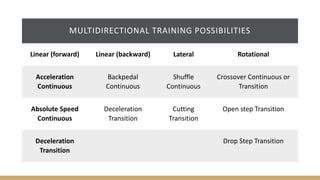
MULTIDIRECTIONAL TRAINING POSSIBILITIES
Linear (forward) Linear (backward) Lateral Rotational
Acceleration
Continuous
Backpedal
Continuous
Shuffle
Continuous
Crossover Continuous or
Transition
Absolute Speed
Continuous
Deceleration
Transition
Cutting
Transition
Open step Transition
Deceleration
Transition
Drop Step Transition
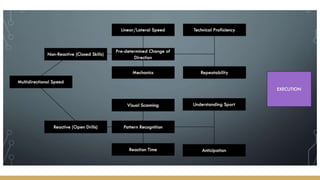
2 MAIN
CATEGORIES…
SO…WHAT’S THE
POINT???
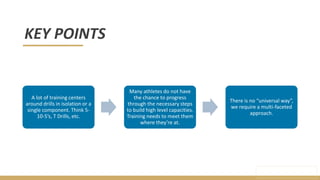
KEY POINTS
A lot of training centers
around drills in isolation or a
single component. Think 5-
10-5’s, T Drills, etc.
Many athletes do not have
the chance to progress
through the necessary steps
to build high level capacities.
Training needs to meet them
where they’re at.
There is no “universal way”,
we require a multi-faceted
approach.
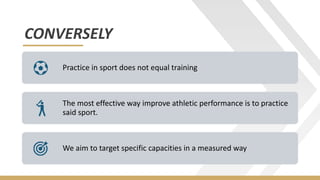
CONVERSELY
Practice in sport does not equal training
The most effective way improve athletic performance is to practice
said sport.
We aim to target specific capacities in a measured way
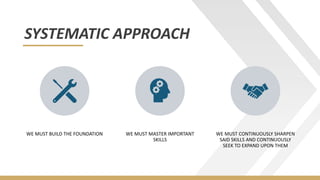
SYSTEMATIC APPROACH
WE MUST BUILD THE FOUNDATION WE MUST MASTER IMPORTANT
SKILLS
WE MUST CONTINUOUSLY SHARPEN
SAID SKILLS AND CONTINUOUSLY
SEEK TO EXPAND UPON THEM
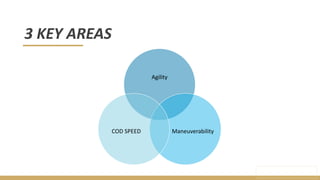
Agility
Maneuverability
COD SPEED
3 KEY AREAS
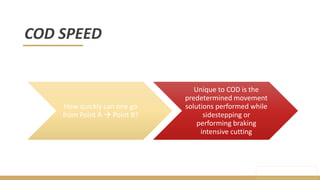
Unique to COD is the
predetermined movement
solutions performed while
sidestepping or
performing braking
intensive cutting
How quickly can one go
from Point A  Point B?
COD SPEED
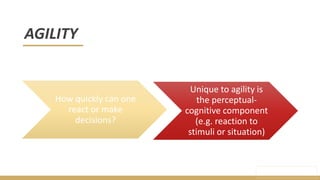
AGILITY
Unique to agility is
the perceptual-
cognitive component
(e.g. reaction to
stimuli or situation)
How quickly can one
react or make
decisions?
Unique to maneuverability is
the use of certain changes in
mode for positioning, not
directly related to maximal
speed and may be tactical (e.g.
transition to side-shuffle)
How will one react? With what
method?
MANEUVERABILITY
THE APPROACH
TIER 1: BUILDING
FOUNDATIONAL
QUALITIES
» Understanding key
principles and building
foundational strength:
▪ Center of mass
▪ Foot striking patterns
▪ Toes to shin
▪ Postures
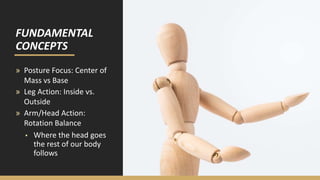
FUNDAMENTAL
CONCEPTS
» Posture Focus: Center of
Mass vs Base
» Leg Action: Inside vs.
Outside
» Arm/Head Action:
Rotation Balance
▪ Where the head goes
the rest of our body
follows
TIER 3: “MASTERY”
» Tasks become increasing complex, higher level reactivity and
anticipation.
▪ Still warm up with foundational qualities
– These skills will atrophy if we aren’t careful.
▪ Introducing different tasks
▪ Introducing different constraints
▪ Manipulating environment
▪ Nonlinear Pedagogy
© 2020 National Strength and Conditioning Association
TASK ELEMENTS
-New or something accustomed too?
-Visual, auditory, etc.?
-Competitive, cognitively demanding, etc.?
-Specific tactics?
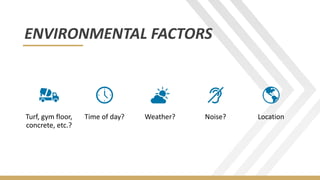
ENVIRONMENTAL FACTORS
Turf, gym floor,
concrete, etc.?
Time of day? Weather? Noise? Location
PERFORMER
» 1v1, 1v2, individual?
» Skill level?
» Motivation?
» Anthropometry
© 2020 National Strength and Conditioning Association
LASTLY, INTEGRATION IS
KEY
Important to integrate into the wider program
-What phase are we in?
-Before or after resistance training?
-Further conditioning required?
-Don’t be afraid to progress and regress
SESSION STRUCTURE
KEY RESOURCES
A SPECIAL THANK YOU TOO:
Brian Kula
John Cole
Darren Krein
Mike Benedict
Mark Ryan
Dan Linsacum
Ryan Swope
Tim Holan
Kristin Heumann

Practical Applications For Multidirectional Training

  • 1.
    © 2020 NationalStrength and Conditioning Association © 2020 National Strength and Conditioning Association PRACTICAL APPLICATIONS FOR MULTI-DIRECTIONAL TRAINING Jimmy Pritchard MSc, RSCC, CSCS, TSAC-F
  • 2.
    CONFLICT OF INTERESTSTATEMENT I have no actual or potential conflict of interest in relation to this presentation.
  • 3.
    WHAT DO WEMEAN BY “MULTIDIRECTIONAL TRAINING?” o Synonymous with many terms: o Agility o Quickness o Foot Speed o Athleticism
  • 4.
    MULTIDIRECTIONAL TRAINING DEFINED “Category ofmovement skills that account for all movements and movement sequences occurring in sport under non- reactive and reactive conditions.”
  • 5.
    WHY IS IT IMPORTANT? •Increases athletic ability (particularly in field sports) • Establishes fundamental movement patterns/principles athletes will require for competitive bouts • Can improve athlete body awareness thereby reducing likelihood of injury
  • 6.
    WIDE VARIETY Multi-directional traininggets overcomplicated rather quickly. Better to take a step back, look at all the possibilities from a 30,000 ft view
  • 7.
    MULTIDIRECTIONAL TRAINING POSSIBILITIES Linear(forward) Linear (backward) Lateral Rotational Acceleration Continuous Backpedal Continuous Shuffle Continuous Crossover Continuous or Transition Absolute Speed Continuous Deceleration Transition Cutting Transition Open step Transition Deceleration Transition Drop Step Transition
  • 8.
  • 10.
  • 11.
    KEY POINTS A lotof training centers around drills in isolation or a single component. Think 5- 10-5’s, T Drills, etc. Many athletes do not have the chance to progress through the necessary steps to build high level capacities. Training needs to meet them where they’re at. There is no “universal way”, we require a multi-faceted approach.
  • 13.
    CONVERSELY Practice in sportdoes not equal training The most effective way improve athletic performance is to practice said sport. We aim to target specific capacities in a measured way
  • 14.
    SYSTEMATIC APPROACH WE MUSTBUILD THE FOUNDATION WE MUST MASTER IMPORTANT SKILLS WE MUST CONTINUOUSLY SHARPEN SAID SKILLS AND CONTINUOUSLY SEEK TO EXPAND UPON THEM
  • 15.
  • 16.
    Unique to CODis the predetermined movement solutions performed while sidestepping or performing braking intensive cutting How quickly can one go from Point A  Point B? COD SPEED
  • 17.
    AGILITY Unique to agilityis the perceptual- cognitive component (e.g. reaction to stimuli or situation) How quickly can one react or make decisions?
  • 18.
    Unique to maneuverabilityis the use of certain changes in mode for positioning, not directly related to maximal speed and may be tactical (e.g. transition to side-shuffle) How will one react? With what method? MANEUVERABILITY
  • 19.
  • 20.
    TIER 1: BUILDING FOUNDATIONAL QUALITIES »Understanding key principles and building foundational strength: ▪ Center of mass ▪ Foot striking patterns ▪ Toes to shin ▪ Postures
  • 21.
    FUNDAMENTAL CONCEPTS » Posture Focus:Center of Mass vs Base » Leg Action: Inside vs. Outside » Arm/Head Action: Rotation Balance ▪ Where the head goes the rest of our body follows
  • 22.
    TIER 3: “MASTERY” »Tasks become increasing complex, higher level reactivity and anticipation. ▪ Still warm up with foundational qualities – These skills will atrophy if we aren’t careful. ▪ Introducing different tasks ▪ Introducing different constraints ▪ Manipulating environment ▪ Nonlinear Pedagogy
  • 23.
    © 2020 NationalStrength and Conditioning Association © 2020 National Strength and Conditioning Association TASK ELEMENTS -New or something accustomed too? -Visual, auditory, etc.? -Competitive, cognitively demanding, etc.? -Specific tactics?
  • 24.
    ENVIRONMENTAL FACTORS Turf, gymfloor, concrete, etc.? Time of day? Weather? Noise? Location
  • 25.
    PERFORMER » 1v1, 1v2,individual? » Skill level? » Motivation? » Anthropometry
  • 26.
    © 2020 NationalStrength and Conditioning Association © 2020 National Strength and Conditioning Association LASTLY, INTEGRATION IS KEY Important to integrate into the wider program -What phase are we in? -Before or after resistance training? -Further conditioning required? -Don’t be afraid to progress and regress
  • 27.
  • 28.
  • 29.
    A SPECIAL THANKYOU TOO: Brian Kula John Cole Darren Krein Mike Benedict Mark Ryan Dan Linsacum Ryan Swope Tim Holan Kristin Heumann