Agility in Team Field Sport
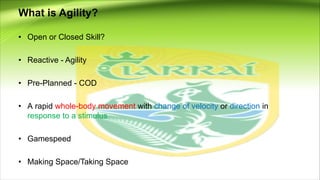
What is Agility?
• Open or Closed Skill?
• Reactive - Agility
• Pre-Planned - COD
• A rapid whole-body movement with change of velocity or direction in
response to a stimulus
• Gamespeed
• Making Space/Taking Space
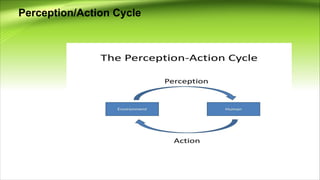
Perception/Action Cycle
OODA Loop
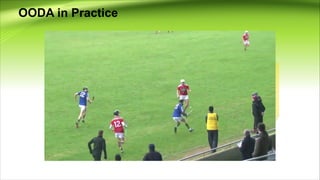
OODA in Practice
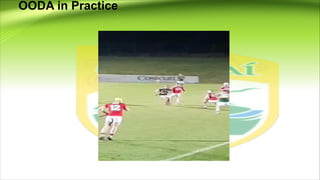
OODA in Practice
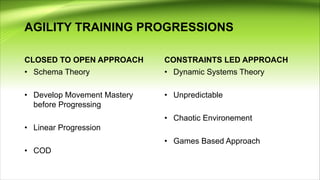
AGILITY TRAINING PROGRESSIONS
CLOSED TO OPEN APPROACH
• Schema Theory
• Develop Movement Mastery
before Progressing
• Linear Progression
• COD
CONSTRAINTS LED APPROACH
• Dynamic Systems Theory
• Unpredictable
• Chaotic Environement
• Games Based Approach
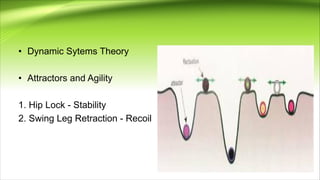
• Dynamic Sytems Theory
• Attractors and Agility
1. Hip Lock - Stability
2. Swing Leg Retraction - Recoil
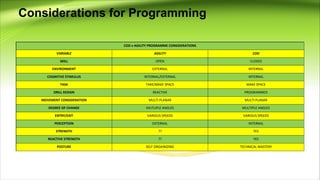
Considerations for Programming
COD v AGILITY PROGRAMME CONSIDERATIONS
VARIABLE AGILITY COD
SKILL OPEN CLOSED
ENVIRONMENT EXTERNAL INTERNAL
COGNITIVE STIMULUS INTERNAL/EXTERNAL INTERNAL
TASK TAKE/MAKE SPACE MAKE SPACE
DRILL DESIGN REACTIVE PROGRAMMED
MOVEMENT CONSIDERATION MULTI PLANAR MULTI PLANAR
DEGREE OF CHANGE MUTLIPLE ANGLES MULTIPLE ANGLES
ENTRY/EXIT VARIOUS SPEEDS VARIOUS SPEEDS
PERCEPTION EXTERNAL INTERNAL
STRENGTH ?? YES
REACTIVE STRENGTH ?? YES
POSTURE SELF ORGAINIZING TECHNICAL MASTERY
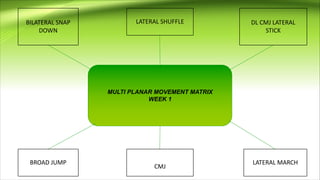
MULTI PLANAR MOVEMENT MATRIX
WEEK 1
BILATERAL SNAP
DOWN
LATERAL SHUFFLE DL CMJ LATERAL
STICK
CMJ
LATERAL MARCHBROAD JUMP
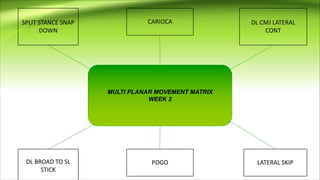
MULTI PLANAR MOVEMENT MATRIX
WEEK 2
SPLIT STANCE SNAP
DOWN
CARIOCA DL CMJ LATERAL
CONT
POGO LATERAL SKIPDL BROAD TO SL
STICK
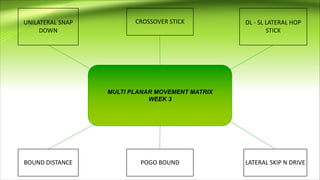
MULTI PLANAR MOVEMENT MATRIX
WEEK 3
UNILATERAL SNAP
DOWN
CROSSOVER STICK DL - SL LATERAL HOP
STICK
POGO BOUND LATERAL SKIP N DRIVEBOUND DISTANCE
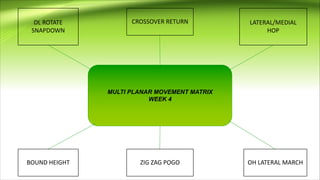
MULTI PLANAR MOVEMENT MATRIX
WEEK 4
DL ROTATE
SNAPDOWN
CROSSOVER RETURN LATERAL/MEDIAL
HOP
ZIG ZAG POGO OH LATERAL MARCHBOUND HEIGHT
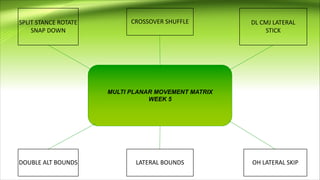
MULTI PLANAR MOVEMENT MATRIX
WEEK 5
SPLIT STANCE ROTATE
SNAP DOWN
CROSSOVER SHUFFLE DL CMJ LATERAL
STICK
LATERAL BOUNDS OH LATERAL SKIPDOUBLE ALT BOUNDS
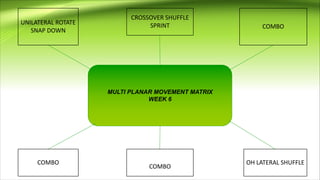
MULTI PLANAR MOVEMENT MATRIX
WEEK 6
UNILATERAL ROTATE
SNAP DOWN
CROSSOVER SHUFFLE
SPRINT COMBO
COMBO
OH LATERAL SHUFFLECOMBO
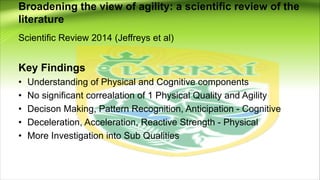
Broadening the view of agility: a scientific review of the
literature
Scientific Review 2014 (Jeffreys et al)
Key Findings
• Understanding of Physical and Cognitive components
• No significant correalation of 1 Physical Quality and Agility
• Decison Making, Pattern Recognition, Anticipation - Cognitive
• Deceleration, Acceleration, Reactive Strength - Physical
• More Investigation into Sub Qualities
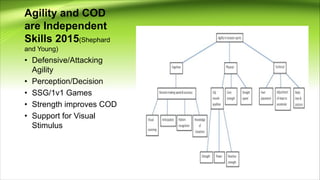
Agility and COD
are Independent
Skills 2015(Shephard
and Young)
• Defensive/Attacking
Agility
• Perception/Decision
• SSG/1v1 Games
• Strength improves COD
• Support for Visual
Stimulus
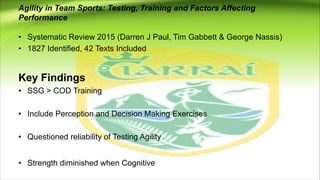
Agility in Team Sports: Testing, Training and Factors Affecting
Performance
• Systematic Review 2015 (Darren J Paul, Tim Gabbett & George Nassis)
• 1827 Identified, 42 Texts Included
Key Findings
• SSG > COD Training
• Include Perception and Decision Making Exercises
• Questioned reliability of Testing Agility
• Strength diminished when Cognitive
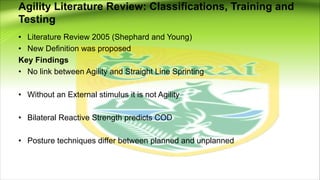
Agility Literature Review: Classifications, Training and
Testing
• Literature Review 2005 (Shephard and Young)
• New Definition was proposed
Key Findings
• No link between Agility and Straight Line Sprinting
• Without an External stimulus it is not Agility
• Bilateral Reactive Strength predicts COD
• Posture techniques differ between planned and unplanned
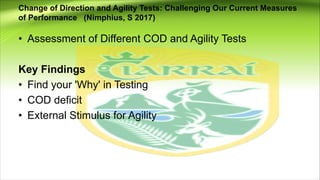
Change of Direction and Agility Tests: Challenging Our Current Measures
of Performance (Nimphius, S 2017)
• Assessment of Different COD and Agility Tests
Key Findings
• Find your 'Why' in Testing
• COD deficit
• External Stimulus for Agility
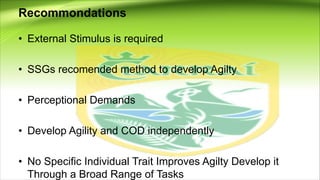
Recommondations
• External Stimulus is required
• SSGs recomended method to develop Agilty
• Perceptional Demands
• Develop Agility and COD independently
• No Specific Individual Trait Improves Agilty Develop it
Through a Broad Range of Tasks
Games Based Drills and Closed Drills Progressions
and Variations
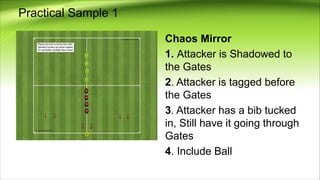
Practical Sample 1
Chaos Mirror
1. Attacker is Shadowed to
the Gates
2. Attacker is tagged before
the Gates
3. Attacker has a bib tucked
in, Still have it going through
Gates
4. Include Ball
Practical Sample 2
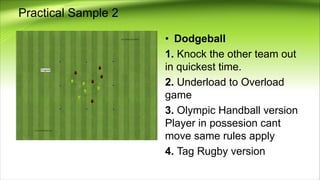
• Dodgeball
1. Knock the other team out
in quickest time.
2. Underload to Overload
game
3. Olympic Handball version
Player in possesion cant
move same rules apply
4. Tag Rugby version
Practical Sample
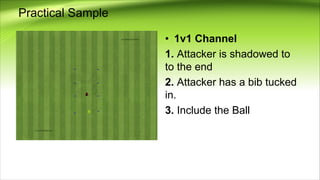
• 1v1 Channel
1. Attacker is shadowed to
to the end
2. Attacker has a bib tucked
in.
3. Include the Ball
Practical Sample
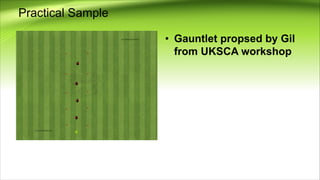
• Gauntlet propsed by Gil
from UKSCA workshop
Practical Sample
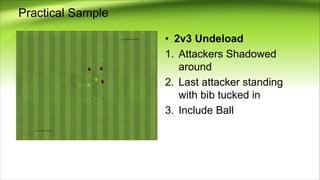
• 2v3 Undeload
1. Attackers Shadowed
around
2. Last attacker standing
with bib tucked in
3. Include Ball
Practical Sample
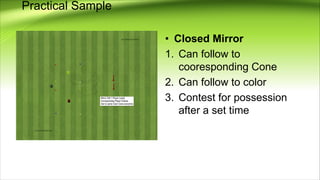
• Closed Mirror
1. Can follow to
cooresponding Cone
2. Can follow to color
3. Contest for possession
after a set time
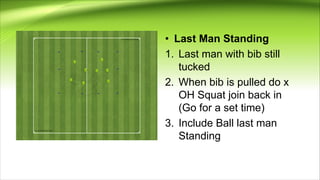
• Last Man Standing
1. Last man with bib still
tucked
2. When bib is pulled do x
OH Squat join back in
(Go for a set time)
3. Include Ball last man
Standing
Practical Sample
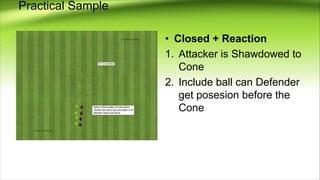
• Closed + Reaction
1. Attacker is Shawdowed to
Cone
2. Include ball can Defender
get posesion before the
Cone
Practical Sample
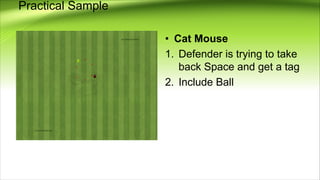
• Cat Mouse
1. Defender is trying to take
back Space and get a tag
2. Include Ball
Practical Sample
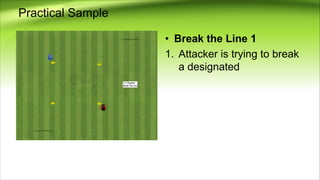
• Break the Line 1
1. Attacker is trying to break
a designated
Practical Sample
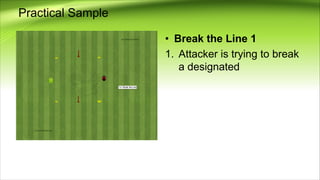
• Break the Line 1
1. Attacker is trying to break
a designated
Practical Sample
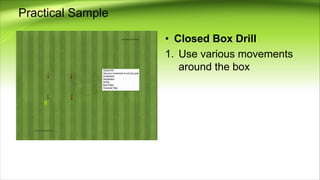
• Closed Box Drill
1. Use various movements
around the box
Resources
• Agility and change of direction speed are independent skills Implications for agility in invasion
sports
• Agility in Team Sports Testing Training and Factors Affecting Performance
• Broadening the view of agility: a scientific review of the literature
• Agility Literature Review: Classifications, Training and Testing
• Change of Direction and Agility Tests: Challenging Our Current Measures of Performance
• Agility training for team sports – running the OODA loop
• Frans Bosch: Strength Training and Coordination: An Integrative Approach, An Anatomy of
Agility
• Ian Jeffreys Gamespeed
• Sophia Nimphus
• Rich Clarke UKSCA
• James Smith Twitter (@theuofstrength)
• Rob Gray - Perception/Action Podcast

Agility team field sport

  • 1.
    Agility in TeamField Sport
  • 2.
    What is Agility? •Open or Closed Skill? • Reactive - Agility • Pre-Planned - COD • A rapid whole-body movement with change of velocity or direction in response to a stimulus • Gamespeed • Making Space/Taking Space
  • 3.
  • 4.
  • 5.
  • 6.
  • 7.
    AGILITY TRAINING PROGRESSIONS CLOSEDTO OPEN APPROACH • Schema Theory • Develop Movement Mastery before Progressing • Linear Progression • COD CONSTRAINTS LED APPROACH • Dynamic Systems Theory • Unpredictable • Chaotic Environement • Games Based Approach
  • 8.
    • Dynamic SytemsTheory • Attractors and Agility 1. Hip Lock - Stability 2. Swing Leg Retraction - Recoil
  • 9.
    Considerations for Programming CODv AGILITY PROGRAMME CONSIDERATIONS VARIABLE AGILITY COD SKILL OPEN CLOSED ENVIRONMENT EXTERNAL INTERNAL COGNITIVE STIMULUS INTERNAL/EXTERNAL INTERNAL TASK TAKE/MAKE SPACE MAKE SPACE DRILL DESIGN REACTIVE PROGRAMMED MOVEMENT CONSIDERATION MULTI PLANAR MULTI PLANAR DEGREE OF CHANGE MUTLIPLE ANGLES MULTIPLE ANGLES ENTRY/EXIT VARIOUS SPEEDS VARIOUS SPEEDS PERCEPTION EXTERNAL INTERNAL STRENGTH ?? YES REACTIVE STRENGTH ?? YES POSTURE SELF ORGAINIZING TECHNICAL MASTERY
  • 10.
    MULTI PLANAR MOVEMENTMATRIX WEEK 1 BILATERAL SNAP DOWN LATERAL SHUFFLE DL CMJ LATERAL STICK CMJ LATERAL MARCHBROAD JUMP
  • 11.
    MULTI PLANAR MOVEMENTMATRIX WEEK 2 SPLIT STANCE SNAP DOWN CARIOCA DL CMJ LATERAL CONT POGO LATERAL SKIPDL BROAD TO SL STICK
  • 12.
    MULTI PLANAR MOVEMENTMATRIX WEEK 3 UNILATERAL SNAP DOWN CROSSOVER STICK DL - SL LATERAL HOP STICK POGO BOUND LATERAL SKIP N DRIVEBOUND DISTANCE
  • 13.
    MULTI PLANAR MOVEMENTMATRIX WEEK 4 DL ROTATE SNAPDOWN CROSSOVER RETURN LATERAL/MEDIAL HOP ZIG ZAG POGO OH LATERAL MARCHBOUND HEIGHT
  • 14.
    MULTI PLANAR MOVEMENTMATRIX WEEK 5 SPLIT STANCE ROTATE SNAP DOWN CROSSOVER SHUFFLE DL CMJ LATERAL STICK LATERAL BOUNDS OH LATERAL SKIPDOUBLE ALT BOUNDS
  • 15.
    MULTI PLANAR MOVEMENTMATRIX WEEK 6 UNILATERAL ROTATE SNAP DOWN CROSSOVER SHUFFLE SPRINT COMBO COMBO OH LATERAL SHUFFLECOMBO
  • 16.
    Broadening the viewof agility: a scientific review of the literature Scientific Review 2014 (Jeffreys et al) Key Findings • Understanding of Physical and Cognitive components • No significant correalation of 1 Physical Quality and Agility • Decison Making, Pattern Recognition, Anticipation - Cognitive • Deceleration, Acceleration, Reactive Strength - Physical • More Investigation into Sub Qualities
  • 17.
    Agility and COD areIndependent Skills 2015(Shephard and Young) • Defensive/Attacking Agility • Perception/Decision • SSG/1v1 Games • Strength improves COD • Support for Visual Stimulus
  • 18.
    Agility in TeamSports: Testing, Training and Factors Affecting Performance • Systematic Review 2015 (Darren J Paul, Tim Gabbett & George Nassis) • 1827 Identified, 42 Texts Included Key Findings • SSG > COD Training • Include Perception and Decision Making Exercises • Questioned reliability of Testing Agility • Strength diminished when Cognitive
  • 19.
    Agility Literature Review:Classifications, Training and Testing • Literature Review 2005 (Shephard and Young) • New Definition was proposed Key Findings • No link between Agility and Straight Line Sprinting • Without an External stimulus it is not Agility • Bilateral Reactive Strength predicts COD • Posture techniques differ between planned and unplanned
  • 20.
    Change of Directionand Agility Tests: Challenging Our Current Measures of Performance (Nimphius, S 2017) • Assessment of Different COD and Agility Tests Key Findings • Find your 'Why' in Testing • COD deficit • External Stimulus for Agility
  • 21.
    Recommondations • External Stimulusis required • SSGs recomended method to develop Agilty • Perceptional Demands • Develop Agility and COD independently • No Specific Individual Trait Improves Agilty Develop it Through a Broad Range of Tasks
  • 22.
    Games Based Drillsand Closed Drills Progressions and Variations
  • 23.
    Practical Sample 1 ChaosMirror 1. Attacker is Shadowed to the Gates 2. Attacker is tagged before the Gates 3. Attacker has a bib tucked in, Still have it going through Gates 4. Include Ball
  • 24.
    Practical Sample 2 •Dodgeball 1. Knock the other team out in quickest time. 2. Underload to Overload game 3. Olympic Handball version Player in possesion cant move same rules apply 4. Tag Rugby version
  • 25.
    Practical Sample • 1v1Channel 1. Attacker is shadowed to to the end 2. Attacker has a bib tucked in. 3. Include the Ball
  • 26.
    Practical Sample • Gauntletpropsed by Gil from UKSCA workshop
  • 27.
    Practical Sample • 2v3Undeload 1. Attackers Shadowed around 2. Last attacker standing with bib tucked in 3. Include Ball
  • 28.
    Practical Sample • ClosedMirror 1. Can follow to cooresponding Cone 2. Can follow to color 3. Contest for possession after a set time
  • 29.
    • Last ManStanding 1. Last man with bib still tucked 2. When bib is pulled do x OH Squat join back in (Go for a set time) 3. Include Ball last man Standing
  • 30.
    Practical Sample • Closed+ Reaction 1. Attacker is Shawdowed to Cone 2. Include ball can Defender get posesion before the Cone
  • 31.
    Practical Sample • CatMouse 1. Defender is trying to take back Space and get a tag 2. Include Ball
  • 32.
    Practical Sample • Breakthe Line 1 1. Attacker is trying to break a designated
  • 33.
    Practical Sample • Breakthe Line 1 1. Attacker is trying to break a designated
  • 34.
    Practical Sample • ClosedBox Drill 1. Use various movements around the box
  • 35.
    Resources • Agility andchange of direction speed are independent skills Implications for agility in invasion sports • Agility in Team Sports Testing Training and Factors Affecting Performance • Broadening the view of agility: a scientific review of the literature • Agility Literature Review: Classifications, Training and Testing • Change of Direction and Agility Tests: Challenging Our Current Measures of Performance • Agility training for team sports – running the OODA loop • Frans Bosch: Strength Training and Coordination: An Integrative Approach, An Anatomy of Agility • Ian Jeffreys Gamespeed • Sophia Nimphus • Rich Clarke UKSCA • James Smith Twitter (@theuofstrength) • Rob Gray - Perception/Action Podcast