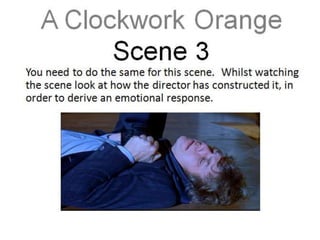
A Clockwork Orange – Final
session
Session aims and outcomes
Construction – Micro Elements
• Camerawork
• Character alignment
• Narrative
• Sound
• Mise en scene
• Editing
• Emotional response to topic
15 mins Task
• You have 15 mins to watch these clips and
decide how the Director has constructed it to
create an emotion response from the
audience
• Extension: Link to the theories how might
different audiences view it?
Pleasure
Stories gain emotional responses from listeners, readers or viewers.
Effective storytelling encourages us to feel human emotions by
allowing us to sympathise, empathise or even identify with characters
and their narrative experiences. As spectators (and as readers) we
presumably find this process to be pleasureable or we would not
return time after time to films (and stories), but in what ways is it
pleasurable? Entering the window of the hotel room at the opening to
Psycho would seem to encourage the notion of film as voyeuristically
pleasurable, but what is the connection between voyeurism and
emotional response? What sorts of emotional response does
voyeurism bring about? Are we being permitted to give rein to a type
of human interest in others that might more normally be considered
socially unacceptable? If so, what sorts of emotion do we experience
at this point?
Pleasure
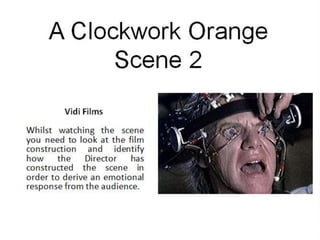
• What sort of pleasure do audiences get from
watching the eye lid scene in “Clockwork
Orange”?
• Think of a film and a specific scene within it
and explain what pleasure there could be in
watching it….
Remember link to theories
• Key Theories
Hypodermic Needle Model
• HYPODERMIC NEEDLE MODEL: Also referred to as Magic Bullet Theory.
Hypodermic Needles are needles which put things in, most commonly we think
• of hypodermic needles being used by drug addicts.
• Therefore the Hypodermic Needle Model explains that people watch/read media
texts and they believe every part of every media message they are told. They
consume
• it like a drug straight into the brain. It is the effect of BRAINWASHING someone. If
the hypodermic needle model is to be believed then audiences are PASSIVE.
• This theory fits well into the concept of advertising- if the concepts of “the best
product on the market” and “you can’t do without one of these” are reinforced
during adverts then people will believe they need them and therefore buy the
products.
Uses and Gratifications
• Communication is never a simple matter of sending a message to a receiver as if
delivering a parcel, but involves interactive participation by the receiver. Stuart
Hall described three main ways spectators tend to respond to the way they are
positioned.
A preferred reading: where spectators accept the response and
point of view that filmmakers intended.
•An oppositional reading: where spectators reject the response and point of view that
filmmakers intended.
A negotiated reading: where spectators only partially accept the response and point
of view that filmmakers intended (modifying it with views of their own, treating it with
some scepticism).
Emotional response is very closely linked to the opinions and points of view, values
and attitudes which films convey. That is a reminder that a powerful way of raising
issue is by appealing to an emotion.
Uses and Gratifications
Some “Uses” and “Gratifications” for Audience
members include:
Diversion: escape or emotional release from daily
pressure
Personal Relationship: virtual companionship &
sociability of discussing TV with others.
Personal Identity: comparing your existence with
what you see.
Surveillance: finding out what’s going on in the
world- Voyeurism.
Projecting Illusion: Film spectatorship and the
impression of reality
(Richard Allen)
• “Contemporary film theorists argue that, for a
number of reasons, the cinematic image appears to
spectators as if it were reality, but this appearance is
an illusion. In fact, the cinematic image provides an
impression of reality…”
• “Cinema is a form of signification that creates the
appearance of a knowable reality and hence
confirms the self definition of the human subject as
someone capable of knowing that reality… the reality
are the “effects” of a process of signification”
Projecting Illusion: Film spectatorship and the
impression of reality
(Richard Allen)
• “Contemporary film theorists construe the film
spectator as a passive observer of the image who is
duped into believing that it is real. In fact, as I shall
argue, the film spectator knows it is only a film and
actively participates in the experience of illusion that
the cinema affords.”
Feminist Readings
• It is worth noting that some films may evoke
certain responses from feminists and or
different ethnic groups etc
Task
• In groups Write an answer to the following
question:
• Group 1: In a Clockwork Orange 2 how far do
you think the Director is able to manipulate
the audience into an emotional response (link
to “uses and gratifications model”)
Group 2: Do the same linking to “Hypodermic
Needle Model”
Extended Task
• You will need to select three films which you
feel evoke a strong emotional response from
the audience. You will study these in depth
and ultimately respond to example exam
questions on them.
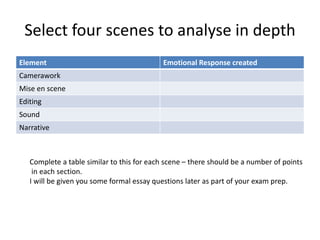
Select four scenes to analyse in depth
Element Emotional Response created
Camerawork
Mise en scene
Editing
Sound
Narrative
Complete a table similar to this for each scene – there should be a number of points
in each section.
I will be given you some formal essay questions later as part of your exam prep.

A clockwork orange – final session

  • 1.
    A Clockwork Orange– Final session
  • 2.
  • 3.
    Construction – MicroElements • Camerawork • Character alignment • Narrative • Sound • Mise en scene • Editing • Emotional response to topic
  • 6.
    15 mins Task •You have 15 mins to watch these clips and decide how the Director has constructed it to create an emotion response from the audience • Extension: Link to the theories how might different audiences view it?
  • 7.
    Pleasure Stories gain emotionalresponses from listeners, readers or viewers. Effective storytelling encourages us to feel human emotions by allowing us to sympathise, empathise or even identify with characters and their narrative experiences. As spectators (and as readers) we presumably find this process to be pleasureable or we would not return time after time to films (and stories), but in what ways is it pleasurable? Entering the window of the hotel room at the opening to Psycho would seem to encourage the notion of film as voyeuristically pleasurable, but what is the connection between voyeurism and emotional response? What sorts of emotional response does voyeurism bring about? Are we being permitted to give rein to a type of human interest in others that might more normally be considered socially unacceptable? If so, what sorts of emotion do we experience at this point?
  • 8.
    Pleasure • What sortof pleasure do audiences get from watching the eye lid scene in “Clockwork Orange”? • Think of a film and a specific scene within it and explain what pleasure there could be in watching it….
  • 9.
    Remember link totheories • Key Theories
  • 10.
    Hypodermic Needle Model •HYPODERMIC NEEDLE MODEL: Also referred to as Magic Bullet Theory. Hypodermic Needles are needles which put things in, most commonly we think • of hypodermic needles being used by drug addicts. • Therefore the Hypodermic Needle Model explains that people watch/read media texts and they believe every part of every media message they are told. They consume • it like a drug straight into the brain. It is the effect of BRAINWASHING someone. If the hypodermic needle model is to be believed then audiences are PASSIVE. • This theory fits well into the concept of advertising- if the concepts of “the best product on the market” and “you can’t do without one of these” are reinforced during adverts then people will believe they need them and therefore buy the products.
  • 11.
    Uses and Gratifications •Communication is never a simple matter of sending a message to a receiver as if delivering a parcel, but involves interactive participation by the receiver. Stuart Hall described three main ways spectators tend to respond to the way they are positioned. A preferred reading: where spectators accept the response and point of view that filmmakers intended. •An oppositional reading: where spectators reject the response and point of view that filmmakers intended. A negotiated reading: where spectators only partially accept the response and point of view that filmmakers intended (modifying it with views of their own, treating it with some scepticism). Emotional response is very closely linked to the opinions and points of view, values and attitudes which films convey. That is a reminder that a powerful way of raising issue is by appealing to an emotion.
  • 12.
    Uses and Gratifications Some“Uses” and “Gratifications” for Audience members include: Diversion: escape or emotional release from daily pressure Personal Relationship: virtual companionship & sociability of discussing TV with others. Personal Identity: comparing your existence with what you see. Surveillance: finding out what’s going on in the world- Voyeurism.
  • 13.
    Projecting Illusion: Filmspectatorship and the impression of reality (Richard Allen) • “Contemporary film theorists argue that, for a number of reasons, the cinematic image appears to spectators as if it were reality, but this appearance is an illusion. In fact, the cinematic image provides an impression of reality…” • “Cinema is a form of signification that creates the appearance of a knowable reality and hence confirms the self definition of the human subject as someone capable of knowing that reality… the reality are the “effects” of a process of signification”
  • 14.
    Projecting Illusion: Filmspectatorship and the impression of reality (Richard Allen) • “Contemporary film theorists construe the film spectator as a passive observer of the image who is duped into believing that it is real. In fact, as I shall argue, the film spectator knows it is only a film and actively participates in the experience of illusion that the cinema affords.”
  • 15.
    Feminist Readings • Itis worth noting that some films may evoke certain responses from feminists and or different ethnic groups etc
  • 16.
    Task • In groupsWrite an answer to the following question: • Group 1: In a Clockwork Orange 2 how far do you think the Director is able to manipulate the audience into an emotional response (link to “uses and gratifications model”) Group 2: Do the same linking to “Hypodermic Needle Model”
  • 17.
    Extended Task • Youwill need to select three films which you feel evoke a strong emotional response from the audience. You will study these in depth and ultimately respond to example exam questions on them.
  • 18.
    Select four scenesto analyse in depth Element Emotional Response created Camerawork Mise en scene Editing Sound Narrative Complete a table similar to this for each scene – there should be a number of points in each section. I will be given you some formal essay questions later as part of your exam prep.