Chest Pain
Diabetic
Emergencies
Cardiac
Arrest
Respiratory
Distress
Orthopedic
Injuries
Medications Picture ID
100 100
200
300
100 100100
200
300
400
500
100
200
300
400
500
100
200
300
400
500
100
200
300
400
500
100
200
300
400
500
100
200
300
400
500
100
200
300
400
500
What is the first medication given to a cardiac patient
complaining of chest pain?
Chest Pain 100
Oxygen
Chest Pain 100
What is the normal dose for Oxygen with
patient on a nasal cannula?
Chest Pain 200
2 to 6 Liters Per Minute
Chest Pain 200
What is one thing you should always try to
obtain as part of your assessment, even if you
are not allowed to interpret it?
Chest Pain 300
12 Lead ECG / EKG
Chest Pain 300
Chest Pain 400
What is the dose for Aspirin?
325 mg PO
Actual dose is 324 mg PO, since the aspirin is 81 mg each = 4 tablets X 81 mg
Chest Pain 400
What is the main contraindication for
use of Nitro?
Chest Pain 500
Systolic blood pressure below 100 mmHg
Chest Pain 500
At what general level of blood sugar do we
become concerned if our patient is not
really responsive to us?
Diabetic 100
Less than 60 mg/dl
Diabetic 100
How many grams of sugar are in the oral
glucose that we, normally carry?
Diabetic 200
15 grams of sugar
Diabetic 200
How can an EMT give glucagon or can
they?
Diabetic 300
Yes they can, by Auto Injector
Which is not available on the market yet.
Diabetic 300
What is the normal dose of Glucagon?
Diabetic 400
0.5 – 1 mg Auto injector for EMT
0.5 – 1 mg IM for AEMT & Paramedic
Diabetic 400
How many grams of dextrose is there in a
normal amp of D50?
Diabetic 500
25 grams of dextrose
Diabetic 500
What should be assessed first on a cardiac
arrest patient?
Cardiac Arrest 100
A – Airway
B – Breathing
C – Circulation
Cardiac Arrest 100
What should be done first if, you have a
bag valve mask and AED present?
Cardiac Arrest 200
Start compressions while you apply the
AED
Cardiac Arrest 200
What are the two rhythms that are
shockable?
Cardiac Arrest 300
Ventricular Tachycardia
Ventricular Fibrillation
Cardiac Arrest 300
What is the first medication, after oxygen,
on any cardiac arrest and dose?
Cardiac Arrest 400
1mg - Epinephrine 1:10,000
Cardiac Arrest 400
What is the dose and repeat dose for
amiodarone in a pulseless patient?
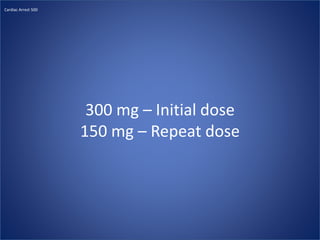
Cardiac Arrest 500
300 mg – Initial dose
150 mg – Repeat dose
Cardiac Arrest 500
At what dose should you administer
oxygen with a patient with severe
respiratory distress, but has COPD?
Respiratory Distress 100
15 LPM via non-rebreather
The lack of oxygen out ranks the COPD, and generally you will not knock out the
respiratory drive in the short amount of time we have them.
Respiratory Distress 100
What are 4 general things should you note
when taking your vitals, history, and
physical assessment?
Respiratory Distress 200
Lung Sounds
Distal Edema
O2 Saturation
Respiratory Rate
Respiratory Distress 200
What is the concentration of Albuterol we
carry and how is it administered?
Respiratory Distress 300
2.5 mg in 3 mills and is placed in nebulizer.
Oxygen at 6 LPM is connected and ran until
the fluid is gone.
Respiratory Distress 300
What should you do if your patient is
showing non-severe respiratory distress
and doesn’t fall in any of the normal
categories of respiratory distress?
Respiratory Distress 400
Transport and contact medical control.
Respiratory Distress 400
What are 4 additional drugs that a
paramedic can use on a patient with acute
congestive heart failure and the normal
doses per protocol?
Respiratory Distress 500
Lasix – 20 – 80 mg over 2 minutes
Nitroglycerin – 0.4 mg – max dose 1.2 mg
Morphine 2 – 5 mg
Dopamine – 2 – 20 mcg/kg/min
Respiratory Distress 500
What are the 4 neurovascular that should
be assessed before and after splinting?
Orthopedic Injuries 100
Pulse
Capillary refill
Movement
Sensation
Orthopedic Injuries 100
We carry 4 splints that could be used for a
leg injury. What are they?
Orthopedic Injuries 200
Vacuum Splint
Hare Traction
Rigid Splint
Reel Splint
Orthopedic Injuries 200
How do you determine if the splint is the
appropriate size?
Orthopedic Injuries 300
It immobilizes the joint above and below
the injury.
Orthopedic Injuries 300
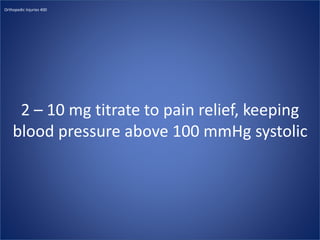
What is the normal dose of Morphine?
Orthopedic Injuries 400
2 – 10 mg titrate to pain relief, keeping
blood pressure above 100 mmHg systolic
Orthopedic Injuries 400
What is a severe side effect of morphine
that needs to be constantly monitored,
other than hypotension?
Orthopedic Injuries 500
Respiratory Depression
Orthopedic Injuries 500
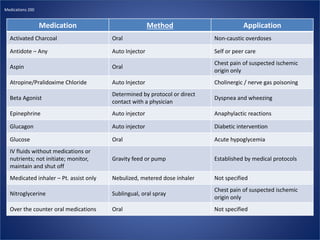
What are the medications that an EMR can
administer , per the state medication list?
Medications 100
Medication Method Application
Antidote – any Auto Injector Self or peer care
Aspirin Oral
Chest pain of suspected ischemic origin
only
Atropine/Pralidoxime
Chloride
Auto injector Cholinergic/nerve gas poisoning
Epinephrine Auto Injector Anaphylactic Reactions
Glucose Oral Acute hypoglycemia
Medicated Inhaler –
Pt. Assist only
Nebulizer or
metered dose
Acute asthmatic attacks, bronchospasm
Medications 100
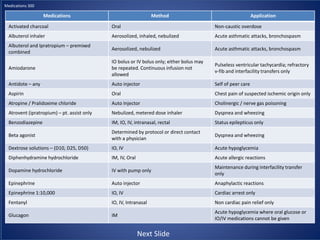
What are the medications that an EMT can
administer , per the state medication list?
Medications 200
Medication Method Application
Activated Charcoal Oral Non-caustic overdoses
Antidote – Any Auto Injector Self or peer care
Aspin Oral
Chest pain of suspected ischemic
origin only
Atropine/Pralidoxime Chloride Auto Injector Cholinergic / nerve gas poisoning
Beta Agonist
Determined by protocol or direct
contact with a physician
Dyspnea and wheezing
Epinephrine Auto injector Anaphylactic reactions
Glucagon Auto injector Diabetic intervention
Glucose Oral Acute hypoglycemia
IV fluids without medications or
nutrients; not initiate; monitor,
maintain and shut off
Gravity feed or pump Established by medical protocols
Medicated inhaler – Pt. assist only Nebulized, metered dose inhaler Not specified
Nitroglycerine Sublingual, oral spray
Chest pain of suspected ischemic
origin only
Over the counter oral medications Oral Not specified
Medications 200
What are the medications that an AEMT
can administer, per the state medication
list?
Medications 300
Medications Method Application
Activated charcoal Oral Non-caustic overdose
Albuterol inhaler Aerosolized, inhaled, nebulized Acute asthmatic attacks, bronchospasm
Albuterol and Ipratropium – premixed
combined
Aerosolized, nebulized Acute asthmatic attacks, bronchospasm
Amiodarone
IO bolus or IV bolus only; either bolus may
be repeated. Continuous infusion not
allowed
Pulseless ventricular tachycardia; refractory
v-fib and interfacility transfers only
Antidote – any Auto injector Self of peer care
Aspirin Oral Chest pain of suspected ischemic origin only
Atropine / Pralidoxime chloride Auto Injector Cholinergic / nerve gas poisoning
Atrovent (ipratropium) – pt. assist only Nebulized, metered dose inhaler Dyspnea and wheezing
Benzodiazepine IM, IO, IV, intranasal, rectal Status epilepticus only
Beta agonist
Determined by protocol or direct contact
with a physician
Dyspnea and wheezing
Dextrose solutions – (D10, D25, D50) IO, IV Acute hypoglycemia
Diphenhydramine hydrochloride IM, IV, Oral Acute allergic reactions
Dopamine hydrochloride IV with pump only
Maintenance during interfacility transfer
only
Epinephrine Auto injector Anaphylactic reactions
Epinephrine 1:10,000 IO, IV Cardiac arrest only
Fentanyl IO, IV, Intranasal Non cardiac pain relief only
Glucagon IM
Acute hypoglycemia where oral glucose or
IO/IV medications cannot be given
Next Slide
Medications 300
Medications Method Application
Glucose Oral Acute hypoglycemia
Ipratropium Nebulized, inhalation Acute asthmatic attacks, bronchospasm
IV electrolytes/antibiotic additives IV pump only
Maintenance during interfacility transfer
only
IV fluids without medications or nutrients;
monitor, maintain and shut off
IV gravity or pump Established by medical protocol
IV solutions – any combination of fluids IO, IV
Medication administration, volume
expansion
Lidocaine
IO bolus or IV bolus only; either bolus may
be repeated. Continuous infusion not
allowed.
Pulseless ventricular tachycardia; refractory
v-fib and interfacility transfers only
Medicated inhaler – pt. assisted only Nebulized or metered dose Acute asthmatic attacks, bronchospasm
Morphine IO, IV Noncardiac pain relief only
Naloxone IM, IO, IV, SQ, Intranasal Reversal of narcotic overdose
Nitroglycerine/nitro preparation Dermal, oral, oral spray sublingual Anginal pain relief
Nitrous oxide Inhalation Pain relief
Ondansetron Oral, IV, IO, IM Nausea/vomiting
Over the counter oral medications Oral Not specified
Keep in mind some AEMT protocols for medication administration state “Consider
pain control with direct contact with Medical or Service Director”
Medications 300
What is common name for Ondansetron
and its dose?
Medications 400
Zofran – 4mg oral or IV
Medications 400
What are some contraindications for
administration of nitroglycerin?
Medications 500
Hypersensitivity
Systolic BP less than 100 mmHg
Erectile dysfunction medication in the last
24 hours
Severe anemia
Increased intracranial pressure
Medications 500
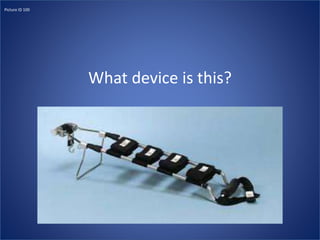
What device is this?
Picture ID 100
Hare Traction
Picture ID 100
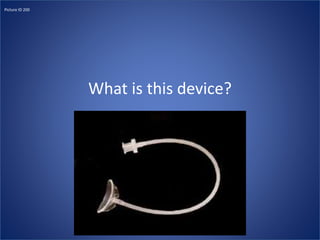
What is this device?
Picture ID 200
Morgan Lens
Picture ID 200
What size catheter is this?
Picture ID 300
20 gauge
Picture ID 300
What is this device?
Picture ID 400
Capnography nasal sampling line
Picture ID 400
What is this device?
Picture ID 400
CPR assistance device to help with chest
recoil
Picture ID 400

EMS ppt Jeopardy game

  • 1.
    Chest Pain Diabetic Emergencies Cardiac Arrest Respiratory Distress Orthopedic Injuries Medications PictureID 100 100 200 300 100 100100 200 300 400 500 100 200 300 400 500 100 200 300 400 500 100 200 300 400 500 100 200 300 400 500 100 200 300 400 500 100 200 300 400 500
  • 2.
    What is thefirst medication given to a cardiac patient complaining of chest pain? Chest Pain 100
  • 3.
  • 4.
    What is thenormal dose for Oxygen with patient on a nasal cannula? Chest Pain 200
  • 5.
    2 to 6Liters Per Minute Chest Pain 200
  • 6.
    What is onething you should always try to obtain as part of your assessment, even if you are not allowed to interpret it? Chest Pain 300
  • 7.
    12 Lead ECG/ EKG Chest Pain 300
  • 8.
    Chest Pain 400 Whatis the dose for Aspirin?
  • 9.
    325 mg PO Actualdose is 324 mg PO, since the aspirin is 81 mg each = 4 tablets X 81 mg Chest Pain 400
  • 10.
    What is themain contraindication for use of Nitro? Chest Pain 500
  • 11.
    Systolic blood pressurebelow 100 mmHg Chest Pain 500
  • 12.
    At what generallevel of blood sugar do we become concerned if our patient is not really responsive to us? Diabetic 100
  • 13.
    Less than 60mg/dl Diabetic 100
  • 14.
    How many gramsof sugar are in the oral glucose that we, normally carry? Diabetic 200
  • 15.
    15 grams ofsugar Diabetic 200
  • 16.
    How can anEMT give glucagon or can they? Diabetic 300
  • 17.
    Yes they can,by Auto Injector Which is not available on the market yet. Diabetic 300
  • 18.
    What is thenormal dose of Glucagon? Diabetic 400
  • 19.
    0.5 – 1mg Auto injector for EMT 0.5 – 1 mg IM for AEMT & Paramedic Diabetic 400
  • 20.
    How many gramsof dextrose is there in a normal amp of D50? Diabetic 500
  • 21.
    25 grams ofdextrose Diabetic 500
  • 22.
    What should beassessed first on a cardiac arrest patient? Cardiac Arrest 100
  • 23.
    A – Airway B– Breathing C – Circulation Cardiac Arrest 100
  • 24.
    What should bedone first if, you have a bag valve mask and AED present? Cardiac Arrest 200
  • 25.
    Start compressions whileyou apply the AED Cardiac Arrest 200
  • 26.
    What are thetwo rhythms that are shockable? Cardiac Arrest 300
  • 27.
  • 28.
    What is thefirst medication, after oxygen, on any cardiac arrest and dose? Cardiac Arrest 400
  • 29.
    1mg - Epinephrine1:10,000 Cardiac Arrest 400
  • 30.
    What is thedose and repeat dose for amiodarone in a pulseless patient? Cardiac Arrest 500
  • 31.
    300 mg –Initial dose 150 mg – Repeat dose Cardiac Arrest 500
  • 32.
    At what doseshould you administer oxygen with a patient with severe respiratory distress, but has COPD? Respiratory Distress 100
  • 33.
    15 LPM vianon-rebreather The lack of oxygen out ranks the COPD, and generally you will not knock out the respiratory drive in the short amount of time we have them. Respiratory Distress 100
  • 34.
    What are 4general things should you note when taking your vitals, history, and physical assessment? Respiratory Distress 200
  • 35.
    Lung Sounds Distal Edema O2Saturation Respiratory Rate Respiratory Distress 200
  • 36.
    What is theconcentration of Albuterol we carry and how is it administered? Respiratory Distress 300
  • 37.
    2.5 mg in3 mills and is placed in nebulizer. Oxygen at 6 LPM is connected and ran until the fluid is gone. Respiratory Distress 300
  • 38.
    What should youdo if your patient is showing non-severe respiratory distress and doesn’t fall in any of the normal categories of respiratory distress? Respiratory Distress 400
  • 39.
    Transport and contactmedical control. Respiratory Distress 400
  • 40.
    What are 4additional drugs that a paramedic can use on a patient with acute congestive heart failure and the normal doses per protocol? Respiratory Distress 500
  • 41.
    Lasix – 20– 80 mg over 2 minutes Nitroglycerin – 0.4 mg – max dose 1.2 mg Morphine 2 – 5 mg Dopamine – 2 – 20 mcg/kg/min Respiratory Distress 500
  • 42.
    What are the4 neurovascular that should be assessed before and after splinting? Orthopedic Injuries 100
  • 43.
  • 44.
    We carry 4splints that could be used for a leg injury. What are they? Orthopedic Injuries 200
  • 45.
    Vacuum Splint Hare Traction RigidSplint Reel Splint Orthopedic Injuries 200
  • 46.
    How do youdetermine if the splint is the appropriate size? Orthopedic Injuries 300
  • 47.
    It immobilizes thejoint above and below the injury. Orthopedic Injuries 300
  • 48.
    What is thenormal dose of Morphine? Orthopedic Injuries 400
  • 49.
    2 – 10mg titrate to pain relief, keeping blood pressure above 100 mmHg systolic Orthopedic Injuries 400
  • 50.
    What is asevere side effect of morphine that needs to be constantly monitored, other than hypotension? Orthopedic Injuries 500
  • 51.
  • 52.
    What are themedications that an EMR can administer , per the state medication list? Medications 100
  • 53.
    Medication Method Application Antidote– any Auto Injector Self or peer care Aspirin Oral Chest pain of suspected ischemic origin only Atropine/Pralidoxime Chloride Auto injector Cholinergic/nerve gas poisoning Epinephrine Auto Injector Anaphylactic Reactions Glucose Oral Acute hypoglycemia Medicated Inhaler – Pt. Assist only Nebulizer or metered dose Acute asthmatic attacks, bronchospasm Medications 100
  • 54.
    What are themedications that an EMT can administer , per the state medication list? Medications 200
  • 55.
    Medication Method Application ActivatedCharcoal Oral Non-caustic overdoses Antidote – Any Auto Injector Self or peer care Aspin Oral Chest pain of suspected ischemic origin only Atropine/Pralidoxime Chloride Auto Injector Cholinergic / nerve gas poisoning Beta Agonist Determined by protocol or direct contact with a physician Dyspnea and wheezing Epinephrine Auto injector Anaphylactic reactions Glucagon Auto injector Diabetic intervention Glucose Oral Acute hypoglycemia IV fluids without medications or nutrients; not initiate; monitor, maintain and shut off Gravity feed or pump Established by medical protocols Medicated inhaler – Pt. assist only Nebulized, metered dose inhaler Not specified Nitroglycerine Sublingual, oral spray Chest pain of suspected ischemic origin only Over the counter oral medications Oral Not specified Medications 200
  • 56.
    What are themedications that an AEMT can administer, per the state medication list? Medications 300
  • 57.
    Medications Method Application Activatedcharcoal Oral Non-caustic overdose Albuterol inhaler Aerosolized, inhaled, nebulized Acute asthmatic attacks, bronchospasm Albuterol and Ipratropium – premixed combined Aerosolized, nebulized Acute asthmatic attacks, bronchospasm Amiodarone IO bolus or IV bolus only; either bolus may be repeated. Continuous infusion not allowed Pulseless ventricular tachycardia; refractory v-fib and interfacility transfers only Antidote – any Auto injector Self of peer care Aspirin Oral Chest pain of suspected ischemic origin only Atropine / Pralidoxime chloride Auto Injector Cholinergic / nerve gas poisoning Atrovent (ipratropium) – pt. assist only Nebulized, metered dose inhaler Dyspnea and wheezing Benzodiazepine IM, IO, IV, intranasal, rectal Status epilepticus only Beta agonist Determined by protocol or direct contact with a physician Dyspnea and wheezing Dextrose solutions – (D10, D25, D50) IO, IV Acute hypoglycemia Diphenhydramine hydrochloride IM, IV, Oral Acute allergic reactions Dopamine hydrochloride IV with pump only Maintenance during interfacility transfer only Epinephrine Auto injector Anaphylactic reactions Epinephrine 1:10,000 IO, IV Cardiac arrest only Fentanyl IO, IV, Intranasal Non cardiac pain relief only Glucagon IM Acute hypoglycemia where oral glucose or IO/IV medications cannot be given Next Slide Medications 300
  • 58.
    Medications Method Application GlucoseOral Acute hypoglycemia Ipratropium Nebulized, inhalation Acute asthmatic attacks, bronchospasm IV electrolytes/antibiotic additives IV pump only Maintenance during interfacility transfer only IV fluids without medications or nutrients; monitor, maintain and shut off IV gravity or pump Established by medical protocol IV solutions – any combination of fluids IO, IV Medication administration, volume expansion Lidocaine IO bolus or IV bolus only; either bolus may be repeated. Continuous infusion not allowed. Pulseless ventricular tachycardia; refractory v-fib and interfacility transfers only Medicated inhaler – pt. assisted only Nebulized or metered dose Acute asthmatic attacks, bronchospasm Morphine IO, IV Noncardiac pain relief only Naloxone IM, IO, IV, SQ, Intranasal Reversal of narcotic overdose Nitroglycerine/nitro preparation Dermal, oral, oral spray sublingual Anginal pain relief Nitrous oxide Inhalation Pain relief Ondansetron Oral, IV, IO, IM Nausea/vomiting Over the counter oral medications Oral Not specified Keep in mind some AEMT protocols for medication administration state “Consider pain control with direct contact with Medical or Service Director” Medications 300
  • 59.
    What is commonname for Ondansetron and its dose? Medications 400
  • 60.
    Zofran – 4mgoral or IV Medications 400
  • 61.
    What are somecontraindications for administration of nitroglycerin? Medications 500
  • 62.
    Hypersensitivity Systolic BP lessthan 100 mmHg Erectile dysfunction medication in the last 24 hours Severe anemia Increased intracranial pressure Medications 500
  • 63.
    What device isthis? Picture ID 100
  • 64.
  • 65.
    What is thisdevice? Picture ID 200
  • 66.
  • 67.
    What size catheteris this? Picture ID 300
  • 68.
  • 69.
    What is thisdevice? Picture ID 400
  • 70.
    Capnography nasal samplingline Picture ID 400
  • 71.
    What is thisdevice? Picture ID 400
  • 72.
    CPR assistance deviceto help with chest recoil Picture ID 400