Design of Planar
                  Power Transformers


         Contents
         Introduction        3

         Design procedure    4

         Design examples
            -flyback         8
            -forward         10

         Formulas            13
         Layer design        14


     1
Ferroxcube
Exploded view of a planar transformer


                  2
             Ferroxcube
Introduction

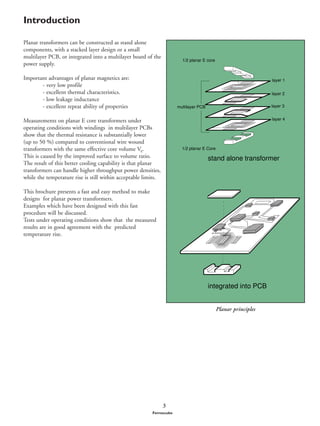
Planar transformers can be constructed as stand alone
components, with a stacked layer design or a small
multilayer PCB, or integrated into a multilayer board of the
                                                                        1/2 planar E core
power supply.

Important advantages of planar magnetics are:                                                                   layer 1
       - very low profile
       - excellent thermal characteristics.                                                                     layer 2
       - low leakage inductance
       - excellent repeat ability of properties                       multilayer PCB                            layer 3


Measurements on planar E core transformers under                                                                layer 4

operating conditions with windings in multilayer PCBs
show that the thermal resistance is substantially lower
(up to 50 %) compared to conventional wire wound
transformers with the same effective core volume Ve.                    1/2 planar E Core
This is caused by the improved surface to volume ratio.                                stand alone transformer
The result of this better cooling capability is that planar
transformers can handle higher throughput power densities,
while the temperature rise is still within acceptable limits.

This brochure presents a fast and easy method to make
designs for planar power transformers.
Examples which have been designed with this fast
procedure will be discussed.
Tests under operating conditions show that the measured
results are in good agreement with the predicted
temperature rise.


                                                                                       integrated into PCB


                                                                                            Planar principles


                                                                3
                                                         Ferroxcube
Design procedure
1. Calculation of maximum flux density

The core and copper losses in a transformer under                    Power losses in our ferrites have been measured as a
operating conditions will induce a temperature rise.                 function of frequency (f in Hz), peak flux density (B in
This rise must stay below a maximum allowable value to               T) and temperature (T in °C). Core loss density can be
avoid damage to the transformer or the rest of the circuitry.        approximated (2) by the following formula :
In thermal equilibrium the total losses in the transformer,                Pcore = Cm . f x. B y. (ct0-ct1T+ct2T2)        [3]
Ptrafo, can be related to a temperature rise ∆T of the                                        peak

transformer with an analogon of Ohm’s law by:
                                                                                 = Cm . CT . f x. Bpeak
                                                                                                    y       [mW/cm3]
                    ∆T
   Ptrafo =                                           [1]     In this formula Cm, x ,y, ct0, ct1 and ct2 are parameters
                    R th
                                                              which have been found by curve fitting of the measured
In this formula Rth represents the thermal resistance of the power loss data. These parameters are specific for a ferrite
transformer. Ptrafo can in fact be interpreted as the cooling material. They are dimensioned in such a way that at
capability of the transformer.                                100 °C the value of CT is equal to 1.
Previous work (1), showed that it is possible to establish    In table 1 fit parameters are listed for several Ferroxcube
an empirical formula which relates the value of thermal       power ferrites. Maximum allowed Pcore is calculated with
resistance of a transformer directly to the value of the      equation [2]. This value is inserted in equation [3].
effective magnetic volume Ve of the ferrite core used.        Maximum allowed flux density Bpeak can now be calculated
This empirical formula is valid for wire wound transformers by rewriting equation [3]:
with core shapes like RM and ETD. A similar relation has                                             1/y
now been found for planar E transformers.                                           Pcore
This relation can be used to estimate the temperature rise       Bpeak =                                   [T]        [4]
                                                                                 Cm . CT . f x
of the transformer as a function of flux density in the
core. Because of the limited available winding space it is
recommended to use the maximum allowed flux densities
in planar magnetics.
With the assumption that half of the total transformer
loss is core loss, it is possible to express the                      B
maximum core loss density Pcore as a function of the
allowed temperature rise ∆T of the transformer as:
                                                                                                             2 .Bpeak
                   12 . ∆ T            [mW/cm3]
   Pcore =                                            [2]
                     Ve ( cm3 )


                                                                     Bpeak in the formulas is half the peak to peak flux excursion
                                                                                              in the core.

 ferrite      f (kHz)      Cm             x          y               ct2          ct1                ct0
 3C30         20-100       7.13.10-3      1.42       3.02            3.65.10-4    6.65.10-2          4
              100-200      7.13.10-3      1.42       3.02            4.10-4       6.8   .10-2        3.8
 3C90         20-200       3.2.10-3       1.46       2.75            1.65.10-4    3.1.10-2           2.45
 3C94         20-200       2.37.10-3      1.46       2.75            1.65.10-4    3.1.10-2           2.45
              200-400      2.10-9         2.6        2.75            1.65.10-4    3.1.10-2           2.45
 3F3          100-300      0.25.10-3      1.63       2.45            0.79.10-4    1.05.10-2          1.26
              300-500      2.10-5         1.8        2.5             0.77.10-4    1.05.10-2          1.28
              500-1000     3.6.10-9       2.4        2.25            0.67.10-4    0.81.10-2          1.14
 3F4          500-1000     12.10-4        1.75       2.9             0.95.10-4    1.1.10-2           1.15
              1000-3000    1.1.10-11      2.8        2.4             0.34.10-4    0.01.10-2          0.67
                                  Table 1: Fit parameters to calculate the power loss density
                                                                 4
                                                            Ferroxcube
Note:                                                                                Depending on the production capability of the PCB
The maximum allowed value for B can also be found in another way.
Formula [3] together with the fit parameters can be inserted into a
                                                                                     manufacturer smaller dimensions might be possible, but
computer program which makes it possible to calculate the power losses               that will probably imply a substantial cost increase of the
for arbitrary wave forms (3). Advantage is that the real wave shape of B             PCB.
can be simulated to calculate the losses and that it is possible to select the       The number of turns per layer and the spacing between
optimum ferrite for the concerned application.
                                                                                     the turns are denoted by the symbols Nl and s respectively.
                                                                                     Then for an available winding width bw , the track width
                                                                                     wt can be calculated with (see fig 1):
2. Recommendations for distribution of the                                                         [ bw - (N1 + 1) . s ]
turns in the winding space                                                              wt =                                              [5]
                                                                                                           N1
Once the value for the maximum peak flux density                                     In case mains insulation requirements have to be fulfilled
is determined, established formulas applicable to the                                the situation is somewhat different. The core is seen as a
converter topology and transformer type (e.g. flyback or                             part of the primary side and has to be separated 400 µm
forward) can be used to calculate the number of primary                              from the secondary side. Therefore, the creepage distance
and secondary turns.                                                                 between the (secondary) windings close to the inner and
                                                                                     outer leg and the core must be 400 µm. In this case the
A decision has to be made how the windings will be                                   track width can be calculated with [6] since 800 µm has to
divided over the available layers. Currents in the tracks will                       be subtracted from the available winding width.
induce a temperature rise of the PCB. It is recommended                   [ bw - 0.8 - (N1 - 1) . s ]
to distribute the winding turns in the outer layers               wt =                                                                    [6]
symmetrically with respect to the turns in the inner layers                           N1
for reasons of thermal expansion.                              In formula 5 and 6 all dimensions are in mm.
From a magnetic point of view the optimum would be
to sandwich the primary and secondary layers. This will
reduce the so called proximity effect (see page 6).
However the available winding height in the PCBs and the
required number of turns for the application will not always                 wt           wt            wt
allow an optimum design.

For cost price reasons it is recommended to choose a
standard thickness of the copper layers. Often a thickness
of 35 or 70 µm are used by PCB manufacturers. The choice
of thickness of the layers plays an important role for the
temperature rise in the windings induced by the currents.                                      s             s             s          s


Safety Standards like IEC 950 require a distance of 400
µm through PCB material (FR2 or FR4) for mains
insulation between primary and secondary windings. If
mains insulation is not required a distance of 200 µm
between the winding layers is sufficient. Furthermore one
has to take into account a solder mask layer of about 50 µm
on the top and bottom of the PCB.                                                                                bw

The track width of a winding follows from the value of
the current and the maximum current density allowed. The
spacing between the turns is governed by the production                                 Fig.1 Track width wt spacing s and winding width bw
capabilities and costs. A rule of thumb for a copper layer
thickness of 35 µm is a track width and spacing of
> 150 µm, and for layers of 70 µm >200 µm.


                                                                                 5
                                                                         Ferroxcube
3. Determination of temperature rise in the
PCB caused by the currents

The final step is to check the temperature rise in the                             The skin depth δ is the distance from the conductor surface
copper tracks induced by the currents. For this purpose                            towards the centre over which the current density has
the effective (= RMS) currents have to be calculated from                          reduced by a factor of 1/e. The skin depth depends on
the input data and desired output. The calculation method                          material properties as conductivity and permeability and is
depends on the topology used. In the design examples this                          inversely proportional to the square root of the frequency.
is shown for a conventional standard forward and flyback                           For copper at 60 °C the skin depth can be approximated
converter topology. An example of relations between the                            by: δ(µm) = 2230/(f [kHz])1/2 .
RMS currents and induced temperature rises for various                             When the conductor width (wt ) is taken smaller than 2δ,
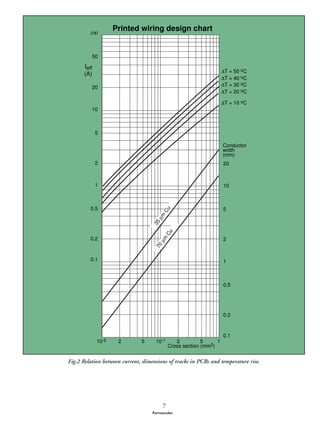
cross sections of conductors in PCBs is shown in fig. 2.                           the contribution of this effect will be limited.This means a
For single conductor applications or inductors which are                           track width of <200 µm for a frequency of 500 kHz.
not too closely spaced this chart can be used directly for                         If there is more winding width bw available for the
determining conductor widths, conductor thickness, cross                           concerned number of turns, the best solution from the
sectional areas and allowed maximum currents for various                           magnetic point of view would be to split them up in
preset values of the temperature rise.                                             parallel tracks.

Note:                                                                              In practical situations there will be eddy current effects in
For groups of similar parallel inductors, if closely spaced, the temperature
rise may be found by using an equivalent cross section and equivalent
                                                                                   the conductor not only due to the alternating field of its
current. The equivalent cross section is the sum of the cross sections             own current (skin effect) but also due to the fields of
of the parallel conductors and the equivalent current is the sum of the            other conductors in the vicinity. This effect is called
currents in the inductor.                                                          the proximity effect. When the primary and secondary
                                                                                   layers are sandwiched this effect will be strongly decreased.
A shortcoming in this design approach is that the induced                          Reason is that the primary and secondary currents flow
heat in the windings is assumed to be caused by a DC                               in opposite directions so that their magnetic fields will
current while in reality there is an AC current causing skin                       cancel out. However there will still be a contribution to
effect and proximity effect.                                                       the proximity effect of the neighbouring conductors in the
The skin effect is the result of the magnetic field inside a                       same layer.
conductor generated by the conductors own current. Fast
current changes (high frequency) induce alternating fluxes                         Empirical tool
which cause eddy currents. These eddy currents which add                           Temperature measurements on several designs of multilayer
to the main current are opposite to the direction of the                           PCBs with AC currents supplied to the windings, show
main current. The current is cancelled out in the centre of                        with reasonable accuracy that up to 1MHz each increase
the conductor and moves towards the surface. The current                           of 100 kHz in frequency gives 2 °C extra in temperature
density decreases exponentially from the surface towards the                       rise of the PCB compared to the values determined for DC
centre.                                                                            currents.


                                                                               6
                                                                      Ferroxcube
Printed wiring design chart
         100


          50
      Ieff
                                                                      ∆T = 50 oC
      (A)
                                                                      ∆T = 40 oC
                                                                      ∆T = 30 oC
          20
                                                                      ∆T = 20 oC

                                                                      ∆T = 10 oC
          10


             5

                                                                      Conductor
                                                                      width
                                                                      (mm)
             2                                                        20


             1                                                        10


         0.5                                                          5
                                          Cu
                                      µm
                                    35

                                           Cu


         0.2
                                       µm


                                                                      2
                                     70


         0.1                                                          1


                                                                      0.5


                                                                      0.2


                                                                      0.1
             10-2    2         5     10-1        2          5     1
                                              Cross section (mm2)


Fig.2 Relation between current, dimensions of tracks in PCBs and temperature rise.


                                          7
                                    Ferroxcube
Design example 1: Flyback transformer
minimum input voltage:              Uimin      = 70 V              A program based on expression [3] is used to compute the
output voltage:                     Uo         = 8.2 V             losses for unipolar triangle flux wave forms with frequency
extra primary output:               UpIC       = 8V                120 kHz, Bpeak 160 mT and operating temperature 95 °C.
primary duty cycle:                 δprim      ≈ 0.48/0.5          For the power ferrites 3C30, 3C90 the expected core loss
                                                                   densities are 385 mW/cm3 and 430 mW/cm3.
secondary duty cycle:               δsec       ≈ 0.48/0.5
switching frequency                 f          ≈120kHz             Allowed core loss densities for ∆T = 35 °C are 470
output power                        Pmax       8W                  mW/cm3 for E-PLT18 and 429 mW/cm3 for E-E18
ambient temperature                 Tamb       60oC                (from equation 1).
allowed temperature rise            ∆T         35oC                The conclusion is that 3C30 and 3C90 can be used in
                                                                   both core combinations. Inferior ferrites with higher power
The aim is to design a flyback transformer with a                  losses would result in a too high temperature rise.
specification as shown above.
As a first step it is assumed that at this frequency a high        The 24 primary winding turns can be divided in a
peak flux density of 160 mT can be used. Later it will             symmetrical way by using 2 or 4 layers. The available
be checked whether this is possible given the allowed core         winding width of the E-18 cores is 4.6 mm. This implies
losses and temperature rise.                                       it will be a technically difficult - and therefore expensive
Table 2 shows the calculated number of turns for the six           - solution to use only 2 layers with 12 turns each. This
smallest standard combinations of the Ferroxcube planar            would require very narrow track widths and spacing.
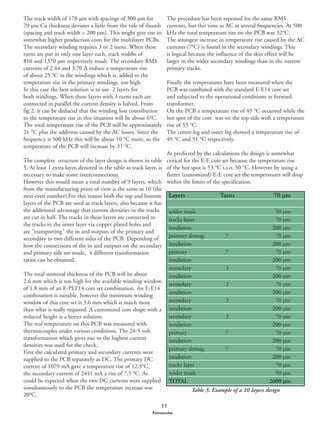
E and PLT cores. Also the primary self inductance and              So a choice is made for 4 layers with 6 turns each.
required airgaps and currents are calculated with formulas         A lower number of layers in the multilayer PCB will result
as shown in appendix 1.                                            in a lower cost price. Therefore we assume for the 3 turns
                                                                   of the primary (for IC voltage) and for the 3 secondary
From Table 2 it can be seen that he required number of             winding turns one layer each. The six layer design could be
primary turns for the E-14 core sets is too high for a             built up as shown in table 3.
multilayer PCB winding. Therefore an E-E18 or E-PLT18
core combinations look the most suitable choice. Rounding
of N1, N2 and NIC results in 24, 3 and 3 respectively.

Core         Ae (mm2)    Ve (mm3)       N1          N2          NIC           G(µm)               Other calculated data
E-PLT14      14.5        240            63          7.4         7.2           113                 Lprim = 638 µH
E-E14        14.5        300            63          7.4         7.2           113                 Ip(RMS)=186 mA
E-PLT18      39.5        800            23          2.7         2.6           41                  Io(RMS)= 1593 mA
E-E18        39.5        960            23          2.7         2.6           41
E-PLT22      78.5        2040           12          1.4         1.4           22
E-E22        78.5        2550           12          1.4         1.4           22


                               Table 2. Calculation of data for several flyback transformers.


                                                               8
                                                          Ferroxcube
Depending on the heat generated by the currents the                  Layers               Turns     35 µm         70 µm
choice can be made between 35 or 70 µm copper layers.
Between primary and secondary layers a distance of 400
                                                                     solder mask                     50 µm        50 µm
µm is required for the mains insulation. An E-PLT 18
                                                                     primary                 6       35 µm        70 µm
combination has a minimum winding window of 1.8.mm.
This is sufficient for the 35 µm layer design which results in       insulation                     200 µm       200 µm
a PCB thickness of about 1710 µm.                                    primary                 6       35 µm        70 µm
To achieve a economic design we assumed a spacing                    insulation                     200 µm       200 µm
of 300 µm between the tracks. Calculating the track width            primary IC              3       35 µm        70 µm
for the secondary winding with [5] returns 1.06 mm,                  insulation                     400 µm       400 µm
inclusive mains insulation.                                          secondary               3       35 µm        70 µm
Looking in fig 2. and using the calculated (see table 2)
                                                                     insulation                     400 µm       400 µm
secondary RMS current of 1.6 A, results in a temperature
rise of 25 °C for the 35 µm layers and approx. 7 °C for              primary                 6       35 µm        70 µm
the 70 µm design.                                                    insulation                     200 µm       200 µm
The temperature rise caused by the winding loss is allowed           primary                 6       35 µm        70 µm
to be about half the total temperature rise, in this case            solder mask                     50 µm        50 µm
17.5 °C. Clearly the 35 µm layers will give a too large
temperature rise for an RMS current of 1.6 A and the                 TOTAL                        1710 µm       1920 µm
70 µm layers will have to be used.
The track widths for the primary winding turns can be                         Table 3. Example of a six layers design
calculated with [5] and will be approx. 416 µm. This track
width will cause hardly any temperature rise by the primary
RMS current of 0.24 A.
Because the frequency is 120 kHz, 2 °C extra temperature
rise of the PCB is expected compared to the DC current
situation. The total temperature rise of the PCB caused by
the currents only will remain below 10 °C.

This design with 6 layers of 70 µm Cu tracks should
function within its specification. The nominal thickness
of the PCB will be about 1920 µm which means that a
standard planar E-PLT18 combination cannot be used.
The standard E-E18 combination with a winding window
of 3.6 mm is usable. However its winding window is
excessive, so a customized core shape with a winding
window of approximately 2 mm would be a more elegant
solution.

Measurements on a comparable design with an E-E core
combination in 3C90 material showed a total temperature
rise of 28 °C. This is in line with a calculated contribution
of 17.5 °C temperature rise from the core losses and 10 °C
caused by winding losses.
The coupling between primary and secondary is good
because the leakage inductance turns out to be only
0.6 % of the primary inductance.


                                                                 9
                                                          Ferroxcube
Design example 2: Forward transformer
input and output voltages:       48 V         5V                A final check of the core loss density at the operating
                                 48 V         3.3 V             temperature of 100 °C for the applied flux density wave
                                 24 V         5V                shapes at 530 kHz gives for 3F3 1030 mW/cm3 and for
                                 24 V         3.3 V             3F4 1580 mW/cm3. Clearly 3F3 is the best option
                                                                The temperature rise induced in the E-PLT14 is given by:
output power:                    Pmax         ≈ 18 W
duty cycle:                      δ            ≈ 0.46                                                               .
                                                                (calculated loss density 3F3/allowed loss density) ½∆T
switching frequency              f            ≈ 500kHz                                    .
                                                                         = ( 1030/1225 ) 25oC = 21 °C.
ambient temperature              Tamb         = 40oC
                                                                For the E-E14 combination this would be 23.5 °C.
allowed temperature rise         ∆T           = 50oC
                                                                For the primary side 7 or 14 turns are required,
                                                                depending on the input voltage. For a conventional forward
                                                                transformer the same number of turns is necessary for the
Here the aim is to design a forward transformer with
                                                                demagnetizing (recovery) winding. To make it possible to
the possibility to choose from 4 transformation ratios
                                                                use 7 or 14 primary turns and the same number of turns
which are often used in low power DC-DC converters. The
                                                                for the demagnetizing winding, 4 layers with each 7 turns
specification is shown above.
                                                                are chosen. When 7 primary and demagnetizing turns are
The first step is to check whether the smallest core
                                                                needed, the turns on 2 layers are connected in parallel. This
combinations of the standard planar E core range, the
                                                                will give the additional effect that the current density in the
E-PLT14 and E-E14, are suitable for this application.
                                                                winding tracks will be halved.
Using [2] to calculate the allowed core loss density for a
                                                                If 14 turns are necessary for the primary and demagnetizing
temperature rise of 50 °C results in 1095 mW/cm3 and
                                                                windings, the turns in two layers are connected in series so
1225 mW/cm3 for the E-E and E-PLT 14 combinations .
                                                                that the effective number of turns is 14.
With formula [3] the core loss density is calculated for
unipolar triangle flux wave forms with a frequency of 500
                                                                The available winding width for a PCB for the E 14 core is
kHz and several peak flux densities. It turns out that peak
                                                                3.65 mm. For an economic design with 300 µm spacing the
flux densities of about 100 mT will result in losses lower
                                                                track width for 7 turns per layer is 178 µm.
than the allowed core loss densities calculated with [2].
                                                                The copper layer thickness should be 70 µm because for the
The calculation of the winding turns and effective currents
                                                                24 V input the effective primary current is about 1.09 A.
is done with the formulas given in appendix 1. Using a
                                                                This gives (see fig. 2) in an effective track width of 356 µm
peak flux density of 100 mT, together with the specified
                                                                (double because of parallel connection for 7 winding turns)
data as input for the calculation, it turns out that at a
                                                                a temperature rise of 15 °C The 48 V input will result
frequency of 530 kHz the E-E14 or the E-PLT14 are usable
                                                                in an effective current of about 0.54 A. This will give in
core combinations with a reasonable number of turns .The
                                                                a track width of 178 µm (14 winding turns connected in
results of the calculations are shown in table 4.
                                                                series) a winding loss contribution to the temperature rise
                                                                of approx. 14 °C.


Core         Vin       Vout      N1          N2          Lprim              Io(RMS)           Imag             Ip(RMS)
                                                          (µH)               (mA)             (mA)               (mA)
E-PLT14      48 V      5V        14          3.2         690                2441              60               543
             48 V      3.3 V     14          2.1         690                3699              60               548
             24 V      5V        7           3.2         172                2441              121              1087
             24 V      3.3 V     7           2.1         172                3699              121              1097


E-E14        48 V      5V        14          3.2         855                2441              48               539
             48 V      3.3 V     14          2.1         855                3699              48               544
             24 V      5V        7           3.2         172                2441              97               1079
             24 V      3.3 V     7           2.1         172                3699              97               1089
                                  Table 4: Calculation of several forward transformers

                                                           10
                                                       Ferroxcube
The track width of 178 µm with spacings of 300 µm for                The procedure has been repeated for the same RMS
70 µm Cu thickness deviates a little from the rule of thumb          currents, but this time as AC at several frequencies. At 500
(spacing and track width > 200 µm). This might give rise to          kHz the total temperature rise on the PCB was 32°C.
somewhat higher production costs for the multilayer PCBs.            The strongest increase in temperature rise caused by the AC
The secondary winding requires 3 or 2 turns. When these              currents (7°C) is found in the secondary windings. This
turns are put in only one layer each, track widths of                is logical because the influence of the skin effect will be
810 and 1370 µm respectively result. The secondary RMS               larger in the wider secondary windings than in the narrow
currents of 2.44 and 3.70 A induce a temperature rise                primary tracks.
of about 25 °C in the windings which is, added to the
temperature rise in the primary windings, too high.                  Finally the temperatures have been measured when the
In this case the best solution is to use 2 layers for                PCB was combined with the standard E-E14 core set
both windings. When these layers with 3 turns each are               and subjected to the operational conditions as forward
connected in parallel the current density is halved. From            transformer.
fig 2. it can be deduced that the winding loss contribution          On the PCB a temperature rise of 49 °C occurred while the
to the temperature rise in this situation will be about 6°C.         hot spot of the core was on the top side with a temperature
The total temperature rise of the PCB will be approximately          rise of 53 °C.
21 °C plus the addition caused by the AC losses. Since the           The centre leg and outer leg showed a temperature rise of
frequency is 500 kHz this will be about 10 °C more, so the           49 °C and 51 °C respectively.
temperature of the PCB will increase by 31 °C.
                                                                     As predicted by the calculations the design is somewhat
The complete structure of the layer design is shown in table         critical for the E-E core set because the temperature rise
5. At least 1 extra layer, denoted in the table as track layer, is   of the hot spot is 53 °C i.s.o. 50 °C. However by using a
necessary to make some interconnections.                             flatter (customized) E-E core set the temperatures will drop
However this would mean a total number of 9 layers, which            within the limits of the specification.
from the manufacturing point of view is the same as 10 (the
next even number).For this reason both the top and bottom             Layers                Turns                   70 µm
layers of the PCB are used as track layers, also because it has
the additional advantage that current densities in the tracks         solder mask                                   50 µm
are cut in half. The tracks in these layers are connected to          tracks layer                                  70 µm
the tracks in the inner layer via copper plated holes and
                                                                      insulation                                   200 µm
are "transporting" the in and outputs of the primary and
secondary to two different sides of the PCB. Depending of             primary demag.          7                     70 µm
how the connections of the in and outputs on the secondary            insulation                                   200 µm
and primary side are made, 4 different transformation                 primary                 7                     70 µm
ratios can be obtained.                                               insulation                                   200 µm
                                                                      secondary               3                     70 µm
The total nominal thickness of the PCB will be about                  insulation                                   200 µm
2.6 mm which is too high for the available winding window
                                                                      secondary               2                     70 µm
of 1.8 mm of an E-PLT14 core set combination. An E-E14
                                                                      insulation                                   200 µm
combination is suitable, however the minimum winding
window of this core set is 3.6 mm which is much more                  secondary               2                     70 µm
than what is really required. A customized core shape with a          insulation                                   200 µm
reduced height is a better solution.                                  secondary               3                     70 µm
The real temperature on this PCB was measured with                    insulation                                   200 µm
thermocouples under various conditions. The 24-5 volt                 primary                 7                     70 µm
transformation which gives rise to the highest current                insulation                                   200 µm
densities was used for the check.
                                                                      primary demag.          7                     70 µm
First the calculated primary and secondary currents were
supplied to the PCB separately as DC. The primary DC                  insulation                                   200 µm
current of 1079 mA gave a temperature rise of 12.5°C,                 tracks layer                                  70 µm
the secondary current of 2441 mA a rise of 7.5 °C. As                 solder mask                                   50 µm
could be expected when the two DC currents were supplied              TOTAL                                       2600 µm
simultaneously to the PCB the temperature increase was                         Table 3. Example of a 10 layers design
20°C.
                                                                 11
                                                             Ferroxcube
References

1. Mulder S.A., 1990
Application note on the design of low profile high
frequency transformers, Ferroxcube Components.

2. Mulder S.A.,1994
Loss formulas for power ferrites and their use in
transformer design,Philips Components.

3. Durbaum Th, Albach M, 1995
Core losses in transformers with an arbitrary shape of the
magnetizing current.1995 EPE Sevilla.

4. Brockmeyer A., 1995
Experimental Evaluation of the influence of DC
premagnetization on the properties of power electronic
ferrites, Aachen University of Technology

5. Ferroxcube Components technical note, 1996
25 Watt DC/DC converter using integrated Planar
Magnetics.(9398 236 26011)


                                                             12
                                                         Ferroxcube
Appendix 1: Formulas used for the calculations of the design

                                               List of symbols used
 Ae        =      effect. cross-sectional area            NIC   =          windings for IC voltage
 Bpeak     =      peak flux density                       Pmax =           output power
 f         =      Switching frequency                     Uimin =          minimum input voltage
 Ip(RMS)   =      primary rms current                     U0    =          output voltage
 I0(RMS)   =      secondary output current                UIC   =          IC voltage
 Imag      =      magnetizing current (forward)           δ     =          duty cycle signal (forward)
 Lprim     =      primary self inductance                 δprim =          duty cycle primary signal
 le        =      effect. path length                     δsec  =          duty cycle secondary signal
 G         =      airgap length                           µa    =          amplitude permeability
 N1        =      primary winding turns                   µe    =          effective permeability
 N2        =      secondary winding turns                 µ0    =          permeability of free space


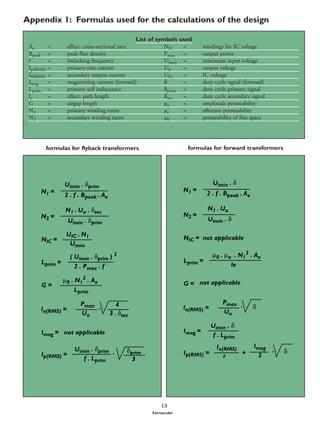
           formulas for flyback transformers                       formulas for forward transformers


                 Uimin . δprim                                                 Uimin . δ
      N1 =                                                        N1 =
                 2 . f . Bpeak . Ae                                         2 . f . Bpeak . Ae

                 N1 . Uo . δsec                                              N1 . Uo
      N2 =                                                        N2 =
                  Uimin . δprim                                              Uimin . δ

                  UIC . N1
      NIC =                                                       NIC = not applicable
                   Uimin

                   ( Uimin . δprim ) 2                                         µ0 . µa . N12 . Ae
      Lprim =                                                     Lprim =
                     2 . Pmax . f                                                     le

                 µ0 . N12 . Ae
      G=                                                          G = not applicable
                      Lprim

                       Pmax              4                                         Pmax
                            .                                     Io(RMS) =             .        δ
      Io(RMS) =                                                                    Uo
                       Uo             3 . δsec
                                                                              Uimin . δ
      Imag = not applicable                                       Imag =
                                                                              f . Lprim

                     Uimin . δprim .                                             Io(RMS)         Imag
                                             δprim                Ip(RMS) =              +            .   δ
      Ip(RMS) =                                                                     r              2
                        f . Lprim              3


                                                         13
                                                     Ferroxcube
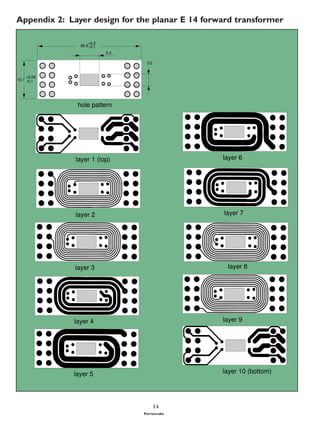
Appendix 2: Layer design for the planar E 14 forward transformer

                   +0.2
               28.5−0.1
                          5.3

                                 3.2


     +0.05
10.7 -0.1


              hole pattern


              layer 1 (top)                      layer 6


              layer 2                            layer 7


              layer 3                             layer 8


             layer 4                             layer 9


             layer 5                             layer 10 (bottom)


                                       14
                                Ferroxcube
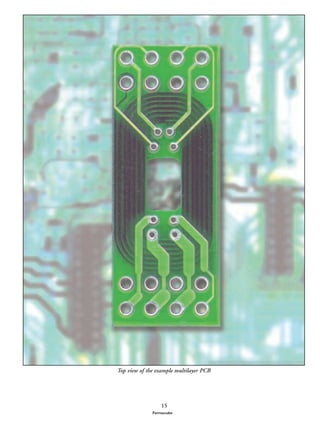
Top view of the example multilayer PCB


                  15
              Ferroxcube

Planar pcb design guide(ferroxcube) no pw

  • 2.
    Design of Planar Power Transformers Contents Introduction 3 Design procedure 4 Design examples -flyback 8 -forward 10 Formulas 13 Layer design 14 1 Ferroxcube
  • 3.
    Exploded view ofa planar transformer 2 Ferroxcube
  • 4.
    Introduction Planar transformers canbe constructed as stand alone components, with a stacked layer design or a small multilayer PCB, or integrated into a multilayer board of the 1/2 planar E core power supply. Important advantages of planar magnetics are: layer 1 - very low profile - excellent thermal characteristics. layer 2 - low leakage inductance - excellent repeat ability of properties multilayer PCB layer 3 Measurements on planar E core transformers under layer 4 operating conditions with windings in multilayer PCBs show that the thermal resistance is substantially lower (up to 50 %) compared to conventional wire wound transformers with the same effective core volume Ve. 1/2 planar E Core This is caused by the improved surface to volume ratio. stand alone transformer The result of this better cooling capability is that planar transformers can handle higher throughput power densities, while the temperature rise is still within acceptable limits. This brochure presents a fast and easy method to make designs for planar power transformers. Examples which have been designed with this fast procedure will be discussed. Tests under operating conditions show that the measured results are in good agreement with the predicted temperature rise. integrated into PCB Planar principles 3 Ferroxcube
  • 5.
    Design procedure 1. Calculationof maximum flux density The core and copper losses in a transformer under Power losses in our ferrites have been measured as a operating conditions will induce a temperature rise. function of frequency (f in Hz), peak flux density (B in This rise must stay below a maximum allowable value to T) and temperature (T in °C). Core loss density can be avoid damage to the transformer or the rest of the circuitry. approximated (2) by the following formula : In thermal equilibrium the total losses in the transformer, Pcore = Cm . f x. B y. (ct0-ct1T+ct2T2) [3] Ptrafo, can be related to a temperature rise ∆T of the peak transformer with an analogon of Ohm’s law by: = Cm . CT . f x. Bpeak y [mW/cm3] ∆T Ptrafo = [1] In this formula Cm, x ,y, ct0, ct1 and ct2 are parameters R th which have been found by curve fitting of the measured In this formula Rth represents the thermal resistance of the power loss data. These parameters are specific for a ferrite transformer. Ptrafo can in fact be interpreted as the cooling material. They are dimensioned in such a way that at capability of the transformer. 100 °C the value of CT is equal to 1. Previous work (1), showed that it is possible to establish In table 1 fit parameters are listed for several Ferroxcube an empirical formula which relates the value of thermal power ferrites. Maximum allowed Pcore is calculated with resistance of a transformer directly to the value of the equation [2]. This value is inserted in equation [3]. effective magnetic volume Ve of the ferrite core used. Maximum allowed flux density Bpeak can now be calculated This empirical formula is valid for wire wound transformers by rewriting equation [3]: with core shapes like RM and ETD. A similar relation has 1/y now been found for planar E transformers. Pcore This relation can be used to estimate the temperature rise Bpeak = [T] [4] Cm . CT . f x of the transformer as a function of flux density in the core. Because of the limited available winding space it is recommended to use the maximum allowed flux densities in planar magnetics. With the assumption that half of the total transformer loss is core loss, it is possible to express the B maximum core loss density Pcore as a function of the allowed temperature rise ∆T of the transformer as: 2 .Bpeak 12 . ∆ T [mW/cm3] Pcore = [2] Ve ( cm3 ) Bpeak in the formulas is half the peak to peak flux excursion in the core. ferrite f (kHz) Cm x y ct2 ct1 ct0 3C30 20-100 7.13.10-3 1.42 3.02 3.65.10-4 6.65.10-2 4 100-200 7.13.10-3 1.42 3.02 4.10-4 6.8 .10-2 3.8 3C90 20-200 3.2.10-3 1.46 2.75 1.65.10-4 3.1.10-2 2.45 3C94 20-200 2.37.10-3 1.46 2.75 1.65.10-4 3.1.10-2 2.45 200-400 2.10-9 2.6 2.75 1.65.10-4 3.1.10-2 2.45 3F3 100-300 0.25.10-3 1.63 2.45 0.79.10-4 1.05.10-2 1.26 300-500 2.10-5 1.8 2.5 0.77.10-4 1.05.10-2 1.28 500-1000 3.6.10-9 2.4 2.25 0.67.10-4 0.81.10-2 1.14 3F4 500-1000 12.10-4 1.75 2.9 0.95.10-4 1.1.10-2 1.15 1000-3000 1.1.10-11 2.8 2.4 0.34.10-4 0.01.10-2 0.67 Table 1: Fit parameters to calculate the power loss density 4 Ferroxcube
  • 6.
    Note: Depending on the production capability of the PCB The maximum allowed value for B can also be found in another way. Formula [3] together with the fit parameters can be inserted into a manufacturer smaller dimensions might be possible, but computer program which makes it possible to calculate the power losses that will probably imply a substantial cost increase of the for arbitrary wave forms (3). Advantage is that the real wave shape of B PCB. can be simulated to calculate the losses and that it is possible to select the The number of turns per layer and the spacing between optimum ferrite for the concerned application. the turns are denoted by the symbols Nl and s respectively. Then for an available winding width bw , the track width wt can be calculated with (see fig 1): 2. Recommendations for distribution of the [ bw - (N1 + 1) . s ] turns in the winding space wt = [5] N1 Once the value for the maximum peak flux density In case mains insulation requirements have to be fulfilled is determined, established formulas applicable to the the situation is somewhat different. The core is seen as a converter topology and transformer type (e.g. flyback or part of the primary side and has to be separated 400 µm forward) can be used to calculate the number of primary from the secondary side. Therefore, the creepage distance and secondary turns. between the (secondary) windings close to the inner and outer leg and the core must be 400 µm. In this case the A decision has to be made how the windings will be track width can be calculated with [6] since 800 µm has to divided over the available layers. Currents in the tracks will be subtracted from the available winding width. induce a temperature rise of the PCB. It is recommended [ bw - 0.8 - (N1 - 1) . s ] to distribute the winding turns in the outer layers wt = [6] symmetrically with respect to the turns in the inner layers N1 for reasons of thermal expansion. In formula 5 and 6 all dimensions are in mm. From a magnetic point of view the optimum would be to sandwich the primary and secondary layers. This will reduce the so called proximity effect (see page 6). However the available winding height in the PCBs and the required number of turns for the application will not always wt wt wt allow an optimum design. For cost price reasons it is recommended to choose a standard thickness of the copper layers. Often a thickness of 35 or 70 µm are used by PCB manufacturers. The choice of thickness of the layers plays an important role for the temperature rise in the windings induced by the currents. s s s s Safety Standards like IEC 950 require a distance of 400 µm through PCB material (FR2 or FR4) for mains insulation between primary and secondary windings. If mains insulation is not required a distance of 200 µm between the winding layers is sufficient. Furthermore one has to take into account a solder mask layer of about 50 µm on the top and bottom of the PCB. bw The track width of a winding follows from the value of the current and the maximum current density allowed. The spacing between the turns is governed by the production Fig.1 Track width wt spacing s and winding width bw capabilities and costs. A rule of thumb for a copper layer thickness of 35 µm is a track width and spacing of > 150 µm, and for layers of 70 µm >200 µm. 5 Ferroxcube
  • 7.
    3. Determination oftemperature rise in the PCB caused by the currents The final step is to check the temperature rise in the The skin depth δ is the distance from the conductor surface copper tracks induced by the currents. For this purpose towards the centre over which the current density has the effective (= RMS) currents have to be calculated from reduced by a factor of 1/e. The skin depth depends on the input data and desired output. The calculation method material properties as conductivity and permeability and is depends on the topology used. In the design examples this inversely proportional to the square root of the frequency. is shown for a conventional standard forward and flyback For copper at 60 °C the skin depth can be approximated converter topology. An example of relations between the by: δ(µm) = 2230/(f [kHz])1/2 . RMS currents and induced temperature rises for various When the conductor width (wt ) is taken smaller than 2δ, cross sections of conductors in PCBs is shown in fig. 2. the contribution of this effect will be limited.This means a For single conductor applications or inductors which are track width of <200 µm for a frequency of 500 kHz. not too closely spaced this chart can be used directly for If there is more winding width bw available for the determining conductor widths, conductor thickness, cross concerned number of turns, the best solution from the sectional areas and allowed maximum currents for various magnetic point of view would be to split them up in preset values of the temperature rise. parallel tracks. Note: In practical situations there will be eddy current effects in For groups of similar parallel inductors, if closely spaced, the temperature rise may be found by using an equivalent cross section and equivalent the conductor not only due to the alternating field of its current. The equivalent cross section is the sum of the cross sections own current (skin effect) but also due to the fields of of the parallel conductors and the equivalent current is the sum of the other conductors in the vicinity. This effect is called currents in the inductor. the proximity effect. When the primary and secondary layers are sandwiched this effect will be strongly decreased. A shortcoming in this design approach is that the induced Reason is that the primary and secondary currents flow heat in the windings is assumed to be caused by a DC in opposite directions so that their magnetic fields will current while in reality there is an AC current causing skin cancel out. However there will still be a contribution to effect and proximity effect. the proximity effect of the neighbouring conductors in the The skin effect is the result of the magnetic field inside a same layer. conductor generated by the conductors own current. Fast current changes (high frequency) induce alternating fluxes Empirical tool which cause eddy currents. These eddy currents which add Temperature measurements on several designs of multilayer to the main current are opposite to the direction of the PCBs with AC currents supplied to the windings, show main current. The current is cancelled out in the centre of with reasonable accuracy that up to 1MHz each increase the conductor and moves towards the surface. The current of 100 kHz in frequency gives 2 °C extra in temperature density decreases exponentially from the surface towards the rise of the PCB compared to the values determined for DC centre. currents. 6 Ferroxcube
  • 8.
    Printed wiring designchart 100 50 Ieff ∆T = 50 oC (A) ∆T = 40 oC ∆T = 30 oC 20 ∆T = 20 oC ∆T = 10 oC 10 5 Conductor width (mm) 2 20 1 10 0.5 5 Cu µm 35 Cu 0.2 µm 2 70 0.1 1 0.5 0.2 0.1 10-2 2 5 10-1 2 5 1 Cross section (mm2) Fig.2 Relation between current, dimensions of tracks in PCBs and temperature rise. 7 Ferroxcube
  • 9.
    Design example 1:Flyback transformer minimum input voltage: Uimin = 70 V A program based on expression [3] is used to compute the output voltage: Uo = 8.2 V losses for unipolar triangle flux wave forms with frequency extra primary output: UpIC = 8V 120 kHz, Bpeak 160 mT and operating temperature 95 °C. primary duty cycle: δprim ≈ 0.48/0.5 For the power ferrites 3C30, 3C90 the expected core loss densities are 385 mW/cm3 and 430 mW/cm3. secondary duty cycle: δsec ≈ 0.48/0.5 switching frequency f ≈120kHz Allowed core loss densities for ∆T = 35 °C are 470 output power Pmax 8W mW/cm3 for E-PLT18 and 429 mW/cm3 for E-E18 ambient temperature Tamb 60oC (from equation 1). allowed temperature rise ∆T 35oC The conclusion is that 3C30 and 3C90 can be used in both core combinations. Inferior ferrites with higher power The aim is to design a flyback transformer with a losses would result in a too high temperature rise. specification as shown above. As a first step it is assumed that at this frequency a high The 24 primary winding turns can be divided in a peak flux density of 160 mT can be used. Later it will symmetrical way by using 2 or 4 layers. The available be checked whether this is possible given the allowed core winding width of the E-18 cores is 4.6 mm. This implies losses and temperature rise. it will be a technically difficult - and therefore expensive Table 2 shows the calculated number of turns for the six - solution to use only 2 layers with 12 turns each. This smallest standard combinations of the Ferroxcube planar would require very narrow track widths and spacing. E and PLT cores. Also the primary self inductance and So a choice is made for 4 layers with 6 turns each. required airgaps and currents are calculated with formulas A lower number of layers in the multilayer PCB will result as shown in appendix 1. in a lower cost price. Therefore we assume for the 3 turns of the primary (for IC voltage) and for the 3 secondary From Table 2 it can be seen that he required number of winding turns one layer each. The six layer design could be primary turns for the E-14 core sets is too high for a built up as shown in table 3. multilayer PCB winding. Therefore an E-E18 or E-PLT18 core combinations look the most suitable choice. Rounding of N1, N2 and NIC results in 24, 3 and 3 respectively. Core Ae (mm2) Ve (mm3) N1 N2 NIC G(µm) Other calculated data E-PLT14 14.5 240 63 7.4 7.2 113 Lprim = 638 µH E-E14 14.5 300 63 7.4 7.2 113 Ip(RMS)=186 mA E-PLT18 39.5 800 23 2.7 2.6 41 Io(RMS)= 1593 mA E-E18 39.5 960 23 2.7 2.6 41 E-PLT22 78.5 2040 12 1.4 1.4 22 E-E22 78.5 2550 12 1.4 1.4 22 Table 2. Calculation of data for several flyback transformers. 8 Ferroxcube
  • 10.
    Depending on theheat generated by the currents the Layers Turns 35 µm 70 µm choice can be made between 35 or 70 µm copper layers. Between primary and secondary layers a distance of 400 solder mask 50 µm 50 µm µm is required for the mains insulation. An E-PLT 18 primary 6 35 µm 70 µm combination has a minimum winding window of 1.8.mm. This is sufficient for the 35 µm layer design which results in insulation 200 µm 200 µm a PCB thickness of about 1710 µm. primary 6 35 µm 70 µm To achieve a economic design we assumed a spacing insulation 200 µm 200 µm of 300 µm between the tracks. Calculating the track width primary IC 3 35 µm 70 µm for the secondary winding with [5] returns 1.06 mm, insulation 400 µm 400 µm inclusive mains insulation. secondary 3 35 µm 70 µm Looking in fig 2. and using the calculated (see table 2) insulation 400 µm 400 µm secondary RMS current of 1.6 A, results in a temperature rise of 25 °C for the 35 µm layers and approx. 7 °C for primary 6 35 µm 70 µm the 70 µm design. insulation 200 µm 200 µm The temperature rise caused by the winding loss is allowed primary 6 35 µm 70 µm to be about half the total temperature rise, in this case solder mask 50 µm 50 µm 17.5 °C. Clearly the 35 µm layers will give a too large temperature rise for an RMS current of 1.6 A and the TOTAL 1710 µm 1920 µm 70 µm layers will have to be used. The track widths for the primary winding turns can be Table 3. Example of a six layers design calculated with [5] and will be approx. 416 µm. This track width will cause hardly any temperature rise by the primary RMS current of 0.24 A. Because the frequency is 120 kHz, 2 °C extra temperature rise of the PCB is expected compared to the DC current situation. The total temperature rise of the PCB caused by the currents only will remain below 10 °C. This design with 6 layers of 70 µm Cu tracks should function within its specification. The nominal thickness of the PCB will be about 1920 µm which means that a standard planar E-PLT18 combination cannot be used. The standard E-E18 combination with a winding window of 3.6 mm is usable. However its winding window is excessive, so a customized core shape with a winding window of approximately 2 mm would be a more elegant solution. Measurements on a comparable design with an E-E core combination in 3C90 material showed a total temperature rise of 28 °C. This is in line with a calculated contribution of 17.5 °C temperature rise from the core losses and 10 °C caused by winding losses. The coupling between primary and secondary is good because the leakage inductance turns out to be only 0.6 % of the primary inductance. 9 Ferroxcube
  • 11.
    Design example 2:Forward transformer input and output voltages: 48 V 5V A final check of the core loss density at the operating 48 V 3.3 V temperature of 100 °C for the applied flux density wave 24 V 5V shapes at 530 kHz gives for 3F3 1030 mW/cm3 and for 24 V 3.3 V 3F4 1580 mW/cm3. Clearly 3F3 is the best option The temperature rise induced in the E-PLT14 is given by: output power: Pmax ≈ 18 W duty cycle: δ ≈ 0.46 . (calculated loss density 3F3/allowed loss density) ½∆T switching frequency f ≈ 500kHz . = ( 1030/1225 ) 25oC = 21 °C. ambient temperature Tamb = 40oC For the E-E14 combination this would be 23.5 °C. allowed temperature rise ∆T = 50oC For the primary side 7 or 14 turns are required, depending on the input voltage. For a conventional forward transformer the same number of turns is necessary for the Here the aim is to design a forward transformer with demagnetizing (recovery) winding. To make it possible to the possibility to choose from 4 transformation ratios use 7 or 14 primary turns and the same number of turns which are often used in low power DC-DC converters. The for the demagnetizing winding, 4 layers with each 7 turns specification is shown above. are chosen. When 7 primary and demagnetizing turns are The first step is to check whether the smallest core needed, the turns on 2 layers are connected in parallel. This combinations of the standard planar E core range, the will give the additional effect that the current density in the E-PLT14 and E-E14, are suitable for this application. winding tracks will be halved. Using [2] to calculate the allowed core loss density for a If 14 turns are necessary for the primary and demagnetizing temperature rise of 50 °C results in 1095 mW/cm3 and windings, the turns in two layers are connected in series so 1225 mW/cm3 for the E-E and E-PLT 14 combinations . that the effective number of turns is 14. With formula [3] the core loss density is calculated for unipolar triangle flux wave forms with a frequency of 500 The available winding width for a PCB for the E 14 core is kHz and several peak flux densities. It turns out that peak 3.65 mm. For an economic design with 300 µm spacing the flux densities of about 100 mT will result in losses lower track width for 7 turns per layer is 178 µm. than the allowed core loss densities calculated with [2]. The copper layer thickness should be 70 µm because for the The calculation of the winding turns and effective currents 24 V input the effective primary current is about 1.09 A. is done with the formulas given in appendix 1. Using a This gives (see fig. 2) in an effective track width of 356 µm peak flux density of 100 mT, together with the specified (double because of parallel connection for 7 winding turns) data as input for the calculation, it turns out that at a a temperature rise of 15 °C The 48 V input will result frequency of 530 kHz the E-E14 or the E-PLT14 are usable in an effective current of about 0.54 A. This will give in core combinations with a reasonable number of turns .The a track width of 178 µm (14 winding turns connected in results of the calculations are shown in table 4. series) a winding loss contribution to the temperature rise of approx. 14 °C. Core Vin Vout N1 N2 Lprim Io(RMS) Imag Ip(RMS) (µH) (mA) (mA) (mA) E-PLT14 48 V 5V 14 3.2 690 2441 60 543 48 V 3.3 V 14 2.1 690 3699 60 548 24 V 5V 7 3.2 172 2441 121 1087 24 V 3.3 V 7 2.1 172 3699 121 1097 E-E14 48 V 5V 14 3.2 855 2441 48 539 48 V 3.3 V 14 2.1 855 3699 48 544 24 V 5V 7 3.2 172 2441 97 1079 24 V 3.3 V 7 2.1 172 3699 97 1089 Table 4: Calculation of several forward transformers 10 Ferroxcube
  • 12.
    The track widthof 178 µm with spacings of 300 µm for The procedure has been repeated for the same RMS 70 µm Cu thickness deviates a little from the rule of thumb currents, but this time as AC at several frequencies. At 500 (spacing and track width > 200 µm). This might give rise to kHz the total temperature rise on the PCB was 32°C. somewhat higher production costs for the multilayer PCBs. The strongest increase in temperature rise caused by the AC The secondary winding requires 3 or 2 turns. When these currents (7°C) is found in the secondary windings. This turns are put in only one layer each, track widths of is logical because the influence of the skin effect will be 810 and 1370 µm respectively result. The secondary RMS larger in the wider secondary windings than in the narrow currents of 2.44 and 3.70 A induce a temperature rise primary tracks. of about 25 °C in the windings which is, added to the temperature rise in the primary windings, too high. Finally the temperatures have been measured when the In this case the best solution is to use 2 layers for PCB was combined with the standard E-E14 core set both windings. When these layers with 3 turns each are and subjected to the operational conditions as forward connected in parallel the current density is halved. From transformer. fig 2. it can be deduced that the winding loss contribution On the PCB a temperature rise of 49 °C occurred while the to the temperature rise in this situation will be about 6°C. hot spot of the core was on the top side with a temperature The total temperature rise of the PCB will be approximately rise of 53 °C. 21 °C plus the addition caused by the AC losses. Since the The centre leg and outer leg showed a temperature rise of frequency is 500 kHz this will be about 10 °C more, so the 49 °C and 51 °C respectively. temperature of the PCB will increase by 31 °C. As predicted by the calculations the design is somewhat The complete structure of the layer design is shown in table critical for the E-E core set because the temperature rise 5. At least 1 extra layer, denoted in the table as track layer, is of the hot spot is 53 °C i.s.o. 50 °C. However by using a necessary to make some interconnections. flatter (customized) E-E core set the temperatures will drop However this would mean a total number of 9 layers, which within the limits of the specification. from the manufacturing point of view is the same as 10 (the next even number).For this reason both the top and bottom Layers Turns 70 µm layers of the PCB are used as track layers, also because it has the additional advantage that current densities in the tracks solder mask 50 µm are cut in half. The tracks in these layers are connected to tracks layer 70 µm the tracks in the inner layer via copper plated holes and insulation 200 µm are "transporting" the in and outputs of the primary and secondary to two different sides of the PCB. Depending of primary demag. 7 70 µm how the connections of the in and outputs on the secondary insulation 200 µm and primary side are made, 4 different transformation primary 7 70 µm ratios can be obtained. insulation 200 µm secondary 3 70 µm The total nominal thickness of the PCB will be about insulation 200 µm 2.6 mm which is too high for the available winding window secondary 2 70 µm of 1.8 mm of an E-PLT14 core set combination. An E-E14 insulation 200 µm combination is suitable, however the minimum winding window of this core set is 3.6 mm which is much more secondary 2 70 µm than what is really required. A customized core shape with a insulation 200 µm reduced height is a better solution. secondary 3 70 µm The real temperature on this PCB was measured with insulation 200 µm thermocouples under various conditions. The 24-5 volt primary 7 70 µm transformation which gives rise to the highest current insulation 200 µm densities was used for the check. primary demag. 7 70 µm First the calculated primary and secondary currents were supplied to the PCB separately as DC. The primary DC insulation 200 µm current of 1079 mA gave a temperature rise of 12.5°C, tracks layer 70 µm the secondary current of 2441 mA a rise of 7.5 °C. As solder mask 50 µm could be expected when the two DC currents were supplied TOTAL 2600 µm simultaneously to the PCB the temperature increase was Table 3. Example of a 10 layers design 20°C. 11 Ferroxcube
  • 13.
    References 1. Mulder S.A.,1990 Application note on the design of low profile high frequency transformers, Ferroxcube Components. 2. Mulder S.A.,1994 Loss formulas for power ferrites and their use in transformer design,Philips Components. 3. Durbaum Th, Albach M, 1995 Core losses in transformers with an arbitrary shape of the magnetizing current.1995 EPE Sevilla. 4. Brockmeyer A., 1995 Experimental Evaluation of the influence of DC premagnetization on the properties of power electronic ferrites, Aachen University of Technology 5. Ferroxcube Components technical note, 1996 25 Watt DC/DC converter using integrated Planar Magnetics.(9398 236 26011) 12 Ferroxcube
  • 14.
    Appendix 1: Formulasused for the calculations of the design List of symbols used Ae = effect. cross-sectional area NIC = windings for IC voltage Bpeak = peak flux density Pmax = output power f = Switching frequency Uimin = minimum input voltage Ip(RMS) = primary rms current U0 = output voltage I0(RMS) = secondary output current UIC = IC voltage Imag = magnetizing current (forward) δ = duty cycle signal (forward) Lprim = primary self inductance δprim = duty cycle primary signal le = effect. path length δsec = duty cycle secondary signal G = airgap length µa = amplitude permeability N1 = primary winding turns µe = effective permeability N2 = secondary winding turns µ0 = permeability of free space formulas for flyback transformers formulas for forward transformers Uimin . δprim Uimin . δ N1 = N1 = 2 . f . Bpeak . Ae 2 . f . Bpeak . Ae N1 . Uo . δsec N1 . Uo N2 = N2 = Uimin . δprim Uimin . δ UIC . N1 NIC = NIC = not applicable Uimin ( Uimin . δprim ) 2 µ0 . µa . N12 . Ae Lprim = Lprim = 2 . Pmax . f le µ0 . N12 . Ae G= G = not applicable Lprim Pmax 4 Pmax . Io(RMS) = . δ Io(RMS) = Uo Uo 3 . δsec Uimin . δ Imag = not applicable Imag = f . Lprim Uimin . δprim . Io(RMS) Imag δprim Ip(RMS) = + . δ Ip(RMS) = r 2 f . Lprim 3 13 Ferroxcube
  • 15.
    Appendix 2: Layerdesign for the planar E 14 forward transformer +0.2 28.5−0.1 5.3 3.2 +0.05 10.7 -0.1 hole pattern layer 1 (top) layer 6 layer 2 layer 7 layer 3 layer 8 layer 4 layer 9 layer 5 layer 10 (bottom) 14 Ferroxcube
  • 16.
    Top view ofthe example multilayer PCB 15 Ferroxcube