MOBILE TECHNOLOGY
IN MEDICAL
INFORMATICS
PRESENTED BY:
1) JAMES JACKY
2) DZAHIRUDDIN
3) AIDA AISYAH
4) FATIN NAJIHA
5) PRIYATHARSHINI SIVANESAN
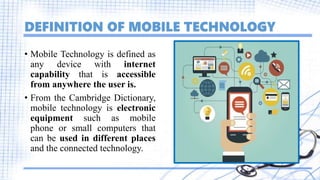
DEFINITION OF MOBILE TECHNOLOGY
• Mobile Technology is defined as
any device with internet
capability that is accessible
from anywhere the user is.
• From the Cambridge Dictionary,
mobile technology is electronic
equipment such as mobile
phone or small computers that
can be used in different places
and the connected technology.
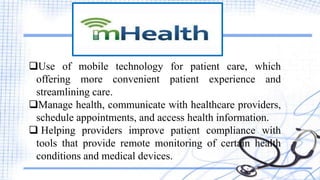
Use of mobile technology for patient care, which
offering more convenient patient experience and
streamlining care.
Manage health, communicate with healthcare providers,
schedule appointments, and access health information.
 Helping providers improve patient compliance with
tools that provide remote monitoring of certain health
conditions and medical devices.
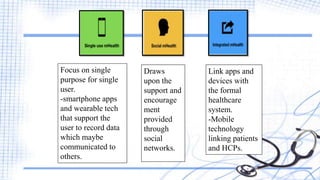
Focus on single
purpose for single
user.
-smartphone apps
and wearable tech
that support the
user to record data
which maybe
communicated to
others.
Draws
upon the
support and
encourage
ment
provided
through
social
networks.
Link apps and
devices with
the formal
healthcare
system.
-Mobile
technology
linking patients
and HCPs.
The Cloud
• The cloud is becoming a more relevant and trusted mechanism
to store and share big data.
• IBM Watson is one example of a cloud-based technology that
is “bringing together clinical, research and social data from a
diverse range of health sources” to advance care and speed up
communication.
• Security and privacy of patient data has always been a concern
for health centres, the cloud has introduced new challenges and
concerns surrounding the possibility of cyber attacks or digital
information breaches.
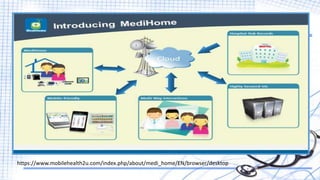
MediHome
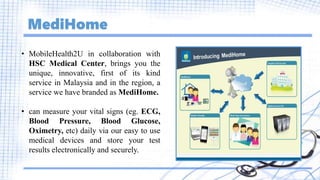
• MobileHealth2U in collaboration with
HSC Medical Center, brings you the
unique, innovative, first of its kind
service in Malaysia and in the region, a
service we have branded as MediHome.
• can measure your vital signs (eg. ECG,
Blood Pressure, Blood Glucose,
Oximetry, etc) daily via our easy to use
medical devices and store your test
results electronically and securely.
https://www.mobilehealth2u.com/index.php/about/medi_home/EN/browser/desktop
MEDIHOME PROVIDES THE FOLLOWING
VALUE ADD:-
• View, Store and Analyze your Personal
Health Records (PHR) whenever you
feel like it
• Trending, tracking and self-monitoring of
your health vital signs
• Free yourself from the hassle of
searching for your Medical Reports
when you need it
• Personal Health Records easily available
in time of emergencies
• Online sharing of Personal Health
Records with your family members and
care providers
ITAREPS
• Information Technology Aided Relapse
Prevention Program in Schizophrenia
• presents a mobile phone-based e-
Health solution for weekly remote
patient monitoring and disease
management in schizophrenia and
psychotic disorders
• capable to reduce the risk of
hospitalization in schizophrenia down
to one-fifth, compared to controls
Kalem, Turhan, Mobile Technology
Applications in the Healthcare Industry
for Disease Management and Wellness,
2015
How ITAREPS works?
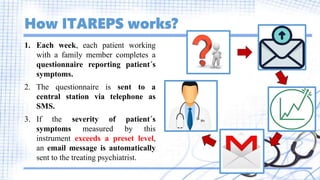
1. Each week, each patient working
with a family member completes a
questionnaire reporting patient´s
symptoms.
2. The questionnaire is sent to a
central station via telephone as
SMS.
3. If the severity of patient´s
symptoms measured by this
instrument exceeds a preset level,
an email message is automatically
sent to the treating psychiatrist.
Advantages of mobile technology in
medical informatics
• Providing education and information
• Improving quality of communication between patient and
healthcare professional
• Improving personal awareness through self-monitoring
• Enabling patients to obtain social support from peers
• Allowing patients to share knowledge and information with peers
• Enabling patients to participate proactively
in their care
• Reducing the cost of healthcare delivery
https://www.eiseverywhere.com/file_u
ploads/a488bbdd996ced16c346b0d885
51f384_HowMobileisTransformingHealt
hcare_Economist.pdf
PROBLEMS FACED IN IMPLEMENTING
MOBILE TECHNOLOGY IN MEDICAL
HEALTHCARE
Challenges Faced by Mobile Healthcare
Solutions Providers
• Security Issues - Patient information is a vital.However, with over 50
percent of all healthcare institutions experiencing at least one cyber
attack a mobile storage and retrieval system that handles this sensitive
data must be resilient to outside intrusions and other security threats.
• Complexity in Mobile Systems - Devices and apps that are difficult
to use or implement hinder the work of doctors and other staff
members, thereby negating any gains in efficiency.
Challenges Faced by Patients
• Ease of Use - Patients naturally shy away from apps and digital
products that are unintuitive and hard to comprehend initially. Adding
in the fact that the various portions of this secondary audience also
approach the utilization of these products from a variety of different
platforms – iOS, Android, Windows, etc. – and connected tools –
glucometers, blood pressure monitors, and so forth – adds, even more,
roadblocks to the adoption and integration process.
• Health Literacy - Not all patients understand health related terms or
information.These individuals require mobile apps and products that
either bridge this gap in knowledge or adapt to the health literacy
levels of the end users.
• Patient Privacy - The private data of these end users are highly
sensitive and subject to compliance guidelines like those set forth by
the Health Insurance Portability and Accountability Act (HIPAA). So,
mobile offerings that fail to impart a sense of security and protection
to patients have very little hope of truly being accepted by the target
community.
How The Systems
Work ?
General Systems Used in Mobile Healthcare
• Cloud Based Data sharing. (as explained previously)
• Use of central data centre whereby medical information can be sent and
accessed through the internet.
• This is a system utilised by many mobile health applications that utilise
peripheral or wearable devices to record health data (Heart rate, SpO2, BP,
etc.).
• However, most of these systems do not connect to a central health data centre.
But, patient are able to show the data to their physician.
General Systems Used in Mobile Healthcare (cont.)
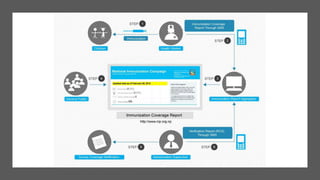
• Short Message systems
• Systems used to send specific information or data utilising technologies such as SMS,
text messages, Twitter, etc.
• Uses a central system that is managed by the related organization which would be
able to send out the medical information to the individuals contact information
(patients), or send out public health notifications on public platforms
• Used in systems that would notify the user (patient / Healthcare provider /
General public) on specific information.
• For health disaster management
• To notify on appointments made with Healthcare Provider
• To notify guardians on condition or of treatment of children
• Patient Medic
• Etc.
A framework design for the
mHealth system
for self-management promotion
From HL7 International website – Mobile Health
http://www.hl7.org/Special/committees/mobile/index.cfm
Design of
mHealth
Framework
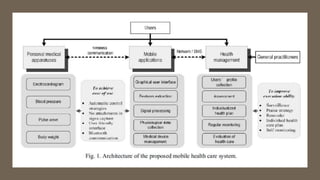
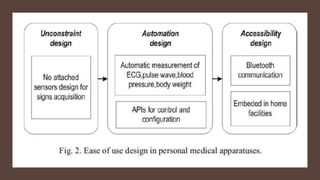
• For personal medical apparatuses, for vital signals acquisition, including
ECG, pulse wave, blood pressure, and body weight.
• Apparatuses would then deliver the raw data to the mobile applications that
are in charge of the medical apparatuses' management, physiological data
collection, data processing, features extraction, preliminary analysis, and
data transmission.
• Health management includes users’ profile collection and assessment,
individualized healthy plan formulation, regular monitoring, and healthcare
effectiveness evaluation.
• To maintain health, the health status of users will be extracted from vital
signs and regularly assessed.
• Health care guidelines help users know how to keep healthy regimens.
• In the framework, medical apparatuses and mobile applications interact
directly with end-users.
• Accordingly, ease of use design principles are implemented in them.
Meanwhile, persuasive technology is incorporated in health management in
the form of a quantitative model to enhance users’ execution ability in daily
self-management.
Mobile Technology in Medical Informatic

Mobile Technology in Medical Informatic

  • 1.
    MOBILE TECHNOLOGY IN MEDICAL INFORMATICS PRESENTEDBY: 1) JAMES JACKY 2) DZAHIRUDDIN 3) AIDA AISYAH 4) FATIN NAJIHA 5) PRIYATHARSHINI SIVANESAN
  • 2.
    DEFINITION OF MOBILETECHNOLOGY • Mobile Technology is defined as any device with internet capability that is accessible from anywhere the user is. • From the Cambridge Dictionary, mobile technology is electronic equipment such as mobile phone or small computers that can be used in different places and the connected technology.
  • 4.
    Use of mobiletechnology for patient care, which offering more convenient patient experience and streamlining care. Manage health, communicate with healthcare providers, schedule appointments, and access health information.  Helping providers improve patient compliance with tools that provide remote monitoring of certain health conditions and medical devices.
  • 5.
    Focus on single purposefor single user. -smartphone apps and wearable tech that support the user to record data which maybe communicated to others. Draws upon the support and encourage ment provided through social networks. Link apps and devices with the formal healthcare system. -Mobile technology linking patients and HCPs.
  • 6.
    The Cloud • Thecloud is becoming a more relevant and trusted mechanism to store and share big data. • IBM Watson is one example of a cloud-based technology that is “bringing together clinical, research and social data from a diverse range of health sources” to advance care and speed up communication. • Security and privacy of patient data has always been a concern for health centres, the cloud has introduced new challenges and concerns surrounding the possibility of cyber attacks or digital information breaches.
  • 7.
    MediHome • MobileHealth2U incollaboration with HSC Medical Center, brings you the unique, innovative, first of its kind service in Malaysia and in the region, a service we have branded as MediHome. • can measure your vital signs (eg. ECG, Blood Pressure, Blood Glucose, Oximetry, etc) daily via our easy to use medical devices and store your test results electronically and securely.
  • 8.
  • 9.
    MEDIHOME PROVIDES THEFOLLOWING VALUE ADD:- • View, Store and Analyze your Personal Health Records (PHR) whenever you feel like it • Trending, tracking and self-monitoring of your health vital signs • Free yourself from the hassle of searching for your Medical Reports when you need it • Personal Health Records easily available in time of emergencies • Online sharing of Personal Health Records with your family members and care providers
  • 10.
    ITAREPS • Information TechnologyAided Relapse Prevention Program in Schizophrenia • presents a mobile phone-based e- Health solution for weekly remote patient monitoring and disease management in schizophrenia and psychotic disorders • capable to reduce the risk of hospitalization in schizophrenia down to one-fifth, compared to controls Kalem, Turhan, Mobile Technology Applications in the Healthcare Industry for Disease Management and Wellness, 2015
  • 11.
    How ITAREPS works? 1.Each week, each patient working with a family member completes a questionnaire reporting patient´s symptoms. 2. The questionnaire is sent to a central station via telephone as SMS. 3. If the severity of patient´s symptoms measured by this instrument exceeds a preset level, an email message is automatically sent to the treating psychiatrist.
  • 12.
    Advantages of mobiletechnology in medical informatics • Providing education and information • Improving quality of communication between patient and healthcare professional • Improving personal awareness through self-monitoring • Enabling patients to obtain social support from peers • Allowing patients to share knowledge and information with peers • Enabling patients to participate proactively in their care • Reducing the cost of healthcare delivery https://www.eiseverywhere.com/file_u ploads/a488bbdd996ced16c346b0d885 51f384_HowMobileisTransformingHealt hcare_Economist.pdf
  • 13.
    PROBLEMS FACED INIMPLEMENTING MOBILE TECHNOLOGY IN MEDICAL HEALTHCARE
  • 14.
    Challenges Faced byMobile Healthcare Solutions Providers • Security Issues - Patient information is a vital.However, with over 50 percent of all healthcare institutions experiencing at least one cyber attack a mobile storage and retrieval system that handles this sensitive data must be resilient to outside intrusions and other security threats. • Complexity in Mobile Systems - Devices and apps that are difficult to use or implement hinder the work of doctors and other staff members, thereby negating any gains in efficiency.
  • 15.
    Challenges Faced byPatients • Ease of Use - Patients naturally shy away from apps and digital products that are unintuitive and hard to comprehend initially. Adding in the fact that the various portions of this secondary audience also approach the utilization of these products from a variety of different platforms – iOS, Android, Windows, etc. – and connected tools – glucometers, blood pressure monitors, and so forth – adds, even more, roadblocks to the adoption and integration process.
  • 16.
    • Health Literacy- Not all patients understand health related terms or information.These individuals require mobile apps and products that either bridge this gap in knowledge or adapt to the health literacy levels of the end users. • Patient Privacy - The private data of these end users are highly sensitive and subject to compliance guidelines like those set forth by the Health Insurance Portability and Accountability Act (HIPAA). So, mobile offerings that fail to impart a sense of security and protection to patients have very little hope of truly being accepted by the target community.
  • 17.
  • 18.
    General Systems Usedin Mobile Healthcare • Cloud Based Data sharing. (as explained previously) • Use of central data centre whereby medical information can be sent and accessed through the internet. • This is a system utilised by many mobile health applications that utilise peripheral or wearable devices to record health data (Heart rate, SpO2, BP, etc.). • However, most of these systems do not connect to a central health data centre. But, patient are able to show the data to their physician.
  • 19.
    General Systems Usedin Mobile Healthcare (cont.) • Short Message systems • Systems used to send specific information or data utilising technologies such as SMS, text messages, Twitter, etc. • Uses a central system that is managed by the related organization which would be able to send out the medical information to the individuals contact information (patients), or send out public health notifications on public platforms • Used in systems that would notify the user (patient / Healthcare provider / General public) on specific information. • For health disaster management • To notify on appointments made with Healthcare Provider • To notify guardians on condition or of treatment of children • Patient Medic • Etc.
  • 21.
    A framework designfor the mHealth system for self-management promotion From HL7 International website – Mobile Health http://www.hl7.org/Special/committees/mobile/index.cfm
  • 22.
    Design of mHealth Framework • Forpersonal medical apparatuses, for vital signals acquisition, including ECG, pulse wave, blood pressure, and body weight. • Apparatuses would then deliver the raw data to the mobile applications that are in charge of the medical apparatuses' management, physiological data collection, data processing, features extraction, preliminary analysis, and data transmission. • Health management includes users’ profile collection and assessment, individualized healthy plan formulation, regular monitoring, and healthcare effectiveness evaluation. • To maintain health, the health status of users will be extracted from vital signs and regularly assessed. • Health care guidelines help users know how to keep healthy regimens. • In the framework, medical apparatuses and mobile applications interact directly with end-users. • Accordingly, ease of use design principles are implemented in them. Meanwhile, persuasive technology is incorporated in health management in the form of a quantitative model to enhance users’ execution ability in daily self-management.