Understanding Individual Behaviour
Unit II
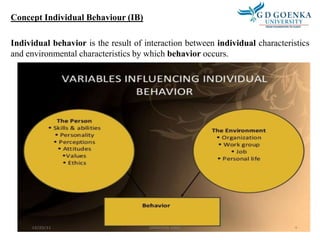
Concept Individual Behaviour (IB)
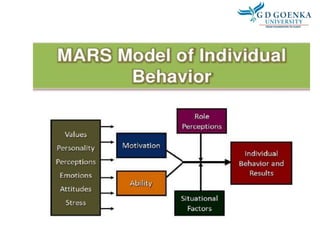
Individual behavior is the result of interaction between individual characteristics
and environmental characteristics by which behavior occurs.
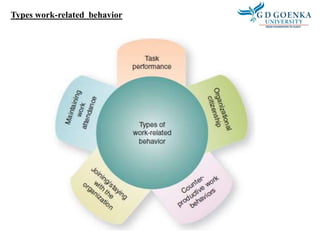
Types work-related behavior
Factors Influencing Individual Behavior
• Personal Factors: - Age, gender, emotional intelligence, marital status,
education, religion, abilities.
• Psychological Factors:- Perception, Value, attitudes, psychological needs,
personality, motivation
• Organizational factors:- organizational culture & climate, tenure, reward
system, leadership style.
• Environmental Factors:- Economical factor, technological factor
Concept of Personality in organization
o Word “Personality” derived from Latin word “Persona” denotes masks that
used to be worn by theatrical players.
o The Sum total of ways in which an individual reacts and interacts with others,
measurable traits of a person exhibits.
o An individual’sunique pattern of thoughts, feelings, and behaviors that
continues over time and across situations.
Every individual has a unique, personal and major determinant of his behavior that
defines his/her personality.
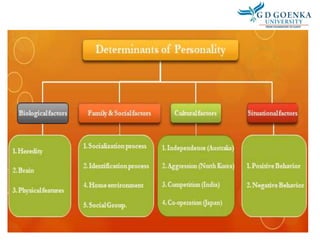
• Personality trait is basically influenced by two major features −
• Inherited characteristics
• Learned characteristics
Major Personality Attributes
Following are the five major personality attributes that influence OB
• Locus of Control
• Machiavellianism
• Self-esteem
• Self-monitoring
• Risk taking
Psychoanalytic Theory ( Given by Sigmund Freud )
Definition: The Psychoanalytic Theory is the personality theory, which is based
on the notion that an individual gets motivated more by unseen forces that are
controlled by the conscious and the rational thought.
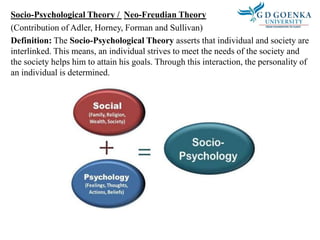
Socio-Psychological Theory / Neo-Freudian Theory
(Contribution of Adler, Horney, Forman and Sullivan)
Definition: The Socio-Psychological Theory asserts that individual and society are
interlinked. This means, an individual strives to meet the needs of the society and
the society helps him to attain his goals. Through this interaction, the personality of
an individual is determined.
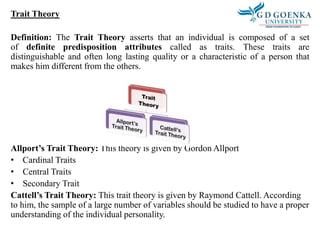
Trait Theory
Definition: The Trait Theory asserts that an individual is composed of a set
of definite predisposition attributes called as traits. These traits are
distinguishable and often long lasting quality or a characteristic of a person that
makes him different from the others.
Allport’s Trait Theory: This theory is given by Gordon Allport
• Cardinal Traits
• Central Traits
• Secondary Trait
Cattell’s Trait Theory: This trait theory is given by Raymond Cattell. According
to him, the sample of a large number of variables should be studied to have a proper
understanding of the individual personality.
Self Theory
Definition: The Self Theory emphasizes on the set of perceptions an individual has
for himself and the perceptions of the relationships he has with others and the other
aspects of life. Carl Rogers has contributed significantly towards the self theory.
Self theory comprises of four factors
Personality Types A and B Definition
These two theorists came up with two extreme ‘behavior syndromes’ to allow us
to look into different stress levels people endure. Each side of the spectrum was
split into its own category; Type A Personality and Type B Personality.
Johari Window
The Johari window is a technique that helps people better understand their
relationship with themselves and others. It was created by psychologists Joseph
Luft (1916–2014) and Harrington Ingham (1916–1995) in 1955, and is used
primarily in self-help groups and corporate settings as a heuristic exercise.
1. Open area, open self, free area, free self, or 'the arena‘: what is known
by the person about him/herself and is also known by others -
2. Blind area, blind self, or 'blindspot‘: what is unknown by the
person about him/herself but which others know
3. Hidden area, hidden self, avoided area, avoided self or 'façade’: what
the person knows about him/herself that others do not know
4. Unknown area or unknown self: what is unknown by the person about
him/herself and is also unknown by others
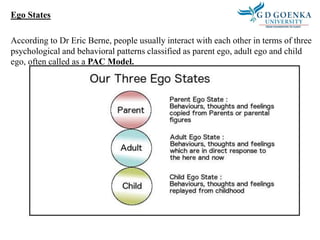
Ego States
According to Dr Eric Berne, people usually interact with each other in terms of three
psychological and behavioral patterns classified as parent ego, adult ego and child
ego, often called as a PAC Model.
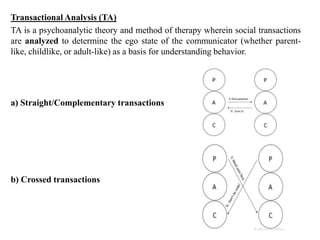
Transactional Analysis (TA)
TA is a psychoanalytic theory and method of therapy wherein social transactions
are analyzed to determine the ego state of the communicator (whether parent-
like, childlike, or adult-like) as a basis for understanding behavior.
a) Straight/Complementary transactions
b) Crossed transactions
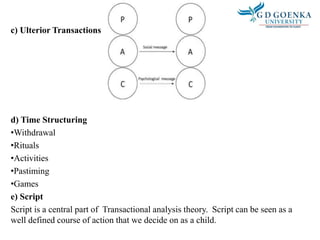
c) Ulterior Transactions
d) Time Structuring
•Withdrawal
•Rituals
•Activities
•Pastiming
•Games
e) Script
Script is a central part of Transactional analysis theory. Script can be seen as a
well defined course of action that we decide on as a child.
Life Positions (By Eric Berne)
Factors Affecting Behavior of an Individual in the Organization
A. Personal factors – The personal factors that can influence the behavior of an
individual is further categorized into 2 parts that includes Biographic and
learned characteristics.
1. Biographic Characteristics
• Physical Characteristics (Age, Gender, Religion, Marital Status, Experience)
• Learned Characteristics (Personality, Perception, Values)
B. Environmental Factors
• Economic Factors (Employment Level, Wage Rates , General Economic
Environment)
C. Organizational Factors
• Physical Facilities (Structure and Design, Leadership, Reward System)
Unit 2_Understanding Individual Behaviour.pptx

Unit 2_Understanding Individual Behaviour.pptx

  • 1.
  • 2.
    Concept Individual Behaviour(IB) Individual behavior is the result of interaction between individual characteristics and environmental characteristics by which behavior occurs.
  • 3.
  • 4.
    Factors Influencing IndividualBehavior • Personal Factors: - Age, gender, emotional intelligence, marital status, education, religion, abilities. • Psychological Factors:- Perception, Value, attitudes, psychological needs, personality, motivation • Organizational factors:- organizational culture & climate, tenure, reward system, leadership style. • Environmental Factors:- Economical factor, technological factor
  • 6.
    Concept of Personalityin organization o Word “Personality” derived from Latin word “Persona” denotes masks that used to be worn by theatrical players. o The Sum total of ways in which an individual reacts and interacts with others, measurable traits of a person exhibits. o An individual’sunique pattern of thoughts, feelings, and behaviors that continues over time and across situations. Every individual has a unique, personal and major determinant of his behavior that defines his/her personality. • Personality trait is basically influenced by two major features − • Inherited characteristics • Learned characteristics
  • 8.
    Major Personality Attributes Followingare the five major personality attributes that influence OB • Locus of Control • Machiavellianism • Self-esteem • Self-monitoring • Risk taking
  • 9.
    Psychoanalytic Theory (Given by Sigmund Freud ) Definition: The Psychoanalytic Theory is the personality theory, which is based on the notion that an individual gets motivated more by unseen forces that are controlled by the conscious and the rational thought.
  • 10.
    Socio-Psychological Theory /Neo-Freudian Theory (Contribution of Adler, Horney, Forman and Sullivan) Definition: The Socio-Psychological Theory asserts that individual and society are interlinked. This means, an individual strives to meet the needs of the society and the society helps him to attain his goals. Through this interaction, the personality of an individual is determined.
  • 11.
    Trait Theory Definition: TheTrait Theory asserts that an individual is composed of a set of definite predisposition attributes called as traits. These traits are distinguishable and often long lasting quality or a characteristic of a person that makes him different from the others. Allport’s Trait Theory: This theory is given by Gordon Allport • Cardinal Traits • Central Traits • Secondary Trait Cattell’s Trait Theory: This trait theory is given by Raymond Cattell. According to him, the sample of a large number of variables should be studied to have a proper understanding of the individual personality.
  • 12.
    Self Theory Definition: TheSelf Theory emphasizes on the set of perceptions an individual has for himself and the perceptions of the relationships he has with others and the other aspects of life. Carl Rogers has contributed significantly towards the self theory. Self theory comprises of four factors
  • 13.
    Personality Types Aand B Definition These two theorists came up with two extreme ‘behavior syndromes’ to allow us to look into different stress levels people endure. Each side of the spectrum was split into its own category; Type A Personality and Type B Personality.
  • 14.
  • 15.
    The Johari windowis a technique that helps people better understand their relationship with themselves and others. It was created by psychologists Joseph Luft (1916–2014) and Harrington Ingham (1916–1995) in 1955, and is used primarily in self-help groups and corporate settings as a heuristic exercise. 1. Open area, open self, free area, free self, or 'the arena‘: what is known by the person about him/herself and is also known by others - 2. Blind area, blind self, or 'blindspot‘: what is unknown by the person about him/herself but which others know 3. Hidden area, hidden self, avoided area, avoided self or 'façade’: what the person knows about him/herself that others do not know 4. Unknown area or unknown self: what is unknown by the person about him/herself and is also unknown by others
  • 16.
    Ego States According toDr Eric Berne, people usually interact with each other in terms of three psychological and behavioral patterns classified as parent ego, adult ego and child ego, often called as a PAC Model.
  • 17.
    Transactional Analysis (TA) TAis a psychoanalytic theory and method of therapy wherein social transactions are analyzed to determine the ego state of the communicator (whether parent- like, childlike, or adult-like) as a basis for understanding behavior. a) Straight/Complementary transactions b) Crossed transactions
  • 18.
    c) Ulterior Transactions d)Time Structuring •Withdrawal •Rituals •Activities •Pastiming •Games e) Script Script is a central part of Transactional analysis theory. Script can be seen as a well defined course of action that we decide on as a child.
  • 19.
    Life Positions (ByEric Berne)
  • 20.
    Factors Affecting Behaviorof an Individual in the Organization A. Personal factors – The personal factors that can influence the behavior of an individual is further categorized into 2 parts that includes Biographic and learned characteristics. 1. Biographic Characteristics • Physical Characteristics (Age, Gender, Religion, Marital Status, Experience) • Learned Characteristics (Personality, Perception, Values) B. Environmental Factors • Economic Factors (Employment Level, Wage Rates , General Economic Environment) C. Organizational Factors • Physical Facilities (Structure and Design, Leadership, Reward System)