Spatial Sense and Geometry for
Preschoolers based on Milestones
Spatial Sense and Geometry for
Preschoolers based on Milestones
Spatial Sense
● Spatial sense is an important cognitive skill
in preschoolers.
● Children start looking at the world as a
space full of objects.
● Shape and size are among the first
characteristics of any object that a child
recognizes.
Spatial sense comprises of two main abilities
1. Spatial Orientation:
This knowledge helps a child to move around and navigate. For
example: A child needs this knowledge to remember a particular
location and the different routes to and from it.
2. Spatial Visualization:
This is the ability to imagine representations of objects in 2D and
3D. Recognition of patterns in shapes of objects and retention of
them in the memory are important for developing good spatial
visualization.
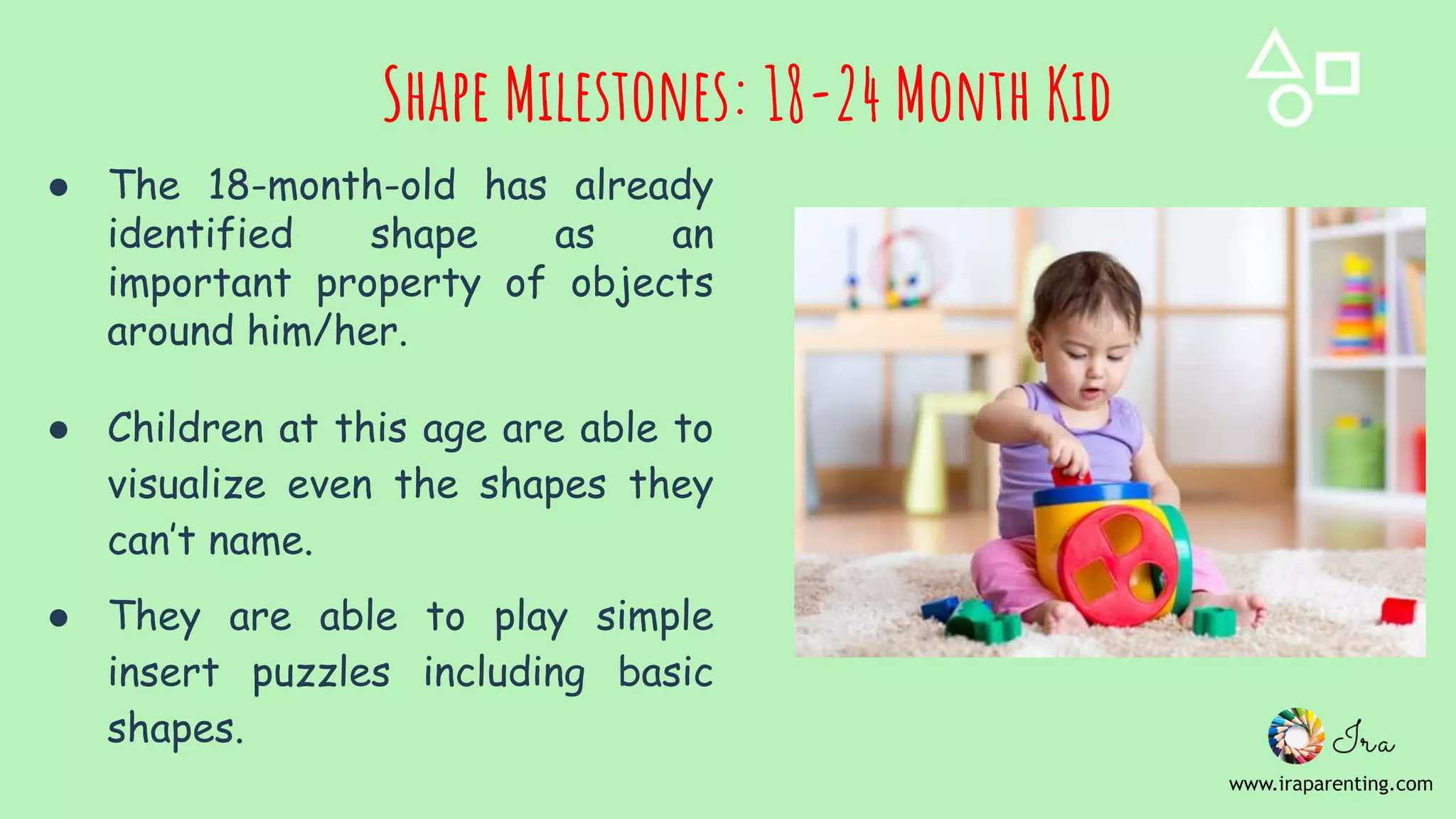
● The 18-month-old has already
identified shape as an
important property of objects
around him/her.
● Children at this age are able to
visualize even the shapes they
can’t name.
● They are able to play simple
insert puzzles including basic
shapes.
Shape Milestones: 18-24 Month Kid
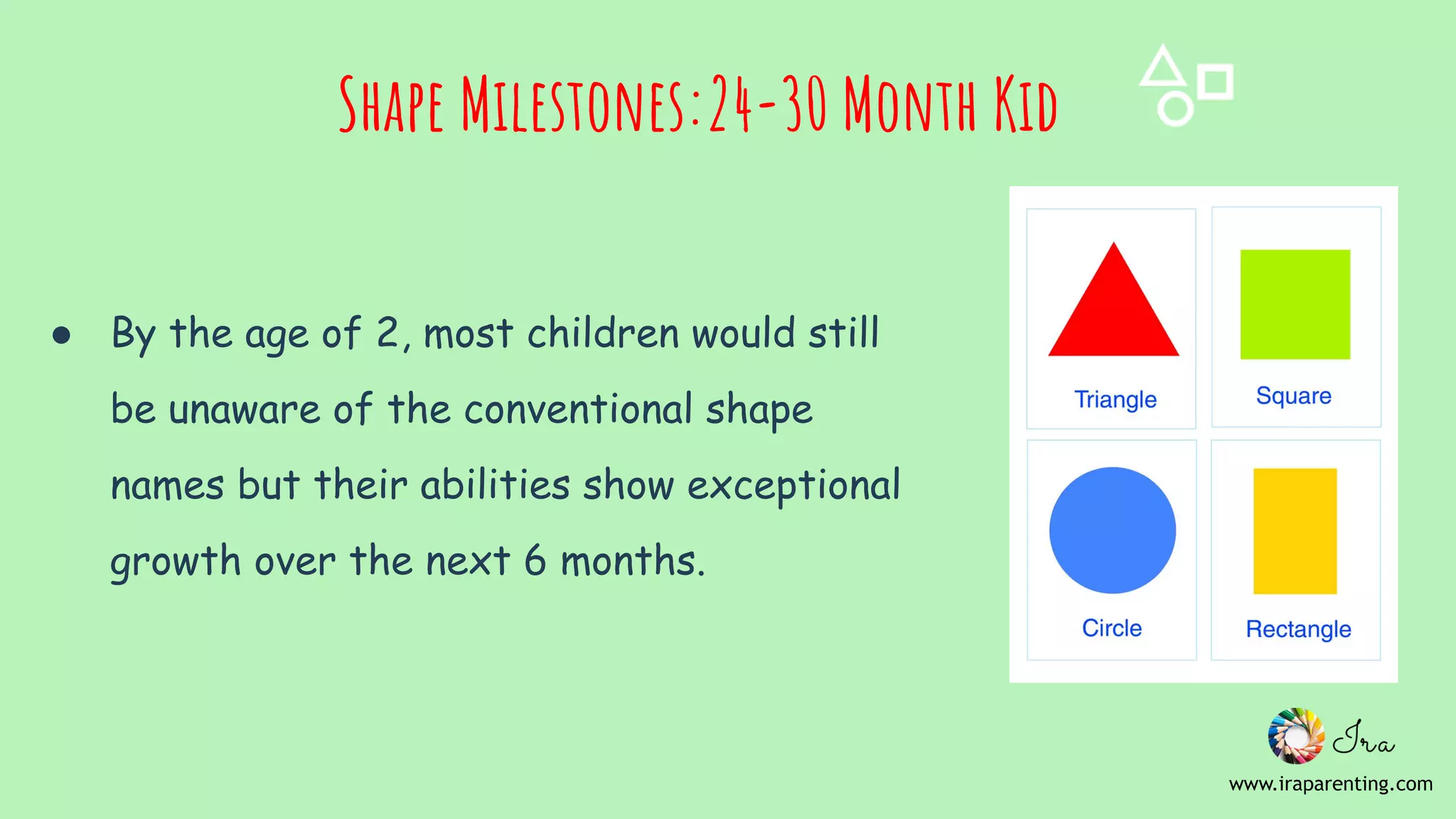
● By the age of 2, most children would still
be unaware of the conventional shape
names but their abilities show exceptional
growth over the next 6 months.
Shape Milestones:24-30 Month Kid
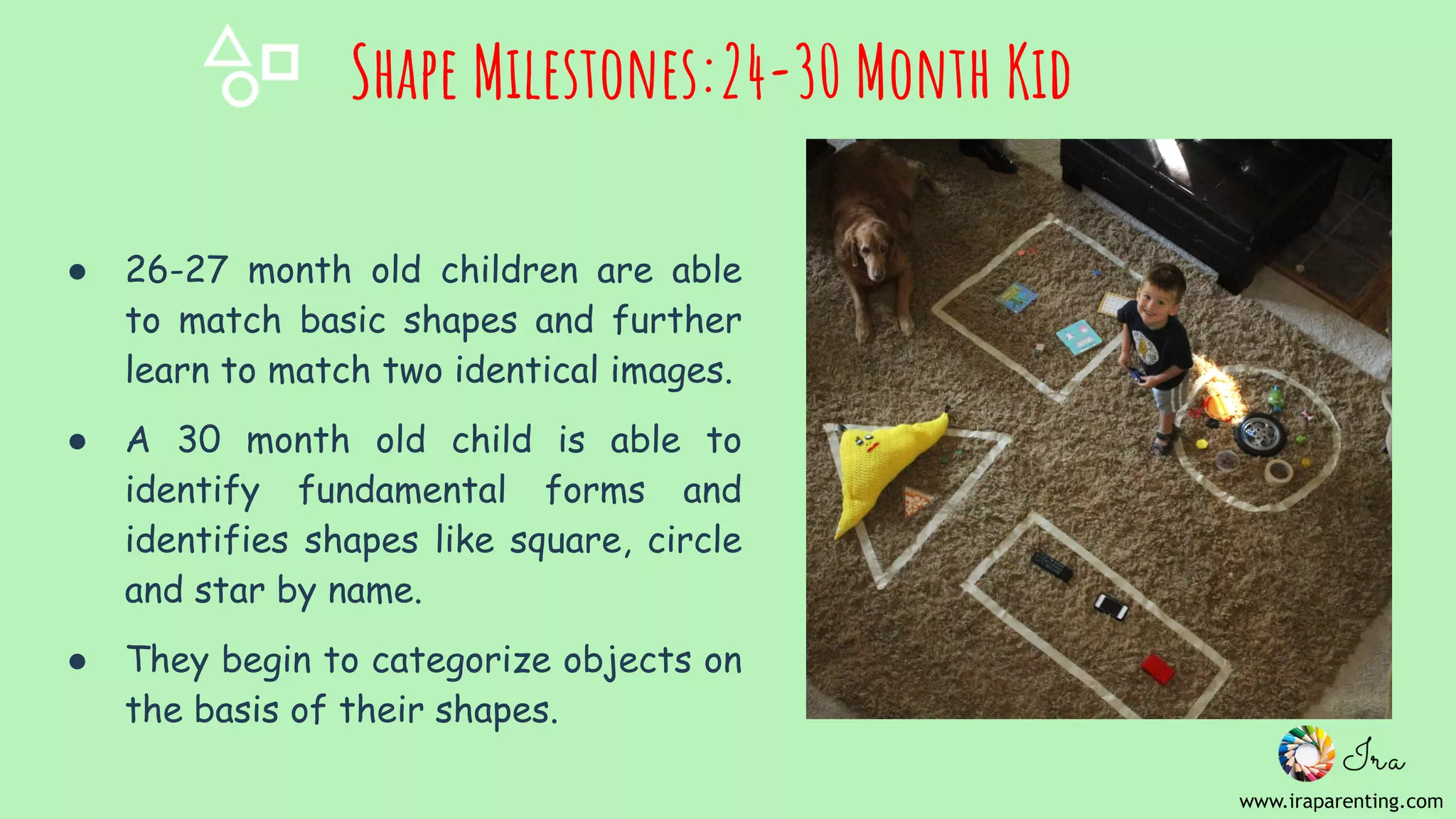
● 26-27 month old children are able
to match basic shapes and further
learn to match two identical images.
● A 30 month old child is able to
identify fundamental forms and
identifies shapes like square, circle
and star by name.
● They begin to categorize objects on
the basis of their shapes.
Shape Milestones:24-30 Month Kid
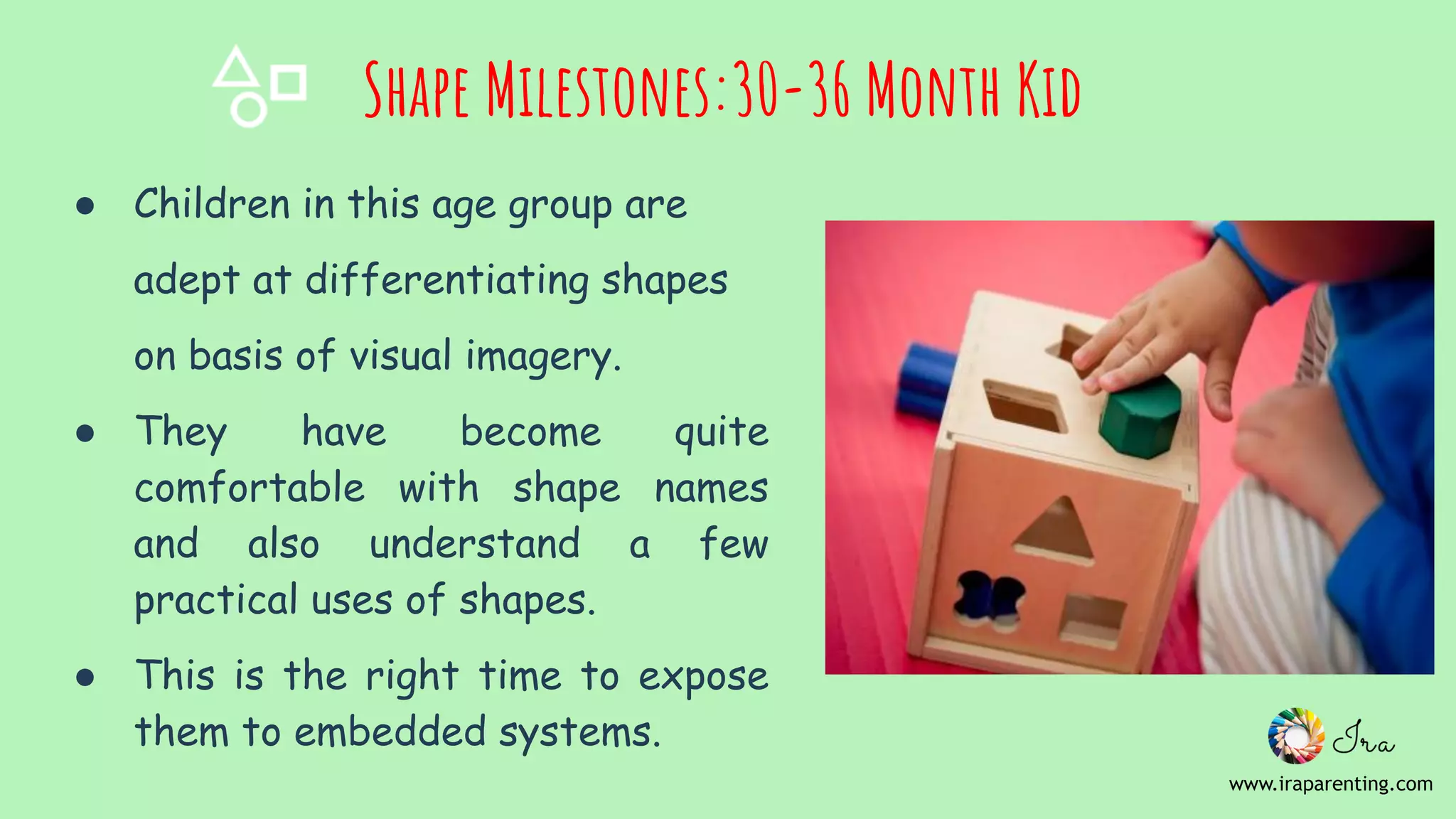
● Children in this age group are
adept at differentiating shapes
on basis of visual imagery.
● They have become quite
comfortable with shape names
and also understand a few
practical uses of shapes.
● This is the right time to expose
them to embedded systems.
Shape Milestones:30-36 Month Kid
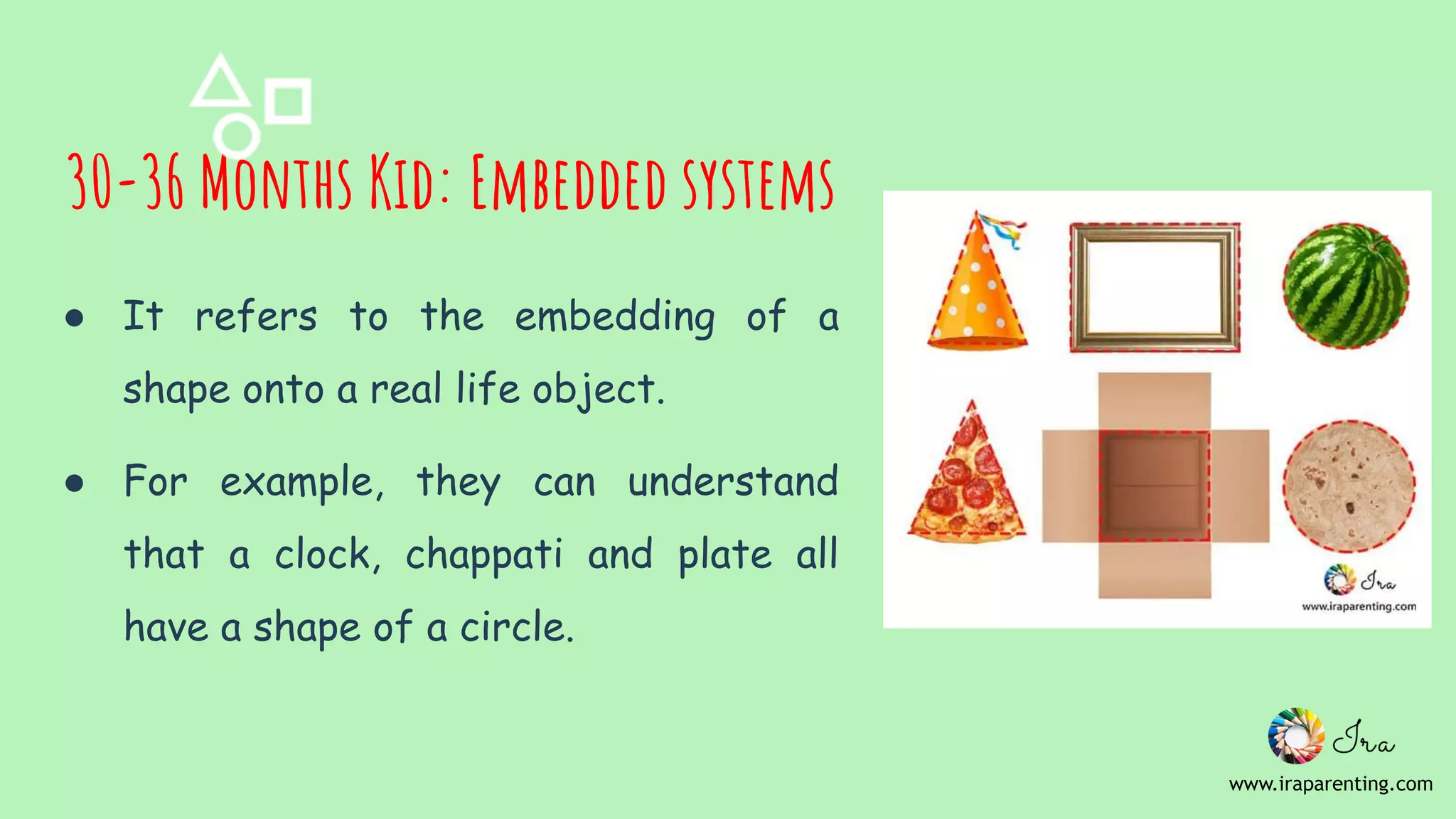
30-36 Months Kid: Embedded systems
● It refers to the embedding of a
shape onto a real life object.
● For example, they can understand
that a clock, chappati and plate all
have a shape of a circle.
● Most children are able draw,
name, match, sort and imagine
shapes.
● Many are able to stack shapes
form lines, although they
cannot create large structures.
By the end of the 3RD year ...
At the end of the 3rd year (contd.)
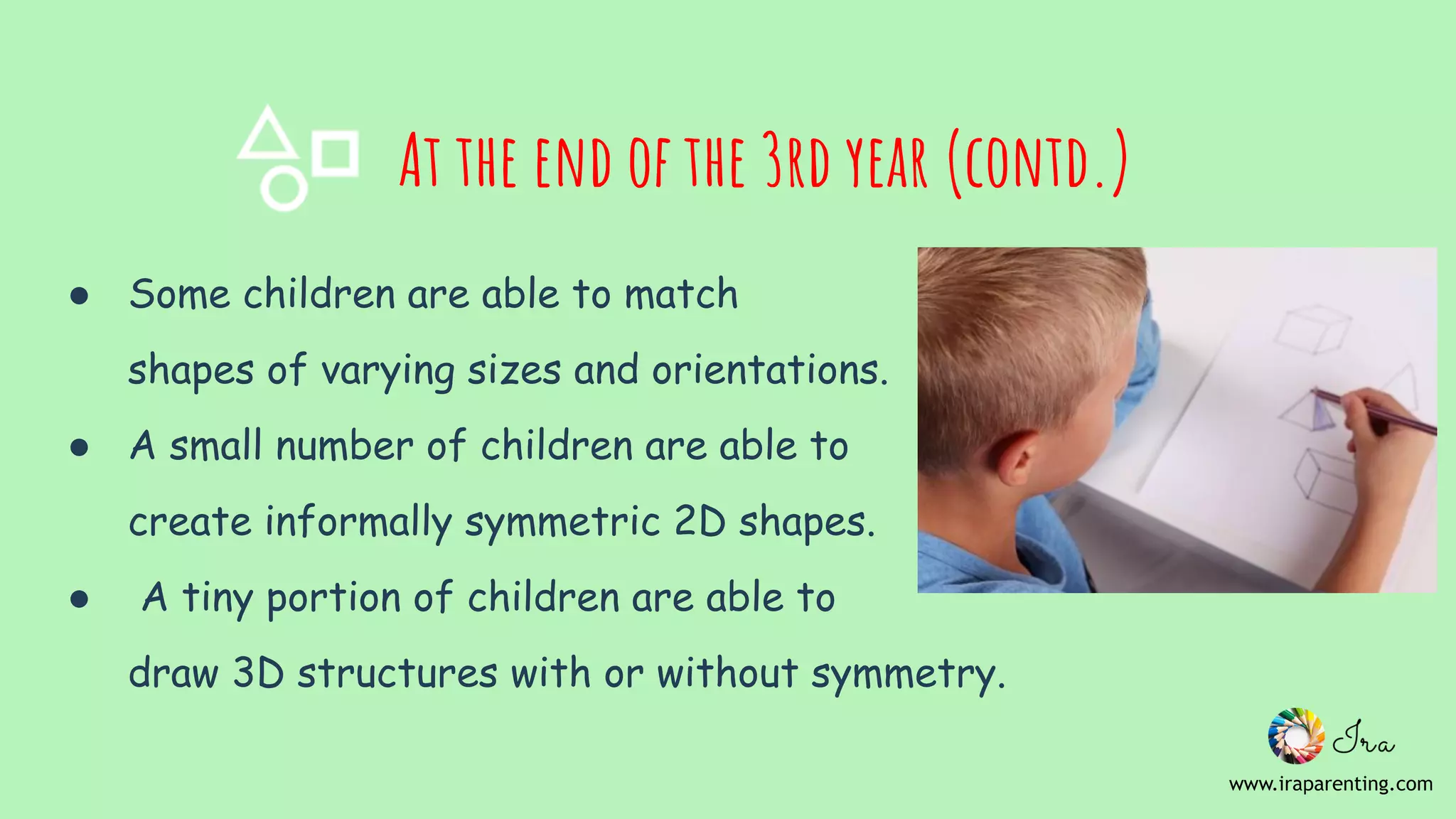
● Some children are able to match
shapes of varying sizes and orientations.
● A small number of children are able to
create informally symmetric 2D shapes.
● A tiny portion of children are able to
draw 3D structures with or without symmetry.
3 Important Challenges Faced
by Children in Learning Shapes
1. Object Labelling and Property Description by Caregivers
● A common difficulty many children face while learning shapes is the
ambiguity between the name of an object and its property.
● Many times parents (or caregivers) focus on the noun (“This is a
clock”) before describing the property (“It is a circle”).
● The child gets confused: it does not know whether ‘circle’ is a
‘property’ of clock or just another name for it.
● To remove such ambiguity, we advise a
comparative approach.
● The child will understand the concept
more easily if we emphasize that a clock,
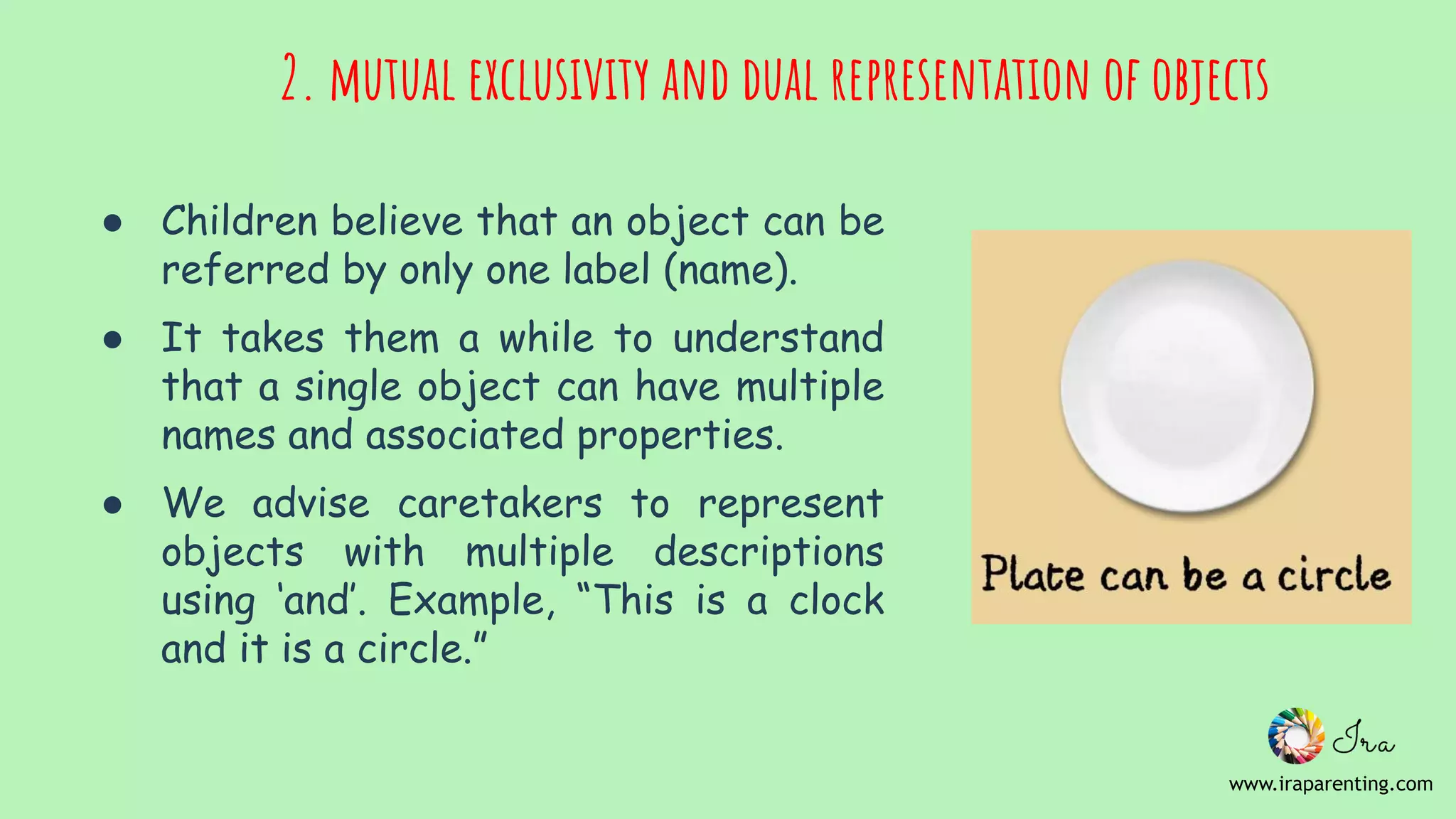
a chappati and a plate are all circles.
● Children believe that an object can be
referred by only one label (name).
● It takes them a while to understand
that a single object can have multiple
names and associated properties.
● We advise caretakers to represent
objects with multiple descriptions
using ‘and’. Example, “This is a clock
and it is a circle.”
2. mutual exclusivity and dual representation of objects
● An exclusive exposure to fundamental
forms for a prolonged time can hinder this
ability.
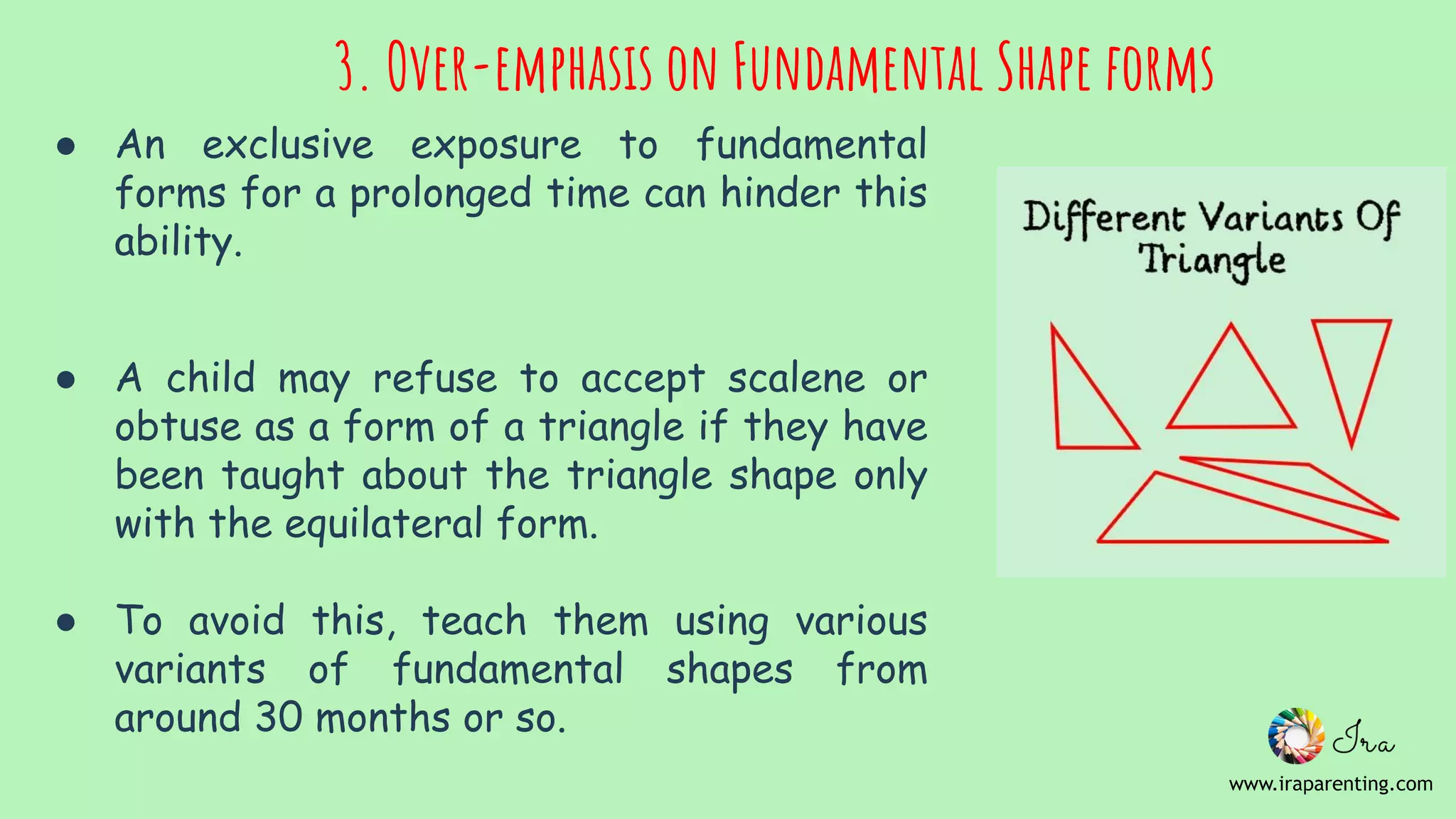
● A child may refuse to accept scalene or
obtuse as a form of a triangle if they have
been taught about the triangle shape only
with the equilateral form.
● To avoid this, teach them using various
variants of fundamental shapes from
around 30 months or so.
3. Over-emphasis on Fundamental Shape forms
TIPS & Activities for Preschoolers
Proper exposure to basic Shapes
● A good amount of time must
be devoted to learning
shapes.
● Once the child has grasped
the fundamental shapes, it
becomes easier to master the
advanced concepts.
Pointing Games
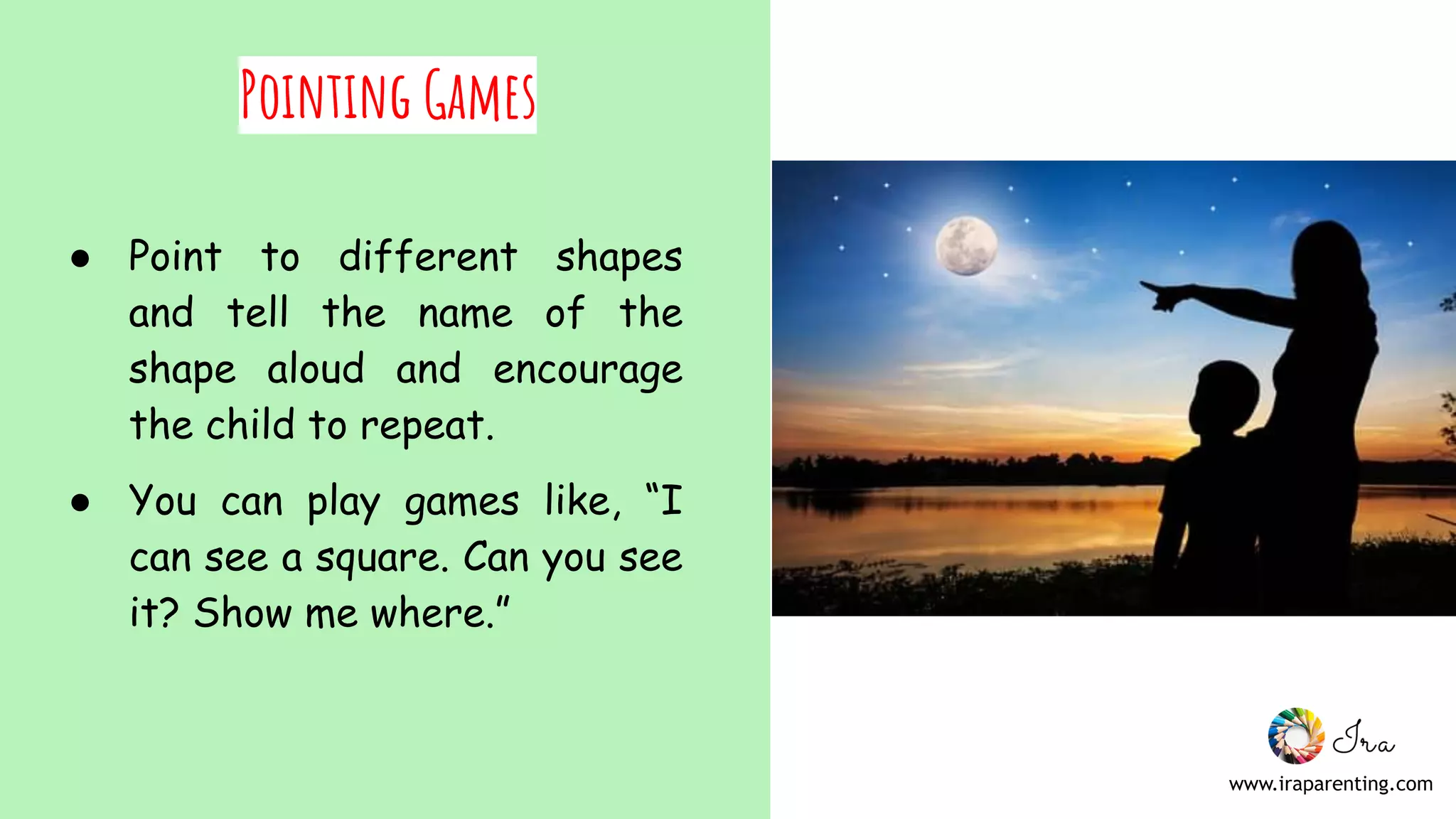
● Point to different shapes
and tell the name of the
shape aloud and encourage
the child to repeat.
● You can play games like, “I
can see a square. Can you see
it? Show me where.”
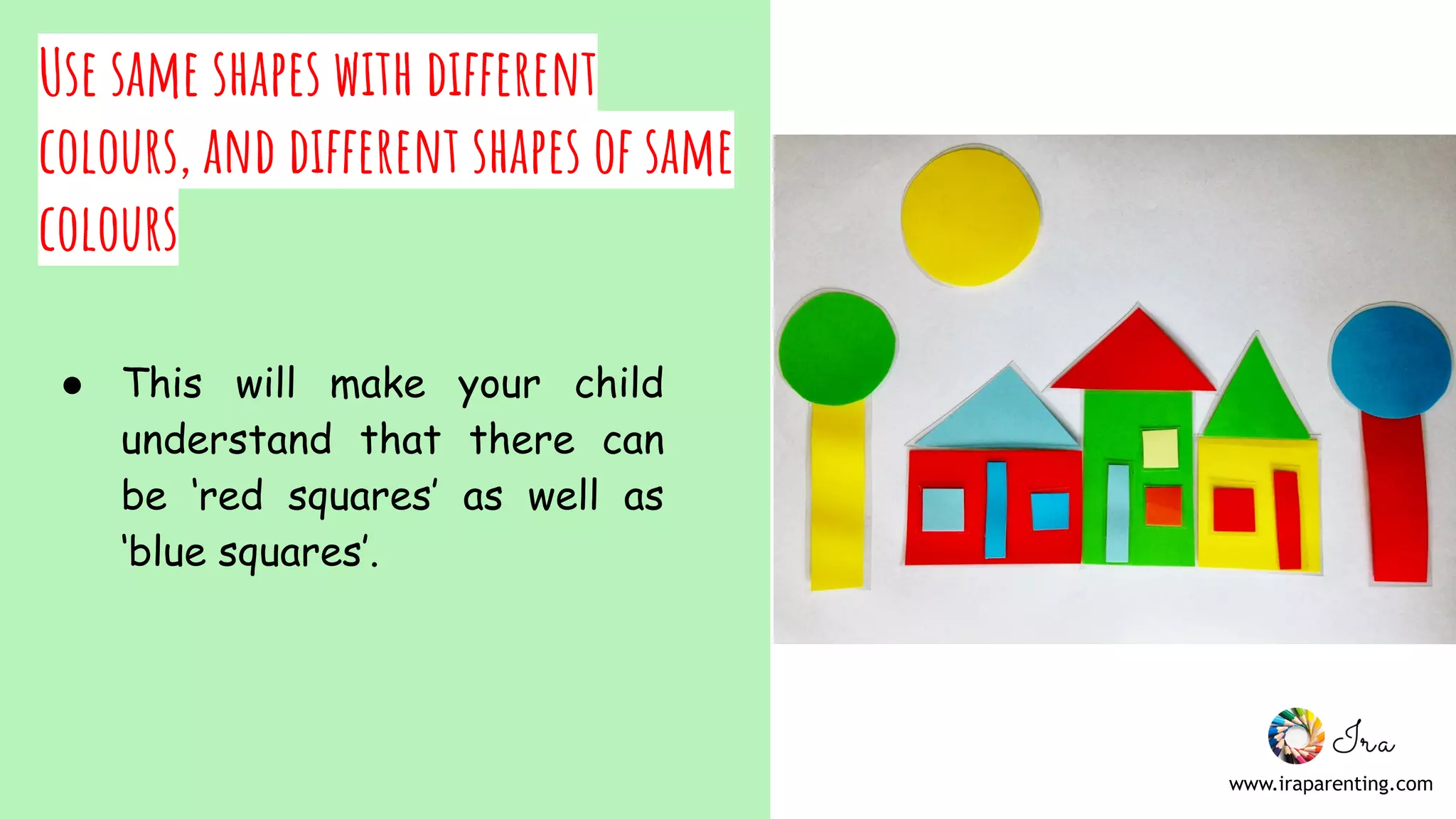
Use same shapes with different
colours, and different shapes of same
colours
● This will make your child
understand that there can
be ‘red squares’ as well as
‘blue squares’.
Correct their Mistakes
● You should never ignore
mistakes. But correct them in
a positive manner.
● If a child refers to a square
window as a circle, saying
“No, it is not a circle”, will not
help.
● It is better to say , “No, it is a
square. And the ring over
there is a circle.”
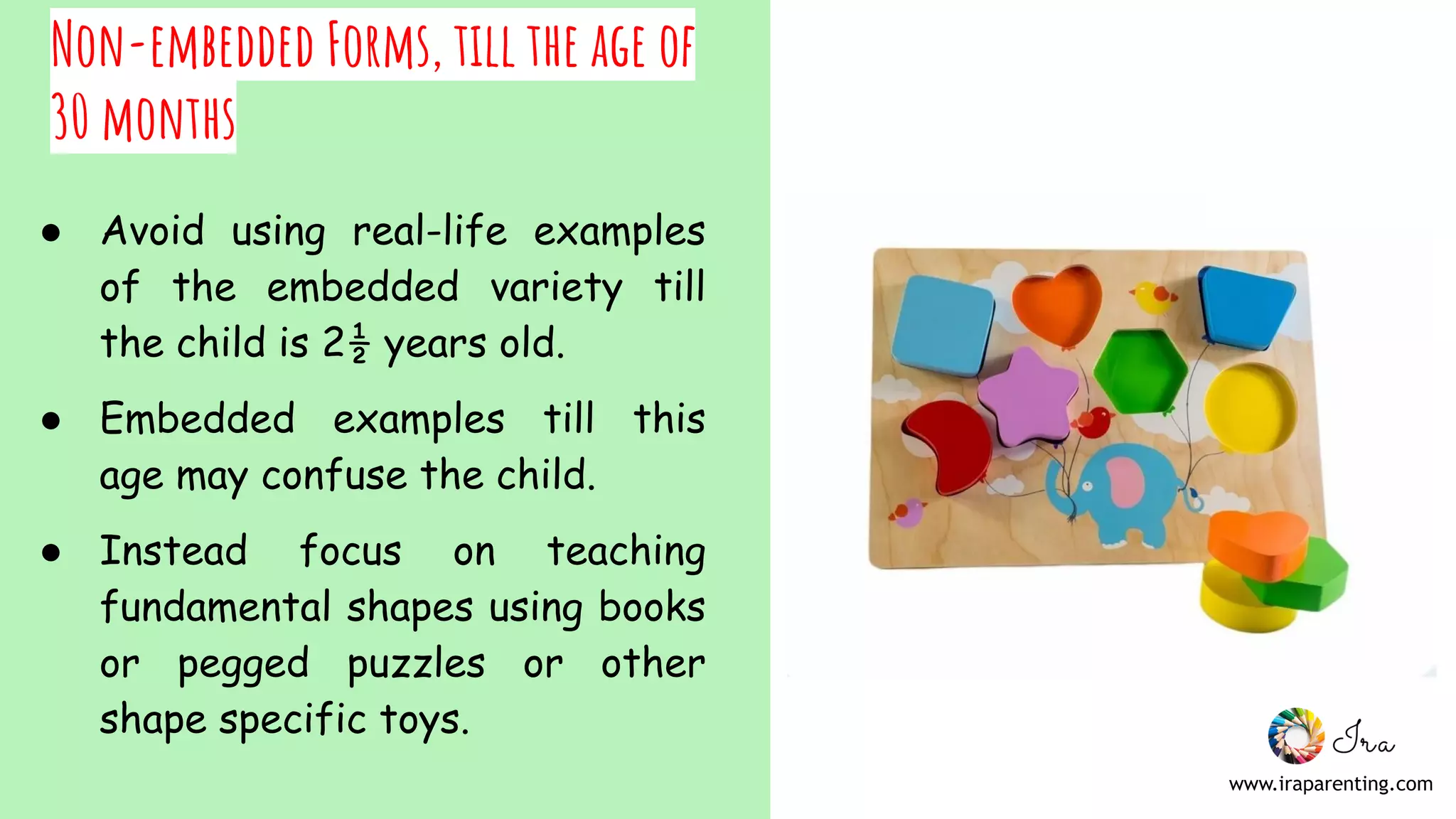
Non-embedded Forms, till the age of
30 months
● Avoid using real-life examples
of the embedded variety till
the child is 2½ years old.
● Embedded examples till this
age may confuse the child.
● Instead focus on teaching
fundamental shapes using books
or pegged puzzles or other
shape specific toys.
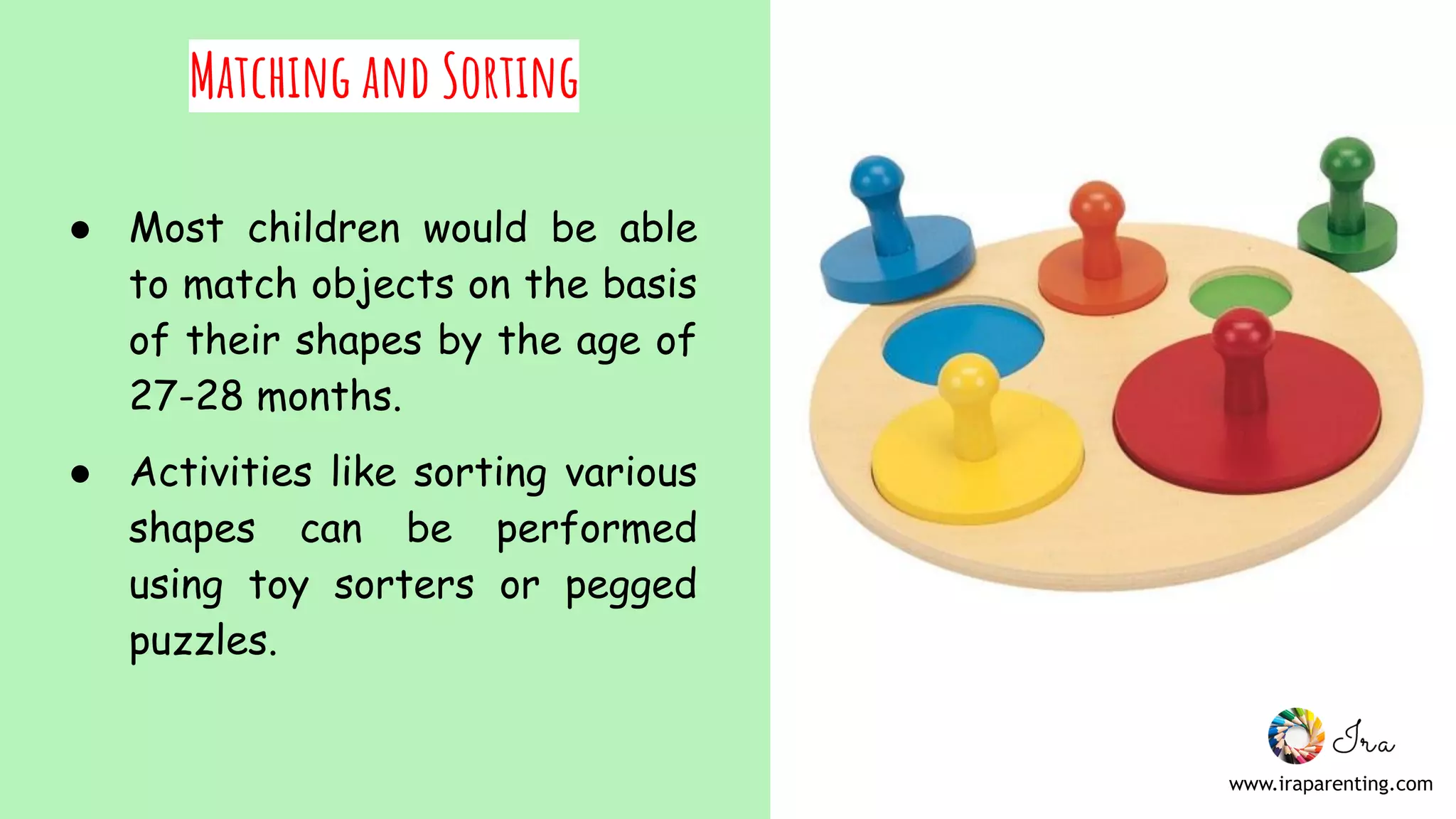
Matching and Sorting
● Most children would be able
to match objects on the basis
of their shapes by the age of
27-28 months.
● Activities like sorting various
shapes can be performed
using toy sorters or pegged
puzzles.
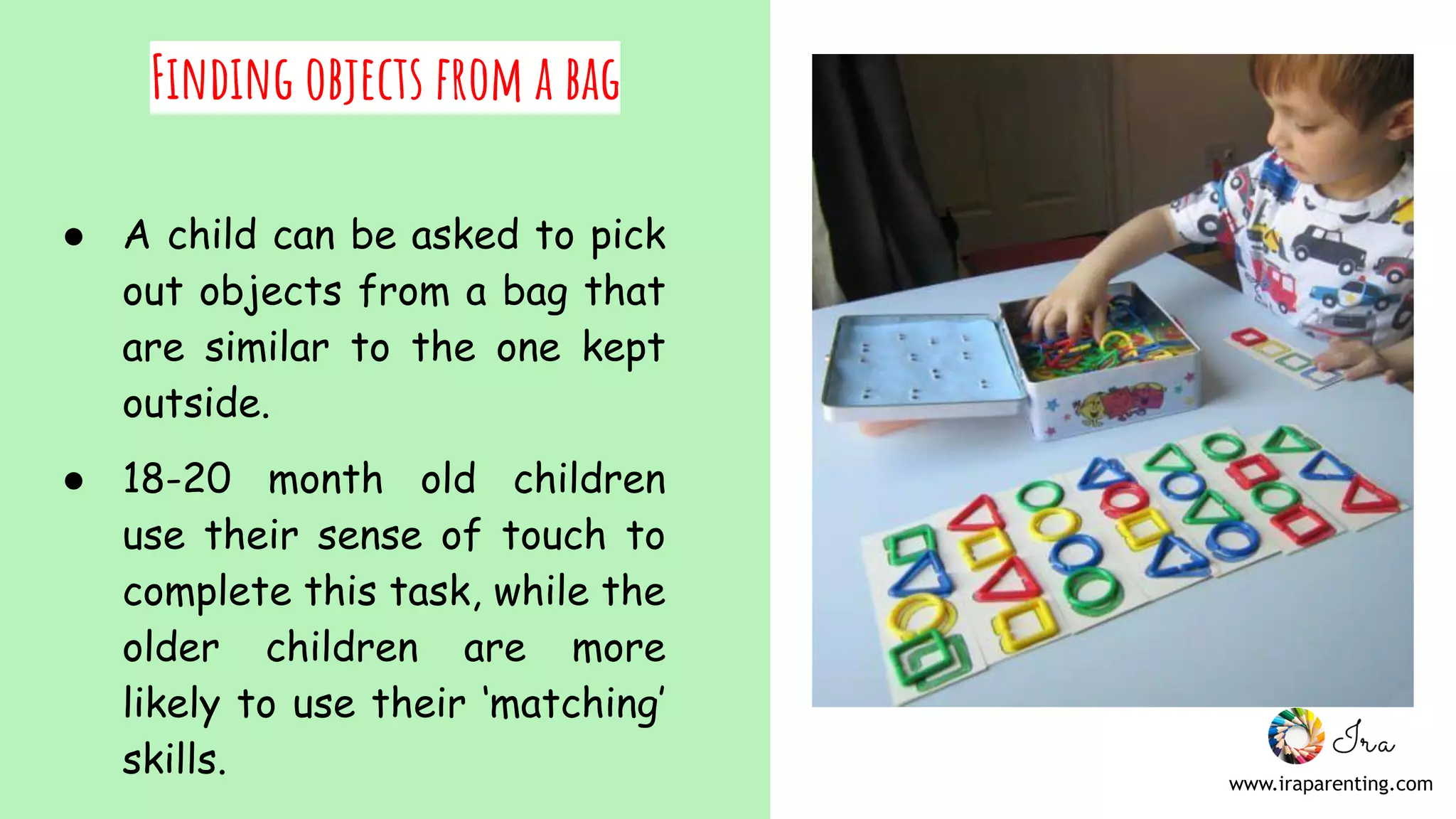
Finding objects from a bag
● A child can be asked to pick
out objects from a bag that
are similar to the one kept
outside.
● 18-20 month old children
use their sense of touch to
complete this task, while the
older children are more
likely to use their ‘matching’
skills.
Rhymes and music
● There are many good rhymes
that teach the concept of shapes
like the famous nursery rhyme,
“We are shapes you can see us
everywhere”.
● Children show better learning
outcomes when taught with the
help of rhymes and music, in
moderation.
There is geometry in the
humming of the strings,
there is music in the spacing
of the spheres - Pythagoras
Thank You!
Contact us:
feedback@iraparenting.com
Visit our website:
www.iraparenting.com
Also read more about spatial sense
milestones for preschoolers here .

Spatial sense and geometry for preschoolers based on milestones

  • 1.
    Spatial Sense andGeometry for Preschoolers based on Milestones Spatial Sense and Geometry for Preschoolers based on Milestones
  • 2.
    Spatial Sense ● Spatialsense is an important cognitive skill in preschoolers. ● Children start looking at the world as a space full of objects. ● Shape and size are among the first characteristics of any object that a child recognizes.
  • 3.
    Spatial sense comprisesof two main abilities 1. Spatial Orientation: This knowledge helps a child to move around and navigate. For example: A child needs this knowledge to remember a particular location and the different routes to and from it. 2. Spatial Visualization: This is the ability to imagine representations of objects in 2D and 3D. Recognition of patterns in shapes of objects and retention of them in the memory are important for developing good spatial visualization.
  • 4.
    ● The 18-month-oldhas already identified shape as an important property of objects around him/her. ● Children at this age are able to visualize even the shapes they can’t name. ● They are able to play simple insert puzzles including basic shapes. Shape Milestones: 18-24 Month Kid
  • 5.
    ● By theage of 2, most children would still be unaware of the conventional shape names but their abilities show exceptional growth over the next 6 months. Shape Milestones:24-30 Month Kid
  • 6.
    ● 26-27 monthold children are able to match basic shapes and further learn to match two identical images. ● A 30 month old child is able to identify fundamental forms and identifies shapes like square, circle and star by name. ● They begin to categorize objects on the basis of their shapes. Shape Milestones:24-30 Month Kid
  • 7.
    ● Children inthis age group are adept at differentiating shapes on basis of visual imagery. ● They have become quite comfortable with shape names and also understand a few practical uses of shapes. ● This is the right time to expose them to embedded systems. Shape Milestones:30-36 Month Kid
  • 8.
    30-36 Months Kid:Embedded systems ● It refers to the embedding of a shape onto a real life object. ● For example, they can understand that a clock, chappati and plate all have a shape of a circle.
  • 9.
    ● Most childrenare able draw, name, match, sort and imagine shapes. ● Many are able to stack shapes form lines, although they cannot create large structures. By the end of the 3RD year ...
  • 10.
    At the endof the 3rd year (contd.) ● Some children are able to match shapes of varying sizes and orientations. ● A small number of children are able to create informally symmetric 2D shapes. ● A tiny portion of children are able to draw 3D structures with or without symmetry.
  • 11.
    3 Important ChallengesFaced by Children in Learning Shapes
  • 12.
    1. Object Labellingand Property Description by Caregivers ● A common difficulty many children face while learning shapes is the ambiguity between the name of an object and its property. ● Many times parents (or caregivers) focus on the noun (“This is a clock”) before describing the property (“It is a circle”). ● The child gets confused: it does not know whether ‘circle’ is a ‘property’ of clock or just another name for it.
  • 13.
    ● To removesuch ambiguity, we advise a comparative approach. ● The child will understand the concept more easily if we emphasize that a clock, a chappati and a plate are all circles.
  • 14.
    ● Children believethat an object can be referred by only one label (name). ● It takes them a while to understand that a single object can have multiple names and associated properties. ● We advise caretakers to represent objects with multiple descriptions using ‘and’. Example, “This is a clock and it is a circle.” 2. mutual exclusivity and dual representation of objects
  • 15.
    ● An exclusiveexposure to fundamental forms for a prolonged time can hinder this ability. ● A child may refuse to accept scalene or obtuse as a form of a triangle if they have been taught about the triangle shape only with the equilateral form. ● To avoid this, teach them using various variants of fundamental shapes from around 30 months or so. 3. Over-emphasis on Fundamental Shape forms
  • 16.
    TIPS & Activitiesfor Preschoolers
  • 17.
    Proper exposure tobasic Shapes ● A good amount of time must be devoted to learning shapes. ● Once the child has grasped the fundamental shapes, it becomes easier to master the advanced concepts.
  • 18.
    Pointing Games ● Pointto different shapes and tell the name of the shape aloud and encourage the child to repeat. ● You can play games like, “I can see a square. Can you see it? Show me where.”
  • 19.
    Use same shapeswith different colours, and different shapes of same colours ● This will make your child understand that there can be ‘red squares’ as well as ‘blue squares’.
  • 20.
    Correct their Mistakes ●You should never ignore mistakes. But correct them in a positive manner. ● If a child refers to a square window as a circle, saying “No, it is not a circle”, will not help. ● It is better to say , “No, it is a square. And the ring over there is a circle.”
  • 21.
    Non-embedded Forms, tillthe age of 30 months ● Avoid using real-life examples of the embedded variety till the child is 2½ years old. ● Embedded examples till this age may confuse the child. ● Instead focus on teaching fundamental shapes using books or pegged puzzles or other shape specific toys.
  • 22.
    Matching and Sorting ●Most children would be able to match objects on the basis of their shapes by the age of 27-28 months. ● Activities like sorting various shapes can be performed using toy sorters or pegged puzzles.
  • 23.
    Finding objects froma bag ● A child can be asked to pick out objects from a bag that are similar to the one kept outside. ● 18-20 month old children use their sense of touch to complete this task, while the older children are more likely to use their ‘matching’ skills.
  • 24.
    Rhymes and music ●There are many good rhymes that teach the concept of shapes like the famous nursery rhyme, “We are shapes you can see us everywhere”. ● Children show better learning outcomes when taught with the help of rhymes and music, in moderation.
  • 25.
    There is geometryin the humming of the strings, there is music in the spacing of the spheres - Pythagoras
  • 26.
    Thank You! Contact us: feedback@iraparenting.com Visitour website: www.iraparenting.com Also read more about spatial sense milestones for preschoolers here .