



©2015 Azul Systems, Inc.	 	 	 	 	 	
How NOT to
Measure Latency
Gil Tene, CTO & co-Founder, Azul Systems
@giltene
InfoQ.com: News & Community Site
• 750,000 unique visitors/month
• Published in 4 languages (English, Chinese, Japanese and Brazilian
Portuguese)
• Post content from our QCon conferences
• News 15-20 / week
• Articles 3-4 / week
• Presentations (videos) 12-15 / week
• Interviews 2-3 / week
• Books 1 / month
Watch the video with slide
synchronization on InfoQ.com!
http://www.infoq.com/presentations/
latency-response-time
Purpose of QCon
- to empower software development by facilitating the spread of
knowledge and innovation
Strategy
- practitioner-driven conference designed for YOU: influencers of
change and innovation in your teams
- speakers and topics driving the evolution and innovation
- connecting and catalyzing the influencers and innovators
Highlights
- attended by more than 12,000 delegates since 2007
- held in 9 cities worldwide
Presented at QCon San Francisco
www.qconsf.com
©2015 Azul Systems, Inc.	 	 	 	 	 	
The “Oh S@%#!” talk
Gil Tene, CTO & co-Founder, Azul Systems
@giltene
©2015 Azul Systems, Inc.	 	 	 	 	 	
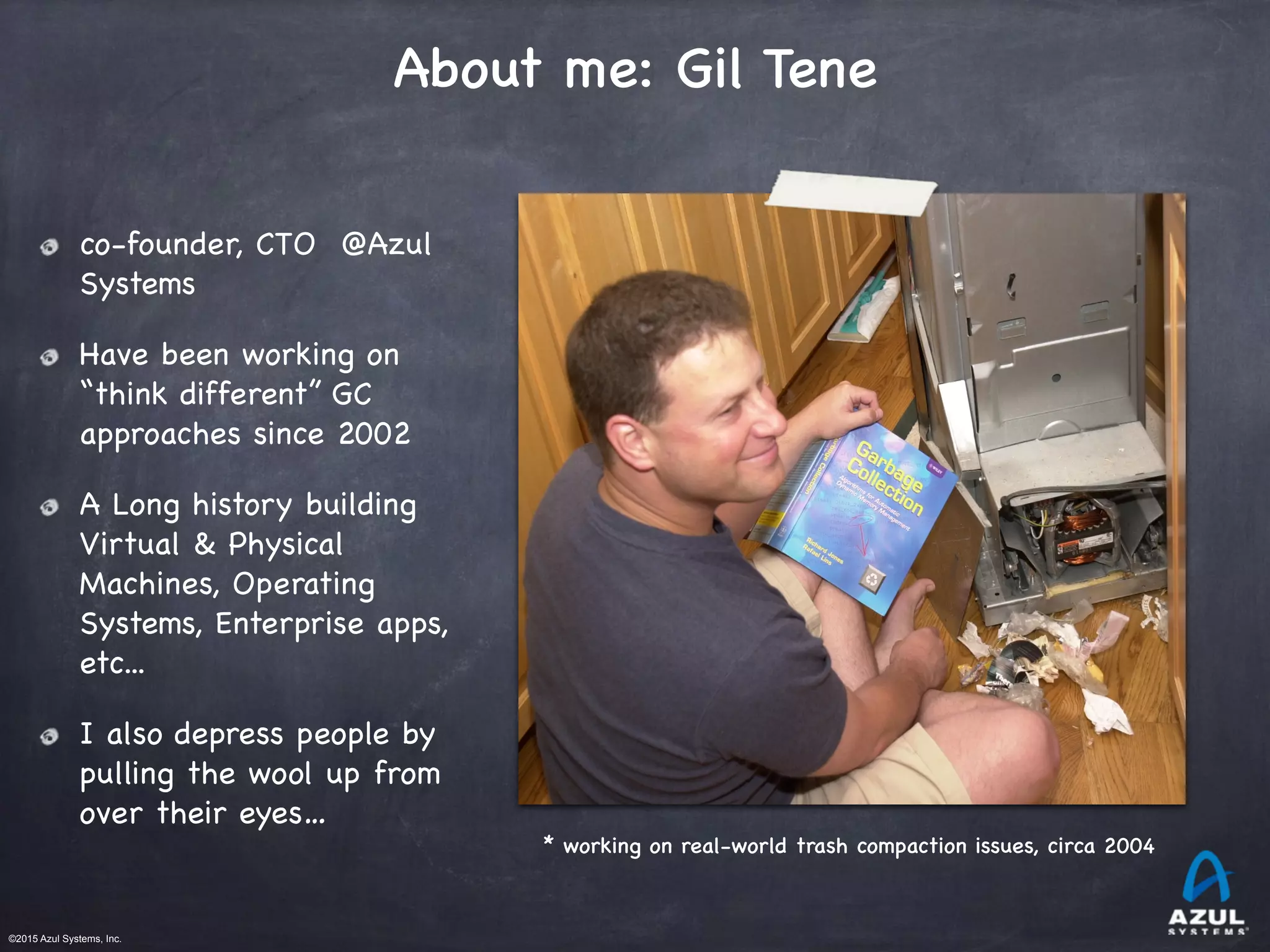
About me: Gil Tene
co-founder, CTO @Azul
Systems

Have been working on
“think different” GC
approaches since 2002

A Long history building
Virtual & Physical
Machines, Operating
Systems, Enterprise apps,
etc...

I also depress people by
pulling the wool up from
over their eyes…
* working on real-world trash compaction issues, circa 2004
©2015 Azul Systems, Inc.
©2015 Azul Systems, Inc.	 	 	 	 	 	
Latency Behavior
Latency: The time it took one operation to happen

Each operation occurrence has its own latency

What we care about is how latency behaves

Behavior is a lot more than “the common case was X”
©2015 Azul Systems, Inc.	 	 	 	 	 	
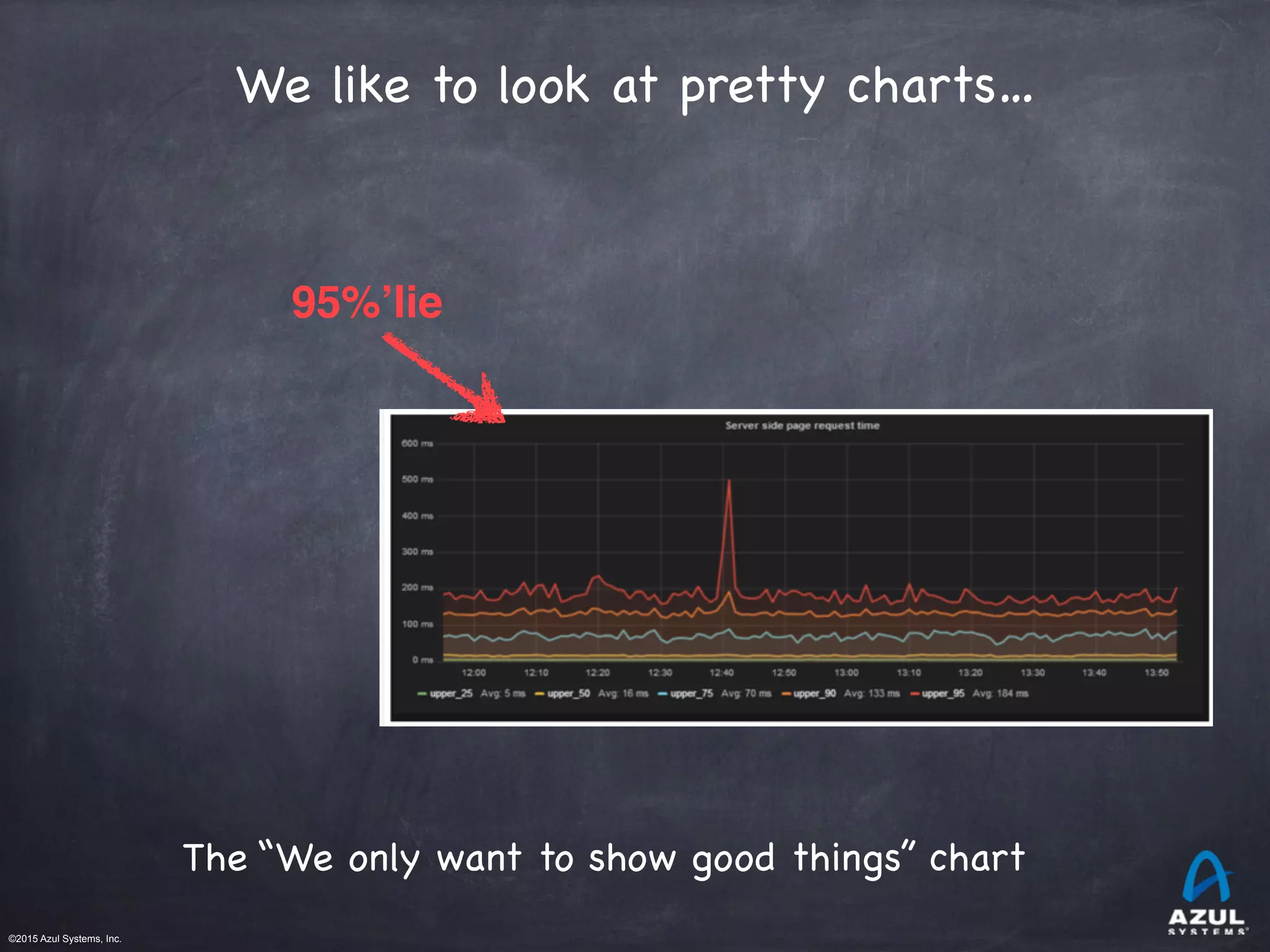
We like to look at pretty charts…
95%’lie
The “We only want to show good things” chart
©2015 Azul Systems, Inc.
©2015 Azul Systems, Inc.	 	 	 	 	 	
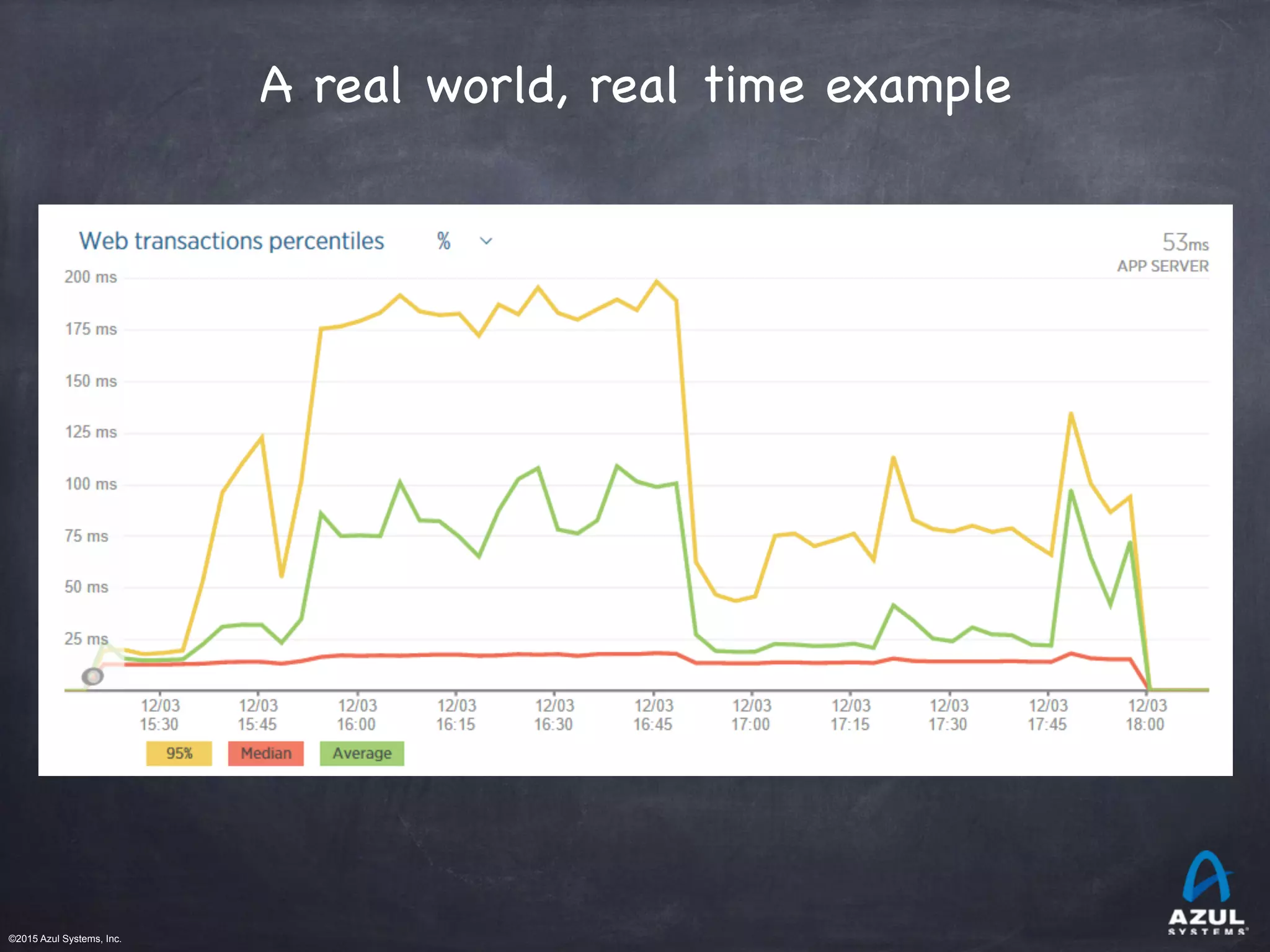
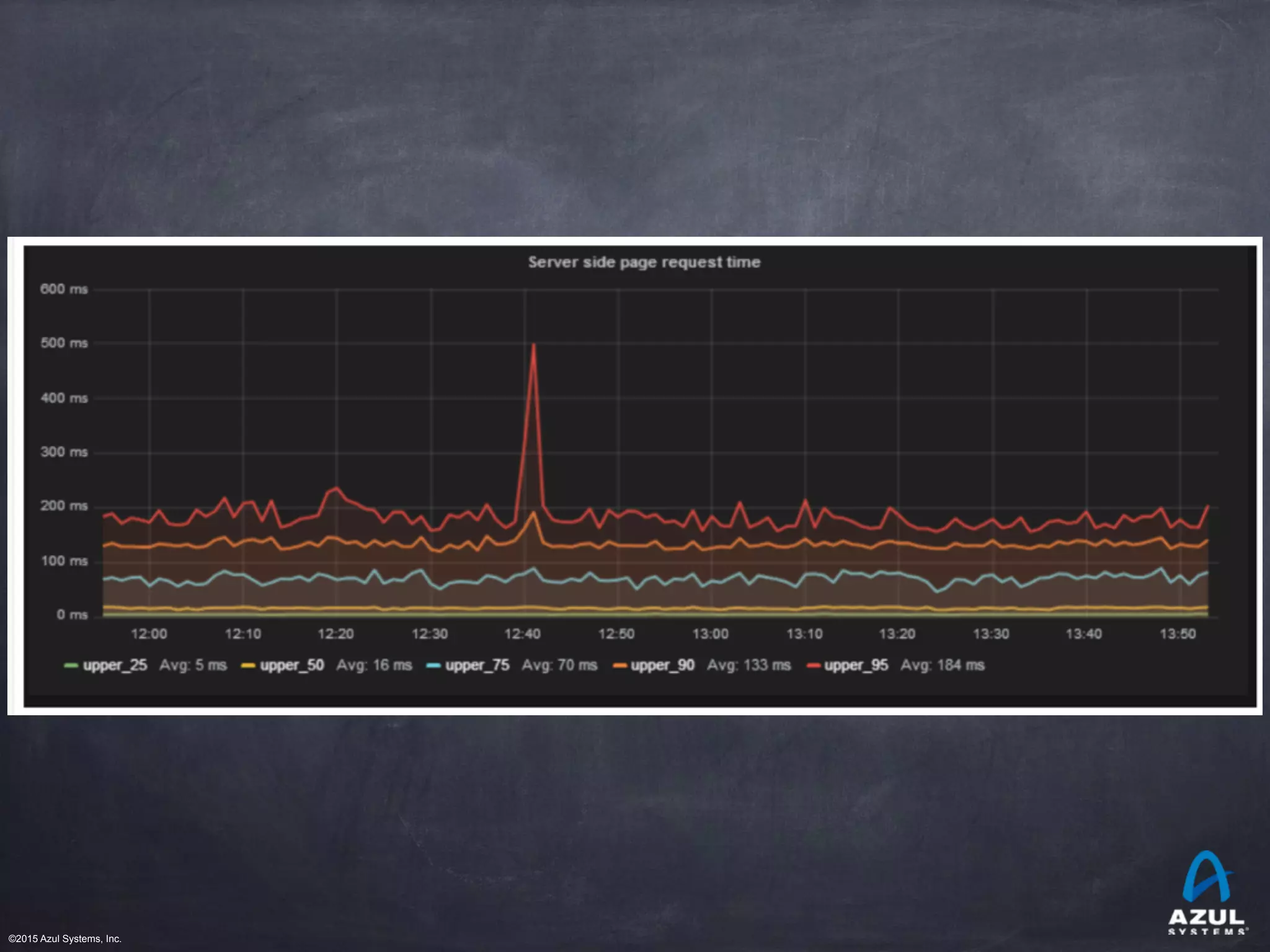
A real world, real time example
©2015 Azul Systems, Inc.	 	 	 	 	 	
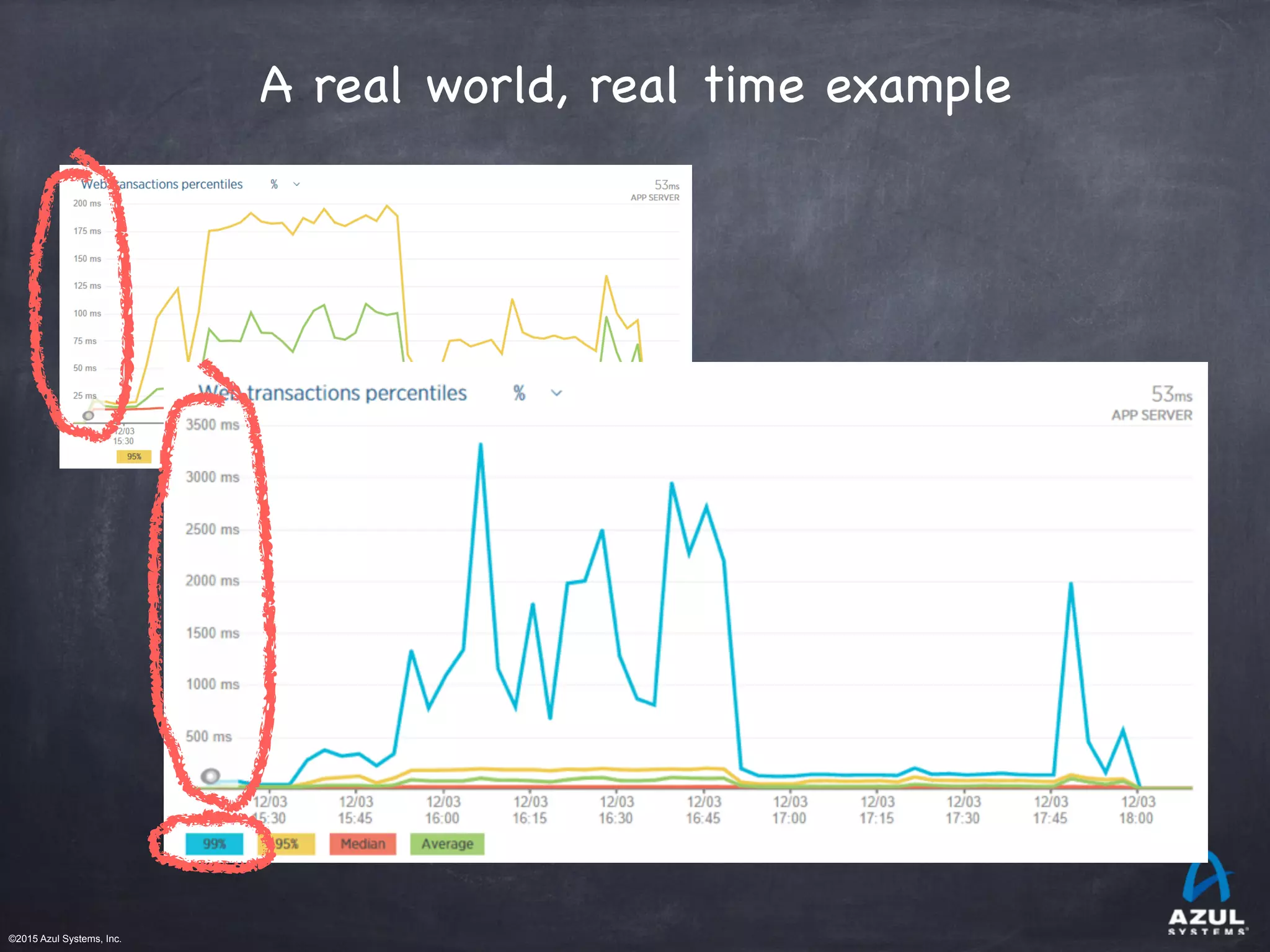
A real world, real time example
©2015 Azul Systems, Inc.	 	 	 	 	 	
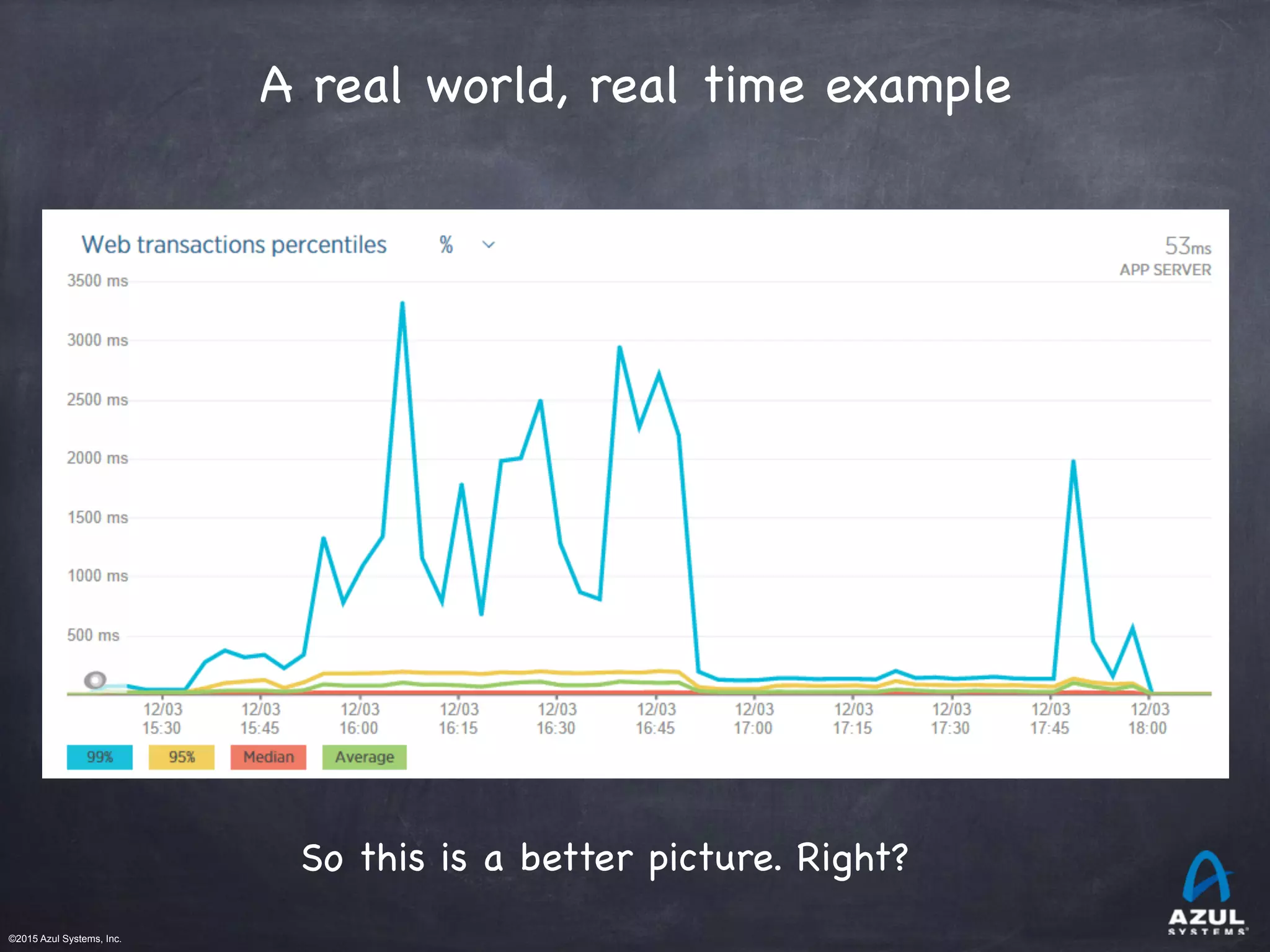
A real world, real time example
So this is a better picture. Right?
©2015 Azul Systems, Inc.	 	 	 	 	 	
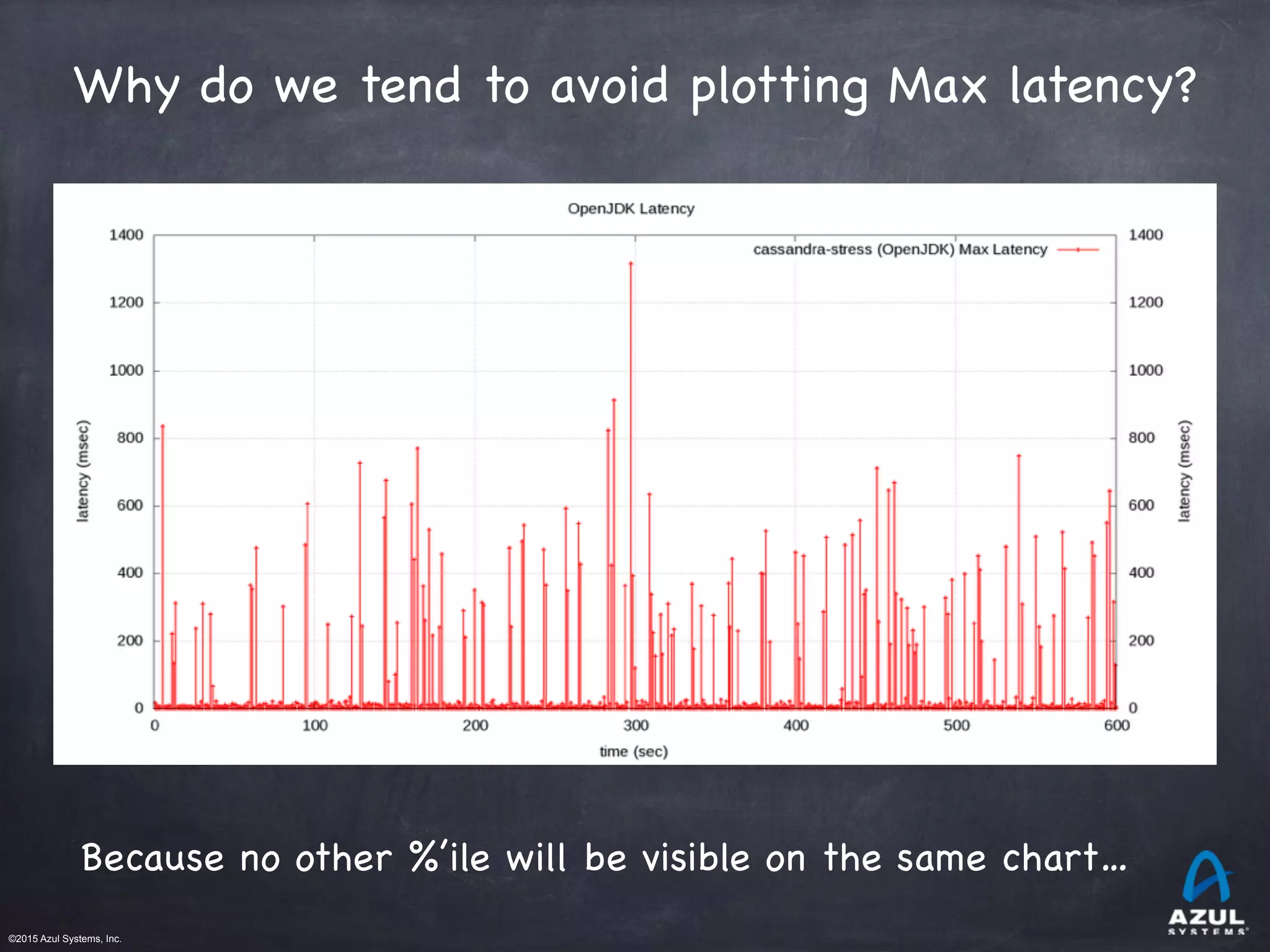
Why do we tend to avoid plotting Max latency?
Because no other %’ile will be visible on the same chart…
©2015 Azul Systems, Inc.	 	 	 	 	 	
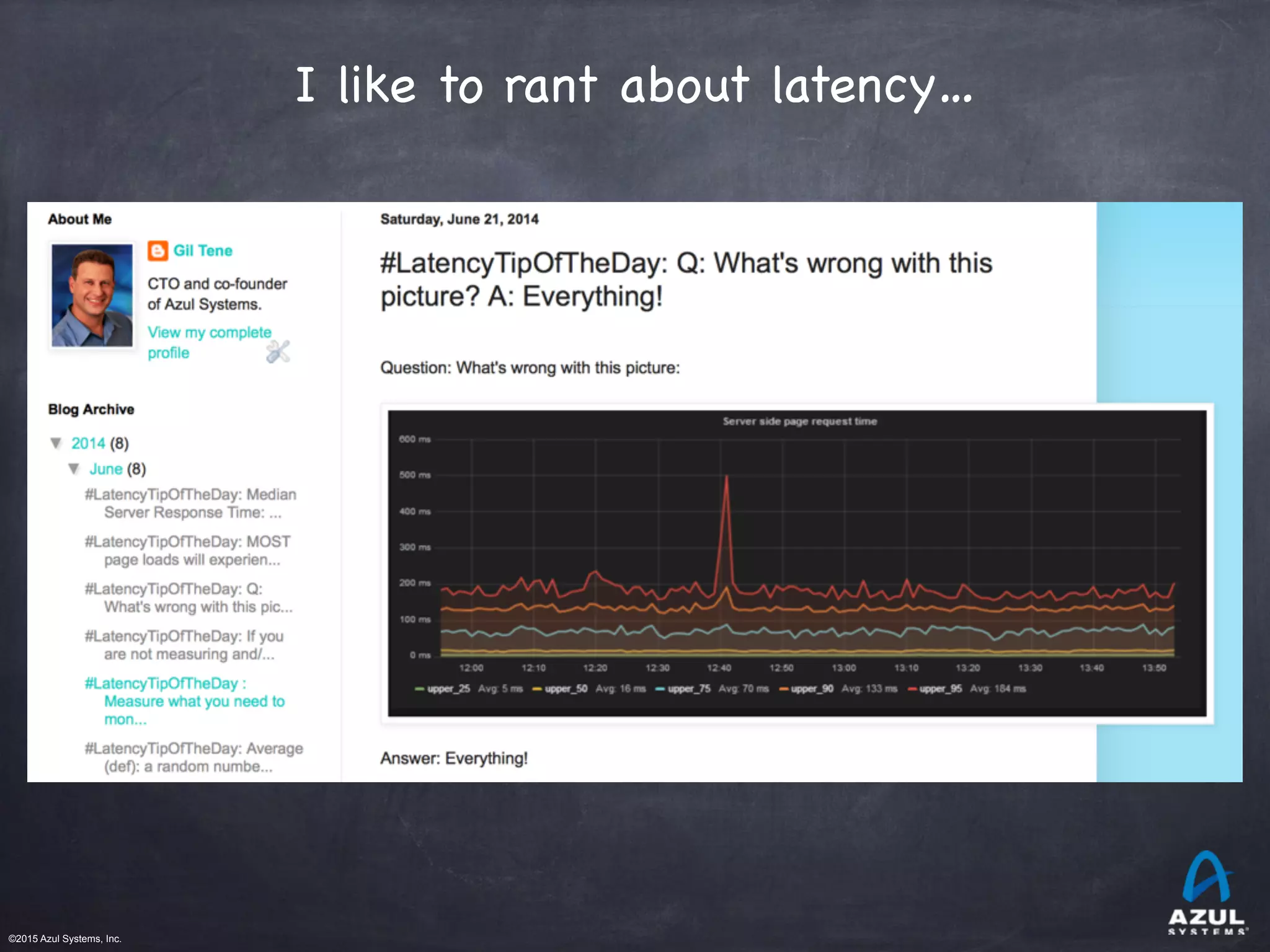
I like to rant about latency…
©2015 Azul Systems, Inc.	 	 	 	 	 	
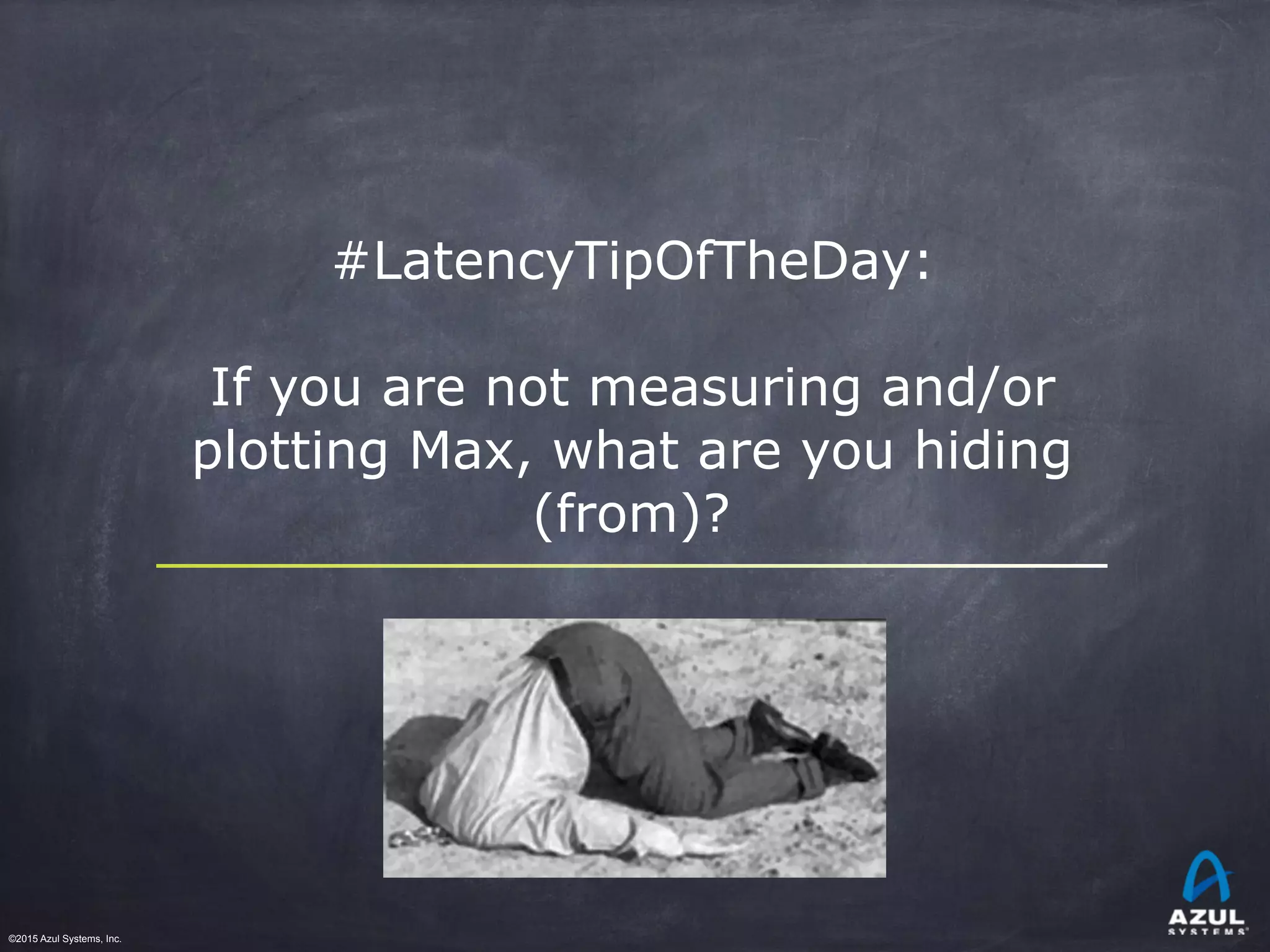
#LatencyTipOfTheDay:
If you are not measuring and/or
plotting Max, what are you hiding
(from)?
©2015 Azul Systems, Inc.
©2015 Azul Systems, Inc.	 	 	 	 	 	
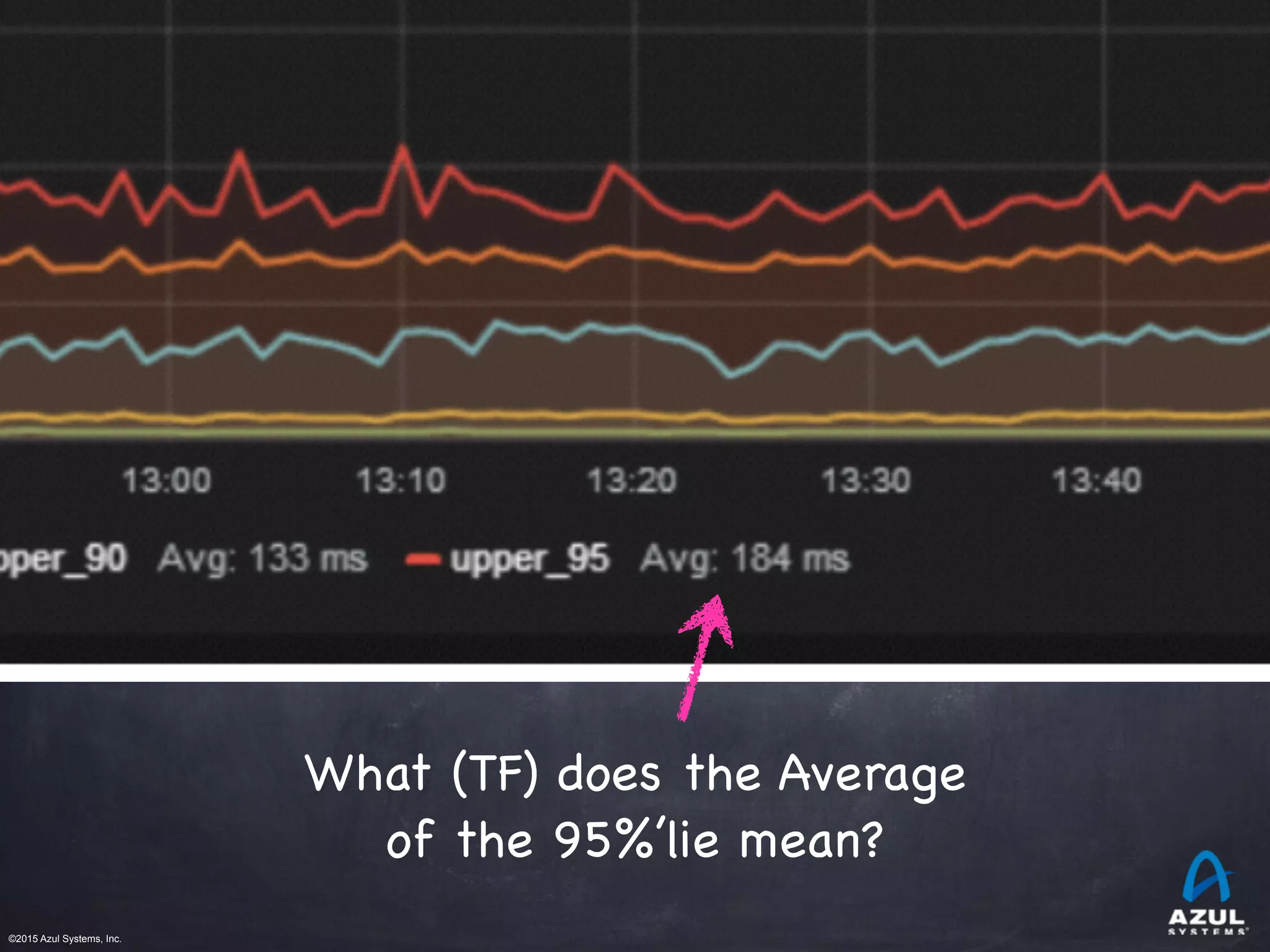
What (TF) does the Average
of the 95%’lie mean?
©2015 Azul Systems, Inc.	 	 	 	 	 	
What (TF) does the Average
of the 95%’lie mean?
Lets do the same with 100%’ile; Suppose we a set of
100%’ile values for each minute:

[1, 0, 3, 1, 601, 4, 2, 8, 0, 3, 3, 1, 1, 0, 2]

“The average 100%’ile over the past 15 minutes was 42”

Same nonsense applies to any other %’lie
©2015 Azul Systems, Inc.	 	 	 	 	 	
#LatencyTipOfTheDay:
You can't average percentiles.
Period.
©2015 Azul Systems, Inc.	 	 	 	 	 	
Percentiles Matter
©2015 Azul Systems, Inc.	 	 	 	 	 	
Is the 99%’lie “rare”?
©2015 Azul Systems, Inc.	 	 	 	 	 	
99%’lie: a good indicator, right?
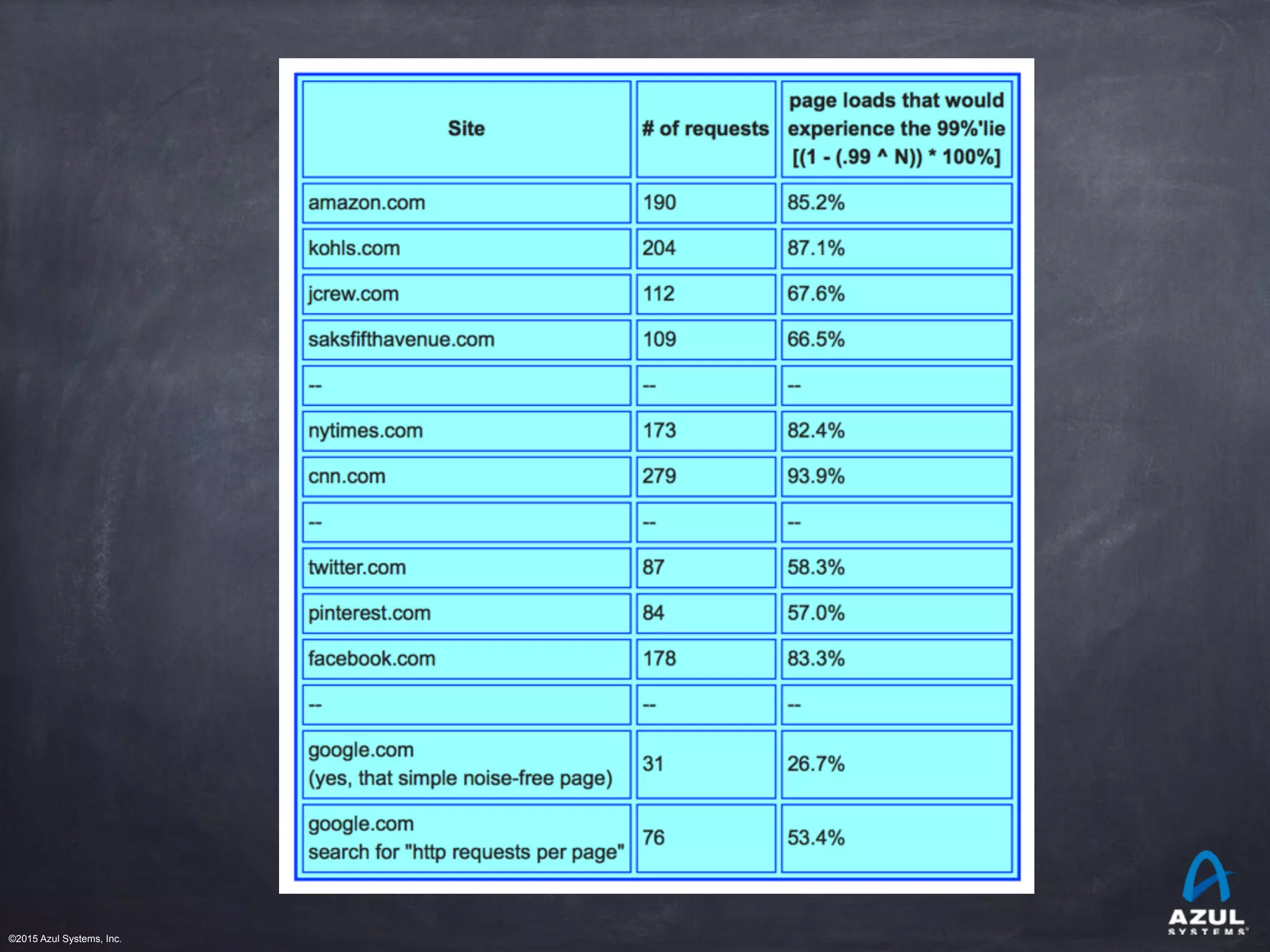
What are the chances of a single web page
view experiencing >99%’lie latency of:
- A single search engine node?
- A single Key/Value store node?
- A single Database node?
- A single CDN request?
©2015 Azul Systems, Inc.
©2015 Azul Systems, Inc.	 	 	 	 	 	
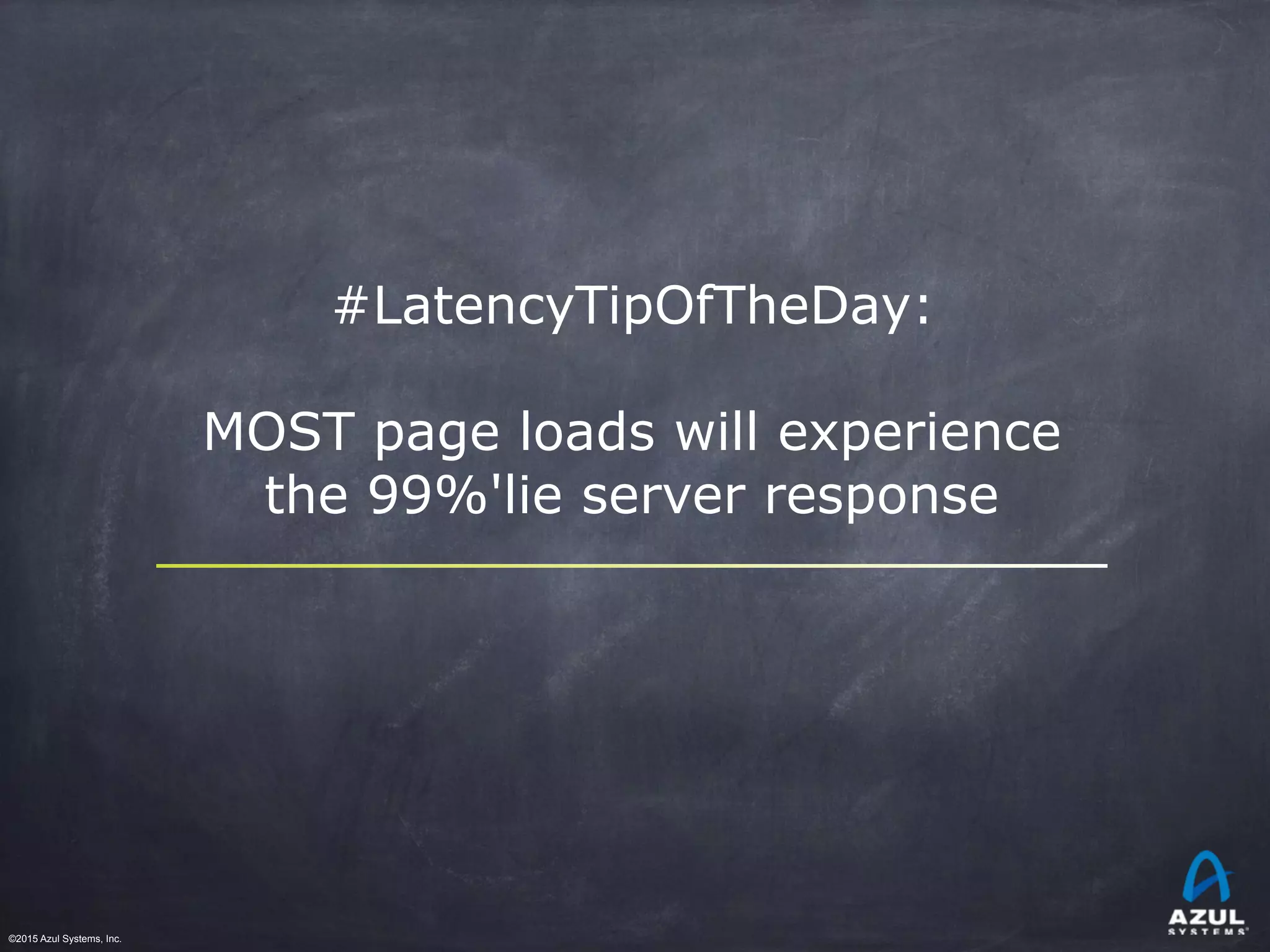
#LatencyTipOfTheDay:
MOST page loads will experience
the 99%'lie server response
©2015 Azul Systems, Inc.	 	 	 	 	 	
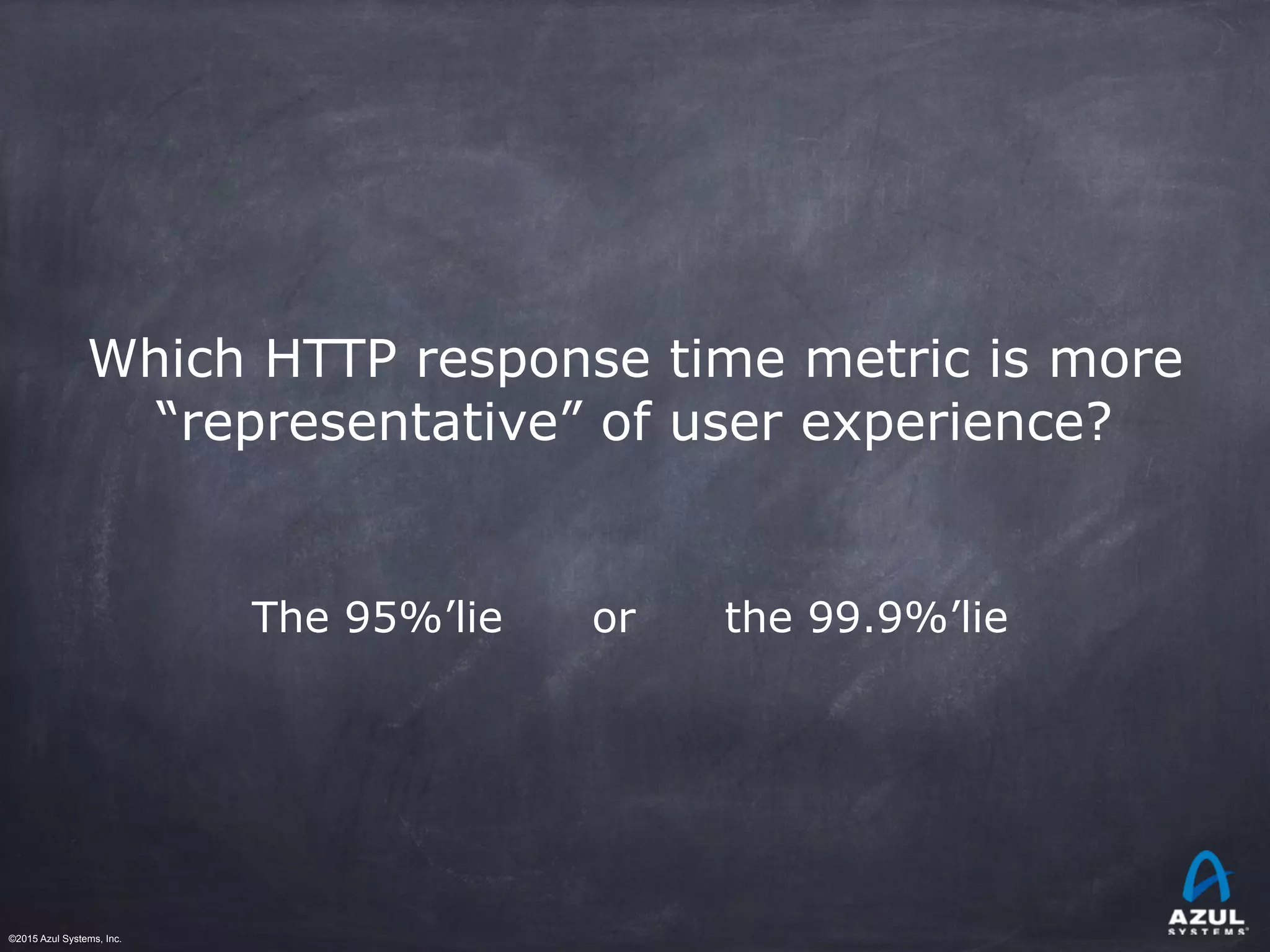
Which HTTP response time metric is more
“representative” of user experience?
The 95%’lie or the 99.9%’lie
©2015 Azul Systems, Inc.	 	 	 	 	 	
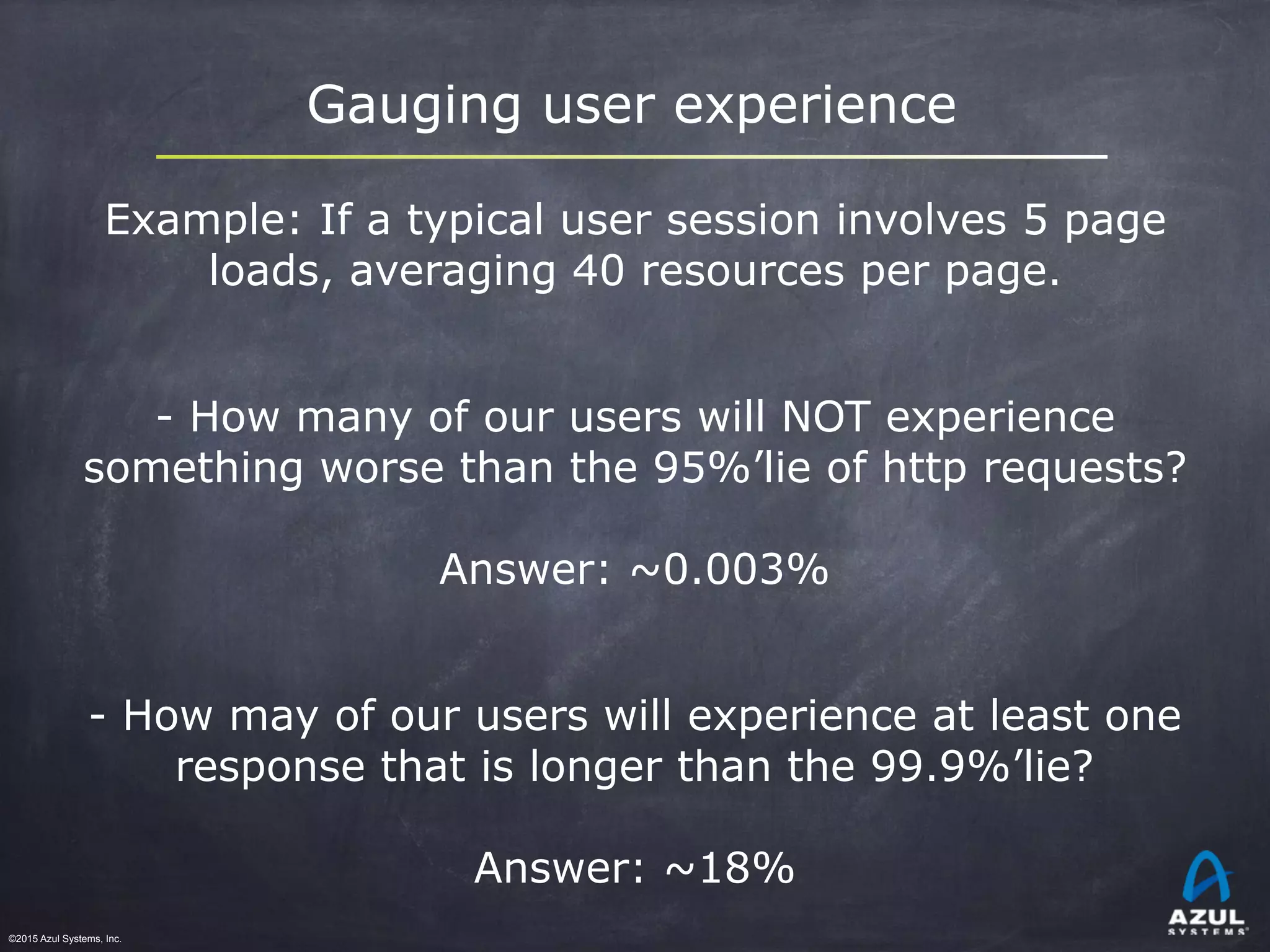
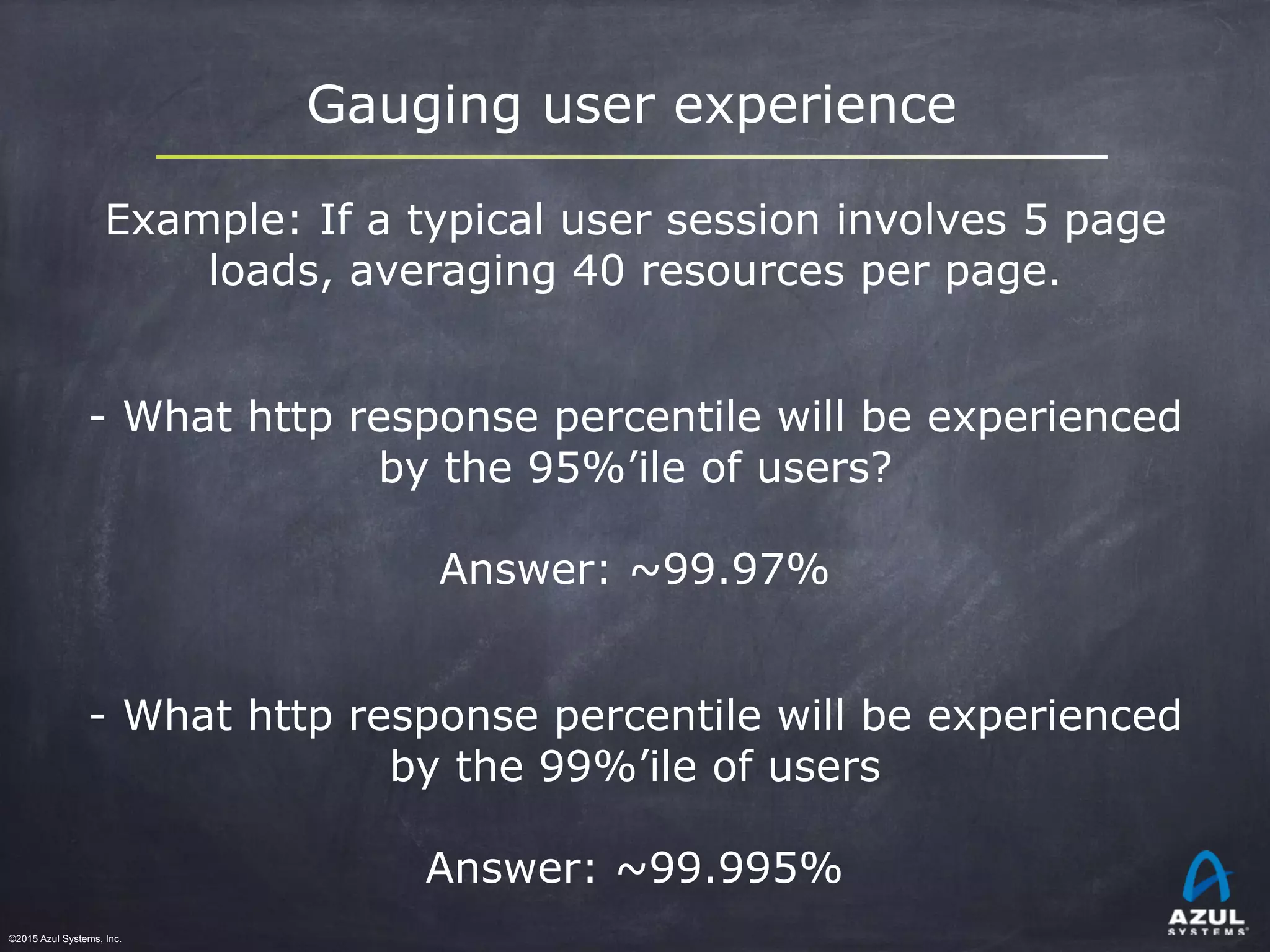
Gauging user experience
Example: If a typical user session involves 5 page
loads, averaging 40 resources per page.
- How many of our users will NOT experience
something worse than the 95%’lie of http requests?
Answer: ~0.003%
- How may of our users will experience at least one
response that is longer than the 99.9%’lie?
Answer: ~18%
©2015 Azul Systems, Inc.	 	 	 	 	 	
Gauging user experience
Example: If a typical user session involves 5 page
loads, averaging 40 resources per page.
- What http response percentile will be experienced
by the 95%’ile of users?
Answer: ~99.97%
- What http response percentile will be experienced
by the 99%’ile of users
Answer: ~99.995%
©2015 Azul Systems, Inc.	 	 	 	 	 	
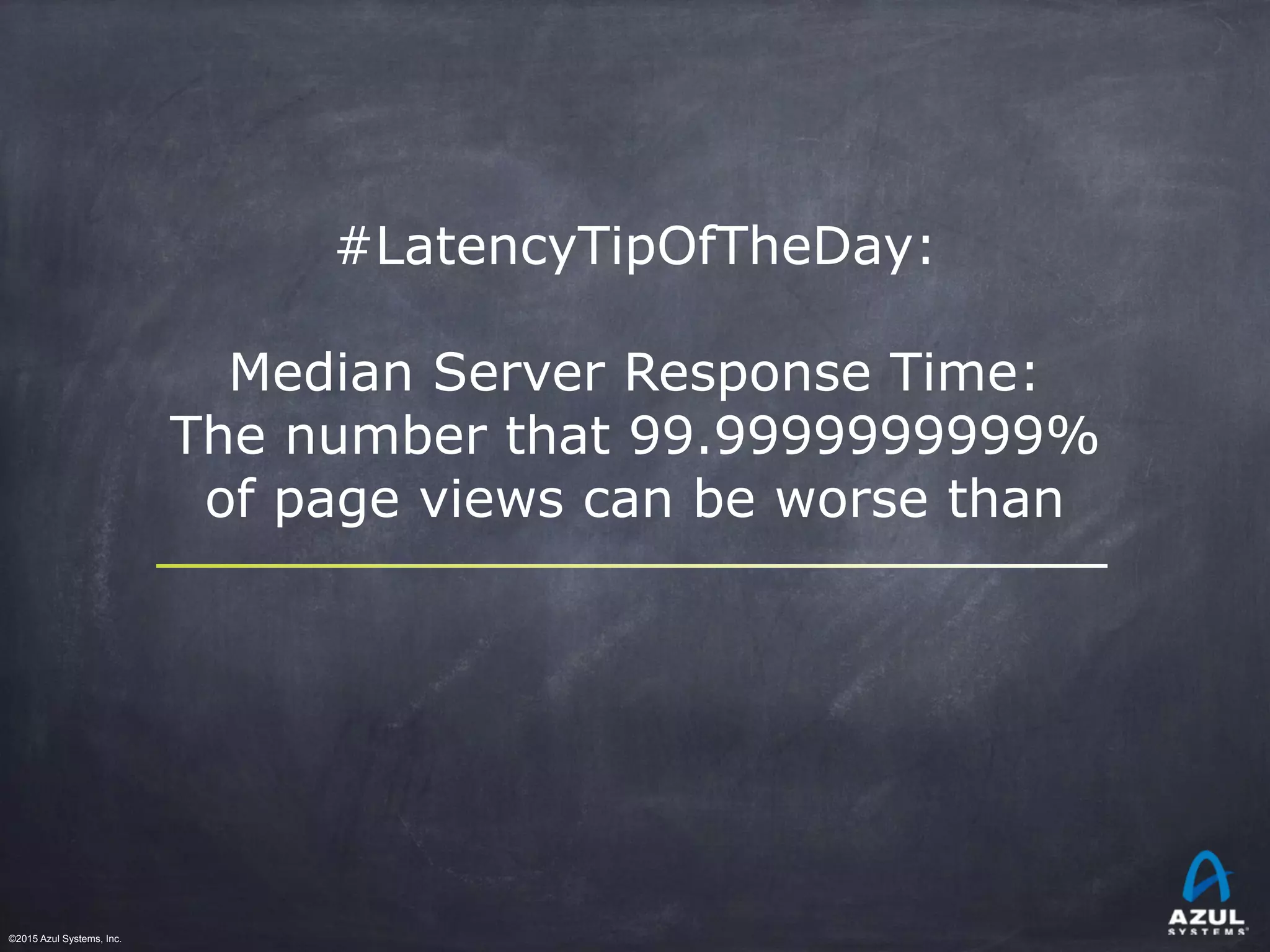
#LatencyTipOfTheDay:
Median Server Response Time:
The number that 99.9999999999%
of page views can be worse than
©2015 Azul Systems, Inc.	 	 	 	 	 	
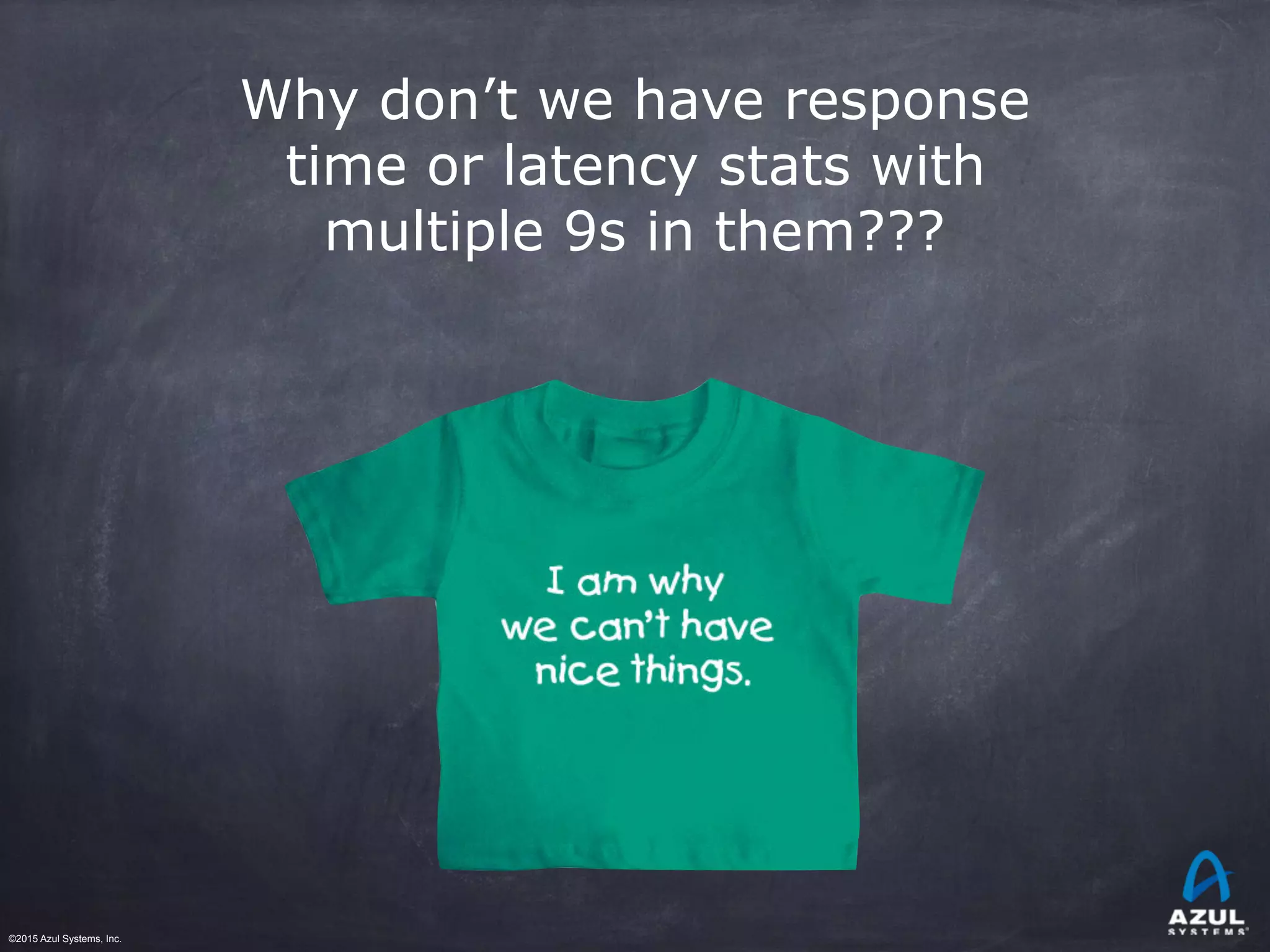
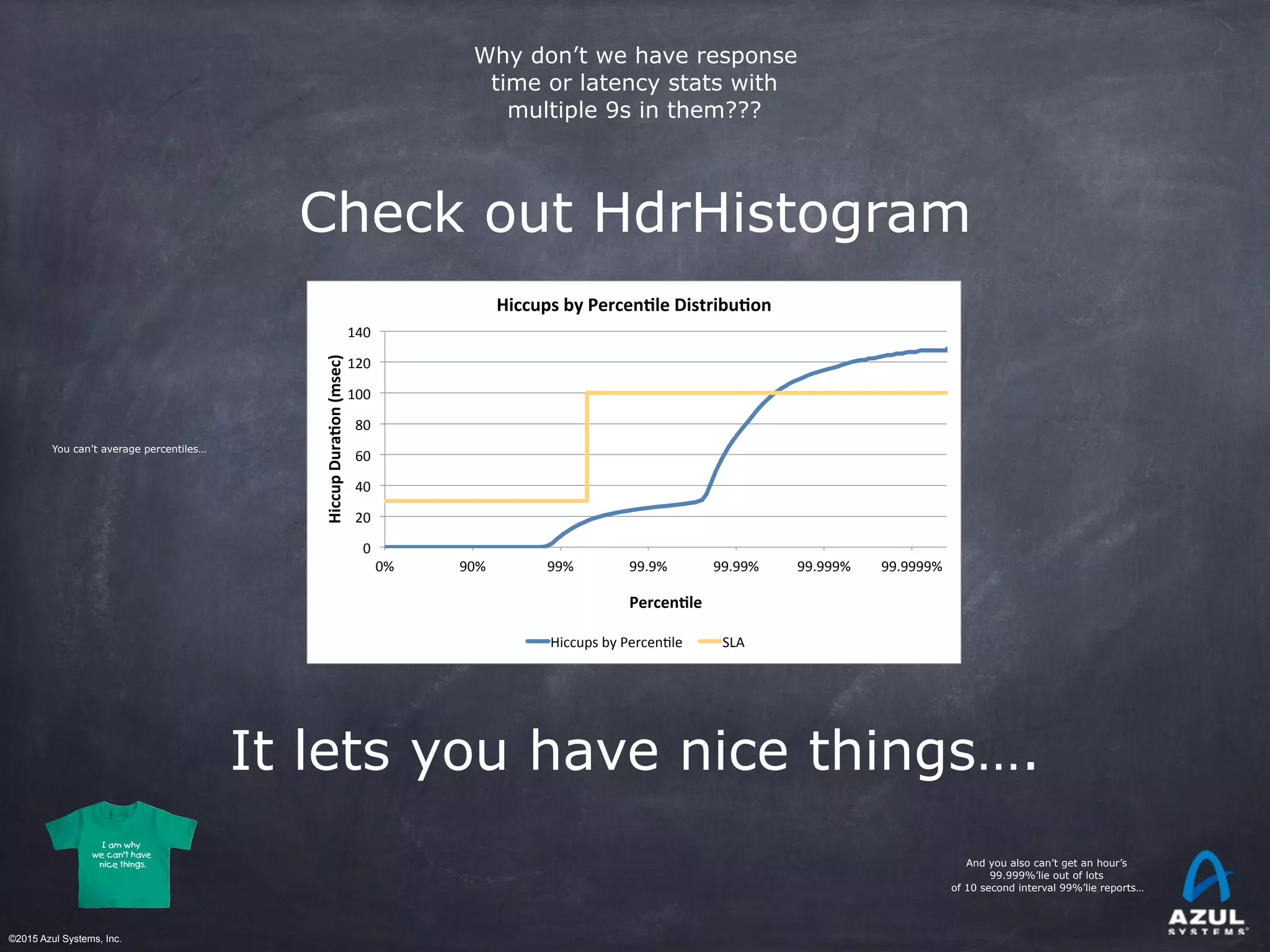
Why don’t we have response
time or latency stats with
multiple 9s in them???
©2015 Azul Systems, Inc.	 	 	 	 	 	
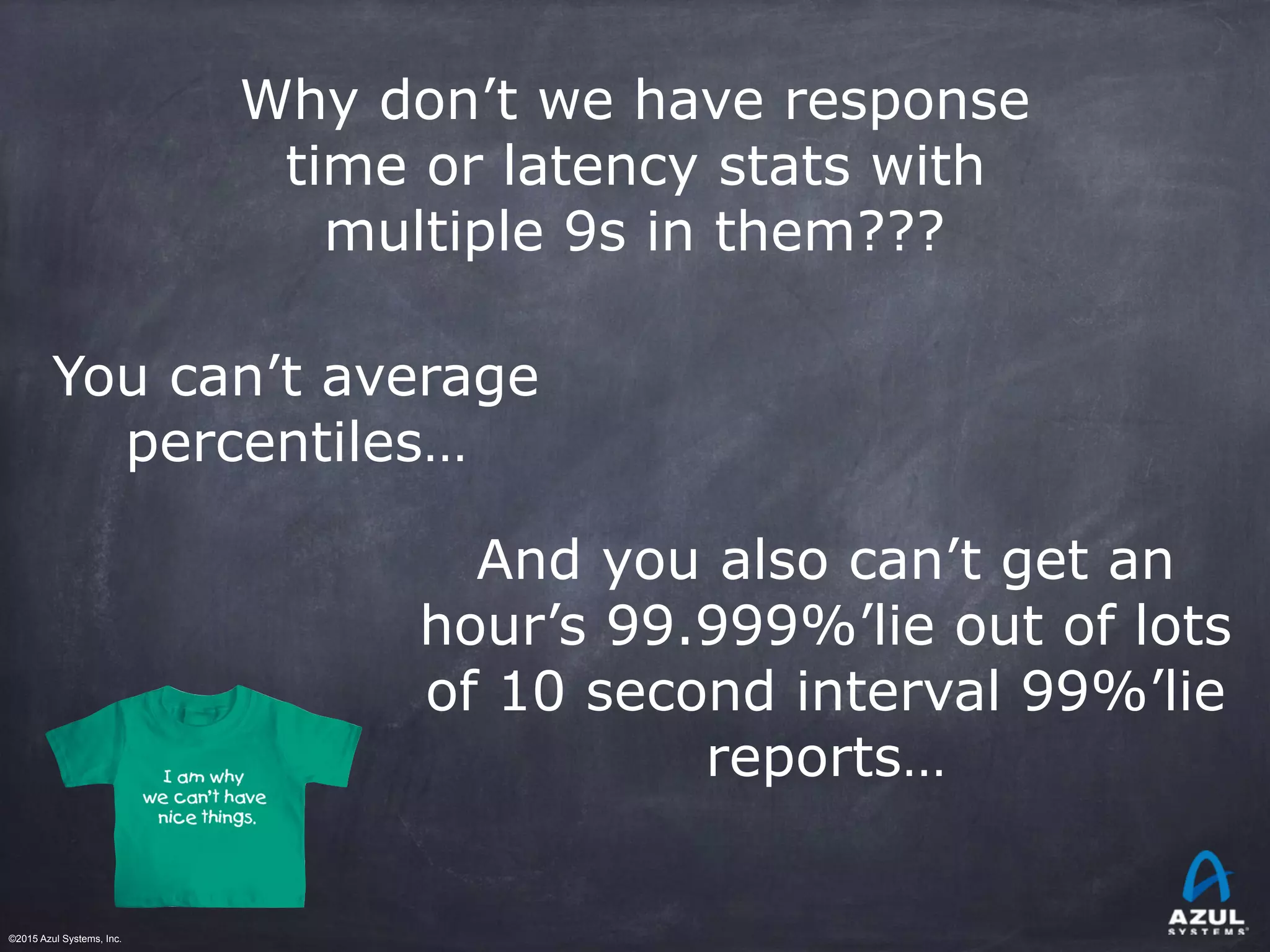
You can’t average
percentiles…
And you also can’t get an
hour’s 99.999%’lie out of lots
of 10 second interval 99%’lie
reports…
Why don’t we have response
time or latency stats with
multiple 9s in them???
©2015 Azul Systems, Inc.	 	 	 	 	 	
You can’t average percentiles…
And you also can’t get an hour’s
99.999%’lie out of lots
of 10 second interval 99%’lie reports…
Check out HdrHistogram
It lets you have nice things….
Why don’t we have response
time or latency stats with
multiple 9s in them???
0"
20"
40"
60"
80"
100"
120"
0" 500" 1000" 1500" 2000" 2500"
Hiccup&Dura*on&(mse
&Elapsed&Time&(sec)&
0%" 90%" 99%" 99.9%" 99.99%" 99.999%" 99.9999%"
0"
20"
40"
60"
80"
100"
120"
140"Hiccup&Dura*on&(msec)&
&
&
Percen*le&
Hiccups&by&Percen*le&Distribu*on&
Hiccups"by"Percen?le" SLA"
©2015 Azul Systems, Inc.	 	 	 	 	 	
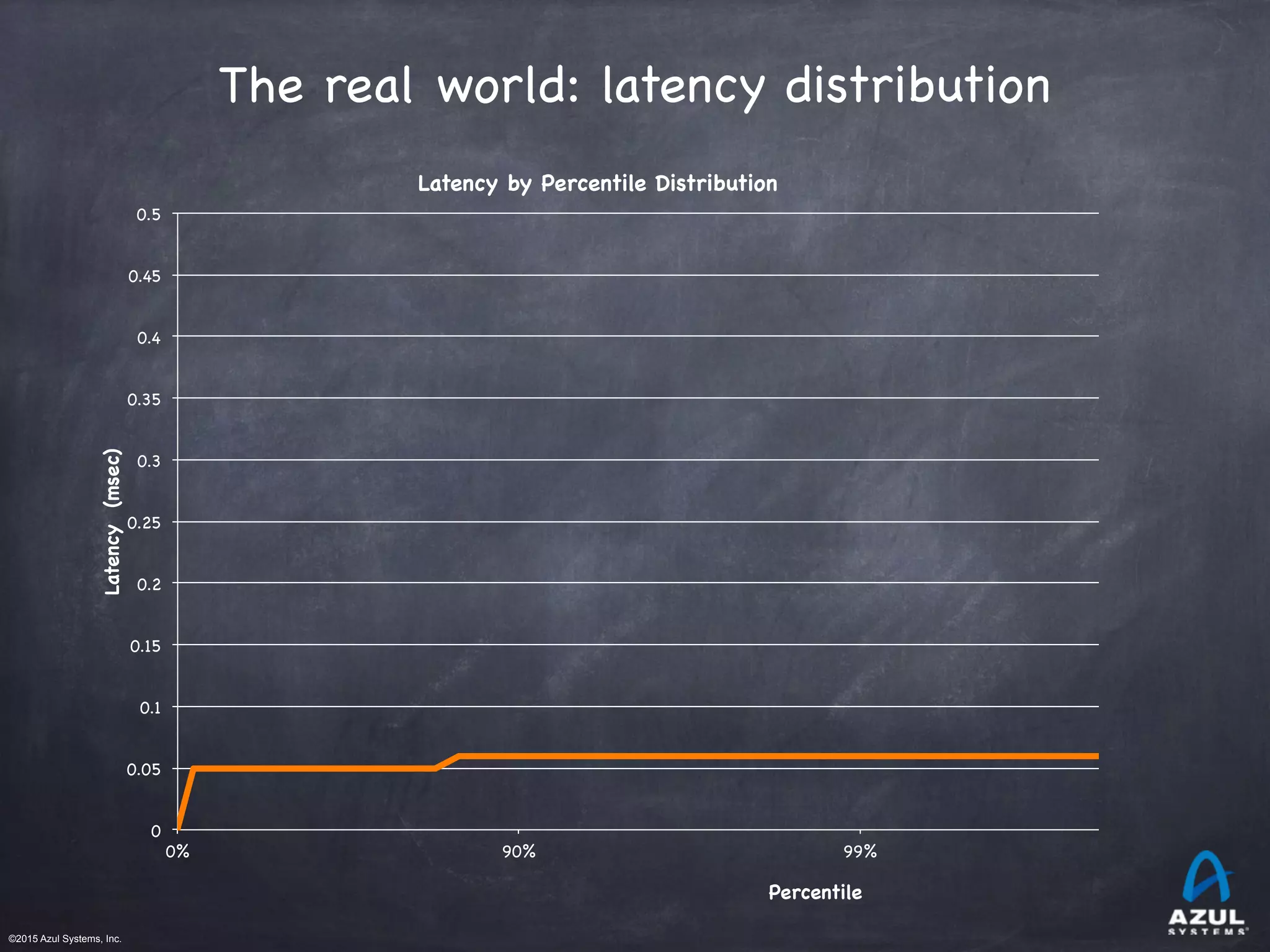
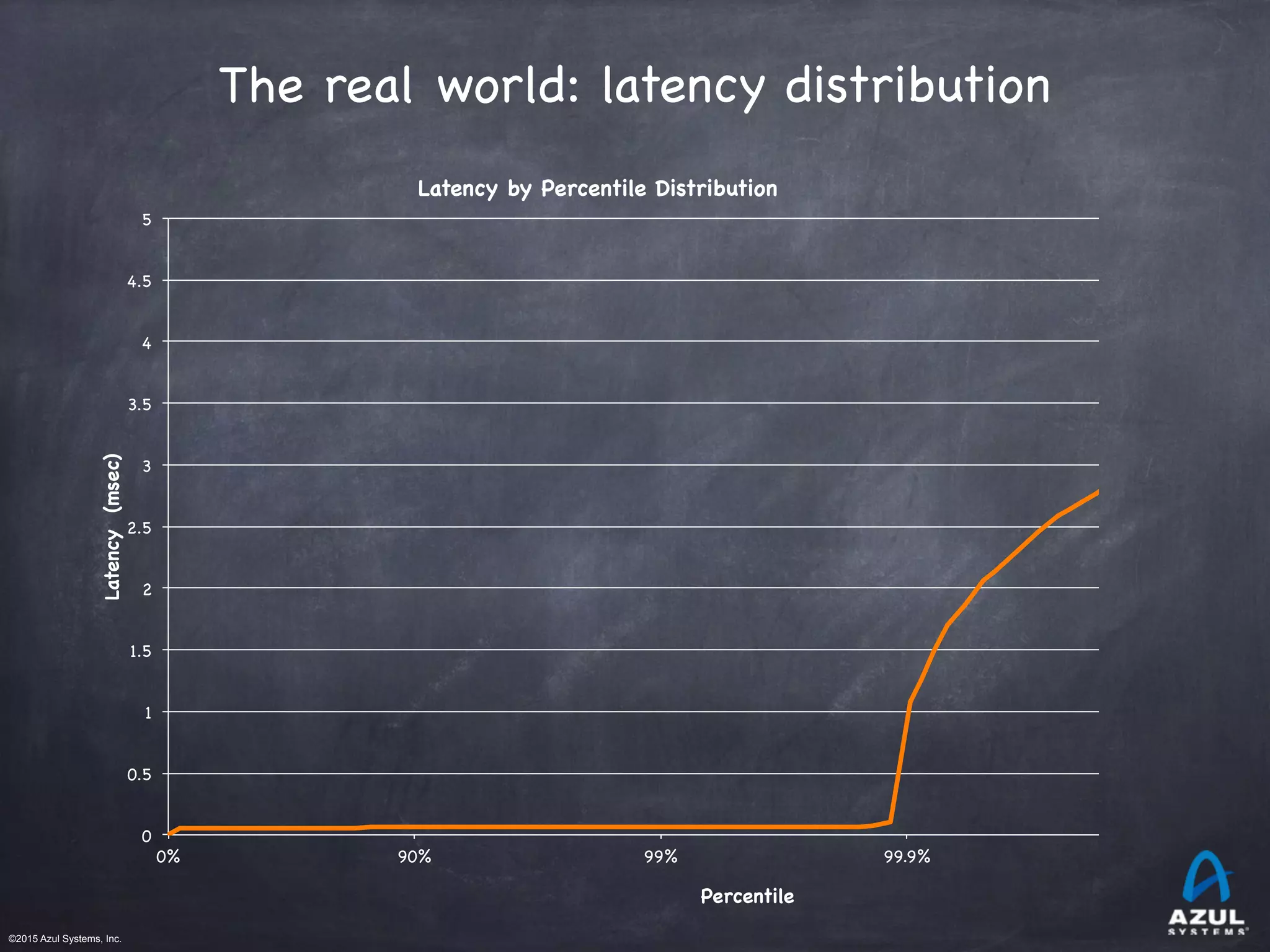
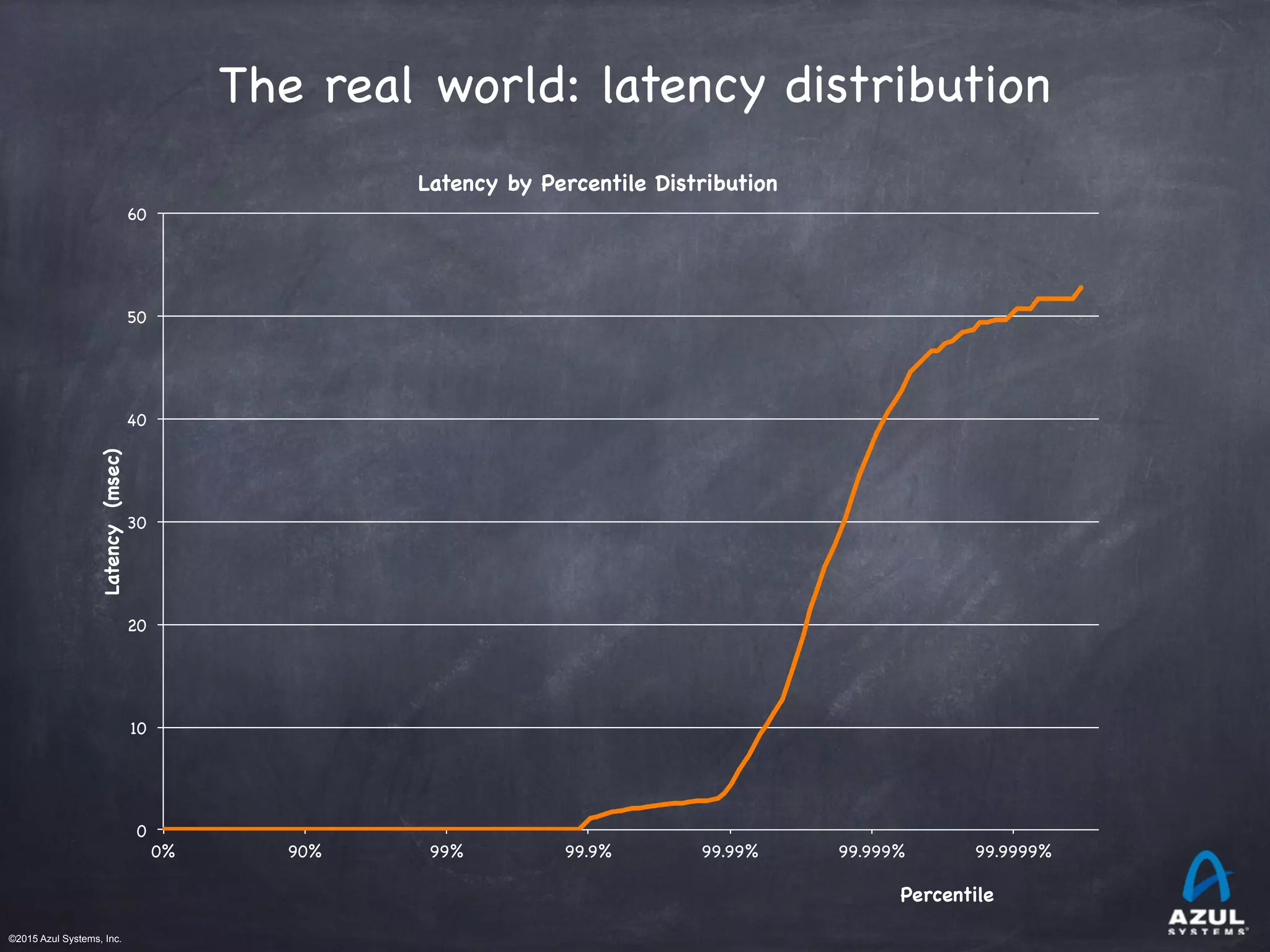
Latency “wishful thinking”
We know how to compute
averages & std. deviation, etc.

Wouldn’t it be nice if latency
had a normal distribution?

The average, 90%’lie, 99%’lie,
std. deviation, etc. can give us
a “feel” for the rest of the
distribution, right?

If 99% of the stuff behaves
well, how bad can the rest be,
really?
©2015 Azul Systems, Inc.	 	 	 	 	 	
The real world: latency distribution
0%! 90%! 99%!
0!
0.05!
0.1!
0.15!
0.2!
0.25!
0.3!
0.35!
0.4!
0.45!
0.5!
Latency(msec)!
!
!
Percentile!
Latency by Percentile Distribution!
©2015 Azul Systems, Inc.	 	 	 	 	 	
The real world: latency distribution
0%! 90%! 99%! 99.9%!
0!
0.5!
1!
1.5!
2!
2.5!
3!
3.5!
4!
4.5!
5!
Latency(msec)!
!
!
Percentile!
Latency by Percentile Distribution!
©2015 Azul Systems, Inc.	 	 	 	 	 	
The real world: latency distribution
0%! 90%! 99%! 99.9%! 99.99%! 99.999%! 99.9999%!
0!
10!
20!
30!
40!
50!
60!
Latency(msec)!
!
!
Percentile!
Latency by Percentile Distribution!
©2015 Azul Systems, Inc.	 	 	 	 	 	
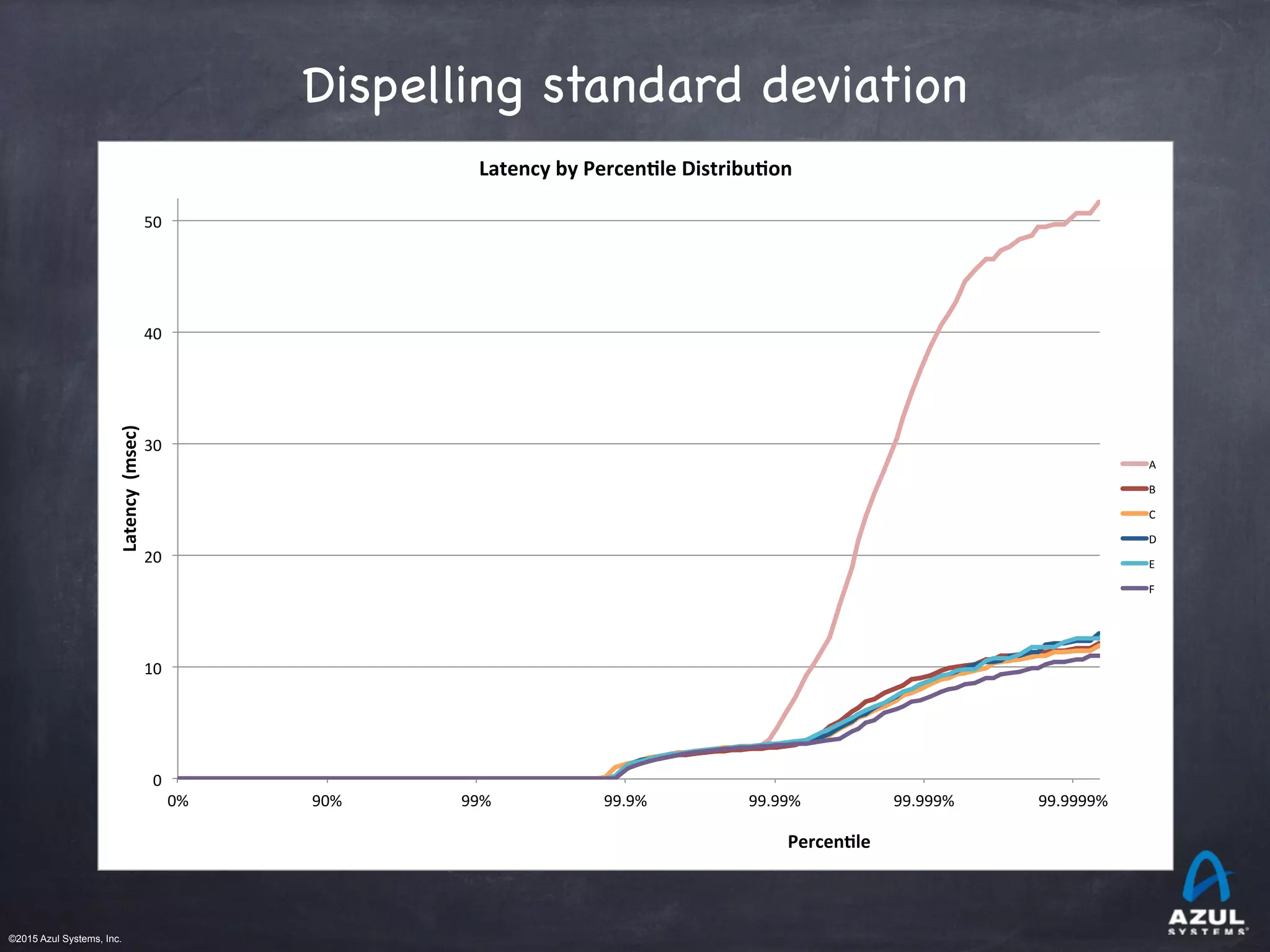
Dispelling standard deviation
0%# 90%# 99%# 99.9%# 99.99%# 99.999%# 99.9999%#
0#
10#
20#
30#
40#
50#
Latency(((msec)(
(
(
Percen/le(
Latency(by(Percen/le(Distribu/on(
A#
B#
C#
D#
E#
F#
©2015 Azul Systems, Inc.	 	 	 	 	 	
Dispelling standard deviation
0%# 90%# 99%# 99.9%# 99.99%# 99.999%# 99.9999%#
0#
10#
20#
30#
40#
50#
Latency(((msec)(
(
(
Percen/le(
Latency(by(Percen/le(Distribu/on(
A#
B#
C#
D#
E#
F#
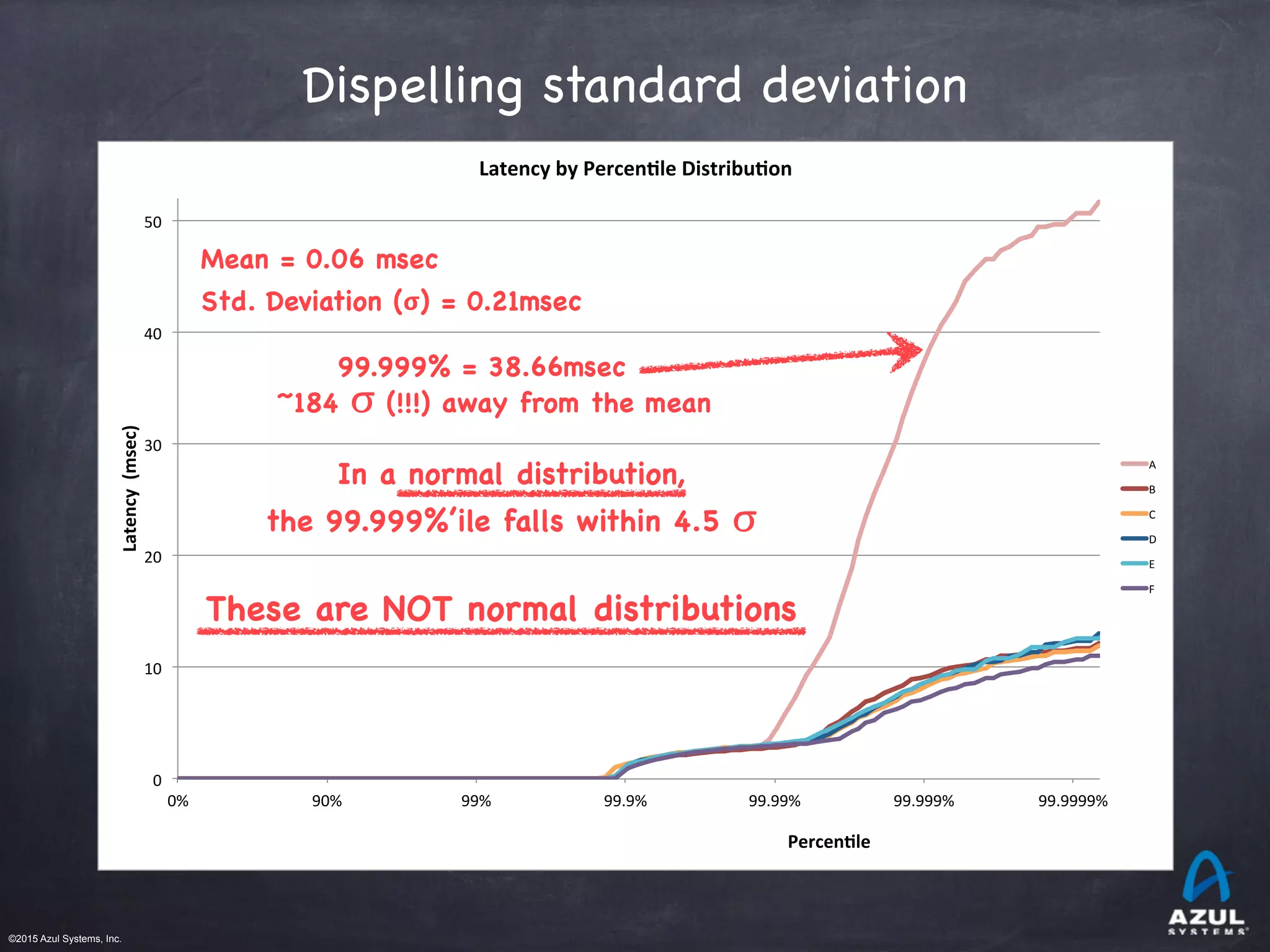
Mean = 0.06 msec

Std. Deviation (𝞂) = 0.21msec
99.999% = 38.66msec
In a normal distribution,
These are NOT normal distributions
~184 σ (!!!) away from the mean
the 99.999%’ile falls within 4.5 σ
©2015 Azul Systems, Inc.	 	 	 	 	 	
The coordinated omission problem
An accidental conspiracy...
The lie in the 99%’lies
©2015 Azul Systems, Inc.	 	 	 	 	 	
The coordinated omission
problem
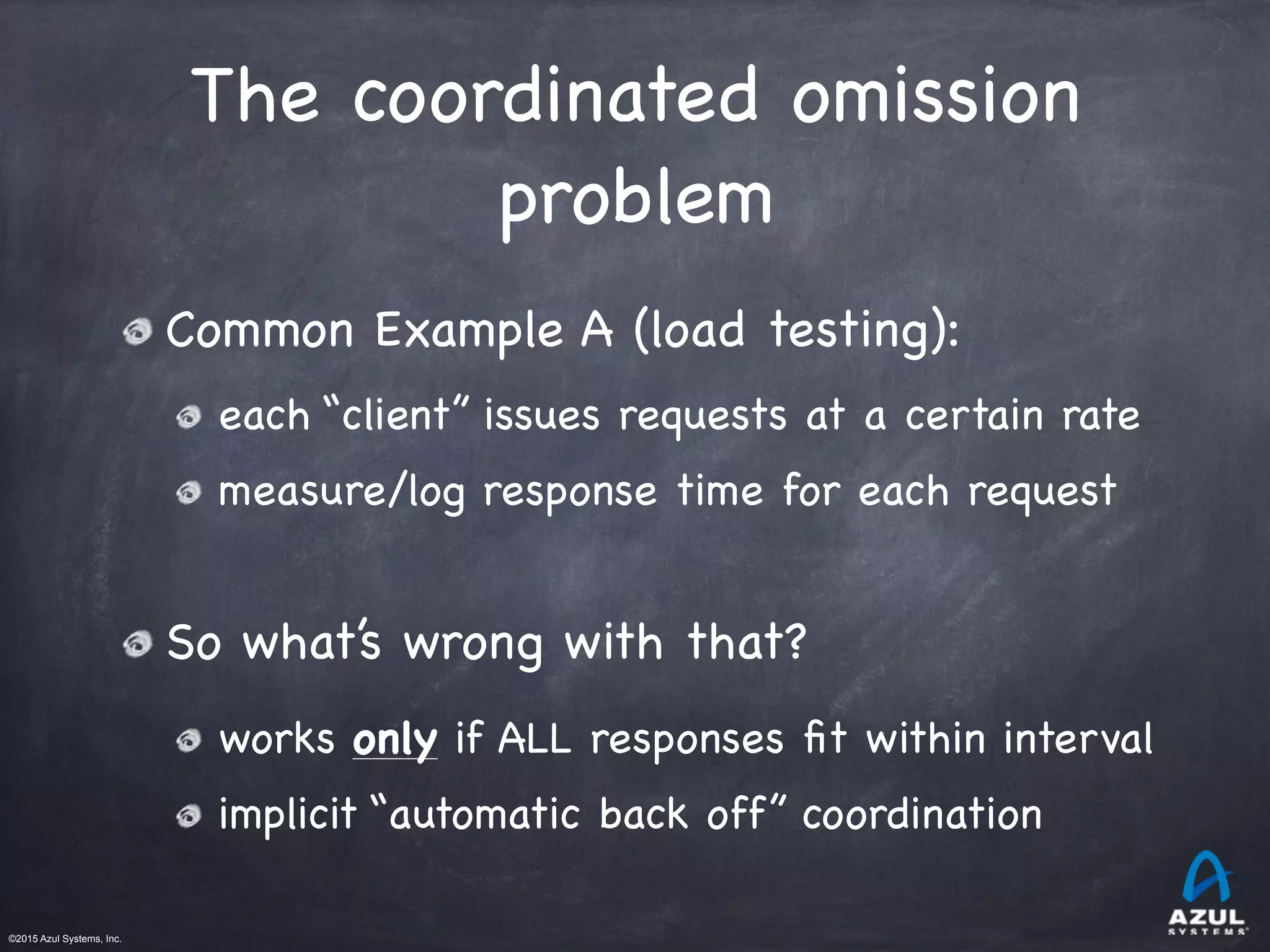
Common Example A (load testing):

each “client” issues requests at a certain rate

measure/log response time for each request

So what’s wrong with that?

works only if ALL responses fit within interval

implicit “automatic back off” coordination
©2015 Azul Systems, Inc.	 	 	 	 	 	
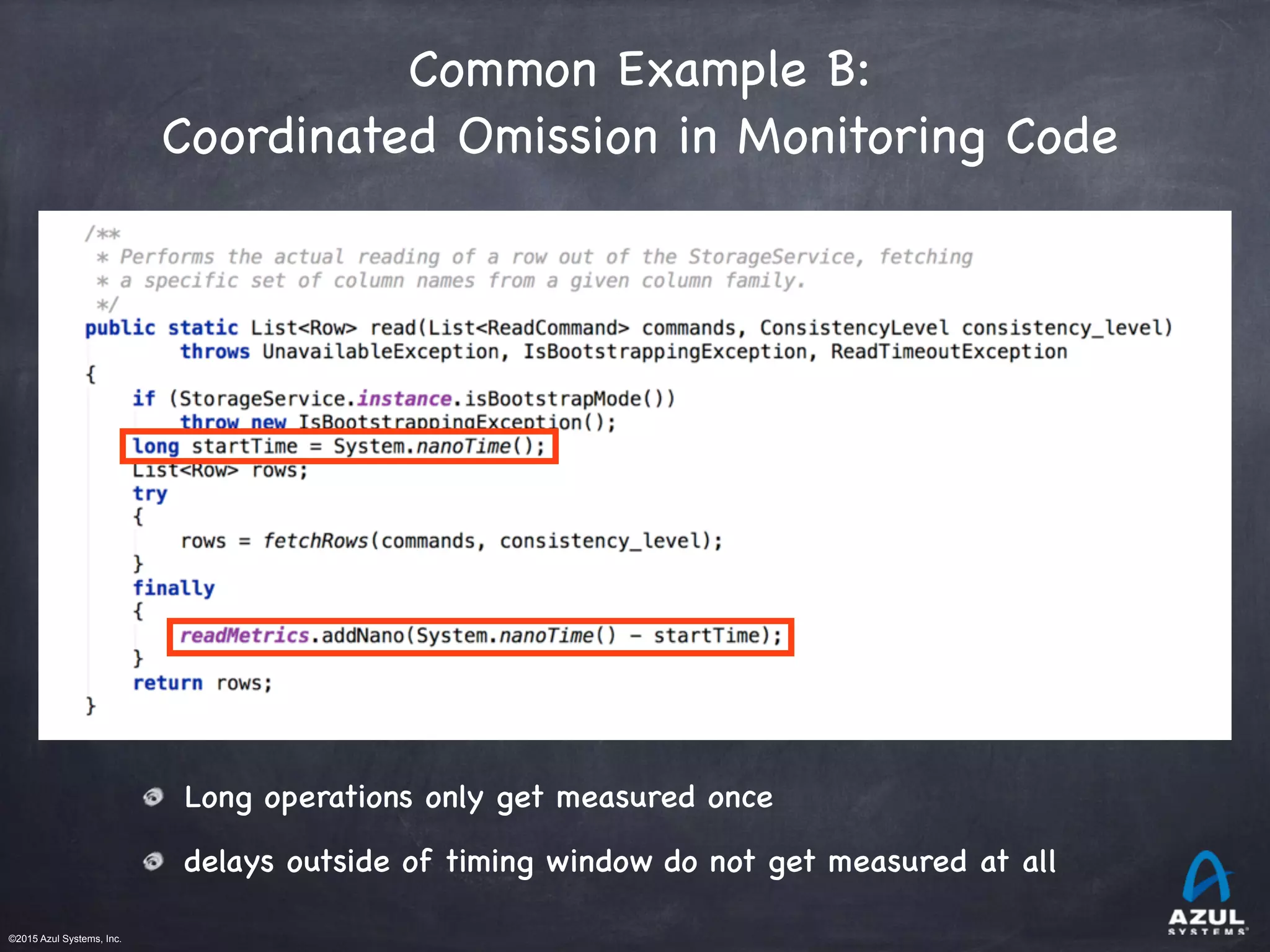
Common Example B: 

Coordinated Omission in Monitoring Code
Long operations only get measured once
delays outside of timing window do not get measured at all
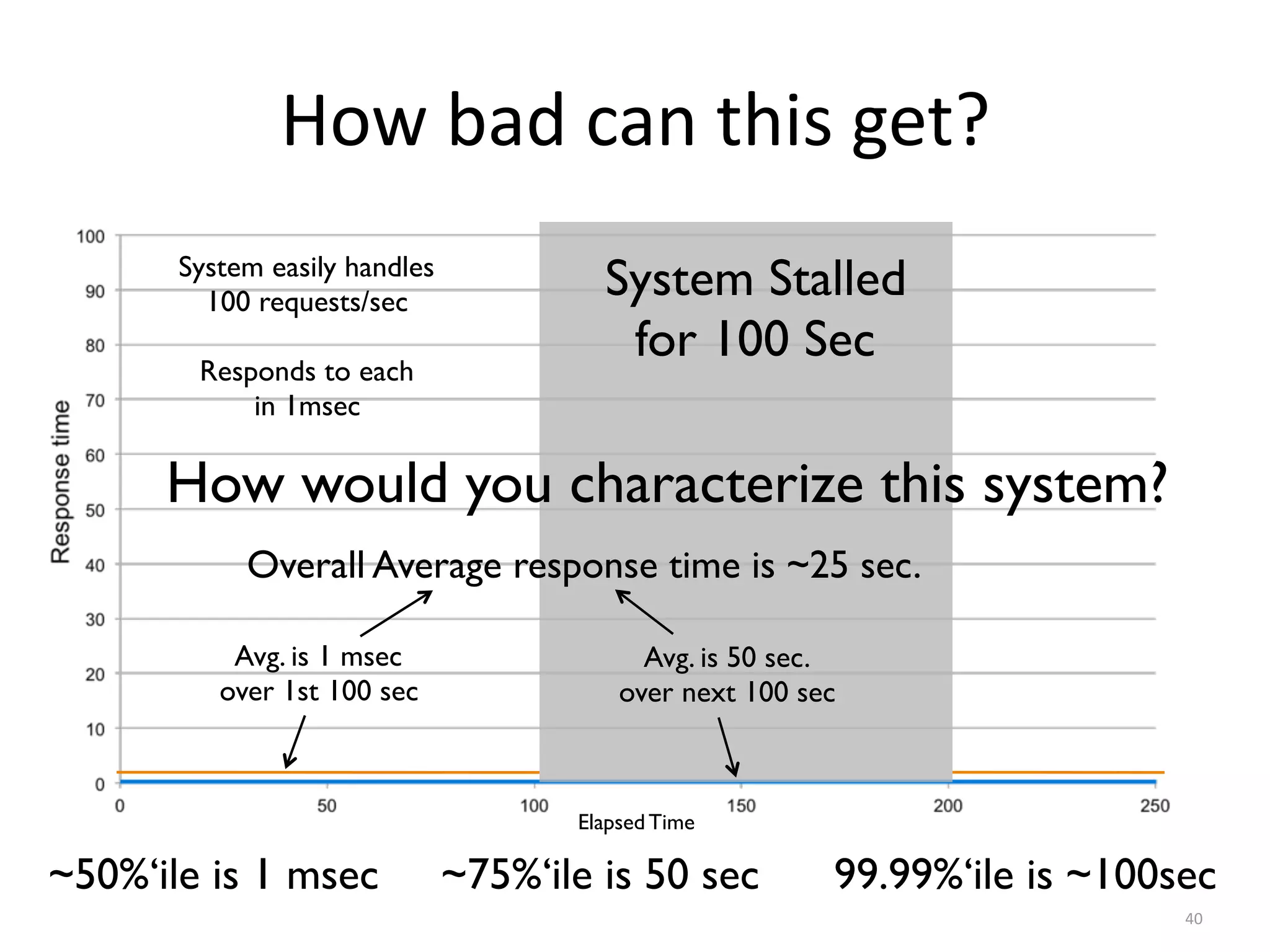
How	bad	can	this	get?
40
Avg. is 1 msec
over 1st 100 sec
System Stalled
for 100 Sec
Elapsed Time
System easily handles
100 requests/sec
Responds to each
in 1msec
How would you characterize this system?
~50%‘ile is 1 msec ~75%‘ile is 50 sec 99.99%‘ile is ~100sec
Avg. is 50 sec.
over next 100 sec
Overall Average response time is ~25 sec.
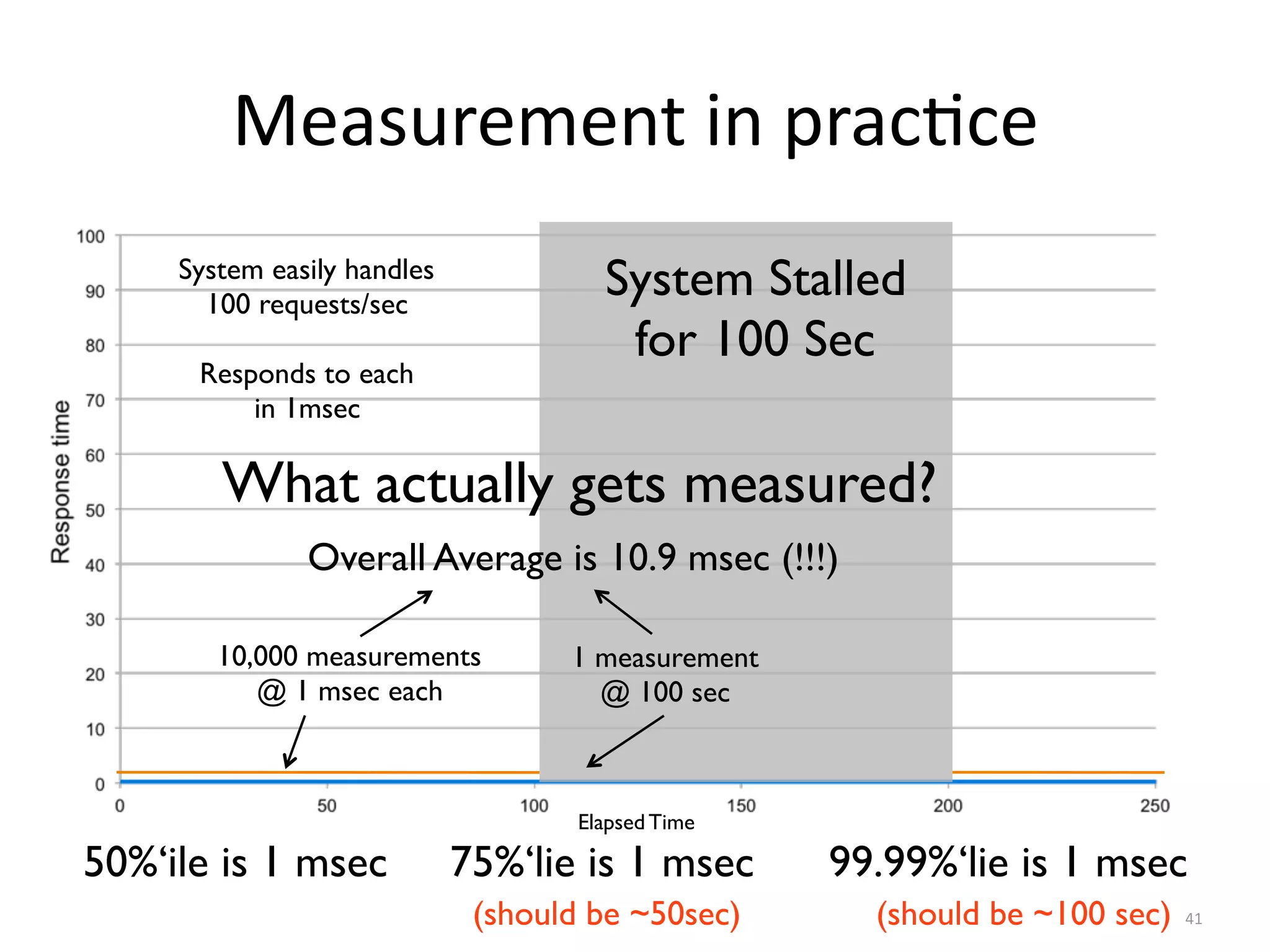
Measurement	in	prac8ce
41
System Stalled
for 100 Sec
Elapsed Time
System easily handles
100 requests/sec
Responds to each
in 1msec
What actually gets measured?
(should be ~50sec) (should be ~100 sec)
50%‘ile is 1 msec 75%‘lie is 1 msec 99.99%‘lie is 1 msec
10,000 measurements
@ 1 msec each
1 measurement
@ 100 sec
Overall Average is 10.9 msec (!!!)
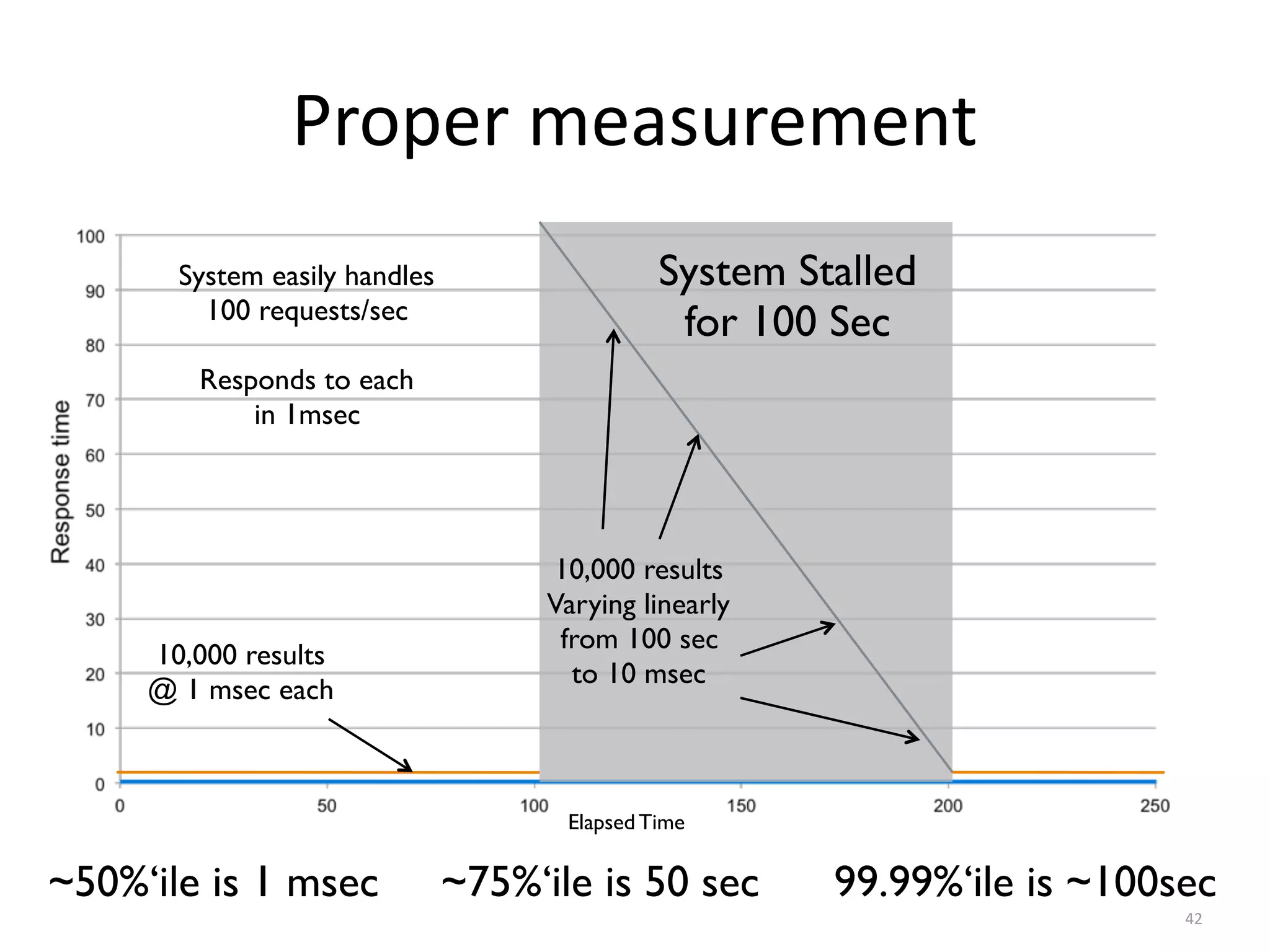
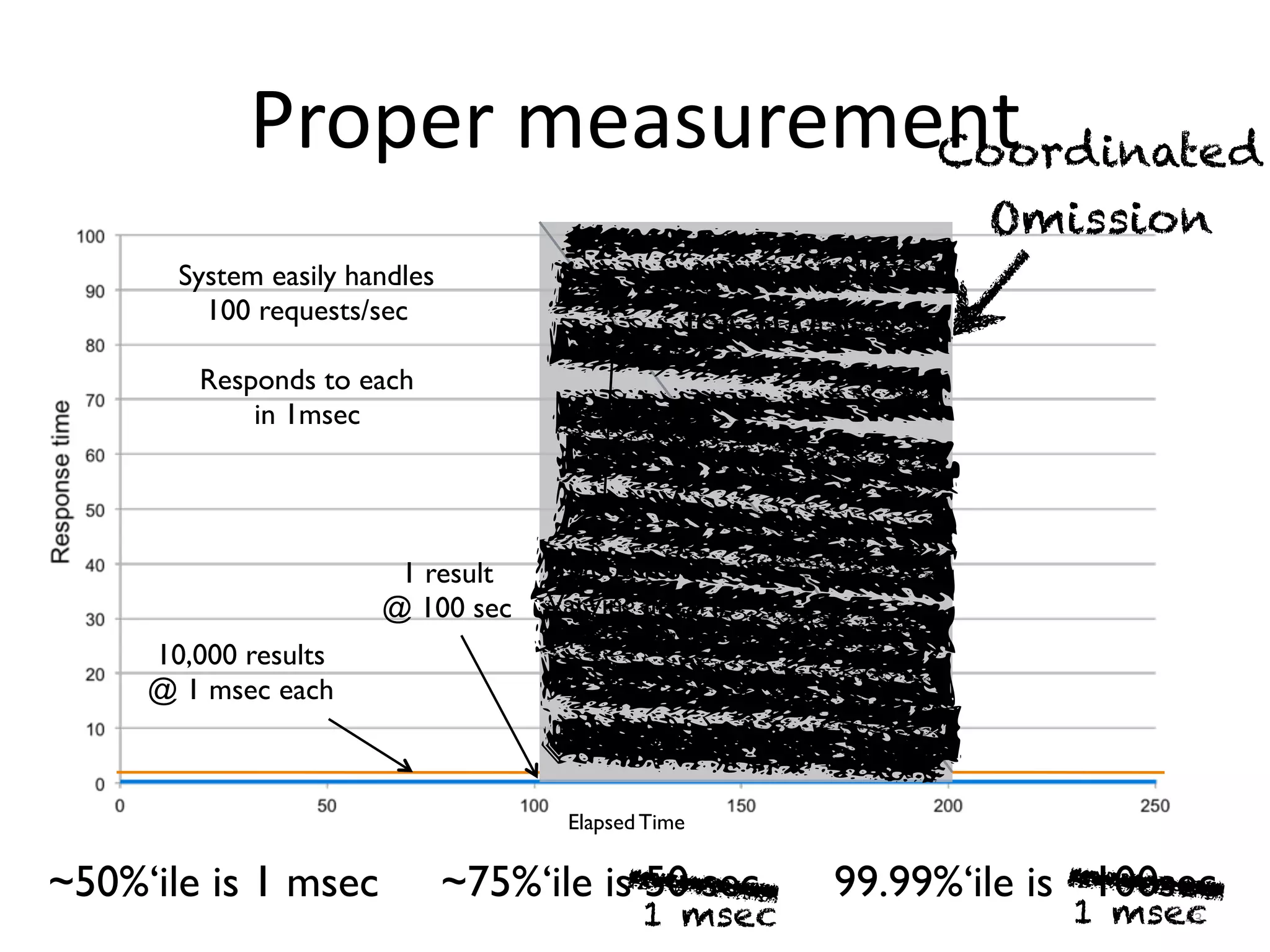
Proper	measurement
42
System Stalled
for 100 Sec
Elapsed Time
System easily handles
100 requests/sec
Responds to each
in 1msec
10,000 results
Varying linearly
from 100 sec
to 10 msec
10,000 results
@ 1 msec each
~50%‘ile is 1 msec ~75%‘ile is 50 sec 99.99%‘ile is ~100sec
Proper	measurement
43
System Stalled
for 100 Sec
Elapsed Time
System easily handles
100 requests/sec
Responds to each
in 1msec
10,000 results
Varying linearly
from 100 sec
to 10 msec
10,000 results
@ 1 msec each
~50%‘ile is 1 msec ~75%‘ile is 50 sec 99.99%‘ile is ~100sec
Coordinated
Omission
1 msec 1 msec
1 result
@ 100 sec
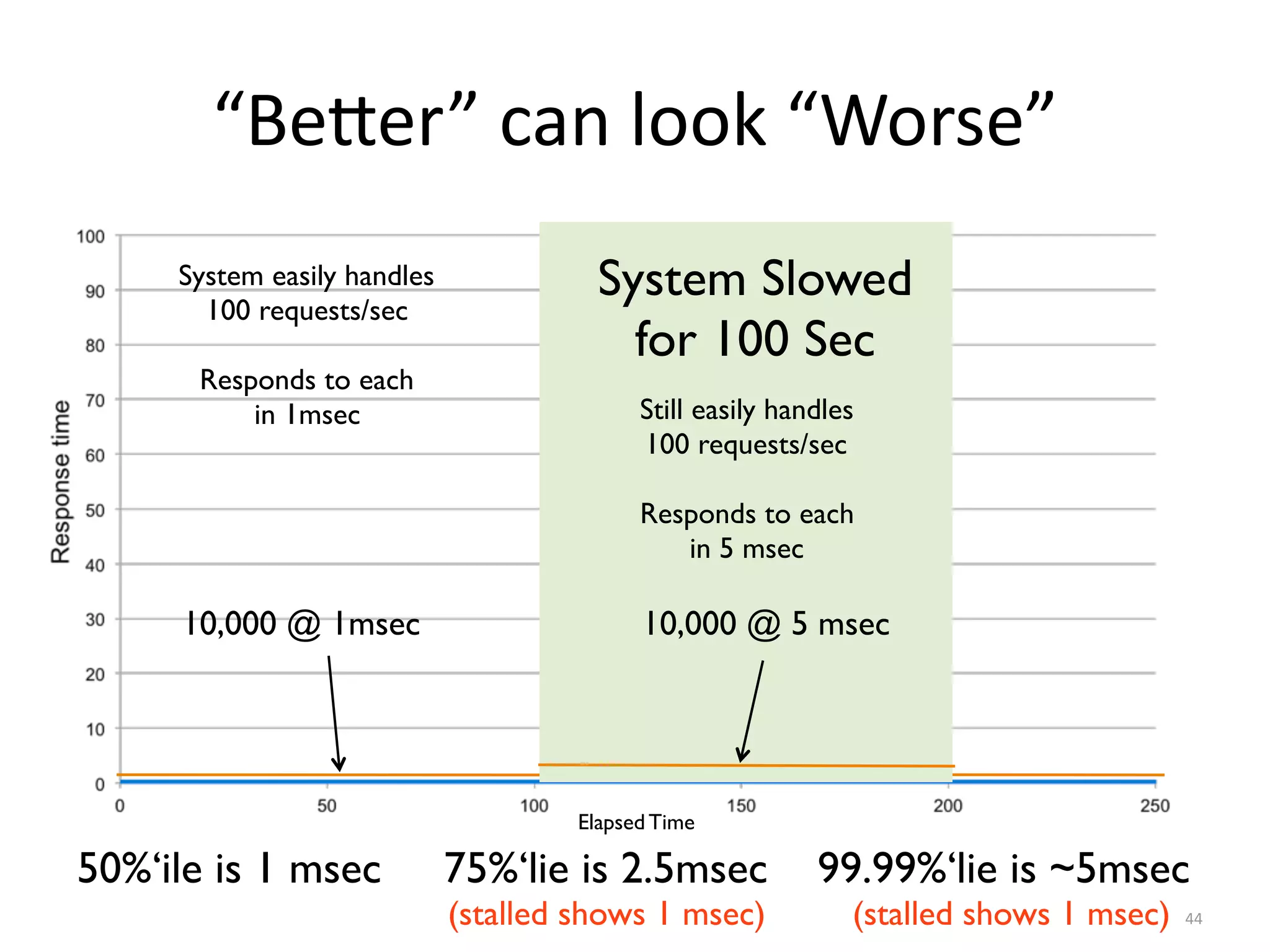
“Be?er”	can	look	“Worse”
44
System Slowed
for 100 Sec
Elapsed Time
System easily handles
100 requests/sec
Responds to each
in 1msec
10,000 @ 1msec 10,000 @ 5 msec
50%‘ile is 1 msec 75%‘lie is 2.5msec 99.99%‘lie is ~5msec
Still easily handles
100 requests/sec
Responds to each
in 5 msec
(stalled shows 1 msec) (stalled shows 1 msec)
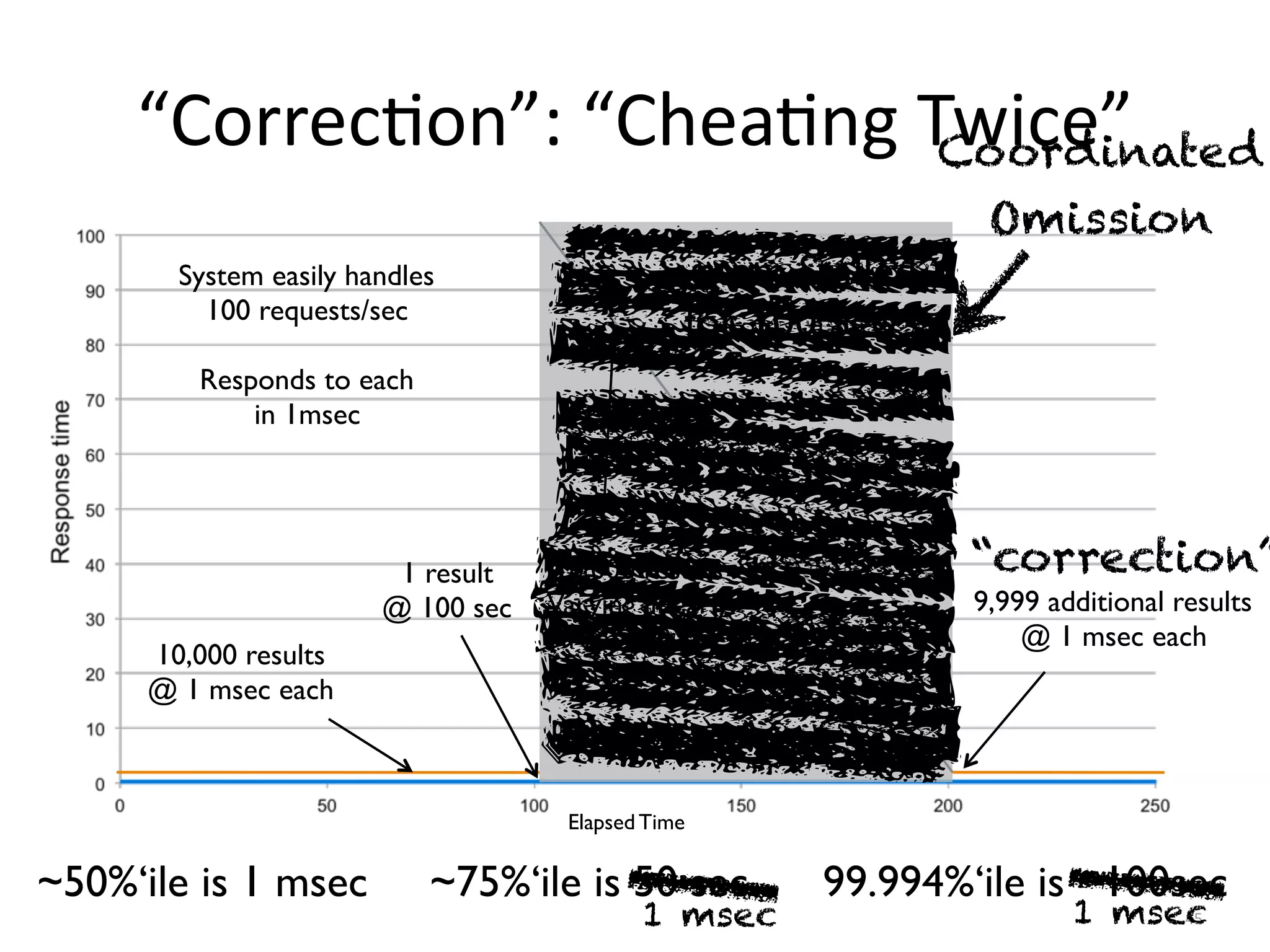
“Correc8on”:	“Chea8ng	Twice”
45
System Stalled
for 100 Sec
Elapsed Time
System easily handles
100 requests/sec
Responds to each
in 1msec
10,000 results
Varying linearly
from 100 sec
to 10 msec
10,000 results
@ 1 msec each
~50%‘ile is 1 msec ~75%‘ile is 50 sec 99.994%‘ile is ~100sec
Coordinated
Omission
1 msec 1 msec
9,999 additional results
@ 1 msec each
1 result
@ 100 sec
“correction”
©2015 Azul Systems, Inc.	 	 	 	 	 	
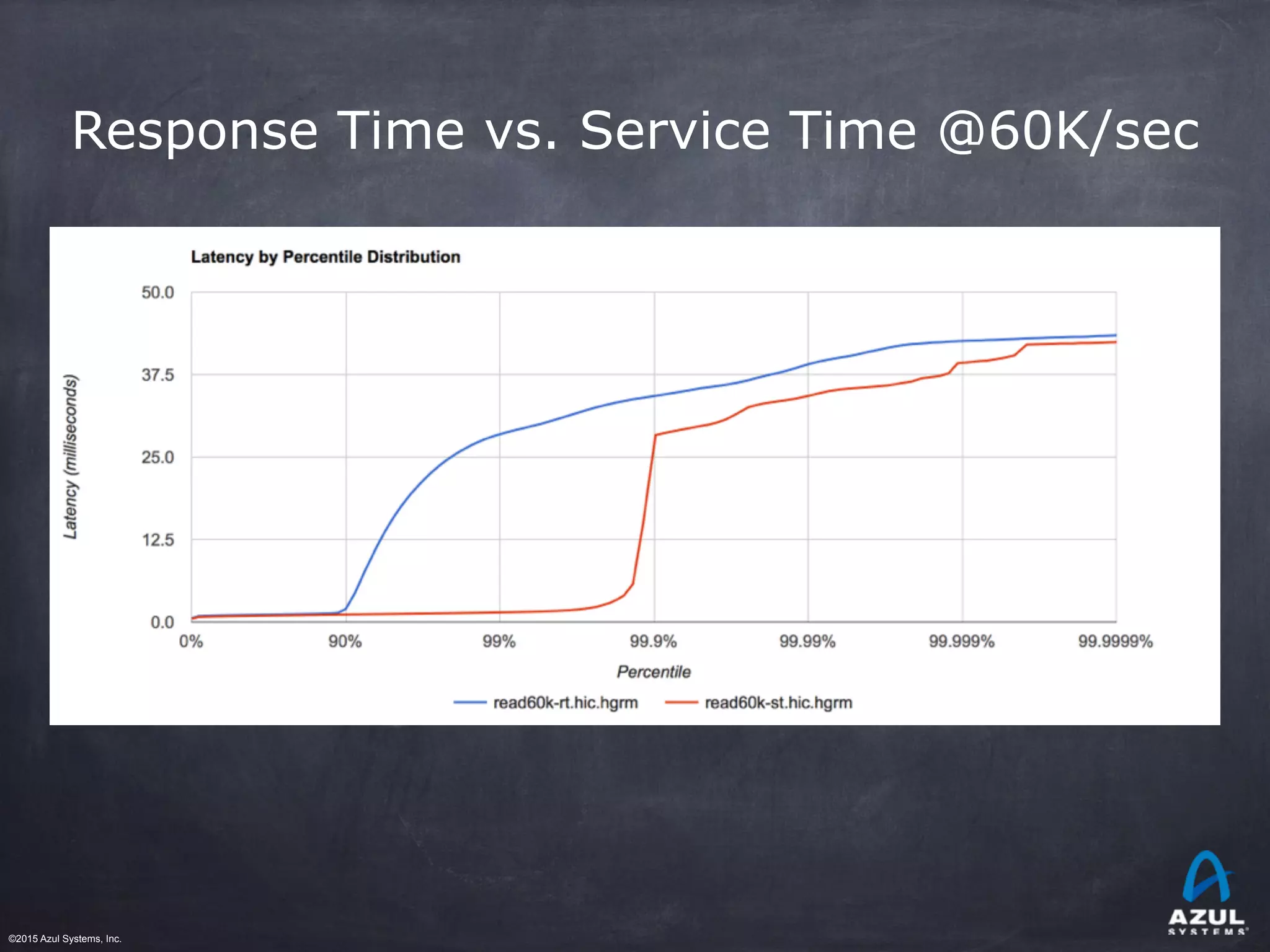
Response Time vs. Service Time
©2015 Azul Systems, Inc.	 	 	 	 	 	
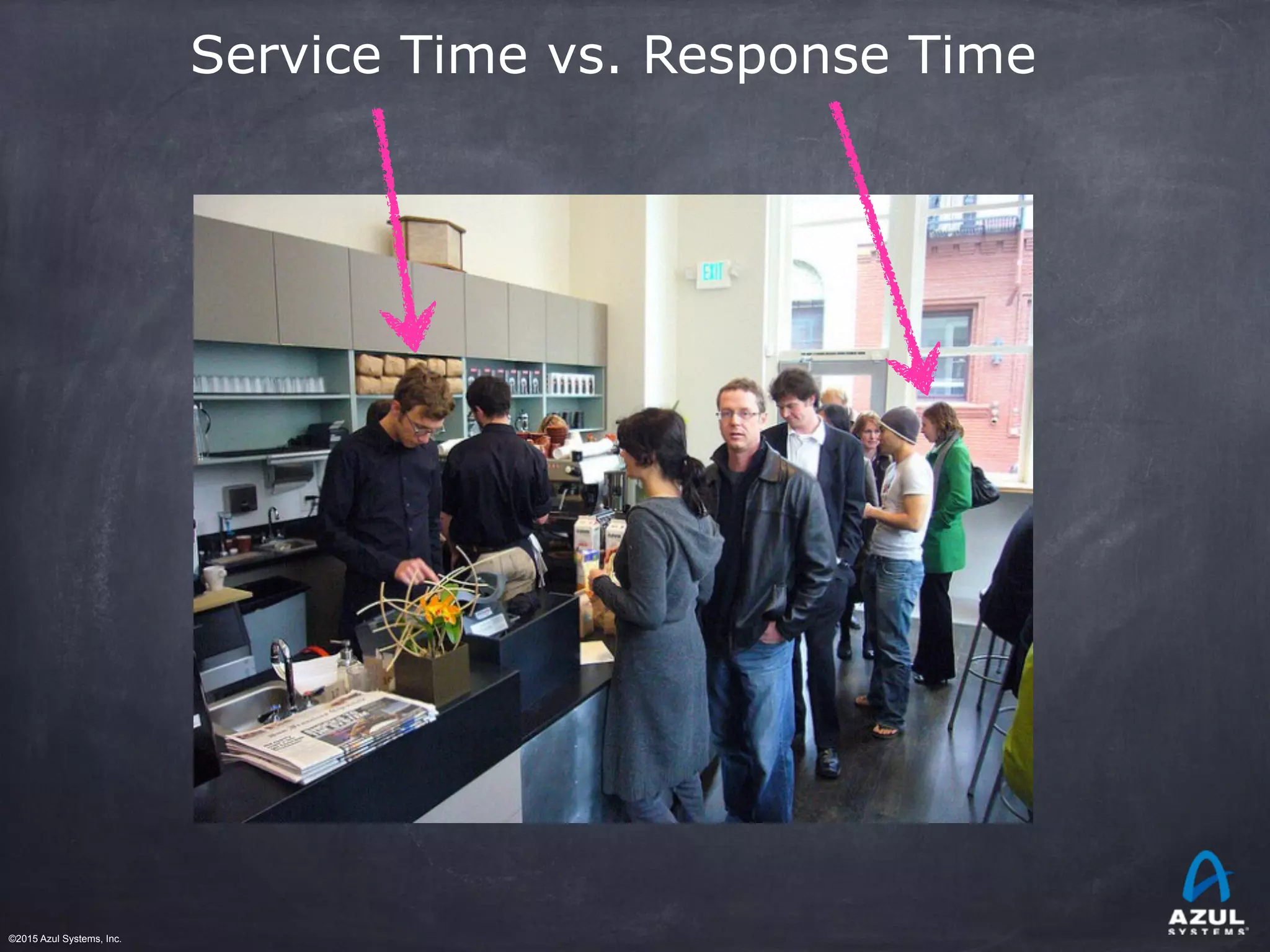
Service Time vs. Response Time
©2015 Azul Systems, Inc.	 	 	 	 	 	
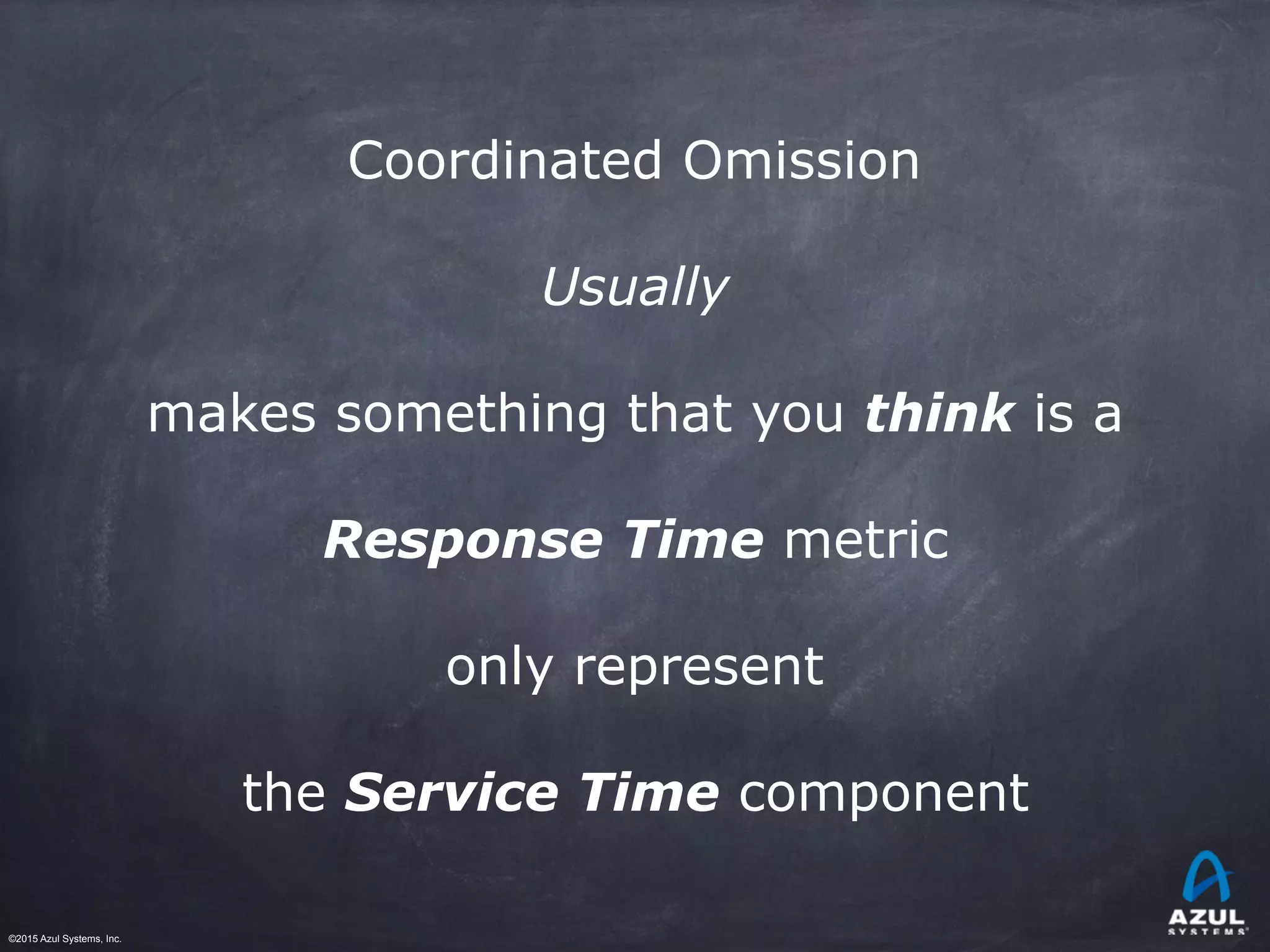
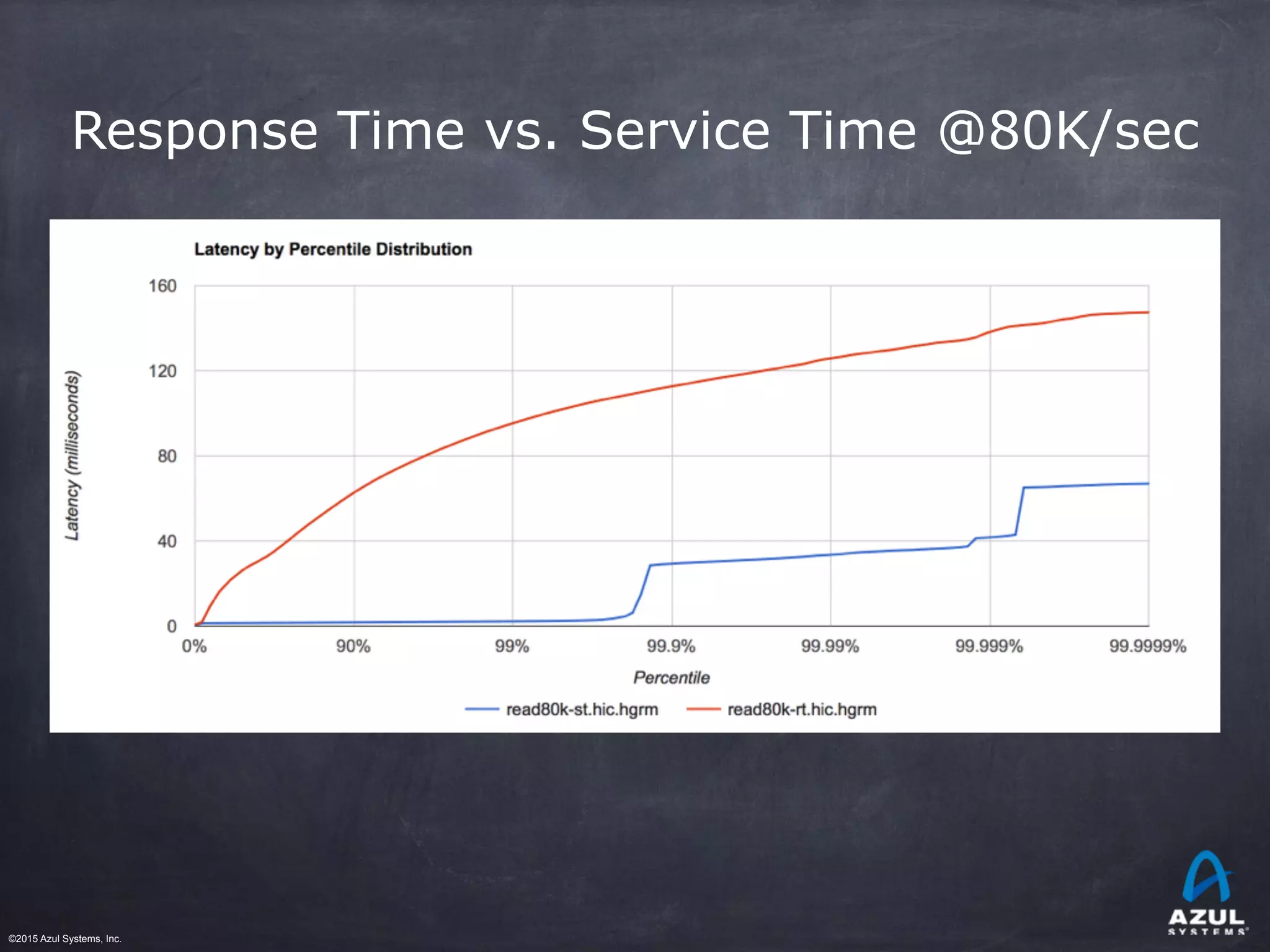
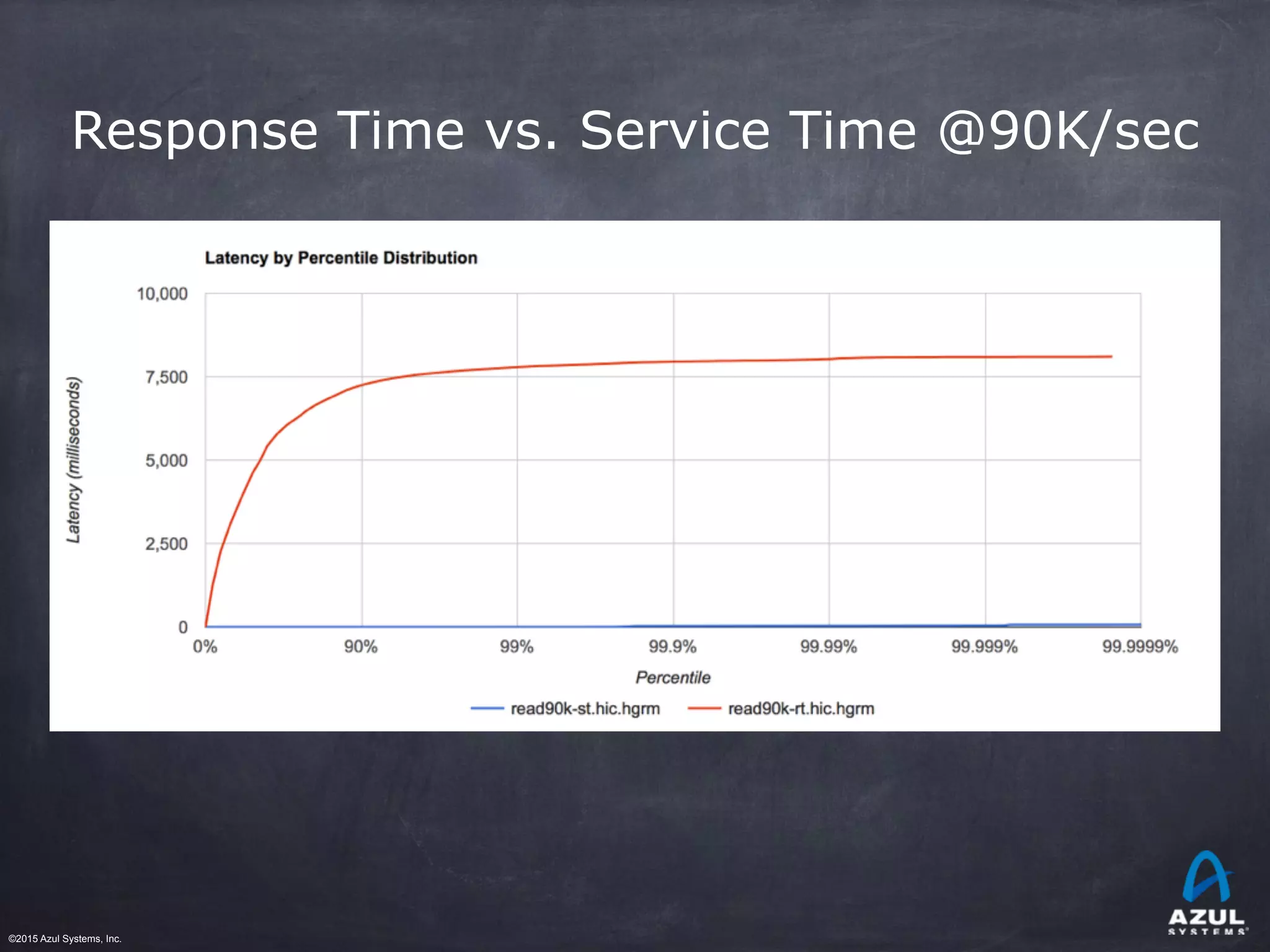
Coordinated Omission
Usually
makes something that you think is a
Response Time metric
only represent
the Service Time component
©2015 Azul Systems, Inc.	 	 	 	 	 	
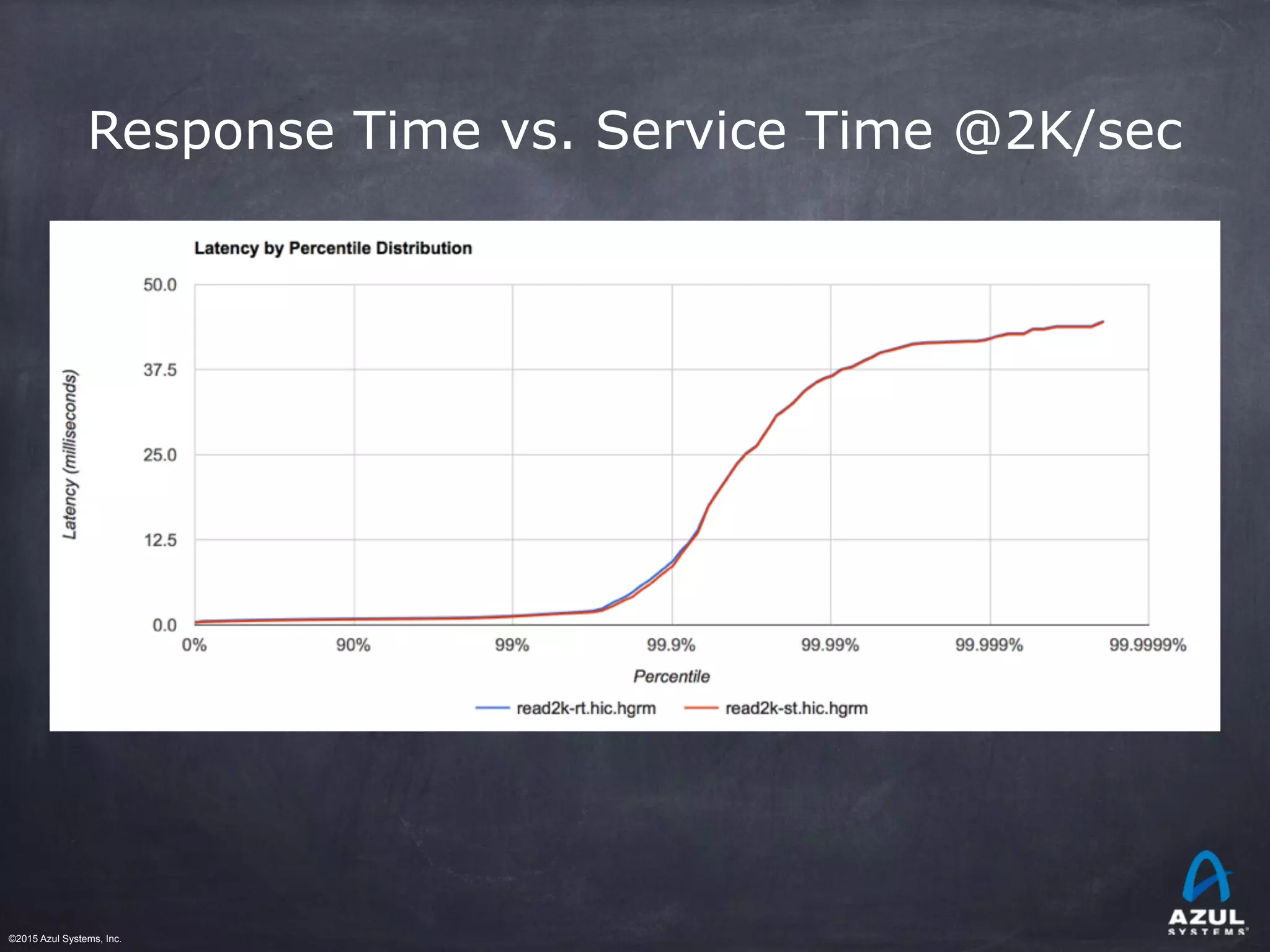
Response Time vs. Service Time @2K/sec
©2015 Azul Systems, Inc.	 	 	 	 	 	
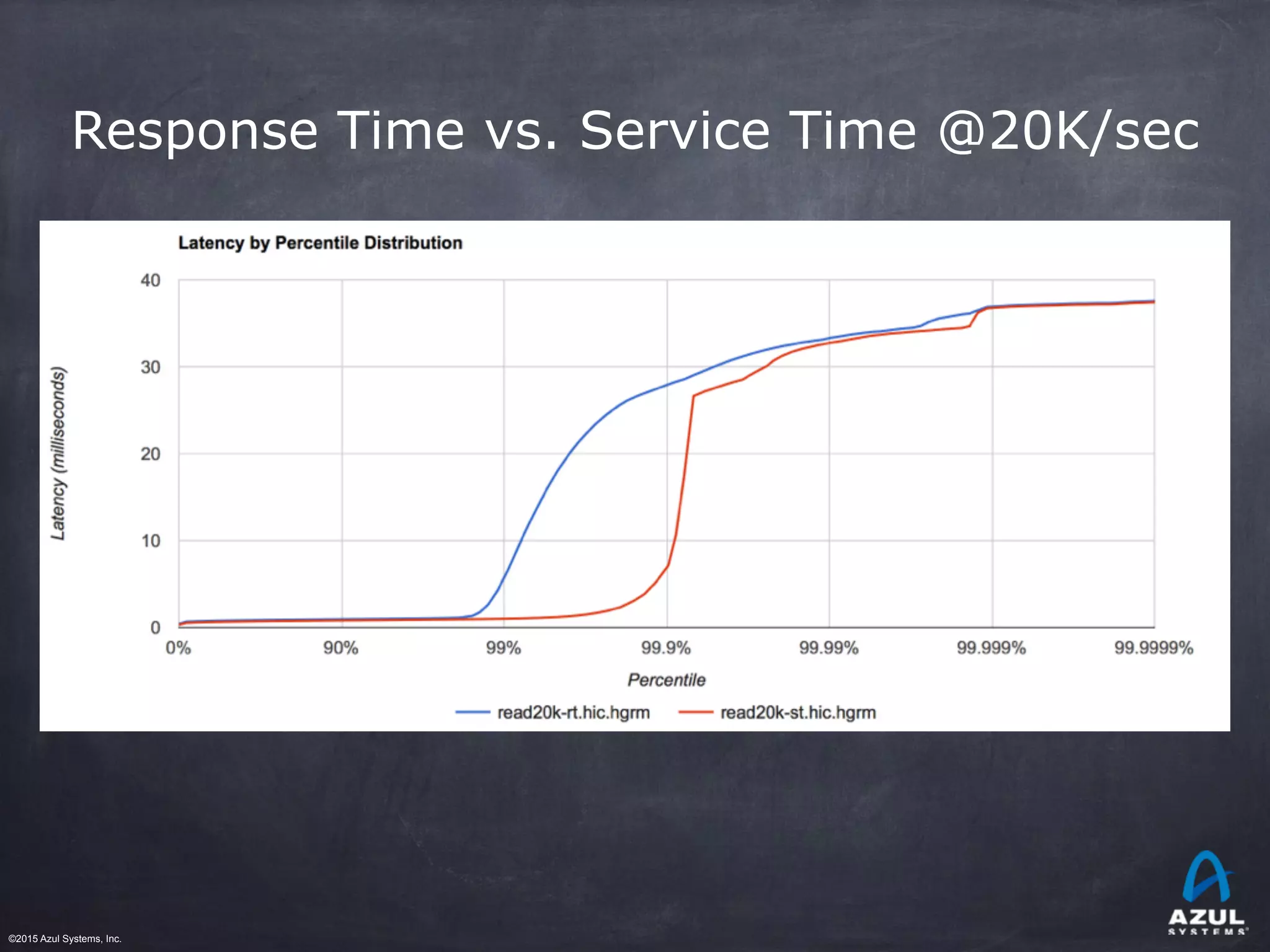
Response Time vs. Service Time @20K/sec
©2015 Azul Systems, Inc.	 	 	 	 	 	
Response Time vs. Service Time @60K/sec
©2015 Azul Systems, Inc.	 	 	 	 	 	
Response Time vs. Service Time @80K/sec
©2015 Azul Systems, Inc.	 	 	 	 	 	
Response Time vs. Service Time @90K/sec
©2015 Azul Systems, Inc.	 	 	 	 	 	
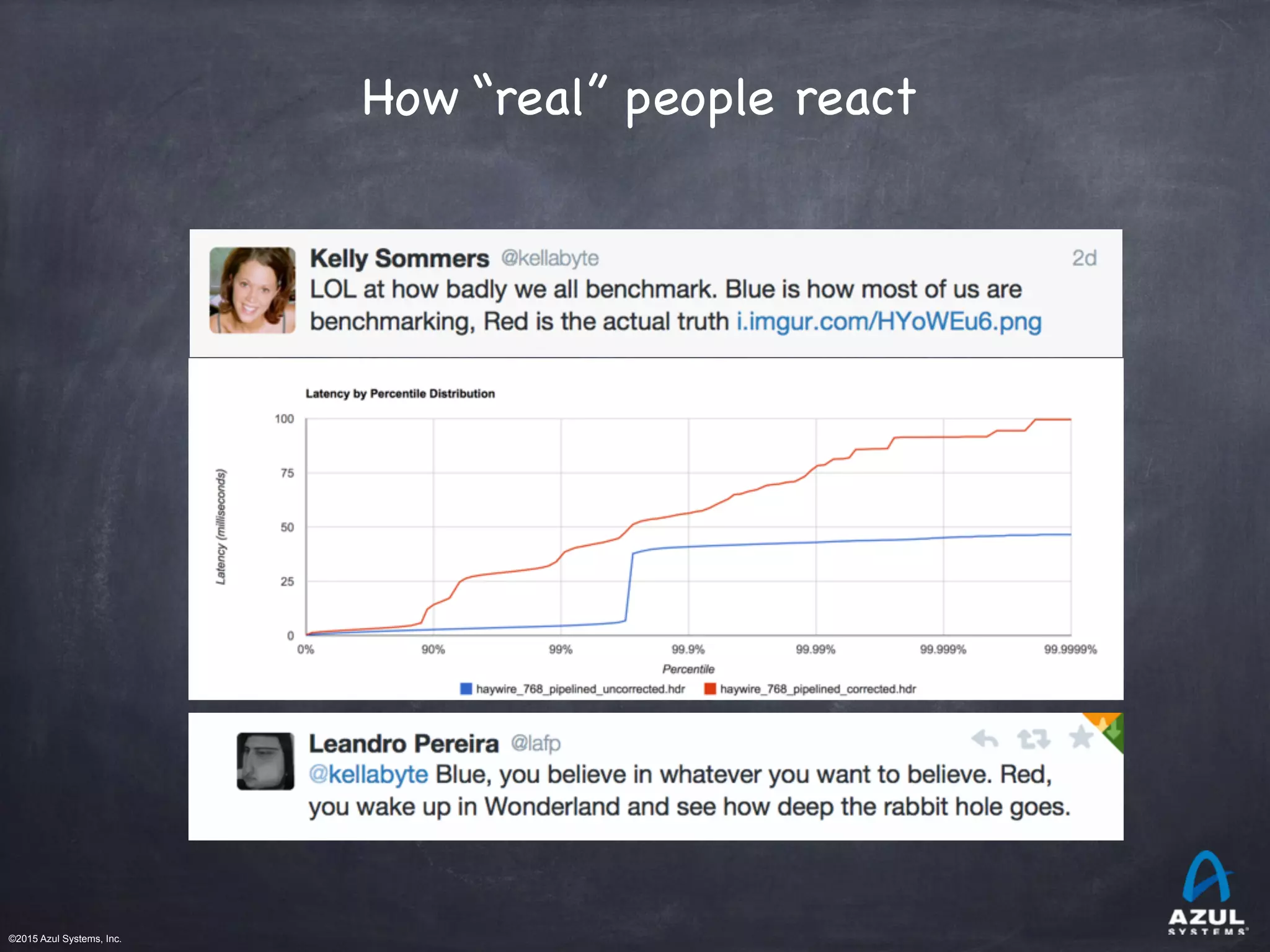
How “real” people react
©2015 Azul Systems, Inc.	 	 	 	 	 	
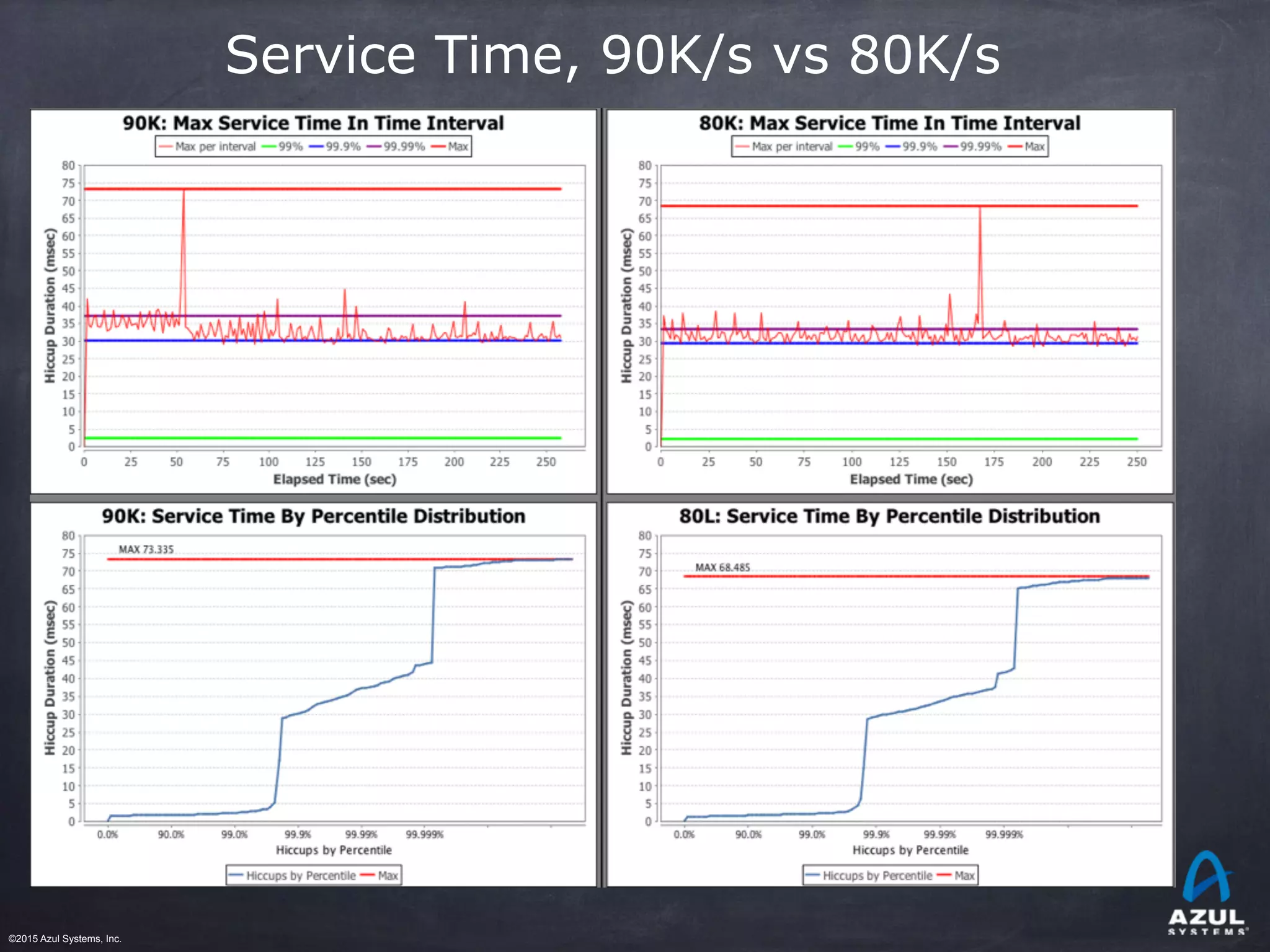
Service Time, 90K/s vs 80K/s
©2015 Azul Systems, Inc.	 	 	 	 	 	
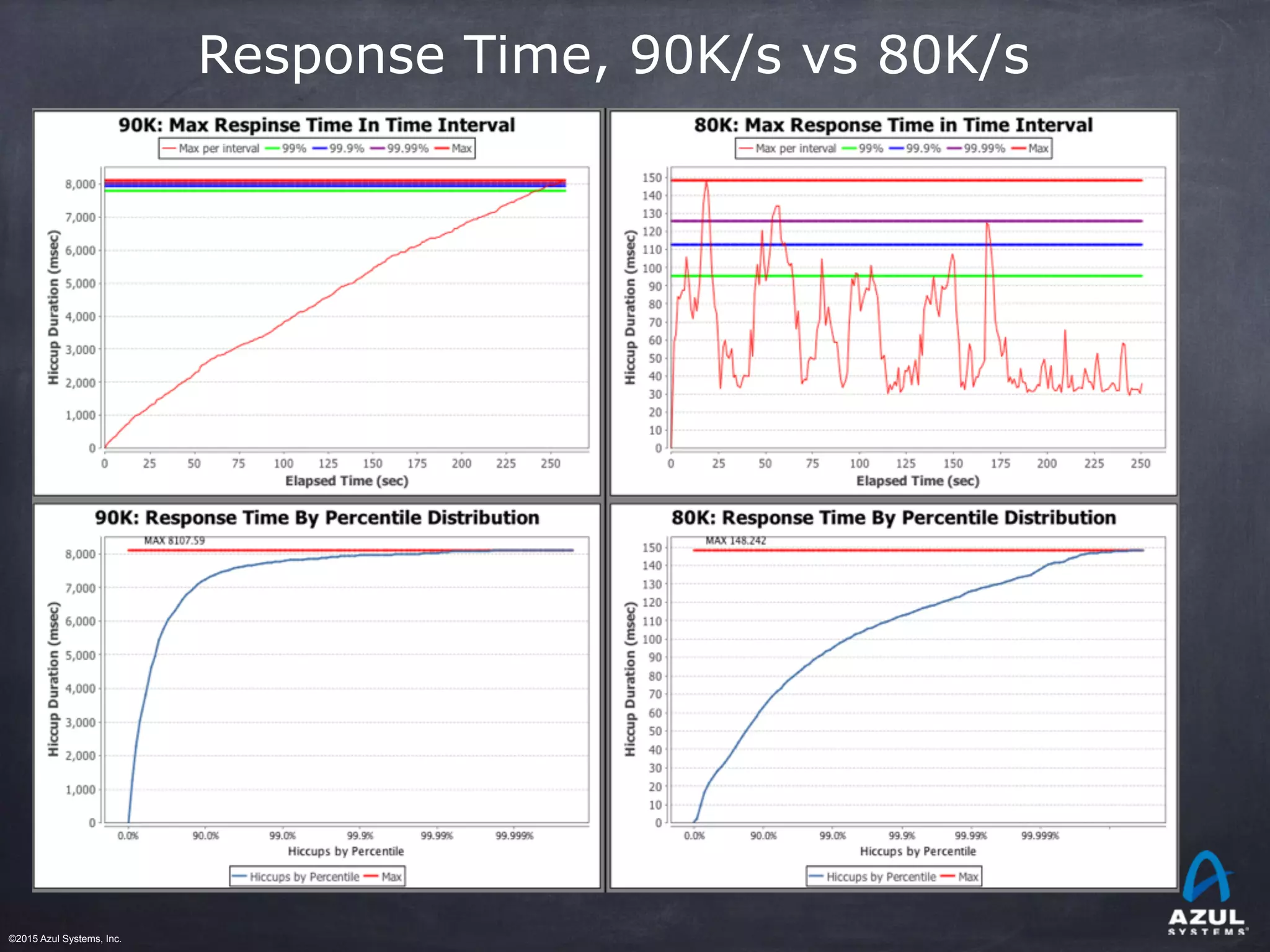
Response Time, 90K/s vs 80K/s
©2015 Azul Systems, Inc.	 	 	 	 	 	
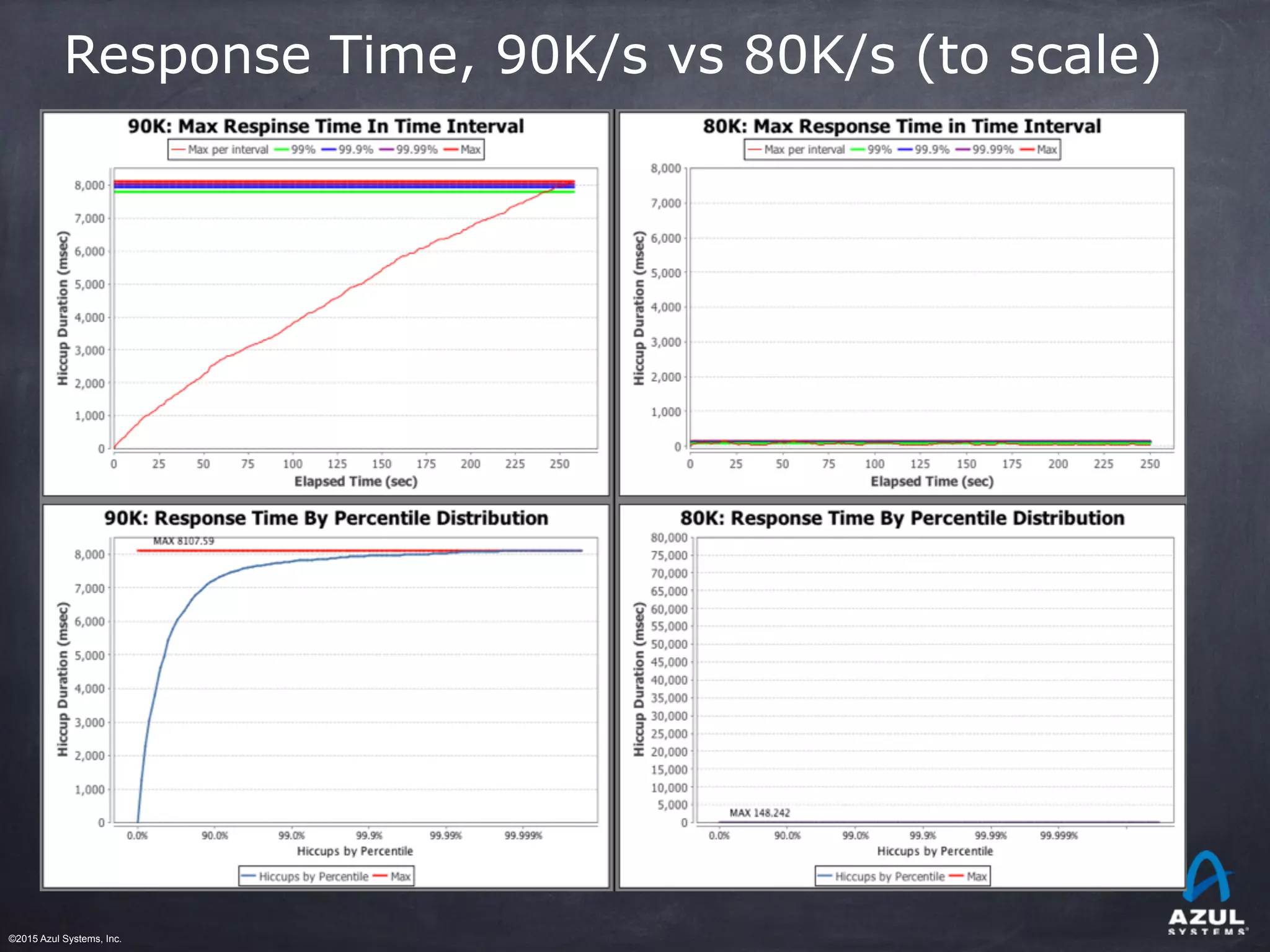
Response Time, 90K/s vs 80K/s (to scale)
©2015 Azul Systems, Inc.	 	 	 	 	 	
Latency doesn’t live in a vacuum
©2015 Azul Systems, Inc.	 	 	 	 	 	
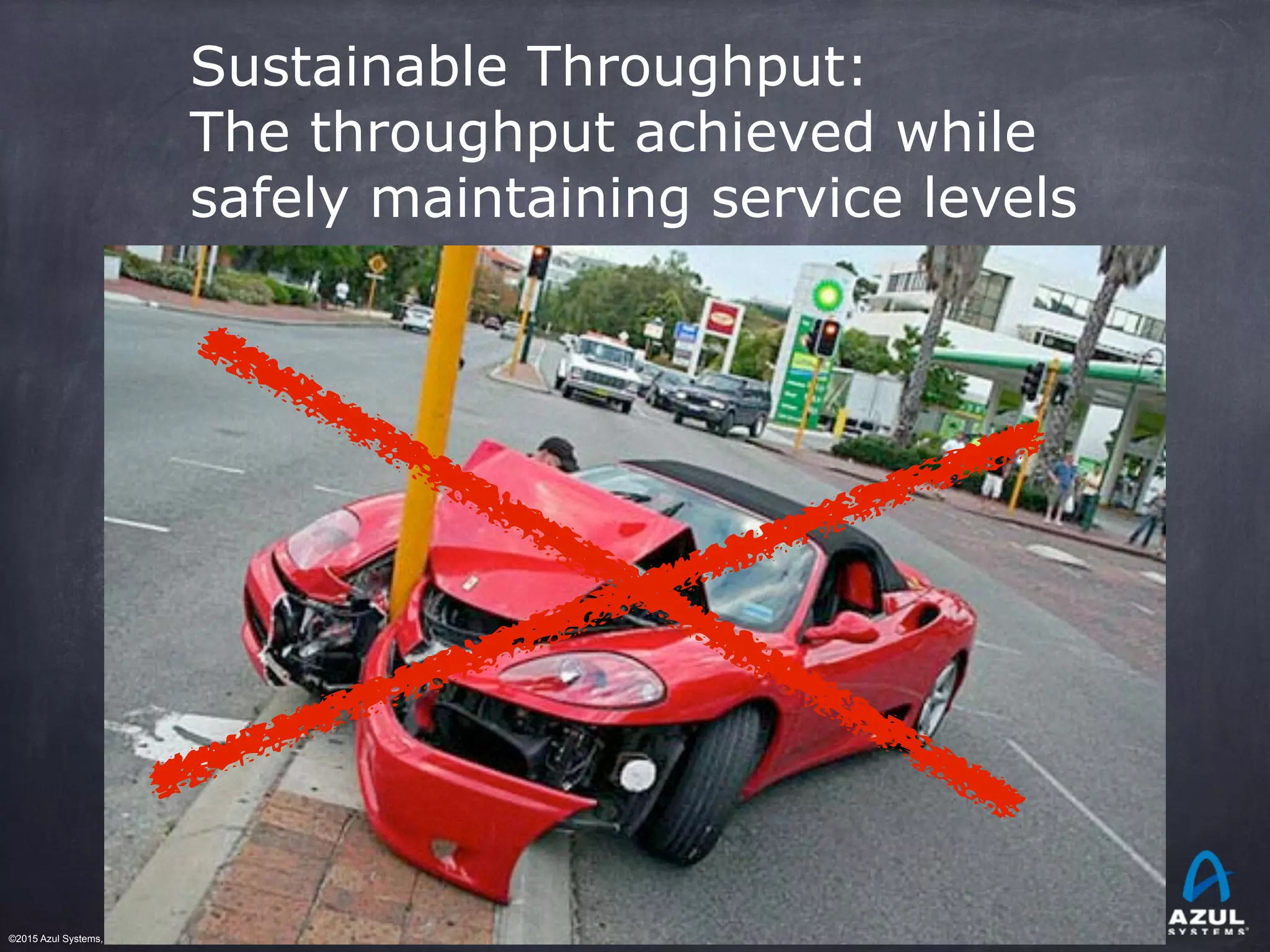
Sustainable Throughput:
The throughput achieved while
safely maintaining service levels
©2015 Azul Systems, Inc.	 	 	 	 	 	
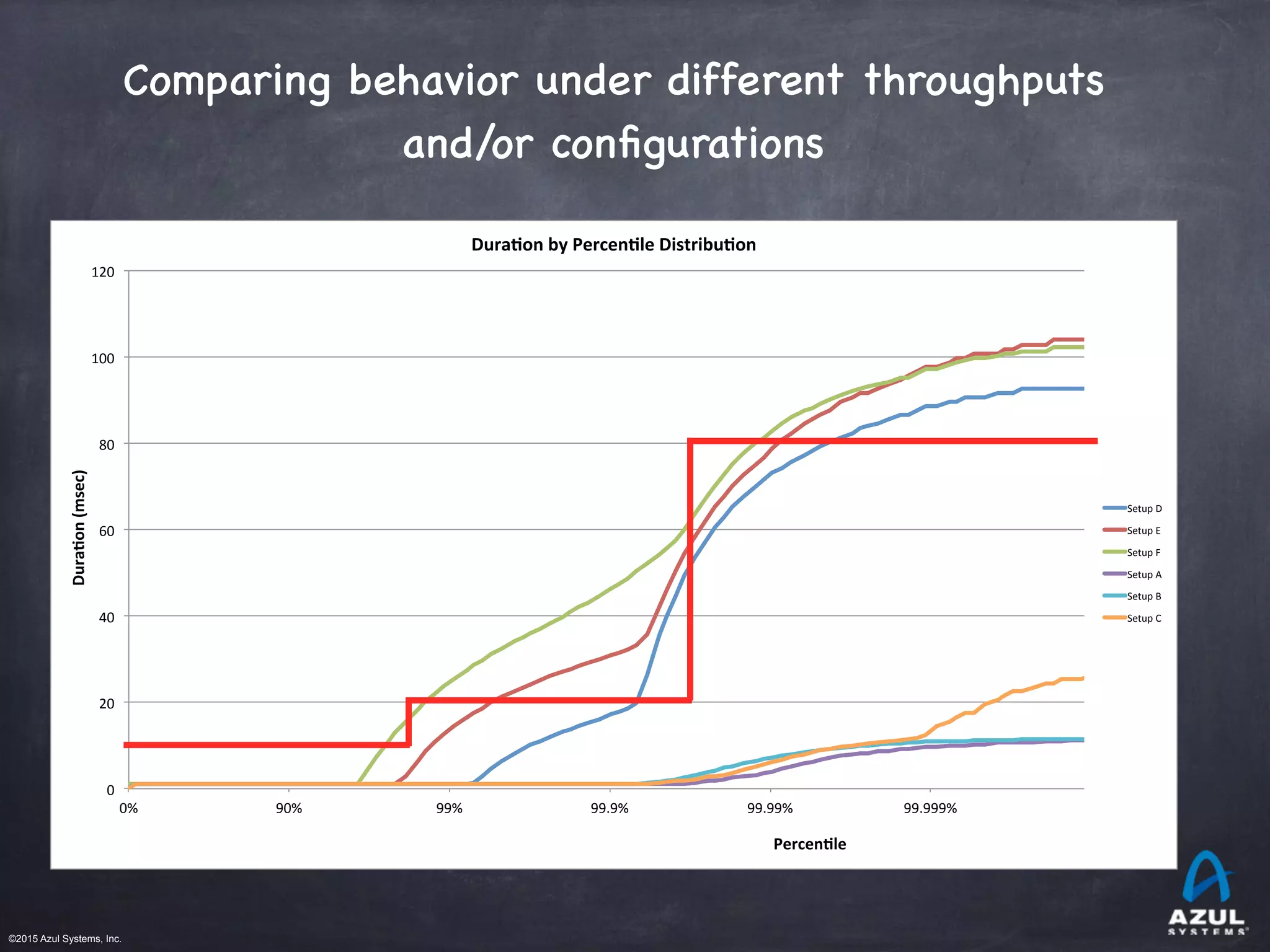
Comparing behavior under different throughputs
and/or configurations
0%# 90%# 99%# 99.9%# 99.99%# 99.999%#
0#
20#
40#
60#
80#
100#
120#
!Dura&on!(msec)!
!
!
Percen&le!
Dura&on!by!Percen&le!Distribu&on!
Setup#D#
Setup#E#
Setup#F#
Setup#A#
Setup#B#
Setup#C#
©2015 Azul Systems, Inc.	 	 	 	 	 	
Comparing response time or
latency behaviors
©2015 Azul Systems, Inc.	 	 	 	 	 	
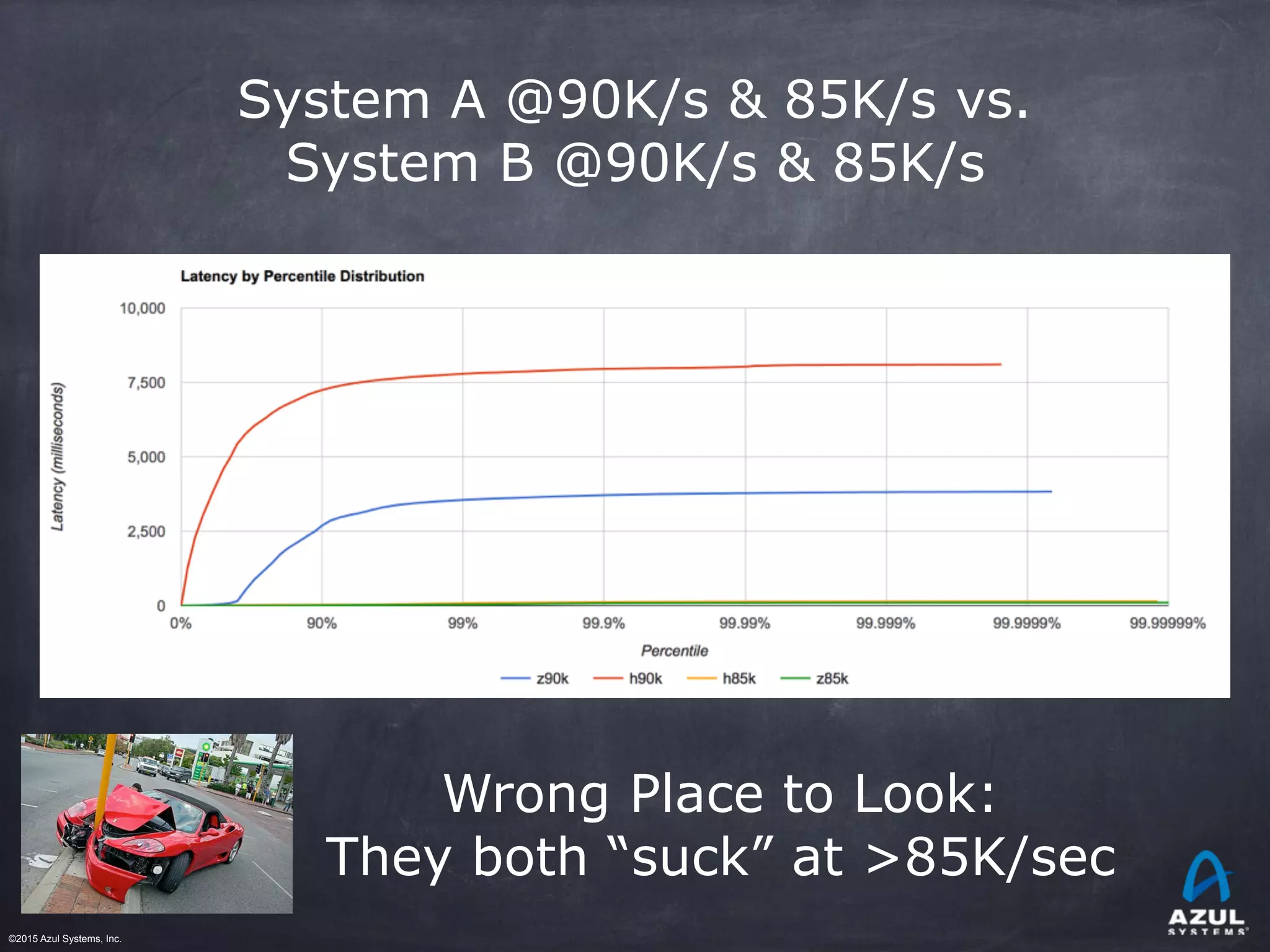
System A @90K/s & 85K/s vs.
System B @90K/s & 85K/s
Wrong Place to Look:
They both “suck” at >85K/sec
©2015 Azul Systems, Inc.	 	 	 	 	 	
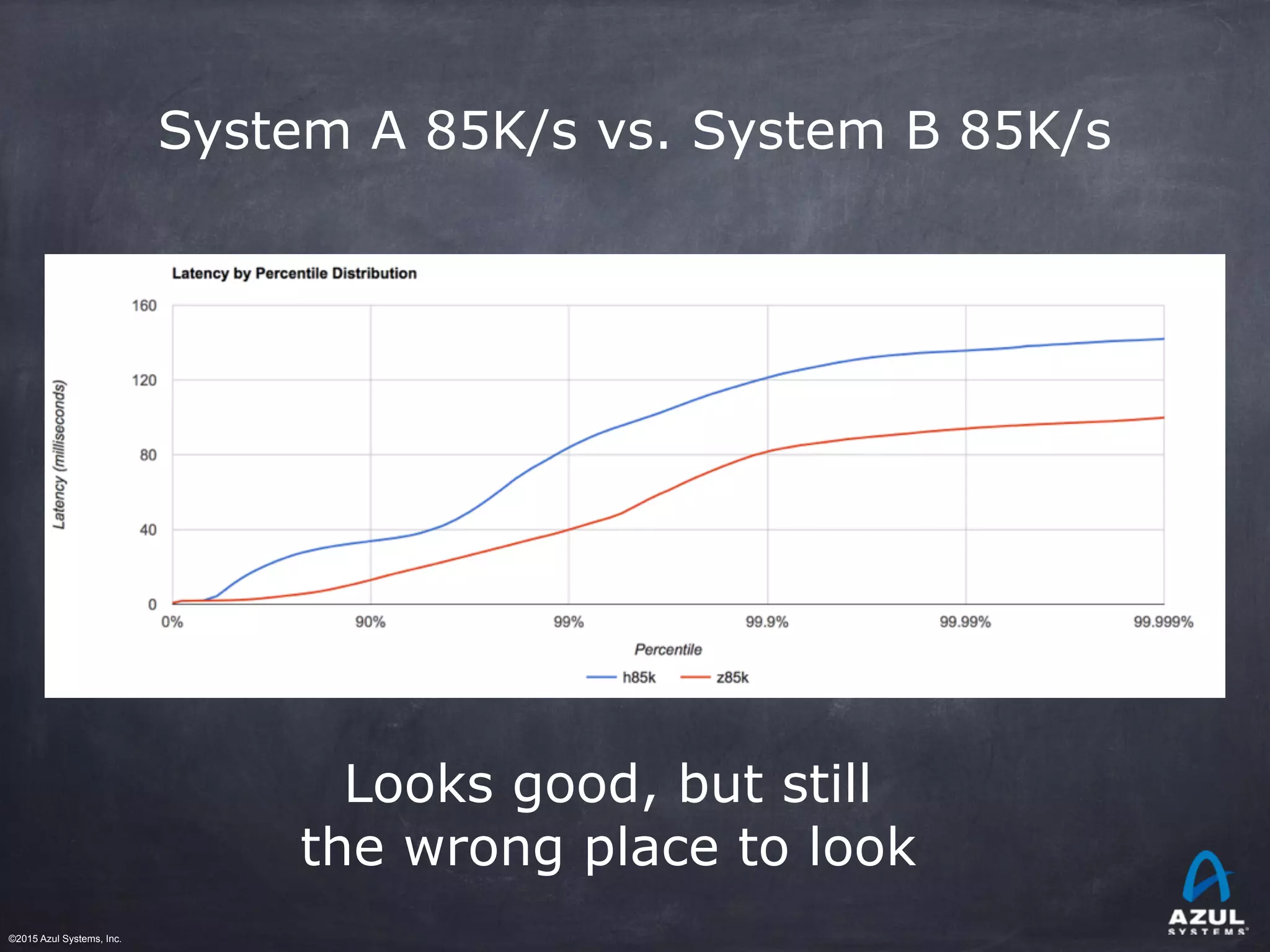
System A 85K/s vs. System B 85K/s
Looks good, but still
the wrong place to look
©2015 Azul Systems, Inc.	 	 	 	 	 	
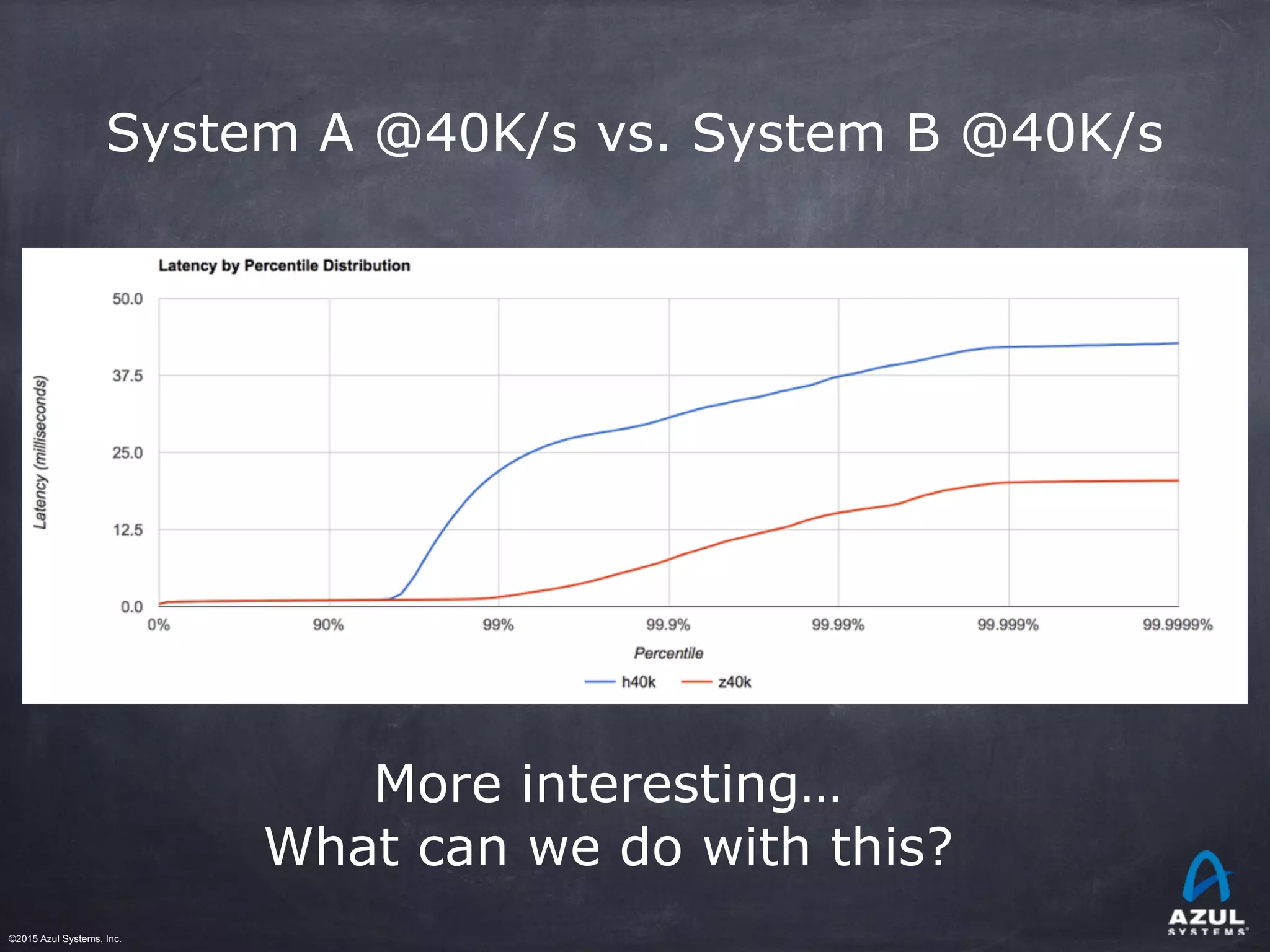
System A @40K/s vs. System B @40K/s
More interesting…
What can we do with this?
©2015 Azul Systems, Inc.	 	 	 	 	 	
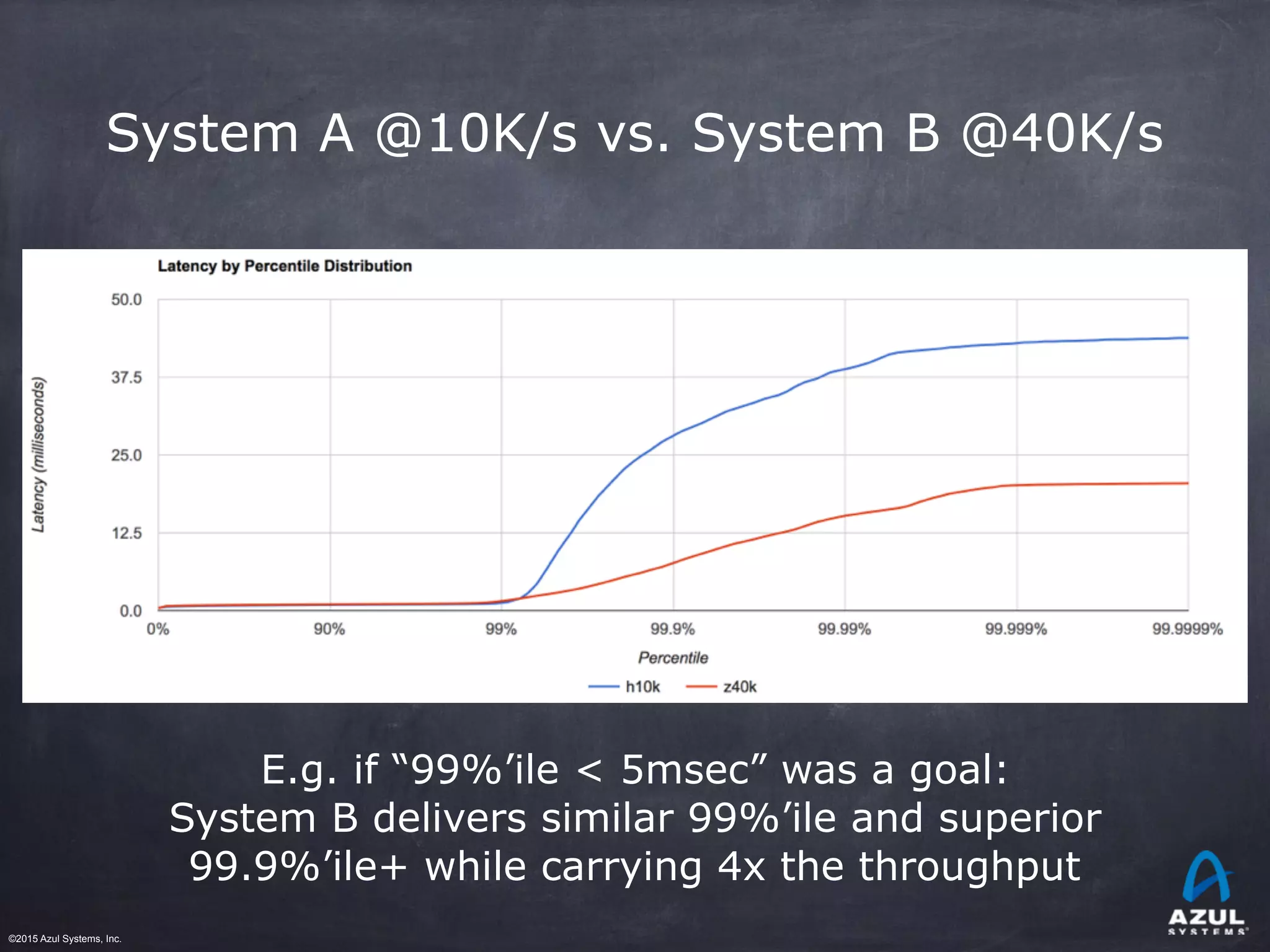
System A @10K/s vs. System B @40K/s
E.g. if “99%’ile < 5msec” was a goal:
System B delivers similar 99%’ile and superior
99.9%’ile+ while carrying 4x the throughput
©2015 Azul Systems, Inc.	 	 	 	 	 	
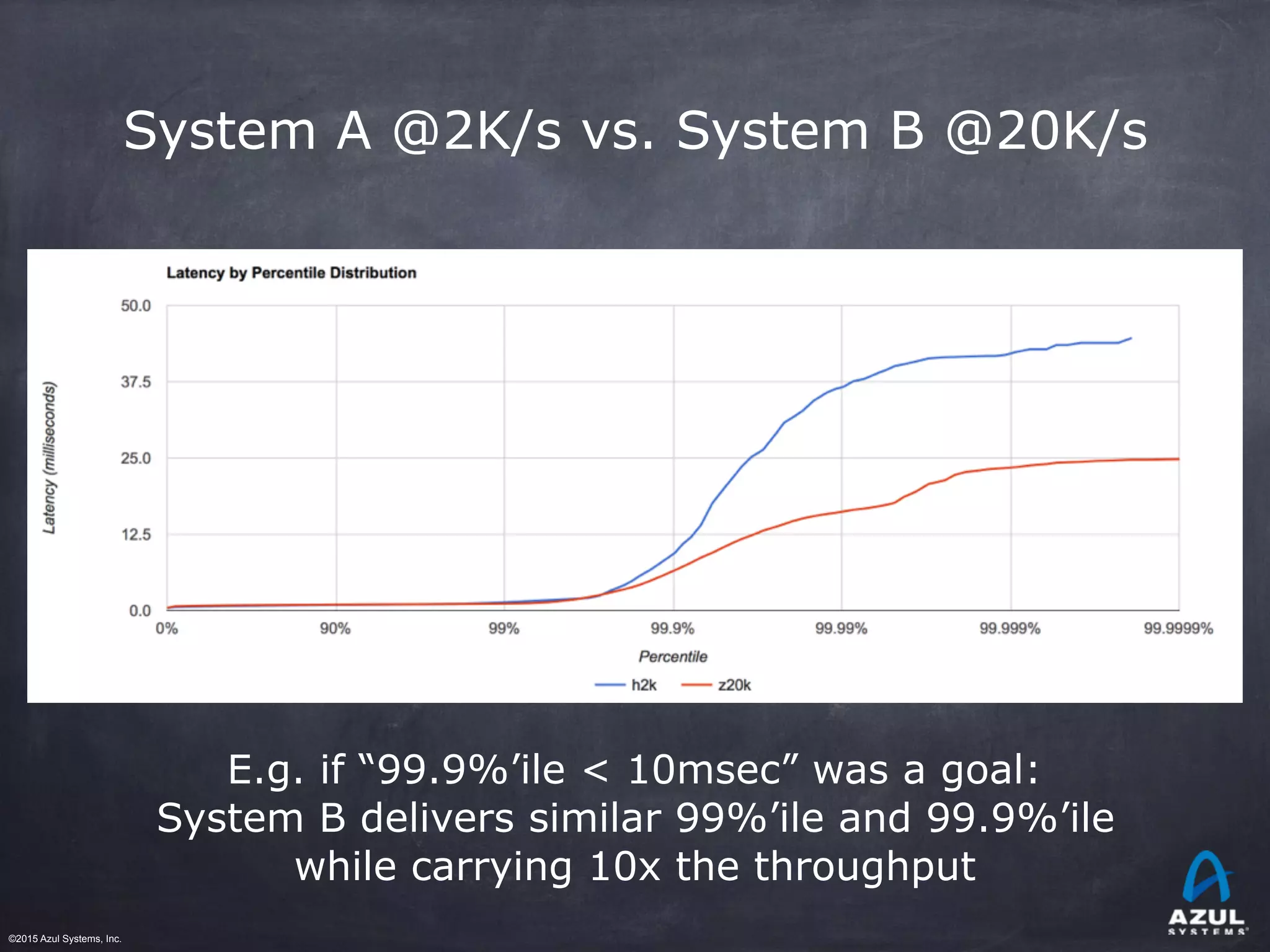
System A @2K/s vs. System B @20K/s
E.g. if “99.9%’ile < 10msec” was a goal:
System B delivers similar 99%’ile and 99.9%’ile
while carrying 10x the throughput
©2015 Azul Systems, Inc.	 	 	 	 	 	
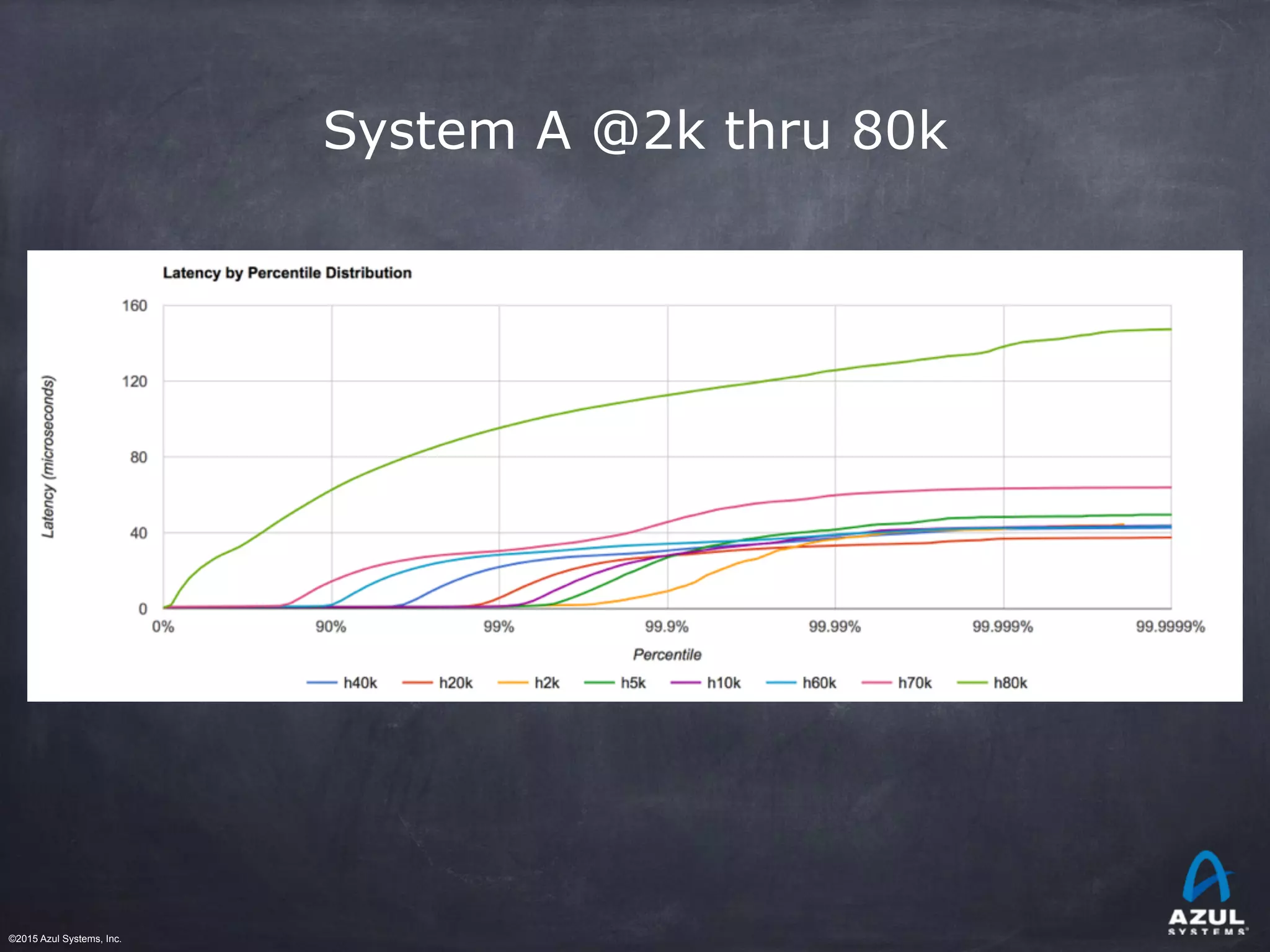
System A @2k thru 80k
©2015 Azul Systems, Inc.	 	 	 	 	 	
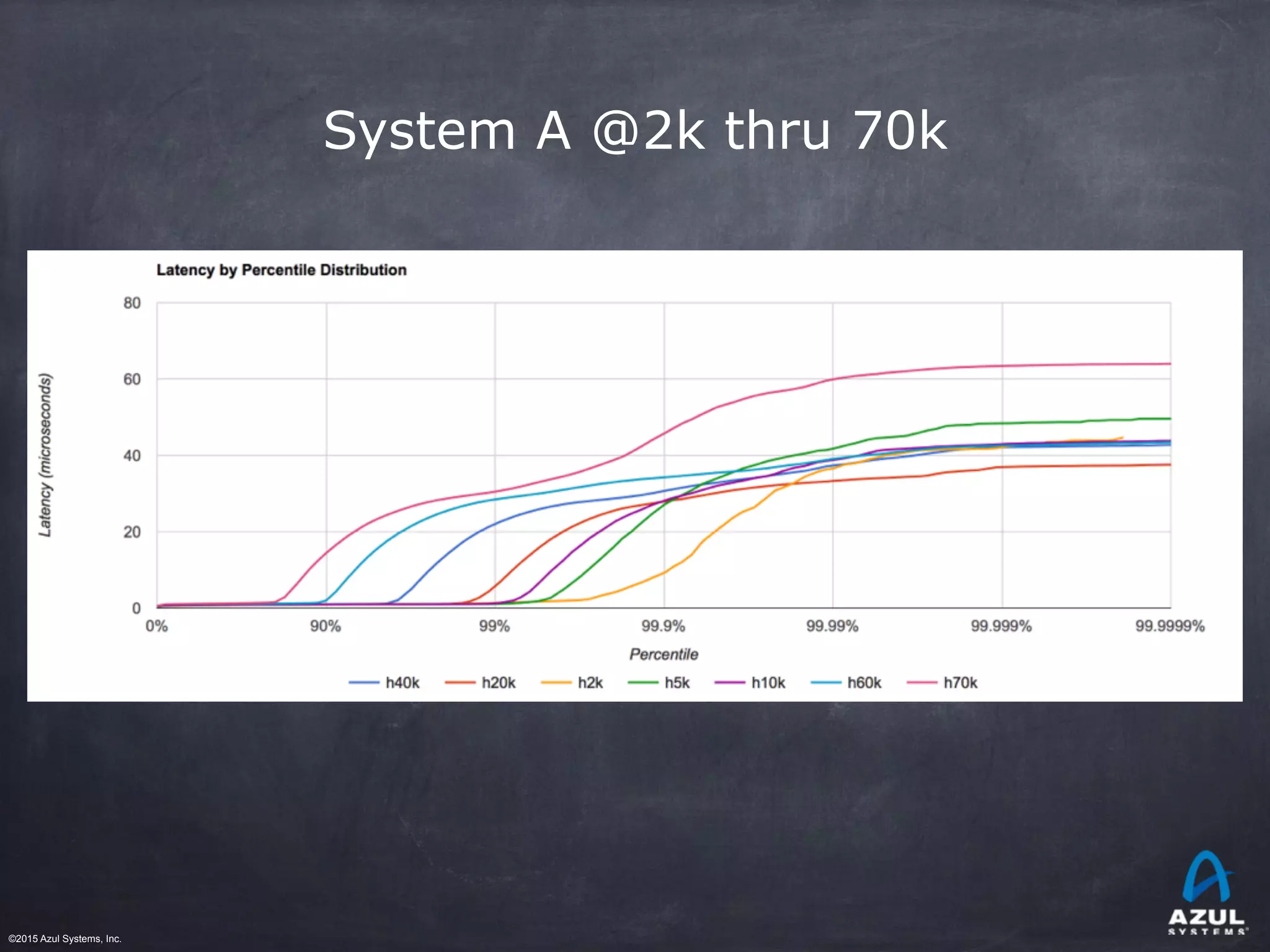
System A @2k thru 70k
©2015 Azul Systems, Inc.	 	 	 	 	 	
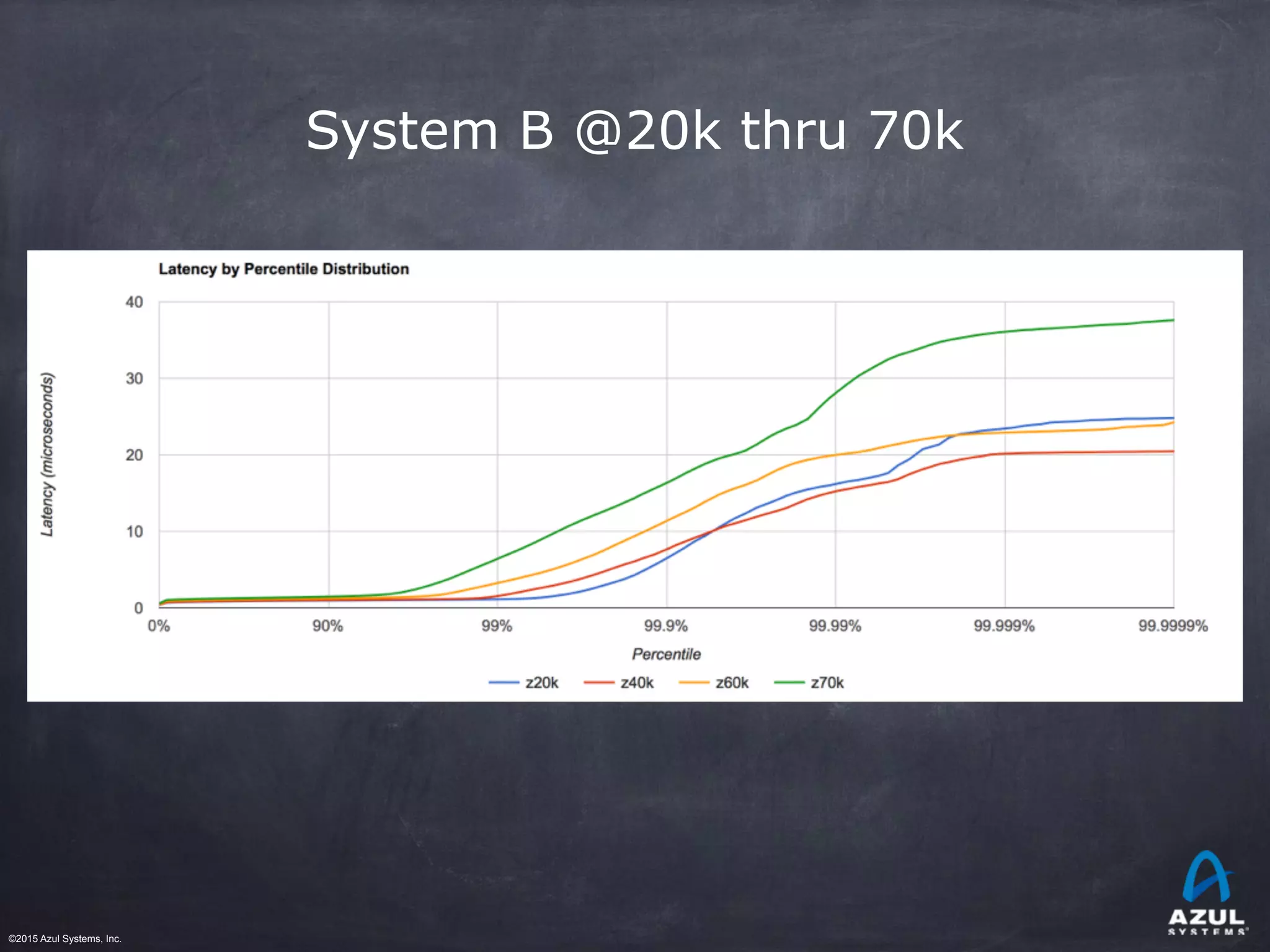
System B @20k thru 70k
©2015 Azul Systems, Inc.	 	 	 	 	 	
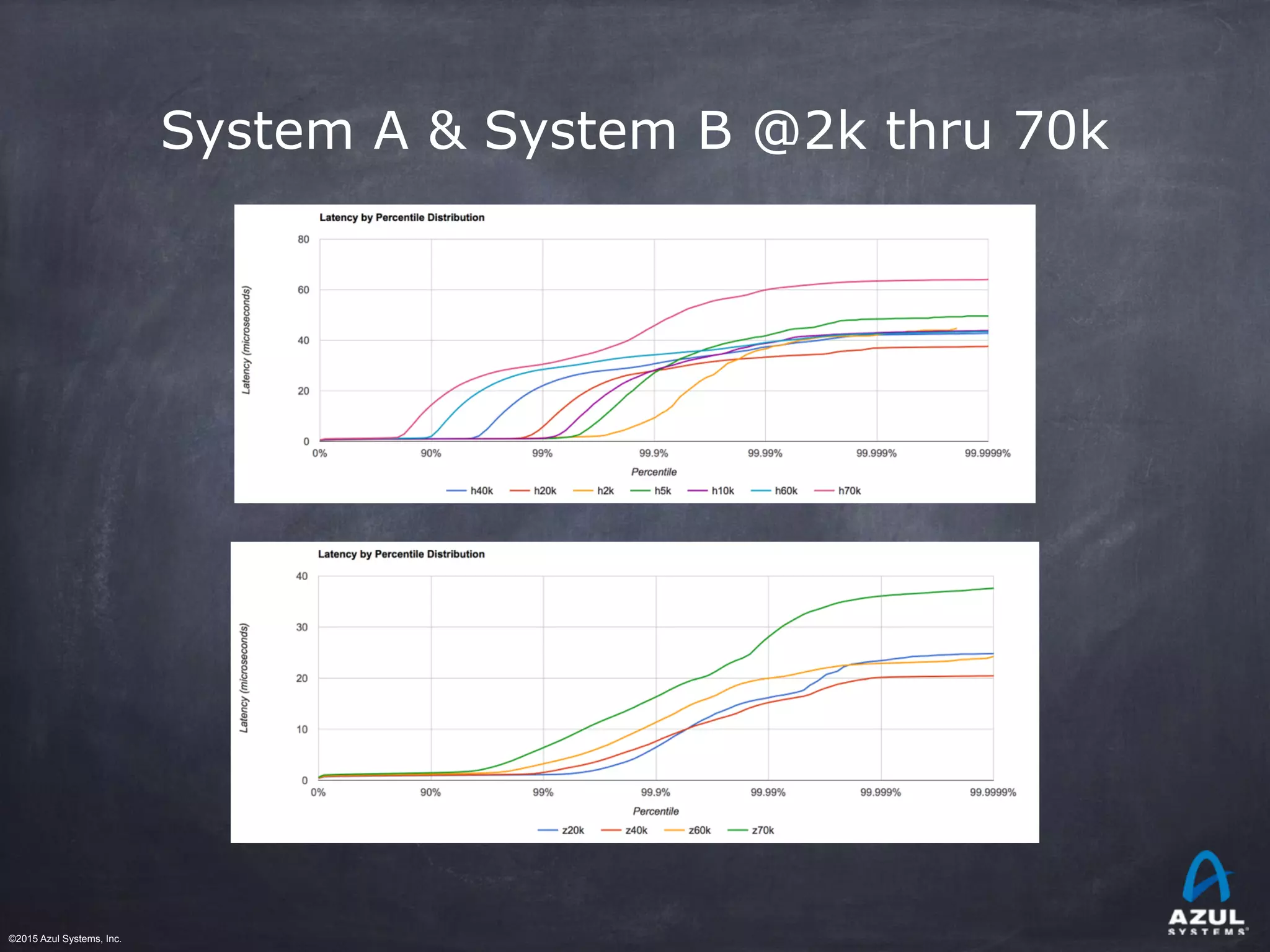
System A & System B @2k thru 70k
©2015 Azul Systems, Inc.	 	 	 	 	 	
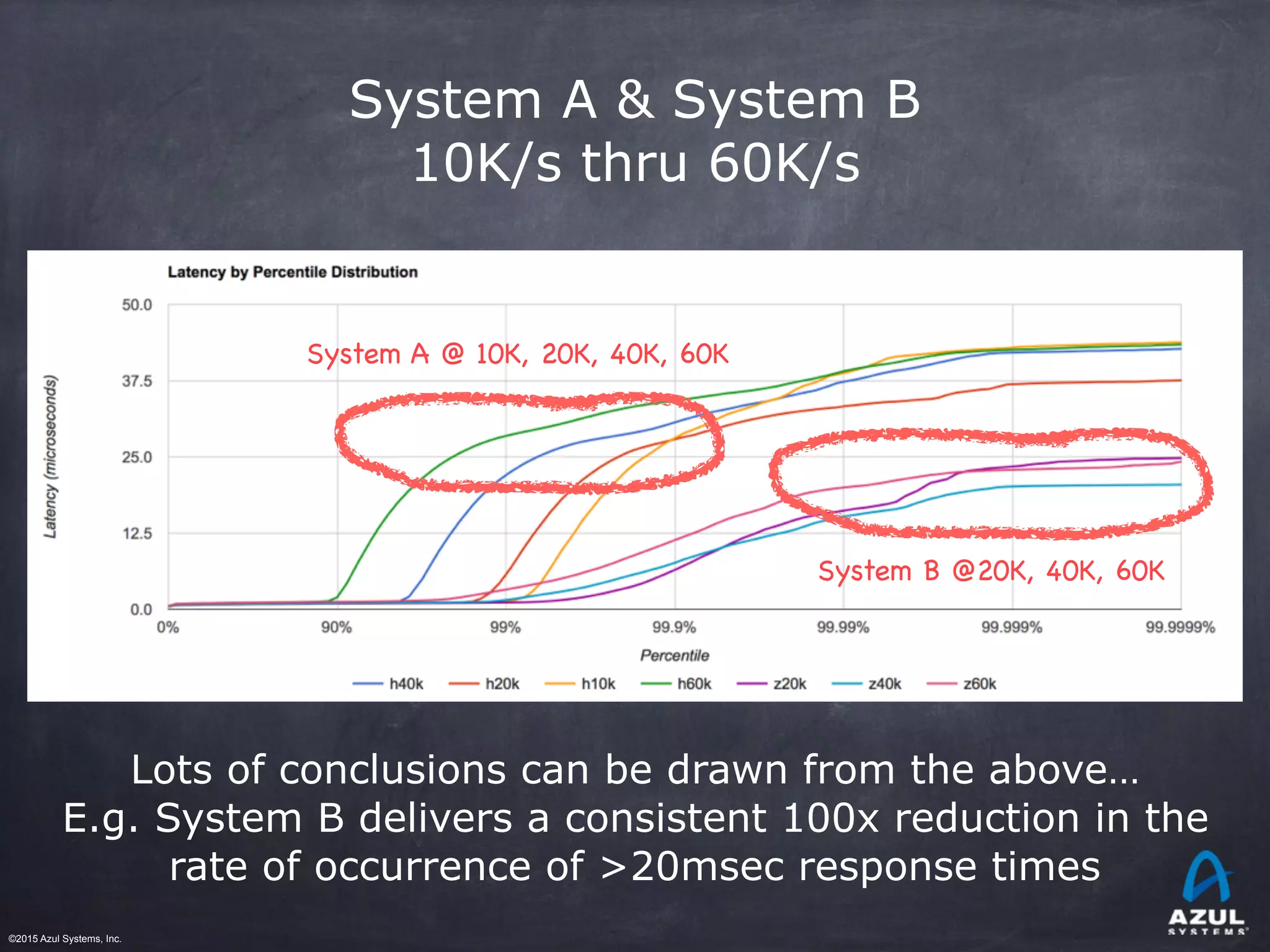
System A & System B
10K/s thru 60K/s
System A @ 10K, 20K, 40K, 60K
System B @20K, 40K, 60K
Lots of conclusions can be drawn from the above…
E.g. System B delivers a consistent 100x reduction in the
rate of occurrence of >20msec response times
©2015 Azul Systems, Inc.	 	 	 	 	 	
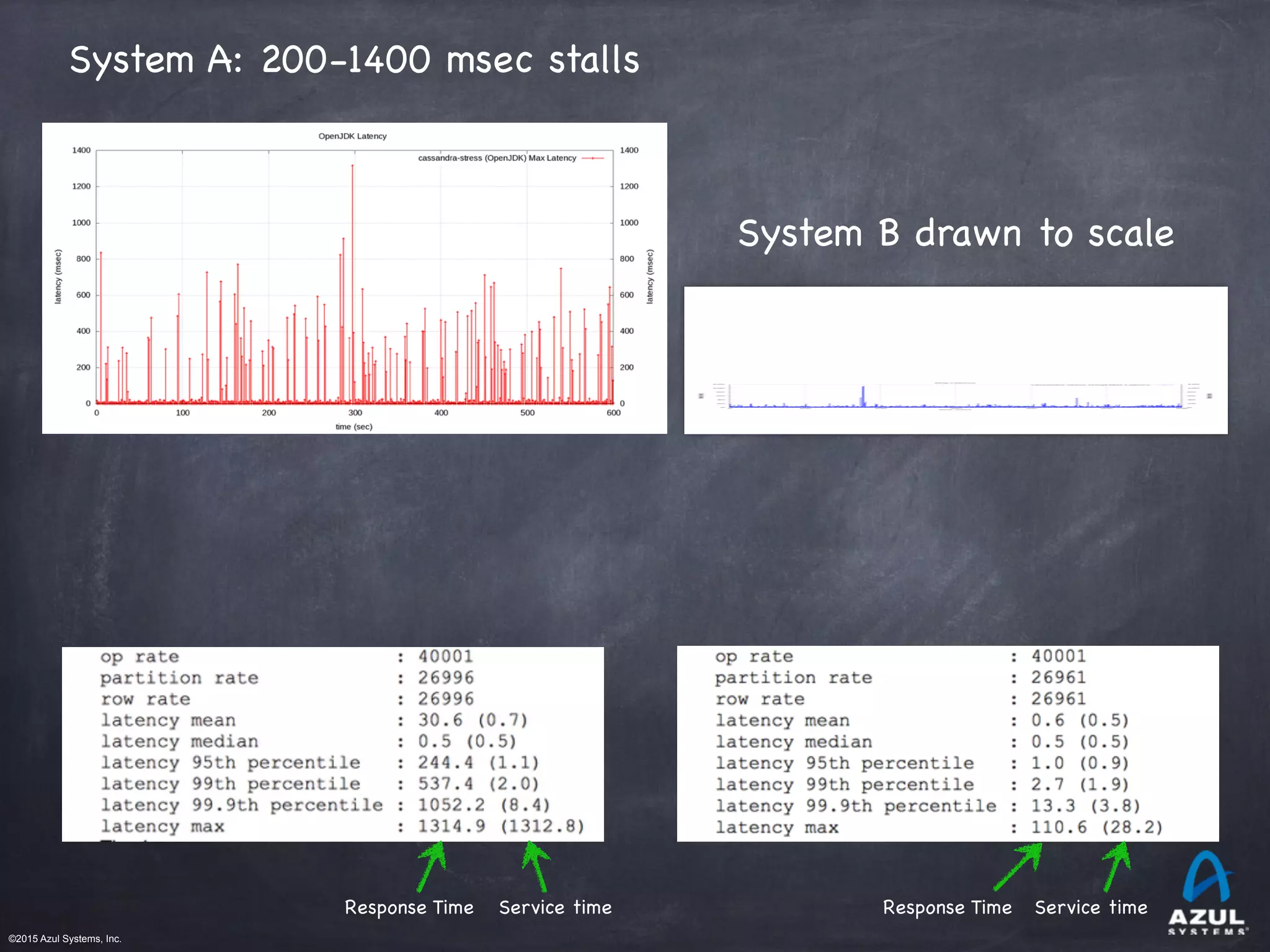
System A: 200-1400 msec stalls
System B drawn to scale
Service timeResponse Time Response TimeService time
©2015 Azul Systems, Inc.	 	 	 	 	 	
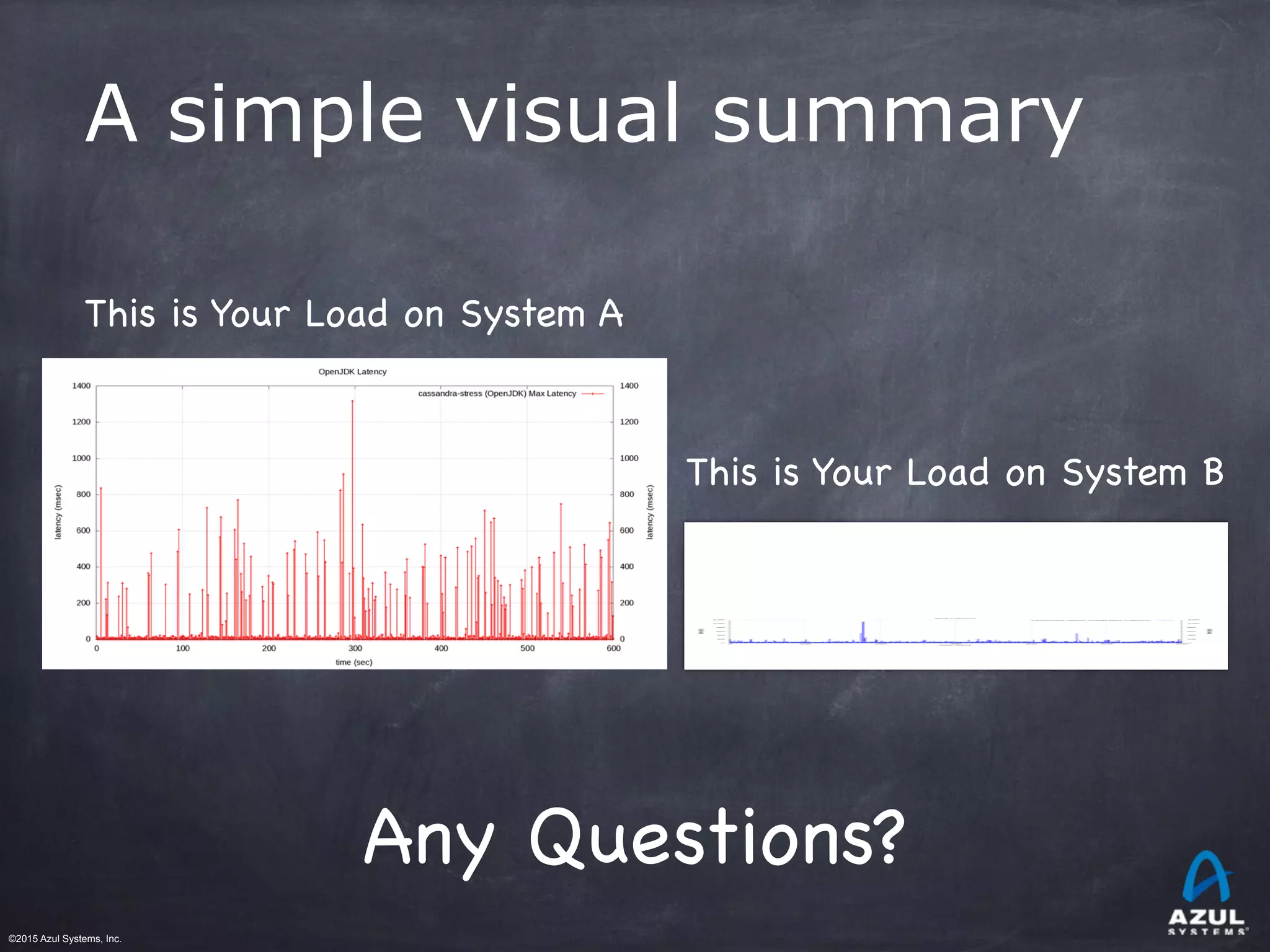
This is Your Load on System A
This is Your Load on System B
Any Questions?
A simple visual summary
©2015 Azul Systems, Inc.	 	 	 	 	 	
http://www.azulsystems.com
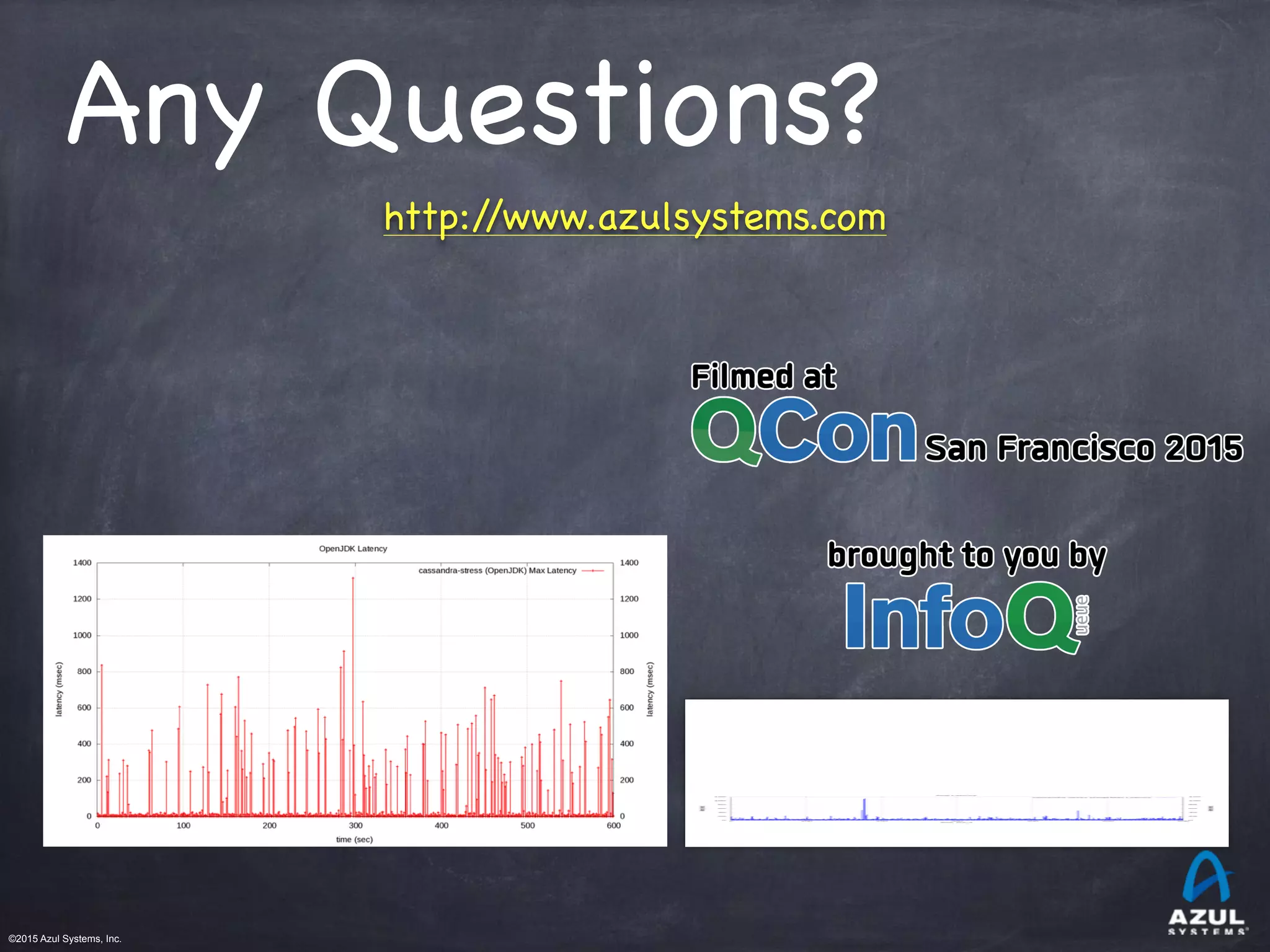
Any Questions?
Watch the video with slide synchronization on
InfoQ.com!
http://www.infoq.com/presentations/latency-
response-time

How NOT to Measure Latency

  • 1.
    ©2015 Azul Systems,Inc. How NOT to Measure Latency Gil Tene, CTO & co-Founder, Azul Systems @giltene
  • 2.
    InfoQ.com: News &Community Site • 750,000 unique visitors/month • Published in 4 languages (English, Chinese, Japanese and Brazilian Portuguese) • Post content from our QCon conferences • News 15-20 / week • Articles 3-4 / week • Presentations (videos) 12-15 / week • Interviews 2-3 / week • Books 1 / month Watch the video with slide synchronization on InfoQ.com! http://www.infoq.com/presentations/ latency-response-time
  • 3.
    Purpose of QCon -to empower software development by facilitating the spread of knowledge and innovation Strategy - practitioner-driven conference designed for YOU: influencers of change and innovation in your teams - speakers and topics driving the evolution and innovation - connecting and catalyzing the influencers and innovators Highlights - attended by more than 12,000 delegates since 2007 - held in 9 cities worldwide Presented at QCon San Francisco www.qconsf.com
  • 4.
    ©2015 Azul Systems,Inc. The “Oh S@%#!” talk Gil Tene, CTO & co-Founder, Azul Systems @giltene
  • 5.
    ©2015 Azul Systems,Inc. About me: Gil Tene co-founder, CTO @Azul Systems Have been working on “think different” GC approaches since 2002 A Long history building Virtual & Physical Machines, Operating Systems, Enterprise apps, etc... I also depress people by pulling the wool up from over their eyes… * working on real-world trash compaction issues, circa 2004
  • 6.
  • 7.
    ©2015 Azul Systems,Inc. Latency Behavior Latency: The time it took one operation to happen Each operation occurrence has its own latency What we care about is how latency behaves Behavior is a lot more than “the common case was X”
  • 8.
    ©2015 Azul Systems,Inc. We like to look at pretty charts… 95%’lie The “We only want to show good things” chart
  • 9.
  • 10.
    ©2015 Azul Systems,Inc. A real world, real time example
  • 11.
    ©2015 Azul Systems,Inc. A real world, real time example
  • 12.
    ©2015 Azul Systems,Inc. A real world, real time example So this is a better picture. Right?
  • 13.
    ©2015 Azul Systems,Inc. Why do we tend to avoid plotting Max latency? Because no other %’ile will be visible on the same chart…
  • 14.
    ©2015 Azul Systems,Inc. I like to rant about latency…
  • 15.
    ©2015 Azul Systems,Inc. #LatencyTipOfTheDay: If you are not measuring and/or plotting Max, what are you hiding (from)?
  • 16.
  • 17.
    ©2015 Azul Systems,Inc. What (TF) does the Average of the 95%’lie mean?
  • 18.
    ©2015 Azul Systems,Inc. What (TF) does the Average of the 95%’lie mean? Lets do the same with 100%’ile; Suppose we a set of 100%’ile values for each minute: [1, 0, 3, 1, 601, 4, 2, 8, 0, 3, 3, 1, 1, 0, 2] “The average 100%’ile over the past 15 minutes was 42” Same nonsense applies to any other %’lie
  • 19.
    ©2015 Azul Systems,Inc. #LatencyTipOfTheDay: You can't average percentiles. Period.
  • 20.
    ©2015 Azul Systems,Inc. Percentiles Matter
  • 21.
    ©2015 Azul Systems,Inc. Is the 99%’lie “rare”?
  • 22.
    ©2015 Azul Systems,Inc. 99%’lie: a good indicator, right? What are the chances of a single web page view experiencing >99%’lie latency of: - A single search engine node? - A single Key/Value store node? - A single Database node? - A single CDN request?
  • 23.
  • 24.
  • 25.
    ©2015 Azul Systems,Inc. #LatencyTipOfTheDay: MOST page loads will experience the 99%'lie server response
  • 26.
    ©2015 Azul Systems,Inc. Which HTTP response time metric is more “representative” of user experience? The 95%’lie or the 99.9%’lie
  • 27.
    ©2015 Azul Systems,Inc. Gauging user experience Example: If a typical user session involves 5 page loads, averaging 40 resources per page. - How many of our users will NOT experience something worse than the 95%’lie of http requests? Answer: ~0.003% - How may of our users will experience at least one response that is longer than the 99.9%’lie? Answer: ~18%
  • 28.
    ©2015 Azul Systems,Inc. Gauging user experience Example: If a typical user session involves 5 page loads, averaging 40 resources per page. - What http response percentile will be experienced by the 95%’ile of users? Answer: ~99.97% - What http response percentile will be experienced by the 99%’ile of users Answer: ~99.995%
  • 29.
    ©2015 Azul Systems,Inc. #LatencyTipOfTheDay: Median Server Response Time: The number that 99.9999999999% of page views can be worse than
  • 30.
    ©2015 Azul Systems,Inc. Why don’t we have response time or latency stats with multiple 9s in them???
  • 31.
    ©2015 Azul Systems,Inc. You can’t average percentiles… And you also can’t get an hour’s 99.999%’lie out of lots of 10 second interval 99%’lie reports… Why don’t we have response time or latency stats with multiple 9s in them???
  • 32.
    ©2015 Azul Systems,Inc. You can’t average percentiles… And you also can’t get an hour’s 99.999%’lie out of lots of 10 second interval 99%’lie reports… Check out HdrHistogram It lets you have nice things…. Why don’t we have response time or latency stats with multiple 9s in them??? 0" 20" 40" 60" 80" 100" 120" 0" 500" 1000" 1500" 2000" 2500" Hiccup&Dura*on&(mse &Elapsed&Time&(sec)& 0%" 90%" 99%" 99.9%" 99.99%" 99.999%" 99.9999%" 0" 20" 40" 60" 80" 100" 120" 140"Hiccup&Dura*on&(msec)& & & Percen*le& Hiccups&by&Percen*le&Distribu*on& Hiccups"by"Percen?le" SLA"
  • 33.
    ©2015 Azul Systems,Inc. Latency “wishful thinking” We know how to compute averages & std. deviation, etc. Wouldn’t it be nice if latency had a normal distribution? The average, 90%’lie, 99%’lie, std. deviation, etc. can give us a “feel” for the rest of the distribution, right? If 99% of the stuff behaves well, how bad can the rest be, really?
  • 34.
    ©2015 Azul Systems,Inc. The real world: latency distribution 0%! 90%! 99%! 0! 0.05! 0.1! 0.15! 0.2! 0.25! 0.3! 0.35! 0.4! 0.45! 0.5! Latency(msec)! ! ! Percentile! Latency by Percentile Distribution!
  • 35.
    ©2015 Azul Systems,Inc. The real world: latency distribution 0%! 90%! 99%! 99.9%! 0! 0.5! 1! 1.5! 2! 2.5! 3! 3.5! 4! 4.5! 5! Latency(msec)! ! ! Percentile! Latency by Percentile Distribution!
  • 36.
    ©2015 Azul Systems,Inc. The real world: latency distribution 0%! 90%! 99%! 99.9%! 99.99%! 99.999%! 99.9999%! 0! 10! 20! 30! 40! 50! 60! Latency(msec)! ! ! Percentile! Latency by Percentile Distribution!
  • 37.
    ©2015 Azul Systems,Inc. Dispelling standard deviation 0%# 90%# 99%# 99.9%# 99.99%# 99.999%# 99.9999%# 0# 10# 20# 30# 40# 50# Latency(((msec)( ( ( Percen/le( Latency(by(Percen/le(Distribu/on( A# B# C# D# E# F#
  • 38.
    ©2015 Azul Systems,Inc. Dispelling standard deviation 0%# 90%# 99%# 99.9%# 99.99%# 99.999%# 99.9999%# 0# 10# 20# 30# 40# 50# Latency(((msec)( ( ( Percen/le( Latency(by(Percen/le(Distribu/on( A# B# C# D# E# F# Mean = 0.06 msec Std. Deviation (𝞂) = 0.21msec 99.999% = 38.66msec In a normal distribution, These are NOT normal distributions ~184 σ (!!!) away from the mean the 99.999%’ile falls within 4.5 σ
  • 39.
    ©2015 Azul Systems,Inc. The coordinated omission problem An accidental conspiracy... The lie in the 99%’lies
  • 40.
    ©2015 Azul Systems,Inc. The coordinated omission problem Common Example A (load testing): each “client” issues requests at a certain rate measure/log response time for each request So what’s wrong with that? works only if ALL responses fit within interval implicit “automatic back off” coordination
  • 41.
    ©2015 Azul Systems,Inc. Common Example B: Coordinated Omission in Monitoring Code Long operations only get measured once delays outside of timing window do not get measured at all
  • 42.
    How bad can this get? 40 Avg. is 1msec over 1st 100 sec System Stalled for 100 Sec Elapsed Time System easily handles 100 requests/sec Responds to each in 1msec How would you characterize this system? ~50%‘ile is 1 msec ~75%‘ile is 50 sec 99.99%‘ile is ~100sec Avg. is 50 sec. over next 100 sec Overall Average response time is ~25 sec.
  • 43.
    Measurement in prac8ce 41 System Stalled for 100Sec Elapsed Time System easily handles 100 requests/sec Responds to each in 1msec What actually gets measured? (should be ~50sec) (should be ~100 sec) 50%‘ile is 1 msec 75%‘lie is 1 msec 99.99%‘lie is 1 msec 10,000 measurements @ 1 msec each 1 measurement @ 100 sec Overall Average is 10.9 msec (!!!)
  • 44.
    Proper measurement 42 System Stalled for 100Sec Elapsed Time System easily handles 100 requests/sec Responds to each in 1msec 10,000 results Varying linearly from 100 sec to 10 msec 10,000 results @ 1 msec each ~50%‘ile is 1 msec ~75%‘ile is 50 sec 99.99%‘ile is ~100sec
  • 45.
    Proper measurement 43 System Stalled for 100Sec Elapsed Time System easily handles 100 requests/sec Responds to each in 1msec 10,000 results Varying linearly from 100 sec to 10 msec 10,000 results @ 1 msec each ~50%‘ile is 1 msec ~75%‘ile is 50 sec 99.99%‘ile is ~100sec Coordinated Omission 1 msec 1 msec 1 result @ 100 sec
  • 46.
    “Be?er” can look “Worse” 44 System Slowed for 100Sec Elapsed Time System easily handles 100 requests/sec Responds to each in 1msec 10,000 @ 1msec 10,000 @ 5 msec 50%‘ile is 1 msec 75%‘lie is 2.5msec 99.99%‘lie is ~5msec Still easily handles 100 requests/sec Responds to each in 5 msec (stalled shows 1 msec) (stalled shows 1 msec)
  • 47.
    “Correc8on”: “Chea8ng Twice” 45 System Stalled for 100Sec Elapsed Time System easily handles 100 requests/sec Responds to each in 1msec 10,000 results Varying linearly from 100 sec to 10 msec 10,000 results @ 1 msec each ~50%‘ile is 1 msec ~75%‘ile is 50 sec 99.994%‘ile is ~100sec Coordinated Omission 1 msec 1 msec 9,999 additional results @ 1 msec each 1 result @ 100 sec “correction”
  • 48.
    ©2015 Azul Systems,Inc. Response Time vs. Service Time
  • 49.
    ©2015 Azul Systems,Inc. Service Time vs. Response Time
  • 50.
    ©2015 Azul Systems,Inc. Coordinated Omission Usually makes something that you think is a Response Time metric only represent the Service Time component
  • 51.
    ©2015 Azul Systems,Inc. Response Time vs. Service Time @2K/sec
  • 52.
    ©2015 Azul Systems,Inc. Response Time vs. Service Time @20K/sec
  • 53.
    ©2015 Azul Systems,Inc. Response Time vs. Service Time @60K/sec
  • 54.
    ©2015 Azul Systems,Inc. Response Time vs. Service Time @80K/sec
  • 55.
    ©2015 Azul Systems,Inc. Response Time vs. Service Time @90K/sec
  • 56.
    ©2015 Azul Systems,Inc. How “real” people react
  • 57.
    ©2015 Azul Systems,Inc. Service Time, 90K/s vs 80K/s
  • 58.
    ©2015 Azul Systems,Inc. Response Time, 90K/s vs 80K/s
  • 59.
    ©2015 Azul Systems,Inc. Response Time, 90K/s vs 80K/s (to scale)
  • 60.
    ©2015 Azul Systems,Inc. Latency doesn’t live in a vacuum
  • 61.
    ©2015 Azul Systems,Inc. Sustainable Throughput: The throughput achieved while safely maintaining service levels
  • 62.
    ©2015 Azul Systems,Inc. Comparing behavior under different throughputs and/or configurations 0%# 90%# 99%# 99.9%# 99.99%# 99.999%# 0# 20# 40# 60# 80# 100# 120# !Dura&on!(msec)! ! ! Percen&le! Dura&on!by!Percen&le!Distribu&on! Setup#D# Setup#E# Setup#F# Setup#A# Setup#B# Setup#C#
  • 63.
    ©2015 Azul Systems,Inc. Comparing response time or latency behaviors
  • 64.
    ©2015 Azul Systems,Inc. System A @90K/s & 85K/s vs. System B @90K/s & 85K/s Wrong Place to Look: They both “suck” at >85K/sec
  • 65.
    ©2015 Azul Systems,Inc. System A 85K/s vs. System B 85K/s Looks good, but still the wrong place to look
  • 66.
    ©2015 Azul Systems,Inc. System A @40K/s vs. System B @40K/s More interesting… What can we do with this?
  • 67.
    ©2015 Azul Systems,Inc. System A @10K/s vs. System B @40K/s E.g. if “99%’ile < 5msec” was a goal: System B delivers similar 99%’ile and superior 99.9%’ile+ while carrying 4x the throughput
  • 68.
    ©2015 Azul Systems,Inc. System A @2K/s vs. System B @20K/s E.g. if “99.9%’ile < 10msec” was a goal: System B delivers similar 99%’ile and 99.9%’ile while carrying 10x the throughput
  • 69.
    ©2015 Azul Systems,Inc. System A @2k thru 80k
  • 70.
    ©2015 Azul Systems,Inc. System A @2k thru 70k
  • 71.
    ©2015 Azul Systems,Inc. System B @20k thru 70k
  • 72.
    ©2015 Azul Systems,Inc. System A & System B @2k thru 70k
  • 73.
    ©2015 Azul Systems,Inc. System A & System B 10K/s thru 60K/s System A @ 10K, 20K, 40K, 60K System B @20K, 40K, 60K Lots of conclusions can be drawn from the above… E.g. System B delivers a consistent 100x reduction in the rate of occurrence of >20msec response times
  • 74.
    ©2015 Azul Systems,Inc. System A: 200-1400 msec stalls System B drawn to scale Service timeResponse Time Response TimeService time
  • 75.
    ©2015 Azul Systems,Inc. This is Your Load on System A This is Your Load on System B Any Questions? A simple visual summary
  • 76.
    ©2015 Azul Systems,Inc. http://www.azulsystems.com Any Questions?
  • 77.
    Watch the videowith slide synchronization on InfoQ.com! http://www.infoq.com/presentations/latency- response-time