Managing Agile Projects
@Inflectra | #InflectraCon
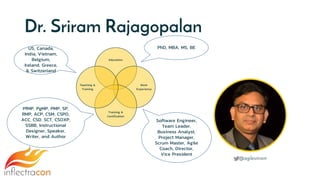
Dr. Sriram Rajagopalan
Education
Work
Experience
Training &
Certification
Teaching &
Training
PhD, MBA, MS, BE
PfMP, PgMP, PMP, SP,
RMP, ACP, CSM, CSPO,
ACC, CSD, SCT, CSOXP,
SSBB, Instructional
Designer, Speaker,
Writer, and Author
Software Engineer,
Team Leader,
Business Analyst,
Project Manager,
Scrum Master, Agile
Coach, Director,
Vice President
US, Canada,
India, Vietnam,
Belgium,
Ireland, Greece,
& Switzerland
@agilesriram
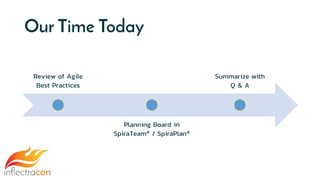
Our Time Today
Review of Agile
Best Practices
Planning Board in
SpiraTeam® / SpiraPlan®
Summarize with
Q & A
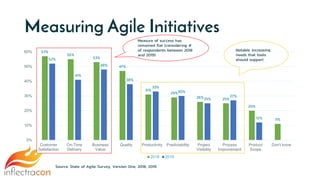
Measuring Agile Initiatives
Measure of success has
remained flat (considering #
of respondents between 2018
and 2019)
Notable increasing
needs that tools
should support
57%
55%
53%
47%
31%
29%
26% 25%
20%
11%
52%
41%
48%
38%
33%
30%
25%
27%
12%
0%
10%
20%
30%
40%
50%
60%
Customer
Satisfaction
On-Time
Delivery
Business
Value
Quality Productivity Predictability Project
Visibility
Process
Improvement
Product
Scope
Don't know
2018 2019
Source: State of Agile Survey, Version One, 2018, 2019
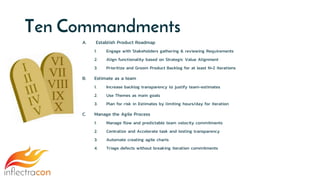
Ten Commandments
A. Establish Product Roadmap
1. Engage with Stakeholders gathering & reviewing Requirements
2. Align functionality based on Strategic Value Alignment
3. Prioritize and Groom Product Backlog for at least N+2 iterations
B. Estimate as a team
1. Increase backlog transparency to justify team-estimates
2. Use Themes as main goals
3. Plan for risk in Estimates by limiting hours/day for iteration
C. Manage the Agile Process
1. Manage flow and predictable team velocity commitments
2. Centralize and Accelerate task and testing transparency
3. Automate creating agile charts
4. Triage defects without breaking iteration commitments
Establish Product Roadmap
How SpiraTeam/SpiraPlan supports this functionality
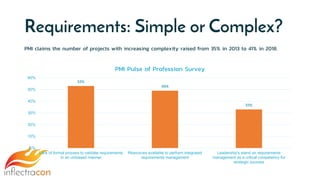
Requirements: Simple or Complex?
53%
49%
33%
0%
10%
20%
30%
40%
50%
60%
Lack of formal process to validate requirements
in an unbiased manner
Resources available to perform integrated
requirements management
Leadership's stand on requirements
management as a critical competency for
strategic success
PMI Pulse of Profession Survey
PMI claims the number of projects with increasing complexity raised from 35% in 2013 to 41% in 2018.
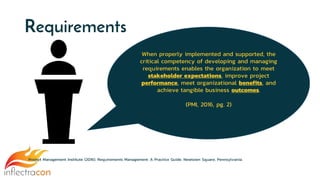
Requirements
When properly implemented and supported, the
critical competency of developing and managing
requirements enables the organization to meet
stakeholder expectations, improve project
performance, meet organizational benefits, and
achieve tangible business outcomes.
(PMI, 2016, pg. 2)
Project Management Institute (2016). Requirements Management: A Practice Guide. Newtown Square, Pennsylvania.
When properly implemented and supported, the
critical competency of developing and managing
requirements enables the organization to meet
stakeholder expectations, improve project
performance, meet organizational benefits, and
achieve tangible business outcomes.
(PMI, 2016, pg. 2)
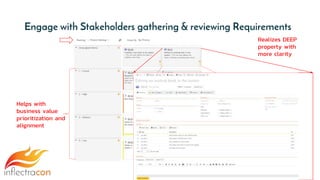
Engage with Stakeholders gathering & reviewing Requirements
Helps with
business value
prioritization and
alignment
Realizes DEEP
property with
more clarity
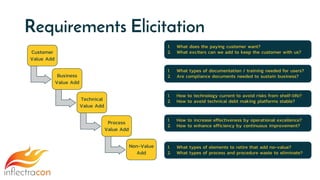
Requirements Elicitation
Customer
Value Add
Business
Value Add
Technical
Value Add
Process
Value Add
Non-Value
Add
1. What does the paying customer want?
2. What exciters can we add to keep the customer with us?
1. What types of documentation / training needed for users?
2. Are compliance documents needed to sustain business?
1. How to technology current to avoid risks from shelf-life?
2. How to avoid technical debt making platforms stable?
1. What types of elements to retire that add no-value?
2. What types of process and procedure waste to eliminate?
1. How to increase effectiveness by operational excellence?
2. How to enhance efficiency by continuous improvement?
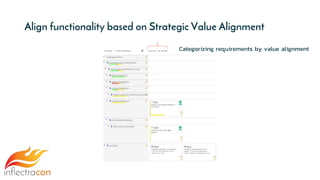
Align functionality based on Strategic Value Alignment
Categorizing requirements by value alignment
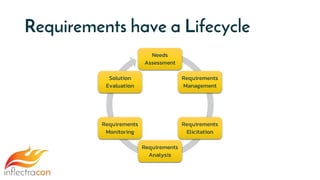
Requirements have a Lifecycle
Needs
Assessment
Requirements
Management
Requirements
Elicitation
Requirements
Analysis
Requirements
Monitoring
Solution
Evaluation
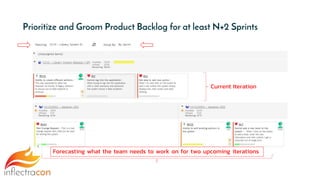
Prioritize and Groom Product Backlog for at least N+2 Sprints
Current Iteration
Forecasting what the team needs to work on for two upcoming iterations
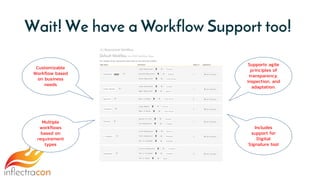
Wait! We have a Workflow Support too!
Customizable
Workflow based
on business
needs
Multiple
workflows
based on
requirement
types
Supports agile
principles of
transparency,
inspection, and
adaptation.
Includes
support for
Digital
Signature too!
Estimate as a Team
How SpiraTeam/SpiraPlan supports this functionality
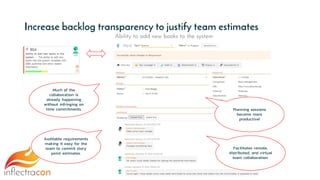
Increase backlog transparency to justify team estimates
Much of the
collaboration is
already happening
without infringing on
time commitments. Planning sessions
become more
productive!
Auditable requirements
making it easy for the
team to commit story
point estimates.
Facilitates remote,
distributed, and virtual
team collaboration.
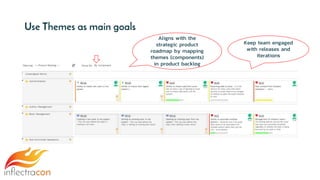
Use Themes as main goals
Aligns with the
strategic product
roadmap by mapping
themes (components)
in product backlog
Keep team engaged
with releases and
iterations
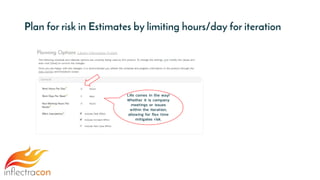
Plan for risk in Estimates by limiting hours/day for iteration
Life comes in the way!
Whether it is company
meetings or issues
within the iteration,
allowing for flex time
mitigates risk.
Manage the Agile Process
How SpiraTeam/SpiraPlan supports this functionality
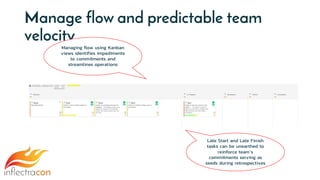
Manage flow and predictable team
velocity
Managing flow using Kanban
views identifies impediments
to commitments and
streamlines operations
Late Start and Late Finish
tasks can be unearthed to
reinforce team’s
commitments serving as
seeds during retrospectives
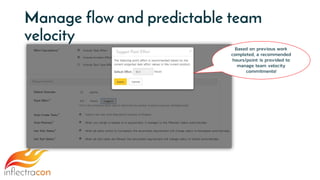
Manage flow and predictable team
velocity
Based on previous work
completed, a recommended
hours/point is provided to
manage team velocity
commitments!
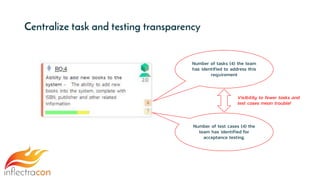
Centralize task and testing transparency
Number of tasks (4) the team
has identified to address this
requirement
Number of test cases (4) the
team has identified for
acceptance testing.
Visibility to fewer tasks and
test cases mean trouble!
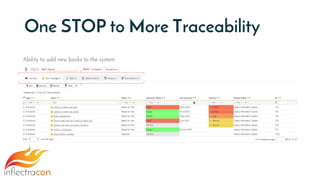
One STOP to More Traceability
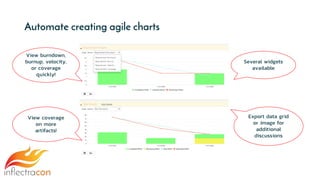
Automate creating agile charts
Several widgets
available
Export data grid
or image for
additional
discussions
View burndown,
burnup, velocity,
or coverage
quickly!
View coverage
on more
artifacts!
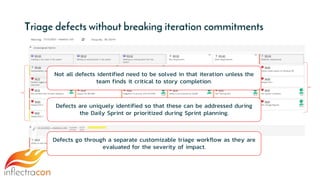
Triage defects without breaking iteration commitments
Not all defects identified need to be solved in that iteration unless the
team finds it critical to story completion.
Defects are uniquely identified so that these can be addressed during
the Daily Sprint or prioritized during Sprint planning.
Defects go through a separate customizable triage workflow as they are
evaluated for the severity of impact.
Summary
•Agile is a framework
with a set of
philosophies
•Focus on agility by
adopting practices
that suit your needs
•Focus on people,
process, technology,
and organizational
needs

Methodologies 1: Managing Agile Projects

  • 1.
  • 2.
    Dr. Sriram Rajagopalan Education Work Experience Training& Certification Teaching & Training PhD, MBA, MS, BE PfMP, PgMP, PMP, SP, RMP, ACP, CSM, CSPO, ACC, CSD, SCT, CSOXP, SSBB, Instructional Designer, Speaker, Writer, and Author Software Engineer, Team Leader, Business Analyst, Project Manager, Scrum Master, Agile Coach, Director, Vice President US, Canada, India, Vietnam, Belgium, Ireland, Greece, & Switzerland @agilesriram
  • 3.
    Our Time Today Reviewof Agile Best Practices Planning Board in SpiraTeam® / SpiraPlan® Summarize with Q & A
  • 4.
    Measuring Agile Initiatives Measureof success has remained flat (considering # of respondents between 2018 and 2019) Notable increasing needs that tools should support 57% 55% 53% 47% 31% 29% 26% 25% 20% 11% 52% 41% 48% 38% 33% 30% 25% 27% 12% 0% 10% 20% 30% 40% 50% 60% Customer Satisfaction On-Time Delivery Business Value Quality Productivity Predictability Project Visibility Process Improvement Product Scope Don't know 2018 2019 Source: State of Agile Survey, Version One, 2018, 2019
  • 5.
    Ten Commandments A. EstablishProduct Roadmap 1. Engage with Stakeholders gathering & reviewing Requirements 2. Align functionality based on Strategic Value Alignment 3. Prioritize and Groom Product Backlog for at least N+2 iterations B. Estimate as a team 1. Increase backlog transparency to justify team-estimates 2. Use Themes as main goals 3. Plan for risk in Estimates by limiting hours/day for iteration C. Manage the Agile Process 1. Manage flow and predictable team velocity commitments 2. Centralize and Accelerate task and testing transparency 3. Automate creating agile charts 4. Triage defects without breaking iteration commitments
  • 6.
    Establish Product Roadmap HowSpiraTeam/SpiraPlan supports this functionality
  • 7.
    Requirements: Simple orComplex? 53% 49% 33% 0% 10% 20% 30% 40% 50% 60% Lack of formal process to validate requirements in an unbiased manner Resources available to perform integrated requirements management Leadership's stand on requirements management as a critical competency for strategic success PMI Pulse of Profession Survey PMI claims the number of projects with increasing complexity raised from 35% in 2013 to 41% in 2018.
  • 8.
    Requirements When properly implementedand supported, the critical competency of developing and managing requirements enables the organization to meet stakeholder expectations, improve project performance, meet organizational benefits, and achieve tangible business outcomes. (PMI, 2016, pg. 2) Project Management Institute (2016). Requirements Management: A Practice Guide. Newtown Square, Pennsylvania. When properly implemented and supported, the critical competency of developing and managing requirements enables the organization to meet stakeholder expectations, improve project performance, meet organizational benefits, and achieve tangible business outcomes. (PMI, 2016, pg. 2)
  • 9.
    Engage with Stakeholdersgathering & reviewing Requirements Helps with business value prioritization and alignment Realizes DEEP property with more clarity
  • 10.
    Requirements Elicitation Customer Value Add Business ValueAdd Technical Value Add Process Value Add Non-Value Add 1. What does the paying customer want? 2. What exciters can we add to keep the customer with us? 1. What types of documentation / training needed for users? 2. Are compliance documents needed to sustain business? 1. How to technology current to avoid risks from shelf-life? 2. How to avoid technical debt making platforms stable? 1. What types of elements to retire that add no-value? 2. What types of process and procedure waste to eliminate? 1. How to increase effectiveness by operational excellence? 2. How to enhance efficiency by continuous improvement?
  • 11.
    Align functionality basedon Strategic Value Alignment Categorizing requirements by value alignment
  • 12.
    Requirements have aLifecycle Needs Assessment Requirements Management Requirements Elicitation Requirements Analysis Requirements Monitoring Solution Evaluation
  • 13.
    Prioritize and GroomProduct Backlog for at least N+2 Sprints Current Iteration Forecasting what the team needs to work on for two upcoming iterations
  • 14.
    Wait! We havea Workflow Support too! Customizable Workflow based on business needs Multiple workflows based on requirement types Supports agile principles of transparency, inspection, and adaptation. Includes support for Digital Signature too!
  • 15.
    Estimate as aTeam How SpiraTeam/SpiraPlan supports this functionality
  • 16.
    Increase backlog transparencyto justify team estimates Much of the collaboration is already happening without infringing on time commitments. Planning sessions become more productive! Auditable requirements making it easy for the team to commit story point estimates. Facilitates remote, distributed, and virtual team collaboration.
  • 17.
    Use Themes asmain goals Aligns with the strategic product roadmap by mapping themes (components) in product backlog Keep team engaged with releases and iterations
  • 18.
    Plan for riskin Estimates by limiting hours/day for iteration Life comes in the way! Whether it is company meetings or issues within the iteration, allowing for flex time mitigates risk.
  • 19.
    Manage the AgileProcess How SpiraTeam/SpiraPlan supports this functionality
  • 20.
    Manage flow andpredictable team velocity Managing flow using Kanban views identifies impediments to commitments and streamlines operations Late Start and Late Finish tasks can be unearthed to reinforce team’s commitments serving as seeds during retrospectives
  • 21.
    Manage flow andpredictable team velocity Based on previous work completed, a recommended hours/point is provided to manage team velocity commitments!
  • 22.
    Centralize task andtesting transparency Number of tasks (4) the team has identified to address this requirement Number of test cases (4) the team has identified for acceptance testing. Visibility to fewer tasks and test cases mean trouble!
  • 23.
    One STOP toMore Traceability
  • 24.
    Automate creating agilecharts Several widgets available Export data grid or image for additional discussions View burndown, burnup, velocity, or coverage quickly! View coverage on more artifacts!
  • 25.
    Triage defects withoutbreaking iteration commitments Not all defects identified need to be solved in that iteration unless the team finds it critical to story completion. Defects are uniquely identified so that these can be addressed during the Daily Sprint or prioritized during Sprint planning. Defects go through a separate customizable triage workflow as they are evaluated for the severity of impact.
  • 26.
    Summary •Agile is aframework with a set of philosophies •Focus on agility by adopting practices that suit your needs •Focus on people, process, technology, and organizational needs