Using Spira for
Waterfall Projects
Methodologies 3
@Inflectra | #InflectraCon
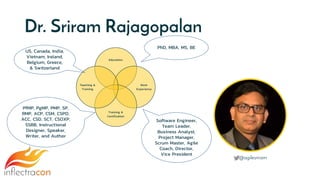
Dr. Sriram Rajagopalan
Education
Work
Experience
Training &
Certification
Teaching &
Training
PhD, MBA, MS, BE
PfMP, PgMP, PMP, SP,
RMP, ACP, CSM, CSPO,
ACC, CSD, SCT, CSOXP,
SSBB, Instructional
Designer, Speaker,
Writer, and Author
Software Engineer,
Team Leader,
Business Analyst,
Project Manager,
Scrum Master, Agile
Coach, Director,
Vice President
US, Canada, India,
Vietnam, Ireland,
Belgium, Greece,
& Switzerland
@agilesriram
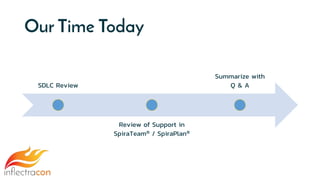
Our Time Today
SDLC Review
Review of Support in
SpiraTeam® / SpiraPlan®
Summarize with
Q & A
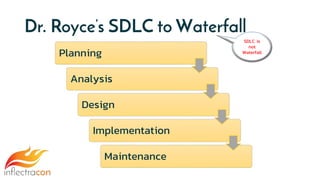
Dr. Royce’s SDLC to Waterfall
Planning
Analysis
Design
Implementation
Maintenance
SDLC is
not
Waterfall
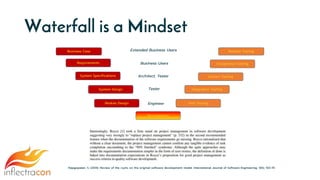
Waterfall is a Mindset
Rajagopalan, S. (2014). Review of the myths on the original software development model. International Journal of Software Engineering, 5(6), 103-111.
Business Case
Requirements
System Specifications
System Design
Module Design
Release Testing
Acceptance Testing
System Testing
Integration Testing
Unit Testing
Development
Engineer
Tester
Architect, Tester
Business Users
Extended Business Users
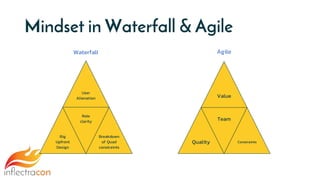
Mindset in Waterfall & Agile
User
Alienation
Big
Upfront
Design
Role
clarity
Breakdown
of Quad
constraints
Waterfall
Value
Quality
Team
Constraints
Agile
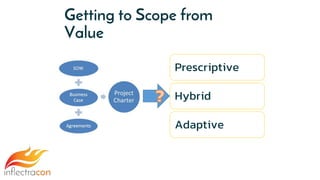
Getting to Scope from
Value
Prescriptive
Hybrid
Adaptive
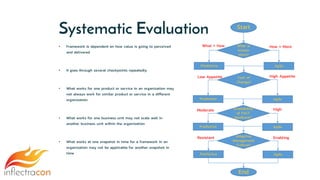
Systematic Evaluation
• Framework is dependent on how value is going to perceived
and delivered
• It goes through several checkpoints repeatedly
• What works for one product or service in an organization may
not always work for similar product or service in a different
organization
• What works for one business unit may not scale well in
another business unit within the organization
• What works at one snapshot in time for a framework in an
organization may not be applicable for another snapshot in
time
Start
What is
known
more?
Predictive Agile
What > How How > More
Cost of
Change?
Low Appetite High Appetite
Predictive Agile
Availability
of FACT
feedback?
Moderate High
Predictive Agile
Adaptive
Management
Culture?
Resistant Enabling
Predictive Agile
End
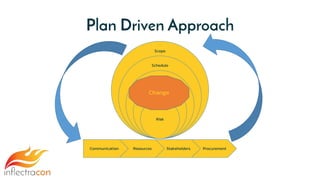
Plan Driven Approach
Scope
Schedule
Cost
Quality
Risk
Communication Resources Stakeholders Procurement
Change
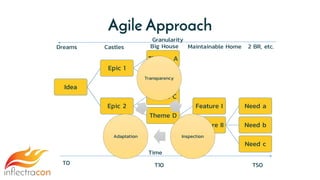
Agile Approach
Idea
Epic 1
Theme A
Theme B
Epic 2
Theme C
Theme D
Feature I
Feature II
Need a
Need b
Need c
T0 T10 T50
Time
Dreams Castles
Granularity
Big House Maintainable Home 2 BR, etc.
Transparency
InspectionAdaptation
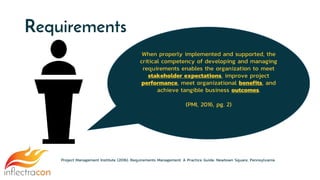
Requirements
When properly implemented and supported, the
critical competency of developing and managing
requirements enables the organization to meet
stakeholder expectations, improve project
performance, meet organizational benefits, and
achieve tangible business outcomes.
(PMI, 2016, pg. 2)
Project Management Institute (2016). Requirements Management: A Practice Guide. Newtown Square, Pennsylvania.
When properly implemented and supported, the
critical competency of developing and managing
requirements enables the organization to meet
stakeholder expectations, improve project
performance, meet organizational benefits, and
achieve tangible business outcomes.
(PMI, 2016, pg. 2)
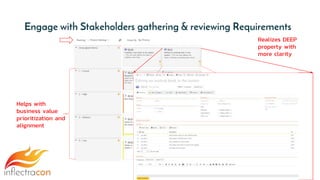
Engage with Stakeholders gathering & reviewing Requirements
Helps with
business value
prioritization and
alignment
Realizes DEEP
property with
more clarity
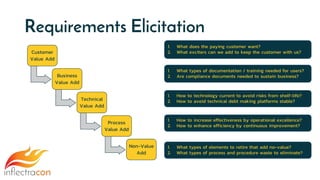
Requirements Elicitation
Customer
Value Add
Business
Value Add
Technical
Value Add
Process
Value Add
Non-Value
Add
1. What does the paying customer want?
2. What exciters can we add to keep the customer with us?
1. What types of documentation / training needed for users?
2. Are compliance documents needed to sustain business?
1. How to technology current to avoid risks from shelf-life?
2. How to avoid technical debt making platforms stable?
1. What types of elements to retire that add no-value?
2. What types of process and procedure waste to eliminate?
1. How to increase effectiveness by operational excellence?
2. How to enhance efficiency by continuous improvement?
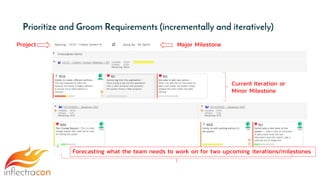
Prioritize and Groom Requirements (incrementally and iteratively)
Current Iteration or
Minor Milestone
Forecasting what the team needs to work on for two upcoming iterations/milestones
Major MilestoneProject
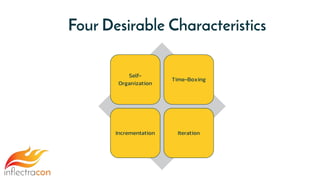
Four Desirable Characteristics
Self-
Organization
Time-Boxing
Incrementation Iteration
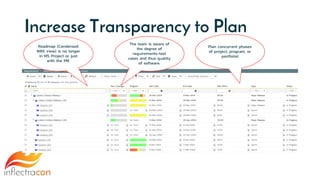
Increase Transparency to Plan
Roadmap (Condensed
WBS view) is no longer
in MS Project or just
with the PM.
Plan concurrent phases
of project, program, or
portfolio!
The team is aware of
the degree of
requirements-test
cases and thus quality
of software.
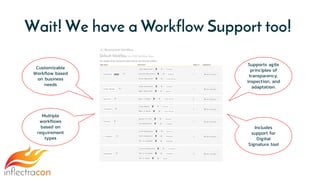
Wait! We have a Workflow Support too!
Customizable
Workflow based
on business
needs
Multiple
workflows
based on
requirement
types
Supports agile
principles of
transparency,
inspection, and
adaptation.
Includes
support for
Digital
Signature too!
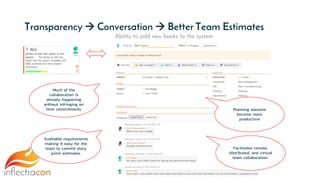
Transparency  Conversation  Better Team Estimates
Much of the
collaboration is
already happening
without infringing on
time commitments. Planning sessions
become more
productive!
Auditable requirements
making it easy for the
team to commit story
point estimates.
Facilitates remote,
distributed, and virtual
team collaboration.
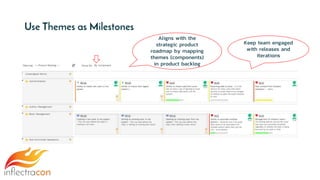
Use Themes as Milestones
Aligns with the
strategic product
roadmap by mapping
themes (components)
in product backlog
Keep team engaged
with releases and
iterations
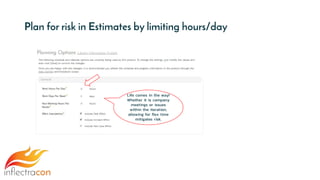
Plan for risk in Estimates by limiting hours/day
Life comes in the way!
Whether it is company
meetings or issues
within the iteration,
allowing for flex time
mitigates risk.
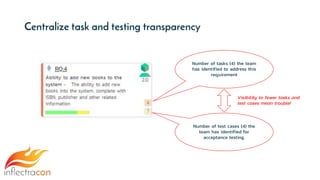
Centralize task and testing transparency
Number of tasks (4) the team
has identified to address this
requirement
Number of test cases (4) the
team has identified for
acceptance testing.
Visibility to fewer tasks and
test cases mean trouble!
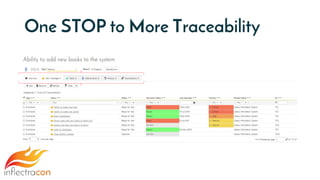
One STOP to More Traceability
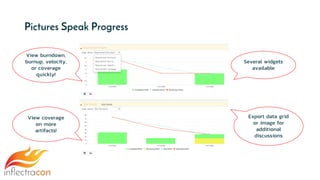
Pictures Speak Progress
Several widgets
available
Export data grid
or image for
additional
discussions
View burndown,
burnup, velocity,
or coverage
quickly!
View coverage
on more
artifacts!
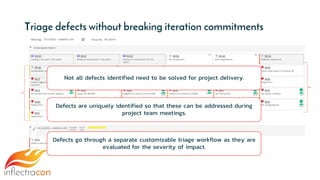
Triage defects without breaking iteration commitments
Not all defects identified need to be solved for project delivery.
Defects are uniquely identified so that these can be addressed during
project team meetings.
Defects go through a separate customizable triage workflow as they are
evaluated for the severity of impact.
Summary
• Waterfall or agile is a
framework with a set of
philosophies
• Focus on business needs by
adopting practices
• Focus on people, process,
technology, and
organizational needs

Methodologies 3: Using Spira for Waterfall

  • 1.
    Using Spira for WaterfallProjects Methodologies 3 @Inflectra | #InflectraCon
  • 2.
    Dr. Sriram Rajagopalan Education Work Experience Training& Certification Teaching & Training PhD, MBA, MS, BE PfMP, PgMP, PMP, SP, RMP, ACP, CSM, CSPO, ACC, CSD, SCT, CSOXP, SSBB, Instructional Designer, Speaker, Writer, and Author Software Engineer, Team Leader, Business Analyst, Project Manager, Scrum Master, Agile Coach, Director, Vice President US, Canada, India, Vietnam, Ireland, Belgium, Greece, & Switzerland @agilesriram
  • 3.
    Our Time Today SDLCReview Review of Support in SpiraTeam® / SpiraPlan® Summarize with Q & A
  • 4.
    Dr. Royce’s SDLCto Waterfall Planning Analysis Design Implementation Maintenance SDLC is not Waterfall
  • 5.
    Waterfall is aMindset Rajagopalan, S. (2014). Review of the myths on the original software development model. International Journal of Software Engineering, 5(6), 103-111. Business Case Requirements System Specifications System Design Module Design Release Testing Acceptance Testing System Testing Integration Testing Unit Testing Development Engineer Tester Architect, Tester Business Users Extended Business Users
  • 6.
    Mindset in Waterfall& Agile User Alienation Big Upfront Design Role clarity Breakdown of Quad constraints Waterfall Value Quality Team Constraints Agile
  • 7.
    Getting to Scopefrom Value Prescriptive Hybrid Adaptive
  • 8.
    Systematic Evaluation • Frameworkis dependent on how value is going to perceived and delivered • It goes through several checkpoints repeatedly • What works for one product or service in an organization may not always work for similar product or service in a different organization • What works for one business unit may not scale well in another business unit within the organization • What works at one snapshot in time for a framework in an organization may not be applicable for another snapshot in time Start What is known more? Predictive Agile What > How How > More Cost of Change? Low Appetite High Appetite Predictive Agile Availability of FACT feedback? Moderate High Predictive Agile Adaptive Management Culture? Resistant Enabling Predictive Agile End
  • 9.
  • 10.
    Agile Approach Idea Epic 1 ThemeA Theme B Epic 2 Theme C Theme D Feature I Feature II Need a Need b Need c T0 T10 T50 Time Dreams Castles Granularity Big House Maintainable Home 2 BR, etc. Transparency InspectionAdaptation
  • 11.
    Requirements When properly implementedand supported, the critical competency of developing and managing requirements enables the organization to meet stakeholder expectations, improve project performance, meet organizational benefits, and achieve tangible business outcomes. (PMI, 2016, pg. 2) Project Management Institute (2016). Requirements Management: A Practice Guide. Newtown Square, Pennsylvania. When properly implemented and supported, the critical competency of developing and managing requirements enables the organization to meet stakeholder expectations, improve project performance, meet organizational benefits, and achieve tangible business outcomes. (PMI, 2016, pg. 2)
  • 12.
    Engage with Stakeholdersgathering & reviewing Requirements Helps with business value prioritization and alignment Realizes DEEP property with more clarity
  • 13.
    Requirements Elicitation Customer Value Add Business ValueAdd Technical Value Add Process Value Add Non-Value Add 1. What does the paying customer want? 2. What exciters can we add to keep the customer with us? 1. What types of documentation / training needed for users? 2. Are compliance documents needed to sustain business? 1. How to technology current to avoid risks from shelf-life? 2. How to avoid technical debt making platforms stable? 1. What types of elements to retire that add no-value? 2. What types of process and procedure waste to eliminate? 1. How to increase effectiveness by operational excellence? 2. How to enhance efficiency by continuous improvement?
  • 14.
    Prioritize and GroomRequirements (incrementally and iteratively) Current Iteration or Minor Milestone Forecasting what the team needs to work on for two upcoming iterations/milestones Major MilestoneProject
  • 15.
  • 16.
    Increase Transparency toPlan Roadmap (Condensed WBS view) is no longer in MS Project or just with the PM. Plan concurrent phases of project, program, or portfolio! The team is aware of the degree of requirements-test cases and thus quality of software.
  • 17.
    Wait! We havea Workflow Support too! Customizable Workflow based on business needs Multiple workflows based on requirement types Supports agile principles of transparency, inspection, and adaptation. Includes support for Digital Signature too!
  • 18.
    Transparency  Conversation Better Team Estimates Much of the collaboration is already happening without infringing on time commitments. Planning sessions become more productive! Auditable requirements making it easy for the team to commit story point estimates. Facilitates remote, distributed, and virtual team collaboration.
  • 19.
    Use Themes asMilestones Aligns with the strategic product roadmap by mapping themes (components) in product backlog Keep team engaged with releases and iterations
  • 20.
    Plan for riskin Estimates by limiting hours/day Life comes in the way! Whether it is company meetings or issues within the iteration, allowing for flex time mitigates risk.
  • 21.
    Centralize task andtesting transparency Number of tasks (4) the team has identified to address this requirement Number of test cases (4) the team has identified for acceptance testing. Visibility to fewer tasks and test cases mean trouble!
  • 22.
    One STOP toMore Traceability
  • 23.
    Pictures Speak Progress Severalwidgets available Export data grid or image for additional discussions View burndown, burnup, velocity, or coverage quickly! View coverage on more artifacts!
  • 24.
    Triage defects withoutbreaking iteration commitments Not all defects identified need to be solved for project delivery. Defects are uniquely identified so that these can be addressed during project team meetings. Defects go through a separate customizable triage workflow as they are evaluated for the severity of impact.
  • 25.
    Summary • Waterfall oragile is a framework with a set of philosophies • Focus on business needs by adopting practices • Focus on people, process, technology, and organizational needs

Editor's Notes

  • #5 One of the most classic models for product development, in particular software, is waterfall model.   Who is familiar with this model? Based on the response decide on the details of your presentation.   The waterfall model suggests that development is seen as flowing steadily downwards much like a waterfall through the phases.   The idea is that once you know what the requirements are, you move ahead one step at a time through design and implementation until the product is verified and ready for delivery.   What do you think of this model? Is it going to work? Expect to hear that this model may have problems since once requirements are set, you need to move forward and implement them without being able to go back. The system is inflexible.   Interestingly the model was first presented by Royce, who suggested it as a failed model and moved on to offer a better model that did not have this limitation. However, his original waterfall model was noticed strongly and became popular.   How do you think we can improve on this model? What is missing? Expect to hear that we need to have an iterative process so we can go back and forward between the requirements and implementations to make sure what we make is going to be valuable to the end user or the client.   Does anyone know such a system? Suggest RUP and move on to the next slide to explain it.
  • #7 Waterfall Challenges Alienates clients and business owners until deployment Exhaustive documentation (BRD, FRD) resistant to change Long planning & more time Compartmentalized roles (PM, BA, Developer): Siloed thought & central dependency Low visibility on projects: Schedule slip & budget overrun Quality compromises