Demystifying Garbage Collection
in Java
Igor Braga
Important Disclaimers
• THE INFORMATION CONTAINED IN THIS PRESENTATION IS PROVIDED FOR INFORMATIONAL PURPOSES ONLY.
• WHILST EFFORTS WERE MADE TO VERIFY THE COMPLETENESS AND ACCURACY OF THE INFORMATION
CONTAINED IN THIS PRESENTATION, IT IS PROVIDED “AS IS”, WITHOUT WARRANTY OF ANY KIND,
EXPRESS OR IMPLIED.
• ALL PERFORMANCE DATA INCLUDED IN THIS PRESENTATION HAVE BEEN GATHERED IN A CONTROLLED
ENVIRONMENT. YOUR OWN TEST RESULTS MAY VARY BASED ON HARDWARE, SOFTWARE OR
INFRASTRUCTURE DIFFERENCES.
• ALL DATA INCLUDED IN THIS PRESENTATION ARE MEANT TO BE USED ONLY AS A GUIDE.
• IN ADDITION, THE INFORMATION CONTAINED IN THIS PRESENTATION IS BASED ON IBM’S CURRENT
PRODUCT PLANS AND STRATEGY, WHICH ARE SUBJECT TO CHANGE BY IBM, WITHOUT NOTICE.
• IBM AND ITS AFFILIATED COMPANIES SHALL NOT BE RESPONSIBLE FOR ANY DAMAGES ARISING OUT
OF THE USE OF, OR OTHERWISE RELATED TO, THIS PRESENTATION OR ANY OTHER DOCUMENTATION.
• NOTHING CONTAINED IN THIS PRESENTATION IS INTENDED TO, OR SHALL HAVE THE EFFECT OF:
• CREATING ANY WARRANT OR REPRESENTATION FROM IBM, ITS AFFILIATED COMPANIES OR ITS
OR THEIR SUPPLIERS AND/OR LICENSORS
2
Outline
1. Introduction
2. OpenJ9 Project
3. Garbage Collection Overview
4. OpenJ9 GC technologies
5. Double Mapping (Advanced Feature)
6. Summary
3
4
Eclipse OpenJ9
Created Sept 2017
http://www.eclipse.org/openj9
https://github.com/eclipse/openj9
Dual License:
Eclipse Public License v2.0
Apache 2.0
Users and contributors very welcome
https://github.com/eclipse/openj9/blob/master/CONTRIBUTING.md
5
The place to get OpenJDK builds
For both
https://adoptopenjdk.net
OpenJDK
+
OpenJ9
OpenJDK
+
Hotspot
or
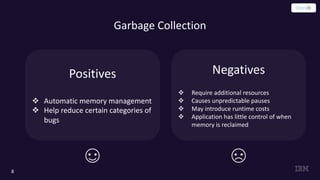
Garbage Collection
6
Garbage Collection
7
“Garbage Collection (GC) is a form of automatic memory
management. The garbage collector attempts to reclaim
memory occupied by objects that are no longer in use by the
application.”
Garbage Collection
8
Positives
v Automatic memory management
v Help reduce certain categories of
bugs
Negatives
v Require additional resources
v Causes unpredictable pauses
v May introduce runtime costs
v Application has little control of when
memory is reclaimed
OpenJ9 GC Goals
9
Implement
re-usable
technology
Use less
memory when
possible
Provide highly
scalable GC
technology
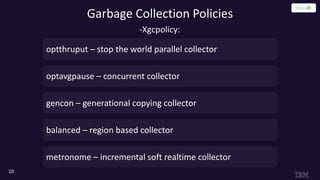
Garbage Collection Policies
10
optthruput – stop the world parallel collector
optavgpause – concurrent collector
gencon – generational copying collector
balanced – region based collector
metronome – incremental soft realtime collector
-Xgcpolicy:
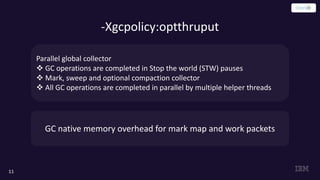
-Xgcpolicy:optthruput
11
Parallel global collector
v GC operations are completed in Stop the world (STW) pauses
v Mark, sweep and optional compaction collector
v All GC operations are completed in parallel by multiple helper threads
GC native memory overhead for mark map and work packets
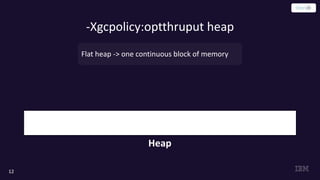
-Xgcpolicy:optthruput heap
12
Flat heap -> one continuous block of memory
Heap
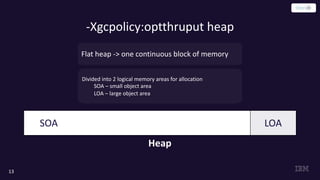
-Xgcpolicy:optthruput heap
13
Flat heap -> one continuous block of memory
Heap
SOA LOA
Divided into 2 logical memory areas for allocation
SOA – small object area
LOA – large object area
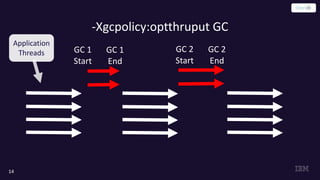
-Xgcpolicy:optthruput GC
14
GC 1
Start
GC 1
End
GC 2
Start
GC 2
End
Application
Threads
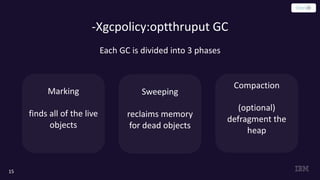
-Xgcpolicy:optthruput GC
15
Each GC is divided into 3 phases
Marking
finds all of the live
objects
Sweeping
reclaims memory
for dead objects
Compaction
(optional)
defragment the
heap
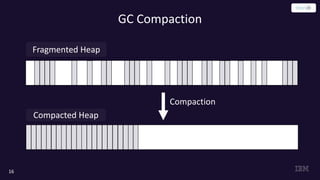
GC Compaction
16
Compaction
Fragmented Heap
Compacted Heap
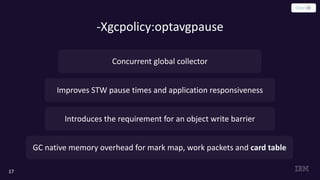
-Xgcpolicy:optavgpause
17
Improves STW pause times and application responsiveness
Introduces the requirement for an object write barrier
Concurrent global collector
GC native memory overhead for mark map, work packets and card table
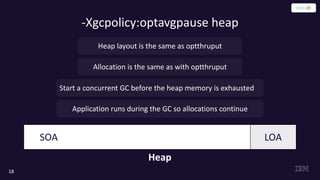
-Xgcpolicy:optavgpause heap
18
Heap layout is the same as optthruput
Heap
SOA LOA
Allocation is the same as with optthruput
Start a concurrent GC before the heap memory is exhausted
Application runs during the GC so allocations continue
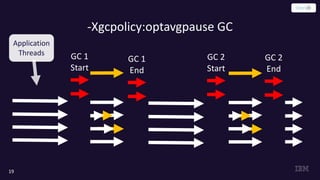
-Xgcpolicy:optavgpause GC
19
GC 1
Start
GC 1
End
GC 2
Start
GC 2
End
Application
Threads
-Xgcpolicy:optavgpause GC
20
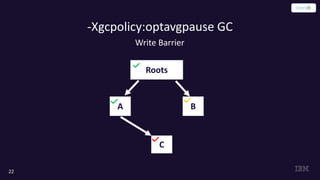
Write Barrier
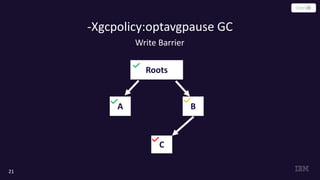
-Xgcpolicy:optavgpause GC
21
Write Barrier
B
C
Roots
A
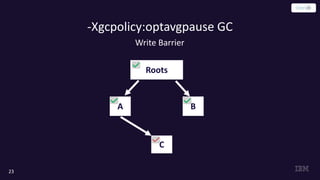
-Xgcpolicy:optavgpause GC
22
Write Barrier
B
C
Roots
A
-Xgcpolicy:optavgpause GC
23
Write Barrier
B
C
Roots
A
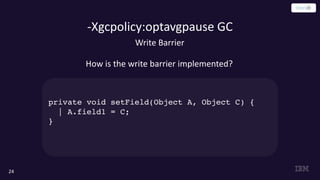
-Xgcpolicy:optavgpause GC
24
Write Barrier
How is the write barrier implemented?
private void setField(Object A, Object C) {
| A.field1 = C;
}
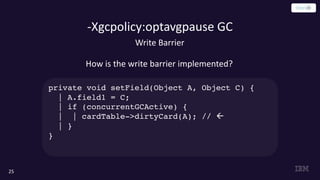
-Xgcpolicy:optavgpause GC
25
Write Barrier
How is the write barrier implemented?
private void setField(Object A, Object C) {
| A.field1 = C;
| if (concurrentGCActive) {
| | cardTable->dirtyCard(A); // ß
| }
}
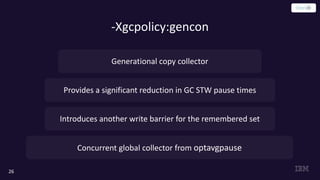
-Xgcpolicy:gencon
26
Provides a significant reduction in GC STW pause times
Introduces another write barrier for the remembered set
Generational copy collector
Concurrent global collector from optavgpause
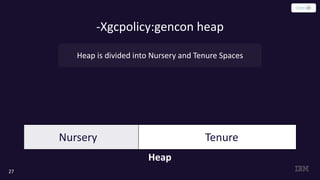
-Xgcpolicy:gencon heap
27
Heap is divided into Nursery and Tenure Spaces
Tenure
Heap
Nursery
-Xgcpolicy:gencon heap
28
Heap is divided into Nursery and Tenure Spaces
Heap
The Nursery is divided into 2 logical spaces: Allocate and Survivor
TenureAllocate Survivor
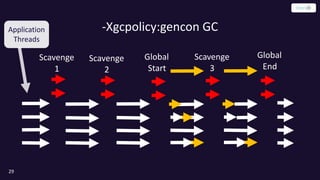
-Xgcpolicy:gencon GC
29
Scavenge
1
Scavenge
2
Global
Start
Scavenge
3
Global
End
Application
Threads
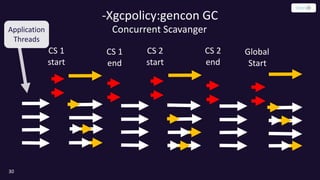
-Xgcpolicy:gencon GC
30
CS 1
start
Global
Start
CS 1
end
CS 2
start
CS 2
end
Concurrent ScavangerApplication
Threads
-Xgcpolicy:gencon GC
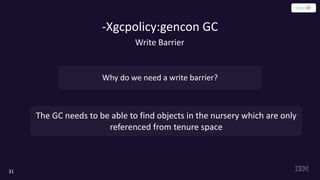
31
Why do we need a write barrier?
The GC needs to be able to find objects in the nursery which are only
referenced from tenure space
Write Barrier
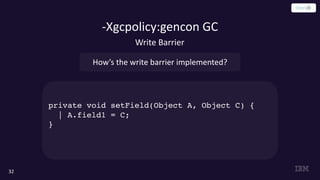
-Xgcpolicy:gencon GC
32
How’s the write barrier implemented?
Write Barrier
private void setField(Object A, Object C) {
| A.field1 = C;
}
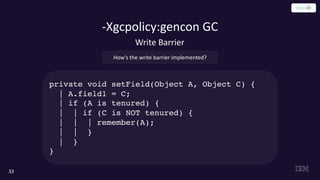
-Xgcpolicy:gencon GC
33
How’s the write barrier implemented?
Write Barrier
private void setField(Object A, Object C) {
| A.field1 = C;
| if (A is tenured) {
| | if (C is NOT tenured) {
| | | remember(A);
| | }
| }
}
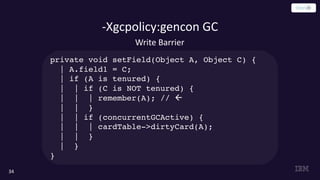
-Xgcpolicy:gencon GC
34
Write Barrier
private void setField(Object A, Object C) {
| A.field1 = C;
| if (A is tenured) {
| | if (C is NOT tenured) {
| | | remember(A); // ß
| | }
| | if (concurrentGCActive) {
| | | cardTable->dirtyCard(A);
| | }
| }
}
-Xgcpolicy:metronome
35
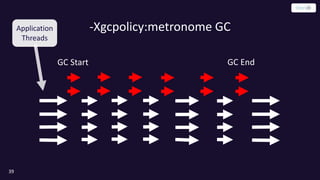
Provides a significant reduction in max GC STW pause times
Uses a Snapshot At The Beginning (SATB) write barrier
Incremental soft realtime collector
High percentage of floating garbage
-Xgcpolicy:metronome heap
36
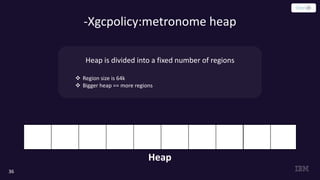
Heap is divided into a fixed number of regions
v Region size is 64k
v Bigger heap == more regions
Heap
-Xgcpolicy:metronome heap
37
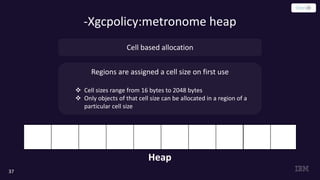
Cell based allocation
Heap
Regions are assigned a cell size on first use
v Cell sizes range from 16 bytes to 2048 bytes
v Only objects of that cell size can be allocated in a region of a
particular cell size
-Xgcpolicy:metronome heap
38
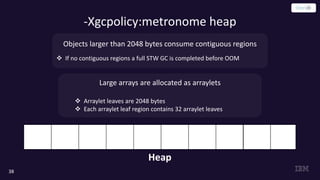
Objects larger than 2048 bytes consume contiguous regions
v If no contiguous regions a full STW GC is completed before OOM
Heap
Large arrays are allocated as arraylets
v Arraylet leaves are 2048 bytes
v Each arraylet leaf region contains 32 arraylet leaves
-Xgcpolicy:metronome GC
39
GC Start GC End
Application
Threads
-Xgcpolicy:metronome
40
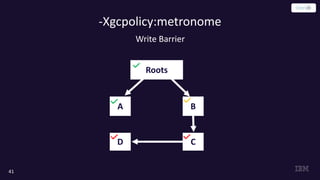
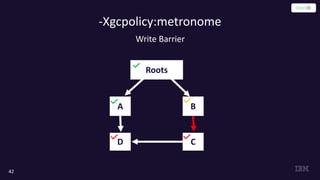
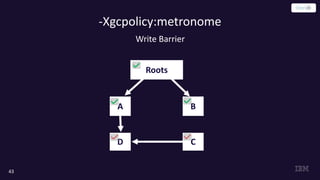
Snapshot at the beginning of the barrier (SATB)
Write Barrier
Causes a lot of floating garbage
The barrier has to be performed before the store
41
Write Barrier
-Xgcpolicy:metronome
B
C
Roots
A
D
42
Write Barrier
-Xgcpolicy:metronome
C
B
Roots
A
D
43
Write Barrier
-Xgcpolicy:metronome
B
C
Roots
A
D
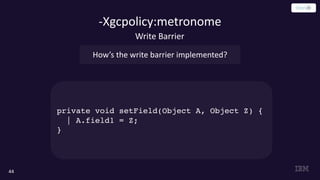
-Xgcpolicy:metronome
44
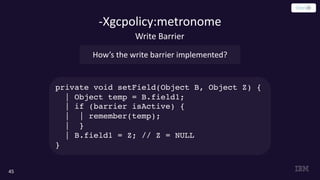
private void setField(Object A, Object Z) {
| A.field1 = Z;
}
Write Barrier
How’s the write barrier implemented?
-Xgcpolicy:metronome
45
private void setField(Object B, Object Z) {
| Object temp = B.field1;
| if (barrier isActive) {
| | remember(temp);
| }
| B.field1 = Z; // Z = NULL
}
Write Barrier
How’s the write barrier implemented?
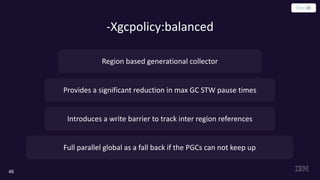
-Xgcpolicy:balanced
46
Provides a significant reduction in max GC STW pause times
Introduces a write barrier to track inter region references
Region based generational collector
Full parallel global as a fall back if the PGCs can not keep up
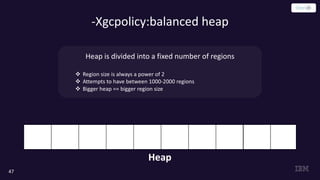
-Xgcpolicy:balanced heap
47
Heap is divided into a fixed number of regions
v Region size is always a power of 2
v Attempts to have between 1000-2000 regions
v Bigger heap == bigger region size
Heap
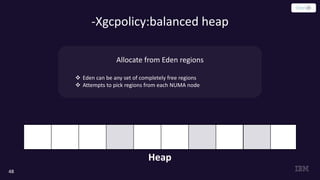
-Xgcpolicy:balanced heap
48
Allocate from Eden regions
v Eden can be any set of completely free regions
v Attempts to pick regions from each NUMA node
Heap
-Xgcpolicy:balanced heap
49
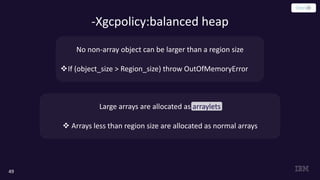
No non-array object can be larger than a region size
vIf (object_size > Region_size) throw OutOfMemoryError
Large arrays are allocated as arraylets
v Arrays less than region size are allocated as normal arrays
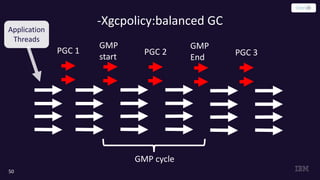
-Xgcpolicy:balanced GC
50
PGC 1
GMP
start
PGC 2
GMP
End
PGC 3
GMP cycle
Application
Threads
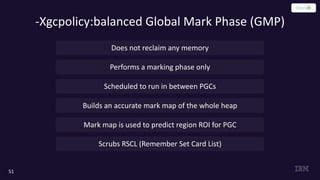
-Xgcpolicy:balanced Global Mark Phase (GMP)
51
Does not reclaim any memory
Performs a marking phase only
Scheduled to run in between PGCs
Builds an accurate mark map of the whole heap
Mark map is used to predict region ROI for PGC
Scrubs RSCL (Remember Set Card List)
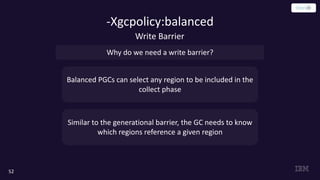
-Xgcpolicy:balanced
52
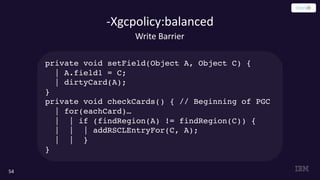
Why do we need a write barrier?
Write Barrier
Balanced PGCs can select any region to be included in the
collect phase
Similar to the generational barrier, the GC needs to know
which regions reference a given region
-Xgcpolicy:balanced
53
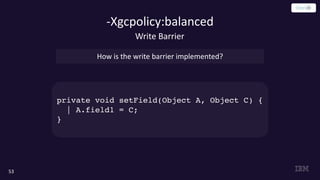
How is the write barrier implemented?
Write Barrier
private void setField(Object A, Object C) {
| A.field1 = C;
}
-Xgcpolicy:balanced
54
Write Barrier
private void setField(Object A, Object C) {
| A.field1 = C;
| dirtyCard(A);
}
private void checkCards() { // Beginning of PGC
| for(eachCard)…
| | if (findRegion(A) != findRegion(C)) {
| | | addRSCLEntryFor(C, A);
| | }
}
GC Policy Quick Guide
55
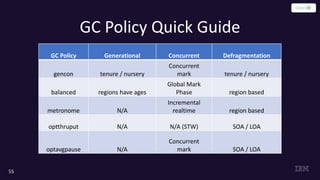
GC Policy Generational Concurrent Defragmentation
gencon tenure / nursery
Concurrent
mark tenure / nursery
balanced regions have ages
Global Mark
Phase region based
metronome N/A
Incremental
realtime region based
optthruput N/A N/A (STW) SOA / LOA
optavgpause N/A
Concurrent
mark SOA / LOA
GC Policy Quick Guide
56
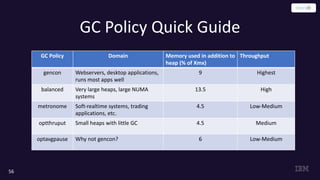
GC Policy Domain Memory used in addition to
heap (% of Xmx)
Throughput
gencon Webservers, desktop applications,
runs most apps well
9 Highest
balanced Very large heaps, large NUMA
systems
13.5 High
metronome Soft-realtime systems, trading
applications, etc.
4.5 Low-Medium
optthruput Small heaps with little GC 4.5 Medium
optavgpause Why not gencon? 6 Low-Medium
GC Summary
57
Generational Collectors
Region based Collectors
Write Barriers to keep track of
concurrent and inter region allocation
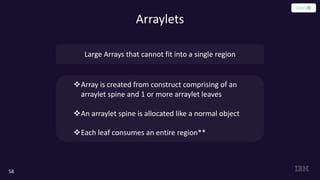
Arraylets
58
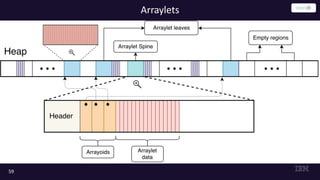
Large Arrays that cannot fit into a single region
vArray is created from construct comprising of an
arraylet spine and 1 or more arraylet leaves
vAn arraylet spine is allocated like a normal object
vEach leaf consumes an entire region**
Arraylets
59
60
Arraylets
Arraylets were introduced so that arrays were more cleverly
stored in the heap for balanced and metronome GC policies.
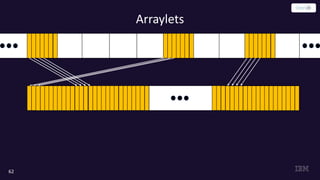
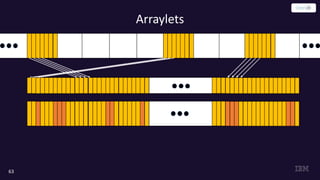
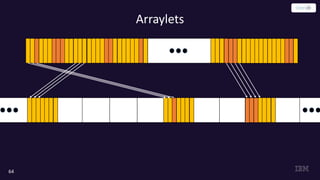
Some APIs require a contiguous view of an array
61
Arraylets
Some APIs require a contiguous view of an array
The case of Java Native Interface (JNI)
JNI Critical is used when the programmer wants direct
addressability of the object.
62
Arraylets
63
Arraylets
64
Arraylets
65
Arraylets
Very expensive!!
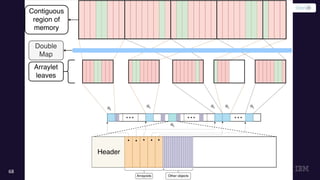
66
Arraylets
Double Mapping
Make large arrays (discontiguous arraylets) look contiguous
Virtual Memory address space is large in 64 bit systems, 264 in fact
compared to 32 bits in 32 bit systems
Physical memory is limited
67
Arraylets
Double Mapping
Map 2 virtual memory addresses to the same physical
memory address
Any modifications to the newly mapped address will reflect
the original array data, and vice-versa
68
Arraylets
Double Mapping
69
Arraylets
Double Mapping
Comparing JNI critical operations, array operations got up to
30x boost in speedup
Links
70
Eclipse OpenJ9
https://www.eclipse.org/openj9
https://blog.openj9.org/
AdoptOpenJDK
https://adoptopenjdk.net
Eclipse OMR
https://www.eclipse.org/omr/
Eclipse OMR
Summary
71
v What is Garbage Collection
v Different GC Policies
v Double mapping to improve large array performance
Slides Link:
Questions?
72
Appendix
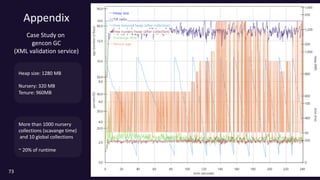
73
Case Study on
gencon GC
(XML validation service)
Heap size: 1280 MB
Nursery: 320 MB
Tenure: 960MB
More than 1000 nursery
collections (scavange time)
and 10 global collections
~ 20% of runtime
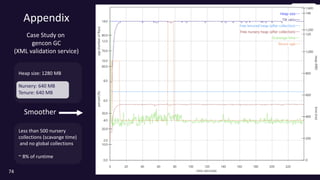
74
Case Study on
gencon GC
(XML validation service)
Heap size: 1280 MB
Nursery: 640 MB
Tenure: 640 MB
Less than 500 nursery
collections (scavange time)
and no global collections
~ 8% of runtime
Appendix
Smoother
References
75
[1] R. Jones et al. “The Garbage Collection Handbook”. Chapman & Hall/CRC, 2012

Demystifying Garbage Collection in Java