Enforcing Regulation under Illicit Adaptation
Andres Gonzalez Lira Mushq Mobarak
UC Berkeley Yale
September 4, 2018
Contents
1 Motivation
2 Previous Literature
3 Experimental Design
4 Results
5 Conclusions
Curbing Undesired Behavior
Correcting market failures may require curbing undesirable behaviors
Deforestation, resource exploitation, tax evasion, open defecation
Curbing Undesired Behavior
Correcting market failures may require curbing undesirable behaviors
Deforestation, resource exploitation, tax evasion, open defecation
Regulations and penalties are the most direct way to counter such
behaviors.
Incentive (subsidies/pigovian taxes) are another way.
Curbing Undesired Behavior
Correcting market failures may require curbing undesirable behaviors
Deforestation, resource exploitation, tax evasion, open defecation
Regulations and penalties are the most direct way to counter such
behaviors.
Incentive (subsidies/pigovian taxes) are another way.
Requires strong institutions to enact and enforce laws
Sophisticated policing to track agents' reactions to penalties
More challenging in developing countries, and may need to rely on less
direct strategies
Information campaigns and social incentives
Growing literature showing positive results of these policies in
developing countries (Guiteras et al. (2015), Chetty et al. (2015))
What this Paper Does
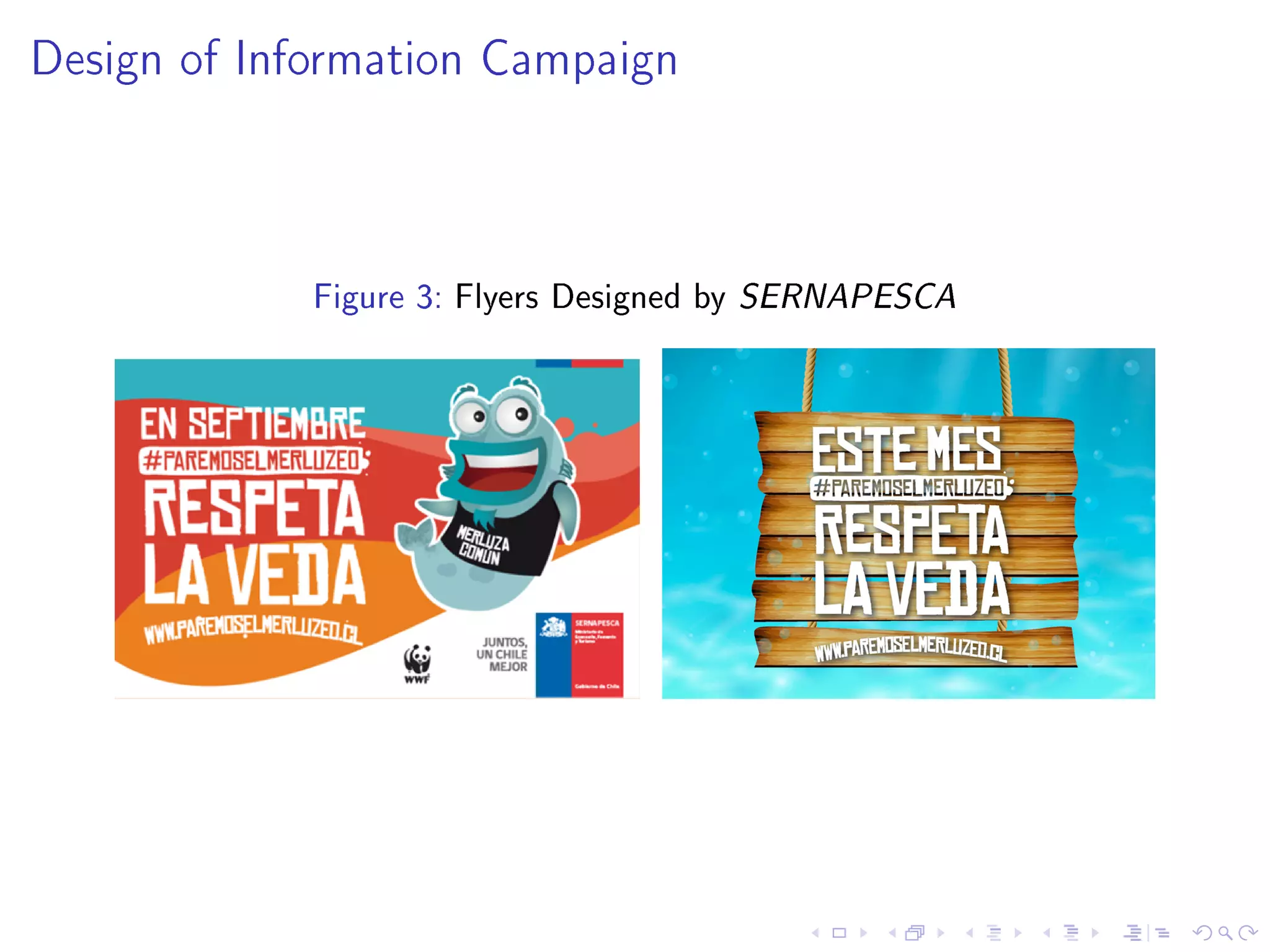
Regulated agents may react interventions designed to counter
corruption/theft/elite capture
What this Paper Does
Regulated agents may react interventions designed to counter
corruption/theft/elite capture
Short-term evaluations of such interventions are incomplete
What this Paper Does
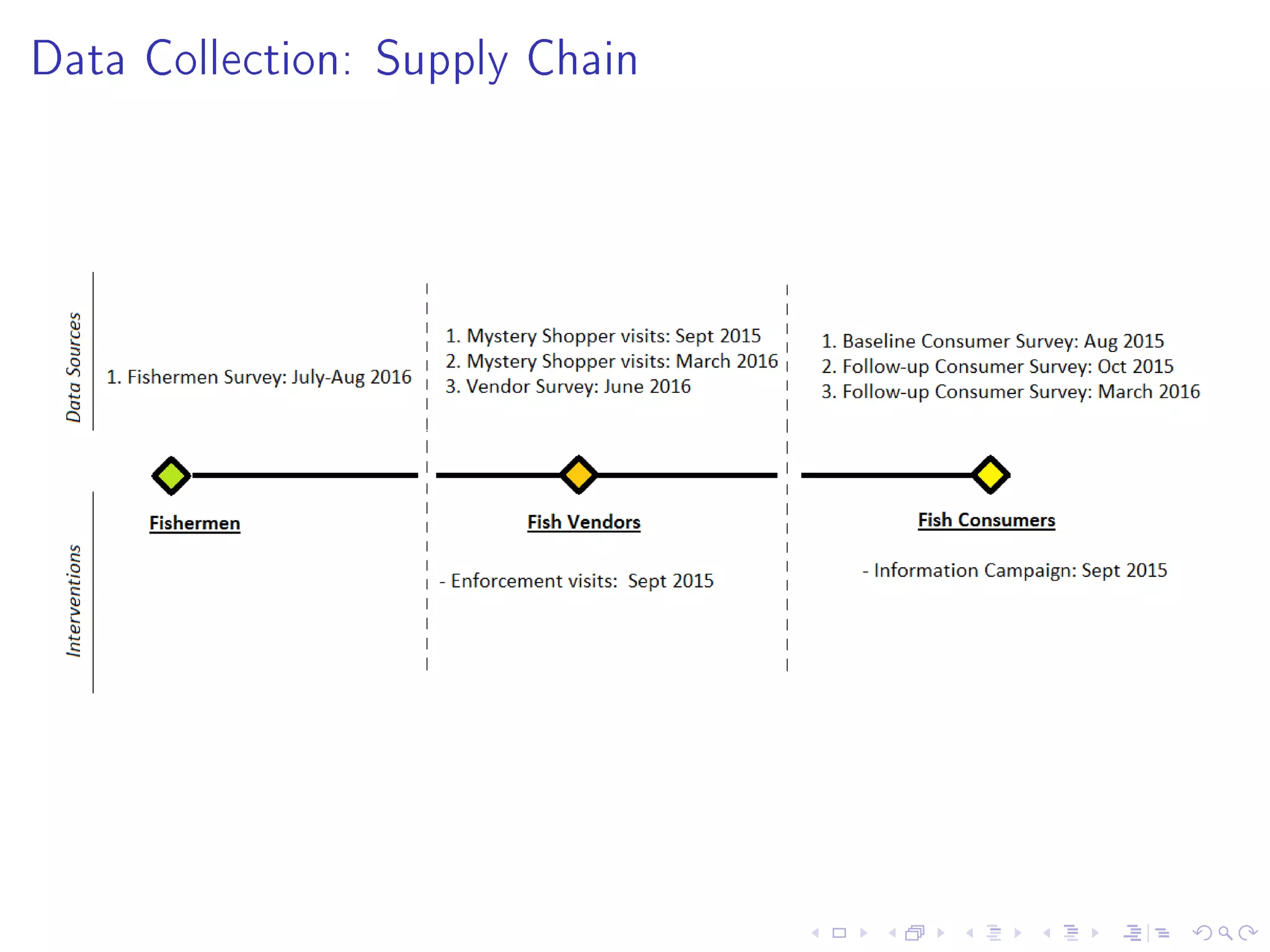
Regulated agents may react interventions designed to counter
corruption/theft/elite capture
Short-term evaluations of such interventions are incomplete
A more comprehensive evaluation requires:
A research design that is cognizant of the possibility that agents react
Creative data collection that can track agents' hidden reactions to
penalties
Dicult to anticipate any specic reaction, so research strategy must
be exible and general
What this Paper Does
Regulated agents may react interventions designed to counter
corruption/theft/elite capture
Short-term evaluations of such interventions are incomplete
A more comprehensive evaluation requires:
A research design that is cognizant of the possibility that agents react
Creative data collection that can track agents' hidden reactions to
penalties
Dicult to anticipate any specic reaction, so research strategy must
be exible and general
We develop such a research methodology, in order to investigate the
eects of regulation net of agent adaptive behaviors
What this Paper Does
Regulated agents may react interventions designed to counter
corruption/theft/elite capture
Short-term evaluations of such interventions are incomplete
A more comprehensive evaluation requires:
A research design that is cognizant of the possibility that agents react
Creative data collection that can track agents' hidden reactions to
penalties
Dicult to anticipate any specic reaction, so research strategy must
be exible and general
We develop such a research methodology, in order to investigate the
eects of regulation net of agent adaptive behaviors
Beyond evaluating a government program;
Introduce experimental variations in enforcement design to curb illegal
sh sales even when agents try to circumvent rules
One strategy we designed works well
The other one backres and makes the situation worse!
Overshing: A Global Policy Issue where Enforcement is
Challenging
Overshing is the textbook example of problem of the commons
(Ostrom (1990), Stavins (2011))
Diculties regulating artisanal and small-scale shermen
Diculties tracking illegal sh in the market
Overshing: A Global Policy Issue where Enforcement is
Challenging
Overshing is the textbook example of problem of the commons
(Ostrom (1990), Stavins (2011))
Diculties regulating artisanal and small-scale shermen
Diculties tracking illegal sh in the market
Overshing a global problem, and common in poorer countries
Weak governance, corruption, poor monitoring and enforcement
Overshing: A Global Policy Issue where Enforcement is
Challenging
Overshing is the textbook example of problem of the commons
(Ostrom (1990), Stavins (2011))
Diculties regulating artisanal and small-scale shermen
Diculties tracking illegal sh in the market
Overshing a global problem, and common in poorer countries
Weak governance, corruption, poor monitoring and enforcement
Has important economic implications (FAO 2014)
Marine resource related activities employ 10-12% of world population
Over 90% of those employed in small-scale sheries in LDCs
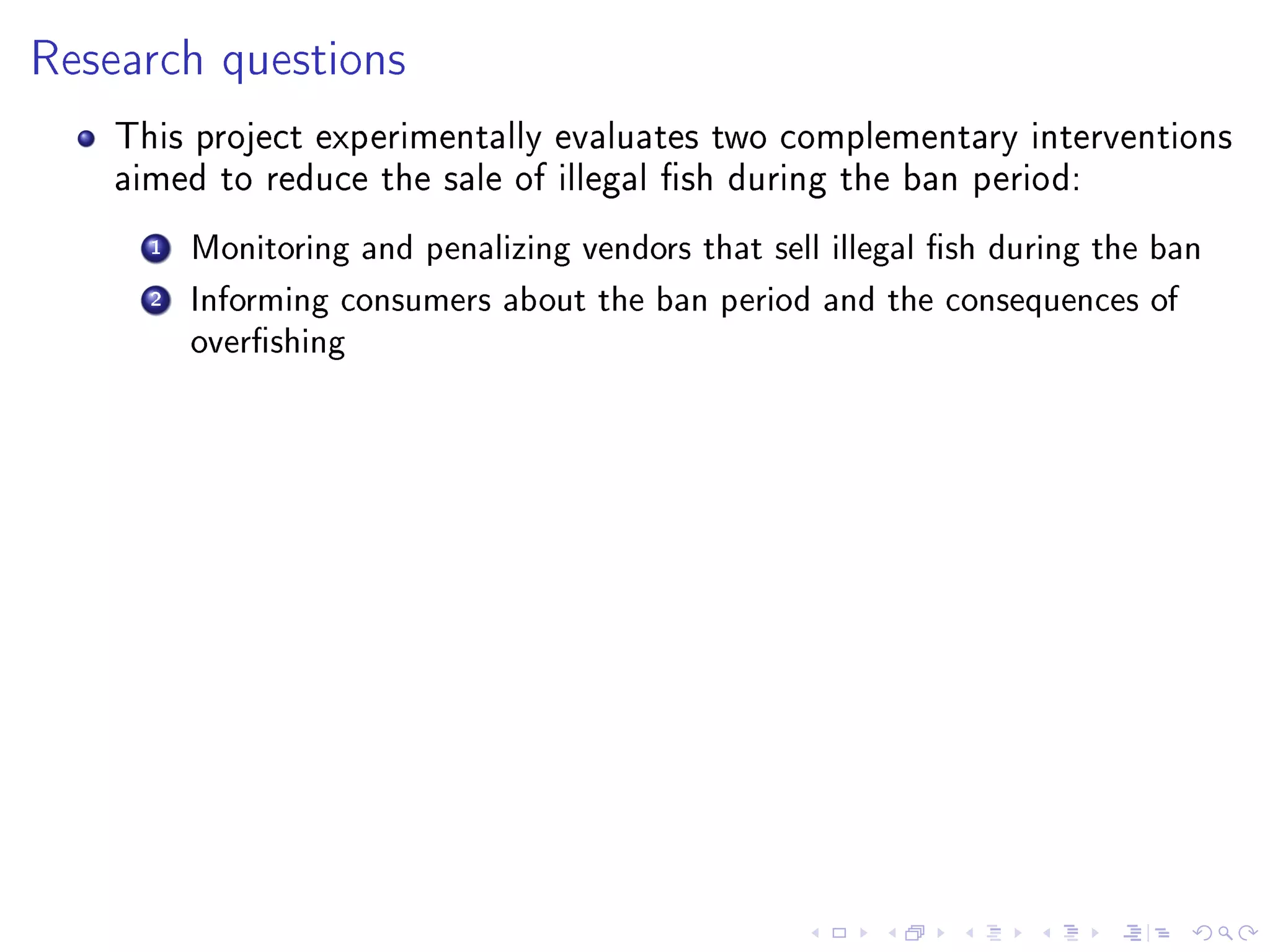
Research questions
This project experimentally evaluates two complementary interventions
aimed to reduce the sale of illegal sh during the ban period:
1 Monitoring and penalizing vendors that sell illegal sh during the ban
2 Informing consumers about the ban period and the consequences of
overshing
Research questions
This project experimentally evaluates two complementary interventions
aimed to reduce the sale of illegal sh during the ban period:
1 Monitoring and penalizing vendors that sell illegal sh during the ban
2 Informing consumers about the ban period and the consequences of
overshing
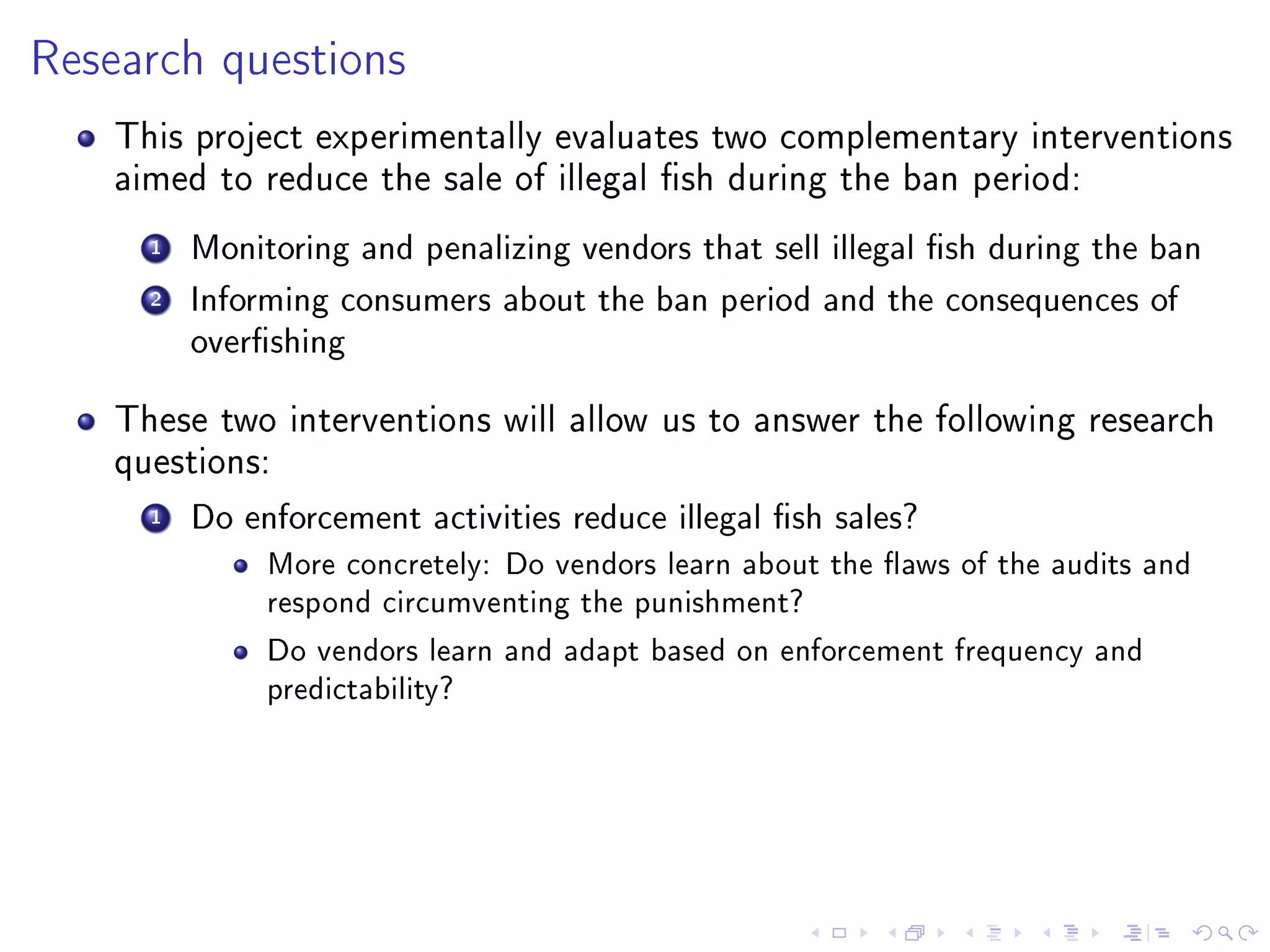
These two interventions will allow us to answer the following research
questions:
1 Do enforcement activities reduce illegal sh sales?
More concretely: Do vendors learn about the aws of the audits and
respond circumventing the punishment?
Do vendors learn and adapt based on enforcement frequency and
predictability?
Research questions
This project experimentally evaluates two complementary interventions
aimed to reduce the sale of illegal sh during the ban period:
1 Monitoring and penalizing vendors that sell illegal sh during the ban
2 Informing consumers about the ban period and the consequences of
overshing
These two interventions will allow us to answer the following research
questions:
1 Do enforcement activities reduce illegal sh sales?
More concretely: Do vendors learn about the aws of the audits and
respond circumventing the punishment?
Do vendors learn and adapt based on enforcement frequency and
predictability?
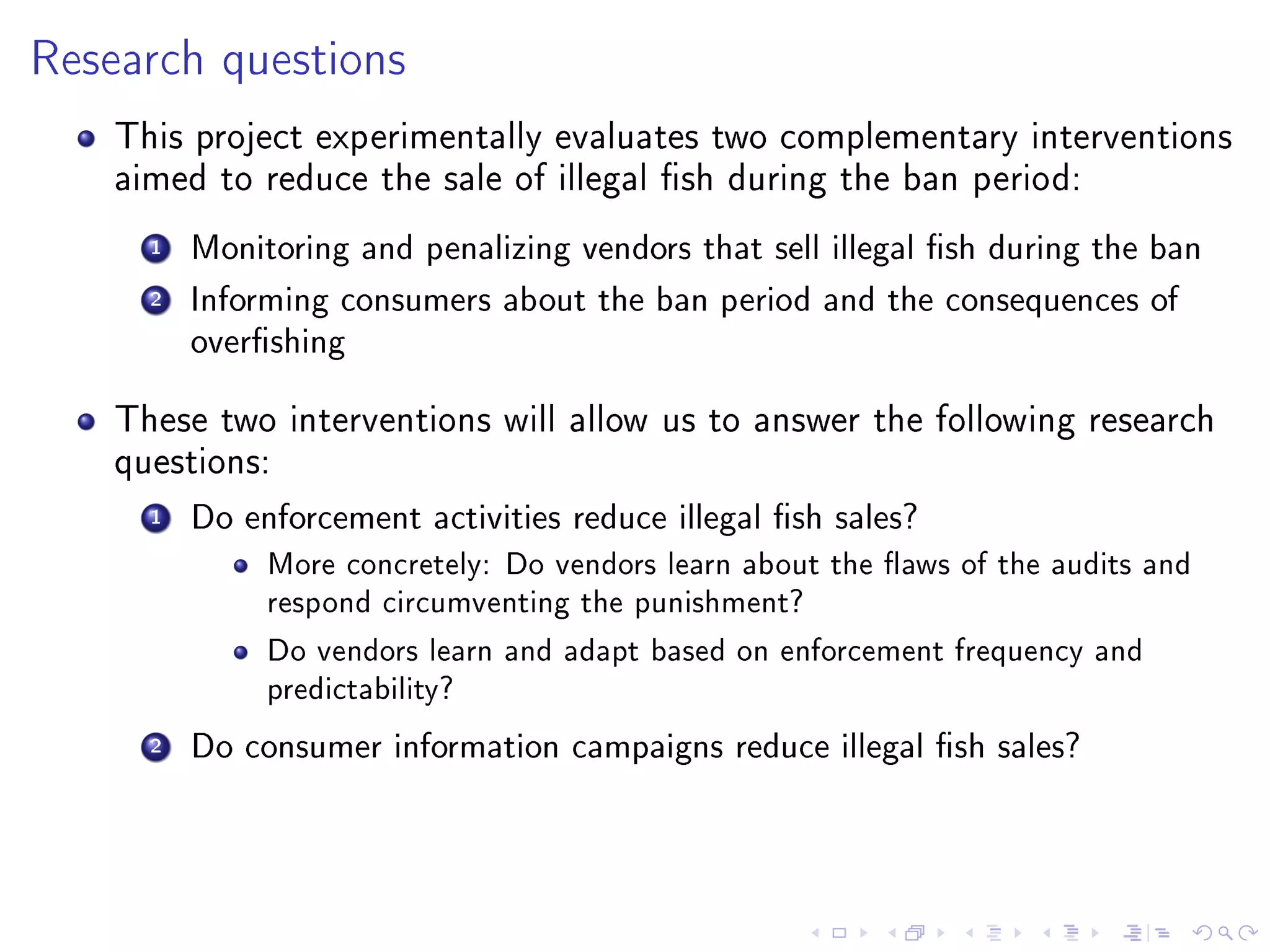
2 Do consumer information campaigns reduce illegal sh sales?
Research questions
This project experimentally evaluates two complementary interventions
aimed to reduce the sale of illegal sh during the ban period:
1 Monitoring and penalizing vendors that sell illegal sh during the ban
2 Informing consumers about the ban period and the consequences of
overshing
These two interventions will allow us to answer the following research
questions:
1 Do enforcement activities reduce illegal sh sales?
More concretely: Do vendors learn about the aws of the audits and
respond circumventing the punishment?
Do vendors learn and adapt based on enforcement frequency and
predictability?
2 Do consumer information campaigns reduce illegal sh sales?
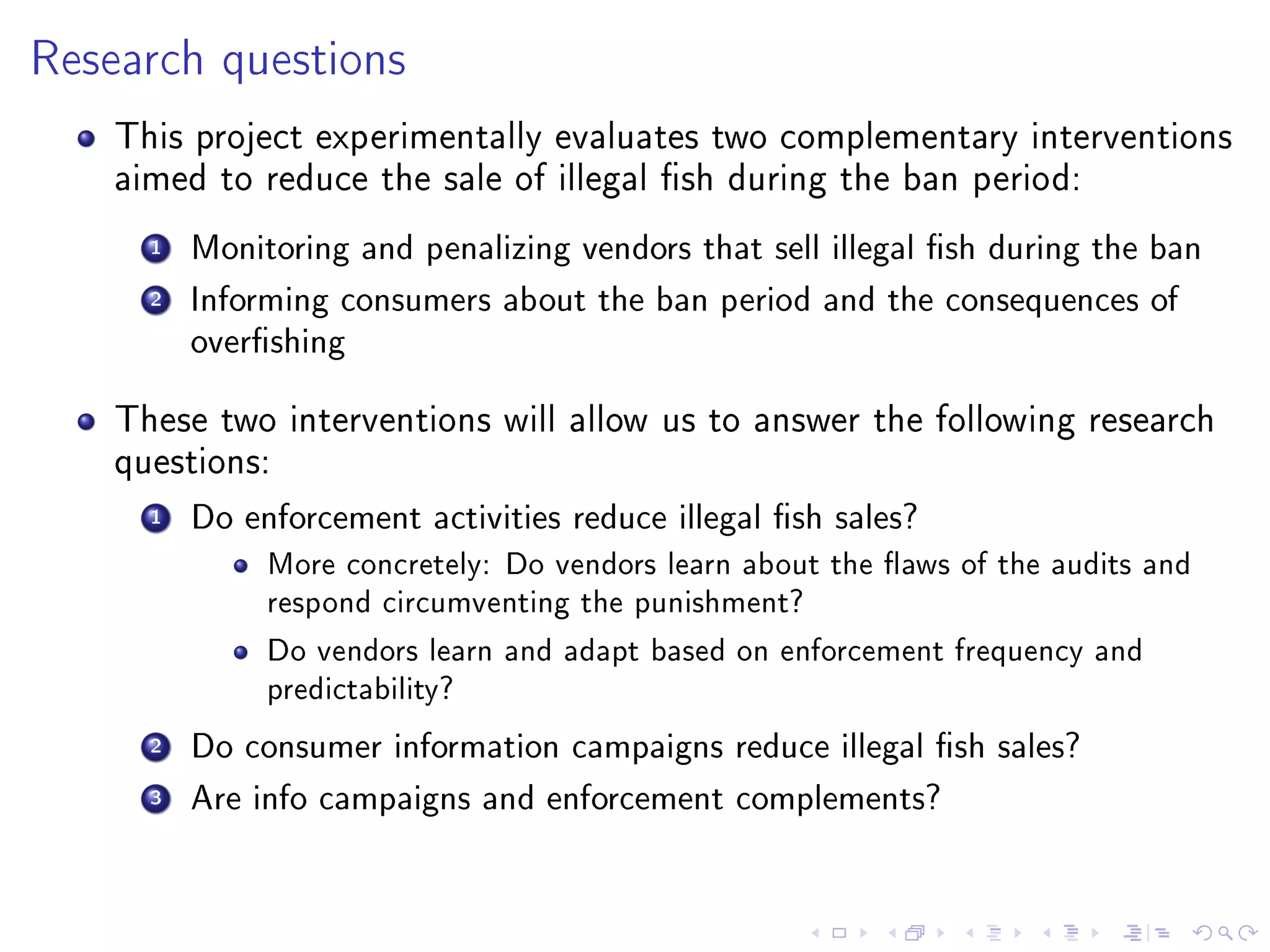
3 Are info campaigns and enforcement complements?
Research questions
This project experimentally evaluates two complementary interventions
aimed to reduce the sale of illegal sh during the ban period:
1 Monitoring and penalizing vendors that sell illegal sh during the ban
2 Informing consumers about the ban period and the consequences of
overshing
These two interventions will allow us to answer the following research
questions:
1 Do enforcement activities reduce illegal sh sales?
More concretely: Do vendors learn about the aws of the audits and
respond circumventing the punishment?
Do vendors learn and adapt based on enforcement frequency and
predictability?
2 Do consumer information campaigns reduce illegal sh sales?
3 Are info campaigns and enforcement complements?
4 Do info campaign and enforcement strategies have dierential eects
beyond the ban period?
Connections to Previous Literature
Many interventions designed to align agents' behavior and circumvent
corruption. Duo et al. (2013), Banerjee et al. (2015), Banerjee et al.
(2014), Muralidharan et al. (2016)
Corrupt entities subject to new regime may adjust to changes in
regulatory rules, and engage in a dierent type of corruption. Tax
evasion: Carrillo et al. (2017), Alm et al. (2009)
Short and long-run eects may be dierent
Eects of information campaigns, for environmental or public health
goals, generally uneven and not very positive. Dupas (2011), Mobarak
et al. (2012), Meredith et al. (2012)
Connections to Previous Literature
Many interventions designed to align agents' behavior and circumvent
corruption. Duo et al. (2013), Banerjee et al. (2015), Banerjee et al.
(2014), Muralidharan et al. (2016)
Corrupt entities subject to new regime may adjust to changes in
regulatory rules, and engage in a dierent type of corruption. Tax
evasion: Carrillo et al. (2017), Alm et al. (2009)
Short and long-run eects may be dierent
Eects of information campaigns, for environmental or public health
goals, generally uneven and not very positive. Dupas (2011), Mobarak
et al. (2012), Meredith et al. (2012)
This is the rst project (to our knowledge) that addresses an
environmental issue (1) gauging the relative eect of enforcement and
info campaigns interventions and (2) empirically measures agents'
attempts to circumvent to dierent enforcement strategies
Context: Fish Market in Chile
The Pacic Hake (or merluza)
Popular source of protein for low and middle-income Chileans
Critically threatened by over-shing
SERNAPESCA estimates that population is 18% of sustainable level
Context: Fish Market in Chile
The Pacic Hake (or merluza)
Popular source of protein for low and middle-income Chileans
Critically threatened by over-shing
SERNAPESCA estimates that population is 18% of sustainable level
Chilean government passed regulations to protect the sh, including
ban on shing and consumption during September when hake
reproduces
Context: Fish Market in Chile
The Pacic Hake (or merluza)
Popular source of protein for low and middle-income Chileans
Critically threatened by over-shing
SERNAPESCA estimates that population is 18% of sustainable level
Chilean government passed regulations to protect the sh, including
ban on shing and consumption during September when hake
reproduces
SERNAPESCA eorts have focused on monitoring small scale
shermen:
Geographically dispersed, informal, each sherman is small-scale
Social tensions
Social tensions
They contribute almost 40% of total sh harvested, and up to 75% of
the hake sh market
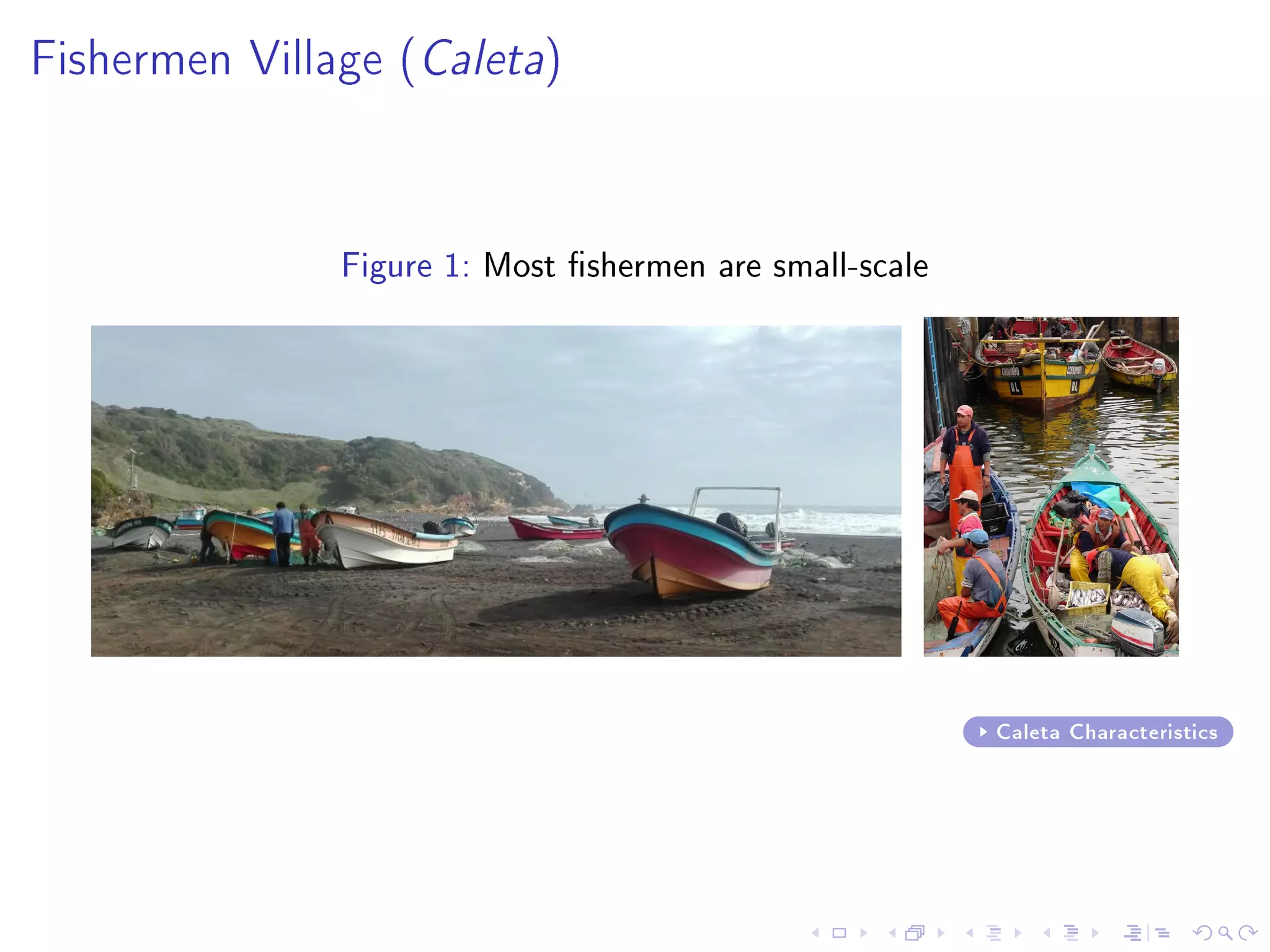
Fishermen Village (Caleta)
Figure 1: Most shermen are small-scale
Caleta Characteristics
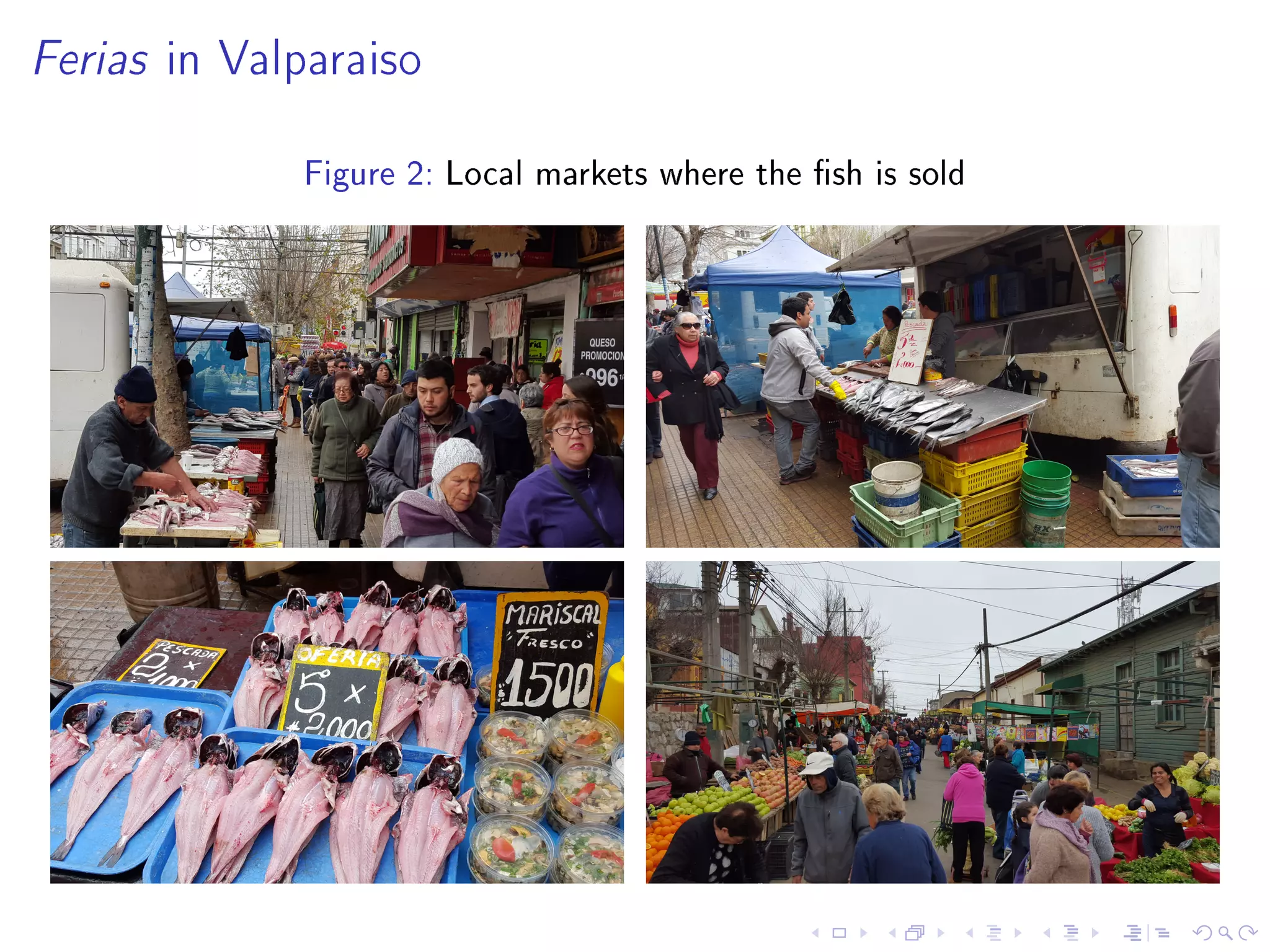
Ferias in Valparaiso
Figure 2: Local markets where the sh is sold
Experimental Design: Context
Most of the sh sold in ferias, which are local markets
regulated/organized by the municipality
The sh sold in ferias is fresh, i.e. harvested the same day or the day
before
Vendors move around between ferias during dierent days of the week
e.g. they return to same feria every Sun and Wed
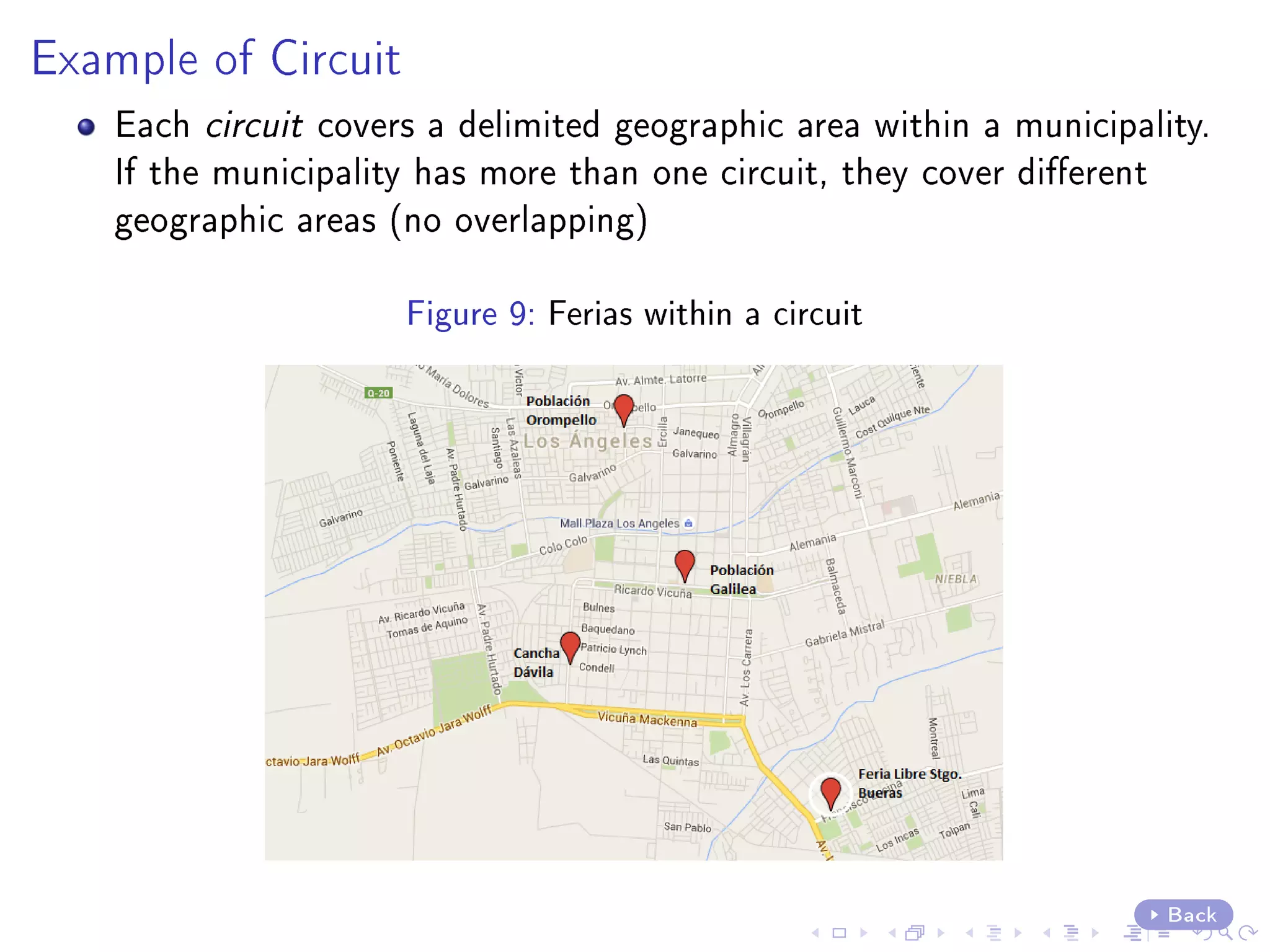
Ferias are therefore organized into circuits.
Example Circuit
Most of the municipalities (comunas) have only one circuit
Experimental Design: Context
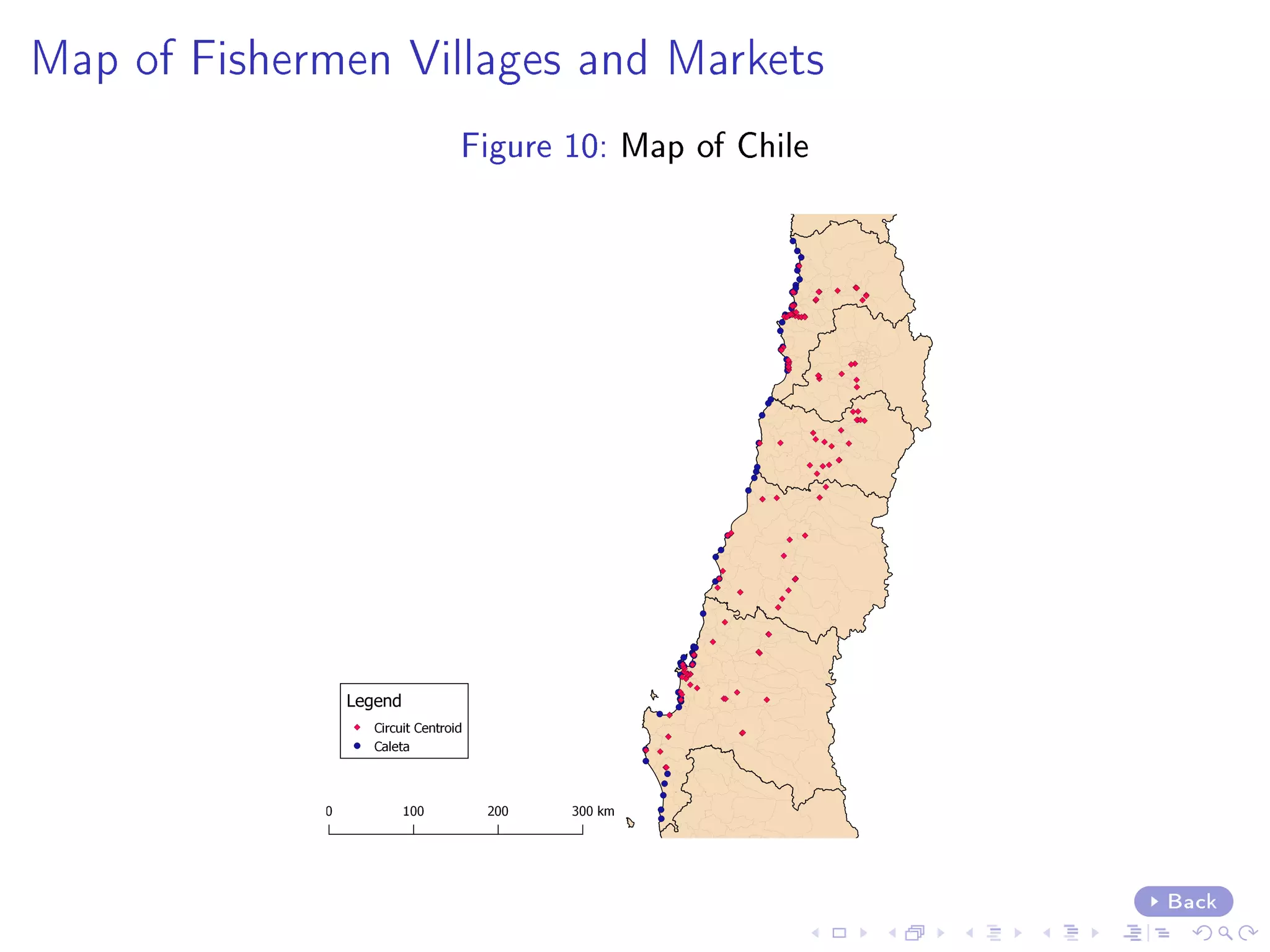
The interventions include 106 circuits containing 280 ferias, in 70
municipalities - Universe of ferias and circuits where at least one sh
vendor operates (except Santiago)
Map
Experimental Design: Context
The interventions include 106 circuits containing 280 ferias, in 70
municipalities - Universe of ferias and circuits where at least one sh
vendor operates (except Santiago)
Map
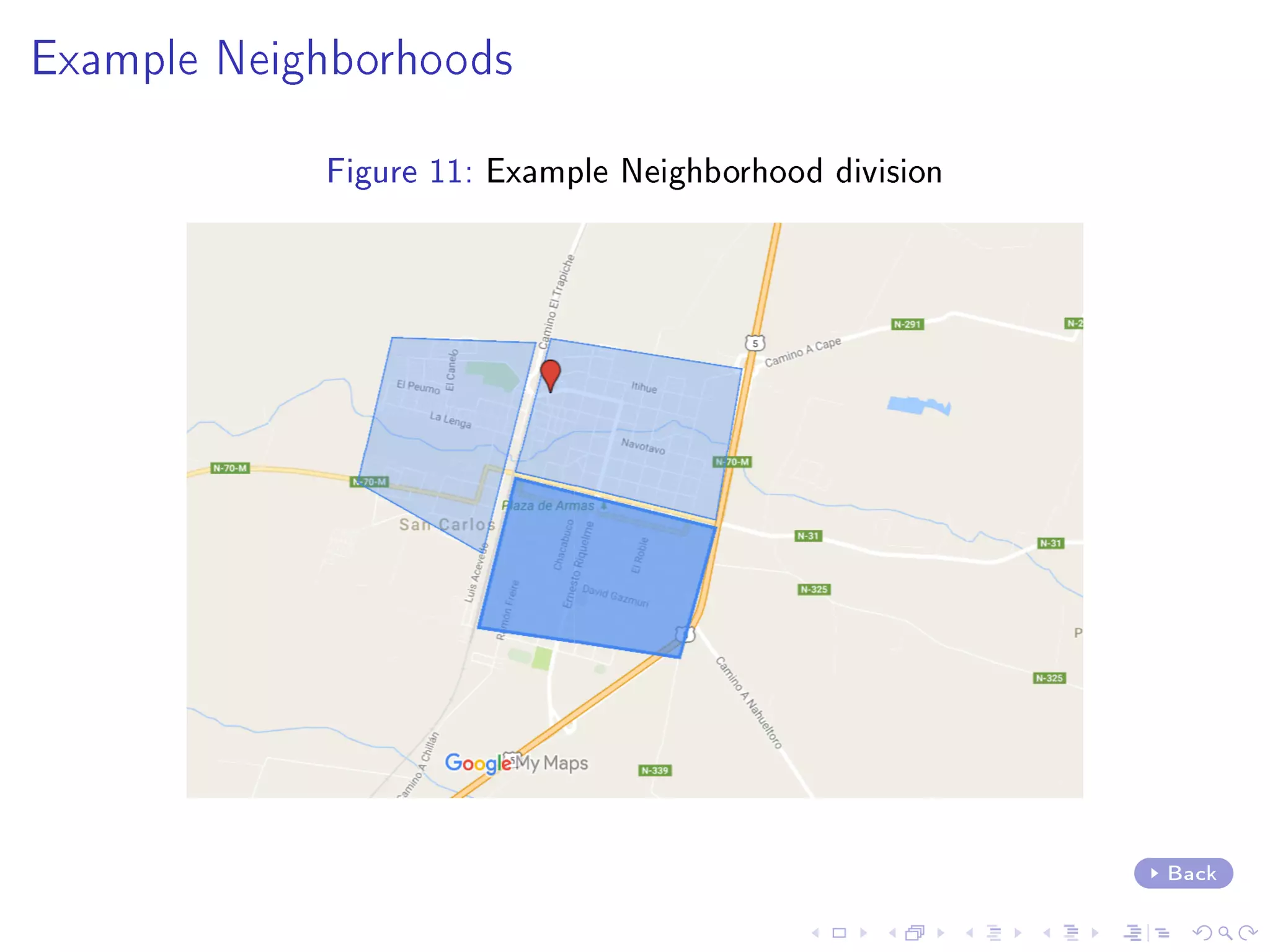
Each municipality is divided in neighborhoods
Example Neighborhoods
Experimental Design: Context
The interventions include 106 circuits containing 280 ferias, in 70
municipalities - Universe of ferias and circuits where at least one sh
vendor operates (except Santiago)
Map
Each municipality is divided in neighborhoods
Example Neighborhoods
The enforcement assignment is randomized at circuit level
Information campaign was assigned at neighborhood level
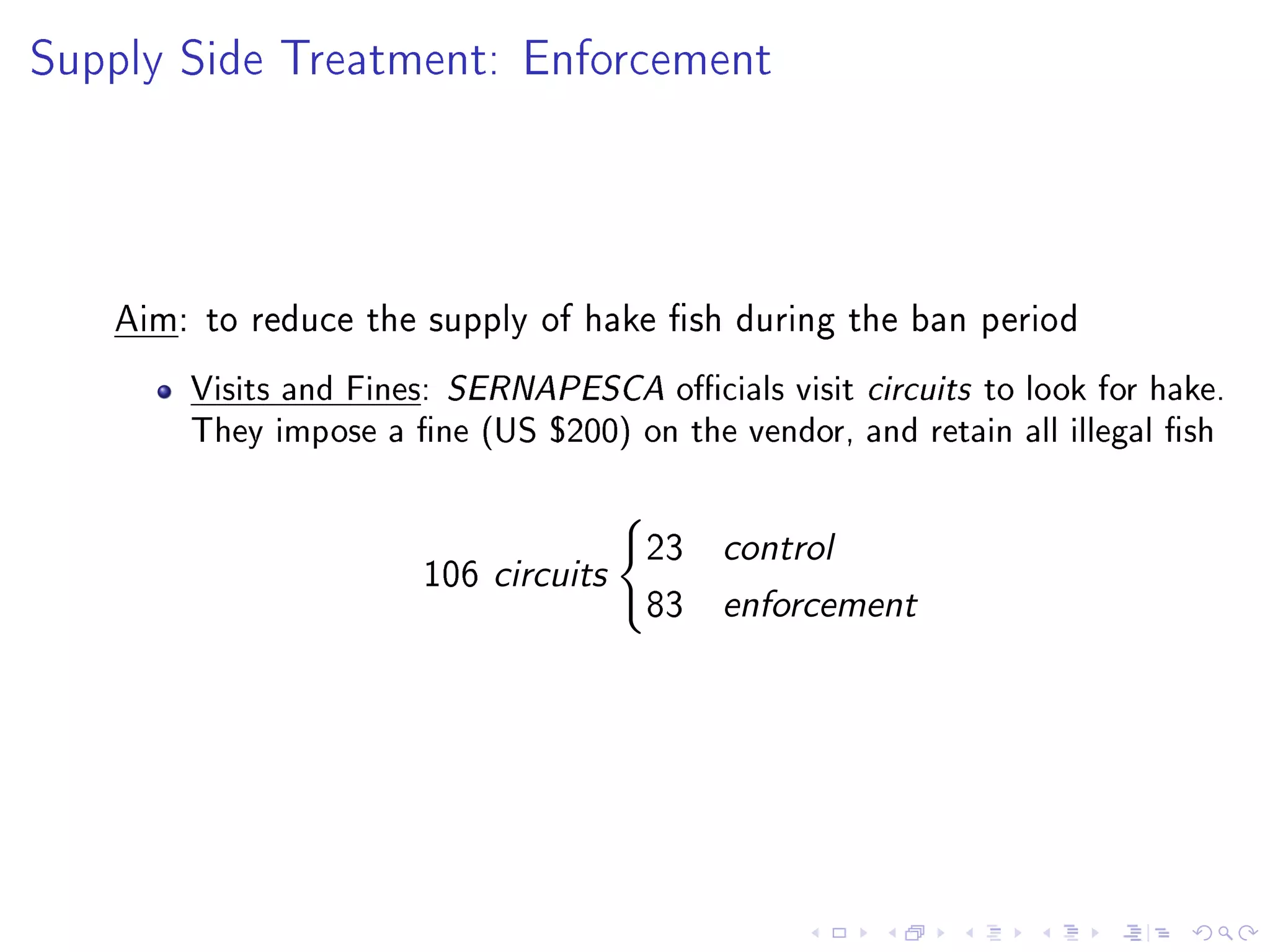
Supply Side Treatment: Enforcement
Aim: to reduce the supply of hake sh during the ban period
Visits and Fines: SERNAPESCA ocials visit circuits to look for hake.
They impose a ne (US $200) on the vendor, and retain all illegal sh
106 circuits
23 control
83 enforcement
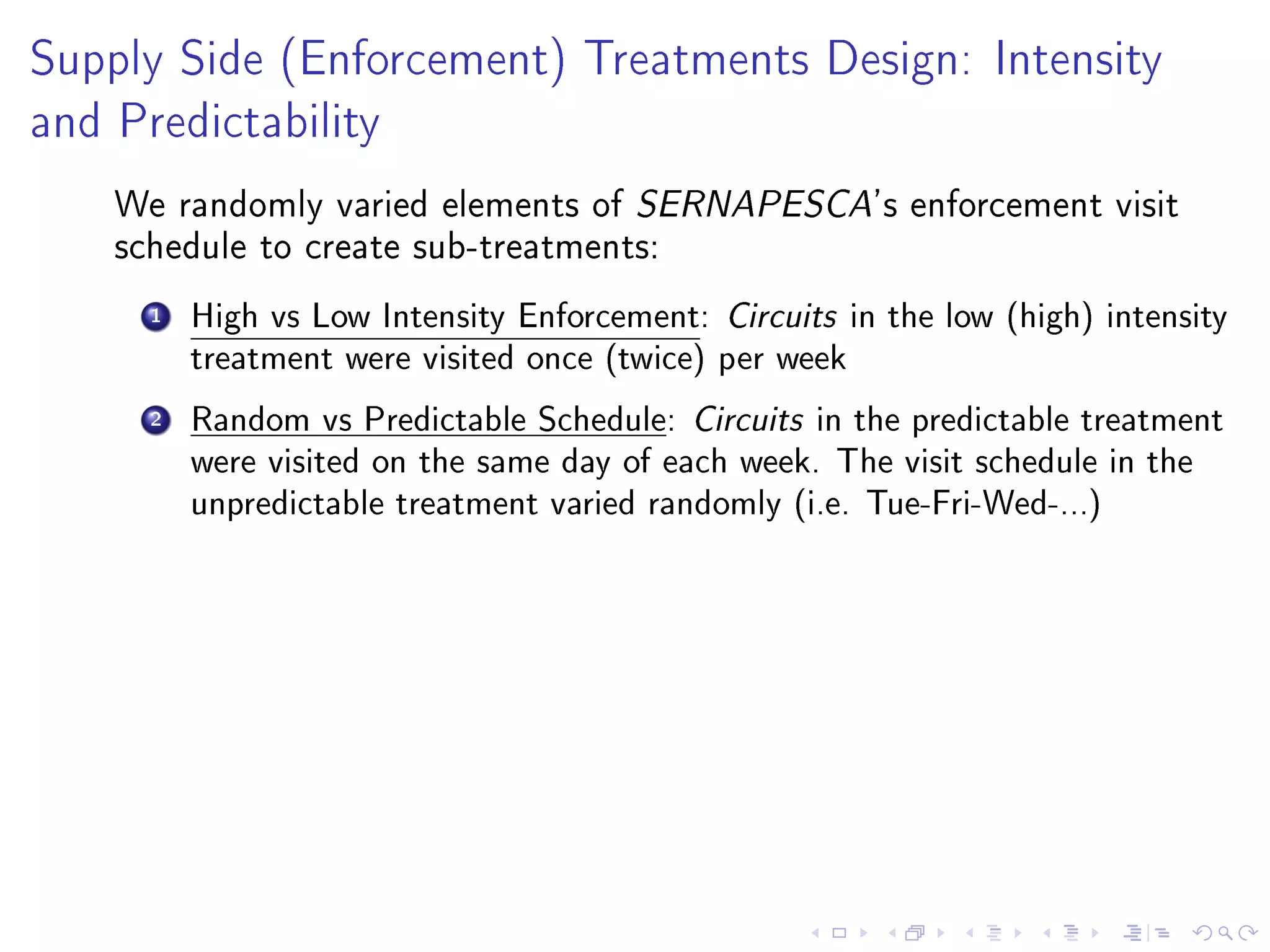
Supply Side (Enforcement) Treatments Design: Intensity
and Predictability
We randomly varied elements of SERNAPESCA's enforcement visit
schedule to create sub-treatments:
1 High vs Low Intensity Enforcement: Circuits in the low (high) intensity
treatment were visited once (twice) per week
2 Random vs Predictable Schedule: Circuits in the predictable treatment
were visited on the same day of each week. The visit schedule in the
unpredictable treatment varied randomly (i.e. Tue-Fri-Wed-...)
Supply Side (Enforcement) Treatments Design: Intensity
and Predictability
We randomly varied elements of SERNAPESCA's enforcement visit
schedule to create sub-treatments:
1 High vs Low Intensity Enforcement: Circuits in the low (high) intensity
treatment were visited once (twice) per week
2 Random vs Predictable Schedule: Circuits in the predictable treatment
were visited on the same day of each week. The visit schedule in the
unpredictable treatment varied randomly (i.e. Tue-Fri-Wed-...)
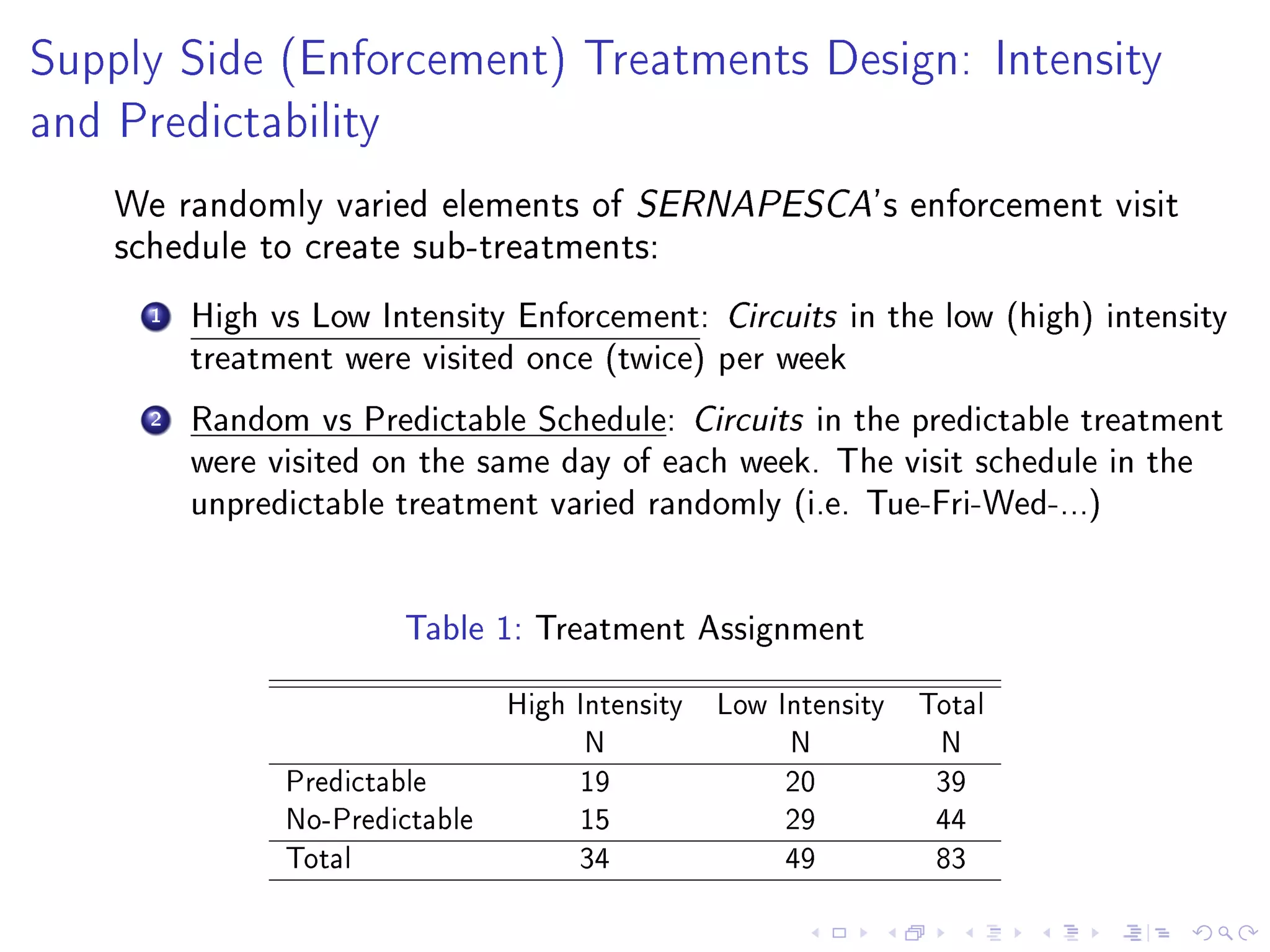
Table 1: Treatment Assignment
High Intensity Low Intensity Total
N N N
Predictable 19 20 39
No-Predictable 15 29 44
Total 34 49 83
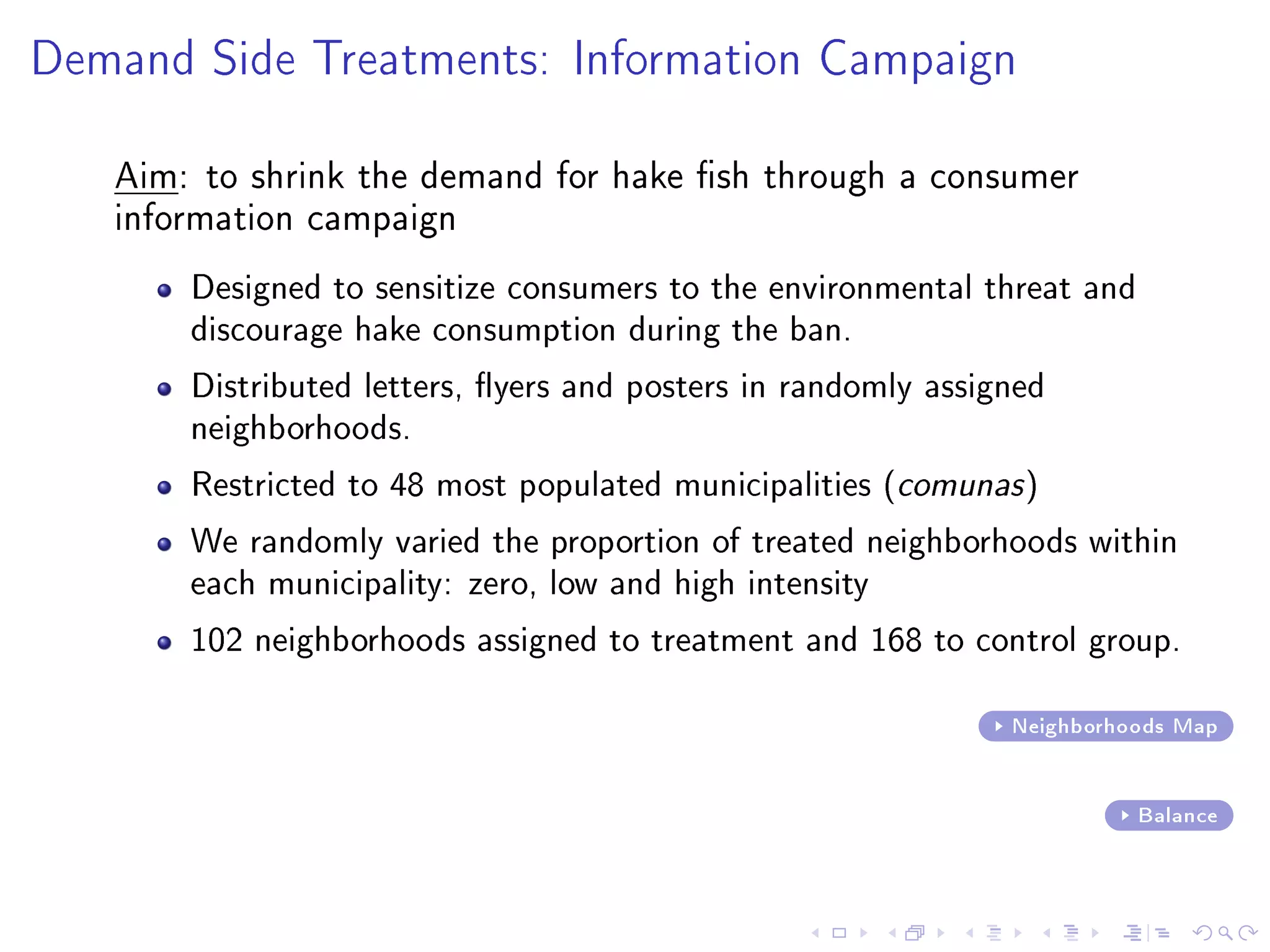
Demand Side Treatments: Information Campaign
Aim: to shrink the demand for hake sh through a consumer
information campaign
Designed to sensitize consumers to the environmental threat and
discourage hake consumption during the ban.
Distributed letters, yers and posters in randomly assigned
neighborhoods.
Restricted to 48 most populated municipalities (comunas)
We randomly varied the proportion of treated neighborhoods within
each municipality: zero, low and high intensity
102 neighborhoods assigned to treatment and 168 to control group.
Neighborhoods Map
Balance
Design of Information Campaign
Figure 3: Flyers Designed by SERNAPESCA
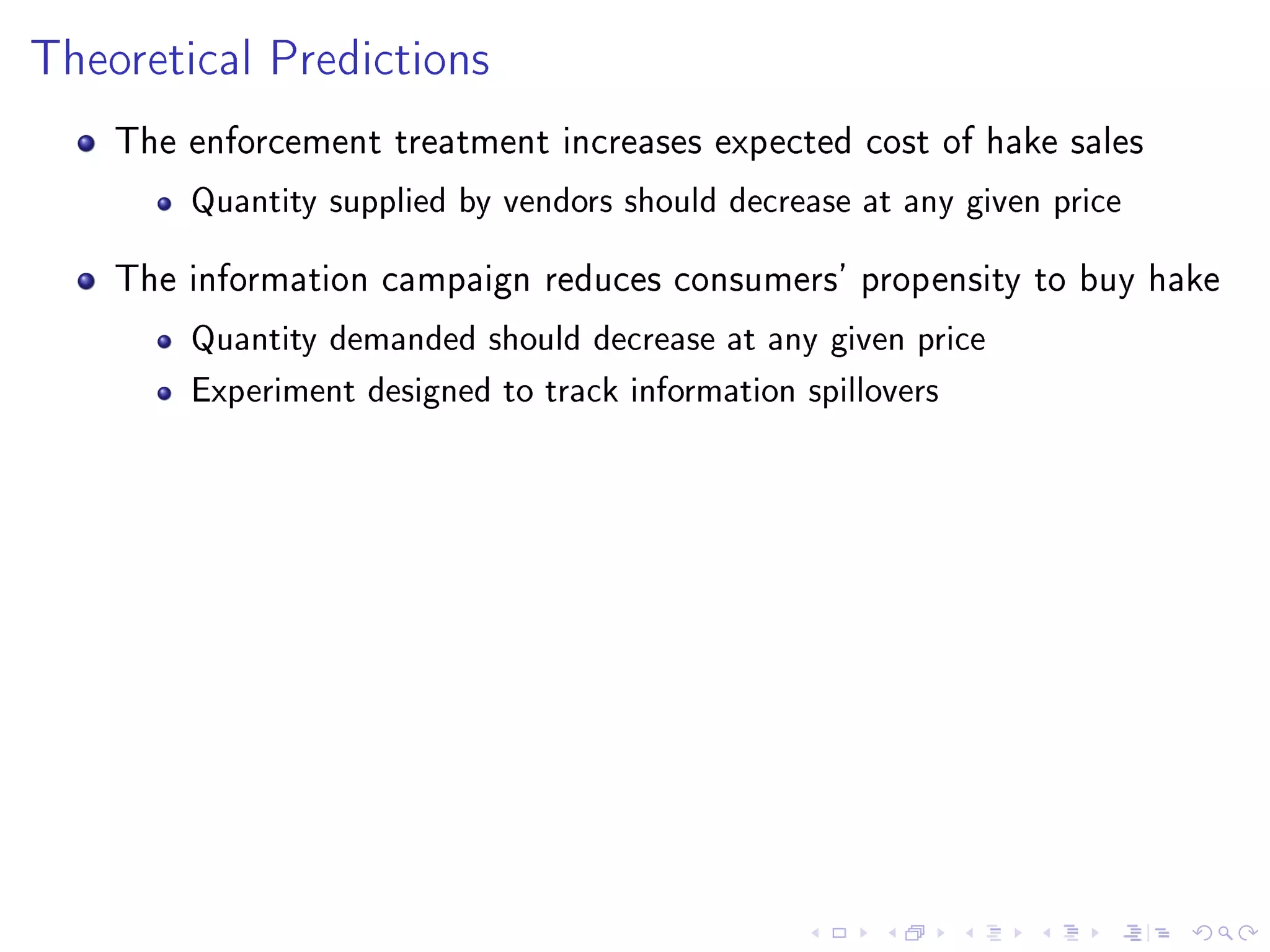
Theoretical Predictions
The enforcement treatment increases expected cost of hake sales
Quantity supplied by vendors should decrease at any given price
Theoretical Predictions
The enforcement treatment increases expected cost of hake sales
Quantity supplied by vendors should decrease at any given price
The information campaign reduces consumers' propensity to buy hake
Quantity demanded should decrease at any given price
Experiment designed to track information spillovers
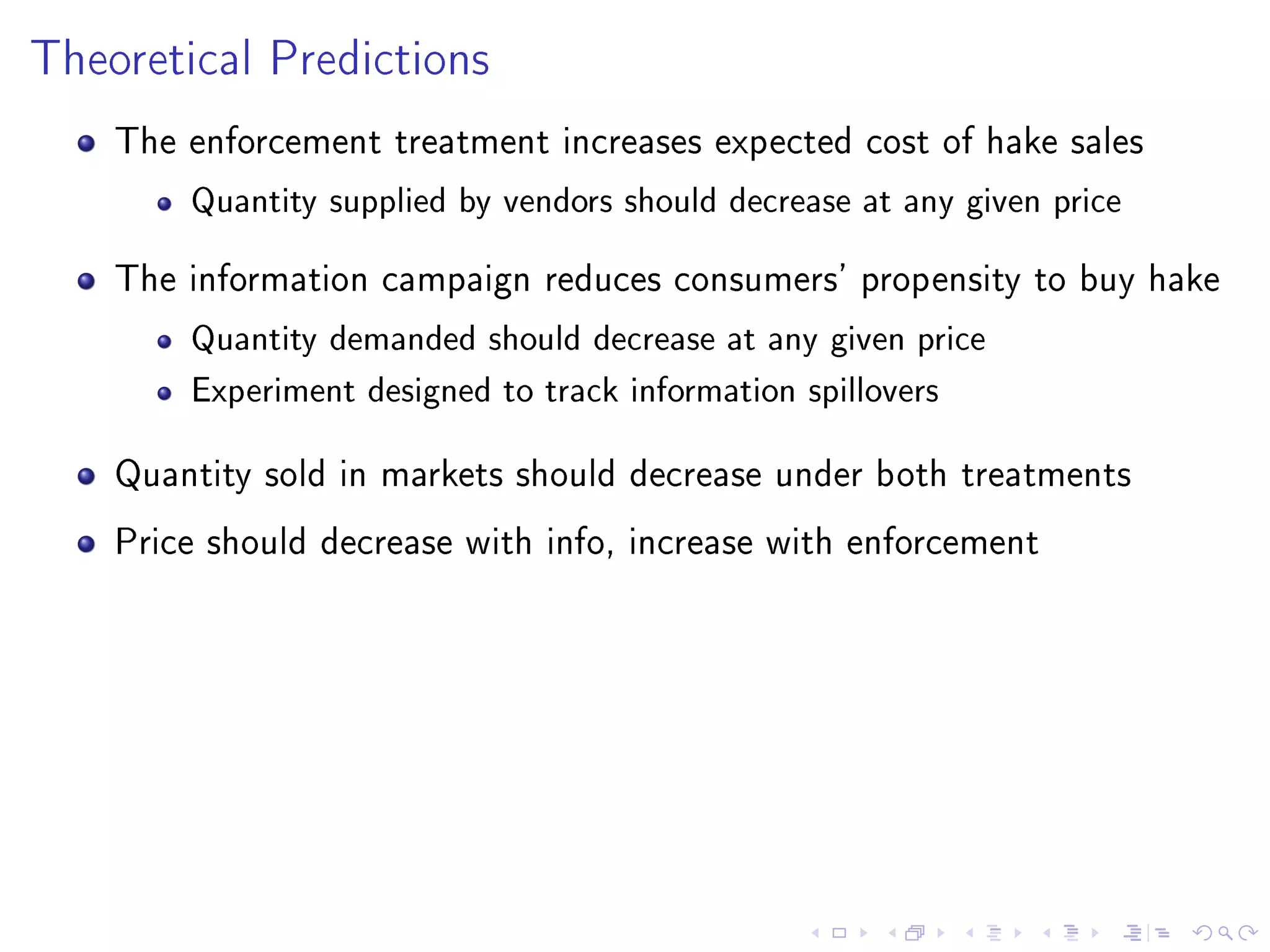
Theoretical Predictions
The enforcement treatment increases expected cost of hake sales
Quantity supplied by vendors should decrease at any given price
The information campaign reduces consumers' propensity to buy hake
Quantity demanded should decrease at any given price
Experiment designed to track information spillovers
Quantity sold in markets should decrease under both treatments
Price should decrease with info, increase with enforcement
Theoretical Predictions
The enforcement treatment increases expected cost of hake sales
Quantity supplied by vendors should decrease at any given price
The information campaign reduces consumers' propensity to buy hake
Quantity demanded should decrease at any given price
Experiment designed to track information spillovers
Quantity sold in markets should decrease under both treatments
Price should decrease with info, increase with enforcement
Enforcement variations:
Predictability: Vendors may infer the probability of receiving
enforcement based on the past schedule of visits
Intensity: vendors exposed to more frequent enforcement may
anticipate higher probability of enforcement. However, more often
interactions with enforcers may open space for learning about possible
weaknesses/loopholes of the enforcement methodology
Theoretical Predictions
Possible spill-overs:
Consumers exposed to either of these treatments may inform other
untreated consumers aecting their behavior
Treatment vendors may tell about either of these treatments to their
colleagues in control markets.
Changes in market outcomes in treatment markets may inuence the
behavior of control vendors through the upstream markets - i.e.
decrease equilibrium price inducing the control vendor to buy more hake
Data Collection
Data:
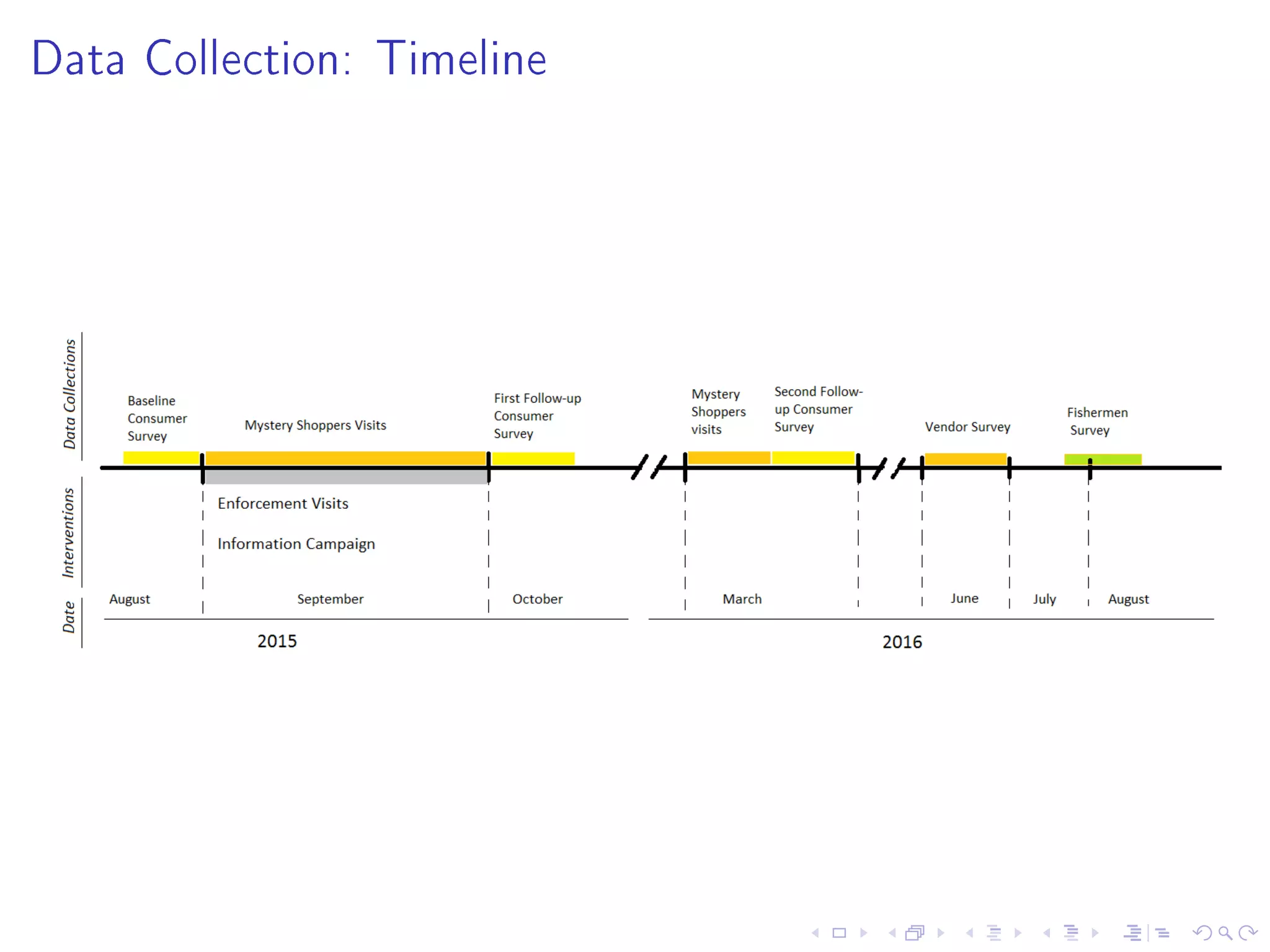
1 Mystery Shoppers: Trained surveyors who look like typical shoppers
posed as buyers who tried to purchase sh. Continuous monitoring:
Each circuit visited 3-4 times on average during Setember 2015. Two
additional rounds of visited were carried out in March 2016.
2 Consumer Survey: Asked consumers at the feria about goods
purchased in the market and prices paid, that day, and during the past
month. Baseline in August. Follow-up in October. One additional
round of surveys was collected in March 2016.
3 Vendor Survey and Fishermen Survey: To understand market features
and channels of spill-overs. One round in June 2016 (vendors) and
July-August 2016 (shermen).
Data Collection: Timeline
Data Collection: Supply Chain
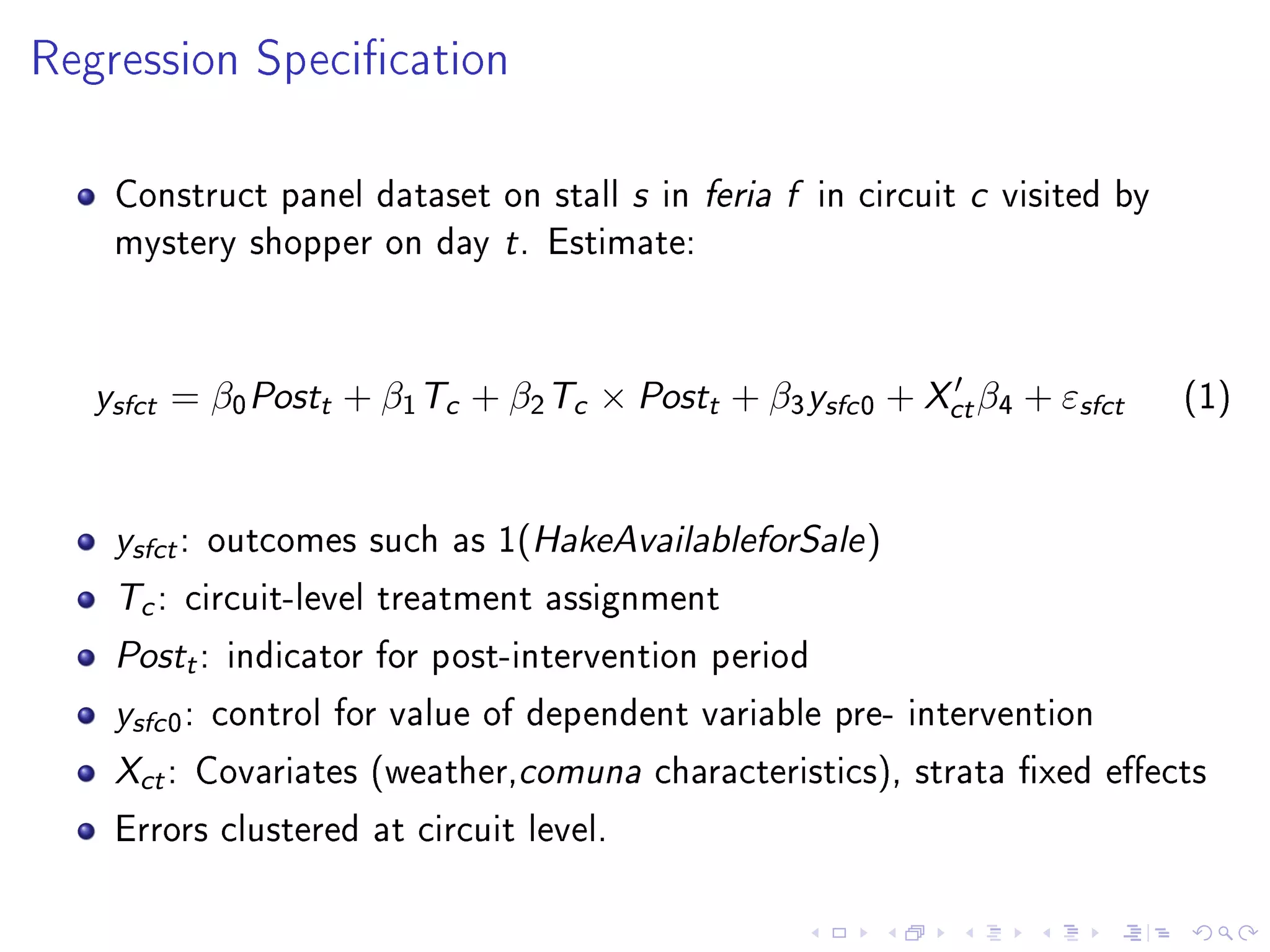
Regression Specication
Construct panel dataset on stall s in feria f in circuit c visited by
mystery shopper on day t. Estimate:
ysfct = β0Postt + β1Tc + β2Tc × Postt + β3ysfc0 + Xctβ4 + εsfct (1)
ysfct: outcomes such as 1(HakeAvailableforSale)
Tc: circuit-level treatment assignment
Postt: indicator for post-intervention period
ysfc0: control for value of dependent variable pre- intervention
Xct: Covariates (weather,comuna characteristics), strata xed eects
Errors clustered at circuit level.
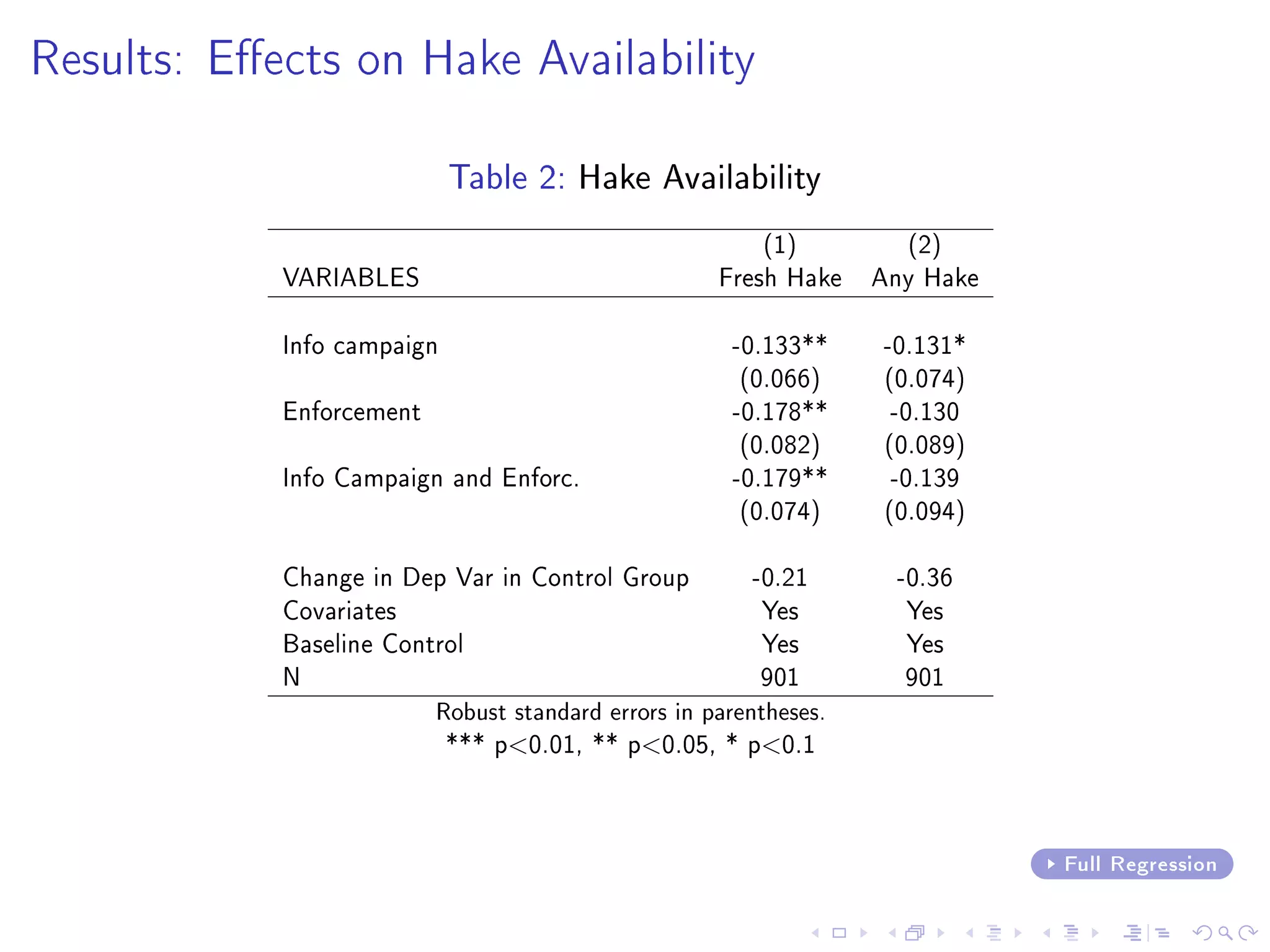
Results: Eects on Hake Availability
Table 2: Hake Availability
(1) (2)
VARIABLES Fresh Hake Any Hake
Info campaign -0.133** -0.131*
(0.066) (0.074)
Enforcement -0.178** -0.130
(0.082) (0.089)
Info Campaign and Enforc. -0.179** -0.139
(0.074) (0.094)
Change in Dep Var in Control Group -0.21 -0.36
Covariates Yes Yes
Baseline Control Yes Yes
N 901 901
Robust standard errors in parentheses.
*** p0.01, ** p0.05, * p0.1
Full Regression
Results: Vendors Reactions
Advantage of collecting data through mystery shoppers: We observe
more than government inspector
Results: Vendors Reactions
Advantage of collecting data through mystery shoppers: We observe
more than government inspector
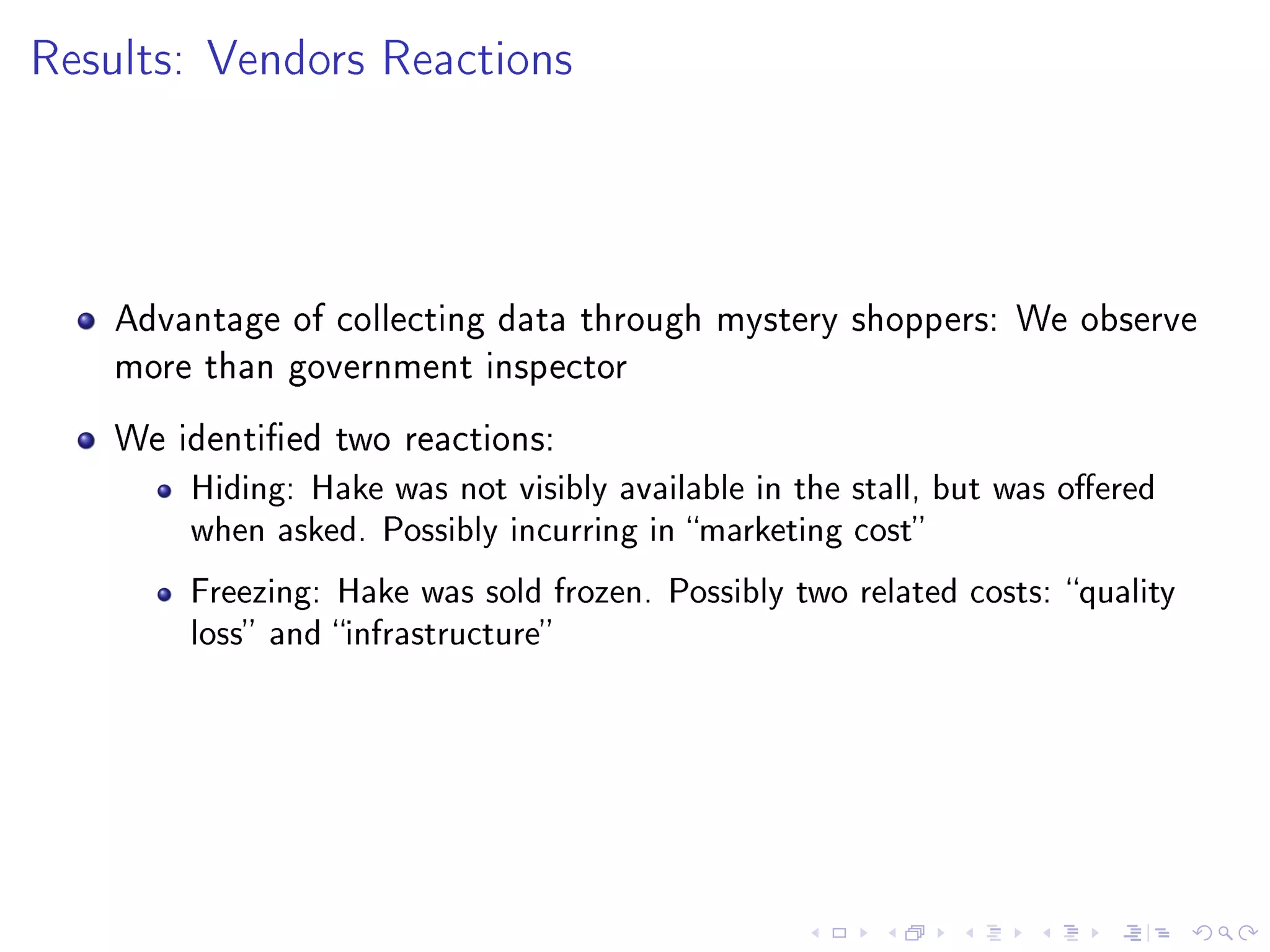
We identied two reactions:
Hiding: Hake was not visibly available in the stall, but was oered
when asked. Possibly incurring in marketing cost
Results: Vendors Reactions
Advantage of collecting data through mystery shoppers: We observe
more than government inspector
We identied two reactions:
Hiding: Hake was not visibly available in the stall, but was oered
when asked. Possibly incurring in marketing cost
Freezing: Hake was sold frozen. Possibly two related costs: quality
loss and infrastructure
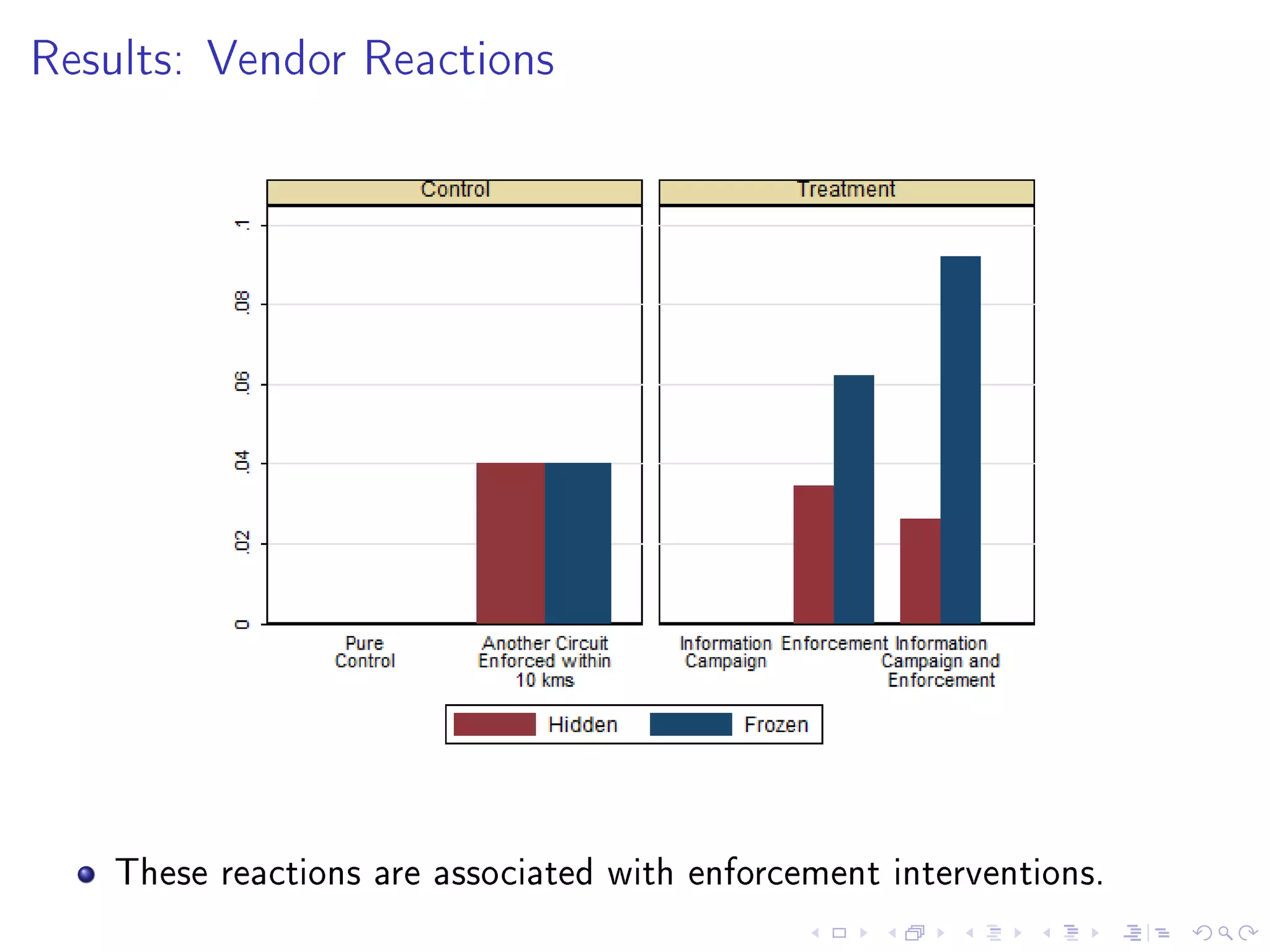
Results: Vendor Reactions
These reactions are associated with enforcement interventions.
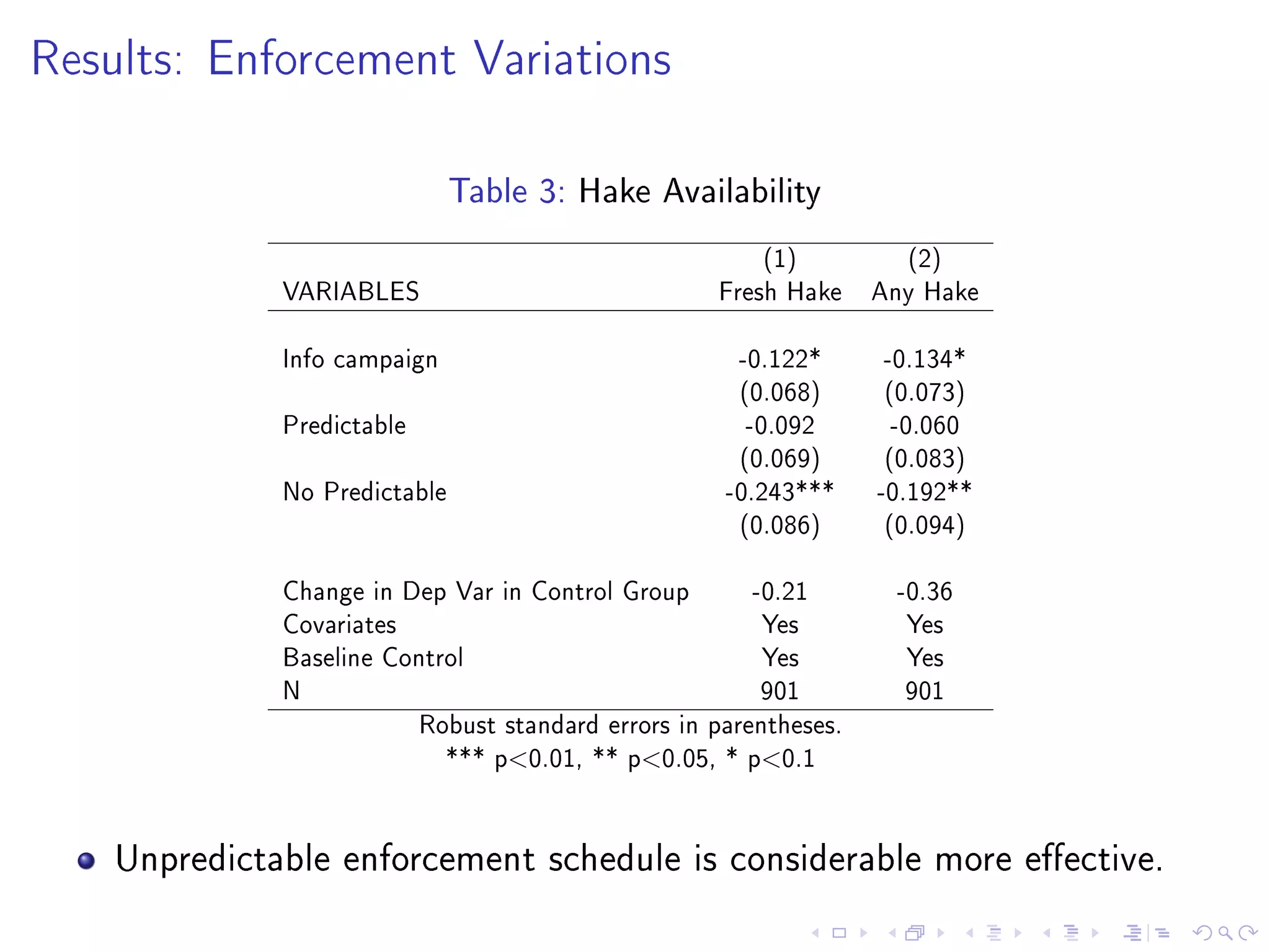
Results: Enforcement Variations
Table 3: Hake Availability
(1) (2)
VARIABLES Fresh Hake Any Hake
Info campaign -0.122* -0.134*
(0.068) (0.073)
Predictable -0.092 -0.060
(0.069) (0.083)
No Predictable -0.243*** -0.192**
(0.086) (0.094)
Change in Dep Var in Control Group -0.21 -0.36
Covariates Yes Yes
Baseline Control Yes Yes
N 901 901
Robust standard errors in parentheses.
*** p0.01, ** p0.05, * p0.1
Unpredictable enforcement schedule is considerable more eective.
Results: Enforcement Variations
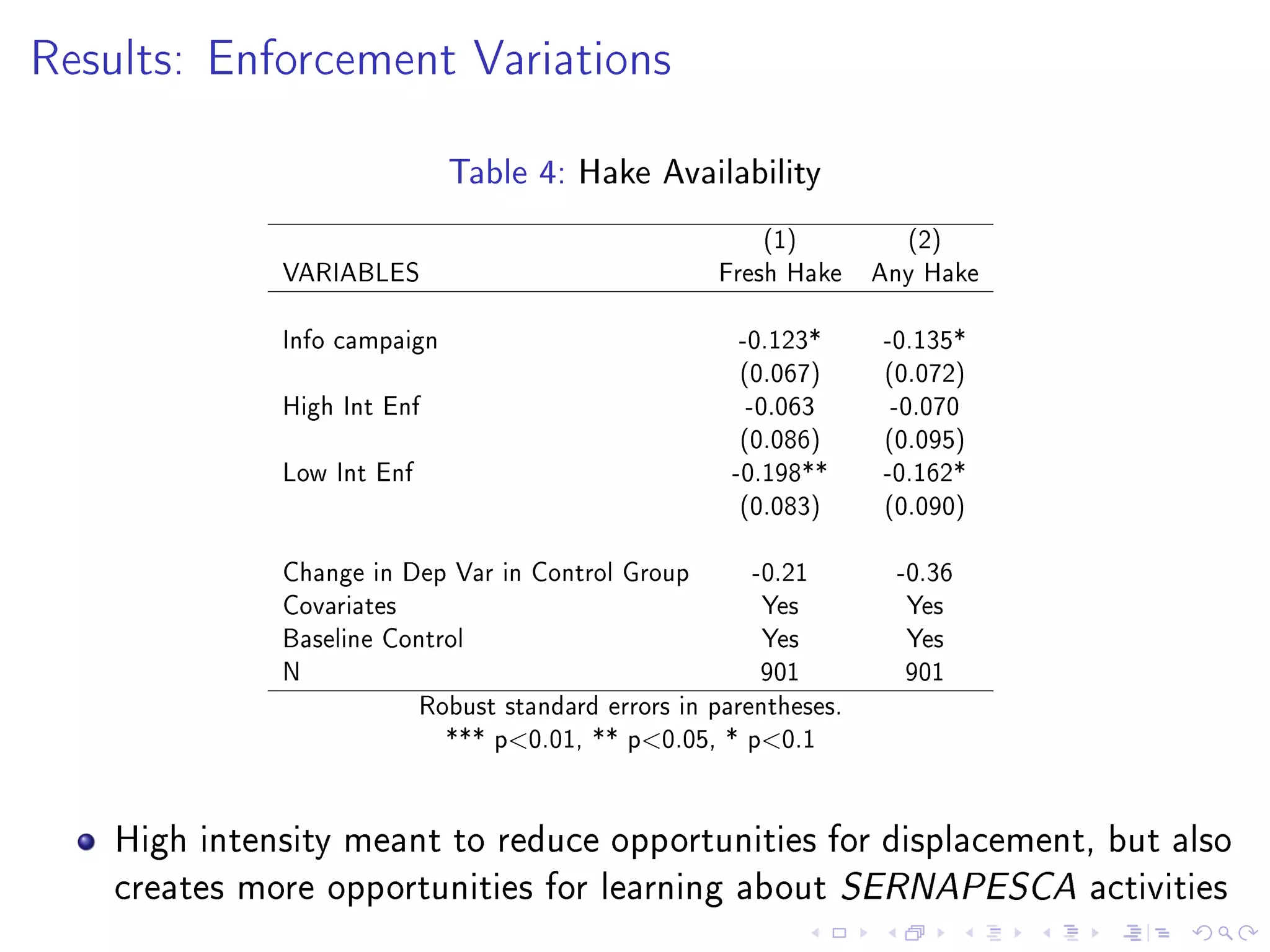
Table 4: Hake Availability
(1) (2)
VARIABLES Fresh Hake Any Hake
Info campaign -0.123* -0.135*
(0.067) (0.072)
High Int Enf -0.063 -0.070
(0.086) (0.095)
Low Int Enf -0.198** -0.162*
(0.083) (0.090)
Change in Dep Var in Control Group -0.21 -0.36
Covariates Yes Yes
Baseline Control Yes Yes
N 901 901
Robust standard errors in parentheses.
*** p0.01, ** p0.05, * p0.1
High intensity meant to reduce opportunities for displacement, but also
creates more opportunities for learning about SERNAPESCA activities
Results: Enforcement Variations
Figure 4: Hidden Hake
Most hiding occur in [High Intensity]x[Predictable] treatment
Results: Enforcement Variations
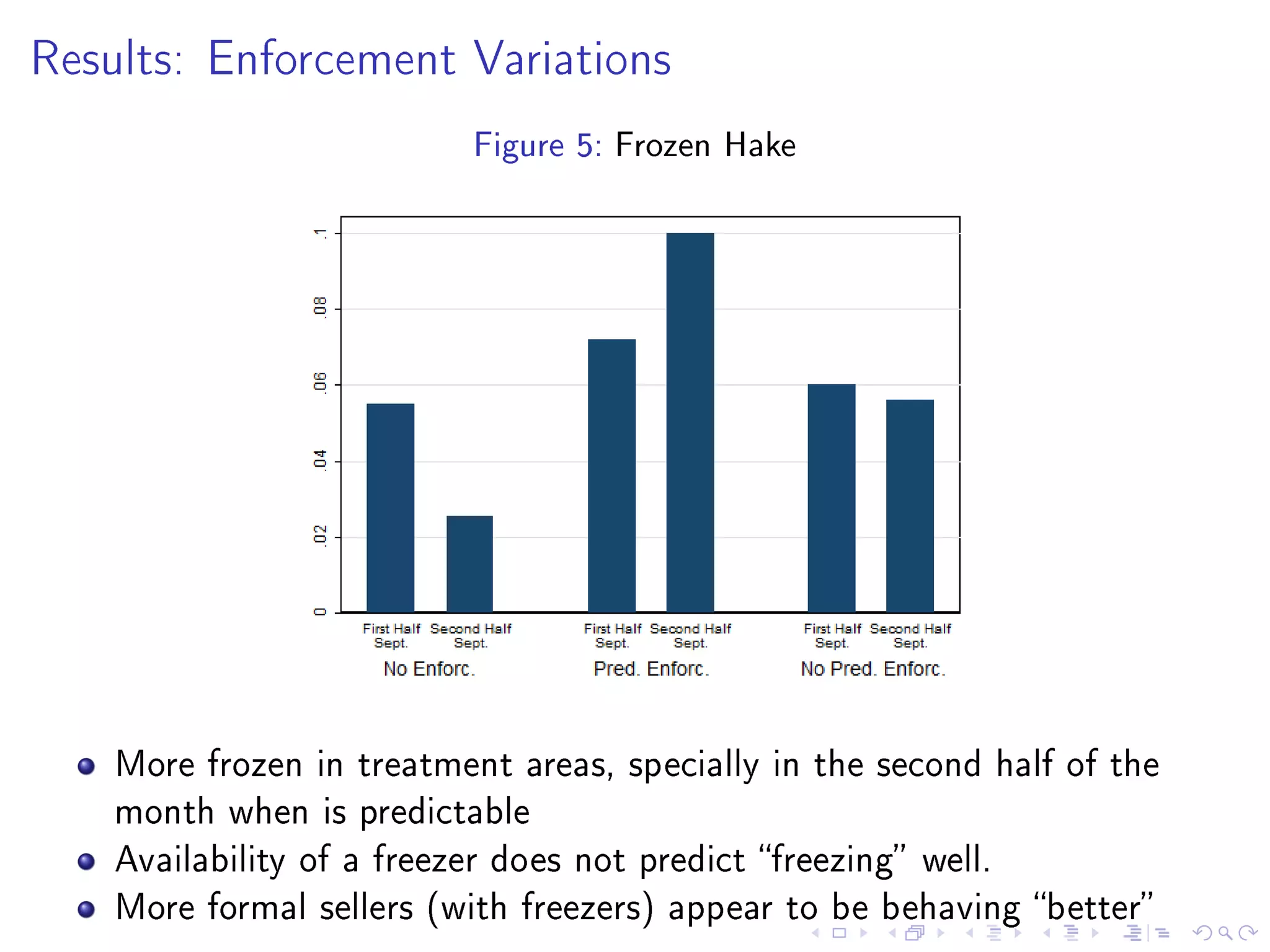
Figure 5: Frozen Hake
More frozen in treatment areas, specially in the second half of the
month when is predictable
Availability of a freezer does not predict freezing well.
More formal sellers (with freezers) appear to be behaving better
Results: Consumer Survey Results
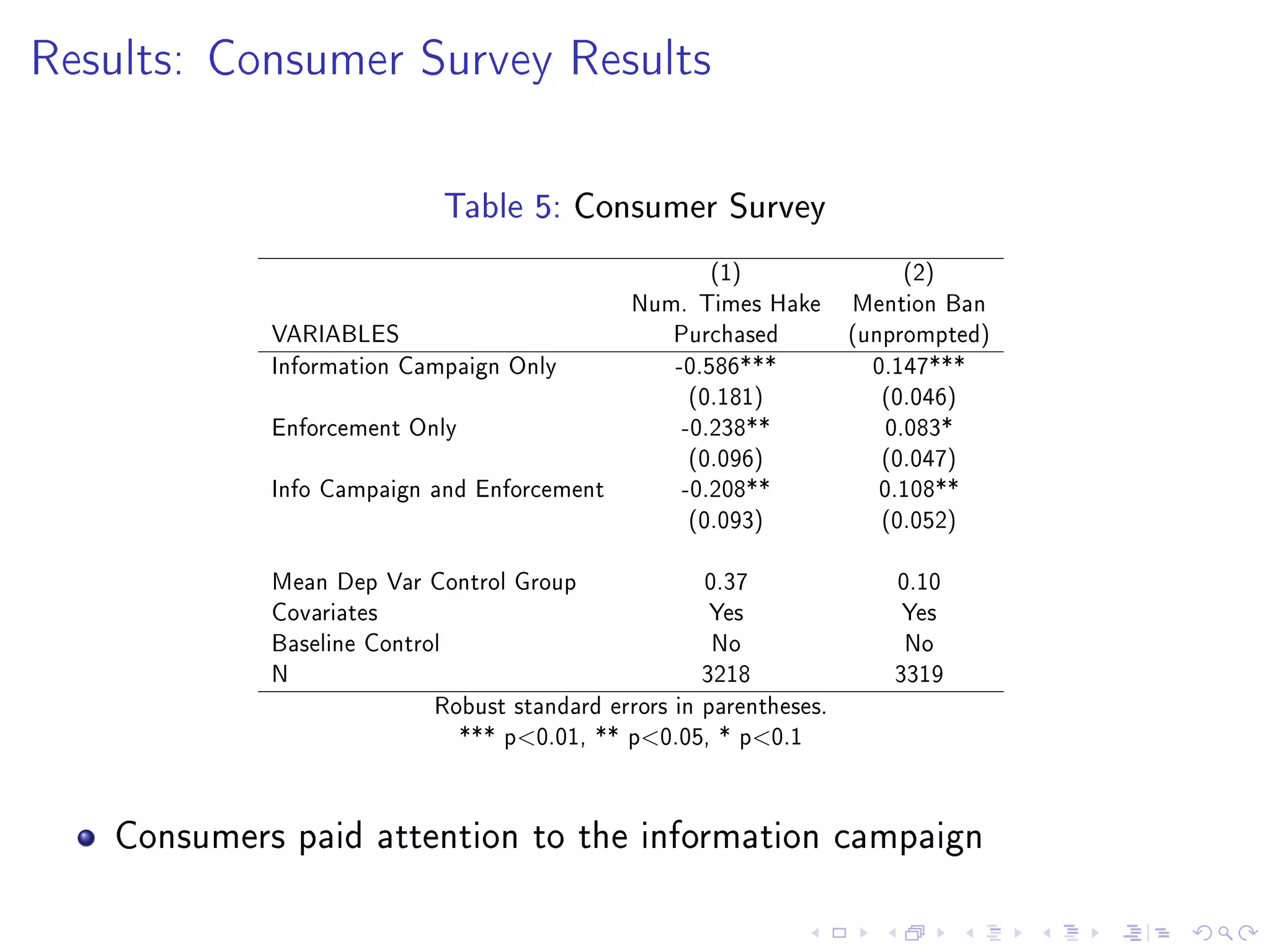
Table 5: Consumer Survey
(1) (2)
Num. Times Hake Mention Ban
VARIABLES Purchased (unprompted)
Information Campaign Only -0.586*** 0.147***
(0.181) (0.046)
Enforcement Only -0.238** 0.083*
(0.096) (0.047)
Info Campaign and Enforcement -0.208** 0.108**
(0.093) (0.052)
Mean Dep Var Control Group 0.37 0.10
Covariates Yes Yes
Baseline Control No No
N 3218 3319
Robust standard errors in parentheses.
*** p0.01, ** p0.05, * p0.1
Consumers paid attention to the information campaign
Results: Spill-Overs
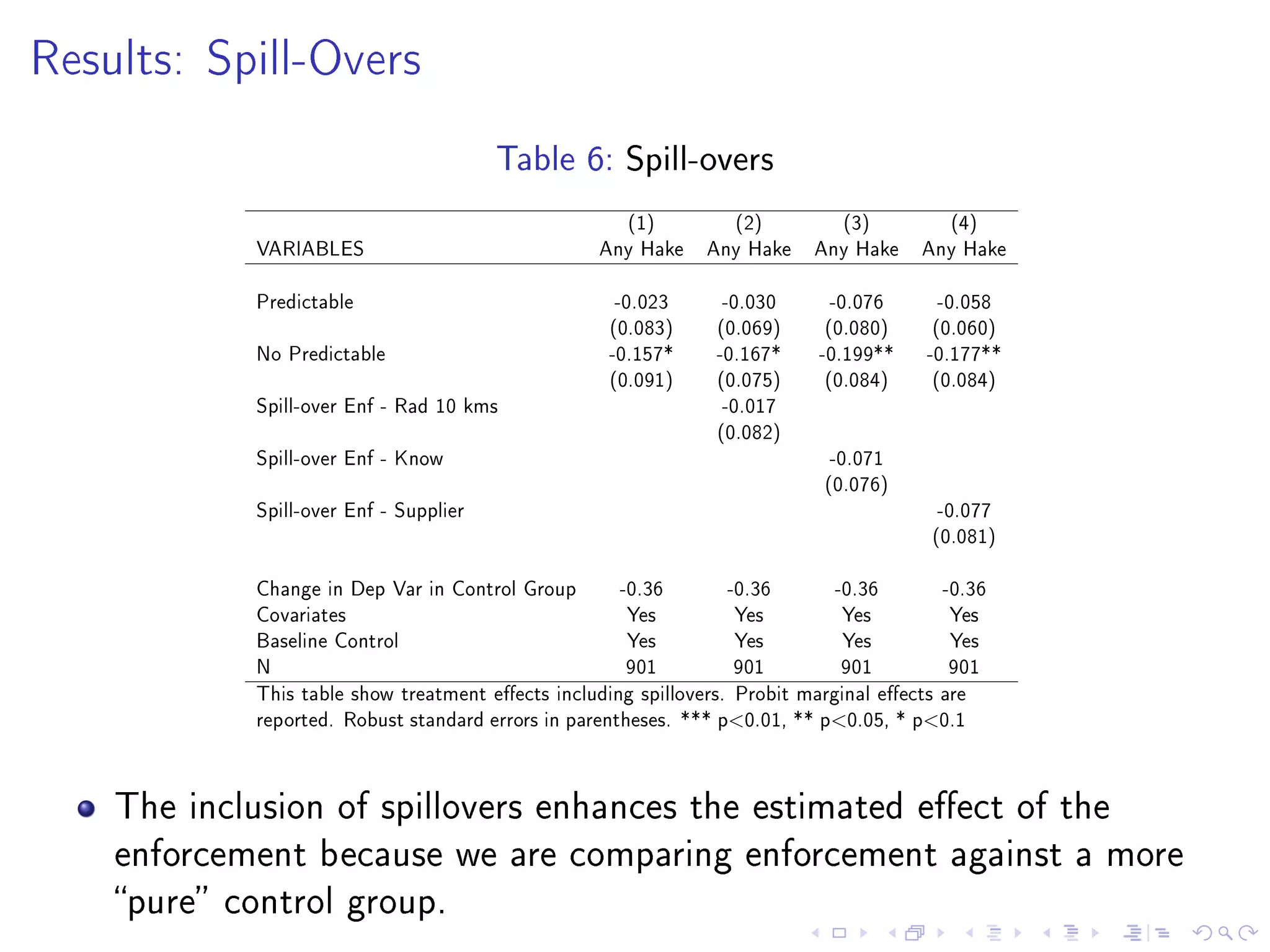
Table 6: Spill-overs
(1) (2) (3) (4)
VARIABLES Any Hake Any Hake Any Hake Any Hake
Predictable -0.023 -0.030 -0.076 -0.058
(0.083) (0.069) (0.080) (0.060)
No Predictable -0.157* -0.167* -0.199** -0.177**
(0.091) (0.075) (0.084) (0.084)
Spill-over Enf - Rad 10 kms -0.017
(0.082)
Spill-over Enf - Know -0.071
(0.076)
Spill-over Enf - Supplier -0.077
(0.081)
Change in Dep Var in Control Group -0.36 -0.36 -0.36 -0.36
Covariates Yes Yes Yes Yes
Baseline Control Yes Yes Yes Yes
N 901 901 901 901
This table show treatment eects including spillovers. Probit marginal eects are
reported. Robust standard errors in parentheses. *** p0.01, ** p0.05, * p0.1
The inclusion of spillovers enhances the estimated eect of the
enforcement because we are comparing enforcement against a more
pure control group.
Results: Treatment Eect Transmission Along the Supply
Chain
Table 7: Fishermen Survey
(1) (2) (3)
Earned Less in Feria Vendors buy Consumers are
VARIABLES Sept 15 than less Hake in Sep15 informed of
Sept 14 compared to Sept 14 Hake Ban
At least one circuit Enforced 0.323*** 0.195 0.009
(0.105) (0.303) (0.161)
Info Campaign 0.120 -0.049 0.364*
(0.158) (0.334) (0.192)
At least one circuit E. and I.C. 0.451*** 0.626* 0.217
(0.131) (0.329) (0.201)
Mean Dep Var Control 0.31 0.40 0.77
Covariates Yes Yes Yes
N 202 179 217
Standard errors in parentheses.
*** p0.01, ** p0.05, * p0.1
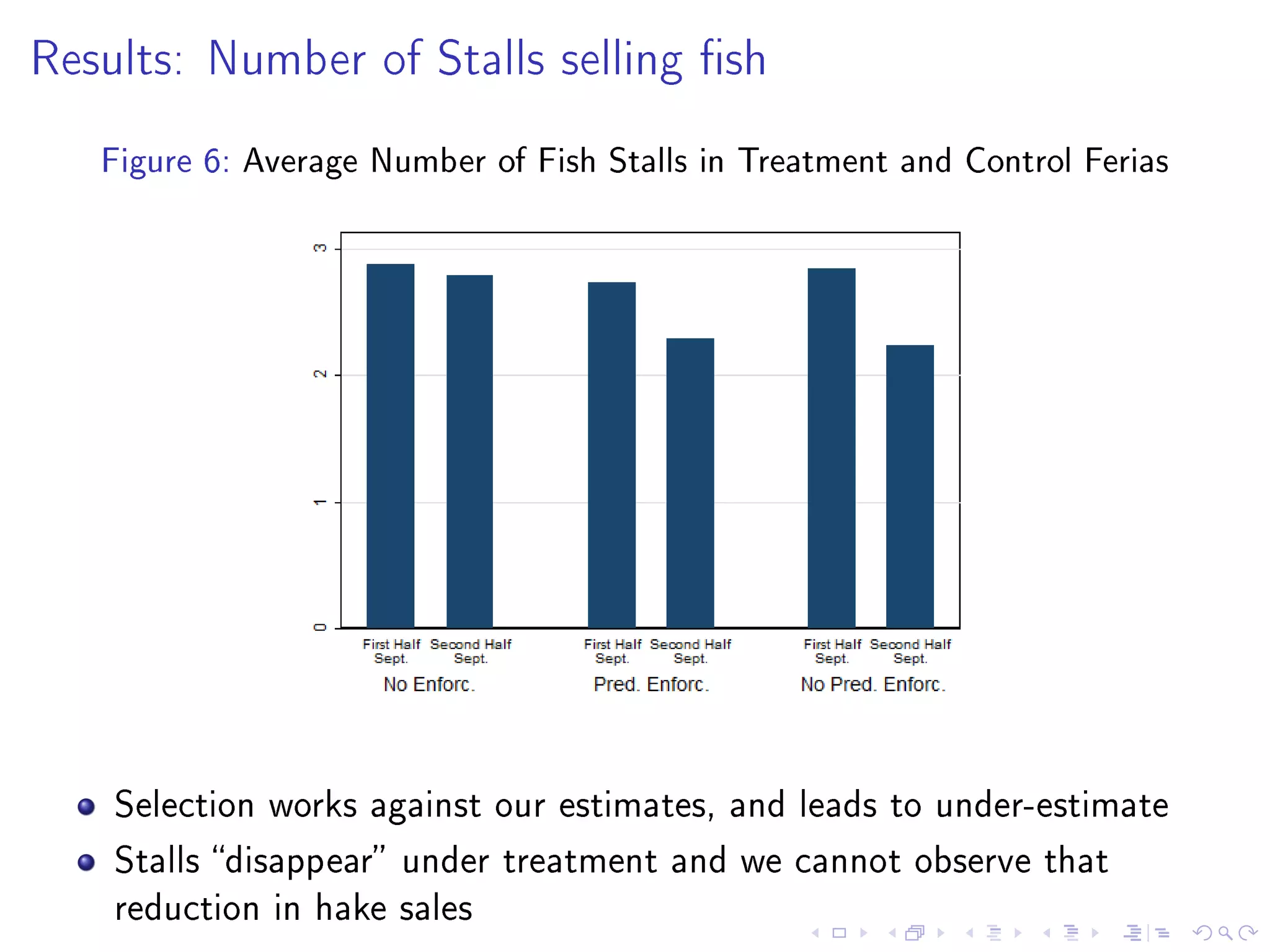
Results: Number of Stalls selling sh
Figure 6: Average Number of Fish Stalls in Treatment and Control Ferias
Selection works against our estimates, and leads to under-estimate
Stalls disappear under treatment and we cannot observe that
reduction in hake sales
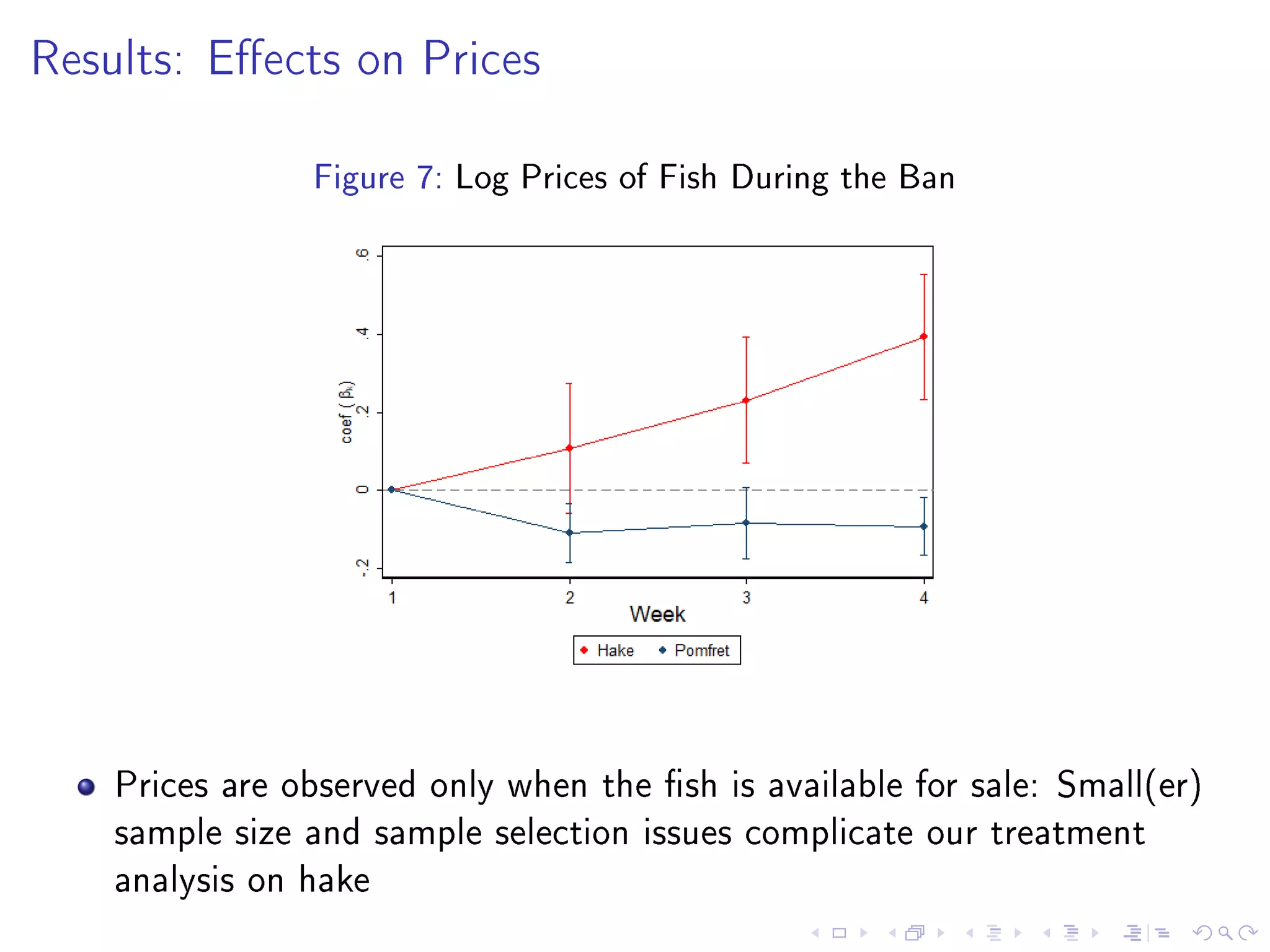
Results: Eects on Prices
Figure 7: Log Prices of Fish During the Ban
Prices are observed only when the sh is available for sale: Small(er)
sample size and sample selection issues complicate our treatment
analysis on hake
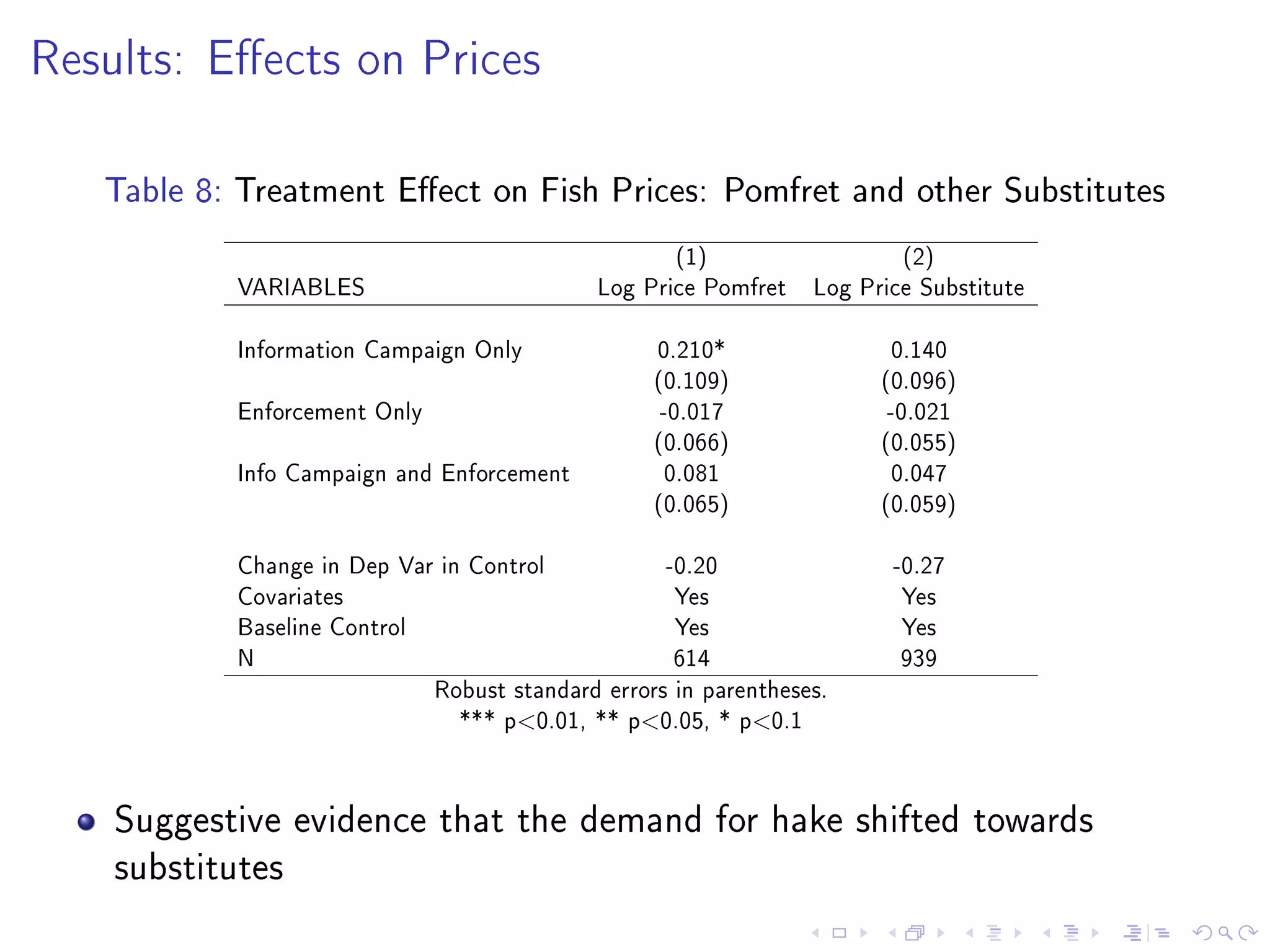
Results: Eects on Prices
Table 8: Treatment Eect on Fish Prices: Pomfret and other Substitutes
(1) (2)
VARIABLES Log Price Pomfret Log Price Substitute
Information Campaign Only 0.210* 0.140
(0.109) (0.096)
Enforcement Only -0.017 -0.021
(0.066) (0.055)
Info Campaign and Enforcement 0.081 0.047
(0.065) (0.059)
Change in Dep Var in Control -0.20 -0.27
Covariates Yes Yes
Baseline Control Yes Yes
N 614 939
Robust standard errors in parentheses.
*** p0.01, ** p0.05, * p0.1
Suggestive evidence that the demand for hake shifted towards
substitutes
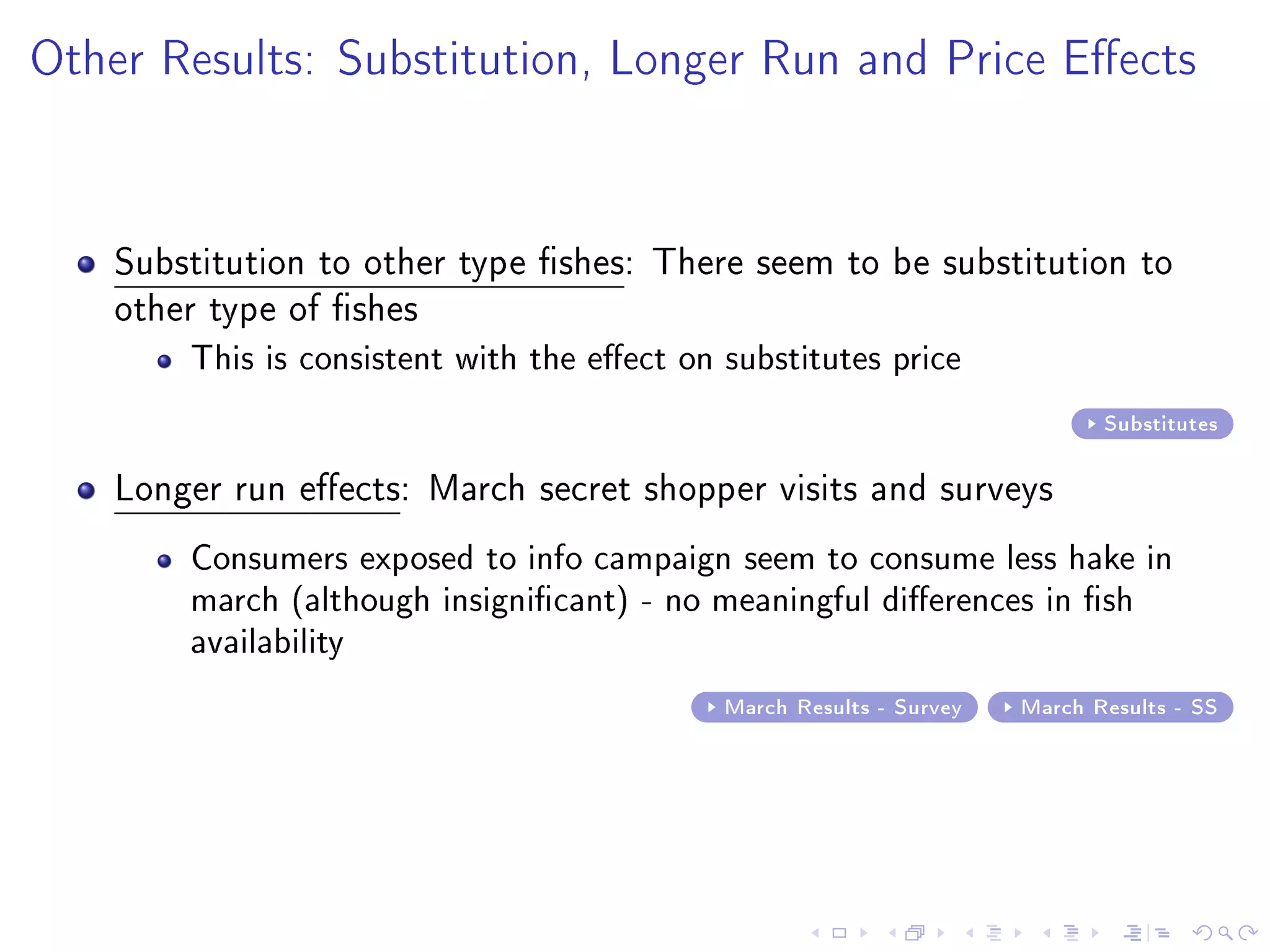
Other Results: Substitution, Longer Run and Price Eects
Substitution to other type shes: There seem to be substitution to
other type of shes
This is consistent with the eect on substitutes price
Substitutes
Longer run eects: March secret shopper visits and surveys
Consumers exposed to info campaign seem to consume less hake in
march (although insignicant) - no meaningful dierences in sh
availability
March Results - Survey March Results - SS
Cost-Eectiveness of Enforcement vs. Information
What's the best use of (limited) public resources to protect hake
populations?
Cost-Eectiveness of Enforcement vs. Information
What's the best use of (limited) public resources to protect hake
populations?
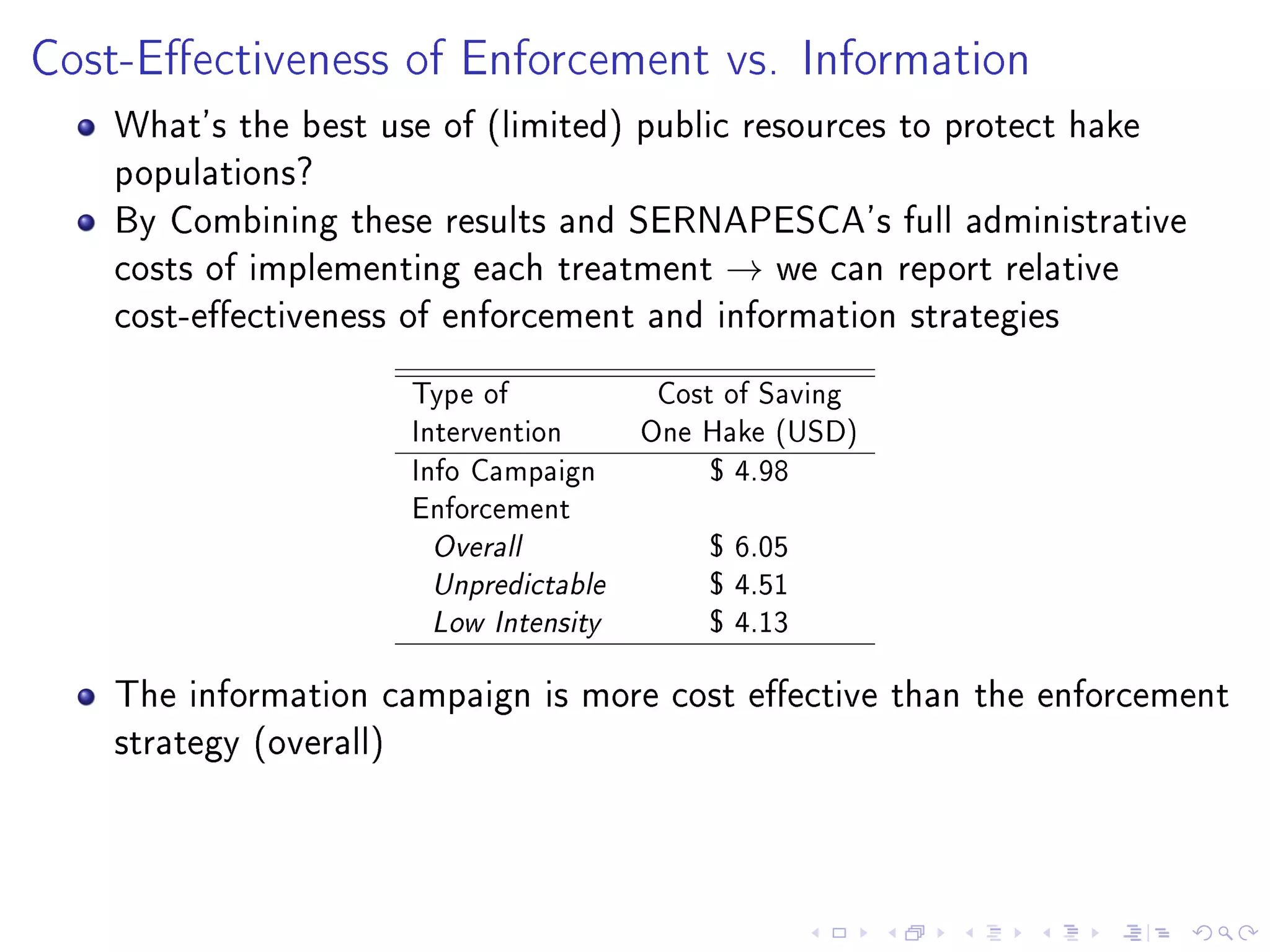
By Combining these results and SERNAPESCA's full administrative
costs of implementing each treatment → we can report relative
cost-eectiveness of enforcement and information strategies
Cost-Eectiveness of Enforcement vs. Information
What's the best use of (limited) public resources to protect hake
populations?
By Combining these results and SERNAPESCA's full administrative
costs of implementing each treatment → we can report relative
cost-eectiveness of enforcement and information strategies
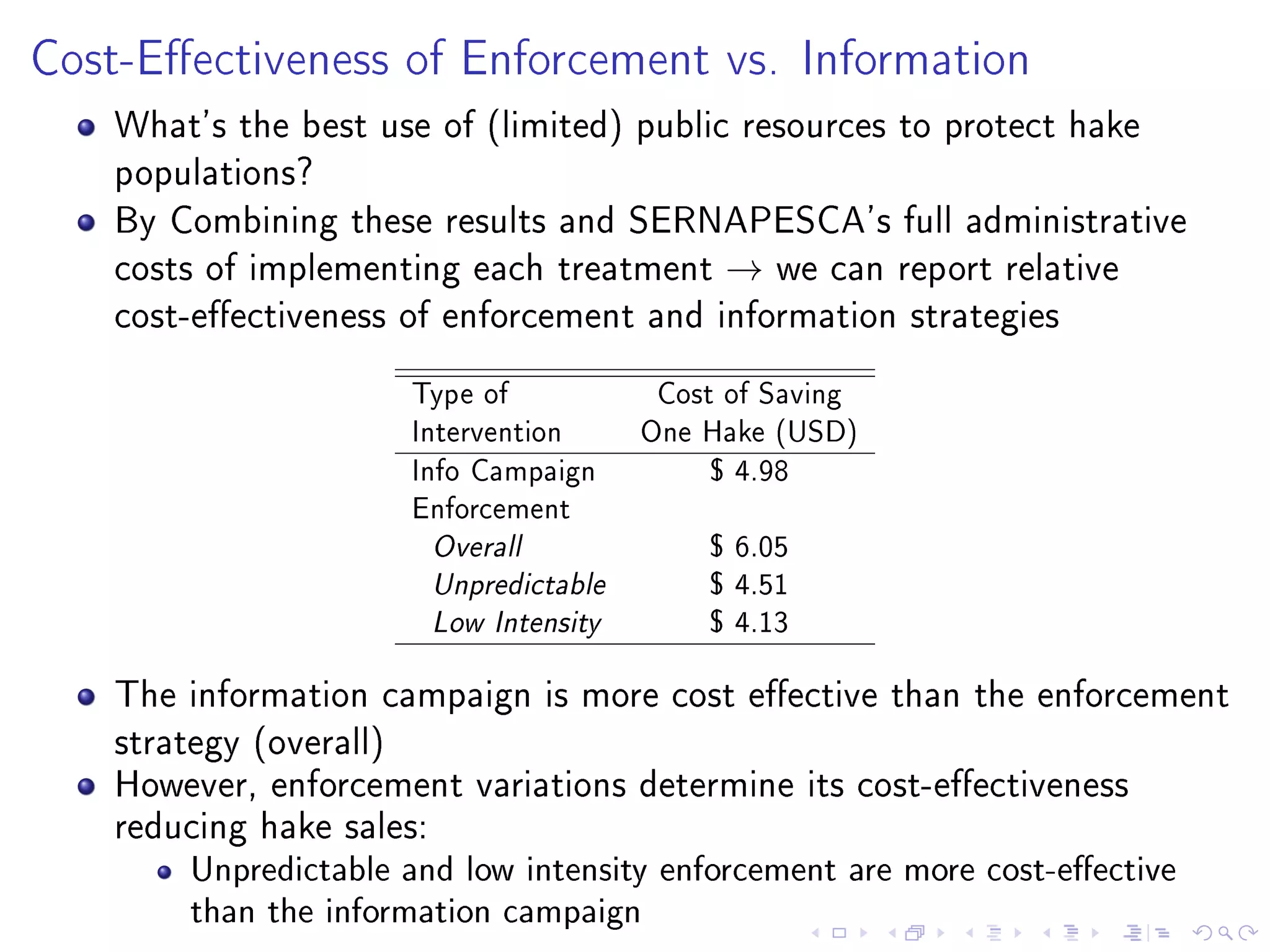
Type of Cost of Saving
Intervention One Hake (USD)
Info Campaign $ 4.98
Enforcement
Overall $ 6.05
Unpredictable $ 4.51
Low Intensity $ 4.13
The information campaign is more cost eective than the enforcement
strategy (overall)
Cost-Eectiveness of Enforcement vs. Information
What's the best use of (limited) public resources to protect hake
populations?
By Combining these results and SERNAPESCA's full administrative
costs of implementing each treatment → we can report relative
cost-eectiveness of enforcement and information strategies
Type of Cost of Saving
Intervention One Hake (USD)
Info Campaign $ 4.98
Enforcement
Overall $ 6.05
Unpredictable $ 4.51
Low Intensity $ 4.13
The information campaign is more cost eective than the enforcement
strategy (overall)
However, enforcement variations determine its cost-eectiveness
reducing hake sales:
Unpredictable and low intensity enforcement are more cost-eective
than the information campaign
Conclusions
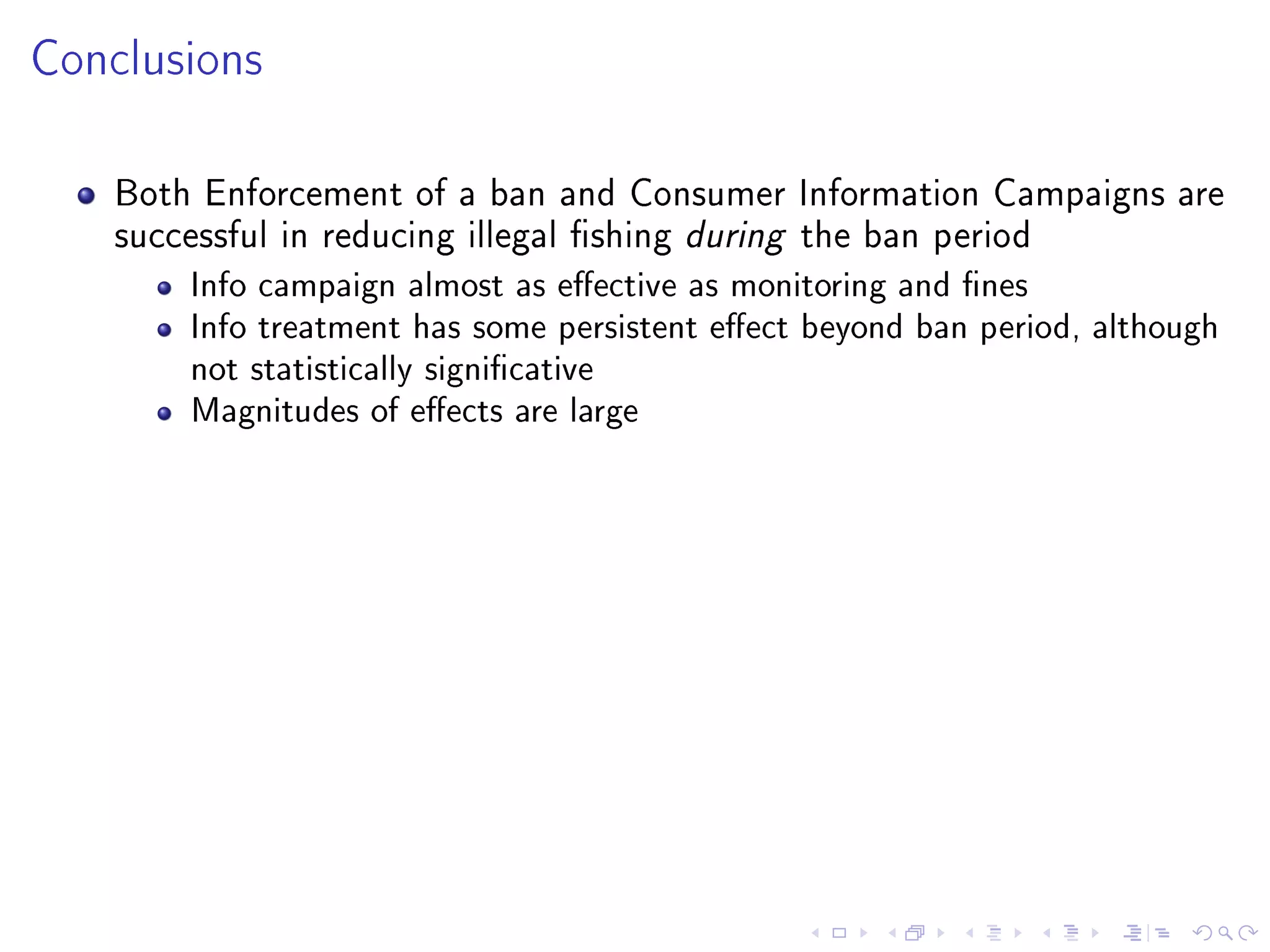
Both Enforcement of a ban and Consumer Information Campaigns are
successful in reducing illegal shing during the ban period
Info campaign almost as eective as monitoring and nes
Info treatment has some persistent eect beyond ban period, although
not statistically signicative
Magnitudes of eects are large
Conclusions
Both Enforcement of a ban and Consumer Information Campaigns are
successful in reducing illegal shing during the ban period
Info campaign almost as eective as monitoring and nes
Info treatment has some persistent eect beyond ban period, although
not statistically signicative
Magnitudes of eects are large
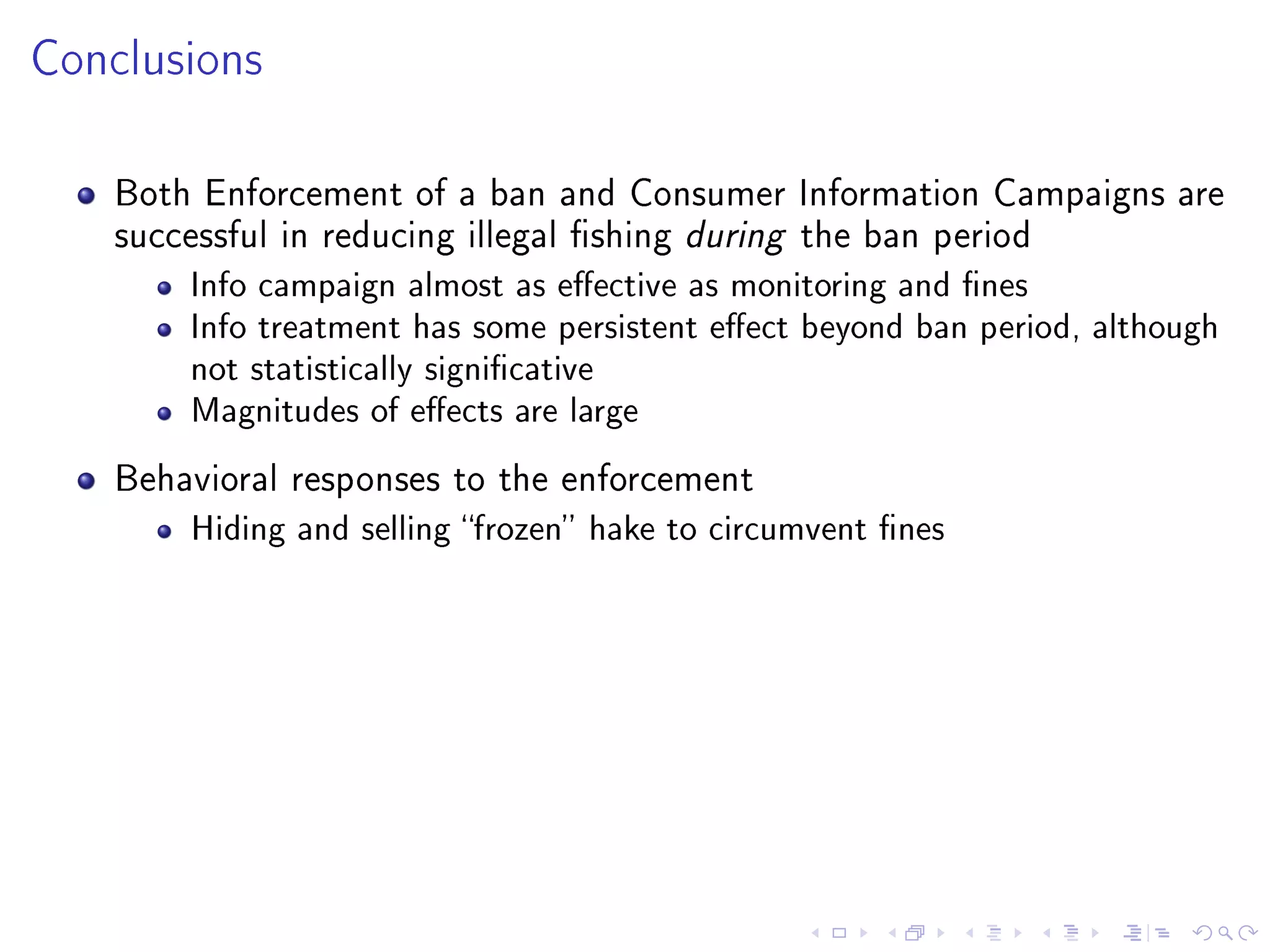
Behavioral responses to the enforcement
Hiding and selling frozen hake to circumvent nes
Conclusions
Both Enforcement of a ban and Consumer Information Campaigns are
successful in reducing illegal shing during the ban period
Info campaign almost as eective as monitoring and nes
Info treatment has some persistent eect beyond ban period, although
not statistically signicative
Magnitudes of eects are large
Behavioral responses to the enforcement
Hiding and selling frozen hake to circumvent nes
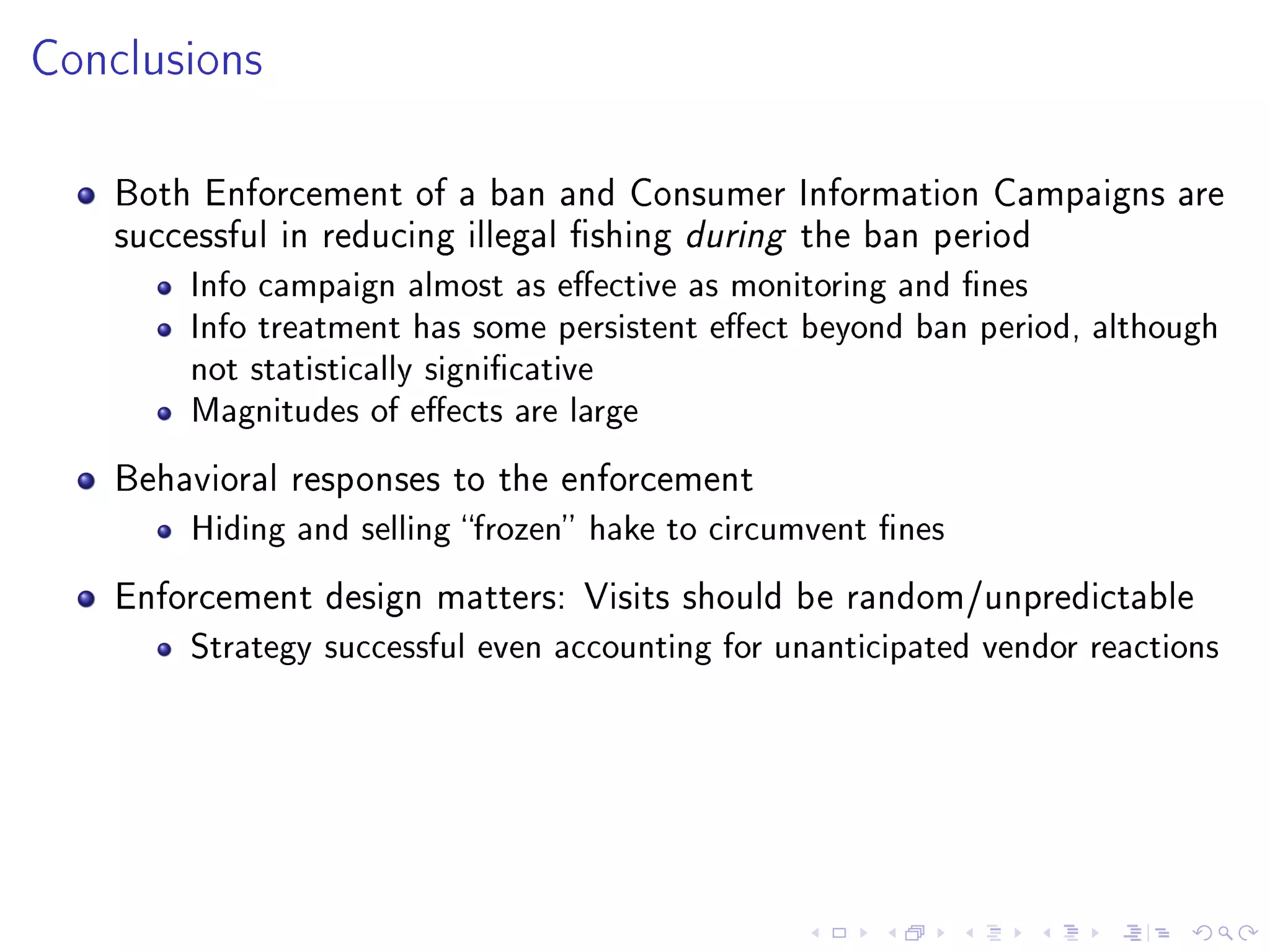
Enforcement design matters: Visits should be random/unpredictable
Strategy successful even accounting for unanticipated vendor reactions
Conclusions
Both Enforcement of a ban and Consumer Information Campaigns are
successful in reducing illegal shing during the ban period
Info campaign almost as eective as monitoring and nes
Info treatment has some persistent eect beyond ban period, although
not statistically signicative
Magnitudes of eects are large
Behavioral responses to the enforcement
Hiding and selling frozen hake to circumvent nes
Enforcement design matters: Visits should be random/unpredictable
Strategy successful even accounting for unanticipated vendor reactions
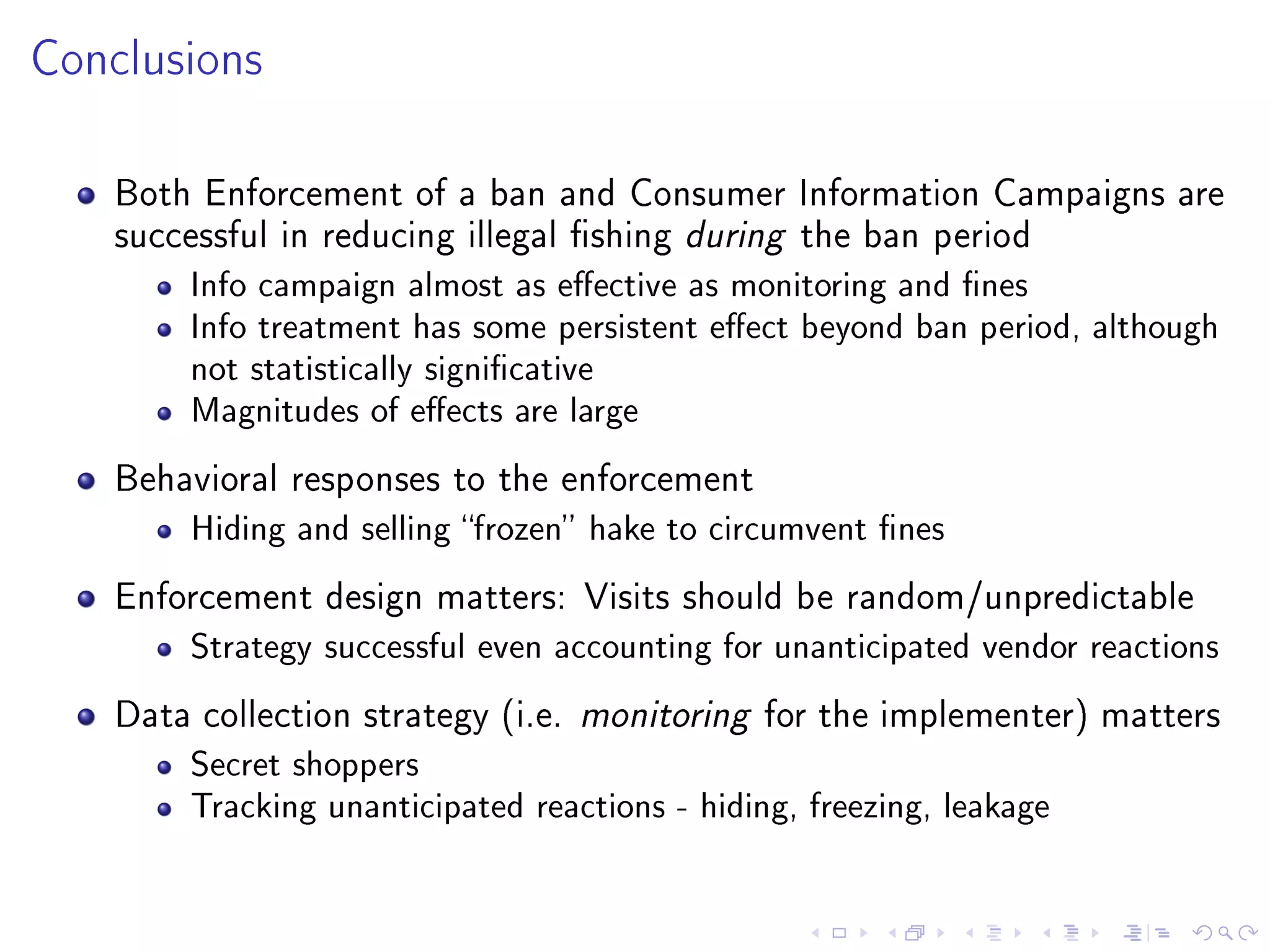
Data collection strategy (i.e. monitoring for the implementer) matters
Secret shoppers
Tracking unanticipated reactions - hiding, freezing, leakage
Implications
Enforcement strategies complicated by behavioral responses
Requires sophisticated monitoring
Unpredictable enforcement schedule reduces leakage in multiple ways
Implications
Enforcement strategies complicated by behavioral responses
Requires sophisticated monitoring
Unpredictable enforcement schedule reduces leakage in multiple ways
Information campaigns not as eective in prior studies
Eective in this middle income country, and complements enforcement
Implications
Enforcement strategies complicated by behavioral responses
Requires sophisticated monitoring
Unpredictable enforcement schedule reduces leakage in multiple ways
Information campaigns not as eective in prior studies
Eective in this middle income country, and complements enforcement
Vendors have to be even more careful when consumers are policing.
Vendors' behavioral responses to enforcement more complicated if
consumers are also aware. e.g. hide from both consumers and monitors
Implication: Perhaps involve and incentivize consumers to do policing?
Thank you!
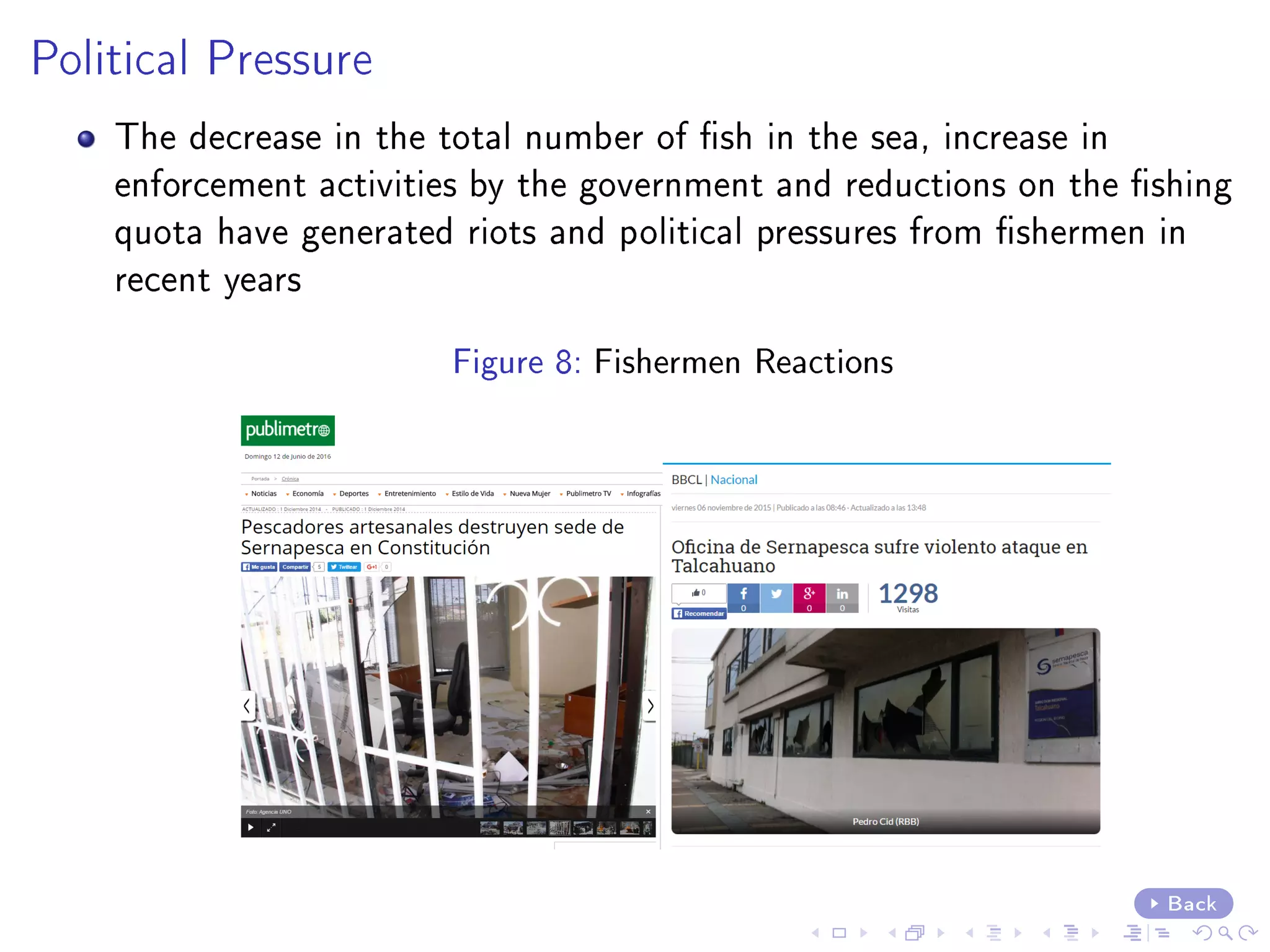
Political Pressure
The decrease in the total number of sh in the sea, increase in
enforcement activities by the government and reductions on the shing
quota have generated riots and political pressures from shermen in
recent years
Figure 8: Fishermen Reactions
Back
Caleta Characteristics
Coastal regions in the sample include 74 caletas.
Each caleta is composed by a group of shermen, organized by 1 or 2
unions.
70% of these caletas have less than 60 boats. 24% have lass than 10
boats.
Each shing boat is managed by 2 or 3 shermen.
91% of the boats are less than 10 mts long.
Back - Context
Example of Circuit
Each circuit covers a delimited geographic area within a municipality.
If the municipality has more than one circuit, they cover dierent
geographic areas (no overlapping)
Figure 9: Ferias within a circuit
Back
Map of Fishermen Villages and Markets
Figure 10: Map of Chile
Back
Example Neighborhoods
Figure 11: Example Neighborhood division
Back
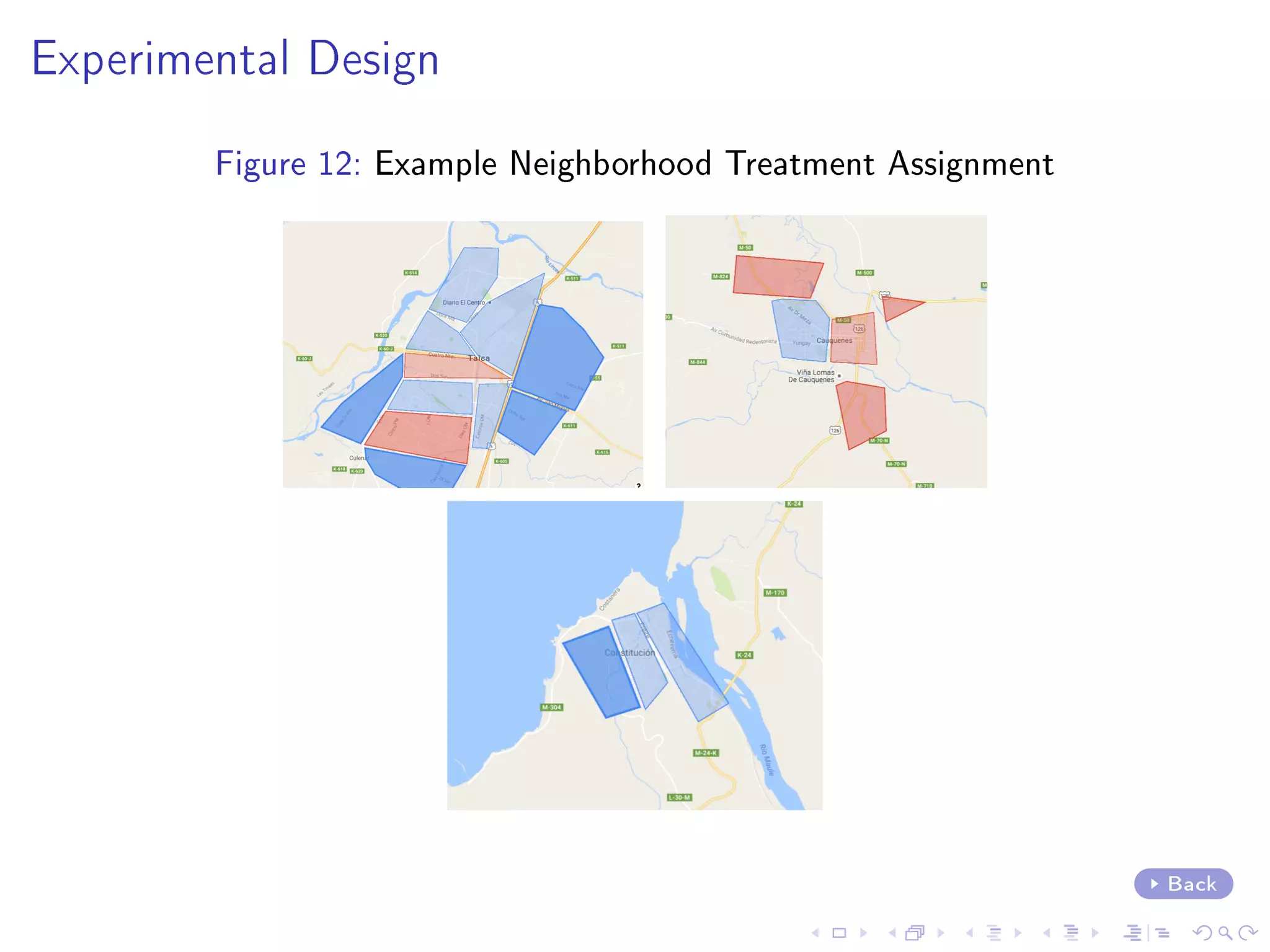
Experimental Design
Figure 12: Example Neighborhood Treatment Assignment
Back
Balance
Table 9: Balance
(1) (2) (3) (4) (5) (6) (7)
Variable Control Info Campaign Enforcement Enforc. and Info Camp.
Mean Mean Di Mean Di Mean Di
Indicator Fixed Stalls 0.573 0.644 0.083 0.489 -0.069 0.509 0.013
( 0.497) ( 0.484) [ 0.740] ( 0.501) [ 0.574] ( 0.501) [ 0.920]
Distance to Closest Caleta (kms) 16.507 11.572 3.465 14.863 -3.606 26.425 2.245
( 25.082) ( 9.503) [ 0.516] ( 22.626) [ 0.386] ( 29.037) [ 0.682]
Poverty Rate Municipality 19.006 17.567 -2.148 18.026 -1.079 16.734 -0.316
( 4.780) ( 3.313) [ 0.244] ( 5.483) [ 0.412] ( 7.549) [ 0.851]
Av. Monthly Income Municipality (USD) 791.767 875.475 18.446 790.514 -2.506 830.683 20.464
( 149.808) ( 172.858) [ 0.846] ( 140.334) [ 0.953] ( 139.251) [ 0.673]
Deliquency Rate Municipality 0.038 0.029 -0.013** 0.036 -0.001 0.034 -0.004
( 0.015) ( 0.002) [ 0.016] ( 0.015) [ 0.835] ( 0.009) [ 0.480]
Rain Indicator 0.290 0.133 -0.124 0.178 -0.114 0.142 -0.122
( 0.456) ( 0.344) [ 0.455] ( 0.383) [ 0.318] ( 0.349) [ 0.301]
Average Temperature (Celsius) 12.200 12.126 0.081 11.993 -0.192 11.936 -0.688
( 2.281) ( 2.087) [ 0.942] ( 2.021) [ 0.797] ( 2.196) [ 0.346]
Joint Signicance
F statistic 0.609 1.094 0.816
p-value 0.747 0.371 0.575
*** p0.01, ** p0.05, * p0.1
Back
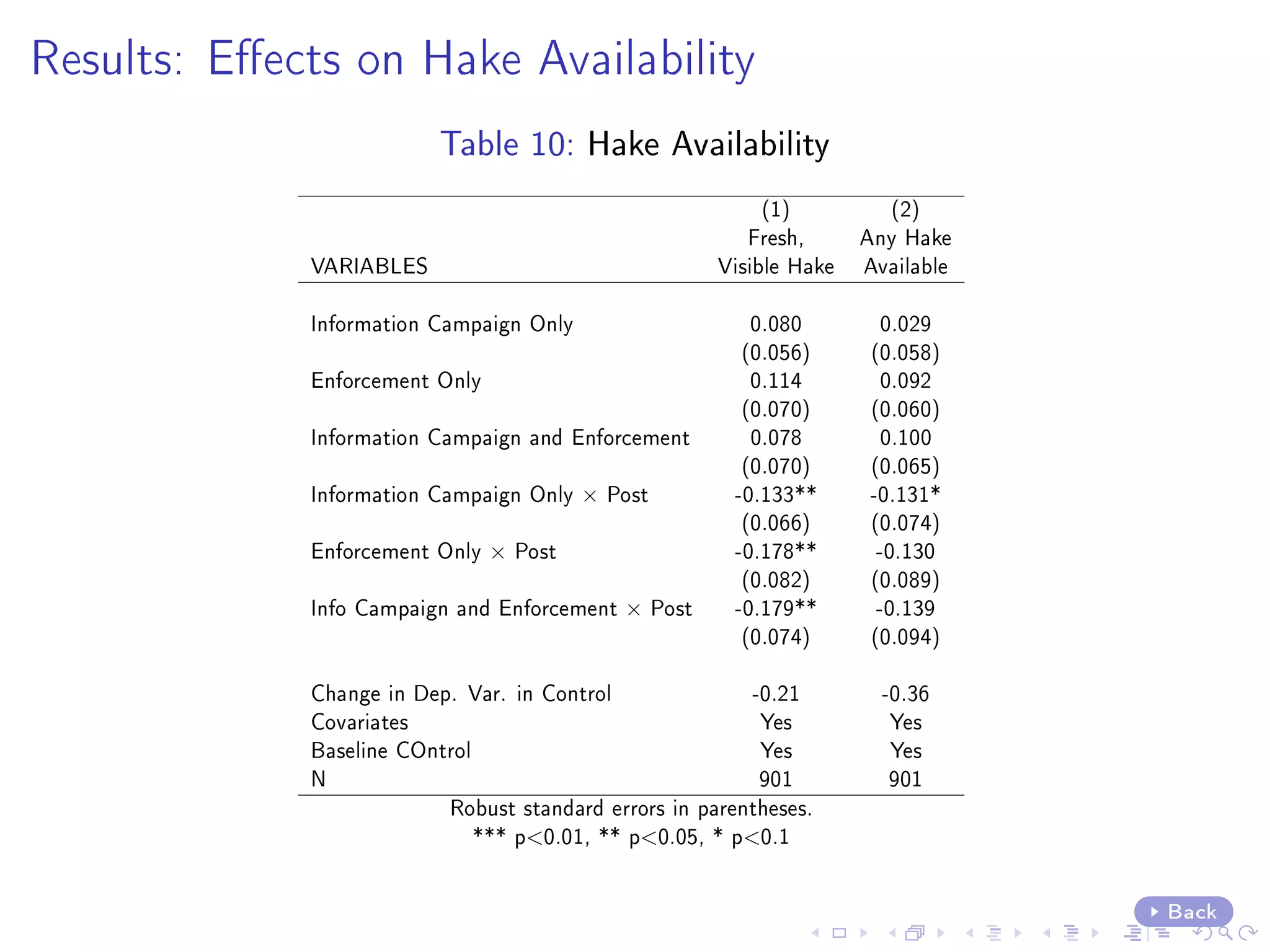
Results: Eects on Hake Availability
Table 10: Hake Availability
(1) (2)
Fresh, Any Hake
VARIABLES Visible Hake Available
Information Campaign Only 0.080 0.029
(0.056) (0.058)
Enforcement Only 0.114 0.092
(0.070) (0.060)
Information Campaign and Enforcement 0.078 0.100
(0.070) (0.065)
Information Campaign Only × Post -0.133** -0.131*
(0.066) (0.074)
Enforcement Only × Post -0.178** -0.130
(0.082) (0.089)
Info Campaign and Enforcement × Post -0.179** -0.139
(0.074) (0.094)
Change in Dep. Var. in Control -0.21 -0.36
Covariates Yes Yes
Baseline COntrol Yes Yes
N 901 901
Robust standard errors in parentheses.
*** p0.01, ** p0.05, * p0.1
Back
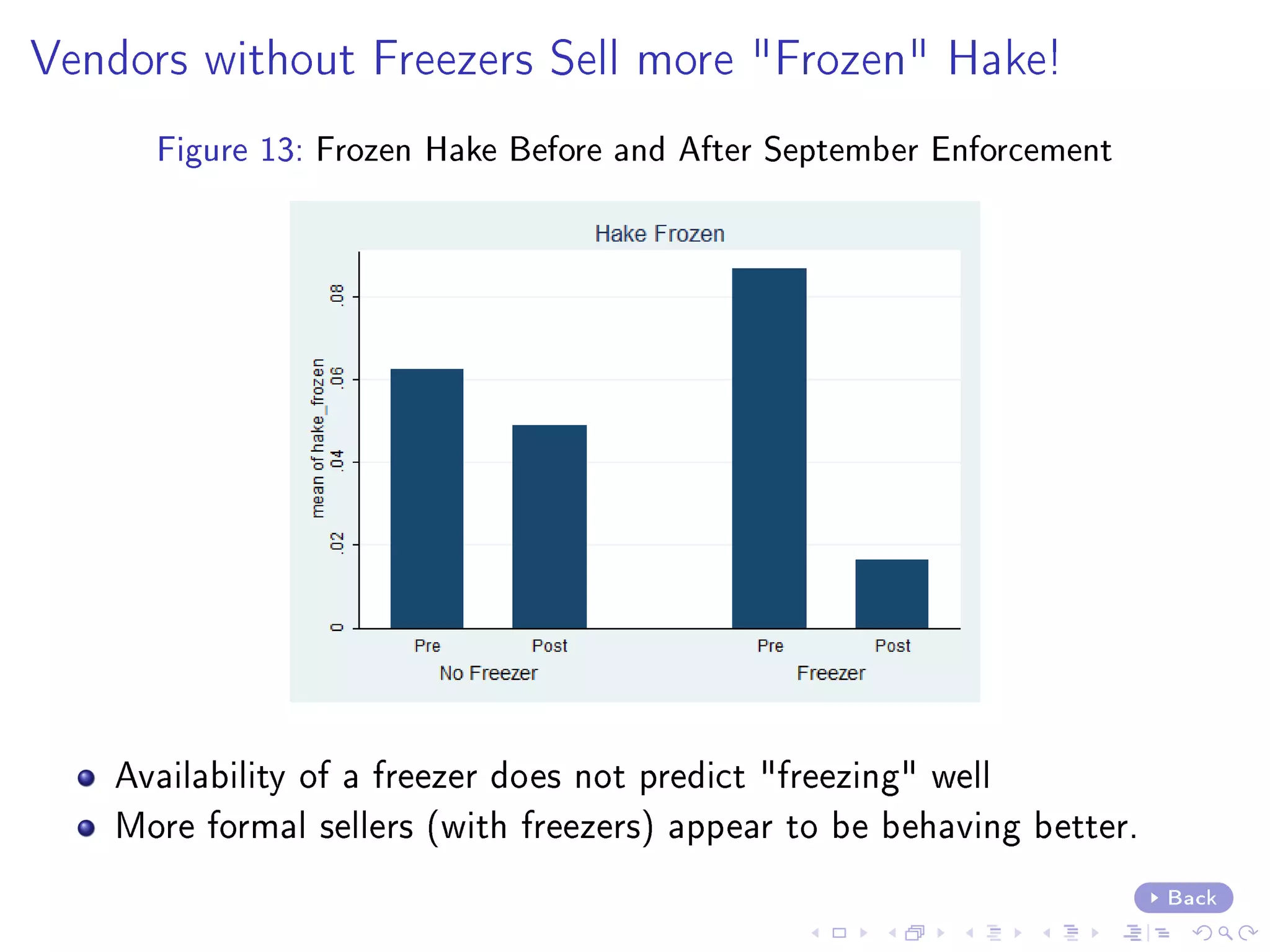
Vendors without Freezers Sell more Frozen Hake!
Figure 13: Frozen Hake Before and After September Enforcement
Availability of a freezer does not predict freezing well
More formal sellers (with freezers) appear to be behaving better.
Back
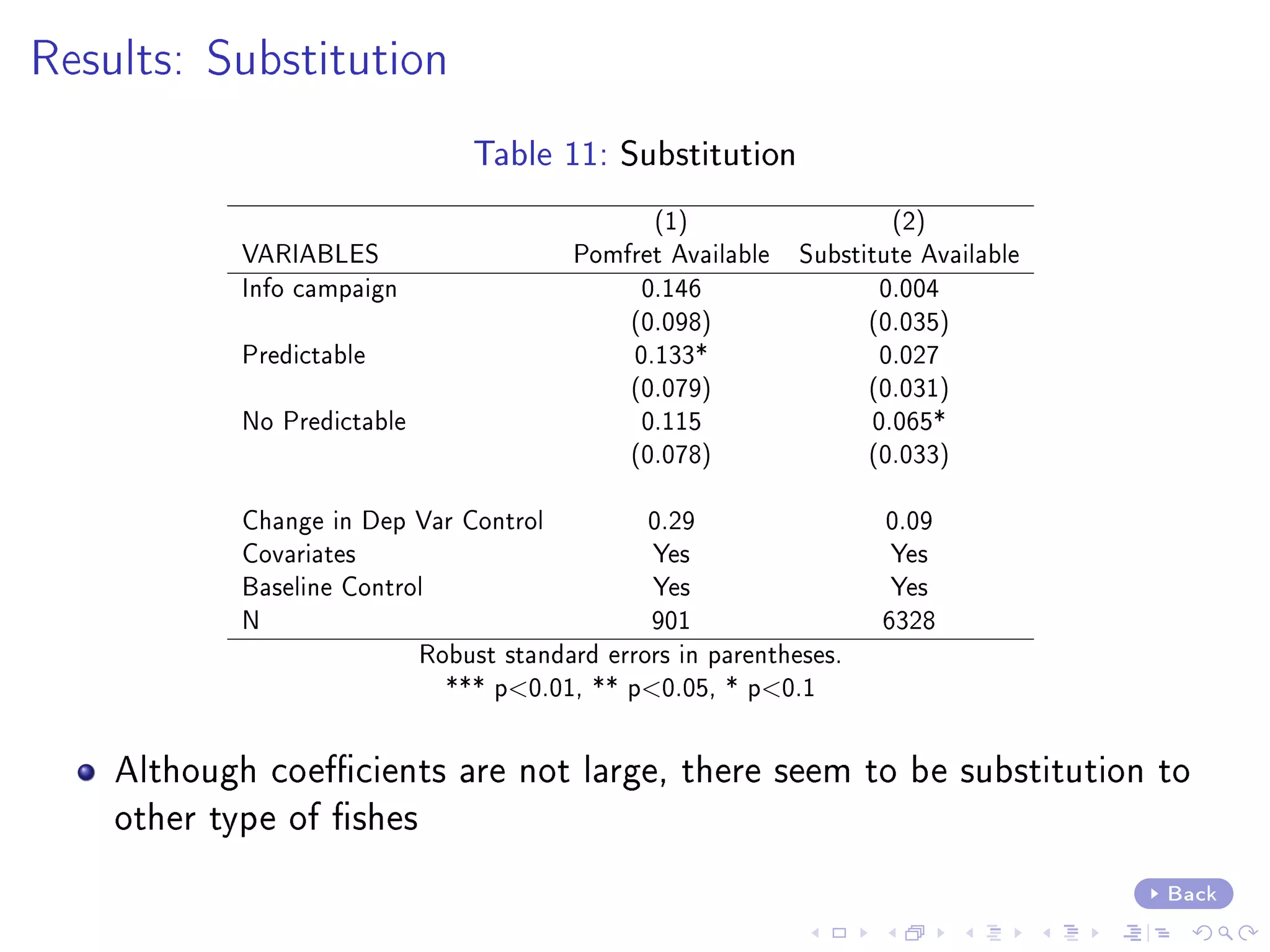
Results: Substitution
Table 11: Substitution
(1) (2)
VARIABLES Pomfret Available Substitute Available
Info campaign 0.146 0.004
(0.098) (0.035)
Predictable 0.133* 0.027
(0.079) (0.031)
No Predictable 0.115 0.065*
(0.078) (0.033)
Change in Dep Var Control 0.29 0.09
Covariates Yes Yes
Baseline Control Yes Yes
N 901 6328
Robust standard errors in parentheses.
*** p0.01, ** p0.05, * p0.1
Although coecients are not large, there seem to be substitution to
other type of shes
Back
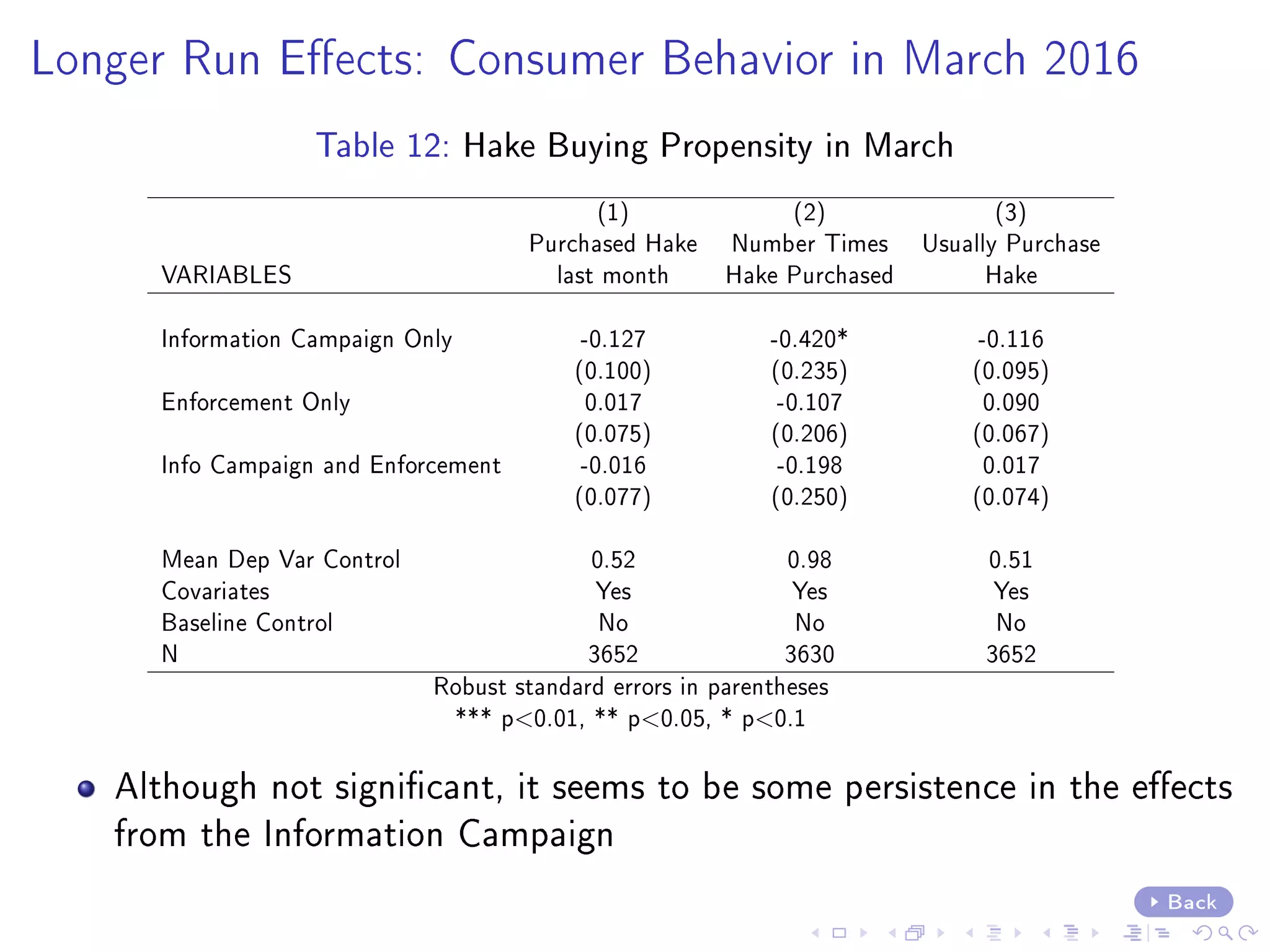
Longer Run Eects: Consumer Behavior in March 2016
Table 12: Hake Buying Propensity in March
(1) (2) (3)
Purchased Hake Number Times Usually Purchase
VARIABLES last month Hake Purchased Hake
Information Campaign Only -0.127 -0.420* -0.116
(0.100) (0.235) (0.095)
Enforcement Only 0.017 -0.107 0.090
(0.075) (0.206) (0.067)
Info Campaign and Enforcement -0.016 -0.198 0.017
(0.077) (0.250) (0.074)
Mean Dep Var Control 0.52 0.98 0.51
Covariates Yes Yes Yes
Baseline Control No No No
N 3652 3630 3652
Robust standard errors in parentheses
*** p0.01, ** p0.05, * p0.1
Although not signicant, it seems to be some persistence in the eects
from the Information Campaign
Back
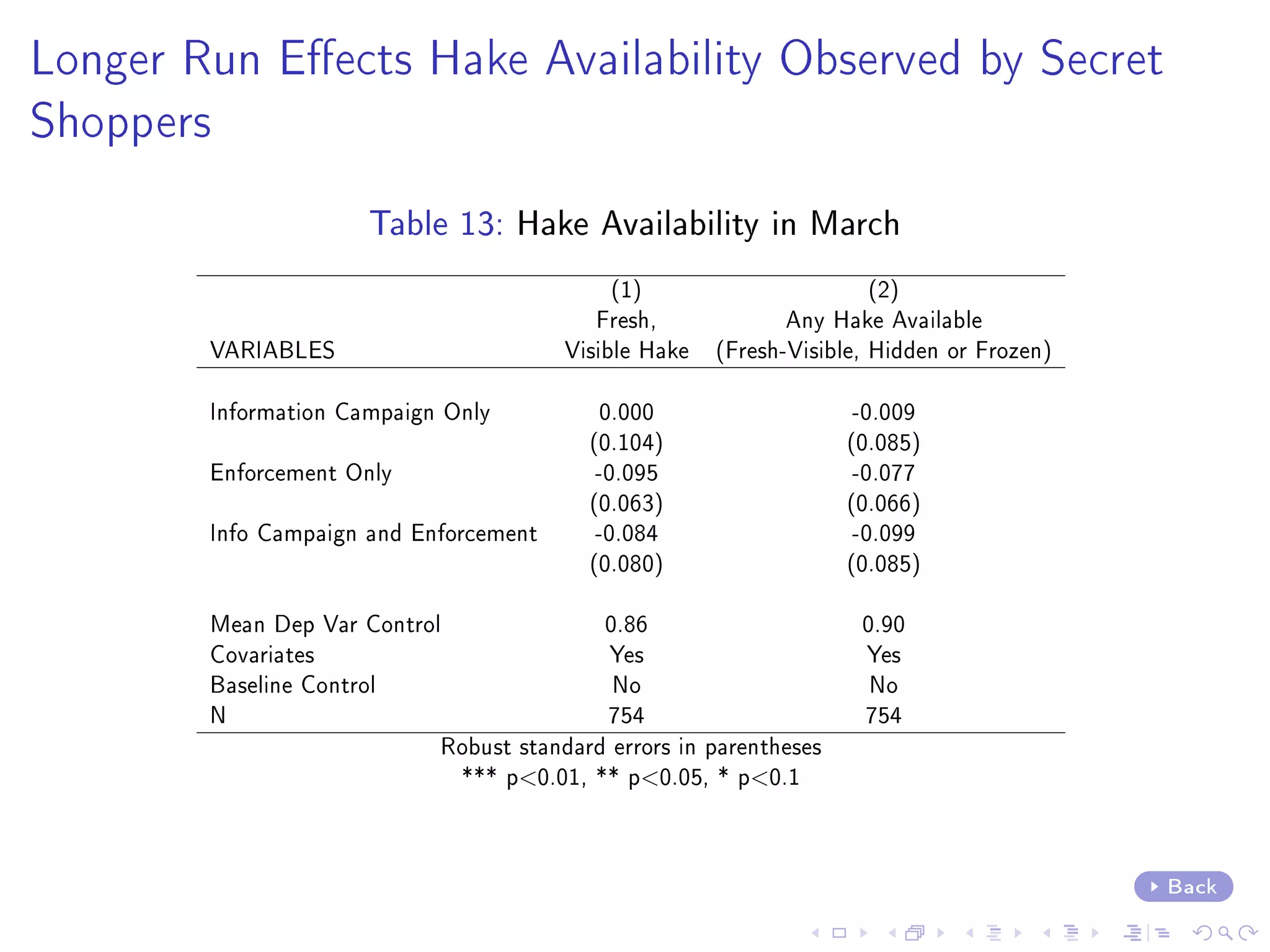
Longer Run Eects Hake Availability Observed by Secret
Shoppers
Table 13: Hake Availability in March
(1) (2)
Fresh, Any Hake Available
VARIABLES Visible Hake (Fresh-Visible, Hidden or Frozen)
Information Campaign Only 0.000 -0.009
(0.104) (0.085)
Enforcement Only -0.095 -0.077
(0.063) (0.066)
Info Campaign and Enforcement -0.084 -0.099
(0.080) (0.085)
Mean Dep Var Control 0.86 0.90
Covariates Yes Yes
Baseline Control No No
N 754 754
Robust standard errors in parentheses
*** p0.01, ** p0.05, * p0.1
Back

Enforcing Regulation under Illicit Adaptation

  • 1.
    Enforcing Regulation underIllicit Adaptation Andres Gonzalez Lira Mushq Mobarak UC Berkeley Yale September 4, 2018
  • 2.
    Contents 1 Motivation 2 PreviousLiterature 3 Experimental Design 4 Results 5 Conclusions
  • 3.
    Curbing Undesired Behavior Correctingmarket failures may require curbing undesirable behaviors Deforestation, resource exploitation, tax evasion, open defecation
  • 4.
    Curbing Undesired Behavior Correctingmarket failures may require curbing undesirable behaviors Deforestation, resource exploitation, tax evasion, open defecation Regulations and penalties are the most direct way to counter such behaviors. Incentive (subsidies/pigovian taxes) are another way.
  • 5.
    Curbing Undesired Behavior Correctingmarket failures may require curbing undesirable behaviors Deforestation, resource exploitation, tax evasion, open defecation Regulations and penalties are the most direct way to counter such behaviors. Incentive (subsidies/pigovian taxes) are another way. Requires strong institutions to enact and enforce laws Sophisticated policing to track agents' reactions to penalties More challenging in developing countries, and may need to rely on less direct strategies Information campaigns and social incentives Growing literature showing positive results of these policies in developing countries (Guiteras et al. (2015), Chetty et al. (2015))
  • 6.
    What this PaperDoes Regulated agents may react interventions designed to counter corruption/theft/elite capture
  • 7.
    What this PaperDoes Regulated agents may react interventions designed to counter corruption/theft/elite capture Short-term evaluations of such interventions are incomplete
  • 8.
    What this PaperDoes Regulated agents may react interventions designed to counter corruption/theft/elite capture Short-term evaluations of such interventions are incomplete A more comprehensive evaluation requires: A research design that is cognizant of the possibility that agents react Creative data collection that can track agents' hidden reactions to penalties Dicult to anticipate any specic reaction, so research strategy must be exible and general
  • 9.
    What this PaperDoes Regulated agents may react interventions designed to counter corruption/theft/elite capture Short-term evaluations of such interventions are incomplete A more comprehensive evaluation requires: A research design that is cognizant of the possibility that agents react Creative data collection that can track agents' hidden reactions to penalties Dicult to anticipate any specic reaction, so research strategy must be exible and general We develop such a research methodology, in order to investigate the eects of regulation net of agent adaptive behaviors
  • 10.
    What this PaperDoes Regulated agents may react interventions designed to counter corruption/theft/elite capture Short-term evaluations of such interventions are incomplete A more comprehensive evaluation requires: A research design that is cognizant of the possibility that agents react Creative data collection that can track agents' hidden reactions to penalties Dicult to anticipate any specic reaction, so research strategy must be exible and general We develop such a research methodology, in order to investigate the eects of regulation net of agent adaptive behaviors Beyond evaluating a government program; Introduce experimental variations in enforcement design to curb illegal sh sales even when agents try to circumvent rules One strategy we designed works well The other one backres and makes the situation worse!
  • 11.
    Overshing: A GlobalPolicy Issue where Enforcement is Challenging Overshing is the textbook example of problem of the commons (Ostrom (1990), Stavins (2011)) Diculties regulating artisanal and small-scale shermen Diculties tracking illegal sh in the market
  • 12.
    Overshing: A GlobalPolicy Issue where Enforcement is Challenging Overshing is the textbook example of problem of the commons (Ostrom (1990), Stavins (2011)) Diculties regulating artisanal and small-scale shermen Diculties tracking illegal sh in the market Overshing a global problem, and common in poorer countries Weak governance, corruption, poor monitoring and enforcement
  • 13.
    Overshing: A GlobalPolicy Issue where Enforcement is Challenging Overshing is the textbook example of problem of the commons (Ostrom (1990), Stavins (2011)) Diculties regulating artisanal and small-scale shermen Diculties tracking illegal sh in the market Overshing a global problem, and common in poorer countries Weak governance, corruption, poor monitoring and enforcement Has important economic implications (FAO 2014) Marine resource related activities employ 10-12% of world population Over 90% of those employed in small-scale sheries in LDCs
  • 14.
    Research questions This projectexperimentally evaluates two complementary interventions aimed to reduce the sale of illegal sh during the ban period: 1 Monitoring and penalizing vendors that sell illegal sh during the ban 2 Informing consumers about the ban period and the consequences of overshing
  • 15.
    Research questions This projectexperimentally evaluates two complementary interventions aimed to reduce the sale of illegal sh during the ban period: 1 Monitoring and penalizing vendors that sell illegal sh during the ban 2 Informing consumers about the ban period and the consequences of overshing These two interventions will allow us to answer the following research questions: 1 Do enforcement activities reduce illegal sh sales? More concretely: Do vendors learn about the aws of the audits and respond circumventing the punishment? Do vendors learn and adapt based on enforcement frequency and predictability?
  • 16.
    Research questions This projectexperimentally evaluates two complementary interventions aimed to reduce the sale of illegal sh during the ban period: 1 Monitoring and penalizing vendors that sell illegal sh during the ban 2 Informing consumers about the ban period and the consequences of overshing These two interventions will allow us to answer the following research questions: 1 Do enforcement activities reduce illegal sh sales? More concretely: Do vendors learn about the aws of the audits and respond circumventing the punishment? Do vendors learn and adapt based on enforcement frequency and predictability? 2 Do consumer information campaigns reduce illegal sh sales?
  • 17.
    Research questions This projectexperimentally evaluates two complementary interventions aimed to reduce the sale of illegal sh during the ban period: 1 Monitoring and penalizing vendors that sell illegal sh during the ban 2 Informing consumers about the ban period and the consequences of overshing These two interventions will allow us to answer the following research questions: 1 Do enforcement activities reduce illegal sh sales? More concretely: Do vendors learn about the aws of the audits and respond circumventing the punishment? Do vendors learn and adapt based on enforcement frequency and predictability? 2 Do consumer information campaigns reduce illegal sh sales? 3 Are info campaigns and enforcement complements?
  • 18.
    Research questions This projectexperimentally evaluates two complementary interventions aimed to reduce the sale of illegal sh during the ban period: 1 Monitoring and penalizing vendors that sell illegal sh during the ban 2 Informing consumers about the ban period and the consequences of overshing These two interventions will allow us to answer the following research questions: 1 Do enforcement activities reduce illegal sh sales? More concretely: Do vendors learn about the aws of the audits and respond circumventing the punishment? Do vendors learn and adapt based on enforcement frequency and predictability? 2 Do consumer information campaigns reduce illegal sh sales? 3 Are info campaigns and enforcement complements? 4 Do info campaign and enforcement strategies have dierential eects beyond the ban period?
  • 19.
    Connections to PreviousLiterature Many interventions designed to align agents' behavior and circumvent corruption. Duo et al. (2013), Banerjee et al. (2015), Banerjee et al. (2014), Muralidharan et al. (2016) Corrupt entities subject to new regime may adjust to changes in regulatory rules, and engage in a dierent type of corruption. Tax evasion: Carrillo et al. (2017), Alm et al. (2009) Short and long-run eects may be dierent Eects of information campaigns, for environmental or public health goals, generally uneven and not very positive. Dupas (2011), Mobarak et al. (2012), Meredith et al. (2012)
  • 20.
    Connections to PreviousLiterature Many interventions designed to align agents' behavior and circumvent corruption. Duo et al. (2013), Banerjee et al. (2015), Banerjee et al. (2014), Muralidharan et al. (2016) Corrupt entities subject to new regime may adjust to changes in regulatory rules, and engage in a dierent type of corruption. Tax evasion: Carrillo et al. (2017), Alm et al. (2009) Short and long-run eects may be dierent Eects of information campaigns, for environmental or public health goals, generally uneven and not very positive. Dupas (2011), Mobarak et al. (2012), Meredith et al. (2012) This is the rst project (to our knowledge) that addresses an environmental issue (1) gauging the relative eect of enforcement and info campaigns interventions and (2) empirically measures agents' attempts to circumvent to dierent enforcement strategies
  • 21.
    Context: Fish Marketin Chile The Pacic Hake (or merluza) Popular source of protein for low and middle-income Chileans Critically threatened by over-shing SERNAPESCA estimates that population is 18% of sustainable level
  • 22.
    Context: Fish Marketin Chile The Pacic Hake (or merluza) Popular source of protein for low and middle-income Chileans Critically threatened by over-shing SERNAPESCA estimates that population is 18% of sustainable level Chilean government passed regulations to protect the sh, including ban on shing and consumption during September when hake reproduces
  • 23.
    Context: Fish Marketin Chile The Pacic Hake (or merluza) Popular source of protein for low and middle-income Chileans Critically threatened by over-shing SERNAPESCA estimates that population is 18% of sustainable level Chilean government passed regulations to protect the sh, including ban on shing and consumption during September when hake reproduces SERNAPESCA eorts have focused on monitoring small scale shermen: Geographically dispersed, informal, each sherman is small-scale Social tensions Social tensions They contribute almost 40% of total sh harvested, and up to 75% of the hake sh market
  • 24.
    Fishermen Village (Caleta) Figure1: Most shermen are small-scale Caleta Characteristics
  • 25.
    Ferias in Valparaiso Figure2: Local markets where the sh is sold
  • 26.
    Experimental Design: Context Mostof the sh sold in ferias, which are local markets regulated/organized by the municipality The sh sold in ferias is fresh, i.e. harvested the same day or the day before Vendors move around between ferias during dierent days of the week e.g. they return to same feria every Sun and Wed Ferias are therefore organized into circuits. Example Circuit Most of the municipalities (comunas) have only one circuit
  • 27.
    Experimental Design: Context Theinterventions include 106 circuits containing 280 ferias, in 70 municipalities - Universe of ferias and circuits where at least one sh vendor operates (except Santiago) Map
  • 28.
    Experimental Design: Context Theinterventions include 106 circuits containing 280 ferias, in 70 municipalities - Universe of ferias and circuits where at least one sh vendor operates (except Santiago) Map Each municipality is divided in neighborhoods Example Neighborhoods
  • 29.
    Experimental Design: Context Theinterventions include 106 circuits containing 280 ferias, in 70 municipalities - Universe of ferias and circuits where at least one sh vendor operates (except Santiago) Map Each municipality is divided in neighborhoods Example Neighborhoods The enforcement assignment is randomized at circuit level Information campaign was assigned at neighborhood level
  • 30.
    Supply Side Treatment:Enforcement Aim: to reduce the supply of hake sh during the ban period Visits and Fines: SERNAPESCA ocials visit circuits to look for hake. They impose a ne (US $200) on the vendor, and retain all illegal sh 106 circuits 23 control 83 enforcement
  • 31.
    Supply Side (Enforcement)Treatments Design: Intensity and Predictability We randomly varied elements of SERNAPESCA's enforcement visit schedule to create sub-treatments: 1 High vs Low Intensity Enforcement: Circuits in the low (high) intensity treatment were visited once (twice) per week 2 Random vs Predictable Schedule: Circuits in the predictable treatment were visited on the same day of each week. The visit schedule in the unpredictable treatment varied randomly (i.e. Tue-Fri-Wed-...)
  • 32.
    Supply Side (Enforcement)Treatments Design: Intensity and Predictability We randomly varied elements of SERNAPESCA's enforcement visit schedule to create sub-treatments: 1 High vs Low Intensity Enforcement: Circuits in the low (high) intensity treatment were visited once (twice) per week 2 Random vs Predictable Schedule: Circuits in the predictable treatment were visited on the same day of each week. The visit schedule in the unpredictable treatment varied randomly (i.e. Tue-Fri-Wed-...) Table 1: Treatment Assignment High Intensity Low Intensity Total N N N Predictable 19 20 39 No-Predictable 15 29 44 Total 34 49 83
  • 33.
    Demand Side Treatments:Information Campaign Aim: to shrink the demand for hake sh through a consumer information campaign Designed to sensitize consumers to the environmental threat and discourage hake consumption during the ban. Distributed letters, yers and posters in randomly assigned neighborhoods. Restricted to 48 most populated municipalities (comunas) We randomly varied the proportion of treated neighborhoods within each municipality: zero, low and high intensity 102 neighborhoods assigned to treatment and 168 to control group. Neighborhoods Map Balance
  • 34.
    Design of InformationCampaign Figure 3: Flyers Designed by SERNAPESCA
  • 35.
    Theoretical Predictions The enforcementtreatment increases expected cost of hake sales Quantity supplied by vendors should decrease at any given price
  • 36.
    Theoretical Predictions The enforcementtreatment increases expected cost of hake sales Quantity supplied by vendors should decrease at any given price The information campaign reduces consumers' propensity to buy hake Quantity demanded should decrease at any given price Experiment designed to track information spillovers
  • 37.
    Theoretical Predictions The enforcementtreatment increases expected cost of hake sales Quantity supplied by vendors should decrease at any given price The information campaign reduces consumers' propensity to buy hake Quantity demanded should decrease at any given price Experiment designed to track information spillovers Quantity sold in markets should decrease under both treatments Price should decrease with info, increase with enforcement
  • 38.
    Theoretical Predictions The enforcementtreatment increases expected cost of hake sales Quantity supplied by vendors should decrease at any given price The information campaign reduces consumers' propensity to buy hake Quantity demanded should decrease at any given price Experiment designed to track information spillovers Quantity sold in markets should decrease under both treatments Price should decrease with info, increase with enforcement Enforcement variations: Predictability: Vendors may infer the probability of receiving enforcement based on the past schedule of visits Intensity: vendors exposed to more frequent enforcement may anticipate higher probability of enforcement. However, more often interactions with enforcers may open space for learning about possible weaknesses/loopholes of the enforcement methodology
  • 39.
    Theoretical Predictions Possible spill-overs: Consumersexposed to either of these treatments may inform other untreated consumers aecting their behavior Treatment vendors may tell about either of these treatments to their colleagues in control markets. Changes in market outcomes in treatment markets may inuence the behavior of control vendors through the upstream markets - i.e. decrease equilibrium price inducing the control vendor to buy more hake
  • 40.
    Data Collection Data: 1 MysteryShoppers: Trained surveyors who look like typical shoppers posed as buyers who tried to purchase sh. Continuous monitoring: Each circuit visited 3-4 times on average during Setember 2015. Two additional rounds of visited were carried out in March 2016. 2 Consumer Survey: Asked consumers at the feria about goods purchased in the market and prices paid, that day, and during the past month. Baseline in August. Follow-up in October. One additional round of surveys was collected in March 2016. 3 Vendor Survey and Fishermen Survey: To understand market features and channels of spill-overs. One round in June 2016 (vendors) and July-August 2016 (shermen).
  • 41.
  • 42.
  • 43.
    Regression Specication Construct paneldataset on stall s in feria f in circuit c visited by mystery shopper on day t. Estimate: ysfct = β0Postt + β1Tc + β2Tc × Postt + β3ysfc0 + Xctβ4 + εsfct (1) ysfct: outcomes such as 1(HakeAvailableforSale) Tc: circuit-level treatment assignment Postt: indicator for post-intervention period ysfc0: control for value of dependent variable pre- intervention Xct: Covariates (weather,comuna characteristics), strata xed eects Errors clustered at circuit level.
  • 44.
    Results: Eects onHake Availability Table 2: Hake Availability (1) (2) VARIABLES Fresh Hake Any Hake Info campaign -0.133** -0.131* (0.066) (0.074) Enforcement -0.178** -0.130 (0.082) (0.089) Info Campaign and Enforc. -0.179** -0.139 (0.074) (0.094) Change in Dep Var in Control Group -0.21 -0.36 Covariates Yes Yes Baseline Control Yes Yes N 901 901 Robust standard errors in parentheses. *** p0.01, ** p0.05, * p0.1 Full Regression
  • 45.
    Results: Vendors Reactions Advantageof collecting data through mystery shoppers: We observe more than government inspector
  • 46.
    Results: Vendors Reactions Advantageof collecting data through mystery shoppers: We observe more than government inspector We identied two reactions: Hiding: Hake was not visibly available in the stall, but was oered when asked. Possibly incurring in marketing cost
  • 47.
    Results: Vendors Reactions Advantageof collecting data through mystery shoppers: We observe more than government inspector We identied two reactions: Hiding: Hake was not visibly available in the stall, but was oered when asked. Possibly incurring in marketing cost Freezing: Hake was sold frozen. Possibly two related costs: quality loss and infrastructure
  • 48.
    Results: Vendor Reactions Thesereactions are associated with enforcement interventions.
  • 49.
    Results: Enforcement Variations Table3: Hake Availability (1) (2) VARIABLES Fresh Hake Any Hake Info campaign -0.122* -0.134* (0.068) (0.073) Predictable -0.092 -0.060 (0.069) (0.083) No Predictable -0.243*** -0.192** (0.086) (0.094) Change in Dep Var in Control Group -0.21 -0.36 Covariates Yes Yes Baseline Control Yes Yes N 901 901 Robust standard errors in parentheses. *** p0.01, ** p0.05, * p0.1 Unpredictable enforcement schedule is considerable more eective.
  • 50.
    Results: Enforcement Variations Table4: Hake Availability (1) (2) VARIABLES Fresh Hake Any Hake Info campaign -0.123* -0.135* (0.067) (0.072) High Int Enf -0.063 -0.070 (0.086) (0.095) Low Int Enf -0.198** -0.162* (0.083) (0.090) Change in Dep Var in Control Group -0.21 -0.36 Covariates Yes Yes Baseline Control Yes Yes N 901 901 Robust standard errors in parentheses. *** p0.01, ** p0.05, * p0.1 High intensity meant to reduce opportunities for displacement, but also creates more opportunities for learning about SERNAPESCA activities
  • 51.
    Results: Enforcement Variations Figure4: Hidden Hake Most hiding occur in [High Intensity]x[Predictable] treatment
  • 52.
    Results: Enforcement Variations Figure5: Frozen Hake More frozen in treatment areas, specially in the second half of the month when is predictable Availability of a freezer does not predict freezing well. More formal sellers (with freezers) appear to be behaving better
  • 53.
    Results: Consumer SurveyResults Table 5: Consumer Survey (1) (2) Num. Times Hake Mention Ban VARIABLES Purchased (unprompted) Information Campaign Only -0.586*** 0.147*** (0.181) (0.046) Enforcement Only -0.238** 0.083* (0.096) (0.047) Info Campaign and Enforcement -0.208** 0.108** (0.093) (0.052) Mean Dep Var Control Group 0.37 0.10 Covariates Yes Yes Baseline Control No No N 3218 3319 Robust standard errors in parentheses. *** p0.01, ** p0.05, * p0.1 Consumers paid attention to the information campaign
  • 54.
    Results: Spill-Overs Table 6:Spill-overs (1) (2) (3) (4) VARIABLES Any Hake Any Hake Any Hake Any Hake Predictable -0.023 -0.030 -0.076 -0.058 (0.083) (0.069) (0.080) (0.060) No Predictable -0.157* -0.167* -0.199** -0.177** (0.091) (0.075) (0.084) (0.084) Spill-over Enf - Rad 10 kms -0.017 (0.082) Spill-over Enf - Know -0.071 (0.076) Spill-over Enf - Supplier -0.077 (0.081) Change in Dep Var in Control Group -0.36 -0.36 -0.36 -0.36 Covariates Yes Yes Yes Yes Baseline Control Yes Yes Yes Yes N 901 901 901 901 This table show treatment eects including spillovers. Probit marginal eects are reported. Robust standard errors in parentheses. *** p0.01, ** p0.05, * p0.1 The inclusion of spillovers enhances the estimated eect of the enforcement because we are comparing enforcement against a more pure control group.
  • 55.
    Results: Treatment EectTransmission Along the Supply Chain Table 7: Fishermen Survey (1) (2) (3) Earned Less in Feria Vendors buy Consumers are VARIABLES Sept 15 than less Hake in Sep15 informed of Sept 14 compared to Sept 14 Hake Ban At least one circuit Enforced 0.323*** 0.195 0.009 (0.105) (0.303) (0.161) Info Campaign 0.120 -0.049 0.364* (0.158) (0.334) (0.192) At least one circuit E. and I.C. 0.451*** 0.626* 0.217 (0.131) (0.329) (0.201) Mean Dep Var Control 0.31 0.40 0.77 Covariates Yes Yes Yes N 202 179 217 Standard errors in parentheses. *** p0.01, ** p0.05, * p0.1
  • 56.
    Results: Number ofStalls selling sh Figure 6: Average Number of Fish Stalls in Treatment and Control Ferias Selection works against our estimates, and leads to under-estimate Stalls disappear under treatment and we cannot observe that reduction in hake sales
  • 57.
    Results: Eects onPrices Figure 7: Log Prices of Fish During the Ban Prices are observed only when the sh is available for sale: Small(er) sample size and sample selection issues complicate our treatment analysis on hake
  • 58.
    Results: Eects onPrices Table 8: Treatment Eect on Fish Prices: Pomfret and other Substitutes (1) (2) VARIABLES Log Price Pomfret Log Price Substitute Information Campaign Only 0.210* 0.140 (0.109) (0.096) Enforcement Only -0.017 -0.021 (0.066) (0.055) Info Campaign and Enforcement 0.081 0.047 (0.065) (0.059) Change in Dep Var in Control -0.20 -0.27 Covariates Yes Yes Baseline Control Yes Yes N 614 939 Robust standard errors in parentheses. *** p0.01, ** p0.05, * p0.1 Suggestive evidence that the demand for hake shifted towards substitutes
  • 59.
    Other Results: Substitution,Longer Run and Price Eects Substitution to other type shes: There seem to be substitution to other type of shes This is consistent with the eect on substitutes price Substitutes Longer run eects: March secret shopper visits and surveys Consumers exposed to info campaign seem to consume less hake in march (although insignicant) - no meaningful dierences in sh availability March Results - Survey March Results - SS
  • 60.
    Cost-Eectiveness of Enforcementvs. Information What's the best use of (limited) public resources to protect hake populations?
  • 61.
    Cost-Eectiveness of Enforcementvs. Information What's the best use of (limited) public resources to protect hake populations? By Combining these results and SERNAPESCA's full administrative costs of implementing each treatment → we can report relative cost-eectiveness of enforcement and information strategies
  • 62.
    Cost-Eectiveness of Enforcementvs. Information What's the best use of (limited) public resources to protect hake populations? By Combining these results and SERNAPESCA's full administrative costs of implementing each treatment → we can report relative cost-eectiveness of enforcement and information strategies Type of Cost of Saving Intervention One Hake (USD) Info Campaign $ 4.98 Enforcement Overall $ 6.05 Unpredictable $ 4.51 Low Intensity $ 4.13 The information campaign is more cost eective than the enforcement strategy (overall)
  • 63.
    Cost-Eectiveness of Enforcementvs. Information What's the best use of (limited) public resources to protect hake populations? By Combining these results and SERNAPESCA's full administrative costs of implementing each treatment → we can report relative cost-eectiveness of enforcement and information strategies Type of Cost of Saving Intervention One Hake (USD) Info Campaign $ 4.98 Enforcement Overall $ 6.05 Unpredictable $ 4.51 Low Intensity $ 4.13 The information campaign is more cost eective than the enforcement strategy (overall) However, enforcement variations determine its cost-eectiveness reducing hake sales: Unpredictable and low intensity enforcement are more cost-eective than the information campaign
  • 64.
    Conclusions Both Enforcement ofa ban and Consumer Information Campaigns are successful in reducing illegal shing during the ban period Info campaign almost as eective as monitoring and nes Info treatment has some persistent eect beyond ban period, although not statistically signicative Magnitudes of eects are large
  • 65.
    Conclusions Both Enforcement ofa ban and Consumer Information Campaigns are successful in reducing illegal shing during the ban period Info campaign almost as eective as monitoring and nes Info treatment has some persistent eect beyond ban period, although not statistically signicative Magnitudes of eects are large Behavioral responses to the enforcement Hiding and selling frozen hake to circumvent nes
  • 66.
    Conclusions Both Enforcement ofa ban and Consumer Information Campaigns are successful in reducing illegal shing during the ban period Info campaign almost as eective as monitoring and nes Info treatment has some persistent eect beyond ban period, although not statistically signicative Magnitudes of eects are large Behavioral responses to the enforcement Hiding and selling frozen hake to circumvent nes Enforcement design matters: Visits should be random/unpredictable Strategy successful even accounting for unanticipated vendor reactions
  • 67.
    Conclusions Both Enforcement ofa ban and Consumer Information Campaigns are successful in reducing illegal shing during the ban period Info campaign almost as eective as monitoring and nes Info treatment has some persistent eect beyond ban period, although not statistically signicative Magnitudes of eects are large Behavioral responses to the enforcement Hiding and selling frozen hake to circumvent nes Enforcement design matters: Visits should be random/unpredictable Strategy successful even accounting for unanticipated vendor reactions Data collection strategy (i.e. monitoring for the implementer) matters Secret shoppers Tracking unanticipated reactions - hiding, freezing, leakage
  • 68.
    Implications Enforcement strategies complicatedby behavioral responses Requires sophisticated monitoring Unpredictable enforcement schedule reduces leakage in multiple ways
  • 69.
    Implications Enforcement strategies complicatedby behavioral responses Requires sophisticated monitoring Unpredictable enforcement schedule reduces leakage in multiple ways Information campaigns not as eective in prior studies Eective in this middle income country, and complements enforcement
  • 70.
    Implications Enforcement strategies complicatedby behavioral responses Requires sophisticated monitoring Unpredictable enforcement schedule reduces leakage in multiple ways Information campaigns not as eective in prior studies Eective in this middle income country, and complements enforcement Vendors have to be even more careful when consumers are policing. Vendors' behavioral responses to enforcement more complicated if consumers are also aware. e.g. hide from both consumers and monitors Implication: Perhaps involve and incentivize consumers to do policing?
  • 71.
  • 72.
    Political Pressure The decreasein the total number of sh in the sea, increase in enforcement activities by the government and reductions on the shing quota have generated riots and political pressures from shermen in recent years Figure 8: Fishermen Reactions Back
  • 73.
    Caleta Characteristics Coastal regionsin the sample include 74 caletas. Each caleta is composed by a group of shermen, organized by 1 or 2 unions. 70% of these caletas have less than 60 boats. 24% have lass than 10 boats. Each shing boat is managed by 2 or 3 shermen. 91% of the boats are less than 10 mts long. Back - Context
  • 74.
    Example of Circuit Eachcircuit covers a delimited geographic area within a municipality. If the municipality has more than one circuit, they cover dierent geographic areas (no overlapping) Figure 9: Ferias within a circuit Back
  • 75.
    Map of FishermenVillages and Markets Figure 10: Map of Chile Back
  • 76.
    Example Neighborhoods Figure 11:Example Neighborhood division Back
  • 77.
    Experimental Design Figure 12:Example Neighborhood Treatment Assignment Back
  • 78.
    Balance Table 9: Balance (1)(2) (3) (4) (5) (6) (7) Variable Control Info Campaign Enforcement Enforc. and Info Camp. Mean Mean Di Mean Di Mean Di Indicator Fixed Stalls 0.573 0.644 0.083 0.489 -0.069 0.509 0.013 ( 0.497) ( 0.484) [ 0.740] ( 0.501) [ 0.574] ( 0.501) [ 0.920] Distance to Closest Caleta (kms) 16.507 11.572 3.465 14.863 -3.606 26.425 2.245 ( 25.082) ( 9.503) [ 0.516] ( 22.626) [ 0.386] ( 29.037) [ 0.682] Poverty Rate Municipality 19.006 17.567 -2.148 18.026 -1.079 16.734 -0.316 ( 4.780) ( 3.313) [ 0.244] ( 5.483) [ 0.412] ( 7.549) [ 0.851] Av. Monthly Income Municipality (USD) 791.767 875.475 18.446 790.514 -2.506 830.683 20.464 ( 149.808) ( 172.858) [ 0.846] ( 140.334) [ 0.953] ( 139.251) [ 0.673] Deliquency Rate Municipality 0.038 0.029 -0.013** 0.036 -0.001 0.034 -0.004 ( 0.015) ( 0.002) [ 0.016] ( 0.015) [ 0.835] ( 0.009) [ 0.480] Rain Indicator 0.290 0.133 -0.124 0.178 -0.114 0.142 -0.122 ( 0.456) ( 0.344) [ 0.455] ( 0.383) [ 0.318] ( 0.349) [ 0.301] Average Temperature (Celsius) 12.200 12.126 0.081 11.993 -0.192 11.936 -0.688 ( 2.281) ( 2.087) [ 0.942] ( 2.021) [ 0.797] ( 2.196) [ 0.346] Joint Signicance F statistic 0.609 1.094 0.816 p-value 0.747 0.371 0.575 *** p0.01, ** p0.05, * p0.1 Back
  • 79.
    Results: Eects onHake Availability Table 10: Hake Availability (1) (2) Fresh, Any Hake VARIABLES Visible Hake Available Information Campaign Only 0.080 0.029 (0.056) (0.058) Enforcement Only 0.114 0.092 (0.070) (0.060) Information Campaign and Enforcement 0.078 0.100 (0.070) (0.065) Information Campaign Only × Post -0.133** -0.131* (0.066) (0.074) Enforcement Only × Post -0.178** -0.130 (0.082) (0.089) Info Campaign and Enforcement × Post -0.179** -0.139 (0.074) (0.094) Change in Dep. Var. in Control -0.21 -0.36 Covariates Yes Yes Baseline COntrol Yes Yes N 901 901 Robust standard errors in parentheses. *** p0.01, ** p0.05, * p0.1 Back
  • 80.
    Vendors without FreezersSell more Frozen Hake! Figure 13: Frozen Hake Before and After September Enforcement Availability of a freezer does not predict freezing well More formal sellers (with freezers) appear to be behaving better. Back
  • 81.
    Results: Substitution Table 11:Substitution (1) (2) VARIABLES Pomfret Available Substitute Available Info campaign 0.146 0.004 (0.098) (0.035) Predictable 0.133* 0.027 (0.079) (0.031) No Predictable 0.115 0.065* (0.078) (0.033) Change in Dep Var Control 0.29 0.09 Covariates Yes Yes Baseline Control Yes Yes N 901 6328 Robust standard errors in parentheses. *** p0.01, ** p0.05, * p0.1 Although coecients are not large, there seem to be substitution to other type of shes Back
  • 82.
    Longer Run Eects:Consumer Behavior in March 2016 Table 12: Hake Buying Propensity in March (1) (2) (3) Purchased Hake Number Times Usually Purchase VARIABLES last month Hake Purchased Hake Information Campaign Only -0.127 -0.420* -0.116 (0.100) (0.235) (0.095) Enforcement Only 0.017 -0.107 0.090 (0.075) (0.206) (0.067) Info Campaign and Enforcement -0.016 -0.198 0.017 (0.077) (0.250) (0.074) Mean Dep Var Control 0.52 0.98 0.51 Covariates Yes Yes Yes Baseline Control No No No N 3652 3630 3652 Robust standard errors in parentheses *** p0.01, ** p0.05, * p0.1 Although not signicant, it seems to be some persistence in the eects from the Information Campaign Back
  • 83.
    Longer Run EectsHake Availability Observed by Secret Shoppers Table 13: Hake Availability in March (1) (2) Fresh, Any Hake Available VARIABLES Visible Hake (Fresh-Visible, Hidden or Frozen) Information Campaign Only 0.000 -0.009 (0.104) (0.085) Enforcement Only -0.095 -0.077 (0.063) (0.066) Info Campaign and Enforcement -0.084 -0.099 (0.080) (0.085) Mean Dep Var Control 0.86 0.90 Covariates Yes Yes Baseline Control No No N 754 754 Robust standard errors in parentheses *** p0.01, ** p0.05, * p0.1 Back