International Journal of
Computer Science
& Information Security
© IJCSIS PUBLICATION 2018
Pennsylvania, USA
IJCSIS Vol. 16 No. 7, July 2018
ISSN 1947-5500
Indexed and technically co-sponsored by :
Indexing Service
IJCSIS has been indexed by several world class databases, for more information, please
access the following links:
Global Impact Factor
http://globalimpactfactor.com/
Google Scholar
http://scholar.google.com/
CrossRef
http://www.crossref.org/
Microsoft Academic Search
http://academic.research.microsoft.com/
IndexCopernicus
http://journals.indexcopernicus.com/
IET Inspec
http://www.theiet.org/resources/inspec/
EBSCO
http://www.ebscohost.com/
JournalSeek
http://journalseek.net
Ulrich
http://ulrichsweb.serialssolutions.com/
WordCat
http://www.worldcat.org
Academic Journals Database
http://www.journaldatabase.org/
Stanford University Libraries
http://searchworks.stanford.edu/
Harvard Library
http://discovery.lib.harvard.edu/?itemid=|library/m/aleph|012618581
UniSA Library
http://www.library.unisa.edu.au/
ProQuest
http://www.proquest.co.uk
Zeitschriftendatenbank (ZDB)
http://dispatch.opac.d-nb.de/
IJCSIS
ISSN (online): 1947-5500
Please consider to contribute to and/or forward to the appropriate groups the following opportunity to submit and publish
original scientific results.
CALL FOR PAPERS
International Journal of Computer Science and Information Security (IJCSIS)
January-December 2018 Issues
The topics suggested by this issue can be discussed in term of concepts, surveys, state of the art, research,
standards, implementations, running experiments, applications, and industrial case studies. Authors are invited
to submit complete unpublished papers, which are not under review in any other conference or journal in the
following, but not limited to, topic areas.
See authors guide for manuscript preparation and submission guidelines.
Indexed by Google Scholar, DBLP, CiteSeerX, Directory for Open Access Journal (DOAJ), Bielefeld
Academic Search Engine (BASE), SCIRUS, Scopus Database, Cornell University Library, ScientificCommons,
ProQuest, EBSCO and more.
Deadline: see web site
Notification: see web site
Revision: see web site
Publication: see web site
For more topics, please see web site https://sites.google.com/site/ijcsis/
For more information, please visit the journal website (https://sites.google.com/site/ijcsis/)
 
Context-aware systems
Networking technologies
Security in network, systems, and applications
Evolutionary computation
Industrial systems
Evolutionary computation
Autonomic and autonomous systems
Bio-technologies
Knowledge data systems
Mobile and distance education
Intelligent techniques, logics and systems
Knowledge processing
Information technologies
Internet and web technologies, IoT
Digital information processing
Cognitive science and knowledge 
Agent-based systems
Mobility and multimedia systems
Systems performance
Networking and telecommunications
Software development and deployment
Knowledge virtualization
Systems and networks on the chip
Knowledge for global defense
Information Systems [IS]
IPv6 Today - Technology and deployment
Modeling
Software Engineering
Optimization
Complexity
Natural Language Processing
Speech Synthesis
Data Mining 
Editorial
Message from Editorial Board
It is our great pleasure to present the July 2018 issue (Volume 16 Number 6) of the
International Journal of Computer Science and Information Security (IJCSIS). High quality
research, survey & review articles are proposed from experts in the field, promoting insight and
understanding of the state of the art, and trends in computer science and digital technologies. It
especially provides a platform for high-caliber academics, practitioners and PhD/Doctoral
graduates to publish completed work and latest research outcomes. According to Google Scholar,
up to now papers published in IJCSIS have been cited over 11450 times and this journal is
experiencing steady and healthy growth. Google statistics shows that IJCSIS has established the
first step to be an international and prestigious journal in the field of Computer Science and
Information Security. There have been many improvements to the processing of papers; we have
also witnessed a significant growth in interest through a higher number of submissions as well as
through the breadth and quality of those submissions. IJCSIS is already indexed in some major
academic/scientific databases and important repositories, such as: Google Scholar, Thomson
Reuters, ArXiv, CiteSeerX, Cornell’s University Library, Ei Compendex, ISI Scopus, DBLP, DOAJ,
ProQuest, ResearchGate, LinkedIn, Academia.edu and EBSCO among others.
A reputed & professional journal has a dedicated editorial team of editors and reviewers. On
behalf of IJCSIS community and the sponsors, we congratulate the authors and thank the
reviewers & editors for their outstanding efforts to meticulously review and recommend high
quality papers for publication. In particular, we would like to thank the international academia and
researchers for continued support by citing or reading papers published in IJCSIS. Without their
sustained and unselfish commitments, IJCSIS would not have achieved its current premier status,
making sure we deliver high-quality content to our readers in a timely fashion.
“We support researchers to succeed by providing high visibility & impact value, prestige and
excellence in research publication.” We would like to thank you, the authors and readers, the
content providers and consumers, who have made this journal the best possible.
For further questions or other suggestions please do not hesitate to contact us at
ijcsiseditor@gmail.com.
A complete list of journals can be found at:
http://sites.google.com/site/ijcsis/
IJCSIS Vol. 16, No. 7, July 2018 Edition
ISSN 1947-5500 © IJCSIS, USA.
Journal Indexed by (among others):
Open Access This Journal is distributed under the terms of the Creative Commons Attribution 4.0 International License
(http://creativecommons.org/licenses/by/4.0/), which permits unrestricted use, distribution, and reproduction in any medium,
provided you give appropriate credit to the original author(s) and the source.
Bibliographic Information
ISSN: 1947-5500
Monthly publication (Regular Special Issues)
Commenced Publication since May 2009
Editorial / Paper Submissions:
IJCSIS Managing Editor
(ijcsiseditor@gmail.com)
Pennsylvania, USA
Tel: +1 412 390 5159
IJCSIS EDITORIAL BOARD
IJCSIS Editorial Board IJCSIS Guest Editors / Associate Editors
Dr. Shimon K. Modi [Profile]
Director of Research BSPA Labs,
Purdue University, USA
Dr Riktesh Srivastava [Profile]
Associate Professor, Information Systems,
Skyline University College, Sharjah, PO 1797,
UAE
Professor Ying Yang, PhD. [Profile]
Computer Science Department, Yale University, USA
Dr. Jianguo Ding [Profile]
Norwegian University of Science and Technology
(NTNU), Norway
Professor Hamid Reza Naji, PhD. [Profile]
Department of Computer Enigneering, Shahid
Beheshti University, Tehran, Iran
Dr. Naseer Alquraishi [Profile]
University of Wasit, Iraq
Professor Yong Li, PhD. [Profile]
School of Electronic and Information Engineering,
Beijing Jiaotong University,
P. R. China
Dr. Kai Cong [Profile]
Intel Corporation,
& Computer Science Department, Portland State
University, USA
Professor Mokhtar Beldjehem, PhD. [Profile]
Sainte-Anne University, Halifax, NS, Canada
Dr. Omar A. Alzubi [Profile]
Al-Balqa Applied University (BAU), Jordan
Professor Yousef Farhaoui, PhD.
Department of Computer Science, Moulay Ismail
University, Morocco
Dr. Jorge A. Ruiz-Vanoye [Profile]
Universidad Autónoma del Estado de Morelos,
Mexico
Dr. Alex Pappachen James [Profile]
Queensland Micro-nanotechnology center, Griffith
University, Australia
Prof. Ning Xu,
Wuhan University of Technology, China
Professor Sanjay Jasola [Profile]
Gautam Buddha University
Dr . Bilal Alatas [Profile]
Department of Software Engineering, Firat
University, Turkey
Dr. Siddhivinayak Kulkarni [Profile]
University of Ballarat, Ballarat, Victoria, Australia
Dr. Ioannis V. Koskosas,
University of Western Macedonia, Greece
Dr. Reza Ebrahimi Atani [Profile]
University of Guilan, Iran
Dr Venu Kuthadi [Profile]
University of Johannesburg, Johannesburg, RSA
Dr. Dong Zhang [Profile]
University of Central Florida, USA
Dr. Zhihan lv [Profile]
Chinese Academy of Science, China
Dr. Vahid Esmaeelzadeh [Profile]
Iran University of Science and Technology
Prof. Ghulam Qasim [Profile]
University of Engineering and Technology,
Peshawar, Pakistan
Dr. Jiliang Zhang [Profile]
Northeastern University, China
Prof. Dr. Maqbool Uddin Shaikh [Profile]
Preston University, Islamabad, Pakistan
Dr. Jacek M. Czerniak [Profile]
Casimir the Great University in Bydgoszcz, Poland
Dr. Musa Peker [Profile]
Faculty of Technology, Mugla Sitki Kocman
University, Turkey
Dr. Binh P. Nguyen [Profile]
National University of Singapore
Dr. Wencan Luo [Profile]
University of Pittsburgh, US
Professor Seifeidne Kadry [Profile]
American University of the Middle East, Kuwait
Dr. Ijaz Ali Shoukat [Profile]
King Saud University, Saudi Arabia
Dr. Riccardo Colella [Profile]
University of Salento, Italy
Dr. Yilun Shang [Profile]
Tongji University, Shanghai, China
Dr. Sedat Akleylek [Profile]
Ondokuz Mayis University, Turkey
Dr. Sachin Kumar [Profile]
Indian Institute of Technology (IIT) Roorkee
Dr Basit Shahzad [Profile]
King Saud University, Riyadh - Saudi Arabia
Dr. Mohd. Muntjir [Profile]
Taif University
Kingdom of Saudi Arabia
Dr. Sherzod Turaev [Profile]
International Islamic University Malaysia
Dr. Bohui Wang [Profile]
School of Aerospace Science and Technology,
Xidian University, P. R. China
Dr. Kelvin LO M. F. [Profile]
The Hong Kong Polytechnic University, Hong Kong
Dr. Man Fung LO [Profile]
The Hong Kong Polytechnic University
ISSN 1947 5500 Copyright © IJCSIS, USA.
TABLE OF CONTENTS
1. PaperID 30061815: A Survey of Cyber Security Countermeasures Using Hardware Performance Counters
(pp. 1-9)
James Christopher Foreman, Department of Engineering Fundamentals, University of Louisville, Louisville, KY.
USA
Full Text: PDF [Academia.edu | Scopus | Scribd | Archive | ProQuest]
2. PaperID 30061802: Factors of Cloud Computing Adoption by Small and Medium Size Enterprises (SMEs)
(pp. 10-13)
Fahd Nasser (1) & Sundresan Perumal (2),
(1) Post Graduate Centre, Limkokwing University of Creative Technology
(2) Faculty of Science and Technology, University Sains Islam Malaysia, darul Khusus, Malaysia,
Full Text: PDF [Academia.edu | Scopus | Scribd | Archive | ProQuest]
3. PaperID 30061809: Development of a Predictive Model for Audio Quality of Service in Nigeria (pp. 14-20)
Mebawondu J.O., Department of Computer Sci. FUTA, Nigeria;
Adewale O.S., Department of Computer Sci. FUTA, Nigeria;
Dahunsi F.M., Department of Electrical Electronic Engineering FUTA, Nigeria;
Alese B.K., Department of Computer Sci. FUTA;
Full Text: PDF [Academia.edu | Scopus | Scribd | Archive | ProQuest]
4. PaperID 30061810: Thinging for Software Engineers (pp. 21-29)
Sabah S. Al-Fedaghi, Computer Engineering Department, Kuwait University, Kuwait
Full Text: PDF [Academia.edu | Scopus | Scribd | Archive | ProQuest]
5. PaperID 30061817: A Service Differentiation Aware Dynamic Random Early Detection and Optimized Fuzzy
Proportional Integral Derivative for Active Queue Management Congestion Control in Mobile Wireless Sensor
Network (pp. 30-40)
Monisha V. (1) & Dr Ranganayaki T. (2)
(1) Ph.D Research Scholar, (2) Associate Professor
Department of Computer Science, Erode Arts & Science College, Erode, Tamil Nadu, India
Full Text: PDF [Academia.edu | Scopus | Scribd | Archive | ProQuest]
6. PaperID 30061821: Medical Image Segmentation Based On Generalized Gamma Distribution for Effective
Identification of Diseases in Brain (pp. 41-45)
K. Srinivas (1), P.V.G.D. Prasad Reddy (2), G.P.S. Varma (3)
(1) Research Scholar, Dept. of CS&SE, Andhra University, Visakhapatnam, A.P-India.
(2) Prof & HOD, Dept. of CS&SE, Andhra University, Visakhapatnam, A.P-India.
(3) Principal, SRKR Engineering College, Bhimavaram, A.P-India.
Full Text: PDF [Academia.edu | Scopus | Scribd | Archive | ProQuest]
7. PaperID 30061823: Using Safety Case to Automotive and IoT Systems (pp. 46-65)
Hiroyuki Utsunomiya, Nagoya University, Furo-cho Chikusa-ku, Nagoya Aichi, Japan
Nobuhide Kobayashi, DENSO CREATE INC., 3-1-1 Sakae Naka-ku, Nagoya Aichi, Japan
Shuichiro Yamamoto, Nagoya University, Furo-cho Chikusa-ku, Nagoya Aichi, Japan
Full Text: PDF [Academia.edu | Scopus | Scribd | Archive | ProQuest]
8. PaperID 30061825: Perceived Usability Using Arabic System Usability Scale (A-SUS): Student Perspective
of Smart PAAET App (pp. 66-78)
Bareeq A. AlGhannam, Computer Science and Information Systems Department, College of Business Studies, The
Public Authority for Applied Education and Training Kuwait, Kuwait.
Manal Alsuwaidi, Computer Science and Information Systems Department, College of Business Studies, The Public
Authority for Applied Education and Training Kuwait, Kuwait.
Waheeda Almayyan, Computer Science and Information Systems Department, College of Business Studies, The
Public Authority for Applied Education and Training Kuwait, Kuwait.
Full Text: PDF [Academia.edu | Scopus | Scribd | Archive | ProQuest]
9. PaperID 30061837: Evaluating the Proposed Public Budget Ontological Model (pp. 79-91)
Y. M. Helmy, Faculty of Commerce and Business Administration, Helwan University, Egypt
S. A. Ali, Faculty of Commerce and Business Administration, Helwan University, Egypt
M. M.A. Abd Ellatif, Faculty of Information Systems, Jeddah University, KSA and Helwan University, Egypt
Full Text: PDF [Academia.edu | Scopus | Scribd | Archive | ProQuest]
10. PaperID 30061840: Reliable Multicast Notification System on Mobile Location Indexing (pp. 92-96)
Thu Thu Zan, Cloud Computing Lab, University of Computer Studies, Yangon, Yangon, Myanmar
Sabai Phyu, Cloud Computing Lab, University of Computer Studies, Yangon, Yangon, Myanmar
Full Text: PDF [Academia.edu | Scopus | Scribd | Archive | ProQuest]
11. PaperID 30061843: Building an Effective Intrusion Detection System using Genetic Algorithm based
Feature Selection (pp. 97-110)
(1) Mr. Prakash N Kalavadekar, Research Scholar; (2) Dr. Shirish S. Sane
K.K. Wagh Institute of Engineering Education & Research, Nashik Savitribai Phule Pune University, India
Full Text: PDF [Academia.edu | Scopus | Scribd | Archive | ProQuest]
12. PaperID 30061844: Master-Slave Clustering Technique for High Density Traffic in Urban VANET Scenario
(pp. 111-116)
Rifat Tasnim Anannya, Md. Abdullah Al Faruk, Md. Manirul Islam
Department Of Computer Science, American International University-Bangladesh, Dhaka, Bangladesh
Full Text: PDF [Academia.edu | Scopus | Scribd | Archive | ProQuest]
13. PaperID 30061846: Prediction of Suicidal Case Poisoning by Modeling and Simulation of Time Series (pp.
117-128)
Mohammed Kaicer (a*) , Siham Mahir (b), Wafae Elelem (c), Abdelmajid Soulaymani (b), Rachida Soumlaymani
(d), Latifa Amiar (e), Rachid Hmimou (d)
(a)(b) Genetic & Biometric laboratory Tofail university, 242, Kenitra - Maroc
(c) Laboratory of study and research in applied mathematics, EMI, Med 5 university, United Nations Avenue, Agdal,
Rabat Morocco B.P: 8007.N.U
(d) PPCM, Faculty of Medicine, Med 5 University, United Nations Avenue, Agdal, Rabat Morocco B.P: 8007.N.U
(e) Faculty of Sciences and Technology, Old street of Aeroport, Km 10, Ziaten. 416. Tangier - Morocco
Full Text: PDF [Academia.edu | Scopus | Scribd | Archive | ProQuest]
14. PaperID 30061848: A New Communication Architecture Model for Smart Grid (pp. 129-143)
Zahid Soufiane, Institut National des Postes et Télécommunications, Morocco
En-Nouaary Abdeslam, Institut National des Postes et Télécommunications, Morocco
BAH Slimane, Ecole Mohammadia d'Ingénieurs, Morocco
Full Text: PDF [Academia.edu | Scopus | Scribd | Archive | ProQuest]
15. PaperID 30061849: An Improved Logic Design Simulator (pp. 144-150)
Adewale, F.O; Adegbile, A.A; Olanrewaju, O.T.; Togun, A.O; Dada, T.O
Department of Computer Science, FCAH&PT, Apata, Ibadan, Nigeria
Osunade O., Department of Computer Science, University of Ibadan, Nigeria
Full Text: PDF [Academia.edu | Scopus | Scribd | Archive | ProQuest]
16. PaperID 30061850: Education Game for Teaching Stack and Link- List as an Aspect of Data Structure and
Algorithm (pp. 151-157)
Olanrewaju, O.T; Adegbile, A.A; Ogunbade, A.O; Dada, T.O; Adewale, F.O; Aguda O.O.;
Department of Computer Science, FCAH&PT, Apata, Ibadan, Nigeria
Osunade O., Department of Computer Science, University of Ibadan, Nigeria
Full Text: PDF [Academia.edu | Scopus | Scribd | Archive | ProQuest]
17. PaperID 30061851: Design and Implementation of a Virtual Project Repository System (A Case Study of
Federal College of Animal Health and Production Technology) (pp. 158-161)
Adegbile, A.A.; Ayobiolaja, S.P.; Olanrewaju, O.T.; Togun, O.A.; Nwufoh, C.V.
Department of Computer Science, FCAH&PT, Moor Plantation Apata, Ibadan, Nigeria
Osunade, O.; Department of Computer Science, University of Ibadan, Nigeria
Full Text: PDF [Academia.edu | Scopus | Scribd | Archive | ProQuest]
18. PaperID 30061855: Anonymous Safe Routing Scheme for Compromised Network Environment (pp. 162-
168)
William Asiedu, Department of information Technology Education, University of Education, Winneba, Kumasi
Campus, Ghana
Dr. Rajan John, College of Computer Science, Jazan University, Jazan, Kingdom of Saudi Arabia
Full Text: PDF [Academia.edu | Scopus | Scribd | Archive | ProQuest]
19. PaperID 30061789: A Multi-metric and Multi-deme Multiagent System Applied on Some Multiobjective
Optimization Problems (pp. 169-178)
Jamshid Tamouk & Adnan Acan,
Eastern Mediterranean University, Computer Engineering Department, Gazimagusa, TRNC, 99628, Turkey
Full Text: PDF [Academia.edu | Scopus | Scribd | Archive | ProQuest]
20. PaperID 31051826: Spasmodic Watermarking Of Comparative Images Using Discrete Wavelet Transform
(DWT) and Histogram Changing (pp. 179-188)
S. Venkatesh, Research Scholar, Faculty of Computer Science and Engineering, Sathyabama University, Chennai,
Tamilnadu.
Dr. M. A. Dorairangaswamy, Professor and Registrar, St Peter’s University, Avadi Chennai, Tamilnadu.
Full Text: PDF [Academia.edu | Scopus | Scribd | Archive | ProQuest]
21. PaperID 31051838: The Role of ICT on E-Governance Framework in Nigerian Aviation Industry (pp. 189-
197)
Eleberi Ebele Leticia, Department of Computer Science, Imo State University, PMB 2000, Owerri Nigeria
Full Text: PDF [Academia.edu | Scopus | Scribd | Archive | ProQuest]
22. PaperID 30061803: Integration and Combination of Cryptographic Algorithm for Data Security in Cloud
(pp. 198-203)
Kiran Huma, Muhammad Sheraz Arshad Malik, Sadaf Safdar, Bakhtawar Jabeen, Department of Information
technology, Government College University, Faisalabad, Pakistan
Rizwan Arshad, School of Mechanical and Manufacturing Engineering, National University of Sciences and
Technology, Islamabad, Pakistan
Full Text: PDF [Academia.edu | Scopus | Scribd | Archive | ProQuest]
23. PaperID 31071818: RFID Reader Collision Avoidance Using CSMA/CA With Fibonacci Backoff Algorithm
(pp. 204-210)
(1) Olanrewaju, B. S.; (2) Thanni, A. M.; (3) Deji-Akinpelu, O.O.; (4) Olanrewaju, O. T., (5) Osunade, O.
(1) Dept of Computer Science, Wellspring University, Benin City, Nigeria
(2, 3, 5) Dept of Computer Science, University of Ibadan, Nigeria
(4) Dept of Computer Science, Federal College of Animal Health and Production Technology, Moor Plantation,
Ibadan, Nigeria
Full Text: PDF [Academia.edu | Scopus | Scribd | Archive | ProQuest]
A Survey of Cyber Security Countermeasures Using
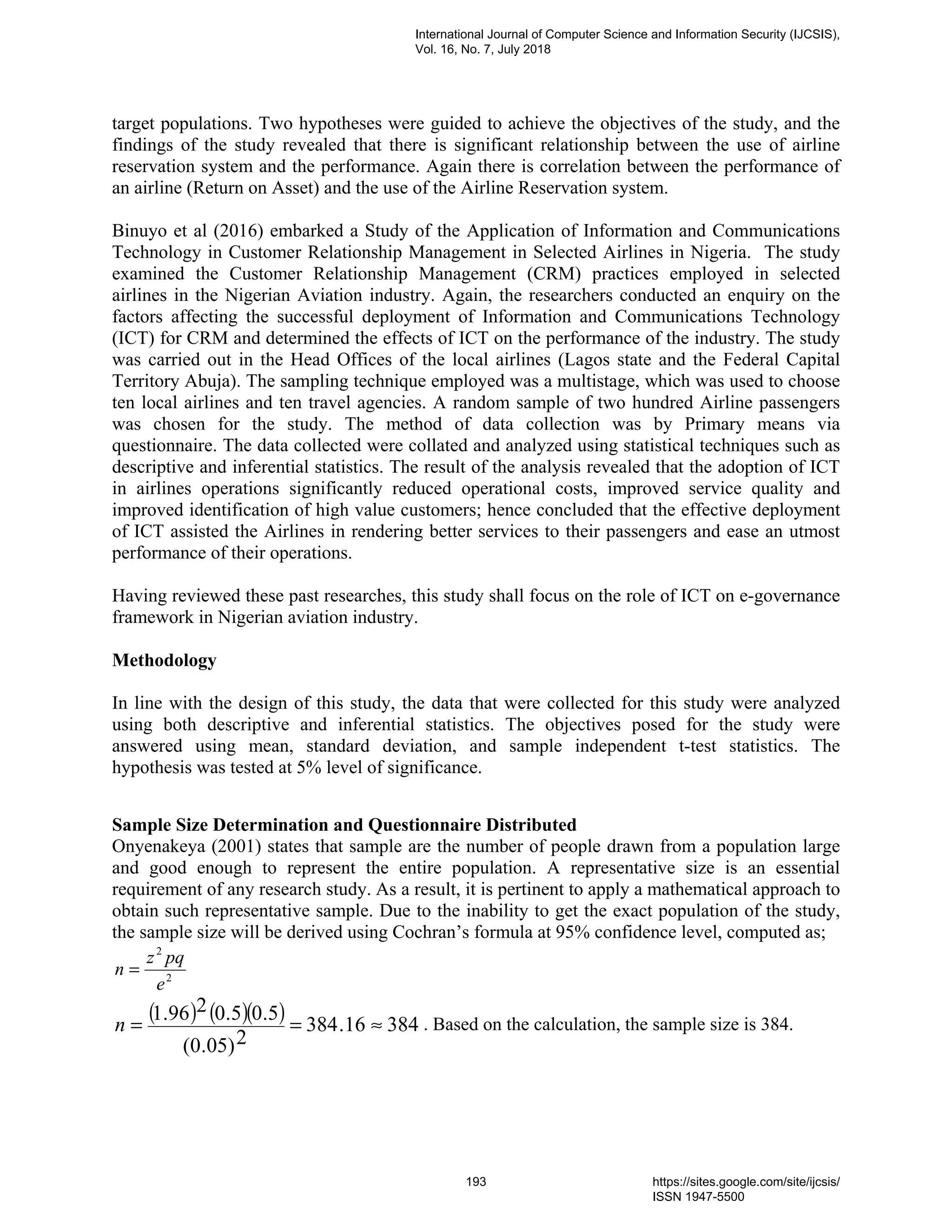
Hardware Performance Counters
James Christopher Foreman #1
#
Department of Engineering Fundamentals, University of Louisville
Louisville, KY. USA 1
jcfore01@louisville.edu
Abstract—Cyber attacks and malware are now more prevalent
than ever and the trend is ever upward. There have been
several approaches to attack detection including resident software
applications at the root or user level, e.g., virus detection, and
modifications to the OS, e.g., encryption, application signing, etc.
Some approaches have moved to lower level detection and preven-
tion, e.g., Data Execution Prevention. An emerging approach in
countermeasure development is the use of hardware performance
counters existing in the micro-architecture of modern processors.
These are at the lowest level, implemented in processor hardware,
and the wealth of data collected by these counters affords some
very promising countermeasures with minimal overhead as well
as protection from being sabotaged themselves by attackers. Here,
we conduct a survey of recent techniques in realizing effective
countermeasures for cyber attack detection from these hardware
performance counters.
I. INTRODUCTION
Cyber security has been at the forefront of mainstream media
for several years now as a critical problem for our society to
overcome. Attackers are increasingly motivated and enabled
to compromise software and computing infrastructure. Cyber
security countermeasures are of prime interest in mitigating
such attacks and associated malware.
There are many types of countermeasures that are built as
software applications, e.g., virus checkers, based on control-
ling physical access, e.g., biometrics, or enforced as policies,
etc. Our investigation is to survey the state of the art in the
utilization of Hardware Performance Counters (HPC) to build
cyber security countermeasures. HPCs are a promising new
resource to address the limitations of typical software, and
other countermeasures.
Hardware performance counters are special purpose registers
and logic incorporated in the micro-architecture of modern
processors and CPUs. They are typically used as debugging
tools that run at the lowest level, i.e., on chip, for performance
tuning and analysis by collecting information on processor
events and the running processes. As the name implies, HPCs
are used to count events, such as cache misses, and aid in
timing events, such as counting CPU cycles per unit time.
This information that is typically used to debug software can
now also be used to detect cyber attacks. Their residence in
micro-architecture, i.e., in silicon, is a safeguard against their
tampering.
A. Recent Related Surveys
Several related surveys have been performed, e.g., [1] exam-
ines the feasibility of using HPCs to detect malware with
several specific examples of HPC data triggers and detection
techniques, and others that focus on Control Flow Integrity[2]
(CFI), hardware trojans[3], and side-channel timing attacks[4].
Our survey updates the current state of knowledge and focuses
on HPCs in particular, examining several examples and cate-
gorizing them by method and attack vector.
B. Using Hardware Performance Counters as Countermea-
sures
Hardware performance counters afford a highly granular and
low footprint method of detecting anomalous behavior. HPCs
reside on the processor chip, implemented in dedicated hard-
ware, so they typically consume minimal resources from
the processor. Their inclusion by major processor vendors
alleviates the need to develop custom IP cores for cyber attack
detection. HPCs collect a wealth of information such as cache
misses, event timing, branch mis/predictions, etc. about the
running processes. They also execute at the kernel/hardware
privilege level, and are difficult to spoof or sabotage by attack-
ers due to their physical persistence in the micro-architecture.
Table #1 lists some of the commonly used HPCs. Many
additional HPCs are available depending on the processor
manufacturer, e.g., Intel[5]. This table is more thoroughly
discussed with supporting data collected from anomaly testing
in [6].
The perf utility in Linux is an example method of access.
Direct access through machine coding, e.g., inline in C, and
custom monitoring software are possible as well. Software
development tools should allow HPCs to be activated without
source code modification or in some cases rebuilding. In this
case, HPCs are in contrast to code instrumentation as they exist
to passively and externally monitor the processor behavior.
The wealth of data from HPCs lends itself to the discovery of
anomalous behavior that is an indicator of a potential attack.
International Journal of Computer Science and Information Security (IJCSIS),
Vol. 16, No. 7, July 2018
1 https://sites.google.com/site/ijcsis/
ISSN 1947-5500
TABLE I
TYPICAL HARDWARE PERFORMANCE COUNTERS, adapted from [6].
cpu-cycles L1-dcache-loads dTLB-loads
branches L1-dcache-stores iTLB-loads
instructions L1-icache-loads dTLB-load-misses
branch-misses L1-icache-load-misses iTLB-load-misses
branch-loads LLC-loads dTLB-stores
branch-load-misses LLC-load-misses dTLB-store-misses
cache-references LLC-stores
cache-misses LLC-store-misses
ref-cycles
bus-cycles
HPCs employ one or more of the approaches in detecting
attacks.
1) Signature based: HPCs collect information about the
suspect process and determine if this information cor-
responds to either known attacks, e.g., blacklist, or
known safe applications, e.g., whitelist. This is similar
to approaches used by many virus scanning applications.
The whitelist, if practical, has the added benefit of
denying any activity that has not been validated, thus
mitigating unknown and zero day attacks.
2) Heuristic based: HPCs monitor the suspect process to
determine if behavior is anomalous, such as if there are
a high number of cache misses or a high number of
branch mis-predictions (above a heuristic threshold) to
indicate a potential attack.
3) Advanced approaches: HPC data are analyzed and used
in more advanced statistical analysis, machine learning,
or other artificial intelligence approaches with super-
vised or unsupervised learning.
4) Hybrid approaches: A combination of one or more of
these, possibly also in cooperation with other security
countermeasures.
5) Context sensitivity: In addition to monitoring blacklist,
whitelist, and heuristic behavior, the context in which the
application is running can be part of the classification.
This can be realized when the countermeasure creates a
Control Flow Graph (CFG) during initial configuration
and then monitors when syntactically-correct, though
functionally invalid, paths are attempted, such as during
code reuse attacks.
The selection of an approach depends on the application and
environment. Forming signatures requires specific knowledge
of the attack to form a blacklist, or knowledge of all valid (ac-
ceptable) applications to form a whitelist. Heuristics are used
when this knowledge is less specific, and general knowledge
of trends are available through monitoring of the system to
set guidelines, e.g., thresholds. Machine learning becomes a
better alternative when the system needs to adapt to unknown
threats or the execution environment is too dynamic to predict
anomalous behavior.
C. Notes for IoT and Embedded Systems
Embedded systems and systems that comprise the Internet
of Things (IoT) usually have the characteristics of limited
resources, such as memory, processing power, and network
bandwidth. IoT specifically may also include high deploy-
ment where many devices are managed. The use of HPCs
for countermeasures are still a viable alternative for these,
perhaps more so due to the low overhead of HPCs, though
the following points should be considered.
1) Some embedded systems may have limited HPCs avail-
able, especially in custom or application specific imple-
mentations.
2) The use of black/white lists may require too much
storage and the use of machine learning algorithms
may require too much processing power. Heuristic ap-
proaches tend to work best, though when used alone
they may not provide adequate protection.
3) In deployments with many devices, a centralized
database or machine learning engine may be able to
offset some of the local limitations to provide good pro-
tection, providing that network bandwidth is available.
Distributed approaches may alleviate limitations when a
centralized authority is not practical.
4) Many embedded systems only run a limited selection
of applications and/or have static configurations. A
whitelist may be more practical and effective in these
cases.
D. Notes for Cloud Usage
Cloud usage and usage in Virtual Machines (VM) should be
possible as most VM hypervisors have the option of enabling
virtual HPCs. Cloud providers would need to enable this func-
tionality as it is usually not enabled by default. Otherwise, the
use of HPCs for countermeasures should be largely transparent
to the cloud provider and users. When HPCs are enabled in
VMs, it should be ensured that the HPC values presented to the
VM OS are only for that VM’s activities, which is usually the
case and again, managed by the hypervisor. Cloud providers
may choose to enable these methods rather than rely on users’
requests.
E. Structure of this Paper
Section I introduces the topic of cyber attack detection via
HPCs, discusses similar surveys, and includes notes on specific
application areas. Section II discusses the types of attacks, i.e.
attack categories, including their capabilities and how they
are carried out. Section III analyzes several example cyber
attack countermeasures using HPCs, categorizing these by
countermeasure approach. Section IV provides a summary of
this analysis with insights into countermeasure characteris-
tics, implementation, and hybridization of multiple counter-
measures that may be utilized for more complete detection
coverage while mitigating false positives and false negatives.
International Journal of Computer Science and Information Security (IJCSIS),
Vol. 16, No. 7, July 2018
2 https://sites.google.com/site/ijcsis/
ISSN 1947-5500
Finally, Section V discusses future directions for HPC-based
countermeasures.
II. TYPES OF CYBER ATTACKS AND ATTACK VECTORS
The types of cyber attacks possible have been well covered in
the literature. A brief summary of cyber attack categories is
provided in Fig. #1.
Code Reuse Attacks (CRA) that compromise control flow
integrity seek to alter the normal control flow of a software
application to perform malicious activities. Examples include
Return Oriented Programming (ROP), in which the attacker
gains control of the call stack to rewrite the return address
from a function call, and Jump Oriented Programming (JOP),
in which the attacker maliciously uses the jump instruction
to piece together malicious code fragments. The attack uses
existing instructions in executable code or resident libraries
that are chained together to form gadgets. These gadgets are
similar to functions, i.e., sets of instructions, that are used to
perform the malicious activity of the attacker. In most cases,
the attacker needs to know the executable code and libraries
from which to select gadgets. For commodity operating sys-
tems and applications, these are known to the attacker. Address
space layout randomization, e.g., code randomization, is an
effort to make this more difficult. Also, side channel leaks
may allow an attacker to uncover enough information from
which to build useful gadgets anyway. Such CRA mitigation
has been a primary focus of HPC-based countermeasures as
the HPC information collected, such as cache misses, branch
mis-predictions, etc., are good heuristic indicators of CRA
where control flow becomes detectably anomalous.
False Code Injection (FCI) and modification attacks seek
to inject a malicious software payload or overwrite existing
application code with such a payload to perform malicious
activities. Many of these are done via buffer overflows, and
may be performed by other various means. In some cases,
false data may be injected to alter program behavior, such as
false sensor readings in process control systems. The goals
of such attacks may be to seize control, sabotage, or to
damage the system being attacked so as to interfere with
the performance of its mission. HPC countermeasures for
these generally look for anomalous behavior, i.e., contrary to
the valid functioning of the application software. Depending
on the code overwritten, the counts for various errors may
dramatically increase in a short time, e.g., buffer overflow
events.
Information leakage attacks seek to steal information from the
target system. Usually, these are passwords or other secrets,
and may be executable code fragments in preparation for a
code reuse attack. Side channel leakage is the most common
vector using cache operation attacks such as flush+reload[7],
evict+time, prime+probe, and evict+reload. HPCs can detect
these from excessive cache misses. HPCs may also monitor
event counts for correlation with secret keys when attackers
seek to employ HPCs in side channel attacks. Due to the high
level of detail HPCs can provide, some attackers may exploit
HPCs, for example, to leak the secret key when encryption
operations are performed. Martin et al. [8] have proposed
disabling or adding noise to HPCs to reduce their accuracy
and subsequent efficacy in an effort to prevent attackers from
leveraging these.
In other scenarios, more specific hardware events such as
memory corruption by rowhammer, which repeatedly accesses
(hammers) RAM in a very atypical manner to induce errors in
adjacent memory cells, may occur and be detected by HPCs
acting as hardware monitors based on RAM access. Some
Denial of Service (DoS) attacks may also be detected by
HPCs noting that most event counts for normal operation often
differ greatly from operation during a DoS, which is typically
characterized by extremely high activity.
III. APPROACHES TO ATTACK DETECTION
From the list of approaches for attack detection in the previous
section, several specific examples are examined to establish the
current state of the art in HPC cyber security countermeasures.
A. Signature Based Examples
Three signature based examples, SIGDROP[9], ConFirm[10],
[11], and another by Chiappetta et al.[12] are examined in their
use of HPCs to detect cyber attacks. SIGDROP focuses on
detecting Return Oriented Programming (ROP) attacks using
two characteristics of such attacks. The first is a high level of
mis-prediction by the Return Address Stack (RAS) due to the
attackers mis-direction in returns. The second characteristic
is that of calls to functions that are very short in instruction
length, i.e., gadgets, that are artificially crafted from existing
code to perform attack functions. Many such gadgets must
be chained together to perform useful work for the attack,
thus long chains of very short functions are another signature.
Recent studies show that most ROP gadgets have fewer than
6 instructions [13], [14], [15] and may require chaining of
dozens to hundreds of gadgets to perform an attack function.
SIGDROP configures hardware performance counters to count
if the number of consecutive return address predictor misses is
above a threshold, TM , and compares this to the total number
of return instructions, NR. If these are nearly equal, then the
return address predictor is missing almost all the time, which
is one of the characteristics of a ROP attack. A HPC is also
configured to count total instructions executed, NI, to check
the average number of instructions per missed return address
prediction. Noting that the typical number of instructions per
gadget or per return is TI ≤ 6 for ROP attacks, the second
signature is found by NI ≤ (TI × TM ), which is true when
the total number of instructions is less than or equal to the
typical ROP gadget length times the number of return address
predictor misses. Thus, SIGDROP is an example of a blacklist
signature approach. The blacklist behavior is determined by
comparison against known attacks.
International Journal of Computer Science and Information Security (IJCSIS),
Vol. 16, No. 7, July 2018
3 https://sites.google.com/site/ijcsis/
ISSN 1947-5500
Fig. 1. Types of cyber attack.
ConFirm[10], [11] uses hardware performance counters to
detect malicious software either injected into firmware or by
performing CRAs using firmware code. ConFirm is a whitelist
signature approach since firmware is known in advance and
rarely changes. ConFirm performs HPC checks at various
points in the firmware code execution process to determine
if configured HPCs are at typical values. Since the same code
always executes under normal circumstances, these should be
very consistent. An attack would introduce new operations and
thus change the HPCs. The whitelist behavior is determined
by profiling the valid code (firmware) prior to deployment
(offline) to collect good HPC values and determine optimal
checkpoints.
Chiappetta et al.[12] proposed using HPCs to detect side
channel attacks, specifically on cache memory to compromise
encryption through information leakage, such as flush+reload.
The countermeasure employs a utility, quickhpc, that allows
the HPC to be queried much faster, at microsecond resolution.
Under normal circumstances, the encryption process would
be expected to benefit from the cache for a significant por-
tion of the process time. However, when under attack the
encryption process never benefits from the cache, because
the flush+reload side channel attack is constantly flushing the
cache and timing the reload to determine program flow of the
encryption process. These cache misses are collected by the
HPC which can signal anomalous operation. If using simple
threshold heuristics, there could be many false positives, so
Chiappetta employs simple machine learning to determine a
signature for the encryption process. This is another example
of a whitelist approach that uses unsupervised training.
B. Heuristic Based Examples
Heuristic based examples, such as ANVIL[16],
CacheShield[17], by Lui et al.[18], by Torres et al.[19],
and Eunomia[20], provide direct detection of attacks when
certain events count past preset thresholds, either individually
or in some combination. These tend to perform better when the
effects of attacks are more generally known, e.g., when jump
oriented attacks result in high branch mis-predictions. These
may result in a higher number of false positives depending on
the process being executed, especially when there is a wide
range of potentially valid processes. However, they are simple
to implement and can act as a pre-filter for more advanced
and resource consuming detection approaches. ANVIL
is a Linux-based kernel module to mitigate rowhammer
attacks, specifically new forms of rowhammer that seek
to evade simple rowhammer countermeasures that DRAM
manufacturers are now employing, such as on-DRAM caches.
ANVIL works by monitoring the locality of DRAM row
accesses out of the LLC misses (LONGEST LAT CACHE.MISS).
Once a preset threshold of LLC misses is exceeded, a second
stage of detection samples virtual addresses for a time
duration using Load Latency (MEM TRANS RETIRED.LOAD
LATENCY) and Precise Store (MEM TRANS RETIRED.PRECISE
STORE) events to determine locality. Once an attack is
detected, the rows adjacent to the rows being attacked are
refreshed through a read operation. This is only performed
as needed so that false positives have very little effect on
the system. Thresholds can be determined by observation of
bit flips, and may also be empirically set based on DRAM
specifications.
International Journal of Computer Science and Information Security (IJCSIS),
Vol. 16, No. 7, July 2018
4 https://sites.google.com/site/ijcsis/
ISSN 1947-5500
CacheShield[17] is designed to be a user-level tool, with
low performance impact for legacy systems, that specifically
targets cache attacks. Cache misses, a common symptom of
cache attacks, are counted using various cache miss HPCs.
CacheShield is configured by monitoring known valid and
malicious applications to determine cache miss thresholds for
detection, and selects the specific HPCs that are most affected
for the application. The example given in the paper was for
OpenSSL and the L3 cache. A cache attack is detected when
an abrupt change in the statistical distribution of cache misses
occurs.
Lui et al.[18] developed a countermeasure to stack buffer
overflow attacks used to compromise control flow integrity. A
two-level approach is used with the first level being a heuristic
pre-filter to facilitate low overhead on embedded systems.
Stack buffer overflow attacks redirect control flow through
dynamically overwriting the return address of a procedure,
which results in instruction cache misses and mis-prediction of
return addresses. Anomalous behavior is detected when these
occur above an established threshold.
Torres et al.[19] investigated if data-only exploits could be
detected at runtime with HPCs. Examples of data oriented at-
tacks are SQL injections or any other mis-information whereby
malformed data sent to a host causes the host to disclose secret
information. The Heartbleed attack, studied specifically in this
work, uses an overestimate of the size of keep-alive packets
that keep secure channels open, causing the host to respond
with extra data, which contain sensitive information.
Eunomia[20] is another example of earlier work that is similar
to these where deviations in PMU-event counts signal mali-
cious activity versus valid processes. This paper includes a
good quantitive discussion of HPC deviation values in general
under attack scenarios for reference.
C. Examples of Machine Learning and Context Sensitivity
Machine learning includes most approaches in the area of
artificial intelligence. Learning may be supervised, such as
training HPC data against known valid and known malicious
applications. This learning is usually offline, i.e., the classi-
fication engine for detecting malicious behavior is developed
before runtime or deployment. Learning may also be unsu-
pervised, such as online during runtime based on accumulated
information, e.g., information from HPCs. Security policy may
still be specified for unsupervised learning and the classi-
fication engine will learn violations to this policy. Context
sensitivity implies knowledge of the operating environment
or application. This knowledge may include information from
the source or binary code such as the proper execution paths,
e.g., control flow graph verification, or mathematical rules,
such as those extracted from the code or based in physics
for physical processes, to validate proper operation of the
compiled application. Instrumentation of the binary may be
performed to provide checkpoints within the application to
facilitate these checks. Knowledge of the user environment
may be used to detect deviation from expected user behaviors,
or even the behaviors of the machine hardware.
The goal of machine learning is to provide a more advanced
detection scheme that eliminates the false positives from
simple signatures and heuristics as well as eliminating the false
negatives when sophisticated attacks are launched that use
valid code fragments and other seemingly valid approaches.
Machine learning is typically of much higher processing over-
heads and is often deployed as a second layer to a signature
or heuristic first layer, which acts as a pre-filter to minimize
the performance impact.
Torres et al.[19] performed a survey of approaches that were
essentially intelligent outlier rejection. The desired approach
characteristic was unsupervised learning by using collected
HPC data only, i.e., a data-driven approach. Cache misses
and branch mis-predictions were common variables studied.
During runtime, HPC data was collected for specific intervals
(1ms, 10ms, 100ms) with the assumption that valid activity
was more common (normal) and that invalid activity (attacks)
would be statistical outliers to the HPC data. The counter-
measure behaved similarly to heuristic analysis without the
necessity of pre-determining heuristic thresholds. The machine
learning portion would build a model in memory of the valid
state space as the statistical norm.
HPCMalHunter[21] dynamically monitors HPC data to clas-
sify malicious behavior. This approach uses supervised learn-
ing and offline pre-training to build a database for classi-
fication. The HPC data assembled into vectors (monitored)
in the example were: Branch instructions retired (BIR), load
instructions retired (LIR), store instructions retired (SIR), and
mis-predicted branch instructions (MBI). The database is a
matrix and HPC event data is formatted as a vector input for
classification, similar to an artificial neural network except by
a Support Vector Machine[22] (SVM) in this case. As HPC
data are typically very sparse, the SVM matrix is optimized by
Single Value Decomposition (SVD) to reduce its dimension-
ality and reduce storage and processing overheads resulting in
the final classification engine. This particular countermeasure
examined HPC data in blocks of 100,000 machine instructions,
and the span of examining multiple HPC data (BIR, LIR, SIR,
MBI) facilitated a very low false positive rate.
Nomani et al.[23] developed an Artificial Neural Network
(ANN) classifier to determine the phase of a running applica-
tion as a countermeasure against side channel attacks. Here,
side channel attacks refer to attacks that attempt to capture
secret information or perform malicious activities on shared
resources. Phase refers to the types of resources and functional
units that are utilized at that time, such as a memory phase
during high memory accesses, a floating point phase during
floating point operations, an integer phase, etc. When multiple
applications, or an application and a malicious program, share
resources, the potential for an attack is much higher[24], and
thus monitoring should be more vigilant. The ANN provides a
International Journal of Computer Science and Information Security (IJCSIS),
Vol. 16, No. 7, July 2018
5 https://sites.google.com/site/ijcsis/
ISSN 1947-5500
black-box approach to determining the phase in which running
applications reside or are in transition and purposely influences
the OS scheduler to avoid scheduling other applications on the
same processor using the same functional resources. Contrary
to increasing overhead, the countermeasure on average reduced
resource load by as much as 25% in some cases as a side
benefit. Once trained via supervised learning, the ANN was
able to perform classification well under the average time
between context switches allowing the scheduler sufficient
time to recalculate thread scheduling in most cases.
Alam et al.[25] developed a countermeasure that employed two
novel methods. The first was consideration that lots of HPC
data were known or could be generated for valid applications,
while HPC data for attacks were rare or would be unknown
due to zero-day attacks. Therefore, a single-class SVM was
developed to only classify valid behavior. The failure to
classify valid behavior determined potential invalid (malicious)
behavior. The behavior was further analyzed to select the
most likely HPC variables for attack classification based on
how the anomalous behavior deviated from valid behavior.
The second novel method used in the countermeasure was
Dynamic Time Warping[26] (DTW). HPC data represent time
series of various event counts, such as cache misses. A side
channel attack may seek to exploit HPCs by superimposing the
secret key or other sensitive information on these time series
through seemingly benign operations to exfiltrate the sensitive
information. Therefore, these time series (HPC events) are
monitored and correlated with sensitive information to see if
there is a match. The DTW algorithm allows detection even
when the time series is compressed, stretched, or scaled with
respect to the sensitive information pattern.
BehavioR based Adaptive Intrusion detection in Networks[27]
(BRAIN) is a countermeasure for distributed Denial of Ser-
vice (DoS) attacks in networks. Most network-based DoS
countermeasures use heuristics on network traffic by exam-
ining packets for attack signatures or specific attack behavior.
BRAIN enhances this by adding HPC data in the analysis of
DoS attacks under the assumption that processors also behave
differently during such attacks. BRAIN is trained during idle
and normal operation as well as during known DoS attacks,
i.e., supervised and online. Network heuristics from traditional
approaches are combined with BRAIN’s HPC-based informa-
tion via unsupervised K-means clustering that is then used to
form a SVM for final classification. Claimed results are zero
false positives with 99.8% true positive detection, conditional
on the span of the DoS attack scenarios used in training.
FlowGuard[28] is a countermeasure approach worth men-
tioning here although it does not use HPCs. It does, how-
ever, utilize Intel Processor Trace[29], a debugging tool also
implemented in micro-architecture. FlowGuard uses machine
learning of control flow paths to form a valid Control Flow
Graph (CFG). It then compresses the CFG information in the
same format as that supplied by Intel Processor Trace to allow
rapid, direct comparison of runtime control flow with these
learned valid paths. Paths are ranked with the most common
paths ranked highest. During runtime, deviation from valid
paths will indicate an anomaly and potential attack that can
then be examined with additional analysis, such as a hybrid
approach with HPCs.
IV. COMPARISON OF COUNTERMEASURE APPROACHES
In this section, a comparison of countermeasures approaches
as exemplified in Section III is given. Table II tabulates
the examples given in Section III with respect to name and
citation, HPCs utilized, the general category also from Section
III, and the types of attacks for which that example is good
for detecting. Table III provides a comparison of the general
categories with respect to characteristics of countermeasures
within that category and application notes that fit that cate-
gory. Figure 2 illustrates the process flow of countermeasure
categories and how multiple approaches may be used in hybrid
configurations.
The following terms are used in Table II. Branch instructions
retired (BIR), load instructions retired (LIR), store instructions
retired (SIR), and mis-predicted branch instructions (MBI),
Processor Management Unit events (PMU), Code Reuse At-
tacks (CRA), Machine Learning (ML), self-directed Outlier
Rejection (OR), Support Vector Machine (SVM), Single value
Decomposition (SVD), Artificial Neural Network (ANN), Dy-
namic Time Warping (DTW), Control Flow Graph (CFG),
and Return Oriented Programming (ROP). General attack
effectiveness, usually in machine learning, implies the coun-
termeasure is used to detect general attack behavior versus a
specific class. Chooses by learning implies the countermeasure
selects HPCs that are best suited, i.e. most affected, by the
attack class to be detected.
†Torres et al. incorporates both heuristic and machine learning
aspects to its approach.
In Fig. 2, attacks of all types, as denoted in Fig. 1, enter
the target system. Signature countermeasures, Section III-A
scan attack activity in various HPCs for specific patterns.
The assumption is that known attacks impact various counters
in a predictable and repeatable manner. Another approach
may be the use of heuristics, Section III-B. Heuristics look
for anomalous activity in HPCs as the exceeding a preset
threshold. These are usually quick and simple in implemen-
tation. Machine learning approaches, Section III-C, may be
utilized through any number of more advanced approaches.
Any one of these may be used as a first layer of detection
of cyber attack. Hybrid approaches will use one or more
of these as a pre-filter in combination with one or more of
these at a second layer of detection in an effort to mitigate
false positives/negatives, incorporate intelligent approaches,
and minimize resource requirements by reserving complex
countermeasure activities only after passing through simpler
pre-filtering. A typical hybrid approach would be using a
heuristic as a pre-filter at the first layer and (&) using machine
learning for further analysis at the second layer.
International Journal of Computer Science and Information Security (IJCSIS),
Vol. 16, No. 7, July 2018
6 https://sites.google.com/site/ijcsis/
ISSN 1947-5500
TABLE II
EXAMPLES OF HPC COUNTERMEASURES.
Name Category HPCs used Attacks targeted
SIGDROP [9] signature return address predictor misses, total
number of return instructions
ROP and other CRAs
ConFirm [10],
[11]
signature various HPCs, code instrumentation
via checkpoints
malicious software injected into
firmware or CRAs using firmware
Chiappetta et al.
[12]
signature cache misses and high speed HPC
query
side channel attacks, cache memory,
information leakage, e.g., flush+reload
ANVIL [16] heuristic LLC misses, Load Latency, Precise
Store
rowhammer
CacheShield [17] heuristic various cache misses cache attacks on legacy systems
Lui et al. [18] heuristic instruction cache misses and
mis-prediction
stack buffer overflow attacks
Torres et al. [19] † heuristic Cache misses and branch
mis-predictions
general, anything outside the norm,
Heartbleed
Eunomia [20] heuristic PMU events general
Torres et al. [19] † ML, OR Cache misses and branch
mis-predictions
general, anything outside the norm,
Heartbleed
HPCMal-
Hunter[21]
ML, SVM, SVD BIR, LIR, SIR, MBI general
Nomani et al. [23] ML, ANN HPCs by resource (memory, floating
point, integer, etc.)
general
Alam et al. [25] ML, SVM, DTW chooses HPCs from learning general
BRAIN [27] ML, k-means,
SVM
chooses HPCs from learning distributed denial of service
FlowGuard [28] ML, CFG Intel Processor Trace ROP and others that alter process flow
TABLE III
COMPARISON OF HPC COUNTERMEASURE CATEGORIES.
Category Characteristics/requirements Application (Use cases)
Signature memory intensive, not adaptive, training of signatures,
simple
specific/known attacks and apps, black-
list/whitelist
Heuristic minimal footprint, generally quickest, tuning of thresh-
olds, false posi/negatives may be higher
when general behaviors are known, attack
exceeds some threshold
Machine learn-
ing
generally largest footprint, potentially best with minimal
false posi/negatives, context sensitivity
dynamic/unknown attack and app behaviors,
deep attacks, zero day attacks
Hybrid large footprint offset by filtering (multi-layer), minimal
impact with minimal false posi/negatives
when the combined features of two or more
countermeasure layers is beneficial
V. FUTURE DIRECTIONS
From this survey, hardware performance counters have already
been used in a variety of cyber attack countermeasure ap-
proaches. In most cases, they are an existing resource and
implemented in on-chip in separate hardware, thus minimizing
their impact both on application performance and in applica-
tion development.
The motivations for including HPCs in micro-architecture
have been towards improved debugging and application sta-
bility. If additional micro-architectural features are incorpo-
rated that have cyber security as a primary mission, more
approaches may be possible in the near future. Additional
micro-architectural approaches already available include ex-
ecution and information flow monitoring, e.g., Intel Processor
Trace[29], built in self tests, subroutines from Joint Test Action
Group (JTAG) interfaces, and others. Also of note are the in-
creasing reliance on cloud systems and computing as a service.
In the same method of using micro-architectural approaches,
hypervisor based approaches should also be examined. Re-
search should continue in such approaches as an additional
front in the prevention of cyber attacks, especially noting the
International Journal of Computer Science and Information Security (IJCSIS),
Vol. 16, No. 7, July 2018
7 https://sites.google.com/site/ijcsis/
ISSN 1947-5500
Fig. 2. Summary of HPC countermeasures.
ever increasing footprint of software based approaches. As the
number and complexity of attacks increases, these applications
utilize more resources and become more difficult to develop
and manage.
While cyber attacks are increasing in number and sophisti-
cation, the vast majority of these are still not able to per-
form much malicious activity without leaving basic hardware
signatures, such as missed branch predictions, cache misses,
hammering of rows, etc. HPC based countermeasures need to
move out of research and into to the mainstream of attack
detection software as quickly as possible. In cases where a
hardware/software system configuration is completely known,
HPCs could theoretically detect most any direct attack. In
many cases, side channels can be detected as well, e.g.,
Dynamic Time Warping.
A. Special Note Meltdown and Spectre
Currently, the cyber attacks of Meltdown and Spectre [30]
have emerged at the micro-architectural level. In Meltdown, an
attack attempts an unauthorized read of privileged memory, to
which it is not allowed access. Though the processor will even-
tually deny access to this memory, it will still fetch and in most
cases perform some processing, i.e., speculative processing,
with this memory. The attacker then attempts to intercept this
information or the result prior to failing the privilege check, or
in some cases as a residual after the privilege check. HPCs that
count privilege check violations, if developed, might indicate
this attack. Spectre is a more generalized class of vulnera-
bilities similar to Meltdown, focusing on branch prediction.
In speculative execution schemes, both branch options may
be followed until the correct branch is finally determined.
The processor would then discard the mis-predicted branch,
though side effects of this would remain and encourage a
side channel attack. These types of branch mis-predictions are
common whether the attack is present or not, i.e., the attack
does not cause these mis-predictions. Some mitigations involve
preventing out of order execution for vulnerable processes, but
this carries significant performance impacts. Perhaps future
work in HPCs as cyber attack countermeasures could employ
multiple event counts to selectively classify Meltdown and
Spectre attacks since HPCs work at the micro-architectural
level with these attacks.
REFERENCES
[1] J. Demme, M. Maycock, J. Schmitz, A. Tang, A. Waksman, S. Sethu-
madhavan, and S. Stolfo, “On the feasibility of online malware detection
with performance counters,” in ACM SIGARCH Computer Architecture
News, vol. 41, no. 3. ACM, 2013, pp. 559–570.
[2] R. de Clercq and I. Verbauwhede, “A survey of hardware-based control
flow integrity (cfi),” arXiv preprint arXiv:1706.07257, 2017.
[3] S. Bhunia, M. S. Hsiao, M. Banga, and S. Narasimhan, “Hardware trojan
attacks: threat analysis and countermeasures,” Proceedings of the IEEE,
vol. 102, no. 8, pp. 1229–1247, 2014.
[4] Q. Ge, Y. Yarom, D. Cock, and G. Heiser, “A survey of microarchitec-
tural timing attacks and countermeasures on contemporary hardware,”
Journal of Cryptographic Engineering, pp. 1–27, 2016.
[5] “Intel 64 and ia-32 architectures software developers manual volume 3,
chapter 17, 18, and 19,” 2016.
[6] A. Garcia-Serrano, “Anomaly detection for malware identification us-
ing hardware performance counters,” arXiv preprint arXiv:1508.07482,
2015.
[7] Y. Yarom and K. Falkner, “FLUSH+RELOAD: A High Resolution, Low
Noise, L3 Cache Side-Channel Attack.” in USENIX Security, vol. 2014,
2014, pp. 719–732.
[8] R. Martin, J. Demme, and S. Sethumadhavan, “Timewarp: rethinking
timekeeping and performance monitoring mechanisms to mitigate side-
International Journal of Computer Science and Information Security (IJCSIS),
Vol. 16, No. 7, July 2018
8 https://sites.google.com/site/ijcsis/
ISSN 1947-5500
channel attacks,” ACM SIGARCH Computer Architecture News, vol. 40,
no. 3, pp. 118–129, 2012.
[9] X. Wang and J. Backer, “Sigdrop: Signature-based rop detection us-
ing hardware performance counters,” arXiv preprint arXiv:1609.02667,
2016.
[10] X. Wang, C. Konstantinou, M. Maniatakos, and R. Karri, “Confirm:
Detecting firmware modifications in embedded systems using hard-
ware performance counters,” in Computer-Aided Design (ICCAD), 2015
IEEE/ACM International Conference on. IEEE, 2015, pp. 544–551.
[11] X. Wang, C. Konstantinou, M. Maniatakos, R. Karri, S. Lee, P. Robison,
P. Stergiou, and S. Kim, “Malicious firmware detection with hardware
performance counters,” IEEE Transactions on Multi-Scale Computing
Systems, vol. 2, no. 3, pp. 160–173, 2016.
[12] M. Chiappetta, E. Savas, and C. Yilmaz, “Real time detection of
cache-based side-channel attacks using hardware performance counters,”
Applied Soft Computing, vol. 49, pp. 1162–1174, 2016.
[13] V. Pappas, M. Polychronakis, and A. D. Keromytis, “Transparent rop
exploit mitigation using indirect branch tracing.” in USENIX Security,
vol. 30, 2013, p. 38.
[14] Y. Cheng, Z. Zhou, Y. Miao, X. Ding, H. DENG et al., “Ropecker:
A generic and practical approach for defending against rop attack,”
Proceedings of the 21th Annual Network and Distributed System Security
Symposium (NDSS14), 2014.
[15] M. Kayaalp, T. Schmitt, J. Nomani, D. Ponomarev, and N. Abu-
Ghazaleh, “Scrap: Architecture for signature-based protection from
code reuse attacks,” in High Performance Computer Architecture
(HPCA2013), 2013 IEEE 19th International Symposium on. IEEE,
2013, pp. 258–269.
[16] Z. B. Aweke, S. F. Yitbarek, R. Qiao, R. Das, M. Hicks, Y. Oren,
and T. Austin, “Anvil: Software-based protection against next-generation
rowhammer attacks,” ACM SIGPLAN Notices, vol. 51, no. 4, pp. 743–
755, 2016.
[17] S. Briongos, G. Irazoqui, P. Malag´on, and T. Eisenbarth, “Cacheshield:
Protecting legacy processes against cache attacks,” arXiv preprint
arXiv:1709.01795, 2017.
[18] C. Liu, C. Yang, and Y. Shen, “Leveraging microarchitectural side chan-
nel information to efficiently enhance program control flow integrity,”
in Hardware/Software Codesign and System Synthesis (CODES+ ISSS),
2014 International Conference on. IEEE, 2014, pp. 1–9.
[19] G. Torres and C. Liu, “Can data-only exploits be detected at runtime
using hardware events?: A case study of the heartbleed vulnerability,”
in Proceedings of the Hardware and Architectural Support for Security
and Privacy 2016. ACM, 2016, p. 2.
[20] L. Yuan, W. Xing, H. Chen, and B. Zang, “Security breaches as pmu
deviation: detecting and identifying security attacks using performance
counters,” in Proceedings of the Second Asia-Pacific Workshop on
Systems. ACM, 2011, p. 6.
[21] M. B. Bahador, M. Abadi, and A. Tajoddin, “Hpcmalhunter: Behavioral
malware detection using hardware performance counters and singular
value decomposition,” in Computer and Knowledge Engineering (IC-
CKE), 2014 4th International eConference on. IEEE, 2014, pp. 703–
708.
[22] W. contributors, “Support vector machine — wikipedia, the free en-
cyclopedia,” https://en.wikipedia.org/w/index.php?title=Support vector
machine&oldid=826949511, 2018, [Online; accessed 25-February-
2018].
[23] J. Nomani and J. Szefer, “Predicting program phases and defending
against side-channel attacks using hardware performance counters,” in
Proceedings of the Fourth Workshop on Hardware and Architectural
Support for Security and Privacy. ACM, 2015, p. 9.
[24] Y. Zhang, A. Juels, M. K. Reiter, and T. Ristenpart, “Cross-vm side
channels and their use to extract private keys,” in Proceedings of
the 2012 ACM conference on Computer and communications security.
ACM, 2012, pp. 305–316.
[25] M. Alam, S. Bhattacharya, D. Mukhopadhyay, and S. Bhattacharya,
“Performance counters to rescue: A machine learning based safe-
guard against micro-architectural side-channel-attacks,” IACR Cryptol-
ogy ePrint Archive, 2017.
[26] W. contributors, “Dynamic time warping — wikipedia, the free en-
cyclopedia,” https://en.wikipedia.org/w/index.php?title=Dynamic time
warping&oldid=822466906, 2018, [Online; accessed 25-February-
2018].
[27] V. Jyothi, X. Wang, S. K. Addepalli, and R. Karri, “Brain: Behavior
based adaptive intrusion detection in networks: Using hardware perfor-
mance counters to detect ddos attacks,” in VLSI Design and 2016 15th
International Conference on Embedded Systems (VLSID), 2016 29th
International Conference on. IEEE, 2016, pp. 587–588.
[28] Y. Liu, P. Shi, X. Wang, H. Chen, B. Zang, and H. Guan, “Transpar-
ent and efficient cfi enforcement with intel processor trace,” in High
Performance Computer Architecture (HPCA), 2017 IEEE International
Symposium on. IEEE, 2017, pp. 529–540.
[29] J. R. and I. Corporation, “Processor tracing,” https://software.intel.com/
en-us/blogs/2013/09/18/processor-tracing, 2013, [Online; published 18-
September-2013].
[30] U.-C. U. S. C. E. R. Team, “Meltdown and spectre side-channel
vulnerabilities,” https://www.us-cert.gov/ncas/current-activity/2018/01/
03/Meltdown-and-Spectre-Side-Channel-Vulnerabilities, 2018, [Online;
published 03-January-2018].
International Journal of Computer Science and Information Security (IJCSIS),
Vol. 16, No. 7, July 2018
9 https://sites.google.com/site/ijcsis/
ISSN 1947-5500
Abstract— The main objective of this study is to determine
the factors influencing cloud computing adoption by Small
and Medium-sized Enterprises (SMEs). Based on two
dominant theories in the field of diffusion of innovation, a
conceptual model is proposed. In order to test the model
empirically, an online survey was designed and launched.
Decision makers of 101 SMEs agreed to participate in this
survey. In order to evaluate the internal, convergent, and
discriminant validity of the instrument, factor analysis and
reliability tests were performed. Logistic regression is
employed to test our hypotheses. The results of regression
reveal that decision maker’s knowledge about cloud
computing is the main influential factor in decision making
about its adoption.
Keywords: Cloud computing, SMEs, adoption
I. INTRODUCTION
Small and Medium-sized Enterprises (SMEs) significantly
contribute to each nation’s Gross Domestic Product (GDP)
and its labour market. Therefore, proposing strategies and
developing new systems are not only beneficial for SMEs, but
also for the economy as a whole. According to Tan et al. [1],
using appropriate Information and Communication
Technologies (ICT) helps SMEs become more efficient and
productive; however, SMEs do not have access to enough
resources (e.g. financial resources). Cloud computing, which
is an alternative to deploying applications and systems on-
premises, helps SMEs tackle many issues such as the high cost
and risk that are involved in IT projects. According to [5]
cloud computing has four advantages: 1) Data storage are
secure; the teams of the backend Cloud are so professional
that manage data also protect them from different attacks of
viruses and cracks. 2) The different application can be
supported by cloud computing. 3). The share of data and
applications are easy. 4) Thousands of servers exist in Cloud,
which has strong storage and computing ability. By
considering the advantages and key challenges of cloud
computing adoption, it is clear that cloud computing adoption
is still as a question for some organization. The organization
avoiding adopting cloud computing but due to advantages,
they are in favour to move cloud computing adoption.
Amazon, Google, Microsoft, IBM contributing in terms of
cloud computing. According to International Data Corporation
(IDC) 53% of Asian organizations already applying some of
the cloud computing services, and remaining 47% of the
organizations have decided to adopt Cloud services [9].
II. Literature review
SMEs are vital players of each market. One strategy which has
been proven to enhance SMEs’ ability to compete against
larger companies is the use of appropriate Information and
Communication Technologies (ICT) [1]. Although adopting
new technologies helps SMEs gain a competitive advantage, it
usually involves high costs. Cloud computing, as a new
computing paradigm, offers many advantages to companies,
especially smaller ones. Flexibility, scalability, and reduced
cost are just some of many advantages that cloud computing
offers to SMEs. To date, there is no universal definition for
cloud computing. Perhaps the most accurate definition of
cloud computing is the one offered by the National Institute of
Standards and Technology (NIST). They de- defined cloud
computing as “a model for enabling ubiquitous, convenient,
on-demand network access to a shared pool of configurable
computing resources (e.g., networks, servers, storage,
applications, and services) that can be rapidly provisioned and
released with minimal management effort or service provider
interaction. This cloud model is composed of five essential
characteristics, three service models, and four deployment
models.” [2] Following the success of cloud computing, the
new cloud-based delivery model of cloud computing has
emerged. These cloud computing solutions are market to offer
similar functionality as their on-premise counterparts, but the
infrastructure (software, computational power, hardware etc.)
is provide on-demand by the vendors in a pay-per-use model.
As with cloud computing, this new cloud computing delivery
model gains success increasingly growing its market share.
Most companies at least consider a cloud-cloud computing
solution and this trend were illustrates by [11] where
approximately 70 per cent of the CFOs stated that they would
consider using a Cloud-based version of their cloud
computing. Cloud computing Report quantifies the momentum
of cloud-cloud computing as it revealed that the market share
Factors of Cloud Computing Adoption by Small
and Medium Size Enterprises (SMEs)
Fahad1
, Sundresan Perumal2
1
Post Graduate Centre, Limkokwing University of Creative Technology
fahd.badr.nasser12@gmail.com
2
Faculty of Science and Technology, University Sains Islam Malaysia, darul Khusus, Malaysia,
sundresan.p@usim.edu.my
International Journal of Computer Science and Information Security (IJCSIS),
Vol. 16, No. 7, July 2018
10 https://sites.google.com/site/ijcsis/
ISSN 1947-5500
of cloud-based cloud computing systems has grown from 6
percent to 18 percent just in one year, from 2011 to 2012
(Panorama Consulting) [10]. As the market moves to a cloud
environment, traditional cloud computing providers are also
force to develop their own cloud-based solutions, otherwise
they risk losing market shares to the emerging Cloud
computing software vendors such as Netsuite and Plex.
However, a question that still appears to lack a clear answer is
whether cloud computing is a viable solution for companies of
all sizes.
III. Theory Review
The conceptual framework that is proposed in this research
originated from two well-known theoretical frameworks in
this field of study, which are Diffusion of Innovation (DOI)
theory developed by Rogers [30-31] and the Technology,
Organization, Environment (TOE) framework proposed by
Tornatzky and Fleischer [32]. Diffusion of Innovation Theory
(DOI) is a theory that tries to discover the factors that
influence the spread of a new idea or technology in a society
[31]. Rogers [30] defined diffusion of innovation as “the
process by which an innovation is communicated through
certain channels over time among the members of a social
system”. Any idea, process, product, or technology constitutes
an innovation, as long as it is perceived as new by individuals.
Rogers [30] argues that each innovation has different
attributes that influence its diffusion in society. Relative
advantage, compatibility, complexity, trialability, and
observability are the five key attributes of innovation. DOI
does not take into account the environmental and
organizational aspects of the context; therefore, in this study, I
used the Technology Organization Environment (TOE)
framework, which takes into account other aspects of
enterprises’ context.
IV. Research Model and Hypotheses
In order to study the adoption of cloud computing by SMEs, a
conceptual model is proposed. According to this model,
twelve variables influence the decision to adopt cloud
computing, which is depicted in Figure 1. All factors except
complexity have a positive influence on the adoption of cloud
computing. A very important study by Tornatzky and Klein
[33] reveals that relative advantage, complexity, and
compatibility are the characteristics of innovation that have
the most influence on the adoption of an innovation.
Hypotheses
Based on the model, 12 different hypotheses have been
proposed. Chau and Hui [34] argue that the size and structure
of SMEs force them to rely on external parties. In this context,
external support is defined as “The perceived importance of
support offered by cloud providers”. The first hypothesis is:
H1: Higher levels of perceived external support from cloud
providers positively affects the likelihood of cloud computing
adoption by SMEs
Competitive pressure is the level of competition among firms
within the specific industry in which the company operates
[35]. The following hypothesis is developed:
H2: Businesses that operate in more competitive environments
are more likely to adopt cloud computing.
Having enough knowledge about an innovation is the first step
in the adoption process. Therefore, in the context of cloud
computing, the following hypotheses have been developed:
H3: Decision Makers’ knowledge about cloud computing is
positively related to the decision to adopt cloud computing.
H4: Employees’ knowledge about cloud computing is
positively related to the adoption of cloud computing
Innovativeness is defined as “the level of decision-makers’
preference to try solutions that have not been tried out; and
therefore, are risky” [34]. Hypothesis 5 is:
H5: Decision Makers’ innovativeness is positively related to
the adoption of cloud computing.
According to Thong [35], information intensity is defined as
“the degree to which information is present in the product or
service of a business”. The following hypothesis is related to
this construct:
H6: Information intensity is positively related to the adoption
of cloud computing
An advantageous technology is one that enables companies to
perform their tasks more quickly, easily, and efficiently.
Moreover, it improves the quality, productivity, and
performance of the company. The following hypothesis below
is formulated: H7: Decision makers’ perception of the relative
advantage of using cloud computing is positively related to
cloud adoption
A technology that is difficult to understand, and whose use is
considered to be complex, is less likely to be successfully
adopted. Therefore, the following hypothesis is developed:
H8: The perceived level of complexity of the cloud computing
has a negative impact on the adoption of cloud computing.
In this research, compatibility is defined as “the degree to
which cloud computing is perceived as consistent with the
existing values, past experience, and needs of companies”.
The related hypothesis is as follows:
H9: High levels of compatibility between cloud computing
and a company’s norms and technologies have a positive
influence on cloud adoption.
We believe that the opportunity to use cloud computing on a
trial basis positively influences the adoption of cloud
computing; therefore, the next hypothesis is:
H10: a Higher level of trialability has a positive influence on
the adoption of cloud computing
In this study, the cost of cloud computing is defined as “the
degree to which decision makers perceive the total cost of
using cloud computing to be lower than other computing
paradigms”. In the context of cloud computing the next
hypothesis is:
H11. Decision makers who perceive cloud computing as being
less costly than other computing paradigms are more likely to
adopt cloud computing
In the context of cloud computing, security is defined as the
security of the service, data centres, and media. It also takes
into account the privacy and confidentiality of the companies’
data. Therefore, in the context of cloud computing:
H12: The more secure that decision makers perceive cloud
computing to be, the more they are willing to adopt cloud
computing.
International Journal of Computer Science and Information Security (IJCSIS),
Vol. 16, No. 7, July 2018
11 https://sites.google.com/site/ijcsis/
ISSN 1947-5500
V. Research Methodology
Data collection procedure of this research is based on a
survey. We developed a questionnaire which was reviewed
and modified by a panel of experts, consisting of three ITM
professors and four PhD students. We used Qualtrics to
develop our online questionnaire. The responses to our
questions were captured on a 5-point Likert-type scale. The
survey was sent to more than 500 decision makers. The
response rate of 20% left us with 101 completed
questionnaires. Both adopter and non-adopter companies were
asked to participate in this survey. In order to assure the
quality of the responses, several quality assurance (QA)
questions were added to the questionnaire. The questions
asked of participants were adapted mainly from papers already
published in this field. In addition to the standard questions,
we also developed some questions that are specific to the
context of cloud computing.
VI. Limitations and Future Studies
This research has some limitations, because of which the
results cannot be generalized to all SMEs. Our main limitation
is related to sample size. Sample size becomes problematic
because, in order to get significant results, there should be at
least 10 observations per each group of the dependent
variable. Having eight different variables, our ideal sample
size is 160, which is well beyond our actual sample size.
Moreover, our sample is selected from North American
companies. The results of this research are thus only
applicable to SMEs located in North America. Moreover, the
data is not restricted to a specific industry; this is problematic
because each industry has its own characteristics and
requirements. Performing further research in this field is
highly recommended. Cloud computing is a new phenomenon;
not many studies have been conducted in this field. The same
study may be replicated using larger sample sizes and in
different industries. Performing a longitudinal study would
also prove useful.
VII. Conclusion
Similar to any innovation, the diffusion of cloud computing
depends on various factors. In this research, we not only study
the technical aspects of cloud computing, but also others such
as environmental, organizational, and managerial factors. For
this purpose, a conceptual model is proposed and empirically
tested. The proposed model is developed based on two well-
known theoretical frameworks in the field of technology
adoption, which is: DOI developed by Rogers [30], and the
TOE framework developed by Tornatzky and Fleischer [32].
Based on the research model, a set of hypotheses were
proposed. In order to empirically test the model, we asked
decision makers of SMEs to participate in an online survey.
After the internal validity of the items was checked, factor
analysis was performed. At this stage, some of the items were
deleted. Removing these items left us with nine different
factors.
REFERENCES
[1] Lian, J. W. 2015. Critical factors for cloud-based e-invoice service
adoption in Taiwan: An empirical study. International Journal of
Information Management. Vol. 35, pp. 98-109.
[2] Yang, Z., Sun, J., Zhang, Y., and Wang, Y. 2015. Understanding SaaS
adoption from the perspective of organizational users: A tripod readiness
model. Computers in Human Behavior. Vol. 45, pp. 254-264.
[3] Picoto, W. Crespo. N. Kahn. F. 2013. Cloud Computing Usage and
Organizational Mobility An Empirical Assessment.
[4] Borgman, H. P., Bahli, B., Heier, H., and Schewski, F. 2013. Cloud rise:
exploring cloud computing adoption and governance with the TOE
framework. In System Sciences (HICSS), 46th Hawaii International
Conference on pp. 4425-4435.
[5] Kuiper, E., Van Dam, F., Reiter, A., and Janssen, M. 2014. Factors
influencing the adoption of and business case for Cloud computing in
the public sector. In eChallenges e-2014Conference. pp. 1-10.
[6] Sulaiman, H., and Maguire, A. I. 2014. Factors affecting the adoption of
integrated cloud-based e-health record in healthcare organizations: a
case study of Jordan. In Information Technology and Multimedia
(ICIMU), 2014 International Conference, IEEE. pp.102-107.
[7] N. Alkhater, R. Walters, and G. Wills. 2014. An investigation of factors
influencing an organization’s intention to adopt cloud computing,
International Conference on Information Society (i-Society 2014). pp.
337–338.
[8] N. Alkhater, R. Walters, and G. Wills. 2014. An investigation of factors
influencing an organization’s intention to adopt cloud computing,
International Conference on Information Society (i-Society 2014). pp.
337–338.
[9] Gangwar, H., Date, H., and Ramaswamy, R. 2015. Understanding
determinants of cloud computing adoption using an integrated TAM-
TOE
[10] Low, C., Chen, Y., and Wu, M. 2011. Understanding the determinants of
cloud computing adoption. Industrial management & data systems. Vol.
111, pp. 1006-1023
[11] Lin, A., and Chen, N. C. 2012. Cloud computing as an innovation:
Perception, attitude, and adoption. International Journal of Information
Management. Vol. 32, pp. 533-540.
[12] Lian, J. W., Yen, D. C., and Wang, Y. T. 2014. An exploratory study to
understand the critical factors affecting the decision to adopt cloud
computing in Taiwan hospital. International Journal of Information
Management. Vol. 34, pp 28-36.
[13] Asatiani, Aleksandre, "Why Cloud? - A Review of Cloud Adoption
Determinants in Organizations" (2015). ECIS 2015 Completed Research
Papers. Paper 13. ISBN 978-3-00-050284-2 h
p://aisel.aisnet.org/ecis2015_cr/13
[14] Nicholas A. Ogunde and join Mehnen. 2013. Factors affecting cloud
technology adoption: Potential user’s perspective. Pp 77-88.
10.1007/978-1-4471-4935-4_4
[15] Jlelaty and Monzer, 2012. Cloud computing adoption. The University of
Lund, Department of informatics.
https://lup.lub.lu.se/luur/download?func=downloadFile&recordOId=279
6971&fileOId=2796982
[16] Yeboah-Boateng, EO & Essandoh, KA 2014, 'Factors Influencing the
Adoption of Cloud Computing by Small and Medium Enterprises
(SMEs) in Developing Economies' International Journal of Emerging
Science and Engineering (IJESE), vol 2, no. 4, 4, pp. 13-20.
[17] Khamis Haji Salum, and Mohd Zaidi Abd Rozan. 2016. Exploring the
challenge impacted SMEs to Adopt cloud ERP. Indian Journal of
Science and Technology, Vol 9(45), DOI:
10.17485/ijst/2016/v9i45/100452.
[18] Zhong and Rohde, 2014. Cloud computing and ERP. Australasian
conference on information systems.
http://aut.researchgateway.ac.nz/bitstream/handle/10292/8108/acis20140
_submission_63.pdf?sequence=1
[19] Bjorn Johansson and Pedro Ruivo. Exploring factors for adoption ERP
as SaaS. Association for Promotion and Dissemination of Scientific
Knowledge. doi: 10.1016/j.protcy.2013.12.010
[20] Adnan Mustafa AlBar, Md Rakibul Hoque. 2015. Determinants of
Cloud ERP Adoption in Saudi Arabia: An Empirical Study. International
Conference on Cloud computing.
10.1109/CLOUDCOMP.2015.7149637
[21] Shima Ramezani Tehrani and Farid Shirazi. 2014. Conference: the 16th
International Conference on Human-Computer (HCII-2014), Volume:
Crete: Greece. 10.1007/978-3-319-07863-2_60
[22] S.M. Salleh, Z. Bohari, and L.Y. Khedi. 2013. Factors influencing the
adoption of cloud computing; A review of the literature.
[23] Mathews Z. Nkhoma, and Duy P.T. Dang. 2013. Contributing factors of
cloud computing Adoption: A Technology-Organizational-
Environmental Framework Approach. International journal of
International Journal of Computer Science and Information Security (IJCSIS),
Vol. 16, No. 7, July 2018
12 https://sites.google.com/site/ijcsis/
ISSN 1947-5500
information systems and engineering(IJSE) Vol 1, No 1. ISSN: 2289-
3709
[24] Fasil Alemeye and Fukada Getahun. 2014. Cloud Readiness assessment
framework and recommendation system.
http://www.hilcoe.net/docs/papers/Volume2N2/V2N2Paper4.pdf
[25] Khamis Haji Salum, and Mohd Zaidi Abd Rozan. 2015. Barriers and
drivers in cloud ERP adoption among SMEs. Journal of Information
Systems Research and Innovation. 9(1), 9-20,
[26] Alshamaila, Y., Papagiannidis, S., & Li, F. (2013). Cloud computing
adoption by SMEs in the north east of England: A multi-perspective
framework. Journal of Enterprise Information Management, 26(3), 250-
275. doi:10.1108/17410391311325225
[27] Oliveira, T., Thomas, M., & Espadanal, M. (2014). Assessing the
determinants of cloud computing adoption: An analysis of the
manufacturing and services sectors. Information & Management, 51,
497-510. doi:10.1016/j.im.2014.03.006
[28] Chin-Sheng Chena, Wen-Yau Liangb, & Hui-Yu Hsu. (2014). A cloud
computing platform for ERP applications.
http://dx.doi.org/10.1016/j.asoc.2014.11.009
[29] Saudi, Amin and Iahad, Noorminshah A., "An Integrated Theoretical
Framework for Cloud Computing Adoption by Small and Medium-Sized
Enterprises" (2013). PACIS 2013 Proceedings. Paper 48.
http://aisel.aisnet.org/pacis2013/48
[30] Ali, Omar; Soar, Jeffrey; McClymont, Hoda; Yong, Jianming; and
Biswas, Jit, "Anticipated Benefits of Cloud Computing Adoption in
Australian Regional Municipal Governments: An Exploratory Study"
(2015). PACIS 2015 Proceedings. Paper 209.
http://aisel.aisnet.org/pacis2015/209
[31] Mayank Yuvaraj, (2016)," Determining factors for the adoption of cloud
computing in developing countries A case study of Indian academic
libraries ", The Bottom Line, Vol. 29 Iss 4 pp. 259 – 272 Permanent
links to this document: http://dx.doi.org/10.1108/BL-02-2016-0009
[32] Garverick, Michael L., "Motives and Barriers to Cloud ERP Selection
for SMEs: A Survey of Value Added Resellers (VAR) Perspectives."
Dissertation, Georgia State University, 2014.
http://scholarworks.gsu.edu/bus_admin_diss/36
[33] Father M. O. I. Norafida Ithnin, (2016),"Factors influencing cloud
computing adoption for e-government implementation in developing
countries: instrument development", Journal of Systems and Information
Technology, Vol. 18 Iss 3 pp. -Permanent link to this document:
http://dx.doi.org/10.1108/JSIT-01-2016-0001
[34] Usman, U.M.Z., Ahmad, M.N. & Zakariya, N.H., 2016. Factors
influencing cloud enterprise resource planning adoption in SMEs. In K.
J. Kim & N. Joukov, eds. Lecture Notes in Electrical Engineering.
Singapore: Springer Singapore, pp. 235–245. Available at:
http://dx.doi.org/10.1007/978-981-10-0557-2_24
[35] Prashant Guptaa, A. Seetharamana, & John Rudolph Rajb. (2013). The
usage and adoption of cloud computing by small and medium
businesses. International Journal of Information Management 33 861–
874
[36] Jiunn W. Liana,1, David C. Yenb, &Yen-Ting Wangaa (2013). An
exploratory study to understand the critical factors affecting the
decision to adopt cloud computing in Taiwan hospital
International Journal of Computer Science and Information Security (IJCSIS),
Vol. 16, No. 7, July 2018
13 https://sites.google.com/site/ijcsis/
ISSN 1947-5500
Abstract—The unavailability of user-based data for audio
quality of service and user’s complaint about services rendered
by mobile network providers are on the increase. The concern
about the poor quality of service (QoS), especially for voice
callers, motivated this work. The objective of this research is to
develop a predictive model using decision tree algorithm and
Fuzzy logic derived for the mobile telecommunication users and
evaluates the performance of the model. The study proposed a
predictive model; the model can enhance monitoring of the
quality of service delivery.
Keywords: Quality of Service, classification, voice calls,
prediction, C4.5 and ID3 decision trees
Index Terms—Enter key words or phrases in alphabetical
order, separated by commas.
I. BACKGROUND OF THE STUDY
They are numerous advantages the citizen enjoyed with the
deployment of cellular network (CN) services into any
developing economy. The CN services in the mobile
telecommunication sector have some challenges. The numbers
of services and subscribers of CN increases drastically, and
that also increases the worry of users about QoS rendered [1].
NCC sanctions some mobile network operators (MNO) in
Nigeria namely MNO_3, MNO_4, MNO_2 and MNO_1 due
to the poor quality of service. Also, the National Assembly in
Nigeria debated on the citizen complaints of poor quality of
services in the sector. The second challenge is the need to
document and analyze the past and present data with the aim
of predicting future trends. The GSM providers in Nigeria are
far from providing reliable services to their clients [2, 3, 4, 5].
In this work, KPIs in cellular network data were captured for
21 out of 36 states in the country using crowdsourcing
paradigm. The call success rate (CSSR), call drop rate (CDR),
congestion rate (TCHR) and received signal strength (RSS)
parameters used for this work. So concerned about the poor
quality of service especially for voice callers justify or
motivated this work. This research work focused on voice
service. This work has five sections. Section two discusses
literature review, section three is about methodology, and
section four and five discuss results and conclusion
respectively.
II. LITERATURE REVIEW
The data collection is very crucial for any meaningful
analysis. Incidentally, telecommunication data are classified
data which make data collection a difficult task. The other
older methods of data collections have their shortcomings. The
new emerging technique called crowdsourcing is considered
appropriate for this work. In [4], Crowdsourcing Application
for Cellular Network voice QoS analysis and Evaluation using
mobile devices is reported. The development of an android
application that measured some KPIs, using Java
programming language on Android smartphones reported. The
work succeeded in measuring KPIs using subscriber’s mobile
devices (used in accessing the network). However, the app
could not successfully measure KPIs on the server.
The aim of this study is to access GSM services in Nigeria
[6]. Secondary data was collected and used for the analysis.
Theories of Performance tools were employed. The
work reported that GSM services performed below
expectation. The limitation of the work is that the researcher
used secondary data. Given the mass data generated from
mobile telecommunication industry, data mining technique is
used to analyze the captured data. The data mining tools are
used to determine various models, summaries and derived
values from a given large collection of data. There are
other different approaches to mine data such as clustering,
Decision tree/rules, Genetic algorithm/programming,
statistical method, Neural Network, Support Vector Machine,
Fuzzy logic. The aim of data mining is either to classify,
model evaluate and predict. The DM tools applied to several
sectors. An example is its application to medical field. Idowu
et al., (2015) applied one of the tools to depict changes in the
model used in the management of one of the deadly disease in
the medical sector. The management of deadly disease in
medical line is similar to management of poor quality of
service in telecommunication. The objectives of this research
are to analyze the QoS of CN based on crowd sourced data;
develop a platform to group captured data using decision tree
DEVELOPMENT OF A PREDICTIVE
MODEL FOR AUDIO QUALITY OF
SERVICE IN NIGERIA
1
Mebawondu J.O., 2
Adewale O.S, 3
Dahunsi F.M., 4
Alese B.K.
1,2,4
Department of Computer Sci. FUTA, Nigeria; 3
Department of Electrical Electronic Engineering FUTA,
Nigeria
1
mebawondu1010@gmail.com, 2
adewale@futa.edu.ng, 3
fmdahunsi@gmail.com, 4
bkalese@futa.edu.ng
International Journal of Computer Science and Information Security (IJCSIS),
Vol. 16, No. 7, July 2018
14 https://sites.google.com/site/ijcsis/
ISSN 1947-5500
algorithm in predicting user-based voice QoS for the mobile
telecommunication users
III METHODOLOGY
This section explained the method used to achieve the
objective of this work. The first step is the collection of
datasets from the crowd sourced data; the next step is
preprocessing of data and the formulation of the desired model
using the decision trees algorithms (C4.5 and ID3). Finally,
the Fuzzy logic tool used for the modeling [7, 8, 9].
Decision Trees Algorithm
The rules used by DT algorithm are inducted by definition
from each respective node to branch leaf. Given a set of j
number of cases, the decision trees algorithm grows an initial
tree using the divide-and-conquer algorithm
ID3 and C4.5 algorithms used for audio QoS modeling. C4.5
is superior due to its ability to: handle different types of
variables; handle missing values; handle attributes with
differing costs; and prune trees after creation. Equation (1)
used in determining which attribute is used to split the dataset,
which of the selected attribute split is most useful in splitting
the dataset after attribute selection by equation (1).
Let Xij be a dataset containing records of i numbers of
attributes alongside their respective level of QoS. Xij is a set
of attributes of j numbers of cases, Xi is a single attribute with
two or more outcome. Hk assumes values H1for poor, H2 for
fair and H3 for good. T is the set of values for a given
attributes Xi. IG is the information gain. Split (T) is
introduced to avoid bias.
( ) = ( )	−	
| |
	
	. ( )																			(1)	
Where:
																													 ( ) = −
| |
	
	. 	 	
| , |
	
																																																		 	( )
= −
| |
	
	. 	 	
| |
	
																				(2)
T is the set of values for a given attribute.
Fuzzy Logic Model
Fuzzy Logic using triangular membership function was used
for the modeling [10]:
v= {(x, µv(x))|x ϵ V, µv(x) ϵ [0,1] (3)
where µv(x) is the membership function of xv and µv is the
degree of membership of xv in the interval of [0, 1].
Data Pre-processing:
Input Variables: Input parameters collected are the Call Set-
up Success Rate (CSSR), the TCH Congestion (TCHCR), the
Received Signal Strength Indicator (RSS) and the Call Drop
Rate (CDR). Good, fair and poor are represented by 0,1.2
respectively. Table 1 shows the description of input variables
used.
TABLE 1: INPUT DATA TRANSFORMATION
S/
No.
Input
Variable
Input
Variable
Codes
Domain
Values
Normalized
Values
1 Received
Signal
Strength
(RSS)dMb X < 1 4
14<=X<20
20<=X<=31
0
1
2
2 Call Setup
Success Rate
KPI – CSSR
(X1)%
X 1 < 9 0
90<=X1<=95.9
X 1 > = 9 6
0
1
2
3 Call drop rate KPI – CSSR
(X2)%
X 2 > 5
2 < X 2 < = 5
X 2 < = 2 %
0
1
2
4 Congestion
rate
KPI – CSSR
(X3)%
X 3 > 5 %
2 < X 3 < = 5
X 3 = < 2
0
1
2
TABLE 2: PERFORMANCE OF VOICE CALL QOS OUTPUT
OUTPUT VARIABLE DOMAIN
S/
NO
VALUES NORMALISED QoS
VALUES
1 Excellent QoS 08 – 09 2 (Excellent)
2 Moderate QoS 06 – 7.9 1 (Moderate)
3 Poor QoS 0.0 – 5.9 0 (Poor)
The output variable represents the performance of voice call
QoS. The output make use of three levels grading systems,
detail is shown in Table 2.
(i) Data Identification
In this study, the needed variables to measure QoS of mobile
telecommunications companies identified by experts. KPIs
selected based on the review of related works concerning the
quality of service of mobile telecommunications companies.
Based on the feature selection, the considered variables for
this work were received signal strength (RSS), congestion rate
(TCHR), call success rate (CSSR) and the call drop rate
(CDR).
(ii) Data Collection-
For this study, data were collected from156,180 voice calls
using crowdsourcing technique the captured data cut across
21 states and Federal Capital Territory in Nigeria. The
information collected from the sites was collected in the cloud
and downloaded into a spreadsheet application – Microsoft
Excel of the Microsoft Office 2016. Information collected
from the sites contained the explanatory variables alongside
QoS of the mobile telecommunications companies.
(iii) Data-Preprocessing
Following the collection of data, the 156,180 voice calls pre-
processed [11] into dataset file that contained 4280 records
alongside the ten (10) attributes, the data collected was
processed for the presence of an error in data entry including
misspellings and missing data. The data stored in the comma
separated variable (.csv) format was transformed into the
attribute file format (.arff). Figure 1 depicts format of the .arff
used for model development – a light-weight java application
composed of supervised and unsupervised machine learning
tools. The tariff file is composed of three parts, namely:
International Journal of Computer Science and Information Security (IJCSIS),
Vol. 16, No. 7, July 2018
15 https://sites.google.com/site/ijcsis/
ISSN 1947-5500
a. The relation name section which contains the tag
@QoS-data, that contains the data needed for
simulation;
b. The attribute names section which contains the tag
@attribute attribute_name label was used to identify
the attributes that describe the dataset stored in the
.arff file needed for simulation.; and
c. The primary data is in tag @data
The crowd-sourced data can be found in QoS-data.arff while
the number of attributes listed in the attribute section was 9
including the target attribute. Following this, the result dataset
contains 4280 records preprocessed after downloading.
3.4 Model Formulation
Supervised machine learning algorithms make it possible to
assign a set of records (input variables of QoS) to a target
class – the measure of QoS (Poor, Fair and Good). Supervised
machine learning algorithms are Black-boxed models, thus it
is not possible to give an exact description of the mathematical
relationship existing among the independent variables (input
variables) to the target variable (output variable – a measure of
QoS). Cost functions are used by supervised machine learning
algorithms to estimate the error in prediction during the
training of data for model development. The decision trees
algorithm is a white-boxed model owing to its ability to be
interpreted as a tree-structure. The tree structure was extended
to support the construction of IF-THEN statements using the
edges (attributes) of the decision trees.
IV RESULTS
Figure 1depicts DT constructed with the aid of a C4.5
algorithm. The tree indicates size 40 (edges) present while the
number of leaves is 27.The parameters with the highest
information used in DT construction, the results used to
estimate QoS of Nigerian Mobile Network Operators. The
parameters are TCHR, CSSR, RSS and the CDR in order of
importance based on the hierarchical position on the tree.
Samples of the rules derived from DT as containing in Figure
1 are as follows:
a. IF (CSSR = “Poor”) AND (TCHR=”Poor”) AND
(RSS=”Poor”) AND (CDR=”Poor”) THEN (QOS =
Poor) [rule 1]
b. IF (CSSR = “Poor”) AND (TCHR=”Fair”) AND
(RSS=”Poor”) AND (CDR=”Fair”) THEN (QOS =
Poor) [rule 5]
c. IF (CSSR = “Poor”) AND (TCHR=”Fair”) AND
(RSS=”Fair”) AND (CDR=”Fair”) THEN (QOS =
Poor) [rule 32]
d. IF (CSSR = “Poor”) AND (TCHR=”Fair”) AND
(RSS=”Good”) AND (CDR=”Fair”) THEN (QOS =
Poor). [rule 59]
e. IF (CSSR = “Poor”) AND (TCHR=”Fair”) AND
(RSS=”Good”) AND (CDR=”Good”) THEN (QOS
= Moderate). [rule 60]
f. IF (CSSR = “Fair”) AND (RSS=”Fair”) AND
(TCHR=”Fair”) AND (CDR=”Fair”) THEN (QOS
= Moderate). [rule 41]
g. IF (CSSR = “Good”) AND (TCHR=”Good”) AND
(RSS=”Poor”) AND (CDR=”Fair”) THEN (QOS =
Moderate). [rule 26]
h. IF (CSSR = “Good”) AND (TCHR=”Good”) AND
(RSS=”Fair”) AND (CDR=”Good”) THEN (QOS =
Excellent). So [rule 54]
IF (CSSR = “Good”) AND (TCHR=”Good”) AND
(RSS=”Good”) AND (CDR=”Good”) THEN (QOS =
Excellent). [rule 81]
Figure 1: C4.5 Decision Trees for QOS
The decision trees generated with the aid of ID3 decision
trees algorithm displayed in Figure 2. The tree has a size of 39
edges present while there are 26 leaves. The parameters with
the highest information used in DT construction, the results
used to estimate QoS of Nigeria Mobile Network Operators.
The parameters are TCHR, CSSR, RSS and the CDR in order
of importance based on the hierarchical position on the tree.
The ID3 decision trees algorithm has differences at certain
nodes as shown in Figure 2. IDE was unable to decode the
following rules:
a. IF (CSSR=” Fair”) AND (RSS=” Fair”) AND
(TCHR=” Good”) AND (CDR=”Poor”)[rule 43 of
id3]
b. IF (CSSR=”Poor”) AND (RSS=”Fair”) AND
(TCHR=”Good”) AND (CDR=”Poor”) and [rule 34
of id3]
c. IF (CSSR=”Fair”) AND (RSS=”Fair”) AND
(TCHR=”Good”) AND (CDR=”Fair”) [rule 45].
The extra rules that could be determined by the ID3
presented as follows:
a. IF (CSSR = “Poor”) AND (TCHR=”Poor”) AND
(RSS=”Poor”) AND (CDR=”Fair”) THEN (QOS =
Poor) [rule 2]
b. IF (CSSR = “Fair”) AND (TCHR=”Good”) AND
(RSS=”Poor”) AND (CDR=”Poor”) THEN (QOS =
Poor) [rule 16]
c. IF (CSSR = “Good”) AND (TCHR=”Fair”) AND
(RSS=”Fair”) AND (CDR=”Fair”) THEN (QOS =
Moderate). [rule 50]
d. IF (CSSR = “Fair”) AND (RSS=”Fair”) AND
(TCHR=”Fair”) AND (CDR=”Good”) THEN (QOS
= Moderate). [rule 42]
e. IF (CSSR = “Good”) AND (TCHR=”Fair”) AND
(RSS=”Good”) AND (CDR=”Good”) THEN (QOS
= Excellent). And [rule 78]
International Journal of Computer Science and Information Security (IJCSIS),
Vol. 16, No. 7, July 2018
16 https://sites.google.com/site/ijcsis/
ISSN 1947-5500
f. IF (CSSR = “Good”) AND (TCHR=”Good”) AND
(RSS=”Good”) AND (CDR=”Fair”) THEN (QOS =
Excellent). [rule 80]
Figure 2: ID3 Decision Trees for QOS
So the combination of C4.5 and ID3 rules are used as rules
for the fuzzy logic. The combination of the two algorithms
makes the Fuzzy to be robust.
Fuzzy Logic Interface and Output
The membership function interface displayed in figure 3.
The figure 3 displays the four variables used with the output.
Supplying different values of input parameters will generate
equivalent output. The other outputs of different relationships
demonstrated in figures 4 to 7.
Figure 3: Membership Function interface
Figure 3 is an interface where the rules for voice calls
QoS captured in the editor mode. The parameters specified in
this section.
Figure 4: Surface view of QoS showing
the relationship between RSS against TCHR
Figure 5: Surface view of QoS showing
the relationship between TCHR against CSSR
Figure 4 shows the surface diagram of the relationship
between received signal strength (RSS) and congestion rate
(THCR). This diagram shows that whenever the RSS is good
(2) and the TCHR is good (2) then the QoS is excellent else it
is moderate.
Figure 5 shows the surface diagram of the relationship
between congestion rate (THCR) and call set up success rate
(CSSR).This diagram shows that whenever the (THCR) is
good (2) and the CSSR is good (2) then the QoS is excellent
else it is moderate.
Figure 6: Surface view of QoS showing the relationship between TCHR
against CDR
International Journal of Computer Science and Information Security (IJCSIS),
Vol. 16, No. 7, July 2018
17 https://sites.google.com/site/ijcsis/
ISSN 1947-5500
Figure 7: Surface view of QoS showing the relationships between CDR
against RSS.
Figure 6 shows the surface diagram of the relationship
between call drop rate (CDR) and congestion rate (THCR).
This diagram shows that whenever the TCHR is good (0) and
the CDR is good (0) then the QoS is excellent else it is
moderate. Figure 7 showed the surface diagram of the
relationship between call drop rate (CDR) and received signal
strength congestion rate (RSS).This diagram shows that
whenever the (RSS) is good (2) and the CDR is good (0) then
the QoS is excellent else it is moderate.
TABLE 3: DESCRIPTION OF THE SOME IDENTIFIED VARIABLES IN THE
DATASET
Variables Codes Frequency Percentage (%)
Network MNO_1 1013 23.67
MNO_2 911 21.29
MNO_3 829 19.37
Others 285 6.66
Day Monday 615 14.37
Tuesday 605 14.14
Wednesday 680 15.89
Thursday 598 13.97
Friday 607 14.18
Saturday 618 14.44
Sunday 557 13.01
Month March 513 11.99
April 461 10.77
May 241 5.63
June 223 5.21
July 463 10.82
August 541 12.64
September 165 3.86
October 365 8.53
November 573 13.39
December 735 17.17
Year 2016 2375 55.49
2017 1905 44.51
Received
Signal
Strength
(RSS)
Poor 1045 24.42
Fair 2263 52.87
Good 972 22.71
Congestion
Rate (TCHR)
Poor 685 16.00
Fair 1175 27.45
Good 2420 56.54
Call Setup
Success Rate
(CSSR)
Poor 3549 82.92
Fair 104 2.43
Good 627 14.65
Call Drop
Rate (CDR)
Poor 12 0.28
Fair 108 2.52
Good 4160 97.20
Quality of
Service
(QoS)
Poor 2023 47.27
Moderate 1952 45.61
Excellent 305 7.13
Statistics of data collected regarding frequency and percentage of each
variable shown in Table 3
3.5 Performance Evaluation
This section aimed at evaluating the performance of the
supervised machine learning algorithms used for the
classification of the audio services in Nigeria mobile
networks. The confusion matrix used for the assessment.
IV RESULTS OF DATA DESCRIPTION
This part contains a brief description and analysis of the
captured data. The result in table 3 shows that 2375 (55.5%)
records were collected in 2016 while 1905 (44.5%) records
collected in 2017. Is observed that majority of the records
were collected from MNO_4 constituting 29.0% followed by
MNO_1 (23.7%) and MNO_2 constituting 21.3% of records.
The results of the days within which the data collected showed
that majority data recorded on Wednesdays (15.9%) followed
by the data collected on Saturdays (14.4%) and the data
collected on Mondays (14.4%). December (17.2%) has the
highest captured data followed by those collected in
November (13.4%) and in August (12.6%).
The results also showed that regarding the received signal
strength (RSS), the majority of records were fair (52.9%)
followed by poor (24.4%) and good (22.7%). The results
showed that regarding the congestion rate (TCHR), the
majority were good (56.5%) followed by fair (27.5%) and
poor (16.0%). The results showed that regarding the call
success rate (CSSR), the results showed that majority were
poor (82.9%) followed by good (14.7%) and fair (2.4%). The
results showed that regarding the call drop rate (CDR), the
results showed that majority of the records were good
(97.2%), followed by fair (2.5%) and poor (0.3%). Besides,
the majority were classified as poor (47.3%), followed by
moderate service quality (45.6%) and excellent (7.1%).
4.2 Simulation Results
Two different decision trees algorithms were used to
formulate the predictive model for the measure of the QOS of
Nigerian telecommunications companies. The C4.5 decision
trees algorithm was simulated on the WEKA explorer
interface while the ID3 was simulated using the ID3 algorithm
both available in the Trees Classifier class of the WEKA
Package using the dataset containing 4280 records. The 10-
fold cross-validation method used for the derived model.
4.2.1 Results of the C4.5 decision trees algorithm
Using the C4.5 decision trees algorithm classifier available
in WEKA to train the predictive model developed using the
training data via the 10-fold cross-validation method. There
were 4276 (99.91%) correct classifications containing 2021
for Poor, 1950 for Moderate and 305 for Excellent – along
with the diagonal). However, 4 (0.09%) containing 2 Poor as
Moderate and 2 Moderate as Poor misclassified as a display in
figure 3. Hence, the predictive model for the QOS showed an
accuracy of 99.91%. Besides, out of the 2023 poor cases,
2021 were correctly classified with 2 misclassified as
International Journal of Computer Science and Information Security (IJCSIS),
Vol. 16, No. 7, July 2018
18 https://sites.google.com/site/ijcsis/
ISSN 1947-5500
moderate; out of the 1952 moderate cases, 1950 correctly
classified with 2 misclassified as poor all 305 cases of
excellent were correctly classified.
Based on the C4.5 algorithm results, as shown in Table 4,
the TP rate of the model was the same for the moderate and
poor cases with a value of 0.999 – 99.9% of the actual cases
correctly classified. The case of excellent was 1; FP rate of the
model was the same for the moderate and poor cases, a value
of 0.001 – 0.1% of the actual cases
misclassified. Concerning precision, the model performed
equally in predicting the moderate and poor cases, a value of
0.999 – 99.9% of the predicted cases correctly classified as
excellent having a value of 1.
TABLE 4: PERFORMANCE EVALUATION OF THE C4.5 DECISION TREES
CLASSIFIER
Class TP rate FP rate Precision
Poor 0.999 0.001 0.999
Moderate 0.999 0.001 0.999
Excellent 1.000 0.000 1.000
Average 0.999 0.001 0.999
4.2.2 Results of the ID3 decision trees classifier
The predictive model developed was trained using the
training data through the 10-fold cross-validation technique.
There were 4274 (99.86%) correct classifications containing
2022 for Poor, 1947 for Moderate and 305 for Excellent –
along with the diagonal). However, and 3 (0.07%)
misclassified are as follows: 1 Poor as Moderate and 2
Moderate as Poor. Hence, the predictive model for the QoS
showed an accuracy of 99.86%. Also, out of the 2023 poor
cases, 2022 correctly classified with 1 misclassified as
moderate; out of the 1952 moderate cases, 1947 were correctly
classified with 2 misclassified as poor and 3 not determined by
the ID3 while all 305 cases of excellent were correctly
classified.
Table 5 displays ID3 algorithm results, the TP rate of the
model was the same for the moderate and poor cases with a
value of 0.999 – 99.9% of the actual cases correctly classified.
Excellent was 1; the FP rate of the model was the same for the
moderate and poor cases, a value of 0.001 – 0.1% of the actual
cases misclassified. Regarding precision, the model performed
equally in predicting the moderate and poor cases, a value of
0.999 – 99.9% of the predicted cases correctly classified with
excellent having a value of 1. correctly classified, excellent
class, having a value of 1.
TABLE 5: PERFORMANCE EVALUATION OF THE ID3 DECISION TREES
CLASSIFIER
Class TP rate FP rate Precision
Poor 1.000 0.001 0.999
Moderate 0.999 0.000 0.999
Excellent 1.000 0.000 1.000
Average 0.999 0.000 0.999
4.3 Discussions
Summary of the simulation results is in Table 5. The
sensitivity, 1-specificity, precision, accuracy metrics used.
The ID3 algorithm could not predict the output for 3 records
out of the dataset due to the null output value of the rules for
such records presented in the dataset. Generally, the
evaluation of the performance of both decision trees models
was equally good. Since the rules generated can be used to
estimate any combination of the values of the input
variables, so, C4.5 decision trees algorithm is a more reliable
model compared to that of the ID3. Also, both models reveal
that the user based QoS determination carried out through the
RSS, TCHR, CDR, and CSSR KPIs. Table 6 gives the
Summary of simulation results.
TABLE 6: SUMMARY OF SIMULATION RESULTS
Decision
Trees
Algorithm
Accurac
y (%)
TP rate FP rate Precision
C4.5 99.91 0.999 0.001 0.999
ID 3 99.86 0.999 0.000 0.999
CONCLUSIONS
The model for determining the voice CN QoS in the
Nigerian telecommunications’ quality of service achieved. The
156,180 voice calls transformed into dataset file that contained
4280 records. The KPIs identified as being related to QoS for
which a dataset containing information on 4280 records from
sites located across 22 states of Nigeria. The quality of
service grouped into poor, moderate and excellent classes.
After the process of data collection and pre-processing, two
decision trees algorithms were used to develop the predictive
model for the measurement of QoS using the crowd sourced
dataset from which the training and testing dataset collected.
The decision trees performed very well at identifying the QoS
of telecommunication companies in Nigeria by identifying the
values of the TCHR, CSSR, CDR and the RSS.
The study also concluded that the measure of the QoS was
not dependent on the location, date and the type of
telecommunication network used by clients but by the values
of the TCHR, CSSR, CDR, and RSS alone. The models
performed well but C4.5 decision trees algorithm is a more
reliable model compared to that of the ID3. The study also
concluded that the predictive model integrated into a
telecommunications network system for monitoring the
quality of service delivery. Further research is still going on in
this work. Also, Fuzzy systems used for a knowledge-based
process monitoring systems in mobile networks could help to
determine the performance of mobile network operators from
the user’s end.
RECOMMENDATION
The results from this work show structured classification of
user based audio QoS with the aid of decision tree. The QoS
delivered by MNOs is only fair and the pattern reported. The
likelihood of voice call going through is only moderate due to
high congestion rate and low signal strength. So, prompt
action required in this sector, therefore, faulty hardware
replacement and hardware maintenance or replacement
recommended so that voice call users can enjoy service for
money paid. The developed model could be used to enhance
International Journal of Computer Science and Information Security (IJCSIS),
Vol. 16, No. 7, July 2018
19 https://sites.google.com/site/ijcsis/
ISSN 1947-5500
management of the audio QoS in mobile telecommunication
networks system. Further research is going on this work.
REFERENCE
[1] Nigerian Communication Commission.. QoS (Technical) Benchmarks
for Mobile Services, http://www.ncc.gov.ng, 2017, retrieved March 15,
2018
[2] B. M. Kuboye, B. K. Alese, O. Fajuyigbe, and O. S. Adewale ,
Development of Models for Managing Network Congestion on Global
System for Mobile Communication (GSM) in Nigeria Journal of
Wireless Networking and Communications; 1(1): 2012, pp8-15
[3] F. M. Dahunsi and G. Kolawole, Participatory Analysis of Cellular
Network Quality of Service. International Journal of Computing and
ICT Research, Vol. 9, Issue 1, 2015, pp 25 - 4
[4] G.S. Kolawole. Crowd Sourcing Application for Cellular Network
Voice QoS Analysis and Evaluation using Mobile Devices BTech
Computer Science Thesis, FUTA, Akure, 2014
[5] O. N. Emuoyibofarhe, J. A. Awokola, K. Oyetunji, and A. E. Oladeji.,
Performance Analysis of Traffic Control Congestion Management In
Mobile Wireless communication In South West Of Nigeria, Journal of
Multidisciplinary Engineering Science and Technology (JMEST) ISSN:
3159-0040 Vol. 2 Issue 7, 2015
[6] Adekitan and Rasheed, Performance Evaluation of Global System for
Mobile Telecommunication Networks in Nigeria, SCSR Journal of
Business and Entrepreneurship (SCSR-JBE) Volume 1, Issue 1
(February, 2014), pp 09 – 21, www. scsrjournals@scholarconsult.com,
2014, retrieved on 20th
April, 2018
[7] J. D. Delgado and M. Zafrullah, Neuro-Fuzzy clustering a Key
Performance Indicator for QoS assessment in Terrestrial Trunked Radio
(TETRA) Network approach (self-organizing maps algorithms,
International Journal of Mobile Network Communications and
Telematics (IJMNCT) Vol. 3, 2013, pg.6.
[8] M. K. Choudhury and N. Barunah and K. C. Monish. A Fuzzy Logic
Based Expert System for determination of Health Risk Level of Patient.
International Journal of Research in Engineering and Technology 4(5),
2015, pgs. 261 – 267.
[9] A. Uyar. A Predictive modeling of implantation outcome in an in vitro
fertilization setting: and an application of machine learning method,
medical decision making, 2014
[10] P.A. Idowu, S.O. Ajibola, and J.A. Balogun, Development of a Fuzzy
Logic Based Model for Monitoring Cardiovascular Risk, 36th
International Journal of Health Information System and Information
10(4), 2015. pp. 36-53.
[11] B.A. Onyekwelu, B.K. Alese, and A.O. Adetunmbi. Pre-Processing of
University Web server Log Files for Intrusion Detection, I. J. Computer
Network,and Information Security, Published Online January 2017 in
MECS, http://www
.mecs-press.org, 2017, retrieved on 16/4/2018
International Journal of Computer Science and Information Security (IJCSIS),
Vol. 16, No. 7, July 2018
20 https://sites.google.com/site/ijcsis/
ISSN 1947-5500
Thinging for Software Engineers
Sabah S. Al-Fedaghi
Computer Engineering Department
Kuwait University
Kuwait
sabah.alfedaghi@ku.edu.kw
Abstract—The aim of this paper is to promote the terms thing and
thinging (which refers to the act of defining a boundary around
some portion of reality and labeling it with a name) as valued
notions that play an important role in software engineering
modeling. Additionally, we attempt to furnish operational
definitions for terms thing, object, process, and thinging. The
substantive discussion is based on the conception of an (abstract)
machine, named the Thinging Machine (TM), used in several
research works. The TM creates, processes, receives, releases,
and transfers things. Accordingly, a diagrammatic representation
of the TM is used to model reality. In the discussion section, this
paper clarifies interesting issues related to conceptual modeling
in software engineering. The substance of this paper and its
conclusion suggest that thinging should be more meaningfully
emphasized as a valuable research and teaching topic, at least in
the requirement analysis phase of the software development
cycle.
Keywords-conceptual modeling; thing vs. object; thinging;
diagrammatic representation
I. INTRODUCTION
The current norm in software engineering is the object
model, in which object orientation has become the standard for
the analysis and design phases of the software development
process. This model “in object-oriented analysis and design
provides a more realistic representation, which an end user can
more readily understand” [1]. The model has assimilated
ontological issues that explicitly specify the conceptualization
of the domain of concern, for which the term object represents
a fundamental notion in the object-orientation paradigm. This
paper is oriented toward modeling the domain of interest with
things, a notion that is more general than that of objects. Thing
is interchangeable with entity and is applicable to any item that
is acknowledged by a system, whether that item be particular,
universal, abstract, or concrete [2].
A. Specific Aim of This Paper
Several papers submitted to software engineering journals
and conferences have advanced objections to the use of the
term thing as “a vague and empty word [that lacks] any
definition.” One purpose of writing this paper is to defend this
term and demonstrate that thing specifically and thinging in
general are as “celebrated” [3] as the terms object and class.
Thinging refers to “defining a boundary around some portion of
reality separating it from everything else and then labeling that
portion of reality with a name” [4]. According to Heidegger, to
understand the thingness of things, one needs to reflect on the
power of things to “gather” space and time [5]. Thinging
expresses how a “thing things”, which he explained as
“gathering”, uniting, or tying together its constituents. Uniting
here can be illustrated by the bridge that makes the
environment (banks, stream, and landscape) into a unified
whole.
According to Fry [6], “The thingly character of the thing
does not consist in its being a represented object, nor can it be
defined in any way in terms of the objectness, the over-
againstness, of the object.” “Things” are irreducible to
“objects” [7], and the two notions are “incommensurable” [8].
The notions of thing and thinging play an important role in
modeling contending with the salience of the widely acclaimed
significance of the word object, the term currently in vogue
among most software engineers.
In computer science, interest in things and thing-orientation
[9] dates back to ThingLab (1979) and Self (1987), the
programming languages. More recently, Water, a prototype-
based language, has linked every XML tag with its top-level
ancestor, a “Thing”. Imbusch et al. [9] noted that “Thing-
oriented programming is the art of creating software composed
of Things.”
This article is about modeling thinging. Additionally, this
paper unpacks philosophical issues that inform the world of
computing.
Philosophers attempt to find the essential or deeper meanings
of . . . words that refer to important concepts that we use to
guide us in making important decisions . . . [and] to a large
extent, is to organize these meanings into coherent
frameworks that help us make sense out of the world around
us. [10]
That being said, a similar value is attached to the potential
insights from recognizing the capacity of computers and
information technology to shed new light on philosophical
issues and pose questions that cannot readily be approached
within traditional philosophical frameworks [11].
Specifically, this paper discusses the ontological status of
objects and related notions, such as processes and events. Many
research works use the term entity, but “there is little, in the
texts, to differentiate between entities and objects” [12]. Most
of the time, an entity is defined in terms of a thing (e.g., in
Chen’s [13] description of an entity, it is a thing that can be
distinctly identified).
The substantive discussion is based on the conception of an
(abstract) machine (an assemblage) named the Thinging
Machine (TM), which has been used in several research works
International Journal of Computer Science and Information Security (IJCSIS),
Vol. 16, No. 7, July 2018
21 https://sites.google.com/site/ijcsis/
ISSN 1947-5500
[14-23]. The main motivation is to justify adopting a
terminology that relies more on the notion of things than it does
on objects, particularly in the context of the TM.
B. What Is an Object?
In the object-orientation literature, an object is described in
terms of having an identity, state, behavior, and properties, as
well as a specified set of operations. Objects, here, include
virtual objects (e.g., a web page), ordinary physical objects,
(e.g., a building), and institutional entities [24] (e.g., the act of
buying). “The world being modelled is made up of objects . . .
objects are just there for the picking!” [25]. “Identifying objects
is pretty easy to do. Start out by focusing on the problem at
hand and ask yourself ‘what are the things [italics mine] in this
problem?’” [26]. Objects have a dual nature that turns on their
two sets of properties: functional properties and structural
properties [27]. Functional properties are related to what an
object does (e.g., a car is used for transportation) and its
structural properties pertain to its physical makeup (e.g., the car
is red and has white seats) [28].
In object-oriented analysis and design, an object models some
unity [italics mine] that exists in physical or conceptual space,
or some new unity [italics mine] that could be realized in the
physical space because someone has thought it out. [12]
Many descriptions of objects may oftentimes include
examples of relevant things that fit into an object’s category
[9]. According to Maciaszek [29], “an object is an instance of a
‘thing’,” and “a generic description of a ‘thing’ is called a
class.” All the objects common to everyday life, such as paper
clips, tablets, and dog collars, are intentionally produced things
[28]. Interestingly, in image analysis studies, an object is
defined as “a set of regions located near the center of the
image, which has significant color distribution compared with
its surrounding (or background) region” [30]. Thus, an empty
beach at sunset, with red sky, blue sea, and gray sand, has no
object but certainly is a (beautiful) thing.
According to Atkins [31], to objectify a thing is to reduce it,
to break it down into increasingly smaller parts instead of
taking it holistically as it is. An object consists of its universal
form with shared particular qualities (e.g., its color, shape, size,
and texture are accidental or unnecessary).
What separates an object from any ordinary “thing” is its
phenomena of perception as conjured by a subject. Thus,
objects are entities that a subject projects desire and
necessity, supporting the theory of objectivity and
establishing objecthood. [32]
C. What Is a Thing?
According to Edwards [33], a thing is surely among the
most colorless of English words. Almost anything can be
labeled with the word thing—a word that seems simultaneously
essential and empty—and is essential because of its very
emptiness. Thing is “a banal term we use for designating what
is out there, unquestionably . . . what lies out of any dispute,
out of language” [3].
Heidegger [5] distinguished between objects and things:
“The handmade jug can be a thing, while the industrially made
can of Coke remains an object” [3]. For Heidegger [5], things
have unique “thingy Qualities” [3] that are related to reality and
therefore not typically found in industrially generated objects.
According to Heidegger [5], a thing is self-sustained, self-
supporting, or independent—something that stands on its own.
The condition of being self-supporting transpires by means of
producing the thing.
The TM, which is based on the concept of thinging, is an
abstract machine that creates, processes, and exchanges things.
Although, as noted above, several works have described the
TM, the following section provides an interpretation of it from
a novel perspective.
II. THINGING MACHINE
Thinging signifies the following:
 Forming, molding, shaping, and refining the “clay-like stuff”
of reality to generate things: diverse pieces have their own
identities and different compositions, in terms of parts and
wholes. The resultant (so-called mereological) universe
consists of conceptualized things that we refer to as
components of a system.
 The flow of these things in terms of five stages: creation,
processing, receiving, transferring, and releasing. “Not only
do things exist in the world, but stuff happens to them, There
are occurrences. There is movement” [31].
Thinging, from our perspective—which deviates from the
Heideggerrian thought—is a thing forming itself in the world
as a machine. A thinging machine (this term is taken from [34])
generates and handles the thing and its constituent subthings
(e.g., an object is a machine and its qualities are submachines).
The machine (human and non-human) can craft things.
Accordingly, this (abstract) machine is defined in terms of its
functions to create, process (change), receive, release, and
transfer things, as shown in Fig. 1. Additionally, the TM model
utilizes triggering (denoted by a dashed arrow) to establish
connection with other machines that have different type of
things. The machine is the building block of that what things.
A machine that crafts things is itself a thing that is crafted
by other machines. For example, a human being is a machine
that includes sensory and cognitive submachines and so forth;
simultaneously, a human being is a thing in other larger
machines such as social machinery (see Fig. 2). Thus, every
“thing” is a machine (environment/place) of thinging other
things.
Going by the function of a TM, we define a thing as
follows:
A thing (material and immaterial) is what manifests itself in
creation, processing, receiving, releasing, and transferring
stages of a thinging machine.
Figure 1. Thinging machine.
Create
Receive
Transfer
Release
Process
Accept Arrive
Output Input
International Journal of Computer Science and Information Security (IJCSIS),
Vol. 16, No. 7, July 2018
22 https://sites.google.com/site/ijcsis/
ISSN 1947-5500
Examples of things include numbers, time, events, and data.
A TM is the “context” of a thing. For example, according to
Grigg [35], “The rain, of course, must be raining because it can
do nothing else. The ‘rain’ is its ‘raining’, just as a ‘thing’ is its
‘thinging.’” The rain is not to be separated from its context and
made a static “thing”; rather, it is an operating, dynamic
machine (Grigg [35] calls it a PROCESS), through which rain
is created (in the atmosphere), released, and transferred, to be
received by Earth.
Accordingly, instead of “the thing things”, in a TM, we
have five kinds of thingings: the thing emerges, changes,
arrives, transfers, and waits (for departure). Thinging is the
emergence, changing, arriving, departing, and transferring of
things. Heidegger’s fourfold concerns the creation type of
thing.
Heidegger’s notion of thinging has influenced thinking in
many scientific fields (e.g., design thinking [36], information
services [37], and organization/management studies [38]). The
utilization of thinging in this paper is not about the
philosophical issues related to the ontology of things and their
nature; rather, it concerns the representation of things in
software engineering modeling. This representation is utilized
in documentation and in the early phases of building software
systems.
In several papers submitted to software engineering
journals and conferences, some referees rejected the use of the
term thing. According to one referee, “the system is badly
described and many terms are not well defined (e.g., ‘thing’).”
Another referee stated:
“Things can be concepts, actions, or information.” This is a
very fuzzy explanation. First of all, concepts are independent
of space and time, though things are closely related to
processes, which are in space and time.
However, the sentence “Things can be concepts, actions, or
information” furnishes examples of what can be created,
processed, received, released, and transferred. For instance, a
concept is created, or generated, in the brain; it is processed to
create a corresponding proposition; it is received by a listener
or reader after being embedded into a speech; it is released in
the form of a linguistic expression; and it is transferred from
one person to another.
According to Malafouris [39], we are creative “thingers” in
the sense that “We make new things that scaffold the ecology
of our minds, shape the boundaries of our thinking and form
new ways to engage and make sense of the world.” The
aforementioned referees’ comments show little appreciation for
thinging and the issue of “defining boundaries around portions
of reality” [4] or a significant disregard to the difficulty of
defining the problem of what a thing is. This is an important
aspect to consider with regard to the TM. Lacking a clear
description of the most basic term in the model would
undermine the potential viability of judging its research value.
We claim that the definition—a thing is what can be created,
processed, received, released, and transferred—is of some
worth in making the term more well-defined and less fuzzy.
Malfouris [39] explains:
The notion of thinging seeks to encapsulate the major
phenomenological ingredients . . . , shifting our attention
away from the sphere of isolated and fixed categories
(objects, artefacts, etc.) to the sphere of the fluid and
relational transactions . . . [39]
 Current approaches to things are somewhat limited in
comparison to TM. Heidegger [5] emphasized only the
ontological thinging of a thing (producing [5] – creation in
the TM) in response to “what is – ness”. Heidegger’s “thing”
is the name we give to a discrete yet unspecifiable entity [7].
 The TM’s definition of thing broadens its characterization by
including other secondary aspects: process-ness, receive-
ness, transfer-ness, and release-ness. All four features form
possible “thingy Qualities” [3] after production (creation). In
a TM, “things” take the characteristics of “objects” as
discrete specifiable entities.
A thing that has been created refers to a thing that has been
born, is acknowledged, exists, appears, and emerges as a
separate item in reality and with respect to other things. A
black swan was acknowledged as a metaphor based on a pre-
1697 observation that all swans are white. In this case, a black
swan was created as a metaphorical thing before 1697. This
metaphor was processed and communicated among people at
that time. It is the black swan machine. In 1697, a black swan
was created in the sphere of knowledge by the appearance of
the physical thing. The black swan machine is now a machine
that consists of the metaphor and the bird. Note that a thing is a
machine and vice versa. A factory can be a thing that is
constructed and inspected as well as a machine that receives
other things (e.g., materials) to create products. A factory is a
thing when it processed (e.g., created), and it is a machine
when it is processing things (e.g., creating products).
Is there a thing in a machine—or world—that is not
created? Here, creation may refer to physical things (e.g., the
sky or an animal), social things (e.g., a society or a
celebration), mental things, (e.g., a thought, a feeling, or
literature), and nonphysical things (e.g., music). Note that some
machines are only processors, receivers, releasers, and/or
transferors of a thing. Thus, processing, receiving, releasing,
and transferring are important in defining a thing in a
noncreating machine.
It is clear why we have opted to use the term thing instead
of object, which, in Heidegger’s [5] view, is a manufactured
thing, such as a computational artifact (e.g., computer-oriented,
Create
Receive
Transfe
r
Releas
e
Process
Accept Arrive
Output Input
Figure 2. A human being is a thing and a machine.
Create
Receive
Transfer
Release
Process
Accept
Arrive
Output Input
International Journal of Computer Science and Information Security (IJCSIS),
Vol. 16, No. 7, July 2018
23 https://sites.google.com/site/ijcsis/
ISSN 1947-5500
manufactured data). A thing can be created, processed,
received, released, and/or transferred.
Create a thing means that it comes about and this implies
the possibility of its un-thinging within a machine. A collection
of machines of a thing forms a larger machine. The stomach
machine is a food-processing machine in the digestive
machine. The digestive system is one machine in the human
being machine, with respect to the thing, food, which is
digested (processed) to create waste. A human being is a thing
in a school machine.
Processing indicates a type of change that a machine
performs on a thing without turning it into a new thing (e.g., a
car is processed when its color is changed).
Receiving is the flow of a thing to a machine from an
outside machine. Releasing is exporting a thing outside the
machine. It stays as a released thing if the exporting channel is
not available. Transferring is the released thing departing to
outside the machine.
Note that the relevant purpose involves thinging machines
that are relevant for this purpose. After all, a machine is a thing.
For example, in a hospital, a human being includes broken or
nonfunctioning machines or infectious machines (viral or
bacterial machines), and other characteristics used to represent
a human thing (machine).
The world of a TM consists of an arrangement of machines,
wherein each thing has its own unique stream of flow. TM
modeling puts together all of the things/machines required to
assemble a system (a grand machine).
The example below illustrates these concepts in terms of
the software engineering sphere.
III. EXAMPLE
Deitel and Deitel’s book C++ How to Program [40] gives
an object-oriented program that uses the class Time:
Functions:
void setTime(int, int, int); // set hour, minute, second
void printUniversal(); // print universal-time format
void printStandard(); // print standard-time format
The attributes: int hour, int minute, and int second.
The main program includes such statements as:
Time t; // instantiate object t of class Time
t.printUniversal(); // 00:00:00
t.printStandard(); // 12:00:00 AM
t.setTime(13, 27, 6); // change time
Fig. 3 shows the TM’s static (independent of time)
representation of this program. Note that in the following
discussion Time denotes the class Time, while time denotes the
notion of time as generally understood and used.
In the figure, the Time machine (circle 1) includes the hour
(2), minute (3), and second (4) submachines. All Time
submachines are fed by the integer machine (5). When an
integer is created, it is processed to verify its constraints (e.g.,
the second must be is between 0 and 60). The created Time
thing (instance) is processed (6 and 7) in the Time machine to
either convert it to the standard or universal format, after which
it will flow (8) to the printer to be printed (9).
Fig. 3 represents the program’s static description, which we
call the machine. To specify the behavior of the C++ program’s
execution, we identify different possible events and their
chronologies.
An event is a machine in a TM that contains at least three
submachines: the time, the region, and the event itself. The
region is where the event takes place or site of its unfolding.
We can bring here Heidegger’s notion of gathering, in the
sense that the event brings into presence the value
(meaningfulness) of the region that was previously hidden.
Thus, the event (as a machine) emerges as a thing by gathering
(enclosing) the time and region (and other things). Such
dwelling (Heidegger’s term) can be applied to all phases of the
TM modeling, but we want to emphasize engineering here, not
philosophical thought.
Fig. 4 shows the representation of the event: Create the
constructor of the class Time. It includes the three machines:
the region of the event (circle 1), which is a subdiagram of Fig.
3; the (real) time submachine (2); and the event submachine
itself (3).
Create
Create
Hour
Minute
Second
Create
Receive
Receive
Receive
Time
Create
Integer
Release
Release
Release
zero
zero
zero
Process: convert
to universal
Process: convert
to Standard Process:
print
TransferProcess Transfer
TransferProcess
Process Transfer
Printer
Transfer
Transfer
Release Transfer Transfer Receive
1
2
3
4
5
6
7
8
9
Figure 3. The TM representation of the class Time.
Create Process
Hour
Minute
Second
Create
Receive
Receive
Receive
Time
Integer
Release
Release
Release
zero
zero
zero
TransferTransfer
Transfer
TransferTransfer
Region
Transfer
Transfer TransferReleaseProcessReceive
Time
Event itself
Figure 4. The event creating the constructor.
Event: Create the constructor of the class Time
1
2
3
4
5
International Journal of Computer Science and Information Security (IJCSIS),
Vol. 16, No. 7, July 2018
24 https://sites.google.com/site/ijcsis/
ISSN 1947-5500
Note that, in general, an event may have other features, such as
its intensity. In the figure, the processing of time (4) reflects the
consumption of time, whereas the processing of the event (5)
indicates that the event is taking its course. For the sake of
simplification, we will represent an event only by its region.
Accordingly, we identify the following four events:
Event 1 (E1): Create the constructor of the class Time (Fig. 4);
Event 2 (E2): Set Time (Fig. 5);
Event 3 (E3): Print Time in standard form (Fig. 6); and
Event 4 (E4): Print Time in universal form (Fig. 7).
Fig. 8 shows the chronology of execution of these events. Fig.
9 represents the execution of Deitel and Deitel’s program [40].
In philosophical language, this chronology of events is an
ordering setting-up, through which “enframing” (gathering
things/machines together) is applied to all submachines to
enable the program machine to “reveal” itself.
IV. PROCESS VERSUS MACHINE
What is the difference between a machine and a
PROCESS? The term PROCESS, written in capital letters to
avoid confusion with Process (change) in the TM machine,
denotes what is typically defined as a sequence of operations
that transforms input into output. According to Tanaka [41],
PROCESS is “a collection of steps taking place in a prescribed
manner and leading to an objective.”
A. An Example from the PROCESS Specification Language
In the PROCESS specification language (PSL), a standard
exchange language for PROCESSing information in the
manufacturing industry [42-43]. “Most PROCESS models
support the notions of input and output, which are data or
objects provided to a behavior execution before it starts, and
data produced when it finishes, respectively” [44].
Bock and Gruninger [44] use Fig. 10 to show an example of
a PROCESS change in a car’s color using one of the UML 2
notations for object flow. According to Bock and Gruninger
[44],
[The figure] is ambiguous not because it is graphical,
textual languages have the same problem, but because it is
specifying execution with constructs that only implicitly
refer to runtime, rather than explicitly. For example, the
nodes labeled ChangeColor, Paint, and Dry will be executed
many times in many situations, and the diagram does not
clarify which executions are referred to, or how the
graphical nesting and arcs constrain them.
In addition, Bock and Gruninger [44] use Fig. 11, called the
occurrence tree, to demonstrate a runtime execution of an
activity: “It has no analog in UML, because UML does not
have a direct model of runtime execution yet” [44].
Create
Create
Hour
Minute
Second
Create
Receive
Receive
Receive
Time
Transfer
Integer
Release
Release
Release
TransferProcess Transfer
TransferProcess
Process TransferTransfer
Transfer
2
3
4
Figure 5. The setting of Time.
Time
Process: convert
to universal
Process:
print
Printer
Release Transfer Transfer Receive
Figure 6. The event Print Time in standard form.
Time
Process: convert
to Standard
Process:
print
Printer
Release Transfer
Transfer Receive
Figure 7. The event Print Time in universal form.
E1
E2
E3 E4
Figure 8. Chronology of the execution.
int main(){
Time t;
t.printUniversal();
t.printStandard();
t.setTime( 13, 27, 6 );
t.printUniversal();
t.printStandard();
t.setTime( 99, 99, 99 );
t.printUniversal();
t.printStandard();
return 0; }
E1
E2
E3
E4
E4
E3
E2
E4
E3
Figure 9. A sample C++ program and its events.
ChangeColor
Color Dry
Figure 10. Example UML 2 (redrawn from Bock and Gruninger [44]).
Paint
Dry
Figure 11. PSL occurrence tree (partially redrawn from Bock and
Gruninger [44]).
International Journal of Computer Science and Information Security (IJCSIS),
Vol. 16, No. 7, July 2018
25 https://sites.google.com/site/ijcsis/
ISSN 1947-5500
Fig. 12 shows the corresponding TM representation. Note
that the coloring/drying machine includes the PROCESSes of
transferring, receiving, releasing, and processing (change). This
TM representation, which is illustrated in Fig. 12, can be used
to specify the execution of a sequence of events. Fig. 13 shows
two possible thingings of events; each of them represent a
different “slicing” of regions in Fig. 12, depending on the
design mode of thinging for the events.
B. Chronology of Events
To make the example more compelling, let us assume that
 A first test is performed to check whether the car has been
colored to a satisfactory level, and
 A second test is conducted to check whether the car is
completely dry.
Accordingly, Fig. 14 shows the new TM representation. We
inserted the machine testing after the car is first colored (circle
1 in the figure). If the paint is satisfactory, the car continues to
drying (2); otherwise, the car is sent back (3) to be painted
again (4).
When drying starts, a time is set (5) (e.g., 1 hour). At the end of
that time, the car is sent to be checked (6). If it is not dry, the
car is dried again for the set time. If the car is dry, then it has
been finished (9).
To model the machine’s behavior for a single car, Fig. 15
shows seven selected events:
Event 1 (E1): A car arrives and is painted.
Event 2 (E2): The car is tested to see whether the paint is
satisfactory.
Event 3 (E3): The car is returned to be repainted.
Event 4 (E4): The car is dried.
Event 5 (E5): The car is sent to be tested for dryness.
Event 6 (E6): The car is sent back to be dried again.
Event 7 (E7): The car is dry and released from the station.
Fig. 16 renders the chronology of these events, exemplified
by a single car.
Note that the thinging of the events is rendered pursuant to
their “meaningfulness” to the modeler of the coloring/drying
machine. In E1, a car arrives and is colored. Subevents such as
receiving the car are not of interest (e.g., to report, register,
note these events), so they are subsumed in E1. This is an
example of thinging events. The execution of events in Fig. 15
represents the lifecycle of a single car in the coloring/drying
machine (one occurrence of the behavior of the machine). It is
interesting to investigate the intersection of multiple
occurrences.
Car
Process
dry
Transfer Receive TransferRelease ReceiveTransferProcess:
paint
Coloring Drying
Figure 12. TM representation of the color/dry machine.
If not dry
Process test
else
Car
Process
test
If OK
else
Transfer Receive
Transfer
Drying
ReceiveTransfer Release
CreateProcess: Greater
than x units if time
TransferReceive Process
dry
time
1
3
Transfer Transfer
Release ReceiveProcess:
paint
Coloring Testing
Receive Release
4
56
Testing7
8
9
Figure 14. The TM representation with testing.
2
Figure 15. Events.
Transfer
Drying
Process: Greater
than x units if time
Create time
TestingIf not Dry
Process test
else
Transfer Release ReceiveProcess
dry
Receive Transfer
Event4Event5
Event6
Process
test
If OK
else
Testing
Event2Event1
Car
Coloring
Event1
Transfer Transfer
Event3
Event7
ReceiveTransfer Receive Release
ReleaseReceive
Process:
paint
Car
Process
dry
Coloring Drying
Transfer Receive TransferRelease ReceiveTransfer
Car
Coloring
Figure 13. Two possible thingings of events.
Process
: dry
Drying
Process:
paint
Transfer Receive TransferRelease ReceiveTransferProcess:
paint
Event1 Event2
Event3
Event6
Event4 Event5 Event7 Event8
Event2
Event1
Figure 16. The chronology of execution for a car.
E1
E2
E3 E4
E5
E6 E7
International Journal of Computer Science and Information Security (IJCSIS),
Vol. 16, No. 7, July 2018
26 https://sites.google.com/site/ijcsis/
ISSN 1947-5500
C. Behavior with Multiple Cars
Consider a situation in which we can maximize the use of
the coloring/drying machine with multiple cars. In this case, we
have to add queues to the coloring and drying submachines, as
shown in Fig. 17. In Fig. 17, cars arriving in the coloring
machine are queued (circle 1). They are processed one by one
(2). When a car is being colored, the state of the coloring
submachine is set to busy (3). When a car leaves the coloring
submachine, the state is set to not busy to allow another car
from the queue to be colored. A similar procedure is installed
in the drying machine (5, 6, 7, and 8).
Fig. 18 shows the results of thinging “meaningful” events,
whereas Fig. 19 shows the chronology of the events for one
car. To “run” (execute) the coloring/drying machine such that
multiple cars can be processed simultaneously, we simplify the
process by assuming that no car is returned to be colored or
dried twice; that is, the color and dryness are satisfactory after
the first time. Fig. 20 demonstrates a situation with different
cars during which events overlap. Car 1 “enters” E1 and then
flows to E2. As soon as it “leaves” from E2 to E3, car 2 “enters”
E2. Accordingly, different cars progress to different events of
the coloring/drying machine. Eventually, in the last column of
Fig. 20, seven cars are being processed simultaneously.
This illustrates parallel car processing chronologies
(multiple iterations of Fig. 19) in the behavior of the machine.
This illustration of the TM’s specification advances smoothly
from thinging things and machines to thinging events to
modeling the machine’s dynamic activity.
Sequence
of
arrivals
Car 1 Car 2 Car 3 Car 4 Car 5 Car 6 Car
7
Time
period 1
Time
period 2
Time
period 3
Time
period 4
Time
period 5
Time
period 6
Time
period 7
If not Dry
Process test
else
Car
Process
test
If OK
else
Receive
Transfer
Drying
Receive
Transfer Release
CreateProcess: Greater
than x units if time
TransferReceive
Process: dry
time
Transfer Transfer
Release ReceiveProcess:
paint
Coloring
Testing
Receive Release
Testing
Figure 17. The TM representation with queues.
Busy
Not busy
State
Create
Not busy
Busy
State
Create
1
2
3 4
Transfer
Queue
8 7 Queue
6
5
Coloring
Car
Process:
paint
Queue
Busy
Not busy
State
Create
Transfer Receive Release Process
test
If OK
else
Transfer
Testing
Receive
Transfer
Process: Greater
than x units if time
Create time
Receive Release
If not Dry
Process test
else Receive Transfer
Testing
Transfer
Not busy
Busy
Drying
Release
Process: dry
State
Create
Queue
Event1
Event2
Event3
Event4
Event5
Event6
Event7
Event8
Event9
Transfer
Receive
Event10
Figure 18. Events in the example.
E1
E2
E3
E4
E6
E7
E8
E10
E1
E2
E3
E4
E6
E7
E8
E1
E2
E3
E4
E6
E7
E1
E2
E3
E4
E6
E1
E2
E3
E4
E1
E2
E3
E1
E2
Figure 20. The chronology of execution for multiple cars.
Figure 19. The chronology of execution for a car using the queue.
E1 E2 E3 E4
E5
E6 E7 E8
E9
E10
International Journal of Computer Science and Information Security (IJCSIS),
Vol. 16, No. 7, July 2018
27 https://sites.google.com/site/ijcsis/
ISSN 1947-5500
V. THINGING AND EVENTING
The previous section stated that an event in the TM
includes at least three submachines: the time, region, and event
itself. According to Heidegger [5], “the particularity of things
seems to depend completely on their space and time” [44].
Space in the TM is called the region of the event, as shown in
the previous examples. From this perspective, TM events are of
sources that generate particularities. If we focus on the space
aspect of regions in events, we find that it is a logical space:
Even if we break a thing to get to the space “inside” we find
external relations between its parts, bits, and pieces. Space
seems to be not really “in” the thing but only the
“possibility” of arrangements of its parts (in, out, next to,
etc.). [44]
For Heidegger [5], time and space are the realms in which
things can be given. Edwards [33] expands, “They stabilize the
flow of sentience; they make it into something. They bring it to
a lasting stand”. In TM events, time and space even out the
flow of things (e.g., in the Time class example, the three flows
of integers [hour, minute, and second] reach their destination to
create a particular time [thing]). Analogous to analyzing a
connection between a subject and a predicate [44], the TM
conceptualizes a connection between a machine (system) and
an event (region/time diagram). In the context of the machine,
the region diagram expresses itself as a situation in which
facets of itself are stated and in which something (the creation)
is asserted about the thing. (The last two sentences express an
alternative account of Gendlin’s [44] description of a
connection between a thing and a human being.)
VI. CONCLUSION
This paper has presented the term thing and showed that
this specific term and the general term thinging are valued
notions that play an important role in the need to distinguish
separable entities in software engineering modeling.
Additionally, the paper attempted to answer the question, what
is a thing, object, or process? As a result, this may raise the
issue of thinging in software engineering.
An (abstract) TM is reintroduced and proposed as a
foundation for the clarification of these notions.
The substance of this paper suggests that thinging should be
more meaningfully emphasized as a research and teaching
topic, at least in the requirement analysis phase of the software
development cycle. According to Umans [45], “the quest for
knowledge is not a quest for truth but a challenge to understand
the processes of thinging.”
REFERENCES
[1] W. V. Siricharoen, “Ontologies and object models in object oriented
software engineering,” IAENG Int. J. of Com. Sci., vol. 33, issue 1,
2007. www.iaeng.org/IJCS/issues_v33/issue_1/IJCS_33_1_4.pdf
[2] B. Rettler and A. Bailey, “Object,” October 26, 2017, Stanford Encycl.
of Phil.
[3] B. Latour, “Why has critique run out of steam?” in Critical Inquiry, vol.
30, Winter 2004.
[4] J. Carreira, “Philosophy is not a luxury,” [blog], March 2, 2011,
https://philosophyisnotaluxury.com/2011/03/02/to-thing-a-new-verb/
[5] M. Heidegger, “The thing,” in Poetry, Language, Thought, A.
Hofstadter, Trans. New York: Harper & Row, 1975, pp. 161–184.
[6] T. Fry, “‘Object-thing philosophy’ and design: Review of B. Latour and
P. Weibel making things public; G. Harman tool-being and guerrilla
metaphysics; Peter-Paul Verbeek what things do,” Design Philosophy
Papers, vol. 4, issue 1, 2006, pp. 21–39.
http://dx.doi.org/10.2752/144871306X13966268131316
[7] A-S. Klemp McLeod, Personal Effects and Vital Matters: Property and
Personhood in Eighteenth-Century Satiric Fiction. Københavns
Universitet, Det Humanistiske Fakultet, 2015.
[8] Y. Cho, “Politics of tranquility: Religious mobilities and material
engagements of Tibetan Buddhist nuns in post-Mao China,” Ph.D.
dissertation, Department of Cultural Anthropology, Duke University,
2015.
[9] O. Imbusch, F. Langhammer, and G. von Walter, “Ercatons: Thing-
oriented programming,” 5th Annual International Conference on Object-
Oriented and Internet-Based Technologies, Concepts, and Applications
for a Networked World, Net.ObjectDays 2004, Erfurt, Germany,
September 27–30, 2004. DOI:10.1007/978-3-540-30196-7_16
[10] J. M. Artz, “The ghost of Socrates: Exploring philosophical issues in
information systems,” unpublished, 2010.
http://www.academia.edu/34450599/The_Ghost_of_Socrates_The_Ghos
t_of_Socrates_Exploring_Philosophical_Issues_in_Information_Systems
_The_Ghost_of_Socrates
[11] P. Brey and J. H. Søraker, “Philosophy of computing and information
technology,” in Philosophy of Technology and Engineering Sciences, 1st
ed., A. Meijers, Ed., North Holland, 2009. eBook ISBN:
9780080930749.
https://pdfs.semanticscholar.org/9573/e4e10c786de69fac32b80b03f164a
9c27f44.pdf
[12] H. Campbell, “A critical evaluation of object-oriented analysis and
design methods with a special focus on object formulation,” master’s
thesis, University of Central Lancashire, May 2001.
http://www.google.com/url?sa=t&rct=j&q=&esrc=s&source=web&cd=9
&cad=rja&uact=8&ved=0ahUKEwiS2IHS-
OfbAhVpIJoKHUXMDL4QFghjMAg&url=http%3A%2F%2Fclok.ucla
n.ac.uk%2F9272%2F1%2FHelen%2520Campbell%2520May01%2520a
%2520critical%2520evaluation%2520of%2520object-
orientated%2520analysis%2520and%2520design%2520methods%2520
with%2520a%2520special%2520focus%2520on%2520object%2520for
mation%2520%2520Master%2520of%2520Phlosophy%2520unpublishe
d1.pdf&usg=AOvVaw29NUqkkji8QNqWfvBa1Lbu
[13] P. P.-S. Chen, Ed. The Entity-Relationship Model: Towards a Unified
View of Data. Readings in Database Systems (1994), Morgan
Kaufmann, 1976.
[14] S. Al-Fedaghi and H. Alahmad, “Process description, behavior, and
control,” Int. J. Com. Sci. and Inf. Sec., vol. 15, no. 7, August 2017.
[15] S. Al-Fedaghi, “Thinking in terms of flow in design of software
systems,” 2017 Second International Conference on Design Engineering
and Science (ICDES 2017), Kortrijk, Belgium, February 24–26, 2017.
[16] S. Al-Fedaghi, “How to create things: Conceptual modeling and
philosophy,” Int. J. Com. Sci. and Inf. Sec., vol. 15, no. 6, June 2017.
[17] S. Al-Fedaghi, “Flow-base provenance,” Informing Sci., vol. 20, 2017.
[18] S. Al-Fedaghi, “Software engineering modeling applied to English verb
classification (and poetry),” Int. J. Com. Sci. and Inf. Sec., vol. 15, no.
10, Oct. 2017.
[19] S. Al-Fedaghi, “Diagrammatic exploration of some concepts in
linguistics,” Int. J. Com. Sci. and Inf. Sec., vol. 15, no. 5, May 2017.
[20] S. Al-Fedaghi, “Toward a philosophy of data for database systems
design,” Int. J. Database Theory and Application, vol. 9, no. 10, 2016.
[21] S. Al-Fedaghi, “Function-behavior-structure model of design: An
altenative approach,” Int. J. Adv. Com. Sci. and Applications, vol. 7,
issue 7, 2016.
[22] S. Al-Fedaghi and M. Almutairy, “Applying thing-oriented modeling
and patterns,” Int. J. Software Eng. and Its Appl., vol. 10, no. 4, 2016,
pp. 143–160.
International Journal of Computer Science and Information Security (IJCSIS),
Vol. 16, No. 7, July 2018
28 https://sites.google.com/site/ijcsis/
ISSN 1947-5500
[23] S. Al-Fedaghi, “Philosophy made (partially) structured for computer
scientists and engineers,” Int. J. u- and e- Service, Sci. and Tech., vol. 9,
no. 8, 2016.
[24] J. Searle, The Construction of Social Reality. MIT Press, 1995.
[25] B. Meyer, Obiect-Oriented Software Construction. New York: Prentice
Hall, 1988.
[26] S. Shlaer and S. Mellor, Object Oriented Systems Analysis: Modelling
the World in Data. Prentice Hall, 1988.
[27] A. Thomasson, “Artifacts and human concepts,” in Creations of the
Mind: Essays on Artifacts and Their Representations, E. Margolis and S.
Laurence, Eds. Oxford: Oxford University Press, 2007.
[28] “The philosophy of computer science,” in The Stanford Encyclopedia of
Philosophy, 2017. https://plato.stanford.edu/entries/computer-science/
[29] L. A. Maciaszek, Requirements Analysis and Systems Design, 2nd ed.
Harlow: Pearson Education Limited, 2004.
[30] S. Kim, S. Park, and M. Kim, “Image classification into object/non-
object classes,” in CIVR 2004, LNCS 3115, P. Enser et al., Eds. City,
2004, pp. 393–400.
[31] C. Atkins, “Of worlds and things,” Neologikon [blog], June 25, 2018.
https://neologikonblog.wordpress.com/tag/heidegger-on-things
[32] L. Constantine, “What is perception? Our relationship with new media
objects,” Leah Constantine [blog].
https://leahconstantine.net/perception-relationship-new-media-objects/
[33] J. C. Edwards, “The thinging of the thing: The ethic of conditionality in
Heidegger's later work,” in A Companion to Heidegger, H. L. Dreyfus
and M. A. Wrathall, Eds. lackwell Publishing, 2004. eISBN:
9781405110921
[34] T. Winograd, “Thinging machines: Can there be? Are we?” in The
Boundaries of Humanity Humans, Animals, Machines, J. J. Sheehan and
M. Sosna, Eds. Berkeley: University of California Press, 1991.
http://ark.cdlib.org/ark:/13030/ft338nb20q/
[35] R. Grigg, “‘Thinging’ and the verb ‘to thing,’” Speak to the Wild [blog],
10 March 2015. https://www.speaktothewild.org/2015/03/thinging-and-
the-verb-to-thing/
[36] E. Bjögvinsson, P. Ehn, P.-A. Hillgren, “Design things and design
thinking: Contemporary participatory design challenges,” DesignIssues,
vol. 28, no. 3, Summer 2012.
[37] W. Pieters, Ethics and Information Technology, vol. 15, Issue 3,
September 2013, pp. 195–208.
[38] K. Skoldberg, “Heidgger and organization: Notes towards a new
research programme,” Scandinavian J. Mgmt., vol. 14, no. 1–2, March–
June 1998, pp. 77–102.
[39] L. Malafouris, “The feeling of and for clay,” Pragmatics & Cognition,
vol. 22, no. 1, pp. 140–158, January 2014. DOI:10.1075/pc.22.1.08mal
[40] P. Deitel and H. Deitel, C++ How to Program, 10th ed., Prentice Hall.
2017.
[41] A. Tanaka, “Usage of business process choreography,” OMG Second
Workshop on Web Services Modeling, Architectures, Infrastructures and
Standard, April 2003.
http://www.omg.org/news/meetings/workshops/Web_Services_USA_M
anual/08-3_Tanaka.pdf
[42] “Introduction and support package: Guidance on the concept and use of
the process approach for management systems,” Document: ISO/TC
176/SC 2/N544R3, October 2008. “Industrial automation systems and
integration – Process specification language – Part 1: Overview and
basic principles,” ISO IS 18629-1, 2004.
[43] C. Bock and M. L. Gruninger, “PSL: A semantic domain for
flowmodels,” Softw. Syst. Model., vol. 4, 2005, pp. 209–231.
DOI:10.1007/s10270-004-0066-x.
[44] E. T. Gendlin, “An analysis of Martin Heidegger’s What is a Thing?” in
M. Heidegger, What Is a Thing?, W. B. Barton and V. Deutsch, Trans.
Chicago: Henry Regnery, 1967, pp. 247–296.
http://www.focusing.org/gendlin/docs/gol_2041.html
[45] L. Umans, On the Edge of Fluidity: International Cooperation in
Turbulent Times, Phd Thesis, Wageningen University, November 2016.
http://www.google.com/url?sa=t&rct=j&q=&esrc=s&source=web&cd=4
0&cad=rja&uact=8&ved=0ahUKEwiIrrbanrHcAhVBBywKHWviADI4
HhAWCFowCQ&url=http%3A%2F%2Fedepot.wur.nl%2F388367&usg
=AOvVaw2pwVst5F9bRBDQDrwftUrZ
International Journal of Computer Science and Information Security (IJCSIS),
Vol. 16, No. 7, July 2018
29 https://sites.google.com/site/ijcsis/
ISSN 1947-5500
A Service Differentiation Aware Dynamic Random Early
Detection and Optimized Fuzzy Proportional Integral Derivative
for Active Queue Management Congestion Control in Mobile
Wireless Sensor Network
Monisha V1
and Dr Ranganayaki T 2
1
Ph.DResearch Scholar, 2
Associate Professor
Department of Computer Science,Erode Arts & Science College,Erode, Tamil Nadu, India
Email : 1
monishavedhas @gmail.com,2
ranganayakitcs@gmail.com
Abstract—In Wireless Sensor Network (WSN), extremely vital challenges are congestion control and service
differentiation, while traffic becomes greater than the aggregated or individual capacity of the underlying
channels. For this case, special considerations are required for developing more sophisticated mechanism for
detecting, avoiding and resolving congestion. As a result, a Dynamic Random Early Detection (DRED) with
Fuzzy Proportional Integral Derivative (FuzzyPID) controller has been designed to control the target buffer
queue and sending rate of each node. However, a service differentiation mechanism was not considered which
also controls the traffic flow of each node. Hence in this article, a DRED is improved by integrating service
differentiation mechanism to differentiate high priority and low priority traffic based on the weighted load
metric and services the input traffic according to its priority. Here, high priority traffic is buffered in a separate
queue with low buffer size whereas low priority traffic is controlled by using DRED algorithm. Moreover, fuzzy
inference system is enhanced by applying Deep Neural Network (DNN) optimization algorithm which provides
DRED with self-adaptation and enhanced performance. This optimization algorithm also tries to optimize
sending rate and average queuing delay. Finally, the experimental results show that the improvements on DRED
in terms of packet loss ratio, packet loss probability, mean end-to-end delay, mean queue length and mean
energy consumption.
Keywords— Wireless sensor networks, Congestion control, Service differentiation, Dynamic random early
detection, Deep neural network, Fuzzy PID
1. INTRODUCTION
A Wireless Sensor Network (WSN) is a
spatially distributed autonomous sensor for
monitoring physical and atmosphere conditions like
temperature, pressure, humidity, etc. Sensor nodes
can record this information and transmitted them
over to a central unit known as sink. Sensor nodes
must be cheap, simple to use, battery-powered,
ability of self-configuration, ability to deal with
node failures and resist harsh surrounding
conditions. Such networks have a vital role in
different applications like military, healthcare,
medical, etc. Mostly utilized for monitoring
International Journal of Computer Science and Information Security (IJCSIS),
Vol. 16, No. 7, July 2018
30 https://sites.google.com/site/ijcsis/
ISSN 1947-5500
patient’s health status i.e., remotely monitored
patients who do not need the doctor’s presence. In
medical and emergency applications, sensors are
installed on the body and more information are
collected in a short duration and then transmitted to
the sink (Gentili, C., et al. 2017). This load of
outgoing data packets can lead to information
explosion and so congestion in intermediate nodes
is occurred which is predictable.
Congestion directly affects the end-to-end
delay, packet loss and energy consumption in the
nodes and network connectivity. If the battery on a
sensor dies or it malfunctions or a data packet gets
lost, then it may result in exacerbation of the illness
or death of an individual. This makes congestion
management in medical applications more
essential. Therefore, one of the major challenges in
such networks is reducing the congestion since the
data packets containing health information are
directly linked to life and well-being of the patient
and loss of these data packets might endanger a
human life. Over the past decades, different
congestion control protocols such as congestion
detection, congestion notification and rate
adjustment were proposed.
Congestion control protocols in
Healthcare WSN are classified into traditional
protocols and soft computing based protocols.
Traditional protocols are proposed according to the
rate control, priority, queue management and class.
Soft computing techniques are intellectual
techniques which are based on learning automata,
fuzzy and game theory and may enhance an
effectiveness of the wireless networks. When the
link bandwidth exceeds than the router capacity,
this causes delay and later packet drop occurs. As a
result, Active Queue Management (AQM) protocol
has been designed which notifies about the
initiatory congestion proactively to the terminals
(Adams, R. 2013). AQM is a technique based on
router which is used for magnifying the
performance of Transmission Control Protocol
(TCP) and also an effective congestion control
mechanism that controls the queue size for
ensuring higher throughput. Hence, an effective
congestion control and Quality of Service (QoS)
can be achieved.
Earlier AQM based technology for
congestion control relies on classical control
principles such as Random Early Detection (RED),
Proportional Derivative (PD) control, Proportional
Integral (PI), Proportional Integral Derivative
(PID). With the traditional principles, the
congestion control was not that much satisfied
(Sharma, A. K., & Behra, A. K. 2016). To achieve
better control, Dynamic RED (DRED) was
integrated with Fuzzy PID controller together based
on AQM mechanism (Rezaee, A. A., &
Pasandideh, F. 2018). When fuzzy logic combines
with PID, the target buffer queue was controlled. In
addition, the sending rate of each node was
estimated and adjusted by fuzzy logical controller.
However, the other significant issue in WSN such
as service differentiation of packet flow was not
considered.
In this article, a DRED is enhanced by
considering the service differentiation mechanism.
In this proposed DRED-FDNNPID mechanism,
priority-based rate control for service
differentiation is introduced according to a
weighted load metric related to the queue status of
the nodes is computed for providing a distributed
and stateless traffic control mechanism. Here, each
traffic class is assigned a different priority since
ensuring a low delay bound is a significant issue
for real-time traffic. High priority based traffic is
buffered in a separate queue along low buffer size
and low priority based traffic is controlled by using
International Journal of Computer Science and Information Security (IJCSIS),
Vol. 16, No. 7, July 2018
31 https://sites.google.com/site/ijcsis/
ISSN 1947-5500
DRED algorithm. Moreover, fuzzy inference
system is enhanced based on the machine learning
approach such as Deep Neural Network (DNN)
known as FDNN which uses more inputs for
learning process. This improves the DRED-
FDNNPID with self-adaptation to enhance the
performance and optimize the average queuing
delay.
The rest of the article is structured as
follows: Section 2 presents the literature survey
related to the AQM based congestion control
mechanisms in WSN. Section 3 explains the
proposed methodology. Section 4 illustrates the
experimental results of the proposed mechanism.
Finally, Section 5 concludes the research work and
presents the future enhancement.
2. LITERATURE SURVEY
A compensated PID AQM controller was
proposed (Kahe, G., et al. 2013) by using an
improved queue dynamic model. In this approach,
an improved queue dynamic model was proposed
when the packet drop probability was incorporated.
Based on this model, a novel compensated PID
AQM controller was designed for TCP/IP
networks. A parameter-varying dynamic
compensator that operates on tracking error and
internal dynamics was proposed for capturing an
unstable internal dynamics and also reducing the
effect of uncertainties by unresponsive flows. This
dynamic compensator was utilized for designing
PID AQM controller whose gains were directly
obtained from the state-space representation of the
system with no further gain tuning requirements.
However, an adaptive controller was required for
improving the performance by considering time-
varying network parameters.
An optimized congestion management
protocol (Rezaee, A. A., et al. 2014) was proposed
for healthcare WSN. Initially, a novel AQM
scheme was proposed for avoiding congestion and
providing QoS by utilizing individual virtual
queues on a single physical queue for storing the
input packets from each child node according to the
significance and priority of the source’s traffic. If
the incoming packet was accepted, then three
mechanisms were used for controlling the
congestion. It detects congestion by a three-state
machine and virtual queue status and also modifies
the child’s transmitting rate by an optimization
function. However, the efficiency was less in
detection and classification of heterogeneous traffic
flows in a dynamic atmosphere.
A robust AQM scheme was proposed
(Zhou, C., et al. 2013) based on H-infinity feedback
control theory for network congestion control. A
TCP model with link capacity distribution,
modeling uncertainties and time-varying delay was
investigated and the objective was designing a
feedback controller which guarantees the queue
length stability and robustness against the external
distributions and model perturbations. Temporarily,
a simple on-line estimation of TCP window size
was adopted for reducing the computation
complexity significantly. Moreover, the controller
parameters were obtained via the standard linear
matrix inequality techniques. However, it suffers
from the problem of tuning over different network
parameters.
A congestion control protocol (Aghdam,
S. M., et al. 2014) was proposed for Wireless
Multimedia Sensor Networks (WMSN). A new
content-aware cross layer WMSN Congestion
Control Protocol (WCCP) was proposed based on
the consideration of characteristics of multimedia
content. A Source Congestion Avoidance Protocol
(SCAP) was employed in the source nodes and a
Receiver Congestion Control Protocol (RCCP) in
International Journal of Computer Science and Information Security (IJCSIS),
Vol. 16, No. 7, July 2018
32 https://sites.google.com/site/ijcsis/
ISSN 1947-5500
the intermediate nodes. In SCAP, Group of Picture
(GoP) size was used for detecting the congestion in
network and avoiding the congestion based on the
modification of transmitting rate of source nodes
and distribution of the departing packets from the
source nodes. As well, RCCP was used for
monitoring the queue length of intermediate nodes
for detecting congestion in both monitoring and
event-driven traffics. Furthermore, I-frames were
controlled and the other frame types of compressed
video were ignored in the congestion conditions for
improving the received video quality in base
station. However, average network throughput of
this method was less.
Hierarchical tree based congestion control
(Sayyada, J., & Choudhari, N. K. 2014) was
proposed by using fuzzy logic for heterogeneous
traffic in WSN. Initially, the hierarchical tree was
built by using topology control algorithm and then
the congestion detection was performed based on
the fuzzy logic technique according to the
parameters like packet service ratio, number of
contenders and buffer occupancy. A dynamic rate
adaptation or adjustment was also proposed for
congestion control. If rate adjustment was not
feasible, then an alternating path was selected from
the established hierarchical tree by the source node.
However, packet delivery ratio of this method was
not improved.
Congestion-aware routing and fuzzy-based
rate controller were proposed (Hatamian, M., et al.
2016) for WSN. In this method, a novel
congestion-aware routing was proposed by using
greedy approach. This approach was used for
finding more affordable paths. Then, a fuzzy rate
controller was used for rate controlling that utilizes
two criteria as its inputs with congestion score and
buffer occupancy. Such parameters were according
to the total packet input rate, packet forwarding rate
at MAC layer, number of packets in the queue
buffer and total buffer size at each node. Once
congestion was detected, the notification signal was
transmitted to the offspring nodes. Thus, they were
able for modifying their data transmission rate.
However, only two inputs were considered in this
approach.
Priority-based queuing and transmission
rate management were proposed (Bouazzi, I., et al.
2017) by using a fuzzy logic controller in WSN.
The main objective of this approach was
introducing a fuzzy logic algorithm to solve the
issues in maintaining the message latency,
reliability and maximizing the battery life of sensor
nodes. Here, a fuzzy logic scheme was employed
for optimizing the energy consumption and
minimizing the packet drops. The fuzzy logic was
implemented in the Carrier Sense Multiple Access
with Collision Avoidance (CSMA/CA) mechanism
by filling queue length and traffic rate at each node.
However, the efficiency of this approach was less.
3. PROPOSED METHODOLOGY
In this section, the proposed DRED-
FDNNPID mechanism in WSN healthcare
application is explained in brief. The main goal of
this mechanism is differentiating the services as
well as detecting and controlling the congestion in
the networks. In this proposed protocol, low,
intermediate and high priority levels of traffics are
considered. Low priority traffic is designed for
transferring normal data traffic. Intermediate
priority is used for transferring the image data
which require intermediate delay whereas high
priority traffics are used for transferring high
priority data. This proposed system consists of four
units which are shown in Figure 1:
 Service Differentiation Unit (SDU)
 Congestion Detection Unit (CDU)
International Journal of Computer Science and Information Security (IJCSIS),
Vol. 16, No. 7, July 2018
33 https://sites.google.com/site/ijcsis/
ISSN 1947-5500
 Congestion Notification Unit (CNU)
 Rate Adjustment Unit (RAU)
3.1 Service Differentiation Unit (SDU)
The service differentiation unit is required
for supporting differentiated services in WMSN or
other wireless networks. Network traffic
classification facilitates to organize traffic into
traffic classes on the basis of whether the traffic
matches a certain criteria (Yaghmaee, M. H., &
Adjeroh, D. A. 2009). The classification of network
traffic is the essential to enable several QoS
characteristics on the network. The main aim of
this scheme is aligning traffic according to the user-
defined criteria thus the resulted network traffic
may be subjected to certain QoS requirements. The
QoS requirements may include faster transmitting
by intermediate nodes or reduced probability of the
traffic being dropped due to lack of buffering
resources.
Figure.1 Overall Concept of the Proposed
Mechanism
An aggregated weighted load metric is
determined as a total of the priority values of the
packets in the queue. The priority of a packet is
determined as a function of the precedence and the
number of efforts:
∑ (1)
( ) (2)
In above equations, refers the aggregated
weight for node , refers the priority level of
packet, and are the weight factors for
precedence ( ) and number of efforts ( ) of the
packet i.e., packets in the queue is assigned for
class , correspondingly. The priority can be
estimated as a linear function (
). The weighted load metric is defined the
throttle time between successive transmissions. It is
normalized ( ) based on the minimum throttle
time ( ) and maximum weight level ( ).
(3)
Each node accesses the channel based on its
priority level. Moreover, high priority traffic
classes are required to have high throughput and
low delay bound.
3.2 Congestion Detection Unit (CDU)
This unit computes the amount of traffic in
the queues of each node in the network. The packet
drop rate poses a linear relationship while the
network holds thresholds between the minimal and
maximum values identically for certain time
duration in RED system (Chen, J. V., et al. 2012).
As a result, FDNN-PID is proposed in CDU for an
AQM method for solving non-linear network
congestion and reducing the packet drop rate
between the two threshold values. One of the input
variables of the fuzzy CDU is ( ) which measures
the difference between current queue length and
expected queue length over time. According to the
cross-layer design and window-based flow control
of TCP congestion control, ( ) is given as,
( ) ( ) (4)
Congestion
detection
using FDNN
controller
Implicit
Congestion
Notification
(ICN)
Rate
adjustment
using FDNN
controller
To notify
congestion
To control congestion
To differentiate service
Service
Differentiation
To detect
congestion
International Journal of Computer Science and Information Security (IJCSIS),
Vol. 16, No. 7, July 2018
34 https://sites.google.com/site/ijcsis/
ISSN 1947-5500
The other input variable is ( ) which refers the
deviation of error ( ) between time slots and
. As well, it is calculated as,
( ) ( ) ( ) (5)
Moreover, the output ( ) is measured as follows:
( ) ( ) (6)
Where ∫ (7)
In above equations, ( ) refers the running
queue length in sample time , -, refers
the target queue length, denotes the probability of
packet drop and ∫ is equivalent to total
of ( ). These parameters are used for defining
seven linguistic variables such as Negative High
(NH), Negative Average (NA), Negative Low
(NL), Zero (ZR), Positive Low (PL), Positive
Average (PA) and Positive High (PH).
( ) * +
( ) * +
(∫ ) * +
( ) * +
Then, DNN is applied for regularization and
learning of those input and output parameters in a
fuzzy membership function. DNN consists of huge
amount of neurons with multiple inputs and a
single output known as activation (Yan, F., et al.
2018). Neurons are linked hierarchically i.e., layer-
by-layer with the activations of neurons in layer
serving as inputs to neurons in layer . In
DNN, each parameter is computed layer by layer in
a forward propagation manner where the output of
a layer becomes the input of layer .
Especially, is defined as the activation of neuron
in layer . The value of is estimated as a
function of its inputs from neurons in the
preceding layer as follows:
.(∑ ) / (8)
In equation (8), refers the weight
associated with the link between neuron in layer
and neuron in layer and denotes the bias
associated with neuron . The activation function
associated with all neurons in the network is a
predefined non-linear function. Hence for a given
parameters, its main computation at each layer is
a matrix-vector multiplication of the weight of the
layer with activation vector from layer . By
using the activation values, the parameters of fuzzy
system are regularized efficiently. Then, the fuzzy
rules are generated which are given in Table 1 and
based on those rules congestion level is predicted.
Table.1 Fuzzy Rule Base
( )
NH NA NL ZR PL PA PH
NH ZR ZR ZR ZR ZR ZR ZR
NA NH NA NA NL ZR ZR PL
NL NH NA NA NL ZR ZR ZR
ZR NA NL NL ZR PL PL PA
PL ZR ZR ZR PL PA PA PH
PA NL ZR ZR PL PA PA PH
PH ZR ZR ZR ZR ZR ZR ZR
3.3 Congestion Notification Unit (CNU)
Once the congestion is detected, the signal
will be transmitted to the intermediate nodes. For
this process, two schemes of Implicit Congestion
Notification (ICN) and Explicit Congestion
Notification (ECN) are utilized. This approach
piggybacks congestion information in the header of
data packets and evades transmitting additional
International Journal of Computer Science and Information Security (IJCSIS),
Vol. 16, No. 7, July 2018
35 https://sites.google.com/site/ijcsis/
ISSN 1947-5500
control messages that improves the energy-
efficiency.
3.4 Rate Adjustment Unit (RAU)
A fuzzy system is also utilized in RAU
and as the congestion signal is received, the rate is
controlled in each node. The main aim of this
system is controlling the sending rate of each node
to improve the efficiency by reducing packet loss
and increased conductivity. In this system, Packet
Loss Rate (PLR), Packet Delivery Ratio (PDR) and
Residual Energy (RE) are used as input to the fuzzy
system and the Optimal Transmission Rate (OTR)
as output variable. Similar to CDU unit, the
considered parameters are learned by using DNN
algorithm and the fuzzy rules are generated as
based on the fuzzy variables as follows:
( )
* ( ) ( ) ( )+
( ) * +
For example, if both RE and PDR are high and
PLR is low, then the OTR will be set to Positive
High (PH). Once the optimal rate is computed, the
nodes can adjust their transmission rate to control
the congestion through the network. Thus, this
proposed mechanism provides service
differentiation and controls the congestion through
the network efficiently.
4. EXPERIMENTAL RESULTS
In this section, performance effectiveness
of the proposed protocol is illustrated. The
proposed DRED-FDNNPID is implemented and
simulated by using Network Simulator version 2.35
(NS2.35). This DRED-FDNNPID is compared with
the existing DRED-FPID scheme. When an event is
detected, the sensor nodes transmit number of data
packets and while number of nodes can transmit
data packets at the same time, congestion may
occur. Once congestion is detected, each node can
adjust its transmission rate for controlling
congestion. The simulation parameters are given in
Table.2.
Table.2 Simulation Parameters
Parameter Value
Network size 300×400 sqm
Number of sensor nodes 30
Number of sink nodes 1
Packet size 512 bytes
Packet rate 120 packets/sec
Node’s initial energy 5000 Joule
Buffer size 100
4.1 Packet Loss Ratio (PLR)
PLR is defined as the amount of packets
lost during its transmission in a unit time and is
computed as,
Figure.2 Comparison of PLR
In Figure 2, comparison of PLR in the
network for both DRED-FPID and DRED-
FDNNPID scheme is shown with respect to time. It
0
0.05
0.1
0.15
0.2
0.25
0.3
0.35
0.4
0.45
0.5
2 4 6 8 10 12 14
PLR
Time (sec)
DRED-FPID
DRED-
FDNNPID
International Journal of Computer Science and Information Security (IJCSIS),
Vol. 16, No. 7, July 2018
36 https://sites.google.com/site/ijcsis/
ISSN 1947-5500
is observed that when service is not yet
differentiated, the PLR is high. Alternatively, as
service differentiation process is performed with
congestion control and rate adjustment process, the
PLR is reduced significantly.
4.2 Packet Loss Probability
The packet loss probability is computed as,
Figure.3 Comparison of Packet Loss Probability
In Figure 3, comparison of packet loss
probability in the network for both DRED-FPID
and DRED-FDNNPID scheme is shown with
respect to time. It is observed that the proposed
DRED-FDNNPID scheme using service
differentiation with congestion control and rate
adjustment can serve to maintain less packet loss
probability compared to the DRED-FPID scheme.
4.3 Mean End-to-end Delay
It defines the time between generation of
data packets and reaching the destination.
Figure.4 Comparison of Mean End-to-end Delay
In Figure 4, comparison of mean end-to-
end delay in the network for both DRED-FPID and
DRED-FDNNPID scheme is shown with respect to
time. It is observed that end-to-end delay in the
proposed DRED-FDNNPID scheme is less than the
DRED-FPID method and low delay is crucial for
packets containing patient’s information.
4.4 Mean Queue Length
The queue length is defined as the amount
of packets in the queue and the mean queue length
is the most essential criterion in delay
measurement. When the packet inter-arrival time
longer than the packet service time, the queue
length is increased and thus a delay is increased in
the network. It is based on the delay status and
waiting time in intermediate nodes.
Figure.5 Comparison of Mean Queue Length
0
0.05
0.1
0.15
0.2
0.25
0.3
0.35
0.4
2 4 6 8 101214
PacketLossProbability
Time (sec)
DRED-
FPID
DRED-
FDNNPID
0
0.05
0.1
0.15
0.2
0.25
0.3
0.35
2 4 6 8 10 12 14
MeanEnd-to-endDelay(sec)
Time (sec)
DRED-
FPID
DRED-
FDNNPID
0
5
10
15
20
25
2 4 6 8 101214
MeanQueueLength
(Packets)
Time (sec)
DRED-
FPID
DRED-
FDNNPID
International Journal of Computer Science and Information Security (IJCSIS),
Vol. 16, No. 7, July 2018
37 https://sites.google.com/site/ijcsis/
ISSN 1947-5500
In Figure 5, comparison of mean queue
length in the network for both DRED-FPID and
DRED-FDNNPID scheme is shown with respect to
time. It is observed that the proposed DRED-
FDNNPID scheme controls the queue length.
Therefore, the mean queue length is less than 6
packets per second. Thus, the proposed scheme
controls queue length by differentiating the services
to remove the congestion in the network.
4.5 Transmission Rate Adjustment
The transmission rate is defined as the
speed that data is being transmitted from source to
destination in a given time duration. Rate
adjustment is occurred from the node with
congestion to the source node of the traffic in hop-
by-hop manner. In addition, it is performed until
the network congestion is removed and there is no
notification transmitted to the source for adjusting
the transmission rate.
Figure.6 Comparison of Transmission Rate
In Figure 6, comparison of transmission
rate in the network for both DRED-FPID and
DRED-FDNNPID scheme is shown with respect to
time. It is observed that the transmission rate of
proposed DRED-FDNNPID scheme in each time
period is less than the DRED-FPID method
resulting in reducing the congestion through the
network.
4.6 Mean Energy Consumption
It is defined as the amount of energy
consumed by sensor node during transmitting the
data packets from source node to destination node.
Figure.7 Comparison of Mean Energy
Consumption
In Figure 7, comparison of mean energy
consumption in the network for both DRED-FPID
and DRED-FDNNPID scheme is shown with
respect to time. It is observed that the energy
consumption of proposed DRED-FDNNPID
scheme in each time period is lesser than the
DRED-FPID method resulting in increasing the
network lifetime by using both service
differentiation and congestion control mechanism.
5. CONCLUSION
In this article, an enhanced DRED-based
congestion control with service differentiation is
proposed for healthcare WSN. Initially, priority-
based i.e., low or high priority service
differentiation based on the weighted load metric
which is associated with the queue status of nodes.
This metric is computed to provide a distributed
and stateless traffic control mechanism. In this
mechanism, low priority traffic is managed and
high priority traffic is buffered in an individual
queue. In addition, fuzzy system is improved by
applying DNN for learning the fuzzy input and
0
20
40
60
80
100
120
2 6 10 14
TransmissionRate
(bytes/sec)
Time (sec)
DRED-
FPID
DRED-
FDNNPID
0
1000
2000
3000
4000
5000
20 60 100 140
MeanEneergy
Consumption(J)
Time (sec)
DRED-
FPID
DRED-
FDNNPID
International Journal of Computer Science and Information Security (IJCSIS),
Vol. 16, No. 7, July 2018
38 https://sites.google.com/site/ijcsis/
ISSN 1947-5500
output variables which enhances the self-adaptation
and performance of DRED significantly. Finally,
the experimental results prove that the effectiveness
of the proposed service differentiation and
congestion control mechanism in healthcare WSN.
In Future, this approach will be enhanced by
considering network traffic diversion scheme to
remove the congested path during transmission.
REFERENCES
1. Adams, R. (2013). Active queue
management: a survey. IEEE
Communications Surveys & Tutorials,
15(3), 1425-1476.
2. Sharma, A. K., & Behra, A. K. (2016). A
Survey on Active Queue Management
Techniques. International Journal of
Engineering and Computer Science, 5(11).
3. Rezaee, A. A., & Pasandideh, F. (2018). A
Fuzzy Congestion Control Protocol Based
on Active Queue Management in Wireless
Sensor Networks with Medical
Applications. Wireless Personal
Communications, 98(1), 815-842.
4. Kahe, G., Jahangir, A. H., & Ebrahimi, B.
(2014). A compensated PID active queue
management controller using an improved
queue dynamic model. International
Journal of Communication Systems,
27(12), 4543-4563.
5. Rezaee, A. A., Yaghmaee, M. H., &
Rahmani, A. M. (2014). Optimized
congestion management protocol for
healthcare wireless sensor networks.
Wireless personal communications, 75(1),
11-34.
6. Zhou, C., He, J., & Chen, Q. (2013). A
robust active queue management scheme
for network congestion control.
Computers & Electrical Engineering,
39(2), 285-294.
7. Aghdam, S. M., Khansari, M., Rabiee, H.
R., & Salehi, M. (2014). WCCP: A
congestion control protocol for wireless
multimedia communication in sensor
networks. Ad Hoc Networks, 13, 516-534.
8. Sayyada, J., Choudhari, N. K. (2014).
Hierarchical tree based congestion control
using fuzzy logic for heterogeneous traffic
in WSN. International Journal of Current
Engineering and Technology, 4(6), 4136-
4143.
9. Hatamian, M., Bardmily, M. A.,
Asadboland, M., & Barati, H. (2016).
Congestion-aware routing and fuzzy-based
rate controller for wireless sensor
networks. Radioengineering, 25(1), 115.
10. Bouazzi, I., Bhar, J., & Atri, M. (2017).
Priority-based queuing and transmission
rate management using a fuzzy logic
controller in WSNs. ICT Express, 3(2),
101-105.
11. Yaghmaee, M. H., & Adjeroh, D. A.
(2009). Priority-based rate control for
service differentiation and congestion
control in wireless multimedia sensor
networks. Computer Networks, 53(11),
1798-1811.
12. Chen, J. V., Chen, F. C., Tarn, J. M., &
Yen, D. C. (2012). Improving network
congestion: A RED-based FuzzyPID
approach. Computer Standards &
Interfaces, 34(5), 426-438.
13. Yan, F., He, Y., Ruwase, O., & Smirni, E.
(2018). Efficient Deep Neural Network
Serving: Fast and Furious. IEEE
Transactions on Network and Service
Management, 15(1), 112-126.
International Journal of Computer Science and Information Security (IJCSIS),
Vol. 16, No. 7, July 2018
39 https://sites.google.com/site/ijcsis/
ISSN 1947-5500
AUTHORS
V.Monisha received the Bachelor
of Computer Science (B.Sc)
degree from the Periyar
University, in 2013.She done her
Master of Computer Science (M.Sc) degree in
Periyar university, in 2015 and she awarded Mphil
Computer Science from the Bharathiar
University,Coimbatore in 2017.Currently she is
doing her Ph.D Computer Science in Erode Arts &
Science College.Her Research area includes
Advanced Networking.
Dr T.Ranganayaki graduated in
1984 with a Bachelor of science
in Physics. She obtained her
Master Degree and M.Phil
degree from the Bharathiar University.She received
the Ph.D degree from the Bharathiar University.
She has 27 years of teaching experience starting
from the Lecturer to Associate Professor. At
present she is doing Associate Professor of
Computer Science in Erode Arts and Science
College, Erode, Tamilnadu.She 32 has guided
Mphil scholars. Currently she is Guiding 6 Ph.D
scholars.She is the member of Board of Studies in
Colleges.Her current research includes Advanced
Networking.
International Journal of Computer Science and Information Security (IJCSIS),
Vol. 16, No. 7, July 2018
40 https://sites.google.com/site/ijcsis/
ISSN 1947-5500
Medical Image Segmentation Based On
Generalized Gamma Distribution for Effective
Identification of Diseases in Brain
K .Srinivas #1
, P.V.G.D Prasad Reddy#2
, GPS Varma#3
#1
Research Scholar, Dept. of CS&SE, Andhra University, Visakhapatnam, A.P-India.
#2
Prof & HOD, Dept. of CS&SE, Andhra University, Visakhapatnam, A.P-India.
#3
Principal, SRKR Engineering College, Bhimavaram, A.P-India.
1
kasrinu71@gmail.com
2
prasadreddy.vizag@gmail.com
3
gpsvarma@gmail.com
Abstract—Medical image processing has gained
significant importance with the increase in the number of
medical cases globally. To combat this increase, sophisticated
medical equipments were developed and made into use. However
in particular cases of medical diseases like-; Alzimeer diseases,
Parksions diseases, Acoustic Neuroma, these technological
developments could not able to identify the early onsets of the
diseases. Therefore to overcome this disadvantage, the present
article makes an attempt for identifying the medical diseases at
the earlier stages by proposing a methodology based on
generalized gamma distribution with k-Means algorithm. The
performance evaluation carried out by using metrics like
Average Difference, Maximum Distance, Image Fedility, Mean
squared Error and Signal to Noise Ratio showcase that the
developed model exhibits an accuracy rate of above 90 percent in
most of the cases.
Index terms: Medical image analysis, Acoustic Neuroma, Parksions
diseases, Performance evaluation metrics, AD, IF, MSE, PSNR
I. INTRODUCTION
Image processing is a area of specialization that deals with
mainly the analysis and enhancement of the images under
consideration. This area was popularized with the addition of
medical analysis and had wide applications ranging from
security to military. Medical image processing mainly deals
with the analysis of the images and thereby helps in the
identification of the diseases, such that more appropriate
details regarding the medical data can be extracted. This
analysis has helped to resolve in many of the medical related
diseases identification. As the number of medical cases are
increasing on daily basis, to identify these diseases accurately
with the available recourses of specialized Medical
Radiologists has become a challenging task. Therefore, many
models were developed by researchers to help in the
identification process [1], [2], [3], [4]. Most of these methods
were based on models based on neural network approach
based, SVM classifier based, Data mining based approaches.
However, as the number of cases is increasing, the disease
identification is mostly based on manual interpretation of the
Radiologists in many on the previous instances. But as the
number of cases is increasing, the manual identification
process has become extremely difficult and hence effective
identification is mostly at stake. To overcome this
disadvantages, automated devices are into existence, however
whenever a disease is affected, there are many factors that
influence the disease. Therefore, to underline these factors is
an essential task before ratifying a disease. With this very
purpose, approaches based on both generative and
degenerative model based techniques were proposed by many
reviewers [5], [6], [7], [8], [9], Among these approaches,
generative approaches are most commonly and widely
recognized because of their ability to interpret the disease
more precisely, since they consider the associated parameters
of the human anatomy into consideration and thereby ensures
better recognition rates (S.K.Pal, N.R.Pal (1993)).
Among the medical diseases, brain related diseases are
mostly highlighted in the recent past. The numbers of
mortality cases are increasing as a result of this deformity.
The main reason is that every human brain enclose three main
tissues, namely White Matter (WM), Grey Matter (GM) and
Cerebrum Spinal Fluid (CSF) . Most of these diseases of the
brain are obscured with either WM or GM. Therefore
identification of the diseases more aptly has become a
challenging task. To overcome this disadvantage, in the
present article an methodology was proposed by using
Generalized Gamma Distribution (GGM). The main
advantage behind the consideration of this model is that all the
pixels inside the medical region exhibit random phenomena,
and as a result, the output results into several shapes of
distributions. Most of these shapes are the particular cases of
GGM. Hence the choice of the model is justified. The rest of
the paper is structured as follows; section-2 of the paper deals
with the GGM and its PDF, this section also highlights the
updated parameters of the proposed model, Section-3
highlights the clustering methodology based on K-Means
algorithm, the Dataset considered is presented in section 4, the
section 5 of the paper highlights the experimentation carried
out and in the section 6, the performance of the model is
carried out using evaluation metrics like Average Difference,
Maximum distance, Image Fedility, Mean Squared Error and
International Journal of Computer Science and Information Security (IJCSIS),
Vol. 16, No. 7, July 2018
41 https://sites.google.com/site/ijcsis/
ISSN 1947-5500
Signal to Noise Ratio, and the concluding section 7,
summarizes the article.
II. GENERALIZED GAMMA DISTRIBUTION
Every image is a collection of several image regions. In
each image region, the image data is quantized by pixel,
which is a random variable because of the fact it is influenced
by random factors like Vision, brightness, contrast etc. To
model the pixel intensities in a image region, it is necessary to
assume that the pixels in each image region follow a
Generalized Gamma Distribution.
The probability density function of generalized gamma
distribution is given by
--2.2.1
Where a, b, c, k are called the gamma variants and c, k are
called shape parameters such that c, k >0.
a is called location parameter, b is called shape parameter
with a ,b >0.
The mean of the generalized gamma distribution is given by
--2.2.2
The variance of the generalized gamma distribution is given
by
--2.2.3
The mode of generalized gamma distribution is given by
--2.2.4
The rth
moment about the location parameter „a‟ is given by
--2.2.5
III. K-MEANS ALGORITHM
All paragraphs must be indented. All paragraphs must be
justified, i.e. both left-justified and right-justified.
The K-Means clustering is a popular approach to segment the
image into K-Clusters. The steps to be performed are:
Step 1: Begin with initial value of k=Number of segments.
Step 2: Select the number of clusters k with initial cluster
centroids Vi; i=1,2…k.
Step 3: Partition the input pixels into k clusters by assigning
each pixel xj to the closest Cluster centroid Vi using the
selected distance measure, e.g. Euclidean distance defined as:
Step 4: Compute a cluster assignment matrix U representing
the partition of the pixels with the binary membership value of
the jth pixel to the ith
cluster such that:
U = [µij], Where,
Step 5: Recompute the centroids using the membership values
as
Step 6: If the cluster centroids or the assignment matrix does
not change from the previous iteration, stop otherwise goto
step 3.
A. Segmentation Algorithm
After refining the parameters, the first step in image
reconstruction by allocating pixels to the segments. This
operation is done by the segmentation algorithm. The
segmentation algorithm consists of 7 steps.
Step 1: Obtain the pixel intensities of the gray image. Let they
be represented by xij.
Step 2: Obtain the number of regions by k-means algorithm
and divide the (image) pixel into regions.
Step 3: For each region obtain the initial estimates using
moment methods of estimation for µi, σi. Let αi=1/k is the
initial estimate for αi.
Step 4: Obtain the refined estimates of µi, σi, αi for i=1….k
using updated equations for the parameters derived by EM
algorithm with step 3 estimates as initial estimates.
Step 5: Implement the segmentation and retrieval algorithm
by considering maximum likelihood estimate.
Step 6: With the step 5 obtain the image quality metric.
Step 7: The image segmentation is carried out by assigning
each pixel into a proper region (segment) according to
maximum likelihood estimates of the jth
element Lj according
to the following equation
Lj = Maxj
International Journal of Computer Science and Information Security (IJCSIS),
Vol. 16, No. 7, July 2018
42 https://sites.google.com/site/ijcsis/
ISSN 1947-5500
IV. DATA SET CONSIDERED
In order to propose the present model; we have considered a
Dataset obtained from, Brain Web Data. This database
consists of several images pertaining to several images with
several diseases. Every image consists of fixed sizes each of
size 150 x 150.
V. EXPERIMENTATION
Each image is pre-processed such that it is free from noise,
each proceed image is given as input to the K-means
Algorithm to segment the image. The segmented image is
given as input to the segmentation algorithm, presented in
section 3.1.
Using the probability density function of Generalized Gamma
Distribution given in section 2. The image retrieval process is
carried out by using the inverse transformation method and
the performance of the model is performed using subjective
image quality testing by comparing the original and retrieved
image. The original and the reconstructed images obtained by
using the image retrieval process are shown in figure-2.1.
( a ) ( b ) ( c ) ( d )
Figure-2.1 (a)
a) Input images of B0 (c) Input images of B1
b) Output Images of B0 (d) Output Images of B1
VI.PERFORMANCE EVALUATION
To evaluate the proposed methodology, we have considered
the following metrics and the formulas for the calculation of
each of the metrics is presented in the following table-1.
TABLE I
PERFORMANCE EVALUATION METRICS
Quality metric Formula to Evaluate
Average
Difference (AD)
Where M,N are image matrix rows and columns
Maximum
Distance (MD)
Max{|
Image Fidelity
(IF)
Where M,N are image matrix rows and columns
Mean Squared
error (MSE)
Where M,N are image matrix rows and columns
Signal to noise
ratio (SNR) Where, MAXI is maximum possible pixel value of image,
MSE is the Mean squared error
The methodology is tested against the metrics and compared
with that of the models presented in the literature, GMM and
the results show case that the developed model performs
better that the existing algorithms and the results derived are
showcased in the following table-1.
TABLE 2
PERFORMANCE EVALUATION OF THE PROPOSED MODEL
Image
Quality
Metric
GMM
GGD
with
K-Means
Standard
Limits
Standard
Criteria
Average
Difference
0.573 0.773 -1 to 1 Closer to 1
Maximum
Distance
0.422 0.922 -1 to 1 Closer to 1
Image
Fidelity
0.416 0.875 0 to 1 Closer to 1
Mean
Squared
error
0.04 0.134 0 to 1 Closer to 0
Signal to
Noise ratio 17.41 29.23 -∞ to ∞
As big
Possible
Average
Difference
0.37 0.876 -1 to 1 Closer to 1
Maximum
Distance
0.221 0.897 -1 to 1 Closer to 1
Image
Fidelity
0.336 0.876 0 to 1 Closer to 1
Mean
Squared
error
0.2404 0.211 0 to 1 Closer to 0
Signal to
Noise ratio 14.45 35.65 -∞ to ∞
As big
Possible
International Journal of Computer Science and Information Security (IJCSIS),
Vol. 16, No. 7, July 2018
43 https://sites.google.com/site/ijcsis/
ISSN 1947-5500
Average
Difference
0.456 0.76 -1 to 1 Closer to 1
Maximum
Distance
0.345 0.879 -1 to 1 Closer to 1
Image
Fidelity
0.44 0.86 0 to 1 Closer to 1
Mean
Squared
error
0.22 0.23 0 to 1 Closer to 0
Signal to
Noise ratio 19.88 37.98 -∞ to ∞
As big
Possible
Average
Difference
0.231 0.473 -1 to 1 Closer to 1
Maximum
Distance
0.224 0.977 -1 to 1 Closer to 1
Image
Fidelity
0.212 0.813 0 to 1 Closer to 1
Mean
Squared
error
0.24 0.121 0 to 1 Closer to 0
Signal to
Noise ratio 21.42 33.28 -∞ to ∞
As big
Possible
Average
Difference
0.342 0.764 -1 to 1 Closer to 1
Maximum
Distance
0.317 0.819 -1 to 1 Closer to 1
Image
Fidelity
0.391 0.812 0 to 1 Closer to 1
Mean
Squared
error
0.2514 0.228 0 to 1 Closer to 0
Signal to
Noise ratio 3.241 5.514 -∞ to ∞
As big
Possible
Average
Difference
0.21 0.3653 -1 to 1 Closer to 1
Maximum
Distance
0.21 0.892 -1 to 1 Closer to 1
Image
Fidelity
0.2134 0.787 0 to 1 Closer to 1
Mean
Squared
error
0.06 0.145 0 to 1 Closer to 0
Signal to
Noise ratio 13.43 49.22 -∞ to ∞
As big
Possible
Average
Difference
0.3232 0.322 -1 to 1 Closer to 1
Maximum
Distance
0.123 0.212 -1 to 1 Closer to 1
Image
Fidelity
0.233 0.897 0 to 1 Closer to 1
Mean
Squared
error
0.01 0.4345 0 to 1 Closer to 0
Signal to
Noise ratio 11.11 27.267 -∞ to ∞
As big
Possible
Average
Difference
0.314 0.338 -1 to 1 Closer to 1
Maximum
Distance
0.241 0.249 -1 to 1 Closer to 1
Image
Fidelity
0.293 0.683 0 to 1 Closer to 1
Mean
Squared
error
0.18 0.197 0 to 1 Closer to 0
Signal to
Noise ratio 21.214 78.19 -∞ to ∞
As big
Possible
From the above table-2, it can be observed that the MSE of
the developed model is very less in comparison with the
existing algorithm. The MSE values of the proposed model is
approaching towards 0, which clearly shows that the error is
minimal, since the error is less, implies that the retrieved
image is more in accordance with that of the original image.
The SNR is high in case of the existing model, which clearly
shows that the retrieval signal. The same is in case with the
other metrics.
VII. CONCLUSION
In this article, a methodology based on GGM is
proposed for analysing the medical data. The methodology is
applied on to the Brain web images, obtained from the web
data. This method is tested against the existing model based
on GMM and the results are tested against the metrics like
Average Difference, Maximum Distance, Image Fedility,
Mean Squared Error and Signal to Noise Ratio. From the
above results presented in Table-2, it clearly showcased that
the developed model outperforms than that of the existing
model based on GMM, from the results it can be seen that
MSE is very less in case of the developed model, which
specifies that it is more acceptable than that of the existing
model, the other metrics like IF, SNR, AD, MD showcase
better results to the developed model when compared to that
of the existing model. The overall efficiency is around 92%
recognition rate.
REFERENCES
[1] Annemie Ribbons, Jeroen Hermans, Frederik Maes, Dirk
Vandermeulen, and Paul Suetens, “Unsupervised Segmentation,
Clustering, and Groupwise Registration of Heterogeneous Populations
of Brain MR Images,” IEEE Transaction on Medical Imaging., vol. 33,
no. 2, pp. 201-224, 2014.
[2] A. Montanvert et al, “Hierarchical Image Analysis Using Irregular
Tessellations”, Transactions On Pattern Analysis and Machine
Learning, Vol. 13, No.4, April-1991
[3] A. Montanvert et al, “Hierarchical Image Analysis Using Irregular
Tessellations”, Transactions On Pattern Analysis and Machine
Learning, Vol. 13, No.4, April-1991
[4] A. Ortiz, J.M.Gorriz, J.Ramirez, and D. Salas-Gonzalez,
“Unsupervised Neural Techniques Applied to MR Brain Image
Segmentation,” Hindawi Publishing Corporation on Advances in
Artificial Neural Systems, vol. 2012 Article ID 457590 pp. 1-7, 2012.
[5] A. Ortiz, J.M.Gorriz, J.Ramirez, and D. Salas-Gonzalez, J.M. Llamas-
Elvira, “Two fully-unsupervised mehods for MR brain image
International Journal of Computer Science and Information Security (IJCSIS),
Vol. 16, No. 7, July 2018
44 https://sites.google.com/site/ijcsis/
ISSN 1947-5500
segmentation using SOM-based strategies,” ELSEVIER on Applied
Soft Computing 13 (2013) 2668-2682.
[6] Nagesh Vadaparthi, Srinivas Yarramalle, Suresh Varma Penumatsa,
P.S.R.Murthy, “Segmentation of Brain MR Images based on Finite
Skew Gaussian Mixture Model with Fuzzy C-Means Clustering and
EM Algorithm,” International Journal of Computer Applications, vol.
28, no. 10, pp. 18-26, August 2 011.
[7] Nagesh Vadaparthi, Srinivas Yarramalle, Suresh Varma.P,
“Unsupervised medical Image Segmentation on Brain MRI images
using Skew Gaussian Distribution”, IEEE-International Conference on
Recent Trends in Information Technology, 2011, pp.1293-1297.
[8] Nikos Vlassis and Theo Gevers, “A Spatially Constrained Generative
Model and EM Algorithm for Image Segmentation”, IEEE
Transactions on Neural Networks, Vol:18, No. 3, May 2007.
[9] Prasad Reddy P.V.G.D, Srinivas Rao. K, Srinivas Yarramalle,
“Unsupervised Image Segmentation Method based on Finite
Generalized Gaussian Distribution with EM & K-Means Algorithm”,
IJCSNS International Journal of Computer Science and Network
Security, VOL.7 No.4, April 2007.
[10] Publishing Corporation on Computational and Mathematical Methods
in Medicine., vol. 2014, Article ID 712783, pp.
[11] R. B. Dubey et al, “Semi-automatic Segmentation of MRI Brain
Tumor”, ICGST-GVIP Journal, ISSN: 1687-398X, Volume 9, Issue 4,
August 2009.
[12] R. Venkateswaran, S.Muthukumar, “Genetic Approach on Medical
Image Segmentation by Generalized Spatial Fuzzy C-Means
Algorithm”, IEEE Int. Conf. on Computational Intelligence and
Computing Research, 2017.
[13] R.C.Gongalez and R.E. Woods, “Digital Image Processing”, PHI
Publications India Limited, New Delhi, India.
[14] Rahman Farnoosh, Gholamhossein Yari, Behnam Zarpak, “Image
Segmentation Using Gaussian Mixture Models”, 26-th International
Workshop on Bayesian Inference and Maximum Entropy Methods in
Science and Engineering, Paris, France, July 8-13, 2016.
[15] K. Srinivas, Dr.G.P.Saradhi Varma, Dr. P.V G D Prasada Reddy
“ Improved tool for Content and Context based Information Retrieval ”
by in National Conference on Research Issues & Recent Trends in
Computer Science& Information Technology, Sir CRREC, Eluru.
International Journal of Computer Science and Information Security (IJCSIS),
Vol. 16, No. 7, July 2018
45 https://sites.google.com/site/ijcsis/
ISSN 1947-5500
Using Safety Case to Automotive and IoT
Systems
Hiroyuki Utsunomiya
Nagoya University
Furo-cho Chikusa-ku, Nagoya Aichi Japan
utsunomiya.hiroyuki@k.mbox.nagoya-u.ac.jp
Nobuhide Kobayashi
DENSO CREATE INC.
3-1-1 Sakae Naka-ku, Nagoya Aichi Japan
nobuhide@dcinc.co.jp
Shuichiro Yamamoto
Nagoya University
Furo-cho Chikusa-ku, Nagoya Aichi Japan
yamamotosui@icts.nagoya-u.ac.jp
Abstract- Along with the growth of engineering and hardware, it is taken for granted that whatever device will
contribute in the future. In the automobile industry, everything is expected to lead Automotives to provide
advanced services such as automatic driving. In IoT society, as each lead is one or more systems, each quality
characteristic is different like safety. For this reason, there is a concern that troubles may occur due to differences
in posture regarding safety. In order to avoid the problem, it is important to visualize the design quality of each
other system. It is necessary to obtain a common understanding among stakeholders. In this paper, as a method to
visualize the design quality of the system, in order to prepare a description document of automatic operation
system using GSN, based on the assumption and evidence, to be able to objectively explain the validity of the design
quality. Check each other's system and after verification, it was shown that items should be described mutually
among systems by providing items for measures against expected risks and threats in relationships between
systems in the automatic operation system. When a such descriptor structure is shared between systems, a common
understanding can be standardized obtained amongst stakeholders, and the quality required for products can be
predicted. As a result, it is thought that problems caused by differences in corporate culture can be prevented.
Keywords- GSN; stakeholders; software quality; hazard; threat; conflict.
I. INTRODUCTION
In the future IoT society, in order to develop a high quality and safe system, it is essential to have obtained
the common understanding for the quality and safety among the stakeholders related to the development. For
this purpose, it is necessary to document, sufficient information capable of convincing the stakeholders and to
visualize the design quality of the system.
In this paper, for the target of the automatic driving system, we will organize the products and stakeholders
leading to the automatic driving system to create a document explaining the safety (validity of quality) of each
product among the stakeholders using the GSN. We will clarify the process for creating an explanation
document and consider the explanation document to be required in the future it society. Discusses related
research in Section 2, describes the safety of the described procedure of automatic driving system using the
GSN in Section 3. We will add the discussions in Section 4, and finally make the summary and clarify the
future challenges in Section 5.
International Journal of Computer Science and Information Security (IJCSIS),
Vol. 16, No. 7, July 2018
46 https://sites.google.com/site/ijcsis/
ISSN 1947-5500
II. RELATED WORK
Reference [1][5] describe notation of safety and dependability of the description document of the system. In
this paper, we have adopted the GSN to the notation of the safety knowledge representation.
Reference [1][10][14] proposes knowledge system related to safety or dependability, but it does not provide
a way to describe the GSN. Reference [3][4][5][6] proposes the notation or patterns related to a safety
argument. However, it does not describe the relation between HAZOP, FTA and GSN. Reference [2][7][15]
proposes the method combined HAZOP or FTA with D-Case, but it does not describe the relation between
HAZOP and FTA. Reference [8][9] shows the relation of safety analysis methods such as HAZOP, FTA, but
it does not show the relation with GSN. Reference [11][12] proposes the method of generating safety case, but
it does not describe concrete analysis methods such as HAZOP. Reference [13] proposes the method of
generating D-Case based on Context Dependency Matrix. However, it does not consider about HAZOP and
FTA.
Any of the research, the applied case to the automatic driving system are not included. Therefore, in the
system development in the future of the IoT society, the safety knowledge representation of automatic driving
system shown in this paper is considered to be effective.
III. ADOPTED SAFETY ANALYSIS PROCESS
Here, we describe the procedure for creating an explanation document that the stakeholders involved in the
development of the automatic driving system confirm the quality of each other's product and verify the quality
of the entire system.
(1) Define (Agree) the quality requirements the system should achieve.
(2) Organize the context, such as the configuration of the target system.
(3) To confirm the quality of the system based on the context.
A. Defining the quality requirements the system should achieve
In the automatic drive system, various devices will be connected. Due to having been connected, threats
such as the falsification of communication data are considered to increase. Furthermore, with the falsification
or reception error of communication data, it is also conceivable that hazards may occur in the system.
Therefore, in this explanation, we will explain that the following quality requirements have been achieved:
(A) Countermeasures against the possible hazards have been established.
(B) Countermeasures against the possible threats have been established.
(C) Countermeasures against the possible conflicts between services have been established.
B. Organizing the context
(1) Component devices and stakeholders of the automatic driving system
International Journal of Computer Science and Information Security (IJCSIS),
Vol. 16, No. 7, July 2018
47 https://sites.google.com/site/ijcsis/
ISSN 1947-5500
The actual automatic driving system is discussed that the various devices will be connected, and many
stakeholders are also involved in it, but this time, we consider a simple relationship as shown below.
Figure 1. Component devices and stakeholders of the automatic driving system.
(2) Hardware configuration of the automatic driving system
For analyzing the possible hazards, we define the hardware configuration of the automatic driving system.
Here, we show a configuration in which some of the hardware is omitted in accordance with the “collision
prevention service of invisible people and vehicle” to be described later.
Figure 2. Hardware configuration of the automatic driving system.
International Journal of Computer Science and Information Security (IJCSIS),
Vol. 16, No. 7, July 2018
48 https://sites.google.com/site/ijcsis/
ISSN 1947-5500
(3) Services to be provided by the automatic driving system
A list of services to be provided by the automatic driving system is shown in Table I. To provide multiple
services from one system, it is necessary to check the quality of each service.
TABLE I. PROVIDING SERVICES.
ID. Service ID. Service
1. Collision prevention between invisible people and vehicle 7. Idling stop support
2. Crossing road accident prevention 8. Start delay prevention
3. Collision prevention when turning right or left 9. Securing the safety of passengers
4. Rear-end collision and crash prevention 10. Securing the punctuality of public transportation
5. Sag part transportation facilitation 11. Overall optimization of public transportation
6. Track convoy travel 12. Movement support of vulnerable road users
(4) Collision prevention service of invisible people and vehicle
The specifications for the “Collision prevention with invisible people and vehicle”, one of the services to be
provided by the automatic driving system, are shown below.
[For vehicle drivers]
 Using the following information to be obtained from the outside of vehicle, issues a warning by
detecting the risk of collision in advance with invisible people and vehicle due to the wall and the like.
Slows down the vehicle automatically as necessary.
 Position information of pedestrians obtained from a smartphone
 Vehicle position information obtained from the other vehicle
 Risk avoidance information obtained via the roadside antenna from the Center
[For pedestrians]
 Using the vehicle position information transmitted from the vehicle, issues a warning by detecting the
risk of collision in advance with invisible people and vehicle due to the wall and the like.
(5) Life cycle of the services
The behavior of the system will change according to the user's contract status. The behavior of the system
for the contract status of the “Collision prevention with invisible people and vehicle” is shown in Table II.
TABLE II. LIFE CYCLE OF THE SERVICES.
Service Life cycle Behavior
Collision prevention
with invisible people
and vehicle
When closing the
service contract
Sends the personal information such as name and
vehicle ID to the Center to close the service contract.
During the service
contract
Provides the collision prevention services with other
invisible vehicles and people due to the wall and the
like.
When terminating the
service contract
Terminates the service contract based on the contract
and deletes the personal information stored in the
Center.
International Journal of Computer Science and Information Security (IJCSIS),
Vol. 16, No. 7, July 2018
49 https://sites.google.com/site/ijcsis/
ISSN 1947-5500
(6) Parameters transmitted and received between devices during the service contract
A list of parameters transmitted and received between the products during the service contract of “Collision
prevention with invisible people and vehicle” is shown Table III. In the table, Tx and Rx represent
transmission and reception, respectively.
TABLE III. PARAMETERS BETWEEN THE DEVICES.
Parameter Device
Own vehicle Other vehicles Smartphone Roadside antenna Center
Vehicle position information (own vehicle) Tx Rx Rx - -
Vehicle position information (other vehicles) Rx Tx Rx - -
Pedestrian position information Rx Rx Tx - -
Risk avoidance information (Roadside antenna) Rx Rx - Tx -
Risk avoidance information (Center) - - - Rx Tx
(7) Characteristics of the parameters between devices
The parameters between devices can be divided into two categories: “dynamic parameters” transmitted and
received only when the devices have come close with each other within the communication distance and
“static parameters” capable of always transmitting and receiving. The characteristics of the parameters
between devices are shown in Table IV.
TABLE IV. CHARACTERISTICS OF THE PARAMETERS BETWEEN DEVICES.
Characteristics Definition
Static The partner to transmit and receive has been statically decided, and the
transmission and reception can always occur.
Dynamic The partner to transmit and receive may change dynamically.
The transmission and reception don’t occur during the period when the
partner to transmit and receive is not decided.
(8) A list of provided service and operation product type
Table V. shows the product categories that each service operates as necessary.
TABLE V. PROVIDED SERVICE AND OPERATION PRODUCT TYPE.
Service Product type to be operated
Collision prevention between invisible people and vehicle Vehicle and Smartphone
Crossing road accident prevention Vehicle and Smartphone
(9) A list of provided services and operation actuators
Table VI. shows the actuators actually driven by instructions from each service.
TABLE VI. PROVIDED SERVICE AND OPERATION ACTUATOR.
Service Product type to operate Actuator to be operated
Collision prevention between invisible people
and vehicle
Vehicle Brake, Steering and Speaker
Smartphone Display, Speaker and Vibrator
International Journal of Computer Science and Information Security (IJCSIS),
Vol. 16, No. 7, July 2018
50 https://sites.google.com/site/ijcsis/
ISSN 1947-5500
Crossing road accident prevention Vehicle Brake and Steering
Smartphone Display and Speaker
C. Assure the system quality with the assumption
We assure the quality based on the assumption arranged in Section III.B. while setting “the quality of the
automatic driving system is reasonable” as the highest goal.
We assure mainly by the following 4 procedures.
(1) Subdivide the goal per component for the automatic driving system.
(2) Assure if a measure is established for a potential hazard of a parameter between devices (III.A-(A)).
(3) Assure if a measure is established for a potential threat of a parameter between devices (III.A-(B)).
(4) Assure if a measure is established for against conflict of actuator operation between the services (III.A-
(C)).
In order to clarify each procedure, the following case studies have executed (1) to (3) earlier and added (4)
later.
(1) Subdivide the goal per component for the automatic driving system.
Show the result after subdividing the goal per component for the automatic driving system as Fig.3.
Analysis is conducted in the following sequence:
[Step.1] Assure the quality over the system.
Explain the quality of the automatic driving system by subdividing per service which the automatic driving
system provides.
[Step2.] Assure the quality per service.
We explain including a service “collision prevention between invisible people and vehicle”. In this service,
the system behavior will be changed depending on three status of users such as before/after service contract or
at the time of service contract, under service contract, and at the time of termination of service contracts.
Accordingly, we explain per status which changes the system behavior in order to explain that the service
quality is reasonable.
[Step.3] Assure the quality per service component.
We explain including the status, “under service contract”. Services are composed of several devices and
each device performs the cooperative behavior. In the world such as automatic driving service which can
connect to several devices, we need to explain the quality per device is reasonable as well as the quality of
relationship between devices is reasonable. The quality per device should be assured by individual developer
and we link the assurance result as evidence. Also, the normal function related to the connection between
devices should be assured by assuring the reasonability of quality per device.
In addition, concerning the relationship between devices, we consider that each type of parameters is sent
and received between devices in order to realize the service and assure that the quality of relationship between
devices is reasonable by subdividing per parameter sent and received in this step.
International Journal of Computer Science and Information Security (IJCSIS),
Vol. 16, No. 7, July 2018
51 https://sites.google.com/site/ijcsis/
ISSN 1947-5500
[Step.4] Assure the quality per parameter between devices.
As explained above, we showed that we can subdivide into; assuring that the quality per system component
device is reasonable and assuring that the quality per parameter between devices is reasonable when assuring
the reasonability of service quality. We actually assure the followings against sending and receiving a
parameter in order to actually assure the reasonability of system quality.
 Safety:
A measure is established for a potential hazard in sending and receiving a parameter.
 Security:
A measure is established for a potential threat in sending and receiving a parameter.
International Journal of Computer Science and Information Security (IJCSIS),
Vol. 16, No. 7, July 2018
52 https://sites.google.com/site/ijcsis/
ISSN 1947-5500
Area Explanation contents
1. Assure the reasonability of quality over the system.
2. Assure the reasonability of quality per service.
3. Assure the reasonability of quality per service component.
4. Assure the reasonability of quality per parameter between product types.
Figure 3. Subdivide per service and system component.
1.
2.
3.
4.
International Journal of Computer Science and Information Security (IJCSIS),
Vol. 16, No. 7, July 2018
53 https://sites.google.com/site/ijcsis/
ISSN 1947-5500
(2) Assure if a measure is established for a potential hazard of a parameter between devices.
We show the case for explanation to assure if a measure is established for a potential hazard as Fig.5. We
now analyze the parameter of vehicle position information sent and received between devices.
Analysis is conducted in the following sequence:
[Step.5] Description of what is measured hazard expected.
Subdivide per hazard and assure if a measure is established for a potential hazard in sending and receiving a
parameter between devices. We now explain including the vehicle position information.
In order to extract a hazard, we conduct HAZOP analysis by Guide Words. Guide Words included “No /
More / Less / Extra / Insufficiently / Other than / Reverse / Early / Delay / Before / After”.
We apply Guide Words to parameters to extract a potential hazard. We now assume that there is a period
without any sending and receiving and a period with them since the vehicle position information is a dynamic
parameter as shown in Table IV. We show how we think about it as below.
■ How to consider a dynamic parameter at the time of extracting a hazard.
[Guide Word: Delay]
• Vehicle as well as smartphones (pedestrians) may detect a vehicle position after they reached a
position with high risk of collision since they are moving therefore the connection is “delayed”.
=> Hazard: A vehicle detection is delayed and no warning appears on the smartphone.
[Guide Word: No]
• Even though the connection is established between the vehicle and smartphone, the vehicle position
information “cannot be received”.
=> Hazard: No warning appears when a vehicle is closing.
• Both vehicles and smartphone are moving therefore the vehicle position information “cannot be
received” when they have a long distance each other.
=> Hazard: None
(It is normal not to receive a parameter and any undesirable situation will not occur.)
TABLE VII. RESULTS OF HAZARD EXTRACTION ON VEHICLE POSITION INFORMATION PARAMETERS.
Parameter Characteristics Guide Words Hazard
Vehicle
position
information
Dynamic No No warning appears when a vehicle is closing.
More The smartphone erroneously recognizes the position of the vehicle and issues an
unnecessary warning.
Less The smartphone erroneously recognizes the position of the vehicle and issues an
unnecessary warning.
Extra The smartphone is the illusion that there are multiple vehicles, and multiple
warnings are issued when the vehicle approaches.
Insufficiently Since part of the data is not acquired, the smartphone can’t detect the approach of
the vehicle and does not issue a warning when the vehicle approaches.
Other than The smartphone erroneously recognizes the position of the vehicle and does not
issue a warning when the vehicle approaches.
Reverse The smartphone erroneously recognizes the position of the vehicle and does not
issue a warning when the vehicle approaches.
Early Since the smartphone can’t detect the approach of the vehicle, do not issue a
warning when the vehicle approaches.
International Journal of Computer Science and Information Security (IJCSIS),
Vol. 16, No. 7, July 2018
54 https://sites.google.com/site/ijcsis/
ISSN 1947-5500
Delay A vehicle detection is delayed and no warning appears on the smartphone.
Before Since the smartphone can’t detect the approach of the vehicle, do not issue a
warning when the vehicle approaches.
After Since the smartphone can’t detect the approach of the vehicle, do not issue a
warning when the vehicle approaches.
[Step.6] Analyze the damage factor against a hazard.
We conducted FTA analysis against an extracted hazard of system structure and specify the damage factor.
The results of FTA analysis are shown below.
International Journal of Computer Science and Information Security (IJCSIS),
Vol. 16, No. 7, July 2018
55 https://sites.google.com/site/ijcsis/
ISSN 1947-5500
Figure 4. FTA analysis(hazard).
International Journal of Computer Science and Information Security (IJCSIS),
Vol. 16, No. 7, July 2018
56 https://sites.google.com/site/ijcsis/
ISSN 1947-5500
The following explanation shows a hazard, “no warning appears when a vehicle is closing since the
smartphone cannot detect the closing vehicle”.
[Step.7] Assure if a measure is established for a damage factor.
We consider a measure per damage factor extracted from FTA and explain to assure that a measure is
established for a hazard by linking a record assuring that the measure is involved to a portion where the
measure is required as evidence. The results of the examination of countermeasures and the measures taken
against hazards are shown below.
TABLE VIII. RESULTS OF HAZARD EXTRACTION ON VEHICLE POSITION INFORMATION PARAMETERS.
Countermeasure targets
product type
Factor of hazard Measures
Vehicle Change in value of CAN message due to
noise
Detecting an error in the CRC, to request retransmission
Smartphone Change in value of IEEE 802.11a/b/g
message due to noise
Detecting an error in the CRC, to request retransmission
International Journal of Computer Science and Information Security (IJCSIS),
Vol. 16, No. 7, July 2018
57 https://sites.google.com/site/ijcsis/
ISSN 1947-5500
Area Explanation contents
5. Assure per potential hazard.
6. Assure per factor of hazard.
7. Assure that it is measured for each device.
Figure 5. Explanation of measures to deal with expected hazards.
6.
7.
5.
International Journal of Computer Science and Information Security (IJCSIS),
Vol. 16, No. 7, July 2018
58 https://sites.google.com/site/ijcsis/
ISSN 1947-5500
(3) Assure if a measure is established for a potential threat of a parameter between devices.
Fig.7 shows an illustrative case of dealing with expected threats. Here, vehicle position information
parameters which are sent and received between devices are analyzed.
Analysis is conducted in the following sequence:
[Step.8] Description of what is measures threat expected.
Regarding sending and receiving of parameters between devices, confirm that measures have been taken for
expected threats by decomposing into individual threats. Here, the explanation is given using vehicle position
information.
In order to identify threats, HAZOP analysis is conducted using Guide Words. For Guide Words, “Spoofing
/ Tampering / Repudiation / Information Disclosure / Denial of Service / Elevation of Privilege” are used.
Moreover, since vehicle position data are dynamic parameters, identification of threats is conducted taking
into consideration of their characteristics, as with hazards. The results of extracting assumed threats are shown
below.
TABLE IX. ANALYSIS OF FACTORS OF THREAT.
Parameter Characteristics Guide Words Threat
Vehicle
position
information
Dynamic Spoofing A third party transmits unauthorized vehicle position information,
and the smartphone gives an unnecessary warning.
Tampering A third party transmits unauthorized vehicle position information,
and the smartphone gives an unnecessary warning.
Repudiation Not applicable. (Since the authentication of transmission content is
not done)
Information Disclosure Third parties eavesdrop on vehicle position information and
personal information such as vehicle ID is stolen.
Denial of Service The vehicle position information can’t be transmitted, and the
smartphone can’t issue a warning when the vehicle approaches.
Elevation of Privilege A third party transmits unauthorized vehicle position information,
and the smartphone gives an unnecessary warning.
[Step.9] Analysis of factors of threat.
For the identified threats, FTA analysis is conducted using the system composition, to identify factors
which give threats to the system. The results of FTA analysis are shown below.
International Journal of Computer Science and Information Security (IJCSIS),
Vol. 16, No. 7, July 2018
59 https://sites.google.com/site/ijcsis/
ISSN 1947-5500
Figure 6. FTA analysis(threats).
In the explanation below, the threat that “A third party eavesdrops vehicle position information, and
information such as vehicle IDs is stolen” is taken up.
[Step.10] Confirmation of measures to deal with the factors of threats.
Examine measures for each factor of threats identified from FTA, and explain that measures have been
taken to deal with threats by linking, as evidence, the record of confirmation that such measures are
incorporated in the necessary places. The results of the examination of countermeasures and the measures
against threats are shown below.
TABLE X. RESULTS OF THREAT EXTRACTION ON VEHICLE POSITION INFORMATION PARAMETERS.
Countermeasure targets
product type
Factor of threat Measures
Vehicle Eavesdropping of IEEE 802.11a/b/g radio
waves
Encryption of telecommunications contents
of IEEE 802 11a/b/g
Smartphone Eavesdropping of IEEE 802.11a/b/g radio
waves
Encryption of telecommunications contents
of IEEE 802 11a/b/g
International Journal of Computer Science and Information Security (IJCSIS),
Vol. 16, No. 7, July 2018
60 https://sites.google.com/site/ijcsis/
ISSN 1947-5500
Area Explanation contents
8. Assure per potential threat.
9. Assure per factor of threat.
10. Assure that it is measured for each device.
Figure 7. Explanation of measures to deal with expected threats.
9.
10.
8.
International Journal of Computer Science and Information Security (IJCSIS),
Vol. 16, No. 7, July 2018
61 https://sites.google.com/site/ijcsis/
ISSN 1947-5500
(4) Assure if a measure is established for against conflict of actuator operation between the services.
In [Step 1], we decided to describe the quality of the entire system by service. However, since multiple
services actually operate at the same time, it is necessary to explain that the quality of the relationship
between the services is appropriate.
[Step.11] Add quality check of relationship between services.
We decompose the top goal “the quality of the automatic operation system is reasonable” into “the quality
of each provided service is reasonable” and “the quality of the relationship between the provided services is
reasonable”. For quality confirmation of individual services, combine the GSNs confirmed in [Step 2] - [Step.
10] as they are.
[Step.12] Confirmation of service that instructs operation for the same product type.
It is conceivable that multiple services simultaneously refer to devices and parameters used by each service.
However, there is no big problem if only reference. The problem is competition against actuator operation
such that a plurality of services simultaneously operates the steering of the vehicle. Organize product
categories for which each service instructs operation and extract combinations of services that instruct
operation of the same product type.
[Step.13] Confirmation of services that instruct operation to the same actuator.
Furthermore, a combination of services instructing operation to the same actuator is extracted.
[Step.14] Confirmation that countermeasures against the contention of operation instructions can be taken.
We explain how measures can be taken against action instruction conflicts by considering countermeasures
at every competition of action instructions and associating the record confirming that the countermeasure is
incorporated as evidence.
The results of confirmation are shown below
International Journal of Computer Science and Information Security (IJCSIS),
Vol. 16, No. 7, July 2018
62 https://sites.google.com/site/ijcsis/
ISSN 1947-5500
Area Explanation contents
11. Assure the reasonability of quality over the system.
12. Assure the reasonability of quality each service and the relationship between services.
13. Assure the reasonability of quality of conflicting behavior between services.
Figure 8. Explanation of the countermeasures against continuation of actuator operation between services.
12.
13.
11.
International Journal of Computer Science and Information Security (IJCSIS),
Vol. 16, No. 7, July 2018
63 https://sites.google.com/site/ijcsis/
ISSN 1947-5500
IV. DISCUSSION
In the illustrative case prepared this time, GSN is selected for the notation method. By visualizing, as
preconditions, the reasons to decompose the assertion in the upper ranks, it is expected that explanation will
be easy to confirm and nonconformity parts can be pointed out among developers of linked systems.
Moreover, it is possible to derive from the structure of the case a framework to explain the appropriateness
of quality of linked systems. This framework has a possibility of becoming standardized because it consists of
widely known techniques and those that are not dependent on industries.
Next, techniques to be used for visualizing the preconditions of GSN will be examined.
In the HAZOP analysis utilized to identify impediments, characteristics of parameters are defined to
identify impediments caused by the characteristics of the automatic driving system, and analysis is conducted
taking into account the characteristics of parameters when Guide Words are applied. On the other hand, while
I have selected well-known standard Guide Words advocated by IPA and Guide Words from STRIDE which
is a standard model for threat analysis, I think it will be necessary to discuss further as to whether Guide
Words are sufficient to identify impediments of linked systems going forward.
Moreover, in the FTA analysis of impediments, many of those that are expected from analysts’ experience
in the industry have been identified for factors of failures as the results of analysis, including H/W failure of
telecommunications IC and disconnection of telecommunication lines. In the FTA analysis as well, there is a
possibility to visualize tacit knowledge in the industry and analysts’ experiences by setting Guide Words such
as “H/W failure” and “disconnection”.
In addition, in order to confirm the quality of the relationship between multiple services, we propose
analytical methods focused on competing actuator operations. It seems that when enterprises cooperate to
provide services, they are analyzed steadily. However, by visualizing with GSN and linking the result of
confirming that there is no problem, it is thought that the recognition level improves and it is possible to
reduce the trouble due to recognition discrepancies among companies.
A. Limit of this process
The explanatory process conducted in this article has the following limits:
⚫ It limits the relation between devices to sending/receiving of parameters, and does not take into
account positional relations.
V. CONCLUSION
In an IoT society in which a plurality of devices cooperatively operate, in a system that realizes the
automatic operation and the like, it is necessary to cooperate a plurality of systems having different quality
characteristics including safety, so that a failure occurs due to a different approach based on safety It is
expected that. In order to prevent this, there is the possibility of standardizing the technology to visualize the
design quality of each other's system and gain mutual understanding among companies. As a technology for
visualizing the design quality of the system, it is possible to prepare a manual of the automatic driving system
International Journal of Computer Science and Information Security (IJCSIS),
Vol. 16, No. 7, July 2018
64 https://sites.google.com/site/ijcsis/
ISSN 1947-5500
and objectively explain the adequacy of the design quality of each system based on the preconditions and the
evidence It has been confirmed.
At the time of confirmation, measures to deal with the risks and threats expected in relation between the
products in the automatic operation system and explanation items on items to be explained mutually among
the products were set. By standardizing such explanation system and sharing among the companies, it is
necessary to have a common understanding between companies, predict the product quality necessary for
collaborating with the system in advance, and to prevent malfunction due to the difference in corporate
culture I think that I can do it.
ACKNOWLEDGMENT
I would like to express my sincere gratitude to D-Case Study Group member who gave us a valuable
opinion. And I am very grateful to the mine company’s colleagues who cooperate with the safety analysis.
REFERENCES
[1] M.Tokoro, Dependable Operating Systems for Embedded Systems Aiming at Practical Applications, 2010 Japan Science and
Technology Agency, 2010
[2] R.Alexander, T.Kelly, Z.Kurd, and J.McDer-mid, Safety cases for advanced control software: Safety Case Patterns, Technical report,
Department of Computer Science, University of York, 2007
[3] T.Kelly, R.Weaver, The goal structuring notation - a safety argument notation, In Proceedings of the Dependable Systems and
Networks 2004 Workshop on Assurance Cases, July 2004
[4]T.Kelly, Arguing Safety - A Systematic Approach to Safety Case Management, Department of Computer Science, University of York,
YCST99-05, 1998.
[5] GSN contributors. GSN community standard version 1.0, http://www.goalstructuringnotation.info, 2011
[6] R,Hawkins, T.Kelly, A Software Safety Argument Pattern Catalogue, Technical Report, Department of Computer Science, University
of York, YCS-2013-482, 2013
[7] Y.Matsunoand, S.Yamamoto, A Framework for Dependability Consensus Building and In-OperationAssurance, Journal of Wireless
Mobile Networks, Ubiquitous Computing, and Dependable Applications (JoWUA), vol. 4, no. 1, pp. 118–134, 2013
[8] T.Dimitrakos, B.Ritchie, D.Raptis, K.Stolen, Model Based Security Risk Analysis for Web Applications: The CORAS Approach,
Proceedings of the EuroWeb 2002, st Anne’s College, Oxford, UK. Electronic Workshops in Computing vol. British Computer
Society, 2002
[9] P.Fenelon, B.D.Hebbron, Applying HAZOP to software engineering models. In Risk Man- agement And Critical Protective Systems,
Proceedings of SARSS 1994, Altrincham, England, pp. 1/1–1/16, The Safety a
nd Reliability Society, 1994
[10]T.Srivatanakul, Security analysis with deviational techniques, Department of Computer Science, University of York, UK, YCST-
2005-12, 2005
[11]I.Habli et al, Model-Based Assurance for Justifying Automotive Functional Safety, Proceedings of the 2010 SAE World Congress,
Detroit, Michigan, USA, 2010
[12]V.Patua, S.Yamamoto, How to develop Security Case by combining real life security experiences (evidence) with D-Case, 17th
International Conference in Knowledge Based and Intelligent Information and Engineering Systems – KES2013, 2013
[13]M.Matsumura, S.Morisaki, N.Astumi, S.Yamamoto, A Comparative capability analysis on the context description methods for CDM,
KBSE Conference, IEICE-KBSE2014-30, IEICE-114, no.292, pp. 13-18, 2014 (in Japanese)
[14]S,Yamamoto, A knowledge integration approach of safety-critical software development and operation based on the method
architecture, 18th International Conference on Knowledge-Based and Intelligent Information & Engineering Systems - KES2014,
2014
[15]F.Ding, S.Yamamoto, N.Abrahim, The Method of D-Case Development Using HAZOP Analysis on UML Models, Knowledge-
Based Software Engineering Communications in Computer and Information Science Volume 466, pp.617-629, 2014
International Journal of Computer Science and Information Security (IJCSIS),
Vol. 16, No. 7, July 2018
65 https://sites.google.com/site/ijcsis/
ISSN 1947-5500
Perceived Usability Using Arabic System
Usability Scale (A-SUS): Student Perspective
of Smart PAAET App
Bareeq A. AlGhannam, Ph.D.
Computer Science and Information Systems Department, College of Business Studies
The Public Authority for Applied Education and Training
Kuwait, Kuwait
ba.alghannam@paaet.edu.kw.
Manal Alsuwaidi , BSc.
Computer Science and Information Systems Department, College of Business Studies
The Public Authority for Applied Education and Training
Kuwait, Kuwait
ma.alsowaidy@paaet.edu.kw
Waheeda Almayyan, Ph.D.
Computer Science and Information Systems Department, College of Business Studies
The Public Authority for Applied Education and Training
Kuwait, Kuwait
wi.almayyan@paaet.edu.kw
International Journal of Computer Science and Information Security (IJCSIS),
Vol. 16, No. 7, July 2018
66 https://sites.google.com/site/ijcsis/
ISSN 1947-5500
Abstract—Educational institutions are making use of academic management apps to satisfy the needs of their stakeholders.
Perceived usability of such apps determines their sustainability, and thus there is an urgent need for usability scholars to
develop benchmarks for comparisons. Research in app usability in the academic realm is scarce, and it is even more scarce
for Arabic apps. This research calls to build a database of usability evaluation findings of academic management apps
using a standard usability tool that is adapted to the Arabic language. A case study is administered at the Public Authority
for Applied Education and Training (PAAET) in Kuwait. The Arabic System Usability Scale (A-SUS) questionnaire which
is an adaptation of the standard System Usability Scale (System Usability Scale) is used to evaluate female students per-
ceived usability of PAAETs’ “Smart PAAET” app. Results are employed in two folds: to evaluate the perceived usability
of the app, and to start a repository of perceived usability data for Arabic academic apps. By using A-SUS, results will
contribute to the ultimate goal of establishing system usability benchmarks.
Keywords- App Usability; System Usability Scale; SUS; Standard Usability Questionnaire; Arabic-System Usability Scale,
A-SUS; Usability Benchmarks; Academic Management App.
I. INTRODUCTION
Database repositories of standard system usability evaluation results is essential. They are used in software engineer-
ing to compare against previous studies to ensure the quality of systems. Usability results of software are used as part
of a learning process, patterns of previous studies are compared with the ultimate goal of enhancing the system under
focus [1] [2]. Such data is collected over time and space, spanning diverse genres for the purpose of generalization and
establishing benchmarks for each system.
Smartphones and their mobile applications are considered systems. The mobile application industry is expanding
and app users are increasing at a great scale [3]. This is evident in the increase number of app downloads for all
platform users [4]. Smartphones and apps revolutionised how things are being done, [5] specifically in the current era
of technological advancement [5] [6]. Usability of these apps is crucial as it represents a users satisfaction of the app.
Specifically if these apps are integrated within the processes of an educational institution, as these apps may either
facilitate users experiences or add to their frustration. A specific process needs to be followed to ensure the apps quality
[6]. Usability evaluation is used as a mean to ensure quality, and quality in return ensures continuous use of the app.
There is a need to keep users from various stakeholder categories engaged, satisfied and continue using the app. This
need is extended to academic management apps to support the academic process.
The paper starts with an outline of a literature review of standard usability questionnaires, and translations of stand-
ard tools to languages other then English. The literature review emphasises that the Arabic region lacks research in
perceived usability and standard usability tools, and an overview specifically SUS is presented. To help advance the
Arabic region in usability studies a standard usability tool is administered on “Smart PAAET” app. This study presents
a female student perspective of usability evaluation of an academic management app. It is administered using the
Arabic-System Usability Scale (A-SUS) tool [7]; an Arabic adaptation of the standard System Usability Scale (SUS)
International Journal of Computer Science and Information Security (IJCSIS),
Vol. 16, No. 7, July 2018
67 https://sites.google.com/site/ijcsis/
ISSN 1947-5500
[1][8]. “Smart PAAET” app is an academic management app that is specifically developed for users of the Public
Authority for Applied Education and Training (PAAET) in Kuwait. The research conducts psychometric evaluation
on the perceived usability data of “Smart PAAET” app. Which will contribute to the ultimate goal of building a
corpus of research administered on A-SUS, with hope of establishing benchmarks for usability practitioners, and
scholars that are of need of usability questionnaires administered in the Arabic native language. Results are then
presented followed by a discussion of the empirical implementation of A-SUS. The paper concludes that there is a
need to promote future work in the field of app usability, and continue collecting data for the usability database,
specifically on native Arabic language speakers using Arabic usability tools.
II. LITRERATURE REVIEW
A. Standard Usability Tools
Usability is a multidimensional construct that is context specific, where it is defined as the effectiveness, efficiency
and ease of use of a specific system in a specific context [9]. Usability evaluation results vary according to the system's
environment and the participants involved in the evaluation process. Where usability measure is conducted at any
point of system development [10] [11]; as it serves a specific goal at each development phase. Using standard usability
tools after an initial launch of an app, developers and clients will have a prominent way to gain initial acceptance of
its usability. The advantage of specifically using a standard tool is that there is common understanding of how the
evaluation is to be performed, and how to interpret the results. Employing this act as part of system development
promotes the overall usability of the system [6].
Standard usability tools are a reliable mean to evaluate the usability of systems [12] [13]. They are developed by
practitioners and scholars to measure usability with confidence. Various literature in standard usability is evident with
documented processes, approaches and findings [7][11][14][15][16][17]. Many usability practitioners and scholars
are adopting and adapting standard tools as part of their practice because they appreciated the reliability of their results
[13]. Most standard usability tools that evaluate user perceptions are in the form of questionnaires [13]. Standard
usability questionnaires use psychometric methodologies. There is a need to prove that these questionnaires are relia-
ble, valid, and sensitive [14]. Results of such studies are used to set benchmarks that are beneficial for system com-
parison. A usability benchmark of a system in a specific environment from a certain perspective and goal informs the
system developers if improvements are needed.
Standard usability questionnaires if followed correctly can be conducted and interpreted in a fast, and simple man-
ner. The literature is evident with various standard usability questionnaires in the English language. The most com-
monly used are the System Usability Scale (SUS) [1][15], Computer System Usability Questionnaire (CSUQ) [15],
Usability Metric for User Experience (UMUX) [13], Usability Metric for User Experience Light (UMUX-Light) [12],
and Post-Study System Usability Questionnaire (PSSUQ) [15][16][17].
International Journal of Computer Science and Information Security (IJCSIS),
Vol. 16, No. 7, July 2018
68 https://sites.google.com/site/ijcsis/
ISSN 1947-5500
B. Translations of Usability Tools in Arabic Language
Usability questionnaires are used globally in different countries by different language speakers. However, usability
practitioners find that it can be beneficial if these standard tools are adapted to the native language of the users [7] [8]
[18] [19] [20] [21] [22] [23].
The literature shows how these tools have been transformed into the native language of the participants. Psycho-
metric evaluation ensures that these translations reflect the original English versions tools [18] [24] [25]. A certain
level of validity, reliability, and sensitivity gives confidence in the questionnaires. They answer questions such as does
the questionnaire evaluates what it is supposed to evaluate?, does it stand the duration of time and space?, and can it
depict small differences and variations in the system?. Questionnaires conducted in the native language avoids mis-
understanding of the statements, and thus more accurate results of usability are measured.
Systems developers in the Arab region find difficulties in acquiring standard tools to accommodate system usa-
bility for native Arabic speakers. The authors are aware of two documented attempts of such Arabic tools, Arabic
System Usability Scale (A-SUS) [7] and Arabic Computer System Usability Questionnaire (A-CSUQ) [26]. The first
has been applied to several systems, and the later is still under development. It should be noted that Arabic usability
questionnaires should still be used casually and in need of further investigation. There is a crucial need to further
administer A-SUS studies, document them, and analyse their results for the optimal goal of benchmarking.
C. Usability of Academic Apps
Academic life in diverse institutions has already made use of apps and they have had them integrated within their
academic processes (for example student application, registration, employees services,..etc.). The usability of their
apps is vital to support the management flow for all stakeholders using it. Standard usability assessment of such apps
would be beneficial and provides a usability measure, that is widely acceptable by practitioners and scholars. More
and more practitioners and scholars are using and coming up with various standard usability tools and measures.
In the mobile application realm, usability has been and is still a major interest of practitioners [10] [27] [28] [29].
Mobile app usability is considered crucial and very important, however literature shows that there is scare literature
that taps it, specifically on app usability [30]. It also calls for the development of a processes to be followed by
software researchers and practitioners to specifically measure mobile usability within its context. A rigorous process
when followed will ensure both quality and efficiency of the app. There is a gap in the literature conc
D. Usability Tool Dellima
In this research, we are concerned with particularly studying students perception which is subjective. Student
experience and perceive the academic management app differently then faculty, administration or other users. Also,
International Journal of Computer Science and Information Security (IJCSIS),
Vol. 16, No. 7, July 2018
69 https://sites.google.com/site/ijcsis/
ISSN 1947-5500
each student might experience the use of the same app differently depending on the capabilities of the device used to
access the app [6][31] and the students experience with the smart phone. In the literature, minimum studies exist that
support better understanding of app usability perception [6], specifically academic management apps. The added tech-
nology usage may add onto the stress of students that are less technical savvy. In general, it’s vital to realise the
importance of software usability [29] [11], and it is more vital to realize the importance of usability for app acceptance
[32]. Reference [ 33] shows that it is important to evaluate academic systems. Therefore, academic management apps
would benefit from administering usability evaluation on them.
Usability practitioners and researchers are faced with a major dilemma [34]. They need to consider what usability
tool to use to evaluate a system [11]. The decision of usability measurement tool relies on the goal of the evaluation
[7] [35] [36]. References [11] [23] [24] [25], [26] span some of the literature in usability and documents what usability
evaluation methods adopted and used for what purpose and at what point of systems development.
Usability measurement tools in both the literature and industry are originally developed for desktops and laptops
software. Some have been developed for universal systems and only one is found in the literature that is specifically
developed for mobile usability [8]. Smart phones and mobile devices have features devices [5] [6] [31] that evolve
constantly [31], which makes them very different than software systems and websites. One of the most prominent
feature is the global positioning system (GPS), other features include: use of cameras, accessing the app without the
internet, and many more features that are evolving constantly as new functions are being adapted to smartphones.
Academic apps when developed for academic management in educational institutions recognises these evolving
smartphone feature and makes use of them in. Users of academic apps need the usability of such apps to be high or at
least acceptable in order for them to continue using them. Therefore their usability measures is crucial, and the via-
bility of such apps definitely depends on their usability. Literature shows apps are developed in a rapid manner [37],
it also shows a massive increase of app downloads [38] [39]; however downloading does not sustain the use of the
app [9]. The distinguished characteristics and features of smart phones [5] [6] [31] has promoted innovated usage of
apps. The mobile app industry needs to makes use of usability to ensure the successfulness of their apps [9]. Taking
into consideration the revolution of app development and how they are being more integrated into every aspect of our
lives. There is a need of a fast way to conduct usability and to acquire a certain level of quality in the app development
process to ensure app use sustainability.
Results of usability studies can be used to correct errors, and/or enhance the software [1] [2]. Mobile applications
benefit from the use of standardised usability questionnaires for their evaluation [7]. Following a process ensures
improved app usability and this will enable developers to cope with the evolving next generation of mobile technology.
E. System Usability Scale(SUS) and Arabic System Usability Scale(A-SUS)
In our research, the goal is evaluating perceived usability. Literature shows that standard questionnaires are
widely used in practice to evaluate such usability [12]. Evidence shows that they are adequate tools to be used in
order to satisfy the goal of the research of perceived usability. As presented in the previous section one such standard
International Journal of Computer Science and Information Security (IJCSIS),
Vol. 16, No. 7, July 2018
70 https://sites.google.com/site/ijcsis/
ISSN 1947-5500
usability questionnaire is called “The System Usability Scale” (SUS) [15]. We believe that SUS best fits our research
because of the following reasons: it is short and fast; which appeals to the respondents, easy to administer, easy to
complete, has a guided analysis process, and it is psychometrically evaluated. It is beneficial to find the usability of
Arabic mobile apps using the adaptations of the standard usability tools. One such implementation uses A-SUS to
evaluate the perceived usability of a payment app from its users who are Arabic native speakers [9]. It is also note-
worthy to point that the literature highly advocates the use of SUS on systems [6], as it is considered a universal
usability tool [8], therefore, the authors choose to use its Arabic version in our study .
SUS, is a standard questionnaire for system usability that is psychometrically proven [1] [30]. In 1986, SUS was
developed by Digital Equipment Corporation (DEC), in the UK by John Brooke. It consists of a ten statements ques-
tionnaire that starts with a negative statement followed by a positive statement alternatively. Respondents choose
from a five level Likert scale that ranges from (1) being least agreed upon to (5) being the most agreed upon. The
SUS questionnaire is then analysed using specific guidelines to obtain a single numeric value that represents the sub-
jective measure of perceived usability. The SUS usability single value is interpreted differently depending on the
users and genres [1] [40].
Interpretation of results SUS is systemic and easy to conduct. The process of dealing with the statements is divided
into two ways. First: the odd statements, a one is to be subtracted from the choice of the evaluator. Second: the even
statements the evaluators' choice is subtracted from five. The resulted values for all standard are transformed values
in the range of (0 to 4); where four indicates the most positive response. At the end, the transformed responses of
each evaluator is summed and multiplied by 2.5, the final SUS result is a single value in the range of (0 to 100). It
should be noted that this value from zero to one hundred is not a percentiles, and there is specific representation for
the SUS values as presented [41]. The literature shows that SUS values of usability are interpreted differently when
conducted on different environments [41]. This importance of environment reflection on usability is in sync with [11]
who stressed on the effect of the environment on usability measures. As a conclusion identical scores for two different
users in different genres might give different indications of usability. To make the evaluation more comprehendible,
researchers have transformed the numerical value to an adjective representation [28]. The evaluation of perceived
satisfaction of apps is essential [17] and there is a demand in the literature for further research [9].
There is a need to find confidence in Arabic standard usability tools. Native Arabic language apps are rapidly
becoming popular and being developed for the public sector specifically the public educational sector in Kuwait.
Scarce literature exists that documents perceived usability measures using standard usability tools adapted for the
Arabic language. The state of Kuwait and its goal of integrating technology to meet the “New Kuwait” motto calls
for public institutions to initiate and the use of apps. Institutions all over Kuwait are moving into the use mobile apps,
and academic tertiary institutions in Kuwait are no exceptions. At this time of fast pace and working on the go, aca-
demic management apps are essential in Kuwait because it inhabits in students, academics and staff a culture of mobile
process. Specific attention to the student perceived usability of these apps is of vital importance because they are
International Journal of Computer Science and Information Security (IJCSIS),
Vol. 16, No. 7, July 2018
71 https://sites.google.com/site/ijcsis/
ISSN 1947-5500
considered the input of our market place and workforce. We need to integrate the use of such apps seamlessly within
their academic life.
A case study is chosen to add onto the collected database of perceived usability of mobile apps. The usability tool
A-SUS is administered on an “Smart PAAET” app in one of Kuwaits’ tertiary educational sectors; The Public Au-
thority for Applied Education and Training (PAAET). The next section provides detailed description of how the case
study was administered utilising the chosen usability tool.
III. METHODS
A. Process and Tools
The process below outlines the steps and tools used, it follows an adaptation of steps developed from a previous
study of usability evaluation [9] and changed accordingly.
1) An academic management app is chosen for usability evaluation.
2) An in-depth interview was conducted to encapsulate app environment.
3) A Usability Evaluation tool was chosen to measure the perceived usability of the app taking into consid-
eration the goal of the study.
4) Results of usability are documented in a repository with an emphasis of the systems environment , user and
goal.
5) Focus groups to discuss results.
Steps 1 to 5 need to be repeated on other apps to establish benchmark.
B. Participants and Setting
“Smart PAAET” is chosen as a case study to measure the usability of a mobile app in Kuwait within the educational
realm. The app is a web-based Academic/Educational Management software tool, that is becoming a popular course
management app in the Public Authority of Applied Education and Training (PAAET) in Kuwait. It offers easy
paperless solution that can be used with confidence.
The app is used by various stakeholders (students, faculty, employees, administrators ,.. etc.) to promote organiza-
tion and cooperation between them. “Smart PAAET” is used to facilitate the learning process. An interview with the
IT staff in PAAET informed the authors that “Smart PAAET” was designed with the goal to increase productivity
and improve communications between PAAETs’ stakeholders, thus in return the use of the app will reduce time and
cost. To achieve this goal, “Smart PAAET” offers a variety of academic and management-related tasks to its stake-
holders.
The focus of this study is from a students perspective. For students, “Smart PAAET” provides a number of tools,
including the academic year calendar, general announcement, electronic mail, student schedule, grade maintenance,
International Journal of Computer Science and Information Security (IJCSIS),
Vol. 16, No. 7, July 2018
72 https://sites.google.com/site/ijcsis/
ISSN 1947-5500
student progress tracking and student reward financial record. It also provides an access to track student enrollment,
progress reports and verify course completion.
“Smart PAAET” app fills the gap of a needed communication tool between students and academics in PAAET.
The authors are from PAAET Enviroment, and each is with more than 15 years. The first and third author have expe-
riences as instructors and teachers, while the second author is an experienced trainer within PAAET. According to
their experience, E-mail is not favorable by students in PAAET, and students are gradually forced to use it as a com-
munication tool to contact the instructor. The authors feel that the students are still reluctant to use E-mail. There still
is no student email created by PAAET. The faculty has resolved to using social media tools to communicate with
students. Some instructors utilized Twitter, WhatsApp, and recently many instructors are using my which is a Kuwaiti
app that is privately owned specifically meets the need of student-faculty interactions.
C. Procedure and Analysis
The standard tool SUS is used in this research to measure the perceived usability. The literature presents various
attempts of using SUS [42], psychometric analysis of SUS indicates that it is a valid, reliable and sensitive tool.
The importance of administrating SUS in the native language of the user [7] where many scholars have used such
language adaptations to various standard usability tools [18] [19] [20] [21] [22] . For that reason, in this research, we
employ the Arabic adaptation of the SUS standard evaluation tool called Arabic- System Usability Scale (A-SUS)
[7].
Psychometric Evaluation considers the validity, reliability, and sensitivity of a questionnaire [15]. It is essential
to examine the psychometric evaluation of the usability tool [24], specifically if it’s adapted in a different language.
The literature shows many standard tools used in other languages have gone through psychometric evaluation [18]
[25] The psychometric process conducted previously for A-SUS in conjunction with the communication disorder app
[7] is to be followed in this study. Reliability, validity, and sensitivity is of concern and once established. A-SUS
results will indicate usability as perceived satisfaction [7].
The A-SUS score is calculated using the same procedure used to calculate SUS presented in the literature review.
Psychometric evaluation of A-SUS ensures that the essence of SUS is reflected upon it; where it has similar results to
previously conducted research using SUS [7].
IV. RESULTS
The A-SUS questionnaires was distributed to female students through a link sent via WhatsApp app messages.
Student users were asked to download the questionnaires link from the message. The link opens a questionnaire; where
Google forms was used to create and collect the responses. The total number of students who responded was 159
students.
International Journal of Computer Science and Information Security (IJCSIS),
Vol. 16, No. 7, July 2018
73 https://sites.google.com/site/ijcsis/
ISSN 1947-5500
Reliability of 0.83 alpha Cronbach is calculated from the collected data. This score is considered a valid and reliable
result; where reliable results have a minimum of 0.70 alpha coefficient. Also Pearson correlation ranges between the
values 0.528 and 0.732 and this range is within the accepted range of valid results.
A score of 68.8 represents the total of a single number of A-SUS as discussed in the methods section. This
represents an acceptable result of usability; where SUS average benchmark is a score of <= 68 [25]. Perceived
usability of the system under study is just above benchmark of usability. However it is under the benchmark of
software products of 72 [25].
Item A7 such states “ would imagine that most people would learn to use this system very quickly”, has the highest
mean, which indicates that “Smart PAAET” seams acceptable, easy to learn and students would adapt to using it in
minimum time. While item A10 which states “needed to learn a lot of things before I could get going with this system”
has the lowest mean, which gives us an indication that it is most not agreed on item between students, thus confirms
that “Smart PAAET” seams acceptable and easy to learn.
V. Discussion
A-SUS tool was administered on “Smart PAAET” app; an academic management mobile application. The data
was collected electronically by google forms, however students were given direct information on how to use and fill
the questionnaires. Calculation of A-SUS score followed the same calculation process of SUS. Usability results found
in general was acceptable. However, they are considered a below average result if we take into consideration the
realm of SUS application of software products. Benchmarks are vital to find where a system falls. Even though
usability results are acceptable, there is a need for improvement. Early interviews with the developers indicate that
some services are still not functioning, which explains the relatively low result of A-SUS score. Post A-SUS evalua-
tion focus groups with students confirmed that although “Smart PAAET” is easy to use but it still has to resolve some
services that are still not functioning creating a negative impact on its effectiveness and efficiency.
Results of A-SUS are stored in a database of app usability, specifically academic management, with the emphasis
of student users perspective. There was a need to add a descriptive explanation of what might have affected the results
of the A-SUS. Qualitative data enhances the findings of the questionnaires and provides further understanding. Figures
and numbers alone are indicators of benchmarks, and descriptive data articulate context to the numeric value. The
authors based their analysis on benchmarks of software in general using SUS. This gives emphasis to develop bench-
marks specific to academic management apps. If by time a benchmark is set for such apps, then the discussion part of
this research needs revaluation.
International Journal of Computer Science and Information Security (IJCSIS),
Vol. 16, No. 7, July 2018
74 https://sites.google.com/site/ijcsis/
ISSN 1947-5500
VI. CONCLUSION AND FURTHER STUDIES
This study is significant to the usability literature because its findings will help in time build up confidence in an
Arabic standard usability tool. Results are obtained from students feedback in hope of finding a measure of their
perceived usability using an adapted Arabic standard usability tool. The results will also enable practitioners and
scholars of usability to better understand students perceptions of apps used for academic management purposes spe-
cifically with an Arabic interface.
This research shows results of a single case study that measures perceived usability of an academic management
app called “Smart PAAET”. A-SUS questionnaire showed an acceptable level of reliability. It captures the essence
of SUS; where SUS provides a reliable mean to measure usability. Results not only help collect data related to A-
SUS, but also sheds insight to how students perceive the new “ Smart PAAET” app and if it needs to be improved. A-
SUS score was found just above the acceptable average of software genre in general, which indicates that the app
would benefit from further enhancements. This result of needed enhancing is supported by post evaluation focus
group discussions with students and initial interviews with the developers.
The findings of this single case study will be added to the corpus of data collected from A-SUS other empirical
administrations. A-SUS score is stored in a database repository in hope to perusing the goal to generalise A-SUS as
a standard usability tool by promoting similar studies. Collected repository of A-SUS results, builds confidence in
the tool, and will further be used to set benchmarks for usability to compare systems for enhancement purposes.
Future studies would be beneficial if further qualitative practice is to be integrated with A-SUS which will provide
further better understanding. Furthermore the collection of data over time in diverse studies will allow generalisation.
ACKNOWLEDGMENT
We would like to thank the staff in the Information Technology department at the Public Authority for Applied
Education and Training (PAAET) for their support while conducting this research. Specifically Fares Jamal Khazaal,
Abdulaziz Hussain Askar and Ali Ahmad Hussain. Also we would like to thank all the students who are users of “Smart
PAAET” app who gave us their feedback in both the questionnaire and focus groups.
International Journal of Computer Science and Information Security (IJCSIS),
Vol. 16, No. 7, July 2018
75 https://sites.google.com/site/ijcsis/
ISSN 1947-5500
REFERENCES
[1] J. Brooke, “SUS: A retrospective”, Journal of Usability Studies. vol. 8, no. 2, 2013, pp. 29-40.
[2] R. Tsopra, J.P. Jais, A. Venot and C. Duclos, “Comparison of two kinds of interface, based on guided navigation or usability principles, for
improving the adoption of computerized decision support systems: application to the prescription of antibiotics”, Journal of the American
medical informatics Association, vol. 21, no. 1, 2014, pp. 107–116.
[3] Ericsson Website, Ericsson Mobility Report: 70 Percent of World's Population Using Smartphones by 2020, 2015. Available:www.ericsson.com,
[Accessed 16 December, 2017].
[4] Available: http://www.digital.com, [Accessed December, 30, 2015].
[5] A. Tang, “Mobile app monetization: app business models in the digital era”, International Journal of Innovation, Management and Technology,
vol. 7, no. 5, October 2016, Available:http://www.ijimt.org/vol7/677-MB00017.pdf, [Accessed January, 4, 2018].
[6] A. Inukollu1, D. Keshamoni, T. Kang and M. Inukollu., “Factors influencing quality of mobile apps: role of mobile app development life cycle”,
International Journal of Software Engineering & Applications (IJSEA), vol. 5, no. 5, September 2014, Available: http://airccse.org/jour-
nal/ijsea/papers/5514ijsea02.pdf, [Accessed January, 1, 2018].
[7] B. AlGhannam, S. Albustan, A. Al-Hassan and L. Albustan, “Towards a standard Arabic System Usability Scale (A-SUS): psychometric evaluation
using communication disorder app”, International Journal of Human-Computer Interaction, 2017, Available:
https://doi.org/10.1080/10447318.2017.1388099, [Accessed December, 30, 2017].
[8] James R. Lewis (2018) The System Usability Scale: Past, Present, and Future, International Journal of Human–Computer Interaction, Available:
doi: 10.1080/10447318.2018.1455307
[9] B. AlGhannam, E. AlEssa and M. Almukhaizim. (2018). “Mobile First Companies: A Case of App Usability in Kuwait”. International Journal of
Computer Science and Information Security. vol. 16. no. 3, Available: https://www.academia.edu/36306545/Mobile_First_Compa-
nies_A_Case_of_App_Usability_in_Kuwait Accessed [11 June 2018].
[10] K. Blagec, K. M. Romagnoli, R. D. Boyce and M. Samwald, “Examining perceptions of the usefulness and usability of a mobile-based system for
pharmacogenomics clinical decision support: A mixed methods study”, PeerJ , vol. 8, no. 4, 2016, Available:
https://doi.org/10.7717/peerj.1671, [Accessed February, 1, 2017].
[11] N. Bevan, “International standards for usability should be more widely used”, Journal of Usability Studies. 4, no. 3, 2009, pp. 106-113.
[12] J. Lewis, B. Utesch and D. Maher, “Measuring perceived usability: The SUS, UMUX-LITE, and AltUsability”, International Journal of Human–
Computer Interaction, vol. 31, no. 8, 2015, pp. 484-495.
[13] M. I. Berkman and D. Karahoca, “Re-Assessing the Usability Metric for User Experience (UMUX) Scale”, Journal of Usability Studies. vol. 11,
no. 3, May 2016, pp. 89–109.
[14] J. C. Nunnally, Psychometric theory, 2nd Edition, McGraw-Hill, New York, 1978.
[15] J. Lewis, “ IBM computer usability satisfaction questionnaires: Psychometric evaluation and instructions for Use”, International Journal of Human-
Computer Interaction, vol. 7, no. 1, 1995, pp. 57-78.
[16] J. Lewis, “Psychometric evaluation of PSSUQ using data from five years of usability studies”, International Journal of Human-Computer Interac-
tion, vol. 14, no. (3&4), 2002, pp. 463-488.
[17] J. Lewis and J. Sauro, “The factor structure of the System Usability Scale”, In Proceedings of the 1st International Conference on Human Centered
Design: Held as Part of HCI International 2009. 2009, pp. 94-103, ACM , Available: doi: 10.1007/978-3-642-02806-9_12.
[18] K. Lohmann, “System Usability Scale (SUS)- An improved German translation of the questionnaire”, Minds, 2013, Available: https://minds.core-
media.com/2013/09/18/sus-scale-an-improved-german-translation-questionnaire/, [Accessed February 02, 2017].
[19] I. Dianat, Z. Ghanbari and M. Asghari-Jafarabadi, “Psychometric properties of the Persian language version of the System Usability Scale” Health
Promote Prospect,, vol. 4, no. 1, 2014, pp. 82-89.
[20] B. Blažica and J. R. Lewis, “A Slovene translation of the System Usability Scale: The SUS-SI”, International Journal of Human-Computer
Interaction, vol. 3, no. 2, 2015, pp. 112-117.
[21] A. I. Martins, A. F. Rosa, A. Queirós, A. Silva, and N. P. Rocha, “ European Portuguese validation of the System Usability Scale (SUS)”,
Procedia Computer Science, vol. 67, 2015, pp. 293-300, Available: www.sciencedirect.com
International Journal of Computer Science and Information Security (IJCSIS),
Vol. 16, No. 7, July 2018
76 https://sites.google.com/site/ijcsis/
ISSN 1947-5500
[22] A. Borkowska, and K. Jach, “ Pre-testing of Polish translation of System Usability Scale (SUS)”, In: L. Borzemski, A. Grzech, J. Świątek, Z.
Wilimowska, Ed. Information Systems Architecture and Technology: In Proceedings of 37th International Conference on Information Sys-
tems Architecture and Technology – ISAT 2016 – Part I, Advances in Intelligent Systems and Computing, vol. 521, 2016, pp. 143-153,
Springer, Cham, ch. 12.
[23] O Erdinç, Harun Karga, Ahmet Ürkmez. “User satisfaction and components of perceived usability for a course management software”, Interna-
tional Conference on Value Chain Sustainability (ICOVACS 2015), March 2015.
[24] M. Deniz and A. Alsaffar, “Assessing the validity and reliability of a questionnaire on dietary fibre-related knowledge in a 450 Turkish Student
Population”, Journal of Health, Population, and Nutrition, vol. 31, no. 4, 2013, pp. 497–503.
[25] J. Sauro, “The challenges and opportunities of measuring the user experience”, Journal of Usability Studies, vol. 12, no. 1, 2016, pp. 1-7.
[26] A. Al-Hassan, B. AlGhannam, M. Bin Naser, H. AlAbdulrazaq, "Towards a standardized Arabic-CSUQ", The Annual Kuwait University Poster
Day for Humanities and Bussiness Administration, 2017.
[27] A. Kaikkonen, T. Kallio, A. Keklinen, A. Kankainen and M. Cankar, “Usability testing of mobile applications: A comparison between
laboratory and field testing”, Journal of Usability Studies, vol. 1, no. 1, 2005, pp. 4-16.
[28] B. Campbell, C. Tossell, M.D. Byrne and P. Kortum, “Voting on a smartphone: evaluating the usability of an optimized voting system for
handheld mobile devices”, Proceedings of the Human Factors and Ergonomics Society, 2010, pp. 1100-1104, Santa Monica, CA, Available:
http://chil.rice.edu/research/pdf/CampbellTossellByrneKortum_HFES_(2011), pdf, [Accessed February, 1, 2017].
[29] P. Kortum and M. Sorber, “Measuring the usability of mobile applications for phones and tablets“, International Journal of Human–Computer
Interaction, vol. 31, no. 8, 2015, pp. 518-529.
[30] R. Harrison, D. Flood and D. Duce, “Usability of mobile applications: literature review and rationale for a new usability model”, Journal of
Interaction Science, 2013, Available: http://www.journalofinteractionscience.com/content/1/1/1, [Accessed February, 1, 2016].
[31] L. Wroblewski, Mobile First, Mandy Brown (Ed), Publisher Jeffry Zeldman, 2011, ISBN 978-1-937557-02-7 Available: http://www.fer-
rispark.com/audio/DOCUMENTS/mobile-first.pdf, [Accessed December, 17, 2017].
[32] F. Lettner and C. Holzmann, “Usability evaluation framework”, In: Moreno-Díaz R., Pichler F., Quesada-Arencibia A. (eds) Computer
Aided Systems Theory – EUROCAST 2011, EUROCAST 2011. Lecture Notes in Computer Science, vol. 6928, Springer, Berlin,
Heidelberg, Available: doi https://doi.org/10.1007/978-3-642-27579-1_72
[33] B. Scholtz, A. Calitz and C. Cilliers, “Usability Evaluation of a Medium- sized ERP System in Higher Education” , The Electronic Journal
Information Systems Evaluation”, vol. 16 , no. 2, 2013, pp.148-161, ISSN 1566-6379 148, Available: www.ejise.com, [Accessed June, 30,
2018].
[34] F. Nayebi, J. Desharnais and A. Abran, “The state of the art of mobile application usability evaluation”, 25th IEEE Canadian Conference on
Electrical and Computer Engineering (IEEE CD: 978-1-4673-6/12), Montreal, April 29-May 2, 2012, IEEE.
[35] J. Nielsen, Usability 101: Introduction to Usability, 2012, Available: https://www.nngroup.com/articles/author/jakob-nielsen, [Accessed January,
19, 2018].
[36] C. Rohrer, When to Use Which User-Experience Research Methods, Nielson Norman Group, 2014, Available : https://www.nngroup.com/arti-
cles/which-ux-research-methods/, [Accessed March, 30, 2017].
[37] H. Flora, S. Chande and X. Wang, “Adopting an agile approach for the development of mobile applications”, International Journal of Computer
Applications (0975 – 8887), vol. 94, no. 17, May 2014, Available: doi: 10.5120/16454-6199, https://pdfs.seman-
ticscholar.org/aa3f/4916c79db8118729e1b0bc0039d248e5eb72.pdf
[38] A. Logan. “Regulating the mobile app market”, Regulation, Washington, vol. 37, no. 3, 2014, pp. 13-14.
[39] P. LaBerge, The 2017 Mobile Growth Handbook, 2017. Available: https://branch.io/attachment/2017-Mobile-Growth-Handbook.pdf, [Accessed
January, 1, 2018].
[40] J. Brooke, “SUS: A ‘quick and dirty’ usability scale”, In P.W. Jordan, B. Thomas, B.A. Weerdmeester, and I.L. McClelland (Eds.), Usability
Evaluation in Industry, pp. 189-194, London: Taylor & Francis, 1996.
[41] A. Bangor, P.T. Kortum and J.T. Miller, “ Determining what individual SUS scores mean: Adding an adjective rating scale”, Journal of Usability
Study. Vol. 4, no. 3, 2009, pp. 114-123. Available: http://uxpajournal.org/issue/volume-4-issue-3/, [Accessed 10 January, 2017].
[42] O. Erdinç and J. Lewis, “ Psychometric evaluation of the T-CSUQ: The Turkish version of the computer system usability questionnaire”, Interna-
tional Journal of Human-Computer Interaction, vol. 29, no. 5, 2013, pp. 319–326, Available: doi:10.1080/10447318.2012.711702.
International Journal of Computer Science and Information Security (IJCSIS),
Vol. 16, No. 7, July 2018
77 https://sites.google.com/site/ijcsis/
ISSN 1947-5500
AUTHORS PROFILE
Bareeq AlGhannam is an Assistant Professor in the Computer Science and Information Systems Department, College of Business Studies, the
Public Authority for Applied Education and Training in Kuwait. Dr. AlGhannam has a Bachelor of Science in Computer Engineering with a Ph.D.
in Software Engineering focused on the realm of Stakeholder Collaboration within software requirements collection. Currently Dr. AlGhannam is
conducting various research in Systems Usability Evaluation with emphasis on stakeholders perspectives and on Translations of Standard Usability
questionnaires.
Manal Alsuwaidi is a Trainer in the Computer Science and Information Systems Department, College of Business Studies, The Public Authority
for Applied Education and Training in Kuwait. Alsowaidi has a Bachelor degree of Science in Computer Science. Currently Mrs. Alsowaidi is
conducting research in App Usability and Student Centred Learning.
Waheeda Almayan is an Associate Proffesor in the Computer Science and Information Systems Department, College of Business Studies, The
Public Authority for Applied Education and Training in Kuwait. Dr. Waheedah had both Bachelor and Master degrees of Science in Computer
Science, and her PhD is in Artificial Intelligence. Her research has focused in Data Mining and currently on App Usability.
International Journal of Computer Science and Information Security (IJCSIS),
Vol. 16, No. 7, July 2018
78 https://sites.google.com/site/ijcsis/
ISSN 1947-5500
Evaluating the Proposed Public Budget
Ontological Model
Y. M. Helmy, Faculty of Commerce and Business Administration, Helwan University, Egypt
S. A. Ali, Faculty of Commerce and Business Administration, Helwan University, Egypt
M. M.A. Abd Ellatif, Faculty of Information Systems, Jeddah University, KSA and Helwan University,
Egypt
Abstract- Ontology plays an important role in the emerging semantic web as it captures background knowledge for a
specific domain and provides relevant concepts and relationships between them. From these vital domains, is the budget
domain. In order to provide budget transparency, the ontology is going to be used to share and formalize
conceptualization of the budget in order to enable humans and machines to read and understand the data that is being
exchanged. The fluency of the ontology can be measured only by its evaluation of its quality from different perspectives.
Consequently this paper intends to show how we can use the evaluation methods and metrics to measure the quality of an
ontology based on the proposed public budget ontological model as an area of study, In order to ensure the quality of the
ontology design an OntoMetric tool is used and obtained a reasonable results compared to the ideal results of the
standards. As well as to measure the validity of the ontology towards the real world, a Protégé tool employing the
reasoner is used to check the consistency of the concepts and subconcepts.
I. INTRODUCTION
Public budget is an important field of study due to its importance in including all government revenues and expenses
during a coming period of time mainly a year. It reflects the main instructions of the general policy for the
government [15]. The governmental public budget needs to be transparent and accurate. because budget
transparency means that it includes a full disclosure of all relevant financial information in a timely, accurate and
systematic manner [27].But in fact, there is a difficulty in the budget preparation process and It‟s found that there are
non- experienced employees with a misunderstanding of the whole budget structure, as well as the technical aspects
that are could be used to achieve the work efficiently are not employed [25]. All of these issues are found similarly
in the Egyptian public sector, which affects badly the process of the public budget structure and preparation. So in
order to ensure the public budget transparency, which is significantly important due to its ability to facilitate
understanding the basic structure of the budget, as well as help the recipient government make their budget
processes more predictable and efficiently make the budget information accessible [26]. According to these, we
sought to use the ontology which considered the backbone of the semantic web, to facilitate representing, storing,
sharing, reusing and inferring new knowledge of the public budget domain in an efficient way. Ontology plays an
important role in knowledge sharing with its ability to capture the real world information into a machine-readable
format [24]. As well as it provides an explicitly defined and formal requirement specification in the initial stage of
the requirement engineering [28].Unfortunately, according to the Standish group, 19% of the projects are failed
because of the requirement engineering, which takes the highest proportion of the elements that affect the software
International Journal of Computer Science and Information Security (IJCSIS),
Vol. 16, No. 7, July 2018
79 https://sites.google.com/site/ijcsis/
ISSN 1947-5500
projects, as a result, it could make an effect in whole software project construction [29].To overcome these
requirement engineering problems, many researchers tend to use the semantic web and ontology to increase the
quality of the project and reduce failure[30]. So in order to take the steps towards the transparency of the budget an
ontological model is developed for a public budget for the first time in Egypt. As well as to ensure the quality of this
budget ontological model, This paper provides an evaluation for the quality of the proposed public budget
ontological model using an OntoMetrics tool based on a set of well-defined metrics and the validation method to
check whether the ontological model really model the real world for which it is created using the protégé tool.
In order to effectively start the journey of evaluating the quality of the proposed ontological public budget model,
we will begin by introducing the concepts of the public budget domain, the basics of ontology and the ontology
evaluation metrics and methods.
II. PUBLIC BUDGET DOMAIN
Budget is a public planning document which simultaneously projects revenues and expenditure, the budget is an
itemized summary of likely income and expenses for a given period of time mainly one year [15]. The budget
structure contains all the features of the socio-economic and political relations of the cities in which the budget is
passed. It‟s important to know that Planning and monitoring the budget will help in identifying wasteful
expenditures, adapt quickly the financial situation changes, and achieve the financial goals. Budget planners and
adopters should know that budget is an administrative document valid for a period of one financial year, accurately
determining the structure of revenues and expenditure, prepared and adopted prior to the start of a budget year, it
contains general provisions essential to the process of execution while it must be in accordance with economic
policy [6]. The budget also considers the main guidance of the public policy. According to the state‟s general budget
in the Arab Republic of Egypt, It is stated that The General Budget life cycle process is consisted of four stages as
follows [15].
Stage 1: Preparation
The first stage of the budget process is to actually generate the budget. Done right, this process starts with a careful
thought at the ground level as to what is needed and what new initiatives can be started. At the same time, leadership
and vision from the top offer some guidance as to what the departments can expect. Once each department makes its
spending decisions, their requests are sent to the decision makers for inclusion in, or exclusion from, the final
document. The preparation of the budget should pass through the following six phases that are shown in Fig. 1.
International Journal of Computer Science and Information Security (IJCSIS),
Vol. 16, No. 7, July 2018
80 https://sites.google.com/site/ijcsis/
ISSN 1947-5500
Figure 1: Budget Preparation Phases
Stage 2: Ratification
Once the parliament ratified the budget, the budget law is issued. The legislator has authorized, under certain
controls and does not prejudice the financial planning accuracy.
Stage 3: Implementation
After the budget‟s ratification from the parliament, the budget law is issued and starts to work in it at the beginning
of the financial year. And after the beginning of the implementation stage, The Minister of the finance starts the
spending on the chapters.
Stage 4: Revising the actual implementation outputs and prepare the final accounts
The final accounts are prepared for three main entities which are:
First, Final account for the ministries and governmental departments, here after preparing the final accounts of the
ministry which consists of the revenues, expenses and accounts settlements. The statements should be signed by the
president of the authority, then send a copy of the final account statement to the ministry of finance. Second, Final
account for public entities, each entity should list the financial positions of all the assets and liabilities as well as
revenues, expenses. Third, Final account for the state, the general department of accounts of the ministry of finance
review the final accounts received from the ministries and government entities and match them with the monthly
tables for the same entities through the year.
International Journal of Computer Science and Information Security (IJCSIS),
Vol. 16, No. 7, July 2018
81 https://sites.google.com/site/ijcsis/
ISSN 1947-5500
III. Ontology
Ontologies are considered the important component and the building block of the semantic Web and are becoming
increasingly popular since they allow for delivering a shared common description of data that does not depend on
the particular context of a data source and can be freely communicated between information systems and people [3].
The ontology describes a hierarchy of concepts that are usually related to other concepts by the relationships. A
simple example that illustrates its use is when two communicating organizations refer to the same concept using
different names then if one application needs to access the databases of both organizations, it needs to be able to
recognize that those two concepts refer to the same subject. Therefore, this system may need to refer to an ontology
file that defines concepts using a logic-based machine-readable format so that the machines would be able to resolve
the name mismatch and infer whether the two concepts share the same semantics. Ontology types based on the level
of generality as summarized as Top-level ontologies -Domain ontologies -Task-based ontologies -Application
ontologies where ontologies are used to represent a conceptualization of a specific domain and a specific task. And it
is a very broad term and act as a more conceptual idea rather than a strictly defined formalism for expressing
knowledge and it can be seen as a dictionary of terms formulated in a canonical syntax and with commonly accepted
definitions designed to yield as a taxonomical framework for knowledge representation which can be shared by
different information system communities [2]. It considered being important to share information in internal
activities of government administration and to facilitate information access in e-government services. It describes an
area with a given terminology, basic concept, classification of these concepts and the connection between concepts
while defining the rules between them. It also provides a detailed description of the structure of an area of
knowledge with formal definitions of mutual relationships and connections among the various elements of the area.
Ontologies are used for knowledge representation, knowledge management, and organization, as well as for the
search and retrieving of desired knowledge it is beneficial because it can be updated, new concepts and connections.
Creating ontology is an iterative and continuous upgradable process. In Computer and information, science
Ontology is a data model that represents the concepts within a domain and the relationships that can exist for an
agent or a community of agents [6].
In the context of database systems, ontology can be viewed as a level of abstraction of data models, analogous to
hierarchical and relational models, but intended for modeling knowledge about individuals, their attributes, and their
relationships to other individuals. Ontologies are typically specified in languages that allow abstraction away from
data structures and implementation strategies; in practice, the languages of ontologies are closer in expressive power
to first-order logic than languages used to model databases. For this reason, ontologies are said to be at the
"semantic" level, whereas database schema is models of data at the "logical" or "physical" level. Due to their
independence from lower level data models, ontologies are used for integrating heterogeneous databases, enabling
interoperability among disparate systems, and specifying interfaces to independent, knowledge-based services.
So reasons that allow people to develop ontology are: 1) to share a common understanding of the structure of
information among people or software agents. 2) To enable reuse of domain knowledge. 3) To make domain
International Journal of Computer Science and Information Security (IJCSIS),
Vol. 16, No. 7, July 2018
82 https://sites.google.com/site/ijcsis/
ISSN 1947-5500
assumptions explicit. 4) To separate domain knowledge from the operational knowledge, 5) to analyze domain
knowledge, 6) provide an organizational framework that allows reasoning knowledge.
A. Ontology Development Processes
To support engineer and building of ontology we are going to use methods and tools from software engineering. In
general, the ontology development process can be divided into three main phases: Specification, Conceptualization,
and Implementation. Atanasova Stated that the objective of the specification subprocess is to acquire informal
knowledge about the domain. To fulfill this objective this subprocess is divided into four main tasks: determine
ontology goal and scope, describe the domain, define motivating scenarios and competency questions and, define
granularity and ontology type. With regards to the conceptualization subprocess, its objective is to define a domain
conceptual model organizing the relevant knowledge acquired in the previous subprocess [1]. To this aim, this
subprocess is divided into three main tasks: define the domain conceptual model, identify classes, relations, and
attributes and, create instances. And in order to engineer and develop an ontology for business analysis domain, there
are two main groups of methodologies to be concerned in which the first group is experience based methodologies
and the second group is evaluative prototype methodologies. Finally, the goal of the implementation subprocess is to
build a correct ontology represented in a machine-processable language. With this goal in mind, this subprocess is
divided into three main tasks: implement the ontology, verify the ontology and, validate competency questions.
Radivojevic Stated that adopting ontologies and knowledge bases improved the process of creating and adopting
budgets faster and more efficiently and also provide monitoring as well as better understanding of the budget
structure [6]. Brusa stated that the ontology development process can be divided into two main phases: specification
and conceptualization. The goal of the specification phase is to acquire knowledge about the domain. The goal of the
conceptualization phase is to organize and structure this knowledge using external representations that are
independent of the implementation languages and environments. In order to define the ontology for the budget
domain, we have followed the 101 Method which guides for creating the first ontology and used the analysis steps
from METHONTOLOGY in the conceptualization process. Both consider an incremental construction that allows
refining the original model in successive steps and they offer different representations for the conceptualization task
[2]. Salah M. has developed an ontology in the financial investment domain in order to facilitate the process of
collection, organization, representation, and formalization in the finance, they used the METHONTOLOGY as
development process to facilitate the sharing of knowledge in the field [5].
B. The Proposed Public Budget Ontological Model
This section demonstrates an excerpt of the development of the proposed public budget ontological model developed
for the first time for the Egyptian public sector.
Ontologies are considered as descriptions of certain application domains of knowledge which include sets of
concepts and links between them. Also, it consists of properties and individuals. Different languages may be used
for ontology description. Such languages as RDFS and OWL were developed within the Semantic Web framework.
These languages have different capabilities that enable to facilities the creation of detailed concept descriptions and
International Journal of Computer Science and Information Security (IJCSIS),
Vol. 16, No. 7, July 2018
83 https://sites.google.com/site/ijcsis/
ISSN 1947-5500
performance of logical inference. RDFS allows description of concept hierarchies and relations between them [12].
There are also various tools used as infrastructure for the ontology. From this tools that are employed in this study is
the Protégé. The protégé is an open source platform that enables users to read and save OWL ontologies, update and
visualize concepts, performance reasons. It also allows users to display the meanings of terms and the relationships
between those terms. It provides a rich set of structures and modeling activities that support the creation,
visualization and manipulation of ontologies represented in different formats [13].
In order to build the public budget ontology, the concepts should be defined. Concepts in the domain act as a
collection of objects. It considered as the fundamental element of the domain and usually represent a group whose
members share common properties. This component is represented in form of hierarchical graphs [14]. Annotation
properties can be used to add information (metadata-data about data) to classes. Ontologies can define their own
annotation properties or reuse existing ones. In contrast to other properties, annotation properties do not have any
formal meaning for external OWL components like reasoners, but they are an extremely important vehicle for
maintaining project information. A typical use for annotation property in the budget field is to design concepts that
describe the functionality of each class. Therefore we should first illustrate the main concepts of the budget where it
consists of five main concepts: Budget Basics, Budget Classification, Budget Phases, Budget Report and Budget
Setup. Fig. 2 presented An Excerpt view of the Public Budget Ontology. An OntoGraf is used to give the support for
interactively navigating the relationships in the ontology [16].
Figure 2: Excerpt view of the Public Budget Ontology
IV. Ontology Evaluation Methods and Metrics
As Ontologies become the widely used methodology for knowledge representation, so the need for its effectiveness
and quality are increased. Subsequently, the importance of the ontology can be measured only by its evaluation.
Accordingly, evaluation is recommended during the whole life cycle of the ontology. Brank, Stated that there is no
single best approach to evaluate the ontology. Instead, the approach should be chosen according to the purpose of
the ontology, the application in which the ontology will be applied on, and on what aspect of the ontology trying to
evaluate. While Bilgin indicated that ontology evaluation methods are defined according to two basic concepts
International Journal of Computer Science and Information Security (IJCSIS),
Vol. 16, No. 7, July 2018
84 https://sites.google.com/site/ijcsis/
ISSN 1947-5500
which are: The verification method that ensures the structure of the ontology meets the domain requirement and the
validation method that examines the applicability of the ontology in the real world [8]. According to Gómez,
Ontology evaluation can be defined as “A technical judgment of the content of the ontology with respect to a frame
of reference during every phase and between phases of their lifecycle". As well as, the author indicated that the
evaluation should consist of two main terms. The first is the verification which referred to “building the ontology
correctly, that is, ensuring that its definitions (written in informal or the formal language) implement correctly the
ontology requirements and competency questions, or function correctly in the real world”. The second is the
validation which referred to “whether the ontology definitions really model the real world for which the ontology
was created. So the goal is to prove that the world model is compliant with the world modeled formally"[9].
Lovrencic and others indicated that in order to develop an appropriate and usable ontology, several evaluation
methods should be applied to ensure the quality of ontology. They applied it on domain ontology for university
studies in Croatia as an example by employing two independent evaluation methods for both verification and
validation. They use the ontology taxonomy evaluation method and ontoclean method for the verification. While
they use the application ontology and ontology content evaluation methods for the verification. They found that it is
beneficial to apply multiple evaluation methods that comprise both the verification and validation methods [10]. Tan
provides the evaluation procedures for real-life application ontology, the evaluation is based on three ontology
quality features such as usability, correctness, and usability. First, the usability means that ontology should be user-
friendly and the users should put a trust in it and be confident that it carries their tasks effectively and efficiently.
Usability can be measured using the protégé tool to visualize the application ontology in the evaluation through the
VOWL tool. The correctness of ontology is probably the most important quality feature that needs to be evaluated.
The Correctness is measured through using competency questions which compare the information represented in the
ontology with the information found in the required document. As well as, the web-based application is an ontology
verbalization tool that is used to evaluate the correctness. Finally, Applicability means the quality of the ontology
regarding its appropriateness, and it can be evaluated by the person who develops the application and who use the
ontology to implement its functionality [11]. According to Tartir, the quality of the ontology can be evaluated from
different dimensions such as the quality metrics which can be used to evaluate how much the schema succeeded in
modeling a real world domain. Then, the quality of the populated ontology (knowledge base) can be measured to
ensure whether it is rich and represent the real-world entities and relationships accurately or not. Finally, the quality
of the knowledge base itself can be measured to check if the instances and relations agree with the schema. The
study used the OntoQA approach to analyze the ontology schema and their population [18].
A. Ontology Metrics
Metrics are used to evaluate the ontology fast and in a simple way [19]. Ontology metrics offers a quantitative
representation of the ontology quality through scanning the ontology and returning a statistics about the knowledge
represented in the ontology [18]. It also considered an important approach as they can help to evaluate and qualify
ontology. From the ontology developer‟s perspective, assessing the quality of ontology, can define areas that might
need more work and recognize some parts of the ontology that may cause problems. Furthermore, metrics are
International Journal of Computer Science and Information Security (IJCSIS),
Vol. 16, No. 7, July 2018
85 https://sites.google.com/site/ijcsis/
ISSN 1947-5500
helpful in the process of reusing because before using a previously defined ontology it should be evaluated in order
to determine the worthiness of using it. Metrics can always evaluate ontologies both during engineering and
application processes [20]. The metrics are divided into two main categories which are: the schema metrics and the
instance metrics. The First category assesses the ontology design and measures the inheritance level, while the
second category assesses the placement of the instance data in the ontology and measure how the ontology is used to
represent the knowledge model [18]. There are various tools that are used to implement the metrics from this tools
are OntoQA, Protégé, OntoMetrics, and OntoClean.
In this study, we are going to use the OntoMetrics tool which is a web-based tool and works to validate and display
the statistics about the OWL ontology. Based on the schema metrics which are includes three important metrics:
base metrics, schema metrics, and graph metrics.
The first metric is; Base Metrics [21] encompasses simple metrics, such as the counting of classes, axioms, and
objects. It shows the number of ontology elements. These metrics include measurement of:
Axioms: which are a basic statement of the ontology and also act as a main component, they indicate what is actually
true in a domain. It is possible that classes, properties, datatype definitions, assertions, and annotations have axioms.
Logical Axiom: An axiom which affects the logical meaning of the ontology
Class: The class or the concept in the ontology includes a set of individuals. This metric counts the number of the
classes in ontology.
There are two types of the properties in the ontology which are; Data property which is used to link individuals or
the attributes to data values. And, Object property which is used to describe the relationships between classes.
Individuals: the individual is the instance of the class, it represents the actual object of the domain. This metric
counts the number of the instances in the class of the ontology.
Annotation: the annotation can be used to add information with the ontology. It consists of annotation value and
annotation property.
DL expressivity: Description Logics (DL) is used to describe the relevant concepts of an application domain. It gets
the human-readable name of the metric.
The second metric is; the Schema Metrics [22] which is used to evaluate the design of the ontology, as well as
indicates the richness and inheritance of the ontology schema design. Schema metrics provide the richness of
attributes, inheritance, and relationships in the ontology schema.
Attribute Richness: This metric measures the number of attributes that are defined for each class. It can evaluate the
quality of both the ontology design and the amount of the information inside the instance data. The more attributes
that are defined the more knowledge the ontology could have. Formally, The Attribute Richness (AR) is defined as
International Journal of Computer Science and Information Security (IJCSIS),
Vol. 16, No. 7, July 2018
86 https://sites.google.com/site/ijcsis/
ISSN 1947-5500
the average number of the attributes per class. It is calculated as the number of the attributes for all classes (att)
divided by the number of classes (C).
(1)
The result will be a real number that represents the average number of attributes per class, which indicates how
much the knowledge is acquired in the schema. An ontology with a high value for the AR means that each class has
a high number of attributes, while a lower value indicates that less information is provided about each class [18].
Inheritance Richness: This metric defines the distribution of the information across the ontology‟s inheritance tree.
It is considered as a good indicator to measure how well the knowledge is grouped into different categories and
subcategories in the ontology.
This Metric can also differentiate between the horizontal ontology (which indicates high inheritance richness to
represent a deep knowledge, through having a large number of subclasses) and the vertical ontology (which
indicates low inheritance richness, through having a few numbers of subclasses), this can be measured for the whole
schema or for a subtree of the schema.
Formally, the inheritance schema (IR) is defined as the average number of subclasses per class. The number of
subclasses of a class is defined as the average number of subclasses ( ) for a class ( ) is defined as ( ( ) ,
Where (H) is the number of the inheritance relationships.
∑ ( )
(2)
The result of the equation will be a real number, which represents the average number of subclasses per class. The
high (IR) indicates a horizontal nature ontology with a deep knowledge. Otherwise, the low (IR) indicates a vertical
ontology which contains very detailed type of knowledge [18].
Relationship Richness: This metric describes the different types of relations in the ontology. An ontology that
includes only inheritance relationships usually results from a less information than an ontology that contains a
different set of relationships. An ontology that includes many relations other than the class-subclass relationship is
fruitful than a taxonomy with an only class-subclass relationship.
Formally, the relationship richness (RR) of the schema is defined as the average number of the non-inheritance
relationships (P), divided by the total number of the relationships in the schema (which is the summation of the
number of inheritance relationship (H) and non-inheritance relationship (P)).
(3)
The result of this metric will be represented in a percentage number which indicates how much are the connections
between classes of rich relationships compared to all of the possible connections that can include rich relationships
and inheritance relationships. if an ontology has an RR near to zero, this means that most of the relationships are
International Journal of Computer Science and Information Security (IJCSIS),
Vol. 16, No. 7, July 2018
87 https://sites.google.com/site/ijcsis/
ISSN 1947-5500
class-subclass relationships. While ontology with an RR near one this means that most of the relationships are other
than class-subclass [18].
The third metric is the Graph Metrics [23] calculates the structure of the ontology from different perspectives such
as the absolute root, leaf, and sibling cardinality. As well as, the absolute, average and maximal count of the depth
and breadth.
B. The Proposed Public Budget Ontology’s Evaluation Results
According to The metrics mentioned above in Section 3 in order to ensure the verification of the ontology. The
metrics of the schema are used by employing attribute richness, inheritance richness, and relationship richness. The
schema metrics are implemented using the OntoMetrics tool, which is used to display the statistics about the OWL
of the public budget ontology.
Making the evaluation based on equation (1), equation (2), and equation (3). The results are shown in table 1 as
follow.
TABLE I: RESULTS OF THE BUDGET ONTOLOGY „S EVALUATION BASED ON THE SCHEMA METRICS
Metrics Results Logical Interpretation
Classes 34 Number of the classes found in the public budget ontology
Attribute Richness 1.04 moderate
Inheritance Richness 2.97 Horizontal
Relationship Richness 0.83 Good
Evaluating the ontology during its building has a disadvantage and an advantage. Its disadvantage is that it returns
unfair results because the work does not complete yet. But, its advantage is that can allow us to evaluate the work in
its initial phase and identify if there any area that will require further enhance.
The above results presented in table II reflects back the evaluation of the proposed public budget ontology which
includes 34 classes. Equation (1) is used to calculate the attribute richness the result equal 1.04 which is mean that it
is a moderate result that reflects the average number of attributes per class. Equation (2) is used to measure the
inheritance richness, the result is equal to 2.97 which is near to be horizontal ontology (it is going to represent the
general knowledge as modeled). Equation (3) is used to evaluate the relationship richness and by comparing the
ideal results for this metric and the obtained result it‟s found that the result is good because it is near to one so this
means that the relationships are other-than class-subclass relations. This evaluation will be repeated after completing
all the development of the ontology in order to enhance the results of the evaluation using these metrics.
As a result of the importance of developing the ontology for the budget domain in the public sector, the results need
to be obtained accurately and with a high-quality. We didn‟t depend only on the OntoMetrics for evaluating the
budget ontology but the ontology is also evaluated using the Protégé tool, in order to measure the quality using the
validation method by applying the Reasoner using Pellet 1.5.2 in order to check the inconsistency of the concepts,
subconcepts and the properties in a general way.
International Journal of Computer Science and Information Security (IJCSIS),
Vol. 16, No. 7, July 2018
88 https://sites.google.com/site/ijcsis/
ISSN 1947-5500
The results show that the overall ontology concepts, subconcepts, and properties are consistent and there is no any
issue as shown in Fig. 3.
Figure 3: checking budget ontology consistency
V. CONCLUSION AND FUTURE WORK
This research shows that the issues that face the public budget preparation could affect its transparency. Whereas,
ontology played an important role in developing the public budget ontology as it is considered the cornerstone of the
semantic web due to its importance in representing, storing, sharing and inferring new knowledge of the domain.
But the challenge that we face, is how to ensure the quality of the budget ontology development without failing into
reaching the domain requirement. Consequently, this paper indicates that evaluating the quality of the ontology
domain in its early stages of the building is better than completing it incorrectly. The proposed public budget
ontology is evaluated using the OntoMetrics tool and a well- defined set of metrics especially the schema metrics to
verify the ontology design. The results show that by measuring the richness of the attributes, relationships, and the
inheritance it obtained reasonable results near to the ideal standard results. As well as the ontology is evaluated to
ensure its validity and to measure the consistency of the concepts and subconcepts using the protégé tool. The results
indicated that all the concepts and the subconcepts are consistent and validated. because we evaluate the budget
ontology in its initial iteration as mentioned before so the future work of this study is to evaluate the public budget
ontology after completion of its development.as well as using another methods or metrics for evaluation such as the
instance metrics which is used to measure the effectiveness of the ontology in representing the knowledge of the real
world.
REFERENCES
1. Atanasova, I. (2011). A Process for Engineer Domain Ontology: An Experience in Developing Business Analysis
Ontology. Informatica Economica, 15(1).
2. Brusa, G., Caliusco, M. L., & Chiotti, O. (2006, December). A process for building a domain ontology: an experience in developing a
government budgetary ontology. In Proceedings of the second Australasian workshop on Advances in ontologies-Volume 72 (pp. 7-15).
Australian Computer Society, Inc..
3. Brusa, G., Caliusco, M. L., & Chiotti, O. (2007). Enabling knowledge sharing within e-government back-office through ontological
engineering. Journal of Theoretical and Applied Electronic Commerce Research, 2(1).
4. Luis Araujo, M. S. (2015). The Brazilian Federal Budget Ontology- A Semantic Web Case Of Public Open Data. ACM, 25-29.
5. Salah, M., & Mohamed, T. (2011). Developing Ontology for Financial Investments “Algeria Case Study”. International Journal of
Computer Applications (0975-8887), 24, 1-6.
International Journal of Computer Science and Information Security (IJCSIS),
Vol. 16, No. 7, July 2018
89 https://sites.google.com/site/ijcsis/
ISSN 1947-5500
6. Radivojevic, M., Ristic, K., & Lolic, S. (2014). With The Implementation Of Ontologies To The Intelligence And More Efficient
Serving of The Users In The Public Administration. INTERNATIONAL JOURNAL OF MANAGEMENT & INFORMATION
TECHNOLOGY, 9(1), 1530-1543.
7. Shaileshkumar K. Patel, D. H. (2015). Semantic Web Technology and Ontology designing for e-Learning Environments . International
Journal of Computer Science and Information Technologies, 48-51.
8. Bilgin, G., Dikmen, I., & Birgonul, M. T. (2014). Ontology evaluation: An example of delay analysis. Procedia Engineering, 85, 61-68.
9. Gómez-Pérez, A., Fernández-López, M., & Corcho, O. (2006). Ontological Engineering: with examples from the areas of Knowledge
Management, e-Commerce and the Semantic Web. Springer Science & Business Media.
10. Lovrencic, S., & Cubrilo, M. (2008). Ontology evaluation-comprising verification and validation. In Central European Conference on
Information and Intelligent Systems (p. 1). Faculty of Organization and Informatics Varazdin.
11. Tan, H., Adlemo, A., Tarasov, V., & Johansson, M. E. (2017). Evaluation of an Application Ontology. In Proceedings of the Joint
Ontology Workshops 2017 Episode 3: The Tyrolean Autumn of Ontology Bozen-Bolzano, Italy, September 21–23, 2017 (Vol. 2050).
Rheinisch-Westfaelische Technische Hochschule Aachen* Lehrstuhl Informatik V.
12. Petrova, G. G., Tuzovsky, A. F., & Aksenova, N. V. (2017, January). Application of the Financial Industry Business Ontology (FIBO)
for development of a financial organization ontology. In Journal of Physics: Conference Series (Vol. 803, No. 1, p. 012116). IOP
Publishing.
13. Klincov, R., Dučića, J., Radivojević, M., & Radivojević, D. (2014). Implementing Ontologies and Knowledge Bases As A Means for A
More Efficient Creation and Adopting of Budget Local Self–Government Units in Bosnia And Herzegovina. International Journal of
Engineering, 3(8).
14. Taye, M. M. (2010). Understanding semantic web and ontologies: Theory and applications. arXiv preprint arXiv:1006.4567.
15. State's General Budget Classification Manual in Arab Republic of Egypt (2016).Egypt:www.mof.gov.eg
16. Falconer, S. (2013). OntoGraf-Protege Wiki. 2010.
17. Brank, J., Grobelnik, M., & Mladenić, D. (2005). A survey of ontology evaluation techniques.
18. Tartir, S., Arpinar, I. B., Moore, M., Sheth, A. P., & Aleman-Meza, B. (2005). OntoQA: Metric-based ontology quality analysis.
19. Vrandečić, D., & Sure, Y. (2007, June). How to design better ontology metrics. In European Semantic Web Conference (pp. 311-325).
Springer, Berlin, Heidelberg.
20. García, J., Jose‟García-Peñalvo, F., & Therón, R. (2010, September). A survey on ontology metrics. In World Summit on Knowledge
Society (pp. 22-27). Springer, Berlin, Heidelberg.
21. https://ontometrics.informatik.uni-rostock.de/wiki/index.php/Base_Metrics
22. https://ontometrics.informatik.uni-rostock.de/wiki/index.php/Schema_Metrics
23. https://ontometrics.informatik.uni-rostock.de/wiki/index.php/Graph_Metrics
24. Banerjee, S. (2013, January). A Semantic Web Based Ontology in the Financial Domain. In Proceedings of World Academy of Science,
Engineering and Technology (No. 78, p. 1663). World Academy of Science, Engineering and Technology (WASET).
25. Lidia, T. G. (2014). Difficulties of the budgeting process and factors leading to the decision to implement this management
tool. Procedia Economics and Finance, 15, 466-473.
26. Carlitz, R. (2013). Improving transparency and accountability in the budget process: An assessment of recent initiatives. Development
Policy Review, 31, s49-s67.
27. Gaventa, J., & McGee, R. (2013). The impact of transparency and accountability initiatives. Development Policy Review, 31, s3-s28.
28. Hesse, W. (2005, June). Ontologies in the Software Engineering Process. In EAI (pp. 3-16).
29. Mohamed, K. A., Ellatif, M. A., & Farhan, M. S. (2017, December). Using ontology-based concept maps for requirements engineering:
A case study. In Computer Engineering Conference (ICENCO), 2017 13th International (pp. 366-371). IEEE.
International Journal of Computer Science and Information Security (IJCSIS),
Vol. 16, No. 7, July 2018
90 https://sites.google.com/site/ijcsis/
ISSN 1947-5500
30. Dermeval, D., Vilela, J., Bittencourt, I. I., Castro, J., Isotani, S., Brito, P., & Silva, A. (2016). Applications of ontologies in
requirements engineering: a systematic review of the literature. Requirements Engineering, 21(4), 405-437.
International Journal of Computer Science and Information Security (IJCSIS),
Vol. 16, No. 7, July 2018
91 https://sites.google.com/site/ijcsis/
ISSN 1947-5500
Reliable Multicast Notification System on
Mobile Location Indexing
Thu Thu Zan
Cloud Computing Lab
University of Computer Studies, Yangon
Yangon, Myanmar
thuthuzan@ucsy.edu.mm
Sabai Phyu
Cloud Computing Lab
University of Computer Studies, Yangon
Yangon, Myanmar
sabaiphyu@ucsy.edu.mm
Abstract—Today, many people in their daily activities
include searching for required data and getting information on
the mobile phones. The mobile technology is fully supported for
such activities so that the mobile stands the most important and
common in the telecommunications. Typically, there is also the
need for many people to receive information automatically rather
than the self-query and search for it. In other words, there is no
person who does not want to receive important news,
environmental reminding for them. This paper proposed a
complete notification system with relevant architecture, research
methods and experimental results. In this system, a novel Range*
tree- based location index structure is proposed and mobile users
in the imminent emergency area are searched by range query.
Then, notification is sent by multicast to the mobile users
according to the current locations.
Keywords- range query, FCM, location update, index tree, Google
API
I. INTRODUCTION
Mobile has been significantly improved that acts as a king
in digital marketing today. With the growth of the mobile, its
technologies are widely applied to business areas, government
and public environment. Push notification, one of the mobile
technologies is a clickable real-time message system which
appears on the screen even mobile is in an idle state. For this
technology, there is an inexpensive way of communication
that interacts between a third-party server and application.
Moreover, it can create the rich push messages with valuable
notification and information. This is called Firebase Cloud
Messaging that allows queuing and delivering the message to
mobile devices to the server [10] [5]. Besides, as push comes
from location-based services (LBS), it also has a similar
service called pull [8]. However, apart from each of functional
differences, the results of two types are quite different in
energy consumption [2]. In pull type, the mobile application
pulls the server whenever it requires new messages. In this
way, pull may suffer battery consumption and message delays
when the pulling frequency is too high or too low [11].
Nevertheless, both approaches are used in risk reduction
management, such as natural disaster alert system and other
information accessing systems such as advertising, product
promotions and so on[1].
Normally, the special issues and requirements related to
LBS have grown since LBS together with the variety of
research areas of positioning, modelling, and analysis of
location-based data are rapidly increase [4]. In addition, there
has been a significant improvement in location-based
techniques in the modern era. These techniques or services are
normally based on the current location of the user that receives
from the location providers. GPS signals are uncertain to
estimate moving object locations under weak conditions of
Satellite [9]. Sometimes, Google Map is used to map the road
and places of interest in the location-based system. But lack of
details in Google Map especially in developing countries
brings the main challenge in such a system [7]. Google API is
one of the location access techniques that combine the
effectiveness of location providers such as Cellular Network,
Global Positioning System and Network Provider.
In this system, getting locations of mobile users are
undertaken by using Google API with relevant location update
policies. Besides, the appropriate update is done by taking
distance and time predefined thresholds at the client side. In
order to quickly access query, Range* tree-based index
structure is proposed for storing and managing of moving
objects' locations. Normally, indexing technology has been
used for moving data in recent years. It is used as an
optimization technique in real time that manages and stores
moving locations and query based on them. The objective of a
moving index structure is both query and update to be running
smoothly. Thus, moving object databases are created along
with relevant structure query language for accessing [3]. In
fact, the index structure that can quickly access the query is
not easy to take the appropriate update. In other words, it is
rarely to be perfect index structure for both updating and
querying. Therefore, moving object types and behaviours are
classified and stored them separately in the indexes [6]. In this
paper, thus, the duty of the update consistently undertakes at
the client side and efficient and fast query processing is done
on the server side by proposed index structure.
II. RESEARCH METHODOLOGIES
In this system, there are three aspects of methods that fully
support to be a complete multicast notification. Each of them
has certain facts and reasons to promote for a multicast
notification system. The appropriate explanations and
motivations of these methodologies are explained in the
following.
International Journal of Computer Science and Information Security (IJCSIS),
Vol. 16, No. 7, July 2018
92 https://sites.google.com/site/ijcsis/
ISSN 1947-5500
A. Range*
Tree-based Indexing and Range Searching
The proposed Range*
tree come from Range tree thus this
index structure is a two-dimensional relationship that
recursively builds based on one dimensional Range tree
structure. The only difference is that the data is added by
sorted lists and it is taken as input parameters. Thus, the
creation of an index is faster than the usual because it does not
have to search for the correct space to store the new value, and
it saves both I/O and CPU costs. The new value that will
always be joined adjacent to the last value that was stored. The
index tree would be fast as it is built sequentially and range
search easily.
Normally, the index is built by unsorted two-dimensional
data. When it is built by unsorted data, it might be bigger than
the index structure of the sorted data. Especially it is going to
be hard to build and store in a large amount of data size.
Ordering or sorting the data may take additional extra time,
but it will be faster than any other unsorted structure and thus
it will bring to be a fast and compact index including range
searching.
B. Location Updating based on Policies
A moving object database and server, client locations are
changing instantly as soon as the motion forwards. And then,
the new locations have received constantly from the database
and server. As it moves to multiple locations occur being
updated often and network traffic. In other words, whether
required or not the required update a request arriving at the
server so the update cost is very expensive.
In addition, a repeated narrow range updating is busy and
not easy in the database workload. There is a mutually
convenient way that delivers the location updates in a
necessary time or a pre-defined distance. Thus, a location
update policy is needed between the mobile objects, database
and server. In this system, location update occurs when
distance and time reach predefined threshold values of
distance and time with the mobile current position.
mobileloc-update = (time update * distance update) + mobileloc (1)
where time update ≥ time threshold,
distance update ≥ distance threshold
C. Firebase Cloud Messaging
In a client-server environment, the client usually initiates
requests for desired data to the server. It means the client pulls
the data from the server. Sometimes, there is a push type that
the data is initially transferred by the server.
This is achieved by keeping a persistent network that
definitely connects between the client-server communications.
But it takes high cost because of maintaining thousands of
connections for each app between the server and user's device.
Firebase Cloud Messaging (FCM) solves this problem that
stays intermediate between the server and the user's device.
This is because Google cloud server supports to manage all of
the persistent connections with FCM. It also queues the
messages while the mobiles are in offline. Besides,
notifications are delivered reliably and securely. The activities
of FCM between client app and server are shown in fig.1.
Figure1. Activities of FCM between App Server and Client App
The goal of FCM is sending a notification message to
the correct place. To get FCM service, a project is created in
the Google Developer Console firstly that releases project
number and API Key. Then, the required credentials are
shown with explanations in table 1.
TABLE I CREDENTIAL AND PARAMETER EXPLANATION
Credential Explanation
Sender ID
unique numerical value API project (Google
Developer Console)
API Key save on app server (header post)
Application ID client app register to receive the message
Token ID
FCM connection servers issue ID that uses the client
app and receives the notification message
III. SYSTEM REQUIREMENTS
The proposed notification system uses the following
technologies:
• Android SDK: It is built by API tools and libraries that can
be used for testing, debugging and building Android, a
software environment built for mobile device applications.
• Apache Http Client: It operates HTTP/HTTPS protocol
with client-side application libraries.
• XML: It is used for transporting, storing and encoding
documents. It is widely used in web-services with data
structure representation.
• Spring Scheduler: To schedule tasks without re-compiling
and re-deploying the entire system, Spring scheduler is
used that supports as the abstraction layer with flexibility
and loose coupling. It is used in many application systems
such as marketing and production system, transportation
and distribution system, Information processing system and
other communication systems. It has functions that are
taken by schedule plans.
• Mybatis: It is a framework that provides data access tier
especially for data manipulation. It is an open source,
lightweight, and persistent framework. It automates the
mapping between a database and objects.
University of Computer Studies, Yangon
Firebase
Cloud
Server
App Server Client App
Downstream
Message
HTTP
Response
Downstream
Message
Down/
Upstream
Message
with ACK
Downstream
Message
Upstream
Message
Android
iOS
Chrome
HTTP
XAMPP
International Journal of Computer Science and Information Security (IJCSIS),
Vol. 16, No. 7, July 2018
93 https://sites.google.com/site/ijcsis/
ISSN 1947-5500
• JBoss Server: It is known as the JBoss application server
(JBoss AS) that developed by JBoss. It is an open source,
cross-platform, supports the executions of Java 2
Enterprise Edition (J2EE) that can be used for Web-based
and Java applications.
• Firebase Cloud Messaging: It is a free service for
delivering cross-platform messaging by multicast or
broadcasting techniques. It supports push notification well
and queuing of messages. The connections between
Application Server, Android Mobile and FCM are shown
in Fig.2.
Figure2. App Server, Android Mobile and FCM relations
IV. PROPOSED SYSTEM
A. Notification Architecture
Android application from the mobile phone receives the
current position through a special location provider called
Google API. Then, the application registers to FCM with
application ID that generates Token ID. Then the application
communicates with the server not only giving token ID but
also sending the location of the mobile current position.
After that, the server keeps mobile’s latitude and longitude
to the database which has built index structure. For users who
are located in an imminent emergency area, the server
searches all of the users who are in the service area by
indexing tree based range query. Then, the server sends the
message to FCM with the lists of mobile users in the
emergency area. Afterwards, the application fetches the
message from FCM push technology by multicasting. The
architecture of this system is given in fig. 3.
Figure3. Notification System Architecture
B. Notification System Steps
The proposed system has the following phases:
• Information Acquiring and sending:
The application server acquires disaster information from
disaster server and sends a message through firebase
cloud server to the intended mobiles. The cloud server
sends all of the messages by multicasting with push type
of service.
• Mobile Location Tracking and Updating:
Android Application gets the user's mobile position with
latitude and longitude of location by Google API. It
connects to the application server and sends the current
and update positions by update policy conveniently.
• Index Tree Building:
It is used for handling of two-dimensional mobile
locations systematically. It stores mobile locations
structurally and supports dynamic and continuous range
queries.
• Range Searching:
The disaster area is defined by a range, and then the
mobile locations which are within the disaster region
search by circular range queries.
• Locking:
It is used to ensure a conflict-serializable program that
protects the concurrent update between index tree and
range searching.
• Device Messaging Via Cloud:
Firebase cloud server sends a message to the application
on the android devices which are in the disaster area.
Devices receive these messages with pop up notifications.
• Notification:
Whenever a disaster occurs, users in the disaster region
receive notification that shows outside of the Android
applications' UI. A notification message consists of
disaster information and emergency guideline.
• Generate token ID to the
mobile
• Connect with App server by
server key and app ID
• Queue the message while
• Register to FCM
• Send token ID to
the App server
• Receive
notifications
• Store token ID
from the mobile
• Search mobiles in
disaster range
• Send messages to
FCM
Firebase Cloud Messaging
Android Mobile
App Server
Storage
Server
5. Broadcast
Message
International Journal of Computer Science and Information Security (IJCSIS),
Vol. 16, No. 7, July 2018
94 https://sites.google.com/site/ijcsis/
ISSN 1947-5500
C. Client Side Prototype
There are three tabs in the client side: Home, News and
Supply. In-home tab, current weather conditions are shown. In
the News tab, the information about the disaster in Myanmar
is shown. In Supply tab, there are two phases namely help
button for phone numbers of emergency aid foundations and
their addresses. The prototype of the client side is shown in fig
.4.
Figure 4. Client Side Prototype
V. EXPERIMENTAL RESULTS AND DISCUSSION
A. Evaluation of Processing Time
In figure shows the evaluation of the processing time
of the index structure with the range searching implemented
by this system. It has been conducted with various location
ranges with the number of mobile locations over index
structure. The test of processing time determines to start to end
the computing time of indexing with the range search query.
Tp=Tend-Tstart (2)
where, Tp= indexing with range search query/processing time
Tstart= Computation start time
Tend = Computation end time
Figure5. Comparison of processing time
The processing time comparison between index-based
range search and distance based range search approach is
displayed in the fig.5. The experiment is conducted upon 1M
mobile locations in the database server. Each query was done
25 times and the average was recorded. In this experiment, the
processing time of the two approaches is slightly increased
when the requested location range is greater. But the
processing time for index-based range search is about two
times speedy than the distance based range searching.
B. Execution Time over Number of Mobile Locations
The range query execution time over mobile locations is
calculated and displayed in the fig.6. There is no significant
difference in the number of mobile objects in index-based
range searching. All of these are already ordered before tree
structure thus it is saved time and support to query
performance.
Figure6. Execution time between index-based and distance-based range search
C. Evaluation of Computational Responsiveness Time
This system is evaluated by response time that starts
message list query from the database to indexing with range
query calculation. This experiment consists of various location
ranges and comparison of index-based range and distance
based range are conducted. It takes the time between marking
a region for multicasting and sending notification by searching
range query.
Tresp= Tmreg+ Tp+Tnoti (3)
where Tresp=Response Time of the notification service
Tmreg=acquiring message by admin and marking the service
region
Tp= indexing with range search query/processing time
Tnoti=sending notification by multicasting
Figure7. Comparison of response time
International Journal of Computer Science and Information Security (IJCSIS),
Vol. 16, No. 7, July 2018
95 https://sites.google.com/site/ijcsis/
ISSN 1947-5500
The response time comparison between index-based range
and the distance based range is shown in the fig.7. It is done
by different location ranges and range search times are marked
on millisecond. The experiment is conducted with 1million
mobile locations in the database server. Both of them
gradually increase in range search time along with the
increasing number of location range. According to this fig.7,
even though the response time increases based on location
range, the response time of the index-based approach is about
two times faster than distance based range search approach.
D. Discussion
The experiment has been conducted on a Core i7 CPU and
8 GB memory. It basically performs for range search along
with processing time and response time from range searching.
The proposed index structure has three activities such as
preprocessing, querying, and updating. It is compared to
distance-based range searching for processing time,
responsiveness time and execution time on mobile locations.
The range searching time of the proposed index structure is
about two times faster than the distance based range searching.
The index-based range search takes better performance when
it is used for both a larger range area and the number of
datasets. Especially, it needs the less number of seconds when
it is used for a large number of moving dataset.
CONCLUSION
This system is aimed at sending multicast notification of
emergency conditions that are too bad and facing difficulties.
Notifications or alerts will be delivered to users who are in the
emergency area such as Tsunami, earthquake, cyclone and so
on. This system provides finding the location of mobile users
in an emergency region. Then, the message is delivered to
users who are actually needed for notification so that they are
saved with lives and property. The application is intended to
use on Android mobile. It will be used in all the mobiles
which are equipped with location provider in our future work.
This system can be used not only for emergency notification
but also product promotion and business notification of any
environment. This system takes not to be receiving duplicate
messages in multiple times and not to be expiring messages
during a time-to-live period. Moreover, the proposed Range*
tree structure allows for storing other moving objects such as
temperature, vehicle location and so on.
ACKNOWLEDGEMENT
I deeply express my special appreciation and thanks to Dr
Sabai Phyu who is my supervisor work at University of
Computer Studies, Yangon, Myanmar. She always kind and
believe in me. Her comments, advice, and insight are very
useful. I will not be able to do well without her precious
guideline and valuable suggestion during the period of
research.
REFERENCES
[1] A.Elazab, B.Shababa, H.Hefny, "Location-Based Approach for
Messaging Services", Egyptian Computer Science Journal, Vol. 42 No.2,
pp. 30-43, May 2018.
[2] D.Burgstahler, U.Lampe, N.Richerzhagen, R.Steinmetz, " Push vs. Pull:
An Energy Perspective ", 2013 IEEE 6th International Conference on
Service-Oriented Computing and Applications, Koloa, HI, USA, pp.
190-193, 16-18 Dec 2013.
[3] H.Hajari, F.Hakimpour, "A Spatial Data Model For Moving Object
Databases", International Journal of Database Management Systems
(IJDMS) Vol.6, No.1, pp. 1-20, Feb 2014.
[4] H. Huang, G. Gartner, Current Trends and Challenges in Location-Based
Services, International Journal of Geo-Information, ISPRS Int. J. Geo-
Inf. 2018, Vol. 7, 199, 2018.
[5] H.Singh, S.udesh Kumar, H.Kaur, "Location Based System Using
Google Cloud Messaging", Proceedings of National Conference on
Innovative Trends in Computer Science Engineering (ITCSE-2015),
BRCMCET, Bahal, Pp.183-186, 4th April 2015.
[6] J.Qiu, Q. Guo, Y. Xiong, "QR*-Tree: A New Hybrid Spatial Database
Index Structure", Recent Advances in Computer Science and
Information Engineering, Part of the Lecture Notes in Electrical
Engineering book series (LNEE), Vol. 126, pp 795-801, Feb 5 2012.
[7] P.Doshi, P. Jain, A.Shakwal," Location Based Services and Integration of
Google Maps in Android ", International Journal Of Engineering And
Computer Science, Vol. 3 Issue 3 pp. 5072-5077, March 2014.
[8] S.W. Rahate, Dr M.Z. Shaikh, "Geo-fencing Infrastructure: Location
Based Service", International Research Journal of Engineering and
Technology (IRJET), Vol. 03 Issue: 11, pp. 1095-1098, Nov -2016.
[9] V. A. Paz-Soldan, R. C. Reiner Jr, A. C. Morrison, S. T. Stoddard, U.
Kitron, T. W. Scott, J. P. Elder, E. S. Halsey, "Strengths and
Weaknesses of Global Positioning System (GPS) Data-Loggers and
Semi-structured Interviews for Capturing Fine-scale HumanMobility:
Findings from Iquitos, Peru", June 12, 2014.
[10] Y.Selim Y.Bahadir I.Aydin M.Demirbas, "Google Cloud Messaging
(GCM): An Evaluation", Globecom 2014 - Symposium on Selected
Areas in Communications: GC14 SAC Internet of things IEEE, pp.
2847-2852, 2014.
[11] Z. Ji, I. Ganchev, M.O’Droma1, Q.Zhao, " A Push-Notification Service
for Use in the UCWW", 2014 International Conference on Cyber-
Enabled Distributed Computing and Knowledge Discovery, IEEE
Computer Society, Shanghai, China, pp. 318-322, October 10 - 12, 2014.
AUTHORS PROFILE
Professor Sabai Phyu is a dean of
Cloud Computing Lab at University of
Computer Studies, Yangon (UCSY). She
is interested in computer science,
information theory and cloud computing.
Her research areas include wireless and
mobile cloud computing, spatial indexing
and virtualization. She currently works at
the Software Department, UCSY,
Myanmar.
Thu Thu Zan is a PhD candidate at
University of Computer Studies, Yangon.
She is very interested in mobile
computing and moving object indexing.
Her current research is related to moving
object database, wireless technologies,
location-based services and spatial query
and index structure. She is also a research
student at University of Computer Studies,
Yangon, now.
International Journal of Computer Science and Information Security (IJCSIS),
Vol. 16, No. 7, July 2018
96 https://sites.google.com/site/ijcsis/
ISSN 1947-5500
Building an Effective Intrusion Detection System using Genetic Algorithm
based Feature Selection
Mr. Prakash N Kalavadekar, Research Scholar Dr. Shirish S. Sane
K.K Wagh Institute of Engineering Education & Research, Nashik
Savitribai Phule Pune University, India, kprak3004@gmail.com, sssane@kkwagh.edu.in
Abstract-Conventional methods of intrusion prevention like firewalls, cryptography techniques or access management schemes, have
not proved themselves to completely defend networks and systems from refined malwares and attacks. Intrusion Detection Systems
(IDS) are providing better solution to the current issues and thus became an important element of any security infrastructure to
detect these threats so as to prevent widespread harm. The basic aim of IDS is to detect attacks and their nature and prevent damage
to the computer systems.
A signature-based IDS builds a classifier model using training data. The trained model is then used to detect and classify various
attacks. As like any other classification applications, the issues in building such IDS is to pre-process the training dataset by selecting
only a handful of important features to build a compact model in least amount of time without degradation in detection rate,
accuracy etc.
Several different algorithms are available for feature selection. FMIFS is one of such reported feature selection approach. This paper
investigates the performance of IDS that employs genetic algorithm for features selection. The empirical results presented here are
encouraging and show superiority of Genetic based feature selection over FMIFS and other state-of-the-art feature selection
algorithms with respect to time required to build the model, detection rate, accuracy, false positive rate and F-measure.
Keywords: Intrusion Detection, Security, Signature, Features.
I. INTRODUCTION
Security attacks are classified into two types: passive and active. The passive attacks are usually invisible (hidden) and do
tapping of the communication link to gather data or destroy the network functioning. Passive attacks are classified as
eavesdropping, tampering, traffic monitoring and analysis. Active attacks affect the operations within the network [1]. The
performance of networking services may get degraded or come to a halt because of these attacks. Active attacks are classified
as hole attacks, Denial-of-Service (DoS), jamming, flooding etc. The security solutions for two types of networks (wireless or
wired) are as given below:
Prevention: It provides preventing before happening of any attack. Signature based technique can used to protect against the
targeted attack.
Detection: If an attacker break the precautions made by the prevention system, then defending is difficult for such types of
attacks. At this point, the protection answer would instantly use the ‘detection’ section of the attack to find which parts of the
nodes are being compromised.
Mitigation: In this step the affected nodes were removed from the network and securing the network [18].
In any security system, if prevention does not stop intrusions, then detection system will be used for further process. Detection
means finding suspicious behavior of user during a network communications. In the security set up, IDS offer information to
the opposite systems such as identification, location ( single node or group of nodes from particular region), time of the
intrusion, type of intrusion (active or passive), specific attack name, OSI layer such as physical, data link, network from where
attack is happened. This data would be terribly useful in defense like mitigating and analyzing the results of attacks. So, IDS
plays important role in network security.
Intrusion is referred as: “any set of actions that plan to compromise the integrity, confidentiality, or handiness of a resource”
and intrusion interference techniques such as encoding, authentication, access management, secure routing, etc. are parts of the
initial phase of defense against intrusions. But till there are security systems does not provide fully preventions for intrusions.
The discovery of security keys to the intruders can compromise the security of nodes. So this will break the defined mechanism
of preventive security. So the IDS will play the role of disclosure of intrusions for preventing important system resources. The
IDS should posses as: “low false positive rate, calculated because the proportion of normalcy variations detected as anomalies,
International Journal of Computer Science and Information Security (IJCSIS),
Vol. 16, No. 7, July 2018
97 https://sites.google.com/site/ijcsis/
ISSN 1947-5500
and high true positive rate, calculated because the proportion of anomalies detected”. So there is plenty of scope for analysis in
detection performance for unknown attacks & detection speed.
II. MOTIVATIONS AND RELATED WORK
Detection using Misuse or Signatures: -These types of methods are used to recognize known attacks using signatures of
previously known attacks. These methods always gives accurate & efficient finding of attacks which are known with low false
positive rate[19].The limitation is that it only works for known attack, if any new kind of attack then it will not useful to detect.
Sobh [19] says that such systems works like anti-virus systems, which will be useful for only detecting some or all known
attacks.
These systems used known attack dataset like KDD Cup 99 which contains 41 attributes for each signature of different types
(DOS, R2L, U2R, and Probe) attacks [5].
Malki and Shun [13] have developed signature based IDS using neural network with the back propagation training algorithm. It
was used to determine and predict current and possibly future attacks. For training & testing of classifier KDD Cup (1999)
dataset was used.
Siva Sivatha Sindhu, S.Geetha and A. Kannan [6] have developed decision tree based light weight signature based detection
using a wrapper approach for features selection and nerotree for classification of attacks. They have used genetic algorithm for
optimizing selection of signature features from given 41 features of KDD Cup 99 dataset.
Chung and Wahid [21] proposed a classification methodology in which they used dynamic swarm based rough set and
simplified swarm optimization (SSO) with hybrid feature selection. They used weighted local search (WLS) strategy to
enhance the performance of SSO to find a better solution from the neighborhood. They achieved the 93.3% accuracy in
classifying intrusions. Kuang et al. had proposed a hybrid methodology for intrusion detection by combining multi-layered
SVM with kernel principal component analysis (KPCA) and genetic algorithm (GA) to increase the accuracy of the model. The
dimension of features set and the training time is reduced using KPCA. In the KDD Cup99 dataset there are 41 features from
which few features have no effect or have high levels of noise. So, they find the suitable features using SVM, decision tree and
simulated annealing (SA) [19].
Kim et al. [21] used C4.5 decision tree algorithm in hybrid misuse detection system and proposed an autonomous labeling
approach to support vector machine algorithms. They excluded the well known attacks from the dataset which improves the
performance of SVM. So to improve efficiency of intrusion detection, features selection is important. So, they proposed a
method based on gradually feature removal combined with SVM and ant colony algorithm. SVM may be inefficient in large
scale intrusion detection datasets because it will take more time to train a model. So this drawback can be removed by using
Core Vector Machine (CVM) and Partial Least Square(PLS) features extraction to increase the training speed and detection
capability.
Mukkamala and Sung [22] selected 6 features from 41 using a novel feature selection algorithm and evaluated using SVM
model. So selected features improves the classification accuracy by 1%.
Chebrolu et al. [23] had reduced features from 41 to 12 of KDD Cup99 using a Markov blanket model and decision tree
analysis.
Chen et al. [24] had selected 4 features using a pre-processing feature selection phase and implemented IDS based on Flexible
Neural Tree (FNT). The model achieved 99.19% detection accuracy.
Amiri had build the IDS using LS-SVM classifier with a forward feature selection algorithm which uses the mutual
information method to measure the relation among features [2].
International Journal of Computer Science and Information Security (IJCSIS),
Vol. 16, No. 7, July 2018
98 https://sites.google.com/site/ijcsis/
ISSN 1947-5500
Training Dataset [KDDCup99/NSL-KDD] Features Selecton using Genetc Algorithm
Training with selected
features
Classifcaton using SVM/J48Testng Dataset /Packet
Data
AtackInntrusion or Normal Unknown Atack
Horng et al. had built the IDS by combining a hierarchical clustering and the SVM. The training data is selected using
hierarchical clustering algorithm which reduced the average training and testing time as well as improves the classification
performance. Experiment was performed on the corrected labels KDD Cup 99 dataset, which includes some new attacks. The
IDS which is based on SVM gives false positive rate as 0.7% and overall accuracy is 95.75% [2].
III. IMPLEMENTATION METHODOLOGIES
Signature based IDS can be trained by using previously known attack pattern. Whenever new record comes to system it
compares that pattern with previously known attack pattern and based on comparison decision will be given. Figure 1 shows
proposed architecture of Effective IDS, in which signature based detection system will be used for detection of known &
unknown attacks.
Figure 1. Framework of EIDS
Before applying any learning algorithm data processing step is essential. By reducing attribute space a good understandable
model can be designed. Feature reduction can be done by two approaches as1] wrapper which uses the learning algorithm to
find out the usefulness of features, 2] the filter which uses general characteristics of the data. The wrapper approach runs much
slower but produces better result than filter.
As per the survey, from the total 41 features of signature based dataset, 5 features for Probe attack, 9 features for DoS attack,
14 features for R2L attack and 8 features for U2R attack are important. So to get these numbers of optimized features GA
(Genetic Algorithm) is used [28].
Features selection using Genetic Algorithm (GA) requires taking care of encoding & fitness function. For IDS, a fixed-length
binary string encoding can be used in which the value of the gene 0 or 1 is decided from the number of features. So, each
individual chromosome with fixed length in population represents the given features set.
Fitness Function: - The fitness feedback is required to evaluate feature subset which is represented in GA population. This will
be helpful for enhancing detection accuracy of the IDS i.e. it is indirectly achieved by maximizing the sensitivity and
specificity of the classifier.
The GA works as filter approach for selecting number of features from given dataset. So the length of chromosome is
depending on number of features in dataset. The population size is decided on number of records in given dataset. The number
of generations and termination condition can be used to generate new population to get best solution or expected solution. The
tournament selection is a method of selecting individual from a population of individuals and used to choose few individuals at
random from the population and which is fittest will be selected for crossover operation.
The crossover probability will decide to select two individuals from population to form new individual in new population. The
mutation with low probability need to add a little bit randomness into population’s genetics otherwise every combination of
solutions would be initial population.
International Journal of Computer Science and Information Security (IJCSIS),
Vol. 16, No. 7, July 2018
99 https://sites.google.com/site/ijcsis/
ISSN 1947-5500
Algorithm Steps:
Figure 2. Pseudo code for Genetic Algorithm to select features
This implies that some of the bits in the bit string can be flipped. The algorithm termination condition will decide the
population has converged i.e. does not produce solution which are significantly different from the previous generation. The
different values are set as 0.1 to 1.0 for crossover probability and 0.0001 to 0.1 for mutation probability to get different
important features from the three different datasets. These features are used with J48 classifier to get best accuracy, detection
rate and false positive rate. In this paper we have shown the best results with less time for building model and minimum
number of features [28].
IV. EXPERIMENTAL RESULTS AND ANALYSIS
A. Datasets
To test and evaluate IDS only a few public datasets are available currently. The commonly used datasets in the literature are
KDD Cup99 dataset; NSLKDD dataset and Kyoto 2006+ dataset to assess the performance of IDS. These datasets are of
different data sizes and have varying number of features which is useful for validating feature selection methods. Therefore,
testing of proposed approach with these datasets facilitates a fair and rational comparison with other state-of-the-art detection
approaches.
To evaluate the performance of intrusion detection systems mostly the KDD Cup99 dataset is widely used. It consists of five
different classes: ‘normal’ and four types of attacks, namely, the ‘DoS’, ‘Probe’, ‘U2R’ and ‘R2L’. It contains training data
with approximately five million connection records and test data with about two million connection records. Each record in the
dataset has 41 different quantitative and qualitative features and labeled as either ‘normal’ or one of the attacks mentioned
above.
Tavallaee had proposed a new revised version of the KDD Cup99 as NSLKDD dataset. A huge number of redundant records
are the problem of the KDD Cup99 dataset is resolved in NSLKDD dataset. The 41 different quantitative and qualitative
features are available in each record of NSLKDD as like the KDD Cup99 dataset.
Input- Binary encoded string which is having length n (where n is the number of features), population size, Uniform
crossover probability (Pc), Mutation probability (Pm), Empty solution (All bits value ‘0’).
Output- Selected important features.
1. Initialize the population with chromosome which has size n and each gene value can be ‘0’ or ‘1’. (0-means
feature value zero and 1- means feature value other than zero )
2. Initialize Maximum Fitness = Solution length (n), previous fitness = 0 & calculate current fitness (initial value
is zero) of chromosome by incrementing fitness value by one if solution bits match with gene bits.
3. While (( current fitness – previous fitness)>0.001) {
a. With the specified probability Pc & Pm do uniform crossover and mutation operations.
b. Increment fitness value if solution bits match with gene bits.
c. Make previous fitness = current fitness.
4. Using tournament selections find the best of chromosomes into new population. }
5. Display the solution with selected features.
International Journal of Computer Science and Information Security (IJCSIS),
Vol. 16, No. 7, July 2018
100 https://sites.google.com/site/ijcsis/
ISSN 1947-5500
Both the KDD Cup 99 and NSL-KDD benchmarks include different datasets: 1) the training sets called the “10% KDD Cup
99” and “KDDTrain+”, the testing sets called “KDD Cup test data” and “KDDTest+” and sets containing samples of new
attacks previously unseen in the training data called the corrected labels KDD Cup 99 and KDDTest-21.
Song presented the Kyoto 2006+ dataset which contains three years of real traffic data between November 2006 and August
2009. The data was collected from both honeypots and regular servers that were deployed at Kyoto University. Each record in
this dataset has 24 different features. The Table 1 provides the details of datasets used in experiments.
TABLE 1: Dataset details
Dataset # Features Records
KDD Cup 99 10% 41 494021
KDD Cup_Corrected_Test 41 311029
NSLKDD 41 125973
Kyoto 2006+ (1-3 Nov 2007) 24 237718
Kyoto 2006+ (27-31 Aug 2009) 24 777110
B. Experimental Setup
Feature selection algorithms aim at selecting optimum features from the given set of features. The selected features are then
used by a classifier to build a trained model without compromising the detection rate and/or accuracy of the model.
Table 2 shows number of features selected by different feature selection methods such as Genetic Algorithm (GA), FMIFS [2]
and three in-built attribute selection algorithms such as AttributeSelection, RandomProjection, RandomSubset from Weka
3.8.1for each of the five datasets. It can be seen from Table 2 that Genetic algorithm based feature selection algorithm selects
lesser number of features in case of all five datasets when compared with FMIFS and Randomsubset while the algorithm
AttributeSelection selects the least value of features. Number of features selected by ‘RandomProjection’ is intermediate. The
time required for selection of attribute by the GA algorithm is also shown and it is directly proportional to number of attributes
and instances. Time required by FMIFS or other algorithms in WEKA are not available and thus not shown. The best Pc=0.3
and Pm=0.001, Pc=0.9 and Pm=0.001,Pc=0.6 and Pm=0.0001, Pc=0.8 and Pm=0.001 for KDD Cup 99, NSLKDD, Kyoto
2006+ 27-31 Aug 2009 and Kyoto 2006+ 1-3 Nov 2007 was selected respectively.
TABLE 2: Number of Features selected
Dataset #Attributes #Records # Attributes selected by
FMIFS GA Attribute
Selection
Random
Projection
Random
Subset#
Attribu
tes
Time
needed
(sec)
KDD Cup 99 41 494021 19 12 13.711 11 10 21
NSL-KDD 41 125973 18 14 4.185 19 10 21
Kyoto 2006 +
(27-31 August
2009)
24 777110 4 6 21.645 4 10 9
Kyoto 2006 +
(1-3 Nov 2007)
24 237718 5 6 6.688 2 10 9
KDD Cup
99_Corrected
41 311029 19 14 8.476 12 10 21
In order to test and compare effectiveness of a IDS constructed using attributes selected by GA, FMIS and other approaches, in
terms of time need to build the system, detection rate, false positive rate and accuracy using the J48 classifier in WEKA 3.8.1
and LIBSVM classifier in and MATLAB. J48 is decision tree based classifier and normally needs lesser time to construct. To
evaluate the performance three different datasets are used as KDD Cup99, NSLKDD and Kyoto 2006+ dataset. The
experimental results of the J48 and LIBSVM based on GA are compared with the results using the other LSSVM-IDSs with
FMIFS as feature selection.
International Journal of Computer Science and Information Security (IJCSIS),
Vol. 16, No. 7, July 2018
101 https://sites.google.com/site/ijcsis/
ISSN 1947-5500
The latest updated data of 27, 28, 29, 30 and 31 August 2009 are selected for the experiments from Kyoto 2006+ dataset. For
the experimental on each dataset, KDD Cup 99 (494021 samples) and using Weka Instance Filter “StratifiedRmoveFolds”
(n=3) (164674 samples), NSLKDD (125973 samples) and for Kyoto 2006+ (777110 of 27-31 August 2009 samples) and using
Weka Instance Filter StratifiedRmoveFolds (n=5) (155422 samples), (154517 of 1-3 Nov 2007 samples randomly) are selected.
To evaluate the detection performance a 10-fold cross-validation and Use Training sets are used.
C. Performance Evaluation
Performance of implemented system has been evaluated using accuracy, detection rate, false positive rate and are defined by
Accuracy=
TP+TN
TP+TN+ FN+FP
(1)
Detection Rate=
TP
TP+FN
(2)
False Positive Rate=
FP
FP+TN
(3)
where, True Positive (TP) is the number of actual attacks classified as attacks, True Negative (TN) is the number of actual
normal records classified as normal ones, False Positive (FP) is the number of actual normal records classified as attacks, and
False Negative (FN) is the number of actual attacks classified as normal or unknown records.
The F-measure is a harmonic mean between precision and recall.
F−measure=
2(Precision∗ Recall)
Precision+Recall
(4)
The precision is the proportion of predicted positives values which are actually positive. The precision value directly affects the
performance of the system. A higher value of precision means a lower false positive rate and vice versa. The precision is given
by (6).
Precision=
TP
TP+FP
(5)
The recall is another important value for measuring the performance of the detection system and to indicate the proportion of
the actual number of positives which are correctly identified. The recall is defined as:
Recall=
TP
TP+FN
(6)
D. Results and Discussion with J48
The classification performance of the intrusion detection model (J48) combined with GA (proposed), FMIFS and filters from
Weka 3.8.1 and using all features based on the three datasets are shown in Table 3, 4,5,6 and average over all datasets in Table
7. Table 3-7 summarizes the classification results of the different selection methods in regard to detection rates, false positive
rates and accuracy rates. The results clearly demonstrate that the classification performance of IDS is enhanced by the feature
selection step. In addition, the proposed feature selection algorithm GA shows promising results in terms of low computational
International Journal of Computer Science and Information Security (IJCSIS),
Vol. 16, No. 7, July 2018
102 https://sites.google.com/site/ijcsis/
ISSN 1947-5500
cost and high classification results. It shows clearly that the detection model combined with the GA has achieved an accuracy
rate of 99.95%, 99.49%, 99.71% and 99.80% using J48 for KDD Cup 99, NSL-KDD, Kyoto 2006+ (August 2009) and Kyoto
2006+ (Nov 2007), respectively, and significantly up to the mark with all other methods. In addition, the proposed detection
model combined with GA gives the lowest build time and the lowest false positive rate in comparison with other combined
detection models on all three datasets with highest precision 99.70%. The Figure 3 shows the comparison of build time over all
datasets and methods.
TABLE 3: Performance classification for all attacks based on the KDD Cup 99 (494021)
Method
Build
Time(Sec)
Accuracy DR FPR Precision Recall F-measure
J48 + All 40.35 99.92 99.99 0.00 99.90 99.99 99.94
J48 + FMIFS 8.53 99.93 99.99 0.00 99.90 99.99 99.94
J48 + GA 21.22 99.95 100 0.00 100 100 100
J48 + AttributeSelection 5.66 99.89 99.90 0.00 99.90 99.90 99.90
J48 + RandomProjection 10.75 99.85 99.90 0.00 99.80 99.90 99.90
J48 + RandomSubset 11.22 99.90 99.90 0.00 99.90 99.90 99.90
LSSVM + FMIFS n/a 99.79 99.46 0.13 n/a 99.46 n/a
TABLE 4: Performance classification for all attacks based on the NSL-KDD (125973)
Method Build
Time(Sec)
Accuracy DR FPR Precision Recall F-measure
J48 + All 74.45 99.75 99.98 0.2 99.70 99.98 99.70
J48 + FMIFS 27.13 99.72 99.70 0.2 99.70 99.70 99.70
J48 + GA 13.08 99.49 99.50 0.2 99.50 99.50 99.50
J48 + AttributeSelection 30.5 99.74 99.70 0.2 99.70 99.70 99.70
J48 + RandomProjection 18.95 99.50 99.50 0.3 99.50 99.50 99.50
J48 + RandomSubset 23.88 99.60 99.60 0.2 99.60 99.60 99.60
LSSVM + FMIFS n/a 99.91 98.76 0.28 n/a 98.76 n/a
Table 5: Performance classification for all attacks based on the Kyoto 2006 + (27-31 Aug 2009) (155422)
Method Build
Time(Sec)
Accuracy DR FPR Precision Recall F-measure
J48 + All 23.39 98.88 98.90 1.5 97.90 98.90 98.40
J48 + FMIFS 17.2 98.33 98.35 1.65 98.15 98.35 98.25
J48 + GA 2.47 99.71 99.70 0.3 99.50 99.70 99.60
J48 + AttributeSelection 3.36 99.60 99.60 0.4 99.40 99.60 99.60
J48 + RandomProjection 25.89 99.71 99.70 0.3 99.60 99.70 99.60
J48 + RandomSubset 16.42 99.73 99.70 0.3 99.60 99.70 99.70
LSSVM + FMIFS n/a 99.77 99.64 0.13 n/a 99.64 n/a
TABLE 6: Performance classification for all attacks based on the Kyoto 2006 + (1-3 Nov 2007) (154507)
Method Build
Time(Sec)
Accuracy DR FPR Precision Recall F-measure
J48 + All 12.55 99.92 99.90 0.1 99.90 99.90 99.90
J48 + FMIFS 5.8 99.18 99.20 0.8 99.20 99.20 99.20
J48 + GA 6.84 99.80 99.80 0.2 99.80 99.80 99.80
J48 + AttributeSelection 1.89 96.79 96.80 3.1 97.00 96.80 96.80
J48 + RandomProjection 21.38 98.90 98.90 1.1 98.90 98.90 98.90
J48 + RandomSubset 5.67 97.67 97.70 2.3 97.70 97.70 97.70
LSSVM + FMIFS n/a n/a 97.80 0.43 n/a 97.80 n/a
Table 7: Average performance over all datasets
Method Build
Time(Sec)
Accuracy DR FPR Precision Recall F-measure
J48 + All 37.68 99.61 99.69 0.45 99.35 99.69 99.48
J48 + FMIFS 14.66 99.29 99.31 0.66 99.24 99.31 99.27
J48 + GA 10.90 99.74 99.75 0.17 99.70 99.75 99.72
J48 + AttributeSelection 10.35 99.00 99.00 0.92 99.00 99.00 99.00
J48 + RandomProjection 19.24 99.49 99.50 0.42 99.45 99.50 99.47
J48 + RandomSubset 14.30 99.22 99.22 0.70 99.20 99.22 99.22
LSSVM + FMIFS n/a 99.82 98.91 0.24 n/a 98.91 n/a
International Journal of Computer Science and Information Security (IJCSIS),
Vol. 16, No. 7, July 2018
103 https://sites.google.com/site/ijcsis/
ISSN 1947-5500
All
FM
InFS
GA
AtributeSelecton
Random
Projecton
Random
Subset
0
5
10
15
20
25
30
35
40
Build Time (Sec)
Figure 3. Average building times of J48-IDS using all features and J48 combined with GA and other methods respectively, on three datasets.
The proposed feature selection algorithm is computationally efficient when it is applied to the J48-IDS. Figure 3 shows the
building (training) times consumed by the detection model using GA compared with the detection model using all other
features selection methods. The figure shows that the J48-IDS + GA perform better than GA-IDS with all 41 features and other
methods on all datasets.
E. Results and Discussion with LIBSVM
The classification performance of the intrusion detection model (LIBSVM) combined with GA (proposed), FMIFS and filters
from Weka 3.8.1 and using all features based on the three datasets are shown in Table 8, 9,10,11 and average over all datasets
in Table 12. Table 8-11 summarizes the classification results of the different selection methods in regard to detection rates,
false positive rates and accuracy rates. The results clearly demonstrate that the classification performance of IDS is enhanced
by the feature selection step. In addition, the proposed feature selection algorithm GA shows promising results in terms of low
computational cost and high classification results. It shows clearly that the detection model combined with the GA has
achieved an accuracy rate of 99.87%, 99.86%, 99.42% and 99.04% using LIBSVM for KDD Cup 99, NSL-KDD, Kyoto 2006+
(August 2009) and Kyoto 2006+ (Nov 2007), respectively, and significantly up to the mark with all other methods. In addition,
the proposed detection model combined with GA gives the lowest build time and the good false positive rate in comparison
with other combined detection models on all three datasets with precision 99.37%. The Figure 4 shows the comparison of build
time over all datasets and methods.
TABLE 8: Performance classification for all attacks based on the KDD Cup 99 (164674)
Method Build
Time(Sec)
Accuracy DR FPR Precision Recall F-measure
LIBSVM + All 7497 99.97 99.99 0.32 99.91 99.99 99.94
LIBSVM + FMIFS 6049.51 99.88 99.91 0.22 99.95 99.91 99.93
LIBSVM + GA 2004.31 99.87 99.84 0.3 99.84 99.84 99.84
LIBSVM + AttributeSelection 8.74 99.87 99.91 0.3 99.92 99.91 99.91
LIBSVM + RandomProjection 6979.88 99.99 99.99 0.00 100 99.99 99.99
LIBSVM + RandomSubset 4749.10 99.98 99.97 0.30 99.99 99.97 99.98
LSSVM + FMIFS n/a 99.79 99.46 0.13 n/a 99.46 n/a
International Journal of Computer Science and Information Security (IJCSIS),
Vol. 16, No. 7, July 2018
104 https://sites.google.com/site/ijcsis/
ISSN 1947-5500
TABLE 9: Performance classification for all attacks based on the NSL-KDD (125973)
Method Build
Time(Sec)
Accuracy DR FPR Precision Recall F-measure
LIBSVM + All 39733 99.99 99.96 0.015 99.98 99.96 99.96
LIBSVM + FMIFS 25481 99.93 99.90 0.028 99.96 99.90 99.93
LIBSVM + GA 6514 99.86 99.89 0.15 99.81 99.89 99.85
LIBSVM + AttributeSelection 3458.80 99.31 99.63 0.95 98.91 99.63 99.27
LIBSVM + RandomProjection 33248 99.96 99.93 0.00 99.99 99.93 99.96
LIBSVM + RandomSubset 31846 99.86 99.77 0.057 99.93 99.77 99.85
LSSVM + FMIFS n/a 99.91 98.76 0.28 n/a 98.76 n/a
TABLE 10: Performance classification for all attacks based on the Kyoto 2006 + (27-31 Aug 2009) (155422)
Method Build
Time(Sec)
Accuracy DR FPR Precision Recall F-measure
LIBSVM + All 14043 99.96 99.97 0.04 99.94 99.97 99.95
LIBSVM + FMIFS 7192 99.66 99.76 0.43 99.57 99.76 99.66
LIBSVM + GA 6785 99.42 99.46 0.61 99.45 99.46 99.45
LIBSVM + AttributeSelection 93.76 99.80 99.73 0.23 99.77 99.73 99.75
LIBSVM + RandomProjection 24847 99.98 99.99 0.02 99.97 99.99 99.98
LIBSVM + RandomSubset 6837 99.90 99.96 0.15 99.83 99.96 99.89
LSSVM + FMIFS n/a 99.77 99.64 0.13 n/a 99.64 n/a
TABLE 11: Performance classification for all attacks based on the Kyoto 2006 + (1-3 Nov 2007) (154507)
Method Build
Time(Sec)
Accuracy DR FPR Precision Recall F-measure
LIBSVM + All 11110 98.83 99.60 1.9 98.06 99.60 98.82
LIBSVM + FMIFS 7742 92.43 97.08 12.10 88.65 97.08 92.67
LIBSVM + GA 8935 99.04 99.70 1.59 98.38 99.70 99.03
LIBSVM + AttributeSelection 127.81 96.82 99.96 6.2 93.98 99.96 96.88
LIBSVM + RandomProjection 10217 99.70 99.67 0.26 99.73 99.67 99.70
LIBSVM + RandomSubset 4677 97.66 97.55 2.23 97.70 97.55 97.62
LSSVM + FMIFS n/a n/a 97.80 0.43 n/a 97.80 n/a
Table 12: Average performance over all datasets
Method Build
Time(Sec)
Accuracy DR FPR Precision Recall F-measure
LIBSVM + All 18096 99.56 99.88 0.57 99.47 99.88 99.67
LIBSVM + FMIFS 11616 97.97 99.16 3.19 97.03 99.16 98.04
LIBSVM + GA 6060 99.55 99.74 0.66 99.37 99.74 99.54
LIBSVM + AttributeSelection 922.27 98.95 99.80 1.92 98.14 99.80 98.95
LIBSVM + RandomProjection 18822.97 99.90 99.89 0.07 99.92 99.89 99.91
LIBSVM + RandomSubset 12027.27 99.35 99.31 0.68 99.36 99.31 99.33
LSSVM + FMIFS n/a 99.82 98.91 0.24 n/a 98.91 n/a
International Journal of Computer Science and Information Security (IJCSIS),
Vol. 16, No. 7, July 2018
105 https://sites.google.com/site/ijcsis/
ISSN 1947-5500
All
FM
InFS
GA
cfssubsetvalue
Random
Projecton
Random
Subset
0
2000
4000
6000
8000
10000
12000
14000
16000
18000
20000
Build Time (Sec)
Figure 4. Average building times of LIBSVM-IDS using all features and LIBSVM combined with GA and other methods respectively, on three datasets.
The proposed feature selection algorithm is computationally efficient when it is applied to the LIBSVM-IDS. Figure 4 shows
the building (training) times consumed by the detection model using GA compared with the detection model using all other
features selection methods. The figure shows that the LIBSVM-IDS + GA perform better than LIBSVM-IDS with all 41
features on all datasets.
F. Comparative Study
Table 13 shows a comparison with the results achieved by CSV-ISVM, LSSVM + FMIFS proposed in [2] that have been tested
on Kyoto 2006+ dataset (1-3 Nov. 2007). Through the results, both systems show improvement in detection rates and reduction
in false positive rates. However, the obtained results of the J48-IDS + GA and LIBSVM-IDS +GA are better, compared to
LSSVM + FMIFS and CSV-ISVM. The final results achieved by J48-IDS + GA show 99.80% ,0.2% and LIBSVM-IDS + GA
show 99.70%, 1.59% of the final detection and false positive rates respectively, while LSSVM + FMIFS produces 97.80% and
0.43% of the final detection and false positive rates respectively.
TABLE 13: Performance classification for all attacks based on the Kyoto 2006 + (1-3 Nov 2007)
Method # Feature Accuracy DR FPR
J48 + All 21 99.92 99.90 0.1
J48 + FMIFS 5 99.18 99.20 0.8
J48 + GA 6 99.80 99.80 0.2
LIBSVM + All 41 98.83 99.60 1.9
LIBSVM + FMIPS 4 92.43 97.08 12.10
LIBSVM + GA 6 99.04 99.70 1.59
LSSVM + FMIFS[2] 5 n/a 97.80 0.43
CSV-ISVM [2] 5 n/a 90.15 2.31
Table 14: Detection rate (%) for different algorithm performances on the test dataset with Corrected Labels of KDD Cup 99 dataset
System Normal DoS Probe U2R R2L Overall
J48 + GA 95.6 91.25 91.11 33.05 63.17 74.83
J48 + FMIFS 94.8 96.68 98.77 92.75 70.91 76.74
LSSVM + FMIFS [2] 98.98 98.76 86.08 22.11 88.38 78.86
KDD’99 winner [2] 99.50 97.10 83.30 13.20 8.40 60.30
International Journal of Computer Science and Information Security (IJCSIS),
Vol. 16, No. 7, July 2018
106 https://sites.google.com/site/ijcsis/
ISSN 1947-5500
Furthermore, the detection rate of J48 + GA has been compared with some other approaches that have also been tested on the
Corrected Labels dataset and the results are shown in Table 14. Through Table, compared to the KDD Cup 99 winner’s
detection system and other systems, J48-IDS + GA achieves the best detection rates for Probe,U2R and R2L attacks with rates
of 91.11%, 33.05% and 63.17% respectively. For the normal class, all of KDD Cup 99 winner [2], Association rule [22] and
PNrule [2] achieve the best result with 99.50% detection rate. However, overall, J48 + GA have achieved the 74.83 detection
rate among all systems.
0
10
20
30
40
50
60
70
80
90
100
J48 + GA
J48 + FMInPS
LSSVM + FMInPS
Figure 5. Comparison results of F-measure rate on the Corrected Labels of KDD Cup 99 dataset
Figure 5 illustrates a comparison between J48-IDS+GA, J48-IDS+FMIFS and LSSVM+FMIFS proposed by Ambusaidi [2] in
terms of F-measure rates. This figure makes it obvious that the proposed model outperforms the LSSVM+FMIFS models in
most of the classes including Normal, Probe, U2R, and R2L with 93.90%, 92.08%, 34.50% and 65.13%, respectively.
LSSVM+FMIFS provide the highest result in DoS class of 99.27%. Overall, the results of J48-IDS+GA the shown in this
figure demonstrate satisfying performance compared with the other methods.
Figure 6 shows a comparison of the proposed system with those systems proposed in [2] that have been tested on the three
datasets in terms of the classification accuracy. Among those systems, the proposed detection model achieved the classification
accuracy of 99.55%
All
FM
IFS
GA
cfssubsetvalueRandom
Projection
Random
SubsetLSSVM
+
FM
IFS
0
10
20
30
40
50
60
70
80
90
100
Classification Accuracy
Accuracy
International Journal of Computer Science and Information Security (IJCSIS),
Vol. 16, No. 7, July 2018
107 https://sites.google.com/site/ijcsis/
ISSN 1947-5500
Figure 6. Comparison results of classification accuracy with LSSVM+FMIFS and LIBSVM-IDS on three datasets
All
FM
IFS
GA
cfssubsetvalueRandom
Projection
Random
SubsetLSSVM
+
FM
IFS
0
20
40
60
80
100
Classification Accuracy
Accuracy
Figure 7. Comparison results of classification accuracy with LSSVM+FMIFS and J48-IDS on three datasets
Figure 7 shows a comparison of the proposed system with those systems proposed in [2] that have been tested on the three
datasets in terms of the classification accuracy. Among those systems, the proposed detection model achieved the classification
accuracy of 99.74%
V. Conclusion & Future Scope
Since the current IDS technologies are not sufficient enough to provide a reliable detection rate so work should be carried on to
improve the rate. The speed of detection is another research problem.
The information presented gives how the features selection is an important to increase speed of detection & detection accuracy.
The filter based features selection genetic algorithm is proposed and used combined with J48 and LIBSVM method. The
proposed IDS have been evaluated using three well known datasets as KDD Cup 99, NSL-KDD and Kyoto 2006+ datasets.
The proposed work performance up to the mark in terms of classification accuracy, detection rate, false positive rate and F-
measure with existing detection approaches. Finally based on the experimental results achieved on all datasets, it can be
concluded that proposed detection system has achieved promising performance in detecting intrusions over computer network.
Although the proposed feature selection algorithm has shown encouraging performance, it could be further enhanced by
optimizing search strategy.
References
[1] Min Cai, Kai Hwang and Min Qin “Hybrid intrusion detection with weighted signature generation over anomalous internet
episodes”, IEEE Transactions on Dependable And Secure Computing, Vol.4 No.1, Jan-March 2007.
[2] Mohammed A. Ambusaidi, Priyadarshi Nanda “Building an intrusion detection system using a filter-based feature selection
algorithm”, IEEE Transactions on computers, November 2014.
[3] Gisung Kim, Seungmin Lee, Sehun Kim “A novel hybrid intrusion detection method integrating anomaly detection with
misuse detection”, Expert Systems with Applications, Elsevier Ltd, 2014.
[4] S. Jajodia L., Popyack D. Barbara, J. Couto and N. Wuy. Adam, “Detecting Intrusions by data mining “, Technical report,
Workshop Information Assurance and Security, USA, 2001.
[5] Bharathi M. Sahana Devi K. J.,”Hybrid intrusion detection with weighted signature generation”, Technical report, Dept of
CSE, Chickballapur, 2011.
International Journal of Computer Science and Information Security (IJCSIS),
Vol. 16, No. 7, July 2018
108 https://sites.google.com/site/ijcsis/
ISSN 1947-5500
[6] Siva S. Sivatha Sindhu, S. Geetha, A. Kannan" Decision tree based light weight intrusion detection using a wrapper
approach", Expert Systems with Applications 39 129-141, 2012.
[7] Kapil Kumar Gupta, Baikunth Nath, Ramamohanarao Kotagiri," Layered Approach Using Conditional Random Fields for
Intrusion Detection" IEEE Transactions on Dependable and Secure Computing, Vol.4 No.1, Jan-March 2010
[8] Dr. Saurabh Mukherjeea, Neelam Sharma," Intrusion Detection using Naive Bayes Classifier with Feature Reduction",
Procedia Technology, 119 – 128, 2012.
[9] Bertrand Portier, Froment-Curtil," Data Mining Techniques for Intrusion Detection", The University of Texas at Austin, Dr.
Ghosh - EE380L Data Mining Term Paper, Spring 2000.
[10] L Prema Rajeswari, Kannan Arputharaj," An Active Rule Approach for Network Intrusion Detection with Enhanced C4.5
Algorithm", I. J. Communications, Network and System Sciences, 4, 284-359 Published Online, November 2008.
[11] Nahla Ben Amor, Salem Benferhat," Naive Bayes vs Decision Trees in Intrusion Detection Systems" , SAC’04, March 14-
17, Nicosia, Cyprus,2004.
[12] Ahmed H. Fares and Mohamed I. Sharawy," Intrusion Detection: Supervised Machine Learning", Journal of Computing
Science and Engineering, Vol. 5, No. 4, pp. 305-313, December 2011.
[13] Adetunmbi A.Olusola., Adeola S.Oladele and Daramola O. Abosede, "Analysis of KDD 99 Intrusion Detection Dataset
for Selection of Relevance Features", Proceedings of the World Congress on Engineering and Computer Science 2010,Vol I
WCECS 2010, San Francisco, USA, October 20-22 2010.
[14] Mahbod Tavallaee, Ebrahim Bagheri, Wei Lu and Ali A., Ghorbani, "A Detailed Analysis of the KDD CUP 99 Data Set”,
Proceedings of the 2009 IEEE Symposium on Computational Intelligence in Security and Defense Applications (CISDA
2009).
[15] Taisir Eldos, Mohammad Khubeb Siddiqui and Kanan, “The KDD99 Dataset: Statistical Analysis for Feature Selection",
Journal of Data Mining and Knowledge Discovery ISSN: 2229-6662 & ISSN: 2229-6670, Volume 3, Issue 3, pp.-88-90, 2012.
[16]Yisehac Yohannes, John Hoddinott, Classification and Regression Trees: An Introduction", International Food Policy
Research Institute,2033 K Street, N.W.Washington, D.C., U.S.A, 2006
[17]Peyman Kabiri and Ali A. Ghorbani, “Research on Intrusion Detection and Response: A Survey”, International Journal of
Network Security, Vol.1, No.2, PP.84–102, Sep. 2005.
[18]Wenke Lee and Salvatore J. Stolfo, “Data Mining Approaches for Intrusion Detection”, 7th USENIX Security Symposium,
1998.
[19] Ismail Butun, Salvatore D. Morgera, and Ravi Sankar, “A Survey of Intrusion Detection Systems in Wireless Sensor
Networks”, IEEE Communications Surveys & Tutorials, 2013.
[20] Wenying Feng, Quinglei, Gongzhu Hu, Jimmy Xiangi Huang, “Mining Network data for intrusion detection through
combining SVMs with ant colony networks”, Future Generation Computer Systems, Elsevier, 2013.
[21] Seyed Mojtaba, Hosseini Bamakan, HuadongWang, TianYingjie, YongShi, “An effective intrusion detection framework
based on MCLP/SVM optimized by time-varying chaos particle swarm optimization”, Nerocomputing, Elsevier Ltd, 2016.
[22] S. Mukkamala, A. H. Sung, “Significant feature selection using computational intelligent techniques for intrusion
detection”, Advanced Methods for Knowledge Discovery from Complex Data, Springer, 2005, pp. 285–306.
[23] S. Chebrolu, A. Abraham, J. P. Thomas, “Feature deduction and ensemble design of intrusion detection systems”,
Computers & Security 24 (4) (2005) 295–307.
[24] Y. Chen, A. Abraham, B. Yang, “Feature selection and classification flexible neural tree”, Neurocomputing 70 (1) (2006)
305–313.
International Journal of Computer Science and Information Security (IJCSIS),
Vol. 16, No. 7, July 2018
109 https://sites.google.com/site/ijcsis/
ISSN 1947-5500
[25] Kapil Kumar Gupta, Baikunth Nath, Senior Member, IEEE, and Ramamohanarao Kotagiri, Member, IEEE, “Layered
Approach Using Conditional Random Fields for Intrusion Detection”, IEEE Transactions on Dependable and Secure
Computing, Vol. 7, No. 1, January-March 2010.
[26] Prakash Kalavadekar, Dr. Shirish Sane “Effective Intrusion Detection Systems using Hybrid Approach”International
Journal of Exploring Emerging Trends in Engineering, Volume 3 Issue 2 Mar-Apr-2016
[27] Prakash Kalavadekar, Dr. Shirish Sane “Effective Intrusion Detection Systems using Genetic Algorithm”,International
Journal on Emerging Trends in Technology, Volume 4, Special Issue July-2017, pp.8315-8319.
[28] Prakash Kalavadekar, Dr. Shirish Sane “Effect of Mutation and Crossover Probabilities on Genetic Algorithm and
Signature Based Intrusion Detection System”, To be published in International Journal of Engineering & Technology (UAE),
ISSN-2227-524X.
Mr.Prakash N.Kalavadekar, received Bachelors Degree in Computer Science & Engineering and Masters
Degree ME in Computer Science & Engineering from Walchand College of Engineering, Sangli in the year
1997 and 2007 respectively. Currently he is pursuing his research work at research centre at K K Wagh
Institute of Engineering Education and Research, Nashik affiliated to the Savitribai Phule Pune University,
Pune. His areas of interests include Data Mining, Databases, Computer Network & Security, Cloud
Computing and Image Processing.
Dr. Shirish S.Sane, obtained his Bachelors’ Degree in Computer Engineering from the Pune Institute of
Computer Technology (PICT), Pune, Masters Degree M. Tech (CSE) from IIT Bombay and Ph. D. in
Computer Engineering from Savitribati Phule Pune University, formerly known as University of Pune.
Dr. Shirish is working as the Head of the Computer Engineering Department and Vice Principal at K K
Wagh Institute of Engineering Education & Research, Nashik. He has published more than 60 research
papers at the National and International Conferences and Journals. He has also authored books on the subjects "Data
Structures" and "Theory of Computer Science". His areas of interests include Data Mining, Databases, Compilers and
Cloud Computing.
International Journal of Computer Science and Information Security (IJCSIS),
Vol. 16, No. 7, July 2018
110 https://sites.google.com/site/ijcsis/
ISSN 1947-5500
Master-Slave Clustering Technique for High
Density Traffic in Urban VANET Scenario
Rifat Tasnim Anannya #1
, Md. Abdullah Al Faruk *2
, Md. Manirul Islam #3
Department Of Computer Science, American International University-Bangladesh
Dhaka, Bangladesh
rifat.tasnim@aiub.edu
peash.education@gmail.com
manirul@aiub.edu
Abstract—Moving vehicle is never free of traffic congestion
especially in the cities. Every day commuters wastes hours in
travelling just because of traffic congestion. This has led to the
emergence of vehicular management which will be beneficial for
Road Transport department to control and manage the traffic
flow on congested roads. Thus to support above idea we have
Vehicular Ad-Hoc Network, or VANET technology that turns
every participating car into a node, allowing cars to connect with
each other and in turn create a network. There are wealthy
numbers of approaches were highlighted to solve several thriving
challenges of VANET. Clustering technique in vehicle is one of
them which made a great impact on VANET. But it fails to fulfill
a crucial requirement. Several protocols wanted to build a
cluster in low density traffic where the numbers of vehicles are
less with respect to transmission range & there is a less chance of
broadcast storming which is not a practical scenario. So that
cluster formation in high density traffic has arisen as an issue
where there is a great possibility to broadcast storm. This paper
suggests a “Priority Based Master-Slave Cluster Formation
Process” in high density traffic for an urban scenario using
“fidelity” metric. With the help of this metric it will be easier to
find high density traffic & form priority based Master-Slave
dynamically by reducing broadcast storm problem.
In this paper CHP function runs on the vehicular environment
which carried out to select a vehicle as Master. In this Ad-hoc
wireless environment a dataset is assumed which create a proper
environment & generate a graph. Graph results can be analyzed
to have the highest one selects as a Master. Thus for the final
result, real aspects of vehicular traffic is very essential and
scenarios play a very crucial role.
I. INTRODUCTION
A. Vehicular Ad-hoc Network (VANET)
Vehicular Ad-hoc Network (VANET) has been a focus
point for the researchers for the last few years. Tremendous
amount of developments have taken place in the field of
wireless communication, as well as in vehicle industry.
Disbursing road related safety and non-safety information to
vehicles while running on the roads is the main objective of
VANET. Vehicles get connected and create an ad-hoc
network to accomplish their desired task.
VANET is basically a form Mobile Ad-hoc Network
(MANET). But in the case of VANET, mobility rate of the
nodes, which are the vehicles, is higher than of MANET.
Along this high mobility issue there are several more issues
that have made VANET a challenging sector for research.
Besides of the high mobility rate, number of nodes exists in a
VANET environment. But for the issues and challenges
mentioned previously many new and optimized protocols
were proposed and developed for VANETs.
B. Infrastructure Of VANET
Fig. 1. Infrastructure Of VANET[12]
The structure of VANET is quite different from others.
Integrating on-board devices with the network interface,
different types of sensors and GPS receivers is used to collect
process and disseminate information. According to the IEEE
802.11p architecture standard guidelines, VANETs can be
divided into three domains: the mobile domain, the
infrastructure domain, and the generic domain. First the
mobile domain consists of two parts: the vehicle domain and
International Journal of Computer Science and Information Security (IJCSIS),
Vol. 16, No. 7, July 2018
111 https://sites.google.com/site/ijcsis/
ISSN 1947-5500
the mobile device domain where The vehicle domain
comprises all kinds of vehicles such as cars and buses. The
mobile domain comprises all kinds of portable devices like
navigation devices and smartphones. Within the infrastructure
domain, there are two domains: the roadside infrastructure
domain and the central infrastructure domain. The roadside
infrastructure domain contains roadside unit entities like
traffic lights, lamp etc. . then The central infrastructure
domain contains infrastructure management centers such as
traffic management centers (TMCs) and vehicle management
centers. However, the development of VANETs architecture
varies from domain to domain. In the CAR-2-X
communication system which is pursued by the CAR-2-CAR
communication consortium, the reference architecture is a bit
different.CAR-2-CAR communication consortium (C2C-CC)
is the major driving force for vehicular communication. This
system architecture comprises three domains: in-vehicle, ad
hoc, and infrastructure domain. Infrastructure, Ad-hoc &
Generic Domain. In infrastructure domain it needs to maintain
a relationship in On Board Unit & AU using wired or wireless
communication. Ad hoc domain maintains the relationship
between OBU and road side unit (RSU) such as lamp post or
traffic light. The relationship is build using DSRC medium
which focus physical layer & add the wireless functionality in
vehicle. Application unit (AU) The AU is attached within the
vehicle that uses the applications provided by the provider
with the help of OBU. The AU can be a dedicated device for
safety applications which is utilized to improve the safety on
the road. In any emergency situation, the surrounding vehicle
must be informed as soon as possible. Otherwise, the safety
system works as useless in helping the driver to deal with the
emergency situations. Hence, It is required that the DSRC
safety-related Vehicle to vehicle communication must provide
a service delivering messages within their lifetime with high
reliability but under high-speed. The AU may reside with the
OBU in a single physical unit the distinction between the AU
and the OBU is logical. Then, Roadside unit (RSU) The RSU
which is a wave device usually fixed along the road side or in
dedicated locations such as at near parking spaces. The RSU
is connected via one network device for a dedicated short
range communication based on IEEE802.11p standard, and
can also be attached with other network devices for the
purpose of communication within the infrastructural network.
Extending the communication range of the ad hoc network by
disseminate the information to other OBUs and by sending the
information to other RSUs in order to forward it to other
OBUs. Integrating with this environment VANET
communicate either V2V or V2I depends on the necessity.
C. Motivation
Vehicular Ad-Hoc Networks (VANETS) are a promising
field for increasing comfort and safety on the road in
Bangladesh where the traffic jam is like a nightmare. [14]
According to the world bank data the average traffic rate has
been reduced from 21km per hour to 7km per hour. But
sometimes using some techniques we can avoid these
unbearable traffic jam. Let’s assume that you are on the way
in a car & wants to know the traffic jam condition at the next
turn or want to know that any vehicle met any accidents or not.
Sometimes the answer of these questions are found in
VANET. [16]To find these answers there are several routing
protocols works, such as – Topology Based Routing Protocols,
who utilize the information regarding the links between nodes
for routing protocols. This topological protocols can also be
subcategorized in to proactive, reactive and hybrid. Another
one is Position based routing protocols who decides the packet
routing based on the source to destination node position and
one hop position. Examples are: GyTAR[15], LOUVRE, DIR
etc. .Again Cluster based routing protocols form a group and
select a head among themselves in order to pass packet from a
source to a destination. Examples are : CBLR, LORA-DCBF,
HCB etc. But the drawback of these protocols are most of the
time they applied in a low density traffic area where the no of
vehicles are less with respect to transmission range. As a
result there is a less possibility of broadcast storming which
means at a time less no of vehicles wants to communicate
their head if we applied a clustering scenario. But this is not a
practical scenario in our country like Bangladesh where there
are max no of vehicles exist in one road segment.
So, in this concern a Master Slave clustering technique is
proposed which effectively works in high density traffic in
urban scenario though some key challenges still exist.
This paper divided into the six chapters. The remainder of
this paper is organized as follows: In Section I, we have
discussed the Introduction which gives overview of VANET,
Domain in VANET, Types of routing protocols in VANET &
the overall structure. In Section II, we have described
dedicated pioneering approaches of the literature. In Section
III, we have thoroughly described the proposed scheme of
ours. In Section IV, the environment with parameters and the
preliminary evaluation of our proposed protocol are presented.
We have also shown some graph of the proposed algorithm.
Finally, the paper is concluded in last section which sketches
issues regarding the future work.
II. BACKGROUND STUDY
Researches has found a vast amount of interest in VANET
due to the low cost of embedded sensor but frequent
movement in this environment make the whole scenario more
complex[18]. Strategies focused around the vehicle’s location,
in the same way as the Floating Car Data (FCD).[1] But it is
better to disseminate all the data in a group based so that it can
be easier to control all the vehicles. In the literature, it has
been demonstrated that clustering made a great impact in the
performance of VANETs and can be utilized in various
application. Daeinabi et al.[2] proposed an efficient clustering
algorithm for VANETs getting the direction of vehicle and
number of neighbors to perform clustering. In [3] an open
inter-vehicle communication network, algorithm for clustering
was proposed by taking into account the dynamic topology in
International Journal of Computer Science and Information Security (IJCSIS),
Vol. 16, No. 7, July 2018
112 https://sites.google.com/site/ijcsis/
ISSN 1947-5500
VANET .In [4] Fan et al. suggested a clustering algorithm
based upon the direction of vehicle. In [5] an adaptive
connectivity proposed by Yang et al demonstrated the choice
of the optimal path based on collecting data from diverse
regions by decreasing the total of the weight between source
and Destination. In [6] Wu et al proposed mobility-sensitive
data dissemination protocol for VANET environment. In [7]
Kumar et al proposed an agent learning–based clustering
algorithm to evaluate the performance by taking into different
metrics like node participation, percentage of connectivity,
cluster head period, connectivity preservation ratio,
transmission ratio etc. Due to continuous expansion of this
structure, clustering is a popular means of organizing
clustering process which is attracted by many Researchers.
Many clustering technique, including topology-based
clustering, mobility-based clustering, identifier neighbor-
based clustering, energy-based clustering and weight-based
clustering, have been proposed [8]. In Most of the clustering
technique, the selection of the gateway is based on the speed
of the CH, signal strength and communication connectivity
[9].One of the popular clustering algorithms is the affinity
propagation (AP) algorithm, which is a distance-based
clustering algorithm, results in the frequent changing of CHs
when speed effectively changes[10].Some other literature
works introduced a clustering routing protocol in which CH
selects another head in order to forward packets [11].The
majority of these research works only considered the location
or the speed of the vehicles for constructing the clusters, while
the density or broadcast issue of the vehicles have not been
thoroughly considered. Most importantly, all of these
protocols and solutions have never been investigated in high
density traffic to test the broadcast storm. The majority of
vehicles , maintain a constant distance between them which is
not a practical scenario in Bangladesh perspective .
III. PROPOSED SCHEME
In this paper, first it is assumed that in an urban scenario
where all the vehicles are equipped with Global Position
System (GPS.) Here moving nodes are basically vehicles and
vehicles are equipped with On Board Unit (OBU). Vehicles
can also communicate with Road Side Unit (RSU) and this
communication is based on Dedicated Short Range
Communication (DSRC). DSRC functions at frequency of 5.9
GHz & cover the radius of 1000m.
The proposed method is Master-Slave Clustering
Technique which is consists of RSU, OBU & local DB. OBU
& RSU communicate each other using DSRC as a medium.
Vehicle connects itself to the RSU when it enters the road&
send a request message to RSU.RSU check its local database
that if the vehicle is registered or not. Assumption made in my
scenario that there are n vehicles in the network & each one
has a unique vehicle ID during registration V= {v1, v2….vn}
also there are x roads& each one has a unique road id,
R={r1,r2,r3…rn}.Road length and the number of lanes of road
ri are denoted as Lni & LORi that are saved in road database
which is accessed by RSU.
For selecting a node as Master efficiently it must fulfill four
criteria’s. First, it required to have minimum average distance
to its members. Secondly, the velocity has to be the closest to
the average speed. Third, maximum number of neighbor
vehicle around that node. Fourth, nodal degree of directly
connected node is in same direction. This searching is
repeated to the maximum number of iteration.
Fig. 2. Flow-chart Of Vehicles connectivity with RSU
Fig. 3. Flow-chart of Finding Master & Slave
On the basis of the above requirements, Cluster Head
Probability (CHP) as follows is stated:
International Journal of Computer Science and Information Security (IJCSIS),
Vol. 16, No. 7, July 2018
113 https://sites.google.com/site/ijcsis/
ISSN 1947-5500
CHP=C1.C1.Dvi,j+C2|Avg.vi-Svi.degi|+C3.Nneig.Vi]) (1)
Where, SVi means speed value of vehicle Vi ; Nneig
denoted as the number of the neighbors of vehicle Vi; Nit is
the maximum no of iterations starts from 1; C1, C2, and C3
are acceleration coefficient supplied to this function.
(2)
AvgVi is the average speed of vehicle Vi. It is calculated as
follow:
(3)
Nodal degree for node i (Degi), which is defined that clusters
are formed by vehicles traveling in the same direction,
Degi =|Ni|
Each vehicle initialize itself with position & velocity which
is collected from OBU. After initializing within a given
transmission range R. All the nodes calculate the CHP &
immediately transfer this calculation to RSU because this
calculation is carried out to identify this node as Master.
After receiving the value from each vehicle RSU make a
priority list to its local Db. Master is then selected which has
the highest priority based on the max CHP value. RSU selects
a Master through sending a packet which contains position,
speed of its neighboring vehicle, Cluster_id & Slave_id.
Master save the packet information in its table and set
flag=0 while disseminating a Join Request as a beacon
message within transmission Range R. Beacon message
contains Cluster id, Master id as source_add, Nodal_degree,
Position, Vehicle id as destination. Each time when reply is
sent back to Master, master save all the member info in
member table &OBU calculates fidelity metric.
Fidelity=𝑇𝑜𝑡𝑎𝑙_𝐽𝑜𝑖𝑛𝑒𝑑_𝑉𝑒ℎ𝑖𝑐𝑙𝑒/𝑇𝑜𝑡𝑎𝑙_𝐼𝑛𝑓𝑜𝑟𝑚𝑒𝑑_𝑉𝑒ℎ𝑖𝑐𝑙𝑒
If fidelity is greater than 80%, that means at a time max
vehicle wants to communicate with master resulting broadcast
storm in high density area. So in this case Master send a
packet to slave_id and set flag=1. Now Master share its
member table to slave & according to the transmission range
vehicle connects either Master or Slave. So that, one vehicle
does not need to handle too much traffic all alone.
IV.SIMULATION AND RESULT
In this section, we have evaluated the performance using
our approach described in the previous section. Then we have
presented the performance results of our proposed method.
First we have created an environment.
Fig. 4. High Density Traffic In Road With Neighbor Relationship
The parameters of the simulated environment are briefly
shown in Table 1.
Table I: Simulation Parameters (Distance)
Neighbor relationship with distance
For V1
Neighbor Euclidean Distance
V1,V2 6
V1,V5 5
V1,V24 3
V1,V8 1
V1,V12 2
V1,V7 3
For V2
Neighbor Euclidean Distance
V2,V25 8
V2,V7 8
V2,V5 6
V2,V1 6
V2,V6 2
For V8
Neighbor Euclidean Distance
V8,V1 1
V8,V24 3
V8,V26 4
V8,V9 4
V8,V15 3
V8,V12 3
International Journal of Computer Science and Information Security (IJCSIS),
Vol. 16, No. 7, July 2018
114 https://sites.google.com/site/ijcsis/
ISSN 1947-5500
Table II: Simulation Parameters (Speed)
Vehicles Speed
V1 5
V2 2
V8 8
V11 6
V12 1
V25 3
V6 2
V7 7
V5 5
V14 5
V18 4
V24 3
V8 2
V15 2
V26 1
V9 2
V16 7
V19 5
V22 4
V11 3
V21 4
V10 3
To measure the performance of our proposed method, we have
considered above scenario. We then studied the impact of
growing no of vehicles on the performance of our proposed
approach. First a High Density scenario using 25 vehicles is
created & assumed speed & distance value between the cars.
Randomly selected 5 cars & judged them according to the
formula. Our proposed method applied to the high density
area to efficiently select the Master node to reduce the
broadcast storm problem. We have put all the above values in
our equation to find out an efficient master for above scenario.
Here value of C1,C2,C3 are 1,2,3.Below CHP, Avg speed &
iteration values are given.
Table 3: Parameters For High Density Environment(CHP, Average
Speed, Max No Of Iteration)
According to the value from above we can find a CHP graph
containing all the values & identify the highest one as Master
& second highest as Slave vehicle. The id of this vehicle is
saved in priority table & used as Master and Slave for this
clustering process. The graph carries the proof of itself.
Fig. 5. CHP Function Vs. Vehicle As Master
Neighbor relationship with distance
For V11
Neighbor Euclidean Distance
V11,V9 7
V11,V10 8
V11,V21 8
V11,V16 6
V11,V22 6
For V18
Neighbor Euclidean Distance
V18,V14 7
V18,V15 8
V18,V19 8
V18.V12 6
CHP
Vehicle CHP
V1 168
V2 129
V8 130
V11 120
V18 103
Average Speed
Vehicle Average Speed
V1 3.33
V2 2.4
V8 0.33
V11 2
V18 6.5
Max No of Iteration
Vehicle Iteration
V1 6
V2 5
V8 6
V11 5
V18 4
International Journal of Computer Science and Information Security (IJCSIS),
Vol. 16, No. 7, July 2018
115 https://sites.google.com/site/ijcsis/
ISSN 1947-5500
This graph shows that V1 has the capability to handle entire
member as Master & V8 as slave. So, all these simulation
prove the above scenario that we have done for this research.
V. CONCLUSION
VANET is a hot topic of research for the last decade in the
vehicle industry. Lots of new routing protocols have been
proposed previously for making routing more efficient in the
rapidly changing topology in VANET. In this paper a cluster
based routing method is introduced where the cluster head
will be released from excess pressure while being the leader in
the cluster. The broadcast storm can be mitigated with the
introduced mechanism. In the introduced scheme, a cluster
will be having multiple cluster heads from where the master
and slave heads will be chosen from the value derived from
the CHP function. This slave will be used when the broadcast
will increase in the master CH. This will efficiently reduce the
broadcast overhead of the master CH. In the future the scheme
can be more optimized. Also in real time simulation
environments can be tested to make it more efficient and
trustworthy.
ACKNOWLEDGMENT
First of all we express our gratefulness to the Almighty
Allah, without His divine blessing it would not be possible for
us to complete this research. We sincerely like to thank our
honourable supervisor Md. Manirul Islam, Department of
Computer Science, American International University
Bangladesh (AIUB) for his great inspiration and proper
guidance throughout the whole research work. We are also
grateful to all of our respected teachers without whom we
would never be at this educational stage. We would like to
show our gratitude to our parents for being so understanding.
Last but not least we would like to express gratitude to our
Department Head Dr. Khandaker Tabin Hasan for his proper
direction to complete this work.
REFERENCES
[1] DF Llorca, MA Sotelo,S Sanchez,M. Ocana, JM Rodriguez,
Ascariz,MA Garca-Garrido.Traffic Data Collection for Floating Car Data
Enhancement in V2I Networks EURASIP Journal on Advances in Signal
Processing, 2010;2010;719294;1-13.
[2]. A. Daeinabi, A. G. P. Rahbar, A. Khademzadeh.VWCA: An efficient
clustering algorithm in vehicular ad hoc networks. Journal of Network and
Computer Applications, 2010.
[3]. J. Blum, A. Eskandarian, and L. Hoffman.Mobility Management in
IVC Networks. In IEEE Intelligent Vehicles Symposium, 2003.
[4]. P. Fan, J. G. Haran, J. Dillenburg, and P. C. Nelson. Cluster-based
framework in vehicular ad-hoc networks, Lecture Notes In Computer Science,
October 2005; 3738, p. 32–42.
[5]. Yang Qing , Lim Alvin ,Li Shuang ,Fang Jian And Agrawal Prathima
Acar: Adaptive Connectivity Aware Routing For Vehicular Ad Hoc Networks,
In City Scenarios Mobile Networks And Applications 2010, 15:1, p. 36-60.
[6]. H. Wu, R. Fujimoto, R. Guensler, and M. Hunter.MDDV: A Mobility-
Centric Data Dissemination Algorithm for Vehicular Networks. Vehicular Ad
Hoc Networks, 2004.
[7]. Neeraj Kumar, Naveen Chilamkurti, Jong Hyuk Park .Agent learning–
based clustering algorithm in vehicular ad hoc networks. Personal and
Ubiquitous Computing, September 2012 .
[8]. Bentaleb, A.; Boubetra, A.; Harous, S. Survey of clustering schemes in
mobile ad hoc networks.Commun. Netw.2013,5, 8–14.
[9]. Saleet, H.; Langar, R.; Naik, K.; Boutaba, R.; Nayak, A.; Goel, N.
Intersection-based geographical routing protocol for VANETs: A proposal
and analysis.IEEE Trans Veh. Technol.2011,60, 4560–4574.
[10]. Hassanabadi, B.; Shea, C.; Zhang, L.; Valaee, S. Clustering in
vehicular ad hoc networks using affinity propagation.Ad Hoc Netw.2014,13,
535–548.
[11]. Song, T.; Xia, W.; Song, T.; Shen, L. A cluster-based directional
routing protocol in VANET. In Proceedings of the 2010 12th IEEE
International Conference on Communication Technology (ICCT), Nanjing,
China,11–14 November 2010; pp. 1172–1175.
[12]. Review Article Vehicular Ad Hoc Networks: Architectures, Research
Issues,Methodologies, Challenges, and Trends Wenshuang Liang, Zhuorong
Li, Hongyang Zhang, Shenling Wang, and Rongfang Bie,Beijing 100875,
China.6 November 2014
[13]. H. Hartenstein and K. Laberteaux, VANET-Vehicular Applications
and Inter-Networking Technologies, John Wiley & Sons,2010.
[14]. http://www.worldbank.org/en/news/press-release/2017/07/19/modern-
dhaka-key-bangladesh-upper-middle-income-country-vision
[15]. A.Wahid, H. Yoo, and D. Kim, “Unicast geographic routing
protocols for inter-vehicle communications: a survey,” in Proceedings of the
5th ACM Workshop on Perfor Mance
Monitoring and Measurement of Heterogeneous Wireless and Wired
Networks (PM2HW2N ’10), pp. 17–24, New York, NY, USA, 2010.
[16]. Fan Li and Yu Wang , Routing in Vehicular Ad Hoc Networks: A
Survey , IEEE Vehicular Technology Magazine, June 2007, pp. 12-22
[17]. Harri, J., Filali, F., and Bonnet, C. (2009). Mobility models for
vehicular ad hoc networks: a survey and taxonomy. Communications Surveys
and Tutorials, IEEE, 11(4), 19-41
[18]. Ding, Ranran, and Qing-An Zeng. "A clustering-based multi-channel
vehicle-to-vehicle (V2V) communication system." Master Thesis, University
of Cincinnati, 2009
International Journal of Computer Science and Information Security (IJCSIS),
Vol. 16, No. 7, July 2018
116 https://sites.google.com/site/ijcsis/
ISSN 1947-5500
Prediction of Suicidal Case Poisoning by
Modeling and Simulation of Time Series
Mohammed Kaicera*
, Siham Mahirb
, Wafae Elelem c
, Abdelmajid Soulaymanib
, Rachida
Soumlaymanid
, Latifa Amiare
, Rachid Hmimoud
a
b
Genetic & Biometric laboratory Tofail university, 242, Kenitra - Maroc
c
laboratory of study and research in applied mathematics, EMI, Med 5 university, United Nations Avenue, Agdal, Rabat Morocco B.P: 8007.N.U
d
PPCM, Faculty of Medicine, Med 5 university, United Nations Avenue, Agdal, Rabat Morocco B.P: 8007.N.U
e
Faculty of Sciences and Technology, Old street of Aeroport, Km 10, Ziaten. 416. Tangier - Morocco
*Corresponding authors: mohammed.kaicer@uit.ac.ma
Abstract- In Morocco, poisoning is a real public health challenge with its frequency and severity. In period of 1980 and
2007, more than 77,000 cases are listed by the Poison Control Center of Morocco (PCCM), such as the highest number of
deaths in was the Souss-Massa-Daraa region, it is a PPD. This work aims to study the evolution of health indicators, and to
determine the substance influencing intoxicated patients in the studied region. This study allowed drawing and for the
first time the epidemiology of poisoning in the Souss-Massa-Daraa region during the last 21 years and the treatment is
based on data of period 1992 2012. The forecast, based on modeling and simulation of time series, results show an increase
in cases of suicide attempts in the year 2013Thus, the results show that the number of cases of poisoning and the mortality
rate in our region are far from negligible. Besides, this modeling presents a decision making tools destined to reduce
morbidity and mortality due to poisoning.
I. INTRODUCTION
Poisoning is a set of the organism functioning disorders due to the absorption of a foreign substance, called toxic.
A substance is said to be a poison when, after penetration into the body, by any means, at a relatively high dose (once
or several times very close together) or in small, long-repeated doses, it causes, in the immediate or after a latent
phase more or less prolonged, temporarily or lasting, disorders of one or more functions of the body up to their
complete suppression and bring death [2]. Thus, poisoning is considered a major health problem worldwide (WHO,
2005). The available statistics is not exhaustive. In 2004, the World Health Organization [16] recorded 345,814 cases
of poisoning deaths in the world, or 5.35 deaths per 100,000 of people. The victims were mostly adults (20-74 years
old), but 13% were children (5-14 years old) [12]. In adolescents (15-19 years), poisoning is the 13th leading cause
of death, while among children under 15; they are the 4th cause (2000-2001) after road accidents, fires and drowning
[13].
In Morocco, according to data from the Anti Poison Center and Pharmacovigilance Morocco [17], 77 133 cases of
poisoning were recorded with 1203 deaths in the period 1980-2007 [10]. The geographical distribution of cases of
poisoning in different regions of Morocco shows that there is a difference between the regions of country. The
number of returns, the number of deaths, the type of toxic as suspected, the effect, mortality, with the highest number
of reports reported in the Grand Casablanca region (17.5% of the total cases). And, the highest number of deaths
observed in the Souss-Massa region Daraa area (187 deaths) with a 3.9% case fatality rate [10].
Thus, the development of the strategies of antitoxic control is not uniform for all the regions, requires knowledge
of the epidemiology of poisoning in each region. To evaluate the incidence, the mortality and to determine the risk
factors, so to reduce the morbidity and mortality of these poisonings. Unfortunately, the exact dimensions of this
phenomenon in the Souss-Massa-Daraa region are still poorly defined. This study is a retrospective epidemiological
International Journal of Computer Science and Information Security (IJCSIS),
Vol. 16, No. 7, July 2018
117 https://sites.google.com/site/ijcsis/
ISSN 1947-5500
study of a series of cases that form the database of poisoning cases collected between 1992 and 2012 in the region of
Souss Massa Daraa by PCCM. The objective of this study is:
To study the epidemiological profile of poisonings and to determine the risk factors influencing the vital prognosis
of intoxicated patients in the Souss-Massa-Daraa region from 1992 to 2012, we will also study the evolution of
health indicators in the different provinces. Using a model that provides monthly forecasts, cases of poisoning in the
region of Souss Massa Daraa, whose dynamics are random, in order to provide stakeholders in the decision making
tools. First, we discussed the epidemiology of poisoning in three parts, they are: determining the overall
characteristics of poisoning for suicidal attempts and suicidal poisoning. In the second part, we have introduced new
devices that we used mathematical modeling and simulation of time series. The goal is to provide decision support
tools that by forecasting of suicidal cases poisoning.
A. Collect of information
Specialized in managing toxicological problems, the toxicant monitoring system based on the information
management system (Information Technology IT) on the standardization of reporting cases of poisoning. The
toxicovigilance and prevention programs are based on integrated data addict in local and regional situation (age and
sex…) Fig. 1, the suspected product and poisoning (the time, place, circumstances, symptomatology, treatment and
evolution). This qualitative and quantitative information’s are useful for highlighting warnings and plan a strategy to
antitoxic. Between 1992 and 2012, 5792 cases of poisoning were collected: at the level of the Toxicovigilance unit,
the Toxicovigilance system had collected 3958 cases; the Toxicological Information had recorded 1834 cases. The
frequency of reporting varied from one source to another and from one service to another (sees Table I).
Figure 1. Magnetization as a function of applied field. IT of data collecte
International Journal of Computer Science and Information Security (IJCSIS),
Vol. 16, No. 7, July 2018
118 https://sites.google.com/site/ijcsis/
ISSN 1947-5500
Table I
Number of cases recorded by information system, by source and by service
Center Information Technology Provenance Service n (%)
Information of Toxicology
(31,66%)
Home - 217 (11,83)
Hospital structure
Emergency 1364 (74,37)
Pediatrics 33 (01,79)
Resuscitation
Dermatology
Psychiatry
16 (00,87)
3 (00,16)
1 (00,05
Pharmacy - 42 (02,29)
Telephone Cabinet - 7 (00, 38)
Other - 5 (00,27)
Unknown - 247 (13,46)
1834 (100,00)
Toxicovigilance
(68,34%)
Hospital Structures
Emergency 3864 (90,67)
Medicine 60 (00,08)
Dermatology 6 (00,05)
Pediatrics 28 (00,02)
3958 (100,00)
Total 5792 (100,00)
The Toxicovigilance system had collected the most information. He was able to collect up to 68.34% of all reports,
coming only from hospitals. The vast majority came from emergencies, most likely because of the dangerousness of
poisoning. The telephone response, she had particularly interested the home, which could show that the population
alert, declare and frequently seeks advice and recommendations.
The objective of the descriptive statistics is to describe, that is to summarize or represent by statistics, the available
data when they are numerous. It consists of identifying the frequencies and characteristics of each studied parameter,
which allowed us to draw up an epidemiological profile of poisoning in the Souss-Massa-Daraa region.
The results are expressed in raw values for the qualitative and average variables ± 1 the standard deviation for
quantitative variables. The analytic statistics was based on association tests such as the Khi-2 test (2). (for more
details) [15].
B. Data analysis
 Time parameters
The average annual number of reports was 275 cases. The year 1994 had the lowest number of cases (174 cases).
While the year 2010 had notified the most cases ( 424 cases). Fig 2, illustrates the distribution of cases of poisoning
reported by year, from 1992 to 2012 [4].
International Journal of Computer Science and Information Security (IJCSIS),
Vol. 16, No. 7, July 2018
119 https://sites.google.com/site/ijcsis/
ISSN 1947-5500
Figure 2. Annual distribution of cases of poisoning
The annual distribution of reported cases shows that reporting has been increasing since 1994 with a first peak in
1999, coinciding with the period when awareness became increasingly active in the reporting of PCCM poisoning
cases. Through provincial stimulus letters, continuing education of health staff and open awareness days. The period
between 2003 and 2004 had resulted in a remarkable decrease in the number of poisonings, with a minimum of cases
in 2004. This decrease can be explained by the fact that in 2003, several awareness campaigns were conducted
intensively and good dissemination of information has been done [9].
III. PREDICTION OF CASES OF SUICIDAL POISONING BY TIME SERIES
A. Annual distribution of suicidal poisonings by the P-PhenyleneDiamine (PPD)
Ref. [15] the results presented in Fig. 3, show that each year, the suicidal poisonings by the PPD appear, on
average in 6 cases, generating 2 deaths per year. In addition, the results of the evolution of the cases of attempted
suicide by the PPD show a decrease in cases of suicide attempts and deaths between 1992 and 2012. It is also
observed that between 2005 and 2012, there were no deaths at all been registered.
Frequency
Year
International Journal of Computer Science and Information Security (IJCSIS),
Vol. 16, No. 7, July 2018
120 https://sites.google.com/site/ijcsis/
ISSN 1947-5500
Figure 3. The annual evolution of suicidal poisonings by the PPD
Ref. [6] the number of addicts varies according to the year, such that the year 1994 had recorded the least number
of cases, while the year 2010 had notified the most cases, after the year 2010 there was a slight decrease in the
number of reports. This study was limited to 2012 due to lack of data (the databases are not always easy to grasp
because the declarations are very numerous). Because of this, it is necessary to know the future forecasts.
The preceding remarks therefore lead to the conclusion that decision-makers (in the field of health, education,
politics, etc.) have great difficulty in making the best decision for reducing the morbidity and mortality of poisoning
in our region. For this reason, that we are using a model that allows obtaining monthly forecasts, cases of poisoning
in the Souss-Massa-Daraa, whose dynamics are random, in order to offer stakeholders of the decision making tools
in public health sector.
B. Problematic and objective
According to the epidemiological profile results of poisoning in the Souss-Massa-Daraa and the risk factors we
recorded 1154 cases of suicide attempts with 91 cases of death and a risk of 3 times more than the other
circumstances of death. Poisoning which shows the seriousness of suicidal poisoning [15, chapter 2].
Indeed, the annual distribution of cases of suicidal poisoning shows that the year 1996 had recorded the most
cases, or 118 cases, while the year 2009 had notified the least case, or 20 cases. According to the results of the
distribution of the evolution of suicide attempts, the years 1993, 1995 and 2002 recorded the most cases of fatal
suicidal poisoning, with respectively, 11 deaths, 12 deaths and 11 deaths.
After 2003, there has been a remarkable decrease in cases of suicide attempts and suicide during the period 2003
and 2009. Starting in 2010, cases of suicide attempts and suicide have increased again Fig. 4,. This can be explained
by the following events:
 Prohibiting the sale of PPD (a toxic substance widely used in this region for suicide) in 2003 plays a
very important role in reducing cases of suicide attempts during the period 2004-2009.
Number of suicide of attempts by PPD
Number of suicide by PPD
International Journal of Computer Science and Information Security (IJCSIS),
Vol. 16, No. 7, July 2018
121 https://sites.google.com/site/ijcsis/
ISSN 1947-5500
 After the year 2010, we recorded a successive increase of suicide attempts. This may be because of,
people are looking for other toxic products for use in suicide after the prohibition of PPD. It has been
confirmed by [15], which shows an increase in the use of drugs, pesticides and agricultural products [4,
9].
Figure 4. Annual distributions of cases of suicide and suicide attempts by toxic products between 1992 and 2012
Increased cases of suicide attempts through the use of toxic products ranging from 20 cases in 2009 to 58 cases in
2012. So, given this dynamic of this series, we are obliged to know its tendency. At least general, to understand this
dynamic, using a model that provides monthly forecasts, suicidal poisoning cases in the Souss-Massa-Daraa , in
order to offer industry stakeholders decision-making tools to minimize the damage.
C. The methodology of forecasting
The development forecasts cases of suicidal poisonings in this area is based on historical statements of cases of
suicidal poisoning have been recorded by the PCCM for the period 1992 and 2012. Thus, the data are a series of case
of suicidal poisoning evolved over time. So the prediction of many of the suicide attempts is based on past values to
predict future values. The most appropriate prediction technique with data by time series modeling.
To decrease the uncertainty of prediction, we chose a short-term horizon to predict the number of cases of suicidal
poisoning in the Souss-Massa-Daraa. Thus, we measured the monthly number of cases of suicidal poisoning during
2013.
Indeed, there are several predictive models for time series. We chose a basic model, it is "Autoregressive
Integrated Moving Average" (ARIMA), developed by Box & Jenkins (1976) [3], which treats only phenomena that
are linear or approximately but does not allow “capture "the properties of nonlinear phenomena. In addition, the
ARIMA model is used in short-term forecasting.
International Journal of Computer Science and Information Security (IJCSIS),
Vol. 16, No. 7, July 2018
122 https://sites.google.com/site/ijcsis/
ISSN 1947-5500
Ref. [3] the Box & Jenkins methodology aims to formulate a model to represent a chronicle with the purpose of
predicting future values. As such, the purpose of this methodology is to model a time series based on its past and
present values to determine the appropriate ARIMA process by parsimony [1]. This methodology suggests a
following procedure: Identification, Model estimation, Model validation and Prediction.
D. Analysis and simulation of the prediction model
1. Identification
Before using the ARIMA procedure, we must first examine the series and verify its stationarity with a time chart
Fig.5,. If the average of the series or its variance shows a variation over time, then it is necessary to differentiate the
series or to use a transformation which makes the series stationary and to verify the stationarity.
2. Sequential diagram
The sequence diagram is very important because it allows us to determine if a series is stationary or not. It is
important to begin the study with this diagram.
Figure 5. Monthly distributions of suicidal poisonings between 1992 and 2012
Apparently, this series is not stationary: it seems to be present on the one hand a break of trend and on the other
hand a volatility of values which diminished over time
3. Stationarity of serie:
To improve the trend, it gives the difference in the value 1 this variable corresponds to the ARIMA model.
International Journal of Computer Science and Information Security (IJCSIS),
Vol. 16, No. 7, July 2018
123 https://sites.google.com/site/ijcsis/
ISSN 1947-5500
Figure 6. Diagram of the differentiated series of order 1
.
From the figure above, we note that there is still a trend, so we give the difference d the value 2. The graph thus
obtained shows the effect of the differentiation: the differentiated series no longer seems to present trend and its
volatility does not seem to increase anymore with time. Indeed, the series presents a kind of stationary but to be sure
we will try to stabilize the variance.
Figure 7. Diagram of the differentiated series of order 2
The time series is ready for use in the following. Seasonality: Values are given for each month so periodicity does
not exist.
International Journal of Computer Science and Information Security (IJCSIS),
Vol. 16, No. 7, July 2018
124 https://sites.google.com/site/ijcsis/
ISSN 1947-5500
4. Verification of stationarity of serie
The visual examination of the correlogram (ACF, PACF) shows that the coefficients of the autocorrelation
function are close to 0 for all offsets, which indicates that the series is probably stationary Fig.8,.
Figure 8. Correlogram (ACF, PACF) of the stationary series
5. Estimation
After obtaining the stationary of the series, the next step is to analyze the autocorrelogram ACF and that of PACF
to determine p and q.
The parameter d is already fixed by the number of differentiations made to make the series stationary, then d = 2.
Indeed, we tested several models by the variation of the value of p and we find that the most suitable is
ARIMA (5,2,1).
E. Validation of ARIMA (5, 2,1) model
 Independence of residuals
The residuals between the observed values and the values estimated by the model must behave like white noise.
These residues follow a white noise whereas the autocorrelation function of the residues does not contain
International Journal of Computer Science and Information Security (IJCSIS),
Vol. 16, No. 7, July 2018
125 https://sites.google.com/site/ijcsis/
ISSN 1947-5500
autocorrelations significantly different from 0. According to the previous correlograms (ACF, PACF), all the
coefficients of the autocorrelation function are close to 0.
A statistic is used to test for white noise is the Ljung-Box statistic. This verification can easily be done using the
SPSS Autocorrelation procedure which gives the Ljung-Box statistic so if the test value is greater than a risk
threshold already set (sig˃0,05), then we accept that residues are white noises. The Ljung-Box test on our model
gives a value of 0.1 which is greater than 0.05, so we accept the hypothesis (see Table II).
Tableau II
Estimation of parameters
Tableau I Estimation of parameters
Model
Number of
independents
variables
Statistics of quality
of model adjustment Ljung-Box Q(18)
Number of far
valuesR² stationary BIC standardized Statistics
Degree of
freedom Sig.
SUICIDE-Model_1 0 0.751 2.611 18.304 12 0.107 0
 Normality of residuals
The Kolmogrov-Smirnov test was used to verify the normality of the residues. In fact, if the test value is greater
than a fixed a priori risk (0.05), it is significant in other words we accept the normality of the residuals. From the
chart below our test gives a higher value of Z is 0.05, and then we accept the normality of residuals.
Table III
Test of Kolmogorov-Smirnov applied to sample
Residual fo bruit fo
SUICIDE-Model _1
N(size of sample) 250
Normal parameters a, b Average -0.07-
Sd 0.792
Most extreme
Differences
Absolute 0.070
Positive 0.038
Negative -0.070-
Z of Kolmogorov-Smirnov 1.100
Asymptotic Meaning (bilateral ) 0.178
a. The distribution to be tested is Gaussian.
b. Calculated from the data.
Another test to check the normality is the stationary R² test if it is close to 1 so we have a white noise. We have a
stationary R² value of 0,75 which are close to 1, then one accepts the hypothesis of the normality of the residuals.
F. Model Comparison Criteria
If there are models whose verification of independence and normality on residues are verified, it is imperative to
choose among these models the one that is the most significant. One criterion is available. This is the Bayesian
International Journal of Computer Science and Information Security (IJCSIS),
Vol. 16, No. 7, July 2018
126 https://sites.google.com/site/ijcsis/
ISSN 1947-5500
Information Criterion (BIC) (see Table IV). The best of the models is the model that minimizes this statistic. The
results in table below show the BIC of our model to a value of 2.6 is a minimum value relative to the models tested.
Table IV
Quality of adjustment
Statistic of quality of
adjustment Average SE Minimum Maximum
Percentile
5 10 25 50 75 90 95
R² stationary 0.751 . 0.751 0.751 0.751 0.751 0.751 0.751 0.751 0.751 0.751
R² 0.041 . 0.041 0.041 0.041 0.041 0.041 0.041 0.041 0.041 0.041
BIC standardized 2.611 . 2.611 2.611 2.611 2.611 2.611 2.611 2.611 2.611 2.611
From the previous steps, our model (5,2,1) is valid. Our model is adequate and will then be used to predict values
for the months of the following year.
G. Making of forecasting
From Fig. 9, we note the model chosen is well adjusted the observations that allowed us to make forecasts whose
purpose to know the type of trend of cases of suicide attempts for the year 2013 based on data collected from 1992 to
2012.
Figure 9. Forecasting of ARIMA (5, 2, 2) for poisonings suicidal cases since the month of 2013
The graph shows that the number of cases of suicidal poisoning shows an increasing trend with a forecast interval
that covers the values of cases of suicidal poisoning at 95%. This growth confirms our results, which show an
International Journal of Computer Science and Information Security (IJCSIS),
Vol. 16, No. 7, July 2018
127 https://sites.google.com/site/ijcsis/
ISSN 1947-5500
increase in cases of suicide attempts through the use of other toxic products (drugs, pesticides and agricultural
products, etc.) after the ban on the sale of PPD.
VI. CONCLUSION
The results of the predictions showed that the growth of the number of cases of suicidal poisoning in 2013 in our
region studied is far from negligible. These data are important to consider in public health, especially in the area of
mental health. The majority of cases of suicidal poisoning are preventable, and in many cases, preventive measures
are available. the databases are not always easy to grasp because the declarations are very numerous.
The development of forecasts could be carried out for each category of products, in order to better determine the
evolution of the use of each type of toxic product in suicides. The regulation and control of the sale of drugs,
pesticides and agricultural products is mandatory in order to limit the use of these products in suicides.
ACKNOWLEDGMENT
We would like to thank the PCCM for its longstanding and cooperation.
REFERENCES
[1] B. P.J. Brockwell, and R.A. Davis, Time Series: Theory and Method. New York: Springer-Verlag, 1991.
[2] S. Kernbaum, Dictionnaire de médecine Flammarion. Flammarion Médecine-Sciences, Paris : 5th edition, 1994
[3] G.E.P. Box and G.M. Jenkins. “Time Series Analysis: forecasting and control,” . Holden-Day (1976).
[4] N. Attazagharti, A. Soulaymani, D. Benali, A. Mokhtari, BR. Soulaymani. “Poisoning à la paraphénylène diamine au Maroc et facteurs de
risque influençant l’évolution des patients, ”. Médecine du Maghreb, vol. 187, pp: 13-20, 2011
[5] J. Emsley. “The Elements of Murder: A History of Poison,“ Oxford University Press, “ New York, may 2005
[6] M. Kaicer and al, ‘’ Vital Prognosis of Intoxicated Patients, Modeling by SVM, Evidence from Souss-Massa Daraa- Morocco,’’ Procedia
Computer Science, Vol. 127, pp:154-160, 2018
[7] S. Mahir, A. Soulaymani , H. Hami , A. Mokhtari, D. Benali, BR. Soulaymani, “Les caractéristiques épidémiologiques des poisonings dans
la région de Souss-Massa-Drâa au Maroc, “ Research fr, pp :1:619, 2014
[8] S. Mahir, A. Soulaymani , H. Hami , A. Mokhtari, D. Benali, BR. Soulaymani, L. Ouammi , M. Windy . “Les poisonings suicidaires dans la
région de souss-massa-draa au maroc, “ Sante Publique. Vol. 25(3), pp : 343-50 May-Jun.2013.
[9] S. Moutaouakkil, B. Charra, A. Hachimi, H. Ezzouine, H. Guedari, H. Nejmi, A. Benslama. ‘’Rhabdomyolyse et poisoning à la
paraphénylène-diamine,’’ Ann Fr Anesth Réanim. Vol ; 25, pp :708–713, 2006
[10] L. Ouammi, N. Rhalem, R. Aghandous, I. Semllali, M. Badri, G. Jalal, and al. ‘’Profil épidémiologique des poisonings au Maroc de 1980 à
2007,’’. Toxicologie Maroc. Vol. 1, pp : 8-13, 2009
[11] L. Ouammi. ‘’Mémoire sur l’élaboration d’une stratégie nationale de lute antitoxique basée sur l’épidémiologie des poisonings au Maroc,’’.
Mémoire, Centre anti poison et de pharmacovigilance du Maroc 2009
[12] M. Peden, K. Oyegbite, J.O. Smith, A. Hyder, C. Branche, A.K.M. Rahman, ‘’ Rapport mondial sur la prévention des traumatismes chez
l’enfant,’’. WHO, Geneve: 2008
[13] C. Taft and all. (Washington, DC, 2002). Childhood unintentional injury worldwide: meeting the challenge. Avaible:
http://www.safekids.org/pdf/WW-Study-Ltr.pdf, consulté le 6 avril 2008).
[14] H. Yagi, A.M. El Hendi, ‘’Acute poisoning from hair dye,’’ East Afr Med J. pp: 68:404, 1991;
[15] S. Mahir, ‘’ Facteur Risk factor, forecasting and modeling of poisoning in Souss Massa Daraa area,’’ M.S thesis, Dept ; Bio., Ibn tofail
university, Kenitra, Morroco, 2015.
[16] World Health Ogranization: http://www.who.int/
[17] the Anti Poison Center and Pharmacovigilance Morocco: http://www.capm.ma/
International Journal of Computer Science and Information Security (IJCSIS),
Vol. 16, No. 7, July 2018
128 https://sites.google.com/site/ijcsis/
ISSN 1947-5500
A New Communication Architecture Model for
Smart Grid
Zahid Soufiane, Institut National des Postes et Télécommunications, Morocco
zahidsoufiane@gmail.com
En-Nouaary Abdeslam, Institut National des Postes et Télécommunications, Morocco
abdeslam@inpt.ac.ma
BAH Slimane, Ecole Mohammadia d'Ingénieurs, Morocco
slimane.bah@emi.ac.ma
Abstract-Nowadays, the power grid infrastructure becomes more intelligent by using advanced information and
communication technologies (ICT). The Smart Grid, which is the new generation power grid, requires a scalable,
sophisticated, reliable and fast communication infrastructure. Countries around the world are dealing with the problem of
finding the most appropriate architecture that can satisfy their future communication needs. This article focuses on the
Smart Grid communication architecture. We describe the conceptual models proposed by international organizations:
NIST (National Institute for Standards and Technology), IEEE and ITU. A simulation study is performed to understand
the requirements and limitations of these models. Then, we present a new model based on these international roadmaps
and guides, with the possible communication technologies that can be used to interconnect the components and standards
for each section. This model fulfills the six functionalities that Smart Grid network must achieve. Finally, we give attention
to the customer side or the Home Area Network.
Keywords: Smart Grid; Communication infrastructure; SG services; HAN
I. INTRODUCTION
Smart Grid is a vision, a collection of technologies and services, and a series of projects to upgrade our current
electrical system, using two-way communication technologies and computer processing. The main role of a Smart
Grid is to perform continuous self assessments to monitor and analyze its interconnected elements, and to predict
potential failures and future outages. It is composed of a large number of heterogeneous entities which forms a whole
system hard to predict and hard to describe. For this reason, Smart Grid is classified as a complex system [1].
On the other hand, Smart Grid requires a flexible and efficient framework to ensure the collection of real-time and
accurate information from various locations in power grid to provide continuous and reliable operation. Most of the
technologies required to create a Smart Grid are available today, and many utility companies are also implementing
Smart Grid in their countries (e.g. US, China, India, Finland) [2]. However, in order to analyze this system of
systems, the network architecture must be defined. Many international organizations, such as NIST, ITU-T
(Telecommunication Standardization Sector) and IEEE, propose their own models. These models are conceptual and
can’t be used to grasp the relationship between the system components. They represent only guides and roadmaps to
understand the general operation of the system, and introduce basis to discuss the characteristics, uses, behavior,
interfaces, requirements, and standards of the Smart Grid. So, these models are only a tool to describe Smart Grid
architecture.
One of the most challenging aspects in Smart Grid is the communication and information network. The later has
not been clearly investigated. In this article we intend to propose our own Smart Grid architecture, based on the
international guides mentioned above. This architecture supports the six functionalities that Smart Grid must fulfill,
as described in the U.S. Department of Energy (DOE) [3]. This issue has been investigated by many researchers.
Aggarwal et al [4] modeled the communication bandwidth requirements for the distribution network in the future
International Journal of Computer Science and Information Security (IJCSIS),
Vol. 16, No. 7, July 2018
129 https://sites.google.com/site/ijcsis/
ISSN 1947-5500
grid using mathematical formulas. They focused on the advanced metering infrastructure (AMI) and proposed an IP-
based network to provide predictive information and suggestions to both customers and utilities. Nagesh et al [5]
studied also the AMI network, and especially the real time management system. They used the business intelligent
tools to study the distribution network and extend the study to the transmission network. They present the benefits of
this new architecture. Another work [6] presents a new architecture security model for Smart Grid communication
network. This architecture incorporates three services among the six Smart Grid functionalities, namely, the
Advanced Metering Infrastructure (AMI), the Demand Response and the Distributed Energy Resources (DER).
Authors identified the security requirements for this group and proposed a model that fulfills these requirements and
focused on the communication aspect.
Unlike the aforementioned contributions, we defined an architecture that takes into account all the six services. We
aim mainly to identify the requirements and limitations for communication architecture to get an efficient topology
from the customer side to the utility. And we explain the functioning of essential components of a robust
architecture. We divide the analysis into three parts depending on the network studied: Home Area Network (HAN),
Neighborhood Area Network (NAN) or Wide Area Network (WAN). Once the architecture is detailed and the
interaction between its components is explained, we propose, for each communication interface, the possible
technologies and standards that we can use for these links.
This article is structured as follows. The next section provides a brief review of the Smart Grid history and the
international models proposed by NIST, ITU and IEEE. Moreover, it introduces the six services and details the
architecture's three parts of our analysis. Then we identify the communication requirements of a simple architecture
model between the customer side and the utility. The section after, describes our new model architecture based on
the international guides and roadmaps, the interfaces between sections and the communication standards and
technologies used in the interconnection. In the fifth section, we give attention to customer side which is the HAN
network. We detail its interfaces and communication network, before concluding.
II. BACKGROUND
The first official definition of smart grid has been published in the Energy Independence and Security Act of 2007
[7]. This act aimed to move the United States toward greater energy independence and security, by increasing the
utilization of renewable energy sources, the development of smart technologies including appliances, devices and
vehicles, and the development of standards for communication and interoperability of appliances and equipment
connected to the grid [7]. Many international organizations have integrated the movement and presented their own
models. In this section, we present the well-known international models, the services or functionalities that Smart
Grid architecture must fulfill, and the sections of this architecture.
A. International architecture models
In order to establish a standard and develop recommendations for the Smart Grid from the communication
technologies perspective, the international organizations of standardization have proposed their own models. We
discuss here three of the famous models.
The Smart Grid is comprised of many networks (domains) that have to be interconnected to provide end-to-end
services. The challenge is to design network architectures that can meet the interoperability requirements for inter-
International Journal of Computer Science and Information Security (IJCSIS),
Vol. 16, No. 7, July 2018
130 https://sites.google.com/site/ijcsis/
ISSN 1947-5500
domain and intra-domain communications. One of the first and well known models is the NIST conceptual mode [8].
It developed a framework that includes protocols and standards for information management to achieve
interoperability of Smart Grid devices and systems. This model is composed of seven domains, as shown in Fig.1.
These four domains in the lower layer (bulk generation, transmission, distribution and customer) are related to
electrical power system. The three remained domains (the market, operations, and service providers) are related to
the regulatory operation. Each domain embodies the Smart Grid actors and applications. Actors include devices,
systems, or software programs that make decisions and exchange information, with other actors, necessary for
performing applications. On the other hand, applications are tasks performed by actors within a domain [8]. This
model provides a foundation for utilities in the development of their particular Smart Grid architectures and to serve
as a guide for implementing specific features designed to make their electric grid smarter. It defines the potential
communication and information flow and the interconnection between domains. So, this is a descriptive model that
does not define any solution for the implementation purpose, but it can be used only to understand the functioning of
Smart Grid.
Figure 1. Conceptual Reference Diagram for Smart Grid [8]
Explicit efforts have been made to adopt the terminology used by NIST to ensure a consistent architectural
framework for the Smart Grid. IEEE Std 2030 SGIRM (Smart Grid Interoperability Reference Model) provides
alternative approaches and best practices for achieving Smart Grid interoperability [9]. It is a conceptual
International Journal of Computer Science and Information Security (IJCSIS),
Vol. 16, No. 7, July 2018
131 https://sites.google.com/site/ijcsis/
ISSN 1947-5500
representation of the Smart Grid architecture from three perspectives: 1) power systems; 2) communications; and 3)
information technology. This model aims to provide organizations with standards-based architectural direction to
achieve Smart Grid interoperability, and the ability to communicate effectively and transfer meaningful data, even
though they may be using a variety of different information systems over widely different communication
infrastructures. It is composed of many domains. Within each domain or between different domains, the entities are
connected to each other through one or more interfaces. The number of interfaces connecting one or more entities
represents the available, future and most relevant interconnection alternatives. However, it is not meant to give all
details required for the designer of new architectures, it provides only generic and standard framework elements and
view of domains and how they are connected to each other, with coded entities and interfaces that can be detailed
and refined for particular needs by each organization.
The third model we discuss is the ITU-T model [10, 11]. This is another conceptual model, which is a simplified
reference model derived from the NIST one. It reduces the number of domains from seven to five as shown in Fig. 2,
and defines five external interfaces between various domains, that should be the focal point of standardization
efforts, named: reference points. However, this model can be used only as roadmap for Smart Grid implementation.
Also, the choice of what type of network is needed to support a particular Smart Grid function shall be driven by the
requirements of that function.
Figure 2. Simplified reference architecture for Smart Grid [10]
International Journal of Computer Science and Information Security (IJCSIS),
Vol. 16, No. 7, July 2018
132 https://sites.google.com/site/ijcsis/
ISSN 1947-5500
B. Smart Grid services and sections
In 2010, the U.S Department of Energy published a report on the communications requirements of electric utilities
and proposes specific recommendations for next steps to support these requirements [3]. This report is built upon
Federal Energy Regulatory Commission (FERC) work, completed by NIST. It identified six key priority
functionalities of the Smart Grid as follow: AMI, DR, EV (Electric Vehicles), DER, WASA (Wide-Area Situational
Awareness), and DA (Distribution Automation).
Based on communication requirements (data rate, coverage range...), the Smart Grid architecture can be divided
into three sub-networks, which we will detail later: HAN, NAN, and WAN. Each network supports different
functionalities as shown in Table I.
TABLE 1. SMART GRID FUNCTIONALITIES BY NETWORK
AMI DR DER EV DA WASA
HAN X X X X
NAN X X X X X
WAN X X X X X X
III. ANALYSIS OF SMART GRID REQUIREMENTS
In this section, we study a simple Smart Grid architecture named the last mile. This is a part of the network that
connects the customer side or HAN to utility network. The goal of this study is to show the limitations of
communication network in Smart Grid, and that this network needs a more attention. The architecture is shown in
Fig. 3. Each customer has an Energy Services Interface (ESI), also known as HAN gateway through which a
customer's HAN communicates with the utility. This device sends data to concentrators or Data Aggregation Points
(DAP) via multiple nodes associated to feeders and then the aggregated information is sent to the Substation via a
backbone network. We basically consider a linear communication chain that is a radial multi-hop topology formed
by nodes in top of feeders. The first node is the one that receive that receive traffic from ESI, and the last one is the
DAP. Distance between poles varies by country and grid architecture. We choose an average of 100 meters in our
example. So, nodes are separated by a constant inter-node distance of 100m. We can use either the wired or wireless
technologies. However, the implementation of wireless technologies offers many advantages over wired ones, e.g.
low installation cost, mobility, rapid installation, etc. So, we choose WiFi as an example. Data traffic in the feeder
network can be estimated by a few hundred kilobytes. Nodes transmit data continuously and in regular intervals.
Since data is sampled periodically, Continuous Bit Rate (CBR) traffic is assumed in our model to simulate the traffic
in the network. For simulation we have used NS-2 (Network Simulator-2 version 2.34) under fedora 14. The routing
protocol is AODV; it is the best choice for ad-hoc network and performs better than other reactive and proactive
protocols [12, 13]. We define two metrics to measure the performance of our chain:
1) Packet Delivery Fraction: defined as the number of packets successfully received by a receiver over the
expected number of packets. The Smart Grid network comprises millions and even billions of devices. The generated
traffic is high, and then the transmission of lost packets once again will generate an additional traffic. This parameter
is used to show the ability of the network to send data without loss.
2) Average End-to-end Delay: defined as the average time taken for packets to be transmitted from the sending
application to the receiving application. This metric measures the network ability to send packets in a real-time or
International Journal of Computer Science and Information Security (IJCSIS),
Vol. 16, No. 7, July 2018
133 https://sites.google.com/site/ijcsis/
ISSN 1947-5500
near-real-time manner depending on the NAN application. In this article, we will not discuss the requirement latency
for NAN functions. We will only try to minimize as much as possible the value of this metric.
Figure 3. NAN communication architecture
In the first three scenarios, we suppose that only the first node generates the traffic and the DAP is the sink. Other
nodes just route data from the source to the destination.
A. Scenario 1
In our first scenario, we fixed the length of the radial chain to 10 km, which is the maximum communication range
requirement for Smart Grid NAN network [14]. We varied data rate from a low value to 1 Mbps. Results are shown
in Fig. 4. We can see that when the data rate is less than 0.2 Mbps, the packet delivery fraction is approximately
100%. However, when data rate exceeds this value the packet delivery fraction would decrease from 100% to a value
less than 20%. The average end-to-end delay also increases significantly after 0.2 Mbps. The exact value from which
the fraction of packets received successfully decrease from 100% and the average delay increases is 0.12 Mbps.
From these results we can conclude that the optimum value for communication data rate for a length chain of 10 km
to achieve a good performance is 0.12 Mbps.
Figure 4. Results for different data rate
International Journal of Computer Science and Information Security (IJCSIS),
Vol. 16, No. 7, July 2018
134 https://sites.google.com/site/ijcsis/
ISSN 1947-5500
B. Scenario 2
Under this scenario, we fixed data rate to 0.12 Mbps and varied the chain length from 2 to 26 km to calculate the
maximum length that ensures the communication performance. Fig. 5 highlights this simulation. When the chain
length increases from 2 to 25 km there is a linear increase in the average end-to-end delay and the packet delivery
fraction is generally 100%. Once the length exceeds 25 km we observe a remarkable fall in the packet delivery
fraction value. Thus the maximum length of this radial topology is 25 km.
Figure 5. Results for different chain length
C. Scenario 3
The two metrics against varying the packet size were evaluated in this scenario to decide the optimum value for
this parameter required to provide a relevant performance. Data rate was fixed to 0.12 Mbps and we simulated the
performance for both 10 and 25 km. packet delivery fraction and average delay for these two cases are plotted in
Fig.6. It can be seen from this figure that the average delay increases with data rate in both cases. To ensure a packet
delivery fraction of 100% with acceptable delay the optimum value must be 500 to 600 bytes.
Figure 6. Results for different packet sizes
To find the exact value we simulated another metric: Average Throughput. It is defined as the average of the total
number of packets delivered over the total simulation time. From Fig. 7 we can see that 600 bytes is the optimum
value for the packet size.
International Journal of Computer Science and Information Security (IJCSIS),
Vol. 16, No. 7, July 2018
135 https://sites.google.com/site/ijcsis/
ISSN 1947-5500
Figure 7. Average Throughput vs packet size
D. Scenario 4
In the previous simulations we assumed that only the first node sends data which is an ideal scenario. If all nodes
send packets to the sink node we would see performance degradation (Fig. 8). The packet delivery fraction decrease
from 100% (one node sends data in 25 km) to 2.44% (all nodes send data in 25 km) and 6.25% (all nodes send data
in 10 km). Nodes cannot transmit together without packet collisions. The network model suffers from other
problems. However, finding solutions for these problems is out the scope of this article.
Figure 8. Real scenario vs ideal scenario
To summarize, when data rate exceeds 0.12 Mbps, the queuing and transmission operations take more time than
the small data rate value (less than 0.12 Mbps). So, the delay and packet loss augment due to collision. The 25 km
limitation is related to the route discovery which is an obstacle in multi-hop network. It takes longer time to complete
as the number of hops increases. However, this length can be increased by using a multi-tier multi-hop architecture
[15]. The idea of this architecture is to divide a very long chain-topology network into several shorter segments and
each segment is connected to neighboring segments using a longer-distance communication approach, such as
WiMAX, to greatly reduce the number of hops required for route discovery and data forwarding. For the packet size,
the optimum value is 600 bytes. It minimizes the delay and avoids congestion in the network by avoiding
fragmentation. We presented here a simple architecture for the last mile, with an ideal communication network.
International Journal of Computer Science and Information Security (IJCSIS),
Vol. 16, No. 7, July 2018
136 https://sites.google.com/site/ijcsis/
ISSN 1947-5500
Since this architecture represents limitations in term of communication, it is important to define new robust
architecture and optimize it. In the rest of this article, we will present our new model.
IV. NEW ARCHITECTURE MODEL
As we mentioned early in second section, the architectures model presented by NIST, IEEE and ITU are
conceptual. We aim to present a new architecture adapted from the three given models, and we detail, in particular,
the communication network. The analysis is divided on two big parts. The first is devoted to architecture and the
components of each network, namely, HAN, NAN and WAN. We present the main and essential components and
systems of Smart Grid, and not the whole system and all its details. Therefore, we mention the mandatory systems
for the proper functioning of Smart Grid. The second part is the communication between these components. We
define external interfaces without discussing the communication intra-system.
A. Architecture description
A Home Area Network (HAN) is a network contained within a user's home that connects user's appliances and
electrical vehicles to a common network. It also contains renewable energy resources and storage equipments to save
the generated energy, as well as software applications to manage and control all these devices.
Appliances are all devices in the home that can be connected to the electricity network, and they may include a
technology known as Smart Plug (SP), which allow devices to communicate with other equipments. Another special
device is the Plug-in Electrical Vehicle (PEV). Smart Grid must support the connection of huge number of PEV. So,
this is a challenge that must be taken into account while designing a new network. Then, to control this network, the
home is equipped with an In-Home Display (IHD). This is an interface between the customer and the HAN. It shows
a list of all devices plugged in the network, and statistics about their energy consumption, allowing the user to send
command to a specific device (power off...), and visualize load equipment information in the home (such as air
conditioner, storage battery and EV) and controlling it properly. In addition, we find the main component in the
HAN: Energy Management System (EMS). It controls and optimizes the performance of energy generation,
consumption and storage in the HAN. It delivers control commands or events from utilities to smart appliances, and
gathers all types of information from HAN devices. So, to establish a secure communication connection between
utilities and HAN, all HAN customer devices must register themselves firstly to EMS. In order to communicate with
utility companies or any other entity that provides energy management services, HAN must be equipped with a
gateway. The Energy Services Interface (ESI) plays this role, and routes data between the HAN and the NAN.
Generally, the ESI is embedded in the Smart Meter device physically, but, it is logically separate from meter. In fact,
the SM collects information about energy usage in customer side, as well as manages control services such as circuit
disconnection. It can store the metering data internally, and send it to utility via ESI through a two-way
communication.
Multiple HANs can be grouped and form NAN network. The NAN is the core of the Smart Grid. It collects sensed
data from customers in a neighborhood to send it to an electric utility company after aggregation. Sometimes, the
NAN contains field devices such as intelligent electronic devices (IEDs). In this case the NAN can be called Field
Area Network (FAN).
International Journal of Computer Science and Information Security (IJCSIS),
Vol. 16, No. 7, July 2018
137 https://sites.google.com/site/ijcsis/
ISSN 1947-5500
The traffic sent by Smart Meters is concentrated at Data Collection Unit (DCU) on the border between HAN and
NAN. This equipment transmits the metering data receiving from a set of Smart Meters to equipment named Head
End System (HES). This later is a central data collection point for AMI network [16]. It receives data several times a
day (e.g., 4–6 times per residential meter per day or 12–24 times per commercial/industrial meter per day). Another
main system in the NAN is the Meter/Load Controller [17]. It routes messages (commands, requests) between the
WAN and customer side, and it is designed to perform demand response service.
The last part of Smart Grid architecture is the WAN. It is a robust network with many systems and components
interconnected to each other forming a complex architecture. It covers vast zone from NAN to control center, and
provides communication between the electric utility and substations. It also supports real-time monitoring, control
and protection applications, which help detecting problems in real-time and diagnose the network state to prevent
cascading outages. Here, we describe the most important and mandatory systems for the Smart Grid.
The first system we present is Meter Data Management System (MDMS). This is the main system in WAN. It acts
as a database system for storing and analyzing metering data. In fact, it collects raw data sent by HES, via two-way
communication network, stores and processes it before making it available to other applications [10]. Moreover, it
has other capabilities such as managing all kinds of meters (electric, gas, heat), transmitting other type of data than
tariff and turn electricity on/off, etc. This system is directly affects some critical applications such as DR, outage
management and dynamic pricing that need information provided by MDMS. It is interconnected with the
Distribution Management System (DMS), responsible for monitoring, controlling and optimizing the distribution
system performance as an attempt to manage its complexity [18]. The ultimate goal of a DMS is to enable a smart,
self-healing distribution system and to provide improvements in supply reliability and quality, efficiency and
effectiveness of system operation. It is one of the most important systems in the power industry, and it was qualified
as the actual brain of future distribution grids [19], because DMS leads to better asset management, the provision of
new services and greater customer satisfaction. Nowadays, DMS systems are based on existing Supervisory Control
And Data Acquisition (SCADA) system. This last is the core system in the DA service. Indeed, DA can be defined as
the use of SCADA for the remote monitoring and control of the distribution network [20]. Its basic functions include
data acquisition, remote control, historical data analysis and report writing. But generally it is used for remote
manipulation to allow dispatchers to see the system failures and make remote changes easier. To achieve these goals,
it coordinates with other systems, i.e., SCADA/Automatic Generation Control (AGC), EMS, DMS and Distribution
Automation System (DAS) [20]. We can classify the DAS system role into three groups: for the substation
automation, feeder automation and customer automation. So, it provides utilities with the capability to monitor
distribution equipments remotely, gather information from a widespread network of equipments and sensors, and,
then, take appropriate control actions, even automatically or with human supervision [21]. For the EMS system, it
manages the energy generation and storage from different sources (wind, solar…).
On the other hand, the service DR is managed by two essential systems. The first is the DR Manager that generates
the DR messages (commands, requests) to be transferred to the meters/load controllers [17]. And the second one is
Demand Response Management System (DRMS). This is the utility system managing the DR capabilities from the
International Journal of Computer Science and Information Security (IJCSIS),
Vol. 16, No. 7, July 2018
138 https://sites.google.com/site/ijcsis/
ISSN 1947-5500
utility down to the consumer. The DRMS also interfaces and operates with other utility operational and information
systems, such as DMS, Outage Management System (OMS), and Customer Information System (CIS) [22].
Until now, we discussed five among the six services. The remainder service, WASA, aims at providing system
data in real-time from a group of Intelligent Electronic Devices (IEDs) and Phasor Measurement Units (PMUs), and
then passes to the decision-making process (Perception, Comprehension, Projection) [23]. IEDs transmit snapshots
of device status and measurement data to SCADA over a WAN communication. PMUs, on the other hand, enable
time-synchronized snapshots of a power network including voltage and current phase angles. The data generated by
the PMU/IED sensors is sent, via a Phasor Data Concentrator (PDC), to the Central Equipment (CE)/ Wide-Area
Measurement Systems (WAMS). This information, measured over a wide area, is used to create a countermeasure
which is the control scenario to be used when the instability phenomenon occurs as expected from simulation of
severe power system faults and sends it to the IED.
In addition to systems above, the architecture is composed of other systems, specifically; OMS, CIS and billing
system. The OMS identify, diagnose and locate faults, then isolate the problems and restore supply. It notifies
customers affected by the faults, analyses the event and maintains historical records of the outage as well as
calculating statistical indices of interruptions. The CIS maintains databases of customers’ names, addresses, and
network connection. And the billing system preserves all necessary information about the billing process.
B. Communication technologies
Once the architecture is defined, we resume the communication technologies for the majority of the linked
interfaces between its components. Many technologies to be adopted by Smart Grid have already been used in other
industrial applications, such as sensor networks in manufacturing and wireless networks in telecommunications, and
are being adapted for use in new intelligent and interconnected paradigm. In fact, technical standards underpinning
the Smart Grid are being developed by several Standard Development Organizations (SDOs) such as the American
National Standards Institute (ANSI), The International Electrotechnical Commission (IEC), IEEE, the International
Organization for Standardization (ISO), and ITU organizations. Also, Independent Organizations (e.g. NIST) and
Alliances (e.g. ZigBee alliance) proposed their solutions for Smart Grid [24-26]. Since all the standards need to work
together to support an overall system, coordination of efforts by these organizations is critically important.
Our architecture is presented in Fig.9. It indicates the components and the communication interfaces between
them. The Energy Market is considered as an external component, so we will not take it into account in this article.
TABLE II resumes the technologies and standards for each communication interface between two components based
on the networks requirements in terms of transmission range, scalability, latency. We indicate the Smart Grid
components involved, the technologies used and the underlying standards/ recommendations. For instance, the
interface C1 concerns the communication between appliances and IHD. This interface is used by customers to
control their HAN devices through protocols such as ZigBee, PLC or other short range protocols. Another interface
related to IHD is C3, which is used to transmit information regarding customer energy consumption to the smart
meter and then all the way to the utility via the AMI network. However, the interface C16, between the ESI and the
meter/load controller, is used, as mentioned above, to route HAN information to utility through a TCP/IP network.
International Journal of Computer Science and Information Security (IJCSIS),
Vol. 16, No. 7, July 2018
139 https://sites.google.com/site/ijcsis/
ISSN 1947-5500
Figure 9. Our Smart Grid Architecture
Other examples are given in the table. We cite the well-used standards for each section, but other standards may be
added. The communication with the energy market is out the scope of this article. In HAN network, we can use a
hybrid mix of technologies like TCP/IP technologies, ZigBee, PLC (Power Line Communication), RS232C [27] and
others. Generally, the choice between these technologies depends either on the constraints imposed by the utilities
network (according to each country), or, in case this network supports more than one technology, the choice is up to
the user especially for the appliances and EV. While NAN is responsible for transferring data from HANs to WAN,
it is connected through a multiple of Wireless or wired technologies like PLC, TCP/IP etc. However; the NAN can
be developed with the use of small range coverage network technologies, especially in the last mile network, as we
showed before in the third section. On the other hand, WAN can be developed using one or many technologies
including wired and/or wireless technologies like fiber optics, WIMAX, cellular (GPRS/UMTS/LTE), ICCP [28]
(Inter Control Center Protocol), ModBus [29], DNP [30] (Distributed Network Protocol), MMS [31] (Manufacturing
Message Specification).
TABLE II: Communication TECHNOLOGIES AND STANDARDS FOR SMART GRID ARCHITECTURE
Interfaces 1st component 2nd component Technologies Standard
C1 Appliance IHD PLC, ZigBee, TCP/IP IEC61968-9, C12.19, TCP/IP
C2 Appliance Smart Meter PLC, ZigBee, TCP/IP IEC61968-9, C12.19, TCP/IP
C3 IHD Smart Meter PLC, ZigBee, TCP/IP IEC61968-9, C12.19, TCP/IP
C4 IHD ESI PLC, ZigBee, TCP/IP IEC61968-9, C12.19, TCP/IP
C5 Customer EMS Smart Meter PLC, ZigBee IEC61968-9, C12.19
C6 Customer EMS Customer Storage RS232C IEC 61850 -7-420
C7 Customer EMS Customer DER RS232C IEC 61850 -7-420
C8 Smart Meter ESI PLC, ZigBee IEC61968-9, C12.19
C9 Smart Meter PEV PLC, ZigBee IEC 61851
C10 ESI PEV PLC, ZigBee IEC 61851
C11 ESI Customer EMS PLC, ZigBee IEC61968-9, C12.19
C12 Smart Meter DCU PLC, ZigBee IEC61968-9, C12.19
C13 HES DCU PLC, ZigBee, Binary CDMA IEC61968-9, C12.19
C14 ESI Billing System TCP/IP TCP/IP
International Journal of Computer Science and Information Security (IJCSIS),
Vol. 16, No. 7, July 2018
140 https://sites.google.com/site/ijcsis/
ISSN 1947-5500
C15 ESI REP TCP/IP TCP/IP
C16 ESI Load Controller TCP/IP TCP/IP
C17 ESI DRE TCP/IP TCP/IP
C18 HES OMS PLC, ZigBee, Binary CDMA IEC61968-9, C12.19
C19 HES CIS PLC, ZigBee, Binary CDMA IEC61968-9, C12.19
C20 HES DRE PLC, ZigBee, Binary CDMA IEC61968-9, C12.19
C21 HES MDMS PLC, ZigBee, Binary CDMA IEC61968-9, C12.19
C22 HES DMS PLC, ZigBee, Binary CDMA IEC61968-9, C12.19
C23 CIS DRE PLC, ZigBee IEC61968-9, C12.19
C24 CIS MDMS PLC, ZigBee IEC61968-9, C12.19
C25 OMS DAS ICCP IEC 60870-6
C26 Billing System MDMS TCP/IP TCP/IP
C27 Billing System REP TCP/IP TCP/IP
C28 DRE SCADA/AGC ICCP IEC 60870-6
C29 DRE DMS TCP/IP TCP/IP
C30 DRE DR Manager TCP/IP OpenADR, TCP/IP
C31 DRE MDMS TCP/IP TCP/IP
C32 DMS MDMS TCP/IP TCP/IP
C33 DMS REP TCP/IP TCP/IP
C34 DMS SCADA/AGC ICCP IEC 60870-6
C35 DR Manager Load Controller TCP/IP OpenADR, TCP/IP
C36 Operator EMS SCADA/AGC MMS, DNP, ModBus IEC 61850
C37 Operator EMS Operator DER RS232C IEC 61850 -7-420
C38 Operator EMS Operator Storage RS232C IEC 61850 -7-420
C39 PMU/IED Operator DER TCP/IP IEC61850
C40 PMU/IED Operator Storage TCP/IP IEC61850
C41 PMU/IED PDC TCP/IP IEC61850-90-1, IEC61850-90-1, C37.118.2
C42 CE/WAMS PDC TCP/IP IEC61970
C43 CE/WAMS SCADA/AGC ICCP IEC61970
C44 DAS SCADA/AGC ICCP IEC61970
V. THE HOME AREA NETWORK
To understand the functioning of HAN network, we present here a use case diagram. Generally, this network is
related to three actors: the customer, the utility and the environment. Fig.10 represents this diagram. The
"generalization" relationship between the "control device" use case and the two use cases "control appliance" and
"control EV", show that a customer can control all devices inside the home. He can power on/off any appliances,
plug/unplug the EV and launch the charge process. While the Smart Grid is characterized by its two way power flow,
the actor can also define parameters to authorize the storage change (allowing the sale of energy) generated by the
environment (wind, solar...). The last actor is the utility. It can read the metering data from the Smart Meter, propose
an offer to buy energy and also control the devices in customer side.
In order to satisfy these customer needs, the HAN must meet the communication requirements of each component.
For example, in term of latency, some Smart Grid applications require real-time communication. They may not
tolerate any latency. For other applications, such as advanced metering infrastructure (AMI) or home energy
management (HEMS), latency is not critical. But in general, latency must not exceed a few seconds [14]. On the
other side, the communication nodes should always be reliable for the continuity of communications. Even though
some of applications can tolerate some outages in data transfer, reliability must be higher than 98% [14].
International Journal of Computer Science and Information Security (IJCSIS),
Vol. 16, No. 7, July 2018
141 https://sites.google.com/site/ijcsis/
ISSN 1947-5500
Figure 10. The use case diagram of the HAN
VI. CONCLUSION
Technologies involved in the Smart Grid communication represent a fundamental element in the growth and
performance of Smart Grid. A scalable, sophisticated, reliable and fast communication infrastructure is crucial in
both construction and operation of the network. In this article we introduced the international guides and roadmaps
for Smart Grid architecture. Then we identified the requirements and limitations of these conceptual models, in
particular the last mile network, through simulation scenarios. This led us to propose a new architecture model based
on the models above. This model takes into account the six functionalities that a Smart Grid must fulfill. We propose
a set of possible standard and technologies for the communication purpose. And finally, we give more attention to
the Home Area Network. In the next step, we aim at modeling this network and validating it using reachability
analysis and model checking methods; before we will trait the NAN and WAN.
REFERENCES
[1] D. Chavalarias et aI., "French roadmap for complex systems 2008-2009, " Mar. 2009. [Online]. Available: https://hal.archives-
ouvertes.fr/hal-00392486/en/ [Accessed July 14, 2018].
[2] M. Hashmi, "Survey of smart grid concepts worldwide", Julkaisija - Utgivare Publisher VTT Technical Research Centre Finland Tech. Rep.,
2011, ISBN 1459-7683
[3] "Communications requirements of Smart Grid technologies", pp. 1-69, 2010, [online] Available:
http://energy.gov/gc/downloads/communications-requirements-smart-grid-technologies [Accessed July 14, 2018].
[4] A. Aggarwal, S. Kunta, P. K. Verma, "A proposed communications infrastructure for the smart grid", Proc. Innovative Smart Grid
Technologies Conf., pp. 1-5, 2010.
[5] D.Y.R. Nagesh, J.V.V. Krishna, S.S. Tulasiram, "A real-time architecture for smart energy management", IEEE Innovative Smart Grid
Technologies (ISGT), 2010.
[6] H. Lim et al., "Security architecture model for smart grid communication systems", Proc. Int. Conf. IT Convergence Security (ICITCS), pp.
1-4, Dec. 2013.
[7] F. Sissine, Energy Independence and Security Act of 2007: A summary of major provisions, Dec. 2007.
International Journal of Computer Science and Information Security (IJCSIS),
Vol. 16, No. 7, July 2018
142 https://sites.google.com/site/ijcsis/
ISSN 1947-5500
[8] Framework, N. I. S. T. "Roadmap for smart grid interoperability standards. National Institute of Standards and Technology", January 2010
[online] Available: https://www.nist.gov/sites/default/files/documents/smartgrid/NIST_Framework_Release_2-0_corr.pdf. [Accessed July
14, 2018].
[9] IEEE Guide for Smart Grid Interoperability of Energy Technology and Information Technology Operation with the Electric Power System
(EPS), End-Use Applications, and Loads, IEEE Standard 2030-2011, Coordinating Committee 21, 2011
[10] G. M. Lee and D. Su. Standarization of smart grid in ITU-T. IEEE Communications Magazine, 51(1):90-97, january 2013.
[11] Editors (2011, December 18-21). "Smart Grid overview" deliverable. [Online]. Available: https://www.itu.int/en/ITU-
T/focusgroups/smart/Documents/smart-o-0034r4-overview-output.doc [Accessed July 14, 2018].
[12] R. Jain, N. B. Khaimar, and et al. Comparitive study of three mobile ad-hoc network routing protocols under different traffic source. In
Communication Systems and Network Technologies (CSNT20lJ), 2011.
[13] S. Shah et al., "Performance Evaluation of Ad Hoc Routing Protocols Using NS2 Simulation", Proceedings of the National Conference on
Mobile and Pervasive Computing (CoMPC-2008), August 2008.
[14] M. Kuzlu, M. Pipattanasomporn, S. Rahman, "Communication network requirements for major smart grid applications in HAN NAN and
WAN", Comput. Netw., vol. 67, pp. 74-88, Jul. 2014.
[15] P. Mahasukhon, H. Sharif, M. Hempel, T. Zhou, T. Ma, P. L. Shrestha, "Multi-tier Multi-hop Routing in Large-Scale Wireless Sensor
Networks for Real-time Monitoring," IEEE Sensors, 2010.
[16] Z. Popovic, V. Cackovic, "Advanced Metering Infrastructure in the context of Smart Grids", IEEE International Energy Conference
(ENERGYCON), pp. 1509-1514, May 2014.
[17] Salman Mohagheghi, James Stoupis, Zhenyuan Wang, Zhao Li, Hormoz Kazemzadeh, "Demand Response Architecture: Integration into the
Distribution Management System". First IEEE International Conference on SMART Grid Communications, 4-6 Oct, 2010.
[18] J. Ekanayake, N. Jenkins, K. Liyanage, J. Wu, A. Yokoyama, Smart Grid: Technology and Applications, New York:Wiley, 2012.
[19] S. Bruno, L. Silvia, R Giuseppe, S. Ugo, M. La Scala, "Unbalanced Three-Phase Optimal Power Flow for Smart Grids", IEEE Trans. Ind.
Electron., vol. 58, no. 10, pp. 4504-4513, Oct. 2011.
[20] Mini S. Thomas, Seema Arora, Vinay Kumar Chandna, "Distribution automation leading to a smarter grid", Innovative Smart Grid
Technologies-India (lSGT India) 2011 IEEE PES, 2011.
[21] S. Bavarian, L. Lampe, C. Siew, S. Lancashire, K. Adeleye, "Leveraging the smart metering infrastructure in distribution automation", 2012
IEEE Third International Conference on Smart Grid Communications, 2012.
[22] S. Borlease, Smart Grids: Infrastructure Technology and Solutions, Boca Raton, FL, USA:CRC Press, 2016.
[23] Panteli Mathaios, P. A. Crossley, Daniel S. Kirschen, "A multi-state model for assessing the impact of insufficient wide-area situational
awareness", pp. 81-81, 2012.
[24] D. Niyato, N. Kayastha, E. Hossain, Z. Han, "Smart grid sensor data collection communication networking: A tutorial", Wireless Commun.
Mobile Comput., vol. 14, no. 11, pp. 1055-1087, Aug. 2014.
[25] IEC Smart Grid Standardization Roadmap, Prepared by SMB Smart Grid Strategic Group (SG3); Edition 1.0, June 2010.
[26] "IEEE Standards Activities in the Smart Grid Space (ICT Focus)", IEEE Standards Association, [online] Available:
http://standards.ieee.org/develop/intl/msp/smartgrid.pdf [Accessed July 14, 2018].
[27] Bo Wang, "Frame Collision Model and Queueing Strategy of Multiple Callings Based on RS232C Protocol", Communications and Mobile
Computing 2009. CMC'09. WRI International Conference on., vol. 3, 2009.
[28] Kavya J. Mohan et al., "Self healing ICCP", Innovative Smart Grid Technologies-Asia (ISGT Asia) 2013 IEEE. IEEE, 2013
[29] Modbus, 1979, [Online]. Available: http://www.modbus.org/ [Accessed July 14, 2018].
[30] DNP, oct 2012 [Online]. Available: http://www.dnp.org/ [Accessed July 14, 2018].
[31] F.-Y. Wang, K. Gildea, H. Jungnitz, D. D. Chen, "Protocol design and performance analysis for manufacturing message specification: a Petri
net approach", IEEE Trans. Ind. Electron., vol. 41, no. 6, pp. 641-653, Nov./Dec. 1994.
International Journal of Computer Science and Information Security (IJCSIS),
Vol. 16, No. 7, July 2018
143 https://sites.google.com/site/ijcsis/
ISSN 1947-5500
AN IMPROVED LOGIC DESIGN SIMULATOR
Adewale, F.O1
, Adegbile, A.A2
, Olanrewaju, O.T3
.,
Togun, A.O5
, Dada, T.O6
Department of Computer Science, FCAH&PT, Apata,
Ibadan, Nigeria
Phummi_03@yahoo.com, timothydada16@gmail.com
ayotundetaiwo@gmail.com alibimpe@gmail.com,
pelumi.togun@gmail.com
Osunade, O4
Department of Computer Science, University of Ibadan,
Nigeria
o.osunade@ui.edu.ng
Abstract -An improved logic gate simulator was design
to make the to simulate the behavior of logic gate and to
make the learning of logic gate easier and simple as the
existing software was not user friendly and the result does
not usually show in a way that can be easily understood
by the students. With the proposed new system, the
process of logic simulation has been made much easier
because it simulates the behaviour of logic gate and has
Graphic User Interface (GUI) features coupled with an
help content which would assist the user with being
familiar with the software. The automated system helps to
connects logic gates together, display their result via
LCD, the study outlines the main concepts of the analysis
and design methodology of the proposed system, compare
it to the existing and goes further to explain the design
and implementation of the system. The logic gate
simulator will assist the students taking the topic (logic
gate) under the Digital Electronics course to fully
understand how the gates behaves under different
situations and thus assisting in making life easier for their
lectures and Technologists.
Keyword: Simulation, Logic gate, computer
simulation, JAVA, Digital Electronics, software
I. INTRODUCTION
Computer simulation is the use of computer to
represent the dynamic responses of another system
modeled after it. A simulation uses a mathematical model
of a real system in the form of a computer program. A
mathematical model is a method of simulating real life
situations mathematical equations to forecast their future
behavior.
Computer simulation have become a useful tool for
the mathematical modeling of many natural systems in
physics, astrophysics, climatology, chemistry and
biology, human systems in economics and in engineering.
Simulation of a system is represented as running of the
system’s model. It can be used to explore and gain new
insight into the new technology and to estimate the
performance of system too complex for analytical
solutions.
Computer simulations are computer programs that
can be either small, running almost instantly on small
devices, or large-scale programs that run for hours or days
on network based on groups of computers. the scale
events being stimulated by computer simulations has far
exceeded anything possible, using traditional way of
paper and pencil mathematical modeling.
A compute-based model is a computer program that
is designed to stimulate what might happen in a situation.
They are used in many ways including in astronomy,
economics and in sciences such as physics and biology.
A computer model is the algorithm and equation
study the behavior being modeled. On contrary, computer
simulation is the actual running of the program that
contain these equations of algorithms. Simulation,
therefore, is the process of running the model. In one
word the simulator cannot build an algorithm while model
cannot run a simulation
Logic simulation is a field of technology that uses
automated methods for representing logic circuits using
software that can be used to design such circuit. The
method uses circuit simulating software to draw digital
circuit which can later be used in the real world for its
actual implementation. Because such software’s are
computer based, they do not make mistakes like that of
the manual representation, the only mistake that can occur
is from the user of the software when the rule is not
followed. Also, such a circuit design cannot be easily lost,
because it can be saved on a computer, and can also be
backup on another device.
The existing logic Friday desktop application
software which allow users to have access to a toolbar
which in it contains logic gate and also an arrow to
represent an input and output for gate construction which
makes use of drag and drop to draw digital circuits and
shows their truth table.
International Journal of Computer Science and Information Security (IJCSIS),
Vol. 16, No. 7, July 2018
144 https://sites.google.com/site/ijcsis/
ISSN 1947-5500
Logic Friday lets you design logic circuit and convert
the digital logic circuit into truth table as well as the logic
expression for the same, this approach does not show how
the circuit would work. The proposed logic simulation
software deals with this problem by creating an approach
that shows how the circuit would work, and that is the
simulation aspect of it. The application will help student
to have better understanding of what they are being taught
and thereby help students build their skills on this logic
aspect of electronics. It allows the users to draw logic
components and know how it works
The proposed system is a simulation software which
simulates logic circuit diagram, this diagram would be
drawn by the user, it automatically shows how the circuit
would work while the user is drawing the circuit.
II. RELATED WORKS
HISTORY OF SIMULATION
Simulation is used in many contexts, such as
simulation of technology for performance optimization,
safety engineering, testing, training, education, and video
games. Simulation is also used with scientific modeling of
natural systems or human systems to gain insight in their
functioning. Simulation is also used when the real system
cannot be engaged, because it may be accessible.
Historically, simulation used in different fields developed
largely independently, but 20th
century studies of system
theory and cybernetics combined with spreading use of
computer across all those field have led to some
unification and a more systematic view of concept.
The binary number system was by Gottfried Wilhelm
Leibniz (published in 1705), influenced by the ancient I
Ching’s binary system. [4]
In an 1886 letter, Charles Sanders Peirce described how
logical operations could be carried out by electrical
switching circuits. Lee De Forest’s modification, in 1907,
of the Fleming valve can be used as an AND logic gate.
Ludwig Wittgenstein introduced a version of the 16-row
truth table as proposition 5.101 of TractatusLogico-
Philosophicus (1921).
[10,] His work was later cited by Claude E. Shannon, who
elaborated on the use of Boolean algebra in the analysis
and design of switching circuits in 1937. ([11] Using this
property of electrical switches to implement logic is the
fundamental concept that underlies all electronic digital
computers. As it became widely known in the electrical
engineering community during and after world war 11,
with theoretical rigor superseding the ad hoc methods that
had prevailed previously. [11]
SIMULATION SOFTWARE
Simulation software’s are programs that imitate of the
operation of real world process or system over time. The
act of simulating something first requires that a model be
developed; the model represents the system itself,
whereas the simulation represents the operation of the
system overtime.
LOGIC FRIDAY
This is the previous system. Logic Friday is free
Windows program that provides a graphical interface to
ESPRESSO, as well as to miss II, another module in the
Berkeley octtools package.
COMPUTER SIMULATION
A computer simulation is an attempt to model a
real life of hypothetical simulation on a computer so that
it can be study to see how it can be study to see how the
system works.
TYPES OF COMPUTER SIMULATION
1. Deterministic
This is an algorithm which given a particular
input, will always produce the same output, with
the underlying machine always passing through
the same sequence of state. (Edward A.Lee)
2. Dynamic system simulation
This is the use of computer to model the time
varying behavior of a system.
3. Stochastics models
This model uses random number generators to
model chance or random events
4. Discrete event simulation(DES)
Manages events in time. Logic test and fault free
simulations are of this type. its often more
important to be able to access the data produced
by the simulation and to discover logic defects in
the design or the sequence or events. [13]
5. Continuous dynamic simulation
It performs the numerical solutions of
differential algebraic equation or differential
equation (partially or ordinary)
International Journal of Computer Science and Information Security (IJCSIS),
Vol. 16, No. 7, July 2018
145 https://sites.google.com/site/ijcsis/
ISSN 1947-5500
LOGIC GATES
In electronics, a logic gate is an idealized or physical
device implementing a Boolean function: that is, it
performs a logical operation on one or more binary input
produces a single binary output.
TYPES OF LOGIC GATES
AND
Functions the same way as a logical “and” operator.
Thinking about 0’s as false and 1’s as true, the AND gate
only outputs true if both input are true, otherwise it
outputs false.
OR
Functions as logical “or” operator. Its outputs true if one
or more of the inputs are true and false otherwise.
NOT
it is used in logic diagram to indicate a logic negation
between the external logic state and the logic state (i.e.
from 1 to 0 or vice versa), (ex. If the input is true, it
output will be false).
NAND
Is the AND gate followed by the NOT gate. As a result,
the output are the inverses of what the output would have
been for the AND gate. The output of a NAND is true if
any of the input are false and false otherwise.
NOR
Similar to NAND gate. A NOR gate is an OR gate
followed by a NOT gate. The output of a NOR gate are
false if any of the inputs are true, and true otherwise.
X-OR
The XOR gate(exclusive-OR) given an output of true if
either of the inputs are true, but not if both input are true.
If both inputs are false then the output is false.
X-NOR
Exclusive-NOR is opposite of X-OR gate if either, but not
both, of the inputs are true, then the output is false and
true otherwise.
III. METHODOLOGY
SYSTEM INVESTIGATION
The investigation was carried out on the existing system
on how the logic design simulation is build and work and
also the learning and teaching of logic gate in digital
electronics was being carried out.
3.2 THE EXISTING SYSTEM
Logic Friday performs its operation using drag and drop
features, that helps to draw logic gates and connect them
together and thereafter the user can generate the truth
table for the gates that has been drawn.
Fig 1, System Flowchart of the operation of the old
Software.
IIIA PROBLEM OF THE EXISTING SYSTEM
Due to old system being used in learning digital
electronics, the problem encountered includes:
• It does not make the learning of digital
electronics more attractive by students.
• The former software only draws logic
components but not simulate their behaviour.
• It is difficult to use by students that are just
learning the concepts of logic gates.
IIIB. Proposed Alternative Systems
Identifying the limitations of the existing system, we then
came about a way of solving the problem by designing a
International Journal of Computer Science and Information Security (IJCSIS),
Vol. 16, No. 7, July 2018
146 https://sites.google.com/site/ijcsis/
ISSN 1947-5500
software which can be run a desktop computer and can
This application would have to respond to the behavior of
the logic gate in order to achieve the stated aim and
objectives of the Logic Simulation Software.
Fig 2, System Flowchart of the operation of Logic
Simulation Software.
IIIC.`APPROACH OF SYSTEM DESIGN
Coding and the design of the system was done using
JAVA programming language, and the IDE used to test
run the code was NetBeans IDE 8.1.
Flow Chart
Fig 3 System Flowchart.
IV SYSTEM IMPLEMENTATION
IVA. DESCRIPTION OF THE NEW SYSTEM
The proposed system has in it basics logic gates
which can then be simulated to know their behaviour,
these gates includes: AND Gate, OR Gate, XOR Gate,
NOT Gate, Half Adder. Each of these gates can be resized
to whatever size the user wants and can also be labeled
with any character.
When the software is run the user would be
prompted to right click on the empty panel to add and
then draw the logic gate and then simulate it. Each gate
can be connected together using wires, the value of each
gates would be determined by the state of the switch
whether it is ON of OFF and the output would be known
by the by state of the LCD.
IVB. INPUT DESIGN
This is the frame that is first displayed when the
software is launched, it not only shows the software name
but also shows the version of the software.
Fig 4 Start Interface
International Journal of Computer Science and Information Security (IJCSIS),
Vol. 16, No. 7, July 2018
147 https://sites.google.com/site/ijcsis/
ISSN 1947-5500
Fig 5. AND Gate
This is the pictorial illustration that shows what
happens when the user presses some key on the keyboard
or right click on the draw panel, for example if the key a
is pressed then an AND Gate is drawn on the keyboard.
Fig 6. Switch OFF
This is what a switch looks like on the software, it is a
toggle button that changes when it is clicked or pressed by
the user. It helps to give value to any gate connected to it
be it a high constant or a low constant
Fig 7. JPopmenu for Gate, Switch and Label
This is what happens when the user right clicks
on the draw panel, the user can choose to create a gate or
create other or to create a label.
This shows how an AND Gate works, when the
two inputs are high then the output would be high but
when either of the input is low then the output would be
low. This shows two switches, 1 AND Gate and one
LCD, the two switch is connected to the two input of the
and gate, and to display the output the LCD is used, here
one of the switch is a low constant so the output would be
LOW, and the value of the LCD would be 0.
Fig 8. AND Gate connecting to switch
International Journal of Computer Science and Information Security (IJCSIS),
Vol. 16, No. 7, July 2018
148 https://sites.google.com/site/ijcsis/
ISSN 1947-5500
Fig 9. AND Gate ON
This shows two switches, one AND Gate and
one LCD, the two switch is which have an High constant
are connected to the two inputs of the AND Gate and the
result of this is the LCD having a value of 1.
Fig 10. OR Gate OFF
This shows the behaviour of an OR Gate, and
this is how it works when either of the input is LOW i.e.,
OFF then the output would be ON, but when the two
switch is of then the output would be ON.
HALF ADDER. An XOR Gate is Gate where a true
output will only occur when anyone of the inputs to the
gate is one, when both inputs are 0 or 1, a false or 0
output will occur.
Fig 11. HALF ADDER
This is an HALF ADDER, when either of the input is ON
then the output would be ON but when the two input is
OFF then the output would be OFF. Here the two input is
ON so the Sout would be OFF while the Cout would be ON
Fig 12. HALF ADDER ON and OFF
This is an HALF ADDER, when either of the
input is ON then the output would be ON but when the
two input is OFF then the output would be OFF. Here the
one of the switch is ON while the other is OFF so the Sout
would be ON while the Cout would be OFF
V. CONCLUSION
This project mainly comprised of development
of a Logic Simulation software. Simulation is very helpful
International Journal of Computer Science and Information Security (IJCSIS),
Vol. 16, No. 7, July 2018
149 https://sites.google.com/site/ijcsis/
ISSN 1947-5500
in showing the behaviour of a system or how a system
would work, Logic Simulation is very helpful in helping
students to better understand the properties of each Logic
gate and how they would respond even when different
gates are connected to together. This project has been able
to connect logic gate together and also shows their
behaviour when connected to different gates. The success
of this project is a solution to the problems with the
manual system of drawing and connecting logic gate.
It is hoped that This work will help students to
better understand Logic gate operation and behaviour and
also serve as an aid for lecturers to teach students the
topic. It will also have a positive impact on the students as
knowing the behaviour of each logic gates, and will help
students to have more interest in the course and also in
electronics
REFERENCES
[1] Alan MathisonTuring (1947). “Modeling and
Simulation”. InHoboken, NJ: Wiley. Principles
of Modeling and Simulation P.6. ISBN 978-0-
470-28943-3 ISBN 1780061414950. doi:
09.2626/346585626484(retrievedfrom
https://en.m.wikipedia.org/wiki/Computer_simul
ation)
[2] Baase, Sara. A Gift of Fire (2007). “Social,
Legal, and Ethical Issues for Computing and the
Internet”. 3. Upper Saddle River: Prentice Hall.
Pages 363- 364. ISBN0-13-6008848-8.
(retrieved from
https://en.m.wikipedia.org/wiki/Computingandin
ternet ).
[3] Deitel Paul J., "Java: how to program / P.J.
Deitel, H.M. Deitel. -- 9th ed.",Writings of
Deitel S. v. 5, 1993, pp. 421–23. See Burks,
Arthur H., "Introduction to Computers and Java.
Ch.2 pp.40, see 1535. PDF Eprint.
[4] Edward A. Lee. “The problems with Threads”.
Retrieved 2009-05-29. (retrieved from
https://en.m.wikipedia.org/wiki/Deterministic
Algorithm).
[5 ] Nylan, Michael (2001). The Five "Confucian"
Classics. Yale University Press. pp. 204–206.
ISBN 978-0-300-08185-5. Retrieved 8 June
2010.
[6] Overview of IEEE Standard 91-1984
Explanation of Logic Symbols, Doc. No.
SDYZ001A, Texas Instruments Semiconductor
Group, 1996.
[7] Perkins, Franklin. Leibniz and China: A
Commerce of Light. Cambridge: Cambridge
University Press, 2004. p 117. Print.
[8] Deitel Paul J., "Java: how to program / P.J.
Deitel, H.M. Deitel. -- 9th ed.",Writings of
Deitel S. v. 5, 1993, pp. 421–23. See Burks,
Arthur H., "Introduction to Computers and Java.
Ch.2 pp.40, see 1535. PDF Eprint.
[9] Peirce, C. S., "Letter, Peirce to A.
Marquand", (1886).Writings of Charles S.
Peirce, v. 5, 1993, pp. 421–23. See Burks,
Arthur W., "Review: Charles S. Peirce, the new
elements of mathematics", Bulletin of the
American Mathematical Society v. 84, n. 5
(1978), pp. 913–18, see 917. PDF Eprint.
[10] Radomir S. Stanković (University of Nis),
Jaakko T. Astola (Tampere University of
Technology), Mark G. Karpovsky (Boston
University), Some Historical Remarks on
Switching Theory, 2007h, DOI 10.1.1.66.1248.
[11] Radomir S. Stanković, Jaakko Astola (2008),
Reprints from the Early Days of Information
Sciences: TICSP Series On the Contributions of
Akira Nakashima to Switching Theory, TICSP
Series #40, Tampere International Center for
Signal Processing, Tampere University of
Technology.
[12]Santer, Thomas J, Brain J, Notz William I
(2003). The design and analysis of computer
experiments. Springer Verlag. (retrieved from
https://slidesharecdn.comésimulation/all-types-
of-modelisimulationoselling
[13]Smith J.E (2002). “Simulation Symposium”. In
Brockman, John. Statistical Simulation of
Symmetric Multiprocessor Systems. Pages 233.
ISSN 1082-241X. doi:
10.1109/SIMSYM.2002.10000093 (retrieved
from
https://en.m.wikipedia.org/wiki/Comput
er_simulation).
[14]Strogatz, Steven (2007). “The End of Insight”.
In Brockman, John. What is the dangerous idea?
HarperCollins. Pages 233. ISBN
9780061214950. doi:10.1787/603233448430
(retrieved from
https://en.m.wikipedia.org/wiki/Computer_simul
ation).
International Journal of Computer Science and Information Security (IJCSIS),
Vol. 16, No. 7, July 2018
150 https://sites.google.com/site/ijcsis/
ISSN 1947-5500
EDUCATION GAME FOR TEACHING STACK AND LINK- LIST AS AN
ASPECT OF DATA STRUCTURE AND ALGORITHM
Olanrewaju, O.T1
, Adegbile, A.A2
, Ogunbade, A.O4
,
Dada, T.O5
, Adewale, F.O6 ,
Aguda O.O7
.
Department of Computer Science, FCAH&PT, Apata,
Ibadan, Nigeria
{ayotundetaiwo@gmail.com, alibimpe}@gmail.com,
timothydada16@gmail.com,phummi03@yahoo.com,
wale_ogunbade@yahoo.com, aguda@fcahptib.edu.ng
Osunade, O3
Department of Computer Science, University of Ibadan,
Nigeria
o.osunade@ui.edu.ng
Abstract -This project focused on designing educational
games for teaching stack and link-list which are the most
challenging and difficult aspect of Data structure and
Algorithm. Due to the nature of the course, and from
research findings, it was observed that most students find
it difficult to understand stack and linked list despite the
effort of the lecturer. Therefore, the introduction of this
educational game will enable the student to learn fast and
understand the major content of the course. This
application was developed to eradicate the abstractness of
teaching stack and link-list and make the learning an
interactive one, it is application software that can be
installed java mobile environment for the use of students
most especially those in the higher institutions. This
application can be installed in a JAVA environment just
like any other app and can be updated from time to time
which makes the application accessible on the mobile
device for students. It’s also help in the simplification of
the teaching of stack and link-list in tertiary institutions
most especially for Computer Science students.
Keywords: Data Structure, Java, Stack, Link-list,
Educational game, Algorithm
I. INTRODUCTION
Computer Games are software systems that involve
interaction with a user interface to generate visual
feedback on a computer or a video device and utilize
many elements, such as fun, play, winning/losing, and
competition. Computer games that involve learning of
certain knowledge are called Educational Computer
Games [20]
Computer games have made a significant cultural, social,
economic, political, and technological impact on society
[16]. Given the widespread popularity of computer games,
and their ability to sustain long engagement with
challenging tasks, it should come as no great surprise that
educators have become increasingly interested in the
potential of such games as learning tools. Since computer
games have the capacity to engage children in learning
experiences, it is important to assess the extent that
computer game technology had an impact on childhood
education. However, it appears that very few games on
the commercial market have educational value; some
evidence suggests that important skills may be built or
reinforced by computer game. For example, spatial
visualization ability (i.e. mentally, rotating and
manipulating two- and three-dimensional objects)
improve with video game playing.
The educational games are computer games that can be
integrated into the educational domain to generate new
trend in technologies and make learning process more
effective and efficient [10].
[15], defined teaching as an intimate contact between a
more mature personality and less mature one which is
designed to further education of the letters. Effective
teaching is an approach to help teacher to change their
teaching practices to meet the need of the students by data
gathering, provide information to assist in monitoring
student’s engagement progress and achievement adapting
learning program and identifying students who needs
further challenges for additional support. Teaching is also
an act, practice and profession of impacting knowledge or
is an act of interpretation and self-expression on the part
of education.
Data structure is a way of organizing data in a computer
memory so that it can be use efficiently. An algorithm is a
formula or set of steps for solving a particular problem.
An Algorithm is defined as “a sequence of computational
steps that takes a value, or set of values, as input and
produces a value, or set of values, as output” [8].
Algorithms usually model complicated concepts, refer to
abstract mathematical notions, or describe complex
dynamic changes in data structures to solve relatively
difficult problems. Stack and linked list is an aspect of
data structure and algorithm.
A stack is an Abstract Data Type (ADT), commonly used
in most programming languages. It is named stack as it
behaves like a real-world stack, for example – a deck of
cards or a pile of plates, etc. ADT allows all data
operations at one end only. At any given time, we can
only access the top element of a stack, this feature makes
it LIFO (Last-in-first-out). Here, the element which is
placed (inserted or added) in last, is accessed first. In
stack terminology, insertion operation is
called PUSH operation and removal operation is
called POP operation.
International Journal of Computer Science and Information Security (IJCSIS),
Vol. 16, No. 7, July 2018
151 https://sites.google.com/site/ijcsis/
ISSN 1947-5500
A linked list is a sequence of data structures, which are
connected together via links. Linked List is a sequence of
links which contains items. Each link contains a
connection to another link. Linked list is the second
most-used data structure after array. Linked list can be
visualized as a chain of nodes, where every node points
to the next node.[3]
However, most student find it difficult to understand the
basic concept of stack and linked list, not that the lecturer
did not know it but it is not explainable despite the effort
of the lecturer students still find it difficult to understand
because of the nature of the course, it requires much
explanation and illustration. Teaching aids other than
chalkboard and view-graph are always needed to help
students learn and understand stack and linked list better
and that is the reason this game is been implemented.
The aim of this project work is design an educational
game for teaching stack and linked list on data structure
and algorithm which will motivate and arouse the interest
of student towards learning. It can also increase their
thinking ability by giving them confidence to do things by
themselves with or without supervision.
II RELATED WORKS
IIA. THE HISTORY OF EDUCATIONAL
GAME
The history of educational game can generally be broken
down into two separate areas of interest. First, is the
conception of educational gaming and further justification
of why the gaming paradigm lends particularly strong
synergy with classical approaches to the way people
learn? Second, is the study of what’s known about good
educational game design – in essence, what works well
and with whom?
[6], recorded that educational video games are importance
for individualized learning, given that every learner is
different, teachers are always looking for adequate
resources that will provide every learner with an
individualized learning plan. Video games allow students
to learn new concepts at their own pace without having a
constant overlook from parents and teachers.
Furthermore, the experience of the players can be tailored
based on their preferences and performance. The game
automatically adjusted to prevent high level challenges
after solving each problem, if they are having difficulty
with concept in a different manner until the student
understand it. Video games balance enjoyment with
appropriate challenge level, which keeps players in an
optimally engaging and challenging learning zone.
IIB. EDUCATIONAL GAME BASED LEARNING
According to Dickers [9] Game Based Learning (GBL) is
a type of game play that defined learning outcome.
Generally, game base learning is designed to balance
subject matter with game play and ability of the player to
retain and apply said subject matter to the real-world .The
built in learning processes of game is what makes a game
enjoyable. The progress of a player makes in a game is
through learning, it is the process of the human mind
grasping and able to understand a new system. The
progress of understanding a new concept through gaming
makes an individual feel a sense of reward whether the
game is considered entertainment or edutainment.
[4], reported that Game based teaching and learning can
be quite effective if one understood what is and how it can
be implemented to enhance instruction and learning.
Game based learning is not gamification, game based
learning is using games to enhance the learner in the
classroom, when discussing game for learning it is
essential that educators see a benefit to the use of the
game. Gamification can be described as a way to add
game elements to a non- game situation.
[5] explain that one difference between gaming for fun
and gaming for educational purposes is that educators
start with learning goals,; and gaming media choices will
be made based on the games potential to meet those goals
[13], recorded four keys ingredients to game which are:
• Goal-a game has to have a desired outcome that
everyone is working to accomplish.
• Rules-in order to achieve a goal there has to be
some parameters put into place that eliminate or
make it difficult to achieve the goal.
• Feedback system- this is a process where the
player knows where they are in system to
achieve the goal.
• Voluntarily participation- basically this means
that everyone involved in the game understands
the rules, has a clear sense of the goal, and how
to receive feedback.
[14] discovered that educational games have been a
common place part of the K-12 experience since the
beginning of the 1980s (and in some places well before
that), with early titles introducing students to fundamental
math, history, and problem solving concepts just as games
do today. While the graphics may not have been great, the
games helped to engage a generation of kids with
technology and laid a solid foundation for the educational
games that were to come.
IIC. REVIEW OF EXISTING TEACHING SYSTEM
This involve the collection of information in respect to the
existing operations, procedures with respect to this project
study, the existing method of teaching is the manual and
traditional way which does not involve the use of
computer device to stimulate the teaching and learning
International Journal of Computer Science and Information Security (IJCSIS),
Vol. 16, No. 7, July 2018
152 https://sites.google.com/site/ijcsis/
ISSN 1947-5500
process. In this existing system student assemble in
classroom where teachers will present in order to pass
knowledge to them.
IID. REVIEW OF PAST PROJECT ON THE RELATED
RESEARCH
In the decades following the establishment of the original
psychological basis for education gaming, many studies
looked not only at valuable subjects such as the genres of
learners and how game design can be applied to these
varied behaviours, but also the different game play
activity modes and how these can be best applied based
on individual preferences.
A landmark studied by [12] provided the basis for
differentiation in learning behaviour not in accordance
with classically known educational psychology, but rather
specifically in the paradigm of education and gaming. In
his study, the genre of learner’s game behaviour was
divided into six categories: creative learners, exploring
learners, collaborate learners, trial and error learners,
inquiring learners, and entertaining learners. Each of these
different types of learners required that specific design
strategies should be used regardless of their learning type
and all students remain engaged. These categories are
explained below:
I. Creative learners need an environment that
allows for a diverse set of solutions, whereas
exploring learners need the game to lead them
freely.
II. Collaborative learners need effective interaction
and communication, trial and error learners need
a large base of support and help, inquiring
learners need the ability to discuss and play
different roles, and entertaining learners need
choices, challenges, and an engaging story.
He concluded that these various types of needs provide
the basis for good game design – taking into account the
differentiation in player preferences in vital for creating
educational games that have widespread appeal and
efficacy.
Junjie’s study was built upon by [12], they divided types
of gameplay into six corresponding categories that
mirrored some of Junjie’s chosen areas, and looked at
play preferences among test subjects. The categories of
play their study focused were:
i. Active play was characterized as involving
intensely performative input that involved
response time and combination input.
ii. Explorative play, on the other hand, is where
physical travel is simulated so that the player is
allowed to discover new areas and challenges.
iii. Problem-solving play and strategic play have the
same basis of interaction, but problem-solving
focuses more on short-term puzzles and
challenges, whereas strategic play focuses more
on long-term resource management.
iv. Social play focuses on the interactions and
collaborations between characters.
v. Creative play focuses on the ability to create and
interact with elements during the game.
[12], also gave breakdowns of preferences between
the two genders, Boys actually preferred active play
most by a fair margin, but active play was least
preferential for girls tied for last with strategic play.
Boys preferred explorative play second best and
girls’ preferred explorative play most the reason why
explorative play is, on average, the most preferred
genre of game. For reference purposes, the top three
types of play for boys were active, explorative, and
strategic, the top three for girls were explorative,
creative, and problem solving, the bottom three for
boys were creative, social, and problem solving, and
the bottom three for girls were strategic, active, and
social.
IIE. RESEARCH RELATED GAME
SNAKE AND LADDER GAME
[18] recorded that the game has been interpreted and used
as a tool for teaching the effects of good deeds. The board
was covered with symbolic images, the top featuring
gods, angels, and majestic beings, while the rest of the
board was covered with pictures of animals, flowers and
people. The ladders represented virtues such as
generosity, faith, and humility, while the snakes
represented vices such as lust, anger, murder, and theft.
The morality lesson of the game was that a person can
attain salvation through doing well, whereas by doing evil
one will inherit rebirth to lower forms of life.
[2], recorded that the central mechanism of Snakes and
Ladders makes it an effective tool for teaching young
children about various subjects. In two separate
Indonesian schools, the implementation of the game as
media in English lessons of fifth graders not only
improved the students' vocabulary but also stimulated
their interest and excitement about the learning process.
[19], found that pre-scholars from low income
backgrounds who played an hour of numerical board
games like Snakes and Ladders matched the performance
of their middle-class counterparts by showing
improvements in counting and recognizing number
shapes. the game was also used to teach students and
teachers about climate change and environmental
sustainability.
READER RABBIT GAME
[11], explained that Reader Rabbit game has taught scores
of toddlers and young students how to read and spell
International Journal of Computer Science and Information Security (IJCSIS),
Vol. 16, No. 7, July 2018
153 https://sites.google.com/site/ijcsis/
ISSN 1947-5500
through simple but fun mini-games, is among the most
influential and successful educational games of all time.
The Learning Company has added many more titles to
the Reader Rabbit series (branching out to math and
higher grade levels), which continue to be popular
educational titles in homes and schools today. Reader
Rabbit was one of the first educational gaming brands to
become a household name and with a new title for the
Nintendo Wii announced in 2011, it remains a powerful
force in the edutainment market today.
SNOOPER TROOPS GAME
According to [1] Snooper Troops was one of several
popular and successful educational titles released by
Spinnaker Software (others
included FaceMaker, Kidwriter, and The Story Machine)
in the early 1980s and is comprised of two episodes: The
Case of the Granite Point Ghost and The Case of the
Disappearing Dolphin. Players comb the streets looking
for clues, question witnesses, investigate homes while
occupants are away, and use the Snoop Net computers to
solve crimes.
[7] recorded that the games are fun, interesting, and boost
problem solving and creative thinking skills while
teaching kids how to take notes, organize information,
and expand their knowledge about police work. While the
series would be short-lived, the problem-solving game
play geared towards kids would inspire many games.
III METHODOLOGY
The educational game design and development model for
this work is based on agile game development
methodology.
IIIA THE PROPOSED SYSTEM
This new system is design at working out how best
educational computer game application can be used in
teaching most especially stack and link-list as an aspect in
data structure and algorithm.
This new system will reduce the slim less effort of
Fig. 1 The proposed methodology development process
the lecture in charge, because the game will be designed
in a way that a dullard in the class will understand the
course.
The learning package application has a home page where
the user will select the game to be played, after which a
question will be displayed to test the ability of the user.
The game is being design in a way that the user can play a
single game more than one time, just a matter of making
selection through the home page.
IIIB. FLOW CHART DIAGRAM FOR THE PROPOSED
SYSTEM
Fig 2: Flow Chart Diagram for Teaching Stack and
Linked list.
IV.RESULTS AND DISCUSSION
IVA.PROCEDURE FOR USE OF THE SYSTEM
a. Homepage
b. Selected game
c. Game displayed
d. Quiz interface
International Journal of Computer Science and Information Security (IJCSIS),
Vol. 16, No. 7, July 2018
154 https://sites.google.com/site/ijcsis/
ISSN 1947-5500
This procedure shows the steps to follow in playing
the computer educational game. From the Home Page, the
users select the game to be played, whether stack or link-
list. However, the selected game will be displayed where
the user is expected to click on play. After clicking on
play, the game will be displayed. Moreover, after each
game a question will be display to test the user’s
understanding of each course and the result for each quiz
will also be shown, this will serve as a feedback for the
user.
Fig.3: Home page
In fig 3 above, the user select the game to be played and
proceed to the next level.
Fig.4: Selected game
The diagram in fig.4 above shows that the users have
selected stack game.
In fig.5 above, the pancake pile-up game is displayed the
by dragging and dropping in the plate. Depending on the
number of pancake the player can pileup, the last in
pancake will first out.
The diagram in fig.6 displayed questions to be answered
by the user’s after playing the game to test the user ability
on stack.
International Journal of Computer Science and Information Security (IJCSIS),
Vol. 16, No. 7, July 2018
155 https://sites.google.com/site/ijcsis/
ISSN 1947-5500
Fig.7: Selected game
The diagram in fig.7 above shows that the users have
selected linked list game. The user can select on the play
mode.
Fig.8: Display game
In fig.8 above the snake game is displayed. The user will
tap to start by making the nodes to allocate at heap, the
nodes continue until it is explicitly de-allocated.
Fig.9: Quiz interface
The diagram in fig.9 display questions to be answered by
the user after playing the game to test the user’s ability on
linked list.
V. CONCLUSION AND RECOMMENDATIONS
The educational game for teaching stack and linked list on
data structure and algorithm has been the main focus of
this project. When it was implemented, it helps to remove
a lot of problem and explain more effective of learning for
teaching stack and linked list.
The educational game was been tested by the student after
the game has been designed properly and was confirmed
working on any android phone running (android OS 4.0
and above). This project was designed in such a way that
it will be very convenient for users to play.
We hereby recommend that
• Student should make use of the game effectively
to have positive impact on their academics.
• The lectures in charge of the course should make
use of it in the classroom for physical and better
explanation.
• Due to the time constraint, this work covers on
stack and linked list under data structure and
algorithm therefore, it is recommended that
student who which to proceed on this word
should work on other topic in data structure and
algorithm.
REFERENCES
[1] Abelson, Hal. (2001). "snooper troops ". Artificial
Intelligence Lab, Massachusetts Institute of Technology.
Retrieved August 28, 2016.
International Journal of Computer Science and Information Security (IJCSIS),
Vol. 16, No. 7, July 2018
156 https://sites.google.com/site/ijcsis/
ISSN 1947-5500
[2] Bell, R. C. (1983). "Snakes and Ladders". The
Boardgame Book. Exeter Books.
pp. 134–35.ISBN 0-671-06030-9.
[3] Black, Paul E (2004-08-16), " linked list"Dictionary of
Data structure and Algrithm.national institute of
standards and technology. Retrieved 2004-12-14.
[4] Blogger J (1998) " how game based teaching can be
implemented to enhance instruction and learning". 31,(
21-32).
[5] Blunt R (2006 ) Exploration of the Relationship
Between Game for Fun and for Educational Purpose:
Teaching Management with videos. Applied Management
and Decision Sciences; Walden university (2006)
[6] Chang M, Sinclair, Brendan (2009 ) "Learning by
Playing Game-based Learning System Design and
Development ".4th international conference on E-
learning,Edutainment 2009,Banff, Canada,August9-
11,2009, proceedings.5670.springerScience& Business
Media.
[7] Charles, M, Bustard, D, and Black, M. (2009) "Game
Inspired Tool Support for e-Learning Processes"
Electronic Journal of e-Learning Volume 7 Issue 2,
(pp101 - 110), available
online at www.ejel.org
[8] Cormen Thomas H, Leiserson Charles E, Rivest
Ronald L,( 2003 ). " Introduction to Data structure and
Algorithm " MIT Press. pp,203-209 ISBN 0-26203293-7.
[9] Dickers Seann (2001) Game-based Learning Moving
learning games forward: Obstacles,opportunities, and
openness. The Education Arcade: Massachusetts Institute
of Technology.Retrieved from
http://www.educationarcade.org/
[10] Elman, J. Incremental Learning, or the Importance of
Starting Small. Technical Report 9101, Center for
Research in Language, University of California at San
Diego. San Diego: CA, 2002.
[11] Jinny Gudmundsen, USA Today. "Reader Rabbit
hops over to the Wii." May 29, 2011. Retrieve June 7,
2011.
[12] Junjie B (2008) Categories of learning behavior. The
Cambridge handbook of multimedia learning (pp.525-
547) Cambridge New York, Melbourne. Cambridge
University Press.
[13] McGonigal (2011) " Four keys ingredients to game".
Journal of interactive learning
23(3), 51-71
[14] Moreno-Ger, .(1998) Educational game design for
online education, Computers in Human Behavior.
Retrieved from
http://merlin.germinus.com/c/document_library/get_file?f
olderId=12452&name=DLFE -2705.pdf
[15] Morrison Henry (2007) Effective learning. The
British journal of educational psychology 83:2
Newman Paul(2004) Using video games to support
science education. Retrieved April 29, 2005.
pp.14-15
[16] Parkes A (2003) “Educational game not just tools for
teaching” international computer game
association journal 31(1),pp 13-34
[17] Pritchard, D. B. (1994), "Snakes and Ladders", The
Family Book of Games, Brockhampton Press, p.
162,ISBN 1-86019-021-9
[18] Siegler, Robert S., and Geetha B. Ramani.(2003)
"Playing Linear Numerical Board Games Promotes Low-
income Children’s Numerical Development."
Developmental Science 11.5 (2008): 655-61. Web.
[19] Thompson K. and Haninger,K. (2002).“ interaction
on Video Games.” Journal of the
American Medical Association, [Online Document],
(2001 Aug), Available at: HTTP:
http://www.kidsrisk.harvard.edu/faqs3.htm.
International Journal of Computer Science and Information Security (IJCSIS),
Vol. 16, No. 7, July 2018
157 https://sites.google.com/site/ijcsis/
ISSN 1947-5500
DESIGN AND IMPLEMENTATION OF A VIRTUAL PROJECT
REPOSITORY SYSTEM
(A CASE STUDY OF FEDERAL COLLEGE OF ANIMAL HEALTH AND PRODUCTION TECHNOLOGY)
Adegbile, A.A.1
, Ayobiolaja, S.P.2
, Olanrewaju,
O.T.3
, Togun, O.A.,5
Nwufoh, C.V.6
Department of Computer Science, FCAH&PT,
Moor Plantation Apata, Ibadan, Nigeria
Email: ayotundetaiwo@gmail.com,
alibimpe@gmail.com,pelumi.togun@gmail.com,
chinonyelum.tabansi@yahoo.com
Osunade, O4
Department of Computer Science, University of
Ibadan, Nigeria
o.osunade@ui.edu.ng,
Abstract-The project work emphasizes
the application of Project Repository System to
educational administration as an alternative to
the manual method of storing past project
documents and class materials. It takes Federal
College of Animal Health and Production
Technology as a case study. However, the
application of Project Repository System focus
on the past project works of the institution with
a view to reducing the stress, errors, loss and
other damages which arises as a result of
manual method of keeping past project works in
an educational institution like Federal College of
Animal Health and Production Technology,
Ibadan in particular. This project has been
specifically carried out and presented in a
concise manner to cover the necessary
background information and to satisfy the needs
for designing a project repository system. Visual
Basic programing language and Windows form
application was used to in order to satisfy the
needs for designing a project repository system
for an institution. The software developed will
be able eradicate the difficulties experienced in
the old system and make work easier, timely,
reliable, efficient in work flow which in turn will
assist management in decision making to meet
up with global challenges of the recent age.
Keywords: Repository, Project, Educational
institution, Information
I. INTRODUCTION
The present technology age is faster moving to
the digital level and almost everyone has accessed
to the electronic versions of textbooks, projects
reports, and notes whether there are online or
offline. Many students found it difficult to have
access to past project materials due to factors
beyond their control, some of those factors may
include lack of digital content in schools etc.
A Repository System which is also referred to
as digital repository according to Larry lannom of
the Corporation for National Research Initiatives
(CNRI) is a collection of digital objects that include
text, visual materials, audio materials, video
materials stored as electronic media formats (as
opposed to print, micro form, or other media),
along with means for organizing, storing, and
retrieving the files and media contained in a library
collection. [1]., A digital repository is a mechanism
for managing and storing digital content and can be
subject or institutional in their focus. therefore,
deriving maximum value from it and in the process
supporting research, learning, and administrative
processes [7].
Reference [4]. explained that the term digital
library is used synonymously with e-library,
universal library, future library, virtual library and
library without walls.
Digital libraries can be very immense in size
and scope, and can be maintained by individuals,
organizations or can be affiliated with established
physical library buildings or institution or with
academic institutions. The electronic content may
be stored locally, or accessed remotely via
computer networks, [6]. A Project Repository
System can therefore be regarded to as a type of
information retrieval system.
II. RELATED WORKS
Reference [2]. defines a repository as a digital
archive of the intellectual product created by the
faculty, research staff, and students of an
institution.
There are different types of Project Repository
System for the diverse information needs of the
targeted group of users. Some are developed by
groups or organizations, higher education
institutions, research centers, national libraries, as
well as public libraries. They include contents that
are born digital and those that have been digitized
[3].
Reference [5]. observes that is the ability to
make efficient and effective use of information
sources, and that an information literate person
today should possess specific online searching
International Journal of Computer Science and Information Security (IJCSIS),
Vol. 16, No. 7, July 2018
158 https://sites.google.com/site/ijcsis/
ISSN 1947-5500
skills, which include the ability to select
appropriate search terminology, construct a logical
search strategy, and evaluate information
appropriately.
Fig 1.ER diagram of the Project
Repository System
Fig. 2 System Flowchart
E. System Coding / Building the new System
1) The system was built using the following
resources Visual Studio 2013, .Net
Framework 4.0, Notepad and the code
used is VB.NET.
2) For the system to operate seamlessly, the
following are the operational requirement
that the users need to adhere to:
F. Software Requirement
1) The software (moor project repository
system) will have to be installed on the
users operating system e.g. A window 7,
8, and 8.1
2) The user system must have a utility
software name .net frame work 4.0 on the
system to allow proper function of the
software.
3) The user system must have a high
definition of Adobe Reader which allows
display of the other tools in the software.
G. Hardware Requirement
1) The user system should have Intel
Pentium 4 or AMD AthlonR 32-bits or 64-
bits processor.
2) The Random-Access Memory of the user
system should be at least 1GB or more
recommended.
3) The user system should have a hard disk
of at least 500MB space for installation
4) The computer system should have
1024x768 display (1280x800
recommended) with qualified hardware-
accelerated OpenGL graphics card, 16-bit
color, and 256MB of VRAM.
III. RESULT AND DISCUSSION
Procedure for the use of System
1) Home.
2) Student Department.
3) Response from the System --->
Department Fields (Dictionary, Class
Note, Project Works, Picture Search).
4) Response from the System ---> Users
Inputs or Information Search. --->
Output.
5) Exit.
This procedure explains the steps and
procedure to follow in accessing the Moor
project repository system. From the software
home in Figure 3, the user will see the college
department which are Animal Health
Technology, Computer Science, Fisheries
Technology, Science Laboratory Technology
and Statistics then the user selects his own area
of specification. Now under the user area of
specification, the user will find its department
fields contained in the moor project repository
system which are dictionary, class note, project
works and picture search as shown in figure 4.
Then the user selects its field under its
department, if it’s to be dictionary, the user
will have to input the words he/she required
information about and if the request is
accepted by the system, the system will
process the information out to the user and if
the user data is not meet; the system will show
International Journal of Computer Science and Information Security (IJCSIS),
Vol. 16, No. 7, July 2018
159 https://sites.google.com/site/ijcsis/
ISSN 1947-5500
a notification message that. “no result found”
and a pop-up message will display to the user
if he / she will like to use the embedded
browser to search the necessary information in
which he / she will needs internet connection
as shown in figure 7 and 8.; this process also
operates for picture search (Figure 6). If the
user is selecting project work in his/her
department field contained in the moor project
repository, the user will have to click the year
he / she is interested in searching for, then a
drop down will be shown to the user
containing project works of the year the user
has selected. Once the user clicks a project
works, the system will generate the output of
the year selected to the user as shown in figure
5. In term of class note contained has a
department field in the moor project repository
system, the user will have to select the level he
/ she is interested for either ND I or ND II,
after selecting the level, the system will show a
drop down showing whether first semester or
second semester then the user selects its
semester of its own choice. After which the
system generates the course under the semester
the user has selected and the user select the
course he / she intended to generate
information from. After the course is selected
then the system generates output of the course
selected to the user from software resource.
Fig. 3. System Home Page
Fig.4. A department homepage showing its
field
Fig 5. Project works as a field of computer
science department in moor project repository
system
Fig 6. Picture Search as a field of computer
science department in moor project repository
system
International Journal of Computer Science and Information Security (IJCSIS),
Vol. 16, No. 7, July 2018
160 https://sites.google.com/site/ijcsis/
ISSN 1947-5500
Fig 7. Moor Project Repository System
Browser
Fig. 8 Browser embedded in moor project
repository system to display more information
if the result is not meet
IV. CONCLUSION
The overall aim of this study was to develop a
flexible and yet easy to use repository system that
will contains student project, the repository system
will assist students and their lecturers in accessing
past projects work done by the graduating students
in the National Diploma programme.
The design and implementation of a project
repository system for the Federal College of
Animal Health and Production Technology, Moor
Plantation Ibadan has provided a solution to most
of the challenges encountered in keeping hardcopy
of past project works done by the students and also
aided in the process of digitization of student’s
project work.
This repository system tool is expected to impact
positively on the process of digitization of student’s
projects write up in the school and other places
where there may be needed. The system helps
librarians and other people that are concern with
the process of digitization and making project
writeup more accessible to students.
References
[1] Akst, D. (2003). The Digital Library: Its
Future Has Arrived. Carnegie Reporter , 2(3), 4-8.
[2] Crow, R. (2002). The case for institutional
repositories: a SPARC position paper. Washington,
D.C.: Scholarly Publishing & Academic Resources
Coalition. Available at: http://www.arl.org/sparc/IR
/ir.html
[3] Digital library (2009), in Wikipedia, The
Free Encylopedia, retrieved from
http://en.wikipedia.org/w/index.php?title=Digital_li
brary&oldid=272431571
[4] Issa, A.O., Amusan B., and Daura, U.D.
(2009). Effects of Information Literacy Skills on
the Use of eLibrary Resources among Students of
the University of Ilorin, Kwara State,
Nigeria(2009). Library Philosophy and Practice (e-
journal). page 245. Retrieved http://digitalcomm
ons.unl.edu/libphilprac/245
[5] Julien , H. (2002). Use of Information,
Encylopedia of Communication and
Information.USA: Macmillan Reference page
1051-1056.
[6] Lanagan, Smeaton, james, Alan F . (2017).
Video digital libraries: contributive and
decentralized". Springer: page 273–284.
[7] Repositories Support Project (RSP)
(2017), What is a repository? Retrieved from
http://www.rsp.a c.uk/start/before-you-start/w hat-
is-a-repository/ on the 27 of February, 2018
International Journal of Computer Science and Information Security (IJCSIS),
Vol. 16, No. 7, July 2018
161 https://sites.google.com/site/ijcsis/
ISSN 1947-5500
Anonymous Safe Routing Scheme for Compromised
Network Environment
William Asiedu
Department of information Technology Education
University of Education, Winneba
Kumasi Campus, Ghana
asiedu2@gmail.com
Dr. Rajan John
College of Computer Science
Jazan University
Jazan, Kingdom of Saudi Arabia
rsubbaiah@jazanu.edu.sa
Abstract— The security of communication in Ad hoc wireless
networks is very vital, particularly in military applications.
Providing security in MANET has been a great issue since these
nodes have a lot of constraints. Hiding the identity of nodes that
participate in routing will be the most efficient and reliable way
of ensuring packet delivery. This paper proposes a protocol that
stops strong adversaries from tracing a packet flow from source
to destination and compare it to other existing anonymous
routing protocol which based on hop-to-hop encryption. This
protocol also inhibits attackers or compromised nodes from
interfering with uncompromised routes made up of
uncompromised nodes and prevents many types of Denial of
service attacks.
Keywords-communication; security; anonymouse; denial of
service attacks; MANET
I. INTRODUCTION
Designing a foolproof security protocol for an ad hoc
wireless network is an exceptional task. This is largely as a
result of some distinctive features of ad hoc wireless
networks[1]. The operating environments where ad hoc
wireless networks are utilized might not always be secure. One
vital use of such network is in war zones. The system topology
in an ad hoc wireless network is extremely dynamic because of
the movement of nodes, therefore, an on-going session’s
regular path breaks. Interruption happens either because of the
movement of the intermediate nodes in the path or because of
the movement of end nodes. Such conditions do not happen
due to dependable links in wired networks. Although the wired
network protocols discover alternative routes during breaks,
their convergence occurs slowly. Hence, wired network routing
protocols to be utilized in ad hoc wireless networks where the
movement of nodes lead to recurrently changing network
topologies. Routing protocols for ad hoc wireless networks
should be able to carry out efficient and effective mobility
management [2]. The broadcast nature of the radio channel
presents peculiar issues in ad hoc wireless networks. The
wireless links possess time-varying features in relation to link
capacity and link-error possibility. This necessitates that the ad
hoc wireless network routing protocol communicates with the
MAC layer to discover alternative routes through better-
quality links. Likewise, transmissions in ad hoc wireless
networks lead to clash of data and control packets. This is
ascribed to concealed terminal issues [1]. Therefore, it is
necessary that ad hoc wireless network routing protocols
discover routes with less traffic [3].
Moreover, in wireless networks, the radio band is restricted
and therefore, the data levels it can provide are lesser than the
amount a wired network can give. This necessitates that the
routing protocols utilize the bandwidth optimally by ensuring
that the overhead is as low as possible. The restricted
bandwidth availability also places a limitation on routing
protocols in keeping regular topological information. Owing to
the regular alterations in topology, keeping consistent
topological information at all the nodes involves more control
overhead which leads to the wasting of more bandwidth.
II. RELATED WORK
Many studies have suggested protected routing protocols. For
instance, Pathak [4] suggested the flooding NPBR, an on
demand protocol developed for wired networks that floods
each packet via the network. Flooding NPBR allots a fraction
of the bandwidth beside every link to every node and utilizes
digital signatures to verify all packets. However, this protocol
possesses high overhead with regard to the computational
resources required for digital signature authentication and in
relation to the bandwidths it requires. Also, estimation and
guarantee of available bandwidth in a wireless environment is
complicated [5].
Other wired network protocols possess safe or protected
periodic routing protocols with asymmetric cryptography, like
Defray et al. [6], Pathak’s link-state NPBR, Hu’s secure link
state protocol [7], and Hubaux et al. [8, 9]. Nevertheless, nodes
in an ad hoc network might not have enough resources to
authenticate an asymmetric signature; specifically, a hacker can
trivially flood a victim with packets which contain invalid
signatures, but authentication can be excessively expensive for
the victim. Additionally, these protocols might suffer in some
cases as periodic protocols might not be able to handle the high
levels of movement in an ad hoc network. Similarly, Hubaux
analyzes threats to both distance-vector protocols and link-state
protocols and defines procedures for protecting distance-vector
protocols. Nevertheless, these procedures are susceptible to the
compromise of just one node.
Beresford and Stajano [12], X. Wu [10], and El-Khatib et al.
[14] suggest the utilization of asymmetric cryptography to
International Journal of Computer Science and Information Security (IJCSIS),
Vol. 16, No. 7, July 2018
162 https://sites.google.com/site/ijcsis/
ISSN 1947-5500
protect ondemand ad hoc network routing protocols.
Nonetheless, as indicated above, when the nodes in an ad hoc
network are usually not able to authenticate asymmetric
signatures fast enough, or when the network bandwidth is not
enough, these protocols might not be appropriate. Zhu [11],
Ratnasamy et al. [15], and Raymond [16] describe symmetric-
key approaches to the validation of link-state updates; however,
they do not discuss techniques for the detection of the status of
these links. In wired networks, a common procedure for
verifying HELLO packets is to confirm that the incoming
network’s interface is the anticipated interface and that the IP
TTL of the packet is 255. In a wireless ad hoc network, this
procedure cannot be utilized. In addition, these protocols take
up the utilization of periodic routing protocols, which are not at
all times appropriate in ad hoc networks. Wu [20] utilizes
cryptographic techniques similar to the ones utilized in Ariadne
with TESLA but positively integrates routing data before it is
verified, which seriously affects security.
Several other studies have similarly suggested the utilization
of symmetric schemes for verifying routing control packets.
Hong [18] suggests a technique which requires shared keys
between all communicating routers. This technique might not
scale to huge ad hoc networks and might be open to single-
node compromise. Camp et al. [17] utilizes symmetric
primitives to protect routing between nodes and a reliable base
station. Mokbel et al. [21] utilize a network-wide symmetric
key to protect routing communication that is open to single
node compromises, even though they specify the utilization of
secure hardware to reduce the harm that can be caused by a
compromised node. Xue,Li and Nahrstedt [23] have developed
a mechanism that offers protection against non-colluding
attackers, and they do not verify intermediate nodes which pass
on route requests, and therefore, do not run authorization.
Jannotti et al. [22] analyze challenges related to authorization.
SEAD [26] utilizes hash chains to verify routing updates sent
by a distance-vector protocol; nonetheless, that method builds
on a periodic protocol, and protocols like that are likely to have
higher overhead than on-demand protocols and might not
therefore be appropriate in highly mobile networks. A previous
version of the Ariadne protocol was discussed in [22]. In
addition, Routing protocol intrusion detection has been
analyzed as a technique for the detection of malfunctioning
routers [7, 11, 24].
III. THREATS IN MOBILE NETWORKS
There are many different forms of attacks against MANETs,
therefore, in this section, we do not attempt to give a
comprehensive list of all mobile routing attacks. We based on
few ones that have direct effect on this research.
A. Black Hole:
This form of attack is generally performed against reactive
protocols through the injection of route reply which
advertises the attacker as possessing the shortest path,
which compels the data flow to pass by the attacker so as
to alter or simply to listen in on the exchanged traffic [15].
It can also be utilized to make the attacker appear as the
actual node.
B. Replay:
The attacker introduces into the network routing
information that had been taken earlier to disturb the
functioning of routing in the network or to promote the
attacker as an authentic node and execute a black hole
attack [12]. This attack can only be performed against
poorly developed routing protocols since any extra security
mechanism such as digital signature can end this attack.
C. Blackmail:
This attack is carried out against routing protocols that are
based on node behaviour to detect malicious nodes [16],
which are saved in a black list to be utilized for route
selection. The attacker normally creates such messages
against real nodes. A mechanism of digital signature and
PKI are useful against these attacks.
D. Routing table poisoning:
This attack is carried out against table driven routing
protocols, in the manner that the attacker diffuses false
routing data to its neighbours so as to interfere with or
block the traffic over the network. In addition, the attacker
can introduce fabricated routing information to entice all
the network activity to him so as to alter or just listening to
the data flow [16].
E. Denial of service attacks:
These attacks attempt to stop the activity on the network
by disrupting the routing function in the network [17].
IV. SECURING ROUTING PROTOCOLS
Available studies indicate that there are many techniques
for securing routing protocols by including new security
challenges over existing routing techniques utilized by these
protocols. In this part of the study, a summary of some secured
routing protocols is provided:
A. The Secure Routing Protocol (SRP):
is a set of security extensions which can be used in any ad
hoc routing protocol that uses broadcasting as its route
querying technique [18]. It utilizes a security connection
between the source and the destination so as to share a secret
key to encrypt traffic over the discovered path.
International Journal of Computer Science and Information Security (IJCSIS),
Vol. 16, No. 7, July 2018
163 https://sites.google.com/site/ijcsis/
ISSN 1947-5500
B. The Authenticated Routing for Ad hoc Networks (ARAN):
suggested in [19], is a stand-alone solution to secure on
demand routing protocols in ad hoc networking utilizing
asymmetric cryptography and certificates to guarantee both
verification and non-repudiation. It requires the presence of a
trusted certificate authority to provide certificates.
C. Secure Ad hoc On-demand Distance Vector (SAODV):
is a security extension used in the AODV protocol [7]. The
recommended extensions use digital signatures and hash
chains so as to protect route discovery by the application of a
digital signature on particular fields of the header of routing
packets, the aim of this suggestion is to guarantee the
authentication of the discovered routes.
D. The Secure Link State Routing Protocol (SLSP):
has been proposed in [21] to give safe proactive routing
for mobile ad hoc networks. It protects the detection and the
supply of link state information utilizing public key
cryptography in order to circumvent the burden because of the
deployment of a certificate authority; nodes communicate their
certificate during flooding routing information which ensures
the verification of routing messages.
V. PUBLIC KEY INFRASTRUCTURE (PKI)
A PKI is a set of mechanisms which take care of digital
certificates as publishing, distributing, renewing and
cancellation in a given community or network. A PKI is
basically made up of Certificate Authority (CA), Registration
Authority (RA) and Certificate Revocation List (CRL).
Contingent on the application and the setting where a PKI is
sent all or just a subset of these elements are utilized. The most
vital element of a PKI is the certificate authority since it is the
trusted party which signs and authenticates certificates. A
certificate is an electronic document which ties pieces of
information (name, serial numbers, address, IP and MAC
address) signed by the certificate authority. The present version
of certificate is X.509 V3, nevertheless, based on the
requirement of each system new fields can be added to permit a
perfect identification within the community. For instance, in a
wireless ad hoc network, an IP or MAC address [13] can be
added to be utilized so as to directly localize the corresponding
node without using other servers or infrastructure.
PKI is perceived as the most effective tool for provision of
authentication and nonrepudiation in conventional networks.
However, the provision of such infrastructure for MANETs is a
challenging mission because of the nature of these networks.
Many studies propose several solutions like partially
distributed certification suggested in [22] and completely
distributed certification proposed in [23]. Nevertheless, present
studies propose solutions that exploit some new features like
clustering so as to make the management of PKI services easier
[13].
To secure routing protocols in MANETs it appears that PKI
is a very great tool to guarantee verification and data integrity
utilizing digital signature. Nonetheless, the challenge is how to
issue certificates and how to keep them safe.
The proposed scheme in this paper attempts to utilize the
underlying routing protocol thought to be reactive as a support
for certificate publishing. In the manner that the route
discovery and reply mechanisms are utilized to publish
certificate within the entire network; the route discovery is
flooded over the whole network which guarantees that the
certificate is known by all nodes in the network with the least
overhead.
VI. DESIGN ELEMENTS
• Zone Leader: These nodes create a key and share it
with other nodes to form a zone. General accessibility
of location information: every node will be fortified
with a device that is able to obtain position
information. In addition, it is in charge of the
administration of the group; introducing the group and
controlling who joins and leaves (revocations).
Likewise, it is in charge of revealing the owner of a
signature in the event of a dispute.
• Group Members: users/entities that stand for the
present set of authorized signers. Every member
should have a unique private key which enables the
member to sign on behalf of the group.
VII. ANONYMOUS ROUTING
The proposed secure anonymous routing protocol is made up of
two parts: the route construction phase and the data transfer
phase.
A. Route construction phase
The simple approach of this protocol during the route creation
phase is to create a route by flooding RouteRequest packets in
the network.
Location-aid routing protocol [5] uses the location information
to improve on the effectiveness of routing by the reduction of
the control overhead. LAR takes up the accessibility of the
global positioning system (GPS) to obtain the geographical
position information required for routing. LAR assigns two
geographical regions for selectivity forwarding of control
packets known as ExpectedZone and RequestZone. The
ExpectedZone is the location where the destination node is
required to be available, providing information in relation to
its location in the past and its mobility information. In case of
non-availability of the past information about destination, the
whole network area is thought to be the ExpectedZone of the
destination. Likewise, with the accessibility of more data
about its mobility, the ExpectedZone of the destination can be
fixed with more accurately and efficiency enhanced. The
RequestZone is a geographic area within which the route
discovery control packets are allowed to be circulated. This
region is decided by the sender of a data transfer session. The
control packets utilized for route discovery are sent by nodes
which are available in the RequestZone and are disposed of by
nodes outside the zone. In circumstances where the sender or
the intermediate relay nodes are absent from the RequestZone,
an extra zone is add for forwarding the packets. This is done
when the initial attempt to obtain a route to a destination
International Journal of Computer Science and Information Security (IJCSIS),
Vol. 16, No. 7, July 2018
164 https://sites.google.com/site/ijcsis/
ISSN 1947-5500
utilizing the first RequestZone does not yield a route within an
adequately long waiting period. In this instance, the second
attempt repeats the procedure with a bigger RequestZone size
to account for mobility and error in location estimation.
For instance, when the source node S needs to interact with the
intended destination node D, it must create a secure
anonymous route between them in the network and then data
traffic can be securely transmitted on the route.
1) The RREQ in source node:
Source node S generates a key pair (pk, sk) and random
number rS before it interacts with destination node D. It is
assumed that the localized trust management has separated
trust nodes and circulated trust key K to them. Likewise, it is
assumed that sk will be known by all the zone leaders. At this
point node S will communicate a route request (RREQ)
message to all of its neighbors and fills ”null” in the zone
leader node field of its route table. The message will be gotten
by the leader in that zone. In other words, the zone leaders will
decrypt the message to identify whether the destination node is
within its zone.
There are two features in the proposed protocol:
• The whole RREQ message is encrypted with trust key
before the node sends the RREQ.It ensures that a
malignant node cannot take part in the path-finding.
Although the localized trust management has
quarantined malignant nodes from the network, the
circumstance must be considered as a node that had
been previously confirmed as trusted has been seized
by an enemy and its neighbors or central nodes do not
know about that. It is serious whenever on the
processes of route establishment or data transfer.
Nevertheless, since trust key is distributed from time to
time and malicious nodes cannot determine the trust
key K of this session, it cannot decode a received
message and take part in the protocol.
• When a trust node receives the RREQ, it transmits
Hello message to its zonal leaders within the message
expiration time e. The aim of this is to verify that it is a
trust node to its zonal leader. This phase together with
the encryption of the whole RREQ message can
completely bar malicious nodes and shield attacks.
Fig1: network topology
2) The intermediate node:
As presented in Fig.1, when the intermediate nodes get the
RREQ, it passes through the following process:
• Check if the intermediate node has the trust key to decode
the message, if this is the case, it is a trusted node as Z.
• Without the trust key, the intermediate node is deemed a
malicious node and cannot transmit Hello message to its
leader node within the time e. At the end of the waiting period,
the leader marks this specific node as a malicious node and
notifies its central nodes, then the node is separated from the
network.
3) The RREQ in destination node: Decrypting
Node D discovers that it is the intended destination node and
forwards Hello message to its zone leader. Here, the leader
can identify the route. Also, it can identify the shortest route
between the two nodes. The zone leader will encrypt the route
to the source node.
B. How it works
It is computationally simple for a party S to generate a pair
(public key sk, private key pk).
It is computationally simple for a sender S knowing the public
key and the message to be encrypted, M, to generate the
corresponding ciphertext
Χ= Ε(σκ, Μ) (1)
It is computationally simple for the receiver D to decode the
resultant ciphertext utilizing the private key to retrieve the
original message:
M= D(pk, C)=D[pk,E(sk,M)] (2)
It is computationally not possible for an attacker which knows
the public key sk to define the private key pk
It is computationally not possible for an attacker which knows
the public key sk and a ciphertext C to retrieve the original
message, M.
These are difficult requirements as is evident by the fact that
just some algorithms (RSA, elliptic curve cryptography, Diffie
Hellman, DSS) have been widely accepted in over the decades
since the notion of public key cryptography was proposed.
Fig. 2 Different node density
z
z
z
z
S
D
International Journal of Computer Science and Information Security (IJCSIS),
Vol. 16, No. 7, July 2018
165 https://sites.google.com/site/ijcsis/
ISSN 1947-5500
Fig. 3 Different moving speed
VIII. PERFORMANCE EVALUATION
In this area, empirical valuation of the scheme was done,
which shows uniformity with the analytical results. The
proposed scheme shows more superior performance in
providing anonymity with low computation cost overhead.
The performance of the proposed scheme is compared with
two recently proposed anonymous geographical routing
protocols: AO2P [10] and ALARM [5], which are supported
on hop-by-hop cryptography and redundant traffic. The
proposed scheme, AO2P and ALARM are all based on
geographic routing, therefore, the present scheme is compared
with the baseline routing protocol GPSR[15] in its evaluations.
In GPSR, a packet is forwarded to the nodes close to the
direction of destination node.
When close nodes are not available, GPSR utilizes perimeter
furtherance to discover nodes that are very close to the
destination device. In ALARM also, nodes frequently send
and receive information about their current position on the
network with its true neighbors. Therefore, the nodes are able
to build good map for geographical routing. During routing
processes, each node encrypts the packet using its key which
can be substantiated by the true neighbors (next hop).
In AO2P, the protocol has a contention phase in which the
neighboring nodes of the current packet holder will try to be
the next hop. AO2P uses contention phase to group nodes
based on their distance from the destination node and choose a
node in the group that is closer to the destination node.
Fig. 2 shows the performance of our scheme, ALARM, AO2P,
and GPSR at different delivery rate. We can observe that the
delivery rate all close to 1, the in the sparse settings where
node density is 50 nodes/km2. in In Fig. 16b, when there is
destination update, the scheme and other protocols can also
maintain a delivery rate steadily with different node moving
speeds from 2 to 8 m/s.
Fig 4 demonstrate the performance of end-to-end delay versus
mobility. The figure shows that our scheme has lower end-to-
end delay. During light traffic load of 2 packets/second our
scheme’s delay increases from 0.1ms to 0.75ms when node
speed increases from 0m/s to 10m/s but other protocols have
longer latency.
Fig. 4 End-to-End delay Vs Mobility
Fig. 5 illustrates the routing cost for delivery a unit of data
payload. Our scheme has less overhead than AO2P, ALARM
and GPSR because we based on one-time cryptographic
encryption.
Fig. 5 Routing packet Overhead
Fig. 6 Throughput vs Mobility
International Journal of Computer Science and Information Security (IJCSIS),
Vol. 16, No. 7, July 2018
166 https://sites.google.com/site/ijcsis/
ISSN 1947-5500
In terms of throughput, our scheme provides a better
throughput than other protocols as shown in fig. 6. The
throughput decreases as node speed increases in all the
protocols.
IX. SIMULATION
The random way point model [17] is used as the default
settings and set the environment range of every group to 150m
with 10 groups[8] and 200m with five groups.
The test was done on NS2 simulator utilizing 802.11 as MAC
protocol with a standard wireless transmission range of 250 m
and UDP/CBR traffic [16] with a packet size of 512 bytes. The
field in the trial was set to a 1000m X 1000 m area with 200
nodes moving at a speed of 2 m/s. The concentration was set
to 50, 100, 150, and 200 nodes per square meters. The length
of every simulation was set to 100 s. The number of pairs of S-
D communication nodes was set to 10 and S-D pairs were
randomly produced. S transmits a packet to D at an interval of
2 s. The final results are the average of results of 30 runs. For
encryption, the symmetric encryption algorithm is AES and
the public key encryption is RSA. Data are produced randomly
based on the packet size indicated in the paper. Packets are
encrypted whenever necessary. The encryption algorithm is
single threaded running besides other parts of the experiment
on a 1.8 Ghzprocessor. A typical symmetric encryption costs
quite a few milliseconds while public key encryption operation
costs 2-3 hundred milliseconds.
X. CONCLUSION
This study has highlighted the design and assessment of our
scheme, a new safe ad hoc network routing protocol. This
scheme offers protection against a compromised node and
arbitrary active attackers. It depends on solely on effective
symmetric cryptographic processes. It also runs on-demand,
dynamically finding paths between nodes only as required.
The model is centered on the simple operation of the DSR
protocol. Instead of the application of cryptography to an
existent protocol to attain protection, this study cautiously
recreated each protocol message and its processing. The
protection techniques which were developed are very effective
and general. This is so that they can be used to secure different
types of routing protocols.
However, due to the fact that the optimizations of DSR in our
scheme were not secured, the subsequent protocol is not as
effective as the much optimized version of DSR that runs in a
trustworthy environment
REFERENCES
[1] A. Pfitzmann, M. Hansen, T. Dresden, and U. Kiel, “Anonymity,
Unlinkability, Unobservability, Pseudonymity, and Identity Management
a Consolidated Proposal for Terminology, Version 0.31,” technical
report, 2005.
[2] Sk.Md.M. Rahman, M. Mambo, A. Inomata, and E. Okamoto, “An
Anonymous On-Demand Position-Based Routing in Mobile Ad Hoc
Networks,” Proc. Int’l Symp. Applications on Internet (SAINT), 2006.
[3] Z. Zhi and Y.K. Choong, “Anonymizing Geographic Ad Hoc Routing
for Preserving Location Privacy,” Proc. Third Int’l Workshop Mobile
Distributed Computing (ICDCSW), 2005.
[4] V. Pathak, D. Yao, and L. Iftode, “Securing Location Aware Services
over VANET Using Geographical Secure Path Routing,” Proc. IEEE
Int’l Conf. Vehicular Electronics and safety (ICVES), 2008.
[5] K.E. Defrawy and G. Tsudik, “ALARM: Anonymous Location- Aided
Routing in Suspicious MANETs,” Proc. IEEE Int’l Conf. Network
Protocols (ICNP), 2007.
[6] K.E. Defrawy and G. Tsudik, “PRISM: Privacy-Friendly Routing in
Suspicious MANETs (and VANETs),” Proc. IEEE Int’l Conf. Network
Protocols (ICNP), 2008.
[7] Y.-C. Hu, A. Perrig, and D.B. Johnson, “Ariadne: A Secure On-
Demand Routing Protocol for Ad Hoc Networks,” Wireless Networks,
vol. 11, pp. 21-38, 2005.
[8] I. Aad, C. Castelluccia, and J. Hubaux, “Packet Coding for Strong
Anonymity in Ad Hoc Networks,” Proc. Securecomm and Workshops,
2006.
[9] C.-C. Chou, D.S.L. Wei, C.-C. Jay Kuo, and K. Naik, “An Efficient
Anonymous Communication Protocol for Peer-to-Peer Applications over
Mobile Ad-Hoc Networks,” IEEE J. Selected Areas in Comm., vol. 25,
no. 1, pp. 192-203, Jan. 2007.
[10] X. Wu, “AO2P: Ad Hoc On-Demand Position-Based Private Routing
Protocol,” IEEE Trans. Mobile Computing, vol. 4, no. 4, pp. 335-348,
July/Aug. 2005.
[11] B. Zhu, Z. Wan, M.S. Kankanhalli, F. Bao, and R.H. Deng,
“Anonymous Secure Routing in Mobile Ad-Hoc Networks,” Proc. IEEE
29th Ann. Int’l Conf. Local Computer Networks (LCN), 2004.
[12] A.R. Beresford and F. Stajano, “Mix Zones: User Privacy in Location-
Aware Services,” Proc. IEEE Second Ann. Conf. Pervasive Computing
and Comm. Workshops (PERCOMW), 2004.
[13] X. Wu, J. Liu, X. Hong, and E. Bertino, “Anonymous Geo-Forwarding
in MANETs through Location Cloaking,” IEEE Trans. Parallel and
Distributed Systems, vol. 19, no. 10, pp. 1297-1309, Oct. 2008.
[14] K. El-Khatib, L. Korba, R. Song, and G. Yee, “Anonymous Secure
Routing in Mobile Ad-Hoc Networks,” Proc. Int’l Conf. Parallel
Processing Workshops (ICPPW), 2003.
[15] S. Ratnasamy, B. Karp, S. Shenker, D. Estrin, R. Govindan, L. Yin, and
F. Yu, “Data-Centric Storage in Sensornets with GHT, a Geographic
Hash Table,” Mobile Network Applications, vol. 8, no. 4, pp. 427-442,
2003.
[16] J. Raymond, “Traffic Analysis: Protocols, Attacks, Design Issues, and
Open Problems,” Proc. Int’l Workshop Designing Privacy Enhancing
Technologies: Design Issues in Anonymity and Unobservability
(WDIAU), pp. 10-29, 2001.
[17] T. Camp, J. Boleng, and V. Davies, “A Survey of Mobility Models for
Ad Hoc Network Research,” Wireless Communications and Mobile
Computing, vol. 2, pp. 483-502, 2002.
[18] X. Hong, M. Gerla, G. Pei, and C.C. Chiang, “A Group Mobility Model
for Ad Hoc Wireless Networks,” Proc. Second ACM Int’l Workshop
Modeling, Analysis and Simulation of Wireless and Mobile Systems
(MSWiM), 1999.
International Journal of Computer Science and Information Security (IJCSIS),
Vol. 16, No. 7, July 2018
167 https://sites.google.com/site/ijcsis/
ISSN 1947-5500
[19] Debian Administration, http://www.debian-administration.org/
users/dkg/weblog/48, 2012.
[20] X. Wu, “DISPOSER: Distributed Secure Position Service in Mobile Ad
Hoc Networks: Research Articles,” Wireless Comm. and Mobile
Computing, vol. 6, pp. 357-373, 2006.
[21] M.F. Mokbel, C.-Y. Chow, and W.G. Aref, “The New Casper: Query
Processing for Location Services without Compromising Privacy,” Proc.
32nd Int’l Conf. Very Large Databases (VLDB), 2006.
[22] J. Li, J. Jannotti, D.S.J. De, D.S.J. De Couto, D.R. Karger, and R.
Morris, “A Scalable Location Service for Geographic Ad Hoc Routing,”
Proc. ACM MobiCom, 2000.
[23] Y. Xue, B. Li, and K. Nahrstedt, “A Scalable Location Management
Scheme in Mobile Ad-Hoc Networks,” technical report, 2001.
[24] J. Li, J. Jannotti, D.S.J. De, C. David, R. Karger, and R. Morris, “A
Scalable Location Service for Geographic Ad Hoc Routing,” Proc. ACM
MobiCom, 2000.
[25] Y.-C. Hu, D.B. Johnson, and A. Perrig, “SEAD: Secure Efficient
Distance Vector Routing for Mobile Wireless Ad Hoc Networks,” Proc.
IEEE Workshop Mobile Computing Systems and Applications
(WMCSA), 2002.
[26] L. Sweeney, “k-Anonymity: A Model for Protecting Privacy,” Int’l J.
Uncertainity Fuzziness Knowledge-Based Systems, vol. 10, no. 5, pp.
557-570, 2002.
.
International Journal of Computer Science and Information Security (IJCSIS),
Vol. 16, No. 7, July 2018
168 https://sites.google.com/site/ijcsis/
ISSN 1947-5500
A Multi-metric and Multi-deme Multiagent System
Applied on Some Multiobjective Optimization
Problems
Jamshid Tamouk and Adnan Acan
Eastern Mediterranean University, Computer Engineering Department
Gazimagusa, TRNC, 99628, Turkey
E-mail: (jamshid.tamouk@cc emu.edu.tr, adnan.acan@emu.edu.tr)
Abstract: This article proposes a multiagent system consisting of a number of multiobjective metaheuristic agents working
towards the optimization of a Pareto front using multiple performance metrics in a session wise manner. At the beginning of
each session, main population is divided into a number of subpopulations that are assigned to individual agents randomly. The
system runs in consecutive sessions such that agents start running after being assigned with a subpopulation and return the
optimized subpopulations together with the corresponding set of nondominated solutions at the end of the session. There are
three multiobjective assessment metrics in use and a different metric is considered for each session to measure the success of
each metaheuristic agent. Evaluation of individual agents using a particular assessment metric is used in two ways: first,
number of fitness evaluations for each agent is adjusted based on their performance; second, the subpopulation improved by
an individual agent might be rejected based on its evaluation score. At the end of each session, individual subpopulations are
merged to get the updated main population while individual sets of nondominated solutions are combined to form the global
Pareto front. In addition to the individual multiobjective metaheuristic agents, the system also contains a number of
coordination and synchronization agents that run the whole system towards its objectives. The proposed system is tested using
ZDT and DTLZ real-valued multiobjective benchmark problems. Experimental results and statistical evaluations exhibited that
the achieved success is better than many of state-of-the-art algorithms.
Keywords: Multi-agent systems, Metaheuristics, Multi-objective optimization, Multiobjective assessment metrics.
1 Introduction
Modeling real-world usually involves the simultaneous optimization of a number of objectives which usually
contradict with each other. In this respect, a multiobjective optimization (MOO) method aims to provide more than
one solutions (so-called Pareto-optimal set) representing a number of tradeoff alternatives among the problem
objectives. The main goal is to obtain a global Pareto optimum set of feasible solutions (so-called Pareto Front) such
that all solutions within this set are pairwise non-dominated [1].
For a decade, metaheuristic-based approaches gain high popularity due to their low computational complexity and
success in extracting optimal or very close-to-optimal Pareto fronts for high-dimensional difficult problems. Among
numerous proposals of MOO metaheuristics, some of those that are well-known by their success are non-dominated
sorting genetic algorithm (NSGA II) [2], multiobjective genetic algorithm (MOGA) [3], strength Pareto evolutionary
algorithm (SPEA 2) [4], multiobjective differential evolution (MODE) [5], multiobjective simulated annealing
(AMOSA) [6], and multiobjective particle swarm optimization (MOPSO) [7]. The method proposed in this article
implements a multiagent system in which the above mentioned MOO metaheuristics act as individual agents.
A multiagent system (MAS) is a social environment for a population of agents that perform a goal-oriented task
on the environment using their own operators. Basically, each agent gets a set of percepts from their environment,
International Journal of Computer Science and Information Security (IJCSIS),
Vol. 16, No. 7, July 2018
169 https://sites.google.com/site/ijcsis/
ISSN 1947-5500
processes the percepts under light of their accumulated knowledge, and act on the environment through their available
operators to achieve a predefined design goal. MASs are designed to carry out a particular task through social
interaction of its agents. This social interaction is also usually of two types, namely cooperation or competition. Both
of these social interactions require agents to use communication mechanisms through which they can share or
exchange information.
This paper presents a novel multiagent system for the solution of real-valued multiobjective optimization problems.
The proposed architecture contains implementations of a number of MO metaheuristics as individual agents that
cooperatively work on different randomly sampled subpopulations and returns the improved subpopulation and the
extracted Pareto front. Individual agents have their own local archives of non-dominated solutions extracted in a
session, while there is a global archive keeping all non-dominated solutions found so far. At the end of each session,
all subpopulations are combined into one global population to be used for the initialization of the next session.
Similarly, all local archives are merged with the global archive to get the set of all non-dominated solutions found by
all metaheuristics. This way, the metaheuristics cooperate with each other by sharing their search experiences through
collecting them in a common population and a common global archive. The proposed MAS is experimentally
evaluated using the well-known sets of ZDT and DTLZ benchmark problems [8, 9] and comparative analysis of the
experimental results demonstrated that the proposed architecture achieves better performance than majority of its
state-of-the-art competitors in most of the problem instances. Detailed descriptions of the proposed MAS are given in
Section 4.
The rest of this paper is organized as follows: Fundamental subjects and components of a multiagent system are
illustrated in Section 2. The proposed heterogeneous, multi-deme multi-metric MAS for real valued multiobjective
optimization is described in detail in Section 3. Section 4 comprises description of experimental suit, test problems,
algorithm parameters, results and comparative analyses in terms of quantitative and statistical computations. Section
5 presents conclusions and some future research directions.
2 Multiagent systems
Fundamentally, a MAS comprises a set of agents and their environment in which the agents are designed to perform
particular tasks. In this respect, individual agents are computational procedures that perceive their environment, make
inferences based on the received percepts and their learned experience and acts on their environment to reach
predefined design goals [10]. In intelligent MASs, individual agents are required to be autonomous that means learning
capability through interactions with the environment as well as adapting to changes in the environment caused by
agents’ actions internally and the environments’ dynamics externally [11]. Communication channel is another
major part of a MAS which let the agents in a MAS to interact and communicate with each other through it [12].
The other fundamental part of a MAS is the environment which is sensed and changed by its agents to reach their
goals. The environment is a shared common resource for all agents and it takes the role of specifying positions, locality,
and limitations on actions of agents [13].
Multiagent systems including metaheuristics as individual agents are widely used to provide
cooperative/competitive frameworks for optimization [12, 14]. There exists significantly large literature in this field
and a detailed literature review together with descriptions of some of the pioneering studies are presented in [15].
The method proposed in this paper comprises some MOO metaheuristic agents acting on subsets of a common
population. In addition to an assigned subset of population elements, agents also maintain their local archives keeping
the non-dominated solutions extracted during a particular session. The proposed method runs in consecutive sessions
International Journal of Computer Science and Information Security (IJCSIS),
Vol. 16, No. 7, July 2018
170 https://sites.google.com/site/ijcsis/
ISSN 1947-5500
and each session includes two phases as follows: in the first phase, a population of solutions is divided into
subpopulations of individual solutions (by uniform random sampling) such that an individual may be selected for
more than one subpopulation but there is exactly one copy of an individual in a subpopulation. In the second phase,
each agent works on its subpopulation using its own MO search strategies and tools, and then returns the improved
subpopulation and the extracted Pareto front. Each extracted Pareto front is evaluated using the current assessment
metric under consideration and evaluations scores are used in two ways; first, number of fitness evaluations for each
agent is adjusted based on their performance and, the second, the subpopulation improved by an individual agent
might be rejected based on its evaluation score. In each session, extracted non-dominated solutions are kept in local
archives and all non-dominated solutions found so far are combined into a global archive at the end of the session.
This way, metaheuristic agents share their experiences through improved solutions when collecting them in a common
population and a common global archive. The proposed MAS includes one supervisory agent that controls
communication and coordination of agents’ activities through monitoring individual sessions, common population
and the common archive. The resulting MAS architecture is used to solve real-valued multiobjective optimization
problems within the well-known ZDT and DTLZ benchmarks sets. Analysis of the obtained results showed that the
resulting MAS is in fact a powerful alternative for the solution of hard numerical MOO problems.
3 The Proposed Multi-metric and Multi-deme Multiagent Architecture
The main idea presented in this paper is a multiagent architecture in which basic forms of a number of
metaheuristics for multiobjective optimization are implemented as individual agents that are controlled and
coordinated by strategy and population management agents. Individual agents are assigned to subpopulations and their
success is evaluated in a session-wise manner using multiple MO assessment metrics. In this implementation, there
are five MO metaheuristic agents and three MO assessment metrics under consideration. Hence, the overall execution
of the proposed MAS is completed in three sessions such that performances of individual agents are measured based
on one of the three assessment metrics. Each assessment metric, namely ε–indicator, generalized spread metric and
IGD, is used only once and experimental results showed that the order in which they are used has no significant effect
on the overall success of the proposed method. In this respect, individual agents try to improve Pareto fronts based on
different quality measures in each session. Fundamentally, ε–indicator and generalized spread metrics are used to
measure the degree of convergence and diversity along a reference Pareto front, respectively, whereas inverted
generalized distance can be considered as an indicator of both convergence and diversity. Consequently, the proposed
MAS aims to extract Pareto fronts having high quality indicators in terms of convergence and diversity metrics. In
each session, the proposed method assigns different parts of the whole population to individual agents and grades their
performance based on the same assessment metric. If an agent does not exhibit enough success in a session, then the
subpopulation returned after its execution is rejected while its extracted nondominated set of solutions are sent to
archive agent for a possible inclusion of some of them into the global Pareto front. This way, instead of working on a
fixed agent-owned population and getting stuck at locally optimal solutions due to bias caused by a fixed set of search
operators, different parts of the whole population are processed by different agents (methods) in a coordinated manner.
Another important concern here is the knowledge sharing (cooperation) among individual agents trough combining
their subpopulations and the discovered Pareto fronts. Even though there is no direct communication among MOEA
agents, they cooperate with each other through sharing their search experiences within a common global population
and within a common global archive at the end of each session. This way, in consecutive sessions, improved solutions
resulting from search efforts of several metaheuristics constitute starting populations of individual metaheuristics.
International Journal of Computer Science and Information Security (IJCSIS),
Vol. 16, No. 7, July 2018
171 https://sites.google.com/site/ijcsis/
ISSN 1947-5500
Architectural description of the proposed method is presented in Figure 1. This architecture can also be implicitly
interpreted as a two-layer system in which the first layer contains organizational agents whereas the second layer
consists of the individual MOEAs. There is a problem agent to read formulation of the multiobjective optimization
problem and to initialize the related parameters such as number of variables, variable domains and number of
objectives. The problem agent sends the problem description and its parameter values to the Solution Pool Agent
(SPA) which manages all the transactions associated with the shared global population. As a first task, SPA initializes
the solution pool with randomly built solutions and computes their objective function values. The next operation
carried out by SPA is the distribution of global population into subpopulations of randomly sampled individuals. Due
to the number of agents in the system, an individual solution in the global population may be selected for more than
one subpopulation, and a few individuals might not be present in any subpopulation, although this is a very small
probability. Based on the retrieve message of the strategy agent, SPA sends the subpopulations, corresponding
objective function values, initial order of multiobjective assessment metrics and initial order of agents to be used for
the task assignment purpose.
Figure 1. Architectural description of the proposed multiagent system.
The archive agent deals with all transactions associated with the global archive and it communicates with the
strategy agent for initialization, retrieval and update operations. Upon receiving the current sets of non-dominated
solutions from MOO agents through the strategy agent, archive agent unites its current contents with the received sets
and eliminates those dominated solutions from this combination. The updated global archive is sent back to the
strategy agent to be used as a shared resource for all agents during their executions. The heart of the proposed system
is the strategy agent (SA) that communicates with all other agents and carries out task assignments, data collection,
data transfer and control of all agent activities.
In its current implementation, the proposed system runs in three sessions and a different MO assessment metric is
used to measure the success of individual agents. In the first session, all individual agents are given the same number
of fitness evaluations in execution of their subpopulation. For the second and the third sessions, number of fitness
evaluations for each agent is adjusted based on their success in the previous session. That is, at the end of first and
second sessions, the strategy agent computes the score of each individual agent based on their returned populations
and the current MO assessment metric under consideration. A better score means higher number of iterations for the
International Journal of Computer Science and Information Security (IJCSIS),
Vol. 16, No. 7, July 2018
172 https://sites.google.com/site/ijcsis/
ISSN 1947-5500
next session. For this purpose, a weight wi is computed for each agent i based on its current metric score and the
number of fitness evaluations for the next sessions is computed as wi times the number of fitness evaluations for the
first session. For the first session, number of fitness evaluations for each agent is set to a fixed value . However, in
every session, number of fitness evaluations for each individual agent is limited to an interval [1* ,2* ].
Calculation of the weights wi is based on the following idea: wi’s take values from the range [wmin,wmax] such that
the best performing agent is assigned with the weight wmax, whereas the worst performing one takes the weight wmin.
Weights of other agents are determined linearly based on the following simple formula,
𝑤𝑖 = 𝑤 𝑚𝑖𝑛 +
𝑤 𝑚𝑎𝑥 − 𝑤 𝑚𝑖𝑛
𝑆 𝑚𝑎𝑥 − 𝑆 𝑚𝑖𝑛
(𝑆𝑖 − 𝑆min )
where Si, Smax and Smin represents the metric score of agent i, maximum metric score and minimum metric score,
respectively, at the end the current session. Agents’ weights are also used for accepting or rejecting their
subpopulations. In this respect, if Si/Sbestwi, then the subpopulation returned by agent i is rejected. However, the set
of nondominated solutions extracted by agent i is sent to the archive agent for a possible inclusion of some its elements
within the global set of nondominated solutions. As it was also mentioned above, the strategy agent is performing the
most critical operations of the proposed MAS. A flowchart description of the strategy agent that describes the flow of
above explained operations is given below in Figure 2.
In each session, the best Pareto front found so far, stored in the global archive, is taken as the reference Pareto front
needed to compute the associated performance metrics. Also, at the beginning of each session, the algorithmic
parameters of individual agents are set as described in Table 1.
4 Experimental results and evaluations
Performance evaluations of the proposed algorithm are carried out over the difficult ZDT and DTLZ benchmark
[8, 9] problems. For each of the test functions, number of variables, number of independent runs and the termination
criterion, in terms of the number of fitness evaluations, are set the same as the ones mentioned in these references so
that fairness is guaranteed for comparative evaluations. Algorithmic parameters of the proposed method are kept the
same for all the test functions and no interactive intervention is made throughout the program executions.
Algorithmic parameters of the metaheuristic methods used within the proposed multiagent system are given in
Table 1 where the proposed multi-metric multi-deme MAS is named as M3
D/MAS. All of the parameters in Table 1
are collected from well-known conventional implementations of the corresponding metaheuristic algorithms. Except
for AMOSA, that is a trajectory based metaheuristic running over single solutions, initial population size, , is set to
20 individuals for all other metaheuristic agents. Implementation of the proposed system is carried out using Matlab®
programming language environment and a personal PC with 8 GB main memory and 2.1 GHz clock speed.
International Journal of Computer Science and Information Security (IJCSIS),
Vol. 16, No. 7, July 2018
173 https://sites.google.com/site/ijcsis/
ISSN 1947-5500
Figure 2. Process flowchart of the proposed multi-agent system
Table 1. Algorithmic parameters of the metaheuristic methods used within the proposed system.
Metaheuristic
Agent
Algorithm Parameters
MOGA PC =0.7, Pm=0.2, Gaussian_Sigma_Pm=20
MOPSO C1=2.0, C2=2.0, ωmax=0.9, ωmin=0.4
MODE Scaling_Factor=0.5, PC =0.7
SPEA2 PC =0.9, Pm=1.0/Num_Vars, Distribution_Index=20
AMOSA Archive_Hlimit=20, Archive_Slimit=50, Max_Temp=200, Gamma=2.0,
Min_Temp=0.00025, Cooling_Rate=0.95, Hill_Climbing_Num=20,
NSGAII PC =0.9, Pm=1.0/ Num_Vars, Distribution_Index=20,
M3
D/MAS =20, wmin= 0.6 wmax=1.4 1=0.1 2=1.9
In the recent decade, a number of MOO assessment metrics have been proposed to quantify the performance and
facilitate the comparative evaluation of MOO algorithms. In this research two well-known MOO assessment metrics,
namely ε –indicator and inverted generational distance (IGD) are used to evaluate the success of MOO algorithms in
terms of additive distance, diversity, and Euclidean mean distance, respectively. Detailed description of these metrics
are given in [16, 17, 18, and 19].
Average scores of M3
D/MAS for ZDT and DTLZ benchmark problems over 30 runs are compared to published
values in [20, 21, and 22]. In all the tables within this section, results of best performing algorithms are indicated in
International Journal of Computer Science and Information Security (IJCSIS),
Vol. 16, No. 7, July 2018
174 https://sites.google.com/site/ijcsis/
ISSN 1947-5500
bold. Table 3 and Table 4 illustrate the Min, Max and Average IGD and ε –indicator values associated with the
proposed M3
D/MAS algorithm for the 10 mentioned above. It can be seen from these tables that small values of
standard deviations indicate that the proposed algorithm is a stable and robust alternative numerical MOO.
Additionally, small values of IGD and ε –indicator metrics show that the proposed algorithm successfully extracts
Pareto fronts that close to the optimal one.
Table 2. Variable ranges, number of variables and maximum number of fitness evaluations for each benchmark problem instance
Instance Number and Range of Variables # Fitness
Evaluations
ZDT1 [0, 1] 𝑛
n = 30 300 000
ZDT2 [0, 1] 𝑛
n = 30 300 000
ZDT3 [0, 1] 𝑛
n = 30 300 000
ZDT4 𝑥1∈[0,1] , 𝑥𝑖∈[−5,5], n = 30 300 000
ZDT6 [0, 1] 𝑛
n = 30 300 000
DTLZ1 [0, 1] 𝑛
n = 30 300 000
DTLZ2 [0, 1] 𝑛
n = 30 300 000
DTLZ3 [0, 1] 𝑛
n = 30 300 000
DTLZ4 [0, 1] 𝑛
n = 30 300 000
DTLZ7 [0, 1] 𝑛
n = 30 300 000
Table 3. Min, Max and Average IGD values of M3D/MAS in 30 runs.
Function Average Min Max Std
ZDT1 3.19e – 03 2.96e – 03 3.58 e – 03 2.1e – 04
ZDT2 3.33e – 03 3.08e – 03 3.63 e – 03 2.0e – 04
ZDT3 3.77e – 03 3.50e – 03 4.33e – 03 2.2e – 04
ZDT4 3.01e – 03 2.59e – 03 3.52e – 03 2.3e – 04
ZDT6 2.54e – 03 2.30e – 03 2.89e – 03 1.9e – 04
DTLZ1 1.40e – 03 1.37e – 03 1.55e – 03 1.2e – 04
DTLZ2 2.97e – 03 2.77e – 03 3.23e – 03 2.0e – 04
DTLZ3 3.47e – 03 3.36e – 03 3.59e – 03 1.8e – 04
DTLZ4 2.95e – 03 2.82e – 03 3.17e – 03 1.7e – 04
DTLZ7 5.55e – 03 5.35e – 03 5.95e – 03 4.2e – 04
Table 4. Min, Max and Average ε values of M3D/MAS in 30 runs.
Function Average Min Max Std
ZDT1 5.30e – 03 4.80e – 03 5.66e – 03 3.6e – 04
ZDT2 4.96e – 03 4.75e – 03 5.13e – 03 2.7e – 04
ZDT3 5.34e – 03 4.90e – 03 5.78e – 03 4.3e – 04
ZDT4 4.36e – 03 4.08e – 03 4.88e – 03 4.1e – 04
ZDT6 4.04e – 03 3.89e – 03 4.47e – 03 3.2e – 04
DTLZ1 2.27e – 03 2.16e – 03 2.44e – 03 1.8e – 04
DTLZ2 4.29e – 03 3.79e – 03 4.70e – 03 3.2e – 04
DTLZ3 5.63e – 03 5.40e – 03 6.05e – 03 3.8e – 04
DTLZ4 5.87e – 03 5.72e – 03 6.22e – 03 3.1e – 04
DTLZ7 8.75e – 03 8.31e – 03 9.32e – 03 5.4e – 04
Tables 5 exhibit IGD results of M3D/MAS and 5 other recently published state-of-the-art MOO methods for
comparative evaluations. For ZTD benchmarks, the best performing algorithm is BX-NU that achieved the best IGD
scores for 3 test problems whereas M3D/MAS took the second position and exhibited the best scores for 2 of ZDT
instances. For the 6 DTLZ instances, BLX-NU and SBX-PN are the best performing methods while the proposed
algorithm is taking the third position.
Table 5. Comparing average IGD values of M3
D/MAS with 5 MOO methods
Function BLX-NU
[20]
SBX-PN
[20]
MOEA/D
[21]
MOEA/D-
DE+PSO [21]
MOEA/D-
CPDE [21]
M3D/MAS
ZDT1 5.58e − 03 2.99e – 02 4.05e − 03 4.14e − 03 4.03e − 03 3.19e – 03
ZDT2 4.37e − 03 7.44e − 03 3.81e − 03 3.87e − 03 3.80e − 03 3.33e – 03
ZDT3 3.10e − 03 5.92e – 03 7.08e − 03 9.02e − 03 7.08e − 03 3.77e – 03
ZDT4 7.90e − 04 2.15e – 03 1.96e − 01 7.55e − 03 3.95e − 03 3.01e – 03
ZDT6 1.07e − 03 1.22e – 03 1.34e − 02 1.45e − 02 5.97e − 03 2.54e – 03
DTLZ1 2.70e − 04 5.50e – 04 NA NA NA 1.40e – 03
DTLZ2 7.60e − 04 2.68e – 03 NA NA NA 2.97e – 03
DTLZ3 4.00e − 04 3.90e – 04 NA NA NA 3.47e – 03
DTLZ4 2.93e − 03 2.74e – 03 NA NA NA 2.95e – 03
DTLZ7 6.96e − 03 1.17e − 02 NA NA NA 5.55e – 03
International Journal of Computer Science and Information Security (IJCSIS),
Vol. 16, No. 7, July 2018
175 https://sites.google.com/site/ijcsis/
ISSN 1947-5500
Tables 6 illustrates ε-indicator values of 7 MOO metheuristics including M3
D /MAS and 6 other well-known MOO
methods. It clear that the proposed methods is the winner against its competitors and achieved the best scores for 6 of
the 10 benchmark problems. The second best performing method is SMPSO that took the first position for 4 test
instances.
Table 6. Comparing average ε values of M3
D/MAS with 6 MOO methods [22]
Function NSGA-II SPEA2 OMOPSO AbYSS MOCell SMPSO M3D/MAS
ZDT1 1.37e – 02 8.69e – 03 6.36e – 03 7.72e – 03 6.23e – 03 5.39e − 03 5.30e – 03
ZDT2 1.28e – 02 8.73e − 03 6.19e − 03 7.10e − 03 5.57e – 03 5.33e − 03 4.96e – 03
ZDT3 8.13e – 03 9.72e − 03 1.32e − 02 6.10e – 03 5.66e – 03 5.10e − 03 5.34e – 03
ZDT4 1.49e – 02 3.42e − 02 5.79e + 00 1.14e − 02 8.17e – 03 6.02e − 03 4.36e – 03
ZDT6 1.47e – 02 2.42e − 02 4.65e − 03 5.06e − 03 6.53e – 03 4.43e − 03 4.04e – 03
DTLZ1 7.13e – 03 5.89e − 03 1.92e + 01 5.85e − 03 4.02e – 03 2.97e − 03 2.27e – 03
DTLZ2 1.11e – 02 7.34e − 03 6.72e − 03 5.39e − 03 5.09e – 03 5.17e − 03 4.29e – 03
DTLZ3 1.04e + 0 2.28e + 00 8.86e + 01 1.66e + 00 7.91e – 01 5.39e − 03 5.63e – 03
DTLZ4 1.13e – 02 7.66e − 03 3.18e − 02 5.39e − 03 5.74e – 03 5.39e − 03 5.87e – 03
DTLZ7 1.04e – 02 9.09e − 03 7.13e − 03 5.51e − 03 5.19e – 03 4.95e − 03 8.75e – 03
a) PF true and extracted PF for ZDT1 b) PF true and extracted PF for ZDT2 c) PF true and extracted PF for ZDT3
d) PF true and extracted PF for ZDT4 e) PF true and extracted PF for ZDT6
International Journal of Computer Science and Information Security (IJCSIS),
Vol. 16, No. 7, July 2018
176 https://sites.google.com/site/ijcsis/
ISSN 1947-5500
f) PF true and extracted PF for DTLZ1 g) PF true and extracted PF for DTLZ2 h) PF true and extracted PF for DTLZ3
i) PF true and extracted PF for DTLZ4 j) PF true and extracted PF for DTLZ7
Figure 3. Plots of Pareto fronts computed by M3D/MAS and optimal Pareto fronts of the ten ZDT and DTLZ benchmark problems: Subplots a-e
illustrate the computed and optimal PFs of ZDT benchmarks, whereas subplots f-j show those for the DTLZ test instances.
Figure 3 shows the Pareto fronts computed by M3D/MAS and the optimal Pareto fronts for the ZDT and DTLZ
benchmark instances. It is seen that both the spread and convergence of the computed Pareto fronts are close to optimal
for all the problems under consideration.
5 Conclusions and future works
This study presents a new approach for the design of a cooperative multiagent system of metaheuristic agents for
the solution of real-valued multiobjective optimization problems. Basic descriptions of a number of metaheuristics
for MOO are implemented as individual agents. The global population is randomly divided into subpopulations and
each subpopulation is optimized by an assigned agent based on a session-wise specified MOO assessment metric. The
effectiveness of the proposed MAS is tested using a well-known sets of benchmark problems and its performance is
comparatively evaluated against well-known modern MOO algorithms. Experimental results exhibited that significant
improvements have been obtained using the proposed algorithm in comparison to well-known methods. Both the
quantitative and statistical analysis put the proposed approach, M3D/MAS to a promising position against its
competitors.
Further research is planned to extend the proposed MAS with additional MOO agents and consider its use for
practical real-valued and combinatorial optimization problems.
International Journal of Computer Science and Information Security (IJCSIS),
Vol. 16, No. 7, July 2018
177 https://sites.google.com/site/ijcsis/
ISSN 1947-5500
References
1. Bosman, P. A. N.: On gradients and hybrid evolutionary algorithms for real-valued multiobjective optimization, IEEE Trans. on Evolutionary
Computation, Vol. 16, No. 1, pp. 51-69, (2014)
2. Deb. K., Agrawal, S., Pratap, A., Meyarivan, T.: A fast and elitist multiobjective genetic algorithm: NSGA-II, IEEE Trans. on Evolutionary
Computation, , vol. 6, No. 2, pp. 182–197, (2002)
3. Fonseca, C. M., Fleming, P.J.: Genetic algorithm for multiobjective optimization, formulation, discussion and generalization, Proc. of the
Fifth Intl. Conf. on Genetic Algorithms, pp. 416-423, (1993)
4. Zitzler, E., Laumanns, M., Thiele, L.: SPEA2: Improving the strength Pareto evolutionary algorithm for multiobjective optimization,
Evolutionary Methods for Design Optimization and Control with Applications to Industrial Problems, pp. 95–100, (2001)
5. Xue, F., Sanderson, A. C., Graves, R. J.: Pareto-based multiobjective differential evolution, IEEE Congress on Evolutionary Computation
(CEC’2003), pp. 862-869, Australia, (2003)
6. Bandyopadhyay, S., Saha, S., Maulik, U., Deb, K.: A Simulated Annealing Based Multiobjective Optimization Algorithm: AMOSA : IEEE
Trans. on Evolutionary Computation, Vol. 12, No. 3, PP. 269-283, (2008).
7. Coello, C. A., Lechuga, M. S.: MOPSO: a proposal for multiple objective optimization, Proc. of IEEE Congress on Evolutionary Computation
(CEC’2002), pp.1051-1056, US, (2002).
8. Yang K, Mu L, Yang, D, Zou F, Wang L, and Jiang Q, Multiobjective Memetic Estimation of Distribution Algorithm Based on an Incremental
Tournament Local Searcher, Hindawi Publishing Corporation, The Scientific World Journal, Volume 2014, Article ID 836272, 2014.
9. Huband S, Hingston P, Barone L, While L, A Review of Multi-objective Test Problems and a Scalable Test Problem Toolkit, IEEE
TRANSACTIONS ON EVOLUTIONARY COMPUTATION, VOL. 10, NO. 5,
10. Stone, P., Veloso, M.: Multiagent systems: a survey from a machine learning perspective: Autonomous robotics, Vol. 8, pp. 345-383, (2000).
11. Panait, L., Luke, S.: Cooperative multiagent learning: the state of the art, Autonomous Agents and Multiagent Systems, pp. 387-434, (2005).
12. Teixeira, F., Castro, A.J.M., Rocha, A.P., Oliveira, E.: Multiagent learning in both cooperative and competitive environments, XVI Portuguese
Conf. on AI – EPAI 2013, pp. 370-381, (2013)
13. Sycara, K. P.: Multiagent systems: American association for artificial intelligence, AI magazine, vol. 19, no. 2, pp. 79-92, (1998).
14. Meignan, D., Creput, J. C., Koukam, A.: An organizational view of metaheuristics: Proc. of First Intl. Workshop on Optimization on
Multiagent Systems, pp. 77-85, (2008).
15. Acan A., Lotfi N.: A multiagent, dynamic rank-driven multi-deme architecture for real-valued multiobjective optimization, Artificial
Intelligence Review, DOI: 10.1007/s10462-016-9493-7, (2016)
16. Jiang S, Zhang J, Ong YS, Feng L.: Consistencies and contradictions of performance metrics in multiobjective optimization, IEEE Trans.
on Cybernetics, Vol. 44 , No. 12, pp. 2391-2404, (2014).
17. Zitzler E, Thiele L, Laumanns M, Fonseca CM, Fonseca VG.: Performance assessment of multiobjective optimizers: An analysis and review.
IEEE Trans. Evoutionary Computation, Vol. 7, No. 2, pp. 117–132, (2003).
18. Zhou A, Jin Y, Zhang Q, Sendhoff B, Tsang E.: Combining model-based and genetics-based offspring generation for multi-objective
optimization using a convergence criterion. In Proc. IEEE Conf. on Evolutionary Computation, pp. 892–899, (2006).
19. Veldhuizen DV, Lamont G.: On measuring multiobjective evolutionary algorithm performance. In Proc. of the Congress on Evolutionary
Computation, Vol. 1, pp. 204-211, (2000).
20. Ojha M., Singh K.P., Chakraborty P., Verma S., An Aggregation Based Approach with Pareto Ranking in Multiobjective Genetic Algorithm.
In: Proceedings of Fifth International Conference on Soft Computing for Problem Solving. Advances in Intelligent Systems and Computing,
vol 437. Springer, Singapore, 2016.
21. Li W, Wang L, Jiang Q, Hei X and Wang B, Multiobjective Cloud Particle Optimization Algorithm Based on Decomposition, Algorithms, 8,
157-176; doi:10.3390/a8020157, 2015.
22. Nebro A J, Durillo J J, García-Nieto J, Luna F, SMPSO: A new PSO-based metaheuristic for multi-objective optimization, Conference Paper
·DOI: 10.1109/MCDM.2009.4938830 · Source: IEEE Xplore, 2009.
International Journal of Computer Science and Information Security (IJCSIS),
Vol. 16, No. 7, July 2018
178 https://sites.google.com/site/ijcsis/
ISSN 1947-5500
ABSTRACT- A innovative Double Faced
watermarking scheme Using histogram changing
inflection which flexible takes care of the confined
specification of the picture contented. By registering
it to the picture calculation-problems and by making
an allowance for their next locality, the techniques
we used to placing information in textured areas
that should be encrypted & decrypted properly. in
addition, our methods makes utilize of a
categorization process for notifying the parts of the
picture so it has been watermarkened with the
nearly everyone suitable double faced (spasmodic)
intonation. These categorization can be done on a
orientation picture derived from the original picture
itself, a predict of which have the resources of being
relative to the watermark embeded. In this method,
these watermark implanted plus extractor stay
coordinated for message removal and image
rebuilding. The test arrangement happening on a
number of general images and on medicinal picture
as of variety of modalities, our plan can include
more data with subordinate twist than any existing
method
with lower twist than any existing technique In
histogram changing the pixel can be well-organized
and lesser difficulty than applying it on calculation-
errors. since, the histogram maxima corresponds to
the void gray value; capability is increased and
underflow are simply evade by changing pixel value
to the correct, i.e. by adding up a productive gray
scale value.
Keyword - Double Faced , Proportional, Histogram
Changing, DWT.
At present digital acoustic watermark have been
recognized as latent as well as sensible answer toward
the problem of the acoustic reasonable assets right
guard and acknowledged extensive attraction [1, 2].
The majority of the acoustic watermark techniques uses
the permanent values devoid of some optimization
inside the text [3-6]. As an alternative can be used by
permanent parameter, one more trend is witness clever
systems in addition to inventing algorithms are included
into watermark technique to optimize the variables [7-
12]. A popular intellectual devoid of using its incline, If
SPASMODIC WATERMARKING OF
COMPARATIVE IMAGES USING
DISCRETE WAVELET TRANSFORM
(DWT) AND HISTOGRAM CHANGING
S.Venkatesh1
, Dr.M.A.Dorairangaswamy2
1
Research Scholar, Faculty of Computer Science and Engineering
Sathyabama University, Chennai, Tamilnadu.
2
Professor and Registrar, St Peter’s University, Avadi Chennai, Tamilnadu.
1
venkyjep@gmail.com
2
drdorairs@yahoo.co.in
International Journal of Computer Science and Information Security (IJCSIS),
Vol. 16, No. 7, July 2018
179 https://sites.google.com/site/ijcsis/
ISSN 1947-5500
the incline is difficult or smooth not possible to
develop, DE is extremely helpful to calculate the
estimated solution for such troubles. The recommend of
watermark method, Double level major except
incompatible requirements (i.e. imperceptibile and
strength) are supposed to be in use into reflection so
the embattled stability between the two requirements.
An auditory & image watermark is a exceptional
electronic identifier implanted in an auditory & image
typically used to identify rights of patent. It is identical
to a watermark on a snap. Watermark is the procedure
of implanted data into auditory (e.g. auditory,
videocassette or movies) in a method that is hard to take
away. when the signal is derivative, then the data is also
agreed in the print. Watermarking has become more
and more significant to allow patent guard and rights
confirmation.
A watermark, in appearance software, is frequently
used in a slightly different manner. A watermark is
frequently a dreary image or manuscript used as a
surroundings of a glide. It is meant to improve, but not
be the important point of the glide. Watermarks are
sometimes used in the form of a symbol discreetly
located on a glide to brand the appearance.
Watermarking technique causes enduring distortion to
the original data. Double Faced watermarking is used
for both extraction and restitution of the original image.
The extracted information and restored image can be
compared to confirm with acknowledged image is
genuine and has not been alter marked. Double Faced
termarking hemes be o led
invertible or loss less and re rn to be applied
mainly in scenarios where the authority of a digital
image has to be set and the inventive contented is
promptorily preferred at the decoding side.
Basic Watermarking Method
The procedure of embedding the watermark into a
digital information is known as Digital Watermark. It is
a procedure of embedding ordinary logos or labels or
information data or prototype into the digital
information. The notion of digital watermark is
connected with stenography. It is denned as covered
writing, which hides the key message in a sheltered
media while,
digital watermarking is a way of hitting a covert or
character message to provide copyrights and the
information reliability. Digital image watermarking is a
new approach, which is suitable for medical, military,
and archival base application. The embedded
watermarks are hard to eliminate and typically
invisible, could be in the form of text, image, audio, or
video.
The embedding of covert watermark in digital data, no
matter how much unseen it may be. However it leads to
some filth in the resultant embedded digital data. To
defeat this and to recover the unique data, Double
Faced watermarking has been implemented, which
considered as a best move toward over the
cryptography. In cryptography after encryption the
consequential data may not be able to be seen or clear
also at the time of salvage this may lead to defeat of
semantic information of congregation data, which is not
in case of watermarking. In digital data more than a few
watermarks can be entrenched at the same time and this
is known as numerous watermarking techniques. A
digital watermark also measured as digital cross which
International Journal of Computer Science and Information Security (IJCSIS),
Vol. 16, No. 7, July 2018
180 https://sites.google.com/site/ijcsis/
ISSN 1947-5500
provides the genuineness.
II. PROPOSED SYSTEM
In my planned move toward, participation Image has to
be taken and Discrete Wavelet Transform (DWT) is
applied to the scrupulous image. After that that Image is
obtained as watermarked image. In that watermarked
image, we are going to insert particular image. And the
hided image has to given as the form of mean value and
LSB insertion. That exacting insert information is
extracted by means of converse Discrete Wavelet
Transform (IDWT). To bring to a close up, the original
image and the hided picture is attain individually.
First involvement is histogram changing accent can
adapt take care of limited specification in image
contented. Additionally, our method will be
categorization procedure for recognize part of the
picture that be able to be watermark with the nearly
everyone right Double Faced modulation. classes by
allow for the local specification of the image.
Everyone just propose uses the locality of every
calculation-problem in organize to conclude the
majority personalized carrier-class designed for
message enclosure. A different upgrading is based on
the collection of the majority of locally adapted
lossless intonation. Double Faced modulations are extra
or less well-organized depending on image contented.
III. TECHNOLOGY WORN
In this planned system, three techniques are mainly
used to watermark image.
A. Vibrant histogram changing
In histogram changing the pixels might be added well-
organized and of slighter difficulty for applying it
on calculation-troubles. since, these histogram maxima
correspond towards the void gray value; capability is
increased and underflow basically avoid for changing
pixels rate towards right, i.e. by adding up together up a
optimistic gray value. The watermark embedded and
extractor remains coordinated because the extractor will
recover the same orientation image. The presentation
investigation of our system in term of imperceptiable
and capability on dissimilar sets of medicinal picture
from similar modalities as fighting fit as on some well-
recognized normal test images. The Watermarking
system which innovation stands in identify part of the
image to facilitate the watermark use two separate HS
intonation: Pixels Histogram changing and lively
calculation mistake Histogram changing These
planning are still in enhanced. Indeed, like the majority
current method, our DPEHS shall be shared with the
enlargement embed (EE) modulation, since as fit as
with a improved pixel calculation. Though, this
technique is delicate as some modifications will contact
the watermarking.
B.DWT (Discrete Wavelet Transform):
DWT is the discrete option of the wavelet transform.
Wavelet change represents a valid alternative to the
cosine change used in ordinary JPEG. The DWT of
video is a change based on the tree arrangement with D
levels that can be implement by using an suitable store
of filters .Fundamentally it is probable to follow two
approach that vary from each other fundamentally
because of the measure used to extract strings of image
(frame) samples to be elaborated by the store of filters.
IV PROCEDURE:
1. choose a wrap image of dimension P*Q as an input.
2. The note to be secreted is implanted in RGB
segment simply of an image.
International Journal of Computer Science and Information Security (IJCSIS),
Vol. 16, No. 7, July 2018
181 https://sites.google.com/site/ijcsis/
ISSN 1947-5500
3. Utilize a pixel choice filter to attain the best areas
to secrete information in the wrap image to obtain a
improved charge. The filter is functional to Least
Significant Bit (LSB) of each pixel to put out of sight
away information, parting most significant bits (MSB).
4. After that note is hidden using Bit alternate
method. A.Embedding algorithm
Input:
1- wrap Image
2-Watermark passage.
Output:
Watermarked
Image start
1- Verify the measurement lengthwise of the watermark
passage to know how many copies will be implanted in
the first LSB and if it will implant in the next LSB.
2- Embedding the measurement lengthwise of the
watermark passage in the first LSB.
3- Translate the watermark text from characters to
bits. 4- converse the watermark bit.
5- Verify the organize of X; if it is strange, the
algorithm will add 1 to X, and if it is smooth, the
algorithm will subtract 1 from X.
6- Implant the watermark bit in the first LSB.
7- Go to 4 until concluding the complete watermark.
8- Go to 4 if we need to implant one more print of the
watermark passage
9- Save the Image as bitmap
image End
B. Extracting Steps
Key in:
WatermarkedImage.
Productivity:Watermark
Way. Begin:
1- Get the measurement lengthwise of the watermark
text from the first LSB.
2- The client can choose which print he wants if there is
more than one copy.
3- Verify the coordinate of X, if it is strange, the
algorithm will add 1 to X, and if it is smooth, the
algorithm will sub 1 from X.
4- obtain the bit as of the first LSB.
5- Contrary the bit and save it in array.
6- Go to 3 until concluding all the watermark
passage 7- Translate the array to characters.
End
V. FUNCTIONING ENVIRONMENT
This planned method is implement using MATLAB
11.10.0(R2011a). The unique image is taken into input
image.
A. ARCHITECTURE DIAGRAM
The image in which the contented has to be hided
motivation be in make use of as an input and then be
appropriate the grayscale change which converts the
unique image into grayscale image. Then the
transformed grayscale image is applied to histogram
changing procedure that produces the apparent and
precise image which is further practical for the sub
band division that includes four types of sub bands (i.e)
LH, LL, HL, and HH.
Architecture of the Planned System
The resultant sub band will be chosen and given to the
wavelet function as an input. One supplementary input
that is watermark image which is to be hided also given
to the wavelet application. Then the watermarked image
is applied for IDWT method which is used for extract
International Journal of Computer Science and Information Security (IJCSIS),
Vol. 16, No. 7, July 2018
182 https://sites.google.com/site/ijcsis/
ISSN 1947-5500
the watermarked image along with watermark
extraction process.
B. MODULE DESCRIPTION:
The system for the watermarking consists of the
following modules they are Grayscale change, DWT
application, Sub bands taking apart (Classifying image
data), Obtaining Watermarked Image, Mean Value &
LSB insertion, contrary Discrete Wavelet Transform
function.
A grayscale digital picture is a picture inside the value
of each pixel is a only representation, it carry a single
strength in sequence. picture of this type, also called as
black & white, completely of shade of gray, variable
from black at the lesser attention to white on the
strong. Grayvalue imagery is discrete from one-bit
double-tonal dark-and-bright imagery,in which the
circumstances of processor pictureing are picture with
only the double colors, black, and white (also known as
double -altitude or double imagery). Gray value
imagery have lots of colored lenses of dark in stuck
between Grayvalue images are also known as
monochrome, indicate that there of only one (single)
color (chrome).
C. DWT Application
DWT is functional to the Input image. The DWT
decomposes a digital signal into diverse sub bands so
that the subordinate frequency sub bands have higher
frequency decree and coarser time decree compared to
the higher frequency sub bands.
D. Histogram Changing:
A lower pass filter as well as a higher pass filter are
selected, so that they accurately cut in two the
occurrence variety in the middle of themselves. This
riddle pair is called the examination Filter pair.
Primary, the Low Pass Filter is practical for every line
of data, by getting the lower frequency mechanism of
the line. But since the LPF is a half band filter, the
efficiency data contain frequency only in the primary
halved of the unique frequency series. So, by Shannon's
Sampling Theorem, they can be subsamples by two, so
that manufacture information now hold partially unique
number of sample. currently, a high pass filter is
sensible for the same line of information, and likewise
the higher pass workings are divided, and located by the
side of the low pass mechanism. This procedure is
complete for all rows.
E. Obtaining Watermark Image
The digital watermarking is a variety of indicator
secretly fixed inside a sound-broadminded indication
such as auditory or picture information. It is normally
use to recognize rights of patent of such indication.
"Watermark" is a procedure of hitting digital in
sequence in a mover signal; secreted in sequence, need
not to enclose a relative to delivery service indication.
Digital watermarking used to confirm the genuineness
otherwise veracity of the delivery signal or toward
reveal individuality of it proprietor. It highly use for
trace the patent infringement and for bank note
verification. similar to conventional watermark, digital
watermarking are detectable beneath certain situation,
i.e. subsequent using of a few algorithm, hardly
noticeable . when a digital watermarking distort the
delivery service signal becomes perceivable, it is of no
uses conventional Watermarking may be applied to able
to be seen media (like imagery or videocassette), while
in digital watermark, the signal may be auditory,
International Journal of Computer Science and Information Security (IJCSIS),
Vol. 16, No. 7, July 2018
183 https://sites.google.com/site/ijcsis/
ISSN 1947-5500
movies, videotape, text or 3D model. A indication may
take more than a few dissimilar watermarks at identical
time. Unlike interiordata that is additional to the
delivery service signal, a digital watermarking did not
modify the dimension of the delivery service signal.
F. Steps for obtaining watermarked image:
Input: Single 8 bit grayvalue image I, with PxQ pixels
and watermarking iw.
Output: Watermarked image iw, hit the highest peak P,
the minimal point Q, extent of watermark and the
position map a.
Level 1: Scrutinize the picture i and build the histogram
C(c)Є[0, 255]. In these histogram get hold of hit the
highest peak a and less peak b which is equivalent to
(b+c) .
Level 2: Verification the place of pixel value whose
assessments deceit between position a and b.
Level 3: Scrutinize these wrap image i once more.
place counter Y for measurement lengthwise of
watermark. If counter k is lesser than measurement
lengthwise of watermark. If scan pixel value fabrication
surrounded by x and y, increased it by (L-1) .
b. The pixel value fabrication above b, then keep
pixel value as same.
c. The pixel values recline under a-(L-2), then also
keep hold of that pixel values as same.
d. Scrutinize the watermarking, if scan value is 1,
then augment pixel value of a-(L-2)
by (L-1), a-(L-3) by (L-1), a-(L-4) by (L-1)…………a-
(L-L) by (L-1). If scan assessment of watermarking is 0
then did not augment pixel value.
Level 4: Maintain level 3 towards the end of
watermarking. If counter k becomes better than
measurement lengthwise of watermark, does not
modify any charge upto ending of picture scan
completes
VI. EXPERIMENTAL RESULTS:
A wrap image used is a 512×512 gray scale image and
the watermark logo is a 32×32 binary logo. For
extracting the binary watermark logo, each pixel of the
watermark logo needs one block in the host to furnish
its embedded, where any change due to attacks on the
block, only one pixel of the host image is affected, also
one pixel of the watermark logo is affected. Figure 4.1
shows the 512×512 bit gray scale cover image Barbara,
and mandrill, the 32×32 binary image watermark, the
watermarkeded wrap picture and the watermark
construct from HH sub band. A Normalized
Table 1 size of the image
ze of wrap image (gray scale) 2×512
ze of logo image (binary) ×32
aluate cellence SE, PSNR
atermarkeded image
asure milarity C
racted logo
The Watermark Embedded Algorithm in Wavelet
Domain The signal in this channel are process
separately. likewise, in multi resolution disintegration,
the picture is divided into bands of in the region of one
and the similar bandwidth on a log scale. It is
predictable that make use of of the discrete wavelet
convert will permit for self-determining process of the
resultant works with no major perceptible interface
among them, and thus makes the procedure of
imperceptible markes more efficient. DWT
Watermarking implanted procedure is collected of 4
subdivision: inventive picture, computation of multi-
level threshes olds intended for select perceptually
important coefficients, watermarking placing
progression, and inverse wavelet of the coefficients
International Journal of Computer Science and Information Security (IJCSIS),
Vol. 16, No. 7, July 2018
184 https://sites.google.com/site/ijcsis/
ISSN 1947-5500
with marking process.
The embedded algorithm in wavelet domain
Algorithm-1: Watermark embeded procedure
key:
– R be the unique picture of dimensionP1 ×P2,
Q1 × Q2.
Process
1. Let a = 1 to A
2. Let b = 1 to B
◦ compute fk,l(p, q)
3. produce random key in Key Є {0, 2}
◦ where Key = 0 then does not implant a spot Else
– arrange the feature coefficients such
that: fb1,i(p, q) ≤fb2,i(p, q) ≤ fb3,i(p,
n)
– quantization by subdivided by fb1,l(p, q) and fb3,l(p,
q) into bins using the
4. A merged convert coefficients in every band are
scale backside to the stage of the unique picture alter
coefficient by means of the smallest amount are most
coefficient values.
◦ the merged coefficients fused are compute as follows:
fused = αfb,a(p, q) +W(x, y).
5. A inverse change is currently compute to provide the
watermarked image.
Result: Watermarked picture.
A. The Watermarking recognition Algorithm in
Wavelet Domain
The plan of the watermarking removal procedure is to
consistently find a estimation of unique watermarking
from a probably unclear edition of the watermarked
picture. A recognition procedure was converse method
of the watermarking placing processing. It require
understanding of the watermark picture W I(p, q) as
well as the key Key(p, q). the recompense of wavelet-
base watermark is its capability towards extend the
watermarking each and every one more than the
picture. If a division of the picture is cropped, it might
at a halt cling to part of the watermark. These part of
watermark can be identified by convinced process still
if the picture has been more measured or rotate. The
watermark removal techniqueis presented in
Watermarking removal procedure in wavelet
domain
Procedure-2: Watermarking removal technique
key in:
– The watermark picture (attack picture) Wi(p, q)
– The Key
Process
1. For a = 1 to A
2. For b = 1 to B
◦ Apply Ath level DWT on the watermarked image
WI(p,q);
◦ Compute fb,l(p, q) // Get the image details
coefficients;
◦ locate the neighboring quantize value Q from
comparative position of fb2,l(p, q);
◦ arrange the detail coefficients such that:
International Journal of Computer Science and Information Security (IJCSIS),
Vol. 16, No. 7, July 2018
185 https://sites.google.com/site/ijcsis/
ISSN 1947-5500
fb1,l(p, q) _ fb2,l(p, q) _ fb3,l(p, q).
3. ensure if Q be used to implant a one or a
pessimistic one.
4. If the watermark have been implanted in different
locations more than a few times, then the almost all
common small piece value extracted is assigned for the
expected watermark.
5. If an equivalent number of ones and negative ones
were extracted, then a arbitrary guess is ended to its
value.
6. locate a threshold→ T.
7. calculate the relationship coefficient ρ(,Z˜) between
Z (given watermark) and ˜ Z
(extracted watermark) with the subsequent equation:
ρ(Z, ˜ Z) =Z(q) ˜ Z(q) ≤z2(q)≤˜ Z2(q).
8. If ρ(Z,Z˜) _> T then the watermarked be extracted
else set off to Step 6.
Output: The inventive image.
VII. EXISTING SYSTEM PERFORMANCE
ANALYSIS
Several Double Faced watermarking methods
contain the proposed system for shielding images of
perceptive substance, like medicinal or armed images,
for which some alteration might contact their
explanation. These techniques permit the customer to
renovate precisely the inventive image as of its
watermarked edition by means of extracts the
watermark. consequently it becomes probable to revise
the watermark contented, as for example safety
measures attributes (e.g., single digital cross or some
authority codes), at any time missing of adding novel
image distortions. However, if the reversibility
resources relaxes constraint of invisibility, it may also
introduce discontinuity in data protection. In reality, the
image is not sheltered once the watermark is
unconcerned. So, still watermark exclusion is probable,
its imperceptibility have to exist assured as most
applications contain a high importance in keeping the
watermark in the image as long as achievable,
enchanting benefit of the uninterrupted protection
watermarking offers in the storage.
The below table describes about the performance of the
existing system. Here an image is taken and the bit rate
and PSNR value is calculated in order to find the
efficiency of the system.
Performance of Existing System
Proposed System Performance Analysis
The below table describes about the performance of the
proposed system, here ∆ pixel shifting magnitude,
Capacity, PSNR Peak Signal Noise Ratio. Here the
PSNR value for the different parts of image is
calculated and the value is high compared to the
existing system. Therefore the proposed system
produces a high quality image than the existing system.
The smallest amount significant bit i.e. the eighth bit is
use to alter toward a bit of the covert message. as soon
as by means of a 24-bit image, one be able to
accumulate 3 bits in every pixel as a result of changing
a small piece of every of the red, green and blue color
gears. Suppose that we contain three neighboring pixels
(9 bytes) with the RGB encoding
When the figure 300, can be which binary
International Journal of Computer Science and Information Security (IJCSIS),
Vol. 16, No. 7, July 2018
186 https://sites.google.com/site/ijcsis/
ISSN 1947-5500
representation is 100101100 implanted into the least
significant bits of this measurement of the image. If we
overlay these 9 bits over the LSB of the 9 bytes higher
than we get the following (where bits in bold have been
changed)
Table 2 Performance of Proposed System
Use of 2/4 of Use f 2/2 Use
∆=2 the image image whole image
LENA N N N
2 42 4 51 9 29
3 54 8 78 1 58
4 37 7 54 5 72
B
ABOO N N N
N
05 66 1 46 2 11
1 92 1 80 3 97
12 02 2 07 4 16
VIII. CONCLUSION AND FUTURE WORK
improve the inventive image without any alteration
from the distinct image after the unseen data have
been extracted. The SPIHT algorithm does not provide
the required hiding capacity. This also provide the
high PSNR value. But the proposed algorithm produce
thebetter hiding capacity and produce the better pixel
prediction.The proposed algorithm is a extremely
high-quality negotiation in terms of capability and
image quality safeguarding for both medicinal and
natural images. This method can still be improved.
DPEHS can be joint with the expansion embedding
(EE) modulation, as healthy as with a enhanced pixel
prediction. However, this technique is easily broken as
any modifications will impact the watermark. This is
one of the upcoming challenges.
Acknowledged
This study was supported by National centre for
Multiscale Modeling for Biological Systems.
REFERENCE
[1] M.A.Dorairangaswamy, S.Venkatesh,”
Randomized Watermarking Security and Detection
against Sensitivity Analysis Attack”, ICST 2011,
Chennai.
[2] J. Wang, R. Healy, and J. Timoney, 2011,"A
robust audio watermarking scheme based on reduced
singular value decomposition and distortion removal,"
Signal Processing, vol. 91, pp. 1693-1708.
[3] V. Aslantas, 2009,"An optimal robust digital
image watermarking based on SVD Optics
Communications, vol. 282, pp. 769-777.
[4] Ashish Chawla & Pranjal Shukla, “A Modified
Secure Digital Image Steganography based on Dwt
using Matrix Rotation Method”,
[5] International Journal of Computer Science
and communication Engineering, vol 2, pp 20-25, 2013
[6] H S Manjunatha Reddy & K B Raja, ” Wavelet
based Non LSB Steganography”, International Journal
International Journal of Computer Science and Information Security (IJCSIS),
Vol. 16, No. 7, July 2018
187 https://sites.google.com/site/ijcsis/
ISSN 1947-5500
of Advanced Networking and applications, vol
3,issue 3, pp 1203-1209, 2011 .
[7] M. Ravi Shankar Reddy et al., 2013, “A Novel
Method for Steganography in Spatial
Domain”,International Journal of Advanced
Research in computer Science and Software
Engineering, vol 3, issue 10.
[8] Wu S, Huang J, Huang D, Shi YQ: Efficiently self
synchronized audio watermarking for assured audio
data transmission. IEEE Transactions on
Broadcasting2005,51(1):6976,10.1109/TBC.2004.83
8265.
International Journal of Computer Science and Information Security (IJCSIS),
Vol. 16, No. 7, July 2018
188 https://sites.google.com/site/ijcsis/
ISSN 1947-5500
THE ROLE OF ICT ON E-GOVERNANCE FRAMEWORK IN NIGERIAN AVIATION
INDUSTRY
BY
ELEBERI EBELE LETICIA
Department of Computer Science
Imo State University, PMB 2000, Owerri Nigeria
E-mail: ebyfav2001@yahoo.com
ABSTRACT
In this study, the researcher evaluated the role of ICT on e-governance framework in Nigerian
Aviation Industry. The objectives of the study are; to examine the factors responsible for the
application of ICT in the selected airlines in aviation industry in Nigeria; and to examine if the
impact of ICT on e-governance has significantly improve the performance of selected airlines in
aviation industry in Nigeria. Due to the inability to get the exact population of the study, the
study used Cochran’s formula at 95% confidence level to obtain a sample size of 384. Cronbach
alpha was employed to obtain a reliability instrument that yielded an index coefficient of 0.924,
which made the instrument reliable. In line with the design of this study, the data that were
collected for this study were analyzed using both descriptive and inferential statistics. The
objectives posed for the study were answered using mean, standard deviation, and sample
independent t-test statistics. The hypothesis was tested at 5% level of significance. Based on the
findings of the study, it was concluded that the effective applications of ICT on e-governance has
helped the Airlines in the Nigerian Aviation industry in providing superior services to their
passengers and ease a powerful performance of their operations. Even though there has been an
effective application of ICT on e-governance for better services in the aviation industry in
Nigeria, but not to a very large extent. Hence the study recommends that Airlines in Nigeria
aviation industry should improve on their performances at a very large extent and the factors
contributing to the effective application of ICT on e-governance in the aviation industry.
Keywords: Aviation Industry, E-governance, Information and Communication Technologies
(ICT), Nigeria
Introduction
Technology has been on the increase worldwide, and has really transformed the ideology of the
masses on their activities. Whatever one does is being influence technologically. The capability
of people to navigate the World Wide Web has significantly improved, as one can check e-mails
or texting or sending messages with phones, mobile communication is growing. People employ
the internet to shop on-line, do banking transactions, book for flight tickets and make payment
on-line, check the weather, do research on any subject matter and connect with network. One
may be wondering how this has led to Nigerian Aviation industry. It is obvious that as the
Internet consumption improves, and the usage of technology in general improves, it directly
implies that the application of technology and Internet by government also improves. Hence, the
International Journal of Computer Science and Information Security (IJCSIS),
Vol. 16, No. 7, July 2018
189 https://sites.google.com/site/ijcsis/
ISSN 1947-5500
term E-governance is used to narrate the government’s practice of technology in discharge its
multiple responsibilities (Holzer and Schwester, 2011).
Methodological speaking, E-Governance has been generally accepted in the areas of the use of
Information Technology in improving transparency, providing information rapidly to all citizens,
improving administration efficiency, improving public services such as aviation industry, power,
health, water, security and municipal services. Over the years, governance has been relying on
technology, in the widest sense of knowledge, skills, techniques and epistemological strategies,
as well as devices, hardware, software and power circuits. As the reach of governance has spread
into new areas of the globe as well as new aspects of hitherto personal relationships, it has come
to depend upon more compound accumulation of technically stored and disseminated knowledge
(Coleman, 2008).
According to Gholami et al (2008), information technology causes fundamental variations in the
nature and approach of technology in business. Information Communication Technologies (ICT)
can supply strong deliberate and calculated instruments for organizations, which could bring
substantial merits in encouraging and reinforcing their competitiveness, if carefully employed
and applied. The growth of the Internet, as a main flow communication means and as an
infrastructure for business transactions has produced a broad scope of deliberate suggestions for
businesses in general as well as for the travel and airline industries in specific (Li-Hua and
Khalil, 2006).
Werthner and Klein (2005) are in the opinion that Internet technology and web based commerce
have spectacularly changed the airline industry in the decade. Information and Communication
Technologies (ICTs) have always engaged in a principal part in the airline sector but with the
emergence of the Internet and open source technology, their influence is getting progressively
more essential and obvious (Buhalis, 2004; Jacobsen et al., 2008). According to Dennis (2007),
Buhalis and Law (2008), Web distribution merged with inexpensive and extra workable
technologies enables new players on the market, Low Cost Airlines (LCCs), to execute
functional low-cost direct distribution strategies and increase competition in the sector.
Meaning of E-Governance
It is necessary to understand the term governance before proceeding to e-governance. The word
"governance" means the technique of decision-making and the approach by which decisions are
executed (or not executed). The phrase “governance” can be employed in many circumstances
like corporate governance, international governance, national governance and local governance.
Governance can be seen as the compound techniques, processes, associations and institutions by
which citizens and categories articulate their interests, exercise their rights and responsibilities
and conciliate their disagreements (Olufemi, 2012)
It has been normally accepted that e-governance proffers enough future to enlarge the influence
of government pursuits for citizens, which implies that the meaning of e-governance is wholly
different and wide (Fang, 2002). The phrase e-governance simply means the application of
information technologies like the Internet, World Wide Web, and mobile computing by
government agencies that can change their association with citizens, businesses, various areas of
government, and other governments. These technologies assist to carry out government services
International Journal of Computer Science and Information Security (IJCSIS),
Vol. 16, No. 7, July 2018
190 https://sites.google.com/site/ijcsis/
ISSN 1947-5500
to citizens, enhance interactions with businesses and industries, and provide entrance to
information. The phrase e-governance can be explained as the application of emerging
information and communication technologies to ease the procedures of government and public
administration (Moon, 2002). E-governance according to Basu (2004) means the application by
government agencies, like the aviation industry, of information technologies that have the
capability to change relations with citizens, businesses and other arms of government.
Statement of Problem
The airline industry is strongly acquiring different ways of technological transformation in a bid
to minimize expenses without affecting the quality of services (Feldman, 2007). The airline
industry specifically has encouraged a reliance on technology on their functional and tactical
management. Gholami et al. (2008) affirm that airlines were early adopters of ICT and have a
long history of technological alteration, in contrast to other travel and tourism businesses. ICT
and E-governance usage have assisted the airline industry enhance its administration strategy and
minimize expenses.
Nigerian aviation has been growing persistently as an industry over the years. This has involved
a variation in its performances. There has been reasonable improvement in the cases of hand held
current technological devices being employed by staff in the Nigerian Airways, and it is
imperative to unveil the rationale behind this occurrence, whether the movement for the industry
has ICT and E-governance contributed positively to industry performance. Corporate culture
according to Dennis (2007) has welcomed ICT and E-governance as the most important factors
of business; this implies that corporate bodies are investing maximally in ICT and E-governance
in which Nigerian Airways is no exception.
E-governance and ICT have increased and create an avenue for revolution. Industries/firms have
been investing maximally in technology so to be in a profitable edge. Hence, this study is on the
belief that the entrance of time and the very innumerable and outstanding variations in the
aviation industry have led to wholly various components affecting the application of ICT and E-
governance in the industry. Many studies in one way or the other have attempted to explain on
the subject matter under study by generalizing it but did not succeed to explicitly analyze the
issues by the present study. This therefore creates a knowledge lacuna on the role of ICT on E-
governance framework in Nigerian Aviation Industry. To the widest imagination of the
researcher, no known study has attempted the role of ICT and E-governance framework in
Nigerian Aviation Industry.
Aim and Objectives of the Study
The aim of this study is to evaluate the role of ICT on e-governance framework in Nigerian
Aviation Industry. Hence, the specific objectives are
i. To examine the factors responsible for the application of ICT in the selected airlines
in aviation industry in Nigeria
ii. To examine if the impact of ICT on e-governance has significantly improve the
performance of selected airlines in aviation industry in Nigeria
Related Literature Review
International Journal of Computer Science and Information Security (IJCSIS),
Vol. 16, No. 7, July 2018
191 https://sites.google.com/site/ijcsis/
ISSN 1947-5500
Abasilim and Edet (2015) carried out a research on E-Governance and its implementation
challenges in the Nigerian Public Service. In the study, the researchers said that E-governance is
an improved tool that is geared in regards to effective public service delivery that is postulated
on the expectation that the significant use of Information and Communication Technologies
(ICT) technique in the day to day tasks of government will bring productive service delivery. It
was as a result of many confrontations that hinder the effectual application of e-governance in
Nigerian public service that led researcher to identifying some confrontations to e-governance
application in Nigerian public service. The study did not employ any strong statistical analysis,
as it was based on quality related study done by past researchers and inferences were drawn from
them, and the findings concluded that e-governance was the ultimate in encouraging
transparency and accountability in government business. The study further recommended that
government should be more committed to the application of e-governance, and also embarks on
sufficient enlightenment about e-governance.
Adegun (2014) carried a research on the use of ICT among women of tertiary institutions in Ekiti
State, Nigeria. To achieve the goals of the study, three research questions and one hypothesis
guided the study based on knowledge, usage and challenges facing women in the use of ICT. The
study was a descriptive research design of the survey type. The population of the study
comprised all the tertiary institutions in the state. A sample of one university, only one existing
polytechnic and college of education was purposively employed for the study. A self designed
and validated questionnaire was used for data collection. Data obtained were analyzed using the
simple percentage, mean and one way ANOVA. The study showed that the women have
adequate knowledge of the ICT tools that could enhance their capability; the usage of ICT was
low among women and a number of challenges such as domestic pressure, erratic power failure,
unavailability of the necessary tools, lack of adequate training and others were faced by women.
Based on the findings from the study, the researcher recommended that an enabling environment
that will encourage the usage of ICT by women in the tertiary institutions should be created. In
addition, an effective and sustainable ICT policy and programmes that will enhance ICT usage
by women should be put in place.
Usman (2016) researched on ICT and Online Social Movements for Good Governance in
Nigeria. The study first explained how the existence of various Internet-enabled social media has
led to the arrival of online social movements supporting the principle of good governance in the
affairs of the state. The study examined the evolution of online social movements in Nigeria, and
the impact of ICT in their mobilization for good governance. Resource mobilization theory was
used as the explanatory framework. The study maintained that though online social movements
in Nigeria are generally in their embryonic stage, they are, nonetheless, increasingly affecting the
three organs of government and shaping public policies in the country.
Okeudo and Nwokoro (2015) worked on Enhancing Airlines Operations through ICT Integration
into Reservation Procedures: An Evaluation of Its Prospects in Nigeria. The study assessed the
impact of ICT enhanced reservation procedures on the performance of airline industries with an
intention that the information provided will guide airline operators and policy makers in their bid
to sustain productivity and maintain efficiency. The study adopted an exploratory framework to
evaluate the role of Airline Reservation System on the performance of airline companies with
offices located in Sam-Mbakwe International Cargo Airport Owerri, Imo state Nigeria as the
International Journal of Computer Science and Information Security (IJCSIS),
Vol. 16, No. 7, July 2018
192 https://sites.google.com/site/ijcsis/
ISSN 1947-5500
target populations. Two hypotheses were guided to achieve the objectives of the study, and the
findings of the study revealed that there is significant relationship between the use of airline
reservation system and the performance. Again there is correlation between the performance of
an airline (Return on Asset) and the use of the Airline Reservation system.
Binuyo et al (2016) embarked a Study of the Application of Information and Communications
Technology in Customer Relationship Management in Selected Airlines in Nigeria. The study
examined the Customer Relationship Management (CRM) practices employed in selected
airlines in the Nigerian Aviation industry. Again, the researchers conducted an enquiry on the
factors affecting the successful deployment of Information and Communications Technology
(ICT) for CRM and determined the effects of ICT on the performance of the industry. The study
was carried out in the Head Offices of the local airlines (Lagos state and the Federal Capital
Territory Abuja). The sampling technique employed was a multistage, which was used to choose
ten local airlines and ten travel agencies. A random sample of two hundred Airline passengers
was chosen for the study. The method of data collection was by Primary means via
questionnaire. The data collected were collated and analyzed using statistical techniques such as
descriptive and inferential statistics. The result of the analysis revealed that the adoption of ICT
in airlines operations significantly reduced operational costs, improved service quality and
improved identification of high value customers; hence concluded that the effective deployment
of ICT assisted the Airlines in rendering better services to their passengers and ease an utmost
performance of their operations.
Having reviewed these past researches, this study shall focus on the role of ICT on e-governance
framework in Nigerian aviation industry.
Methodology
In line with the design of this study, the data that were collected for this study were analyzed
using both descriptive and inferential statistics. The objectives posed for the study were
answered using mean, standard deviation, and sample independent t-test statistics. The
hypothesis was tested at 5% level of significance.
Sample Size Determination and Questionnaire Distributed
Onyenakeya (2001) states that sample are the number of people drawn from a population large
and good enough to represent the entire population. A representative size is an essential
requirement of any research study. As a result, it is pertinent to apply a mathematical approach to
obtain such representative sample. Due to the inability to get the exact population of the study,
the sample size will be derived using Cochran’s formula at 95% confidence level, computed as;
2
2
e
pqz
n =
( ) ( )( ) 38416.384
2)05.0(
5.05.0296.1
≈==n . Based on the calculation, the sample size is 384.
International Journal of Computer Science and Information Security (IJCSIS),
Vol. 16, No. 7, July 2018
193 https://sites.google.com/site/ijcsis/
ISSN 1947-5500
Where: n = sample size, z = 1.96 (selected critical value of desired confidence level), p = 0.5 (the
estimated proportion of an attribute that is present in the population), q = 0.5 (1-p), and e = 0.05
(the desired level of precision).
A total figure of three hundred and eighty four (384) was distributed in the selected airlines to
the respondents (airline passengers, airline agencies and airline officials) using purposive
sampling technique. Out of the total figure distributed, three hundred and forty one (341)
questionnaires were retrieved, that is 88.8%, while forty three (43) questionnaires were not
retrieved, which is 11.2%.
Reliability of the Instrument
The reliability of the instrument was achieved through a one-shot method of trial testing using
sixty (60) respondents. The instruments were administered to the group and the scores were
collated. Their responses (scores) were analyzed using Cronbach alpha which yielded an index
coefficient of 0.924 via SPSS package as displayed in Table 1. The researcher therefore
considered the instrument suitable and adequate for the study.
Table 1: SPSS output for the Reliability Test
Reliability Statistics
Cronbach's
Alpha
Cronbach's
Alpha Based on
Standardized
Items
N of Items
.924 .928 16
Results and Discussion
Table 2: The following factors are efficient in the selected airlines as a result of application
of ICT on e-governance
S/N Indicators X SD
1 Accuracy in information provided 3.42 0.66
2 Quantitative and qualitative information on
website
3.55 0.61
3 Reliability in information provided 3.55 0.62
4 User friendly applications 3.40 0.66
5 Assist in making informed decisions 3.41 0.71
6 Prompt response to customer queries/enquires 3.21 0.77
7 Comfort 3.42 0.66
8 Time efficiency 3.55 0.62
Cluster mean 3.44 0.67
Key: VLE= Very Large Extent (4 Points), LE = Large Extent (3 Points), LE=Low Extent (2
Points) and VLE =Very Low Extent (1 Point)
International Journal of Computer Science and Information Security (IJCSIS),
Vol. 16, No. 7, July 2018
194 https://sites.google.com/site/ijcsis/
ISSN 1947-5500
Among the factors responsible for the application of ICT in the selected Airlines, as displayed in
Table 2; quantitative and qualitative information on website, reliability in information provided,
and time efficiency all obtained an approximate average value of 4.00 which implies that they
have influence to a very large extent on the effective application of ICT in aviation industry.
However, the low standard deviations of 0.61, 0.62 and 0.62 for qualitative information on
website, reliability in information provided and time efficiency respectively show high
homogeneity in agreement. On the other hand, accuracy in information provided, user friendly
applications, assist in making informed decisions, prompt response to customers’
queries/enquiries and comfort all had an approximate average value of 3 which means that they
have influence to a large extent on the effective application of ICT in aviation industry.
Table 3: Extent of Impact of ICT (devices, applications and networks) on Airline
Performance
S/N Indicators X SD
1 Increased number of passengers 3.11 0.66
2 Increased number of cargo 3.75 0.62
3 Additional destinations 3.06 0.73
4 Diverse new markets 3.14 0.71
5 Customer loyalty 3.70 0.62
6 Increased number of employees 3.83 0.61
7 Employee turnover 3.40 0.62
8 Large number of assets owned 3.05 0.75
9 Positive cash flows 3.78 0.63
Cluster mean 3.42 0.66
Key: VLE= Very Large Extent (4 Points), LE = Large Extent (3 Points), LE=Low Extent (2
Points) and VLE =Very Low Extent (1 Point)
Table 4: SPSS Output impact of ICT on Airline Performance
One-Sample Statistics
N Mean Std. Deviation Std. Error Mean
VAR00002 9 3.5467 .21331 .07110
One-Sample Test
Test Value = 0
t df Sig. (2-tailed) Mean Difference
95% Confidence Interval of the
Difference
Lower Upper
VAR00002 49.881 8 .000 3.54667 3.3827 3.7106
International Journal of Computer Science and Information Security (IJCSIS),
Vol. 16, No. 7, July 2018
195 https://sites.google.com/site/ijcsis/
ISSN 1947-5500
From the SPSS output, the p-value (0.000) is less than 0.05, which implies that the impact of ICT
on e-governance has significantly improved the performance of Aviation industry. The clusters
mean of approximately 3 (See Table 3) shows that the extent of impact is to a large extent.
Conclusion and Recommendation
Based on the findings of the study, it has concluded that the effective applications of ICT on e-
governance has helped the Airlines in the Nigerian Aviation industry in providing superior
services to their passengers and ease a powerful performance of their operations. Even though
there has been an effective application of ICT on e-governance for better services in the aviation
industry in Nigeria, but not to a very large extent. Hence the study recommends that Airlines in
Nigeria aviation industry should improve on their performances at a very large extent and the
factors contributing to the effective application of ICT on e-governance in the aviation industry.
References
Abasilim, U.D. and Edet, L.I. (2015). E-Governance and Its Implementation Challenges in the
Nigerian Public Service. Acta Universitatis Danubius. Administratio, Vol 7, No 1 (2015).
Adegun, O.A. (2014). The usage of information communication technology (ICT) by women
in tertiary institutions in Ekiti State, Nigeria. Journal of Education Research and
Behavioral Sciences Vol. 3(2), pp. 054-059.
Basu, S, (2004). “E-governance and Developing Countries: An Overview”, International Review
of Law Computers, 18(1)
Binuyo, G.O., Olasupo, J.O., Ogunjemilua, E.M. (2016). A Study of the Application of
Information and Communications Technology in Customer Relationship Management in
Selected Airlines in Nigeria. International Journal of Computer Applications (0975 –
8887) Volume 139 – No.1, April 2016
Buhalis, D. (2004). eAirlines: strategic and tactical use of ICT in the airline industry.
Information and Management, pp 805-825.
Buhalis, D. and Law, R. (2008). Progress in tourism management: Twenty years on and 10 years
after the Internet: The state of eTourism research. Tourism Management, pp 609-623.
Coleman, S. (2008), “Foundation of Digital Government in Chen, H., Brandt, L., Gregg, V. et al
(eds), Digital Government: E-Government Research, Case Studies, and Implementation,
New York: Springer Science+ Business Media.
Dennis, E. (2007). Information systems for sustainable competitive advantage, Information and
Technology
Fang, Z. (2002), E-government in Digital Era: Concept, Practice and Development. International
Journal of the Computer, the Internet and Management, Vol.10, No. 2.
Gholami, R., Emrouznejad, A., and Schmidt, H. (2008). The Impact of ICT on Productivity of
Airline Industry. Operations and Information Management. Aston Business School.
Holzer, M. and Schwester, R. W. (2011), Public Administration: An Introduction. New York.
M.E. Sharpe, Inc. Arabian Journal of Business and Management Review (OMAN
Chapter) Vol. 5, No.3; October. 2015
Jacobsen, C., Gary, D., Cashman, W. and Tim, J. (2008). Discovering Computers: Concepts for
a Connected World. Cambridge, Massachusetts: Course Technology.
International Journal of Computer Science and Information Security (IJCSIS),
Vol. 16, No. 7, July 2018
196 https://sites.google.com/site/ijcsis/
ISSN 1947-5500
Li-Hua, X. and Khalil, P. (2006). Review: the resource-based view and information systems
research: review, extension, and suggestions for future research. Management, pp. 131-
136.
Moon, M. J. (2002). “The Evolution of E-governance Among Municipalities: Rhetoric or
Reality?” Public Administration Review, 62(4).
Okeudo, J.N. and Nwokoro, I.A. (2015). Enhancing Airlines Operations through ICT Integration
into Reservation Procedures: An Evaluation of Its Prospects in Nigeria. British Journal of
Economics, Management & Trade 8(3): 190-199, 2015, Article no.BJEMT.2015.110
Olufemi, F.J. (2012). Electronic Governance: Myth or Opportunity for Nigerian Public
Administration? International Journal of Academic Research in Business and Social
Sciences September 2012, Vol. 2, No. 9
Onyenankaya, O.S (2001). Integrated statistics: Owerri: Alphabet Nigeria publishers.
Usman, A.O. (2016). ICT and Online Social Movements for Good Governance in Nigeria. The
Journal of Community Informatics, ISSN: 1721-4441.
Webster, Frank, and Robins, Kevin. (1986). Information Technology—A Luddite Analysis.
Norwood, NJ: Ablex.
International Journal of Computer Science and Information Security (IJCSIS),
Vol. 16, No. 7, July 2018
197 https://sites.google.com/site/ijcsis/
ISSN 1947-5500
Integration and Combination of Cryptographic Algorithm for Data
Security in Cloud
a
Kiran Huma,b
Muhammad Sheraz Arshad Malik,
c
Sadaf Safdar, d
Bakhtawar Jabeen,
a, b, c, d
Department of Information technology
Government College University
Faisalabad, Pakistan
Rizwan Arshad
School of Mechanical and Manufacturing Engineering
National University of Sciences and Technology
Islamabad, Pakistan
rizwan.arshad@smme.edu.pk
a
kiran.huma36@gmail.com
Abstract—Cloud computing has no doubt many benefits but it
also has some critical security issues which have become a hurdle
to achieve the trust of clients for migration of data to the cloud.
For security, the number of terminologies and mechanisms are
used, one of them is cryptography. Encryption is a technique of
cryptography which conceals message in such a way that only
destined receiver can use it. But currently, encryption can be
broken by cyber-criminals due to many security loopholes like
unsecured distribution of key. There is a need to find a solution to
these barriers to ensure security. The issues and solutions of DES,
One-time pad, Honey encryption will be discussed in this paper.
These solutions will help to minimize the flaws of these
algorithms and provide the secure novel model. In this model,
data and key encrypt and decrypt by integration and
combination of Data encryption standard, One-time pad, and
Honey encryption. The key is distributed by steganography and
public key cryptography. The comparison of cookies is used for
data integrity. It will be difficult for an intruder to break
multiple encryption without the valid key. The proposed model
will provide more security to cloud storage than previous models.
Keywords-Data Security; One-Time Pad; Data Encryption
Standard; Information; Honey encryption
I. INTRODUCTION
Cloud computing revolutionize the IT industry. In cloud
computing, users register indispensable service from the cloud
provider. They are free from the frivolous task of purchasing
and installing of basic hardware and software structures. This
type of environment allows them to concentrate on the core
parts of the organization which leads to more production and
more profit. There are a lot of benefits of cloud computing. It
reduces the cost of business because vendors have not to
purchase new equipment but they simply request to cloud
provider for resources.
There are a lot of services provided by cloud computing to
business organization e.g. document preparing or searching the
internet. Organizations are migrating their data to the cloud. As
data is stored in the cloud means organizations gives
permission to cloud to manage their data. Now its cloud
responsibility to ensure data security. Security is the most
challenging phase of cloud because of virus attack, worms,
phishing, spoofing, and hacking. Enterprises must think about
these threats before uploading data to the cloud. When you
transferring company’s most important data to cloud provider’s
servers, you must have knowledge either this cloud has the
ability to secure your details from intruders or not. While data
on the cloud, it faces many challenges and these challenges are
increasing with the advancement. The number of users is
increasing so security, privacy and trust issues are also
increasing.
There are a lot of solutions provided by security experts to
secure the client information of which cryptography has stood
out. In cryptography, data must be encrypted before uploading
to the cloud. Data owner permits only particular group member
to access data. Organization’s data is stored on distributed and
connected resources that consist of a cloud. Encryption plays a
vital role to provide a secure environment to distributed and
connected resources. In encryption algorithm, data is
transformed into an unreadable format by using "key”. At
decryption side, data is transformed into a readable format by
using the “key” (the key with which sender has decrypted the
data) at the receiver side. Encryption is used by many IT
experts by using a single algorithm with the large key or public
key algorithm [6] to build a secure system. A single algorithm
is fast as compared to hybrid but what is the value of speed if
data is stolen? A single system [5] is not more secure than the
hybrid. If the key is stolen whole data will be breach by an
intruder. The problem in public key algorithm is private key
theft.
A hybrid cryptographic algorithms are more secure than
single algorithm because of integration of different algorithms.
In this paper, there is a brief explanation of integration and
combination of One-time pad,Data Encryption Standard,
Honey Encryption and secure distribution of key, encryption of
key and source authentication.
II. LITERATURE REVIEW
AES and RSA [1]: In this Paper, the cloud is secured by
authentication, secure sharing.
Enhanced data security using AES, RSA and SHA
algorithm [2]: In this paper, enhanced data security using AES,
RSA and SHA algorithm with the minimal cost and effort is
achieved.
Diffie Hellman algorithm for key generation, digital
signature for authentication, AES to encrypt/ decrypt [3]: A,
International Journal of Computer Science and Information Security (IJCSIS),
Vol. 16, No. 7, July 2018
198 https://sites.google.com/site/ijcsis/
ISSN 1947-5500
model is presented which provide facility to avoid data
modification at the server end.
AES, Elliptic curve cryptography, Elliptic curve Diffie
Hellman, Blowfish Algorithm, Digital Signature [4]: In this
paper, authentication and access control mechanism is
presented.
One-time pad using 512 key size [5]: An algorithm which
reduces the occurrences of brute force attack.
Data security is provided by implementing RSA algorithm
[6]: This paper present mechanism in which only authorized
user can access the data.
DES, S-CEM [9]: A model is presented which provide
confidentiality and privacy of data.
III. PROPOSED MODEL
The model is proposed for the data security and also
provide the secure way for the distribution of key. In this
model, simple algorithms are used which are not commonly
used nowadays because of their weaknesses. This model will
cover these weaknesses. It consists of three layers.
• The first layer assures the security by XORing of data
with a Public key of receiver and integration of Xored
data into DES and DES data into the One-time pad.
• The second layer consists of encryption of data and
key. The final key is encrypted by public key of the
receiver which is accessed by that receiver which has
the private key of the paired public key. There is a
question arises why encryption of key is needed?
While using public key cryptography. The answer is,
there will be a chance of private key theft. In that case,
if the attacker has the private key, the attacker will not
be able to read message due to combination and
integration of keys. The knowledge of the order of
combination and integration of algorithms must only
known to sender and receiver.
• The Third layer consists of Integrity check by cookies
comparison mechanism.
This model is used for critical data which needs to be
secure at any cost. The below Figure1 presents the overview of
the proposed model.
Figure 1. Proposed Model
IV. EXPLANATION
At the sender side and receiver side below algorithms are
implemented.
A. DES (Data Encryption Standard)
DES consist of 16 round and each round consist of
expansion, round function, s-box, permutation. It consists of
the 64-bit key but uses only 56 bit and these 56 bits are further
converted into different 48 bits for encryption and decryption.
Encryption side consist of two permutation one is initial
permutation and second is final permutation and these
permutations are called p-Boxes. At encryption side, plain-text
is transformed into cipher-text by passing 16 rounds of the
algorithm. At the decryption side, the cipher-text is transformed
into plain text by passing through 16 rounds of DES algorithm
but in inverse order by using same keys as used in encryption.
Each round is decrypted or encrypted by different 48-bit keys.
Permutation of 64-bit input X and then it divides into half
32 bits left L0, 32 bits right RO. The right half goes to function
F and go through the process of expansion, 32 bits now become
48 bits. The key generator generates the key. Key is XORed
with R0 48 bits. Then 8 S-boxes receive 6 bits each
(8*6=48).S-boxes convert 6 bits to 4 bits in each box, and now
we have 4*8=32 bits. Permutation has done and now have 32
bits. These 32 bits XOR with left 32 bit and then Lo becomes
R1 and so on. After the 16th round, permutation takes place in
reverse and got output Y.
B. One-Time Pad
A one-time pad is an algorithm in which unique keys are
randomly generated. One key is used only once to encrypt
information and send to the receiver. And at the decryption
side, only that receiver is able to read information which has
the similar one-time pad key generated by the sender. Each
encryption is not related to next so that no one finds out the key
by brute force. Each encryption and key is unique.
C. Honey Encryption:
It is a type of encryption in which when an incorrect key as
guessed by an attacker is used to decrypt the message, it creates
seeming reasonable yet incorrect plain-text. It protects against
brute force attack.
D. Steganography
Hide the message into image, audio or video or any other
media. It is used to avoid the attacker. An attacker will have no
idea that these media contain any type of sensitive information.
E. Trusted Authority
A trusted third party that establishes a shared secret key
distribution between two parties. Each user has its own unique
private key.
F. Public Key Cryptography
Public key cryptography consists of the public and private
key. Public key spread widely and the private key is only
International Journal of Computer Science and Information Security (IJCSIS),
Vol. 16, No. 7, July 2018
199 https://sites.google.com/site/ijcsis/
ISSN 1947-5500
known to the owner. These keys are provided by a trusted
authority (as mentioned above).
G. Authentication
In this cookies are used for assurance of data integrity. The
comparison of cookies of sender and receiver ensure that data
reach the destination without any malfunction.In this
model,sender’s cookie is encrypted by public cryptography.
Public key cryptography is used to ensure that cookies are
decrypted by the only destined receiver. In this model, cookies
contain sender and receiver address.
H. Traffic padding
Integrate some bits in stream of message to frustrate
attacker.In this paper adding of parity bits is called traffic
padding.
V. METHODOLOGY
A. First Layer
First Layer consists of five steps which are explained
below.
• First Step: The message is scrambled by first
encryption. Data (D1) is first XORed with the public
key (Public Keyr) of the receiver. The output of the
first step is represented by D2 (eq.1). So, before
entering into rounds of DES, the message is converted
into an unreadable format.
(D1 (Xored) Public Keyr) =D2 (1)
• Second Step: The Xored data (D2) is passed through
16 rounds of DES. The Output of this Step is D3 and
K2 (eq.2). D3 is the cipher data of DES and K2 is the
key to that data.
(D2 (en) DES) =D3, K2 (2)
Figure 2. First Layer of Proposed Model
• Third Step: The data (D3) is ciphered by the one-time
pad. Each time unique encryption takes place by the
one-time pad. The key (K2) of DES remains intact and
the data (D3) produced by DES is pass through the
one-time pad and produce data (D4). So, the output of
the third step is D4 and K3(eq.3).D4 is cipher data of
One-time pad and K3 is the key to that data (D4).The
Figure 2 shows the first layer of encryption of sensitive
data.
D3 (en) OTP=D4, K3 (3)
B. Second Layer
There may be the chances of key stealing by an intruder.
There is a need for the secure way to transfer key to the
receiver.
• Before sending the key to the receiver, the key of DES
(K2 in eq.2) combined with the key of one-time-pad
(K3 in eq.3) and produced K4 (K4 shown in eq. 4).
K2 (combine) K3=K4 (4)
• Data (D4 in eq.3) produced by One-time pad is
combined with parity bits as a result D5 is obtained
(Shown in eq.5). The parity bits are garbage, these are
only used to increase the length of output as compared
to input.
(D4 (+) parity bits=D5 (5)
• Finally, data (D5 in eq.5) is encrypted by honey
encryption and gives an output of D6and K5 (shown in
eq.6). Honey encryption is used to avoid any brute
force attack and send to the cloud.
D5 (en) Honey Encryption=D6, K5 (6)
• The key (K5 in eq.6) of Honey encryption is Combine
with K4 (K4 shown in eq.4)and as a result, final
key(K6) is obtained (shown in eq.7) .K4 is produced
by the combination of one-time pad key and DES key.
K4 (+) K5= K6 (7)
• The final key is now encrypted by the public key of the
receiver and hides in any media by steganography.
Then D6 with encrypted cookie (It contain the sender
address, from which receiver expecting data) is send to
cloud.Below Figure 3 shows the second layer of
encryption of sensitive data.
Figure 3. Second Layer of Proposed Model
International Journal of Computer Science and Information Security (IJCSIS),
Vol. 16, No. 7, July 2018
200 https://sites.google.com/site/ijcsis/
ISSN 1947-5500
C. Third Layer
There may be a possibility that a user wants to confirm that
either the message is from the destined sender or from the fake
person. This layer gives the assurance that data reach the
destination without malfunction. And request the key to read
data. The distribution of key consist of five steps which are
explained below.
• 1st: The cloud receives the data (D6) and the cookie
which contain the sender address which is encrypted
by public key of the receiver (en (cookie) ks).Then,
Cloud sends that data (D6) and en (cookie) Ks to the
receiver.
• 2nd: Receiver receive data and cookie, and decrypt
cookie by its private key to check either data is from
expected source or not. If the source is authentic then
receiver send the request for key and also a cookie
which contains receiver address.
• 3rd: Cloud now has the address of both receiver and
sender.
• 4rth: Now cloud compares the sender and receiver
address to check that either data reach the destined
receiver or not.
• 5th: If the cookies match then cloud send encrypted
key of data to the receiver.
• 6th: Receiver get key by steganography and apply its
private key and get K6.And receiver decrypts the key
by using same algorithms which are used in encryption
but in reverse direction. Below Figure 4 is the image
representation of the third layer.
Figure 4. Third Layer of Proposed Model
The pseudo code for comparison of cookie is given below.
This program will run on the cloud to authenticate the receiver
and sender.
1) Get sender address // Cloud get from
sender
2) Get receiver address // Cloud gets the address
of the receiver. It is obtained from the sender.
3) Get cookie and key request from receiver //cookie has
the address of receiver who received data
4) If cookie address matches receiver address then
//receiver address(Step 2)and cookie address(Step 3)
5) Send Key
6) Else
7) Reject the request For key
VI. STRUCTURE OF SENDER AND RECEIVER
RESPONSIBILITIES
The responsibilities to encrypt the data by sender are shown
in below Figure 5.
• The arrows on left side in data encryption figure
represent input and
• The small box on right side of data encryption shows
output.
• Each output data of the previous step become the input
of next step.
• The key encryption Figure 5 explains the key
encryption.
Figure 5. Sender Responsibilities
The decryption side repeats the same steps but in the
inverse direction.In key decryption diagram,when keys
decrypted then these keys are used to decrypt the data in data
decryption side.The responsibilities to decrypt the data by the
receiver are shown in below Figure 6.
International Journal of Computer Science and Information Security (IJCSIS),
Vol. 16, No. 7, July 2018
201 https://sites.google.com/site/ijcsis/
ISSN 1947-5500
Figure 6. Receiver Responsibilities
VII. RESULTS AND DISCUSSION
A. Weakness and their Solutions
• Two chosen input to an S-box it can give the same
output in DES
In this model, public key XORed with data solved this
problem. Because before entering into DES, data is scrambled
by XORing. So, if the intruder tries to guess the data by two
chosen input to an S-box it will not produce any readable data.
• The problem with the one-time pad is that it requires a
pad of the same length as the message to be encrypted,
and it must need to transmit securely. Now intruder
knows the length of data which may cause brute force
attack.
In this model, the length of output text is greater than input
text. The parity bits are used to increase the length of the output
of encryption.
• Known-plain text in honey encryption
If the intruder has an idea that plain-text must match in
order to licit, they can guess the data encrypted by honey
encryption. This problem is solved by integration of more than
one algorithm.
• Private key theft
If the private key is stolen.The hacker will not able to use
this key to decrypt data because key is also encrypted.The
way(order of algorithm) to decrypt key is only known to
receiver and sender.
B. Encryption Server Provider And Decryption Server
Provider
Below Table 1 and Table 2 summarize the whole
encryption and decryption processes.
TABLE I. ENCRYPTION
Data Encryption Key Encryption
(D1(Xored)PublicKeyr=D2(eq.1) K1 is the public key of the
receiver.
D2(en)DES=D3,K2 (eq.2) K2 remain intact
D3(en)OTP=D4,K3 (eq.3) K2(combine)K3=K4(eq.4)
(D4(comb)parity bits=D5 (eq.5)
D5(en)Honey Encryption=D6,K5
(eq.6)
K4(comb)K5= K6 (eq.7)
Apply Public Key
Hide by Steganography
TABLE II. DECRYPTION
Key Decryption Data Decryption
Get Key from media
Apply Private key and get K6
Apply K6=K4, K5
Apply K5 on D6=D5
Apply K4=K2,K3 Get D4 by discarding parity bits
K3 Apply K3 on D4=D3
K2 Apply K2 on D3=D2
Public Key of receiver(K1) D2(Xored)Public Key(K1)=D1
VIII. CONCLUSION
In this paper, a novel model is discussed to make data
secure from the intruder. The mechanisms used in model are
used to overcome the risk of security breaching in cloud
computing system. The model is used to send data and key
without alteration and breaching. This model consists of three
layers. The first layer encrypts data, the second include
integration and combination of keys, public key cryptography,
steganography, data combination with parity bits and
encryption, and the third layer provide source authentication.
ACKNOWLEDGMENT
We authors thank our Government College University,
Faisalabad, Pakistan who provided insight and expertise that
greatly assisted the research.
REFERENCES
[1] K. Chachapara and S. Bhadlawala, "Secure sharing with cryptography in
cloud computing," presented at the Nirma University International
Conference on Engineering Ahmedabad, India, 2013.
[2] M. Sudha, M. Monica, "Enhanced Security Framework to Ensure Data
Security in Cloud Computing Using Cryptography," (in English),
Advances in Computer Science and its Applications, vol. 1, no. 1, pp.
32-37, 2012.
[3] P. Rewagad and Y. Pawar, " Use of Digital Signature with Diffie
Hellman Key Exchange and AES Encryption Algorithm to Enhance
Data Security in Cloud Computing," presented at the Communication
Systems and Network Technologies (CSNT), Gwalior, India, 2013.
[4] N. Gajra, S. Khan and P. Rane, "Private cloud security: Secured user
authentication by using enhanced hybrid algorithm," presented at the
International Journal of Computer Science and Information Security (IJCSIS),
Vol. 16, No. 7, July 2018
202 https://sites.google.com/site/ijcsis/
ISSN 1947-5500
International Conference Advances in Communication and Computing
Technologies (ICACACT), Mumbai, India, 2014.
[5] O.Ayokunle A, F.Adekogbe, O.Ernestc and P.Uchendu, "An
Implementation of a One-Time Pad Encryption Algorithm for Data
Security in Cloud Computing Environment," Research Journal of
Mathematics and Computer Science, vol. 1, no. 6, 2017.
[6] P. Kalpana and S. Singaraju, "Data Security in Cloud Computing using
RSA Algorithm," International Journal of Research in Computer and
Communication technology, vol. 1, no. 4, 2012.
[7] R.V. Rao and K. Selvaman, "Data Security Challenges and Its Solutions
in Cloud Computing," presented at the Computer, Communication and
Convergence (ICCC), Bhubaneswar, Odisha, India, 2015.
[8] R. Arora, A. Parashar, "Secure User Data in Cloud Computing Using
Encryption Algorithms," International Journal of Engineering Research
and Applications vol. 3, no. 4, pp. 1922-1926, 2013.
[9] T. Aravindh, S. Shyam Chander, R. Rukmani and G. Kalaichelvi,
"Secured Cloud Storage for Strategic Applications - A case study,"
presented at the Sixth International Conference on Advanced Computing
(ICoAC) Chennai, India, 2014.
[10] Varsha, A. Wadhwa, S. Gupta, "Study of Security Issues in Cloud
Computing," International Journal of Computer Science and Mobile
Computing, vol. 4, no. 6, pp. 230 – 234, 2015.
[11] S. Khan, R.R. Tuteja, "Security in Cloud Computing using
Cryptographic Algorithms," International Journal of Innovative
Research in Computer and Communication Engineering, vol. 3, no. 1.
[12] D. Jamil, H. Zaki, "Security Issue in cloud computing and
Countermeasures," International Journal of Engineering Science and
Technology, vol. 3, no. 4, 2011.
[13] D.Chen, H. Zhao, "Data Security and Privacy Protection Issues in Cloud
Computing," in International Conference on Computer Science and
Electronics Engineering, Washington, DC, USA 2012, vol. 1, pp. 647-
651 IEEE.
.
International Journal of Computer Science and Information Security (IJCSIS),
Vol. 16, No. 7, July 2018
203 https://sites.google.com/site/ijcsis/
ISSN 1947-5500
RFID READER COLLISION AVOIDANCE USING CSMA/CA WITH
FIBONACCI BACKOFF ALGORITHM
1
Olanrewaju, B. S.; 2
Thanni, A. M.; 3
Deji-Akinpelu, O.O.; 4
Olanrewaju, O. T. and 5
Osunade, O.
1
Dept of Computer Science, Wellspring University, Benin City, Nigeria
2,3,5
Dept of Computer Science, University of Ibadan, Nigeria
4
Dept of Computer Science, Federal College of Animal Health and Production Technology, Moor Plantation, Ibadan, Nigeria
1
bs.olanrewaju@gmail.com, 2
thanni073664@gmail.com, 3
omokehindeakinpelu@gmail.com, 4
ayotundetaiwo@gmail.com, 5
seyiosunade@gmail.com
Abstract—The perception of risks in the usage of information and
information systems especially over public and private network
in recent times is becoming higher due to increased activities in
cyber-crimes. There are various security measures that have
been adopted to curb these malicious activities. One of these
measures is the Radio Frequency Identification (RFID) system.
However, the performance of RFID is reduced due to inherent
collisions of information during transmission. This paper seeks to
improve performance of RFID by introducing an algorithm that
reduces RFID reader collision during transmission of
information. The algorithm uses Carrier Sense Multiple Access
with Collision Avoidance together with Fibonacci Backoff. The
performance of this new algorithm is compared with an existing
Binary Exponential Backoff algorithm using collision percent
and throughput as performance metrics. The results shows that
Fibonacci Backoff algorithm has lower collision percent and
higher throughput when compared with Binary Exponential
Backoff algorithm in a simulation carried out using MATLAB.
This paper therefore, presents an algorithm that reduces collision
problems in RFID readers and better throughput during
transmission to enhance RFID performance in cyber security.
Keywords: cyber security, RFID, RFID collisions, CSMA/CA
1 INTRODUCTION
To curtail network security breaches in every aspect of
cyberspace which encompasses not only the online world and
the Internet but also the wired and wireless world of
communication in general is the concern of cyber-security
measures where information and information systems are
protected from unauthorized users and attack [1], [2]
(Williams and Sawyer 2003 and Pande, 2017). One major and
developing technology to achieve the goal of cyber security is
the Radio Frequency Identification (RFID) system [3]
(Konidala and Kim, 2007). Among many uses of RFID for
cyber security is the one presented by [4] Swati (2014) where
RFID used to track stolen devices is used together with “kill
switch system to remotely destroy the stolen devices data
making it useless for the thieves.
RFID is a means by which objects are tracked and identified
by the use of radio frequency transmission. A RFID consists
of readers which use radio frequency to communicate with
tags. RFID technology is used wildly in large industries such
as logistics and transportation and even in government [5]
(Kamdar et al, 2016). RFID improves on the regular barcode
technology in that with RFID, larger sets of unique IDs can be
identified. Also, objects can be identified from long distances
unlike barcode technology. Based on power and modulation
modes, the two types of RFID systems are the active and the
passive system [6] (Finkenzeller, 2010). The difference
between the two systems is the means by which they are
powered which are by battery and magnetic energies
respectively.
A great fall back in the RFID technology is Reader collision
and tag collision which definitely affects the performance of
RFID in ensuring prompt and adequate cyber security [7]
(Waldrop et al, 2003). Reader collision is a situation where
close by readers establish communication with a tag
simultaneously while tag collision is a situation where a reader
cannot identify a tag data when more than a tag occupies the
same communication channel. Signals from one reader might
interfere with signals from other readers. This interference is
called Reader collision. Reader collision is categorized into
two. The first is the reader-reader collision which occurs when
a reader transmits a signal which is interfered by the signal
transmitted by another reader. The second is reader-tag
collision when a tag is in the transmission zone of more than
one reader.
Different algorithms have been used in the past to solve reader
collision problems in RFID systems [7] (Waldrop et al, 2003).
This research focuses on solving reader-to-tag collision
problems in large-scale RFID networks to improve its
performance in cyber security. This research aims to improve
RFID reader collision avoidance through carrier sense
multiple access with collision avoidance (CSMA/CA)
mechanism with FibonacciBack-off Algorithm. The
Objectives include using CSMA/CA with Fibonacci Backoff
Algorithm to perform channel reservation with almost zero-
collision among RFID Readers and to evaluate the
performance of CSMA/CA in collision avoidance in RFID
system in terms of throughput and collision minimizing
behaviour.
International Journal of Computer Science and Information Security (IJCSIS),
Vol. 16, No. 7, July 2018
204 https://sites.google.com/site/ijcsis/
ISSN 1947-5500
2 LITERATURE REVIEW
RFID is defined as technology that uses radio waves to
transfer data from an electronic tag, RFID tag or label that has
been attached to an object through a reader for the purpose of
identifying and tracking the object. RFID automatically
identifies and tracks tags attached to objects through the
transmission from its readers [5] (Kamdar et al, 2016). Active
tags have a local power source and can therefore operate
hundreds of meters from the RFID reader while the passive
tags collect energy from a nearby RFID reader’s interrogating
radio waves. Radio frequency has moved from obscurity into
mainstream applications which help speed the handling of
manufactured goods and materials because of its ability to
identify from a distance. Unlike Barcode technology, RFID
can support a larger set of data such as manufacturer of
devices, product type and even environmental factors such as
temperature. In addition, RFID can differentiate from different
tags located in the same area.
RFID-enabled systems help companies cut costs, improve
customer service and reduce labour. A major advantage of all
kinds of RFID system is that they work contactless and require
no line of site. They are also reliable in tough environments
and allow for bulk detection because of their remarkable speed
even in difficult conditions.
The major components of RFID systems are the tag, antenna
and reader. Tags are devices made up of an electronic circuit
and an integrated antenna which hold data [8] (HKSAR,
2008). It is a microchip combined with an antenna in a
compact package. The antenna is responsible for the
transmission of information between the reader and tag using
radio waves. There are two classes of tags which are the active
tags and passive tags [9] (Sridhar, 2005). Active tags require a
power source and they are either connected to a powered
infrastructure or they use energy stored in an integrated
battery. An example of an active tag is the transponder
attached to an aircraft that identifies its national origin.
Passive RFID attracts more attention because they do not
require batteries or maintenance. Passive tags have no power
source or transmitter. They are powered by the signals that are
sent by the reader to the tags [10] (Roy, 2006). Passive tags
are cheaper and have a shorter range of about 4-15 feet.
Reader is the source of the RF energy used to activate and
power the passive RFID tags. RFID readers are capable of
reading the information stored on tags laced in their vicinity.
The reader energizes the tags in the vicinity with Radio
Frequency (RF) power continuously for the entire read
operation. For the tag response, part of the RF power is
transmitted back to the reader using a process called
backscattering. Most radio frequency identification
applications such as supply markets, localization and object
tracking activity use passive RFID tags. Figure 1 shows the
components of RFID systems.
.
Figure1: RFID components
RFID tags can be attached to equipment/user personal/official
belongings such as organization ID and vehicles. By using
RFID, permission can be granted, revoked or access can be
recorded. RFID is also used for auditing and controlling
security persons. Its application provides checkpoints for
patrolling security guards. In this case, checkpoints are RFID
tags which security guards need to scan during their sequential
patrols. Airline industries also employ RFID in their
packaging and delivery service. Handling large amount of
packages from many places to various destinations on
different routes can be very complex. In this scenario, RFID
application provides best resource management. The
transportation industry also benefits from the RFID
technology by making toll collecting/charging better with
improved traffic flow. This application helps to keep good
traffic flow and to identify traffic patterns.
Tag collisions and reader collisions are the two types of RFID
collisions.The reader collision also known as the reader
interference problem occurs when a tag is within the
interrogation zone of a reader A and within the interference
zone of another reader B. Due to the interference of the
readers, either the tag cannot receive the request command
from reader A correctly or reader A cannot interpret the
response from the tag properly. This is called the reader
collision problem [6] (Finkenzeller, 2010). For tags to be
identified in the interference zone, a reader sends a request to
ask tags to send back their IDs. When multiple tags within a
reader’s interrogation zone responds to this request
simultaneously, collision occurs and the reader cannot identify
any tag properly. This is called tag collision [6] (Finkenzeller,
2010).
Anti-collision in RFID refers to the different ways to keep
radio waves from one device from interfering with radio
waves from another device. Anti-collision algorithms are used
International Journal of Computer Science and Information Security (IJCSIS),
Vol. 16, No. 7, July 2018
205 https://sites.google.com/site/ijcsis/
ISSN 1947-5500
in RFID readers to enable a single reader to read more than
one tag in the interference zone. Anti-collision Algorithms can
be divided into tag anti-collision and reader anti-collision
algorithms [6] (Finkenzeller, 2010).The reader Anti-collision
Algorithm is classified into three which are the TDMA (Time
Division Multiple Access), FDMA (Frequency Division
Multiple Access) and CSMA (Carrier Sense Multiple Access).
In TDMA, the time period is divided into intervals and to
allow a reader to transmit messages only within its allocated
intervals. There are two more anti-collision protocols under
TDMA which are Distributed Colour Selection (DCS) and
Colorwave algorithms [11] (Daniel, 2002). FDMA technique
allows multiple transmission channels to work together at the
same time by using different operating frequencies. In this
technique, a tag not only receives power from the reader
broadcasted signal but also utilized the signal as the carrier of
its modulated backscatter signals [6] (Finkenzeller, 2010).
CSMA entails listening of the transmission channel so if the
channel is sensed free, transmission is enabled and if the
channel is sensed busy, transmission is inhibited. There are
several types of CSMA protocols: 1-Persistent CSMA, Non-
Persistent CSMA, P-Persistent CSMA. Each of these kinds
has different way of dealing with the collisions that can occur
when more than one station attempts to transmit on the shared
medium at the same time
3 METHODOLOGY
3.1 Introduction
Since it is not easy to detect collisions in wireless medium
such as Radio Frequency Identification, CSMA based MAC
protocol has been developed to avoid collisions in dense RFID
networks. This paper proposes the use of CSMA/CA with
Fibonacci Backoff Algorithm. The algorithm is commonly
used to schedule re-transmissions after RFID reader collisions.
The retransmission is delayed by an amount of time derived
from the slot time and the number of attempts to retransmit
called back-off timer. The MAC layer specified by The IEEE
802.11 standard and its contention free service provided by the
Distributed Coordination Function (DCF) to control channel
access is adopted in this paper.
3.2 System model
A large-scale RFID system is considered with multiple readers
and homogeneous local density of RFID tags within the
interrogation area. Readers are assumed to have homogeneous
properties. Therefore, their communication range is assumed
to be the same with the assumption of the existing of an
overlapping area in their interrogation areas.
Before transmitting a data frame, a station must sense the
channel to determine whether any other station is transmitting.
If the medium is sensed to be free for a DCF inter-frame space
(DIFS) time interval, the transmission will proceed otherwise
the transmission is deferred until the end of the current
transmission. A random interval, henceforth referred to as the
Backoff time, is then selected, which is used to initialize the
Backoff timer. The Backoff timer is decreased for as long as
the channel is sensed as idle, stopped when a transmission is
detected on the channel, and reactivated when the channel is
sensed as idle again for more than a DIFS. The station is
enabled to transmit its frame when the Backoff timer reaches
zero. The ACK is transmitted by the receiver immediately
after a period of duration equal to SIFS. The Backoff time is
slotted. Specifically, the Backoff time is an integer number of
slots uniformly chosen in the interval (0, CW-1), where CW is
the contention window defined as the Backoff window. In
addition, whenever a nodedetects an erroneous frame, the
node defers its transmission by a fixed duration indicated by
EIFS, i.e., extended inter-frame space time. This time is equal
to the SIFS + ACKtime + DIFS time.
This paper also employ RTS/CTS access method which is an
additional four-way handshaking technique and very effective
in solving the hidden terminal problem. When the sender
wants to transmit a packet, it sends a short frame called
request to send (RTS) instead of the packet first after the
channel has been sensed idle for a DIFS. When the receiver
detects the RTS, it responses, after a SIFS, with a clear to send
(CTS) frame. A successful RTS/CTS exchange reserves the
channel for the sender-receiver pair. Other stations adjust their
Network Allocation Vectors (NAVs) based on the duration
field of the RTS or of the CTS. The sender starts to transmit
the packet after a SIFS only if it received the CTS frame
correctly.
As a part of an efficient MAC protocol, an efficient Backoff
algorithm is needed for a high throughput while ensuring
collision free transmission when many nodes try to access the
medium. Only one of the nodes is granted access to the
channel, while other contending nodes are suspended into a
Backoff state for some period (BO). Since Contention
Window size determines amount of collisions, it is important
to adopt a good Backoff algorithm to minimize collision. To
achieve this, Fibonacci Backoff (FIB) algorithm was used over
traditional Binary exponential Backoff Algorithm. Increasing
the size of CW in case of failure to transmit tends to rapidly
increase the size of CW to even larger sizes. Reaching such
large window sizes decreases the expected wait time for a
given node to gain access to the shared medium. Moreover, a
large window size tends to contribute to increasing channel
idle times, leading to a major waste in the shared channel
bandwidth. FIB algorithm aims to reduce the difference
between contention windows sizes generated, resulting in a
higher network throughput and decreasing the chances of
collision among the contending stations.
International Journal of Computer Science and Information Security (IJCSIS),
Vol. 16, No. 7, July 2018
206 https://sites.google.com/site/ijcsis/
ISSN 1947-5500
F(n) is the new contention window size, leading to a smaller
increment on large window.
After c collision, a random number of slot times between 0
and 2c − 1 is chosen. For the first collision, each sender will
wait 0 or 1 slot times. After the second collision, the senders
will wait anywhere from 0 to 3 times. By the third collision,
the senders will wait anywhere from 0 to 7 slot times and so
forth. As the number of retransmission attempts increases, the
number of possibilities for delay increases exponentially. A
small window tends to reduce channel idle times, leading to an
optimal usage of the shared limited communication channel.
For example, if the ceiling is set at I = 0 then the maximum
delay is at i = 10 then the maximum delay is 34 slot times.
The incremental behaviour of Fibonacci mechanism is
expected to minimize the possibility that two or more nodes
choose the same Backoff period in dense networks or
networks with intensive traffic loads and hence avoid collision
caused by Binary Exponential Backoff (BEB) mechanism.
Figure 2 shows the flow diagram of how Fibonacci Backoff
algorithm works.
Figure 2: Flow diagram of how Fibonacci Backoff
Algorithm works
3.3 Simulation
The network was simulated using MATLAB. C++ served as
the programming language used to interpret the algorithm. The
wireless network was first simulated using 10 stations with
minimum Contention Window being 3 and Maximum
Contention Window being 10. More stations are added in
multiples of 10 until the number of stations got to 100 to get
more accurate result. Other parameters that were taking into
consideration are the frame size, the time slot, time scale for
random motion.
Fibonacci Backoff was first simulated and the graph generated
can be shown in Figure 3 below.
Figuer 3: Simulation graph of collision percent for Fibonacci
and Exponential Backoff Algorithm
From figure 3 above, the red line indicates the Collision
percent for Binary Exponential algorithm and the blue line
indicates that of the Fibonacci Backoff Algorithm.
Figure 4: Simulation graph of Throughput for Fibonacci and
Exponential Backoff Algorithm
Figure 4 above shows the simulation result in terms of
throughput for both Fibonacci Backoff Algorithm and Binary
Exponential Algorithm. The red line indicates Binary
Exponential Backoff while the blue line indicates Fibonacci
Backoff Algorithm.
International Journal of Computer Science and Information Security (IJCSIS),
Vol. 16, No. 7, July 2018
207 https://sites.google.com/site/ijcsis/
ISSN 1947-5500
4 RESULTS AND DISCUSSION
MATLAB was used to design a wireless network. A dense
RFID wireless network was taken into consideration to see if
higher throughput can be derived and if collision among the
stations could be reduced. The anti-collision algorithm is used
in RFID systems to improve Readers success rate during
transmission. Initially, 10 stations were considered and the
number was increased to 100. A slot time of 2 and an interface
range of 100 were increased to 100 stations. The slot time
used was 2 and the interference range between each station
was 100.The table below shows simulation parameter values
that we used
Table 1: Parameters considered for Simulation
Parameters Values
Number of stations 10
Simulation time 600
Frame Size 1500bytes
Time Scale for random motion 0 – 10
Range of each station 100
Compared Algorithms Binary Exponential and
Fibonacci
Slot time for RFID Readers 2
CWmin 3
CWmax 10
Maximum iteration 1000
Table 2: Simulation test data for the Collision percent of
Fibonacci and Exponential Backoff
Iteration
Collision Percent
with Binary Backoff
Collision Percent with
Fibonacci backoff
1 0
100 0.386363636 0
200 0.397849462 0.025974026
300 0.35971223 0.01754386
400 0.37704918 0.013513514
500 0.377777778 0.010810811
600 0.366300366 0.018181818
700 0.37037037 0.014981273
780 0.375 0.013422819
800 0.377358491 0.012861736
900 0.380487805 0.011494253
1000 0.375545852 0.010335917
Average 0.37671047 0.013556366
The table 2 above shows the average collision percentage and
throughput. It shows that the FibonacciBackoff performs
better when the average number of iterations increases.
Table 3:Test data for the Throughput of Fibonacci and
Binary Exponential Backoff
Iteration
Throughput with
Binary Backoff
(Bps)
Throughput with
Fibonacci
Backoff(Bps)
1 0 0
100 19419.61662 6118.062165
200 28431.30712 73288.31191
300 173899.239 71268.63734
400 320378.8133 424656.8281
500 36310.97499 532275.3393
600 191796.1457 307615.5839
700 421922.2744 424117.2691
780 602783.4675 745990.9512
800 110320.2376 823632.1087
900 365688.5334 379443.1812
International Journal of Computer Science and Information Security (IJCSIS),
Vol. 16, No. 7, July 2018
208 https://sites.google.com/site/ijcsis/
ISSN 1947-5500
1000 92641.07844 844346.5272
Average 214871.9716 421159.3455
The throughput of Fibonacci Backoff was higher than Binary
Exponential Backoff as shown in table 3 above.It is expected
that the Fibonacci Backoff will perform better when adopted
with CSMA CA in terms of throughput in RFID System.
Figure 5: Collision Percent of Fibonacci Backoff and
Exponential Backoff
Figure 5 shows that the collision percentage of Fibonacci
Backoff Algorithm decreases as the number of iteration
increases. In comparison, Fibonacci Backoff has a lesser
collision than the binary Backoff Algorithm as shown clearly
from the graph above.
Figure 6 Collision Percent for stations in multiples of 10
From figure 6 above, it can be observed that increasing the
number of stations does not increase the collision among the
stations. This shows that using the Fibonacci Backoff
Algorithm along with CSMA CA will reduce collisions as the
number of stations increases.
Table 4: Test data for Throughput of stations in multiples of
10
No of Stations Average Throughput FIB
10 343760.1636
20 344448.0878
30 356544.2111
40 362225.5444
50 389999.0112
60 410001.1211
70 438707.0001
80 439777.0008
90 688880.7787
100 890000.8776
From Table 4 above, the throughput for stations in multiples
of 10 was also computed from simulation and the result shows
that throughput is maximum when 100 stations were used.
5 CONCLUSIONS
In this paper, a better algorithm for improving collision
avoidance and throughput when RFID readers and tags
exchange signals was presented. MAC layer protocol, Carrier
International Journal of Computer Science and Information Security (IJCSIS),
Vol. 16, No. 7, July 2018
209 https://sites.google.com/site/ijcsis/
ISSN 1947-5500
Sense Multiple Access with Collision Avoidance (CSMA/CA)
was used alongside with a better Backoff algorithm which
helps to reschedule transmission of frames by RFID Readers
after the first collision. Due to its characteristics, Fibonacci
Backoff algorithm was chosen as the algorithm to help lower
the contention window size between two successive backoff
times. Fibonacci Backoff Algorithm was simulated alongside
Binary Exponential Algorithm for evaluation purposes in other
to make comparisons between the two protocols based on two
major metrics which are throughput and collision
minimization behaviour.
This research has presented a way to minimize collision
among RFID readers through proper and efficient channel
reservation to ensure a better throughput during transmission
of data. The two major factors which were considered during
the implementation were collision minimization and
throughput. The results show that a more efficient algorithm
such as the Fibonacci Backoff algorithm can be used together
with CSMA CA to reduce collisions of RFID Readers and
increase their throughput.
REFERENCES
[1] Williams, B.K., & Sawyer, S.C. 2003. Using
Information Technology: A Practical Introduction to
Computers & Communications. New York:
McGraw-Hill/Irwin.
[2] Pande, J. 2017. Introduction to Cyber Security.
Uttarakhand Open University. Retrieved on 2nd
May,
2018
fromhttp://elearning.uou.ac.in/pluginfile.php/1441/m
od_resource/content/2/Introduction%20to%20cyber
%20security.pdf
[3] Konidala, D. M. and Kim, K. 2007. Security for
RFID-based Applications in Smart Home
Environment. The 2007 Symposium on Cryptography
and Information Security (SCIS 2007).Sasebo, Japan,
Jan. 23-26, 2007. The Institute of Electronics,
Information and Communication Engineers.
[4] Swati K. (2014). Intel Developing RFID Tracking
and Remote Controlled ‘Kill Switch' for Laptops. The
Hacker News
https://thehackernews.com/2014/06/intel-developing-
rfid-tracking-and.html
[5] Kamdar, M.N., Vinita S., and Sudhanshu N. 2016. A
Survey paper on RFID Technology, its Applications
and Classification of Security/Privacy Attacks and
Solutions. International Journal of Computer Science
and Information Technology & Security (IJCSITS).
ISSN: 2249-9555 Vol.6, No4, July-August 2016.
Retrieved on 2nd
May, 2018 from
https://ijcsits.org/papers/vol6no42016/13vol6no4.pdf
[6] Finkenzeller K. 2010. RFID Handbook:
Fundamentals And Applications In Contactless Smart
Cards, Radio Frequency Identification And Near-
Field Communication, Third Edition John Wiley &
Sons, Ltd
[7] Waldrop, J., Engels, D. W. and Sarma.S. E. 2003.
Colorwave: An anti-collision algorithm for the reader
collision problem. In IEEE Wireless Communications
and Networking Conference (WCNC), 2003.
[8] HKSAR (The Government of the Hong Kong Special
Administrative Region.), 2008. RFID SECURITY
https://www.infosec.gov.hk/english/technical/files/rfi
d.pdf
[9] Sridhar I. 2005. RFID: Technology and Applications
https://www.it.iitb.ac.in/~sri/talks/rfid-05.pdf
[10]Roy, W. 2006. An Introduction to RFID Technology
https://www.cs.colorado.edu/~rhan/CSCI_7143_001_
Fall_2002/Papers/rfid_intro_01593568.pdf.
Published by the IEEE CS and IEEE ComSoc.
[11]Daniel W. E. 2002. The reader collision problem.
Technical report, epcglobal.org, 2002.
International Journal of Computer Science and Information Security (IJCSIS),
Vol. 16, No. 7, July 2018
210 https://sites.google.com/site/ijcsis/
ISSN 1947-5500
(IJCSIS) International Journal of Computer Science and Information Security,
Vol. 16 No. 7, July 2018
IJCSIS REVIEWERS’ LIST
Assist Prof (Dr.) M. Emre Celebi, Louisiana State University in Shreveport, USA
Dr. Lam Hong Lee, Universiti Tunku Abdul Rahman, Malaysia
Dr. Shimon K. Modi, Director of Research BSPA Labs, Purdue University, USA
Dr. Jianguo Ding, Norwegian University of Science and Technology (NTNU), Norway
Assoc. Prof. N. Jaisankar, VIT University, Vellore,Tamilnadu, India
Dr. Amogh Kavimandan, The Mathworks Inc., USA
Dr. Ramasamy Mariappan, Vinayaka Missions University, India
Dr. Yong Li, School of Electronic and Information Engineering, Beijing Jiaotong University, P.R. China
Assist. Prof. Sugam Sharma, NIET, India / Iowa State University, USA
Dr. Jorge A. Ruiz-Vanoye, Universidad Autónoma del Estado de Morelos, Mexico
Dr. Neeraj Kumar, SMVD University, Katra (J&K), India
Dr Genge Bela, "Petru Maior" University of Targu Mures, Romania
Dr. Junjie Peng, Shanghai University, P. R. China
Dr. Ilhem LENGLIZ, HANA Group - CRISTAL Laboratory, Tunisia
Prof. Dr. Durgesh Kumar Mishra, Acropolis Institute of Technology and Research, Indore, MP, India
Dr. Jorge L. Hernández-Ardieta, University Carlos III of Madrid, Spain
Prof. Dr.C.Suresh Gnana Dhas, Anna University, India
Dr Li Fang, Nanyang Technological University, Singapore
Prof. Pijush Biswas, RCC Institute of Information Technology, India
Dr. Siddhivinayak Kulkarni, University of Ballarat, Ballarat, Victoria, Australia
Dr. A. Arul Lawrence, Royal College of Engineering & Technology, India
Dr. Wongyos Keardsri, Chulalongkorn University, Bangkok, Thailand
Dr. Somesh Kumar Dewangan, CSVTU Bhilai (C.G.)/ Dimat Raipur, India
Dr. Hayder N. Jasem, University Putra Malaysia, Malaysia
Dr. A.V.Senthil Kumar, C. M. S. College of Science and Commerce, India
Dr. R. S. Karthik, C. M. S. College of Science and Commerce, India
Dr. P. Vasant, University Technology Petronas, Malaysia
Dr. Wong Kok Seng, Soongsil University, Seoul, South Korea
Dr. Praveen Ranjan Srivastava, BITS PILANI, India
Dr. Kong Sang Kelvin, Leong, The Hong Kong Polytechnic University, Hong Kong
Dr. Mohd Nazri Ismail, Universiti Kuala Lumpur, Malaysia
Dr. Rami J. Matarneh, Al-isra Private University, Amman, Jordan
Dr Ojesanmi Olusegun Ayodeji, Ajayi Crowther University, Oyo, Nigeria
Dr. Riktesh Srivastava, Skyline University, UAE
Dr. Oras F. Baker, UCSI University - Kuala Lumpur, Malaysia
Dr. Ahmed S. Ghiduk, Faculty of Science, Beni-Suef University, Egypt
and Department of Computer science, Taif University, Saudi Arabia
Dr. Tirthankar Gayen, IIT Kharagpur, India
Dr. Huei-Ru Tseng, National Chiao Tung University, Taiwan
Prof. Ning Xu, Wuhan University of Technology, China
Dr Mohammed Salem Binwahlan, Hadhramout University of Science and Technology, Yemen
& Universiti Teknologi Malaysia, Malaysia.
Dr. Aruna Ranganath, Bhoj Reddy Engineering College for Women, India
Dr. Hafeezullah Amin, Institute of Information Technology, KUST, Kohat, Pakistan
(IJCSIS) International Journal of Computer Science and Information Security,
Vol. 16 No. 7, July 2018
Prof. Syed S. Rizvi, University of Bridgeport, USA
Dr. Shahbaz Pervez Chattha, University of Engineering and Technology Taxila, Pakistan
Dr. Shishir Kumar, Jaypee University of Information Technology, Wakanaghat (HP), India
Dr. Shahid Mumtaz, Portugal Telecommunication, Instituto de Telecomunicações (IT) , Aveiro, Portugal
Dr. Rajesh K Shukla, Corporate Institute of Science & Technology Bhopal M P
Dr. Poonam Garg, Institute of Management Technology, India
Dr. S. Mehta, Inha University, Korea
Dr. Dilip Kumar S.M, Bangalore University, Bangalore
Prof. Malik Sikander Hayat Khiyal, Fatima Jinnah Women University, Rawalpindi, Pakistan
Dr. Virendra Gomase , Department of Bioinformatics, Padmashree Dr. D.Y. Patil University
Dr. Irraivan Elamvazuthi, University Technology PETRONAS, Malaysia
Dr. Saqib Saeed, University of Siegen, Germany
Dr. Pavan Kumar Gorakavi, IPMA-USA [YC]
Dr. Ahmed Nabih Zaki Rashed, Menoufia University, Egypt
Prof. Shishir K. Shandilya, Rukmani Devi Institute of Science & Technology, India
Dr. J. Komala Lakshmi, SNR Sons College, Computer Science, India
Dr. Muhammad Sohail, KUST, Pakistan
Dr. Manjaiah D.H, Mangalore University, India
Dr. S Santhosh Baboo, D.G.Vaishnav College, Chennai, India
Prof. Dr. Mokhtar Beldjehem, Sainte-Anne University, Halifax, NS, Canada
Dr. Deepak Laxmi Narasimha, University of Malaya, Malaysia
Prof. Dr. Arunkumar Thangavelu, Vellore Institute Of Technology, India
Dr. M. Azath, Anna University, India
Dr. Md. Rabiul Islam, Rajshahi University of Engineering & Technology (RUET), Bangladesh
Dr. Aos Alaa Zaidan Ansaef, Multimedia University, Malaysia
Dr Suresh Jain, Devi Ahilya University, Indore (MP) India,
Dr. Mohammed M. Kadhum, Universiti Utara Malaysia
Dr. Hanumanthappa. J. University of Mysore, India
Dr. Syed Ishtiaque Ahmed, Bangladesh University of Engineering and Technology (BUET)
Dr Akinola Solomon Olalekan, University of Ibadan, Ibadan, Nigeria
Dr. Santosh K. Pandey, The Institute of Chartered Accountants of India
Dr. P. Vasant, Power Control Optimization, Malaysia
Dr. Petr Ivankov, Automatika - S, Russian Federation
Dr. Utkarsh Seetha, Data Infosys Limited, India
Mrs. Priti Maheshwary, Maulana Azad National Institute of Technology, Bhopal
Dr. (Mrs) Padmavathi Ganapathi, Avinashilingam University for Women, Coimbatore
Assist. Prof. A. Neela madheswari, Anna university, India
Prof. Ganesan Ramachandra Rao, PSG College of Arts and Science, India
Mr. Kamanashis Biswas, Daffodil International University, Bangladesh
Dr. Atul Gonsai, Saurashtra University, Gujarat, India
Mr. Angkoon Phinyomark, Prince of Songkla University, Thailand
Mrs. G. Nalini Priya, Anna University, Chennai
Dr. P. Subashini, Avinashilingam University for Women, India
Assoc. Prof. Vijay Kumar Chakka, Dhirubhai Ambani IICT, Gandhinagar ,Gujarat
Mr Jitendra Agrawal, : Rajiv Gandhi Proudyogiki Vishwavidyalaya, Bhopal
Mr. Vishal Goyal, Department of Computer Science, Punjabi University, India
Dr. R. Baskaran, Department of Computer Science and Engineering, Anna University, Chennai
(IJCSIS) International Journal of Computer Science and Information Security,
Vol. 16 No. 7, July 2018
Assist. Prof, Kanwalvir Singh Dhindsa, B.B.S.B.Engg.College, Fatehgarh Sahib (Punjab), India
Dr. Jamal Ahmad Dargham, School of Engineering and Information Technology, Universiti Malaysia Sabah
Mr. Nitin Bhatia, DAV College, India
Dr. Dhavachelvan Ponnurangam, Pondicherry Central University, India
Dr. Mohd Faizal Abdollah, University of Technical Malaysia, Malaysia
Assist. Prof. Sonal Chawla, Panjab University, India
Dr. Abdul Wahid, AKG Engg. College, Ghaziabad, India
Mr. Arash Habibi Lashkari, University of Malaya (UM), Malaysia
Mr. Md. Rajibul Islam, Ibnu Sina Institute, University Technology Malaysia
Professor Dr. Sabu M. Thampi, .B.S Institute of Technology for Women, Kerala University, India
Mr. Noor Muhammed Nayeem, Université Lumière Lyon 2, 69007 Lyon, France
Dr. Himanshu Aggarwal, Department of Computer Engineering, Punjabi University, India
Prof R. Naidoo, Dept of Mathematics/Center for Advanced Computer Modelling, Durban University of Technology,
Durban,South Africa
Prof. Mydhili K Nair, Visweswaraiah Technological University, Bangalore, India
M. Prabu, Adhiyamaan College of Engineering/Anna University, India
Mr. Swakkhar Shatabda, United International University, Bangladesh
Dr. Abdur Rashid Khan, ICIT, Gomal University, Dera Ismail Khan, Pakistan
Mr. H. Abdul Shabeer, I-Nautix Technologies,Chennai, India
Dr. M. Aramudhan, Perunthalaivar Kamarajar Institute of Engineering and Technology, India
Dr. M. P. Thapliyal, Department of Computer Science, HNB Garhwal University (Central University), India
Dr. Shahaboddin Shamshirband, Islamic Azad University, Iran
Mr. Zeashan Hameed Khan, Université de Grenoble, France
Prof. Anil K Ahlawat, Ajay Kumar Garg Engineering College, Ghaziabad, UP Technical University, Lucknow
Mr. Longe Olumide Babatope, University Of Ibadan, Nigeria
Associate Prof. Raman Maini, University College of Engineering, Punjabi University, India
Dr. Maslin Masrom, University Technology Malaysia, Malaysia
Sudipta Chattopadhyay, Jadavpur University, Kolkata, India
Dr. Dang Tuan NGUYEN, University of Information Technology, Vietnam National University - Ho Chi Minh City
Dr. Mary Lourde R., BITS-PILANI Dubai , UAE
Dr. Abdul Aziz, University of Central Punjab, Pakistan
Mr. Karan Singh, Gautam Budtha University, India
Mr. Avinash Pokhriyal, Uttar Pradesh Technical University, Lucknow, India
Associate Prof Dr Zuraini Ismail, University Technology Malaysia, Malaysia
Assistant Prof. Yasser M. Alginahi, Taibah University, Madinah Munawwarrah, KSA
Mr. Dakshina Ranjan Kisku, West Bengal University of Technology, India
Mr. Raman Kumar, Dr B R Ambedkar National Institute of Technology, Jalandhar, Punjab, India
Associate Prof. Samir B. Patel, Institute of Technology, Nirma University, India
Dr. M.Munir Ahamed Rabbani, B. S. Abdur Rahman University, India
Asst. Prof. Koushik Majumder, West Bengal University of Technology, India
Dr. Alex Pappachen James, Queensland Micro-nanotechnology center, Griffith University, Australia
Assistant Prof. S. Hariharan, B.S. Abdur Rahman University, India
Asst Prof. Jasmine. K. S, R.V.College of Engineering, India
Mr Naushad Ali Mamode Khan, Ministry of Education and Human Resources, Mauritius
Prof. Mahesh Goyani, G H Patel Collge of Engg. & Tech, V.V.N, Anand, Gujarat, India
Dr. Mana Mohammed, University of Tlemcen, Algeria
Prof. Jatinder Singh, Universal Institutiion of Engg. & Tech. CHD, India
(IJCSIS) International Journal of Computer Science and Information Security,
Vol. 16 No. 7, July 2018
Mrs. M. Anandhavalli Gauthaman, Sikkim Manipal Institute of Technology, Majitar, East Sikkim
Dr. Bin Guo, Institute Telecom SudParis, France
Mrs. Maleika Mehr Nigar Mohamed Heenaye-Mamode Khan, University of Mauritius
Prof. Pijush Biswas, RCC Institute of Information Technology, India
Mr. V. Bala Dhandayuthapani, Mekelle University, Ethiopia
Dr. Irfan Syamsuddin, State Polytechnic of Ujung Pandang, Indonesia
Mr. Kavi Kumar Khedo, University of Mauritius, Mauritius
Mr. Ravi Chandiran, Zagro Singapore Pte Ltd. Singapore
Mr. Milindkumar V. Sarode, Jawaharlal Darda Institute of Engineering and Technology, India
Dr. Shamimul Qamar, KSJ Institute of Engineering & Technology, India
Dr. C. Arun, Anna University, India
Assist. Prof. M.N.Birje, Basaveshwar Engineering College, India
Prof. Hamid Reza Naji, Department of Computer Enigneering, Shahid Beheshti University, Tehran, Iran
Assist. Prof. Debasis Giri, Department of Computer Science and Engineering, Haldia Institute of Technology
Subhabrata Barman, Haldia Institute of Technology, West Bengal
Mr. M. I. Lali, COMSATS Institute of Information Technology, Islamabad, Pakistan
Dr. Feroz Khan, Central Institute of Medicinal and Aromatic Plants, Lucknow, India
Mr. R. Nagendran, Institute of Technology, Coimbatore, Tamilnadu, India
Mr. Amnach Khawne, King Mongkut’s Institute of Technology Ladkrabang, Ladkrabang, Bangkok, Thailand
Dr. P. Chakrabarti, Sir Padampat Singhania University, Udaipur, India
Mr. Nafiz Imtiaz Bin Hamid, Islamic University of Technology (IUT), Bangladesh.
Shahab-A. Shamshirband, Islamic Azad University, Chalous, Iran
Prof. B. Priestly Shan, Anna Univeristy, Tamilnadu, India
Venkatramreddy Velma, Dept. of Bioinformatics, University of Mississippi Medical Center, Jackson MS USA
Akshi Kumar, Dept. of Computer Engineering, Delhi Technological University, India
Dr. Umesh Kumar Singh, Vikram University, Ujjain, India
Mr. Serguei A. Mokhov, Concordia University, Canada
Mr. Lai Khin Wee, Universiti Teknologi Malaysia, Malaysia
Dr. Awadhesh Kumar Sharma, Madan Mohan Malviya Engineering College, India
Mr. Syed R. Rizvi, Analytical Services & Materials, Inc., USA
Dr. S. Karthik, SNS Collegeof Technology, India
Mr. Syed Qasim Bukhari, CIMET (Universidad de Granada), Spain
Mr. A.D.Potgantwar, Pune University, India
Dr. Himanshu Aggarwal, Punjabi University, India
Mr. Rajesh Ramachandran, Naipunya Institute of Management and Information Technology, India
Dr. K.L. Shunmuganathan, R.M.K Engg College , Kavaraipettai ,Chennai
Dr. Prasant Kumar Pattnaik, KIST, India.
Dr. Ch. Aswani Kumar, VIT University, India
Mr. Ijaz Ali Shoukat, King Saud University, Riyadh KSA
Mr. Arun Kumar, Sir Padam Pat Singhania University, Udaipur, Rajasthan
Mr. Muhammad Imran Khan, Universiti Teknologi PETRONAS, Malaysia
Dr. Natarajan Meghanathan, Jackson State University, Jackson, MS, USA
Mr. Mohd Zaki Bin Mas'ud, Universiti Teknikal Malaysia Melaka (UTeM), Malaysia
Prof. Dr. R. Geetharamani, Dept. of Computer Science and Eng., Rajalakshmi Engineering College, India
Dr. Smita Rajpal, Institute of Technology and Management, Gurgaon, India
Dr. S. Abdul Khader Jilani, University of Tabuk, Tabuk, Saudi Arabia
Mr. Syed Jamal Haider Zaidi, Bahria University, Pakistan
(IJCSIS) International Journal of Computer Science and Information Security,
Vol. 16 No. 7, July 2018
Dr. N. Devarajan, Government College of Technology,Coimbatore, Tamilnadu, INDIA
Mr. R. Jagadeesh Kannan, RMK Engineering College, India
Mr. Deo Prakash, Shri Mata Vaishno Devi University, India
Mr. Mohammad Abu Naser, Dept. of EEE, IUT, Gazipur, Bangladesh
Assist. Prof. Prasun Ghosal, Bengal Engineering and Science University, India
Mr. Md. Golam Kaosar, School of Engineering and Science, Victoria University, Melbourne City, Australia
Mr. R. Mahammad Shafi, Madanapalle Institute of Technology & Science, India
Dr. F.Sagayaraj Francis, Pondicherry Engineering College,India
Dr. Ajay Goel, HIET , Kaithal, India
Mr. Nayak Sunil Kashibarao, Bahirji Smarak Mahavidyalaya, India
Mr. Suhas J Manangi, Microsoft India
Dr. Kalyankar N. V., Yeshwant Mahavidyalaya, Nanded , India
Dr. K.D. Verma, S.V. College of Post graduate studies & Research, India
Dr. Amjad Rehman, University Technology Malaysia, Malaysia
Mr. Rachit Garg, L K College, Jalandhar, Punjab
Mr. J. William, M.A.M college of Engineering, Trichy, Tamilnadu,India
Prof. Jue-Sam Chou, Nanhua University, College of Science and Technology, Taiwan
Dr. Thorat S.B., Institute of Technology and Management, India
Mr. Ajay Prasad, Sir Padampat Singhania University, Udaipur, India
Dr. Kamaljit I. Lakhtaria, Atmiya Institute of Technology & Science, India
Mr. Syed Rafiul Hussain, Ahsanullah University of Science and Technology, Bangladesh
Mrs Fazeela Tunnisa, Najran University, Kingdom of Saudi Arabia
Mrs Kavita Taneja, Maharishi Markandeshwar University, Haryana, India
Mr. Maniyar Shiraz Ahmed, Najran University, Najran, KSA
Mr. Anand Kumar, AMC Engineering College, Bangalore
Dr. Rakesh Chandra Gangwar, Beant College of Engg. & Tech., Gurdaspur (Punjab) India
Dr. V V Rama Prasad, Sree Vidyanikethan Engineering College, India
Assist. Prof. Neetesh Kumar Gupta, Technocrats Institute of Technology, Bhopal (M.P.), India
Mr. Ashish Seth, Uttar Pradesh Technical University, Lucknow ,UP India
Dr. V V S S S Balaram, Sreenidhi Institute of Science and Technology, India
Mr Rahul Bhatia, Lingaya's Institute of Management and Technology, India
Prof. Niranjan Reddy. P, KITS , Warangal, India
Prof. Rakesh. Lingappa, Vijetha Institute of Technology, Bangalore, India
Dr. Mohammed Ali Hussain, Nimra College of Engineering & Technology, Vijayawada, A.P., India
Dr. A.Srinivasan, MNM Jain Engineering College, Rajiv Gandhi Salai, Thorapakkam, Chennai
Mr. Rakesh Kumar, M.M. University, Mullana, Ambala, India
Dr. Lena Khaled, Zarqa Private University, Aman, Jordon
Ms. Supriya Kapoor, Patni/Lingaya's Institute of Management and Tech., India
Dr. Tossapon Boongoen , Aberystwyth University, UK
Dr . Bilal Alatas, Firat University, Turkey
Assist. Prof. Jyoti Praaksh Singh , Academy of Technology, India
Dr. Ritu Soni, GNG College, India
Dr . Mahendra Kumar , Sagar Institute of Research & Technology, Bhopal, India.
Dr. Binod Kumar, Lakshmi Narayan College of Tech.(LNCT)Bhopal India
Dr. Muzhir Shaban Al-Ani, Amman Arab University Amman – Jordan
Dr. T.C. Manjunath , ATRIA Institute of Tech, India
Mr. Muhammad Zakarya, COMSATS Institute of Information Technology (CIIT), Pakistan
(IJCSIS) International Journal of Computer Science and Information Security,
Vol. 16 No. 7, July 2018
Assist. Prof. Harmunish Taneja, M. M. University, India
Dr. Chitra Dhawale , SICSR, Model Colony, Pune, India
Mrs Sankari Muthukaruppan, Nehru Institute of Engineering and Technology, Anna University, India
Mr. Aaqif Afzaal Abbasi, National University Of Sciences And Technology, Islamabad
Prof. Ashutosh Kumar Dubey, Trinity Institute of Technology and Research Bhopal, India
Mr. G. Appasami, Dr. Pauls Engineering College, India
Mr. M Yasin, National University of Science and Tech, karachi (NUST), Pakistan
Mr. Yaser Miaji, University Utara Malaysia, Malaysia
Mr. Shah Ahsanul Haque, International Islamic University Chittagong (IIUC), Bangladesh
Prof. (Dr) Syed Abdul Sattar, Royal Institute of Technology & Science, India
Dr. S. Sasikumar, Roever Engineering College
Assist. Prof. Monit Kapoor, Maharishi Markandeshwar University, India
Mr. Nwaocha Vivian O, National Open University of Nigeria
Dr. M. S. Vijaya, GR Govindarajulu School of Applied Computer Technology, India
Assist. Prof. Chakresh Kumar, Manav Rachna International University, India
Mr. Kunal Chadha , R&D Software Engineer, Gemalto, Singapore
Mr. Mueen Uddin, Universiti Teknologi Malaysia, UTM , Malaysia
Dr. Dhuha Basheer abdullah, Mosul university, Iraq
Mr. S. Audithan, Annamalai University, India
Prof. Vijay K Chaudhari, Technocrats Institute of Technology , India
Associate Prof. Mohd Ilyas Khan, Technocrats Institute of Technology , India
Dr. Vu Thanh Nguyen, University of Information Technology, HoChiMinh City, VietNam
Assist. Prof. Anand Sharma, MITS, Lakshmangarh, Sikar, Rajasthan, India
Prof. T V Narayana Rao, HITAM Engineering college, Hyderabad
Mr. Deepak Gour, Sir Padampat Singhania University, India
Assist. Prof. Amutharaj Joyson, Kalasalingam University, India
Mr. Ali Balador, Islamic Azad University, Iran
Mr. Mohit Jain, Maharaja Surajmal Institute of Technology, India
Mr. Dilip Kumar Sharma, GLA Institute of Technology & Management, India
Dr. Debojyoti Mitra, Sir padampat Singhania University, India
Dr. Ali Dehghantanha, Asia-Pacific University College of Technology and Innovation, Malaysia
Mr. Zhao Zhang, City University of Hong Kong, China
Prof. S.P. Setty, A.U. College of Engineering, India
Prof. Patel Rakeshkumar Kantilal, Sankalchand Patel College of Engineering, India
Mr. Biswajit Bhowmik, Bengal College of Engineering & Technology, India
Mr. Manoj Gupta, Apex Institute of Engineering & Technology, India
Assist. Prof. Ajay Sharma, Raj Kumar Goel Institute Of Technology, India
Assist. Prof. Ramveer Singh, Raj Kumar Goel Institute of Technology, India
Dr. Hanan Elazhary, Electronics Research Institute, Egypt
Dr. Hosam I. Faiq, USM, Malaysia
Prof. Dipti D. Patil, MAEER’s MIT College of Engg. & Tech, Pune, India
Assist. Prof. Devendra Chack, BCT Kumaon engineering College Dwarahat Almora, India
Prof. Manpreet Singh, M. M. Engg. College, M. M. University, India
Assist. Prof. M. Sadiq ali Khan, University of Karachi, Pakistan
Mr. Prasad S. Halgaonkar, MIT - College of Engineering, Pune, India
Dr. Imran Ghani, Universiti Teknologi Malaysia, Malaysia
Prof. Varun Kumar Kakar, Kumaon Engineering College, Dwarahat, India
(IJCSIS) International Journal of Computer Science and Information Security,
Vol. 16 No. 7, July 2018
Assist. Prof. Nisheeth Joshi, Apaji Institute, Banasthali University, Rajasthan, India
Associate Prof. Kunwar S. Vaisla, VCT Kumaon Engineering College, India
Prof Anupam Choudhary, Bhilai School Of Engg.,Bhilai (C.G.),India
Mr. Divya Prakash Shrivastava, Al Jabal Al garbi University, Zawya, Libya
Associate Prof. Dr. V. Radha, Avinashilingam Deemed university for women, Coimbatore.
Dr. Kasarapu Ramani, JNT University, Anantapur, India
Dr. Anuraag Awasthi, Jayoti Vidyapeeth Womens University, India
Dr. C G Ravichandran, R V S College of Engineering and Technology, India
Dr. Mohamed A. Deriche, King Fahd University of Petroleum and Minerals, Saudi Arabia
Mr. Abbas Karimi, Universiti Putra Malaysia, Malaysia
Mr. Amit Kumar, Jaypee University of Engg. and Tech., India
Dr. Nikolai Stoianov, Defense Institute, Bulgaria
Assist. Prof. S. Ranichandra, KSR College of Arts and Science, Tiruchencode
Mr. T.K.P. Rajagopal, Diamond Horse International Pvt Ltd, India
Dr. Md. Ekramul Hamid, Rajshahi University, Bangladesh
Mr. Hemanta Kumar Kalita , TATA Consultancy Services (TCS), India
Dr. Messaouda Azzouzi, Ziane Achour University of Djelfa, Algeria
Prof. (Dr.) Juan Jose Martinez Castillo, "Gran Mariscal de Ayacucho" University and Acantelys research Group,
Venezuela
Dr. Jatinderkumar R. Saini, Narmada College of Computer Application, India
Dr. Babak Bashari Rad, University Technology of Malaysia, Malaysia
Dr. Nighat Mir, Effat University, Saudi Arabia
Prof. (Dr.) G.M.Nasira, Sasurie College of Engineering, India
Mr. Varun Mittal, Gemalto Pte Ltd, Singapore
Assist. Prof. Mrs P. Banumathi, Kathir College Of Engineering, Coimbatore
Assist. Prof. Quan Yuan, University of Wisconsin-Stevens Point, US
Dr. Pranam Paul, Narula Institute of Technology, Agarpara, West Bengal, India
Assist. Prof. J. Ramkumar, V.L.B Janakiammal college of Arts & Science, India
Mr. P. Sivakumar, Anna university, Chennai, India
Mr. Md. Humayun Kabir Biswas, King Khalid University, Kingdom of Saudi Arabia
Mr. Mayank Singh, J.P. Institute of Engg & Technology, Meerut, India
HJ. Kamaruzaman Jusoff, Universiti Putra Malaysia
Mr. Nikhil Patrick Lobo, CADES, India
Dr. Amit Wason, Rayat-Bahra Institute of Engineering & Boi-Technology, India
Dr. Rajesh Shrivastava, Govt. Benazir Science & Commerce College, Bhopal, India
Assist. Prof. Vishal Bharti, DCE, Gurgaon
Mrs. Sunita Bansal, Birla Institute of Technology & Science, India
Dr. R. Sudhakar, Dr.Mahalingam college of Engineering and Technology, India
Dr. Amit Kumar Garg, Shri Mata Vaishno Devi University, Katra(J&K), India
Assist. Prof. Raj Gaurang Tiwari, AZAD Institute of Engineering and Technology, India
Mr. Hamed Taherdoost, Tehran, Iran
Mr. Amin Daneshmand Malayeri, YRC, IAU, Malayer Branch, Iran
Mr. Shantanu Pal, University of Calcutta, India
Dr. Terry H. Walcott, E-Promag Consultancy Group, United Kingdom
Dr. Ezekiel U OKIKE, University of Ibadan, Nigeria
Mr. P. Mahalingam, Caledonian College of Engineering, Oman
Dr. Mahmoud M. A. Abd Ellatif, Mansoura University, Egypt
(IJCSIS) International Journal of Computer Science and Information Security,
Vol. 16 No. 7, July 2018
Prof. Kunwar S. Vaisla, BCT Kumaon Engineering College, India
Prof. Mahesh H. Panchal, Kalol Institute of Technology & Research Centre, India
Mr. Muhammad Asad, Technical University of Munich, Germany
Mr. AliReza Shams Shafigh, Azad Islamic university, Iran
Prof. S. V. Nagaraj, RMK Engineering College, India
Mr. Ashikali M Hasan, Senior Researcher, CelNet security, India
Dr. Adnan Shahid Khan, University Technology Malaysia, Malaysia
Mr. Prakash Gajanan Burade, Nagpur University/ITM college of engg, Nagpur, India
Dr. Jagdish B.Helonde, Nagpur University/ITM college of engg, Nagpur, India
Professor, Doctor BOUHORMA Mohammed, Univertsity Abdelmalek Essaadi, Morocco
Mr. K. Thirumalaivasan, Pondicherry Engg. College, India
Mr. Umbarkar Anantkumar Janardan, Walchand College of Engineering, India
Mr. Ashish Chaurasia, Gyan Ganga Institute of Technology & Sciences, India
Mr. Sunil Taneja, Kurukshetra University, India
Mr. Fauzi Adi Rafrastara, Dian Nuswantoro University, Indonesia
Dr. Yaduvir Singh, Thapar University, India
Dr. Ioannis V. Koskosas, University of Western Macedonia, Greece
Dr. Vasantha Kalyani David, Avinashilingam University for women, Coimbatore
Dr. Ahmed Mansour Manasrah, Universiti Sains Malaysia, Malaysia
Miss. Nazanin Sadat Kazazi, University Technology Malaysia, Malaysia
Mr. Saeed Rasouli Heikalabad, Islamic Azad University - Tabriz Branch, Iran
Assoc. Prof. Dhirendra Mishra, SVKM's NMIMS University, India
Prof. Shapoor Zarei, UAE Inventors Association, UAE
Prof. B.Raja Sarath Kumar, Lenora College of Engineering, India
Dr. Bashir Alam, Jamia millia Islamia, Delhi, India
Prof. Anant J Umbarkar, Walchand College of Engg., India
Assist. Prof. B. Bharathi, Sathyabama University, India
Dr. Fokrul Alom Mazarbhuiya, King Khalid University, Saudi Arabia
Prof. T.S.Jeyali Laseeth, Anna University of Technology, Tirunelveli, India
Dr. M. Balraju, Jawahar Lal Nehru Technological University Hyderabad, India
Dr. Vijayalakshmi M. N., R.V.College of Engineering, Bangalore
Prof. Walid Moudani, Lebanese University, Lebanon
Dr. Saurabh Pal, VBS Purvanchal University, Jaunpur, India
Associate Prof. Suneet Chaudhary, Dehradun Institute of Technology, India
Associate Prof. Dr. Manuj Darbari, BBD University, India
Ms. Prema Selvaraj, K.S.R College of Arts and Science, India
Assist. Prof. Ms.S.Sasikala, KSR College of Arts & Science, India
Mr. Sukhvinder Singh Deora, NC Institute of Computer Sciences, India
Dr. Abhay Bansal, Amity School of Engineering & Technology, India
Ms. Sumita Mishra, Amity School of Engineering and Technology, India
Professor S. Viswanadha Raju, JNT University Hyderabad, India
Mr. Asghar Shahrzad Khashandarag, Islamic Azad University Tabriz Branch, India
Mr. Manoj Sharma, Panipat Institute of Engg. & Technology, India
Mr. Shakeel Ahmed, King Faisal University, Saudi Arabia
Dr. Mohamed Ali Mahjoub, Institute of Engineer of Monastir, Tunisia
Mr. Adri Jovin J.J., SriGuru Institute of Technology, India
Dr. Sukumar Senthilkumar, Universiti Sains Malaysia, Malaysia
(IJCSIS) International Journal of Computer Science and Information Security,
Vol. 16 No. 7, July 2018
Mr. Rakesh Bharati, Dehradun Institute of Technology Dehradun, India
Mr. Shervan Fekri Ershad, Shiraz International University, Iran
Mr. Md. Safiqul Islam, Daffodil International University, Bangladesh
Mr. Mahmudul Hasan, Daffodil International University, Bangladesh
Prof. Mandakini Tayade, UIT, RGTU, Bhopal, India
Ms. Sarla More, UIT, RGTU, Bhopal, India
Mr. Tushar Hrishikesh Jaware, R.C. Patel Institute of Technology, Shirpur, India
Ms. C. Divya, Dr G R Damodaran College of Science, Coimbatore, India
Mr. Fahimuddin Shaik, Annamacharya Institute of Technology & Sciences, India
Dr. M. N. Giri Prasad, JNTUCE,Pulivendula, A.P., India
Assist. Prof. Chintan M Bhatt, Charotar University of Science And Technology, India
Prof. Sahista Machchhar, Marwadi Education Foundation's Group of institutions, India
Assist. Prof. Navnish Goel, S. D. College Of Enginnering & Technology, India
Mr. Khaja Kamaluddin, Sirt University, Sirt, Libya
Mr. Mohammad Zaidul Karim, Daffodil International, Bangladesh
Mr. M. Vijayakumar, KSR College of Engineering, Tiruchengode, India
Mr. S. A. Ahsan Rajon, Khulna University, Bangladesh
Dr. Muhammad Mohsin Nazir, LCW University Lahore, Pakistan
Mr. Mohammad Asadul Hoque, University of Alabama, USA
Mr. P.V.Sarathchand, Indur Institute of Engineering and Technology, India
Mr. Durgesh Samadhiya, Chung Hua University, Taiwan
Dr Venu Kuthadi, University of Johannesburg, Johannesburg, RSA
Dr. (Er) Jasvir Singh, Guru Nanak Dev University, Amritsar, Punjab, India
Mr. Jasmin Cosic, Min. of the Interior of Una-sana canton, B&H, Bosnia and Herzegovina
Dr S. Rajalakshmi, Botho College, South Africa
Dr. Mohamed Sarrab, De Montfort University, UK
Mr. Basappa B. Kodada, Canara Engineering College, India
Assist. Prof. K. Ramana, Annamacharya Institute of Technology and Sciences, India
Dr. Ashu Gupta, Apeejay Institute of Management, Jalandhar, India
Assist. Prof. Shaik Rasool, Shadan College of Engineering & Technology, India
Assist. Prof. K. Suresh, Annamacharya Institute of Tech & Sci. Rajampet, AP, India
Dr . G. Singaravel, K.S.R. College of Engineering, India
Dr B. G. Geetha, K.S.R. College of Engineering, India
Assist. Prof. Kavita Choudhary, ITM University, Gurgaon
Dr. Mehrdad Jalali, Azad University, Mashhad, Iran
Megha Goel, Shamli Institute of Engineering and Technology, Shamli, India
Mr. Chi-Hua Chen, Institute of Information Management, National Chiao-Tung University, Taiwan (R.O.C.)
Assoc. Prof. A. Rajendran, RVS College of Engineering and Technology, India
Assist. Prof. S. Jaganathan, RVS College of Engineering and Technology, India
Assoc. Prof. (Dr.) A S N Chakravarthy, JNTUK University College of Engineering Vizianagaram (State University)
Assist. Prof. Deepshikha Patel, Technocrat Institute of Technology, India
Assist. Prof. Maram Balajee, GMRIT, India
Assist. Prof. Monika Bhatnagar, TIT, India
Prof. Gaurang Panchal, Charotar University of Science & Technology, India
Prof. Anand K. Tripathi, Computer Society of India
Prof. Jyoti Chaudhary, High Performance Computing Research Lab, India
Assist. Prof. Supriya Raheja, ITM University, India
(IJCSIS) International Journal of Computer Science and Information Security,
Vol. 16 No. 7, July 2018
Dr. Pankaj Gupta, Microsoft Corporation, U.S.A.
Assist. Prof. Panchamukesh Chandaka, Hyderabad Institute of Tech. & Management, India
Prof. Mohan H.S, SJB Institute Of Technology, India
Mr. Hossein Malekinezhad, Islamic Azad University, Iran
Mr. Zatin Gupta, Universti Malaysia, Malaysia
Assist. Prof. Amit Chauhan, Phonics Group of Institutions, India
Assist. Prof. Ajal A. J., METS School Of Engineering, India
Mrs. Omowunmi Omobola Adeyemo, University of Ibadan, Nigeria
Dr. Bharat Bhushan Agarwal, I.F.T.M. University, India
Md. Nazrul Islam, University of Western Ontario, Canada
Tushar Kanti, L.N.C.T, Bhopal, India
Er. Aumreesh Kumar Saxena, SIRTs College Bhopal, India
Mr. Mohammad Monirul Islam, Daffodil International University, Bangladesh
Dr. Kashif Nisar, University Utara Malaysia, Malaysia
Dr. Wei Zheng, Rutgers Univ/ A10 Networks, USA
Associate Prof. Rituraj Jain, Vyas Institute of Engg & Tech, Jodhpur – Rajasthan
Assist. Prof. Apoorvi Sood, I.T.M. University, India
Dr. Kayhan Zrar Ghafoor, University Technology Malaysia, Malaysia
Mr. Swapnil Soner, Truba Institute College of Engineering & Technology, Indore, India
Ms. Yogita Gigras, I.T.M. University, India
Associate Prof. Neelima Sadineni, Pydha Engineering College, India Pydha Engineering College
Assist. Prof. K. Deepika Rani, HITAM, Hyderabad
Ms. Shikha Maheshwari, Jaipur Engineering College & Research Centre, India
Prof. Dr V S Giridhar Akula, Avanthi's Scientific Tech. & Research Academy, Hyderabad
Prof. Dr.S.Saravanan, Muthayammal Engineering College, India
Mr. Mehdi Golsorkhatabar Amiri, Islamic Azad University, Iran
Prof. Amit Sadanand Savyanavar, MITCOE, Pune, India
Assist. Prof. P.Oliver Jayaprakash, Anna University,Chennai
Assist. Prof. Ms. Sujata, ITM University, Gurgaon, India
Dr. Asoke Nath, St. Xavier's College, India
Mr. Masoud Rafighi, Islamic Azad University, Iran
Assist. Prof. RamBabu Pemula, NIMRA College of Engineering & Technology, India
Assist. Prof. Ms Rita Chhikara, ITM University, Gurgaon, India
Mr. Sandeep Maan, Government Post Graduate College, India
Prof. Dr. S. Muralidharan, Mepco Schlenk Engineering College, India
Associate Prof. T.V.Sai Krishna, QIS College of Engineering and Technology, India
Mr. R. Balu, Bharathiar University, Coimbatore, India
Assist. Prof. Shekhar. R, Dr.SM College of Engineering, India
Prof. P. Senthilkumar, Vivekanandha Institue of Engineering and Techology for Woman, India
Mr. M. Kamarajan, PSNA College of Engineering & Technology, India
Dr. Angajala Srinivasa Rao, Jawaharlal Nehru Technical University, India
Assist. Prof. C. Venkatesh, A.I.T.S, Rajampet, India
Mr. Afshin Rezakhani Roozbahani, Ayatollah Boroujerdi University, Iran
Mr. Laxmi chand, SCTL, Noida, India
Dr. Dr. Abdul Hannan, Vivekanand College, Aurangabad
Prof. Mahesh Panchal, KITRC, Gujarat
Dr. A. Subramani, K.S.R. College of Engineering, Tiruchengode
(IJCSIS) International Journal of Computer Science and Information Security,
Vol. 16 No. 7, July 2018
Assist. Prof. Prakash M, Rajalakshmi Engineering College, Chennai, India
Assist. Prof. Akhilesh K Sharma, Sir Padampat Singhania University, India
Ms. Varsha Sahni, Guru Nanak Dev Engineering College, Ludhiana, India
Associate Prof. Trilochan Rout, NM Institute of Engineering and Technlogy, India
Mr. Srikanta Kumar Mohapatra, NMIET, Orissa, India
Mr. Waqas Haider Bangyal, Iqra University Islamabad, Pakistan
Dr. S. Vijayaragavan, Christ College of Engineering and Technology, Pondicherry, India
Prof. Elboukhari Mohamed, University Mohammed First, Oujda, Morocco
Dr. Muhammad Asif Khan, King Faisal University, Saudi Arabia
Dr. Nagy Ramadan Darwish Omran, Cairo University, Egypt.
Assistant Prof. Anand Nayyar, KCL Institute of Management and Technology, India
Mr. G. Premsankar, Ericcson, India
Assist. Prof. T. Hemalatha, VELS University, India
Prof. Tejaswini Apte, University of Pune, India
Dr. Edmund Ng Giap Weng, Universiti Malaysia Sarawak, Malaysia
Mr. Mahdi Nouri, Iran University of Science and Technology, Iran
Associate Prof. S. Asif Hussain, Annamacharya Institute of technology & Sciences, India
Mrs. Kavita Pabreja, Maharaja Surajmal Institute (an affiliate of GGSIP University), India
Mr. Vorugunti Chandra Sekhar, DA-IICT, India
Mr. Muhammad Najmi Ahmad Zabidi, Universiti Teknologi Malaysia, Malaysia
Dr. Aderemi A. Atayero, Covenant University, Nigeria
Assist. Prof. Osama Sohaib, Balochistan University of Information Technology, Pakistan
Assist. Prof. K. Suresh, Annamacharya Institute of Technology and Sciences, India
Mr. Hassen Mohammed Abduallah Alsafi, International Islamic University Malaysia (IIUM) Malaysia
Mr. Robail Yasrab, Virtual University of Pakistan, Pakistan
Mr. R. Balu, Bharathiar University, Coimbatore, India
Prof. Anand Nayyar, KCL Institute of Management and Technology, Jalandhar
Assoc. Prof. Vivek S Deshpande, MIT College of Engineering, India
Prof. K. Saravanan, Anna university Coimbatore, India
Dr. Ravendra Singh, MJP Rohilkhand University, Bareilly, India
Mr. V. Mathivanan, IBRA College of Technology, Sultanate of OMAN
Assoc. Prof. S. Asif Hussain, AITS, India
Assist. Prof. C. Venkatesh, AITS, India
Mr. Sami Ulhaq, SZABIST Islamabad, Pakistan
Dr. B. Justus Rabi, Institute of Science & Technology, India
Mr. Anuj Kumar Yadav, Dehradun Institute of technology, India
Mr. Alejandro Mosquera, University of Alicante, Spain
Assist. Prof. Arjun Singh, Sir Padampat Singhania University (SPSU), Udaipur, India
Dr. Smriti Agrawal, JB Institute of Engineering and Technology, Hyderabad
Assist. Prof. Swathi Sambangi, Visakha Institute of Engineering and Technology, India
Ms. Prabhjot Kaur, Guru Gobind Singh Indraprastha University, India
Mrs. Samaher AL-Hothali, Yanbu University College, Saudi Arabia
Prof. Rajneeshkaur Bedi, MIT College of Engineering, Pune, India
Mr. Hassen Mohammed Abduallah Alsafi, International Islamic University Malaysia (IIUM)
Dr. Wei Zhang, Amazon.com, Seattle, WA, USA
Mr. B. Santhosh Kumar, C S I College of Engineering, Tamil Nadu
Dr. K. Reji Kumar, , N S S College, Pandalam, India
(IJCSIS) International Journal of Computer Science and Information Security,
Vol. 16 No. 7, July 2018
Assoc. Prof. K. Seshadri Sastry, EIILM University, India
Mr. Kai Pan, UNC Charlotte, USA
Mr. Ruikar Sachin, SGGSIET, India
Prof. (Dr.) Vinodani Katiyar, Sri Ramswaroop Memorial University, India
Assoc. Prof., M. Giri, Sreenivasa Institute of Technology and Management Studies, India
Assoc. Prof. Labib Francis Gergis, Misr Academy for Engineering and Technology (MET), Egypt
Assist. Prof. Amanpreet Kaur, ITM University, India
Assist. Prof. Anand Singh Rajawat, Shri Vaishnav Institute of Technology & Science, Indore
Mrs. Hadeel Saleh Haj Aliwi, Universiti Sains Malaysia (USM), Malaysia
Dr. Abhay Bansal, Amity University, India
Dr. Mohammad A. Mezher, Fahad Bin Sultan University, KSA
Assist. Prof. Nidhi Arora, M.C.A. Institute, India
Prof. Dr. P. Suresh, Karpagam College of Engineering, Coimbatore, India
Dr. Kannan Balasubramanian, Mepco Schlenk Engineering College, India
Dr. S. Sankara Gomathi, Panimalar Engineering college, India
Prof. Anil kumar Suthar, Gujarat Technological University, L.C. Institute of Technology, India
Assist. Prof. R. Hubert Rajan, NOORUL ISLAM UNIVERSITY, India
Assist. Prof. Dr. Jyoti Mahajan, College of Engineering & Technology
Assist. Prof. Homam Reda El-Taj, College of Network Engineering, Saudi Arabia & Malaysia
Mr. Bijan Paul, Shahjalal University of Science & Technology, Bangladesh
Assoc. Prof. Dr. Ch V Phani Krishna, KL University, India
Dr. Vishal Bhatnagar, Ambedkar Institute of Advanced Communication Technologies & Research, India
Dr. Lamri LAOUAMER, Al Qassim University, Dept. Info. Systems & European University of Brittany, Dept. Computer
Science, UBO, Brest, France
Prof. Ashish Babanrao Sasankar, G.H.Raisoni Institute Of Information Technology, India
Prof. Pawan Kumar Goel, Shamli Institute of Engineering and Technology, India
Mr. Ram Kumar Singh, S.V Subharti University, India
Assistant Prof. Sunish Kumar O S, Amaljyothi College of Engineering, India
Dr Sanjay Bhargava, Banasthali University, India
Mr. Pankaj S. Kulkarni, AVEW's Shatabdi Institute of Technology, India
Mr. Roohollah Etemadi, Islamic Azad University, Iran
Mr. Oloruntoyin Sefiu Taiwo, Emmanuel Alayande College Of Education, Nigeria
Mr. Sumit Goyal, National Dairy Research Institute, India
Mr Jaswinder Singh Dilawari, Geeta Engineering College, India
Prof. Raghuraj Singh, Harcourt Butler Technological Institute, Kanpur
Dr. S.K. Mahendran, Anna University, Chennai, India
Dr. Amit Wason, Hindustan Institute of Technology & Management, Punjab
Dr. Ashu Gupta, Apeejay Institute of Management, India
Assist. Prof. D. Asir Antony Gnana Singh, M.I.E.T Engineering College, India
Mrs Mina Farmanbar, Eastern Mediterranean University, Famagusta, North Cyprus
Mr. Maram Balajee, GMR Institute of Technology, India
Mr. Moiz S. Ansari, Isra University, Hyderabad, Pakistan
Mr. Adebayo, Olawale Surajudeen, Federal University of Technology Minna, Nigeria
Mr. Jasvir Singh, University College Of Engg., India
Mr. Vivek Tiwari, MANIT, Bhopal, India
Assoc. Prof. R. Navaneethakrishnan, Bharathiyar College of Engineering and Technology, India
Mr. Somdip Dey, St. Xavier's College, Kolkata, India
(IJCSIS) International Journal of Computer Science and Information Security,
Vol. 16 No. 7, July 2018
Mr. Souleymane Balla-Arabé, Xi’an University of Electronic Science and Technology, China
Mr. Mahabub Alam, Rajshahi University of Engineering and Technology, Bangladesh
Mr. Sathyapraksh P., S.K.P Engineering College, India
Dr. N. Karthikeyan, SNS College of Engineering, Anna University, India
Dr. Binod Kumar, JSPM's, Jayawant Technical Campus, Pune, India
Assoc. Prof. Dinesh Goyal, Suresh Gyan Vihar University, India
Mr. Md. Abdul Ahad, K L University, India
Mr. Vikas Bajpai, The LNM IIT, India
Dr. Manish Kumar Anand, Salesforce (R & D Analytics), San Francisco, USA
Assist. Prof. Dheeraj Murari, Kumaon Engineering College, India
Assoc. Prof. Dr. A. Muthukumaravel, VELS University, Chennai
Mr. A. Siles Balasingh, St.Joseph University in Tanzania, Tanzania
Mr. Ravindra Daga Badgujar, R C Patel Institute of Technology, India
Dr. Preeti Khanna, SVKM’s NMIMS, School of Business Management, India
Mr. Kumar Dayanand, Cambridge Institute of Technology, India
Dr. Syed Asif Ali, SMI University Karachi, Pakistan
Prof. Pallvi Pandit, Himachal Pradeh University, India
Mr. Ricardo Verschueren, University of Gloucestershire, UK
Assist. Prof. Mamta Juneja, University Institute of Engineering and Technology, Panjab University, India
Assoc. Prof. P. Surendra Varma, NRI Institute of Technology, JNTU Kakinada, India
Assist. Prof. Gaurav Shrivastava, RGPV / SVITS Indore, India
Dr. S. Sumathi, Anna University, India
Assist. Prof. Ankita M. Kapadia, Charotar University of Science and Technology, India
Mr. Deepak Kumar, Indian Institute of Technology (BHU), India
Dr. Dr. Rajan Gupta, GGSIP University, New Delhi, India
Assist. Prof M. Anand Kumar, Karpagam University, Coimbatore, India
Mr. Mr Arshad Mansoor, Pakistan Aeronautical Complex
Mr. Kapil Kumar Gupta, Ansal Institute of Technology and Management, India
Dr. Neeraj Tomer, SINE International Institute of Technology, Jaipur, India
Assist. Prof. Trunal J. Patel, C.G.Patel Institute of Technology, Uka Tarsadia University, Bardoli, Surat
Mr. Sivakumar, Codework solutions, India
Mr. Mohammad Sadegh Mirzaei, PGNR Company, Iran
Dr. Gerard G. Dumancas, Oklahoma Medical Research Foundation, USA
Mr. Varadala Sridhar, Varadhaman College Engineering College, Affiliated To JNTU, Hyderabad
Assist. Prof. Manoj Dhawan, SVITS, Indore
Assoc. Prof. Chitreshh Banerjee, Suresh Gyan Vihar University, Jaipur, India
Dr. S. Santhi, SCSVMV University, India
Mr. Davood Mohammadi Souran, Ministry of Energy of Iran, Iran
Mr. Shamim Ahmed, Bangladesh University of Business and Technology, Bangladesh
Mr. Sandeep Reddivari, Mississippi State University, USA
Assoc. Prof. Ousmane Thiare, Gaston Berger University, Senegal
Dr. Hazra Imran, Athabasca University, Canada
Dr. Setu Kumar Chaturvedi, Technocrats Institute of Technology, Bhopal, India
Mr. Mohd Dilshad Ansari, Jaypee University of Information Technology, India
Ms. Jaspreet Kaur, Distance Education LPU, India
Dr. D. Nagarajan, Salalah College of Technology, Sultanate of Oman
Dr. K.V.N.R.Sai Krishna, S.V.R.M. College, India
(IJCSIS) International Journal of Computer Science and Information Security,
Vol. 16 No. 7, July 2018
Mr. Himanshu Pareek, Center for Development of Advanced Computing (CDAC), India
Mr. Khaldi Amine, Badji Mokhtar University, Algeria
Mr. Mohammad Sadegh Mirzaei, Scientific Applied University, Iran
Assist. Prof. Khyati Chaudhary, Ram-eesh Institute of Engg. & Technology, India
Mr. Sanjay Agal, Pacific College of Engineering Udaipur, India
Mr. Abdul Mateen Ansari, King Khalid University, Saudi Arabia
Dr. H.S. Behera, Veer Surendra Sai University of Technology (VSSUT), India
Dr. Shrikant Tiwari, Shri Shankaracharya Group of Institutions (SSGI), India
Prof. Ganesh B. Regulwar, Shri Shankarprasad Agnihotri College of Engg, India
Prof. Pinnamaneni Bhanu Prasad, Matrix vision GmbH, Germany
Dr. Shrikant Tiwari, Shri Shankaracharya Technical Campus (SSTC), India
Dr. Siddesh G.K., : Dayananada Sagar College of Engineering, Bangalore, India
Dr. Nadir Bouchama, CERIST Research Center, Algeria
Dr. R. Sathishkumar, Sri Venkateswara College of Engineering, India
Assistant Prof (Dr.) Mohamed Moussaoui, Abdelmalek Essaadi University, Morocco
Dr. S. Malathi, Panimalar Engineering College, Chennai, India
Dr. V. Subedha, Panimalar Institute of Technology, Chennai, India
Dr. Prashant Panse, Swami Vivekanand College of Engineering, Indore, India
Dr. Hamza Aldabbas, Al-Balqa’a Applied University, Jordan
Dr. G. Rasitha Banu, Vel's University, Chennai
Dr. V. D. Ambeth Kumar, Panimalar Engineering College, Chennai
Prof. Anuranjan Misra, Bhagwant Institute of Technology, Ghaziabad, India
Ms. U. Sinthuja, PSG college of arts &science, India
Dr. Ehsan Saradar Torshizi, Urmia University, Iran
Dr. Shamneesh Sharma, APG Shimla University, Shimla (H.P.), India
Assistant Prof. A. S. Syed Navaz, Muthayammal College of Arts & Science, India
Assistant Prof. Ranjit Panigrahi, Sikkim Manipal Institute of Technology, Majitar, Sikkim
Dr. Khaled Eskaf, Arab Academy for Science ,Technology & Maritime Transportation, Egypt
Dr. Nishant Gupta, University of Jammu, India
Assistant Prof. Nagarajan Sankaran, Annamalai University, Chidambaram, Tamilnadu, India
Assistant Prof.Tribikram Pradhan, Manipal Institute of Technology, India
Dr. Nasser Lotfi, Eastern Mediterranean University, Northern Cyprus
Dr. R. Manavalan, K S Rangasamy college of Arts and Science, Tamilnadu, India
Assistant Prof. P. Krishna Sankar, K S Rangasamy college of Arts and Science, Tamilnadu, India
Dr. Rahul Malik, Cisco Systems, USA
Dr. S. C. Lingareddy, ALPHA College of Engineering, India
Assistant Prof. Mohammed Shuaib, Interal University, Lucknow, India
Dr. Sachin Yele, Sanghvi Institute of Management & Science, India
Dr. T. Thambidurai, Sun Univercell, Singapore
Prof. Anandkumar Telang, BKIT, India
Assistant Prof. R. Poorvadevi, SCSVMV University, India
Dr Uttam Mande, Gitam University, India
Dr. Poornima Girish Naik, Shahu Institute of Business Education and Research (SIBER), India
Prof. Md. Abu Kausar, Jaipur National University, Jaipur, India
Dr. Mohammed Zuber, AISECT University, India
Prof. Kalum Priyanath Udagepola, King Abdulaziz University, Saudi Arabia
Dr. K. R. Ananth, Velalar College of Engineering and Technology, India
(IJCSIS) International Journal of Computer Science and Information Security,
Vol. 16 No. 7, July 2018
Assistant Prof. Sanjay Sharma, Roorkee Engineering & Management Institute Shamli (U.P), India
Assistant Prof. Panem Charan Arur, Priyadarshini Institute of Technology, India
Dr. Ashwak Mahmood muhsen alabaichi, Karbala University / College of Science, Iraq
Dr. Urmila Shrawankar, G H Raisoni College of Engineering, Nagpur (MS), India
Dr. Krishan Kumar Paliwal, Panipat Institute of Engineering & Technology, India
Dr. Mukesh Negi, Tech Mahindra, India
Dr. Anuj Kumar Singh, Amity University Gurgaon, India
Dr. Babar Shah, Gyeongsang National University, South Korea
Assistant Prof. Jayprakash Upadhyay, SRI-TECH Jabalpur, India
Assistant Prof. Varadala Sridhar, Vidya Jyothi Institute of Technology, India
Assistant Prof. Parameshachari B D, KSIT, Bangalore, India
Assistant Prof. Ankit Garg, Amity University, Haryana, India
Assistant Prof. Rajashe Karappa, SDMCET, Karnataka, India
Assistant Prof. Varun Jasuja, GNIT, India
Assistant Prof. Sonal Honale, Abha Gaikwad Patil College of Engineering Nagpur, India
Dr. Pooja Choudhary, CT Group of Institutions, NIT Jalandhar, India
Dr. Faouzi Hidoussi, UHL Batna, Algeria
Dr. Naseer Ali Husieen, Wasit University, Iraq
Assistant Prof. Vinod Kumar Shukla, Amity University, Dubai
Dr. Ahmed Farouk Metwaly, K L University
Mr. Mohammed Noaman Murad, Cihan University, Iraq
Dr. Suxing Liu, Arkansas State University, USA
Dr. M. Gomathi, Velalar College of Engineering and Technology, India
Assistant Prof. Sumardiono, College PGRI Blitar, Indonesia
Dr. Latika Kharb, Jagan Institute of Management Studies (JIMS), Delhi, India
Associate Prof. S. Raja, Pauls College of Engineering and Technology, Tamilnadu, India
Assistant Prof. Seyed Reza Pakize, Shahid Sani High School, Iran
Dr. Thiyagu Nagaraj, University-INOU, India
Assistant Prof. Noreen Sarai, Harare Institute of Technology, Zimbabwe
Assistant Prof. Gajanand Sharma, Suresh Gyan Vihar University Jaipur, Rajasthan, India
Assistant Prof. Mapari Vikas Prakash, Siddhant COE, Sudumbare, Pune, India
Dr. Devesh Katiyar, Shri Ramswaroop Memorial University, India
Dr. Shenshen Liang, University of California, Santa Cruz, US
Assistant Prof. Mohammad Abu Omar, Limkokwing University of Creative Technology- Malaysia
Mr. Snehasis Banerjee, Tata Consultancy Services, India
Assistant Prof. Kibona Lusekelo, Ruaha Catholic University (RUCU), Tanzania
Assistant Prof. Adib Kabir Chowdhury, University College Technology Sarawak, Malaysia
Dr. Ying Yang, Computer Science Department, Yale University, USA
Dr. Vinay Shukla, Institute Of Technology & Management, India
Dr. Liviu Octavian Mafteiu-Scai, West University of Timisoara, Romania
Assistant Prof. Rana Khudhair Abbas Ahmed, Al-Rafidain University College, Iraq
Assistant Prof. Nitin A. Naik, S.R.T.M. University, India
Dr. Timothy Powers, University of Hertfordshire, UK
Dr. S. Prasath, Bharathiar University, Erode, India
Dr. Ritu Shrivastava, SIRTS Bhopal, India
Prof. Rohit Shrivastava, Mittal Institute of Technology, Bhopal, India
Dr. Gianina Mihai, Dunarea de Jos" University of Galati, Romania
(IJCSIS) International Journal of Computer Science and Information Security,
Vol. 16 No. 7, July 2018
Assistant Prof. Ms. T. Kalai Selvi, Erode Sengunthar Engineering College, India
Assistant Prof. Ms. C. Kavitha, Erode Sengunthar Engineering College, India
Assistant Prof. K. Sinivasamoorthi, Erode Sengunthar Engineering College, India
Assistant Prof. Mallikarjun C Sarsamba Bheemnna Khandre Institute Technology, Bhalki, India
Assistant Prof. Vishwanath Chikaraddi, Veermata Jijabai technological Institute (Central Technological Institute), India
Assistant Prof. Dr. Ikvinderpal Singh, Trai Shatabdi GGS Khalsa College, India
Assistant Prof. Mohammed Noaman Murad, Cihan University, Iraq
Professor Yousef Farhaoui, Moulay Ismail University, Errachidia, Morocco
Dr. Parul Verma, Amity University, India
Professor Yousef Farhaoui, Moulay Ismail University, Errachidia, Morocco
Assistant Prof. Madhavi Dhingra, Amity University, Madhya Pradesh, India
Assistant Prof.. G. Selvavinayagam, SNS College of Technology, Coimbatore, India
Assistant Prof. Madhavi Dhingra, Amity University, MP, India
Professor Kartheesan Log, Anna University, Chennai
Professor Vasudeva Acharya, Shri Madhwa vadiraja Institute of Technology, India
Dr. Asif Iqbal Hajamydeen, Management & Science University, Malaysia
Assistant Prof., Mahendra Singh Meena, Amity University Haryana
Assistant Professor Manjeet Kaur, Amity University Haryana
Dr. Mohamed Abd El-Basset Matwalli, Zagazig University, Egypt
Dr. Ramani Kannan, Universiti Teknologi PETRONAS, Malaysia
Assistant Prof. S. Jagadeesan Subramaniam, Anna University, India
Assistant Prof. Dharmendra Choudhary, Tripura University, India
Assistant Prof. Deepika Vodnala, SR Engineering College, India
Dr. Kai Cong, Intel Corporation & Computer Science Department, Portland State University, USA
Dr. Kailas R Patil, Vishwakarma Institute of Information Technology (VIIT), India
Dr. Omar A. Alzubi, Faculty of IT / Al-Balqa Applied University, Jordan
Assistant Prof. Kareemullah Shaik, Nimra Institute of Science and Technology, India
Assistant Prof. Chirag Modi, NIT Goa
Dr. R. Ramkumar, Nandha Arts And Science College, India
Dr. Priyadharshini Vydhialingam, Harathiar University, India
Dr. P. S. Jagadeesh Kumar, DBIT, Bangalore, Karnataka
Dr. Vikas Thada, AMITY University, Pachgaon
Dr. T. A. Ashok Kumar, Institute of Management, Christ University, Bangalore
Dr. Shaheera Rashwan, Informatics Research Institute
Dr. S. Preetha Gunasekar, Bharathiyar University, India
Asst Professor Sameer Dev Sharma, Uttaranchal University, Dehradun
Dr. Zhihan lv, Chinese Academy of Science, China
Dr. Ikvinderpal Singh, Trai Shatabdi GGS Khalsa College, Amritsar
Dr. Umar Ruhi, University of Ottawa, Canada
Dr. Jasmin Cosic, University of Bihac, Bosnia and Herzegovina
Dr. Homam Reda El-Taj, University of Tabuk, Kingdom of Saudi Arabia
Dr. Mostafa Ghobaei Arani, Islamic Azad University, Iran
Dr. Ayyasamy Ayyanar, Annamalai University, India
Dr. Selvakumar Manickam, Universiti Sains Malaysia, Malaysia
Dr. Murali Krishna Namana, GITAM University, India
Dr. Smriti Agrawal, Chaitanya Bharathi Institute of Technology, Hyderabad, India
Professor Vimalathithan Rathinasabapathy, Karpagam College Of Engineering, India
(IJCSIS) International Journal of Computer Science and Information Security,
Vol. 16 No. 7, July 2018
Dr. Sushil Chandra Dimri, Graphic Era University, India
Dr. Dinh-Sinh Mai, Le Quy Don Technical University, Vietnam
Dr. S. Rama Sree, Aditya Engg. College, India
Dr. Ehab T. Alnfrawy, Sadat Academy, Egypt
Dr. Patrick D. Cerna, Haramaya University, Ethiopia
Dr. Vishal Jain, Bharati Vidyapeeth's Institute of Computer Applications and Management (BVICAM), India
Associate Prof. Dr. Jiliang Zhang, North Eastern University, China
Dr. Sharefa Murad, Middle East University, Jordan
Dr. Ajeet Singh Poonia, Govt. College of Engineering & technology, Rajasthan, India
Dr. Vahid Esmaeelzadeh, University of Science and Technology, Iran
Dr. Jacek M. Czerniak, Casimir the Great University in Bydgoszcz, Institute of Technology, Poland
Associate Prof. Anisur Rehman Nasir, Jamia Millia Islamia University
Assistant Prof. Imran Ahmad, COMSATS Institute of Information Technology, Pakistan
Professor Ghulam Qasim, Preston University, Islamabad, Pakistan
Dr. Parameshachari B D, GSSS Institute of Engineering and Technology for Women
Dr. Wencan Luo, University of Pittsburgh, US
Dr. Musa PEKER, Faculty of Technology, Mugla Sitki Kocman University, Turkey
Dr. Gunasekaran Shanmugam, Anna University, India
Dr. Binh P. Nguyen, National University of Singapore, Singapore
Dr. Rajkumar Jain, Indian Institute of Technology Indore, India
Dr. Imtiaz Ali Halepoto, QUEST Nawabshah, Pakistan
Dr. Shaligram Prajapat, Devi Ahilya University Indore India
Dr. Sunita Singhal, Birla Institute of Technologyand Science, Pilani, India
Dr. Ijaz Ali Shoukat, King Saud University, Saudi Arabia
Dr. Anuj Gupta, IKG Punjab Technical University, India
Dr. Sonali Saini, IES-IPS Academy, India
Dr. Krishan Kumar, MotiLal Nehru National Institute of Technology, Allahabad, India
Dr. Z. Faizal Khan, College of Engineering, Shaqra University, Kingdom of Saudi Arabia
Prof. M. Padmavathamma, S.V. University Tirupati, India
Prof. A. Velayudham, Cape Institute of Technology, India
Prof. Seifeidne Kadry, American University of the Middle East
Dr. J. Durga Prasad Rao, Pt. Ravishankar Shukla University, Raipur
Assistant Prof. Najam Hasan, Dhofar University
Dr. G. Suseendran, Vels University, Pallavaram, Chennai
Prof. Ankit Faldu, Gujarat Technological Universiry- Atmiya Institute of Technology and Science
Dr. Ali Habiboghli, Islamic Azad University
Dr. Deepak Dembla, JECRC University, Jaipur, India
Dr. Pankaj Rajan, Walmart Labs, USA
Assistant Prof. Radoslava Kraleva, South-West University "Neofit Rilski", Bulgaria
Assistant Prof. Medhavi Shriwas, Shri vaishnav institute of Technology, India
Associate Prof. Sedat Akleylek, Ondokuz Mayis University, Turkey
Dr. U.V. Arivazhagu, Kingston Engineering College Affiliated To Anna University, India
Dr. Touseef Ali, University of Engineering and Technology, Taxila, Pakistan
Assistant Prof. Naren Jeeva, SASTRA University, India
Dr. Riccardo Colella, University of Salento, Italy
Dr. Enache Maria Cristina, University of Galati, Romania
Dr. Senthil P, Kurinji College of Arts & Science, India
(IJCSIS) International Journal of Computer Science and Information Security,
Vol. 16 No. 7, July 2018
Dr. Hasan Ashrafi-rizi, Isfahan University of Medical Sciences, Isfahan, Iran
Dr. Mazhar Malik, Institute of Southern Punjab, Pakistan
Dr. Yajie Miao, Carnegie Mellon University, USA
Dr. Kamran Shaukat, University of the Punjab, Pakistan
Dr. Sasikaladevi N., SASTRA University, India
Dr. Ali Asghar Rahmani Hosseinabadi, Islamic Azad University Ayatollah Amoli Branch, Amol, Iran
Dr. Velin Kralev, South-West University "Neofit Rilski", Blagoevgrad, Bulgaria
Dr. Marius Iulian Mihailescu, LUMINA - The University of South-East Europe
Dr. Sriramula Nagaprasad, S.R.R.Govt.Arts & Science College, Karimnagar, India
Prof (Dr.) Namrata Dhanda, Dr. APJ Abdul Kalam Technical University, Lucknow, India
Dr. Javed Ahmed Mahar, Shah Abdul Latif University, Khairpur Mir’s, Pakistan
Dr. B. Narendra Kumar Rao, Sree Vidyanikethan Engineering College, India
Dr. Shahzad Anwar, University of Engineering & Technology Peshawar, Pakistan
Dr. Basit Shahzad, King Saud University, Riyadh - Saudi Arabia
Dr. Nilamadhab Mishra, Chang Gung University
Dr. Sachin Kumar, Indian Institute of Technology Roorkee
Dr. Santosh Nanda, Biju-Pattnaik University of Technology
Dr. Sherzod Turaev, International Islamic University Malaysia
Dr. Yilun Shang, Tongji University, Department of Mathematics, Shanghai, China
Dr. Nuzhat Shaikh, Modern Education society's College of Engineering, Pune, India
Dr. Parul Verma, Amity University, Lucknow campus, India
Dr. Rachid Alaoui, Agadir Ibn Zohr University, Agadir, Morocco
Dr. Dharmendra Patel, Charotar University of Science and Technology, India
Dr. Dong Zhang, University of Central Florida, USA
Dr. Kennedy Chinedu Okafor, Federal University of Technology Owerri, Nigeria
Prof. C Ram Kumar, Dr NGP Institute of Technology, India
Dr. Sandeep Gupta, GGS IP University, New Delhi, India
Dr. Shahanawaj Ahamad, University of Ha'il, Ha'il City, Ministry of Higher Education, Kingdom of Saudi Arabia
Dr. Najeed Ahmed Khan, NED University of Engineering & Technology, India
Dr. Sajid Ullah Khan, Universiti Malaysia Sarawak, Malaysia
Dr. Muhammad Asif, National Textile University Faisalabad, Pakistan
Dr. Yu BI, University of Central Florida, Orlando, FL, USA
Dr. Brijendra Kumar Joshi, Research Center, Military College of Telecommunication Engineering, India
Prof. Dr. Nak Eun Cho, Pukyong National University, Korea
Prof. Wasim Ul-Haq, Faculty of Science, Majmaah University, Saudi Arabia
Dr. Mohsan Raza, G.C University Faisalabad, Pakistan
Dr. Syed Zakar Hussain Bukhari, National Science and Technalogy Azad Jamu Kashmir, Pakistan
Dr. Ruksar Fatima, KBN College of Engineering, Gulbarga, Karnataka, India
Associate Professor S. Karpagavalli, Department of Computer Science, PSGR Krishnammal College for Women
Coimbatore, Tamilnadu, India
Dr. Bushra Mohamed Elamin Elnaim, Prince Sattam bin Abbdulaziz University, Saudi Arabia
Dr. Shamik Tiwari, Department of CSE, CET, Mody University, Lakshmangarh
Dr. Rohit Raja, Faculty of Engineering and Technology, Shri Shankaracharya Group of Institutions, India
Prof. Dr. Aqeel-ur-Rehman, Department of Computing, HIET, FEST, Hamdard University, Pakistan
Dr. Nageswara Rao Moparthi, Velagapudi Ramakrishna Siddhartha Engineering College, India
Dr. Mohd Muqeem, Department of Computer Application, Integral University, Lucknow, India
Dr. Zeeshan Bhatti, Institute of Information and Communication Technology, University of Sindh, Jamshoro, Pakistan
(IJCSIS) International Journal of Computer Science and Information Security,
Vol. 16 No. 7, July 2018
Dr. Emrah Irmak, Biomedical Engineering Department, Karabuk University, Turkey
Dr. Fouad Abdulameer salman, School of Informatics and Applied Mathematics, Universiti Malaysia Terengganu
Dr. N. Prasath, Department of Computer Science and Engineering, KPR Institute of Engineering and Technology, Arasur,
Coimbatore
Dr. Hasan Ashrafi-rizi, Health Information Technology Research Center, Isfahan University of Medical Sciences, Hezar
Jerib Avenue, Isfahan, Iran
Dr. N. Sasikaladevi, School of Computing, SASTRA University, Thirumalisamudram, Tamilnadu, India.
Dr. Anchit Bijalwan, Arba Minch University, Ethiopia
Dr. K. Sathishkumar, BlueCrest University College, Accra North, Ghana, West Africa
Dr. Dr. Parameshachari B D, GSSS Institute of Engineering and Technology for Women, Affiliated to Visvesvaraya
Technological University, Belagavi
Dr. C. Shoba Bindu, Dept. of CSE, JNTUA College of Engineering, India
Dr. M. Inbavalli, ER. Perumal Manimekalai College of Engineering, Hosur, Tamilnadu, India
Dr. Vidya Sagar Ponnam, Dept. of IT, Velagapudi Ramakrishna Siddhartha Engineering College, India
Dr. Kelvin LO M. F., The Hong Kong Polytechnic University, Hong Kong
Prof. Karimella Vikram, G.H. Raisoni College of Engineering & Management, Pune, India
Dr. Shajilin Loret J.B., VV College of Engineering, India
Dr. P. Sujatha, Department of Computer Science at Vels University, Chennai
Dr. Vaibhav Sundriyal, Old Dominion University Research Foundation, USA
Dr. Md Masud Rana, Khulna University of Engineering and Technology, Bangladesh
Dr. Gurcharan Singh, Khasa College Amritsar, Guru Nanak Dev University, Amritsar, India
Dr. Richard Otieno Omollo, Department of Computer Science and Software Engineering, Jaramogi Oginga Odinga
University of Science and Technology, Kenya
Prof. (Dr) Amit Verma, Computer Science & Engineering, Chandigarh Engineering College, Landran, Mohali, India
Dr. Vidya Sagar Ponnam, Velagapudi Ramakrishna Siddhartha Engineering College, India
Dr. Bohui Wang, School of Aerospace Science and Technology, Xidian University, P.R. China
Dr. M. Anjan Kumar, Department of Computer Science, Satavahana University, Karimnagar
Dr. Hanumanthappa J., DoS in CS,Uni of Mysuru, Karnataka, India
Dr. Pouya Derakhshan-Barjoei, Dept. of Telecommunication and Engineering, Islamic Azad University, Iran
Professor Edelberto Silva, Universidade Federal de Juiz de Fora, Brazil
Dr. Sonali Vyas, Amity University Rajasthan, India
Dr. Santosh Bharti, National Institute of Technology Rourkela, India
Dr. Deepak Gupta, Maharaja Agrasen Institute of Technology, India
Dr. Emrah Irmak, Karabuk Univerity, Turkey
Dr. Yojna Arora, Amity University, India
Dr. Marta Cimitile, Unitelma Sapienza, Italy
Assistant Prof. Shanthakumari Raju, Kongu Engineering College, India
Dr. Ravi Verma, RGPV Bhopal, India
Dr. Tanweer Alam, Islamic University of Madinah, Dept. of Computer Science, College of Computer and Information
System, Al Madinah, Saudi Arabia
Dr. Kumar Keshamoni, Dept. of ECE, Vaagdevi Engineering College, Warangal, Telangana, India
Dr. G. Rajkumar, N.M.S.S.Vellaichamy Nadar College, Madurai, Tamilnadu, India
Dr. P. Mayil Vel Kumar, Karpagam Institute of Technology, Coimbatore, India
Dr. M. Yaswanth Bhanu Murthy, Vasireddy Venkatadri Institute of Technology, Guntur, A.P., India
Asst. Prof. Dr. Mehmet Barış TABAKCIOĞLU, Bursa Technical University, Turkey
Dr. Mohd. Muntjir, College of Computers and Information Technology, Taif University, Kingdom of Saudi Arabia
Dr. Sanjay Agal, Aravali Institute of Technical Studies, Udaipur, India
(IJCSIS) International Journal of Computer Science and Information Security,
Vol. 16 No. 7, July 2018
Dr. Shanshan Tuo, xAd Inc., US
Dr. Subhadra Shaw, AKS University, Satna, India
Dr. Piyush Anand, Noida International University, Greater Noida, India
Dr. Brijendra Kumar Joshi, Research Center Military College of Telecommunication Engineering, India
Dr. V. Sreerama Murthy, GMRIT, Rajam, AP, India
Dr. S. Nagarajan, Annamalai University, India
Prof. Pramod Bhausaheb Deshmukh, D. Y. Patil College of Engineering, Akurdi, Pune, India
Dr. Jaspreet Kour, GCET, India
Dr. Parul Agarwal, Jamia Hamdard
Dr. Muhammad Faheem, Abduallah Gul University
Dr. Vaibhav Sundriyal, Old Dominion University
Dr. Sujatha Dandu, JNTUH
Dr. Wenzhao Zhang, NCSU, US
Dr. Senthil Kumar P., Anna University
Dr. Harshal Karande, Arvind Gavali College of Engineering, Satara
Dr. Kannan Dhandapani, Nehru Arts and Science College, Affiliated to Bharatiar Univerisity
Prof. Dr. Muthukumar Subramnian, Indian Institute of Information Technology, Tamilnadu, India
Dr. K .Vengatesan Krishnasamy, Dr. BATU University
Dr. Jayapandian N., Knowledge Institute of Technology
Dr. Sangeetha S.K.B, Rajalakshmi Engineering College
Dr. Geetha Devi Appari, PVP Siddhartha Institute of Technology
Dr. Pradeep Gurunathan, A.V.C. College of Engineering
Dr. Muftah Fraifer, Interaction design Center-University of Limerick
Dr. Gamal Eladl, Mansoura University/ IS Dept.
Dr. Bereket Assa, Woliyta Soddo University
Dr. Venkata Suryanarayana Tinnaluri, Malla Reddy Group of Institutions
Dr. Jagadeesh Gopal, VIT University, Vellore
Dr. Vidya Sagar Ponnam, JNTUK, Kakinada/Velagapudi Ramakrishna Siddhartha Engineering College
Dr. Meenashi Sharma, Chandigarh University
Dr. Hiyam Hatem, University of Baghdad, College of Science
Dr. Smitha Elsa Peter, PRIST University
Dr. Gurcharan Singh, Guru Nanak Dev University
Dr. Ahmed EL-YAHYAOUI, Mohammed V University in Rabat
Dr. Shruti Bahrgava, JNTUH
Dr. Seda Kul, Kocaeli University
Dr. Bappaditya Jana, Chaibasa Engineering College
Dr. Farhad Goodarzi, UPM university
Dr. Sujatha P., Vels University, Chennai
Dr. Satya Bhushan Verma, National Institute of Technology Durgapur
Dr. Man Fung LO, The Hong Kong Polytechnic University
Dr. Muhammad Adnan, Abdul Wali Khan University
Dr. Seyed Sahand Mohammadi Ziabari, Vrije University
Dr. Brindha Srinivasan, Palanisamy College of Arts, Erode
Dr. Mohammad Aldabbagh, University of Mosul
Prof. Abdallah Rhattoy, Moulay Ismail University, Higher School of Technology
Dr. Kumar Keshamoni, Vaagdevi Engineering College, Warangal, Telangana, India
Dr. Khalid Nazim Abdus Sattar, College of Science, Az-Zulfi campus, Majmaah university, Kingdom of Saudi Arabia
CALL FOR PAPERS
International Journal of Computer Science and Information Security
IJCSIS 2018-2019
ISSN: 1947-5500
http://sites.google.com/site/ijcsis/
International Journal Computer Science and Information Security, IJCSIS, is the premier
scholarly venue in the areas of computer science and security issues. IJCSIS 2011 will provide a high
profile, leading edge platform for researchers and engineers alike to publish state-of-the-art research in the
respective fields of information technology and communication security. The journal will feature a diverse
mixture of publication articles including core and applied computer science related topics.
Authors are solicited to contribute to the special issue by submitting articles that illustrate research results,
projects, surveying works and industrial experiences that describe significant advances in the following
areas, but are not limited to. Submissions may span a broad range of topics, e.g.:
Track A: Security
Access control, Anonymity, Audit and audit reduction & Authentication and authorization, Applied
cryptography, Cryptanalysis, Digital Signatures, Biometric security, Boundary control devices,
Certification and accreditation, Cross-layer design for security, Security & Network Management, Data and
system integrity, Database security, Defensive information warfare, Denial of service protection, Intrusion
Detection, Anti-malware, Distributed systems security, Electronic commerce, E-mail security, Spam,
Phishing, E-mail fraud, Virus, worms, Trojan Protection, Grid security, Information hiding and
watermarking & Information survivability, Insider threat protection, Integrity
Intellectual property protection, Internet/Intranet Security, Key management and key recovery, Language-
based security, Mobile and wireless security, Mobile, Ad Hoc and Sensor Network Security, Monitoring
and surveillance, Multimedia security ,Operating system security, Peer-to-peer security, Performance
Evaluations of Protocols & Security Application, Privacy and data protection, Product evaluation criteria
and compliance, Risk evaluation and security certification, Risk/vulnerability assessment, Security &
Network Management, Security Models & protocols, Security threats & countermeasures (DDoS, MiM,
Session Hijacking, Replay attack etc,), Trusted computing, Ubiquitous Computing Security, Virtualization
security, VoIP security, Web 2.0 security, Submission Procedures, Active Defense Systems, Adaptive
Defense Systems, Benchmark, Analysis and Evaluation of Security Systems, Distributed Access Control
and Trust Management, Distributed Attack Systems and Mechanisms, Distributed Intrusion
Detection/Prevention Systems, Denial-of-Service Attacks and Countermeasures, High Performance
Security Systems, Identity Management and Authentication, Implementation, Deployment and
Management of Security Systems, Intelligent Defense Systems, Internet and Network Forensics, Large-
scale Attacks and Defense, RFID Security and Privacy, Security Architectures in Distributed Network
Systems, Security for Critical Infrastructures, Security for P2P systems and Grid Systems, Security in E-
Commerce, Security and Privacy in Wireless Networks, Secure Mobile Agents and Mobile Code, Security
Protocols, Security Simulation and Tools, Security Theory and Tools, Standards and Assurance Methods,
Trusted Computing, Viruses, Worms, and Other Malicious Code, World Wide Web Security, Novel and
emerging secure architecture, Study of attack strategies, attack modeling, Case studies and analysis of
actual attacks, Continuity of Operations during an attack, Key management, Trust management, Intrusion
detection techniques, Intrusion response, alarm management, and correlation analysis, Study of tradeoffs
between security and system performance, Intrusion tolerance systems, Secure protocols, Security in
wireless networks (e.g. mesh networks, sensor networks, etc.), Cryptography and Secure Communications,
Computer Forensics, Recovery and Healing, Security Visualization, Formal Methods in Security, Principles
for Designing a Secure Computing System, Autonomic Security, Internet Security, Security in Health Care
Systems, Security Solutions Using Reconfigurable Computing, Adaptive and Intelligent Defense Systems,
Authentication and Access control, Denial of service attacks and countermeasures, Identity, Route and
Location Anonymity schemes, Intrusion detection and prevention techniques, Cryptography, encryption
algorithms and Key management schemes, Secure routing schemes, Secure neighbor discovery and
localization, Trust establishment and maintenance, Confidentiality and data integrity, Security architectures,
deployments and solutions, Emerging threats to cloud-based services, Security model for new services,
Cloud-aware web service security, Information hiding in Cloud Computing, Securing distributed data
storage in cloud, Security, privacy and trust in mobile computing systems and applications, Middleware
security & Security features: middleware software is an asset on
its own and has to be protected, interaction between security-specific and other middleware features, e.g.,
context-awareness, Middleware-level security monitoring and measurement: metrics and mechanisms
for quantification and evaluation of security enforced by the middleware, Security co-design: trade-off and
co-design between application-based and middleware-based security, Policy-based management:
innovative support for policy-based definition and enforcement of security concerns, Identification and
authentication mechanisms: Means to capture application specific constraints in defining and enforcing
access control rules, Middleware-oriented security patterns: identification of patterns for sound, reusable
security, Security in aspect-based middleware: mechanisms for isolating and enforcing security aspects,
Security in agent-based platforms: protection for mobile code and platforms, Smart Devices: Biometrics,
National ID cards, Embedded Systems Security and TPMs, RFID Systems Security, Smart Card Security,
Pervasive Systems: Digital Rights Management (DRM) in pervasive environments, Intrusion Detection and
Information Filtering, Localization Systems Security (Tracking of People and Goods), Mobile Commerce
Security, Privacy Enhancing Technologies, Security Protocols (for Identification and Authentication,
Confidentiality and Privacy, and Integrity), Ubiquitous Networks: Ad Hoc Networks Security, Delay-
Tolerant Network Security, Domestic Network Security, Peer-to-Peer Networks Security, Security Issues
in Mobile and Ubiquitous Networks, Security of GSM/GPRS/UMTS Systems, Sensor Networks Security,
Vehicular Network Security, Wireless Communication Security: Bluetooth, NFC, WiFi, WiMAX,
WiMedia, others
This Track will emphasize the design, implementation, management and applications of computer
communications, networks and services. Topics of mostly theoretical nature are also welcome, provided
there is clear practical potential in applying the results of such work.
Track B: Computer Science
Broadband wireless technologies: LTE, WiMAX, WiRAN, HSDPA, HSUPA, Resource allocation and
interference management, Quality of service and scheduling methods, Capacity planning and dimensioning,
Cross-layer design and Physical layer based issue, Interworking architecture and interoperability, Relay
assisted and cooperative communications, Location and provisioning and mobility management, Call
admission and flow/congestion control, Performance optimization, Channel capacity modeling and analysis,
Middleware Issues: Event-based, publish/subscribe, and message-oriented middleware, Reconfigurable,
adaptable, and reflective middleware approaches, Middleware solutions for reliability, fault tolerance, and
quality-of-service, Scalability of middleware, Context-aware middleware, Autonomic and self-managing
middleware, Evaluation techniques for middleware solutions, Formal methods and tools for designing,
verifying, and evaluating, middleware, Software engineering techniques for middleware, Service oriented
middleware, Agent-based middleware, Security middleware, Network Applications: Network-based
automation, Cloud applications, Ubiquitous and pervasive applications, Collaborative applications, RFID
and sensor network applications, Mobile applications, Smart home applications, Infrastructure monitoring
and control applications, Remote health monitoring, GPS and location-based applications, Networked
vehicles applications, Alert applications, Embeded Computer System, Advanced Control Systems, and
Intelligent Control : Advanced control and measurement, computer and microprocessor-based control,
signal processing, estimation and identification techniques, application specific IC’s, nonlinear and
adaptive control, optimal and robot control, intelligent control, evolutionary computing, and intelligent
systems, instrumentation subject to critical conditions, automotive, marine and aero-space control and all
other control applications, Intelligent Control System, Wiring/Wireless Sensor, Signal Control System.
Sensors, Actuators and Systems Integration : Intelligent sensors and actuators, multisensor fusion, sensor
array and multi-channel processing, micro/nano technology, microsensors and microactuators,
instrumentation electronics, MEMS and system integration, wireless sensor, Network Sensor, Hybrid
Sensor, Distributed Sensor Networks. Signal and Image Processing : Digital signal processing theory,
methods, DSP implementation, speech processing, image and multidimensional signal processing, Image
analysis and processing, Image and Multimedia applications, Real-time multimedia signal processing,
Computer vision, Emerging signal processing areas, Remote Sensing, Signal processing in education.
Industrial Informatics: Industrial applications of neural networks, fuzzy algorithms, Neuro-Fuzzy
application, bioInformatics, real-time computer control, real-time information systems, human-machine
interfaces, CAD/CAM/CAT/CIM, virtual reality, industrial communications, flexible manufacturing
systems, industrial automated process, Data Storage Management, Harddisk control, Supply Chain
Management, Logistics applications, Power plant automation, Drives automation. Information Technology,
Management of Information System : Management information systems, Information Management,
Nursing information management, Information System, Information Technology and their application, Data
retrieval, Data Base Management, Decision analysis methods, Information processing, Operations research,
E-Business, E-Commerce, E-Government, Computer Business, Security and risk management, Medical
imaging, Biotechnology, Bio-Medicine, Computer-based information systems in health care, Changing
Access to Patient Information, Healthcare Management Information Technology.
Communication/Computer Network, Transportation Application : On-board diagnostics, Active safety
systems, Communication systems, Wireless technology, Communication application, Navigation and
Guidance, Vision-based applications, Speech interface, Sensor fusion, Networking theory and technologies,
Transportation information, Autonomous vehicle, Vehicle application of affective computing, Advance
Computing technology and their application : Broadband and intelligent networks, Data Mining, Data
fusion, Computational intelligence, Information and data security, Information indexing and retrieval,
Information processing, Information systems and applications, Internet applications and performances,
Knowledge based systems, Knowledge management, Software Engineering, Decision making, Mobile
networks and services, Network management and services, Neural Network, Fuzzy logics, Neuro-Fuzzy,
Expert approaches, Innovation Technology and Management : Innovation and product development,
Emerging advances in business and its applications, Creativity in Internet management and retailing, B2B
and B2C management, Electronic transceiver device for Retail Marketing Industries, Facilities planning
and management, Innovative pervasive computing applications, Programming paradigms for pervasive
systems, Software evolution and maintenance in pervasive systems, Middleware services and agent
technologies, Adaptive, autonomic and context-aware computing, Mobile/Wireless computing systems and
services in pervasive computing, Energy-efficient and green pervasive computing, Communication
architectures for pervasive computing, Ad hoc networks for pervasive communications, Pervasive
opportunistic communications and applications, Enabling technologies for pervasive systems (e.g., wireless
BAN, PAN), Positioning and tracking technologies, Sensors and RFID in pervasive systems, Multimodal
sensing and context for pervasive applications, Pervasive sensing, perception and semantic interpretation,
Smart devices and intelligent environments, Trust, security and privacy issues in pervasive systems, User
interfaces and interaction models, Virtual immersive communications, Wearable computers, Standards and
interfaces for pervasive computing environments, Social and economic models for pervasive systems,
Active and Programmable Networks, Ad Hoc & Sensor Network, Congestion and/or Flow Control, Content
Distribution, Grid Networking, High-speed Network Architectures, Internet Services and Applications,
Optical Networks, Mobile and Wireless Networks, Network Modeling and Simulation, Multicast,
Multimedia Communications, Network Control and Management, Network Protocols, Network
Performance, Network Measurement, Peer to Peer and Overlay Networks, Quality of Service and Quality
of Experience, Ubiquitous Networks, Crosscutting Themes – Internet Technologies, Infrastructure,
Services and Applications; Open Source Tools, Open Models and Architectures; Security, Privacy and
Trust; Navigation Systems, Location Based Services; Social Networks and Online Communities; ICT
Convergence, Digital Economy and Digital Divide, Neural Networks, Pattern Recognition, Computer
Vision, Advanced Computing Architectures and New Programming Models, Visualization and Virtual
Reality as Applied to Computational Science, Computer Architecture and Embedded Systems, Technology
in Education, Theoretical Computer Science, Computing Ethics, Computing Practices & Applications
Authors are invited to submit papers through e-mail ijcsiseditor@gmail.com. Submissions must be original
and should not have been published previously or be under consideration for publication while being
evaluated by IJCSIS. Before submission authors should carefully read over the journal's Author Guidelines,
which are located at http://sites.google.com/site/ijcsis/authors-notes .
© IJCSIS PUBLICATION 2018
ISSN 1947 5500
http://sites.google.com/site/ijcsis/

Journal of computer science ijcsis july 2018 full volume

  • 1.
    International Journal of ComputerScience & Information Security © IJCSIS PUBLICATION 2018 Pennsylvania, USA IJCSIS Vol. 16 No. 7, July 2018 ISSN 1947-5500
  • 2.
    Indexed and technicallyco-sponsored by :
  • 3.
    Indexing Service IJCSIS hasbeen indexed by several world class databases, for more information, please access the following links: Global Impact Factor http://globalimpactfactor.com/ Google Scholar http://scholar.google.com/ CrossRef http://www.crossref.org/ Microsoft Academic Search http://academic.research.microsoft.com/ IndexCopernicus http://journals.indexcopernicus.com/ IET Inspec http://www.theiet.org/resources/inspec/ EBSCO http://www.ebscohost.com/ JournalSeek http://journalseek.net Ulrich http://ulrichsweb.serialssolutions.com/ WordCat http://www.worldcat.org Academic Journals Database http://www.journaldatabase.org/ Stanford University Libraries http://searchworks.stanford.edu/ Harvard Library http://discovery.lib.harvard.edu/?itemid=|library/m/aleph|012618581 UniSA Library http://www.library.unisa.edu.au/ ProQuest http://www.proquest.co.uk
  • 4.
  • 5.
    IJCSIS ISSN (online): 1947-5500 Pleaseconsider to contribute to and/or forward to the appropriate groups the following opportunity to submit and publish original scientific results. CALL FOR PAPERS International Journal of Computer Science and Information Security (IJCSIS) January-December 2018 Issues The topics suggested by this issue can be discussed in term of concepts, surveys, state of the art, research, standards, implementations, running experiments, applications, and industrial case studies. Authors are invited to submit complete unpublished papers, which are not under review in any other conference or journal in the following, but not limited to, topic areas. See authors guide for manuscript preparation and submission guidelines. Indexed by Google Scholar, DBLP, CiteSeerX, Directory for Open Access Journal (DOAJ), Bielefeld Academic Search Engine (BASE), SCIRUS, Scopus Database, Cornell University Library, ScientificCommons, ProQuest, EBSCO and more. Deadline: see web site Notification: see web site Revision: see web site Publication: see web site For more topics, please see web site https://sites.google.com/site/ijcsis/ For more information, please visit the journal website (https://sites.google.com/site/ijcsis/)   Context-aware systems Networking technologies Security in network, systems, and applications Evolutionary computation Industrial systems Evolutionary computation Autonomic and autonomous systems Bio-technologies Knowledge data systems Mobile and distance education Intelligent techniques, logics and systems Knowledge processing Information technologies Internet and web technologies, IoT Digital information processing Cognitive science and knowledge  Agent-based systems Mobility and multimedia systems Systems performance Networking and telecommunications Software development and deployment Knowledge virtualization Systems and networks on the chip Knowledge for global defense Information Systems [IS] IPv6 Today - Technology and deployment Modeling Software Engineering Optimization Complexity Natural Language Processing Speech Synthesis Data Mining 
  • 6.
    Editorial Message from EditorialBoard It is our great pleasure to present the July 2018 issue (Volume 16 Number 6) of the International Journal of Computer Science and Information Security (IJCSIS). High quality research, survey & review articles are proposed from experts in the field, promoting insight and understanding of the state of the art, and trends in computer science and digital technologies. It especially provides a platform for high-caliber academics, practitioners and PhD/Doctoral graduates to publish completed work and latest research outcomes. According to Google Scholar, up to now papers published in IJCSIS have been cited over 11450 times and this journal is experiencing steady and healthy growth. Google statistics shows that IJCSIS has established the first step to be an international and prestigious journal in the field of Computer Science and Information Security. There have been many improvements to the processing of papers; we have also witnessed a significant growth in interest through a higher number of submissions as well as through the breadth and quality of those submissions. IJCSIS is already indexed in some major academic/scientific databases and important repositories, such as: Google Scholar, Thomson Reuters, ArXiv, CiteSeerX, Cornell’s University Library, Ei Compendex, ISI Scopus, DBLP, DOAJ, ProQuest, ResearchGate, LinkedIn, Academia.edu and EBSCO among others. A reputed & professional journal has a dedicated editorial team of editors and reviewers. On behalf of IJCSIS community and the sponsors, we congratulate the authors and thank the reviewers & editors for their outstanding efforts to meticulously review and recommend high quality papers for publication. In particular, we would like to thank the international academia and researchers for continued support by citing or reading papers published in IJCSIS. Without their sustained and unselfish commitments, IJCSIS would not have achieved its current premier status, making sure we deliver high-quality content to our readers in a timely fashion. “We support researchers to succeed by providing high visibility & impact value, prestige and excellence in research publication.” We would like to thank you, the authors and readers, the content providers and consumers, who have made this journal the best possible. For further questions or other suggestions please do not hesitate to contact us at ijcsiseditor@gmail.com. A complete list of journals can be found at: http://sites.google.com/site/ijcsis/ IJCSIS Vol. 16, No. 7, July 2018 Edition ISSN 1947-5500 © IJCSIS, USA. Journal Indexed by (among others): Open Access This Journal is distributed under the terms of the Creative Commons Attribution 4.0 International License (http://creativecommons.org/licenses/by/4.0/), which permits unrestricted use, distribution, and reproduction in any medium, provided you give appropriate credit to the original author(s) and the source.
  • 7.
    Bibliographic Information ISSN: 1947-5500 Monthlypublication (Regular Special Issues) Commenced Publication since May 2009 Editorial / Paper Submissions: IJCSIS Managing Editor (ijcsiseditor@gmail.com) Pennsylvania, USA Tel: +1 412 390 5159
  • 8.
    IJCSIS EDITORIAL BOARD IJCSISEditorial Board IJCSIS Guest Editors / Associate Editors Dr. Shimon K. Modi [Profile] Director of Research BSPA Labs, Purdue University, USA Dr Riktesh Srivastava [Profile] Associate Professor, Information Systems, Skyline University College, Sharjah, PO 1797, UAE Professor Ying Yang, PhD. [Profile] Computer Science Department, Yale University, USA Dr. Jianguo Ding [Profile] Norwegian University of Science and Technology (NTNU), Norway Professor Hamid Reza Naji, PhD. [Profile] Department of Computer Enigneering, Shahid Beheshti University, Tehran, Iran Dr. Naseer Alquraishi [Profile] University of Wasit, Iraq Professor Yong Li, PhD. [Profile] School of Electronic and Information Engineering, Beijing Jiaotong University, P. R. China Dr. Kai Cong [Profile] Intel Corporation, & Computer Science Department, Portland State University, USA Professor Mokhtar Beldjehem, PhD. [Profile] Sainte-Anne University, Halifax, NS, Canada Dr. Omar A. Alzubi [Profile] Al-Balqa Applied University (BAU), Jordan Professor Yousef Farhaoui, PhD. Department of Computer Science, Moulay Ismail University, Morocco Dr. Jorge A. Ruiz-Vanoye [Profile] Universidad Autónoma del Estado de Morelos, Mexico Dr. Alex Pappachen James [Profile] Queensland Micro-nanotechnology center, Griffith University, Australia Prof. Ning Xu, Wuhan University of Technology, China Professor Sanjay Jasola [Profile] Gautam Buddha University Dr . Bilal Alatas [Profile] Department of Software Engineering, Firat University, Turkey Dr. Siddhivinayak Kulkarni [Profile] University of Ballarat, Ballarat, Victoria, Australia Dr. Ioannis V. Koskosas, University of Western Macedonia, Greece Dr. Reza Ebrahimi Atani [Profile] University of Guilan, Iran Dr Venu Kuthadi [Profile] University of Johannesburg, Johannesburg, RSA Dr. Dong Zhang [Profile] University of Central Florida, USA Dr. Zhihan lv [Profile] Chinese Academy of Science, China Dr. Vahid Esmaeelzadeh [Profile] Iran University of Science and Technology Prof. Ghulam Qasim [Profile] University of Engineering and Technology, Peshawar, Pakistan Dr. Jiliang Zhang [Profile] Northeastern University, China Prof. Dr. Maqbool Uddin Shaikh [Profile] Preston University, Islamabad, Pakistan Dr. Jacek M. Czerniak [Profile] Casimir the Great University in Bydgoszcz, Poland Dr. Musa Peker [Profile] Faculty of Technology, Mugla Sitki Kocman University, Turkey Dr. Binh P. Nguyen [Profile] National University of Singapore Dr. Wencan Luo [Profile] University of Pittsburgh, US Professor Seifeidne Kadry [Profile] American University of the Middle East, Kuwait Dr. Ijaz Ali Shoukat [Profile] King Saud University, Saudi Arabia Dr. Riccardo Colella [Profile] University of Salento, Italy Dr. Yilun Shang [Profile] Tongji University, Shanghai, China Dr. Sedat Akleylek [Profile] Ondokuz Mayis University, Turkey Dr. Sachin Kumar [Profile] Indian Institute of Technology (IIT) Roorkee
  • 9.
    Dr Basit Shahzad[Profile] King Saud University, Riyadh - Saudi Arabia Dr. Mohd. Muntjir [Profile] Taif University Kingdom of Saudi Arabia Dr. Sherzod Turaev [Profile] International Islamic University Malaysia Dr. Bohui Wang [Profile] School of Aerospace Science and Technology, Xidian University, P. R. China Dr. Kelvin LO M. F. [Profile] The Hong Kong Polytechnic University, Hong Kong Dr. Man Fung LO [Profile] The Hong Kong Polytechnic University ISSN 1947 5500 Copyright © IJCSIS, USA.
  • 10.
    TABLE OF CONTENTS 1.PaperID 30061815: A Survey of Cyber Security Countermeasures Using Hardware Performance Counters (pp. 1-9) James Christopher Foreman, Department of Engineering Fundamentals, University of Louisville, Louisville, KY. USA Full Text: PDF [Academia.edu | Scopus | Scribd | Archive | ProQuest] 2. PaperID 30061802: Factors of Cloud Computing Adoption by Small and Medium Size Enterprises (SMEs) (pp. 10-13) Fahd Nasser (1) & Sundresan Perumal (2), (1) Post Graduate Centre, Limkokwing University of Creative Technology (2) Faculty of Science and Technology, University Sains Islam Malaysia, darul Khusus, Malaysia, Full Text: PDF [Academia.edu | Scopus | Scribd | Archive | ProQuest] 3. PaperID 30061809: Development of a Predictive Model for Audio Quality of Service in Nigeria (pp. 14-20) Mebawondu J.O., Department of Computer Sci. FUTA, Nigeria; Adewale O.S., Department of Computer Sci. FUTA, Nigeria; Dahunsi F.M., Department of Electrical Electronic Engineering FUTA, Nigeria; Alese B.K., Department of Computer Sci. FUTA; Full Text: PDF [Academia.edu | Scopus | Scribd | Archive | ProQuest] 4. PaperID 30061810: Thinging for Software Engineers (pp. 21-29) Sabah S. Al-Fedaghi, Computer Engineering Department, Kuwait University, Kuwait Full Text: PDF [Academia.edu | Scopus | Scribd | Archive | ProQuest] 5. PaperID 30061817: A Service Differentiation Aware Dynamic Random Early Detection and Optimized Fuzzy Proportional Integral Derivative for Active Queue Management Congestion Control in Mobile Wireless Sensor Network (pp. 30-40) Monisha V. (1) & Dr Ranganayaki T. (2) (1) Ph.D Research Scholar, (2) Associate Professor Department of Computer Science, Erode Arts & Science College, Erode, Tamil Nadu, India Full Text: PDF [Academia.edu | Scopus | Scribd | Archive | ProQuest] 6. PaperID 30061821: Medical Image Segmentation Based On Generalized Gamma Distribution for Effective Identification of Diseases in Brain (pp. 41-45) K. Srinivas (1), P.V.G.D. Prasad Reddy (2), G.P.S. Varma (3) (1) Research Scholar, Dept. of CS&SE, Andhra University, Visakhapatnam, A.P-India.
  • 11.
    (2) Prof &HOD, Dept. of CS&SE, Andhra University, Visakhapatnam, A.P-India. (3) Principal, SRKR Engineering College, Bhimavaram, A.P-India. Full Text: PDF [Academia.edu | Scopus | Scribd | Archive | ProQuest] 7. PaperID 30061823: Using Safety Case to Automotive and IoT Systems (pp. 46-65) Hiroyuki Utsunomiya, Nagoya University, Furo-cho Chikusa-ku, Nagoya Aichi, Japan Nobuhide Kobayashi, DENSO CREATE INC., 3-1-1 Sakae Naka-ku, Nagoya Aichi, Japan Shuichiro Yamamoto, Nagoya University, Furo-cho Chikusa-ku, Nagoya Aichi, Japan Full Text: PDF [Academia.edu | Scopus | Scribd | Archive | ProQuest] 8. PaperID 30061825: Perceived Usability Using Arabic System Usability Scale (A-SUS): Student Perspective of Smart PAAET App (pp. 66-78) Bareeq A. AlGhannam, Computer Science and Information Systems Department, College of Business Studies, The Public Authority for Applied Education and Training Kuwait, Kuwait. Manal Alsuwaidi, Computer Science and Information Systems Department, College of Business Studies, The Public Authority for Applied Education and Training Kuwait, Kuwait. Waheeda Almayyan, Computer Science and Information Systems Department, College of Business Studies, The Public Authority for Applied Education and Training Kuwait, Kuwait. Full Text: PDF [Academia.edu | Scopus | Scribd | Archive | ProQuest] 9. PaperID 30061837: Evaluating the Proposed Public Budget Ontological Model (pp. 79-91) Y. M. Helmy, Faculty of Commerce and Business Administration, Helwan University, Egypt S. A. Ali, Faculty of Commerce and Business Administration, Helwan University, Egypt M. M.A. Abd Ellatif, Faculty of Information Systems, Jeddah University, KSA and Helwan University, Egypt Full Text: PDF [Academia.edu | Scopus | Scribd | Archive | ProQuest] 10. PaperID 30061840: Reliable Multicast Notification System on Mobile Location Indexing (pp. 92-96) Thu Thu Zan, Cloud Computing Lab, University of Computer Studies, Yangon, Yangon, Myanmar Sabai Phyu, Cloud Computing Lab, University of Computer Studies, Yangon, Yangon, Myanmar Full Text: PDF [Academia.edu | Scopus | Scribd | Archive | ProQuest] 11. PaperID 30061843: Building an Effective Intrusion Detection System using Genetic Algorithm based Feature Selection (pp. 97-110) (1) Mr. Prakash N Kalavadekar, Research Scholar; (2) Dr. Shirish S. Sane K.K. Wagh Institute of Engineering Education & Research, Nashik Savitribai Phule Pune University, India Full Text: PDF [Academia.edu | Scopus | Scribd | Archive | ProQuest] 12. PaperID 30061844: Master-Slave Clustering Technique for High Density Traffic in Urban VANET Scenario (pp. 111-116)
  • 12.
    Rifat Tasnim Anannya,Md. Abdullah Al Faruk, Md. Manirul Islam Department Of Computer Science, American International University-Bangladesh, Dhaka, Bangladesh Full Text: PDF [Academia.edu | Scopus | Scribd | Archive | ProQuest] 13. PaperID 30061846: Prediction of Suicidal Case Poisoning by Modeling and Simulation of Time Series (pp. 117-128) Mohammed Kaicer (a*) , Siham Mahir (b), Wafae Elelem (c), Abdelmajid Soulaymani (b), Rachida Soumlaymani (d), Latifa Amiar (e), Rachid Hmimou (d) (a)(b) Genetic & Biometric laboratory Tofail university, 242, Kenitra - Maroc (c) Laboratory of study and research in applied mathematics, EMI, Med 5 university, United Nations Avenue, Agdal, Rabat Morocco B.P: 8007.N.U (d) PPCM, Faculty of Medicine, Med 5 University, United Nations Avenue, Agdal, Rabat Morocco B.P: 8007.N.U (e) Faculty of Sciences and Technology, Old street of Aeroport, Km 10, Ziaten. 416. Tangier - Morocco Full Text: PDF [Academia.edu | Scopus | Scribd | Archive | ProQuest] 14. PaperID 30061848: A New Communication Architecture Model for Smart Grid (pp. 129-143) Zahid Soufiane, Institut National des Postes et Télécommunications, Morocco En-Nouaary Abdeslam, Institut National des Postes et Télécommunications, Morocco BAH Slimane, Ecole Mohammadia d'Ingénieurs, Morocco Full Text: PDF [Academia.edu | Scopus | Scribd | Archive | ProQuest] 15. PaperID 30061849: An Improved Logic Design Simulator (pp. 144-150) Adewale, F.O; Adegbile, A.A; Olanrewaju, O.T.; Togun, A.O; Dada, T.O Department of Computer Science, FCAH&PT, Apata, Ibadan, Nigeria Osunade O., Department of Computer Science, University of Ibadan, Nigeria Full Text: PDF [Academia.edu | Scopus | Scribd | Archive | ProQuest] 16. PaperID 30061850: Education Game for Teaching Stack and Link- List as an Aspect of Data Structure and Algorithm (pp. 151-157) Olanrewaju, O.T; Adegbile, A.A; Ogunbade, A.O; Dada, T.O; Adewale, F.O; Aguda O.O.; Department of Computer Science, FCAH&PT, Apata, Ibadan, Nigeria Osunade O., Department of Computer Science, University of Ibadan, Nigeria Full Text: PDF [Academia.edu | Scopus | Scribd | Archive | ProQuest] 17. PaperID 30061851: Design and Implementation of a Virtual Project Repository System (A Case Study of Federal College of Animal Health and Production Technology) (pp. 158-161) Adegbile, A.A.; Ayobiolaja, S.P.; Olanrewaju, O.T.; Togun, O.A.; Nwufoh, C.V. Department of Computer Science, FCAH&PT, Moor Plantation Apata, Ibadan, Nigeria Osunade, O.; Department of Computer Science, University of Ibadan, Nigeria
  • 13.
    Full Text: PDF[Academia.edu | Scopus | Scribd | Archive | ProQuest] 18. PaperID 30061855: Anonymous Safe Routing Scheme for Compromised Network Environment (pp. 162- 168) William Asiedu, Department of information Technology Education, University of Education, Winneba, Kumasi Campus, Ghana Dr. Rajan John, College of Computer Science, Jazan University, Jazan, Kingdom of Saudi Arabia Full Text: PDF [Academia.edu | Scopus | Scribd | Archive | ProQuest] 19. PaperID 30061789: A Multi-metric and Multi-deme Multiagent System Applied on Some Multiobjective Optimization Problems (pp. 169-178) Jamshid Tamouk & Adnan Acan, Eastern Mediterranean University, Computer Engineering Department, Gazimagusa, TRNC, 99628, Turkey Full Text: PDF [Academia.edu | Scopus | Scribd | Archive | ProQuest] 20. PaperID 31051826: Spasmodic Watermarking Of Comparative Images Using Discrete Wavelet Transform (DWT) and Histogram Changing (pp. 179-188) S. Venkatesh, Research Scholar, Faculty of Computer Science and Engineering, Sathyabama University, Chennai, Tamilnadu. Dr. M. A. Dorairangaswamy, Professor and Registrar, St Peter’s University, Avadi Chennai, Tamilnadu. Full Text: PDF [Academia.edu | Scopus | Scribd | Archive | ProQuest] 21. PaperID 31051838: The Role of ICT on E-Governance Framework in Nigerian Aviation Industry (pp. 189- 197) Eleberi Ebele Leticia, Department of Computer Science, Imo State University, PMB 2000, Owerri Nigeria Full Text: PDF [Academia.edu | Scopus | Scribd | Archive | ProQuest] 22. PaperID 30061803: Integration and Combination of Cryptographic Algorithm for Data Security in Cloud (pp. 198-203) Kiran Huma, Muhammad Sheraz Arshad Malik, Sadaf Safdar, Bakhtawar Jabeen, Department of Information technology, Government College University, Faisalabad, Pakistan Rizwan Arshad, School of Mechanical and Manufacturing Engineering, National University of Sciences and Technology, Islamabad, Pakistan Full Text: PDF [Academia.edu | Scopus | Scribd | Archive | ProQuest] 23. PaperID 31071818: RFID Reader Collision Avoidance Using CSMA/CA With Fibonacci Backoff Algorithm (pp. 204-210) (1) Olanrewaju, B. S.; (2) Thanni, A. M.; (3) Deji-Akinpelu, O.O.; (4) Olanrewaju, O. T., (5) Osunade, O. (1) Dept of Computer Science, Wellspring University, Benin City, Nigeria
  • 14.
    (2, 3, 5)Dept of Computer Science, University of Ibadan, Nigeria (4) Dept of Computer Science, Federal College of Animal Health and Production Technology, Moor Plantation, Ibadan, Nigeria Full Text: PDF [Academia.edu | Scopus | Scribd | Archive | ProQuest]
  • 15.
    A Survey ofCyber Security Countermeasures Using Hardware Performance Counters James Christopher Foreman #1 # Department of Engineering Fundamentals, University of Louisville Louisville, KY. USA 1 jcfore01@louisville.edu Abstract—Cyber attacks and malware are now more prevalent than ever and the trend is ever upward. There have been several approaches to attack detection including resident software applications at the root or user level, e.g., virus detection, and modifications to the OS, e.g., encryption, application signing, etc. Some approaches have moved to lower level detection and preven- tion, e.g., Data Execution Prevention. An emerging approach in countermeasure development is the use of hardware performance counters existing in the micro-architecture of modern processors. These are at the lowest level, implemented in processor hardware, and the wealth of data collected by these counters affords some very promising countermeasures with minimal overhead as well as protection from being sabotaged themselves by attackers. Here, we conduct a survey of recent techniques in realizing effective countermeasures for cyber attack detection from these hardware performance counters. I. INTRODUCTION Cyber security has been at the forefront of mainstream media for several years now as a critical problem for our society to overcome. Attackers are increasingly motivated and enabled to compromise software and computing infrastructure. Cyber security countermeasures are of prime interest in mitigating such attacks and associated malware. There are many types of countermeasures that are built as software applications, e.g., virus checkers, based on control- ling physical access, e.g., biometrics, or enforced as policies, etc. Our investigation is to survey the state of the art in the utilization of Hardware Performance Counters (HPC) to build cyber security countermeasures. HPCs are a promising new resource to address the limitations of typical software, and other countermeasures. Hardware performance counters are special purpose registers and logic incorporated in the micro-architecture of modern processors and CPUs. They are typically used as debugging tools that run at the lowest level, i.e., on chip, for performance tuning and analysis by collecting information on processor events and the running processes. As the name implies, HPCs are used to count events, such as cache misses, and aid in timing events, such as counting CPU cycles per unit time. This information that is typically used to debug software can now also be used to detect cyber attacks. Their residence in micro-architecture, i.e., in silicon, is a safeguard against their tampering. A. Recent Related Surveys Several related surveys have been performed, e.g., [1] exam- ines the feasibility of using HPCs to detect malware with several specific examples of HPC data triggers and detection techniques, and others that focus on Control Flow Integrity[2] (CFI), hardware trojans[3], and side-channel timing attacks[4]. Our survey updates the current state of knowledge and focuses on HPCs in particular, examining several examples and cate- gorizing them by method and attack vector. B. Using Hardware Performance Counters as Countermea- sures Hardware performance counters afford a highly granular and low footprint method of detecting anomalous behavior. HPCs reside on the processor chip, implemented in dedicated hard- ware, so they typically consume minimal resources from the processor. Their inclusion by major processor vendors alleviates the need to develop custom IP cores for cyber attack detection. HPCs collect a wealth of information such as cache misses, event timing, branch mis/predictions, etc. about the running processes. They also execute at the kernel/hardware privilege level, and are difficult to spoof or sabotage by attack- ers due to their physical persistence in the micro-architecture. Table #1 lists some of the commonly used HPCs. Many additional HPCs are available depending on the processor manufacturer, e.g., Intel[5]. This table is more thoroughly discussed with supporting data collected from anomaly testing in [6]. The perf utility in Linux is an example method of access. Direct access through machine coding, e.g., inline in C, and custom monitoring software are possible as well. Software development tools should allow HPCs to be activated without source code modification or in some cases rebuilding. In this case, HPCs are in contrast to code instrumentation as they exist to passively and externally monitor the processor behavior. The wealth of data from HPCs lends itself to the discovery of anomalous behavior that is an indicator of a potential attack. International Journal of Computer Science and Information Security (IJCSIS), Vol. 16, No. 7, July 2018 1 https://sites.google.com/site/ijcsis/ ISSN 1947-5500
  • 16.
    TABLE I TYPICAL HARDWAREPERFORMANCE COUNTERS, adapted from [6]. cpu-cycles L1-dcache-loads dTLB-loads branches L1-dcache-stores iTLB-loads instructions L1-icache-loads dTLB-load-misses branch-misses L1-icache-load-misses iTLB-load-misses branch-loads LLC-loads dTLB-stores branch-load-misses LLC-load-misses dTLB-store-misses cache-references LLC-stores cache-misses LLC-store-misses ref-cycles bus-cycles HPCs employ one or more of the approaches in detecting attacks. 1) Signature based: HPCs collect information about the suspect process and determine if this information cor- responds to either known attacks, e.g., blacklist, or known safe applications, e.g., whitelist. This is similar to approaches used by many virus scanning applications. The whitelist, if practical, has the added benefit of denying any activity that has not been validated, thus mitigating unknown and zero day attacks. 2) Heuristic based: HPCs monitor the suspect process to determine if behavior is anomalous, such as if there are a high number of cache misses or a high number of branch mis-predictions (above a heuristic threshold) to indicate a potential attack. 3) Advanced approaches: HPC data are analyzed and used in more advanced statistical analysis, machine learning, or other artificial intelligence approaches with super- vised or unsupervised learning. 4) Hybrid approaches: A combination of one or more of these, possibly also in cooperation with other security countermeasures. 5) Context sensitivity: In addition to monitoring blacklist, whitelist, and heuristic behavior, the context in which the application is running can be part of the classification. This can be realized when the countermeasure creates a Control Flow Graph (CFG) during initial configuration and then monitors when syntactically-correct, though functionally invalid, paths are attempted, such as during code reuse attacks. The selection of an approach depends on the application and environment. Forming signatures requires specific knowledge of the attack to form a blacklist, or knowledge of all valid (ac- ceptable) applications to form a whitelist. Heuristics are used when this knowledge is less specific, and general knowledge of trends are available through monitoring of the system to set guidelines, e.g., thresholds. Machine learning becomes a better alternative when the system needs to adapt to unknown threats or the execution environment is too dynamic to predict anomalous behavior. C. Notes for IoT and Embedded Systems Embedded systems and systems that comprise the Internet of Things (IoT) usually have the characteristics of limited resources, such as memory, processing power, and network bandwidth. IoT specifically may also include high deploy- ment where many devices are managed. The use of HPCs for countermeasures are still a viable alternative for these, perhaps more so due to the low overhead of HPCs, though the following points should be considered. 1) Some embedded systems may have limited HPCs avail- able, especially in custom or application specific imple- mentations. 2) The use of black/white lists may require too much storage and the use of machine learning algorithms may require too much processing power. Heuristic ap- proaches tend to work best, though when used alone they may not provide adequate protection. 3) In deployments with many devices, a centralized database or machine learning engine may be able to offset some of the local limitations to provide good pro- tection, providing that network bandwidth is available. Distributed approaches may alleviate limitations when a centralized authority is not practical. 4) Many embedded systems only run a limited selection of applications and/or have static configurations. A whitelist may be more practical and effective in these cases. D. Notes for Cloud Usage Cloud usage and usage in Virtual Machines (VM) should be possible as most VM hypervisors have the option of enabling virtual HPCs. Cloud providers would need to enable this func- tionality as it is usually not enabled by default. Otherwise, the use of HPCs for countermeasures should be largely transparent to the cloud provider and users. When HPCs are enabled in VMs, it should be ensured that the HPC values presented to the VM OS are only for that VM’s activities, which is usually the case and again, managed by the hypervisor. Cloud providers may choose to enable these methods rather than rely on users’ requests. E. Structure of this Paper Section I introduces the topic of cyber attack detection via HPCs, discusses similar surveys, and includes notes on specific application areas. Section II discusses the types of attacks, i.e. attack categories, including their capabilities and how they are carried out. Section III analyzes several example cyber attack countermeasures using HPCs, categorizing these by countermeasure approach. Section IV provides a summary of this analysis with insights into countermeasure characteris- tics, implementation, and hybridization of multiple counter- measures that may be utilized for more complete detection coverage while mitigating false positives and false negatives. International Journal of Computer Science and Information Security (IJCSIS), Vol. 16, No. 7, July 2018 2 https://sites.google.com/site/ijcsis/ ISSN 1947-5500
  • 17.
    Finally, Section Vdiscusses future directions for HPC-based countermeasures. II. TYPES OF CYBER ATTACKS AND ATTACK VECTORS The types of cyber attacks possible have been well covered in the literature. A brief summary of cyber attack categories is provided in Fig. #1. Code Reuse Attacks (CRA) that compromise control flow integrity seek to alter the normal control flow of a software application to perform malicious activities. Examples include Return Oriented Programming (ROP), in which the attacker gains control of the call stack to rewrite the return address from a function call, and Jump Oriented Programming (JOP), in which the attacker maliciously uses the jump instruction to piece together malicious code fragments. The attack uses existing instructions in executable code or resident libraries that are chained together to form gadgets. These gadgets are similar to functions, i.e., sets of instructions, that are used to perform the malicious activity of the attacker. In most cases, the attacker needs to know the executable code and libraries from which to select gadgets. For commodity operating sys- tems and applications, these are known to the attacker. Address space layout randomization, e.g., code randomization, is an effort to make this more difficult. Also, side channel leaks may allow an attacker to uncover enough information from which to build useful gadgets anyway. Such CRA mitigation has been a primary focus of HPC-based countermeasures as the HPC information collected, such as cache misses, branch mis-predictions, etc., are good heuristic indicators of CRA where control flow becomes detectably anomalous. False Code Injection (FCI) and modification attacks seek to inject a malicious software payload or overwrite existing application code with such a payload to perform malicious activities. Many of these are done via buffer overflows, and may be performed by other various means. In some cases, false data may be injected to alter program behavior, such as false sensor readings in process control systems. The goals of such attacks may be to seize control, sabotage, or to damage the system being attacked so as to interfere with the performance of its mission. HPC countermeasures for these generally look for anomalous behavior, i.e., contrary to the valid functioning of the application software. Depending on the code overwritten, the counts for various errors may dramatically increase in a short time, e.g., buffer overflow events. Information leakage attacks seek to steal information from the target system. Usually, these are passwords or other secrets, and may be executable code fragments in preparation for a code reuse attack. Side channel leakage is the most common vector using cache operation attacks such as flush+reload[7], evict+time, prime+probe, and evict+reload. HPCs can detect these from excessive cache misses. HPCs may also monitor event counts for correlation with secret keys when attackers seek to employ HPCs in side channel attacks. Due to the high level of detail HPCs can provide, some attackers may exploit HPCs, for example, to leak the secret key when encryption operations are performed. Martin et al. [8] have proposed disabling or adding noise to HPCs to reduce their accuracy and subsequent efficacy in an effort to prevent attackers from leveraging these. In other scenarios, more specific hardware events such as memory corruption by rowhammer, which repeatedly accesses (hammers) RAM in a very atypical manner to induce errors in adjacent memory cells, may occur and be detected by HPCs acting as hardware monitors based on RAM access. Some Denial of Service (DoS) attacks may also be detected by HPCs noting that most event counts for normal operation often differ greatly from operation during a DoS, which is typically characterized by extremely high activity. III. APPROACHES TO ATTACK DETECTION From the list of approaches for attack detection in the previous section, several specific examples are examined to establish the current state of the art in HPC cyber security countermeasures. A. Signature Based Examples Three signature based examples, SIGDROP[9], ConFirm[10], [11], and another by Chiappetta et al.[12] are examined in their use of HPCs to detect cyber attacks. SIGDROP focuses on detecting Return Oriented Programming (ROP) attacks using two characteristics of such attacks. The first is a high level of mis-prediction by the Return Address Stack (RAS) due to the attackers mis-direction in returns. The second characteristic is that of calls to functions that are very short in instruction length, i.e., gadgets, that are artificially crafted from existing code to perform attack functions. Many such gadgets must be chained together to perform useful work for the attack, thus long chains of very short functions are another signature. Recent studies show that most ROP gadgets have fewer than 6 instructions [13], [14], [15] and may require chaining of dozens to hundreds of gadgets to perform an attack function. SIGDROP configures hardware performance counters to count if the number of consecutive return address predictor misses is above a threshold, TM , and compares this to the total number of return instructions, NR. If these are nearly equal, then the return address predictor is missing almost all the time, which is one of the characteristics of a ROP attack. A HPC is also configured to count total instructions executed, NI, to check the average number of instructions per missed return address prediction. Noting that the typical number of instructions per gadget or per return is TI ≤ 6 for ROP attacks, the second signature is found by NI ≤ (TI × TM ), which is true when the total number of instructions is less than or equal to the typical ROP gadget length times the number of return address predictor misses. Thus, SIGDROP is an example of a blacklist signature approach. The blacklist behavior is determined by comparison against known attacks. International Journal of Computer Science and Information Security (IJCSIS), Vol. 16, No. 7, July 2018 3 https://sites.google.com/site/ijcsis/ ISSN 1947-5500
  • 18.
    Fig. 1. Typesof cyber attack. ConFirm[10], [11] uses hardware performance counters to detect malicious software either injected into firmware or by performing CRAs using firmware code. ConFirm is a whitelist signature approach since firmware is known in advance and rarely changes. ConFirm performs HPC checks at various points in the firmware code execution process to determine if configured HPCs are at typical values. Since the same code always executes under normal circumstances, these should be very consistent. An attack would introduce new operations and thus change the HPCs. The whitelist behavior is determined by profiling the valid code (firmware) prior to deployment (offline) to collect good HPC values and determine optimal checkpoints. Chiappetta et al.[12] proposed using HPCs to detect side channel attacks, specifically on cache memory to compromise encryption through information leakage, such as flush+reload. The countermeasure employs a utility, quickhpc, that allows the HPC to be queried much faster, at microsecond resolution. Under normal circumstances, the encryption process would be expected to benefit from the cache for a significant por- tion of the process time. However, when under attack the encryption process never benefits from the cache, because the flush+reload side channel attack is constantly flushing the cache and timing the reload to determine program flow of the encryption process. These cache misses are collected by the HPC which can signal anomalous operation. If using simple threshold heuristics, there could be many false positives, so Chiappetta employs simple machine learning to determine a signature for the encryption process. This is another example of a whitelist approach that uses unsupervised training. B. Heuristic Based Examples Heuristic based examples, such as ANVIL[16], CacheShield[17], by Lui et al.[18], by Torres et al.[19], and Eunomia[20], provide direct detection of attacks when certain events count past preset thresholds, either individually or in some combination. These tend to perform better when the effects of attacks are more generally known, e.g., when jump oriented attacks result in high branch mis-predictions. These may result in a higher number of false positives depending on the process being executed, especially when there is a wide range of potentially valid processes. However, they are simple to implement and can act as a pre-filter for more advanced and resource consuming detection approaches. ANVIL is a Linux-based kernel module to mitigate rowhammer attacks, specifically new forms of rowhammer that seek to evade simple rowhammer countermeasures that DRAM manufacturers are now employing, such as on-DRAM caches. ANVIL works by monitoring the locality of DRAM row accesses out of the LLC misses (LONGEST LAT CACHE.MISS). Once a preset threshold of LLC misses is exceeded, a second stage of detection samples virtual addresses for a time duration using Load Latency (MEM TRANS RETIRED.LOAD LATENCY) and Precise Store (MEM TRANS RETIRED.PRECISE STORE) events to determine locality. Once an attack is detected, the rows adjacent to the rows being attacked are refreshed through a read operation. This is only performed as needed so that false positives have very little effect on the system. Thresholds can be determined by observation of bit flips, and may also be empirically set based on DRAM specifications. International Journal of Computer Science and Information Security (IJCSIS), Vol. 16, No. 7, July 2018 4 https://sites.google.com/site/ijcsis/ ISSN 1947-5500
  • 19.
    CacheShield[17] is designedto be a user-level tool, with low performance impact for legacy systems, that specifically targets cache attacks. Cache misses, a common symptom of cache attacks, are counted using various cache miss HPCs. CacheShield is configured by monitoring known valid and malicious applications to determine cache miss thresholds for detection, and selects the specific HPCs that are most affected for the application. The example given in the paper was for OpenSSL and the L3 cache. A cache attack is detected when an abrupt change in the statistical distribution of cache misses occurs. Lui et al.[18] developed a countermeasure to stack buffer overflow attacks used to compromise control flow integrity. A two-level approach is used with the first level being a heuristic pre-filter to facilitate low overhead on embedded systems. Stack buffer overflow attacks redirect control flow through dynamically overwriting the return address of a procedure, which results in instruction cache misses and mis-prediction of return addresses. Anomalous behavior is detected when these occur above an established threshold. Torres et al.[19] investigated if data-only exploits could be detected at runtime with HPCs. Examples of data oriented at- tacks are SQL injections or any other mis-information whereby malformed data sent to a host causes the host to disclose secret information. The Heartbleed attack, studied specifically in this work, uses an overestimate of the size of keep-alive packets that keep secure channels open, causing the host to respond with extra data, which contain sensitive information. Eunomia[20] is another example of earlier work that is similar to these where deviations in PMU-event counts signal mali- cious activity versus valid processes. This paper includes a good quantitive discussion of HPC deviation values in general under attack scenarios for reference. C. Examples of Machine Learning and Context Sensitivity Machine learning includes most approaches in the area of artificial intelligence. Learning may be supervised, such as training HPC data against known valid and known malicious applications. This learning is usually offline, i.e., the classi- fication engine for detecting malicious behavior is developed before runtime or deployment. Learning may also be unsu- pervised, such as online during runtime based on accumulated information, e.g., information from HPCs. Security policy may still be specified for unsupervised learning and the classi- fication engine will learn violations to this policy. Context sensitivity implies knowledge of the operating environment or application. This knowledge may include information from the source or binary code such as the proper execution paths, e.g., control flow graph verification, or mathematical rules, such as those extracted from the code or based in physics for physical processes, to validate proper operation of the compiled application. Instrumentation of the binary may be performed to provide checkpoints within the application to facilitate these checks. Knowledge of the user environment may be used to detect deviation from expected user behaviors, or even the behaviors of the machine hardware. The goal of machine learning is to provide a more advanced detection scheme that eliminates the false positives from simple signatures and heuristics as well as eliminating the false negatives when sophisticated attacks are launched that use valid code fragments and other seemingly valid approaches. Machine learning is typically of much higher processing over- heads and is often deployed as a second layer to a signature or heuristic first layer, which acts as a pre-filter to minimize the performance impact. Torres et al.[19] performed a survey of approaches that were essentially intelligent outlier rejection. The desired approach characteristic was unsupervised learning by using collected HPC data only, i.e., a data-driven approach. Cache misses and branch mis-predictions were common variables studied. During runtime, HPC data was collected for specific intervals (1ms, 10ms, 100ms) with the assumption that valid activity was more common (normal) and that invalid activity (attacks) would be statistical outliers to the HPC data. The counter- measure behaved similarly to heuristic analysis without the necessity of pre-determining heuristic thresholds. The machine learning portion would build a model in memory of the valid state space as the statistical norm. HPCMalHunter[21] dynamically monitors HPC data to clas- sify malicious behavior. This approach uses supervised learn- ing and offline pre-training to build a database for classi- fication. The HPC data assembled into vectors (monitored) in the example were: Branch instructions retired (BIR), load instructions retired (LIR), store instructions retired (SIR), and mis-predicted branch instructions (MBI). The database is a matrix and HPC event data is formatted as a vector input for classification, similar to an artificial neural network except by a Support Vector Machine[22] (SVM) in this case. As HPC data are typically very sparse, the SVM matrix is optimized by Single Value Decomposition (SVD) to reduce its dimension- ality and reduce storage and processing overheads resulting in the final classification engine. This particular countermeasure examined HPC data in blocks of 100,000 machine instructions, and the span of examining multiple HPC data (BIR, LIR, SIR, MBI) facilitated a very low false positive rate. Nomani et al.[23] developed an Artificial Neural Network (ANN) classifier to determine the phase of a running applica- tion as a countermeasure against side channel attacks. Here, side channel attacks refer to attacks that attempt to capture secret information or perform malicious activities on shared resources. Phase refers to the types of resources and functional units that are utilized at that time, such as a memory phase during high memory accesses, a floating point phase during floating point operations, an integer phase, etc. When multiple applications, or an application and a malicious program, share resources, the potential for an attack is much higher[24], and thus monitoring should be more vigilant. The ANN provides a International Journal of Computer Science and Information Security (IJCSIS), Vol. 16, No. 7, July 2018 5 https://sites.google.com/site/ijcsis/ ISSN 1947-5500
  • 20.
    black-box approach todetermining the phase in which running applications reside or are in transition and purposely influences the OS scheduler to avoid scheduling other applications on the same processor using the same functional resources. Contrary to increasing overhead, the countermeasure on average reduced resource load by as much as 25% in some cases as a side benefit. Once trained via supervised learning, the ANN was able to perform classification well under the average time between context switches allowing the scheduler sufficient time to recalculate thread scheduling in most cases. Alam et al.[25] developed a countermeasure that employed two novel methods. The first was consideration that lots of HPC data were known or could be generated for valid applications, while HPC data for attacks were rare or would be unknown due to zero-day attacks. Therefore, a single-class SVM was developed to only classify valid behavior. The failure to classify valid behavior determined potential invalid (malicious) behavior. The behavior was further analyzed to select the most likely HPC variables for attack classification based on how the anomalous behavior deviated from valid behavior. The second novel method used in the countermeasure was Dynamic Time Warping[26] (DTW). HPC data represent time series of various event counts, such as cache misses. A side channel attack may seek to exploit HPCs by superimposing the secret key or other sensitive information on these time series through seemingly benign operations to exfiltrate the sensitive information. Therefore, these time series (HPC events) are monitored and correlated with sensitive information to see if there is a match. The DTW algorithm allows detection even when the time series is compressed, stretched, or scaled with respect to the sensitive information pattern. BehavioR based Adaptive Intrusion detection in Networks[27] (BRAIN) is a countermeasure for distributed Denial of Ser- vice (DoS) attacks in networks. Most network-based DoS countermeasures use heuristics on network traffic by exam- ining packets for attack signatures or specific attack behavior. BRAIN enhances this by adding HPC data in the analysis of DoS attacks under the assumption that processors also behave differently during such attacks. BRAIN is trained during idle and normal operation as well as during known DoS attacks, i.e., supervised and online. Network heuristics from traditional approaches are combined with BRAIN’s HPC-based informa- tion via unsupervised K-means clustering that is then used to form a SVM for final classification. Claimed results are zero false positives with 99.8% true positive detection, conditional on the span of the DoS attack scenarios used in training. FlowGuard[28] is a countermeasure approach worth men- tioning here although it does not use HPCs. It does, how- ever, utilize Intel Processor Trace[29], a debugging tool also implemented in micro-architecture. FlowGuard uses machine learning of control flow paths to form a valid Control Flow Graph (CFG). It then compresses the CFG information in the same format as that supplied by Intel Processor Trace to allow rapid, direct comparison of runtime control flow with these learned valid paths. Paths are ranked with the most common paths ranked highest. During runtime, deviation from valid paths will indicate an anomaly and potential attack that can then be examined with additional analysis, such as a hybrid approach with HPCs. IV. COMPARISON OF COUNTERMEASURE APPROACHES In this section, a comparison of countermeasures approaches as exemplified in Section III is given. Table II tabulates the examples given in Section III with respect to name and citation, HPCs utilized, the general category also from Section III, and the types of attacks for which that example is good for detecting. Table III provides a comparison of the general categories with respect to characteristics of countermeasures within that category and application notes that fit that cate- gory. Figure 2 illustrates the process flow of countermeasure categories and how multiple approaches may be used in hybrid configurations. The following terms are used in Table II. Branch instructions retired (BIR), load instructions retired (LIR), store instructions retired (SIR), and mis-predicted branch instructions (MBI), Processor Management Unit events (PMU), Code Reuse At- tacks (CRA), Machine Learning (ML), self-directed Outlier Rejection (OR), Support Vector Machine (SVM), Single value Decomposition (SVD), Artificial Neural Network (ANN), Dy- namic Time Warping (DTW), Control Flow Graph (CFG), and Return Oriented Programming (ROP). General attack effectiveness, usually in machine learning, implies the coun- termeasure is used to detect general attack behavior versus a specific class. Chooses by learning implies the countermeasure selects HPCs that are best suited, i.e. most affected, by the attack class to be detected. †Torres et al. incorporates both heuristic and machine learning aspects to its approach. In Fig. 2, attacks of all types, as denoted in Fig. 1, enter the target system. Signature countermeasures, Section III-A scan attack activity in various HPCs for specific patterns. The assumption is that known attacks impact various counters in a predictable and repeatable manner. Another approach may be the use of heuristics, Section III-B. Heuristics look for anomalous activity in HPCs as the exceeding a preset threshold. These are usually quick and simple in implemen- tation. Machine learning approaches, Section III-C, may be utilized through any number of more advanced approaches. Any one of these may be used as a first layer of detection of cyber attack. Hybrid approaches will use one or more of these as a pre-filter in combination with one or more of these at a second layer of detection in an effort to mitigate false positives/negatives, incorporate intelligent approaches, and minimize resource requirements by reserving complex countermeasure activities only after passing through simpler pre-filtering. A typical hybrid approach would be using a heuristic as a pre-filter at the first layer and (&) using machine learning for further analysis at the second layer. International Journal of Computer Science and Information Security (IJCSIS), Vol. 16, No. 7, July 2018 6 https://sites.google.com/site/ijcsis/ ISSN 1947-5500
  • 21.
    TABLE II EXAMPLES OFHPC COUNTERMEASURES. Name Category HPCs used Attacks targeted SIGDROP [9] signature return address predictor misses, total number of return instructions ROP and other CRAs ConFirm [10], [11] signature various HPCs, code instrumentation via checkpoints malicious software injected into firmware or CRAs using firmware Chiappetta et al. [12] signature cache misses and high speed HPC query side channel attacks, cache memory, information leakage, e.g., flush+reload ANVIL [16] heuristic LLC misses, Load Latency, Precise Store rowhammer CacheShield [17] heuristic various cache misses cache attacks on legacy systems Lui et al. [18] heuristic instruction cache misses and mis-prediction stack buffer overflow attacks Torres et al. [19] † heuristic Cache misses and branch mis-predictions general, anything outside the norm, Heartbleed Eunomia [20] heuristic PMU events general Torres et al. [19] † ML, OR Cache misses and branch mis-predictions general, anything outside the norm, Heartbleed HPCMal- Hunter[21] ML, SVM, SVD BIR, LIR, SIR, MBI general Nomani et al. [23] ML, ANN HPCs by resource (memory, floating point, integer, etc.) general Alam et al. [25] ML, SVM, DTW chooses HPCs from learning general BRAIN [27] ML, k-means, SVM chooses HPCs from learning distributed denial of service FlowGuard [28] ML, CFG Intel Processor Trace ROP and others that alter process flow TABLE III COMPARISON OF HPC COUNTERMEASURE CATEGORIES. Category Characteristics/requirements Application (Use cases) Signature memory intensive, not adaptive, training of signatures, simple specific/known attacks and apps, black- list/whitelist Heuristic minimal footprint, generally quickest, tuning of thresh- olds, false posi/negatives may be higher when general behaviors are known, attack exceeds some threshold Machine learn- ing generally largest footprint, potentially best with minimal false posi/negatives, context sensitivity dynamic/unknown attack and app behaviors, deep attacks, zero day attacks Hybrid large footprint offset by filtering (multi-layer), minimal impact with minimal false posi/negatives when the combined features of two or more countermeasure layers is beneficial V. FUTURE DIRECTIONS From this survey, hardware performance counters have already been used in a variety of cyber attack countermeasure ap- proaches. In most cases, they are an existing resource and implemented in on-chip in separate hardware, thus minimizing their impact both on application performance and in applica- tion development. The motivations for including HPCs in micro-architecture have been towards improved debugging and application sta- bility. If additional micro-architectural features are incorpo- rated that have cyber security as a primary mission, more approaches may be possible in the near future. Additional micro-architectural approaches already available include ex- ecution and information flow monitoring, e.g., Intel Processor Trace[29], built in self tests, subroutines from Joint Test Action Group (JTAG) interfaces, and others. Also of note are the in- creasing reliance on cloud systems and computing as a service. In the same method of using micro-architectural approaches, hypervisor based approaches should also be examined. Re- search should continue in such approaches as an additional front in the prevention of cyber attacks, especially noting the International Journal of Computer Science and Information Security (IJCSIS), Vol. 16, No. 7, July 2018 7 https://sites.google.com/site/ijcsis/ ISSN 1947-5500
  • 22.
    Fig. 2. Summaryof HPC countermeasures. ever increasing footprint of software based approaches. As the number and complexity of attacks increases, these applications utilize more resources and become more difficult to develop and manage. While cyber attacks are increasing in number and sophisti- cation, the vast majority of these are still not able to per- form much malicious activity without leaving basic hardware signatures, such as missed branch predictions, cache misses, hammering of rows, etc. HPC based countermeasures need to move out of research and into to the mainstream of attack detection software as quickly as possible. In cases where a hardware/software system configuration is completely known, HPCs could theoretically detect most any direct attack. In many cases, side channels can be detected as well, e.g., Dynamic Time Warping. A. Special Note Meltdown and Spectre Currently, the cyber attacks of Meltdown and Spectre [30] have emerged at the micro-architectural level. In Meltdown, an attack attempts an unauthorized read of privileged memory, to which it is not allowed access. Though the processor will even- tually deny access to this memory, it will still fetch and in most cases perform some processing, i.e., speculative processing, with this memory. The attacker then attempts to intercept this information or the result prior to failing the privilege check, or in some cases as a residual after the privilege check. HPCs that count privilege check violations, if developed, might indicate this attack. Spectre is a more generalized class of vulnera- bilities similar to Meltdown, focusing on branch prediction. In speculative execution schemes, both branch options may be followed until the correct branch is finally determined. The processor would then discard the mis-predicted branch, though side effects of this would remain and encourage a side channel attack. These types of branch mis-predictions are common whether the attack is present or not, i.e., the attack does not cause these mis-predictions. Some mitigations involve preventing out of order execution for vulnerable processes, but this carries significant performance impacts. Perhaps future work in HPCs as cyber attack countermeasures could employ multiple event counts to selectively classify Meltdown and Spectre attacks since HPCs work at the micro-architectural level with these attacks. REFERENCES [1] J. Demme, M. Maycock, J. Schmitz, A. Tang, A. Waksman, S. Sethu- madhavan, and S. Stolfo, “On the feasibility of online malware detection with performance counters,” in ACM SIGARCH Computer Architecture News, vol. 41, no. 3. ACM, 2013, pp. 559–570. [2] R. de Clercq and I. Verbauwhede, “A survey of hardware-based control flow integrity (cfi),” arXiv preprint arXiv:1706.07257, 2017. [3] S. Bhunia, M. S. Hsiao, M. Banga, and S. Narasimhan, “Hardware trojan attacks: threat analysis and countermeasures,” Proceedings of the IEEE, vol. 102, no. 8, pp. 1229–1247, 2014. [4] Q. Ge, Y. Yarom, D. Cock, and G. Heiser, “A survey of microarchitec- tural timing attacks and countermeasures on contemporary hardware,” Journal of Cryptographic Engineering, pp. 1–27, 2016. [5] “Intel 64 and ia-32 architectures software developers manual volume 3, chapter 17, 18, and 19,” 2016. [6] A. Garcia-Serrano, “Anomaly detection for malware identification us- ing hardware performance counters,” arXiv preprint arXiv:1508.07482, 2015. [7] Y. Yarom and K. Falkner, “FLUSH+RELOAD: A High Resolution, Low Noise, L3 Cache Side-Channel Attack.” in USENIX Security, vol. 2014, 2014, pp. 719–732. [8] R. Martin, J. Demme, and S. Sethumadhavan, “Timewarp: rethinking timekeeping and performance monitoring mechanisms to mitigate side- International Journal of Computer Science and Information Security (IJCSIS), Vol. 16, No. 7, July 2018 8 https://sites.google.com/site/ijcsis/ ISSN 1947-5500
  • 23.
    channel attacks,” ACMSIGARCH Computer Architecture News, vol. 40, no. 3, pp. 118–129, 2012. [9] X. Wang and J. Backer, “Sigdrop: Signature-based rop detection us- ing hardware performance counters,” arXiv preprint arXiv:1609.02667, 2016. [10] X. Wang, C. Konstantinou, M. Maniatakos, and R. Karri, “Confirm: Detecting firmware modifications in embedded systems using hard- ware performance counters,” in Computer-Aided Design (ICCAD), 2015 IEEE/ACM International Conference on. IEEE, 2015, pp. 544–551. [11] X. Wang, C. Konstantinou, M. Maniatakos, R. Karri, S. Lee, P. Robison, P. Stergiou, and S. Kim, “Malicious firmware detection with hardware performance counters,” IEEE Transactions on Multi-Scale Computing Systems, vol. 2, no. 3, pp. 160–173, 2016. [12] M. Chiappetta, E. Savas, and C. Yilmaz, “Real time detection of cache-based side-channel attacks using hardware performance counters,” Applied Soft Computing, vol. 49, pp. 1162–1174, 2016. [13] V. Pappas, M. Polychronakis, and A. D. Keromytis, “Transparent rop exploit mitigation using indirect branch tracing.” in USENIX Security, vol. 30, 2013, p. 38. [14] Y. Cheng, Z. Zhou, Y. Miao, X. Ding, H. DENG et al., “Ropecker: A generic and practical approach for defending against rop attack,” Proceedings of the 21th Annual Network and Distributed System Security Symposium (NDSS14), 2014. [15] M. Kayaalp, T. Schmitt, J. Nomani, D. Ponomarev, and N. Abu- Ghazaleh, “Scrap: Architecture for signature-based protection from code reuse attacks,” in High Performance Computer Architecture (HPCA2013), 2013 IEEE 19th International Symposium on. IEEE, 2013, pp. 258–269. [16] Z. B. Aweke, S. F. Yitbarek, R. Qiao, R. Das, M. Hicks, Y. Oren, and T. Austin, “Anvil: Software-based protection against next-generation rowhammer attacks,” ACM SIGPLAN Notices, vol. 51, no. 4, pp. 743– 755, 2016. [17] S. Briongos, G. Irazoqui, P. Malag´on, and T. Eisenbarth, “Cacheshield: Protecting legacy processes against cache attacks,” arXiv preprint arXiv:1709.01795, 2017. [18] C. Liu, C. Yang, and Y. Shen, “Leveraging microarchitectural side chan- nel information to efficiently enhance program control flow integrity,” in Hardware/Software Codesign and System Synthesis (CODES+ ISSS), 2014 International Conference on. IEEE, 2014, pp. 1–9. [19] G. Torres and C. Liu, “Can data-only exploits be detected at runtime using hardware events?: A case study of the heartbleed vulnerability,” in Proceedings of the Hardware and Architectural Support for Security and Privacy 2016. ACM, 2016, p. 2. [20] L. Yuan, W. Xing, H. Chen, and B. Zang, “Security breaches as pmu deviation: detecting and identifying security attacks using performance counters,” in Proceedings of the Second Asia-Pacific Workshop on Systems. ACM, 2011, p. 6. [21] M. B. Bahador, M. Abadi, and A. Tajoddin, “Hpcmalhunter: Behavioral malware detection using hardware performance counters and singular value decomposition,” in Computer and Knowledge Engineering (IC- CKE), 2014 4th International eConference on. IEEE, 2014, pp. 703– 708. [22] W. contributors, “Support vector machine — wikipedia, the free en- cyclopedia,” https://en.wikipedia.org/w/index.php?title=Support vector machine&oldid=826949511, 2018, [Online; accessed 25-February- 2018]. [23] J. Nomani and J. Szefer, “Predicting program phases and defending against side-channel attacks using hardware performance counters,” in Proceedings of the Fourth Workshop on Hardware and Architectural Support for Security and Privacy. ACM, 2015, p. 9. [24] Y. Zhang, A. Juels, M. K. Reiter, and T. Ristenpart, “Cross-vm side channels and their use to extract private keys,” in Proceedings of the 2012 ACM conference on Computer and communications security. ACM, 2012, pp. 305–316. [25] M. Alam, S. Bhattacharya, D. Mukhopadhyay, and S. Bhattacharya, “Performance counters to rescue: A machine learning based safe- guard against micro-architectural side-channel-attacks,” IACR Cryptol- ogy ePrint Archive, 2017. [26] W. contributors, “Dynamic time warping — wikipedia, the free en- cyclopedia,” https://en.wikipedia.org/w/index.php?title=Dynamic time warping&oldid=822466906, 2018, [Online; accessed 25-February- 2018]. [27] V. Jyothi, X. Wang, S. K. Addepalli, and R. Karri, “Brain: Behavior based adaptive intrusion detection in networks: Using hardware perfor- mance counters to detect ddos attacks,” in VLSI Design and 2016 15th International Conference on Embedded Systems (VLSID), 2016 29th International Conference on. IEEE, 2016, pp. 587–588. [28] Y. Liu, P. Shi, X. Wang, H. Chen, B. Zang, and H. Guan, “Transpar- ent and efficient cfi enforcement with intel processor trace,” in High Performance Computer Architecture (HPCA), 2017 IEEE International Symposium on. IEEE, 2017, pp. 529–540. [29] J. R. and I. Corporation, “Processor tracing,” https://software.intel.com/ en-us/blogs/2013/09/18/processor-tracing, 2013, [Online; published 18- September-2013]. [30] U.-C. U. S. C. E. R. Team, “Meltdown and spectre side-channel vulnerabilities,” https://www.us-cert.gov/ncas/current-activity/2018/01/ 03/Meltdown-and-Spectre-Side-Channel-Vulnerabilities, 2018, [Online; published 03-January-2018]. International Journal of Computer Science and Information Security (IJCSIS), Vol. 16, No. 7, July 2018 9 https://sites.google.com/site/ijcsis/ ISSN 1947-5500
  • 24.
    Abstract— The mainobjective of this study is to determine the factors influencing cloud computing adoption by Small and Medium-sized Enterprises (SMEs). Based on two dominant theories in the field of diffusion of innovation, a conceptual model is proposed. In order to test the model empirically, an online survey was designed and launched. Decision makers of 101 SMEs agreed to participate in this survey. In order to evaluate the internal, convergent, and discriminant validity of the instrument, factor analysis and reliability tests were performed. Logistic regression is employed to test our hypotheses. The results of regression reveal that decision maker’s knowledge about cloud computing is the main influential factor in decision making about its adoption. Keywords: Cloud computing, SMEs, adoption I. INTRODUCTION Small and Medium-sized Enterprises (SMEs) significantly contribute to each nation’s Gross Domestic Product (GDP) and its labour market. Therefore, proposing strategies and developing new systems are not only beneficial for SMEs, but also for the economy as a whole. According to Tan et al. [1], using appropriate Information and Communication Technologies (ICT) helps SMEs become more efficient and productive; however, SMEs do not have access to enough resources (e.g. financial resources). Cloud computing, which is an alternative to deploying applications and systems on- premises, helps SMEs tackle many issues such as the high cost and risk that are involved in IT projects. According to [5] cloud computing has four advantages: 1) Data storage are secure; the teams of the backend Cloud are so professional that manage data also protect them from different attacks of viruses and cracks. 2) The different application can be supported by cloud computing. 3). The share of data and applications are easy. 4) Thousands of servers exist in Cloud, which has strong storage and computing ability. By considering the advantages and key challenges of cloud computing adoption, it is clear that cloud computing adoption is still as a question for some organization. The organization avoiding adopting cloud computing but due to advantages, they are in favour to move cloud computing adoption. Amazon, Google, Microsoft, IBM contributing in terms of cloud computing. According to International Data Corporation (IDC) 53% of Asian organizations already applying some of the cloud computing services, and remaining 47% of the organizations have decided to adopt Cloud services [9]. II. Literature review SMEs are vital players of each market. One strategy which has been proven to enhance SMEs’ ability to compete against larger companies is the use of appropriate Information and Communication Technologies (ICT) [1]. Although adopting new technologies helps SMEs gain a competitive advantage, it usually involves high costs. Cloud computing, as a new computing paradigm, offers many advantages to companies, especially smaller ones. Flexibility, scalability, and reduced cost are just some of many advantages that cloud computing offers to SMEs. To date, there is no universal definition for cloud computing. Perhaps the most accurate definition of cloud computing is the one offered by the National Institute of Standards and Technology (NIST). They de- defined cloud computing as “a model for enabling ubiquitous, convenient, on-demand network access to a shared pool of configurable computing resources (e.g., networks, servers, storage, applications, and services) that can be rapidly provisioned and released with minimal management effort or service provider interaction. This cloud model is composed of five essential characteristics, three service models, and four deployment models.” [2] Following the success of cloud computing, the new cloud-based delivery model of cloud computing has emerged. These cloud computing solutions are market to offer similar functionality as their on-premise counterparts, but the infrastructure (software, computational power, hardware etc.) is provide on-demand by the vendors in a pay-per-use model. As with cloud computing, this new cloud computing delivery model gains success increasingly growing its market share. Most companies at least consider a cloud-cloud computing solution and this trend were illustrates by [11] where approximately 70 per cent of the CFOs stated that they would consider using a Cloud-based version of their cloud computing. Cloud computing Report quantifies the momentum of cloud-cloud computing as it revealed that the market share Factors of Cloud Computing Adoption by Small and Medium Size Enterprises (SMEs) Fahad1 , Sundresan Perumal2 1 Post Graduate Centre, Limkokwing University of Creative Technology fahd.badr.nasser12@gmail.com 2 Faculty of Science and Technology, University Sains Islam Malaysia, darul Khusus, Malaysia, sundresan.p@usim.edu.my International Journal of Computer Science and Information Security (IJCSIS), Vol. 16, No. 7, July 2018 10 https://sites.google.com/site/ijcsis/ ISSN 1947-5500
  • 25.
    of cloud-based cloudcomputing systems has grown from 6 percent to 18 percent just in one year, from 2011 to 2012 (Panorama Consulting) [10]. As the market moves to a cloud environment, traditional cloud computing providers are also force to develop their own cloud-based solutions, otherwise they risk losing market shares to the emerging Cloud computing software vendors such as Netsuite and Plex. However, a question that still appears to lack a clear answer is whether cloud computing is a viable solution for companies of all sizes. III. Theory Review The conceptual framework that is proposed in this research originated from two well-known theoretical frameworks in this field of study, which are Diffusion of Innovation (DOI) theory developed by Rogers [30-31] and the Technology, Organization, Environment (TOE) framework proposed by Tornatzky and Fleischer [32]. Diffusion of Innovation Theory (DOI) is a theory that tries to discover the factors that influence the spread of a new idea or technology in a society [31]. Rogers [30] defined diffusion of innovation as “the process by which an innovation is communicated through certain channels over time among the members of a social system”. Any idea, process, product, or technology constitutes an innovation, as long as it is perceived as new by individuals. Rogers [30] argues that each innovation has different attributes that influence its diffusion in society. Relative advantage, compatibility, complexity, trialability, and observability are the five key attributes of innovation. DOI does not take into account the environmental and organizational aspects of the context; therefore, in this study, I used the Technology Organization Environment (TOE) framework, which takes into account other aspects of enterprises’ context. IV. Research Model and Hypotheses In order to study the adoption of cloud computing by SMEs, a conceptual model is proposed. According to this model, twelve variables influence the decision to adopt cloud computing, which is depicted in Figure 1. All factors except complexity have a positive influence on the adoption of cloud computing. A very important study by Tornatzky and Klein [33] reveals that relative advantage, complexity, and compatibility are the characteristics of innovation that have the most influence on the adoption of an innovation. Hypotheses Based on the model, 12 different hypotheses have been proposed. Chau and Hui [34] argue that the size and structure of SMEs force them to rely on external parties. In this context, external support is defined as “The perceived importance of support offered by cloud providers”. The first hypothesis is: H1: Higher levels of perceived external support from cloud providers positively affects the likelihood of cloud computing adoption by SMEs Competitive pressure is the level of competition among firms within the specific industry in which the company operates [35]. The following hypothesis is developed: H2: Businesses that operate in more competitive environments are more likely to adopt cloud computing. Having enough knowledge about an innovation is the first step in the adoption process. Therefore, in the context of cloud computing, the following hypotheses have been developed: H3: Decision Makers’ knowledge about cloud computing is positively related to the decision to adopt cloud computing. H4: Employees’ knowledge about cloud computing is positively related to the adoption of cloud computing Innovativeness is defined as “the level of decision-makers’ preference to try solutions that have not been tried out; and therefore, are risky” [34]. Hypothesis 5 is: H5: Decision Makers’ innovativeness is positively related to the adoption of cloud computing. According to Thong [35], information intensity is defined as “the degree to which information is present in the product or service of a business”. The following hypothesis is related to this construct: H6: Information intensity is positively related to the adoption of cloud computing An advantageous technology is one that enables companies to perform their tasks more quickly, easily, and efficiently. Moreover, it improves the quality, productivity, and performance of the company. The following hypothesis below is formulated: H7: Decision makers’ perception of the relative advantage of using cloud computing is positively related to cloud adoption A technology that is difficult to understand, and whose use is considered to be complex, is less likely to be successfully adopted. Therefore, the following hypothesis is developed: H8: The perceived level of complexity of the cloud computing has a negative impact on the adoption of cloud computing. In this research, compatibility is defined as “the degree to which cloud computing is perceived as consistent with the existing values, past experience, and needs of companies”. The related hypothesis is as follows: H9: High levels of compatibility between cloud computing and a company’s norms and technologies have a positive influence on cloud adoption. We believe that the opportunity to use cloud computing on a trial basis positively influences the adoption of cloud computing; therefore, the next hypothesis is: H10: a Higher level of trialability has a positive influence on the adoption of cloud computing In this study, the cost of cloud computing is defined as “the degree to which decision makers perceive the total cost of using cloud computing to be lower than other computing paradigms”. In the context of cloud computing the next hypothesis is: H11. Decision makers who perceive cloud computing as being less costly than other computing paradigms are more likely to adopt cloud computing In the context of cloud computing, security is defined as the security of the service, data centres, and media. It also takes into account the privacy and confidentiality of the companies’ data. Therefore, in the context of cloud computing: H12: The more secure that decision makers perceive cloud computing to be, the more they are willing to adopt cloud computing. International Journal of Computer Science and Information Security (IJCSIS), Vol. 16, No. 7, July 2018 11 https://sites.google.com/site/ijcsis/ ISSN 1947-5500
  • 26.
    V. Research Methodology Datacollection procedure of this research is based on a survey. We developed a questionnaire which was reviewed and modified by a panel of experts, consisting of three ITM professors and four PhD students. We used Qualtrics to develop our online questionnaire. The responses to our questions were captured on a 5-point Likert-type scale. The survey was sent to more than 500 decision makers. The response rate of 20% left us with 101 completed questionnaires. Both adopter and non-adopter companies were asked to participate in this survey. In order to assure the quality of the responses, several quality assurance (QA) questions were added to the questionnaire. The questions asked of participants were adapted mainly from papers already published in this field. In addition to the standard questions, we also developed some questions that are specific to the context of cloud computing. VI. Limitations and Future Studies This research has some limitations, because of which the results cannot be generalized to all SMEs. Our main limitation is related to sample size. Sample size becomes problematic because, in order to get significant results, there should be at least 10 observations per each group of the dependent variable. Having eight different variables, our ideal sample size is 160, which is well beyond our actual sample size. Moreover, our sample is selected from North American companies. The results of this research are thus only applicable to SMEs located in North America. Moreover, the data is not restricted to a specific industry; this is problematic because each industry has its own characteristics and requirements. Performing further research in this field is highly recommended. Cloud computing is a new phenomenon; not many studies have been conducted in this field. The same study may be replicated using larger sample sizes and in different industries. Performing a longitudinal study would also prove useful. VII. Conclusion Similar to any innovation, the diffusion of cloud computing depends on various factors. In this research, we not only study the technical aspects of cloud computing, but also others such as environmental, organizational, and managerial factors. For this purpose, a conceptual model is proposed and empirically tested. The proposed model is developed based on two well- known theoretical frameworks in the field of technology adoption, which is: DOI developed by Rogers [30], and the TOE framework developed by Tornatzky and Fleischer [32]. Based on the research model, a set of hypotheses were proposed. In order to empirically test the model, we asked decision makers of SMEs to participate in an online survey. After the internal validity of the items was checked, factor analysis was performed. At this stage, some of the items were deleted. Removing these items left us with nine different factors. REFERENCES [1] Lian, J. W. 2015. Critical factors for cloud-based e-invoice service adoption in Taiwan: An empirical study. International Journal of Information Management. Vol. 35, pp. 98-109. [2] Yang, Z., Sun, J., Zhang, Y., and Wang, Y. 2015. Understanding SaaS adoption from the perspective of organizational users: A tripod readiness model. Computers in Human Behavior. Vol. 45, pp. 254-264. [3] Picoto, W. Crespo. N. Kahn. F. 2013. Cloud Computing Usage and Organizational Mobility An Empirical Assessment. [4] Borgman, H. P., Bahli, B., Heier, H., and Schewski, F. 2013. Cloud rise: exploring cloud computing adoption and governance with the TOE framework. In System Sciences (HICSS), 46th Hawaii International Conference on pp. 4425-4435. [5] Kuiper, E., Van Dam, F., Reiter, A., and Janssen, M. 2014. Factors influencing the adoption of and business case for Cloud computing in the public sector. In eChallenges e-2014Conference. pp. 1-10. [6] Sulaiman, H., and Maguire, A. I. 2014. Factors affecting the adoption of integrated cloud-based e-health record in healthcare organizations: a case study of Jordan. In Information Technology and Multimedia (ICIMU), 2014 International Conference, IEEE. pp.102-107. [7] N. Alkhater, R. Walters, and G. Wills. 2014. An investigation of factors influencing an organization’s intention to adopt cloud computing, International Conference on Information Society (i-Society 2014). pp. 337–338. [8] N. Alkhater, R. Walters, and G. Wills. 2014. An investigation of factors influencing an organization’s intention to adopt cloud computing, International Conference on Information Society (i-Society 2014). pp. 337–338. [9] Gangwar, H., Date, H., and Ramaswamy, R. 2015. Understanding determinants of cloud computing adoption using an integrated TAM- TOE [10] Low, C., Chen, Y., and Wu, M. 2011. Understanding the determinants of cloud computing adoption. Industrial management & data systems. Vol. 111, pp. 1006-1023 [11] Lin, A., and Chen, N. C. 2012. Cloud computing as an innovation: Perception, attitude, and adoption. International Journal of Information Management. Vol. 32, pp. 533-540. [12] Lian, J. W., Yen, D. C., and Wang, Y. T. 2014. An exploratory study to understand the critical factors affecting the decision to adopt cloud computing in Taiwan hospital. International Journal of Information Management. Vol. 34, pp 28-36. [13] Asatiani, Aleksandre, "Why Cloud? - A Review of Cloud Adoption Determinants in Organizations" (2015). ECIS 2015 Completed Research Papers. Paper 13. ISBN 978-3-00-050284-2 h p://aisel.aisnet.org/ecis2015_cr/13 [14] Nicholas A. Ogunde and join Mehnen. 2013. Factors affecting cloud technology adoption: Potential user’s perspective. Pp 77-88. 10.1007/978-1-4471-4935-4_4 [15] Jlelaty and Monzer, 2012. Cloud computing adoption. The University of Lund, Department of informatics. https://lup.lub.lu.se/luur/download?func=downloadFile&recordOId=279 6971&fileOId=2796982 [16] Yeboah-Boateng, EO & Essandoh, KA 2014, 'Factors Influencing the Adoption of Cloud Computing by Small and Medium Enterprises (SMEs) in Developing Economies' International Journal of Emerging Science and Engineering (IJESE), vol 2, no. 4, 4, pp. 13-20. [17] Khamis Haji Salum, and Mohd Zaidi Abd Rozan. 2016. Exploring the challenge impacted SMEs to Adopt cloud ERP. Indian Journal of Science and Technology, Vol 9(45), DOI: 10.17485/ijst/2016/v9i45/100452. [18] Zhong and Rohde, 2014. Cloud computing and ERP. Australasian conference on information systems. http://aut.researchgateway.ac.nz/bitstream/handle/10292/8108/acis20140 _submission_63.pdf?sequence=1 [19] Bjorn Johansson and Pedro Ruivo. Exploring factors for adoption ERP as SaaS. Association for Promotion and Dissemination of Scientific Knowledge. doi: 10.1016/j.protcy.2013.12.010 [20] Adnan Mustafa AlBar, Md Rakibul Hoque. 2015. Determinants of Cloud ERP Adoption in Saudi Arabia: An Empirical Study. International Conference on Cloud computing. 10.1109/CLOUDCOMP.2015.7149637 [21] Shima Ramezani Tehrani and Farid Shirazi. 2014. Conference: the 16th International Conference on Human-Computer (HCII-2014), Volume: Crete: Greece. 10.1007/978-3-319-07863-2_60 [22] S.M. Salleh, Z. Bohari, and L.Y. Khedi. 2013. Factors influencing the adoption of cloud computing; A review of the literature. [23] Mathews Z. Nkhoma, and Duy P.T. Dang. 2013. Contributing factors of cloud computing Adoption: A Technology-Organizational- Environmental Framework Approach. International journal of International Journal of Computer Science and Information Security (IJCSIS), Vol. 16, No. 7, July 2018 12 https://sites.google.com/site/ijcsis/ ISSN 1947-5500
  • 27.
    information systems andengineering(IJSE) Vol 1, No 1. ISSN: 2289- 3709 [24] Fasil Alemeye and Fukada Getahun. 2014. Cloud Readiness assessment framework and recommendation system. http://www.hilcoe.net/docs/papers/Volume2N2/V2N2Paper4.pdf [25] Khamis Haji Salum, and Mohd Zaidi Abd Rozan. 2015. Barriers and drivers in cloud ERP adoption among SMEs. Journal of Information Systems Research and Innovation. 9(1), 9-20, [26] Alshamaila, Y., Papagiannidis, S., & Li, F. (2013). Cloud computing adoption by SMEs in the north east of England: A multi-perspective framework. Journal of Enterprise Information Management, 26(3), 250- 275. doi:10.1108/17410391311325225 [27] Oliveira, T., Thomas, M., & Espadanal, M. (2014). Assessing the determinants of cloud computing adoption: An analysis of the manufacturing and services sectors. Information & Management, 51, 497-510. doi:10.1016/j.im.2014.03.006 [28] Chin-Sheng Chena, Wen-Yau Liangb, & Hui-Yu Hsu. (2014). A cloud computing platform for ERP applications. http://dx.doi.org/10.1016/j.asoc.2014.11.009 [29] Saudi, Amin and Iahad, Noorminshah A., "An Integrated Theoretical Framework for Cloud Computing Adoption by Small and Medium-Sized Enterprises" (2013). PACIS 2013 Proceedings. Paper 48. http://aisel.aisnet.org/pacis2013/48 [30] Ali, Omar; Soar, Jeffrey; McClymont, Hoda; Yong, Jianming; and Biswas, Jit, "Anticipated Benefits of Cloud Computing Adoption in Australian Regional Municipal Governments: An Exploratory Study" (2015). PACIS 2015 Proceedings. Paper 209. http://aisel.aisnet.org/pacis2015/209 [31] Mayank Yuvaraj, (2016)," Determining factors for the adoption of cloud computing in developing countries A case study of Indian academic libraries ", The Bottom Line, Vol. 29 Iss 4 pp. 259 – 272 Permanent links to this document: http://dx.doi.org/10.1108/BL-02-2016-0009 [32] Garverick, Michael L., "Motives and Barriers to Cloud ERP Selection for SMEs: A Survey of Value Added Resellers (VAR) Perspectives." Dissertation, Georgia State University, 2014. http://scholarworks.gsu.edu/bus_admin_diss/36 [33] Father M. O. I. Norafida Ithnin, (2016),"Factors influencing cloud computing adoption for e-government implementation in developing countries: instrument development", Journal of Systems and Information Technology, Vol. 18 Iss 3 pp. -Permanent link to this document: http://dx.doi.org/10.1108/JSIT-01-2016-0001 [34] Usman, U.M.Z., Ahmad, M.N. & Zakariya, N.H., 2016. Factors influencing cloud enterprise resource planning adoption in SMEs. In K. J. Kim & N. Joukov, eds. Lecture Notes in Electrical Engineering. Singapore: Springer Singapore, pp. 235–245. Available at: http://dx.doi.org/10.1007/978-981-10-0557-2_24 [35] Prashant Guptaa, A. Seetharamana, & John Rudolph Rajb. (2013). The usage and adoption of cloud computing by small and medium businesses. International Journal of Information Management 33 861– 874 [36] Jiunn W. Liana,1, David C. Yenb, &Yen-Ting Wangaa (2013). An exploratory study to understand the critical factors affecting the decision to adopt cloud computing in Taiwan hospital International Journal of Computer Science and Information Security (IJCSIS), Vol. 16, No. 7, July 2018 13 https://sites.google.com/site/ijcsis/ ISSN 1947-5500
  • 28.
    Abstract—The unavailability ofuser-based data for audio quality of service and user’s complaint about services rendered by mobile network providers are on the increase. The concern about the poor quality of service (QoS), especially for voice callers, motivated this work. The objective of this research is to develop a predictive model using decision tree algorithm and Fuzzy logic derived for the mobile telecommunication users and evaluates the performance of the model. The study proposed a predictive model; the model can enhance monitoring of the quality of service delivery. Keywords: Quality of Service, classification, voice calls, prediction, C4.5 and ID3 decision trees Index Terms—Enter key words or phrases in alphabetical order, separated by commas. I. BACKGROUND OF THE STUDY They are numerous advantages the citizen enjoyed with the deployment of cellular network (CN) services into any developing economy. The CN services in the mobile telecommunication sector have some challenges. The numbers of services and subscribers of CN increases drastically, and that also increases the worry of users about QoS rendered [1]. NCC sanctions some mobile network operators (MNO) in Nigeria namely MNO_3, MNO_4, MNO_2 and MNO_1 due to the poor quality of service. Also, the National Assembly in Nigeria debated on the citizen complaints of poor quality of services in the sector. The second challenge is the need to document and analyze the past and present data with the aim of predicting future trends. The GSM providers in Nigeria are far from providing reliable services to their clients [2, 3, 4, 5]. In this work, KPIs in cellular network data were captured for 21 out of 36 states in the country using crowdsourcing paradigm. The call success rate (CSSR), call drop rate (CDR), congestion rate (TCHR) and received signal strength (RSS) parameters used for this work. So concerned about the poor quality of service especially for voice callers justify or motivated this work. This research work focused on voice service. This work has five sections. Section two discusses literature review, section three is about methodology, and section four and five discuss results and conclusion respectively. II. LITERATURE REVIEW The data collection is very crucial for any meaningful analysis. Incidentally, telecommunication data are classified data which make data collection a difficult task. The other older methods of data collections have their shortcomings. The new emerging technique called crowdsourcing is considered appropriate for this work. In [4], Crowdsourcing Application for Cellular Network voice QoS analysis and Evaluation using mobile devices is reported. The development of an android application that measured some KPIs, using Java programming language on Android smartphones reported. The work succeeded in measuring KPIs using subscriber’s mobile devices (used in accessing the network). However, the app could not successfully measure KPIs on the server. The aim of this study is to access GSM services in Nigeria [6]. Secondary data was collected and used for the analysis. Theories of Performance tools were employed. The work reported that GSM services performed below expectation. The limitation of the work is that the researcher used secondary data. Given the mass data generated from mobile telecommunication industry, data mining technique is used to analyze the captured data. The data mining tools are used to determine various models, summaries and derived values from a given large collection of data. There are other different approaches to mine data such as clustering, Decision tree/rules, Genetic algorithm/programming, statistical method, Neural Network, Support Vector Machine, Fuzzy logic. The aim of data mining is either to classify, model evaluate and predict. The DM tools applied to several sectors. An example is its application to medical field. Idowu et al., (2015) applied one of the tools to depict changes in the model used in the management of one of the deadly disease in the medical sector. The management of deadly disease in medical line is similar to management of poor quality of service in telecommunication. The objectives of this research are to analyze the QoS of CN based on crowd sourced data; develop a platform to group captured data using decision tree DEVELOPMENT OF A PREDICTIVE MODEL FOR AUDIO QUALITY OF SERVICE IN NIGERIA 1 Mebawondu J.O., 2 Adewale O.S, 3 Dahunsi F.M., 4 Alese B.K. 1,2,4 Department of Computer Sci. FUTA, Nigeria; 3 Department of Electrical Electronic Engineering FUTA, Nigeria 1 mebawondu1010@gmail.com, 2 adewale@futa.edu.ng, 3 fmdahunsi@gmail.com, 4 bkalese@futa.edu.ng International Journal of Computer Science and Information Security (IJCSIS), Vol. 16, No. 7, July 2018 14 https://sites.google.com/site/ijcsis/ ISSN 1947-5500
  • 29.
    algorithm in predictinguser-based voice QoS for the mobile telecommunication users III METHODOLOGY This section explained the method used to achieve the objective of this work. The first step is the collection of datasets from the crowd sourced data; the next step is preprocessing of data and the formulation of the desired model using the decision trees algorithms (C4.5 and ID3). Finally, the Fuzzy logic tool used for the modeling [7, 8, 9]. Decision Trees Algorithm The rules used by DT algorithm are inducted by definition from each respective node to branch leaf. Given a set of j number of cases, the decision trees algorithm grows an initial tree using the divide-and-conquer algorithm ID3 and C4.5 algorithms used for audio QoS modeling. C4.5 is superior due to its ability to: handle different types of variables; handle missing values; handle attributes with differing costs; and prune trees after creation. Equation (1) used in determining which attribute is used to split the dataset, which of the selected attribute split is most useful in splitting the dataset after attribute selection by equation (1). Let Xij be a dataset containing records of i numbers of attributes alongside their respective level of QoS. Xij is a set of attributes of j numbers of cases, Xi is a single attribute with two or more outcome. Hk assumes values H1for poor, H2 for fair and H3 for good. T is the set of values for a given attributes Xi. IG is the information gain. Split (T) is introduced to avoid bias. ( ) = ( ) − | | . ( ) (1) Where: ( ) = − | | . | , | ( ) = − | | . | | (2) T is the set of values for a given attribute. Fuzzy Logic Model Fuzzy Logic using triangular membership function was used for the modeling [10]: v= {(x, µv(x))|x ϵ V, µv(x) ϵ [0,1] (3) where µv(x) is the membership function of xv and µv is the degree of membership of xv in the interval of [0, 1]. Data Pre-processing: Input Variables: Input parameters collected are the Call Set- up Success Rate (CSSR), the TCH Congestion (TCHCR), the Received Signal Strength Indicator (RSS) and the Call Drop Rate (CDR). Good, fair and poor are represented by 0,1.2 respectively. Table 1 shows the description of input variables used. TABLE 1: INPUT DATA TRANSFORMATION S/ No. Input Variable Input Variable Codes Domain Values Normalized Values 1 Received Signal Strength (RSS)dMb X < 1 4 14<=X<20 20<=X<=31 0 1 2 2 Call Setup Success Rate KPI – CSSR (X1)% X 1 < 9 0 90<=X1<=95.9 X 1 > = 9 6 0 1 2 3 Call drop rate KPI – CSSR (X2)% X 2 > 5 2 < X 2 < = 5 X 2 < = 2 % 0 1 2 4 Congestion rate KPI – CSSR (X3)% X 3 > 5 % 2 < X 3 < = 5 X 3 = < 2 0 1 2 TABLE 2: PERFORMANCE OF VOICE CALL QOS OUTPUT OUTPUT VARIABLE DOMAIN S/ NO VALUES NORMALISED QoS VALUES 1 Excellent QoS 08 – 09 2 (Excellent) 2 Moderate QoS 06 – 7.9 1 (Moderate) 3 Poor QoS 0.0 – 5.9 0 (Poor) The output variable represents the performance of voice call QoS. The output make use of three levels grading systems, detail is shown in Table 2. (i) Data Identification In this study, the needed variables to measure QoS of mobile telecommunications companies identified by experts. KPIs selected based on the review of related works concerning the quality of service of mobile telecommunications companies. Based on the feature selection, the considered variables for this work were received signal strength (RSS), congestion rate (TCHR), call success rate (CSSR) and the call drop rate (CDR). (ii) Data Collection- For this study, data were collected from156,180 voice calls using crowdsourcing technique the captured data cut across 21 states and Federal Capital Territory in Nigeria. The information collected from the sites was collected in the cloud and downloaded into a spreadsheet application – Microsoft Excel of the Microsoft Office 2016. Information collected from the sites contained the explanatory variables alongside QoS of the mobile telecommunications companies. (iii) Data-Preprocessing Following the collection of data, the 156,180 voice calls pre- processed [11] into dataset file that contained 4280 records alongside the ten (10) attributes, the data collected was processed for the presence of an error in data entry including misspellings and missing data. The data stored in the comma separated variable (.csv) format was transformed into the attribute file format (.arff). Figure 1 depicts format of the .arff used for model development – a light-weight java application composed of supervised and unsupervised machine learning tools. The tariff file is composed of three parts, namely: International Journal of Computer Science and Information Security (IJCSIS), Vol. 16, No. 7, July 2018 15 https://sites.google.com/site/ijcsis/ ISSN 1947-5500
  • 30.
    a. The relationname section which contains the tag @QoS-data, that contains the data needed for simulation; b. The attribute names section which contains the tag @attribute attribute_name label was used to identify the attributes that describe the dataset stored in the .arff file needed for simulation.; and c. The primary data is in tag @data The crowd-sourced data can be found in QoS-data.arff while the number of attributes listed in the attribute section was 9 including the target attribute. Following this, the result dataset contains 4280 records preprocessed after downloading. 3.4 Model Formulation Supervised machine learning algorithms make it possible to assign a set of records (input variables of QoS) to a target class – the measure of QoS (Poor, Fair and Good). Supervised machine learning algorithms are Black-boxed models, thus it is not possible to give an exact description of the mathematical relationship existing among the independent variables (input variables) to the target variable (output variable – a measure of QoS). Cost functions are used by supervised machine learning algorithms to estimate the error in prediction during the training of data for model development. The decision trees algorithm is a white-boxed model owing to its ability to be interpreted as a tree-structure. The tree structure was extended to support the construction of IF-THEN statements using the edges (attributes) of the decision trees. IV RESULTS Figure 1depicts DT constructed with the aid of a C4.5 algorithm. The tree indicates size 40 (edges) present while the number of leaves is 27.The parameters with the highest information used in DT construction, the results used to estimate QoS of Nigerian Mobile Network Operators. The parameters are TCHR, CSSR, RSS and the CDR in order of importance based on the hierarchical position on the tree. Samples of the rules derived from DT as containing in Figure 1 are as follows: a. IF (CSSR = “Poor”) AND (TCHR=”Poor”) AND (RSS=”Poor”) AND (CDR=”Poor”) THEN (QOS = Poor) [rule 1] b. IF (CSSR = “Poor”) AND (TCHR=”Fair”) AND (RSS=”Poor”) AND (CDR=”Fair”) THEN (QOS = Poor) [rule 5] c. IF (CSSR = “Poor”) AND (TCHR=”Fair”) AND (RSS=”Fair”) AND (CDR=”Fair”) THEN (QOS = Poor) [rule 32] d. IF (CSSR = “Poor”) AND (TCHR=”Fair”) AND (RSS=”Good”) AND (CDR=”Fair”) THEN (QOS = Poor). [rule 59] e. IF (CSSR = “Poor”) AND (TCHR=”Fair”) AND (RSS=”Good”) AND (CDR=”Good”) THEN (QOS = Moderate). [rule 60] f. IF (CSSR = “Fair”) AND (RSS=”Fair”) AND (TCHR=”Fair”) AND (CDR=”Fair”) THEN (QOS = Moderate). [rule 41] g. IF (CSSR = “Good”) AND (TCHR=”Good”) AND (RSS=”Poor”) AND (CDR=”Fair”) THEN (QOS = Moderate). [rule 26] h. IF (CSSR = “Good”) AND (TCHR=”Good”) AND (RSS=”Fair”) AND (CDR=”Good”) THEN (QOS = Excellent). So [rule 54] IF (CSSR = “Good”) AND (TCHR=”Good”) AND (RSS=”Good”) AND (CDR=”Good”) THEN (QOS = Excellent). [rule 81] Figure 1: C4.5 Decision Trees for QOS The decision trees generated with the aid of ID3 decision trees algorithm displayed in Figure 2. The tree has a size of 39 edges present while there are 26 leaves. The parameters with the highest information used in DT construction, the results used to estimate QoS of Nigeria Mobile Network Operators. The parameters are TCHR, CSSR, RSS and the CDR in order of importance based on the hierarchical position on the tree. The ID3 decision trees algorithm has differences at certain nodes as shown in Figure 2. IDE was unable to decode the following rules: a. IF (CSSR=” Fair”) AND (RSS=” Fair”) AND (TCHR=” Good”) AND (CDR=”Poor”)[rule 43 of id3] b. IF (CSSR=”Poor”) AND (RSS=”Fair”) AND (TCHR=”Good”) AND (CDR=”Poor”) and [rule 34 of id3] c. IF (CSSR=”Fair”) AND (RSS=”Fair”) AND (TCHR=”Good”) AND (CDR=”Fair”) [rule 45]. The extra rules that could be determined by the ID3 presented as follows: a. IF (CSSR = “Poor”) AND (TCHR=”Poor”) AND (RSS=”Poor”) AND (CDR=”Fair”) THEN (QOS = Poor) [rule 2] b. IF (CSSR = “Fair”) AND (TCHR=”Good”) AND (RSS=”Poor”) AND (CDR=”Poor”) THEN (QOS = Poor) [rule 16] c. IF (CSSR = “Good”) AND (TCHR=”Fair”) AND (RSS=”Fair”) AND (CDR=”Fair”) THEN (QOS = Moderate). [rule 50] d. IF (CSSR = “Fair”) AND (RSS=”Fair”) AND (TCHR=”Fair”) AND (CDR=”Good”) THEN (QOS = Moderate). [rule 42] e. IF (CSSR = “Good”) AND (TCHR=”Fair”) AND (RSS=”Good”) AND (CDR=”Good”) THEN (QOS = Excellent). And [rule 78] International Journal of Computer Science and Information Security (IJCSIS), Vol. 16, No. 7, July 2018 16 https://sites.google.com/site/ijcsis/ ISSN 1947-5500
  • 31.
    f. IF (CSSR= “Good”) AND (TCHR=”Good”) AND (RSS=”Good”) AND (CDR=”Fair”) THEN (QOS = Excellent). [rule 80] Figure 2: ID3 Decision Trees for QOS So the combination of C4.5 and ID3 rules are used as rules for the fuzzy logic. The combination of the two algorithms makes the Fuzzy to be robust. Fuzzy Logic Interface and Output The membership function interface displayed in figure 3. The figure 3 displays the four variables used with the output. Supplying different values of input parameters will generate equivalent output. The other outputs of different relationships demonstrated in figures 4 to 7. Figure 3: Membership Function interface Figure 3 is an interface where the rules for voice calls QoS captured in the editor mode. The parameters specified in this section. Figure 4: Surface view of QoS showing the relationship between RSS against TCHR Figure 5: Surface view of QoS showing the relationship between TCHR against CSSR Figure 4 shows the surface diagram of the relationship between received signal strength (RSS) and congestion rate (THCR). This diagram shows that whenever the RSS is good (2) and the TCHR is good (2) then the QoS is excellent else it is moderate. Figure 5 shows the surface diagram of the relationship between congestion rate (THCR) and call set up success rate (CSSR).This diagram shows that whenever the (THCR) is good (2) and the CSSR is good (2) then the QoS is excellent else it is moderate. Figure 6: Surface view of QoS showing the relationship between TCHR against CDR International Journal of Computer Science and Information Security (IJCSIS), Vol. 16, No. 7, July 2018 17 https://sites.google.com/site/ijcsis/ ISSN 1947-5500
  • 32.
    Figure 7: Surfaceview of QoS showing the relationships between CDR against RSS. Figure 6 shows the surface diagram of the relationship between call drop rate (CDR) and congestion rate (THCR). This diagram shows that whenever the TCHR is good (0) and the CDR is good (0) then the QoS is excellent else it is moderate. Figure 7 showed the surface diagram of the relationship between call drop rate (CDR) and received signal strength congestion rate (RSS).This diagram shows that whenever the (RSS) is good (2) and the CDR is good (0) then the QoS is excellent else it is moderate. TABLE 3: DESCRIPTION OF THE SOME IDENTIFIED VARIABLES IN THE DATASET Variables Codes Frequency Percentage (%) Network MNO_1 1013 23.67 MNO_2 911 21.29 MNO_3 829 19.37 Others 285 6.66 Day Monday 615 14.37 Tuesday 605 14.14 Wednesday 680 15.89 Thursday 598 13.97 Friday 607 14.18 Saturday 618 14.44 Sunday 557 13.01 Month March 513 11.99 April 461 10.77 May 241 5.63 June 223 5.21 July 463 10.82 August 541 12.64 September 165 3.86 October 365 8.53 November 573 13.39 December 735 17.17 Year 2016 2375 55.49 2017 1905 44.51 Received Signal Strength (RSS) Poor 1045 24.42 Fair 2263 52.87 Good 972 22.71 Congestion Rate (TCHR) Poor 685 16.00 Fair 1175 27.45 Good 2420 56.54 Call Setup Success Rate (CSSR) Poor 3549 82.92 Fair 104 2.43 Good 627 14.65 Call Drop Rate (CDR) Poor 12 0.28 Fair 108 2.52 Good 4160 97.20 Quality of Service (QoS) Poor 2023 47.27 Moderate 1952 45.61 Excellent 305 7.13 Statistics of data collected regarding frequency and percentage of each variable shown in Table 3 3.5 Performance Evaluation This section aimed at evaluating the performance of the supervised machine learning algorithms used for the classification of the audio services in Nigeria mobile networks. The confusion matrix used for the assessment. IV RESULTS OF DATA DESCRIPTION This part contains a brief description and analysis of the captured data. The result in table 3 shows that 2375 (55.5%) records were collected in 2016 while 1905 (44.5%) records collected in 2017. Is observed that majority of the records were collected from MNO_4 constituting 29.0% followed by MNO_1 (23.7%) and MNO_2 constituting 21.3% of records. The results of the days within which the data collected showed that majority data recorded on Wednesdays (15.9%) followed by the data collected on Saturdays (14.4%) and the data collected on Mondays (14.4%). December (17.2%) has the highest captured data followed by those collected in November (13.4%) and in August (12.6%). The results also showed that regarding the received signal strength (RSS), the majority of records were fair (52.9%) followed by poor (24.4%) and good (22.7%). The results showed that regarding the congestion rate (TCHR), the majority were good (56.5%) followed by fair (27.5%) and poor (16.0%). The results showed that regarding the call success rate (CSSR), the results showed that majority were poor (82.9%) followed by good (14.7%) and fair (2.4%). The results showed that regarding the call drop rate (CDR), the results showed that majority of the records were good (97.2%), followed by fair (2.5%) and poor (0.3%). Besides, the majority were classified as poor (47.3%), followed by moderate service quality (45.6%) and excellent (7.1%). 4.2 Simulation Results Two different decision trees algorithms were used to formulate the predictive model for the measure of the QOS of Nigerian telecommunications companies. The C4.5 decision trees algorithm was simulated on the WEKA explorer interface while the ID3 was simulated using the ID3 algorithm both available in the Trees Classifier class of the WEKA Package using the dataset containing 4280 records. The 10- fold cross-validation method used for the derived model. 4.2.1 Results of the C4.5 decision trees algorithm Using the C4.5 decision trees algorithm classifier available in WEKA to train the predictive model developed using the training data via the 10-fold cross-validation method. There were 4276 (99.91%) correct classifications containing 2021 for Poor, 1950 for Moderate and 305 for Excellent – along with the diagonal). However, 4 (0.09%) containing 2 Poor as Moderate and 2 Moderate as Poor misclassified as a display in figure 3. Hence, the predictive model for the QOS showed an accuracy of 99.91%. Besides, out of the 2023 poor cases, 2021 were correctly classified with 2 misclassified as International Journal of Computer Science and Information Security (IJCSIS), Vol. 16, No. 7, July 2018 18 https://sites.google.com/site/ijcsis/ ISSN 1947-5500
  • 33.
    moderate; out ofthe 1952 moderate cases, 1950 correctly classified with 2 misclassified as poor all 305 cases of excellent were correctly classified. Based on the C4.5 algorithm results, as shown in Table 4, the TP rate of the model was the same for the moderate and poor cases with a value of 0.999 – 99.9% of the actual cases correctly classified. The case of excellent was 1; FP rate of the model was the same for the moderate and poor cases, a value of 0.001 – 0.1% of the actual cases misclassified. Concerning precision, the model performed equally in predicting the moderate and poor cases, a value of 0.999 – 99.9% of the predicted cases correctly classified as excellent having a value of 1. TABLE 4: PERFORMANCE EVALUATION OF THE C4.5 DECISION TREES CLASSIFIER Class TP rate FP rate Precision Poor 0.999 0.001 0.999 Moderate 0.999 0.001 0.999 Excellent 1.000 0.000 1.000 Average 0.999 0.001 0.999 4.2.2 Results of the ID3 decision trees classifier The predictive model developed was trained using the training data through the 10-fold cross-validation technique. There were 4274 (99.86%) correct classifications containing 2022 for Poor, 1947 for Moderate and 305 for Excellent – along with the diagonal). However, and 3 (0.07%) misclassified are as follows: 1 Poor as Moderate and 2 Moderate as Poor. Hence, the predictive model for the QoS showed an accuracy of 99.86%. Also, out of the 2023 poor cases, 2022 correctly classified with 1 misclassified as moderate; out of the 1952 moderate cases, 1947 were correctly classified with 2 misclassified as poor and 3 not determined by the ID3 while all 305 cases of excellent were correctly classified. Table 5 displays ID3 algorithm results, the TP rate of the model was the same for the moderate and poor cases with a value of 0.999 – 99.9% of the actual cases correctly classified. Excellent was 1; the FP rate of the model was the same for the moderate and poor cases, a value of 0.001 – 0.1% of the actual cases misclassified. Regarding precision, the model performed equally in predicting the moderate and poor cases, a value of 0.999 – 99.9% of the predicted cases correctly classified with excellent having a value of 1. correctly classified, excellent class, having a value of 1. TABLE 5: PERFORMANCE EVALUATION OF THE ID3 DECISION TREES CLASSIFIER Class TP rate FP rate Precision Poor 1.000 0.001 0.999 Moderate 0.999 0.000 0.999 Excellent 1.000 0.000 1.000 Average 0.999 0.000 0.999 4.3 Discussions Summary of the simulation results is in Table 5. The sensitivity, 1-specificity, precision, accuracy metrics used. The ID3 algorithm could not predict the output for 3 records out of the dataset due to the null output value of the rules for such records presented in the dataset. Generally, the evaluation of the performance of both decision trees models was equally good. Since the rules generated can be used to estimate any combination of the values of the input variables, so, C4.5 decision trees algorithm is a more reliable model compared to that of the ID3. Also, both models reveal that the user based QoS determination carried out through the RSS, TCHR, CDR, and CSSR KPIs. Table 6 gives the Summary of simulation results. TABLE 6: SUMMARY OF SIMULATION RESULTS Decision Trees Algorithm Accurac y (%) TP rate FP rate Precision C4.5 99.91 0.999 0.001 0.999 ID 3 99.86 0.999 0.000 0.999 CONCLUSIONS The model for determining the voice CN QoS in the Nigerian telecommunications’ quality of service achieved. The 156,180 voice calls transformed into dataset file that contained 4280 records. The KPIs identified as being related to QoS for which a dataset containing information on 4280 records from sites located across 22 states of Nigeria. The quality of service grouped into poor, moderate and excellent classes. After the process of data collection and pre-processing, two decision trees algorithms were used to develop the predictive model for the measurement of QoS using the crowd sourced dataset from which the training and testing dataset collected. The decision trees performed very well at identifying the QoS of telecommunication companies in Nigeria by identifying the values of the TCHR, CSSR, CDR and the RSS. The study also concluded that the measure of the QoS was not dependent on the location, date and the type of telecommunication network used by clients but by the values of the TCHR, CSSR, CDR, and RSS alone. The models performed well but C4.5 decision trees algorithm is a more reliable model compared to that of the ID3. The study also concluded that the predictive model integrated into a telecommunications network system for monitoring the quality of service delivery. Further research is still going on in this work. Also, Fuzzy systems used for a knowledge-based process monitoring systems in mobile networks could help to determine the performance of mobile network operators from the user’s end. RECOMMENDATION The results from this work show structured classification of user based audio QoS with the aid of decision tree. The QoS delivered by MNOs is only fair and the pattern reported. The likelihood of voice call going through is only moderate due to high congestion rate and low signal strength. So, prompt action required in this sector, therefore, faulty hardware replacement and hardware maintenance or replacement recommended so that voice call users can enjoy service for money paid. The developed model could be used to enhance International Journal of Computer Science and Information Security (IJCSIS), Vol. 16, No. 7, July 2018 19 https://sites.google.com/site/ijcsis/ ISSN 1947-5500
  • 34.
    management of theaudio QoS in mobile telecommunication networks system. Further research is going on this work. REFERENCE [1] Nigerian Communication Commission.. QoS (Technical) Benchmarks for Mobile Services, http://www.ncc.gov.ng, 2017, retrieved March 15, 2018 [2] B. M. Kuboye, B. K. Alese, O. Fajuyigbe, and O. S. Adewale , Development of Models for Managing Network Congestion on Global System for Mobile Communication (GSM) in Nigeria Journal of Wireless Networking and Communications; 1(1): 2012, pp8-15 [3] F. M. Dahunsi and G. Kolawole, Participatory Analysis of Cellular Network Quality of Service. International Journal of Computing and ICT Research, Vol. 9, Issue 1, 2015, pp 25 - 4 [4] G.S. Kolawole. Crowd Sourcing Application for Cellular Network Voice QoS Analysis and Evaluation using Mobile Devices BTech Computer Science Thesis, FUTA, Akure, 2014 [5] O. N. Emuoyibofarhe, J. A. Awokola, K. Oyetunji, and A. E. Oladeji., Performance Analysis of Traffic Control Congestion Management In Mobile Wireless communication In South West Of Nigeria, Journal of Multidisciplinary Engineering Science and Technology (JMEST) ISSN: 3159-0040 Vol. 2 Issue 7, 2015 [6] Adekitan and Rasheed, Performance Evaluation of Global System for Mobile Telecommunication Networks in Nigeria, SCSR Journal of Business and Entrepreneurship (SCSR-JBE) Volume 1, Issue 1 (February, 2014), pp 09 – 21, www. scsrjournals@scholarconsult.com, 2014, retrieved on 20th April, 2018 [7] J. D. Delgado and M. Zafrullah, Neuro-Fuzzy clustering a Key Performance Indicator for QoS assessment in Terrestrial Trunked Radio (TETRA) Network approach (self-organizing maps algorithms, International Journal of Mobile Network Communications and Telematics (IJMNCT) Vol. 3, 2013, pg.6. [8] M. K. Choudhury and N. Barunah and K. C. Monish. A Fuzzy Logic Based Expert System for determination of Health Risk Level of Patient. International Journal of Research in Engineering and Technology 4(5), 2015, pgs. 261 – 267. [9] A. Uyar. A Predictive modeling of implantation outcome in an in vitro fertilization setting: and an application of machine learning method, medical decision making, 2014 [10] P.A. Idowu, S.O. Ajibola, and J.A. Balogun, Development of a Fuzzy Logic Based Model for Monitoring Cardiovascular Risk, 36th International Journal of Health Information System and Information 10(4), 2015. pp. 36-53. [11] B.A. Onyekwelu, B.K. Alese, and A.O. Adetunmbi. Pre-Processing of University Web server Log Files for Intrusion Detection, I. J. Computer Network,and Information Security, Published Online January 2017 in MECS, http://www .mecs-press.org, 2017, retrieved on 16/4/2018 International Journal of Computer Science and Information Security (IJCSIS), Vol. 16, No. 7, July 2018 20 https://sites.google.com/site/ijcsis/ ISSN 1947-5500
  • 35.
    Thinging for SoftwareEngineers Sabah S. Al-Fedaghi Computer Engineering Department Kuwait University Kuwait sabah.alfedaghi@ku.edu.kw Abstract—The aim of this paper is to promote the terms thing and thinging (which refers to the act of defining a boundary around some portion of reality and labeling it with a name) as valued notions that play an important role in software engineering modeling. Additionally, we attempt to furnish operational definitions for terms thing, object, process, and thinging. The substantive discussion is based on the conception of an (abstract) machine, named the Thinging Machine (TM), used in several research works. The TM creates, processes, receives, releases, and transfers things. Accordingly, a diagrammatic representation of the TM is used to model reality. In the discussion section, this paper clarifies interesting issues related to conceptual modeling in software engineering. The substance of this paper and its conclusion suggest that thinging should be more meaningfully emphasized as a valuable research and teaching topic, at least in the requirement analysis phase of the software development cycle. Keywords-conceptual modeling; thing vs. object; thinging; diagrammatic representation I. INTRODUCTION The current norm in software engineering is the object model, in which object orientation has become the standard for the analysis and design phases of the software development process. This model “in object-oriented analysis and design provides a more realistic representation, which an end user can more readily understand” [1]. The model has assimilated ontological issues that explicitly specify the conceptualization of the domain of concern, for which the term object represents a fundamental notion in the object-orientation paradigm. This paper is oriented toward modeling the domain of interest with things, a notion that is more general than that of objects. Thing is interchangeable with entity and is applicable to any item that is acknowledged by a system, whether that item be particular, universal, abstract, or concrete [2]. A. Specific Aim of This Paper Several papers submitted to software engineering journals and conferences have advanced objections to the use of the term thing as “a vague and empty word [that lacks] any definition.” One purpose of writing this paper is to defend this term and demonstrate that thing specifically and thinging in general are as “celebrated” [3] as the terms object and class. Thinging refers to “defining a boundary around some portion of reality separating it from everything else and then labeling that portion of reality with a name” [4]. According to Heidegger, to understand the thingness of things, one needs to reflect on the power of things to “gather” space and time [5]. Thinging expresses how a “thing things”, which he explained as “gathering”, uniting, or tying together its constituents. Uniting here can be illustrated by the bridge that makes the environment (banks, stream, and landscape) into a unified whole. According to Fry [6], “The thingly character of the thing does not consist in its being a represented object, nor can it be defined in any way in terms of the objectness, the over- againstness, of the object.” “Things” are irreducible to “objects” [7], and the two notions are “incommensurable” [8]. The notions of thing and thinging play an important role in modeling contending with the salience of the widely acclaimed significance of the word object, the term currently in vogue among most software engineers. In computer science, interest in things and thing-orientation [9] dates back to ThingLab (1979) and Self (1987), the programming languages. More recently, Water, a prototype- based language, has linked every XML tag with its top-level ancestor, a “Thing”. Imbusch et al. [9] noted that “Thing- oriented programming is the art of creating software composed of Things.” This article is about modeling thinging. Additionally, this paper unpacks philosophical issues that inform the world of computing. Philosophers attempt to find the essential or deeper meanings of . . . words that refer to important concepts that we use to guide us in making important decisions . . . [and] to a large extent, is to organize these meanings into coherent frameworks that help us make sense out of the world around us. [10] That being said, a similar value is attached to the potential insights from recognizing the capacity of computers and information technology to shed new light on philosophical issues and pose questions that cannot readily be approached within traditional philosophical frameworks [11]. Specifically, this paper discusses the ontological status of objects and related notions, such as processes and events. Many research works use the term entity, but “there is little, in the texts, to differentiate between entities and objects” [12]. Most of the time, an entity is defined in terms of a thing (e.g., in Chen’s [13] description of an entity, it is a thing that can be distinctly identified). The substantive discussion is based on the conception of an (abstract) machine (an assemblage) named the Thinging Machine (TM), which has been used in several research works International Journal of Computer Science and Information Security (IJCSIS), Vol. 16, No. 7, July 2018 21 https://sites.google.com/site/ijcsis/ ISSN 1947-5500
  • 36.
    [14-23]. The mainmotivation is to justify adopting a terminology that relies more on the notion of things than it does on objects, particularly in the context of the TM. B. What Is an Object? In the object-orientation literature, an object is described in terms of having an identity, state, behavior, and properties, as well as a specified set of operations. Objects, here, include virtual objects (e.g., a web page), ordinary physical objects, (e.g., a building), and institutional entities [24] (e.g., the act of buying). “The world being modelled is made up of objects . . . objects are just there for the picking!” [25]. “Identifying objects is pretty easy to do. Start out by focusing on the problem at hand and ask yourself ‘what are the things [italics mine] in this problem?’” [26]. Objects have a dual nature that turns on their two sets of properties: functional properties and structural properties [27]. Functional properties are related to what an object does (e.g., a car is used for transportation) and its structural properties pertain to its physical makeup (e.g., the car is red and has white seats) [28]. In object-oriented analysis and design, an object models some unity [italics mine] that exists in physical or conceptual space, or some new unity [italics mine] that could be realized in the physical space because someone has thought it out. [12] Many descriptions of objects may oftentimes include examples of relevant things that fit into an object’s category [9]. According to Maciaszek [29], “an object is an instance of a ‘thing’,” and “a generic description of a ‘thing’ is called a class.” All the objects common to everyday life, such as paper clips, tablets, and dog collars, are intentionally produced things [28]. Interestingly, in image analysis studies, an object is defined as “a set of regions located near the center of the image, which has significant color distribution compared with its surrounding (or background) region” [30]. Thus, an empty beach at sunset, with red sky, blue sea, and gray sand, has no object but certainly is a (beautiful) thing. According to Atkins [31], to objectify a thing is to reduce it, to break it down into increasingly smaller parts instead of taking it holistically as it is. An object consists of its universal form with shared particular qualities (e.g., its color, shape, size, and texture are accidental or unnecessary). What separates an object from any ordinary “thing” is its phenomena of perception as conjured by a subject. Thus, objects are entities that a subject projects desire and necessity, supporting the theory of objectivity and establishing objecthood. [32] C. What Is a Thing? According to Edwards [33], a thing is surely among the most colorless of English words. Almost anything can be labeled with the word thing—a word that seems simultaneously essential and empty—and is essential because of its very emptiness. Thing is “a banal term we use for designating what is out there, unquestionably . . . what lies out of any dispute, out of language” [3]. Heidegger [5] distinguished between objects and things: “The handmade jug can be a thing, while the industrially made can of Coke remains an object” [3]. For Heidegger [5], things have unique “thingy Qualities” [3] that are related to reality and therefore not typically found in industrially generated objects. According to Heidegger [5], a thing is self-sustained, self- supporting, or independent—something that stands on its own. The condition of being self-supporting transpires by means of producing the thing. The TM, which is based on the concept of thinging, is an abstract machine that creates, processes, and exchanges things. Although, as noted above, several works have described the TM, the following section provides an interpretation of it from a novel perspective. II. THINGING MACHINE Thinging signifies the following:  Forming, molding, shaping, and refining the “clay-like stuff” of reality to generate things: diverse pieces have their own identities and different compositions, in terms of parts and wholes. The resultant (so-called mereological) universe consists of conceptualized things that we refer to as components of a system.  The flow of these things in terms of five stages: creation, processing, receiving, transferring, and releasing. “Not only do things exist in the world, but stuff happens to them, There are occurrences. There is movement” [31]. Thinging, from our perspective—which deviates from the Heideggerrian thought—is a thing forming itself in the world as a machine. A thinging machine (this term is taken from [34]) generates and handles the thing and its constituent subthings (e.g., an object is a machine and its qualities are submachines). The machine (human and non-human) can craft things. Accordingly, this (abstract) machine is defined in terms of its functions to create, process (change), receive, release, and transfer things, as shown in Fig. 1. Additionally, the TM model utilizes triggering (denoted by a dashed arrow) to establish connection with other machines that have different type of things. The machine is the building block of that what things. A machine that crafts things is itself a thing that is crafted by other machines. For example, a human being is a machine that includes sensory and cognitive submachines and so forth; simultaneously, a human being is a thing in other larger machines such as social machinery (see Fig. 2). Thus, every “thing” is a machine (environment/place) of thinging other things. Going by the function of a TM, we define a thing as follows: A thing (material and immaterial) is what manifests itself in creation, processing, receiving, releasing, and transferring stages of a thinging machine. Figure 1. Thinging machine. Create Receive Transfer Release Process Accept Arrive Output Input International Journal of Computer Science and Information Security (IJCSIS), Vol. 16, No. 7, July 2018 22 https://sites.google.com/site/ijcsis/ ISSN 1947-5500
  • 37.
    Examples of thingsinclude numbers, time, events, and data. A TM is the “context” of a thing. For example, according to Grigg [35], “The rain, of course, must be raining because it can do nothing else. The ‘rain’ is its ‘raining’, just as a ‘thing’ is its ‘thinging.’” The rain is not to be separated from its context and made a static “thing”; rather, it is an operating, dynamic machine (Grigg [35] calls it a PROCESS), through which rain is created (in the atmosphere), released, and transferred, to be received by Earth. Accordingly, instead of “the thing things”, in a TM, we have five kinds of thingings: the thing emerges, changes, arrives, transfers, and waits (for departure). Thinging is the emergence, changing, arriving, departing, and transferring of things. Heidegger’s fourfold concerns the creation type of thing. Heidegger’s notion of thinging has influenced thinking in many scientific fields (e.g., design thinking [36], information services [37], and organization/management studies [38]). The utilization of thinging in this paper is not about the philosophical issues related to the ontology of things and their nature; rather, it concerns the representation of things in software engineering modeling. This representation is utilized in documentation and in the early phases of building software systems. In several papers submitted to software engineering journals and conferences, some referees rejected the use of the term thing. According to one referee, “the system is badly described and many terms are not well defined (e.g., ‘thing’).” Another referee stated: “Things can be concepts, actions, or information.” This is a very fuzzy explanation. First of all, concepts are independent of space and time, though things are closely related to processes, which are in space and time. However, the sentence “Things can be concepts, actions, or information” furnishes examples of what can be created, processed, received, released, and transferred. For instance, a concept is created, or generated, in the brain; it is processed to create a corresponding proposition; it is received by a listener or reader after being embedded into a speech; it is released in the form of a linguistic expression; and it is transferred from one person to another. According to Malafouris [39], we are creative “thingers” in the sense that “We make new things that scaffold the ecology of our minds, shape the boundaries of our thinking and form new ways to engage and make sense of the world.” The aforementioned referees’ comments show little appreciation for thinging and the issue of “defining boundaries around portions of reality” [4] or a significant disregard to the difficulty of defining the problem of what a thing is. This is an important aspect to consider with regard to the TM. Lacking a clear description of the most basic term in the model would undermine the potential viability of judging its research value. We claim that the definition—a thing is what can be created, processed, received, released, and transferred—is of some worth in making the term more well-defined and less fuzzy. Malfouris [39] explains: The notion of thinging seeks to encapsulate the major phenomenological ingredients . . . , shifting our attention away from the sphere of isolated and fixed categories (objects, artefacts, etc.) to the sphere of the fluid and relational transactions . . . [39]  Current approaches to things are somewhat limited in comparison to TM. Heidegger [5] emphasized only the ontological thinging of a thing (producing [5] – creation in the TM) in response to “what is – ness”. Heidegger’s “thing” is the name we give to a discrete yet unspecifiable entity [7].  The TM’s definition of thing broadens its characterization by including other secondary aspects: process-ness, receive- ness, transfer-ness, and release-ness. All four features form possible “thingy Qualities” [3] after production (creation). In a TM, “things” take the characteristics of “objects” as discrete specifiable entities. A thing that has been created refers to a thing that has been born, is acknowledged, exists, appears, and emerges as a separate item in reality and with respect to other things. A black swan was acknowledged as a metaphor based on a pre- 1697 observation that all swans are white. In this case, a black swan was created as a metaphorical thing before 1697. This metaphor was processed and communicated among people at that time. It is the black swan machine. In 1697, a black swan was created in the sphere of knowledge by the appearance of the physical thing. The black swan machine is now a machine that consists of the metaphor and the bird. Note that a thing is a machine and vice versa. A factory can be a thing that is constructed and inspected as well as a machine that receives other things (e.g., materials) to create products. A factory is a thing when it processed (e.g., created), and it is a machine when it is processing things (e.g., creating products). Is there a thing in a machine—or world—that is not created? Here, creation may refer to physical things (e.g., the sky or an animal), social things (e.g., a society or a celebration), mental things, (e.g., a thought, a feeling, or literature), and nonphysical things (e.g., music). Note that some machines are only processors, receivers, releasers, and/or transferors of a thing. Thus, processing, receiving, releasing, and transferring are important in defining a thing in a noncreating machine. It is clear why we have opted to use the term thing instead of object, which, in Heidegger’s [5] view, is a manufactured thing, such as a computational artifact (e.g., computer-oriented, Create Receive Transfe r Releas e Process Accept Arrive Output Input Figure 2. A human being is a thing and a machine. Create Receive Transfer Release Process Accept Arrive Output Input International Journal of Computer Science and Information Security (IJCSIS), Vol. 16, No. 7, July 2018 23 https://sites.google.com/site/ijcsis/ ISSN 1947-5500
  • 38.
    manufactured data). Athing can be created, processed, received, released, and/or transferred. Create a thing means that it comes about and this implies the possibility of its un-thinging within a machine. A collection of machines of a thing forms a larger machine. The stomach machine is a food-processing machine in the digestive machine. The digestive system is one machine in the human being machine, with respect to the thing, food, which is digested (processed) to create waste. A human being is a thing in a school machine. Processing indicates a type of change that a machine performs on a thing without turning it into a new thing (e.g., a car is processed when its color is changed). Receiving is the flow of a thing to a machine from an outside machine. Releasing is exporting a thing outside the machine. It stays as a released thing if the exporting channel is not available. Transferring is the released thing departing to outside the machine. Note that the relevant purpose involves thinging machines that are relevant for this purpose. After all, a machine is a thing. For example, in a hospital, a human being includes broken or nonfunctioning machines or infectious machines (viral or bacterial machines), and other characteristics used to represent a human thing (machine). The world of a TM consists of an arrangement of machines, wherein each thing has its own unique stream of flow. TM modeling puts together all of the things/machines required to assemble a system (a grand machine). The example below illustrates these concepts in terms of the software engineering sphere. III. EXAMPLE Deitel and Deitel’s book C++ How to Program [40] gives an object-oriented program that uses the class Time: Functions: void setTime(int, int, int); // set hour, minute, second void printUniversal(); // print universal-time format void printStandard(); // print standard-time format The attributes: int hour, int minute, and int second. The main program includes such statements as: Time t; // instantiate object t of class Time t.printUniversal(); // 00:00:00 t.printStandard(); // 12:00:00 AM t.setTime(13, 27, 6); // change time Fig. 3 shows the TM’s static (independent of time) representation of this program. Note that in the following discussion Time denotes the class Time, while time denotes the notion of time as generally understood and used. In the figure, the Time machine (circle 1) includes the hour (2), minute (3), and second (4) submachines. All Time submachines are fed by the integer machine (5). When an integer is created, it is processed to verify its constraints (e.g., the second must be is between 0 and 60). The created Time thing (instance) is processed (6 and 7) in the Time machine to either convert it to the standard or universal format, after which it will flow (8) to the printer to be printed (9). Fig. 3 represents the program’s static description, which we call the machine. To specify the behavior of the C++ program’s execution, we identify different possible events and their chronologies. An event is a machine in a TM that contains at least three submachines: the time, the region, and the event itself. The region is where the event takes place or site of its unfolding. We can bring here Heidegger’s notion of gathering, in the sense that the event brings into presence the value (meaningfulness) of the region that was previously hidden. Thus, the event (as a machine) emerges as a thing by gathering (enclosing) the time and region (and other things). Such dwelling (Heidegger’s term) can be applied to all phases of the TM modeling, but we want to emphasize engineering here, not philosophical thought. Fig. 4 shows the representation of the event: Create the constructor of the class Time. It includes the three machines: the region of the event (circle 1), which is a subdiagram of Fig. 3; the (real) time submachine (2); and the event submachine itself (3). Create Create Hour Minute Second Create Receive Receive Receive Time Create Integer Release Release Release zero zero zero Process: convert to universal Process: convert to Standard Process: print TransferProcess Transfer TransferProcess Process Transfer Printer Transfer Transfer Release Transfer Transfer Receive 1 2 3 4 5 6 7 8 9 Figure 3. The TM representation of the class Time. Create Process Hour Minute Second Create Receive Receive Receive Time Integer Release Release Release zero zero zero TransferTransfer Transfer TransferTransfer Region Transfer Transfer TransferReleaseProcessReceive Time Event itself Figure 4. The event creating the constructor. Event: Create the constructor of the class Time 1 2 3 4 5 International Journal of Computer Science and Information Security (IJCSIS), Vol. 16, No. 7, July 2018 24 https://sites.google.com/site/ijcsis/ ISSN 1947-5500
  • 39.
    Note that, ingeneral, an event may have other features, such as its intensity. In the figure, the processing of time (4) reflects the consumption of time, whereas the processing of the event (5) indicates that the event is taking its course. For the sake of simplification, we will represent an event only by its region. Accordingly, we identify the following four events: Event 1 (E1): Create the constructor of the class Time (Fig. 4); Event 2 (E2): Set Time (Fig. 5); Event 3 (E3): Print Time in standard form (Fig. 6); and Event 4 (E4): Print Time in universal form (Fig. 7). Fig. 8 shows the chronology of execution of these events. Fig. 9 represents the execution of Deitel and Deitel’s program [40]. In philosophical language, this chronology of events is an ordering setting-up, through which “enframing” (gathering things/machines together) is applied to all submachines to enable the program machine to “reveal” itself. IV. PROCESS VERSUS MACHINE What is the difference between a machine and a PROCESS? The term PROCESS, written in capital letters to avoid confusion with Process (change) in the TM machine, denotes what is typically defined as a sequence of operations that transforms input into output. According to Tanaka [41], PROCESS is “a collection of steps taking place in a prescribed manner and leading to an objective.” A. An Example from the PROCESS Specification Language In the PROCESS specification language (PSL), a standard exchange language for PROCESSing information in the manufacturing industry [42-43]. “Most PROCESS models support the notions of input and output, which are data or objects provided to a behavior execution before it starts, and data produced when it finishes, respectively” [44]. Bock and Gruninger [44] use Fig. 10 to show an example of a PROCESS change in a car’s color using one of the UML 2 notations for object flow. According to Bock and Gruninger [44], [The figure] is ambiguous not because it is graphical, textual languages have the same problem, but because it is specifying execution with constructs that only implicitly refer to runtime, rather than explicitly. For example, the nodes labeled ChangeColor, Paint, and Dry will be executed many times in many situations, and the diagram does not clarify which executions are referred to, or how the graphical nesting and arcs constrain them. In addition, Bock and Gruninger [44] use Fig. 11, called the occurrence tree, to demonstrate a runtime execution of an activity: “It has no analog in UML, because UML does not have a direct model of runtime execution yet” [44]. Create Create Hour Minute Second Create Receive Receive Receive Time Transfer Integer Release Release Release TransferProcess Transfer TransferProcess Process TransferTransfer Transfer 2 3 4 Figure 5. The setting of Time. Time Process: convert to universal Process: print Printer Release Transfer Transfer Receive Figure 6. The event Print Time in standard form. Time Process: convert to Standard Process: print Printer Release Transfer Transfer Receive Figure 7. The event Print Time in universal form. E1 E2 E3 E4 Figure 8. Chronology of the execution. int main(){ Time t; t.printUniversal(); t.printStandard(); t.setTime( 13, 27, 6 ); t.printUniversal(); t.printStandard(); t.setTime( 99, 99, 99 ); t.printUniversal(); t.printStandard(); return 0; } E1 E2 E3 E4 E4 E3 E2 E4 E3 Figure 9. A sample C++ program and its events. ChangeColor Color Dry Figure 10. Example UML 2 (redrawn from Bock and Gruninger [44]). Paint Dry Figure 11. PSL occurrence tree (partially redrawn from Bock and Gruninger [44]). International Journal of Computer Science and Information Security (IJCSIS), Vol. 16, No. 7, July 2018 25 https://sites.google.com/site/ijcsis/ ISSN 1947-5500
  • 40.
    Fig. 12 showsthe corresponding TM representation. Note that the coloring/drying machine includes the PROCESSes of transferring, receiving, releasing, and processing (change). This TM representation, which is illustrated in Fig. 12, can be used to specify the execution of a sequence of events. Fig. 13 shows two possible thingings of events; each of them represent a different “slicing” of regions in Fig. 12, depending on the design mode of thinging for the events. B. Chronology of Events To make the example more compelling, let us assume that  A first test is performed to check whether the car has been colored to a satisfactory level, and  A second test is conducted to check whether the car is completely dry. Accordingly, Fig. 14 shows the new TM representation. We inserted the machine testing after the car is first colored (circle 1 in the figure). If the paint is satisfactory, the car continues to drying (2); otherwise, the car is sent back (3) to be painted again (4). When drying starts, a time is set (5) (e.g., 1 hour). At the end of that time, the car is sent to be checked (6). If it is not dry, the car is dried again for the set time. If the car is dry, then it has been finished (9). To model the machine’s behavior for a single car, Fig. 15 shows seven selected events: Event 1 (E1): A car arrives and is painted. Event 2 (E2): The car is tested to see whether the paint is satisfactory. Event 3 (E3): The car is returned to be repainted. Event 4 (E4): The car is dried. Event 5 (E5): The car is sent to be tested for dryness. Event 6 (E6): The car is sent back to be dried again. Event 7 (E7): The car is dry and released from the station. Fig. 16 renders the chronology of these events, exemplified by a single car. Note that the thinging of the events is rendered pursuant to their “meaningfulness” to the modeler of the coloring/drying machine. In E1, a car arrives and is colored. Subevents such as receiving the car are not of interest (e.g., to report, register, note these events), so they are subsumed in E1. This is an example of thinging events. The execution of events in Fig. 15 represents the lifecycle of a single car in the coloring/drying machine (one occurrence of the behavior of the machine). It is interesting to investigate the intersection of multiple occurrences. Car Process dry Transfer Receive TransferRelease ReceiveTransferProcess: paint Coloring Drying Figure 12. TM representation of the color/dry machine. If not dry Process test else Car Process test If OK else Transfer Receive Transfer Drying ReceiveTransfer Release CreateProcess: Greater than x units if time TransferReceive Process dry time 1 3 Transfer Transfer Release ReceiveProcess: paint Coloring Testing Receive Release 4 56 Testing7 8 9 Figure 14. The TM representation with testing. 2 Figure 15. Events. Transfer Drying Process: Greater than x units if time Create time TestingIf not Dry Process test else Transfer Release ReceiveProcess dry Receive Transfer Event4Event5 Event6 Process test If OK else Testing Event2Event1 Car Coloring Event1 Transfer Transfer Event3 Event7 ReceiveTransfer Receive Release ReleaseReceive Process: paint Car Process dry Coloring Drying Transfer Receive TransferRelease ReceiveTransfer Car Coloring Figure 13. Two possible thingings of events. Process : dry Drying Process: paint Transfer Receive TransferRelease ReceiveTransferProcess: paint Event1 Event2 Event3 Event6 Event4 Event5 Event7 Event8 Event2 Event1 Figure 16. The chronology of execution for a car. E1 E2 E3 E4 E5 E6 E7 International Journal of Computer Science and Information Security (IJCSIS), Vol. 16, No. 7, July 2018 26 https://sites.google.com/site/ijcsis/ ISSN 1947-5500
  • 41.
    C. Behavior withMultiple Cars Consider a situation in which we can maximize the use of the coloring/drying machine with multiple cars. In this case, we have to add queues to the coloring and drying submachines, as shown in Fig. 17. In Fig. 17, cars arriving in the coloring machine are queued (circle 1). They are processed one by one (2). When a car is being colored, the state of the coloring submachine is set to busy (3). When a car leaves the coloring submachine, the state is set to not busy to allow another car from the queue to be colored. A similar procedure is installed in the drying machine (5, 6, 7, and 8). Fig. 18 shows the results of thinging “meaningful” events, whereas Fig. 19 shows the chronology of the events for one car. To “run” (execute) the coloring/drying machine such that multiple cars can be processed simultaneously, we simplify the process by assuming that no car is returned to be colored or dried twice; that is, the color and dryness are satisfactory after the first time. Fig. 20 demonstrates a situation with different cars during which events overlap. Car 1 “enters” E1 and then flows to E2. As soon as it “leaves” from E2 to E3, car 2 “enters” E2. Accordingly, different cars progress to different events of the coloring/drying machine. Eventually, in the last column of Fig. 20, seven cars are being processed simultaneously. This illustrates parallel car processing chronologies (multiple iterations of Fig. 19) in the behavior of the machine. This illustration of the TM’s specification advances smoothly from thinging things and machines to thinging events to modeling the machine’s dynamic activity. Sequence of arrivals Car 1 Car 2 Car 3 Car 4 Car 5 Car 6 Car 7 Time period 1 Time period 2 Time period 3 Time period 4 Time period 5 Time period 6 Time period 7 If not Dry Process test else Car Process test If OK else Receive Transfer Drying Receive Transfer Release CreateProcess: Greater than x units if time TransferReceive Process: dry time Transfer Transfer Release ReceiveProcess: paint Coloring Testing Receive Release Testing Figure 17. The TM representation with queues. Busy Not busy State Create Not busy Busy State Create 1 2 3 4 Transfer Queue 8 7 Queue 6 5 Coloring Car Process: paint Queue Busy Not busy State Create Transfer Receive Release Process test If OK else Transfer Testing Receive Transfer Process: Greater than x units if time Create time Receive Release If not Dry Process test else Receive Transfer Testing Transfer Not busy Busy Drying Release Process: dry State Create Queue Event1 Event2 Event3 Event4 Event5 Event6 Event7 Event8 Event9 Transfer Receive Event10 Figure 18. Events in the example. E1 E2 E3 E4 E6 E7 E8 E10 E1 E2 E3 E4 E6 E7 E8 E1 E2 E3 E4 E6 E7 E1 E2 E3 E4 E6 E1 E2 E3 E4 E1 E2 E3 E1 E2 Figure 20. The chronology of execution for multiple cars. Figure 19. The chronology of execution for a car using the queue. E1 E2 E3 E4 E5 E6 E7 E8 E9 E10 International Journal of Computer Science and Information Security (IJCSIS), Vol. 16, No. 7, July 2018 27 https://sites.google.com/site/ijcsis/ ISSN 1947-5500
  • 42.
    V. THINGING ANDEVENTING The previous section stated that an event in the TM includes at least three submachines: the time, region, and event itself. According to Heidegger [5], “the particularity of things seems to depend completely on their space and time” [44]. Space in the TM is called the region of the event, as shown in the previous examples. From this perspective, TM events are of sources that generate particularities. If we focus on the space aspect of regions in events, we find that it is a logical space: Even if we break a thing to get to the space “inside” we find external relations between its parts, bits, and pieces. Space seems to be not really “in” the thing but only the “possibility” of arrangements of its parts (in, out, next to, etc.). [44] For Heidegger [5], time and space are the realms in which things can be given. Edwards [33] expands, “They stabilize the flow of sentience; they make it into something. They bring it to a lasting stand”. In TM events, time and space even out the flow of things (e.g., in the Time class example, the three flows of integers [hour, minute, and second] reach their destination to create a particular time [thing]). Analogous to analyzing a connection between a subject and a predicate [44], the TM conceptualizes a connection between a machine (system) and an event (region/time diagram). In the context of the machine, the region diagram expresses itself as a situation in which facets of itself are stated and in which something (the creation) is asserted about the thing. (The last two sentences express an alternative account of Gendlin’s [44] description of a connection between a thing and a human being.) VI. CONCLUSION This paper has presented the term thing and showed that this specific term and the general term thinging are valued notions that play an important role in the need to distinguish separable entities in software engineering modeling. Additionally, the paper attempted to answer the question, what is a thing, object, or process? As a result, this may raise the issue of thinging in software engineering. An (abstract) TM is reintroduced and proposed as a foundation for the clarification of these notions. The substance of this paper suggests that thinging should be more meaningfully emphasized as a research and teaching topic, at least in the requirement analysis phase of the software development cycle. According to Umans [45], “the quest for knowledge is not a quest for truth but a challenge to understand the processes of thinging.” REFERENCES [1] W. V. Siricharoen, “Ontologies and object models in object oriented software engineering,” IAENG Int. J. of Com. Sci., vol. 33, issue 1, 2007. www.iaeng.org/IJCS/issues_v33/issue_1/IJCS_33_1_4.pdf [2] B. Rettler and A. Bailey, “Object,” October 26, 2017, Stanford Encycl. of Phil. [3] B. Latour, “Why has critique run out of steam?” in Critical Inquiry, vol. 30, Winter 2004. [4] J. Carreira, “Philosophy is not a luxury,” [blog], March 2, 2011, https://philosophyisnotaluxury.com/2011/03/02/to-thing-a-new-verb/ [5] M. Heidegger, “The thing,” in Poetry, Language, Thought, A. Hofstadter, Trans. New York: Harper & Row, 1975, pp. 161–184. [6] T. Fry, “‘Object-thing philosophy’ and design: Review of B. Latour and P. Weibel making things public; G. Harman tool-being and guerrilla metaphysics; Peter-Paul Verbeek what things do,” Design Philosophy Papers, vol. 4, issue 1, 2006, pp. 21–39. http://dx.doi.org/10.2752/144871306X13966268131316 [7] A-S. Klemp McLeod, Personal Effects and Vital Matters: Property and Personhood in Eighteenth-Century Satiric Fiction. Københavns Universitet, Det Humanistiske Fakultet, 2015. [8] Y. Cho, “Politics of tranquility: Religious mobilities and material engagements of Tibetan Buddhist nuns in post-Mao China,” Ph.D. dissertation, Department of Cultural Anthropology, Duke University, 2015. [9] O. Imbusch, F. Langhammer, and G. von Walter, “Ercatons: Thing- oriented programming,” 5th Annual International Conference on Object- Oriented and Internet-Based Technologies, Concepts, and Applications for a Networked World, Net.ObjectDays 2004, Erfurt, Germany, September 27–30, 2004. DOI:10.1007/978-3-540-30196-7_16 [10] J. M. Artz, “The ghost of Socrates: Exploring philosophical issues in information systems,” unpublished, 2010. http://www.academia.edu/34450599/The_Ghost_of_Socrates_The_Ghos t_of_Socrates_Exploring_Philosophical_Issues_in_Information_Systems _The_Ghost_of_Socrates [11] P. Brey and J. H. Søraker, “Philosophy of computing and information technology,” in Philosophy of Technology and Engineering Sciences, 1st ed., A. Meijers, Ed., North Holland, 2009. eBook ISBN: 9780080930749. https://pdfs.semanticscholar.org/9573/e4e10c786de69fac32b80b03f164a 9c27f44.pdf [12] H. Campbell, “A critical evaluation of object-oriented analysis and design methods with a special focus on object formulation,” master’s thesis, University of Central Lancashire, May 2001. http://www.google.com/url?sa=t&rct=j&q=&esrc=s&source=web&cd=9 &cad=rja&uact=8&ved=0ahUKEwiS2IHS- OfbAhVpIJoKHUXMDL4QFghjMAg&url=http%3A%2F%2Fclok.ucla n.ac.uk%2F9272%2F1%2FHelen%2520Campbell%2520May01%2520a %2520critical%2520evaluation%2520of%2520object- orientated%2520analysis%2520and%2520design%2520methods%2520 with%2520a%2520special%2520focus%2520on%2520object%2520for mation%2520%2520Master%2520of%2520Phlosophy%2520unpublishe d1.pdf&usg=AOvVaw29NUqkkji8QNqWfvBa1Lbu [13] P. P.-S. Chen, Ed. The Entity-Relationship Model: Towards a Unified View of Data. Readings in Database Systems (1994), Morgan Kaufmann, 1976. [14] S. Al-Fedaghi and H. Alahmad, “Process description, behavior, and control,” Int. J. Com. Sci. and Inf. Sec., vol. 15, no. 7, August 2017. [15] S. Al-Fedaghi, “Thinking in terms of flow in design of software systems,” 2017 Second International Conference on Design Engineering and Science (ICDES 2017), Kortrijk, Belgium, February 24–26, 2017. [16] S. Al-Fedaghi, “How to create things: Conceptual modeling and philosophy,” Int. J. Com. Sci. and Inf. Sec., vol. 15, no. 6, June 2017. [17] S. Al-Fedaghi, “Flow-base provenance,” Informing Sci., vol. 20, 2017. [18] S. Al-Fedaghi, “Software engineering modeling applied to English verb classification (and poetry),” Int. J. Com. Sci. and Inf. Sec., vol. 15, no. 10, Oct. 2017. [19] S. Al-Fedaghi, “Diagrammatic exploration of some concepts in linguistics,” Int. J. Com. Sci. and Inf. Sec., vol. 15, no. 5, May 2017. [20] S. Al-Fedaghi, “Toward a philosophy of data for database systems design,” Int. J. Database Theory and Application, vol. 9, no. 10, 2016. [21] S. Al-Fedaghi, “Function-behavior-structure model of design: An altenative approach,” Int. J. Adv. Com. Sci. and Applications, vol. 7, issue 7, 2016. [22] S. Al-Fedaghi and M. Almutairy, “Applying thing-oriented modeling and patterns,” Int. J. Software Eng. and Its Appl., vol. 10, no. 4, 2016, pp. 143–160. International Journal of Computer Science and Information Security (IJCSIS), Vol. 16, No. 7, July 2018 28 https://sites.google.com/site/ijcsis/ ISSN 1947-5500
  • 43.
    [23] S. Al-Fedaghi,“Philosophy made (partially) structured for computer scientists and engineers,” Int. J. u- and e- Service, Sci. and Tech., vol. 9, no. 8, 2016. [24] J. Searle, The Construction of Social Reality. MIT Press, 1995. [25] B. Meyer, Obiect-Oriented Software Construction. New York: Prentice Hall, 1988. [26] S. Shlaer and S. Mellor, Object Oriented Systems Analysis: Modelling the World in Data. Prentice Hall, 1988. [27] A. Thomasson, “Artifacts and human concepts,” in Creations of the Mind: Essays on Artifacts and Their Representations, E. Margolis and S. Laurence, Eds. Oxford: Oxford University Press, 2007. [28] “The philosophy of computer science,” in The Stanford Encyclopedia of Philosophy, 2017. https://plato.stanford.edu/entries/computer-science/ [29] L. A. Maciaszek, Requirements Analysis and Systems Design, 2nd ed. Harlow: Pearson Education Limited, 2004. [30] S. Kim, S. Park, and M. Kim, “Image classification into object/non- object classes,” in CIVR 2004, LNCS 3115, P. Enser et al., Eds. City, 2004, pp. 393–400. [31] C. Atkins, “Of worlds and things,” Neologikon [blog], June 25, 2018. https://neologikonblog.wordpress.com/tag/heidegger-on-things [32] L. Constantine, “What is perception? Our relationship with new media objects,” Leah Constantine [blog]. https://leahconstantine.net/perception-relationship-new-media-objects/ [33] J. C. Edwards, “The thinging of the thing: The ethic of conditionality in Heidegger's later work,” in A Companion to Heidegger, H. L. Dreyfus and M. A. Wrathall, Eds. lackwell Publishing, 2004. eISBN: 9781405110921 [34] T. Winograd, “Thinging machines: Can there be? Are we?” in The Boundaries of Humanity Humans, Animals, Machines, J. J. Sheehan and M. Sosna, Eds. Berkeley: University of California Press, 1991. http://ark.cdlib.org/ark:/13030/ft338nb20q/ [35] R. Grigg, “‘Thinging’ and the verb ‘to thing,’” Speak to the Wild [blog], 10 March 2015. https://www.speaktothewild.org/2015/03/thinging-and- the-verb-to-thing/ [36] E. Bjögvinsson, P. Ehn, P.-A. Hillgren, “Design things and design thinking: Contemporary participatory design challenges,” DesignIssues, vol. 28, no. 3, Summer 2012. [37] W. Pieters, Ethics and Information Technology, vol. 15, Issue 3, September 2013, pp. 195–208. [38] K. Skoldberg, “Heidgger and organization: Notes towards a new research programme,” Scandinavian J. Mgmt., vol. 14, no. 1–2, March– June 1998, pp. 77–102. [39] L. Malafouris, “The feeling of and for clay,” Pragmatics & Cognition, vol. 22, no. 1, pp. 140–158, January 2014. DOI:10.1075/pc.22.1.08mal [40] P. Deitel and H. Deitel, C++ How to Program, 10th ed., Prentice Hall. 2017. [41] A. Tanaka, “Usage of business process choreography,” OMG Second Workshop on Web Services Modeling, Architectures, Infrastructures and Standard, April 2003. http://www.omg.org/news/meetings/workshops/Web_Services_USA_M anual/08-3_Tanaka.pdf [42] “Introduction and support package: Guidance on the concept and use of the process approach for management systems,” Document: ISO/TC 176/SC 2/N544R3, October 2008. “Industrial automation systems and integration – Process specification language – Part 1: Overview and basic principles,” ISO IS 18629-1, 2004. [43] C. Bock and M. L. Gruninger, “PSL: A semantic domain for flowmodels,” Softw. Syst. Model., vol. 4, 2005, pp. 209–231. DOI:10.1007/s10270-004-0066-x. [44] E. T. Gendlin, “An analysis of Martin Heidegger’s What is a Thing?” in M. Heidegger, What Is a Thing?, W. B. Barton and V. Deutsch, Trans. Chicago: Henry Regnery, 1967, pp. 247–296. http://www.focusing.org/gendlin/docs/gol_2041.html [45] L. Umans, On the Edge of Fluidity: International Cooperation in Turbulent Times, Phd Thesis, Wageningen University, November 2016. http://www.google.com/url?sa=t&rct=j&q=&esrc=s&source=web&cd=4 0&cad=rja&uact=8&ved=0ahUKEwiIrrbanrHcAhVBBywKHWviADI4 HhAWCFowCQ&url=http%3A%2F%2Fedepot.wur.nl%2F388367&usg =AOvVaw2pwVst5F9bRBDQDrwftUrZ International Journal of Computer Science and Information Security (IJCSIS), Vol. 16, No. 7, July 2018 29 https://sites.google.com/site/ijcsis/ ISSN 1947-5500
  • 44.
    A Service DifferentiationAware Dynamic Random Early Detection and Optimized Fuzzy Proportional Integral Derivative for Active Queue Management Congestion Control in Mobile Wireless Sensor Network Monisha V1 and Dr Ranganayaki T 2 1 Ph.DResearch Scholar, 2 Associate Professor Department of Computer Science,Erode Arts & Science College,Erode, Tamil Nadu, India Email : 1 monishavedhas @gmail.com,2 ranganayakitcs@gmail.com Abstract—In Wireless Sensor Network (WSN), extremely vital challenges are congestion control and service differentiation, while traffic becomes greater than the aggregated or individual capacity of the underlying channels. For this case, special considerations are required for developing more sophisticated mechanism for detecting, avoiding and resolving congestion. As a result, a Dynamic Random Early Detection (DRED) with Fuzzy Proportional Integral Derivative (FuzzyPID) controller has been designed to control the target buffer queue and sending rate of each node. However, a service differentiation mechanism was not considered which also controls the traffic flow of each node. Hence in this article, a DRED is improved by integrating service differentiation mechanism to differentiate high priority and low priority traffic based on the weighted load metric and services the input traffic according to its priority. Here, high priority traffic is buffered in a separate queue with low buffer size whereas low priority traffic is controlled by using DRED algorithm. Moreover, fuzzy inference system is enhanced by applying Deep Neural Network (DNN) optimization algorithm which provides DRED with self-adaptation and enhanced performance. This optimization algorithm also tries to optimize sending rate and average queuing delay. Finally, the experimental results show that the improvements on DRED in terms of packet loss ratio, packet loss probability, mean end-to-end delay, mean queue length and mean energy consumption. Keywords— Wireless sensor networks, Congestion control, Service differentiation, Dynamic random early detection, Deep neural network, Fuzzy PID 1. INTRODUCTION A Wireless Sensor Network (WSN) is a spatially distributed autonomous sensor for monitoring physical and atmosphere conditions like temperature, pressure, humidity, etc. Sensor nodes can record this information and transmitted them over to a central unit known as sink. Sensor nodes must be cheap, simple to use, battery-powered, ability of self-configuration, ability to deal with node failures and resist harsh surrounding conditions. Such networks have a vital role in different applications like military, healthcare, medical, etc. Mostly utilized for monitoring International Journal of Computer Science and Information Security (IJCSIS), Vol. 16, No. 7, July 2018 30 https://sites.google.com/site/ijcsis/ ISSN 1947-5500
  • 45.
    patient’s health statusi.e., remotely monitored patients who do not need the doctor’s presence. In medical and emergency applications, sensors are installed on the body and more information are collected in a short duration and then transmitted to the sink (Gentili, C., et al. 2017). This load of outgoing data packets can lead to information explosion and so congestion in intermediate nodes is occurred which is predictable. Congestion directly affects the end-to-end delay, packet loss and energy consumption in the nodes and network connectivity. If the battery on a sensor dies or it malfunctions or a data packet gets lost, then it may result in exacerbation of the illness or death of an individual. This makes congestion management in medical applications more essential. Therefore, one of the major challenges in such networks is reducing the congestion since the data packets containing health information are directly linked to life and well-being of the patient and loss of these data packets might endanger a human life. Over the past decades, different congestion control protocols such as congestion detection, congestion notification and rate adjustment were proposed. Congestion control protocols in Healthcare WSN are classified into traditional protocols and soft computing based protocols. Traditional protocols are proposed according to the rate control, priority, queue management and class. Soft computing techniques are intellectual techniques which are based on learning automata, fuzzy and game theory and may enhance an effectiveness of the wireless networks. When the link bandwidth exceeds than the router capacity, this causes delay and later packet drop occurs. As a result, Active Queue Management (AQM) protocol has been designed which notifies about the initiatory congestion proactively to the terminals (Adams, R. 2013). AQM is a technique based on router which is used for magnifying the performance of Transmission Control Protocol (TCP) and also an effective congestion control mechanism that controls the queue size for ensuring higher throughput. Hence, an effective congestion control and Quality of Service (QoS) can be achieved. Earlier AQM based technology for congestion control relies on classical control principles such as Random Early Detection (RED), Proportional Derivative (PD) control, Proportional Integral (PI), Proportional Integral Derivative (PID). With the traditional principles, the congestion control was not that much satisfied (Sharma, A. K., & Behra, A. K. 2016). To achieve better control, Dynamic RED (DRED) was integrated with Fuzzy PID controller together based on AQM mechanism (Rezaee, A. A., & Pasandideh, F. 2018). When fuzzy logic combines with PID, the target buffer queue was controlled. In addition, the sending rate of each node was estimated and adjusted by fuzzy logical controller. However, the other significant issue in WSN such as service differentiation of packet flow was not considered. In this article, a DRED is enhanced by considering the service differentiation mechanism. In this proposed DRED-FDNNPID mechanism, priority-based rate control for service differentiation is introduced according to a weighted load metric related to the queue status of the nodes is computed for providing a distributed and stateless traffic control mechanism. Here, each traffic class is assigned a different priority since ensuring a low delay bound is a significant issue for real-time traffic. High priority based traffic is buffered in a separate queue along low buffer size and low priority based traffic is controlled by using International Journal of Computer Science and Information Security (IJCSIS), Vol. 16, No. 7, July 2018 31 https://sites.google.com/site/ijcsis/ ISSN 1947-5500
  • 46.
    DRED algorithm. Moreover,fuzzy inference system is enhanced based on the machine learning approach such as Deep Neural Network (DNN) known as FDNN which uses more inputs for learning process. This improves the DRED- FDNNPID with self-adaptation to enhance the performance and optimize the average queuing delay. The rest of the article is structured as follows: Section 2 presents the literature survey related to the AQM based congestion control mechanisms in WSN. Section 3 explains the proposed methodology. Section 4 illustrates the experimental results of the proposed mechanism. Finally, Section 5 concludes the research work and presents the future enhancement. 2. LITERATURE SURVEY A compensated PID AQM controller was proposed (Kahe, G., et al. 2013) by using an improved queue dynamic model. In this approach, an improved queue dynamic model was proposed when the packet drop probability was incorporated. Based on this model, a novel compensated PID AQM controller was designed for TCP/IP networks. A parameter-varying dynamic compensator that operates on tracking error and internal dynamics was proposed for capturing an unstable internal dynamics and also reducing the effect of uncertainties by unresponsive flows. This dynamic compensator was utilized for designing PID AQM controller whose gains were directly obtained from the state-space representation of the system with no further gain tuning requirements. However, an adaptive controller was required for improving the performance by considering time- varying network parameters. An optimized congestion management protocol (Rezaee, A. A., et al. 2014) was proposed for healthcare WSN. Initially, a novel AQM scheme was proposed for avoiding congestion and providing QoS by utilizing individual virtual queues on a single physical queue for storing the input packets from each child node according to the significance and priority of the source’s traffic. If the incoming packet was accepted, then three mechanisms were used for controlling the congestion. It detects congestion by a three-state machine and virtual queue status and also modifies the child’s transmitting rate by an optimization function. However, the efficiency was less in detection and classification of heterogeneous traffic flows in a dynamic atmosphere. A robust AQM scheme was proposed (Zhou, C., et al. 2013) based on H-infinity feedback control theory for network congestion control. A TCP model with link capacity distribution, modeling uncertainties and time-varying delay was investigated and the objective was designing a feedback controller which guarantees the queue length stability and robustness against the external distributions and model perturbations. Temporarily, a simple on-line estimation of TCP window size was adopted for reducing the computation complexity significantly. Moreover, the controller parameters were obtained via the standard linear matrix inequality techniques. However, it suffers from the problem of tuning over different network parameters. A congestion control protocol (Aghdam, S. M., et al. 2014) was proposed for Wireless Multimedia Sensor Networks (WMSN). A new content-aware cross layer WMSN Congestion Control Protocol (WCCP) was proposed based on the consideration of characteristics of multimedia content. A Source Congestion Avoidance Protocol (SCAP) was employed in the source nodes and a Receiver Congestion Control Protocol (RCCP) in International Journal of Computer Science and Information Security (IJCSIS), Vol. 16, No. 7, July 2018 32 https://sites.google.com/site/ijcsis/ ISSN 1947-5500
  • 47.
    the intermediate nodes.In SCAP, Group of Picture (GoP) size was used for detecting the congestion in network and avoiding the congestion based on the modification of transmitting rate of source nodes and distribution of the departing packets from the source nodes. As well, RCCP was used for monitoring the queue length of intermediate nodes for detecting congestion in both monitoring and event-driven traffics. Furthermore, I-frames were controlled and the other frame types of compressed video were ignored in the congestion conditions for improving the received video quality in base station. However, average network throughput of this method was less. Hierarchical tree based congestion control (Sayyada, J., & Choudhari, N. K. 2014) was proposed by using fuzzy logic for heterogeneous traffic in WSN. Initially, the hierarchical tree was built by using topology control algorithm and then the congestion detection was performed based on the fuzzy logic technique according to the parameters like packet service ratio, number of contenders and buffer occupancy. A dynamic rate adaptation or adjustment was also proposed for congestion control. If rate adjustment was not feasible, then an alternating path was selected from the established hierarchical tree by the source node. However, packet delivery ratio of this method was not improved. Congestion-aware routing and fuzzy-based rate controller were proposed (Hatamian, M., et al. 2016) for WSN. In this method, a novel congestion-aware routing was proposed by using greedy approach. This approach was used for finding more affordable paths. Then, a fuzzy rate controller was used for rate controlling that utilizes two criteria as its inputs with congestion score and buffer occupancy. Such parameters were according to the total packet input rate, packet forwarding rate at MAC layer, number of packets in the queue buffer and total buffer size at each node. Once congestion was detected, the notification signal was transmitted to the offspring nodes. Thus, they were able for modifying their data transmission rate. However, only two inputs were considered in this approach. Priority-based queuing and transmission rate management were proposed (Bouazzi, I., et al. 2017) by using a fuzzy logic controller in WSN. The main objective of this approach was introducing a fuzzy logic algorithm to solve the issues in maintaining the message latency, reliability and maximizing the battery life of sensor nodes. Here, a fuzzy logic scheme was employed for optimizing the energy consumption and minimizing the packet drops. The fuzzy logic was implemented in the Carrier Sense Multiple Access with Collision Avoidance (CSMA/CA) mechanism by filling queue length and traffic rate at each node. However, the efficiency of this approach was less. 3. PROPOSED METHODOLOGY In this section, the proposed DRED- FDNNPID mechanism in WSN healthcare application is explained in brief. The main goal of this mechanism is differentiating the services as well as detecting and controlling the congestion in the networks. In this proposed protocol, low, intermediate and high priority levels of traffics are considered. Low priority traffic is designed for transferring normal data traffic. Intermediate priority is used for transferring the image data which require intermediate delay whereas high priority traffics are used for transferring high priority data. This proposed system consists of four units which are shown in Figure 1:  Service Differentiation Unit (SDU)  Congestion Detection Unit (CDU) International Journal of Computer Science and Information Security (IJCSIS), Vol. 16, No. 7, July 2018 33 https://sites.google.com/site/ijcsis/ ISSN 1947-5500
  • 48.
     Congestion NotificationUnit (CNU)  Rate Adjustment Unit (RAU) 3.1 Service Differentiation Unit (SDU) The service differentiation unit is required for supporting differentiated services in WMSN or other wireless networks. Network traffic classification facilitates to organize traffic into traffic classes on the basis of whether the traffic matches a certain criteria (Yaghmaee, M. H., & Adjeroh, D. A. 2009). The classification of network traffic is the essential to enable several QoS characteristics on the network. The main aim of this scheme is aligning traffic according to the user- defined criteria thus the resulted network traffic may be subjected to certain QoS requirements. The QoS requirements may include faster transmitting by intermediate nodes or reduced probability of the traffic being dropped due to lack of buffering resources. Figure.1 Overall Concept of the Proposed Mechanism An aggregated weighted load metric is determined as a total of the priority values of the packets in the queue. The priority of a packet is determined as a function of the precedence and the number of efforts: ∑ (1) ( ) (2) In above equations, refers the aggregated weight for node , refers the priority level of packet, and are the weight factors for precedence ( ) and number of efforts ( ) of the packet i.e., packets in the queue is assigned for class , correspondingly. The priority can be estimated as a linear function ( ). The weighted load metric is defined the throttle time between successive transmissions. It is normalized ( ) based on the minimum throttle time ( ) and maximum weight level ( ). (3) Each node accesses the channel based on its priority level. Moreover, high priority traffic classes are required to have high throughput and low delay bound. 3.2 Congestion Detection Unit (CDU) This unit computes the amount of traffic in the queues of each node in the network. The packet drop rate poses a linear relationship while the network holds thresholds between the minimal and maximum values identically for certain time duration in RED system (Chen, J. V., et al. 2012). As a result, FDNN-PID is proposed in CDU for an AQM method for solving non-linear network congestion and reducing the packet drop rate between the two threshold values. One of the input variables of the fuzzy CDU is ( ) which measures the difference between current queue length and expected queue length over time. According to the cross-layer design and window-based flow control of TCP congestion control, ( ) is given as, ( ) ( ) (4) Congestion detection using FDNN controller Implicit Congestion Notification (ICN) Rate adjustment using FDNN controller To notify congestion To control congestion To differentiate service Service Differentiation To detect congestion International Journal of Computer Science and Information Security (IJCSIS), Vol. 16, No. 7, July 2018 34 https://sites.google.com/site/ijcsis/ ISSN 1947-5500
  • 49.
    The other inputvariable is ( ) which refers the deviation of error ( ) between time slots and . As well, it is calculated as, ( ) ( ) ( ) (5) Moreover, the output ( ) is measured as follows: ( ) ( ) (6) Where ∫ (7) In above equations, ( ) refers the running queue length in sample time , -, refers the target queue length, denotes the probability of packet drop and ∫ is equivalent to total of ( ). These parameters are used for defining seven linguistic variables such as Negative High (NH), Negative Average (NA), Negative Low (NL), Zero (ZR), Positive Low (PL), Positive Average (PA) and Positive High (PH). ( ) * + ( ) * + (∫ ) * + ( ) * + Then, DNN is applied for regularization and learning of those input and output parameters in a fuzzy membership function. DNN consists of huge amount of neurons with multiple inputs and a single output known as activation (Yan, F., et al. 2018). Neurons are linked hierarchically i.e., layer- by-layer with the activations of neurons in layer serving as inputs to neurons in layer . In DNN, each parameter is computed layer by layer in a forward propagation manner where the output of a layer becomes the input of layer . Especially, is defined as the activation of neuron in layer . The value of is estimated as a function of its inputs from neurons in the preceding layer as follows: .(∑ ) / (8) In equation (8), refers the weight associated with the link between neuron in layer and neuron in layer and denotes the bias associated with neuron . The activation function associated with all neurons in the network is a predefined non-linear function. Hence for a given parameters, its main computation at each layer is a matrix-vector multiplication of the weight of the layer with activation vector from layer . By using the activation values, the parameters of fuzzy system are regularized efficiently. Then, the fuzzy rules are generated which are given in Table 1 and based on those rules congestion level is predicted. Table.1 Fuzzy Rule Base ( ) NH NA NL ZR PL PA PH NH ZR ZR ZR ZR ZR ZR ZR NA NH NA NA NL ZR ZR PL NL NH NA NA NL ZR ZR ZR ZR NA NL NL ZR PL PL PA PL ZR ZR ZR PL PA PA PH PA NL ZR ZR PL PA PA PH PH ZR ZR ZR ZR ZR ZR ZR 3.3 Congestion Notification Unit (CNU) Once the congestion is detected, the signal will be transmitted to the intermediate nodes. For this process, two schemes of Implicit Congestion Notification (ICN) and Explicit Congestion Notification (ECN) are utilized. This approach piggybacks congestion information in the header of data packets and evades transmitting additional International Journal of Computer Science and Information Security (IJCSIS), Vol. 16, No. 7, July 2018 35 https://sites.google.com/site/ijcsis/ ISSN 1947-5500
  • 50.
    control messages thatimproves the energy- efficiency. 3.4 Rate Adjustment Unit (RAU) A fuzzy system is also utilized in RAU and as the congestion signal is received, the rate is controlled in each node. The main aim of this system is controlling the sending rate of each node to improve the efficiency by reducing packet loss and increased conductivity. In this system, Packet Loss Rate (PLR), Packet Delivery Ratio (PDR) and Residual Energy (RE) are used as input to the fuzzy system and the Optimal Transmission Rate (OTR) as output variable. Similar to CDU unit, the considered parameters are learned by using DNN algorithm and the fuzzy rules are generated as based on the fuzzy variables as follows: ( ) * ( ) ( ) ( )+ ( ) * + For example, if both RE and PDR are high and PLR is low, then the OTR will be set to Positive High (PH). Once the optimal rate is computed, the nodes can adjust their transmission rate to control the congestion through the network. Thus, this proposed mechanism provides service differentiation and controls the congestion through the network efficiently. 4. EXPERIMENTAL RESULTS In this section, performance effectiveness of the proposed protocol is illustrated. The proposed DRED-FDNNPID is implemented and simulated by using Network Simulator version 2.35 (NS2.35). This DRED-FDNNPID is compared with the existing DRED-FPID scheme. When an event is detected, the sensor nodes transmit number of data packets and while number of nodes can transmit data packets at the same time, congestion may occur. Once congestion is detected, each node can adjust its transmission rate for controlling congestion. The simulation parameters are given in Table.2. Table.2 Simulation Parameters Parameter Value Network size 300×400 sqm Number of sensor nodes 30 Number of sink nodes 1 Packet size 512 bytes Packet rate 120 packets/sec Node’s initial energy 5000 Joule Buffer size 100 4.1 Packet Loss Ratio (PLR) PLR is defined as the amount of packets lost during its transmission in a unit time and is computed as, Figure.2 Comparison of PLR In Figure 2, comparison of PLR in the network for both DRED-FPID and DRED- FDNNPID scheme is shown with respect to time. It 0 0.05 0.1 0.15 0.2 0.25 0.3 0.35 0.4 0.45 0.5 2 4 6 8 10 12 14 PLR Time (sec) DRED-FPID DRED- FDNNPID International Journal of Computer Science and Information Security (IJCSIS), Vol. 16, No. 7, July 2018 36 https://sites.google.com/site/ijcsis/ ISSN 1947-5500
  • 51.
    is observed thatwhen service is not yet differentiated, the PLR is high. Alternatively, as service differentiation process is performed with congestion control and rate adjustment process, the PLR is reduced significantly. 4.2 Packet Loss Probability The packet loss probability is computed as, Figure.3 Comparison of Packet Loss Probability In Figure 3, comparison of packet loss probability in the network for both DRED-FPID and DRED-FDNNPID scheme is shown with respect to time. It is observed that the proposed DRED-FDNNPID scheme using service differentiation with congestion control and rate adjustment can serve to maintain less packet loss probability compared to the DRED-FPID scheme. 4.3 Mean End-to-end Delay It defines the time between generation of data packets and reaching the destination. Figure.4 Comparison of Mean End-to-end Delay In Figure 4, comparison of mean end-to- end delay in the network for both DRED-FPID and DRED-FDNNPID scheme is shown with respect to time. It is observed that end-to-end delay in the proposed DRED-FDNNPID scheme is less than the DRED-FPID method and low delay is crucial for packets containing patient’s information. 4.4 Mean Queue Length The queue length is defined as the amount of packets in the queue and the mean queue length is the most essential criterion in delay measurement. When the packet inter-arrival time longer than the packet service time, the queue length is increased and thus a delay is increased in the network. It is based on the delay status and waiting time in intermediate nodes. Figure.5 Comparison of Mean Queue Length 0 0.05 0.1 0.15 0.2 0.25 0.3 0.35 0.4 2 4 6 8 101214 PacketLossProbability Time (sec) DRED- FPID DRED- FDNNPID 0 0.05 0.1 0.15 0.2 0.25 0.3 0.35 2 4 6 8 10 12 14 MeanEnd-to-endDelay(sec) Time (sec) DRED- FPID DRED- FDNNPID 0 5 10 15 20 25 2 4 6 8 101214 MeanQueueLength (Packets) Time (sec) DRED- FPID DRED- FDNNPID International Journal of Computer Science and Information Security (IJCSIS), Vol. 16, No. 7, July 2018 37 https://sites.google.com/site/ijcsis/ ISSN 1947-5500
  • 52.
    In Figure 5,comparison of mean queue length in the network for both DRED-FPID and DRED-FDNNPID scheme is shown with respect to time. It is observed that the proposed DRED- FDNNPID scheme controls the queue length. Therefore, the mean queue length is less than 6 packets per second. Thus, the proposed scheme controls queue length by differentiating the services to remove the congestion in the network. 4.5 Transmission Rate Adjustment The transmission rate is defined as the speed that data is being transmitted from source to destination in a given time duration. Rate adjustment is occurred from the node with congestion to the source node of the traffic in hop- by-hop manner. In addition, it is performed until the network congestion is removed and there is no notification transmitted to the source for adjusting the transmission rate. Figure.6 Comparison of Transmission Rate In Figure 6, comparison of transmission rate in the network for both DRED-FPID and DRED-FDNNPID scheme is shown with respect to time. It is observed that the transmission rate of proposed DRED-FDNNPID scheme in each time period is less than the DRED-FPID method resulting in reducing the congestion through the network. 4.6 Mean Energy Consumption It is defined as the amount of energy consumed by sensor node during transmitting the data packets from source node to destination node. Figure.7 Comparison of Mean Energy Consumption In Figure 7, comparison of mean energy consumption in the network for both DRED-FPID and DRED-FDNNPID scheme is shown with respect to time. It is observed that the energy consumption of proposed DRED-FDNNPID scheme in each time period is lesser than the DRED-FPID method resulting in increasing the network lifetime by using both service differentiation and congestion control mechanism. 5. CONCLUSION In this article, an enhanced DRED-based congestion control with service differentiation is proposed for healthcare WSN. Initially, priority- based i.e., low or high priority service differentiation based on the weighted load metric which is associated with the queue status of nodes. This metric is computed to provide a distributed and stateless traffic control mechanism. In this mechanism, low priority traffic is managed and high priority traffic is buffered in an individual queue. In addition, fuzzy system is improved by applying DNN for learning the fuzzy input and 0 20 40 60 80 100 120 2 6 10 14 TransmissionRate (bytes/sec) Time (sec) DRED- FPID DRED- FDNNPID 0 1000 2000 3000 4000 5000 20 60 100 140 MeanEneergy Consumption(J) Time (sec) DRED- FPID DRED- FDNNPID International Journal of Computer Science and Information Security (IJCSIS), Vol. 16, No. 7, July 2018 38 https://sites.google.com/site/ijcsis/ ISSN 1947-5500
  • 53.
    output variables whichenhances the self-adaptation and performance of DRED significantly. Finally, the experimental results prove that the effectiveness of the proposed service differentiation and congestion control mechanism in healthcare WSN. In Future, this approach will be enhanced by considering network traffic diversion scheme to remove the congested path during transmission. REFERENCES 1. Adams, R. (2013). Active queue management: a survey. IEEE Communications Surveys & Tutorials, 15(3), 1425-1476. 2. Sharma, A. K., & Behra, A. K. (2016). A Survey on Active Queue Management Techniques. International Journal of Engineering and Computer Science, 5(11). 3. Rezaee, A. A., & Pasandideh, F. (2018). A Fuzzy Congestion Control Protocol Based on Active Queue Management in Wireless Sensor Networks with Medical Applications. Wireless Personal Communications, 98(1), 815-842. 4. Kahe, G., Jahangir, A. H., & Ebrahimi, B. (2014). A compensated PID active queue management controller using an improved queue dynamic model. International Journal of Communication Systems, 27(12), 4543-4563. 5. Rezaee, A. A., Yaghmaee, M. H., & Rahmani, A. M. (2014). Optimized congestion management protocol for healthcare wireless sensor networks. Wireless personal communications, 75(1), 11-34. 6. Zhou, C., He, J., & Chen, Q. (2013). A robust active queue management scheme for network congestion control. Computers & Electrical Engineering, 39(2), 285-294. 7. Aghdam, S. M., Khansari, M., Rabiee, H. R., & Salehi, M. (2014). WCCP: A congestion control protocol for wireless multimedia communication in sensor networks. Ad Hoc Networks, 13, 516-534. 8. Sayyada, J., Choudhari, N. K. (2014). Hierarchical tree based congestion control using fuzzy logic for heterogeneous traffic in WSN. International Journal of Current Engineering and Technology, 4(6), 4136- 4143. 9. Hatamian, M., Bardmily, M. A., Asadboland, M., & Barati, H. (2016). Congestion-aware routing and fuzzy-based rate controller for wireless sensor networks. Radioengineering, 25(1), 115. 10. Bouazzi, I., Bhar, J., & Atri, M. (2017). Priority-based queuing and transmission rate management using a fuzzy logic controller in WSNs. ICT Express, 3(2), 101-105. 11. Yaghmaee, M. H., & Adjeroh, D. A. (2009). Priority-based rate control for service differentiation and congestion control in wireless multimedia sensor networks. Computer Networks, 53(11), 1798-1811. 12. Chen, J. V., Chen, F. C., Tarn, J. M., & Yen, D. C. (2012). Improving network congestion: A RED-based FuzzyPID approach. Computer Standards & Interfaces, 34(5), 426-438. 13. Yan, F., He, Y., Ruwase, O., & Smirni, E. (2018). Efficient Deep Neural Network Serving: Fast and Furious. IEEE Transactions on Network and Service Management, 15(1), 112-126. International Journal of Computer Science and Information Security (IJCSIS), Vol. 16, No. 7, July 2018 39 https://sites.google.com/site/ijcsis/ ISSN 1947-5500
  • 54.
    AUTHORS V.Monisha received theBachelor of Computer Science (B.Sc) degree from the Periyar University, in 2013.She done her Master of Computer Science (M.Sc) degree in Periyar university, in 2015 and she awarded Mphil Computer Science from the Bharathiar University,Coimbatore in 2017.Currently she is doing her Ph.D Computer Science in Erode Arts & Science College.Her Research area includes Advanced Networking. Dr T.Ranganayaki graduated in 1984 with a Bachelor of science in Physics. She obtained her Master Degree and M.Phil degree from the Bharathiar University.She received the Ph.D degree from the Bharathiar University. She has 27 years of teaching experience starting from the Lecturer to Associate Professor. At present she is doing Associate Professor of Computer Science in Erode Arts and Science College, Erode, Tamilnadu.She 32 has guided Mphil scholars. Currently she is Guiding 6 Ph.D scholars.She is the member of Board of Studies in Colleges.Her current research includes Advanced Networking. International Journal of Computer Science and Information Security (IJCSIS), Vol. 16, No. 7, July 2018 40 https://sites.google.com/site/ijcsis/ ISSN 1947-5500
  • 55.
    Medical Image SegmentationBased On Generalized Gamma Distribution for Effective Identification of Diseases in Brain K .Srinivas #1 , P.V.G.D Prasad Reddy#2 , GPS Varma#3 #1 Research Scholar, Dept. of CS&SE, Andhra University, Visakhapatnam, A.P-India. #2 Prof & HOD, Dept. of CS&SE, Andhra University, Visakhapatnam, A.P-India. #3 Principal, SRKR Engineering College, Bhimavaram, A.P-India. 1 kasrinu71@gmail.com 2 prasadreddy.vizag@gmail.com 3 gpsvarma@gmail.com Abstract—Medical image processing has gained significant importance with the increase in the number of medical cases globally. To combat this increase, sophisticated medical equipments were developed and made into use. However in particular cases of medical diseases like-; Alzimeer diseases, Parksions diseases, Acoustic Neuroma, these technological developments could not able to identify the early onsets of the diseases. Therefore to overcome this disadvantage, the present article makes an attempt for identifying the medical diseases at the earlier stages by proposing a methodology based on generalized gamma distribution with k-Means algorithm. The performance evaluation carried out by using metrics like Average Difference, Maximum Distance, Image Fedility, Mean squared Error and Signal to Noise Ratio showcase that the developed model exhibits an accuracy rate of above 90 percent in most of the cases. Index terms: Medical image analysis, Acoustic Neuroma, Parksions diseases, Performance evaluation metrics, AD, IF, MSE, PSNR I. INTRODUCTION Image processing is a area of specialization that deals with mainly the analysis and enhancement of the images under consideration. This area was popularized with the addition of medical analysis and had wide applications ranging from security to military. Medical image processing mainly deals with the analysis of the images and thereby helps in the identification of the diseases, such that more appropriate details regarding the medical data can be extracted. This analysis has helped to resolve in many of the medical related diseases identification. As the number of medical cases are increasing on daily basis, to identify these diseases accurately with the available recourses of specialized Medical Radiologists has become a challenging task. Therefore, many models were developed by researchers to help in the identification process [1], [2], [3], [4]. Most of these methods were based on models based on neural network approach based, SVM classifier based, Data mining based approaches. However, as the number of cases is increasing, the disease identification is mostly based on manual interpretation of the Radiologists in many on the previous instances. But as the number of cases is increasing, the manual identification process has become extremely difficult and hence effective identification is mostly at stake. To overcome this disadvantages, automated devices are into existence, however whenever a disease is affected, there are many factors that influence the disease. Therefore, to underline these factors is an essential task before ratifying a disease. With this very purpose, approaches based on both generative and degenerative model based techniques were proposed by many reviewers [5], [6], [7], [8], [9], Among these approaches, generative approaches are most commonly and widely recognized because of their ability to interpret the disease more precisely, since they consider the associated parameters of the human anatomy into consideration and thereby ensures better recognition rates (S.K.Pal, N.R.Pal (1993)). Among the medical diseases, brain related diseases are mostly highlighted in the recent past. The numbers of mortality cases are increasing as a result of this deformity. The main reason is that every human brain enclose three main tissues, namely White Matter (WM), Grey Matter (GM) and Cerebrum Spinal Fluid (CSF) . Most of these diseases of the brain are obscured with either WM or GM. Therefore identification of the diseases more aptly has become a challenging task. To overcome this disadvantage, in the present article an methodology was proposed by using Generalized Gamma Distribution (GGM). The main advantage behind the consideration of this model is that all the pixels inside the medical region exhibit random phenomena, and as a result, the output results into several shapes of distributions. Most of these shapes are the particular cases of GGM. Hence the choice of the model is justified. The rest of the paper is structured as follows; section-2 of the paper deals with the GGM and its PDF, this section also highlights the updated parameters of the proposed model, Section-3 highlights the clustering methodology based on K-Means algorithm, the Dataset considered is presented in section 4, the section 5 of the paper highlights the experimentation carried out and in the section 6, the performance of the model is carried out using evaluation metrics like Average Difference, Maximum distance, Image Fedility, Mean Squared Error and International Journal of Computer Science and Information Security (IJCSIS), Vol. 16, No. 7, July 2018 41 https://sites.google.com/site/ijcsis/ ISSN 1947-5500
  • 56.
    Signal to NoiseRatio, and the concluding section 7, summarizes the article. II. GENERALIZED GAMMA DISTRIBUTION Every image is a collection of several image regions. In each image region, the image data is quantized by pixel, which is a random variable because of the fact it is influenced by random factors like Vision, brightness, contrast etc. To model the pixel intensities in a image region, it is necessary to assume that the pixels in each image region follow a Generalized Gamma Distribution. The probability density function of generalized gamma distribution is given by --2.2.1 Where a, b, c, k are called the gamma variants and c, k are called shape parameters such that c, k >0. a is called location parameter, b is called shape parameter with a ,b >0. The mean of the generalized gamma distribution is given by --2.2.2 The variance of the generalized gamma distribution is given by --2.2.3 The mode of generalized gamma distribution is given by --2.2.4 The rth moment about the location parameter „a‟ is given by --2.2.5 III. K-MEANS ALGORITHM All paragraphs must be indented. All paragraphs must be justified, i.e. both left-justified and right-justified. The K-Means clustering is a popular approach to segment the image into K-Clusters. The steps to be performed are: Step 1: Begin with initial value of k=Number of segments. Step 2: Select the number of clusters k with initial cluster centroids Vi; i=1,2…k. Step 3: Partition the input pixels into k clusters by assigning each pixel xj to the closest Cluster centroid Vi using the selected distance measure, e.g. Euclidean distance defined as: Step 4: Compute a cluster assignment matrix U representing the partition of the pixels with the binary membership value of the jth pixel to the ith cluster such that: U = [µij], Where, Step 5: Recompute the centroids using the membership values as Step 6: If the cluster centroids or the assignment matrix does not change from the previous iteration, stop otherwise goto step 3. A. Segmentation Algorithm After refining the parameters, the first step in image reconstruction by allocating pixels to the segments. This operation is done by the segmentation algorithm. The segmentation algorithm consists of 7 steps. Step 1: Obtain the pixel intensities of the gray image. Let they be represented by xij. Step 2: Obtain the number of regions by k-means algorithm and divide the (image) pixel into regions. Step 3: For each region obtain the initial estimates using moment methods of estimation for µi, σi. Let αi=1/k is the initial estimate for αi. Step 4: Obtain the refined estimates of µi, σi, αi for i=1….k using updated equations for the parameters derived by EM algorithm with step 3 estimates as initial estimates. Step 5: Implement the segmentation and retrieval algorithm by considering maximum likelihood estimate. Step 6: With the step 5 obtain the image quality metric. Step 7: The image segmentation is carried out by assigning each pixel into a proper region (segment) according to maximum likelihood estimates of the jth element Lj according to the following equation Lj = Maxj International Journal of Computer Science and Information Security (IJCSIS), Vol. 16, No. 7, July 2018 42 https://sites.google.com/site/ijcsis/ ISSN 1947-5500
  • 57.
    IV. DATA SETCONSIDERED In order to propose the present model; we have considered a Dataset obtained from, Brain Web Data. This database consists of several images pertaining to several images with several diseases. Every image consists of fixed sizes each of size 150 x 150. V. EXPERIMENTATION Each image is pre-processed such that it is free from noise, each proceed image is given as input to the K-means Algorithm to segment the image. The segmented image is given as input to the segmentation algorithm, presented in section 3.1. Using the probability density function of Generalized Gamma Distribution given in section 2. The image retrieval process is carried out by using the inverse transformation method and the performance of the model is performed using subjective image quality testing by comparing the original and retrieved image. The original and the reconstructed images obtained by using the image retrieval process are shown in figure-2.1. ( a ) ( b ) ( c ) ( d ) Figure-2.1 (a) a) Input images of B0 (c) Input images of B1 b) Output Images of B0 (d) Output Images of B1 VI.PERFORMANCE EVALUATION To evaluate the proposed methodology, we have considered the following metrics and the formulas for the calculation of each of the metrics is presented in the following table-1. TABLE I PERFORMANCE EVALUATION METRICS Quality metric Formula to Evaluate Average Difference (AD) Where M,N are image matrix rows and columns Maximum Distance (MD) Max{| Image Fidelity (IF) Where M,N are image matrix rows and columns Mean Squared error (MSE) Where M,N are image matrix rows and columns Signal to noise ratio (SNR) Where, MAXI is maximum possible pixel value of image, MSE is the Mean squared error The methodology is tested against the metrics and compared with that of the models presented in the literature, GMM and the results show case that the developed model performs better that the existing algorithms and the results derived are showcased in the following table-1. TABLE 2 PERFORMANCE EVALUATION OF THE PROPOSED MODEL Image Quality Metric GMM GGD with K-Means Standard Limits Standard Criteria Average Difference 0.573 0.773 -1 to 1 Closer to 1 Maximum Distance 0.422 0.922 -1 to 1 Closer to 1 Image Fidelity 0.416 0.875 0 to 1 Closer to 1 Mean Squared error 0.04 0.134 0 to 1 Closer to 0 Signal to Noise ratio 17.41 29.23 -∞ to ∞ As big Possible Average Difference 0.37 0.876 -1 to 1 Closer to 1 Maximum Distance 0.221 0.897 -1 to 1 Closer to 1 Image Fidelity 0.336 0.876 0 to 1 Closer to 1 Mean Squared error 0.2404 0.211 0 to 1 Closer to 0 Signal to Noise ratio 14.45 35.65 -∞ to ∞ As big Possible International Journal of Computer Science and Information Security (IJCSIS), Vol. 16, No. 7, July 2018 43 https://sites.google.com/site/ijcsis/ ISSN 1947-5500
  • 58.
    Average Difference 0.456 0.76 -1to 1 Closer to 1 Maximum Distance 0.345 0.879 -1 to 1 Closer to 1 Image Fidelity 0.44 0.86 0 to 1 Closer to 1 Mean Squared error 0.22 0.23 0 to 1 Closer to 0 Signal to Noise ratio 19.88 37.98 -∞ to ∞ As big Possible Average Difference 0.231 0.473 -1 to 1 Closer to 1 Maximum Distance 0.224 0.977 -1 to 1 Closer to 1 Image Fidelity 0.212 0.813 0 to 1 Closer to 1 Mean Squared error 0.24 0.121 0 to 1 Closer to 0 Signal to Noise ratio 21.42 33.28 -∞ to ∞ As big Possible Average Difference 0.342 0.764 -1 to 1 Closer to 1 Maximum Distance 0.317 0.819 -1 to 1 Closer to 1 Image Fidelity 0.391 0.812 0 to 1 Closer to 1 Mean Squared error 0.2514 0.228 0 to 1 Closer to 0 Signal to Noise ratio 3.241 5.514 -∞ to ∞ As big Possible Average Difference 0.21 0.3653 -1 to 1 Closer to 1 Maximum Distance 0.21 0.892 -1 to 1 Closer to 1 Image Fidelity 0.2134 0.787 0 to 1 Closer to 1 Mean Squared error 0.06 0.145 0 to 1 Closer to 0 Signal to Noise ratio 13.43 49.22 -∞ to ∞ As big Possible Average Difference 0.3232 0.322 -1 to 1 Closer to 1 Maximum Distance 0.123 0.212 -1 to 1 Closer to 1 Image Fidelity 0.233 0.897 0 to 1 Closer to 1 Mean Squared error 0.01 0.4345 0 to 1 Closer to 0 Signal to Noise ratio 11.11 27.267 -∞ to ∞ As big Possible Average Difference 0.314 0.338 -1 to 1 Closer to 1 Maximum Distance 0.241 0.249 -1 to 1 Closer to 1 Image Fidelity 0.293 0.683 0 to 1 Closer to 1 Mean Squared error 0.18 0.197 0 to 1 Closer to 0 Signal to Noise ratio 21.214 78.19 -∞ to ∞ As big Possible From the above table-2, it can be observed that the MSE of the developed model is very less in comparison with the existing algorithm. The MSE values of the proposed model is approaching towards 0, which clearly shows that the error is minimal, since the error is less, implies that the retrieved image is more in accordance with that of the original image. The SNR is high in case of the existing model, which clearly shows that the retrieval signal. The same is in case with the other metrics. VII. CONCLUSION In this article, a methodology based on GGM is proposed for analysing the medical data. The methodology is applied on to the Brain web images, obtained from the web data. This method is tested against the existing model based on GMM and the results are tested against the metrics like Average Difference, Maximum Distance, Image Fedility, Mean Squared Error and Signal to Noise Ratio. From the above results presented in Table-2, it clearly showcased that the developed model outperforms than that of the existing model based on GMM, from the results it can be seen that MSE is very less in case of the developed model, which specifies that it is more acceptable than that of the existing model, the other metrics like IF, SNR, AD, MD showcase better results to the developed model when compared to that of the existing model. The overall efficiency is around 92% recognition rate. REFERENCES [1] Annemie Ribbons, Jeroen Hermans, Frederik Maes, Dirk Vandermeulen, and Paul Suetens, “Unsupervised Segmentation, Clustering, and Groupwise Registration of Heterogeneous Populations of Brain MR Images,” IEEE Transaction on Medical Imaging., vol. 33, no. 2, pp. 201-224, 2014. [2] A. Montanvert et al, “Hierarchical Image Analysis Using Irregular Tessellations”, Transactions On Pattern Analysis and Machine Learning, Vol. 13, No.4, April-1991 [3] A. Montanvert et al, “Hierarchical Image Analysis Using Irregular Tessellations”, Transactions On Pattern Analysis and Machine Learning, Vol. 13, No.4, April-1991 [4] A. Ortiz, J.M.Gorriz, J.Ramirez, and D. Salas-Gonzalez, “Unsupervised Neural Techniques Applied to MR Brain Image Segmentation,” Hindawi Publishing Corporation on Advances in Artificial Neural Systems, vol. 2012 Article ID 457590 pp. 1-7, 2012. [5] A. Ortiz, J.M.Gorriz, J.Ramirez, and D. Salas-Gonzalez, J.M. Llamas- Elvira, “Two fully-unsupervised mehods for MR brain image International Journal of Computer Science and Information Security (IJCSIS), Vol. 16, No. 7, July 2018 44 https://sites.google.com/site/ijcsis/ ISSN 1947-5500
  • 59.
    segmentation using SOM-basedstrategies,” ELSEVIER on Applied Soft Computing 13 (2013) 2668-2682. [6] Nagesh Vadaparthi, Srinivas Yarramalle, Suresh Varma Penumatsa, P.S.R.Murthy, “Segmentation of Brain MR Images based on Finite Skew Gaussian Mixture Model with Fuzzy C-Means Clustering and EM Algorithm,” International Journal of Computer Applications, vol. 28, no. 10, pp. 18-26, August 2 011. [7] Nagesh Vadaparthi, Srinivas Yarramalle, Suresh Varma.P, “Unsupervised medical Image Segmentation on Brain MRI images using Skew Gaussian Distribution”, IEEE-International Conference on Recent Trends in Information Technology, 2011, pp.1293-1297. [8] Nikos Vlassis and Theo Gevers, “A Spatially Constrained Generative Model and EM Algorithm for Image Segmentation”, IEEE Transactions on Neural Networks, Vol:18, No. 3, May 2007. [9] Prasad Reddy P.V.G.D, Srinivas Rao. K, Srinivas Yarramalle, “Unsupervised Image Segmentation Method based on Finite Generalized Gaussian Distribution with EM & K-Means Algorithm”, IJCSNS International Journal of Computer Science and Network Security, VOL.7 No.4, April 2007. [10] Publishing Corporation on Computational and Mathematical Methods in Medicine., vol. 2014, Article ID 712783, pp. [11] R. B. Dubey et al, “Semi-automatic Segmentation of MRI Brain Tumor”, ICGST-GVIP Journal, ISSN: 1687-398X, Volume 9, Issue 4, August 2009. [12] R. Venkateswaran, S.Muthukumar, “Genetic Approach on Medical Image Segmentation by Generalized Spatial Fuzzy C-Means Algorithm”, IEEE Int. Conf. on Computational Intelligence and Computing Research, 2017. [13] R.C.Gongalez and R.E. Woods, “Digital Image Processing”, PHI Publications India Limited, New Delhi, India. [14] Rahman Farnoosh, Gholamhossein Yari, Behnam Zarpak, “Image Segmentation Using Gaussian Mixture Models”, 26-th International Workshop on Bayesian Inference and Maximum Entropy Methods in Science and Engineering, Paris, France, July 8-13, 2016. [15] K. Srinivas, Dr.G.P.Saradhi Varma, Dr. P.V G D Prasada Reddy “ Improved tool for Content and Context based Information Retrieval ” by in National Conference on Research Issues & Recent Trends in Computer Science& Information Technology, Sir CRREC, Eluru. International Journal of Computer Science and Information Security (IJCSIS), Vol. 16, No. 7, July 2018 45 https://sites.google.com/site/ijcsis/ ISSN 1947-5500
  • 60.
    Using Safety Caseto Automotive and IoT Systems Hiroyuki Utsunomiya Nagoya University Furo-cho Chikusa-ku, Nagoya Aichi Japan utsunomiya.hiroyuki@k.mbox.nagoya-u.ac.jp Nobuhide Kobayashi DENSO CREATE INC. 3-1-1 Sakae Naka-ku, Nagoya Aichi Japan nobuhide@dcinc.co.jp Shuichiro Yamamoto Nagoya University Furo-cho Chikusa-ku, Nagoya Aichi Japan yamamotosui@icts.nagoya-u.ac.jp Abstract- Along with the growth of engineering and hardware, it is taken for granted that whatever device will contribute in the future. In the automobile industry, everything is expected to lead Automotives to provide advanced services such as automatic driving. In IoT society, as each lead is one or more systems, each quality characteristic is different like safety. For this reason, there is a concern that troubles may occur due to differences in posture regarding safety. In order to avoid the problem, it is important to visualize the design quality of each other system. It is necessary to obtain a common understanding among stakeholders. In this paper, as a method to visualize the design quality of the system, in order to prepare a description document of automatic operation system using GSN, based on the assumption and evidence, to be able to objectively explain the validity of the design quality. Check each other's system and after verification, it was shown that items should be described mutually among systems by providing items for measures against expected risks and threats in relationships between systems in the automatic operation system. When a such descriptor structure is shared between systems, a common understanding can be standardized obtained amongst stakeholders, and the quality required for products can be predicted. As a result, it is thought that problems caused by differences in corporate culture can be prevented. Keywords- GSN; stakeholders; software quality; hazard; threat; conflict. I. INTRODUCTION In the future IoT society, in order to develop a high quality and safe system, it is essential to have obtained the common understanding for the quality and safety among the stakeholders related to the development. For this purpose, it is necessary to document, sufficient information capable of convincing the stakeholders and to visualize the design quality of the system. In this paper, for the target of the automatic driving system, we will organize the products and stakeholders leading to the automatic driving system to create a document explaining the safety (validity of quality) of each product among the stakeholders using the GSN. We will clarify the process for creating an explanation document and consider the explanation document to be required in the future it society. Discusses related research in Section 2, describes the safety of the described procedure of automatic driving system using the GSN in Section 3. We will add the discussions in Section 4, and finally make the summary and clarify the future challenges in Section 5. International Journal of Computer Science and Information Security (IJCSIS), Vol. 16, No. 7, July 2018 46 https://sites.google.com/site/ijcsis/ ISSN 1947-5500
  • 61.
    II. RELATED WORK Reference[1][5] describe notation of safety and dependability of the description document of the system. In this paper, we have adopted the GSN to the notation of the safety knowledge representation. Reference [1][10][14] proposes knowledge system related to safety or dependability, but it does not provide a way to describe the GSN. Reference [3][4][5][6] proposes the notation or patterns related to a safety argument. However, it does not describe the relation between HAZOP, FTA and GSN. Reference [2][7][15] proposes the method combined HAZOP or FTA with D-Case, but it does not describe the relation between HAZOP and FTA. Reference [8][9] shows the relation of safety analysis methods such as HAZOP, FTA, but it does not show the relation with GSN. Reference [11][12] proposes the method of generating safety case, but it does not describe concrete analysis methods such as HAZOP. Reference [13] proposes the method of generating D-Case based on Context Dependency Matrix. However, it does not consider about HAZOP and FTA. Any of the research, the applied case to the automatic driving system are not included. Therefore, in the system development in the future of the IoT society, the safety knowledge representation of automatic driving system shown in this paper is considered to be effective. III. ADOPTED SAFETY ANALYSIS PROCESS Here, we describe the procedure for creating an explanation document that the stakeholders involved in the development of the automatic driving system confirm the quality of each other's product and verify the quality of the entire system. (1) Define (Agree) the quality requirements the system should achieve. (2) Organize the context, such as the configuration of the target system. (3) To confirm the quality of the system based on the context. A. Defining the quality requirements the system should achieve In the automatic drive system, various devices will be connected. Due to having been connected, threats such as the falsification of communication data are considered to increase. Furthermore, with the falsification or reception error of communication data, it is also conceivable that hazards may occur in the system. Therefore, in this explanation, we will explain that the following quality requirements have been achieved: (A) Countermeasures against the possible hazards have been established. (B) Countermeasures against the possible threats have been established. (C) Countermeasures against the possible conflicts between services have been established. B. Organizing the context (1) Component devices and stakeholders of the automatic driving system International Journal of Computer Science and Information Security (IJCSIS), Vol. 16, No. 7, July 2018 47 https://sites.google.com/site/ijcsis/ ISSN 1947-5500
  • 62.
    The actual automaticdriving system is discussed that the various devices will be connected, and many stakeholders are also involved in it, but this time, we consider a simple relationship as shown below. Figure 1. Component devices and stakeholders of the automatic driving system. (2) Hardware configuration of the automatic driving system For analyzing the possible hazards, we define the hardware configuration of the automatic driving system. Here, we show a configuration in which some of the hardware is omitted in accordance with the “collision prevention service of invisible people and vehicle” to be described later. Figure 2. Hardware configuration of the automatic driving system. International Journal of Computer Science and Information Security (IJCSIS), Vol. 16, No. 7, July 2018 48 https://sites.google.com/site/ijcsis/ ISSN 1947-5500
  • 63.
    (3) Services tobe provided by the automatic driving system A list of services to be provided by the automatic driving system is shown in Table I. To provide multiple services from one system, it is necessary to check the quality of each service. TABLE I. PROVIDING SERVICES. ID. Service ID. Service 1. Collision prevention between invisible people and vehicle 7. Idling stop support 2. Crossing road accident prevention 8. Start delay prevention 3. Collision prevention when turning right or left 9. Securing the safety of passengers 4. Rear-end collision and crash prevention 10. Securing the punctuality of public transportation 5. Sag part transportation facilitation 11. Overall optimization of public transportation 6. Track convoy travel 12. Movement support of vulnerable road users (4) Collision prevention service of invisible people and vehicle The specifications for the “Collision prevention with invisible people and vehicle”, one of the services to be provided by the automatic driving system, are shown below. [For vehicle drivers]  Using the following information to be obtained from the outside of vehicle, issues a warning by detecting the risk of collision in advance with invisible people and vehicle due to the wall and the like. Slows down the vehicle automatically as necessary.  Position information of pedestrians obtained from a smartphone  Vehicle position information obtained from the other vehicle  Risk avoidance information obtained via the roadside antenna from the Center [For pedestrians]  Using the vehicle position information transmitted from the vehicle, issues a warning by detecting the risk of collision in advance with invisible people and vehicle due to the wall and the like. (5) Life cycle of the services The behavior of the system will change according to the user's contract status. The behavior of the system for the contract status of the “Collision prevention with invisible people and vehicle” is shown in Table II. TABLE II. LIFE CYCLE OF THE SERVICES. Service Life cycle Behavior Collision prevention with invisible people and vehicle When closing the service contract Sends the personal information such as name and vehicle ID to the Center to close the service contract. During the service contract Provides the collision prevention services with other invisible vehicles and people due to the wall and the like. When terminating the service contract Terminates the service contract based on the contract and deletes the personal information stored in the Center. International Journal of Computer Science and Information Security (IJCSIS), Vol. 16, No. 7, July 2018 49 https://sites.google.com/site/ijcsis/ ISSN 1947-5500
  • 64.
    (6) Parameters transmittedand received between devices during the service contract A list of parameters transmitted and received between the products during the service contract of “Collision prevention with invisible people and vehicle” is shown Table III. In the table, Tx and Rx represent transmission and reception, respectively. TABLE III. PARAMETERS BETWEEN THE DEVICES. Parameter Device Own vehicle Other vehicles Smartphone Roadside antenna Center Vehicle position information (own vehicle) Tx Rx Rx - - Vehicle position information (other vehicles) Rx Tx Rx - - Pedestrian position information Rx Rx Tx - - Risk avoidance information (Roadside antenna) Rx Rx - Tx - Risk avoidance information (Center) - - - Rx Tx (7) Characteristics of the parameters between devices The parameters between devices can be divided into two categories: “dynamic parameters” transmitted and received only when the devices have come close with each other within the communication distance and “static parameters” capable of always transmitting and receiving. The characteristics of the parameters between devices are shown in Table IV. TABLE IV. CHARACTERISTICS OF THE PARAMETERS BETWEEN DEVICES. Characteristics Definition Static The partner to transmit and receive has been statically decided, and the transmission and reception can always occur. Dynamic The partner to transmit and receive may change dynamically. The transmission and reception don’t occur during the period when the partner to transmit and receive is not decided. (8) A list of provided service and operation product type Table V. shows the product categories that each service operates as necessary. TABLE V. PROVIDED SERVICE AND OPERATION PRODUCT TYPE. Service Product type to be operated Collision prevention between invisible people and vehicle Vehicle and Smartphone Crossing road accident prevention Vehicle and Smartphone (9) A list of provided services and operation actuators Table VI. shows the actuators actually driven by instructions from each service. TABLE VI. PROVIDED SERVICE AND OPERATION ACTUATOR. Service Product type to operate Actuator to be operated Collision prevention between invisible people and vehicle Vehicle Brake, Steering and Speaker Smartphone Display, Speaker and Vibrator International Journal of Computer Science and Information Security (IJCSIS), Vol. 16, No. 7, July 2018 50 https://sites.google.com/site/ijcsis/ ISSN 1947-5500
  • 65.
    Crossing road accidentprevention Vehicle Brake and Steering Smartphone Display and Speaker C. Assure the system quality with the assumption We assure the quality based on the assumption arranged in Section III.B. while setting “the quality of the automatic driving system is reasonable” as the highest goal. We assure mainly by the following 4 procedures. (1) Subdivide the goal per component for the automatic driving system. (2) Assure if a measure is established for a potential hazard of a parameter between devices (III.A-(A)). (3) Assure if a measure is established for a potential threat of a parameter between devices (III.A-(B)). (4) Assure if a measure is established for against conflict of actuator operation between the services (III.A- (C)). In order to clarify each procedure, the following case studies have executed (1) to (3) earlier and added (4) later. (1) Subdivide the goal per component for the automatic driving system. Show the result after subdividing the goal per component for the automatic driving system as Fig.3. Analysis is conducted in the following sequence: [Step.1] Assure the quality over the system. Explain the quality of the automatic driving system by subdividing per service which the automatic driving system provides. [Step2.] Assure the quality per service. We explain including a service “collision prevention between invisible people and vehicle”. In this service, the system behavior will be changed depending on three status of users such as before/after service contract or at the time of service contract, under service contract, and at the time of termination of service contracts. Accordingly, we explain per status which changes the system behavior in order to explain that the service quality is reasonable. [Step.3] Assure the quality per service component. We explain including the status, “under service contract”. Services are composed of several devices and each device performs the cooperative behavior. In the world such as automatic driving service which can connect to several devices, we need to explain the quality per device is reasonable as well as the quality of relationship between devices is reasonable. The quality per device should be assured by individual developer and we link the assurance result as evidence. Also, the normal function related to the connection between devices should be assured by assuring the reasonability of quality per device. In addition, concerning the relationship between devices, we consider that each type of parameters is sent and received between devices in order to realize the service and assure that the quality of relationship between devices is reasonable by subdividing per parameter sent and received in this step. International Journal of Computer Science and Information Security (IJCSIS), Vol. 16, No. 7, July 2018 51 https://sites.google.com/site/ijcsis/ ISSN 1947-5500
  • 66.
    [Step.4] Assure thequality per parameter between devices. As explained above, we showed that we can subdivide into; assuring that the quality per system component device is reasonable and assuring that the quality per parameter between devices is reasonable when assuring the reasonability of service quality. We actually assure the followings against sending and receiving a parameter in order to actually assure the reasonability of system quality.  Safety: A measure is established for a potential hazard in sending and receiving a parameter.  Security: A measure is established for a potential threat in sending and receiving a parameter. International Journal of Computer Science and Information Security (IJCSIS), Vol. 16, No. 7, July 2018 52 https://sites.google.com/site/ijcsis/ ISSN 1947-5500
  • 67.
    Area Explanation contents 1.Assure the reasonability of quality over the system. 2. Assure the reasonability of quality per service. 3. Assure the reasonability of quality per service component. 4. Assure the reasonability of quality per parameter between product types. Figure 3. Subdivide per service and system component. 1. 2. 3. 4. International Journal of Computer Science and Information Security (IJCSIS), Vol. 16, No. 7, July 2018 53 https://sites.google.com/site/ijcsis/ ISSN 1947-5500
  • 68.
    (2) Assure ifa measure is established for a potential hazard of a parameter between devices. We show the case for explanation to assure if a measure is established for a potential hazard as Fig.5. We now analyze the parameter of vehicle position information sent and received between devices. Analysis is conducted in the following sequence: [Step.5] Description of what is measured hazard expected. Subdivide per hazard and assure if a measure is established for a potential hazard in sending and receiving a parameter between devices. We now explain including the vehicle position information. In order to extract a hazard, we conduct HAZOP analysis by Guide Words. Guide Words included “No / More / Less / Extra / Insufficiently / Other than / Reverse / Early / Delay / Before / After”. We apply Guide Words to parameters to extract a potential hazard. We now assume that there is a period without any sending and receiving and a period with them since the vehicle position information is a dynamic parameter as shown in Table IV. We show how we think about it as below. ■ How to consider a dynamic parameter at the time of extracting a hazard. [Guide Word: Delay] • Vehicle as well as smartphones (pedestrians) may detect a vehicle position after they reached a position with high risk of collision since they are moving therefore the connection is “delayed”. => Hazard: A vehicle detection is delayed and no warning appears on the smartphone. [Guide Word: No] • Even though the connection is established between the vehicle and smartphone, the vehicle position information “cannot be received”. => Hazard: No warning appears when a vehicle is closing. • Both vehicles and smartphone are moving therefore the vehicle position information “cannot be received” when they have a long distance each other. => Hazard: None (It is normal not to receive a parameter and any undesirable situation will not occur.) TABLE VII. RESULTS OF HAZARD EXTRACTION ON VEHICLE POSITION INFORMATION PARAMETERS. Parameter Characteristics Guide Words Hazard Vehicle position information Dynamic No No warning appears when a vehicle is closing. More The smartphone erroneously recognizes the position of the vehicle and issues an unnecessary warning. Less The smartphone erroneously recognizes the position of the vehicle and issues an unnecessary warning. Extra The smartphone is the illusion that there are multiple vehicles, and multiple warnings are issued when the vehicle approaches. Insufficiently Since part of the data is not acquired, the smartphone can’t detect the approach of the vehicle and does not issue a warning when the vehicle approaches. Other than The smartphone erroneously recognizes the position of the vehicle and does not issue a warning when the vehicle approaches. Reverse The smartphone erroneously recognizes the position of the vehicle and does not issue a warning when the vehicle approaches. Early Since the smartphone can’t detect the approach of the vehicle, do not issue a warning when the vehicle approaches. International Journal of Computer Science and Information Security (IJCSIS), Vol. 16, No. 7, July 2018 54 https://sites.google.com/site/ijcsis/ ISSN 1947-5500
  • 69.
    Delay A vehicledetection is delayed and no warning appears on the smartphone. Before Since the smartphone can’t detect the approach of the vehicle, do not issue a warning when the vehicle approaches. After Since the smartphone can’t detect the approach of the vehicle, do not issue a warning when the vehicle approaches. [Step.6] Analyze the damage factor against a hazard. We conducted FTA analysis against an extracted hazard of system structure and specify the damage factor. The results of FTA analysis are shown below. International Journal of Computer Science and Information Security (IJCSIS), Vol. 16, No. 7, July 2018 55 https://sites.google.com/site/ijcsis/ ISSN 1947-5500
  • 70.
    Figure 4. FTAanalysis(hazard). International Journal of Computer Science and Information Security (IJCSIS), Vol. 16, No. 7, July 2018 56 https://sites.google.com/site/ijcsis/ ISSN 1947-5500
  • 71.
    The following explanationshows a hazard, “no warning appears when a vehicle is closing since the smartphone cannot detect the closing vehicle”. [Step.7] Assure if a measure is established for a damage factor. We consider a measure per damage factor extracted from FTA and explain to assure that a measure is established for a hazard by linking a record assuring that the measure is involved to a portion where the measure is required as evidence. The results of the examination of countermeasures and the measures taken against hazards are shown below. TABLE VIII. RESULTS OF HAZARD EXTRACTION ON VEHICLE POSITION INFORMATION PARAMETERS. Countermeasure targets product type Factor of hazard Measures Vehicle Change in value of CAN message due to noise Detecting an error in the CRC, to request retransmission Smartphone Change in value of IEEE 802.11a/b/g message due to noise Detecting an error in the CRC, to request retransmission International Journal of Computer Science and Information Security (IJCSIS), Vol. 16, No. 7, July 2018 57 https://sites.google.com/site/ijcsis/ ISSN 1947-5500
  • 72.
    Area Explanation contents 5.Assure per potential hazard. 6. Assure per factor of hazard. 7. Assure that it is measured for each device. Figure 5. Explanation of measures to deal with expected hazards. 6. 7. 5. International Journal of Computer Science and Information Security (IJCSIS), Vol. 16, No. 7, July 2018 58 https://sites.google.com/site/ijcsis/ ISSN 1947-5500
  • 73.
    (3) Assure ifa measure is established for a potential threat of a parameter between devices. Fig.7 shows an illustrative case of dealing with expected threats. Here, vehicle position information parameters which are sent and received between devices are analyzed. Analysis is conducted in the following sequence: [Step.8] Description of what is measures threat expected. Regarding sending and receiving of parameters between devices, confirm that measures have been taken for expected threats by decomposing into individual threats. Here, the explanation is given using vehicle position information. In order to identify threats, HAZOP analysis is conducted using Guide Words. For Guide Words, “Spoofing / Tampering / Repudiation / Information Disclosure / Denial of Service / Elevation of Privilege” are used. Moreover, since vehicle position data are dynamic parameters, identification of threats is conducted taking into consideration of their characteristics, as with hazards. The results of extracting assumed threats are shown below. TABLE IX. ANALYSIS OF FACTORS OF THREAT. Parameter Characteristics Guide Words Threat Vehicle position information Dynamic Spoofing A third party transmits unauthorized vehicle position information, and the smartphone gives an unnecessary warning. Tampering A third party transmits unauthorized vehicle position information, and the smartphone gives an unnecessary warning. Repudiation Not applicable. (Since the authentication of transmission content is not done) Information Disclosure Third parties eavesdrop on vehicle position information and personal information such as vehicle ID is stolen. Denial of Service The vehicle position information can’t be transmitted, and the smartphone can’t issue a warning when the vehicle approaches. Elevation of Privilege A third party transmits unauthorized vehicle position information, and the smartphone gives an unnecessary warning. [Step.9] Analysis of factors of threat. For the identified threats, FTA analysis is conducted using the system composition, to identify factors which give threats to the system. The results of FTA analysis are shown below. International Journal of Computer Science and Information Security (IJCSIS), Vol. 16, No. 7, July 2018 59 https://sites.google.com/site/ijcsis/ ISSN 1947-5500
  • 74.
    Figure 6. FTAanalysis(threats). In the explanation below, the threat that “A third party eavesdrops vehicle position information, and information such as vehicle IDs is stolen” is taken up. [Step.10] Confirmation of measures to deal with the factors of threats. Examine measures for each factor of threats identified from FTA, and explain that measures have been taken to deal with threats by linking, as evidence, the record of confirmation that such measures are incorporated in the necessary places. The results of the examination of countermeasures and the measures against threats are shown below. TABLE X. RESULTS OF THREAT EXTRACTION ON VEHICLE POSITION INFORMATION PARAMETERS. Countermeasure targets product type Factor of threat Measures Vehicle Eavesdropping of IEEE 802.11a/b/g radio waves Encryption of telecommunications contents of IEEE 802 11a/b/g Smartphone Eavesdropping of IEEE 802.11a/b/g radio waves Encryption of telecommunications contents of IEEE 802 11a/b/g International Journal of Computer Science and Information Security (IJCSIS), Vol. 16, No. 7, July 2018 60 https://sites.google.com/site/ijcsis/ ISSN 1947-5500
  • 75.
    Area Explanation contents 8.Assure per potential threat. 9. Assure per factor of threat. 10. Assure that it is measured for each device. Figure 7. Explanation of measures to deal with expected threats. 9. 10. 8. International Journal of Computer Science and Information Security (IJCSIS), Vol. 16, No. 7, July 2018 61 https://sites.google.com/site/ijcsis/ ISSN 1947-5500
  • 76.
    (4) Assure ifa measure is established for against conflict of actuator operation between the services. In [Step 1], we decided to describe the quality of the entire system by service. However, since multiple services actually operate at the same time, it is necessary to explain that the quality of the relationship between the services is appropriate. [Step.11] Add quality check of relationship between services. We decompose the top goal “the quality of the automatic operation system is reasonable” into “the quality of each provided service is reasonable” and “the quality of the relationship between the provided services is reasonable”. For quality confirmation of individual services, combine the GSNs confirmed in [Step 2] - [Step. 10] as they are. [Step.12] Confirmation of service that instructs operation for the same product type. It is conceivable that multiple services simultaneously refer to devices and parameters used by each service. However, there is no big problem if only reference. The problem is competition against actuator operation such that a plurality of services simultaneously operates the steering of the vehicle. Organize product categories for which each service instructs operation and extract combinations of services that instruct operation of the same product type. [Step.13] Confirmation of services that instruct operation to the same actuator. Furthermore, a combination of services instructing operation to the same actuator is extracted. [Step.14] Confirmation that countermeasures against the contention of operation instructions can be taken. We explain how measures can be taken against action instruction conflicts by considering countermeasures at every competition of action instructions and associating the record confirming that the countermeasure is incorporated as evidence. The results of confirmation are shown below International Journal of Computer Science and Information Security (IJCSIS), Vol. 16, No. 7, July 2018 62 https://sites.google.com/site/ijcsis/ ISSN 1947-5500
  • 77.
    Area Explanation contents 11.Assure the reasonability of quality over the system. 12. Assure the reasonability of quality each service and the relationship between services. 13. Assure the reasonability of quality of conflicting behavior between services. Figure 8. Explanation of the countermeasures against continuation of actuator operation between services. 12. 13. 11. International Journal of Computer Science and Information Security (IJCSIS), Vol. 16, No. 7, July 2018 63 https://sites.google.com/site/ijcsis/ ISSN 1947-5500
  • 78.
    IV. DISCUSSION In theillustrative case prepared this time, GSN is selected for the notation method. By visualizing, as preconditions, the reasons to decompose the assertion in the upper ranks, it is expected that explanation will be easy to confirm and nonconformity parts can be pointed out among developers of linked systems. Moreover, it is possible to derive from the structure of the case a framework to explain the appropriateness of quality of linked systems. This framework has a possibility of becoming standardized because it consists of widely known techniques and those that are not dependent on industries. Next, techniques to be used for visualizing the preconditions of GSN will be examined. In the HAZOP analysis utilized to identify impediments, characteristics of parameters are defined to identify impediments caused by the characteristics of the automatic driving system, and analysis is conducted taking into account the characteristics of parameters when Guide Words are applied. On the other hand, while I have selected well-known standard Guide Words advocated by IPA and Guide Words from STRIDE which is a standard model for threat analysis, I think it will be necessary to discuss further as to whether Guide Words are sufficient to identify impediments of linked systems going forward. Moreover, in the FTA analysis of impediments, many of those that are expected from analysts’ experience in the industry have been identified for factors of failures as the results of analysis, including H/W failure of telecommunications IC and disconnection of telecommunication lines. In the FTA analysis as well, there is a possibility to visualize tacit knowledge in the industry and analysts’ experiences by setting Guide Words such as “H/W failure” and “disconnection”. In addition, in order to confirm the quality of the relationship between multiple services, we propose analytical methods focused on competing actuator operations. It seems that when enterprises cooperate to provide services, they are analyzed steadily. However, by visualizing with GSN and linking the result of confirming that there is no problem, it is thought that the recognition level improves and it is possible to reduce the trouble due to recognition discrepancies among companies. A. Limit of this process The explanatory process conducted in this article has the following limits: ⚫ It limits the relation between devices to sending/receiving of parameters, and does not take into account positional relations. V. CONCLUSION In an IoT society in which a plurality of devices cooperatively operate, in a system that realizes the automatic operation and the like, it is necessary to cooperate a plurality of systems having different quality characteristics including safety, so that a failure occurs due to a different approach based on safety It is expected that. In order to prevent this, there is the possibility of standardizing the technology to visualize the design quality of each other's system and gain mutual understanding among companies. As a technology for visualizing the design quality of the system, it is possible to prepare a manual of the automatic driving system International Journal of Computer Science and Information Security (IJCSIS), Vol. 16, No. 7, July 2018 64 https://sites.google.com/site/ijcsis/ ISSN 1947-5500
  • 79.
    and objectively explainthe adequacy of the design quality of each system based on the preconditions and the evidence It has been confirmed. At the time of confirmation, measures to deal with the risks and threats expected in relation between the products in the automatic operation system and explanation items on items to be explained mutually among the products were set. By standardizing such explanation system and sharing among the companies, it is necessary to have a common understanding between companies, predict the product quality necessary for collaborating with the system in advance, and to prevent malfunction due to the difference in corporate culture I think that I can do it. ACKNOWLEDGMENT I would like to express my sincere gratitude to D-Case Study Group member who gave us a valuable opinion. And I am very grateful to the mine company’s colleagues who cooperate with the safety analysis. REFERENCES [1] M.Tokoro, Dependable Operating Systems for Embedded Systems Aiming at Practical Applications, 2010 Japan Science and Technology Agency, 2010 [2] R.Alexander, T.Kelly, Z.Kurd, and J.McDer-mid, Safety cases for advanced control software: Safety Case Patterns, Technical report, Department of Computer Science, University of York, 2007 [3] T.Kelly, R.Weaver, The goal structuring notation - a safety argument notation, In Proceedings of the Dependable Systems and Networks 2004 Workshop on Assurance Cases, July 2004 [4]T.Kelly, Arguing Safety - A Systematic Approach to Safety Case Management, Department of Computer Science, University of York, YCST99-05, 1998. [5] GSN contributors. GSN community standard version 1.0, http://www.goalstructuringnotation.info, 2011 [6] R,Hawkins, T.Kelly, A Software Safety Argument Pattern Catalogue, Technical Report, Department of Computer Science, University of York, YCS-2013-482, 2013 [7] Y.Matsunoand, S.Yamamoto, A Framework for Dependability Consensus Building and In-OperationAssurance, Journal of Wireless Mobile Networks, Ubiquitous Computing, and Dependable Applications (JoWUA), vol. 4, no. 1, pp. 118–134, 2013 [8] T.Dimitrakos, B.Ritchie, D.Raptis, K.Stolen, Model Based Security Risk Analysis for Web Applications: The CORAS Approach, Proceedings of the EuroWeb 2002, st Anne’s College, Oxford, UK. Electronic Workshops in Computing vol. British Computer Society, 2002 [9] P.Fenelon, B.D.Hebbron, Applying HAZOP to software engineering models. In Risk Man- agement And Critical Protective Systems, Proceedings of SARSS 1994, Altrincham, England, pp. 1/1–1/16, The Safety a nd Reliability Society, 1994 [10]T.Srivatanakul, Security analysis with deviational techniques, Department of Computer Science, University of York, UK, YCST- 2005-12, 2005 [11]I.Habli et al, Model-Based Assurance for Justifying Automotive Functional Safety, Proceedings of the 2010 SAE World Congress, Detroit, Michigan, USA, 2010 [12]V.Patua, S.Yamamoto, How to develop Security Case by combining real life security experiences (evidence) with D-Case, 17th International Conference in Knowledge Based and Intelligent Information and Engineering Systems – KES2013, 2013 [13]M.Matsumura, S.Morisaki, N.Astumi, S.Yamamoto, A Comparative capability analysis on the context description methods for CDM, KBSE Conference, IEICE-KBSE2014-30, IEICE-114, no.292, pp. 13-18, 2014 (in Japanese) [14]S,Yamamoto, A knowledge integration approach of safety-critical software development and operation based on the method architecture, 18th International Conference on Knowledge-Based and Intelligent Information & Engineering Systems - KES2014, 2014 [15]F.Ding, S.Yamamoto, N.Abrahim, The Method of D-Case Development Using HAZOP Analysis on UML Models, Knowledge- Based Software Engineering Communications in Computer and Information Science Volume 466, pp.617-629, 2014 International Journal of Computer Science and Information Security (IJCSIS), Vol. 16, No. 7, July 2018 65 https://sites.google.com/site/ijcsis/ ISSN 1947-5500
  • 80.
    Perceived Usability UsingArabic System Usability Scale (A-SUS): Student Perspective of Smart PAAET App Bareeq A. AlGhannam, Ph.D. Computer Science and Information Systems Department, College of Business Studies The Public Authority for Applied Education and Training Kuwait, Kuwait ba.alghannam@paaet.edu.kw. Manal Alsuwaidi , BSc. Computer Science and Information Systems Department, College of Business Studies The Public Authority for Applied Education and Training Kuwait, Kuwait ma.alsowaidy@paaet.edu.kw Waheeda Almayyan, Ph.D. Computer Science and Information Systems Department, College of Business Studies The Public Authority for Applied Education and Training Kuwait, Kuwait wi.almayyan@paaet.edu.kw International Journal of Computer Science and Information Security (IJCSIS), Vol. 16, No. 7, July 2018 66 https://sites.google.com/site/ijcsis/ ISSN 1947-5500
  • 81.
    Abstract—Educational institutions aremaking use of academic management apps to satisfy the needs of their stakeholders. Perceived usability of such apps determines their sustainability, and thus there is an urgent need for usability scholars to develop benchmarks for comparisons. Research in app usability in the academic realm is scarce, and it is even more scarce for Arabic apps. This research calls to build a database of usability evaluation findings of academic management apps using a standard usability tool that is adapted to the Arabic language. A case study is administered at the Public Authority for Applied Education and Training (PAAET) in Kuwait. The Arabic System Usability Scale (A-SUS) questionnaire which is an adaptation of the standard System Usability Scale (System Usability Scale) is used to evaluate female students per- ceived usability of PAAETs’ “Smart PAAET” app. Results are employed in two folds: to evaluate the perceived usability of the app, and to start a repository of perceived usability data for Arabic academic apps. By using A-SUS, results will contribute to the ultimate goal of establishing system usability benchmarks. Keywords- App Usability; System Usability Scale; SUS; Standard Usability Questionnaire; Arabic-System Usability Scale, A-SUS; Usability Benchmarks; Academic Management App. I. INTRODUCTION Database repositories of standard system usability evaluation results is essential. They are used in software engineer- ing to compare against previous studies to ensure the quality of systems. Usability results of software are used as part of a learning process, patterns of previous studies are compared with the ultimate goal of enhancing the system under focus [1] [2]. Such data is collected over time and space, spanning diverse genres for the purpose of generalization and establishing benchmarks for each system. Smartphones and their mobile applications are considered systems. The mobile application industry is expanding and app users are increasing at a great scale [3]. This is evident in the increase number of app downloads for all platform users [4]. Smartphones and apps revolutionised how things are being done, [5] specifically in the current era of technological advancement [5] [6]. Usability of these apps is crucial as it represents a users satisfaction of the app. Specifically if these apps are integrated within the processes of an educational institution, as these apps may either facilitate users experiences or add to their frustration. A specific process needs to be followed to ensure the apps quality [6]. Usability evaluation is used as a mean to ensure quality, and quality in return ensures continuous use of the app. There is a need to keep users from various stakeholder categories engaged, satisfied and continue using the app. This need is extended to academic management apps to support the academic process. The paper starts with an outline of a literature review of standard usability questionnaires, and translations of stand- ard tools to languages other then English. The literature review emphasises that the Arabic region lacks research in perceived usability and standard usability tools, and an overview specifically SUS is presented. To help advance the Arabic region in usability studies a standard usability tool is administered on “Smart PAAET” app. This study presents a female student perspective of usability evaluation of an academic management app. It is administered using the Arabic-System Usability Scale (A-SUS) tool [7]; an Arabic adaptation of the standard System Usability Scale (SUS) International Journal of Computer Science and Information Security (IJCSIS), Vol. 16, No. 7, July 2018 67 https://sites.google.com/site/ijcsis/ ISSN 1947-5500
  • 82.
    [1][8]. “Smart PAAET”app is an academic management app that is specifically developed for users of the Public Authority for Applied Education and Training (PAAET) in Kuwait. The research conducts psychometric evaluation on the perceived usability data of “Smart PAAET” app. Which will contribute to the ultimate goal of building a corpus of research administered on A-SUS, with hope of establishing benchmarks for usability practitioners, and scholars that are of need of usability questionnaires administered in the Arabic native language. Results are then presented followed by a discussion of the empirical implementation of A-SUS. The paper concludes that there is a need to promote future work in the field of app usability, and continue collecting data for the usability database, specifically on native Arabic language speakers using Arabic usability tools. II. LITRERATURE REVIEW A. Standard Usability Tools Usability is a multidimensional construct that is context specific, where it is defined as the effectiveness, efficiency and ease of use of a specific system in a specific context [9]. Usability evaluation results vary according to the system's environment and the participants involved in the evaluation process. Where usability measure is conducted at any point of system development [10] [11]; as it serves a specific goal at each development phase. Using standard usability tools after an initial launch of an app, developers and clients will have a prominent way to gain initial acceptance of its usability. The advantage of specifically using a standard tool is that there is common understanding of how the evaluation is to be performed, and how to interpret the results. Employing this act as part of system development promotes the overall usability of the system [6]. Standard usability tools are a reliable mean to evaluate the usability of systems [12] [13]. They are developed by practitioners and scholars to measure usability with confidence. Various literature in standard usability is evident with documented processes, approaches and findings [7][11][14][15][16][17]. Many usability practitioners and scholars are adopting and adapting standard tools as part of their practice because they appreciated the reliability of their results [13]. Most standard usability tools that evaluate user perceptions are in the form of questionnaires [13]. Standard usability questionnaires use psychometric methodologies. There is a need to prove that these questionnaires are relia- ble, valid, and sensitive [14]. Results of such studies are used to set benchmarks that are beneficial for system com- parison. A usability benchmark of a system in a specific environment from a certain perspective and goal informs the system developers if improvements are needed. Standard usability questionnaires if followed correctly can be conducted and interpreted in a fast, and simple man- ner. The literature is evident with various standard usability questionnaires in the English language. The most com- monly used are the System Usability Scale (SUS) [1][15], Computer System Usability Questionnaire (CSUQ) [15], Usability Metric for User Experience (UMUX) [13], Usability Metric for User Experience Light (UMUX-Light) [12], and Post-Study System Usability Questionnaire (PSSUQ) [15][16][17]. International Journal of Computer Science and Information Security (IJCSIS), Vol. 16, No. 7, July 2018 68 https://sites.google.com/site/ijcsis/ ISSN 1947-5500
  • 83.
    B. Translations ofUsability Tools in Arabic Language Usability questionnaires are used globally in different countries by different language speakers. However, usability practitioners find that it can be beneficial if these standard tools are adapted to the native language of the users [7] [8] [18] [19] [20] [21] [22] [23]. The literature shows how these tools have been transformed into the native language of the participants. Psycho- metric evaluation ensures that these translations reflect the original English versions tools [18] [24] [25]. A certain level of validity, reliability, and sensitivity gives confidence in the questionnaires. They answer questions such as does the questionnaire evaluates what it is supposed to evaluate?, does it stand the duration of time and space?, and can it depict small differences and variations in the system?. Questionnaires conducted in the native language avoids mis- understanding of the statements, and thus more accurate results of usability are measured. Systems developers in the Arab region find difficulties in acquiring standard tools to accommodate system usa- bility for native Arabic speakers. The authors are aware of two documented attempts of such Arabic tools, Arabic System Usability Scale (A-SUS) [7] and Arabic Computer System Usability Questionnaire (A-CSUQ) [26]. The first has been applied to several systems, and the later is still under development. It should be noted that Arabic usability questionnaires should still be used casually and in need of further investigation. There is a crucial need to further administer A-SUS studies, document them, and analyse their results for the optimal goal of benchmarking. C. Usability of Academic Apps Academic life in diverse institutions has already made use of apps and they have had them integrated within their academic processes (for example student application, registration, employees services,..etc.). The usability of their apps is vital to support the management flow for all stakeholders using it. Standard usability assessment of such apps would be beneficial and provides a usability measure, that is widely acceptable by practitioners and scholars. More and more practitioners and scholars are using and coming up with various standard usability tools and measures. In the mobile application realm, usability has been and is still a major interest of practitioners [10] [27] [28] [29]. Mobile app usability is considered crucial and very important, however literature shows that there is scare literature that taps it, specifically on app usability [30]. It also calls for the development of a processes to be followed by software researchers and practitioners to specifically measure mobile usability within its context. A rigorous process when followed will ensure both quality and efficiency of the app. There is a gap in the literature conc D. Usability Tool Dellima In this research, we are concerned with particularly studying students perception which is subjective. Student experience and perceive the academic management app differently then faculty, administration or other users. Also, International Journal of Computer Science and Information Security (IJCSIS), Vol. 16, No. 7, July 2018 69 https://sites.google.com/site/ijcsis/ ISSN 1947-5500
  • 84.
    each student mightexperience the use of the same app differently depending on the capabilities of the device used to access the app [6][31] and the students experience with the smart phone. In the literature, minimum studies exist that support better understanding of app usability perception [6], specifically academic management apps. The added tech- nology usage may add onto the stress of students that are less technical savvy. In general, it’s vital to realise the importance of software usability [29] [11], and it is more vital to realize the importance of usability for app acceptance [32]. Reference [ 33] shows that it is important to evaluate academic systems. Therefore, academic management apps would benefit from administering usability evaluation on them. Usability practitioners and researchers are faced with a major dilemma [34]. They need to consider what usability tool to use to evaluate a system [11]. The decision of usability measurement tool relies on the goal of the evaluation [7] [35] [36]. References [11] [23] [24] [25], [26] span some of the literature in usability and documents what usability evaluation methods adopted and used for what purpose and at what point of systems development. Usability measurement tools in both the literature and industry are originally developed for desktops and laptops software. Some have been developed for universal systems and only one is found in the literature that is specifically developed for mobile usability [8]. Smart phones and mobile devices have features devices [5] [6] [31] that evolve constantly [31], which makes them very different than software systems and websites. One of the most prominent feature is the global positioning system (GPS), other features include: use of cameras, accessing the app without the internet, and many more features that are evolving constantly as new functions are being adapted to smartphones. Academic apps when developed for academic management in educational institutions recognises these evolving smartphone feature and makes use of them in. Users of academic apps need the usability of such apps to be high or at least acceptable in order for them to continue using them. Therefore their usability measures is crucial, and the via- bility of such apps definitely depends on their usability. Literature shows apps are developed in a rapid manner [37], it also shows a massive increase of app downloads [38] [39]; however downloading does not sustain the use of the app [9]. The distinguished characteristics and features of smart phones [5] [6] [31] has promoted innovated usage of apps. The mobile app industry needs to makes use of usability to ensure the successfulness of their apps [9]. Taking into consideration the revolution of app development and how they are being more integrated into every aspect of our lives. There is a need of a fast way to conduct usability and to acquire a certain level of quality in the app development process to ensure app use sustainability. Results of usability studies can be used to correct errors, and/or enhance the software [1] [2]. Mobile applications benefit from the use of standardised usability questionnaires for their evaluation [7]. Following a process ensures improved app usability and this will enable developers to cope with the evolving next generation of mobile technology. E. System Usability Scale(SUS) and Arabic System Usability Scale(A-SUS) In our research, the goal is evaluating perceived usability. Literature shows that standard questionnaires are widely used in practice to evaluate such usability [12]. Evidence shows that they are adequate tools to be used in order to satisfy the goal of the research of perceived usability. As presented in the previous section one such standard International Journal of Computer Science and Information Security (IJCSIS), Vol. 16, No. 7, July 2018 70 https://sites.google.com/site/ijcsis/ ISSN 1947-5500
  • 85.
    usability questionnaire iscalled “The System Usability Scale” (SUS) [15]. We believe that SUS best fits our research because of the following reasons: it is short and fast; which appeals to the respondents, easy to administer, easy to complete, has a guided analysis process, and it is psychometrically evaluated. It is beneficial to find the usability of Arabic mobile apps using the adaptations of the standard usability tools. One such implementation uses A-SUS to evaluate the perceived usability of a payment app from its users who are Arabic native speakers [9]. It is also note- worthy to point that the literature highly advocates the use of SUS on systems [6], as it is considered a universal usability tool [8], therefore, the authors choose to use its Arabic version in our study . SUS, is a standard questionnaire for system usability that is psychometrically proven [1] [30]. In 1986, SUS was developed by Digital Equipment Corporation (DEC), in the UK by John Brooke. It consists of a ten statements ques- tionnaire that starts with a negative statement followed by a positive statement alternatively. Respondents choose from a five level Likert scale that ranges from (1) being least agreed upon to (5) being the most agreed upon. The SUS questionnaire is then analysed using specific guidelines to obtain a single numeric value that represents the sub- jective measure of perceived usability. The SUS usability single value is interpreted differently depending on the users and genres [1] [40]. Interpretation of results SUS is systemic and easy to conduct. The process of dealing with the statements is divided into two ways. First: the odd statements, a one is to be subtracted from the choice of the evaluator. Second: the even statements the evaluators' choice is subtracted from five. The resulted values for all standard are transformed values in the range of (0 to 4); where four indicates the most positive response. At the end, the transformed responses of each evaluator is summed and multiplied by 2.5, the final SUS result is a single value in the range of (0 to 100). It should be noted that this value from zero to one hundred is not a percentiles, and there is specific representation for the SUS values as presented [41]. The literature shows that SUS values of usability are interpreted differently when conducted on different environments [41]. This importance of environment reflection on usability is in sync with [11] who stressed on the effect of the environment on usability measures. As a conclusion identical scores for two different users in different genres might give different indications of usability. To make the evaluation more comprehendible, researchers have transformed the numerical value to an adjective representation [28]. The evaluation of perceived satisfaction of apps is essential [17] and there is a demand in the literature for further research [9]. There is a need to find confidence in Arabic standard usability tools. Native Arabic language apps are rapidly becoming popular and being developed for the public sector specifically the public educational sector in Kuwait. Scarce literature exists that documents perceived usability measures using standard usability tools adapted for the Arabic language. The state of Kuwait and its goal of integrating technology to meet the “New Kuwait” motto calls for public institutions to initiate and the use of apps. Institutions all over Kuwait are moving into the use mobile apps, and academic tertiary institutions in Kuwait are no exceptions. At this time of fast pace and working on the go, aca- demic management apps are essential in Kuwait because it inhabits in students, academics and staff a culture of mobile process. Specific attention to the student perceived usability of these apps is of vital importance because they are International Journal of Computer Science and Information Security (IJCSIS), Vol. 16, No. 7, July 2018 71 https://sites.google.com/site/ijcsis/ ISSN 1947-5500
  • 86.
    considered the inputof our market place and workforce. We need to integrate the use of such apps seamlessly within their academic life. A case study is chosen to add onto the collected database of perceived usability of mobile apps. The usability tool A-SUS is administered on an “Smart PAAET” app in one of Kuwaits’ tertiary educational sectors; The Public Au- thority for Applied Education and Training (PAAET). The next section provides detailed description of how the case study was administered utilising the chosen usability tool. III. METHODS A. Process and Tools The process below outlines the steps and tools used, it follows an adaptation of steps developed from a previous study of usability evaluation [9] and changed accordingly. 1) An academic management app is chosen for usability evaluation. 2) An in-depth interview was conducted to encapsulate app environment. 3) A Usability Evaluation tool was chosen to measure the perceived usability of the app taking into consid- eration the goal of the study. 4) Results of usability are documented in a repository with an emphasis of the systems environment , user and goal. 5) Focus groups to discuss results. Steps 1 to 5 need to be repeated on other apps to establish benchmark. B. Participants and Setting “Smart PAAET” is chosen as a case study to measure the usability of a mobile app in Kuwait within the educational realm. The app is a web-based Academic/Educational Management software tool, that is becoming a popular course management app in the Public Authority of Applied Education and Training (PAAET) in Kuwait. It offers easy paperless solution that can be used with confidence. The app is used by various stakeholders (students, faculty, employees, administrators ,.. etc.) to promote organiza- tion and cooperation between them. “Smart PAAET” is used to facilitate the learning process. An interview with the IT staff in PAAET informed the authors that “Smart PAAET” was designed with the goal to increase productivity and improve communications between PAAETs’ stakeholders, thus in return the use of the app will reduce time and cost. To achieve this goal, “Smart PAAET” offers a variety of academic and management-related tasks to its stake- holders. The focus of this study is from a students perspective. For students, “Smart PAAET” provides a number of tools, including the academic year calendar, general announcement, electronic mail, student schedule, grade maintenance, International Journal of Computer Science and Information Security (IJCSIS), Vol. 16, No. 7, July 2018 72 https://sites.google.com/site/ijcsis/ ISSN 1947-5500
  • 87.
    student progress trackingand student reward financial record. It also provides an access to track student enrollment, progress reports and verify course completion. “Smart PAAET” app fills the gap of a needed communication tool between students and academics in PAAET. The authors are from PAAET Enviroment, and each is with more than 15 years. The first and third author have expe- riences as instructors and teachers, while the second author is an experienced trainer within PAAET. According to their experience, E-mail is not favorable by students in PAAET, and students are gradually forced to use it as a com- munication tool to contact the instructor. The authors feel that the students are still reluctant to use E-mail. There still is no student email created by PAAET. The faculty has resolved to using social media tools to communicate with students. Some instructors utilized Twitter, WhatsApp, and recently many instructors are using my which is a Kuwaiti app that is privately owned specifically meets the need of student-faculty interactions. C. Procedure and Analysis The standard tool SUS is used in this research to measure the perceived usability. The literature presents various attempts of using SUS [42], psychometric analysis of SUS indicates that it is a valid, reliable and sensitive tool. The importance of administrating SUS in the native language of the user [7] where many scholars have used such language adaptations to various standard usability tools [18] [19] [20] [21] [22] . For that reason, in this research, we employ the Arabic adaptation of the SUS standard evaluation tool called Arabic- System Usability Scale (A-SUS) [7]. Psychometric Evaluation considers the validity, reliability, and sensitivity of a questionnaire [15]. It is essential to examine the psychometric evaluation of the usability tool [24], specifically if it’s adapted in a different language. The literature shows many standard tools used in other languages have gone through psychometric evaluation [18] [25] The psychometric process conducted previously for A-SUS in conjunction with the communication disorder app [7] is to be followed in this study. Reliability, validity, and sensitivity is of concern and once established. A-SUS results will indicate usability as perceived satisfaction [7]. The A-SUS score is calculated using the same procedure used to calculate SUS presented in the literature review. Psychometric evaluation of A-SUS ensures that the essence of SUS is reflected upon it; where it has similar results to previously conducted research using SUS [7]. IV. RESULTS The A-SUS questionnaires was distributed to female students through a link sent via WhatsApp app messages. Student users were asked to download the questionnaires link from the message. The link opens a questionnaire; where Google forms was used to create and collect the responses. The total number of students who responded was 159 students. International Journal of Computer Science and Information Security (IJCSIS), Vol. 16, No. 7, July 2018 73 https://sites.google.com/site/ijcsis/ ISSN 1947-5500
  • 88.
    Reliability of 0.83alpha Cronbach is calculated from the collected data. This score is considered a valid and reliable result; where reliable results have a minimum of 0.70 alpha coefficient. Also Pearson correlation ranges between the values 0.528 and 0.732 and this range is within the accepted range of valid results. A score of 68.8 represents the total of a single number of A-SUS as discussed in the methods section. This represents an acceptable result of usability; where SUS average benchmark is a score of <= 68 [25]. Perceived usability of the system under study is just above benchmark of usability. However it is under the benchmark of software products of 72 [25]. Item A7 such states “ would imagine that most people would learn to use this system very quickly”, has the highest mean, which indicates that “Smart PAAET” seams acceptable, easy to learn and students would adapt to using it in minimum time. While item A10 which states “needed to learn a lot of things before I could get going with this system” has the lowest mean, which gives us an indication that it is most not agreed on item between students, thus confirms that “Smart PAAET” seams acceptable and easy to learn. V. Discussion A-SUS tool was administered on “Smart PAAET” app; an academic management mobile application. The data was collected electronically by google forms, however students were given direct information on how to use and fill the questionnaires. Calculation of A-SUS score followed the same calculation process of SUS. Usability results found in general was acceptable. However, they are considered a below average result if we take into consideration the realm of SUS application of software products. Benchmarks are vital to find where a system falls. Even though usability results are acceptable, there is a need for improvement. Early interviews with the developers indicate that some services are still not functioning, which explains the relatively low result of A-SUS score. Post A-SUS evalua- tion focus groups with students confirmed that although “Smart PAAET” is easy to use but it still has to resolve some services that are still not functioning creating a negative impact on its effectiveness and efficiency. Results of A-SUS are stored in a database of app usability, specifically academic management, with the emphasis of student users perspective. There was a need to add a descriptive explanation of what might have affected the results of the A-SUS. Qualitative data enhances the findings of the questionnaires and provides further understanding. Figures and numbers alone are indicators of benchmarks, and descriptive data articulate context to the numeric value. The authors based their analysis on benchmarks of software in general using SUS. This gives emphasis to develop bench- marks specific to academic management apps. If by time a benchmark is set for such apps, then the discussion part of this research needs revaluation. International Journal of Computer Science and Information Security (IJCSIS), Vol. 16, No. 7, July 2018 74 https://sites.google.com/site/ijcsis/ ISSN 1947-5500
  • 89.
    VI. CONCLUSION ANDFURTHER STUDIES This study is significant to the usability literature because its findings will help in time build up confidence in an Arabic standard usability tool. Results are obtained from students feedback in hope of finding a measure of their perceived usability using an adapted Arabic standard usability tool. The results will also enable practitioners and scholars of usability to better understand students perceptions of apps used for academic management purposes spe- cifically with an Arabic interface. This research shows results of a single case study that measures perceived usability of an academic management app called “Smart PAAET”. A-SUS questionnaire showed an acceptable level of reliability. It captures the essence of SUS; where SUS provides a reliable mean to measure usability. Results not only help collect data related to A- SUS, but also sheds insight to how students perceive the new “ Smart PAAET” app and if it needs to be improved. A- SUS score was found just above the acceptable average of software genre in general, which indicates that the app would benefit from further enhancements. This result of needed enhancing is supported by post evaluation focus group discussions with students and initial interviews with the developers. The findings of this single case study will be added to the corpus of data collected from A-SUS other empirical administrations. A-SUS score is stored in a database repository in hope to perusing the goal to generalise A-SUS as a standard usability tool by promoting similar studies. Collected repository of A-SUS results, builds confidence in the tool, and will further be used to set benchmarks for usability to compare systems for enhancement purposes. Future studies would be beneficial if further qualitative practice is to be integrated with A-SUS which will provide further better understanding. Furthermore the collection of data over time in diverse studies will allow generalisation. ACKNOWLEDGMENT We would like to thank the staff in the Information Technology department at the Public Authority for Applied Education and Training (PAAET) for their support while conducting this research. Specifically Fares Jamal Khazaal, Abdulaziz Hussain Askar and Ali Ahmad Hussain. Also we would like to thank all the students who are users of “Smart PAAET” app who gave us their feedback in both the questionnaire and focus groups. International Journal of Computer Science and Information Security (IJCSIS), Vol. 16, No. 7, July 2018 75 https://sites.google.com/site/ijcsis/ ISSN 1947-5500
  • 90.
    REFERENCES [1] J. Brooke,“SUS: A retrospective”, Journal of Usability Studies. vol. 8, no. 2, 2013, pp. 29-40. [2] R. Tsopra, J.P. Jais, A. Venot and C. Duclos, “Comparison of two kinds of interface, based on guided navigation or usability principles, for improving the adoption of computerized decision support systems: application to the prescription of antibiotics”, Journal of the American medical informatics Association, vol. 21, no. 1, 2014, pp. 107–116. [3] Ericsson Website, Ericsson Mobility Report: 70 Percent of World's Population Using Smartphones by 2020, 2015. Available:www.ericsson.com, [Accessed 16 December, 2017]. [4] Available: http://www.digital.com, [Accessed December, 30, 2015]. [5] A. Tang, “Mobile app monetization: app business models in the digital era”, International Journal of Innovation, Management and Technology, vol. 7, no. 5, October 2016, Available:http://www.ijimt.org/vol7/677-MB00017.pdf, [Accessed January, 4, 2018]. [6] A. Inukollu1, D. Keshamoni, T. Kang and M. Inukollu., “Factors influencing quality of mobile apps: role of mobile app development life cycle”, International Journal of Software Engineering & Applications (IJSEA), vol. 5, no. 5, September 2014, Available: http://airccse.org/jour- nal/ijsea/papers/5514ijsea02.pdf, [Accessed January, 1, 2018]. [7] B. AlGhannam, S. Albustan, A. Al-Hassan and L. Albustan, “Towards a standard Arabic System Usability Scale (A-SUS): psychometric evaluation using communication disorder app”, International Journal of Human-Computer Interaction, 2017, Available: https://doi.org/10.1080/10447318.2017.1388099, [Accessed December, 30, 2017]. [8] James R. Lewis (2018) The System Usability Scale: Past, Present, and Future, International Journal of Human–Computer Interaction, Available: doi: 10.1080/10447318.2018.1455307 [9] B. AlGhannam, E. AlEssa and M. Almukhaizim. (2018). “Mobile First Companies: A Case of App Usability in Kuwait”. International Journal of Computer Science and Information Security. vol. 16. no. 3, Available: https://www.academia.edu/36306545/Mobile_First_Compa- nies_A_Case_of_App_Usability_in_Kuwait Accessed [11 June 2018]. [10] K. Blagec, K. M. Romagnoli, R. D. Boyce and M. Samwald, “Examining perceptions of the usefulness and usability of a mobile-based system for pharmacogenomics clinical decision support: A mixed methods study”, PeerJ , vol. 8, no. 4, 2016, Available: https://doi.org/10.7717/peerj.1671, [Accessed February, 1, 2017]. [11] N. Bevan, “International standards for usability should be more widely used”, Journal of Usability Studies. 4, no. 3, 2009, pp. 106-113. [12] J. Lewis, B. Utesch and D. Maher, “Measuring perceived usability: The SUS, UMUX-LITE, and AltUsability”, International Journal of Human– Computer Interaction, vol. 31, no. 8, 2015, pp. 484-495. [13] M. I. Berkman and D. Karahoca, “Re-Assessing the Usability Metric for User Experience (UMUX) Scale”, Journal of Usability Studies. vol. 11, no. 3, May 2016, pp. 89–109. [14] J. C. Nunnally, Psychometric theory, 2nd Edition, McGraw-Hill, New York, 1978. [15] J. Lewis, “ IBM computer usability satisfaction questionnaires: Psychometric evaluation and instructions for Use”, International Journal of Human- Computer Interaction, vol. 7, no. 1, 1995, pp. 57-78. [16] J. Lewis, “Psychometric evaluation of PSSUQ using data from five years of usability studies”, International Journal of Human-Computer Interac- tion, vol. 14, no. (3&4), 2002, pp. 463-488. [17] J. Lewis and J. Sauro, “The factor structure of the System Usability Scale”, In Proceedings of the 1st International Conference on Human Centered Design: Held as Part of HCI International 2009. 2009, pp. 94-103, ACM , Available: doi: 10.1007/978-3-642-02806-9_12. [18] K. Lohmann, “System Usability Scale (SUS)- An improved German translation of the questionnaire”, Minds, 2013, Available: https://minds.core- media.com/2013/09/18/sus-scale-an-improved-german-translation-questionnaire/, [Accessed February 02, 2017]. [19] I. Dianat, Z. Ghanbari and M. Asghari-Jafarabadi, “Psychometric properties of the Persian language version of the System Usability Scale” Health Promote Prospect,, vol. 4, no. 1, 2014, pp. 82-89. [20] B. Blažica and J. R. Lewis, “A Slovene translation of the System Usability Scale: The SUS-SI”, International Journal of Human-Computer Interaction, vol. 3, no. 2, 2015, pp. 112-117. [21] A. I. Martins, A. F. Rosa, A. Queirós, A. Silva, and N. P. Rocha, “ European Portuguese validation of the System Usability Scale (SUS)”, Procedia Computer Science, vol. 67, 2015, pp. 293-300, Available: www.sciencedirect.com International Journal of Computer Science and Information Security (IJCSIS), Vol. 16, No. 7, July 2018 76 https://sites.google.com/site/ijcsis/ ISSN 1947-5500
  • 91.
    [22] A. Borkowska,and K. Jach, “ Pre-testing of Polish translation of System Usability Scale (SUS)”, In: L. Borzemski, A. Grzech, J. Świątek, Z. Wilimowska, Ed. Information Systems Architecture and Technology: In Proceedings of 37th International Conference on Information Sys- tems Architecture and Technology – ISAT 2016 – Part I, Advances in Intelligent Systems and Computing, vol. 521, 2016, pp. 143-153, Springer, Cham, ch. 12. [23] O Erdinç, Harun Karga, Ahmet Ürkmez. “User satisfaction and components of perceived usability for a course management software”, Interna- tional Conference on Value Chain Sustainability (ICOVACS 2015), March 2015. [24] M. Deniz and A. Alsaffar, “Assessing the validity and reliability of a questionnaire on dietary fibre-related knowledge in a 450 Turkish Student Population”, Journal of Health, Population, and Nutrition, vol. 31, no. 4, 2013, pp. 497–503. [25] J. Sauro, “The challenges and opportunities of measuring the user experience”, Journal of Usability Studies, vol. 12, no. 1, 2016, pp. 1-7. [26] A. Al-Hassan, B. AlGhannam, M. Bin Naser, H. AlAbdulrazaq, "Towards a standardized Arabic-CSUQ", The Annual Kuwait University Poster Day for Humanities and Bussiness Administration, 2017. [27] A. Kaikkonen, T. Kallio, A. Keklinen, A. Kankainen and M. Cankar, “Usability testing of mobile applications: A comparison between laboratory and field testing”, Journal of Usability Studies, vol. 1, no. 1, 2005, pp. 4-16. [28] B. Campbell, C. Tossell, M.D. Byrne and P. Kortum, “Voting on a smartphone: evaluating the usability of an optimized voting system for handheld mobile devices”, Proceedings of the Human Factors and Ergonomics Society, 2010, pp. 1100-1104, Santa Monica, CA, Available: http://chil.rice.edu/research/pdf/CampbellTossellByrneKortum_HFES_(2011), pdf, [Accessed February, 1, 2017]. [29] P. Kortum and M. Sorber, “Measuring the usability of mobile applications for phones and tablets“, International Journal of Human–Computer Interaction, vol. 31, no. 8, 2015, pp. 518-529. [30] R. Harrison, D. Flood and D. Duce, “Usability of mobile applications: literature review and rationale for a new usability model”, Journal of Interaction Science, 2013, Available: http://www.journalofinteractionscience.com/content/1/1/1, [Accessed February, 1, 2016]. [31] L. Wroblewski, Mobile First, Mandy Brown (Ed), Publisher Jeffry Zeldman, 2011, ISBN 978-1-937557-02-7 Available: http://www.fer- rispark.com/audio/DOCUMENTS/mobile-first.pdf, [Accessed December, 17, 2017]. [32] F. Lettner and C. Holzmann, “Usability evaluation framework”, In: Moreno-Díaz R., Pichler F., Quesada-Arencibia A. (eds) Computer Aided Systems Theory – EUROCAST 2011, EUROCAST 2011. Lecture Notes in Computer Science, vol. 6928, Springer, Berlin, Heidelberg, Available: doi https://doi.org/10.1007/978-3-642-27579-1_72 [33] B. Scholtz, A. Calitz and C. Cilliers, “Usability Evaluation of a Medium- sized ERP System in Higher Education” , The Electronic Journal Information Systems Evaluation”, vol. 16 , no. 2, 2013, pp.148-161, ISSN 1566-6379 148, Available: www.ejise.com, [Accessed June, 30, 2018]. [34] F. Nayebi, J. Desharnais and A. Abran, “The state of the art of mobile application usability evaluation”, 25th IEEE Canadian Conference on Electrical and Computer Engineering (IEEE CD: 978-1-4673-6/12), Montreal, April 29-May 2, 2012, IEEE. [35] J. Nielsen, Usability 101: Introduction to Usability, 2012, Available: https://www.nngroup.com/articles/author/jakob-nielsen, [Accessed January, 19, 2018]. [36] C. Rohrer, When to Use Which User-Experience Research Methods, Nielson Norman Group, 2014, Available : https://www.nngroup.com/arti- cles/which-ux-research-methods/, [Accessed March, 30, 2017]. [37] H. Flora, S. Chande and X. Wang, “Adopting an agile approach for the development of mobile applications”, International Journal of Computer Applications (0975 – 8887), vol. 94, no. 17, May 2014, Available: doi: 10.5120/16454-6199, https://pdfs.seman- ticscholar.org/aa3f/4916c79db8118729e1b0bc0039d248e5eb72.pdf [38] A. Logan. “Regulating the mobile app market”, Regulation, Washington, vol. 37, no. 3, 2014, pp. 13-14. [39] P. LaBerge, The 2017 Mobile Growth Handbook, 2017. Available: https://branch.io/attachment/2017-Mobile-Growth-Handbook.pdf, [Accessed January, 1, 2018]. [40] J. Brooke, “SUS: A ‘quick and dirty’ usability scale”, In P.W. Jordan, B. Thomas, B.A. Weerdmeester, and I.L. McClelland (Eds.), Usability Evaluation in Industry, pp. 189-194, London: Taylor & Francis, 1996. [41] A. Bangor, P.T. Kortum and J.T. Miller, “ Determining what individual SUS scores mean: Adding an adjective rating scale”, Journal of Usability Study. Vol. 4, no. 3, 2009, pp. 114-123. Available: http://uxpajournal.org/issue/volume-4-issue-3/, [Accessed 10 January, 2017]. [42] O. Erdinç and J. Lewis, “ Psychometric evaluation of the T-CSUQ: The Turkish version of the computer system usability questionnaire”, Interna- tional Journal of Human-Computer Interaction, vol. 29, no. 5, 2013, pp. 319–326, Available: doi:10.1080/10447318.2012.711702. International Journal of Computer Science and Information Security (IJCSIS), Vol. 16, No. 7, July 2018 77 https://sites.google.com/site/ijcsis/ ISSN 1947-5500
  • 92.
    AUTHORS PROFILE Bareeq AlGhannamis an Assistant Professor in the Computer Science and Information Systems Department, College of Business Studies, the Public Authority for Applied Education and Training in Kuwait. Dr. AlGhannam has a Bachelor of Science in Computer Engineering with a Ph.D. in Software Engineering focused on the realm of Stakeholder Collaboration within software requirements collection. Currently Dr. AlGhannam is conducting various research in Systems Usability Evaluation with emphasis on stakeholders perspectives and on Translations of Standard Usability questionnaires. Manal Alsuwaidi is a Trainer in the Computer Science and Information Systems Department, College of Business Studies, The Public Authority for Applied Education and Training in Kuwait. Alsowaidi has a Bachelor degree of Science in Computer Science. Currently Mrs. Alsowaidi is conducting research in App Usability and Student Centred Learning. Waheeda Almayan is an Associate Proffesor in the Computer Science and Information Systems Department, College of Business Studies, The Public Authority for Applied Education and Training in Kuwait. Dr. Waheedah had both Bachelor and Master degrees of Science in Computer Science, and her PhD is in Artificial Intelligence. Her research has focused in Data Mining and currently on App Usability. International Journal of Computer Science and Information Security (IJCSIS), Vol. 16, No. 7, July 2018 78 https://sites.google.com/site/ijcsis/ ISSN 1947-5500
  • 93.
    Evaluating the ProposedPublic Budget Ontological Model Y. M. Helmy, Faculty of Commerce and Business Administration, Helwan University, Egypt S. A. Ali, Faculty of Commerce and Business Administration, Helwan University, Egypt M. M.A. Abd Ellatif, Faculty of Information Systems, Jeddah University, KSA and Helwan University, Egypt Abstract- Ontology plays an important role in the emerging semantic web as it captures background knowledge for a specific domain and provides relevant concepts and relationships between them. From these vital domains, is the budget domain. In order to provide budget transparency, the ontology is going to be used to share and formalize conceptualization of the budget in order to enable humans and machines to read and understand the data that is being exchanged. The fluency of the ontology can be measured only by its evaluation of its quality from different perspectives. Consequently this paper intends to show how we can use the evaluation methods and metrics to measure the quality of an ontology based on the proposed public budget ontological model as an area of study, In order to ensure the quality of the ontology design an OntoMetric tool is used and obtained a reasonable results compared to the ideal results of the standards. As well as to measure the validity of the ontology towards the real world, a Protégé tool employing the reasoner is used to check the consistency of the concepts and subconcepts. I. INTRODUCTION Public budget is an important field of study due to its importance in including all government revenues and expenses during a coming period of time mainly a year. It reflects the main instructions of the general policy for the government [15]. The governmental public budget needs to be transparent and accurate. because budget transparency means that it includes a full disclosure of all relevant financial information in a timely, accurate and systematic manner [27].But in fact, there is a difficulty in the budget preparation process and It‟s found that there are non- experienced employees with a misunderstanding of the whole budget structure, as well as the technical aspects that are could be used to achieve the work efficiently are not employed [25]. All of these issues are found similarly in the Egyptian public sector, which affects badly the process of the public budget structure and preparation. So in order to ensure the public budget transparency, which is significantly important due to its ability to facilitate understanding the basic structure of the budget, as well as help the recipient government make their budget processes more predictable and efficiently make the budget information accessible [26]. According to these, we sought to use the ontology which considered the backbone of the semantic web, to facilitate representing, storing, sharing, reusing and inferring new knowledge of the public budget domain in an efficient way. Ontology plays an important role in knowledge sharing with its ability to capture the real world information into a machine-readable format [24]. As well as it provides an explicitly defined and formal requirement specification in the initial stage of the requirement engineering [28].Unfortunately, according to the Standish group, 19% of the projects are failed because of the requirement engineering, which takes the highest proportion of the elements that affect the software International Journal of Computer Science and Information Security (IJCSIS), Vol. 16, No. 7, July 2018 79 https://sites.google.com/site/ijcsis/ ISSN 1947-5500
  • 94.
    projects, as aresult, it could make an effect in whole software project construction [29].To overcome these requirement engineering problems, many researchers tend to use the semantic web and ontology to increase the quality of the project and reduce failure[30]. So in order to take the steps towards the transparency of the budget an ontological model is developed for a public budget for the first time in Egypt. As well as to ensure the quality of this budget ontological model, This paper provides an evaluation for the quality of the proposed public budget ontological model using an OntoMetrics tool based on a set of well-defined metrics and the validation method to check whether the ontological model really model the real world for which it is created using the protégé tool. In order to effectively start the journey of evaluating the quality of the proposed ontological public budget model, we will begin by introducing the concepts of the public budget domain, the basics of ontology and the ontology evaluation metrics and methods. II. PUBLIC BUDGET DOMAIN Budget is a public planning document which simultaneously projects revenues and expenditure, the budget is an itemized summary of likely income and expenses for a given period of time mainly one year [15]. The budget structure contains all the features of the socio-economic and political relations of the cities in which the budget is passed. It‟s important to know that Planning and monitoring the budget will help in identifying wasteful expenditures, adapt quickly the financial situation changes, and achieve the financial goals. Budget planners and adopters should know that budget is an administrative document valid for a period of one financial year, accurately determining the structure of revenues and expenditure, prepared and adopted prior to the start of a budget year, it contains general provisions essential to the process of execution while it must be in accordance with economic policy [6]. The budget also considers the main guidance of the public policy. According to the state‟s general budget in the Arab Republic of Egypt, It is stated that The General Budget life cycle process is consisted of four stages as follows [15]. Stage 1: Preparation The first stage of the budget process is to actually generate the budget. Done right, this process starts with a careful thought at the ground level as to what is needed and what new initiatives can be started. At the same time, leadership and vision from the top offer some guidance as to what the departments can expect. Once each department makes its spending decisions, their requests are sent to the decision makers for inclusion in, or exclusion from, the final document. The preparation of the budget should pass through the following six phases that are shown in Fig. 1. International Journal of Computer Science and Information Security (IJCSIS), Vol. 16, No. 7, July 2018 80 https://sites.google.com/site/ijcsis/ ISSN 1947-5500
  • 95.
    Figure 1: BudgetPreparation Phases Stage 2: Ratification Once the parliament ratified the budget, the budget law is issued. The legislator has authorized, under certain controls and does not prejudice the financial planning accuracy. Stage 3: Implementation After the budget‟s ratification from the parliament, the budget law is issued and starts to work in it at the beginning of the financial year. And after the beginning of the implementation stage, The Minister of the finance starts the spending on the chapters. Stage 4: Revising the actual implementation outputs and prepare the final accounts The final accounts are prepared for three main entities which are: First, Final account for the ministries and governmental departments, here after preparing the final accounts of the ministry which consists of the revenues, expenses and accounts settlements. The statements should be signed by the president of the authority, then send a copy of the final account statement to the ministry of finance. Second, Final account for public entities, each entity should list the financial positions of all the assets and liabilities as well as revenues, expenses. Third, Final account for the state, the general department of accounts of the ministry of finance review the final accounts received from the ministries and government entities and match them with the monthly tables for the same entities through the year. International Journal of Computer Science and Information Security (IJCSIS), Vol. 16, No. 7, July 2018 81 https://sites.google.com/site/ijcsis/ ISSN 1947-5500
  • 96.
    III. Ontology Ontologies areconsidered the important component and the building block of the semantic Web and are becoming increasingly popular since they allow for delivering a shared common description of data that does not depend on the particular context of a data source and can be freely communicated between information systems and people [3]. The ontology describes a hierarchy of concepts that are usually related to other concepts by the relationships. A simple example that illustrates its use is when two communicating organizations refer to the same concept using different names then if one application needs to access the databases of both organizations, it needs to be able to recognize that those two concepts refer to the same subject. Therefore, this system may need to refer to an ontology file that defines concepts using a logic-based machine-readable format so that the machines would be able to resolve the name mismatch and infer whether the two concepts share the same semantics. Ontology types based on the level of generality as summarized as Top-level ontologies -Domain ontologies -Task-based ontologies -Application ontologies where ontologies are used to represent a conceptualization of a specific domain and a specific task. And it is a very broad term and act as a more conceptual idea rather than a strictly defined formalism for expressing knowledge and it can be seen as a dictionary of terms formulated in a canonical syntax and with commonly accepted definitions designed to yield as a taxonomical framework for knowledge representation which can be shared by different information system communities [2]. It considered being important to share information in internal activities of government administration and to facilitate information access in e-government services. It describes an area with a given terminology, basic concept, classification of these concepts and the connection between concepts while defining the rules between them. It also provides a detailed description of the structure of an area of knowledge with formal definitions of mutual relationships and connections among the various elements of the area. Ontologies are used for knowledge representation, knowledge management, and organization, as well as for the search and retrieving of desired knowledge it is beneficial because it can be updated, new concepts and connections. Creating ontology is an iterative and continuous upgradable process. In Computer and information, science Ontology is a data model that represents the concepts within a domain and the relationships that can exist for an agent or a community of agents [6]. In the context of database systems, ontology can be viewed as a level of abstraction of data models, analogous to hierarchical and relational models, but intended for modeling knowledge about individuals, their attributes, and their relationships to other individuals. Ontologies are typically specified in languages that allow abstraction away from data structures and implementation strategies; in practice, the languages of ontologies are closer in expressive power to first-order logic than languages used to model databases. For this reason, ontologies are said to be at the "semantic" level, whereas database schema is models of data at the "logical" or "physical" level. Due to their independence from lower level data models, ontologies are used for integrating heterogeneous databases, enabling interoperability among disparate systems, and specifying interfaces to independent, knowledge-based services. So reasons that allow people to develop ontology are: 1) to share a common understanding of the structure of information among people or software agents. 2) To enable reuse of domain knowledge. 3) To make domain International Journal of Computer Science and Information Security (IJCSIS), Vol. 16, No. 7, July 2018 82 https://sites.google.com/site/ijcsis/ ISSN 1947-5500
  • 97.
    assumptions explicit. 4)To separate domain knowledge from the operational knowledge, 5) to analyze domain knowledge, 6) provide an organizational framework that allows reasoning knowledge. A. Ontology Development Processes To support engineer and building of ontology we are going to use methods and tools from software engineering. In general, the ontology development process can be divided into three main phases: Specification, Conceptualization, and Implementation. Atanasova Stated that the objective of the specification subprocess is to acquire informal knowledge about the domain. To fulfill this objective this subprocess is divided into four main tasks: determine ontology goal and scope, describe the domain, define motivating scenarios and competency questions and, define granularity and ontology type. With regards to the conceptualization subprocess, its objective is to define a domain conceptual model organizing the relevant knowledge acquired in the previous subprocess [1]. To this aim, this subprocess is divided into three main tasks: define the domain conceptual model, identify classes, relations, and attributes and, create instances. And in order to engineer and develop an ontology for business analysis domain, there are two main groups of methodologies to be concerned in which the first group is experience based methodologies and the second group is evaluative prototype methodologies. Finally, the goal of the implementation subprocess is to build a correct ontology represented in a machine-processable language. With this goal in mind, this subprocess is divided into three main tasks: implement the ontology, verify the ontology and, validate competency questions. Radivojevic Stated that adopting ontologies and knowledge bases improved the process of creating and adopting budgets faster and more efficiently and also provide monitoring as well as better understanding of the budget structure [6]. Brusa stated that the ontology development process can be divided into two main phases: specification and conceptualization. The goal of the specification phase is to acquire knowledge about the domain. The goal of the conceptualization phase is to organize and structure this knowledge using external representations that are independent of the implementation languages and environments. In order to define the ontology for the budget domain, we have followed the 101 Method which guides for creating the first ontology and used the analysis steps from METHONTOLOGY in the conceptualization process. Both consider an incremental construction that allows refining the original model in successive steps and they offer different representations for the conceptualization task [2]. Salah M. has developed an ontology in the financial investment domain in order to facilitate the process of collection, organization, representation, and formalization in the finance, they used the METHONTOLOGY as development process to facilitate the sharing of knowledge in the field [5]. B. The Proposed Public Budget Ontological Model This section demonstrates an excerpt of the development of the proposed public budget ontological model developed for the first time for the Egyptian public sector. Ontologies are considered as descriptions of certain application domains of knowledge which include sets of concepts and links between them. Also, it consists of properties and individuals. Different languages may be used for ontology description. Such languages as RDFS and OWL were developed within the Semantic Web framework. These languages have different capabilities that enable to facilities the creation of detailed concept descriptions and International Journal of Computer Science and Information Security (IJCSIS), Vol. 16, No. 7, July 2018 83 https://sites.google.com/site/ijcsis/ ISSN 1947-5500
  • 98.
    performance of logicalinference. RDFS allows description of concept hierarchies and relations between them [12]. There are also various tools used as infrastructure for the ontology. From this tools that are employed in this study is the Protégé. The protégé is an open source platform that enables users to read and save OWL ontologies, update and visualize concepts, performance reasons. It also allows users to display the meanings of terms and the relationships between those terms. It provides a rich set of structures and modeling activities that support the creation, visualization and manipulation of ontologies represented in different formats [13]. In order to build the public budget ontology, the concepts should be defined. Concepts in the domain act as a collection of objects. It considered as the fundamental element of the domain and usually represent a group whose members share common properties. This component is represented in form of hierarchical graphs [14]. Annotation properties can be used to add information (metadata-data about data) to classes. Ontologies can define their own annotation properties or reuse existing ones. In contrast to other properties, annotation properties do not have any formal meaning for external OWL components like reasoners, but they are an extremely important vehicle for maintaining project information. A typical use for annotation property in the budget field is to design concepts that describe the functionality of each class. Therefore we should first illustrate the main concepts of the budget where it consists of five main concepts: Budget Basics, Budget Classification, Budget Phases, Budget Report and Budget Setup. Fig. 2 presented An Excerpt view of the Public Budget Ontology. An OntoGraf is used to give the support for interactively navigating the relationships in the ontology [16]. Figure 2: Excerpt view of the Public Budget Ontology IV. Ontology Evaluation Methods and Metrics As Ontologies become the widely used methodology for knowledge representation, so the need for its effectiveness and quality are increased. Subsequently, the importance of the ontology can be measured only by its evaluation. Accordingly, evaluation is recommended during the whole life cycle of the ontology. Brank, Stated that there is no single best approach to evaluate the ontology. Instead, the approach should be chosen according to the purpose of the ontology, the application in which the ontology will be applied on, and on what aspect of the ontology trying to evaluate. While Bilgin indicated that ontology evaluation methods are defined according to two basic concepts International Journal of Computer Science and Information Security (IJCSIS), Vol. 16, No. 7, July 2018 84 https://sites.google.com/site/ijcsis/ ISSN 1947-5500
  • 99.
    which are: Theverification method that ensures the structure of the ontology meets the domain requirement and the validation method that examines the applicability of the ontology in the real world [8]. According to Gómez, Ontology evaluation can be defined as “A technical judgment of the content of the ontology with respect to a frame of reference during every phase and between phases of their lifecycle". As well as, the author indicated that the evaluation should consist of two main terms. The first is the verification which referred to “building the ontology correctly, that is, ensuring that its definitions (written in informal or the formal language) implement correctly the ontology requirements and competency questions, or function correctly in the real world”. The second is the validation which referred to “whether the ontology definitions really model the real world for which the ontology was created. So the goal is to prove that the world model is compliant with the world modeled formally"[9]. Lovrencic and others indicated that in order to develop an appropriate and usable ontology, several evaluation methods should be applied to ensure the quality of ontology. They applied it on domain ontology for university studies in Croatia as an example by employing two independent evaluation methods for both verification and validation. They use the ontology taxonomy evaluation method and ontoclean method for the verification. While they use the application ontology and ontology content evaluation methods for the verification. They found that it is beneficial to apply multiple evaluation methods that comprise both the verification and validation methods [10]. Tan provides the evaluation procedures for real-life application ontology, the evaluation is based on three ontology quality features such as usability, correctness, and usability. First, the usability means that ontology should be user- friendly and the users should put a trust in it and be confident that it carries their tasks effectively and efficiently. Usability can be measured using the protégé tool to visualize the application ontology in the evaluation through the VOWL tool. The correctness of ontology is probably the most important quality feature that needs to be evaluated. The Correctness is measured through using competency questions which compare the information represented in the ontology with the information found in the required document. As well as, the web-based application is an ontology verbalization tool that is used to evaluate the correctness. Finally, Applicability means the quality of the ontology regarding its appropriateness, and it can be evaluated by the person who develops the application and who use the ontology to implement its functionality [11]. According to Tartir, the quality of the ontology can be evaluated from different dimensions such as the quality metrics which can be used to evaluate how much the schema succeeded in modeling a real world domain. Then, the quality of the populated ontology (knowledge base) can be measured to ensure whether it is rich and represent the real-world entities and relationships accurately or not. Finally, the quality of the knowledge base itself can be measured to check if the instances and relations agree with the schema. The study used the OntoQA approach to analyze the ontology schema and their population [18]. A. Ontology Metrics Metrics are used to evaluate the ontology fast and in a simple way [19]. Ontology metrics offers a quantitative representation of the ontology quality through scanning the ontology and returning a statistics about the knowledge represented in the ontology [18]. It also considered an important approach as they can help to evaluate and qualify ontology. From the ontology developer‟s perspective, assessing the quality of ontology, can define areas that might need more work and recognize some parts of the ontology that may cause problems. Furthermore, metrics are International Journal of Computer Science and Information Security (IJCSIS), Vol. 16, No. 7, July 2018 85 https://sites.google.com/site/ijcsis/ ISSN 1947-5500
  • 100.
    helpful in theprocess of reusing because before using a previously defined ontology it should be evaluated in order to determine the worthiness of using it. Metrics can always evaluate ontologies both during engineering and application processes [20]. The metrics are divided into two main categories which are: the schema metrics and the instance metrics. The First category assesses the ontology design and measures the inheritance level, while the second category assesses the placement of the instance data in the ontology and measure how the ontology is used to represent the knowledge model [18]. There are various tools that are used to implement the metrics from this tools are OntoQA, Protégé, OntoMetrics, and OntoClean. In this study, we are going to use the OntoMetrics tool which is a web-based tool and works to validate and display the statistics about the OWL ontology. Based on the schema metrics which are includes three important metrics: base metrics, schema metrics, and graph metrics. The first metric is; Base Metrics [21] encompasses simple metrics, such as the counting of classes, axioms, and objects. It shows the number of ontology elements. These metrics include measurement of: Axioms: which are a basic statement of the ontology and also act as a main component, they indicate what is actually true in a domain. It is possible that classes, properties, datatype definitions, assertions, and annotations have axioms. Logical Axiom: An axiom which affects the logical meaning of the ontology Class: The class or the concept in the ontology includes a set of individuals. This metric counts the number of the classes in ontology. There are two types of the properties in the ontology which are; Data property which is used to link individuals or the attributes to data values. And, Object property which is used to describe the relationships between classes. Individuals: the individual is the instance of the class, it represents the actual object of the domain. This metric counts the number of the instances in the class of the ontology. Annotation: the annotation can be used to add information with the ontology. It consists of annotation value and annotation property. DL expressivity: Description Logics (DL) is used to describe the relevant concepts of an application domain. It gets the human-readable name of the metric. The second metric is; the Schema Metrics [22] which is used to evaluate the design of the ontology, as well as indicates the richness and inheritance of the ontology schema design. Schema metrics provide the richness of attributes, inheritance, and relationships in the ontology schema. Attribute Richness: This metric measures the number of attributes that are defined for each class. It can evaluate the quality of both the ontology design and the amount of the information inside the instance data. The more attributes that are defined the more knowledge the ontology could have. Formally, The Attribute Richness (AR) is defined as International Journal of Computer Science and Information Security (IJCSIS), Vol. 16, No. 7, July 2018 86 https://sites.google.com/site/ijcsis/ ISSN 1947-5500
  • 101.
    the average numberof the attributes per class. It is calculated as the number of the attributes for all classes (att) divided by the number of classes (C). (1) The result will be a real number that represents the average number of attributes per class, which indicates how much the knowledge is acquired in the schema. An ontology with a high value for the AR means that each class has a high number of attributes, while a lower value indicates that less information is provided about each class [18]. Inheritance Richness: This metric defines the distribution of the information across the ontology‟s inheritance tree. It is considered as a good indicator to measure how well the knowledge is grouped into different categories and subcategories in the ontology. This Metric can also differentiate between the horizontal ontology (which indicates high inheritance richness to represent a deep knowledge, through having a large number of subclasses) and the vertical ontology (which indicates low inheritance richness, through having a few numbers of subclasses), this can be measured for the whole schema or for a subtree of the schema. Formally, the inheritance schema (IR) is defined as the average number of subclasses per class. The number of subclasses of a class is defined as the average number of subclasses ( ) for a class ( ) is defined as ( ( ) , Where (H) is the number of the inheritance relationships. ∑ ( ) (2) The result of the equation will be a real number, which represents the average number of subclasses per class. The high (IR) indicates a horizontal nature ontology with a deep knowledge. Otherwise, the low (IR) indicates a vertical ontology which contains very detailed type of knowledge [18]. Relationship Richness: This metric describes the different types of relations in the ontology. An ontology that includes only inheritance relationships usually results from a less information than an ontology that contains a different set of relationships. An ontology that includes many relations other than the class-subclass relationship is fruitful than a taxonomy with an only class-subclass relationship. Formally, the relationship richness (RR) of the schema is defined as the average number of the non-inheritance relationships (P), divided by the total number of the relationships in the schema (which is the summation of the number of inheritance relationship (H) and non-inheritance relationship (P)). (3) The result of this metric will be represented in a percentage number which indicates how much are the connections between classes of rich relationships compared to all of the possible connections that can include rich relationships and inheritance relationships. if an ontology has an RR near to zero, this means that most of the relationships are International Journal of Computer Science and Information Security (IJCSIS), Vol. 16, No. 7, July 2018 87 https://sites.google.com/site/ijcsis/ ISSN 1947-5500
  • 102.
    class-subclass relationships. Whileontology with an RR near one this means that most of the relationships are other than class-subclass [18]. The third metric is the Graph Metrics [23] calculates the structure of the ontology from different perspectives such as the absolute root, leaf, and sibling cardinality. As well as, the absolute, average and maximal count of the depth and breadth. B. The Proposed Public Budget Ontology’s Evaluation Results According to The metrics mentioned above in Section 3 in order to ensure the verification of the ontology. The metrics of the schema are used by employing attribute richness, inheritance richness, and relationship richness. The schema metrics are implemented using the OntoMetrics tool, which is used to display the statistics about the OWL of the public budget ontology. Making the evaluation based on equation (1), equation (2), and equation (3). The results are shown in table 1 as follow. TABLE I: RESULTS OF THE BUDGET ONTOLOGY „S EVALUATION BASED ON THE SCHEMA METRICS Metrics Results Logical Interpretation Classes 34 Number of the classes found in the public budget ontology Attribute Richness 1.04 moderate Inheritance Richness 2.97 Horizontal Relationship Richness 0.83 Good Evaluating the ontology during its building has a disadvantage and an advantage. Its disadvantage is that it returns unfair results because the work does not complete yet. But, its advantage is that can allow us to evaluate the work in its initial phase and identify if there any area that will require further enhance. The above results presented in table II reflects back the evaluation of the proposed public budget ontology which includes 34 classes. Equation (1) is used to calculate the attribute richness the result equal 1.04 which is mean that it is a moderate result that reflects the average number of attributes per class. Equation (2) is used to measure the inheritance richness, the result is equal to 2.97 which is near to be horizontal ontology (it is going to represent the general knowledge as modeled). Equation (3) is used to evaluate the relationship richness and by comparing the ideal results for this metric and the obtained result it‟s found that the result is good because it is near to one so this means that the relationships are other-than class-subclass relations. This evaluation will be repeated after completing all the development of the ontology in order to enhance the results of the evaluation using these metrics. As a result of the importance of developing the ontology for the budget domain in the public sector, the results need to be obtained accurately and with a high-quality. We didn‟t depend only on the OntoMetrics for evaluating the budget ontology but the ontology is also evaluated using the Protégé tool, in order to measure the quality using the validation method by applying the Reasoner using Pellet 1.5.2 in order to check the inconsistency of the concepts, subconcepts and the properties in a general way. International Journal of Computer Science and Information Security (IJCSIS), Vol. 16, No. 7, July 2018 88 https://sites.google.com/site/ijcsis/ ISSN 1947-5500
  • 103.
    The results showthat the overall ontology concepts, subconcepts, and properties are consistent and there is no any issue as shown in Fig. 3. Figure 3: checking budget ontology consistency V. CONCLUSION AND FUTURE WORK This research shows that the issues that face the public budget preparation could affect its transparency. Whereas, ontology played an important role in developing the public budget ontology as it is considered the cornerstone of the semantic web due to its importance in representing, storing, sharing and inferring new knowledge of the domain. But the challenge that we face, is how to ensure the quality of the budget ontology development without failing into reaching the domain requirement. Consequently, this paper indicates that evaluating the quality of the ontology domain in its early stages of the building is better than completing it incorrectly. The proposed public budget ontology is evaluated using the OntoMetrics tool and a well- defined set of metrics especially the schema metrics to verify the ontology design. The results show that by measuring the richness of the attributes, relationships, and the inheritance it obtained reasonable results near to the ideal standard results. As well as the ontology is evaluated to ensure its validity and to measure the consistency of the concepts and subconcepts using the protégé tool. The results indicated that all the concepts and the subconcepts are consistent and validated. because we evaluate the budget ontology in its initial iteration as mentioned before so the future work of this study is to evaluate the public budget ontology after completion of its development.as well as using another methods or metrics for evaluation such as the instance metrics which is used to measure the effectiveness of the ontology in representing the knowledge of the real world. REFERENCES 1. Atanasova, I. (2011). A Process for Engineer Domain Ontology: An Experience in Developing Business Analysis Ontology. Informatica Economica, 15(1). 2. Brusa, G., Caliusco, M. L., & Chiotti, O. (2006, December). A process for building a domain ontology: an experience in developing a government budgetary ontology. In Proceedings of the second Australasian workshop on Advances in ontologies-Volume 72 (pp. 7-15). Australian Computer Society, Inc.. 3. Brusa, G., Caliusco, M. L., & Chiotti, O. (2007). Enabling knowledge sharing within e-government back-office through ontological engineering. Journal of Theoretical and Applied Electronic Commerce Research, 2(1). 4. Luis Araujo, M. S. (2015). The Brazilian Federal Budget Ontology- A Semantic Web Case Of Public Open Data. ACM, 25-29. 5. Salah, M., & Mohamed, T. (2011). Developing Ontology for Financial Investments “Algeria Case Study”. International Journal of Computer Applications (0975-8887), 24, 1-6. International Journal of Computer Science and Information Security (IJCSIS), Vol. 16, No. 7, July 2018 89 https://sites.google.com/site/ijcsis/ ISSN 1947-5500
  • 104.
    6. Radivojevic, M.,Ristic, K., & Lolic, S. (2014). With The Implementation Of Ontologies To The Intelligence And More Efficient Serving of The Users In The Public Administration. INTERNATIONAL JOURNAL OF MANAGEMENT & INFORMATION TECHNOLOGY, 9(1), 1530-1543. 7. Shaileshkumar K. Patel, D. H. (2015). Semantic Web Technology and Ontology designing for e-Learning Environments . International Journal of Computer Science and Information Technologies, 48-51. 8. Bilgin, G., Dikmen, I., & Birgonul, M. T. (2014). Ontology evaluation: An example of delay analysis. Procedia Engineering, 85, 61-68. 9. Gómez-Pérez, A., Fernández-López, M., & Corcho, O. (2006). Ontological Engineering: with examples from the areas of Knowledge Management, e-Commerce and the Semantic Web. Springer Science & Business Media. 10. Lovrencic, S., & Cubrilo, M. (2008). Ontology evaluation-comprising verification and validation. In Central European Conference on Information and Intelligent Systems (p. 1). Faculty of Organization and Informatics Varazdin. 11. Tan, H., Adlemo, A., Tarasov, V., & Johansson, M. E. (2017). Evaluation of an Application Ontology. In Proceedings of the Joint Ontology Workshops 2017 Episode 3: The Tyrolean Autumn of Ontology Bozen-Bolzano, Italy, September 21–23, 2017 (Vol. 2050). Rheinisch-Westfaelische Technische Hochschule Aachen* Lehrstuhl Informatik V. 12. Petrova, G. G., Tuzovsky, A. F., & Aksenova, N. V. (2017, January). Application of the Financial Industry Business Ontology (FIBO) for development of a financial organization ontology. In Journal of Physics: Conference Series (Vol. 803, No. 1, p. 012116). IOP Publishing. 13. Klincov, R., Dučića, J., Radivojević, M., & Radivojević, D. (2014). Implementing Ontologies and Knowledge Bases As A Means for A More Efficient Creation and Adopting of Budget Local Self–Government Units in Bosnia And Herzegovina. International Journal of Engineering, 3(8). 14. Taye, M. M. (2010). Understanding semantic web and ontologies: Theory and applications. arXiv preprint arXiv:1006.4567. 15. State's General Budget Classification Manual in Arab Republic of Egypt (2016).Egypt:www.mof.gov.eg 16. Falconer, S. (2013). OntoGraf-Protege Wiki. 2010. 17. Brank, J., Grobelnik, M., & Mladenić, D. (2005). A survey of ontology evaluation techniques. 18. Tartir, S., Arpinar, I. B., Moore, M., Sheth, A. P., & Aleman-Meza, B. (2005). OntoQA: Metric-based ontology quality analysis. 19. Vrandečić, D., & Sure, Y. (2007, June). How to design better ontology metrics. In European Semantic Web Conference (pp. 311-325). Springer, Berlin, Heidelberg. 20. García, J., Jose‟García-Peñalvo, F., & Therón, R. (2010, September). A survey on ontology metrics. In World Summit on Knowledge Society (pp. 22-27). Springer, Berlin, Heidelberg. 21. https://ontometrics.informatik.uni-rostock.de/wiki/index.php/Base_Metrics 22. https://ontometrics.informatik.uni-rostock.de/wiki/index.php/Schema_Metrics 23. https://ontometrics.informatik.uni-rostock.de/wiki/index.php/Graph_Metrics 24. Banerjee, S. (2013, January). A Semantic Web Based Ontology in the Financial Domain. In Proceedings of World Academy of Science, Engineering and Technology (No. 78, p. 1663). World Academy of Science, Engineering and Technology (WASET). 25. Lidia, T. G. (2014). Difficulties of the budgeting process and factors leading to the decision to implement this management tool. Procedia Economics and Finance, 15, 466-473. 26. Carlitz, R. (2013). Improving transparency and accountability in the budget process: An assessment of recent initiatives. Development Policy Review, 31, s49-s67. 27. Gaventa, J., & McGee, R. (2013). The impact of transparency and accountability initiatives. Development Policy Review, 31, s3-s28. 28. Hesse, W. (2005, June). Ontologies in the Software Engineering Process. In EAI (pp. 3-16). 29. Mohamed, K. A., Ellatif, M. A., & Farhan, M. S. (2017, December). Using ontology-based concept maps for requirements engineering: A case study. In Computer Engineering Conference (ICENCO), 2017 13th International (pp. 366-371). IEEE. International Journal of Computer Science and Information Security (IJCSIS), Vol. 16, No. 7, July 2018 90 https://sites.google.com/site/ijcsis/ ISSN 1947-5500
  • 105.
    30. Dermeval, D.,Vilela, J., Bittencourt, I. I., Castro, J., Isotani, S., Brito, P., & Silva, A. (2016). Applications of ontologies in requirements engineering: a systematic review of the literature. Requirements Engineering, 21(4), 405-437. International Journal of Computer Science and Information Security (IJCSIS), Vol. 16, No. 7, July 2018 91 https://sites.google.com/site/ijcsis/ ISSN 1947-5500
  • 106.
    Reliable Multicast NotificationSystem on Mobile Location Indexing Thu Thu Zan Cloud Computing Lab University of Computer Studies, Yangon Yangon, Myanmar thuthuzan@ucsy.edu.mm Sabai Phyu Cloud Computing Lab University of Computer Studies, Yangon Yangon, Myanmar sabaiphyu@ucsy.edu.mm Abstract—Today, many people in their daily activities include searching for required data and getting information on the mobile phones. The mobile technology is fully supported for such activities so that the mobile stands the most important and common in the telecommunications. Typically, there is also the need for many people to receive information automatically rather than the self-query and search for it. In other words, there is no person who does not want to receive important news, environmental reminding for them. This paper proposed a complete notification system with relevant architecture, research methods and experimental results. In this system, a novel Range* tree- based location index structure is proposed and mobile users in the imminent emergency area are searched by range query. Then, notification is sent by multicast to the mobile users according to the current locations. Keywords- range query, FCM, location update, index tree, Google API I. INTRODUCTION Mobile has been significantly improved that acts as a king in digital marketing today. With the growth of the mobile, its technologies are widely applied to business areas, government and public environment. Push notification, one of the mobile technologies is a clickable real-time message system which appears on the screen even mobile is in an idle state. For this technology, there is an inexpensive way of communication that interacts between a third-party server and application. Moreover, it can create the rich push messages with valuable notification and information. This is called Firebase Cloud Messaging that allows queuing and delivering the message to mobile devices to the server [10] [5]. Besides, as push comes from location-based services (LBS), it also has a similar service called pull [8]. However, apart from each of functional differences, the results of two types are quite different in energy consumption [2]. In pull type, the mobile application pulls the server whenever it requires new messages. In this way, pull may suffer battery consumption and message delays when the pulling frequency is too high or too low [11]. Nevertheless, both approaches are used in risk reduction management, such as natural disaster alert system and other information accessing systems such as advertising, product promotions and so on[1]. Normally, the special issues and requirements related to LBS have grown since LBS together with the variety of research areas of positioning, modelling, and analysis of location-based data are rapidly increase [4]. In addition, there has been a significant improvement in location-based techniques in the modern era. These techniques or services are normally based on the current location of the user that receives from the location providers. GPS signals are uncertain to estimate moving object locations under weak conditions of Satellite [9]. Sometimes, Google Map is used to map the road and places of interest in the location-based system. But lack of details in Google Map especially in developing countries brings the main challenge in such a system [7]. Google API is one of the location access techniques that combine the effectiveness of location providers such as Cellular Network, Global Positioning System and Network Provider. In this system, getting locations of mobile users are undertaken by using Google API with relevant location update policies. Besides, the appropriate update is done by taking distance and time predefined thresholds at the client side. In order to quickly access query, Range* tree-based index structure is proposed for storing and managing of moving objects' locations. Normally, indexing technology has been used for moving data in recent years. It is used as an optimization technique in real time that manages and stores moving locations and query based on them. The objective of a moving index structure is both query and update to be running smoothly. Thus, moving object databases are created along with relevant structure query language for accessing [3]. In fact, the index structure that can quickly access the query is not easy to take the appropriate update. In other words, it is rarely to be perfect index structure for both updating and querying. Therefore, moving object types and behaviours are classified and stored them separately in the indexes [6]. In this paper, thus, the duty of the update consistently undertakes at the client side and efficient and fast query processing is done on the server side by proposed index structure. II. RESEARCH METHODOLOGIES In this system, there are three aspects of methods that fully support to be a complete multicast notification. Each of them has certain facts and reasons to promote for a multicast notification system. The appropriate explanations and motivations of these methodologies are explained in the following. International Journal of Computer Science and Information Security (IJCSIS), Vol. 16, No. 7, July 2018 92 https://sites.google.com/site/ijcsis/ ISSN 1947-5500
  • 107.
    A. Range* Tree-based Indexingand Range Searching The proposed Range* tree come from Range tree thus this index structure is a two-dimensional relationship that recursively builds based on one dimensional Range tree structure. The only difference is that the data is added by sorted lists and it is taken as input parameters. Thus, the creation of an index is faster than the usual because it does not have to search for the correct space to store the new value, and it saves both I/O and CPU costs. The new value that will always be joined adjacent to the last value that was stored. The index tree would be fast as it is built sequentially and range search easily. Normally, the index is built by unsorted two-dimensional data. When it is built by unsorted data, it might be bigger than the index structure of the sorted data. Especially it is going to be hard to build and store in a large amount of data size. Ordering or sorting the data may take additional extra time, but it will be faster than any other unsorted structure and thus it will bring to be a fast and compact index including range searching. B. Location Updating based on Policies A moving object database and server, client locations are changing instantly as soon as the motion forwards. And then, the new locations have received constantly from the database and server. As it moves to multiple locations occur being updated often and network traffic. In other words, whether required or not the required update a request arriving at the server so the update cost is very expensive. In addition, a repeated narrow range updating is busy and not easy in the database workload. There is a mutually convenient way that delivers the location updates in a necessary time or a pre-defined distance. Thus, a location update policy is needed between the mobile objects, database and server. In this system, location update occurs when distance and time reach predefined threshold values of distance and time with the mobile current position. mobileloc-update = (time update * distance update) + mobileloc (1) where time update ≥ time threshold, distance update ≥ distance threshold C. Firebase Cloud Messaging In a client-server environment, the client usually initiates requests for desired data to the server. It means the client pulls the data from the server. Sometimes, there is a push type that the data is initially transferred by the server. This is achieved by keeping a persistent network that definitely connects between the client-server communications. But it takes high cost because of maintaining thousands of connections for each app between the server and user's device. Firebase Cloud Messaging (FCM) solves this problem that stays intermediate between the server and the user's device. This is because Google cloud server supports to manage all of the persistent connections with FCM. It also queues the messages while the mobiles are in offline. Besides, notifications are delivered reliably and securely. The activities of FCM between client app and server are shown in fig.1. Figure1. Activities of FCM between App Server and Client App The goal of FCM is sending a notification message to the correct place. To get FCM service, a project is created in the Google Developer Console firstly that releases project number and API Key. Then, the required credentials are shown with explanations in table 1. TABLE I CREDENTIAL AND PARAMETER EXPLANATION Credential Explanation Sender ID unique numerical value API project (Google Developer Console) API Key save on app server (header post) Application ID client app register to receive the message Token ID FCM connection servers issue ID that uses the client app and receives the notification message III. SYSTEM REQUIREMENTS The proposed notification system uses the following technologies: • Android SDK: It is built by API tools and libraries that can be used for testing, debugging and building Android, a software environment built for mobile device applications. • Apache Http Client: It operates HTTP/HTTPS protocol with client-side application libraries. • XML: It is used for transporting, storing and encoding documents. It is widely used in web-services with data structure representation. • Spring Scheduler: To schedule tasks without re-compiling and re-deploying the entire system, Spring scheduler is used that supports as the abstraction layer with flexibility and loose coupling. It is used in many application systems such as marketing and production system, transportation and distribution system, Information processing system and other communication systems. It has functions that are taken by schedule plans. • Mybatis: It is a framework that provides data access tier especially for data manipulation. It is an open source, lightweight, and persistent framework. It automates the mapping between a database and objects. University of Computer Studies, Yangon Firebase Cloud Server App Server Client App Downstream Message HTTP Response Downstream Message Down/ Upstream Message with ACK Downstream Message Upstream Message Android iOS Chrome HTTP XAMPP International Journal of Computer Science and Information Security (IJCSIS), Vol. 16, No. 7, July 2018 93 https://sites.google.com/site/ijcsis/ ISSN 1947-5500
  • 108.
    • JBoss Server:It is known as the JBoss application server (JBoss AS) that developed by JBoss. It is an open source, cross-platform, supports the executions of Java 2 Enterprise Edition (J2EE) that can be used for Web-based and Java applications. • Firebase Cloud Messaging: It is a free service for delivering cross-platform messaging by multicast or broadcasting techniques. It supports push notification well and queuing of messages. The connections between Application Server, Android Mobile and FCM are shown in Fig.2. Figure2. App Server, Android Mobile and FCM relations IV. PROPOSED SYSTEM A. Notification Architecture Android application from the mobile phone receives the current position through a special location provider called Google API. Then, the application registers to FCM with application ID that generates Token ID. Then the application communicates with the server not only giving token ID but also sending the location of the mobile current position. After that, the server keeps mobile’s latitude and longitude to the database which has built index structure. For users who are located in an imminent emergency area, the server searches all of the users who are in the service area by indexing tree based range query. Then, the server sends the message to FCM with the lists of mobile users in the emergency area. Afterwards, the application fetches the message from FCM push technology by multicasting. The architecture of this system is given in fig. 3. Figure3. Notification System Architecture B. Notification System Steps The proposed system has the following phases: • Information Acquiring and sending: The application server acquires disaster information from disaster server and sends a message through firebase cloud server to the intended mobiles. The cloud server sends all of the messages by multicasting with push type of service. • Mobile Location Tracking and Updating: Android Application gets the user's mobile position with latitude and longitude of location by Google API. It connects to the application server and sends the current and update positions by update policy conveniently. • Index Tree Building: It is used for handling of two-dimensional mobile locations systematically. It stores mobile locations structurally and supports dynamic and continuous range queries. • Range Searching: The disaster area is defined by a range, and then the mobile locations which are within the disaster region search by circular range queries. • Locking: It is used to ensure a conflict-serializable program that protects the concurrent update between index tree and range searching. • Device Messaging Via Cloud: Firebase cloud server sends a message to the application on the android devices which are in the disaster area. Devices receive these messages with pop up notifications. • Notification: Whenever a disaster occurs, users in the disaster region receive notification that shows outside of the Android applications' UI. A notification message consists of disaster information and emergency guideline. • Generate token ID to the mobile • Connect with App server by server key and app ID • Queue the message while • Register to FCM • Send token ID to the App server • Receive notifications • Store token ID from the mobile • Search mobiles in disaster range • Send messages to FCM Firebase Cloud Messaging Android Mobile App Server Storage Server 5. Broadcast Message International Journal of Computer Science and Information Security (IJCSIS), Vol. 16, No. 7, July 2018 94 https://sites.google.com/site/ijcsis/ ISSN 1947-5500
  • 109.
    C. Client SidePrototype There are three tabs in the client side: Home, News and Supply. In-home tab, current weather conditions are shown. In the News tab, the information about the disaster in Myanmar is shown. In Supply tab, there are two phases namely help button for phone numbers of emergency aid foundations and their addresses. The prototype of the client side is shown in fig .4. Figure 4. Client Side Prototype V. EXPERIMENTAL RESULTS AND DISCUSSION A. Evaluation of Processing Time In figure shows the evaluation of the processing time of the index structure with the range searching implemented by this system. It has been conducted with various location ranges with the number of mobile locations over index structure. The test of processing time determines to start to end the computing time of indexing with the range search query. Tp=Tend-Tstart (2) where, Tp= indexing with range search query/processing time Tstart= Computation start time Tend = Computation end time Figure5. Comparison of processing time The processing time comparison between index-based range search and distance based range search approach is displayed in the fig.5. The experiment is conducted upon 1M mobile locations in the database server. Each query was done 25 times and the average was recorded. In this experiment, the processing time of the two approaches is slightly increased when the requested location range is greater. But the processing time for index-based range search is about two times speedy than the distance based range searching. B. Execution Time over Number of Mobile Locations The range query execution time over mobile locations is calculated and displayed in the fig.6. There is no significant difference in the number of mobile objects in index-based range searching. All of these are already ordered before tree structure thus it is saved time and support to query performance. Figure6. Execution time between index-based and distance-based range search C. Evaluation of Computational Responsiveness Time This system is evaluated by response time that starts message list query from the database to indexing with range query calculation. This experiment consists of various location ranges and comparison of index-based range and distance based range are conducted. It takes the time between marking a region for multicasting and sending notification by searching range query. Tresp= Tmreg+ Tp+Tnoti (3) where Tresp=Response Time of the notification service Tmreg=acquiring message by admin and marking the service region Tp= indexing with range search query/processing time Tnoti=sending notification by multicasting Figure7. Comparison of response time International Journal of Computer Science and Information Security (IJCSIS), Vol. 16, No. 7, July 2018 95 https://sites.google.com/site/ijcsis/ ISSN 1947-5500
  • 110.
    The response timecomparison between index-based range and the distance based range is shown in the fig.7. It is done by different location ranges and range search times are marked on millisecond. The experiment is conducted with 1million mobile locations in the database server. Both of them gradually increase in range search time along with the increasing number of location range. According to this fig.7, even though the response time increases based on location range, the response time of the index-based approach is about two times faster than distance based range search approach. D. Discussion The experiment has been conducted on a Core i7 CPU and 8 GB memory. It basically performs for range search along with processing time and response time from range searching. The proposed index structure has three activities such as preprocessing, querying, and updating. It is compared to distance-based range searching for processing time, responsiveness time and execution time on mobile locations. The range searching time of the proposed index structure is about two times faster than the distance based range searching. The index-based range search takes better performance when it is used for both a larger range area and the number of datasets. Especially, it needs the less number of seconds when it is used for a large number of moving dataset. CONCLUSION This system is aimed at sending multicast notification of emergency conditions that are too bad and facing difficulties. Notifications or alerts will be delivered to users who are in the emergency area such as Tsunami, earthquake, cyclone and so on. This system provides finding the location of mobile users in an emergency region. Then, the message is delivered to users who are actually needed for notification so that they are saved with lives and property. The application is intended to use on Android mobile. It will be used in all the mobiles which are equipped with location provider in our future work. This system can be used not only for emergency notification but also product promotion and business notification of any environment. This system takes not to be receiving duplicate messages in multiple times and not to be expiring messages during a time-to-live period. Moreover, the proposed Range* tree structure allows for storing other moving objects such as temperature, vehicle location and so on. ACKNOWLEDGEMENT I deeply express my special appreciation and thanks to Dr Sabai Phyu who is my supervisor work at University of Computer Studies, Yangon, Myanmar. She always kind and believe in me. Her comments, advice, and insight are very useful. I will not be able to do well without her precious guideline and valuable suggestion during the period of research. REFERENCES [1] A.Elazab, B.Shababa, H.Hefny, "Location-Based Approach for Messaging Services", Egyptian Computer Science Journal, Vol. 42 No.2, pp. 30-43, May 2018. [2] D.Burgstahler, U.Lampe, N.Richerzhagen, R.Steinmetz, " Push vs. Pull: An Energy Perspective ", 2013 IEEE 6th International Conference on Service-Oriented Computing and Applications, Koloa, HI, USA, pp. 190-193, 16-18 Dec 2013. [3] H.Hajari, F.Hakimpour, "A Spatial Data Model For Moving Object Databases", International Journal of Database Management Systems (IJDMS) Vol.6, No.1, pp. 1-20, Feb 2014. [4] H. Huang, G. Gartner, Current Trends and Challenges in Location-Based Services, International Journal of Geo-Information, ISPRS Int. J. Geo- Inf. 2018, Vol. 7, 199, 2018. [5] H.Singh, S.udesh Kumar, H.Kaur, "Location Based System Using Google Cloud Messaging", Proceedings of National Conference on Innovative Trends in Computer Science Engineering (ITCSE-2015), BRCMCET, Bahal, Pp.183-186, 4th April 2015. [6] J.Qiu, Q. Guo, Y. Xiong, "QR*-Tree: A New Hybrid Spatial Database Index Structure", Recent Advances in Computer Science and Information Engineering, Part of the Lecture Notes in Electrical Engineering book series (LNEE), Vol. 126, pp 795-801, Feb 5 2012. [7] P.Doshi, P. Jain, A.Shakwal," Location Based Services and Integration of Google Maps in Android ", International Journal Of Engineering And Computer Science, Vol. 3 Issue 3 pp. 5072-5077, March 2014. [8] S.W. Rahate, Dr M.Z. Shaikh, "Geo-fencing Infrastructure: Location Based Service", International Research Journal of Engineering and Technology (IRJET), Vol. 03 Issue: 11, pp. 1095-1098, Nov -2016. [9] V. A. Paz-Soldan, R. C. Reiner Jr, A. C. Morrison, S. T. Stoddard, U. Kitron, T. W. Scott, J. P. Elder, E. S. Halsey, "Strengths and Weaknesses of Global Positioning System (GPS) Data-Loggers and Semi-structured Interviews for Capturing Fine-scale HumanMobility: Findings from Iquitos, Peru", June 12, 2014. [10] Y.Selim Y.Bahadir I.Aydin M.Demirbas, "Google Cloud Messaging (GCM): An Evaluation", Globecom 2014 - Symposium on Selected Areas in Communications: GC14 SAC Internet of things IEEE, pp. 2847-2852, 2014. [11] Z. Ji, I. Ganchev, M.O’Droma1, Q.Zhao, " A Push-Notification Service for Use in the UCWW", 2014 International Conference on Cyber- Enabled Distributed Computing and Knowledge Discovery, IEEE Computer Society, Shanghai, China, pp. 318-322, October 10 - 12, 2014. AUTHORS PROFILE Professor Sabai Phyu is a dean of Cloud Computing Lab at University of Computer Studies, Yangon (UCSY). She is interested in computer science, information theory and cloud computing. Her research areas include wireless and mobile cloud computing, spatial indexing and virtualization. She currently works at the Software Department, UCSY, Myanmar. Thu Thu Zan is a PhD candidate at University of Computer Studies, Yangon. She is very interested in mobile computing and moving object indexing. Her current research is related to moving object database, wireless technologies, location-based services and spatial query and index structure. She is also a research student at University of Computer Studies, Yangon, now. International Journal of Computer Science and Information Security (IJCSIS), Vol. 16, No. 7, July 2018 96 https://sites.google.com/site/ijcsis/ ISSN 1947-5500
  • 111.
    Building an EffectiveIntrusion Detection System using Genetic Algorithm based Feature Selection Mr. Prakash N Kalavadekar, Research Scholar Dr. Shirish S. Sane K.K Wagh Institute of Engineering Education & Research, Nashik Savitribai Phule Pune University, India, kprak3004@gmail.com, sssane@kkwagh.edu.in Abstract-Conventional methods of intrusion prevention like firewalls, cryptography techniques or access management schemes, have not proved themselves to completely defend networks and systems from refined malwares and attacks. Intrusion Detection Systems (IDS) are providing better solution to the current issues and thus became an important element of any security infrastructure to detect these threats so as to prevent widespread harm. The basic aim of IDS is to detect attacks and their nature and prevent damage to the computer systems. A signature-based IDS builds a classifier model using training data. The trained model is then used to detect and classify various attacks. As like any other classification applications, the issues in building such IDS is to pre-process the training dataset by selecting only a handful of important features to build a compact model in least amount of time without degradation in detection rate, accuracy etc. Several different algorithms are available for feature selection. FMIFS is one of such reported feature selection approach. This paper investigates the performance of IDS that employs genetic algorithm for features selection. The empirical results presented here are encouraging and show superiority of Genetic based feature selection over FMIFS and other state-of-the-art feature selection algorithms with respect to time required to build the model, detection rate, accuracy, false positive rate and F-measure. Keywords: Intrusion Detection, Security, Signature, Features. I. INTRODUCTION Security attacks are classified into two types: passive and active. The passive attacks are usually invisible (hidden) and do tapping of the communication link to gather data or destroy the network functioning. Passive attacks are classified as eavesdropping, tampering, traffic monitoring and analysis. Active attacks affect the operations within the network [1]. The performance of networking services may get degraded or come to a halt because of these attacks. Active attacks are classified as hole attacks, Denial-of-Service (DoS), jamming, flooding etc. The security solutions for two types of networks (wireless or wired) are as given below: Prevention: It provides preventing before happening of any attack. Signature based technique can used to protect against the targeted attack. Detection: If an attacker break the precautions made by the prevention system, then defending is difficult for such types of attacks. At this point, the protection answer would instantly use the ‘detection’ section of the attack to find which parts of the nodes are being compromised. Mitigation: In this step the affected nodes were removed from the network and securing the network [18]. In any security system, if prevention does not stop intrusions, then detection system will be used for further process. Detection means finding suspicious behavior of user during a network communications. In the security set up, IDS offer information to the opposite systems such as identification, location ( single node or group of nodes from particular region), time of the intrusion, type of intrusion (active or passive), specific attack name, OSI layer such as physical, data link, network from where attack is happened. This data would be terribly useful in defense like mitigating and analyzing the results of attacks. So, IDS plays important role in network security. Intrusion is referred as: “any set of actions that plan to compromise the integrity, confidentiality, or handiness of a resource” and intrusion interference techniques such as encoding, authentication, access management, secure routing, etc. are parts of the initial phase of defense against intrusions. But till there are security systems does not provide fully preventions for intrusions. The discovery of security keys to the intruders can compromise the security of nodes. So this will break the defined mechanism of preventive security. So the IDS will play the role of disclosure of intrusions for preventing important system resources. The IDS should posses as: “low false positive rate, calculated because the proportion of normalcy variations detected as anomalies, International Journal of Computer Science and Information Security (IJCSIS), Vol. 16, No. 7, July 2018 97 https://sites.google.com/site/ijcsis/ ISSN 1947-5500
  • 112.
    and high truepositive rate, calculated because the proportion of anomalies detected”. So there is plenty of scope for analysis in detection performance for unknown attacks & detection speed. II. MOTIVATIONS AND RELATED WORK Detection using Misuse or Signatures: -These types of methods are used to recognize known attacks using signatures of previously known attacks. These methods always gives accurate & efficient finding of attacks which are known with low false positive rate[19].The limitation is that it only works for known attack, if any new kind of attack then it will not useful to detect. Sobh [19] says that such systems works like anti-virus systems, which will be useful for only detecting some or all known attacks. These systems used known attack dataset like KDD Cup 99 which contains 41 attributes for each signature of different types (DOS, R2L, U2R, and Probe) attacks [5]. Malki and Shun [13] have developed signature based IDS using neural network with the back propagation training algorithm. It was used to determine and predict current and possibly future attacks. For training & testing of classifier KDD Cup (1999) dataset was used. Siva Sivatha Sindhu, S.Geetha and A. Kannan [6] have developed decision tree based light weight signature based detection using a wrapper approach for features selection and nerotree for classification of attacks. They have used genetic algorithm for optimizing selection of signature features from given 41 features of KDD Cup 99 dataset. Chung and Wahid [21] proposed a classification methodology in which they used dynamic swarm based rough set and simplified swarm optimization (SSO) with hybrid feature selection. They used weighted local search (WLS) strategy to enhance the performance of SSO to find a better solution from the neighborhood. They achieved the 93.3% accuracy in classifying intrusions. Kuang et al. had proposed a hybrid methodology for intrusion detection by combining multi-layered SVM with kernel principal component analysis (KPCA) and genetic algorithm (GA) to increase the accuracy of the model. The dimension of features set and the training time is reduced using KPCA. In the KDD Cup99 dataset there are 41 features from which few features have no effect or have high levels of noise. So, they find the suitable features using SVM, decision tree and simulated annealing (SA) [19]. Kim et al. [21] used C4.5 decision tree algorithm in hybrid misuse detection system and proposed an autonomous labeling approach to support vector machine algorithms. They excluded the well known attacks from the dataset which improves the performance of SVM. So to improve efficiency of intrusion detection, features selection is important. So, they proposed a method based on gradually feature removal combined with SVM and ant colony algorithm. SVM may be inefficient in large scale intrusion detection datasets because it will take more time to train a model. So this drawback can be removed by using Core Vector Machine (CVM) and Partial Least Square(PLS) features extraction to increase the training speed and detection capability. Mukkamala and Sung [22] selected 6 features from 41 using a novel feature selection algorithm and evaluated using SVM model. So selected features improves the classification accuracy by 1%. Chebrolu et al. [23] had reduced features from 41 to 12 of KDD Cup99 using a Markov blanket model and decision tree analysis. Chen et al. [24] had selected 4 features using a pre-processing feature selection phase and implemented IDS based on Flexible Neural Tree (FNT). The model achieved 99.19% detection accuracy. Amiri had build the IDS using LS-SVM classifier with a forward feature selection algorithm which uses the mutual information method to measure the relation among features [2]. International Journal of Computer Science and Information Security (IJCSIS), Vol. 16, No. 7, July 2018 98 https://sites.google.com/site/ijcsis/ ISSN 1947-5500
  • 113.
    Training Dataset [KDDCup99/NSL-KDD]Features Selecton using Genetc Algorithm Training with selected features Classifcaton using SVM/J48Testng Dataset /Packet Data AtackInntrusion or Normal Unknown Atack Horng et al. had built the IDS by combining a hierarchical clustering and the SVM. The training data is selected using hierarchical clustering algorithm which reduced the average training and testing time as well as improves the classification performance. Experiment was performed on the corrected labels KDD Cup 99 dataset, which includes some new attacks. The IDS which is based on SVM gives false positive rate as 0.7% and overall accuracy is 95.75% [2]. III. IMPLEMENTATION METHODOLOGIES Signature based IDS can be trained by using previously known attack pattern. Whenever new record comes to system it compares that pattern with previously known attack pattern and based on comparison decision will be given. Figure 1 shows proposed architecture of Effective IDS, in which signature based detection system will be used for detection of known & unknown attacks. Figure 1. Framework of EIDS Before applying any learning algorithm data processing step is essential. By reducing attribute space a good understandable model can be designed. Feature reduction can be done by two approaches as1] wrapper which uses the learning algorithm to find out the usefulness of features, 2] the filter which uses general characteristics of the data. The wrapper approach runs much slower but produces better result than filter. As per the survey, from the total 41 features of signature based dataset, 5 features for Probe attack, 9 features for DoS attack, 14 features for R2L attack and 8 features for U2R attack are important. So to get these numbers of optimized features GA (Genetic Algorithm) is used [28]. Features selection using Genetic Algorithm (GA) requires taking care of encoding & fitness function. For IDS, a fixed-length binary string encoding can be used in which the value of the gene 0 or 1 is decided from the number of features. So, each individual chromosome with fixed length in population represents the given features set. Fitness Function: - The fitness feedback is required to evaluate feature subset which is represented in GA population. This will be helpful for enhancing detection accuracy of the IDS i.e. it is indirectly achieved by maximizing the sensitivity and specificity of the classifier. The GA works as filter approach for selecting number of features from given dataset. So the length of chromosome is depending on number of features in dataset. The population size is decided on number of records in given dataset. The number of generations and termination condition can be used to generate new population to get best solution or expected solution. The tournament selection is a method of selecting individual from a population of individuals and used to choose few individuals at random from the population and which is fittest will be selected for crossover operation. The crossover probability will decide to select two individuals from population to form new individual in new population. The mutation with low probability need to add a little bit randomness into population’s genetics otherwise every combination of solutions would be initial population. International Journal of Computer Science and Information Security (IJCSIS), Vol. 16, No. 7, July 2018 99 https://sites.google.com/site/ijcsis/ ISSN 1947-5500
  • 114.
    Algorithm Steps: Figure 2.Pseudo code for Genetic Algorithm to select features This implies that some of the bits in the bit string can be flipped. The algorithm termination condition will decide the population has converged i.e. does not produce solution which are significantly different from the previous generation. The different values are set as 0.1 to 1.0 for crossover probability and 0.0001 to 0.1 for mutation probability to get different important features from the three different datasets. These features are used with J48 classifier to get best accuracy, detection rate and false positive rate. In this paper we have shown the best results with less time for building model and minimum number of features [28]. IV. EXPERIMENTAL RESULTS AND ANALYSIS A. Datasets To test and evaluate IDS only a few public datasets are available currently. The commonly used datasets in the literature are KDD Cup99 dataset; NSLKDD dataset and Kyoto 2006+ dataset to assess the performance of IDS. These datasets are of different data sizes and have varying number of features which is useful for validating feature selection methods. Therefore, testing of proposed approach with these datasets facilitates a fair and rational comparison with other state-of-the-art detection approaches. To evaluate the performance of intrusion detection systems mostly the KDD Cup99 dataset is widely used. It consists of five different classes: ‘normal’ and four types of attacks, namely, the ‘DoS’, ‘Probe’, ‘U2R’ and ‘R2L’. It contains training data with approximately five million connection records and test data with about two million connection records. Each record in the dataset has 41 different quantitative and qualitative features and labeled as either ‘normal’ or one of the attacks mentioned above. Tavallaee had proposed a new revised version of the KDD Cup99 as NSLKDD dataset. A huge number of redundant records are the problem of the KDD Cup99 dataset is resolved in NSLKDD dataset. The 41 different quantitative and qualitative features are available in each record of NSLKDD as like the KDD Cup99 dataset. Input- Binary encoded string which is having length n (where n is the number of features), population size, Uniform crossover probability (Pc), Mutation probability (Pm), Empty solution (All bits value ‘0’). Output- Selected important features. 1. Initialize the population with chromosome which has size n and each gene value can be ‘0’ or ‘1’. (0-means feature value zero and 1- means feature value other than zero ) 2. Initialize Maximum Fitness = Solution length (n), previous fitness = 0 & calculate current fitness (initial value is zero) of chromosome by incrementing fitness value by one if solution bits match with gene bits. 3. While (( current fitness – previous fitness)>0.001) { a. With the specified probability Pc & Pm do uniform crossover and mutation operations. b. Increment fitness value if solution bits match with gene bits. c. Make previous fitness = current fitness. 4. Using tournament selections find the best of chromosomes into new population. } 5. Display the solution with selected features. International Journal of Computer Science and Information Security (IJCSIS), Vol. 16, No. 7, July 2018 100 https://sites.google.com/site/ijcsis/ ISSN 1947-5500
  • 115.
    Both the KDDCup 99 and NSL-KDD benchmarks include different datasets: 1) the training sets called the “10% KDD Cup 99” and “KDDTrain+”, the testing sets called “KDD Cup test data” and “KDDTest+” and sets containing samples of new attacks previously unseen in the training data called the corrected labels KDD Cup 99 and KDDTest-21. Song presented the Kyoto 2006+ dataset which contains three years of real traffic data between November 2006 and August 2009. The data was collected from both honeypots and regular servers that were deployed at Kyoto University. Each record in this dataset has 24 different features. The Table 1 provides the details of datasets used in experiments. TABLE 1: Dataset details Dataset # Features Records KDD Cup 99 10% 41 494021 KDD Cup_Corrected_Test 41 311029 NSLKDD 41 125973 Kyoto 2006+ (1-3 Nov 2007) 24 237718 Kyoto 2006+ (27-31 Aug 2009) 24 777110 B. Experimental Setup Feature selection algorithms aim at selecting optimum features from the given set of features. The selected features are then used by a classifier to build a trained model without compromising the detection rate and/or accuracy of the model. Table 2 shows number of features selected by different feature selection methods such as Genetic Algorithm (GA), FMIFS [2] and three in-built attribute selection algorithms such as AttributeSelection, RandomProjection, RandomSubset from Weka 3.8.1for each of the five datasets. It can be seen from Table 2 that Genetic algorithm based feature selection algorithm selects lesser number of features in case of all five datasets when compared with FMIFS and Randomsubset while the algorithm AttributeSelection selects the least value of features. Number of features selected by ‘RandomProjection’ is intermediate. The time required for selection of attribute by the GA algorithm is also shown and it is directly proportional to number of attributes and instances. Time required by FMIFS or other algorithms in WEKA are not available and thus not shown. The best Pc=0.3 and Pm=0.001, Pc=0.9 and Pm=0.001,Pc=0.6 and Pm=0.0001, Pc=0.8 and Pm=0.001 for KDD Cup 99, NSLKDD, Kyoto 2006+ 27-31 Aug 2009 and Kyoto 2006+ 1-3 Nov 2007 was selected respectively. TABLE 2: Number of Features selected Dataset #Attributes #Records # Attributes selected by FMIFS GA Attribute Selection Random Projection Random Subset# Attribu tes Time needed (sec) KDD Cup 99 41 494021 19 12 13.711 11 10 21 NSL-KDD 41 125973 18 14 4.185 19 10 21 Kyoto 2006 + (27-31 August 2009) 24 777110 4 6 21.645 4 10 9 Kyoto 2006 + (1-3 Nov 2007) 24 237718 5 6 6.688 2 10 9 KDD Cup 99_Corrected 41 311029 19 14 8.476 12 10 21 In order to test and compare effectiveness of a IDS constructed using attributes selected by GA, FMIS and other approaches, in terms of time need to build the system, detection rate, false positive rate and accuracy using the J48 classifier in WEKA 3.8.1 and LIBSVM classifier in and MATLAB. J48 is decision tree based classifier and normally needs lesser time to construct. To evaluate the performance three different datasets are used as KDD Cup99, NSLKDD and Kyoto 2006+ dataset. The experimental results of the J48 and LIBSVM based on GA are compared with the results using the other LSSVM-IDSs with FMIFS as feature selection. International Journal of Computer Science and Information Security (IJCSIS), Vol. 16, No. 7, July 2018 101 https://sites.google.com/site/ijcsis/ ISSN 1947-5500
  • 116.
    The latest updateddata of 27, 28, 29, 30 and 31 August 2009 are selected for the experiments from Kyoto 2006+ dataset. For the experimental on each dataset, KDD Cup 99 (494021 samples) and using Weka Instance Filter “StratifiedRmoveFolds” (n=3) (164674 samples), NSLKDD (125973 samples) and for Kyoto 2006+ (777110 of 27-31 August 2009 samples) and using Weka Instance Filter StratifiedRmoveFolds (n=5) (155422 samples), (154517 of 1-3 Nov 2007 samples randomly) are selected. To evaluate the detection performance a 10-fold cross-validation and Use Training sets are used. C. Performance Evaluation Performance of implemented system has been evaluated using accuracy, detection rate, false positive rate and are defined by Accuracy= TP+TN TP+TN+ FN+FP (1) Detection Rate= TP TP+FN (2) False Positive Rate= FP FP+TN (3) where, True Positive (TP) is the number of actual attacks classified as attacks, True Negative (TN) is the number of actual normal records classified as normal ones, False Positive (FP) is the number of actual normal records classified as attacks, and False Negative (FN) is the number of actual attacks classified as normal or unknown records. The F-measure is a harmonic mean between precision and recall. F−measure= 2(Precision∗ Recall) Precision+Recall (4) The precision is the proportion of predicted positives values which are actually positive. The precision value directly affects the performance of the system. A higher value of precision means a lower false positive rate and vice versa. The precision is given by (6). Precision= TP TP+FP (5) The recall is another important value for measuring the performance of the detection system and to indicate the proportion of the actual number of positives which are correctly identified. The recall is defined as: Recall= TP TP+FN (6) D. Results and Discussion with J48 The classification performance of the intrusion detection model (J48) combined with GA (proposed), FMIFS and filters from Weka 3.8.1 and using all features based on the three datasets are shown in Table 3, 4,5,6 and average over all datasets in Table 7. Table 3-7 summarizes the classification results of the different selection methods in regard to detection rates, false positive rates and accuracy rates. The results clearly demonstrate that the classification performance of IDS is enhanced by the feature selection step. In addition, the proposed feature selection algorithm GA shows promising results in terms of low computational International Journal of Computer Science and Information Security (IJCSIS), Vol. 16, No. 7, July 2018 102 https://sites.google.com/site/ijcsis/ ISSN 1947-5500
  • 117.
    cost and highclassification results. It shows clearly that the detection model combined with the GA has achieved an accuracy rate of 99.95%, 99.49%, 99.71% and 99.80% using J48 for KDD Cup 99, NSL-KDD, Kyoto 2006+ (August 2009) and Kyoto 2006+ (Nov 2007), respectively, and significantly up to the mark with all other methods. In addition, the proposed detection model combined with GA gives the lowest build time and the lowest false positive rate in comparison with other combined detection models on all three datasets with highest precision 99.70%. The Figure 3 shows the comparison of build time over all datasets and methods. TABLE 3: Performance classification for all attacks based on the KDD Cup 99 (494021) Method Build Time(Sec) Accuracy DR FPR Precision Recall F-measure J48 + All 40.35 99.92 99.99 0.00 99.90 99.99 99.94 J48 + FMIFS 8.53 99.93 99.99 0.00 99.90 99.99 99.94 J48 + GA 21.22 99.95 100 0.00 100 100 100 J48 + AttributeSelection 5.66 99.89 99.90 0.00 99.90 99.90 99.90 J48 + RandomProjection 10.75 99.85 99.90 0.00 99.80 99.90 99.90 J48 + RandomSubset 11.22 99.90 99.90 0.00 99.90 99.90 99.90 LSSVM + FMIFS n/a 99.79 99.46 0.13 n/a 99.46 n/a TABLE 4: Performance classification for all attacks based on the NSL-KDD (125973) Method Build Time(Sec) Accuracy DR FPR Precision Recall F-measure J48 + All 74.45 99.75 99.98 0.2 99.70 99.98 99.70 J48 + FMIFS 27.13 99.72 99.70 0.2 99.70 99.70 99.70 J48 + GA 13.08 99.49 99.50 0.2 99.50 99.50 99.50 J48 + AttributeSelection 30.5 99.74 99.70 0.2 99.70 99.70 99.70 J48 + RandomProjection 18.95 99.50 99.50 0.3 99.50 99.50 99.50 J48 + RandomSubset 23.88 99.60 99.60 0.2 99.60 99.60 99.60 LSSVM + FMIFS n/a 99.91 98.76 0.28 n/a 98.76 n/a Table 5: Performance classification for all attacks based on the Kyoto 2006 + (27-31 Aug 2009) (155422) Method Build Time(Sec) Accuracy DR FPR Precision Recall F-measure J48 + All 23.39 98.88 98.90 1.5 97.90 98.90 98.40 J48 + FMIFS 17.2 98.33 98.35 1.65 98.15 98.35 98.25 J48 + GA 2.47 99.71 99.70 0.3 99.50 99.70 99.60 J48 + AttributeSelection 3.36 99.60 99.60 0.4 99.40 99.60 99.60 J48 + RandomProjection 25.89 99.71 99.70 0.3 99.60 99.70 99.60 J48 + RandomSubset 16.42 99.73 99.70 0.3 99.60 99.70 99.70 LSSVM + FMIFS n/a 99.77 99.64 0.13 n/a 99.64 n/a TABLE 6: Performance classification for all attacks based on the Kyoto 2006 + (1-3 Nov 2007) (154507) Method Build Time(Sec) Accuracy DR FPR Precision Recall F-measure J48 + All 12.55 99.92 99.90 0.1 99.90 99.90 99.90 J48 + FMIFS 5.8 99.18 99.20 0.8 99.20 99.20 99.20 J48 + GA 6.84 99.80 99.80 0.2 99.80 99.80 99.80 J48 + AttributeSelection 1.89 96.79 96.80 3.1 97.00 96.80 96.80 J48 + RandomProjection 21.38 98.90 98.90 1.1 98.90 98.90 98.90 J48 + RandomSubset 5.67 97.67 97.70 2.3 97.70 97.70 97.70 LSSVM + FMIFS n/a n/a 97.80 0.43 n/a 97.80 n/a Table 7: Average performance over all datasets Method Build Time(Sec) Accuracy DR FPR Precision Recall F-measure J48 + All 37.68 99.61 99.69 0.45 99.35 99.69 99.48 J48 + FMIFS 14.66 99.29 99.31 0.66 99.24 99.31 99.27 J48 + GA 10.90 99.74 99.75 0.17 99.70 99.75 99.72 J48 + AttributeSelection 10.35 99.00 99.00 0.92 99.00 99.00 99.00 J48 + RandomProjection 19.24 99.49 99.50 0.42 99.45 99.50 99.47 J48 + RandomSubset 14.30 99.22 99.22 0.70 99.20 99.22 99.22 LSSVM + FMIFS n/a 99.82 98.91 0.24 n/a 98.91 n/a International Journal of Computer Science and Information Security (IJCSIS), Vol. 16, No. 7, July 2018 103 https://sites.google.com/site/ijcsis/ ISSN 1947-5500
  • 118.
    All FM InFS GA AtributeSelecton Random Projecton Random Subset 0 5 10 15 20 25 30 35 40 Build Time (Sec) Figure3. Average building times of J48-IDS using all features and J48 combined with GA and other methods respectively, on three datasets. The proposed feature selection algorithm is computationally efficient when it is applied to the J48-IDS. Figure 3 shows the building (training) times consumed by the detection model using GA compared with the detection model using all other features selection methods. The figure shows that the J48-IDS + GA perform better than GA-IDS with all 41 features and other methods on all datasets. E. Results and Discussion with LIBSVM The classification performance of the intrusion detection model (LIBSVM) combined with GA (proposed), FMIFS and filters from Weka 3.8.1 and using all features based on the three datasets are shown in Table 8, 9,10,11 and average over all datasets in Table 12. Table 8-11 summarizes the classification results of the different selection methods in regard to detection rates, false positive rates and accuracy rates. The results clearly demonstrate that the classification performance of IDS is enhanced by the feature selection step. In addition, the proposed feature selection algorithm GA shows promising results in terms of low computational cost and high classification results. It shows clearly that the detection model combined with the GA has achieved an accuracy rate of 99.87%, 99.86%, 99.42% and 99.04% using LIBSVM for KDD Cup 99, NSL-KDD, Kyoto 2006+ (August 2009) and Kyoto 2006+ (Nov 2007), respectively, and significantly up to the mark with all other methods. In addition, the proposed detection model combined with GA gives the lowest build time and the good false positive rate in comparison with other combined detection models on all three datasets with precision 99.37%. The Figure 4 shows the comparison of build time over all datasets and methods. TABLE 8: Performance classification for all attacks based on the KDD Cup 99 (164674) Method Build Time(Sec) Accuracy DR FPR Precision Recall F-measure LIBSVM + All 7497 99.97 99.99 0.32 99.91 99.99 99.94 LIBSVM + FMIFS 6049.51 99.88 99.91 0.22 99.95 99.91 99.93 LIBSVM + GA 2004.31 99.87 99.84 0.3 99.84 99.84 99.84 LIBSVM + AttributeSelection 8.74 99.87 99.91 0.3 99.92 99.91 99.91 LIBSVM + RandomProjection 6979.88 99.99 99.99 0.00 100 99.99 99.99 LIBSVM + RandomSubset 4749.10 99.98 99.97 0.30 99.99 99.97 99.98 LSSVM + FMIFS n/a 99.79 99.46 0.13 n/a 99.46 n/a International Journal of Computer Science and Information Security (IJCSIS), Vol. 16, No. 7, July 2018 104 https://sites.google.com/site/ijcsis/ ISSN 1947-5500
  • 119.
    TABLE 9: Performanceclassification for all attacks based on the NSL-KDD (125973) Method Build Time(Sec) Accuracy DR FPR Precision Recall F-measure LIBSVM + All 39733 99.99 99.96 0.015 99.98 99.96 99.96 LIBSVM + FMIFS 25481 99.93 99.90 0.028 99.96 99.90 99.93 LIBSVM + GA 6514 99.86 99.89 0.15 99.81 99.89 99.85 LIBSVM + AttributeSelection 3458.80 99.31 99.63 0.95 98.91 99.63 99.27 LIBSVM + RandomProjection 33248 99.96 99.93 0.00 99.99 99.93 99.96 LIBSVM + RandomSubset 31846 99.86 99.77 0.057 99.93 99.77 99.85 LSSVM + FMIFS n/a 99.91 98.76 0.28 n/a 98.76 n/a TABLE 10: Performance classification for all attacks based on the Kyoto 2006 + (27-31 Aug 2009) (155422) Method Build Time(Sec) Accuracy DR FPR Precision Recall F-measure LIBSVM + All 14043 99.96 99.97 0.04 99.94 99.97 99.95 LIBSVM + FMIFS 7192 99.66 99.76 0.43 99.57 99.76 99.66 LIBSVM + GA 6785 99.42 99.46 0.61 99.45 99.46 99.45 LIBSVM + AttributeSelection 93.76 99.80 99.73 0.23 99.77 99.73 99.75 LIBSVM + RandomProjection 24847 99.98 99.99 0.02 99.97 99.99 99.98 LIBSVM + RandomSubset 6837 99.90 99.96 0.15 99.83 99.96 99.89 LSSVM + FMIFS n/a 99.77 99.64 0.13 n/a 99.64 n/a TABLE 11: Performance classification for all attacks based on the Kyoto 2006 + (1-3 Nov 2007) (154507) Method Build Time(Sec) Accuracy DR FPR Precision Recall F-measure LIBSVM + All 11110 98.83 99.60 1.9 98.06 99.60 98.82 LIBSVM + FMIFS 7742 92.43 97.08 12.10 88.65 97.08 92.67 LIBSVM + GA 8935 99.04 99.70 1.59 98.38 99.70 99.03 LIBSVM + AttributeSelection 127.81 96.82 99.96 6.2 93.98 99.96 96.88 LIBSVM + RandomProjection 10217 99.70 99.67 0.26 99.73 99.67 99.70 LIBSVM + RandomSubset 4677 97.66 97.55 2.23 97.70 97.55 97.62 LSSVM + FMIFS n/a n/a 97.80 0.43 n/a 97.80 n/a Table 12: Average performance over all datasets Method Build Time(Sec) Accuracy DR FPR Precision Recall F-measure LIBSVM + All 18096 99.56 99.88 0.57 99.47 99.88 99.67 LIBSVM + FMIFS 11616 97.97 99.16 3.19 97.03 99.16 98.04 LIBSVM + GA 6060 99.55 99.74 0.66 99.37 99.74 99.54 LIBSVM + AttributeSelection 922.27 98.95 99.80 1.92 98.14 99.80 98.95 LIBSVM + RandomProjection 18822.97 99.90 99.89 0.07 99.92 99.89 99.91 LIBSVM + RandomSubset 12027.27 99.35 99.31 0.68 99.36 99.31 99.33 LSSVM + FMIFS n/a 99.82 98.91 0.24 n/a 98.91 n/a International Journal of Computer Science and Information Security (IJCSIS), Vol. 16, No. 7, July 2018 105 https://sites.google.com/site/ijcsis/ ISSN 1947-5500
  • 120.
    All FM InFS GA cfssubsetvalue Random Projecton Random Subset 0 2000 4000 6000 8000 10000 12000 14000 16000 18000 20000 Build Time (Sec) Figure4. Average building times of LIBSVM-IDS using all features and LIBSVM combined with GA and other methods respectively, on three datasets. The proposed feature selection algorithm is computationally efficient when it is applied to the LIBSVM-IDS. Figure 4 shows the building (training) times consumed by the detection model using GA compared with the detection model using all other features selection methods. The figure shows that the LIBSVM-IDS + GA perform better than LIBSVM-IDS with all 41 features on all datasets. F. Comparative Study Table 13 shows a comparison with the results achieved by CSV-ISVM, LSSVM + FMIFS proposed in [2] that have been tested on Kyoto 2006+ dataset (1-3 Nov. 2007). Through the results, both systems show improvement in detection rates and reduction in false positive rates. However, the obtained results of the J48-IDS + GA and LIBSVM-IDS +GA are better, compared to LSSVM + FMIFS and CSV-ISVM. The final results achieved by J48-IDS + GA show 99.80% ,0.2% and LIBSVM-IDS + GA show 99.70%, 1.59% of the final detection and false positive rates respectively, while LSSVM + FMIFS produces 97.80% and 0.43% of the final detection and false positive rates respectively. TABLE 13: Performance classification for all attacks based on the Kyoto 2006 + (1-3 Nov 2007) Method # Feature Accuracy DR FPR J48 + All 21 99.92 99.90 0.1 J48 + FMIFS 5 99.18 99.20 0.8 J48 + GA 6 99.80 99.80 0.2 LIBSVM + All 41 98.83 99.60 1.9 LIBSVM + FMIPS 4 92.43 97.08 12.10 LIBSVM + GA 6 99.04 99.70 1.59 LSSVM + FMIFS[2] 5 n/a 97.80 0.43 CSV-ISVM [2] 5 n/a 90.15 2.31 Table 14: Detection rate (%) for different algorithm performances on the test dataset with Corrected Labels of KDD Cup 99 dataset System Normal DoS Probe U2R R2L Overall J48 + GA 95.6 91.25 91.11 33.05 63.17 74.83 J48 + FMIFS 94.8 96.68 98.77 92.75 70.91 76.74 LSSVM + FMIFS [2] 98.98 98.76 86.08 22.11 88.38 78.86 KDD’99 winner [2] 99.50 97.10 83.30 13.20 8.40 60.30 International Journal of Computer Science and Information Security (IJCSIS), Vol. 16, No. 7, July 2018 106 https://sites.google.com/site/ijcsis/ ISSN 1947-5500
  • 121.
    Furthermore, the detectionrate of J48 + GA has been compared with some other approaches that have also been tested on the Corrected Labels dataset and the results are shown in Table 14. Through Table, compared to the KDD Cup 99 winner’s detection system and other systems, J48-IDS + GA achieves the best detection rates for Probe,U2R and R2L attacks with rates of 91.11%, 33.05% and 63.17% respectively. For the normal class, all of KDD Cup 99 winner [2], Association rule [22] and PNrule [2] achieve the best result with 99.50% detection rate. However, overall, J48 + GA have achieved the 74.83 detection rate among all systems. 0 10 20 30 40 50 60 70 80 90 100 J48 + GA J48 + FMInPS LSSVM + FMInPS Figure 5. Comparison results of F-measure rate on the Corrected Labels of KDD Cup 99 dataset Figure 5 illustrates a comparison between J48-IDS+GA, J48-IDS+FMIFS and LSSVM+FMIFS proposed by Ambusaidi [2] in terms of F-measure rates. This figure makes it obvious that the proposed model outperforms the LSSVM+FMIFS models in most of the classes including Normal, Probe, U2R, and R2L with 93.90%, 92.08%, 34.50% and 65.13%, respectively. LSSVM+FMIFS provide the highest result in DoS class of 99.27%. Overall, the results of J48-IDS+GA the shown in this figure demonstrate satisfying performance compared with the other methods. Figure 6 shows a comparison of the proposed system with those systems proposed in [2] that have been tested on the three datasets in terms of the classification accuracy. Among those systems, the proposed detection model achieved the classification accuracy of 99.55% All FM IFS GA cfssubsetvalueRandom Projection Random SubsetLSSVM + FM IFS 0 10 20 30 40 50 60 70 80 90 100 Classification Accuracy Accuracy International Journal of Computer Science and Information Security (IJCSIS), Vol. 16, No. 7, July 2018 107 https://sites.google.com/site/ijcsis/ ISSN 1947-5500
  • 122.
    Figure 6. Comparisonresults of classification accuracy with LSSVM+FMIFS and LIBSVM-IDS on three datasets All FM IFS GA cfssubsetvalueRandom Projection Random SubsetLSSVM + FM IFS 0 20 40 60 80 100 Classification Accuracy Accuracy Figure 7. Comparison results of classification accuracy with LSSVM+FMIFS and J48-IDS on three datasets Figure 7 shows a comparison of the proposed system with those systems proposed in [2] that have been tested on the three datasets in terms of the classification accuracy. Among those systems, the proposed detection model achieved the classification accuracy of 99.74% V. Conclusion & Future Scope Since the current IDS technologies are not sufficient enough to provide a reliable detection rate so work should be carried on to improve the rate. The speed of detection is another research problem. The information presented gives how the features selection is an important to increase speed of detection & detection accuracy. The filter based features selection genetic algorithm is proposed and used combined with J48 and LIBSVM method. The proposed IDS have been evaluated using three well known datasets as KDD Cup 99, NSL-KDD and Kyoto 2006+ datasets. The proposed work performance up to the mark in terms of classification accuracy, detection rate, false positive rate and F- measure with existing detection approaches. Finally based on the experimental results achieved on all datasets, it can be concluded that proposed detection system has achieved promising performance in detecting intrusions over computer network. Although the proposed feature selection algorithm has shown encouraging performance, it could be further enhanced by optimizing search strategy. References [1] Min Cai, Kai Hwang and Min Qin “Hybrid intrusion detection with weighted signature generation over anomalous internet episodes”, IEEE Transactions on Dependable And Secure Computing, Vol.4 No.1, Jan-March 2007. [2] Mohammed A. Ambusaidi, Priyadarshi Nanda “Building an intrusion detection system using a filter-based feature selection algorithm”, IEEE Transactions on computers, November 2014. [3] Gisung Kim, Seungmin Lee, Sehun Kim “A novel hybrid intrusion detection method integrating anomaly detection with misuse detection”, Expert Systems with Applications, Elsevier Ltd, 2014. [4] S. Jajodia L., Popyack D. Barbara, J. Couto and N. Wuy. Adam, “Detecting Intrusions by data mining “, Technical report, Workshop Information Assurance and Security, USA, 2001. [5] Bharathi M. Sahana Devi K. J.,”Hybrid intrusion detection with weighted signature generation”, Technical report, Dept of CSE, Chickballapur, 2011. International Journal of Computer Science and Information Security (IJCSIS), Vol. 16, No. 7, July 2018 108 https://sites.google.com/site/ijcsis/ ISSN 1947-5500
  • 123.
    [6] Siva S.Sivatha Sindhu, S. Geetha, A. Kannan" Decision tree based light weight intrusion detection using a wrapper approach", Expert Systems with Applications 39 129-141, 2012. [7] Kapil Kumar Gupta, Baikunth Nath, Ramamohanarao Kotagiri," Layered Approach Using Conditional Random Fields for Intrusion Detection" IEEE Transactions on Dependable and Secure Computing, Vol.4 No.1, Jan-March 2010 [8] Dr. Saurabh Mukherjeea, Neelam Sharma," Intrusion Detection using Naive Bayes Classifier with Feature Reduction", Procedia Technology, 119 – 128, 2012. [9] Bertrand Portier, Froment-Curtil," Data Mining Techniques for Intrusion Detection", The University of Texas at Austin, Dr. Ghosh - EE380L Data Mining Term Paper, Spring 2000. [10] L Prema Rajeswari, Kannan Arputharaj," An Active Rule Approach for Network Intrusion Detection with Enhanced C4.5 Algorithm", I. J. Communications, Network and System Sciences, 4, 284-359 Published Online, November 2008. [11] Nahla Ben Amor, Salem Benferhat," Naive Bayes vs Decision Trees in Intrusion Detection Systems" , SAC’04, March 14- 17, Nicosia, Cyprus,2004. [12] Ahmed H. Fares and Mohamed I. Sharawy," Intrusion Detection: Supervised Machine Learning", Journal of Computing Science and Engineering, Vol. 5, No. 4, pp. 305-313, December 2011. [13] Adetunmbi A.Olusola., Adeola S.Oladele and Daramola O. Abosede, "Analysis of KDD 99 Intrusion Detection Dataset for Selection of Relevance Features", Proceedings of the World Congress on Engineering and Computer Science 2010,Vol I WCECS 2010, San Francisco, USA, October 20-22 2010. [14] Mahbod Tavallaee, Ebrahim Bagheri, Wei Lu and Ali A., Ghorbani, "A Detailed Analysis of the KDD CUP 99 Data Set”, Proceedings of the 2009 IEEE Symposium on Computational Intelligence in Security and Defense Applications (CISDA 2009). [15] Taisir Eldos, Mohammad Khubeb Siddiqui and Kanan, “The KDD99 Dataset: Statistical Analysis for Feature Selection", Journal of Data Mining and Knowledge Discovery ISSN: 2229-6662 & ISSN: 2229-6670, Volume 3, Issue 3, pp.-88-90, 2012. [16]Yisehac Yohannes, John Hoddinott, Classification and Regression Trees: An Introduction", International Food Policy Research Institute,2033 K Street, N.W.Washington, D.C., U.S.A, 2006 [17]Peyman Kabiri and Ali A. Ghorbani, “Research on Intrusion Detection and Response: A Survey”, International Journal of Network Security, Vol.1, No.2, PP.84–102, Sep. 2005. [18]Wenke Lee and Salvatore J. Stolfo, “Data Mining Approaches for Intrusion Detection”, 7th USENIX Security Symposium, 1998. [19] Ismail Butun, Salvatore D. Morgera, and Ravi Sankar, “A Survey of Intrusion Detection Systems in Wireless Sensor Networks”, IEEE Communications Surveys & Tutorials, 2013. [20] Wenying Feng, Quinglei, Gongzhu Hu, Jimmy Xiangi Huang, “Mining Network data for intrusion detection through combining SVMs with ant colony networks”, Future Generation Computer Systems, Elsevier, 2013. [21] Seyed Mojtaba, Hosseini Bamakan, HuadongWang, TianYingjie, YongShi, “An effective intrusion detection framework based on MCLP/SVM optimized by time-varying chaos particle swarm optimization”, Nerocomputing, Elsevier Ltd, 2016. [22] S. Mukkamala, A. H. Sung, “Significant feature selection using computational intelligent techniques for intrusion detection”, Advanced Methods for Knowledge Discovery from Complex Data, Springer, 2005, pp. 285–306. [23] S. Chebrolu, A. Abraham, J. P. Thomas, “Feature deduction and ensemble design of intrusion detection systems”, Computers & Security 24 (4) (2005) 295–307. [24] Y. Chen, A. Abraham, B. Yang, “Feature selection and classification flexible neural tree”, Neurocomputing 70 (1) (2006) 305–313. International Journal of Computer Science and Information Security (IJCSIS), Vol. 16, No. 7, July 2018 109 https://sites.google.com/site/ijcsis/ ISSN 1947-5500
  • 124.
    [25] Kapil KumarGupta, Baikunth Nath, Senior Member, IEEE, and Ramamohanarao Kotagiri, Member, IEEE, “Layered Approach Using Conditional Random Fields for Intrusion Detection”, IEEE Transactions on Dependable and Secure Computing, Vol. 7, No. 1, January-March 2010. [26] Prakash Kalavadekar, Dr. Shirish Sane “Effective Intrusion Detection Systems using Hybrid Approach”International Journal of Exploring Emerging Trends in Engineering, Volume 3 Issue 2 Mar-Apr-2016 [27] Prakash Kalavadekar, Dr. Shirish Sane “Effective Intrusion Detection Systems using Genetic Algorithm”,International Journal on Emerging Trends in Technology, Volume 4, Special Issue July-2017, pp.8315-8319. [28] Prakash Kalavadekar, Dr. Shirish Sane “Effect of Mutation and Crossover Probabilities on Genetic Algorithm and Signature Based Intrusion Detection System”, To be published in International Journal of Engineering & Technology (UAE), ISSN-2227-524X. Mr.Prakash N.Kalavadekar, received Bachelors Degree in Computer Science & Engineering and Masters Degree ME in Computer Science & Engineering from Walchand College of Engineering, Sangli in the year 1997 and 2007 respectively. Currently he is pursuing his research work at research centre at K K Wagh Institute of Engineering Education and Research, Nashik affiliated to the Savitribai Phule Pune University, Pune. His areas of interests include Data Mining, Databases, Computer Network & Security, Cloud Computing and Image Processing. Dr. Shirish S.Sane, obtained his Bachelors’ Degree in Computer Engineering from the Pune Institute of Computer Technology (PICT), Pune, Masters Degree M. Tech (CSE) from IIT Bombay and Ph. D. in Computer Engineering from Savitribati Phule Pune University, formerly known as University of Pune. Dr. Shirish is working as the Head of the Computer Engineering Department and Vice Principal at K K Wagh Institute of Engineering Education & Research, Nashik. He has published more than 60 research papers at the National and International Conferences and Journals. He has also authored books on the subjects "Data Structures" and "Theory of Computer Science". His areas of interests include Data Mining, Databases, Compilers and Cloud Computing. International Journal of Computer Science and Information Security (IJCSIS), Vol. 16, No. 7, July 2018 110 https://sites.google.com/site/ijcsis/ ISSN 1947-5500
  • 125.
    Master-Slave Clustering Techniquefor High Density Traffic in Urban VANET Scenario Rifat Tasnim Anannya #1 , Md. Abdullah Al Faruk *2 , Md. Manirul Islam #3 Department Of Computer Science, American International University-Bangladesh Dhaka, Bangladesh rifat.tasnim@aiub.edu peash.education@gmail.com manirul@aiub.edu Abstract—Moving vehicle is never free of traffic congestion especially in the cities. Every day commuters wastes hours in travelling just because of traffic congestion. This has led to the emergence of vehicular management which will be beneficial for Road Transport department to control and manage the traffic flow on congested roads. Thus to support above idea we have Vehicular Ad-Hoc Network, or VANET technology that turns every participating car into a node, allowing cars to connect with each other and in turn create a network. There are wealthy numbers of approaches were highlighted to solve several thriving challenges of VANET. Clustering technique in vehicle is one of them which made a great impact on VANET. But it fails to fulfill a crucial requirement. Several protocols wanted to build a cluster in low density traffic where the numbers of vehicles are less with respect to transmission range & there is a less chance of broadcast storming which is not a practical scenario. So that cluster formation in high density traffic has arisen as an issue where there is a great possibility to broadcast storm. This paper suggests a “Priority Based Master-Slave Cluster Formation Process” in high density traffic for an urban scenario using “fidelity” metric. With the help of this metric it will be easier to find high density traffic & form priority based Master-Slave dynamically by reducing broadcast storm problem. In this paper CHP function runs on the vehicular environment which carried out to select a vehicle as Master. In this Ad-hoc wireless environment a dataset is assumed which create a proper environment & generate a graph. Graph results can be analyzed to have the highest one selects as a Master. Thus for the final result, real aspects of vehicular traffic is very essential and scenarios play a very crucial role. I. INTRODUCTION A. Vehicular Ad-hoc Network (VANET) Vehicular Ad-hoc Network (VANET) has been a focus point for the researchers for the last few years. Tremendous amount of developments have taken place in the field of wireless communication, as well as in vehicle industry. Disbursing road related safety and non-safety information to vehicles while running on the roads is the main objective of VANET. Vehicles get connected and create an ad-hoc network to accomplish their desired task. VANET is basically a form Mobile Ad-hoc Network (MANET). But in the case of VANET, mobility rate of the nodes, which are the vehicles, is higher than of MANET. Along this high mobility issue there are several more issues that have made VANET a challenging sector for research. Besides of the high mobility rate, number of nodes exists in a VANET environment. But for the issues and challenges mentioned previously many new and optimized protocols were proposed and developed for VANETs. B. Infrastructure Of VANET Fig. 1. Infrastructure Of VANET[12] The structure of VANET is quite different from others. Integrating on-board devices with the network interface, different types of sensors and GPS receivers is used to collect process and disseminate information. According to the IEEE 802.11p architecture standard guidelines, VANETs can be divided into three domains: the mobile domain, the infrastructure domain, and the generic domain. First the mobile domain consists of two parts: the vehicle domain and International Journal of Computer Science and Information Security (IJCSIS), Vol. 16, No. 7, July 2018 111 https://sites.google.com/site/ijcsis/ ISSN 1947-5500
  • 126.
    the mobile devicedomain where The vehicle domain comprises all kinds of vehicles such as cars and buses. The mobile domain comprises all kinds of portable devices like navigation devices and smartphones. Within the infrastructure domain, there are two domains: the roadside infrastructure domain and the central infrastructure domain. The roadside infrastructure domain contains roadside unit entities like traffic lights, lamp etc. . then The central infrastructure domain contains infrastructure management centers such as traffic management centers (TMCs) and vehicle management centers. However, the development of VANETs architecture varies from domain to domain. In the CAR-2-X communication system which is pursued by the CAR-2-CAR communication consortium, the reference architecture is a bit different.CAR-2-CAR communication consortium (C2C-CC) is the major driving force for vehicular communication. This system architecture comprises three domains: in-vehicle, ad hoc, and infrastructure domain. Infrastructure, Ad-hoc & Generic Domain. In infrastructure domain it needs to maintain a relationship in On Board Unit & AU using wired or wireless communication. Ad hoc domain maintains the relationship between OBU and road side unit (RSU) such as lamp post or traffic light. The relationship is build using DSRC medium which focus physical layer & add the wireless functionality in vehicle. Application unit (AU) The AU is attached within the vehicle that uses the applications provided by the provider with the help of OBU. The AU can be a dedicated device for safety applications which is utilized to improve the safety on the road. In any emergency situation, the surrounding vehicle must be informed as soon as possible. Otherwise, the safety system works as useless in helping the driver to deal with the emergency situations. Hence, It is required that the DSRC safety-related Vehicle to vehicle communication must provide a service delivering messages within their lifetime with high reliability but under high-speed. The AU may reside with the OBU in a single physical unit the distinction between the AU and the OBU is logical. Then, Roadside unit (RSU) The RSU which is a wave device usually fixed along the road side or in dedicated locations such as at near parking spaces. The RSU is connected via one network device for a dedicated short range communication based on IEEE802.11p standard, and can also be attached with other network devices for the purpose of communication within the infrastructural network. Extending the communication range of the ad hoc network by disseminate the information to other OBUs and by sending the information to other RSUs in order to forward it to other OBUs. Integrating with this environment VANET communicate either V2V or V2I depends on the necessity. C. Motivation Vehicular Ad-Hoc Networks (VANETS) are a promising field for increasing comfort and safety on the road in Bangladesh where the traffic jam is like a nightmare. [14] According to the world bank data the average traffic rate has been reduced from 21km per hour to 7km per hour. But sometimes using some techniques we can avoid these unbearable traffic jam. Let’s assume that you are on the way in a car & wants to know the traffic jam condition at the next turn or want to know that any vehicle met any accidents or not. Sometimes the answer of these questions are found in VANET. [16]To find these answers there are several routing protocols works, such as – Topology Based Routing Protocols, who utilize the information regarding the links between nodes for routing protocols. This topological protocols can also be subcategorized in to proactive, reactive and hybrid. Another one is Position based routing protocols who decides the packet routing based on the source to destination node position and one hop position. Examples are: GyTAR[15], LOUVRE, DIR etc. .Again Cluster based routing protocols form a group and select a head among themselves in order to pass packet from a source to a destination. Examples are : CBLR, LORA-DCBF, HCB etc. But the drawback of these protocols are most of the time they applied in a low density traffic area where the no of vehicles are less with respect to transmission range. As a result there is a less possibility of broadcast storming which means at a time less no of vehicles wants to communicate their head if we applied a clustering scenario. But this is not a practical scenario in our country like Bangladesh where there are max no of vehicles exist in one road segment. So, in this concern a Master Slave clustering technique is proposed which effectively works in high density traffic in urban scenario though some key challenges still exist. This paper divided into the six chapters. The remainder of this paper is organized as follows: In Section I, we have discussed the Introduction which gives overview of VANET, Domain in VANET, Types of routing protocols in VANET & the overall structure. In Section II, we have described dedicated pioneering approaches of the literature. In Section III, we have thoroughly described the proposed scheme of ours. In Section IV, the environment with parameters and the preliminary evaluation of our proposed protocol are presented. We have also shown some graph of the proposed algorithm. Finally, the paper is concluded in last section which sketches issues regarding the future work. II. BACKGROUND STUDY Researches has found a vast amount of interest in VANET due to the low cost of embedded sensor but frequent movement in this environment make the whole scenario more complex[18]. Strategies focused around the vehicle’s location, in the same way as the Floating Car Data (FCD).[1] But it is better to disseminate all the data in a group based so that it can be easier to control all the vehicles. In the literature, it has been demonstrated that clustering made a great impact in the performance of VANETs and can be utilized in various application. Daeinabi et al.[2] proposed an efficient clustering algorithm for VANETs getting the direction of vehicle and number of neighbors to perform clustering. In [3] an open inter-vehicle communication network, algorithm for clustering was proposed by taking into account the dynamic topology in International Journal of Computer Science and Information Security (IJCSIS), Vol. 16, No. 7, July 2018 112 https://sites.google.com/site/ijcsis/ ISSN 1947-5500
  • 127.
    VANET .In [4]Fan et al. suggested a clustering algorithm based upon the direction of vehicle. In [5] an adaptive connectivity proposed by Yang et al demonstrated the choice of the optimal path based on collecting data from diverse regions by decreasing the total of the weight between source and Destination. In [6] Wu et al proposed mobility-sensitive data dissemination protocol for VANET environment. In [7] Kumar et al proposed an agent learning–based clustering algorithm to evaluate the performance by taking into different metrics like node participation, percentage of connectivity, cluster head period, connectivity preservation ratio, transmission ratio etc. Due to continuous expansion of this structure, clustering is a popular means of organizing clustering process which is attracted by many Researchers. Many clustering technique, including topology-based clustering, mobility-based clustering, identifier neighbor- based clustering, energy-based clustering and weight-based clustering, have been proposed [8]. In Most of the clustering technique, the selection of the gateway is based on the speed of the CH, signal strength and communication connectivity [9].One of the popular clustering algorithms is the affinity propagation (AP) algorithm, which is a distance-based clustering algorithm, results in the frequent changing of CHs when speed effectively changes[10].Some other literature works introduced a clustering routing protocol in which CH selects another head in order to forward packets [11].The majority of these research works only considered the location or the speed of the vehicles for constructing the clusters, while the density or broadcast issue of the vehicles have not been thoroughly considered. Most importantly, all of these protocols and solutions have never been investigated in high density traffic to test the broadcast storm. The majority of vehicles , maintain a constant distance between them which is not a practical scenario in Bangladesh perspective . III. PROPOSED SCHEME In this paper, first it is assumed that in an urban scenario where all the vehicles are equipped with Global Position System (GPS.) Here moving nodes are basically vehicles and vehicles are equipped with On Board Unit (OBU). Vehicles can also communicate with Road Side Unit (RSU) and this communication is based on Dedicated Short Range Communication (DSRC). DSRC functions at frequency of 5.9 GHz & cover the radius of 1000m. The proposed method is Master-Slave Clustering Technique which is consists of RSU, OBU & local DB. OBU & RSU communicate each other using DSRC as a medium. Vehicle connects itself to the RSU when it enters the road& send a request message to RSU.RSU check its local database that if the vehicle is registered or not. Assumption made in my scenario that there are n vehicles in the network & each one has a unique vehicle ID during registration V= {v1, v2….vn} also there are x roads& each one has a unique road id, R={r1,r2,r3…rn}.Road length and the number of lanes of road ri are denoted as Lni & LORi that are saved in road database which is accessed by RSU. For selecting a node as Master efficiently it must fulfill four criteria’s. First, it required to have minimum average distance to its members. Secondly, the velocity has to be the closest to the average speed. Third, maximum number of neighbor vehicle around that node. Fourth, nodal degree of directly connected node is in same direction. This searching is repeated to the maximum number of iteration. Fig. 2. Flow-chart Of Vehicles connectivity with RSU Fig. 3. Flow-chart of Finding Master & Slave On the basis of the above requirements, Cluster Head Probability (CHP) as follows is stated: International Journal of Computer Science and Information Security (IJCSIS), Vol. 16, No. 7, July 2018 113 https://sites.google.com/site/ijcsis/ ISSN 1947-5500
  • 128.
    CHP=C1.C1.Dvi,j+C2|Avg.vi-Svi.degi|+C3.Nneig.Vi]) (1) Where, SVimeans speed value of vehicle Vi ; Nneig denoted as the number of the neighbors of vehicle Vi; Nit is the maximum no of iterations starts from 1; C1, C2, and C3 are acceleration coefficient supplied to this function. (2) AvgVi is the average speed of vehicle Vi. It is calculated as follow: (3) Nodal degree for node i (Degi), which is defined that clusters are formed by vehicles traveling in the same direction, Degi =|Ni| Each vehicle initialize itself with position & velocity which is collected from OBU. After initializing within a given transmission range R. All the nodes calculate the CHP & immediately transfer this calculation to RSU because this calculation is carried out to identify this node as Master. After receiving the value from each vehicle RSU make a priority list to its local Db. Master is then selected which has the highest priority based on the max CHP value. RSU selects a Master through sending a packet which contains position, speed of its neighboring vehicle, Cluster_id & Slave_id. Master save the packet information in its table and set flag=0 while disseminating a Join Request as a beacon message within transmission Range R. Beacon message contains Cluster id, Master id as source_add, Nodal_degree, Position, Vehicle id as destination. Each time when reply is sent back to Master, master save all the member info in member table &OBU calculates fidelity metric. Fidelity=𝑇𝑜𝑡𝑎𝑙_𝐽𝑜𝑖𝑛𝑒𝑑_𝑉𝑒ℎ𝑖𝑐𝑙𝑒/𝑇𝑜𝑡𝑎𝑙_𝐼𝑛𝑓𝑜𝑟𝑚𝑒𝑑_𝑉𝑒ℎ𝑖𝑐𝑙𝑒 If fidelity is greater than 80%, that means at a time max vehicle wants to communicate with master resulting broadcast storm in high density area. So in this case Master send a packet to slave_id and set flag=1. Now Master share its member table to slave & according to the transmission range vehicle connects either Master or Slave. So that, one vehicle does not need to handle too much traffic all alone. IV.SIMULATION AND RESULT In this section, we have evaluated the performance using our approach described in the previous section. Then we have presented the performance results of our proposed method. First we have created an environment. Fig. 4. High Density Traffic In Road With Neighbor Relationship The parameters of the simulated environment are briefly shown in Table 1. Table I: Simulation Parameters (Distance) Neighbor relationship with distance For V1 Neighbor Euclidean Distance V1,V2 6 V1,V5 5 V1,V24 3 V1,V8 1 V1,V12 2 V1,V7 3 For V2 Neighbor Euclidean Distance V2,V25 8 V2,V7 8 V2,V5 6 V2,V1 6 V2,V6 2 For V8 Neighbor Euclidean Distance V8,V1 1 V8,V24 3 V8,V26 4 V8,V9 4 V8,V15 3 V8,V12 3 International Journal of Computer Science and Information Security (IJCSIS), Vol. 16, No. 7, July 2018 114 https://sites.google.com/site/ijcsis/ ISSN 1947-5500
  • 129.
    Table II: SimulationParameters (Speed) Vehicles Speed V1 5 V2 2 V8 8 V11 6 V12 1 V25 3 V6 2 V7 7 V5 5 V14 5 V18 4 V24 3 V8 2 V15 2 V26 1 V9 2 V16 7 V19 5 V22 4 V11 3 V21 4 V10 3 To measure the performance of our proposed method, we have considered above scenario. We then studied the impact of growing no of vehicles on the performance of our proposed approach. First a High Density scenario using 25 vehicles is created & assumed speed & distance value between the cars. Randomly selected 5 cars & judged them according to the formula. Our proposed method applied to the high density area to efficiently select the Master node to reduce the broadcast storm problem. We have put all the above values in our equation to find out an efficient master for above scenario. Here value of C1,C2,C3 are 1,2,3.Below CHP, Avg speed & iteration values are given. Table 3: Parameters For High Density Environment(CHP, Average Speed, Max No Of Iteration) According to the value from above we can find a CHP graph containing all the values & identify the highest one as Master & second highest as Slave vehicle. The id of this vehicle is saved in priority table & used as Master and Slave for this clustering process. The graph carries the proof of itself. Fig. 5. CHP Function Vs. Vehicle As Master Neighbor relationship with distance For V11 Neighbor Euclidean Distance V11,V9 7 V11,V10 8 V11,V21 8 V11,V16 6 V11,V22 6 For V18 Neighbor Euclidean Distance V18,V14 7 V18,V15 8 V18,V19 8 V18.V12 6 CHP Vehicle CHP V1 168 V2 129 V8 130 V11 120 V18 103 Average Speed Vehicle Average Speed V1 3.33 V2 2.4 V8 0.33 V11 2 V18 6.5 Max No of Iteration Vehicle Iteration V1 6 V2 5 V8 6 V11 5 V18 4 International Journal of Computer Science and Information Security (IJCSIS), Vol. 16, No. 7, July 2018 115 https://sites.google.com/site/ijcsis/ ISSN 1947-5500
  • 130.
    This graph showsthat V1 has the capability to handle entire member as Master & V8 as slave. So, all these simulation prove the above scenario that we have done for this research. V. CONCLUSION VANET is a hot topic of research for the last decade in the vehicle industry. Lots of new routing protocols have been proposed previously for making routing more efficient in the rapidly changing topology in VANET. In this paper a cluster based routing method is introduced where the cluster head will be released from excess pressure while being the leader in the cluster. The broadcast storm can be mitigated with the introduced mechanism. In the introduced scheme, a cluster will be having multiple cluster heads from where the master and slave heads will be chosen from the value derived from the CHP function. This slave will be used when the broadcast will increase in the master CH. This will efficiently reduce the broadcast overhead of the master CH. In the future the scheme can be more optimized. Also in real time simulation environments can be tested to make it more efficient and trustworthy. ACKNOWLEDGMENT First of all we express our gratefulness to the Almighty Allah, without His divine blessing it would not be possible for us to complete this research. We sincerely like to thank our honourable supervisor Md. Manirul Islam, Department of Computer Science, American International University Bangladesh (AIUB) for his great inspiration and proper guidance throughout the whole research work. We are also grateful to all of our respected teachers without whom we would never be at this educational stage. We would like to show our gratitude to our parents for being so understanding. Last but not least we would like to express gratitude to our Department Head Dr. Khandaker Tabin Hasan for his proper direction to complete this work. REFERENCES [1] DF Llorca, MA Sotelo,S Sanchez,M. Ocana, JM Rodriguez, Ascariz,MA Garca-Garrido.Traffic Data Collection for Floating Car Data Enhancement in V2I Networks EURASIP Journal on Advances in Signal Processing, 2010;2010;719294;1-13. [2]. A. Daeinabi, A. G. P. Rahbar, A. Khademzadeh.VWCA: An efficient clustering algorithm in vehicular ad hoc networks. Journal of Network and Computer Applications, 2010. [3]. J. Blum, A. Eskandarian, and L. Hoffman.Mobility Management in IVC Networks. In IEEE Intelligent Vehicles Symposium, 2003. [4]. P. Fan, J. G. Haran, J. Dillenburg, and P. C. Nelson. Cluster-based framework in vehicular ad-hoc networks, Lecture Notes In Computer Science, October 2005; 3738, p. 32–42. [5]. Yang Qing , Lim Alvin ,Li Shuang ,Fang Jian And Agrawal Prathima Acar: Adaptive Connectivity Aware Routing For Vehicular Ad Hoc Networks, In City Scenarios Mobile Networks And Applications 2010, 15:1, p. 36-60. [6]. H. Wu, R. Fujimoto, R. Guensler, and M. Hunter.MDDV: A Mobility- Centric Data Dissemination Algorithm for Vehicular Networks. Vehicular Ad Hoc Networks, 2004. [7]. Neeraj Kumar, Naveen Chilamkurti, Jong Hyuk Park .Agent learning– based clustering algorithm in vehicular ad hoc networks. Personal and Ubiquitous Computing, September 2012 . [8]. Bentaleb, A.; Boubetra, A.; Harous, S. Survey of clustering schemes in mobile ad hoc networks.Commun. Netw.2013,5, 8–14. [9]. Saleet, H.; Langar, R.; Naik, K.; Boutaba, R.; Nayak, A.; Goel, N. Intersection-based geographical routing protocol for VANETs: A proposal and analysis.IEEE Trans Veh. Technol.2011,60, 4560–4574. [10]. Hassanabadi, B.; Shea, C.; Zhang, L.; Valaee, S. Clustering in vehicular ad hoc networks using affinity propagation.Ad Hoc Netw.2014,13, 535–548. [11]. Song, T.; Xia, W.; Song, T.; Shen, L. A cluster-based directional routing protocol in VANET. In Proceedings of the 2010 12th IEEE International Conference on Communication Technology (ICCT), Nanjing, China,11–14 November 2010; pp. 1172–1175. [12]. Review Article Vehicular Ad Hoc Networks: Architectures, Research Issues,Methodologies, Challenges, and Trends Wenshuang Liang, Zhuorong Li, Hongyang Zhang, Shenling Wang, and Rongfang Bie,Beijing 100875, China.6 November 2014 [13]. H. Hartenstein and K. Laberteaux, VANET-Vehicular Applications and Inter-Networking Technologies, John Wiley & Sons,2010. [14]. http://www.worldbank.org/en/news/press-release/2017/07/19/modern- dhaka-key-bangladesh-upper-middle-income-country-vision [15]. A.Wahid, H. Yoo, and D. Kim, “Unicast geographic routing protocols for inter-vehicle communications: a survey,” in Proceedings of the 5th ACM Workshop on Perfor Mance Monitoring and Measurement of Heterogeneous Wireless and Wired Networks (PM2HW2N ’10), pp. 17–24, New York, NY, USA, 2010. [16]. Fan Li and Yu Wang , Routing in Vehicular Ad Hoc Networks: A Survey , IEEE Vehicular Technology Magazine, June 2007, pp. 12-22 [17]. Harri, J., Filali, F., and Bonnet, C. (2009). Mobility models for vehicular ad hoc networks: a survey and taxonomy. Communications Surveys and Tutorials, IEEE, 11(4), 19-41 [18]. Ding, Ranran, and Qing-An Zeng. "A clustering-based multi-channel vehicle-to-vehicle (V2V) communication system." Master Thesis, University of Cincinnati, 2009 International Journal of Computer Science and Information Security (IJCSIS), Vol. 16, No. 7, July 2018 116 https://sites.google.com/site/ijcsis/ ISSN 1947-5500
  • 131.
    Prediction of SuicidalCase Poisoning by Modeling and Simulation of Time Series Mohammed Kaicera* , Siham Mahirb , Wafae Elelem c , Abdelmajid Soulaymanib , Rachida Soumlaymanid , Latifa Amiare , Rachid Hmimoud a b Genetic & Biometric laboratory Tofail university, 242, Kenitra - Maroc c laboratory of study and research in applied mathematics, EMI, Med 5 university, United Nations Avenue, Agdal, Rabat Morocco B.P: 8007.N.U d PPCM, Faculty of Medicine, Med 5 university, United Nations Avenue, Agdal, Rabat Morocco B.P: 8007.N.U e Faculty of Sciences and Technology, Old street of Aeroport, Km 10, Ziaten. 416. Tangier - Morocco *Corresponding authors: mohammed.kaicer@uit.ac.ma Abstract- In Morocco, poisoning is a real public health challenge with its frequency and severity. In period of 1980 and 2007, more than 77,000 cases are listed by the Poison Control Center of Morocco (PCCM), such as the highest number of deaths in was the Souss-Massa-Daraa region, it is a PPD. This work aims to study the evolution of health indicators, and to determine the substance influencing intoxicated patients in the studied region. This study allowed drawing and for the first time the epidemiology of poisoning in the Souss-Massa-Daraa region during the last 21 years and the treatment is based on data of period 1992 2012. The forecast, based on modeling and simulation of time series, results show an increase in cases of suicide attempts in the year 2013Thus, the results show that the number of cases of poisoning and the mortality rate in our region are far from negligible. Besides, this modeling presents a decision making tools destined to reduce morbidity and mortality due to poisoning. I. INTRODUCTION Poisoning is a set of the organism functioning disorders due to the absorption of a foreign substance, called toxic. A substance is said to be a poison when, after penetration into the body, by any means, at a relatively high dose (once or several times very close together) or in small, long-repeated doses, it causes, in the immediate or after a latent phase more or less prolonged, temporarily or lasting, disorders of one or more functions of the body up to their complete suppression and bring death [2]. Thus, poisoning is considered a major health problem worldwide (WHO, 2005). The available statistics is not exhaustive. In 2004, the World Health Organization [16] recorded 345,814 cases of poisoning deaths in the world, or 5.35 deaths per 100,000 of people. The victims were mostly adults (20-74 years old), but 13% were children (5-14 years old) [12]. In adolescents (15-19 years), poisoning is the 13th leading cause of death, while among children under 15; they are the 4th cause (2000-2001) after road accidents, fires and drowning [13]. In Morocco, according to data from the Anti Poison Center and Pharmacovigilance Morocco [17], 77 133 cases of poisoning were recorded with 1203 deaths in the period 1980-2007 [10]. The geographical distribution of cases of poisoning in different regions of Morocco shows that there is a difference between the regions of country. The number of returns, the number of deaths, the type of toxic as suspected, the effect, mortality, with the highest number of reports reported in the Grand Casablanca region (17.5% of the total cases). And, the highest number of deaths observed in the Souss-Massa region Daraa area (187 deaths) with a 3.9% case fatality rate [10]. Thus, the development of the strategies of antitoxic control is not uniform for all the regions, requires knowledge of the epidemiology of poisoning in each region. To evaluate the incidence, the mortality and to determine the risk factors, so to reduce the morbidity and mortality of these poisonings. Unfortunately, the exact dimensions of this phenomenon in the Souss-Massa-Daraa region are still poorly defined. This study is a retrospective epidemiological International Journal of Computer Science and Information Security (IJCSIS), Vol. 16, No. 7, July 2018 117 https://sites.google.com/site/ijcsis/ ISSN 1947-5500
  • 132.
    study of aseries of cases that form the database of poisoning cases collected between 1992 and 2012 in the region of Souss Massa Daraa by PCCM. The objective of this study is: To study the epidemiological profile of poisonings and to determine the risk factors influencing the vital prognosis of intoxicated patients in the Souss-Massa-Daraa region from 1992 to 2012, we will also study the evolution of health indicators in the different provinces. Using a model that provides monthly forecasts, cases of poisoning in the region of Souss Massa Daraa, whose dynamics are random, in order to provide stakeholders in the decision making tools. First, we discussed the epidemiology of poisoning in three parts, they are: determining the overall characteristics of poisoning for suicidal attempts and suicidal poisoning. In the second part, we have introduced new devices that we used mathematical modeling and simulation of time series. The goal is to provide decision support tools that by forecasting of suicidal cases poisoning. A. Collect of information Specialized in managing toxicological problems, the toxicant monitoring system based on the information management system (Information Technology IT) on the standardization of reporting cases of poisoning. The toxicovigilance and prevention programs are based on integrated data addict in local and regional situation (age and sex…) Fig. 1, the suspected product and poisoning (the time, place, circumstances, symptomatology, treatment and evolution). This qualitative and quantitative information’s are useful for highlighting warnings and plan a strategy to antitoxic. Between 1992 and 2012, 5792 cases of poisoning were collected: at the level of the Toxicovigilance unit, the Toxicovigilance system had collected 3958 cases; the Toxicological Information had recorded 1834 cases. The frequency of reporting varied from one source to another and from one service to another (sees Table I). Figure 1. Magnetization as a function of applied field. IT of data collecte International Journal of Computer Science and Information Security (IJCSIS), Vol. 16, No. 7, July 2018 118 https://sites.google.com/site/ijcsis/ ISSN 1947-5500
  • 133.
    Table I Number ofcases recorded by information system, by source and by service Center Information Technology Provenance Service n (%) Information of Toxicology (31,66%) Home - 217 (11,83) Hospital structure Emergency 1364 (74,37) Pediatrics 33 (01,79) Resuscitation Dermatology Psychiatry 16 (00,87) 3 (00,16) 1 (00,05 Pharmacy - 42 (02,29) Telephone Cabinet - 7 (00, 38) Other - 5 (00,27) Unknown - 247 (13,46) 1834 (100,00) Toxicovigilance (68,34%) Hospital Structures Emergency 3864 (90,67) Medicine 60 (00,08) Dermatology 6 (00,05) Pediatrics 28 (00,02) 3958 (100,00) Total 5792 (100,00) The Toxicovigilance system had collected the most information. He was able to collect up to 68.34% of all reports, coming only from hospitals. The vast majority came from emergencies, most likely because of the dangerousness of poisoning. The telephone response, she had particularly interested the home, which could show that the population alert, declare and frequently seeks advice and recommendations. The objective of the descriptive statistics is to describe, that is to summarize or represent by statistics, the available data when they are numerous. It consists of identifying the frequencies and characteristics of each studied parameter, which allowed us to draw up an epidemiological profile of poisoning in the Souss-Massa-Daraa region. The results are expressed in raw values for the qualitative and average variables ± 1 the standard deviation for quantitative variables. The analytic statistics was based on association tests such as the Khi-2 test (2). (for more details) [15]. B. Data analysis  Time parameters The average annual number of reports was 275 cases. The year 1994 had the lowest number of cases (174 cases). While the year 2010 had notified the most cases ( 424 cases). Fig 2, illustrates the distribution of cases of poisoning reported by year, from 1992 to 2012 [4]. International Journal of Computer Science and Information Security (IJCSIS), Vol. 16, No. 7, July 2018 119 https://sites.google.com/site/ijcsis/ ISSN 1947-5500
  • 134.
    Figure 2. Annualdistribution of cases of poisoning The annual distribution of reported cases shows that reporting has been increasing since 1994 with a first peak in 1999, coinciding with the period when awareness became increasingly active in the reporting of PCCM poisoning cases. Through provincial stimulus letters, continuing education of health staff and open awareness days. The period between 2003 and 2004 had resulted in a remarkable decrease in the number of poisonings, with a minimum of cases in 2004. This decrease can be explained by the fact that in 2003, several awareness campaigns were conducted intensively and good dissemination of information has been done [9]. III. PREDICTION OF CASES OF SUICIDAL POISONING BY TIME SERIES A. Annual distribution of suicidal poisonings by the P-PhenyleneDiamine (PPD) Ref. [15] the results presented in Fig. 3, show that each year, the suicidal poisonings by the PPD appear, on average in 6 cases, generating 2 deaths per year. In addition, the results of the evolution of the cases of attempted suicide by the PPD show a decrease in cases of suicide attempts and deaths between 1992 and 2012. It is also observed that between 2005 and 2012, there were no deaths at all been registered. Frequency Year International Journal of Computer Science and Information Security (IJCSIS), Vol. 16, No. 7, July 2018 120 https://sites.google.com/site/ijcsis/ ISSN 1947-5500
  • 135.
    Figure 3. Theannual evolution of suicidal poisonings by the PPD Ref. [6] the number of addicts varies according to the year, such that the year 1994 had recorded the least number of cases, while the year 2010 had notified the most cases, after the year 2010 there was a slight decrease in the number of reports. This study was limited to 2012 due to lack of data (the databases are not always easy to grasp because the declarations are very numerous). Because of this, it is necessary to know the future forecasts. The preceding remarks therefore lead to the conclusion that decision-makers (in the field of health, education, politics, etc.) have great difficulty in making the best decision for reducing the morbidity and mortality of poisoning in our region. For this reason, that we are using a model that allows obtaining monthly forecasts, cases of poisoning in the Souss-Massa-Daraa, whose dynamics are random, in order to offer stakeholders of the decision making tools in public health sector. B. Problematic and objective According to the epidemiological profile results of poisoning in the Souss-Massa-Daraa and the risk factors we recorded 1154 cases of suicide attempts with 91 cases of death and a risk of 3 times more than the other circumstances of death. Poisoning which shows the seriousness of suicidal poisoning [15, chapter 2]. Indeed, the annual distribution of cases of suicidal poisoning shows that the year 1996 had recorded the most cases, or 118 cases, while the year 2009 had notified the least case, or 20 cases. According to the results of the distribution of the evolution of suicide attempts, the years 1993, 1995 and 2002 recorded the most cases of fatal suicidal poisoning, with respectively, 11 deaths, 12 deaths and 11 deaths. After 2003, there has been a remarkable decrease in cases of suicide attempts and suicide during the period 2003 and 2009. Starting in 2010, cases of suicide attempts and suicide have increased again Fig. 4,. This can be explained by the following events:  Prohibiting the sale of PPD (a toxic substance widely used in this region for suicide) in 2003 plays a very important role in reducing cases of suicide attempts during the period 2004-2009. Number of suicide of attempts by PPD Number of suicide by PPD International Journal of Computer Science and Information Security (IJCSIS), Vol. 16, No. 7, July 2018 121 https://sites.google.com/site/ijcsis/ ISSN 1947-5500
  • 136.
     After theyear 2010, we recorded a successive increase of suicide attempts. This may be because of, people are looking for other toxic products for use in suicide after the prohibition of PPD. It has been confirmed by [15], which shows an increase in the use of drugs, pesticides and agricultural products [4, 9]. Figure 4. Annual distributions of cases of suicide and suicide attempts by toxic products between 1992 and 2012 Increased cases of suicide attempts through the use of toxic products ranging from 20 cases in 2009 to 58 cases in 2012. So, given this dynamic of this series, we are obliged to know its tendency. At least general, to understand this dynamic, using a model that provides monthly forecasts, suicidal poisoning cases in the Souss-Massa-Daraa , in order to offer industry stakeholders decision-making tools to minimize the damage. C. The methodology of forecasting The development forecasts cases of suicidal poisonings in this area is based on historical statements of cases of suicidal poisoning have been recorded by the PCCM for the period 1992 and 2012. Thus, the data are a series of case of suicidal poisoning evolved over time. So the prediction of many of the suicide attempts is based on past values to predict future values. The most appropriate prediction technique with data by time series modeling. To decrease the uncertainty of prediction, we chose a short-term horizon to predict the number of cases of suicidal poisoning in the Souss-Massa-Daraa. Thus, we measured the monthly number of cases of suicidal poisoning during 2013. Indeed, there are several predictive models for time series. We chose a basic model, it is "Autoregressive Integrated Moving Average" (ARIMA), developed by Box & Jenkins (1976) [3], which treats only phenomena that are linear or approximately but does not allow “capture "the properties of nonlinear phenomena. In addition, the ARIMA model is used in short-term forecasting. International Journal of Computer Science and Information Security (IJCSIS), Vol. 16, No. 7, July 2018 122 https://sites.google.com/site/ijcsis/ ISSN 1947-5500
  • 137.
    Ref. [3] theBox & Jenkins methodology aims to formulate a model to represent a chronicle with the purpose of predicting future values. As such, the purpose of this methodology is to model a time series based on its past and present values to determine the appropriate ARIMA process by parsimony [1]. This methodology suggests a following procedure: Identification, Model estimation, Model validation and Prediction. D. Analysis and simulation of the prediction model 1. Identification Before using the ARIMA procedure, we must first examine the series and verify its stationarity with a time chart Fig.5,. If the average of the series or its variance shows a variation over time, then it is necessary to differentiate the series or to use a transformation which makes the series stationary and to verify the stationarity. 2. Sequential diagram The sequence diagram is very important because it allows us to determine if a series is stationary or not. It is important to begin the study with this diagram. Figure 5. Monthly distributions of suicidal poisonings between 1992 and 2012 Apparently, this series is not stationary: it seems to be present on the one hand a break of trend and on the other hand a volatility of values which diminished over time 3. Stationarity of serie: To improve the trend, it gives the difference in the value 1 this variable corresponds to the ARIMA model. International Journal of Computer Science and Information Security (IJCSIS), Vol. 16, No. 7, July 2018 123 https://sites.google.com/site/ijcsis/ ISSN 1947-5500
  • 138.
    Figure 6. Diagramof the differentiated series of order 1 . From the figure above, we note that there is still a trend, so we give the difference d the value 2. The graph thus obtained shows the effect of the differentiation: the differentiated series no longer seems to present trend and its volatility does not seem to increase anymore with time. Indeed, the series presents a kind of stationary but to be sure we will try to stabilize the variance. Figure 7. Diagram of the differentiated series of order 2 The time series is ready for use in the following. Seasonality: Values are given for each month so periodicity does not exist. International Journal of Computer Science and Information Security (IJCSIS), Vol. 16, No. 7, July 2018 124 https://sites.google.com/site/ijcsis/ ISSN 1947-5500
  • 139.
    4. Verification ofstationarity of serie The visual examination of the correlogram (ACF, PACF) shows that the coefficients of the autocorrelation function are close to 0 for all offsets, which indicates that the series is probably stationary Fig.8,. Figure 8. Correlogram (ACF, PACF) of the stationary series 5. Estimation After obtaining the stationary of the series, the next step is to analyze the autocorrelogram ACF and that of PACF to determine p and q. The parameter d is already fixed by the number of differentiations made to make the series stationary, then d = 2. Indeed, we tested several models by the variation of the value of p and we find that the most suitable is ARIMA (5,2,1). E. Validation of ARIMA (5, 2,1) model  Independence of residuals The residuals between the observed values and the values estimated by the model must behave like white noise. These residues follow a white noise whereas the autocorrelation function of the residues does not contain International Journal of Computer Science and Information Security (IJCSIS), Vol. 16, No. 7, July 2018 125 https://sites.google.com/site/ijcsis/ ISSN 1947-5500
  • 140.
    autocorrelations significantly differentfrom 0. According to the previous correlograms (ACF, PACF), all the coefficients of the autocorrelation function are close to 0. A statistic is used to test for white noise is the Ljung-Box statistic. This verification can easily be done using the SPSS Autocorrelation procedure which gives the Ljung-Box statistic so if the test value is greater than a risk threshold already set (sig˃0,05), then we accept that residues are white noises. The Ljung-Box test on our model gives a value of 0.1 which is greater than 0.05, so we accept the hypothesis (see Table II). Tableau II Estimation of parameters Tableau I Estimation of parameters Model Number of independents variables Statistics of quality of model adjustment Ljung-Box Q(18) Number of far valuesR² stationary BIC standardized Statistics Degree of freedom Sig. SUICIDE-Model_1 0 0.751 2.611 18.304 12 0.107 0  Normality of residuals The Kolmogrov-Smirnov test was used to verify the normality of the residues. In fact, if the test value is greater than a fixed a priori risk (0.05), it is significant in other words we accept the normality of the residuals. From the chart below our test gives a higher value of Z is 0.05, and then we accept the normality of residuals. Table III Test of Kolmogorov-Smirnov applied to sample Residual fo bruit fo SUICIDE-Model _1 N(size of sample) 250 Normal parameters a, b Average -0.07- Sd 0.792 Most extreme Differences Absolute 0.070 Positive 0.038 Negative -0.070- Z of Kolmogorov-Smirnov 1.100 Asymptotic Meaning (bilateral ) 0.178 a. The distribution to be tested is Gaussian. b. Calculated from the data. Another test to check the normality is the stationary R² test if it is close to 1 so we have a white noise. We have a stationary R² value of 0,75 which are close to 1, then one accepts the hypothesis of the normality of the residuals. F. Model Comparison Criteria If there are models whose verification of independence and normality on residues are verified, it is imperative to choose among these models the one that is the most significant. One criterion is available. This is the Bayesian International Journal of Computer Science and Information Security (IJCSIS), Vol. 16, No. 7, July 2018 126 https://sites.google.com/site/ijcsis/ ISSN 1947-5500
  • 141.
    Information Criterion (BIC)(see Table IV). The best of the models is the model that minimizes this statistic. The results in table below show the BIC of our model to a value of 2.6 is a minimum value relative to the models tested. Table IV Quality of adjustment Statistic of quality of adjustment Average SE Minimum Maximum Percentile 5 10 25 50 75 90 95 R² stationary 0.751 . 0.751 0.751 0.751 0.751 0.751 0.751 0.751 0.751 0.751 R² 0.041 . 0.041 0.041 0.041 0.041 0.041 0.041 0.041 0.041 0.041 BIC standardized 2.611 . 2.611 2.611 2.611 2.611 2.611 2.611 2.611 2.611 2.611 From the previous steps, our model (5,2,1) is valid. Our model is adequate and will then be used to predict values for the months of the following year. G. Making of forecasting From Fig. 9, we note the model chosen is well adjusted the observations that allowed us to make forecasts whose purpose to know the type of trend of cases of suicide attempts for the year 2013 based on data collected from 1992 to 2012. Figure 9. Forecasting of ARIMA (5, 2, 2) for poisonings suicidal cases since the month of 2013 The graph shows that the number of cases of suicidal poisoning shows an increasing trend with a forecast interval that covers the values of cases of suicidal poisoning at 95%. This growth confirms our results, which show an International Journal of Computer Science and Information Security (IJCSIS), Vol. 16, No. 7, July 2018 127 https://sites.google.com/site/ijcsis/ ISSN 1947-5500
  • 142.
    increase in casesof suicide attempts through the use of other toxic products (drugs, pesticides and agricultural products, etc.) after the ban on the sale of PPD. VI. CONCLUSION The results of the predictions showed that the growth of the number of cases of suicidal poisoning in 2013 in our region studied is far from negligible. These data are important to consider in public health, especially in the area of mental health. The majority of cases of suicidal poisoning are preventable, and in many cases, preventive measures are available. the databases are not always easy to grasp because the declarations are very numerous. The development of forecasts could be carried out for each category of products, in order to better determine the evolution of the use of each type of toxic product in suicides. The regulation and control of the sale of drugs, pesticides and agricultural products is mandatory in order to limit the use of these products in suicides. ACKNOWLEDGMENT We would like to thank the PCCM for its longstanding and cooperation. REFERENCES [1] B. P.J. Brockwell, and R.A. Davis, Time Series: Theory and Method. New York: Springer-Verlag, 1991. [2] S. Kernbaum, Dictionnaire de médecine Flammarion. Flammarion Médecine-Sciences, Paris : 5th edition, 1994 [3] G.E.P. Box and G.M. Jenkins. “Time Series Analysis: forecasting and control,” . Holden-Day (1976). [4] N. Attazagharti, A. Soulaymani, D. Benali, A. Mokhtari, BR. Soulaymani. “Poisoning à la paraphénylène diamine au Maroc et facteurs de risque influençant l’évolution des patients, ”. Médecine du Maghreb, vol. 187, pp: 13-20, 2011 [5] J. Emsley. “The Elements of Murder: A History of Poison,“ Oxford University Press, “ New York, may 2005 [6] M. Kaicer and al, ‘’ Vital Prognosis of Intoxicated Patients, Modeling by SVM, Evidence from Souss-Massa Daraa- Morocco,’’ Procedia Computer Science, Vol. 127, pp:154-160, 2018 [7] S. Mahir, A. Soulaymani , H. Hami , A. Mokhtari, D. Benali, BR. Soulaymani, “Les caractéristiques épidémiologiques des poisonings dans la région de Souss-Massa-Drâa au Maroc, “ Research fr, pp :1:619, 2014 [8] S. Mahir, A. Soulaymani , H. Hami , A. Mokhtari, D. Benali, BR. Soulaymani, L. Ouammi , M. Windy . “Les poisonings suicidaires dans la région de souss-massa-draa au maroc, “ Sante Publique. Vol. 25(3), pp : 343-50 May-Jun.2013. [9] S. Moutaouakkil, B. Charra, A. Hachimi, H. Ezzouine, H. Guedari, H. Nejmi, A. Benslama. ‘’Rhabdomyolyse et poisoning à la paraphénylène-diamine,’’ Ann Fr Anesth Réanim. Vol ; 25, pp :708–713, 2006 [10] L. Ouammi, N. Rhalem, R. Aghandous, I. Semllali, M. Badri, G. Jalal, and al. ‘’Profil épidémiologique des poisonings au Maroc de 1980 à 2007,’’. Toxicologie Maroc. Vol. 1, pp : 8-13, 2009 [11] L. Ouammi. ‘’Mémoire sur l’élaboration d’une stratégie nationale de lute antitoxique basée sur l’épidémiologie des poisonings au Maroc,’’. Mémoire, Centre anti poison et de pharmacovigilance du Maroc 2009 [12] M. Peden, K. Oyegbite, J.O. Smith, A. Hyder, C. Branche, A.K.M. Rahman, ‘’ Rapport mondial sur la prévention des traumatismes chez l’enfant,’’. WHO, Geneve: 2008 [13] C. Taft and all. (Washington, DC, 2002). Childhood unintentional injury worldwide: meeting the challenge. Avaible: http://www.safekids.org/pdf/WW-Study-Ltr.pdf, consulté le 6 avril 2008). [14] H. Yagi, A.M. El Hendi, ‘’Acute poisoning from hair dye,’’ East Afr Med J. pp: 68:404, 1991; [15] S. Mahir, ‘’ Facteur Risk factor, forecasting and modeling of poisoning in Souss Massa Daraa area,’’ M.S thesis, Dept ; Bio., Ibn tofail university, Kenitra, Morroco, 2015. [16] World Health Ogranization: http://www.who.int/ [17] the Anti Poison Center and Pharmacovigilance Morocco: http://www.capm.ma/ International Journal of Computer Science and Information Security (IJCSIS), Vol. 16, No. 7, July 2018 128 https://sites.google.com/site/ijcsis/ ISSN 1947-5500
  • 143.
    A New CommunicationArchitecture Model for Smart Grid Zahid Soufiane, Institut National des Postes et Télécommunications, Morocco zahidsoufiane@gmail.com En-Nouaary Abdeslam, Institut National des Postes et Télécommunications, Morocco abdeslam@inpt.ac.ma BAH Slimane, Ecole Mohammadia d'Ingénieurs, Morocco slimane.bah@emi.ac.ma Abstract-Nowadays, the power grid infrastructure becomes more intelligent by using advanced information and communication technologies (ICT). The Smart Grid, which is the new generation power grid, requires a scalable, sophisticated, reliable and fast communication infrastructure. Countries around the world are dealing with the problem of finding the most appropriate architecture that can satisfy their future communication needs. This article focuses on the Smart Grid communication architecture. We describe the conceptual models proposed by international organizations: NIST (National Institute for Standards and Technology), IEEE and ITU. A simulation study is performed to understand the requirements and limitations of these models. Then, we present a new model based on these international roadmaps and guides, with the possible communication technologies that can be used to interconnect the components and standards for each section. This model fulfills the six functionalities that Smart Grid network must achieve. Finally, we give attention to the customer side or the Home Area Network. Keywords: Smart Grid; Communication infrastructure; SG services; HAN I. INTRODUCTION Smart Grid is a vision, a collection of technologies and services, and a series of projects to upgrade our current electrical system, using two-way communication technologies and computer processing. The main role of a Smart Grid is to perform continuous self assessments to monitor and analyze its interconnected elements, and to predict potential failures and future outages. It is composed of a large number of heterogeneous entities which forms a whole system hard to predict and hard to describe. For this reason, Smart Grid is classified as a complex system [1]. On the other hand, Smart Grid requires a flexible and efficient framework to ensure the collection of real-time and accurate information from various locations in power grid to provide continuous and reliable operation. Most of the technologies required to create a Smart Grid are available today, and many utility companies are also implementing Smart Grid in their countries (e.g. US, China, India, Finland) [2]. However, in order to analyze this system of systems, the network architecture must be defined. Many international organizations, such as NIST, ITU-T (Telecommunication Standardization Sector) and IEEE, propose their own models. These models are conceptual and can’t be used to grasp the relationship between the system components. They represent only guides and roadmaps to understand the general operation of the system, and introduce basis to discuss the characteristics, uses, behavior, interfaces, requirements, and standards of the Smart Grid. So, these models are only a tool to describe Smart Grid architecture. One of the most challenging aspects in Smart Grid is the communication and information network. The later has not been clearly investigated. In this article we intend to propose our own Smart Grid architecture, based on the international guides mentioned above. This architecture supports the six functionalities that Smart Grid must fulfill, as described in the U.S. Department of Energy (DOE) [3]. This issue has been investigated by many researchers. Aggarwal et al [4] modeled the communication bandwidth requirements for the distribution network in the future International Journal of Computer Science and Information Security (IJCSIS), Vol. 16, No. 7, July 2018 129 https://sites.google.com/site/ijcsis/ ISSN 1947-5500
  • 144.
    grid using mathematicalformulas. They focused on the advanced metering infrastructure (AMI) and proposed an IP- based network to provide predictive information and suggestions to both customers and utilities. Nagesh et al [5] studied also the AMI network, and especially the real time management system. They used the business intelligent tools to study the distribution network and extend the study to the transmission network. They present the benefits of this new architecture. Another work [6] presents a new architecture security model for Smart Grid communication network. This architecture incorporates three services among the six Smart Grid functionalities, namely, the Advanced Metering Infrastructure (AMI), the Demand Response and the Distributed Energy Resources (DER). Authors identified the security requirements for this group and proposed a model that fulfills these requirements and focused on the communication aspect. Unlike the aforementioned contributions, we defined an architecture that takes into account all the six services. We aim mainly to identify the requirements and limitations for communication architecture to get an efficient topology from the customer side to the utility. And we explain the functioning of essential components of a robust architecture. We divide the analysis into three parts depending on the network studied: Home Area Network (HAN), Neighborhood Area Network (NAN) or Wide Area Network (WAN). Once the architecture is detailed and the interaction between its components is explained, we propose, for each communication interface, the possible technologies and standards that we can use for these links. This article is structured as follows. The next section provides a brief review of the Smart Grid history and the international models proposed by NIST, ITU and IEEE. Moreover, it introduces the six services and details the architecture's three parts of our analysis. Then we identify the communication requirements of a simple architecture model between the customer side and the utility. The section after, describes our new model architecture based on the international guides and roadmaps, the interfaces between sections and the communication standards and technologies used in the interconnection. In the fifth section, we give attention to customer side which is the HAN network. We detail its interfaces and communication network, before concluding. II. BACKGROUND The first official definition of smart grid has been published in the Energy Independence and Security Act of 2007 [7]. This act aimed to move the United States toward greater energy independence and security, by increasing the utilization of renewable energy sources, the development of smart technologies including appliances, devices and vehicles, and the development of standards for communication and interoperability of appliances and equipment connected to the grid [7]. Many international organizations have integrated the movement and presented their own models. In this section, we present the well-known international models, the services or functionalities that Smart Grid architecture must fulfill, and the sections of this architecture. A. International architecture models In order to establish a standard and develop recommendations for the Smart Grid from the communication technologies perspective, the international organizations of standardization have proposed their own models. We discuss here three of the famous models. The Smart Grid is comprised of many networks (domains) that have to be interconnected to provide end-to-end services. The challenge is to design network architectures that can meet the interoperability requirements for inter- International Journal of Computer Science and Information Security (IJCSIS), Vol. 16, No. 7, July 2018 130 https://sites.google.com/site/ijcsis/ ISSN 1947-5500
  • 145.
    domain and intra-domaincommunications. One of the first and well known models is the NIST conceptual mode [8]. It developed a framework that includes protocols and standards for information management to achieve interoperability of Smart Grid devices and systems. This model is composed of seven domains, as shown in Fig.1. These four domains in the lower layer (bulk generation, transmission, distribution and customer) are related to electrical power system. The three remained domains (the market, operations, and service providers) are related to the regulatory operation. Each domain embodies the Smart Grid actors and applications. Actors include devices, systems, or software programs that make decisions and exchange information, with other actors, necessary for performing applications. On the other hand, applications are tasks performed by actors within a domain [8]. This model provides a foundation for utilities in the development of their particular Smart Grid architectures and to serve as a guide for implementing specific features designed to make their electric grid smarter. It defines the potential communication and information flow and the interconnection between domains. So, this is a descriptive model that does not define any solution for the implementation purpose, but it can be used only to understand the functioning of Smart Grid. Figure 1. Conceptual Reference Diagram for Smart Grid [8] Explicit efforts have been made to adopt the terminology used by NIST to ensure a consistent architectural framework for the Smart Grid. IEEE Std 2030 SGIRM (Smart Grid Interoperability Reference Model) provides alternative approaches and best practices for achieving Smart Grid interoperability [9]. It is a conceptual International Journal of Computer Science and Information Security (IJCSIS), Vol. 16, No. 7, July 2018 131 https://sites.google.com/site/ijcsis/ ISSN 1947-5500
  • 146.
    representation of theSmart Grid architecture from three perspectives: 1) power systems; 2) communications; and 3) information technology. This model aims to provide organizations with standards-based architectural direction to achieve Smart Grid interoperability, and the ability to communicate effectively and transfer meaningful data, even though they may be using a variety of different information systems over widely different communication infrastructures. It is composed of many domains. Within each domain or between different domains, the entities are connected to each other through one or more interfaces. The number of interfaces connecting one or more entities represents the available, future and most relevant interconnection alternatives. However, it is not meant to give all details required for the designer of new architectures, it provides only generic and standard framework elements and view of domains and how they are connected to each other, with coded entities and interfaces that can be detailed and refined for particular needs by each organization. The third model we discuss is the ITU-T model [10, 11]. This is another conceptual model, which is a simplified reference model derived from the NIST one. It reduces the number of domains from seven to five as shown in Fig. 2, and defines five external interfaces between various domains, that should be the focal point of standardization efforts, named: reference points. However, this model can be used only as roadmap for Smart Grid implementation. Also, the choice of what type of network is needed to support a particular Smart Grid function shall be driven by the requirements of that function. Figure 2. Simplified reference architecture for Smart Grid [10] International Journal of Computer Science and Information Security (IJCSIS), Vol. 16, No. 7, July 2018 132 https://sites.google.com/site/ijcsis/ ISSN 1947-5500
  • 147.
    B. Smart Gridservices and sections In 2010, the U.S Department of Energy published a report on the communications requirements of electric utilities and proposes specific recommendations for next steps to support these requirements [3]. This report is built upon Federal Energy Regulatory Commission (FERC) work, completed by NIST. It identified six key priority functionalities of the Smart Grid as follow: AMI, DR, EV (Electric Vehicles), DER, WASA (Wide-Area Situational Awareness), and DA (Distribution Automation). Based on communication requirements (data rate, coverage range...), the Smart Grid architecture can be divided into three sub-networks, which we will detail later: HAN, NAN, and WAN. Each network supports different functionalities as shown in Table I. TABLE 1. SMART GRID FUNCTIONALITIES BY NETWORK AMI DR DER EV DA WASA HAN X X X X NAN X X X X X WAN X X X X X X III. ANALYSIS OF SMART GRID REQUIREMENTS In this section, we study a simple Smart Grid architecture named the last mile. This is a part of the network that connects the customer side or HAN to utility network. The goal of this study is to show the limitations of communication network in Smart Grid, and that this network needs a more attention. The architecture is shown in Fig. 3. Each customer has an Energy Services Interface (ESI), also known as HAN gateway through which a customer's HAN communicates with the utility. This device sends data to concentrators or Data Aggregation Points (DAP) via multiple nodes associated to feeders and then the aggregated information is sent to the Substation via a backbone network. We basically consider a linear communication chain that is a radial multi-hop topology formed by nodes in top of feeders. The first node is the one that receive that receive traffic from ESI, and the last one is the DAP. Distance between poles varies by country and grid architecture. We choose an average of 100 meters in our example. So, nodes are separated by a constant inter-node distance of 100m. We can use either the wired or wireless technologies. However, the implementation of wireless technologies offers many advantages over wired ones, e.g. low installation cost, mobility, rapid installation, etc. So, we choose WiFi as an example. Data traffic in the feeder network can be estimated by a few hundred kilobytes. Nodes transmit data continuously and in regular intervals. Since data is sampled periodically, Continuous Bit Rate (CBR) traffic is assumed in our model to simulate the traffic in the network. For simulation we have used NS-2 (Network Simulator-2 version 2.34) under fedora 14. The routing protocol is AODV; it is the best choice for ad-hoc network and performs better than other reactive and proactive protocols [12, 13]. We define two metrics to measure the performance of our chain: 1) Packet Delivery Fraction: defined as the number of packets successfully received by a receiver over the expected number of packets. The Smart Grid network comprises millions and even billions of devices. The generated traffic is high, and then the transmission of lost packets once again will generate an additional traffic. This parameter is used to show the ability of the network to send data without loss. 2) Average End-to-end Delay: defined as the average time taken for packets to be transmitted from the sending application to the receiving application. This metric measures the network ability to send packets in a real-time or International Journal of Computer Science and Information Security (IJCSIS), Vol. 16, No. 7, July 2018 133 https://sites.google.com/site/ijcsis/ ISSN 1947-5500
  • 148.
    near-real-time manner dependingon the NAN application. In this article, we will not discuss the requirement latency for NAN functions. We will only try to minimize as much as possible the value of this metric. Figure 3. NAN communication architecture In the first three scenarios, we suppose that only the first node generates the traffic and the DAP is the sink. Other nodes just route data from the source to the destination. A. Scenario 1 In our first scenario, we fixed the length of the radial chain to 10 km, which is the maximum communication range requirement for Smart Grid NAN network [14]. We varied data rate from a low value to 1 Mbps. Results are shown in Fig. 4. We can see that when the data rate is less than 0.2 Mbps, the packet delivery fraction is approximately 100%. However, when data rate exceeds this value the packet delivery fraction would decrease from 100% to a value less than 20%. The average end-to-end delay also increases significantly after 0.2 Mbps. The exact value from which the fraction of packets received successfully decrease from 100% and the average delay increases is 0.12 Mbps. From these results we can conclude that the optimum value for communication data rate for a length chain of 10 km to achieve a good performance is 0.12 Mbps. Figure 4. Results for different data rate International Journal of Computer Science and Information Security (IJCSIS), Vol. 16, No. 7, July 2018 134 https://sites.google.com/site/ijcsis/ ISSN 1947-5500
  • 149.
    B. Scenario 2 Underthis scenario, we fixed data rate to 0.12 Mbps and varied the chain length from 2 to 26 km to calculate the maximum length that ensures the communication performance. Fig. 5 highlights this simulation. When the chain length increases from 2 to 25 km there is a linear increase in the average end-to-end delay and the packet delivery fraction is generally 100%. Once the length exceeds 25 km we observe a remarkable fall in the packet delivery fraction value. Thus the maximum length of this radial topology is 25 km. Figure 5. Results for different chain length C. Scenario 3 The two metrics against varying the packet size were evaluated in this scenario to decide the optimum value for this parameter required to provide a relevant performance. Data rate was fixed to 0.12 Mbps and we simulated the performance for both 10 and 25 km. packet delivery fraction and average delay for these two cases are plotted in Fig.6. It can be seen from this figure that the average delay increases with data rate in both cases. To ensure a packet delivery fraction of 100% with acceptable delay the optimum value must be 500 to 600 bytes. Figure 6. Results for different packet sizes To find the exact value we simulated another metric: Average Throughput. It is defined as the average of the total number of packets delivered over the total simulation time. From Fig. 7 we can see that 600 bytes is the optimum value for the packet size. International Journal of Computer Science and Information Security (IJCSIS), Vol. 16, No. 7, July 2018 135 https://sites.google.com/site/ijcsis/ ISSN 1947-5500
  • 150.
    Figure 7. AverageThroughput vs packet size D. Scenario 4 In the previous simulations we assumed that only the first node sends data which is an ideal scenario. If all nodes send packets to the sink node we would see performance degradation (Fig. 8). The packet delivery fraction decrease from 100% (one node sends data in 25 km) to 2.44% (all nodes send data in 25 km) and 6.25% (all nodes send data in 10 km). Nodes cannot transmit together without packet collisions. The network model suffers from other problems. However, finding solutions for these problems is out the scope of this article. Figure 8. Real scenario vs ideal scenario To summarize, when data rate exceeds 0.12 Mbps, the queuing and transmission operations take more time than the small data rate value (less than 0.12 Mbps). So, the delay and packet loss augment due to collision. The 25 km limitation is related to the route discovery which is an obstacle in multi-hop network. It takes longer time to complete as the number of hops increases. However, this length can be increased by using a multi-tier multi-hop architecture [15]. The idea of this architecture is to divide a very long chain-topology network into several shorter segments and each segment is connected to neighboring segments using a longer-distance communication approach, such as WiMAX, to greatly reduce the number of hops required for route discovery and data forwarding. For the packet size, the optimum value is 600 bytes. It minimizes the delay and avoids congestion in the network by avoiding fragmentation. We presented here a simple architecture for the last mile, with an ideal communication network. International Journal of Computer Science and Information Security (IJCSIS), Vol. 16, No. 7, July 2018 136 https://sites.google.com/site/ijcsis/ ISSN 1947-5500
  • 151.
    Since this architecturerepresents limitations in term of communication, it is important to define new robust architecture and optimize it. In the rest of this article, we will present our new model. IV. NEW ARCHITECTURE MODEL As we mentioned early in second section, the architectures model presented by NIST, IEEE and ITU are conceptual. We aim to present a new architecture adapted from the three given models, and we detail, in particular, the communication network. The analysis is divided on two big parts. The first is devoted to architecture and the components of each network, namely, HAN, NAN and WAN. We present the main and essential components and systems of Smart Grid, and not the whole system and all its details. Therefore, we mention the mandatory systems for the proper functioning of Smart Grid. The second part is the communication between these components. We define external interfaces without discussing the communication intra-system. A. Architecture description A Home Area Network (HAN) is a network contained within a user's home that connects user's appliances and electrical vehicles to a common network. It also contains renewable energy resources and storage equipments to save the generated energy, as well as software applications to manage and control all these devices. Appliances are all devices in the home that can be connected to the electricity network, and they may include a technology known as Smart Plug (SP), which allow devices to communicate with other equipments. Another special device is the Plug-in Electrical Vehicle (PEV). Smart Grid must support the connection of huge number of PEV. So, this is a challenge that must be taken into account while designing a new network. Then, to control this network, the home is equipped with an In-Home Display (IHD). This is an interface between the customer and the HAN. It shows a list of all devices plugged in the network, and statistics about their energy consumption, allowing the user to send command to a specific device (power off...), and visualize load equipment information in the home (such as air conditioner, storage battery and EV) and controlling it properly. In addition, we find the main component in the HAN: Energy Management System (EMS). It controls and optimizes the performance of energy generation, consumption and storage in the HAN. It delivers control commands or events from utilities to smart appliances, and gathers all types of information from HAN devices. So, to establish a secure communication connection between utilities and HAN, all HAN customer devices must register themselves firstly to EMS. In order to communicate with utility companies or any other entity that provides energy management services, HAN must be equipped with a gateway. The Energy Services Interface (ESI) plays this role, and routes data between the HAN and the NAN. Generally, the ESI is embedded in the Smart Meter device physically, but, it is logically separate from meter. In fact, the SM collects information about energy usage in customer side, as well as manages control services such as circuit disconnection. It can store the metering data internally, and send it to utility via ESI through a two-way communication. Multiple HANs can be grouped and form NAN network. The NAN is the core of the Smart Grid. It collects sensed data from customers in a neighborhood to send it to an electric utility company after aggregation. Sometimes, the NAN contains field devices such as intelligent electronic devices (IEDs). In this case the NAN can be called Field Area Network (FAN). International Journal of Computer Science and Information Security (IJCSIS), Vol. 16, No. 7, July 2018 137 https://sites.google.com/site/ijcsis/ ISSN 1947-5500
  • 152.
    The traffic sentby Smart Meters is concentrated at Data Collection Unit (DCU) on the border between HAN and NAN. This equipment transmits the metering data receiving from a set of Smart Meters to equipment named Head End System (HES). This later is a central data collection point for AMI network [16]. It receives data several times a day (e.g., 4–6 times per residential meter per day or 12–24 times per commercial/industrial meter per day). Another main system in the NAN is the Meter/Load Controller [17]. It routes messages (commands, requests) between the WAN and customer side, and it is designed to perform demand response service. The last part of Smart Grid architecture is the WAN. It is a robust network with many systems and components interconnected to each other forming a complex architecture. It covers vast zone from NAN to control center, and provides communication between the electric utility and substations. It also supports real-time monitoring, control and protection applications, which help detecting problems in real-time and diagnose the network state to prevent cascading outages. Here, we describe the most important and mandatory systems for the Smart Grid. The first system we present is Meter Data Management System (MDMS). This is the main system in WAN. It acts as a database system for storing and analyzing metering data. In fact, it collects raw data sent by HES, via two-way communication network, stores and processes it before making it available to other applications [10]. Moreover, it has other capabilities such as managing all kinds of meters (electric, gas, heat), transmitting other type of data than tariff and turn electricity on/off, etc. This system is directly affects some critical applications such as DR, outage management and dynamic pricing that need information provided by MDMS. It is interconnected with the Distribution Management System (DMS), responsible for monitoring, controlling and optimizing the distribution system performance as an attempt to manage its complexity [18]. The ultimate goal of a DMS is to enable a smart, self-healing distribution system and to provide improvements in supply reliability and quality, efficiency and effectiveness of system operation. It is one of the most important systems in the power industry, and it was qualified as the actual brain of future distribution grids [19], because DMS leads to better asset management, the provision of new services and greater customer satisfaction. Nowadays, DMS systems are based on existing Supervisory Control And Data Acquisition (SCADA) system. This last is the core system in the DA service. Indeed, DA can be defined as the use of SCADA for the remote monitoring and control of the distribution network [20]. Its basic functions include data acquisition, remote control, historical data analysis and report writing. But generally it is used for remote manipulation to allow dispatchers to see the system failures and make remote changes easier. To achieve these goals, it coordinates with other systems, i.e., SCADA/Automatic Generation Control (AGC), EMS, DMS and Distribution Automation System (DAS) [20]. We can classify the DAS system role into three groups: for the substation automation, feeder automation and customer automation. So, it provides utilities with the capability to monitor distribution equipments remotely, gather information from a widespread network of equipments and sensors, and, then, take appropriate control actions, even automatically or with human supervision [21]. For the EMS system, it manages the energy generation and storage from different sources (wind, solar…). On the other hand, the service DR is managed by two essential systems. The first is the DR Manager that generates the DR messages (commands, requests) to be transferred to the meters/load controllers [17]. And the second one is Demand Response Management System (DRMS). This is the utility system managing the DR capabilities from the International Journal of Computer Science and Information Security (IJCSIS), Vol. 16, No. 7, July 2018 138 https://sites.google.com/site/ijcsis/ ISSN 1947-5500
  • 153.
    utility down tothe consumer. The DRMS also interfaces and operates with other utility operational and information systems, such as DMS, Outage Management System (OMS), and Customer Information System (CIS) [22]. Until now, we discussed five among the six services. The remainder service, WASA, aims at providing system data in real-time from a group of Intelligent Electronic Devices (IEDs) and Phasor Measurement Units (PMUs), and then passes to the decision-making process (Perception, Comprehension, Projection) [23]. IEDs transmit snapshots of device status and measurement data to SCADA over a WAN communication. PMUs, on the other hand, enable time-synchronized snapshots of a power network including voltage and current phase angles. The data generated by the PMU/IED sensors is sent, via a Phasor Data Concentrator (PDC), to the Central Equipment (CE)/ Wide-Area Measurement Systems (WAMS). This information, measured over a wide area, is used to create a countermeasure which is the control scenario to be used when the instability phenomenon occurs as expected from simulation of severe power system faults and sends it to the IED. In addition to systems above, the architecture is composed of other systems, specifically; OMS, CIS and billing system. The OMS identify, diagnose and locate faults, then isolate the problems and restore supply. It notifies customers affected by the faults, analyses the event and maintains historical records of the outage as well as calculating statistical indices of interruptions. The CIS maintains databases of customers’ names, addresses, and network connection. And the billing system preserves all necessary information about the billing process. B. Communication technologies Once the architecture is defined, we resume the communication technologies for the majority of the linked interfaces between its components. Many technologies to be adopted by Smart Grid have already been used in other industrial applications, such as sensor networks in manufacturing and wireless networks in telecommunications, and are being adapted for use in new intelligent and interconnected paradigm. In fact, technical standards underpinning the Smart Grid are being developed by several Standard Development Organizations (SDOs) such as the American National Standards Institute (ANSI), The International Electrotechnical Commission (IEC), IEEE, the International Organization for Standardization (ISO), and ITU organizations. Also, Independent Organizations (e.g. NIST) and Alliances (e.g. ZigBee alliance) proposed their solutions for Smart Grid [24-26]. Since all the standards need to work together to support an overall system, coordination of efforts by these organizations is critically important. Our architecture is presented in Fig.9. It indicates the components and the communication interfaces between them. The Energy Market is considered as an external component, so we will not take it into account in this article. TABLE II resumes the technologies and standards for each communication interface between two components based on the networks requirements in terms of transmission range, scalability, latency. We indicate the Smart Grid components involved, the technologies used and the underlying standards/ recommendations. For instance, the interface C1 concerns the communication between appliances and IHD. This interface is used by customers to control their HAN devices through protocols such as ZigBee, PLC or other short range protocols. Another interface related to IHD is C3, which is used to transmit information regarding customer energy consumption to the smart meter and then all the way to the utility via the AMI network. However, the interface C16, between the ESI and the meter/load controller, is used, as mentioned above, to route HAN information to utility through a TCP/IP network. International Journal of Computer Science and Information Security (IJCSIS), Vol. 16, No. 7, July 2018 139 https://sites.google.com/site/ijcsis/ ISSN 1947-5500
  • 154.
    Figure 9. OurSmart Grid Architecture Other examples are given in the table. We cite the well-used standards for each section, but other standards may be added. The communication with the energy market is out the scope of this article. In HAN network, we can use a hybrid mix of technologies like TCP/IP technologies, ZigBee, PLC (Power Line Communication), RS232C [27] and others. Generally, the choice between these technologies depends either on the constraints imposed by the utilities network (according to each country), or, in case this network supports more than one technology, the choice is up to the user especially for the appliances and EV. While NAN is responsible for transferring data from HANs to WAN, it is connected through a multiple of Wireless or wired technologies like PLC, TCP/IP etc. However; the NAN can be developed with the use of small range coverage network technologies, especially in the last mile network, as we showed before in the third section. On the other hand, WAN can be developed using one or many technologies including wired and/or wireless technologies like fiber optics, WIMAX, cellular (GPRS/UMTS/LTE), ICCP [28] (Inter Control Center Protocol), ModBus [29], DNP [30] (Distributed Network Protocol), MMS [31] (Manufacturing Message Specification). TABLE II: Communication TECHNOLOGIES AND STANDARDS FOR SMART GRID ARCHITECTURE Interfaces 1st component 2nd component Technologies Standard C1 Appliance IHD PLC, ZigBee, TCP/IP IEC61968-9, C12.19, TCP/IP C2 Appliance Smart Meter PLC, ZigBee, TCP/IP IEC61968-9, C12.19, TCP/IP C3 IHD Smart Meter PLC, ZigBee, TCP/IP IEC61968-9, C12.19, TCP/IP C4 IHD ESI PLC, ZigBee, TCP/IP IEC61968-9, C12.19, TCP/IP C5 Customer EMS Smart Meter PLC, ZigBee IEC61968-9, C12.19 C6 Customer EMS Customer Storage RS232C IEC 61850 -7-420 C7 Customer EMS Customer DER RS232C IEC 61850 -7-420 C8 Smart Meter ESI PLC, ZigBee IEC61968-9, C12.19 C9 Smart Meter PEV PLC, ZigBee IEC 61851 C10 ESI PEV PLC, ZigBee IEC 61851 C11 ESI Customer EMS PLC, ZigBee IEC61968-9, C12.19 C12 Smart Meter DCU PLC, ZigBee IEC61968-9, C12.19 C13 HES DCU PLC, ZigBee, Binary CDMA IEC61968-9, C12.19 C14 ESI Billing System TCP/IP TCP/IP International Journal of Computer Science and Information Security (IJCSIS), Vol. 16, No. 7, July 2018 140 https://sites.google.com/site/ijcsis/ ISSN 1947-5500
  • 155.
    C15 ESI REPTCP/IP TCP/IP C16 ESI Load Controller TCP/IP TCP/IP C17 ESI DRE TCP/IP TCP/IP C18 HES OMS PLC, ZigBee, Binary CDMA IEC61968-9, C12.19 C19 HES CIS PLC, ZigBee, Binary CDMA IEC61968-9, C12.19 C20 HES DRE PLC, ZigBee, Binary CDMA IEC61968-9, C12.19 C21 HES MDMS PLC, ZigBee, Binary CDMA IEC61968-9, C12.19 C22 HES DMS PLC, ZigBee, Binary CDMA IEC61968-9, C12.19 C23 CIS DRE PLC, ZigBee IEC61968-9, C12.19 C24 CIS MDMS PLC, ZigBee IEC61968-9, C12.19 C25 OMS DAS ICCP IEC 60870-6 C26 Billing System MDMS TCP/IP TCP/IP C27 Billing System REP TCP/IP TCP/IP C28 DRE SCADA/AGC ICCP IEC 60870-6 C29 DRE DMS TCP/IP TCP/IP C30 DRE DR Manager TCP/IP OpenADR, TCP/IP C31 DRE MDMS TCP/IP TCP/IP C32 DMS MDMS TCP/IP TCP/IP C33 DMS REP TCP/IP TCP/IP C34 DMS SCADA/AGC ICCP IEC 60870-6 C35 DR Manager Load Controller TCP/IP OpenADR, TCP/IP C36 Operator EMS SCADA/AGC MMS, DNP, ModBus IEC 61850 C37 Operator EMS Operator DER RS232C IEC 61850 -7-420 C38 Operator EMS Operator Storage RS232C IEC 61850 -7-420 C39 PMU/IED Operator DER TCP/IP IEC61850 C40 PMU/IED Operator Storage TCP/IP IEC61850 C41 PMU/IED PDC TCP/IP IEC61850-90-1, IEC61850-90-1, C37.118.2 C42 CE/WAMS PDC TCP/IP IEC61970 C43 CE/WAMS SCADA/AGC ICCP IEC61970 C44 DAS SCADA/AGC ICCP IEC61970 V. THE HOME AREA NETWORK To understand the functioning of HAN network, we present here a use case diagram. Generally, this network is related to three actors: the customer, the utility and the environment. Fig.10 represents this diagram. The "generalization" relationship between the "control device" use case and the two use cases "control appliance" and "control EV", show that a customer can control all devices inside the home. He can power on/off any appliances, plug/unplug the EV and launch the charge process. While the Smart Grid is characterized by its two way power flow, the actor can also define parameters to authorize the storage change (allowing the sale of energy) generated by the environment (wind, solar...). The last actor is the utility. It can read the metering data from the Smart Meter, propose an offer to buy energy and also control the devices in customer side. In order to satisfy these customer needs, the HAN must meet the communication requirements of each component. For example, in term of latency, some Smart Grid applications require real-time communication. They may not tolerate any latency. For other applications, such as advanced metering infrastructure (AMI) or home energy management (HEMS), latency is not critical. But in general, latency must not exceed a few seconds [14]. On the other side, the communication nodes should always be reliable for the continuity of communications. Even though some of applications can tolerate some outages in data transfer, reliability must be higher than 98% [14]. International Journal of Computer Science and Information Security (IJCSIS), Vol. 16, No. 7, July 2018 141 https://sites.google.com/site/ijcsis/ ISSN 1947-5500
  • 156.
    Figure 10. Theuse case diagram of the HAN VI. CONCLUSION Technologies involved in the Smart Grid communication represent a fundamental element in the growth and performance of Smart Grid. A scalable, sophisticated, reliable and fast communication infrastructure is crucial in both construction and operation of the network. In this article we introduced the international guides and roadmaps for Smart Grid architecture. Then we identified the requirements and limitations of these conceptual models, in particular the last mile network, through simulation scenarios. This led us to propose a new architecture model based on the models above. This model takes into account the six functionalities that a Smart Grid must fulfill. We propose a set of possible standard and technologies for the communication purpose. And finally, we give more attention to the Home Area Network. In the next step, we aim at modeling this network and validating it using reachability analysis and model checking methods; before we will trait the NAN and WAN. REFERENCES [1] D. Chavalarias et aI., "French roadmap for complex systems 2008-2009, " Mar. 2009. [Online]. Available: https://hal.archives- ouvertes.fr/hal-00392486/en/ [Accessed July 14, 2018]. [2] M. Hashmi, "Survey of smart grid concepts worldwide", Julkaisija - Utgivare Publisher VTT Technical Research Centre Finland Tech. Rep., 2011, ISBN 1459-7683 [3] "Communications requirements of Smart Grid technologies", pp. 1-69, 2010, [online] Available: http://energy.gov/gc/downloads/communications-requirements-smart-grid-technologies [Accessed July 14, 2018]. [4] A. Aggarwal, S. Kunta, P. K. Verma, "A proposed communications infrastructure for the smart grid", Proc. Innovative Smart Grid Technologies Conf., pp. 1-5, 2010. [5] D.Y.R. Nagesh, J.V.V. Krishna, S.S. Tulasiram, "A real-time architecture for smart energy management", IEEE Innovative Smart Grid Technologies (ISGT), 2010. [6] H. Lim et al., "Security architecture model for smart grid communication systems", Proc. Int. Conf. IT Convergence Security (ICITCS), pp. 1-4, Dec. 2013. [7] F. Sissine, Energy Independence and Security Act of 2007: A summary of major provisions, Dec. 2007. International Journal of Computer Science and Information Security (IJCSIS), Vol. 16, No. 7, July 2018 142 https://sites.google.com/site/ijcsis/ ISSN 1947-5500
  • 157.
    [8] Framework, N.I. S. T. "Roadmap for smart grid interoperability standards. National Institute of Standards and Technology", January 2010 [online] Available: https://www.nist.gov/sites/default/files/documents/smartgrid/NIST_Framework_Release_2-0_corr.pdf. [Accessed July 14, 2018]. [9] IEEE Guide for Smart Grid Interoperability of Energy Technology and Information Technology Operation with the Electric Power System (EPS), End-Use Applications, and Loads, IEEE Standard 2030-2011, Coordinating Committee 21, 2011 [10] G. M. Lee and D. Su. Standarization of smart grid in ITU-T. IEEE Communications Magazine, 51(1):90-97, january 2013. [11] Editors (2011, December 18-21). "Smart Grid overview" deliverable. [Online]. Available: https://www.itu.int/en/ITU- T/focusgroups/smart/Documents/smart-o-0034r4-overview-output.doc [Accessed July 14, 2018]. [12] R. Jain, N. B. Khaimar, and et al. Comparitive study of three mobile ad-hoc network routing protocols under different traffic source. In Communication Systems and Network Technologies (CSNT20lJ), 2011. [13] S. Shah et al., "Performance Evaluation of Ad Hoc Routing Protocols Using NS2 Simulation", Proceedings of the National Conference on Mobile and Pervasive Computing (CoMPC-2008), August 2008. [14] M. Kuzlu, M. Pipattanasomporn, S. Rahman, "Communication network requirements for major smart grid applications in HAN NAN and WAN", Comput. Netw., vol. 67, pp. 74-88, Jul. 2014. [15] P. Mahasukhon, H. Sharif, M. Hempel, T. Zhou, T. Ma, P. L. Shrestha, "Multi-tier Multi-hop Routing in Large-Scale Wireless Sensor Networks for Real-time Monitoring," IEEE Sensors, 2010. [16] Z. Popovic, V. Cackovic, "Advanced Metering Infrastructure in the context of Smart Grids", IEEE International Energy Conference (ENERGYCON), pp. 1509-1514, May 2014. [17] Salman Mohagheghi, James Stoupis, Zhenyuan Wang, Zhao Li, Hormoz Kazemzadeh, "Demand Response Architecture: Integration into the Distribution Management System". First IEEE International Conference on SMART Grid Communications, 4-6 Oct, 2010. [18] J. Ekanayake, N. Jenkins, K. Liyanage, J. Wu, A. Yokoyama, Smart Grid: Technology and Applications, New York:Wiley, 2012. [19] S. Bruno, L. Silvia, R Giuseppe, S. Ugo, M. La Scala, "Unbalanced Three-Phase Optimal Power Flow for Smart Grids", IEEE Trans. Ind. Electron., vol. 58, no. 10, pp. 4504-4513, Oct. 2011. [20] Mini S. Thomas, Seema Arora, Vinay Kumar Chandna, "Distribution automation leading to a smarter grid", Innovative Smart Grid Technologies-India (lSGT India) 2011 IEEE PES, 2011. [21] S. Bavarian, L. Lampe, C. Siew, S. Lancashire, K. Adeleye, "Leveraging the smart metering infrastructure in distribution automation", 2012 IEEE Third International Conference on Smart Grid Communications, 2012. [22] S. Borlease, Smart Grids: Infrastructure Technology and Solutions, Boca Raton, FL, USA:CRC Press, 2016. [23] Panteli Mathaios, P. A. Crossley, Daniel S. Kirschen, "A multi-state model for assessing the impact of insufficient wide-area situational awareness", pp. 81-81, 2012. [24] D. Niyato, N. Kayastha, E. Hossain, Z. Han, "Smart grid sensor data collection communication networking: A tutorial", Wireless Commun. Mobile Comput., vol. 14, no. 11, pp. 1055-1087, Aug. 2014. [25] IEC Smart Grid Standardization Roadmap, Prepared by SMB Smart Grid Strategic Group (SG3); Edition 1.0, June 2010. [26] "IEEE Standards Activities in the Smart Grid Space (ICT Focus)", IEEE Standards Association, [online] Available: http://standards.ieee.org/develop/intl/msp/smartgrid.pdf [Accessed July 14, 2018]. [27] Bo Wang, "Frame Collision Model and Queueing Strategy of Multiple Callings Based on RS232C Protocol", Communications and Mobile Computing 2009. CMC'09. WRI International Conference on., vol. 3, 2009. [28] Kavya J. Mohan et al., "Self healing ICCP", Innovative Smart Grid Technologies-Asia (ISGT Asia) 2013 IEEE. IEEE, 2013 [29] Modbus, 1979, [Online]. Available: http://www.modbus.org/ [Accessed July 14, 2018]. [30] DNP, oct 2012 [Online]. Available: http://www.dnp.org/ [Accessed July 14, 2018]. [31] F.-Y. Wang, K. Gildea, H. Jungnitz, D. D. Chen, "Protocol design and performance analysis for manufacturing message specification: a Petri net approach", IEEE Trans. Ind. Electron., vol. 41, no. 6, pp. 641-653, Nov./Dec. 1994. International Journal of Computer Science and Information Security (IJCSIS), Vol. 16, No. 7, July 2018 143 https://sites.google.com/site/ijcsis/ ISSN 1947-5500
  • 158.
    AN IMPROVED LOGICDESIGN SIMULATOR Adewale, F.O1 , Adegbile, A.A2 , Olanrewaju, O.T3 ., Togun, A.O5 , Dada, T.O6 Department of Computer Science, FCAH&PT, Apata, Ibadan, Nigeria Phummi_03@yahoo.com, timothydada16@gmail.com ayotundetaiwo@gmail.com alibimpe@gmail.com, pelumi.togun@gmail.com Osunade, O4 Department of Computer Science, University of Ibadan, Nigeria o.osunade@ui.edu.ng Abstract -An improved logic gate simulator was design to make the to simulate the behavior of logic gate and to make the learning of logic gate easier and simple as the existing software was not user friendly and the result does not usually show in a way that can be easily understood by the students. With the proposed new system, the process of logic simulation has been made much easier because it simulates the behaviour of logic gate and has Graphic User Interface (GUI) features coupled with an help content which would assist the user with being familiar with the software. The automated system helps to connects logic gates together, display their result via LCD, the study outlines the main concepts of the analysis and design methodology of the proposed system, compare it to the existing and goes further to explain the design and implementation of the system. The logic gate simulator will assist the students taking the topic (logic gate) under the Digital Electronics course to fully understand how the gates behaves under different situations and thus assisting in making life easier for their lectures and Technologists. Keyword: Simulation, Logic gate, computer simulation, JAVA, Digital Electronics, software I. INTRODUCTION Computer simulation is the use of computer to represent the dynamic responses of another system modeled after it. A simulation uses a mathematical model of a real system in the form of a computer program. A mathematical model is a method of simulating real life situations mathematical equations to forecast their future behavior. Computer simulation have become a useful tool for the mathematical modeling of many natural systems in physics, astrophysics, climatology, chemistry and biology, human systems in economics and in engineering. Simulation of a system is represented as running of the system’s model. It can be used to explore and gain new insight into the new technology and to estimate the performance of system too complex for analytical solutions. Computer simulations are computer programs that can be either small, running almost instantly on small devices, or large-scale programs that run for hours or days on network based on groups of computers. the scale events being stimulated by computer simulations has far exceeded anything possible, using traditional way of paper and pencil mathematical modeling. A compute-based model is a computer program that is designed to stimulate what might happen in a situation. They are used in many ways including in astronomy, economics and in sciences such as physics and biology. A computer model is the algorithm and equation study the behavior being modeled. On contrary, computer simulation is the actual running of the program that contain these equations of algorithms. Simulation, therefore, is the process of running the model. In one word the simulator cannot build an algorithm while model cannot run a simulation Logic simulation is a field of technology that uses automated methods for representing logic circuits using software that can be used to design such circuit. The method uses circuit simulating software to draw digital circuit which can later be used in the real world for its actual implementation. Because such software’s are computer based, they do not make mistakes like that of the manual representation, the only mistake that can occur is from the user of the software when the rule is not followed. Also, such a circuit design cannot be easily lost, because it can be saved on a computer, and can also be backup on another device. The existing logic Friday desktop application software which allow users to have access to a toolbar which in it contains logic gate and also an arrow to represent an input and output for gate construction which makes use of drag and drop to draw digital circuits and shows their truth table. International Journal of Computer Science and Information Security (IJCSIS), Vol. 16, No. 7, July 2018 144 https://sites.google.com/site/ijcsis/ ISSN 1947-5500
  • 159.
    Logic Friday letsyou design logic circuit and convert the digital logic circuit into truth table as well as the logic expression for the same, this approach does not show how the circuit would work. The proposed logic simulation software deals with this problem by creating an approach that shows how the circuit would work, and that is the simulation aspect of it. The application will help student to have better understanding of what they are being taught and thereby help students build their skills on this logic aspect of electronics. It allows the users to draw logic components and know how it works The proposed system is a simulation software which simulates logic circuit diagram, this diagram would be drawn by the user, it automatically shows how the circuit would work while the user is drawing the circuit. II. RELATED WORKS HISTORY OF SIMULATION Simulation is used in many contexts, such as simulation of technology for performance optimization, safety engineering, testing, training, education, and video games. Simulation is also used with scientific modeling of natural systems or human systems to gain insight in their functioning. Simulation is also used when the real system cannot be engaged, because it may be accessible. Historically, simulation used in different fields developed largely independently, but 20th century studies of system theory and cybernetics combined with spreading use of computer across all those field have led to some unification and a more systematic view of concept. The binary number system was by Gottfried Wilhelm Leibniz (published in 1705), influenced by the ancient I Ching’s binary system. [4] In an 1886 letter, Charles Sanders Peirce described how logical operations could be carried out by electrical switching circuits. Lee De Forest’s modification, in 1907, of the Fleming valve can be used as an AND logic gate. Ludwig Wittgenstein introduced a version of the 16-row truth table as proposition 5.101 of TractatusLogico- Philosophicus (1921). [10,] His work was later cited by Claude E. Shannon, who elaborated on the use of Boolean algebra in the analysis and design of switching circuits in 1937. ([11] Using this property of electrical switches to implement logic is the fundamental concept that underlies all electronic digital computers. As it became widely known in the electrical engineering community during and after world war 11, with theoretical rigor superseding the ad hoc methods that had prevailed previously. [11] SIMULATION SOFTWARE Simulation software’s are programs that imitate of the operation of real world process or system over time. The act of simulating something first requires that a model be developed; the model represents the system itself, whereas the simulation represents the operation of the system overtime. LOGIC FRIDAY This is the previous system. Logic Friday is free Windows program that provides a graphical interface to ESPRESSO, as well as to miss II, another module in the Berkeley octtools package. COMPUTER SIMULATION A computer simulation is an attempt to model a real life of hypothetical simulation on a computer so that it can be study to see how it can be study to see how the system works. TYPES OF COMPUTER SIMULATION 1. Deterministic This is an algorithm which given a particular input, will always produce the same output, with the underlying machine always passing through the same sequence of state. (Edward A.Lee) 2. Dynamic system simulation This is the use of computer to model the time varying behavior of a system. 3. Stochastics models This model uses random number generators to model chance or random events 4. Discrete event simulation(DES) Manages events in time. Logic test and fault free simulations are of this type. its often more important to be able to access the data produced by the simulation and to discover logic defects in the design or the sequence or events. [13] 5. Continuous dynamic simulation It performs the numerical solutions of differential algebraic equation or differential equation (partially or ordinary) International Journal of Computer Science and Information Security (IJCSIS), Vol. 16, No. 7, July 2018 145 https://sites.google.com/site/ijcsis/ ISSN 1947-5500
  • 160.
    LOGIC GATES In electronics,a logic gate is an idealized or physical device implementing a Boolean function: that is, it performs a logical operation on one or more binary input produces a single binary output. TYPES OF LOGIC GATES AND Functions the same way as a logical “and” operator. Thinking about 0’s as false and 1’s as true, the AND gate only outputs true if both input are true, otherwise it outputs false. OR Functions as logical “or” operator. Its outputs true if one or more of the inputs are true and false otherwise. NOT it is used in logic diagram to indicate a logic negation between the external logic state and the logic state (i.e. from 1 to 0 or vice versa), (ex. If the input is true, it output will be false). NAND Is the AND gate followed by the NOT gate. As a result, the output are the inverses of what the output would have been for the AND gate. The output of a NAND is true if any of the input are false and false otherwise. NOR Similar to NAND gate. A NOR gate is an OR gate followed by a NOT gate. The output of a NOR gate are false if any of the inputs are true, and true otherwise. X-OR The XOR gate(exclusive-OR) given an output of true if either of the inputs are true, but not if both input are true. If both inputs are false then the output is false. X-NOR Exclusive-NOR is opposite of X-OR gate if either, but not both, of the inputs are true, then the output is false and true otherwise. III. METHODOLOGY SYSTEM INVESTIGATION The investigation was carried out on the existing system on how the logic design simulation is build and work and also the learning and teaching of logic gate in digital electronics was being carried out. 3.2 THE EXISTING SYSTEM Logic Friday performs its operation using drag and drop features, that helps to draw logic gates and connect them together and thereafter the user can generate the truth table for the gates that has been drawn. Fig 1, System Flowchart of the operation of the old Software. IIIA PROBLEM OF THE EXISTING SYSTEM Due to old system being used in learning digital electronics, the problem encountered includes: • It does not make the learning of digital electronics more attractive by students. • The former software only draws logic components but not simulate their behaviour. • It is difficult to use by students that are just learning the concepts of logic gates. IIIB. Proposed Alternative Systems Identifying the limitations of the existing system, we then came about a way of solving the problem by designing a International Journal of Computer Science and Information Security (IJCSIS), Vol. 16, No. 7, July 2018 146 https://sites.google.com/site/ijcsis/ ISSN 1947-5500
  • 161.
    software which canbe run a desktop computer and can This application would have to respond to the behavior of the logic gate in order to achieve the stated aim and objectives of the Logic Simulation Software. Fig 2, System Flowchart of the operation of Logic Simulation Software. IIIC.`APPROACH OF SYSTEM DESIGN Coding and the design of the system was done using JAVA programming language, and the IDE used to test run the code was NetBeans IDE 8.1. Flow Chart Fig 3 System Flowchart. IV SYSTEM IMPLEMENTATION IVA. DESCRIPTION OF THE NEW SYSTEM The proposed system has in it basics logic gates which can then be simulated to know their behaviour, these gates includes: AND Gate, OR Gate, XOR Gate, NOT Gate, Half Adder. Each of these gates can be resized to whatever size the user wants and can also be labeled with any character. When the software is run the user would be prompted to right click on the empty panel to add and then draw the logic gate and then simulate it. Each gate can be connected together using wires, the value of each gates would be determined by the state of the switch whether it is ON of OFF and the output would be known by the by state of the LCD. IVB. INPUT DESIGN This is the frame that is first displayed when the software is launched, it not only shows the software name but also shows the version of the software. Fig 4 Start Interface International Journal of Computer Science and Information Security (IJCSIS), Vol. 16, No. 7, July 2018 147 https://sites.google.com/site/ijcsis/ ISSN 1947-5500
  • 162.
    Fig 5. ANDGate This is the pictorial illustration that shows what happens when the user presses some key on the keyboard or right click on the draw panel, for example if the key a is pressed then an AND Gate is drawn on the keyboard. Fig 6. Switch OFF This is what a switch looks like on the software, it is a toggle button that changes when it is clicked or pressed by the user. It helps to give value to any gate connected to it be it a high constant or a low constant Fig 7. JPopmenu for Gate, Switch and Label This is what happens when the user right clicks on the draw panel, the user can choose to create a gate or create other or to create a label. This shows how an AND Gate works, when the two inputs are high then the output would be high but when either of the input is low then the output would be low. This shows two switches, 1 AND Gate and one LCD, the two switch is connected to the two input of the and gate, and to display the output the LCD is used, here one of the switch is a low constant so the output would be LOW, and the value of the LCD would be 0. Fig 8. AND Gate connecting to switch International Journal of Computer Science and Information Security (IJCSIS), Vol. 16, No. 7, July 2018 148 https://sites.google.com/site/ijcsis/ ISSN 1947-5500
  • 163.
    Fig 9. ANDGate ON This shows two switches, one AND Gate and one LCD, the two switch is which have an High constant are connected to the two inputs of the AND Gate and the result of this is the LCD having a value of 1. Fig 10. OR Gate OFF This shows the behaviour of an OR Gate, and this is how it works when either of the input is LOW i.e., OFF then the output would be ON, but when the two switch is of then the output would be ON. HALF ADDER. An XOR Gate is Gate where a true output will only occur when anyone of the inputs to the gate is one, when both inputs are 0 or 1, a false or 0 output will occur. Fig 11. HALF ADDER This is an HALF ADDER, when either of the input is ON then the output would be ON but when the two input is OFF then the output would be OFF. Here the two input is ON so the Sout would be OFF while the Cout would be ON Fig 12. HALF ADDER ON and OFF This is an HALF ADDER, when either of the input is ON then the output would be ON but when the two input is OFF then the output would be OFF. Here the one of the switch is ON while the other is OFF so the Sout would be ON while the Cout would be OFF V. CONCLUSION This project mainly comprised of development of a Logic Simulation software. Simulation is very helpful International Journal of Computer Science and Information Security (IJCSIS), Vol. 16, No. 7, July 2018 149 https://sites.google.com/site/ijcsis/ ISSN 1947-5500
  • 164.
    in showing thebehaviour of a system or how a system would work, Logic Simulation is very helpful in helping students to better understand the properties of each Logic gate and how they would respond even when different gates are connected to together. This project has been able to connect logic gate together and also shows their behaviour when connected to different gates. The success of this project is a solution to the problems with the manual system of drawing and connecting logic gate. It is hoped that This work will help students to better understand Logic gate operation and behaviour and also serve as an aid for lecturers to teach students the topic. It will also have a positive impact on the students as knowing the behaviour of each logic gates, and will help students to have more interest in the course and also in electronics REFERENCES [1] Alan MathisonTuring (1947). “Modeling and Simulation”. InHoboken, NJ: Wiley. Principles of Modeling and Simulation P.6. ISBN 978-0- 470-28943-3 ISBN 1780061414950. doi: 09.2626/346585626484(retrievedfrom https://en.m.wikipedia.org/wiki/Computer_simul ation) [2] Baase, Sara. A Gift of Fire (2007). “Social, Legal, and Ethical Issues for Computing and the Internet”. 3. Upper Saddle River: Prentice Hall. Pages 363- 364. ISBN0-13-6008848-8. (retrieved from https://en.m.wikipedia.org/wiki/Computingandin ternet ). [3] Deitel Paul J., "Java: how to program / P.J. Deitel, H.M. Deitel. -- 9th ed.",Writings of Deitel S. v. 5, 1993, pp. 421–23. See Burks, Arthur H., "Introduction to Computers and Java. Ch.2 pp.40, see 1535. PDF Eprint. [4] Edward A. Lee. “The problems with Threads”. Retrieved 2009-05-29. (retrieved from https://en.m.wikipedia.org/wiki/Deterministic Algorithm). [5 ] Nylan, Michael (2001). The Five "Confucian" Classics. Yale University Press. pp. 204–206. ISBN 978-0-300-08185-5. Retrieved 8 June 2010. [6] Overview of IEEE Standard 91-1984 Explanation of Logic Symbols, Doc. No. SDYZ001A, Texas Instruments Semiconductor Group, 1996. [7] Perkins, Franklin. Leibniz and China: A Commerce of Light. Cambridge: Cambridge University Press, 2004. p 117. Print. [8] Deitel Paul J., "Java: how to program / P.J. Deitel, H.M. Deitel. -- 9th ed.",Writings of Deitel S. v. 5, 1993, pp. 421–23. See Burks, Arthur H., "Introduction to Computers and Java. Ch.2 pp.40, see 1535. PDF Eprint. [9] Peirce, C. S., "Letter, Peirce to A. Marquand", (1886).Writings of Charles S. Peirce, v. 5, 1993, pp. 421–23. See Burks, Arthur W., "Review: Charles S. Peirce, the new elements of mathematics", Bulletin of the American Mathematical Society v. 84, n. 5 (1978), pp. 913–18, see 917. PDF Eprint. [10] Radomir S. Stanković (University of Nis), Jaakko T. Astola (Tampere University of Technology), Mark G. Karpovsky (Boston University), Some Historical Remarks on Switching Theory, 2007h, DOI 10.1.1.66.1248. [11] Radomir S. Stanković, Jaakko Astola (2008), Reprints from the Early Days of Information Sciences: TICSP Series On the Contributions of Akira Nakashima to Switching Theory, TICSP Series #40, Tampere International Center for Signal Processing, Tampere University of Technology. [12]Santer, Thomas J, Brain J, Notz William I (2003). The design and analysis of computer experiments. Springer Verlag. (retrieved from https://slidesharecdn.comésimulation/all-types- of-modelisimulationoselling [13]Smith J.E (2002). “Simulation Symposium”. In Brockman, John. Statistical Simulation of Symmetric Multiprocessor Systems. Pages 233. ISSN 1082-241X. doi: 10.1109/SIMSYM.2002.10000093 (retrieved from https://en.m.wikipedia.org/wiki/Comput er_simulation). [14]Strogatz, Steven (2007). “The End of Insight”. In Brockman, John. What is the dangerous idea? HarperCollins. Pages 233. ISBN 9780061214950. doi:10.1787/603233448430 (retrieved from https://en.m.wikipedia.org/wiki/Computer_simul ation). International Journal of Computer Science and Information Security (IJCSIS), Vol. 16, No. 7, July 2018 150 https://sites.google.com/site/ijcsis/ ISSN 1947-5500
  • 165.
    EDUCATION GAME FORTEACHING STACK AND LINK- LIST AS AN ASPECT OF DATA STRUCTURE AND ALGORITHM Olanrewaju, O.T1 , Adegbile, A.A2 , Ogunbade, A.O4 , Dada, T.O5 , Adewale, F.O6 , Aguda O.O7 . Department of Computer Science, FCAH&PT, Apata, Ibadan, Nigeria {ayotundetaiwo@gmail.com, alibimpe}@gmail.com, timothydada16@gmail.com,phummi03@yahoo.com, wale_ogunbade@yahoo.com, aguda@fcahptib.edu.ng Osunade, O3 Department of Computer Science, University of Ibadan, Nigeria o.osunade@ui.edu.ng Abstract -This project focused on designing educational games for teaching stack and link-list which are the most challenging and difficult aspect of Data structure and Algorithm. Due to the nature of the course, and from research findings, it was observed that most students find it difficult to understand stack and linked list despite the effort of the lecturer. Therefore, the introduction of this educational game will enable the student to learn fast and understand the major content of the course. This application was developed to eradicate the abstractness of teaching stack and link-list and make the learning an interactive one, it is application software that can be installed java mobile environment for the use of students most especially those in the higher institutions. This application can be installed in a JAVA environment just like any other app and can be updated from time to time which makes the application accessible on the mobile device for students. It’s also help in the simplification of the teaching of stack and link-list in tertiary institutions most especially for Computer Science students. Keywords: Data Structure, Java, Stack, Link-list, Educational game, Algorithm I. INTRODUCTION Computer Games are software systems that involve interaction with a user interface to generate visual feedback on a computer or a video device and utilize many elements, such as fun, play, winning/losing, and competition. Computer games that involve learning of certain knowledge are called Educational Computer Games [20] Computer games have made a significant cultural, social, economic, political, and technological impact on society [16]. Given the widespread popularity of computer games, and their ability to sustain long engagement with challenging tasks, it should come as no great surprise that educators have become increasingly interested in the potential of such games as learning tools. Since computer games have the capacity to engage children in learning experiences, it is important to assess the extent that computer game technology had an impact on childhood education. However, it appears that very few games on the commercial market have educational value; some evidence suggests that important skills may be built or reinforced by computer game. For example, spatial visualization ability (i.e. mentally, rotating and manipulating two- and three-dimensional objects) improve with video game playing. The educational games are computer games that can be integrated into the educational domain to generate new trend in technologies and make learning process more effective and efficient [10]. [15], defined teaching as an intimate contact between a more mature personality and less mature one which is designed to further education of the letters. Effective teaching is an approach to help teacher to change their teaching practices to meet the need of the students by data gathering, provide information to assist in monitoring student’s engagement progress and achievement adapting learning program and identifying students who needs further challenges for additional support. Teaching is also an act, practice and profession of impacting knowledge or is an act of interpretation and self-expression on the part of education. Data structure is a way of organizing data in a computer memory so that it can be use efficiently. An algorithm is a formula or set of steps for solving a particular problem. An Algorithm is defined as “a sequence of computational steps that takes a value, or set of values, as input and produces a value, or set of values, as output” [8]. Algorithms usually model complicated concepts, refer to abstract mathematical notions, or describe complex dynamic changes in data structures to solve relatively difficult problems. Stack and linked list is an aspect of data structure and algorithm. A stack is an Abstract Data Type (ADT), commonly used in most programming languages. It is named stack as it behaves like a real-world stack, for example – a deck of cards or a pile of plates, etc. ADT allows all data operations at one end only. At any given time, we can only access the top element of a stack, this feature makes it LIFO (Last-in-first-out). Here, the element which is placed (inserted or added) in last, is accessed first. In stack terminology, insertion operation is called PUSH operation and removal operation is called POP operation. International Journal of Computer Science and Information Security (IJCSIS), Vol. 16, No. 7, July 2018 151 https://sites.google.com/site/ijcsis/ ISSN 1947-5500
  • 166.
    A linked listis a sequence of data structures, which are connected together via links. Linked List is a sequence of links which contains items. Each link contains a connection to another link. Linked list is the second most-used data structure after array. Linked list can be visualized as a chain of nodes, where every node points to the next node.[3] However, most student find it difficult to understand the basic concept of stack and linked list, not that the lecturer did not know it but it is not explainable despite the effort of the lecturer students still find it difficult to understand because of the nature of the course, it requires much explanation and illustration. Teaching aids other than chalkboard and view-graph are always needed to help students learn and understand stack and linked list better and that is the reason this game is been implemented. The aim of this project work is design an educational game for teaching stack and linked list on data structure and algorithm which will motivate and arouse the interest of student towards learning. It can also increase their thinking ability by giving them confidence to do things by themselves with or without supervision. II RELATED WORKS IIA. THE HISTORY OF EDUCATIONAL GAME The history of educational game can generally be broken down into two separate areas of interest. First, is the conception of educational gaming and further justification of why the gaming paradigm lends particularly strong synergy with classical approaches to the way people learn? Second, is the study of what’s known about good educational game design – in essence, what works well and with whom? [6], recorded that educational video games are importance for individualized learning, given that every learner is different, teachers are always looking for adequate resources that will provide every learner with an individualized learning plan. Video games allow students to learn new concepts at their own pace without having a constant overlook from parents and teachers. Furthermore, the experience of the players can be tailored based on their preferences and performance. The game automatically adjusted to prevent high level challenges after solving each problem, if they are having difficulty with concept in a different manner until the student understand it. Video games balance enjoyment with appropriate challenge level, which keeps players in an optimally engaging and challenging learning zone. IIB. EDUCATIONAL GAME BASED LEARNING According to Dickers [9] Game Based Learning (GBL) is a type of game play that defined learning outcome. Generally, game base learning is designed to balance subject matter with game play and ability of the player to retain and apply said subject matter to the real-world .The built in learning processes of game is what makes a game enjoyable. The progress of a player makes in a game is through learning, it is the process of the human mind grasping and able to understand a new system. The progress of understanding a new concept through gaming makes an individual feel a sense of reward whether the game is considered entertainment or edutainment. [4], reported that Game based teaching and learning can be quite effective if one understood what is and how it can be implemented to enhance instruction and learning. Game based learning is not gamification, game based learning is using games to enhance the learner in the classroom, when discussing game for learning it is essential that educators see a benefit to the use of the game. Gamification can be described as a way to add game elements to a non- game situation. [5] explain that one difference between gaming for fun and gaming for educational purposes is that educators start with learning goals,; and gaming media choices will be made based on the games potential to meet those goals [13], recorded four keys ingredients to game which are: • Goal-a game has to have a desired outcome that everyone is working to accomplish. • Rules-in order to achieve a goal there has to be some parameters put into place that eliminate or make it difficult to achieve the goal. • Feedback system- this is a process where the player knows where they are in system to achieve the goal. • Voluntarily participation- basically this means that everyone involved in the game understands the rules, has a clear sense of the goal, and how to receive feedback. [14] discovered that educational games have been a common place part of the K-12 experience since the beginning of the 1980s (and in some places well before that), with early titles introducing students to fundamental math, history, and problem solving concepts just as games do today. While the graphics may not have been great, the games helped to engage a generation of kids with technology and laid a solid foundation for the educational games that were to come. IIC. REVIEW OF EXISTING TEACHING SYSTEM This involve the collection of information in respect to the existing operations, procedures with respect to this project study, the existing method of teaching is the manual and traditional way which does not involve the use of computer device to stimulate the teaching and learning International Journal of Computer Science and Information Security (IJCSIS), Vol. 16, No. 7, July 2018 152 https://sites.google.com/site/ijcsis/ ISSN 1947-5500
  • 167.
    process. In thisexisting system student assemble in classroom where teachers will present in order to pass knowledge to them. IID. REVIEW OF PAST PROJECT ON THE RELATED RESEARCH In the decades following the establishment of the original psychological basis for education gaming, many studies looked not only at valuable subjects such as the genres of learners and how game design can be applied to these varied behaviours, but also the different game play activity modes and how these can be best applied based on individual preferences. A landmark studied by [12] provided the basis for differentiation in learning behaviour not in accordance with classically known educational psychology, but rather specifically in the paradigm of education and gaming. In his study, the genre of learner’s game behaviour was divided into six categories: creative learners, exploring learners, collaborate learners, trial and error learners, inquiring learners, and entertaining learners. Each of these different types of learners required that specific design strategies should be used regardless of their learning type and all students remain engaged. These categories are explained below: I. Creative learners need an environment that allows for a diverse set of solutions, whereas exploring learners need the game to lead them freely. II. Collaborative learners need effective interaction and communication, trial and error learners need a large base of support and help, inquiring learners need the ability to discuss and play different roles, and entertaining learners need choices, challenges, and an engaging story. He concluded that these various types of needs provide the basis for good game design – taking into account the differentiation in player preferences in vital for creating educational games that have widespread appeal and efficacy. Junjie’s study was built upon by [12], they divided types of gameplay into six corresponding categories that mirrored some of Junjie’s chosen areas, and looked at play preferences among test subjects. The categories of play their study focused were: i. Active play was characterized as involving intensely performative input that involved response time and combination input. ii. Explorative play, on the other hand, is where physical travel is simulated so that the player is allowed to discover new areas and challenges. iii. Problem-solving play and strategic play have the same basis of interaction, but problem-solving focuses more on short-term puzzles and challenges, whereas strategic play focuses more on long-term resource management. iv. Social play focuses on the interactions and collaborations between characters. v. Creative play focuses on the ability to create and interact with elements during the game. [12], also gave breakdowns of preferences between the two genders, Boys actually preferred active play most by a fair margin, but active play was least preferential for girls tied for last with strategic play. Boys preferred explorative play second best and girls’ preferred explorative play most the reason why explorative play is, on average, the most preferred genre of game. For reference purposes, the top three types of play for boys were active, explorative, and strategic, the top three for girls were explorative, creative, and problem solving, the bottom three for boys were creative, social, and problem solving, and the bottom three for girls were strategic, active, and social. IIE. RESEARCH RELATED GAME SNAKE AND LADDER GAME [18] recorded that the game has been interpreted and used as a tool for teaching the effects of good deeds. The board was covered with symbolic images, the top featuring gods, angels, and majestic beings, while the rest of the board was covered with pictures of animals, flowers and people. The ladders represented virtues such as generosity, faith, and humility, while the snakes represented vices such as lust, anger, murder, and theft. The morality lesson of the game was that a person can attain salvation through doing well, whereas by doing evil one will inherit rebirth to lower forms of life. [2], recorded that the central mechanism of Snakes and Ladders makes it an effective tool for teaching young children about various subjects. In two separate Indonesian schools, the implementation of the game as media in English lessons of fifth graders not only improved the students' vocabulary but also stimulated their interest and excitement about the learning process. [19], found that pre-scholars from low income backgrounds who played an hour of numerical board games like Snakes and Ladders matched the performance of their middle-class counterparts by showing improvements in counting and recognizing number shapes. the game was also used to teach students and teachers about climate change and environmental sustainability. READER RABBIT GAME [11], explained that Reader Rabbit game has taught scores of toddlers and young students how to read and spell International Journal of Computer Science and Information Security (IJCSIS), Vol. 16, No. 7, July 2018 153 https://sites.google.com/site/ijcsis/ ISSN 1947-5500
  • 168.
    through simple butfun mini-games, is among the most influential and successful educational games of all time. The Learning Company has added many more titles to the Reader Rabbit series (branching out to math and higher grade levels), which continue to be popular educational titles in homes and schools today. Reader Rabbit was one of the first educational gaming brands to become a household name and with a new title for the Nintendo Wii announced in 2011, it remains a powerful force in the edutainment market today. SNOOPER TROOPS GAME According to [1] Snooper Troops was one of several popular and successful educational titles released by Spinnaker Software (others included FaceMaker, Kidwriter, and The Story Machine) in the early 1980s and is comprised of two episodes: The Case of the Granite Point Ghost and The Case of the Disappearing Dolphin. Players comb the streets looking for clues, question witnesses, investigate homes while occupants are away, and use the Snoop Net computers to solve crimes. [7] recorded that the games are fun, interesting, and boost problem solving and creative thinking skills while teaching kids how to take notes, organize information, and expand their knowledge about police work. While the series would be short-lived, the problem-solving game play geared towards kids would inspire many games. III METHODOLOGY The educational game design and development model for this work is based on agile game development methodology. IIIA THE PROPOSED SYSTEM This new system is design at working out how best educational computer game application can be used in teaching most especially stack and link-list as an aspect in data structure and algorithm. This new system will reduce the slim less effort of Fig. 1 The proposed methodology development process the lecture in charge, because the game will be designed in a way that a dullard in the class will understand the course. The learning package application has a home page where the user will select the game to be played, after which a question will be displayed to test the ability of the user. The game is being design in a way that the user can play a single game more than one time, just a matter of making selection through the home page. IIIB. FLOW CHART DIAGRAM FOR THE PROPOSED SYSTEM Fig 2: Flow Chart Diagram for Teaching Stack and Linked list. IV.RESULTS AND DISCUSSION IVA.PROCEDURE FOR USE OF THE SYSTEM a. Homepage b. Selected game c. Game displayed d. Quiz interface International Journal of Computer Science and Information Security (IJCSIS), Vol. 16, No. 7, July 2018 154 https://sites.google.com/site/ijcsis/ ISSN 1947-5500
  • 169.
    This procedure showsthe steps to follow in playing the computer educational game. From the Home Page, the users select the game to be played, whether stack or link- list. However, the selected game will be displayed where the user is expected to click on play. After clicking on play, the game will be displayed. Moreover, after each game a question will be display to test the user’s understanding of each course and the result for each quiz will also be shown, this will serve as a feedback for the user. Fig.3: Home page In fig 3 above, the user select the game to be played and proceed to the next level. Fig.4: Selected game The diagram in fig.4 above shows that the users have selected stack game. In fig.5 above, the pancake pile-up game is displayed the by dragging and dropping in the plate. Depending on the number of pancake the player can pileup, the last in pancake will first out. The diagram in fig.6 displayed questions to be answered by the user’s after playing the game to test the user ability on stack. International Journal of Computer Science and Information Security (IJCSIS), Vol. 16, No. 7, July 2018 155 https://sites.google.com/site/ijcsis/ ISSN 1947-5500
  • 170.
    Fig.7: Selected game Thediagram in fig.7 above shows that the users have selected linked list game. The user can select on the play mode. Fig.8: Display game In fig.8 above the snake game is displayed. The user will tap to start by making the nodes to allocate at heap, the nodes continue until it is explicitly de-allocated. Fig.9: Quiz interface The diagram in fig.9 display questions to be answered by the user after playing the game to test the user’s ability on linked list. V. CONCLUSION AND RECOMMENDATIONS The educational game for teaching stack and linked list on data structure and algorithm has been the main focus of this project. When it was implemented, it helps to remove a lot of problem and explain more effective of learning for teaching stack and linked list. The educational game was been tested by the student after the game has been designed properly and was confirmed working on any android phone running (android OS 4.0 and above). This project was designed in such a way that it will be very convenient for users to play. We hereby recommend that • Student should make use of the game effectively to have positive impact on their academics. • The lectures in charge of the course should make use of it in the classroom for physical and better explanation. • Due to the time constraint, this work covers on stack and linked list under data structure and algorithm therefore, it is recommended that student who which to proceed on this word should work on other topic in data structure and algorithm. REFERENCES [1] Abelson, Hal. (2001). "snooper troops ". Artificial Intelligence Lab, Massachusetts Institute of Technology. Retrieved August 28, 2016. International Journal of Computer Science and Information Security (IJCSIS), Vol. 16, No. 7, July 2018 156 https://sites.google.com/site/ijcsis/ ISSN 1947-5500
  • 171.
    [2] Bell, R.C. (1983). "Snakes and Ladders". The Boardgame Book. Exeter Books. pp. 134–35.ISBN 0-671-06030-9. [3] Black, Paul E (2004-08-16), " linked list"Dictionary of Data structure and Algrithm.national institute of standards and technology. Retrieved 2004-12-14. [4] Blogger J (1998) " how game based teaching can be implemented to enhance instruction and learning". 31,( 21-32). [5] Blunt R (2006 ) Exploration of the Relationship Between Game for Fun and for Educational Purpose: Teaching Management with videos. Applied Management and Decision Sciences; Walden university (2006) [6] Chang M, Sinclair, Brendan (2009 ) "Learning by Playing Game-based Learning System Design and Development ".4th international conference on E- learning,Edutainment 2009,Banff, Canada,August9- 11,2009, proceedings.5670.springerScience& Business Media. [7] Charles, M, Bustard, D, and Black, M. (2009) "Game Inspired Tool Support for e-Learning Processes" Electronic Journal of e-Learning Volume 7 Issue 2, (pp101 - 110), available online at www.ejel.org [8] Cormen Thomas H, Leiserson Charles E, Rivest Ronald L,( 2003 ). " Introduction to Data structure and Algorithm " MIT Press. pp,203-209 ISBN 0-26203293-7. [9] Dickers Seann (2001) Game-based Learning Moving learning games forward: Obstacles,opportunities, and openness. The Education Arcade: Massachusetts Institute of Technology.Retrieved from http://www.educationarcade.org/ [10] Elman, J. Incremental Learning, or the Importance of Starting Small. Technical Report 9101, Center for Research in Language, University of California at San Diego. San Diego: CA, 2002. [11] Jinny Gudmundsen, USA Today. "Reader Rabbit hops over to the Wii." May 29, 2011. Retrieve June 7, 2011. [12] Junjie B (2008) Categories of learning behavior. The Cambridge handbook of multimedia learning (pp.525- 547) Cambridge New York, Melbourne. Cambridge University Press. [13] McGonigal (2011) " Four keys ingredients to game". Journal of interactive learning 23(3), 51-71 [14] Moreno-Ger, .(1998) Educational game design for online education, Computers in Human Behavior. Retrieved from http://merlin.germinus.com/c/document_library/get_file?f olderId=12452&name=DLFE -2705.pdf [15] Morrison Henry (2007) Effective learning. The British journal of educational psychology 83:2 Newman Paul(2004) Using video games to support science education. Retrieved April 29, 2005. pp.14-15 [16] Parkes A (2003) “Educational game not just tools for teaching” international computer game association journal 31(1),pp 13-34 [17] Pritchard, D. B. (1994), "Snakes and Ladders", The Family Book of Games, Brockhampton Press, p. 162,ISBN 1-86019-021-9 [18] Siegler, Robert S., and Geetha B. Ramani.(2003) "Playing Linear Numerical Board Games Promotes Low- income Children’s Numerical Development." Developmental Science 11.5 (2008): 655-61. Web. [19] Thompson K. and Haninger,K. (2002).“ interaction on Video Games.” Journal of the American Medical Association, [Online Document], (2001 Aug), Available at: HTTP: http://www.kidsrisk.harvard.edu/faqs3.htm. International Journal of Computer Science and Information Security (IJCSIS), Vol. 16, No. 7, July 2018 157 https://sites.google.com/site/ijcsis/ ISSN 1947-5500
  • 172.
    DESIGN AND IMPLEMENTATIONOF A VIRTUAL PROJECT REPOSITORY SYSTEM (A CASE STUDY OF FEDERAL COLLEGE OF ANIMAL HEALTH AND PRODUCTION TECHNOLOGY) Adegbile, A.A.1 , Ayobiolaja, S.P.2 , Olanrewaju, O.T.3 , Togun, O.A.,5 Nwufoh, C.V.6 Department of Computer Science, FCAH&PT, Moor Plantation Apata, Ibadan, Nigeria Email: ayotundetaiwo@gmail.com, alibimpe@gmail.com,pelumi.togun@gmail.com, chinonyelum.tabansi@yahoo.com Osunade, O4 Department of Computer Science, University of Ibadan, Nigeria o.osunade@ui.edu.ng, Abstract-The project work emphasizes the application of Project Repository System to educational administration as an alternative to the manual method of storing past project documents and class materials. It takes Federal College of Animal Health and Production Technology as a case study. However, the application of Project Repository System focus on the past project works of the institution with a view to reducing the stress, errors, loss and other damages which arises as a result of manual method of keeping past project works in an educational institution like Federal College of Animal Health and Production Technology, Ibadan in particular. This project has been specifically carried out and presented in a concise manner to cover the necessary background information and to satisfy the needs for designing a project repository system. Visual Basic programing language and Windows form application was used to in order to satisfy the needs for designing a project repository system for an institution. The software developed will be able eradicate the difficulties experienced in the old system and make work easier, timely, reliable, efficient in work flow which in turn will assist management in decision making to meet up with global challenges of the recent age. Keywords: Repository, Project, Educational institution, Information I. INTRODUCTION The present technology age is faster moving to the digital level and almost everyone has accessed to the electronic versions of textbooks, projects reports, and notes whether there are online or offline. Many students found it difficult to have access to past project materials due to factors beyond their control, some of those factors may include lack of digital content in schools etc. A Repository System which is also referred to as digital repository according to Larry lannom of the Corporation for National Research Initiatives (CNRI) is a collection of digital objects that include text, visual materials, audio materials, video materials stored as electronic media formats (as opposed to print, micro form, or other media), along with means for organizing, storing, and retrieving the files and media contained in a library collection. [1]., A digital repository is a mechanism for managing and storing digital content and can be subject or institutional in their focus. therefore, deriving maximum value from it and in the process supporting research, learning, and administrative processes [7]. Reference [4]. explained that the term digital library is used synonymously with e-library, universal library, future library, virtual library and library without walls. Digital libraries can be very immense in size and scope, and can be maintained by individuals, organizations or can be affiliated with established physical library buildings or institution or with academic institutions. The electronic content may be stored locally, or accessed remotely via computer networks, [6]. A Project Repository System can therefore be regarded to as a type of information retrieval system. II. RELATED WORKS Reference [2]. defines a repository as a digital archive of the intellectual product created by the faculty, research staff, and students of an institution. There are different types of Project Repository System for the diverse information needs of the targeted group of users. Some are developed by groups or organizations, higher education institutions, research centers, national libraries, as well as public libraries. They include contents that are born digital and those that have been digitized [3]. Reference [5]. observes that is the ability to make efficient and effective use of information sources, and that an information literate person today should possess specific online searching International Journal of Computer Science and Information Security (IJCSIS), Vol. 16, No. 7, July 2018 158 https://sites.google.com/site/ijcsis/ ISSN 1947-5500
  • 173.
    skills, which includethe ability to select appropriate search terminology, construct a logical search strategy, and evaluate information appropriately. Fig 1.ER diagram of the Project Repository System Fig. 2 System Flowchart E. System Coding / Building the new System 1) The system was built using the following resources Visual Studio 2013, .Net Framework 4.0, Notepad and the code used is VB.NET. 2) For the system to operate seamlessly, the following are the operational requirement that the users need to adhere to: F. Software Requirement 1) The software (moor project repository system) will have to be installed on the users operating system e.g. A window 7, 8, and 8.1 2) The user system must have a utility software name .net frame work 4.0 on the system to allow proper function of the software. 3) The user system must have a high definition of Adobe Reader which allows display of the other tools in the software. G. Hardware Requirement 1) The user system should have Intel Pentium 4 or AMD AthlonR 32-bits or 64- bits processor. 2) The Random-Access Memory of the user system should be at least 1GB or more recommended. 3) The user system should have a hard disk of at least 500MB space for installation 4) The computer system should have 1024x768 display (1280x800 recommended) with qualified hardware- accelerated OpenGL graphics card, 16-bit color, and 256MB of VRAM. III. RESULT AND DISCUSSION Procedure for the use of System 1) Home. 2) Student Department. 3) Response from the System ---> Department Fields (Dictionary, Class Note, Project Works, Picture Search). 4) Response from the System ---> Users Inputs or Information Search. ---> Output. 5) Exit. This procedure explains the steps and procedure to follow in accessing the Moor project repository system. From the software home in Figure 3, the user will see the college department which are Animal Health Technology, Computer Science, Fisheries Technology, Science Laboratory Technology and Statistics then the user selects his own area of specification. Now under the user area of specification, the user will find its department fields contained in the moor project repository system which are dictionary, class note, project works and picture search as shown in figure 4. Then the user selects its field under its department, if it’s to be dictionary, the user will have to input the words he/she required information about and if the request is accepted by the system, the system will process the information out to the user and if the user data is not meet; the system will show International Journal of Computer Science and Information Security (IJCSIS), Vol. 16, No. 7, July 2018 159 https://sites.google.com/site/ijcsis/ ISSN 1947-5500
  • 174.
    a notification messagethat. “no result found” and a pop-up message will display to the user if he / she will like to use the embedded browser to search the necessary information in which he / she will needs internet connection as shown in figure 7 and 8.; this process also operates for picture search (Figure 6). If the user is selecting project work in his/her department field contained in the moor project repository, the user will have to click the year he / she is interested in searching for, then a drop down will be shown to the user containing project works of the year the user has selected. Once the user clicks a project works, the system will generate the output of the year selected to the user as shown in figure 5. In term of class note contained has a department field in the moor project repository system, the user will have to select the level he / she is interested for either ND I or ND II, after selecting the level, the system will show a drop down showing whether first semester or second semester then the user selects its semester of its own choice. After which the system generates the course under the semester the user has selected and the user select the course he / she intended to generate information from. After the course is selected then the system generates output of the course selected to the user from software resource. Fig. 3. System Home Page Fig.4. A department homepage showing its field Fig 5. Project works as a field of computer science department in moor project repository system Fig 6. Picture Search as a field of computer science department in moor project repository system International Journal of Computer Science and Information Security (IJCSIS), Vol. 16, No. 7, July 2018 160 https://sites.google.com/site/ijcsis/ ISSN 1947-5500
  • 175.
    Fig 7. MoorProject Repository System Browser Fig. 8 Browser embedded in moor project repository system to display more information if the result is not meet IV. CONCLUSION The overall aim of this study was to develop a flexible and yet easy to use repository system that will contains student project, the repository system will assist students and their lecturers in accessing past projects work done by the graduating students in the National Diploma programme. The design and implementation of a project repository system for the Federal College of Animal Health and Production Technology, Moor Plantation Ibadan has provided a solution to most of the challenges encountered in keeping hardcopy of past project works done by the students and also aided in the process of digitization of student’s project work. This repository system tool is expected to impact positively on the process of digitization of student’s projects write up in the school and other places where there may be needed. The system helps librarians and other people that are concern with the process of digitization and making project writeup more accessible to students. References [1] Akst, D. (2003). The Digital Library: Its Future Has Arrived. Carnegie Reporter , 2(3), 4-8. [2] Crow, R. (2002). The case for institutional repositories: a SPARC position paper. Washington, D.C.: Scholarly Publishing & Academic Resources Coalition. Available at: http://www.arl.org/sparc/IR /ir.html [3] Digital library (2009), in Wikipedia, The Free Encylopedia, retrieved from http://en.wikipedia.org/w/index.php?title=Digital_li brary&oldid=272431571 [4] Issa, A.O., Amusan B., and Daura, U.D. (2009). Effects of Information Literacy Skills on the Use of eLibrary Resources among Students of the University of Ilorin, Kwara State, Nigeria(2009). Library Philosophy and Practice (e- journal). page 245. Retrieved http://digitalcomm ons.unl.edu/libphilprac/245 [5] Julien , H. (2002). Use of Information, Encylopedia of Communication and Information.USA: Macmillan Reference page 1051-1056. [6] Lanagan, Smeaton, james, Alan F . (2017). Video digital libraries: contributive and decentralized". Springer: page 273–284. [7] Repositories Support Project (RSP) (2017), What is a repository? Retrieved from http://www.rsp.a c.uk/start/before-you-start/w hat- is-a-repository/ on the 27 of February, 2018 International Journal of Computer Science and Information Security (IJCSIS), Vol. 16, No. 7, July 2018 161 https://sites.google.com/site/ijcsis/ ISSN 1947-5500
  • 176.
    Anonymous Safe RoutingScheme for Compromised Network Environment William Asiedu Department of information Technology Education University of Education, Winneba Kumasi Campus, Ghana asiedu2@gmail.com Dr. Rajan John College of Computer Science Jazan University Jazan, Kingdom of Saudi Arabia rsubbaiah@jazanu.edu.sa Abstract— The security of communication in Ad hoc wireless networks is very vital, particularly in military applications. Providing security in MANET has been a great issue since these nodes have a lot of constraints. Hiding the identity of nodes that participate in routing will be the most efficient and reliable way of ensuring packet delivery. This paper proposes a protocol that stops strong adversaries from tracing a packet flow from source to destination and compare it to other existing anonymous routing protocol which based on hop-to-hop encryption. This protocol also inhibits attackers or compromised nodes from interfering with uncompromised routes made up of uncompromised nodes and prevents many types of Denial of service attacks. Keywords-communication; security; anonymouse; denial of service attacks; MANET I. INTRODUCTION Designing a foolproof security protocol for an ad hoc wireless network is an exceptional task. This is largely as a result of some distinctive features of ad hoc wireless networks[1]. The operating environments where ad hoc wireless networks are utilized might not always be secure. One vital use of such network is in war zones. The system topology in an ad hoc wireless network is extremely dynamic because of the movement of nodes, therefore, an on-going session’s regular path breaks. Interruption happens either because of the movement of the intermediate nodes in the path or because of the movement of end nodes. Such conditions do not happen due to dependable links in wired networks. Although the wired network protocols discover alternative routes during breaks, their convergence occurs slowly. Hence, wired network routing protocols to be utilized in ad hoc wireless networks where the movement of nodes lead to recurrently changing network topologies. Routing protocols for ad hoc wireless networks should be able to carry out efficient and effective mobility management [2]. The broadcast nature of the radio channel presents peculiar issues in ad hoc wireless networks. The wireless links possess time-varying features in relation to link capacity and link-error possibility. This necessitates that the ad hoc wireless network routing protocol communicates with the MAC layer to discover alternative routes through better- quality links. Likewise, transmissions in ad hoc wireless networks lead to clash of data and control packets. This is ascribed to concealed terminal issues [1]. Therefore, it is necessary that ad hoc wireless network routing protocols discover routes with less traffic [3]. Moreover, in wireless networks, the radio band is restricted and therefore, the data levels it can provide are lesser than the amount a wired network can give. This necessitates that the routing protocols utilize the bandwidth optimally by ensuring that the overhead is as low as possible. The restricted bandwidth availability also places a limitation on routing protocols in keeping regular topological information. Owing to the regular alterations in topology, keeping consistent topological information at all the nodes involves more control overhead which leads to the wasting of more bandwidth. II. RELATED WORK Many studies have suggested protected routing protocols. For instance, Pathak [4] suggested the flooding NPBR, an on demand protocol developed for wired networks that floods each packet via the network. Flooding NPBR allots a fraction of the bandwidth beside every link to every node and utilizes digital signatures to verify all packets. However, this protocol possesses high overhead with regard to the computational resources required for digital signature authentication and in relation to the bandwidths it requires. Also, estimation and guarantee of available bandwidth in a wireless environment is complicated [5]. Other wired network protocols possess safe or protected periodic routing protocols with asymmetric cryptography, like Defray et al. [6], Pathak’s link-state NPBR, Hu’s secure link state protocol [7], and Hubaux et al. [8, 9]. Nevertheless, nodes in an ad hoc network might not have enough resources to authenticate an asymmetric signature; specifically, a hacker can trivially flood a victim with packets which contain invalid signatures, but authentication can be excessively expensive for the victim. Additionally, these protocols might suffer in some cases as periodic protocols might not be able to handle the high levels of movement in an ad hoc network. Similarly, Hubaux analyzes threats to both distance-vector protocols and link-state protocols and defines procedures for protecting distance-vector protocols. Nevertheless, these procedures are susceptible to the compromise of just one node. Beresford and Stajano [12], X. Wu [10], and El-Khatib et al. [14] suggest the utilization of asymmetric cryptography to International Journal of Computer Science and Information Security (IJCSIS), Vol. 16, No. 7, July 2018 162 https://sites.google.com/site/ijcsis/ ISSN 1947-5500
  • 177.
    protect ondemand adhoc network routing protocols. Nonetheless, as indicated above, when the nodes in an ad hoc network are usually not able to authenticate asymmetric signatures fast enough, or when the network bandwidth is not enough, these protocols might not be appropriate. Zhu [11], Ratnasamy et al. [15], and Raymond [16] describe symmetric- key approaches to the validation of link-state updates; however, they do not discuss techniques for the detection of the status of these links. In wired networks, a common procedure for verifying HELLO packets is to confirm that the incoming network’s interface is the anticipated interface and that the IP TTL of the packet is 255. In a wireless ad hoc network, this procedure cannot be utilized. In addition, these protocols take up the utilization of periodic routing protocols, which are not at all times appropriate in ad hoc networks. Wu [20] utilizes cryptographic techniques similar to the ones utilized in Ariadne with TESLA but positively integrates routing data before it is verified, which seriously affects security. Several other studies have similarly suggested the utilization of symmetric schemes for verifying routing control packets. Hong [18] suggests a technique which requires shared keys between all communicating routers. This technique might not scale to huge ad hoc networks and might be open to single- node compromise. Camp et al. [17] utilizes symmetric primitives to protect routing between nodes and a reliable base station. Mokbel et al. [21] utilize a network-wide symmetric key to protect routing communication that is open to single node compromises, even though they specify the utilization of secure hardware to reduce the harm that can be caused by a compromised node. Xue,Li and Nahrstedt [23] have developed a mechanism that offers protection against non-colluding attackers, and they do not verify intermediate nodes which pass on route requests, and therefore, do not run authorization. Jannotti et al. [22] analyze challenges related to authorization. SEAD [26] utilizes hash chains to verify routing updates sent by a distance-vector protocol; nonetheless, that method builds on a periodic protocol, and protocols like that are likely to have higher overhead than on-demand protocols and might not therefore be appropriate in highly mobile networks. A previous version of the Ariadne protocol was discussed in [22]. In addition, Routing protocol intrusion detection has been analyzed as a technique for the detection of malfunctioning routers [7, 11, 24]. III. THREATS IN MOBILE NETWORKS There are many different forms of attacks against MANETs, therefore, in this section, we do not attempt to give a comprehensive list of all mobile routing attacks. We based on few ones that have direct effect on this research. A. Black Hole: This form of attack is generally performed against reactive protocols through the injection of route reply which advertises the attacker as possessing the shortest path, which compels the data flow to pass by the attacker so as to alter or simply to listen in on the exchanged traffic [15]. It can also be utilized to make the attacker appear as the actual node. B. Replay: The attacker introduces into the network routing information that had been taken earlier to disturb the functioning of routing in the network or to promote the attacker as an authentic node and execute a black hole attack [12]. This attack can only be performed against poorly developed routing protocols since any extra security mechanism such as digital signature can end this attack. C. Blackmail: This attack is carried out against routing protocols that are based on node behaviour to detect malicious nodes [16], which are saved in a black list to be utilized for route selection. The attacker normally creates such messages against real nodes. A mechanism of digital signature and PKI are useful against these attacks. D. Routing table poisoning: This attack is carried out against table driven routing protocols, in the manner that the attacker diffuses false routing data to its neighbours so as to interfere with or block the traffic over the network. In addition, the attacker can introduce fabricated routing information to entice all the network activity to him so as to alter or just listening to the data flow [16]. E. Denial of service attacks: These attacks attempt to stop the activity on the network by disrupting the routing function in the network [17]. IV. SECURING ROUTING PROTOCOLS Available studies indicate that there are many techniques for securing routing protocols by including new security challenges over existing routing techniques utilized by these protocols. In this part of the study, a summary of some secured routing protocols is provided: A. The Secure Routing Protocol (SRP): is a set of security extensions which can be used in any ad hoc routing protocol that uses broadcasting as its route querying technique [18]. It utilizes a security connection between the source and the destination so as to share a secret key to encrypt traffic over the discovered path. International Journal of Computer Science and Information Security (IJCSIS), Vol. 16, No. 7, July 2018 163 https://sites.google.com/site/ijcsis/ ISSN 1947-5500
  • 178.
    B. The AuthenticatedRouting for Ad hoc Networks (ARAN): suggested in [19], is a stand-alone solution to secure on demand routing protocols in ad hoc networking utilizing asymmetric cryptography and certificates to guarantee both verification and non-repudiation. It requires the presence of a trusted certificate authority to provide certificates. C. Secure Ad hoc On-demand Distance Vector (SAODV): is a security extension used in the AODV protocol [7]. The recommended extensions use digital signatures and hash chains so as to protect route discovery by the application of a digital signature on particular fields of the header of routing packets, the aim of this suggestion is to guarantee the authentication of the discovered routes. D. The Secure Link State Routing Protocol (SLSP): has been proposed in [21] to give safe proactive routing for mobile ad hoc networks. It protects the detection and the supply of link state information utilizing public key cryptography in order to circumvent the burden because of the deployment of a certificate authority; nodes communicate their certificate during flooding routing information which ensures the verification of routing messages. V. PUBLIC KEY INFRASTRUCTURE (PKI) A PKI is a set of mechanisms which take care of digital certificates as publishing, distributing, renewing and cancellation in a given community or network. A PKI is basically made up of Certificate Authority (CA), Registration Authority (RA) and Certificate Revocation List (CRL). Contingent on the application and the setting where a PKI is sent all or just a subset of these elements are utilized. The most vital element of a PKI is the certificate authority since it is the trusted party which signs and authenticates certificates. A certificate is an electronic document which ties pieces of information (name, serial numbers, address, IP and MAC address) signed by the certificate authority. The present version of certificate is X.509 V3, nevertheless, based on the requirement of each system new fields can be added to permit a perfect identification within the community. For instance, in a wireless ad hoc network, an IP or MAC address [13] can be added to be utilized so as to directly localize the corresponding node without using other servers or infrastructure. PKI is perceived as the most effective tool for provision of authentication and nonrepudiation in conventional networks. However, the provision of such infrastructure for MANETs is a challenging mission because of the nature of these networks. Many studies propose several solutions like partially distributed certification suggested in [22] and completely distributed certification proposed in [23]. Nevertheless, present studies propose solutions that exploit some new features like clustering so as to make the management of PKI services easier [13]. To secure routing protocols in MANETs it appears that PKI is a very great tool to guarantee verification and data integrity utilizing digital signature. Nonetheless, the challenge is how to issue certificates and how to keep them safe. The proposed scheme in this paper attempts to utilize the underlying routing protocol thought to be reactive as a support for certificate publishing. In the manner that the route discovery and reply mechanisms are utilized to publish certificate within the entire network; the route discovery is flooded over the whole network which guarantees that the certificate is known by all nodes in the network with the least overhead. VI. DESIGN ELEMENTS • Zone Leader: These nodes create a key and share it with other nodes to form a zone. General accessibility of location information: every node will be fortified with a device that is able to obtain position information. In addition, it is in charge of the administration of the group; introducing the group and controlling who joins and leaves (revocations). Likewise, it is in charge of revealing the owner of a signature in the event of a dispute. • Group Members: users/entities that stand for the present set of authorized signers. Every member should have a unique private key which enables the member to sign on behalf of the group. VII. ANONYMOUS ROUTING The proposed secure anonymous routing protocol is made up of two parts: the route construction phase and the data transfer phase. A. Route construction phase The simple approach of this protocol during the route creation phase is to create a route by flooding RouteRequest packets in the network. Location-aid routing protocol [5] uses the location information to improve on the effectiveness of routing by the reduction of the control overhead. LAR takes up the accessibility of the global positioning system (GPS) to obtain the geographical position information required for routing. LAR assigns two geographical regions for selectivity forwarding of control packets known as ExpectedZone and RequestZone. The ExpectedZone is the location where the destination node is required to be available, providing information in relation to its location in the past and its mobility information. In case of non-availability of the past information about destination, the whole network area is thought to be the ExpectedZone of the destination. Likewise, with the accessibility of more data about its mobility, the ExpectedZone of the destination can be fixed with more accurately and efficiency enhanced. The RequestZone is a geographic area within which the route discovery control packets are allowed to be circulated. This region is decided by the sender of a data transfer session. The control packets utilized for route discovery are sent by nodes which are available in the RequestZone and are disposed of by nodes outside the zone. In circumstances where the sender or the intermediate relay nodes are absent from the RequestZone, an extra zone is add for forwarding the packets. This is done when the initial attempt to obtain a route to a destination International Journal of Computer Science and Information Security (IJCSIS), Vol. 16, No. 7, July 2018 164 https://sites.google.com/site/ijcsis/ ISSN 1947-5500
  • 179.
    utilizing the firstRequestZone does not yield a route within an adequately long waiting period. In this instance, the second attempt repeats the procedure with a bigger RequestZone size to account for mobility and error in location estimation. For instance, when the source node S needs to interact with the intended destination node D, it must create a secure anonymous route between them in the network and then data traffic can be securely transmitted on the route. 1) The RREQ in source node: Source node S generates a key pair (pk, sk) and random number rS before it interacts with destination node D. It is assumed that the localized trust management has separated trust nodes and circulated trust key K to them. Likewise, it is assumed that sk will be known by all the zone leaders. At this point node S will communicate a route request (RREQ) message to all of its neighbors and fills ”null” in the zone leader node field of its route table. The message will be gotten by the leader in that zone. In other words, the zone leaders will decrypt the message to identify whether the destination node is within its zone. There are two features in the proposed protocol: • The whole RREQ message is encrypted with trust key before the node sends the RREQ.It ensures that a malignant node cannot take part in the path-finding. Although the localized trust management has quarantined malignant nodes from the network, the circumstance must be considered as a node that had been previously confirmed as trusted has been seized by an enemy and its neighbors or central nodes do not know about that. It is serious whenever on the processes of route establishment or data transfer. Nevertheless, since trust key is distributed from time to time and malicious nodes cannot determine the trust key K of this session, it cannot decode a received message and take part in the protocol. • When a trust node receives the RREQ, it transmits Hello message to its zonal leaders within the message expiration time e. The aim of this is to verify that it is a trust node to its zonal leader. This phase together with the encryption of the whole RREQ message can completely bar malicious nodes and shield attacks. Fig1: network topology 2) The intermediate node: As presented in Fig.1, when the intermediate nodes get the RREQ, it passes through the following process: • Check if the intermediate node has the trust key to decode the message, if this is the case, it is a trusted node as Z. • Without the trust key, the intermediate node is deemed a malicious node and cannot transmit Hello message to its leader node within the time e. At the end of the waiting period, the leader marks this specific node as a malicious node and notifies its central nodes, then the node is separated from the network. 3) The RREQ in destination node: Decrypting Node D discovers that it is the intended destination node and forwards Hello message to its zone leader. Here, the leader can identify the route. Also, it can identify the shortest route between the two nodes. The zone leader will encrypt the route to the source node. B. How it works It is computationally simple for a party S to generate a pair (public key sk, private key pk). It is computationally simple for a sender S knowing the public key and the message to be encrypted, M, to generate the corresponding ciphertext Χ= Ε(σκ, Μ) (1) It is computationally simple for the receiver D to decode the resultant ciphertext utilizing the private key to retrieve the original message: M= D(pk, C)=D[pk,E(sk,M)] (2) It is computationally not possible for an attacker which knows the public key sk to define the private key pk It is computationally not possible for an attacker which knows the public key sk and a ciphertext C to retrieve the original message, M. These are difficult requirements as is evident by the fact that just some algorithms (RSA, elliptic curve cryptography, Diffie Hellman, DSS) have been widely accepted in over the decades since the notion of public key cryptography was proposed. Fig. 2 Different node density z z z z S D International Journal of Computer Science and Information Security (IJCSIS), Vol. 16, No. 7, July 2018 165 https://sites.google.com/site/ijcsis/ ISSN 1947-5500
  • 180.
    Fig. 3 Differentmoving speed VIII. PERFORMANCE EVALUATION In this area, empirical valuation of the scheme was done, which shows uniformity with the analytical results. The proposed scheme shows more superior performance in providing anonymity with low computation cost overhead. The performance of the proposed scheme is compared with two recently proposed anonymous geographical routing protocols: AO2P [10] and ALARM [5], which are supported on hop-by-hop cryptography and redundant traffic. The proposed scheme, AO2P and ALARM are all based on geographic routing, therefore, the present scheme is compared with the baseline routing protocol GPSR[15] in its evaluations. In GPSR, a packet is forwarded to the nodes close to the direction of destination node. When close nodes are not available, GPSR utilizes perimeter furtherance to discover nodes that are very close to the destination device. In ALARM also, nodes frequently send and receive information about their current position on the network with its true neighbors. Therefore, the nodes are able to build good map for geographical routing. During routing processes, each node encrypts the packet using its key which can be substantiated by the true neighbors (next hop). In AO2P, the protocol has a contention phase in which the neighboring nodes of the current packet holder will try to be the next hop. AO2P uses contention phase to group nodes based on their distance from the destination node and choose a node in the group that is closer to the destination node. Fig. 2 shows the performance of our scheme, ALARM, AO2P, and GPSR at different delivery rate. We can observe that the delivery rate all close to 1, the in the sparse settings where node density is 50 nodes/km2. in In Fig. 16b, when there is destination update, the scheme and other protocols can also maintain a delivery rate steadily with different node moving speeds from 2 to 8 m/s. Fig 4 demonstrate the performance of end-to-end delay versus mobility. The figure shows that our scheme has lower end-to- end delay. During light traffic load of 2 packets/second our scheme’s delay increases from 0.1ms to 0.75ms when node speed increases from 0m/s to 10m/s but other protocols have longer latency. Fig. 4 End-to-End delay Vs Mobility Fig. 5 illustrates the routing cost for delivery a unit of data payload. Our scheme has less overhead than AO2P, ALARM and GPSR because we based on one-time cryptographic encryption. Fig. 5 Routing packet Overhead Fig. 6 Throughput vs Mobility International Journal of Computer Science and Information Security (IJCSIS), Vol. 16, No. 7, July 2018 166 https://sites.google.com/site/ijcsis/ ISSN 1947-5500
  • 181.
    In terms ofthroughput, our scheme provides a better throughput than other protocols as shown in fig. 6. The throughput decreases as node speed increases in all the protocols. IX. SIMULATION The random way point model [17] is used as the default settings and set the environment range of every group to 150m with 10 groups[8] and 200m with five groups. The test was done on NS2 simulator utilizing 802.11 as MAC protocol with a standard wireless transmission range of 250 m and UDP/CBR traffic [16] with a packet size of 512 bytes. The field in the trial was set to a 1000m X 1000 m area with 200 nodes moving at a speed of 2 m/s. The concentration was set to 50, 100, 150, and 200 nodes per square meters. The length of every simulation was set to 100 s. The number of pairs of S- D communication nodes was set to 10 and S-D pairs were randomly produced. S transmits a packet to D at an interval of 2 s. The final results are the average of results of 30 runs. For encryption, the symmetric encryption algorithm is AES and the public key encryption is RSA. Data are produced randomly based on the packet size indicated in the paper. Packets are encrypted whenever necessary. The encryption algorithm is single threaded running besides other parts of the experiment on a 1.8 Ghzprocessor. A typical symmetric encryption costs quite a few milliseconds while public key encryption operation costs 2-3 hundred milliseconds. X. CONCLUSION This study has highlighted the design and assessment of our scheme, a new safe ad hoc network routing protocol. This scheme offers protection against a compromised node and arbitrary active attackers. It depends on solely on effective symmetric cryptographic processes. It also runs on-demand, dynamically finding paths between nodes only as required. The model is centered on the simple operation of the DSR protocol. Instead of the application of cryptography to an existent protocol to attain protection, this study cautiously recreated each protocol message and its processing. The protection techniques which were developed are very effective and general. This is so that they can be used to secure different types of routing protocols. However, due to the fact that the optimizations of DSR in our scheme were not secured, the subsequent protocol is not as effective as the much optimized version of DSR that runs in a trustworthy environment REFERENCES [1] A. Pfitzmann, M. Hansen, T. Dresden, and U. Kiel, “Anonymity, Unlinkability, Unobservability, Pseudonymity, and Identity Management a Consolidated Proposal for Terminology, Version 0.31,” technical report, 2005. [2] Sk.Md.M. Rahman, M. Mambo, A. Inomata, and E. Okamoto, “An Anonymous On-Demand Position-Based Routing in Mobile Ad Hoc Networks,” Proc. Int’l Symp. Applications on Internet (SAINT), 2006. [3] Z. Zhi and Y.K. Choong, “Anonymizing Geographic Ad Hoc Routing for Preserving Location Privacy,” Proc. Third Int’l Workshop Mobile Distributed Computing (ICDCSW), 2005. [4] V. Pathak, D. Yao, and L. Iftode, “Securing Location Aware Services over VANET Using Geographical Secure Path Routing,” Proc. IEEE Int’l Conf. Vehicular Electronics and safety (ICVES), 2008. [5] K.E. Defrawy and G. Tsudik, “ALARM: Anonymous Location- Aided Routing in Suspicious MANETs,” Proc. IEEE Int’l Conf. Network Protocols (ICNP), 2007. [6] K.E. Defrawy and G. Tsudik, “PRISM: Privacy-Friendly Routing in Suspicious MANETs (and VANETs),” Proc. IEEE Int’l Conf. Network Protocols (ICNP), 2008. [7] Y.-C. Hu, A. Perrig, and D.B. Johnson, “Ariadne: A Secure On- Demand Routing Protocol for Ad Hoc Networks,” Wireless Networks, vol. 11, pp. 21-38, 2005. [8] I. Aad, C. Castelluccia, and J. Hubaux, “Packet Coding for Strong Anonymity in Ad Hoc Networks,” Proc. Securecomm and Workshops, 2006. [9] C.-C. Chou, D.S.L. Wei, C.-C. Jay Kuo, and K. Naik, “An Efficient Anonymous Communication Protocol for Peer-to-Peer Applications over Mobile Ad-Hoc Networks,” IEEE J. Selected Areas in Comm., vol. 25, no. 1, pp. 192-203, Jan. 2007. [10] X. Wu, “AO2P: Ad Hoc On-Demand Position-Based Private Routing Protocol,” IEEE Trans. Mobile Computing, vol. 4, no. 4, pp. 335-348, July/Aug. 2005. [11] B. Zhu, Z. Wan, M.S. Kankanhalli, F. Bao, and R.H. Deng, “Anonymous Secure Routing in Mobile Ad-Hoc Networks,” Proc. IEEE 29th Ann. Int’l Conf. Local Computer Networks (LCN), 2004. [12] A.R. Beresford and F. Stajano, “Mix Zones: User Privacy in Location- Aware Services,” Proc. IEEE Second Ann. Conf. Pervasive Computing and Comm. Workshops (PERCOMW), 2004. [13] X. Wu, J. Liu, X. Hong, and E. Bertino, “Anonymous Geo-Forwarding in MANETs through Location Cloaking,” IEEE Trans. Parallel and Distributed Systems, vol. 19, no. 10, pp. 1297-1309, Oct. 2008. [14] K. El-Khatib, L. Korba, R. Song, and G. Yee, “Anonymous Secure Routing in Mobile Ad-Hoc Networks,” Proc. Int’l Conf. Parallel Processing Workshops (ICPPW), 2003. [15] S. Ratnasamy, B. Karp, S. Shenker, D. Estrin, R. Govindan, L. Yin, and F. Yu, “Data-Centric Storage in Sensornets with GHT, a Geographic Hash Table,” Mobile Network Applications, vol. 8, no. 4, pp. 427-442, 2003. [16] J. Raymond, “Traffic Analysis: Protocols, Attacks, Design Issues, and Open Problems,” Proc. Int’l Workshop Designing Privacy Enhancing Technologies: Design Issues in Anonymity and Unobservability (WDIAU), pp. 10-29, 2001. [17] T. Camp, J. Boleng, and V. Davies, “A Survey of Mobility Models for Ad Hoc Network Research,” Wireless Communications and Mobile Computing, vol. 2, pp. 483-502, 2002. [18] X. Hong, M. Gerla, G. Pei, and C.C. Chiang, “A Group Mobility Model for Ad Hoc Wireless Networks,” Proc. Second ACM Int’l Workshop Modeling, Analysis and Simulation of Wireless and Mobile Systems (MSWiM), 1999. International Journal of Computer Science and Information Security (IJCSIS), Vol. 16, No. 7, July 2018 167 https://sites.google.com/site/ijcsis/ ISSN 1947-5500
  • 182.
    [19] Debian Administration,http://www.debian-administration.org/ users/dkg/weblog/48, 2012. [20] X. Wu, “DISPOSER: Distributed Secure Position Service in Mobile Ad Hoc Networks: Research Articles,” Wireless Comm. and Mobile Computing, vol. 6, pp. 357-373, 2006. [21] M.F. Mokbel, C.-Y. Chow, and W.G. Aref, “The New Casper: Query Processing for Location Services without Compromising Privacy,” Proc. 32nd Int’l Conf. Very Large Databases (VLDB), 2006. [22] J. Li, J. Jannotti, D.S.J. De, D.S.J. De Couto, D.R. Karger, and R. Morris, “A Scalable Location Service for Geographic Ad Hoc Routing,” Proc. ACM MobiCom, 2000. [23] Y. Xue, B. Li, and K. Nahrstedt, “A Scalable Location Management Scheme in Mobile Ad-Hoc Networks,” technical report, 2001. [24] J. Li, J. Jannotti, D.S.J. De, C. David, R. Karger, and R. Morris, “A Scalable Location Service for Geographic Ad Hoc Routing,” Proc. ACM MobiCom, 2000. [25] Y.-C. Hu, D.B. Johnson, and A. Perrig, “SEAD: Secure Efficient Distance Vector Routing for Mobile Wireless Ad Hoc Networks,” Proc. IEEE Workshop Mobile Computing Systems and Applications (WMCSA), 2002. [26] L. Sweeney, “k-Anonymity: A Model for Protecting Privacy,” Int’l J. Uncertainity Fuzziness Knowledge-Based Systems, vol. 10, no. 5, pp. 557-570, 2002. . International Journal of Computer Science and Information Security (IJCSIS), Vol. 16, No. 7, July 2018 168 https://sites.google.com/site/ijcsis/ ISSN 1947-5500
  • 183.
    A Multi-metric andMulti-deme Multiagent System Applied on Some Multiobjective Optimization Problems Jamshid Tamouk and Adnan Acan Eastern Mediterranean University, Computer Engineering Department Gazimagusa, TRNC, 99628, Turkey E-mail: (jamshid.tamouk@cc emu.edu.tr, adnan.acan@emu.edu.tr) Abstract: This article proposes a multiagent system consisting of a number of multiobjective metaheuristic agents working towards the optimization of a Pareto front using multiple performance metrics in a session wise manner. At the beginning of each session, main population is divided into a number of subpopulations that are assigned to individual agents randomly. The system runs in consecutive sessions such that agents start running after being assigned with a subpopulation and return the optimized subpopulations together with the corresponding set of nondominated solutions at the end of the session. There are three multiobjective assessment metrics in use and a different metric is considered for each session to measure the success of each metaheuristic agent. Evaluation of individual agents using a particular assessment metric is used in two ways: first, number of fitness evaluations for each agent is adjusted based on their performance; second, the subpopulation improved by an individual agent might be rejected based on its evaluation score. At the end of each session, individual subpopulations are merged to get the updated main population while individual sets of nondominated solutions are combined to form the global Pareto front. In addition to the individual multiobjective metaheuristic agents, the system also contains a number of coordination and synchronization agents that run the whole system towards its objectives. The proposed system is tested using ZDT and DTLZ real-valued multiobjective benchmark problems. Experimental results and statistical evaluations exhibited that the achieved success is better than many of state-of-the-art algorithms. Keywords: Multi-agent systems, Metaheuristics, Multi-objective optimization, Multiobjective assessment metrics. 1 Introduction Modeling real-world usually involves the simultaneous optimization of a number of objectives which usually contradict with each other. In this respect, a multiobjective optimization (MOO) method aims to provide more than one solutions (so-called Pareto-optimal set) representing a number of tradeoff alternatives among the problem objectives. The main goal is to obtain a global Pareto optimum set of feasible solutions (so-called Pareto Front) such that all solutions within this set are pairwise non-dominated [1]. For a decade, metaheuristic-based approaches gain high popularity due to their low computational complexity and success in extracting optimal or very close-to-optimal Pareto fronts for high-dimensional difficult problems. Among numerous proposals of MOO metaheuristics, some of those that are well-known by their success are non-dominated sorting genetic algorithm (NSGA II) [2], multiobjective genetic algorithm (MOGA) [3], strength Pareto evolutionary algorithm (SPEA 2) [4], multiobjective differential evolution (MODE) [5], multiobjective simulated annealing (AMOSA) [6], and multiobjective particle swarm optimization (MOPSO) [7]. The method proposed in this article implements a multiagent system in which the above mentioned MOO metaheuristics act as individual agents. A multiagent system (MAS) is a social environment for a population of agents that perform a goal-oriented task on the environment using their own operators. Basically, each agent gets a set of percepts from their environment, International Journal of Computer Science and Information Security (IJCSIS), Vol. 16, No. 7, July 2018 169 https://sites.google.com/site/ijcsis/ ISSN 1947-5500
  • 184.
    processes the perceptsunder light of their accumulated knowledge, and act on the environment through their available operators to achieve a predefined design goal. MASs are designed to carry out a particular task through social interaction of its agents. This social interaction is also usually of two types, namely cooperation or competition. Both of these social interactions require agents to use communication mechanisms through which they can share or exchange information. This paper presents a novel multiagent system for the solution of real-valued multiobjective optimization problems. The proposed architecture contains implementations of a number of MO metaheuristics as individual agents that cooperatively work on different randomly sampled subpopulations and returns the improved subpopulation and the extracted Pareto front. Individual agents have their own local archives of non-dominated solutions extracted in a session, while there is a global archive keeping all non-dominated solutions found so far. At the end of each session, all subpopulations are combined into one global population to be used for the initialization of the next session. Similarly, all local archives are merged with the global archive to get the set of all non-dominated solutions found by all metaheuristics. This way, the metaheuristics cooperate with each other by sharing their search experiences through collecting them in a common population and a common global archive. The proposed MAS is experimentally evaluated using the well-known sets of ZDT and DTLZ benchmark problems [8, 9] and comparative analysis of the experimental results demonstrated that the proposed architecture achieves better performance than majority of its state-of-the-art competitors in most of the problem instances. Detailed descriptions of the proposed MAS are given in Section 4. The rest of this paper is organized as follows: Fundamental subjects and components of a multiagent system are illustrated in Section 2. The proposed heterogeneous, multi-deme multi-metric MAS for real valued multiobjective optimization is described in detail in Section 3. Section 4 comprises description of experimental suit, test problems, algorithm parameters, results and comparative analyses in terms of quantitative and statistical computations. Section 5 presents conclusions and some future research directions. 2 Multiagent systems Fundamentally, a MAS comprises a set of agents and their environment in which the agents are designed to perform particular tasks. In this respect, individual agents are computational procedures that perceive their environment, make inferences based on the received percepts and their learned experience and acts on their environment to reach predefined design goals [10]. In intelligent MASs, individual agents are required to be autonomous that means learning capability through interactions with the environment as well as adapting to changes in the environment caused by agents’ actions internally and the environments’ dynamics externally [11]. Communication channel is another major part of a MAS which let the agents in a MAS to interact and communicate with each other through it [12]. The other fundamental part of a MAS is the environment which is sensed and changed by its agents to reach their goals. The environment is a shared common resource for all agents and it takes the role of specifying positions, locality, and limitations on actions of agents [13]. Multiagent systems including metaheuristics as individual agents are widely used to provide cooperative/competitive frameworks for optimization [12, 14]. There exists significantly large literature in this field and a detailed literature review together with descriptions of some of the pioneering studies are presented in [15]. The method proposed in this paper comprises some MOO metaheuristic agents acting on subsets of a common population. In addition to an assigned subset of population elements, agents also maintain their local archives keeping the non-dominated solutions extracted during a particular session. The proposed method runs in consecutive sessions International Journal of Computer Science and Information Security (IJCSIS), Vol. 16, No. 7, July 2018 170 https://sites.google.com/site/ijcsis/ ISSN 1947-5500
  • 185.
    and each sessionincludes two phases as follows: in the first phase, a population of solutions is divided into subpopulations of individual solutions (by uniform random sampling) such that an individual may be selected for more than one subpopulation but there is exactly one copy of an individual in a subpopulation. In the second phase, each agent works on its subpopulation using its own MO search strategies and tools, and then returns the improved subpopulation and the extracted Pareto front. Each extracted Pareto front is evaluated using the current assessment metric under consideration and evaluations scores are used in two ways; first, number of fitness evaluations for each agent is adjusted based on their performance and, the second, the subpopulation improved by an individual agent might be rejected based on its evaluation score. In each session, extracted non-dominated solutions are kept in local archives and all non-dominated solutions found so far are combined into a global archive at the end of the session. This way, metaheuristic agents share their experiences through improved solutions when collecting them in a common population and a common global archive. The proposed MAS includes one supervisory agent that controls communication and coordination of agents’ activities through monitoring individual sessions, common population and the common archive. The resulting MAS architecture is used to solve real-valued multiobjective optimization problems within the well-known ZDT and DTLZ benchmarks sets. Analysis of the obtained results showed that the resulting MAS is in fact a powerful alternative for the solution of hard numerical MOO problems. 3 The Proposed Multi-metric and Multi-deme Multiagent Architecture The main idea presented in this paper is a multiagent architecture in which basic forms of a number of metaheuristics for multiobjective optimization are implemented as individual agents that are controlled and coordinated by strategy and population management agents. Individual agents are assigned to subpopulations and their success is evaluated in a session-wise manner using multiple MO assessment metrics. In this implementation, there are five MO metaheuristic agents and three MO assessment metrics under consideration. Hence, the overall execution of the proposed MAS is completed in three sessions such that performances of individual agents are measured based on one of the three assessment metrics. Each assessment metric, namely ε–indicator, generalized spread metric and IGD, is used only once and experimental results showed that the order in which they are used has no significant effect on the overall success of the proposed method. In this respect, individual agents try to improve Pareto fronts based on different quality measures in each session. Fundamentally, ε–indicator and generalized spread metrics are used to measure the degree of convergence and diversity along a reference Pareto front, respectively, whereas inverted generalized distance can be considered as an indicator of both convergence and diversity. Consequently, the proposed MAS aims to extract Pareto fronts having high quality indicators in terms of convergence and diversity metrics. In each session, the proposed method assigns different parts of the whole population to individual agents and grades their performance based on the same assessment metric. If an agent does not exhibit enough success in a session, then the subpopulation returned after its execution is rejected while its extracted nondominated set of solutions are sent to archive agent for a possible inclusion of some of them into the global Pareto front. This way, instead of working on a fixed agent-owned population and getting stuck at locally optimal solutions due to bias caused by a fixed set of search operators, different parts of the whole population are processed by different agents (methods) in a coordinated manner. Another important concern here is the knowledge sharing (cooperation) among individual agents trough combining their subpopulations and the discovered Pareto fronts. Even though there is no direct communication among MOEA agents, they cooperate with each other through sharing their search experiences within a common global population and within a common global archive at the end of each session. This way, in consecutive sessions, improved solutions resulting from search efforts of several metaheuristics constitute starting populations of individual metaheuristics. International Journal of Computer Science and Information Security (IJCSIS), Vol. 16, No. 7, July 2018 171 https://sites.google.com/site/ijcsis/ ISSN 1947-5500
  • 186.
    Architectural description ofthe proposed method is presented in Figure 1. This architecture can also be implicitly interpreted as a two-layer system in which the first layer contains organizational agents whereas the second layer consists of the individual MOEAs. There is a problem agent to read formulation of the multiobjective optimization problem and to initialize the related parameters such as number of variables, variable domains and number of objectives. The problem agent sends the problem description and its parameter values to the Solution Pool Agent (SPA) which manages all the transactions associated with the shared global population. As a first task, SPA initializes the solution pool with randomly built solutions and computes their objective function values. The next operation carried out by SPA is the distribution of global population into subpopulations of randomly sampled individuals. Due to the number of agents in the system, an individual solution in the global population may be selected for more than one subpopulation, and a few individuals might not be present in any subpopulation, although this is a very small probability. Based on the retrieve message of the strategy agent, SPA sends the subpopulations, corresponding objective function values, initial order of multiobjective assessment metrics and initial order of agents to be used for the task assignment purpose. Figure 1. Architectural description of the proposed multiagent system. The archive agent deals with all transactions associated with the global archive and it communicates with the strategy agent for initialization, retrieval and update operations. Upon receiving the current sets of non-dominated solutions from MOO agents through the strategy agent, archive agent unites its current contents with the received sets and eliminates those dominated solutions from this combination. The updated global archive is sent back to the strategy agent to be used as a shared resource for all agents during their executions. The heart of the proposed system is the strategy agent (SA) that communicates with all other agents and carries out task assignments, data collection, data transfer and control of all agent activities. In its current implementation, the proposed system runs in three sessions and a different MO assessment metric is used to measure the success of individual agents. In the first session, all individual agents are given the same number of fitness evaluations in execution of their subpopulation. For the second and the third sessions, number of fitness evaluations for each agent is adjusted based on their success in the previous session. That is, at the end of first and second sessions, the strategy agent computes the score of each individual agent based on their returned populations and the current MO assessment metric under consideration. A better score means higher number of iterations for the International Journal of Computer Science and Information Security (IJCSIS), Vol. 16, No. 7, July 2018 172 https://sites.google.com/site/ijcsis/ ISSN 1947-5500
  • 187.
    next session. Forthis purpose, a weight wi is computed for each agent i based on its current metric score and the number of fitness evaluations for the next sessions is computed as wi times the number of fitness evaluations for the first session. For the first session, number of fitness evaluations for each agent is set to a fixed value . However, in every session, number of fitness evaluations for each individual agent is limited to an interval [1* ,2* ]. Calculation of the weights wi is based on the following idea: wi’s take values from the range [wmin,wmax] such that the best performing agent is assigned with the weight wmax, whereas the worst performing one takes the weight wmin. Weights of other agents are determined linearly based on the following simple formula, 𝑤𝑖 = 𝑤 𝑚𝑖𝑛 + 𝑤 𝑚𝑎𝑥 − 𝑤 𝑚𝑖𝑛 𝑆 𝑚𝑎𝑥 − 𝑆 𝑚𝑖𝑛 (𝑆𝑖 − 𝑆min ) where Si, Smax and Smin represents the metric score of agent i, maximum metric score and minimum metric score, respectively, at the end the current session. Agents’ weights are also used for accepting or rejecting their subpopulations. In this respect, if Si/Sbestwi, then the subpopulation returned by agent i is rejected. However, the set of nondominated solutions extracted by agent i is sent to the archive agent for a possible inclusion of some its elements within the global set of nondominated solutions. As it was also mentioned above, the strategy agent is performing the most critical operations of the proposed MAS. A flowchart description of the strategy agent that describes the flow of above explained operations is given below in Figure 2. In each session, the best Pareto front found so far, stored in the global archive, is taken as the reference Pareto front needed to compute the associated performance metrics. Also, at the beginning of each session, the algorithmic parameters of individual agents are set as described in Table 1. 4 Experimental results and evaluations Performance evaluations of the proposed algorithm are carried out over the difficult ZDT and DTLZ benchmark [8, 9] problems. For each of the test functions, number of variables, number of independent runs and the termination criterion, in terms of the number of fitness evaluations, are set the same as the ones mentioned in these references so that fairness is guaranteed for comparative evaluations. Algorithmic parameters of the proposed method are kept the same for all the test functions and no interactive intervention is made throughout the program executions. Algorithmic parameters of the metaheuristic methods used within the proposed multiagent system are given in Table 1 where the proposed multi-metric multi-deme MAS is named as M3 D/MAS. All of the parameters in Table 1 are collected from well-known conventional implementations of the corresponding metaheuristic algorithms. Except for AMOSA, that is a trajectory based metaheuristic running over single solutions, initial population size, , is set to 20 individuals for all other metaheuristic agents. Implementation of the proposed system is carried out using Matlab® programming language environment and a personal PC with 8 GB main memory and 2.1 GHz clock speed. International Journal of Computer Science and Information Security (IJCSIS), Vol. 16, No. 7, July 2018 173 https://sites.google.com/site/ijcsis/ ISSN 1947-5500
  • 188.
    Figure 2. Processflowchart of the proposed multi-agent system Table 1. Algorithmic parameters of the metaheuristic methods used within the proposed system. Metaheuristic Agent Algorithm Parameters MOGA PC =0.7, Pm=0.2, Gaussian_Sigma_Pm=20 MOPSO C1=2.0, C2=2.0, ωmax=0.9, ωmin=0.4 MODE Scaling_Factor=0.5, PC =0.7 SPEA2 PC =0.9, Pm=1.0/Num_Vars, Distribution_Index=20 AMOSA Archive_Hlimit=20, Archive_Slimit=50, Max_Temp=200, Gamma=2.0, Min_Temp=0.00025, Cooling_Rate=0.95, Hill_Climbing_Num=20, NSGAII PC =0.9, Pm=1.0/ Num_Vars, Distribution_Index=20, M3 D/MAS =20, wmin= 0.6 wmax=1.4 1=0.1 2=1.9 In the recent decade, a number of MOO assessment metrics have been proposed to quantify the performance and facilitate the comparative evaluation of MOO algorithms. In this research two well-known MOO assessment metrics, namely ε –indicator and inverted generational distance (IGD) are used to evaluate the success of MOO algorithms in terms of additive distance, diversity, and Euclidean mean distance, respectively. Detailed description of these metrics are given in [16, 17, 18, and 19]. Average scores of M3 D/MAS for ZDT and DTLZ benchmark problems over 30 runs are compared to published values in [20, 21, and 22]. In all the tables within this section, results of best performing algorithms are indicated in International Journal of Computer Science and Information Security (IJCSIS), Vol. 16, No. 7, July 2018 174 https://sites.google.com/site/ijcsis/ ISSN 1947-5500
  • 189.
    bold. Table 3and Table 4 illustrate the Min, Max and Average IGD and ε –indicator values associated with the proposed M3 D/MAS algorithm for the 10 mentioned above. It can be seen from these tables that small values of standard deviations indicate that the proposed algorithm is a stable and robust alternative numerical MOO. Additionally, small values of IGD and ε –indicator metrics show that the proposed algorithm successfully extracts Pareto fronts that close to the optimal one. Table 2. Variable ranges, number of variables and maximum number of fitness evaluations for each benchmark problem instance Instance Number and Range of Variables # Fitness Evaluations ZDT1 [0, 1] 𝑛 n = 30 300 000 ZDT2 [0, 1] 𝑛 n = 30 300 000 ZDT3 [0, 1] 𝑛 n = 30 300 000 ZDT4 𝑥1∈[0,1] , 𝑥𝑖∈[−5,5], n = 30 300 000 ZDT6 [0, 1] 𝑛 n = 30 300 000 DTLZ1 [0, 1] 𝑛 n = 30 300 000 DTLZ2 [0, 1] 𝑛 n = 30 300 000 DTLZ3 [0, 1] 𝑛 n = 30 300 000 DTLZ4 [0, 1] 𝑛 n = 30 300 000 DTLZ7 [0, 1] 𝑛 n = 30 300 000 Table 3. Min, Max and Average IGD values of M3D/MAS in 30 runs. Function Average Min Max Std ZDT1 3.19e – 03 2.96e – 03 3.58 e – 03 2.1e – 04 ZDT2 3.33e – 03 3.08e – 03 3.63 e – 03 2.0e – 04 ZDT3 3.77e – 03 3.50e – 03 4.33e – 03 2.2e – 04 ZDT4 3.01e – 03 2.59e – 03 3.52e – 03 2.3e – 04 ZDT6 2.54e – 03 2.30e – 03 2.89e – 03 1.9e – 04 DTLZ1 1.40e – 03 1.37e – 03 1.55e – 03 1.2e – 04 DTLZ2 2.97e – 03 2.77e – 03 3.23e – 03 2.0e – 04 DTLZ3 3.47e – 03 3.36e – 03 3.59e – 03 1.8e – 04 DTLZ4 2.95e – 03 2.82e – 03 3.17e – 03 1.7e – 04 DTLZ7 5.55e – 03 5.35e – 03 5.95e – 03 4.2e – 04 Table 4. Min, Max and Average ε values of M3D/MAS in 30 runs. Function Average Min Max Std ZDT1 5.30e – 03 4.80e – 03 5.66e – 03 3.6e – 04 ZDT2 4.96e – 03 4.75e – 03 5.13e – 03 2.7e – 04 ZDT3 5.34e – 03 4.90e – 03 5.78e – 03 4.3e – 04 ZDT4 4.36e – 03 4.08e – 03 4.88e – 03 4.1e – 04 ZDT6 4.04e – 03 3.89e – 03 4.47e – 03 3.2e – 04 DTLZ1 2.27e – 03 2.16e – 03 2.44e – 03 1.8e – 04 DTLZ2 4.29e – 03 3.79e – 03 4.70e – 03 3.2e – 04 DTLZ3 5.63e – 03 5.40e – 03 6.05e – 03 3.8e – 04 DTLZ4 5.87e – 03 5.72e – 03 6.22e – 03 3.1e – 04 DTLZ7 8.75e – 03 8.31e – 03 9.32e – 03 5.4e – 04 Tables 5 exhibit IGD results of M3D/MAS and 5 other recently published state-of-the-art MOO methods for comparative evaluations. For ZTD benchmarks, the best performing algorithm is BX-NU that achieved the best IGD scores for 3 test problems whereas M3D/MAS took the second position and exhibited the best scores for 2 of ZDT instances. For the 6 DTLZ instances, BLX-NU and SBX-PN are the best performing methods while the proposed algorithm is taking the third position. Table 5. Comparing average IGD values of M3 D/MAS with 5 MOO methods Function BLX-NU [20] SBX-PN [20] MOEA/D [21] MOEA/D- DE+PSO [21] MOEA/D- CPDE [21] M3D/MAS ZDT1 5.58e − 03 2.99e – 02 4.05e − 03 4.14e − 03 4.03e − 03 3.19e – 03 ZDT2 4.37e − 03 7.44e − 03 3.81e − 03 3.87e − 03 3.80e − 03 3.33e – 03 ZDT3 3.10e − 03 5.92e – 03 7.08e − 03 9.02e − 03 7.08e − 03 3.77e – 03 ZDT4 7.90e − 04 2.15e – 03 1.96e − 01 7.55e − 03 3.95e − 03 3.01e – 03 ZDT6 1.07e − 03 1.22e – 03 1.34e − 02 1.45e − 02 5.97e − 03 2.54e – 03 DTLZ1 2.70e − 04 5.50e – 04 NA NA NA 1.40e – 03 DTLZ2 7.60e − 04 2.68e – 03 NA NA NA 2.97e – 03 DTLZ3 4.00e − 04 3.90e – 04 NA NA NA 3.47e – 03 DTLZ4 2.93e − 03 2.74e – 03 NA NA NA 2.95e – 03 DTLZ7 6.96e − 03 1.17e − 02 NA NA NA 5.55e – 03 International Journal of Computer Science and Information Security (IJCSIS), Vol. 16, No. 7, July 2018 175 https://sites.google.com/site/ijcsis/ ISSN 1947-5500
  • 190.
    Tables 6 illustratesε-indicator values of 7 MOO metheuristics including M3 D /MAS and 6 other well-known MOO methods. It clear that the proposed methods is the winner against its competitors and achieved the best scores for 6 of the 10 benchmark problems. The second best performing method is SMPSO that took the first position for 4 test instances. Table 6. Comparing average ε values of M3 D/MAS with 6 MOO methods [22] Function NSGA-II SPEA2 OMOPSO AbYSS MOCell SMPSO M3D/MAS ZDT1 1.37e – 02 8.69e – 03 6.36e – 03 7.72e – 03 6.23e – 03 5.39e − 03 5.30e – 03 ZDT2 1.28e – 02 8.73e − 03 6.19e − 03 7.10e − 03 5.57e – 03 5.33e − 03 4.96e – 03 ZDT3 8.13e – 03 9.72e − 03 1.32e − 02 6.10e – 03 5.66e – 03 5.10e − 03 5.34e – 03 ZDT4 1.49e – 02 3.42e − 02 5.79e + 00 1.14e − 02 8.17e – 03 6.02e − 03 4.36e – 03 ZDT6 1.47e – 02 2.42e − 02 4.65e − 03 5.06e − 03 6.53e – 03 4.43e − 03 4.04e – 03 DTLZ1 7.13e – 03 5.89e − 03 1.92e + 01 5.85e − 03 4.02e – 03 2.97e − 03 2.27e – 03 DTLZ2 1.11e – 02 7.34e − 03 6.72e − 03 5.39e − 03 5.09e – 03 5.17e − 03 4.29e – 03 DTLZ3 1.04e + 0 2.28e + 00 8.86e + 01 1.66e + 00 7.91e – 01 5.39e − 03 5.63e – 03 DTLZ4 1.13e – 02 7.66e − 03 3.18e − 02 5.39e − 03 5.74e – 03 5.39e − 03 5.87e – 03 DTLZ7 1.04e – 02 9.09e − 03 7.13e − 03 5.51e − 03 5.19e – 03 4.95e − 03 8.75e – 03 a) PF true and extracted PF for ZDT1 b) PF true and extracted PF for ZDT2 c) PF true and extracted PF for ZDT3 d) PF true and extracted PF for ZDT4 e) PF true and extracted PF for ZDT6 International Journal of Computer Science and Information Security (IJCSIS), Vol. 16, No. 7, July 2018 176 https://sites.google.com/site/ijcsis/ ISSN 1947-5500
  • 191.
    f) PF trueand extracted PF for DTLZ1 g) PF true and extracted PF for DTLZ2 h) PF true and extracted PF for DTLZ3 i) PF true and extracted PF for DTLZ4 j) PF true and extracted PF for DTLZ7 Figure 3. Plots of Pareto fronts computed by M3D/MAS and optimal Pareto fronts of the ten ZDT and DTLZ benchmark problems: Subplots a-e illustrate the computed and optimal PFs of ZDT benchmarks, whereas subplots f-j show those for the DTLZ test instances. Figure 3 shows the Pareto fronts computed by M3D/MAS and the optimal Pareto fronts for the ZDT and DTLZ benchmark instances. It is seen that both the spread and convergence of the computed Pareto fronts are close to optimal for all the problems under consideration. 5 Conclusions and future works This study presents a new approach for the design of a cooperative multiagent system of metaheuristic agents for the solution of real-valued multiobjective optimization problems. Basic descriptions of a number of metaheuristics for MOO are implemented as individual agents. The global population is randomly divided into subpopulations and each subpopulation is optimized by an assigned agent based on a session-wise specified MOO assessment metric. The effectiveness of the proposed MAS is tested using a well-known sets of benchmark problems and its performance is comparatively evaluated against well-known modern MOO algorithms. Experimental results exhibited that significant improvements have been obtained using the proposed algorithm in comparison to well-known methods. Both the quantitative and statistical analysis put the proposed approach, M3D/MAS to a promising position against its competitors. Further research is planned to extend the proposed MAS with additional MOO agents and consider its use for practical real-valued and combinatorial optimization problems. International Journal of Computer Science and Information Security (IJCSIS), Vol. 16, No. 7, July 2018 177 https://sites.google.com/site/ijcsis/ ISSN 1947-5500
  • 192.
    References 1. Bosman, P.A. N.: On gradients and hybrid evolutionary algorithms for real-valued multiobjective optimization, IEEE Trans. on Evolutionary Computation, Vol. 16, No. 1, pp. 51-69, (2014) 2. Deb. K., Agrawal, S., Pratap, A., Meyarivan, T.: A fast and elitist multiobjective genetic algorithm: NSGA-II, IEEE Trans. on Evolutionary Computation, , vol. 6, No. 2, pp. 182–197, (2002) 3. Fonseca, C. M., Fleming, P.J.: Genetic algorithm for multiobjective optimization, formulation, discussion and generalization, Proc. of the Fifth Intl. Conf. on Genetic Algorithms, pp. 416-423, (1993) 4. Zitzler, E., Laumanns, M., Thiele, L.: SPEA2: Improving the strength Pareto evolutionary algorithm for multiobjective optimization, Evolutionary Methods for Design Optimization and Control with Applications to Industrial Problems, pp. 95–100, (2001) 5. Xue, F., Sanderson, A. C., Graves, R. J.: Pareto-based multiobjective differential evolution, IEEE Congress on Evolutionary Computation (CEC’2003), pp. 862-869, Australia, (2003) 6. Bandyopadhyay, S., Saha, S., Maulik, U., Deb, K.: A Simulated Annealing Based Multiobjective Optimization Algorithm: AMOSA : IEEE Trans. on Evolutionary Computation, Vol. 12, No. 3, PP. 269-283, (2008). 7. Coello, C. A., Lechuga, M. S.: MOPSO: a proposal for multiple objective optimization, Proc. of IEEE Congress on Evolutionary Computation (CEC’2002), pp.1051-1056, US, (2002). 8. Yang K, Mu L, Yang, D, Zou F, Wang L, and Jiang Q, Multiobjective Memetic Estimation of Distribution Algorithm Based on an Incremental Tournament Local Searcher, Hindawi Publishing Corporation, The Scientific World Journal, Volume 2014, Article ID 836272, 2014. 9. Huband S, Hingston P, Barone L, While L, A Review of Multi-objective Test Problems and a Scalable Test Problem Toolkit, IEEE TRANSACTIONS ON EVOLUTIONARY COMPUTATION, VOL. 10, NO. 5, 10. Stone, P., Veloso, M.: Multiagent systems: a survey from a machine learning perspective: Autonomous robotics, Vol. 8, pp. 345-383, (2000). 11. Panait, L., Luke, S.: Cooperative multiagent learning: the state of the art, Autonomous Agents and Multiagent Systems, pp. 387-434, (2005). 12. Teixeira, F., Castro, A.J.M., Rocha, A.P., Oliveira, E.: Multiagent learning in both cooperative and competitive environments, XVI Portuguese Conf. on AI – EPAI 2013, pp. 370-381, (2013) 13. Sycara, K. P.: Multiagent systems: American association for artificial intelligence, AI magazine, vol. 19, no. 2, pp. 79-92, (1998). 14. Meignan, D., Creput, J. C., Koukam, A.: An organizational view of metaheuristics: Proc. of First Intl. Workshop on Optimization on Multiagent Systems, pp. 77-85, (2008). 15. Acan A., Lotfi N.: A multiagent, dynamic rank-driven multi-deme architecture for real-valued multiobjective optimization, Artificial Intelligence Review, DOI: 10.1007/s10462-016-9493-7, (2016) 16. Jiang S, Zhang J, Ong YS, Feng L.: Consistencies and contradictions of performance metrics in multiobjective optimization, IEEE Trans. on Cybernetics, Vol. 44 , No. 12, pp. 2391-2404, (2014). 17. Zitzler E, Thiele L, Laumanns M, Fonseca CM, Fonseca VG.: Performance assessment of multiobjective optimizers: An analysis and review. IEEE Trans. Evoutionary Computation, Vol. 7, No. 2, pp. 117–132, (2003). 18. Zhou A, Jin Y, Zhang Q, Sendhoff B, Tsang E.: Combining model-based and genetics-based offspring generation for multi-objective optimization using a convergence criterion. In Proc. IEEE Conf. on Evolutionary Computation, pp. 892–899, (2006). 19. Veldhuizen DV, Lamont G.: On measuring multiobjective evolutionary algorithm performance. In Proc. of the Congress on Evolutionary Computation, Vol. 1, pp. 204-211, (2000). 20. Ojha M., Singh K.P., Chakraborty P., Verma S., An Aggregation Based Approach with Pareto Ranking in Multiobjective Genetic Algorithm. In: Proceedings of Fifth International Conference on Soft Computing for Problem Solving. Advances in Intelligent Systems and Computing, vol 437. Springer, Singapore, 2016. 21. Li W, Wang L, Jiang Q, Hei X and Wang B, Multiobjective Cloud Particle Optimization Algorithm Based on Decomposition, Algorithms, 8, 157-176; doi:10.3390/a8020157, 2015. 22. Nebro A J, Durillo J J, García-Nieto J, Luna F, SMPSO: A new PSO-based metaheuristic for multi-objective optimization, Conference Paper ·DOI: 10.1109/MCDM.2009.4938830 · Source: IEEE Xplore, 2009. International Journal of Computer Science and Information Security (IJCSIS), Vol. 16, No. 7, July 2018 178 https://sites.google.com/site/ijcsis/ ISSN 1947-5500
  • 193.
    ABSTRACT- A innovativeDouble Faced watermarking scheme Using histogram changing inflection which flexible takes care of the confined specification of the picture contented. By registering it to the picture calculation-problems and by making an allowance for their next locality, the techniques we used to placing information in textured areas that should be encrypted & decrypted properly. in addition, our methods makes utilize of a categorization process for notifying the parts of the picture so it has been watermarkened with the nearly everyone suitable double faced (spasmodic) intonation. These categorization can be done on a orientation picture derived from the original picture itself, a predict of which have the resources of being relative to the watermark embeded. In this method, these watermark implanted plus extractor stay coordinated for message removal and image rebuilding. The test arrangement happening on a number of general images and on medicinal picture as of variety of modalities, our plan can include more data with subordinate twist than any existing method with lower twist than any existing technique In histogram changing the pixel can be well-organized and lesser difficulty than applying it on calculation- errors. since, the histogram maxima corresponds to the void gray value; capability is increased and underflow are simply evade by changing pixel value to the correct, i.e. by adding up a productive gray scale value. Keyword - Double Faced , Proportional, Histogram Changing, DWT. At present digital acoustic watermark have been recognized as latent as well as sensible answer toward the problem of the acoustic reasonable assets right guard and acknowledged extensive attraction [1, 2]. The majority of the acoustic watermark techniques uses the permanent values devoid of some optimization inside the text [3-6]. As an alternative can be used by permanent parameter, one more trend is witness clever systems in addition to inventing algorithms are included into watermark technique to optimize the variables [7- 12]. A popular intellectual devoid of using its incline, If SPASMODIC WATERMARKING OF COMPARATIVE IMAGES USING DISCRETE WAVELET TRANSFORM (DWT) AND HISTOGRAM CHANGING S.Venkatesh1 , Dr.M.A.Dorairangaswamy2 1 Research Scholar, Faculty of Computer Science and Engineering Sathyabama University, Chennai, Tamilnadu. 2 Professor and Registrar, St Peter’s University, Avadi Chennai, Tamilnadu. 1 venkyjep@gmail.com 2 drdorairs@yahoo.co.in International Journal of Computer Science and Information Security (IJCSIS), Vol. 16, No. 7, July 2018 179 https://sites.google.com/site/ijcsis/ ISSN 1947-5500
  • 194.
    the incline isdifficult or smooth not possible to develop, DE is extremely helpful to calculate the estimated solution for such troubles. The recommend of watermark method, Double level major except incompatible requirements (i.e. imperceptibile and strength) are supposed to be in use into reflection so the embattled stability between the two requirements. An auditory & image watermark is a exceptional electronic identifier implanted in an auditory & image typically used to identify rights of patent. It is identical to a watermark on a snap. Watermark is the procedure of implanted data into auditory (e.g. auditory, videocassette or movies) in a method that is hard to take away. when the signal is derivative, then the data is also agreed in the print. Watermarking has become more and more significant to allow patent guard and rights confirmation. A watermark, in appearance software, is frequently used in a slightly different manner. A watermark is frequently a dreary image or manuscript used as a surroundings of a glide. It is meant to improve, but not be the important point of the glide. Watermarks are sometimes used in the form of a symbol discreetly located on a glide to brand the appearance. Watermarking technique causes enduring distortion to the original data. Double Faced watermarking is used for both extraction and restitution of the original image. The extracted information and restored image can be compared to confirm with acknowledged image is genuine and has not been alter marked. Double Faced termarking hemes be o led invertible or loss less and re rn to be applied mainly in scenarios where the authority of a digital image has to be set and the inventive contented is promptorily preferred at the decoding side. Basic Watermarking Method The procedure of embedding the watermark into a digital information is known as Digital Watermark. It is a procedure of embedding ordinary logos or labels or information data or prototype into the digital information. The notion of digital watermark is connected with stenography. It is denned as covered writing, which hides the key message in a sheltered media while, digital watermarking is a way of hitting a covert or character message to provide copyrights and the information reliability. Digital image watermarking is a new approach, which is suitable for medical, military, and archival base application. The embedded watermarks are hard to eliminate and typically invisible, could be in the form of text, image, audio, or video. The embedding of covert watermark in digital data, no matter how much unseen it may be. However it leads to some filth in the resultant embedded digital data. To defeat this and to recover the unique data, Double Faced watermarking has been implemented, which considered as a best move toward over the cryptography. In cryptography after encryption the consequential data may not be able to be seen or clear also at the time of salvage this may lead to defeat of semantic information of congregation data, which is not in case of watermarking. In digital data more than a few watermarks can be entrenched at the same time and this is known as numerous watermarking techniques. A digital watermark also measured as digital cross which International Journal of Computer Science and Information Security (IJCSIS), Vol. 16, No. 7, July 2018 180 https://sites.google.com/site/ijcsis/ ISSN 1947-5500
  • 195.
    provides the genuineness. II.PROPOSED SYSTEM In my planned move toward, participation Image has to be taken and Discrete Wavelet Transform (DWT) is applied to the scrupulous image. After that that Image is obtained as watermarked image. In that watermarked image, we are going to insert particular image. And the hided image has to given as the form of mean value and LSB insertion. That exacting insert information is extracted by means of converse Discrete Wavelet Transform (IDWT). To bring to a close up, the original image and the hided picture is attain individually. First involvement is histogram changing accent can adapt take care of limited specification in image contented. Additionally, our method will be categorization procedure for recognize part of the picture that be able to be watermark with the nearly everyone right Double Faced modulation. classes by allow for the local specification of the image. Everyone just propose uses the locality of every calculation-problem in organize to conclude the majority personalized carrier-class designed for message enclosure. A different upgrading is based on the collection of the majority of locally adapted lossless intonation. Double Faced modulations are extra or less well-organized depending on image contented. III. TECHNOLOGY WORN In this planned system, three techniques are mainly used to watermark image. A. Vibrant histogram changing In histogram changing the pixels might be added well- organized and of slighter difficulty for applying it on calculation-troubles. since, these histogram maxima correspond towards the void gray value; capability is increased and underflow basically avoid for changing pixels rate towards right, i.e. by adding up together up a optimistic gray value. The watermark embedded and extractor remains coordinated because the extractor will recover the same orientation image. The presentation investigation of our system in term of imperceptiable and capability on dissimilar sets of medicinal picture from similar modalities as fighting fit as on some well- recognized normal test images. The Watermarking system which innovation stands in identify part of the image to facilitate the watermark use two separate HS intonation: Pixels Histogram changing and lively calculation mistake Histogram changing These planning are still in enhanced. Indeed, like the majority current method, our DPEHS shall be shared with the enlargement embed (EE) modulation, since as fit as with a improved pixel calculation. Though, this technique is delicate as some modifications will contact the watermarking. B.DWT (Discrete Wavelet Transform): DWT is the discrete option of the wavelet transform. Wavelet change represents a valid alternative to the cosine change used in ordinary JPEG. The DWT of video is a change based on the tree arrangement with D levels that can be implement by using an suitable store of filters .Fundamentally it is probable to follow two approach that vary from each other fundamentally because of the measure used to extract strings of image (frame) samples to be elaborated by the store of filters. IV PROCEDURE: 1. choose a wrap image of dimension P*Q as an input. 2. The note to be secreted is implanted in RGB segment simply of an image. International Journal of Computer Science and Information Security (IJCSIS), Vol. 16, No. 7, July 2018 181 https://sites.google.com/site/ijcsis/ ISSN 1947-5500
  • 196.
    3. Utilize apixel choice filter to attain the best areas to secrete information in the wrap image to obtain a improved charge. The filter is functional to Least Significant Bit (LSB) of each pixel to put out of sight away information, parting most significant bits (MSB). 4. After that note is hidden using Bit alternate method. A.Embedding algorithm Input: 1- wrap Image 2-Watermark passage. Output: Watermarked Image start 1- Verify the measurement lengthwise of the watermark passage to know how many copies will be implanted in the first LSB and if it will implant in the next LSB. 2- Embedding the measurement lengthwise of the watermark passage in the first LSB. 3- Translate the watermark text from characters to bits. 4- converse the watermark bit. 5- Verify the organize of X; if it is strange, the algorithm will add 1 to X, and if it is smooth, the algorithm will subtract 1 from X. 6- Implant the watermark bit in the first LSB. 7- Go to 4 until concluding the complete watermark. 8- Go to 4 if we need to implant one more print of the watermark passage 9- Save the Image as bitmap image End B. Extracting Steps Key in: WatermarkedImage. Productivity:Watermark Way. Begin: 1- Get the measurement lengthwise of the watermark text from the first LSB. 2- The client can choose which print he wants if there is more than one copy. 3- Verify the coordinate of X, if it is strange, the algorithm will add 1 to X, and if it is smooth, the algorithm will sub 1 from X. 4- obtain the bit as of the first LSB. 5- Contrary the bit and save it in array. 6- Go to 3 until concluding all the watermark passage 7- Translate the array to characters. End V. FUNCTIONING ENVIRONMENT This planned method is implement using MATLAB 11.10.0(R2011a). The unique image is taken into input image. A. ARCHITECTURE DIAGRAM The image in which the contented has to be hided motivation be in make use of as an input and then be appropriate the grayscale change which converts the unique image into grayscale image. Then the transformed grayscale image is applied to histogram changing procedure that produces the apparent and precise image which is further practical for the sub band division that includes four types of sub bands (i.e) LH, LL, HL, and HH. Architecture of the Planned System The resultant sub band will be chosen and given to the wavelet function as an input. One supplementary input that is watermark image which is to be hided also given to the wavelet application. Then the watermarked image is applied for IDWT method which is used for extract International Journal of Computer Science and Information Security (IJCSIS), Vol. 16, No. 7, July 2018 182 https://sites.google.com/site/ijcsis/ ISSN 1947-5500
  • 197.
    the watermarked imagealong with watermark extraction process. B. MODULE DESCRIPTION: The system for the watermarking consists of the following modules they are Grayscale change, DWT application, Sub bands taking apart (Classifying image data), Obtaining Watermarked Image, Mean Value & LSB insertion, contrary Discrete Wavelet Transform function. A grayscale digital picture is a picture inside the value of each pixel is a only representation, it carry a single strength in sequence. picture of this type, also called as black & white, completely of shade of gray, variable from black at the lesser attention to white on the strong. Grayvalue imagery is discrete from one-bit double-tonal dark-and-bright imagery,in which the circumstances of processor pictureing are picture with only the double colors, black, and white (also known as double -altitude or double imagery). Gray value imagery have lots of colored lenses of dark in stuck between Grayvalue images are also known as monochrome, indicate that there of only one (single) color (chrome). C. DWT Application DWT is functional to the Input image. The DWT decomposes a digital signal into diverse sub bands so that the subordinate frequency sub bands have higher frequency decree and coarser time decree compared to the higher frequency sub bands. D. Histogram Changing: A lower pass filter as well as a higher pass filter are selected, so that they accurately cut in two the occurrence variety in the middle of themselves. This riddle pair is called the examination Filter pair. Primary, the Low Pass Filter is practical for every line of data, by getting the lower frequency mechanism of the line. But since the LPF is a half band filter, the efficiency data contain frequency only in the primary halved of the unique frequency series. So, by Shannon's Sampling Theorem, they can be subsamples by two, so that manufacture information now hold partially unique number of sample. currently, a high pass filter is sensible for the same line of information, and likewise the higher pass workings are divided, and located by the side of the low pass mechanism. This procedure is complete for all rows. E. Obtaining Watermark Image The digital watermarking is a variety of indicator secretly fixed inside a sound-broadminded indication such as auditory or picture information. It is normally use to recognize rights of patent of such indication. "Watermark" is a procedure of hitting digital in sequence in a mover signal; secreted in sequence, need not to enclose a relative to delivery service indication. Digital watermarking used to confirm the genuineness otherwise veracity of the delivery signal or toward reveal individuality of it proprietor. It highly use for trace the patent infringement and for bank note verification. similar to conventional watermark, digital watermarking are detectable beneath certain situation, i.e. subsequent using of a few algorithm, hardly noticeable . when a digital watermarking distort the delivery service signal becomes perceivable, it is of no uses conventional Watermarking may be applied to able to be seen media (like imagery or videocassette), while in digital watermark, the signal may be auditory, International Journal of Computer Science and Information Security (IJCSIS), Vol. 16, No. 7, July 2018 183 https://sites.google.com/site/ijcsis/ ISSN 1947-5500
  • 198.
    movies, videotape, textor 3D model. A indication may take more than a few dissimilar watermarks at identical time. Unlike interiordata that is additional to the delivery service signal, a digital watermarking did not modify the dimension of the delivery service signal. F. Steps for obtaining watermarked image: Input: Single 8 bit grayvalue image I, with PxQ pixels and watermarking iw. Output: Watermarked image iw, hit the highest peak P, the minimal point Q, extent of watermark and the position map a. Level 1: Scrutinize the picture i and build the histogram C(c)Є[0, 255]. In these histogram get hold of hit the highest peak a and less peak b which is equivalent to (b+c) . Level 2: Verification the place of pixel value whose assessments deceit between position a and b. Level 3: Scrutinize these wrap image i once more. place counter Y for measurement lengthwise of watermark. If counter k is lesser than measurement lengthwise of watermark. If scan pixel value fabrication surrounded by x and y, increased it by (L-1) . b. The pixel value fabrication above b, then keep pixel value as same. c. The pixel values recline under a-(L-2), then also keep hold of that pixel values as same. d. Scrutinize the watermarking, if scan value is 1, then augment pixel value of a-(L-2) by (L-1), a-(L-3) by (L-1), a-(L-4) by (L-1)…………a- (L-L) by (L-1). If scan assessment of watermarking is 0 then did not augment pixel value. Level 4: Maintain level 3 towards the end of watermarking. If counter k becomes better than measurement lengthwise of watermark, does not modify any charge upto ending of picture scan completes VI. EXPERIMENTAL RESULTS: A wrap image used is a 512×512 gray scale image and the watermark logo is a 32×32 binary logo. For extracting the binary watermark logo, each pixel of the watermark logo needs one block in the host to furnish its embedded, where any change due to attacks on the block, only one pixel of the host image is affected, also one pixel of the watermark logo is affected. Figure 4.1 shows the 512×512 bit gray scale cover image Barbara, and mandrill, the 32×32 binary image watermark, the watermarkeded wrap picture and the watermark construct from HH sub band. A Normalized Table 1 size of the image ze of wrap image (gray scale) 2×512 ze of logo image (binary) ×32 aluate cellence SE, PSNR atermarkeded image asure milarity C racted logo The Watermark Embedded Algorithm in Wavelet Domain The signal in this channel are process separately. likewise, in multi resolution disintegration, the picture is divided into bands of in the region of one and the similar bandwidth on a log scale. It is predictable that make use of of the discrete wavelet convert will permit for self-determining process of the resultant works with no major perceptible interface among them, and thus makes the procedure of imperceptible markes more efficient. DWT Watermarking implanted procedure is collected of 4 subdivision: inventive picture, computation of multi- level threshes olds intended for select perceptually important coefficients, watermarking placing progression, and inverse wavelet of the coefficients International Journal of Computer Science and Information Security (IJCSIS), Vol. 16, No. 7, July 2018 184 https://sites.google.com/site/ijcsis/ ISSN 1947-5500
  • 199.
    with marking process. Theembedded algorithm in wavelet domain Algorithm-1: Watermark embeded procedure key: – R be the unique picture of dimensionP1 ×P2, Q1 × Q2. Process 1. Let a = 1 to A 2. Let b = 1 to B ◦ compute fk,l(p, q) 3. produce random key in Key Є {0, 2} ◦ where Key = 0 then does not implant a spot Else – arrange the feature coefficients such that: fb1,i(p, q) ≤fb2,i(p, q) ≤ fb3,i(p, n) – quantization by subdivided by fb1,l(p, q) and fb3,l(p, q) into bins using the 4. A merged convert coefficients in every band are scale backside to the stage of the unique picture alter coefficient by means of the smallest amount are most coefficient values. ◦ the merged coefficients fused are compute as follows: fused = αfb,a(p, q) +W(x, y). 5. A inverse change is currently compute to provide the watermarked image. Result: Watermarked picture. A. The Watermarking recognition Algorithm in Wavelet Domain The plan of the watermarking removal procedure is to consistently find a estimation of unique watermarking from a probably unclear edition of the watermarked picture. A recognition procedure was converse method of the watermarking placing processing. It require understanding of the watermark picture W I(p, q) as well as the key Key(p, q). the recompense of wavelet- base watermark is its capability towards extend the watermarking each and every one more than the picture. If a division of the picture is cropped, it might at a halt cling to part of the watermark. These part of watermark can be identified by convinced process still if the picture has been more measured or rotate. The watermark removal techniqueis presented in Watermarking removal procedure in wavelet domain Procedure-2: Watermarking removal technique key in: – The watermark picture (attack picture) Wi(p, q) – The Key Process 1. For a = 1 to A 2. For b = 1 to B ◦ Apply Ath level DWT on the watermarked image WI(p,q); ◦ Compute fb,l(p, q) // Get the image details coefficients; ◦ locate the neighboring quantize value Q from comparative position of fb2,l(p, q); ◦ arrange the detail coefficients such that: International Journal of Computer Science and Information Security (IJCSIS), Vol. 16, No. 7, July 2018 185 https://sites.google.com/site/ijcsis/ ISSN 1947-5500
  • 200.
    fb1,l(p, q) _fb2,l(p, q) _ fb3,l(p, q). 3. ensure if Q be used to implant a one or a pessimistic one. 4. If the watermark have been implanted in different locations more than a few times, then the almost all common small piece value extracted is assigned for the expected watermark. 5. If an equivalent number of ones and negative ones were extracted, then a arbitrary guess is ended to its value. 6. locate a threshold→ T. 7. calculate the relationship coefficient ρ(,Z˜) between Z (given watermark) and ˜ Z (extracted watermark) with the subsequent equation: ρ(Z, ˜ Z) =Z(q) ˜ Z(q) ≤z2(q)≤˜ Z2(q). 8. If ρ(Z,Z˜) _> T then the watermarked be extracted else set off to Step 6. Output: The inventive image. VII. EXISTING SYSTEM PERFORMANCE ANALYSIS Several Double Faced watermarking methods contain the proposed system for shielding images of perceptive substance, like medicinal or armed images, for which some alteration might contact their explanation. These techniques permit the customer to renovate precisely the inventive image as of its watermarked edition by means of extracts the watermark. consequently it becomes probable to revise the watermark contented, as for example safety measures attributes (e.g., single digital cross or some authority codes), at any time missing of adding novel image distortions. However, if the reversibility resources relaxes constraint of invisibility, it may also introduce discontinuity in data protection. In reality, the image is not sheltered once the watermark is unconcerned. So, still watermark exclusion is probable, its imperceptibility have to exist assured as most applications contain a high importance in keeping the watermark in the image as long as achievable, enchanting benefit of the uninterrupted protection watermarking offers in the storage. The below table describes about the performance of the existing system. Here an image is taken and the bit rate and PSNR value is calculated in order to find the efficiency of the system. Performance of Existing System Proposed System Performance Analysis The below table describes about the performance of the proposed system, here ∆ pixel shifting magnitude, Capacity, PSNR Peak Signal Noise Ratio. Here the PSNR value for the different parts of image is calculated and the value is high compared to the existing system. Therefore the proposed system produces a high quality image than the existing system. The smallest amount significant bit i.e. the eighth bit is use to alter toward a bit of the covert message. as soon as by means of a 24-bit image, one be able to accumulate 3 bits in every pixel as a result of changing a small piece of every of the red, green and blue color gears. Suppose that we contain three neighboring pixels (9 bytes) with the RGB encoding When the figure 300, can be which binary International Journal of Computer Science and Information Security (IJCSIS), Vol. 16, No. 7, July 2018 186 https://sites.google.com/site/ijcsis/ ISSN 1947-5500
  • 201.
    representation is 100101100implanted into the least significant bits of this measurement of the image. If we overlay these 9 bits over the LSB of the 9 bytes higher than we get the following (where bits in bold have been changed) Table 2 Performance of Proposed System Use of 2/4 of Use f 2/2 Use ∆=2 the image image whole image LENA N N N 2 42 4 51 9 29 3 54 8 78 1 58 4 37 7 54 5 72 B ABOO N N N N 05 66 1 46 2 11 1 92 1 80 3 97 12 02 2 07 4 16 VIII. CONCLUSION AND FUTURE WORK improve the inventive image without any alteration from the distinct image after the unseen data have been extracted. The SPIHT algorithm does not provide the required hiding capacity. This also provide the high PSNR value. But the proposed algorithm produce thebetter hiding capacity and produce the better pixel prediction.The proposed algorithm is a extremely high-quality negotiation in terms of capability and image quality safeguarding for both medicinal and natural images. This method can still be improved. DPEHS can be joint with the expansion embedding (EE) modulation, as healthy as with a enhanced pixel prediction. However, this technique is easily broken as any modifications will impact the watermark. This is one of the upcoming challenges. Acknowledged This study was supported by National centre for Multiscale Modeling for Biological Systems. REFERENCE [1] M.A.Dorairangaswamy, S.Venkatesh,” Randomized Watermarking Security and Detection against Sensitivity Analysis Attack”, ICST 2011, Chennai. [2] J. Wang, R. Healy, and J. Timoney, 2011,"A robust audio watermarking scheme based on reduced singular value decomposition and distortion removal," Signal Processing, vol. 91, pp. 1693-1708. [3] V. Aslantas, 2009,"An optimal robust digital image watermarking based on SVD Optics Communications, vol. 282, pp. 769-777. [4] Ashish Chawla & Pranjal Shukla, “A Modified Secure Digital Image Steganography based on Dwt using Matrix Rotation Method”, [5] International Journal of Computer Science and communication Engineering, vol 2, pp 20-25, 2013 [6] H S Manjunatha Reddy & K B Raja, ” Wavelet based Non LSB Steganography”, International Journal International Journal of Computer Science and Information Security (IJCSIS), Vol. 16, No. 7, July 2018 187 https://sites.google.com/site/ijcsis/ ISSN 1947-5500
  • 202.
    of Advanced Networkingand applications, vol 3,issue 3, pp 1203-1209, 2011 . [7] M. Ravi Shankar Reddy et al., 2013, “A Novel Method for Steganography in Spatial Domain”,International Journal of Advanced Research in computer Science and Software Engineering, vol 3, issue 10. [8] Wu S, Huang J, Huang D, Shi YQ: Efficiently self synchronized audio watermarking for assured audio data transmission. IEEE Transactions on Broadcasting2005,51(1):6976,10.1109/TBC.2004.83 8265. International Journal of Computer Science and Information Security (IJCSIS), Vol. 16, No. 7, July 2018 188 https://sites.google.com/site/ijcsis/ ISSN 1947-5500
  • 203.
    THE ROLE OFICT ON E-GOVERNANCE FRAMEWORK IN NIGERIAN AVIATION INDUSTRY BY ELEBERI EBELE LETICIA Department of Computer Science Imo State University, PMB 2000, Owerri Nigeria E-mail: ebyfav2001@yahoo.com ABSTRACT In this study, the researcher evaluated the role of ICT on e-governance framework in Nigerian Aviation Industry. The objectives of the study are; to examine the factors responsible for the application of ICT in the selected airlines in aviation industry in Nigeria; and to examine if the impact of ICT on e-governance has significantly improve the performance of selected airlines in aviation industry in Nigeria. Due to the inability to get the exact population of the study, the study used Cochran’s formula at 95% confidence level to obtain a sample size of 384. Cronbach alpha was employed to obtain a reliability instrument that yielded an index coefficient of 0.924, which made the instrument reliable. In line with the design of this study, the data that were collected for this study were analyzed using both descriptive and inferential statistics. The objectives posed for the study were answered using mean, standard deviation, and sample independent t-test statistics. The hypothesis was tested at 5% level of significance. Based on the findings of the study, it was concluded that the effective applications of ICT on e-governance has helped the Airlines in the Nigerian Aviation industry in providing superior services to their passengers and ease a powerful performance of their operations. Even though there has been an effective application of ICT on e-governance for better services in the aviation industry in Nigeria, but not to a very large extent. Hence the study recommends that Airlines in Nigeria aviation industry should improve on their performances at a very large extent and the factors contributing to the effective application of ICT on e-governance in the aviation industry. Keywords: Aviation Industry, E-governance, Information and Communication Technologies (ICT), Nigeria Introduction Technology has been on the increase worldwide, and has really transformed the ideology of the masses on their activities. Whatever one does is being influence technologically. The capability of people to navigate the World Wide Web has significantly improved, as one can check e-mails or texting or sending messages with phones, mobile communication is growing. People employ the internet to shop on-line, do banking transactions, book for flight tickets and make payment on-line, check the weather, do research on any subject matter and connect with network. One may be wondering how this has led to Nigerian Aviation industry. It is obvious that as the Internet consumption improves, and the usage of technology in general improves, it directly implies that the application of technology and Internet by government also improves. Hence, the International Journal of Computer Science and Information Security (IJCSIS), Vol. 16, No. 7, July 2018 189 https://sites.google.com/site/ijcsis/ ISSN 1947-5500
  • 204.
    term E-governance isused to narrate the government’s practice of technology in discharge its multiple responsibilities (Holzer and Schwester, 2011). Methodological speaking, E-Governance has been generally accepted in the areas of the use of Information Technology in improving transparency, providing information rapidly to all citizens, improving administration efficiency, improving public services such as aviation industry, power, health, water, security and municipal services. Over the years, governance has been relying on technology, in the widest sense of knowledge, skills, techniques and epistemological strategies, as well as devices, hardware, software and power circuits. As the reach of governance has spread into new areas of the globe as well as new aspects of hitherto personal relationships, it has come to depend upon more compound accumulation of technically stored and disseminated knowledge (Coleman, 2008). According to Gholami et al (2008), information technology causes fundamental variations in the nature and approach of technology in business. Information Communication Technologies (ICT) can supply strong deliberate and calculated instruments for organizations, which could bring substantial merits in encouraging and reinforcing their competitiveness, if carefully employed and applied. The growth of the Internet, as a main flow communication means and as an infrastructure for business transactions has produced a broad scope of deliberate suggestions for businesses in general as well as for the travel and airline industries in specific (Li-Hua and Khalil, 2006). Werthner and Klein (2005) are in the opinion that Internet technology and web based commerce have spectacularly changed the airline industry in the decade. Information and Communication Technologies (ICTs) have always engaged in a principal part in the airline sector but with the emergence of the Internet and open source technology, their influence is getting progressively more essential and obvious (Buhalis, 2004; Jacobsen et al., 2008). According to Dennis (2007), Buhalis and Law (2008), Web distribution merged with inexpensive and extra workable technologies enables new players on the market, Low Cost Airlines (LCCs), to execute functional low-cost direct distribution strategies and increase competition in the sector. Meaning of E-Governance It is necessary to understand the term governance before proceeding to e-governance. The word "governance" means the technique of decision-making and the approach by which decisions are executed (or not executed). The phrase “governance” can be employed in many circumstances like corporate governance, international governance, national governance and local governance. Governance can be seen as the compound techniques, processes, associations and institutions by which citizens and categories articulate their interests, exercise their rights and responsibilities and conciliate their disagreements (Olufemi, 2012) It has been normally accepted that e-governance proffers enough future to enlarge the influence of government pursuits for citizens, which implies that the meaning of e-governance is wholly different and wide (Fang, 2002). The phrase e-governance simply means the application of information technologies like the Internet, World Wide Web, and mobile computing by government agencies that can change their association with citizens, businesses, various areas of government, and other governments. These technologies assist to carry out government services International Journal of Computer Science and Information Security (IJCSIS), Vol. 16, No. 7, July 2018 190 https://sites.google.com/site/ijcsis/ ISSN 1947-5500
  • 205.
    to citizens, enhanceinteractions with businesses and industries, and provide entrance to information. The phrase e-governance can be explained as the application of emerging information and communication technologies to ease the procedures of government and public administration (Moon, 2002). E-governance according to Basu (2004) means the application by government agencies, like the aviation industry, of information technologies that have the capability to change relations with citizens, businesses and other arms of government. Statement of Problem The airline industry is strongly acquiring different ways of technological transformation in a bid to minimize expenses without affecting the quality of services (Feldman, 2007). The airline industry specifically has encouraged a reliance on technology on their functional and tactical management. Gholami et al. (2008) affirm that airlines were early adopters of ICT and have a long history of technological alteration, in contrast to other travel and tourism businesses. ICT and E-governance usage have assisted the airline industry enhance its administration strategy and minimize expenses. Nigerian aviation has been growing persistently as an industry over the years. This has involved a variation in its performances. There has been reasonable improvement in the cases of hand held current technological devices being employed by staff in the Nigerian Airways, and it is imperative to unveil the rationale behind this occurrence, whether the movement for the industry has ICT and E-governance contributed positively to industry performance. Corporate culture according to Dennis (2007) has welcomed ICT and E-governance as the most important factors of business; this implies that corporate bodies are investing maximally in ICT and E-governance in which Nigerian Airways is no exception. E-governance and ICT have increased and create an avenue for revolution. Industries/firms have been investing maximally in technology so to be in a profitable edge. Hence, this study is on the belief that the entrance of time and the very innumerable and outstanding variations in the aviation industry have led to wholly various components affecting the application of ICT and E- governance in the industry. Many studies in one way or the other have attempted to explain on the subject matter under study by generalizing it but did not succeed to explicitly analyze the issues by the present study. This therefore creates a knowledge lacuna on the role of ICT on E- governance framework in Nigerian Aviation Industry. To the widest imagination of the researcher, no known study has attempted the role of ICT and E-governance framework in Nigerian Aviation Industry. Aim and Objectives of the Study The aim of this study is to evaluate the role of ICT on e-governance framework in Nigerian Aviation Industry. Hence, the specific objectives are i. To examine the factors responsible for the application of ICT in the selected airlines in aviation industry in Nigeria ii. To examine if the impact of ICT on e-governance has significantly improve the performance of selected airlines in aviation industry in Nigeria Related Literature Review International Journal of Computer Science and Information Security (IJCSIS), Vol. 16, No. 7, July 2018 191 https://sites.google.com/site/ijcsis/ ISSN 1947-5500
  • 206.
    Abasilim and Edet(2015) carried out a research on E-Governance and its implementation challenges in the Nigerian Public Service. In the study, the researchers said that E-governance is an improved tool that is geared in regards to effective public service delivery that is postulated on the expectation that the significant use of Information and Communication Technologies (ICT) technique in the day to day tasks of government will bring productive service delivery. It was as a result of many confrontations that hinder the effectual application of e-governance in Nigerian public service that led researcher to identifying some confrontations to e-governance application in Nigerian public service. The study did not employ any strong statistical analysis, as it was based on quality related study done by past researchers and inferences were drawn from them, and the findings concluded that e-governance was the ultimate in encouraging transparency and accountability in government business. The study further recommended that government should be more committed to the application of e-governance, and also embarks on sufficient enlightenment about e-governance. Adegun (2014) carried a research on the use of ICT among women of tertiary institutions in Ekiti State, Nigeria. To achieve the goals of the study, three research questions and one hypothesis guided the study based on knowledge, usage and challenges facing women in the use of ICT. The study was a descriptive research design of the survey type. The population of the study comprised all the tertiary institutions in the state. A sample of one university, only one existing polytechnic and college of education was purposively employed for the study. A self designed and validated questionnaire was used for data collection. Data obtained were analyzed using the simple percentage, mean and one way ANOVA. The study showed that the women have adequate knowledge of the ICT tools that could enhance their capability; the usage of ICT was low among women and a number of challenges such as domestic pressure, erratic power failure, unavailability of the necessary tools, lack of adequate training and others were faced by women. Based on the findings from the study, the researcher recommended that an enabling environment that will encourage the usage of ICT by women in the tertiary institutions should be created. In addition, an effective and sustainable ICT policy and programmes that will enhance ICT usage by women should be put in place. Usman (2016) researched on ICT and Online Social Movements for Good Governance in Nigeria. The study first explained how the existence of various Internet-enabled social media has led to the arrival of online social movements supporting the principle of good governance in the affairs of the state. The study examined the evolution of online social movements in Nigeria, and the impact of ICT in their mobilization for good governance. Resource mobilization theory was used as the explanatory framework. The study maintained that though online social movements in Nigeria are generally in their embryonic stage, they are, nonetheless, increasingly affecting the three organs of government and shaping public policies in the country. Okeudo and Nwokoro (2015) worked on Enhancing Airlines Operations through ICT Integration into Reservation Procedures: An Evaluation of Its Prospects in Nigeria. The study assessed the impact of ICT enhanced reservation procedures on the performance of airline industries with an intention that the information provided will guide airline operators and policy makers in their bid to sustain productivity and maintain efficiency. The study adopted an exploratory framework to evaluate the role of Airline Reservation System on the performance of airline companies with offices located in Sam-Mbakwe International Cargo Airport Owerri, Imo state Nigeria as the International Journal of Computer Science and Information Security (IJCSIS), Vol. 16, No. 7, July 2018 192 https://sites.google.com/site/ijcsis/ ISSN 1947-5500
  • 207.
    target populations. Twohypotheses were guided to achieve the objectives of the study, and the findings of the study revealed that there is significant relationship between the use of airline reservation system and the performance. Again there is correlation between the performance of an airline (Return on Asset) and the use of the Airline Reservation system. Binuyo et al (2016) embarked a Study of the Application of Information and Communications Technology in Customer Relationship Management in Selected Airlines in Nigeria. The study examined the Customer Relationship Management (CRM) practices employed in selected airlines in the Nigerian Aviation industry. Again, the researchers conducted an enquiry on the factors affecting the successful deployment of Information and Communications Technology (ICT) for CRM and determined the effects of ICT on the performance of the industry. The study was carried out in the Head Offices of the local airlines (Lagos state and the Federal Capital Territory Abuja). The sampling technique employed was a multistage, which was used to choose ten local airlines and ten travel agencies. A random sample of two hundred Airline passengers was chosen for the study. The method of data collection was by Primary means via questionnaire. The data collected were collated and analyzed using statistical techniques such as descriptive and inferential statistics. The result of the analysis revealed that the adoption of ICT in airlines operations significantly reduced operational costs, improved service quality and improved identification of high value customers; hence concluded that the effective deployment of ICT assisted the Airlines in rendering better services to their passengers and ease an utmost performance of their operations. Having reviewed these past researches, this study shall focus on the role of ICT on e-governance framework in Nigerian aviation industry. Methodology In line with the design of this study, the data that were collected for this study were analyzed using both descriptive and inferential statistics. The objectives posed for the study were answered using mean, standard deviation, and sample independent t-test statistics. The hypothesis was tested at 5% level of significance. Sample Size Determination and Questionnaire Distributed Onyenakeya (2001) states that sample are the number of people drawn from a population large and good enough to represent the entire population. A representative size is an essential requirement of any research study. As a result, it is pertinent to apply a mathematical approach to obtain such representative sample. Due to the inability to get the exact population of the study, the sample size will be derived using Cochran’s formula at 95% confidence level, computed as; 2 2 e pqz n = ( ) ( )( ) 38416.384 2)05.0( 5.05.0296.1 ≈==n . Based on the calculation, the sample size is 384. International Journal of Computer Science and Information Security (IJCSIS), Vol. 16, No. 7, July 2018 193 https://sites.google.com/site/ijcsis/ ISSN 1947-5500
  • 208.
    Where: n =sample size, z = 1.96 (selected critical value of desired confidence level), p = 0.5 (the estimated proportion of an attribute that is present in the population), q = 0.5 (1-p), and e = 0.05 (the desired level of precision). A total figure of three hundred and eighty four (384) was distributed in the selected airlines to the respondents (airline passengers, airline agencies and airline officials) using purposive sampling technique. Out of the total figure distributed, three hundred and forty one (341) questionnaires were retrieved, that is 88.8%, while forty three (43) questionnaires were not retrieved, which is 11.2%. Reliability of the Instrument The reliability of the instrument was achieved through a one-shot method of trial testing using sixty (60) respondents. The instruments were administered to the group and the scores were collated. Their responses (scores) were analyzed using Cronbach alpha which yielded an index coefficient of 0.924 via SPSS package as displayed in Table 1. The researcher therefore considered the instrument suitable and adequate for the study. Table 1: SPSS output for the Reliability Test Reliability Statistics Cronbach's Alpha Cronbach's Alpha Based on Standardized Items N of Items .924 .928 16 Results and Discussion Table 2: The following factors are efficient in the selected airlines as a result of application of ICT on e-governance S/N Indicators X SD 1 Accuracy in information provided 3.42 0.66 2 Quantitative and qualitative information on website 3.55 0.61 3 Reliability in information provided 3.55 0.62 4 User friendly applications 3.40 0.66 5 Assist in making informed decisions 3.41 0.71 6 Prompt response to customer queries/enquires 3.21 0.77 7 Comfort 3.42 0.66 8 Time efficiency 3.55 0.62 Cluster mean 3.44 0.67 Key: VLE= Very Large Extent (4 Points), LE = Large Extent (3 Points), LE=Low Extent (2 Points) and VLE =Very Low Extent (1 Point) International Journal of Computer Science and Information Security (IJCSIS), Vol. 16, No. 7, July 2018 194 https://sites.google.com/site/ijcsis/ ISSN 1947-5500
  • 209.
    Among the factorsresponsible for the application of ICT in the selected Airlines, as displayed in Table 2; quantitative and qualitative information on website, reliability in information provided, and time efficiency all obtained an approximate average value of 4.00 which implies that they have influence to a very large extent on the effective application of ICT in aviation industry. However, the low standard deviations of 0.61, 0.62 and 0.62 for qualitative information on website, reliability in information provided and time efficiency respectively show high homogeneity in agreement. On the other hand, accuracy in information provided, user friendly applications, assist in making informed decisions, prompt response to customers’ queries/enquiries and comfort all had an approximate average value of 3 which means that they have influence to a large extent on the effective application of ICT in aviation industry. Table 3: Extent of Impact of ICT (devices, applications and networks) on Airline Performance S/N Indicators X SD 1 Increased number of passengers 3.11 0.66 2 Increased number of cargo 3.75 0.62 3 Additional destinations 3.06 0.73 4 Diverse new markets 3.14 0.71 5 Customer loyalty 3.70 0.62 6 Increased number of employees 3.83 0.61 7 Employee turnover 3.40 0.62 8 Large number of assets owned 3.05 0.75 9 Positive cash flows 3.78 0.63 Cluster mean 3.42 0.66 Key: VLE= Very Large Extent (4 Points), LE = Large Extent (3 Points), LE=Low Extent (2 Points) and VLE =Very Low Extent (1 Point) Table 4: SPSS Output impact of ICT on Airline Performance One-Sample Statistics N Mean Std. Deviation Std. Error Mean VAR00002 9 3.5467 .21331 .07110 One-Sample Test Test Value = 0 t df Sig. (2-tailed) Mean Difference 95% Confidence Interval of the Difference Lower Upper VAR00002 49.881 8 .000 3.54667 3.3827 3.7106 International Journal of Computer Science and Information Security (IJCSIS), Vol. 16, No. 7, July 2018 195 https://sites.google.com/site/ijcsis/ ISSN 1947-5500
  • 210.
    From the SPSSoutput, the p-value (0.000) is less than 0.05, which implies that the impact of ICT on e-governance has significantly improved the performance of Aviation industry. The clusters mean of approximately 3 (See Table 3) shows that the extent of impact is to a large extent. Conclusion and Recommendation Based on the findings of the study, it has concluded that the effective applications of ICT on e- governance has helped the Airlines in the Nigerian Aviation industry in providing superior services to their passengers and ease a powerful performance of their operations. Even though there has been an effective application of ICT on e-governance for better services in the aviation industry in Nigeria, but not to a very large extent. Hence the study recommends that Airlines in Nigeria aviation industry should improve on their performances at a very large extent and the factors contributing to the effective application of ICT on e-governance in the aviation industry. References Abasilim, U.D. and Edet, L.I. (2015). E-Governance and Its Implementation Challenges in the Nigerian Public Service. Acta Universitatis Danubius. Administratio, Vol 7, No 1 (2015). Adegun, O.A. (2014). The usage of information communication technology (ICT) by women in tertiary institutions in Ekiti State, Nigeria. Journal of Education Research and Behavioral Sciences Vol. 3(2), pp. 054-059. Basu, S, (2004). “E-governance and Developing Countries: An Overview”, International Review of Law Computers, 18(1) Binuyo, G.O., Olasupo, J.O., Ogunjemilua, E.M. (2016). A Study of the Application of Information and Communications Technology in Customer Relationship Management in Selected Airlines in Nigeria. International Journal of Computer Applications (0975 – 8887) Volume 139 – No.1, April 2016 Buhalis, D. (2004). eAirlines: strategic and tactical use of ICT in the airline industry. Information and Management, pp 805-825. Buhalis, D. and Law, R. (2008). Progress in tourism management: Twenty years on and 10 years after the Internet: The state of eTourism research. Tourism Management, pp 609-623. Coleman, S. (2008), “Foundation of Digital Government in Chen, H., Brandt, L., Gregg, V. et al (eds), Digital Government: E-Government Research, Case Studies, and Implementation, New York: Springer Science+ Business Media. Dennis, E. (2007). Information systems for sustainable competitive advantage, Information and Technology Fang, Z. (2002), E-government in Digital Era: Concept, Practice and Development. International Journal of the Computer, the Internet and Management, Vol.10, No. 2. Gholami, R., Emrouznejad, A., and Schmidt, H. (2008). The Impact of ICT on Productivity of Airline Industry. Operations and Information Management. Aston Business School. Holzer, M. and Schwester, R. W. (2011), Public Administration: An Introduction. New York. M.E. Sharpe, Inc. Arabian Journal of Business and Management Review (OMAN Chapter) Vol. 5, No.3; October. 2015 Jacobsen, C., Gary, D., Cashman, W. and Tim, J. (2008). Discovering Computers: Concepts for a Connected World. Cambridge, Massachusetts: Course Technology. International Journal of Computer Science and Information Security (IJCSIS), Vol. 16, No. 7, July 2018 196 https://sites.google.com/site/ijcsis/ ISSN 1947-5500
  • 211.
    Li-Hua, X. andKhalil, P. (2006). Review: the resource-based view and information systems research: review, extension, and suggestions for future research. Management, pp. 131- 136. Moon, M. J. (2002). “The Evolution of E-governance Among Municipalities: Rhetoric or Reality?” Public Administration Review, 62(4). Okeudo, J.N. and Nwokoro, I.A. (2015). Enhancing Airlines Operations through ICT Integration into Reservation Procedures: An Evaluation of Its Prospects in Nigeria. British Journal of Economics, Management & Trade 8(3): 190-199, 2015, Article no.BJEMT.2015.110 Olufemi, F.J. (2012). Electronic Governance: Myth or Opportunity for Nigerian Public Administration? International Journal of Academic Research in Business and Social Sciences September 2012, Vol. 2, No. 9 Onyenankaya, O.S (2001). Integrated statistics: Owerri: Alphabet Nigeria publishers. Usman, A.O. (2016). ICT and Online Social Movements for Good Governance in Nigeria. The Journal of Community Informatics, ISSN: 1721-4441. Webster, Frank, and Robins, Kevin. (1986). Information Technology—A Luddite Analysis. Norwood, NJ: Ablex. International Journal of Computer Science and Information Security (IJCSIS), Vol. 16, No. 7, July 2018 197 https://sites.google.com/site/ijcsis/ ISSN 1947-5500
  • 212.
    Integration and Combinationof Cryptographic Algorithm for Data Security in Cloud a Kiran Huma,b Muhammad Sheraz Arshad Malik, c Sadaf Safdar, d Bakhtawar Jabeen, a, b, c, d Department of Information technology Government College University Faisalabad, Pakistan Rizwan Arshad School of Mechanical and Manufacturing Engineering National University of Sciences and Technology Islamabad, Pakistan rizwan.arshad@smme.edu.pk a kiran.huma36@gmail.com Abstract—Cloud computing has no doubt many benefits but it also has some critical security issues which have become a hurdle to achieve the trust of clients for migration of data to the cloud. For security, the number of terminologies and mechanisms are used, one of them is cryptography. Encryption is a technique of cryptography which conceals message in such a way that only destined receiver can use it. But currently, encryption can be broken by cyber-criminals due to many security loopholes like unsecured distribution of key. There is a need to find a solution to these barriers to ensure security. The issues and solutions of DES, One-time pad, Honey encryption will be discussed in this paper. These solutions will help to minimize the flaws of these algorithms and provide the secure novel model. In this model, data and key encrypt and decrypt by integration and combination of Data encryption standard, One-time pad, and Honey encryption. The key is distributed by steganography and public key cryptography. The comparison of cookies is used for data integrity. It will be difficult for an intruder to break multiple encryption without the valid key. The proposed model will provide more security to cloud storage than previous models. Keywords-Data Security; One-Time Pad; Data Encryption Standard; Information; Honey encryption I. INTRODUCTION Cloud computing revolutionize the IT industry. In cloud computing, users register indispensable service from the cloud provider. They are free from the frivolous task of purchasing and installing of basic hardware and software structures. This type of environment allows them to concentrate on the core parts of the organization which leads to more production and more profit. There are a lot of benefits of cloud computing. It reduces the cost of business because vendors have not to purchase new equipment but they simply request to cloud provider for resources. There are a lot of services provided by cloud computing to business organization e.g. document preparing or searching the internet. Organizations are migrating their data to the cloud. As data is stored in the cloud means organizations gives permission to cloud to manage their data. Now its cloud responsibility to ensure data security. Security is the most challenging phase of cloud because of virus attack, worms, phishing, spoofing, and hacking. Enterprises must think about these threats before uploading data to the cloud. When you transferring company’s most important data to cloud provider’s servers, you must have knowledge either this cloud has the ability to secure your details from intruders or not. While data on the cloud, it faces many challenges and these challenges are increasing with the advancement. The number of users is increasing so security, privacy and trust issues are also increasing. There are a lot of solutions provided by security experts to secure the client information of which cryptography has stood out. In cryptography, data must be encrypted before uploading to the cloud. Data owner permits only particular group member to access data. Organization’s data is stored on distributed and connected resources that consist of a cloud. Encryption plays a vital role to provide a secure environment to distributed and connected resources. In encryption algorithm, data is transformed into an unreadable format by using "key”. At decryption side, data is transformed into a readable format by using the “key” (the key with which sender has decrypted the data) at the receiver side. Encryption is used by many IT experts by using a single algorithm with the large key or public key algorithm [6] to build a secure system. A single algorithm is fast as compared to hybrid but what is the value of speed if data is stolen? A single system [5] is not more secure than the hybrid. If the key is stolen whole data will be breach by an intruder. The problem in public key algorithm is private key theft. A hybrid cryptographic algorithms are more secure than single algorithm because of integration of different algorithms. In this paper, there is a brief explanation of integration and combination of One-time pad,Data Encryption Standard, Honey Encryption and secure distribution of key, encryption of key and source authentication. II. LITERATURE REVIEW AES and RSA [1]: In this Paper, the cloud is secured by authentication, secure sharing. Enhanced data security using AES, RSA and SHA algorithm [2]: In this paper, enhanced data security using AES, RSA and SHA algorithm with the minimal cost and effort is achieved. Diffie Hellman algorithm for key generation, digital signature for authentication, AES to encrypt/ decrypt [3]: A, International Journal of Computer Science and Information Security (IJCSIS), Vol. 16, No. 7, July 2018 198 https://sites.google.com/site/ijcsis/ ISSN 1947-5500
  • 213.
    model is presentedwhich provide facility to avoid data modification at the server end. AES, Elliptic curve cryptography, Elliptic curve Diffie Hellman, Blowfish Algorithm, Digital Signature [4]: In this paper, authentication and access control mechanism is presented. One-time pad using 512 key size [5]: An algorithm which reduces the occurrences of brute force attack. Data security is provided by implementing RSA algorithm [6]: This paper present mechanism in which only authorized user can access the data. DES, S-CEM [9]: A model is presented which provide confidentiality and privacy of data. III. PROPOSED MODEL The model is proposed for the data security and also provide the secure way for the distribution of key. In this model, simple algorithms are used which are not commonly used nowadays because of their weaknesses. This model will cover these weaknesses. It consists of three layers. • The first layer assures the security by XORing of data with a Public key of receiver and integration of Xored data into DES and DES data into the One-time pad. • The second layer consists of encryption of data and key. The final key is encrypted by public key of the receiver which is accessed by that receiver which has the private key of the paired public key. There is a question arises why encryption of key is needed? While using public key cryptography. The answer is, there will be a chance of private key theft. In that case, if the attacker has the private key, the attacker will not be able to read message due to combination and integration of keys. The knowledge of the order of combination and integration of algorithms must only known to sender and receiver. • The Third layer consists of Integrity check by cookies comparison mechanism. This model is used for critical data which needs to be secure at any cost. The below Figure1 presents the overview of the proposed model. Figure 1. Proposed Model IV. EXPLANATION At the sender side and receiver side below algorithms are implemented. A. DES (Data Encryption Standard) DES consist of 16 round and each round consist of expansion, round function, s-box, permutation. It consists of the 64-bit key but uses only 56 bit and these 56 bits are further converted into different 48 bits for encryption and decryption. Encryption side consist of two permutation one is initial permutation and second is final permutation and these permutations are called p-Boxes. At encryption side, plain-text is transformed into cipher-text by passing 16 rounds of the algorithm. At the decryption side, the cipher-text is transformed into plain text by passing through 16 rounds of DES algorithm but in inverse order by using same keys as used in encryption. Each round is decrypted or encrypted by different 48-bit keys. Permutation of 64-bit input X and then it divides into half 32 bits left L0, 32 bits right RO. The right half goes to function F and go through the process of expansion, 32 bits now become 48 bits. The key generator generates the key. Key is XORed with R0 48 bits. Then 8 S-boxes receive 6 bits each (8*6=48).S-boxes convert 6 bits to 4 bits in each box, and now we have 4*8=32 bits. Permutation has done and now have 32 bits. These 32 bits XOR with left 32 bit and then Lo becomes R1 and so on. After the 16th round, permutation takes place in reverse and got output Y. B. One-Time Pad A one-time pad is an algorithm in which unique keys are randomly generated. One key is used only once to encrypt information and send to the receiver. And at the decryption side, only that receiver is able to read information which has the similar one-time pad key generated by the sender. Each encryption is not related to next so that no one finds out the key by brute force. Each encryption and key is unique. C. Honey Encryption: It is a type of encryption in which when an incorrect key as guessed by an attacker is used to decrypt the message, it creates seeming reasonable yet incorrect plain-text. It protects against brute force attack. D. Steganography Hide the message into image, audio or video or any other media. It is used to avoid the attacker. An attacker will have no idea that these media contain any type of sensitive information. E. Trusted Authority A trusted third party that establishes a shared secret key distribution between two parties. Each user has its own unique private key. F. Public Key Cryptography Public key cryptography consists of the public and private key. Public key spread widely and the private key is only International Journal of Computer Science and Information Security (IJCSIS), Vol. 16, No. 7, July 2018 199 https://sites.google.com/site/ijcsis/ ISSN 1947-5500
  • 214.
    known to theowner. These keys are provided by a trusted authority (as mentioned above). G. Authentication In this cookies are used for assurance of data integrity. The comparison of cookies of sender and receiver ensure that data reach the destination without any malfunction.In this model,sender’s cookie is encrypted by public cryptography. Public key cryptography is used to ensure that cookies are decrypted by the only destined receiver. In this model, cookies contain sender and receiver address. H. Traffic padding Integrate some bits in stream of message to frustrate attacker.In this paper adding of parity bits is called traffic padding. V. METHODOLOGY A. First Layer First Layer consists of five steps which are explained below. • First Step: The message is scrambled by first encryption. Data (D1) is first XORed with the public key (Public Keyr) of the receiver. The output of the first step is represented by D2 (eq.1). So, before entering into rounds of DES, the message is converted into an unreadable format. (D1 (Xored) Public Keyr) =D2 (1) • Second Step: The Xored data (D2) is passed through 16 rounds of DES. The Output of this Step is D3 and K2 (eq.2). D3 is the cipher data of DES and K2 is the key to that data. (D2 (en) DES) =D3, K2 (2) Figure 2. First Layer of Proposed Model • Third Step: The data (D3) is ciphered by the one-time pad. Each time unique encryption takes place by the one-time pad. The key (K2) of DES remains intact and the data (D3) produced by DES is pass through the one-time pad and produce data (D4). So, the output of the third step is D4 and K3(eq.3).D4 is cipher data of One-time pad and K3 is the key to that data (D4).The Figure 2 shows the first layer of encryption of sensitive data. D3 (en) OTP=D4, K3 (3) B. Second Layer There may be the chances of key stealing by an intruder. There is a need for the secure way to transfer key to the receiver. • Before sending the key to the receiver, the key of DES (K2 in eq.2) combined with the key of one-time-pad (K3 in eq.3) and produced K4 (K4 shown in eq. 4). K2 (combine) K3=K4 (4) • Data (D4 in eq.3) produced by One-time pad is combined with parity bits as a result D5 is obtained (Shown in eq.5). The parity bits are garbage, these are only used to increase the length of output as compared to input. (D4 (+) parity bits=D5 (5) • Finally, data (D5 in eq.5) is encrypted by honey encryption and gives an output of D6and K5 (shown in eq.6). Honey encryption is used to avoid any brute force attack and send to the cloud. D5 (en) Honey Encryption=D6, K5 (6) • The key (K5 in eq.6) of Honey encryption is Combine with K4 (K4 shown in eq.4)and as a result, final key(K6) is obtained (shown in eq.7) .K4 is produced by the combination of one-time pad key and DES key. K4 (+) K5= K6 (7) • The final key is now encrypted by the public key of the receiver and hides in any media by steganography. Then D6 with encrypted cookie (It contain the sender address, from which receiver expecting data) is send to cloud.Below Figure 3 shows the second layer of encryption of sensitive data. Figure 3. Second Layer of Proposed Model International Journal of Computer Science and Information Security (IJCSIS), Vol. 16, No. 7, July 2018 200 https://sites.google.com/site/ijcsis/ ISSN 1947-5500
  • 215.
    C. Third Layer Theremay be a possibility that a user wants to confirm that either the message is from the destined sender or from the fake person. This layer gives the assurance that data reach the destination without malfunction. And request the key to read data. The distribution of key consist of five steps which are explained below. • 1st: The cloud receives the data (D6) and the cookie which contain the sender address which is encrypted by public key of the receiver (en (cookie) ks).Then, Cloud sends that data (D6) and en (cookie) Ks to the receiver. • 2nd: Receiver receive data and cookie, and decrypt cookie by its private key to check either data is from expected source or not. If the source is authentic then receiver send the request for key and also a cookie which contains receiver address. • 3rd: Cloud now has the address of both receiver and sender. • 4rth: Now cloud compares the sender and receiver address to check that either data reach the destined receiver or not. • 5th: If the cookies match then cloud send encrypted key of data to the receiver. • 6th: Receiver get key by steganography and apply its private key and get K6.And receiver decrypts the key by using same algorithms which are used in encryption but in reverse direction. Below Figure 4 is the image representation of the third layer. Figure 4. Third Layer of Proposed Model The pseudo code for comparison of cookie is given below. This program will run on the cloud to authenticate the receiver and sender. 1) Get sender address // Cloud get from sender 2) Get receiver address // Cloud gets the address of the receiver. It is obtained from the sender. 3) Get cookie and key request from receiver //cookie has the address of receiver who received data 4) If cookie address matches receiver address then //receiver address(Step 2)and cookie address(Step 3) 5) Send Key 6) Else 7) Reject the request For key VI. STRUCTURE OF SENDER AND RECEIVER RESPONSIBILITIES The responsibilities to encrypt the data by sender are shown in below Figure 5. • The arrows on left side in data encryption figure represent input and • The small box on right side of data encryption shows output. • Each output data of the previous step become the input of next step. • The key encryption Figure 5 explains the key encryption. Figure 5. Sender Responsibilities The decryption side repeats the same steps but in the inverse direction.In key decryption diagram,when keys decrypted then these keys are used to decrypt the data in data decryption side.The responsibilities to decrypt the data by the receiver are shown in below Figure 6. International Journal of Computer Science and Information Security (IJCSIS), Vol. 16, No. 7, July 2018 201 https://sites.google.com/site/ijcsis/ ISSN 1947-5500
  • 216.
    Figure 6. ReceiverResponsibilities VII. RESULTS AND DISCUSSION A. Weakness and their Solutions • Two chosen input to an S-box it can give the same output in DES In this model, public key XORed with data solved this problem. Because before entering into DES, data is scrambled by XORing. So, if the intruder tries to guess the data by two chosen input to an S-box it will not produce any readable data. • The problem with the one-time pad is that it requires a pad of the same length as the message to be encrypted, and it must need to transmit securely. Now intruder knows the length of data which may cause brute force attack. In this model, the length of output text is greater than input text. The parity bits are used to increase the length of the output of encryption. • Known-plain text in honey encryption If the intruder has an idea that plain-text must match in order to licit, they can guess the data encrypted by honey encryption. This problem is solved by integration of more than one algorithm. • Private key theft If the private key is stolen.The hacker will not able to use this key to decrypt data because key is also encrypted.The way(order of algorithm) to decrypt key is only known to receiver and sender. B. Encryption Server Provider And Decryption Server Provider Below Table 1 and Table 2 summarize the whole encryption and decryption processes. TABLE I. ENCRYPTION Data Encryption Key Encryption (D1(Xored)PublicKeyr=D2(eq.1) K1 is the public key of the receiver. D2(en)DES=D3,K2 (eq.2) K2 remain intact D3(en)OTP=D4,K3 (eq.3) K2(combine)K3=K4(eq.4) (D4(comb)parity bits=D5 (eq.5) D5(en)Honey Encryption=D6,K5 (eq.6) K4(comb)K5= K6 (eq.7) Apply Public Key Hide by Steganography TABLE II. DECRYPTION Key Decryption Data Decryption Get Key from media Apply Private key and get K6 Apply K6=K4, K5 Apply K5 on D6=D5 Apply K4=K2,K3 Get D4 by discarding parity bits K3 Apply K3 on D4=D3 K2 Apply K2 on D3=D2 Public Key of receiver(K1) D2(Xored)Public Key(K1)=D1 VIII. CONCLUSION In this paper, a novel model is discussed to make data secure from the intruder. The mechanisms used in model are used to overcome the risk of security breaching in cloud computing system. The model is used to send data and key without alteration and breaching. This model consists of three layers. The first layer encrypts data, the second include integration and combination of keys, public key cryptography, steganography, data combination with parity bits and encryption, and the third layer provide source authentication. ACKNOWLEDGMENT We authors thank our Government College University, Faisalabad, Pakistan who provided insight and expertise that greatly assisted the research. REFERENCES [1] K. Chachapara and S. Bhadlawala, "Secure sharing with cryptography in cloud computing," presented at the Nirma University International Conference on Engineering Ahmedabad, India, 2013. [2] M. Sudha, M. Monica, "Enhanced Security Framework to Ensure Data Security in Cloud Computing Using Cryptography," (in English), Advances in Computer Science and its Applications, vol. 1, no. 1, pp. 32-37, 2012. [3] P. Rewagad and Y. Pawar, " Use of Digital Signature with Diffie Hellman Key Exchange and AES Encryption Algorithm to Enhance Data Security in Cloud Computing," presented at the Communication Systems and Network Technologies (CSNT), Gwalior, India, 2013. [4] N. Gajra, S. Khan and P. Rane, "Private cloud security: Secured user authentication by using enhanced hybrid algorithm," presented at the International Journal of Computer Science and Information Security (IJCSIS), Vol. 16, No. 7, July 2018 202 https://sites.google.com/site/ijcsis/ ISSN 1947-5500
  • 217.
    International Conference Advancesin Communication and Computing Technologies (ICACACT), Mumbai, India, 2014. [5] O.Ayokunle A, F.Adekogbe, O.Ernestc and P.Uchendu, "An Implementation of a One-Time Pad Encryption Algorithm for Data Security in Cloud Computing Environment," Research Journal of Mathematics and Computer Science, vol. 1, no. 6, 2017. [6] P. Kalpana and S. Singaraju, "Data Security in Cloud Computing using RSA Algorithm," International Journal of Research in Computer and Communication technology, vol. 1, no. 4, 2012. [7] R.V. Rao and K. Selvaman, "Data Security Challenges and Its Solutions in Cloud Computing," presented at the Computer, Communication and Convergence (ICCC), Bhubaneswar, Odisha, India, 2015. [8] R. Arora, A. Parashar, "Secure User Data in Cloud Computing Using Encryption Algorithms," International Journal of Engineering Research and Applications vol. 3, no. 4, pp. 1922-1926, 2013. [9] T. Aravindh, S. Shyam Chander, R. Rukmani and G. Kalaichelvi, "Secured Cloud Storage for Strategic Applications - A case study," presented at the Sixth International Conference on Advanced Computing (ICoAC) Chennai, India, 2014. [10] Varsha, A. Wadhwa, S. Gupta, "Study of Security Issues in Cloud Computing," International Journal of Computer Science and Mobile Computing, vol. 4, no. 6, pp. 230 – 234, 2015. [11] S. Khan, R.R. Tuteja, "Security in Cloud Computing using Cryptographic Algorithms," International Journal of Innovative Research in Computer and Communication Engineering, vol. 3, no. 1. [12] D. Jamil, H. Zaki, "Security Issue in cloud computing and Countermeasures," International Journal of Engineering Science and Technology, vol. 3, no. 4, 2011. [13] D.Chen, H. Zhao, "Data Security and Privacy Protection Issues in Cloud Computing," in International Conference on Computer Science and Electronics Engineering, Washington, DC, USA 2012, vol. 1, pp. 647- 651 IEEE. . International Journal of Computer Science and Information Security (IJCSIS), Vol. 16, No. 7, July 2018 203 https://sites.google.com/site/ijcsis/ ISSN 1947-5500
  • 218.
    RFID READER COLLISIONAVOIDANCE USING CSMA/CA WITH FIBONACCI BACKOFF ALGORITHM 1 Olanrewaju, B. S.; 2 Thanni, A. M.; 3 Deji-Akinpelu, O.O.; 4 Olanrewaju, O. T. and 5 Osunade, O. 1 Dept of Computer Science, Wellspring University, Benin City, Nigeria 2,3,5 Dept of Computer Science, University of Ibadan, Nigeria 4 Dept of Computer Science, Federal College of Animal Health and Production Technology, Moor Plantation, Ibadan, Nigeria 1 bs.olanrewaju@gmail.com, 2 thanni073664@gmail.com, 3 omokehindeakinpelu@gmail.com, 4 ayotundetaiwo@gmail.com, 5 seyiosunade@gmail.com Abstract—The perception of risks in the usage of information and information systems especially over public and private network in recent times is becoming higher due to increased activities in cyber-crimes. There are various security measures that have been adopted to curb these malicious activities. One of these measures is the Radio Frequency Identification (RFID) system. However, the performance of RFID is reduced due to inherent collisions of information during transmission. This paper seeks to improve performance of RFID by introducing an algorithm that reduces RFID reader collision during transmission of information. The algorithm uses Carrier Sense Multiple Access with Collision Avoidance together with Fibonacci Backoff. The performance of this new algorithm is compared with an existing Binary Exponential Backoff algorithm using collision percent and throughput as performance metrics. The results shows that Fibonacci Backoff algorithm has lower collision percent and higher throughput when compared with Binary Exponential Backoff algorithm in a simulation carried out using MATLAB. This paper therefore, presents an algorithm that reduces collision problems in RFID readers and better throughput during transmission to enhance RFID performance in cyber security. Keywords: cyber security, RFID, RFID collisions, CSMA/CA 1 INTRODUCTION To curtail network security breaches in every aspect of cyberspace which encompasses not only the online world and the Internet but also the wired and wireless world of communication in general is the concern of cyber-security measures where information and information systems are protected from unauthorized users and attack [1], [2] (Williams and Sawyer 2003 and Pande, 2017). One major and developing technology to achieve the goal of cyber security is the Radio Frequency Identification (RFID) system [3] (Konidala and Kim, 2007). Among many uses of RFID for cyber security is the one presented by [4] Swati (2014) where RFID used to track stolen devices is used together with “kill switch system to remotely destroy the stolen devices data making it useless for the thieves. RFID is a means by which objects are tracked and identified by the use of radio frequency transmission. A RFID consists of readers which use radio frequency to communicate with tags. RFID technology is used wildly in large industries such as logistics and transportation and even in government [5] (Kamdar et al, 2016). RFID improves on the regular barcode technology in that with RFID, larger sets of unique IDs can be identified. Also, objects can be identified from long distances unlike barcode technology. Based on power and modulation modes, the two types of RFID systems are the active and the passive system [6] (Finkenzeller, 2010). The difference between the two systems is the means by which they are powered which are by battery and magnetic energies respectively. A great fall back in the RFID technology is Reader collision and tag collision which definitely affects the performance of RFID in ensuring prompt and adequate cyber security [7] (Waldrop et al, 2003). Reader collision is a situation where close by readers establish communication with a tag simultaneously while tag collision is a situation where a reader cannot identify a tag data when more than a tag occupies the same communication channel. Signals from one reader might interfere with signals from other readers. This interference is called Reader collision. Reader collision is categorized into two. The first is the reader-reader collision which occurs when a reader transmits a signal which is interfered by the signal transmitted by another reader. The second is reader-tag collision when a tag is in the transmission zone of more than one reader. Different algorithms have been used in the past to solve reader collision problems in RFID systems [7] (Waldrop et al, 2003). This research focuses on solving reader-to-tag collision problems in large-scale RFID networks to improve its performance in cyber security. This research aims to improve RFID reader collision avoidance through carrier sense multiple access with collision avoidance (CSMA/CA) mechanism with FibonacciBack-off Algorithm. The Objectives include using CSMA/CA with Fibonacci Backoff Algorithm to perform channel reservation with almost zero- collision among RFID Readers and to evaluate the performance of CSMA/CA in collision avoidance in RFID system in terms of throughput and collision minimizing behaviour. International Journal of Computer Science and Information Security (IJCSIS), Vol. 16, No. 7, July 2018 204 https://sites.google.com/site/ijcsis/ ISSN 1947-5500
  • 219.
    2 LITERATURE REVIEW RFIDis defined as technology that uses radio waves to transfer data from an electronic tag, RFID tag or label that has been attached to an object through a reader for the purpose of identifying and tracking the object. RFID automatically identifies and tracks tags attached to objects through the transmission from its readers [5] (Kamdar et al, 2016). Active tags have a local power source and can therefore operate hundreds of meters from the RFID reader while the passive tags collect energy from a nearby RFID reader’s interrogating radio waves. Radio frequency has moved from obscurity into mainstream applications which help speed the handling of manufactured goods and materials because of its ability to identify from a distance. Unlike Barcode technology, RFID can support a larger set of data such as manufacturer of devices, product type and even environmental factors such as temperature. In addition, RFID can differentiate from different tags located in the same area. RFID-enabled systems help companies cut costs, improve customer service and reduce labour. A major advantage of all kinds of RFID system is that they work contactless and require no line of site. They are also reliable in tough environments and allow for bulk detection because of their remarkable speed even in difficult conditions. The major components of RFID systems are the tag, antenna and reader. Tags are devices made up of an electronic circuit and an integrated antenna which hold data [8] (HKSAR, 2008). It is a microchip combined with an antenna in a compact package. The antenna is responsible for the transmission of information between the reader and tag using radio waves. There are two classes of tags which are the active tags and passive tags [9] (Sridhar, 2005). Active tags require a power source and they are either connected to a powered infrastructure or they use energy stored in an integrated battery. An example of an active tag is the transponder attached to an aircraft that identifies its national origin. Passive RFID attracts more attention because they do not require batteries or maintenance. Passive tags have no power source or transmitter. They are powered by the signals that are sent by the reader to the tags [10] (Roy, 2006). Passive tags are cheaper and have a shorter range of about 4-15 feet. Reader is the source of the RF energy used to activate and power the passive RFID tags. RFID readers are capable of reading the information stored on tags laced in their vicinity. The reader energizes the tags in the vicinity with Radio Frequency (RF) power continuously for the entire read operation. For the tag response, part of the RF power is transmitted back to the reader using a process called backscattering. Most radio frequency identification applications such as supply markets, localization and object tracking activity use passive RFID tags. Figure 1 shows the components of RFID systems. . Figure1: RFID components RFID tags can be attached to equipment/user personal/official belongings such as organization ID and vehicles. By using RFID, permission can be granted, revoked or access can be recorded. RFID is also used for auditing and controlling security persons. Its application provides checkpoints for patrolling security guards. In this case, checkpoints are RFID tags which security guards need to scan during their sequential patrols. Airline industries also employ RFID in their packaging and delivery service. Handling large amount of packages from many places to various destinations on different routes can be very complex. In this scenario, RFID application provides best resource management. The transportation industry also benefits from the RFID technology by making toll collecting/charging better with improved traffic flow. This application helps to keep good traffic flow and to identify traffic patterns. Tag collisions and reader collisions are the two types of RFID collisions.The reader collision also known as the reader interference problem occurs when a tag is within the interrogation zone of a reader A and within the interference zone of another reader B. Due to the interference of the readers, either the tag cannot receive the request command from reader A correctly or reader A cannot interpret the response from the tag properly. This is called the reader collision problem [6] (Finkenzeller, 2010). For tags to be identified in the interference zone, a reader sends a request to ask tags to send back their IDs. When multiple tags within a reader’s interrogation zone responds to this request simultaneously, collision occurs and the reader cannot identify any tag properly. This is called tag collision [6] (Finkenzeller, 2010). Anti-collision in RFID refers to the different ways to keep radio waves from one device from interfering with radio waves from another device. Anti-collision algorithms are used International Journal of Computer Science and Information Security (IJCSIS), Vol. 16, No. 7, July 2018 205 https://sites.google.com/site/ijcsis/ ISSN 1947-5500
  • 220.
    in RFID readersto enable a single reader to read more than one tag in the interference zone. Anti-collision Algorithms can be divided into tag anti-collision and reader anti-collision algorithms [6] (Finkenzeller, 2010).The reader Anti-collision Algorithm is classified into three which are the TDMA (Time Division Multiple Access), FDMA (Frequency Division Multiple Access) and CSMA (Carrier Sense Multiple Access). In TDMA, the time period is divided into intervals and to allow a reader to transmit messages only within its allocated intervals. There are two more anti-collision protocols under TDMA which are Distributed Colour Selection (DCS) and Colorwave algorithms [11] (Daniel, 2002). FDMA technique allows multiple transmission channels to work together at the same time by using different operating frequencies. In this technique, a tag not only receives power from the reader broadcasted signal but also utilized the signal as the carrier of its modulated backscatter signals [6] (Finkenzeller, 2010). CSMA entails listening of the transmission channel so if the channel is sensed free, transmission is enabled and if the channel is sensed busy, transmission is inhibited. There are several types of CSMA protocols: 1-Persistent CSMA, Non- Persistent CSMA, P-Persistent CSMA. Each of these kinds has different way of dealing with the collisions that can occur when more than one station attempts to transmit on the shared medium at the same time 3 METHODOLOGY 3.1 Introduction Since it is not easy to detect collisions in wireless medium such as Radio Frequency Identification, CSMA based MAC protocol has been developed to avoid collisions in dense RFID networks. This paper proposes the use of CSMA/CA with Fibonacci Backoff Algorithm. The algorithm is commonly used to schedule re-transmissions after RFID reader collisions. The retransmission is delayed by an amount of time derived from the slot time and the number of attempts to retransmit called back-off timer. The MAC layer specified by The IEEE 802.11 standard and its contention free service provided by the Distributed Coordination Function (DCF) to control channel access is adopted in this paper. 3.2 System model A large-scale RFID system is considered with multiple readers and homogeneous local density of RFID tags within the interrogation area. Readers are assumed to have homogeneous properties. Therefore, their communication range is assumed to be the same with the assumption of the existing of an overlapping area in their interrogation areas. Before transmitting a data frame, a station must sense the channel to determine whether any other station is transmitting. If the medium is sensed to be free for a DCF inter-frame space (DIFS) time interval, the transmission will proceed otherwise the transmission is deferred until the end of the current transmission. A random interval, henceforth referred to as the Backoff time, is then selected, which is used to initialize the Backoff timer. The Backoff timer is decreased for as long as the channel is sensed as idle, stopped when a transmission is detected on the channel, and reactivated when the channel is sensed as idle again for more than a DIFS. The station is enabled to transmit its frame when the Backoff timer reaches zero. The ACK is transmitted by the receiver immediately after a period of duration equal to SIFS. The Backoff time is slotted. Specifically, the Backoff time is an integer number of slots uniformly chosen in the interval (0, CW-1), where CW is the contention window defined as the Backoff window. In addition, whenever a nodedetects an erroneous frame, the node defers its transmission by a fixed duration indicated by EIFS, i.e., extended inter-frame space time. This time is equal to the SIFS + ACKtime + DIFS time. This paper also employ RTS/CTS access method which is an additional four-way handshaking technique and very effective in solving the hidden terminal problem. When the sender wants to transmit a packet, it sends a short frame called request to send (RTS) instead of the packet first after the channel has been sensed idle for a DIFS. When the receiver detects the RTS, it responses, after a SIFS, with a clear to send (CTS) frame. A successful RTS/CTS exchange reserves the channel for the sender-receiver pair. Other stations adjust their Network Allocation Vectors (NAVs) based on the duration field of the RTS or of the CTS. The sender starts to transmit the packet after a SIFS only if it received the CTS frame correctly. As a part of an efficient MAC protocol, an efficient Backoff algorithm is needed for a high throughput while ensuring collision free transmission when many nodes try to access the medium. Only one of the nodes is granted access to the channel, while other contending nodes are suspended into a Backoff state for some period (BO). Since Contention Window size determines amount of collisions, it is important to adopt a good Backoff algorithm to minimize collision. To achieve this, Fibonacci Backoff (FIB) algorithm was used over traditional Binary exponential Backoff Algorithm. Increasing the size of CW in case of failure to transmit tends to rapidly increase the size of CW to even larger sizes. Reaching such large window sizes decreases the expected wait time for a given node to gain access to the shared medium. Moreover, a large window size tends to contribute to increasing channel idle times, leading to a major waste in the shared channel bandwidth. FIB algorithm aims to reduce the difference between contention windows sizes generated, resulting in a higher network throughput and decreasing the chances of collision among the contending stations. International Journal of Computer Science and Information Security (IJCSIS), Vol. 16, No. 7, July 2018 206 https://sites.google.com/site/ijcsis/ ISSN 1947-5500
  • 221.
    F(n) is thenew contention window size, leading to a smaller increment on large window. After c collision, a random number of slot times between 0 and 2c − 1 is chosen. For the first collision, each sender will wait 0 or 1 slot times. After the second collision, the senders will wait anywhere from 0 to 3 times. By the third collision, the senders will wait anywhere from 0 to 7 slot times and so forth. As the number of retransmission attempts increases, the number of possibilities for delay increases exponentially. A small window tends to reduce channel idle times, leading to an optimal usage of the shared limited communication channel. For example, if the ceiling is set at I = 0 then the maximum delay is at i = 10 then the maximum delay is 34 slot times. The incremental behaviour of Fibonacci mechanism is expected to minimize the possibility that two or more nodes choose the same Backoff period in dense networks or networks with intensive traffic loads and hence avoid collision caused by Binary Exponential Backoff (BEB) mechanism. Figure 2 shows the flow diagram of how Fibonacci Backoff algorithm works. Figure 2: Flow diagram of how Fibonacci Backoff Algorithm works 3.3 Simulation The network was simulated using MATLAB. C++ served as the programming language used to interpret the algorithm. The wireless network was first simulated using 10 stations with minimum Contention Window being 3 and Maximum Contention Window being 10. More stations are added in multiples of 10 until the number of stations got to 100 to get more accurate result. Other parameters that were taking into consideration are the frame size, the time slot, time scale for random motion. Fibonacci Backoff was first simulated and the graph generated can be shown in Figure 3 below. Figuer 3: Simulation graph of collision percent for Fibonacci and Exponential Backoff Algorithm From figure 3 above, the red line indicates the Collision percent for Binary Exponential algorithm and the blue line indicates that of the Fibonacci Backoff Algorithm. Figure 4: Simulation graph of Throughput for Fibonacci and Exponential Backoff Algorithm Figure 4 above shows the simulation result in terms of throughput for both Fibonacci Backoff Algorithm and Binary Exponential Algorithm. The red line indicates Binary Exponential Backoff while the blue line indicates Fibonacci Backoff Algorithm. International Journal of Computer Science and Information Security (IJCSIS), Vol. 16, No. 7, July 2018 207 https://sites.google.com/site/ijcsis/ ISSN 1947-5500
  • 222.
    4 RESULTS ANDDISCUSSION MATLAB was used to design a wireless network. A dense RFID wireless network was taken into consideration to see if higher throughput can be derived and if collision among the stations could be reduced. The anti-collision algorithm is used in RFID systems to improve Readers success rate during transmission. Initially, 10 stations were considered and the number was increased to 100. A slot time of 2 and an interface range of 100 were increased to 100 stations. The slot time used was 2 and the interference range between each station was 100.The table below shows simulation parameter values that we used Table 1: Parameters considered for Simulation Parameters Values Number of stations 10 Simulation time 600 Frame Size 1500bytes Time Scale for random motion 0 – 10 Range of each station 100 Compared Algorithms Binary Exponential and Fibonacci Slot time for RFID Readers 2 CWmin 3 CWmax 10 Maximum iteration 1000 Table 2: Simulation test data for the Collision percent of Fibonacci and Exponential Backoff Iteration Collision Percent with Binary Backoff Collision Percent with Fibonacci backoff 1 0 100 0.386363636 0 200 0.397849462 0.025974026 300 0.35971223 0.01754386 400 0.37704918 0.013513514 500 0.377777778 0.010810811 600 0.366300366 0.018181818 700 0.37037037 0.014981273 780 0.375 0.013422819 800 0.377358491 0.012861736 900 0.380487805 0.011494253 1000 0.375545852 0.010335917 Average 0.37671047 0.013556366 The table 2 above shows the average collision percentage and throughput. It shows that the FibonacciBackoff performs better when the average number of iterations increases. Table 3:Test data for the Throughput of Fibonacci and Binary Exponential Backoff Iteration Throughput with Binary Backoff (Bps) Throughput with Fibonacci Backoff(Bps) 1 0 0 100 19419.61662 6118.062165 200 28431.30712 73288.31191 300 173899.239 71268.63734 400 320378.8133 424656.8281 500 36310.97499 532275.3393 600 191796.1457 307615.5839 700 421922.2744 424117.2691 780 602783.4675 745990.9512 800 110320.2376 823632.1087 900 365688.5334 379443.1812 International Journal of Computer Science and Information Security (IJCSIS), Vol. 16, No. 7, July 2018 208 https://sites.google.com/site/ijcsis/ ISSN 1947-5500
  • 223.
    1000 92641.07844 844346.5272 Average214871.9716 421159.3455 The throughput of Fibonacci Backoff was higher than Binary Exponential Backoff as shown in table 3 above.It is expected that the Fibonacci Backoff will perform better when adopted with CSMA CA in terms of throughput in RFID System. Figure 5: Collision Percent of Fibonacci Backoff and Exponential Backoff Figure 5 shows that the collision percentage of Fibonacci Backoff Algorithm decreases as the number of iteration increases. In comparison, Fibonacci Backoff has a lesser collision than the binary Backoff Algorithm as shown clearly from the graph above. Figure 6 Collision Percent for stations in multiples of 10 From figure 6 above, it can be observed that increasing the number of stations does not increase the collision among the stations. This shows that using the Fibonacci Backoff Algorithm along with CSMA CA will reduce collisions as the number of stations increases. Table 4: Test data for Throughput of stations in multiples of 10 No of Stations Average Throughput FIB 10 343760.1636 20 344448.0878 30 356544.2111 40 362225.5444 50 389999.0112 60 410001.1211 70 438707.0001 80 439777.0008 90 688880.7787 100 890000.8776 From Table 4 above, the throughput for stations in multiples of 10 was also computed from simulation and the result shows that throughput is maximum when 100 stations were used. 5 CONCLUSIONS In this paper, a better algorithm for improving collision avoidance and throughput when RFID readers and tags exchange signals was presented. MAC layer protocol, Carrier International Journal of Computer Science and Information Security (IJCSIS), Vol. 16, No. 7, July 2018 209 https://sites.google.com/site/ijcsis/ ISSN 1947-5500
  • 224.
    Sense Multiple Accesswith Collision Avoidance (CSMA/CA) was used alongside with a better Backoff algorithm which helps to reschedule transmission of frames by RFID Readers after the first collision. Due to its characteristics, Fibonacci Backoff algorithm was chosen as the algorithm to help lower the contention window size between two successive backoff times. Fibonacci Backoff Algorithm was simulated alongside Binary Exponential Algorithm for evaluation purposes in other to make comparisons between the two protocols based on two major metrics which are throughput and collision minimization behaviour. This research has presented a way to minimize collision among RFID readers through proper and efficient channel reservation to ensure a better throughput during transmission of data. The two major factors which were considered during the implementation were collision minimization and throughput. The results show that a more efficient algorithm such as the Fibonacci Backoff algorithm can be used together with CSMA CA to reduce collisions of RFID Readers and increase their throughput. REFERENCES [1] Williams, B.K., & Sawyer, S.C. 2003. Using Information Technology: A Practical Introduction to Computers & Communications. New York: McGraw-Hill/Irwin. [2] Pande, J. 2017. Introduction to Cyber Security. Uttarakhand Open University. Retrieved on 2nd May, 2018 fromhttp://elearning.uou.ac.in/pluginfile.php/1441/m od_resource/content/2/Introduction%20to%20cyber %20security.pdf [3] Konidala, D. M. and Kim, K. 2007. Security for RFID-based Applications in Smart Home Environment. The 2007 Symposium on Cryptography and Information Security (SCIS 2007).Sasebo, Japan, Jan. 23-26, 2007. The Institute of Electronics, Information and Communication Engineers. [4] Swati K. (2014). Intel Developing RFID Tracking and Remote Controlled ‘Kill Switch' for Laptops. The Hacker News https://thehackernews.com/2014/06/intel-developing- rfid-tracking-and.html [5] Kamdar, M.N., Vinita S., and Sudhanshu N. 2016. A Survey paper on RFID Technology, its Applications and Classification of Security/Privacy Attacks and Solutions. International Journal of Computer Science and Information Technology & Security (IJCSITS). ISSN: 2249-9555 Vol.6, No4, July-August 2016. Retrieved on 2nd May, 2018 from https://ijcsits.org/papers/vol6no42016/13vol6no4.pdf [6] Finkenzeller K. 2010. RFID Handbook: Fundamentals And Applications In Contactless Smart Cards, Radio Frequency Identification And Near- Field Communication, Third Edition John Wiley & Sons, Ltd [7] Waldrop, J., Engels, D. W. and Sarma.S. E. 2003. Colorwave: An anti-collision algorithm for the reader collision problem. In IEEE Wireless Communications and Networking Conference (WCNC), 2003. [8] HKSAR (The Government of the Hong Kong Special Administrative Region.), 2008. RFID SECURITY https://www.infosec.gov.hk/english/technical/files/rfi d.pdf [9] Sridhar I. 2005. RFID: Technology and Applications https://www.it.iitb.ac.in/~sri/talks/rfid-05.pdf [10]Roy, W. 2006. An Introduction to RFID Technology https://www.cs.colorado.edu/~rhan/CSCI_7143_001_ Fall_2002/Papers/rfid_intro_01593568.pdf. Published by the IEEE CS and IEEE ComSoc. [11]Daniel W. E. 2002. The reader collision problem. Technical report, epcglobal.org, 2002. International Journal of Computer Science and Information Security (IJCSIS), Vol. 16, No. 7, July 2018 210 https://sites.google.com/site/ijcsis/ ISSN 1947-5500
  • 225.
    (IJCSIS) International Journalof Computer Science and Information Security, Vol. 16 No. 7, July 2018 IJCSIS REVIEWERS’ LIST Assist Prof (Dr.) M. Emre Celebi, Louisiana State University in Shreveport, USA Dr. Lam Hong Lee, Universiti Tunku Abdul Rahman, Malaysia Dr. Shimon K. Modi, Director of Research BSPA Labs, Purdue University, USA Dr. Jianguo Ding, Norwegian University of Science and Technology (NTNU), Norway Assoc. Prof. N. Jaisankar, VIT University, Vellore,Tamilnadu, India Dr. Amogh Kavimandan, The Mathworks Inc., USA Dr. Ramasamy Mariappan, Vinayaka Missions University, India Dr. Yong Li, School of Electronic and Information Engineering, Beijing Jiaotong University, P.R. China Assist. Prof. Sugam Sharma, NIET, India / Iowa State University, USA Dr. Jorge A. Ruiz-Vanoye, Universidad Autónoma del Estado de Morelos, Mexico Dr. Neeraj Kumar, SMVD University, Katra (J&K), India Dr Genge Bela, "Petru Maior" University of Targu Mures, Romania Dr. Junjie Peng, Shanghai University, P. R. China Dr. Ilhem LENGLIZ, HANA Group - CRISTAL Laboratory, Tunisia Prof. Dr. Durgesh Kumar Mishra, Acropolis Institute of Technology and Research, Indore, MP, India Dr. Jorge L. Hernández-Ardieta, University Carlos III of Madrid, Spain Prof. Dr.C.Suresh Gnana Dhas, Anna University, India Dr Li Fang, Nanyang Technological University, Singapore Prof. Pijush Biswas, RCC Institute of Information Technology, India Dr. Siddhivinayak Kulkarni, University of Ballarat, Ballarat, Victoria, Australia Dr. A. Arul Lawrence, Royal College of Engineering & Technology, India Dr. Wongyos Keardsri, Chulalongkorn University, Bangkok, Thailand Dr. Somesh Kumar Dewangan, CSVTU Bhilai (C.G.)/ Dimat Raipur, India Dr. Hayder N. Jasem, University Putra Malaysia, Malaysia Dr. A.V.Senthil Kumar, C. M. S. College of Science and Commerce, India Dr. R. S. Karthik, C. M. S. College of Science and Commerce, India Dr. P. Vasant, University Technology Petronas, Malaysia Dr. Wong Kok Seng, Soongsil University, Seoul, South Korea Dr. Praveen Ranjan Srivastava, BITS PILANI, India Dr. Kong Sang Kelvin, Leong, The Hong Kong Polytechnic University, Hong Kong Dr. Mohd Nazri Ismail, Universiti Kuala Lumpur, Malaysia Dr. Rami J. Matarneh, Al-isra Private University, Amman, Jordan Dr Ojesanmi Olusegun Ayodeji, Ajayi Crowther University, Oyo, Nigeria Dr. Riktesh Srivastava, Skyline University, UAE Dr. Oras F. Baker, UCSI University - Kuala Lumpur, Malaysia Dr. Ahmed S. Ghiduk, Faculty of Science, Beni-Suef University, Egypt and Department of Computer science, Taif University, Saudi Arabia Dr. Tirthankar Gayen, IIT Kharagpur, India Dr. Huei-Ru Tseng, National Chiao Tung University, Taiwan Prof. Ning Xu, Wuhan University of Technology, China Dr Mohammed Salem Binwahlan, Hadhramout University of Science and Technology, Yemen & Universiti Teknologi Malaysia, Malaysia. Dr. Aruna Ranganath, Bhoj Reddy Engineering College for Women, India Dr. Hafeezullah Amin, Institute of Information Technology, KUST, Kohat, Pakistan
  • 226.
    (IJCSIS) International Journalof Computer Science and Information Security, Vol. 16 No. 7, July 2018 Prof. Syed S. Rizvi, University of Bridgeport, USA Dr. Shahbaz Pervez Chattha, University of Engineering and Technology Taxila, Pakistan Dr. Shishir Kumar, Jaypee University of Information Technology, Wakanaghat (HP), India Dr. Shahid Mumtaz, Portugal Telecommunication, Instituto de Telecomunicações (IT) , Aveiro, Portugal Dr. Rajesh K Shukla, Corporate Institute of Science & Technology Bhopal M P Dr. Poonam Garg, Institute of Management Technology, India Dr. S. Mehta, Inha University, Korea Dr. Dilip Kumar S.M, Bangalore University, Bangalore Prof. Malik Sikander Hayat Khiyal, Fatima Jinnah Women University, Rawalpindi, Pakistan Dr. Virendra Gomase , Department of Bioinformatics, Padmashree Dr. D.Y. Patil University Dr. Irraivan Elamvazuthi, University Technology PETRONAS, Malaysia Dr. Saqib Saeed, University of Siegen, Germany Dr. Pavan Kumar Gorakavi, IPMA-USA [YC] Dr. Ahmed Nabih Zaki Rashed, Menoufia University, Egypt Prof. Shishir K. Shandilya, Rukmani Devi Institute of Science & Technology, India Dr. J. Komala Lakshmi, SNR Sons College, Computer Science, India Dr. Muhammad Sohail, KUST, Pakistan Dr. Manjaiah D.H, Mangalore University, India Dr. S Santhosh Baboo, D.G.Vaishnav College, Chennai, India Prof. Dr. Mokhtar Beldjehem, Sainte-Anne University, Halifax, NS, Canada Dr. Deepak Laxmi Narasimha, University of Malaya, Malaysia Prof. Dr. Arunkumar Thangavelu, Vellore Institute Of Technology, India Dr. M. Azath, Anna University, India Dr. Md. Rabiul Islam, Rajshahi University of Engineering & Technology (RUET), Bangladesh Dr. Aos Alaa Zaidan Ansaef, Multimedia University, Malaysia Dr Suresh Jain, Devi Ahilya University, Indore (MP) India, Dr. Mohammed M. Kadhum, Universiti Utara Malaysia Dr. Hanumanthappa. J. University of Mysore, India Dr. Syed Ishtiaque Ahmed, Bangladesh University of Engineering and Technology (BUET) Dr Akinola Solomon Olalekan, University of Ibadan, Ibadan, Nigeria Dr. Santosh K. Pandey, The Institute of Chartered Accountants of India Dr. P. Vasant, Power Control Optimization, Malaysia Dr. Petr Ivankov, Automatika - S, Russian Federation Dr. Utkarsh Seetha, Data Infosys Limited, India Mrs. Priti Maheshwary, Maulana Azad National Institute of Technology, Bhopal Dr. (Mrs) Padmavathi Ganapathi, Avinashilingam University for Women, Coimbatore Assist. Prof. A. Neela madheswari, Anna university, India Prof. Ganesan Ramachandra Rao, PSG College of Arts and Science, India Mr. Kamanashis Biswas, Daffodil International University, Bangladesh Dr. Atul Gonsai, Saurashtra University, Gujarat, India Mr. Angkoon Phinyomark, Prince of Songkla University, Thailand Mrs. G. Nalini Priya, Anna University, Chennai Dr. P. Subashini, Avinashilingam University for Women, India Assoc. Prof. Vijay Kumar Chakka, Dhirubhai Ambani IICT, Gandhinagar ,Gujarat Mr Jitendra Agrawal, : Rajiv Gandhi Proudyogiki Vishwavidyalaya, Bhopal Mr. Vishal Goyal, Department of Computer Science, Punjabi University, India Dr. R. Baskaran, Department of Computer Science and Engineering, Anna University, Chennai
  • 227.
    (IJCSIS) International Journalof Computer Science and Information Security, Vol. 16 No. 7, July 2018 Assist. Prof, Kanwalvir Singh Dhindsa, B.B.S.B.Engg.College, Fatehgarh Sahib (Punjab), India Dr. Jamal Ahmad Dargham, School of Engineering and Information Technology, Universiti Malaysia Sabah Mr. Nitin Bhatia, DAV College, India Dr. Dhavachelvan Ponnurangam, Pondicherry Central University, India Dr. Mohd Faizal Abdollah, University of Technical Malaysia, Malaysia Assist. Prof. Sonal Chawla, Panjab University, India Dr. Abdul Wahid, AKG Engg. College, Ghaziabad, India Mr. Arash Habibi Lashkari, University of Malaya (UM), Malaysia Mr. Md. Rajibul Islam, Ibnu Sina Institute, University Technology Malaysia Professor Dr. Sabu M. Thampi, .B.S Institute of Technology for Women, Kerala University, India Mr. Noor Muhammed Nayeem, Université Lumière Lyon 2, 69007 Lyon, France Dr. Himanshu Aggarwal, Department of Computer Engineering, Punjabi University, India Prof R. Naidoo, Dept of Mathematics/Center for Advanced Computer Modelling, Durban University of Technology, Durban,South Africa Prof. Mydhili K Nair, Visweswaraiah Technological University, Bangalore, India M. Prabu, Adhiyamaan College of Engineering/Anna University, India Mr. Swakkhar Shatabda, United International University, Bangladesh Dr. Abdur Rashid Khan, ICIT, Gomal University, Dera Ismail Khan, Pakistan Mr. H. Abdul Shabeer, I-Nautix Technologies,Chennai, India Dr. M. Aramudhan, Perunthalaivar Kamarajar Institute of Engineering and Technology, India Dr. M. P. Thapliyal, Department of Computer Science, HNB Garhwal University (Central University), India Dr. Shahaboddin Shamshirband, Islamic Azad University, Iran Mr. Zeashan Hameed Khan, Université de Grenoble, France Prof. Anil K Ahlawat, Ajay Kumar Garg Engineering College, Ghaziabad, UP Technical University, Lucknow Mr. Longe Olumide Babatope, University Of Ibadan, Nigeria Associate Prof. Raman Maini, University College of Engineering, Punjabi University, India Dr. Maslin Masrom, University Technology Malaysia, Malaysia Sudipta Chattopadhyay, Jadavpur University, Kolkata, India Dr. Dang Tuan NGUYEN, University of Information Technology, Vietnam National University - Ho Chi Minh City Dr. Mary Lourde R., BITS-PILANI Dubai , UAE Dr. Abdul Aziz, University of Central Punjab, Pakistan Mr. Karan Singh, Gautam Budtha University, India Mr. Avinash Pokhriyal, Uttar Pradesh Technical University, Lucknow, India Associate Prof Dr Zuraini Ismail, University Technology Malaysia, Malaysia Assistant Prof. Yasser M. Alginahi, Taibah University, Madinah Munawwarrah, KSA Mr. Dakshina Ranjan Kisku, West Bengal University of Technology, India Mr. Raman Kumar, Dr B R Ambedkar National Institute of Technology, Jalandhar, Punjab, India Associate Prof. Samir B. Patel, Institute of Technology, Nirma University, India Dr. M.Munir Ahamed Rabbani, B. S. Abdur Rahman University, India Asst. Prof. Koushik Majumder, West Bengal University of Technology, India Dr. Alex Pappachen James, Queensland Micro-nanotechnology center, Griffith University, Australia Assistant Prof. S. Hariharan, B.S. Abdur Rahman University, India Asst Prof. Jasmine. K. S, R.V.College of Engineering, India Mr Naushad Ali Mamode Khan, Ministry of Education and Human Resources, Mauritius Prof. Mahesh Goyani, G H Patel Collge of Engg. & Tech, V.V.N, Anand, Gujarat, India Dr. Mana Mohammed, University of Tlemcen, Algeria Prof. Jatinder Singh, Universal Institutiion of Engg. & Tech. CHD, India
  • 228.
    (IJCSIS) International Journalof Computer Science and Information Security, Vol. 16 No. 7, July 2018 Mrs. M. Anandhavalli Gauthaman, Sikkim Manipal Institute of Technology, Majitar, East Sikkim Dr. Bin Guo, Institute Telecom SudParis, France Mrs. Maleika Mehr Nigar Mohamed Heenaye-Mamode Khan, University of Mauritius Prof. Pijush Biswas, RCC Institute of Information Technology, India Mr. V. Bala Dhandayuthapani, Mekelle University, Ethiopia Dr. Irfan Syamsuddin, State Polytechnic of Ujung Pandang, Indonesia Mr. Kavi Kumar Khedo, University of Mauritius, Mauritius Mr. Ravi Chandiran, Zagro Singapore Pte Ltd. Singapore Mr. Milindkumar V. Sarode, Jawaharlal Darda Institute of Engineering and Technology, India Dr. Shamimul Qamar, KSJ Institute of Engineering & Technology, India Dr. C. Arun, Anna University, India Assist. Prof. M.N.Birje, Basaveshwar Engineering College, India Prof. Hamid Reza Naji, Department of Computer Enigneering, Shahid Beheshti University, Tehran, Iran Assist. Prof. Debasis Giri, Department of Computer Science and Engineering, Haldia Institute of Technology Subhabrata Barman, Haldia Institute of Technology, West Bengal Mr. M. I. Lali, COMSATS Institute of Information Technology, Islamabad, Pakistan Dr. Feroz Khan, Central Institute of Medicinal and Aromatic Plants, Lucknow, India Mr. R. Nagendran, Institute of Technology, Coimbatore, Tamilnadu, India Mr. Amnach Khawne, King Mongkut’s Institute of Technology Ladkrabang, Ladkrabang, Bangkok, Thailand Dr. P. Chakrabarti, Sir Padampat Singhania University, Udaipur, India Mr. Nafiz Imtiaz Bin Hamid, Islamic University of Technology (IUT), Bangladesh. Shahab-A. Shamshirband, Islamic Azad University, Chalous, Iran Prof. B. Priestly Shan, Anna Univeristy, Tamilnadu, India Venkatramreddy Velma, Dept. of Bioinformatics, University of Mississippi Medical Center, Jackson MS USA Akshi Kumar, Dept. of Computer Engineering, Delhi Technological University, India Dr. Umesh Kumar Singh, Vikram University, Ujjain, India Mr. Serguei A. Mokhov, Concordia University, Canada Mr. Lai Khin Wee, Universiti Teknologi Malaysia, Malaysia Dr. Awadhesh Kumar Sharma, Madan Mohan Malviya Engineering College, India Mr. Syed R. Rizvi, Analytical Services & Materials, Inc., USA Dr. S. Karthik, SNS Collegeof Technology, India Mr. Syed Qasim Bukhari, CIMET (Universidad de Granada), Spain Mr. A.D.Potgantwar, Pune University, India Dr. Himanshu Aggarwal, Punjabi University, India Mr. Rajesh Ramachandran, Naipunya Institute of Management and Information Technology, India Dr. K.L. Shunmuganathan, R.M.K Engg College , Kavaraipettai ,Chennai Dr. Prasant Kumar Pattnaik, KIST, India. Dr. Ch. Aswani Kumar, VIT University, India Mr. Ijaz Ali Shoukat, King Saud University, Riyadh KSA Mr. Arun Kumar, Sir Padam Pat Singhania University, Udaipur, Rajasthan Mr. Muhammad Imran Khan, Universiti Teknologi PETRONAS, Malaysia Dr. Natarajan Meghanathan, Jackson State University, Jackson, MS, USA Mr. Mohd Zaki Bin Mas'ud, Universiti Teknikal Malaysia Melaka (UTeM), Malaysia Prof. Dr. R. Geetharamani, Dept. of Computer Science and Eng., Rajalakshmi Engineering College, India Dr. Smita Rajpal, Institute of Technology and Management, Gurgaon, India Dr. S. Abdul Khader Jilani, University of Tabuk, Tabuk, Saudi Arabia Mr. Syed Jamal Haider Zaidi, Bahria University, Pakistan
  • 229.
    (IJCSIS) International Journalof Computer Science and Information Security, Vol. 16 No. 7, July 2018 Dr. N. Devarajan, Government College of Technology,Coimbatore, Tamilnadu, INDIA Mr. R. Jagadeesh Kannan, RMK Engineering College, India Mr. Deo Prakash, Shri Mata Vaishno Devi University, India Mr. Mohammad Abu Naser, Dept. of EEE, IUT, Gazipur, Bangladesh Assist. Prof. Prasun Ghosal, Bengal Engineering and Science University, India Mr. Md. Golam Kaosar, School of Engineering and Science, Victoria University, Melbourne City, Australia Mr. R. Mahammad Shafi, Madanapalle Institute of Technology & Science, India Dr. F.Sagayaraj Francis, Pondicherry Engineering College,India Dr. Ajay Goel, HIET , Kaithal, India Mr. Nayak Sunil Kashibarao, Bahirji Smarak Mahavidyalaya, India Mr. Suhas J Manangi, Microsoft India Dr. Kalyankar N. V., Yeshwant Mahavidyalaya, Nanded , India Dr. K.D. Verma, S.V. College of Post graduate studies & Research, India Dr. Amjad Rehman, University Technology Malaysia, Malaysia Mr. Rachit Garg, L K College, Jalandhar, Punjab Mr. J. William, M.A.M college of Engineering, Trichy, Tamilnadu,India Prof. Jue-Sam Chou, Nanhua University, College of Science and Technology, Taiwan Dr. Thorat S.B., Institute of Technology and Management, India Mr. Ajay Prasad, Sir Padampat Singhania University, Udaipur, India Dr. Kamaljit I. Lakhtaria, Atmiya Institute of Technology & Science, India Mr. Syed Rafiul Hussain, Ahsanullah University of Science and Technology, Bangladesh Mrs Fazeela Tunnisa, Najran University, Kingdom of Saudi Arabia Mrs Kavita Taneja, Maharishi Markandeshwar University, Haryana, India Mr. Maniyar Shiraz Ahmed, Najran University, Najran, KSA Mr. Anand Kumar, AMC Engineering College, Bangalore Dr. Rakesh Chandra Gangwar, Beant College of Engg. & Tech., Gurdaspur (Punjab) India Dr. V V Rama Prasad, Sree Vidyanikethan Engineering College, India Assist. Prof. Neetesh Kumar Gupta, Technocrats Institute of Technology, Bhopal (M.P.), India Mr. Ashish Seth, Uttar Pradesh Technical University, Lucknow ,UP India Dr. V V S S S Balaram, Sreenidhi Institute of Science and Technology, India Mr Rahul Bhatia, Lingaya's Institute of Management and Technology, India Prof. Niranjan Reddy. P, KITS , Warangal, India Prof. Rakesh. Lingappa, Vijetha Institute of Technology, Bangalore, India Dr. Mohammed Ali Hussain, Nimra College of Engineering & Technology, Vijayawada, A.P., India Dr. A.Srinivasan, MNM Jain Engineering College, Rajiv Gandhi Salai, Thorapakkam, Chennai Mr. Rakesh Kumar, M.M. University, Mullana, Ambala, India Dr. Lena Khaled, Zarqa Private University, Aman, Jordon Ms. Supriya Kapoor, Patni/Lingaya's Institute of Management and Tech., India Dr. Tossapon Boongoen , Aberystwyth University, UK Dr . Bilal Alatas, Firat University, Turkey Assist. Prof. Jyoti Praaksh Singh , Academy of Technology, India Dr. Ritu Soni, GNG College, India Dr . Mahendra Kumar , Sagar Institute of Research & Technology, Bhopal, India. Dr. Binod Kumar, Lakshmi Narayan College of Tech.(LNCT)Bhopal India Dr. Muzhir Shaban Al-Ani, Amman Arab University Amman – Jordan Dr. T.C. Manjunath , ATRIA Institute of Tech, India Mr. Muhammad Zakarya, COMSATS Institute of Information Technology (CIIT), Pakistan
  • 230.
    (IJCSIS) International Journalof Computer Science and Information Security, Vol. 16 No. 7, July 2018 Assist. Prof. Harmunish Taneja, M. M. University, India Dr. Chitra Dhawale , SICSR, Model Colony, Pune, India Mrs Sankari Muthukaruppan, Nehru Institute of Engineering and Technology, Anna University, India Mr. Aaqif Afzaal Abbasi, National University Of Sciences And Technology, Islamabad Prof. Ashutosh Kumar Dubey, Trinity Institute of Technology and Research Bhopal, India Mr. G. Appasami, Dr. Pauls Engineering College, India Mr. M Yasin, National University of Science and Tech, karachi (NUST), Pakistan Mr. Yaser Miaji, University Utara Malaysia, Malaysia Mr. Shah Ahsanul Haque, International Islamic University Chittagong (IIUC), Bangladesh Prof. (Dr) Syed Abdul Sattar, Royal Institute of Technology & Science, India Dr. S. Sasikumar, Roever Engineering College Assist. Prof. Monit Kapoor, Maharishi Markandeshwar University, India Mr. Nwaocha Vivian O, National Open University of Nigeria Dr. M. S. Vijaya, GR Govindarajulu School of Applied Computer Technology, India Assist. Prof. Chakresh Kumar, Manav Rachna International University, India Mr. Kunal Chadha , R&D Software Engineer, Gemalto, Singapore Mr. Mueen Uddin, Universiti Teknologi Malaysia, UTM , Malaysia Dr. Dhuha Basheer abdullah, Mosul university, Iraq Mr. S. Audithan, Annamalai University, India Prof. Vijay K Chaudhari, Technocrats Institute of Technology , India Associate Prof. Mohd Ilyas Khan, Technocrats Institute of Technology , India Dr. Vu Thanh Nguyen, University of Information Technology, HoChiMinh City, VietNam Assist. Prof. Anand Sharma, MITS, Lakshmangarh, Sikar, Rajasthan, India Prof. T V Narayana Rao, HITAM Engineering college, Hyderabad Mr. Deepak Gour, Sir Padampat Singhania University, India Assist. Prof. Amutharaj Joyson, Kalasalingam University, India Mr. Ali Balador, Islamic Azad University, Iran Mr. Mohit Jain, Maharaja Surajmal Institute of Technology, India Mr. Dilip Kumar Sharma, GLA Institute of Technology & Management, India Dr. Debojyoti Mitra, Sir padampat Singhania University, India Dr. Ali Dehghantanha, Asia-Pacific University College of Technology and Innovation, Malaysia Mr. Zhao Zhang, City University of Hong Kong, China Prof. S.P. Setty, A.U. College of Engineering, India Prof. Patel Rakeshkumar Kantilal, Sankalchand Patel College of Engineering, India Mr. Biswajit Bhowmik, Bengal College of Engineering & Technology, India Mr. Manoj Gupta, Apex Institute of Engineering & Technology, India Assist. Prof. Ajay Sharma, Raj Kumar Goel Institute Of Technology, India Assist. Prof. Ramveer Singh, Raj Kumar Goel Institute of Technology, India Dr. Hanan Elazhary, Electronics Research Institute, Egypt Dr. Hosam I. Faiq, USM, Malaysia Prof. Dipti D. Patil, MAEER’s MIT College of Engg. & Tech, Pune, India Assist. Prof. Devendra Chack, BCT Kumaon engineering College Dwarahat Almora, India Prof. Manpreet Singh, M. M. Engg. College, M. M. University, India Assist. Prof. M. Sadiq ali Khan, University of Karachi, Pakistan Mr. Prasad S. Halgaonkar, MIT - College of Engineering, Pune, India Dr. Imran Ghani, Universiti Teknologi Malaysia, Malaysia Prof. Varun Kumar Kakar, Kumaon Engineering College, Dwarahat, India
  • 231.
    (IJCSIS) International Journalof Computer Science and Information Security, Vol. 16 No. 7, July 2018 Assist. Prof. Nisheeth Joshi, Apaji Institute, Banasthali University, Rajasthan, India Associate Prof. Kunwar S. Vaisla, VCT Kumaon Engineering College, India Prof Anupam Choudhary, Bhilai School Of Engg.,Bhilai (C.G.),India Mr. Divya Prakash Shrivastava, Al Jabal Al garbi University, Zawya, Libya Associate Prof. Dr. V. Radha, Avinashilingam Deemed university for women, Coimbatore. Dr. Kasarapu Ramani, JNT University, Anantapur, India Dr. Anuraag Awasthi, Jayoti Vidyapeeth Womens University, India Dr. C G Ravichandran, R V S College of Engineering and Technology, India Dr. Mohamed A. Deriche, King Fahd University of Petroleum and Minerals, Saudi Arabia Mr. Abbas Karimi, Universiti Putra Malaysia, Malaysia Mr. Amit Kumar, Jaypee University of Engg. and Tech., India Dr. Nikolai Stoianov, Defense Institute, Bulgaria Assist. Prof. S. Ranichandra, KSR College of Arts and Science, Tiruchencode Mr. T.K.P. Rajagopal, Diamond Horse International Pvt Ltd, India Dr. Md. Ekramul Hamid, Rajshahi University, Bangladesh Mr. Hemanta Kumar Kalita , TATA Consultancy Services (TCS), India Dr. Messaouda Azzouzi, Ziane Achour University of Djelfa, Algeria Prof. (Dr.) Juan Jose Martinez Castillo, "Gran Mariscal de Ayacucho" University and Acantelys research Group, Venezuela Dr. Jatinderkumar R. Saini, Narmada College of Computer Application, India Dr. Babak Bashari Rad, University Technology of Malaysia, Malaysia Dr. Nighat Mir, Effat University, Saudi Arabia Prof. (Dr.) G.M.Nasira, Sasurie College of Engineering, India Mr. Varun Mittal, Gemalto Pte Ltd, Singapore Assist. Prof. Mrs P. Banumathi, Kathir College Of Engineering, Coimbatore Assist. Prof. Quan Yuan, University of Wisconsin-Stevens Point, US Dr. Pranam Paul, Narula Institute of Technology, Agarpara, West Bengal, India Assist. Prof. J. Ramkumar, V.L.B Janakiammal college of Arts & Science, India Mr. P. Sivakumar, Anna university, Chennai, India Mr. Md. Humayun Kabir Biswas, King Khalid University, Kingdom of Saudi Arabia Mr. Mayank Singh, J.P. Institute of Engg & Technology, Meerut, India HJ. Kamaruzaman Jusoff, Universiti Putra Malaysia Mr. Nikhil Patrick Lobo, CADES, India Dr. Amit Wason, Rayat-Bahra Institute of Engineering & Boi-Technology, India Dr. Rajesh Shrivastava, Govt. Benazir Science & Commerce College, Bhopal, India Assist. Prof. Vishal Bharti, DCE, Gurgaon Mrs. Sunita Bansal, Birla Institute of Technology & Science, India Dr. R. Sudhakar, Dr.Mahalingam college of Engineering and Technology, India Dr. Amit Kumar Garg, Shri Mata Vaishno Devi University, Katra(J&K), India Assist. Prof. Raj Gaurang Tiwari, AZAD Institute of Engineering and Technology, India Mr. Hamed Taherdoost, Tehran, Iran Mr. Amin Daneshmand Malayeri, YRC, IAU, Malayer Branch, Iran Mr. Shantanu Pal, University of Calcutta, India Dr. Terry H. Walcott, E-Promag Consultancy Group, United Kingdom Dr. Ezekiel U OKIKE, University of Ibadan, Nigeria Mr. P. Mahalingam, Caledonian College of Engineering, Oman Dr. Mahmoud M. A. Abd Ellatif, Mansoura University, Egypt
  • 232.
    (IJCSIS) International Journalof Computer Science and Information Security, Vol. 16 No. 7, July 2018 Prof. Kunwar S. Vaisla, BCT Kumaon Engineering College, India Prof. Mahesh H. Panchal, Kalol Institute of Technology & Research Centre, India Mr. Muhammad Asad, Technical University of Munich, Germany Mr. AliReza Shams Shafigh, Azad Islamic university, Iran Prof. S. V. Nagaraj, RMK Engineering College, India Mr. Ashikali M Hasan, Senior Researcher, CelNet security, India Dr. Adnan Shahid Khan, University Technology Malaysia, Malaysia Mr. Prakash Gajanan Burade, Nagpur University/ITM college of engg, Nagpur, India Dr. Jagdish B.Helonde, Nagpur University/ITM college of engg, Nagpur, India Professor, Doctor BOUHORMA Mohammed, Univertsity Abdelmalek Essaadi, Morocco Mr. K. Thirumalaivasan, Pondicherry Engg. College, India Mr. Umbarkar Anantkumar Janardan, Walchand College of Engineering, India Mr. Ashish Chaurasia, Gyan Ganga Institute of Technology & Sciences, India Mr. Sunil Taneja, Kurukshetra University, India Mr. Fauzi Adi Rafrastara, Dian Nuswantoro University, Indonesia Dr. Yaduvir Singh, Thapar University, India Dr. Ioannis V. Koskosas, University of Western Macedonia, Greece Dr. Vasantha Kalyani David, Avinashilingam University for women, Coimbatore Dr. Ahmed Mansour Manasrah, Universiti Sains Malaysia, Malaysia Miss. Nazanin Sadat Kazazi, University Technology Malaysia, Malaysia Mr. Saeed Rasouli Heikalabad, Islamic Azad University - Tabriz Branch, Iran Assoc. Prof. Dhirendra Mishra, SVKM's NMIMS University, India Prof. Shapoor Zarei, UAE Inventors Association, UAE Prof. B.Raja Sarath Kumar, Lenora College of Engineering, India Dr. Bashir Alam, Jamia millia Islamia, Delhi, India Prof. Anant J Umbarkar, Walchand College of Engg., India Assist. Prof. B. Bharathi, Sathyabama University, India Dr. Fokrul Alom Mazarbhuiya, King Khalid University, Saudi Arabia Prof. T.S.Jeyali Laseeth, Anna University of Technology, Tirunelveli, India Dr. M. Balraju, Jawahar Lal Nehru Technological University Hyderabad, India Dr. Vijayalakshmi M. N., R.V.College of Engineering, Bangalore Prof. Walid Moudani, Lebanese University, Lebanon Dr. Saurabh Pal, VBS Purvanchal University, Jaunpur, India Associate Prof. Suneet Chaudhary, Dehradun Institute of Technology, India Associate Prof. Dr. Manuj Darbari, BBD University, India Ms. Prema Selvaraj, K.S.R College of Arts and Science, India Assist. Prof. Ms.S.Sasikala, KSR College of Arts & Science, India Mr. Sukhvinder Singh Deora, NC Institute of Computer Sciences, India Dr. Abhay Bansal, Amity School of Engineering & Technology, India Ms. Sumita Mishra, Amity School of Engineering and Technology, India Professor S. Viswanadha Raju, JNT University Hyderabad, India Mr. Asghar Shahrzad Khashandarag, Islamic Azad University Tabriz Branch, India Mr. Manoj Sharma, Panipat Institute of Engg. & Technology, India Mr. Shakeel Ahmed, King Faisal University, Saudi Arabia Dr. Mohamed Ali Mahjoub, Institute of Engineer of Monastir, Tunisia Mr. Adri Jovin J.J., SriGuru Institute of Technology, India Dr. Sukumar Senthilkumar, Universiti Sains Malaysia, Malaysia
  • 233.
    (IJCSIS) International Journalof Computer Science and Information Security, Vol. 16 No. 7, July 2018 Mr. Rakesh Bharati, Dehradun Institute of Technology Dehradun, India Mr. Shervan Fekri Ershad, Shiraz International University, Iran Mr. Md. Safiqul Islam, Daffodil International University, Bangladesh Mr. Mahmudul Hasan, Daffodil International University, Bangladesh Prof. Mandakini Tayade, UIT, RGTU, Bhopal, India Ms. Sarla More, UIT, RGTU, Bhopal, India Mr. Tushar Hrishikesh Jaware, R.C. Patel Institute of Technology, Shirpur, India Ms. C. Divya, Dr G R Damodaran College of Science, Coimbatore, India Mr. Fahimuddin Shaik, Annamacharya Institute of Technology & Sciences, India Dr. M. N. Giri Prasad, JNTUCE,Pulivendula, A.P., India Assist. Prof. Chintan M Bhatt, Charotar University of Science And Technology, India Prof. Sahista Machchhar, Marwadi Education Foundation's Group of institutions, India Assist. Prof. Navnish Goel, S. D. College Of Enginnering & Technology, India Mr. Khaja Kamaluddin, Sirt University, Sirt, Libya Mr. Mohammad Zaidul Karim, Daffodil International, Bangladesh Mr. M. Vijayakumar, KSR College of Engineering, Tiruchengode, India Mr. S. A. Ahsan Rajon, Khulna University, Bangladesh Dr. Muhammad Mohsin Nazir, LCW University Lahore, Pakistan Mr. Mohammad Asadul Hoque, University of Alabama, USA Mr. P.V.Sarathchand, Indur Institute of Engineering and Technology, India Mr. Durgesh Samadhiya, Chung Hua University, Taiwan Dr Venu Kuthadi, University of Johannesburg, Johannesburg, RSA Dr. (Er) Jasvir Singh, Guru Nanak Dev University, Amritsar, Punjab, India Mr. Jasmin Cosic, Min. of the Interior of Una-sana canton, B&H, Bosnia and Herzegovina Dr S. Rajalakshmi, Botho College, South Africa Dr. Mohamed Sarrab, De Montfort University, UK Mr. Basappa B. Kodada, Canara Engineering College, India Assist. Prof. K. Ramana, Annamacharya Institute of Technology and Sciences, India Dr. Ashu Gupta, Apeejay Institute of Management, Jalandhar, India Assist. Prof. Shaik Rasool, Shadan College of Engineering & Technology, India Assist. Prof. K. Suresh, Annamacharya Institute of Tech & Sci. Rajampet, AP, India Dr . G. Singaravel, K.S.R. College of Engineering, India Dr B. G. Geetha, K.S.R. College of Engineering, India Assist. Prof. Kavita Choudhary, ITM University, Gurgaon Dr. Mehrdad Jalali, Azad University, Mashhad, Iran Megha Goel, Shamli Institute of Engineering and Technology, Shamli, India Mr. Chi-Hua Chen, Institute of Information Management, National Chiao-Tung University, Taiwan (R.O.C.) Assoc. Prof. A. Rajendran, RVS College of Engineering and Technology, India Assist. Prof. S. Jaganathan, RVS College of Engineering and Technology, India Assoc. Prof. (Dr.) A S N Chakravarthy, JNTUK University College of Engineering Vizianagaram (State University) Assist. Prof. Deepshikha Patel, Technocrat Institute of Technology, India Assist. Prof. Maram Balajee, GMRIT, India Assist. Prof. Monika Bhatnagar, TIT, India Prof. Gaurang Panchal, Charotar University of Science & Technology, India Prof. Anand K. Tripathi, Computer Society of India Prof. Jyoti Chaudhary, High Performance Computing Research Lab, India Assist. Prof. Supriya Raheja, ITM University, India
  • 234.
    (IJCSIS) International Journalof Computer Science and Information Security, Vol. 16 No. 7, July 2018 Dr. Pankaj Gupta, Microsoft Corporation, U.S.A. Assist. Prof. Panchamukesh Chandaka, Hyderabad Institute of Tech. & Management, India Prof. Mohan H.S, SJB Institute Of Technology, India Mr. Hossein Malekinezhad, Islamic Azad University, Iran Mr. Zatin Gupta, Universti Malaysia, Malaysia Assist. Prof. Amit Chauhan, Phonics Group of Institutions, India Assist. Prof. Ajal A. J., METS School Of Engineering, India Mrs. Omowunmi Omobola Adeyemo, University of Ibadan, Nigeria Dr. Bharat Bhushan Agarwal, I.F.T.M. University, India Md. Nazrul Islam, University of Western Ontario, Canada Tushar Kanti, L.N.C.T, Bhopal, India Er. Aumreesh Kumar Saxena, SIRTs College Bhopal, India Mr. Mohammad Monirul Islam, Daffodil International University, Bangladesh Dr. Kashif Nisar, University Utara Malaysia, Malaysia Dr. Wei Zheng, Rutgers Univ/ A10 Networks, USA Associate Prof. Rituraj Jain, Vyas Institute of Engg & Tech, Jodhpur – Rajasthan Assist. Prof. Apoorvi Sood, I.T.M. University, India Dr. Kayhan Zrar Ghafoor, University Technology Malaysia, Malaysia Mr. Swapnil Soner, Truba Institute College of Engineering & Technology, Indore, India Ms. Yogita Gigras, I.T.M. University, India Associate Prof. Neelima Sadineni, Pydha Engineering College, India Pydha Engineering College Assist. Prof. K. Deepika Rani, HITAM, Hyderabad Ms. Shikha Maheshwari, Jaipur Engineering College & Research Centre, India Prof. Dr V S Giridhar Akula, Avanthi's Scientific Tech. & Research Academy, Hyderabad Prof. Dr.S.Saravanan, Muthayammal Engineering College, India Mr. Mehdi Golsorkhatabar Amiri, Islamic Azad University, Iran Prof. Amit Sadanand Savyanavar, MITCOE, Pune, India Assist. Prof. P.Oliver Jayaprakash, Anna University,Chennai Assist. Prof. Ms. Sujata, ITM University, Gurgaon, India Dr. Asoke Nath, St. Xavier's College, India Mr. Masoud Rafighi, Islamic Azad University, Iran Assist. Prof. RamBabu Pemula, NIMRA College of Engineering & Technology, India Assist. Prof. Ms Rita Chhikara, ITM University, Gurgaon, India Mr. Sandeep Maan, Government Post Graduate College, India Prof. Dr. S. Muralidharan, Mepco Schlenk Engineering College, India Associate Prof. T.V.Sai Krishna, QIS College of Engineering and Technology, India Mr. R. Balu, Bharathiar University, Coimbatore, India Assist. Prof. Shekhar. R, Dr.SM College of Engineering, India Prof. P. Senthilkumar, Vivekanandha Institue of Engineering and Techology for Woman, India Mr. M. Kamarajan, PSNA College of Engineering & Technology, India Dr. Angajala Srinivasa Rao, Jawaharlal Nehru Technical University, India Assist. Prof. C. Venkatesh, A.I.T.S, Rajampet, India Mr. Afshin Rezakhani Roozbahani, Ayatollah Boroujerdi University, Iran Mr. Laxmi chand, SCTL, Noida, India Dr. Dr. Abdul Hannan, Vivekanand College, Aurangabad Prof. Mahesh Panchal, KITRC, Gujarat Dr. A. Subramani, K.S.R. College of Engineering, Tiruchengode
  • 235.
    (IJCSIS) International Journalof Computer Science and Information Security, Vol. 16 No. 7, July 2018 Assist. Prof. Prakash M, Rajalakshmi Engineering College, Chennai, India Assist. Prof. Akhilesh K Sharma, Sir Padampat Singhania University, India Ms. Varsha Sahni, Guru Nanak Dev Engineering College, Ludhiana, India Associate Prof. Trilochan Rout, NM Institute of Engineering and Technlogy, India Mr. Srikanta Kumar Mohapatra, NMIET, Orissa, India Mr. Waqas Haider Bangyal, Iqra University Islamabad, Pakistan Dr. S. Vijayaragavan, Christ College of Engineering and Technology, Pondicherry, India Prof. Elboukhari Mohamed, University Mohammed First, Oujda, Morocco Dr. Muhammad Asif Khan, King Faisal University, Saudi Arabia Dr. Nagy Ramadan Darwish Omran, Cairo University, Egypt. Assistant Prof. Anand Nayyar, KCL Institute of Management and Technology, India Mr. G. Premsankar, Ericcson, India Assist. Prof. T. Hemalatha, VELS University, India Prof. Tejaswini Apte, University of Pune, India Dr. Edmund Ng Giap Weng, Universiti Malaysia Sarawak, Malaysia Mr. Mahdi Nouri, Iran University of Science and Technology, Iran Associate Prof. S. Asif Hussain, Annamacharya Institute of technology & Sciences, India Mrs. Kavita Pabreja, Maharaja Surajmal Institute (an affiliate of GGSIP University), India Mr. Vorugunti Chandra Sekhar, DA-IICT, India Mr. Muhammad Najmi Ahmad Zabidi, Universiti Teknologi Malaysia, Malaysia Dr. Aderemi A. Atayero, Covenant University, Nigeria Assist. Prof. Osama Sohaib, Balochistan University of Information Technology, Pakistan Assist. Prof. K. Suresh, Annamacharya Institute of Technology and Sciences, India Mr. Hassen Mohammed Abduallah Alsafi, International Islamic University Malaysia (IIUM) Malaysia Mr. Robail Yasrab, Virtual University of Pakistan, Pakistan Mr. R. Balu, Bharathiar University, Coimbatore, India Prof. Anand Nayyar, KCL Institute of Management and Technology, Jalandhar Assoc. Prof. Vivek S Deshpande, MIT College of Engineering, India Prof. K. Saravanan, Anna university Coimbatore, India Dr. Ravendra Singh, MJP Rohilkhand University, Bareilly, India Mr. V. Mathivanan, IBRA College of Technology, Sultanate of OMAN Assoc. Prof. S. Asif Hussain, AITS, India Assist. Prof. C. Venkatesh, AITS, India Mr. Sami Ulhaq, SZABIST Islamabad, Pakistan Dr. B. Justus Rabi, Institute of Science & Technology, India Mr. Anuj Kumar Yadav, Dehradun Institute of technology, India Mr. Alejandro Mosquera, University of Alicante, Spain Assist. Prof. Arjun Singh, Sir Padampat Singhania University (SPSU), Udaipur, India Dr. Smriti Agrawal, JB Institute of Engineering and Technology, Hyderabad Assist. Prof. Swathi Sambangi, Visakha Institute of Engineering and Technology, India Ms. Prabhjot Kaur, Guru Gobind Singh Indraprastha University, India Mrs. Samaher AL-Hothali, Yanbu University College, Saudi Arabia Prof. Rajneeshkaur Bedi, MIT College of Engineering, Pune, India Mr. Hassen Mohammed Abduallah Alsafi, International Islamic University Malaysia (IIUM) Dr. Wei Zhang, Amazon.com, Seattle, WA, USA Mr. B. Santhosh Kumar, C S I College of Engineering, Tamil Nadu Dr. K. Reji Kumar, , N S S College, Pandalam, India
  • 236.
    (IJCSIS) International Journalof Computer Science and Information Security, Vol. 16 No. 7, July 2018 Assoc. Prof. K. Seshadri Sastry, EIILM University, India Mr. Kai Pan, UNC Charlotte, USA Mr. Ruikar Sachin, SGGSIET, India Prof. (Dr.) Vinodani Katiyar, Sri Ramswaroop Memorial University, India Assoc. Prof., M. Giri, Sreenivasa Institute of Technology and Management Studies, India Assoc. Prof. Labib Francis Gergis, Misr Academy for Engineering and Technology (MET), Egypt Assist. Prof. Amanpreet Kaur, ITM University, India Assist. Prof. Anand Singh Rajawat, Shri Vaishnav Institute of Technology & Science, Indore Mrs. Hadeel Saleh Haj Aliwi, Universiti Sains Malaysia (USM), Malaysia Dr. Abhay Bansal, Amity University, India Dr. Mohammad A. Mezher, Fahad Bin Sultan University, KSA Assist. Prof. Nidhi Arora, M.C.A. Institute, India Prof. Dr. P. Suresh, Karpagam College of Engineering, Coimbatore, India Dr. Kannan Balasubramanian, Mepco Schlenk Engineering College, India Dr. S. Sankara Gomathi, Panimalar Engineering college, India Prof. Anil kumar Suthar, Gujarat Technological University, L.C. Institute of Technology, India Assist. Prof. R. Hubert Rajan, NOORUL ISLAM UNIVERSITY, India Assist. Prof. Dr. Jyoti Mahajan, College of Engineering & Technology Assist. Prof. Homam Reda El-Taj, College of Network Engineering, Saudi Arabia & Malaysia Mr. Bijan Paul, Shahjalal University of Science & Technology, Bangladesh Assoc. Prof. Dr. Ch V Phani Krishna, KL University, India Dr. Vishal Bhatnagar, Ambedkar Institute of Advanced Communication Technologies & Research, India Dr. Lamri LAOUAMER, Al Qassim University, Dept. Info. Systems & European University of Brittany, Dept. Computer Science, UBO, Brest, France Prof. Ashish Babanrao Sasankar, G.H.Raisoni Institute Of Information Technology, India Prof. Pawan Kumar Goel, Shamli Institute of Engineering and Technology, India Mr. Ram Kumar Singh, S.V Subharti University, India Assistant Prof. Sunish Kumar O S, Amaljyothi College of Engineering, India Dr Sanjay Bhargava, Banasthali University, India Mr. Pankaj S. Kulkarni, AVEW's Shatabdi Institute of Technology, India Mr. Roohollah Etemadi, Islamic Azad University, Iran Mr. Oloruntoyin Sefiu Taiwo, Emmanuel Alayande College Of Education, Nigeria Mr. Sumit Goyal, National Dairy Research Institute, India Mr Jaswinder Singh Dilawari, Geeta Engineering College, India Prof. Raghuraj Singh, Harcourt Butler Technological Institute, Kanpur Dr. S.K. Mahendran, Anna University, Chennai, India Dr. Amit Wason, Hindustan Institute of Technology & Management, Punjab Dr. Ashu Gupta, Apeejay Institute of Management, India Assist. Prof. D. Asir Antony Gnana Singh, M.I.E.T Engineering College, India Mrs Mina Farmanbar, Eastern Mediterranean University, Famagusta, North Cyprus Mr. Maram Balajee, GMR Institute of Technology, India Mr. Moiz S. Ansari, Isra University, Hyderabad, Pakistan Mr. Adebayo, Olawale Surajudeen, Federal University of Technology Minna, Nigeria Mr. Jasvir Singh, University College Of Engg., India Mr. Vivek Tiwari, MANIT, Bhopal, India Assoc. Prof. R. Navaneethakrishnan, Bharathiyar College of Engineering and Technology, India Mr. Somdip Dey, St. Xavier's College, Kolkata, India
  • 237.
    (IJCSIS) International Journalof Computer Science and Information Security, Vol. 16 No. 7, July 2018 Mr. Souleymane Balla-Arabé, Xi’an University of Electronic Science and Technology, China Mr. Mahabub Alam, Rajshahi University of Engineering and Technology, Bangladesh Mr. Sathyapraksh P., S.K.P Engineering College, India Dr. N. Karthikeyan, SNS College of Engineering, Anna University, India Dr. Binod Kumar, JSPM's, Jayawant Technical Campus, Pune, India Assoc. Prof. Dinesh Goyal, Suresh Gyan Vihar University, India Mr. Md. Abdul Ahad, K L University, India Mr. Vikas Bajpai, The LNM IIT, India Dr. Manish Kumar Anand, Salesforce (R & D Analytics), San Francisco, USA Assist. Prof. Dheeraj Murari, Kumaon Engineering College, India Assoc. Prof. Dr. A. Muthukumaravel, VELS University, Chennai Mr. A. Siles Balasingh, St.Joseph University in Tanzania, Tanzania Mr. Ravindra Daga Badgujar, R C Patel Institute of Technology, India Dr. Preeti Khanna, SVKM’s NMIMS, School of Business Management, India Mr. Kumar Dayanand, Cambridge Institute of Technology, India Dr. Syed Asif Ali, SMI University Karachi, Pakistan Prof. Pallvi Pandit, Himachal Pradeh University, India Mr. Ricardo Verschueren, University of Gloucestershire, UK Assist. Prof. Mamta Juneja, University Institute of Engineering and Technology, Panjab University, India Assoc. Prof. P. Surendra Varma, NRI Institute of Technology, JNTU Kakinada, India Assist. Prof. Gaurav Shrivastava, RGPV / SVITS Indore, India Dr. S. Sumathi, Anna University, India Assist. Prof. Ankita M. Kapadia, Charotar University of Science and Technology, India Mr. Deepak Kumar, Indian Institute of Technology (BHU), India Dr. Dr. Rajan Gupta, GGSIP University, New Delhi, India Assist. Prof M. Anand Kumar, Karpagam University, Coimbatore, India Mr. Mr Arshad Mansoor, Pakistan Aeronautical Complex Mr. Kapil Kumar Gupta, Ansal Institute of Technology and Management, India Dr. Neeraj Tomer, SINE International Institute of Technology, Jaipur, India Assist. Prof. Trunal J. Patel, C.G.Patel Institute of Technology, Uka Tarsadia University, Bardoli, Surat Mr. Sivakumar, Codework solutions, India Mr. Mohammad Sadegh Mirzaei, PGNR Company, Iran Dr. Gerard G. Dumancas, Oklahoma Medical Research Foundation, USA Mr. Varadala Sridhar, Varadhaman College Engineering College, Affiliated To JNTU, Hyderabad Assist. Prof. Manoj Dhawan, SVITS, Indore Assoc. Prof. Chitreshh Banerjee, Suresh Gyan Vihar University, Jaipur, India Dr. S. Santhi, SCSVMV University, India Mr. Davood Mohammadi Souran, Ministry of Energy of Iran, Iran Mr. Shamim Ahmed, Bangladesh University of Business and Technology, Bangladesh Mr. Sandeep Reddivari, Mississippi State University, USA Assoc. Prof. Ousmane Thiare, Gaston Berger University, Senegal Dr. Hazra Imran, Athabasca University, Canada Dr. Setu Kumar Chaturvedi, Technocrats Institute of Technology, Bhopal, India Mr. Mohd Dilshad Ansari, Jaypee University of Information Technology, India Ms. Jaspreet Kaur, Distance Education LPU, India Dr. D. Nagarajan, Salalah College of Technology, Sultanate of Oman Dr. K.V.N.R.Sai Krishna, S.V.R.M. College, India
  • 238.
    (IJCSIS) International Journalof Computer Science and Information Security, Vol. 16 No. 7, July 2018 Mr. Himanshu Pareek, Center for Development of Advanced Computing (CDAC), India Mr. Khaldi Amine, Badji Mokhtar University, Algeria Mr. Mohammad Sadegh Mirzaei, Scientific Applied University, Iran Assist. Prof. Khyati Chaudhary, Ram-eesh Institute of Engg. & Technology, India Mr. Sanjay Agal, Pacific College of Engineering Udaipur, India Mr. Abdul Mateen Ansari, King Khalid University, Saudi Arabia Dr. H.S. Behera, Veer Surendra Sai University of Technology (VSSUT), India Dr. Shrikant Tiwari, Shri Shankaracharya Group of Institutions (SSGI), India Prof. Ganesh B. Regulwar, Shri Shankarprasad Agnihotri College of Engg, India Prof. Pinnamaneni Bhanu Prasad, Matrix vision GmbH, Germany Dr. Shrikant Tiwari, Shri Shankaracharya Technical Campus (SSTC), India Dr. Siddesh G.K., : Dayananada Sagar College of Engineering, Bangalore, India Dr. Nadir Bouchama, CERIST Research Center, Algeria Dr. R. Sathishkumar, Sri Venkateswara College of Engineering, India Assistant Prof (Dr.) Mohamed Moussaoui, Abdelmalek Essaadi University, Morocco Dr. S. Malathi, Panimalar Engineering College, Chennai, India Dr. V. Subedha, Panimalar Institute of Technology, Chennai, India Dr. Prashant Panse, Swami Vivekanand College of Engineering, Indore, India Dr. Hamza Aldabbas, Al-Balqa’a Applied University, Jordan Dr. G. Rasitha Banu, Vel's University, Chennai Dr. V. D. Ambeth Kumar, Panimalar Engineering College, Chennai Prof. Anuranjan Misra, Bhagwant Institute of Technology, Ghaziabad, India Ms. U. Sinthuja, PSG college of arts &science, India Dr. Ehsan Saradar Torshizi, Urmia University, Iran Dr. Shamneesh Sharma, APG Shimla University, Shimla (H.P.), India Assistant Prof. A. S. Syed Navaz, Muthayammal College of Arts & Science, India Assistant Prof. Ranjit Panigrahi, Sikkim Manipal Institute of Technology, Majitar, Sikkim Dr. Khaled Eskaf, Arab Academy for Science ,Technology & Maritime Transportation, Egypt Dr. Nishant Gupta, University of Jammu, India Assistant Prof. Nagarajan Sankaran, Annamalai University, Chidambaram, Tamilnadu, India Assistant Prof.Tribikram Pradhan, Manipal Institute of Technology, India Dr. Nasser Lotfi, Eastern Mediterranean University, Northern Cyprus Dr. R. Manavalan, K S Rangasamy college of Arts and Science, Tamilnadu, India Assistant Prof. P. Krishna Sankar, K S Rangasamy college of Arts and Science, Tamilnadu, India Dr. Rahul Malik, Cisco Systems, USA Dr. S. C. Lingareddy, ALPHA College of Engineering, India Assistant Prof. Mohammed Shuaib, Interal University, Lucknow, India Dr. Sachin Yele, Sanghvi Institute of Management & Science, India Dr. T. Thambidurai, Sun Univercell, Singapore Prof. Anandkumar Telang, BKIT, India Assistant Prof. R. Poorvadevi, SCSVMV University, India Dr Uttam Mande, Gitam University, India Dr. Poornima Girish Naik, Shahu Institute of Business Education and Research (SIBER), India Prof. Md. Abu Kausar, Jaipur National University, Jaipur, India Dr. Mohammed Zuber, AISECT University, India Prof. Kalum Priyanath Udagepola, King Abdulaziz University, Saudi Arabia Dr. K. R. Ananth, Velalar College of Engineering and Technology, India
  • 239.
    (IJCSIS) International Journalof Computer Science and Information Security, Vol. 16 No. 7, July 2018 Assistant Prof. Sanjay Sharma, Roorkee Engineering & Management Institute Shamli (U.P), India Assistant Prof. Panem Charan Arur, Priyadarshini Institute of Technology, India Dr. Ashwak Mahmood muhsen alabaichi, Karbala University / College of Science, Iraq Dr. Urmila Shrawankar, G H Raisoni College of Engineering, Nagpur (MS), India Dr. Krishan Kumar Paliwal, Panipat Institute of Engineering & Technology, India Dr. Mukesh Negi, Tech Mahindra, India Dr. Anuj Kumar Singh, Amity University Gurgaon, India Dr. Babar Shah, Gyeongsang National University, South Korea Assistant Prof. Jayprakash Upadhyay, SRI-TECH Jabalpur, India Assistant Prof. Varadala Sridhar, Vidya Jyothi Institute of Technology, India Assistant Prof. Parameshachari B D, KSIT, Bangalore, India Assistant Prof. Ankit Garg, Amity University, Haryana, India Assistant Prof. Rajashe Karappa, SDMCET, Karnataka, India Assistant Prof. Varun Jasuja, GNIT, India Assistant Prof. Sonal Honale, Abha Gaikwad Patil College of Engineering Nagpur, India Dr. Pooja Choudhary, CT Group of Institutions, NIT Jalandhar, India Dr. Faouzi Hidoussi, UHL Batna, Algeria Dr. Naseer Ali Husieen, Wasit University, Iraq Assistant Prof. Vinod Kumar Shukla, Amity University, Dubai Dr. Ahmed Farouk Metwaly, K L University Mr. Mohammed Noaman Murad, Cihan University, Iraq Dr. Suxing Liu, Arkansas State University, USA Dr. M. Gomathi, Velalar College of Engineering and Technology, India Assistant Prof. Sumardiono, College PGRI Blitar, Indonesia Dr. Latika Kharb, Jagan Institute of Management Studies (JIMS), Delhi, India Associate Prof. S. Raja, Pauls College of Engineering and Technology, Tamilnadu, India Assistant Prof. Seyed Reza Pakize, Shahid Sani High School, Iran Dr. Thiyagu Nagaraj, University-INOU, India Assistant Prof. Noreen Sarai, Harare Institute of Technology, Zimbabwe Assistant Prof. Gajanand Sharma, Suresh Gyan Vihar University Jaipur, Rajasthan, India Assistant Prof. Mapari Vikas Prakash, Siddhant COE, Sudumbare, Pune, India Dr. Devesh Katiyar, Shri Ramswaroop Memorial University, India Dr. Shenshen Liang, University of California, Santa Cruz, US Assistant Prof. Mohammad Abu Omar, Limkokwing University of Creative Technology- Malaysia Mr. Snehasis Banerjee, Tata Consultancy Services, India Assistant Prof. Kibona Lusekelo, Ruaha Catholic University (RUCU), Tanzania Assistant Prof. Adib Kabir Chowdhury, University College Technology Sarawak, Malaysia Dr. Ying Yang, Computer Science Department, Yale University, USA Dr. Vinay Shukla, Institute Of Technology & Management, India Dr. Liviu Octavian Mafteiu-Scai, West University of Timisoara, Romania Assistant Prof. Rana Khudhair Abbas Ahmed, Al-Rafidain University College, Iraq Assistant Prof. Nitin A. Naik, S.R.T.M. University, India Dr. Timothy Powers, University of Hertfordshire, UK Dr. S. Prasath, Bharathiar University, Erode, India Dr. Ritu Shrivastava, SIRTS Bhopal, India Prof. Rohit Shrivastava, Mittal Institute of Technology, Bhopal, India Dr. Gianina Mihai, Dunarea de Jos" University of Galati, Romania
  • 240.
    (IJCSIS) International Journalof Computer Science and Information Security, Vol. 16 No. 7, July 2018 Assistant Prof. Ms. T. Kalai Selvi, Erode Sengunthar Engineering College, India Assistant Prof. Ms. C. Kavitha, Erode Sengunthar Engineering College, India Assistant Prof. K. Sinivasamoorthi, Erode Sengunthar Engineering College, India Assistant Prof. Mallikarjun C Sarsamba Bheemnna Khandre Institute Technology, Bhalki, India Assistant Prof. Vishwanath Chikaraddi, Veermata Jijabai technological Institute (Central Technological Institute), India Assistant Prof. Dr. Ikvinderpal Singh, Trai Shatabdi GGS Khalsa College, India Assistant Prof. Mohammed Noaman Murad, Cihan University, Iraq Professor Yousef Farhaoui, Moulay Ismail University, Errachidia, Morocco Dr. Parul Verma, Amity University, India Professor Yousef Farhaoui, Moulay Ismail University, Errachidia, Morocco Assistant Prof. Madhavi Dhingra, Amity University, Madhya Pradesh, India Assistant Prof.. G. Selvavinayagam, SNS College of Technology, Coimbatore, India Assistant Prof. Madhavi Dhingra, Amity University, MP, India Professor Kartheesan Log, Anna University, Chennai Professor Vasudeva Acharya, Shri Madhwa vadiraja Institute of Technology, India Dr. Asif Iqbal Hajamydeen, Management & Science University, Malaysia Assistant Prof., Mahendra Singh Meena, Amity University Haryana Assistant Professor Manjeet Kaur, Amity University Haryana Dr. Mohamed Abd El-Basset Matwalli, Zagazig University, Egypt Dr. Ramani Kannan, Universiti Teknologi PETRONAS, Malaysia Assistant Prof. S. Jagadeesan Subramaniam, Anna University, India Assistant Prof. Dharmendra Choudhary, Tripura University, India Assistant Prof. Deepika Vodnala, SR Engineering College, India Dr. Kai Cong, Intel Corporation & Computer Science Department, Portland State University, USA Dr. Kailas R Patil, Vishwakarma Institute of Information Technology (VIIT), India Dr. Omar A. Alzubi, Faculty of IT / Al-Balqa Applied University, Jordan Assistant Prof. Kareemullah Shaik, Nimra Institute of Science and Technology, India Assistant Prof. Chirag Modi, NIT Goa Dr. R. Ramkumar, Nandha Arts And Science College, India Dr. Priyadharshini Vydhialingam, Harathiar University, India Dr. P. S. Jagadeesh Kumar, DBIT, Bangalore, Karnataka Dr. Vikas Thada, AMITY University, Pachgaon Dr. T. A. Ashok Kumar, Institute of Management, Christ University, Bangalore Dr. Shaheera Rashwan, Informatics Research Institute Dr. S. Preetha Gunasekar, Bharathiyar University, India Asst Professor Sameer Dev Sharma, Uttaranchal University, Dehradun Dr. Zhihan lv, Chinese Academy of Science, China Dr. Ikvinderpal Singh, Trai Shatabdi GGS Khalsa College, Amritsar Dr. Umar Ruhi, University of Ottawa, Canada Dr. Jasmin Cosic, University of Bihac, Bosnia and Herzegovina Dr. Homam Reda El-Taj, University of Tabuk, Kingdom of Saudi Arabia Dr. Mostafa Ghobaei Arani, Islamic Azad University, Iran Dr. Ayyasamy Ayyanar, Annamalai University, India Dr. Selvakumar Manickam, Universiti Sains Malaysia, Malaysia Dr. Murali Krishna Namana, GITAM University, India Dr. Smriti Agrawal, Chaitanya Bharathi Institute of Technology, Hyderabad, India Professor Vimalathithan Rathinasabapathy, Karpagam College Of Engineering, India
  • 241.
    (IJCSIS) International Journalof Computer Science and Information Security, Vol. 16 No. 7, July 2018 Dr. Sushil Chandra Dimri, Graphic Era University, India Dr. Dinh-Sinh Mai, Le Quy Don Technical University, Vietnam Dr. S. Rama Sree, Aditya Engg. College, India Dr. Ehab T. Alnfrawy, Sadat Academy, Egypt Dr. Patrick D. Cerna, Haramaya University, Ethiopia Dr. Vishal Jain, Bharati Vidyapeeth's Institute of Computer Applications and Management (BVICAM), India Associate Prof. Dr. Jiliang Zhang, North Eastern University, China Dr. Sharefa Murad, Middle East University, Jordan Dr. Ajeet Singh Poonia, Govt. College of Engineering & technology, Rajasthan, India Dr. Vahid Esmaeelzadeh, University of Science and Technology, Iran Dr. Jacek M. Czerniak, Casimir the Great University in Bydgoszcz, Institute of Technology, Poland Associate Prof. Anisur Rehman Nasir, Jamia Millia Islamia University Assistant Prof. Imran Ahmad, COMSATS Institute of Information Technology, Pakistan Professor Ghulam Qasim, Preston University, Islamabad, Pakistan Dr. Parameshachari B D, GSSS Institute of Engineering and Technology for Women Dr. Wencan Luo, University of Pittsburgh, US Dr. Musa PEKER, Faculty of Technology, Mugla Sitki Kocman University, Turkey Dr. Gunasekaran Shanmugam, Anna University, India Dr. Binh P. Nguyen, National University of Singapore, Singapore Dr. Rajkumar Jain, Indian Institute of Technology Indore, India Dr. Imtiaz Ali Halepoto, QUEST Nawabshah, Pakistan Dr. Shaligram Prajapat, Devi Ahilya University Indore India Dr. Sunita Singhal, Birla Institute of Technologyand Science, Pilani, India Dr. Ijaz Ali Shoukat, King Saud University, Saudi Arabia Dr. Anuj Gupta, IKG Punjab Technical University, India Dr. Sonali Saini, IES-IPS Academy, India Dr. Krishan Kumar, MotiLal Nehru National Institute of Technology, Allahabad, India Dr. Z. Faizal Khan, College of Engineering, Shaqra University, Kingdom of Saudi Arabia Prof. M. Padmavathamma, S.V. University Tirupati, India Prof. A. Velayudham, Cape Institute of Technology, India Prof. Seifeidne Kadry, American University of the Middle East Dr. J. Durga Prasad Rao, Pt. Ravishankar Shukla University, Raipur Assistant Prof. Najam Hasan, Dhofar University Dr. G. Suseendran, Vels University, Pallavaram, Chennai Prof. Ankit Faldu, Gujarat Technological Universiry- Atmiya Institute of Technology and Science Dr. Ali Habiboghli, Islamic Azad University Dr. Deepak Dembla, JECRC University, Jaipur, India Dr. Pankaj Rajan, Walmart Labs, USA Assistant Prof. Radoslava Kraleva, South-West University "Neofit Rilski", Bulgaria Assistant Prof. Medhavi Shriwas, Shri vaishnav institute of Technology, India Associate Prof. Sedat Akleylek, Ondokuz Mayis University, Turkey Dr. U.V. Arivazhagu, Kingston Engineering College Affiliated To Anna University, India Dr. Touseef Ali, University of Engineering and Technology, Taxila, Pakistan Assistant Prof. Naren Jeeva, SASTRA University, India Dr. Riccardo Colella, University of Salento, Italy Dr. Enache Maria Cristina, University of Galati, Romania Dr. Senthil P, Kurinji College of Arts & Science, India
  • 242.
    (IJCSIS) International Journalof Computer Science and Information Security, Vol. 16 No. 7, July 2018 Dr. Hasan Ashrafi-rizi, Isfahan University of Medical Sciences, Isfahan, Iran Dr. Mazhar Malik, Institute of Southern Punjab, Pakistan Dr. Yajie Miao, Carnegie Mellon University, USA Dr. Kamran Shaukat, University of the Punjab, Pakistan Dr. Sasikaladevi N., SASTRA University, India Dr. Ali Asghar Rahmani Hosseinabadi, Islamic Azad University Ayatollah Amoli Branch, Amol, Iran Dr. Velin Kralev, South-West University "Neofit Rilski", Blagoevgrad, Bulgaria Dr. Marius Iulian Mihailescu, LUMINA - The University of South-East Europe Dr. Sriramula Nagaprasad, S.R.R.Govt.Arts & Science College, Karimnagar, India Prof (Dr.) Namrata Dhanda, Dr. APJ Abdul Kalam Technical University, Lucknow, India Dr. Javed Ahmed Mahar, Shah Abdul Latif University, Khairpur Mir’s, Pakistan Dr. B. Narendra Kumar Rao, Sree Vidyanikethan Engineering College, India Dr. Shahzad Anwar, University of Engineering & Technology Peshawar, Pakistan Dr. Basit Shahzad, King Saud University, Riyadh - Saudi Arabia Dr. Nilamadhab Mishra, Chang Gung University Dr. Sachin Kumar, Indian Institute of Technology Roorkee Dr. Santosh Nanda, Biju-Pattnaik University of Technology Dr. Sherzod Turaev, International Islamic University Malaysia Dr. Yilun Shang, Tongji University, Department of Mathematics, Shanghai, China Dr. Nuzhat Shaikh, Modern Education society's College of Engineering, Pune, India Dr. Parul Verma, Amity University, Lucknow campus, India Dr. Rachid Alaoui, Agadir Ibn Zohr University, Agadir, Morocco Dr. Dharmendra Patel, Charotar University of Science and Technology, India Dr. Dong Zhang, University of Central Florida, USA Dr. Kennedy Chinedu Okafor, Federal University of Technology Owerri, Nigeria Prof. C Ram Kumar, Dr NGP Institute of Technology, India Dr. Sandeep Gupta, GGS IP University, New Delhi, India Dr. Shahanawaj Ahamad, University of Ha'il, Ha'il City, Ministry of Higher Education, Kingdom of Saudi Arabia Dr. Najeed Ahmed Khan, NED University of Engineering & Technology, India Dr. Sajid Ullah Khan, Universiti Malaysia Sarawak, Malaysia Dr. Muhammad Asif, National Textile University Faisalabad, Pakistan Dr. Yu BI, University of Central Florida, Orlando, FL, USA Dr. Brijendra Kumar Joshi, Research Center, Military College of Telecommunication Engineering, India Prof. Dr. Nak Eun Cho, Pukyong National University, Korea Prof. Wasim Ul-Haq, Faculty of Science, Majmaah University, Saudi Arabia Dr. Mohsan Raza, G.C University Faisalabad, Pakistan Dr. Syed Zakar Hussain Bukhari, National Science and Technalogy Azad Jamu Kashmir, Pakistan Dr. Ruksar Fatima, KBN College of Engineering, Gulbarga, Karnataka, India Associate Professor S. Karpagavalli, Department of Computer Science, PSGR Krishnammal College for Women Coimbatore, Tamilnadu, India Dr. Bushra Mohamed Elamin Elnaim, Prince Sattam bin Abbdulaziz University, Saudi Arabia Dr. Shamik Tiwari, Department of CSE, CET, Mody University, Lakshmangarh Dr. Rohit Raja, Faculty of Engineering and Technology, Shri Shankaracharya Group of Institutions, India Prof. Dr. Aqeel-ur-Rehman, Department of Computing, HIET, FEST, Hamdard University, Pakistan Dr. Nageswara Rao Moparthi, Velagapudi Ramakrishna Siddhartha Engineering College, India Dr. Mohd Muqeem, Department of Computer Application, Integral University, Lucknow, India Dr. Zeeshan Bhatti, Institute of Information and Communication Technology, University of Sindh, Jamshoro, Pakistan
  • 243.
    (IJCSIS) International Journalof Computer Science and Information Security, Vol. 16 No. 7, July 2018 Dr. Emrah Irmak, Biomedical Engineering Department, Karabuk University, Turkey Dr. Fouad Abdulameer salman, School of Informatics and Applied Mathematics, Universiti Malaysia Terengganu Dr. N. Prasath, Department of Computer Science and Engineering, KPR Institute of Engineering and Technology, Arasur, Coimbatore Dr. Hasan Ashrafi-rizi, Health Information Technology Research Center, Isfahan University of Medical Sciences, Hezar Jerib Avenue, Isfahan, Iran Dr. N. Sasikaladevi, School of Computing, SASTRA University, Thirumalisamudram, Tamilnadu, India. Dr. Anchit Bijalwan, Arba Minch University, Ethiopia Dr. K. Sathishkumar, BlueCrest University College, Accra North, Ghana, West Africa Dr. Dr. Parameshachari B D, GSSS Institute of Engineering and Technology for Women, Affiliated to Visvesvaraya Technological University, Belagavi Dr. C. Shoba Bindu, Dept. of CSE, JNTUA College of Engineering, India Dr. M. Inbavalli, ER. Perumal Manimekalai College of Engineering, Hosur, Tamilnadu, India Dr. Vidya Sagar Ponnam, Dept. of IT, Velagapudi Ramakrishna Siddhartha Engineering College, India Dr. Kelvin LO M. F., The Hong Kong Polytechnic University, Hong Kong Prof. Karimella Vikram, G.H. Raisoni College of Engineering & Management, Pune, India Dr. Shajilin Loret J.B., VV College of Engineering, India Dr. P. Sujatha, Department of Computer Science at Vels University, Chennai Dr. Vaibhav Sundriyal, Old Dominion University Research Foundation, USA Dr. Md Masud Rana, Khulna University of Engineering and Technology, Bangladesh Dr. Gurcharan Singh, Khasa College Amritsar, Guru Nanak Dev University, Amritsar, India Dr. Richard Otieno Omollo, Department of Computer Science and Software Engineering, Jaramogi Oginga Odinga University of Science and Technology, Kenya Prof. (Dr) Amit Verma, Computer Science & Engineering, Chandigarh Engineering College, Landran, Mohali, India Dr. Vidya Sagar Ponnam, Velagapudi Ramakrishna Siddhartha Engineering College, India Dr. Bohui Wang, School of Aerospace Science and Technology, Xidian University, P.R. China Dr. M. Anjan Kumar, Department of Computer Science, Satavahana University, Karimnagar Dr. Hanumanthappa J., DoS in CS,Uni of Mysuru, Karnataka, India Dr. Pouya Derakhshan-Barjoei, Dept. of Telecommunication and Engineering, Islamic Azad University, Iran Professor Edelberto Silva, Universidade Federal de Juiz de Fora, Brazil Dr. Sonali Vyas, Amity University Rajasthan, India Dr. Santosh Bharti, National Institute of Technology Rourkela, India Dr. Deepak Gupta, Maharaja Agrasen Institute of Technology, India Dr. Emrah Irmak, Karabuk Univerity, Turkey Dr. Yojna Arora, Amity University, India Dr. Marta Cimitile, Unitelma Sapienza, Italy Assistant Prof. Shanthakumari Raju, Kongu Engineering College, India Dr. Ravi Verma, RGPV Bhopal, India Dr. Tanweer Alam, Islamic University of Madinah, Dept. of Computer Science, College of Computer and Information System, Al Madinah, Saudi Arabia Dr. Kumar Keshamoni, Dept. of ECE, Vaagdevi Engineering College, Warangal, Telangana, India Dr. G. Rajkumar, N.M.S.S.Vellaichamy Nadar College, Madurai, Tamilnadu, India Dr. P. Mayil Vel Kumar, Karpagam Institute of Technology, Coimbatore, India Dr. M. Yaswanth Bhanu Murthy, Vasireddy Venkatadri Institute of Technology, Guntur, A.P., India Asst. Prof. Dr. Mehmet Barış TABAKCIOĞLU, Bursa Technical University, Turkey Dr. Mohd. Muntjir, College of Computers and Information Technology, Taif University, Kingdom of Saudi Arabia Dr. Sanjay Agal, Aravali Institute of Technical Studies, Udaipur, India
  • 244.
    (IJCSIS) International Journalof Computer Science and Information Security, Vol. 16 No. 7, July 2018 Dr. Shanshan Tuo, xAd Inc., US Dr. Subhadra Shaw, AKS University, Satna, India Dr. Piyush Anand, Noida International University, Greater Noida, India Dr. Brijendra Kumar Joshi, Research Center Military College of Telecommunication Engineering, India Dr. V. Sreerama Murthy, GMRIT, Rajam, AP, India Dr. S. Nagarajan, Annamalai University, India Prof. Pramod Bhausaheb Deshmukh, D. Y. Patil College of Engineering, Akurdi, Pune, India Dr. Jaspreet Kour, GCET, India Dr. Parul Agarwal, Jamia Hamdard Dr. Muhammad Faheem, Abduallah Gul University Dr. Vaibhav Sundriyal, Old Dominion University Dr. Sujatha Dandu, JNTUH Dr. Wenzhao Zhang, NCSU, US Dr. Senthil Kumar P., Anna University Dr. Harshal Karande, Arvind Gavali College of Engineering, Satara Dr. Kannan Dhandapani, Nehru Arts and Science College, Affiliated to Bharatiar Univerisity Prof. Dr. Muthukumar Subramnian, Indian Institute of Information Technology, Tamilnadu, India Dr. K .Vengatesan Krishnasamy, Dr. BATU University Dr. Jayapandian N., Knowledge Institute of Technology Dr. Sangeetha S.K.B, Rajalakshmi Engineering College Dr. Geetha Devi Appari, PVP Siddhartha Institute of Technology Dr. Pradeep Gurunathan, A.V.C. College of Engineering Dr. Muftah Fraifer, Interaction design Center-University of Limerick Dr. Gamal Eladl, Mansoura University/ IS Dept. Dr. Bereket Assa, Woliyta Soddo University Dr. Venkata Suryanarayana Tinnaluri, Malla Reddy Group of Institutions Dr. Jagadeesh Gopal, VIT University, Vellore Dr. Vidya Sagar Ponnam, JNTUK, Kakinada/Velagapudi Ramakrishna Siddhartha Engineering College Dr. Meenashi Sharma, Chandigarh University Dr. Hiyam Hatem, University of Baghdad, College of Science Dr. Smitha Elsa Peter, PRIST University Dr. Gurcharan Singh, Guru Nanak Dev University Dr. Ahmed EL-YAHYAOUI, Mohammed V University in Rabat Dr. Shruti Bahrgava, JNTUH Dr. Seda Kul, Kocaeli University Dr. Bappaditya Jana, Chaibasa Engineering College Dr. Farhad Goodarzi, UPM university Dr. Sujatha P., Vels University, Chennai Dr. Satya Bhushan Verma, National Institute of Technology Durgapur Dr. Man Fung LO, The Hong Kong Polytechnic University Dr. Muhammad Adnan, Abdul Wali Khan University Dr. Seyed Sahand Mohammadi Ziabari, Vrije University Dr. Brindha Srinivasan, Palanisamy College of Arts, Erode Dr. Mohammad Aldabbagh, University of Mosul Prof. Abdallah Rhattoy, Moulay Ismail University, Higher School of Technology Dr. Kumar Keshamoni, Vaagdevi Engineering College, Warangal, Telangana, India Dr. Khalid Nazim Abdus Sattar, College of Science, Az-Zulfi campus, Majmaah university, Kingdom of Saudi Arabia
  • 245.
    CALL FOR PAPERS InternationalJournal of Computer Science and Information Security IJCSIS 2018-2019 ISSN: 1947-5500 http://sites.google.com/site/ijcsis/ International Journal Computer Science and Information Security, IJCSIS, is the premier scholarly venue in the areas of computer science and security issues. IJCSIS 2011 will provide a high profile, leading edge platform for researchers and engineers alike to publish state-of-the-art research in the respective fields of information technology and communication security. The journal will feature a diverse mixture of publication articles including core and applied computer science related topics. Authors are solicited to contribute to the special issue by submitting articles that illustrate research results, projects, surveying works and industrial experiences that describe significant advances in the following areas, but are not limited to. Submissions may span a broad range of topics, e.g.: Track A: Security Access control, Anonymity, Audit and audit reduction & Authentication and authorization, Applied cryptography, Cryptanalysis, Digital Signatures, Biometric security, Boundary control devices, Certification and accreditation, Cross-layer design for security, Security & Network Management, Data and system integrity, Database security, Defensive information warfare, Denial of service protection, Intrusion Detection, Anti-malware, Distributed systems security, Electronic commerce, E-mail security, Spam, Phishing, E-mail fraud, Virus, worms, Trojan Protection, Grid security, Information hiding and watermarking & Information survivability, Insider threat protection, Integrity Intellectual property protection, Internet/Intranet Security, Key management and key recovery, Language- based security, Mobile and wireless security, Mobile, Ad Hoc and Sensor Network Security, Monitoring and surveillance, Multimedia security ,Operating system security, Peer-to-peer security, Performance Evaluations of Protocols & Security Application, Privacy and data protection, Product evaluation criteria and compliance, Risk evaluation and security certification, Risk/vulnerability assessment, Security & Network Management, Security Models & protocols, Security threats & countermeasures (DDoS, MiM, Session Hijacking, Replay attack etc,), Trusted computing, Ubiquitous Computing Security, Virtualization security, VoIP security, Web 2.0 security, Submission Procedures, Active Defense Systems, Adaptive Defense Systems, Benchmark, Analysis and Evaluation of Security Systems, Distributed Access Control and Trust Management, Distributed Attack Systems and Mechanisms, Distributed Intrusion Detection/Prevention Systems, Denial-of-Service Attacks and Countermeasures, High Performance Security Systems, Identity Management and Authentication, Implementation, Deployment and Management of Security Systems, Intelligent Defense Systems, Internet and Network Forensics, Large- scale Attacks and Defense, RFID Security and Privacy, Security Architectures in Distributed Network Systems, Security for Critical Infrastructures, Security for P2P systems and Grid Systems, Security in E- Commerce, Security and Privacy in Wireless Networks, Secure Mobile Agents and Mobile Code, Security Protocols, Security Simulation and Tools, Security Theory and Tools, Standards and Assurance Methods, Trusted Computing, Viruses, Worms, and Other Malicious Code, World Wide Web Security, Novel and emerging secure architecture, Study of attack strategies, attack modeling, Case studies and analysis of actual attacks, Continuity of Operations during an attack, Key management, Trust management, Intrusion detection techniques, Intrusion response, alarm management, and correlation analysis, Study of tradeoffs between security and system performance, Intrusion tolerance systems, Secure protocols, Security in wireless networks (e.g. mesh networks, sensor networks, etc.), Cryptography and Secure Communications, Computer Forensics, Recovery and Healing, Security Visualization, Formal Methods in Security, Principles for Designing a Secure Computing System, Autonomic Security, Internet Security, Security in Health Care Systems, Security Solutions Using Reconfigurable Computing, Adaptive and Intelligent Defense Systems, Authentication and Access control, Denial of service attacks and countermeasures, Identity, Route and
  • 246.
    Location Anonymity schemes,Intrusion detection and prevention techniques, Cryptography, encryption algorithms and Key management schemes, Secure routing schemes, Secure neighbor discovery and localization, Trust establishment and maintenance, Confidentiality and data integrity, Security architectures, deployments and solutions, Emerging threats to cloud-based services, Security model for new services, Cloud-aware web service security, Information hiding in Cloud Computing, Securing distributed data storage in cloud, Security, privacy and trust in mobile computing systems and applications, Middleware security & Security features: middleware software is an asset on its own and has to be protected, interaction between security-specific and other middleware features, e.g., context-awareness, Middleware-level security monitoring and measurement: metrics and mechanisms for quantification and evaluation of security enforced by the middleware, Security co-design: trade-off and co-design between application-based and middleware-based security, Policy-based management: innovative support for policy-based definition and enforcement of security concerns, Identification and authentication mechanisms: Means to capture application specific constraints in defining and enforcing access control rules, Middleware-oriented security patterns: identification of patterns for sound, reusable security, Security in aspect-based middleware: mechanisms for isolating and enforcing security aspects, Security in agent-based platforms: protection for mobile code and platforms, Smart Devices: Biometrics, National ID cards, Embedded Systems Security and TPMs, RFID Systems Security, Smart Card Security, Pervasive Systems: Digital Rights Management (DRM) in pervasive environments, Intrusion Detection and Information Filtering, Localization Systems Security (Tracking of People and Goods), Mobile Commerce Security, Privacy Enhancing Technologies, Security Protocols (for Identification and Authentication, Confidentiality and Privacy, and Integrity), Ubiquitous Networks: Ad Hoc Networks Security, Delay- Tolerant Network Security, Domestic Network Security, Peer-to-Peer Networks Security, Security Issues in Mobile and Ubiquitous Networks, Security of GSM/GPRS/UMTS Systems, Sensor Networks Security, Vehicular Network Security, Wireless Communication Security: Bluetooth, NFC, WiFi, WiMAX, WiMedia, others This Track will emphasize the design, implementation, management and applications of computer communications, networks and services. Topics of mostly theoretical nature are also welcome, provided there is clear practical potential in applying the results of such work. Track B: Computer Science Broadband wireless technologies: LTE, WiMAX, WiRAN, HSDPA, HSUPA, Resource allocation and interference management, Quality of service and scheduling methods, Capacity planning and dimensioning, Cross-layer design and Physical layer based issue, Interworking architecture and interoperability, Relay assisted and cooperative communications, Location and provisioning and mobility management, Call admission and flow/congestion control, Performance optimization, Channel capacity modeling and analysis, Middleware Issues: Event-based, publish/subscribe, and message-oriented middleware, Reconfigurable, adaptable, and reflective middleware approaches, Middleware solutions for reliability, fault tolerance, and quality-of-service, Scalability of middleware, Context-aware middleware, Autonomic and self-managing middleware, Evaluation techniques for middleware solutions, Formal methods and tools for designing, verifying, and evaluating, middleware, Software engineering techniques for middleware, Service oriented middleware, Agent-based middleware, Security middleware, Network Applications: Network-based automation, Cloud applications, Ubiquitous and pervasive applications, Collaborative applications, RFID and sensor network applications, Mobile applications, Smart home applications, Infrastructure monitoring and control applications, Remote health monitoring, GPS and location-based applications, Networked vehicles applications, Alert applications, Embeded Computer System, Advanced Control Systems, and Intelligent Control : Advanced control and measurement, computer and microprocessor-based control, signal processing, estimation and identification techniques, application specific IC’s, nonlinear and adaptive control, optimal and robot control, intelligent control, evolutionary computing, and intelligent systems, instrumentation subject to critical conditions, automotive, marine and aero-space control and all other control applications, Intelligent Control System, Wiring/Wireless Sensor, Signal Control System. Sensors, Actuators and Systems Integration : Intelligent sensors and actuators, multisensor fusion, sensor array and multi-channel processing, micro/nano technology, microsensors and microactuators, instrumentation electronics, MEMS and system integration, wireless sensor, Network Sensor, Hybrid
  • 247.
    Sensor, Distributed SensorNetworks. Signal and Image Processing : Digital signal processing theory, methods, DSP implementation, speech processing, image and multidimensional signal processing, Image analysis and processing, Image and Multimedia applications, Real-time multimedia signal processing, Computer vision, Emerging signal processing areas, Remote Sensing, Signal processing in education. Industrial Informatics: Industrial applications of neural networks, fuzzy algorithms, Neuro-Fuzzy application, bioInformatics, real-time computer control, real-time information systems, human-machine interfaces, CAD/CAM/CAT/CIM, virtual reality, industrial communications, flexible manufacturing systems, industrial automated process, Data Storage Management, Harddisk control, Supply Chain Management, Logistics applications, Power plant automation, Drives automation. Information Technology, Management of Information System : Management information systems, Information Management, Nursing information management, Information System, Information Technology and their application, Data retrieval, Data Base Management, Decision analysis methods, Information processing, Operations research, E-Business, E-Commerce, E-Government, Computer Business, Security and risk management, Medical imaging, Biotechnology, Bio-Medicine, Computer-based information systems in health care, Changing Access to Patient Information, Healthcare Management Information Technology. Communication/Computer Network, Transportation Application : On-board diagnostics, Active safety systems, Communication systems, Wireless technology, Communication application, Navigation and Guidance, Vision-based applications, Speech interface, Sensor fusion, Networking theory and technologies, Transportation information, Autonomous vehicle, Vehicle application of affective computing, Advance Computing technology and their application : Broadband and intelligent networks, Data Mining, Data fusion, Computational intelligence, Information and data security, Information indexing and retrieval, Information processing, Information systems and applications, Internet applications and performances, Knowledge based systems, Knowledge management, Software Engineering, Decision making, Mobile networks and services, Network management and services, Neural Network, Fuzzy logics, Neuro-Fuzzy, Expert approaches, Innovation Technology and Management : Innovation and product development, Emerging advances in business and its applications, Creativity in Internet management and retailing, B2B and B2C management, Electronic transceiver device for Retail Marketing Industries, Facilities planning and management, Innovative pervasive computing applications, Programming paradigms for pervasive systems, Software evolution and maintenance in pervasive systems, Middleware services and agent technologies, Adaptive, autonomic and context-aware computing, Mobile/Wireless computing systems and services in pervasive computing, Energy-efficient and green pervasive computing, Communication architectures for pervasive computing, Ad hoc networks for pervasive communications, Pervasive opportunistic communications and applications, Enabling technologies for pervasive systems (e.g., wireless BAN, PAN), Positioning and tracking technologies, Sensors and RFID in pervasive systems, Multimodal sensing and context for pervasive applications, Pervasive sensing, perception and semantic interpretation, Smart devices and intelligent environments, Trust, security and privacy issues in pervasive systems, User interfaces and interaction models, Virtual immersive communications, Wearable computers, Standards and interfaces for pervasive computing environments, Social and economic models for pervasive systems, Active and Programmable Networks, Ad Hoc & Sensor Network, Congestion and/or Flow Control, Content Distribution, Grid Networking, High-speed Network Architectures, Internet Services and Applications, Optical Networks, Mobile and Wireless Networks, Network Modeling and Simulation, Multicast, Multimedia Communications, Network Control and Management, Network Protocols, Network Performance, Network Measurement, Peer to Peer and Overlay Networks, Quality of Service and Quality of Experience, Ubiquitous Networks, Crosscutting Themes – Internet Technologies, Infrastructure, Services and Applications; Open Source Tools, Open Models and Architectures; Security, Privacy and Trust; Navigation Systems, Location Based Services; Social Networks and Online Communities; ICT Convergence, Digital Economy and Digital Divide, Neural Networks, Pattern Recognition, Computer Vision, Advanced Computing Architectures and New Programming Models, Visualization and Virtual Reality as Applied to Computational Science, Computer Architecture and Embedded Systems, Technology in Education, Theoretical Computer Science, Computing Ethics, Computing Practices & Applications Authors are invited to submit papers through e-mail ijcsiseditor@gmail.com. Submissions must be original and should not have been published previously or be under consideration for publication while being evaluated by IJCSIS. Before submission authors should carefully read over the journal's Author Guidelines, which are located at http://sites.google.com/site/ijcsis/authors-notes .
  • 248.
    © IJCSIS PUBLICATION2018 ISSN 1947 5500 http://sites.google.com/site/ijcsis/