Hivet Tricyclazole 75% WP
Hivet
Protective fungicide
with contact action
2
A multi-site contact inorganic fungicide.
Sulphur is a non-systemic contact and
protectant fungicide with secondary
acaricidal activity. Hivet is a dust free,
flowable micronised sulphur granules, ease
ofmeasuring&handling.
HIVET
It has instant dispersion and high
suspensability in water, therefore it
don't cause scorching. It has triple
action as fungicide, micronutrient
(Sulphur) and miticide. It has sustained
action for longer effect. It helps in
maintaining the appropriate PH of the
soil, thereby better uptake of other
nutrients. Better crop stand. It controls
metabolic & growth processes within
plant cells. It promotes nodulation in the
legumes, thereby helps in nitrogen
fixation.
www.hpmindia.com
3
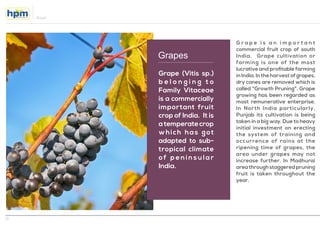
Grapes
Grape (Vitis sp.)
b e l o n g i n g t o
Family Vitaceae
is a commercially
important fruit
crop of India. It is
atemperatecrop
which has got
adapted to sub-
tropical climate
o f p e n i n s u l a r
India.
G r a p e i s a n i m p o r t a n t
commercial fruit crop of south
India. Grape cultivation or
farming is one of the most
lucrative and profitable farming
inIndia.Intheharvestofgrapes,
dry canes are removed which is
called "Growth Pruning". Grape
growing has been regarded as
most remunerative enterprise.
In North India particularly,
Punjab its cultivation is being
taken in a big way. Due to heavy
initial investment on erecting
the system of training and
occurrence of rains at the
ripening time of grapes, the
area under grapes may not
increase further. In Madhurai
areathroughstaggeredpruning
fruit is taken throughout the
year.
Hivet
4
All green tissues of the grapevine are susceptible to
powdery mildew (Erysiphe necator (Schw.) Burr.)
infection. The disease appears as a whitish-gray
powderycoatingontheleavesorfruitcausedbyfungal
mycelium and conidia on the surface of the plant. On
leaves, initial symptoms appear as chlorotic spots on
the upper leaf surface that soon become whitish
lesions.Lateintheseason,smallblackroundstructures
(chasmothecia) begin to appear on the white powdery
lesions.Onshoots,infectedareashavetheappearance
of brown/black diffuse patches; on dormant canes,
thesepatchesarereddishbrown.
Powdery mildew is the most persistent fungal
problem of grapes in and one of the most
widespread fungal diseases of grapevines in the
world.
Dose : 750-1000 gm/acre
www.hpmindia.com
5
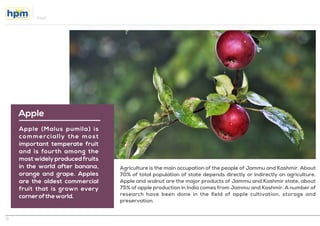
Apple
Apple (Malus pumila) is
commercially the most
important temperate fruit
and is fourth among the
most widely produced fruits
in the world after banana,
orange and grape. Apples
are the oldest commercial
fruit that is grown every
corneroftheworld.
Agriculture is the main occupation of the people of Jammu and Kashmir. About
70% of total population of state depends directly or indirectly on agriculture.
Apple and walnut are the major products of Jammu and Kashmir state, about
75% of apple production in India comes from Jammu and Kashmir. A number of
research have been done in the field of apple cultivation, storage and
preservation.
Hivet
6
Powdery Mildew
Powderymildewofappleoccursin
all apple-producing regions of the
world. The disease causes
economicdamagebyreducingtree
vigor, flower bud production, and
fruitquality.
Powdery mildew of apple produces symptoms on young
shoots, leaves, blossoms, and fruit. In general, symptoms
are most noticeable on the leaves and fruit. Overwintered
infections in dormant flower and shoot buds provide
inoculum for the following year. In spring when the terminal
buds begin to grow, the fungus colonizes the young, green
tissue as it emerges. These infected “flag shoots” have a
silver-grayappearanceandmayexhibitdefoliation,stunted
growth,anddie-back.
Dose : 750-1000 gm/acre
www.hpmindia.com
7
Pea is an important vegetable in India; the crop is generally
cultivated for its green pods. It is highly nutritive and is rich in
protein. It is used as a vegetable or in soup, canned frozen or
dehydrate. It is cooked as a vegetable along or with potatoes.
Split grains of pea are widely used for dal. Pea straw is a
nutritiousfodder.
Pea Cltivation
Pea crop can be grown on a
wide range of soils but it
grows well on well- drained
loamy soil. Water logging is
injurious to the crop. If the soil
is acidic, liming has to be done
aftersoilanalysis.
Hivet
8
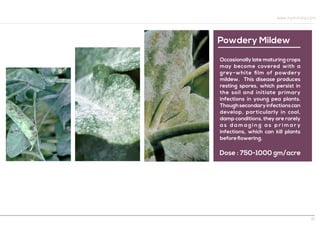
Powdery Mildew
Occasionally late maturing crops
may become covered with a
grey-white film of powdery
mildew. This disease produces
resting spores, which persist in
the soil and initiate primary
infections in young pea plants.
Thoughsecondaryinfectionscan
develop, particularly in cool,
damp conditions, they are rarely
a s d a m a g i n g a s p r i m a r y
infections, which can kill plants
beforeflowering.
Dose : 750-1000 gm/acre
www.hpmindia.com
9
Cuminum cyminum is a delicate-looking
annual, with slender, branched stems. It is a
small, fast growing plant seldom reaching
higher than three feet. Tiny white flowers will
yield cumin seeds, which range in color from
pale brown to khaki. Cumin seeds are similar
in appearance to caraway seeds, averaging
about ¼ inch in length. It grows in temperate
climates and is harvested just four months
after planting. It’s amazing that such an
unassuming plant produces a seed so packed
withflavorandaroma.
Cumin seed has an
extensive history and
the foods that it is
used to flavor today
actually traces its
fascinating past.
Earliest records of
c u m i n d at e b a c k
more than 4,000
years to its farming in
the Nile River Valley
and cultivation by the
Egyptians.
Cumin
Hivet
10
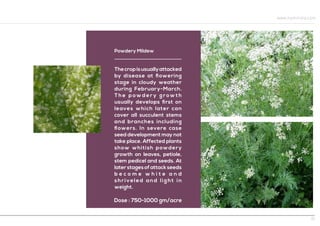
Powdery Mildew
Thecropisusuallyattacked
by disease at flowering
stage in cloudy weather
during February-March.
T h e p ow d e r y g r ow t h
usually develops first on
leaves which later can
cover all succulent stems
and branches including
flowers. In severe case
seed development may not
take place. Affected plants
show whitish powdery
growth on leaves, petiole,
stem pedicel and seeds. At
laterstagesofattackseeds
b e c o m e w h i t e a n d
shriveled and light in
weight.
Dose : 750-1000 gm/acre
www.hpmindia.com
11
Mango
Mango (Mangifera indica
L)isoneofthechoicestand
most ancient fruits known
to mankind. It occupies a
p r e - e m i n e n t p l a c e
amongst the sub-tropical
fruits hence while doing
mango cultivation we have
to take care of a number of
t h i n g s s o t h a t t h e
nutritional value of mango
is preserved and we can
havehighqualitymangoes.
Mango thrives well up to
600 m above mean sea
level provided locality is
frost free and there is no
high humidity or rains
duringflowering.
Hivet
12
Powdery mildew is a very serious disease of mango, affecting almost all cultivars in all mango-growing
regions of the world. It usually appears from December to March. The fungus attacks inflorescences, leaves,
and young fruits during the dry winter. The characteristic symptom of the disease is the whitish, superficial,
powdery fungal growth, mainly on inflorescences. The affected flowers do not open and in most cases shed
prematurely. Young fruits may also be covered with powdery growth and drop off prematurely.
Dose : 750-1000 gm/acre
Poor fruit set and
heavy flower and
fruit drop result in
severe yield losses,
sometimes reaching
as high as 70–80% on
anindividualplant.
www.hpmindia.com
13
HPM Chemicals & Fertilizers Ltd.

Hivet

  • 1.
  • 2.
  • 3.
    A multi-site contactinorganic fungicide. Sulphur is a non-systemic contact and protectant fungicide with secondary acaricidal activity. Hivet is a dust free, flowable micronised sulphur granules, ease ofmeasuring&handling. HIVET It has instant dispersion and high suspensability in water, therefore it don't cause scorching. It has triple action as fungicide, micronutrient (Sulphur) and miticide. It has sustained action for longer effect. It helps in maintaining the appropriate PH of the soil, thereby better uptake of other nutrients. Better crop stand. It controls metabolic & growth processes within plant cells. It promotes nodulation in the legumes, thereby helps in nitrogen fixation. www.hpmindia.com 3
  • 4.
    Grapes Grape (Vitis sp.) be l o n g i n g t o Family Vitaceae is a commercially important fruit crop of India. It is atemperatecrop which has got adapted to sub- tropical climate o f p e n i n s u l a r India. G r a p e i s a n i m p o r t a n t commercial fruit crop of south India. Grape cultivation or farming is one of the most lucrative and profitable farming inIndia.Intheharvestofgrapes, dry canes are removed which is called "Growth Pruning". Grape growing has been regarded as most remunerative enterprise. In North India particularly, Punjab its cultivation is being taken in a big way. Due to heavy initial investment on erecting the system of training and occurrence of rains at the ripening time of grapes, the area under grapes may not increase further. In Madhurai areathroughstaggeredpruning fruit is taken throughout the year. Hivet 4
  • 5.
    All green tissuesof the grapevine are susceptible to powdery mildew (Erysiphe necator (Schw.) Burr.) infection. The disease appears as a whitish-gray powderycoatingontheleavesorfruitcausedbyfungal mycelium and conidia on the surface of the plant. On leaves, initial symptoms appear as chlorotic spots on the upper leaf surface that soon become whitish lesions.Lateintheseason,smallblackroundstructures (chasmothecia) begin to appear on the white powdery lesions.Onshoots,infectedareashavetheappearance of brown/black diffuse patches; on dormant canes, thesepatchesarereddishbrown. Powdery mildew is the most persistent fungal problem of grapes in and one of the most widespread fungal diseases of grapevines in the world. Dose : 750-1000 gm/acre www.hpmindia.com 5
  • 6.
    Apple Apple (Malus pumila)is commercially the most important temperate fruit and is fourth among the most widely produced fruits in the world after banana, orange and grape. Apples are the oldest commercial fruit that is grown every corneroftheworld. Agriculture is the main occupation of the people of Jammu and Kashmir. About 70% of total population of state depends directly or indirectly on agriculture. Apple and walnut are the major products of Jammu and Kashmir state, about 75% of apple production in India comes from Jammu and Kashmir. A number of research have been done in the field of apple cultivation, storage and preservation. Hivet 6
  • 7.
    Powdery Mildew Powderymildewofappleoccursin all apple-producingregions of the world. The disease causes economicdamagebyreducingtree vigor, flower bud production, and fruitquality. Powdery mildew of apple produces symptoms on young shoots, leaves, blossoms, and fruit. In general, symptoms are most noticeable on the leaves and fruit. Overwintered infections in dormant flower and shoot buds provide inoculum for the following year. In spring when the terminal buds begin to grow, the fungus colonizes the young, green tissue as it emerges. These infected “flag shoots” have a silver-grayappearanceandmayexhibitdefoliation,stunted growth,anddie-back. Dose : 750-1000 gm/acre www.hpmindia.com 7
  • 8.
    Pea is animportant vegetable in India; the crop is generally cultivated for its green pods. It is highly nutritive and is rich in protein. It is used as a vegetable or in soup, canned frozen or dehydrate. It is cooked as a vegetable along or with potatoes. Split grains of pea are widely used for dal. Pea straw is a nutritiousfodder. Pea Cltivation Pea crop can be grown on a wide range of soils but it grows well on well- drained loamy soil. Water logging is injurious to the crop. If the soil is acidic, liming has to be done aftersoilanalysis. Hivet 8
  • 9.
    Powdery Mildew Occasionally latematuring crops may become covered with a grey-white film of powdery mildew. This disease produces resting spores, which persist in the soil and initiate primary infections in young pea plants. Thoughsecondaryinfectionscan develop, particularly in cool, damp conditions, they are rarely a s d a m a g i n g a s p r i m a r y infections, which can kill plants beforeflowering. Dose : 750-1000 gm/acre www.hpmindia.com 9
  • 10.
    Cuminum cyminum isa delicate-looking annual, with slender, branched stems. It is a small, fast growing plant seldom reaching higher than three feet. Tiny white flowers will yield cumin seeds, which range in color from pale brown to khaki. Cumin seeds are similar in appearance to caraway seeds, averaging about ¼ inch in length. It grows in temperate climates and is harvested just four months after planting. It’s amazing that such an unassuming plant produces a seed so packed withflavorandaroma. Cumin seed has an extensive history and the foods that it is used to flavor today actually traces its fascinating past. Earliest records of c u m i n d at e b a c k more than 4,000 years to its farming in the Nile River Valley and cultivation by the Egyptians. Cumin Hivet 10
  • 11.
    Powdery Mildew Thecropisusuallyattacked by diseaseat flowering stage in cloudy weather during February-March. T h e p ow d e r y g r ow t h usually develops first on leaves which later can cover all succulent stems and branches including flowers. In severe case seed development may not take place. Affected plants show whitish powdery growth on leaves, petiole, stem pedicel and seeds. At laterstagesofattackseeds b e c o m e w h i t e a n d shriveled and light in weight. Dose : 750-1000 gm/acre www.hpmindia.com 11
  • 12.
    Mango Mango (Mangifera indica L)isoneofthechoicestand mostancient fruits known to mankind. It occupies a p r e - e m i n e n t p l a c e amongst the sub-tropical fruits hence while doing mango cultivation we have to take care of a number of t h i n g s s o t h a t t h e nutritional value of mango is preserved and we can havehighqualitymangoes. Mango thrives well up to 600 m above mean sea level provided locality is frost free and there is no high humidity or rains duringflowering. Hivet 12
  • 13.
    Powdery mildew isa very serious disease of mango, affecting almost all cultivars in all mango-growing regions of the world. It usually appears from December to March. The fungus attacks inflorescences, leaves, and young fruits during the dry winter. The characteristic symptom of the disease is the whitish, superficial, powdery fungal growth, mainly on inflorescences. The affected flowers do not open and in most cases shed prematurely. Young fruits may also be covered with powdery growth and drop off prematurely. Dose : 750-1000 gm/acre Poor fruit set and heavy flower and fruit drop result in severe yield losses, sometimes reaching as high as 70–80% on anindividualplant. www.hpmindia.com 13
  • 14.
    HPM Chemicals &Fertilizers Ltd.