Article 8 
The Right to Equality
Article 8 (1) 
All persons are equal before the law 
and entitled to the equal protection 
of the law.
PPPP vv TTeennggkkuu MMaahhmmoooodd IIsskkaannddaarr 
[[11997711]] MMLLJJ 112288 
The High Court, having regard to the 
gravity of the offence, substituted a 
more severe sentence for a lesser 
one imposed by a lower court, which 
had taken into account the status of 
the accused as a Prince of the ruling 
house of the state of Johore.
The High Court is stated that the decision of the lower court 
"had ... conflicted with the provisions of Article 8 of our 
Constitution which says that all persons are equal before 
the law. 
That implies that there is only one kind of law in the country 
to which all citizens are amenable. 
Every citizen, irrespective of his official or social status, is 
under the same responsibility for every act done without 
legal justification. 
This equality of all in the eyes of the law minimises 
tyranny".
RRuullee ooff LLaaww 
Equality before the law. 
It excludes the idea of any exception of government 
officials or other people 
from the duty of obedience to 
the law or from the jurisdiction of the court. 
The rule of law implies that every person is equally 
subject to the law. 
The social or political or economical status of an 
individual is by itself no answer to legal 
proceedings, civil or criminal. 
Everyone, whatever his position must be ready to 
justify his actions by reference to some specific 
legal rule and be ready to justify them in the 
ordinary courts.
Article 8(2) 
There shall be no discrimination against citizens 
on the ground only of 
 Religion, 
 Race, 
 Descent, 
 Place of birth or 
 Gender
Article 8(2) in any law or 
in the appointment to any office or employment 
under a public authority or 
in the administration of any law relating to 
 The acquisition, holding or disposition of 
property or 
 The establishing or carrying on of any trade, 
business, profession, vocation or 
employment. 
Except as expressly authorised by this 
Constitution. 
(i.e. (5) of this article)
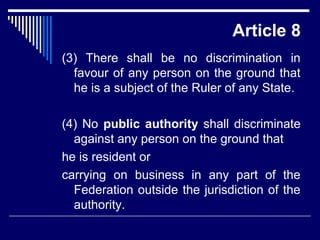
Article 8 
(3) There shall be no discrimination in 
favour of any person on the ground that 
he is a subject of the Ruler of any State. 
(4) No public authority shall discriminate 
against any person on the ground that 
he is resident or 
carrying on business in any part of the 
Federation outside the jurisdiction of the 
authority.
Datuk Haji Harun bin Haji Idris v. Public 
Prosecutor [1977] 2 MLJ 155 
The prohibition of unequal treatment applies 
not only to the legislature but also to the 
executive. 
This is seen from the use of the words 
“public authority” in clause (4) and 
“practice” in clause (5)(b) of Article 8. 
The prohibition applies to both substantive and 
procedural laws.
Equality = Justice ?
PP v Su Liang Yu [1976] MLJ 2 128 
The dominant idea in both expressions 
“equal before the law” 
and 
“equal protection of the law” 
is that of 
equal justice.
Does not guarantee equality that is not just. 
Allow difference of treatment that attains 
justice. 
• Express Exceptions 
• Implied Exception (Judicial Exception)
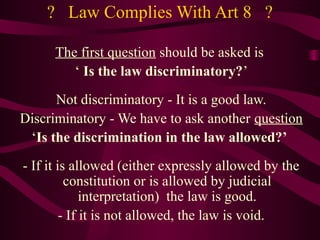
? Law Complies With Art 8 ? 
The first question should be asked is 
‘ Is the law discriminatory?’ 
Not discriminatory - It is a good law. 
Discriminatory - We have to ask another question 
‘Is the discrimination in the law allowed?’ 
- If it is allowed (either expressly allowed by the 
constitution or is allowed by judicial 
interpretation) the law is good. 
- If it is not allowed, the law is void.
EExxcceeppttiioonnss ttoo GGeenneerraall RRuullee 
• EExxpprreessss EExxcceeppttiioonnss 
• IImmpplliieedd EExxcceeppttiioonn 
SSiittuuaattiioonnss wwhheerree eeqquuaalliittyy ddooeess nnoott pprroommoottee 
jjuussttiiccee
TThhee EExxpprreessss EExxcceeppttiioonnss 
AArrttiiccllee 88 ((55)).. ‘‘TThhiiss AArrttiiccllee ddooeess nnoott iinnvvaalliiddaattee oorr pprroohhiibbiitt……’’ 
TThhee ffoolllloowwiinnggss aarree aalllloowweedd ((bbeeccaauussee tthheeyy aarree eexxpprreessssllyy 
eexxcceepptteedd bbyy tthhee CCoonnssttiittuuttiioonn)):: 
‘‘((aa)) aannyy pprroovviissiioonn rreegguullaattiinngg ppeerrssoonnaall llaaww;;’’ 
• ii..ee.. IIssllaammiicc LLaawwss 
’’((bb)) aannyy pprroovviissiioonn oorr pprraaccttiiccee rreessttrriiccttiinngg ooffffiiccee oorr 
eemmppllooyymmeenntt ccoonnnneecctteedd wwiitthh tthhee aaffffaaiirrss ooff aannyy rreelliiggiioonn,, oorr 
ooff aann iinnssttiittuuttiioonn mmaannaaggeedd bbyy aa ggrroouupp pprrooffeessssiinngg aannyy 
rreelliiggiioonn,, ttoo ppeerrssoonnss pprrooffeessssiinngg tthhaatt rreelliiggiioonn;;’’ 
• ii..ee.. AAddmmiinniissttrraattiioonn ooff rreelliiggiioouuss iinnssttiittuuttiioonnss ssuucchh aass 
mmoossqquuee..
TThhee EExxpprreessss EExxcceeppttiioonnss 
‘‘((cc)) aannyy pprroovviissiioonn ffoorr tthhee pprrootteeccttiioonn,, wweellll--bbeeiinngg oorr 
aaddvvaanncceemmeenntt ooff tthhee aabboorriiggiinnaall ppeeoopplleess ooff tthhee MMaallaayy 
PPeenniinnssuullaa ((iinncclluuddiinngg tthhee rreesseerrvvaattiioonn ooff llaanndd)) oorr tthhee 
rreesseerrvvaattiioonn ttoo aabboorriiggiinneess ooff aa rreeaassoonnaabbllee pprrooppoorrttiioonn ooff 
ssuuiittaabbllee ppoossiittiioonnss iinn tthhee ppuubblliicc sseerrvviiccee;;’’ 
• ii..ee.. MMaallaayy pprriivviilleeggeess.. AArrtt.. 115522 aanndd 115533,, aanndd rreellaatteedd llaawwss 
’’((dd)) aannyy pprroovviissiioonn pprreessccrriibbiinngg rreessiiddeennccee iinn aa SSttaattee oorr 
ppaarrtt ooff aa SSttaattee aass aa qquuaalliiffiiccaattiioonn ffoorr eelleeccttiioonn oorr 
aappppooiinnttmmeenntt ttoo aannyy aauutthhoorriittyy hhaavviinngg jjuurriissddiiccttiioonn oonnllyy iinn 
tthhaatt SSttaattee oorr ppaarrtt,, oorr ffoorr vvoottiinngg iinn ssuucchh aann eelleeccttiioonn;;’’ 
• ii..ee.. LLooccaall aauutthhoorriittyy ssuucchh aass MMaajjlliiss PPeerrbbaannddaarraann,, JJKKKKKK 
eettcc..
TThhee EExxpprreessss EExxcceeppttiioonnss 
’’((ee)) aannyy pprroovviissiioonn ooff aa CCoonnssttiittuuttiioonn ooff aa 
SSttaattee,, bbeeiinngg oorr ccoorrrreessppoonnddiinngg ttoo aa 
pprroovviissiioonn iinn ffoorrccee iimmmmeeddiiaatteellyy bbeeffoorree 
MMeerrddeekkaa DDaayy;;’’ 
’’((ff)) aannyy pprroovviissiioonn rreessttrriiccttiinngg eennlliissttmmeenntt 
iinn tthhee MMaallaayy RReeggiimmeenntt ttoo MMaallaayyss..’’
Affirmative Action (Preferential TTrreeaattmmeenntt)):: 
AA TTooooll ffoorr JJuussttiiccee 
AAffffiirrmmaattiivvee aaccttiioonn iiss aa ppoolliiccyy tthhaatt ddiirreeccttllyy oorr iinnddiirreeccttllyy 
aawwaarrddss jjoobbss,, pprroommoottiioonnss,, aanndd ootthheerr rreessoouurrcceess ttoo 
iinnddiivviidduuaallss oonn tthhee bbaassiiss ooff mmeemmbbeerrsshhiipp iinn aa pprrootteecctteedd 
ggrroouupp iinn oorrddeerr ttoo ccoommppeennssaattee tthhoossee ggrroouuppss ffoorr ppaasstt 
ddiissccrriimmiinnaattiioonn.. 
• 
TThhrroouugghh aaffffiirrmmaattiivvee aaccttiioonn,, tthhee aauutthhoorriittyy mmaayy ttaakkee 
ppoossiittiivvee sstteeppss ttoo ccoorrrreecctt ppaasstt rraacciiaall ddiissccrriimmiinnaattiioonn.. 
• 
AAffffiirrmmaattiivvee aaccttiioonn iiss nnootthhiinngg mmoorree tthhaann rreevveerrssee 
ddiissccrriimmiinnaattiioonn..
Limitation by Judicial Interpretation on Right to 
Equality: Doctrine of Reasonable Classification 
PP v Khong Teng Khen [1976] 2 MLJ 166 
The principle underlying Article 8 is that 
a law must operate alike on all 
persons under like circumstance.
Limitation by Judicial Interpretation on Right to 
Equality: Doctrine of Reasonable Classification 
A law is not required to operate on all persons in 
any circumstances. 
A law is also not required to be general in 
character and universal in application 
The article does not prohibit the legislature and 
executive bodies to distinguish and classify 
persons.
Doctrine of Reasonable Classification 
Thus 
The law may classify persons. 
The law may classify offences into different 
categories. 
All that Article 8 guarantees is that 
a person in one class should be treated the 
same as another person in the same 
class.
Doctrine of Reasonable Classification 
Su Liang Yu [1976] 2 MLJ 128 
No person shall be denied equality before the law 
or equal protection of the law 
but 
Article 8 does not prevent Parliament from making 
a law based on or involving some classifications. 
Discriminatory law is good law if it is based on 
“reasonable” or “permissible” classification.
Requirements that must be fulfilled by 
laws that involve classification 
The classification is founded on an intelligible differentia 
which distinguishes persons that are grouped together 
from others left out of the group. 
And 
The differentia has a rational relation to the object sought 
to be achieved by the law in question. 
The classification may be founded on different bases such as 
geographical, or according to objects or occupations and 
the like. 
There must be a nexus between the basis of 
classification and the object of the law in question.
B Malaysian Baarr && AAnnoorr.. vv GGoovvtt ooff MMaallaayyssiiaa 
[[11998877]] 22 MMLLJJ 116655.. 
AAmmeennddmmeenntt ttoo tthhee LLeeggaall PPrrooffeessssiioonn AAcctt 11997766 
mmaakkeess iitt uunnllaawwffuull ffoorr aann aaddvvooccaattee aanndd ssoolliicciittoorr 
-- lleessss tthhaann sseevveenn yyeeaarrss ssttaannddiinngg 
-- aa mmeemmbbeerr ooff aannyy ppoolliittiiccaall oorrggaanniissaattiioonn oorr ttrraaddee 
uunniioonn 
ttoo bbee aa mmeemmbbeerr ooff tthhee BBaarr CCoouunncciill oorr aannyy 
ccoommmmiitttteeee tthheerreeooff..
TThhee SSuupprreemmee CCoouurrtt hheelldd tthhaatt tthheerree wwaass aa 
rraattiioonnaall nneexxuuss bbeettwweeeenn 
tthhee ppuurrppoossee ooff tthhee llaaww ((ttoo eennssuurree tthhaatt tthhee 
BBaarr wwaass rruunn bbyy eexxppeerriieenncceedd,, ccoommppeetteenntt 
aanndd iinnddeeppeennddeenntt pprraaccttiittiioonneerrss)) aanndd 
tthhee ccllaassssiiffiiccaattiioonn aaddoopptteedd ((lleessss tthhaann sseevveenn 
yyeeaarrss ssttaannddiinngg aanndd mmeemmbbeerr ooff aannyy 
ppoolliittiiccaall oorrggaanniissaattiioonn oorr ttrraaddee uunniioonn))..

Article 8 right to equality and its exceptions

  • 1.
    Article 8 TheRight to Equality
  • 2.
    Article 8 (1) All persons are equal before the law and entitled to the equal protection of the law.
  • 3.
    PPPP vv TTeennggkkuuMMaahhmmoooodd IIsskkaannddaarr [[11997711]] MMLLJJ 112288 The High Court, having regard to the gravity of the offence, substituted a more severe sentence for a lesser one imposed by a lower court, which had taken into account the status of the accused as a Prince of the ruling house of the state of Johore.
  • 4.
    The High Courtis stated that the decision of the lower court "had ... conflicted with the provisions of Article 8 of our Constitution which says that all persons are equal before the law. That implies that there is only one kind of law in the country to which all citizens are amenable. Every citizen, irrespective of his official or social status, is under the same responsibility for every act done without legal justification. This equality of all in the eyes of the law minimises tyranny".
  • 5.
    RRuullee ooff LLaaww Equality before the law. It excludes the idea of any exception of government officials or other people from the duty of obedience to the law or from the jurisdiction of the court. The rule of law implies that every person is equally subject to the law. The social or political or economical status of an individual is by itself no answer to legal proceedings, civil or criminal. Everyone, whatever his position must be ready to justify his actions by reference to some specific legal rule and be ready to justify them in the ordinary courts.
  • 6.
    Article 8(2) Thereshall be no discrimination against citizens on the ground only of  Religion,  Race,  Descent,  Place of birth or  Gender
  • 7.
    Article 8(2) inany law or in the appointment to any office or employment under a public authority or in the administration of any law relating to  The acquisition, holding or disposition of property or  The establishing or carrying on of any trade, business, profession, vocation or employment. Except as expressly authorised by this Constitution. (i.e. (5) of this article)
  • 8.
    Article 8 (3)There shall be no discrimination in favour of any person on the ground that he is a subject of the Ruler of any State. (4) No public authority shall discriminate against any person on the ground that he is resident or carrying on business in any part of the Federation outside the jurisdiction of the authority.
  • 9.
    Datuk Haji Harunbin Haji Idris v. Public Prosecutor [1977] 2 MLJ 155 The prohibition of unequal treatment applies not only to the legislature but also to the executive. This is seen from the use of the words “public authority” in clause (4) and “practice” in clause (5)(b) of Article 8. The prohibition applies to both substantive and procedural laws.
  • 10.
  • 11.
    PP v SuLiang Yu [1976] MLJ 2 128 The dominant idea in both expressions “equal before the law” and “equal protection of the law” is that of equal justice.
  • 12.
    Does not guaranteeequality that is not just. Allow difference of treatment that attains justice. • Express Exceptions • Implied Exception (Judicial Exception)
  • 13.
    ? Law CompliesWith Art 8 ? The first question should be asked is ‘ Is the law discriminatory?’ Not discriminatory - It is a good law. Discriminatory - We have to ask another question ‘Is the discrimination in the law allowed?’ - If it is allowed (either expressly allowed by the constitution or is allowed by judicial interpretation) the law is good. - If it is not allowed, the law is void.
  • 14.
    EExxcceeppttiioonnss ttoo GGeenneerraallRRuullee • EExxpprreessss EExxcceeppttiioonnss • IImmpplliieedd EExxcceeppttiioonn SSiittuuaattiioonnss wwhheerree eeqquuaalliittyy ddooeess nnoott pprroommoottee jjuussttiiccee
  • 15.
    TThhee EExxpprreessss EExxcceeppttiioonnss AArrttiiccllee 88 ((55)).. ‘‘TThhiiss AArrttiiccllee ddooeess nnoott iinnvvaalliiddaattee oorr pprroohhiibbiitt……’’ TThhee ffoolllloowwiinnggss aarree aalllloowweedd ((bbeeccaauussee tthheeyy aarree eexxpprreessssllyy eexxcceepptteedd bbyy tthhee CCoonnssttiittuuttiioonn)):: ‘‘((aa)) aannyy pprroovviissiioonn rreegguullaattiinngg ppeerrssoonnaall llaaww;;’’ • ii..ee.. IIssllaammiicc LLaawwss ’’((bb)) aannyy pprroovviissiioonn oorr pprraaccttiiccee rreessttrriiccttiinngg ooffffiiccee oorr eemmppllooyymmeenntt ccoonnnneecctteedd wwiitthh tthhee aaffffaaiirrss ooff aannyy rreelliiggiioonn,, oorr ooff aann iinnssttiittuuttiioonn mmaannaaggeedd bbyy aa ggrroouupp pprrooffeessssiinngg aannyy rreelliiggiioonn,, ttoo ppeerrssoonnss pprrooffeessssiinngg tthhaatt rreelliiggiioonn;;’’ • ii..ee.. AAddmmiinniissttrraattiioonn ooff rreelliiggiioouuss iinnssttiittuuttiioonnss ssuucchh aass mmoossqquuee..
  • 16.
    TThhee EExxpprreessss EExxcceeppttiioonnss ‘‘((cc)) aannyy pprroovviissiioonn ffoorr tthhee pprrootteeccttiioonn,, wweellll--bbeeiinngg oorr aaddvvaanncceemmeenntt ooff tthhee aabboorriiggiinnaall ppeeoopplleess ooff tthhee MMaallaayy PPeenniinnssuullaa ((iinncclluuddiinngg tthhee rreesseerrvvaattiioonn ooff llaanndd)) oorr tthhee rreesseerrvvaattiioonn ttoo aabboorriiggiinneess ooff aa rreeaassoonnaabbllee pprrooppoorrttiioonn ooff ssuuiittaabbllee ppoossiittiioonnss iinn tthhee ppuubblliicc sseerrvviiccee;;’’ • ii..ee.. MMaallaayy pprriivviilleeggeess.. AArrtt.. 115522 aanndd 115533,, aanndd rreellaatteedd llaawwss ’’((dd)) aannyy pprroovviissiioonn pprreessccrriibbiinngg rreessiiddeennccee iinn aa SSttaattee oorr ppaarrtt ooff aa SSttaattee aass aa qquuaalliiffiiccaattiioonn ffoorr eelleeccttiioonn oorr aappppooiinnttmmeenntt ttoo aannyy aauutthhoorriittyy hhaavviinngg jjuurriissddiiccttiioonn oonnllyy iinn tthhaatt SSttaattee oorr ppaarrtt,, oorr ffoorr vvoottiinngg iinn ssuucchh aann eelleeccttiioonn;;’’ • ii..ee.. LLooccaall aauutthhoorriittyy ssuucchh aass MMaajjlliiss PPeerrbbaannddaarraann,, JJKKKKKK eettcc..
  • 17.
    TThhee EExxpprreessss EExxcceeppttiioonnss ’’((ee)) aannyy pprroovviissiioonn ooff aa CCoonnssttiittuuttiioonn ooff aa SSttaattee,, bbeeiinngg oorr ccoorrrreessppoonnddiinngg ttoo aa pprroovviissiioonn iinn ffoorrccee iimmmmeeddiiaatteellyy bbeeffoorree MMeerrddeekkaa DDaayy;;’’ ’’((ff)) aannyy pprroovviissiioonn rreessttrriiccttiinngg eennlliissttmmeenntt iinn tthhee MMaallaayy RReeggiimmeenntt ttoo MMaallaayyss..’’
  • 18.
    Affirmative Action (PreferentialTTrreeaattmmeenntt)):: AA TTooooll ffoorr JJuussttiiccee AAffffiirrmmaattiivvee aaccttiioonn iiss aa ppoolliiccyy tthhaatt ddiirreeccttllyy oorr iinnddiirreeccttllyy aawwaarrddss jjoobbss,, pprroommoottiioonnss,, aanndd ootthheerr rreessoouurrcceess ttoo iinnddiivviidduuaallss oonn tthhee bbaassiiss ooff mmeemmbbeerrsshhiipp iinn aa pprrootteecctteedd ggrroouupp iinn oorrddeerr ttoo ccoommppeennssaattee tthhoossee ggrroouuppss ffoorr ppaasstt ddiissccrriimmiinnaattiioonn.. • TThhrroouugghh aaffffiirrmmaattiivvee aaccttiioonn,, tthhee aauutthhoorriittyy mmaayy ttaakkee ppoossiittiivvee sstteeppss ttoo ccoorrrreecctt ppaasstt rraacciiaall ddiissccrriimmiinnaattiioonn.. • AAffffiirrmmaattiivvee aaccttiioonn iiss nnootthhiinngg mmoorree tthhaann rreevveerrssee ddiissccrriimmiinnaattiioonn..
  • 19.
    Limitation by JudicialInterpretation on Right to Equality: Doctrine of Reasonable Classification PP v Khong Teng Khen [1976] 2 MLJ 166 The principle underlying Article 8 is that a law must operate alike on all persons under like circumstance.
  • 20.
    Limitation by JudicialInterpretation on Right to Equality: Doctrine of Reasonable Classification A law is not required to operate on all persons in any circumstances. A law is also not required to be general in character and universal in application The article does not prohibit the legislature and executive bodies to distinguish and classify persons.
  • 21.
    Doctrine of ReasonableClassification Thus The law may classify persons. The law may classify offences into different categories. All that Article 8 guarantees is that a person in one class should be treated the same as another person in the same class.
  • 22.
    Doctrine of ReasonableClassification Su Liang Yu [1976] 2 MLJ 128 No person shall be denied equality before the law or equal protection of the law but Article 8 does not prevent Parliament from making a law based on or involving some classifications. Discriminatory law is good law if it is based on “reasonable” or “permissible” classification.
  • 23.
    Requirements that mustbe fulfilled by laws that involve classification The classification is founded on an intelligible differentia which distinguishes persons that are grouped together from others left out of the group. And The differentia has a rational relation to the object sought to be achieved by the law in question. The classification may be founded on different bases such as geographical, or according to objects or occupations and the like. There must be a nexus between the basis of classification and the object of the law in question.
  • 24.
    B Malaysian Baarr&& AAnnoorr.. vv GGoovvtt ooff MMaallaayyssiiaa [[11998877]] 22 MMLLJJ 116655.. AAmmeennddmmeenntt ttoo tthhee LLeeggaall PPrrooffeessssiioonn AAcctt 11997766 mmaakkeess iitt uunnllaawwffuull ffoorr aann aaddvvooccaattee aanndd ssoolliicciittoorr -- lleessss tthhaann sseevveenn yyeeaarrss ssttaannddiinngg -- aa mmeemmbbeerr ooff aannyy ppoolliittiiccaall oorrggaanniissaattiioonn oorr ttrraaddee uunniioonn ttoo bbee aa mmeemmbbeerr ooff tthhee BBaarr CCoouunncciill oorr aannyy ccoommmmiitttteeee tthheerreeooff..
  • 25.
    TThhee SSuupprreemmee CCoouurrtthheelldd tthhaatt tthheerree wwaass aa rraattiioonnaall nneexxuuss bbeettwweeeenn tthhee ppuurrppoossee ooff tthhee llaaww ((ttoo eennssuurree tthhaatt tthhee BBaarr wwaass rruunn bbyy eexxppeerriieenncceedd,, ccoommppeetteenntt aanndd iinnddeeppeennddeenntt pprraaccttiittiioonneerrss)) aanndd tthhee ccllaassssiiffiiccaattiioonn aaddoopptteedd ((lleessss tthhaann sseevveenn yyeeaarrss ssttaannddiinngg aanndd mmeemmbbeerr ooff aannyy ppoolliittiiccaall oorrggaanniissaattiioonn oorr ttrraaddee uunniioonn))..

Editor's Notes

  • #18 It relates to special position of the Malays.
  • #23 On the same note Hashim Yeop Sani stated in Su Liang Yu [1976] 2 MLJ 128 “..the true meaning of equality provision under our constitution is simply that no person shall be denied equality before the law or equal protection of the law but that clause shall not be construed so as to prevent Parliament from making a law based on or involving some classification provided that no real or actual discrimination occurs.’ ‘Clause (1) of our article 8 does not proclaim that all persons must be treated alike but only that persons in like circumstances must be treated alike. What constitute a circumstance entitling the legislature to discriminate and what constitutes discrimination are questions of values to be decided by the court;... these values may change from time to time..’.