Energy & Health in India
Green Hospitals Asia Conference
Taipei, 20th October 2017
Bhargav Krishna, Shriram Manogaran
Energy Use in India
• Third largest energy consumer after China
and USA
• About 70% of India's electricity generation
is from fossil fuel but the use of renewable
energy has increased from 12% to 14 % in
the period 2005-15.
• National Energy Policy, 2017 (NEP) aims to
reduce emissions intensity by 33%-35% by
increasing the share of non-fossil fuel
based capacity in the electricity mix at
above 40% by 2030.
#LowCarbonHealthCare
Source: Draft National Energy Policy, NITI Aayog, Government of India, 2017
National Energy Policy 2017
• Four key objectives:
• Access at affordable prices
• Improved security and Independence
• Greater Sustainability
• Economic Growth
• Forecasts reduced demand through energy efficiency initiatives  17% reduced
demand by 2040
• Rural Electrification  100% electrification by 2022
• Clean Cooking Access  40% of population without access to clean cooking fuel
• Grid Integration of Renewable Electricity and More Efficient Grid Operation 
Eliminate uncertainty and variability
• Reduced air pollution exposure  Investments in mass transit, EVs, etc.
#LowCarbonHealthCare
Source: Draft National Energy Policy, NITI Aayog, Government of India, 2017
Renewable Energy Growth
• 60 GW from wind power, 100 GW from solar power, 10 GW from biomass power and
5 GW from small hydro power by 2022
Available capacity
57.5 GW
(16%)
Target capacity by
2022
175 GW
Target capacity by
2040
597-710 GW
(40%)
#LowCarbonHealthCare
Source: Draft National Energy Policy, NITI Aayog, Government of India, 2017
#LowCarbonHealthCare
Energy for Health
• Public health system primary mode of delivery for preventive and curative health care for
most
• 55% of all household in India depend on the public health system to meet their
healthcare needs
• Primary health centres first point of contact or FRUs  ~29,000 in operation
• They provide basic out-patient consultation, immunization and other child health
services, and some in-patient care including deliveries and neonatal care
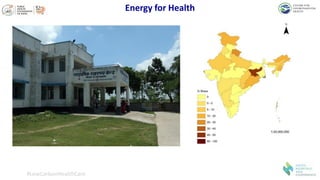
• Even though 96.7% of villages in India are deemed electrified, PHC’s in rural areas is
either not supplied, suffer from irregular power supply, or are not grid-connected
#LowCarbonHealthCare
Source: Solar for Powering Health and Education in India, 2016
#LowCarbonHealthCare
Energy for Health
Electrification
Equipment
functionality
Water supplyStaff
retention
In-patient services
Out-patient services
Immunization services
Delivery services
Neonatal care
Laboratory services
#LowCarbonHealthCare
Health and Energy Intertwined
Health Sector Contribution
#LowCarbonHealthCare
• Healthcare can also play a big role in driving change
• Large footprint, and high prevalence of diesel generator sets
• Industry growing at 17% y-o-y thereby increasing demand
• Rural India underserved, with much of the provision in major cities
• Has great potential to leverage the investment in renewables
• Diffuse locations, questionable access, urgent unmet needs
• Strong incentives for private sector to take up the renewable baton
Energy Case Study
• Bhagat Chandra Hospital, a multi-specialty hospital in New Delhi.
• The facility has a capacity of 85 beds for in-patients and efficiently provides
services for approximately 70,000 out-patients in a year.
• Hospital has 50kW of grid connected solar PV installed to reduce their power
consumption.
#LowCarbonHealthCare
Strategies Implemented
• 2009 (Construction)
• Wooden thermal insulator walls for partitions
• Thermostat timer to control temperature
• Hydraulic door closer
• 2014
• LED lighting was introduced
• Procurement for Solar capacity was initiated
• 2015
• 20kW solar panels were installed
• All CFLs were replaced
• 2016
• Additional 30kW was added
#LowCarbonHealthCare
Energy Case Study
Energy generated between October 2016 to September 2017
• Generating an average of at least 2000
kW every month
• The installed capacity reduces 20%-30%
of their consumption.
• Solar energy generated has helped
conserve about 77,496 kilograms of CO₂
emissions since 2014.
• Savings in spite of expansion in
operations
#LowCarbonHealthCare
Health and Environment Leadership Platform (H.E.L.P.)
1. Align thought leadership across the health sector to drive unified messaging for policy
advocacy on environmental health issues.
2. Attain commitment from health systems, institutions, professional bodies, organizations, and
hospitals to implement a framework to reduce their ecological footprint, and promote better
environmental health outcomes.
3. Build capacity among the physician community on environmental exposures and health
impacts
Members represent 5000+ hospitals and healthcare institutions
Fostering Health Sector Leadership
• Air Pollution monitoring at hospitals
• Case studies on energy, water & waste
• Short course on environmental health for physicians
• Embed sustainability into accreditation standards for hospitals
#LowCarbonHealthCare
Fostering Health Sector Leadership

WORKSHOP 2: Bhargav Krishna_energy_2017

  • 1.
    Energy & Healthin India Green Hospitals Asia Conference Taipei, 20th October 2017 Bhargav Krishna, Shriram Manogaran
  • 2.
    Energy Use inIndia • Third largest energy consumer after China and USA • About 70% of India's electricity generation is from fossil fuel but the use of renewable energy has increased from 12% to 14 % in the period 2005-15. • National Energy Policy, 2017 (NEP) aims to reduce emissions intensity by 33%-35% by increasing the share of non-fossil fuel based capacity in the electricity mix at above 40% by 2030. #LowCarbonHealthCare Source: Draft National Energy Policy, NITI Aayog, Government of India, 2017
  • 3.
    National Energy Policy2017 • Four key objectives: • Access at affordable prices • Improved security and Independence • Greater Sustainability • Economic Growth • Forecasts reduced demand through energy efficiency initiatives  17% reduced demand by 2040 • Rural Electrification  100% electrification by 2022 • Clean Cooking Access  40% of population without access to clean cooking fuel • Grid Integration of Renewable Electricity and More Efficient Grid Operation  Eliminate uncertainty and variability • Reduced air pollution exposure  Investments in mass transit, EVs, etc. #LowCarbonHealthCare Source: Draft National Energy Policy, NITI Aayog, Government of India, 2017
  • 4.
    Renewable Energy Growth •60 GW from wind power, 100 GW from solar power, 10 GW from biomass power and 5 GW from small hydro power by 2022 Available capacity 57.5 GW (16%) Target capacity by 2022 175 GW Target capacity by 2040 597-710 GW (40%) #LowCarbonHealthCare Source: Draft National Energy Policy, NITI Aayog, Government of India, 2017
  • 5.
  • 6.
    Energy for Health •Public health system primary mode of delivery for preventive and curative health care for most • 55% of all household in India depend on the public health system to meet their healthcare needs • Primary health centres first point of contact or FRUs  ~29,000 in operation • They provide basic out-patient consultation, immunization and other child health services, and some in-patient care including deliveries and neonatal care • Even though 96.7% of villages in India are deemed electrified, PHC’s in rural areas is either not supplied, suffer from irregular power supply, or are not grid-connected #LowCarbonHealthCare Source: Solar for Powering Health and Education in India, 2016
  • 7.
  • 8.
    Electrification Equipment functionality Water supplyStaff retention In-patient services Out-patientservices Immunization services Delivery services Neonatal care Laboratory services #LowCarbonHealthCare Health and Energy Intertwined
  • 9.
    Health Sector Contribution #LowCarbonHealthCare •Healthcare can also play a big role in driving change • Large footprint, and high prevalence of diesel generator sets • Industry growing at 17% y-o-y thereby increasing demand • Rural India underserved, with much of the provision in major cities • Has great potential to leverage the investment in renewables • Diffuse locations, questionable access, urgent unmet needs • Strong incentives for private sector to take up the renewable baton
  • 10.
    Energy Case Study •Bhagat Chandra Hospital, a multi-specialty hospital in New Delhi. • The facility has a capacity of 85 beds for in-patients and efficiently provides services for approximately 70,000 out-patients in a year. • Hospital has 50kW of grid connected solar PV installed to reduce their power consumption. #LowCarbonHealthCare
  • 11.
    Strategies Implemented • 2009(Construction) • Wooden thermal insulator walls for partitions • Thermostat timer to control temperature • Hydraulic door closer • 2014 • LED lighting was introduced • Procurement for Solar capacity was initiated • 2015 • 20kW solar panels were installed • All CFLs were replaced • 2016 • Additional 30kW was added #LowCarbonHealthCare
  • 12.
    Energy Case Study Energygenerated between October 2016 to September 2017 • Generating an average of at least 2000 kW every month • The installed capacity reduces 20%-30% of their consumption. • Solar energy generated has helped conserve about 77,496 kilograms of CO₂ emissions since 2014. • Savings in spite of expansion in operations #LowCarbonHealthCare
  • 13.
    #LowCarbonHealthCare Health and EnvironmentLeadership Platform (H.E.L.P.) 1. Align thought leadership across the health sector to drive unified messaging for policy advocacy on environmental health issues. 2. Attain commitment from health systems, institutions, professional bodies, organizations, and hospitals to implement a framework to reduce their ecological footprint, and promote better environmental health outcomes. 3. Build capacity among the physician community on environmental exposures and health impacts Members represent 5000+ hospitals and healthcare institutions Fostering Health Sector Leadership
  • 14.
    • Air Pollutionmonitoring at hospitals • Case studies on energy, water & waste • Short course on environmental health for physicians • Embed sustainability into accreditation standards for hospitals #LowCarbonHealthCare Fostering Health Sector Leadership