-By Suhel Gavandi
Nanotechnology ?
“ Technology
Manipulating
At
Range Billionth
Of
A
Meter”
“Level Of Nature”
What is mean by Nanotechnology?
 Nano, which comes from the Greek word for dwarf,
indicates a billionth. One nanometer is a billionth of a
meter. Definitions of ‘nanotechnology’ vary, but it generally
refers to understanding and manipulation of matter on the
Nano scale, say, from 0.1 run to 100 nm.
 The significance and importance of controlling matter at
the Nano scale is that at this scale different laws of physics
come into play.
Civil Engineering ?
 Coastal Engineering
 Construction Engineering
 Earthquake Engineering
 Environmental Engineering
 Geotechnical Engineering
 Water Resource Engineering
 Materials Engineering
 Structural Engineering
 Transportation Engineering
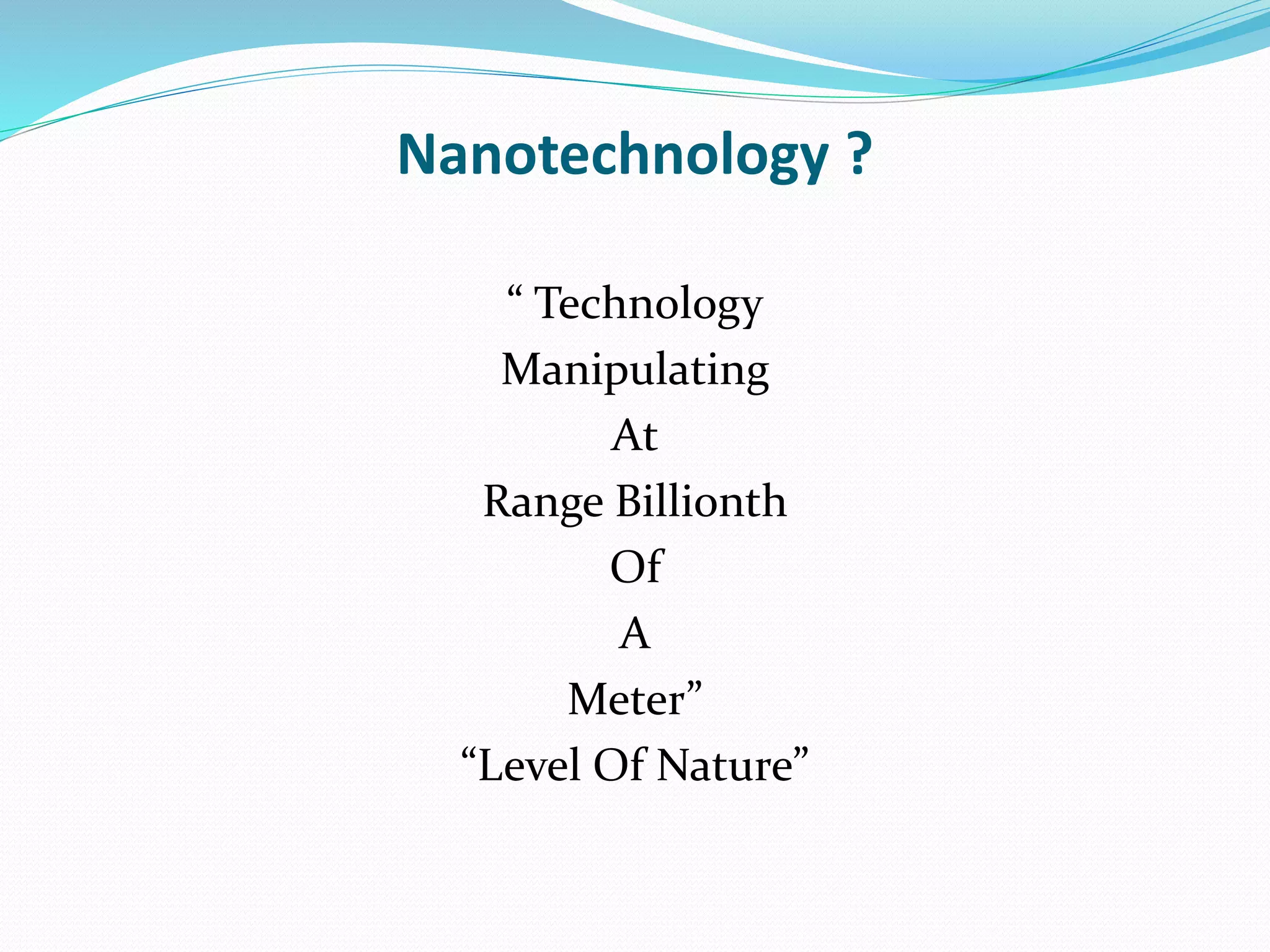
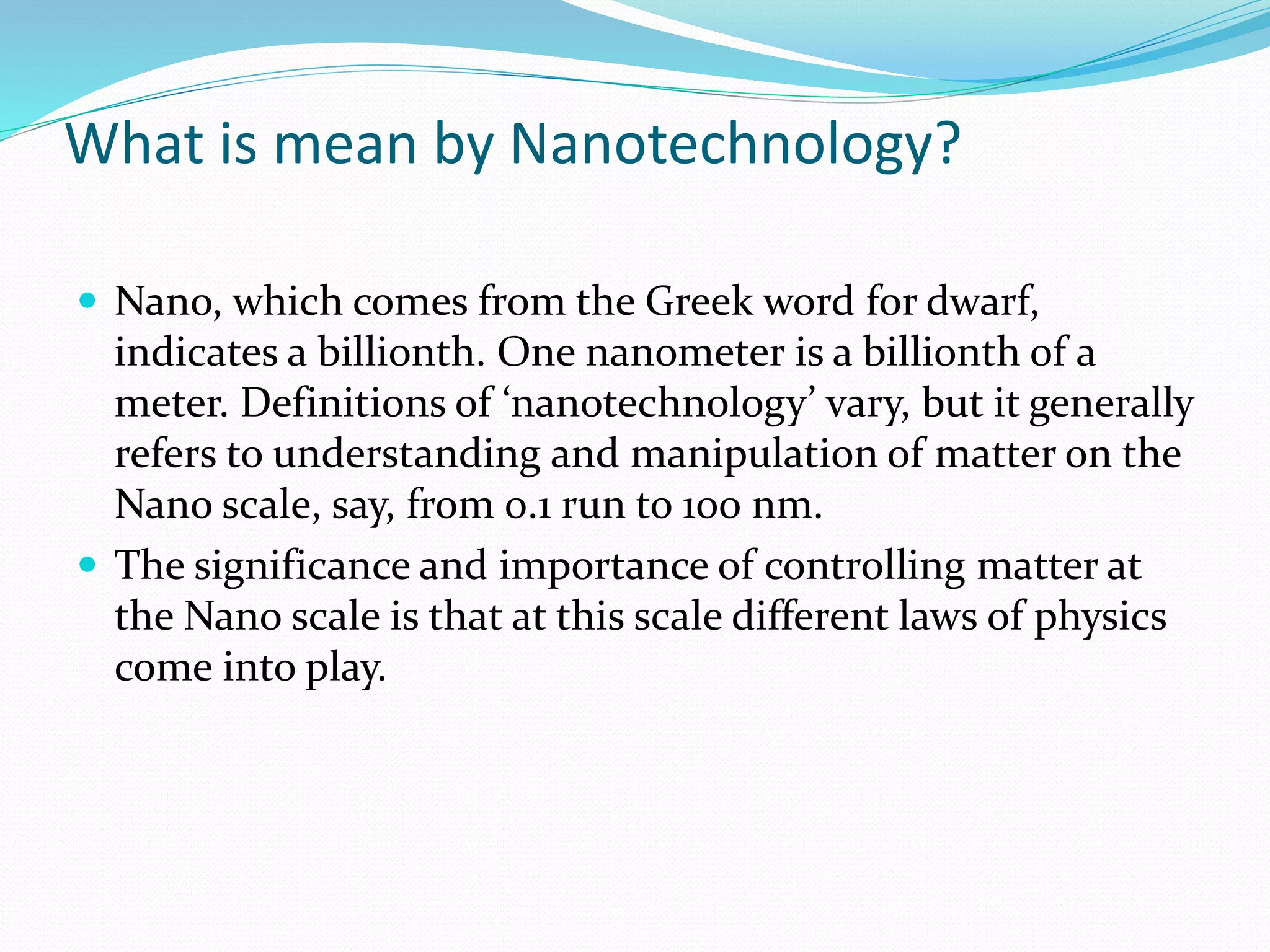
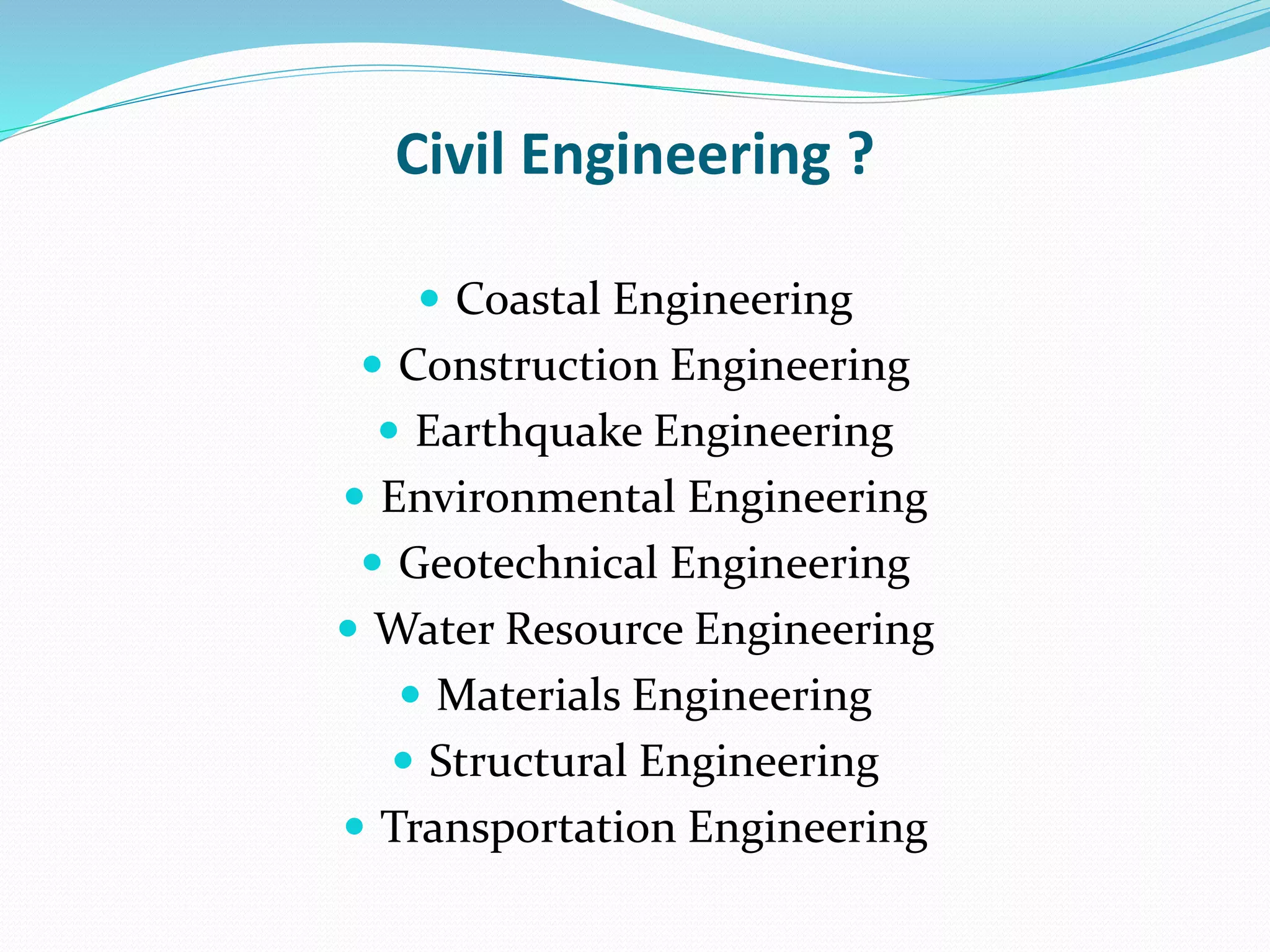
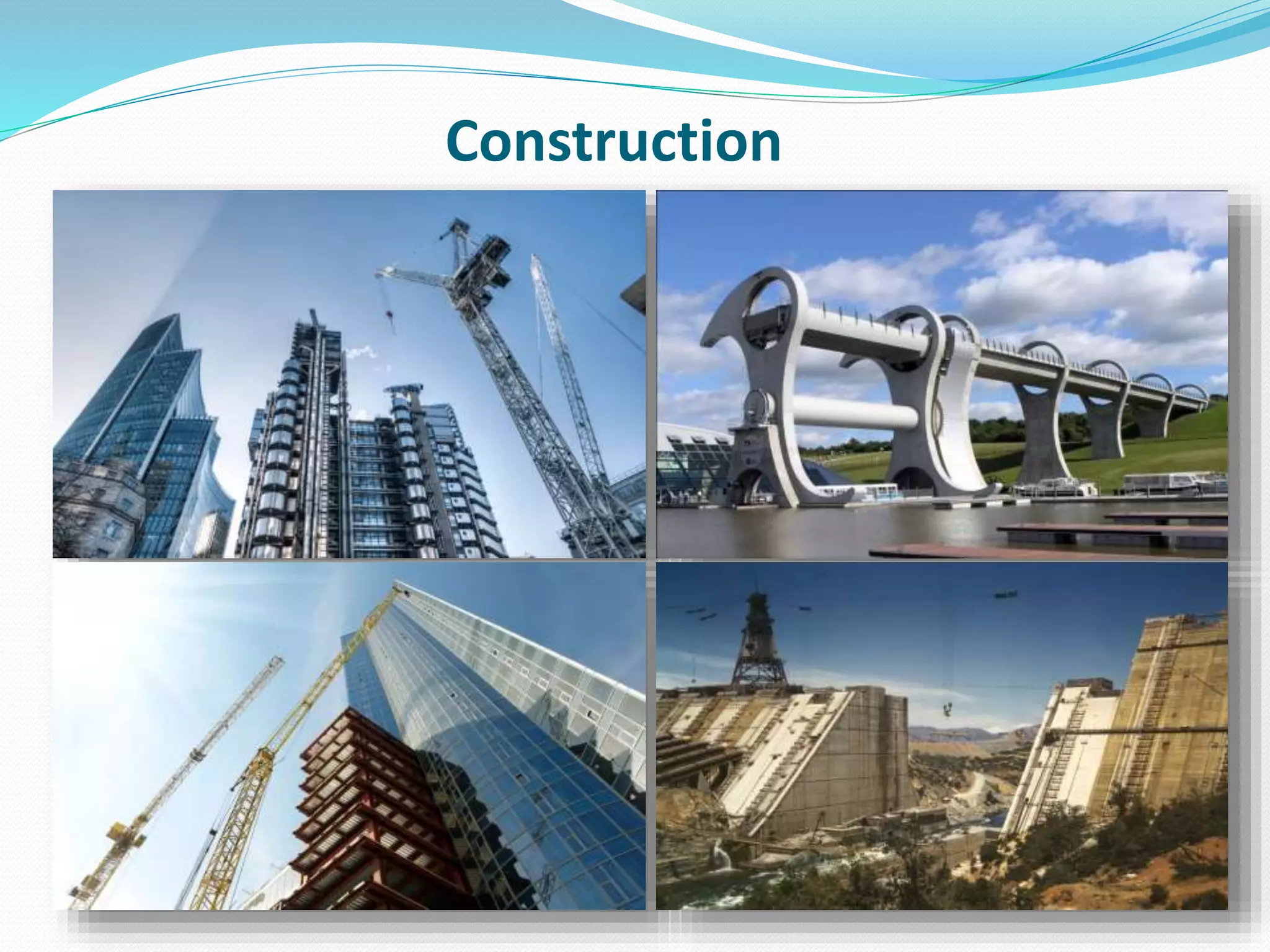
Construction
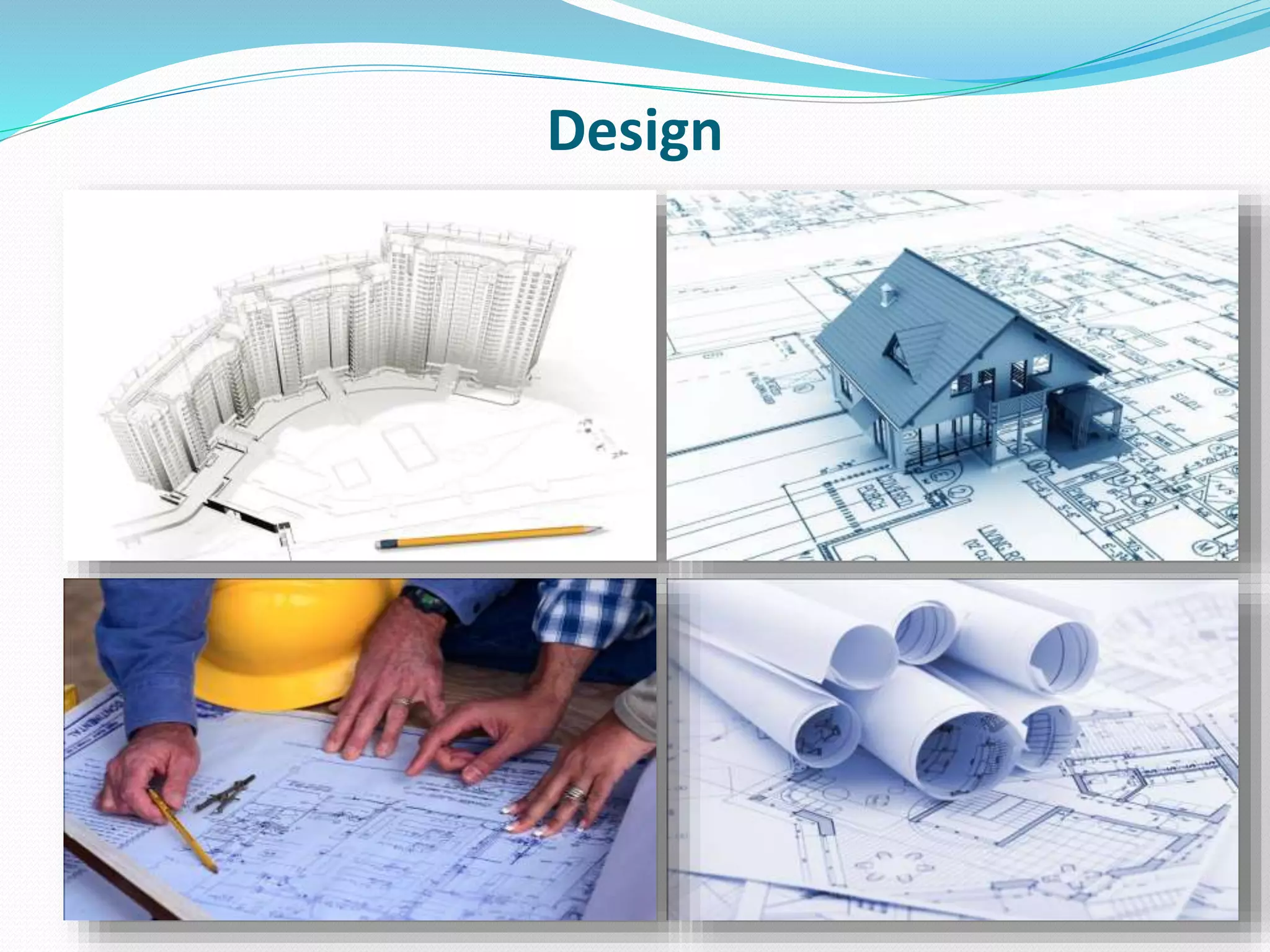
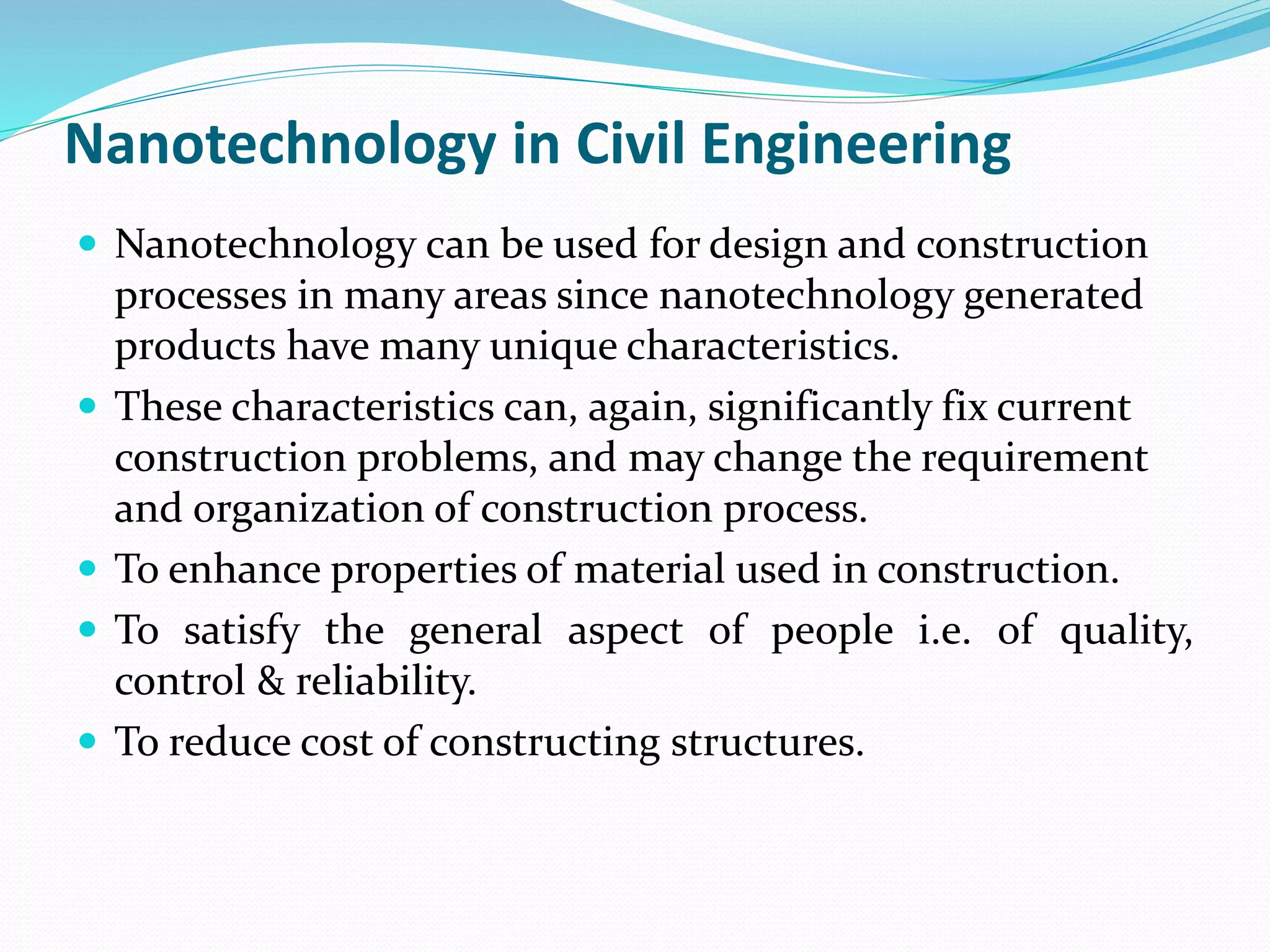
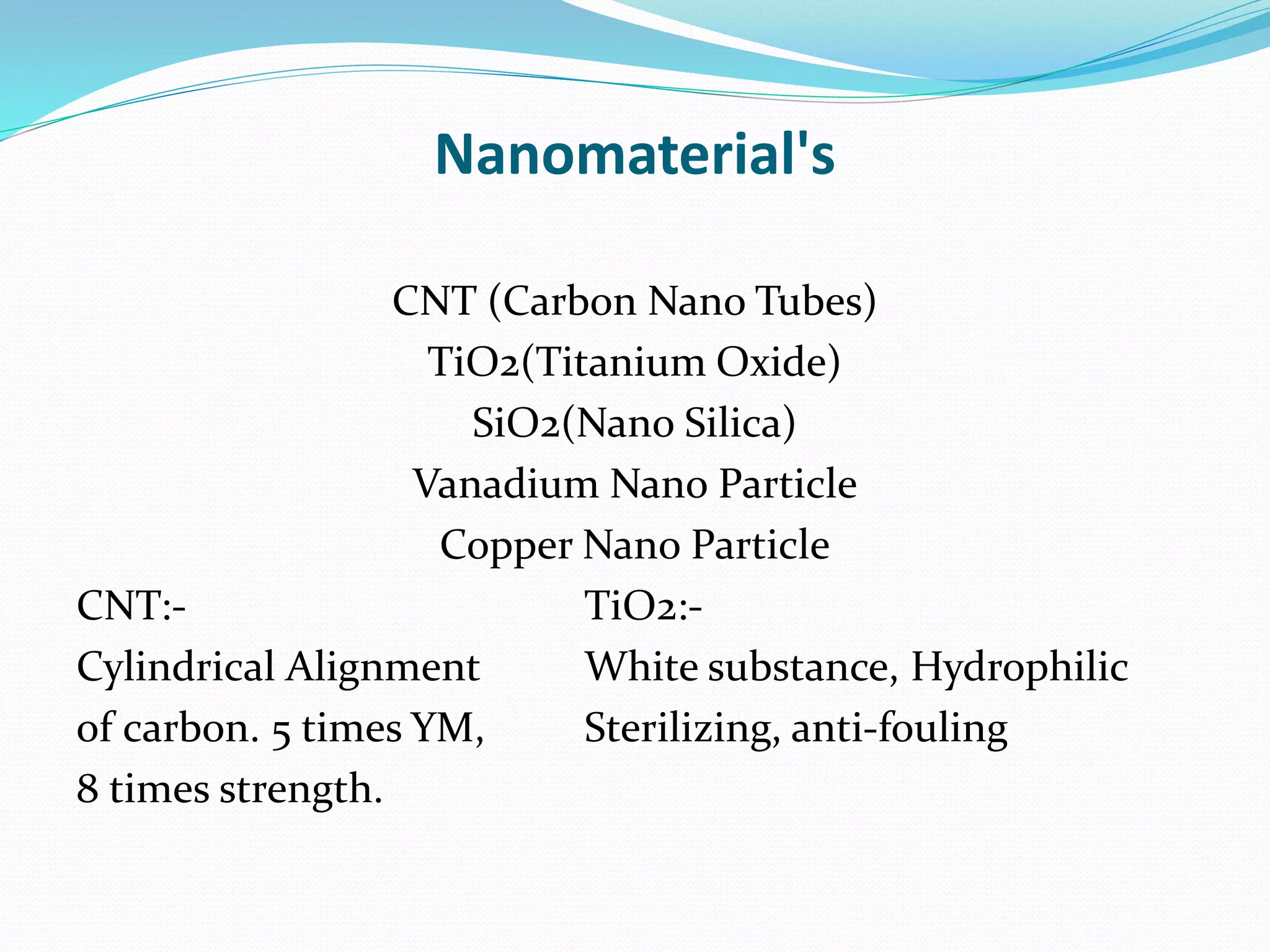
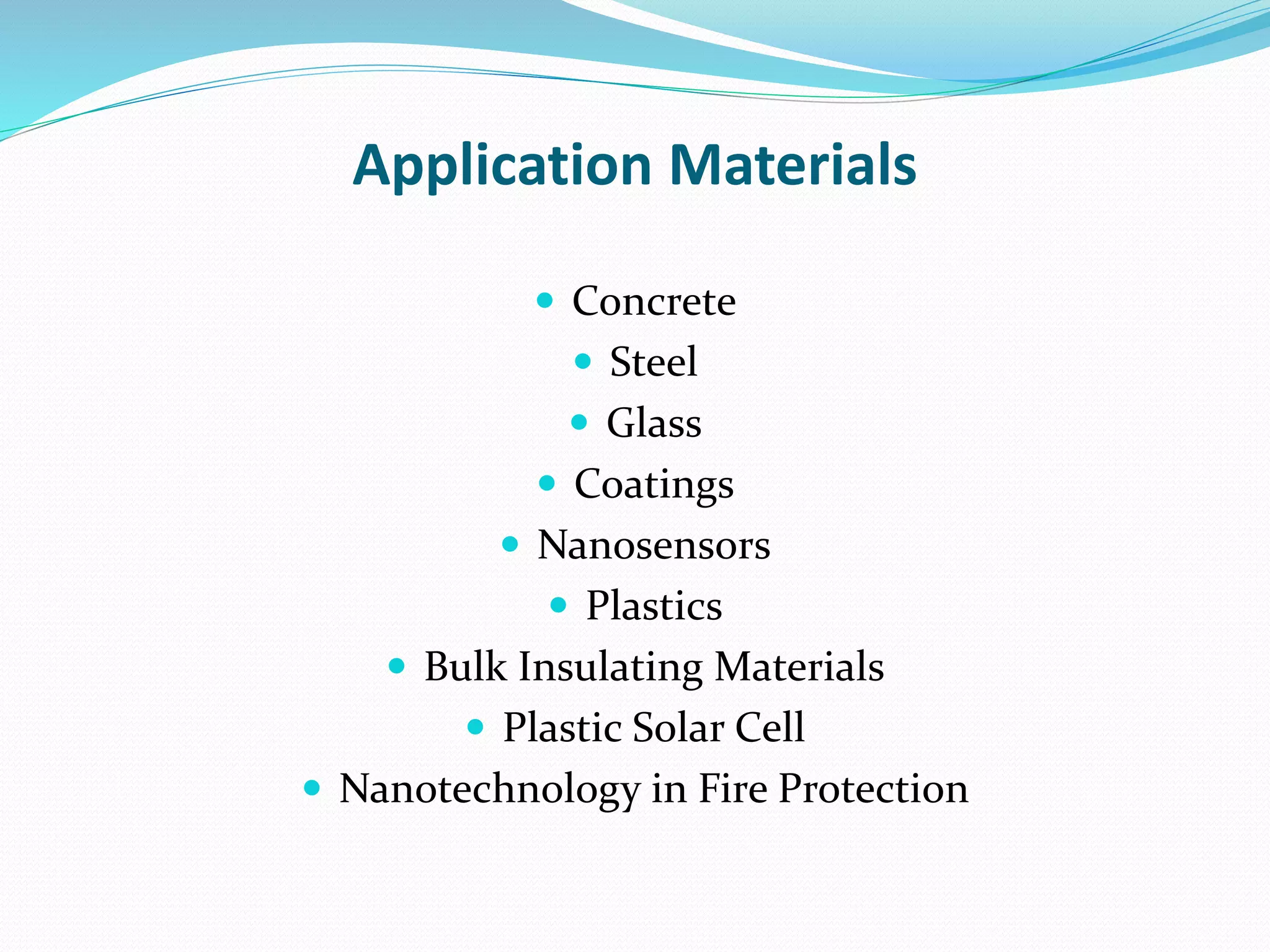
Design
Maintenance
Nanotechnology in Civil Engineering
 Nanotechnology can be used for design and construction
processes in many areas since nanotechnology generated
products have many unique characteristics.
 These characteristics can, again, significantly fix current
construction problems, and may change the requirement
and organization of construction process.
 To enhance properties of material used in construction.
 To satisfy the general aspect of people i.e. of quality,
control & reliability.
 To reduce cost of constructing structures.
Nanomaterial's
CNT (Carbon Nano Tubes)
TiO2(Titanium Oxide)
SiO2(Nano Silica)
Vanadium Nano Particle
Copper Nano Particle
CNT:- TiO2:-
Cylindrical Alignment White substance, Hydrophilic
of carbon. 5 times YM, Sterilizing, anti-fouling
8 times strength.
Application Materials
 Concrete
 Steel
 Glass
 Coatings
 Nanosensors
 Plastics
 Bulk Insulating Materials
 Plastic Solar Cell
 Nanotechnology in Fire Protection
Concrete
 Concrete is one of the most common and widely used
construction materials. Nanotechnology is widely used in
studying its properties like hydration reaction, alkali
silicate reaction (ASR) and fly ash reactivity.
 With the addition of nano-SiO2 part of the cement is
replaced but the density and strength of the fly-ash
concrete improves particularly in the early stages.
 Fiber wrapping of concrete is quite common today for
increasing the strength of pre-existing concrete structural
elements.
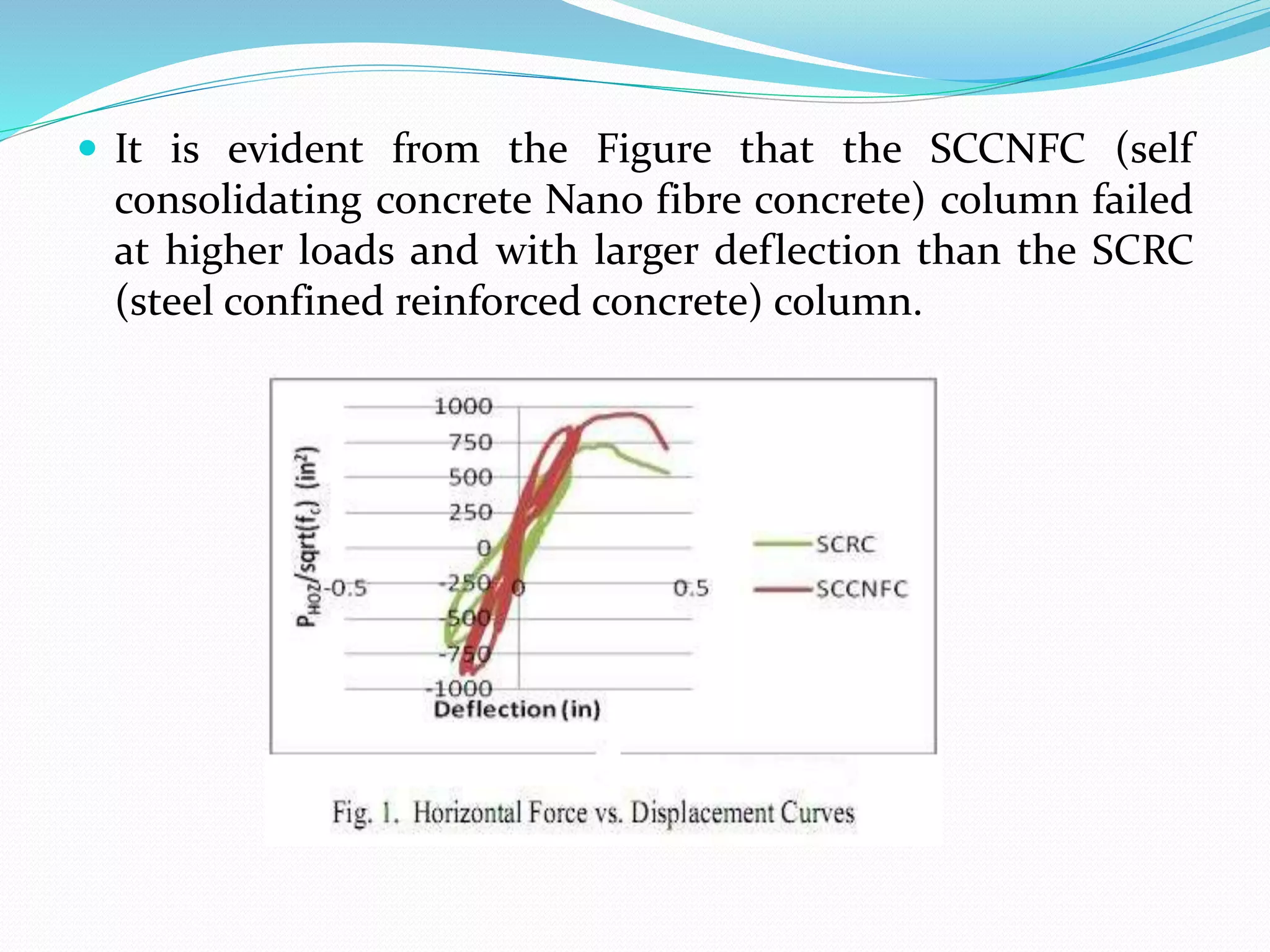
 It is evident from the Figure that the SCCNFC (self
consolidating concrete Nano fibre concrete) column failed
at higher loads and with larger deflection than the SCRC
(steel confined reinforced concrete) column.
Steel
 Steel is a major construction material.
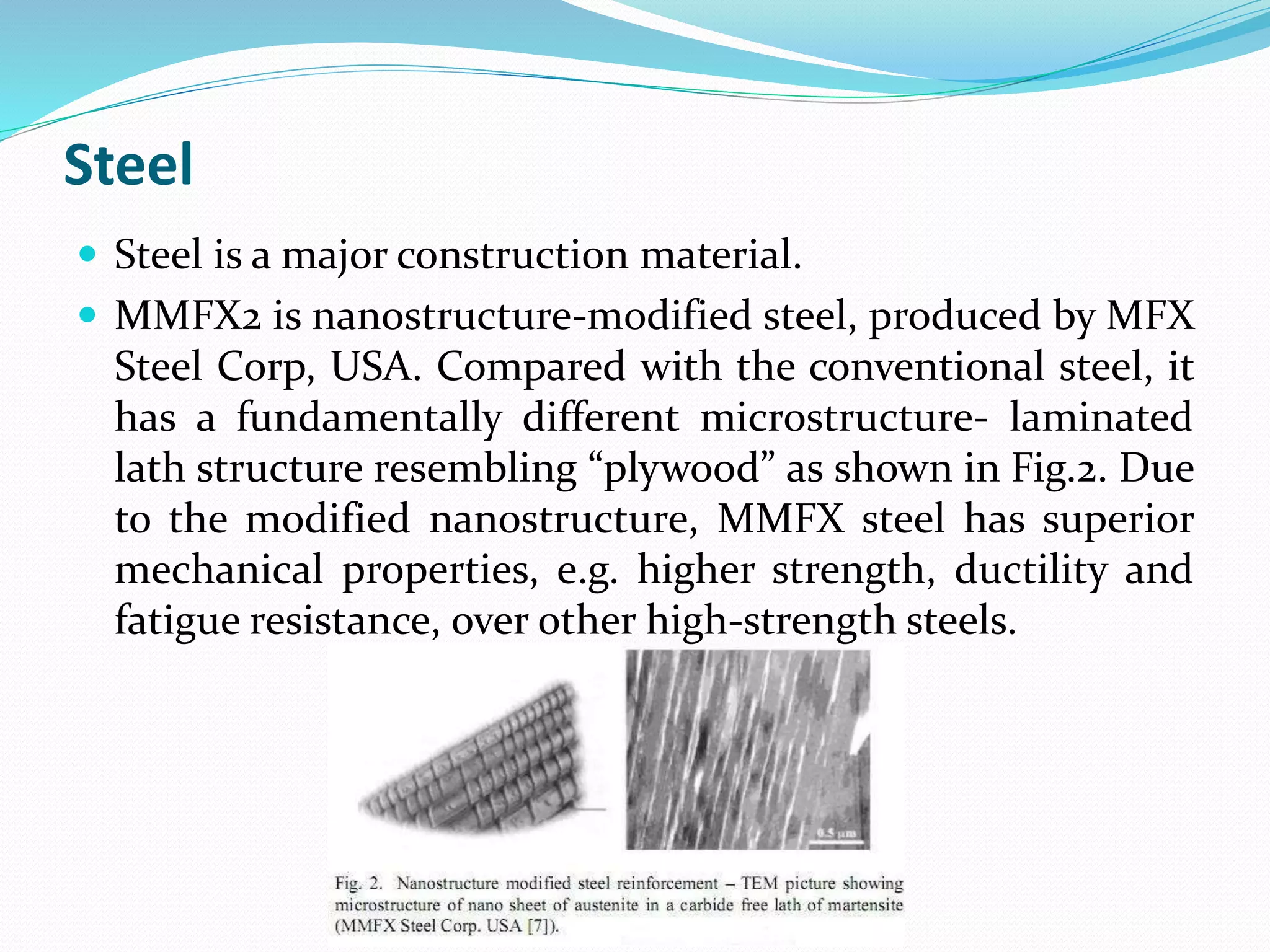
 MMFX2 is nanostructure-modified steel, produced by MFX
Steel Corp, USA. Compared with the conventional steel, it
has a fundamentally different microstructure- laminated
lath structure resembling “plywood” as shown in Fig.2. Due
to the modified nanostructure, MMFX steel has superior
mechanical properties, e.g. higher strength, ductility and
fatigue resistance, over other high-strength steels.
Coating
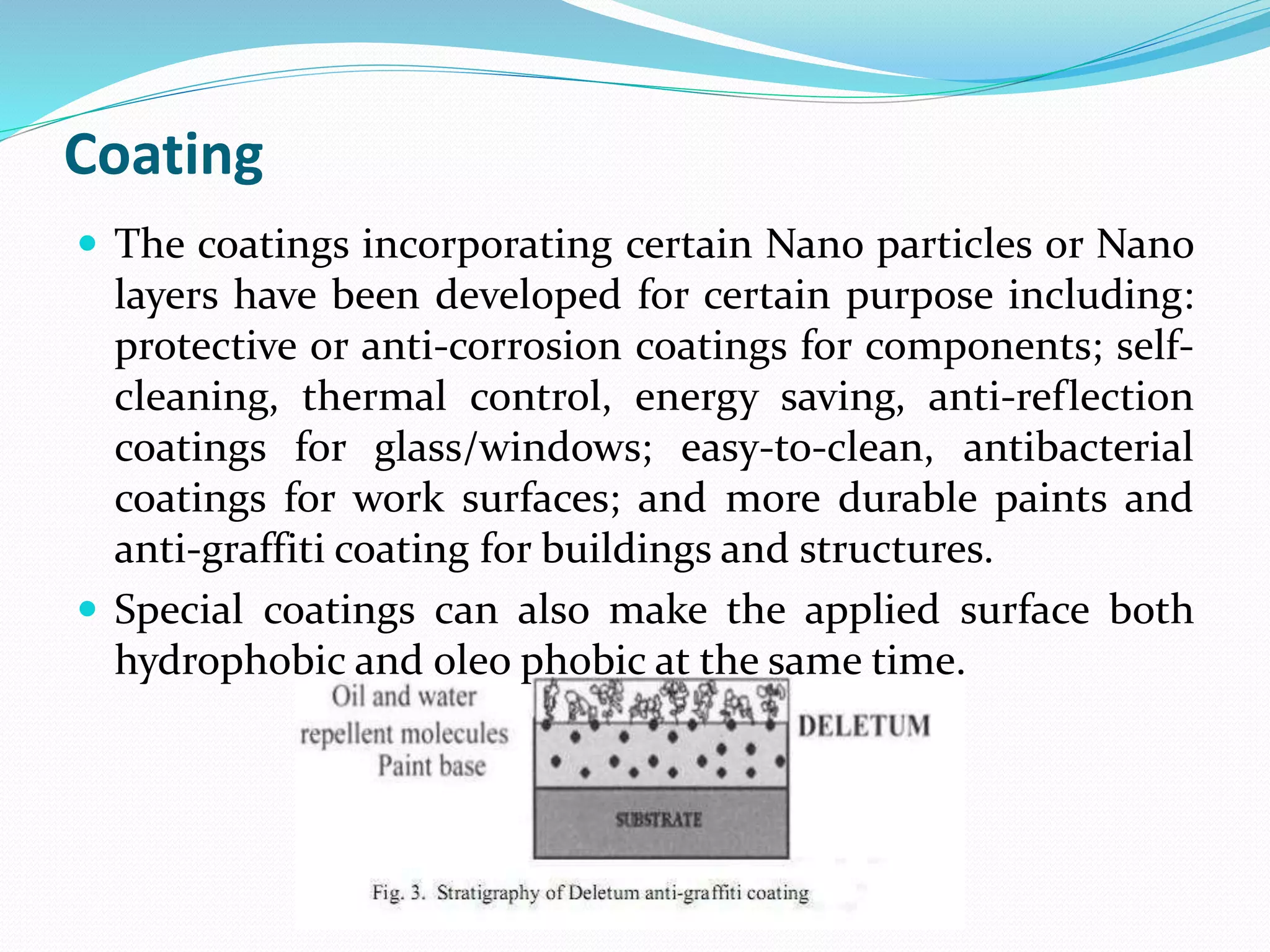
 The coatings incorporating certain Nano particles or Nano
layers have been developed for certain purpose including:
protective or anti-corrosion coatings for components; self-
cleaning, thermal control, energy saving, anti-reflection
coatings for glass/windows; easy-to-clean, antibacterial
coatings for work surfaces; and more durable paints and
anti-graffiti coating for buildings and structures.
 Special coatings can also make the applied surface both
hydrophobic and oleo phobic at the same time.
Glass
 Fire-protective glass is another application of
nanotechnology. This is achieved by using a clear
intumescent layer sandwiched between glass panels (an
interlayer) formed of fumed silica (SiO2) nanoparticles
which turns into a rigid and opaque fire shield when
heated.
 The hydrophobic properties of TiO2, it can be applied in
antifogging coatings or in self-cleaning windows.
 Nano-TiO2 coatings can also be applied to building
exteriors to prevent sticking of pollutants, and thus reduce
a facility’s maintenance costs.
Nanosensors
 Nanotechnology enabled sensors/devices also offer great
potential for developing smart materials and structures
which have ‘self-sensing’ and ‘self-actuating’ capability.
 Nano and Micro electrical mechanical systems (NEMS &
MEMS) sensors have been developed and used in
construction to monitor and/or control the environment
conditions (e.g. temperature, moisture, smoke, noise, etc.)
and the materials/structure performance (e.g. stress, strain,
vibration, cracking, corrosion, etc.) during the structure’s
life.
 Nano sensor ranges from 10-9m to 10-5 m which could be
embedded into the structure during the construction
process.
Plastics
 The carbon fibre reinforced plastics (CFRP) being light
weight material does not exhibit good electrical properties.
CNTs are among the stiffest and strongest fibers known,
and have high electrical conductivity.
 Plasma technology in order to transfer their properties to
CFRPs since these micro- or nanoparticles must be highly
homogeneous, and sometimes very closely bound to the
polymer.
Plastic Solar Cell
 The most promising application in the areas of energy and
environment leading to the sustainable building is the
development of fuel cells and photovoltaic.
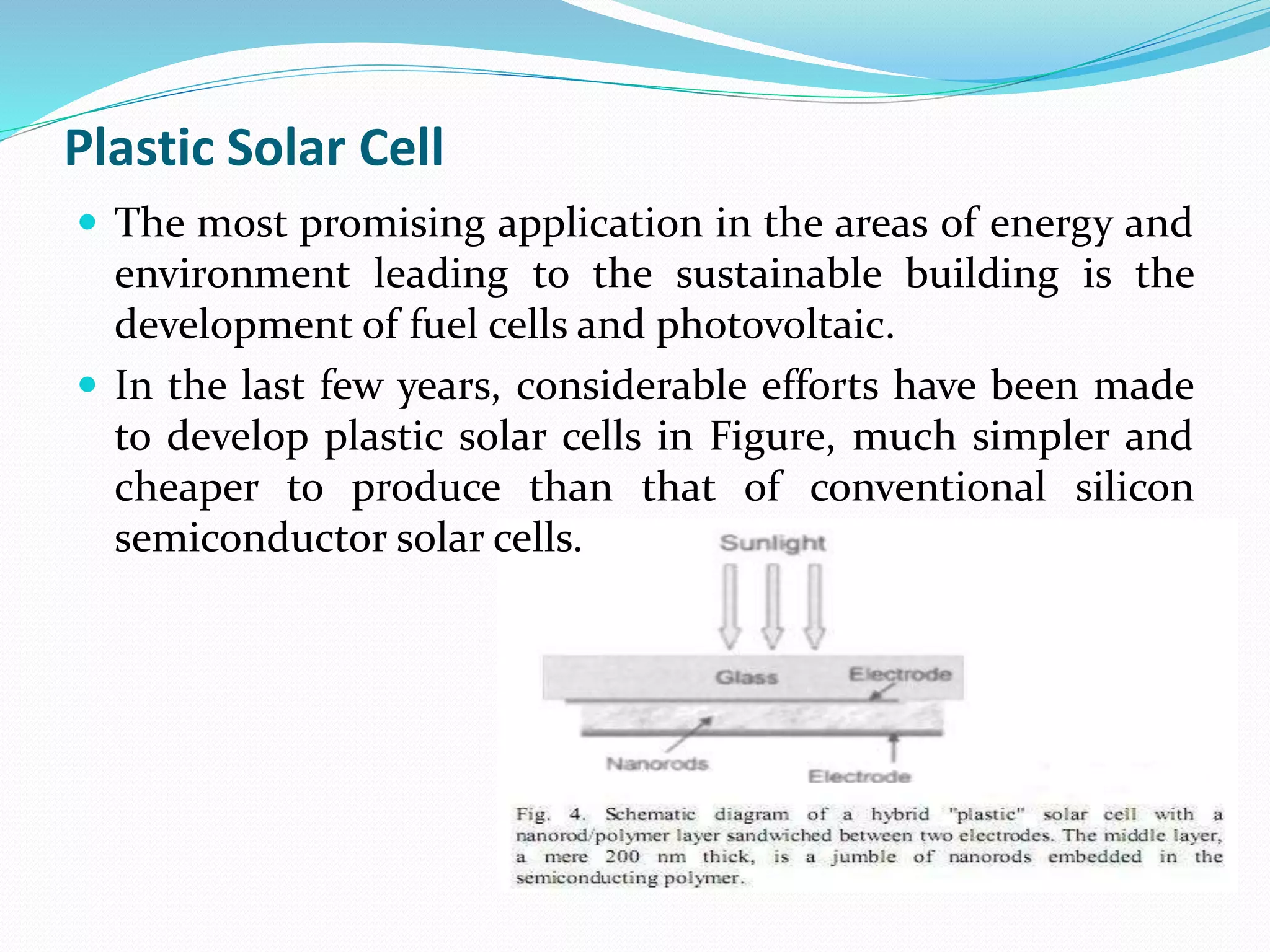
 In the last few years, considerable efforts have been made
to develop plastic solar cells in Figure, much simpler and
cheaper to produce than that of conventional silicon
semiconductor solar cells.
Nanotechnology In Fire Protection
 Fire resistance of steel structures is often provided by a
coating of spray on cementitious process which is no more
popular because they need to be thick, tend to be brittle
and polymer additions are needed to improve adhesion.
 Research into nano-cement made of nano-sized particles
has the potential to create a new paradigm in this area of
application.
 Polypropylene fibres are also being considered as a method
of increasing fire resistance and this is a cheaper option
than conventional insulation.
 CNTs can also be used to produce protective clothing
materials because of their flame retardant property.
Disadvantages
 Because of their small particle size, Nano particles have the
potential to negatively affect the respiratory and digestive
tracks and the skin or eye surface, thus exposes workers to
hazards.
 Small production volumes and high cost remain the main
barriers to the use of nanotechnology.
 The time for commercializing a product is long.
Future Projection of Nanotechnology in
Construction
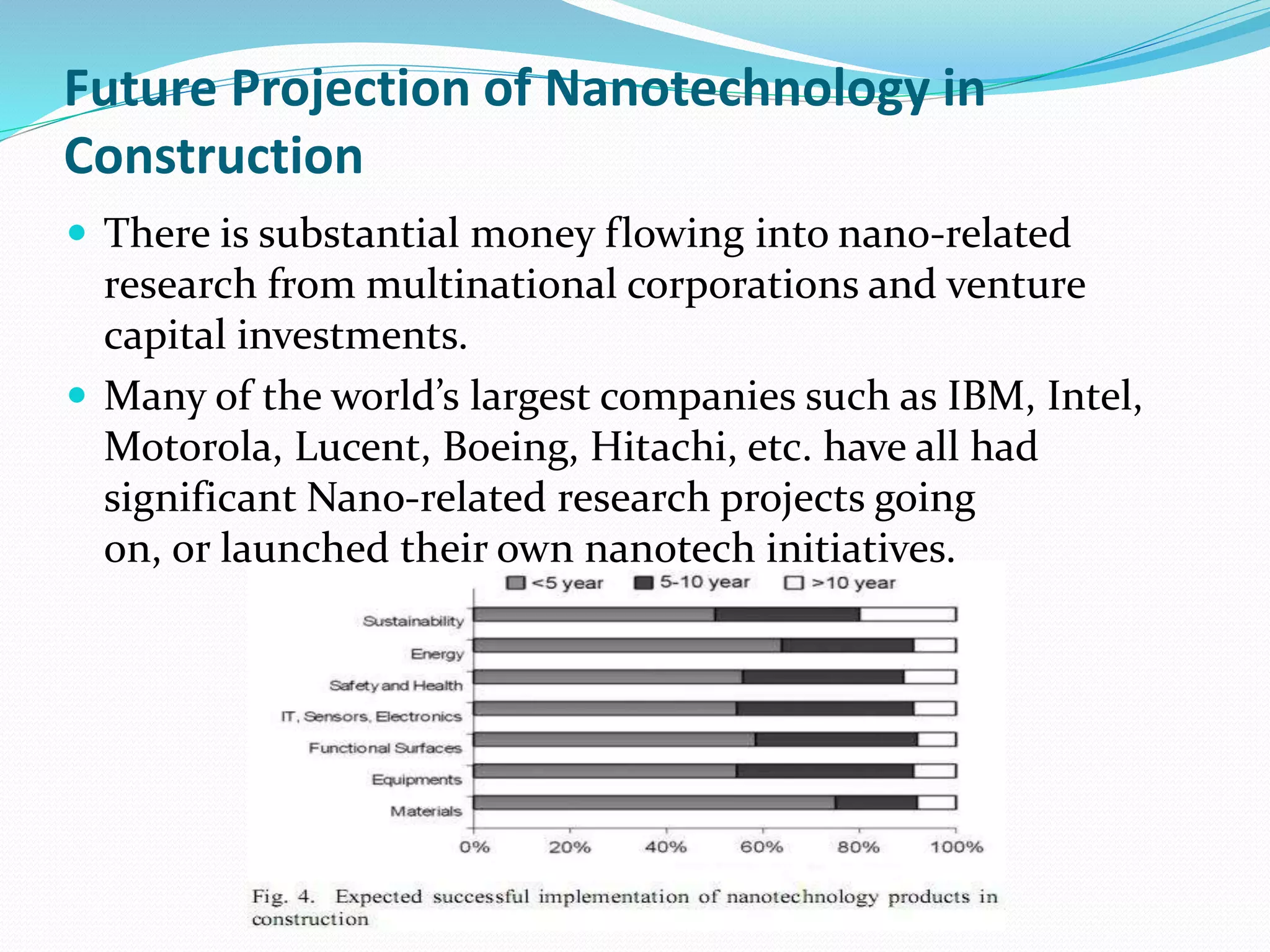
 There is substantial money flowing into nano-related
research from multinational corporations and venture
capital investments.
 Many of the world’s largest companies such as IBM, Intel,
Motorola, Lucent, Boeing, Hitachi, etc. have all had
significant Nano-related research projects going
on, or launched their own nanotech initiatives.
MY OPINION
FIRM CONSTRUCTION
INNOVATIVE DESIGNING
AND
SMART MAINTAINANCE
Conclusion
 Research in nanotechnology that is related to construction
is still in its infancy; however the main benefits and
barriers that allow the effect of nanotechnology on
construction to be defined.
 Recent years of R&D have shown massive investments
Nano-construction.
HIGH COST
OF
MANUPULATION AND RESEARCH
Thank You

Application Of Nanotechnology In Civil Engineering

  • 1.
  • 2.
    Nanotechnology ? “ Technology Manipulating At RangeBillionth Of A Meter” “Level Of Nature”
  • 3.
    What is meanby Nanotechnology?  Nano, which comes from the Greek word for dwarf, indicates a billionth. One nanometer is a billionth of a meter. Definitions of ‘nanotechnology’ vary, but it generally refers to understanding and manipulation of matter on the Nano scale, say, from 0.1 run to 100 nm.  The significance and importance of controlling matter at the Nano scale is that at this scale different laws of physics come into play.
  • 4.
    Civil Engineering ? Coastal Engineering  Construction Engineering  Earthquake Engineering  Environmental Engineering  Geotechnical Engineering  Water Resource Engineering  Materials Engineering  Structural Engineering  Transportation Engineering
  • 5.
  • 6.
  • 7.
  • 8.
    Nanotechnology in CivilEngineering  Nanotechnology can be used for design and construction processes in many areas since nanotechnology generated products have many unique characteristics.  These characteristics can, again, significantly fix current construction problems, and may change the requirement and organization of construction process.  To enhance properties of material used in construction.  To satisfy the general aspect of people i.e. of quality, control & reliability.  To reduce cost of constructing structures.
  • 9.
    Nanomaterial's CNT (Carbon NanoTubes) TiO2(Titanium Oxide) SiO2(Nano Silica) Vanadium Nano Particle Copper Nano Particle CNT:- TiO2:- Cylindrical Alignment White substance, Hydrophilic of carbon. 5 times YM, Sterilizing, anti-fouling 8 times strength.
  • 10.
    Application Materials  Concrete Steel  Glass  Coatings  Nanosensors  Plastics  Bulk Insulating Materials  Plastic Solar Cell  Nanotechnology in Fire Protection
  • 11.
    Concrete  Concrete isone of the most common and widely used construction materials. Nanotechnology is widely used in studying its properties like hydration reaction, alkali silicate reaction (ASR) and fly ash reactivity.  With the addition of nano-SiO2 part of the cement is replaced but the density and strength of the fly-ash concrete improves particularly in the early stages.  Fiber wrapping of concrete is quite common today for increasing the strength of pre-existing concrete structural elements.
  • 12.
     It isevident from the Figure that the SCCNFC (self consolidating concrete Nano fibre concrete) column failed at higher loads and with larger deflection than the SCRC (steel confined reinforced concrete) column.
  • 13.
    Steel  Steel isa major construction material.  MMFX2 is nanostructure-modified steel, produced by MFX Steel Corp, USA. Compared with the conventional steel, it has a fundamentally different microstructure- laminated lath structure resembling “plywood” as shown in Fig.2. Due to the modified nanostructure, MMFX steel has superior mechanical properties, e.g. higher strength, ductility and fatigue resistance, over other high-strength steels.
  • 14.
    Coating  The coatingsincorporating certain Nano particles or Nano layers have been developed for certain purpose including: protective or anti-corrosion coatings for components; self- cleaning, thermal control, energy saving, anti-reflection coatings for glass/windows; easy-to-clean, antibacterial coatings for work surfaces; and more durable paints and anti-graffiti coating for buildings and structures.  Special coatings can also make the applied surface both hydrophobic and oleo phobic at the same time.
  • 15.
    Glass  Fire-protective glassis another application of nanotechnology. This is achieved by using a clear intumescent layer sandwiched between glass panels (an interlayer) formed of fumed silica (SiO2) nanoparticles which turns into a rigid and opaque fire shield when heated.  The hydrophobic properties of TiO2, it can be applied in antifogging coatings or in self-cleaning windows.  Nano-TiO2 coatings can also be applied to building exteriors to prevent sticking of pollutants, and thus reduce a facility’s maintenance costs.
  • 16.
    Nanosensors  Nanotechnology enabledsensors/devices also offer great potential for developing smart materials and structures which have ‘self-sensing’ and ‘self-actuating’ capability.  Nano and Micro electrical mechanical systems (NEMS & MEMS) sensors have been developed and used in construction to monitor and/or control the environment conditions (e.g. temperature, moisture, smoke, noise, etc.) and the materials/structure performance (e.g. stress, strain, vibration, cracking, corrosion, etc.) during the structure’s life.  Nano sensor ranges from 10-9m to 10-5 m which could be embedded into the structure during the construction process.
  • 17.
    Plastics  The carbonfibre reinforced plastics (CFRP) being light weight material does not exhibit good electrical properties. CNTs are among the stiffest and strongest fibers known, and have high electrical conductivity.  Plasma technology in order to transfer their properties to CFRPs since these micro- or nanoparticles must be highly homogeneous, and sometimes very closely bound to the polymer.
  • 18.
    Plastic Solar Cell The most promising application in the areas of energy and environment leading to the sustainable building is the development of fuel cells and photovoltaic.  In the last few years, considerable efforts have been made to develop plastic solar cells in Figure, much simpler and cheaper to produce than that of conventional silicon semiconductor solar cells.
  • 19.
    Nanotechnology In FireProtection  Fire resistance of steel structures is often provided by a coating of spray on cementitious process which is no more popular because they need to be thick, tend to be brittle and polymer additions are needed to improve adhesion.  Research into nano-cement made of nano-sized particles has the potential to create a new paradigm in this area of application.  Polypropylene fibres are also being considered as a method of increasing fire resistance and this is a cheaper option than conventional insulation.  CNTs can also be used to produce protective clothing materials because of their flame retardant property.
  • 20.
    Disadvantages  Because oftheir small particle size, Nano particles have the potential to negatively affect the respiratory and digestive tracks and the skin or eye surface, thus exposes workers to hazards.  Small production volumes and high cost remain the main barriers to the use of nanotechnology.  The time for commercializing a product is long.
  • 21.
    Future Projection ofNanotechnology in Construction  There is substantial money flowing into nano-related research from multinational corporations and venture capital investments.  Many of the world’s largest companies such as IBM, Intel, Motorola, Lucent, Boeing, Hitachi, etc. have all had significant Nano-related research projects going on, or launched their own nanotech initiatives.
  • 22.
    MY OPINION FIRM CONSTRUCTION INNOVATIVEDESIGNING AND SMART MAINTAINANCE
  • 23.
    Conclusion  Research innanotechnology that is related to construction is still in its infancy; however the main benefits and barriers that allow the effect of nanotechnology on construction to be defined.  Recent years of R&D have shown massive investments Nano-construction. HIGH COST OF MANUPULATION AND RESEARCH
  • 24.