WHAT MAKES VALUE METHODOLOGY WORK? 
GEZA E. KMETTY AND ALFRED I. PALEY 
PAGE 1 
WHAT MAKES VALUE METHODOLOGY WORK? 
(AN ANALYSIS OF FUNCTION ANALYSIS) 
Abstract 
The paper analyzes and dissects how Value Management’s (VM’s) Function Analysis 
Discipline works and explains how the resulting “creative discontent” impacts 
brainstorming and creativity of the Value Engineering (VE) Team. The focus is on 
Function; the role of the Verb-Noun definitions as the basic element needed to obtain a 
clear understanding of the item under study; and how it serves as the essential tool of 
building VE Team consensus on “where and how the object being analyzed fits in the 
world”. Through the use of the Function Analysis System Technique (FAST) diagram, 
the paper demonstrates VM’s systematic process and how it assists in correctly 
identifying the Problem and how that will lead to identifying the correct solution. It is 
demonstrated that VM is not just cost cutting, but it is primarily an excellent decision-making, 
team-consensus-based Problem Solving and Value Improvement methodology. 
A. Problem Solving 
Problem Solving is an everyday activity, conducted by individuals and groups of people. 
Everyone feels that they are good problem solvers. But are we all good problem 
solvers? 
Let us look at a simple example: Assume that there is an accident in some public area. 
A woman slips and falls on a wet floor. After attending to the woman to make certain 
that there is no major damage to the individual, the problem of the wet and slippery floor 
is fixed. It is dried and it is assumed that the problem of the wet floor has been taken 
care of. Finished Next problem! However, it is fixed only - until the next rain! – the 
cause the problem is a hole in the roof! People are very apt to define a problem in 
terms of their Pet Solution – as in the example: “when a floor is wet, you need to dry it”. 
Many problems, big or small, are defined by people in terms of their pet solution, and, 
their belief that they know what the problem is. That is why we often 
experience/hear, “How come that problem is still here? I thought we solved that 
problem long ago”. It applies as well to areas of personal activities, industry, finance, 
government, medical, etc. Everywhere that people are involved, they will push their Pet 
Solution – it is a people problem!. Reducing costs may results in the benefit of 
increasing Value. However, reducing costs can present problems that require clear 
understanding of many factors. Value Engineering/Value Analysis provides a 
methodology using Function Analysis that overcomes these and other problems.
WHAT MAKES VALUE METHODOLOGY WORK? 
GEZA E. KMETTY AND ALFRED I. PALEY 
PAGE 2 
B. The Inventions 
Value Engineering (VE), originally called Value Analysis (VA), was the product of an 
observation made after World War II. During the war, individuals were drafted out of 
their civilian jobs (similar to the military draft program), and assigned to necessary 
government war efforts. Some were assigned to the War Production Board (WPB) 
whose job was to keep the acquisition of necessary war materiel going strong, keeping 
the supply lines full. Their efforts helped the USA and its allies to win the war. 
After the war was over, drafted individuals were permitted to return to their previous 
civilian jobs. Some of these WPB people returned to General Electric (GE). They were 
asked about their experiences at the WPB, (similar to debriefing) to see if any of their 
experiences could be of help to GE. One of the observations reported was that if they 
had a problem with shortness of supplies, in order to keep the supply lines flowing, they 
had to find substitutes/alternatives -- and often the substitute/alternative worked just 
as well, if not better, and cost less! 
The GE management asked how that happened? No one knew the answer! 
Management set out to find out How? Management assigned a team of people to study 
this “phenomenon” so that they could do it on purpose instead of by accident. Lawrence 
D. Miles, a GE employee, was assigned to form a team. After a few years of study, 
Miles came to the conclusion that what had been ordered or specified at the time was 
not necessarily what was needed. It was the Function of the item which was needed 
by the system or product! 
If the Function was analyzed, there was the opportunity to have a different choice, an 
alternative that could work as well and cost less The alternate could be analyzed to see 
if it could perform the function, and perhaps lower the cost without affecting 
performance or reliability - and even do a better job. And so, Invention No.1 Function 
Analysis as a process was formed. 
Function Analysis, as introduced by Miles in the USA after WWII, followed the 
methodology of Structured Problem Solving to develop a process for cost reduction, by 
identifying unnecessary costs in products, processes and procedures. This has 
generally been called Value Engineering. 
Miles published a book, “Techniques of Value Analysis and Engineering” (Reference 1). 
GE assigned him to train all GE personnel in this process of cost reduction. Later the 
VE process was picked up by the Government. This was at the forefront of the Value 
work that resulted in the formation of the Society of American Value Engineers (SAVE) 
and all the succeeding Value societies. 
Miles’ work was fundamental in introducing the importance of identifying and 
understanding (analyzing) Functions as opposed to primarily “materials” and “things” in 
the cost reduction effort, which was the core of his first efforts. Included in his book, and
WHAT MAKES VALUE METHODOLOGY WORK? 
GEZA E. KMETTY AND ALFRED I. PALEY 
PAGE 3 
of significant importance, was the introduction of an objective way to define the 
“problem” (or problems) in the structured problem-solving process. 
People tend to define problems in terms of their „Pet Solution‟. But Miles taught us that 
the Cost/Function relationship is a more objective way to unambiguously identify a 
problem That is, by establishing the Cost/Function relationships for each Function, one 
can find the cost drivers by comparison and thereby indicate where an unusually high 
cost (or other) problem may exist. As the Value work proceeded in industry and 
government, and Function Analysis began to be applied to more fields and to other than 
just cost reduction efforts, it became clear that understanding the relationships of 
Functions is the key to productivity, efficiency, and elimination of wasteful efforts in all 
the efforts in which people are involved. 
Invention No.2 was the Function Analysis System Technique (FAST), diagram 
(developed by Mr. Charles W. Bytheway in 1964, (Reference 2) and first presented as a 
paper to the SAVE conference in 1965. FAST contributed significantly to an important 
phase of the development of the body of knowledge, currently being referred to as the 
Value Methodology (VM). 
The introduction of FAST diagramming resulted in a two dimensional presentation of the 
hierarchy and relationship of Functions. This provided a clearer understanding of the 
products, processes, and procedures for which individuals and teams of people were 
responsible. The result of applying Function Analysis in problem solving procedures is 
that consensus can be obtained more readily for decision making. Doc Ruggles, one of 
the first teachers in VA/VE (Reference 3) stated “…the FAST diagram will cause the 
problem to jump out at you”. 
C. From Reasoning to Function Analysis 
Reason is what helps us figure out how or why something happened. In a way 
reason is a tool for arriving at theories to construct Stories the crucial soldering iron 
required to connect the dots. And why do we make stories? Not necessarily because 
they help us understand the world better, but because they help us explain the world 
better. We are a story telling species. We make up stories to win arguments and we 
use reason to enhance our stories with superior logic. 
Lawrence D. Miles, was the “inventor” of Functional Thinking with the Active Verb and 
the Measurable Noun as the “language” of Value Methodology. He makes the statement 
that “With the product, the customer wants a FUNCTION”. The language of FUNCTION 
(Active Verb and a Measurable Noun) is the LANGUAGE which helps us to define the 
heart of the problem. 
Charles W. Bytheway organized the language of Miles into sentences and paragraphs, 
making full Stories, with the use of the FAST. FAST is a pictoral representation of
WHAT MAKES VALUE METHODOLOGY WORK? 
GEZA E. KMETTY AND ALFRED I. PALEY 
PAGE 4 
function “words”, organized into sentences and pictures to make “Logical Stories”, in 
a how-why relationship. Now let’s construct a “ FAST-Story” of Function Analysis! 
D. Creating a FAST Diagram of Function Analysis 
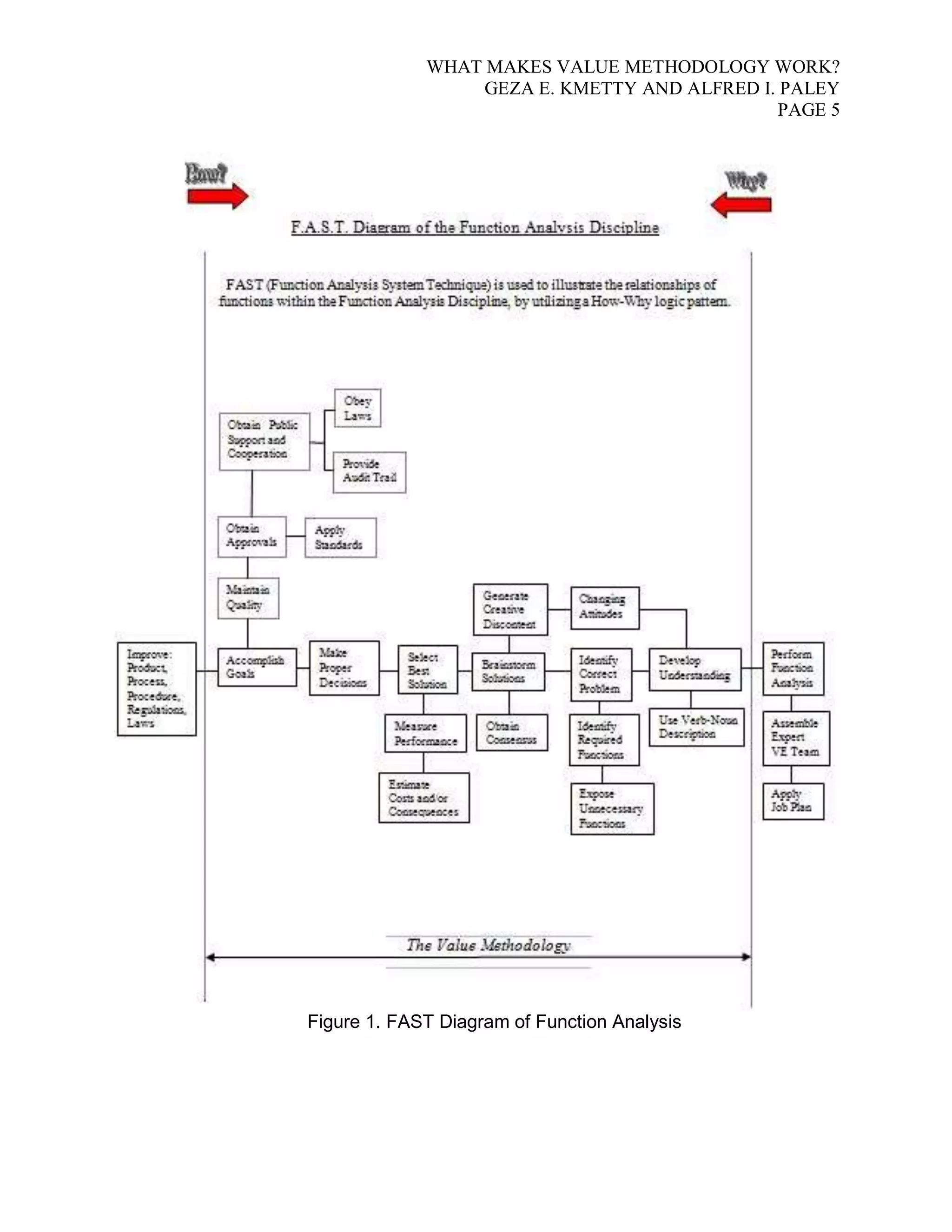
Following is a list of Functions which describe Function Analysis. The list below 
(relevant to the process of Function Analysis) are the Words that form the Story of 
Function Analysis. The hyphenations are to keep the “Measurable Nouns” as one word. 
For example, the first Function in our list “Accomplish” is the Verb and “Goals” is the 
Noun. The rest follow the same logic. 
Accomplish Goals 
Make Proper-Decisions 
Select Best-Solution 
Brainstorm Solutions 
Identify Correct-Problem 
Maintain Quality 
Obtain Approvals 
Apply Standards 
Obtain Public-Support 
Obey Laws 
Provide Audit-Trail 
Measure Performance 
Estimate Costs 
Estimate Consequences 
Obtain Consensus 
Identify Required-Functions 
Expose Unnecessary-Functions 
Generate Creative-Discontent 
Change Attitudes 
Develop Understanding 
Perform Function-Analysis 
Use Verb-Noun Description 
Apply Job-Plan 
Assemble Expert VE Team 
Using the above list of Function-Words, we may now construct a FAST Diagram to form 
a two dimensional picture and tell a Story.
WHAT MAKES VALUE METHODOLOGY WORK? 
GEZA E. KMETTY AND ALFRED I. PALEY 
PAGE 5 
Figure 1. FAST Diagram of Function Analysis
WHAT MAKES VALUE METHODOLOGY WORK? 
GEZA E. KMETTY AND ALFRED I. PALEY 
PAGE 6 
E. Reading the FAST Diagram 
The above FAST Diagram is telling us the Story of the Function Analysis discipline. 
Follow the Diagram from Left to Right or Right to Left. It should make logical sense 
either way. Each Function should answer the How and Why questions with an adjacent 
Function. By observation, the most Value Improvement opportunity in this FAST is the 
Identify Correct-Problem Function which is coming from the Develop Understanding 
Function and followed by the Brainstorm Solution Function from the right to the left. Now 
we are on the right track to Select Best Solution and Make Proper Decision, and to 
Accomplish Goal which will result in improving whatever Unsatisfactory Situation on 
which we are working. 
F. Function Engineering 
The arrangement and rearrangement of Functions and display them in such a way that 
the teams agree/show consensus that the Function diagram represents the 
project/system. The ability to organize one’s thinking about Functions and to reorganize 
and use Logic to rearrange Functions for improvement of cost savings, time savings, 
substitutions and rearrangement is Function Engineering. 
Why this has not been identified as such is not clear, but could be that it worked no 
matter that it was called VA, VE, Discipline or etc.? Function Engineering as a name 
can bring the discipline to a new level of understanding as to why it has been so 
effective for over 60 years. 
We have recently heard the phrase “Financial Engineering” being used to describe 
some of the activities on Wall Street that came up with investment derivatives, such as 
Credit Default Swap Derivatives. During the present financial crisis, the following 
thought comes to mind about Function Science: 
The work done by Larry Miles in developing “Techniques of Value Analysis and 
Engineering“, was the identification, arrangement and manipulation of Functions, ergo: 
Function Engineering. It is now apparent that the science of Function Analysis is the 
use/application of Function Engineering and is the basis of Value Engineering. 
For example, in Electrical Engineering the understanding of relationship of Voltage (E), 
Current (I), and Resistance (R ) results in the formula, E=IR. In Value Engineering we 
start with Functions, and then through the use of logic in the How?/Why? to arrange and 
rearrange those functions, we developed the process known as Function Engineering. 
Our path has been through the FAST diagramming tool which can be defined as 
supplying the formula that is inherent in Engineering -- the basic truth or factor.
WHAT MAKES VALUE METHODOLOGY WORK? 
GEZA E. KMETTY AND ALFRED I. PALEY 
PAGE 7 
The development of Function Engineering is all due to the genius of Larry D. Miles and 
Charles Bytheway who developed the FAST Diagramming tool. Their work created a 
powerful improvement to Structured Problem Solving through the Language of Verbs 
and Nouns and the Story told by the FAST Diagram. 
G. Example 
FAST diagrams had been constructed during a VE workshop in the course of following 
the structured problem solving procedure of the Job Plan (See Section J). The FAST 
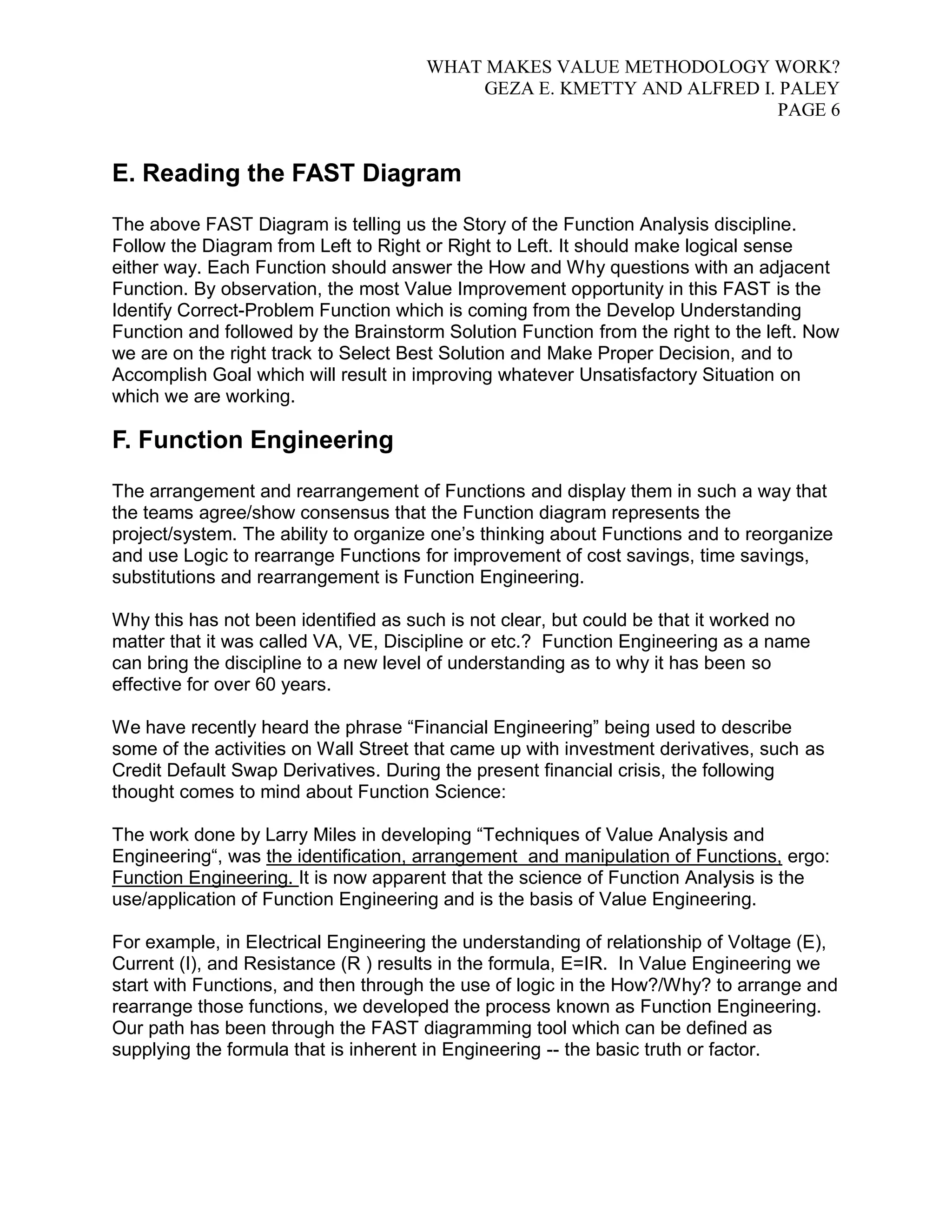
diagrams were invaluable in defining the problems. Figure 2 illustrates a simplified form 
of FAST as an example: 
FAST Diagramming 
General Layout 
Basic 
Function 
Function 
Function Input 
Driving 
Function 
Higher 
Order 
Function 
Supporting 
Function 
WHY? 
Specifications 
Scope Lines 
HOW? 
Figure 2. FAST Diagram, Simplified Layout 
In reviewing the FAST diagrams and the Functions that were beginning to be detailed 
during the VA/VE workshops unnecessary costs often were identified. Following is an 
actual VA/VE project on a 60 year old Railroad Bridge Maintenance and 
Remodeling (a bridge redesign and rail traffic maintenance project). 
60 year Old Railroad Bridge Maintenance/Remodeling 
This bridge repair project began as the result of failure of the railroad lift bridge across a 
major waterway to open as required to allow ship and boat traffic. Due to aging of the 
railroad bridge and its pilings, the bridge support pilings had shifted over time. Bridge 
inspectors found that if the lift bridge was raised, it would not properly position itself on 
the shifted pilings when lowered, thus interrupting the rail traffic. Therefore the bridge 
could no longer be opened. However, the Coast Guard required that the river traffic be 
maintained. The bridge and its pilings had to be repaired so that both traffic 
requirements were met.
WHAT MAKES VALUE METHODOLOGY WORK? 
GEZA E. KMETTY AND ALFRED I. PALEY 
PAGE 8 
A design for the reconstruction effort had been made which included dismantling of the 
old bridge, and redesign and construction of a new railroad lift bridge and its pilings. 
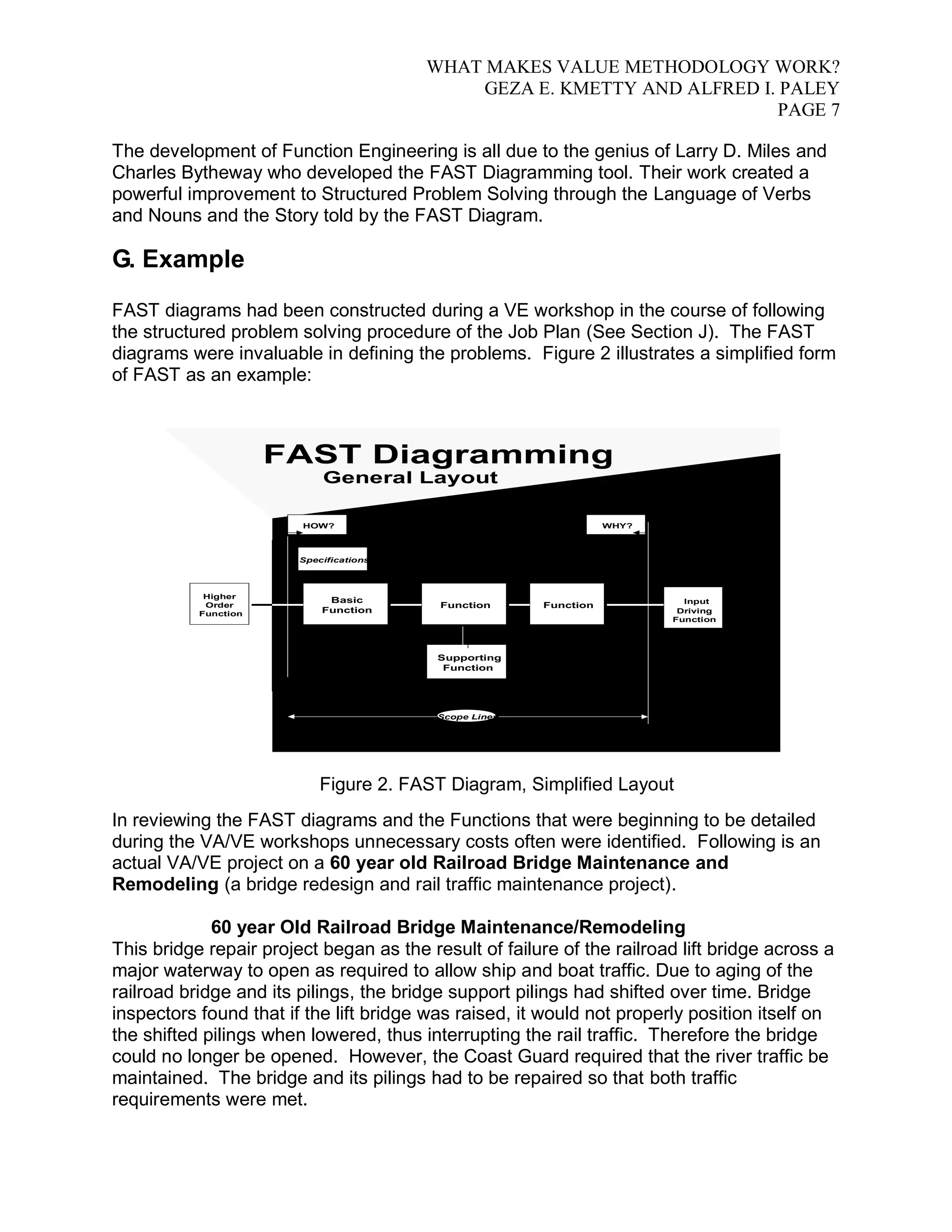
Figure 3 is a FAST diagram of the project as originally designed. In order to maintain 
railroad traffic during the reconstruction project, the design included a by-pass rail line 
located upstream of the river crossing to by-pass the construction area. This by-pass 
rail line would have required complete removal after all the reconstruction was 
completed. The contract for the project included a requirement for a VA/VE study, and a 
workshop was organized. 
The first order of workshop business was to obtain and review all of the drawings and 
specifications for the project. The VA/VE team had to identify all of the Functions and 
begin to understand the Functions associated with the project. In order to get a deeper 
understanding of the project, a field trip was organized for the workshop team to visit the 
site of the railroad bridge -- to see the condition of the pilings, and the bridge. 
60yr old Railroad Lift Bridge 
Maintenance/Remodeling 
Complete 
Construction- 
Project 
Replace 
Bridge 
FAST Diagram 
Provide 
Water- 
Traffic 
Railroad 
Lift Bridge 
Needs Repair 
Provide 
Water and 
Rail Traffic Provide 
Rail-Traffic 
HOW? 
WHY? 
Higher Order Function 
Specifications 
Maintain 
Rail & Water 
Traffic 
Maintain 
Rail-Traffic 
Provide 
Rail- 
By-Pass 
Environmental 
Impact 
Study 
Figure 3. FAST Diagram of Existing Railroad Lift Bridge 
As the team walked out to the railroad bridge it became immediately apparent that the 
railroad bridge was actually two bridges; each with two sets of railroad tracks.
WHAT MAKES VALUE METHODOLOGY WORK? 
GEZA E. KMETTY AND ALFRED I. PALEY 
PAGE 9 
The workshop team investigated the impact of their finding two railroad bridges at the 
site instead of one. If one bridge could be worked on at a time, railroad traffic could be 
maintained on the two tracks of the other bridge. If the rail traffic could be maintained, 
the unnecessary cost of construction of the by-pass, its later removal, and the 
expensive environmental impact study, which had no Function or value after the project 
was completed, could be avoided. 
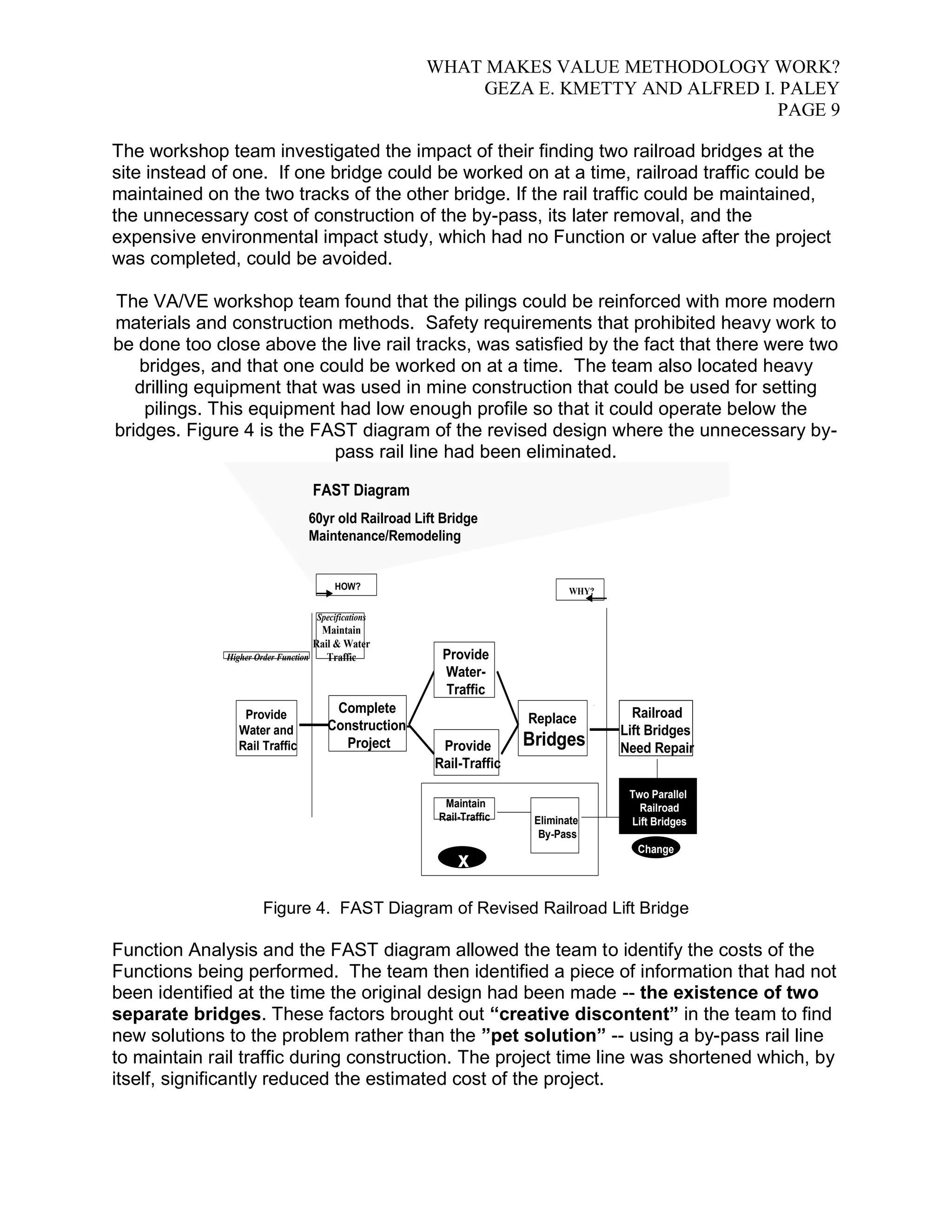
The VA/VE workshop team found that the pilings could be reinforced with more modern 
materials and construction methods. Safety requirements that prohibited heavy work to 
be done too close above the live rail tracks, was satisfied by the fact that there were two 
bridges, and that one could be worked on at a time. The team also located heavy 
drilling equipment that was used in mine construction that could be used for setting 
pilings. This equipment had low enough profile so that it could operate below the 
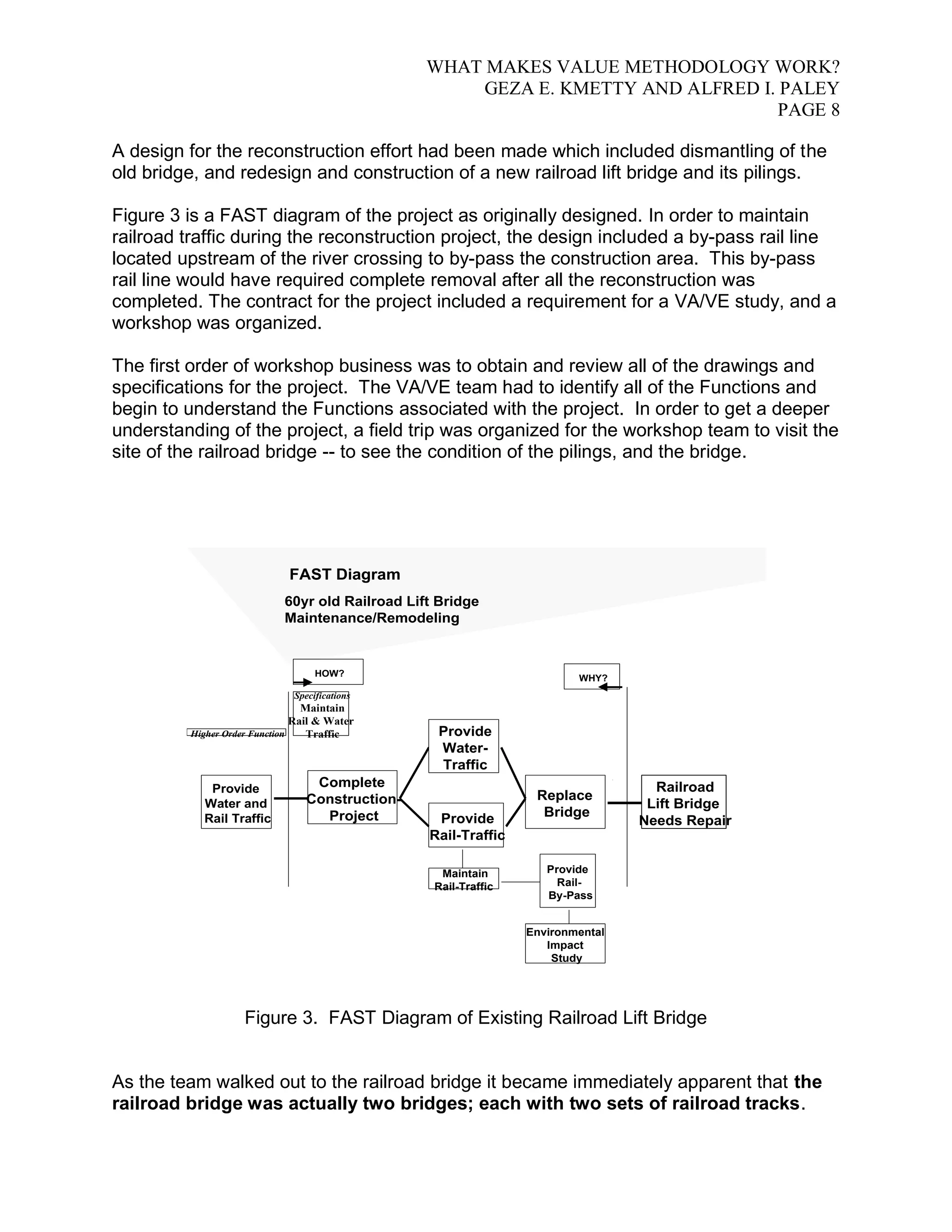
bridges. Figure 4 is the FAST diagram of the revised design where the unnecessary by-pass 
rail line had been eliminated. 
60yr old Railroad Lift Bridge 
Maintenance/Remodeling 
Complete 
Construction- 
Project 
Replace 
Bridges 
FAST Diagram 
Provide 
Water- 
Traffic 
Railroad 
Lift Bridges 
Need Repair 
Provide 
Water and 
Rail Traffic Provide 
Rail-Traffic 
HOW? 
WHY? 
Higher Order Function 
Specifications 
Maintain 
Rail & Water 
Traffic 
Maintain 
Rail-Traffic Eliminate 
By-Pass 
Two Parallel 
Railroad 
Lift Bridges 
x 
Change 
Figure 4. FAST Diagram of Revised Railroad Lift Bridge 
Function Analysis and the FAST diagram allowed the team to identify the costs of the 
Functions being performed. The team then identified a piece of information that had not 
been identified at the time the original design had been made -- the existence of two 
separate bridges. These factors brought out “creative discontent” in the team to find 
new solutions to the problem rather than the ”pet solution” -- using a by-pass rail line 
to maintain rail traffic during construction. The project time line was shortened which, by 
itself, significantly reduced the estimated cost of the project.
WHAT MAKES VALUE METHODOLOGY WORK? 
GEZA E. KMETTY AND ALFRED I. PALEY 
PAGE 10 
H. Reasons of Poor Quality and Wrong Decisions 
 Lack of Information 
 Honest Wrong beliefs 
 Habitual Thinking 
 Risk of Personal Loss. 
 Reluctance to Ask for Advice 
 Time Pressures 
 Political Pressure 
 Negative Attitudes 
 Rapidly changing technology. 
 Strict Adherence to Requirements 
 Poor Human Relations 
VE workshops are successful because they use impartial multi-disciplined teams to 
break down a project into its basic functions and then use “creative discontent” and 
creativity to find different ways to perform these functions. 
I. The VE Job Plan 
1. Identify the major elements of a project; 
2. Analyze the functions these project elements perform; 
3. Use brainstorming to develop several design alternatives to perform those 
functions; 
4. Evaluate the alternatives to insure they do not degrade the project; 
5. Assign costs (including life-cycle cost) to each of the most promising 
alternatives; and 
6. Develop the promising alternatives into acceptable recommendations. 
VE teams will provide management with as many recommendations as practical. The 
recommendations are then evaluated by the client’s staff whose specialty areas are impacted by 
the proposed recommendation. Management then decides, based on all available information, 
whether or not to approve and implement the recommendation. 
J. Conclusions 
This paper has described the VE Methodology processes and procedures. It 
demonstrated the value of the Verb Noun definition of Functions, and the use of FAST 
diagramming and Function Analysis to find the Correct Problem and make the Best 
Decisions.
WHAT MAKES VALUE METHODOLOGY WORK? 
GEZA E. KMETTY AND ALFRED I. PALEY 
PAGE 11 
After the unnecessary functions and costs are identified and eliminated, the solutions 
appear to be obvious and generally simple. However, as in the example given, the 
wrong problems were real to the people working on the project. The solutions were not 
obvious to them until they were identified during the VE effort in the relatively short time 
of the workshop. 
It is recognized that all the work in any process is accomplished by human beings who 
work with possibly incomplete and perhaps incorrect information -- and generally under 
various pressures at that. 
Function Analysis and FAST diagramming provide the ability to obtain better and 
objective understanding of products, processes, and procedures so that unnecessary 
functions and costs are more readily recognized. It is the use of Function Analysis and 
FAST which supplies the ability to objectively and clearly identify and define the “correct 
problem” in the problem solving procedure that yields the best results. 
The Value Methodology is the language of reason and logical thinking. The VE 
effort will result in identification of the correct problem and an intimate 
understanding of the required functions which lead to the best possible solution 
of which the VE team is capable. 
References 
1. Larry D. Miles; 1949, Techniques of Value Analysis and Engineering: Publisher 
McGraw-Hill Book Company. 
2. Charles Bytheway,1975, inventor of the FAST diagramming technique. 
3. Doc Ruggles, 1976, Value Analysis Incorporated (VAI) was a teacher of FAST 
diagramming.

Final PDF Paper 3-6-12

  • 1.
    WHAT MAKES VALUEMETHODOLOGY WORK? GEZA E. KMETTY AND ALFRED I. PALEY PAGE 1 WHAT MAKES VALUE METHODOLOGY WORK? (AN ANALYSIS OF FUNCTION ANALYSIS) Abstract The paper analyzes and dissects how Value Management’s (VM’s) Function Analysis Discipline works and explains how the resulting “creative discontent” impacts brainstorming and creativity of the Value Engineering (VE) Team. The focus is on Function; the role of the Verb-Noun definitions as the basic element needed to obtain a clear understanding of the item under study; and how it serves as the essential tool of building VE Team consensus on “where and how the object being analyzed fits in the world”. Through the use of the Function Analysis System Technique (FAST) diagram, the paper demonstrates VM’s systematic process and how it assists in correctly identifying the Problem and how that will lead to identifying the correct solution. It is demonstrated that VM is not just cost cutting, but it is primarily an excellent decision-making, team-consensus-based Problem Solving and Value Improvement methodology. A. Problem Solving Problem Solving is an everyday activity, conducted by individuals and groups of people. Everyone feels that they are good problem solvers. But are we all good problem solvers? Let us look at a simple example: Assume that there is an accident in some public area. A woman slips and falls on a wet floor. After attending to the woman to make certain that there is no major damage to the individual, the problem of the wet and slippery floor is fixed. It is dried and it is assumed that the problem of the wet floor has been taken care of. Finished Next problem! However, it is fixed only - until the next rain! – the cause the problem is a hole in the roof! People are very apt to define a problem in terms of their Pet Solution – as in the example: “when a floor is wet, you need to dry it”. Many problems, big or small, are defined by people in terms of their pet solution, and, their belief that they know what the problem is. That is why we often experience/hear, “How come that problem is still here? I thought we solved that problem long ago”. It applies as well to areas of personal activities, industry, finance, government, medical, etc. Everywhere that people are involved, they will push their Pet Solution – it is a people problem!. Reducing costs may results in the benefit of increasing Value. However, reducing costs can present problems that require clear understanding of many factors. Value Engineering/Value Analysis provides a methodology using Function Analysis that overcomes these and other problems.
  • 2.
    WHAT MAKES VALUEMETHODOLOGY WORK? GEZA E. KMETTY AND ALFRED I. PALEY PAGE 2 B. The Inventions Value Engineering (VE), originally called Value Analysis (VA), was the product of an observation made after World War II. During the war, individuals were drafted out of their civilian jobs (similar to the military draft program), and assigned to necessary government war efforts. Some were assigned to the War Production Board (WPB) whose job was to keep the acquisition of necessary war materiel going strong, keeping the supply lines full. Their efforts helped the USA and its allies to win the war. After the war was over, drafted individuals were permitted to return to their previous civilian jobs. Some of these WPB people returned to General Electric (GE). They were asked about their experiences at the WPB, (similar to debriefing) to see if any of their experiences could be of help to GE. One of the observations reported was that if they had a problem with shortness of supplies, in order to keep the supply lines flowing, they had to find substitutes/alternatives -- and often the substitute/alternative worked just as well, if not better, and cost less! The GE management asked how that happened? No one knew the answer! Management set out to find out How? Management assigned a team of people to study this “phenomenon” so that they could do it on purpose instead of by accident. Lawrence D. Miles, a GE employee, was assigned to form a team. After a few years of study, Miles came to the conclusion that what had been ordered or specified at the time was not necessarily what was needed. It was the Function of the item which was needed by the system or product! If the Function was analyzed, there was the opportunity to have a different choice, an alternative that could work as well and cost less The alternate could be analyzed to see if it could perform the function, and perhaps lower the cost without affecting performance or reliability - and even do a better job. And so, Invention No.1 Function Analysis as a process was formed. Function Analysis, as introduced by Miles in the USA after WWII, followed the methodology of Structured Problem Solving to develop a process for cost reduction, by identifying unnecessary costs in products, processes and procedures. This has generally been called Value Engineering. Miles published a book, “Techniques of Value Analysis and Engineering” (Reference 1). GE assigned him to train all GE personnel in this process of cost reduction. Later the VE process was picked up by the Government. This was at the forefront of the Value work that resulted in the formation of the Society of American Value Engineers (SAVE) and all the succeeding Value societies. Miles’ work was fundamental in introducing the importance of identifying and understanding (analyzing) Functions as opposed to primarily “materials” and “things” in the cost reduction effort, which was the core of his first efforts. Included in his book, and
  • 3.
    WHAT MAKES VALUEMETHODOLOGY WORK? GEZA E. KMETTY AND ALFRED I. PALEY PAGE 3 of significant importance, was the introduction of an objective way to define the “problem” (or problems) in the structured problem-solving process. People tend to define problems in terms of their „Pet Solution‟. But Miles taught us that the Cost/Function relationship is a more objective way to unambiguously identify a problem That is, by establishing the Cost/Function relationships for each Function, one can find the cost drivers by comparison and thereby indicate where an unusually high cost (or other) problem may exist. As the Value work proceeded in industry and government, and Function Analysis began to be applied to more fields and to other than just cost reduction efforts, it became clear that understanding the relationships of Functions is the key to productivity, efficiency, and elimination of wasteful efforts in all the efforts in which people are involved. Invention No.2 was the Function Analysis System Technique (FAST), diagram (developed by Mr. Charles W. Bytheway in 1964, (Reference 2) and first presented as a paper to the SAVE conference in 1965. FAST contributed significantly to an important phase of the development of the body of knowledge, currently being referred to as the Value Methodology (VM). The introduction of FAST diagramming resulted in a two dimensional presentation of the hierarchy and relationship of Functions. This provided a clearer understanding of the products, processes, and procedures for which individuals and teams of people were responsible. The result of applying Function Analysis in problem solving procedures is that consensus can be obtained more readily for decision making. Doc Ruggles, one of the first teachers in VA/VE (Reference 3) stated “…the FAST diagram will cause the problem to jump out at you”. C. From Reasoning to Function Analysis Reason is what helps us figure out how or why something happened. In a way reason is a tool for arriving at theories to construct Stories the crucial soldering iron required to connect the dots. And why do we make stories? Not necessarily because they help us understand the world better, but because they help us explain the world better. We are a story telling species. We make up stories to win arguments and we use reason to enhance our stories with superior logic. Lawrence D. Miles, was the “inventor” of Functional Thinking with the Active Verb and the Measurable Noun as the “language” of Value Methodology. He makes the statement that “With the product, the customer wants a FUNCTION”. The language of FUNCTION (Active Verb and a Measurable Noun) is the LANGUAGE which helps us to define the heart of the problem. Charles W. Bytheway organized the language of Miles into sentences and paragraphs, making full Stories, with the use of the FAST. FAST is a pictoral representation of
  • 4.
    WHAT MAKES VALUEMETHODOLOGY WORK? GEZA E. KMETTY AND ALFRED I. PALEY PAGE 4 function “words”, organized into sentences and pictures to make “Logical Stories”, in a how-why relationship. Now let’s construct a “ FAST-Story” of Function Analysis! D. Creating a FAST Diagram of Function Analysis Following is a list of Functions which describe Function Analysis. The list below (relevant to the process of Function Analysis) are the Words that form the Story of Function Analysis. The hyphenations are to keep the “Measurable Nouns” as one word. For example, the first Function in our list “Accomplish” is the Verb and “Goals” is the Noun. The rest follow the same logic. Accomplish Goals Make Proper-Decisions Select Best-Solution Brainstorm Solutions Identify Correct-Problem Maintain Quality Obtain Approvals Apply Standards Obtain Public-Support Obey Laws Provide Audit-Trail Measure Performance Estimate Costs Estimate Consequences Obtain Consensus Identify Required-Functions Expose Unnecessary-Functions Generate Creative-Discontent Change Attitudes Develop Understanding Perform Function-Analysis Use Verb-Noun Description Apply Job-Plan Assemble Expert VE Team Using the above list of Function-Words, we may now construct a FAST Diagram to form a two dimensional picture and tell a Story.
  • 5.
    WHAT MAKES VALUEMETHODOLOGY WORK? GEZA E. KMETTY AND ALFRED I. PALEY PAGE 5 Figure 1. FAST Diagram of Function Analysis
  • 6.
    WHAT MAKES VALUEMETHODOLOGY WORK? GEZA E. KMETTY AND ALFRED I. PALEY PAGE 6 E. Reading the FAST Diagram The above FAST Diagram is telling us the Story of the Function Analysis discipline. Follow the Diagram from Left to Right or Right to Left. It should make logical sense either way. Each Function should answer the How and Why questions with an adjacent Function. By observation, the most Value Improvement opportunity in this FAST is the Identify Correct-Problem Function which is coming from the Develop Understanding Function and followed by the Brainstorm Solution Function from the right to the left. Now we are on the right track to Select Best Solution and Make Proper Decision, and to Accomplish Goal which will result in improving whatever Unsatisfactory Situation on which we are working. F. Function Engineering The arrangement and rearrangement of Functions and display them in such a way that the teams agree/show consensus that the Function diagram represents the project/system. The ability to organize one’s thinking about Functions and to reorganize and use Logic to rearrange Functions for improvement of cost savings, time savings, substitutions and rearrangement is Function Engineering. Why this has not been identified as such is not clear, but could be that it worked no matter that it was called VA, VE, Discipline or etc.? Function Engineering as a name can bring the discipline to a new level of understanding as to why it has been so effective for over 60 years. We have recently heard the phrase “Financial Engineering” being used to describe some of the activities on Wall Street that came up with investment derivatives, such as Credit Default Swap Derivatives. During the present financial crisis, the following thought comes to mind about Function Science: The work done by Larry Miles in developing “Techniques of Value Analysis and Engineering“, was the identification, arrangement and manipulation of Functions, ergo: Function Engineering. It is now apparent that the science of Function Analysis is the use/application of Function Engineering and is the basis of Value Engineering. For example, in Electrical Engineering the understanding of relationship of Voltage (E), Current (I), and Resistance (R ) results in the formula, E=IR. In Value Engineering we start with Functions, and then through the use of logic in the How?/Why? to arrange and rearrange those functions, we developed the process known as Function Engineering. Our path has been through the FAST diagramming tool which can be defined as supplying the formula that is inherent in Engineering -- the basic truth or factor.
  • 7.
    WHAT MAKES VALUEMETHODOLOGY WORK? GEZA E. KMETTY AND ALFRED I. PALEY PAGE 7 The development of Function Engineering is all due to the genius of Larry D. Miles and Charles Bytheway who developed the FAST Diagramming tool. Their work created a powerful improvement to Structured Problem Solving through the Language of Verbs and Nouns and the Story told by the FAST Diagram. G. Example FAST diagrams had been constructed during a VE workshop in the course of following the structured problem solving procedure of the Job Plan (See Section J). The FAST diagrams were invaluable in defining the problems. Figure 2 illustrates a simplified form of FAST as an example: FAST Diagramming General Layout Basic Function Function Function Input Driving Function Higher Order Function Supporting Function WHY? Specifications Scope Lines HOW? Figure 2. FAST Diagram, Simplified Layout In reviewing the FAST diagrams and the Functions that were beginning to be detailed during the VA/VE workshops unnecessary costs often were identified. Following is an actual VA/VE project on a 60 year old Railroad Bridge Maintenance and Remodeling (a bridge redesign and rail traffic maintenance project). 60 year Old Railroad Bridge Maintenance/Remodeling This bridge repair project began as the result of failure of the railroad lift bridge across a major waterway to open as required to allow ship and boat traffic. Due to aging of the railroad bridge and its pilings, the bridge support pilings had shifted over time. Bridge inspectors found that if the lift bridge was raised, it would not properly position itself on the shifted pilings when lowered, thus interrupting the rail traffic. Therefore the bridge could no longer be opened. However, the Coast Guard required that the river traffic be maintained. The bridge and its pilings had to be repaired so that both traffic requirements were met.
  • 8.
    WHAT MAKES VALUEMETHODOLOGY WORK? GEZA E. KMETTY AND ALFRED I. PALEY PAGE 8 A design for the reconstruction effort had been made which included dismantling of the old bridge, and redesign and construction of a new railroad lift bridge and its pilings. Figure 3 is a FAST diagram of the project as originally designed. In order to maintain railroad traffic during the reconstruction project, the design included a by-pass rail line located upstream of the river crossing to by-pass the construction area. This by-pass rail line would have required complete removal after all the reconstruction was completed. The contract for the project included a requirement for a VA/VE study, and a workshop was organized. The first order of workshop business was to obtain and review all of the drawings and specifications for the project. The VA/VE team had to identify all of the Functions and begin to understand the Functions associated with the project. In order to get a deeper understanding of the project, a field trip was organized for the workshop team to visit the site of the railroad bridge -- to see the condition of the pilings, and the bridge. 60yr old Railroad Lift Bridge Maintenance/Remodeling Complete Construction- Project Replace Bridge FAST Diagram Provide Water- Traffic Railroad Lift Bridge Needs Repair Provide Water and Rail Traffic Provide Rail-Traffic HOW? WHY? Higher Order Function Specifications Maintain Rail & Water Traffic Maintain Rail-Traffic Provide Rail- By-Pass Environmental Impact Study Figure 3. FAST Diagram of Existing Railroad Lift Bridge As the team walked out to the railroad bridge it became immediately apparent that the railroad bridge was actually two bridges; each with two sets of railroad tracks.
  • 9.
    WHAT MAKES VALUEMETHODOLOGY WORK? GEZA E. KMETTY AND ALFRED I. PALEY PAGE 9 The workshop team investigated the impact of their finding two railroad bridges at the site instead of one. If one bridge could be worked on at a time, railroad traffic could be maintained on the two tracks of the other bridge. If the rail traffic could be maintained, the unnecessary cost of construction of the by-pass, its later removal, and the expensive environmental impact study, which had no Function or value after the project was completed, could be avoided. The VA/VE workshop team found that the pilings could be reinforced with more modern materials and construction methods. Safety requirements that prohibited heavy work to be done too close above the live rail tracks, was satisfied by the fact that there were two bridges, and that one could be worked on at a time. The team also located heavy drilling equipment that was used in mine construction that could be used for setting pilings. This equipment had low enough profile so that it could operate below the bridges. Figure 4 is the FAST diagram of the revised design where the unnecessary by-pass rail line had been eliminated. 60yr old Railroad Lift Bridge Maintenance/Remodeling Complete Construction- Project Replace Bridges FAST Diagram Provide Water- Traffic Railroad Lift Bridges Need Repair Provide Water and Rail Traffic Provide Rail-Traffic HOW? WHY? Higher Order Function Specifications Maintain Rail & Water Traffic Maintain Rail-Traffic Eliminate By-Pass Two Parallel Railroad Lift Bridges x Change Figure 4. FAST Diagram of Revised Railroad Lift Bridge Function Analysis and the FAST diagram allowed the team to identify the costs of the Functions being performed. The team then identified a piece of information that had not been identified at the time the original design had been made -- the existence of two separate bridges. These factors brought out “creative discontent” in the team to find new solutions to the problem rather than the ”pet solution” -- using a by-pass rail line to maintain rail traffic during construction. The project time line was shortened which, by itself, significantly reduced the estimated cost of the project.
  • 10.
    WHAT MAKES VALUEMETHODOLOGY WORK? GEZA E. KMETTY AND ALFRED I. PALEY PAGE 10 H. Reasons of Poor Quality and Wrong Decisions  Lack of Information  Honest Wrong beliefs  Habitual Thinking  Risk of Personal Loss.  Reluctance to Ask for Advice  Time Pressures  Political Pressure  Negative Attitudes  Rapidly changing technology.  Strict Adherence to Requirements  Poor Human Relations VE workshops are successful because they use impartial multi-disciplined teams to break down a project into its basic functions and then use “creative discontent” and creativity to find different ways to perform these functions. I. The VE Job Plan 1. Identify the major elements of a project; 2. Analyze the functions these project elements perform; 3. Use brainstorming to develop several design alternatives to perform those functions; 4. Evaluate the alternatives to insure they do not degrade the project; 5. Assign costs (including life-cycle cost) to each of the most promising alternatives; and 6. Develop the promising alternatives into acceptable recommendations. VE teams will provide management with as many recommendations as practical. The recommendations are then evaluated by the client’s staff whose specialty areas are impacted by the proposed recommendation. Management then decides, based on all available information, whether or not to approve and implement the recommendation. J. Conclusions This paper has described the VE Methodology processes and procedures. It demonstrated the value of the Verb Noun definition of Functions, and the use of FAST diagramming and Function Analysis to find the Correct Problem and make the Best Decisions.
  • 11.
    WHAT MAKES VALUEMETHODOLOGY WORK? GEZA E. KMETTY AND ALFRED I. PALEY PAGE 11 After the unnecessary functions and costs are identified and eliminated, the solutions appear to be obvious and generally simple. However, as in the example given, the wrong problems were real to the people working on the project. The solutions were not obvious to them until they were identified during the VE effort in the relatively short time of the workshop. It is recognized that all the work in any process is accomplished by human beings who work with possibly incomplete and perhaps incorrect information -- and generally under various pressures at that. Function Analysis and FAST diagramming provide the ability to obtain better and objective understanding of products, processes, and procedures so that unnecessary functions and costs are more readily recognized. It is the use of Function Analysis and FAST which supplies the ability to objectively and clearly identify and define the “correct problem” in the problem solving procedure that yields the best results. The Value Methodology is the language of reason and logical thinking. The VE effort will result in identification of the correct problem and an intimate understanding of the required functions which lead to the best possible solution of which the VE team is capable. References 1. Larry D. Miles; 1949, Techniques of Value Analysis and Engineering: Publisher McGraw-Hill Book Company. 2. Charles Bytheway,1975, inventor of the FAST diagramming technique. 3. Doc Ruggles, 1976, Value Analysis Incorporated (VAI) was a teacher of FAST diagramming.