
CELL BLOCK PREPARATION,
DIAGNOSTIC UTILITY AND ITS
RELEVANCE
Dr. Gaurav kumar
King Georges Medical University
History
• 1896- cell block prepared in celloidin embedding medium
• 1901- centrifugation was used to increase cellularity
• 1959- bacterial agar introduced for preparing cell block
• 1973- plasma thrombin clot introduced
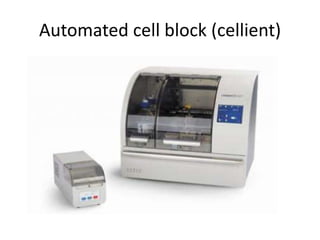
• 2007- automated cell block system (cellient)
Fine needle aspiration cytology
(FNAC)
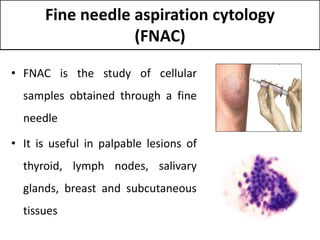
• FNAC is the study of cellular
samples obtained through a fine
needle
• It is useful in palpable lesions of
thyroid, lymph nodes, salivary
glands, breast and subcutaneous
tissues
• Relatively painless and inexpensive
• Provides unequivocal diagnosis (sensitivity and specificity ≥
90%)
• Highly suitable in debilitated patients and multiple lesions
• Low risk of complications
• Easily repeatable
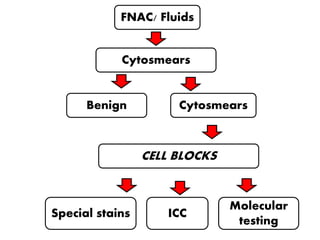
FNAC/ Fluids
Cytosmears
CytosmearsBenign
CELL BLOCKS
Special stains ICC
Molecular
testing
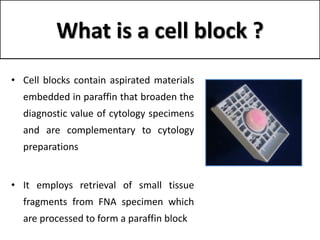
• Cell blocks contain aspirated materials
embedded in paraffin that broaden the
diagnostic value of cytology specimens
and are complementary to cytology
preparations
• It employs retrieval of small tissue
fragments from FNA specimen which
are processed to form a paraffin block
What is a cell block ?
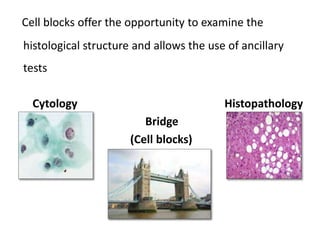
Cell blocks offer the opportunity to examine the
histological structure and allows the use of ancillary
tests
Cytology Histopathology
Bridge
(Cell blocks)
• Acquisition of tissue for cell block can increase both
diagnostic sensitivity and specificity (through both cellular
morphology and ancillary testing)
• It requires minimal effort and is cost efficient.
• Moreover, tissue preserved in cell block can be stored
easily
Need for Cell Block
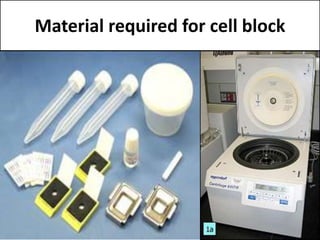
Material required for cell block
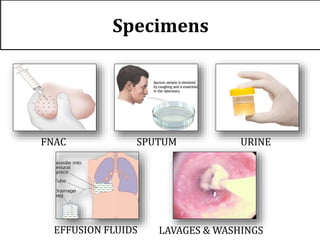
Specimens
FNAC SPUTUM
EFFUSION FLUIDS
URINE
LAVAGES & WASHINGS
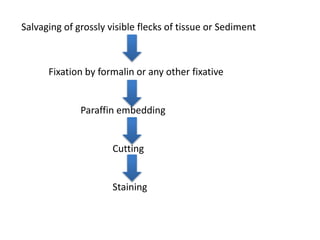
Salvaging of grossly visible flecks of tissue or Sediment
Fixation by formalin or any other fixative
Paraffin embedding
Cutting
Staining
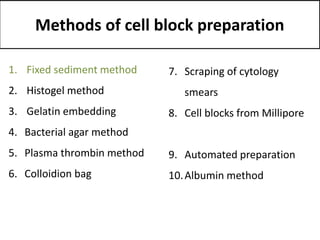
1. Fixed sediment method
2. Histogel method
3. Gelatin embedding
4. Bacterial agar method
5. Plasma thrombin method
6. Colloidion bag
Methods of cell block preparation
7. Scraping of cytology
smears
8. Cell blocks from Millipore
9. Automated preparation
10.Albumin method
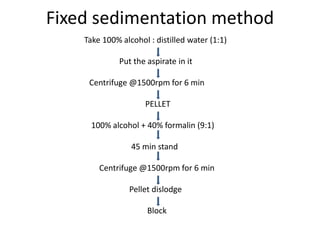
Fixed sedimentation method
Take 100% alcohol : distilled water (1:1)
Put the aspirate in it
Centrifuge @1500rpm for 6 min
PELLET
100% alcohol + 40% formalin (9:1)
45 min stand
Centrifuge @1500rpm for 6 min
Pellet dislodge
Block
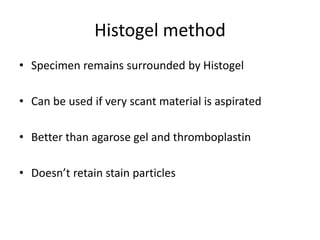
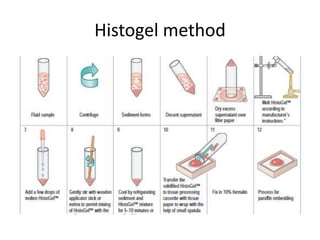
Histogel method
• Specimen remains surrounded by Histogel
• Can be used if very scant material is aspirated
• Better than agarose gel and thromboplastin
• Doesn’t retain stain particles
Histogel method
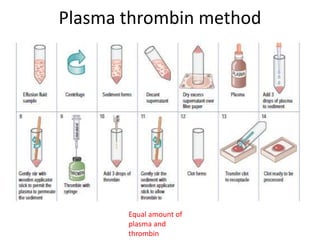
Plasma thrombin method
Equal amount of
plasma and
thrombin
Other methods
• Gelatin method- 2% molten gelatin is used
• Bacterial Agar method- 3% agar is used
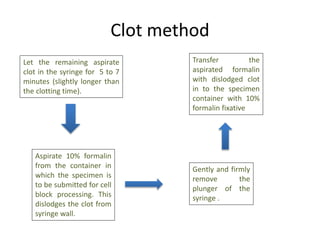
Clot method
Aspirate 10% formalin
from the container in
which the specimen is
to be submitted for cell
block processing. This
dislodges the clot from
syringe wall.
Let the remaining aspirate
clot in the syringe for 5 to 7
minutes (slightly longer than
the clotting time).
Gently and firmly
remove the
plunger of the
syringe .
Transfer the
aspirated formalin
with dislodged clot
in to the specimen
container with 10%
formalin fixative
Automated cell block (cellient)
1. Cell Block is simple , reproducible and readily available in
routine labs
2. Increased cellularity
3. Better morphological and architectural patterns
4. Additional yield of cells, thereby increasing diagnostic yield
5. Unlimited storage of the sample
6. Application of ancillary studies (ICC and molecular testing)
Advantages
Disadvantages of cell block
• Compared to routine smears takes longer time
• Distortion artifact
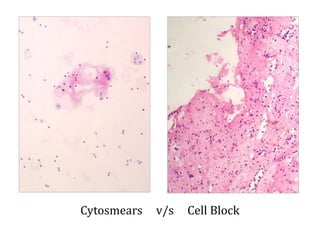
Cytosmears v/s Cell Block
Refrences
• G.W. Gill, cytopreparation: principles &
practice, essentials in cytopathology12,
Springer science
• Shidham & Epple Ch 14‘Cytopathologic
Diagnosis of Serous Fluids’ :Elsevier (W. B.
Saunders Company)
• Koss diagnostic and cytology and its
histopathologic bases 5th edition
Thank you
MCQ
1- Most common method of cell block
preparation
a) Fixed sedimentation method
b) Plasma thrombin method
c) Agar method
d) Gelatin method
2- % of alcohol and formalin in fixed sediment
method is-
a) 100% alcohol and 40% formalin
b) 90% alcohol and 40% formalin
c) 40% alcohol and 40% formalin
d) 40% alcohol and 100% formalin
3- % of agar used in bacterial agar method-
a) 1%
b) 2%
c) 3%
d) 4%
4- amount of plasma and thrombin used in
plasma thrombin method?
a) 1:1
b) 1:2
c) 2:1
d) 3:1
5- Ratio of formalin(40%) and alcohol(100%) is-
a) 1:9
b) 9:1
c) 2:3
d) 3:2

Cell block and its diagnostic utility

  • 1.
    CELL BLOCK PREPARATION, DIAGNOSTICUTILITY AND ITS RELEVANCE Dr. Gaurav kumar King Georges Medical University
  • 2.
    History • 1896- cellblock prepared in celloidin embedding medium • 1901- centrifugation was used to increase cellularity • 1959- bacterial agar introduced for preparing cell block • 1973- plasma thrombin clot introduced • 2007- automated cell block system (cellient)
  • 3.
    Fine needle aspirationcytology (FNAC) • FNAC is the study of cellular samples obtained through a fine needle • It is useful in palpable lesions of thyroid, lymph nodes, salivary glands, breast and subcutaneous tissues
  • 4.
    • Relatively painlessand inexpensive • Provides unequivocal diagnosis (sensitivity and specificity ≥ 90%) • Highly suitable in debilitated patients and multiple lesions • Low risk of complications • Easily repeatable
  • 5.
  • 6.
    • Cell blockscontain aspirated materials embedded in paraffin that broaden the diagnostic value of cytology specimens and are complementary to cytology preparations • It employs retrieval of small tissue fragments from FNA specimen which are processed to form a paraffin block What is a cell block ?
  • 7.
    Cell blocks offerthe opportunity to examine the histological structure and allows the use of ancillary tests Cytology Histopathology Bridge (Cell blocks)
  • 8.
    • Acquisition oftissue for cell block can increase both diagnostic sensitivity and specificity (through both cellular morphology and ancillary testing) • It requires minimal effort and is cost efficient. • Moreover, tissue preserved in cell block can be stored easily Need for Cell Block
  • 9.
  • 10.
  • 11.
    Salvaging of grosslyvisible flecks of tissue or Sediment Fixation by formalin or any other fixative Paraffin embedding Cutting Staining
  • 12.
    1. Fixed sedimentmethod 2. Histogel method 3. Gelatin embedding 4. Bacterial agar method 5. Plasma thrombin method 6. Colloidion bag Methods of cell block preparation 7. Scraping of cytology smears 8. Cell blocks from Millipore 9. Automated preparation 10.Albumin method
  • 13.
    Fixed sedimentation method Take100% alcohol : distilled water (1:1) Put the aspirate in it Centrifuge @1500rpm for 6 min PELLET 100% alcohol + 40% formalin (9:1) 45 min stand Centrifuge @1500rpm for 6 min Pellet dislodge Block
  • 14.
    Histogel method • Specimenremains surrounded by Histogel • Can be used if very scant material is aspirated • Better than agarose gel and thromboplastin • Doesn’t retain stain particles
  • 15.
  • 16.
    Plasma thrombin method Equalamount of plasma and thrombin
  • 17.
    Other methods • Gelatinmethod- 2% molten gelatin is used • Bacterial Agar method- 3% agar is used
  • 18.
    Clot method Aspirate 10%formalin from the container in which the specimen is to be submitted for cell block processing. This dislodges the clot from syringe wall. Let the remaining aspirate clot in the syringe for 5 to 7 minutes (slightly longer than the clotting time). Gently and firmly remove the plunger of the syringe . Transfer the aspirated formalin with dislodged clot in to the specimen container with 10% formalin fixative
  • 19.
  • 20.
    1. Cell Blockis simple , reproducible and readily available in routine labs 2. Increased cellularity 3. Better morphological and architectural patterns 4. Additional yield of cells, thereby increasing diagnostic yield 5. Unlimited storage of the sample 6. Application of ancillary studies (ICC and molecular testing) Advantages
  • 21.
    Disadvantages of cellblock • Compared to routine smears takes longer time • Distortion artifact
  • 22.
  • 23.
    Refrences • G.W. Gill,cytopreparation: principles & practice, essentials in cytopathology12, Springer science • Shidham & Epple Ch 14‘Cytopathologic Diagnosis of Serous Fluids’ :Elsevier (W. B. Saunders Company) • Koss diagnostic and cytology and its histopathologic bases 5th edition
  • 24.
  • 25.
  • 26.
    1- Most commonmethod of cell block preparation a) Fixed sedimentation method b) Plasma thrombin method c) Agar method d) Gelatin method
  • 27.
    2- % ofalcohol and formalin in fixed sediment method is- a) 100% alcohol and 40% formalin b) 90% alcohol and 40% formalin c) 40% alcohol and 40% formalin d) 40% alcohol and 100% formalin
  • 28.
    3- % ofagar used in bacterial agar method- a) 1% b) 2% c) 3% d) 4%
  • 29.
    4- amount ofplasma and thrombin used in plasma thrombin method? a) 1:1 b) 1:2 c) 2:1 d) 3:1
  • 30.
    5- Ratio offormalin(40%) and alcohol(100%) is- a) 1:9 b) 9:1 c) 2:3 d) 3:2