Teachers of English as
school research leads and
knowledge mobilisers
researchED Oxford, Saturday 1 April, 2017
Dr Gary Jones
By the end of this session we will have
• Defined the term knowledge mobiliser and outlined Ward’s 2016
framework for knowledge mobilisation
• Shared some provisional findings of a research project focussing on
the school research lead as knowledge mobiliser and looked at the
contrasting experiences of two English teachers
• Reflected on some of the implications for school research leads
and schools
Knowledge Mobilisers – what do they do?
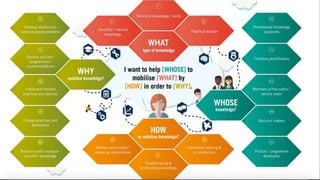
Ward’s framework of knowledge mobilisation
• Why mobilise knowledge?
• What knowledge is being mobilised?
• Whose knowledge is being mobilised?
• How is knowledge is being mobilised?
Whose knowledge is being mobilised?
• Professional knowledge producers
• Frontline practitioners
• Members of the public acting as or on behalf of their
communitires
• Decision-makers responsible for commissiong services
• Product and programme developers responsible for developing
tangible products, services and programmes
What knowledge is being mobilised?
• Scientific/factual knowledge
• Technical knowledge
• Practical wisdom
How is knowledge is being mobilised?
• Making connections between knowledge stakeholders and actors
by establishing and brokering relationships
• Disseminating and synthesising knowledge
• Facilitating interactive learning and co-production via
participatory research projects and action learning sets.
Why mobilise knowledge
• To develop local solutions to practice based problems
• To develop new policies, programmes and recommendations
• To adopt/implement clearly defined practices and policies
• To change practices and behaviours
• To produce useful research and scientific knowledge
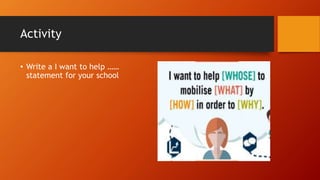
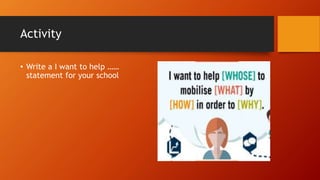
Activity
• Write a I want to help ……
statement for your school
Things to consider
• Personal reflection and learning
• Team/project development
• Networking and communicating with others
• Evaluating knowledge mobilisation
• Identifying relevant literature, tools and approaches
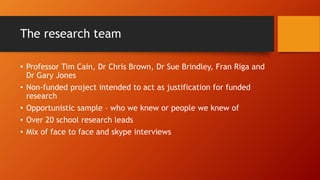
The research team
• Professor Tim Cain, Dr Chris Brown, Dr Sue Brindley, Fran Riga and
Dr Gary Jones
• Non-funded project intended to act as justification for funded
research
• Opportunistic sample – who we knew or people we knew of
• Over 20 school research leads
• Mix of face to face and skype interviews
The research questions
1. On what grounds do research coordinators select research for
their school?
2. How do they expect teachers to use research?
3. What institutional or supra-institutional factors do they perceive
as influencing their answers to the above questions?
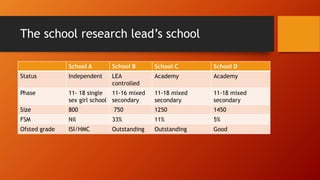
The school research lead’s school
School A School B School C School D
Status Independent LEA
controlled
Academy Academy
Phase 11- 18 single
sex girl school
11-16 mixed
secondary
11-18 mixed
secondary
11-18 mixed
secondary
Size 800 750 1250 1450
FSM Nil 33% 11% 5%
Ofsted grade ISI/HMC Outstanding Outstanding Good
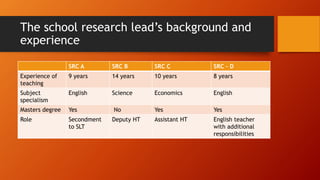
The school research lead’s background and
experience
SRC A SRC B SRC C SRC – D
Experience of
teaching
9 years 14 years 10 years 8 years
Subject
specialism
English Science Economics English
Masters degree Yes No Yes Yes
Role Secondment
to SLT
Deputy HT Assistant HT English teacher
with additional
responsibilities
Statements about research 1
1 Research may have the greatest effects on education where it raises new questions and contributes
to transformations in the general paradigms.
2 Teachers] should select what is relevant and useful to their purposes, according to the situation,
and interpret and employ this in the context of other knowledge and a motivational framework that
is adapted to circumstance
3 The only worthwhile kind of evidence about whether something works in a particular situation
comes from trying it out. In the language of research, that means doing well controlled field
experiments.
4 The goal of educational research is to develop statistically reliable, generalizable findings
regarding a network of causal relationships that practitioners can use to improve educational
outcomes.
5 Research is most useful when it provides evidence that our current practice can be justified
Statements about research One SRC A SRC B SRC
C
SRC –
D
Research may have the greatest effects on education where it
raises new questions and contributes to transformations in the
general paradigms.
1 2 1 1
Teachers] should select what is relevant and useful to their
purposes, according to the situation, and interpret and employ
this in the context of other knowledge and a motivational
framework that is adapted to circumstance
2 1 2 1
The only worthwhile kind of evidence about whether something
works in a particular situation comes from trying it out. In the
language of research, that means doing well controlled field
experiments.
4 4 3 4
The goal of educational research is to develop statistically
reliable, generalizable findings regarding a network of causal
relationships that practitioners can use to improve educational
outcomes.
3 3 4 3
Research is most useful when it provides evidence that our
current practice can be justified
5 5 5 5
Statements about research Two
1 All research, however large-scale, brilliantly conceived, executed and communicated, needs
to be actively interpreted by users for their own context. [It] needs to be personalised within
their professional context.
2 No search for evidence, however systematic, can give grounds for certainty; there is a need to
live with uncertainty … knowledge is more likely to be accurate if the participants themselves –
the teachers and the learners – are able to contribute to its testing, criticism and reproduction.
3 We expect doctors to be able to make informed decisions about which treatment is best, using
the best currently available evidence. Teachers could one day be in the same position
4 By collecting better evidence about what works best, and establishing a culture where this
evidence is used as a matter of routine, we can improve outcomes for children, and increase
professional independence.
5 We can use research as a persuasive or political tool to legitimate a position or practice [
Statements about research Two SRC A SRC B SRC C SRC D
All research, however large-scale, brilliantly conceived,
executed and communicated, needs to be actively
interpreted by users for their own context. [It] needs to be
personalised within their professional context.
3 1 1 3
No search for evidence, however systematic, can give
grounds for certainty; there is a need to live with uncertainty
… knowledge is more likely to be accurate if the participants
themselves – the teachers and the learners – are able to
contribute to its testing, criticism and reproduction.
2 3 3 4
We expect doctors to be able to make informed decisions
about which treatment is best, using the best currently
available evidence. Teachers could one day be in the same
position
1 4 4 1
By collecting better evidence about what works best, and
establishing a culture where this evidence is used as a matter
of routine, we can improve outcomes for children, and
increase professional independence.
4 2 1 2
We can use research as a persuasive or political tool to
legitimate a position or practice [
5 5 5 5
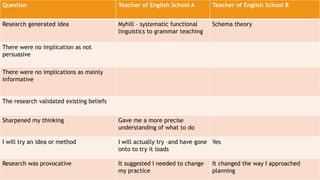
Research generated ideas
Question Teacher of English School A Teacher of English School B
Research generated idea Myhill – systematic functional
linguistics to grammar teaching
Schema theory
There were no implication as not
persuasive
There were no implications as mainly
informative
The research validated existing beliefs
Sharpened my thinking Gave me a more precise
understanding of what to do
I will try an idea or method I will actually try –and have gone
onto to try it loads
Yes
Research was provocative It suggested I needed to change
my practice
It changed the way I approached
planning
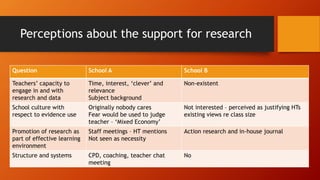
Perceptions about the support for research
Question School A School B
Teachers’ capacity to
engage in and with
research and data
Time, interest, ‘clever’ and
relevance
Subject background
Non-existent
School culture with
respect to evidence use
Originally nobody cares
Fear would be used to judge
teacher – ‘Mixed Economy’
Not interested – perceived as justifying HTs
existing views re class size
Promotion of research as
part of effective learning
environment
Staff meetings – HT mentions
Not seen as necessity
Action research and in-house journal
Structure and systems CPD, coaching, teacher chat
meeting
No
Activity
• Write a I want to help ……
statement for your school
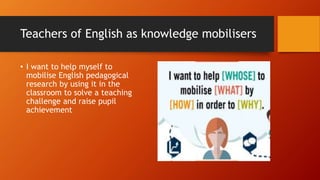
Teachers of English as knowledge mobilisers
• I want to help myself to
mobilise English pedagogical
research by using it in the
classroom to solve a teaching
challenge and raise pupil
achievement
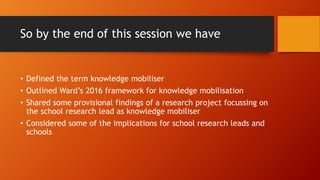
So by the end of this session we have
• Defined the term knowledge mobiliser
• Outlined Ward’s 2016 framework for knowledge mobilisation
• Shared some provisional findings of a research project focussing on
the school research lead as knowledge mobiliser
• Considered some of the implications for school research leads and
schools
For more information
•jones.gary@gmail.com
•@DrGaryJones
•http://evidencebased
educationalleadership
.blogspot.com

researchED Oxford 2017

  • 1.
    Teachers of Englishas school research leads and knowledge mobilisers researchED Oxford, Saturday 1 April, 2017 Dr Gary Jones
  • 2.
    By the endof this session we will have • Defined the term knowledge mobiliser and outlined Ward’s 2016 framework for knowledge mobilisation • Shared some provisional findings of a research project focussing on the school research lead as knowledge mobiliser and looked at the contrasting experiences of two English teachers • Reflected on some of the implications for school research leads and schools
  • 4.
    Knowledge Mobilisers –what do they do?
  • 5.
    Ward’s framework ofknowledge mobilisation • Why mobilise knowledge? • What knowledge is being mobilised? • Whose knowledge is being mobilised? • How is knowledge is being mobilised?
  • 8.
    Whose knowledge isbeing mobilised? • Professional knowledge producers • Frontline practitioners • Members of the public acting as or on behalf of their communitires • Decision-makers responsible for commissiong services • Product and programme developers responsible for developing tangible products, services and programmes
  • 9.
    What knowledge isbeing mobilised? • Scientific/factual knowledge • Technical knowledge • Practical wisdom
  • 10.
    How is knowledgeis being mobilised? • Making connections between knowledge stakeholders and actors by establishing and brokering relationships • Disseminating and synthesising knowledge • Facilitating interactive learning and co-production via participatory research projects and action learning sets.
  • 11.
    Why mobilise knowledge •To develop local solutions to practice based problems • To develop new policies, programmes and recommendations • To adopt/implement clearly defined practices and policies • To change practices and behaviours • To produce useful research and scientific knowledge
  • 12.
    Activity • Write aI want to help …… statement for your school
  • 13.
    Things to consider •Personal reflection and learning • Team/project development • Networking and communicating with others • Evaluating knowledge mobilisation • Identifying relevant literature, tools and approaches
  • 14.
    The research team •Professor Tim Cain, Dr Chris Brown, Dr Sue Brindley, Fran Riga and Dr Gary Jones • Non-funded project intended to act as justification for funded research • Opportunistic sample – who we knew or people we knew of • Over 20 school research leads • Mix of face to face and skype interviews
  • 15.
    The research questions 1.On what grounds do research coordinators select research for their school? 2. How do they expect teachers to use research? 3. What institutional or supra-institutional factors do they perceive as influencing their answers to the above questions?
  • 16.
    The school researchlead’s school School A School B School C School D Status Independent LEA controlled Academy Academy Phase 11- 18 single sex girl school 11-16 mixed secondary 11-18 mixed secondary 11-18 mixed secondary Size 800 750 1250 1450 FSM Nil 33% 11% 5% Ofsted grade ISI/HMC Outstanding Outstanding Good
  • 17.
    The school researchlead’s background and experience SRC A SRC B SRC C SRC – D Experience of teaching 9 years 14 years 10 years 8 years Subject specialism English Science Economics English Masters degree Yes No Yes Yes Role Secondment to SLT Deputy HT Assistant HT English teacher with additional responsibilities
  • 18.
    Statements about research1 1 Research may have the greatest effects on education where it raises new questions and contributes to transformations in the general paradigms. 2 Teachers] should select what is relevant and useful to their purposes, according to the situation, and interpret and employ this in the context of other knowledge and a motivational framework that is adapted to circumstance 3 The only worthwhile kind of evidence about whether something works in a particular situation comes from trying it out. In the language of research, that means doing well controlled field experiments. 4 The goal of educational research is to develop statistically reliable, generalizable findings regarding a network of causal relationships that practitioners can use to improve educational outcomes. 5 Research is most useful when it provides evidence that our current practice can be justified
  • 19.
    Statements about researchOne SRC A SRC B SRC C SRC – D Research may have the greatest effects on education where it raises new questions and contributes to transformations in the general paradigms. 1 2 1 1 Teachers] should select what is relevant and useful to their purposes, according to the situation, and interpret and employ this in the context of other knowledge and a motivational framework that is adapted to circumstance 2 1 2 1 The only worthwhile kind of evidence about whether something works in a particular situation comes from trying it out. In the language of research, that means doing well controlled field experiments. 4 4 3 4 The goal of educational research is to develop statistically reliable, generalizable findings regarding a network of causal relationships that practitioners can use to improve educational outcomes. 3 3 4 3 Research is most useful when it provides evidence that our current practice can be justified 5 5 5 5
  • 20.
    Statements about researchTwo 1 All research, however large-scale, brilliantly conceived, executed and communicated, needs to be actively interpreted by users for their own context. [It] needs to be personalised within their professional context. 2 No search for evidence, however systematic, can give grounds for certainty; there is a need to live with uncertainty … knowledge is more likely to be accurate if the participants themselves – the teachers and the learners – are able to contribute to its testing, criticism and reproduction. 3 We expect doctors to be able to make informed decisions about which treatment is best, using the best currently available evidence. Teachers could one day be in the same position 4 By collecting better evidence about what works best, and establishing a culture where this evidence is used as a matter of routine, we can improve outcomes for children, and increase professional independence. 5 We can use research as a persuasive or political tool to legitimate a position or practice [
  • 21.
    Statements about researchTwo SRC A SRC B SRC C SRC D All research, however large-scale, brilliantly conceived, executed and communicated, needs to be actively interpreted by users for their own context. [It] needs to be personalised within their professional context. 3 1 1 3 No search for evidence, however systematic, can give grounds for certainty; there is a need to live with uncertainty … knowledge is more likely to be accurate if the participants themselves – the teachers and the learners – are able to contribute to its testing, criticism and reproduction. 2 3 3 4 We expect doctors to be able to make informed decisions about which treatment is best, using the best currently available evidence. Teachers could one day be in the same position 1 4 4 1 By collecting better evidence about what works best, and establishing a culture where this evidence is used as a matter of routine, we can improve outcomes for children, and increase professional independence. 4 2 1 2 We can use research as a persuasive or political tool to legitimate a position or practice [ 5 5 5 5
  • 22.
    Research generated ideas QuestionTeacher of English School A Teacher of English School B Research generated idea Myhill – systematic functional linguistics to grammar teaching Schema theory There were no implication as not persuasive There were no implications as mainly informative The research validated existing beliefs Sharpened my thinking Gave me a more precise understanding of what to do I will try an idea or method I will actually try –and have gone onto to try it loads Yes Research was provocative It suggested I needed to change my practice It changed the way I approached planning
  • 23.
    Perceptions about thesupport for research Question School A School B Teachers’ capacity to engage in and with research and data Time, interest, ‘clever’ and relevance Subject background Non-existent School culture with respect to evidence use Originally nobody cares Fear would be used to judge teacher – ‘Mixed Economy’ Not interested – perceived as justifying HTs existing views re class size Promotion of research as part of effective learning environment Staff meetings – HT mentions Not seen as necessity Action research and in-house journal Structure and systems CPD, coaching, teacher chat meeting No
  • 24.
    Activity • Write aI want to help …… statement for your school
  • 25.
    Teachers of Englishas knowledge mobilisers • I want to help myself to mobilise English pedagogical research by using it in the classroom to solve a teaching challenge and raise pupil achievement
  • 26.
    So by theend of this session we have • Defined the term knowledge mobiliser • Outlined Ward’s 2016 framework for knowledge mobilisation • Shared some provisional findings of a research project focussing on the school research lead as knowledge mobiliser • Considered some of the implications for school research leads and schools
  • 27.

Editor's Notes

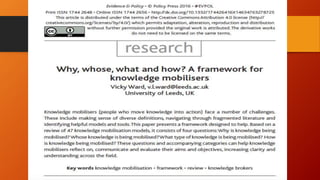
  • #3 WARD, V. 2016. Why, whose, what and how? A framework for knowledge mobilisers. Evidence and Policy.
  • #27 WARD, V. 2016. Why, whose, what and how? A framework for knowledge mobilisers. Evidence and Policy.