Felix Dodds presentation to the HLPF Side event on Addressing Resilience through the Nexus of Water-Food-Energy; Cities as SDG Laboratories
1.
N E XU S M E S S A G E O N W AT E R -
E N E R G Y - F O O D - C L I M AT E
T H R O U G H A N U R B A N L E N S
F E L I X D O D D S , WAT E R I N S T I T U T E U N I V E R S I T Y O F
N O R T H C A R O L I N A
2.
OUR CHALLENGES
Footer texthere 2
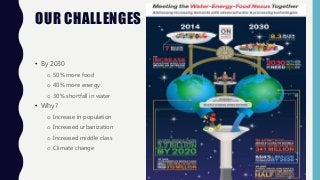
• By 2030
o 50% more food
o 40% more energy
o 30% shortfall in water
• Why?
o Increase in population
o Increased urbanization
o Increased middle class
o Climate change
3.
BUILDING
INTEGRATED
APPROACHES INTO
IMPLEMENTING
THE SUSTAINABLE
DEVELOPMENT
GOALS
•Recognizing the indivisible nature of the
SDGs
• Nexus approach brings into focus the
positive synergies and potential
tradeoffs that arise when working to
achieve the ambitious 2030 Agenda,
• develop more practical solutions to
address key issues.
• integration involves 3 concepts;
optimization, synergies and tradeoffs.
• Nexus of Resources (water, soil, wind,
sun, minerals, waste etc.) is not useful
unless it is linked to the Nexus of
Services (energy, food, housing, supply
etc.) Footer text here 3
4.
NEXUS MESSAGE
Footer texthere 4
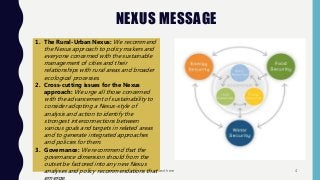
1. The Rural-Urban Nexus: We recommend
the Nexus approach to policy makers and
everyone concerned with the sustainable
management of cities and their
relationships with rural areas and broader
ecological processes.
2. Cross-cutting issues for the Nexus
approach: We urge all those concerned
with the advancement of sustainability to
consider adopting a Nexus-style of
analysis and action to identify the
strongest interconnections between
various goals and targets in related areas
and to generate integrated approaches
and policies for them.
3. Governance: We recommend that the
governance dimension should from the
outset be factored into any new Nexus
analyses and policy recommendations that
5.
NEXUS MESSAGE
Footer texthere 5
4. Finance: We recommend Nexus-style analysis
be built into public and private financial
appraisal systems to ensure that investments
support key integration objectives and
appropriate co-operation between different
levels of governance, and between the public
and private sectors.
5. Linking Nexus analysis to Policies
Formulation: We recommend enhanced
promotion of research and analysis on Nexus
interlinkages between different subject areas,
and linkages between such work and the policy-
making community.
6. Capacity Building: We recommend using
Nexus thinking when implementing capacity
building for SDGs delivering as such approaches
can strengthen understanding regarding the
interconnections between the various
development goals, and thus equip communities
with tools to better address these challenges.
6.
“ A LL O F U S M I G H T W I S H A T
T I M E S T H A T W E L I V E D I N A
M O R E T R A N Q U I L W O R L D ,
B U T W E D O N ’ T .
A N D I F O U R T I M E S A R E
D I F F I C U L T A N D P E R P L E X I N G ,
S O A R E T H E Y C H A L L E N G I N G
A N D F I L L E D W I T H
O P P O R T U N I T Y . ”
R O B E R T K E N N E D Y
F E L I X D O D D S : W AT E R I N S T I T U T E U N I V E R S I T Y O F
N O R T H C A R O L I N A



![Pollution.ppt [Autosaved].ppt yogesh kumbhar](https://cdn.slidesharecdn.com/ss_thumbnails/pollution-251205194856-d30cfee8-thumbnail.jpg?width=640&height=640&fit=bounds)


