Primary Care  for  Transgender Patients Lori Kohler, MD Department of Family and  Community Medicine University of California, San Francisco
Primary Care for Transgender Patients Who is Transgender Clinical Background Barriers to Care Standards of Care Model of Care SFDPH TGCHP
TRANSGENDER refers to a person who is born with the genetic traits of one gender but has the internalized identity of another gender     The goal of treatment for transgender people is to improve their quality of life by facilitating their transition to a physical state that more closely represents their sense of themselves.
Clinical Experience Tom Waddell Health Center Transgender Team Family Health Center Phone Consultation California Medical Facility-Department of Corrections
Barriers to Medical Care for Transgender patients Geographic Isolation Lack of insurance Coverage Stigma of Gender Clinics Lack of clinical research and limited medical literature Provider ignorance
Prevalence Estimates Data from the Netherlands 1 in 11,900 males 1 in 30,400 females
DSM-IV 302.85  Gender Identity Disorder A strong and persistent cross-gender identification Manifested by symptoms such as the desire to be and be treated as the other sex, frequent passing as the other sex, the conviction that he or she has the typical feelings and reactions of the other sex Persistent discomfort with his or her sex or sense of inappropriateness in the gender role
DSM-IV Gender Identity Disorder (cont) The disturbance is not concurrent with a physical intersex condition The disturbance causes clinically significant distress or impairment in social, occupational, or other important areas of functioning
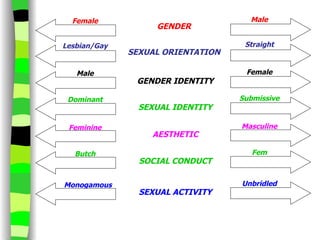
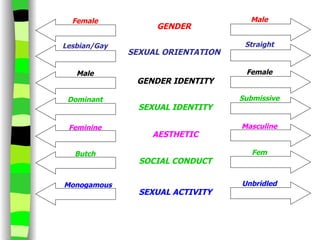
GENDER SEXUAL ORIENTATION GENDER IDENTITY SEXUAL IDENTITY AESTHETIC SOCIAL CONDUCT SEXUAL ACTIVITY Fem Masculine Submissive Female Butch Dominant Male Straight Lesbian/Gay Male Female Feminine Unbridled Monogamous
Harry Benjamin International Gender Dysphoria Association (HBIGDA) Standards of Care for Gender Identity Disorders – 2001  Eligibility Criteria for Hormone Therapy         1.   18 years or older 2.   Demonstrable knowledge of social and  medical risks and benefits of hormones 3. Either A. Documented real life experience for    at least 3 months or B.Psychotherapy for at least 3 months
HBIGDA -2001 Real Life Experience Employment, student, volunteer New legal gender-appropriate first name Documentation that persons other than the therapist know the patient in their new gender role
HBIGDA - 2001 Readiness Criteria for Hormone Therapy Real life experience or psychotherapy further consolidate gender identity Progress has been made toward the elimination of barriers to emotional well being and mental health  Hormones are likely to be taken in a responsible manner
HBIGDA-2001   Hormone Therapy for Incarcerated Persons People with GID should continue to receive treatment according to the SOC Prisoners who withdraw rapidly from hormone therapy are at risk for psychiatric symptoms Medical monitoring of hormonal treatment should be provided according to the SOC Housing for transgendered prisoners should take into account their transition status and their personal safety
HBIGDA-2001 The physician who provides hormonal therapy need not be an endocrinologist but should become well-versed in the relevant medical and psychological aspects of treating persons with gender identity disorders
Initial Visits Review history of gender experience Document prior hormone use Obtain sexual history Review patient goals  Address safety concerns Assess social support system Assess readiness for gender transition Review risks and benefits of hormone therapy Obtain informed consent Order screening laboratory studies Provide referrals
Transgender Hormone Therapy Heredity limits the tissue response to hormones More is not always better
Female to Male Treatment Options No Hormones Depotestosterone Testosterone Enanthate or Cypionate  100-200 mg IM q 2 wks (22g x 1 ½” needles) Transdermal Testosterone Androderm or Teestoderm TTS 2.5-10mg qd Testosterone   Gel Androgel 50,75, 100 mg to skin qd Testosterone Pellet Testopel- implant 6-10 pellets q month
Other Treatment Considerations for FTMs Testosterone cream in aquaphor for clitoral enlargement Estrogen vaginal cream for atrophy Progesterone- cyclic treatment if at  higher risk of endometrial thickening
Testosterone Therapy Permanent Changes Increased facial and body hair Deeper voice Male pattern baldness Clitoral enlargement
Testosterone Therapy – Reversible Changes Cessation of menses Increased libido, changes in sexual behavior Increased muscle mass / upper body strength Redistribution of fat Increased sweating / change in body odor Weight gain / fluid retention Prominence of veins / coarser skin Acne Mild breast atrophy Emotional changes
Risks of Testosterone Therapy Lower HDL Elevated tirglycerides Insulin resistance Increased homocysteine levels Hepatotoxicity Polycythemia Unknown effects on breast, endometrial, ovarian tissues Increased risk of sleep apnea
DRUG INTERACTIONS - Testosterone Increases the anticoagulant effect of warfarin Increases clearance of propranolol Increases the hypoglycemic effects of sulfonylureas
LABORATORY MONITORING FOR FTM PATIENTS ON TESTOSTERONE Screening: CBC Liver Enzymes Lipid Profile Renal Panel Fasting Glucose
LABORATORY MONITORING FOR FTM PATIENTS ON TESTOSTERONE 3 Months after starting testosterone and every 6-12 months: -CBC -Liver Enzymes -Lipid Profile
FOLLOW-UP CARE FOR FTM PATIENTS Assess patient comfort with transition Assess social impact of transition Assess masculinization Discuss family issues Monitor mood cycles Counsel regarding sexual activity
FOLLOW-UP CARE FOR FTM PATIENTS Review medication use Discuss legal issues / name change Review surgical options / plans Continue Health Care Maintenance Including PAP smears, CBE, mammograms,  STD screening Assess CAD risk
SURGICAL OPTIONS FOR FTMs Mastectomy Continue CBE/SBE on residual tissue Hysterectomy/oophorectomy Consider adding low dose estrogen or estrogen vaginal cream Genital reconstruction Phalloplasty Metoidioplasty
Male to Female Treatment Options No hormones Estrogens Premarin 1.25-10mg po qd or divided as bid Ethinyl Estradiol (Estinyl) 0.1-1.0 mg po qd Estradiol Patch 0.1-0.3mg q3-7 days Estradiol Valerate inj. 20-60mg IM q2wks Antiandrogen Spironolactone 50-100 mg po bid Progesterone Not usually recommended
Estrogen Treatment May Lead To Breast Development Redistribution of body fat Softening of skin Loss of erections Testicular atrophy Decreased upper body strength Slowing or cessation of scalp hair loss
Risks of Estrogen Therapy Venous thrombosis/thromboembolism Weight gain Decreased libido Hypertriglyceridemia Drug interactions Elevated blood pressure Decreased glucose tolerance Gallbladder disease Benign pituitary prolactinoma Breast cancer(?) Infertility
Spironolactone Therapy May Lead To  Modest breast development Softening of facial and body hair
Risks of Spironolactone Therapy Hyperkalemia Hypotension Drug Interactions
Women over 40 yo Add ASA to regimen Transdermal estradiol therapy is recommended to reduce the risk of thromboembolism
Cosmetic Therapies Hydroquinone topical treatment for pigmentation caused by estrogen therapy Hair Removal Eflornithine cream  Electrolysis Laser hair removal
Drug Interaction Estradiol ,  Ethinyl Estradiol ,  Testosterone  levels are  DECREASED   by: Lopinavir Carbamazepine Rifampin Phenytoin Progesterone Phenobarbital Dexamethasone Phenylbutazone Naphthoflavone Benzoflavone Sulfamidine Sulfinpyrazone
Drug Interactions Estradiol ,  Ethinyl Estradiol ,  Testosterone  levels are  INCREASED  by: Nefazodone Isoniazid Fluvoxamine Fluoxetine Indinavir Efavirenz Sertraline Paroxetine Diltiazem Verapamil Cimetidine Astemizole Itraconazole Ketoconazole Fluconazole Miconazole Clarythromycin Erythromycin Grapefruit Triacetyloleandomycin
Drug Interactions Estrogen  levels are  DECREASED  by: Smoking cigarettes Nelfinavir Nevirapine Ritonavir
Drug Interactions Estrogen  levels are  INCREASED  by: Vitamin C
Screening Labs for MTF Patients CBC Liver Enzymes Lipid Profile Renal Panel Fasting Glucose Testosterone level Prolactin level
Follow-up labs for MTF Patients Repeat screening labs at 6 months and 12 months after initiation of hormones and annually thereafter Prolactin level annually for 3 years
Follow-Up Care for MTF Patients Assess feminization Review medication use Monitor mood cycles and adjust medication as indicated Discuss social impact of transition Counsel regarding sexual activity Review surgical options Complete forms for name change Review CAD risk factors Continue HCM
Health Care Maintenance for MTF Patients Clinical breast exam Instruction in self breast exam and care Mammography Prostate screening STD screening Beauty tips
Treatment Considerations- MTFs Testosterone therapy after castration Libido Osteoporosis General sense of well-being
Morbidity and Mortality in Transexual Subjects Treated with Cross-Sex Hormones- Van Kestern, et.al., Clinical Endocrinology, 1997 Retrospective study of 816 MTF and 293 FTM transexuals treated between 1975 and 1994 Out come measure: Standardized mortality and incidence ratios calculated form the Dutch population
Morbidity and Mortality (cont) Results In both MTF and FTM transexuals, total mortality was not higher than in the general population Venous thromboembolism was the major complication in MTF patients treated with oral estrogens No serious morbidity was observed that could be related to androgen treament in FTM patients
Case Reports Male to Female patients on estrogen 2 cases of breast carcinoma 3 cases of prostate cancer Female to Male patients on testosterone 1 case of ovarian cancer Ovarian changes similar to polycystic ovaries
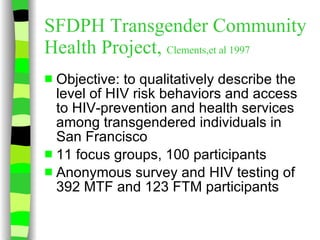
SFDPH Transgender Community Health Project,  Clements,et al 1997 Objective: to qualitatively describe the level of HIV risk behaviors and access to HIV-prevention and health services among transgendered individuals in San Francisco 11 focus groups, 100 participants Anonymous survey and HIV testing of 392 MTF and 123 FTM participants
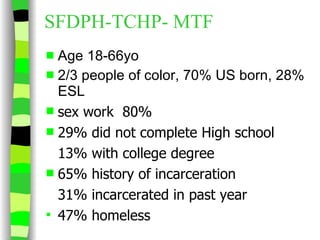
SFDPH-TCHP- MTF  Age 18-66yo 2/3 people of color, 70% US born, 28% ESL sex work  80% 29% did not complete High school 13% with college degree 65% history of incarceration 31% incarcerated in past year 47% homeless
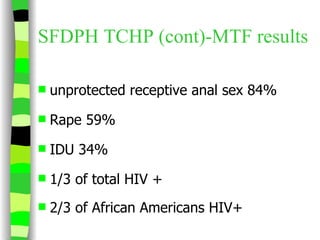
SFDPH TCHP (cont)-MTF results unprotected receptive anal sex 84% Rape 59% IDU 34% 1/3 of total HIV + 2/3 of African Americans HIV+
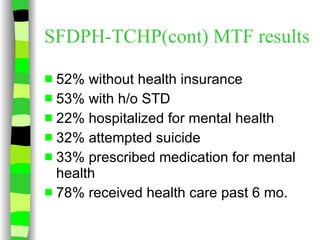
SFDPH-TCHP(cont) MTF results 52% without health insurance 53% with h/o STD 22% hospitalized for mental health 32% attempted suicide 33% prescribed medication for mental health 78% received health care past 6 mo.
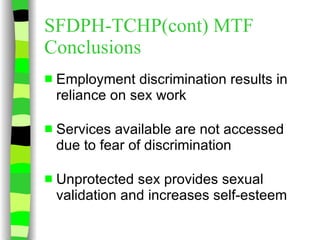
SFDPH-TCHP(cont) MTF Conclusions Employment discrimination results in reliance on sex work Services available are not accessed due to fear of discrimination Unprotected sex provides sexual validation and increases self-esteem
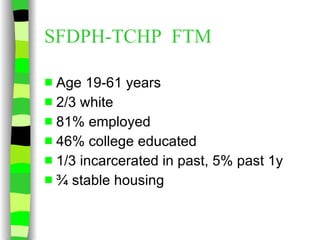
SFDPH-TCHP  FTM  Age 19-61 years 2/3 white 81% employed 46% college educated 1/3 incarcerated in past, 5% past 1y ¾ stable housing
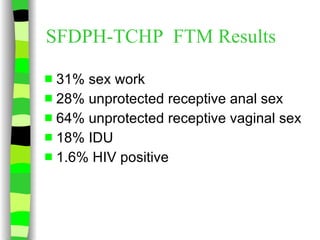
SFDPH-TCHP  FTM Results 31% sex work 28% unprotected receptive anal sex 64% unprotected receptive vaginal sex 18% IDU 1.6% HIV positive
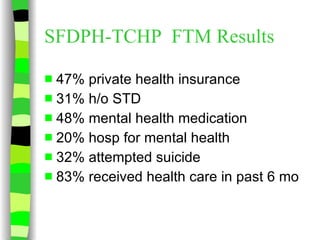
SFDPH-TCHP  FTM Results 47% private health insurance 31% h/o STD 48% mental health medication 20% hosp for mental health 32% attempted suicide 83% received health care in past 6 mo
Challenges for the California Department of Corrections Safety  Staff education/cultural competence Provision of care Adherence to treatment Consistent delivery of care Referral system for social support and follow up care after parole
GENDER SEXUAL ORIENTATION GENDER IDENTITY SEXUAL IDENTITY AESTHETIC SOCIAL CONDUCT SEXUAL ACTIVITY Fem Masculine Submissive Female Butch Dominant Male Straight Lesbian/Gay Male Female Feminine Unbridled Monogamous

Primary Care For Transgender Patients

  • 1.
    Primary Care for Transgender Patients Lori Kohler, MD Department of Family and Community Medicine University of California, San Francisco
  • 2.
    Primary Care forTransgender Patients Who is Transgender Clinical Background Barriers to Care Standards of Care Model of Care SFDPH TGCHP
  • 3.
    TRANSGENDER refers toa person who is born with the genetic traits of one gender but has the internalized identity of another gender     The goal of treatment for transgender people is to improve their quality of life by facilitating their transition to a physical state that more closely represents their sense of themselves.
  • 4.
    Clinical Experience TomWaddell Health Center Transgender Team Family Health Center Phone Consultation California Medical Facility-Department of Corrections
  • 5.
    Barriers to MedicalCare for Transgender patients Geographic Isolation Lack of insurance Coverage Stigma of Gender Clinics Lack of clinical research and limited medical literature Provider ignorance
  • 6.
    Prevalence Estimates Datafrom the Netherlands 1 in 11,900 males 1 in 30,400 females
  • 7.
    DSM-IV 302.85 Gender Identity Disorder A strong and persistent cross-gender identification Manifested by symptoms such as the desire to be and be treated as the other sex, frequent passing as the other sex, the conviction that he or she has the typical feelings and reactions of the other sex Persistent discomfort with his or her sex or sense of inappropriateness in the gender role
  • 8.
    DSM-IV Gender IdentityDisorder (cont) The disturbance is not concurrent with a physical intersex condition The disturbance causes clinically significant distress or impairment in social, occupational, or other important areas of functioning
  • 9.
    GENDER SEXUAL ORIENTATIONGENDER IDENTITY SEXUAL IDENTITY AESTHETIC SOCIAL CONDUCT SEXUAL ACTIVITY Fem Masculine Submissive Female Butch Dominant Male Straight Lesbian/Gay Male Female Feminine Unbridled Monogamous
  • 10.
    Harry Benjamin InternationalGender Dysphoria Association (HBIGDA) Standards of Care for Gender Identity Disorders – 2001 Eligibility Criteria for Hormone Therapy         1.   18 years or older 2. Demonstrable knowledge of social and medical risks and benefits of hormones 3. Either A. Documented real life experience for at least 3 months or B.Psychotherapy for at least 3 months
  • 11.
    HBIGDA -2001 RealLife Experience Employment, student, volunteer New legal gender-appropriate first name Documentation that persons other than the therapist know the patient in their new gender role
  • 12.
    HBIGDA - 2001Readiness Criteria for Hormone Therapy Real life experience or psychotherapy further consolidate gender identity Progress has been made toward the elimination of barriers to emotional well being and mental health Hormones are likely to be taken in a responsible manner
  • 13.
    HBIGDA-2001 Hormone Therapy for Incarcerated Persons People with GID should continue to receive treatment according to the SOC Prisoners who withdraw rapidly from hormone therapy are at risk for psychiatric symptoms Medical monitoring of hormonal treatment should be provided according to the SOC Housing for transgendered prisoners should take into account their transition status and their personal safety
  • 14.
    HBIGDA-2001 The physicianwho provides hormonal therapy need not be an endocrinologist but should become well-versed in the relevant medical and psychological aspects of treating persons with gender identity disorders
  • 15.
    Initial Visits Reviewhistory of gender experience Document prior hormone use Obtain sexual history Review patient goals Address safety concerns Assess social support system Assess readiness for gender transition Review risks and benefits of hormone therapy Obtain informed consent Order screening laboratory studies Provide referrals
  • 16.
    Transgender Hormone TherapyHeredity limits the tissue response to hormones More is not always better
  • 17.
    Female to MaleTreatment Options No Hormones Depotestosterone Testosterone Enanthate or Cypionate 100-200 mg IM q 2 wks (22g x 1 ½” needles) Transdermal Testosterone Androderm or Teestoderm TTS 2.5-10mg qd Testosterone Gel Androgel 50,75, 100 mg to skin qd Testosterone Pellet Testopel- implant 6-10 pellets q month
  • 18.
    Other Treatment Considerationsfor FTMs Testosterone cream in aquaphor for clitoral enlargement Estrogen vaginal cream for atrophy Progesterone- cyclic treatment if at higher risk of endometrial thickening
  • 19.
    Testosterone Therapy PermanentChanges Increased facial and body hair Deeper voice Male pattern baldness Clitoral enlargement
  • 20.
    Testosterone Therapy –Reversible Changes Cessation of menses Increased libido, changes in sexual behavior Increased muscle mass / upper body strength Redistribution of fat Increased sweating / change in body odor Weight gain / fluid retention Prominence of veins / coarser skin Acne Mild breast atrophy Emotional changes
  • 21.
    Risks of TestosteroneTherapy Lower HDL Elevated tirglycerides Insulin resistance Increased homocysteine levels Hepatotoxicity Polycythemia Unknown effects on breast, endometrial, ovarian tissues Increased risk of sleep apnea
  • 22.
    DRUG INTERACTIONS -Testosterone Increases the anticoagulant effect of warfarin Increases clearance of propranolol Increases the hypoglycemic effects of sulfonylureas
  • 23.
    LABORATORY MONITORING FORFTM PATIENTS ON TESTOSTERONE Screening: CBC Liver Enzymes Lipid Profile Renal Panel Fasting Glucose
  • 24.
    LABORATORY MONITORING FORFTM PATIENTS ON TESTOSTERONE 3 Months after starting testosterone and every 6-12 months: -CBC -Liver Enzymes -Lipid Profile
  • 25.
    FOLLOW-UP CARE FORFTM PATIENTS Assess patient comfort with transition Assess social impact of transition Assess masculinization Discuss family issues Monitor mood cycles Counsel regarding sexual activity
  • 26.
    FOLLOW-UP CARE FORFTM PATIENTS Review medication use Discuss legal issues / name change Review surgical options / plans Continue Health Care Maintenance Including PAP smears, CBE, mammograms, STD screening Assess CAD risk
  • 27.
    SURGICAL OPTIONS FORFTMs Mastectomy Continue CBE/SBE on residual tissue Hysterectomy/oophorectomy Consider adding low dose estrogen or estrogen vaginal cream Genital reconstruction Phalloplasty Metoidioplasty
  • 28.
    Male to FemaleTreatment Options No hormones Estrogens Premarin 1.25-10mg po qd or divided as bid Ethinyl Estradiol (Estinyl) 0.1-1.0 mg po qd Estradiol Patch 0.1-0.3mg q3-7 days Estradiol Valerate inj. 20-60mg IM q2wks Antiandrogen Spironolactone 50-100 mg po bid Progesterone Not usually recommended
  • 29.
    Estrogen Treatment MayLead To Breast Development Redistribution of body fat Softening of skin Loss of erections Testicular atrophy Decreased upper body strength Slowing or cessation of scalp hair loss
  • 30.
    Risks of EstrogenTherapy Venous thrombosis/thromboembolism Weight gain Decreased libido Hypertriglyceridemia Drug interactions Elevated blood pressure Decreased glucose tolerance Gallbladder disease Benign pituitary prolactinoma Breast cancer(?) Infertility
  • 31.
    Spironolactone Therapy MayLead To Modest breast development Softening of facial and body hair
  • 32.
    Risks of SpironolactoneTherapy Hyperkalemia Hypotension Drug Interactions
  • 33.
    Women over 40yo Add ASA to regimen Transdermal estradiol therapy is recommended to reduce the risk of thromboembolism
  • 34.
    Cosmetic Therapies Hydroquinonetopical treatment for pigmentation caused by estrogen therapy Hair Removal Eflornithine cream Electrolysis Laser hair removal
  • 35.
    Drug Interaction Estradiol, Ethinyl Estradiol , Testosterone levels are DECREASED by: Lopinavir Carbamazepine Rifampin Phenytoin Progesterone Phenobarbital Dexamethasone Phenylbutazone Naphthoflavone Benzoflavone Sulfamidine Sulfinpyrazone
  • 36.
    Drug Interactions Estradiol, Ethinyl Estradiol , Testosterone levels are INCREASED by: Nefazodone Isoniazid Fluvoxamine Fluoxetine Indinavir Efavirenz Sertraline Paroxetine Diltiazem Verapamil Cimetidine Astemizole Itraconazole Ketoconazole Fluconazole Miconazole Clarythromycin Erythromycin Grapefruit Triacetyloleandomycin
  • 37.
    Drug Interactions Estrogen levels are DECREASED by: Smoking cigarettes Nelfinavir Nevirapine Ritonavir
  • 38.
    Drug Interactions Estrogen levels are INCREASED by: Vitamin C
  • 39.
    Screening Labs forMTF Patients CBC Liver Enzymes Lipid Profile Renal Panel Fasting Glucose Testosterone level Prolactin level
  • 40.
    Follow-up labs forMTF Patients Repeat screening labs at 6 months and 12 months after initiation of hormones and annually thereafter Prolactin level annually for 3 years
  • 41.
    Follow-Up Care forMTF Patients Assess feminization Review medication use Monitor mood cycles and adjust medication as indicated Discuss social impact of transition Counsel regarding sexual activity Review surgical options Complete forms for name change Review CAD risk factors Continue HCM
  • 42.
    Health Care Maintenancefor MTF Patients Clinical breast exam Instruction in self breast exam and care Mammography Prostate screening STD screening Beauty tips
  • 43.
    Treatment Considerations- MTFsTestosterone therapy after castration Libido Osteoporosis General sense of well-being
  • 44.
    Morbidity and Mortalityin Transexual Subjects Treated with Cross-Sex Hormones- Van Kestern, et.al., Clinical Endocrinology, 1997 Retrospective study of 816 MTF and 293 FTM transexuals treated between 1975 and 1994 Out come measure: Standardized mortality and incidence ratios calculated form the Dutch population
  • 45.
    Morbidity and Mortality(cont) Results In both MTF and FTM transexuals, total mortality was not higher than in the general population Venous thromboembolism was the major complication in MTF patients treated with oral estrogens No serious morbidity was observed that could be related to androgen treament in FTM patients
  • 46.
    Case Reports Maleto Female patients on estrogen 2 cases of breast carcinoma 3 cases of prostate cancer Female to Male patients on testosterone 1 case of ovarian cancer Ovarian changes similar to polycystic ovaries
  • 47.
    SFDPH Transgender CommunityHealth Project, Clements,et al 1997 Objective: to qualitatively describe the level of HIV risk behaviors and access to HIV-prevention and health services among transgendered individuals in San Francisco 11 focus groups, 100 participants Anonymous survey and HIV testing of 392 MTF and 123 FTM participants
  • 48.
    SFDPH-TCHP- MTF Age 18-66yo 2/3 people of color, 70% US born, 28% ESL sex work 80% 29% did not complete High school 13% with college degree 65% history of incarceration 31% incarcerated in past year 47% homeless
  • 49.
    SFDPH TCHP (cont)-MTFresults unprotected receptive anal sex 84% Rape 59% IDU 34% 1/3 of total HIV + 2/3 of African Americans HIV+
  • 50.
    SFDPH-TCHP(cont) MTF results52% without health insurance 53% with h/o STD 22% hospitalized for mental health 32% attempted suicide 33% prescribed medication for mental health 78% received health care past 6 mo.
  • 51.
    SFDPH-TCHP(cont) MTF ConclusionsEmployment discrimination results in reliance on sex work Services available are not accessed due to fear of discrimination Unprotected sex provides sexual validation and increases self-esteem
  • 52.
    SFDPH-TCHP FTM Age 19-61 years 2/3 white 81% employed 46% college educated 1/3 incarcerated in past, 5% past 1y ¾ stable housing
  • 53.
    SFDPH-TCHP FTMResults 31% sex work 28% unprotected receptive anal sex 64% unprotected receptive vaginal sex 18% IDU 1.6% HIV positive
  • 54.
    SFDPH-TCHP FTMResults 47% private health insurance 31% h/o STD 48% mental health medication 20% hosp for mental health 32% attempted suicide 83% received health care in past 6 mo
  • 55.
    Challenges for theCalifornia Department of Corrections Safety Staff education/cultural competence Provision of care Adherence to treatment Consistent delivery of care Referral system for social support and follow up care after parole
  • 56.
    GENDER SEXUAL ORIENTATIONGENDER IDENTITY SEXUAL IDENTITY AESTHETIC SOCIAL CONDUCT SEXUAL ACTIVITY Fem Masculine Submissive Female Butch Dominant Male Straight Lesbian/Gay Male Female Feminine Unbridled Monogamous