Starter –
10 minutes

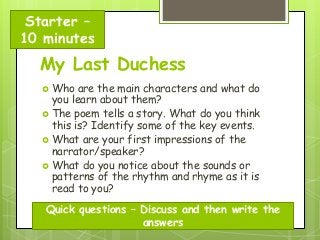
My Last Duchess
 Who

are the main characters and what do
you learn about them?
 The poem tells a story. What do you think
this is? Identify some of the key events.
 What are your first impressions of the
narrator/speaker?
 What do you notice about the sounds or
patterns of the rhythm and rhyme as it is
read to you?
Quick questions – Discuss and then write the
answers
Wednesday, 5th
March 2014

Poetry
L.O: To analyse My Last
Duchess.
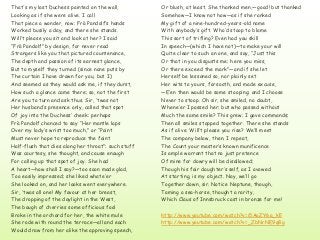
That's my last Duchess painted on the wall,
Looking as if she were alive. I call
That piece a wonder, now: Frà Pandolf’s hands
Worked busily a day, and there she stands.
Will’t please you sit and look at her? I said
“Frà Pandolf” by design, for never read
Strangers like you that pictured countenance,
The depth and passion of its earnest glance,
But to myself they turned (since none puts by
The curtain I have drawn for you, but I)
And seemed as they would ask me, if they durst,
How such a glance came there; so, not the first
Are you to turn and ask thus. Sir, ’twas not
Her husband’s presence only, called that spot
Of joy into the Duchess’ cheek: perhaps
Frà Pandolf chanced to say “Her mantle laps
Over my lady’s wrist too much,” or “Paint
Must never hope to reproduce the faint
Half-flush that dies along her throat”: such stuff
Was courtesy, she thought, and cause enough
For calling up that spot of joy. She had
A heart—how shall I say?—too soon made glad,
Too easily impressed; she liked whate’er
She looked on, and her looks went everywhere.
Sir, ’twas all one! My favour at her breast,
The dropping of the daylight in the West,
The bough of cherries some officious fool
Broke in the orchard for her, the white mule
She rode with round the terrace—all and each
Would draw from her alike the approving speech,

Or blush, at least. She thanked men,—good! but thanked
Somehow—I know not how—as if she ranked
My gift of a nine-hundred-years-old name
With anybody’s gift. Who’d stoop to blame
This sort of trifling? Even had you skill
In speech—(which I have not)—to make your will
Quite clear to such an one, and say, “Just this
Or that in you disgusts me; here you miss,
Or there exceed the mark”—and if she let
Herself be lessoned so, nor plainly set
Her wits to yours, forsooth, and made excuse,
—E’en then would be some stooping; and I choose
Never to stoop. Oh sir, she smiled, no doubt,
Whene’er I passed her; but who passed without
Much the same smile? This grew; I gave commands;
Then all smiles stopped together. There she stands
As if alive. Will’t please you rise? We’ll meet
The company below, then. I repeat,
The Count your master’s known munificence
Is ample warrant that no just pretence
Of mine for dowry will be disallowed;
Though his fair daughter’s self, as I avowed
At starting, is my object. Nay, we’ll go
Together down, sir. Notice Neptune, though,
Taming a sea-horse, thought a rarity,
Which Claus of Innsbruck cast in bronze for me!
http://www.youtube.com/watch?v=i5AoZY6a_kE
http://www.youtube.com/watch?v=_ZbNrNE9q8g
http://www.youtube.com/watch
?v=uIiDN8B6NaA
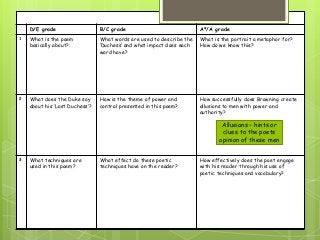
D/E grade

B/C grade

A*/A grade

1

What is the poem
basically about?

What words are used to describe the
‘Duchess’ and what impact does each
word have?

What is the portrait a metaphor for?
How do we know this?

2

What does the Duke say
about his ‘Last Duchess’?

How is the theme of power and
control presented in this poem?

How successfully does Browning create
allusions to men with power and
authority?

Allusions – hints or
clues to the poets
opinion of these men
3

What techniques are
used in this poem?

What effect do these poetic
techniques have on the reader?

How effectively does the poet engage
with his reader through his use of
poetic techniques and vocabulary?
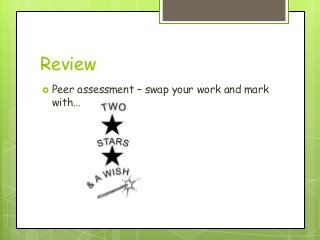
Review
 Peer

assessment – swap your work and mark
with…

Poetry lesson 8 My Last Duchess

  • 1.
    Starter – 10 minutes MyLast Duchess  Who are the main characters and what do you learn about them?  The poem tells a story. What do you think this is? Identify some of the key events.  What are your first impressions of the narrator/speaker?  What do you notice about the sounds or patterns of the rhythm and rhyme as it is read to you? Quick questions – Discuss and then write the answers
  • 2.
    Wednesday, 5th March 2014 Poetry L.O:To analyse My Last Duchess.
  • 3.
    That's my lastDuchess painted on the wall, Looking as if she were alive. I call That piece a wonder, now: Frà Pandolf’s hands Worked busily a day, and there she stands. Will’t please you sit and look at her? I said “Frà Pandolf” by design, for never read Strangers like you that pictured countenance, The depth and passion of its earnest glance, But to myself they turned (since none puts by The curtain I have drawn for you, but I) And seemed as they would ask me, if they durst, How such a glance came there; so, not the first Are you to turn and ask thus. Sir, ’twas not Her husband’s presence only, called that spot Of joy into the Duchess’ cheek: perhaps Frà Pandolf chanced to say “Her mantle laps Over my lady’s wrist too much,” or “Paint Must never hope to reproduce the faint Half-flush that dies along her throat”: such stuff Was courtesy, she thought, and cause enough For calling up that spot of joy. She had A heart—how shall I say?—too soon made glad, Too easily impressed; she liked whate’er She looked on, and her looks went everywhere. Sir, ’twas all one! My favour at her breast, The dropping of the daylight in the West, The bough of cherries some officious fool Broke in the orchard for her, the white mule She rode with round the terrace—all and each Would draw from her alike the approving speech, Or blush, at least. She thanked men,—good! but thanked Somehow—I know not how—as if she ranked My gift of a nine-hundred-years-old name With anybody’s gift. Who’d stoop to blame This sort of trifling? Even had you skill In speech—(which I have not)—to make your will Quite clear to such an one, and say, “Just this Or that in you disgusts me; here you miss, Or there exceed the mark”—and if she let Herself be lessoned so, nor plainly set Her wits to yours, forsooth, and made excuse, —E’en then would be some stooping; and I choose Never to stoop. Oh sir, she smiled, no doubt, Whene’er I passed her; but who passed without Much the same smile? This grew; I gave commands; Then all smiles stopped together. There she stands As if alive. Will’t please you rise? We’ll meet The company below, then. I repeat, The Count your master’s known munificence Is ample warrant that no just pretence Of mine for dowry will be disallowed; Though his fair daughter’s self, as I avowed At starting, is my object. Nay, we’ll go Together down, sir. Notice Neptune, though, Taming a sea-horse, thought a rarity, Which Claus of Innsbruck cast in bronze for me! http://www.youtube.com/watch?v=i5AoZY6a_kE http://www.youtube.com/watch?v=_ZbNrNE9q8g
  • 4.
  • 5.
    D/E grade B/C grade A*/Agrade 1 What is the poem basically about? What words are used to describe the ‘Duchess’ and what impact does each word have? What is the portrait a metaphor for? How do we know this? 2 What does the Duke say about his ‘Last Duchess’? How is the theme of power and control presented in this poem? How successfully does Browning create allusions to men with power and authority? Allusions – hints or clues to the poets opinion of these men 3 What techniques are used in this poem? What effect do these poetic techniques have on the reader? How effectively does the poet engage with his reader through his use of poetic techniques and vocabulary?
  • 6.
    Review  Peer assessment –swap your work and mark with…