Presenter: Nagla Drashti P.
Class: M.A Sem-4
Paper no: 13
Paper name: The New Literature
Topic : Tony as unreliable narrator in the novel :
Sense of an Ending
Batch no: 2016-2018
Email id: nagladrashti38@gmail.com
Submitted to: S. B. Gardi Department of English
Maharaja Krishnakumarsinghji
Bhavnagar University.
About the Author: Julian Barnes
• Julian Patrick Barnes is an English Writer.
• He was born on 19 January, 1946.
• He has also written crime fiction under the
pseudonym : ‘Dan Kavanagh.’
• Barnes was Agnostic.(nonbeliever)
• Four novels out of his list of works, won the booker
prize awards.
1. Flubert’s Parrot(1984)
2. England, England (1998)
3. Arthur and George (2005)
4. The Sense of an Ending (2011) won the Booker Prize.
Three of them short
listed for the Booker
prize.
Julian Barnes,
Born in 19
January, (1946)
About the novel: Sense of an Ending
 The story divided into two parts.
First part starts with the 1960s with four intellectually arrogant
friends, of whom two friends are in the reminder of the story: Tony and
Adrian.
Tony in his teens and twenties, focuses on his three male friends and
his first serious girlfriend Veronica. Tony primarily compares a new
scene from his life, from school days to visits to Veronicas’ home on
weekend.
Part two begins with that Tony confronted again with some of the
major incidents from his youth and is forced to reconsider his sense of
self.
The most important of these incidents concerns....
1. The suicide of Adrian.
2. Receiving a latter of Mrs. Sarah Ford from Veronica.
3. Tony’s three meeting with Veronica.
4. Revelation of secret.
5. Getting the real sense.
What is Unreliable narrator?
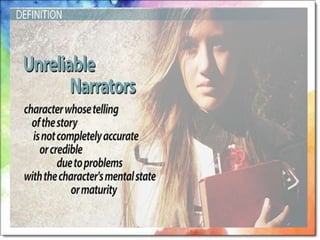
• An unreliable narrator is a narrator, whether in
literature, film, or theatre, whose credibility has been
seriously compromised.
• The term was coined in 1961 by Wayne C. Booth in
The Rhetoric of Fiction. While unreliable narrators are
almost by definition first-person narrators arguments
have been made for the existence of unreliable.
• second- and third-person narrators, especially within
the context of film and television, although sometimes
also in literature.
• Sometimes the narrator's unreliability is made
immediately evident.
• For instance, a story may open with the narrator making a
plainly false or delusional claim or admitting to being severely
mentally ill, or the story itself may have a frame in which the
narrator appears as a character, with clues to the character's
unreliability.
• A more dramatic use of the device delays the revelation
until near the story's end. In some cases, the reader discovers
that in the foregoing narrative, the narrator had concealed or
greatly misrepresented vital pieces of information.
•Such a twist ending forces readers to reconsider their point
of view and experience of the story. In some cases the
narrator's unreliability is never fully revealed but only hinted
at, leaving readers to wonder how much the narrator should
be trusted and how the story should be interpreted.
Continue....
Tony as Unreliable Narrator:
• In this novel the main character named Tony Webster, recalls his
memory from the past. Here he known as unreliable narrator. In part
one Tony talking with the readers about his past, according to his own
memory.
“I remember, in no particular order: —a shiny inner wrist;”.
Those are the words from Tony’s memory. Described in very first line
of the novel.
• The another lines from the text which shows that the weak memory
or unreliable memory of Tony Webster.
“I can’t be sure of the actual events anymore; I can at least be true to
the impressions those facts left. That’s the best I can manage.”
Adrian was the school friend of Tony, who was a smart and
intellectual student among their friend circle. He also gives the
remarkable answers in the classroom. One day the history
teacher ask a question about, “ What is History?”
To answer this question Adrian said that,
"History is that certainty produced at the point where the
imperfections of memory meet the inadequacies of
documentation.“
Instead of this answer Tony replies quickly that,
“History isn’t the lies of the victors . . . It’s more the memories
of the survivors, most of whom are neither victorious nor
defeated.”
The part two of the novel is full of secrets and it’s revealed by
Veronica. Veronica told Tony the secret of his life and what is the
actually sense of life at the end of the novel or as we can say at the
end of the Tony’s life. When Veronica said about the letters which
are written by Tony to Adrian, Tony can not rely on those letters and
asks Veronica that, “ Is it actually written by me? “
He also said the same about the history and memory that,
“What you end up remembering isn’t always the same as what
you have Witnessed”.
By these lines Tony said to the readers that even he himself can not
rely on his memory. He always in a confused state of mind about
what was actually happened in his life? He was the narrator of the
part one in which he described his story according to his memory,
but actually he was confused that in reality it was happened or
not, so the narrator was revealed as unreliable narrator.
“How often do we tell our own life story? How often
do we adjust, embellish, make sly cuts? And the
longer life goes on, the fewer are those around to
challenge our account, to remind us that our life is not
our life, merely the story we have told about our life.
Told to others, but—mainly—to ourselves.”
 This is another quote by Tony that represent his
memory about his life. How he described his life in
front of readers. He tells readers that we not simply
told our story to others, but with some changes and sly
cuts. Tony in part one described the story which is only
he remembered about himself. It is not actually
happened in Tony’s life we know through the Veronica’s
statement in part two.
“It strikes me that this may be one of the differences
between youth and age: when we are young, we
invent different futures for ourselves; when we are old,
we invent different pasts for others.”
 In this quote Tony differentiates between the young
and old age. The thinking process between when we
are young and we are old. Tony at the age of 60 talking
about his twenties. So, there is the age difference in the
thinking process and in the events that happened in his
life. Tony in part one exposes the events of life in front
of readers and now at the age of 60 he thought about
others pasts.
Presentation 13

Presentation 13

  • 1.
    Presenter: Nagla DrashtiP. Class: M.A Sem-4 Paper no: 13 Paper name: The New Literature Topic : Tony as unreliable narrator in the novel : Sense of an Ending Batch no: 2016-2018 Email id: nagladrashti38@gmail.com Submitted to: S. B. Gardi Department of English Maharaja Krishnakumarsinghji Bhavnagar University.
  • 3.
    About the Author:Julian Barnes • Julian Patrick Barnes is an English Writer. • He was born on 19 January, 1946. • He has also written crime fiction under the pseudonym : ‘Dan Kavanagh.’ • Barnes was Agnostic.(nonbeliever) • Four novels out of his list of works, won the booker prize awards. 1. Flubert’s Parrot(1984) 2. England, England (1998) 3. Arthur and George (2005) 4. The Sense of an Ending (2011) won the Booker Prize. Three of them short listed for the Booker prize.
  • 4.
    Julian Barnes, Born in19 January, (1946)
  • 5.
    About the novel:Sense of an Ending  The story divided into two parts. First part starts with the 1960s with four intellectually arrogant friends, of whom two friends are in the reminder of the story: Tony and Adrian. Tony in his teens and twenties, focuses on his three male friends and his first serious girlfriend Veronica. Tony primarily compares a new scene from his life, from school days to visits to Veronicas’ home on weekend. Part two begins with that Tony confronted again with some of the major incidents from his youth and is forced to reconsider his sense of self. The most important of these incidents concerns.... 1. The suicide of Adrian. 2. Receiving a latter of Mrs. Sarah Ford from Veronica. 3. Tony’s three meeting with Veronica. 4. Revelation of secret. 5. Getting the real sense.
  • 7.
    What is Unreliablenarrator? • An unreliable narrator is a narrator, whether in literature, film, or theatre, whose credibility has been seriously compromised. • The term was coined in 1961 by Wayne C. Booth in The Rhetoric of Fiction. While unreliable narrators are almost by definition first-person narrators arguments have been made for the existence of unreliable. • second- and third-person narrators, especially within the context of film and television, although sometimes also in literature. • Sometimes the narrator's unreliability is made immediately evident.
  • 8.
    • For instance,a story may open with the narrator making a plainly false or delusional claim or admitting to being severely mentally ill, or the story itself may have a frame in which the narrator appears as a character, with clues to the character's unreliability. • A more dramatic use of the device delays the revelation until near the story's end. In some cases, the reader discovers that in the foregoing narrative, the narrator had concealed or greatly misrepresented vital pieces of information. •Such a twist ending forces readers to reconsider their point of view and experience of the story. In some cases the narrator's unreliability is never fully revealed but only hinted at, leaving readers to wonder how much the narrator should be trusted and how the story should be interpreted. Continue....
  • 9.
    Tony as UnreliableNarrator: • In this novel the main character named Tony Webster, recalls his memory from the past. Here he known as unreliable narrator. In part one Tony talking with the readers about his past, according to his own memory. “I remember, in no particular order: —a shiny inner wrist;”. Those are the words from Tony’s memory. Described in very first line of the novel. • The another lines from the text which shows that the weak memory or unreliable memory of Tony Webster. “I can’t be sure of the actual events anymore; I can at least be true to the impressions those facts left. That’s the best I can manage.”
  • 10.
    Adrian was theschool friend of Tony, who was a smart and intellectual student among their friend circle. He also gives the remarkable answers in the classroom. One day the history teacher ask a question about, “ What is History?” To answer this question Adrian said that, "History is that certainty produced at the point where the imperfections of memory meet the inadequacies of documentation.“ Instead of this answer Tony replies quickly that, “History isn’t the lies of the victors . . . It’s more the memories of the survivors, most of whom are neither victorious nor defeated.”
  • 11.
    The part twoof the novel is full of secrets and it’s revealed by Veronica. Veronica told Tony the secret of his life and what is the actually sense of life at the end of the novel or as we can say at the end of the Tony’s life. When Veronica said about the letters which are written by Tony to Adrian, Tony can not rely on those letters and asks Veronica that, “ Is it actually written by me? “ He also said the same about the history and memory that, “What you end up remembering isn’t always the same as what you have Witnessed”. By these lines Tony said to the readers that even he himself can not rely on his memory. He always in a confused state of mind about what was actually happened in his life? He was the narrator of the part one in which he described his story according to his memory, but actually he was confused that in reality it was happened or not, so the narrator was revealed as unreliable narrator.
  • 12.
    “How often dowe tell our own life story? How often do we adjust, embellish, make sly cuts? And the longer life goes on, the fewer are those around to challenge our account, to remind us that our life is not our life, merely the story we have told about our life. Told to others, but—mainly—to ourselves.”  This is another quote by Tony that represent his memory about his life. How he described his life in front of readers. He tells readers that we not simply told our story to others, but with some changes and sly cuts. Tony in part one described the story which is only he remembered about himself. It is not actually happened in Tony’s life we know through the Veronica’s statement in part two.
  • 13.
    “It strikes methat this may be one of the differences between youth and age: when we are young, we invent different futures for ourselves; when we are old, we invent different pasts for others.”  In this quote Tony differentiates between the young and old age. The thinking process between when we are young and we are old. Tony at the age of 60 talking about his twenties. So, there is the age difference in the thinking process and in the events that happened in his life. Tony in part one exposes the events of life in front of readers and now at the age of 60 he thought about others pasts.