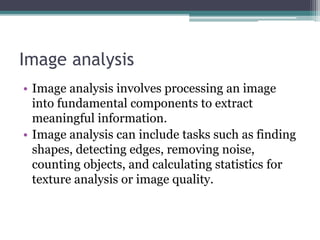
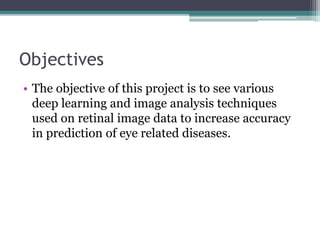
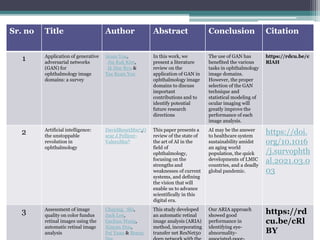
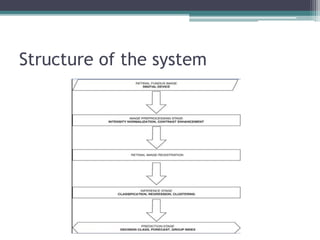
This document discusses using machine learning and deep learning for retinal image analysis. It begins with an introduction on how deep learning can help interpret complex medical image features. It then discusses benefits of AI in ophthalmology like increased efficiency, cost savings, and accuracy compared to humans. Next, it describes image analysis tasks like detecting shapes and edges. The objectives are outlined to increase accuracy in predicting eye diseases using deep learning techniques. Finally, it discusses generative adversarial networks (GANs) and how they can be used for tasks like de-noising, augmenting, and segmenting retinal images to detect eye diseases more precisely.




![DR PPT[1]2[1].pptx - Read-Only.pptx](https://cdn.slidesharecdn.com/ss_thumbnails/drppt121-240211165233-9e17dc66-thumbnail.jpg?width=640&height=640&fit=bounds)


