Composite Redesign of a Olympic Diving Board
Final Project Assignment
Introduction To Composite Materials MECE.644.01
Department of Mechanical Engineering Rochester Institute of Technology
Instructor: Dr. Hany Ghoneim
Author:
Pedro Dominguez
Andrew Pace
Denny George Sebastian
May 19, 2014
Introduction
A diving board is a board that acts as a spring for diving in swimming areas. It is a linear
flex spring of the cantilever type.
Athletes dive from a spring board or a concrete platform, the type of surface an athlete
dives affects the amount of time he/she has in the air. The structure of a springboard allows the
diver to reach a greater height than from a concrete platform.
Springboards are fixed by a hinge at one end, an adjustable fulcrum is located in the
middle, the other end hangs over a swimming pool. Modern springboards are made out of a
single piece extrusion of aircraft grade aluminum. Diving boards used for Olympic events, such
as the Duraflex Maxiflex Model B, are made of such aluminum and is heat treated for a yield
strength of 50,000 psi. Epoxy resin is applied on the surface of the board to make it slip-
resistant. It is then finished with a laminate of flint silica and alumina. The spring constant of a
spring board is adjusted by means of a fulcrum located approximately at the middle of the
spring board.
Springboards are operated in such a way that they approximately obey Hooke's law.
When the diving board is loaded with a diver, the combination of diver's mass and spring
stiffness of the board will result in a resonance frequency that is adjustable by way of the spring
constant via the fulcrum position.
The redesign of the diving board is focused on finding a suitable diving board for the
average athlete. An Olympic type of diving board costs approximately $4179. The redesigned
board will have similar strength and stability as a professional diving board.
Material Selection and Process:
For the part redesign analysis, it was found that for a Duraflex 16’ Olympic grade diving
board, the material used is Aluminum 6070-T6 alloy with an epoxy cover to protect the metal
from chemical exposure. An e-glass/epoxy composite will be the material combination of
choice for the part redesign. E-glass was chosen specifically because it is relatively inexpensive
compared to other composite materials such as carbon. The e-glass epoxy combination also has
high corrosion resistance and is inert to most chemicals which is important when considering
the environment that diving boards are subjected to. Harsh pool chemicals and constant
moisture are common on most diving boards and would result in corrosion and wear for most
other materials.
For manufacturing, a pultrusion process was determined to be the best option in order
to produce the composite diving boards. The e-glass/epoxy materials selected are one of the
most common and widely used materials in the pultrusion process. Given that the geometry of
diving boards are essentially long flat sheets of constant cross section, pultrusion would be the
ideal process. Another advantage of this process is that it is very efficient compared to other
composite manufacturing techniques especially if high volume production of diving boards are
required. It would also be relatively trivial to produce diving boards of different lengths if
desired. The only disadvantage of using this manufacturing method would be the high initial
cost of obtaining a pultrusion machine, but if producing a high volume of diving boards is
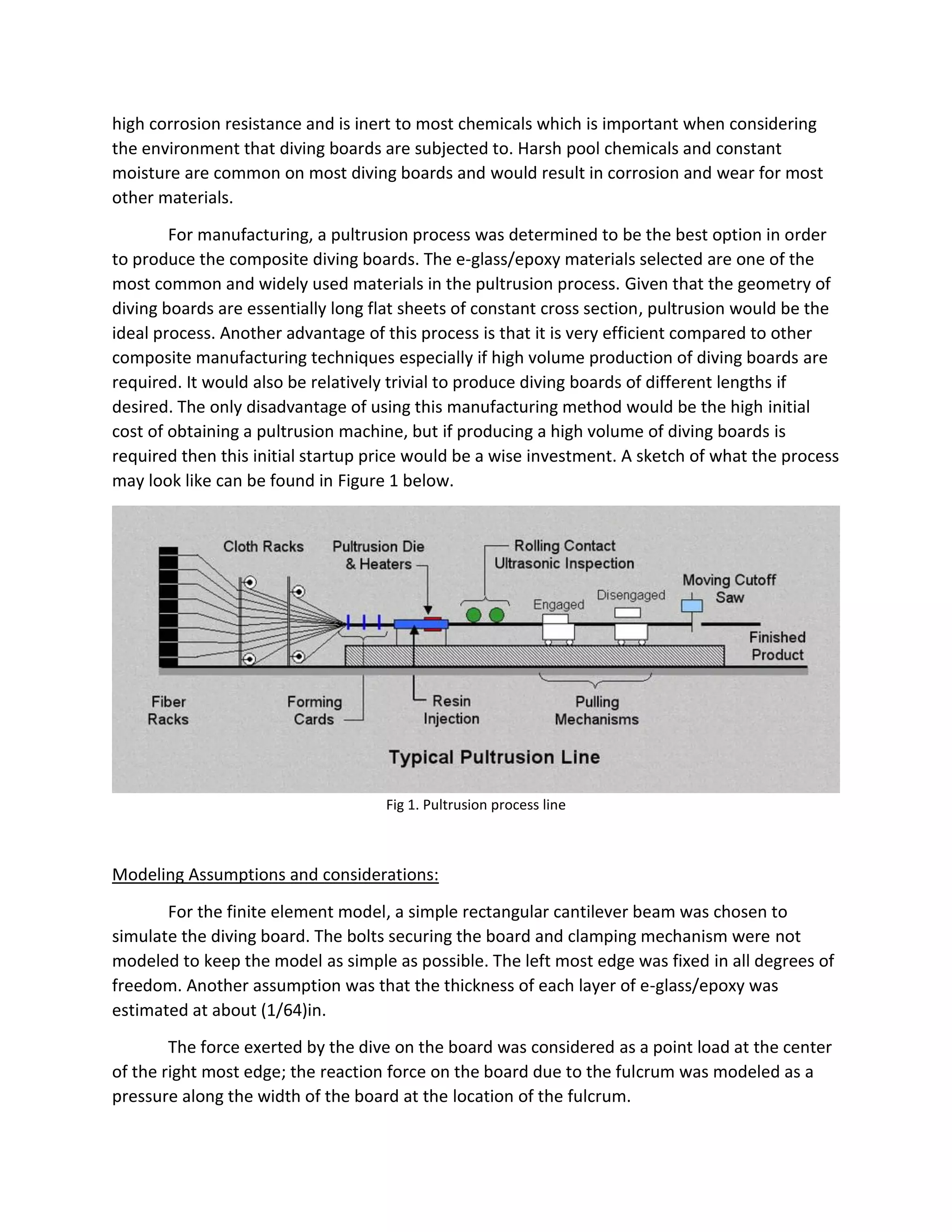
required then this initial startup price would be a wise investment. A sketch of what the process
may look like can be found in Figure 1 below.
Fig 1. Pultrusion process line
Modeling Assumptions and considerations:
For the finite element model, a simple rectangular cantilever beam was chosen to
simulate the diving board. The bolts securing the board and clamping mechanism were not
modeled to keep the model as simple as possible. The left most edge was fixed in all degrees of
freedom. Another assumption was that the thickness of each layer of e-glass/epoxy was
estimated at about (1/64)in.
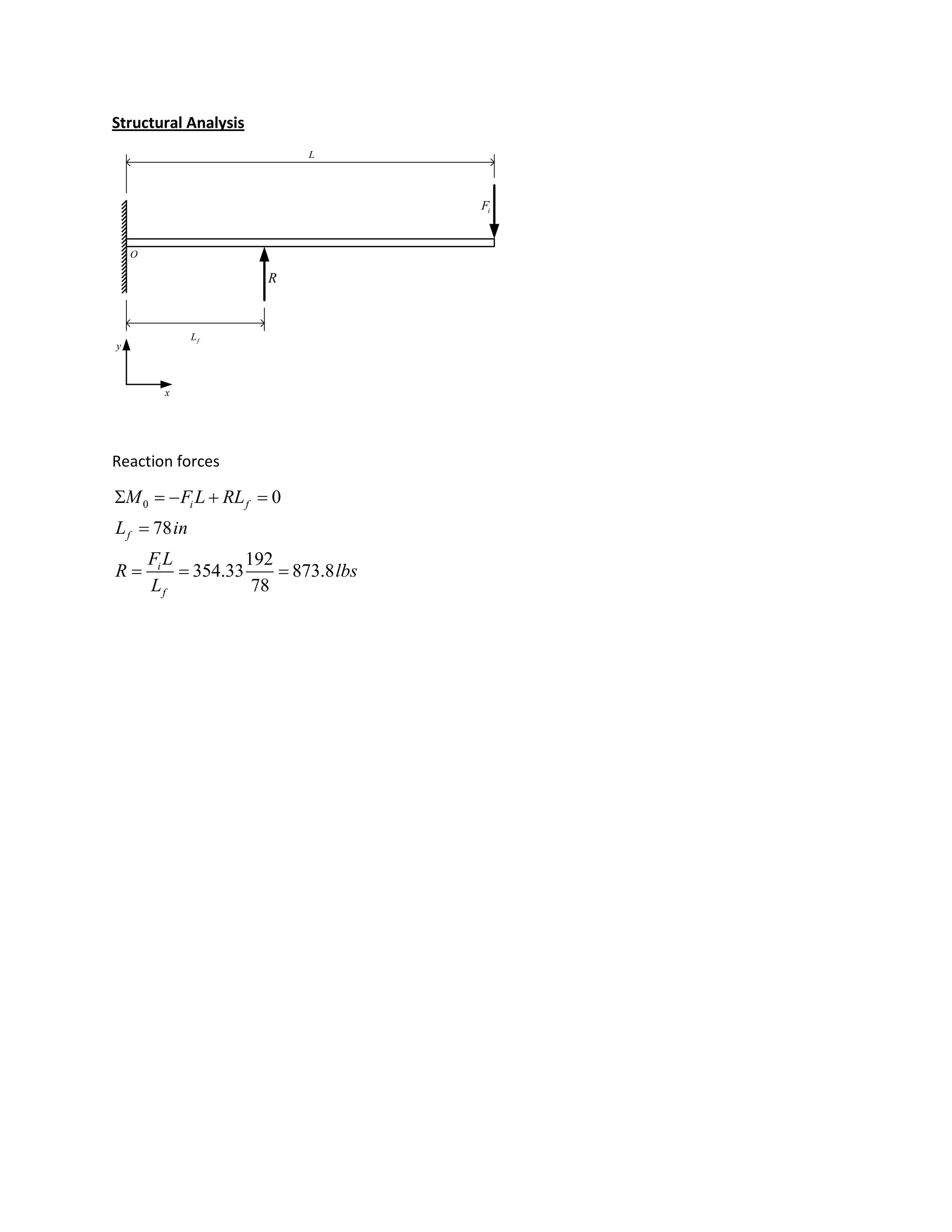
The force exerted by the dive on the board was considered as a point load at the center
of the right most edge; the reaction force on the board due to the fulcrum was modeled as a
pressure along the width of the board at the location of the fulcrum.
Analysis and Results:
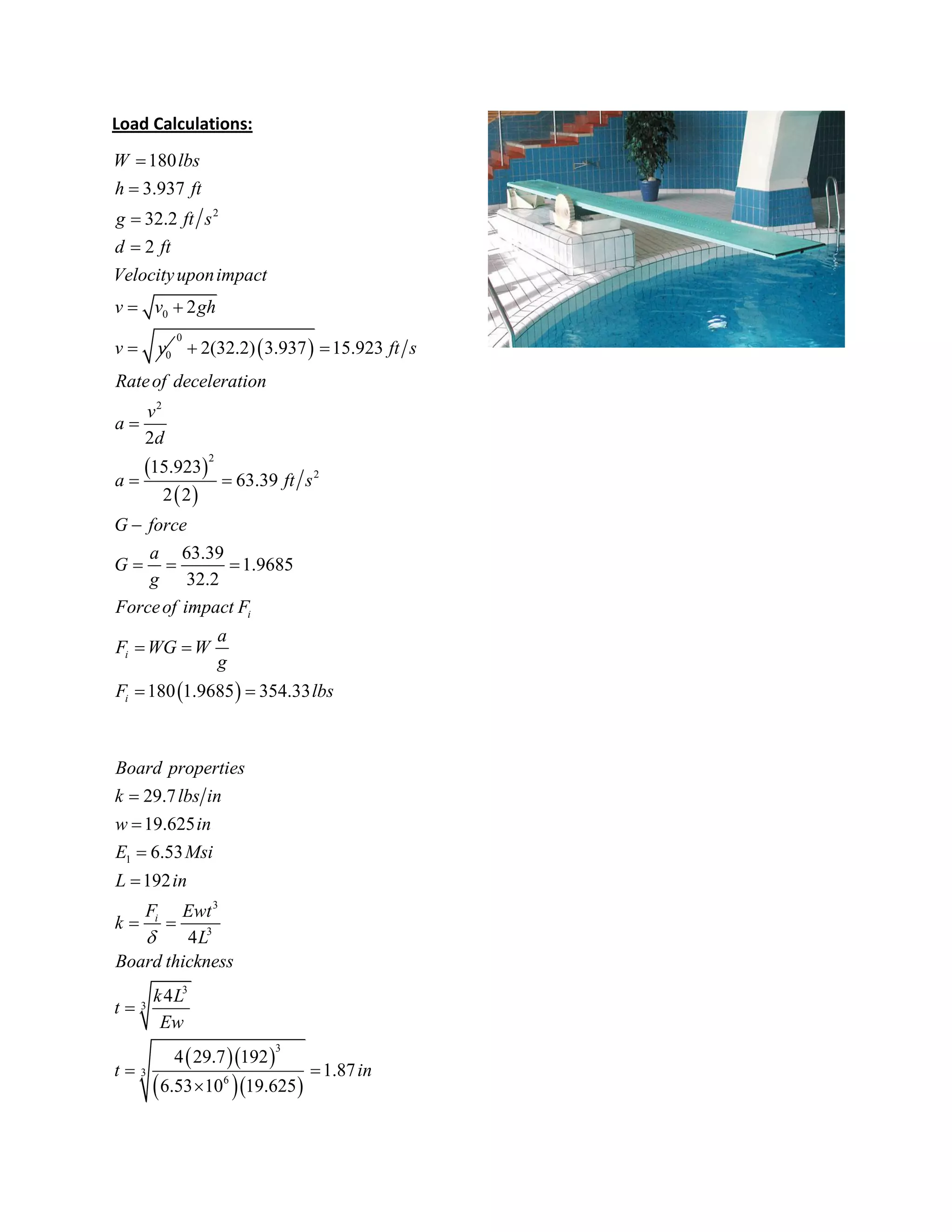
For the stress analysis for the diving board, we assumed an average person, weighing
180lbs, jumping on the diving board. We analyzed the case under which the maximum force
exerted on the board would occur when the person comes down and impacts the board after a
jump. Full analysis can be found in the Appendix.
The composite redesign model was made to ensure that the composite board kept the
important properties of a diving board such as the cantilever spring stiffness to allow divers to
have a similar diving experience on a composite board as they had on the isotropic board. Using
the equation for spring stiffness for a cantilever beam, the stiffness for the isotropic case was
calculated. Using the Young’s modulus, E1, for an e-glass/epoxy composite, the thickness
needed was obtained. The equations and values can be found in the Appendix.
Stress analysis
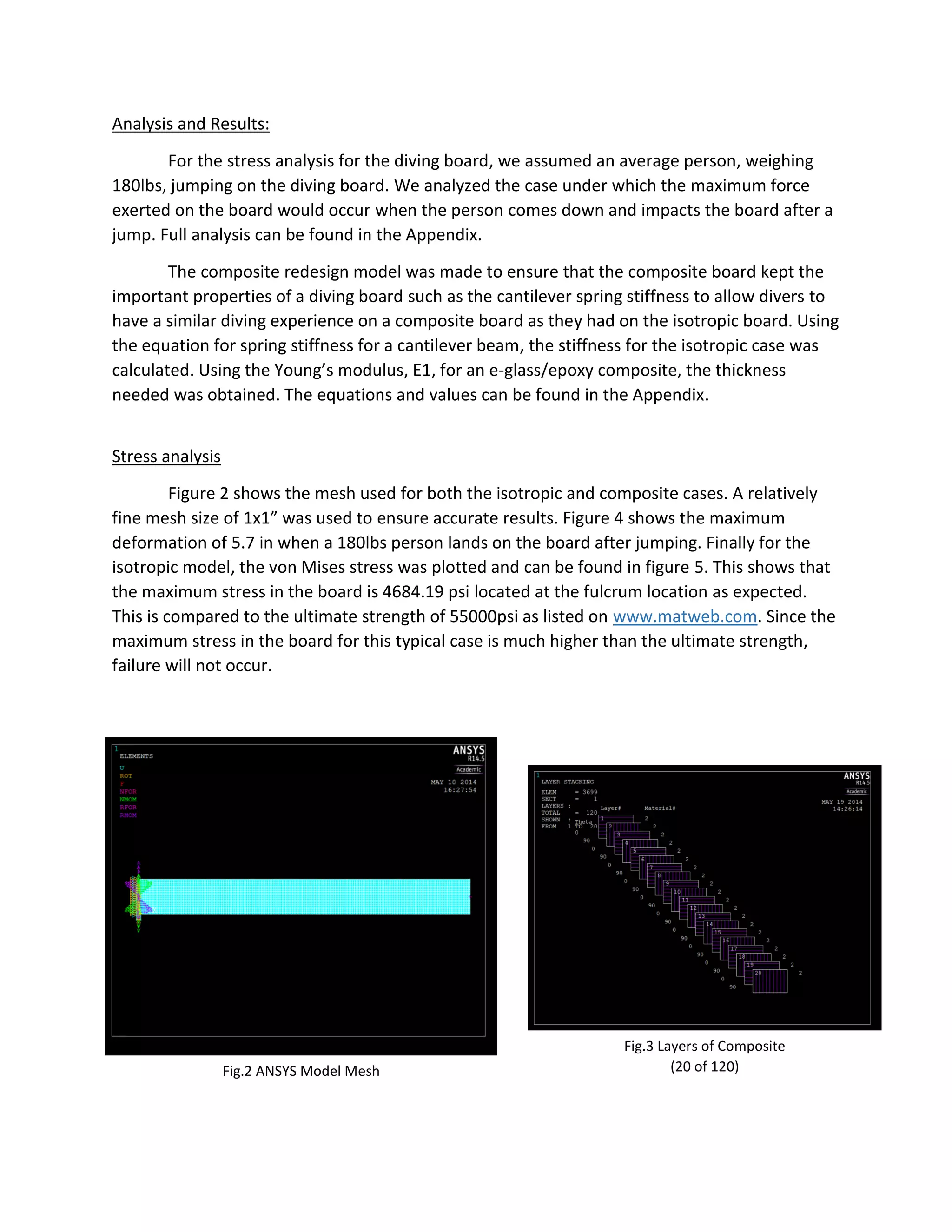
Figure 2 shows the mesh used for both the isotropic and composite cases. A relatively
fine mesh size of 1x1” was used to ensure accurate results. Figure 4 shows the maximum
deformation of 5.7 in when a 180lbs person lands on the board after jumping. Finally for the
isotropic model, the von Mises stress was plotted and can be found in figure 5. This shows that
the maximum stress in the board is 4684.19 psi located at the fulcrum location as expected.
This is compared to the ultimate strength of 55000psi as listed on www.matweb.com. Since the
maximum stress in the board for this typical case is much higher than the ultimate strength,
failure will not occur.
Fig.3 Layers of Composite
(20 of 120)Fig.2 ANSYS Model Mesh
At first we analyzed the orientation of the lamina for the laminate using an anti-
symmetric four layer arrangement of . This was done to eliminate all
coupling so that the board will behave as much like the isotropic case as possible when loads
are applied. It was found that the max von Mises stress was 3882.6psi for top and bottom layer
and the inverse Tsai Wui criteria was each layer was far below failure. Then another analysis
was performed for an orientation scheme of , (layers 1-20 can be seen in Figure 3),
which would also eliminate all of the couplings and it was found that from the von Mises
analysis the max stress in the top layer was 5409.18psi which is higher than for the four layer
arrangement case for that particular layer, but when the inverse Tsai Wui criteria were plotted,
max values were found to be around the same range depending on the layer’s orientation. So
either orientation would be acceptable for typical loading of the diving boards, both being very
far from failure. Comparisons can be found in in table 1.,the deflection of the composite can be
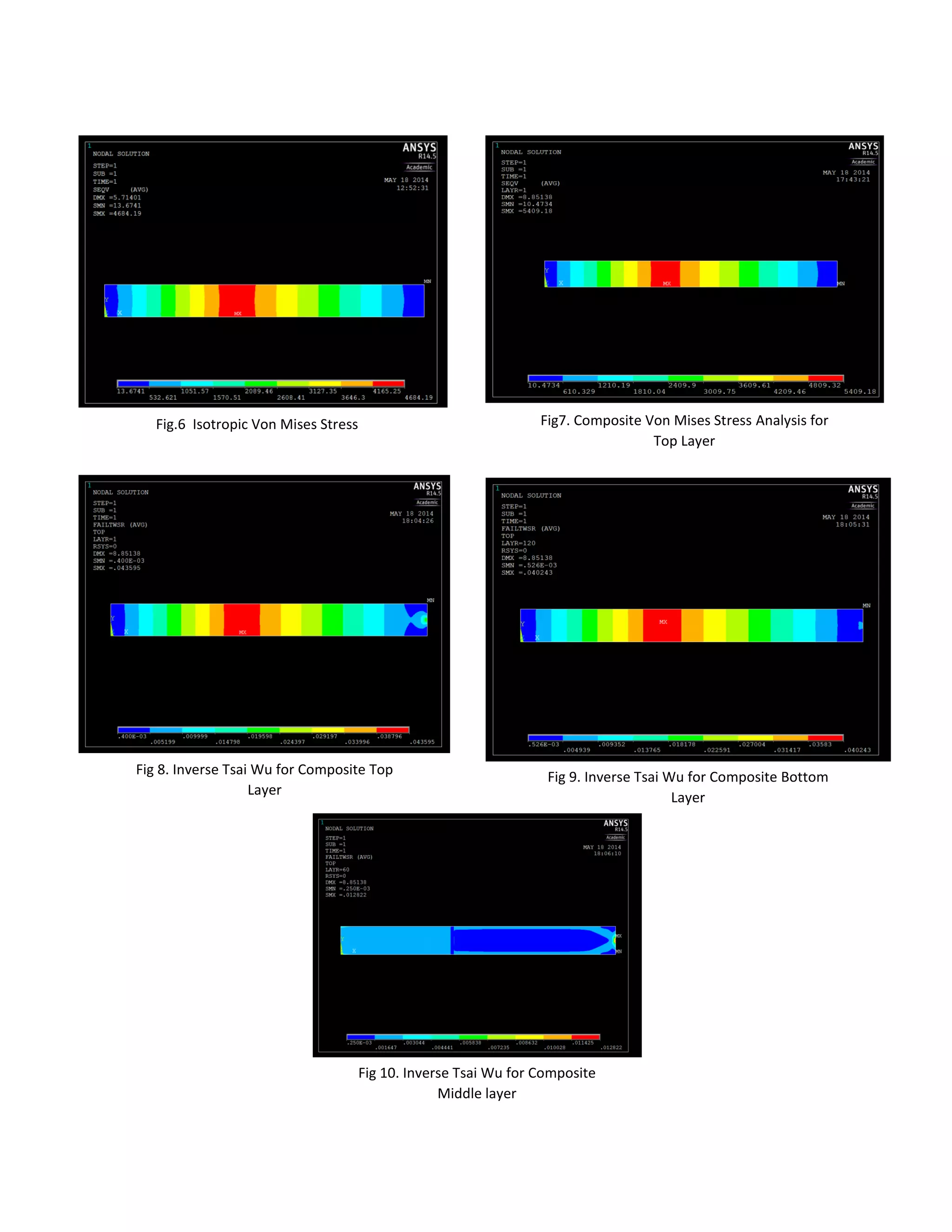
found on figure 5 above. The max Von Mises occurring at the top layer can be seen on figure7.
the Tsai Wui plots for the 0/90 orientation for the top middle and bottom layers can be found in
figures 8,9 and 10.
Isotropic [(45,-45,-45,45)_15]A [(0,90)_30]s
Max Von Mises (top layer) 4684.19 3882.63 5409.18
Max Von Mises (Middle layer) - 230.346 193.294
Max Von Mises (Bottom layer) - 3882.63 5409.18
Inverse Tsai Wui (top layer) - 0.2597 0.043595
Inverse Tsai Wui (Middle
layer)
- 0.015286 0.012822
Inverse Tsai Wui (Bottom
layer)
- 0.16765 0.040243
Inverse Tsai Wui (Max value) - .259742 0.246253
Table 1. Comparison of Stress Values
Fig 4. Isotropic Deformation Shape Fig5. Composite Deformation Shape
Fig.6 Isotropic Von Mises Stress
Analysis
Fig 8. Inverse Tsai Wu for Composite Top
Layer
Fig 9. Inverse Tsai Wu for Composite Bottom
Layer
Fig 10. Inverse Tsai Wu for Composite
Middle layer
Fig7. Composite Von Mises Stress Analysis for
Top Layer
Cost analysis:
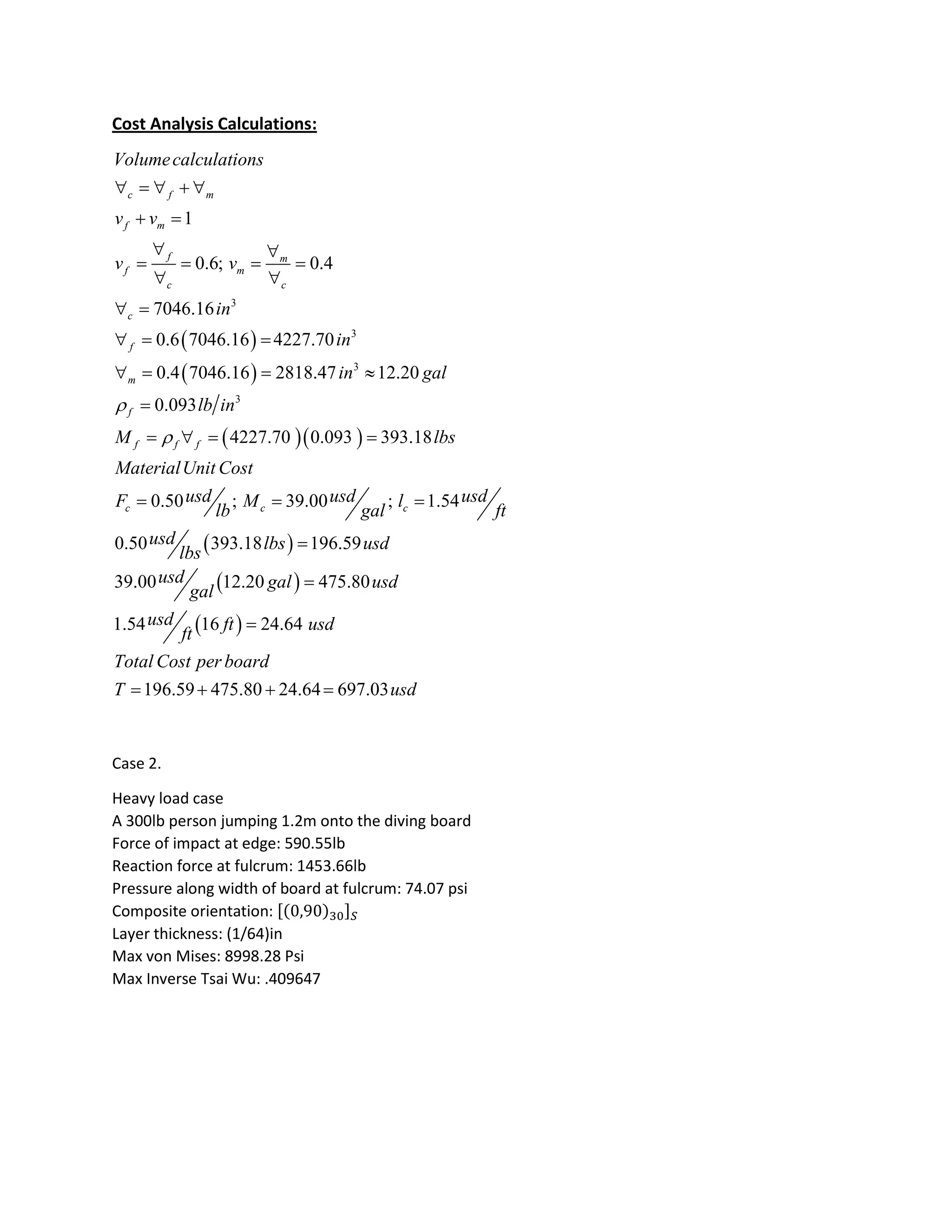
The labor cost for the composite diving board is an estimation of the true cost (source:
Quinn, 1989). Moreover, the only parameter considered in this cost analysis was material and
labor cost. Thus the cost difference between the Aluminum and E-glass/epoxy board could be
less. See Table 2. For cost analysis values and See appendix for the material cost sources and
calculations.
Description Cost QTY Cost/board
E-glass 0.50usd
lbs
393.18lbs 196.59usd
Epoxy 39.00usd
gal 12.20 gal 475.80usd
Labor 1.54usd
ft 16 ft 24.64 usd
Total 697.03usd
Estimated cost (aluminium board) 2089.50usd
Conclusions:
Overall the performance of the composite diving board is comparable to that of the
isotropic case. The composite has proven that it has comparable strength to the isotropic case
and can survive large loads as seen in the second case (see appendix). The advantage of the
composite over the isotropic is the resistance to moisture and chemicals without needing
special coatings, though in production a coating to give grip to the composite board would be
recommended. The estimated cost of a composite diving board is also less, though some values
have been estimated. A possible disadvantage of the composite board is that it will have lesser
life due to quicker fatigue of the fibers and matrix than the isotropic case.
Table 2. Cost Analysis Values
Appendix
Parameters and Properties:
Parameters Description
W Diver weight  lbs
h Diver jump height  ft
g Gravity acceleration  2
ft s
d Deceleration distance  ft
v Velocity at impact ft s
a Deceleration rate  2
ft s
G G-Force
iF Force at impact  lbs
Material: E-glass/epoxy
Longitudinal modulus 1[ ]E Msi 6.527
Transverse modulus 2[ ]E Msi 1.741
Shear modulus 12[ ]G Msi 0.798
Shear modulus 23[ ]G Msi 0.508
Poisson's ratio 12 0.19
Parameters Description
k Diving board stiffness  lbs in
w Diving board width in
L Diving board length in
fL Fulcrum length in
t Diving board thickness in
R Fulcrum reaction force lbs
Material: Aluminum
Modulus of elasticity [ ]E Msi 10
Shear modulus [ ]G Msi 3.77
Tensile strength [ ]Ksi 51
Shear strength [ ]Ksi 34
Poisson's ratio 12 0.33
Load Calculations:
2
0
0
180
3.937
32.2
2
2
W lbs
h ft
g ft s
d ft
Velocityuponimpact
v v gh
v v




 
  
 
 
 
0
2
2
2
2(32.2) 3.937 15.923
2
15.923
63.39
2 2
63.39
1.9685
32.2
180 1.9685 354.33
i
i
i
ft s
Rateof deceleration
v
a
d
a ft s
G force
a
G
g
Forceof impact F
a
F WG W
g
F lbs
 

 

  
 
 
  
  
1
3
3
3
3
3
3
6
29.7
19.625
6.53
192
4
4
4 29.7 192
1.87
6.53 10 19.625
i
Board properties
k lbs in
w in
E Msi
L in
F Ewt
k
L
Board thickness
k L
t
Ew
t in





 

 

Structural Analysis
R
iF
fL
L
O
x
y
Reaction forces
0 0
78
192
354.33 873.8
78
i f
f
i
f
M F L RL
L in
F L
R lbs
L
    

  
Cost Analysis Calculations:
 
 
  
3
3
3
3
1
0.6; 0.4
7046.16
0.6 7046.16 4227.70
0.4 7046.16 2818.47 12.20
0.093
4227.70 0.093 393.18
0.50 ;
c f m
f m
f m
f m
c c
c
f
m
f
f f f
c c
Volumecalculations
v v
v v
in
in
in gal
lb in
M lbs
MaterialUnit Cost
usdF M
lb


    
 
 
   
 
 
  
   

   

 
 
 
39.00 ; 1.54
0.50 393.18 196.59
39.00 12.20 475.80
1.54 16 24.64
196.59 475.80 24.64 697.03
c
usd usdl
gal ft
usd lbs usd
lbs
usd gal usd
gal
usd ft usd
ft
Total Cost per board
T usd
 



   
Case 2.
Heavy load case
A 300lb person jumping 1.2m onto the diving board
Force of impact at edge: 590.55lb
Reaction force at fulcrum: 1453.66lb
Pressure along width of board at fulcrum: 74.07 psi
Composite orientation:
Layer thickness: (1/64)in
Max von Mises: 8998.28 Psi
Max Inverse Tsai Wu: .409647
Companies consulted:
Supplier US Composites
Phone No. 561-588-1001
Fax No. 561-585-8583
Address
6670 White Drive
West Palm Beach, FL
33407
Supplier
Hebei Yuniu Fiberglass
Manufacturing Co., LTD
Phone No. 0086-319-8205333
Fax No. 0086-319-8202066
Address
Xingtai City, Hebei
Province, China. 054000
References:
 Diving board info-
http://www.duraflexinternational.com/product_info.php?cPath=27_22&products_id=32
 Diving Board Fulcrum position-
http://www.duraflexinternational.com/pages.php?page=install_springboards
 Price of Olympic diving board-
http://www.springboardsandmore.com/proddetail.asp?prod=66-231-330
 Isotropic material Properties-
http://www.matweb.com/search/datasheettext.aspx?matid=9421
 Pultrusion photo-
http://www.fibrotec.es/PageEnglish/PULTRUDEDPRODUCTS/Pultrusion.aspx

Analysis of Modeled Composite Diving Board

  • 1.
    Composite Redesign ofa Olympic Diving Board Final Project Assignment Introduction To Composite Materials MECE.644.01 Department of Mechanical Engineering Rochester Institute of Technology Instructor: Dr. Hany Ghoneim Author: Pedro Dominguez Andrew Pace Denny George Sebastian May 19, 2014 Introduction A diving board is a board that acts as a spring for diving in swimming areas. It is a linear flex spring of the cantilever type. Athletes dive from a spring board or a concrete platform, the type of surface an athlete dives affects the amount of time he/she has in the air. The structure of a springboard allows the diver to reach a greater height than from a concrete platform. Springboards are fixed by a hinge at one end, an adjustable fulcrum is located in the middle, the other end hangs over a swimming pool. Modern springboards are made out of a single piece extrusion of aircraft grade aluminum. Diving boards used for Olympic events, such as the Duraflex Maxiflex Model B, are made of such aluminum and is heat treated for a yield strength of 50,000 psi. Epoxy resin is applied on the surface of the board to make it slip- resistant. It is then finished with a laminate of flint silica and alumina. The spring constant of a spring board is adjusted by means of a fulcrum located approximately at the middle of the spring board. Springboards are operated in such a way that they approximately obey Hooke's law. When the diving board is loaded with a diver, the combination of diver's mass and spring stiffness of the board will result in a resonance frequency that is adjustable by way of the spring constant via the fulcrum position. The redesign of the diving board is focused on finding a suitable diving board for the average athlete. An Olympic type of diving board costs approximately $4179. The redesigned board will have similar strength and stability as a professional diving board. Material Selection and Process: For the part redesign analysis, it was found that for a Duraflex 16’ Olympic grade diving board, the material used is Aluminum 6070-T6 alloy with an epoxy cover to protect the metal from chemical exposure. An e-glass/epoxy composite will be the material combination of choice for the part redesign. E-glass was chosen specifically because it is relatively inexpensive compared to other composite materials such as carbon. The e-glass epoxy combination also has
  • 2.
    high corrosion resistanceand is inert to most chemicals which is important when considering the environment that diving boards are subjected to. Harsh pool chemicals and constant moisture are common on most diving boards and would result in corrosion and wear for most other materials. For manufacturing, a pultrusion process was determined to be the best option in order to produce the composite diving boards. The e-glass/epoxy materials selected are one of the most common and widely used materials in the pultrusion process. Given that the geometry of diving boards are essentially long flat sheets of constant cross section, pultrusion would be the ideal process. Another advantage of this process is that it is very efficient compared to other composite manufacturing techniques especially if high volume production of diving boards are required. It would also be relatively trivial to produce diving boards of different lengths if desired. The only disadvantage of using this manufacturing method would be the high initial cost of obtaining a pultrusion machine, but if producing a high volume of diving boards is required then this initial startup price would be a wise investment. A sketch of what the process may look like can be found in Figure 1 below. Fig 1. Pultrusion process line Modeling Assumptions and considerations: For the finite element model, a simple rectangular cantilever beam was chosen to simulate the diving board. The bolts securing the board and clamping mechanism were not modeled to keep the model as simple as possible. The left most edge was fixed in all degrees of freedom. Another assumption was that the thickness of each layer of e-glass/epoxy was estimated at about (1/64)in. The force exerted by the dive on the board was considered as a point load at the center of the right most edge; the reaction force on the board due to the fulcrum was modeled as a pressure along the width of the board at the location of the fulcrum.
  • 3.
    Analysis and Results: Forthe stress analysis for the diving board, we assumed an average person, weighing 180lbs, jumping on the diving board. We analyzed the case under which the maximum force exerted on the board would occur when the person comes down and impacts the board after a jump. Full analysis can be found in the Appendix. The composite redesign model was made to ensure that the composite board kept the important properties of a diving board such as the cantilever spring stiffness to allow divers to have a similar diving experience on a composite board as they had on the isotropic board. Using the equation for spring stiffness for a cantilever beam, the stiffness for the isotropic case was calculated. Using the Young’s modulus, E1, for an e-glass/epoxy composite, the thickness needed was obtained. The equations and values can be found in the Appendix. Stress analysis Figure 2 shows the mesh used for both the isotropic and composite cases. A relatively fine mesh size of 1x1” was used to ensure accurate results. Figure 4 shows the maximum deformation of 5.7 in when a 180lbs person lands on the board after jumping. Finally for the isotropic model, the von Mises stress was plotted and can be found in figure 5. This shows that the maximum stress in the board is 4684.19 psi located at the fulcrum location as expected. This is compared to the ultimate strength of 55000psi as listed on www.matweb.com. Since the maximum stress in the board for this typical case is much higher than the ultimate strength, failure will not occur. Fig.3 Layers of Composite (20 of 120)Fig.2 ANSYS Model Mesh
  • 4.
    At first weanalyzed the orientation of the lamina for the laminate using an anti- symmetric four layer arrangement of . This was done to eliminate all coupling so that the board will behave as much like the isotropic case as possible when loads are applied. It was found that the max von Mises stress was 3882.6psi for top and bottom layer and the inverse Tsai Wui criteria was each layer was far below failure. Then another analysis was performed for an orientation scheme of , (layers 1-20 can be seen in Figure 3), which would also eliminate all of the couplings and it was found that from the von Mises analysis the max stress in the top layer was 5409.18psi which is higher than for the four layer arrangement case for that particular layer, but when the inverse Tsai Wui criteria were plotted, max values were found to be around the same range depending on the layer’s orientation. So either orientation would be acceptable for typical loading of the diving boards, both being very far from failure. Comparisons can be found in in table 1.,the deflection of the composite can be found on figure 5 above. The max Von Mises occurring at the top layer can be seen on figure7. the Tsai Wui plots for the 0/90 orientation for the top middle and bottom layers can be found in figures 8,9 and 10. Isotropic [(45,-45,-45,45)_15]A [(0,90)_30]s Max Von Mises (top layer) 4684.19 3882.63 5409.18 Max Von Mises (Middle layer) - 230.346 193.294 Max Von Mises (Bottom layer) - 3882.63 5409.18 Inverse Tsai Wui (top layer) - 0.2597 0.043595 Inverse Tsai Wui (Middle layer) - 0.015286 0.012822 Inverse Tsai Wui (Bottom layer) - 0.16765 0.040243 Inverse Tsai Wui (Max value) - .259742 0.246253 Table 1. Comparison of Stress Values Fig 4. Isotropic Deformation Shape Fig5. Composite Deformation Shape
  • 5.
    Fig.6 Isotropic VonMises Stress Analysis Fig 8. Inverse Tsai Wu for Composite Top Layer Fig 9. Inverse Tsai Wu for Composite Bottom Layer Fig 10. Inverse Tsai Wu for Composite Middle layer Fig7. Composite Von Mises Stress Analysis for Top Layer
  • 6.
    Cost analysis: The laborcost for the composite diving board is an estimation of the true cost (source: Quinn, 1989). Moreover, the only parameter considered in this cost analysis was material and labor cost. Thus the cost difference between the Aluminum and E-glass/epoxy board could be less. See Table 2. For cost analysis values and See appendix for the material cost sources and calculations. Description Cost QTY Cost/board E-glass 0.50usd lbs 393.18lbs 196.59usd Epoxy 39.00usd gal 12.20 gal 475.80usd Labor 1.54usd ft 16 ft 24.64 usd Total 697.03usd Estimated cost (aluminium board) 2089.50usd Conclusions: Overall the performance of the composite diving board is comparable to that of the isotropic case. The composite has proven that it has comparable strength to the isotropic case and can survive large loads as seen in the second case (see appendix). The advantage of the composite over the isotropic is the resistance to moisture and chemicals without needing special coatings, though in production a coating to give grip to the composite board would be recommended. The estimated cost of a composite diving board is also less, though some values have been estimated. A possible disadvantage of the composite board is that it will have lesser life due to quicker fatigue of the fibers and matrix than the isotropic case. Table 2. Cost Analysis Values
  • 7.
    Appendix Parameters and Properties: ParametersDescription W Diver weight  lbs h Diver jump height  ft g Gravity acceleration  2 ft s d Deceleration distance  ft v Velocity at impact ft s a Deceleration rate  2 ft s G G-Force iF Force at impact  lbs Material: E-glass/epoxy Longitudinal modulus 1[ ]E Msi 6.527 Transverse modulus 2[ ]E Msi 1.741 Shear modulus 12[ ]G Msi 0.798 Shear modulus 23[ ]G Msi 0.508 Poisson's ratio 12 0.19 Parameters Description k Diving board stiffness  lbs in w Diving board width in L Diving board length in fL Fulcrum length in t Diving board thickness in R Fulcrum reaction force lbs Material: Aluminum Modulus of elasticity [ ]E Msi 10 Shear modulus [ ]G Msi 3.77 Tensile strength [ ]Ksi 51 Shear strength [ ]Ksi 34 Poisson's ratio 12 0.33
  • 8.
    Load Calculations: 2 0 0 180 3.937 32.2 2 2 W lbs hft g ft s d ft Velocityuponimpact v v gh v v                0 2 2 2 2(32.2) 3.937 15.923 2 15.923 63.39 2 2 63.39 1.9685 32.2 180 1.9685 354.33 i i i ft s Rateof deceleration v a d a ft s G force a G g Forceof impact F a F WG W g F lbs                    1 3 3 3 3 3 3 6 29.7 19.625 6.53 192 4 4 4 29.7 192 1.87 6.53 10 19.625 i Board properties k lbs in w in E Msi L in F Ewt k L Board thickness k L t Ew t in           
  • 9.
    Structural Analysis R iF fL L O x y Reaction forces 00 78 192 354.33 873.8 78 i f f i f M F L RL L in F L R lbs L         
  • 10.
    Cost Analysis Calculations:       3 3 3 3 1 0.6; 0.4 7046.16 0.6 7046.16 4227.70 0.4 7046.16 2818.47 12.20 0.093 4227.70 0.093 393.18 0.50 ; c f m f m f m f m c c c f m f f f f c c Volumecalculations v v v v in in in gal lb in M lbs MaterialUnit Cost usdF M lb                                       39.00 ; 1.54 0.50 393.18 196.59 39.00 12.20 475.80 1.54 16 24.64 196.59 475.80 24.64 697.03 c usd usdl gal ft usd lbs usd lbs usd gal usd gal usd ft usd ft Total Cost per board T usd          Case 2. Heavy load case A 300lb person jumping 1.2m onto the diving board Force of impact at edge: 590.55lb Reaction force at fulcrum: 1453.66lb Pressure along width of board at fulcrum: 74.07 psi Composite orientation: Layer thickness: (1/64)in Max von Mises: 8998.28 Psi Max Inverse Tsai Wu: .409647
  • 11.
    Companies consulted: Supplier USComposites Phone No. 561-588-1001 Fax No. 561-585-8583 Address 6670 White Drive West Palm Beach, FL 33407 Supplier Hebei Yuniu Fiberglass Manufacturing Co., LTD Phone No. 0086-319-8205333 Fax No. 0086-319-8202066 Address Xingtai City, Hebei Province, China. 054000 References:  Diving board info- http://www.duraflexinternational.com/product_info.php?cPath=27_22&products_id=32  Diving Board Fulcrum position- http://www.duraflexinternational.com/pages.php?page=install_springboards  Price of Olympic diving board- http://www.springboardsandmore.com/proddetail.asp?prod=66-231-330  Isotropic material Properties- http://www.matweb.com/search/datasheettext.aspx?matid=9421  Pultrusion photo- http://www.fibrotec.es/PageEnglish/PULTRUDEDPRODUCTS/Pultrusion.aspx