Comparison:poetry of Frost and
Wordsworth-
PREPARED BY-DAYA VAGHANI
BATCH-2020-22 (MA SEM-II)
PAPER –THE AMERICAN LITERATURE
ROLL NO-06
ENROLLMENT NO-3069206420200017
EMAIL ID -DAYAVAGHANI2969@GMAIL.COM
SUBMITTED TO-S.B. GARDI DEPARTMENT
OF ENGLISH MAHARAJA KRISHNAKUMAR
SINHJI BHAVNAGAR UNIVERSITY
One source of inspiration…
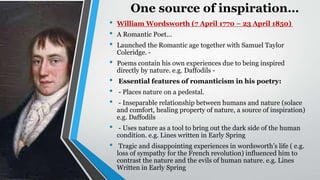
• William Wordsworth (7 April 1770 – 23 April 1850)
• A Romantic Poet...
• Launched the Romantic age together with Samuel Taylor
Coleridge. -
• Poems contain his own experiences due to being inspired
directly by nature. e.g. Daffodils -
• Essential features of romanticism in his poetry:
• - Places nature on a pedestal.
• - Inseparable relationship between humans and nature (solace
and comfort, healing property of nature, a source of inspiration)
e.g. Daffodils
• - Uses nature as a tool to bring out the dark side of the human
condition. e.g. Lines written in Early Spring
• Tragic and disappointing experiences in wordsworth’s life ( e.g.
loss of sympathy for the French revolution) influenced him to
contrast the nature and the evils of human nature. e.g. Lines
Written in Early Spring
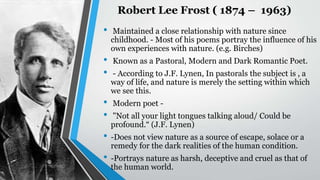
Robert Lee Frost ( 1874 – 1963)
• Maintained a close relationship with nature since
childhood. - Most of his poems portray the influence of his
own experiences with nature. (e.g. Birches)
• Known as a Pastoral, Modern and Dark Romantic Poet.
• - According to J.F. Lynen, In pastorals the subject is , a
way of life, and nature is merely the setting within which
we see this.
• Modern poet -
• "Not all your light tongues talking aloud/ Could be
profound.“ (J.F. Lynen)
• -Does not view nature as a source of escape, solace or a
remedy for the dark realities of the human condition.
• -Portrays nature as harsh, deceptive and cruel as that of
the human world.
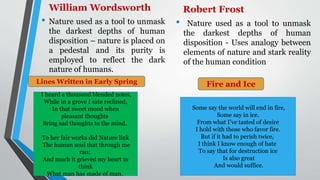
William Wordsworth
• Nature used as a tool to unmask
the darkest depths of human
disposition – nature is placed on
a pedestal and its purity is
employed to reflect the dark
nature of humans.
Robert Frost
• Nature used as a tool to unmask
the darkest depths of human
disposition - Uses analogy between
elements of nature and stark reality
of the human condition
I heard a thousand blended notes,
While in a grove I sate reclined,
In that sweet mood when
pleasant thoughts
Bring sad thoughts to the mind.
To her fair works did Nature link
The human soul that through me
ran;
And much it grieved my heart to
think
What man has made of man.
Some say the world will end in fire,
Some say in ice.
From what I’ve tasted of desire
I hold with those who favor fire.
But if it had to perish twice,
I think I know enough of hate
To say that for destruction ice
Is also great
And would suffice.
Lines Written in Early Spring Fire and Ice
William Wordsworth
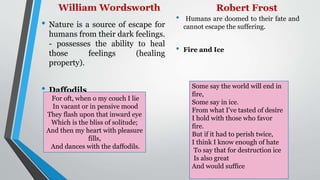
• Nature is a source of escape for
humans from their dark feelings.
- possesses the ability to heal
those feelings (healing
property).
• Daffodils
Robert Frost
• Humans are doomed to their fate and
cannot escape the suffering.
• Fire and Ice
For oft, when o my couch I lie
In vacant or in pensive mood
They flash upon that inward eye
Which is the bliss of solitude;
And then my heart with pleasure
fills,
And dances with the daffodils.
Some say the world will end in
fire,
Some say in ice.
From what I’ve tasted of desire
I hold with those who favor
fire.
But if it had to perish twice,
I think I know enough of hate
To say that for destruction ice
Is also great
And would suffice
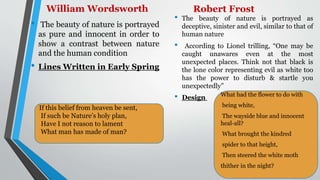
William Wordsworth
• The beauty of nature is portrayed
as pure and innocent in order to
show a contrast between nature
and the human condition
• Lines Written in Early Spring
Robert Frost
• The beauty of nature is portrayed as
deceptive, sinister and evil, similar to that of
human nature
• According to Lionel trilling, “One may be
caught unawares even at the most
unexpected places. Think not that black is
the lone color representing evil as white too
has the power to disturb & startle you
unexpectedly”
• Design
If this belief from heaven be sent,
If such be Nature’s holy plan,
Have I not reason to lament
What man has made of man?
What had the flower to do with
being white,
The wayside blue and innocent
heal-all?
What brought the kindred
spider to that height,
Then steered the white moth
thither in the night?
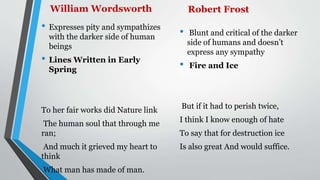
William Wordsworth
• Expresses pity and sympathizes
with the darker side of human
beings
• Lines Written in Early
Spring
To her fair works did Nature link
The human soul that through me
ran;
And much it grieved my heart to
think
What man has made of man.
Robert Frost
• Blunt and critical of the darker
side of humans and doesn’t
express any sympathy
• Fire and Ice
But if it had to perish twice,
I think I know enough of hate
To say that for destruction ice
Is also great And would suffice.
Frost and Wordsworth sees eye to eye...
• In their poems, nature is a constant reminder of the dark reality of the
human condition.
• Acknowledges the dark and inherent qualities of humans.
• The symbolic nature related titles of the poems reflect the prominence
given to nature.
• Ex: Frost – Birches, Leaves Compared with Flowers, Fire and Ice
Wordsworth – Daffodils, A Whirl- blast from Behind the Hill
Conclusion
• It is evident that both poets employ nature as a tool in their poems to
effectively convey the subject matter and themes -
• There is an inextricable link between nature and humans disposition.
• -This presentation is not a generalization of poetry by Frost and
Wordsworth, but rather a discussion of their most prominent features,
in relation to nature and the darkest depths of the human condition.
• There may be a few exceptions, ( “The World Is Too Much With Us” by
Wordsworth ) – deviation from Wordsworth’s usual style.
References
• Ackroyd, P., The Romantics. In
BBC. <http://www.bbc.co.uk/arts/romantics/intro.shtml>
• Gillani, N. S., 2009. Robert Frost: A modern poet. In English
Literature. <http://www.engliterarium.com/2009/02/robert-frost-modern-poet.html>
• Lahti, D., 2012. Lyrical Ballads, and other early poems. In Reflections on Great Literature.
<http://greatlit.qwriting.qc.cuny.edu/2014/06/19/lyrical-ballads-and-other-early-
poems/#more-419>
• Lynen, F. J., 1960. Nature and Pastoralism. New Haven: Yale University
Press.t<http://www.frostfriends.org/FFL/Nature%20and%20Pastoralism%20-
%20Lynen/lynenessay1.html>
• Vincent, C., 2009. The Poetry of Robert Frost. In GradeSaver
<http://www.gradesaver.com/the-poetry-of- robertfrost/study-guide/major-themes>
Comparison: poetry of_frost_and_wordsworth

Comparison: poetry of_frost_and_wordsworth

  • 1.
    Comparison:poetry of Frostand Wordsworth- PREPARED BY-DAYA VAGHANI BATCH-2020-22 (MA SEM-II) PAPER –THE AMERICAN LITERATURE ROLL NO-06 ENROLLMENT NO-3069206420200017 EMAIL ID -DAYAVAGHANI2969@GMAIL.COM SUBMITTED TO-S.B. GARDI DEPARTMENT OF ENGLISH MAHARAJA KRISHNAKUMAR SINHJI BHAVNAGAR UNIVERSITY
  • 2.
    One source ofinspiration… • William Wordsworth (7 April 1770 – 23 April 1850) • A Romantic Poet... • Launched the Romantic age together with Samuel Taylor Coleridge. - • Poems contain his own experiences due to being inspired directly by nature. e.g. Daffodils - • Essential features of romanticism in his poetry: • - Places nature on a pedestal. • - Inseparable relationship between humans and nature (solace and comfort, healing property of nature, a source of inspiration) e.g. Daffodils • - Uses nature as a tool to bring out the dark side of the human condition. e.g. Lines written in Early Spring • Tragic and disappointing experiences in wordsworth’s life ( e.g. loss of sympathy for the French revolution) influenced him to contrast the nature and the evils of human nature. e.g. Lines Written in Early Spring
  • 3.
    Robert Lee Frost( 1874 – 1963) • Maintained a close relationship with nature since childhood. - Most of his poems portray the influence of his own experiences with nature. (e.g. Birches) • Known as a Pastoral, Modern and Dark Romantic Poet. • - According to J.F. Lynen, In pastorals the subject is , a way of life, and nature is merely the setting within which we see this. • Modern poet - • "Not all your light tongues talking aloud/ Could be profound.“ (J.F. Lynen) • -Does not view nature as a source of escape, solace or a remedy for the dark realities of the human condition. • -Portrays nature as harsh, deceptive and cruel as that of the human world.
  • 4.
    William Wordsworth • Natureused as a tool to unmask the darkest depths of human disposition – nature is placed on a pedestal and its purity is employed to reflect the dark nature of humans. Robert Frost • Nature used as a tool to unmask the darkest depths of human disposition - Uses analogy between elements of nature and stark reality of the human condition I heard a thousand blended notes, While in a grove I sate reclined, In that sweet mood when pleasant thoughts Bring sad thoughts to the mind. To her fair works did Nature link The human soul that through me ran; And much it grieved my heart to think What man has made of man. Some say the world will end in fire, Some say in ice. From what I’ve tasted of desire I hold with those who favor fire. But if it had to perish twice, I think I know enough of hate To say that for destruction ice Is also great And would suffice. Lines Written in Early Spring Fire and Ice
  • 5.
    William Wordsworth • Natureis a source of escape for humans from their dark feelings. - possesses the ability to heal those feelings (healing property). • Daffodils Robert Frost • Humans are doomed to their fate and cannot escape the suffering. • Fire and Ice For oft, when o my couch I lie In vacant or in pensive mood They flash upon that inward eye Which is the bliss of solitude; And then my heart with pleasure fills, And dances with the daffodils. Some say the world will end in fire, Some say in ice. From what I’ve tasted of desire I hold with those who favor fire. But if it had to perish twice, I think I know enough of hate To say that for destruction ice Is also great And would suffice
  • 6.
    William Wordsworth • Thebeauty of nature is portrayed as pure and innocent in order to show a contrast between nature and the human condition • Lines Written in Early Spring Robert Frost • The beauty of nature is portrayed as deceptive, sinister and evil, similar to that of human nature • According to Lionel trilling, “One may be caught unawares even at the most unexpected places. Think not that black is the lone color representing evil as white too has the power to disturb & startle you unexpectedly” • Design If this belief from heaven be sent, If such be Nature’s holy plan, Have I not reason to lament What man has made of man? What had the flower to do with being white, The wayside blue and innocent heal-all? What brought the kindred spider to that height, Then steered the white moth thither in the night?
  • 7.
    William Wordsworth • Expressespity and sympathizes with the darker side of human beings • Lines Written in Early Spring To her fair works did Nature link The human soul that through me ran; And much it grieved my heart to think What man has made of man. Robert Frost • Blunt and critical of the darker side of humans and doesn’t express any sympathy • Fire and Ice But if it had to perish twice, I think I know enough of hate To say that for destruction ice Is also great And would suffice.
  • 8.
    Frost and Wordsworthsees eye to eye... • In their poems, nature is a constant reminder of the dark reality of the human condition. • Acknowledges the dark and inherent qualities of humans. • The symbolic nature related titles of the poems reflect the prominence given to nature. • Ex: Frost – Birches, Leaves Compared with Flowers, Fire and Ice Wordsworth – Daffodils, A Whirl- blast from Behind the Hill
  • 9.
    Conclusion • It isevident that both poets employ nature as a tool in their poems to effectively convey the subject matter and themes - • There is an inextricable link between nature and humans disposition. • -This presentation is not a generalization of poetry by Frost and Wordsworth, but rather a discussion of their most prominent features, in relation to nature and the darkest depths of the human condition. • There may be a few exceptions, ( “The World Is Too Much With Us” by Wordsworth ) – deviation from Wordsworth’s usual style.
  • 10.
    References • Ackroyd, P.,The Romantics. In BBC. <http://www.bbc.co.uk/arts/romantics/intro.shtml> • Gillani, N. S., 2009. Robert Frost: A modern poet. In English Literature. <http://www.engliterarium.com/2009/02/robert-frost-modern-poet.html> • Lahti, D., 2012. Lyrical Ballads, and other early poems. In Reflections on Great Literature. <http://greatlit.qwriting.qc.cuny.edu/2014/06/19/lyrical-ballads-and-other-early- poems/#more-419> • Lynen, F. J., 1960. Nature and Pastoralism. New Haven: Yale University Press.t<http://www.frostfriends.org/FFL/Nature%20and%20Pastoralism%20- %20Lynen/lynenessay1.html> • Vincent, C., 2009. The Poetry of Robert Frost. In GradeSaver <http://www.gradesaver.com/the-poetry-of- robertfrost/study-guide/major-themes>