PREPARED BY-DAYA VAGHANI
BATCH-2020-22 (MA SEM-II)
PAPER –HISTORY OF ENGLISH LITERATURE FROM 1900 TO 2000
ROLL NO-06
ENROLLMENT NO-3069206420200017
EMAIL ID -DAYAVAGHANI2969@GMAIL.COM
SUBMITTED TO-S.B. GARDI DEPARTMENT OF ENGLISH
MAHARAJA KRISHNAKUMARSINHJI
BHAVNAGAR UNIVERSITY
Modern Setting: Science Fiction
What is Science Fiction
 science fiction, abbreviation SF or sci-fi, a form of fiction that deals
principally with the impact of actual or imagined science upon society or
individuals. The term science fiction was popularized, if not invented, in the
1920s by one of the genre’s principal advocates, the American publisher Hugo
Gernsback. The Hugo Awards, given annually since 1953 by the World Science
Fiction Society, are named after him. These achievement awards are given to
the top SF writers, editors, illustrators, films, and fanzines.
Sterling, Bruce. "science fiction". Encyclopedia Britannica, 3 Jun.
2021, https://www.britannica.com/art/science-fiction. Accessed 23 June 2021.
What is Science Fiction
Although the term science fiction was not used until
about 1930, science fiction tales have been told since
before the invention of writing. One of the earliest
science fiction writers was Lucian of Samosata who,
around 100 BC, wrote a fantasy about a journey to the
moon. Modern science fiction began to take shape in the
nineteenth century.
Key Elements
 Set in the future
 Theoretically plausible plots..... Often predict future
technological developments, and even inspire them!
 Presents some kind of prediction or warning about the future....
This is usually considered the theme.
 Other Common Elements
 Space travel / exploration
 Aliens
 Monsters often the product of radiation, like Godzilla
 Futuristic technology..... Weapons, computers, and especially
ROBOTS!
○ The word “robot” was coined by a SciFi writer
Key Themes in Sci-Fi
 The first theme: concerns the contention between the individual and
the larger society.
 Explores contemporary issues such as individual rights, social
demands, our culture coming under increasing surveillance, popular
culture, and rampant anti-intellectualism.
 The second theme we will explore looks into rapidly evolving
computer technology and artificial intelligence.
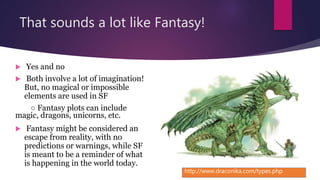
That sounds a lot like Fantasy!
 Yes and no
 Both involve a lot of imagination!
But, no magical or impossible
elements are used in SF
○ Fantasy plots can include
magic, dragons, unicorns, etc.
 Fantasy might be considered an
escape from reality, with no
predictions or warnings, while SF
is meant to be a reminder of what
is happening in the world today.
http://www.draconika.com/types.php
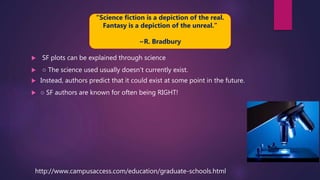
 SF plots can be explained through science
 ○ The science used usually doesn’t currently exist.
 Instead, authors predict that it could exist at some point in the future.
 ○ SF authors are known for often being RIGHT!
http://www.campusaccess.com/education/graduate-schools.html
“Science fiction is a depiction of the real.
Fantasy is a depiction of the unreal.”
~R. Bradbury
 Science fiction is a literature with a
heritage reaching back into ancient
times, to a pre-scientific world
inhabited by peoples whose myths,
legends and superstitions became a way
of thinking about and explaining the
wonders of the universe. The seeds of
science fiction were planted thousands
of years ago, as the human species
dreamed of the great unknown.
Marshall B.Tymn
'Science Fiction: A Brief
History and Review of
Criticism'
 I used to believe that science fiction was a form of proto-
literature, like the Breton lays from which the great cycles
of Arthurian romance were supposed to have emerged; and
that when the stock of gad- getry was compiete, some genius
would take the whole imaginary world, and turn into
literature But I was wrong. Science fiction is a prototype, not
of science liter- ature but of science fact, and the best way to
improve it is to leave the literary ele- ments out.
-Virginia F. Bereit
'The Genre of Science Fiction'
Science fiction is defined loosely as fiction that deals
with the impact of science and technology on the
world. Sometimes the technology is real, sometimes it
is entirely imagined, and sometimes it has been
imagined by an author and then brought to reality by
scientists. Science fiction themes often warn of the
potential for disaster when technology is abused.
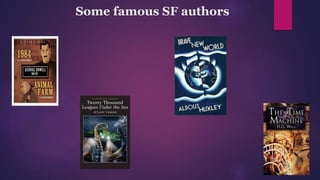
Some famous SF authors
Related Genres
 Utopian Literature
The word utopia resembles both the Greek words "no place", "outopos", and
"good place", "eutopos". A vision of an ideal society.
 Dystopian Literature
Dystopia is defined as a society characterized by a focus on mass poverty, squalor,
suffering, or oppression. Most authors of dystopian fiction explore at least one
reason why things are that way, often as an analogy for similar issues in the real
world.
 Ecotopian Literature
where the author posits either a utopian or dystopian world revolving around
environmental conservation or destruction.
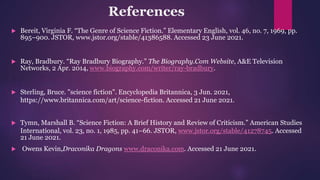
References
 Bereit, Virginia F. “The Genre of Science Fiction.” Elementary English, vol. 46, no. 7, 1969, pp.
895–900. JSTOR, www.jstor.org/stable/41386588. Accessed 23 June 2021.
 Ray, Bradbury. “Ray Bradbury Biography.” The Biography.Com Website, A&E Television
Networks, 2 Apr. 2014, www.biography.com/writer/ray-bradbury.
 Sterling, Bruce. "science fiction". Encyclopedia Britannica, 3 Jun. 2021,
https://www.britannica.com/art/science-fiction. Accessed 21 June 2021.
 Tymn, Marshall B. “Science Fiction: A Brief History and Review of Criticism.” American Studies
International, vol. 23, no. 1, 1985, pp. 41–66. JSTOR, www.jstor.org/stable/41278745. Accessed
21 June 2021.
 Owens Kevin,Draconika Dragons www.draconika.com. Accessed 21 June 2021.
Modern Setting: Science Fiction

Modern Setting: Science Fiction

  • 1.
    PREPARED BY-DAYA VAGHANI BATCH-2020-22(MA SEM-II) PAPER –HISTORY OF ENGLISH LITERATURE FROM 1900 TO 2000 ROLL NO-06 ENROLLMENT NO-3069206420200017 EMAIL ID -DAYAVAGHANI2969@GMAIL.COM SUBMITTED TO-S.B. GARDI DEPARTMENT OF ENGLISH MAHARAJA KRISHNAKUMARSINHJI BHAVNAGAR UNIVERSITY Modern Setting: Science Fiction
  • 2.
    What is ScienceFiction  science fiction, abbreviation SF or sci-fi, a form of fiction that deals principally with the impact of actual or imagined science upon society or individuals. The term science fiction was popularized, if not invented, in the 1920s by one of the genre’s principal advocates, the American publisher Hugo Gernsback. The Hugo Awards, given annually since 1953 by the World Science Fiction Society, are named after him. These achievement awards are given to the top SF writers, editors, illustrators, films, and fanzines. Sterling, Bruce. "science fiction". Encyclopedia Britannica, 3 Jun. 2021, https://www.britannica.com/art/science-fiction. Accessed 23 June 2021.
  • 3.
    What is ScienceFiction Although the term science fiction was not used until about 1930, science fiction tales have been told since before the invention of writing. One of the earliest science fiction writers was Lucian of Samosata who, around 100 BC, wrote a fantasy about a journey to the moon. Modern science fiction began to take shape in the nineteenth century.
  • 4.
    Key Elements  Setin the future  Theoretically plausible plots..... Often predict future technological developments, and even inspire them!  Presents some kind of prediction or warning about the future.... This is usually considered the theme.  Other Common Elements  Space travel / exploration  Aliens  Monsters often the product of radiation, like Godzilla  Futuristic technology..... Weapons, computers, and especially ROBOTS! ○ The word “robot” was coined by a SciFi writer
  • 5.
    Key Themes inSci-Fi  The first theme: concerns the contention between the individual and the larger society.  Explores contemporary issues such as individual rights, social demands, our culture coming under increasing surveillance, popular culture, and rampant anti-intellectualism.  The second theme we will explore looks into rapidly evolving computer technology and artificial intelligence.
  • 6.
    That sounds alot like Fantasy!  Yes and no  Both involve a lot of imagination! But, no magical or impossible elements are used in SF ○ Fantasy plots can include magic, dragons, unicorns, etc.  Fantasy might be considered an escape from reality, with no predictions or warnings, while SF is meant to be a reminder of what is happening in the world today. http://www.draconika.com/types.php
  • 7.
     SF plotscan be explained through science  ○ The science used usually doesn’t currently exist.  Instead, authors predict that it could exist at some point in the future.  ○ SF authors are known for often being RIGHT! http://www.campusaccess.com/education/graduate-schools.html “Science fiction is a depiction of the real. Fantasy is a depiction of the unreal.” ~R. Bradbury
  • 8.
     Science fictionis a literature with a heritage reaching back into ancient times, to a pre-scientific world inhabited by peoples whose myths, legends and superstitions became a way of thinking about and explaining the wonders of the universe. The seeds of science fiction were planted thousands of years ago, as the human species dreamed of the great unknown. Marshall B.Tymn 'Science Fiction: A Brief History and Review of Criticism'
  • 9.
     I usedto believe that science fiction was a form of proto- literature, like the Breton lays from which the great cycles of Arthurian romance were supposed to have emerged; and that when the stock of gad- getry was compiete, some genius would take the whole imaginary world, and turn into literature But I was wrong. Science fiction is a prototype, not of science liter- ature but of science fact, and the best way to improve it is to leave the literary ele- ments out. -Virginia F. Bereit 'The Genre of Science Fiction'
  • 10.
    Science fiction isdefined loosely as fiction that deals with the impact of science and technology on the world. Sometimes the technology is real, sometimes it is entirely imagined, and sometimes it has been imagined by an author and then brought to reality by scientists. Science fiction themes often warn of the potential for disaster when technology is abused.
  • 11.
  • 12.
    Related Genres  UtopianLiterature The word utopia resembles both the Greek words "no place", "outopos", and "good place", "eutopos". A vision of an ideal society.  Dystopian Literature Dystopia is defined as a society characterized by a focus on mass poverty, squalor, suffering, or oppression. Most authors of dystopian fiction explore at least one reason why things are that way, often as an analogy for similar issues in the real world.  Ecotopian Literature where the author posits either a utopian or dystopian world revolving around environmental conservation or destruction.
  • 13.
    References  Bereit, VirginiaF. “The Genre of Science Fiction.” Elementary English, vol. 46, no. 7, 1969, pp. 895–900. JSTOR, www.jstor.org/stable/41386588. Accessed 23 June 2021.  Ray, Bradbury. “Ray Bradbury Biography.” The Biography.Com Website, A&E Television Networks, 2 Apr. 2014, www.biography.com/writer/ray-bradbury.  Sterling, Bruce. "science fiction". Encyclopedia Britannica, 3 Jun. 2021, https://www.britannica.com/art/science-fiction. Accessed 21 June 2021.  Tymn, Marshall B. “Science Fiction: A Brief History and Review of Criticism.” American Studies International, vol. 23, no. 1, 1985, pp. 41–66. JSTOR, www.jstor.org/stable/41278745. Accessed 21 June 2021.  Owens Kevin,Draconika Dragons www.draconika.com. Accessed 21 June 2021.