




THE UNITED ARCHITECTS OF THE PHILIPPINES
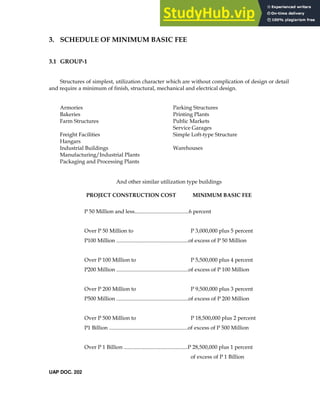
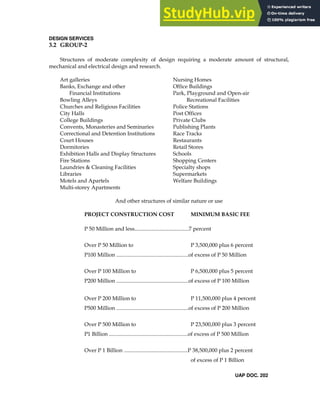
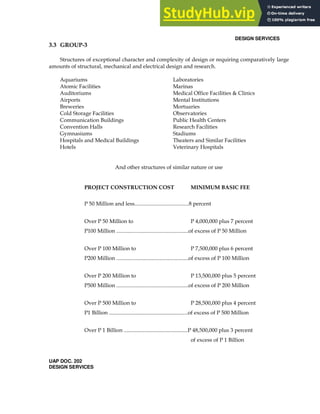
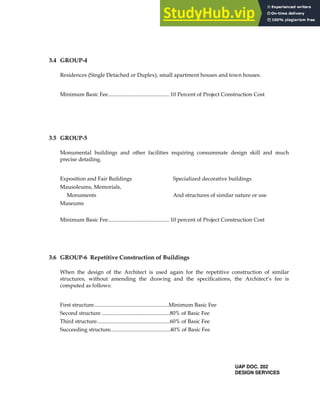
THE DULY ACCREDITED BONA FIDE PROFESSIONAL ORGANIZATION OF ARCHITECTS
FOLK ARTS THEATER, CCP COMPLEX, ROXAS BLVD., PASAY CITY, METRO MANILA
TELEPHONES: 551-4233,551-4329, 551-4350, 832-1120 loc. 09 FAX: 832-7850
ARCHITECT’S
N A T I O N A L
C O D E
CODE OF ETHICAL CONDUCT
UAP DOC. 200
STANDARDS OF PROFESSIONAL PRACTICE
UAP DOC. 201 • PRE-DESIGN SERVICES
202 • DESIGN SERVICES
203 • SPECIALIZED AND ALLIED SERVICES
204 • CONSTRUCTION SERVICES
205 • POST-CONSTRUCTION SERVICES
206 • COMPREHENSIVE ARCHITECTURAL SERVICES
207 • DESIGN-BUILD SERVICES
208 • SELECTION OF THE ARCHITECT
AND METHODS OF COMPENSATION
COPYRIGHT 1979
By
The United Architects of the Philippines, Inc.
ALL RIGHTS RESERVED
This Document or parts thereof may not be reproduced in any form without written
permission from the United Architects of the Philippines, Inc. Printed copies are available
for the use of all practicing Architects in the Philippines.
ARCHITECT’S
NATIONAL
CODE
DOCUMENTS
SERIES 200
200 - CODE OF ETHICAL CONDUCT
TABLE OF CONTENTS
PAGES
PREFACE
PROFESSIONAL REGULATION COMMISSION
BOARD OF ARCHITECTURE RESOLUTIONS
UAP RESOLUTIONS
8 FOREWORD AND
“THE VIRTUES OF AN ARCHITECT”
9 THE ARCHITECT’S CODE OF ETHICS
10 CODE OF ETHICAL CONDUCT
11 • THE ARCHITECT’S RESPONSIBILITIES IN
RELATION TO THE PEOPLE
12 • THE ARCHITECT’S RESPONSIBILITIES IN
RELATION TO HIS CLIENT
13 • THE ARCHITECT’S RESPONSIBILITIES IN
RELATION TO THE CONTRACTOR
14 • THE ARCHITECT’S RESPONSIBILITIES IN
RELATION TO MANUFACTURERS,
DEALERS AND AGENTS
15 • THE ARCHITECT’S RESPONSIBILITIES IN
RELATION TO HIS COLLEAGUES AND
SUBORDINATES
STANDARDS OF PROFESSIONAL PRACTICE
201 - PRE-DESIGN SERVICES
ARCHITECTURAL PROGRAMMING
FEASIBILITY STUDY, ETC.
202 - DESIGN SERVICES
REGULAR SERVICES
203 - SPECIALIZED ALLIED SERVICES
INTERIORS, LANDSCAPING,
ACOUSTICS, COMMUNICATIONS,
ELECTRONICS, PLANNING
TABLE OF CONTENTS
PAGES
16 FOREWORD
17 THE VALUE OF THE ARCHITECT
18 THE SPECTRUM OF THE ARCHITECT’S SERVICES
20 DOC. 201 - PRE-DESIGN SERVICES
22 DOC. 202 - ARCHITECT’S DESIGN SERVICES
(1) - “REGULAR SERVICES”
(2) - PROJECT CLASSIFICATION
(3) - SCHEDULE OF MINIMUM BASIC FEE
(4) - PAYMENT SCHEDULE
(5) - OWNER’S RESPONSIBILITIES
(6) - OTHER CONDITIONS ON SERVICES
35 DOC. 203 - SPECIALIZED ALLIED SERVICES
36 DOC. 203-a INTERIOR DESIGN SERVICES
37 DOC. 203-b ACOUSTIC; COMMUNICATION AND ELECTRONIC
ENGINEERING SERVICES
39 DOC 203-c LANDSCAPE DESIGN SERVICES
40 DOC. 203-d PHYSICAL PLANNING SERVICES
43 DOC. 203-e COMPREHENSIVE PLANNING SERVICES
STANDARDS OF PROFESSIONAL PRACTICE
204 - CONSTRUCTION SERVICES
FULL-TIME SUPERVISION
CONSTRUCTION MANAGEMENT
205 - POST-CONSTRUCTION SERVICES
BUILDING AND GROUNDS ADMINISTRATION
206 - COMPREHENSIVE ARCHITECTURAL SERVICES
PROJECT MANAGEMENT
207 - DESIGN-BUILD SERVICES
208 - SELECTION OF THE ARCHITECT AND
SYSTEMS OF REMUNERATIONS
TABLE OF CONTENTS
PAGES
48 UAP DOC. 204: CONSTRUCTION SERVICES
49 • 204-a FULL-TIME SUPERVISION
52 • 204-b CONSTRUCTION MANAGEMENT
63 UAP DOC. 205: POST-CONSTRUCTION SERVICES
64 UAP DOC. 206: COMPREHENSIVE ARCHITECTURAL SERVICES
72 UAP DOC. 207: DESIGN-BUILD SERVICES
74 UAP DOC. 208: SELECTION OF THE ARCHITECT
& METHODS OF COMPENSATION
• 208-a SELECTION OF THE ARCHITECT
78 • 208-b METHODS OF COMPENSATION
83 • “MAY I ALWAYS BUILD”
• UAP OBJECTIVES
PREFACE
On January 21, 1933, the first document entitled “Relation of Charges and
Rules Relative to Professional Fees” was promulgated and adopted by the
Philippine Architects Society (PAS), the first architectural association organized in
the Philippines. The second edition of their document was made on February 21,
1941.
After the name of the organization was changed to “Philippine Institute of
Architects” (PIA), a new Code of Ethics was published on April 7, 1946. This was
amended and a fourth edition was published in 1950.
On November 25, 1960, after re-examining the Code of Ethics, a new set of
documents entitled “National Code of Architect’s Services and Fees in the
Philippines” was published.
On October 23, 1965, the “Architect’s National Code” was approved by the
three organizations existing at that time, namely, the Philippine Institute of Architects
(PIA), the League of Philippine Architects (LPA), and the Association of Philippine
Government Architects (APGA).
On January 15, 1975, the three architectural organizations were integrated
into one association called the “United Architects of the Philippines” (UAP).
In the process of consolidating all the documents of the three organizations,
the UAP saw the need to review and update them in order to be more responsive to
the practice of the profession in the Philippines. The first draft of the revised code
was published by the UAP in October 1977.
In the continuing examination of the expanding practice of the architect, the
UAP Committee on Professional Practice which was tasked to prepare the final draft,
decided to divide the Architect’s National Code into two divisions, namely:
1. Code of Ethical Conduct
- and -
2. Standards of Professional Practice
UAP DOC. 200
CODE OF ETHICAL CONDUCT
Due to the several facets of services now being undertaken by the Architect,
the Committee deemed it necessary to classify the services of the Architect and
assign each classification as a section under the Standards of Professional Practice
document. This will contribute to a better understanding by the Client of the scope of
services and responsibilities of the Architect in each area of the Architect’s
involvement. It will further facilitate easy reference for the Architect. The
classification with the corresponding sections are as follows:
STANDARDS OF PROFESSIONAL PRACTICE
1. Pre-Design Services - UAP Doc. 201
2. Design Services - UAP Doc. 202
3. Specialized Allied Services - UAP Doc. 203
4. Construction Services - UAP Doc. 204
5. Post-Construction Services - UAP Doc. 205
6. Comprehensive Architectural Services - UAP Doc. 206
7. Design-Build Services - UAP Doc. 207
8. Selection of Architects and
Methods of Compensation - UAP Doc. 208
9. Competition Code - UAP Doc. 209
The final form of the Architect’s National Code was approved by the UAP
National Board of Directors on July 21, 1979 and the Professional Regulation
Commission through the Board of Architecture on Sept. 24, 1979 for adoption and
compliance by the practicing Architects in the Philippines
COMMITTEE ON PROFESSIONAL PRACTICE AND ETHICS
Chairman - Felipe M. Mendoza, FUAP
Vice Chairman - Froilan L. Hong, CUAP
Members - Otilio A. Arellano, FUAP
- Cesar V. Canchela, FUAP
- Antonio S. Dimalanta, FUAP
- Cristina Fugoso, FUAP
- Geronimo V. Manahan, CUAP
- Norberto M. Nuke, FUAP
- Rebecca V. Tobia, CUAP
BOARD OF ARCHITECTURE
Resolution No. 9-A
Series of 1979
WHEREAS, under Resolution No. 79-81 dated July 21, 1979, the United Architects
of the Philippines submitted a draft of the proposed Code of Ethical
Conduct and the Standards for Professional Practice of Architecture
with a request that the same be adopted as the National Code for
Architects in the Philippines;
WHEREAS, the Professional Regulation Commission and the Board of Architecture
acknowledge the urgency of adopting a national code for architects for
the proper maintenance of ethical and professional standards in the
practice of architecture and for the protection of life, health and property;
WHEREAS, the Board of Architecture, after a review of the draft, finds the proposed
Code of Ethical Conduct, UAP Document No. 200, and the proposed
Standards of Professional Practice, UAP Documents Nos. 201, 202,
203, 204, 205, 206, 207 and 208, which are hereto attached and made
integral parts of this Resolution, to be responsive to the demands and
requirements of the profession, and when implemented will achieve the
desired high degree of professionalism that will redound to the best
interest of the profession and the public;
NOW THEREFORE, pursuant to Sections 2 and 8 of R.A. No. 545, as amended, the
Board of Architecture hereby adopts the attached UAP Documents Nos.
200, 201, 202, 203, 204, 205, 206, 207 and 208 as the NATIONAL
CODE FOR ARCHITECTS and as part of the Rules and regulations to
which all practicing architects shall conform in the performance of their
duties and obligations, a violation of which shall be a ground for the
suspension or revocation of the certificate of registration of a practicing
architect.
The attached NATIONAL CODE FOR ARCHITECTS consisting of
Documents Nos. 200.1 to 200.5, 201.1 to 201.4, 202.1 to 202.6, 203.1,
203.a to 203.e, 204.a to 204.b, 205.5, 206.1 to 206.8, 207.1 to 207.3,
208.a to 208.b, inclusive, shall take effect after fifteen (15) days
following its publication in the Official Gazette.
DONE IN THE CITY OF MANILA, this 19th day of September in the
year of our Lord Nineteen Hundred and Seventy Nine.
ANASTACIO R. BERNAL
Chairman
Sgd. Sgd.
NORBERTO M. NUKE CRESENCIO DE CASTRO
Member Member
APPROVED AND PROMULGATED AS PART OF THE RULES AND
REGULATIONS GOVERNING THE PRACTICE OF ARCHITECTURE IN
THE PHILIPPINES, this 24th day of September, 1979.
Sgd. Sgd.
NUMERIANO TANOPO, JR. ERIC C. NUBLA
Associate Commissioner Commissioner
Resolution No. 79-18
Series of 1979
The United Architects of the Philippines
WHEREAS, there were existing standards on professional practice for Architects
since 1985 adopted and in use by the members of the three
architectural organizations, the Association of Philippine Government
Architects (APGA), the League of Philippine Architects (LPA), and the
Philippine Institute of Architects (PIA), before their integration in 1975
into one national organization the United Architects of the Philippines
(UAP);
WHEREAS, in the desire of the members of the UAP to make the practice of
architecture relevant to the demands of our time, our people and our
government’s thrust for national development, the UAP Committee on
Professional Practice prepared a new set of documents on Standards of
Professional Practice and Code of Ethical Conduct embodied in the
Architect’s National Code, and other standard Contract Documents;
WHEREAS, these documents were presented and distributed to the members on
December 1977 and discussed and approved by the members in 1978
and 1979 during the provincial chapter and regional conferences;
WHEREAS, upon the certification of UAP as the only duly accredited bonafide
professional organization for architects in the country, the Board of
Architecture of the Professional Regulation Commission requested the
UAP to prepare documents on Standards of Professional Practice and
Code of Ethical Conduct for Architects to maintain a high standard of
ethical conduct and excellence in the practice of the architectural
profession;
NOW THEREFORE, be it resolved as it is hereby resolved that the Architect’s
National Code and all Standard Documents related to the professional
practice of the Architect as prepared by the Committee on Professional
Practice and Ethics, and approved by the UAP Board and the general
membership, be submitted to the Professional Regulation Commission
through the Board of Architecture for their approval.
RESOLVED FURTHER, that copies of this Resolution and the Architect’s National
Code and all Standard Documents be furnished the Professional
Regulation Commission (PRC) through the Board of Architecture as a
response to their request, and enjoining them to adopt and require these
as the standard documents for use and compliance by all Architects in
the Philippines.
Done this 21st day of July, 1979 in Metro-Manila, Philippines.
Sgd.
FELIPE M. MENDOZA, FUAP
National President
Sgd.
CESAR V. CANCHELA, FUAP
National Secretary
FOREWORD
Adherence to the Principles of the Architect’s National Code is an obligation
of every architect and member of the United Architects of the Philippines. Any
deviation therefrom shall be subject to discipline in proportion to its seriousness. The
National Board of Directors of the United Architects of the Philippines and the Board
of Architecture, Professional Regulation Commission, shall have the sole power of
interpreting the provisions of this Code.
! " # #"$
%"& ! & $ ' !
' " (
$ & ")
( # &!
*" $ ) & ( &
' +++
"& "( "& , $$
UAP DOC. 200
CODE OF ETHICAL CONDUCT
- .
I shall work with this general objective - that my duty is not only to myself, but also to my
Country and God.
I shall uphold the ideals and follow the norms of conduct of a noble profession and endlessly
endeavor to further its just ends.
I shall humbly seek success not through the measure of solicited personal publicity, but by
industrious application to my work, strive to merit a reputation for quality of service and for fair
dealing.
I shall ask from all, fair remuneration for my services while expecting and asking no profits
from any other source.
I shall hold the interest of my Client over and above any self-interest for financial returns.
I shall exercise my professional prerogatives always with impartiality and disinterestedness.
I shall avoid any private business investments or venture which may tend to influence my
professional judgment to the detriment of the trust placed upon me.
I shall inspire by my behaviour the loyalty of my associates and subordinates and take upon
me the mentorship of the aspirants to the profession.
I shall confine my criticisms and praises within constructive and inspirational limits and never
resort to these means to further malicious motives.
I shall dedicate myself to the pursuit of creative endeavor towards the goal of enlightened Art
and Science, generously sharing with colleagues, friends and strangers alike the benefits of
my experience and experiments.
UAP DOC. 200
CODE OF ETHICAL CONDUCT
. / .
!
" ! # $
UAP DOC. 200
CODE OF ETHICAL CONDUCT
THE ARCHITECT’S RESPONSIBILITIES IN RELATION TO
THE PEOPLE
1
STATEMENT: The Architect is engaged in a profession which carries
with it civic responsibilities towards the public, whether such
responsibilities are the natural outcome of good citizenship or of his
professional pursuit or whether they partake of informative and
educational matters or of his normal, good public relations.
1-a The Architect shall seek opportunities to be of constructive service
in civic and urban affairs and to the best of his ability advance the
safety, health and well-being of the people and the community as
well as the promotion, restoration or preservation of the general
amenities and other examples of historic and architectural heritage
of the nation.
1-b The Architect shall promote the interest of his professional
organization and do his full part of the work to enhance the
objectives and services of the organization. He should share in the
interchange of technical information and experience with the other
design professions and the building industry.
1-c The Architect as a good citizen shall abide and observe the laws and
regulations of the government and comply with the standards of
ethical conduct and practice of the profession in the Philippines.
He shall at no time act in a manner detrimental to the best interest
of the profession.
1-d The Architect shall not use paid advertisement nor use self-
laudatory, exaggerated or misleading, publicity. However, the
presentation of factual materials, verbal or visual, of the aims,
standards and progress of the profession through literature or by
industrious application of his work and services which tend to
dignify the professional or advance public knowledge of the
Architect’s function in society may be presented through any public
communication media.
1-e The Architect shall not solicit nor permit to solicit in his name,
advertisements or other support towards the cost of any publication
presenting his work. He should refrain from taking part in paid
advertisement endorsing any materials of construction or building
equipment.
1-f The Architect shall not mislead the public through advertisements,
signs or printed matter citing his professional specializations unless
such qualifications are well known facts or sanctioned by
professional consensus and years of experience.
UAP DOC. 200
CODE OF ETHICAL CONDUCT
THE ARCHITECT’S RESPONSIBILITIES IN RELATION TO
HIS CLIENT
2
STATEMENT: The Architect’s relation to his Client is dependent upon
good faith. To insure the continued existence of such state of good
relationship, the Architect’s position carries with it certain moral
obligations to his Client and to himself.
2-a The Architect may introduce to a prospective Client the
professional services he is able to perform provided it is limited to
presentation of examples of his professional experience and does
not entail the offering of free preliminary sketches or other services
without the benefit of an agreement with the Client for legitimate
compensation.
2-b The Architect shall acquaint or ascertain from the Client at the very
inception of their business relationship, the exact nature and scope
of his services and the corresponding professional charges.
2-c The Architect shall advise a Client against proceeding with any
project whose practicability may be questionable due to financial,
legal or arresting or exigent conditions, even if such advice may
mean the loss of a prospective commission to the Architect.
2-d The Architect shall explain the conditional character of estimates
other than estimates submitted in the form of actual proposals by
contractors and in no case shall he guarantee any estimates or cost
of the work in order to secure a commission.
2-e The Architect shall consider the needs and stipulation of his Client
and the effects of his work upon the life and well-being of the
public and the community as a whole, and to endeavor to meet the
aesthetic and functional requirements of the project commensurate
with the Client’s appropriation.
2-f The Architect shall charge his Client for services rendered, a
professional fee commensurate with the work involved and with his
professional standing and experience based upon the Basic
Minimum Fee prescribed under the “Standards of Professional
Practice” of the “Architect’s National Code.”
2-g The Architect shall not undertake, under a fixed contract sum
agreement, the construction of any project based on plans prepared
by him. He may in certain cases, undertake the construction of a
project even when the plans were prepared by him provided it is
undertaken in conformity with the conditions set forth under
sections covering “Construction Services”, “Comprehensive
Services” or “Design-Build Services” of the document on
“STANDARDS OF PROFESSIONAL PRACTICE.”
UAP DOC. 200
CODE OF ETHICAL CONDUCT
2-h The Architect shall be compensated for his services solely through
his professional fee charged directly to the Client. He shall not
accept nor ask for any other returns in whatever form from any
interested source other than the Client.
2-i The Architect shall be free in his investments and business relations
outside of his profession from any financial or personal interests
which tend to weaken and discredit his standing as an unprejudiced
and honest adviser, free to act in his Client’s best interests. If the
Architect has any business interest which will relate to, or affect the
interest of his Client, he should inform his Client of such condition
or situation.
2-j The Architect shall include in his agreement with the Client a
clause providing for arbitration as a method for settlement of
disputes.
THE ARCHITECT’S RESPONSIBILITIES IN RELATION TO
THE CONTRACTOR
3
STATEMENT: The Contractor depends upon the Architect to safeguard
fairly his interests as well as those of the Client.
3-a The Architect shall give the Contractor every reasonable aid to
enable him to fully understand the contents of the Contract
Documents by furnishing clear, definite and consistent information
in all pertinent contract documents to avoid unnecessary mistakes
that may involve extra costs to the Contractor.
3-b The Architect shall not knowingly call upon the Contractor to
correct or remedy oversights or errors in the Contract Documents to
the Contractor’s financial disadvantage.
3-c The Architect shall immediately upon his personal knowledge and
inspection, reject or condemn materials, equipment or workmanship
which are not in conformity with the Contract Documents in order
not to cause unnecessary delay and additional expense to the
Contractor.
3-d The Architect shall not, at any time or circumstance, accept free
engineering services, or receive any substantial aid, gifts,
commissions, or favors from any Contractor or sub-contractor
which will tend to place him under any kind of moral obligation.
3-e The Architect shall upon request by the Contractor promptly inspect
each phase of the work completed and if found according to the
terms of the Contract Documents issue the corresponding
Certificates of Payment and the Final Certificate of Completion,
respectively, to the Contractor.
UAP DOC. 200
CODE OF ETHICAL CONDUCT
THE ARCHITECT’S RESPONSIBILITIES IN RELATION TO
MANUFACTURERS, DEALERS, AND AGENTS
4
STATEMENT: An exchange of technical information between
Architects and those who supply and handle building materials or
equipment is necessary and therefore encouraged and commended.
However;
4-a The Architect shall not avail or make use of engineering or other
technical services offered by manufacturers, or suppliers of building
materials or equipment which may be accompanied by an
obligation detrimental to the best interest of the Client or which
may adversely affect the Architect’s professional opinion.
4-b The Architect shall not at any time receive commissions, discounts,
fees, gifts or favors from agents or firms handling building
materials or equipment which may place him in a reciprocal frame
of mind. He may however, accept market discounts which shall be
credited to the Client.
THE ARCHITECT’S RESPONSIBILITIES IN RELATION TO HIS
COLLEAGUES AND SUBORDINATES
5
STATEMENT: The Architect has moral responsibilities towards his
profession, his colleagues and his subordinates.
5-a The Architect shall not render professional services without
compensation except for small civic or charity projects. He shall
neither offer nor provide preliminary services on a conditional basis
prior to definite agreement with the Client for the commission of
the project.
5-b The Architect shall not knowingly compete with other Architects on
the basis of difference of professional charges, nor use donation as
a device for obtaining competitive advantage except for worthy
civic or religious projects. Neither shall he submit solicited or
unsolicited sketches or drawings in competition with other
Architects unless such competitive arrangements are conducted
substantially under the terms of the UAP Architectural Competition
Code.
5-c The Architect shall not under any circumstances nor through any
means seek commissions already known to him as previously
endowed to another Architect, whether such endowment has been
definitely agreed upon or still in the process of negotiation.
5-d The Architect shall not, in any case, enter as a competitor in any
Architectural Competition when he has direct relations with the
formulation of the Program thereof or when he has been
engaged
UAP DOC. 200
CODE OF ETHICAL CONDUCT
to act as Professional Adviser or Juror for such competition. Neither
shall the Architect accept and act as professional adviser or juror in any
architectural competition when he has had any information or has
reviewed or assisted in the preparation of any competition design
entered. Nor shall an Architect, retained as professional adviser in a
competition, accept employment as an Architect for that competition
project except as Consulting Architect.
5-e The Architect shall not undertake a commission for which he knows
another Architect has been previously employed until he notified such
other Architect of the fact in writing and has conclusively determined
that the original employment has been terminated and has been duly
compensated for.
5-f The Architect shall not undertake a commission for additions,
rehabilitation or remodeling of any erected structure undertaken
previously by another Architect without duly notifying him of the
contemplated project even when the Owner is no longer the same.
When the greater mass, area or design of the original structure is
substantially maintained the new Architect should limit his
advertisement or claim only to the extent of the work done to the
structure. Architects are enjoined to preserve or restore as much as
possible especially the few and remaining historic examples of our
architectural heritage affecting this phase of practice.
5-g The Architect shall not knowingly injure falsely or maliciously, the
professional reputation, prospects or practice of another Architect.
5-h The Architect shall refrain from associating himself with or allowing
the use of his name by an enterprise of doubtful character or integrity.
5-i The Architect shall not affix his signature and seal to any plans or
professional documents prepared by other persons or entities not done
under his direct personal supervision.
5-j The Architect shall inspire the loyalty of his employees and
subordinates by providing them with suitable working conditions,
requiring them to render competent and efficient services and paying
them adequate and just compensation therefor. He shall tutor and
mentor the young aspirants towards the ideals, functions, duties and
responsibilities of the profession.
5-k The Architect shall unselfishly give his share in the interchange of
technical information and experience among his colleagues and young
aspirants and do his part in fostering unity in the fellowship of the
profession.
5-l He shall unselfishly give his time and effort to the advancement of the
profession thru his active and personal commitment and involvement
with the accredited professional organization for architects.
UAP DOC. 200
CODE OF ETHICAL CONDUCT
ARCHITECT’S NATIONAL CODE
. .
, / ,
, . + 012 • , . 3
010 • . 3
014 • , / 5 . .
// .
FOREWORD
From a synthesis of the past 50 years of Architect-Client relations in the Philippines, this
division of the ARCHITECTS NATIONAL CODE entitled “STANDARDS OF PROFESSIONAL
PRACTICE” is adopted primarily to set a norm of practice of the profession.
The Code defines all aspects of professional service, prescribes the MINIMUM BASIC FEE
relative to each phase of service and thereby establishes the rights and obligations of both the
Architect and his Client.
It stresses the principle that the Architect’s qualification which is based upon his ability,
experience and integrity on one hand, requires the full trust and sympathetic cooperation of the
Client on the other. Their relationship depends upon good faith and mutual respect in order to
inspire the Architect to produce his best work and a sustained devotion to his Client’s interest. For
these ends, the conditions and standards prescribed in this Code should be respected and
adhered to.
The National Board of Directors of the United Architects of the Philippines and the Board of
Architecture, Professional Regulation Commission, shall have the sole power of interpreting the
provisions of this Code.
STANDARDS OF PROFESSIONAL PRACTICE
THE VALUE OF THE ARCHITECT
The Architect creates man’s environment through his awareness and sensitive handling of
spaces that fit the scale of human experience. The resulting quality of the form-envelope
manifested as a structure or building gives rise to man’s appreciation of beauty and order in his
physical world.
The Architects’ deliberation determine how people will be placed in relationship one to
another, how whole societies will work, play, eat, sleep, recreate, travel, worship, or in short how
people will live in consonance with their culture and national aspirations.
His objective is to bring order to man’s environment to cause it to function properly within a
structure that is safe and healthful and to impart to the whole a beauty and distinction that is
appropriate to our time.
STANDARDS OF PROFESSIONAL PRACTICE
THE SPECTRUM OF THE ARCHITECT’S SERVICES
The spectrum of the Architect’s services extends over the entire range of activities that
proceed from the time the idea is conceived, perfected, transformed into sets of space/ design
requirements, translated into structure through design, built, used and become a permanent
feature of the man-made environment.
The Architect’s services consist of the necessary conferences, deliberations, discussions,
evaluations, investigations, consultations, advice on matters affecting the scientific, aesthetic and
orderly coordination of all the processes of safeguarding life, health, and property which enter into
the production of different levels and sophistication of man-made structures and environment.
The Architect, in the process of translating abstract ideas into meaningful concrete terms,
produces documents in the form of a data base report, an architectural program, a feasibility
study, a market study, an appraisal report, an impact analysis report, a space-organizational set-
up report, a site planning analysis and evaluation report, an operational programming report,
building programming and scheduling report.
A complete and detailed documentation of construction or erection drawings is prepared
consisting of the architectural plans, the structural plans, the electrical plans, the plumbing/sanitary
plans, the mechanical/airconditioning plans, the civil work plans, the technical specifications and
the other bid documents.
Aside from these, the Architect can prepare the post construction management
documents, the operating manual, the maintenance manual and other forms of written and
graphical documentations necessary for the effective and efficient functioning of the man-made
structures and environment.
An appreciation of this scope of services of the Architect will bring into focus the crucial
role that the Architect assumes in the realization of abstract ideas into tangible and meaningful
terms.
Between abstract ideas and the physical world, stands the Architect.
STANDARDS OF PROFESSIONAL PRACTICE
1.1 The entire range of the Architect’s services are divided into SEVEN (7) major services as
follows :
1) Pre-Design Services
2) Design Services
3) Specialized Allied Services
4) Construction Services
5) Post Construction Services
6) Comprehensive Architectural Services
7) Design-Build Services
1.2 Each of these SEVEN (7) major services can be contracted separately to the Architect
depending upon the desire and needs of the Client.
1.3 The terms and conditions for the delivery of the SEVEN (7) major services are stipulated in
several UAP Documents as shown in the table below.
1 2 3 4 5 6 7
PRE-DESIGN
SERVICES
DESIGN
SERVICES
SPECIALIZED
ALLIED
SERVICES
CONSTRUC-
TION
SERVICES
POST CONS-
TRUCTION
SERVICES
COMPRE-
HENSIVE
SERVICES
DESIGN-BUILD
SERVICES
UAP DOC. 207
Project
Management Service
UAP DOC. 206
Buildings and Grounds
Administration
UAP DOC. 205
Full-Time Supervision/
Construction Management
UAP DOC. 204
Planning/Interior/Landscaping/
Acoustics, Communications
and Electronic Engineering
UAP DOC. 203
Architect’s Regular Services
UAP DOC. 202
Architectural Programming/Feasibility Study/Site Study
Cost Effectiveness Study/Others
UAP DOC. 201
STANDARDS OF PROFESSIONAL PRACTICE
012 , . 3
2+ .
1.1 The ever-increasing client and user
demands, the continuous development of
new technology, and the enactment of
new laws have pressured architectural
firms to expand their services. While the
basic services provided by the Architect
have remained relatively unchanged over
the years, additional services have become
increasingly accepted as a part of general
practice.
1.2 To stay abreast of the demands of
the times, the architect-professional has
expanded his traditional basic services to
include pre-design services. There are
many instances where the Architect is
called upon by the client to perform
services other than purely architectural or
designing services. In most cases, the
client finds it practical and expedient to
engage the architect in the process of site
selection, land acquisition, project
promotions, and studying the financing
options of the project.
1.3 There is great advantage to the client if
the Architect is involved in the early stage
of conceiving the project. With the
Architect’s knowledge on site evaluation,
construction techniques, materials and
new technologies that bear on the cost of a
project, the basic design parameters can
be established that will assure the
optimization of building needs vis-à-vis
available resources and attendant
constraints.
The client will, therefore, be assured of
the choice of site and a financial scheme
that is most appropriate for the project.
2. MANNER OF PROVIDING SERVICES
2.1 The individual Architect would have to
be knowledgeable in a number of fields in
addition to his basic discipline and
training.
For the architect to effectively assist and
serve his client in Pre-Design Services,
special training will be required leading to
a broad background in real estate, finance,
business, taxation, human behavior, space
programming and others, to supplement
the architect’s skill as a researcher, space
activities organizer, coordinator and
manager of the various activities of
professionals and tradesmen.
2.2 It would not be expected however, that the
architect would actually perform services
in all such fields, but rather, he would act
as the agent of his client in procuring
some of the necessary services that he and
his staff cannot provide. It is his task to
coordinate these services so that acting for
his client, he can retain the degree of
control and coordination of activities
necessary to assure the client of a more
unified result.
2.3 Briefly the Architect can render the
services in the following manner:
a. Architect’s Own Staff
It is possible for individual architects
working in a single firm to specialize in
a variety of ways. Many individuals
and firms specialize without losing the
generalist approach of the whole
architect or of the complete firm.
b. By Association or Consultation
Another trend is towards
more consultation between
architects and other firms of
other disciplines under the extended
terms of the Owner-Architect
Agreement.
PRE-DESIGN SERVICES
4+ , . 3 The several activities that fall under Pre-
Design Services are as follows:
3.1 Economic Feasibility Studies
A study to determine the viability of a
project such as its cost of development
versus its potential return to the Owner.
A detailed cost-benefit analysis can
guide the client and the architect in
selecting a more viable alternative plan.
3.2 Project Financing
Architects assist in the determination of
requirements of lending agencies,
income-expense relationship and
relative demand for different building
types in actual financing negotiations.
3.3 Architectural Programming
Investigating, identifying and
documenting the needs of the client for
use in the design of the project.
3.4 Site Selection and Analysis
Assisting the client in locating sites for
the proposed project and evaluating their
adequacy with regards to topography,
sub-surface conditions, utilities,
development costs, climate, population,
legal considerations and other factors.
3.5 Site Utilization and Land-Use Studies
A detailed analysis of the site to develop
its potential through the proper utilization
of land.
3.6 Space/Management Studies
Analysis of the space requirements of the
project based on organizational
structure and functional set-up. One
method is to use human behavior and
transactional analysis to pinpoint linkages
and interactions of spaces. The services
cover space use and space character
analysis, work station and space module
design and a space program to serve as
basis for architectural design.
3.7 Promotional Services
In some cases, the project would require
promotional activities in order to generate
financial support and acceptance from
governing agencies or from the general
public. The Architect, with his own staff,
can accomplish many of these activities
including preparation of promotional
designs, drawings, brochures and the
like. As the agent of the Owner, the
Architect can produce and coordinate the
additional activities necessary to
complete the services.
In all such activities, the Architect must
maintain his professional status as the
agent of the Owner.
6+ . ,
4.1 The Architect’s services for the Pre-
Design Phase where creative designing
is not included are often compensated
for on the basis of multiple of direct
personnel expense. This cost-based
method of compensation is directly
related to the Architect’s and his
consultant’s efforts where they are
compensated for every technical hour
expended on the project with a
multiplier to cover overhead and a
reasonable profit. This method is
suitable for projects in which the scope
of work is indefinite, particularly for
large complex projects.
But other methods of compensation can
be applied depending on the agreement
between the Owner and the Architect or
on the requirements of the project.
Refer to UAP Doc. 208 -- “Selection of
the Architect and Methods of
Compensation.”
4.2 Progress payment of services shall be
made based on the accomplishments of
the work of the Architect.
PRE-DESIGN SERVICES
010
- . 3
2+ 3 /
1.1 The Architect, in regular practice,
normally acts as his client’s or the
Owner’s adviser. He translates the
Owner’s needs and requirements to
spaces and forms in the best manner of
professional service he can render.
1.2 The Architect’s work starts at the very
inception of the project when the Owner
outlines his requirements to him. It
ranges through his study and analysis of
the various aspects of the project, goes
through the preparation of the necessary
instruments of service and through the
multitude of construction problems and
does not terminate until the project is
completed.
1.3 In effect, the Architect renders services
whose sequence come in four phases as
follows:
a. Schematic Design Phase
b. Design Development Phase
c. Contract Documents Phase and
d. Construction Phase.
1.4 Schematic Design Phase
a. Consults with the Owner to ascertain
the requirements of the project and
confirms such requirements with
him.
b. Prepares schematic design studies
leading to a recommended solution
including a general description of the
project for approval by the Owner.
c. Submits to the Owner a Statement of
Probable Project Construction Cost
based on current cost parameters.
UAP DOC. 202
DESIGN SERVICES
% & ' ' ! !
( ' (
' '
)
*
* +
( ,
( ! !
$ $
% - $ ' !
! '
' '
$ '
(
* +
.
/
+
!
+
0 ,
1&2
3 ,
( ! !
$ $
+
*
UAP DOC. 202
DESIGN SERVICES
+
!
% 4 $ !
!
,
$
5 +
*
, $
*
$
'
,
+ $ /
6 *
)
+ *
*
$ ' 7
+ *
8/
/ *
+ *
$
$ *
$ '
'
,
* $
*
$
'
"
$
!
$
$
!
$
,
*
* + *
$
$
' 7
$ !
$
(
18/ 2
+
, /
,
!
' 0 /
( 5
+ ,
! '
0+ , %
/
9 % *
*
+
+ $
9 9
9 :
9 ;
9 &
.
( 6 " 0
! $ $
9 -
6 "
0 $
*
UAP DOC. 202
DESIGN SERVICES
4+ . / *
4+2 3 , 2
( )
+
! * (
" * ! !
0 ( ! 6 *
( <
0 0 ( = / (
7
" 5
6 . !
! * ! !
)
, % *
! &> 6 -
, ! &> 6 ! : >>> >>> &
!%>> 6 ! &> 6
, ! %>> 6 ! & &>> >>> ;
!9>> 6 ! %>> 6
, ! 9>> 6 ! ? &>> >>> :
!&>> 6 ! 9>> 6
, ! &>> 6 ! %8 &>> >>> 9
!% " ! &>> 6
, ! % " ! 98 &>> >>> %
! % "
UAP DOC. 202
DESIGN SERVICES
4+0 3 , 0
( +
@ 7
" * A , "
0 ! * ! , /
" # 0
$ # 0 ! (
$ 7 ! ,
$ " ! $
$ 6 ( ! !
$ ' # *
$ 7 #
' # (
A 7 ' ( (
0 ( ( $
= B $ 0 (
= ( *
6 5 "
6 /
, % *
! &> 6 4
, ! &> 6 ! : &>> >>> -
!%>> 6 ! &> 6
, ! %>> 6 ! - &>> >>> &
!9>> 6 ! %>> 6
, ! 9>> 6 ! %% &>> >>> ;
!&>> 6 ! 9>> 6
, ! &>> 6 ! 9: &>> >>> :
!% " ! &>> 6
, ! % " ! :8 &>> >>> 9
! % "
UAP DOC. 202
DESIGN SERVICES
4+4 3 , 4
( +
+ =
0 6
6 , 0 B $
6
" 6
$ ( 0 ,
$ " ! 7 $
$ 7 # 0
< (
7 6 " ( 0
7 C 7
, % *
! &> 6 8
, ! &> 6 ! ; >>> >>> 4
!%>> 6 ! &> 6
, ! %>> 6 ! 4 &>> >>> -
!9>> 6 ! %>> 6
, ! 9>> 6 ! %: &>> >>> &
!&>> 6 ! 9>> 6
, ! &>> 6 ! 98 &>> >>> ;
!% " ! &>> 6
, ! % " ! ;8 &>> >>> :
! % "
UAP DOC. 202
DESIGN SERVICES
4+6 3 , 6
# 1( ' ' 2
6 " 0 %> ! ! $ $
4+7 3 , 7
6 + *
A 0 " ( )
6 6
6
6
6 " 0 %> ! $ $
4+8 3 , 8 ) ( & " # *" $ &
5
D
0 6 " 0
( 8>E " 0
->E " 0
( ;>E " 0
UAP DOC. 202
DESIGN SERVICES
4+9 3 , 9 "& , : &
5 * 7, ( @< !#,FA$
6 @ 6 6 0AA
D
0 %> ! $ $
" 0
0 0 % ->E " 0
A 0 %> :>E " 0
4+; 3 , ;
! / +
6 " 0 %& ! ! $ $
4+< 3 , <
0 < % &
&>
%&> " 0
4+213 , 21
5
6 0
7 ! 1!9>> >>G2
+ 5
0
7 ! 1!&>> >>G2
*
G ! @
%?4?
UAP DOC. 202
DESIGN SERVICES
6+ , = . /
; % !
D
+
1&E2
( ' (
%&
( '
, +
1%&E2
" 0
' '
(
%&
' '
,
/ 1:&E2
" 0
1 2
$ '
(
%&
$ '
,
/ 18&E2
" 0
1 2
5 %&
"
+ /
18&E2 "
0
" !
*
0
! $ $
; 9 , *
* +
*
UAP DOC. 202
DESIGN SERVICES
7+ > - , * /
& % !
+
& 9 '
)
A
* ,
& : 0
,
+
)
/
& ; !
+
UAP DOC. 202
DESIGN SERVICES
& & !
+
& -
+
& 4 !
( - H,
$ ( I
1 2
& 8 ,
8+ .
- % $ 6 " 0
H6 " 0 I
( : >
*
$ =
( $ $
* / /
= ( $
+ (
6 " 0
- 9 , ! (
. /
,
,
- : 6 6
*
*
7
,
,
- ; ! ' A
!&>> >>G
,
)
+
%>>
*
- & A ( $ '
, 1&2 '
(
$
$ '
+ ,
,
- - $ , ,
,
' ' '
JJJJJJJJJJJJ
G
! @ %?4?
UAP DOC. 202
DESIGN SERVICES
- 4 5 * (
*
,
*
$ !
,
$
' !
+
A <7 K 0 CA !A#$A@ 18&E2
*
0 0 AA@ !A#$A@ 1%&E2
* *
D
A@ !A#$A@ 1%>E2
$ $ / /
0 CA !A#$A@ 1&E2
5 ,5@A#
UAP DOC. 202
DESIGN SERVICES
A <7 K
0 CA 18&E2 !A#$A@
- 8 ' ! $
1-2
- ? ( $
,
,
- %> ( (
( , +
*
,
6 "
0
$ $
*
- %% 0 / (
, /
, /
*
,
+
*
- %9 A
( !
$ $ ( /
' ' $
A
- %: < (
0
( : H6 "
0 I
+
!
1 2
,
- %; , '
*
*
#
&;& F %4
%?&> ! '
@ ;? H!
! I
@ %; %?49
- %& $ #
' *
,
192
,
192
+
- %- ' ! (
/
)
,
)
,
UAP DOC. 202
DESIGN SERVICES
- %4 ! $ $
! $ $
,
+
/
*
*
,
*
,
(
- %> 1( ( 2
! $ $
A
5
, *
*
* /
UAP DOC. 202
DESIGN SERVICES
014
, / 5 . // .
2+ .
% % //
*
% 9
/
% :
*
7
% ;
# ( 1 ! ' 9>92
% & '
+ )
H( ) ( I
D
'
$
A A
= '
! !
$ !
UAP DOC. 203
DESIGN SERVICES
014 + . 3
2+ .
% %
* 0
)
*
7
0+ ?,
9 % '
$
4+ ,
: %
*
*
+
'
+
)
D
!
!
$ *
$
6+ , =
; % 0
/ +
%&E
*
%9E
9>E
* *
; 9
$ *
; : ( $
$
$
$
$
*
* $
&E *
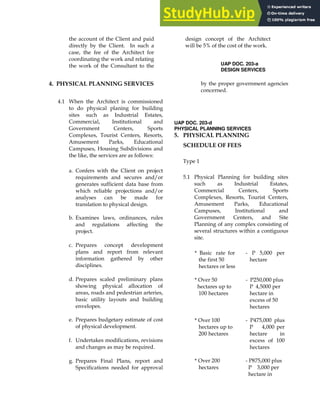
UAP DOC. 203-a
DESIGN SERVICES
6+ , = / ,/ 3
; % 5
A
$
< $ (
$ $ #
! * A
$ 7 (
* D
$ $
+ .
.
A
!
!
!
*
+
! 0 !
(
UAP DOC. 203-d
PHYSICAL PLANNING SERVICES
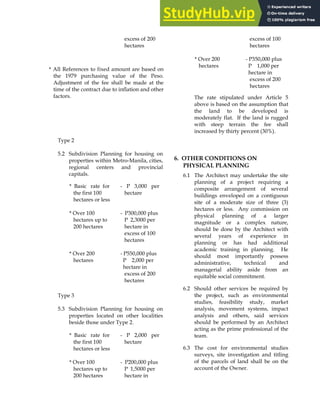
7+ , = / ,/ 3
. /
%
& % ! !
A
$ $ (
$ # $
! * A
$
< $ (
!
G "
&>
/ ! & >>>
G , &>
%>>
/ !9&> >>>
! ; &>>>
&>
G , %>>
9>>
/ !;4& >>>
! ; >>>
%>>
G , 9>> / !84& >>>
! : >>>
9>>
G #
%?4? !
9
& 9 ( !
6 /6
G "
%>>
/ ! : >>>
G , %>>
9>>
/ !:>> >>>
! 9 :>>>
%>>
G , 9>> / !&&> >>>
! 9 >>>
9>>
:
& : ( !
9
G "
%>>
/ ! 9 >>>
G , %>>
9>>
/ !9>> >>>
! % &>>>
%>>
G , 9>> / !:&> >>>
! % >>>
9>>
&
1:>E2
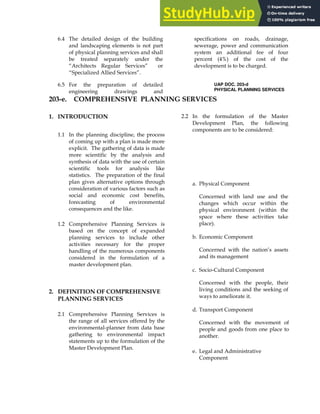
8+ .
, = / ,/ 3
- % *
+
) 1:2
7
+
- 9 ( +
*
- :
,
- ;
H # ( I
H( ) ( I
- & 0
1;E2
UAP DOC. 203-d
PHYSICAL PLANNING SERVICES
014 + , ,/ 3
2+ .
% %
*
+ *
% 9 $ ! (
0+ . ,
,/ 3
9 % $ ! (
/
6 ' !
9 9 6
' !
D
! $
$
1
*
2
A $
$
( /$ $
$
*
$
$
=
$
$
4+ ?,
: % !
+
* 1#
2
UAP DOC. 203-e
COMPREHENSIVE PLANNING SERVICES
6+
/ ,/
; % )
)
+ *
*
; 9 A !
(
+
A !
/
$ ! (
7+ , ,/ 3
& % 5 A !
D
*
A
.
!
6
' !
8+ ,
- % )
D
! 0 A
/!
! ' 9>:/' H!
! ( I
*
6 ' !
A
# ! ' 9>8/" H6
$ I
UAP DOC. 203-e
PHYSICAL PLANNING SERVICES
THE UNITED ARCHITECTS OF THE PHILIPPINES
THE DULY ACCREDITED BONAFIDE PROFESSIONAL ORGANIZATION FOR ARCHITECTS
FOLK ARTS THEATRE, CCP COMPLEX, ROXAS BLVD., PASAY CITY, METRO MANILA
TELEPHONES: 8327850, 551-4233,552-4329, 551-4350, 832-1120 loc. 09 TELEFAX: 832-3711
ARCHITECT’S
N A T I O N A L
C O D E
STANDARDS OF PROFESSIONAL PRACTICE
204 • CONSTRUCTION SERVICES
205 • POST-CONSTRUCTION SERVICES
206 • COMPREHENSIVE ARCHITECTURAL SERVICES
207 • DESIGN-BUILD SERVICES
208 • SELECTION OF THE ARCHITECT
AND METHODS OF COMPENSATION
016 + // ,
2+ .
% % 0 &>
*
D
,5@A#
#$7 A$
A@< @AA# / $,@( = @ (
*
$,@ # $ ,#
*
*
0+ // ,
9 %
)
/
$ */ /5 *
/
$ (
<
, 7
,
4+
D
UAP DOC. 204-a
FULL-TIME SUPERVISION
: % L $ 5 *
7 *
$
*
: 9 A $ 5 *
7
' A
* $
: : 3 # #
$ '
6+ . , @
; % L $
$
$
'
,
+
*
$ /
* +
* +
$ '
@ $
*
+
$
0 / *
*
*
$ *
*
$
( .!
!
$ *
$
'
+
* 0
+ *
# +
( *
$
, $
"
*
*
; 9 A
$
$
#
+ $
$
A .A 5 * ,
$
#
+
$
"
5
*
$ '
*
; : #
3
D
$ $
$ !
(
$ " !
=
UAP DOC. 204-a
FULL-TIME SUPERVISION
; ; 6 * #
D
5 $
6
' (*
$
! 1( (
A 6
2
A+ )
6 ' .$ *
$ .6
#
$ .6
.' 6
, C
, .#
; & 3
D
!
#
$ ,
! !
/" ' .
6
,
+
*
7+
, =
3 ,
UAP DOC. 204-a
FULL-TIME SUPERVISION
& % $
,
/A /$
$
+
& %
, .A /
$
& 9 ,
.A /$
1 2
8+ / =
- % $ (
<
$ /
- 9 7 *
. ' A
9+ / 3 / , * / =
4 % $ (
< ,
,
'
A 7
$ $
'
A
$
*
;+ A /
8 % 0 /
" (
$ A
6 A (
A A A
7
*
<+ ,
$ ( <
,
, *
21+ //
,
%> % 5 + ,
/
$ 7
*
/ *
*
: ; &
%> 9 /
D
! 0 6
%E %ME !
$ $
6 ' !
A 6 1# !
' 9>82
016
3
2+ .
% % '
$ 6
% 9 $ 6
,
,
0+
9 % $ (
# <
$ (
$ *
$
9 9 $ $
!
! ! $6! $
0
# $ ,
!
,
UAP DOC. 204-b
CONSTRUCTION MANAGEMENT
9 : L $ 5 *
3 #
$
( <
$ 6 1#
' 9>;/
$ ( < 2
$ 6
$ ( <
, *
$ 6
4+ / =
: % $ 6
* $
$
$ $
: 9 7
: : 7
+
6 / 3 / , * / =
; % $ 6
,
,
+
*
; 9 7
+
UAP DOC. 204-b
CONSTRUCTION MANAGEMENT
'
A $
7+ A /
& % $ 6
& 9
A
& :
*
$ $
6
8+ 3
- % $
, $
6 %ME
:E
9+
3 3
,
4 % $
6 +
$ 6
/
'
+
D
0 ! /
$ 6
) /
! ! /
,
4 % 0
*
0 0 ! /
,
$ 6
,
0 ! /
,
$ 6
$ 0 1$! 02
$ 0 1$! 02 /
$
H I
$ ! 0 0 /
,
;+
3
8 %
$
6 7
*
* +
(
$
6
UAP DOC. 204-b
CONSTRUCTION MANAGEMENT
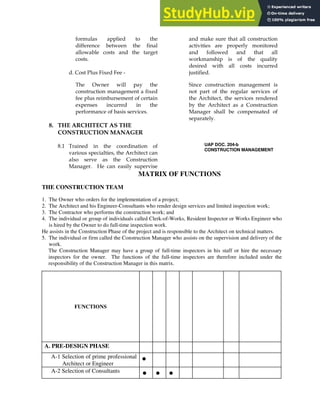
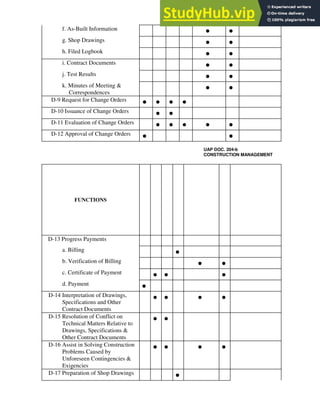
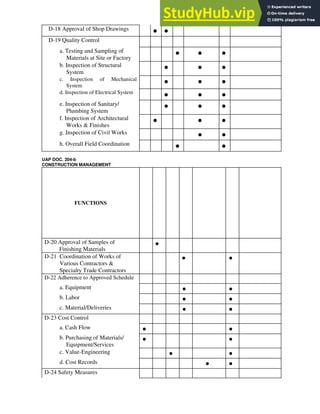
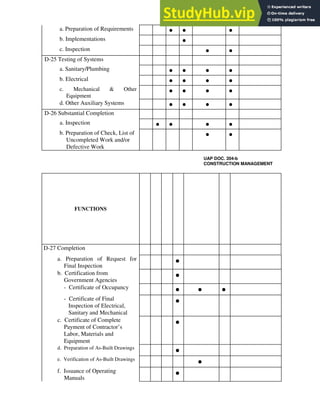
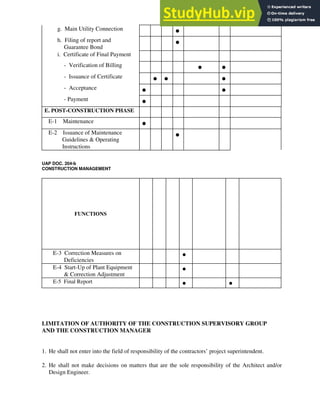
MATRIX OF FUNCTIONS
THE CONSTRUCTION TEAM
1. The Owner who orders for the implementation of a project;
2. The Architect and his Engineer-Consultants who render design services and limited inspection work;
3. The Contractor who performs the construction work; and
4. The individual or group of individuals called Clerk-of-Works, Resident Inspector or Works Engineer who
is hired by the Owner to do full-time inspection work.
He assists in the Construction Phase of the project and is responsible to the Architect on technical matters.
5. The individual or firm called the Construction Manager who assists on the supervision and delivery of the
work.
The Construction Manager may have a group of full-time inspectors in his staff or hire the necessary
inspectors for the owner. The functions of the full-time inspectors are therefore included under the
responsibility of the Construction Manager in this matrix.
FUNCTIONS
A. PRE-DESIGN PHASE
A-1 Selection of prime professional
Architect or Engineer
•
A-2 Selection of Consultants
• • •
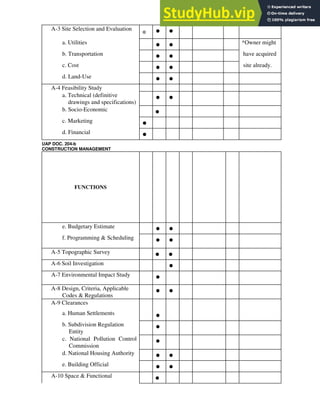
A-3 Site Selection and Evaluation
* • •
a. Utilities
• • *Owner might
b. Transportation
• • have acquired
c. Cost
• • site already.
d. Land-Use
• •
A-4 Feasibility Study
a. Technical (definitive
drawings and specifications)
• •
b. Socio-Economic
•
c. Marketing
•
d. Financial
•
UAP DOC. 204-b
CONSTRUCTION MANAGEMENT
FUNCTIONS
e. Budgetary Estimate
• •
f. Programming & Scheduling
• •
A-5 Topographic Survey
• •
A-6 Soil Investigation
•
A-7 Environmental Impact Study
•
A-8 Design, Criteria, Applicable
Codes & Regulations
• •
A-9 Clearances
a. Human Settlements
•
b. Subdivision Regulation
Entity
•
c. National Pollution Control
Commission
•
d. National Housing Authority
• •
e. Building Official
• •
A-10 Space & Functional
•
Relationships
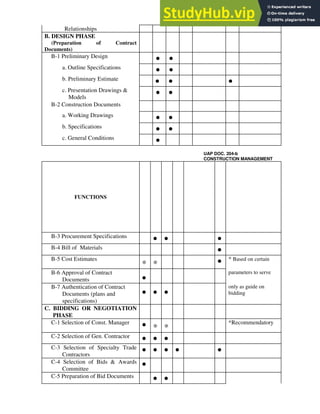
B. DESIGN PHASE
(Preparation of Contract
Documents)
B-1 Preliminary Design
• •
a. Outline Specifications
• •
b. Preliminary Estimate
• • •
c. Presentation Drawings &
Models
• •
B-2 Construction Documents
a. Working Drawings
• •
b. Specifications
• •
c. General Conditions
•
UAP DOC. 204-b
CONSTRUCTION MANAGEMENT
FUNCTIONS
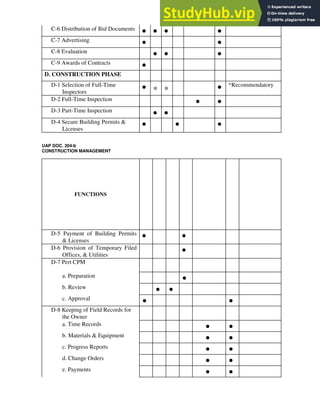
B-3 Procurement Specifications
• • •
B-4 Bill of Materials
•
B-5 Cost Estimates
* * • * Based on certain
B-6 Approval of Contract
Documents •
parameters to serve
B-7 Authentication of Contract
Documents (plans and
specifications)
• • •
only as guide on
bidding
C. BIDDING OR NEGOTIATION
PHASE
C-1 Selection of Const. Manager
• * *
*Recommendatory
C-2 Selection of Gen. Contractor
• • •
C-3 Selection of Specialty Trade
Contractors
• • • • •
C-4 Selection of Bids & Awards
Committee
•
C-5 Preparation of Bid Documents
• •
C-6 Distribution of Bid Documents
• • • •
C-7 Advertising
• •
C-8 Evaluation
• • •
C-9 Awards of Contracts
•
D. CONSTRUCTION PHASE
D-1 Selection of Full-Time
Inspectors
• * * • *Recommendatory
D-2 Full-Time Inspection
• •
D-3 Part-Time Inspection
• •
D-4 Secure Building Permits &
Licenses
• • •
UAP DOC. 204-b
CONSTRUCTION MANAGEMENT
FUNCTIONS
D-5 Payment of Building Permits
& Licenses
• •
D-6 Provision of Temporary Filed
Offices, & Utilities
•
D-7 Pert CPM
a. Preparation
•
b. Review
• •
c. Approval
• •
D-8 Keeping of Field Records for
the Owner
a. Time Records
• •
b. Materials & Equipment
• •
c. Progress Reports
• •
d. Change Orders
• •
e. Payments
• •
f. As-Built Information
• •
g. Shop Drawings
• •
h. Filed Logbook
• •
i. Contract Documents
• •
j. Test Results
• •
k. Minutes of Meeting &
Correspondences
• •
D-9 Request for Change Orders
• • • •
D-10 Issuance of Change Orders
• •
D-11 Evaluation of Change Orders
• • • • •
D-12 Approval of Change Orders
• •
UAP DOC. 204-b
CONSTRUCTION MANAGEMENT
FUNCTIONS
D-13 Progress Payments
a. Billing
•
b. Verification of Billing
• •
c. Certificate of Payment
• • •
d. Payment
•
D-14 Interpretation of Drawings,
Specifications and Other
Contract Documents
• • • •
D-15 Resolution of Conflict on
Technical Matters Relative to
Drawings, Specifications &
Other Contract Documents
• •
D-16 Assist in Solving Construction
Problems Caused by
Unforeseen Contingencies &
Exigencies
• • • •
D-17 Preparation of Shop Drawings
•
D-18 Approval of Shop Drawings
• •
D-19 Quality Control
a. Testing and Sampling of
Materials at Site or Factory
• • •
b. Inspection of Structural
System
• • •
c. Inspection of Mechanical
System • • •
d. Inspection of Electrical System
• • •
e. Inspection of Sanitary/
Plumbing System
• • •
f. Inspection of Architectural
Works & Finishes
• • •
g. Inspection of Civil Works
• •
h. Overall Field Coordination
• •
UAP DOC. 204-b
CONSTRUCTION MANAGEMENT
FUNCTIONS
D-20 Approval of Samples of
Finishing Materials
•
D-21 Coordination of Works of
Various Contractors &
Specialty Trade Contractors
• •
D-22 Adherence to Approved Schedule
a. Equipment • •
b. Labor • •
c. Material/Deliveries • •
D-23 Cost Control
a. Cash Flow • •
b. Purchasing of Materials/
Equipment/Services
• •
c. Value-Engineering • •
d. Cost Records • •
D-24 Safety Measures
a. Preparation of Requirements • • •
b. Implementations •
c. Inspection • •
D-25 Testing of Systems
a. Sanitary/Plumbing • • • •
b. Electrical • • • •
c. Mechanical & Other
Equipment
• • • •
d. Other Auxiliary Systems • • • •
D-26 Substantial Completion
a. Inspection • • • •
b. Preparation of Check, List of
Uncompleted Work and/or
Defective Work
• •
UAP DOC. 204-b
CONSTRUCTION MANAGEMENT
FUNCTIONS
D-27 Completion
a. Preparation of Request for
Final Inspection
•
b. Certification from
Government Agencies
•
- Certificate of Occupancy
• • •
- Certificate of Final
Inspection of Electrical,
Sanitary and Mechanical
•
c. Certificate of Complete
Payment of Contractor’s
Labor, Materials and
Equipment
•
d. Preparation of As-Built Drawings
•
e. Verification of As-Built Drawings
•
f. Issuance of Operating
Manuals
•
g. Main Utility Connection
•
h. Filing of report and
Guarantee Bond
•
i. Certificate of Final Payment
- Verification of Billing
• •
- Issuance of Certificate
• • •
- Acceptance
• •
- Payment
•
E. POST-CONSTRUCTION PHASE
E-1 Maintenance
•
E-2 Issuance of Maintenance
Guidelines & Operating
Instructions
•
UAP DOC. 204-b
CONSTRUCTION MANAGEMENT
FUNCTIONS
E-3 Correction Measures on
Deficiencies
•
E-4 Start-Up of Plant Equipment
& Correction Adjustment
•
E-5 Final Report • •
LIMITATION OF AUTHORITY OF THE CONSTRUCTION SUPERVISORY GROUP
AND THE CONSTRUCTION MANAGER
1. He shall not enter into the field of responsibility of the contractors’ project superintendent.
2. He shall not make decisions on matters that are the sole responsibility of the Architect and/or
Design Engineer.
UAP DOC. 204-b
CONSTRUCTION MANAGEMENT
017
,
2+ .
% % ! / H /
I
$
(
*
% 9
/
(
D
" A+
6
" <
! /$ A
0+ * /. 3 B A ,
9 % 5
+
,
H / I
1
2
+ 1
* 2
*
UAP DOC. 205
POST-CONSTRUCTION SERVICES
4+ * /. 3 B 3 .
.
: % +
H / I
(
D
"
*
6
6
6+ ,
/
; % 5 ,
/
7
D
A
'
A
(
*
7+ . ,
& %
1%2 192
;E -E
& 9
+
,
018
, /
2+ .
% % $
( )
H I H I
% 9 $ (
! / (
( $ (
! /$ (
% :
7
*
% ;
#
$
+
0+ , ,
/
9 % ! /' ( 1 ! ' 9>%2
A 0
! 0
!
( (
( ) = /
(
! (
( .6 (
9 9 ' ( D #
(
1 ! ' 9>92
! '
5 * '
( , $
'
! / (
9 : ( ) (
1 ! ' 9>:2
'
= '
$
A A
!
9 ; $ (
1 ! ' 9>;2
0 / (
$ 6
9 & ! /$ (
1 ! ' 9>&2
" A+
6
"
4+ ,
/
: % ! 6
5 ,
$
( !
6
: 9 ! 6
UAP DOC. 206
COMPREHENSIVE ARCHITECTURAL SERVICES
/
+
,
*
)
: :
! 6
A
$
+
6+ , % 3
; % " 0
$
! 6
1 2
, / /
A /$
A /
$
UAP DOC. 206
COMPREHENSIVE ARCHITECTURAL DESIGN
$
+
,
*
! 6
7
,
; 9 ' 0
! /$ !
! 6
A
1 A2 ,
! /
D
/% ,
+
#
/
/9 !
*
! 6
/A
,
+
*
/: #
1 , 2
+
+
/; / *
+
*
/& $
*
*
+
/
/-
! 6
/A *
$!6
* /
/4 $ * * /
/8 # /
+
+
+
(
+
*
*
*
+
UAP DOC. 206
COMPREHENSIVE ARCHITECTURAL SERVICES
/? $ /
$
6
/
+
) /
*
/%> #
,
+
$ !
! 6
7
*
A ,
/+
,
D
/% 6
*
/9 6
+
UAP DOC. 206
COMPREHENSIVE ARCHITECTURAL SERVICES
/: , *
/; $
A
/& ,
/- ( /
*
A
/4 (
)
/
)
/8 A
)
/? $
/%> #
+
6
/%% A
+
/%9 (
+
+ *
/%: "
+
1 !
6
2
/%; ,
$
/%& *
$!6
)
*
/%- 6
+
A ,
,
/%4 6
+
/%8 3
/%? #
/9> # +
A
,
/9%
$ +
/99 "
+
1
2
UAP DOC. 206
COMPREHENSIVE ARCHITECTURAL SERVICES
/9: ,
+
+
/9; $
*
/9& (
!
6
,
A
.
H I
.
; : @ ! 6
*
$
*
! 6
* $
7+ / =
& %
! 6
$ 6
UAP DOC. 206
COMPREHENSIVE ARCHITECTURAL SERVICES
! 6
* $
$
$ $
7
7
+
! 6
/
8+ / 3 / , * / =
- % " $ $ !
6
A
$
$
6 ! 6
$
9+ , . 3
4 % @
,
"
! 6
( ;
4 9
$
(
*
7
D
A
6 *
< $
# A $
(
!
" *
=
4 : ! 6
,
! 6
$ 6
,
0 / (
! 6
,
;+ . ,
8 % ! 6
9E &E !
$
8 9 ! 6
#
! '
9>9
UAP DOC. 206
COMPREHENSIVE ARCHITECTURAL SERVICES
019
. 3 * /.
2+ .
% %
+
$
+
)
% 9
+
% : ,
' /" ( D
' /"
' /" <
6 $
% ; = #
/ /
0+ . 3 * /. *=
.
5 !
D
9 % ! *
+
9 9 7
9 : @
*
*
9 ; !
+
9 & )
9 - 3 *
9 4
9 8 6
9 ?
D
/
$
*
/
!
! 1%>E2
/
$
*
* *
+ (
$
UAP DOC. 207
DESIGN-BUILD SERVICES
/ $
*
$
9 %>
' /" (
( ! 14E2
! $ $
0
# ' (
4+ . 3 * /.
3 . ?
: % "
' /"
: 9
$
: :
!
H I
UAP DOC. 207
DESIGN-BUILD SERVICES
: ;
! +
$
: &
!
1%>E2 +
$
7
! 1%>E2
! 1%>E2
: - '
" ( <
6 $ !
1%>E2 ! $ $
/ <
6 $ (
#
' (
01;
/ .
. ,
01; + /
2+ .
/
7 * !
! # " 7 *D
! 6
0+ . /
$ *
D
9 % '
*
9 9 $
9 : ' $
+
4+ . /
$
D
: % #
: 9 ! + # /
: : # $
: ; #
$
6+ , /
$ *
+
+
$
#
*
+ )
D
; %
*
+
7
* +
; 9
D
' )
# $
@
*
*
UAP DOC. 208-a
SELECTION OF THE ARCHITECT
D
/% !
/9 A
+
*
/: +
/; @
; :
$
A
7
$
; ;
*
*
, /
UAP DOC. 208-a
SELECTION OF THE ARCHITECT
; & $
*
+
; -
7
$
6 " 0
@ $
$
$
; 4
( A
!
$
; 8 $
(
.
* *
; ? (
*
; %> ,
5 *
) $
A
/
+
7+ / . 3
,
!
!
!
! ' 9>?
& % '
*
$
, 0
,
D
+
, $
$
& 9 (
$
)
!
' 9>? $ $
& : $
*
!
,
UAP DOC 208-a
SELECTION OF THE ARCHITECT
!
7 $
+
+
,
*
& ;
+
@
,
UAP DOC. 208-a
SELECTION OF THE ARCHITECT
(
+
,
+ )
)
)
& & $
D
+ +
$
01;
.
,
2+ .
% %
7
$
$
(
% 9 *
*
% : $
+ +
% ; *
*
$
0 *
0+
*
+
D
9 % "
+
9 9 " $
9 : "
9 ; @
9 & A $
9 - !
+
9 4 "
9 8 ! $
UAP DOC. 208-b
METHODS OF COMPENSATION
9 ? A
$
+
9 %> @ $
H I +
9 %% !
4+ . ,
: % ! $ $
/
)
!
$
!
$ *
*
! +
$ , /
: 9 6 ' !
A
/
/ *
*
UAP 208-b
METHODS OF COMPENSATION
*
*
! /'
( ( 5 *
*
#
( ) '
(
1 / 2
*
9 9 &
/
!
,
/ /
*
$
* * $
!
/
D
N .
$ N $ .
N #
(
!
N1
,N2
,N3 N @
$
(
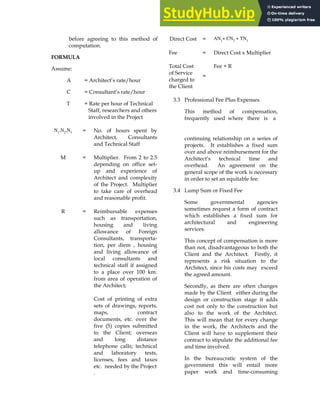
6 N 6 0 9 9 &
/
! 6
*
# N #
0
$ /
%>> *
$
1&2
$
!
' $ N AN1
+ CN2
+ TN3
0 N ' $ 6
$
(
$
N
0 O #
: : ! 0 ! A
+
*
+
: ; = ( 0 0
(
+
$ 0
*
(
$
*
*
$
* /
*
* $
$
,
! *
*
$
UAP DOC. 208-b
METHODS OF COMPENSATION
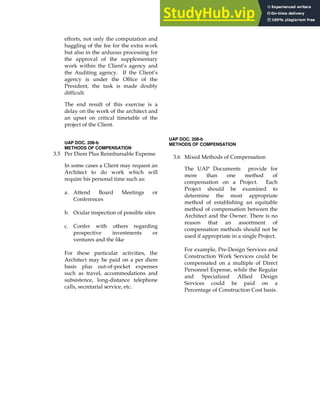
: & ! ' ! # A
$ +
*
+ D
" 6
$
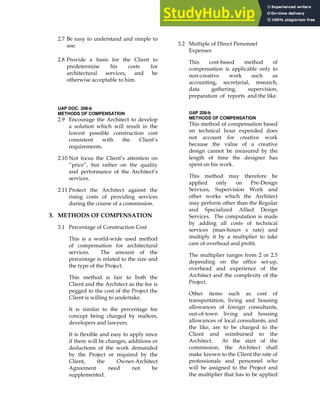
,
$
*
0
/ / *
/
UAP DOC. 208-b
METHODS OF COMPENSATION
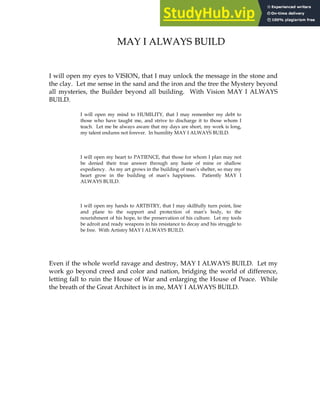
: - 6 6 $
! '
! A
!
+
,
!
0 ! /' (
$ 5 * (
'
! A #
( ) '
(
! $ $
6 K =5 K( " ='
C ( ,@ *
= 6
" 5 C 6 K =5 K(
" ='
7 6 = K
= *
6 K =5 K( " ='
! A@$A
! 6 K
=5 K( " ='
# ( #K *
=
5 6 K =5 K( " ='
A 6 K =5 K( " =' =
*
7 5 7 ! 5
< 6 K =5 K( " ='
THE UNITED ARCHITECTS OF THE PHILIPPINES
OBJECTIVES:
• TO UNITE ALL REGISTERED ARCHITECTS IN THE PHILIPPINES.
• TO ESTABLISH AND PROMOTE THE HIGHEST STANDARDS OF
ETHICAL CONDUCT AND EXCELLENCE IN THE PRACTICE AND
SERVICE OF THE ARCHITECTURAL PROFESSION.
• TO UPLIFT THE STANDARDS OF ARCHITECTURAL EDUCATION,
CONDUCT RESEARCHES, ACCUMULATE AND DISSEMINATE
INFORMATION AND IDEAS IN ARCHITECTURE, ENVIRONMENTAL
DESIGN, ECOLOGY, TECHNOLOGY, CULTURE AND OTHER RELATED
FIELDS.
• TO COOPERATE AND COORDINATE WITH OTHER ALLIED
PROFESSIONS, TRADES AND INDUSTRY.
• TO PARTICIPATE IN MATTERS CONCERNING NATIONAL
DEVELOPMENT OF THE COUNTRY.
• TO COOPERATE AND COORDINATE WITH INTERNATIONAL
ORGANIZATIONS IN THE FIELD OF ARCHITECTURE,
ENVIRONMENTAL DESIGN AND OTHER FIELDS OF ARTS, SCIENCE
AND TECHNOLOGY; AND
• TO RENDER ANY LAWFUL AND APPROPRIATE ASSISTANCE TO ANY
OF ITS MEMBERS.
• HOPING TO FIND IN THE FULFILLMENT OF THESE AIMS ITS MODEST
CONTRIBUTIONS TOWARDS THE MAKING OF A BETTER AND
HAPPIER WORLD TO LIVE IN.
UAP DOC. 200
CODE OF ETHICAL CONDUCT

ARCHITECTS CODE OF ETHICS

  • 1.
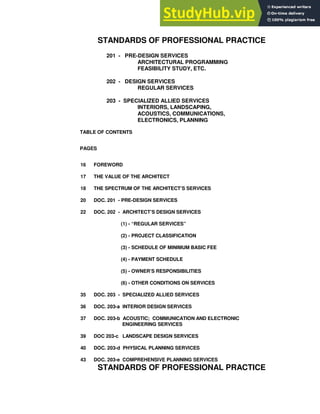
    THE UNITED ARCHITECTSOF THE PHILIPPINES THE DULY ACCREDITED BONA FIDE PROFESSIONAL ORGANIZATION OF ARCHITECTS FOLK ARTS THEATER, CCP COMPLEX, ROXAS BLVD., PASAY CITY, METRO MANILA TELEPHONES: 551-4233,551-4329, 551-4350, 832-1120 loc. 09 FAX: 832-7850 ARCHITECT’S N A T I O N A L C O D E CODE OF ETHICAL CONDUCT UAP DOC. 200 STANDARDS OF PROFESSIONAL PRACTICE UAP DOC. 201 • PRE-DESIGN SERVICES 202 • DESIGN SERVICES 203 • SPECIALIZED AND ALLIED SERVICES 204 • CONSTRUCTION SERVICES 205 • POST-CONSTRUCTION SERVICES 206 • COMPREHENSIVE ARCHITECTURAL SERVICES 207 • DESIGN-BUILD SERVICES 208 • SELECTION OF THE ARCHITECT AND METHODS OF COMPENSATION
  • 2.
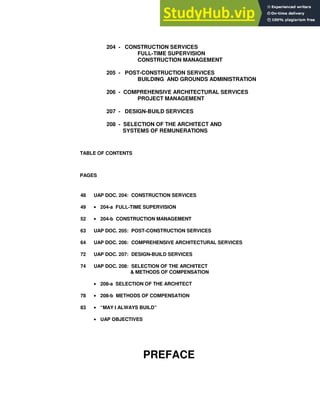
    COPYRIGHT 1979 By The UnitedArchitects of the Philippines, Inc. ALL RIGHTS RESERVED This Document or parts thereof may not be reproduced in any form without written permission from the United Architects of the Philippines, Inc. Printed copies are available for the use of all practicing Architects in the Philippines.
  • 3.
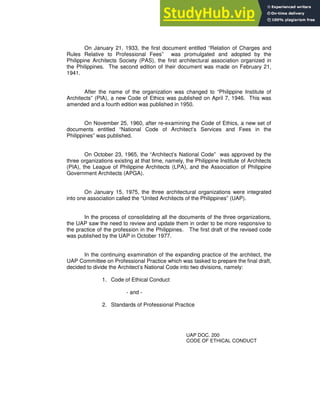
    ARCHITECT’S NATIONAL CODE DOCUMENTS SERIES 200 200 -CODE OF ETHICAL CONDUCT TABLE OF CONTENTS PAGES PREFACE PROFESSIONAL REGULATION COMMISSION BOARD OF ARCHITECTURE RESOLUTIONS UAP RESOLUTIONS 8 FOREWORD AND “THE VIRTUES OF AN ARCHITECT” 9 THE ARCHITECT’S CODE OF ETHICS 10 CODE OF ETHICAL CONDUCT 11 • THE ARCHITECT’S RESPONSIBILITIES IN RELATION TO THE PEOPLE 12 • THE ARCHITECT’S RESPONSIBILITIES IN RELATION TO HIS CLIENT 13 • THE ARCHITECT’S RESPONSIBILITIES IN RELATION TO THE CONTRACTOR 14 • THE ARCHITECT’S RESPONSIBILITIES IN RELATION TO MANUFACTURERS, DEALERS AND AGENTS 15 • THE ARCHITECT’S RESPONSIBILITIES IN RELATION TO HIS COLLEAGUES AND SUBORDINATES
  • 4.
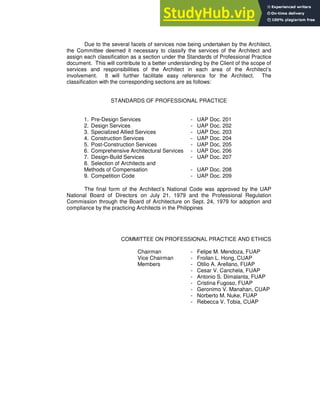
    STANDARDS OF PROFESSIONALPRACTICE 201 - PRE-DESIGN SERVICES ARCHITECTURAL PROGRAMMING FEASIBILITY STUDY, ETC. 202 - DESIGN SERVICES REGULAR SERVICES 203 - SPECIALIZED ALLIED SERVICES INTERIORS, LANDSCAPING, ACOUSTICS, COMMUNICATIONS, ELECTRONICS, PLANNING TABLE OF CONTENTS PAGES 16 FOREWORD 17 THE VALUE OF THE ARCHITECT 18 THE SPECTRUM OF THE ARCHITECT’S SERVICES 20 DOC. 201 - PRE-DESIGN SERVICES 22 DOC. 202 - ARCHITECT’S DESIGN SERVICES (1) - “REGULAR SERVICES” (2) - PROJECT CLASSIFICATION (3) - SCHEDULE OF MINIMUM BASIC FEE (4) - PAYMENT SCHEDULE (5) - OWNER’S RESPONSIBILITIES (6) - OTHER CONDITIONS ON SERVICES 35 DOC. 203 - SPECIALIZED ALLIED SERVICES 36 DOC. 203-a INTERIOR DESIGN SERVICES 37 DOC. 203-b ACOUSTIC; COMMUNICATION AND ELECTRONIC ENGINEERING SERVICES 39 DOC 203-c LANDSCAPE DESIGN SERVICES 40 DOC. 203-d PHYSICAL PLANNING SERVICES 43 DOC. 203-e COMPREHENSIVE PLANNING SERVICES STANDARDS OF PROFESSIONAL PRACTICE
  • 5.
    204 - CONSTRUCTIONSERVICES FULL-TIME SUPERVISION CONSTRUCTION MANAGEMENT 205 - POST-CONSTRUCTION SERVICES BUILDING AND GROUNDS ADMINISTRATION 206 - COMPREHENSIVE ARCHITECTURAL SERVICES PROJECT MANAGEMENT 207 - DESIGN-BUILD SERVICES 208 - SELECTION OF THE ARCHITECT AND SYSTEMS OF REMUNERATIONS TABLE OF CONTENTS PAGES 48 UAP DOC. 204: CONSTRUCTION SERVICES 49 • 204-a FULL-TIME SUPERVISION 52 • 204-b CONSTRUCTION MANAGEMENT 63 UAP DOC. 205: POST-CONSTRUCTION SERVICES 64 UAP DOC. 206: COMPREHENSIVE ARCHITECTURAL SERVICES 72 UAP DOC. 207: DESIGN-BUILD SERVICES 74 UAP DOC. 208: SELECTION OF THE ARCHITECT & METHODS OF COMPENSATION • 208-a SELECTION OF THE ARCHITECT 78 • 208-b METHODS OF COMPENSATION 83 • “MAY I ALWAYS BUILD” • UAP OBJECTIVES PREFACE
  • 6.
    On January 21,1933, the first document entitled “Relation of Charges and Rules Relative to Professional Fees” was promulgated and adopted by the Philippine Architects Society (PAS), the first architectural association organized in the Philippines. The second edition of their document was made on February 21, 1941. After the name of the organization was changed to “Philippine Institute of Architects” (PIA), a new Code of Ethics was published on April 7, 1946. This was amended and a fourth edition was published in 1950. On November 25, 1960, after re-examining the Code of Ethics, a new set of documents entitled “National Code of Architect’s Services and Fees in the Philippines” was published. On October 23, 1965, the “Architect’s National Code” was approved by the three organizations existing at that time, namely, the Philippine Institute of Architects (PIA), the League of Philippine Architects (LPA), and the Association of Philippine Government Architects (APGA). On January 15, 1975, the three architectural organizations were integrated into one association called the “United Architects of the Philippines” (UAP). In the process of consolidating all the documents of the three organizations, the UAP saw the need to review and update them in order to be more responsive to the practice of the profession in the Philippines. The first draft of the revised code was published by the UAP in October 1977. In the continuing examination of the expanding practice of the architect, the UAP Committee on Professional Practice which was tasked to prepare the final draft, decided to divide the Architect’s National Code into two divisions, namely: 1. Code of Ethical Conduct - and - 2. Standards of Professional Practice UAP DOC. 200 CODE OF ETHICAL CONDUCT
  • 7.
    Due to theseveral facets of services now being undertaken by the Architect, the Committee deemed it necessary to classify the services of the Architect and assign each classification as a section under the Standards of Professional Practice document. This will contribute to a better understanding by the Client of the scope of services and responsibilities of the Architect in each area of the Architect’s involvement. It will further facilitate easy reference for the Architect. The classification with the corresponding sections are as follows: STANDARDS OF PROFESSIONAL PRACTICE 1. Pre-Design Services - UAP Doc. 201 2. Design Services - UAP Doc. 202 3. Specialized Allied Services - UAP Doc. 203 4. Construction Services - UAP Doc. 204 5. Post-Construction Services - UAP Doc. 205 6. Comprehensive Architectural Services - UAP Doc. 206 7. Design-Build Services - UAP Doc. 207 8. Selection of Architects and Methods of Compensation - UAP Doc. 208 9. Competition Code - UAP Doc. 209 The final form of the Architect’s National Code was approved by the UAP National Board of Directors on July 21, 1979 and the Professional Regulation Commission through the Board of Architecture on Sept. 24, 1979 for adoption and compliance by the practicing Architects in the Philippines COMMITTEE ON PROFESSIONAL PRACTICE AND ETHICS Chairman - Felipe M. Mendoza, FUAP Vice Chairman - Froilan L. Hong, CUAP Members - Otilio A. Arellano, FUAP - Cesar V. Canchela, FUAP - Antonio S. Dimalanta, FUAP - Cristina Fugoso, FUAP - Geronimo V. Manahan, CUAP - Norberto M. Nuke, FUAP - Rebecca V. Tobia, CUAP
  • 8.
    BOARD OF ARCHITECTURE ResolutionNo. 9-A Series of 1979 WHEREAS, under Resolution No. 79-81 dated July 21, 1979, the United Architects of the Philippines submitted a draft of the proposed Code of Ethical Conduct and the Standards for Professional Practice of Architecture with a request that the same be adopted as the National Code for Architects in the Philippines; WHEREAS, the Professional Regulation Commission and the Board of Architecture acknowledge the urgency of adopting a national code for architects for the proper maintenance of ethical and professional standards in the practice of architecture and for the protection of life, health and property; WHEREAS, the Board of Architecture, after a review of the draft, finds the proposed Code of Ethical Conduct, UAP Document No. 200, and the proposed Standards of Professional Practice, UAP Documents Nos. 201, 202, 203, 204, 205, 206, 207 and 208, which are hereto attached and made integral parts of this Resolution, to be responsive to the demands and requirements of the profession, and when implemented will achieve the desired high degree of professionalism that will redound to the best interest of the profession and the public; NOW THEREFORE, pursuant to Sections 2 and 8 of R.A. No. 545, as amended, the Board of Architecture hereby adopts the attached UAP Documents Nos. 200, 201, 202, 203, 204, 205, 206, 207 and 208 as the NATIONAL CODE FOR ARCHITECTS and as part of the Rules and regulations to which all practicing architects shall conform in the performance of their duties and obligations, a violation of which shall be a ground for the suspension or revocation of the certificate of registration of a practicing architect. The attached NATIONAL CODE FOR ARCHITECTS consisting of Documents Nos. 200.1 to 200.5, 201.1 to 201.4, 202.1 to 202.6, 203.1, 203.a to 203.e, 204.a to 204.b, 205.5, 206.1 to 206.8, 207.1 to 207.3, 208.a to 208.b, inclusive, shall take effect after fifteen (15) days following its publication in the Official Gazette. DONE IN THE CITY OF MANILA, this 19th day of September in the year of our Lord Nineteen Hundred and Seventy Nine. ANASTACIO R. BERNAL Chairman Sgd. Sgd. NORBERTO M. NUKE CRESENCIO DE CASTRO Member Member APPROVED AND PROMULGATED AS PART OF THE RULES AND REGULATIONS GOVERNING THE PRACTICE OF ARCHITECTURE IN THE PHILIPPINES, this 24th day of September, 1979. Sgd. Sgd. NUMERIANO TANOPO, JR. ERIC C. NUBLA Associate Commissioner Commissioner Resolution No. 79-18 Series of 1979
  • 9.
    The United Architectsof the Philippines WHEREAS, there were existing standards on professional practice for Architects since 1985 adopted and in use by the members of the three architectural organizations, the Association of Philippine Government Architects (APGA), the League of Philippine Architects (LPA), and the Philippine Institute of Architects (PIA), before their integration in 1975 into one national organization the United Architects of the Philippines (UAP); WHEREAS, in the desire of the members of the UAP to make the practice of architecture relevant to the demands of our time, our people and our government’s thrust for national development, the UAP Committee on Professional Practice prepared a new set of documents on Standards of Professional Practice and Code of Ethical Conduct embodied in the Architect’s National Code, and other standard Contract Documents; WHEREAS, these documents were presented and distributed to the members on December 1977 and discussed and approved by the members in 1978 and 1979 during the provincial chapter and regional conferences; WHEREAS, upon the certification of UAP as the only duly accredited bonafide professional organization for architects in the country, the Board of Architecture of the Professional Regulation Commission requested the UAP to prepare documents on Standards of Professional Practice and Code of Ethical Conduct for Architects to maintain a high standard of ethical conduct and excellence in the practice of the architectural profession; NOW THEREFORE, be it resolved as it is hereby resolved that the Architect’s National Code and all Standard Documents related to the professional practice of the Architect as prepared by the Committee on Professional Practice and Ethics, and approved by the UAP Board and the general membership, be submitted to the Professional Regulation Commission through the Board of Architecture for their approval. RESOLVED FURTHER, that copies of this Resolution and the Architect’s National Code and all Standard Documents be furnished the Professional Regulation Commission (PRC) through the Board of Architecture as a response to their request, and enjoining them to adopt and require these as the standard documents for use and compliance by all Architects in the Philippines. Done this 21st day of July, 1979 in Metro-Manila, Philippines. Sgd. FELIPE M. MENDOZA, FUAP National President Sgd. CESAR V. CANCHELA, FUAP National Secretary FOREWORD
  • 10.
    Adherence to thePrinciples of the Architect’s National Code is an obligation of every architect and member of the United Architects of the Philippines. Any deviation therefrom shall be subject to discipline in proportion to its seriousness. The National Board of Directors of the United Architects of the Philippines and the Board of Architecture, Professional Regulation Commission, shall have the sole power of interpreting the provisions of this Code. ! " # #"$ %"& ! & $ ' ! ' " ( $ & ") ( # &! *" $ ) & ( & ' +++ "& "( "& , $$ UAP DOC. 200 CODE OF ETHICAL CONDUCT
  • 11.
    - . I shallwork with this general objective - that my duty is not only to myself, but also to my Country and God. I shall uphold the ideals and follow the norms of conduct of a noble profession and endlessly endeavor to further its just ends. I shall humbly seek success not through the measure of solicited personal publicity, but by industrious application to my work, strive to merit a reputation for quality of service and for fair dealing. I shall ask from all, fair remuneration for my services while expecting and asking no profits from any other source. I shall hold the interest of my Client over and above any self-interest for financial returns. I shall exercise my professional prerogatives always with impartiality and disinterestedness. I shall avoid any private business investments or venture which may tend to influence my professional judgment to the detriment of the trust placed upon me. I shall inspire by my behaviour the loyalty of my associates and subordinates and take upon me the mentorship of the aspirants to the profession. I shall confine my criticisms and praises within constructive and inspirational limits and never resort to these means to further malicious motives. I shall dedicate myself to the pursuit of creative endeavor towards the goal of enlightened Art and Science, generously sharing with colleagues, friends and strangers alike the benefits of my experience and experiments. UAP DOC. 200 CODE OF ETHICAL CONDUCT
  • 12.
    . / . ! "! # $ UAP DOC. 200 CODE OF ETHICAL CONDUCT
  • 13.
    THE ARCHITECT’S RESPONSIBILITIESIN RELATION TO THE PEOPLE 1 STATEMENT: The Architect is engaged in a profession which carries with it civic responsibilities towards the public, whether such responsibilities are the natural outcome of good citizenship or of his professional pursuit or whether they partake of informative and educational matters or of his normal, good public relations. 1-a The Architect shall seek opportunities to be of constructive service in civic and urban affairs and to the best of his ability advance the safety, health and well-being of the people and the community as well as the promotion, restoration or preservation of the general amenities and other examples of historic and architectural heritage of the nation. 1-b The Architect shall promote the interest of his professional organization and do his full part of the work to enhance the objectives and services of the organization. He should share in the interchange of technical information and experience with the other design professions and the building industry. 1-c The Architect as a good citizen shall abide and observe the laws and regulations of the government and comply with the standards of ethical conduct and practice of the profession in the Philippines. He shall at no time act in a manner detrimental to the best interest of the profession. 1-d The Architect shall not use paid advertisement nor use self- laudatory, exaggerated or misleading, publicity. However, the presentation of factual materials, verbal or visual, of the aims, standards and progress of the profession through literature or by industrious application of his work and services which tend to dignify the professional or advance public knowledge of the Architect’s function in society may be presented through any public communication media. 1-e The Architect shall not solicit nor permit to solicit in his name, advertisements or other support towards the cost of any publication presenting his work. He should refrain from taking part in paid advertisement endorsing any materials of construction or building equipment. 1-f The Architect shall not mislead the public through advertisements, signs or printed matter citing his professional specializations unless such qualifications are well known facts or sanctioned by professional consensus and years of experience. UAP DOC. 200 CODE OF ETHICAL CONDUCT
  • 14.
    THE ARCHITECT’S RESPONSIBILITIESIN RELATION TO HIS CLIENT 2 STATEMENT: The Architect’s relation to his Client is dependent upon good faith. To insure the continued existence of such state of good relationship, the Architect’s position carries with it certain moral obligations to his Client and to himself. 2-a The Architect may introduce to a prospective Client the professional services he is able to perform provided it is limited to presentation of examples of his professional experience and does not entail the offering of free preliminary sketches or other services without the benefit of an agreement with the Client for legitimate compensation. 2-b The Architect shall acquaint or ascertain from the Client at the very inception of their business relationship, the exact nature and scope of his services and the corresponding professional charges. 2-c The Architect shall advise a Client against proceeding with any project whose practicability may be questionable due to financial, legal or arresting or exigent conditions, even if such advice may mean the loss of a prospective commission to the Architect. 2-d The Architect shall explain the conditional character of estimates other than estimates submitted in the form of actual proposals by contractors and in no case shall he guarantee any estimates or cost of the work in order to secure a commission. 2-e The Architect shall consider the needs and stipulation of his Client and the effects of his work upon the life and well-being of the public and the community as a whole, and to endeavor to meet the aesthetic and functional requirements of the project commensurate with the Client’s appropriation. 2-f The Architect shall charge his Client for services rendered, a professional fee commensurate with the work involved and with his professional standing and experience based upon the Basic Minimum Fee prescribed under the “Standards of Professional Practice” of the “Architect’s National Code.” 2-g The Architect shall not undertake, under a fixed contract sum agreement, the construction of any project based on plans prepared by him. He may in certain cases, undertake the construction of a project even when the plans were prepared by him provided it is undertaken in conformity with the conditions set forth under sections covering “Construction Services”, “Comprehensive Services” or “Design-Build Services” of the document on “STANDARDS OF PROFESSIONAL PRACTICE.” UAP DOC. 200
  • 15.
  • 16.
    2-h The Architectshall be compensated for his services solely through his professional fee charged directly to the Client. He shall not accept nor ask for any other returns in whatever form from any interested source other than the Client. 2-i The Architect shall be free in his investments and business relations outside of his profession from any financial or personal interests which tend to weaken and discredit his standing as an unprejudiced and honest adviser, free to act in his Client’s best interests. If the Architect has any business interest which will relate to, or affect the interest of his Client, he should inform his Client of such condition or situation. 2-j The Architect shall include in his agreement with the Client a clause providing for arbitration as a method for settlement of disputes. THE ARCHITECT’S RESPONSIBILITIES IN RELATION TO THE CONTRACTOR 3 STATEMENT: The Contractor depends upon the Architect to safeguard fairly his interests as well as those of the Client. 3-a The Architect shall give the Contractor every reasonable aid to enable him to fully understand the contents of the Contract Documents by furnishing clear, definite and consistent information in all pertinent contract documents to avoid unnecessary mistakes that may involve extra costs to the Contractor. 3-b The Architect shall not knowingly call upon the Contractor to correct or remedy oversights or errors in the Contract Documents to the Contractor’s financial disadvantage. 3-c The Architect shall immediately upon his personal knowledge and inspection, reject or condemn materials, equipment or workmanship which are not in conformity with the Contract Documents in order not to cause unnecessary delay and additional expense to the Contractor. 3-d The Architect shall not, at any time or circumstance, accept free engineering services, or receive any substantial aid, gifts, commissions, or favors from any Contractor or sub-contractor which will tend to place him under any kind of moral obligation. 3-e The Architect shall upon request by the Contractor promptly inspect each phase of the work completed and if found according to the terms of the Contract Documents issue the corresponding Certificates of Payment and the Final Certificate of Completion, respectively, to the Contractor. UAP DOC. 200
  • 17.
    CODE OF ETHICALCONDUCT THE ARCHITECT’S RESPONSIBILITIES IN RELATION TO MANUFACTURERS, DEALERS, AND AGENTS 4 STATEMENT: An exchange of technical information between Architects and those who supply and handle building materials or equipment is necessary and therefore encouraged and commended. However; 4-a The Architect shall not avail or make use of engineering or other technical services offered by manufacturers, or suppliers of building materials or equipment which may be accompanied by an obligation detrimental to the best interest of the Client or which may adversely affect the Architect’s professional opinion. 4-b The Architect shall not at any time receive commissions, discounts, fees, gifts or favors from agents or firms handling building materials or equipment which may place him in a reciprocal frame of mind. He may however, accept market discounts which shall be credited to the Client. THE ARCHITECT’S RESPONSIBILITIES IN RELATION TO HIS COLLEAGUES AND SUBORDINATES 5 STATEMENT: The Architect has moral responsibilities towards his profession, his colleagues and his subordinates. 5-a The Architect shall not render professional services without compensation except for small civic or charity projects. He shall neither offer nor provide preliminary services on a conditional basis prior to definite agreement with the Client for the commission of the project. 5-b The Architect shall not knowingly compete with other Architects on the basis of difference of professional charges, nor use donation as a device for obtaining competitive advantage except for worthy civic or religious projects. Neither shall he submit solicited or unsolicited sketches or drawings in competition with other Architects unless such competitive arrangements are conducted substantially under the terms of the UAP Architectural Competition Code. 5-c The Architect shall not under any circumstances nor through any means seek commissions already known to him as previously endowed to another Architect, whether such endowment has been definitely agreed upon or still in the process of negotiation. 5-d The Architect shall not, in any case, enter as a competitor in any Architectural Competition when he has direct relations with the formulation of the Program thereof or when he has been engaged
  • 18.
    UAP DOC. 200 CODEOF ETHICAL CONDUCT to act as Professional Adviser or Juror for such competition. Neither shall the Architect accept and act as professional adviser or juror in any architectural competition when he has had any information or has reviewed or assisted in the preparation of any competition design entered. Nor shall an Architect, retained as professional adviser in a competition, accept employment as an Architect for that competition project except as Consulting Architect. 5-e The Architect shall not undertake a commission for which he knows another Architect has been previously employed until he notified such other Architect of the fact in writing and has conclusively determined that the original employment has been terminated and has been duly compensated for. 5-f The Architect shall not undertake a commission for additions, rehabilitation or remodeling of any erected structure undertaken previously by another Architect without duly notifying him of the contemplated project even when the Owner is no longer the same. When the greater mass, area or design of the original structure is substantially maintained the new Architect should limit his advertisement or claim only to the extent of the work done to the structure. Architects are enjoined to preserve or restore as much as possible especially the few and remaining historic examples of our architectural heritage affecting this phase of practice. 5-g The Architect shall not knowingly injure falsely or maliciously, the professional reputation, prospects or practice of another Architect. 5-h The Architect shall refrain from associating himself with or allowing the use of his name by an enterprise of doubtful character or integrity. 5-i The Architect shall not affix his signature and seal to any plans or professional documents prepared by other persons or entities not done under his direct personal supervision. 5-j The Architect shall inspire the loyalty of his employees and subordinates by providing them with suitable working conditions, requiring them to render competent and efficient services and paying them adequate and just compensation therefor. He shall tutor and mentor the young aspirants towards the ideals, functions, duties and responsibilities of the profession. 5-k The Architect shall unselfishly give his share in the interchange of technical information and experience among his colleagues and young aspirants and do his part in fostering unity in the fellowship of the profession. 5-l He shall unselfishly give his time and effort to the advancement of the profession thru his active and personal commitment and involvement with the accredited professional organization for architects.
  • 19.
    UAP DOC. 200 CODEOF ETHICAL CONDUCT
  • 20.
    ARCHITECT’S NATIONAL CODE .. , / , , . + 012 • , . 3 010 • . 3 014 • , / 5 . . // .
  • 21.
    FOREWORD From a synthesisof the past 50 years of Architect-Client relations in the Philippines, this division of the ARCHITECTS NATIONAL CODE entitled “STANDARDS OF PROFESSIONAL PRACTICE” is adopted primarily to set a norm of practice of the profession. The Code defines all aspects of professional service, prescribes the MINIMUM BASIC FEE relative to each phase of service and thereby establishes the rights and obligations of both the Architect and his Client. It stresses the principle that the Architect’s qualification which is based upon his ability, experience and integrity on one hand, requires the full trust and sympathetic cooperation of the Client on the other. Their relationship depends upon good faith and mutual respect in order to inspire the Architect to produce his best work and a sustained devotion to his Client’s interest. For these ends, the conditions and standards prescribed in this Code should be respected and adhered to. The National Board of Directors of the United Architects of the Philippines and the Board of Architecture, Professional Regulation Commission, shall have the sole power of interpreting the provisions of this Code. STANDARDS OF PROFESSIONAL PRACTICE
  • 22.
    THE VALUE OFTHE ARCHITECT The Architect creates man’s environment through his awareness and sensitive handling of spaces that fit the scale of human experience. The resulting quality of the form-envelope manifested as a structure or building gives rise to man’s appreciation of beauty and order in his physical world. The Architects’ deliberation determine how people will be placed in relationship one to another, how whole societies will work, play, eat, sleep, recreate, travel, worship, or in short how people will live in consonance with their culture and national aspirations. His objective is to bring order to man’s environment to cause it to function properly within a structure that is safe and healthful and to impart to the whole a beauty and distinction that is appropriate to our time. STANDARDS OF PROFESSIONAL PRACTICE
  • 23.
    THE SPECTRUM OFTHE ARCHITECT’S SERVICES The spectrum of the Architect’s services extends over the entire range of activities that proceed from the time the idea is conceived, perfected, transformed into sets of space/ design requirements, translated into structure through design, built, used and become a permanent feature of the man-made environment. The Architect’s services consist of the necessary conferences, deliberations, discussions, evaluations, investigations, consultations, advice on matters affecting the scientific, aesthetic and orderly coordination of all the processes of safeguarding life, health, and property which enter into the production of different levels and sophistication of man-made structures and environment. The Architect, in the process of translating abstract ideas into meaningful concrete terms, produces documents in the form of a data base report, an architectural program, a feasibility study, a market study, an appraisal report, an impact analysis report, a space-organizational set- up report, a site planning analysis and evaluation report, an operational programming report, building programming and scheduling report. A complete and detailed documentation of construction or erection drawings is prepared consisting of the architectural plans, the structural plans, the electrical plans, the plumbing/sanitary plans, the mechanical/airconditioning plans, the civil work plans, the technical specifications and the other bid documents. Aside from these, the Architect can prepare the post construction management documents, the operating manual, the maintenance manual and other forms of written and graphical documentations necessary for the effective and efficient functioning of the man-made structures and environment. An appreciation of this scope of services of the Architect will bring into focus the crucial role that the Architect assumes in the realization of abstract ideas into tangible and meaningful terms. Between abstract ideas and the physical world, stands the Architect. STANDARDS OF PROFESSIONAL PRACTICE 1.1 The entire range of the Architect’s services are divided into SEVEN (7) major services as follows :
  • 24.
    1) Pre-Design Services 2)Design Services 3) Specialized Allied Services 4) Construction Services 5) Post Construction Services 6) Comprehensive Architectural Services 7) Design-Build Services 1.2 Each of these SEVEN (7) major services can be contracted separately to the Architect depending upon the desire and needs of the Client. 1.3 The terms and conditions for the delivery of the SEVEN (7) major services are stipulated in several UAP Documents as shown in the table below. 1 2 3 4 5 6 7 PRE-DESIGN SERVICES DESIGN SERVICES SPECIALIZED ALLIED SERVICES CONSTRUC- TION SERVICES POST CONS- TRUCTION SERVICES COMPRE- HENSIVE SERVICES DESIGN-BUILD SERVICES UAP DOC. 207 Project Management Service UAP DOC. 206 Buildings and Grounds Administration UAP DOC. 205 Full-Time Supervision/ Construction Management UAP DOC. 204 Planning/Interior/Landscaping/ Acoustics, Communications and Electronic Engineering UAP DOC. 203 Architect’s Regular Services UAP DOC. 202 Architectural Programming/Feasibility Study/Site Study Cost Effectiveness Study/Others UAP DOC. 201 STANDARDS OF PROFESSIONAL PRACTICE 012 , . 3 2+ .
  • 25.
    1.1 The ever-increasingclient and user demands, the continuous development of new technology, and the enactment of new laws have pressured architectural firms to expand their services. While the basic services provided by the Architect have remained relatively unchanged over the years, additional services have become increasingly accepted as a part of general practice. 1.2 To stay abreast of the demands of the times, the architect-professional has expanded his traditional basic services to include pre-design services. There are many instances where the Architect is called upon by the client to perform services other than purely architectural or designing services. In most cases, the client finds it practical and expedient to engage the architect in the process of site selection, land acquisition, project promotions, and studying the financing options of the project. 1.3 There is great advantage to the client if the Architect is involved in the early stage of conceiving the project. With the Architect’s knowledge on site evaluation, construction techniques, materials and new technologies that bear on the cost of a project, the basic design parameters can be established that will assure the optimization of building needs vis-à-vis available resources and attendant constraints. The client will, therefore, be assured of the choice of site and a financial scheme that is most appropriate for the project. 2. MANNER OF PROVIDING SERVICES 2.1 The individual Architect would have to be knowledgeable in a number of fields in addition to his basic discipline and training. For the architect to effectively assist and serve his client in Pre-Design Services, special training will be required leading to a broad background in real estate, finance, business, taxation, human behavior, space programming and others, to supplement the architect’s skill as a researcher, space activities organizer, coordinator and manager of the various activities of professionals and tradesmen. 2.2 It would not be expected however, that the architect would actually perform services in all such fields, but rather, he would act as the agent of his client in procuring some of the necessary services that he and his staff cannot provide. It is his task to coordinate these services so that acting for his client, he can retain the degree of control and coordination of activities necessary to assure the client of a more unified result. 2.3 Briefly the Architect can render the services in the following manner: a. Architect’s Own Staff It is possible for individual architects working in a single firm to specialize in a variety of ways. Many individuals and firms specialize without losing the generalist approach of the whole architect or of the complete firm. b. By Association or Consultation Another trend is towards more consultation between architects and other firms of other disciplines under the extended terms of the Owner-Architect Agreement. PRE-DESIGN SERVICES 4+ , . 3 The several activities that fall under Pre- Design Services are as follows:
  • 26.
    3.1 Economic FeasibilityStudies A study to determine the viability of a project such as its cost of development versus its potential return to the Owner. A detailed cost-benefit analysis can guide the client and the architect in selecting a more viable alternative plan. 3.2 Project Financing Architects assist in the determination of requirements of lending agencies, income-expense relationship and relative demand for different building types in actual financing negotiations. 3.3 Architectural Programming Investigating, identifying and documenting the needs of the client for use in the design of the project. 3.4 Site Selection and Analysis Assisting the client in locating sites for the proposed project and evaluating their adequacy with regards to topography, sub-surface conditions, utilities, development costs, climate, population, legal considerations and other factors. 3.5 Site Utilization and Land-Use Studies A detailed analysis of the site to develop its potential through the proper utilization of land. 3.6 Space/Management Studies Analysis of the space requirements of the project based on organizational structure and functional set-up. One method is to use human behavior and transactional analysis to pinpoint linkages and interactions of spaces. The services cover space use and space character analysis, work station and space module design and a space program to serve as basis for architectural design. 3.7 Promotional Services In some cases, the project would require promotional activities in order to generate financial support and acceptance from governing agencies or from the general public. The Architect, with his own staff, can accomplish many of these activities including preparation of promotional designs, drawings, brochures and the like. As the agent of the Owner, the Architect can produce and coordinate the additional activities necessary to complete the services. In all such activities, the Architect must maintain his professional status as the agent of the Owner. 6+ . , 4.1 The Architect’s services for the Pre- Design Phase where creative designing is not included are often compensated for on the basis of multiple of direct personnel expense. This cost-based method of compensation is directly related to the Architect’s and his consultant’s efforts where they are compensated for every technical hour expended on the project with a multiplier to cover overhead and a reasonable profit. This method is suitable for projects in which the scope of work is indefinite, particularly for large complex projects. But other methods of compensation can be applied depending on the agreement between the Owner and the Architect or on the requirements of the project. Refer to UAP Doc. 208 -- “Selection of the Architect and Methods of Compensation.” 4.2 Progress payment of services shall be made based on the accomplishments of the work of the Architect. PRE-DESIGN SERVICES 010
  • 27.
    - . 3 2+3 / 1.1 The Architect, in regular practice, normally acts as his client’s or the Owner’s adviser. He translates the Owner’s needs and requirements to spaces and forms in the best manner of professional service he can render. 1.2 The Architect’s work starts at the very inception of the project when the Owner outlines his requirements to him. It ranges through his study and analysis of the various aspects of the project, goes through the preparation of the necessary instruments of service and through the multitude of construction problems and does not terminate until the project is completed. 1.3 In effect, the Architect renders services whose sequence come in four phases as follows: a. Schematic Design Phase b. Design Development Phase c. Contract Documents Phase and d. Construction Phase. 1.4 Schematic Design Phase a. Consults with the Owner to ascertain the requirements of the project and confirms such requirements with him. b. Prepares schematic design studies leading to a recommended solution including a general description of the project for approval by the Owner. c. Submits to the Owner a Statement of Probable Project Construction Cost based on current cost parameters. UAP DOC. 202 DESIGN SERVICES % & ' ' ! ! ( ' (
  • 28.
    ' ' ) * * + (, ( ! ! $ $ % - $ ' ! ! ' ' ' $ ' ( * + . / + ! + 0 , 1&2 3 , ( ! ! $ $ + * UAP DOC. 202 DESIGN SERVICES + ! % 4 $ ! ! , $ 5 + * , $ * $ ' , + $ / 6 * ) + * * $ ' 7 + * 8/ / * + * $ $ * $ ' '
  • 29.
    , * $ * $ ' " $ ! $ $ ! $ , * * +* $ $ ' 7 $ ! $ ( 18/ 2 + , / , ! ' 0 / ( 5 + , ! ' 0+ , % / 9 % * * + + $ 9 9 9 : 9 ; 9 & . ( 6 " 0 ! $ $ 9 - 6 " 0 $ * UAP DOC. 202 DESIGN SERVICES
  • 30.
    4+ . /* 4+2 3 , 2 ( ) + ! * ( " * ! ! 0 ( ! 6 * ( < 0 0 ( = / ( 7 " 5 6 . ! ! * ! ! ) , % * ! &> 6 - , ! &> 6 ! : >>> >>> & !%>> 6 ! &> 6 , ! %>> 6 ! & &>> >>> ; !9>> 6 ! %>> 6 , ! 9>> 6 ! ? &>> >>> : !&>> 6 ! 9>> 6 , ! &>> 6 ! %8 &>> >>> 9 !% " ! &>> 6 , ! % " ! 98 &>> >>> % ! % " UAP DOC. 202
  • 31.
    DESIGN SERVICES 4+0 3, 0 ( + @ 7 " * A , " 0 ! * ! , / " # 0 $ # 0 ! ( $ 7 ! , $ " ! $ $ 6 ( ! ! $ ' # * $ 7 # ' # ( A 7 ' ( ( 0 ( ( $ = B $ 0 ( = ( * 6 5 " 6 / , % * ! &> 6 4 , ! &> 6 ! : &>> >>> - !%>> 6 ! &> 6 , ! %>> 6 ! - &>> >>> & !9>> 6 ! %>> 6 , ! 9>> 6 ! %% &>> >>> ; !&>> 6 ! 9>> 6 , ! &>> 6 ! 9: &>> >>> : !% " ! &>> 6 , ! % " ! :8 &>> >>> 9 ! % " UAP DOC. 202
  • 32.
    DESIGN SERVICES 4+4 3, 4 ( + + = 0 6 6 , 0 B $ 6 " 6 $ ( 0 , $ " ! 7 $ $ 7 # 0 < ( 7 6 " ( 0 7 C 7 , % * ! &> 6 8 , ! &> 6 ! ; >>> >>> 4 !%>> 6 ! &> 6 , ! %>> 6 ! 4 &>> >>> - !9>> 6 ! %>> 6 , ! 9>> 6 ! %: &>> >>> & !&>> 6 ! 9>> 6 , ! &>> 6 ! 98 &>> >>> ; !% " ! &>> 6 , ! % " ! ;8 &>> >>> : ! % " UAP DOC. 202 DESIGN SERVICES
  • 33.
    4+6 3 ,6 # 1( ' ' 2 6 " 0 %> ! ! $ $ 4+7 3 , 7 6 + * A 0 " ( ) 6 6 6 6 6 " 0 %> ! $ $ 4+8 3 , 8 ) ( & " # *" $ & 5 D 0 6 " 0 ( 8>E " 0 ->E " 0 ( ;>E " 0 UAP DOC. 202 DESIGN SERVICES
  • 34.
    4+9 3 ,9 "& , : & 5 * 7, ( @< !#,FA$ 6 @ 6 6 0AA D 0 %> ! $ $ " 0 0 0 % ->E " 0 A 0 %> :>E " 0 4+; 3 , ; ! / + 6 " 0 %& ! ! $ $ 4+< 3 , < 0 < % & &> %&> " 0 4+213 , 21 5 6 0 7 ! 1!9>> >>G2 + 5 0 7 ! 1!&>> >>G2 * G ! @ %?4? UAP DOC. 202 DESIGN SERVICES
  • 35.
    6+ , =. / ; % ! D + 1&E2 ( ' ( %& ( ' , + 1%&E2 " 0 ' ' ( %& ' ' , / 1:&E2 " 0 1 2 $ ' ( %& $ ' , / 18&E2 " 0 1 2 5 %& " + / 18&E2 " 0 " ! * 0 ! $ $ ; 9 , * * + * UAP DOC. 202 DESIGN SERVICES
  • 36.
    7+ > -, * / & % ! + & 9 ' ) A * , & : 0 , + ) / & ; ! + UAP DOC. 202 DESIGN SERVICES & & ! + & - + & 4 ! ( - H, $ ( I 1 2 & 8 ,
  • 37.
    8+ . - %$ 6 " 0 H6 " 0 I ( : > * $ = ( $ $ * / / = ( $ + ( 6 " 0 - 9 , ! ( . / , , - : 6 6 * * 7 , , - ; ! ' A !&>> >>G , ) + %>> * - & A ( $ ' , 1&2 ' ( $ $ ' + , , - - $ , , , ' ' ' JJJJJJJJJJJJ
  • 38.
    G ! @ %?4? UAPDOC. 202 DESIGN SERVICES - 4 5 * ( * , * $ ! , $ ' ! + A <7 K 0 CA !A#$A@ 18&E2 * 0 0 AA@ !A#$A@ 1%&E2 * * D A@ !A#$A@ 1%>E2 $ $ / / 0 CA !A#$A@ 1&E2 5 ,5@A# UAP DOC. 202 DESIGN SERVICES A <7 K 0 CA 18&E2 !A#$A@ - 8 ' ! $ 1-2 - ? ( $ , , - %> ( ( ( , + * ,
  • 39.
    6 " 0 $ $ * -%% 0 / ( , / , / * , + * - %9 A ( ! $ $ ( / ' ' $ A - %: < ( 0 ( : H6 " 0 I + ! 1 2 , - %; , ' * * # &;& F %4 %?&> ! ' @ ;? H! ! I @ %; %?49 - %& $ # ' * , 192 , 192 + - %- ' ! ( / ) , )
  • 40.
    , UAP DOC. 202 DESIGNSERVICES - %4 ! $ $ ! $ $ , + / * * , * , ( - %> 1( ( 2 ! $ $ A 5 , * * * /
  • 41.
    UAP DOC. 202 DESIGNSERVICES 014 , / 5 . // . 2+ . % % // * % 9 / % : * 7 % ; # ( 1 ! ' 9>92 % & ' + ) H( ) ( I D ' $ A A = ' ! ! $ !
  • 42.
    UAP DOC. 203 DESIGNSERVICES 014 + . 3 2+ . % % * 0 ) * 7 0+ ?, 9 % ' $ 4+ , : % * * + ' + ) D ! ! $ * $ 6+ , = ; % 0 / + %&E * %9E 9>E * * ; 9 $ * ; : ( $ $ $
  • 43.
    $ $ * * $ &E * UAPDOC. 203-a DESIGN SERVICES 6+ , = / ,/ 3 ; % 5 A $ < $ ( $ $ # ! * A $ 7 ( * D $ $ + . . A ! ! ! * + ! 0 ! ( UAP DOC. 203-d PHYSICAL PLANNING SERVICES 7+ , = / ,/ 3 . / % & % ! ! A $ $ ( $ # $ ! * A $ < $ ( ! G " &> / ! & >>> G , &> %>> / !9&> >>> ! ; &>>> &> G , %>> 9>> / !;4& >>> ! ; >>> %>> G , 9>> / !84& >>> ! : >>>
  • 44.
    9>> G # %?4? ! 9 &9 ( ! 6 /6 G " %>> / ! : >>> G , %>> 9>> / !:>> >>> ! 9 :>>> %>> G , 9>> / !&&> >>> ! 9 >>> 9>> : & : ( ! 9 G " %>> / ! 9 >>> G , %>> 9>> / !9>> >>> ! % &>>> %>> G , 9>> / !:&> >>> ! % >>> 9>> & 1:>E2 8+ . , = / ,/ 3 - % * + ) 1:2 7 + - 9 ( + * - : ,
  • 45.
    - ; H #( I H( ) ( I - & 0 1;E2 UAP DOC. 203-d PHYSICAL PLANNING SERVICES 014 + , ,/ 3 2+ . % % * + * % 9 $ ! ( 0+ . , ,/ 3 9 % $ ! ( / 6 ' ! 9 9 6 ' ! D ! $ $ 1 * 2 A $ $ ( /$ $ $ * $ $ = $
  • 46.
    $ 4+ ?, : %! + * 1# 2 UAP DOC. 203-e COMPREHENSIVE PLANNING SERVICES 6+ / ,/ ; % ) ) + * * ; 9 A ! ( + A ! / $ ! ( 7+ , ,/ 3 & % 5 A ! D * A . ! 6 ' ! 8+ , - % ) D ! 0 A /! ! ' 9>:/' H!
  • 47.
    ! ( I * 6' ! A # ! ' 9>8/" H6 $ I UAP DOC. 203-e PHYSICAL PLANNING SERVICES THE UNITED ARCHITECTS OF THE PHILIPPINES THE DULY ACCREDITED BONAFIDE PROFESSIONAL ORGANIZATION FOR ARCHITECTS FOLK ARTS THEATRE, CCP COMPLEX, ROXAS BLVD., PASAY CITY, METRO MANILA TELEPHONES: 8327850, 551-4233,552-4329, 551-4350, 832-1120 loc. 09 TELEFAX: 832-3711 ARCHITECT’S N A T I O N A L C O D E STANDARDS OF PROFESSIONAL PRACTICE 204 • CONSTRUCTION SERVICES 205 • POST-CONSTRUCTION SERVICES 206 • COMPREHENSIVE ARCHITECTURAL SERVICES 207 • DESIGN-BUILD SERVICES 208 • SELECTION OF THE ARCHITECT AND METHODS OF COMPENSATION
  • 48.
    016 + //, 2+ . % % 0 &> * D ,5@A# #$7 A$ A@< @AA# / $,@( = @ ( * $,@ # $ ,# * * 0+ // , 9 % ) / $ */ /5 * / $ ( < , 7 , 4+ D UAP DOC. 204-a FULL-TIME SUPERVISION : % L $ 5 * 7 * $ * : 9 A $ 5 * 7 ' A * $ : : 3 # # $ ' 6+ . , @ ; % L $
  • 49.
    $ $ ' , + * $ / * + *+ $ ' @ $ * + $ 0 / * * * $ * * $ ( .! ! $ * $ ' + * 0 + * # + ( * $ , $ " * * ; 9 A $ $ # + $ $ A .A 5 * , $ # + $
  • 50.
    " 5 * $ ' * ; :# 3 D $ $ $ ! ( $ " ! = UAP DOC. 204-a FULL-TIME SUPERVISION ; ; 6 * # D 5 $ 6 ' (* $ ! 1( ( A 6 2 A+ ) 6 ' .$ * $ .6 # $ .6 .' 6 , C , .# ; & 3 D ! # $ , ! ! /" ' . 6 , + * 7+ , = 3 , UAP DOC. 204-a FULL-TIME SUPERVISION & % $ , /A /$ $ + & % , .A / $ & 9 , .A /$ 1 2 8+ / = - % $ ( <
  • 51.
    $ / - 97 * . ' A 9+ / 3 / , * / = 4 % $ ( < , , ' A 7 $ $ ' A $ * ;+ A / 8 % 0 / " ( $ A 6 A ( A A A 7 * <+ , $ ( < , , * 21+ // , %> % 5 + , / $ 7 * / * * : ; & %> 9 / D ! 0 6 %E %ME ! $ $ 6 ' ! A 6 1# ! ' 9>82 016 3 2+ . % % ' $ 6 % 9 $ 6 , ,
  • 52.
    0+ 9 % $( # < $ ( $ * $ 9 9 $ $ ! ! ! $6! $ 0 # $ , ! , UAP DOC. 204-b CONSTRUCTION MANAGEMENT 9 : L $ 5 * 3 # $ ( < $ 6 1# ' 9>;/ $ ( < 2 $ 6 $ ( < , * $ 6 4+ / = : % $ 6 * $ $ $ $ : 9 7 : : 7 + 6 / 3 / , * / = ; % $ 6 , , + * ; 9 7 + UAP DOC. 204-b CONSTRUCTION MANAGEMENT ' A $ 7+ A / & % $ 6 & 9 A
  • 53.
    & : * $ $ 6 8+3 - % $ , $ 6 %ME :E 9+ 3 3 , 4 % $ 6 + $ 6 / ' + D 0 ! / $ 6 ) / ! ! / , 4 % 0 * 0 0 ! / , $ 6 , 0 ! / , $ 6 $ 0 1$! 02 $ 0 1$! 02 / $ H I
  • 54.
    $ ! 00 / , ;+ 3 8 % $ 6 7 * * + ( $ 6 UAP DOC. 204-b CONSTRUCTION MANAGEMENT MATRIX OF FUNCTIONS THE CONSTRUCTION TEAM 1. The Owner who orders for the implementation of a project; 2. The Architect and his Engineer-Consultants who render design services and limited inspection work; 3. The Contractor who performs the construction work; and 4. The individual or group of individuals called Clerk-of-Works, Resident Inspector or Works Engineer who is hired by the Owner to do full-time inspection work. He assists in the Construction Phase of the project and is responsible to the Architect on technical matters. 5. The individual or firm called the Construction Manager who assists on the supervision and delivery of the work. The Construction Manager may have a group of full-time inspectors in his staff or hire the necessary inspectors for the owner. The functions of the full-time inspectors are therefore included under the responsibility of the Construction Manager in this matrix. FUNCTIONS A. PRE-DESIGN PHASE A-1 Selection of prime professional Architect or Engineer • A-2 Selection of Consultants • • •
  • 55.
    A-3 Site Selectionand Evaluation * • • a. Utilities • • *Owner might b. Transportation • • have acquired c. Cost • • site already. d. Land-Use • • A-4 Feasibility Study a. Technical (definitive drawings and specifications) • • b. Socio-Economic • c. Marketing • d. Financial • UAP DOC. 204-b CONSTRUCTION MANAGEMENT FUNCTIONS e. Budgetary Estimate • • f. Programming & Scheduling • • A-5 Topographic Survey • • A-6 Soil Investigation • A-7 Environmental Impact Study • A-8 Design, Criteria, Applicable Codes & Regulations • • A-9 Clearances a. Human Settlements • b. Subdivision Regulation Entity • c. National Pollution Control Commission • d. National Housing Authority • • e. Building Official • • A-10 Space & Functional •
  • 56.
    Relationships B. DESIGN PHASE (Preparationof Contract Documents) B-1 Preliminary Design • • a. Outline Specifications • • b. Preliminary Estimate • • • c. Presentation Drawings & Models • • B-2 Construction Documents a. Working Drawings • • b. Specifications • • c. General Conditions • UAP DOC. 204-b CONSTRUCTION MANAGEMENT FUNCTIONS B-3 Procurement Specifications • • • B-4 Bill of Materials • B-5 Cost Estimates * * • * Based on certain B-6 Approval of Contract Documents • parameters to serve B-7 Authentication of Contract Documents (plans and specifications) • • • only as guide on bidding C. BIDDING OR NEGOTIATION PHASE C-1 Selection of Const. Manager • * * *Recommendatory C-2 Selection of Gen. Contractor • • • C-3 Selection of Specialty Trade Contractors • • • • • C-4 Selection of Bids & Awards Committee • C-5 Preparation of Bid Documents • •
  • 57.
    C-6 Distribution ofBid Documents • • • • C-7 Advertising • • C-8 Evaluation • • • C-9 Awards of Contracts • D. CONSTRUCTION PHASE D-1 Selection of Full-Time Inspectors • * * • *Recommendatory D-2 Full-Time Inspection • • D-3 Part-Time Inspection • • D-4 Secure Building Permits & Licenses • • • UAP DOC. 204-b CONSTRUCTION MANAGEMENT FUNCTIONS D-5 Payment of Building Permits & Licenses • • D-6 Provision of Temporary Filed Offices, & Utilities • D-7 Pert CPM a. Preparation • b. Review • • c. Approval • • D-8 Keeping of Field Records for the Owner a. Time Records • • b. Materials & Equipment • • c. Progress Reports • • d. Change Orders • • e. Payments • •
  • 58.
    f. As-Built Information •• g. Shop Drawings • • h. Filed Logbook • • i. Contract Documents • • j. Test Results • • k. Minutes of Meeting & Correspondences • • D-9 Request for Change Orders • • • • D-10 Issuance of Change Orders • • D-11 Evaluation of Change Orders • • • • • D-12 Approval of Change Orders • • UAP DOC. 204-b CONSTRUCTION MANAGEMENT FUNCTIONS D-13 Progress Payments a. Billing • b. Verification of Billing • • c. Certificate of Payment • • • d. Payment • D-14 Interpretation of Drawings, Specifications and Other Contract Documents • • • • D-15 Resolution of Conflict on Technical Matters Relative to Drawings, Specifications & Other Contract Documents • • D-16 Assist in Solving Construction Problems Caused by Unforeseen Contingencies & Exigencies • • • • D-17 Preparation of Shop Drawings •
  • 59.
    D-18 Approval ofShop Drawings • • D-19 Quality Control a. Testing and Sampling of Materials at Site or Factory • • • b. Inspection of Structural System • • • c. Inspection of Mechanical System • • • d. Inspection of Electrical System • • • e. Inspection of Sanitary/ Plumbing System • • • f. Inspection of Architectural Works & Finishes • • • g. Inspection of Civil Works • • h. Overall Field Coordination • • UAP DOC. 204-b CONSTRUCTION MANAGEMENT FUNCTIONS D-20 Approval of Samples of Finishing Materials • D-21 Coordination of Works of Various Contractors & Specialty Trade Contractors • • D-22 Adherence to Approved Schedule a. Equipment • • b. Labor • • c. Material/Deliveries • • D-23 Cost Control a. Cash Flow • • b. Purchasing of Materials/ Equipment/Services • • c. Value-Engineering • • d. Cost Records • • D-24 Safety Measures
  • 60.
    a. Preparation ofRequirements • • • b. Implementations • c. Inspection • • D-25 Testing of Systems a. Sanitary/Plumbing • • • • b. Electrical • • • • c. Mechanical & Other Equipment • • • • d. Other Auxiliary Systems • • • • D-26 Substantial Completion a. Inspection • • • • b. Preparation of Check, List of Uncompleted Work and/or Defective Work • • UAP DOC. 204-b CONSTRUCTION MANAGEMENT FUNCTIONS D-27 Completion a. Preparation of Request for Final Inspection • b. Certification from Government Agencies • - Certificate of Occupancy • • • - Certificate of Final Inspection of Electrical, Sanitary and Mechanical • c. Certificate of Complete Payment of Contractor’s Labor, Materials and Equipment • d. Preparation of As-Built Drawings • e. Verification of As-Built Drawings • f. Issuance of Operating Manuals •
  • 61.
    g. Main UtilityConnection • h. Filing of report and Guarantee Bond • i. Certificate of Final Payment - Verification of Billing • • - Issuance of Certificate • • • - Acceptance • • - Payment • E. POST-CONSTRUCTION PHASE E-1 Maintenance • E-2 Issuance of Maintenance Guidelines & Operating Instructions • UAP DOC. 204-b CONSTRUCTION MANAGEMENT FUNCTIONS E-3 Correction Measures on Deficiencies • E-4 Start-Up of Plant Equipment & Correction Adjustment • E-5 Final Report • • LIMITATION OF AUTHORITY OF THE CONSTRUCTION SUPERVISORY GROUP AND THE CONSTRUCTION MANAGER 1. He shall not enter into the field of responsibility of the contractors’ project superintendent. 2. He shall not make decisions on matters that are the sole responsibility of the Architect and/or Design Engineer.
  • 62.
    UAP DOC. 204-b CONSTRUCTIONMANAGEMENT 017 , 2+ . % % ! / H / I $ ( * % 9 / ( D " A+ 6 " < ! /$ A 0+ * /. 3 B A , 9 % 5 + , H / I 1 2 + 1 * 2 * UAP DOC. 205 POST-CONSTRUCTION SERVICES 4+ * /. 3 B 3 . . : % + H / I (
  • 63.
    D " * 6 6 6+ , / ; %5 , / 7 D A ' A ( * 7+ . , & % 1%2 192 ;E -E & 9 + ,
  • 64.
    018 , / 2+ . %% $ ( ) H I H I % 9 $ ( ! / ( ( $ ( ! /$ ( % : 7 * % ; # $ + 0+ , , / 9 % ! /' ( 1 ! ' 9>%2 A 0 ! 0 ! ( ( ( ) = / ( ! ( ( .6 ( 9 9 ' ( D # ( 1 ! ' 9>92 ! ' 5 * ' ( , $ ' ! / ( 9 : ( ) ( 1 ! ' 9>:2 ' = ' $ A A ! 9 ; $ ( 1 ! ' 9>;2 0 / ( $ 6 9 & ! /$ ( 1 ! ' 9>&2 " A+ 6 " 4+ , / : % ! 6 5 , $ ( ! 6 : 9 ! 6
  • 65.
    UAP DOC. 206 COMPREHENSIVEARCHITECTURAL SERVICES / + , * ) : : ! 6 A $ + 6+ , % 3 ; % " 0 $ ! 6 1 2 , / / A /$ A / $ UAP DOC. 206 COMPREHENSIVE ARCHITECTURAL DESIGN $ + , * ! 6 7 , ; 9 ' 0 ! /$ ! ! 6 A 1 A2 , ! / D /% , + # /
  • 66.
    /9 ! * ! 6 /A , + * /:# 1 , 2 + + /; / * + * /& $ * * + / /- ! 6 /A * $!6 * / /4 $ * * / /8 # / + + + ( + * * * +
  • 67.
    UAP DOC. 206 COMPREHENSIVEARCHITECTURAL SERVICES /? $ / $ 6 / + ) / * /%> # , + $ ! ! 6 7 * A , /+ , D /% 6 * /9 6 + UAP DOC. 206 COMPREHENSIVE ARCHITECTURAL SERVICES /: , * /; $ A /& , /- ( / * A /4 ( ) / ) /8 A ) /? $
  • 68.
    /%> # + 6 /%% A + /%9( + + * /%: " + 1 ! 6 2 /%; , $ /%& * $!6 ) * /%- 6 + A , , /%4 6 + /%8 3 /%? # /9> # + A , /9% $ + /99 " + 1
  • 69.
    2 UAP DOC. 206 COMPREHENSIVEARCHITECTURAL SERVICES /9: , + + /9; $ * /9& ( ! 6 , A . H I . ; : @ ! 6 * $ * ! 6 * $ 7+ / = & % ! 6 $ 6 UAP DOC. 206 COMPREHENSIVE ARCHITECTURAL SERVICES ! 6 * $ $ $ $ 7 7 + ! 6 / 8+ / 3 / , * / = - % " $ $ ! 6 A $ $ 6 ! 6 $
  • 70.
    9+ , .3 4 % @ , " ! 6 ( ; 4 9 $ ( * 7 D A 6 * < $ # A $ ( ! " * = 4 : ! 6 , ! 6 $ 6 , 0 / ( ! 6 , ;+ . , 8 % ! 6 9E &E ! $ 8 9 ! 6 # ! ' 9>9
  • 71.
    UAP DOC. 206 COMPREHENSIVEARCHITECTURAL SERVICES
  • 72.
    019 . 3 */. 2+ . % % + $ + ) % 9 + % : , ' /" ( D ' /" ' /" < 6 $ % ; = # / / 0+ . 3 * /. *= . 5 ! D 9 % ! * + 9 9 7 9 : @ * * 9 ; ! + 9 & ) 9 - 3 * 9 4 9 8 6 9 ? D / $ * / ! ! 1%>E2 / $ * * * + ( $
  • 73.
  • 74.
    / $ * $ 9 %> '/" ( ( ! 14E2 ! $ $ 0 # ' ( 4+ . 3 * /. 3 . ? : % " ' /" : 9 $ : : ! H I UAP DOC. 207 DESIGN-BUILD SERVICES : ; ! + $ : & ! 1%>E2 + $ 7 ! 1%>E2 ! 1%>E2 : - ' " ( < 6 $ ! 1%>E2 ! $ $ / < 6 $ ( # ' (
  • 75.
    01; / . . , 01;+ / 2+ . / 7 * ! ! # " 7 *D ! 6 0+ . / $ * D 9 % ' * 9 9 $ 9 : ' $ + 4+ . / $ D : % # : 9 ! + # / : : # $ : ; # $ 6+ , / $ * + + $ # * + ) D ; % * + 7 * + ; 9 D ' ) # $ @ * * UAP DOC. 208-a
  • 76.
    SELECTION OF THEARCHITECT D /% ! /9 A + * /: + /; @ ; : $ A 7 $ ; ; * * , / UAP DOC. 208-a SELECTION OF THE ARCHITECT ; & $ * + ; - 7 $ 6 " 0 @ $ $ $ ; 4 ( A ! $ ; 8 $ ( . * * ; ? (
  • 77.
    * ; %> , 5* ) $ A / + 7+ / . 3 , ! ! ! ! ' 9>? & % ' * $ , 0 , D + , $ $ & 9 ( $ ) ! ' 9>? $ $ & : $ * ! ,
  • 78.
    UAP DOC 208-a SELECTIONOF THE ARCHITECT ! 7 $ + + , * & ; + @ , UAP DOC. 208-a SELECTION OF THE ARCHITECT ( + , + ) ) ) & & $ D + + $
  • 79.
    01; . , 2+ . % % 7 $ $ ( %9 * * % : $ + + % ; * * $ 0 * 0+ * + D 9 % " + 9 9 " $ 9 : " 9 ; @ 9 & A $ 9 - ! +
  • 80.
    9 4 " 98 ! $ UAP DOC. 208-b METHODS OF COMPENSATION 9 ? A $ + 9 %> @ $ H I + 9 %% ! 4+ . , : % ! $ $ / ) ! $ ! $ * * ! + $ , / : 9 6 ' ! A / / * * UAP 208-b METHODS OF COMPENSATION * * ! /' ( ( 5 * * # ( ) ' ( 1 / 2 * 9 9 & / ! , / / * $ * * $ !
  • 81.
    / D N . $ N$ . N # ( ! N1 ,N2 ,N3 N @ $ ( 6 N 6 0 9 9 & / ! 6 * # N # 0 $ / %>> * $ 1&2 $ ! ' $ N AN1 + CN2 + TN3 0 N ' $ 6 $ ( $ N 0 O # : : ! 0 ! A + * + : ; = ( 0 0 ( + $ 0 * ( $ * * $ * /
  • 82.
    * * $ $ , ! * * $ UAPDOC. 208-b METHODS OF COMPENSATION : & ! ' ! # A $ + * + D " 6 $ , $ * 0 / / * / UAP DOC. 208-b METHODS OF COMPENSATION : - 6 6 $ ! ' ! A ! + , ! 0 ! /' ( $ 5 * ( ' ! A # ( ) ' ( ! $ $
  • 84.
    6 K =5K( " =' C ( ,@ * = 6 " 5 C 6 K =5 K( " =' 7 6 = K = * 6 K =5 K( " =' ! A@$A ! 6 K =5 K( " =' # ( #K * = 5 6 K =5 K( " =' A 6 K =5 K( " =' = * 7 5 7 ! 5 < 6 K =5 K( " ='
  • 85.
    THE UNITED ARCHITECTSOF THE PHILIPPINES OBJECTIVES: • TO UNITE ALL REGISTERED ARCHITECTS IN THE PHILIPPINES. • TO ESTABLISH AND PROMOTE THE HIGHEST STANDARDS OF ETHICAL CONDUCT AND EXCELLENCE IN THE PRACTICE AND SERVICE OF THE ARCHITECTURAL PROFESSION. • TO UPLIFT THE STANDARDS OF ARCHITECTURAL EDUCATION, CONDUCT RESEARCHES, ACCUMULATE AND DISSEMINATE INFORMATION AND IDEAS IN ARCHITECTURE, ENVIRONMENTAL DESIGN, ECOLOGY, TECHNOLOGY, CULTURE AND OTHER RELATED FIELDS. • TO COOPERATE AND COORDINATE WITH OTHER ALLIED PROFESSIONS, TRADES AND INDUSTRY. • TO PARTICIPATE IN MATTERS CONCERNING NATIONAL DEVELOPMENT OF THE COUNTRY. • TO COOPERATE AND COORDINATE WITH INTERNATIONAL ORGANIZATIONS IN THE FIELD OF ARCHITECTURE, ENVIRONMENTAL DESIGN AND OTHER FIELDS OF ARTS, SCIENCE AND TECHNOLOGY; AND • TO RENDER ANY LAWFUL AND APPROPRIATE ASSISTANCE TO ANY OF ITS MEMBERS. • HOPING TO FIND IN THE FULFILLMENT OF THESE AIMS ITS MODEST CONTRIBUTIONS TOWARDS THE MAKING OF A BETTER AND HAPPIER WORLD TO LIVE IN. UAP DOC. 200 CODE OF ETHICAL CONDUCT