Download as PDF, PPTX



![Static
public class Adder {
public Integer add(Integer a, Integer b ) {
return a + b;
}
public String add(String a, String b ) {
return a + b;
}
public static void main(String[] args) {
Adder myAdder = new Adder();
int x = 10;
int y = 10;
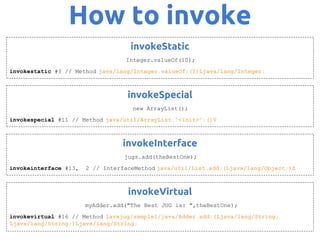
List<String> jugs = new ArrayList<>();
String theBestOne = "LavaJUG";
jugs.add(theBestOne);
myAdder.add(x, y);
myAdder.add( "The Best JUG is: ",theBestOne);
}
}
Types checking at compilation...](https://image.slidesharecdn.com/golo-lava-jug-131108045145-phpapp01/85/Pimp-My-Java-LavaJUG-9-320.jpg)
![Dynamic
class Adder {
def add(a, b) {
return a + b
}
def main(args) {
def myAdder = new Adder()
def x = 10
def y = 10
def jugs = []
def theBestOne = "LavaJUG";
jugs.add(theBestOne)
myAdder.add(x, y)
myAdder.add( "The Best JUG is: ",
theBestOne)
}
}
Types checking at runtime...](https://image.slidesharecdn.com/golo-lava-jug-131108045145-phpapp01/85/Pimp-My-Java-LavaJUG-10-320.jpg)
![public class Adder {
public Integer add(Integer a, Integer b ) {
return a + b;
}
public String add(String a, String b ) {
return a + b;
}
public static void main(String[] args) {
Adder myAdder = new Adder();
int x = 10;
int y = 10;
List<String> jugs = new ArrayList<>();
String theBestOne = "LavaJUG";
jugs.add(theBestOne);
myAdder.add(x, y);
myAdder.add( "The Best JUG is: ",theBestOne);
}
}](https://image.slidesharecdn.com/golo-lava-jug-131108045145-phpapp01/85/Pimp-My-Java-LavaJUG-12-320.jpg)

![public static void main(java.lang.String[]);
flags: ACC_PUBLIC, ACC_STATIC
Code:
stack=3, locals=6, args_size=1
0: new
#8
// class lavajug/sample1/Adder
3: dup
4: invokespecial #9
// Method"<init>":()V
7: astore_1
8: bipush
10
10: istore_2
11: bipush
10
13: istore_3
14: new
#10
// class java/util/ArrayList
17: dup
18: invokespecial #11
// Methodjava/util/ArrayList."<init>":()V
21: astore
4
23: ldc
#12
// String LavaJUG
25: astore
5
27: aload
4
29: aload
5
31: invokeinterface #13, 2
// InterfaceMethod
java/util/List.add:(Ljava/lang/Object;)Z
36: pop
37: aload_1
38: iload_2
39: invokestatic #3
// Methodjava/lang/Integer.valueOf:(I)Ljava/lang/Integer;
42: iload_3
43: invokestatic #3
// Methodjava/lang/Integer.valueOf:(I)Ljava/lang/Integer;
46: invokevirtual #14
// Methodadd:(Ljava/lang/Integer;Ljava/lang/Integer;)Ljava/lang/Integer;
49: pop
50: aload_1
51: ldc
#15
// String The Best JUG is:
53: aload
5
55: invokevirtual #16
// Methodadd:(Ljava/lang/String;Ljava/lang/String;)Ljava/lang/String;
58: pop
59: return](https://image.slidesharecdn.com/golo-lava-jug-131108045145-phpapp01/85/Pimp-My-Java-LavaJUG-14-320.jpg)
![public static void main(java.lang.String[]);
flags: ACC_PUBLIC, ACC_STATIC
Code:
stack=3, locals=6, args_size=1
0: new
#8
// class lavajug/sample1/Adder
3: dup
4: invokespecial #9
// Method"<init>":()V
7: astore_1
8: bipush
10
10: istore_2
11: bipush
10
13: istore_3
14: new
#10
// class java/util/ArrayList
17: dup
18: invokespecial #11
// Methodjava/util/ArrayList."<init>":()V
21: astore
4
23: ldc
#12
// String LavaJUG
25: astore
5
27: aload
4
29: aload
5
31: invokeinterface #13, 2
// InterfaceMethod
java/util/List.add:(Ljava/lang/Object;)Z
36: pop
37: aload_1
38: iload_2
39: invokestatic #3
// Methodjava/lang/Integer.valueOf:(I)Ljava/lang/Integer;
42: iload_3
43: invokestatic #3
// Methodjava/lang/Integer.valueOf:(I)Ljava/lang/Integer;
46: invokevirtual #14
// Methodadd:(Ljava/lang/Integer;Ljava/lang/Integer;)Ljava/lang/Integer;
49: pop
50: aload_1
51: ldc
#15
// String The Best JUG is:
53: aload
5
55: invokevirtual #16
// Methodadd:(Ljava/lang/String;Ljava/lang/String;)Ljava/lang/String;
58: pop
59: return
1- Types present at the callsites](https://image.slidesharecdn.com/golo-lava-jug-131108045145-phpapp01/85/Pimp-My-Java-LavaJUG-15-320.jpg)
![public static void main(java.lang.String[]);
flags: ACC_PUBLIC, ACC_STATIC
Code:
stack=3, locals=6, args_size=1
0: new
#8
// class lavajug/sample1/Adder
3: dup
4: invokespecial #9
// Method"<init>":()V
7: astore_1
8: bipush
10
10: istore_2
11: bipush
10
13: istore_3
14: new
#10
// class java/util/ArrayList
17: dup
18: invokespecial #11
// Methodjava/util/ArrayList."<init>":()V
21: astore
4
23: ldc
#12
// String LavaJUG
25: astore
5
27: aload
4
29: aload
5
31: invokeinterface #13, 2
// InterfaceMethod
java/util/List.add:(Ljava/lang/Object;)Z
36: pop
37: aload_1
38: iload_2
39: invokestatic #3
// Methodjava/lang/Integer.valueOf:(I)Ljava/lang/Integer;
42: iload_3
43: invokestatic #3
// Methodjava/lang/Integer.valueOf:(I)Ljava/lang/Integer;
46: invokevirtual #14
// Methodadd:(Ljava/lang/Integer;Ljava/lang/Integer;)Ljava/lang/Integer;
49: pop
50: aload_1
51: ldc
#15
// String The Best JUG is:
53: aload
5
55: invokevirtual #16
// Methodadd:(Ljava/lang/String;Ljava/lang/String;)Ljava/lang/String;
58: pop
59: return
1- Types present at the callsites
2- Method must exist at compile time](https://image.slidesharecdn.com/golo-lava-jug-131108045145-phpapp01/85/Pimp-My-Java-LavaJUG-16-320.jpg)
![public static void main(java.lang.String[]);
flags: ACC_PUBLIC, ACC_STATIC
Code:
stack=3, locals=6, args_size=1
0: new
#8
// class lavajug/sample1/Adder
3: dup
4: invokespecial #9
// Method"<init>":()V
7: astore_1
8: bipush
10
10: istore_2
11: bipush
10
13: istore_3
14: new
#10
// class java/util/ArrayList
17: dup
18: invokespecial #11
// Methodjava/util/ArrayList."<init>":()V
21: astore
4
23: ldc
#12
// String LavaJUG
25: astore
5
27: aload
4
29: aload
5
31: invokeinterface #13, 2
// InterfaceMethod
java/util/List.add:(Ljava/lang/Object;)Z
36: pop
37: aload_1
38: iload_2
39: invokestatic #3
// Methodjava/lang/Integer.valueOf:(I)Ljava/lang/Integer;
42: iload_3
43: invokestatic #3
// Methodjava/lang/Integer.valueOf:(I)Ljava/lang/Integer;
46: invokevirtual #14
// Methodadd:(Ljava/lang/Integer;Ljava/lang/Integer;)Ljava/lang/Integer;
49: pop
50: aload_1
51: ldc
#15
// String The Best JUG is:
53: aload
5
55: invokevirtual #16
// Methodadd:(Ljava/lang/String;Ljava/lang/String;)Ljava/lang/String;
58: pop
59: return
1- Types present at the callsites
2- Method must exist at compile time
3- No relinking possible](https://image.slidesharecdn.com/golo-lava-jug-131108045145-phpapp01/85/Pimp-My-Java-LavaJUG-17-320.jpg)
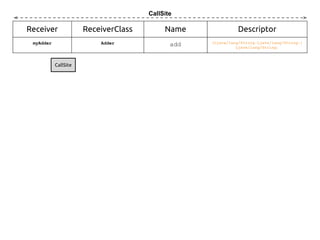
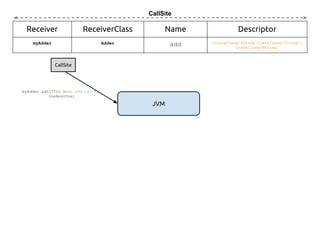
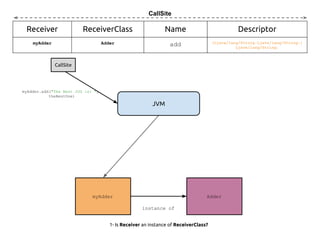
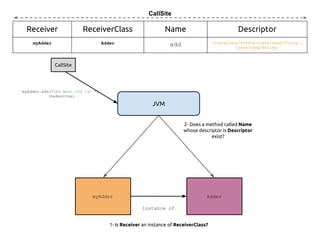

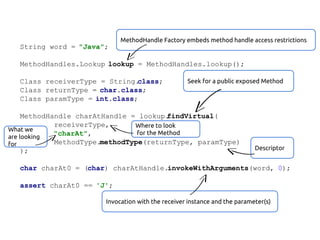


![Lookup lookup = MethodHandles.lookup();
Method formatMethod = MessageFormat.
class.getMethod(
"format",
String.class,
Object[].class
);
MethodHandle greeterHandle = lookup
.unreflect(formatMethod);
assert greeterHandle.type() == methodType(
String.class,
String.class,
Object[].class
From java.lang.reflect to java.lang.invoke
);](https://image.slidesharecdn.com/golo-lava-jug-131108045145-phpapp01/85/Pimp-My-Java-LavaJUG-40-320.jpg)

![Lookup lookup = MethodHandles.lookup();
Method formatMethod = MessageFormat. class.getMethod(
"format", String.class, Object[]. class );
MethodHandle greeterHandle = lookup. unreflect(formatMethod);
greeterHandle = greeterHandle.
bindTo("Hello {0} {1}{2}").
asCollector(Object[]. class, 3);
Curry power ❤
Now representing a 3 args method
//Arguments manipulation
greeterHandle = MethodHandles. insertArguments(
greeterHandle,
greeterHandle.type().parameterCount() - 1, Add/remove/move arguments
"!"
);
//Combining
Method toUpperMethod = String. class.getMethod( "toUpperCase");
MethodHandle toUpperHandle = lookup.unreflect(toUpperMethod);
greeterHandle = MethodHandles. filterReturnValue(greeterHandle,
toUpperHandle);
Split the concerns, then combine the
methods
//Test
String greet = (String) greeterHandle.invokeWithArguments( "John", "Doe");
assert greet.equals( "HELLO JOHN DOE!");](https://image.slidesharecdn.com/golo-lava-jug-131108045145-phpapp01/85/Pimp-My-Java-LavaJUG-42-320.jpg)
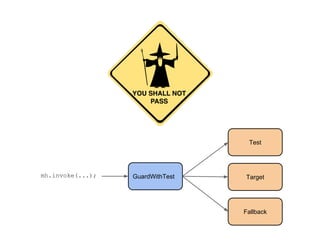
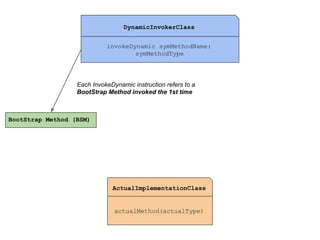
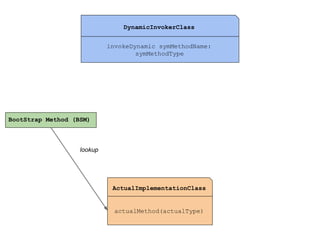
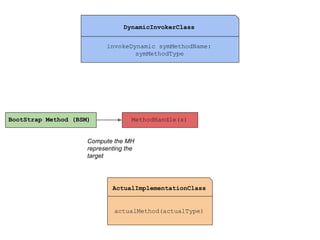
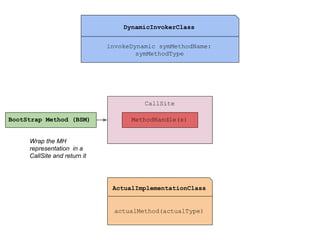
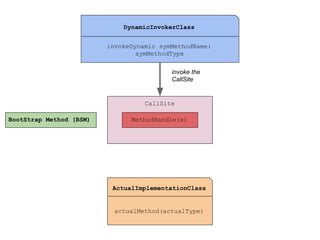
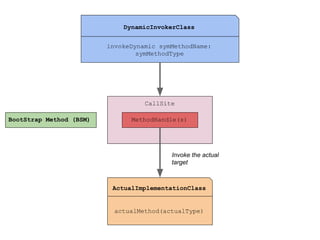
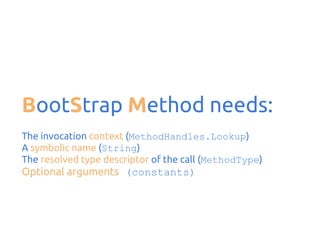
![public static CallSite bootstrap(Lookup lookup, String name, MethodType
type)
throws Throwable {
MethodHandle target = lookup.findStatic(MessageFormat. class, "format",
methodType(String. class, String.class, Object[]. class))
.bindTo( "Hello {0} {1}!")
.asCollector(String[]. class, 2)
The target representation
.asType(type);
return new ConstantCallSite(target);
}
The binding between invoker & receiver
at runtime
public static void main(String[] args) throws Throwable{
CallSite callSite = bootstrap(
MethodHandles.lookup(),
"myGreeter",
methodType(String. class, String.class, String.class)
);
String greet = (String) callSite.dynamicInvoker().invokeWithArguments(
"John", "Doe"
);
assert greet.equals( "Hello John Doe!");
}](https://image.slidesharecdn.com/golo-lava-jug-131108045145-phpapp01/85/Pimp-My-Java-LavaJUG-57-320.jpg)
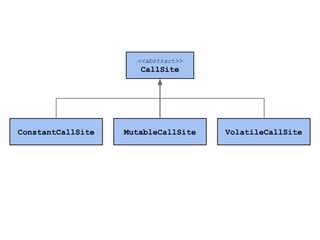


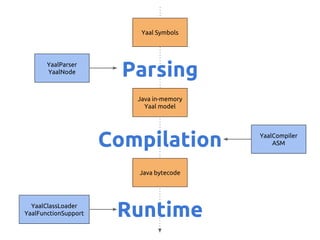
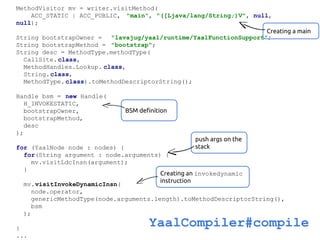
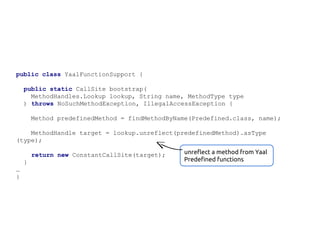



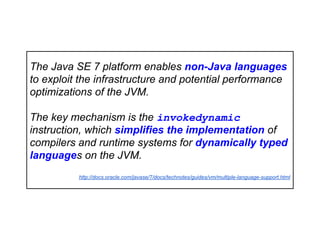
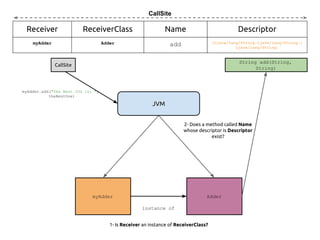
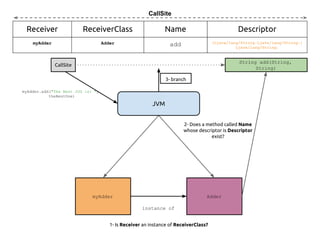
The document discusses how the Java Virtual Machine (JVM) supports dynamic languages through the invokedynamic bytecode instruction. This simplifies the implementation of compilers and runtime systems for dynamically typed languages on the JVM by allowing method dispatch to be deferred until runtime. It also describes how method handles in Java 7 provide a more efficient and flexible way to access methods compared to reflection by embedding access restrictions and allowing faster invocation and combination of methods.


![invokedynamic for Mere Mortals [Code One 2019]](https://cdn.slidesharecdn.com/ss_thumbnails/oco19indyfmm-191015115509-thumbnail.jpg?width=640&height=640&fit=bounds)


![InvokeDynamic for Mere Mortals [JavaOne 2015 CON7682]](https://cdn.slidesharecdn.com/ss_thumbnails/jsr292-171122005506-thumbnail.jpg?width=640&height=640&fit=bounds)


