Executable Bloat
                              How it happens and how we can fight it

                                   Andreas Fredriksson <dep@dice.se>


Thursday, February 24, 2011
Background
                    • Why is ELF/EXE size a problem?
                     • Executable code takes up memory
                     • Consoles have precious little RAM
                     • More available memory enables richer
                                gameplay
                              • It is a lot of work to fix after the fact
Thursday, February 24, 2011
Software Bloat
                                 Software bloat is a term used to describe the
                                 tendency of newer computer programs to have a
                                 larger installation footprint, or have many
                                 unnecessary features that are not used by end
                                 users, or just generally use more system resources
                                 than necessary, while offering little or no benefit
                                 to its users.


                    • Wikipedia has this definition (emphasis mine)
                    • We are wasting memory we could be using
                              to make better games


Thursday, February 24, 2011
C++ Bloat

                    • Let’s look at a few typical C++ techniques
                     • Some are even enforced in coding
                                standards
                              • Often recommended in literature
                              • Often accepted without question

Thursday, February 24, 2011
Interface Class Hiding
                    • Hiding single class Foo         struct IFoo {
                                                         virtual void func() = 0;
                              behind interface IFoo   };


                              • Intent is to avoid    class Foo : public IFoo {

                                                      };
                                                         virtual void func();

                                including heavy Foo
                                header everywhere
                              • Sometimes used for
                                PRX/DLL loading


Thursday, February 24, 2011
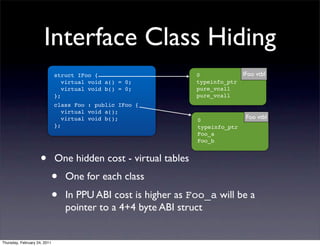
Interface Class Hiding
                              struct IFoo {                      0              IFoo vtbl
                                 virtual void a() = 0;           typeinfo_ptr
                                 virtual void b() = 0;           pure_vcall
                              };                                 pure_vcall
                              class Foo : public IFoo {
                                 virtual void a();
                                 virtual void b();               0
                                                                                 Foo vtbl
                              };                                 typeinfo_ptr
                                                                 Foo_a
                                                                 Foo_b


                    •         One hidden cost - virtual tables
                              •   One for each class
                              •   In PPU ABI cost is higher as Foo_a will be a
                                  pointer to a 4+4 byte ABI struct


Thursday, February 24, 2011
Interface Class Hiding
                    • Additional overhead
                     • Every call site needs vcall adjustment
                     • ctor/dtor needs vptr adjustment
                    • Total SNC overhead, 8 functions: 528 bytes
                     • Likely more, due to callsites
                     • These bytes have no value = bloat
Thursday, February 24, 2011
Excessive Inlining

                    • Typically associated with templates
                     • Templates are almost always inline
                     • Smart pointers
                     • String classes

Thursday, February 24, 2011
Excessive Inlining
                              bool eastl_string_find(eastl::string& str) {
                              !   return str.find("foo") != eastl::string::npos;
                              }
                              bool c_string_find(const char* str) {
                              !   return strstr(str, "foo") != 0;
                              }


                    • Compare two string searches
                     • c_string_find version - 56 bytes (SNC)
                     • eastl_string_find - 504 bytes (SNC)
                    • These bytes add zero value = bloat
Thursday, February 24, 2011
Excessive Inlining
                    • Many other common inlining culprits
                     • operator+= string concatenation
                     • Call by value w/ inline ctor
                    • Hard to control via compiler options
                     • Sometimes you want inlining
                     • Better to avoid pointless cases
Thursday, February 24, 2011
Static Initialization
                              static const eastl::string strings[] = { "foo0", "foo1" };
                              static const Vec3 vecs[] = { { 0.2, 0.3, 0.5 }, { ... } };


                    •         Extreme hidden costs for constructors
                    •         Generates initializer function
                    •         Have seen arrays of this kind generate over 20
                              kb of initializer code in the wild (SNC)
                              •   Array of 10 eastl::strings - 1292 bytes
                              •   Array of 10 vec3 - 368 bytes


Thursday, February 24, 2011
Static Initialization
                              static const char* strings[] = { "foo0", "foo1", ... };
                              static const float vecs[][3] = { { 0.2, 0.3, 0.5 }, ... };


                    • Just don’t do it - prefer POD types
                      • Make sure data ends up in .rodata segment
                      • Adjust code using array accordingly
                    • Alternatively make data load with level
                      • No space overhead when not used
Thursday, February 24, 2011
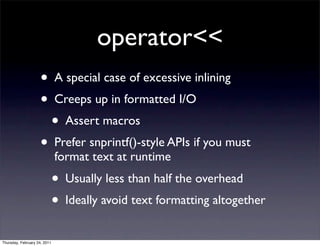
operator<<
                    • A special case of excessive inlining
                    • Creeps up in formatted I/O
                      • Assert macros
                    • Prefer snprintf()-style APIs if you must
                              format text at runtime
                              • Usually less than half the overhead
                              • Ideally avoid text formatting altogether
Thursday, February 24, 2011
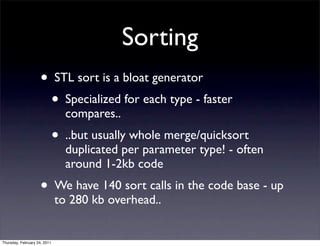
Sorting
                    • STL sort is a bloat generator
                      • Specialized for each type - faster
                                compares..
                              • ..but usually whole merge/quicksort
                                duplicated per parameter type! - often
                                around 1-2kb code
                    • We have 140 sort calls in the code base - up
                              to 280 kb overhead..


Thursday, February 24, 2011
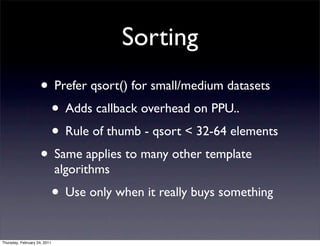
Sorting
                    • Prefer qsort() for small/medium datasets
                     • Adds callback overhead on PPU..
                     • Rule of thumb - qsort < 32-64 elements
                    • Same applies to many other template
                              algorithms
                              • Use only when it really buys something
Thursday, February 24, 2011
Part 2:
                              What you can do


Thursday, February 24, 2011
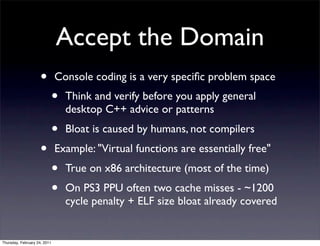
Accept the Domain
                    •         Console coding is a very specific problem space
                              •   Think and verify before you apply general
                                  desktop C++ advice or patterns
                              •   Bloat is caused by humans, not compilers
                    •         Example: "Virtual functions are essentially free"
                              •   True on x86 architecture (most of the time)
                              •   On PS3 PPU often two cache misses - ~1200
                                  cycle penalty + ELF size bloat already covered


Thursday, February 24, 2011
Day to day
                    • Think about full impact of your changes
                     • .text size impact
                     • .data/.rodata size impact
                     • Bring it up & discuss in code reviews
                    • Make sure your code is reasonably sized for
                              the problem it solves!


Thursday, February 24, 2011
Avoid “reuse” bloat
                    •         YAGNI - “You ain’t gonna need it”
                              •   Just write simple code that can be extended if
                                  needed
                              •   We typically never extend systems without
                                  altering their interfaces anyway
                    •         Game code is disposable, a means to an end
                              •   Make sure it works well NOW
                              •   Avoid “single-feature frameworks”


Thursday, February 24, 2011
Avoid repetition
                    •         Can often move repeated code to data
                              •   Higher information density but same end result
                          RegisterFunc("foo", func_foo);
                          RegisterFunc("bar", func_bar);
                          RegisterFunc("baz", func_baz);
                          // ...

                         static const struct {
                             const char *name;   void (*func)(void);
                         } opdata[] = {
                         !   { "foo", func_foo   },
                         !   { "bar", func_bar   },
                         !   { "baz", func_baz   },
                             // ...
                         };

                         for (int i=0; i < sizeof_array(opdata); ++i)
                             RegisterFunc(opdata[i].name, opdata[i].func);


Thursday, February 24, 2011
Compiler Output
                    • Look at the generated code!
                      • That’s what you’re checking in, not C++
                      • Don’t assume code is improved by the
                                compiler
                              • No magic going on, compilers are stupid
                    • Develop an intuition for what to expect
                      • Verify assumptions as you code
Thursday, February 24, 2011
Assembly
                    • Learn enough assembly to read compiler
                              output
                              • Function calls (calling convention)
                              • Memory loads and stores
                              • FP/Vector instructions
                    • It’s not very difficult - just do it
                      • Also improves your debugging skills
Thursday, February 24, 2011
Guidelines
                    • Avoid string classes, concatenation
                     • Excessive inlining
                    • Avoid template containers for simple
                              problems
                              • Inlining + instantiation cost
                              • Prefer C arrays for most jobs
Thursday, February 24, 2011
Guidelines
                    • Avoid complex types in function signatures
                              and interfaces
                               • Requires caller to jump through hoops
                               • Often bloats all call sites
                               • Prefer raw POD types
                                • (T* ptr, int count) is better
                                    than (std::vector<T>&)


Thursday, February 24, 2011
Guidelines
                    • Avoid inheritance, interfaces and virtual
                              functions
                              • Hidden costs are subtle
                              • Prefer function pointers for callbacks
                              • Prefer free functions on predeclared
                                types for header stripping


Thursday, February 24, 2011
Guidelines
                    •         Avoid operator<< streaming
                              •   Prefer printf() style APIs
                              •   Easy to make your own formatter for often-
                                  used types
                    •         Avoid singletons
                              •   They just add bloat around data that's just as
                                  global anyway
                              •   Prefer free functions around static data


Thursday, February 24, 2011
Summary
                    • Make sure the code/data you’re adding is
                              reasonably sized for the problem it solves
                              • Use no more than necessary
                    • Pick up some assembly and look at the
                              compiler output
                    • Always measure, examine & question!

Thursday, February 24, 2011
Questions?
                              Twitter: @deplinenoise
                               Email: <dep@dice.se>


Thursday, February 24, 2011

Executable Bloat - How it happens and how we can fight it

  • 1.
    Executable Bloat How it happens and how we can fight it Andreas Fredriksson <dep@dice.se> Thursday, February 24, 2011
  • 2.
    Background • Why is ELF/EXE size a problem? • Executable code takes up memory • Consoles have precious little RAM • More available memory enables richer gameplay • It is a lot of work to fix after the fact Thursday, February 24, 2011
  • 3.
    Software Bloat Software bloat is a term used to describe the tendency of newer computer programs to have a larger installation footprint, or have many unnecessary features that are not used by end users, or just generally use more system resources than necessary, while offering little or no benefit to its users. • Wikipedia has this definition (emphasis mine) • We are wasting memory we could be using to make better games Thursday, February 24, 2011
  • 4.
    C++ Bloat • Let’s look at a few typical C++ techniques • Some are even enforced in coding standards • Often recommended in literature • Often accepted without question Thursday, February 24, 2011
  • 5.
    Interface Class Hiding • Hiding single class Foo struct IFoo { virtual void func() = 0; behind interface IFoo }; • Intent is to avoid class Foo : public IFoo { }; virtual void func(); including heavy Foo header everywhere • Sometimes used for PRX/DLL loading Thursday, February 24, 2011
  • 6.
    Interface Class Hiding struct IFoo { 0 IFoo vtbl virtual void a() = 0; typeinfo_ptr virtual void b() = 0; pure_vcall }; pure_vcall class Foo : public IFoo { virtual void a(); virtual void b(); 0 Foo vtbl }; typeinfo_ptr Foo_a Foo_b • One hidden cost - virtual tables • One for each class • In PPU ABI cost is higher as Foo_a will be a pointer to a 4+4 byte ABI struct Thursday, February 24, 2011
  • 7.
    Interface Class Hiding • Additional overhead • Every call site needs vcall adjustment • ctor/dtor needs vptr adjustment • Total SNC overhead, 8 functions: 528 bytes • Likely more, due to callsites • These bytes have no value = bloat Thursday, February 24, 2011
  • 8.
    Excessive Inlining • Typically associated with templates • Templates are almost always inline • Smart pointers • String classes Thursday, February 24, 2011
  • 9.
    Excessive Inlining bool eastl_string_find(eastl::string& str) { ! return str.find("foo") != eastl::string::npos; } bool c_string_find(const char* str) { ! return strstr(str, "foo") != 0; } • Compare two string searches • c_string_find version - 56 bytes (SNC) • eastl_string_find - 504 bytes (SNC) • These bytes add zero value = bloat Thursday, February 24, 2011
  • 10.
    Excessive Inlining • Many other common inlining culprits • operator+= string concatenation • Call by value w/ inline ctor • Hard to control via compiler options • Sometimes you want inlining • Better to avoid pointless cases Thursday, February 24, 2011
  • 11.
    Static Initialization static const eastl::string strings[] = { "foo0", "foo1" }; static const Vec3 vecs[] = { { 0.2, 0.3, 0.5 }, { ... } }; • Extreme hidden costs for constructors • Generates initializer function • Have seen arrays of this kind generate over 20 kb of initializer code in the wild (SNC) • Array of 10 eastl::strings - 1292 bytes • Array of 10 vec3 - 368 bytes Thursday, February 24, 2011
  • 12.
    Static Initialization static const char* strings[] = { "foo0", "foo1", ... }; static const float vecs[][3] = { { 0.2, 0.3, 0.5 }, ... }; • Just don’t do it - prefer POD types • Make sure data ends up in .rodata segment • Adjust code using array accordingly • Alternatively make data load with level • No space overhead when not used Thursday, February 24, 2011
  • 13.
    operator<< • A special case of excessive inlining • Creeps up in formatted I/O • Assert macros • Prefer snprintf()-style APIs if you must format text at runtime • Usually less than half the overhead • Ideally avoid text formatting altogether Thursday, February 24, 2011
  • 14.
    Sorting • STL sort is a bloat generator • Specialized for each type - faster compares.. • ..but usually whole merge/quicksort duplicated per parameter type! - often around 1-2kb code • We have 140 sort calls in the code base - up to 280 kb overhead.. Thursday, February 24, 2011
  • 15.
    Sorting • Prefer qsort() for small/medium datasets • Adds callback overhead on PPU.. • Rule of thumb - qsort < 32-64 elements • Same applies to many other template algorithms • Use only when it really buys something Thursday, February 24, 2011
  • 16.
    Part 2: What you can do Thursday, February 24, 2011
  • 17.
    Accept the Domain • Console coding is a very specific problem space • Think and verify before you apply general desktop C++ advice or patterns • Bloat is caused by humans, not compilers • Example: "Virtual functions are essentially free" • True on x86 architecture (most of the time) • On PS3 PPU often two cache misses - ~1200 cycle penalty + ELF size bloat already covered Thursday, February 24, 2011
  • 18.
    Day to day • Think about full impact of your changes • .text size impact • .data/.rodata size impact • Bring it up & discuss in code reviews • Make sure your code is reasonably sized for the problem it solves! Thursday, February 24, 2011
  • 19.
    Avoid “reuse” bloat • YAGNI - “You ain’t gonna need it” • Just write simple code that can be extended if needed • We typically never extend systems without altering their interfaces anyway • Game code is disposable, a means to an end • Make sure it works well NOW • Avoid “single-feature frameworks” Thursday, February 24, 2011
  • 20.
    Avoid repetition • Can often move repeated code to data • Higher information density but same end result RegisterFunc("foo", func_foo); RegisterFunc("bar", func_bar); RegisterFunc("baz", func_baz); // ... static const struct { const char *name; void (*func)(void); } opdata[] = { ! { "foo", func_foo }, ! { "bar", func_bar }, ! { "baz", func_baz }, // ... }; for (int i=0; i < sizeof_array(opdata); ++i) RegisterFunc(opdata[i].name, opdata[i].func); Thursday, February 24, 2011
  • 21.
    Compiler Output • Look at the generated code! • That’s what you’re checking in, not C++ • Don’t assume code is improved by the compiler • No magic going on, compilers are stupid • Develop an intuition for what to expect • Verify assumptions as you code Thursday, February 24, 2011
  • 22.
    Assembly • Learn enough assembly to read compiler output • Function calls (calling convention) • Memory loads and stores • FP/Vector instructions • It’s not very difficult - just do it • Also improves your debugging skills Thursday, February 24, 2011
  • 23.
    Guidelines • Avoid string classes, concatenation • Excessive inlining • Avoid template containers for simple problems • Inlining + instantiation cost • Prefer C arrays for most jobs Thursday, February 24, 2011
  • 24.
    Guidelines • Avoid complex types in function signatures and interfaces • Requires caller to jump through hoops • Often bloats all call sites • Prefer raw POD types • (T* ptr, int count) is better than (std::vector<T>&) Thursday, February 24, 2011
  • 25.
    Guidelines • Avoid inheritance, interfaces and virtual functions • Hidden costs are subtle • Prefer function pointers for callbacks • Prefer free functions on predeclared types for header stripping Thursday, February 24, 2011
  • 26.
    Guidelines • Avoid operator<< streaming • Prefer printf() style APIs • Easy to make your own formatter for often- used types • Avoid singletons • They just add bloat around data that's just as global anyway • Prefer free functions around static data Thursday, February 24, 2011
  • 27.
    Summary • Make sure the code/data you’re adding is reasonably sized for the problem it solves • Use no more than necessary • Pick up some assembly and look at the compiler output • Always measure, examine & question! Thursday, February 24, 2011
  • 28.
    Questions? Twitter: @deplinenoise Email: <dep@dice.se> Thursday, February 24, 2011