[As far as I am aware this document is in the 
Public Domain, 
if you know otherwise, 
please contact me at 
colin49mail-index@yahoo.co.uk 
Colin J…] 
There are 10 Pages – 4,070 words 
The Masonic Emblems 
From Whitby's Ritual of Freemasonry 
Freemasonry is the most ancient and honourable Order in existence, as every character, figure, and emblem 
depicted on its Tracing Boards serve to inculcate the practice of piety and virtue: and the industrious student 
of its mysteries cannot fail to draw from them food for moral reflection and enable him to remove the 
rubbish of ignorance and vice which prevent him from beholding that eternal foundation of truth and 
wisdom upon which he is to erect his spiritual temple. 
As Masonry does not admit any person on account of his rank or opulence, the candidate should divest his 
mind of all selfish and worldly considerations, and lay aside the trinkets and trappings of the outward world, 
and for a time become poor and penniless, as in this state he is better able to appreciate that virtue which 
ought to be the distinguishing characteristic of every Freemason - Charity. 
THE HOODWINK 
The candidate for Freemasonry is prepared to close his eyes on the past and think of the dark mysterious 
future. This blindness is emblematical of man entering into this world helpless, ignorant, and blind: also 
youth groping in mental darkness for intellectual light. It will also remind him that as he was received into 
Masonry in a state of darkness, so also should he keep those of the outside world in darkness as regards our 
secrets. 
THE LEFT BREAST 
is made bare to symbolise his sincerity of purpose and purity of mind, as also to reveal his sex. 
THE RIGHT ARM 
is made bare in token of his unreserved confidence. 
THE LEFT KNEE 
is made bare in token of his humility to bend before the Author of his being. 
THE SLIP SHOE 
is emblematical of his fidelity, as he was prepared to slip the shoe from off his foot.
THE CABLE-TOW 
will remind him of the dangers which surround him in this life. It will also remind him to submit when in 
ignorance; to be led by those whom he knows to be enlightened. 
THE SHARP-POINTED INSTRUMENT 
pressed to his naked left breast will remind him to be cautious. and at all times to put his trust in God. 
THE RIGHT HAND 
placed over the Holy Bible. the Square, and Compasses will remind him of his oath of fidelity and of the 
obligations he owes to God and his fellow-men 
THE GREAT LIGHTS 
In Masonry are the Holy Bible, the Square, and the Compasses, so called because the Holy Bible is God's 
gift to man, wherein He has revealed His Divine will, by which we are to rule and govern our faith; the 
Square reminds us to square our actions by the Masonic rule and line; while the Compasses remind us to 
keep our passions and prejudices within due bounds with all mankind, but more especially with our 
Brethren in Freemasonry. 
THE THREE LESSER LIGHTS 
are represented by three burning candles situated due East, South, and West, and figuratively 
represent the Sun, the Moon, and the Master of the Lodge, and as the sun rules the day and the 
moon governs the night, so ought the Master to rule and govern his Lodge 
THE MASONIC APRON See Clothing Charge in the First or Entered Apprentice Degree. 
THE FOUNDATION STONE 
is, or ought to be, placed in the North-East part of the building; hence the reason that every 
candidate is placed in that part of the Lodge room to receive his first Masonic lesson in moral 
architecture, which, it is hoped, will never be effaced from his memory-namely Charity. 
THE 24-INCH GAUGE 
reminds us of the twenty-four hours of the day, and directs us to apply them to their proper objects 
namely. prayer, labour, refreshment and sleep. 
THE COMMON GAVEL 
is the emblem of reason Its use to the operative mason is to break off corners of rough stones, the 
better to fit them for the builders' use. It should teach the Freemason to break off all habits of 
vice, thereby fitting his mind as a living stone fit to form part of that spiritual temple, that house not 
made with hands eternal in the heavens. 
THE CHISEL 
is an emblem of perseverance which is necessary to establish perfection, promote the habit of virtue 
enlighten the mind, and make the soul pure, As the chisel with perseverance gives polish to the stone. so 
will education give polish to the mind 
THE THREE VIRTUES 
or precious Jewels of an Entered Apprentice Mason are an attentive ear. a silent or instructive tongue, and a 
faithful heart 
AN ATTENTIVE EAR 
should be given to our superiors in knowledge and the call of a distressed brother. There are many entering 
the porch of Masonry who for want of this virtue fall asleep in the arms of indolence, and do not penetrate
beyond the surface, hence they fail to find the golden treasure the rich mine contains. 
A SILENT (OR INSTRUCTIVE ) TONGUE 
is an emblem of prudence aid discretion. This virtue is essential to Masons, so that our secrets may not 
inadvertently become known. It also reminds us that we should speak evil of no man whom we cannot 
approve; we should pity in silence. 
A FAITHFUL HEART 
is the safest repository in which to lock up our secrets. It also reminds us to be faithful to our obligations, 
CHALK, CHARCOAL, AND EARTH 
are emblems of freedom., fervency, and zeal. As there is nothing freer than chalk, the slightest touch of 
which leaves a trace behind; there is no heat more fervent than burning charcoal; and nothing more zealous 
than earth to bring forth. These are characteristics which should be possessed by every Freemason, as we 
should love god with freedom, fervency, and zeal. 
THE LODGE ROOM 
is a representation of the world, and all Masonic Lodges and places of Divine worship are (or ought to be) 
situated due East and West, for which we assign three Masonic reasons. Firstly the sun rises in the east and 
sets in the west secondly, learning originated in the east and spread to the west; and thirdly, the tent or 
tabernacle erected by Moses in the wilderness was so situated to commemorate that miraculous east wind 
which wrought the mighty deliverance of the children of Israel from their Egyptian bondage. 
IT’S DIMENSIONS 
embrace every clime. In length from east to west, in breadth between north and south, in depth from the 
surface of the earth to the centre, and in height from earth to Heaven, denoting the universality its influence, 
and that a Mason's charity should know no bounds save those of prudence. 
ITS SUPPORTS 
are three great pillars, called Wisdom, Strength, and Beauty. Wisdom to contrive, govern, and instruct; 
Strength to support; and Beauty to adorn. Wisdom to conduct us in all our undertakings; Strength to 
support us under all our difficulties; and Beauty to adorn the inward man. They also represent Solomon, 
King of Israel, for his wisdom; Hiram, King of Tyre, for his assistance in building the Temple; and Hiram 
Abiff for his cunning and beautiful workmanship. These three pillars are represented by the three principal 
orders of architecture-the Ionic, the Doric, and the Corinthian. 
ITS COVERING 
is the celestial canopy or starry-decked heavens. The sun, moon, and stars are emblems of 
God's power, goodness, omnipresence, and eternity. 
The spacious Firmament on high. 
With all the blue ethereal sky 
And spangled heavens, a shining frame. 
Their great original proclaim. 
The unwearied sun from day to day 
Does his Creator's power display, 
And publishes to every land 
The work of' an Almighty hand.
Soon as the evening shades prevail 
The moon takes up the wondrous tale, 
And nightly to the listening earth 
Repeats the story of her birth. 
While all the stars that round her hum, 
And all the planets in their turn 
Confirm the tidings as they roll, 
And spread the truth from pole to pole. 
What though in solemn silence all 
Move round this dark terrestrial ball; 
What though no real voice nor sound 
Amid their radiant orbs be found. 
In Reason's ear they all rejoice, 
And utter forth a glorious voice; 
Forever singing as they shine, 
The hand that made us is Divine.' 
ITS FURNITURE 
consists of the Holy Bible, the Square, and the Compasses. The Holy Bible is the symbol of God's will, and 
is dedicated to His service. It is also the rule and guide for our faith. being God's gift to man for that 
purpose, The Square is dedicated to the whole Craft; the Craft, being obligated within the Square, are bound 
to act thereon. The Compasses belong to the Master in particular, that being the chief instrument made use 
of in the formation of all architectural plans and designs; is peculiarly appropriated to the Master as an 
emblem of his dignity, he being the chief head and ruler of the Lodge. 
ITS ORNAMENTS 
are the Blazing Star, the Mosaic Pavement, and the Indented Border. 
THE BLAZING STAR 
is the emblem of prudence, which should shine conspicuous in our conduct and be the guiding 
star of our lives, instructing us to regulate our actions by the dictates of reason and experience; to 
judge wisely, and determine with propriety on everything that tends to our present or future 
happiness. Its proper place is in the centre of the Lodge room, so as to be ever present to the 
eye; that the heart may be attentive to its dictates and steadfast in the laws of prudence. 
THE MOSAIC PAVEMENT 
represents the world chequered o'er with good and evil, pain and pleasure, grief and joy. Today 
we walk in prosperity, tomorrow we totter in adversity; but united in the bond of brotherhood and 
walking uprightly we may not stumble. 
THE INDENTED BORDER 
may be likened to the wavy ocean which skirts the land, and by indenting it adds beauty to the 
earth, but it is emblematically intended to represent the many blessings and comforts by which we 
are surrounded in this life, but more especially those which we hope to enjoy hereafter. 
THE TASSELS
which adorn the four corners of the Indented Border are emblematical of the cardinal virtues - 
Prudence. Fortitude, Temperance, and Justice. 
PRUDENCE 
for delineation of Prudence see Blazing Star. 
FORTITUDE 
is that noble and steady purpose of the soul which enables us to encounter dangers and difficulties, resist 
temptation, and keep us in the straight path o virtue. 
TEMPERANCE 
sets bounds to our desires, frees the mind from the allurements of vice, and renders our passions 
tame and governable, and the dignity of man depends upon the faithful observance of this virtue. 
JUSTICE 
is the boundary of right and the cement of civil society. Without the exercise of this virtue social 
intercourse could not exist, might would usurp the place of right, and universal confusion ensue. Justice 
commands that you 'Do unto others as you would that others should do unto you'. Therefore let Prudence 
direct you, Fortitude support you, Temperance chasten you, and Justice be the guide of all your actions. 
THE JEWELS 
of a Lodge are six in number-three movable and three immovable. The three movable are the Square, 
Level, and the Plumb-Rule, the immovable being the Rough Ashlar, the Perfect Ashlar, and the Trestle 
Board. (For the Square, Level, and Plumb-Rule see the Working Tools in the Second or Fellow~ Craft 
Degree,) 
The Rough Ashlar, the Perfect Ashlar, and the Trestle Board are called immovable Jewels, because they lie 
in open Lodge for the Brethren to moralise on. 
The Rough Ashlar is for the Entered Apprentice to work, mark, and indent on; the Perfect Ashlar for the 
more experienced workman to try and adjust his Jewels on; while the Trestle Board is for the Master to lay 
lines and draw designs on. 
THE ROUGH ASHLAR 
represents man in his natural state- ignorant, unpolished, and vicious, like the rough stone taken from the 
quarry or a precious stone surrounded by a dense crust, its beauty unseen till the rough surface is removed. 
THE PERFECT ASHLAR 
represents man in a high state of civilisation, with his mind divested of all vice prepared for that house not 
made with hands eternal in the heavens; like a stone of a true die or square, fit only to be tried by the Square 
and Compasses. 
THE TRESTLE BOARD 
for the Master to lay lines and draw designs upon, the better to enable the Brethren to carry on the, intended 
structure. So may the Volume of the Sacred Law be justly deemed the spiritual Tracing Board of the Great 
Architecture of the Universe, wherein He had laid down the Divine laws and moral plans, according to 
which we are to erect our spiritual temple and find acceptance into the City of our God 
THE LEWIS 
denotes strength to support. It also represents the son of a Mason, whose duty it is to support his aged 
parents when they are unable to labour or bear the burden of care gathered upon them in their journey 
through life. For this filial duty he can claim the privilege 
of being made a Mason at an earlier age than any other person, however dignified by birth or fortune. It is
depicted on the Trestle Board by certain pieces of metal dovetailed into the Perfect Ashlar. 
THE THEOLOGICAL LADDER 
which Jacob saw in his vision, extending from earth to heaven, represents the way of salvation, the many 
steps composing it representing so many moral virtues, the principal being Faith, Hope. and Charity 
Faith in the Great Architect of the Universe, Hope in immortality, and Charity to all mankind. This ladder 
rests on the Volume of the Sacred Law. because by the doctrines in that Holy Book we are taught to believe 
in the wise dispensations of Divine providence, which belief strengthens our faith and enables us to ascend 
the first step. This faith naturally creates in us a hope of becoming partakers of some of the blessed 
promises therein contained. which hope enables us to ascend the second step: but the third and last, being 
Charity, comprehends the whole, and the Mason who is in possession of this virtue may be said to wear the 
brightest Jewel that can adorn our fraternity. 
THE VOLUME OF THE SACRED LAW 
is represented on the Trestle Board as resting on the top of a circle which is bounded on the north and south 
by two perpendicular lines, representing Moses and King Solomon, or in Christian Lodges, St. John the 
Baptist and St. John the Evangelist who in Masonry, it is understood, were parallels and exemplary of those 
virtues which we as Masons are taught to revere. 
THE CIRCLE 
represents the boundary line of a Mason's conduct and in going round this circle we must of necessity touch 
on both these parallel lines as well as the Volume of the Sacred Law, and were we as conversant with that 
Holy Book as were those two parallels we could not materially err. 
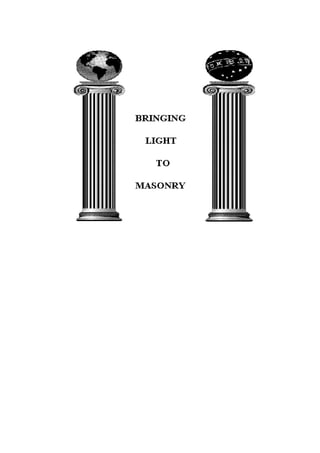
THE TWO PILLARS 
which were placed at the porch or entrance of King Solomon's Temple are described in Ist Kings. seventh 
chapter. They were adorned with chapiters or capitals, one on each, These chapiters 
were each five cubits high, and were adorned with network, lilywork, and pomegranates. Network from 
the connection of its meshes denotes 'Unity'; lilywork from its whiteness denotes 'Peace'; and pomegranates 
from the exuberance of their seed denote 'Plenty'. They were further adorned with two spherical balls or 
globes. on which were delineated maps of the celestial and terrestrial globes. which point out to us 
'Masonary Universal'. Pillars of such magnitude, strength, and beauty could not but impress upon the minds 
of their beholders the idea of strength and stability which their names imply. The destruction of those 
pillars, the magnificent Temple, and the city itself is significant of the weakness and instability of human 
greatness, and that our strength can only be in God, and faith in Him is the only sure foundation on which 
we can build our future Temple of Happiness to stand Firm for ever 
AN EAR OF CORN 
depicted on the Trestle Board as growing near a running stream also denotes 'Plenty'. 
THE WINDING STAIRCASE 
leading from the ground floor to the Middle Chamber symbolises the laborious ascent to eminence in the 
attainment of the hidden mysteries of learning and science. The symbolical winding stair is composed of 
three, five, and seven (or more) steps-three to rule a Lodge, five to hold a Lodge, and seven (or more) to 
make it perfect. The three who rule a Lodge are the Master and his two Wardens; the five who hold a 
Lodge are the Master, his two Wardens, and two Fellow-Crafts; the seven who make it perfect are two 
Entered Apprentices added to the former number. 
THE THREE STEPS 
represent Youth, or the Entered Apprentice Degree. First, his being born into Masonic life; second, his 
ignorance of the world in his childhood; and third, the lessons which he receives in his youth to prepare his
mind for the instruction which is given in the succeeding Degrees. They also represent the three supports in 
Masonry, Wisdom, Strength. and Beauty. 
THE FIVE STEPS 
represent Manhood, or the Fellow-Craft Degree, the five Orders of Architecture. and the five Human 
Senses. 
THE ORDERS OF ARCHITECTURE 
Are the Tuscan, the Doric. the Ionic. the Corinthian, and the Composite. 
THE FIVE HUMAN SENSES 
are Seeing, Hearing, Feeling. Tasting, and Smelling. The first three are essential to Masons to see the 
signs, to hear the words, and feel the grips. 
THE SEVEN STEPS 
represent Old Age, or the Master Mason Degree. They also refer to the seven Sabbatical years, seven 
golden candlesticks, the seven years of plenty, seven years of famine, seven days of the week, seven years 
and over in building and dedicating the Temple. but more especially to the seven Liberal Arts and Sciences, 
namely. Grammar, Logic. Rhetoric. Arithmetic. Geometry, Astronomy. and Music. 
The ancients considered odd numbers more perfect than even ones, hence odd numbers predominate in 
Masonry. and are intended to symbolise 'perfection'. It is as a symbol. and as a symbol only, that we study 
the winding staircase, for as an allegory we see beauty in it, as it points out to us a 'Mason's duty', which is 
to be ever on the search for knowledge even though the steps in the 
attainment of it are winding and difficult. But by study and perseverance we gain our reward, and that 
reward more precious than either-money, corn. wine, or oil. 
CORN, WINE, AND OIL 
are emblematical of plenty. cheerfulness, and peace. 
A Master Mason's Lodge duly opened represents the sanctum sanctorum-um, or Holy of Holies, of King 
Solomon's Temple, where not even Kings are allowed to enter unless duly Initiated, Passed, and Raised to 
that sublime privilege by the help of God, His good name and the united aid of the Square and Compasses, 
which represent Virtue, Morality, Friendship, and Brotherly Love. 
THE PORCH 
or entrance to the Holy of Holies is emblematical of death and the grave, or that porch through which we 
must all pass to enter that sanctum sanctorum or celestial Lodge, where the Grand Master of the Universe 
presides for ever and ever. 
THE CHEQUERED PAVEMENT 
for the High Priest to walk on and burn incense on the golden altar. praying the Almighty for peace and 
prosperity. is emblematical of our choice between light or darkness. Pleasure or pain, good or evil, God or 
mammon. For 'Ye cannot serve God and mammon; if ye reject one ye must take the other'. 
THE DORMER 
or window which gave light to the sanctum sanctorum is emblematical of the Holy Bible, that fountain of 
light and wisdom, which enlightens the mind and instructs us how to die. 
THE THREE STEPS 
are emblematical of the three stages of human life. 
Youth. manhood. and old age, also the three periods of our existence, Time, Death and Eternity.
THE MALLET 
is an emblem of power and authority, morally teaching us to correct all irregularities and to reduce man to a 
proper level. 
For the Hour Glass, the Scythe, the Coffin, Skull and Crossbones, the Spade, and the Sprig of Acacia see 
Emblem Charge after raising 'In the Third or Master Mason Degree. 
THE FIVE-POINTED STAR 
is emblematical of the five points of fellowship. It will remind the Master Mason of. 
F. to F. that we should go 
When sickness lays a Brother low 
To cheer him on his bed of pain, 
And nurse him back to health again. 
K. to K. when’re we pray, 
At early morn or close of day; 
A Brother's name should claim a share 
In every thought and every prayer. 
B. to B. that we should keep 
A Brother's secrets hidden deep, 
To all the world but us unknown, 
And hold them sacred as our own. 
H. to B. with firmest grasp, 
Encircling arm-, and friendly clasp: 
We should be found at duty's call 
To stay a Brother's tottering fall. 
M to E. when’re we find 
To err a Brother is inclined: 
We'll counsel give in gentlest tone, 
And breathe it to his ear alone. 
Then F. to F. and K. to K., 
True Brothers we should ever be: 
With H. to B. and B. to B. 
Each striving still to do his best, 
We'll whisper words of hope and cheer 
With C. to C. and M. to E. 
THE TROWEL 
is an emblem reminding us to spread the cement of brotherly love which binds us into one vast holy, good, 
universal Brotherhood. 
THE SKIRRIT 
is an emblem reminding us of that straight and undeviating line of conduct which leads to immortality, as 
revealed to us in the Volume of the Sacred Laws. 
THE PENCIL
reminds us that our thoughts, words, and actions are recorded by the Great Architect of the Universe, who 
will reward or punish as we obey or disregard His Divine commands. 
THE COMPASSES 
particularly belong to the Master Mason Degree, as when 
they are properly extended they embrace all the tenets and precepts of our Order, and enable us to make the 
circle of our Masonic duties complete. 
THE MONUMENT 
erected to the memory of' H.A.B. was a broken column of white marble supporting a book. with a virgin 
weeping over them. an urn in her left hand and a sprig of acacia in her right. Time standing behind her with 
his Fingers entwined in the ringlets of the virgin's hair. 
THE BROKEN COLUMN 
is emblematical of the weakness and frailty of man, the uncertainty of life, and all things human. 
THE OPEN BOOK 
is emblematical of the revealed will of God and the Book of Nature open for our investigation. 
THE VIRGIN 
weeping over them illustrates the melancholy contemplation that 'Thy doom is written: dust thou art, and 
shall to dust return'. And that time will sooner or later overtake us and wield the scythe which will launch us 
into eternity. 
THE BEEHIVE 
is an emblem of industry. Idleness. which leads to immorality, vice and ruin, is severely reprimanded by 
this emblem. We should therefore be industrious, and give to each flying minute something to keep in 
store', so that we may not be considered a useless drone in the busy hive of Nature. 
THE ARK 
is an emblem of safety, reminding us to put our 'trust in God' to pilot our barque over the tempestuous sea of 
life. 
THE ANCHOR 
is the emblem of a well-grounded hope in a glorious immortality, when the storms of life are past and we 
are anchored on that shore ‘'Where the wicked cease from troubling and the weary are at rest.’ 
THE POT OF INCENSE 
is emblematical of the cloud of celestial white which filled the Temple at Jerusalem, and of a pure heart 
glowing with fervent love and ascending to Heaven in perfumes of Filial gratitude. 
THE ALL - SEEING EYE 
of the Incomprehensible, Omnipotent God reminds us that wherever we are or whatever we do His all,- 
seeing eye beholds us. and that while we continue to act in accordance with the genuine tenets and 
principles of our Order, let us not forget to discharge our duty towards Him with freedom. fervency, and 
zeal.
Freemasonry 080 the masonic emblems

Freemasonry 080 the masonic emblems

  • 1.
    [As far asI am aware this document is in the Public Domain, if you know otherwise, please contact me at colin49mail-index@yahoo.co.uk Colin J…] There are 10 Pages – 4,070 words The Masonic Emblems From Whitby's Ritual of Freemasonry Freemasonry is the most ancient and honourable Order in existence, as every character, figure, and emblem depicted on its Tracing Boards serve to inculcate the practice of piety and virtue: and the industrious student of its mysteries cannot fail to draw from them food for moral reflection and enable him to remove the rubbish of ignorance and vice which prevent him from beholding that eternal foundation of truth and wisdom upon which he is to erect his spiritual temple. As Masonry does not admit any person on account of his rank or opulence, the candidate should divest his mind of all selfish and worldly considerations, and lay aside the trinkets and trappings of the outward world, and for a time become poor and penniless, as in this state he is better able to appreciate that virtue which ought to be the distinguishing characteristic of every Freemason - Charity. THE HOODWINK The candidate for Freemasonry is prepared to close his eyes on the past and think of the dark mysterious future. This blindness is emblematical of man entering into this world helpless, ignorant, and blind: also youth groping in mental darkness for intellectual light. It will also remind him that as he was received into Masonry in a state of darkness, so also should he keep those of the outside world in darkness as regards our secrets. THE LEFT BREAST is made bare to symbolise his sincerity of purpose and purity of mind, as also to reveal his sex. THE RIGHT ARM is made bare in token of his unreserved confidence. THE LEFT KNEE is made bare in token of his humility to bend before the Author of his being. THE SLIP SHOE is emblematical of his fidelity, as he was prepared to slip the shoe from off his foot.
  • 2.
    THE CABLE-TOW willremind him of the dangers which surround him in this life. It will also remind him to submit when in ignorance; to be led by those whom he knows to be enlightened. THE SHARP-POINTED INSTRUMENT pressed to his naked left breast will remind him to be cautious. and at all times to put his trust in God. THE RIGHT HAND placed over the Holy Bible. the Square, and Compasses will remind him of his oath of fidelity and of the obligations he owes to God and his fellow-men THE GREAT LIGHTS In Masonry are the Holy Bible, the Square, and the Compasses, so called because the Holy Bible is God's gift to man, wherein He has revealed His Divine will, by which we are to rule and govern our faith; the Square reminds us to square our actions by the Masonic rule and line; while the Compasses remind us to keep our passions and prejudices within due bounds with all mankind, but more especially with our Brethren in Freemasonry. THE THREE LESSER LIGHTS are represented by three burning candles situated due East, South, and West, and figuratively represent the Sun, the Moon, and the Master of the Lodge, and as the sun rules the day and the moon governs the night, so ought the Master to rule and govern his Lodge THE MASONIC APRON See Clothing Charge in the First or Entered Apprentice Degree. THE FOUNDATION STONE is, or ought to be, placed in the North-East part of the building; hence the reason that every candidate is placed in that part of the Lodge room to receive his first Masonic lesson in moral architecture, which, it is hoped, will never be effaced from his memory-namely Charity. THE 24-INCH GAUGE reminds us of the twenty-four hours of the day, and directs us to apply them to their proper objects namely. prayer, labour, refreshment and sleep. THE COMMON GAVEL is the emblem of reason Its use to the operative mason is to break off corners of rough stones, the better to fit them for the builders' use. It should teach the Freemason to break off all habits of vice, thereby fitting his mind as a living stone fit to form part of that spiritual temple, that house not made with hands eternal in the heavens. THE CHISEL is an emblem of perseverance which is necessary to establish perfection, promote the habit of virtue enlighten the mind, and make the soul pure, As the chisel with perseverance gives polish to the stone. so will education give polish to the mind THE THREE VIRTUES or precious Jewels of an Entered Apprentice Mason are an attentive ear. a silent or instructive tongue, and a faithful heart AN ATTENTIVE EAR should be given to our superiors in knowledge and the call of a distressed brother. There are many entering the porch of Masonry who for want of this virtue fall asleep in the arms of indolence, and do not penetrate
  • 3.
    beyond the surface,hence they fail to find the golden treasure the rich mine contains. A SILENT (OR INSTRUCTIVE ) TONGUE is an emblem of prudence aid discretion. This virtue is essential to Masons, so that our secrets may not inadvertently become known. It also reminds us that we should speak evil of no man whom we cannot approve; we should pity in silence. A FAITHFUL HEART is the safest repository in which to lock up our secrets. It also reminds us to be faithful to our obligations, CHALK, CHARCOAL, AND EARTH are emblems of freedom., fervency, and zeal. As there is nothing freer than chalk, the slightest touch of which leaves a trace behind; there is no heat more fervent than burning charcoal; and nothing more zealous than earth to bring forth. These are characteristics which should be possessed by every Freemason, as we should love god with freedom, fervency, and zeal. THE LODGE ROOM is a representation of the world, and all Masonic Lodges and places of Divine worship are (or ought to be) situated due East and West, for which we assign three Masonic reasons. Firstly the sun rises in the east and sets in the west secondly, learning originated in the east and spread to the west; and thirdly, the tent or tabernacle erected by Moses in the wilderness was so situated to commemorate that miraculous east wind which wrought the mighty deliverance of the children of Israel from their Egyptian bondage. IT’S DIMENSIONS embrace every clime. In length from east to west, in breadth between north and south, in depth from the surface of the earth to the centre, and in height from earth to Heaven, denoting the universality its influence, and that a Mason's charity should know no bounds save those of prudence. ITS SUPPORTS are three great pillars, called Wisdom, Strength, and Beauty. Wisdom to contrive, govern, and instruct; Strength to support; and Beauty to adorn. Wisdom to conduct us in all our undertakings; Strength to support us under all our difficulties; and Beauty to adorn the inward man. They also represent Solomon, King of Israel, for his wisdom; Hiram, King of Tyre, for his assistance in building the Temple; and Hiram Abiff for his cunning and beautiful workmanship. These three pillars are represented by the three principal orders of architecture-the Ionic, the Doric, and the Corinthian. ITS COVERING is the celestial canopy or starry-decked heavens. The sun, moon, and stars are emblems of God's power, goodness, omnipresence, and eternity. The spacious Firmament on high. With all the blue ethereal sky And spangled heavens, a shining frame. Their great original proclaim. The unwearied sun from day to day Does his Creator's power display, And publishes to every land The work of' an Almighty hand.
  • 4.
    Soon as theevening shades prevail The moon takes up the wondrous tale, And nightly to the listening earth Repeats the story of her birth. While all the stars that round her hum, And all the planets in their turn Confirm the tidings as they roll, And spread the truth from pole to pole. What though in solemn silence all Move round this dark terrestrial ball; What though no real voice nor sound Amid their radiant orbs be found. In Reason's ear they all rejoice, And utter forth a glorious voice; Forever singing as they shine, The hand that made us is Divine.' ITS FURNITURE consists of the Holy Bible, the Square, and the Compasses. The Holy Bible is the symbol of God's will, and is dedicated to His service. It is also the rule and guide for our faith. being God's gift to man for that purpose, The Square is dedicated to the whole Craft; the Craft, being obligated within the Square, are bound to act thereon. The Compasses belong to the Master in particular, that being the chief instrument made use of in the formation of all architectural plans and designs; is peculiarly appropriated to the Master as an emblem of his dignity, he being the chief head and ruler of the Lodge. ITS ORNAMENTS are the Blazing Star, the Mosaic Pavement, and the Indented Border. THE BLAZING STAR is the emblem of prudence, which should shine conspicuous in our conduct and be the guiding star of our lives, instructing us to regulate our actions by the dictates of reason and experience; to judge wisely, and determine with propriety on everything that tends to our present or future happiness. Its proper place is in the centre of the Lodge room, so as to be ever present to the eye; that the heart may be attentive to its dictates and steadfast in the laws of prudence. THE MOSAIC PAVEMENT represents the world chequered o'er with good and evil, pain and pleasure, grief and joy. Today we walk in prosperity, tomorrow we totter in adversity; but united in the bond of brotherhood and walking uprightly we may not stumble. THE INDENTED BORDER may be likened to the wavy ocean which skirts the land, and by indenting it adds beauty to the earth, but it is emblematically intended to represent the many blessings and comforts by which we are surrounded in this life, but more especially those which we hope to enjoy hereafter. THE TASSELS
  • 5.
    which adorn thefour corners of the Indented Border are emblematical of the cardinal virtues - Prudence. Fortitude, Temperance, and Justice. PRUDENCE for delineation of Prudence see Blazing Star. FORTITUDE is that noble and steady purpose of the soul which enables us to encounter dangers and difficulties, resist temptation, and keep us in the straight path o virtue. TEMPERANCE sets bounds to our desires, frees the mind from the allurements of vice, and renders our passions tame and governable, and the dignity of man depends upon the faithful observance of this virtue. JUSTICE is the boundary of right and the cement of civil society. Without the exercise of this virtue social intercourse could not exist, might would usurp the place of right, and universal confusion ensue. Justice commands that you 'Do unto others as you would that others should do unto you'. Therefore let Prudence direct you, Fortitude support you, Temperance chasten you, and Justice be the guide of all your actions. THE JEWELS of a Lodge are six in number-three movable and three immovable. The three movable are the Square, Level, and the Plumb-Rule, the immovable being the Rough Ashlar, the Perfect Ashlar, and the Trestle Board. (For the Square, Level, and Plumb-Rule see the Working Tools in the Second or Fellow~ Craft Degree,) The Rough Ashlar, the Perfect Ashlar, and the Trestle Board are called immovable Jewels, because they lie in open Lodge for the Brethren to moralise on. The Rough Ashlar is for the Entered Apprentice to work, mark, and indent on; the Perfect Ashlar for the more experienced workman to try and adjust his Jewels on; while the Trestle Board is for the Master to lay lines and draw designs on. THE ROUGH ASHLAR represents man in his natural state- ignorant, unpolished, and vicious, like the rough stone taken from the quarry or a precious stone surrounded by a dense crust, its beauty unseen till the rough surface is removed. THE PERFECT ASHLAR represents man in a high state of civilisation, with his mind divested of all vice prepared for that house not made with hands eternal in the heavens; like a stone of a true die or square, fit only to be tried by the Square and Compasses. THE TRESTLE BOARD for the Master to lay lines and draw designs upon, the better to enable the Brethren to carry on the, intended structure. So may the Volume of the Sacred Law be justly deemed the spiritual Tracing Board of the Great Architecture of the Universe, wherein He had laid down the Divine laws and moral plans, according to which we are to erect our spiritual temple and find acceptance into the City of our God THE LEWIS denotes strength to support. It also represents the son of a Mason, whose duty it is to support his aged parents when they are unable to labour or bear the burden of care gathered upon them in their journey through life. For this filial duty he can claim the privilege of being made a Mason at an earlier age than any other person, however dignified by birth or fortune. It is
  • 6.
    depicted on theTrestle Board by certain pieces of metal dovetailed into the Perfect Ashlar. THE THEOLOGICAL LADDER which Jacob saw in his vision, extending from earth to heaven, represents the way of salvation, the many steps composing it representing so many moral virtues, the principal being Faith, Hope. and Charity Faith in the Great Architect of the Universe, Hope in immortality, and Charity to all mankind. This ladder rests on the Volume of the Sacred Law. because by the doctrines in that Holy Book we are taught to believe in the wise dispensations of Divine providence, which belief strengthens our faith and enables us to ascend the first step. This faith naturally creates in us a hope of becoming partakers of some of the blessed promises therein contained. which hope enables us to ascend the second step: but the third and last, being Charity, comprehends the whole, and the Mason who is in possession of this virtue may be said to wear the brightest Jewel that can adorn our fraternity. THE VOLUME OF THE SACRED LAW is represented on the Trestle Board as resting on the top of a circle which is bounded on the north and south by two perpendicular lines, representing Moses and King Solomon, or in Christian Lodges, St. John the Baptist and St. John the Evangelist who in Masonry, it is understood, were parallels and exemplary of those virtues which we as Masons are taught to revere. THE CIRCLE represents the boundary line of a Mason's conduct and in going round this circle we must of necessity touch on both these parallel lines as well as the Volume of the Sacred Law, and were we as conversant with that Holy Book as were those two parallels we could not materially err. THE TWO PILLARS which were placed at the porch or entrance of King Solomon's Temple are described in Ist Kings. seventh chapter. They were adorned with chapiters or capitals, one on each, These chapiters were each five cubits high, and were adorned with network, lilywork, and pomegranates. Network from the connection of its meshes denotes 'Unity'; lilywork from its whiteness denotes 'Peace'; and pomegranates from the exuberance of their seed denote 'Plenty'. They were further adorned with two spherical balls or globes. on which were delineated maps of the celestial and terrestrial globes. which point out to us 'Masonary Universal'. Pillars of such magnitude, strength, and beauty could not but impress upon the minds of their beholders the idea of strength and stability which their names imply. The destruction of those pillars, the magnificent Temple, and the city itself is significant of the weakness and instability of human greatness, and that our strength can only be in God, and faith in Him is the only sure foundation on which we can build our future Temple of Happiness to stand Firm for ever AN EAR OF CORN depicted on the Trestle Board as growing near a running stream also denotes 'Plenty'. THE WINDING STAIRCASE leading from the ground floor to the Middle Chamber symbolises the laborious ascent to eminence in the attainment of the hidden mysteries of learning and science. The symbolical winding stair is composed of three, five, and seven (or more) steps-three to rule a Lodge, five to hold a Lodge, and seven (or more) to make it perfect. The three who rule a Lodge are the Master and his two Wardens; the five who hold a Lodge are the Master, his two Wardens, and two Fellow-Crafts; the seven who make it perfect are two Entered Apprentices added to the former number. THE THREE STEPS represent Youth, or the Entered Apprentice Degree. First, his being born into Masonic life; second, his ignorance of the world in his childhood; and third, the lessons which he receives in his youth to prepare his
  • 7.
    mind for theinstruction which is given in the succeeding Degrees. They also represent the three supports in Masonry, Wisdom, Strength. and Beauty. THE FIVE STEPS represent Manhood, or the Fellow-Craft Degree, the five Orders of Architecture. and the five Human Senses. THE ORDERS OF ARCHITECTURE Are the Tuscan, the Doric. the Ionic. the Corinthian, and the Composite. THE FIVE HUMAN SENSES are Seeing, Hearing, Feeling. Tasting, and Smelling. The first three are essential to Masons to see the signs, to hear the words, and feel the grips. THE SEVEN STEPS represent Old Age, or the Master Mason Degree. They also refer to the seven Sabbatical years, seven golden candlesticks, the seven years of plenty, seven years of famine, seven days of the week, seven years and over in building and dedicating the Temple. but more especially to the seven Liberal Arts and Sciences, namely. Grammar, Logic. Rhetoric. Arithmetic. Geometry, Astronomy. and Music. The ancients considered odd numbers more perfect than even ones, hence odd numbers predominate in Masonry. and are intended to symbolise 'perfection'. It is as a symbol. and as a symbol only, that we study the winding staircase, for as an allegory we see beauty in it, as it points out to us a 'Mason's duty', which is to be ever on the search for knowledge even though the steps in the attainment of it are winding and difficult. But by study and perseverance we gain our reward, and that reward more precious than either-money, corn. wine, or oil. CORN, WINE, AND OIL are emblematical of plenty. cheerfulness, and peace. A Master Mason's Lodge duly opened represents the sanctum sanctorum-um, or Holy of Holies, of King Solomon's Temple, where not even Kings are allowed to enter unless duly Initiated, Passed, and Raised to that sublime privilege by the help of God, His good name and the united aid of the Square and Compasses, which represent Virtue, Morality, Friendship, and Brotherly Love. THE PORCH or entrance to the Holy of Holies is emblematical of death and the grave, or that porch through which we must all pass to enter that sanctum sanctorum or celestial Lodge, where the Grand Master of the Universe presides for ever and ever. THE CHEQUERED PAVEMENT for the High Priest to walk on and burn incense on the golden altar. praying the Almighty for peace and prosperity. is emblematical of our choice between light or darkness. Pleasure or pain, good or evil, God or mammon. For 'Ye cannot serve God and mammon; if ye reject one ye must take the other'. THE DORMER or window which gave light to the sanctum sanctorum is emblematical of the Holy Bible, that fountain of light and wisdom, which enlightens the mind and instructs us how to die. THE THREE STEPS are emblematical of the three stages of human life. Youth. manhood. and old age, also the three periods of our existence, Time, Death and Eternity.
  • 8.
    THE MALLET isan emblem of power and authority, morally teaching us to correct all irregularities and to reduce man to a proper level. For the Hour Glass, the Scythe, the Coffin, Skull and Crossbones, the Spade, and the Sprig of Acacia see Emblem Charge after raising 'In the Third or Master Mason Degree. THE FIVE-POINTED STAR is emblematical of the five points of fellowship. It will remind the Master Mason of. F. to F. that we should go When sickness lays a Brother low To cheer him on his bed of pain, And nurse him back to health again. K. to K. when’re we pray, At early morn or close of day; A Brother's name should claim a share In every thought and every prayer. B. to B. that we should keep A Brother's secrets hidden deep, To all the world but us unknown, And hold them sacred as our own. H. to B. with firmest grasp, Encircling arm-, and friendly clasp: We should be found at duty's call To stay a Brother's tottering fall. M to E. when’re we find To err a Brother is inclined: We'll counsel give in gentlest tone, And breathe it to his ear alone. Then F. to F. and K. to K., True Brothers we should ever be: With H. to B. and B. to B. Each striving still to do his best, We'll whisper words of hope and cheer With C. to C. and M. to E. THE TROWEL is an emblem reminding us to spread the cement of brotherly love which binds us into one vast holy, good, universal Brotherhood. THE SKIRRIT is an emblem reminding us of that straight and undeviating line of conduct which leads to immortality, as revealed to us in the Volume of the Sacred Laws. THE PENCIL
  • 9.
    reminds us thatour thoughts, words, and actions are recorded by the Great Architect of the Universe, who will reward or punish as we obey or disregard His Divine commands. THE COMPASSES particularly belong to the Master Mason Degree, as when they are properly extended they embrace all the tenets and precepts of our Order, and enable us to make the circle of our Masonic duties complete. THE MONUMENT erected to the memory of' H.A.B. was a broken column of white marble supporting a book. with a virgin weeping over them. an urn in her left hand and a sprig of acacia in her right. Time standing behind her with his Fingers entwined in the ringlets of the virgin's hair. THE BROKEN COLUMN is emblematical of the weakness and frailty of man, the uncertainty of life, and all things human. THE OPEN BOOK is emblematical of the revealed will of God and the Book of Nature open for our investigation. THE VIRGIN weeping over them illustrates the melancholy contemplation that 'Thy doom is written: dust thou art, and shall to dust return'. And that time will sooner or later overtake us and wield the scythe which will launch us into eternity. THE BEEHIVE is an emblem of industry. Idleness. which leads to immorality, vice and ruin, is severely reprimanded by this emblem. We should therefore be industrious, and give to each flying minute something to keep in store', so that we may not be considered a useless drone in the busy hive of Nature. THE ARK is an emblem of safety, reminding us to put our 'trust in God' to pilot our barque over the tempestuous sea of life. THE ANCHOR is the emblem of a well-grounded hope in a glorious immortality, when the storms of life are past and we are anchored on that shore ‘'Where the wicked cease from troubling and the weary are at rest.’ THE POT OF INCENSE is emblematical of the cloud of celestial white which filled the Temple at Jerusalem, and of a pure heart glowing with fervent love and ascending to Heaven in perfumes of Filial gratitude. THE ALL - SEEING EYE of the Incomprehensible, Omnipotent God reminds us that wherever we are or whatever we do His all,- seeing eye beholds us. and that while we continue to act in accordance with the genuine tenets and principles of our Order, let us not forget to discharge our duty towards Him with freedom. fervency, and zeal.