THE INFLUENCE OF CULTURE ON SENIOR LEADERS
AS THEY SEEK TO RESOLVE ETHICAL DILEMMAS AT WORK
Thomas Christopher McLaverty
A DISSERTATION
In
Penn Chief Learning Officer
Presented to the Faculties of the University of Pennsylvania
in
Partial Fulfilment of the Requirements for the
Degree of Doctor of Education
2016
Supervisor of Dissertation:
_______________________________________
Stanton E.F. Wortham, Judy and Howard Berkowitz Professor of Education
Dean, Graduate School of Education:
______________________________________
Pamela L. Grossman, Dean and Professor
Dissertation Committee:
Stanton E.F. Wortham, Judy and Howard Berkowitz Professor of Education
Annie McKee, Senior Fellow
Sigal Ben-Porath, Professor of Education
ii	
ABSTRACT
THE INFLUENCE OF CULTURE ON SENIOR LEADERS
AS THEY SEEK TO RESOLVE ETHICAL DILEMMAS AT WORK
Thomas Christopher McLaverty
Stanton E.F. Wortham, Professor
This dissertation explores some of the difficulties that arise when using the
cognitive development model to explain ethical behaviour in the world of work. An
alternative theoretical position is explored, one that was originally developed in
anthropology by Richard Shweder and Jonathan Haidt. This position asserts that
ethical behaviour is not universal, it is instead highly contextual and may be
influenced by both organisational and ethnic/national culture. The influence of culture
on ethical behaviour is explored using narrative research techniques. The research is
based on thirty in depth interviews with senior executives who frequently faced
ethical dilemmas at work. Interviewees represented a number of diverse cultural
backgrounds (including British, Dutch, US, Indian, Saudi, Colombian and Brazilian)
and a number of strong organisation cultures. The conclusions emphasize the
importance of personal networks as a resource for resolving ethical dilemmas and the
importance of different cultural approaches to managing power relations within
personal networks. The conclusions question both the current and future role of
compliance functions in global corporations and the effectiveness of leadership
development and staff training in the field of values and ethics.
iii	
TABLE OF CONTENTS
ABSTRACT.................................................................................................................II
LIST OF TABLES.................................. ...................................................................V
CHAPTER 1: INTRODUCTION………………………………………………….1
CHAPTER 2: LITERARTURE REVIEW……....……………………………….6
The Conceptual Framework……………………………………………………….6
The Development of Moral Reasoning……………………………………………10
The Influence of Corporate Sustainability and the Compliance Function…… 22
The Influence of Leadership Behaviour on Ethical Behaviour………………… 28
The Influence of Organisation Culture on Ethical Behaviour…………………..39
The Influence of Ethnic/National Culture on Ethical Behaviour………………..46
CHAPTER 3: METHOD AND RESEARCH MODEL………………………… 69
Experiential Knowledge and the Location of Self in the Research…………….. 63
Choice of Methodology……………………………………………………………. 67
Qualitative Research in the Field of Ethical Behaviour………………………… 70
Criteria for Selecting Research Participants and the Validity of the Sample… 76
Further Characteristics of the Sample/Use of Coding in the Research……….. 79
Ethical Autobiographies and Ethical Dilemmas………………………………. 81
CHAPTER 4: FINDINGS….................................................................................. 84
Overview………………………………………………………………………….. 84
Factors Impacting on Senior Leaders Understanding of Ethical Dilemmas…. 88
The Origins of Ethical Behaviour and Resources Taken from the Past………. 91
The Compliance Function as a Factor for Navigating Ethical Dilemmas…….. 95
Training/Leadership Development as a Factor for Navigating Ethical
Dilemmas………………………………………………………………………… 99
Organisation Culture as a Factor for Navigating Ethical Dilemmas………… 105
iv	
Organisation Structures and Decision Making Models as a Proxy for Personal
Networks……………….......................................................................................... 107
Personal Networks as a Factor for Navigating Ethical Dilemmas……………. 107
Organisation Culture as a Causal Factor for Ethical Dilemmas……………… 118
Ethnic/National Culture as a Factor for Navigating Ethical Dilemmas……. 122
Culturally Determined Personal Networks as a Factor for Navigating Ethical
Dilemmas………………………………………………………………………… 125
CHAPTER 5: CONCLUSIONS………………………………............................. 142
Overview………………………………………………………………………….. 135
Reliance on Internal Ethical Frameworks Inherited from the Past…………..141
The Marginalisation of the Compliance Function and Ethics Training……… 144
The Impact of Organisation Culture…………………………………………… 146
The Impact of Ethnic/National Culture………………………………………… 152
APPENDICES
The Conceptual Model…………………………………………………………… 157
The Interview Protocol…………………………………..……………………… 158
READING………………………………………………………………………… 161
v	
LIST OF TABLES
TABLE ONE: SUMMARY OF ETHICAL
NARRATIVES………………………………………………………………… 91
TABLE TWO: SUMMARY OF ETHICAL
DILEMMAS……………………………………………….. ………………….93
1	
Chapter 1: Introduction
Unethical behaviour has led to the catastrophic collapse or weakening of long
standing companies. Enron, Andersen, Lehman Brothers, BP, GlaxoSmithKline and
HSBC all serve as good examples. These high profile cases usually concern fraud,
destruction of the environment or damage to customer’s health. They cause the
erosion of brand value and reputation and lead to huge losses for shareholders and
employees. The response of government to poor (or absent) corporate ethics and has
been to legislate on anti-bribery, corruption and competition issues. There has also
been a strengthening of regulatory bodies, particularly in the banking, energy,
pharmaceutical and telecommunications sectors.
Large companies have responded to this environment by offering to self-
regulate their activities in three ways (Warren, Gasper & Laufer 2015 p. 86). Firstly,
they have launched statements of corporate sustainability with action plans and
investments to support them. These plans focus on long-term business aims and state
how the company will work to protect the environment, serve the communities in
which they operate and articulate how they will meet the needs of their stakeholders.
Secondly, companies have introduced compliance functions that seek to codify
internal standards of ethical behaviour and determine ways to communicate and
enforce these standards. Finally, many companies have invested in ethics training for
leaders and staff, so that individuals can understand and implement compliance
standards and can role model the desired ethical behaviours for their peers and
subordinates.
2	
The actions of governments, regulators and companies have led to increased
levels of interest in ethics and ethical behaviour. The assumption that business leaders
will include ethical considerations as an important part of their decision-making is
now common (Warren, Gasper & Laufer 2015 p. 86). Many companies have
compliance and ethics committees as part of their governance and board structure and
the majority of business schools have classes on ethics as part of their MBA programs
(Trevino, Weaver & Brown 2008).
Despite all of this interest and activity, existing research has little to offer
regarding senior leaders and their approaches to ethical dilemmas at work. In
academic literature, the topic is most likely to arise as a long-standing request for
future research (Trevino, Weaver & Reynolds 2006; Jennings, Mitchell & Hannah
2015). From a practitioner perspective senior leaders and their ethical dilemmas tend
to be shrouded in mystery. If the senior leader is faced with a need to review business
strategy, prioritise investments or plan for change, there will be well-known models,
tools and techniques, which can be used to support these tasks. There is often
involvement from external consultants and other advisors. There are reports,
presentations and findings. By contrast, it is less clear what occurs when a senior
leader is faced with an ethical dilemma. These are usually resolved in a private space,
with no record of the factors that influenced a decision.
The primary aim of this dissertation is to explore the influences on senior
leaders facing ethical dilemmas at work: finding any useful data on this topic will help
to fill a long standing research gap. The findings should also help practitioners,
including regulators, senior leaders seeking to transform a business and restore a
damaged corporate reputation, those responsible for compliance activity and training
3	
professionals responsible for the design and delivery of ethics training. Understanding
what goes on in the mind of a senior leader when they face an ethical dilemma needs
to have a higher profile in any understanding of ethical behaviour in the workplace
and in any attempt to build a more ethical organisation. This is a particularly acute
requirement in global organisations that operate across distinct ethnic/national cultures
(Jennings, Mitchell & Hannah 2015).
The origins of this dissertation lie in practitioner experience. As Chief
Learning Officer for an integrated oil and gas company, I was charged with the design
and delivery of a global program of ethics for over 54,000 leaders and key contractor
staff. This program was delivered over a three-year period, between 2010 and 2013. I
was left with a number of unanswered questions, as I managed the implementation of
this program. The first set of questions involved the use of ethics in action. What
would happen months or even years later when leaders who had attended the program,
actually faced an ethical dilemma? Would they draw on company sanctioned
approaches to resolving the dilemma or draw on other (unknown) resources?
The second set of questions concerned organisation culture. Many leaders
were working in joint ventures or in enterprises that blended the workforces of
different companies. Would the organisation culture of Rosneft, Statoil or
Schlumberger override the ethics training provided by my employer? An even more
pressing issue was the influence of ethnic/national culture. The design of the ethics
program was based on a set of company values that were assumed to be universal and
acceptable to all employees regardless of their ethnic/national culture of origin. Was
this assumption correct? As the program went global and implementation went
beyond the US and UK, more tension and disagreement took place in the class, when
4	
case study material was used. There seemed to be areas of disagreement in a cross-
cultural setting regarding the appropriate ethical behaviour in a given situation and the
actions a leader should take.
Given this practitioner background, my primary research question is as
follows:
What do senior leaders perceive to be the important factors that impact on their
understanding of ethical dilemmas at work?
The secondary research questions seek to explore the specific impact of organisation
culture and ethnic/national culture.
What observable behaviours, values, cultural artefacts within the organisation seem
to be related to a senior leader’s ability to navigate ethical dilemmas at work?
What do senior leaders perceive to be the impact of ethnic culture on their ability to
navigate ethical dilemmas at work?
It is important to cover a few definitions for terms in the research questions
that will be used throughout this dissertation. “Ethics” is defined as: “ the moral
principles that govern a person’s behavior or the conducting of an activity”. In
addition, “the branch of knowledge that deals with moral principles” (Oxford English
Dictionary 2013 edition). An “ethical dilemma” is defined as: “a complex situation
that often involves an apparent mental conflict between moral imperatives, in which to
obey one would result in transgressing another “ (Dictionary of Business Definitions).
A “senior leader” is defined as: “an individual at the highest level of organizational
management who has the responsibility of managing a company. They hold specific
executive powers conferred to them by authority of the board of directors. They focus
on managing the senior management instead of the day-to-day activities of the
5	
business” (Dictionary of Business Definitions)
The decision to restrict this study to “senior leaders” indicates a number of
limitations that will be explored in more depth in the methods section. It could be
argued that the ethical dilemmas faced by first line supervisors or ordinary staff are as
important as those faced by senior leaders. Schein (2014) asserts that senior leaders
have the ability (regardless of culture) to role model and incentivize desired behavior
from their followers. This makes senior leaders an obvious target group for
preliminary research.
The “ethical dilemma” has been isolated as the unit of study. There are many
different types of decision-making that involve an ethical component and all of them
could be of interest to this field of research. Ethical dilemmas provide an attractive
arena for the study of ethical behavior as ethical issues are to the fore, yet there is also
an emphasis on action or outcome rather than mere reflection. A dilemma means that
there is no obviously right or wrong answer, however any possible decision involves
ethical choices and an outcome that may have some negative consequences.
I am interested in how senior leaders themselves define an ethical dilemma
and the resources, tools and techniques they use to resolve them. I am interested if
they recall changes to their approach over time as they have been promoted to more
senior positions in the company. I want to let senior leaders recount their history of
resolving ethical dilemmas and report in their own words any evidence of the
influence of organizational or ethic/national culture.
6	
Chapter 2: The Literature Review
The Conceptual Framework
There are a number of different fields of study that can combine to offer a
conceptual framework for understanding ethical behaviour in organizations. Maxwell
(2013) defines a conceptual framework as “a system of concepts, assumptions,
expectation, beliefs and theories that supports and informs research” (p. 33). He also
states that the conceptual framework is something that is constructed, not found. “It
incorporates pieces that are borrowed from elsewhere but the structure, the overall
coherence is something that is built by the researcher…a combination of experiential
knowledge and prior theory and research, not something that exists ready made” (p.
35).
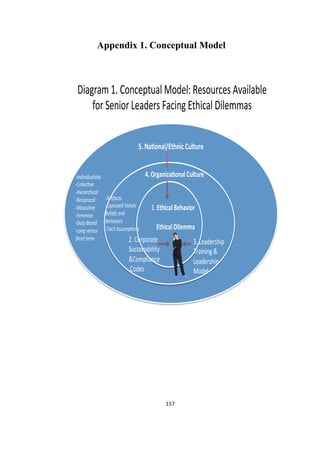
The conceptual framework that informs this research is illustrated in Appendix
One. It is based on current corporate governance models, that are common in North
American and European Union headquartered organisations. It shows the main factors
that are assumed to influence senior leaders when they seek to resolve an ethical
dilemma at work. The research is intended to show if any of these factors exert an
influence. If they do, is any weighting or prioritisation apparent in the minds of
research participants? It is also possible that the conceptual model is incomplete and
that other factors need to be added. This will also be tested in the research.
There are five components in the framework. At the heart is the senior leader
facing an ethical dilemma together with the theories regarding how an individual
develops moral reasoning, moral judgement and ethical behaviour. This includes their
sense of ethics and moral reasoning, how certain issues are defined as moral or ethical
7	
in the first place, how moral judgement and reasoning are applied to these issues and
what sort of outcomes result from this process. There is more literature and theoretical
debate concerning this component of the model than any of the others.
The second component of the conceptual model includes most of the
interventions designed by companies to ensure ethical behaviour and includes
corporate sustainability initiatives and the compliance function. These activities mark
the organisation’s overt and tangible attempts to codify their expectations of ethical
behaviour and to influence and direct the leader’s process of ethical reasoning. One
immediate assumption might be that these activities provide important resources for
senior leaders facing ethical dilemmas. This needs to be tested in the research.
The third component explores another area of action an organization can take
to improve ethical behaviour: training and leadership development. Leadership
training on ethics could be perceived to be part of compliance activities. This is too
narrow a definition of the term. Many leadership development activities which seek to
improve individual and team performance (for example: team building programs,
improving communication and feedback between distinct units of the organization),
may improve ethical behaviour even if this is not the primary aim of development.
Leadership models that can support ethical behaviour are included in this component
of the conceptual model, together with data on evaluation of leadership development
programs that seek to train leaders in ethical behaviour. This study will explore if
there is any evidence of ethics training influencing or assisting senior executives when
they seek to resolve ethical dilemmas.
8	
The fourth component in the conceptual model concerns the influence of
organization culture on ethical behaviour. A deeper consideration of organization
culture provides an alternative possible theory regarding how individuals deploy
moral reasoning and resolve ethical dilemmas. It is possible that wider group
processes are at work, ones that may be largely external to the individual. Could these
group processes override the internal cognitively developed process of moral
reasoning? How might group processes impact on the individual, the team or the
organisation?
The final component in the model is the influence of national/ethnic culture on
senior leaders facing ethical dilemmas. Each of the components in the model is
presumed to be progressively harder for the senior leaders of an organisation to
control and direct. The easiest component for senior leaders to control is corporate
sustainability and compliance and the hardest is ethnic/national culture.
It is the components of the model that are most distant from organizational
control that form a particular focus of this research (organizational and ethnic/national
culture). Some senior leaders may discount organization culture as an issue and refer
to more standardised and tangible interventions such as compliance and training.
Others may assume that organisation culture can be directed and even changed,
particularly if they seek to have a more ethical climate in place after a scandal has
negatively impacted the organization’s reputation and brand. It may be that the
reverse process is in place: the organization culture is shaping and changing the
leader. Much of the literature is sceptical of leader led “culture change”. Schein
(2014) notes
9	
The reality is you can only deviate a short distance from the current culture of
an organisation. A new leader has to destroy the old culture to build and new
one. This is very difficult to do…. organization culture is more likely to evolve
slowly rather than change suddenly (p. 322)
The literature on the development of the moral self and moral reasoning suggests that
there is a need for more research in this area. As research on ethical behaviour starts to
expand beyond US organizations and the influence of different organisation and
national/ethnic cultures is considered in greater depth, it is possible to contemplate
that culture may actually define which (if any) issues are placed in the moral domain
in the first instance. Culture may also directly influence moral reasoning and
behaviour (Husted and Allen 2008).
Having reviewed the conceptual model underlying this dissertation, it is also
important to make a few comments regarding the literature review in general. Ratvich
and Riggan (2012) state that a common metaphor used to describe a literature review
is a conversation (p. 21). However they also state that there is no real consensus
regarding the nature of this conversation:
If a literature review is a conversation among scholars, is the student/author a
participant or an observer? If the student is a participant, how much are they
allowed to talk back? Is their role to sit at the table, ask questions, and nod
solemnly, or are they free to engage with what they see as problematic
assumptions or ideas? (p. 22).
The “conversation” among scholars in the field of ethical behaviour is relatively dense
and diverse regarding the development of the moral self and moral reasoning.
(Trevino, Weaver & Reynolds 2006 p. 967). There is also some practitioner feedback
regarding the effectiveness of leadership development and the success or failure of the
10	
compliance function in shaping ethical behaviour. There is less research on the
linkages between these areas and in the whole area of how culture influences ethical
behaviour (Jennings, Mitchell & Hannah 2015 p. 152). The tone of the conversation in
the literature review will shift as each component in the conceptual model is
considered in turn, with a personal experiential voice becoming louder and clearer as
the literature review touches on culture and the components of the conceptual
framework where less research exists.
The Development of the Moral Self and Moral Reasoning
The individual leader is at the core of the conceptual framework for this study.
There are a number of simple initial questions: where does ethical behaviour come
from? How does any individual develop morality and a sense of ethics? The Stanford
Dictionary of Philosophy (2014 edition) notes that four different theories from the
field of philosophy form the basis for the study of ethics and ethical behaviour: virtue
based ethics, deontological ethics, utilitarian ethics and situational ethics. It is
important to consider each in turn, as each of the original philosophical approaches
has strengths and weaknesses, which in turn influence subsequent theories regarding
ethical behaviour.
The first philosophical approach is virtues based ethics and originates in the
work of Aristotle. This approach asserts that a right act is the action a virtuous person
would do in the circumstance. Virtues ethics is people based, not action based, as it
looks at the virtue or moral character of the person carrying out the action. The way to
build a good society, according to a virtues perspective, is to help its members be
good people rather than use laws and punishments to deter bad actions (Kraut 2014).
11	
The strengths of this approach include the impact that one ethical person can have on
a corrupt system or process and that virtues based ethics is people based. The problem
with this approach is identifying who is ethical in the first place, using which tools
and which perspective (Kraut 2014).
The second approach is Kantian or Deontological, associated with the
philosopher Emmanuel Kant. This approach is duty based and asserts that moral rules
must guide actions and the duty to do the right thing is more importance that the
consequence of any act (Johnson 2014). Kant famously claimed he couldn’t tell a lie
(because this would break a moral rule) to save a friend from a murderer. The
strengths of this approach are clarity and ubiquity, as each individual knows the laws
and rules and everyone can follow them. The weakness is rigidity and the possibility
that a unique situation may (or should) ultimately change the law (Johnson 2014). It is
not clear how this should happen.
The third philosophical approach to ethics is utilitarianism (also known as
consequentialism). This approach posits that of all the things a person might do at any
given moment, the morally right action is the one with the best overall consequence
for the most people. The more positive consequences an act produces the better or
more right the act (Driver 2014). The strength of this approach is a deep pragmatism
accompanied by the attempt to do the right thing for the greatest number of
individuals. The downside is that the human rights of the minority may be violated.
Who is to say that curing ten people is best if one person dies, particularly if the dead
person doesn’t get a casting vote in the process?
12	
The fourth approach is situational ethics (also known as relativism), associated
with the philosophers John Dewey and James H Tufts. They asserted that reflective
morality demands observation of particular situations rather than fixed adherence to a
priori principles. Right and wrong therefore depend on the situation and there is a
rejection of prescriptive rules. Swoyer (2014) notes “since circumstances alter cases,
relativism holds that in practice, what in some times and places we call right is in
other times and places wrong”. The strengths of this approach include the ability to
deeply consider context when applying moral judgements. The problem is that as each
context is unique, with no set rules, each ethical problem would need to be considered
in it’s unique context, a time consuming prospect (Swoyer 2014).
These philosophical ideas resonate in the assumptions that underpin
subsequent research regarding how individuals develop ethical behaviour and apply it
in the workplace. An echo of Aristotle and virtues based ethics can be found in the
assumption that an exceptional chief executive or chairman can turn around and
transform a deeply troubled business, setting their superior moral imprint upon it. The
critique of this expectation can be found in Schein’s (2014) work. He is sceptical that
any one person can change an organization’s culture. It is more likely that the
organization will change the individual. Deontological ethics have been negatively
impacted by 20th
century experience. The statement that any leader found guilty of
unethical behaviour “was only following the rules”, stands as an unacceptable defence
(Kraut 2014). However the introduction of regulatory frameworks and self-policing
corporate compliance functions in the business world of the 21st
century seem to
reflect a desire for clear, transparent immutable rules that are capable of directing
behaviour, regardless of context (Van Marrewijk 2003, p. 101-102).
13	
Utilitarianism has perhaps enjoyed the greatest influence. The questionnaires
that form the basis for the research of both Kohlberg (1969) and Rest (1994) are based
on Utilitarian assumptions (for example it is more ethical for an individual to hand
over a unique vaccine to medical authorities that to use it to cure a spouse or close
family member). The work of Kohlberg and Rest is considered in detail below.
Utilitarian ethics seems to resonate in the field of corporate sustainability (a company
cannot donate to every charity however donating to a few will have a beneficial effect
and is better than donating to none). They also suggest a way for compliance
standards to be implemented across complex and fragmented organizations. The
assumption is that rules that do the greatest good for the largest numbers of
stakeholders are the best rules to implement and enforce.
Relativist ethics could prove to be extremely inconvenient for business. The
cost and effort of weighing every action against unique situational variables is high
(Swoyer 2014). However when cultural influences on ethical behaviour are explored,
it is a relativist position that is most prevalent in the literature. This position informs
the work of Shweder (1991) and Haidt (2004) and will be considered later in this
section. Their relativist position seems to provide the best basis for exploring ethical
behaviour in a cross-cultural environment and it is the position that is most influential
in terms of this research.
The foundational work regarding the development of the moral self is based on
the utilitarian position. This is the cognitive development framework proposed by
Kohlberg (1969). He asserts that moral reasoning; the basis for ethical behaviour has a
hierarchy of six developmental stages. Each stage marks a measurable increase in the
individual’s capability to respond to moral dilemmas. These stages of moral
14	
development are as follows: stage one is the most basic level and concerns
punishment avoidance. Stage two involves negotiation and trade-offs with others to
get what the individual wants. Stage three involves meeting the expectations of others;
stage four concerns the fulfilment of duties and the upholding of laws. Stage five
involves mutual benefit, reciprocity and the perception that the right rules make life
better for everyone. The final and most advanced stage is one where universal
principles apply, where morality is based on principles that transcend mutual benefit.
Kohlberg’s work is based on five basic assumptions (Kohlberg, Levine &
Heifer 1983). The first is that humans are inherently communicative, capable of
reasoning and possess the desire to understand others and the world around them. The
second assumption is that the stages of moral development relate to qualitative moral
reasoning adopted by individuals and do not translate into praise or blame of any
individual’s actions or character. His theory measures moral reasoning, not any
conclusions or actions that arise from that reasoning. The form and structure of moral
arguments are independent of the content; a position Kohlberg labels “formalism”.
The third assumption of Kohlberg’s work is that justice is the essential
characteristic of moral reasoning and that justice itself relies on highly evolved moral
reasoning based on principles. A fourth assumption is that the six stages of moral
development are valid across all human cultures. This is a position that is labelled
“universalism” (Reynolds 2006) and shows the origin of Kohlberg’s work in the
utilitarian school of philosophy, with some influence from deontological principles.
The fifth assumption is that development through the six stages takes a long time,
from earliest childhood to young adulthood. Once an individual has reached a given
15	
level it is not possible to regress down the hierarchy of stages. It is also not possible to
skip levels when progressing up the hierarchy.
Kohlberg (1969) asserts that the development of moral reasoning and the
resulting ethical behaviour is cognitive in nature. It is a lengthy internal process open
to education, role modelling and instruction, practice and feedback. “The process of
moral development is therefore considered to be constructive, as it is initiated by the
conscious construction of the individuals and it is not in any meaningful sense a
component of the individuals innate disposition” (p. 44)
Rest (1994) has played a key role in developing Kohlberg’s theory and
applying it to organizations and to adult learning. He took the basic tool of Kohlberg’s
research (a lengthy case study based, structured interview, known as the Moral
Judgement Interview) and developed this protocol into a shorter questionnaire on
moral reasoning (the Defining Issues Test or DIT). He used the tool to investigate
differences in ethical behaviour between different professions. He found, for example,
that accountants had lower scores on the DIT than doctors, dentists or nurses (p. 156).
He also suggested that many professions could benefit from formal education in
ethics. Considering the case of trainee doctors, Rest notes
Both the issues of social justice and the allocation of limited resources can be
successfully addressed and positively influenced in terms of justice reasoning
by the teaching of medical ethics in the medical education curriculum. These
positive changes in justice reasoning skills are maintained throughout the
remainder of medical education (p. 157).
Rest (1994) viewed the development of ethical behaviour in a less rigid
fashion than Kohlberg. He suggested that individuals have overlapping moral schemas
16	
(rather than crisply distinct stages of moral development). They draw down an
appropriate schema into the work environment according to either past behaviour that
has led to a positive outcome or by a choice dictated by the requirements of their
current context. The overlapping of these schemas means that an individual could
move across Kohlberg’s six levels according to context, by at least a single level and
could possibly choose between two different schemas to resolve an ethical dilemma.
Rest (1994) found one notable difficulty with Kohlberg’s theory. His research
using the DIT questionnaire suggests that eighty per cent of US citizens fail to
progress beyond level four of Kohlberg’s model and remain dependent on laws and
policing to solve ethical dilemmas. There is no explanation in Kohlberg’s theory to
explain why the majority of individuals would never move beyond this level of ethical
development. Trevino, Weaver and Reynolds (2006) suggest that the implication of
this finding for organisations is that most employees will lack an internalised sense of
a principle of justice when facing ethical dilemmas. They will need to rely on external
manifestations of justice, such as explicit codes of conduct, rules, regulations and
visible rewards and punishments (p. 953).
Kohlberg’s (1969) theory has attracted a number of other criticisms. Gilligan
(1982) claimed that Kohlberg emphasised the principle of justice within his
framework of morally reasoning to the exclusion of other values. She asserted that his
theory was also male centric, with the research based on male respondents. The Moral
Judgement Interview protocol is the basic tool of Kohlberg’s research. It is based on
respondents reacting to moral dilemmas involving increasing abstract moral
principles. Kohlberg assumed that individuals move onto higher levels or moral
reasoning when they have less interest in the particulars of who is involved. His early
17	
research findings suggested that women tend to remain at lower levels of moral
reasoning than men, as women tend to prioritise relationships and the welfare of
family and friends over and above abstract moral principles.
Gilligan (1982) suggested an alternative theory of moral reasoning based on
the ethics of caring for others and found that equal numbers of men and women
evolved to the higher level of post conventional moral reasoning. This critique may be
just as relevant to collective cultures that prioritise relationships over and above
abstract moral principles of justice, as it is to gender comparisons.
Haidt (2001) disagrees with the whole concept of Kohlberg’s six-stage model.
His work represents the relativist school of philosophy, where the context of each
moral decision is important. Haidt states that individuals demonstrate inconsistencies
in their moral judgements. They can move erratically between levels of moral
reasoning, particularly if self-interest is involved. Drink driving and business
negotiations for personal gain are two areas where self-interest may trigger a lower
level of moral reasoning. Haidt asserts that certain situations lead to an intuitive and
non-reasoned moral response. He defines moral intuition as “the sudden appearance in
consciousness of a moral judgement including an affective valance (good or bad),
without any conscious awareness of having gone through steps of searching, weighing
evidence or inferring a conclusion” (p. 820).
Haidt and Joseph (2004) propose that,
Human beings come equipped with intuitive ethics or an innate preparedness
to feel flashes of approval or disapproval towards certain patterns involving
other human beings. The four patterns with the best evidence include
suffering, hierarchy, reciprocity and purity/pollution. These intuitions underlie
the moral systems that cultures develop on top (p. 56).
18	
Haidt and Joseph further suggest that individuals often seem to resolve ethical
problems in “a matter of seconds” (p. 58) and then search for justifications from their
reasoning system. Haidt and Joseph state, “if you focus on the reasons people give for
their ethical judgements you are studying the rational tail that got wagged by the
emotional dog” (p. 58).
Haidt and Joseph (2004) claim that virtues (the characteristics of a person that
are morally praiseworthy) are a purely cultural construct developed on top of
intuitions. They state,
Virtues are acquired in childhood and later life through stories that permeate a
given culture. These stories contain information about the protagonist’s
motivations, their state of being, the categorization of the situation and the
evaluation of the outcome offered by experienced others in the story (p. 61).
This raises the possibility that the context or a given situation can determine whether
an issue is moral or not and the form of moral reasoning that will be applied to resolve
an ethical dilemma.
Shweder (1991) asserts that the situation in which an ethical dilemma is
encountered and resolved is of paramount importance and that (for example) the
influence of a collectivist culture may override any individual moral reasoning
process. Haidt (2001) concluded that it is unlikely that moral intuitions about ethical
issues in complex organisations are formed during the early period of life. The social
context of the organisation and social learning processes (for example behaviour
modelling by others at work) will lead to a continually evolving repertoire of moral
intuitions.
19	
Despite these alternative views, Kohlberg’s theory has been widely accepted
as the explanation of how individuals develop and deploy moral reasoning. The extent
of this acceptance is confirmed by the meta-analyses of the literature on behavioural
ethics in organisations by Trevino, Weaver and Reynolds (2006) and more recently by
Jennings, Mitchell and Hannah (2015). Supporters of Kohlberg’s theory have had to
respond to increasing evidence from workplace-based research, suggesting that a
range of contextual factors may deeply influence an individual’s moral reasoning and
lead to unexpected behaviour. This is particularly the case when researchers seek to
explain the “judgement-action gap”. Trevino, Weaver and Reynolds define this gap as
the presence of strong moral reasoning in an individual or group together with a
subsequent lack of an ethical outcome in behaviour and action (p. 966). Jennings,
Mitchell and Hannah state,
Accounting for human moral functioning and subsequent behaviour has
proven to be a complex and difficult problem. Initial research relied heavily on
a cognitive moral development theory that emphasised the importance of
moral reasoning to explain moral behaviour. However the strengths of these
effects vary considerably and the relationship is modest at best (p. 104).
Trevino, Weaver and Reynolds (2006) outline some of the individual factors
that may impact on the assumed universal practice of moral reasoning. These include
the degree of moral strength or moral motivation an individual may have. This is
defined as “an individual’s ability for self-regulation, specifically regarding resistance
to impulses and determination to follow convictions” (p. 961). Trevino Weaver and
Reynolds also consider “identity based moral motivation” (p. 964). This is where a
moral obligation to act may arise from a socially constructed identity that can be role
modelled and re-enforced by leaders or individuals with power and influence within
20	
an individual’s social network. A priest or doctor for example would be expected by
others to approach moral dilemmas in a certain way because of their socialised moral
identity (p. 964).
Jennings Mitchell and Hannah (2015) provide a more exhaustive list of
personal factors impacting upon moral reasoning. They list a number of
“antecedents”. These include “moral centrality” the degree to which morality is
central to one’s self-understanding and “moral judgement disposition” the stable
tendency to take a specific moral perspective (p. 106). Other factors include “self -
conscious moral emotions” the degree to which moral reasoning triggers emotions
such as guilt, shame and pride. Another antecedent is the level of “moral intensity”
felt by an individual (p. 106). This is the degree to which an individual will be
personally impacted by ethical decisions. The assumption is that the more distant the
consequences of a decision from an individual, the less they may deploy moral
reasoning. Finally the individual’s mental health and their degree of religiosity could
also influence their moral reasoning (p. 107).
In summary, the literature on how an individual develops ethical behaviour is
still deeply influenced by Kohlberg. If Kohlberg’s model is correct, there are a
number of possible consequences for the organisation. Training on ethics should be
conducted early in any career, and should be embedded into professional training
(Rest 1994). Training of mature individuals late in their career would be an anomaly,
as they will have well-formed ethical perspectives that are unlikely to change. Finally,
as individuals from all cultures pass through the same stages of ethical development, it
can be assumed compliance codes and standards and training programs can be
standardised and are good for all cultural contexts.
21	
Workplace research from supporters of a cognitive development model
suggests that a large number of “antecedents” influence moral reasoning. The long list
suggested by Jennings, Mitchell and Hannah (2015) add another level of (unintended)
critique to Kohlberg’s original model. Many of the antecedents (for example
religiosity, moral intensity, the actions and role modelling of peers and superiors in
the workplace) appear closer to the “moral schemas” suggested by Haidt (2001).
Haidt’s work suggests that the context around ethical dilemmas might be more
important than any cognitive development model.
Codes of conduct or training staff in ethical behaviour may lead to a more
ethical organization but they are likely to form only one schema amongst many that
staff can draw upon when faced with an ethical issue. Completing a finite list of
antecedents for a cognitive development model may be of little importance to
understanding how senior leaders face an ethical dilemma. It may be more important
to understand how senior leaders navigate through a range of influences and resources
before finally alighting on a schema that may help them. Although not the primary
focus of this dissertation, the development of an individual’s ethical framework, their
sense of right and wrong, will be one of the topics tested in the research for this
dissertation. Is there any evidence of a six-stage cognitive development model in the
recollections of the research participants? Is there any evidence that training on ethics
as a young adult played an important role in the formation of ethical frameworks (Rest
1994). Alternatively is there any evidence that individual’s keep on evolving their
ethical frameworks and perspectives throughout their career, using more intuitive
schemas to guide their actions (Haidt 2001)?
22	
The Influence of Corporate Sustainability and the Compliance Function on
Ethical Behaviour
The most concrete element in the conceptual model for ethical dilemmas is the
written statements outlining how the organisation regards ethics and any required
standards of ethical behaviour. At the simplest level these statements should serve as a
resource for senior leaders facing an ethical dilemma. The statements and standards
should tell them what to do. It is useful to examine the literature to explore where
these statements come from and to see if there is any evidence that suggests that they
do provide a resource for senior leaders.
It is common practice for large companies to have statements of corporate
sustainability in their published annual accounts. Van Marrewijk (2003) states that a
simple definition of corporate sustainability is impossible. “There is no standard
recipe, corporate sustainability is a custom made process for each organisation based
on their unique response to shareholder, stakeholder and societal interests” (p. 95).
Despite this reluctance to offer a definition, Van Marrewijk (2003) states that:
“Corporate sustainability goes beyond compliance and engages in actions that appear
to further some social good, beyond the interests of the firm and that which is required
by law” (p. 96). Corporate sustainability is therefore a business approach that creates
long-term consumer and employee value by “creating a business strategy aimed
toward the natural environment and taking into consideration every dimension of how
a business operates” (p. 96). It is possible that the ambitions to further some social
good have an influence on the behavior of senior leaders (p. 96).
Carroll (1991) provides an early framework for corporate sustainability. He
23	
suggests that companies need to approach elements of their sustainability framework
in a prioritized way. His work echoes Maslow’s hierarchy of needs for an individual.
Carroll assumes that a company needs to meet economic goals and produce a viable
profit as a foundation requirement before any other needs can be met. Then the
company should seek to meet its legal requirements and then it’s ethical
responsibilities. These are defined as: “the activities and practices that are expected or
prohibited by societal members, even though they are not codified into any law”.
Ethical responsibilities embody those standards, norms, or expectations that reflect a
concern for what consumers, employees, shareholders, and the community regard as
fair, just, or in keeping with the respect or protection of stakeholders' moral rights (p.
5). The final level of sustainability, once ethical responsibilities have been met, is
philanthropic activity. This level concerns donations to charities or foundations (p. 8).
Carroll’s (1991) model may offer some scope for prioritizing action. However
his hierarchical approach to corporate sustainability and the alignment of this model to
ethics seems simplistic. There appear to be many companies who make profit, meet
legal and regulatory commitments and even make philanthropic gestures, yet are
damaged by their weak approach to ethics. The tax arrangements of Amazon, Google
and Starbucks offer one example. These arrangements were within the letter of the
law, but were so close to tax avoidance at a time of widespread austerity, that they led
to public outrage and consumer boycott.
Elkington (1997) developed the alternative concept of the “triple bottom line”
to advance the goal of sustainability in business practices. He suggested three
measures of sustainability for a business. These include: profit (defined as the
24	
economic value created by the company), people (the fair and favorable business
practices regarding labor and the community in which the company conducts it’s
business) and planet (the use of sustainable environmental practices and the reduction
of environmental impact). Many current statements of corporate sustainability use the
triple bottom line as a structure for their content.
Similar to Carroll’s model, criticism of the triple bottom line concept focuses
on the lack of clarity regarding the relationships between the different measures of
sustainability. Porter and Kramer (2006) state that it is difficult to compare the people
and planet accounts in terms of cash and profit. It is also impossible to add or combine
the three separate accounts. They need to be considered separately. Porter and Kramer
(2006) claim that as a result,
Corporate Social Responsibility (CSR) tends to focus on the tension between
business and society, not on the inter-dependence. Companies do not identify,
prioritize and address the social issues that matter most or the ones on which
they can make the biggest impact. The outcome is a hodgepodge of un-
coordinated CSR and philanthropic activity disconnected to the company’s
strategy (p. 3)
It is possible that the aspirational statements of corporate citizenship
statements influence ethical behaviour, however this seems unlikely according to
Porter and Kramer (2006). They suggest that corporate sustainability is still of
importance to a company, if aligned to strategy (p. 8). They tend to view the impact of
corporate sustainability on leader and employee behaviour as minimal, lagging far
behind the positive influence that corporate sustainability practices may have on
innovation, branding, cost effectiveness and government relations (p. 10). The only
noticeable link between corporate sustainability and employees is that policies and
25	
programs may improve staff morale (p. 10). The influence of corporate sustainability
appears to operate at more of a macro level, failing to filter down to inspire or
motivate an individual leader (p. 10).
The compliance function within large organisations has grown out of company
legal departments, in response to the increased power of external regulators and the
impact of increased legislation. Van Marrewijk (2003) views compliance activity as
narrower in scope than corporate sustainability. He notes that definitions of
compliance tend to revolve around the existence of codes, rules and regulations within
a specific organisation. It is also important to identify who has the power to define the
codes and the details of how they are enforced through the allocation of rewards and
punishments (p. 101). Compliance activity seeks to influence the behaviour and
actions of the individual leader (p. 102).
Simms and Brinkman (2003) suggest that it is possible for organisations to
have highly articulated statements of corporate sustainability and compliance, which
have minimal impact on actual behaviour. Enron is highlighted as a case study. In this
case there was a paradoxical sophistication in the public relations and marketing tools
used to outline the Enron code of conduct and the company’s approach to corporate
sustainably, contrasted with a total absence of ethical behaviour in the day-to-day
operations of the business. Simms and Brinkman note that Enron employees who tried
to follow the stated codes of conduct were publically humiliated or shunned or faced
other negative sanctions.
Simms and Brinkman (2003) have developed four ideal types for corporate
compliance activities. The organisation that is “morally pre-conventional” (recalling
26	
the lower levels of moral reasoning in Kohlberg’s model) has a low degree of ethical
behaviour combined with almost no publicity and re-enforcement of codes of conduct.
This is close to the “law of the jungle” or an environment lacking in ethical behaviour.
By contrast, the organization that has a high degree of ethical behaviour combined
with an absence of articulated and propagated codes of conduct has a “collective
moral conscience”.
The organization that operates high levels of ethical behaviour combined with
the presence and active publicizing of ethics tools and approaches is labelled “moral
role modelling”. Simms and Brinkman (2003) see this as the compliance model that
will best support and develop the ethical behaviour of leaders. By total contrast the
Enron case study highlights a company that has an apparent sophistication regarding
the presence and marketing of ethics tools and almost no ethical behaviour. This is a
“window dressing” company.
In terms of how compliance might influence leader behaviour, Trevino,
Weaver and Reynolds (2006) are keen to broaden the concept of compliance beyond
written codes. They use the term “ethical infrastructure” to cover an organisation’s
explicit attempt to improve, monitor and measure the ethical behaviour of their
members.
Ethical infrastructure includes all the policies and programmes aimed at
fostering ethical behaviour in organisation members. This includes formal
infrastructure such as statements of corporate sustainability, codes of conduct,
staff communications, training programmes, monitoring of ethical behaviour
and the sanctions if codes are breached. It also includes informal elements
such as the ethical climate”(p. 970).
27	
Trevino, Weaver and Reynolds do not define the informal aspects of ethical
infrastructure in any detail. On the one hand, this could possibly include all of the
espoused values and tacit assumptions outlined in Schein’s (1985) model of
organisation culture. Schein (2014) is adamant that “climate” is not the same as
“culture”. He states “climate can be used for more superficial elements of a culture
that are easier to observe and change. Culture has a specific meaning, describing the
deeper elements of what goes on in organisations and societies” (p. 322).
Trevino, Weaver and Reynolds (2006) note that the origins of any ethical
infrastructure are mixed. They are partly a result of external regulation and legislation
and partly the result of senior executive commitment. The kind of control that ethical
infrastructures embody also varies. Control can be rooted in compelling staff
compliance through rules and regulations and sanctions. Alternatively, controls can be
rooted in the implementation of policies and in the role modelling of boss and peers.
Weaver (1999) notes that controls that have been internalised within the individual
staff member are more effective (p. 970) as they can become part of organisation
culture, however a mixture of externalised rules and regulations existing alongside
internalised controls is also effective. These are different but not mutually exclusive
approaches.
Trevino, Weaver and Reynolds (2006) highlight a major issue for future
research. It is not clear how the ethical infrastructure of an organisation meshes with
routine operations. This is similar to the point made by Simms and Brinkman (2003).
They observed that stated codes of conduct in the Enron case were in opposition with
actual behaviour and the basic business model of that company. Trevino, Weaver and
Reynolds note, “The task of designing appropriate ethical infrastructure is not an easy
28	
one. The impact of single elements such as a code of conduct seems minimal if it is in
isolation from other cultural enablers” (p. 970).
It will be important to note in this study the degree of influence that research
participants perceive that compliance activity (and the broader “ethical
infrastructure”) has on their behaviour. The growing ubiquity of compliance functions
and codes of conduct, suggests that exploring the “ethical infrastructure” should be
part of the research interviews. This would mean checking the senior leader’s
knowledge of the content of codes and company statements, exploring perceptions of
peer and boss behaviour and understanding if any codes or statements are ignored or
strictly followed in particular contexts.
The Influence of Leadership Development on Ethical Behaviour
The next component in the conceptual framework is leadership development
and ethics training. Similar to compliance, this component is within the control of the
organization. There is a small body of literature exploring the influence of leadership
training on ethical behaviour. Many organisations assume that it is possible to train
leaders (and their staff) to improve their ethical behaviour (Warner, Gasper & Laufer
2014). There are two different approaches to training leaders; each will be explored in
more detail. One approach involves the implementation of short programmes
specifically focused on ethics and compliance. The second approach requires the
implementation of longer and more generic leadership development programmes that
seek to amplify a range of leadership behaviours that may support ethical behaviour
(Van Velsor & Ascalon 2008). Some of the literature also suggests that the choice of
leadership model may influence ethical behaviour (Linden et al 2015).
29	
Warner, Gasper and Laufer (2014) note the regulatory impetus behind the
implementation of ethics training in many organizations (p. 86). The US Sentencing
Commission guidelines stipulate that lesser penalties will be imposed if formal ethics
training exists for all staff at all levels of the organization. Warner, Gasper and Laufer
state that, “cynics assume that such programs are used to reduce fines and stave off
prosecution and doubt the ability of formal ethics programs to affect aspects of an
organisation’s ethical culture” (p. 86). Their study seeks to evaluate the impact of one
short ethics program (four hours in duration) on over two thousand staff, working for
a US bank.
The training design of the ethics program in the study was split evenly
between material that focused on values and behaviours and material that concentrated
on compliance (rules, codes, whistle blowing and punishments for wrong doing). The
study was longitudinal: the impact of the training was measured through
questionnaires administered before the training occurred (to establish a baseline), then
nine months after training had taken place and finally after thirty months (p. 98). The
study measured staff perceptions of a number of issues: observed incidents of
unethical behaviour, the organisation’s efficacy of response to incidents, degree of
convergence of norms regarding what is ethical and unethical behaviour and
perceptions that values were becoming more stressed in daily business activities by
peers and supervisors.
Warren, Gasper and Laufer (2014) found that the training program in their
study had long-term positive effects on the organization, thirty months after the
training had taken place (p. 102). There were positive indicators of an ethical
organizational culture (observed incidents of unethical behavior were lower,
30	
intentions to behave ethically were higher, perceptions of organizational efficacy in
managing ethics were perceived as stronger).
The findings were not universally positive (p. 103). While the perceived
importance of espoused organizational values rose in importance at nine months after
training, the boost dissipated after the second year. The study found that two or more
years after training, company values were thought to be of lower importance to senior
leaders, supervisors and co-workers (p. 103). This finding contradicts assumptions in
other studies that sustained improvements in behavior reflect the successful
inculcation of organization values (Trevino 2006, Kaptein 2011). The main
explanation for this finding that Warren Gasper and Laufer (2014) offer is that “before
training, the bank may have already achieved a sense of shared values needed for
behavior change, so returning to pre-training levels of shared values was no threat to
behavior change” (p. 103). It should be noted that the study involved mostly non-
supervisory staff, so the influence of the training on senior leaders as a distinct group
is unknown.
Van Velsor and Ascalon (2008) explore the efficacy of longer and deeper
leadership development interventions in improving ethical behaviour. They work as
leadership development practitioners within a global investment bank. From their
practitioner perspective, companies should not expect many positive results from half-
day programs on ethics (p. 187). They believe that ethical behaviour can be improved,
but only through leadership development interventions that seek to give senior
executives improved feedback on their strengths and weaknesses and in this way
overcome the inherent isolation that is part of senior executive roles. They assert that
specific training on ethics may not be helpful. “Ethical violations are often committed
31	
by senior leaders who have a history of good behaviour, in conditions of modest
competitive pressure and in situations where the principles of right and wrong are
fairly well defined” (p. 187).
Van Velsor and Ascalon (2008) explore case studies of unethical behaviour
involving forty-two executives in six European Union states. They do not define
unethical behaviour and this creates a number of issues regarding the validity of their
findings. It may be the case that some of the executives in their study were sacked due
to “under performance” rather than a documented case of poor ethics.
Van Velsor and Ascalon find four common themes across all of their cases (p.
187-189). Firstly, there is a feeling of complacency in the leader. This leads to a loss
of strategic focus. Secondly, there is a tendency to delegate leadership acts to others
and for the senior individual to disappear from sight as a visible ethical role model.
Thirdly, the leader gains unrestrained access to corporate resources. This includes
privileged access to information. However the executive fails to develop the capacity
to handle that power appropriately. There is a high level of narcissistic behaviour that
blurs the line between what it owned by the individual and what is owned by the
organisation. Finally, senior executives begin to inflate their belief in a personal
ability to control outcomes due to social isolation and lack of feedback. This leads to a
loss of touch with reality regarding one’s own effectiveness. “There is a feeling of
omnipotence and being beyond any law. This means the leader believes their unethical
behaviour will never be discovered or punished” (p. 189).
32	
Van Velsor and Ascalon (2008) believe that leadership development programs
may be only way to counteract the four leadership “traps” (p. 189) that are correlated
to unethical behaviour in their study. They state
Well-designed leadership programmes can help give managers an improved
understanding of strategic processes. Managers stay on the right path through
the provision of rich feedback. This means they can enhance their self-
awareness and they have time to reflect on the quality of their personal and
professional relationships (p. 189).
The failure of the leaders in the Van Velsor and Ascelor study is based on isolation of
the individual and the breakdown of their relationships with others. A number of
researchers, for example Kaplan (1990), and Ludwig and Longnecker (1993),
emphasize that it becomes progressively harder for leaders to maintain their self-
awareness as they move up a corporate hierarchy. As they become more successful,
they are less likely to receive the honest feedback they need to perform well. Van
Velsor and Ascelor state, “Executives who derail lack an ability to build an effective
team with whom to work and get information from. They are isolated from other
perspectives and knowledge bases and this leads them to lose touch with reality” (p.
190).
A final issue needs to be considered regarding the influence of leadership
training on the ethical behaviour of senior leaders. It is possible that the leadership
model that lies behind sets of company values and the design of training programs
could in itself influence ethical behaviour. There are a number of models that have
been linked with ethical behaviour and it is important to examine two of them in
detail: transformational leadership (Burns 1978) and servant leadership (Greenleaf
1971).
33	
Burns (1978) developed the original model of transformational leadership. In
this model, one person takes control of a situation and motivates the group to follow.
A transformational leader is generally energetic, enthusiastic and possesses a passion
for the task at hand. They are not only focused on the task but also help every member
of the group to succeed by enhancing their morale (p. 20). Burns states that, “the
leader’s fundamental act is to induce people to be aware or conscious of what they
feel, to feel their true needs so strongly, to define their values so meaningfully that
they can be moved to purposeful action” (p. 44). Burns asserts that his model is deeply
ethical as transformational leadership “transforms people from the selves that they are
into the selves they should be. As a result people are poised to be true to their better
selves” (p. 20).
Burns (1978) contrasts transformational leadership with transactional
leadership. In the later model, leaders adopt a bargaining stance with other parties.
They may recognise the other party as a person, however the relationship does not
extend beyond a limited economic or political transaction. Burns states: “the
transactional leader has a very poor basis for morality. (By comparison) the
transformational leader must have the capacity to transcend the claims of the
multiplicity of everyday wants and needs and experiences” (p. 46).
Bass (1985) expands upon the concept of transformational leadership. His
conception of transformational leadership includes a number of leadership factors.
Four factors are deemed to be particularly important in transformational leadership (p.
181). The first factor is “intellectual stimulation”. This concerns challenge to the
status quo and to traditional ways of carrying out tasks. It requires leaders to inspire
creativity among their followers by encouraging them to find new ways to complete
34	
projects. The second component is “individualised consideration”. Leaders need to
offer encouragement and support to followers by keeping the lines of communication
open. Team members therefore feel comfortable sharing new ideas. The third
component is “inspirational motivation”. By clearly sharing their vision of how a
project will succeed, this in turn inspires followers to be motivated to carry out the
task to a high standard. The final component is “idealized influence”. This inspires
followers to succeed by emulating and internalizing the manager’s ideals and making
them their own.
The transformational leadership model has had a powerful resonance among
leadership development practitioners. One reason for the ubiquity of the model is the
assumption that the presence of transformational leadership can be measured in the
workplace using the Multifactor Leadership Questionnaire (MLQ) (Cuilla 1998). This
identifies the characteristics of a transformational leader and helps individuals
discover to what extent they measure up to the ideal model in their own estimation
and in the eyes of those they work with. Success in any behavioural change (for
example, the individual striving to become more like the ideal of a transformational
leader) can be measured through a retesting program, which can track changes in
leadership style.
Cuilla (1998) notes that the “model of transformational leadership was
introduced to workplaces at roughly the same time as the professionalization of
change management” (p. 56). She suggests that the business need to promote the
stereotype of the heroic leader who could lead and sustain the enterprise through rapid
change, led to the widespread use of the model. It is also not clear if transformational
leadership is a genuinely cross-cultural concept. There is a straightforward alignment
35	
to cultures that place a high value on individualism and less clarity on how
transformational leadership would align to highly collectivist cultures (p. 58).
Price (2003) notes there is a risk that a transformational leader and followers
exist in a vacuum, with no reference to a wider community or culture (p. 67). Any
charismatic and powerful leader such as Adolf Hitler or Genghis Khan could be
considered “transformational” by their immediate followers. Both inspired followers
by offering big ideals over and above any single individual’s ambition. Simms and
Brinkman (2004) make similar points regarding leadership at Enron. In that company,
leaders were charismatic and concerned about their followers who shared the same
values and behaviours. Leaders consistently rewarded and re-enforced the follower
behaviour that drove Enron’s business model. However this business model was
profoundly corrupt and ultimately illegal and led to the collapse of the firm. Bass and
Steidlmeier (1999) defend transformational leadership by differentiating between
authentic transformational leadership and pseudo authentic leadership (p. 181). Price
refutes this defence and asserts that the transformational leadership model is missing a
truly ethical grounding. He states that
The authenticity concept is not enough to ground ethical concerns about
transformational leadership. Leaders sometimes behave immorally precisely
because they are blinded by their own values… the danger is that
transformational leaders believe they are justified in making exceptions of
themselves on the grounds that they are exceptional and that their leadership is
authentic (p. 181).
The alternative leadership model that is commonly linked to ethical behaviour
and leadership development is servant leadership. Greenleaf (1970) was the first
writer to develop this model. He stressed the importance of leaders supporting and
36	
developing their followers. They accomplish this through setting an example of
honesty, compassion and hard work. Linden et al (2015) state “servant leadership is a
unique model compared to other leadership theories. This is because of its
prioritization of serving followers before attending to one’s own needs” (p. 254). This
is not all. The servant leader acts in all spheres of life: work, home and community.
The servant leader also seeks to develop their followers into servant leaders (p. 254).
Servant leadership suggests a less ego centred, more holistic and multifaceted
form of leadership than transformational leadership. It provides a model that aligns
easily to the stated goals of corporate sustainability and it sets high expectations for
ethical behaviour within the organisation. Linden et al note “servant leadership fits
well with societal demands for higher levels of ethical behaviour in organisations. It
promotes integrity, focuses on helping others and offers the promise of combatting
negative outcomes associated with promoting one’s own self-interests” (p. 254).
Linden et al (2015) state that servant leadership remained as a philosophical
concept for a long time. There was no empirical research in the workplace and the
model was side lined by the growth in popularity of transformational leadership (p.
255). Ehrhart (2004) developed the philosophical concepts of servant leadership into a
multi-dimensional construct that could be tested empirically in the workplace. Linden
(et al) further simplified this construct into a seven-dimension questionnaire known as
The SL7. This questionnaire examines seven factors. Some of the factors explicitly
explore the ethics of the leader and their links to the wider community, for example:
behaving ethically (being honest, trustworthy and serving as a role model of integrity)
and creating value for the community (offering help to the community around the
organisation and encouraging followers to get involved in the community).
37	
The instrument delves deepest into the relationship between leader and
followers with factors that cover empowering (the degree to which a leader entrusts
followers with responsibility, autonomy and decision making), helping subordinates
grow (helping followers reach their true potential), putting subordinates first
(prioritising meeting the needs of subordinates above their own) and emotional
healing (the degree to which the leader cares about his followers wellbeing). One final
factor involves conceptual skills (solving work problems and striving to reach
organisational goals).
Linden et al (2015) note that servant leadership is a construct that consists of
the sum of its dimensions and “none of the dimensions alone or even subsets of the
dimensions capture the complexity of servant leadership in action” (p. 255). He also
asserts that servant leadership extends far beyond the transformational leadership
model “as leaders not only individualise their consideration for followers but put the
meeting of followers needs before their own. The servant leader not only provides
support to followers but attends to their needs beyond the workplace” (p. 256).
Linden et al (2015) suggests that the strong presence of servant leadership, as
measured by the SL7, shows a positive relationship with followers in terms of high
job role performance and high levels of creativity. This holds for individuals and for
wider teams and groups. Servant leaders are ethical and strive to bring out the full
potential of all followers. This leads to all group members developing trust in the
leader. This collective trust enhances the leader’s ability to empower the group and
provides support, which can in turn help the team to meet its goals. If this collective
trust is added to the leader’s encouragement of members to help each other, this leads
to increasing confidence in the team’s abilities (p. 257).
38	
There is also the possibility that servant leadership works at the level of the larger
group as well and positively affects work climates and cultures. Linden et al (2015)
claim that servant leaders promote a procedural justice climate and a customer service
climate (p. 257-258).
The servant leadership model seems to have cross culturally validity. Linden et
al (2015) mention a Singapore study of 409 staff and 78 managers, with respondents
drawn from education, health services and professional service firms and not for profit
organisations. Employees reported on their manager’s servant leadership using the
SL7 instrument and managers reported on the extent to which their subordinates
engaged in creativity and helping behaviours. Data on team performance was
collected from the manager’s bosses. The study found a positive correlation regarding
the presence of servant leadership and higher creativity and team performance (p.
258).
The servant leadership model lacks the popularity of the transformational
leadership model (Cuilla 1998, Ehrhart 2004). It is more complex to explain and
measure and it takes longer for organizations to experience the benefits. Linden et al
(2015) perceive a risk that as organizations seek to improve ethical behaviour, they
merely take one or two factors from servant leadership (such as “humility”) and add
them to transformational leadership models. It is likely that the resulting hybrid model
will be inoperable and collapse under it’s own internal contradictions (p. 259).
In conclusion, the evaluation study of an ethics program by Williams Gasper
and Laufer (2014) and the evidence from the leadership development study provided
by Van Velsor and Ascalon (2008) suggest that it is reasonable to expect that
39	
leadership development programs should influence senior leaders facing an ethical
dilemma, if they have had the opportunity to attend one. This will be an important
theme to explore further in this study. It is also important to consider the leadership
model that is prevalent in a given company as certain leadership models influence
ethical behaviour (Linden et al 2015) regardless of the provision of any training as the
model can influence behaviour through it’s communication and re-enforcement.
The Influence of Organization Culture on Ethical Behaviour
The fourth element of the conceptual model is organization culture. This
element is more complex than compliance or training. Schein (1985) provides a model
for how organization culture develops, how it is maintained and how it can be
changed. He defines organization culture as
A pattern of shared basic assumptions that the group learned as it solved its
problems of external adaptation and internal integration, that has worked well
enough to be considered valid and therefore, to be taught to new members as
the correct way to perceive, think and feel in relation to those problems (p. 9).
His model examines organization culture from the perspective of an external observer
and it is described at three levels: artefacts, espoused values and basic underlying
(tacit) assumptions.
Schein (1985) states that the first level of organization culture consists of
attributes that can be seen touched felt and heard by an uninitiated observer. These
attributes are collectively known as artefacts and comprise the physical and verbal
components of the organization that relay cultural meaning. Physical artefacts are the
surface manifestations of culture and include the office space, furnishings, visible
awards and recognition, the way that staff dress, how each person visibly interacts
40	
with each other and with organizational outsiders, company slogans, mission
statements and other operational documents. It is also important to include verbal
artefacts that include language, stories, and myths that are sometimes represented in
rituals and ceremonies.
The second level of organization culture in Schein’s (1985) model deals with
values both espoused and enacted. Espoused values are explicit and are communicated
deliberately by leaders to the organisation’s members. Espoused values refer only to
what is said and not to what is actually done. Enacted values are those that are actually
exhibited in an organisation and may not be the same as espoused values. The gap
between espoused and enacted values is an issue for further research with respect to
how leaders solve ethical dilemmas.
Schein (1985) believed that the organization's tacit assumptions are found at
the third and deepest level of culture. These assumptions are unseen and not
cognitively identified in everyday interactions between organizational members.
These are the elements of culture, which are often taboo to discuss inside the
organization. Many of these 'unspoken rules' exist without the conscious knowledge of
the membership. Those with sufficient experience to understand this level of
organizational culture usually become acclimatized to its attributes over time, thus
reinforcing the invisibility of their existence. Surveys and casual interviews with
organizational members cannot draw out these attributes. Culture at this level is the
underlying and driving element often missed by organizational behaviourists.
The third level may be the most interesting for considering the influence of
culture on ethical behaviour. It is worthwhile examining what Schein (1985, 2014)
41	
meant by the layer of “tacit assumptions”. He viewed organization culture arising
from founding entrepreneurs. They have a set of principles and values that define the
way they want their organization to operate. The founders impose them on other
joiners and will only hire staff that agree with the founding principles and values and
seek to perpetuate them (p. 322). If the organization fails, no one hears of the values
and principles again. If however the organization succeeds,
The rules and values are seen as good. They build an organization that works.
What used to be the values of a very small group of people become the values
and rules of an entire organization. They become an explanation of
sustainability and success. What personality is to the individual, culture is to
the character of the organization (p. 322).
Over time as the organization grows and becomes more complex, new
employees join and leave in ever-greater numbers. The original set of values and
principles become buried in layers of change and evolving business practice. However
they do persist. They become tacit, but no less powerful or pervasive for being
implicit rather than explicit. To go against the tacit assumptions of the organization
would still contravene the values and principles that led to the original success and
sustainability of the enterprise. For this reason, Schein (2014) believes it is easier to
“seek to recover and restore a deep culture than try to replace a culture with a new
one” (p. 323).
If this third level of the organization can be revealed and explored, it may have
a crucial influence on ethical behaviour. Tacit sets of values and principles that are
unspoken and prevalent would have to be learned in some way by new recruits. This
would be especially true for mature hires, as they would have learned other value
systems from previous employers and these would need to be replaced.
42	
Socio cultural learning theory suggests how the learning of tacit assumptions
might take place. Bandura (1977) uses the term “reciprocal determinism”. He defines
this as “a process whereby behaviour, interpersonal factors and environmental
influences all operate as inter-locking determinants of each other” (p. 346). This
means in practice that a new member is exposed to the behaviours of an in-group,
which in turn are deeply influenced by the tacit assumptions operating at the deepest
level of the organization culture. New members adopt these behaviours through role
modelling and mirroring the behaviours of the in-group and will in their turn pass the
behaviours on to other new members. The tacit assumptions influencing behaviour
may have very little to do with recently stated codes of conduct or sets of values.
Andersen, Reder and Simon (1996) cite a case study of the Los Angeles Police
Department (LAPD) where informal role modelling and learning from deeply
experienced peers helped to pass on corrupt practices and unethical behaviour from
one generation of police officers to the next. In 1991, following many well
documented violations of human rights, the LAPD introduced a rigorous college
based, instructor led training program for new recruits, focusing on human rights and
legal codes. All new recruits studied on the college campus for several months.
The college training was evaluated to be successful, as long as new police
recruits remained in college. It was immediately undermined when recruits passed
from the college environment to the traditional on the job training system used by the
LAPD, involving partnering with an older experienced officer. The older officers
turned a blind eye to human rights abuses and when the new officers were allocated
their first assignment they encouraged new officers to do likewise. The college
training was ignored, replaced by the deeper tacit assumptions of the LAPD. The
43	
process of socio-cultural learning can also align with Haidt’s (2001) view that moral
reasoning is not a completed process by young adulthood and that we continue to add
to our moral reasoning repertoire throughout our adult lives (p. 820). The tacit
assumptions driving an organization culture would provide some of the ethical
repertoire that an executive would intuitively draw upon when confronted by an
ethical dilemma.
Schein (2014) believes that it is possible for tacit assumptions to be radically
different from espoused values. He quotes the case of Hewlett Packard (p. 324).
The Hewlett Packard Way was widely espoused. This was all about teamwork.
The reality was intense political competiveness between individuals and
groups fostered by Hewlett Packard’s long-standing reward system. The
culture worked in a parallel process. If you wanted to get something done,
team consensus in an official meeting was of little practical value (although
this was part of the espoused value system). It was important to identify
individuals with power, on whom you were dependent. Then the Hewlett
Packard leader needed to make side deals with these individuals and follow up
continuously, to make sure their needs were being met (p. 325).
Simms and Brinkman (2003) highlight a similar disparity between espoused
values and tacit assumptions within Enron, prior to its collapse. They outline on one
hand the existence of clearly articulated approaches to corporate ethics and
sustainability in Enron’s annual statements. On the other hand, adherence to these
published ethical principles was found to be absent within the company. Instead a
deeper set of assumptions existed
The need to over perform against set objectives meant that any achievement
became harder and harder in the long term. Staff needed to stretch the rules
until the limits of ethical conduct were surpassed in pursuit of the next success.
Pushing the limits became a survival skill rather than an occasional event (p.
244).
44	
Simms and Brinkman (2003) examine five key mechanisms that are available
for leaders seeking to direct or change the ethical behaviour of an organisation (p.
252). These mechanisms are as follows: the choices leaders make in terms of what
they focus their positive and negative attention on, their reactions to crises, their role
modelling behaviour, the allocation of rewards and punishments and the criteria used
for hiring and firing. Simms and Brinkmann see these as primary mechanisms that can
in turn be re-enforced or amplified by secondary mechanisms, such as organisation
systems and procedures, philosophies, creeds and charters (p. 252). They assert that
often investigations into ethical climate tend to focus on secondary mechanisms rather
than the more important primary mechanisms.
In terms of this research, it is important to discover if the research participants
mention any of the five cultural mechanisms mentioned by Simms and Brinkmann
(2003). For example: when facing an ethical dilemma will the senior leader’s boss
come to mind as a role model? Is there any awareness of rewards or sanctions applied
to peers who have faced similar dilemmas? Does there seem to be a tension between
the espoused values and day-to-day operational pressures?
Complementing Schein’s (1985, 2014) work, that seeks to explore the culture
of organizations in a uniform way, are other models that seek to compare and contrast
different types of organization culture and their impact on ethical behaviour. It is
important to consider if different types of organisation culture are aligned to the
presence of more or less ethical behaviour. Kotter and Heskett (1992) suggest that
organisation cultures differ in the degree to which they impact employees’ values,
attitudes and behaviours and make a contrast between strong and weak cultures. In
45	
strong cultures, values and norms are shared and upheld by most members. Most
managers will share a set of business practices and performance standards. In contrast,
a weak culture is one where values and norms are shared by very limited numbers of
people and the goals, standards and practices of one employee may contrast to a peer
or a boss. Vitell and Singhapakdi (2008) suggest that strong cultures may be closely
aligned to high ethical standards, as they tend to have clear sets of ethical standards
that can be both institutionalized and internalised across large numbers of staff.
Simms and Brinkman (2003) provide an alternative view with their case study of
Enron. In this instance a very strong culture served to isolate staff from regulatory
pressures and legal compliance. They state
Enron leaders used five primary mechanisms to create and re-enforce a culture
that put the bottom line of profits ahead of ethical behaviour. The way they
prioritised objectives, reacted to crisis, role modelled desired behaviour,
allocated rewards and the criteria used for hiring were all used systematically
to create a strong, cohesive but unethical culture (p. 243)
Sorensen (2002) examines the link between strong and weak organisation
culture and business performance. He challenges the linkage between strong culture
and superior business performance. He claims that strong cultures are best positioned
to drive superior performance in a stable business environment and these cultures may
limit the ability to adapt to environmental change. Strong organisation cultures can
seek to control staff beliefs and behaviour too tightly, limiting innovation and this in
turn can decrease organisational effectiveness.
There is no research to date that aligns Sorensen’s findings on the possible
superior adaptability of weak cultures with the presence or absence of ethical
behaviour in these cultures. One possibility is that adaptability is by definition a short-
46	
term phenomenon and that ethical behaviour in organizations has a stronger
correlation to long-term sustainability. Weak cultures that thrive and successfully face
rapid, multiple and on-going adaptability challenges may need to hold at least a few
strongly institutionalised ethical principles.
Exploring the influence of organisation culture on ethical behaviour is one of
the main goals of this research. It is difficult to place a boundary around the concept
of “organisation culture”. According to Schein (1985) compliance functions, codes of
conduct, statements of corporate sustainability, leadership models and training
programs of any kind are all artefacts of a corporate culture and may or may not
explain or guide a member’s behaviour. The emphasis in this research will be
exploring the concept of organisation culture at a deeper level, that or espoused values
and tacit assumptions, to see if these levels of culture are a factor that can help explain
how a leader navigates an ethical dilemma.
The Influence of Ethnic/National Culture on Ethical Behaviour
The final component of the conceptual framework, ethnic/national culture, is
the one requiring the most careful definition. The Oxford English Dictionary (2010
edition) defines culture as “the ideas, customs and social behavior of a particular
people or society” or “the attitudes and behavioral characteristic of a particular social
group”. The anthropologist Margaret Mead (1953) defined culture as “everything that
people in a society have learned and share through traditions, pass on to children and
teach new members. This includes religion, beliefs, political ideologies, values,
language, gender roles and sexuality”. Mead’s definition includes the notion of
transmission from old to new members. It is clear from both definitions that ethics and
47	
ethical behavior need to be considered an integral part of culture.
Other definitions allow for a smaller human group to have a distinctive culture
within a larger one. Triandis (1995) seeks a more flexible definition to cover cultures
and sub cultures and even trends within these larger groupings. He talks of “cultural
syndromes”. He defines these as “patterns characterized by shared beliefs, attitudes,
norms, roles and values that are organized around a theme that can be found in certain
geographical regions during a particular historic period”. Hofstede (2010) states
“culture is the collective programming of the mind, distinguishing the members of one
group or category of people from others” (p. 10). He also highlights that culture is a
fluid concept that only has meaning in a comparative context: “we are all human and
simultaneously we are all unique. In other words, culture can be only used
meaningfully by comparison” (p. 11).
The conceptual model in this study uses the term “ethnic/national culture” to
identify cultures beyond the level of the organization or a single industry or
professional group. It refers to cultural identity at the level of the nation state (for
example French culture or Chinese culture) and to cultural identity at the level of the
ethnic group that may or may not fit within national boundaries (for example Basque
culture or Tibetan culture).
One possibility is that ethnic/national culture has very little impact on ethical
behaviour.	Reynolds (2006) labels this theoretical position as “cultural universalism”
(p. 233). This position asserts that all human cultures share a similar ethical
framework and a similar process for addressing ethical dilemmas. Snarey (1985)
explored the similarities between cultures in cognitive moral development. He
conceived of “hyper norms” in the field of ethics and suggested that a few key moral
48	
concepts bridge all human cultures (p. 202). Dahlsgaard, Petersen and Seligman
(2005) expanded this concept. They examined the texts of several ancient religions
and identified virtues that transcend major cultures. These virtues include courage,
justice, humanity, temperance and wisdom (p. 203).
Silke and Brodbeck (2014) provide one of the most recent studies suggesting a
common approach to ethical behaviour across all cultures. They interviewed a small
sample of leaders from US, Middle Eastern, African and South East Asian
backgrounds. They wanted to discover similarities across cultures regarding
definitions of unethical and ethical leaders. This is similar to Snarey’s (1985) concept
of “hyper norms”. The findings of their study state that interviewees share cross-
cultural role models for the ideal ethical leader. This is defined as “one who leads
honestly, accepts responsibility for their actions and has a deep people orientation” (p.
343). They also found shared cross-cultural views of the unethical leader, one who is
dishonest, corrupt, egocentric and manipulative (p. 344). Silke and Brodbeck
recognise that their findings are based on a very small sample size and also highlight
problems with validity, as all interviewees worked for US or European headquartered
organisations. Silke and Brodbeck note:
Despite the practical significance of the topic, systematic research on ethical
and unethical leadership across cultures is rare. Widely accepted definitions of
ethical leadership tend to be American and over eighty per cent of all research
on ethical leadership is carried out in US organisations (p. 344)
The opposite of a culturally universal approach to ethics and ethical leadership
is one of cultural relativism. This approach originates in relativist philosophy, social
anthropology and cross-cultural psychology. In contrast to a world-view that holds
49	
that ethical behaviour is universal, cultural relativism insists that ethical reasoning and
any resulting ethical behaviour are deeply situational, linked to strong cultural
preferences. Shweder (1991) asserts that “ethical problem solving and decision-
making starts with a recognition that a particular problem falls inside the ethical
domain and this recognition is a cultural construct” (p. 43). Shweder’s ethnographic
fieldwork in India highlighted issues that would be viewed as ethical dilemmas only
within the context of Indian culture (for example whether to share a meal with a
member of another caste). Alternatively his Indian respondents viewed many of the
issues thought to be within the ethical domain by US individuals as being purely
pragmatic, with no ethical component whatsoever (for example using personal
influence to give government jobs to relations).
Shweder (1991) identified three ethical domains for problem solving that are
culturally constructed. These culturally constructed domains concern issues of
autonomy, community and divinity (p. 44). The autonomy domain can be defined as
seeking to avoid harm to the individual and involves the delineation of individual
rights and duties. Actions that harm the individual may give rise to feelings of guilt.
The community domain seeks to avoid disrespect of others and seeks to avoid harm to
the solidarity of the group. Actions that harm this solidarity may give rise to feelings
of shame. Finally the domain of divinity is defined by the existence of a holy code.
This code needs to be upheld by members of a group and any violation provokes a
reaction of disgust. Shweder asserts that these ethical domains are present in all
human societies but with very different levels of importance.
Cultural relativism seems to have had limited impact on the field of business
ethics during the last few decades of the 20th
century. Shweder’s work may have been
50	
initially limited to the field of anthropology, however the impact on organizations
could still be profound. His work suggests that different national/ethnic cultures will
generate different ethical perspectives and that these could be held in common by
large numbers of people (employees, customers, stakeholders). This would have
implications for how leaders resolve ethical dilemmas (or even what they define as an
ethical dilemma), how leaders manage in cross cultural environments, how teams
made up of individuals from different cultures approach problem solving and how
global compliance functions design and implement their policies.
It is important to note that Shweder’s work is narrow in scope. Whilst a useful
starting point for exploring cultural relativity in the field of ethical behaviour,
subsequent research by Hofstede (2001) suggests that there are several additional
ethical domains for problem solving that vary across cultures, such as the
masculine/feminine and certainty/uncertainty domain. Hofstede (2001) examines
differences in behavioural preferences among employees in multinational companies
who were born and educated in different national cultures. He asserts that four
different cultural dimensions found in employees’ ethnic/national culture of origin can
explain differences in their preferences. The four dimensions are power distance,
individualism- collectivism, masculinity-femininity and degree of uncertainty
avoidance (p. 28). He defines power distance as “the extent to which the less powerful
members of institutions and organisations within a country accept that power is
distributed unequally” (p. 28). High scores on the power distance scale indicate that
obedience to authority is expected. Low scores suggest an expectation of devolved
power and that all individuals should be treated equally regardless of rank.
51	
Hofstede (2001) states that the individualism- collectivism scale explores the
strength of ties between individuals in groups. Strongly individual cultures are
characterised by loose ties between individuals, a tendency for individuals to look
after their own interests and speak their minds. At the other end of this scale are
collective cultures, with strong ties between individuals and the group. The group
provides protection for the individual and demands loyalty in return. Collective
cultures are marked by a strong need to maintain harmony and avoid conflict (p. 40).
The difference between individualistic and collective cultures is one that may have the
most immediate implications for ethical behaviour. This will be considered in detail
below.
The femininity-masculinity dimension refers to the extent of overlap between
gender roles. Hofstede (2001) asserts that a high score on femininity refers to cultures
with a high degree of overlap between genders. Both men and women are expected to
be “tender, modest and expressive” (p. 75). At the other end of this scale, masculine
cultures have highly separate gender roles, with men expected to be assertive, tough
and focused on material success. Hofstede states that the final dimension is
uncertainty avoidance, defined as the “extent to which the members of a culture feel
threatened by uncertainty or unknown situations” (p. 113). In weak uncertainty
avoidance cultures, deviant and innovative ideas and behaviours are tolerated. In high
uncertainty avoidance cultures there is “an emotional need for rules” (p. 125). There
has been criticism (Brown 2005) that Hofstede’s model is too simplistic. In response,
Minkov and Hofstede (2010) generated two further dimensions using data from
representative samples of national populations. One was long-term orientation versus
short-term orientation and the other was indulgence versus restraint.
52	
Hofstede’s (2001) work raises the possibility that some of the characteristics of
ethical behaviour could be very different in organisations with different dominant
national/ethnic profiles. It would, for example, be more difficult for an individual to
point out the unethical behaviour of a leader if high levels of power distance exist in
the national culture. Trevino Weaver and Reynolds (2006) note that the role of the
whistle-blower may be easier in a culture of high individualism (p. 978).
One important issue to explore is how a strong ethnic/national culture could
come to influence an organization culture. There is an assumption in many global
organizations that a strong corporate culture overrides ethnic/national cultural
differences (Trevino Weaver & Reynolds 2006, p. 966). The compliance function,
corporate codes of conduct, corporate values statements and the design of many
training programs in ethics make a similar assumption. Could this assumption be
false?
Schein (2014) suggests that ethnic/national culture enters organisation culture
through the geographical location of centres of power, such as the head office. He also
stresses the importance of the assumptions, values and principles of founder
entrepreneurs. These become a strong component of the “tacit assumptions” operating
at the deepest level of organization culture. He notes that to date, the majority of large
companies that have been researched in terms of culture and business transformation
have a European or US origin with leadership educated and employed in the same
geography. It is only recently that multinational companies have appeared with a
Chinese, Indian, Middle Eastern or African origin. Schein states:
One impact of globalisation is that it is getting to be less true that organization
culture is more important than national culture. It appears to be the case that in
the future, organization culture will become relatively less important than a
53	
combination of national and occupational cultures. Multi-cultural teams will
have to learn how to work together to create a new cultural blend that will
enable them to collaborate effectively (p. 326).
Hammerich and Lewis (2013) expand on the link between national culture,
organization culture and corporate strategy. They believe that national traits,
highlighted by Hofstede’s dimensions, become embedded in both organization culture
and a company’s strategy. They state “our assumption is that the vast majority of
business organizations have a national culture at the heart of their corporate culture
and company strategy” (p. 6). Hammerich and Lewis observe that the influence of
national culture may be a blind spot, as executives tend not to “see their deep and
invisible cultural programming in the mirror” (p. 7). They consider the national
cultures of the US, France, UK, Japan, Korea, Germany, Sweden and Denmark and in
each case relate dimensions of the dominant national culture to aspects of the
organisation culture and business strategy found in multinational companies
headquartered in these countries.
Hammerich and Lewis (2013) use the example of Denmark to illustrate the
link between national traits, the organization culture and business strategy. Danish
national culture reflects respect for the individual, pragmatism and openness but also
the independence that makes Danes react negatively to rules, regulations and
standards that they themselves have not helped to define (p. 266). These national traits
are likely to support Danish companies succeed in the start-up phase, as evidenced by
the high number of small and medium sized enterprises in Denmark. However there
are far fewer global Danish corporations than one might expect, given the size of the
economy. Hammerich and Lewis make the comparison to other Scandinavian
54	
countries. “Sweden’s national traits are more aligned to strategies that guide the
mature company and large scale industrial pursuit” (p. 268).
Hammerich and Lewis (2013) also note that successful multinational
companies tend to have founders who align closely to most of the traits of national
culture. At the same time, these founders tend to be able to override a cluster of
negative national traits that could hamper their company’s growth. “A local company
in any country that manages to break out of the pack and onto the global scene is often
blessed with founders whose personal values have helped neutralize potentially
derailing national traits” (p. 267). At Sony, Chairman Morita embedded the non-
typical Japanese traits of being creative, ambitious and open. A similar case is Nokia,
where “Jorma Ollila’s ambition and agility helped the company break out of its
Finnish context” (p. 267).
If Schein (1985), Hofstede (2001) and Hammerich and Lewis (2013) suggest
connections between national culture and organization culture, what can be said
specifically about the influence of ethnic/national culture on ethical behaviour?
Husted and Allen (2008) examine in detail how one dimension of Hofstede’s culture
model (collectivism versus individualism) could impact on moral reasoning. They
begin by restating some of the clear differences between collective and individual
cultures. Individualistic cultures are characterised by a high desire for autonomy. An
individual will place a higher value on his or her own interests than the group’s
interests. There will be a concern for the rights of the individual and highly ethical
business issues are likely to be ones that concern racial and gender discrimination,
invasion of privacy and the unfair treatment of staff complaints (p. 298). By contrast,
in collective cultures, members are more likely to define themselves in terms of group
55	
membership and place much greater value on the collective welfare of the group.
Members of collective cultures will perceive in a negative fashion any business
practice that threatens harmonious group relations (p. 299).
Husted and Allen (2008) cite staff redundancies as one business issue that will
be treated very differently in individualistic and collective cultures. In collective
cultures such as Japan, staff redundancies violate important norms such as loyalty,
duty and inter-dependency. If redundancies do occur, the Japanese corporation is
likely to be deeply ashamed and attempt to conceal the fact by seconding laid off staff
to subsidiaries or “ghost companies” (p. 299). In India, promising jobs to the children
of staff is seen as deeply ethical as it fosters group welfare and wellbeing. In the UK
or US most decision makers would view it as immoral as it infringes the rights of the
individual to fair access to opportunity (p. 299).
The core features of Husted and Allen’s (2008) model of ethical decision-
making are deeply influenced by Kohlberg (1969). A decision is made to place an
issue within the ethical domain and this results in moral reasoning or judgement
(which can use the principle of justice as a basis or the principle of relationships).
Moral reasoning then leads to an outcome of ethical behaviour. Husted and Allen
amend the basic Kohlberg model in a similar way to Trevino Weaver and Reynolds
(2006). There is the assertion that both individual moderators (such as personality,
moral intention, intensity of the moral issue) and situational moderators (such as
culture) influence the process of turning moral reasoning into action. Husted and
Allen state:
Ethical dilemmas are evaluated by individuals using criteria provided by both
the person (personality attributes) and the situation (organisation culture, job
56	
characteristics, work context). However there needs to be a crucial group level
construct added. An individual’s values are shaped by the values of their
cultural group. Ethical decision-making is impacted by the individualism-
collectivism axis because people who emphasize group goals over individual
ones resolve conflicts and optimize benefits in very different ways than people
who emphasize individual goals (p. 295)
The key difference in the Husted and Allen (2008) model compared to Trevino
Weaver and Reynolds (2006) is that situational moderators such as culture can cause
an issue to be placed in the moral domain in one culture and not in another.
Kohlberg’s (1969) original cognitive development model was criticised by Gilligan
(1982) for it’s over reliance on the principle of justice in the operation of moral
reasoning. She asserted that relationship based principles played a major role. Gilligan
was focusing on gender bias in Kohlberg’s work. Husted and Allen assert that
ethnic/national culture also influences the use of justice-based principles (in
individualistic cultures) or relationship-based principles (in collective cultures) within
the moral reasoning process.
In terms of whether an individual from a given culture places an issue within
the moral domain or not, Husted and Allen (2008) state that “decision makers in
collective cultures will include inside the moral domain business issues that affect the
welfare of the group. Decision makers in individualistic cultures will include in the
moral domain business practices that adversely affect individual welfare and rights”
(p. 296). In terms of the impact of culture on moral reasoning, Husted and Allen state
In collective cultures, personal identity is based on an inter-dependant self,
immersed in a web of relations. So in comparison to their peers in an
individualistic culture, decision makers in collective cultures are more likely to
use relationship based post conventional moral reasoning than justice based
reasoning (p. 300)
57	
Husted and Allen (2008) state that collective cultures may display very
different behaviour when resolving an ethical dilemma. “Collective cultures are less
sensitive to hurting an out-group, for example there may be a lower desire to avoid
environmental pollution, deceitful advertisements and the bribing of government
agencies” (p. 299). Two studies seem to support this claim. Tadepalli (1999) studied
Mexican purchasing managers and found that making exaggerated claims for their
products was found to be acceptable within their business culture. It was up to the
buyer to accept or refute the claims. Singhapakdi Vitell & Leelakulthanit (1994) found
similar results when comparing the behaviour of American and Thai marketing
managers. Both studies characterise Mexican and Thai culture as more collective than
individualistic.
Husted and Allan (2008) conclude with a controversial suggestion: that
individualistic cultures will be more effective in resolving ethical dilemmas than
collective ones. They state “we expect members of individualistic cultures to have a
stronger consistency between their moral reasoning and their behaviour” (p. 304).
They claim that in collective cultures, decision makers may hold different personal
beliefs to the group norm, but they will tend to take decisions and act in public in a
way that always aligns to the group norm. This is close to the variable of “field
dependency” that Trevino (1986) claims reduces the efficacy moral reasoning. Husted
and Allen define “field dependency” as the extent to which individuals make use of
external social referents to guide their ethical behaviour. Higher scores of field
dependency moderate moral reasoning. “There is an acceptance of discrepancies
between the public and private self in collective cultures” (p. 304).
58	
By contrast, decision makers in individualistic cultures will tend to view any
split between the private and public self as hypocritical and strive for greater
consistency between personal attitudes and their behaviour. There is likely to be more
tension, more debate and more reflection in the public space regarding the right course
of action (p. 304).
If it is likely that collective cultures will produce ethical behaviour that is
different from individualistic ones, it is also possible that this may be true for other
dimensions in Hofstede’s (2001) model. There is evidence that this is the case for the
power distance domain. Berger and Herstein (2014) explore ethics in Indian business.
They note one strong cultural similarity between the emerging markets of Brazil,
Russia, India and China. All score highly on the Power Distance Index originally
defined by Hofstede (2001). This means that in these countries less powerful members
of organizations and institutions (like the family) accept and expect that power will be
distributed unequally. The index is meant to suggest that followers endorse a culture’s
level of inequality as much as the leaders.
Berger and Herstein believe that India may have a distinct approach to
business ethics because it has the most fundamentally different culture to Anglo
Saxon business norms. “Of all Eastern traditions, the one based on Hinduism is one of
the most prominent in terms of the effect on business ethics” (p. 1074). They assert
that successful global businesses operating in emerging economies need to draw on
indigenous cultural values and practices to develop their corporate strategies and
management practices. (p. 1074). If the business alters its products and services to
meet Indian cultural norms, why not align business ethics to Indian norms when
working in India?
59	
Berger and Herstein (2014) face a number of challenges when defining exactly
what Hindu influenced business ethics might be. Ultimately they define a set of
ethical beliefs rooted in religion, as a set of “vedatic principles” from the Rig Veda
scriptures (p. 1075). In practice, these ethical principles seem to be present as a distant
(and unobtainable) aspiration for business ethics in the future. They appear to be
largely absent in current practice. Berger and Herstein assert that the main influence
on current business ethics in India is the centralization of power in the state and the
high level of corruption that entrepreneurs and organizations face when they need
permits, licenses, utilities or labor agreements. It is the institution of “jugaad” rather
than vedatic principles that characterizes Indian business ethics in the twenty first
century (p. 1076). “Jugaad” is defined as a quick fix or work around when an
individual is faced with insurmountable barriers:
Indians have had to find a way to run businesses in an unethical corrupt and
highly competitive environment with a lack of resources. At a deep cultural
level, Indians believe that nothing is rigid. Everything has a work around. The
“jugaadoo” is a highly networked and resourceful person who can weave their
way through a system and get things done (p. 1076)
Indian business culture therefore stresses a premium on favors, friendship, and
membership of jati (or caste group). Ultimately Berger and Herstein (2014) discount
the view that “jugaad”, despite elements of resourcefulness and innovation, has led to
a positive ethical environment. They assert that jugaad has decreased business ethics
through a focus on short- term fatalism. There is a rejection of risk prevention (a core
element of Anglo Saxon business ethics) and there is an alternative model for dealing
with uncertainties. Jugaad can lead to jury-rigging, bribery and borderline criminality
(p. 1082).
60	
Ardichvili et al (2012) note the similarities between business ethics in Brazil,
Russia, India and China and the respective culturally determined networking
institutions of “jehitinho”, “blat” “jugaad” and “guanxi”. The common theme is not
the exotic territory of different religious beliefs but a common response by individuals
and organizations to the distribution of power and manifestation of power relations.
They state: “They are all a special way of managing obstacles, a search for a path
around implacable bureaucracy. They are a rapid and creative response to a law, rule
or custom that prevents someone from doing something” (p. 417).
So far, most of the literature on the influence of ethnic/national culture on
ethical behaviour is primarily trying to explain or justify why certain cultures may
deviate from standard Western business practices. There is still very little literature on
how Chinese, Korean, Japanese or Indian organisations (for example) view Western
business practices or even how a different culture may evolve its own coherent ethical
standards at variance with Western business practice. Garah et al (2012) attempts this
later challenge with a study of Islamic approaches to business. He notes, “Islamic
tradition has a lot to offer in terms of guidance for management practice. In Islam
every type of work has a moral dimension and is considered a form of worship. Sharia
law has a lot to say about the moral conduct of business” (p. 993). Garah et al claim
that Islamic tradition leads to a number of practices that diverge from the standard US
or European approach to business.
Narrated traditions from Mohammed’s life relate directly to business.
Mohammed and his first wife were successful merchants. There is a fundamental
rejection of the concept of caveat emptor (p. 995). Buyers do not bear full
responsibility for their purchase. If a seller knowingly sells a product containing a
61	
defect, Islamic law would make the sale null and void. Islamic law also emphasizes
environmental responsibility. Man is placed as the “kalifah” or sovereign caretaker of
the earth and Islamic courts would order a business that is polluting the environment
to clean up and remove the source of the pollution (p. 995). Monopolies are explicitly
discouraged as is speculation and the hording of goods to manipulate prices (p. 995).
Perhaps the most subtle and profound difference between the Islamic tradition
and a US or European view of ethical behaviour is in the area of strategic thinking.
Garah et al (2012) note the Islamic concept of “hikmah”. This is sound judgement
concerning a matter or situation through understanding cause and effect phenomena.
This means “doing what is required in the right manner at the right time and place” (p.
994). Judgement can and should be situational and change radically overtime.
Ethical behaviour in this context is relative rather than universal. Garah et al
note that the Treaty of Hudayhiya stands as a good example of “hikmah”. In this
instance, Mohammed and his followers had yet to control Mecca and they set off on a
pilgrimage to the city after fasting for a number of weeks. In this weakened state, the
Quraish, the pagan clan that ruled Mecca, confronted them. Rather than fight,
Mohammed agreed to a new treaty with the Quraish, containing a number of clauses
deemed unfavourable to his followers. Mohammed withdrew and returned a number
of years later, negated the treaty and defeated the Quraish. Garah et al note, “There is
a pragmatism to take the longer view. Leaders have to know when they need to stand
firm and when they need to take a softer approach” (p. 993).
In conclusion, the literature on the influence of national/ethnic culture on
ethical behaviour suggests that different cultures may approach ethical dilemmas in
62	
different ways and the research findings in this study should anticipate cross-cultural
differences. These differences may be most notable and create more culturally
determined ethical dilemmas when cultures meet that are collective versus
individualistic (Husted and Allen, 2008) and low power distance versus high power
distance (Ardichvili et al, 2012).
The literature at times seems to raise more questions than answers. There is
confusion regarding the unit of analysis in many studies. Is it at the individual level (a
person may hold a variety of cultural identities that shift according to context and they
may belong to several different cultural groups)? Or is it at the societal level? Most of
the literature places the individual centre stage and admits that cultural values have
some vaguely defined influence. There is little research on how ethical decisions are
made in more collective cultures. This may not be surprising if eighty per cent or
more of all research into ethical behaviour arises from studies of US organizations
(Silke and Brodbeck 2014). Husted and Allen’s (2008) assertion that individualistic
cultures are more likely to reach consistent ethical decisions may reflect the absence
of research from collective cultures rather than a valid research finding in its own
right.
63	
Chapter 3: Method and Research Design
The literature review confirms that the influence of culture on ethical
behaviour is an important topic to explore; it also suggests that any exploration will be
difficult. Trevino, Weaver and Reynolds (2006) state, “research on the workings and
outcomes of ethical infrastructures within large organizations is weak. These
organizations may not welcome the focus” (p. 970). Similarly Jennings, Mitchell and
Hannah (2015) note, “accounting for human moral functioning and behaviour has
proven to be a difficult and complex problem to solve” (p. 152).
This dissertation is an exploratory study in a field with little existing research.
The methods chapter will address in the first instance, the researcher’s location within
the research field and any experiential knowledge that is brought to the study.
Following this, several possible approaches to the study will be explored. It is
important to anchor the study in qualitative methodologies and review why
quantitative or mixed methods may not be appropriate. A number of qualitative
approaches may be useful in exploring ethical dilemmas. These include grounded
theory, narrative research and ethnographic research.
Having defined the choice of method, issues of research design will be
explored in detail. The choice of research participants is an important topic as is the
sample size. The methods section will conclude with reference to a draft interview
protocol, that has been tested on five senior executives on a London based
outplacement program. It is hoped that this protocol will form the basis of all
subsequent research interviews.
64	
Experiential Knowledge and the Location of Self in the Research
Maxwell (2013) notes the importance of experiential knowledge in conducting
successful research. He defines experiential knowledge as “the researcher’s technical
knowledge, their research background and their personal experiences” (p. 46). He
notes the importance of “critical subjectivity” (p. 47). This involves the researcher
using their experience and recognising the biases that may be introduced into their
research as a result. This is similar to Bourdieu’s (1989, 1990) concept of people as
“embodied histories” or Ravitch and Riggan’s (2012) comment that “how one
approaches data collection and what one brings to the design and framing of the
research as a whole has much to do with the quality and content of one’s data and
therefore has a significant influence on one’s analyses and findings” (p. 52).
There are three key experiences, with possible accompanying biases that I
bring to the design and framing of this research. The first experience involves growing
up in Northern Ireland. This influenced my early experience of ethical behaviour and
resolving ethical dilemmas. Two ethnic groups exist in conflict with each other within
a small geographical space. One group, the Ulster Protestants, is the more powerful
one in terms of political influence, with a clear numerical majority. This group
identifies itself as being British, with a strong value of loyalty to the Queen. Members
of this culture see themselves as descendants of Scottish and English settlers,
“planted” by the English Crown in Northern Ireland in the 17th
century with a mission
to civilise and tame a wild frontier. The ethnic identity of the Ulster Protestants is
formed by the alignment of their religious worldview and of their political and
economic interests to those of the British state.
65	
The other group, the Irish Nationalists, forms a numerical minority and they
struggle for political influence as a result. This has led to armed revolt against the
Unionist/British state. This culture identifies itself as Irish, Celtic and aboriginal. The
values of this group focus on loyalty to the religious, linguistic, political and economic
symbols of a yet to be achieved unified Irish state. These two groups are spatially
separated, with different residential areas, schools, hospitals, parks and cemeteries.
The two groups have very different views of terms such as “terrorist”, “freedom
fighter”, “soldier,” “nationality”, “state”, “law and order” or “border”. Ethical
behaviour and approaches to resolving ethical dilemmas vary across this cultural
divide. In terms of the various theories set out in the conceptual framework, this early
experience would suggest a personal bias towards ethical relativism rather than
universalism.
The second experience concerns the completion of a period of anthropological
fieldwork in India in 1982. I spent 10 months researching the influence of trade unions
and caste associations in the Hindi film industry. My time in India included an
introduction to the tools and techniques of participant observation and anthropological
fieldwork. I became comfortable with qualitative research techniques, largely because
I was exploring emotions and feelings associated with degrees of affiliation to either
trade unions or caste associations. These affiliations were internal to the individual;
they were hard to measure in any quantifiable way.
It was possible to use quantitative methods to measure changes in levels of
trade union membership overtime. I discovered however, that membership of a trade
union was deemed by respondents to be “modern” and “progressive” and therefore
could be talked about at length in front of individuals from other castes and religious
66	
groups and speakers of other languages. Membership of caste associations was viewed
as “traditional” or even backward and was not openly discussed except in front of
members of the same association. However the caste association, with quasi kinship
bonds, shared dietary codes and with powerful micro credit unions that could tide
members over economic difficulties, was a very large presence in the lives of the film
workers, even if respondents were reluctant to talk about these ties.
In this anthropological study, major problems of bias and subjectivity were
present. I worked through an interpreter; at times this meant a constant need for
clarification and the repetition of responses. Many of the research participants were
confused by my presence. I also experienced at first hand some of the outcomes of
Shweder’s (1990) research in a South India temple town. I could see how culture
(particularly religious affiliation) influenced behaviour in the workplace. The
influence of these experiences in India on this study is an overt desire to re-connect
with the disciplines of ethnography and anthropology.
The final experience was working as a practitioner of leadership development.
I was Chief Learning Officer of an integrated oil and gas company for five years. This
period included an environmental catastrophe and it’s aftermath. I was responsible for
leadership development programmes on ethics and ultimately introduced an ethics
programme attended by 54,000 managers and leaders.
I attended several pilot sessions for the ethics program and concluded that a
brief leadership programme on ethics was not changing ethical behaviour. The
program seemed to be more symbolic than practical and seemed to raise more issues
that it resolved. It was clear to me that there were differences of opinion between
67	
managers from different national/ethnic cultures when working on case studies of
ethical behaviour. The differences were muted by the acknowledgement that a single
company culture mediated how an ethical dilemma might be resolved. An Egyptian
manager (for example) stated that they would approach an ethical dilemma differently
if it occurred at work rather than outside the refinery gates. Their approach would be
different again if they recalled prior employment in the Egyptian state energy
company. I was struck by how the situational context could influence ethical
behaviour. I developed an impression that my employer’s interventions to change
ethical behaviour were superficial and simplistic and not capable of delivering the
intended result.
Choice of Methodology: Qualitative Research, Quantitative Research or Mixed
Methods?
The research question “what do senior leaders perceive to be the important
factors that influence their understanding of ethical dilemmas at work?” seeks to
explore the interior motivations and resulting behaviour and actions of senior leaders.
There is no intention to explore causality. This orientates the research methodology
towards qualitative methods. Remler and Van Ryzin (2015) state that qualitative
research methods involve the use of non-numerical data, such as interviews, case
studies, visual images and observation of behaviour. Qualitative research relies on
interpretation and allows for inter subjectivity (the ability to understand someone
else’s behaviour by seeing the world from their perspective) (p. 61).
Remler and Van Ryzin assert that qualitative research is particularly useful in
the following contexts: “exploratory studies, rapid reconnaissance, understanding
68	
cultures and sub cultures, understanding important individuals and understanding
small groups and their dynamics” (p. 64-65). The limitations of qualitative research
include “an inability to produce precise measures of variables, to estimate the
characteristics of a large population, no measurement of the magnitude of relations
between variables and an inability to provide statistical evidence of cause and effect
relationships” (p. 65).
It may be desirable to use mixed methods to research ethical behaviour.
Maxwell (2013) defines this approach as “the joint use of qualitative and quantitative
methods in a single study” (p. 102). Quantitative research can be defined in terms of
the kind of data it produces and the form of analysis it employs. Remler and Van
Ryzin (2015) state that quantitative researchers use instruments (such as surveys and
questionnaires) to gather statistical data that can be used to explore correlations
between different variables and to explore possible causation (p. 84). The reasons for
using quantitative and qualitative methods together include triangulation (the use of
different methods as a check on one another, seeing if methods with different
strengths and limitations all support a single conclusion) and to gain greater
complementarity (gaining information about different aspects of the phenomena under
study). Maxwell (2013) states
The use of multiple methods can generate a dialogue among the results of
different methods, an engagement with differences in findings that forces the
researcher to re-examine their understanding of what is going on. The use of
mixed methods is most valuable for providing divergent perspectives and thus
creating a more complex understanding of the phenomena studied (p. 104).
Mixed methods may be useful for studying ethical behaviour. Focusing
research on a small number of senior leaders is likely to result in gathering data that
69	
explores a limited sample, whilst ignoring other perspectives that might be prevalent
in the organisations where the senior leaders are employed. Using questionnaires or
surveys on a broader sample size could offer an improved understanding of the wider
organisation culture that surrounds senior leader research participants. Data on the
company’s ethical climate could be gathered from employees. This could illustrate
any existing staff perceptions regarding risk taking and decision-making and could
reveal employee views on the ethical perspectives held by their leaders. This material
could be compared and contrasted to data gathered in structured interviews from
senior leaders in the same organisation.
Quantitative data on the ethical climate of an organisation could be difficult to
access. The main barrier preventing the use of mixed methods is likely to be the
reluctance of the organisation to grant access to a sample of employees. Exploring
ethical behaviour is a sensitive issue. Trevino Weaver and Reynolds (2006) note that:
“Research on the workings and outcomes of an organisation’s ethical infrastructure is
rare, as organisations tend not to welcome this activity” (p. 970). Similarly Eriksson
and Kovalainen (2013) emphasise the key role of the organisation as a gatekeeper,
encouraging research that supports their interests and discouraging research if the
findings could prove embarrassing, ambiguous or damaging to their reputation. They
state
Large companies recognize their power as gatekeepers of business research.
They may wish to influence the aims and structure of a research project, the
methods used, the form of reporting. Doing research with business companies
typically means at least some compromise between what is ideal and what is
possible (p. 53).
70	
Schein (2014) reasserts the primacy of qualitative techniques, if the goal is to
explore the tacit assumptions of an organisation. He states, “We are still working with
a model of science built on physics that puts the emphasis on quantitative studies and
hasn’t really evolved ethnographic or clinical and other kinds of inquiry. We are still
stuck in psychology and are underutilizing sociology and anthropology” (p. 327).
Qualitative Research in the Field of Ethical Behaviour: Grounded Theory,
Ethnographic Research and Narrative Research
Given the focus on qualitative research in this study, what are the
methodological options and possible constraints? Eriksson and Kovalainen (2013) list
a number of qualitative approaches linked to the study of organization culture,
including grounded theory, ethnographic research and narrative research. It is
important to consider each of these approaches in turn. Grounded theory is a concept
first developed by Glaser and Strauss (1967). Maxwell (2013) notes that the
characteristics of grounded theory are openness and flexibility. The researcher
modifies the design and focus of their research during their study to pursue new
discoveries and relationships.
The researcher identifies new phenomena and influences, generating new
theories “grounded” in the later. This flexibility derives from the particularistic
nature of qualitative studies, in particular their freedom from the rules of
statistical hypothesis testing. Hypothesis testing requires that the research plan
can’t be altered after data collection has begun (p. 30).
The exploratory nature of research into the influence of culture on ethical
behaviour makes it important for theory to be tested and inductively developed during
the course of the study. This contrasts with an approach where theory has been
71	
developed conceptually and then simply tested against empirical data. Muehlmann
(2014) provides an excellent example of grounded theory in describing how she went
to Mexico to study community fisheries and ended up studying narcotics culture in the
US-Mexico borderlands. She states “I did not decide to write about the drugs culture
until years after I started doing ethnographic research. I learned without having a clear
scholarly agenda but rather from reflecting on the lives and experiences of the people
I came close to as a result of doing field work in local fishing communities” (p. 22).
On a very practical note, grounded theory highlights the importance of pilot
studies to test methods, tools, techniques and assumptions before a major study.
Maxwell notes the importance of these preliminary test studies. “Pilots are specifically
designed to test ideas or methods and explore their implications or to develop
inductively developed grounded theory” (p. 66). The pilot activity for this research is
considered later in this section.
Another important methodological approach for studying ethical behaviour is
ethnographic fieldwork. This approach originated in anthropology, where the
archetypal ethnographer was an alien foreigner who took years to enter a given
culture. In order to do so, they had to learn the language to socialize with their
respondents. The goal was to understand the daily habits, rituals, norms and actions of
a different culture, from an insider’s perspective. Erikkson and Kovalainen (2013)
note that this attempt to gain the insider’s view (labelled the “emic” perspective)
characterizes ethnographic fieldwork. This perspective can be contrasted to the
impartial outsider stance that characterizes most business research (the “etic”
perspective). Eriksson and Kovalainen state that the main aim of ethnographic
research is “to observe how people interact with each other and with their
72	
environment, in order to understand their culture. Currently the field sites for
ethnographic research do not have to be alien cultures. They can be work places,
urban communities, shopping centres and on line chat rooms” (p. 137).
Participant observation is the main research tool that provides this “emic”
perspective. Muehlmann (2014) defines participant observation as “spending long
stretches of time with people, interacting with them in everyday activities and
observing and recording what takes place” (p. 22). The main methodological issue
regarding participant observation is the balance between becoming an insider and
remaining an objective observer.
Eriksson and Kovalainen (2013) state “the challenge is to combine
participation and observation in a way that enables an understanding of the site as an
insider, whilst describing it objectively to outsiders” (p. 146). They note that many
ethnographers do not believe that it is desirable to be a full member of a culture in
order to carry out an ethnographic study. There is a risk of “going native” and losing
objectivity. “There is a need to stay on the margin both socially and intellectually” (p.
146). Ethnographic studies can struggle with the participant/observer dichotomy.
Muehlmann (2014) for example, notes the risks of being a foreign female trying to get
to know male Mexican drug smugglers (p. 8). Her presence may alter the behaviour
she is trying to study.
In addition to participant observation, the main building block of an
ethnographic study is the ethnographic interview. These are open-ended non-
structured interviews that ask participants to directly reflect on their behaviour, on
their circumstances and on events they experience. Eriksson and Kovalainen (2013)
73	
also emphasise the importance of collecting and analysing site documentation to
complement participant observation and interview. “These show how the participants
present themselves to other people, we can learn what kind of demands are placed on
them, their privileges and their reputation within the group” (p. 147).
Ethnographic fieldwork using participant observation, interviews and site
documentation may be the most effective research approach for studying ethical
behaviour in organisations. Schein (1985) states there are three levels in his model for
studying organization culture and that a participant observer should be able to access
each one. Level one concerns tangible artefacts (accessed by the collection of site
documents), level two is composed of espoused and enacted values (accessed by
ethnographic interviews) and level three involves “tacit assumptions” that drive
organisational behaviour (accessed by participant observation).
Issues of time and access greatly restrict the option of ethnographic fieldwork
for this study. The underlying principles of ethnographic fieldwork require a
participant observer to immerse themselves in a culture for several years. This is not
possible due to the time constraints posed by this dissertation. The need to seek
permission to legitimate access to a work site or organization is another barrier. It
remains unlikely that permission would be given to access sites to observe behaviour,
interview respondents and collect appropriate documentation.
The alternative to participant observation and ethnographic interviews is to use
narrative research. Erikson and Kovalainen (2013) acknowledge the value of all oral
and written texts and the language practices used in constructing our understanding
about reality. They define a narrative as “a textural actualisation of a story at a
74	
specific time and context to a specific audience” (p. 212). A narrative has a defined
structure and a coherent plot and a “poetic elaboration of symbolic material” (p. 212).
It is likely that senior leaders will recall previous episodes where they observed ethical
or unethical behaviour and how this influenced their approach to resolving ethical
dilemmas. Stories about positive or negative role models may occur and narratives
supplied on learning and applying lessons learnt from role models. It may be possible
for each research participant to track their history of resolving ethical dilemmas and
through this process, to explore the influence of culture.
Erikson and Kovailinen state that the main problem with narrative research is
the“difficulty in formulating practical implications from a narrative” (p. 201).
Similarly Muehlmann (2014) states, “there is a difficulty highlighting an individual’s
story in ethnographic accounts. Why should anyone be taken as typical? Why should
their experiences be generalizable well beyond their personal trajectories?” (p. 23).
However there is also an anthropological tradition of using narratives from a single
source or from a very small sample if no alternative is possible (for example the
account of Ishi the last surviving member of the Yahi nation, Heizer and Kroeber
1981).
Boje (2001) suggests another major issue with narrative research. Difficulties
may arise from the fact that narratives should not always be taken on face value. They
can have alternative and multiple meanings. He asserts that story telling in an
organisation setting is non-linear, chaotic, multi voiced and preliminary. Narratives
that are collected on topics like leadership and ethical behaviour need to be
“deconstructed” (p. 106-107). This means challenging their linearity, sequence, tone
of voice and plot.
75	
Boje (2001) believes there are unspoken and implicit assumptions in stories
that form the basis of thought and belief. It is important for the researcher to “shatter
the grand narrative of themes like entrepreneurship, competition, organisation growth
and leadership and replace them with a web of little stories from a number of different
voices” (p. 107). Boje’s concept of “ante-narrative analysis” explores how stories
depend on a number of prior conventions, codes and texts taken from other stories. It
is important for researchers to be aware of “narrative causality” (p. 126). Who has the
power to author a narrative, how do codes and other texts get added to the story and
what other options might be available? What causes a story to unfold and end in a
certain way? There is an expectation that any narratives that arise on ethics may need
to be deconstructed to explore the how tensions between individual and organisational
perspectives co-exist in the narrator’s worldview.
The Structured Interview Protocol and Pilot Study
The main research tool for narrative research is the narrative interview, which
involves participants talking openly with no prior hypothesis or propositions to be
tested. The participant tells the story from their point of view in their own words and
using their own expressions. Erikson and Kovalainen (2013) notes that: “It is
important to pose open questions without defining the content of what the story should
be about. Let the participant decide on that” (p. 220).
There was a need to breach this purist concept of narrative research for this
study. A structure needed to be imposed on the research interviews. It was important
to gather the views of all the participants on their organization’s culture, the existence
and impact of training on ethics and the influence of the compliance function. This
76	
meant that an interview protocol was required. The resulting framework for a semi-
structured interview ensured that similar questions were asked of all research
participants. Remler and Van Ryzin (2015) define semi-structured interviews as “a set
of open ended questions sometimes accompanied by probes that help guide or
structure a discussion or conversation” (p. 68).
The questions asked during the research interviews appear in Appendix Two.
A pilot study was conducted before the research interviews took place. The interview
protocol was tested with five senior executives on the outplacement program of Stork
and May (a London based outplacement services firm). Feedback from these
preliminary meetings was positive, with recommendations to start the interview in the
present and work back to the past (the reverse of the original interview design). The
list of questions was also reduced to fit with a 45-60 minute interview.
Twenty-seven interviews took place between 17th
November 2015 and 25th
January 2016. Two further interviews took place in February 2016. All research
participants were given the following in advance: information about the study, a copy
of the consent form and an outline of questions likely to be asked during the
interview. Each interview lasted a minimum of an hour, however a considerable
number lasted for two hours or more. Despite the interview protocol, it was ultimately
up to the research participants to tell their narrative in their own unique way. A few
individuals wanted to talk about a single dilemma, others mentioned six or seven.
The Criteria for Selecting Research Participants and Validity of the Sample
Given the exploratory nature of this study, the choice of research participants
was important. The lack of prior research regarding ethical behaviour in the workplace
77	
meant that obtaining any valid data from leaders responsible for making ethical
decisions would be of interest. The specific set of research questions framing this
study meant that the research participants for this study needed to have particular
characteristics.
Firstly, the sample was composed of senior leaders. They were meant to be
capable of role modelling behaviour for others and of reaffirming appropriate
behaviour through the allocation of rewards and sanctions (Schein 1985, Simms and
Brinkman 2003, Hammerich and Lewis 2013). The following is the definition of a
senior leader used in this study: “an individual at the highest level of organizational
management who has the responsibility of managing a company. They hold specific
executive powers conferred onto them by authority of the board of directors. They
focus on managing the senior management instead of the day-to-day activities of the
business” (Dictionary of Business Definitions)
The intention was to identify individuals who either reported to the Chief
Executive or reported to the direct reports of the Chief Executive. These individuals
should be responsible for directing operations or one of the major functions of a
business. Twenty-four individuals within the sample met these criteria. The remaining
five were included due to their insights into business ethics in India and Saudi Arabia.
Three worked in leadership development or human resources management and two
worked as partners for professional services firms.
Secondly, it was important to be able to explore the influence of organization
culture. This meant finding research participants from work cultures that could be
defined as “strong” or “weak”. Kotter and Heskett (1992) define strong cultures as
78	
having values and norms that are shared and upheld by most members. Senior leaders
will share a set of business practices and performance standards. In contrast, a weak
culture is defined as one where values and norms are shared by very limited numbers
of people and the goals, standards and practices of one employee may contrast to a
peer or a boss. This should enable comparisons to be made regarding how senior
leaders solve ethical dilemmas in company cultures that have strongly espoused
values in comparison to those that do not.
It was important for the research participants themselves to define the relative
strength or weakness of their work cultures. In practice, almost all of the research
participants perceived that they came from strong work cultures (seventy five per cent
of the sample). The remainder worked for private equity firms, companies owned by
private equity or industrial conglomerates formed by merger where the organization
culture was indistinct or still in the process of formation.
Thirdly, ideally half of the research participants should to be selected on the
basis of whether they were educated and had spent a significant part of their career
outside of North American or the European Union. This would permit research into
the similarities and differences regarding how senior leaders from different ethnic or
national cultures resolved ethical dilemmas. Finding research participants from
outside the OECD was one of the most difficult challenges faced in the research
design. The strength of the personal introduction and recommendation from an
influential individual in a business network was all important in gaining access to
Indian, Saudi or Brazilian executives. This was a challenge given geographical and
cultural distance. A total of seven non-OECD individuals were interviewed, short of
the original target.
79	
Whilst it was straightforward to identify the ideal characteristics of research
participants, it was difficult to define the appropriate sample size. There needed to be
a large enough sample size to explore similarities and differences in response from
research participants from different ethnic/national cultural backgrounds and from
different organization cultures. This meant a minimum of thirty individuals to build an
appropriate body of narrative research data. Thirty interviews were recorded. Twenty-
eight interviews were used in full and one was partially used. One interview was
deleted from the study due to the poor quality of data gathered.
The choice of research method and the choice of research participants may
lead to issues of validity. Eriksson and Kovalainen (2013) define validity as “the
findings of a research study accurately represent the phenomenon referred to and that
the findings are backed by evidence (i.e. they are certain)” (p. 292). The thirty senior
leaders in this study may have chosen to avoid particular issues that had a legal or
reputational impact. Their accounts of organization culture were based entirely on
their personal perception. Each account was checked for internal consistency and in
five cases, at least two or three individuals were interviewed from one organization, so
that narratives from the same company could be compared and contrasted.
Further Characteristics of the Sample and the Use of Coding in The Research
Research participants came from a wide variety of economic sectors including
mining, construction, food and beverages, transport, oil and gas, telecommunications,
IT services, banking, pharmaceuticals and not for profit. Some of the research
participants worked for the same company (three companies had two participants each
and two had three).
80	
Approximately half of interviewees (thirteen), were contacted through Stork
and May, a London based outplacement firm. These participants had typically left
their previous employer within the last 12 months. They participated in the study
through reflecting on ethical dilemmas faced in their last major role. A few of these
individuals had subsequently taken up non-executive positions and added their
experience from that perspective. These interviews took place face to face in the Stork
and May Office. A further fourteen individuals were contacted either through personal
networks or through contacts provided by alums of the Penn CLO program. These
interviews were conducted face to face in London or took place by phone or Skype.
The profile of the participants reflected the UK location of the study and the
resulting skew in the researchers own personal network. British nationals composed
forty four per cent of the sample. Other notable nationalities included Indian (fifteen
per cent), Canadian (eleven per cent) Saudi and Dutch (both eight per cent). The UK
nature of the study was also reflected in the ownership of companies highlighted in
the interviews. Forty-one per cent of the sample worked for British owned companies.
Fifteen per cent worked for American owned enterprises and a further eleven per cent
worked for Indian owned businesses. Seven per cent each worked for Saudi, German,
Dutch or Canadian head quartered companies.
Five research participants were female (nineteen per cent of the sample). This
figure partly reflects the small numbers of women currently occupying senior
executive roles, particularly in the UK. National statistics stated that whilst thirty-
eight per cent of all managers (Chartered Management Institute 2015) and twenty-five
per cent of non-executives were female, there were far smaller numbers of women
present in senior operational roles (one criteria for research participants in this study).
81	
There is much dispute regarding definitions of “senior” and “operational” but figures
for female participation range from nine to fifteen per cent. Despite the possible
gender bias of the research sample, valuable data was captured from female
participants. One was the only Chief Executive Officer in the sample, one was a Chief
Operating Officer, two were Regional Vice Presidents and one worked in HR.
The research participants usually held posts that involved leading large teams.
Seventeen individuals volunteered precise data regarding team size. The research
participants together led a total of fifty thousand staff, with an average staff headcount
of three thousand.
A simple code was given to companies, individuals and discrete ethical
dilemmas, to insure anonymity. The company code was a letter, followed by a number
to identify the individual followed by a second number to identify each dilemma.
Therefore A2.1 indicates employment by Company A, the second executive from that
company to be interviewed and the first dilemma mentioned in their interview. It was
then relatively straightforward to explore data from both the ethical autobiography and
from specific ethical dilemmas.
Two Complimentary Approaches to Analysing the Data: Ethical
Autobiographies and Ethical Dilemmas
There were two complimentary approaches used to review the data gathered
from the research interviews. These approaches were implicit in the design of the
study. The first was to examine the end-to-end narratives or ethical autobiographies
outlined by the research participants. The design of the structured interview (see
Appendix Two) was intended to encourage participants to relate their ethical
82	
autobiography. This approach was particularly useful for exploring the influence of
personal networks, the work of the compliance function and the impact of training and
leadership development on leaders as they navigated ethical dilemmas at work.
The ethical autobiographies were also useful for examining early influences on
a leader’s ethical decision-making and how individuals approached ethical dilemmas
earlier in their career. Finally the autobiographies mapped leader’s perceptions on
how ethical dilemmas evolved over time, particularly if they were occurring more or
less frequently or were being caused by different factors than the past.
The second complimentary process was to examine individual ethical
dilemmas as the primary unit of study and to seek similarities and differences across
the separate dilemmas, particularly those that had occurred in the recent past, where
the memory of the research participants was fresh and clear. Using ethical dilemmas
as a unit of study allowed a degree of deconstruction (Boje 2001) of the end-to-end
narratives and a possibility of exploring themes that ran across the narratives and of
which the research participants may not have been consciously aware. (p. 106).
Eighty-seven different dilemmas were recorded during the course of the
research, fifty-five of them from late career. The analysis of discrete ethical dilemmas
was particularly useful for gathering data on specific resources used for navigating a
unique dilemma (for example if a leader’s personal network was mentioned as a
resource, it was possible to gather information on who helped and what they did). It
was also useful for examining in detail the influence of organisation culture and
ethnic/national culture. Many research participants had worked for a number of
organisations and in a number of different national cultures, so examining specific
83	
dilemmas offered a clearer insight than a more generic narrative approach that might
have (for example) melded together within a single career narrative, reflections of
career experience within Microsoft and Kraft in terms of organisation culture and
expatriate assignments in Russia and Peru in terms of national culture.
The findings section aims to combine these two perspectives of narrative
ethical autobiography and discrete ethical dilemmas. Each section will start with an
illustrative ethical dilemma outlined in depth (in italics), followed by more detailed
discussion drawn from the ethical autobiographies and short summaries of individual
dilemmas
84	
Chapter 4: Findings
Overview of Findings
The methods section outlined two complementary approaches for reviewing
findings: through the analysis of the end-to-end ethical autobiography narratives and
through examination of the discrete ethical dilemmas mentioned in the interviews. A
summary of the findings from the narrative autobiographies appears in the table
below. These findings suggest that the formation of ethical behaviour (Kohlberg 1969,
Rest 1994, Haidt 2001) remains an important issue.
Exactly half of the leaders interviewed reported that they used no external
resource to help them with their dilemmas. They relied instead on internalised ethical
frameworks from their past. When the research participants did volunteer information
on the use of external resources to help navigate their dilemmas, there was a low level
of reliance on the compliance function. The leaders seldom used any models or advice
obtained through training or leadership development programs. It was personal
networks that were the single most important tangible resource that leaders drew upon
when faced with a dilemma.
Table One: Overview of Ethical Autobiographies
Factor Research Participants (%)
N=28
Early Life/Career Influence Reported 75% (21 Leaders)
- Influence of Parents
- Influence of Teenage Mentors
- Influence of Career Mentors
- Influence of Religion
- Influence of Early Career Dilemmas on Future
Actions
- No Early Career Dilemmas Experienced
- No Early Known Source For Ethical Frameworks
40%
21%
25%
33%
33%
67%
25%
85	
No External Resources Used When Faced With
Recent Dilemmas
50% (14 leaders)
External Resources Used When Faced With Recent
Dilemmas
50% (14 Leaders)
Use of Compliance Function as Resource 29% (8 Leaders)
- Ethics Committee
- Individual Advice
- Code of Conduct
- Investigations
14%
18%
7%
7%
Use of Training as Resource 32% (9 Leaders)
- Ethics Training
- Leadership Development
- Leadership Model
18%
14%
32%
Use of Personal Networks as Resource 46% (13 Leaders)
- CEO/Superior
- Peers
- Subordinates
- External Advice
14%
25%
14%
25%
The complementary analysis of the eighty-seven ethical dilemmas recorded for
this research is summarised in table two. It is clear from the findings that the research
participants did not believe that the main cause of their ethical dilemmas was bribery,
fraud, corruption or anti competitor activity. It is this type of ethical issue that has
tended to provide the impetus behind anti bribery and corruption legislation in the US
and UK and the creation of many compliance functions (Warren, Gaspar and Laufer,
2014). Instead the dilemmas tended to cluster around internal organisation change
themes or tensions arising from cross-cultural working.
It has already been stated in the methods chapter that the analysis of this data
may provide insights into the influence of organisation culture and ethnic/national
culture on ethical behaviour. At first glance, there seems to be a diverse range of
causal issues behind the dilemmas. However closer examination of the data (see later
86	
in this chapter) suggests that organisation culture is an important factor here: in many
instances, the prevalence of corporate top down culture change and business
transformation programs means that many of the ethical dilemmas focused on site
closures and redundancy programs. Attempts to change companies have also led to
pressure to inflate or fabricate results (to comply with an imposed ethos of target
setting and a focus on improving short term results). The top-down actions that seek to
transform the organisation simultaneously create resistance to imposed targets (or
merely a failure to reach them), with a consequence that ultimately leads to dilemmas
focused on staff performance management.
The more detailed examination of the eighteen per cent of all dilemmas that
involved cross-cultural misunderstandings also appears later in this chapter. These
dilemmas appeared to involve common patterns concerning the use of culturally
determined personal networks in cross cultural work environments. The issue of how
individuals seek to gain some reciprocity in power relations within ethnic/national
cultures where there is a high power distance between leaders and followers will be
explored later in this section through several case studies.
Table Two: Analysis of Ethical Dilemmas
Primary Causal Issue of Ethical
Dilemma
% Of All Ethical Dilemmas (N=87)
Staff Performance Management 18%
Cross Cultural Misunderstandings 18%
Bribery/Fraud/Anti Competitor Activity 16%
Change Management Programs 14%
Pressure to Inflate Results 14%
87	
Health and Safety 5%
Whistle Blowing Investigations 4%
Impact of New Technology 2%
Other* 9%
*	Included work based sexual relationships, mental health issues and lying, betrayed
friendships
The findings chapter is structured into three sections and follows the flow of
the literature review (and the conceptual model outlined in Appendix One). Each
section aims to answer one of the research questions posed in the introduction. The
first section attempts to answer the main research question: “What do senior leaders
perceive to be the important factors that impact on their understanding of ethical
dilemmas at work?” This includes the factors that the leader may have brought from
his or her distant past and aligns to theories on the development of the moral self. The
section also includes findings on the role of the Compliance Function and findings
that concern any training received, either on ethics or broader leadership development
topics.
The second section examines the role of organisation culture in depth. The
data in this section adds to the primary research question, but seeks to explore why
organisation culture may have a pervasive influence on ethical dilemmas. In
particular, the role of personal networks, the impact of change management, business
transformation projects and top down interventions to improve efficiency and
effectiveness. This section seeks to answer the question: what observable behaviours,
values and cultural artefacts within the organisation seem to be related to a senior
leader’s ability to navigate ethical dilemmas at work?
88	
The third section examines the role of ethnic or national culture in navigating
ethnic dilemmas. Once again, this section adds to the primary research question but
seeks to examine the influence of ethnic or national culture in greater depth. There is a
particular focus on the eighteen ethical dilemmas recorded during the research that
detail conflict and misunderstandings arising from the interface between North
American/European business norms and those of other cultures, particularly in Saudi
Arabia, Korea, Brazil and India. This section seeks to answer the question: what do
senior leaders perceive to be the impact of ethnic culture on their ability to navigate
ethical dilemmas?
Factors Impacting on Senior Leaders Understanding of Ethical Dilemmas at
Work
Ethical Dilemma B1.1 Turkish Turnaround
B1 worked for a UK owned company in the telecommunications industry. The
most recent senior position he held involved working on projects to restructure
acquisitions and integrate them into the parent company. B1 had few staff, however he
led over forty initiatives that together aimed to take out $1.5 billion in cost from the
business. His employer bought a Turkish company. The Turkish government had been
keen to sell it for some time and spent considerable effort cleaning it up before the
sale. Civil servants had been sent in to stop corrupt practices before the date of sale
and B1 thought that this effort had worked well.
The Turkish company was set up with a clear strategy. However the CEO of
the acquisition decided to push for revenue at all costs. He did this without informing
Head Office. He designed a strategy that he thought would work best for the local
89	
market. The strategy led to the pricing of services and mobile contracts being too low
for any hope of profit growth and the result was a rapid erosion of margin. The
company was selling a lot but was actually losing money. The CEO was dishonestly
inflating sales figures by a bigger margin month on month to disguise his fundamental
strategic error. The dilemma centred on what B1 should do with his information.
In a previous turn around project in Eastern Europe, B1 had raised a similar
issue to Corporate Finance, only to find that the head of the subsidiary enjoyed the
career sponsorship of the global CEO. Nothing was done about the issue and B1 felt
his career was now under a cloud. Facing a repeat dilemma in Turkey he recalled: “I
was wary of raising these types of issues, even though it was in my job description to
do so. It was getting harder and harder to read the political landscape and I really
needed to keep my job. I couldn’t go against the CEOs protégés for his succession
plan”
In this instance, B1 did report the issue. He logged three reports with
Corporate Finance over a six-month period and was careful to set an audit trail
involving Finance in evaluating his reports. This time, B1 survived and the CEO of
the subsidiary was fired. B1 believed that it was actually quite difficult to have ethical
dilemmas in his industry. He saw it as being technology driven and seldom open to
human intervention. However he thought that there was a build-up of unsustainable
pressure on revenue generation after the arrival of a new CEO.
B1 didn’t feel comfortable sharing his dilemma with his boss, with peers or
subordinates. At the time of the crisis he felt both socially and geographically
isolated. B1 felt that although the compliance function ran training programmes to
90	
support a new set of company values and the introduction of a whistle-blowing
channel, the training was not helpful. “They had these crazy computer check list
courses. They seemed to be for external visibility. Doing them was cosmetic”. B1
viewed the compliance function as part of Finance. This was the only centralised
function in the business and compliance seemed to be more about imposing limits on
spending. B1 stated: “There was no behaviour based agenda as far as I could
understand”.
B1 was clear that: “My own approach to ethical dilemmas has changed
overtime. I am much more careful, more structured, leaving records and an audit
trail. I use my deep sense of ethics for the company’s benefit. These ethics in no way
come from the company. They are my gift to the company. They come from a rural
French Roman Catholic upbringing”.
B1 illustrates one of the starkest findings of this research, that half of the
leaders in the sample reported that they used no external resource to help them
navigate their ethical dilemmas. The only resource they used was their own ethical
framework, based on what had worked or not worked for them in the past. B1’s case
immediately questions the original conceptual model (Appendix One) that forms the
basis of most corporate interventions in the field of ethics: that under direction of the
Board, the compliance function provides the rules and guidelines for ethical behaviour
and that training is provided to help leaders make the right decisions.
B1 worked in a company with a compliance function and with ethics training
for all senior leaders, yet these corporate interventions do not feature highly in his
thinking. He appeared to be using models from his French religious upbringing, over
91	
four decades ago, to help him with his modern dilemma. If half of the research
participants are in the same position as B1, it is worth delving into what exactly is
being used from the past to guide the leader’s actions in the present day.
The Origins of Ethical Behaviour and Resources Taken From the Distant Past
Research participants most frequently mentioned their father as the source of
their ethical behaviour (thirty three per cent). These comments crossed gender,
nationality, profession and industry. A further three individuals mentioned both
parents and two mentioned their mother. Early teenage mentors were important for a
notable minority (twenty two per cent); those mentioned included teachers, sports
coaches and clergy. Two individuals (F1 and R1) within this group also made
reference to belonging to a “close knit working class community” and believed that
the community rather than a single individual was the source of their ethics.
A total of seven individuals (twenty-five per cent) could not respond to
questions regarding the source of their ethics. This group tended to believe that their
ethics had developed after the start of their professional life and some mentioned an
early career mentor as an important figure in the evolution of their ethical
frameworks.
Religion was stated to be important by a sizeable minority of participants
(thirty three per cent). Roman Catholic and Methodist Christianity, Islam and
Hinduism were stated to be important as the source of ethics at work. Religion also
created conflict and tension for individuals. There were comments that the economic
“theory of the firm” (short term profits for small numbers of shareholders), conflicted
with deeply held religious beliefs. B1 for example, specifically mentioned his
92	
upbringing in a rural Roman Catholic community in France as a distinctive source of
his ethics and was clear that he felt that he worked in an unethical work environment.
Q1 noted the tension between Hinduism (and a belief that renouncing material
affairs was beneficial in a spiritual sense) and family pressure to succeed in his chosen
career.
There is plenty in the Vedas to remind you to avoid easy gifts and that teaches
you the terrible things that can happen if you become corrupt and follow an
easy path. The challenge is that so many of the scriptures are about reflection
and renouncing the world. It is probably more accurate to say that the leaders
of the freedom struggle (such as Bose, Nehru and Ghandi) provided a more
tangible role model for living in this world.
This conflict between religious principles and the custom and practice of a
commercial workplace caused some of the ethical dilemmas encountered by the
research participants (for example E2 was finally prompted to seek a career move into
a not for profit organisation, rather than another commercial role, G1 ended up with a
NGO campaigning against his past employer).
For most research participants (sixty-five per cent), the start of a career
(defined as the first ten years) was a period of few or no ethical dilemmas. Participants
recalled being an analyst, sales person, team member or technical specialist. Ethical
dilemmas were perceived to be the domain of senior leaders and seemed to be a
hallmark of reaching Director level roles, typically in the age range of thirty-five to
forty-five.
The early career dilemmas that were raised by a minority of participants (thirty
five per cent of the sample) usually concerned pressure to give/receive small
“kickbacks” from suppliers or distributors (for example A1 was offered free visits to
93	
nightclubs, I1 was pressed by small retailers to give free product samples, M1 was
offered incentives to choose certain distributors over others and S1 faced pressure to
illegally re-classify cough sweets as medicine to benefit from a lower tax regime).
Other early dilemmas focused on pressure to over inflate sales targets (A2 felt
pressure to overstate reserves for small mining clients, S1 was told by his boss to
overstate the sales of a retail outlet to exceed an annual target).
A very small number of individuals recalled facing profound dilemmas early
in their career. C1 had to intervene in racially motivated attacks on staff, whilst
serving as a junior mine manager in apartheid South Africa. C1 also had to face the
decision to sack the staff doctor of a mine, who was a close friend. He was continually
absent from work, moonlighting in clinics to dispense free medical treatment in local
slums. H1 (as a junior manager) decided to highlight that an oil exploration project
backed by a powerful senior executive was never going to make a profit. J1
confronted the military hierarchy of the British Army to reveal tax irregularities in the
operation of the officer’s mess of an elite regiment. Working with ambiguity at an
early date seemed to help these emerging leaders deal successfully with more complex
ethical dilemmas faced later on in their career.
The data gathered from this research suggests that the origins and development
of ethical behaviour remains an important issue for companies seeking to improve
their ethical decision-making. There are large numbers of leaders who seem to rely on
deeply internalised ethical frameworks from their past. In terms of addressing
established theory, this research poses a number of challenges to Kohlberg’s (1969)
six-stage cognitive development model of moral reasoning. The resources for a senior
leader’s ethical framework seem to come from a wide variety of sources and from
94	
different periods of their life. There is no sign of a universal and structured evolution
through six stages that concludes in young adulthood. Perhaps more light could be
shed on this if the senior leaders took the Defining Issues Test (Rest 1994) and the
level of ethical reasoning of all research participants was defined according to
Kohlberg’s model. It might then be possible to compare and contrast different
individual’s levels of moral reasoning and correlate this level with details from their
ethical autobiographies.
Jennings Mitchell and Hannah (2015) building on the work of Kohlberg and
Rest, cite a long list of factors (or antecedents) that can be used to explain an
individual’s moral reasoning. These include moral centrality, moral judgement
disposition and degree of religiosity. Many of these factors can be found in the
narratives of the research participants (particularly religiosity). However it seems just
as likely that the findings support Haidt’s (2001) work on moral intuition. There were
a number of very diverse schemas that research participants drew on, when faced with
a dilemma. For some it was their parents’ behaviour, for others it was a recent
conversation with a peer. Some emphasized their religious belief (with no clarity
regarding when religious belief had become part of their ethical framework). For a
few leaders religious belief became strong in later life, causing them to question
earlier behaviour and assumptions.
For at least seven individuals, no clear ethical framework seemed to be present
until well into their professional career. These individuals seemed to be testing and
experimenting and trying to define the meaning of right and wrong, well into their
thirties or forties. This may be associated in part with the large numbers of
participants (sixty-five per cent) who reported the lack of any major early ethical
95	
dilemmas. It may be difficult to articulate the source of ethical frameworks if these
remain dormant, unused and untested.
The Compliance Function as a Factor in Navigating Ethical Dilemmas
Ethical Dilemma F1.1 Cameroon Casualty
F1 recalled a fatality that had occurred in the company’s factory in
Cameroon. Fatalities were unusual in this industry. It was the kind of factory work
that was usually safe. F1 was horrified by the thought of this fatality. He talked to the
corporate legal team and they advised keeping his distance. This didn’t feel right so
he flew to Cameroon. There were other casualties from the accident recuperating in
hospital. The local health and safety team and the factory manager (a British
expatriate) also advised F1 that he would only make matters more difficult by visiting
the casualties in hospital. An “official” visit might imply that the company had a case
to answer. From this point the dilemmas multiplied.
F1 discovered that life insurance would pay the dead worker’s family around
$6000 in local money. This was thought to be a lot of money in Cameroon. The dead
worker was a single mother and her infant daughter now lived with her grandparents.
The local community expected the compensation to be used for a series of lavish
funeral feasts that would benefit the entire community. F1 was shaken that life
insurance was so low and that none of it would go to benefit the upbringing of the
dead women’s daughter.
F1 started to investigate the cause of the fatality. He wanted the factory closed
down to run the investigation. The country manager refused. This led to an emotional
phone call to the CEO. The CEO agreed to shut the factory against the advice of the
96	
Country Manager and to agree a $20,000 payment into a trust fund to pay for the
orphaned child’s upbringing and education up to the age of twenty-one. F1 states:
“I was profoundly shocked by this case. Even when we paid out three times the
maximum cover, how do you value a life? How do know who to compensate
and how? The Cameroonian way of thinking was so different to mine. Then
again I was shocked by the behaviour of the Factory Manager. He was as
British as I am and he thought so differently about a core issue of company
values”
F1 offered a very different perspective to B1. He clearly belongs to the fifty
per of research participants who did report using external resources when faced with
an ethical dilemma. In contrast to B1 in the Turkish Turnaround dilemma, F1 was
offered plenty of advice from corporate lawyers and the compliance function of his
firm. However he felt confident enough to listen to and reject this advice, inventing
his own solution and seeking approval and support from his CEO who seemed to be
close to F1 and who adopted a sympathetic and supportive stance.
If the Compliance function seems to be marked largely by its absence from
this research, it is important to understand what role it does play when it is mentioned.
Compliance was understandably absent as a resource from early career dilemmas.
2008 generally marked a watershed year in the UK and US for greater regulatory and
legal intervention in the banking, energy and telecommunications industries. A tiny
number of companies (only two in the entire sample) had pioneering Compliance
functions, as a result of reforms in their corporate governance processes in the late
twentieth century. Twenty nine per cent of research participants mention using
97	
Compliance as a resource for late career dilemmas, despite the function being present
in all companies in the sample with more than ten thousand staff.
Many leaders saw Compliance as a bureaucratic intrusion into the commercial
activities of the enterprise. The clearest example is Company A and Company M.
Both were recovering from corruption or environmental scandals that had almost
destroyed them. Compliance was viewed as a historic correction that had to happen
given the conduct of the respective firms in the past, but was now perceived to be a
dead weight, suffocating entrepreneurial activity and corporate recovery. A1 stated:
There was a massive official culture change programme that focused on
compliance and the regulator. This programme is no longer fit for purpose.
There is a lot of focus on petty administration and on the double-checking of
expenses. That is not what got this company into trouble in the first place. It
was a few bad apples.
M1 observed: “It is principles we need, not rules. Many compliance programmes have
been overkill. We need to avoid witch-hunts”. He believed that there were too many
whistle blowing investigations, with no filters to determine which ones the company
should investigate and which ones it should discount.
Other comments concerned a negative perception of whistleblowing channels,
which were often seen as a safety valve for employee grievance. Compliance based
investigations were thought to increase fear in the workforce. L1 stated that:
Too many whistle blowing investigations involve basic human resource
management. They are about bullying or unfair appraisals. All of this stuff is
the day-to-day line management task. The secrecy around some of these petty
accusations is corrosive. The investigation corrodes our company culture and
the authority of the line
98	
A few respondents appreciated the Compliance Function as a resource that
could help them with dilemmas. One set of positive responses came from
pharmaceutical companies (Companies N and O). In these companies powerful ethics
committees took difficult decisions (for example, when to license drugs and how to
handle the pricing of drugs in different markets). N1 and O1 were both relieved that
these decisions were taken for them. They were then free to get on with their
operational tasks without further distraction and they avoided some of their potential
dilemmas. Companies B and E in the telecommunications industry had compliance
activity around data protection and privacy for customers. Some participants (B2 and
E2) felt this improved the value of their products in the eyes of the customer.
The Compliance Function may have unfilled potential to help leaders resolve
ethical dilemmas. In the minds of the research participants however, there needs to be
a shift away from measurement and the threat of punishment, to more focus on values
and behavioural issues around decision making and the judgement of leaders. R1, the
only CEO in the sample remarked:
The Compliance function is an interesting concept. The problem is that it
comes from the lawyers. It is what we “ought” to say as a business not what
we really say and mean. I think compliance needs to be more about values and
the judgements that we make as a result of the values. It needs to be about the
demonstrable behaviours of the CEO and their top team. There is a clear
disconnect. I think most CEOs barely tolerate Compliance. It is a chore and a
cost on doing business, not an asset
The paradox involving compliance as a resource for senior leaders facing
ethical dilemmas concerned the conflict between the function as the source of advice
and problem solving tools and techniques, whilst simultaneously being the source of
measurement, quasi-legal sanctions and control. This paradox is reflected in some of
99	
the literature. Trevino, Weaver and Reynolds (2006) explore the concept of an
“ethical climate” (p. 970) that goes beyond formal infrastructure such as statements of
corporate sustainability, codes of conduct and monitoring of violations. The ethical
climate also includes informal infrastructure such as values and role modelling of
appropriate behaviours by the senior team. Simms and Brinkman (2003) refer to the
importance of “moral role modelling” when building a positive ethical climate
The holistic approach to compliance seemed to be missing from the narratives
gathered in the course of this research. Moral role modelling would involve
internalising the appropriate ethical norms. For many research participants the codes
of conduct and sets of guidelines issued by their Compliance function appeared to be
externally imposed constraints at best (for example in Company A and Company M,
both recovering from scandal) or hypocritical at worst (for example Company B
where two senior executives remember their company values as openly contradicting
the all too tangible reality of their company’s cut throat culture).
Ethics Training and Leadership Development as a Factor for Navigating Ethical
Dilemmas.
If compliance has a low profile in the minds of the research participants,
perhaps they received more support from corporate investments in ethics training or
leadership develop programs? All participants were asked if any form of leadership
development or ethics training had helped them navigate ethical dilemmas at work.
The findings suggested that they were more likely to highlight training as an important
factor earlier in their career (for twenty seven per cent of all early career dilemmas)
than later (thirteen per cent of all later career dilemmas). Reference to leadership
100	
models (thirty-three per cent of the sample) was more prevalent than any form of
learning from a program.
The absence of any strong positive influence arising from training and
leadership development was a strong finding from the research, especially given the
seniority of the research participants and the common expectation that they should act
as role models for the rest of the organisation. If no support was available for this
population, what was happening further down in their organisations? This finding was
also surprising because several of the research participants believed that their
companies had a powerful reputation for talent management and leadership
development (for example companies C, F, G and M).
On line anti bribery and corruption training was a major theme amongst those
who mentioned training. Thirty-three per cent of the sample stated that on line training
was used in their company. These programmes were seen as being primarily designed
by lawyers or the finance function. Their stated intention was to ensure that the
company complied with regulatory and legal requirements. Most leaders viewed this
type of training as poor support for the type of dilemmas they encountered. The
leaders had very low expectations that they could learn anything from this type of
course. The anti-bribery courses contained little in the way of behavioural-based
insight. B1 noted:
In my company they have these crazy computer check list courses. It is like an
exam test on a website. Doing this type of test was cosmetic. It re-assures the
investor community. In reality, I was never briefed properly about any of the
tough environments I had to work in like Turkey
101	
B2 commenting on the same company stated that: “This (training) was a show for the
benefit of the CEO and the Board. It was not genuine learning in any shape or form,”
I1 reflected:
In my company it seemed to be internal audit that did compliance training and
the focus was on are we hitting our numbers the way we said we would hit
them? This stuff was on line. There was zero emphasis on judgement. My
Russian team were deeply cynical about the training. Rules based training had
an historical echo in Russia. It was all about daydreaming at the back of your
mandatory Marxist theory workshop in the 1980s. There was a need instead
for principles and the use of judgement
Compliance training was seen by a small minority (fifteen per cent of the
sample) to be useful to subordinates, particularly if the training was rich in field-based
cases. This seldom seemed to be the case and there appeared to be a knowledge and
capability gap between the training designers and practitioners and the consumers of
the training. A1 stated that: “There has been a massive investment in ethics training in
our business. I have attended. Everyone has to. The training would be better if we
could bring more examples from frontline operations to life”.
A1 believed that existing compliance training faced problems as his business
transitioned to new ways of working. “I think in the next few years all of this
compliance and ethics training will have to change. We are all inter-connected on our
i-pads and phones. People are working from home. This is challenging for
compliance. Modern modes of working in the office will push us to trust each other
more whilst compliance seems to be based on monitoring and punishment”
The suggestion from most of the research participants that compliance training
had little to offer, sits uneasily with recent research by Warren, Gasper and Laufer
102	
(2014). They found evidence that a half-day compliance based programme had a
positive impact on the ethical climate of a bank. This longitudinal study found that the
training session had a positive effect on employee behaviour and attitudes, two years
after the training had taken place. One gap in their study was data on the senior leader
population (p. 103).
The senior leaders in this study were either very critical of short programmes
(for example A1, B1, L1 and H1) or felt that their role was simply as a figure head to
ensure that their subordinates attended the training. They felt that the training did not
help them personally in any practical way (for example A2 and F1). In some cases
they felt that they were too busy or conflicted with other priorities to attend.
Predictably, the senior leaders who felt that the compliance or ethics training was the
most useful, tended to be those who had either been deeply involved in the design (by
providing case studies or teaching on programmes) or were held to be responsible for
the measurable impact of the training (for example G1 and N1).
Leadership development in a broader sense (for example: improving cross
cultural awareness, provision of personal feedback, opportunities for self-reflection,
the provision of problem solving tools and techniques, assistance in building more
diverse and robust networks) seemed to be largely absent as a resource in terms of the
perceptions of this sample of leaders.
Van Velsor and Ascalon (2008) highlighted the importance of leadership
development interventions in their study of how to improve the ethical decision-
making of senior leaders. They found that the isolation of the leader was one of the
major causes for poor ethical judgements including corruption, fraud and abuse of
103	
company resources. The theme of isolation resonated with research participants (B1
and Turkey Turnaround is a good example). Van Velsor and Ascalon believed that the
most important leadership development intervention to improve ethical judgement
was the provision of more 360-feedback and the creation of more reflective space for
the leader. This reduced isolation and encouraged senior leaders to enrich and extend
their own personal networks (p. 187).
A small number of research participants had been exposed to intense
leadership programmes earlier in their career. They still found some of these
experiences to be useful. B2 stated:
In my last company, we had an annual retreat for our top one hundred leaders
and you could really go into issues in depth. One of these events was de-railed
by an attack on the company from the Department of Justice on a monopoly
allegation. More and more people were rolled into a debate about our values
and the future of the company. I felt I learnt so much and some of these
discussions stay with me when I face my current dilemmas in a very different
company
I1 had similar perceptions regarding strong leadership development in mid-career:
I went on a shadow of leadership programme where I learnt about the impact
of my behaviours on others. We had lots of 360-feedback. It is this type of
training that would help me the most with my ethical dilemmas, anything that
could help me understand the perspectives of others.
Finally, LI recalled a general management programme at Harvard (five years earlier)
and thought the connections he made with leaders from other industries might help
with dilemmas as might the multi-disciplinary approach to case studies that was a
feature of that programme.
104	
No leader mentioned assistance or advice from executive coaches, although
some participants had coaches to assist them with other issues such as transition into
new roles, change management and strategic growth. Given the growth of executive
coaching over the last two decades, it seemed surprising that coaches were not
contacted for advice. It may be that some of the hardest dilemmas were simply too
confidential (or embarrassing?) to share with an outsider
One third of the sample remarked on their company’s leadership model and its
implementation in connection to ethical behaviour. For B2, his company’s values and
behaviours based on “trust, agility and speed” were a cynical exercise and his
company was more likely to be “suspicious, duplicative and slow”. The other extreme
was voiced by N1 who believed that a new set of values had helped his company close
an era of family ownership and be clear about the future. For N1 the values of
“courage, honesty, results, caring and innovation” helped him deal with some of the
deep-rooted ethical problems implicit in distributing pharmaceuticals in Latin
America. They legitimated some of the actions he had to take that were against the
ethos of the old family owned firm.
There were leaders who were in between the extremes of B2 and N1. A1, A2,
M1 and C1 all noted the importance of widely propagated “leadership principles”
within their companies that helped guide their decisions. No research participant
provided documentation on their leadership models, however from their verbal
descriptions, the models seemed to be based on transformational leadership (Burns
1979) rather than servant leadership (Greenleaf 1970). The language focused more on
“delivery” and “action” and concerned short-term results and the implementation of
top down directed change. They did not include the language of longer-term
105	
sustainability or of balancing the conflicting needs of shareholders, customers,
employees, communities and the environment. According to Linden et al (2015) the
transformational leadership models mentioned are unlikely to support ethical decision-
making due to the focus on short-term delivery (p. 254).
Regardless of the content of these leadership frameworks, there seemed to be
minimal investment deployed to ensure that they were embedded in a deep and
meaningful way. Research participants reported the desire to explore some of the
contradictions in their leadership models. Even N1, a devoted supporter of his
company’s new leadership model wondered how to balance “results” with “caring”. If
compliance, ethics training and broader leadership development were infrequently
used by senior leaders, it is important to look more deeply at other factors in the
original conceptual model: organisation culture and ethnic/national culture.
Organisation Culture as a Factor for Navigating Ethical Dilemmas
It is difficult to decide where to place the boundary around findings that relate
to organisation culture. Compliance functions, leadership development programmes
and leadership models (already mentioned) are part of organisation culture as defined
by Schein (1985). Ideally these factors should help leaders navigate their dilemmas,
however the research data suggested otherwise. This section will go beyond these
factors and look at other facets of organisation culture that may help leaders navigate
ethical dilemmas.
Some of the most memorable references to organisation culture that appeared
in the narratives of the research participants concerned myths and legends about the
behaviour of company founders, the CEO or of other senior leaders. Company A
106	
combined a strong culture with a recent corporate history of fraud, corruption and
malpractice. Both A1 and A2 related the same story regarding the new CEO brought
in to transform the company. A2 stated: “On his first day the CEO received a gift from
a contractor to welcome him to his new job. It was a cookery book that cost thirty
dollars and the CEO insisted on writing a check for it”.
In a number of instances the founder was a philanthropist and this
subsequently permeated the ethics of the organisation. G1 reflected that: “Corporate
sustainability could be said to have started here in Company G. The founder built
model homes and facilities for the workers in custom built company villages. Ethics
was in the blood of the founder. When it came to redundancies the company had
strong values and deep pockets”.
In a totally different industry and continent, Q1 observed: “The founder
impacts the culture of the company through philanthropy. There is a certain feeling of
austerity and the founder has his own ethics committee. Difficult cases get to him very
quickly”. Once again, stories were told regarding this founder. Q3 recalled that a
leading trade’s union official claimed too much on travel expenses whilst working for
Company Q. The company disciplined the individual and a strike resulted. The usual
response would be to negotiate some form of face saving compromise, however in this
country, with high levels of reported corruption, the founder was prepared to lose a lot
of money and resisted strike action to make his point. All staff should not over report
their travel expenses.
The stories mentioned above were told to illustrate general perceptions about
ethics within a company. No research participant claimed that corporate stories, myths
107	
or legends had directly influenced them as individuals navigating a dilemma. The
stories instead created a context for making ethical decisions and a validation for
decisions that had ben taken in the past. They could presumably act as guidance to
newly promoted or recruited leaders.
The research found that the single most important facet of organisation culture
used to navigate a dilemma was the senior leader’s personal network. This resource
was used by forty-six per cent of leaders in the study and far outstripped the use of
compliance or training. There was one unique case where an organisation culture
created committee structures and decision-making processes to almost force a senior
leader to include certain stakeholders in resolving his ethical dilemma. This case will
be considered in depth. This section will also explore the more generalised use of
personal networks. It will cover the question of network membership and how the
networks were used to help leaders navigate their dilemmas.
Finally there was evidence that organisation culture can be viewed as a causal
factor for dilemmas, particularly when culture change programmes and business
transformation initiatives collide with deeply rooted organisation cultures where
individuals and teams may not welcome change.
Organisation Structures and Decision-Making Processes as a Proxy for Personal
Networks.
Ethical Dilemmas: Ethical Dilemma H1.3 Sub Saharan Strategy
This energy company has a very distinctive cultural overlay. According to H1,
it is Central European, hierarchical and technical. The culture is un-trusting,
controlling and has in built checks and balances. There are rules and there are
108	
consequences for not following these rules. It used to be a state owned entity and it is
still this country’s biggest company. The source of the culture is in downstream
production with a low margin environment. “There are lots of silly rules in place to
stop people doing bad things like a nanny state. One example is that staff can’t
combine business ticket fares for work with any sort of family visit or holiday. What
would be better would be clear principles to enable good people to do the right
thing”. This is consensual and collective leadership. The founder of the company was
the Red Army and the USSR, when the Russians raced east in the Second World War
and needed fuel supplies. There is still a massive union influence and the Board is
composed of state appointees.
The ethical dilemma was created when H1’s boss announced that the company
would invest in at least one new sub Saharan oil basin by the end of the year. This
would make the strategy appear fresh and novel to the financial analysts. The
company chose Equatorial Guinea. There was nothing illegal about this, just a sense
of grubbiness around the edges. Should the company invest in a country with very
questionable human rights? The deal turned out to take a long time to negotiate and
ironically this gave enough time for a really thorough investigation into the plusses
and minuses.
The rather clunky and bureaucratic culture of the company with its complex
committee structures, actually helped make ethical decisions by opening up business
and strategic decision making to a more diverse range of opinion. In this case the
review of investment involved the Norwegian Sovereign Wealth Fund, The Heads of
Business Development, and the CFO. There were some mixed views, along the lines of
“if we don’t hurry up and invest someone else will”. There was a really hard push to
109	
follow “commercial group think”. The Norwegian Sovereign Wealth Fund was a
major investor and they disagreed, threatening to ultimately withdraw their
investment if the deal went ahead.
There is a company policy that any decision must be taken with two peers from
another division and a finance director must also be involved. It’s called the 4-
principle. This causes more conversations to happen, there is collective leadership
and this may bring more delays and maybe more wisdom to key decisions. We have
absolutely no training in place to help us have better conversations in our committees.
There is quite a large CSR group in the company. They work on flaring, greenhouse
gases and human rights. They produced a colour-coded map of Sub Saharan Africa to
depict human rights. Equatorial Guinea was deep red (the worst).
H1 provided the clearest evidence of a distinctive organisation culture that
provided overt processes and tools to help leaders navigate dilemmas, even if the
purpose of these tools seemed to be to share power and reduce risk rather than to
consciously achieve more ethical decisions. H1 appeared to be uncomfortable with his
current organisational culture. He reported feelings of confinement, of being overly
controlled, of others interfering in his work. However in his case it was specific
organisation structures and decision-making tools that helped him navigate his
dilemma. These seemed to serve as a proxy for the personal networks mentioned later
in this section.
H1 admitted to feeling pressure from his boss to make a rapid investment
decision. The decision making process was slowed down by policies that ensured that
peers from different parts of the company examined the proposals. Different
110	
perspectives on the proposed investment came from different stakeholders. An
alternative organisation culture that vested more decision rights in fewer individuals to
make more rapid decisions, may have missed these perspectives. H1 realised at the
end of the case that the slower decision making process, involving a wide range of
stakeholders, led to a higher quality solution to his dilemma
Personal Networks as a Factor to Navigate Ethical Dilemmas
Ethical Dilemma G2.1 Dangerous Detergent
G2 worked for a food and household goods company as General Auditor. His
company had a long history in Europe. This meant that sales and marketing were
fragmented. Each nation state had their own business set up with numerous variations
in product, reflecting local tastes and different legal frameworks. Their major
competitor was US owned and entered the European market late. It was a highly
centralised company and had tremendous economies of scale. A new Director of
Detergents for company G wanted to launch a range of products based on a new
chemistry formula. This was a huge investment that required new plant and new
factories. This was an attempt to fight the centralised R&D machine of the American
competitor. There were to be a number of UK tests of the products and then the
decision to launch would be taken by the UK Board. G2 had a seat on this board.
The culture of the company was one of openness and speaking up. G2
remembered in early career that if he did not agree he could “disagree in an
agreeable way”. There was open and honest challenge to decisions. Once a decision
was made however, everyone aligned behind it, even if they had personally disagreed
111	
with it. There was a flat hierarchy. G2 felt he could access senior management he
needed to. He stated that:
I never felt over burdened by hierarchy. It was not aggressive or really
competitive. You didn’t gain anything by doing the wrong thing. No ethic of
winning at any cost. The culture was constant overtime. We didn’t bring in
external people. There was a reliance on internal promotion. This meant a
consistency of behaviour over time. No single individual would have made a
great difference to that eco system. When economic times got tougher, the
company took slightly more risk.
There was a performance culture, with a strong appraisal system that avoided
forced ranking. There was some rotation of poor performers as this was preferred to
exiting them. There were clear business goals and target setting, completed through
continual dialogue. The individual was heard, you could argue about what objectives
you should have. Plans were not rigid. There was no “just deliver” mantra. This
avoided a lot of scheming and telling of lies and untruths.
At the time of his dilemma, there was a real urgency to start the launch of the
new detergent. G2 felt that the results of the product tests were not all positive. He
was from foods and it was another colleague from foods, the HR Director who agreed
with him. They managed to vote down the immediate product launch, despite everyone
saying that they didn’t know anything about soaps. Europe was furious and the
Director of Detergents came back after three weeks (including Christmas) with a new
set of test results that looked fabulous. Again at the Board, G2 queried how there
could be such a quick turnaround. What had changed? Finally the Chairman told G2
not to question the integrity of his peers, particularly ones who had real operational
responsibility. The product was launched.
112	
By February, there were customer complaints from all over the UK. Something
in the detergent was damaging fabric and de-stabilising dyes. G2 called the
Detergents Director over to London and showed him a lab in the basement of the
office. He was shown the problem. His response was “why did no one tell me about
this?” The company had desperately wanted this product launch and people in R&D
sensed that they couldn’t speak out. There was too much commercial pressure.
Something went profoundly wrong in the culture. This was a defining project and it
had to be done. This became a top down decision, with an absence of data. Apparently
the competitor had tried this chemistry and abandoned it. The desire to beat the
competitor was just so strong.
G2 felt he could take this up because his colleague, the HR Director felt the
same way. G2 felt he wasn’t alone in seeing the facts through a different lens. He
recalled: “It is hard to know if the same thing would’ve happened if I faced this
dilemma alone”.
The “Dangerous Detergent” dilemma outlined above gives one of the clearest
case studies of the use of a personal network as a factor in dilemmas. G2 viewed his
organisation culture as collegiate and consensual. He appeared to deeply value this
culture. Employees were selected after university and socialised into a lifelong career
network. The bonds were strong and it was ultimately the resilience of this peer
network that provided G2 with the support to challenge and finally rescind a major
commercial decision. Unlike the case of H1, the formal consultation processes that
seemed to be an important part of the culture of Company G, failed to deliver a
solution for G2. They were over-whelmed by commercial pressures. Ultimately it was
113	
G2’s personal network that was the major factor or resource used in successfully
tackling the dilemma.
Personal networks like those used by G2 were the single most important
resource mentioned by research participants when they recalled the factors that helped
them navigate ethical dilemmas. Thirty per cent of research participants stated they
used networks to help them for early career dilemmas. This number increased to forty-
six per cent for late career dilemmas. Networks included a variety of individuals:
peers, subordinates, bosses (often the CEO given the seniority of the research
participants) and individuals external to the organisation.
Personal networks occupy an ambiguous space within the literature of
organisation culture. In terms of Schein’s model (1985) they certainly exist at the third
and deepest layer of culture and form part of the process by which new recruits are
socialised into the firm. They also form part of the transmission mechanism, by which
the culture of the company is passed one from one generation to the next. This is
similar to Bandura’s (1977) concept of “reciprocal determinism” where a new recruit
is “exposed to the behaviours of an in-group, which in turn are deeply influenced by
the tacit assumptions operating at the deepest level of the organisation culture” (p
346).
Personal networks could also be said to operate at the second level of Schein’s
culture model (that of espoused values). G2 stated that “fitting in” and building a life
long network with other Company G executives was an explicit goal for new recruits.
Finally networks may be visible at the first and most superficial level of culture as a
114	
tangible artefact in terms of who wears similar clothes, travels to work or socialises
together.
On many occasions, research participants reported consulting individuals
within their own organisation for advice or practical assistance when faced with a
dilemma. They reached out to individuals who shared the same tacit assumptions.
Personal networks played a pivotal role in a number of early career dilemmas. For
some, there is an early mentor figure. This person helped with the transition from
education to work and acted as a source of advice on workplace ethics. F1 stated:
“Mike was my first boss. He took a really zealous personal stand on standards, on
health and safety and everything. He was standard mad. He was prepared to stand up
and be counted and he got some really important standards into my head”. Similarly
R1 stated: “What I can see is that I needed someone to reflect with, who could
recognize my strengths and weaknesses and who could act as a sounding board. I had
this at the start of my career. The Group Legal Counsel was a great mentor as my
boss’s boss”.
According to research participants, the reliance on personal networks grew as
the leader aged: the bonds were presumably getting deeper and the shared tacit
assumptions growing stronger over time. Peers appeared in roughly twenty five per
cent of the narratives. Unsurprisingly, a peer helped G2, who felt that he worked
within a supportive work culture. When he faced his single biggest dilemma: “I felt I
could take up the issue because my colleague the HR Director felt the same way. I
wasn’t alone in seeing the facts through a different lens. It is hard to know what would
have happened if I had faced this dilemma alone”. F1 similarly gave credit to a peer
for helping him understand more about sustainability and how to approach dilemmas
115	
in Africa and Asia. “It wasn’t only me who took an interest in ethics. My Finance
Director, when I was Head of Supply Chain, really helped. He was behind taking a
look at the environment and trying to minimize the use of water and reduce effluent.”
Peers were not only seen as a resource to solve dilemmas. They were also the
cause of dilemmas or are instrumental in making them worse. In B1’s company peers
were competitors and the c-suite population could be judge, jury and executioner
It felt harsh. It was like a gang who have all had the same education and social
background. Diversity and meritocracy were for lip service only. There was a
huge gap between the platitudes spun at head office and the reality of life in
the operating companies. The new HR Director told all of the top executives
that he expected all of us to be replaced within five years. That would be the
logical result of sacking the bottom twenty per cent of performers each year
Confirmation of this particular culture comes from a peer in the same company. B2
stated:
The culture really turned toxic with the new CEO. He was Machiavellian. It
was poisonous. He started lots of groups competing against each other to
achieve the same task. It wasn’t as if there was some sort of clear cultural
change into a more numbers obsessed de-centralised business. It just happened
in dribs and drabs, we became a company of shopkeepers with High Street
stalls selling hand sets and contracts.
B2 noted the cynicism created by a corporate leadership development
programme promoting “trust” as a corporate value. Similar to B1, he felt he had to
face his ethical dilemmas alone. J1 worked in a senior position in a retail bank at the
height of a miss-selling scandal. He recalled being the sole protester, speaking out
against illegal product sales:
116	
I struggle to remember if I had any peer support when I was pointing out the
miss selling. There were a few friendly faces that proved to be long tenured
directors who were deeply into the politics of survival. They manoeuvred
themselves with skill around targets and the potentially illegal acts that they
wouldn’t personally accept. No one however was going to fight the misguided
business model of the entire retail bank
The Chief Executive stands as an ambiguous figure in personal networks. He
or she had a unique role in many dilemmas: either as someone who could intervene
decisively to aid the senior leader or who could ignore dilemmas and perhaps make
them worse. Only fifteen per cent of research participants reported working with a
chief executive they felt they could trust, who might be useful as a sounding board for
a dilemma. F1 felt grateful that his CEO had supported him with his dilemma in
Cameroon. A1 stated the ideal of many research participants (he perceived this to be a
reality in his company). “The CEO has an open door for any discussion about ethics. I
go to him for advice and I try to role model that behaviour in turn for my fifteen direct
reports”.
This ideal of the CEO with the open door, role-modelling values from the top
down, seemed to be part of the ideology of the compliance function and part of the
aim of leadership development models. This type of CEO failed to appear in most
ethical autobiographies. They tended instead to be a neutral or negative influence. L1
commented on the behaviour of his CEO in the transport sector. “The CEO runs the
business in an autocratic way. I would call him talented but fierce. It is a result driven
environment with an edge of real fear. If you underperform, you will be shouted at
and humiliated in public”. P1 recalled her CEO as being brash, opinionated and
charming (an “alpha” and “peacock”) in front of clients. He turned conflict phobic
117	
when faced with internal disputes. “When I wanted to talk about the negative impact
of the behaviour of one senior leader, there was really no one I could turn to for help.
The CEO and his bad judgement was a causal factor”.
The tendency for leaders to rely mostly on internal networks could pose a
problem for ethical decision-making. Kotter and Heskett (1992) describe the
difference between “strong” and “weak” cultures. Strong cultures may be
characterised by standardised norms regarding ethics. Weak cultures may be more
porous and let in many different shades of opinion from multiple sources. Initially the
cohesion of a strong culture may appear to result in more ethical business decisions.
There is a major risk however when there is an over reliance on internal advice.
Simms and Brinkman’s (2003) research into the collapse of Enron showed what
happened when one group of senior leaders shared only internal reference points and
lost sight of external ones (including such simple ones as staying within the law).
The evidence from this study suggests that any organisation culture that can
simultaneously foster and develop robust internal networks and encourage the leader
to maintain external reference points will provide the leader with an excellent resource
for successfully navigating their dilemmas. One relevant case has already been
mentioned. “Sub Saharan Strategy”, showed how a leader who is forced to consult
external stakeholders, ended up making a higher quality decision than if he had relied
on internal advice alone.
Seven research participants (twenty five per cent) mentioned contact with
individuals external to their company when faced with a dilemma. The external
reference points included ex peers who had left for other companies (for example G1,
118	
R1, S1 and Q1), earlier mentors who had retired (F1, R1) and family members and
friends in their communities (A2, E3). What is clear is that almost all executives
would like to share their dilemmas and know intuitively that a wider range of opinions
will improve their decision-making. The majority however did not reach out for help,
either internal or external. It can only be assumed that work cultures that lack trust,
openness and transparency that discourage or ignore the sharing of best practice and
fail to instil a degree of curiosity regarding external benchmarking, caused personal
networks to shrink over time. In these companies, the senior leader is much more
likely to be left alone with their dilemma and poorer decisions are more likely to be
made as a consequence.
Having looked at evidence that suggests how an organisation culture can
provide resources for leaders facing a dilemma, it is also important to highlight
evidence that organisation cultures also appear in the data as a cause of ethical
dilemmas
Organisation Culture as a Cause of Ethical Dilemmas: Business Transformation,
Culture Change Initiatives and Top-down Change Management
Ethical Dilemma G1.2 Change Management Muddle
G1 provides a different view of Company G to the collegial peer networks
reported by G2. He noted:
The nineteen eighties provided my early conditioning for leading change in
UK factories. This was the era of Margaret Thatcher and of management
taking back the right to lead from the trades unions. There was so much laxity
and inefficiency and so many Spanish customs. These experiences provided
some of the thinking behind the more senior roles I held in the company.
119	
Fast forward to 2000 and G1 was asked by the Chairman and the CFO to lead
a global productivity initiative. This was a global transformation plan to cut twenty
thousand jobs. The company share price was collapsing in the dot.com boom.
Everyone wanted out of companies that made and sold things. Senior management
wanted to show the market that company G could transform and modernize. It could
become an enticing investment prospect for the new century. G1 claimed that:
In the nineteen eighties business transformation was all gut feel and intuition,
also very piecemeal. By 2000, there was a big plan and McKinsey were in
helping us. That was a dilemma in itself, as I really wanted to build our own
internal consulting team. We needed to build up our own methods for getting
our own answers to the future of the supply chain. We never built up our own
resources to resolve our own dilemmas: which factories to close, which
products to delete. We needed to build our own decision-making tools and we
never did this.
G1 perceived that his role as Head of Global Supply Chain amounted to fifteen
more years of cost cutting and continual change management. Ultimately the dilemma
of relying on external consulting versus building internal capability was never
resolved and he left company G in frustration in 2014. He remembered that:
First I cut the useless, then the irrelevant. Then I was asked to cut the budgets
for the relevant, to damage the core company and its sustainability. I was tired
of this. I found I had a bottom line to implementing serial remorseless cuts. I
was at my best when I was being sponsored and rising up through the firm. I
was at my worst when I was a stand-alone senior executive, acting as a
participant in the shark tank.
G1 was an active agent of change. He closed several factories and made
thousands of workers redundant. He believed he was modernizing a company that
could no longer compete. The validation for his actions came from external
120	
consultants, the Chief Executive and the Chief Finance Officer. However G1
ultimately lost his desire to lead change as the decade progressed and by 2010 he
realised that the job cuts were endless and the company was failing to learn from the
serial change programmes he led.
Top down directed change and the impact on existing organisation culture
squeezed many of the research participants in a pincer movement. On the one hand
they were deeply situated within their organisation culture. It was in this context that
many had enjoyed early career success and had built up the personal networks that
had helped to progress their career to a senior level. For most there was a loyalty to
the original culture. On the other hand, there were programmes and initiatives that
aimed to introduce greater efficiency and effectiveness and new capabilities. These
interventions often sought to replace or amend the original work culture.
Many of the dilemmas in this study were to be found in the centre of the pincer
movement between new espoused values and deeper tacit cultural assumptions. Some
of the participants wished to uphold deeply cherished norms and patterns of behaviour
(G2) whilst others were tasked with implementing change and dealing with the
consequence (G1). Many individuals felt they were doing both simultaneously.
In the ‘Dangerous Detergent” dilemma mentioned above, it appeared to be
new commercial pressures that led to attempts to force through the launch of a new
untested product against the deeper consensual networked norms of the organisation.
In this case, the clash of the older organisation culture with new commercial pressures
caused the dilemma (in the view of G2) whilst the deeper tacit assumptions of the
culture ultimately offered a solution by providing the resources to navigate the
121	
dilemma. Schein (2014) notes that the three levels of his organisation culture model
may not necessarily align in practice. It is possible for deep tacit assumptions to be
radically different to espoused values (p. 324). He also notes the tensions caused by a
new CEO attempting to change the culture of an organisation: “It is easier to recover
and restore a deep culture than try to replace a culture with a new one” (p. 323).
The findings suggest that fifty two per cent of all dilemmas recorded for this
research involved a set of three inter connected activities, all related to attempts to
change or transform organisation culture. The first activity concerned the
implementation of change management programs (eighteen per cent of all recorded
dilemmas), where change was being imposed top down in an organisation. Specific
examples of ethical dilemmas in this area included J1.1, where private sector
efficiency measures were introduced into a not for profit organisation, E2.2 where call
centres had to close despite the prior acceptance of government grants to keep them
open and K1.1, a closure programme of sales offices across Eastern Europe.
The second activity involved pressure to over achieve against commercial
targets (a further eighteen per cent). Research participants tended to report these
dilemmas as happening to others, not themselves. It was either subordinates or peers
who were impacted and in every instance, the new “stretch” targets were the result of
top down change initiatives. Examples included B1.1 (inflated sales targets in a
Turkish subsidiary), B1.2 (inflated sales targets in Eastern Europe), E2.1 (under
reporting of customer service complaints), I1.1 (conflict with his boss, who over
reported sales figures to achieve an annual bonus). Finally P1 discovered vastly over
reported sales in Italy, with a Country Manager desperate for his first bonus in five
years.
122	
The third activity involved individual performance management and conflict
arising from outcomes such as demotion, disciplinary action, sacking or redundancy
(fifteen per cent of the total sample). These dilemmas revolved around the
consequences of individuals resisting change programmes, or failing to meet new
imposed performance targets. Examples include C1.6, a conflict with a boss regarding
safety standards in a refinery, B2.2, dealing with the under-performance of a Country
Head, M1.4, exiting a poor performer who was a trades union official, N1.3, dealing
with an under-performing Regional Director. There was widespread frustration
amongst research participants that these performance management cases took up so
much time and energy. There was little insight into possible causal factors for these
dilemmas and the role of change management and business transformation initiatives
in causing them.
Ethnic/National Culture as a Factor
Ethical Dilemma A1.1 Saudi Secondments
A1 mentioned an on-going cross-cultural dilemma. It concerned his
company’s work in Saudi Arabia and the Saudi business partner’s preference to hire
male engineers and managers for expatriate appointments. Several men in Company
A had been promoted as a result of their work for Saudi clients. Company A has a
clear diversity policy that states that more women should be appointed to senior
operational roles. Should the company insist on women taking up appointments in
Saudi Arabia to broaden their skill and expertise? To what extent should expatriate
women conform to strict dress codes in the Kingdom? Does the company assume that
it is unwise to appoint the best candidate to a Saudi post if that person is female?
123	
Having explored the strong influence of organisation culture on ethical
dilemmas, there is one final factor that appeared to be important from the research
data: the influence of ethnic or national culture. Ethnic/national culture issues
featured in eighteen per cent of all ethical dilemmas recorded for this study. This is a
relatively high figure, given that a number of research participants had careers
limited to the UK.
The Saudi Secondment dilemma outlined above represented one obvious type
of dilemma arising from the interface between North American/European business
norms and the very different norms of a host culture. The dilemma recalls the work of
Shweder (1990) and his belief that distinct ethnic/national cultures can define what is
or is not an ethical issue (p. 44). In this case, the diversity principles and polices of
Company A (with an assumption of gender equality and an assumption that this is a
universally held value) fail to align with the practices of Wahhabi Islam prevalent in
Saudi Arabia (with an assumption of total gender segregation in public places and a
belief that men and women perform very distinct roles in society).
T1, a Saudi research participant, offered his opinions on foreign companies or
expatriates operating in his country:
“As Saudi Arabia is the birthplace of Islam, all of its legal, political and social
systems are based on Sharia Law. For the Saudis, Islam is the only legitimate
source of morality. From the North American perspective, ethics in Saudi
seem to skip basic moral principals such as freedom of speech, freedom of
religious worship and gender equality”.
T1 stated that “Islam sets the moral norms people should follow, and apart
124	
from these, other moral standards have no validity”. T1 believes that the only way for
an expatriate from Europe of North America to do business in Saudi is through
making a number of conscious and difficult compromises. He concluded:
“Every company can set their own cultural rules as long as it is stays inside the
company’s walls. But the company also has to consider the culture outside
their office walls. They must respect Arab culture because they will need to
meet and cooperate with Arabian people. As for the treatment of woman, they
should make rules that combine their western perspective and the Arab
perspective. The company cannot enforce things in our culture, which they
think are right and we do not.”
The Saudi dilemma (and the response from Saudi research participant T1) also recalls
Garah et al (2012). His research into Islamic based business ethics claims that every
type of work has a moral dimension and is considered a form of worship (p. 993).
Therefore from an Islamic perspective it is highly ethical to segregate men and women
in the mosque, the marketplace and any workplace.
A similar pattern of cultural conflict in terms of appropriate ethical behavior
was related by B2. He was told by his US head office to implement a performance
related pay scheme in a Japanese subsidiary. This was a global policy and the new pay
system was meant to be meritocratic and recognise high performing individuals using
a standard process if senior people were to be awarded stock or if an individual was to
be promoted.
This approach proved impossible to implement in Japan. B2’s employer had
started in the country many decades ago. There was an assumption that the staff saw
125	
themselves as distinct from the national job for life or “salary man” culture. However
when the global pay policy came to be implemented, no one in Japan wanted the
company’s view of meritocracy. They insisted on dividing stock equally among all
team members, occasionally skewing awards by seniority. If an individual had longer
tenure they were thought to be a better performer in the Japanese mind-set.
The Japanese dilemma recalls Hofstede’s (2001) different cultural scales, in
particular the difference between highly individualistic cultures (like the US based
head office intent on introducing individual performance related pay) and collective
ones (like Japan). Hofstede states: “In collective cultures, there is a strong need to
maintain harmony and avoid conflict” (p. 40). This seemed to be the main motivation
behind the rejection of the performance related pay programme by the Japanese
subsidiary.
A closer examination of the ethical dilemmas occurring in cross-cultural
contexts revealed one issue that seemed to occur on many more occasions than the
obvious cross cultural miss-understandings mentioned above. There was a prevalence
of dilemmas caused by the use of culturally determined personal networks in the
workplace, involving reciprocity and the use of power relations within these networks.
It is essential to consider these dilemmas in depth and for an introductory illustration,
it is important to return to Saudi Arabia.
Ethnic and National Cultures and the Factor of Culturally Determined Use of
Personal Networks
Ethical Dilemma L1.3 Saudi Shakedown
126	
This dilemma involved bidding processes for transport contracts in Saudi
Arabia. A request was made for “special advisory fees” The Chairman was advised of
these requests and the UK negotiation team asked many times what these fees were
for. L1 was in the room. The Saudis were embarrassed. They were very vague, but
charmingly persistent. The requests did not come from people directly involved in the
negotiations. It is perhaps best to understand the deal from a Saudi perspective. There
is an extended network of people who are entering into a contract. There is a diversity
of opinion and some degree of conflicting requirements.
If you visit a Saudi office, maybe a government one, you will see lots of empty
offices. There are some senior people who don’t turn up to work or who work for a
few hours a day. They have a sinecure, a non-existent job as a benefit plan, created by
their patron or friends. If these “ghost directors” did turn up and exercise their
authority with their high level of incompetence, the system would collapse. Then there
are people who do the real work. They are efficient and work really hard.
The ones who do the deal and who do the negotiation are very transparent and
competent and work very efficiently. However behind the scenes the wider network
filters some of the “ghost director’s” demands into the process and this creates the
need for “advisory fees”. Many commercial organisations pay these fees of course
and this leads to a mutually re-enforcing cycle.
T1 mentioned an Arabic word to describe the influence of what L1 calls “ghost
directors”. He used “wasta”, a term that loosely translates into nepotism or
influence. It refers to using connections and/or influence to get things done, including
government transactions such as the quick renewal of a passport, waiving of traffic
127	
fines, and getting hired or promoted in a job. It amounts to getting something through
favoritism rather than merit.
T1 stated that few companies in Saudi Arabia have a no-nepotism policy in
place, so it is possible to find a workforce made up of friends and relatives, some of
who may not be qualified for their jobs. “Wasta” can affect hiring and promotion
decisions throughout the organization. The requests for facilitation payments from the
“ghost directors” in dilemma L1.3 seemed to be related to the concept of “wasta”. The
individuals who passed on requests for facilitation payments were embarrassed to do
so, but nevertheless feel an obligation to ask.
Of the eighteen dilemmas that occurred in cross-cultural settings, twelve
involved culturally determined personal networks and their use to gain advantage.
(This amounts to sixty seven per cent of the ethnic/national culture sub sample, or
fifteen per cent of the entire research sample). “Jehitinio” was mentioned in a
Brazilian dilemma. Every Indian research participant mentioned “jugaad”. “Inwha”
was part of a Korean dilemma. “Blat” formed part of a dilemma mentioned by an
expatriate working in Russia. Finally, an expatriate, who had worked for a Chinese
company for over a decade, mentioned the concept of “guanxi”.
It has already been noted that the leader’s personal network is the external
resource most frequently used by all leaders in the sample when faced by an ethical
dilemma (forty six per cent of the total). A number of case studies have already been
mentioned from the UK. British research participants continually tapped rich networks
of bosses, peers, consultants and family members to help them with their dilemmas.
Are matters any different in India or Korea?
128	
It is important to examine some of the cross-cultural cases in detail. Initially,
each case can seem unique, even exotic from a western perspective. It could be
asserted that “wasta” has its origins in Bedouin concepts of reciprocity, that “jagaad”
has some connection to Hindu concepts of karma and dharma and that “jehitinho”
originates in a seventeenth century slave-plantation economy. What they all seem to
have in common according to Berger and Herstein (2014) are “culturally determined
ways of approaching power relations” (p. 72). Hofstede (2001) identified “power
distance” as one of his scales for measuring and classifying culture. He defined this as
“the extent to which the less powerful members of institutions and organisations
within a country accept that power is distributed unequally. High power distance
indicates that obedience to authority is expected” (p. 28).
The findings from this research study suggest that whilst Hofstede (2001)
might be able to classify countries like Russia, China, Brazil and India as having high
power-distance, the response of individuals working within these countries may be
just as relevant. Contrary to Hofstede’s assumptions, individuals may not passively
accept their lack of power. The scene is set for culturally defined personal networks
that seek to redistribute some power from the strong to the weak and also create the
possibility of short cuts when individuals are faced with apparently insurmountable
blockages to their desires. It seemed to be these culturally defined personal networks,
operating within the business sphere that caused expatriates a high number of their
ethical dilemmas when working overseas.
Research participants who had completed expatriate assignments seemed to
have a vague idea that the norms of personal networks varied across cultures and that
different host cultures had different norms of reciprocity and different ways of
129	
handling power relations. Despite this recognition, most research participants
remained surprised when their own networking norms appeared redundant in a cross-
cultural setting. A number of the ethical dilemmas listed below illustrate both how the
use of personal networks varied across culture and some common themes that united
these cases.
The first example was provided by I1. When he was the Country Manager for
a US owned Food Company in Russia, his subordinates offered to get him secret
pricing data from competitors. This information would be obtained using “blat”,
through personal networks based on reciprocal granting of favours and the use of
personal influence for private gain. The subordinates offered to get this information
several times. I1 knew that this would be against the company code of conduct and
would be illegal in the UK or US. He wondered if his competitors had accessed his
pricing data through their own “blat” networks and perhaps the only way to ensure
fair competition (and his own performance bonus) was to tell his subordinates to
obtain the competitor data.
N1 discovered the role of “jehitino” or the “little way”, when she was Country
Head of Brazil. Her boss told her to “clean up Brazil” and ensure that no bribes were
paid or received by her company. Pharmaceutical drugs were expensive in Brazil and
one of the only ways to licence new drugs was to get patients to sue the government in
a class action suit. This sped up the health department’s authorisation process.
Without these legal proceedings, the normal course of approval was extremely slow
and many patients could die as a result of licensing delays.
130	
The act of suing the government was in itself is a “jehitino”. Then inevitably
more “jehitinos” would follow when lawyers and legal advisors, officers of the
pharmaceutical companies and expert witnesses were involved. This needn’t involve
an overt bribe. It could be a lawyer waiving fees in exchange for the loan of a holiday
villa or a similar negotiation. N1 stated:
Touching this process touched a lot of raw nerves. Reviewing the process
(whereby drugs are licensed by class action suits of patients against the
government) could slow down expectations on revenue growth. The corruption
in the legal system meant that a diverse range of stakeholders: lawyers, judges,
medical administrators could be impacted. I put in place checks and screens on
all lawsuits
N1 could not decide how to classify “jehitino” or to what extent she needed to
avoid it or to work within it like a Brazilian. The practice reflected a need for
flexibility in business relations, a way for an individual to find an intermediary path
between two powerful opposing sets of demands (resolving dilemmas in a distinctly
Brazilian way) and a method for resolving conflict. It also had overtones of patron
client relationships, where favours were exchanged for work, money or protection.
A similar conflict of priorities occurred when N1 attempted to secure a major
distribution deal in Korea for her pharmaceutical company. Creating this partnership
was a struggle between the Korean requirement to establish a relationship of trust and
an American requirement to detail every aspect of the deal in a legally binding
contract that would meet US standards of compliance. NI tried to consider the deal
from the Korean perspective:
There is a whole different rhythm to a relationship. It is deeper and more
meaningful. My company was a really compliant one. That was more
131	
important than relationships and that hampered business development in
Korea. There are many Korean MBAs from US universities working in
Korean pharmaceutical companies so it is not a total culture clash, however it
came close. In Korea you work on the basis of the handshake and not on legal
processes.
N1 worked for one year to build the relationship with the Korean company.
This company did not want to agree to several clauses in the contract. They wanted to
build a business relationship as an extension of personal networks based on mutual
trust. The American insistence on compliance turned out to be a deal breaker. N1 was
facing the working of “inwhan”, a Korean variation of the Chinese concept of
“guanxi’ (the management of reciprocal relations) and ‘mianzi’ (face, or maintaining
or enhancing one’s reputation). All are rooted in Confucian ideals. The Koreans relied
less on formal contracts and preferred to use informal agreements. The senior leader’s
ability to personally assess the trustworthiness of business partners and to stake
millions of dollars on a handshake was perhaps the Korean executive’s key capability.
Their judgement of trust and their use of personal networks were more important than
notions of technical skill, qualifications or charisma.
Research participants working in Indian companies in India provided a
detailed set of comments on “jugaad”. Q1 noted that:
One difficult dilemma is when you have friends or relations who want a job in
your company. There is a challenge regarding the conflict of loyalty. The best
thing to do is to declare the conflict of interest and let the HR department
decide. There is a lot of pressure on you as an individual to do a “jugaad”.
This is typically a “work around” of rigid regulations. It has connotations of
innovation. It also has connotations of using a network to take short cuts, so it
may be unethical.
132	
Q1, Q3 and R1 agreed that “jugaad” is different to the Russian concept of “blat” and
the Chinese concept of “guanxi”. Q3 stated that:
Jugaad has to do with improvisation, when you have few or no resources at
hand. You can only use your wits and your contacts. Guanxi is more to do with
an old boy network. The “jugaadoo” is someone who knows how to beat the
system, how to go around the endless barriers that the government or any
powerful entity puts in your way. In this case it might be the harsh, rigorous
recruitment procedures of a top company.
R1 provided more detail on the working of “jugaad” citing a recent example,
prompted by a government attempt to reduce car emissions in New Delhi.
Let's say the government makes a rule that only odd numbered vehicles
may be on the road on odd dates, and even numbered ones on even dates, to
reduce pollution. This rule is not applicable to taxis. I have a van, which I use
for shuttling senior citizens to and from the city to outskirts every day, and get
paid for it, though it is not a registered taxi. Now, I am stuck. To register it as a
taxi is costly. If I don't do that, I can only work on half the days.
So I will try a jugaad. I will ask - who else can drive on all days?
Ambulances maybe? Then I will set up a fake nonprofit and have my car sold
to the nonprofit and make an ambulance out of it. Then I could contact a local
politician. He is the jugaadoo, the person in the network who will bend the
rules or protect me if I do. He will come and inaugurate my new not for profit.
I will be obligated to him. Then I will use it for the van for the same purpose,
and continue making money. That's an example of jugaad.
R1 provided the deepest reflection of “jugaad”. He stated that the origin of his
own business ethics was a personal rejection of the socialist ethics of 20th
century
India. As a teenager he believed in free market economics and that market forces
would enable Indian people to have more choice and access to better goods and
services than the state provided. Although he viewed “jugaad” as being compatible
with the Hindu concepts of karma and dharma, he believed that the real source of
133	
jugaad was 20th
century power relations in India. As India won independence, the
government nationalised most industries, restricting entrepreneurs to a few trading
activities and to the margins of major nationalised sectors of the economy. R1 referred
to this period as the “permit raj”, where entrepreneurs needed permission and permits
for most activities. This led to widespread opportunities for government corruption.
All the power was centralised by the state. Jugaad marked an attempt to work
around these power relations, to find innovative ways around prohibitive rules, red
tape and disproportionate power held by others. R1 stated that: “Chinese
entrepreneurs attribute the main reason for their success to government assistance, the
Indian entrepreneur claims they succeed despite their government, which is corrupt
and wasteful”.
These culturally determined personal networks involved a common theme
regarding centralisation of power (in the Chinese, Russian and Indian state or in the
hands of a few Brazilian oligarchs). All of these networks seek to manage and regulate
relationships between powerful individuals and entities and less powerful individuals.
On the positive side, these networks may lead to innovation, a degree of flexibility in
rigid social or economic systems and a redistribution of power from the strong to the
weak. On the negative side, the short cuts or preferential treatment on offer may be
bought by bribes or favours to be repaid at a later date.
The Indian research respondents saw jugaad as a negative institution,
encouraging corruption and hindering business efficiency. However if jugaad was to
be an inevitable part of business life, it did bring certain advantages. It is no wonder
that expatriates were confused by these networks and could not decide whether to
134	
fight them, ignore them or adapt to them. It may mark an improvement if the
compliance functions and leadership development programmes of global corporations
acknowledged these networks and offered some advice on how to work alongside
them, intervene within them or negate them.
135	
Chapter 5: Conclusions
Overview to Conclusions
The original conceptual model for this dissertation was taken from corporate
governance practice in organisations head quartered in North America and the
European Union. This model needs to be evaluated using the findings from this
research. The model was based on a powerful over riding assumption in terms of
corporate governance. The Board (often represented by the iconic figure of the Chief
Executive) is thought to be able to intervene in a business and guide ethical conduct,
by setting rules and regulations through compliance activity (Van Marrewijk, 2003).
The Board is responsible for defining measures for compliance and for
ensuring that appropriate sanctions are in place, should any rules be broken. The
assumption may also include a belief that ethics training or broader leadership
development programs can be put in place to help guide the ethical behaviour of
senior leaders. Warner, Gasper and Laufer (2014) confirm the ubiquity of these
assumptions when reviewing the effectiveness of ethics training in an investment
bank. Governments, regulators and shareholders share the assumptions of the model
and the model indicates what action should be taken if unethical behaviour is proven
to exist: namely more rigorous compliance activity and more training (p. 86).
In the original model, the influence of organization culture and any difference
of approach arising from ethnic/national culture were believed to be marginal in
impact and/or negated by corporate intervention. This belief meant that standardised
policies and programs in compliance and training were appropriate: there was no need
to consider the context, in which an ethical issue might arise, or the personal history
and experience of the individual facing an ethical dilemma.
136	
The literature review indicated that contrary to the conceptual model,
organisation culture and ethnic/national culture might be a major influence on senior
leaders facing ethical dilemmas, perhaps to the extent that the original conceptual
model could be inverted. This would mean that the executive would be primarily
influenced by cultural factors and that the influence of compliance and ethics training
could be viewed as marginal. The implication would be that many of the assumptions
underpinning culture change programs within organisations, the activities of the
compliance function and the design and implementation of ethics training programs
would need to be re-considered. The lack of research into the actual beliefs and
behaviours shaping the actions of senior leaders when faced with an ethical dilemma
meant that it was difficult to predict from the existing academic literature how culture
may influence the behaviour of leaders. This study aims to provide some indication of
how this influence may work in practice.
At first glance, the findings suggested that the data failed to fit either the
original conceptual model or an inverted version of it. The data implied that the
corporate governance model was not followed in practice. The majority of senior
leaders did not use the Compliance function. They did not consult codes of conduct
and failed to trigger compliance investigations when faced with an ethical dilemma.
They tended to ignore learning obtained from ethics training or broader leadership
development programs. Exactly one half of the sample claimed to use no external
resource. Instead, they used ethical frameworks from their remote past (as far back as
their childhood and teenage years or from early careers in different companies and
industries, even from recently acquired religious beliefs). One implication of this
finding may be that the organisation has little or no influence on the ethical
137	
frameworks an individual holds and perhaps just as important, no knowledge or
insight regarding these frameworks and how the leader might choose to use them.
The other half of the leaders in the sample tended to rely on their personal
networks when faced with a dilemma, often preferring the advice of internal contacts
at the expense of external ones. The frequent use of personal networks was shown by
the research to have a link to organisation culture. The use of networks can be
connected to the tacit assumptions buried deep in organisation culture (Schein 1985,
2014). The organisation cultures that fostered and helped to extend the senior leader’s
personal network also supported the main resource used to resolve ethical dilemmas.
The organisation cultures that isolated the senior leader that encouraged high levels of
peer competition and low levels of knowledge sharing and external benchmarking
tended to force the leader to rely entirely on their prior internalised ethical
frameworks. The comparison of the senior leader narratives from Company G and
Company B mentioned in the findings section, highlights this difference and the
consequences in terms of ethical decision-making.
Organisation culture as a factor in ethical dilemmas was not confined to senior
leaders’ use of their personal networks. Over half of the eighty-seven dilemmas
recorded for this research suggested that organisation culture was a cause or partial
cause of ethical dilemmas. Corporate top down change initiatives tended to create
dilemmas, as espoused values (often embodied by a new Chief Executive and an
attempt to make the firm more cost efficient) collided with tacit cultural assumptions
that involved norms of consensual decision-making, preservation of career tenure and
hierarchy based on longevity of service. The long list of dilemmas based on which
factory to close, how to deal with staff who inflated achievements to meet “stretch”
138	
targets to avoid the sack or the use of performance management processes to “manage
out” the losers of change processes, all served to confirm that ethical dilemmas were
frequently linked to organisation cultures and attempts to change them.
The final factor that research data confirmed as impacting on ethical dilemmas
was ethnic and national culture. In a small number of cases the norms of the host
national culture and those of the North American or European organisation collided
and created ethical dilemmas. It is hardly surprising that a desire to impose gender
equality in Saudi Arabia or individual merit pay in Japan triggered powerful cross-
cultural dilemmas. These cases reaffirm Shweder’s notion (1991) that what is ethical
in the first instance can be a cultural construct and few assumptions can be made
regarding the cross-cultural validity of certain ethical principles.
A different type of ethnic/national culture influence emerged from the data,
one that was perhaps more subtle and persistent than the Saudi and Japanese examples
mentioned above. These were dilemmas that concerned how different ethnic/national
cultures influenced the creation, maintenance and use of personal networks. Ideas of
reciprocity, the allocation of power within networks and the maintenance of power
relations featured in fifteen per cent of all dilemmas recorded for this study. Many
research participants noted that a strategic theme of their businesses over the last ten
years had been growth in the “Brics”, an acronym for the emerging markets of Brazil,
Russia, India and China. The same senior leaders seemed surprised that some cultural
elements from different national cultures were impacting on their growth plans and
business operations in these markets
139	
All of the “Bric” nations score highly on Hofstede’s Power Distance Index
(2001). Not surprisingly, the cultural constructs of “jethinio”, “blat”, “jugaad” and
“gaunxi” appeared in many ethical dilemmas. This was one area where the senior
leaders interviewed had low levels of awareness. They seemed to have a faint or non-
existent impression of how these networks operated or how conflicting pressures
influenced the individuals who lived and operated within them. In many instances this
seemed to mean a low awareness of how local subordinates, peers and even bosses
operated in the host national culture around the expatriate. Few research participants
had any idea regarding how they should either use or negate these culturally
determined personal networks.
Having looked at some of the broad themes contained in the conclusion, it is
also important to cover a number of over-arching priorities for future research. The
obvious priority is the need to gather data from a larger and broader sample of leaders,
using the same techniques as this study: narrative research and the analysis of the
ethical dilemmas that arise from the narratives. It is possible that a different group of
twenty-eight senior leaders would provide an entirely different picture of how they
navigate their own ethical dilemmas. A sample size of a hundred or more would
clarify, confirm or disprove some of the findings of this research.
There is a need to include more interviews from within a single company, to
more deeply understand how specific organisation cultures influence the ethical
behaviour of leaders. In this study, the largest number of research participants drawn
from a single company was three. Many narratives relied on one voice to represent an
entire organisation. It would be useful to corroborate these individual narratives with a
clearer and more detailed view of patterns and trends within a single company.
140	
There were low numbers of female participants in this research. Interviewing
more women leaders may highlight differences regarding the navigation of dilemmas
in terms of gender. This research found few differences in the choices made by male
and female leaders when faced with an ethical dilemma. A larger sample that included
more female leaders would answer the question: do women, as senior leaders tend to
use different resources to men when faced with ethical dilemmas?
It is also important to consider the economic sector in future research design.
Certain industries may generate certain types of ethical dilemma. Ethical dilemmas in
the Pharmaceutical industry seemed to cluster around research and development and
the launch of new drugs. In the Food industry the dilemmas clustered in the supply
chain and involved the wages and working conditions of agricultural workers and the
humane treatment of animals. The public sector and financial services were largely
absent from this study, whilst mining, energy, food and drink, telecommunications
and professional services were well represented. It may be the case that certain
resources for navigating dilemmas are also linked to specific industries. This issue
needs further testing and exploration.
This study included eight narratives from Saudi, Indian and Latin American
leaders, working in companies that have their corporate headquarters outside North
America or Europe. Data from these interviews provided a different worldview from
expatriate perspectives. There is scope to carry out a number of studies that explore
the beliefs of this population in greater depth. How do Chinese or Indian multinational
businesses for example, approach the issue of ethics as they expand into different
markets in Africa, Latin America or Europe? This remains a vital and poorly
researched issue. It remains a total mystery what happens when the world of “guanxi”
141	
meets the world of “jetinhio”. Cross-cultural studies are still frustratingly rare in the
field of leadership development in general and ethical decision making in particular
(Linden et al 2015).
To complete this study, it is essential to look at each major finding in turn: the
high level of reliance that many leaders place on internal ethical frameworks inherited
from the past, the marginal influence of the Compliance Function and ethics training
and leadership development, the influence of organisation culture and the influence of
ethnic/national culture. For each area, concluding remarks will focus on the specific
recommendations for future research (beyond the overview comments mentioned
above) and implications for practitioners.
Reliance on Internal Ethical Frameworks Inherited From the Past
Fifty per cent of all research participants reported that they relied totally on
internalised ethical frameworks, to the exclusion of any other resource. This means
that the question of how a leader develops their ethical behaviour remains a crucial
issue. If the leader’s ethics appear to be independent of the organisation’s attempts to
influence them, where do the ethics come from? This study found few signs of
Kohlberg’s (1969) six-stage model. It could be argued that some data (for example:
the recollection of parents as the source of ethics, the subsequent importance of
teachers, sports coaches and early career mentors) might suggest the presence of a
cognitive developmental model for moral reasoning. The data from individuals who
claimed that their ethical frameworks dated from when they started work or much
later, tended to disprove Kohlberg’s model. Some individuals had adopted religious
142	
beliefs relatively late in their career and these seemed to have shifted their existing
ethical frameworks.
The evidence from the research was more likely to support Haidt’s (1993)
view of “moral intuition”. When individuals in this study were faced with a particular
dilemma, they seemed to draw on a diverse range of schemas in an intuitive way.
Haidt believes that ethical decisions are taken quickly and any rationalisation occurs
afterwards. The sheer diversity of sources for ethical frameworks uncovered by this
study and the fact that they seem to originate at all stages of an individual’s career,
offered some support for Haidt’s theoretical position.
The research found evidence of a ten-year period in the early career of many
individuals, where no ethical dilemmas seemed to occur and individuals had little use
for ethical judgement. This period poses a challenge for the cognitive development
model, as many of the senior leaders interviewed seemed to pause ethical
development during this decade and resumed it in early middle age. This raises
questions for practitioners, regarding when and how business leaders should be
trained. Rest (1994) argued that ethics training should happen early in a given
profession. He believed this to be appropriate, as the cognitive development model
suggests that most individuals reach their maximum level of moral reasoning in their
early twenties. The data from this research suggests that working on ethics when
leaders reach director level roles may be just as appropriate for many individuals.
One specific priority for future research in this area would be to complement
the narrative ethical autobiography interviews used in this study with other tools and
techniques. If a broader sample of senior leaders were to be interviewed, it would be
143	
useful to discover their level of moral reasoning (from Rest’s DIT test) and also to
understand how they compare and contrast to the profile of servant leadership (using
Linden’s simplified SL7 scoring profile).
These psychometrics may give an indication of how independent the senior
leaders perceive themselves to be from any pressure to side step their ethical
frameworks and beliefs to achieve short term results for their own reward or their
company’s benefit. This data could also be used to probe how senior leaders navigate
different identities. Does the leader’s ethical framework remain the same when they
appear as a corporate leader and (for example) as a school governor, an amateur sports
coach or charity trustee or whatever other leadership identity the individual chooses to
assume? Debriefing research participants on these or similar psychometrics may
create more data on whether the behaviour of the leader at work is both consistent
over time and consistent with the same individual across other contexts.
The use of psychometric tools in this area may have an important consequence
for practitioners. If many leaders bring their past to bear on their ethical decision-
making, shouldn’t the organisation seek to explore or even measure what these leaders
are bringing with them from their past and what the implications might be? If
succession planning and selection processes probe the leader’s capability in areas such
as strategic awareness, financial acumen and negotiating skills, isn’t it just as
important to explore their ethical frameworks and the impact on their decision-
making?
144	
The Marginalisation of the Compliance Function, Ethics Training and
Leadership Development
Only twenty-nine per cent of research participants reported involving their
Compliance function when faced with a dilemma. Many remarked on the ambiguity of
this function as the source of rules, regulations, monitoring and punishment as well as
a possible source of advice. Compliance received the most negative feedback in
organisations that had faced a regulatory or legal scandal regarding fraud, tax
avoidance, damaging customer’s health or the environment. In these cases, the
Compliance function had reached a temporary position of power as part of a corporate
recovery plan. This ultimately led to a backlash with compliance activity seen as
excessive and bureaucratic, guilty of stifling business initiative.
More research is needed to examine ethical dilemmas from the perspective of
the compliance function. Do compliance functions believe they should be more
involved with behavioural issues and supporting leaders facing dilemmas? Is it the
case that the compliance function actually has a higher profile than these senior
leaders suggest and that any tools, techniques and advice offered are used but
subsequently given a low value or forgotten by leaders once the dilemma has been
resolved?
Compliance was also found to be largely absent from the task of re-enforcing
values and behaviours. This is an important issue for practitioners to consider. Who
exactly is responsible for guiding and sustaining this work on values and behaviours?
Compliance seems compromised by its financial and legalistic origins and outlook and
few senior leaders seemed to think of Human Resources as an obvious choice. One
145	
option may be to explore the role of non-executives on corporate ethics committees.
These committees seem to play a useful role in the pharmaceutical industry, perhaps
there should be more contact between ethics committees and operational leaders in
other industries as well?
The low reported use of any form of ethics training (a mere thirteen per cent of
the sample, despite this training being present in seventy five per cent of companies)
was one of the starkest findings from the research. There was wide spread confusion
regarding ethics training and the role of the senior leader. Many leaders attended as a
figurehead, keen to be seen to do the right thing and to encourage the right behaviour
amongst their subordinates. They had no expectation of learning anything from these
events. Others were more cynical, commenting on “crazy computer programmes” or
“on line exams” that were seen as a waste of time or a barrier to doing more
productive work. One consequence is that organisations may need to rethink the role
of senior leaders on compliance programmes and adapt the learning material and
process, to more closely meet their requirements. Giving senior leaders the
opportunity to customize programs, insert their own cases and to act as training
faculty may provide some of the alignment and enrolment that appears to be missing
from this sample.
Perhaps more surprising than the low use of standardised corporate resources,
was the absence of broader leadership development programmes as a resource. The
small number of research participants that mentioned executive retreats, business
school programmes and the provision of 360-feedback, all believed in their positive
influence on their ability to resolve dilemmas. Four research participants reported
either a direct benefit in terms of being able to improve their decision-making or an
146	
indirect benefit in that the programmes improved their personal networks and
broadened their perspectives.
The lack of any mention of executive coaches assisting with ethical dilemmas
and the low penetration of leadership development in this senior leader population
should give Chief Executives and Human Resource leaders pause for thought. If it is
personal networks (and particularly the inclusion of external points of view) that tend
to improve the capability to navigate ethical dilemmas, why aren’t organisations
investing more in terms of the personal development of their senior leaders? Small
investments in this area may have more impact than sweeping programmes on ethics
training for thousands of staff. This is particularly so if these ethics programs ignore
the tacit assumptions of organisation culture and leave the behaviour of senior leaders
largely untouched.
The Impact of Organisation Culture on Ethical Dilemmas
Personal Networks. Forty-six per cent of the sample reported that the single
most important factor helping them navigate their ethical dilemma was the use of their
personal networks. These networks were highly variable in composition. They
included peers, subordinates, superiors, functional specialists, external consultants and
advisors, family members and community religious leaders.
The use of personal networks can be directly linked to organisation culture as a
factor in navigating ethical dilemmas. The organisations that supported and
encouraged the development and maintenance of deep peer networks were more likely
to create a resource for the senior leader when they faced a dilemma. Conversely
organisations that failed to support and maintain the personal networks of leaders
147	
were more likely to produce an environment where the leader faced their dilemmas
alone (with lower quality decision making as a possible result).
Studying the use of personal networks in resolving ethical dilemmas may
answer part of a request from Trevino, Weaver and Reynolds (2006): “The large
group has been a well-researched unit in social science. However not much research
has focused on the group as an ethical decision making unit” (p. 968). They note that
social learning theory could suggest ways that new employees (including mature ones)
pick up ethical behaviours as part of informal organisation culture. These new norms
could override ethical behaviour learnt in other prior contexts.
In terms of the choices made by senior leaders in the composition of their
personal networks, there was a skew towards internal members. Peers within the
organisation were the most likely individuals to be consulted. Fewer research
participants consulted network members outside their organisation. This has a possible
consequence: that tacit assumptions of organisation culture prevalent among the peer
group may over ride guidance and advice from external sources.
There is a need for more research to explore how senior leaders build,
maintain and use their personal networks in ethical decision-making. Some
participants in this study asked their network members repeatedly for advice and then
ignored any they received. Others seemed to be swayed by inconclusive advice from
marginal network members. There is a need for more data on how personal networks
are used in practice once individuals within them have been consulted. It is also
important to explore how personal networks operate in a cross-cultural work
environment. Do all members in a personal network have to share similar cultural
148	
assumptions for it to be effective in terms of helping with ethical dilemmas? If they do
not, how may this influence reciprocity and the exchange of advice?
For practitioners, the maintenance and possible extension of a senior leader’s
personal network seems to be a priority in terms leadership development and
executive coaching. Perhaps more thought needs to be given to how to measure the
overall depth and diversity of these networks and more thought given in terms of
practical steps a leader can take to improve his or her network if it becomes small or
inward focused.
Broader Themes Concerning Organisation Culture as a Factor.
Organisation culture was found to have a broader influence on the ethical dilemmas,
beyond the use (or absence) of personal networks and the apparent reluctance of
senior leaders to use the Compliance function or training as a resource. One case study
(O1 and Sub Saharan Strategy) illustrated a context where organisation structures and
a unique decision-making process encouraged the leader to listen to diverse external
sources of advice and make a decision beyond the confines of a quick commercial
negotiation. There were also vivid examples of stories, myths and legends about
founders, chief executives and other leaders (in Companies G, M and Q). These all
appeared to have a positive (if indirect) influence on ethical behaviour.
There was also found to be a darker side to organisation culture, where norms
of competition between peers, totally internalised decision making processes and
negative stories about the behaviour of senior leaders re-enforced an environment
where unethical decisions could be made. Case studies of company collapse caused by
149	
unethical behaviour often cite “organizational culture” as an element in their downfall.
One recent newspaper article reported that:
Senior officials within the Federal Reserve and other agencies in recent weeks
have made it clear that they believe bad behaviour at banks goes deeper than a
few bad apples and are advising firms to track warning signs of excessive risk
taking and other cultural breakdowns (Glazer E & Jones J, 2015, February 1.
As Regulators Focus on Culture, Wall Street Struggles to Define It. Wall
Street Journal).
Simms and Brinkman (2003), commenting on the collapse of Enron, noted that
the influence of culture on ethical behaviour can be complex and multi layered. Enron
won business awards for its approach to business ethics in the year before it collapsed.
Simms and Brinkman also noted that in Enron, individuals were actually disciplined
for behaving in alignment to the espoused values of the company. In Enron’s case, it
was the tacit assumptions (of continual growth at any cost), rather than the formal
compliance code or publicly communicated set of values that really influenced
decision-making within the company.
The Enron case study suggests that business leaders need to consider more
complex interventions, beyond corporate sustainability, compliance and training, if
they seek to embed ethical behaviour in their organizations. Whilst there were no
analogous cases to Enron that emerged in the course of this research, the prevailing
culture at Company B and L (mentioned in the ethical autobiographies of B1 and B2
and L1) suggested clear signs of the negative influence of organisation culture on
ethical decision-making.
Prevalent throughout the data is the possibility that organisation culture is not
only a resource to be used should a dilemma arise; it is also a causal factor in ethical
150	
dilemmas. This was particularly the case when change management or business
transformation programmes were involved. Organisation culture can shape the tacit
assumptions that individuals use to resist unwanted change initiatives. This can be
seen in the “Dangerous Detergent” case where G2 used his deep personal network and
his use of informal processes to rescind an unethical and rushed commercial decision.
From other perspectives, the resistance to change arising from deep tacit
assumptions can be a negative factor. It may prevent companies modernising and
competing more efficiently and effectively. Ethical dilemmas encountered by senior
leaders working in the space between the deep tacit assumptions of the company and
newly imported espoused values appeared in the fifty two per cent of all recorded
ethical dilemmas. These involved an inter-connecting set of factors involving the
immediate consequences of change management or business transformation
programmes, the related pressure for individuals to achieve against imposed “stretch
objectives” or new behaviours and the performance management consequences when
individuals or teams failed to reach these targets.
According to Schein (1985, 2014), it is possible for the three levels of
organisation culture (artefacts, espoused values and deep tacit assumptions) to be
profoundly unaligned. He further states that many change initiatives that seek to
change corporate cultures are misguided and the effort would be better spent
reclaiming or rediscovering weakened cultures. Many of the recorded dilemmas in
this study seem to reflect the layers of culture in Schein’s model in non-alignment,
with ethical dilemmas appearing as a prime symptom of the non-alignment. The deep
cultural layer of tacit assumptions continues to induct new members and pass on tacit
assumptions between generations of staff. In this study these tacit assumptions
151	
included consensual decision-making, a high value placed on personal networks and
trust based relationships, high levels of job security and hierarchical and tenure based
career patterns. The espoused values of the firm often seemed more concerned with an
economic perspective that required short-term profits and top down driven change,
often personified by a new CEO.
Exploring in greater depth the influence of the tacit assumptions of culture on
ethical behaviour may be one of the most important areas for future research. It is also
the one that may be hardest to implement. Schein (2014) admits that the gap between
espoused values and tacit assumptions is one that is hard to investigate, as individuals
in an organisation may have very little overt awareness of the tacit assumptions of
their culture. It may be necessary to complement the narrative research approach with
ethnographic data, in order to observe and record what actually happens on the ground
in organisations. The difficulties of conducting full-scale ethnographic research in the
area of ethical decision-making have already been outlined in the methods chapter.
Patton (2002) suggests one way forward may be the concept of “quick
ethnography”. He defines this as “naturalistic enquiry that permits the researcher to
enter the field with relatively little advance conceptualisation, allowing the inquirer to
be open to whatever becomes salient to pursue. The design is emergent and flexible”
(p. 194). The objective is to view the leader and their behaviour within the
organisation setting, through some limited form of participant observation. Quick
ethnography could include attending a company leadership programme on ethics as an
observer and gathering relevant company artefacts such as values statements or
training materials. The use of this approach needs to be expedient, used as and when
any opportunity arises.
152	
The implications for practitioners regarding the influence of organisation
culture on ethical decision-making are important. One step forward may be the simple
recognition that business transformation programs (including change management and
culture change initiatives) can cause more ethical dilemmas than any amount of
bribery, corruption or anti-competitor activity. Building more staff consultation into
these initiatives (particularly in the area of objective setting and changing well
established work patterns and procedures) should help to clear corporate whistle
blowing channels of employee grievances and re-focus the compliance function on
fraud and reputational issues where it’s legal and financial capabilities are best suited.
Ethnic/National Culture
The final factor to consider is national/ethnic culture. The original conceptual
model suggested that this factor was likely to be a marginal influence on ethical
dilemmas. The findings of the study suggest otherwise. Eighteen per cent of all
dilemmas were based on cross cultural conflict or misunderstanding in one form or
another. In the research data, a tension clearly existed between the explicit corporate
perspective and what occurred in practice. The corporate view tended to assume that
any intervention in compliance and/or ethics training worked equally well across all
ethnic/national cultures. This perspective was not surprising given that US and
European Union legislators, regulators and major shareholders have adopted this
position, attempting to reduce the perceived risks of unethical behaviour occurring
within the global organisation.
Internal economies of scale play a role as well. It is much simpler to design
and deliver a standard global programme on ethics than grapple with complex cross-
153	
cultural realities that many CEOs, legislators and regulators fail to appreciate or
understand. Standardised global programmes and initiatives on ethics appeared in
many of the senior leader narratives, together with a deep scepticism from research
participants that any were appropriate. Treviso, Weaver and Reynolds (2006)
comment on this tension:
The increasing globalisation of the business environment make it imperative
that we learn more and move beyond merely documenting the existence of
cultural differences. For example, we need to know which behavioural ethics
research findings are culturally specific and which are not. Multinational
companies need such information if they are to manage ethics effectively (p.
979).
Most of the cross-cultural ethical dilemmas in this study were caused or
exacerbated by variations of a single theme: the operation of culturally determined
personal networks within the workplace and broader society. This study has already
illustrated how important personal networks are as a resource for any leader faced
with an ethical dilemma. They appear to be even more important for leaders in
countries such as Korea, Saudi Arabia, China, Russia and India. Whilst on one level
they may highlight huge inequalities in power relations in these cultures, they
simultaneously offer the only hope of navigating around the blockages caused by
impersonal arbitrary decisions and obscure bureaucratic edicts.
Hofstede’s Power Distance Index (2001) is intended to measure the extent to
which the less powerful members of organizations and institutions (like the family)
accept and expect that power will be distributed unequally. This represents inequality
(more versus less), but defined from below, not from above. The index is meant to
suggest that the followers endorse a culture’s level of inequality as much as the
154	
leaders.
The manifestations of “wasta”, “blat”, “jehitinho”, “guanxi” and “jugaad” all
occur in cultures with a high power distance score on Hofstede’s scale (between sixty
points for Brazil and eighty for Russia in comparison to the UK with a low score of
twenty-eight). The rules of how these networks operate in terms of the creation and
maintenance of power relations, the nature and degree of reciprocity within them and
the exclusion or inclusion of individuals are all culturally determined. These networks
can serve to remind everyone involved of the inequalities in power relations within a
culture. If a local policeman needs to be bribed daily on a commute to work, it is clear
who holds the power in this daily interaction. This study suggests however that
networks can also play a more ambiguous role: their use offers a possible negotiation
and compromise that may reallocate some power, from the strong to the weak, if only
on a temporary issue by issue basis.
The global executive, whether the expatriate on assignment or an Indian or
Saudi national working across cultures for the first time, faces very real dilemmas in
terms of the degree to which they either ignore or seek to tap into these culturally
conditioned networks. A regulator in the US or European Union will most likely
assume that the global company should seek to negate these networks. Business
reality and the norms of the host culture suggest that some form of accommodation is
inevitable.
Silke and Brodbeck (2014) state in their study that over eighty per cent of all
research into ethical behaviour occurs in US headquartered organizations (p. 343).
Most of the rest of the research comes from the UK, Canada, Australia and Northern
155	
Europe. The voices of non-US leaders and researchers tend to be absent from research
on ethical behaviour in organizations, with unknown consequences. Rectifying this
imbalance remains a priority for future research. Finding a small number of research
participants for this study from Saudi Arabia, India, Colombia and Brazil has opened
up questions regarding the use of personal networks to mitigate power relations.
Investigating the ethical autobiographies and ethical dilemmas of more senior leaders
from different cultures will possibly open up interesting avenues of research untapped
by this study.
It is important to understand with more clarity how individuals use personal
networks in cross-cultural work places. Does a Saudi, Indian, Chinese or Brazilian
leader working for a foreign company use one type of company approved personal
network at work and another outside the office? If so, how do they make this
transition and does it improve their performance? Are there any examples of
expatriates actually learning different approaches to ethical dilemmas as a result of
immersion in foreign cultures? If so how does this influence their approach to ethical
dilemmas when they return home? Is there any evidence in the multi-cultural
workplace of negotiation between competing, conflicting or non-aligned ethical
frameworks? How is compromise achieved and who has the final say? All of these
questions require broader and more detailed research in the growing number of multi-
cultural workplaces within global organisations.
There are several consequences for practitioners. Leadership development
programs may need to be adapted to include stronger cross-cultural elements. The
work of regulators and compliance functions may need to evolve to account for more
cultural difference. Teamwork and problem solving in global organisations, or joint
156	
ventures and partnerships may need to be reviewed. The possibility that
ethnic/national culture could shape ethical behaviour co-exists with the risk that
organisations ignore ethnic/national culture as a dynamic influence on ethical
behaviour and suffer the consequences. These include facing a growing volume of
dilemmas of the type highlighted in this study.
Ultimately these dilemmas create barriers (and untapped opportunities). They
also create a potential cost of entering new markets that most organisations fail to
account for until either fines are imposed by their home country regulator (defining
something like “jugaad” as bribery) or when the contracting, negotiating and deal
making process with local business partners collapses due to miss-reading of cultural
norms
157	
Appendix 1. Conceptual Model
Diagram'1.'Conceptual'Model:'Resources'Available'
for'Senior'Leaders'Facing'Ethical'Dilemmas'
5.#Na&onal/Ethnic#Culture#
'
'
'
1.'Ethical#Behavior#
'
'
'2.'Corporate'
Sustainability'
&Compliance'
'Codes'
3.'Leadership''
Training'&'
Leadership'
Model'
4.#Organiza&onal#Culture#!Individualis+c-
!Collec+ve-
!Hierarchical-
!Reciprocal-
!Masculine-
!Feminine-
!Duty-Based-
!Long-versus-
Short-term-
'
Ethical#Dilemma#
!Ar+facts-
!Espoused-Values-
Beliefs-and-
Behaviors-
!Tacit-Assump+ons-
158	
Appendix 2. Ethical Autobiography Questionnaire
Introduction: Definitions
“Ethics” is defined as: “ the moral principles that govern a person’s behaviour or the
conducting of an activity”. In addition, “the branch of knowledge that deals with
moral principles”. An “ethical dilemma” is defined as: “a complex situation that often
involves an apparent mental conflict between moral imperatives, in which to obey one
would result in transgressing another”.
- Do you believe you face ethical dilemmas at work, or something similar, even
if you might label them another way?
Context: Your Role, Organization and Work Culture
- What was your current/most recent employer and what is the main business
activity?
- Can you outline you’re a few details regarding your current/most recent role?
o Who do you report to?
o How many people report to you?
o What are your key tasks
o Size of budget?
- How would you describe the working culture of your current/most recent
employer? (Define “organization culture” if necessary).
o Can you give some examples to support your description?
- Can you identify any particular leadership style or set of behaviours that are
prevalent in your organization?
- Is there an identifiable founder or leader who helped set the current values or
principles that guide the organization?
o Can you describe this person?
o What has their long-term impact been on the organization and it’s
culture?
Ethical dilemmas in Current Career as a Senior Leader
- Are ethical dilemmas a frequent occurrence in your current/most recent role?
(Be prepared to define “ethical dilemmas” again if required).
159	
o What do you believe creates these dilemmas?
o Can you give a few examples of how they might arise?
o What are the implications of ignoring the ethical dilemmas or
o Of making the wrong decision?
- Can you provide a few recent examples of ethical dilemmas that you
successfully managed to resolve?
- Can you provide a few examples of ethical dilemmas where you faced more
difficulty or delay?
- What do you think explains the difference between ethical dilemmas you could
resolve and those you could not?
- Do you believe that you would approach ethical dilemmas in the same way
outside work?
- Are there any written rules or codes that help guide your decision -making?
- Are there any unwritten assumptions that help guide your decision-making?
This could be previous examples/case studies, behaviour of subordinates, peers
or bosses
- Does your organization currently have formal training programs on ethics in
place for senior leaders like yourself?
o Have you attended?
o If so, did they help?
- Do you believe that values and ethical behaviours are role modelled by the
people above and beside you in the organization?
o If so could you give a few examples?
o If not, why do you believe this is the case?
- Who would you contact for advice inside work/outside work and if so why?
How do they help?
Ethical Dilemmas and Early Career
- Can you remember facing an ethical dilemma at an early stage in your career?
160	
- Can you tell me about it?
o How did it arise?
o Who was involved?
o What happened?
o How did you resolve it?
o What did it feel like to go through the process?
- What were the consequences of making your decision?
- Did you draw on others to help you resolve the dilemma?
o Did you have any positive or negative role models in mind?
- Looking back to the early and middle periods of your career to date
o Did you face ethical dilemmas at work before you reached a leadership
position? If so, could you give me a few examples?
o Were there clear sets of rules and standards for governing ethical
behaviour? Were these implicit or explicit? How did you figure out
these standards?
o Was there any formal training on values, ethics or leadership?
o How useful did you find the training, when faced with ethical
dilemmas?
Views on Ethical Leadership and Role Models
- Can you think of a leader you have met during your professional career, who
you have perceived as being highly ethical?
o Please describe the first person who comes to mind
o Can you give me words that describe their characteristics and
behaviours?
o Could you please describe the behaviours the ethical leader engaged in
when he tried to influence a wider group?
- Can you think of a leader you have met during your professional career who
you have perceived as being highly unethical?
o Can you describe their characteristics and behaviours?
o Could you please describe the behaviours the unethical leader engaged
in when he tried to influence the group?
161	
References	
Andersen, J. R, Reder L & Simon H. (1996). Situated Learning and Education.
Education Researcher Volume 24 No. 4. 5-11.
Ardichvili A, Jondle D, Kaiske B, Cornachione E, Li J, Thakadipram T. (2012).
Ethical Cultures in Large Business Organisations in Brazil, Russia, India and
China. Journal of Business Ethics Volume 105 (4).
Bass B. M. (1999). Ethics, Character and Authentic Transformational Leadership.
Leadership Quarterly Volume 10 Issue 2, 181-217.
Berger R, Herstein R. (2014). The Evolution of Business Ethics in India. International
Journal of Social Economics Volume 41 (11).
Boje D. M. (1991). Organizations as storytelling networks: a study of story
performance in an office supply firm. Administrative Science Quarterly 36:
106-126.
Boje D. M. (2001). Narrative Methods for Organizational and Communication
Research. London. Sage.
Brinkmann J. (2002). Business and Marketing Ethics as Professional Ethics:
Concepts, Approaches and Typologies. Journal of Business Ethics Volume 41,
Issue1-2, 159-177.
Burns J. M. (2003). Transforming Leadership: A New Pursuit of Happiness. Grove
Press.
Cameron K. S & Quinn R. E. (2006). Diagnosing and Changing Organizational
Culture: Based on the competing values framework. San Francisco. Jossey-
Bass.
Ciulla J. B. (2004). Ethics: The Heart of Leadership. Praeger 2nd Edition, London.
162	
Carroll A. B. (1991). The Pyramid of Corporate Social Responsibility: Toward the
Moral Management of Organizational Stakeholders Business Horizons, July-
August.
Chen C. C & Li S. (2005). Cross-national Differences in Co-operative Decision
Making in Mixed Motive Business Contexts: the mediating effect of vertical
and horizontal individualism. Journal of International Business Studies 36,
622-636
Chen C. C, Meindl J. R & Hunt R.G. (1977). Testing the Effect of Vertical and
Horizontal Collectivism: A study of reward allocation preferences in China.
Journal of Cross Cultural Psychology 28 (1), 44-70.
Dahlsgaard K, Petersen C & Segilman M. E. P. (2005). Shared virtue: the
convergence of valued human strengths across culture and history. Review of
General Psychology 9 (3); 203-213.
Denison D. R & Spreitzer G. M. (2006). Organizational culture and organizational
development: a competing values approach, in Research in organizational
change and development, Vol 5, ed Woodman R.W & Pasmore W. A., p1-21
Driver J (2014). The history of utilitarianism. Stanford Encyclopaedia of Philosophy,
Edited by Zalta, N. Stanford University Press.
Elkington J (1999). Cannibals with forks: The Triple Bottom Line of 21st Century
Business. Capstone, Oxford.
Eriksson P & Kovalainen A. (2013). Qualitative Methods in Business Research. Sage.
Los Angeles.
Garah E, Beekun W, Habisch A & Lenssen G. (2012). Practical wisdom for
management from Islamic tradition. Journal of Management. Vol 31 (10)
Gilligan C (1982). In a Different Voice: Women’s Conceptions of Self and Morality.
Harvard Education Review 47 (4).
163	
Haidt, J (2001). The emotional dog and its rational tale: A social intuitionist approach
to moral judgement. Psychological Review, 108(4): 814-834.
Haidt, J and Joseph C (2004). Intuitive ethics: How innately prepared intuitions
generate culturally variable virtues. Daedalus Volume 133 (4).
Hofstede G (1999). Cultures and Organisations: Software of the Mind. McGraw Hill.
New York.
Hofstede, G. (2001). Culture’s consequences: Comparing values, behaviours,
institutions and organisations across nations. Thousand Oaks, CA: Sage.
Husted B. W & Allan D. B. (2008). Toward a Model of Cross-Cultural Business
Ethics: The Impact of Individualism and Collectivism on the Ethical Decision-
Making Process. Journal of Business Ethics 82: 293-305.
Jennings P. L, Mitchell M. S & Hannah S. T. (2015). The Moral Self: A Review and
Integration of the Literature. Journal of Organisation Behaviour 36 p104-168
Johnson R (2014). Kant’s Moral Philosophy. Stanford Encyclopaedia of Philosophy,
Edited by Edward Zalta. Stanford University Press.
Kohlberg, L. 1969. Stage and sequence: The cognitive development approach to
socialization. In Goslin D. A (Ed), handbook of socialization theory 347-480.
Chicago. Rand McNally.
Kotter J & Heskett J (1992). Corporate Culture and Performance. New York. Free
Press.
Kraut R. (2014). Aristotle’s ethics: Stanford Encyclopaedia of Philosophy, Editor
Edward Zalta. Stanford University Press.
Linden R. C, Wayne S. J, Meuser J. D, Lhu J, Wu. J & Liao C (2015). Servant
Leadership: Validation of the Short Form SL28. Leadership Quarterly 26, 254-
269.
164	
Maxwell, J. A. (2013). Qualitative Research Design: An Interactive Approach.
London Sage Publications.
Minkov M, Hofstede G. (2011) "The evolution of Hofstede's doctrine". Cross Cultural
Management: An International Journal, Vol. 18 Issue 1, 10-20.
Muehlmann S (2014). When I Wear My Alligator Boots: Narcotics Culture in the
USMexico Borderlands. University of California Press. Berkeley.
O’Fallon, M.J & Butterfield K D. (2005). A review of the empirical ethical decision
making literature: 1996-2003. Journal of Business Ethics 59(4): 375-413.
Patton, M.Q. (2002). Qualitative Research and Evaluation Methods, Sage
Publications.
Pfeffer J. (1981). Management as symbolic action: the creation and maintenance of
organizational paradigms. Research in organizational behaviour, Vol 3 Ed
Cummings.
L. L, Staw B.M. 1-52 JAI Press Greenwich.
Porter M. E & Kramer M. R. (2006). Strategy and Society: The Link Between
Competitive Advantage and Corporate Social Responsibility. Harvard
Business Review.
Price T (2003). The Ethics of Authentic Transformational Leadership. Leadership
Quarterly 14, 67-81.
Ratvitch S. M, Riggan M. (2012). Reason and Rigour: How Conceptual Frameworks
Guide Research. Sage. London.
Rest, J. R, Thoma S. J, Moon, Y.L & Getz, I. (1986). Different cultures sexes and
religions. In Rest (Ed), Moral development: Advances in research and theory:
89-132. New York: Praeger.
165	
Rest J. R & Narvaez D. (1994). Moral Development in the Professions. Psychology
and Applied Ethics. Laurence Erlbaum Associates, Publishers. Hove UK.
Reynolds S. J. (2006). Moral awareness and ethical predispositions: Investigating the
role of individual differences in the recognition of moral issues. Journal of
Applied Psychology, 91(4) 737-748.
Reynolds S. J. (2006). A neurocognitive model of the ethical decision making process:
Implications for study and practice. Journal of Applied Psychology, 91(4):
737-748.
Schein, E .H. (2004) Organizational Culture and Leadership. Jossey Bass.
Schein E & Barry M. (2014). Footprints in the sand: Edgar Schein. Organizational
Dynamics Volume 43 (4).
	
Shweder R. A. (1991). Thinking Through Cultures: Expeditions in Cultural
Psychology. Harvard University Press.
Silke A E & Brodbeck F (2014). Ethical and Unethical Leadership: A Cross Cultural
and Cross Sectorial Analysis. Journal of Business Ethics 2014 (122): 343-359.
Simms R .R. (2006). Comparing ethical attitudes across cultures. Cross Cultural
Management An International Journal. Vol 13 (2) p13-50.
Simms R. R & Brinkman J. (2003). Enron Ethics (Or: Culture Matters More than
Codes). Journal of Business Ethics 45: 243-256.
Sorenson J. B. (2002). The strength of corporate culture and the reliability of firm
performance. Administrative Science Quarterly 47: p 70-91.
Snarey, J. (1985). The cross-cultural universality of social-moral development.
Psychological Bulletin, 97 (2) 202-232.
166	
Trevino, L. K, Weaver, G. R & Reynolds S. J. (2006). Behavioural Ethics in
Organizations. A Review. Journal of Management Vol 32 951-990.
Van Velsor E & Ascalon E. (2008). The Role and Impact of Leadership Development
in Supporting Ethical Action in Organisations. Journal of Management Vol 27
(2).
Van Marrewijk M. (2003). Concepts and Definitions of Corporate Social
Responsibility and Corporate Sustainability: Between Agency and
Commitment. Journal of Business Ethics 44: 95-105.
Vitell S. J & Singhapakdi A (2008). The role of ethics institutionalization in
influencing organizational commitment, job satisfaction and spirit de corps.
Journal of Business Ethics 81: 343-53.
Warren D. E, Gaspar J & Laufer W. (2014). Is Formal Ethics Training Merely
Cosmetic? Business Ethics Quarterly. February Edition.

Penn CLO Dissertation Final June 2016-2 (004)

  • 1.
    THE INFLUENCE OFCULTURE ON SENIOR LEADERS AS THEY SEEK TO RESOLVE ETHICAL DILEMMAS AT WORK Thomas Christopher McLaverty A DISSERTATION In Penn Chief Learning Officer Presented to the Faculties of the University of Pennsylvania in Partial Fulfilment of the Requirements for the Degree of Doctor of Education 2016 Supervisor of Dissertation: _______________________________________ Stanton E.F. Wortham, Judy and Howard Berkowitz Professor of Education Dean, Graduate School of Education: ______________________________________ Pamela L. Grossman, Dean and Professor Dissertation Committee: Stanton E.F. Wortham, Judy and Howard Berkowitz Professor of Education Annie McKee, Senior Fellow Sigal Ben-Porath, Professor of Education
  • 2.
    ii ABSTRACT THE INFLUENCE OFCULTURE ON SENIOR LEADERS AS THEY SEEK TO RESOLVE ETHICAL DILEMMAS AT WORK Thomas Christopher McLaverty Stanton E.F. Wortham, Professor This dissertation explores some of the difficulties that arise when using the cognitive development model to explain ethical behaviour in the world of work. An alternative theoretical position is explored, one that was originally developed in anthropology by Richard Shweder and Jonathan Haidt. This position asserts that ethical behaviour is not universal, it is instead highly contextual and may be influenced by both organisational and ethnic/national culture. The influence of culture on ethical behaviour is explored using narrative research techniques. The research is based on thirty in depth interviews with senior executives who frequently faced ethical dilemmas at work. Interviewees represented a number of diverse cultural backgrounds (including British, Dutch, US, Indian, Saudi, Colombian and Brazilian) and a number of strong organisation cultures. The conclusions emphasize the importance of personal networks as a resource for resolving ethical dilemmas and the importance of different cultural approaches to managing power relations within personal networks. The conclusions question both the current and future role of compliance functions in global corporations and the effectiveness of leadership development and staff training in the field of values and ethics.
  • 3.
    iii TABLE OF CONTENTS ABSTRACT.................................................................................................................II LISTOF TABLES.................................. ...................................................................V CHAPTER 1: INTRODUCTION………………………………………………….1 CHAPTER 2: LITERARTURE REVIEW……....……………………………….6 The Conceptual Framework……………………………………………………….6 The Development of Moral Reasoning……………………………………………10 The Influence of Corporate Sustainability and the Compliance Function…… 22 The Influence of Leadership Behaviour on Ethical Behaviour………………… 28 The Influence of Organisation Culture on Ethical Behaviour…………………..39 The Influence of Ethnic/National Culture on Ethical Behaviour………………..46 CHAPTER 3: METHOD AND RESEARCH MODEL………………………… 69 Experiential Knowledge and the Location of Self in the Research…………….. 63 Choice of Methodology……………………………………………………………. 67 Qualitative Research in the Field of Ethical Behaviour………………………… 70 Criteria for Selecting Research Participants and the Validity of the Sample… 76 Further Characteristics of the Sample/Use of Coding in the Research……….. 79 Ethical Autobiographies and Ethical Dilemmas………………………………. 81 CHAPTER 4: FINDINGS….................................................................................. 84 Overview………………………………………………………………………….. 84 Factors Impacting on Senior Leaders Understanding of Ethical Dilemmas…. 88 The Origins of Ethical Behaviour and Resources Taken from the Past………. 91 The Compliance Function as a Factor for Navigating Ethical Dilemmas…….. 95 Training/Leadership Development as a Factor for Navigating Ethical Dilemmas………………………………………………………………………… 99 Organisation Culture as a Factor for Navigating Ethical Dilemmas………… 105
  • 4.
    iv Organisation Structures andDecision Making Models as a Proxy for Personal Networks……………….......................................................................................... 107 Personal Networks as a Factor for Navigating Ethical Dilemmas……………. 107 Organisation Culture as a Causal Factor for Ethical Dilemmas……………… 118 Ethnic/National Culture as a Factor for Navigating Ethical Dilemmas……. 122 Culturally Determined Personal Networks as a Factor for Navigating Ethical Dilemmas………………………………………………………………………… 125 CHAPTER 5: CONCLUSIONS………………………………............................. 142 Overview………………………………………………………………………….. 135 Reliance on Internal Ethical Frameworks Inherited from the Past…………..141 The Marginalisation of the Compliance Function and Ethics Training……… 144 The Impact of Organisation Culture…………………………………………… 146 The Impact of Ethnic/National Culture………………………………………… 152 APPENDICES The Conceptual Model…………………………………………………………… 157 The Interview Protocol…………………………………..……………………… 158 READING………………………………………………………………………… 161
  • 5.
    v LIST OF TABLES TABLEONE: SUMMARY OF ETHICAL NARRATIVES………………………………………………………………… 91 TABLE TWO: SUMMARY OF ETHICAL DILEMMAS……………………………………………….. ………………….93
  • 6.
    1 Chapter 1: Introduction Unethicalbehaviour has led to the catastrophic collapse or weakening of long standing companies. Enron, Andersen, Lehman Brothers, BP, GlaxoSmithKline and HSBC all serve as good examples. These high profile cases usually concern fraud, destruction of the environment or damage to customer’s health. They cause the erosion of brand value and reputation and lead to huge losses for shareholders and employees. The response of government to poor (or absent) corporate ethics and has been to legislate on anti-bribery, corruption and competition issues. There has also been a strengthening of regulatory bodies, particularly in the banking, energy, pharmaceutical and telecommunications sectors. Large companies have responded to this environment by offering to self- regulate their activities in three ways (Warren, Gasper & Laufer 2015 p. 86). Firstly, they have launched statements of corporate sustainability with action plans and investments to support them. These plans focus on long-term business aims and state how the company will work to protect the environment, serve the communities in which they operate and articulate how they will meet the needs of their stakeholders. Secondly, companies have introduced compliance functions that seek to codify internal standards of ethical behaviour and determine ways to communicate and enforce these standards. Finally, many companies have invested in ethics training for leaders and staff, so that individuals can understand and implement compliance standards and can role model the desired ethical behaviours for their peers and subordinates.
  • 7.
    2 The actions ofgovernments, regulators and companies have led to increased levels of interest in ethics and ethical behaviour. The assumption that business leaders will include ethical considerations as an important part of their decision-making is now common (Warren, Gasper & Laufer 2015 p. 86). Many companies have compliance and ethics committees as part of their governance and board structure and the majority of business schools have classes on ethics as part of their MBA programs (Trevino, Weaver & Brown 2008). Despite all of this interest and activity, existing research has little to offer regarding senior leaders and their approaches to ethical dilemmas at work. In academic literature, the topic is most likely to arise as a long-standing request for future research (Trevino, Weaver & Reynolds 2006; Jennings, Mitchell & Hannah 2015). From a practitioner perspective senior leaders and their ethical dilemmas tend to be shrouded in mystery. If the senior leader is faced with a need to review business strategy, prioritise investments or plan for change, there will be well-known models, tools and techniques, which can be used to support these tasks. There is often involvement from external consultants and other advisors. There are reports, presentations and findings. By contrast, it is less clear what occurs when a senior leader is faced with an ethical dilemma. These are usually resolved in a private space, with no record of the factors that influenced a decision. The primary aim of this dissertation is to explore the influences on senior leaders facing ethical dilemmas at work: finding any useful data on this topic will help to fill a long standing research gap. The findings should also help practitioners, including regulators, senior leaders seeking to transform a business and restore a damaged corporate reputation, those responsible for compliance activity and training
  • 8.
    3 professionals responsible forthe design and delivery of ethics training. Understanding what goes on in the mind of a senior leader when they face an ethical dilemma needs to have a higher profile in any understanding of ethical behaviour in the workplace and in any attempt to build a more ethical organisation. This is a particularly acute requirement in global organisations that operate across distinct ethnic/national cultures (Jennings, Mitchell & Hannah 2015). The origins of this dissertation lie in practitioner experience. As Chief Learning Officer for an integrated oil and gas company, I was charged with the design and delivery of a global program of ethics for over 54,000 leaders and key contractor staff. This program was delivered over a three-year period, between 2010 and 2013. I was left with a number of unanswered questions, as I managed the implementation of this program. The first set of questions involved the use of ethics in action. What would happen months or even years later when leaders who had attended the program, actually faced an ethical dilemma? Would they draw on company sanctioned approaches to resolving the dilemma or draw on other (unknown) resources? The second set of questions concerned organisation culture. Many leaders were working in joint ventures or in enterprises that blended the workforces of different companies. Would the organisation culture of Rosneft, Statoil or Schlumberger override the ethics training provided by my employer? An even more pressing issue was the influence of ethnic/national culture. The design of the ethics program was based on a set of company values that were assumed to be universal and acceptable to all employees regardless of their ethnic/national culture of origin. Was this assumption correct? As the program went global and implementation went beyond the US and UK, more tension and disagreement took place in the class, when
  • 9.
    4 case study materialwas used. There seemed to be areas of disagreement in a cross- cultural setting regarding the appropriate ethical behaviour in a given situation and the actions a leader should take. Given this practitioner background, my primary research question is as follows: What do senior leaders perceive to be the important factors that impact on their understanding of ethical dilemmas at work? The secondary research questions seek to explore the specific impact of organisation culture and ethnic/national culture. What observable behaviours, values, cultural artefacts within the organisation seem to be related to a senior leader’s ability to navigate ethical dilemmas at work? What do senior leaders perceive to be the impact of ethnic culture on their ability to navigate ethical dilemmas at work? It is important to cover a few definitions for terms in the research questions that will be used throughout this dissertation. “Ethics” is defined as: “ the moral principles that govern a person’s behavior or the conducting of an activity”. In addition, “the branch of knowledge that deals with moral principles” (Oxford English Dictionary 2013 edition). An “ethical dilemma” is defined as: “a complex situation that often involves an apparent mental conflict between moral imperatives, in which to obey one would result in transgressing another “ (Dictionary of Business Definitions). A “senior leader” is defined as: “an individual at the highest level of organizational management who has the responsibility of managing a company. They hold specific executive powers conferred to them by authority of the board of directors. They focus on managing the senior management instead of the day-to-day activities of the
  • 10.
    5 business” (Dictionary ofBusiness Definitions) The decision to restrict this study to “senior leaders” indicates a number of limitations that will be explored in more depth in the methods section. It could be argued that the ethical dilemmas faced by first line supervisors or ordinary staff are as important as those faced by senior leaders. Schein (2014) asserts that senior leaders have the ability (regardless of culture) to role model and incentivize desired behavior from their followers. This makes senior leaders an obvious target group for preliminary research. The “ethical dilemma” has been isolated as the unit of study. There are many different types of decision-making that involve an ethical component and all of them could be of interest to this field of research. Ethical dilemmas provide an attractive arena for the study of ethical behavior as ethical issues are to the fore, yet there is also an emphasis on action or outcome rather than mere reflection. A dilemma means that there is no obviously right or wrong answer, however any possible decision involves ethical choices and an outcome that may have some negative consequences. I am interested in how senior leaders themselves define an ethical dilemma and the resources, tools and techniques they use to resolve them. I am interested if they recall changes to their approach over time as they have been promoted to more senior positions in the company. I want to let senior leaders recount their history of resolving ethical dilemmas and report in their own words any evidence of the influence of organizational or ethic/national culture.
  • 11.
    6 Chapter 2: TheLiterature Review The Conceptual Framework There are a number of different fields of study that can combine to offer a conceptual framework for understanding ethical behaviour in organizations. Maxwell (2013) defines a conceptual framework as “a system of concepts, assumptions, expectation, beliefs and theories that supports and informs research” (p. 33). He also states that the conceptual framework is something that is constructed, not found. “It incorporates pieces that are borrowed from elsewhere but the structure, the overall coherence is something that is built by the researcher…a combination of experiential knowledge and prior theory and research, not something that exists ready made” (p. 35). The conceptual framework that informs this research is illustrated in Appendix One. It is based on current corporate governance models, that are common in North American and European Union headquartered organisations. It shows the main factors that are assumed to influence senior leaders when they seek to resolve an ethical dilemma at work. The research is intended to show if any of these factors exert an influence. If they do, is any weighting or prioritisation apparent in the minds of research participants? It is also possible that the conceptual model is incomplete and that other factors need to be added. This will also be tested in the research. There are five components in the framework. At the heart is the senior leader facing an ethical dilemma together with the theories regarding how an individual develops moral reasoning, moral judgement and ethical behaviour. This includes their sense of ethics and moral reasoning, how certain issues are defined as moral or ethical
  • 12.
    7 in the firstplace, how moral judgement and reasoning are applied to these issues and what sort of outcomes result from this process. There is more literature and theoretical debate concerning this component of the model than any of the others. The second component of the conceptual model includes most of the interventions designed by companies to ensure ethical behaviour and includes corporate sustainability initiatives and the compliance function. These activities mark the organisation’s overt and tangible attempts to codify their expectations of ethical behaviour and to influence and direct the leader’s process of ethical reasoning. One immediate assumption might be that these activities provide important resources for senior leaders facing ethical dilemmas. This needs to be tested in the research. The third component explores another area of action an organization can take to improve ethical behaviour: training and leadership development. Leadership training on ethics could be perceived to be part of compliance activities. This is too narrow a definition of the term. Many leadership development activities which seek to improve individual and team performance (for example: team building programs, improving communication and feedback between distinct units of the organization), may improve ethical behaviour even if this is not the primary aim of development. Leadership models that can support ethical behaviour are included in this component of the conceptual model, together with data on evaluation of leadership development programs that seek to train leaders in ethical behaviour. This study will explore if there is any evidence of ethics training influencing or assisting senior executives when they seek to resolve ethical dilemmas.
  • 13.
    8 The fourth componentin the conceptual model concerns the influence of organization culture on ethical behaviour. A deeper consideration of organization culture provides an alternative possible theory regarding how individuals deploy moral reasoning and resolve ethical dilemmas. It is possible that wider group processes are at work, ones that may be largely external to the individual. Could these group processes override the internal cognitively developed process of moral reasoning? How might group processes impact on the individual, the team or the organisation? The final component in the model is the influence of national/ethnic culture on senior leaders facing ethical dilemmas. Each of the components in the model is presumed to be progressively harder for the senior leaders of an organisation to control and direct. The easiest component for senior leaders to control is corporate sustainability and compliance and the hardest is ethnic/national culture. It is the components of the model that are most distant from organizational control that form a particular focus of this research (organizational and ethnic/national culture). Some senior leaders may discount organization culture as an issue and refer to more standardised and tangible interventions such as compliance and training. Others may assume that organisation culture can be directed and even changed, particularly if they seek to have a more ethical climate in place after a scandal has negatively impacted the organization’s reputation and brand. It may be that the reverse process is in place: the organization culture is shaping and changing the leader. Much of the literature is sceptical of leader led “culture change”. Schein (2014) notes
  • 14.
    9 The reality isyou can only deviate a short distance from the current culture of an organisation. A new leader has to destroy the old culture to build and new one. This is very difficult to do…. organization culture is more likely to evolve slowly rather than change suddenly (p. 322) The literature on the development of the moral self and moral reasoning suggests that there is a need for more research in this area. As research on ethical behaviour starts to expand beyond US organizations and the influence of different organisation and national/ethnic cultures is considered in greater depth, it is possible to contemplate that culture may actually define which (if any) issues are placed in the moral domain in the first instance. Culture may also directly influence moral reasoning and behaviour (Husted and Allen 2008). Having reviewed the conceptual model underlying this dissertation, it is also important to make a few comments regarding the literature review in general. Ratvich and Riggan (2012) state that a common metaphor used to describe a literature review is a conversation (p. 21). However they also state that there is no real consensus regarding the nature of this conversation: If a literature review is a conversation among scholars, is the student/author a participant or an observer? If the student is a participant, how much are they allowed to talk back? Is their role to sit at the table, ask questions, and nod solemnly, or are they free to engage with what they see as problematic assumptions or ideas? (p. 22). The “conversation” among scholars in the field of ethical behaviour is relatively dense and diverse regarding the development of the moral self and moral reasoning. (Trevino, Weaver & Reynolds 2006 p. 967). There is also some practitioner feedback regarding the effectiveness of leadership development and the success or failure of the
  • 15.
    10 compliance function inshaping ethical behaviour. There is less research on the linkages between these areas and in the whole area of how culture influences ethical behaviour (Jennings, Mitchell & Hannah 2015 p. 152). The tone of the conversation in the literature review will shift as each component in the conceptual model is considered in turn, with a personal experiential voice becoming louder and clearer as the literature review touches on culture and the components of the conceptual framework where less research exists. The Development of the Moral Self and Moral Reasoning The individual leader is at the core of the conceptual framework for this study. There are a number of simple initial questions: where does ethical behaviour come from? How does any individual develop morality and a sense of ethics? The Stanford Dictionary of Philosophy (2014 edition) notes that four different theories from the field of philosophy form the basis for the study of ethics and ethical behaviour: virtue based ethics, deontological ethics, utilitarian ethics and situational ethics. It is important to consider each in turn, as each of the original philosophical approaches has strengths and weaknesses, which in turn influence subsequent theories regarding ethical behaviour. The first philosophical approach is virtues based ethics and originates in the work of Aristotle. This approach asserts that a right act is the action a virtuous person would do in the circumstance. Virtues ethics is people based, not action based, as it looks at the virtue or moral character of the person carrying out the action. The way to build a good society, according to a virtues perspective, is to help its members be good people rather than use laws and punishments to deter bad actions (Kraut 2014).
  • 16.
    11 The strengths ofthis approach include the impact that one ethical person can have on a corrupt system or process and that virtues based ethics is people based. The problem with this approach is identifying who is ethical in the first place, using which tools and which perspective (Kraut 2014). The second approach is Kantian or Deontological, associated with the philosopher Emmanuel Kant. This approach is duty based and asserts that moral rules must guide actions and the duty to do the right thing is more importance that the consequence of any act (Johnson 2014). Kant famously claimed he couldn’t tell a lie (because this would break a moral rule) to save a friend from a murderer. The strengths of this approach are clarity and ubiquity, as each individual knows the laws and rules and everyone can follow them. The weakness is rigidity and the possibility that a unique situation may (or should) ultimately change the law (Johnson 2014). It is not clear how this should happen. The third philosophical approach to ethics is utilitarianism (also known as consequentialism). This approach posits that of all the things a person might do at any given moment, the morally right action is the one with the best overall consequence for the most people. The more positive consequences an act produces the better or more right the act (Driver 2014). The strength of this approach is a deep pragmatism accompanied by the attempt to do the right thing for the greatest number of individuals. The downside is that the human rights of the minority may be violated. Who is to say that curing ten people is best if one person dies, particularly if the dead person doesn’t get a casting vote in the process?
  • 17.
    12 The fourth approachis situational ethics (also known as relativism), associated with the philosophers John Dewey and James H Tufts. They asserted that reflective morality demands observation of particular situations rather than fixed adherence to a priori principles. Right and wrong therefore depend on the situation and there is a rejection of prescriptive rules. Swoyer (2014) notes “since circumstances alter cases, relativism holds that in practice, what in some times and places we call right is in other times and places wrong”. The strengths of this approach include the ability to deeply consider context when applying moral judgements. The problem is that as each context is unique, with no set rules, each ethical problem would need to be considered in it’s unique context, a time consuming prospect (Swoyer 2014). These philosophical ideas resonate in the assumptions that underpin subsequent research regarding how individuals develop ethical behaviour and apply it in the workplace. An echo of Aristotle and virtues based ethics can be found in the assumption that an exceptional chief executive or chairman can turn around and transform a deeply troubled business, setting their superior moral imprint upon it. The critique of this expectation can be found in Schein’s (2014) work. He is sceptical that any one person can change an organization’s culture. It is more likely that the organization will change the individual. Deontological ethics have been negatively impacted by 20th century experience. The statement that any leader found guilty of unethical behaviour “was only following the rules”, stands as an unacceptable defence (Kraut 2014). However the introduction of regulatory frameworks and self-policing corporate compliance functions in the business world of the 21st century seem to reflect a desire for clear, transparent immutable rules that are capable of directing behaviour, regardless of context (Van Marrewijk 2003, p. 101-102).
  • 18.
    13 Utilitarianism has perhapsenjoyed the greatest influence. The questionnaires that form the basis for the research of both Kohlberg (1969) and Rest (1994) are based on Utilitarian assumptions (for example it is more ethical for an individual to hand over a unique vaccine to medical authorities that to use it to cure a spouse or close family member). The work of Kohlberg and Rest is considered in detail below. Utilitarian ethics seems to resonate in the field of corporate sustainability (a company cannot donate to every charity however donating to a few will have a beneficial effect and is better than donating to none). They also suggest a way for compliance standards to be implemented across complex and fragmented organizations. The assumption is that rules that do the greatest good for the largest numbers of stakeholders are the best rules to implement and enforce. Relativist ethics could prove to be extremely inconvenient for business. The cost and effort of weighing every action against unique situational variables is high (Swoyer 2014). However when cultural influences on ethical behaviour are explored, it is a relativist position that is most prevalent in the literature. This position informs the work of Shweder (1991) and Haidt (2004) and will be considered later in this section. Their relativist position seems to provide the best basis for exploring ethical behaviour in a cross-cultural environment and it is the position that is most influential in terms of this research. The foundational work regarding the development of the moral self is based on the utilitarian position. This is the cognitive development framework proposed by Kohlberg (1969). He asserts that moral reasoning; the basis for ethical behaviour has a hierarchy of six developmental stages. Each stage marks a measurable increase in the individual’s capability to respond to moral dilemmas. These stages of moral
  • 19.
    14 development are asfollows: stage one is the most basic level and concerns punishment avoidance. Stage two involves negotiation and trade-offs with others to get what the individual wants. Stage three involves meeting the expectations of others; stage four concerns the fulfilment of duties and the upholding of laws. Stage five involves mutual benefit, reciprocity and the perception that the right rules make life better for everyone. The final and most advanced stage is one where universal principles apply, where morality is based on principles that transcend mutual benefit. Kohlberg’s work is based on five basic assumptions (Kohlberg, Levine & Heifer 1983). The first is that humans are inherently communicative, capable of reasoning and possess the desire to understand others and the world around them. The second assumption is that the stages of moral development relate to qualitative moral reasoning adopted by individuals and do not translate into praise or blame of any individual’s actions or character. His theory measures moral reasoning, not any conclusions or actions that arise from that reasoning. The form and structure of moral arguments are independent of the content; a position Kohlberg labels “formalism”. The third assumption of Kohlberg’s work is that justice is the essential characteristic of moral reasoning and that justice itself relies on highly evolved moral reasoning based on principles. A fourth assumption is that the six stages of moral development are valid across all human cultures. This is a position that is labelled “universalism” (Reynolds 2006) and shows the origin of Kohlberg’s work in the utilitarian school of philosophy, with some influence from deontological principles. The fifth assumption is that development through the six stages takes a long time, from earliest childhood to young adulthood. Once an individual has reached a given
  • 20.
    15 level it isnot possible to regress down the hierarchy of stages. It is also not possible to skip levels when progressing up the hierarchy. Kohlberg (1969) asserts that the development of moral reasoning and the resulting ethical behaviour is cognitive in nature. It is a lengthy internal process open to education, role modelling and instruction, practice and feedback. “The process of moral development is therefore considered to be constructive, as it is initiated by the conscious construction of the individuals and it is not in any meaningful sense a component of the individuals innate disposition” (p. 44) Rest (1994) has played a key role in developing Kohlberg’s theory and applying it to organizations and to adult learning. He took the basic tool of Kohlberg’s research (a lengthy case study based, structured interview, known as the Moral Judgement Interview) and developed this protocol into a shorter questionnaire on moral reasoning (the Defining Issues Test or DIT). He used the tool to investigate differences in ethical behaviour between different professions. He found, for example, that accountants had lower scores on the DIT than doctors, dentists or nurses (p. 156). He also suggested that many professions could benefit from formal education in ethics. Considering the case of trainee doctors, Rest notes Both the issues of social justice and the allocation of limited resources can be successfully addressed and positively influenced in terms of justice reasoning by the teaching of medical ethics in the medical education curriculum. These positive changes in justice reasoning skills are maintained throughout the remainder of medical education (p. 157). Rest (1994) viewed the development of ethical behaviour in a less rigid fashion than Kohlberg. He suggested that individuals have overlapping moral schemas
  • 21.
    16 (rather than crisplydistinct stages of moral development). They draw down an appropriate schema into the work environment according to either past behaviour that has led to a positive outcome or by a choice dictated by the requirements of their current context. The overlapping of these schemas means that an individual could move across Kohlberg’s six levels according to context, by at least a single level and could possibly choose between two different schemas to resolve an ethical dilemma. Rest (1994) found one notable difficulty with Kohlberg’s theory. His research using the DIT questionnaire suggests that eighty per cent of US citizens fail to progress beyond level four of Kohlberg’s model and remain dependent on laws and policing to solve ethical dilemmas. There is no explanation in Kohlberg’s theory to explain why the majority of individuals would never move beyond this level of ethical development. Trevino, Weaver and Reynolds (2006) suggest that the implication of this finding for organisations is that most employees will lack an internalised sense of a principle of justice when facing ethical dilemmas. They will need to rely on external manifestations of justice, such as explicit codes of conduct, rules, regulations and visible rewards and punishments (p. 953). Kohlberg’s (1969) theory has attracted a number of other criticisms. Gilligan (1982) claimed that Kohlberg emphasised the principle of justice within his framework of morally reasoning to the exclusion of other values. She asserted that his theory was also male centric, with the research based on male respondents. The Moral Judgement Interview protocol is the basic tool of Kohlberg’s research. It is based on respondents reacting to moral dilemmas involving increasing abstract moral principles. Kohlberg assumed that individuals move onto higher levels or moral reasoning when they have less interest in the particulars of who is involved. His early
  • 22.
    17 research findings suggestedthat women tend to remain at lower levels of moral reasoning than men, as women tend to prioritise relationships and the welfare of family and friends over and above abstract moral principles. Gilligan (1982) suggested an alternative theory of moral reasoning based on the ethics of caring for others and found that equal numbers of men and women evolved to the higher level of post conventional moral reasoning. This critique may be just as relevant to collective cultures that prioritise relationships over and above abstract moral principles of justice, as it is to gender comparisons. Haidt (2001) disagrees with the whole concept of Kohlberg’s six-stage model. His work represents the relativist school of philosophy, where the context of each moral decision is important. Haidt states that individuals demonstrate inconsistencies in their moral judgements. They can move erratically between levels of moral reasoning, particularly if self-interest is involved. Drink driving and business negotiations for personal gain are two areas where self-interest may trigger a lower level of moral reasoning. Haidt asserts that certain situations lead to an intuitive and non-reasoned moral response. He defines moral intuition as “the sudden appearance in consciousness of a moral judgement including an affective valance (good or bad), without any conscious awareness of having gone through steps of searching, weighing evidence or inferring a conclusion” (p. 820). Haidt and Joseph (2004) propose that, Human beings come equipped with intuitive ethics or an innate preparedness to feel flashes of approval or disapproval towards certain patterns involving other human beings. The four patterns with the best evidence include suffering, hierarchy, reciprocity and purity/pollution. These intuitions underlie the moral systems that cultures develop on top (p. 56).
  • 23.
    18 Haidt and Josephfurther suggest that individuals often seem to resolve ethical problems in “a matter of seconds” (p. 58) and then search for justifications from their reasoning system. Haidt and Joseph state, “if you focus on the reasons people give for their ethical judgements you are studying the rational tail that got wagged by the emotional dog” (p. 58). Haidt and Joseph (2004) claim that virtues (the characteristics of a person that are morally praiseworthy) are a purely cultural construct developed on top of intuitions. They state, Virtues are acquired in childhood and later life through stories that permeate a given culture. These stories contain information about the protagonist’s motivations, their state of being, the categorization of the situation and the evaluation of the outcome offered by experienced others in the story (p. 61). This raises the possibility that the context or a given situation can determine whether an issue is moral or not and the form of moral reasoning that will be applied to resolve an ethical dilemma. Shweder (1991) asserts that the situation in which an ethical dilemma is encountered and resolved is of paramount importance and that (for example) the influence of a collectivist culture may override any individual moral reasoning process. Haidt (2001) concluded that it is unlikely that moral intuitions about ethical issues in complex organisations are formed during the early period of life. The social context of the organisation and social learning processes (for example behaviour modelling by others at work) will lead to a continually evolving repertoire of moral intuitions.
  • 24.
    19 Despite these alternativeviews, Kohlberg’s theory has been widely accepted as the explanation of how individuals develop and deploy moral reasoning. The extent of this acceptance is confirmed by the meta-analyses of the literature on behavioural ethics in organisations by Trevino, Weaver and Reynolds (2006) and more recently by Jennings, Mitchell and Hannah (2015). Supporters of Kohlberg’s theory have had to respond to increasing evidence from workplace-based research, suggesting that a range of contextual factors may deeply influence an individual’s moral reasoning and lead to unexpected behaviour. This is particularly the case when researchers seek to explain the “judgement-action gap”. Trevino, Weaver and Reynolds define this gap as the presence of strong moral reasoning in an individual or group together with a subsequent lack of an ethical outcome in behaviour and action (p. 966). Jennings, Mitchell and Hannah state, Accounting for human moral functioning and subsequent behaviour has proven to be a complex and difficult problem. Initial research relied heavily on a cognitive moral development theory that emphasised the importance of moral reasoning to explain moral behaviour. However the strengths of these effects vary considerably and the relationship is modest at best (p. 104). Trevino, Weaver and Reynolds (2006) outline some of the individual factors that may impact on the assumed universal practice of moral reasoning. These include the degree of moral strength or moral motivation an individual may have. This is defined as “an individual’s ability for self-regulation, specifically regarding resistance to impulses and determination to follow convictions” (p. 961). Trevino Weaver and Reynolds also consider “identity based moral motivation” (p. 964). This is where a moral obligation to act may arise from a socially constructed identity that can be role modelled and re-enforced by leaders or individuals with power and influence within
  • 25.
    20 an individual’s socialnetwork. A priest or doctor for example would be expected by others to approach moral dilemmas in a certain way because of their socialised moral identity (p. 964). Jennings Mitchell and Hannah (2015) provide a more exhaustive list of personal factors impacting upon moral reasoning. They list a number of “antecedents”. These include “moral centrality” the degree to which morality is central to one’s self-understanding and “moral judgement disposition” the stable tendency to take a specific moral perspective (p. 106). Other factors include “self - conscious moral emotions” the degree to which moral reasoning triggers emotions such as guilt, shame and pride. Another antecedent is the level of “moral intensity” felt by an individual (p. 106). This is the degree to which an individual will be personally impacted by ethical decisions. The assumption is that the more distant the consequences of a decision from an individual, the less they may deploy moral reasoning. Finally the individual’s mental health and their degree of religiosity could also influence their moral reasoning (p. 107). In summary, the literature on how an individual develops ethical behaviour is still deeply influenced by Kohlberg. If Kohlberg’s model is correct, there are a number of possible consequences for the organisation. Training on ethics should be conducted early in any career, and should be embedded into professional training (Rest 1994). Training of mature individuals late in their career would be an anomaly, as they will have well-formed ethical perspectives that are unlikely to change. Finally, as individuals from all cultures pass through the same stages of ethical development, it can be assumed compliance codes and standards and training programs can be standardised and are good for all cultural contexts.
  • 26.
    21 Workplace research fromsupporters of a cognitive development model suggests that a large number of “antecedents” influence moral reasoning. The long list suggested by Jennings, Mitchell and Hannah (2015) add another level of (unintended) critique to Kohlberg’s original model. Many of the antecedents (for example religiosity, moral intensity, the actions and role modelling of peers and superiors in the workplace) appear closer to the “moral schemas” suggested by Haidt (2001). Haidt’s work suggests that the context around ethical dilemmas might be more important than any cognitive development model. Codes of conduct or training staff in ethical behaviour may lead to a more ethical organization but they are likely to form only one schema amongst many that staff can draw upon when faced with an ethical issue. Completing a finite list of antecedents for a cognitive development model may be of little importance to understanding how senior leaders face an ethical dilemma. It may be more important to understand how senior leaders navigate through a range of influences and resources before finally alighting on a schema that may help them. Although not the primary focus of this dissertation, the development of an individual’s ethical framework, their sense of right and wrong, will be one of the topics tested in the research for this dissertation. Is there any evidence of a six-stage cognitive development model in the recollections of the research participants? Is there any evidence that training on ethics as a young adult played an important role in the formation of ethical frameworks (Rest 1994). Alternatively is there any evidence that individual’s keep on evolving their ethical frameworks and perspectives throughout their career, using more intuitive schemas to guide their actions (Haidt 2001)?
  • 27.
    22 The Influence ofCorporate Sustainability and the Compliance Function on Ethical Behaviour The most concrete element in the conceptual model for ethical dilemmas is the written statements outlining how the organisation regards ethics and any required standards of ethical behaviour. At the simplest level these statements should serve as a resource for senior leaders facing an ethical dilemma. The statements and standards should tell them what to do. It is useful to examine the literature to explore where these statements come from and to see if there is any evidence that suggests that they do provide a resource for senior leaders. It is common practice for large companies to have statements of corporate sustainability in their published annual accounts. Van Marrewijk (2003) states that a simple definition of corporate sustainability is impossible. “There is no standard recipe, corporate sustainability is a custom made process for each organisation based on their unique response to shareholder, stakeholder and societal interests” (p. 95). Despite this reluctance to offer a definition, Van Marrewijk (2003) states that: “Corporate sustainability goes beyond compliance and engages in actions that appear to further some social good, beyond the interests of the firm and that which is required by law” (p. 96). Corporate sustainability is therefore a business approach that creates long-term consumer and employee value by “creating a business strategy aimed toward the natural environment and taking into consideration every dimension of how a business operates” (p. 96). It is possible that the ambitions to further some social good have an influence on the behavior of senior leaders (p. 96). Carroll (1991) provides an early framework for corporate sustainability. He
  • 28.
    23 suggests that companiesneed to approach elements of their sustainability framework in a prioritized way. His work echoes Maslow’s hierarchy of needs for an individual. Carroll assumes that a company needs to meet economic goals and produce a viable profit as a foundation requirement before any other needs can be met. Then the company should seek to meet its legal requirements and then it’s ethical responsibilities. These are defined as: “the activities and practices that are expected or prohibited by societal members, even though they are not codified into any law”. Ethical responsibilities embody those standards, norms, or expectations that reflect a concern for what consumers, employees, shareholders, and the community regard as fair, just, or in keeping with the respect or protection of stakeholders' moral rights (p. 5). The final level of sustainability, once ethical responsibilities have been met, is philanthropic activity. This level concerns donations to charities or foundations (p. 8). Carroll’s (1991) model may offer some scope for prioritizing action. However his hierarchical approach to corporate sustainability and the alignment of this model to ethics seems simplistic. There appear to be many companies who make profit, meet legal and regulatory commitments and even make philanthropic gestures, yet are damaged by their weak approach to ethics. The tax arrangements of Amazon, Google and Starbucks offer one example. These arrangements were within the letter of the law, but were so close to tax avoidance at a time of widespread austerity, that they led to public outrage and consumer boycott. Elkington (1997) developed the alternative concept of the “triple bottom line” to advance the goal of sustainability in business practices. He suggested three measures of sustainability for a business. These include: profit (defined as the
  • 29.
    24 economic value createdby the company), people (the fair and favorable business practices regarding labor and the community in which the company conducts it’s business) and planet (the use of sustainable environmental practices and the reduction of environmental impact). Many current statements of corporate sustainability use the triple bottom line as a structure for their content. Similar to Carroll’s model, criticism of the triple bottom line concept focuses on the lack of clarity regarding the relationships between the different measures of sustainability. Porter and Kramer (2006) state that it is difficult to compare the people and planet accounts in terms of cash and profit. It is also impossible to add or combine the three separate accounts. They need to be considered separately. Porter and Kramer (2006) claim that as a result, Corporate Social Responsibility (CSR) tends to focus on the tension between business and society, not on the inter-dependence. Companies do not identify, prioritize and address the social issues that matter most or the ones on which they can make the biggest impact. The outcome is a hodgepodge of un- coordinated CSR and philanthropic activity disconnected to the company’s strategy (p. 3) It is possible that the aspirational statements of corporate citizenship statements influence ethical behaviour, however this seems unlikely according to Porter and Kramer (2006). They suggest that corporate sustainability is still of importance to a company, if aligned to strategy (p. 8). They tend to view the impact of corporate sustainability on leader and employee behaviour as minimal, lagging far behind the positive influence that corporate sustainability practices may have on innovation, branding, cost effectiveness and government relations (p. 10). The only noticeable link between corporate sustainability and employees is that policies and
  • 30.
    25 programs may improvestaff morale (p. 10). The influence of corporate sustainability appears to operate at more of a macro level, failing to filter down to inspire or motivate an individual leader (p. 10). The compliance function within large organisations has grown out of company legal departments, in response to the increased power of external regulators and the impact of increased legislation. Van Marrewijk (2003) views compliance activity as narrower in scope than corporate sustainability. He notes that definitions of compliance tend to revolve around the existence of codes, rules and regulations within a specific organisation. It is also important to identify who has the power to define the codes and the details of how they are enforced through the allocation of rewards and punishments (p. 101). Compliance activity seeks to influence the behaviour and actions of the individual leader (p. 102). Simms and Brinkman (2003) suggest that it is possible for organisations to have highly articulated statements of corporate sustainability and compliance, which have minimal impact on actual behaviour. Enron is highlighted as a case study. In this case there was a paradoxical sophistication in the public relations and marketing tools used to outline the Enron code of conduct and the company’s approach to corporate sustainably, contrasted with a total absence of ethical behaviour in the day-to-day operations of the business. Simms and Brinkman note that Enron employees who tried to follow the stated codes of conduct were publically humiliated or shunned or faced other negative sanctions. Simms and Brinkman (2003) have developed four ideal types for corporate compliance activities. The organisation that is “morally pre-conventional” (recalling
  • 31.
    26 the lower levelsof moral reasoning in Kohlberg’s model) has a low degree of ethical behaviour combined with almost no publicity and re-enforcement of codes of conduct. This is close to the “law of the jungle” or an environment lacking in ethical behaviour. By contrast, the organization that has a high degree of ethical behaviour combined with an absence of articulated and propagated codes of conduct has a “collective moral conscience”. The organization that operates high levels of ethical behaviour combined with the presence and active publicizing of ethics tools and approaches is labelled “moral role modelling”. Simms and Brinkman (2003) see this as the compliance model that will best support and develop the ethical behaviour of leaders. By total contrast the Enron case study highlights a company that has an apparent sophistication regarding the presence and marketing of ethics tools and almost no ethical behaviour. This is a “window dressing” company. In terms of how compliance might influence leader behaviour, Trevino, Weaver and Reynolds (2006) are keen to broaden the concept of compliance beyond written codes. They use the term “ethical infrastructure” to cover an organisation’s explicit attempt to improve, monitor and measure the ethical behaviour of their members. Ethical infrastructure includes all the policies and programmes aimed at fostering ethical behaviour in organisation members. This includes formal infrastructure such as statements of corporate sustainability, codes of conduct, staff communications, training programmes, monitoring of ethical behaviour and the sanctions if codes are breached. It also includes informal elements such as the ethical climate”(p. 970).
  • 32.
    27 Trevino, Weaver andReynolds do not define the informal aspects of ethical infrastructure in any detail. On the one hand, this could possibly include all of the espoused values and tacit assumptions outlined in Schein’s (1985) model of organisation culture. Schein (2014) is adamant that “climate” is not the same as “culture”. He states “climate can be used for more superficial elements of a culture that are easier to observe and change. Culture has a specific meaning, describing the deeper elements of what goes on in organisations and societies” (p. 322). Trevino, Weaver and Reynolds (2006) note that the origins of any ethical infrastructure are mixed. They are partly a result of external regulation and legislation and partly the result of senior executive commitment. The kind of control that ethical infrastructures embody also varies. Control can be rooted in compelling staff compliance through rules and regulations and sanctions. Alternatively, controls can be rooted in the implementation of policies and in the role modelling of boss and peers. Weaver (1999) notes that controls that have been internalised within the individual staff member are more effective (p. 970) as they can become part of organisation culture, however a mixture of externalised rules and regulations existing alongside internalised controls is also effective. These are different but not mutually exclusive approaches. Trevino, Weaver and Reynolds (2006) highlight a major issue for future research. It is not clear how the ethical infrastructure of an organisation meshes with routine operations. This is similar to the point made by Simms and Brinkman (2003). They observed that stated codes of conduct in the Enron case were in opposition with actual behaviour and the basic business model of that company. Trevino, Weaver and Reynolds note, “The task of designing appropriate ethical infrastructure is not an easy
  • 33.
    28 one. The impactof single elements such as a code of conduct seems minimal if it is in isolation from other cultural enablers” (p. 970). It will be important to note in this study the degree of influence that research participants perceive that compliance activity (and the broader “ethical infrastructure”) has on their behaviour. The growing ubiquity of compliance functions and codes of conduct, suggests that exploring the “ethical infrastructure” should be part of the research interviews. This would mean checking the senior leader’s knowledge of the content of codes and company statements, exploring perceptions of peer and boss behaviour and understanding if any codes or statements are ignored or strictly followed in particular contexts. The Influence of Leadership Development on Ethical Behaviour The next component in the conceptual framework is leadership development and ethics training. Similar to compliance, this component is within the control of the organization. There is a small body of literature exploring the influence of leadership training on ethical behaviour. Many organisations assume that it is possible to train leaders (and their staff) to improve their ethical behaviour (Warner, Gasper & Laufer 2014). There are two different approaches to training leaders; each will be explored in more detail. One approach involves the implementation of short programmes specifically focused on ethics and compliance. The second approach requires the implementation of longer and more generic leadership development programmes that seek to amplify a range of leadership behaviours that may support ethical behaviour (Van Velsor & Ascalon 2008). Some of the literature also suggests that the choice of leadership model may influence ethical behaviour (Linden et al 2015).
  • 34.
    29 Warner, Gasper andLaufer (2014) note the regulatory impetus behind the implementation of ethics training in many organizations (p. 86). The US Sentencing Commission guidelines stipulate that lesser penalties will be imposed if formal ethics training exists for all staff at all levels of the organization. Warner, Gasper and Laufer state that, “cynics assume that such programs are used to reduce fines and stave off prosecution and doubt the ability of formal ethics programs to affect aspects of an organisation’s ethical culture” (p. 86). Their study seeks to evaluate the impact of one short ethics program (four hours in duration) on over two thousand staff, working for a US bank. The training design of the ethics program in the study was split evenly between material that focused on values and behaviours and material that concentrated on compliance (rules, codes, whistle blowing and punishments for wrong doing). The study was longitudinal: the impact of the training was measured through questionnaires administered before the training occurred (to establish a baseline), then nine months after training had taken place and finally after thirty months (p. 98). The study measured staff perceptions of a number of issues: observed incidents of unethical behaviour, the organisation’s efficacy of response to incidents, degree of convergence of norms regarding what is ethical and unethical behaviour and perceptions that values were becoming more stressed in daily business activities by peers and supervisors. Warren, Gasper and Laufer (2014) found that the training program in their study had long-term positive effects on the organization, thirty months after the training had taken place (p. 102). There were positive indicators of an ethical organizational culture (observed incidents of unethical behavior were lower,
  • 35.
    30 intentions to behaveethically were higher, perceptions of organizational efficacy in managing ethics were perceived as stronger). The findings were not universally positive (p. 103). While the perceived importance of espoused organizational values rose in importance at nine months after training, the boost dissipated after the second year. The study found that two or more years after training, company values were thought to be of lower importance to senior leaders, supervisors and co-workers (p. 103). This finding contradicts assumptions in other studies that sustained improvements in behavior reflect the successful inculcation of organization values (Trevino 2006, Kaptein 2011). The main explanation for this finding that Warren Gasper and Laufer (2014) offer is that “before training, the bank may have already achieved a sense of shared values needed for behavior change, so returning to pre-training levels of shared values was no threat to behavior change” (p. 103). It should be noted that the study involved mostly non- supervisory staff, so the influence of the training on senior leaders as a distinct group is unknown. Van Velsor and Ascalon (2008) explore the efficacy of longer and deeper leadership development interventions in improving ethical behaviour. They work as leadership development practitioners within a global investment bank. From their practitioner perspective, companies should not expect many positive results from half- day programs on ethics (p. 187). They believe that ethical behaviour can be improved, but only through leadership development interventions that seek to give senior executives improved feedback on their strengths and weaknesses and in this way overcome the inherent isolation that is part of senior executive roles. They assert that specific training on ethics may not be helpful. “Ethical violations are often committed
  • 36.
    31 by senior leaderswho have a history of good behaviour, in conditions of modest competitive pressure and in situations where the principles of right and wrong are fairly well defined” (p. 187). Van Velsor and Ascalon (2008) explore case studies of unethical behaviour involving forty-two executives in six European Union states. They do not define unethical behaviour and this creates a number of issues regarding the validity of their findings. It may be the case that some of the executives in their study were sacked due to “under performance” rather than a documented case of poor ethics. Van Velsor and Ascalon find four common themes across all of their cases (p. 187-189). Firstly, there is a feeling of complacency in the leader. This leads to a loss of strategic focus. Secondly, there is a tendency to delegate leadership acts to others and for the senior individual to disappear from sight as a visible ethical role model. Thirdly, the leader gains unrestrained access to corporate resources. This includes privileged access to information. However the executive fails to develop the capacity to handle that power appropriately. There is a high level of narcissistic behaviour that blurs the line between what it owned by the individual and what is owned by the organisation. Finally, senior executives begin to inflate their belief in a personal ability to control outcomes due to social isolation and lack of feedback. This leads to a loss of touch with reality regarding one’s own effectiveness. “There is a feeling of omnipotence and being beyond any law. This means the leader believes their unethical behaviour will never be discovered or punished” (p. 189).
  • 37.
    32 Van Velsor andAscalon (2008) believe that leadership development programs may be only way to counteract the four leadership “traps” (p. 189) that are correlated to unethical behaviour in their study. They state Well-designed leadership programmes can help give managers an improved understanding of strategic processes. Managers stay on the right path through the provision of rich feedback. This means they can enhance their self- awareness and they have time to reflect on the quality of their personal and professional relationships (p. 189). The failure of the leaders in the Van Velsor and Ascelor study is based on isolation of the individual and the breakdown of their relationships with others. A number of researchers, for example Kaplan (1990), and Ludwig and Longnecker (1993), emphasize that it becomes progressively harder for leaders to maintain their self- awareness as they move up a corporate hierarchy. As they become more successful, they are less likely to receive the honest feedback they need to perform well. Van Velsor and Ascelor state, “Executives who derail lack an ability to build an effective team with whom to work and get information from. They are isolated from other perspectives and knowledge bases and this leads them to lose touch with reality” (p. 190). A final issue needs to be considered regarding the influence of leadership training on the ethical behaviour of senior leaders. It is possible that the leadership model that lies behind sets of company values and the design of training programs could in itself influence ethical behaviour. There are a number of models that have been linked with ethical behaviour and it is important to examine two of them in detail: transformational leadership (Burns 1978) and servant leadership (Greenleaf 1971).
  • 38.
    33 Burns (1978) developedthe original model of transformational leadership. In this model, one person takes control of a situation and motivates the group to follow. A transformational leader is generally energetic, enthusiastic and possesses a passion for the task at hand. They are not only focused on the task but also help every member of the group to succeed by enhancing their morale (p. 20). Burns states that, “the leader’s fundamental act is to induce people to be aware or conscious of what they feel, to feel their true needs so strongly, to define their values so meaningfully that they can be moved to purposeful action” (p. 44). Burns asserts that his model is deeply ethical as transformational leadership “transforms people from the selves that they are into the selves they should be. As a result people are poised to be true to their better selves” (p. 20). Burns (1978) contrasts transformational leadership with transactional leadership. In the later model, leaders adopt a bargaining stance with other parties. They may recognise the other party as a person, however the relationship does not extend beyond a limited economic or political transaction. Burns states: “the transactional leader has a very poor basis for morality. (By comparison) the transformational leader must have the capacity to transcend the claims of the multiplicity of everyday wants and needs and experiences” (p. 46). Bass (1985) expands upon the concept of transformational leadership. His conception of transformational leadership includes a number of leadership factors. Four factors are deemed to be particularly important in transformational leadership (p. 181). The first factor is “intellectual stimulation”. This concerns challenge to the status quo and to traditional ways of carrying out tasks. It requires leaders to inspire creativity among their followers by encouraging them to find new ways to complete
  • 39.
    34 projects. The secondcomponent is “individualised consideration”. Leaders need to offer encouragement and support to followers by keeping the lines of communication open. Team members therefore feel comfortable sharing new ideas. The third component is “inspirational motivation”. By clearly sharing their vision of how a project will succeed, this in turn inspires followers to be motivated to carry out the task to a high standard. The final component is “idealized influence”. This inspires followers to succeed by emulating and internalizing the manager’s ideals and making them their own. The transformational leadership model has had a powerful resonance among leadership development practitioners. One reason for the ubiquity of the model is the assumption that the presence of transformational leadership can be measured in the workplace using the Multifactor Leadership Questionnaire (MLQ) (Cuilla 1998). This identifies the characteristics of a transformational leader and helps individuals discover to what extent they measure up to the ideal model in their own estimation and in the eyes of those they work with. Success in any behavioural change (for example, the individual striving to become more like the ideal of a transformational leader) can be measured through a retesting program, which can track changes in leadership style. Cuilla (1998) notes that the “model of transformational leadership was introduced to workplaces at roughly the same time as the professionalization of change management” (p. 56). She suggests that the business need to promote the stereotype of the heroic leader who could lead and sustain the enterprise through rapid change, led to the widespread use of the model. It is also not clear if transformational leadership is a genuinely cross-cultural concept. There is a straightforward alignment
  • 40.
    35 to cultures thatplace a high value on individualism and less clarity on how transformational leadership would align to highly collectivist cultures (p. 58). Price (2003) notes there is a risk that a transformational leader and followers exist in a vacuum, with no reference to a wider community or culture (p. 67). Any charismatic and powerful leader such as Adolf Hitler or Genghis Khan could be considered “transformational” by their immediate followers. Both inspired followers by offering big ideals over and above any single individual’s ambition. Simms and Brinkman (2004) make similar points regarding leadership at Enron. In that company, leaders were charismatic and concerned about their followers who shared the same values and behaviours. Leaders consistently rewarded and re-enforced the follower behaviour that drove Enron’s business model. However this business model was profoundly corrupt and ultimately illegal and led to the collapse of the firm. Bass and Steidlmeier (1999) defend transformational leadership by differentiating between authentic transformational leadership and pseudo authentic leadership (p. 181). Price refutes this defence and asserts that the transformational leadership model is missing a truly ethical grounding. He states that The authenticity concept is not enough to ground ethical concerns about transformational leadership. Leaders sometimes behave immorally precisely because they are blinded by their own values… the danger is that transformational leaders believe they are justified in making exceptions of themselves on the grounds that they are exceptional and that their leadership is authentic (p. 181). The alternative leadership model that is commonly linked to ethical behaviour and leadership development is servant leadership. Greenleaf (1970) was the first writer to develop this model. He stressed the importance of leaders supporting and
  • 41.
    36 developing their followers.They accomplish this through setting an example of honesty, compassion and hard work. Linden et al (2015) state “servant leadership is a unique model compared to other leadership theories. This is because of its prioritization of serving followers before attending to one’s own needs” (p. 254). This is not all. The servant leader acts in all spheres of life: work, home and community. The servant leader also seeks to develop their followers into servant leaders (p. 254). Servant leadership suggests a less ego centred, more holistic and multifaceted form of leadership than transformational leadership. It provides a model that aligns easily to the stated goals of corporate sustainability and it sets high expectations for ethical behaviour within the organisation. Linden et al note “servant leadership fits well with societal demands for higher levels of ethical behaviour in organisations. It promotes integrity, focuses on helping others and offers the promise of combatting negative outcomes associated with promoting one’s own self-interests” (p. 254). Linden et al (2015) state that servant leadership remained as a philosophical concept for a long time. There was no empirical research in the workplace and the model was side lined by the growth in popularity of transformational leadership (p. 255). Ehrhart (2004) developed the philosophical concepts of servant leadership into a multi-dimensional construct that could be tested empirically in the workplace. Linden (et al) further simplified this construct into a seven-dimension questionnaire known as The SL7. This questionnaire examines seven factors. Some of the factors explicitly explore the ethics of the leader and their links to the wider community, for example: behaving ethically (being honest, trustworthy and serving as a role model of integrity) and creating value for the community (offering help to the community around the organisation and encouraging followers to get involved in the community).
  • 42.
    37 The instrument delvesdeepest into the relationship between leader and followers with factors that cover empowering (the degree to which a leader entrusts followers with responsibility, autonomy and decision making), helping subordinates grow (helping followers reach their true potential), putting subordinates first (prioritising meeting the needs of subordinates above their own) and emotional healing (the degree to which the leader cares about his followers wellbeing). One final factor involves conceptual skills (solving work problems and striving to reach organisational goals). Linden et al (2015) note that servant leadership is a construct that consists of the sum of its dimensions and “none of the dimensions alone or even subsets of the dimensions capture the complexity of servant leadership in action” (p. 255). He also asserts that servant leadership extends far beyond the transformational leadership model “as leaders not only individualise their consideration for followers but put the meeting of followers needs before their own. The servant leader not only provides support to followers but attends to their needs beyond the workplace” (p. 256). Linden et al (2015) suggests that the strong presence of servant leadership, as measured by the SL7, shows a positive relationship with followers in terms of high job role performance and high levels of creativity. This holds for individuals and for wider teams and groups. Servant leaders are ethical and strive to bring out the full potential of all followers. This leads to all group members developing trust in the leader. This collective trust enhances the leader’s ability to empower the group and provides support, which can in turn help the team to meet its goals. If this collective trust is added to the leader’s encouragement of members to help each other, this leads to increasing confidence in the team’s abilities (p. 257).
  • 43.
    38 There is alsothe possibility that servant leadership works at the level of the larger group as well and positively affects work climates and cultures. Linden et al (2015) claim that servant leaders promote a procedural justice climate and a customer service climate (p. 257-258). The servant leadership model seems to have cross culturally validity. Linden et al (2015) mention a Singapore study of 409 staff and 78 managers, with respondents drawn from education, health services and professional service firms and not for profit organisations. Employees reported on their manager’s servant leadership using the SL7 instrument and managers reported on the extent to which their subordinates engaged in creativity and helping behaviours. Data on team performance was collected from the manager’s bosses. The study found a positive correlation regarding the presence of servant leadership and higher creativity and team performance (p. 258). The servant leadership model lacks the popularity of the transformational leadership model (Cuilla 1998, Ehrhart 2004). It is more complex to explain and measure and it takes longer for organizations to experience the benefits. Linden et al (2015) perceive a risk that as organizations seek to improve ethical behaviour, they merely take one or two factors from servant leadership (such as “humility”) and add them to transformational leadership models. It is likely that the resulting hybrid model will be inoperable and collapse under it’s own internal contradictions (p. 259). In conclusion, the evaluation study of an ethics program by Williams Gasper and Laufer (2014) and the evidence from the leadership development study provided by Van Velsor and Ascalon (2008) suggest that it is reasonable to expect that
  • 44.
    39 leadership development programsshould influence senior leaders facing an ethical dilemma, if they have had the opportunity to attend one. This will be an important theme to explore further in this study. It is also important to consider the leadership model that is prevalent in a given company as certain leadership models influence ethical behaviour (Linden et al 2015) regardless of the provision of any training as the model can influence behaviour through it’s communication and re-enforcement. The Influence of Organization Culture on Ethical Behaviour The fourth element of the conceptual model is organization culture. This element is more complex than compliance or training. Schein (1985) provides a model for how organization culture develops, how it is maintained and how it can be changed. He defines organization culture as A pattern of shared basic assumptions that the group learned as it solved its problems of external adaptation and internal integration, that has worked well enough to be considered valid and therefore, to be taught to new members as the correct way to perceive, think and feel in relation to those problems (p. 9). His model examines organization culture from the perspective of an external observer and it is described at three levels: artefacts, espoused values and basic underlying (tacit) assumptions. Schein (1985) states that the first level of organization culture consists of attributes that can be seen touched felt and heard by an uninitiated observer. These attributes are collectively known as artefacts and comprise the physical and verbal components of the organization that relay cultural meaning. Physical artefacts are the surface manifestations of culture and include the office space, furnishings, visible awards and recognition, the way that staff dress, how each person visibly interacts
  • 45.
    40 with each otherand with organizational outsiders, company slogans, mission statements and other operational documents. It is also important to include verbal artefacts that include language, stories, and myths that are sometimes represented in rituals and ceremonies. The second level of organization culture in Schein’s (1985) model deals with values both espoused and enacted. Espoused values are explicit and are communicated deliberately by leaders to the organisation’s members. Espoused values refer only to what is said and not to what is actually done. Enacted values are those that are actually exhibited in an organisation and may not be the same as espoused values. The gap between espoused and enacted values is an issue for further research with respect to how leaders solve ethical dilemmas. Schein (1985) believed that the organization's tacit assumptions are found at the third and deepest level of culture. These assumptions are unseen and not cognitively identified in everyday interactions between organizational members. These are the elements of culture, which are often taboo to discuss inside the organization. Many of these 'unspoken rules' exist without the conscious knowledge of the membership. Those with sufficient experience to understand this level of organizational culture usually become acclimatized to its attributes over time, thus reinforcing the invisibility of their existence. Surveys and casual interviews with organizational members cannot draw out these attributes. Culture at this level is the underlying and driving element often missed by organizational behaviourists. The third level may be the most interesting for considering the influence of culture on ethical behaviour. It is worthwhile examining what Schein (1985, 2014)
  • 46.
    41 meant by thelayer of “tacit assumptions”. He viewed organization culture arising from founding entrepreneurs. They have a set of principles and values that define the way they want their organization to operate. The founders impose them on other joiners and will only hire staff that agree with the founding principles and values and seek to perpetuate them (p. 322). If the organization fails, no one hears of the values and principles again. If however the organization succeeds, The rules and values are seen as good. They build an organization that works. What used to be the values of a very small group of people become the values and rules of an entire organization. They become an explanation of sustainability and success. What personality is to the individual, culture is to the character of the organization (p. 322). Over time as the organization grows and becomes more complex, new employees join and leave in ever-greater numbers. The original set of values and principles become buried in layers of change and evolving business practice. However they do persist. They become tacit, but no less powerful or pervasive for being implicit rather than explicit. To go against the tacit assumptions of the organization would still contravene the values and principles that led to the original success and sustainability of the enterprise. For this reason, Schein (2014) believes it is easier to “seek to recover and restore a deep culture than try to replace a culture with a new one” (p. 323). If this third level of the organization can be revealed and explored, it may have a crucial influence on ethical behaviour. Tacit sets of values and principles that are unspoken and prevalent would have to be learned in some way by new recruits. This would be especially true for mature hires, as they would have learned other value systems from previous employers and these would need to be replaced.
  • 47.
    42 Socio cultural learningtheory suggests how the learning of tacit assumptions might take place. Bandura (1977) uses the term “reciprocal determinism”. He defines this as “a process whereby behaviour, interpersonal factors and environmental influences all operate as inter-locking determinants of each other” (p. 346). This means in practice that a new member is exposed to the behaviours of an in-group, which in turn are deeply influenced by the tacit assumptions operating at the deepest level of the organization culture. New members adopt these behaviours through role modelling and mirroring the behaviours of the in-group and will in their turn pass the behaviours on to other new members. The tacit assumptions influencing behaviour may have very little to do with recently stated codes of conduct or sets of values. Andersen, Reder and Simon (1996) cite a case study of the Los Angeles Police Department (LAPD) where informal role modelling and learning from deeply experienced peers helped to pass on corrupt practices and unethical behaviour from one generation of police officers to the next. In 1991, following many well documented violations of human rights, the LAPD introduced a rigorous college based, instructor led training program for new recruits, focusing on human rights and legal codes. All new recruits studied on the college campus for several months. The college training was evaluated to be successful, as long as new police recruits remained in college. It was immediately undermined when recruits passed from the college environment to the traditional on the job training system used by the LAPD, involving partnering with an older experienced officer. The older officers turned a blind eye to human rights abuses and when the new officers were allocated their first assignment they encouraged new officers to do likewise. The college training was ignored, replaced by the deeper tacit assumptions of the LAPD. The
  • 48.
    43 process of socio-culturallearning can also align with Haidt’s (2001) view that moral reasoning is not a completed process by young adulthood and that we continue to add to our moral reasoning repertoire throughout our adult lives (p. 820). The tacit assumptions driving an organization culture would provide some of the ethical repertoire that an executive would intuitively draw upon when confronted by an ethical dilemma. Schein (2014) believes that it is possible for tacit assumptions to be radically different from espoused values. He quotes the case of Hewlett Packard (p. 324). The Hewlett Packard Way was widely espoused. This was all about teamwork. The reality was intense political competiveness between individuals and groups fostered by Hewlett Packard’s long-standing reward system. The culture worked in a parallel process. If you wanted to get something done, team consensus in an official meeting was of little practical value (although this was part of the espoused value system). It was important to identify individuals with power, on whom you were dependent. Then the Hewlett Packard leader needed to make side deals with these individuals and follow up continuously, to make sure their needs were being met (p. 325). Simms and Brinkman (2003) highlight a similar disparity between espoused values and tacit assumptions within Enron, prior to its collapse. They outline on one hand the existence of clearly articulated approaches to corporate ethics and sustainability in Enron’s annual statements. On the other hand, adherence to these published ethical principles was found to be absent within the company. Instead a deeper set of assumptions existed The need to over perform against set objectives meant that any achievement became harder and harder in the long term. Staff needed to stretch the rules until the limits of ethical conduct were surpassed in pursuit of the next success. Pushing the limits became a survival skill rather than an occasional event (p. 244).
  • 49.
    44 Simms and Brinkman(2003) examine five key mechanisms that are available for leaders seeking to direct or change the ethical behaviour of an organisation (p. 252). These mechanisms are as follows: the choices leaders make in terms of what they focus their positive and negative attention on, their reactions to crises, their role modelling behaviour, the allocation of rewards and punishments and the criteria used for hiring and firing. Simms and Brinkmann see these as primary mechanisms that can in turn be re-enforced or amplified by secondary mechanisms, such as organisation systems and procedures, philosophies, creeds and charters (p. 252). They assert that often investigations into ethical climate tend to focus on secondary mechanisms rather than the more important primary mechanisms. In terms of this research, it is important to discover if the research participants mention any of the five cultural mechanisms mentioned by Simms and Brinkmann (2003). For example: when facing an ethical dilemma will the senior leader’s boss come to mind as a role model? Is there any awareness of rewards or sanctions applied to peers who have faced similar dilemmas? Does there seem to be a tension between the espoused values and day-to-day operational pressures? Complementing Schein’s (1985, 2014) work, that seeks to explore the culture of organizations in a uniform way, are other models that seek to compare and contrast different types of organization culture and their impact on ethical behaviour. It is important to consider if different types of organisation culture are aligned to the presence of more or less ethical behaviour. Kotter and Heskett (1992) suggest that organisation cultures differ in the degree to which they impact employees’ values, attitudes and behaviours and make a contrast between strong and weak cultures. In
  • 50.
    45 strong cultures, valuesand norms are shared and upheld by most members. Most managers will share a set of business practices and performance standards. In contrast, a weak culture is one where values and norms are shared by very limited numbers of people and the goals, standards and practices of one employee may contrast to a peer or a boss. Vitell and Singhapakdi (2008) suggest that strong cultures may be closely aligned to high ethical standards, as they tend to have clear sets of ethical standards that can be both institutionalized and internalised across large numbers of staff. Simms and Brinkman (2003) provide an alternative view with their case study of Enron. In this instance a very strong culture served to isolate staff from regulatory pressures and legal compliance. They state Enron leaders used five primary mechanisms to create and re-enforce a culture that put the bottom line of profits ahead of ethical behaviour. The way they prioritised objectives, reacted to crisis, role modelled desired behaviour, allocated rewards and the criteria used for hiring were all used systematically to create a strong, cohesive but unethical culture (p. 243) Sorensen (2002) examines the link between strong and weak organisation culture and business performance. He challenges the linkage between strong culture and superior business performance. He claims that strong cultures are best positioned to drive superior performance in a stable business environment and these cultures may limit the ability to adapt to environmental change. Strong organisation cultures can seek to control staff beliefs and behaviour too tightly, limiting innovation and this in turn can decrease organisational effectiveness. There is no research to date that aligns Sorensen’s findings on the possible superior adaptability of weak cultures with the presence or absence of ethical behaviour in these cultures. One possibility is that adaptability is by definition a short-
  • 51.
    46 term phenomenon andthat ethical behaviour in organizations has a stronger correlation to long-term sustainability. Weak cultures that thrive and successfully face rapid, multiple and on-going adaptability challenges may need to hold at least a few strongly institutionalised ethical principles. Exploring the influence of organisation culture on ethical behaviour is one of the main goals of this research. It is difficult to place a boundary around the concept of “organisation culture”. According to Schein (1985) compliance functions, codes of conduct, statements of corporate sustainability, leadership models and training programs of any kind are all artefacts of a corporate culture and may or may not explain or guide a member’s behaviour. The emphasis in this research will be exploring the concept of organisation culture at a deeper level, that or espoused values and tacit assumptions, to see if these levels of culture are a factor that can help explain how a leader navigates an ethical dilemma. The Influence of Ethnic/National Culture on Ethical Behaviour The final component of the conceptual framework, ethnic/national culture, is the one requiring the most careful definition. The Oxford English Dictionary (2010 edition) defines culture as “the ideas, customs and social behavior of a particular people or society” or “the attitudes and behavioral characteristic of a particular social group”. The anthropologist Margaret Mead (1953) defined culture as “everything that people in a society have learned and share through traditions, pass on to children and teach new members. This includes religion, beliefs, political ideologies, values, language, gender roles and sexuality”. Mead’s definition includes the notion of transmission from old to new members. It is clear from both definitions that ethics and
  • 52.
    47 ethical behavior needto be considered an integral part of culture. Other definitions allow for a smaller human group to have a distinctive culture within a larger one. Triandis (1995) seeks a more flexible definition to cover cultures and sub cultures and even trends within these larger groupings. He talks of “cultural syndromes”. He defines these as “patterns characterized by shared beliefs, attitudes, norms, roles and values that are organized around a theme that can be found in certain geographical regions during a particular historic period”. Hofstede (2010) states “culture is the collective programming of the mind, distinguishing the members of one group or category of people from others” (p. 10). He also highlights that culture is a fluid concept that only has meaning in a comparative context: “we are all human and simultaneously we are all unique. In other words, culture can be only used meaningfully by comparison” (p. 11). The conceptual model in this study uses the term “ethnic/national culture” to identify cultures beyond the level of the organization or a single industry or professional group. It refers to cultural identity at the level of the nation state (for example French culture or Chinese culture) and to cultural identity at the level of the ethnic group that may or may not fit within national boundaries (for example Basque culture or Tibetan culture). One possibility is that ethnic/national culture has very little impact on ethical behaviour. Reynolds (2006) labels this theoretical position as “cultural universalism” (p. 233). This position asserts that all human cultures share a similar ethical framework and a similar process for addressing ethical dilemmas. Snarey (1985) explored the similarities between cultures in cognitive moral development. He conceived of “hyper norms” in the field of ethics and suggested that a few key moral
  • 53.
    48 concepts bridge allhuman cultures (p. 202). Dahlsgaard, Petersen and Seligman (2005) expanded this concept. They examined the texts of several ancient religions and identified virtues that transcend major cultures. These virtues include courage, justice, humanity, temperance and wisdom (p. 203). Silke and Brodbeck (2014) provide one of the most recent studies suggesting a common approach to ethical behaviour across all cultures. They interviewed a small sample of leaders from US, Middle Eastern, African and South East Asian backgrounds. They wanted to discover similarities across cultures regarding definitions of unethical and ethical leaders. This is similar to Snarey’s (1985) concept of “hyper norms”. The findings of their study state that interviewees share cross- cultural role models for the ideal ethical leader. This is defined as “one who leads honestly, accepts responsibility for their actions and has a deep people orientation” (p. 343). They also found shared cross-cultural views of the unethical leader, one who is dishonest, corrupt, egocentric and manipulative (p. 344). Silke and Brodbeck recognise that their findings are based on a very small sample size and also highlight problems with validity, as all interviewees worked for US or European headquartered organisations. Silke and Brodbeck note: Despite the practical significance of the topic, systematic research on ethical and unethical leadership across cultures is rare. Widely accepted definitions of ethical leadership tend to be American and over eighty per cent of all research on ethical leadership is carried out in US organisations (p. 344) The opposite of a culturally universal approach to ethics and ethical leadership is one of cultural relativism. This approach originates in relativist philosophy, social anthropology and cross-cultural psychology. In contrast to a world-view that holds
  • 54.
    49 that ethical behaviouris universal, cultural relativism insists that ethical reasoning and any resulting ethical behaviour are deeply situational, linked to strong cultural preferences. Shweder (1991) asserts that “ethical problem solving and decision- making starts with a recognition that a particular problem falls inside the ethical domain and this recognition is a cultural construct” (p. 43). Shweder’s ethnographic fieldwork in India highlighted issues that would be viewed as ethical dilemmas only within the context of Indian culture (for example whether to share a meal with a member of another caste). Alternatively his Indian respondents viewed many of the issues thought to be within the ethical domain by US individuals as being purely pragmatic, with no ethical component whatsoever (for example using personal influence to give government jobs to relations). Shweder (1991) identified three ethical domains for problem solving that are culturally constructed. These culturally constructed domains concern issues of autonomy, community and divinity (p. 44). The autonomy domain can be defined as seeking to avoid harm to the individual and involves the delineation of individual rights and duties. Actions that harm the individual may give rise to feelings of guilt. The community domain seeks to avoid disrespect of others and seeks to avoid harm to the solidarity of the group. Actions that harm this solidarity may give rise to feelings of shame. Finally the domain of divinity is defined by the existence of a holy code. This code needs to be upheld by members of a group and any violation provokes a reaction of disgust. Shweder asserts that these ethical domains are present in all human societies but with very different levels of importance. Cultural relativism seems to have had limited impact on the field of business ethics during the last few decades of the 20th century. Shweder’s work may have been
  • 55.
    50 initially limited tothe field of anthropology, however the impact on organizations could still be profound. His work suggests that different national/ethnic cultures will generate different ethical perspectives and that these could be held in common by large numbers of people (employees, customers, stakeholders). This would have implications for how leaders resolve ethical dilemmas (or even what they define as an ethical dilemma), how leaders manage in cross cultural environments, how teams made up of individuals from different cultures approach problem solving and how global compliance functions design and implement their policies. It is important to note that Shweder’s work is narrow in scope. Whilst a useful starting point for exploring cultural relativity in the field of ethical behaviour, subsequent research by Hofstede (2001) suggests that there are several additional ethical domains for problem solving that vary across cultures, such as the masculine/feminine and certainty/uncertainty domain. Hofstede (2001) examines differences in behavioural preferences among employees in multinational companies who were born and educated in different national cultures. He asserts that four different cultural dimensions found in employees’ ethnic/national culture of origin can explain differences in their preferences. The four dimensions are power distance, individualism- collectivism, masculinity-femininity and degree of uncertainty avoidance (p. 28). He defines power distance as “the extent to which the less powerful members of institutions and organisations within a country accept that power is distributed unequally” (p. 28). High scores on the power distance scale indicate that obedience to authority is expected. Low scores suggest an expectation of devolved power and that all individuals should be treated equally regardless of rank.
  • 56.
    51 Hofstede (2001) statesthat the individualism- collectivism scale explores the strength of ties between individuals in groups. Strongly individual cultures are characterised by loose ties between individuals, a tendency for individuals to look after their own interests and speak their minds. At the other end of this scale are collective cultures, with strong ties between individuals and the group. The group provides protection for the individual and demands loyalty in return. Collective cultures are marked by a strong need to maintain harmony and avoid conflict (p. 40). The difference between individualistic and collective cultures is one that may have the most immediate implications for ethical behaviour. This will be considered in detail below. The femininity-masculinity dimension refers to the extent of overlap between gender roles. Hofstede (2001) asserts that a high score on femininity refers to cultures with a high degree of overlap between genders. Both men and women are expected to be “tender, modest and expressive” (p. 75). At the other end of this scale, masculine cultures have highly separate gender roles, with men expected to be assertive, tough and focused on material success. Hofstede states that the final dimension is uncertainty avoidance, defined as the “extent to which the members of a culture feel threatened by uncertainty or unknown situations” (p. 113). In weak uncertainty avoidance cultures, deviant and innovative ideas and behaviours are tolerated. In high uncertainty avoidance cultures there is “an emotional need for rules” (p. 125). There has been criticism (Brown 2005) that Hofstede’s model is too simplistic. In response, Minkov and Hofstede (2010) generated two further dimensions using data from representative samples of national populations. One was long-term orientation versus short-term orientation and the other was indulgence versus restraint.
  • 57.
    52 Hofstede’s (2001) workraises the possibility that some of the characteristics of ethical behaviour could be very different in organisations with different dominant national/ethnic profiles. It would, for example, be more difficult for an individual to point out the unethical behaviour of a leader if high levels of power distance exist in the national culture. Trevino Weaver and Reynolds (2006) note that the role of the whistle-blower may be easier in a culture of high individualism (p. 978). One important issue to explore is how a strong ethnic/national culture could come to influence an organization culture. There is an assumption in many global organizations that a strong corporate culture overrides ethnic/national cultural differences (Trevino Weaver & Reynolds 2006, p. 966). The compliance function, corporate codes of conduct, corporate values statements and the design of many training programs in ethics make a similar assumption. Could this assumption be false? Schein (2014) suggests that ethnic/national culture enters organisation culture through the geographical location of centres of power, such as the head office. He also stresses the importance of the assumptions, values and principles of founder entrepreneurs. These become a strong component of the “tacit assumptions” operating at the deepest level of organization culture. He notes that to date, the majority of large companies that have been researched in terms of culture and business transformation have a European or US origin with leadership educated and employed in the same geography. It is only recently that multinational companies have appeared with a Chinese, Indian, Middle Eastern or African origin. Schein states: One impact of globalisation is that it is getting to be less true that organization culture is more important than national culture. It appears to be the case that in the future, organization culture will become relatively less important than a
  • 58.
    53 combination of nationaland occupational cultures. Multi-cultural teams will have to learn how to work together to create a new cultural blend that will enable them to collaborate effectively (p. 326). Hammerich and Lewis (2013) expand on the link between national culture, organization culture and corporate strategy. They believe that national traits, highlighted by Hofstede’s dimensions, become embedded in both organization culture and a company’s strategy. They state “our assumption is that the vast majority of business organizations have a national culture at the heart of their corporate culture and company strategy” (p. 6). Hammerich and Lewis observe that the influence of national culture may be a blind spot, as executives tend not to “see their deep and invisible cultural programming in the mirror” (p. 7). They consider the national cultures of the US, France, UK, Japan, Korea, Germany, Sweden and Denmark and in each case relate dimensions of the dominant national culture to aspects of the organisation culture and business strategy found in multinational companies headquartered in these countries. Hammerich and Lewis (2013) use the example of Denmark to illustrate the link between national traits, the organization culture and business strategy. Danish national culture reflects respect for the individual, pragmatism and openness but also the independence that makes Danes react negatively to rules, regulations and standards that they themselves have not helped to define (p. 266). These national traits are likely to support Danish companies succeed in the start-up phase, as evidenced by the high number of small and medium sized enterprises in Denmark. However there are far fewer global Danish corporations than one might expect, given the size of the economy. Hammerich and Lewis make the comparison to other Scandinavian
  • 59.
    54 countries. “Sweden’s nationaltraits are more aligned to strategies that guide the mature company and large scale industrial pursuit” (p. 268). Hammerich and Lewis (2013) also note that successful multinational companies tend to have founders who align closely to most of the traits of national culture. At the same time, these founders tend to be able to override a cluster of negative national traits that could hamper their company’s growth. “A local company in any country that manages to break out of the pack and onto the global scene is often blessed with founders whose personal values have helped neutralize potentially derailing national traits” (p. 267). At Sony, Chairman Morita embedded the non- typical Japanese traits of being creative, ambitious and open. A similar case is Nokia, where “Jorma Ollila’s ambition and agility helped the company break out of its Finnish context” (p. 267). If Schein (1985), Hofstede (2001) and Hammerich and Lewis (2013) suggest connections between national culture and organization culture, what can be said specifically about the influence of ethnic/national culture on ethical behaviour? Husted and Allen (2008) examine in detail how one dimension of Hofstede’s culture model (collectivism versus individualism) could impact on moral reasoning. They begin by restating some of the clear differences between collective and individual cultures. Individualistic cultures are characterised by a high desire for autonomy. An individual will place a higher value on his or her own interests than the group’s interests. There will be a concern for the rights of the individual and highly ethical business issues are likely to be ones that concern racial and gender discrimination, invasion of privacy and the unfair treatment of staff complaints (p. 298). By contrast, in collective cultures, members are more likely to define themselves in terms of group
  • 60.
    55 membership and placemuch greater value on the collective welfare of the group. Members of collective cultures will perceive in a negative fashion any business practice that threatens harmonious group relations (p. 299). Husted and Allen (2008) cite staff redundancies as one business issue that will be treated very differently in individualistic and collective cultures. In collective cultures such as Japan, staff redundancies violate important norms such as loyalty, duty and inter-dependency. If redundancies do occur, the Japanese corporation is likely to be deeply ashamed and attempt to conceal the fact by seconding laid off staff to subsidiaries or “ghost companies” (p. 299). In India, promising jobs to the children of staff is seen as deeply ethical as it fosters group welfare and wellbeing. In the UK or US most decision makers would view it as immoral as it infringes the rights of the individual to fair access to opportunity (p. 299). The core features of Husted and Allen’s (2008) model of ethical decision- making are deeply influenced by Kohlberg (1969). A decision is made to place an issue within the ethical domain and this results in moral reasoning or judgement (which can use the principle of justice as a basis or the principle of relationships). Moral reasoning then leads to an outcome of ethical behaviour. Husted and Allen amend the basic Kohlberg model in a similar way to Trevino Weaver and Reynolds (2006). There is the assertion that both individual moderators (such as personality, moral intention, intensity of the moral issue) and situational moderators (such as culture) influence the process of turning moral reasoning into action. Husted and Allen state: Ethical dilemmas are evaluated by individuals using criteria provided by both the person (personality attributes) and the situation (organisation culture, job
  • 61.
    56 characteristics, work context).However there needs to be a crucial group level construct added. An individual’s values are shaped by the values of their cultural group. Ethical decision-making is impacted by the individualism- collectivism axis because people who emphasize group goals over individual ones resolve conflicts and optimize benefits in very different ways than people who emphasize individual goals (p. 295) The key difference in the Husted and Allen (2008) model compared to Trevino Weaver and Reynolds (2006) is that situational moderators such as culture can cause an issue to be placed in the moral domain in one culture and not in another. Kohlberg’s (1969) original cognitive development model was criticised by Gilligan (1982) for it’s over reliance on the principle of justice in the operation of moral reasoning. She asserted that relationship based principles played a major role. Gilligan was focusing on gender bias in Kohlberg’s work. Husted and Allen assert that ethnic/national culture also influences the use of justice-based principles (in individualistic cultures) or relationship-based principles (in collective cultures) within the moral reasoning process. In terms of whether an individual from a given culture places an issue within the moral domain or not, Husted and Allen (2008) state that “decision makers in collective cultures will include inside the moral domain business issues that affect the welfare of the group. Decision makers in individualistic cultures will include in the moral domain business practices that adversely affect individual welfare and rights” (p. 296). In terms of the impact of culture on moral reasoning, Husted and Allen state In collective cultures, personal identity is based on an inter-dependant self, immersed in a web of relations. So in comparison to their peers in an individualistic culture, decision makers in collective cultures are more likely to use relationship based post conventional moral reasoning than justice based reasoning (p. 300)
  • 62.
    57 Husted and Allen(2008) state that collective cultures may display very different behaviour when resolving an ethical dilemma. “Collective cultures are less sensitive to hurting an out-group, for example there may be a lower desire to avoid environmental pollution, deceitful advertisements and the bribing of government agencies” (p. 299). Two studies seem to support this claim. Tadepalli (1999) studied Mexican purchasing managers and found that making exaggerated claims for their products was found to be acceptable within their business culture. It was up to the buyer to accept or refute the claims. Singhapakdi Vitell & Leelakulthanit (1994) found similar results when comparing the behaviour of American and Thai marketing managers. Both studies characterise Mexican and Thai culture as more collective than individualistic. Husted and Allan (2008) conclude with a controversial suggestion: that individualistic cultures will be more effective in resolving ethical dilemmas than collective ones. They state “we expect members of individualistic cultures to have a stronger consistency between their moral reasoning and their behaviour” (p. 304). They claim that in collective cultures, decision makers may hold different personal beliefs to the group norm, but they will tend to take decisions and act in public in a way that always aligns to the group norm. This is close to the variable of “field dependency” that Trevino (1986) claims reduces the efficacy moral reasoning. Husted and Allen define “field dependency” as the extent to which individuals make use of external social referents to guide their ethical behaviour. Higher scores of field dependency moderate moral reasoning. “There is an acceptance of discrepancies between the public and private self in collective cultures” (p. 304).
  • 63.
    58 By contrast, decisionmakers in individualistic cultures will tend to view any split between the private and public self as hypocritical and strive for greater consistency between personal attitudes and their behaviour. There is likely to be more tension, more debate and more reflection in the public space regarding the right course of action (p. 304). If it is likely that collective cultures will produce ethical behaviour that is different from individualistic ones, it is also possible that this may be true for other dimensions in Hofstede’s (2001) model. There is evidence that this is the case for the power distance domain. Berger and Herstein (2014) explore ethics in Indian business. They note one strong cultural similarity between the emerging markets of Brazil, Russia, India and China. All score highly on the Power Distance Index originally defined by Hofstede (2001). This means that in these countries less powerful members of organizations and institutions (like the family) accept and expect that power will be distributed unequally. The index is meant to suggest that followers endorse a culture’s level of inequality as much as the leaders. Berger and Herstein believe that India may have a distinct approach to business ethics because it has the most fundamentally different culture to Anglo Saxon business norms. “Of all Eastern traditions, the one based on Hinduism is one of the most prominent in terms of the effect on business ethics” (p. 1074). They assert that successful global businesses operating in emerging economies need to draw on indigenous cultural values and practices to develop their corporate strategies and management practices. (p. 1074). If the business alters its products and services to meet Indian cultural norms, why not align business ethics to Indian norms when working in India?
  • 64.
    59 Berger and Herstein(2014) face a number of challenges when defining exactly what Hindu influenced business ethics might be. Ultimately they define a set of ethical beliefs rooted in religion, as a set of “vedatic principles” from the Rig Veda scriptures (p. 1075). In practice, these ethical principles seem to be present as a distant (and unobtainable) aspiration for business ethics in the future. They appear to be largely absent in current practice. Berger and Herstein assert that the main influence on current business ethics in India is the centralization of power in the state and the high level of corruption that entrepreneurs and organizations face when they need permits, licenses, utilities or labor agreements. It is the institution of “jugaad” rather than vedatic principles that characterizes Indian business ethics in the twenty first century (p. 1076). “Jugaad” is defined as a quick fix or work around when an individual is faced with insurmountable barriers: Indians have had to find a way to run businesses in an unethical corrupt and highly competitive environment with a lack of resources. At a deep cultural level, Indians believe that nothing is rigid. Everything has a work around. The “jugaadoo” is a highly networked and resourceful person who can weave their way through a system and get things done (p. 1076) Indian business culture therefore stresses a premium on favors, friendship, and membership of jati (or caste group). Ultimately Berger and Herstein (2014) discount the view that “jugaad”, despite elements of resourcefulness and innovation, has led to a positive ethical environment. They assert that jugaad has decreased business ethics through a focus on short- term fatalism. There is a rejection of risk prevention (a core element of Anglo Saxon business ethics) and there is an alternative model for dealing with uncertainties. Jugaad can lead to jury-rigging, bribery and borderline criminality (p. 1082).
  • 65.
    60 Ardichvili et al(2012) note the similarities between business ethics in Brazil, Russia, India and China and the respective culturally determined networking institutions of “jehitinho”, “blat” “jugaad” and “guanxi”. The common theme is not the exotic territory of different religious beliefs but a common response by individuals and organizations to the distribution of power and manifestation of power relations. They state: “They are all a special way of managing obstacles, a search for a path around implacable bureaucracy. They are a rapid and creative response to a law, rule or custom that prevents someone from doing something” (p. 417). So far, most of the literature on the influence of ethnic/national culture on ethical behaviour is primarily trying to explain or justify why certain cultures may deviate from standard Western business practices. There is still very little literature on how Chinese, Korean, Japanese or Indian organisations (for example) view Western business practices or even how a different culture may evolve its own coherent ethical standards at variance with Western business practice. Garah et al (2012) attempts this later challenge with a study of Islamic approaches to business. He notes, “Islamic tradition has a lot to offer in terms of guidance for management practice. In Islam every type of work has a moral dimension and is considered a form of worship. Sharia law has a lot to say about the moral conduct of business” (p. 993). Garah et al claim that Islamic tradition leads to a number of practices that diverge from the standard US or European approach to business. Narrated traditions from Mohammed’s life relate directly to business. Mohammed and his first wife were successful merchants. There is a fundamental rejection of the concept of caveat emptor (p. 995). Buyers do not bear full responsibility for their purchase. If a seller knowingly sells a product containing a
  • 66.
    61 defect, Islamic lawwould make the sale null and void. Islamic law also emphasizes environmental responsibility. Man is placed as the “kalifah” or sovereign caretaker of the earth and Islamic courts would order a business that is polluting the environment to clean up and remove the source of the pollution (p. 995). Monopolies are explicitly discouraged as is speculation and the hording of goods to manipulate prices (p. 995). Perhaps the most subtle and profound difference between the Islamic tradition and a US or European view of ethical behaviour is in the area of strategic thinking. Garah et al (2012) note the Islamic concept of “hikmah”. This is sound judgement concerning a matter or situation through understanding cause and effect phenomena. This means “doing what is required in the right manner at the right time and place” (p. 994). Judgement can and should be situational and change radically overtime. Ethical behaviour in this context is relative rather than universal. Garah et al note that the Treaty of Hudayhiya stands as a good example of “hikmah”. In this instance, Mohammed and his followers had yet to control Mecca and they set off on a pilgrimage to the city after fasting for a number of weeks. In this weakened state, the Quraish, the pagan clan that ruled Mecca, confronted them. Rather than fight, Mohammed agreed to a new treaty with the Quraish, containing a number of clauses deemed unfavourable to his followers. Mohammed withdrew and returned a number of years later, negated the treaty and defeated the Quraish. Garah et al note, “There is a pragmatism to take the longer view. Leaders have to know when they need to stand firm and when they need to take a softer approach” (p. 993). In conclusion, the literature on the influence of national/ethnic culture on ethical behaviour suggests that different cultures may approach ethical dilemmas in
  • 67.
    62 different ways andthe research findings in this study should anticipate cross-cultural differences. These differences may be most notable and create more culturally determined ethical dilemmas when cultures meet that are collective versus individualistic (Husted and Allen, 2008) and low power distance versus high power distance (Ardichvili et al, 2012). The literature at times seems to raise more questions than answers. There is confusion regarding the unit of analysis in many studies. Is it at the individual level (a person may hold a variety of cultural identities that shift according to context and they may belong to several different cultural groups)? Or is it at the societal level? Most of the literature places the individual centre stage and admits that cultural values have some vaguely defined influence. There is little research on how ethical decisions are made in more collective cultures. This may not be surprising if eighty per cent or more of all research into ethical behaviour arises from studies of US organizations (Silke and Brodbeck 2014). Husted and Allen’s (2008) assertion that individualistic cultures are more likely to reach consistent ethical decisions may reflect the absence of research from collective cultures rather than a valid research finding in its own right.
  • 68.
    63 Chapter 3: Methodand Research Design The literature review confirms that the influence of culture on ethical behaviour is an important topic to explore; it also suggests that any exploration will be difficult. Trevino, Weaver and Reynolds (2006) state, “research on the workings and outcomes of ethical infrastructures within large organizations is weak. These organizations may not welcome the focus” (p. 970). Similarly Jennings, Mitchell and Hannah (2015) note, “accounting for human moral functioning and behaviour has proven to be a difficult and complex problem to solve” (p. 152). This dissertation is an exploratory study in a field with little existing research. The methods chapter will address in the first instance, the researcher’s location within the research field and any experiential knowledge that is brought to the study. Following this, several possible approaches to the study will be explored. It is important to anchor the study in qualitative methodologies and review why quantitative or mixed methods may not be appropriate. A number of qualitative approaches may be useful in exploring ethical dilemmas. These include grounded theory, narrative research and ethnographic research. Having defined the choice of method, issues of research design will be explored in detail. The choice of research participants is an important topic as is the sample size. The methods section will conclude with reference to a draft interview protocol, that has been tested on five senior executives on a London based outplacement program. It is hoped that this protocol will form the basis of all subsequent research interviews.
  • 69.
    64 Experiential Knowledge andthe Location of Self in the Research Maxwell (2013) notes the importance of experiential knowledge in conducting successful research. He defines experiential knowledge as “the researcher’s technical knowledge, their research background and their personal experiences” (p. 46). He notes the importance of “critical subjectivity” (p. 47). This involves the researcher using their experience and recognising the biases that may be introduced into their research as a result. This is similar to Bourdieu’s (1989, 1990) concept of people as “embodied histories” or Ravitch and Riggan’s (2012) comment that “how one approaches data collection and what one brings to the design and framing of the research as a whole has much to do with the quality and content of one’s data and therefore has a significant influence on one’s analyses and findings” (p. 52). There are three key experiences, with possible accompanying biases that I bring to the design and framing of this research. The first experience involves growing up in Northern Ireland. This influenced my early experience of ethical behaviour and resolving ethical dilemmas. Two ethnic groups exist in conflict with each other within a small geographical space. One group, the Ulster Protestants, is the more powerful one in terms of political influence, with a clear numerical majority. This group identifies itself as being British, with a strong value of loyalty to the Queen. Members of this culture see themselves as descendants of Scottish and English settlers, “planted” by the English Crown in Northern Ireland in the 17th century with a mission to civilise and tame a wild frontier. The ethnic identity of the Ulster Protestants is formed by the alignment of their religious worldview and of their political and economic interests to those of the British state.
  • 70.
    65 The other group,the Irish Nationalists, forms a numerical minority and they struggle for political influence as a result. This has led to armed revolt against the Unionist/British state. This culture identifies itself as Irish, Celtic and aboriginal. The values of this group focus on loyalty to the religious, linguistic, political and economic symbols of a yet to be achieved unified Irish state. These two groups are spatially separated, with different residential areas, schools, hospitals, parks and cemeteries. The two groups have very different views of terms such as “terrorist”, “freedom fighter”, “soldier,” “nationality”, “state”, “law and order” or “border”. Ethical behaviour and approaches to resolving ethical dilemmas vary across this cultural divide. In terms of the various theories set out in the conceptual framework, this early experience would suggest a personal bias towards ethical relativism rather than universalism. The second experience concerns the completion of a period of anthropological fieldwork in India in 1982. I spent 10 months researching the influence of trade unions and caste associations in the Hindi film industry. My time in India included an introduction to the tools and techniques of participant observation and anthropological fieldwork. I became comfortable with qualitative research techniques, largely because I was exploring emotions and feelings associated with degrees of affiliation to either trade unions or caste associations. These affiliations were internal to the individual; they were hard to measure in any quantifiable way. It was possible to use quantitative methods to measure changes in levels of trade union membership overtime. I discovered however, that membership of a trade union was deemed by respondents to be “modern” and “progressive” and therefore could be talked about at length in front of individuals from other castes and religious
  • 71.
    66 groups and speakersof other languages. Membership of caste associations was viewed as “traditional” or even backward and was not openly discussed except in front of members of the same association. However the caste association, with quasi kinship bonds, shared dietary codes and with powerful micro credit unions that could tide members over economic difficulties, was a very large presence in the lives of the film workers, even if respondents were reluctant to talk about these ties. In this anthropological study, major problems of bias and subjectivity were present. I worked through an interpreter; at times this meant a constant need for clarification and the repetition of responses. Many of the research participants were confused by my presence. I also experienced at first hand some of the outcomes of Shweder’s (1990) research in a South India temple town. I could see how culture (particularly religious affiliation) influenced behaviour in the workplace. The influence of these experiences in India on this study is an overt desire to re-connect with the disciplines of ethnography and anthropology. The final experience was working as a practitioner of leadership development. I was Chief Learning Officer of an integrated oil and gas company for five years. This period included an environmental catastrophe and it’s aftermath. I was responsible for leadership development programmes on ethics and ultimately introduced an ethics programme attended by 54,000 managers and leaders. I attended several pilot sessions for the ethics program and concluded that a brief leadership programme on ethics was not changing ethical behaviour. The program seemed to be more symbolic than practical and seemed to raise more issues that it resolved. It was clear to me that there were differences of opinion between
  • 72.
    67 managers from differentnational/ethnic cultures when working on case studies of ethical behaviour. The differences were muted by the acknowledgement that a single company culture mediated how an ethical dilemma might be resolved. An Egyptian manager (for example) stated that they would approach an ethical dilemma differently if it occurred at work rather than outside the refinery gates. Their approach would be different again if they recalled prior employment in the Egyptian state energy company. I was struck by how the situational context could influence ethical behaviour. I developed an impression that my employer’s interventions to change ethical behaviour were superficial and simplistic and not capable of delivering the intended result. Choice of Methodology: Qualitative Research, Quantitative Research or Mixed Methods? The research question “what do senior leaders perceive to be the important factors that influence their understanding of ethical dilemmas at work?” seeks to explore the interior motivations and resulting behaviour and actions of senior leaders. There is no intention to explore causality. This orientates the research methodology towards qualitative methods. Remler and Van Ryzin (2015) state that qualitative research methods involve the use of non-numerical data, such as interviews, case studies, visual images and observation of behaviour. Qualitative research relies on interpretation and allows for inter subjectivity (the ability to understand someone else’s behaviour by seeing the world from their perspective) (p. 61). Remler and Van Ryzin assert that qualitative research is particularly useful in the following contexts: “exploratory studies, rapid reconnaissance, understanding
  • 73.
    68 cultures and subcultures, understanding important individuals and understanding small groups and their dynamics” (p. 64-65). The limitations of qualitative research include “an inability to produce precise measures of variables, to estimate the characteristics of a large population, no measurement of the magnitude of relations between variables and an inability to provide statistical evidence of cause and effect relationships” (p. 65). It may be desirable to use mixed methods to research ethical behaviour. Maxwell (2013) defines this approach as “the joint use of qualitative and quantitative methods in a single study” (p. 102). Quantitative research can be defined in terms of the kind of data it produces and the form of analysis it employs. Remler and Van Ryzin (2015) state that quantitative researchers use instruments (such as surveys and questionnaires) to gather statistical data that can be used to explore correlations between different variables and to explore possible causation (p. 84). The reasons for using quantitative and qualitative methods together include triangulation (the use of different methods as a check on one another, seeing if methods with different strengths and limitations all support a single conclusion) and to gain greater complementarity (gaining information about different aspects of the phenomena under study). Maxwell (2013) states The use of multiple methods can generate a dialogue among the results of different methods, an engagement with differences in findings that forces the researcher to re-examine their understanding of what is going on. The use of mixed methods is most valuable for providing divergent perspectives and thus creating a more complex understanding of the phenomena studied (p. 104). Mixed methods may be useful for studying ethical behaviour. Focusing research on a small number of senior leaders is likely to result in gathering data that
  • 74.
    69 explores a limitedsample, whilst ignoring other perspectives that might be prevalent in the organisations where the senior leaders are employed. Using questionnaires or surveys on a broader sample size could offer an improved understanding of the wider organisation culture that surrounds senior leader research participants. Data on the company’s ethical climate could be gathered from employees. This could illustrate any existing staff perceptions regarding risk taking and decision-making and could reveal employee views on the ethical perspectives held by their leaders. This material could be compared and contrasted to data gathered in structured interviews from senior leaders in the same organisation. Quantitative data on the ethical climate of an organisation could be difficult to access. The main barrier preventing the use of mixed methods is likely to be the reluctance of the organisation to grant access to a sample of employees. Exploring ethical behaviour is a sensitive issue. Trevino Weaver and Reynolds (2006) note that: “Research on the workings and outcomes of an organisation’s ethical infrastructure is rare, as organisations tend not to welcome this activity” (p. 970). Similarly Eriksson and Kovalainen (2013) emphasise the key role of the organisation as a gatekeeper, encouraging research that supports their interests and discouraging research if the findings could prove embarrassing, ambiguous or damaging to their reputation. They state Large companies recognize their power as gatekeepers of business research. They may wish to influence the aims and structure of a research project, the methods used, the form of reporting. Doing research with business companies typically means at least some compromise between what is ideal and what is possible (p. 53).
  • 75.
    70 Schein (2014) reassertsthe primacy of qualitative techniques, if the goal is to explore the tacit assumptions of an organisation. He states, “We are still working with a model of science built on physics that puts the emphasis on quantitative studies and hasn’t really evolved ethnographic or clinical and other kinds of inquiry. We are still stuck in psychology and are underutilizing sociology and anthropology” (p. 327). Qualitative Research in the Field of Ethical Behaviour: Grounded Theory, Ethnographic Research and Narrative Research Given the focus on qualitative research in this study, what are the methodological options and possible constraints? Eriksson and Kovalainen (2013) list a number of qualitative approaches linked to the study of organization culture, including grounded theory, ethnographic research and narrative research. It is important to consider each of these approaches in turn. Grounded theory is a concept first developed by Glaser and Strauss (1967). Maxwell (2013) notes that the characteristics of grounded theory are openness and flexibility. The researcher modifies the design and focus of their research during their study to pursue new discoveries and relationships. The researcher identifies new phenomena and influences, generating new theories “grounded” in the later. This flexibility derives from the particularistic nature of qualitative studies, in particular their freedom from the rules of statistical hypothesis testing. Hypothesis testing requires that the research plan can’t be altered after data collection has begun (p. 30). The exploratory nature of research into the influence of culture on ethical behaviour makes it important for theory to be tested and inductively developed during the course of the study. This contrasts with an approach where theory has been
  • 76.
    71 developed conceptually andthen simply tested against empirical data. Muehlmann (2014) provides an excellent example of grounded theory in describing how she went to Mexico to study community fisheries and ended up studying narcotics culture in the US-Mexico borderlands. She states “I did not decide to write about the drugs culture until years after I started doing ethnographic research. I learned without having a clear scholarly agenda but rather from reflecting on the lives and experiences of the people I came close to as a result of doing field work in local fishing communities” (p. 22). On a very practical note, grounded theory highlights the importance of pilot studies to test methods, tools, techniques and assumptions before a major study. Maxwell notes the importance of these preliminary test studies. “Pilots are specifically designed to test ideas or methods and explore their implications or to develop inductively developed grounded theory” (p. 66). The pilot activity for this research is considered later in this section. Another important methodological approach for studying ethical behaviour is ethnographic fieldwork. This approach originated in anthropology, where the archetypal ethnographer was an alien foreigner who took years to enter a given culture. In order to do so, they had to learn the language to socialize with their respondents. The goal was to understand the daily habits, rituals, norms and actions of a different culture, from an insider’s perspective. Erikkson and Kovalainen (2013) note that this attempt to gain the insider’s view (labelled the “emic” perspective) characterizes ethnographic fieldwork. This perspective can be contrasted to the impartial outsider stance that characterizes most business research (the “etic” perspective). Eriksson and Kovalainen state that the main aim of ethnographic research is “to observe how people interact with each other and with their
  • 77.
    72 environment, in orderto understand their culture. Currently the field sites for ethnographic research do not have to be alien cultures. They can be work places, urban communities, shopping centres and on line chat rooms” (p. 137). Participant observation is the main research tool that provides this “emic” perspective. Muehlmann (2014) defines participant observation as “spending long stretches of time with people, interacting with them in everyday activities and observing and recording what takes place” (p. 22). The main methodological issue regarding participant observation is the balance between becoming an insider and remaining an objective observer. Eriksson and Kovalainen (2013) state “the challenge is to combine participation and observation in a way that enables an understanding of the site as an insider, whilst describing it objectively to outsiders” (p. 146). They note that many ethnographers do not believe that it is desirable to be a full member of a culture in order to carry out an ethnographic study. There is a risk of “going native” and losing objectivity. “There is a need to stay on the margin both socially and intellectually” (p. 146). Ethnographic studies can struggle with the participant/observer dichotomy. Muehlmann (2014) for example, notes the risks of being a foreign female trying to get to know male Mexican drug smugglers (p. 8). Her presence may alter the behaviour she is trying to study. In addition to participant observation, the main building block of an ethnographic study is the ethnographic interview. These are open-ended non- structured interviews that ask participants to directly reflect on their behaviour, on their circumstances and on events they experience. Eriksson and Kovalainen (2013)
  • 78.
    73 also emphasise theimportance of collecting and analysing site documentation to complement participant observation and interview. “These show how the participants present themselves to other people, we can learn what kind of demands are placed on them, their privileges and their reputation within the group” (p. 147). Ethnographic fieldwork using participant observation, interviews and site documentation may be the most effective research approach for studying ethical behaviour in organisations. Schein (1985) states there are three levels in his model for studying organization culture and that a participant observer should be able to access each one. Level one concerns tangible artefacts (accessed by the collection of site documents), level two is composed of espoused and enacted values (accessed by ethnographic interviews) and level three involves “tacit assumptions” that drive organisational behaviour (accessed by participant observation). Issues of time and access greatly restrict the option of ethnographic fieldwork for this study. The underlying principles of ethnographic fieldwork require a participant observer to immerse themselves in a culture for several years. This is not possible due to the time constraints posed by this dissertation. The need to seek permission to legitimate access to a work site or organization is another barrier. It remains unlikely that permission would be given to access sites to observe behaviour, interview respondents and collect appropriate documentation. The alternative to participant observation and ethnographic interviews is to use narrative research. Erikson and Kovalainen (2013) acknowledge the value of all oral and written texts and the language practices used in constructing our understanding about reality. They define a narrative as “a textural actualisation of a story at a
  • 79.
    74 specific time andcontext to a specific audience” (p. 212). A narrative has a defined structure and a coherent plot and a “poetic elaboration of symbolic material” (p. 212). It is likely that senior leaders will recall previous episodes where they observed ethical or unethical behaviour and how this influenced their approach to resolving ethical dilemmas. Stories about positive or negative role models may occur and narratives supplied on learning and applying lessons learnt from role models. It may be possible for each research participant to track their history of resolving ethical dilemmas and through this process, to explore the influence of culture. Erikson and Kovailinen state that the main problem with narrative research is the“difficulty in formulating practical implications from a narrative” (p. 201). Similarly Muehlmann (2014) states, “there is a difficulty highlighting an individual’s story in ethnographic accounts. Why should anyone be taken as typical? Why should their experiences be generalizable well beyond their personal trajectories?” (p. 23). However there is also an anthropological tradition of using narratives from a single source or from a very small sample if no alternative is possible (for example the account of Ishi the last surviving member of the Yahi nation, Heizer and Kroeber 1981). Boje (2001) suggests another major issue with narrative research. Difficulties may arise from the fact that narratives should not always be taken on face value. They can have alternative and multiple meanings. He asserts that story telling in an organisation setting is non-linear, chaotic, multi voiced and preliminary. Narratives that are collected on topics like leadership and ethical behaviour need to be “deconstructed” (p. 106-107). This means challenging their linearity, sequence, tone of voice and plot.
  • 80.
    75 Boje (2001) believesthere are unspoken and implicit assumptions in stories that form the basis of thought and belief. It is important for the researcher to “shatter the grand narrative of themes like entrepreneurship, competition, organisation growth and leadership and replace them with a web of little stories from a number of different voices” (p. 107). Boje’s concept of “ante-narrative analysis” explores how stories depend on a number of prior conventions, codes and texts taken from other stories. It is important for researchers to be aware of “narrative causality” (p. 126). Who has the power to author a narrative, how do codes and other texts get added to the story and what other options might be available? What causes a story to unfold and end in a certain way? There is an expectation that any narratives that arise on ethics may need to be deconstructed to explore the how tensions between individual and organisational perspectives co-exist in the narrator’s worldview. The Structured Interview Protocol and Pilot Study The main research tool for narrative research is the narrative interview, which involves participants talking openly with no prior hypothesis or propositions to be tested. The participant tells the story from their point of view in their own words and using their own expressions. Erikson and Kovalainen (2013) notes that: “It is important to pose open questions without defining the content of what the story should be about. Let the participant decide on that” (p. 220). There was a need to breach this purist concept of narrative research for this study. A structure needed to be imposed on the research interviews. It was important to gather the views of all the participants on their organization’s culture, the existence and impact of training on ethics and the influence of the compliance function. This
  • 81.
    76 meant that aninterview protocol was required. The resulting framework for a semi- structured interview ensured that similar questions were asked of all research participants. Remler and Van Ryzin (2015) define semi-structured interviews as “a set of open ended questions sometimes accompanied by probes that help guide or structure a discussion or conversation” (p. 68). The questions asked during the research interviews appear in Appendix Two. A pilot study was conducted before the research interviews took place. The interview protocol was tested with five senior executives on the outplacement program of Stork and May (a London based outplacement services firm). Feedback from these preliminary meetings was positive, with recommendations to start the interview in the present and work back to the past (the reverse of the original interview design). The list of questions was also reduced to fit with a 45-60 minute interview. Twenty-seven interviews took place between 17th November 2015 and 25th January 2016. Two further interviews took place in February 2016. All research participants were given the following in advance: information about the study, a copy of the consent form and an outline of questions likely to be asked during the interview. Each interview lasted a minimum of an hour, however a considerable number lasted for two hours or more. Despite the interview protocol, it was ultimately up to the research participants to tell their narrative in their own unique way. A few individuals wanted to talk about a single dilemma, others mentioned six or seven. The Criteria for Selecting Research Participants and Validity of the Sample Given the exploratory nature of this study, the choice of research participants was important. The lack of prior research regarding ethical behaviour in the workplace
  • 82.
    77 meant that obtainingany valid data from leaders responsible for making ethical decisions would be of interest. The specific set of research questions framing this study meant that the research participants for this study needed to have particular characteristics. Firstly, the sample was composed of senior leaders. They were meant to be capable of role modelling behaviour for others and of reaffirming appropriate behaviour through the allocation of rewards and sanctions (Schein 1985, Simms and Brinkman 2003, Hammerich and Lewis 2013). The following is the definition of a senior leader used in this study: “an individual at the highest level of organizational management who has the responsibility of managing a company. They hold specific executive powers conferred onto them by authority of the board of directors. They focus on managing the senior management instead of the day-to-day activities of the business” (Dictionary of Business Definitions) The intention was to identify individuals who either reported to the Chief Executive or reported to the direct reports of the Chief Executive. These individuals should be responsible for directing operations or one of the major functions of a business. Twenty-four individuals within the sample met these criteria. The remaining five were included due to their insights into business ethics in India and Saudi Arabia. Three worked in leadership development or human resources management and two worked as partners for professional services firms. Secondly, it was important to be able to explore the influence of organization culture. This meant finding research participants from work cultures that could be defined as “strong” or “weak”. Kotter and Heskett (1992) define strong cultures as
  • 83.
    78 having values andnorms that are shared and upheld by most members. Senior leaders will share a set of business practices and performance standards. In contrast, a weak culture is defined as one where values and norms are shared by very limited numbers of people and the goals, standards and practices of one employee may contrast to a peer or a boss. This should enable comparisons to be made regarding how senior leaders solve ethical dilemmas in company cultures that have strongly espoused values in comparison to those that do not. It was important for the research participants themselves to define the relative strength or weakness of their work cultures. In practice, almost all of the research participants perceived that they came from strong work cultures (seventy five per cent of the sample). The remainder worked for private equity firms, companies owned by private equity or industrial conglomerates formed by merger where the organization culture was indistinct or still in the process of formation. Thirdly, ideally half of the research participants should to be selected on the basis of whether they were educated and had spent a significant part of their career outside of North American or the European Union. This would permit research into the similarities and differences regarding how senior leaders from different ethnic or national cultures resolved ethical dilemmas. Finding research participants from outside the OECD was one of the most difficult challenges faced in the research design. The strength of the personal introduction and recommendation from an influential individual in a business network was all important in gaining access to Indian, Saudi or Brazilian executives. This was a challenge given geographical and cultural distance. A total of seven non-OECD individuals were interviewed, short of the original target.
  • 84.
    79 Whilst it wasstraightforward to identify the ideal characteristics of research participants, it was difficult to define the appropriate sample size. There needed to be a large enough sample size to explore similarities and differences in response from research participants from different ethnic/national cultural backgrounds and from different organization cultures. This meant a minimum of thirty individuals to build an appropriate body of narrative research data. Thirty interviews were recorded. Twenty- eight interviews were used in full and one was partially used. One interview was deleted from the study due to the poor quality of data gathered. The choice of research method and the choice of research participants may lead to issues of validity. Eriksson and Kovalainen (2013) define validity as “the findings of a research study accurately represent the phenomenon referred to and that the findings are backed by evidence (i.e. they are certain)” (p. 292). The thirty senior leaders in this study may have chosen to avoid particular issues that had a legal or reputational impact. Their accounts of organization culture were based entirely on their personal perception. Each account was checked for internal consistency and in five cases, at least two or three individuals were interviewed from one organization, so that narratives from the same company could be compared and contrasted. Further Characteristics of the Sample and the Use of Coding in The Research Research participants came from a wide variety of economic sectors including mining, construction, food and beverages, transport, oil and gas, telecommunications, IT services, banking, pharmaceuticals and not for profit. Some of the research participants worked for the same company (three companies had two participants each and two had three).
  • 85.
    80 Approximately half ofinterviewees (thirteen), were contacted through Stork and May, a London based outplacement firm. These participants had typically left their previous employer within the last 12 months. They participated in the study through reflecting on ethical dilemmas faced in their last major role. A few of these individuals had subsequently taken up non-executive positions and added their experience from that perspective. These interviews took place face to face in the Stork and May Office. A further fourteen individuals were contacted either through personal networks or through contacts provided by alums of the Penn CLO program. These interviews were conducted face to face in London or took place by phone or Skype. The profile of the participants reflected the UK location of the study and the resulting skew in the researchers own personal network. British nationals composed forty four per cent of the sample. Other notable nationalities included Indian (fifteen per cent), Canadian (eleven per cent) Saudi and Dutch (both eight per cent). The UK nature of the study was also reflected in the ownership of companies highlighted in the interviews. Forty-one per cent of the sample worked for British owned companies. Fifteen per cent worked for American owned enterprises and a further eleven per cent worked for Indian owned businesses. Seven per cent each worked for Saudi, German, Dutch or Canadian head quartered companies. Five research participants were female (nineteen per cent of the sample). This figure partly reflects the small numbers of women currently occupying senior executive roles, particularly in the UK. National statistics stated that whilst thirty- eight per cent of all managers (Chartered Management Institute 2015) and twenty-five per cent of non-executives were female, there were far smaller numbers of women present in senior operational roles (one criteria for research participants in this study).
  • 86.
    81 There is muchdispute regarding definitions of “senior” and “operational” but figures for female participation range from nine to fifteen per cent. Despite the possible gender bias of the research sample, valuable data was captured from female participants. One was the only Chief Executive Officer in the sample, one was a Chief Operating Officer, two were Regional Vice Presidents and one worked in HR. The research participants usually held posts that involved leading large teams. Seventeen individuals volunteered precise data regarding team size. The research participants together led a total of fifty thousand staff, with an average staff headcount of three thousand. A simple code was given to companies, individuals and discrete ethical dilemmas, to insure anonymity. The company code was a letter, followed by a number to identify the individual followed by a second number to identify each dilemma. Therefore A2.1 indicates employment by Company A, the second executive from that company to be interviewed and the first dilemma mentioned in their interview. It was then relatively straightforward to explore data from both the ethical autobiography and from specific ethical dilemmas. Two Complimentary Approaches to Analysing the Data: Ethical Autobiographies and Ethical Dilemmas There were two complimentary approaches used to review the data gathered from the research interviews. These approaches were implicit in the design of the study. The first was to examine the end-to-end narratives or ethical autobiographies outlined by the research participants. The design of the structured interview (see Appendix Two) was intended to encourage participants to relate their ethical
  • 87.
    82 autobiography. This approachwas particularly useful for exploring the influence of personal networks, the work of the compliance function and the impact of training and leadership development on leaders as they navigated ethical dilemmas at work. The ethical autobiographies were also useful for examining early influences on a leader’s ethical decision-making and how individuals approached ethical dilemmas earlier in their career. Finally the autobiographies mapped leader’s perceptions on how ethical dilemmas evolved over time, particularly if they were occurring more or less frequently or were being caused by different factors than the past. The second complimentary process was to examine individual ethical dilemmas as the primary unit of study and to seek similarities and differences across the separate dilemmas, particularly those that had occurred in the recent past, where the memory of the research participants was fresh and clear. Using ethical dilemmas as a unit of study allowed a degree of deconstruction (Boje 2001) of the end-to-end narratives and a possibility of exploring themes that ran across the narratives and of which the research participants may not have been consciously aware. (p. 106). Eighty-seven different dilemmas were recorded during the course of the research, fifty-five of them from late career. The analysis of discrete ethical dilemmas was particularly useful for gathering data on specific resources used for navigating a unique dilemma (for example if a leader’s personal network was mentioned as a resource, it was possible to gather information on who helped and what they did). It was also useful for examining in detail the influence of organisation culture and ethnic/national culture. Many research participants had worked for a number of organisations and in a number of different national cultures, so examining specific
  • 88.
    83 dilemmas offered aclearer insight than a more generic narrative approach that might have (for example) melded together within a single career narrative, reflections of career experience within Microsoft and Kraft in terms of organisation culture and expatriate assignments in Russia and Peru in terms of national culture. The findings section aims to combine these two perspectives of narrative ethical autobiography and discrete ethical dilemmas. Each section will start with an illustrative ethical dilemma outlined in depth (in italics), followed by more detailed discussion drawn from the ethical autobiographies and short summaries of individual dilemmas
  • 89.
    84 Chapter 4: Findings Overviewof Findings The methods section outlined two complementary approaches for reviewing findings: through the analysis of the end-to-end ethical autobiography narratives and through examination of the discrete ethical dilemmas mentioned in the interviews. A summary of the findings from the narrative autobiographies appears in the table below. These findings suggest that the formation of ethical behaviour (Kohlberg 1969, Rest 1994, Haidt 2001) remains an important issue. Exactly half of the leaders interviewed reported that they used no external resource to help them with their dilemmas. They relied instead on internalised ethical frameworks from their past. When the research participants did volunteer information on the use of external resources to help navigate their dilemmas, there was a low level of reliance on the compliance function. The leaders seldom used any models or advice obtained through training or leadership development programs. It was personal networks that were the single most important tangible resource that leaders drew upon when faced with a dilemma. Table One: Overview of Ethical Autobiographies Factor Research Participants (%) N=28 Early Life/Career Influence Reported 75% (21 Leaders) - Influence of Parents - Influence of Teenage Mentors - Influence of Career Mentors - Influence of Religion - Influence of Early Career Dilemmas on Future Actions - No Early Career Dilemmas Experienced - No Early Known Source For Ethical Frameworks 40% 21% 25% 33% 33% 67% 25%
  • 90.
    85 No External ResourcesUsed When Faced With Recent Dilemmas 50% (14 leaders) External Resources Used When Faced With Recent Dilemmas 50% (14 Leaders) Use of Compliance Function as Resource 29% (8 Leaders) - Ethics Committee - Individual Advice - Code of Conduct - Investigations 14% 18% 7% 7% Use of Training as Resource 32% (9 Leaders) - Ethics Training - Leadership Development - Leadership Model 18% 14% 32% Use of Personal Networks as Resource 46% (13 Leaders) - CEO/Superior - Peers - Subordinates - External Advice 14% 25% 14% 25% The complementary analysis of the eighty-seven ethical dilemmas recorded for this research is summarised in table two. It is clear from the findings that the research participants did not believe that the main cause of their ethical dilemmas was bribery, fraud, corruption or anti competitor activity. It is this type of ethical issue that has tended to provide the impetus behind anti bribery and corruption legislation in the US and UK and the creation of many compliance functions (Warren, Gaspar and Laufer, 2014). Instead the dilemmas tended to cluster around internal organisation change themes or tensions arising from cross-cultural working. It has already been stated in the methods chapter that the analysis of this data may provide insights into the influence of organisation culture and ethnic/national culture on ethical behaviour. At first glance, there seems to be a diverse range of causal issues behind the dilemmas. However closer examination of the data (see later
  • 91.
    86 in this chapter)suggests that organisation culture is an important factor here: in many instances, the prevalence of corporate top down culture change and business transformation programs means that many of the ethical dilemmas focused on site closures and redundancy programs. Attempts to change companies have also led to pressure to inflate or fabricate results (to comply with an imposed ethos of target setting and a focus on improving short term results). The top-down actions that seek to transform the organisation simultaneously create resistance to imposed targets (or merely a failure to reach them), with a consequence that ultimately leads to dilemmas focused on staff performance management. The more detailed examination of the eighteen per cent of all dilemmas that involved cross-cultural misunderstandings also appears later in this chapter. These dilemmas appeared to involve common patterns concerning the use of culturally determined personal networks in cross cultural work environments. The issue of how individuals seek to gain some reciprocity in power relations within ethnic/national cultures where there is a high power distance between leaders and followers will be explored later in this section through several case studies. Table Two: Analysis of Ethical Dilemmas Primary Causal Issue of Ethical Dilemma % Of All Ethical Dilemmas (N=87) Staff Performance Management 18% Cross Cultural Misunderstandings 18% Bribery/Fraud/Anti Competitor Activity 16% Change Management Programs 14% Pressure to Inflate Results 14%
  • 92.
    87 Health and Safety5% Whistle Blowing Investigations 4% Impact of New Technology 2% Other* 9% * Included work based sexual relationships, mental health issues and lying, betrayed friendships The findings chapter is structured into three sections and follows the flow of the literature review (and the conceptual model outlined in Appendix One). Each section aims to answer one of the research questions posed in the introduction. The first section attempts to answer the main research question: “What do senior leaders perceive to be the important factors that impact on their understanding of ethical dilemmas at work?” This includes the factors that the leader may have brought from his or her distant past and aligns to theories on the development of the moral self. The section also includes findings on the role of the Compliance Function and findings that concern any training received, either on ethics or broader leadership development topics. The second section examines the role of organisation culture in depth. The data in this section adds to the primary research question, but seeks to explore why organisation culture may have a pervasive influence on ethical dilemmas. In particular, the role of personal networks, the impact of change management, business transformation projects and top down interventions to improve efficiency and effectiveness. This section seeks to answer the question: what observable behaviours, values and cultural artefacts within the organisation seem to be related to a senior leader’s ability to navigate ethical dilemmas at work?
  • 93.
    88 The third sectionexamines the role of ethnic or national culture in navigating ethnic dilemmas. Once again, this section adds to the primary research question but seeks to examine the influence of ethnic or national culture in greater depth. There is a particular focus on the eighteen ethical dilemmas recorded during the research that detail conflict and misunderstandings arising from the interface between North American/European business norms and those of other cultures, particularly in Saudi Arabia, Korea, Brazil and India. This section seeks to answer the question: what do senior leaders perceive to be the impact of ethnic culture on their ability to navigate ethical dilemmas? Factors Impacting on Senior Leaders Understanding of Ethical Dilemmas at Work Ethical Dilemma B1.1 Turkish Turnaround B1 worked for a UK owned company in the telecommunications industry. The most recent senior position he held involved working on projects to restructure acquisitions and integrate them into the parent company. B1 had few staff, however he led over forty initiatives that together aimed to take out $1.5 billion in cost from the business. His employer bought a Turkish company. The Turkish government had been keen to sell it for some time and spent considerable effort cleaning it up before the sale. Civil servants had been sent in to stop corrupt practices before the date of sale and B1 thought that this effort had worked well. The Turkish company was set up with a clear strategy. However the CEO of the acquisition decided to push for revenue at all costs. He did this without informing Head Office. He designed a strategy that he thought would work best for the local
  • 94.
    89 market. The strategyled to the pricing of services and mobile contracts being too low for any hope of profit growth and the result was a rapid erosion of margin. The company was selling a lot but was actually losing money. The CEO was dishonestly inflating sales figures by a bigger margin month on month to disguise his fundamental strategic error. The dilemma centred on what B1 should do with his information. In a previous turn around project in Eastern Europe, B1 had raised a similar issue to Corporate Finance, only to find that the head of the subsidiary enjoyed the career sponsorship of the global CEO. Nothing was done about the issue and B1 felt his career was now under a cloud. Facing a repeat dilemma in Turkey he recalled: “I was wary of raising these types of issues, even though it was in my job description to do so. It was getting harder and harder to read the political landscape and I really needed to keep my job. I couldn’t go against the CEOs protégés for his succession plan” In this instance, B1 did report the issue. He logged three reports with Corporate Finance over a six-month period and was careful to set an audit trail involving Finance in evaluating his reports. This time, B1 survived and the CEO of the subsidiary was fired. B1 believed that it was actually quite difficult to have ethical dilemmas in his industry. He saw it as being technology driven and seldom open to human intervention. However he thought that there was a build-up of unsustainable pressure on revenue generation after the arrival of a new CEO. B1 didn’t feel comfortable sharing his dilemma with his boss, with peers or subordinates. At the time of the crisis he felt both socially and geographically isolated. B1 felt that although the compliance function ran training programmes to
  • 95.
    90 support a newset of company values and the introduction of a whistle-blowing channel, the training was not helpful. “They had these crazy computer check list courses. They seemed to be for external visibility. Doing them was cosmetic”. B1 viewed the compliance function as part of Finance. This was the only centralised function in the business and compliance seemed to be more about imposing limits on spending. B1 stated: “There was no behaviour based agenda as far as I could understand”. B1 was clear that: “My own approach to ethical dilemmas has changed overtime. I am much more careful, more structured, leaving records and an audit trail. I use my deep sense of ethics for the company’s benefit. These ethics in no way come from the company. They are my gift to the company. They come from a rural French Roman Catholic upbringing”. B1 illustrates one of the starkest findings of this research, that half of the leaders in the sample reported that they used no external resource to help them navigate their ethical dilemmas. The only resource they used was their own ethical framework, based on what had worked or not worked for them in the past. B1’s case immediately questions the original conceptual model (Appendix One) that forms the basis of most corporate interventions in the field of ethics: that under direction of the Board, the compliance function provides the rules and guidelines for ethical behaviour and that training is provided to help leaders make the right decisions. B1 worked in a company with a compliance function and with ethics training for all senior leaders, yet these corporate interventions do not feature highly in his thinking. He appeared to be using models from his French religious upbringing, over
  • 96.
    91 four decades ago,to help him with his modern dilemma. If half of the research participants are in the same position as B1, it is worth delving into what exactly is being used from the past to guide the leader’s actions in the present day. The Origins of Ethical Behaviour and Resources Taken From the Distant Past Research participants most frequently mentioned their father as the source of their ethical behaviour (thirty three per cent). These comments crossed gender, nationality, profession and industry. A further three individuals mentioned both parents and two mentioned their mother. Early teenage mentors were important for a notable minority (twenty two per cent); those mentioned included teachers, sports coaches and clergy. Two individuals (F1 and R1) within this group also made reference to belonging to a “close knit working class community” and believed that the community rather than a single individual was the source of their ethics. A total of seven individuals (twenty-five per cent) could not respond to questions regarding the source of their ethics. This group tended to believe that their ethics had developed after the start of their professional life and some mentioned an early career mentor as an important figure in the evolution of their ethical frameworks. Religion was stated to be important by a sizeable minority of participants (thirty three per cent). Roman Catholic and Methodist Christianity, Islam and Hinduism were stated to be important as the source of ethics at work. Religion also created conflict and tension for individuals. There were comments that the economic “theory of the firm” (short term profits for small numbers of shareholders), conflicted with deeply held religious beliefs. B1 for example, specifically mentioned his
  • 97.
    92 upbringing in arural Roman Catholic community in France as a distinctive source of his ethics and was clear that he felt that he worked in an unethical work environment. Q1 noted the tension between Hinduism (and a belief that renouncing material affairs was beneficial in a spiritual sense) and family pressure to succeed in his chosen career. There is plenty in the Vedas to remind you to avoid easy gifts and that teaches you the terrible things that can happen if you become corrupt and follow an easy path. The challenge is that so many of the scriptures are about reflection and renouncing the world. It is probably more accurate to say that the leaders of the freedom struggle (such as Bose, Nehru and Ghandi) provided a more tangible role model for living in this world. This conflict between religious principles and the custom and practice of a commercial workplace caused some of the ethical dilemmas encountered by the research participants (for example E2 was finally prompted to seek a career move into a not for profit organisation, rather than another commercial role, G1 ended up with a NGO campaigning against his past employer). For most research participants (sixty-five per cent), the start of a career (defined as the first ten years) was a period of few or no ethical dilemmas. Participants recalled being an analyst, sales person, team member or technical specialist. Ethical dilemmas were perceived to be the domain of senior leaders and seemed to be a hallmark of reaching Director level roles, typically in the age range of thirty-five to forty-five. The early career dilemmas that were raised by a minority of participants (thirty five per cent of the sample) usually concerned pressure to give/receive small “kickbacks” from suppliers or distributors (for example A1 was offered free visits to
  • 98.
    93 nightclubs, I1 waspressed by small retailers to give free product samples, M1 was offered incentives to choose certain distributors over others and S1 faced pressure to illegally re-classify cough sweets as medicine to benefit from a lower tax regime). Other early dilemmas focused on pressure to over inflate sales targets (A2 felt pressure to overstate reserves for small mining clients, S1 was told by his boss to overstate the sales of a retail outlet to exceed an annual target). A very small number of individuals recalled facing profound dilemmas early in their career. C1 had to intervene in racially motivated attacks on staff, whilst serving as a junior mine manager in apartheid South Africa. C1 also had to face the decision to sack the staff doctor of a mine, who was a close friend. He was continually absent from work, moonlighting in clinics to dispense free medical treatment in local slums. H1 (as a junior manager) decided to highlight that an oil exploration project backed by a powerful senior executive was never going to make a profit. J1 confronted the military hierarchy of the British Army to reveal tax irregularities in the operation of the officer’s mess of an elite regiment. Working with ambiguity at an early date seemed to help these emerging leaders deal successfully with more complex ethical dilemmas faced later on in their career. The data gathered from this research suggests that the origins and development of ethical behaviour remains an important issue for companies seeking to improve their ethical decision-making. There are large numbers of leaders who seem to rely on deeply internalised ethical frameworks from their past. In terms of addressing established theory, this research poses a number of challenges to Kohlberg’s (1969) six-stage cognitive development model of moral reasoning. The resources for a senior leader’s ethical framework seem to come from a wide variety of sources and from
  • 99.
    94 different periods oftheir life. There is no sign of a universal and structured evolution through six stages that concludes in young adulthood. Perhaps more light could be shed on this if the senior leaders took the Defining Issues Test (Rest 1994) and the level of ethical reasoning of all research participants was defined according to Kohlberg’s model. It might then be possible to compare and contrast different individual’s levels of moral reasoning and correlate this level with details from their ethical autobiographies. Jennings Mitchell and Hannah (2015) building on the work of Kohlberg and Rest, cite a long list of factors (or antecedents) that can be used to explain an individual’s moral reasoning. These include moral centrality, moral judgement disposition and degree of religiosity. Many of these factors can be found in the narratives of the research participants (particularly religiosity). However it seems just as likely that the findings support Haidt’s (2001) work on moral intuition. There were a number of very diverse schemas that research participants drew on, when faced with a dilemma. For some it was their parents’ behaviour, for others it was a recent conversation with a peer. Some emphasized their religious belief (with no clarity regarding when religious belief had become part of their ethical framework). For a few leaders religious belief became strong in later life, causing them to question earlier behaviour and assumptions. For at least seven individuals, no clear ethical framework seemed to be present until well into their professional career. These individuals seemed to be testing and experimenting and trying to define the meaning of right and wrong, well into their thirties or forties. This may be associated in part with the large numbers of participants (sixty-five per cent) who reported the lack of any major early ethical
  • 100.
    95 dilemmas. It maybe difficult to articulate the source of ethical frameworks if these remain dormant, unused and untested. The Compliance Function as a Factor in Navigating Ethical Dilemmas Ethical Dilemma F1.1 Cameroon Casualty F1 recalled a fatality that had occurred in the company’s factory in Cameroon. Fatalities were unusual in this industry. It was the kind of factory work that was usually safe. F1 was horrified by the thought of this fatality. He talked to the corporate legal team and they advised keeping his distance. This didn’t feel right so he flew to Cameroon. There were other casualties from the accident recuperating in hospital. The local health and safety team and the factory manager (a British expatriate) also advised F1 that he would only make matters more difficult by visiting the casualties in hospital. An “official” visit might imply that the company had a case to answer. From this point the dilemmas multiplied. F1 discovered that life insurance would pay the dead worker’s family around $6000 in local money. This was thought to be a lot of money in Cameroon. The dead worker was a single mother and her infant daughter now lived with her grandparents. The local community expected the compensation to be used for a series of lavish funeral feasts that would benefit the entire community. F1 was shaken that life insurance was so low and that none of it would go to benefit the upbringing of the dead women’s daughter. F1 started to investigate the cause of the fatality. He wanted the factory closed down to run the investigation. The country manager refused. This led to an emotional phone call to the CEO. The CEO agreed to shut the factory against the advice of the
  • 101.
    96 Country Manager andto agree a $20,000 payment into a trust fund to pay for the orphaned child’s upbringing and education up to the age of twenty-one. F1 states: “I was profoundly shocked by this case. Even when we paid out three times the maximum cover, how do you value a life? How do know who to compensate and how? The Cameroonian way of thinking was so different to mine. Then again I was shocked by the behaviour of the Factory Manager. He was as British as I am and he thought so differently about a core issue of company values” F1 offered a very different perspective to B1. He clearly belongs to the fifty per of research participants who did report using external resources when faced with an ethical dilemma. In contrast to B1 in the Turkish Turnaround dilemma, F1 was offered plenty of advice from corporate lawyers and the compliance function of his firm. However he felt confident enough to listen to and reject this advice, inventing his own solution and seeking approval and support from his CEO who seemed to be close to F1 and who adopted a sympathetic and supportive stance. If the Compliance function seems to be marked largely by its absence from this research, it is important to understand what role it does play when it is mentioned. Compliance was understandably absent as a resource from early career dilemmas. 2008 generally marked a watershed year in the UK and US for greater regulatory and legal intervention in the banking, energy and telecommunications industries. A tiny number of companies (only two in the entire sample) had pioneering Compliance functions, as a result of reforms in their corporate governance processes in the late twentieth century. Twenty nine per cent of research participants mention using
  • 102.
    97 Compliance as aresource for late career dilemmas, despite the function being present in all companies in the sample with more than ten thousand staff. Many leaders saw Compliance as a bureaucratic intrusion into the commercial activities of the enterprise. The clearest example is Company A and Company M. Both were recovering from corruption or environmental scandals that had almost destroyed them. Compliance was viewed as a historic correction that had to happen given the conduct of the respective firms in the past, but was now perceived to be a dead weight, suffocating entrepreneurial activity and corporate recovery. A1 stated: There was a massive official culture change programme that focused on compliance and the regulator. This programme is no longer fit for purpose. There is a lot of focus on petty administration and on the double-checking of expenses. That is not what got this company into trouble in the first place. It was a few bad apples. M1 observed: “It is principles we need, not rules. Many compliance programmes have been overkill. We need to avoid witch-hunts”. He believed that there were too many whistle blowing investigations, with no filters to determine which ones the company should investigate and which ones it should discount. Other comments concerned a negative perception of whistleblowing channels, which were often seen as a safety valve for employee grievance. Compliance based investigations were thought to increase fear in the workforce. L1 stated that: Too many whistle blowing investigations involve basic human resource management. They are about bullying or unfair appraisals. All of this stuff is the day-to-day line management task. The secrecy around some of these petty accusations is corrosive. The investigation corrodes our company culture and the authority of the line
  • 103.
    98 A few respondentsappreciated the Compliance Function as a resource that could help them with dilemmas. One set of positive responses came from pharmaceutical companies (Companies N and O). In these companies powerful ethics committees took difficult decisions (for example, when to license drugs and how to handle the pricing of drugs in different markets). N1 and O1 were both relieved that these decisions were taken for them. They were then free to get on with their operational tasks without further distraction and they avoided some of their potential dilemmas. Companies B and E in the telecommunications industry had compliance activity around data protection and privacy for customers. Some participants (B2 and E2) felt this improved the value of their products in the eyes of the customer. The Compliance Function may have unfilled potential to help leaders resolve ethical dilemmas. In the minds of the research participants however, there needs to be a shift away from measurement and the threat of punishment, to more focus on values and behavioural issues around decision making and the judgement of leaders. R1, the only CEO in the sample remarked: The Compliance function is an interesting concept. The problem is that it comes from the lawyers. It is what we “ought” to say as a business not what we really say and mean. I think compliance needs to be more about values and the judgements that we make as a result of the values. It needs to be about the demonstrable behaviours of the CEO and their top team. There is a clear disconnect. I think most CEOs barely tolerate Compliance. It is a chore and a cost on doing business, not an asset The paradox involving compliance as a resource for senior leaders facing ethical dilemmas concerned the conflict between the function as the source of advice and problem solving tools and techniques, whilst simultaneously being the source of measurement, quasi-legal sanctions and control. This paradox is reflected in some of
  • 104.
    99 the literature. Trevino,Weaver and Reynolds (2006) explore the concept of an “ethical climate” (p. 970) that goes beyond formal infrastructure such as statements of corporate sustainability, codes of conduct and monitoring of violations. The ethical climate also includes informal infrastructure such as values and role modelling of appropriate behaviours by the senior team. Simms and Brinkman (2003) refer to the importance of “moral role modelling” when building a positive ethical climate The holistic approach to compliance seemed to be missing from the narratives gathered in the course of this research. Moral role modelling would involve internalising the appropriate ethical norms. For many research participants the codes of conduct and sets of guidelines issued by their Compliance function appeared to be externally imposed constraints at best (for example in Company A and Company M, both recovering from scandal) or hypocritical at worst (for example Company B where two senior executives remember their company values as openly contradicting the all too tangible reality of their company’s cut throat culture). Ethics Training and Leadership Development as a Factor for Navigating Ethical Dilemmas. If compliance has a low profile in the minds of the research participants, perhaps they received more support from corporate investments in ethics training or leadership develop programs? All participants were asked if any form of leadership development or ethics training had helped them navigate ethical dilemmas at work. The findings suggested that they were more likely to highlight training as an important factor earlier in their career (for twenty seven per cent of all early career dilemmas) than later (thirteen per cent of all later career dilemmas). Reference to leadership
  • 105.
    100 models (thirty-three percent of the sample) was more prevalent than any form of learning from a program. The absence of any strong positive influence arising from training and leadership development was a strong finding from the research, especially given the seniority of the research participants and the common expectation that they should act as role models for the rest of the organisation. If no support was available for this population, what was happening further down in their organisations? This finding was also surprising because several of the research participants believed that their companies had a powerful reputation for talent management and leadership development (for example companies C, F, G and M). On line anti bribery and corruption training was a major theme amongst those who mentioned training. Thirty-three per cent of the sample stated that on line training was used in their company. These programmes were seen as being primarily designed by lawyers or the finance function. Their stated intention was to ensure that the company complied with regulatory and legal requirements. Most leaders viewed this type of training as poor support for the type of dilemmas they encountered. The leaders had very low expectations that they could learn anything from this type of course. The anti-bribery courses contained little in the way of behavioural-based insight. B1 noted: In my company they have these crazy computer check list courses. It is like an exam test on a website. Doing this type of test was cosmetic. It re-assures the investor community. In reality, I was never briefed properly about any of the tough environments I had to work in like Turkey
  • 106.
    101 B2 commenting onthe same company stated that: “This (training) was a show for the benefit of the CEO and the Board. It was not genuine learning in any shape or form,” I1 reflected: In my company it seemed to be internal audit that did compliance training and the focus was on are we hitting our numbers the way we said we would hit them? This stuff was on line. There was zero emphasis on judgement. My Russian team were deeply cynical about the training. Rules based training had an historical echo in Russia. It was all about daydreaming at the back of your mandatory Marxist theory workshop in the 1980s. There was a need instead for principles and the use of judgement Compliance training was seen by a small minority (fifteen per cent of the sample) to be useful to subordinates, particularly if the training was rich in field-based cases. This seldom seemed to be the case and there appeared to be a knowledge and capability gap between the training designers and practitioners and the consumers of the training. A1 stated that: “There has been a massive investment in ethics training in our business. I have attended. Everyone has to. The training would be better if we could bring more examples from frontline operations to life”. A1 believed that existing compliance training faced problems as his business transitioned to new ways of working. “I think in the next few years all of this compliance and ethics training will have to change. We are all inter-connected on our i-pads and phones. People are working from home. This is challenging for compliance. Modern modes of working in the office will push us to trust each other more whilst compliance seems to be based on monitoring and punishment” The suggestion from most of the research participants that compliance training had little to offer, sits uneasily with recent research by Warren, Gasper and Laufer
  • 107.
    102 (2014). They foundevidence that a half-day compliance based programme had a positive impact on the ethical climate of a bank. This longitudinal study found that the training session had a positive effect on employee behaviour and attitudes, two years after the training had taken place. One gap in their study was data on the senior leader population (p. 103). The senior leaders in this study were either very critical of short programmes (for example A1, B1, L1 and H1) or felt that their role was simply as a figure head to ensure that their subordinates attended the training. They felt that the training did not help them personally in any practical way (for example A2 and F1). In some cases they felt that they were too busy or conflicted with other priorities to attend. Predictably, the senior leaders who felt that the compliance or ethics training was the most useful, tended to be those who had either been deeply involved in the design (by providing case studies or teaching on programmes) or were held to be responsible for the measurable impact of the training (for example G1 and N1). Leadership development in a broader sense (for example: improving cross cultural awareness, provision of personal feedback, opportunities for self-reflection, the provision of problem solving tools and techniques, assistance in building more diverse and robust networks) seemed to be largely absent as a resource in terms of the perceptions of this sample of leaders. Van Velsor and Ascalon (2008) highlighted the importance of leadership development interventions in their study of how to improve the ethical decision- making of senior leaders. They found that the isolation of the leader was one of the major causes for poor ethical judgements including corruption, fraud and abuse of
  • 108.
    103 company resources. Thetheme of isolation resonated with research participants (B1 and Turkey Turnaround is a good example). Van Velsor and Ascalon believed that the most important leadership development intervention to improve ethical judgement was the provision of more 360-feedback and the creation of more reflective space for the leader. This reduced isolation and encouraged senior leaders to enrich and extend their own personal networks (p. 187). A small number of research participants had been exposed to intense leadership programmes earlier in their career. They still found some of these experiences to be useful. B2 stated: In my last company, we had an annual retreat for our top one hundred leaders and you could really go into issues in depth. One of these events was de-railed by an attack on the company from the Department of Justice on a monopoly allegation. More and more people were rolled into a debate about our values and the future of the company. I felt I learnt so much and some of these discussions stay with me when I face my current dilemmas in a very different company I1 had similar perceptions regarding strong leadership development in mid-career: I went on a shadow of leadership programme where I learnt about the impact of my behaviours on others. We had lots of 360-feedback. It is this type of training that would help me the most with my ethical dilemmas, anything that could help me understand the perspectives of others. Finally, LI recalled a general management programme at Harvard (five years earlier) and thought the connections he made with leaders from other industries might help with dilemmas as might the multi-disciplinary approach to case studies that was a feature of that programme.
  • 109.
    104 No leader mentionedassistance or advice from executive coaches, although some participants had coaches to assist them with other issues such as transition into new roles, change management and strategic growth. Given the growth of executive coaching over the last two decades, it seemed surprising that coaches were not contacted for advice. It may be that some of the hardest dilemmas were simply too confidential (or embarrassing?) to share with an outsider One third of the sample remarked on their company’s leadership model and its implementation in connection to ethical behaviour. For B2, his company’s values and behaviours based on “trust, agility and speed” were a cynical exercise and his company was more likely to be “suspicious, duplicative and slow”. The other extreme was voiced by N1 who believed that a new set of values had helped his company close an era of family ownership and be clear about the future. For N1 the values of “courage, honesty, results, caring and innovation” helped him deal with some of the deep-rooted ethical problems implicit in distributing pharmaceuticals in Latin America. They legitimated some of the actions he had to take that were against the ethos of the old family owned firm. There were leaders who were in between the extremes of B2 and N1. A1, A2, M1 and C1 all noted the importance of widely propagated “leadership principles” within their companies that helped guide their decisions. No research participant provided documentation on their leadership models, however from their verbal descriptions, the models seemed to be based on transformational leadership (Burns 1979) rather than servant leadership (Greenleaf 1970). The language focused more on “delivery” and “action” and concerned short-term results and the implementation of top down directed change. They did not include the language of longer-term
  • 110.
    105 sustainability or ofbalancing the conflicting needs of shareholders, customers, employees, communities and the environment. According to Linden et al (2015) the transformational leadership models mentioned are unlikely to support ethical decision- making due to the focus on short-term delivery (p. 254). Regardless of the content of these leadership frameworks, there seemed to be minimal investment deployed to ensure that they were embedded in a deep and meaningful way. Research participants reported the desire to explore some of the contradictions in their leadership models. Even N1, a devoted supporter of his company’s new leadership model wondered how to balance “results” with “caring”. If compliance, ethics training and broader leadership development were infrequently used by senior leaders, it is important to look more deeply at other factors in the original conceptual model: organisation culture and ethnic/national culture. Organisation Culture as a Factor for Navigating Ethical Dilemmas It is difficult to decide where to place the boundary around findings that relate to organisation culture. Compliance functions, leadership development programmes and leadership models (already mentioned) are part of organisation culture as defined by Schein (1985). Ideally these factors should help leaders navigate their dilemmas, however the research data suggested otherwise. This section will go beyond these factors and look at other facets of organisation culture that may help leaders navigate ethical dilemmas. Some of the most memorable references to organisation culture that appeared in the narratives of the research participants concerned myths and legends about the behaviour of company founders, the CEO or of other senior leaders. Company A
  • 111.
    106 combined a strongculture with a recent corporate history of fraud, corruption and malpractice. Both A1 and A2 related the same story regarding the new CEO brought in to transform the company. A2 stated: “On his first day the CEO received a gift from a contractor to welcome him to his new job. It was a cookery book that cost thirty dollars and the CEO insisted on writing a check for it”. In a number of instances the founder was a philanthropist and this subsequently permeated the ethics of the organisation. G1 reflected that: “Corporate sustainability could be said to have started here in Company G. The founder built model homes and facilities for the workers in custom built company villages. Ethics was in the blood of the founder. When it came to redundancies the company had strong values and deep pockets”. In a totally different industry and continent, Q1 observed: “The founder impacts the culture of the company through philanthropy. There is a certain feeling of austerity and the founder has his own ethics committee. Difficult cases get to him very quickly”. Once again, stories were told regarding this founder. Q3 recalled that a leading trade’s union official claimed too much on travel expenses whilst working for Company Q. The company disciplined the individual and a strike resulted. The usual response would be to negotiate some form of face saving compromise, however in this country, with high levels of reported corruption, the founder was prepared to lose a lot of money and resisted strike action to make his point. All staff should not over report their travel expenses. The stories mentioned above were told to illustrate general perceptions about ethics within a company. No research participant claimed that corporate stories, myths
  • 112.
    107 or legends haddirectly influenced them as individuals navigating a dilemma. The stories instead created a context for making ethical decisions and a validation for decisions that had ben taken in the past. They could presumably act as guidance to newly promoted or recruited leaders. The research found that the single most important facet of organisation culture used to navigate a dilemma was the senior leader’s personal network. This resource was used by forty-six per cent of leaders in the study and far outstripped the use of compliance or training. There was one unique case where an organisation culture created committee structures and decision-making processes to almost force a senior leader to include certain stakeholders in resolving his ethical dilemma. This case will be considered in depth. This section will also explore the more generalised use of personal networks. It will cover the question of network membership and how the networks were used to help leaders navigate their dilemmas. Finally there was evidence that organisation culture can be viewed as a causal factor for dilemmas, particularly when culture change programmes and business transformation initiatives collide with deeply rooted organisation cultures where individuals and teams may not welcome change. Organisation Structures and Decision-Making Processes as a Proxy for Personal Networks. Ethical Dilemmas: Ethical Dilemma H1.3 Sub Saharan Strategy This energy company has a very distinctive cultural overlay. According to H1, it is Central European, hierarchical and technical. The culture is un-trusting, controlling and has in built checks and balances. There are rules and there are
  • 113.
    108 consequences for notfollowing these rules. It used to be a state owned entity and it is still this country’s biggest company. The source of the culture is in downstream production with a low margin environment. “There are lots of silly rules in place to stop people doing bad things like a nanny state. One example is that staff can’t combine business ticket fares for work with any sort of family visit or holiday. What would be better would be clear principles to enable good people to do the right thing”. This is consensual and collective leadership. The founder of the company was the Red Army and the USSR, when the Russians raced east in the Second World War and needed fuel supplies. There is still a massive union influence and the Board is composed of state appointees. The ethical dilemma was created when H1’s boss announced that the company would invest in at least one new sub Saharan oil basin by the end of the year. This would make the strategy appear fresh and novel to the financial analysts. The company chose Equatorial Guinea. There was nothing illegal about this, just a sense of grubbiness around the edges. Should the company invest in a country with very questionable human rights? The deal turned out to take a long time to negotiate and ironically this gave enough time for a really thorough investigation into the plusses and minuses. The rather clunky and bureaucratic culture of the company with its complex committee structures, actually helped make ethical decisions by opening up business and strategic decision making to a more diverse range of opinion. In this case the review of investment involved the Norwegian Sovereign Wealth Fund, The Heads of Business Development, and the CFO. There were some mixed views, along the lines of “if we don’t hurry up and invest someone else will”. There was a really hard push to
  • 114.
    109 follow “commercial groupthink”. The Norwegian Sovereign Wealth Fund was a major investor and they disagreed, threatening to ultimately withdraw their investment if the deal went ahead. There is a company policy that any decision must be taken with two peers from another division and a finance director must also be involved. It’s called the 4- principle. This causes more conversations to happen, there is collective leadership and this may bring more delays and maybe more wisdom to key decisions. We have absolutely no training in place to help us have better conversations in our committees. There is quite a large CSR group in the company. They work on flaring, greenhouse gases and human rights. They produced a colour-coded map of Sub Saharan Africa to depict human rights. Equatorial Guinea was deep red (the worst). H1 provided the clearest evidence of a distinctive organisation culture that provided overt processes and tools to help leaders navigate dilemmas, even if the purpose of these tools seemed to be to share power and reduce risk rather than to consciously achieve more ethical decisions. H1 appeared to be uncomfortable with his current organisational culture. He reported feelings of confinement, of being overly controlled, of others interfering in his work. However in his case it was specific organisation structures and decision-making tools that helped him navigate his dilemma. These seemed to serve as a proxy for the personal networks mentioned later in this section. H1 admitted to feeling pressure from his boss to make a rapid investment decision. The decision making process was slowed down by policies that ensured that peers from different parts of the company examined the proposals. Different
  • 115.
    110 perspectives on theproposed investment came from different stakeholders. An alternative organisation culture that vested more decision rights in fewer individuals to make more rapid decisions, may have missed these perspectives. H1 realised at the end of the case that the slower decision making process, involving a wide range of stakeholders, led to a higher quality solution to his dilemma Personal Networks as a Factor to Navigate Ethical Dilemmas Ethical Dilemma G2.1 Dangerous Detergent G2 worked for a food and household goods company as General Auditor. His company had a long history in Europe. This meant that sales and marketing were fragmented. Each nation state had their own business set up with numerous variations in product, reflecting local tastes and different legal frameworks. Their major competitor was US owned and entered the European market late. It was a highly centralised company and had tremendous economies of scale. A new Director of Detergents for company G wanted to launch a range of products based on a new chemistry formula. This was a huge investment that required new plant and new factories. This was an attempt to fight the centralised R&D machine of the American competitor. There were to be a number of UK tests of the products and then the decision to launch would be taken by the UK Board. G2 had a seat on this board. The culture of the company was one of openness and speaking up. G2 remembered in early career that if he did not agree he could “disagree in an agreeable way”. There was open and honest challenge to decisions. Once a decision was made however, everyone aligned behind it, even if they had personally disagreed
  • 116.
    111 with it. Therewas a flat hierarchy. G2 felt he could access senior management he needed to. He stated that: I never felt over burdened by hierarchy. It was not aggressive or really competitive. You didn’t gain anything by doing the wrong thing. No ethic of winning at any cost. The culture was constant overtime. We didn’t bring in external people. There was a reliance on internal promotion. This meant a consistency of behaviour over time. No single individual would have made a great difference to that eco system. When economic times got tougher, the company took slightly more risk. There was a performance culture, with a strong appraisal system that avoided forced ranking. There was some rotation of poor performers as this was preferred to exiting them. There were clear business goals and target setting, completed through continual dialogue. The individual was heard, you could argue about what objectives you should have. Plans were not rigid. There was no “just deliver” mantra. This avoided a lot of scheming and telling of lies and untruths. At the time of his dilemma, there was a real urgency to start the launch of the new detergent. G2 felt that the results of the product tests were not all positive. He was from foods and it was another colleague from foods, the HR Director who agreed with him. They managed to vote down the immediate product launch, despite everyone saying that they didn’t know anything about soaps. Europe was furious and the Director of Detergents came back after three weeks (including Christmas) with a new set of test results that looked fabulous. Again at the Board, G2 queried how there could be such a quick turnaround. What had changed? Finally the Chairman told G2 not to question the integrity of his peers, particularly ones who had real operational responsibility. The product was launched.
  • 117.
    112 By February, therewere customer complaints from all over the UK. Something in the detergent was damaging fabric and de-stabilising dyes. G2 called the Detergents Director over to London and showed him a lab in the basement of the office. He was shown the problem. His response was “why did no one tell me about this?” The company had desperately wanted this product launch and people in R&D sensed that they couldn’t speak out. There was too much commercial pressure. Something went profoundly wrong in the culture. This was a defining project and it had to be done. This became a top down decision, with an absence of data. Apparently the competitor had tried this chemistry and abandoned it. The desire to beat the competitor was just so strong. G2 felt he could take this up because his colleague, the HR Director felt the same way. G2 felt he wasn’t alone in seeing the facts through a different lens. He recalled: “It is hard to know if the same thing would’ve happened if I faced this dilemma alone”. The “Dangerous Detergent” dilemma outlined above gives one of the clearest case studies of the use of a personal network as a factor in dilemmas. G2 viewed his organisation culture as collegiate and consensual. He appeared to deeply value this culture. Employees were selected after university and socialised into a lifelong career network. The bonds were strong and it was ultimately the resilience of this peer network that provided G2 with the support to challenge and finally rescind a major commercial decision. Unlike the case of H1, the formal consultation processes that seemed to be an important part of the culture of Company G, failed to deliver a solution for G2. They were over-whelmed by commercial pressures. Ultimately it was
  • 118.
    113 G2’s personal networkthat was the major factor or resource used in successfully tackling the dilemma. Personal networks like those used by G2 were the single most important resource mentioned by research participants when they recalled the factors that helped them navigate ethical dilemmas. Thirty per cent of research participants stated they used networks to help them for early career dilemmas. This number increased to forty- six per cent for late career dilemmas. Networks included a variety of individuals: peers, subordinates, bosses (often the CEO given the seniority of the research participants) and individuals external to the organisation. Personal networks occupy an ambiguous space within the literature of organisation culture. In terms of Schein’s model (1985) they certainly exist at the third and deepest layer of culture and form part of the process by which new recruits are socialised into the firm. They also form part of the transmission mechanism, by which the culture of the company is passed one from one generation to the next. This is similar to Bandura’s (1977) concept of “reciprocal determinism” where a new recruit is “exposed to the behaviours of an in-group, which in turn are deeply influenced by the tacit assumptions operating at the deepest level of the organisation culture” (p 346). Personal networks could also be said to operate at the second level of Schein’s culture model (that of espoused values). G2 stated that “fitting in” and building a life long network with other Company G executives was an explicit goal for new recruits. Finally networks may be visible at the first and most superficial level of culture as a
  • 119.
    114 tangible artefact interms of who wears similar clothes, travels to work or socialises together. On many occasions, research participants reported consulting individuals within their own organisation for advice or practical assistance when faced with a dilemma. They reached out to individuals who shared the same tacit assumptions. Personal networks played a pivotal role in a number of early career dilemmas. For some, there is an early mentor figure. This person helped with the transition from education to work and acted as a source of advice on workplace ethics. F1 stated: “Mike was my first boss. He took a really zealous personal stand on standards, on health and safety and everything. He was standard mad. He was prepared to stand up and be counted and he got some really important standards into my head”. Similarly R1 stated: “What I can see is that I needed someone to reflect with, who could recognize my strengths and weaknesses and who could act as a sounding board. I had this at the start of my career. The Group Legal Counsel was a great mentor as my boss’s boss”. According to research participants, the reliance on personal networks grew as the leader aged: the bonds were presumably getting deeper and the shared tacit assumptions growing stronger over time. Peers appeared in roughly twenty five per cent of the narratives. Unsurprisingly, a peer helped G2, who felt that he worked within a supportive work culture. When he faced his single biggest dilemma: “I felt I could take up the issue because my colleague the HR Director felt the same way. I wasn’t alone in seeing the facts through a different lens. It is hard to know what would have happened if I had faced this dilemma alone”. F1 similarly gave credit to a peer for helping him understand more about sustainability and how to approach dilemmas
  • 120.
    115 in Africa andAsia. “It wasn’t only me who took an interest in ethics. My Finance Director, when I was Head of Supply Chain, really helped. He was behind taking a look at the environment and trying to minimize the use of water and reduce effluent.” Peers were not only seen as a resource to solve dilemmas. They were also the cause of dilemmas or are instrumental in making them worse. In B1’s company peers were competitors and the c-suite population could be judge, jury and executioner It felt harsh. It was like a gang who have all had the same education and social background. Diversity and meritocracy were for lip service only. There was a huge gap between the platitudes spun at head office and the reality of life in the operating companies. The new HR Director told all of the top executives that he expected all of us to be replaced within five years. That would be the logical result of sacking the bottom twenty per cent of performers each year Confirmation of this particular culture comes from a peer in the same company. B2 stated: The culture really turned toxic with the new CEO. He was Machiavellian. It was poisonous. He started lots of groups competing against each other to achieve the same task. It wasn’t as if there was some sort of clear cultural change into a more numbers obsessed de-centralised business. It just happened in dribs and drabs, we became a company of shopkeepers with High Street stalls selling hand sets and contracts. B2 noted the cynicism created by a corporate leadership development programme promoting “trust” as a corporate value. Similar to B1, he felt he had to face his ethical dilemmas alone. J1 worked in a senior position in a retail bank at the height of a miss-selling scandal. He recalled being the sole protester, speaking out against illegal product sales:
  • 121.
    116 I struggle toremember if I had any peer support when I was pointing out the miss selling. There were a few friendly faces that proved to be long tenured directors who were deeply into the politics of survival. They manoeuvred themselves with skill around targets and the potentially illegal acts that they wouldn’t personally accept. No one however was going to fight the misguided business model of the entire retail bank The Chief Executive stands as an ambiguous figure in personal networks. He or she had a unique role in many dilemmas: either as someone who could intervene decisively to aid the senior leader or who could ignore dilemmas and perhaps make them worse. Only fifteen per cent of research participants reported working with a chief executive they felt they could trust, who might be useful as a sounding board for a dilemma. F1 felt grateful that his CEO had supported him with his dilemma in Cameroon. A1 stated the ideal of many research participants (he perceived this to be a reality in his company). “The CEO has an open door for any discussion about ethics. I go to him for advice and I try to role model that behaviour in turn for my fifteen direct reports”. This ideal of the CEO with the open door, role-modelling values from the top down, seemed to be part of the ideology of the compliance function and part of the aim of leadership development models. This type of CEO failed to appear in most ethical autobiographies. They tended instead to be a neutral or negative influence. L1 commented on the behaviour of his CEO in the transport sector. “The CEO runs the business in an autocratic way. I would call him talented but fierce. It is a result driven environment with an edge of real fear. If you underperform, you will be shouted at and humiliated in public”. P1 recalled her CEO as being brash, opinionated and charming (an “alpha” and “peacock”) in front of clients. He turned conflict phobic
  • 122.
    117 when faced withinternal disputes. “When I wanted to talk about the negative impact of the behaviour of one senior leader, there was really no one I could turn to for help. The CEO and his bad judgement was a causal factor”. The tendency for leaders to rely mostly on internal networks could pose a problem for ethical decision-making. Kotter and Heskett (1992) describe the difference between “strong” and “weak” cultures. Strong cultures may be characterised by standardised norms regarding ethics. Weak cultures may be more porous and let in many different shades of opinion from multiple sources. Initially the cohesion of a strong culture may appear to result in more ethical business decisions. There is a major risk however when there is an over reliance on internal advice. Simms and Brinkman’s (2003) research into the collapse of Enron showed what happened when one group of senior leaders shared only internal reference points and lost sight of external ones (including such simple ones as staying within the law). The evidence from this study suggests that any organisation culture that can simultaneously foster and develop robust internal networks and encourage the leader to maintain external reference points will provide the leader with an excellent resource for successfully navigating their dilemmas. One relevant case has already been mentioned. “Sub Saharan Strategy”, showed how a leader who is forced to consult external stakeholders, ended up making a higher quality decision than if he had relied on internal advice alone. Seven research participants (twenty five per cent) mentioned contact with individuals external to their company when faced with a dilemma. The external reference points included ex peers who had left for other companies (for example G1,
  • 123.
    118 R1, S1 andQ1), earlier mentors who had retired (F1, R1) and family members and friends in their communities (A2, E3). What is clear is that almost all executives would like to share their dilemmas and know intuitively that a wider range of opinions will improve their decision-making. The majority however did not reach out for help, either internal or external. It can only be assumed that work cultures that lack trust, openness and transparency that discourage or ignore the sharing of best practice and fail to instil a degree of curiosity regarding external benchmarking, caused personal networks to shrink over time. In these companies, the senior leader is much more likely to be left alone with their dilemma and poorer decisions are more likely to be made as a consequence. Having looked at evidence that suggests how an organisation culture can provide resources for leaders facing a dilemma, it is also important to highlight evidence that organisation cultures also appear in the data as a cause of ethical dilemmas Organisation Culture as a Cause of Ethical Dilemmas: Business Transformation, Culture Change Initiatives and Top-down Change Management Ethical Dilemma G1.2 Change Management Muddle G1 provides a different view of Company G to the collegial peer networks reported by G2. He noted: The nineteen eighties provided my early conditioning for leading change in UK factories. This was the era of Margaret Thatcher and of management taking back the right to lead from the trades unions. There was so much laxity and inefficiency and so many Spanish customs. These experiences provided some of the thinking behind the more senior roles I held in the company.
  • 124.
    119 Fast forward to2000 and G1 was asked by the Chairman and the CFO to lead a global productivity initiative. This was a global transformation plan to cut twenty thousand jobs. The company share price was collapsing in the dot.com boom. Everyone wanted out of companies that made and sold things. Senior management wanted to show the market that company G could transform and modernize. It could become an enticing investment prospect for the new century. G1 claimed that: In the nineteen eighties business transformation was all gut feel and intuition, also very piecemeal. By 2000, there was a big plan and McKinsey were in helping us. That was a dilemma in itself, as I really wanted to build our own internal consulting team. We needed to build up our own methods for getting our own answers to the future of the supply chain. We never built up our own resources to resolve our own dilemmas: which factories to close, which products to delete. We needed to build our own decision-making tools and we never did this. G1 perceived that his role as Head of Global Supply Chain amounted to fifteen more years of cost cutting and continual change management. Ultimately the dilemma of relying on external consulting versus building internal capability was never resolved and he left company G in frustration in 2014. He remembered that: First I cut the useless, then the irrelevant. Then I was asked to cut the budgets for the relevant, to damage the core company and its sustainability. I was tired of this. I found I had a bottom line to implementing serial remorseless cuts. I was at my best when I was being sponsored and rising up through the firm. I was at my worst when I was a stand-alone senior executive, acting as a participant in the shark tank. G1 was an active agent of change. He closed several factories and made thousands of workers redundant. He believed he was modernizing a company that could no longer compete. The validation for his actions came from external
  • 125.
    120 consultants, the ChiefExecutive and the Chief Finance Officer. However G1 ultimately lost his desire to lead change as the decade progressed and by 2010 he realised that the job cuts were endless and the company was failing to learn from the serial change programmes he led. Top down directed change and the impact on existing organisation culture squeezed many of the research participants in a pincer movement. On the one hand they were deeply situated within their organisation culture. It was in this context that many had enjoyed early career success and had built up the personal networks that had helped to progress their career to a senior level. For most there was a loyalty to the original culture. On the other hand, there were programmes and initiatives that aimed to introduce greater efficiency and effectiveness and new capabilities. These interventions often sought to replace or amend the original work culture. Many of the dilemmas in this study were to be found in the centre of the pincer movement between new espoused values and deeper tacit cultural assumptions. Some of the participants wished to uphold deeply cherished norms and patterns of behaviour (G2) whilst others were tasked with implementing change and dealing with the consequence (G1). Many individuals felt they were doing both simultaneously. In the ‘Dangerous Detergent” dilemma mentioned above, it appeared to be new commercial pressures that led to attempts to force through the launch of a new untested product against the deeper consensual networked norms of the organisation. In this case, the clash of the older organisation culture with new commercial pressures caused the dilemma (in the view of G2) whilst the deeper tacit assumptions of the culture ultimately offered a solution by providing the resources to navigate the
  • 126.
    121 dilemma. Schein (2014)notes that the three levels of his organisation culture model may not necessarily align in practice. It is possible for deep tacit assumptions to be radically different to espoused values (p. 324). He also notes the tensions caused by a new CEO attempting to change the culture of an organisation: “It is easier to recover and restore a deep culture than try to replace a culture with a new one” (p. 323). The findings suggest that fifty two per cent of all dilemmas recorded for this research involved a set of three inter connected activities, all related to attempts to change or transform organisation culture. The first activity concerned the implementation of change management programs (eighteen per cent of all recorded dilemmas), where change was being imposed top down in an organisation. Specific examples of ethical dilemmas in this area included J1.1, where private sector efficiency measures were introduced into a not for profit organisation, E2.2 where call centres had to close despite the prior acceptance of government grants to keep them open and K1.1, a closure programme of sales offices across Eastern Europe. The second activity involved pressure to over achieve against commercial targets (a further eighteen per cent). Research participants tended to report these dilemmas as happening to others, not themselves. It was either subordinates or peers who were impacted and in every instance, the new “stretch” targets were the result of top down change initiatives. Examples included B1.1 (inflated sales targets in a Turkish subsidiary), B1.2 (inflated sales targets in Eastern Europe), E2.1 (under reporting of customer service complaints), I1.1 (conflict with his boss, who over reported sales figures to achieve an annual bonus). Finally P1 discovered vastly over reported sales in Italy, with a Country Manager desperate for his first bonus in five years.
  • 127.
    122 The third activityinvolved individual performance management and conflict arising from outcomes such as demotion, disciplinary action, sacking or redundancy (fifteen per cent of the total sample). These dilemmas revolved around the consequences of individuals resisting change programmes, or failing to meet new imposed performance targets. Examples include C1.6, a conflict with a boss regarding safety standards in a refinery, B2.2, dealing with the under-performance of a Country Head, M1.4, exiting a poor performer who was a trades union official, N1.3, dealing with an under-performing Regional Director. There was widespread frustration amongst research participants that these performance management cases took up so much time and energy. There was little insight into possible causal factors for these dilemmas and the role of change management and business transformation initiatives in causing them. Ethnic/National Culture as a Factor Ethical Dilemma A1.1 Saudi Secondments A1 mentioned an on-going cross-cultural dilemma. It concerned his company’s work in Saudi Arabia and the Saudi business partner’s preference to hire male engineers and managers for expatriate appointments. Several men in Company A had been promoted as a result of their work for Saudi clients. Company A has a clear diversity policy that states that more women should be appointed to senior operational roles. Should the company insist on women taking up appointments in Saudi Arabia to broaden their skill and expertise? To what extent should expatriate women conform to strict dress codes in the Kingdom? Does the company assume that it is unwise to appoint the best candidate to a Saudi post if that person is female?
  • 128.
    123 Having explored thestrong influence of organisation culture on ethical dilemmas, there is one final factor that appeared to be important from the research data: the influence of ethnic or national culture. Ethnic/national culture issues featured in eighteen per cent of all ethical dilemmas recorded for this study. This is a relatively high figure, given that a number of research participants had careers limited to the UK. The Saudi Secondment dilemma outlined above represented one obvious type of dilemma arising from the interface between North American/European business norms and the very different norms of a host culture. The dilemma recalls the work of Shweder (1990) and his belief that distinct ethnic/national cultures can define what is or is not an ethical issue (p. 44). In this case, the diversity principles and polices of Company A (with an assumption of gender equality and an assumption that this is a universally held value) fail to align with the practices of Wahhabi Islam prevalent in Saudi Arabia (with an assumption of total gender segregation in public places and a belief that men and women perform very distinct roles in society). T1, a Saudi research participant, offered his opinions on foreign companies or expatriates operating in his country: “As Saudi Arabia is the birthplace of Islam, all of its legal, political and social systems are based on Sharia Law. For the Saudis, Islam is the only legitimate source of morality. From the North American perspective, ethics in Saudi seem to skip basic moral principals such as freedom of speech, freedom of religious worship and gender equality”. T1 stated that “Islam sets the moral norms people should follow, and apart
  • 129.
    124 from these, othermoral standards have no validity”. T1 believes that the only way for an expatriate from Europe of North America to do business in Saudi is through making a number of conscious and difficult compromises. He concluded: “Every company can set their own cultural rules as long as it is stays inside the company’s walls. But the company also has to consider the culture outside their office walls. They must respect Arab culture because they will need to meet and cooperate with Arabian people. As for the treatment of woman, they should make rules that combine their western perspective and the Arab perspective. The company cannot enforce things in our culture, which they think are right and we do not.” The Saudi dilemma (and the response from Saudi research participant T1) also recalls Garah et al (2012). His research into Islamic based business ethics claims that every type of work has a moral dimension and is considered a form of worship (p. 993). Therefore from an Islamic perspective it is highly ethical to segregate men and women in the mosque, the marketplace and any workplace. A similar pattern of cultural conflict in terms of appropriate ethical behavior was related by B2. He was told by his US head office to implement a performance related pay scheme in a Japanese subsidiary. This was a global policy and the new pay system was meant to be meritocratic and recognise high performing individuals using a standard process if senior people were to be awarded stock or if an individual was to be promoted. This approach proved impossible to implement in Japan. B2’s employer had started in the country many decades ago. There was an assumption that the staff saw
  • 130.
    125 themselves as distinctfrom the national job for life or “salary man” culture. However when the global pay policy came to be implemented, no one in Japan wanted the company’s view of meritocracy. They insisted on dividing stock equally among all team members, occasionally skewing awards by seniority. If an individual had longer tenure they were thought to be a better performer in the Japanese mind-set. The Japanese dilemma recalls Hofstede’s (2001) different cultural scales, in particular the difference between highly individualistic cultures (like the US based head office intent on introducing individual performance related pay) and collective ones (like Japan). Hofstede states: “In collective cultures, there is a strong need to maintain harmony and avoid conflict” (p. 40). This seemed to be the main motivation behind the rejection of the performance related pay programme by the Japanese subsidiary. A closer examination of the ethical dilemmas occurring in cross-cultural contexts revealed one issue that seemed to occur on many more occasions than the obvious cross cultural miss-understandings mentioned above. There was a prevalence of dilemmas caused by the use of culturally determined personal networks in the workplace, involving reciprocity and the use of power relations within these networks. It is essential to consider these dilemmas in depth and for an introductory illustration, it is important to return to Saudi Arabia. Ethnic and National Cultures and the Factor of Culturally Determined Use of Personal Networks Ethical Dilemma L1.3 Saudi Shakedown
  • 131.
    126 This dilemma involvedbidding processes for transport contracts in Saudi Arabia. A request was made for “special advisory fees” The Chairman was advised of these requests and the UK negotiation team asked many times what these fees were for. L1 was in the room. The Saudis were embarrassed. They were very vague, but charmingly persistent. The requests did not come from people directly involved in the negotiations. It is perhaps best to understand the deal from a Saudi perspective. There is an extended network of people who are entering into a contract. There is a diversity of opinion and some degree of conflicting requirements. If you visit a Saudi office, maybe a government one, you will see lots of empty offices. There are some senior people who don’t turn up to work or who work for a few hours a day. They have a sinecure, a non-existent job as a benefit plan, created by their patron or friends. If these “ghost directors” did turn up and exercise their authority with their high level of incompetence, the system would collapse. Then there are people who do the real work. They are efficient and work really hard. The ones who do the deal and who do the negotiation are very transparent and competent and work very efficiently. However behind the scenes the wider network filters some of the “ghost director’s” demands into the process and this creates the need for “advisory fees”. Many commercial organisations pay these fees of course and this leads to a mutually re-enforcing cycle. T1 mentioned an Arabic word to describe the influence of what L1 calls “ghost directors”. He used “wasta”, a term that loosely translates into nepotism or influence. It refers to using connections and/or influence to get things done, including government transactions such as the quick renewal of a passport, waiving of traffic
  • 132.
    127 fines, and gettinghired or promoted in a job. It amounts to getting something through favoritism rather than merit. T1 stated that few companies in Saudi Arabia have a no-nepotism policy in place, so it is possible to find a workforce made up of friends and relatives, some of who may not be qualified for their jobs. “Wasta” can affect hiring and promotion decisions throughout the organization. The requests for facilitation payments from the “ghost directors” in dilemma L1.3 seemed to be related to the concept of “wasta”. The individuals who passed on requests for facilitation payments were embarrassed to do so, but nevertheless feel an obligation to ask. Of the eighteen dilemmas that occurred in cross-cultural settings, twelve involved culturally determined personal networks and their use to gain advantage. (This amounts to sixty seven per cent of the ethnic/national culture sub sample, or fifteen per cent of the entire research sample). “Jehitinio” was mentioned in a Brazilian dilemma. Every Indian research participant mentioned “jugaad”. “Inwha” was part of a Korean dilemma. “Blat” formed part of a dilemma mentioned by an expatriate working in Russia. Finally, an expatriate, who had worked for a Chinese company for over a decade, mentioned the concept of “guanxi”. It has already been noted that the leader’s personal network is the external resource most frequently used by all leaders in the sample when faced by an ethical dilemma (forty six per cent of the total). A number of case studies have already been mentioned from the UK. British research participants continually tapped rich networks of bosses, peers, consultants and family members to help them with their dilemmas. Are matters any different in India or Korea?
  • 133.
    128 It is importantto examine some of the cross-cultural cases in detail. Initially, each case can seem unique, even exotic from a western perspective. It could be asserted that “wasta” has its origins in Bedouin concepts of reciprocity, that “jagaad” has some connection to Hindu concepts of karma and dharma and that “jehitinho” originates in a seventeenth century slave-plantation economy. What they all seem to have in common according to Berger and Herstein (2014) are “culturally determined ways of approaching power relations” (p. 72). Hofstede (2001) identified “power distance” as one of his scales for measuring and classifying culture. He defined this as “the extent to which the less powerful members of institutions and organisations within a country accept that power is distributed unequally. High power distance indicates that obedience to authority is expected” (p. 28). The findings from this research study suggest that whilst Hofstede (2001) might be able to classify countries like Russia, China, Brazil and India as having high power-distance, the response of individuals working within these countries may be just as relevant. Contrary to Hofstede’s assumptions, individuals may not passively accept their lack of power. The scene is set for culturally defined personal networks that seek to redistribute some power from the strong to the weak and also create the possibility of short cuts when individuals are faced with apparently insurmountable blockages to their desires. It seemed to be these culturally defined personal networks, operating within the business sphere that caused expatriates a high number of their ethical dilemmas when working overseas. Research participants who had completed expatriate assignments seemed to have a vague idea that the norms of personal networks varied across cultures and that different host cultures had different norms of reciprocity and different ways of
  • 134.
    129 handling power relations.Despite this recognition, most research participants remained surprised when their own networking norms appeared redundant in a cross- cultural setting. A number of the ethical dilemmas listed below illustrate both how the use of personal networks varied across culture and some common themes that united these cases. The first example was provided by I1. When he was the Country Manager for a US owned Food Company in Russia, his subordinates offered to get him secret pricing data from competitors. This information would be obtained using “blat”, through personal networks based on reciprocal granting of favours and the use of personal influence for private gain. The subordinates offered to get this information several times. I1 knew that this would be against the company code of conduct and would be illegal in the UK or US. He wondered if his competitors had accessed his pricing data through their own “blat” networks and perhaps the only way to ensure fair competition (and his own performance bonus) was to tell his subordinates to obtain the competitor data. N1 discovered the role of “jehitino” or the “little way”, when she was Country Head of Brazil. Her boss told her to “clean up Brazil” and ensure that no bribes were paid or received by her company. Pharmaceutical drugs were expensive in Brazil and one of the only ways to licence new drugs was to get patients to sue the government in a class action suit. This sped up the health department’s authorisation process. Without these legal proceedings, the normal course of approval was extremely slow and many patients could die as a result of licensing delays.
  • 135.
    130 The act ofsuing the government was in itself is a “jehitino”. Then inevitably more “jehitinos” would follow when lawyers and legal advisors, officers of the pharmaceutical companies and expert witnesses were involved. This needn’t involve an overt bribe. It could be a lawyer waiving fees in exchange for the loan of a holiday villa or a similar negotiation. N1 stated: Touching this process touched a lot of raw nerves. Reviewing the process (whereby drugs are licensed by class action suits of patients against the government) could slow down expectations on revenue growth. The corruption in the legal system meant that a diverse range of stakeholders: lawyers, judges, medical administrators could be impacted. I put in place checks and screens on all lawsuits N1 could not decide how to classify “jehitino” or to what extent she needed to avoid it or to work within it like a Brazilian. The practice reflected a need for flexibility in business relations, a way for an individual to find an intermediary path between two powerful opposing sets of demands (resolving dilemmas in a distinctly Brazilian way) and a method for resolving conflict. It also had overtones of patron client relationships, where favours were exchanged for work, money or protection. A similar conflict of priorities occurred when N1 attempted to secure a major distribution deal in Korea for her pharmaceutical company. Creating this partnership was a struggle between the Korean requirement to establish a relationship of trust and an American requirement to detail every aspect of the deal in a legally binding contract that would meet US standards of compliance. NI tried to consider the deal from the Korean perspective: There is a whole different rhythm to a relationship. It is deeper and more meaningful. My company was a really compliant one. That was more
  • 136.
    131 important than relationshipsand that hampered business development in Korea. There are many Korean MBAs from US universities working in Korean pharmaceutical companies so it is not a total culture clash, however it came close. In Korea you work on the basis of the handshake and not on legal processes. N1 worked for one year to build the relationship with the Korean company. This company did not want to agree to several clauses in the contract. They wanted to build a business relationship as an extension of personal networks based on mutual trust. The American insistence on compliance turned out to be a deal breaker. N1 was facing the working of “inwhan”, a Korean variation of the Chinese concept of “guanxi’ (the management of reciprocal relations) and ‘mianzi’ (face, or maintaining or enhancing one’s reputation). All are rooted in Confucian ideals. The Koreans relied less on formal contracts and preferred to use informal agreements. The senior leader’s ability to personally assess the trustworthiness of business partners and to stake millions of dollars on a handshake was perhaps the Korean executive’s key capability. Their judgement of trust and their use of personal networks were more important than notions of technical skill, qualifications or charisma. Research participants working in Indian companies in India provided a detailed set of comments on “jugaad”. Q1 noted that: One difficult dilemma is when you have friends or relations who want a job in your company. There is a challenge regarding the conflict of loyalty. The best thing to do is to declare the conflict of interest and let the HR department decide. There is a lot of pressure on you as an individual to do a “jugaad”. This is typically a “work around” of rigid regulations. It has connotations of innovation. It also has connotations of using a network to take short cuts, so it may be unethical.
  • 137.
    132 Q1, Q3 andR1 agreed that “jugaad” is different to the Russian concept of “blat” and the Chinese concept of “guanxi”. Q3 stated that: Jugaad has to do with improvisation, when you have few or no resources at hand. You can only use your wits and your contacts. Guanxi is more to do with an old boy network. The “jugaadoo” is someone who knows how to beat the system, how to go around the endless barriers that the government or any powerful entity puts in your way. In this case it might be the harsh, rigorous recruitment procedures of a top company. R1 provided more detail on the working of “jugaad” citing a recent example, prompted by a government attempt to reduce car emissions in New Delhi. Let's say the government makes a rule that only odd numbered vehicles may be on the road on odd dates, and even numbered ones on even dates, to reduce pollution. This rule is not applicable to taxis. I have a van, which I use for shuttling senior citizens to and from the city to outskirts every day, and get paid for it, though it is not a registered taxi. Now, I am stuck. To register it as a taxi is costly. If I don't do that, I can only work on half the days. So I will try a jugaad. I will ask - who else can drive on all days? Ambulances maybe? Then I will set up a fake nonprofit and have my car sold to the nonprofit and make an ambulance out of it. Then I could contact a local politician. He is the jugaadoo, the person in the network who will bend the rules or protect me if I do. He will come and inaugurate my new not for profit. I will be obligated to him. Then I will use it for the van for the same purpose, and continue making money. That's an example of jugaad. R1 provided the deepest reflection of “jugaad”. He stated that the origin of his own business ethics was a personal rejection of the socialist ethics of 20th century India. As a teenager he believed in free market economics and that market forces would enable Indian people to have more choice and access to better goods and services than the state provided. Although he viewed “jugaad” as being compatible with the Hindu concepts of karma and dharma, he believed that the real source of
  • 138.
    133 jugaad was 20th centurypower relations in India. As India won independence, the government nationalised most industries, restricting entrepreneurs to a few trading activities and to the margins of major nationalised sectors of the economy. R1 referred to this period as the “permit raj”, where entrepreneurs needed permission and permits for most activities. This led to widespread opportunities for government corruption. All the power was centralised by the state. Jugaad marked an attempt to work around these power relations, to find innovative ways around prohibitive rules, red tape and disproportionate power held by others. R1 stated that: “Chinese entrepreneurs attribute the main reason for their success to government assistance, the Indian entrepreneur claims they succeed despite their government, which is corrupt and wasteful”. These culturally determined personal networks involved a common theme regarding centralisation of power (in the Chinese, Russian and Indian state or in the hands of a few Brazilian oligarchs). All of these networks seek to manage and regulate relationships between powerful individuals and entities and less powerful individuals. On the positive side, these networks may lead to innovation, a degree of flexibility in rigid social or economic systems and a redistribution of power from the strong to the weak. On the negative side, the short cuts or preferential treatment on offer may be bought by bribes or favours to be repaid at a later date. The Indian research respondents saw jugaad as a negative institution, encouraging corruption and hindering business efficiency. However if jugaad was to be an inevitable part of business life, it did bring certain advantages. It is no wonder that expatriates were confused by these networks and could not decide whether to
  • 139.
    134 fight them, ignorethem or adapt to them. It may mark an improvement if the compliance functions and leadership development programmes of global corporations acknowledged these networks and offered some advice on how to work alongside them, intervene within them or negate them.
  • 140.
    135 Chapter 5: Conclusions Overviewto Conclusions The original conceptual model for this dissertation was taken from corporate governance practice in organisations head quartered in North America and the European Union. This model needs to be evaluated using the findings from this research. The model was based on a powerful over riding assumption in terms of corporate governance. The Board (often represented by the iconic figure of the Chief Executive) is thought to be able to intervene in a business and guide ethical conduct, by setting rules and regulations through compliance activity (Van Marrewijk, 2003). The Board is responsible for defining measures for compliance and for ensuring that appropriate sanctions are in place, should any rules be broken. The assumption may also include a belief that ethics training or broader leadership development programs can be put in place to help guide the ethical behaviour of senior leaders. Warner, Gasper and Laufer (2014) confirm the ubiquity of these assumptions when reviewing the effectiveness of ethics training in an investment bank. Governments, regulators and shareholders share the assumptions of the model and the model indicates what action should be taken if unethical behaviour is proven to exist: namely more rigorous compliance activity and more training (p. 86). In the original model, the influence of organization culture and any difference of approach arising from ethnic/national culture were believed to be marginal in impact and/or negated by corporate intervention. This belief meant that standardised policies and programs in compliance and training were appropriate: there was no need to consider the context, in which an ethical issue might arise, or the personal history and experience of the individual facing an ethical dilemma.
  • 141.
    136 The literature reviewindicated that contrary to the conceptual model, organisation culture and ethnic/national culture might be a major influence on senior leaders facing ethical dilemmas, perhaps to the extent that the original conceptual model could be inverted. This would mean that the executive would be primarily influenced by cultural factors and that the influence of compliance and ethics training could be viewed as marginal. The implication would be that many of the assumptions underpinning culture change programs within organisations, the activities of the compliance function and the design and implementation of ethics training programs would need to be re-considered. The lack of research into the actual beliefs and behaviours shaping the actions of senior leaders when faced with an ethical dilemma meant that it was difficult to predict from the existing academic literature how culture may influence the behaviour of leaders. This study aims to provide some indication of how this influence may work in practice. At first glance, the findings suggested that the data failed to fit either the original conceptual model or an inverted version of it. The data implied that the corporate governance model was not followed in practice. The majority of senior leaders did not use the Compliance function. They did not consult codes of conduct and failed to trigger compliance investigations when faced with an ethical dilemma. They tended to ignore learning obtained from ethics training or broader leadership development programs. Exactly one half of the sample claimed to use no external resource. Instead, they used ethical frameworks from their remote past (as far back as their childhood and teenage years or from early careers in different companies and industries, even from recently acquired religious beliefs). One implication of this finding may be that the organisation has little or no influence on the ethical
  • 142.
    137 frameworks an individualholds and perhaps just as important, no knowledge or insight regarding these frameworks and how the leader might choose to use them. The other half of the leaders in the sample tended to rely on their personal networks when faced with a dilemma, often preferring the advice of internal contacts at the expense of external ones. The frequent use of personal networks was shown by the research to have a link to organisation culture. The use of networks can be connected to the tacit assumptions buried deep in organisation culture (Schein 1985, 2014). The organisation cultures that fostered and helped to extend the senior leader’s personal network also supported the main resource used to resolve ethical dilemmas. The organisation cultures that isolated the senior leader that encouraged high levels of peer competition and low levels of knowledge sharing and external benchmarking tended to force the leader to rely entirely on their prior internalised ethical frameworks. The comparison of the senior leader narratives from Company G and Company B mentioned in the findings section, highlights this difference and the consequences in terms of ethical decision-making. Organisation culture as a factor in ethical dilemmas was not confined to senior leaders’ use of their personal networks. Over half of the eighty-seven dilemmas recorded for this research suggested that organisation culture was a cause or partial cause of ethical dilemmas. Corporate top down change initiatives tended to create dilemmas, as espoused values (often embodied by a new Chief Executive and an attempt to make the firm more cost efficient) collided with tacit cultural assumptions that involved norms of consensual decision-making, preservation of career tenure and hierarchy based on longevity of service. The long list of dilemmas based on which factory to close, how to deal with staff who inflated achievements to meet “stretch”
  • 143.
    138 targets to avoidthe sack or the use of performance management processes to “manage out” the losers of change processes, all served to confirm that ethical dilemmas were frequently linked to organisation cultures and attempts to change them. The final factor that research data confirmed as impacting on ethical dilemmas was ethnic and national culture. In a small number of cases the norms of the host national culture and those of the North American or European organisation collided and created ethical dilemmas. It is hardly surprising that a desire to impose gender equality in Saudi Arabia or individual merit pay in Japan triggered powerful cross- cultural dilemmas. These cases reaffirm Shweder’s notion (1991) that what is ethical in the first instance can be a cultural construct and few assumptions can be made regarding the cross-cultural validity of certain ethical principles. A different type of ethnic/national culture influence emerged from the data, one that was perhaps more subtle and persistent than the Saudi and Japanese examples mentioned above. These were dilemmas that concerned how different ethnic/national cultures influenced the creation, maintenance and use of personal networks. Ideas of reciprocity, the allocation of power within networks and the maintenance of power relations featured in fifteen per cent of all dilemmas recorded for this study. Many research participants noted that a strategic theme of their businesses over the last ten years had been growth in the “Brics”, an acronym for the emerging markets of Brazil, Russia, India and China. The same senior leaders seemed surprised that some cultural elements from different national cultures were impacting on their growth plans and business operations in these markets
  • 144.
    139 All of the“Bric” nations score highly on Hofstede’s Power Distance Index (2001). Not surprisingly, the cultural constructs of “jethinio”, “blat”, “jugaad” and “gaunxi” appeared in many ethical dilemmas. This was one area where the senior leaders interviewed had low levels of awareness. They seemed to have a faint or non- existent impression of how these networks operated or how conflicting pressures influenced the individuals who lived and operated within them. In many instances this seemed to mean a low awareness of how local subordinates, peers and even bosses operated in the host national culture around the expatriate. Few research participants had any idea regarding how they should either use or negate these culturally determined personal networks. Having looked at some of the broad themes contained in the conclusion, it is also important to cover a number of over-arching priorities for future research. The obvious priority is the need to gather data from a larger and broader sample of leaders, using the same techniques as this study: narrative research and the analysis of the ethical dilemmas that arise from the narratives. It is possible that a different group of twenty-eight senior leaders would provide an entirely different picture of how they navigate their own ethical dilemmas. A sample size of a hundred or more would clarify, confirm or disprove some of the findings of this research. There is a need to include more interviews from within a single company, to more deeply understand how specific organisation cultures influence the ethical behaviour of leaders. In this study, the largest number of research participants drawn from a single company was three. Many narratives relied on one voice to represent an entire organisation. It would be useful to corroborate these individual narratives with a clearer and more detailed view of patterns and trends within a single company.
  • 145.
    140 There were lownumbers of female participants in this research. Interviewing more women leaders may highlight differences regarding the navigation of dilemmas in terms of gender. This research found few differences in the choices made by male and female leaders when faced with an ethical dilemma. A larger sample that included more female leaders would answer the question: do women, as senior leaders tend to use different resources to men when faced with ethical dilemmas? It is also important to consider the economic sector in future research design. Certain industries may generate certain types of ethical dilemma. Ethical dilemmas in the Pharmaceutical industry seemed to cluster around research and development and the launch of new drugs. In the Food industry the dilemmas clustered in the supply chain and involved the wages and working conditions of agricultural workers and the humane treatment of animals. The public sector and financial services were largely absent from this study, whilst mining, energy, food and drink, telecommunications and professional services were well represented. It may be the case that certain resources for navigating dilemmas are also linked to specific industries. This issue needs further testing and exploration. This study included eight narratives from Saudi, Indian and Latin American leaders, working in companies that have their corporate headquarters outside North America or Europe. Data from these interviews provided a different worldview from expatriate perspectives. There is scope to carry out a number of studies that explore the beliefs of this population in greater depth. How do Chinese or Indian multinational businesses for example, approach the issue of ethics as they expand into different markets in Africa, Latin America or Europe? This remains a vital and poorly researched issue. It remains a total mystery what happens when the world of “guanxi”
  • 146.
    141 meets the worldof “jetinhio”. Cross-cultural studies are still frustratingly rare in the field of leadership development in general and ethical decision making in particular (Linden et al 2015). To complete this study, it is essential to look at each major finding in turn: the high level of reliance that many leaders place on internal ethical frameworks inherited from the past, the marginal influence of the Compliance Function and ethics training and leadership development, the influence of organisation culture and the influence of ethnic/national culture. For each area, concluding remarks will focus on the specific recommendations for future research (beyond the overview comments mentioned above) and implications for practitioners. Reliance on Internal Ethical Frameworks Inherited From the Past Fifty per cent of all research participants reported that they relied totally on internalised ethical frameworks, to the exclusion of any other resource. This means that the question of how a leader develops their ethical behaviour remains a crucial issue. If the leader’s ethics appear to be independent of the organisation’s attempts to influence them, where do the ethics come from? This study found few signs of Kohlberg’s (1969) six-stage model. It could be argued that some data (for example: the recollection of parents as the source of ethics, the subsequent importance of teachers, sports coaches and early career mentors) might suggest the presence of a cognitive developmental model for moral reasoning. The data from individuals who claimed that their ethical frameworks dated from when they started work or much later, tended to disprove Kohlberg’s model. Some individuals had adopted religious
  • 147.
    142 beliefs relatively latein their career and these seemed to have shifted their existing ethical frameworks. The evidence from the research was more likely to support Haidt’s (1993) view of “moral intuition”. When individuals in this study were faced with a particular dilemma, they seemed to draw on a diverse range of schemas in an intuitive way. Haidt believes that ethical decisions are taken quickly and any rationalisation occurs afterwards. The sheer diversity of sources for ethical frameworks uncovered by this study and the fact that they seem to originate at all stages of an individual’s career, offered some support for Haidt’s theoretical position. The research found evidence of a ten-year period in the early career of many individuals, where no ethical dilemmas seemed to occur and individuals had little use for ethical judgement. This period poses a challenge for the cognitive development model, as many of the senior leaders interviewed seemed to pause ethical development during this decade and resumed it in early middle age. This raises questions for practitioners, regarding when and how business leaders should be trained. Rest (1994) argued that ethics training should happen early in a given profession. He believed this to be appropriate, as the cognitive development model suggests that most individuals reach their maximum level of moral reasoning in their early twenties. The data from this research suggests that working on ethics when leaders reach director level roles may be just as appropriate for many individuals. One specific priority for future research in this area would be to complement the narrative ethical autobiography interviews used in this study with other tools and techniques. If a broader sample of senior leaders were to be interviewed, it would be
  • 148.
    143 useful to discovertheir level of moral reasoning (from Rest’s DIT test) and also to understand how they compare and contrast to the profile of servant leadership (using Linden’s simplified SL7 scoring profile). These psychometrics may give an indication of how independent the senior leaders perceive themselves to be from any pressure to side step their ethical frameworks and beliefs to achieve short term results for their own reward or their company’s benefit. This data could also be used to probe how senior leaders navigate different identities. Does the leader’s ethical framework remain the same when they appear as a corporate leader and (for example) as a school governor, an amateur sports coach or charity trustee or whatever other leadership identity the individual chooses to assume? Debriefing research participants on these or similar psychometrics may create more data on whether the behaviour of the leader at work is both consistent over time and consistent with the same individual across other contexts. The use of psychometric tools in this area may have an important consequence for practitioners. If many leaders bring their past to bear on their ethical decision- making, shouldn’t the organisation seek to explore or even measure what these leaders are bringing with them from their past and what the implications might be? If succession planning and selection processes probe the leader’s capability in areas such as strategic awareness, financial acumen and negotiating skills, isn’t it just as important to explore their ethical frameworks and the impact on their decision- making?
  • 149.
    144 The Marginalisation ofthe Compliance Function, Ethics Training and Leadership Development Only twenty-nine per cent of research participants reported involving their Compliance function when faced with a dilemma. Many remarked on the ambiguity of this function as the source of rules, regulations, monitoring and punishment as well as a possible source of advice. Compliance received the most negative feedback in organisations that had faced a regulatory or legal scandal regarding fraud, tax avoidance, damaging customer’s health or the environment. In these cases, the Compliance function had reached a temporary position of power as part of a corporate recovery plan. This ultimately led to a backlash with compliance activity seen as excessive and bureaucratic, guilty of stifling business initiative. More research is needed to examine ethical dilemmas from the perspective of the compliance function. Do compliance functions believe they should be more involved with behavioural issues and supporting leaders facing dilemmas? Is it the case that the compliance function actually has a higher profile than these senior leaders suggest and that any tools, techniques and advice offered are used but subsequently given a low value or forgotten by leaders once the dilemma has been resolved? Compliance was also found to be largely absent from the task of re-enforcing values and behaviours. This is an important issue for practitioners to consider. Who exactly is responsible for guiding and sustaining this work on values and behaviours? Compliance seems compromised by its financial and legalistic origins and outlook and few senior leaders seemed to think of Human Resources as an obvious choice. One
  • 150.
    145 option may beto explore the role of non-executives on corporate ethics committees. These committees seem to play a useful role in the pharmaceutical industry, perhaps there should be more contact between ethics committees and operational leaders in other industries as well? The low reported use of any form of ethics training (a mere thirteen per cent of the sample, despite this training being present in seventy five per cent of companies) was one of the starkest findings from the research. There was wide spread confusion regarding ethics training and the role of the senior leader. Many leaders attended as a figurehead, keen to be seen to do the right thing and to encourage the right behaviour amongst their subordinates. They had no expectation of learning anything from these events. Others were more cynical, commenting on “crazy computer programmes” or “on line exams” that were seen as a waste of time or a barrier to doing more productive work. One consequence is that organisations may need to rethink the role of senior leaders on compliance programmes and adapt the learning material and process, to more closely meet their requirements. Giving senior leaders the opportunity to customize programs, insert their own cases and to act as training faculty may provide some of the alignment and enrolment that appears to be missing from this sample. Perhaps more surprising than the low use of standardised corporate resources, was the absence of broader leadership development programmes as a resource. The small number of research participants that mentioned executive retreats, business school programmes and the provision of 360-feedback, all believed in their positive influence on their ability to resolve dilemmas. Four research participants reported either a direct benefit in terms of being able to improve their decision-making or an
  • 151.
    146 indirect benefit inthat the programmes improved their personal networks and broadened their perspectives. The lack of any mention of executive coaches assisting with ethical dilemmas and the low penetration of leadership development in this senior leader population should give Chief Executives and Human Resource leaders pause for thought. If it is personal networks (and particularly the inclusion of external points of view) that tend to improve the capability to navigate ethical dilemmas, why aren’t organisations investing more in terms of the personal development of their senior leaders? Small investments in this area may have more impact than sweeping programmes on ethics training for thousands of staff. This is particularly so if these ethics programs ignore the tacit assumptions of organisation culture and leave the behaviour of senior leaders largely untouched. The Impact of Organisation Culture on Ethical Dilemmas Personal Networks. Forty-six per cent of the sample reported that the single most important factor helping them navigate their ethical dilemma was the use of their personal networks. These networks were highly variable in composition. They included peers, subordinates, superiors, functional specialists, external consultants and advisors, family members and community religious leaders. The use of personal networks can be directly linked to organisation culture as a factor in navigating ethical dilemmas. The organisations that supported and encouraged the development and maintenance of deep peer networks were more likely to create a resource for the senior leader when they faced a dilemma. Conversely organisations that failed to support and maintain the personal networks of leaders
  • 152.
    147 were more likelyto produce an environment where the leader faced their dilemmas alone (with lower quality decision making as a possible result). Studying the use of personal networks in resolving ethical dilemmas may answer part of a request from Trevino, Weaver and Reynolds (2006): “The large group has been a well-researched unit in social science. However not much research has focused on the group as an ethical decision making unit” (p. 968). They note that social learning theory could suggest ways that new employees (including mature ones) pick up ethical behaviours as part of informal organisation culture. These new norms could override ethical behaviour learnt in other prior contexts. In terms of the choices made by senior leaders in the composition of their personal networks, there was a skew towards internal members. Peers within the organisation were the most likely individuals to be consulted. Fewer research participants consulted network members outside their organisation. This has a possible consequence: that tacit assumptions of organisation culture prevalent among the peer group may over ride guidance and advice from external sources. There is a need for more research to explore how senior leaders build, maintain and use their personal networks in ethical decision-making. Some participants in this study asked their network members repeatedly for advice and then ignored any they received. Others seemed to be swayed by inconclusive advice from marginal network members. There is a need for more data on how personal networks are used in practice once individuals within them have been consulted. It is also important to explore how personal networks operate in a cross-cultural work environment. Do all members in a personal network have to share similar cultural
  • 153.
    148 assumptions for itto be effective in terms of helping with ethical dilemmas? If they do not, how may this influence reciprocity and the exchange of advice? For practitioners, the maintenance and possible extension of a senior leader’s personal network seems to be a priority in terms leadership development and executive coaching. Perhaps more thought needs to be given to how to measure the overall depth and diversity of these networks and more thought given in terms of practical steps a leader can take to improve his or her network if it becomes small or inward focused. Broader Themes Concerning Organisation Culture as a Factor. Organisation culture was found to have a broader influence on the ethical dilemmas, beyond the use (or absence) of personal networks and the apparent reluctance of senior leaders to use the Compliance function or training as a resource. One case study (O1 and Sub Saharan Strategy) illustrated a context where organisation structures and a unique decision-making process encouraged the leader to listen to diverse external sources of advice and make a decision beyond the confines of a quick commercial negotiation. There were also vivid examples of stories, myths and legends about founders, chief executives and other leaders (in Companies G, M and Q). These all appeared to have a positive (if indirect) influence on ethical behaviour. There was also found to be a darker side to organisation culture, where norms of competition between peers, totally internalised decision making processes and negative stories about the behaviour of senior leaders re-enforced an environment where unethical decisions could be made. Case studies of company collapse caused by
  • 154.
    149 unethical behaviour oftencite “organizational culture” as an element in their downfall. One recent newspaper article reported that: Senior officials within the Federal Reserve and other agencies in recent weeks have made it clear that they believe bad behaviour at banks goes deeper than a few bad apples and are advising firms to track warning signs of excessive risk taking and other cultural breakdowns (Glazer E & Jones J, 2015, February 1. As Regulators Focus on Culture, Wall Street Struggles to Define It. Wall Street Journal). Simms and Brinkman (2003), commenting on the collapse of Enron, noted that the influence of culture on ethical behaviour can be complex and multi layered. Enron won business awards for its approach to business ethics in the year before it collapsed. Simms and Brinkman also noted that in Enron, individuals were actually disciplined for behaving in alignment to the espoused values of the company. In Enron’s case, it was the tacit assumptions (of continual growth at any cost), rather than the formal compliance code or publicly communicated set of values that really influenced decision-making within the company. The Enron case study suggests that business leaders need to consider more complex interventions, beyond corporate sustainability, compliance and training, if they seek to embed ethical behaviour in their organizations. Whilst there were no analogous cases to Enron that emerged in the course of this research, the prevailing culture at Company B and L (mentioned in the ethical autobiographies of B1 and B2 and L1) suggested clear signs of the negative influence of organisation culture on ethical decision-making. Prevalent throughout the data is the possibility that organisation culture is not only a resource to be used should a dilemma arise; it is also a causal factor in ethical
  • 155.
    150 dilemmas. This wasparticularly the case when change management or business transformation programmes were involved. Organisation culture can shape the tacit assumptions that individuals use to resist unwanted change initiatives. This can be seen in the “Dangerous Detergent” case where G2 used his deep personal network and his use of informal processes to rescind an unethical and rushed commercial decision. From other perspectives, the resistance to change arising from deep tacit assumptions can be a negative factor. It may prevent companies modernising and competing more efficiently and effectively. Ethical dilemmas encountered by senior leaders working in the space between the deep tacit assumptions of the company and newly imported espoused values appeared in the fifty two per cent of all recorded ethical dilemmas. These involved an inter-connecting set of factors involving the immediate consequences of change management or business transformation programmes, the related pressure for individuals to achieve against imposed “stretch objectives” or new behaviours and the performance management consequences when individuals or teams failed to reach these targets. According to Schein (1985, 2014), it is possible for the three levels of organisation culture (artefacts, espoused values and deep tacit assumptions) to be profoundly unaligned. He further states that many change initiatives that seek to change corporate cultures are misguided and the effort would be better spent reclaiming or rediscovering weakened cultures. Many of the recorded dilemmas in this study seem to reflect the layers of culture in Schein’s model in non-alignment, with ethical dilemmas appearing as a prime symptom of the non-alignment. The deep cultural layer of tacit assumptions continues to induct new members and pass on tacit assumptions between generations of staff. In this study these tacit assumptions
  • 156.
    151 included consensual decision-making,a high value placed on personal networks and trust based relationships, high levels of job security and hierarchical and tenure based career patterns. The espoused values of the firm often seemed more concerned with an economic perspective that required short-term profits and top down driven change, often personified by a new CEO. Exploring in greater depth the influence of the tacit assumptions of culture on ethical behaviour may be one of the most important areas for future research. It is also the one that may be hardest to implement. Schein (2014) admits that the gap between espoused values and tacit assumptions is one that is hard to investigate, as individuals in an organisation may have very little overt awareness of the tacit assumptions of their culture. It may be necessary to complement the narrative research approach with ethnographic data, in order to observe and record what actually happens on the ground in organisations. The difficulties of conducting full-scale ethnographic research in the area of ethical decision-making have already been outlined in the methods chapter. Patton (2002) suggests one way forward may be the concept of “quick ethnography”. He defines this as “naturalistic enquiry that permits the researcher to enter the field with relatively little advance conceptualisation, allowing the inquirer to be open to whatever becomes salient to pursue. The design is emergent and flexible” (p. 194). The objective is to view the leader and their behaviour within the organisation setting, through some limited form of participant observation. Quick ethnography could include attending a company leadership programme on ethics as an observer and gathering relevant company artefacts such as values statements or training materials. The use of this approach needs to be expedient, used as and when any opportunity arises.
  • 157.
    152 The implications forpractitioners regarding the influence of organisation culture on ethical decision-making are important. One step forward may be the simple recognition that business transformation programs (including change management and culture change initiatives) can cause more ethical dilemmas than any amount of bribery, corruption or anti-competitor activity. Building more staff consultation into these initiatives (particularly in the area of objective setting and changing well established work patterns and procedures) should help to clear corporate whistle blowing channels of employee grievances and re-focus the compliance function on fraud and reputational issues where it’s legal and financial capabilities are best suited. Ethnic/National Culture The final factor to consider is national/ethnic culture. The original conceptual model suggested that this factor was likely to be a marginal influence on ethical dilemmas. The findings of the study suggest otherwise. Eighteen per cent of all dilemmas were based on cross cultural conflict or misunderstanding in one form or another. In the research data, a tension clearly existed between the explicit corporate perspective and what occurred in practice. The corporate view tended to assume that any intervention in compliance and/or ethics training worked equally well across all ethnic/national cultures. This perspective was not surprising given that US and European Union legislators, regulators and major shareholders have adopted this position, attempting to reduce the perceived risks of unethical behaviour occurring within the global organisation. Internal economies of scale play a role as well. It is much simpler to design and deliver a standard global programme on ethics than grapple with complex cross-
  • 158.
    153 cultural realities thatmany CEOs, legislators and regulators fail to appreciate or understand. Standardised global programmes and initiatives on ethics appeared in many of the senior leader narratives, together with a deep scepticism from research participants that any were appropriate. Treviso, Weaver and Reynolds (2006) comment on this tension: The increasing globalisation of the business environment make it imperative that we learn more and move beyond merely documenting the existence of cultural differences. For example, we need to know which behavioural ethics research findings are culturally specific and which are not. Multinational companies need such information if they are to manage ethics effectively (p. 979). Most of the cross-cultural ethical dilemmas in this study were caused or exacerbated by variations of a single theme: the operation of culturally determined personal networks within the workplace and broader society. This study has already illustrated how important personal networks are as a resource for any leader faced with an ethical dilemma. They appear to be even more important for leaders in countries such as Korea, Saudi Arabia, China, Russia and India. Whilst on one level they may highlight huge inequalities in power relations in these cultures, they simultaneously offer the only hope of navigating around the blockages caused by impersonal arbitrary decisions and obscure bureaucratic edicts. Hofstede’s Power Distance Index (2001) is intended to measure the extent to which the less powerful members of organizations and institutions (like the family) accept and expect that power will be distributed unequally. This represents inequality (more versus less), but defined from below, not from above. The index is meant to suggest that the followers endorse a culture’s level of inequality as much as the
  • 159.
    154 leaders. The manifestations of“wasta”, “blat”, “jehitinho”, “guanxi” and “jugaad” all occur in cultures with a high power distance score on Hofstede’s scale (between sixty points for Brazil and eighty for Russia in comparison to the UK with a low score of twenty-eight). The rules of how these networks operate in terms of the creation and maintenance of power relations, the nature and degree of reciprocity within them and the exclusion or inclusion of individuals are all culturally determined. These networks can serve to remind everyone involved of the inequalities in power relations within a culture. If a local policeman needs to be bribed daily on a commute to work, it is clear who holds the power in this daily interaction. This study suggests however that networks can also play a more ambiguous role: their use offers a possible negotiation and compromise that may reallocate some power, from the strong to the weak, if only on a temporary issue by issue basis. The global executive, whether the expatriate on assignment or an Indian or Saudi national working across cultures for the first time, faces very real dilemmas in terms of the degree to which they either ignore or seek to tap into these culturally conditioned networks. A regulator in the US or European Union will most likely assume that the global company should seek to negate these networks. Business reality and the norms of the host culture suggest that some form of accommodation is inevitable. Silke and Brodbeck (2014) state in their study that over eighty per cent of all research into ethical behaviour occurs in US headquartered organizations (p. 343). Most of the rest of the research comes from the UK, Canada, Australia and Northern
  • 160.
    155 Europe. The voicesof non-US leaders and researchers tend to be absent from research on ethical behaviour in organizations, with unknown consequences. Rectifying this imbalance remains a priority for future research. Finding a small number of research participants for this study from Saudi Arabia, India, Colombia and Brazil has opened up questions regarding the use of personal networks to mitigate power relations. Investigating the ethical autobiographies and ethical dilemmas of more senior leaders from different cultures will possibly open up interesting avenues of research untapped by this study. It is important to understand with more clarity how individuals use personal networks in cross-cultural work places. Does a Saudi, Indian, Chinese or Brazilian leader working for a foreign company use one type of company approved personal network at work and another outside the office? If so, how do they make this transition and does it improve their performance? Are there any examples of expatriates actually learning different approaches to ethical dilemmas as a result of immersion in foreign cultures? If so how does this influence their approach to ethical dilemmas when they return home? Is there any evidence in the multi-cultural workplace of negotiation between competing, conflicting or non-aligned ethical frameworks? How is compromise achieved and who has the final say? All of these questions require broader and more detailed research in the growing number of multi- cultural workplaces within global organisations. There are several consequences for practitioners. Leadership development programs may need to be adapted to include stronger cross-cultural elements. The work of regulators and compliance functions may need to evolve to account for more cultural difference. Teamwork and problem solving in global organisations, or joint
  • 161.
    156 ventures and partnershipsmay need to be reviewed. The possibility that ethnic/national culture could shape ethical behaviour co-exists with the risk that organisations ignore ethnic/national culture as a dynamic influence on ethical behaviour and suffer the consequences. These include facing a growing volume of dilemmas of the type highlighted in this study. Ultimately these dilemmas create barriers (and untapped opportunities). They also create a potential cost of entering new markets that most organisations fail to account for until either fines are imposed by their home country regulator (defining something like “jugaad” as bribery) or when the contracting, negotiating and deal making process with local business partners collapses due to miss-reading of cultural norms
  • 162.
    157 Appendix 1. ConceptualModel Diagram'1.'Conceptual'Model:'Resources'Available' for'Senior'Leaders'Facing'Ethical'Dilemmas' 5.#Na&onal/Ethnic#Culture# ' ' ' 1.'Ethical#Behavior# ' ' '2.'Corporate' Sustainability' &Compliance' 'Codes' 3.'Leadership'' Training'&' Leadership' Model' 4.#Organiza&onal#Culture#!Individualis+c- !Collec+ve- !Hierarchical- !Reciprocal- !Masculine- !Feminine- !Duty-Based- !Long-versus- Short-term- ' Ethical#Dilemma# !Ar+facts- !Espoused-Values- Beliefs-and- Behaviors- !Tacit-Assump+ons-
  • 163.
    158 Appendix 2. EthicalAutobiography Questionnaire Introduction: Definitions “Ethics” is defined as: “ the moral principles that govern a person’s behaviour or the conducting of an activity”. In addition, “the branch of knowledge that deals with moral principles”. An “ethical dilemma” is defined as: “a complex situation that often involves an apparent mental conflict between moral imperatives, in which to obey one would result in transgressing another”. - Do you believe you face ethical dilemmas at work, or something similar, even if you might label them another way? Context: Your Role, Organization and Work Culture - What was your current/most recent employer and what is the main business activity? - Can you outline you’re a few details regarding your current/most recent role? o Who do you report to? o How many people report to you? o What are your key tasks o Size of budget? - How would you describe the working culture of your current/most recent employer? (Define “organization culture” if necessary). o Can you give some examples to support your description? - Can you identify any particular leadership style or set of behaviours that are prevalent in your organization? - Is there an identifiable founder or leader who helped set the current values or principles that guide the organization? o Can you describe this person? o What has their long-term impact been on the organization and it’s culture? Ethical dilemmas in Current Career as a Senior Leader - Are ethical dilemmas a frequent occurrence in your current/most recent role? (Be prepared to define “ethical dilemmas” again if required).
  • 164.
    159 o What doyou believe creates these dilemmas? o Can you give a few examples of how they might arise? o What are the implications of ignoring the ethical dilemmas or o Of making the wrong decision? - Can you provide a few recent examples of ethical dilemmas that you successfully managed to resolve? - Can you provide a few examples of ethical dilemmas where you faced more difficulty or delay? - What do you think explains the difference between ethical dilemmas you could resolve and those you could not? - Do you believe that you would approach ethical dilemmas in the same way outside work? - Are there any written rules or codes that help guide your decision -making? - Are there any unwritten assumptions that help guide your decision-making? This could be previous examples/case studies, behaviour of subordinates, peers or bosses - Does your organization currently have formal training programs on ethics in place for senior leaders like yourself? o Have you attended? o If so, did they help? - Do you believe that values and ethical behaviours are role modelled by the people above and beside you in the organization? o If so could you give a few examples? o If not, why do you believe this is the case? - Who would you contact for advice inside work/outside work and if so why? How do they help? Ethical Dilemmas and Early Career - Can you remember facing an ethical dilemma at an early stage in your career?
  • 165.
    160 - Can youtell me about it? o How did it arise? o Who was involved? o What happened? o How did you resolve it? o What did it feel like to go through the process? - What were the consequences of making your decision? - Did you draw on others to help you resolve the dilemma? o Did you have any positive or negative role models in mind? - Looking back to the early and middle periods of your career to date o Did you face ethical dilemmas at work before you reached a leadership position? If so, could you give me a few examples? o Were there clear sets of rules and standards for governing ethical behaviour? Were these implicit or explicit? How did you figure out these standards? o Was there any formal training on values, ethics or leadership? o How useful did you find the training, when faced with ethical dilemmas? Views on Ethical Leadership and Role Models - Can you think of a leader you have met during your professional career, who you have perceived as being highly ethical? o Please describe the first person who comes to mind o Can you give me words that describe their characteristics and behaviours? o Could you please describe the behaviours the ethical leader engaged in when he tried to influence a wider group? - Can you think of a leader you have met during your professional career who you have perceived as being highly unethical? o Can you describe their characteristics and behaviours? o Could you please describe the behaviours the unethical leader engaged in when he tried to influence the group?
  • 166.
    161 References Andersen, J. R,Reder L & Simon H. (1996). Situated Learning and Education. Education Researcher Volume 24 No. 4. 5-11. Ardichvili A, Jondle D, Kaiske B, Cornachione E, Li J, Thakadipram T. (2012). Ethical Cultures in Large Business Organisations in Brazil, Russia, India and China. Journal of Business Ethics Volume 105 (4). Bass B. M. (1999). Ethics, Character and Authentic Transformational Leadership. Leadership Quarterly Volume 10 Issue 2, 181-217. Berger R, Herstein R. (2014). The Evolution of Business Ethics in India. International Journal of Social Economics Volume 41 (11). Boje D. M. (1991). Organizations as storytelling networks: a study of story performance in an office supply firm. Administrative Science Quarterly 36: 106-126. Boje D. M. (2001). Narrative Methods for Organizational and Communication Research. London. Sage. Brinkmann J. (2002). Business and Marketing Ethics as Professional Ethics: Concepts, Approaches and Typologies. Journal of Business Ethics Volume 41, Issue1-2, 159-177. Burns J. M. (2003). Transforming Leadership: A New Pursuit of Happiness. Grove Press. Cameron K. S & Quinn R. E. (2006). Diagnosing and Changing Organizational Culture: Based on the competing values framework. San Francisco. Jossey- Bass. Ciulla J. B. (2004). Ethics: The Heart of Leadership. Praeger 2nd Edition, London.
  • 167.
    162 Carroll A. B.(1991). The Pyramid of Corporate Social Responsibility: Toward the Moral Management of Organizational Stakeholders Business Horizons, July- August. Chen C. C & Li S. (2005). Cross-national Differences in Co-operative Decision Making in Mixed Motive Business Contexts: the mediating effect of vertical and horizontal individualism. Journal of International Business Studies 36, 622-636 Chen C. C, Meindl J. R & Hunt R.G. (1977). Testing the Effect of Vertical and Horizontal Collectivism: A study of reward allocation preferences in China. Journal of Cross Cultural Psychology 28 (1), 44-70. Dahlsgaard K, Petersen C & Segilman M. E. P. (2005). Shared virtue: the convergence of valued human strengths across culture and history. Review of General Psychology 9 (3); 203-213. Denison D. R & Spreitzer G. M. (2006). Organizational culture and organizational development: a competing values approach, in Research in organizational change and development, Vol 5, ed Woodman R.W & Pasmore W. A., p1-21 Driver J (2014). The history of utilitarianism. Stanford Encyclopaedia of Philosophy, Edited by Zalta, N. Stanford University Press. Elkington J (1999). Cannibals with forks: The Triple Bottom Line of 21st Century Business. Capstone, Oxford. Eriksson P & Kovalainen A. (2013). Qualitative Methods in Business Research. Sage. Los Angeles. Garah E, Beekun W, Habisch A & Lenssen G. (2012). Practical wisdom for management from Islamic tradition. Journal of Management. Vol 31 (10) Gilligan C (1982). In a Different Voice: Women’s Conceptions of Self and Morality. Harvard Education Review 47 (4).
  • 168.
    163 Haidt, J (2001).The emotional dog and its rational tale: A social intuitionist approach to moral judgement. Psychological Review, 108(4): 814-834. Haidt, J and Joseph C (2004). Intuitive ethics: How innately prepared intuitions generate culturally variable virtues. Daedalus Volume 133 (4). Hofstede G (1999). Cultures and Organisations: Software of the Mind. McGraw Hill. New York. Hofstede, G. (2001). Culture’s consequences: Comparing values, behaviours, institutions and organisations across nations. Thousand Oaks, CA: Sage. Husted B. W & Allan D. B. (2008). Toward a Model of Cross-Cultural Business Ethics: The Impact of Individualism and Collectivism on the Ethical Decision- Making Process. Journal of Business Ethics 82: 293-305. Jennings P. L, Mitchell M. S & Hannah S. T. (2015). The Moral Self: A Review and Integration of the Literature. Journal of Organisation Behaviour 36 p104-168 Johnson R (2014). Kant’s Moral Philosophy. Stanford Encyclopaedia of Philosophy, Edited by Edward Zalta. Stanford University Press. Kohlberg, L. 1969. Stage and sequence: The cognitive development approach to socialization. In Goslin D. A (Ed), handbook of socialization theory 347-480. Chicago. Rand McNally. Kotter J & Heskett J (1992). Corporate Culture and Performance. New York. Free Press. Kraut R. (2014). Aristotle’s ethics: Stanford Encyclopaedia of Philosophy, Editor Edward Zalta. Stanford University Press. Linden R. C, Wayne S. J, Meuser J. D, Lhu J, Wu. J & Liao C (2015). Servant Leadership: Validation of the Short Form SL28. Leadership Quarterly 26, 254- 269.
  • 169.
    164 Maxwell, J. A.(2013). Qualitative Research Design: An Interactive Approach. London Sage Publications. Minkov M, Hofstede G. (2011) "The evolution of Hofstede's doctrine". Cross Cultural Management: An International Journal, Vol. 18 Issue 1, 10-20. Muehlmann S (2014). When I Wear My Alligator Boots: Narcotics Culture in the USMexico Borderlands. University of California Press. Berkeley. O’Fallon, M.J & Butterfield K D. (2005). A review of the empirical ethical decision making literature: 1996-2003. Journal of Business Ethics 59(4): 375-413. Patton, M.Q. (2002). Qualitative Research and Evaluation Methods, Sage Publications. Pfeffer J. (1981). Management as symbolic action: the creation and maintenance of organizational paradigms. Research in organizational behaviour, Vol 3 Ed Cummings. L. L, Staw B.M. 1-52 JAI Press Greenwich. Porter M. E & Kramer M. R. (2006). Strategy and Society: The Link Between Competitive Advantage and Corporate Social Responsibility. Harvard Business Review. Price T (2003). The Ethics of Authentic Transformational Leadership. Leadership Quarterly 14, 67-81. Ratvitch S. M, Riggan M. (2012). Reason and Rigour: How Conceptual Frameworks Guide Research. Sage. London. Rest, J. R, Thoma S. J, Moon, Y.L & Getz, I. (1986). Different cultures sexes and religions. In Rest (Ed), Moral development: Advances in research and theory: 89-132. New York: Praeger.
  • 170.
    165 Rest J. R& Narvaez D. (1994). Moral Development in the Professions. Psychology and Applied Ethics. Laurence Erlbaum Associates, Publishers. Hove UK. Reynolds S. J. (2006). Moral awareness and ethical predispositions: Investigating the role of individual differences in the recognition of moral issues. Journal of Applied Psychology, 91(4) 737-748. Reynolds S. J. (2006). A neurocognitive model of the ethical decision making process: Implications for study and practice. Journal of Applied Psychology, 91(4): 737-748. Schein, E .H. (2004) Organizational Culture and Leadership. Jossey Bass. Schein E & Barry M. (2014). Footprints in the sand: Edgar Schein. Organizational Dynamics Volume 43 (4). Shweder R. A. (1991). Thinking Through Cultures: Expeditions in Cultural Psychology. Harvard University Press. Silke A E & Brodbeck F (2014). Ethical and Unethical Leadership: A Cross Cultural and Cross Sectorial Analysis. Journal of Business Ethics 2014 (122): 343-359. Simms R .R. (2006). Comparing ethical attitudes across cultures. Cross Cultural Management An International Journal. Vol 13 (2) p13-50. Simms R. R & Brinkman J. (2003). Enron Ethics (Or: Culture Matters More than Codes). Journal of Business Ethics 45: 243-256. Sorenson J. B. (2002). The strength of corporate culture and the reliability of firm performance. Administrative Science Quarterly 47: p 70-91. Snarey, J. (1985). The cross-cultural universality of social-moral development. Psychological Bulletin, 97 (2) 202-232.
  • 171.
    166 Trevino, L. K,Weaver, G. R & Reynolds S. J. (2006). Behavioural Ethics in Organizations. A Review. Journal of Management Vol 32 951-990. Van Velsor E & Ascalon E. (2008). The Role and Impact of Leadership Development in Supporting Ethical Action in Organisations. Journal of Management Vol 27 (2). Van Marrewijk M. (2003). Concepts and Definitions of Corporate Social Responsibility and Corporate Sustainability: Between Agency and Commitment. Journal of Business Ethics 44: 95-105. Vitell S. J & Singhapakdi A (2008). The role of ethics institutionalization in influencing organizational commitment, job satisfaction and spirit de corps. Journal of Business Ethics 81: 343-53. Warren D. E, Gaspar J & Laufer W. (2014). Is Formal Ethics Training Merely Cosmetic? Business Ethics Quarterly. February Edition.