By:
Christian Mark O. Amor
Communication
 Communication is the process
where one person is expressing his
or her idea & the other one is
listening to the idea being
expressed by the one who is
talking
 When this results to have an
understanding to both of them,
therefore there is already a
communication.
 To understand communication and other forms of
communication at present. One has to go back to the
past. They have roots that go back quite a way to the
past. Since the beginning of time, people have had the
need to communicate with one another.
The Smoke Signal
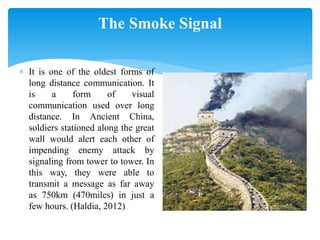
 It is one of the oldest forms of
long distance communication. It
is a form of visual
communication used over long
distance. In Ancient China,
soldiers stationed along the great
wall would alert each other of
impending enemy attack by
signaling from tower to tower. In
this way, they were able to
transmit a message as far away
as 750km (470miles) in just a
few hours. (Haldia, 2012)
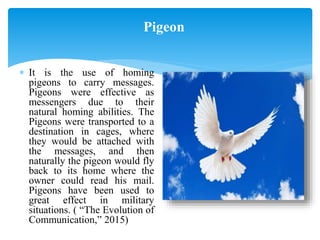
Pigeon
 It is the use of homing
pigeons to carry messages.
Pigeons were effective as
messengers due to their
natural homing abilities. The
Pigeons were transported to a
destination in cages, where
they would be attached with
the messages, and then
naturally the pigeon would fly
back to its home where the
owner could read his mail.
Pigeons have been used to
great effect in military
situations. ( “The Evolution of
Communication,” 2015)
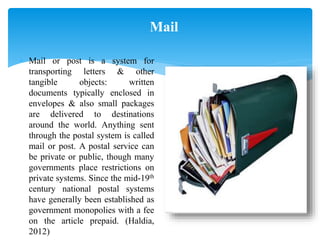
Mail
 Mail or post is a system for
transporting letters & other
tangible objects: written
documents typically enclosed in
envelopes & also small packages
are delivered to destinations
around the world. Anything sent
through the postal system is called
mail or post. A postal service can
be private or public, though many
governments place restrictions on
private systems. Since the mid-19th
century national postal systems
have generally been established as
government monopolies with a fee
on the article prepaid. (Haldia,
2012)
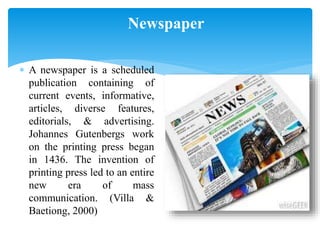
Newspaper
 A newspaper is a scheduled
publication containing of
current events, informative,
articles, diverse features,
editorials, & advertising.
Johannes Gutenbergs work
on the printing press began
in 1436. The invention of
printing press led to an entire
new era of mass
communication. (Villa &
Baetiong, 2000)
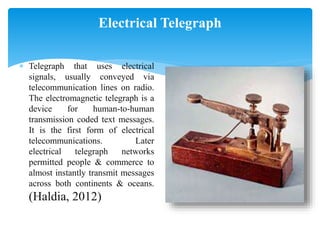
Electrical Telegraph
 Telegraph that uses electrical
signals, usually conveyed via
telecommunication lines on radio.
The electromagnetic telegraph is a
device for human-to-human
transmission coded text messages.
It is the first form of electrical
telecommunications. Later
electrical telegraph networks
permitted people & commerce to
almost instantly transmit messages
across both continents & oceans.
(Haldia, 2012)
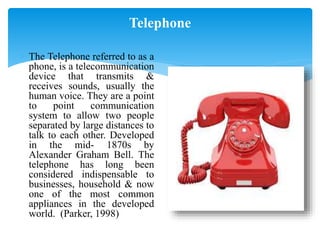
Telephone
 The Telephone referred to as a
phone, is a telecommunication
device that transmits &
receives sounds, usually the
human voice. They are a point
to point communication
system to allow two people
separated by large distances to
talk to each other. Developed
in the mid- 1870s by
Alexander Graham Bell. The
telephone has long been
considered indispensable to
businesses, household & now
one of the most common
appliances in the developed
world. (Parker, 1998)
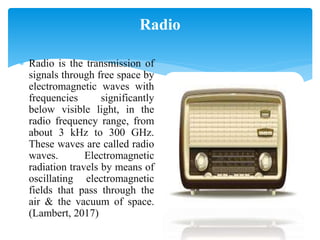
Radio
 Radio is the transmission of
signals through free space by
electromagnetic waves with
frequencies significantly
below visible light, in the
radio frequency range, from
about 3 kHz to 300 GHz.
These waves are called radio
waves. Electromagnetic
radiation travels by means of
oscillating electromagnetic
fields that pass through the
air & the vacuum of space.
(Lambert, 2017)
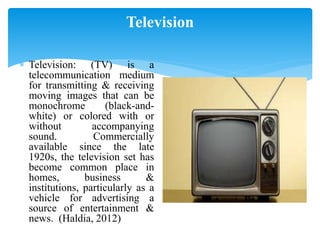
Television
 Television: (TV) is a
telecommunication medium
for transmitting & receiving
moving images that can be
monochrome (black-and-
white) or colored with or
without accompanying
sound. Commercially
available since the late
1920s, the television set has
become common place in
homes, business &
institutions, particularly as a
vehicle for advertising a
source of entertainment &
news. (Haldia, 2012)
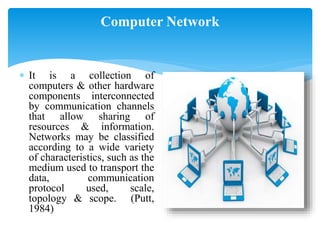
Computer Network
 It is a collection of
computers & other hardware
components interconnected
by communication channels
that allow sharing of
resources & information.
Networks may be classified
according to a wide variety
of characteristics, such as the
medium used to transport the
data, communication
protocol used, scale,
topology & scope. (Putt,
1984)
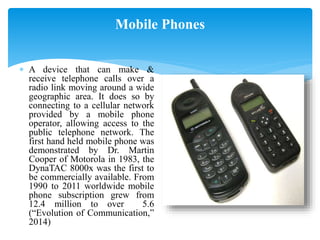
Mobile Phones
 A device that can make &
receive telephone calls over a
radio link moving around a wide
geographic area. It does so by
connecting to a cellular network
provided by a mobile phone
operator, allowing access to the
public telephone network. The
first hand held mobile phone was
demonstrated by Dr. Martin
Cooper of Motorola in 1983, the
DynaTAC 8000x was the first to
be commercially available. From
1990 to 2011 worldwide mobile
phone subscription grew from
12.4 million to over 5.6
(“Evolution of Communication,”
2014)
Internet
 The internet is a global system of
interconnected computer networks
that use the standard internet
protocol suite to serve billions of
users worldwide. It is a network of
networks that consists of millions
of private, public, academic,
business, & government networks
of local to global scope, that are
linked by a broad array of
electronic, wireless & optical
networking technologies. The
Internet carries an extensive range
of information resources &
services, such as the inter-linked
hypertext documents of the World
Wide Web (WWW) & the
infrastructure to support email.
(Andres, 2006)
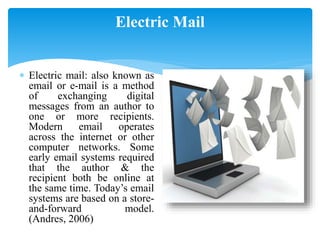
Electric Mail
 Electric mail: also known as
email or e-mail is a method
of exchanging digital
messages from an author to
one or more recipients.
Modern email operates
across the internet or other
computer networks. Some
early email systems required
that the author & the
recipient both be online at
the same time. Today’s email
systems are based on a store-
and-forward model.
(Andres, 2006)
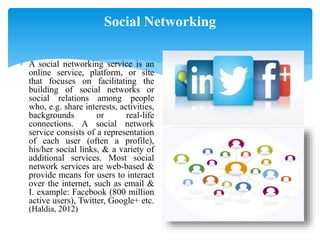
Social Networking
 A social networking service is an
online service, platform, or site
that focuses on facilitating the
building of social networks or
social relations among people
who, e.g. share interests, activities,
backgrounds or real-life
connections. A social network
service consists of a representation
of each user (often a profile),
his/her social links, & a variety of
additional services. Most social
network services are web-based &
provide means for users to interact
over the internet, such as email &
I. example: Facebook (800 million
active users), Twitter, Google+ etc.
(Haldia, 2012)
 The communication revolution has brought around many positive
effects. One example is easing political tension around the world.
Important political figures can now resolve their differences or
make important decisions without having to travels hundreds of
miles or meet face to face. The business world has evolved;
companies can now communicate faster, more efficiently, and
therefore turn more profits. More businesses can make
themselves seen through the internet, which allows a large
diversity of companies to emerge. Communication company like
Microsoft is turning an enormous profit, allowing them to make
technological advances and offer and develop more services for
the public. It also increases employment and therefore decreases
poverty in more developed countries. It breaks down social and
worldwide barriers, allowing people to interact across the globe;
different races, cultures, backgrounds and statuses interact.
Evolution of Communication

Evolution of Communication

  • 1.
  • 2.
    Communication  Communication isthe process where one person is expressing his or her idea & the other one is listening to the idea being expressed by the one who is talking  When this results to have an understanding to both of them, therefore there is already a communication.
  • 3.
     To understandcommunication and other forms of communication at present. One has to go back to the past. They have roots that go back quite a way to the past. Since the beginning of time, people have had the need to communicate with one another.
  • 4.
    The Smoke Signal It is one of the oldest forms of long distance communication. It is a form of visual communication used over long distance. In Ancient China, soldiers stationed along the great wall would alert each other of impending enemy attack by signaling from tower to tower. In this way, they were able to transmit a message as far away as 750km (470miles) in just a few hours. (Haldia, 2012)
  • 5.
    Pigeon  It isthe use of homing pigeons to carry messages. Pigeons were effective as messengers due to their natural homing abilities. The Pigeons were transported to a destination in cages, where they would be attached with the messages, and then naturally the pigeon would fly back to its home where the owner could read his mail. Pigeons have been used to great effect in military situations. ( “The Evolution of Communication,” 2015)
  • 6.
    Mail  Mail orpost is a system for transporting letters & other tangible objects: written documents typically enclosed in envelopes & also small packages are delivered to destinations around the world. Anything sent through the postal system is called mail or post. A postal service can be private or public, though many governments place restrictions on private systems. Since the mid-19th century national postal systems have generally been established as government monopolies with a fee on the article prepaid. (Haldia, 2012)
  • 7.
    Newspaper  A newspaperis a scheduled publication containing of current events, informative, articles, diverse features, editorials, & advertising. Johannes Gutenbergs work on the printing press began in 1436. The invention of printing press led to an entire new era of mass communication. (Villa & Baetiong, 2000)
  • 8.
    Electrical Telegraph  Telegraphthat uses electrical signals, usually conveyed via telecommunication lines on radio. The electromagnetic telegraph is a device for human-to-human transmission coded text messages. It is the first form of electrical telecommunications. Later electrical telegraph networks permitted people & commerce to almost instantly transmit messages across both continents & oceans. (Haldia, 2012)
  • 9.
    Telephone  The Telephonereferred to as a phone, is a telecommunication device that transmits & receives sounds, usually the human voice. They are a point to point communication system to allow two people separated by large distances to talk to each other. Developed in the mid- 1870s by Alexander Graham Bell. The telephone has long been considered indispensable to businesses, household & now one of the most common appliances in the developed world. (Parker, 1998)
  • 10.
    Radio  Radio isthe transmission of signals through free space by electromagnetic waves with frequencies significantly below visible light, in the radio frequency range, from about 3 kHz to 300 GHz. These waves are called radio waves. Electromagnetic radiation travels by means of oscillating electromagnetic fields that pass through the air & the vacuum of space. (Lambert, 2017)
  • 11.
    Television  Television: (TV)is a telecommunication medium for transmitting & receiving moving images that can be monochrome (black-and- white) or colored with or without accompanying sound. Commercially available since the late 1920s, the television set has become common place in homes, business & institutions, particularly as a vehicle for advertising a source of entertainment & news. (Haldia, 2012)
  • 12.
    Computer Network  Itis a collection of computers & other hardware components interconnected by communication channels that allow sharing of resources & information. Networks may be classified according to a wide variety of characteristics, such as the medium used to transport the data, communication protocol used, scale, topology & scope. (Putt, 1984)
  • 13.
    Mobile Phones  Adevice that can make & receive telephone calls over a radio link moving around a wide geographic area. It does so by connecting to a cellular network provided by a mobile phone operator, allowing access to the public telephone network. The first hand held mobile phone was demonstrated by Dr. Martin Cooper of Motorola in 1983, the DynaTAC 8000x was the first to be commercially available. From 1990 to 2011 worldwide mobile phone subscription grew from 12.4 million to over 5.6 (“Evolution of Communication,” 2014)
  • 14.
    Internet  The internetis a global system of interconnected computer networks that use the standard internet protocol suite to serve billions of users worldwide. It is a network of networks that consists of millions of private, public, academic, business, & government networks of local to global scope, that are linked by a broad array of electronic, wireless & optical networking technologies. The Internet carries an extensive range of information resources & services, such as the inter-linked hypertext documents of the World Wide Web (WWW) & the infrastructure to support email. (Andres, 2006)
  • 15.
    Electric Mail  Electricmail: also known as email or e-mail is a method of exchanging digital messages from an author to one or more recipients. Modern email operates across the internet or other computer networks. Some early email systems required that the author & the recipient both be online at the same time. Today’s email systems are based on a store- and-forward model. (Andres, 2006)
  • 16.
    Social Networking  Asocial networking service is an online service, platform, or site that focuses on facilitating the building of social networks or social relations among people who, e.g. share interests, activities, backgrounds or real-life connections. A social network service consists of a representation of each user (often a profile), his/her social links, & a variety of additional services. Most social network services are web-based & provide means for users to interact over the internet, such as email & I. example: Facebook (800 million active users), Twitter, Google+ etc. (Haldia, 2012)
  • 17.
     The communicationrevolution has brought around many positive effects. One example is easing political tension around the world. Important political figures can now resolve their differences or make important decisions without having to travels hundreds of miles or meet face to face. The business world has evolved; companies can now communicate faster, more efficiently, and therefore turn more profits. More businesses can make themselves seen through the internet, which allows a large diversity of companies to emerge. Communication company like Microsoft is turning an enormous profit, allowing them to make technological advances and offer and develop more services for the public. It also increases employment and therefore decreases poverty in more developed countries. It breaks down social and worldwide barriers, allowing people to interact across the globe; different races, cultures, backgrounds and statuses interact.