SPECIFICATION
crystal-display.com
PNL-043-500-M
4.3" IPS TFT with HDMI
1
LCD MODULE
※Please pay more attention for the “inspection standard”, we assume you already agree
this standard when place an order with us.
※The specification of “TBD” should refer to the measured value of sample .
Customer No.:
Spec Version: 01
Issued Date: 2019.3.3
Customer
approval:
Designed Checked Approved
SPECIFICATION
FOR
Part No.: PNL-043-500-M
2
Documents Revision History:
Rivision Date Description Changed By
01 2019/3/3 New released
3
1. General Description
2. Mechanical Specification
ITEM Standard Value Unit
Display Mode Normally Black, Transmissive LCD
Module Dimension 105.80(W)*85.09(H)*5.00(T) mm
Resolution 800(RGB)X 480 Pixels
Active Display Area 95.04(W)×53.86(H) mm
Module Structure LCD Display+ PCB
Viewing Direction All --
LED Backlight Color White --
Interface HDMI --
Color Numbers 16.7M
Power supply USB(5.0V)
Support system Win/7/Win8/Win10(plug and play)
Android,Linux (configured in requests)
Power Consumption 500(Max) mA
3. Absolute Max Ratings & Electrical Specification
 Absolute Max Rating
Item Min. Typ Max Unit Remark
Operating temperature -20 -- 70 °C
Storage temperature -30 -- 80 °C
Humidity -- -- 90% RH @60°C
Note:
*1) Liquid Crystal driving voltage.
Due to the characteristics of LC Material, this voltage vary with environmental
 The PNL-043-500-M model is a Colour TFT LCD
This main Module has a 4.3 inch diagonally measured active display area with
800(RGB)X480 resolution. Each pixel is divided into Red, Green and Blue
sub-pixels and dots, which are arranged in vertical stripes.
 The PNL-043-500-M has been designed to apply the HDMI interface
method that enables low power, high speed, and high contrast.
4
temperature.
*2) T
emp.>60℃, Absolute humidity shall be less than 90%RH at 60℃
*3) T
emp.≤60℃, 90%RH MAX.
*4) The recommended operating conditions refer to a range in which operation of this
product is guaranteed. Should this range is exceeded, the operation cannot be
guaranteed even if the values may be without the absolute maximum ratings.
Accordingly, please make sure that the module is used within this range.
And these current values are measured under the condition that all devices are
stopped, each component is stable and logic signal is input.
 TFT Electrical Specification
Item Min. Typ Max Unit Remark
PCB operating voltage 4.8 5.0 - V USB input
LCD I/O voltage(VDD) 3.0 3.3 3.6 V
Input signal ” H” 0.7*VDD -- VDD V
Input signal ” L” VSS -- 0.3*VDD V
Output signal ” H” VDD-0.4 VDD V
Output signal ” L” VSS VSS+0.4 V
5
4. Optical Specification
Item Symbol Condition Min. Typ. Max. Unit Note
Brightness Bp θ=0°
=0°
- 400 - cd/m2
Uniformity △Bp - 80 - %
Viewing
Angle
θ1
(Ф=90°
or270°)
12 o’clock 70 80 -
Deg Cr≥10
6 o’clock 70 80 -
θ2
(Ф=0° or
180°)
9 o’clock 70 80 -
3 o’clock 70 80 -
CIE
Wx
θ=0°
=0°
0.26 0.30 0.36
Wy 0.28 0.33 0.38
Contrast
Ratio
Cr 640 800 -
Response
Time
ton - 30 40 ms
toff - ms
6
Electro-optical characteristics test method:
Definition of contrast ratio
7
“White state “:The state is that the LCD should driven by Vwhite.
“Black state”: The state is that the LCD should driven by Vblack.
Vwhite: T
o be determined
Vblack: T
o be determined.
Definition of Response Time:
The response time is defined as the LCD optical switching time interval between
“White” state and
“Black” state. Rise time (TON) is the time between photo detector output intensity
changed from
90% to 10%. And fall time (TOFF) is the time between photo detector output intensity
changed from10% to 90%.
Definition of color chromaticity (CIE1931)
8
Color coordinates measured at center point of LCD
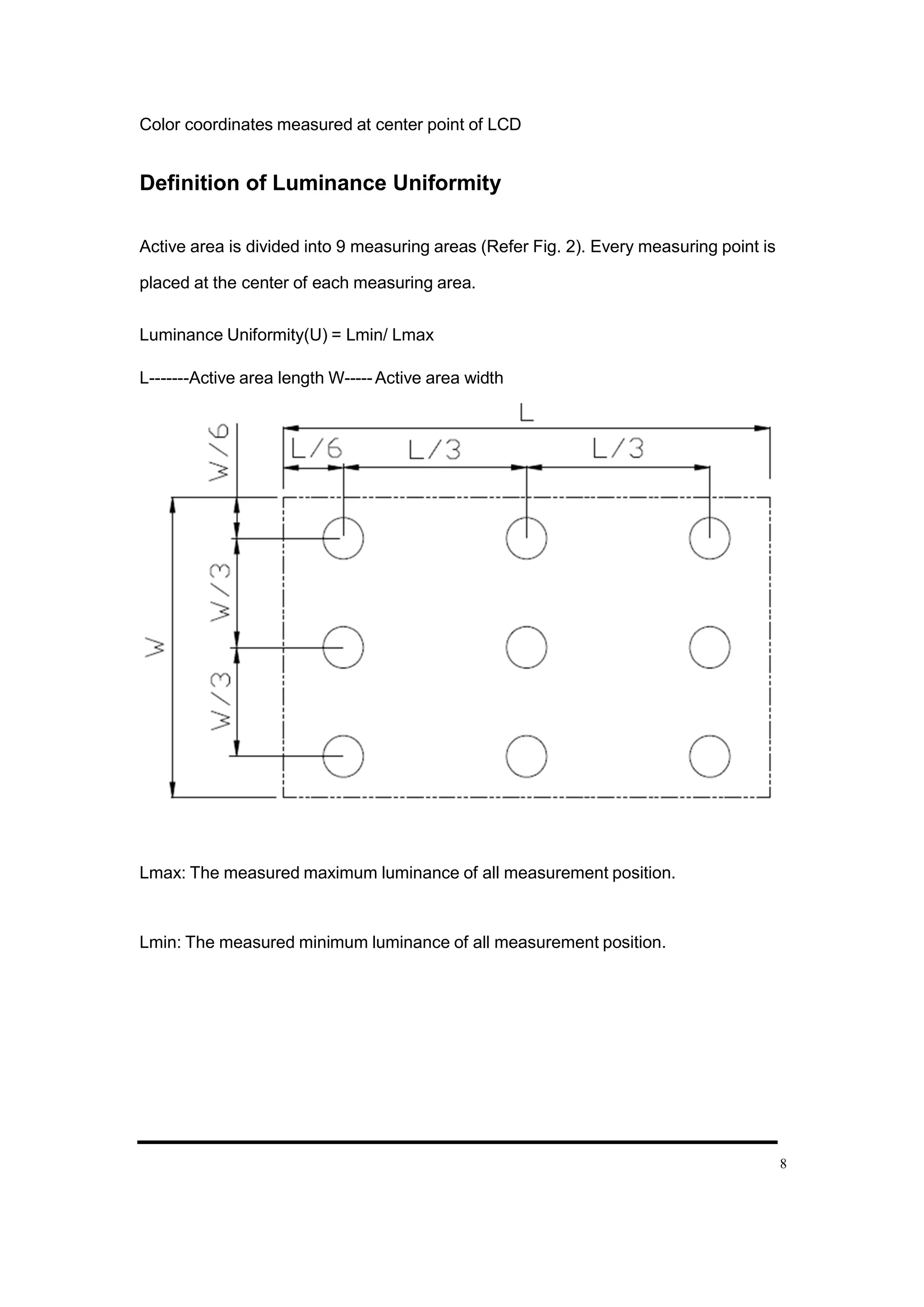
Definition of Luminance Uniformity
Active area is divided into 9 measuring areas (Refer Fig. 2). Every measuring point is
placed at the center of each measuring area.
Luminance Uniformity(U) = Lmin/ Lmax
L-------Active area length W-----Active area width
Lmax: The measured maximum luminance of all measurement position.
Lmin: The measured minimum luminance of all measurement position.
9
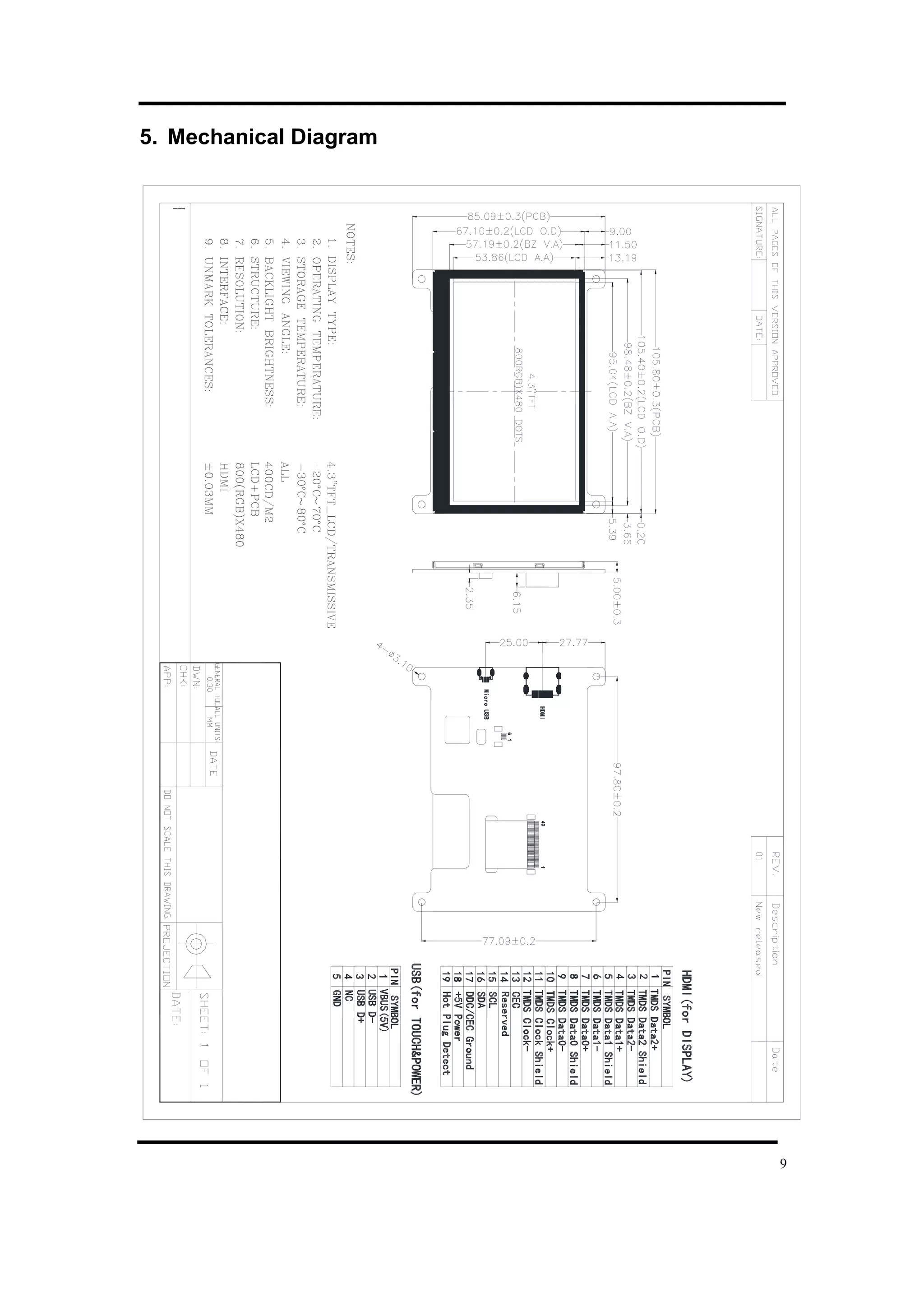
5. Mechanical Diagram
10
6. Interface Pin Connections
HDMI interface:
Pin No. Symbol Description
1 TMDS Data2+
Positive side of channel 2 TMDS low-voltage signal
differential input pair
2 TMDS Data2 Shield Ground
3 TMDS Data2-
Negative side of channel 2 TMDS low-voltage signal
differential input pair
4 TMDS Data1+
Positive side of channel 1 TMDS low-voltage signal
differential input pair
5 TMDS Data1 Shield Ground
6 TMDS Data1-
Negative side of channel 1 TMDS low-voltage signal
differential input pair
7 TMDS Data0+
Positive side of channel 0 TMDS low-voltage signal
differential input pair
8 TMDS Data0 Shield Ground
9 TMDS Data0-
Negative side of channel 0 TMDS low-voltage signal
differential input pair
10 TMDS Clock+
Positive side of reference clock. TMDS low-voltage signal
differential input pair
11 TMDS Clock Shield Ground
12 TMDS Clock-
Negative side of reference clock. TMDS low-voltage
signal differential input pair
13 CEC No Connection
14 Reserved(N.C.) No Connection
15 SCL DDC SCL
16 SDA DDC SDA
17 DDC/CEC Ground Ground
18 +5V Power +5V Power
19 Hot Plug Detect Hot Plug Detect
11
USB interface
Application note: please connected USB interface first, then next connect HDMI
interface.
7. Timing Characteristics
Parallel RGB input Timing table:
12
8. Inspection Standard
A. Sampling Method
Unless otherwise agreed upon in writing, the sampling inspection shall be applied
to theCustomer’s incoming inspection.
1) Lot size: Quantity per shipment lot
2) Sampling type: Normal inspection , single sampling
3) Inspection level: Ⅱ
4) Sampling table: MIL-STD-105D
5) Acceptable Quality Level(AQL): Major=0.65Minor=1.5
B. Inspection Method
1) Ambient Condition:
a. T
emperature: Room temperature 25±5℃
b. Illumination: Single fluorescent lamp non-directive(300 to 700 Lux)
2) Viewing distance
The distance between the LCD and the inspector’s eyes shall be at least 30-50cm.
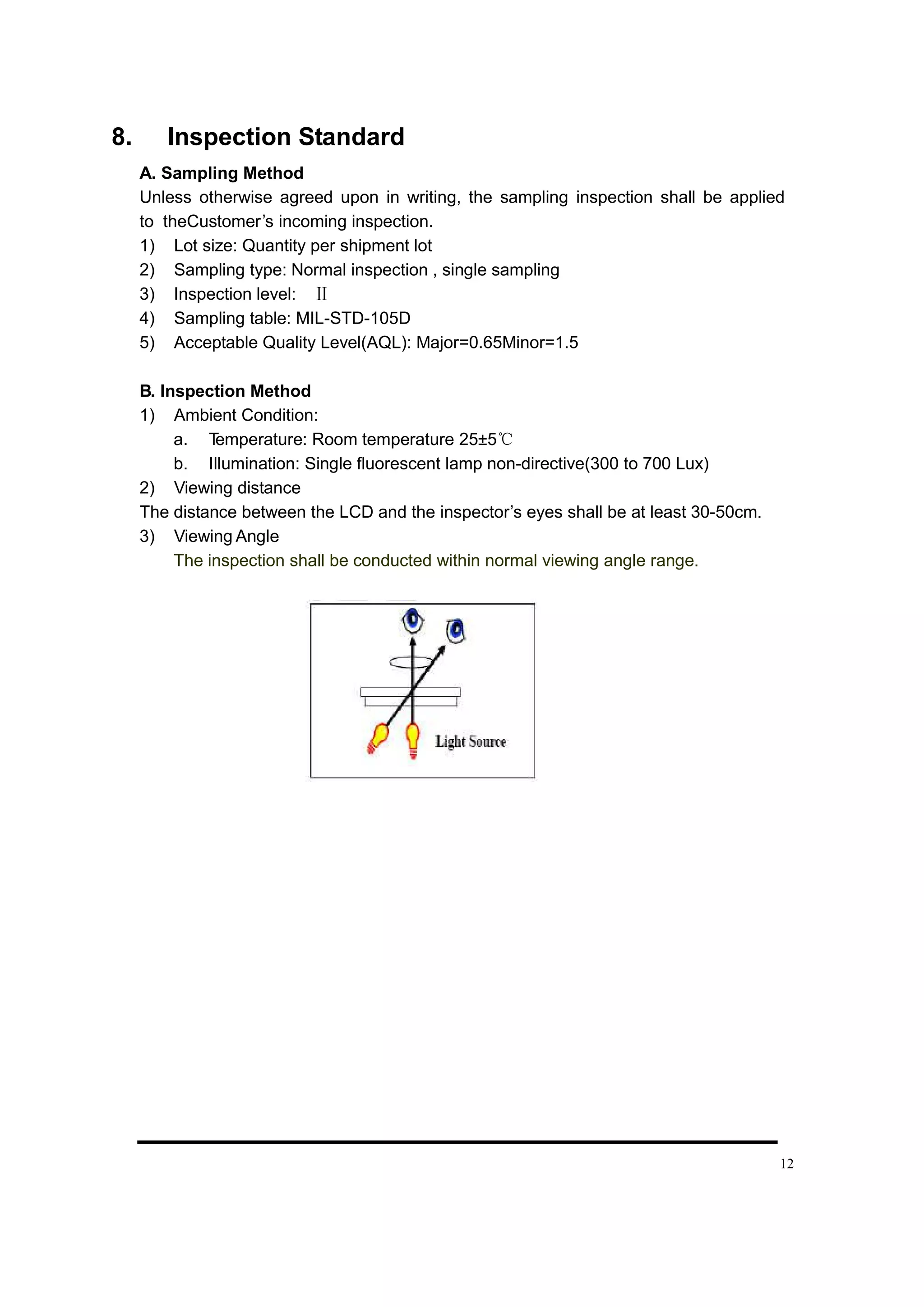
3) Viewing Angle
The inspection shall be conducted within normal viewing angle range.
13
Viewing Area
X1 X2
Y1
Y2
Figure 2
B zone
Active Area(AA)
A zone: Viewing Area(VA)
9. Inspection Criteria
1) Major defect
NO. Item Inspection Standard Classification
defect
1 All function
defect
No display
Display abnormal
Short circuit
Missing segment
Excess power consumption
No backligt, flickering
Major
2 missing Missing compement Major
3 Outline
dimension
Outline Dimension out of drawing tolerance Major
2) Cosmetic defect
A. Definition of inspection range
For dot defect of TFT LCD which is not
smaller than 3 inches, dividing three areas to
make a judgment (according to figure 1).
A area : center of viewing area
B area : periphery of viewing area
C area : Outside viewing area
For other defects, dividing two areas to
make a judgment (according figure 2).
A zone : Inside Viewing area
B zone : Outside Viewing area
X1(A.A~V.A): 2mm X2(A.A~V.A): 2mm
Y1(A.A~V.A): 2mm Y2(A.A~V.A): 2mm
Figure 1
14
b
a
Φ=(a+b)/2(m
W:
Width
L:Length(mm)
a
b
Φ=(a+b)/2(mm)
B. Cosmetic defect criteria
Inspection items
Judgment standard
Category
Acceptable number
A zone B zone
1
Black spot, White
spot, Bright Spot,
Pinhole, Foreign
Particle, Particle
in or on glass,
Scratch on glass
A Φ≦0.10 Neglected
Neglected
B 0.10<Φ≦0.15 2
C 0.15<Φ≦0.20 1
D 0.20<Φ 0
Total defective point(B,C)
3
2
Black line, White
line, and Particle
Between
Polarizer and
glass, Scratch on
glass
A W≦0.01 Neglected
Neglected
B 0.01<W≦0.03 L≦3.0 2
C 0.03<W≦0.05 L≦3.0 1
D 0.05<W 0
Total defective point(B,C) 3
3
Contrast
variation
A Φ≦0.2 Neglected
Neglected
B 0.2<Φ≦0.3 2
C 0.3<Φ≦0.4 1
D 0.4<Φ 0
Total defective point(B,C) 3
4
Dot defect (if TFT
LCD is used)
TFT LCD is smaller
than 3 inches
LCD Class Defect A area B area
A
Bright dot 1
Neglected
Dark dot 2
Total 2
B
Bright dot 2
Dark dot 3
Total 4
TFT LCD between
3~10.4 inches
LCD Class Defect A area B area C area
A
Bright dot 1 1
Neglected
Dark dot 1 2
Total 4
B
Bright dot 2 2
Dark dot 2 3
15
Total 6
Notes:
Bright dot: in R、G、B or dark display figure, the pixel appears bright.
Dark dot: in R、G、B or white display figure, the pixel appears dark.
Defect area must be less than an half size of the dot.
5 Bubble inside cell any size none none
6
Polarizer defect (if
Polarizer is used)
Scratch ,damage on
polarizer, Particle on
polarizer or between
polarizer and glass.
Refer to item 1 and item 2.
Bubble, dent and
convex
A Φ≦0.3 Neglected
Neglected
B 0.3<Φ≦0.7 2
C 0.7<Φ 0
7
Surplus
glass
Stage surplus glass
b≦0.3mm
Surrounding surplus
glass
Should not influence outline dimension and assembling.
11 Contrast ratio uneven According to the limit specimen
12 Crosstalk According to the limit specimen
13 Black /White spot(display) Refer to item 1
14 Black /White line(display) Refer to item 2
b
16
Inspection items
Judgment standard
Category(application: B zone) Acceptable
number
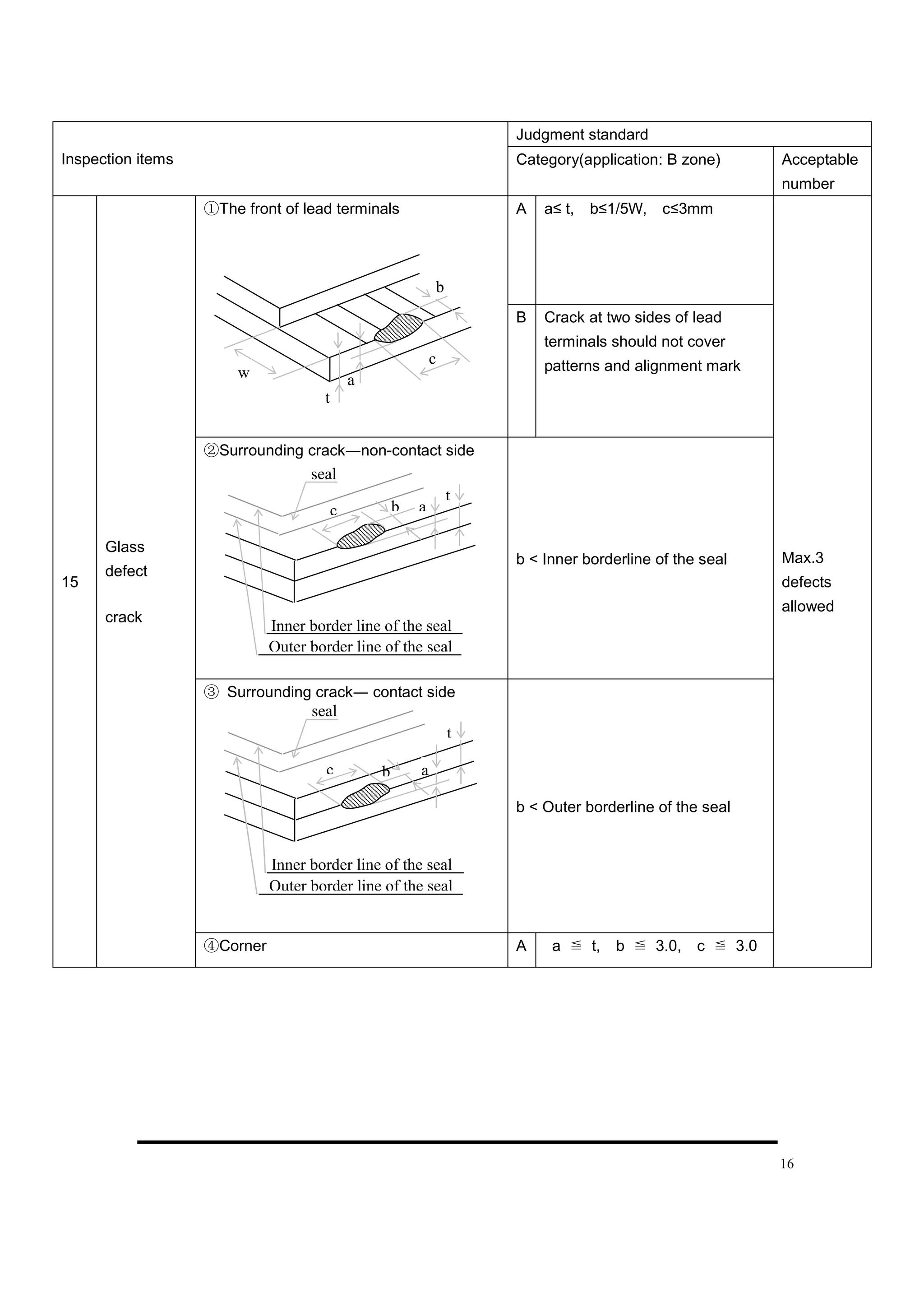
15
Glass
defect
crack
①The front of lead terminals A a≤ t, b≤1/5W, c≤3mm
Max.3
defects
allowed
B Crack at two sides of lead
terminals should not cover
patterns and alignment mark
②Surrounding crack―non-contact side
b < Inner borderline of the seal
③ Surrounding crack― contact side
b < Outer borderline of the seal
④Corner A a ≦ t, b ≦ 3.0, c ≦ 3.0
c
a
b
t
w
seal
Outer border line of the seal
Inner border line of the seal
b a
c
t
b a
seal
Outer border line of the seal
Inner border line of the seal
c
t
17
Inspection items
Judgment standard
Category(application: B zone)
16
PCB
defect
Component soldering:
No cold soldering、
short、
open circuit、
burr、
tin ball
The flat encapsulation component position
deviation must be less than 1/3 width of the
pin (Pic.1);
the sheet component deviation:
Pin deviates from the pad and contact with
the near components is not permitted
(Pic.2)
lead defect:
The lead lack must be less than 1/3 of its
width;
The lead burr must be less than 1/3 of the
seam;
Impurities connect with the near leads is
not permitted
B Glass crack should not cover
patterns u and alignment mark
and patterns.
W
L≤W/2
Component
Soldering pad
Component
Lead
L1>0
L2>0
t
a
c
b
w
18
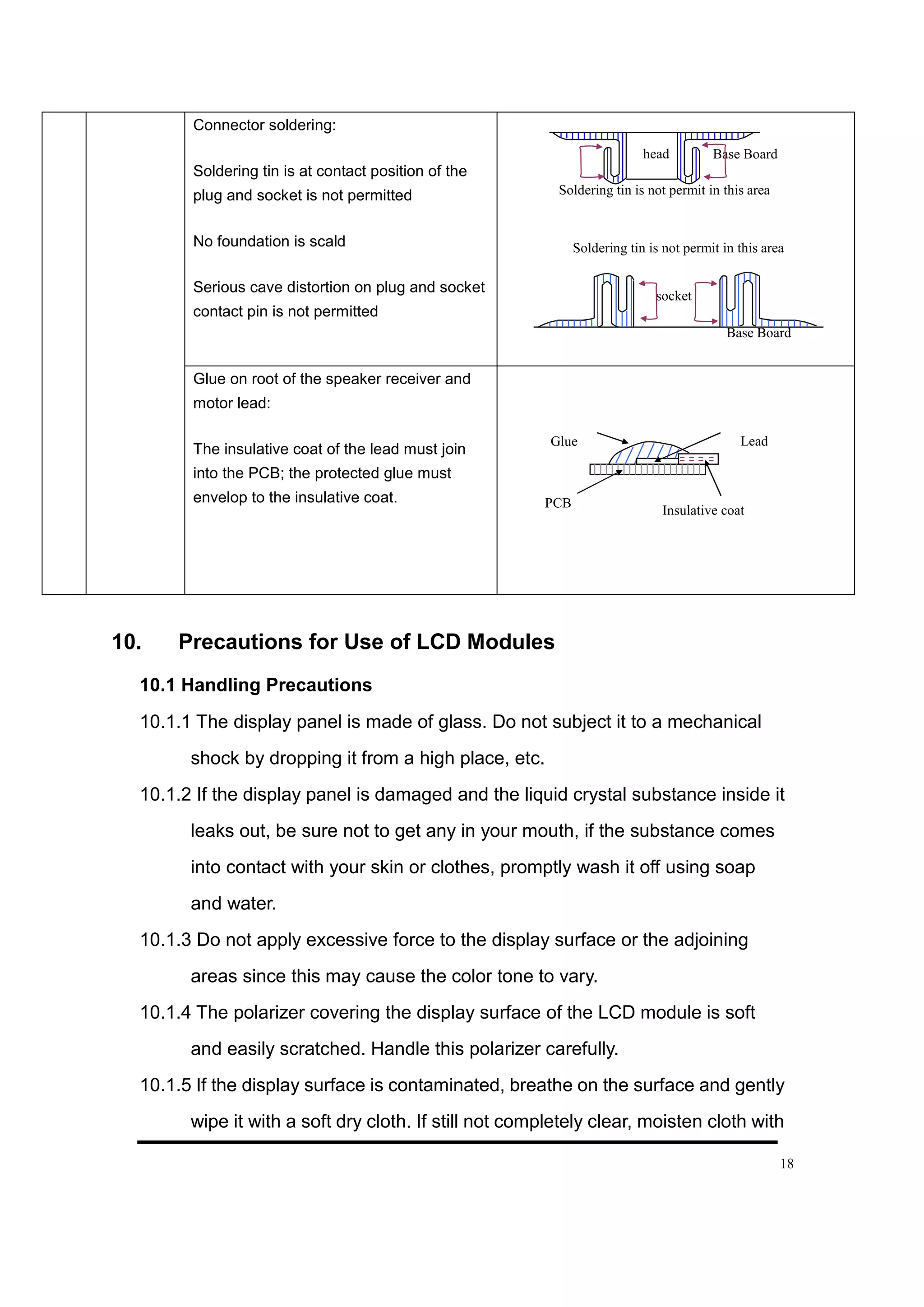
Connector soldering:
Soldering tin is at contact position of the
plug and socket is not permitted
No foundation is scald
Serious cave distortion on plug and socket
contact pin is not permitted
Glue on root of the speaker receiver and
motor lead:
The insulative coat of the lead must join
into the PCB; the protected glue must
envelop to the insulative coat.
10. Precautions for Use of LCD Modules
10.1 Handling Precautions
10.1.1 The display panel is made of glass. Do not subject it to a mechanical
shock by dropping it from a high place, etc.
10.1.2 If the display panel is damaged and the liquid crystal substance inside it
leaks out, be sure not to get any in your mouth, if the substance comes
into contact with your skin or clothes, promptly wash it off using soap
and water.
10.1.3 Do not apply excessive force to the display surface or the adjoining
areas since this may cause the color tone to vary.
10.1.4 The polarizer covering the display surface of the LCD module is soft
and easily scratched. Handle this polarizer carefully.
10.1.5 If the display surface is contaminated, breathe on the surface and gently
wipe it with a soft dry cloth. If still not completely clear, moisten cloth with
Soldering tin is not permit in this area
Base Board
head
socket
Soldering tin is not permit in this area
Base Board
Lead
PCB
Insulative coat
Glue
19
one of the following solvents:
— Isopropyl alcohol
— Ethyl alcohol
Solvents other than those mentioned above may damage the polarizer.
Especially, do not use the following:
— Water
— Ketone
— Aromatic solvents
10.1.6 Do not attempt to disassemble the LCD Module.
10.1.7 If the logic circuit power is off, do not apply the input signals.
10.1.8 To prevent destruction of the elements by static electricity, be careful to
maintain an optimum work environment.
a. Be sure to ground the body when handling the LCD Modules.
b. Tools required for assembly, such as soldering irons, must be properly
ground.
c. To reduce the amount of static electricity generated, do not conduct
assembly and other work under dry conditions.
d. The LCD Module is coated with a film to protect the display surface.
Be care when peeling off this protective film since static electricity
may be generated.
10.2 Storage precautions
10.2.1 When storing the LCD modules, avoid exposure to direct sunlight or to
the light of fluorescent lamps.
10.2.2 The LCD modules should be stored under the storage temperature
range. If the LCD modules will be stored for a long time, the recommend
condition is:
Temperature : 0℃ ~ 40℃
Relatively humidity: ≤80%
20
10.2.3 The LCD modules should be stored in the room without acid, alkali and
harmful gas.
10.2.4 The LCD modules should be no falling and violent shocking during
transportation, and also should avoid excessive press, water, damp and
sunshine.
Need any additional information?
If you need any assistance with pricing information, technical support or require any additional information
our team would be more than happy to assist.
SPECIALISTS IN INNOVATIVE LCD DISPLAY SOLUTIONS
More information can be found at:
CONTACT US:
*E & OE. Specifications may be subject to change without prior notice
crystal-display.com
Crystal Display Systems Ltd
Unit 6 M2M Park, Fort Bridgewood,
Maidstone Road, Rochester, Kent
ME1 3DQ
United Kingdom
T: +44 (0) 1634 791600
E: info@crystal-display.com
W: crystal-display.com

CDS PNL-043-500-M Small IPS TFT with HDMI

  • 1.
  • 2.
    1 LCD MODULE ※Please paymore attention for the “inspection standard”, we assume you already agree this standard when place an order with us. ※The specification of “TBD” should refer to the measured value of sample . Customer No.: Spec Version: 01 Issued Date: 2019.3.3 Customer approval: Designed Checked Approved SPECIFICATION FOR Part No.: PNL-043-500-M
  • 3.
    2 Documents Revision History: RivisionDate Description Changed By 01 2019/3/3 New released
  • 4.
    3 1. General Description 2.Mechanical Specification ITEM Standard Value Unit Display Mode Normally Black, Transmissive LCD Module Dimension 105.80(W)*85.09(H)*5.00(T) mm Resolution 800(RGB)X 480 Pixels Active Display Area 95.04(W)×53.86(H) mm Module Structure LCD Display+ PCB Viewing Direction All -- LED Backlight Color White -- Interface HDMI -- Color Numbers 16.7M Power supply USB(5.0V) Support system Win/7/Win8/Win10(plug and play) Android,Linux (configured in requests) Power Consumption 500(Max) mA 3. Absolute Max Ratings & Electrical Specification  Absolute Max Rating Item Min. Typ Max Unit Remark Operating temperature -20 -- 70 °C Storage temperature -30 -- 80 °C Humidity -- -- 90% RH @60°C Note: *1) Liquid Crystal driving voltage. Due to the characteristics of LC Material, this voltage vary with environmental  The PNL-043-500-M model is a Colour TFT LCD This main Module has a 4.3 inch diagonally measured active display area with 800(RGB)X480 resolution. Each pixel is divided into Red, Green and Blue sub-pixels and dots, which are arranged in vertical stripes.  The PNL-043-500-M has been designed to apply the HDMI interface method that enables low power, high speed, and high contrast.
  • 5.
    4 temperature. *2) T emp.>60℃, Absolutehumidity shall be less than 90%RH at 60℃ *3) T emp.≤60℃, 90%RH MAX. *4) The recommended operating conditions refer to a range in which operation of this product is guaranteed. Should this range is exceeded, the operation cannot be guaranteed even if the values may be without the absolute maximum ratings. Accordingly, please make sure that the module is used within this range. And these current values are measured under the condition that all devices are stopped, each component is stable and logic signal is input.  TFT Electrical Specification Item Min. Typ Max Unit Remark PCB operating voltage 4.8 5.0 - V USB input LCD I/O voltage(VDD) 3.0 3.3 3.6 V Input signal ” H” 0.7*VDD -- VDD V Input signal ” L” VSS -- 0.3*VDD V Output signal ” H” VDD-0.4 VDD V Output signal ” L” VSS VSS+0.4 V
  • 6.
    5 4. Optical Specification ItemSymbol Condition Min. Typ. Max. Unit Note Brightness Bp θ=0° =0° - 400 - cd/m2 Uniformity △Bp - 80 - % Viewing Angle θ1 (Ф=90° or270°) 12 o’clock 70 80 - Deg Cr≥10 6 o’clock 70 80 - θ2 (Ф=0° or 180°) 9 o’clock 70 80 - 3 o’clock 70 80 - CIE Wx θ=0° =0° 0.26 0.30 0.36 Wy 0.28 0.33 0.38 Contrast Ratio Cr 640 800 - Response Time ton - 30 40 ms toff - ms
  • 7.
    6 Electro-optical characteristics testmethod: Definition of contrast ratio
  • 8.
    7 “White state “:Thestate is that the LCD should driven by Vwhite. “Black state”: The state is that the LCD should driven by Vblack. Vwhite: T o be determined Vblack: T o be determined. Definition of Response Time: The response time is defined as the LCD optical switching time interval between “White” state and “Black” state. Rise time (TON) is the time between photo detector output intensity changed from 90% to 10%. And fall time (TOFF) is the time between photo detector output intensity changed from10% to 90%. Definition of color chromaticity (CIE1931)
  • 9.
    8 Color coordinates measuredat center point of LCD Definition of Luminance Uniformity Active area is divided into 9 measuring areas (Refer Fig. 2). Every measuring point is placed at the center of each measuring area. Luminance Uniformity(U) = Lmin/ Lmax L-------Active area length W-----Active area width Lmax: The measured maximum luminance of all measurement position. Lmin: The measured minimum luminance of all measurement position.
  • 10.
  • 11.
    10 6. Interface PinConnections HDMI interface: Pin No. Symbol Description 1 TMDS Data2+ Positive side of channel 2 TMDS low-voltage signal differential input pair 2 TMDS Data2 Shield Ground 3 TMDS Data2- Negative side of channel 2 TMDS low-voltage signal differential input pair 4 TMDS Data1+ Positive side of channel 1 TMDS low-voltage signal differential input pair 5 TMDS Data1 Shield Ground 6 TMDS Data1- Negative side of channel 1 TMDS low-voltage signal differential input pair 7 TMDS Data0+ Positive side of channel 0 TMDS low-voltage signal differential input pair 8 TMDS Data0 Shield Ground 9 TMDS Data0- Negative side of channel 0 TMDS low-voltage signal differential input pair 10 TMDS Clock+ Positive side of reference clock. TMDS low-voltage signal differential input pair 11 TMDS Clock Shield Ground 12 TMDS Clock- Negative side of reference clock. TMDS low-voltage signal differential input pair 13 CEC No Connection 14 Reserved(N.C.) No Connection 15 SCL DDC SCL 16 SDA DDC SDA 17 DDC/CEC Ground Ground 18 +5V Power +5V Power 19 Hot Plug Detect Hot Plug Detect
  • 12.
    11 USB interface Application note:please connected USB interface first, then next connect HDMI interface. 7. Timing Characteristics Parallel RGB input Timing table:
  • 13.
    12 8. Inspection Standard A.Sampling Method Unless otherwise agreed upon in writing, the sampling inspection shall be applied to theCustomer’s incoming inspection. 1) Lot size: Quantity per shipment lot 2) Sampling type: Normal inspection , single sampling 3) Inspection level: Ⅱ 4) Sampling table: MIL-STD-105D 5) Acceptable Quality Level(AQL): Major=0.65Minor=1.5 B. Inspection Method 1) Ambient Condition: a. T emperature: Room temperature 25±5℃ b. Illumination: Single fluorescent lamp non-directive(300 to 700 Lux) 2) Viewing distance The distance between the LCD and the inspector’s eyes shall be at least 30-50cm. 3) Viewing Angle The inspection shall be conducted within normal viewing angle range.
  • 14.
    13 Viewing Area X1 X2 Y1 Y2 Figure2 B zone Active Area(AA) A zone: Viewing Area(VA) 9. Inspection Criteria 1) Major defect NO. Item Inspection Standard Classification defect 1 All function defect No display Display abnormal Short circuit Missing segment Excess power consumption No backligt, flickering Major 2 missing Missing compement Major 3 Outline dimension Outline Dimension out of drawing tolerance Major 2) Cosmetic defect A. Definition of inspection range For dot defect of TFT LCD which is not smaller than 3 inches, dividing three areas to make a judgment (according to figure 1). A area : center of viewing area B area : periphery of viewing area C area : Outside viewing area For other defects, dividing two areas to make a judgment (according figure 2). A zone : Inside Viewing area B zone : Outside Viewing area X1(A.A~V.A): 2mm X2(A.A~V.A): 2mm Y1(A.A~V.A): 2mm Y2(A.A~V.A): 2mm Figure 1
  • 15.
    14 b a Φ=(a+b)/2(m W: Width L:Length(mm) a b Φ=(a+b)/2(mm) B. Cosmetic defectcriteria Inspection items Judgment standard Category Acceptable number A zone B zone 1 Black spot, White spot, Bright Spot, Pinhole, Foreign Particle, Particle in or on glass, Scratch on glass A Φ≦0.10 Neglected Neglected B 0.10<Φ≦0.15 2 C 0.15<Φ≦0.20 1 D 0.20<Φ 0 Total defective point(B,C) 3 2 Black line, White line, and Particle Between Polarizer and glass, Scratch on glass A W≦0.01 Neglected Neglected B 0.01<W≦0.03 L≦3.0 2 C 0.03<W≦0.05 L≦3.0 1 D 0.05<W 0 Total defective point(B,C) 3 3 Contrast variation A Φ≦0.2 Neglected Neglected B 0.2<Φ≦0.3 2 C 0.3<Φ≦0.4 1 D 0.4<Φ 0 Total defective point(B,C) 3 4 Dot defect (if TFT LCD is used) TFT LCD is smaller than 3 inches LCD Class Defect A area B area A Bright dot 1 Neglected Dark dot 2 Total 2 B Bright dot 2 Dark dot 3 Total 4 TFT LCD between 3~10.4 inches LCD Class Defect A area B area C area A Bright dot 1 1 Neglected Dark dot 1 2 Total 4 B Bright dot 2 2 Dark dot 2 3
  • 16.
    15 Total 6 Notes: Bright dot:in R、G、B or dark display figure, the pixel appears bright. Dark dot: in R、G、B or white display figure, the pixel appears dark. Defect area must be less than an half size of the dot. 5 Bubble inside cell any size none none 6 Polarizer defect (if Polarizer is used) Scratch ,damage on polarizer, Particle on polarizer or between polarizer and glass. Refer to item 1 and item 2. Bubble, dent and convex A Φ≦0.3 Neglected Neglected B 0.3<Φ≦0.7 2 C 0.7<Φ 0 7 Surplus glass Stage surplus glass b≦0.3mm Surrounding surplus glass Should not influence outline dimension and assembling. 11 Contrast ratio uneven According to the limit specimen 12 Crosstalk According to the limit specimen 13 Black /White spot(display) Refer to item 1 14 Black /White line(display) Refer to item 2 b
  • 17.
    16 Inspection items Judgment standard Category(application:B zone) Acceptable number 15 Glass defect crack ①The front of lead terminals A a≤ t, b≤1/5W, c≤3mm Max.3 defects allowed B Crack at two sides of lead terminals should not cover patterns and alignment mark ②Surrounding crack―non-contact side b < Inner borderline of the seal ③ Surrounding crack― contact side b < Outer borderline of the seal ④Corner A a ≦ t, b ≦ 3.0, c ≦ 3.0 c a b t w seal Outer border line of the seal Inner border line of the seal b a c t b a seal Outer border line of the seal Inner border line of the seal c t
  • 18.
    17 Inspection items Judgment standard Category(application:B zone) 16 PCB defect Component soldering: No cold soldering、 short、 open circuit、 burr、 tin ball The flat encapsulation component position deviation must be less than 1/3 width of the pin (Pic.1); the sheet component deviation: Pin deviates from the pad and contact with the near components is not permitted (Pic.2) lead defect: The lead lack must be less than 1/3 of its width; The lead burr must be less than 1/3 of the seam; Impurities connect with the near leads is not permitted B Glass crack should not cover patterns u and alignment mark and patterns. W L≤W/2 Component Soldering pad Component Lead L1>0 L2>0 t a c b w
  • 19.
    18 Connector soldering: Soldering tinis at contact position of the plug and socket is not permitted No foundation is scald Serious cave distortion on plug and socket contact pin is not permitted Glue on root of the speaker receiver and motor lead: The insulative coat of the lead must join into the PCB; the protected glue must envelop to the insulative coat. 10. Precautions for Use of LCD Modules 10.1 Handling Precautions 10.1.1 The display panel is made of glass. Do not subject it to a mechanical shock by dropping it from a high place, etc. 10.1.2 If the display panel is damaged and the liquid crystal substance inside it leaks out, be sure not to get any in your mouth, if the substance comes into contact with your skin or clothes, promptly wash it off using soap and water. 10.1.3 Do not apply excessive force to the display surface or the adjoining areas since this may cause the color tone to vary. 10.1.4 The polarizer covering the display surface of the LCD module is soft and easily scratched. Handle this polarizer carefully. 10.1.5 If the display surface is contaminated, breathe on the surface and gently wipe it with a soft dry cloth. If still not completely clear, moisten cloth with Soldering tin is not permit in this area Base Board head socket Soldering tin is not permit in this area Base Board Lead PCB Insulative coat Glue
  • 20.
    19 one of thefollowing solvents: — Isopropyl alcohol — Ethyl alcohol Solvents other than those mentioned above may damage the polarizer. Especially, do not use the following: — Water — Ketone — Aromatic solvents 10.1.6 Do not attempt to disassemble the LCD Module. 10.1.7 If the logic circuit power is off, do not apply the input signals. 10.1.8 To prevent destruction of the elements by static electricity, be careful to maintain an optimum work environment. a. Be sure to ground the body when handling the LCD Modules. b. Tools required for assembly, such as soldering irons, must be properly ground. c. To reduce the amount of static electricity generated, do not conduct assembly and other work under dry conditions. d. The LCD Module is coated with a film to protect the display surface. Be care when peeling off this protective film since static electricity may be generated. 10.2 Storage precautions 10.2.1 When storing the LCD modules, avoid exposure to direct sunlight or to the light of fluorescent lamps. 10.2.2 The LCD modules should be stored under the storage temperature range. If the LCD modules will be stored for a long time, the recommend condition is: Temperature : 0℃ ~ 40℃ Relatively humidity: ≤80%
  • 21.
    20 10.2.3 The LCDmodules should be stored in the room without acid, alkali and harmful gas. 10.2.4 The LCD modules should be no falling and violent shocking during transportation, and also should avoid excessive press, water, damp and sunshine.
  • 22.
    Need any additionalinformation? If you need any assistance with pricing information, technical support or require any additional information our team would be more than happy to assist. SPECIALISTS IN INNOVATIVE LCD DISPLAY SOLUTIONS More information can be found at: CONTACT US: *E & OE. Specifications may be subject to change without prior notice crystal-display.com Crystal Display Systems Ltd Unit 6 M2M Park, Fort Bridgewood, Maidstone Road, Rochester, Kent ME1 3DQ United Kingdom T: +44 (0) 1634 791600 E: info@crystal-display.com W: crystal-display.com