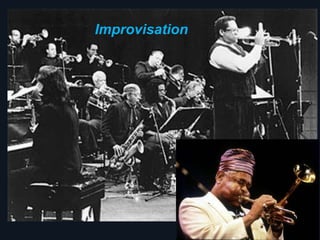
Improvisation
Most startups will fail
60-70% of new businesses fail within 4 years
60-70% venture funded startups will fail
In some sectors up to 90% of startups fail
Are we doing something wrong?
“Most successful entrepreneurs I’ve met
have no idea about the reasons for their
success. My success was a mystery to me
then, and only a little less so now.”
Bob Metcalfe, Inventor of Ethernet
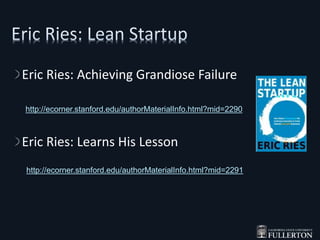
Eric Ries: Achieving Grandiose Failure
Eric Ries: Learns His Lesson
http://ecorner.stanford.edu/authorMaterialInfo.html?mid=2290
http://ecorner.stanford.edu/authorMaterialInfo.html?mid=2291
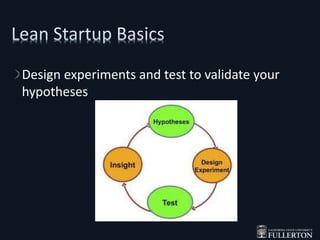
Design experiments and test to validate your
hypotheses
Entrepreneur as Hero
Process Myth
Money Myth
For entrepreneurs who have risked their time,
reputation, and cash….
Passion can quickly become dogmatism
Determination can become commitment to a failing
course of action and
Vision can lead one down a dead-end road “
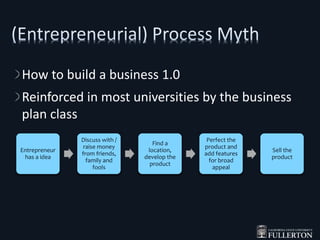
How to build a business 1.0
Reinforced in most universities by the business
plan class
Entrepreneur
has a idea
Discuss with /
raise money
from friends,
family and
fools
Find a
location,
develop the
product
Perfect the
product and
add features
for broad
appeal
Sell the
product
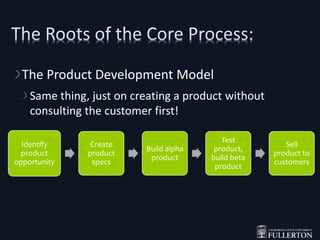
Identify
product
opportunity
Create
product
specs
Build alpha
product
Test
product,
build beta
product
Sell
product to
customers
The Product Development Model
Same thing, just on creating a product without
consulting the customer first!
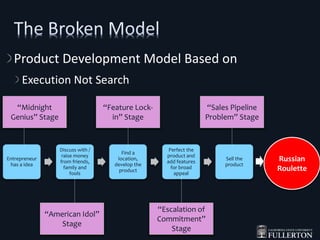
Product Development Model Based on
Execution Not Search
Entrepreneur
has a idea
Discuss with /
raise money
from friends,
family and
fools
Find a
location,
develop the
product
Perfect the
product and
add features
for broad
appeal
Sell the
product
“Escalation of
Commitment”
Stage
“American Idol”
Stage
“Midnight
Genius” Stage
“Feature Lock-
in” Stage
Russian
Roulette
“Sales Pipeline
Problem” Stage
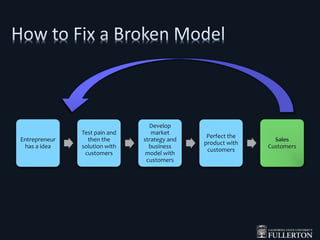
Entrepreneur
has a idea
Test pain and
then the
solution with
customers
Develop
market
strategy and
business
model with
customers
Perfect the
product with
customers
Sales
Customers
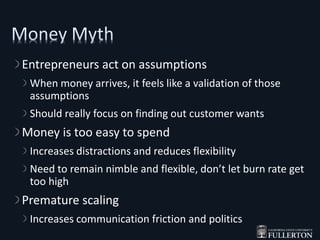
Entrepreneurs act on assumptions
When money arrives, it feels like a validation of those
assumptions
Should really focus on finding out customer wants
Money is too easy to spend
Increases distractions and reduces flexibility
Need to remain nimble and flexible, don’t let burn rate get
too high
Premature scaling
Increases communication friction and politics
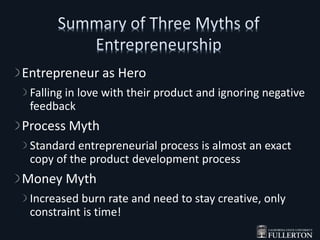
Entrepreneur as Hero
Falling in love with their product and ignoring negative
feedback
Process Myth
Standard entrepreneurial process is almost an exact
copy of the product development process
Money Myth
Increased burn rate and need to stay creative, only
constraint is time!
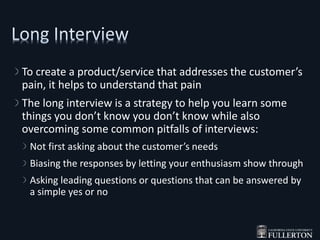
To create a product/service that addresses the customer’s
pain, it helps to understand that pain
The long interview is a strategy to help you learn some
things you don’t know you don’t know while also
overcoming some common pitfalls of interviews:
Not first asking about the customer’s needs
Biasing the responses by letting your enthusiasm show through
Asking leading questions or questions that can be answered by
a simple yes or no
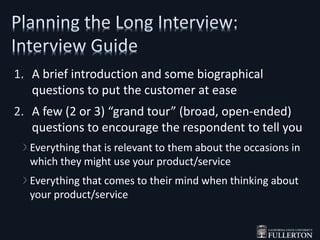
1. A brief introduction and some biographical
questions to put the customer at ease
2. A few (2 or 3) “grand tour” (broad, open-ended)
questions to encourage the respondent to tell you
Everything that is relevant to them about the occasions in
which they might use your product/service
Everything that comes to their mind when thinking about
your product/service
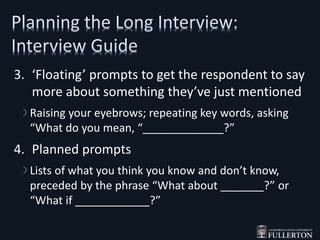
3. ‘Floating’ prompts to get the respondent to say
more about something they’ve just mentioned
Raising your eyebrows; repeating key words, asking
“What do you mean, “_____________?”
4. Planned prompts
Lists of what you think you know and don’t know,
preceded by the phrase “What about _______?” or
“What if ____________?”
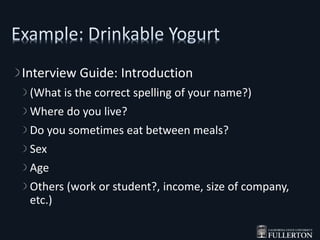
Interview Guide: Introduction
(What is the correct spelling of your name?)
Where do you live?
Do you sometimes eat between meals?
Sex
Age
Others (work or student?, income, size of company,
etc.)
Interview Guide: Grand tour question #1
Would you please tell me what your typical [eating
habits] are like between mealtimes on a typical work
day?
Floating prompts picking up on what they said
Planned prompts zoning in on key issues of interest
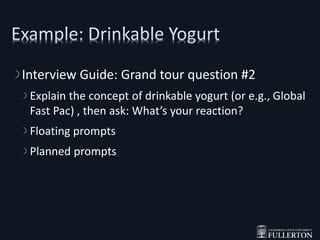
Interview Guide: Grand tour question #2
Explain the concept of drinkable yogurt (or e.g., Global
Fast Pac) , then ask: What’s your reaction?
Floating prompts
Planned prompts
To get the maximum benefit, conduct 20 plus
interviews (per team) split by markets
Respondents should be strangers and from diverse
backgrounds
Face-to-face interviews are preferred over phone
interviews
During the interviews focus on listening (be agreeable and
friendly, not aggressive)
Open-ended questions!!!
The data collection must be “disciplined”: everyone on
team asks the same basic questions
CSUF Startup Incubator - Lean Startup PowerPoint by Phillip Stinis

CSUF Startup Incubator - Lean Startup PowerPoint by Phillip Stinis

  • 4.
  • 5.
    Most startups willfail 60-70% of new businesses fail within 4 years 60-70% venture funded startups will fail In some sectors up to 90% of startups fail Are we doing something wrong?
  • 6.
    “Most successful entrepreneursI’ve met have no idea about the reasons for their success. My success was a mystery to me then, and only a little less so now.” Bob Metcalfe, Inventor of Ethernet
  • 7.
    Eric Ries: AchievingGrandiose Failure Eric Ries: Learns His Lesson http://ecorner.stanford.edu/authorMaterialInfo.html?mid=2290 http://ecorner.stanford.edu/authorMaterialInfo.html?mid=2291
  • 8.
    Design experiments andtest to validate your hypotheses
  • 9.
  • 10.
    For entrepreneurs whohave risked their time, reputation, and cash…. Passion can quickly become dogmatism Determination can become commitment to a failing course of action and Vision can lead one down a dead-end road “
  • 11.
    How to builda business 1.0 Reinforced in most universities by the business plan class Entrepreneur has a idea Discuss with / raise money from friends, family and fools Find a location, develop the product Perfect the product and add features for broad appeal Sell the product
  • 12.
    Identify product opportunity Create product specs Build alpha product Test product, build beta product Sell productto customers The Product Development Model Same thing, just on creating a product without consulting the customer first!
  • 13.
    Product Development ModelBased on Execution Not Search Entrepreneur has a idea Discuss with / raise money from friends, family and fools Find a location, develop the product Perfect the product and add features for broad appeal Sell the product “Escalation of Commitment” Stage “American Idol” Stage “Midnight Genius” Stage “Feature Lock- in” Stage Russian Roulette “Sales Pipeline Problem” Stage
  • 14.
    Entrepreneur has a idea Testpain and then the solution with customers Develop market strategy and business model with customers Perfect the product with customers Sales Customers
  • 15.
    Entrepreneurs act onassumptions When money arrives, it feels like a validation of those assumptions Should really focus on finding out customer wants Money is too easy to spend Increases distractions and reduces flexibility Need to remain nimble and flexible, don’t let burn rate get too high Premature scaling Increases communication friction and politics
  • 16.
    Entrepreneur as Hero Fallingin love with their product and ignoring negative feedback Process Myth Standard entrepreneurial process is almost an exact copy of the product development process Money Myth Increased burn rate and need to stay creative, only constraint is time!
  • 18.
    To create aproduct/service that addresses the customer’s pain, it helps to understand that pain The long interview is a strategy to help you learn some things you don’t know you don’t know while also overcoming some common pitfalls of interviews: Not first asking about the customer’s needs Biasing the responses by letting your enthusiasm show through Asking leading questions or questions that can be answered by a simple yes or no
  • 19.
    1. A briefintroduction and some biographical questions to put the customer at ease 2. A few (2 or 3) “grand tour” (broad, open-ended) questions to encourage the respondent to tell you Everything that is relevant to them about the occasions in which they might use your product/service Everything that comes to their mind when thinking about your product/service
  • 20.
    3. ‘Floating’ promptsto get the respondent to say more about something they’ve just mentioned Raising your eyebrows; repeating key words, asking “What do you mean, “_____________?” 4. Planned prompts Lists of what you think you know and don’t know, preceded by the phrase “What about _______?” or “What if ____________?”
  • 21.
    Interview Guide: Introduction (Whatis the correct spelling of your name?) Where do you live? Do you sometimes eat between meals? Sex Age Others (work or student?, income, size of company, etc.)
  • 22.
    Interview Guide: Grandtour question #1 Would you please tell me what your typical [eating habits] are like between mealtimes on a typical work day? Floating prompts picking up on what they said Planned prompts zoning in on key issues of interest
  • 23.
    Interview Guide: Grandtour question #2 Explain the concept of drinkable yogurt (or e.g., Global Fast Pac) , then ask: What’s your reaction? Floating prompts Planned prompts
  • 24.
    To get themaximum benefit, conduct 20 plus interviews (per team) split by markets Respondents should be strangers and from diverse backgrounds Face-to-face interviews are preferred over phone interviews During the interviews focus on listening (be agreeable and friendly, not aggressive) Open-ended questions!!! The data collection must be “disciplined”: everyone on team asks the same basic questions