Mapping forest loss and fragmentation for
improved comparative analyses of
livelihoods and ecosystem services
Sarah E Gergel, Stephanie A Tomscha, Ian MS Eddy,
Kevin Yang, Jean-Yves Duriaux, Frederic Baudron, Terry CH Sunderland
and many others who contributed to the New Agrarian Change Project
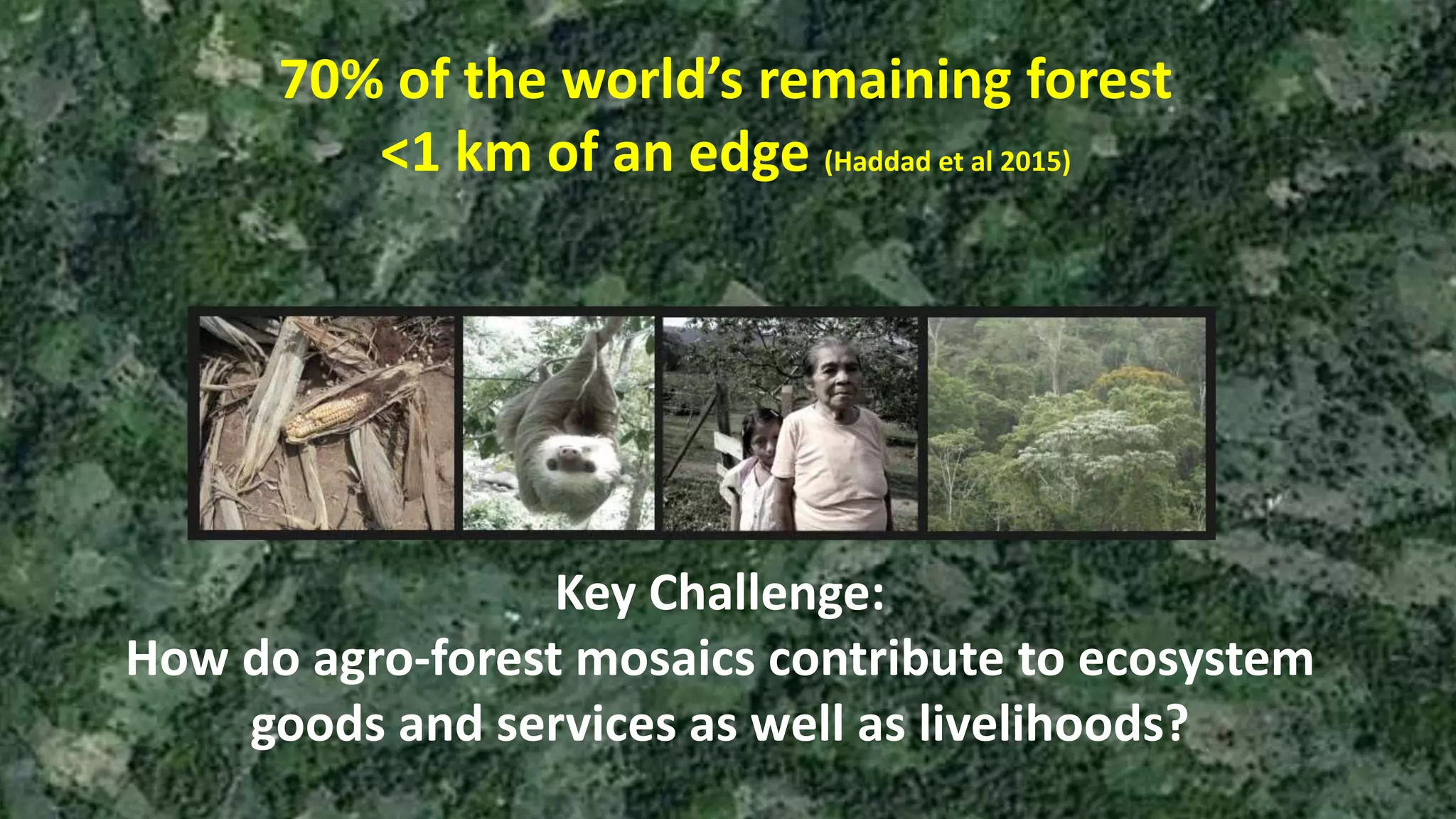
70% of the world’s remaining forest
<1 km of an edge (Haddad et al 2015)
Key Challenge:
How do agro-forest mosaics contribute to ecosystem
goods and services as well as livelihoods?
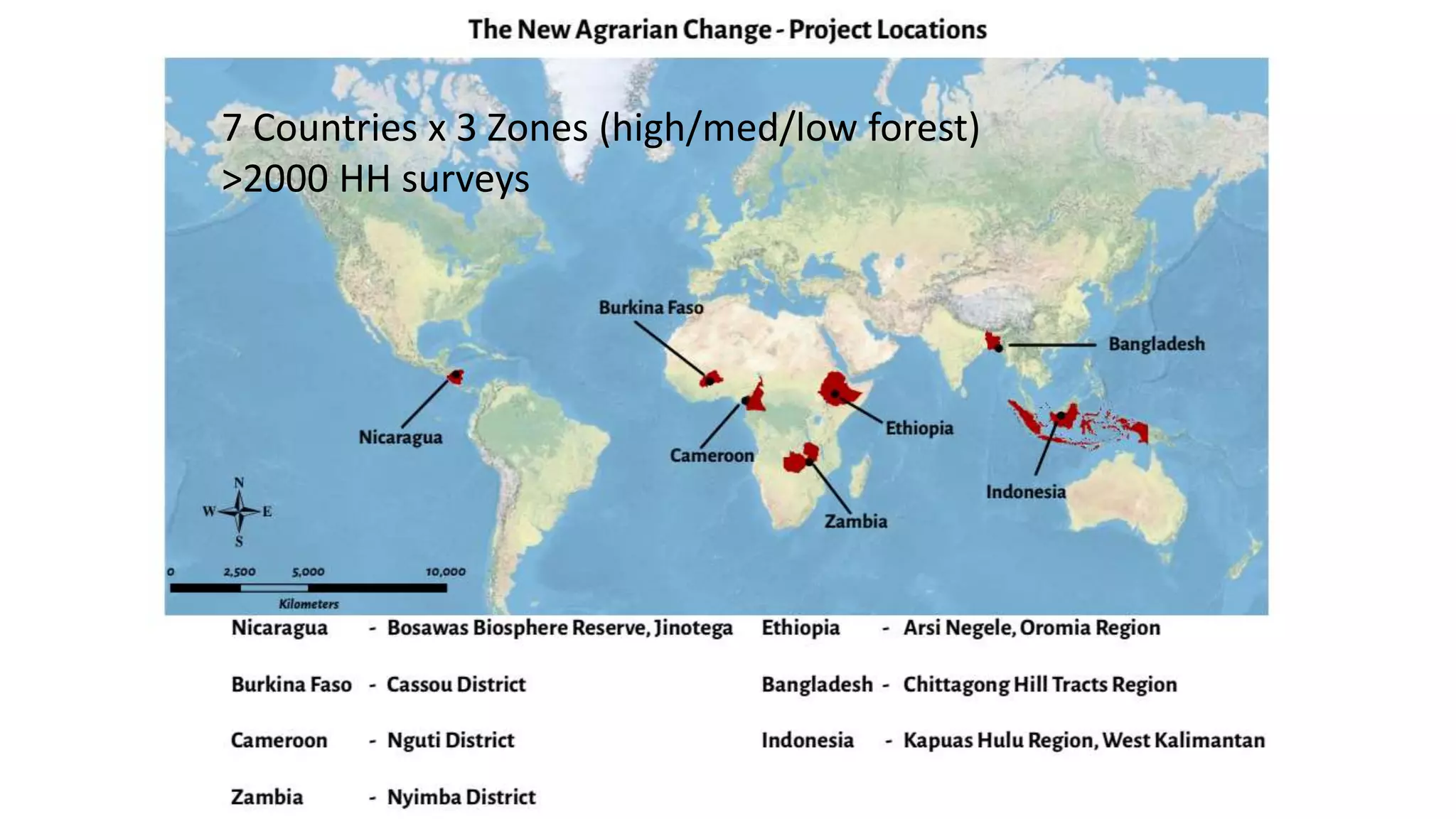
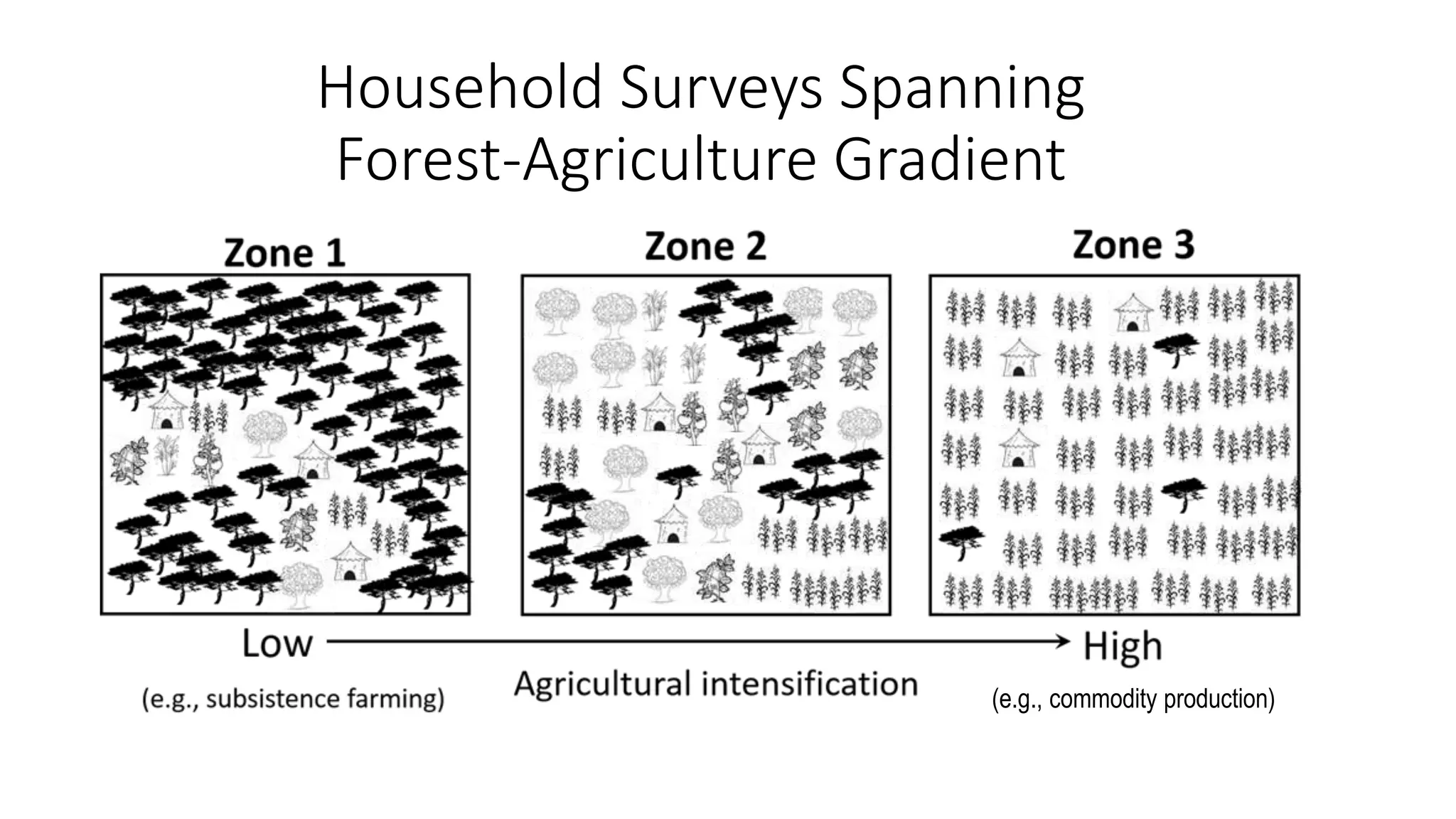
7 Countries x 3 Zones (high/med/low forest)
>2000 HH surveys
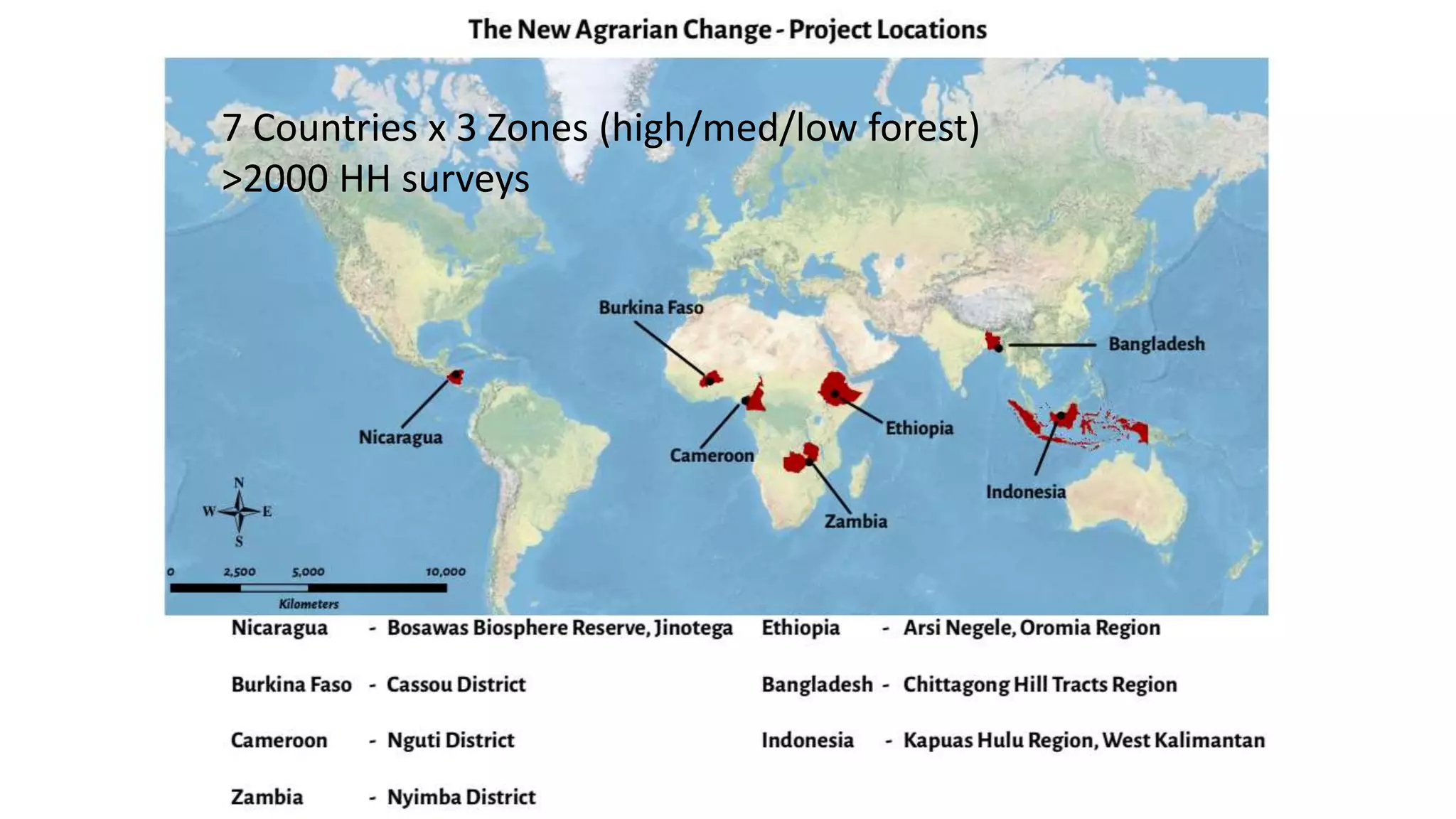
7 Countries x 3 Zones (high/med/low forest)
>2000 HH surveys
Household Surveys Spanning
Forest-Agriculture Gradient
(e.g., commodity production)
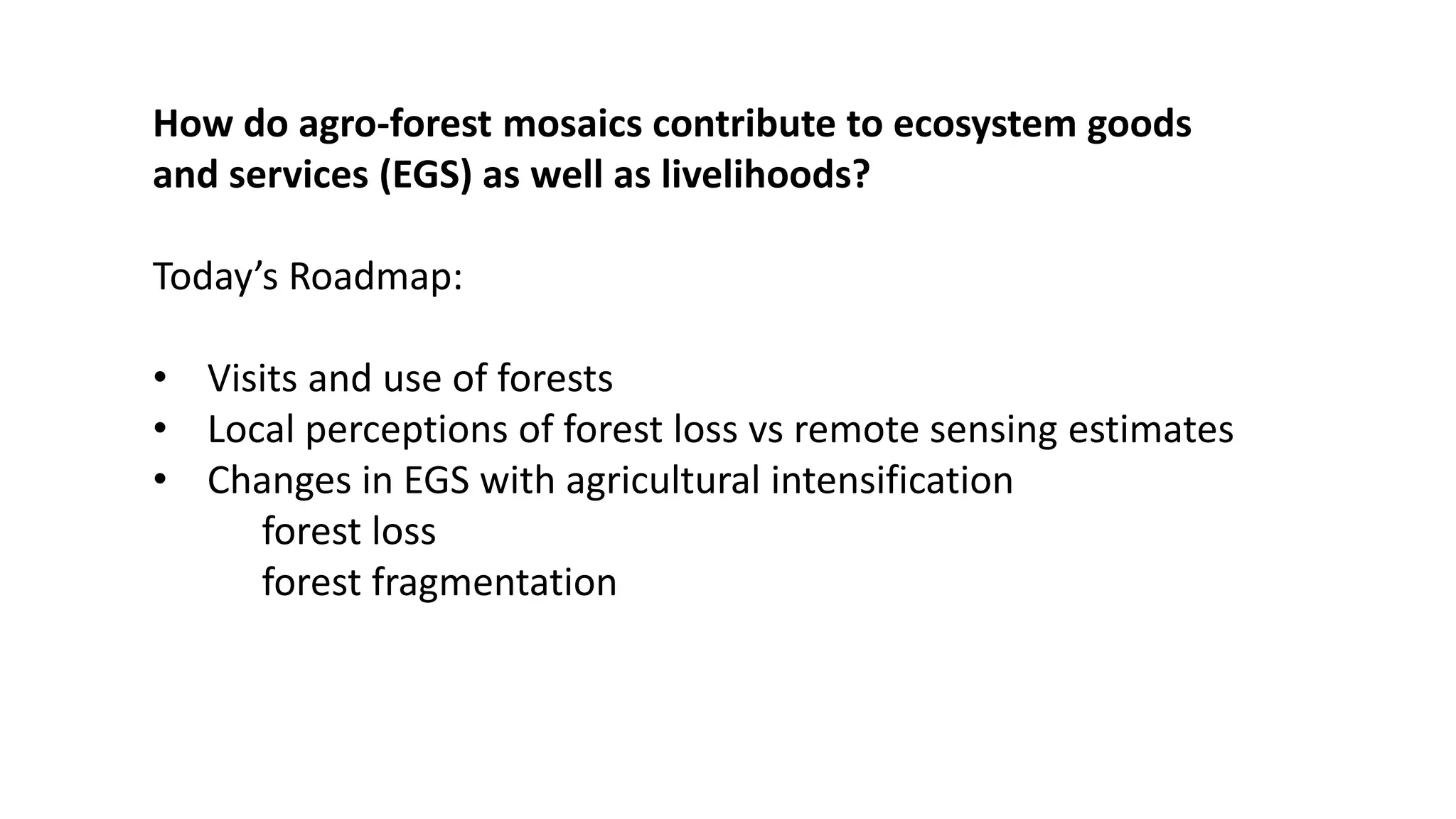
How do agro-forest mosaics contribute to ecosystem goods
and services (EGS) as well as livelihoods?
Today’s Roadmap:
• Visits and use of forests
• Local perceptions of forest loss vs remote sensing estimates
• Changes in EGS with agricultural intensification
forest loss
forest fragmentation
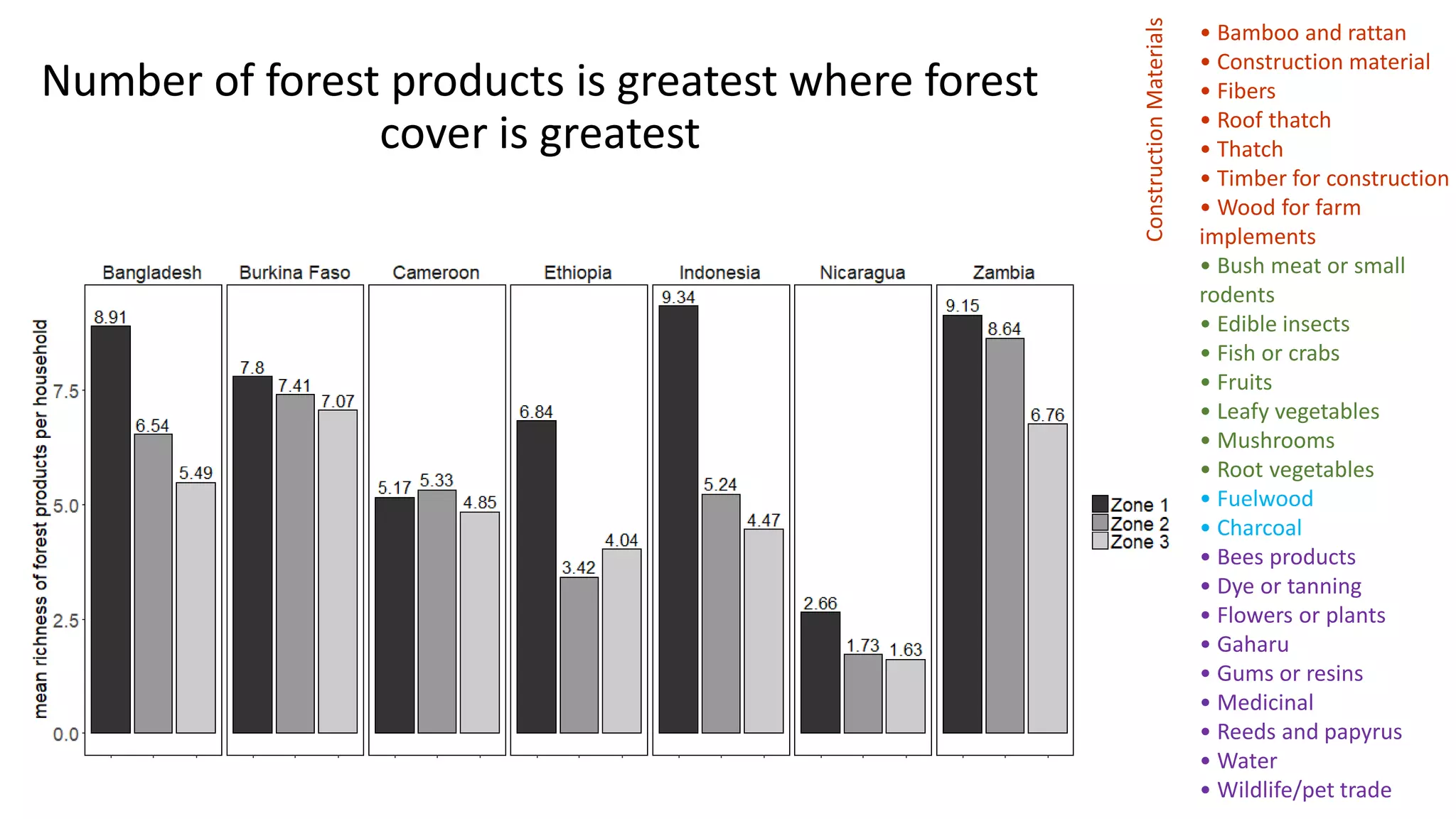
Number of forest products is greatest where forest
cover is greatest
• Bamboo and rattan
• Construction material
• Fibers
• Roof thatch
• Thatch
• Timber for construction
• Wood for farm
implements
• Bush meat or small
rodents
• Edible insects
• Fish or crabs
• Fruits
• Leafy vegetables
• Mushrooms
• Root vegetables
• Fuelwood
• Charcoal
• Bees products
• Dye or tanning
• Flowers or plants
• Gaharu
• Gums or resins
• Medicinal
• Reeds and papyrus
• Water
• Wildlife/pet trade
ConstructionMaterialsFoodFuelOther
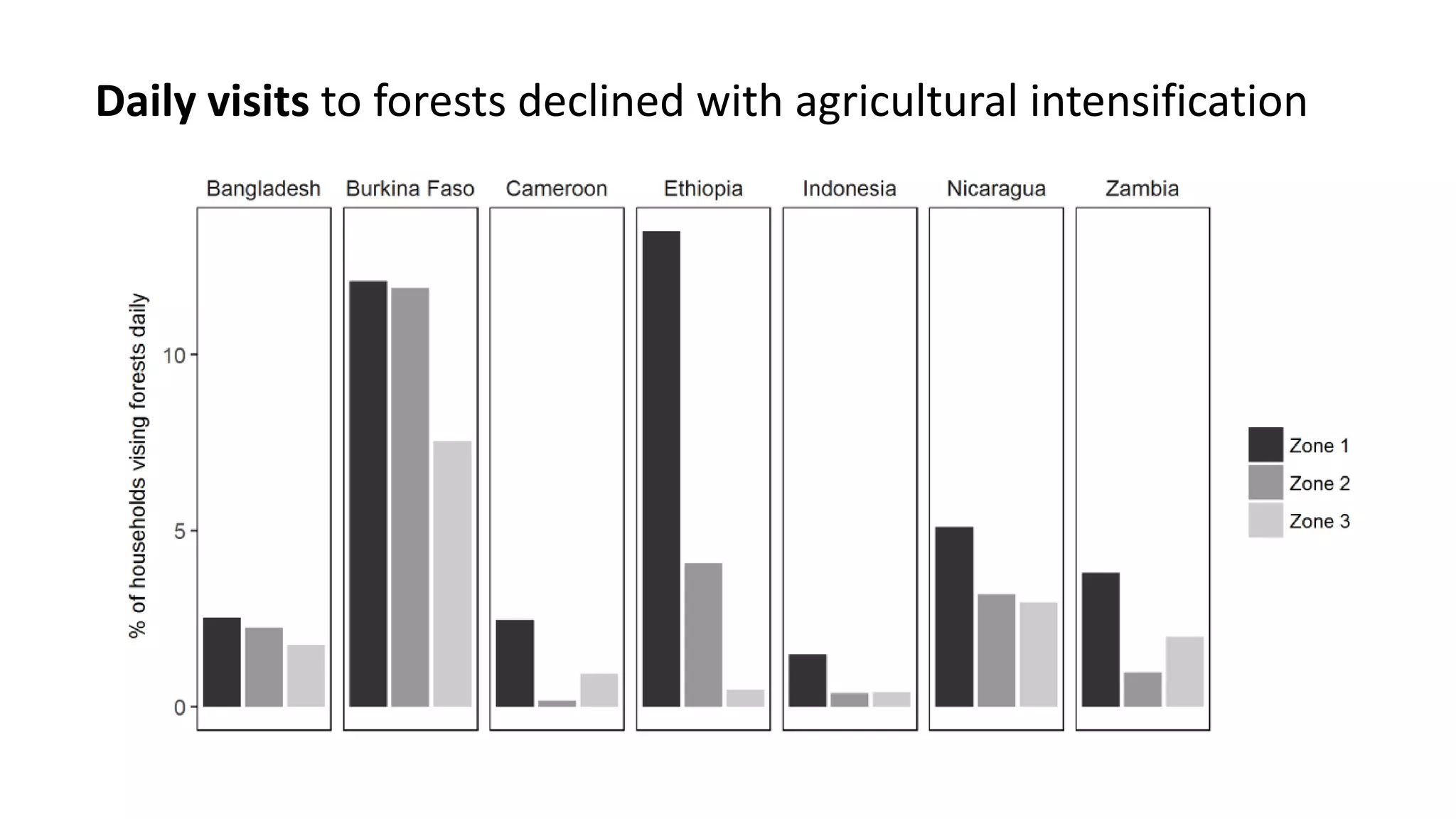
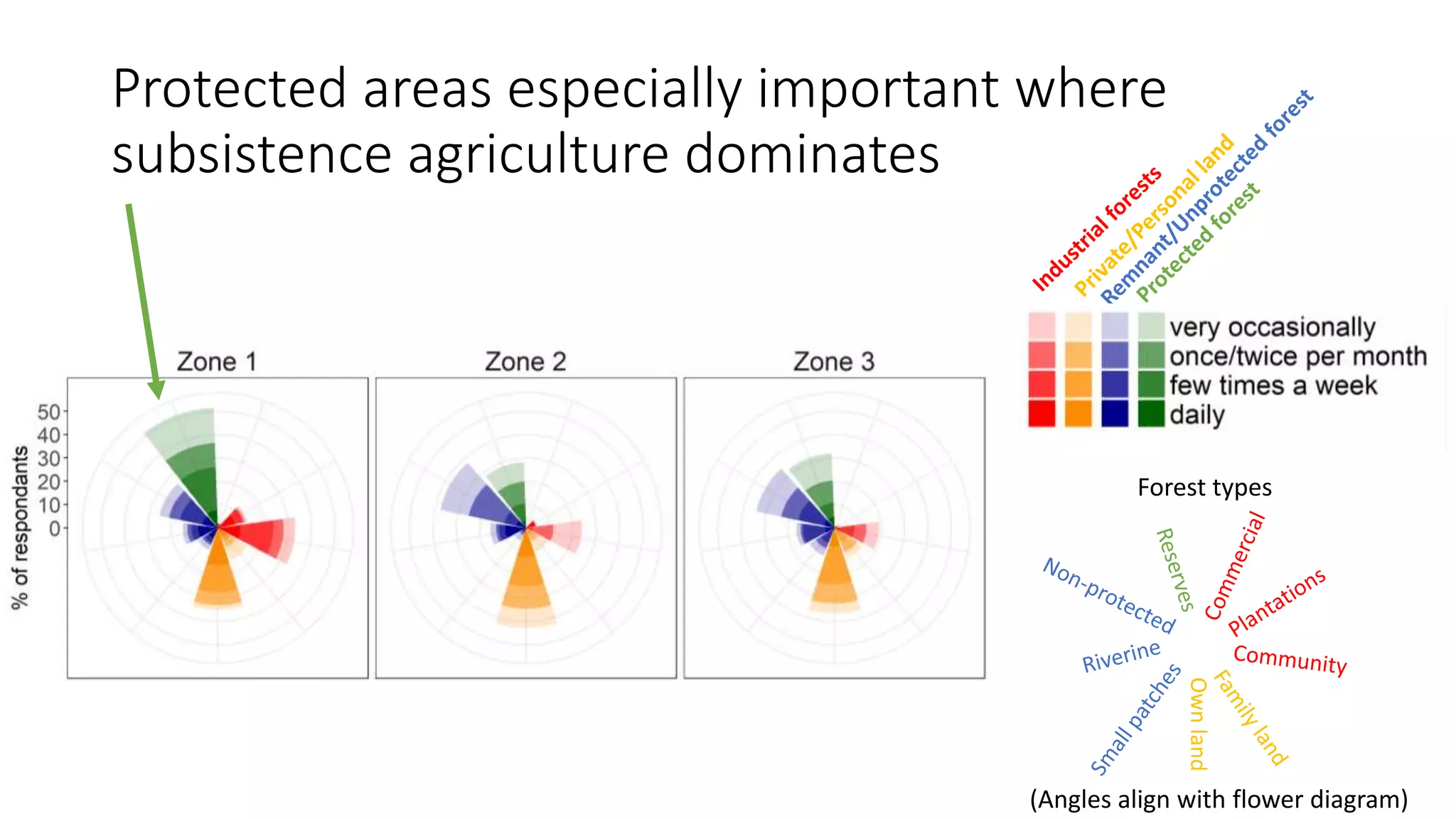
Daily visits to forests declined with agricultural intensification
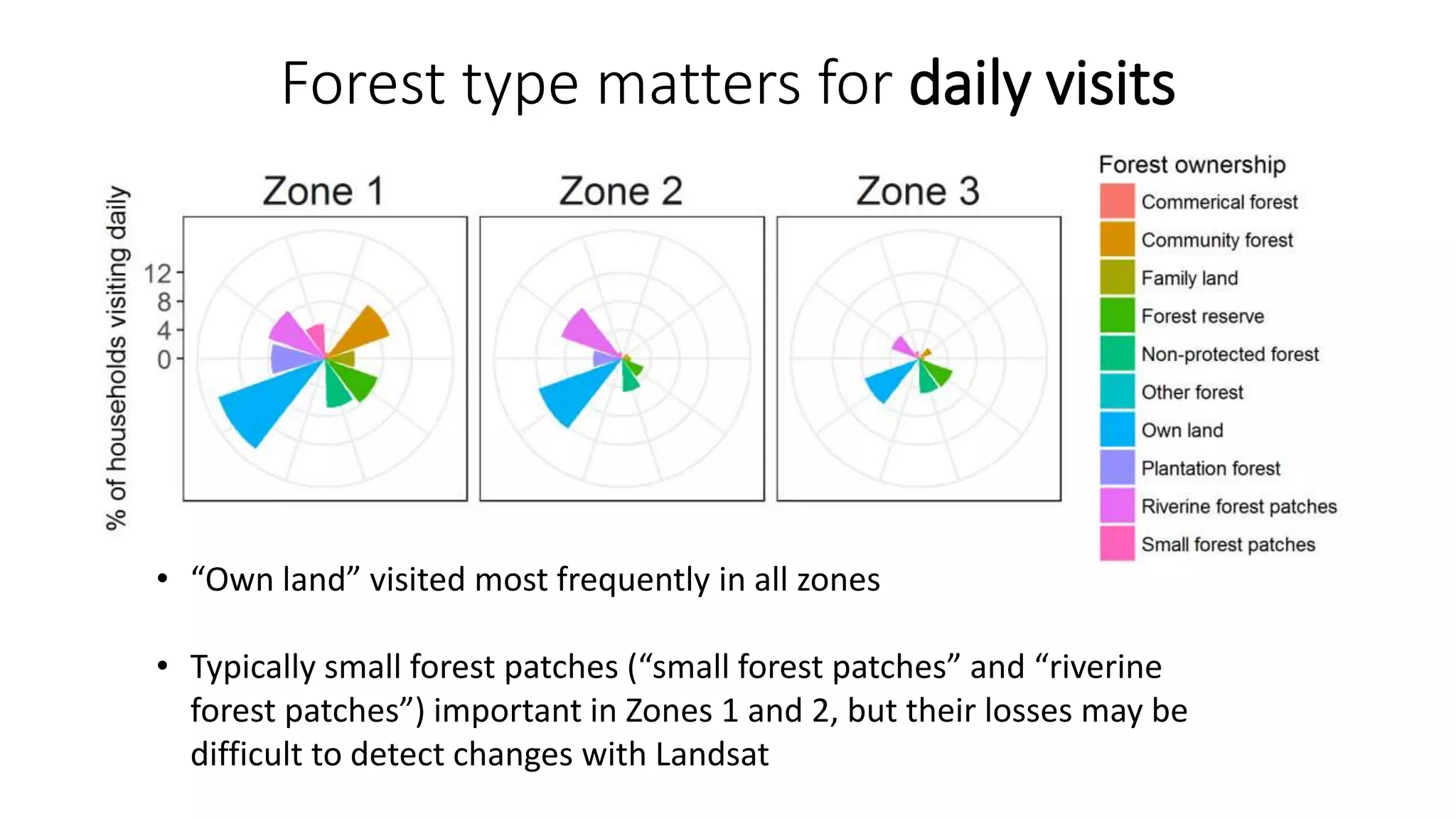
Forest type matters for daily visits
• “Own land” visited most frequently in all zones
• Typically small forest patches (“small forest patches” and “riverine
forest patches”) important in Zones 1 and 2, but their losses may be
difficult to detect changes with Landsat
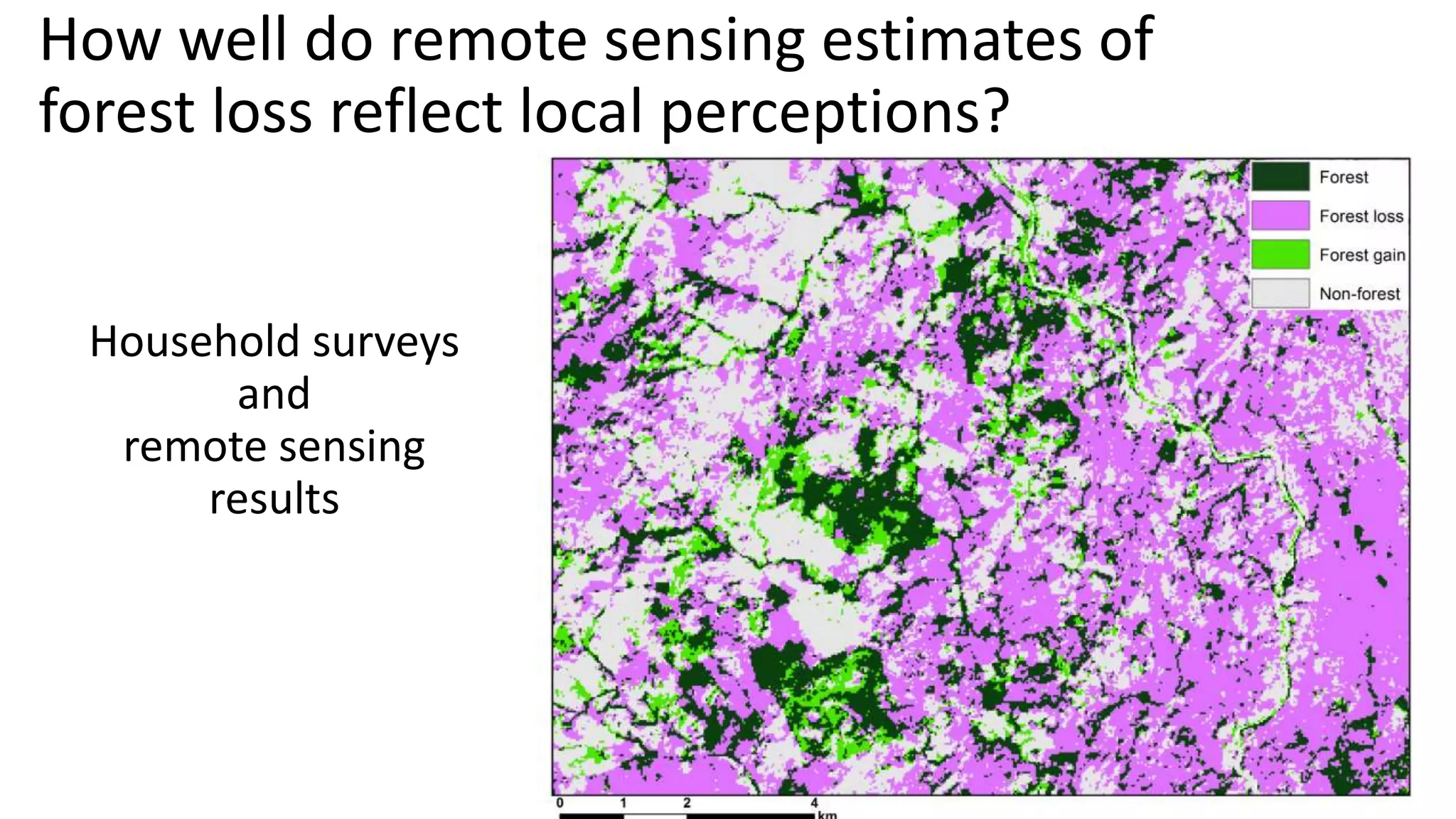
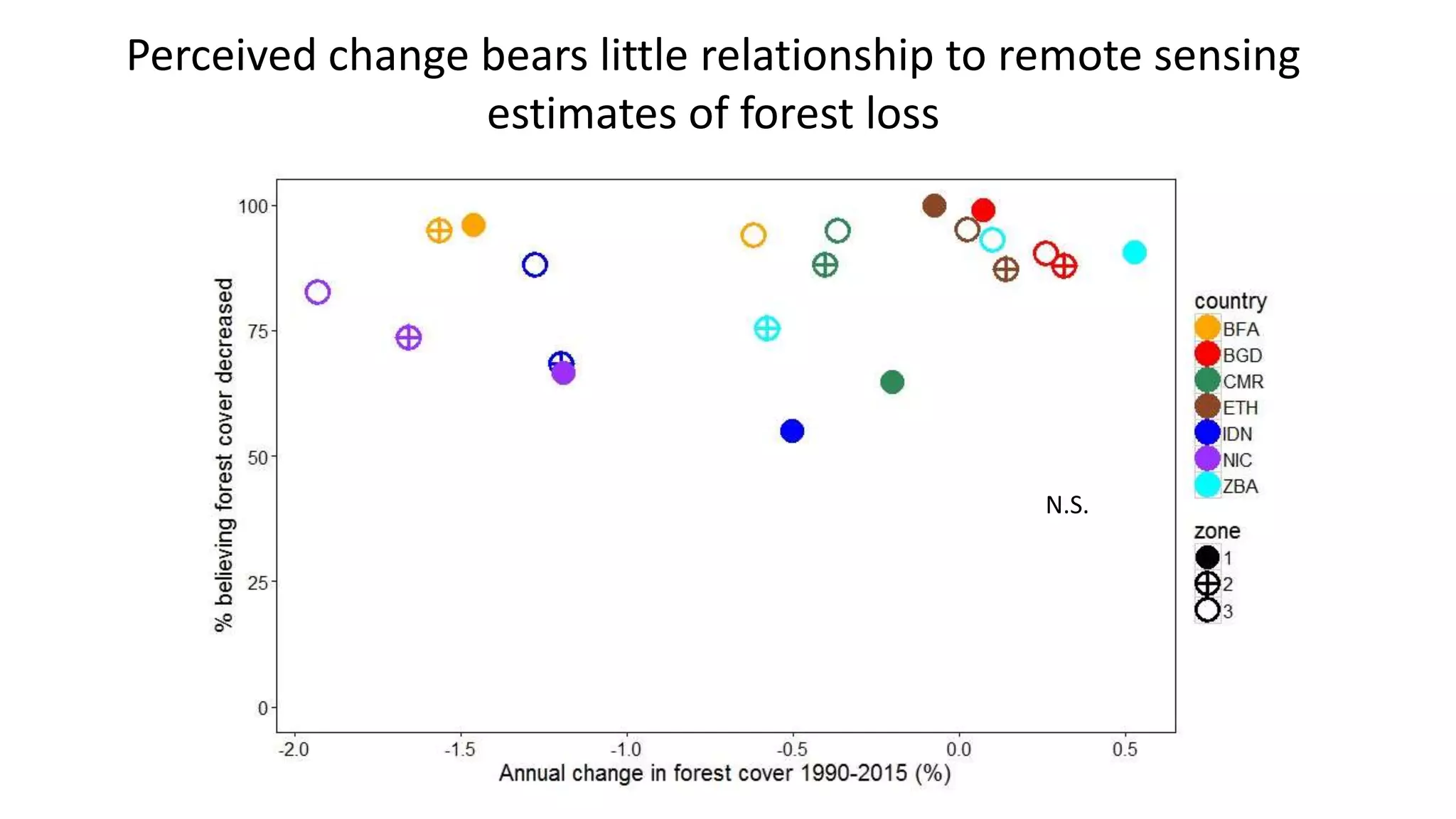
How well do remote sensing estimates of
forest loss reflect local perceptions?
Household surveys
and
remote sensing
results
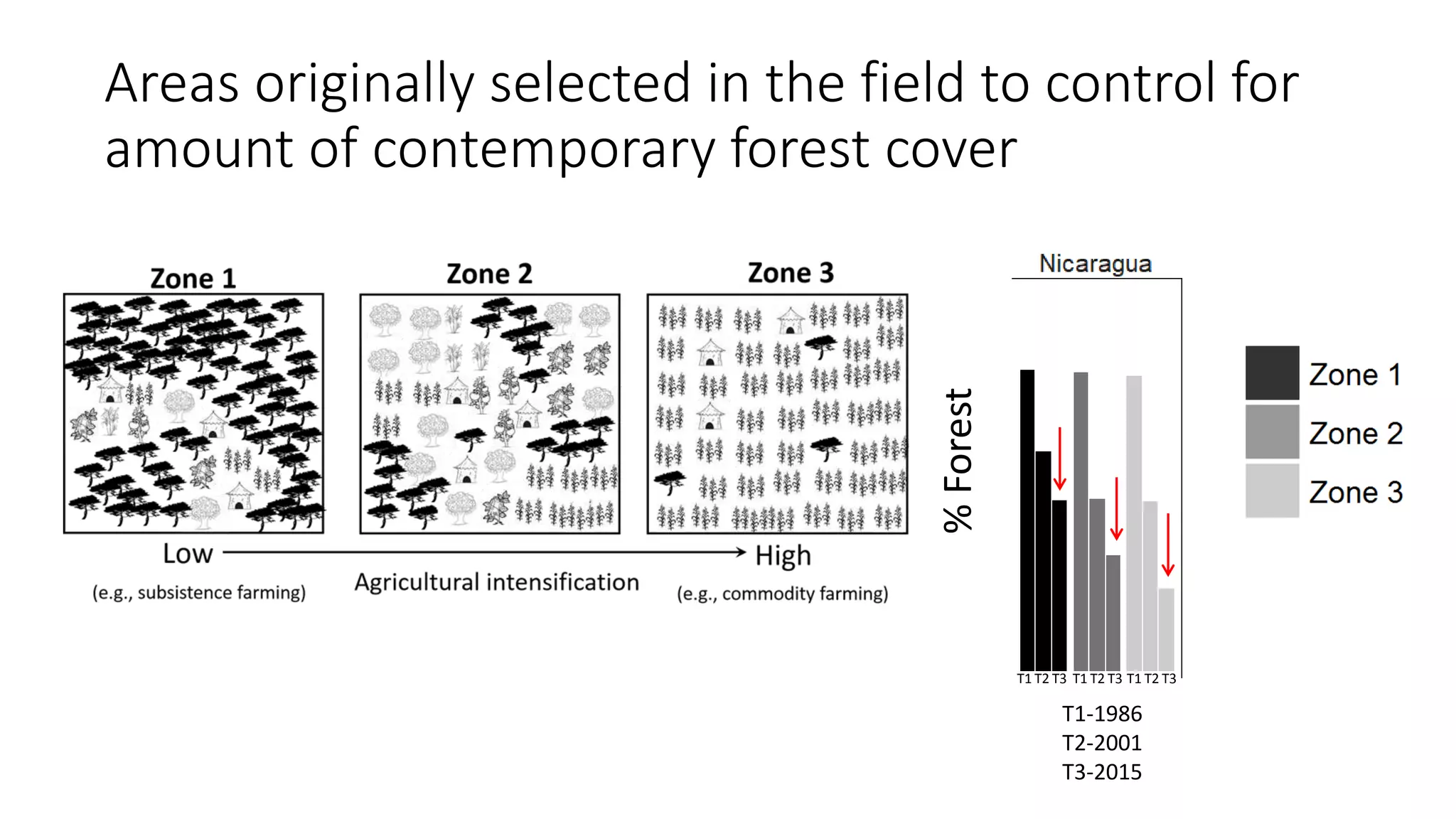
Areas originally selected in the field to control for
amount of contemporary forest cover
%Forest
T1-1986
T2-2001
T3-2015
T1 T2 T3 T1 T2 T3T1 T2 T3
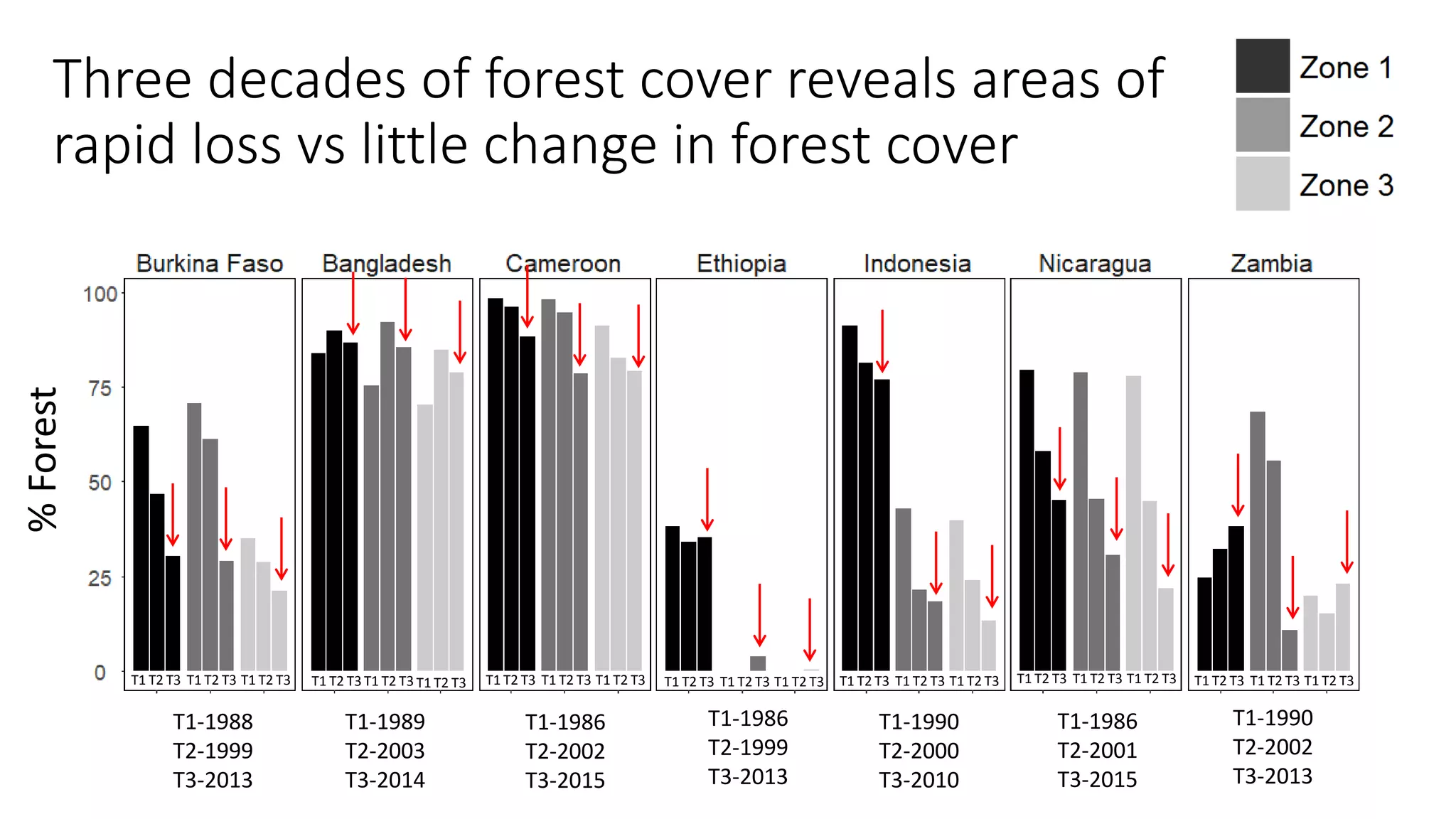
Three decades of forest cover reveals areas of
rapid loss vs little change in forest cover
%Forest
T1-1989
T2-2003
T3-2014
T1-1988
T2-1999
T3-2013
T1-1986
T2-2002
T3-2015
T1-1986
T2-1999
T3-2013
T1-1990
T2-2000
T3-2010
T1-1986
T2-2001
T3-2015
T1-1990
T2-2002
T3-2013
T1 T2 T3 T1 T2 T3T1 T2 T3 T1 T2 T3 T1 T2 T3T1 T2 T3 T1 T2 T3 T1 T2 T3T1 T2 T3 T1 T2 T3 T1 T2 T3T1 T2 T3 T1 T2 T3 T1 T2 T3T1 T2 T3T1 T2 T3T1 T2 T3 T1 T2 T3 T1 T2 T3 T1 T2 T3T1 T2 T3
N.S.
Perceived change bears little relationship to remote sensing
estimates of forest loss
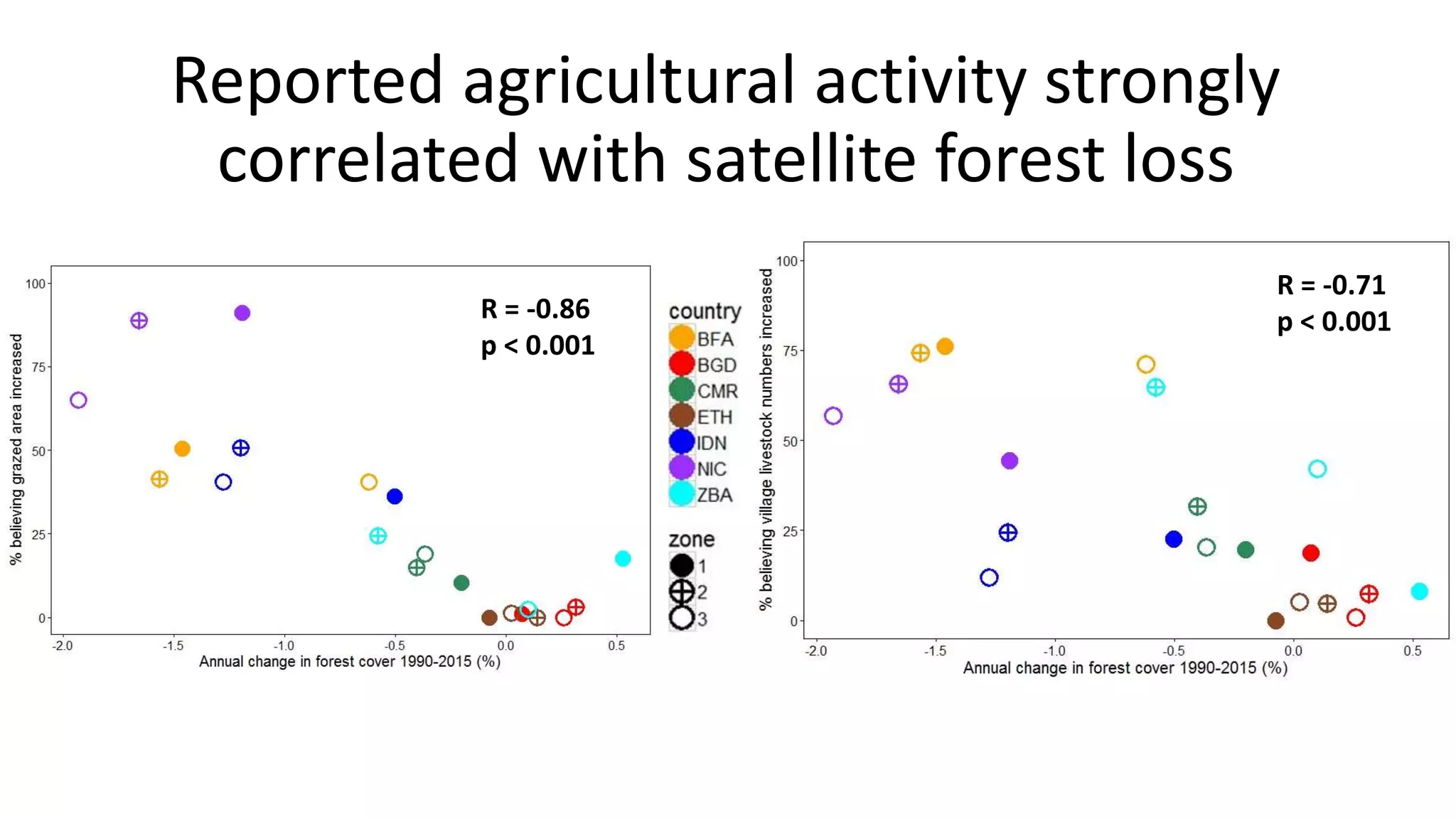
R = -0.86
p < 0.001
Reported agricultural activity strongly
correlated with satellite forest loss
R = -0.71
p < 0.001
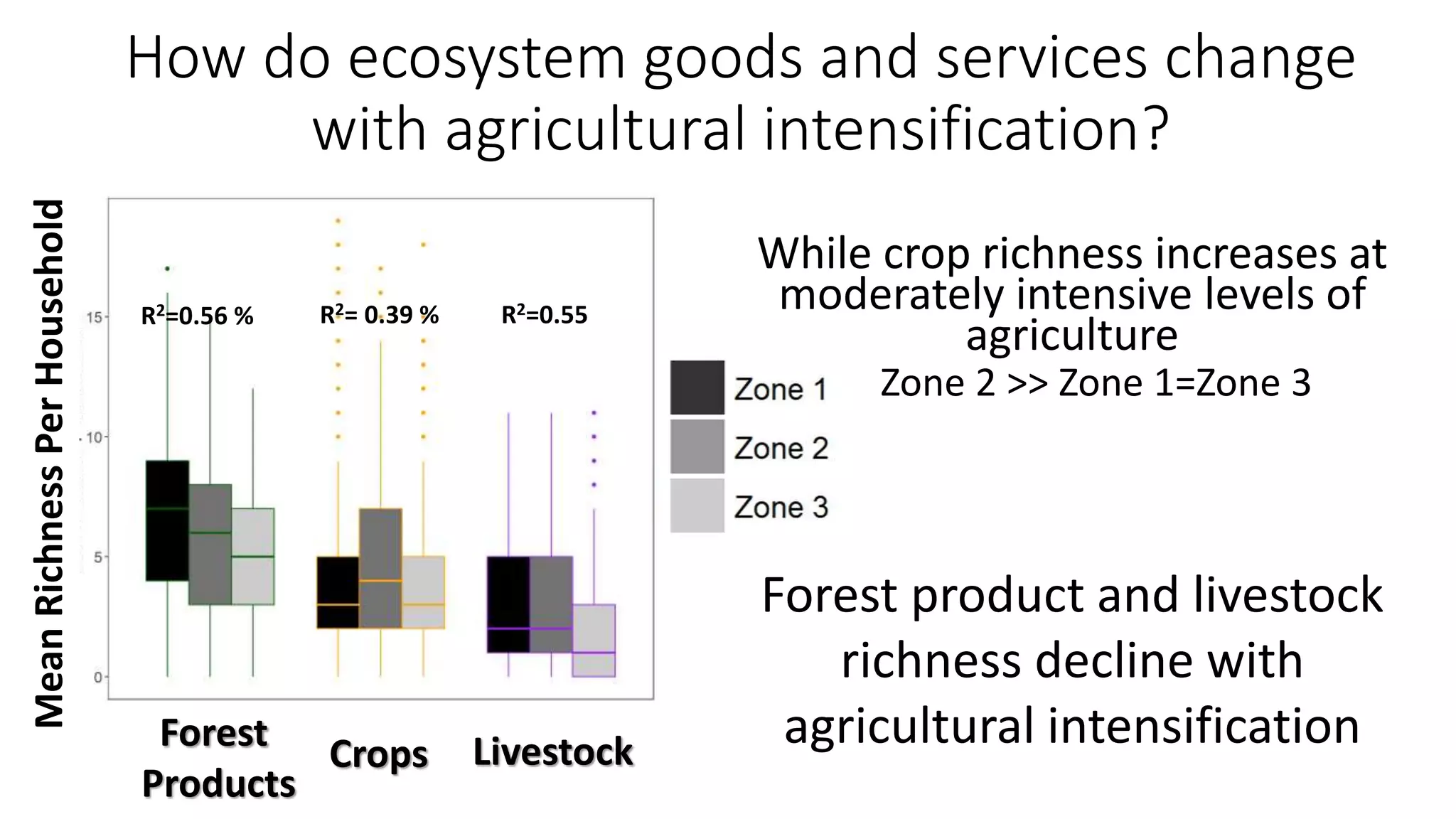
How do ecosystem goods and services change
with agricultural intensification?
Forest
Products
Crops Livestock
While crop richness increases at
moderately intensive levels of
agriculture
Zone 2 >> Zone 1=Zone 3
Forest product and livestock
richness decline with
agricultural intensification
R2=0.56 % R2=0.55R2= 0.39 %
MeanRichnessPerHousehold
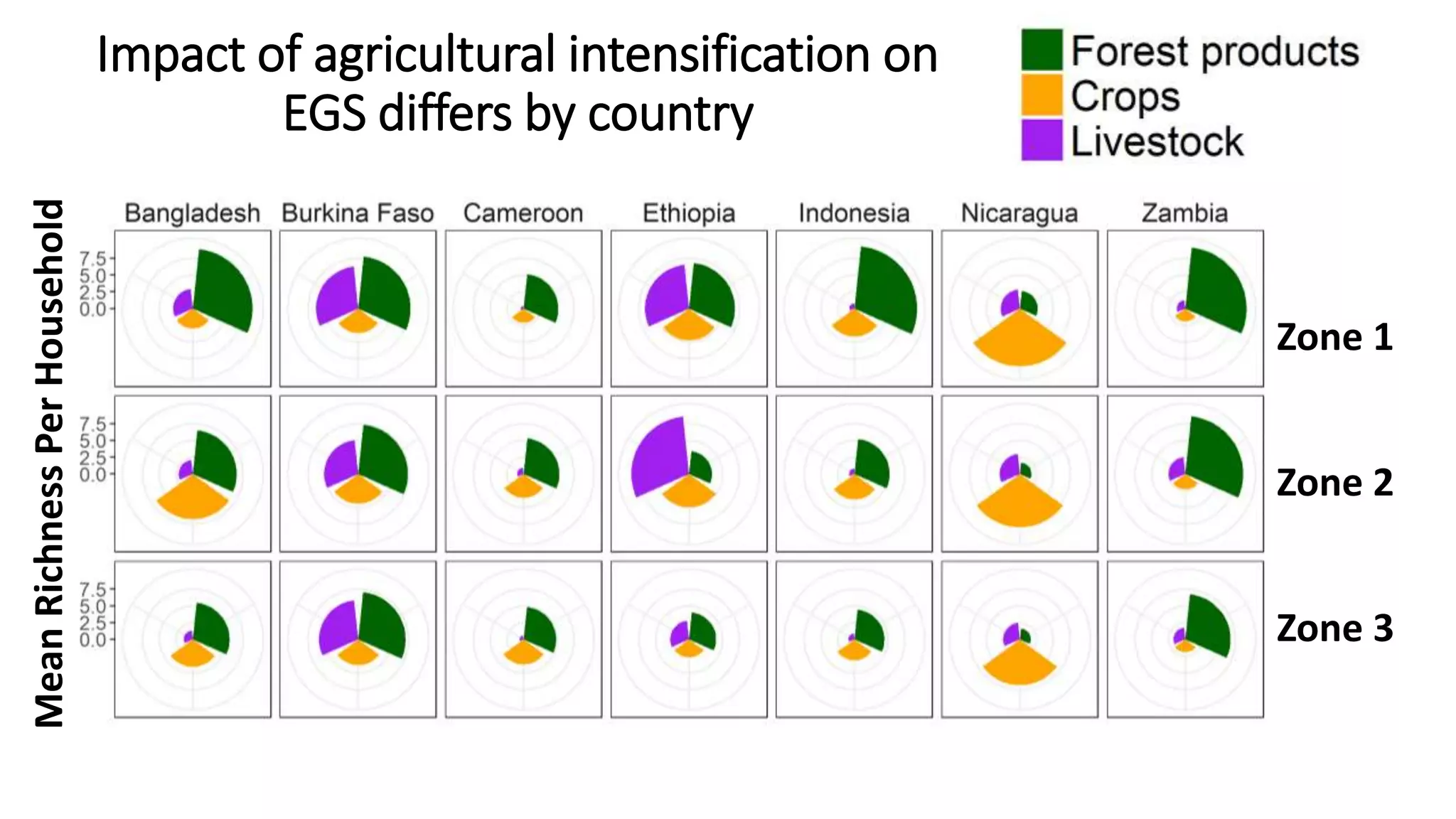
Impact of agricultural intensification on
EGS differs by country
Zone 1
Zone 2
Zone 3
MeanRichnessPerHousehold
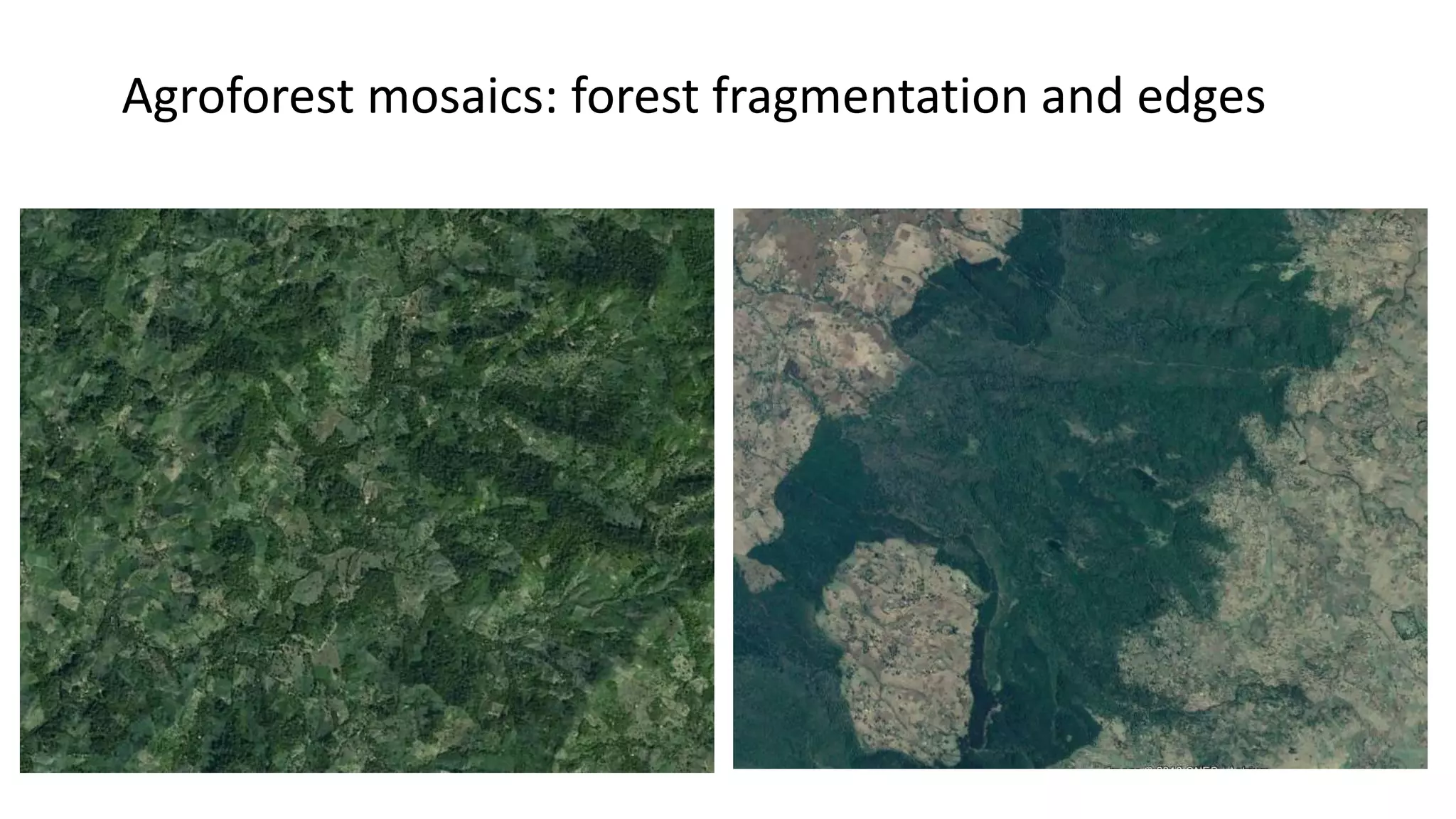
Agroforest mosaics: forest fragmentation and edges
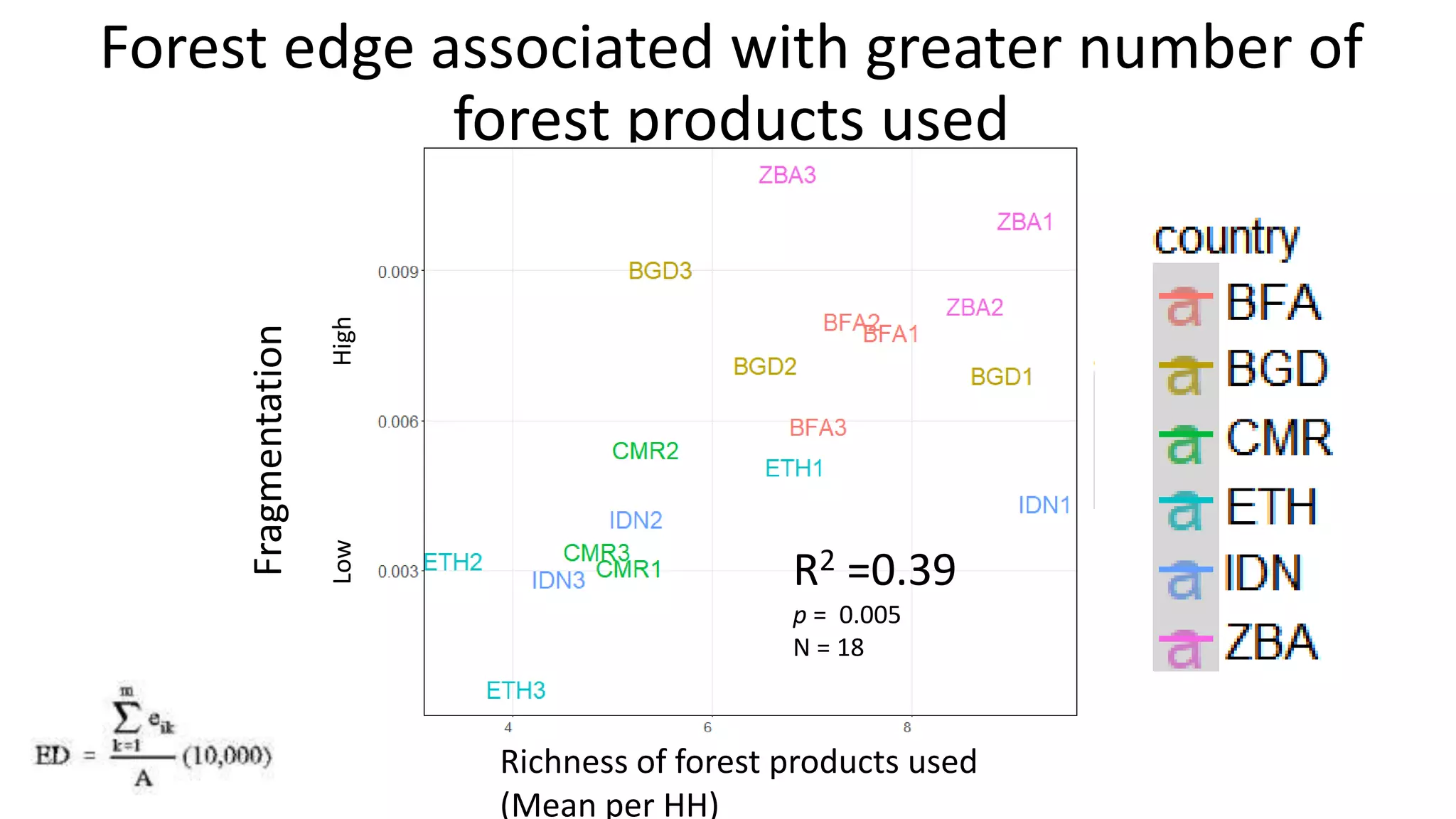
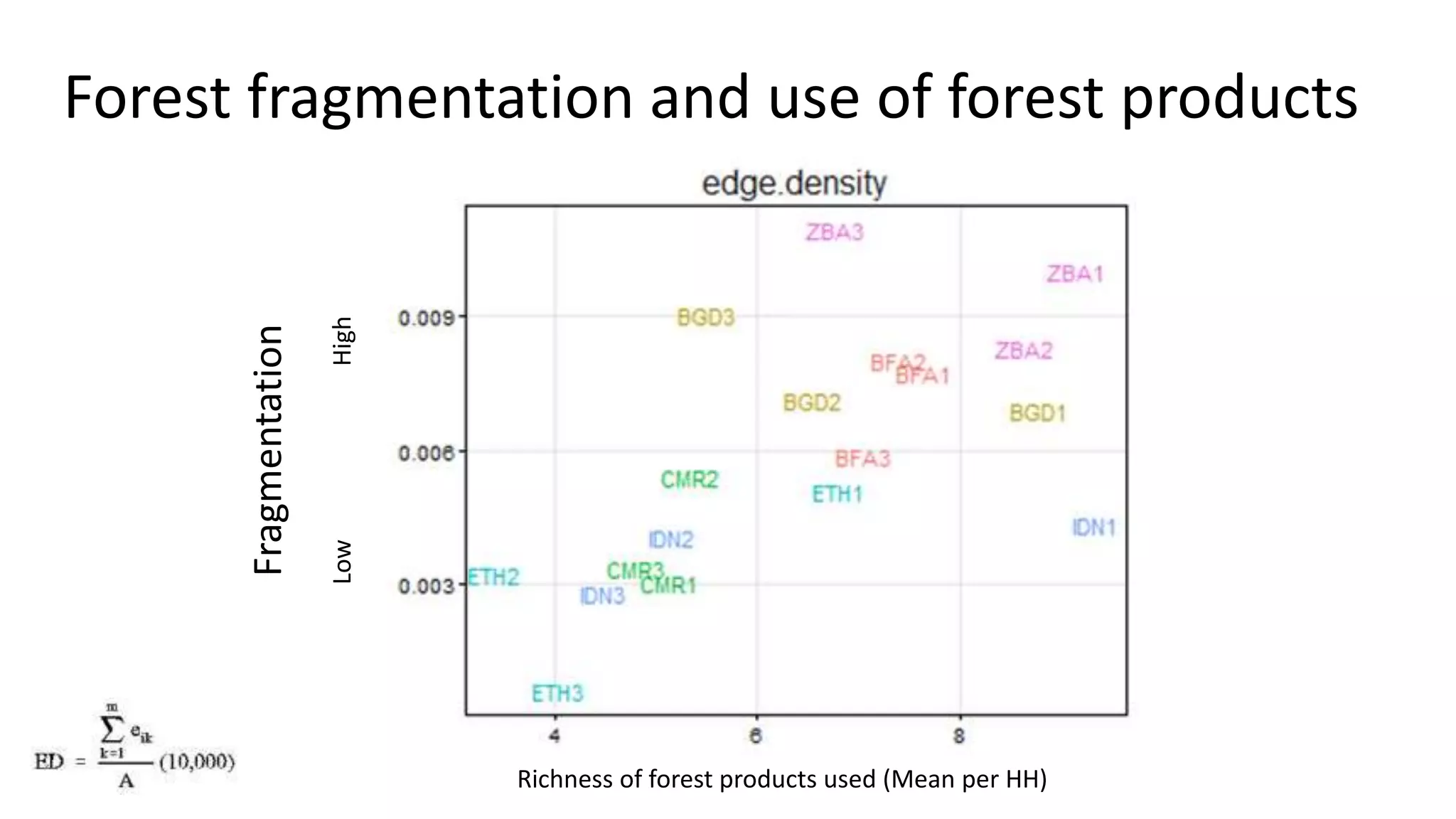
Forest edge associated with greater number of
forest products used
Richness of forest products used
(Mean per HH)
Fragmentation
LowHigh
R2 =0.39
p = 0.005
N = 18
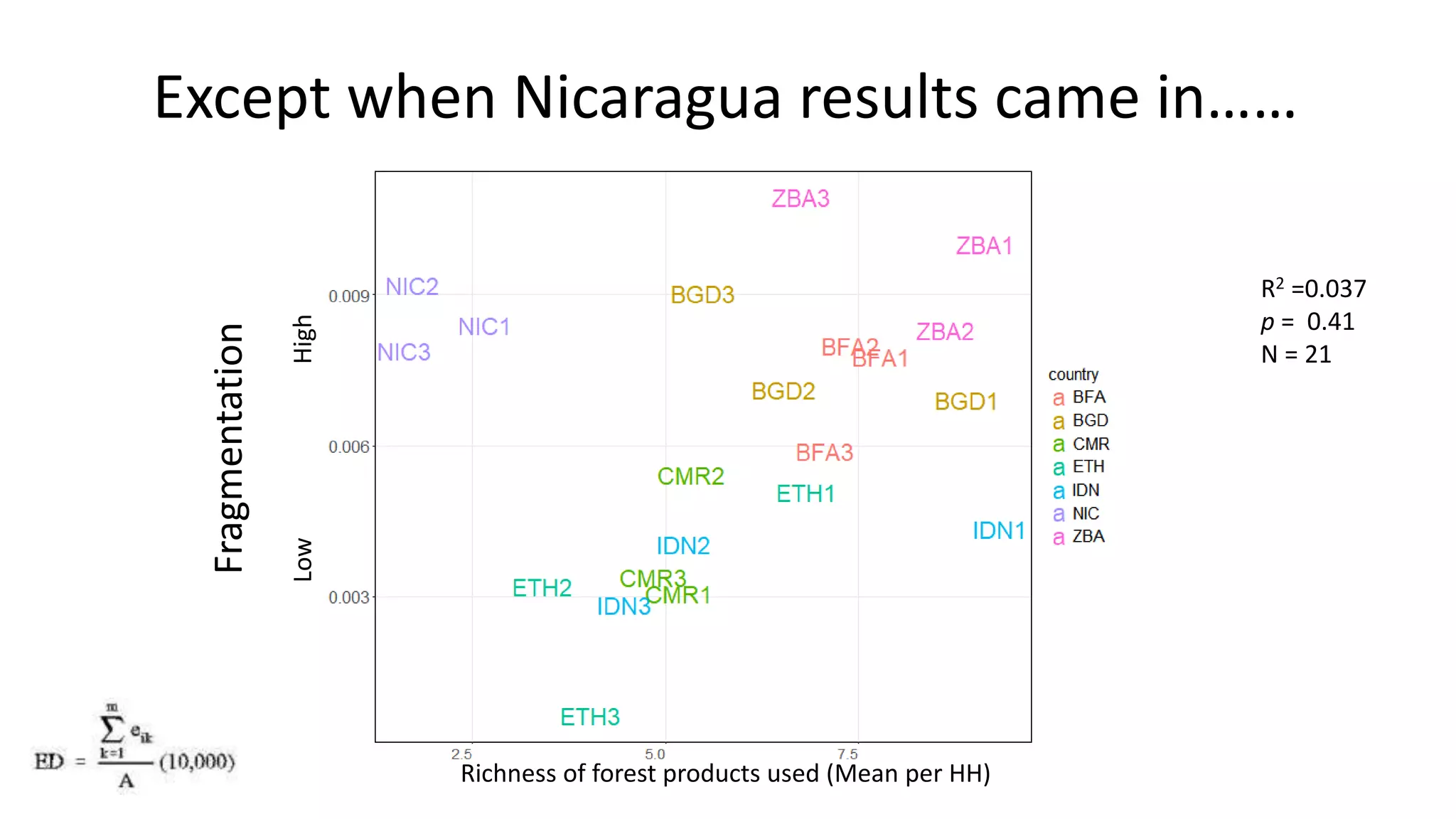
Except when Nicaragua results came in……
Richness of forest products used (Mean per HH)
Fragmentation
LowHigh
R2 =0.037
p = 0.41
N = 21
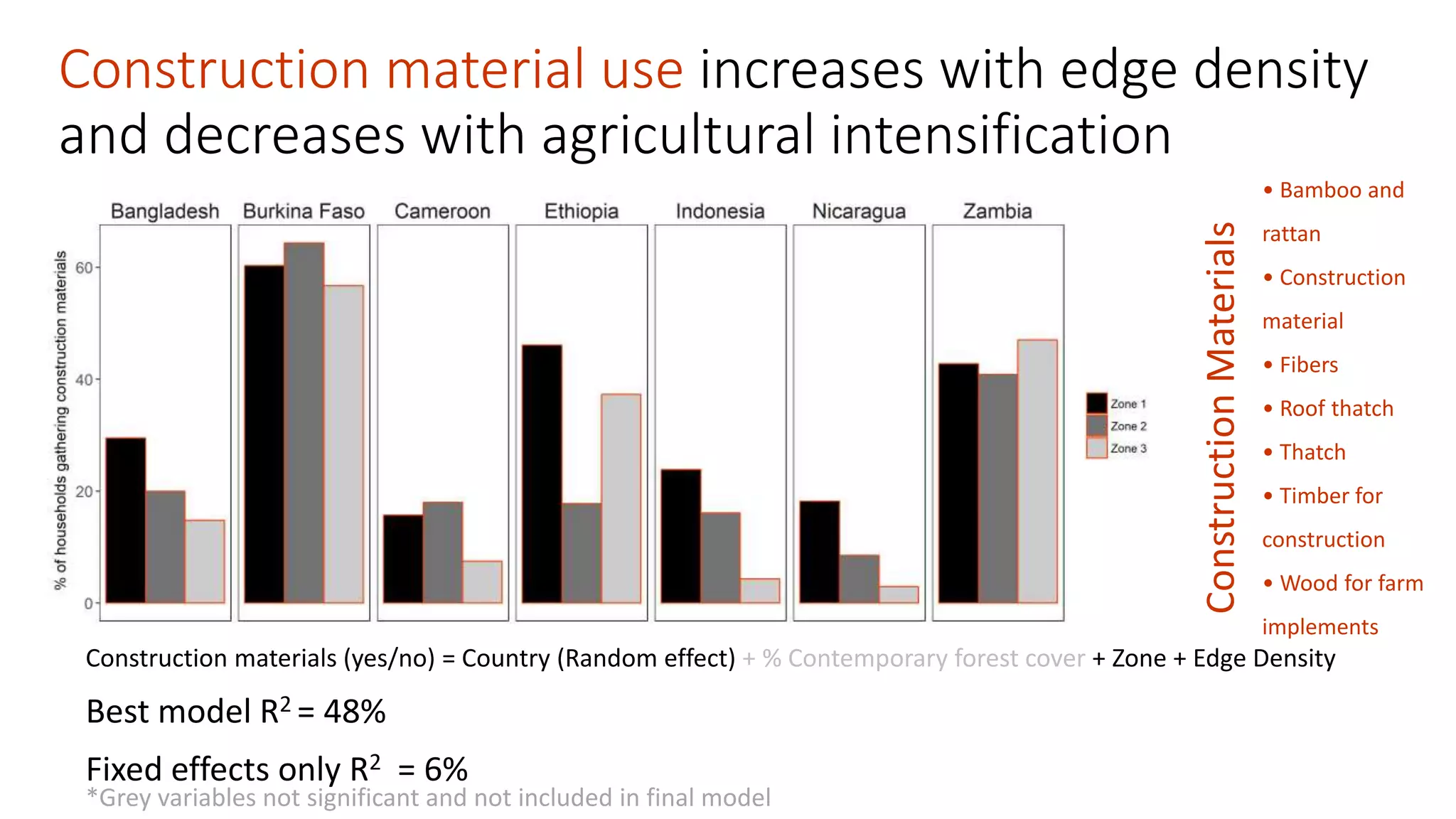
Construction material use increases with edge density
and decreases with agricultural intensification
• Bamboo and
rattan
• Construction
material
• Fibers
• Roof thatch
• Thatch
• Timber for
construction
• Wood for farm
implements
ConstructionMaterials
*Grey variables not significant and not included in final model
Construction materials (yes/no) = Country (Random effect) + % Contemporary forest cover + Zone + Edge Density
Best model R2 = 48%
Fixed effects only R2 = 6%
• Bamboo and rattan
• Construction material
• Fibers
• Roof thatch
• Thatch
• Timber for construction
• Wood for farm
implements
• Bush meat or small
rodents
• Edible insects
• Fish or crabs
• Fruits
• Leafy vegetables
• Mushrooms
• Root vegetables
• Fuelwood
• Charcoal
• Bees products
• Dye or tanning
• Flowers or plants
• Gaharu
• Gums or resins
• Medicinal
• Reeds and papyrus
• Water
• Wildlife/pet trade
ConstructionMaterialsFoodFuelOther
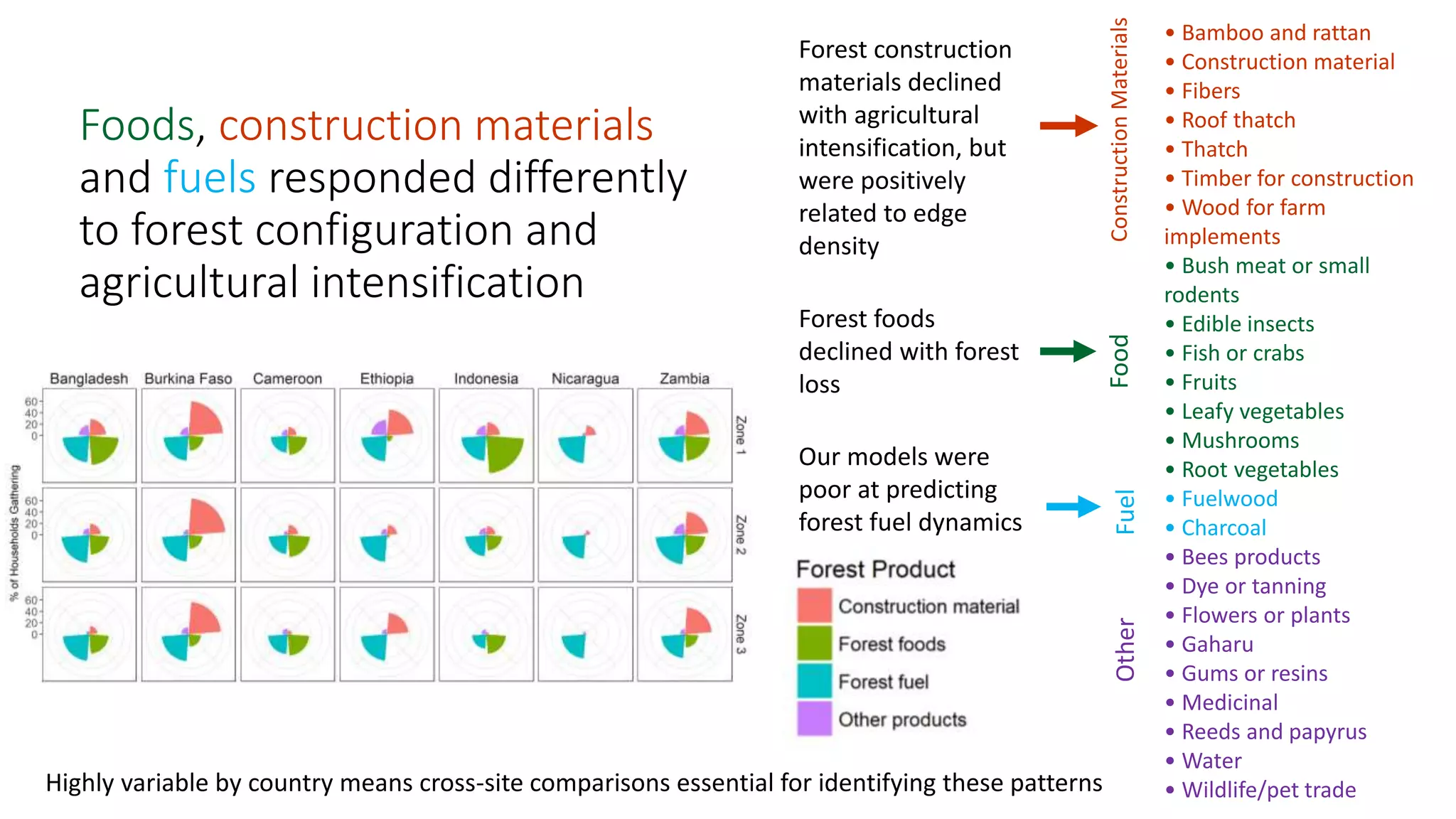
Foods, construction materials
and fuels responded differently
to forest configuration and
agricultural intensification
Forest construction
materials declined
with agricultural
intensification, but
were positively
related to edge
density
Forest foods
declined with forest
loss
Highly variable by country means cross-site comparisons essential for identifying these patterns
Our models were
poor at predicting
forest fuel dynamics
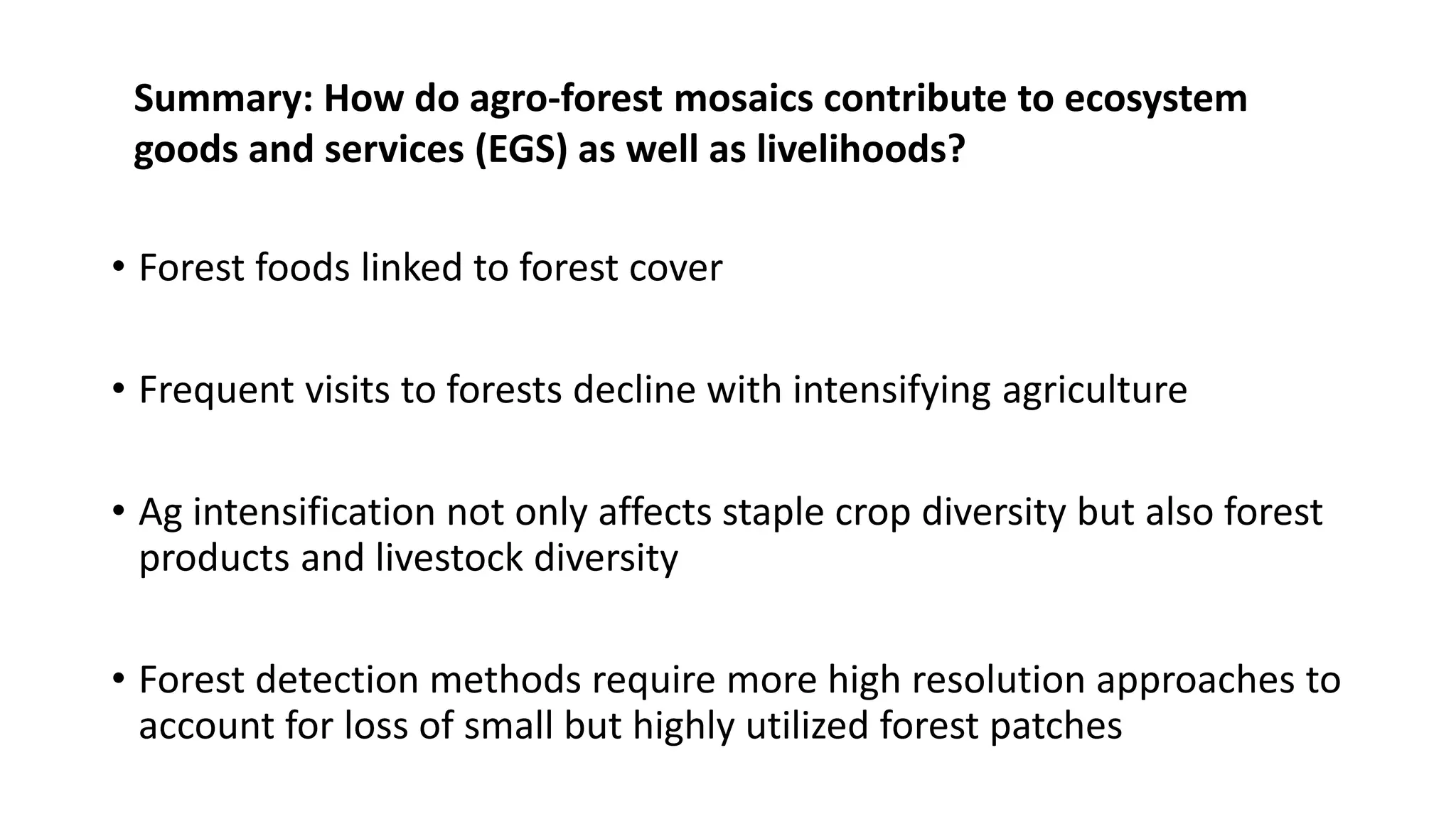
• Forest foods linked to forest cover
• Frequent visits to forests decline with intensifying agriculture
• Ag intensification not only affects staple crop diversity but also forest
products and livestock diversity
• Forest detection methods require more high resolution approaches to
account for loss of small but highly utilized forest patches
Summary: How do agro-forest mosaics contribute to ecosystem
goods and services (EGS) as well as livelihoods?
Acknowledgements
Funding for this project has been provided by the United States Agency
for International Development (USAID) and the UK’s Department for
International Development (DFID) KnowFor grant to CIFOR.
Thank you!
sarah.gergel@ubc.ca
http://www.landscape.forestry.ubc.ca
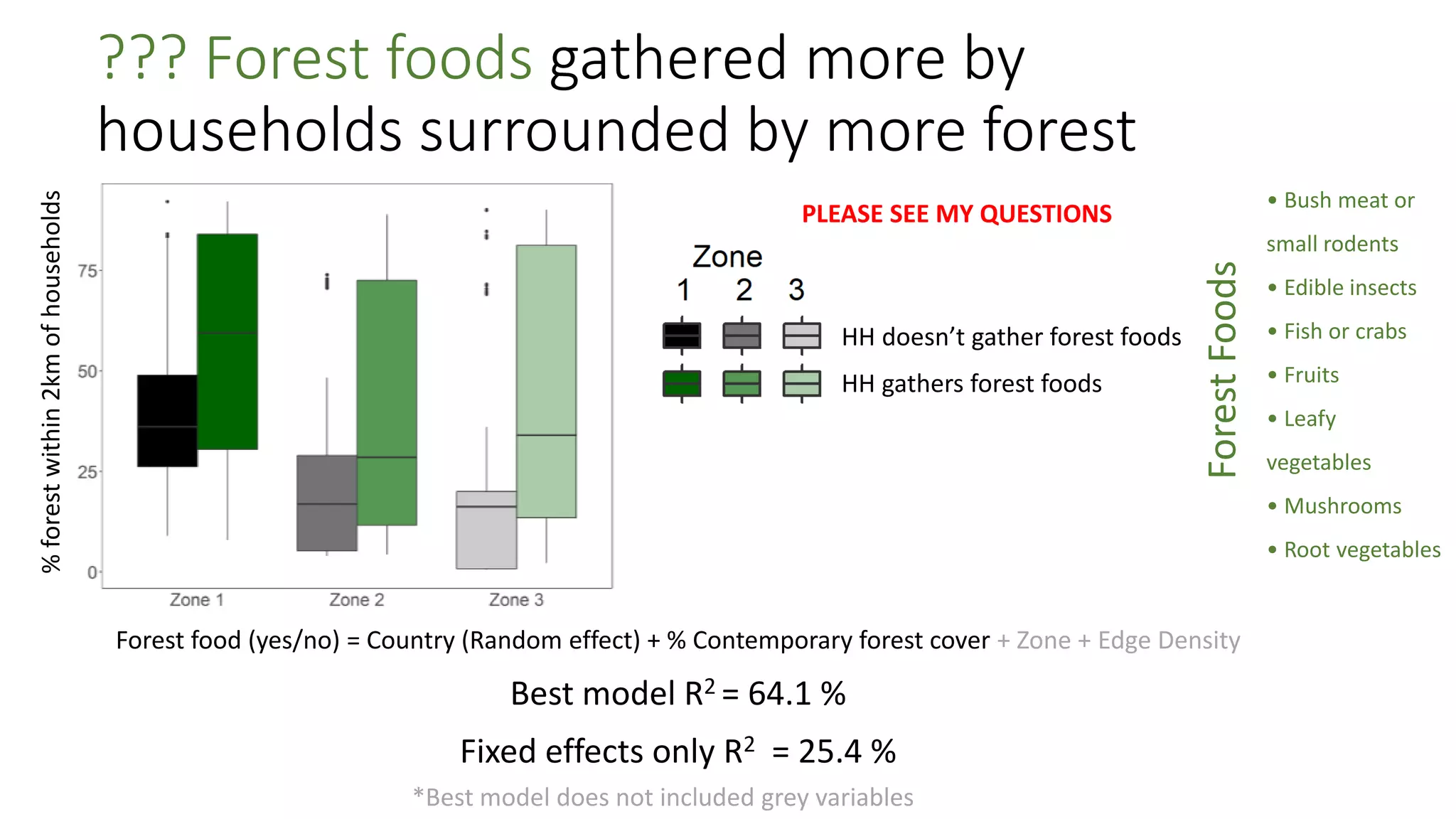
??? Forest foods gathered more by
households surrounded by more forest
• Bush meat or
small rodents
• Edible insects
• Fish or crabs
• Fruits
• Leafy
vegetables
• Mushrooms
• Root vegetables
ForestFoods
Forest food (yes/no) = Country (Random effect) + % Contemporary forest cover + Zone + Edge Density
Best model R2 = 64.1 %
Fixed effects only R2 = 25.4 %
*Best model does not included grey variables
HH gathers forest foods
HH doesn’t gather forest foods
%forestwithin2kmofhouseholds
PLEASE SEE MY QUESTIONS
Protected areas especially important where
subsistence agriculture dominates
Ownland
Forest types
(Angles align with flower diagram)
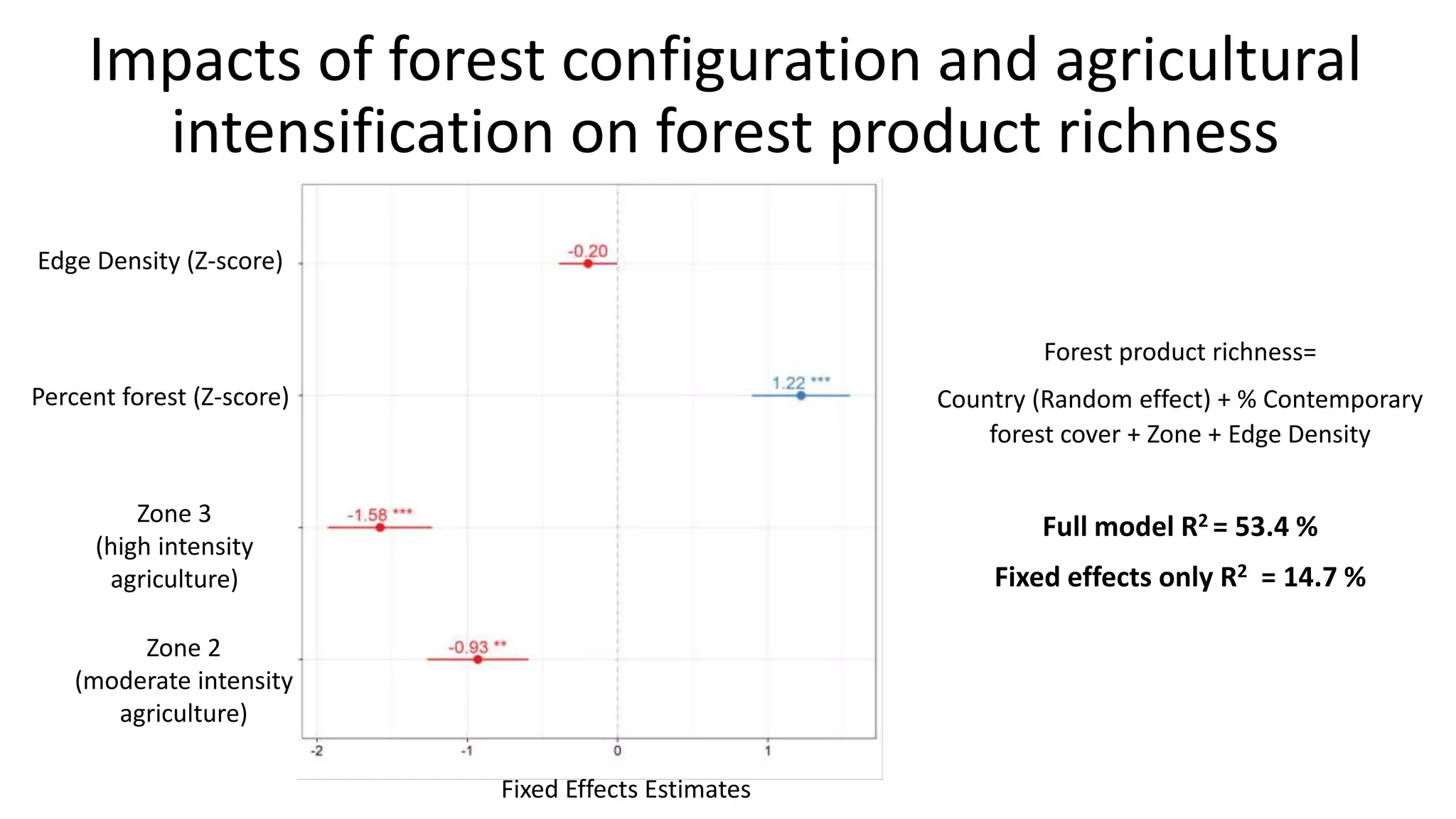
Edge Density (Z-score)
Percent forest (Z-score)
Zone 3
(high intensity
agriculture)
Zone 2
(moderate intensity
agriculture)
Fixed Effects Estimates
Impacts of forest configuration and agricultural
intensification on forest product richness
Forest product richness=
Country (Random effect) + % Contemporary
forest cover + Zone + Edge Density
Full model R2 = 53.4 %
Fixed effects only R2 = 14.7 %
Forest fragmentation and use of forest products
Richness of forest products used (Mean per HH)
Fragmentation
LowHigh
Statistical analyses- the interplay of forest
configuration and agricultural intensification on the
use of different forest products
• Mixed effects models
• Model selection (pairwise deletion)
• Candidate fixed effects include
• Contemporary forest cover (Z-scores)
• Edge density (Z-scores)
• Agricultural zone
• Random effect
• Country
• Boot-strapped confidence intervals determine
significance of fixed effects
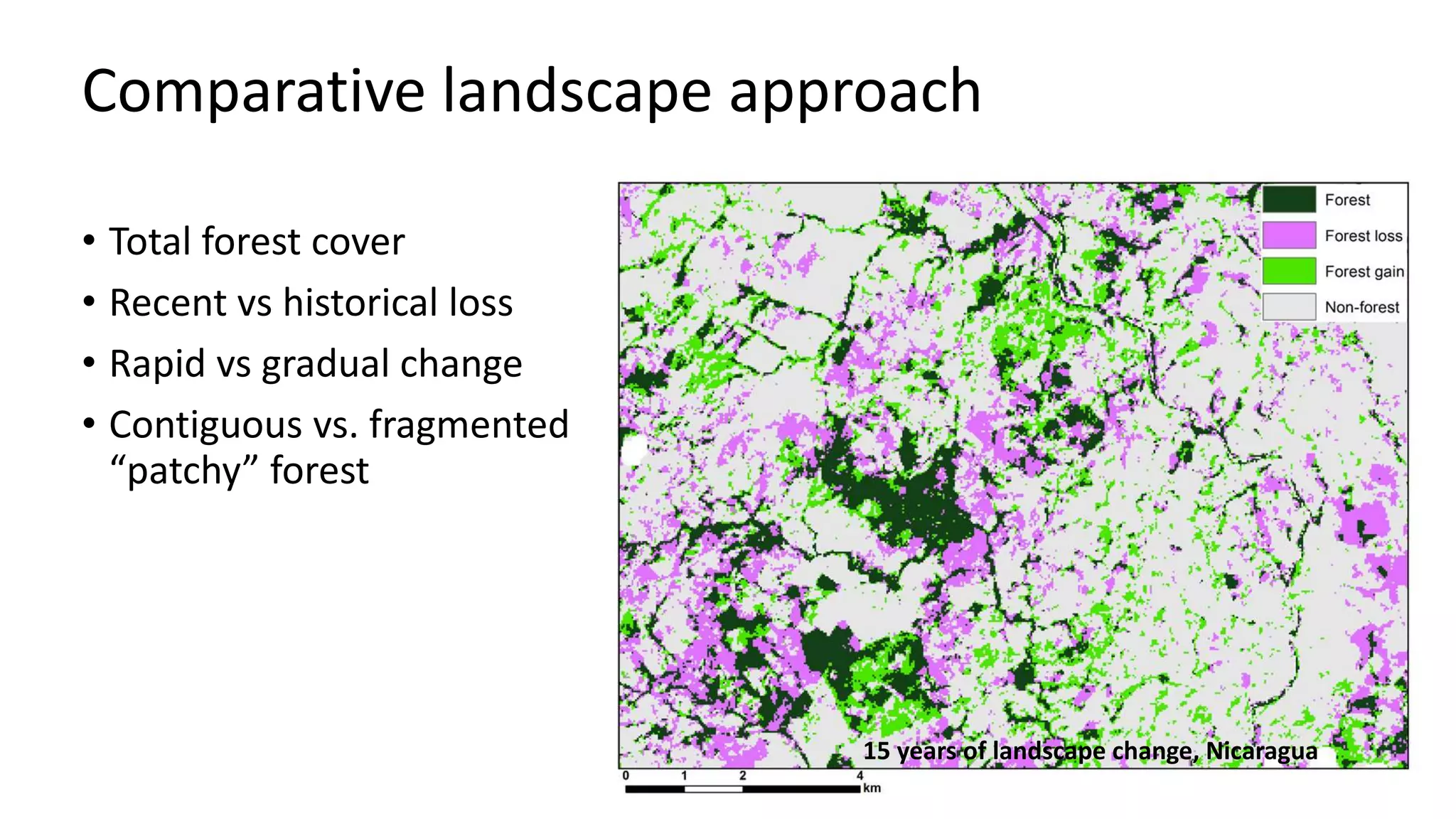
Comparative landscape approach
• Total forest cover
• Recent vs historical loss
• Rapid vs gradual change
• Contiguous vs. fragmented
“patchy” forest
15 years of landscape change, Nicaragua

Mapping forest loss and fragmentation for improved comparative analyses of livelihoods and ecosystem services

  • 1.
    Mapping forest lossand fragmentation for improved comparative analyses of livelihoods and ecosystem services Sarah E Gergel, Stephanie A Tomscha, Ian MS Eddy, Kevin Yang, Jean-Yves Duriaux, Frederic Baudron, Terry CH Sunderland and many others who contributed to the New Agrarian Change Project
  • 2.
    70% of theworld’s remaining forest <1 km of an edge (Haddad et al 2015) Key Challenge: How do agro-forest mosaics contribute to ecosystem goods and services as well as livelihoods?
  • 3.
    7 Countries x3 Zones (high/med/low forest) >2000 HH surveys
  • 4.
    7 Countries x3 Zones (high/med/low forest) >2000 HH surveys
  • 5.
    Household Surveys Spanning Forest-AgricultureGradient (e.g., commodity production)
  • 6.
    How do agro-forestmosaics contribute to ecosystem goods and services (EGS) as well as livelihoods? Today’s Roadmap: • Visits and use of forests • Local perceptions of forest loss vs remote sensing estimates • Changes in EGS with agricultural intensification forest loss forest fragmentation
  • 7.
    Number of forestproducts is greatest where forest cover is greatest • Bamboo and rattan • Construction material • Fibers • Roof thatch • Thatch • Timber for construction • Wood for farm implements • Bush meat or small rodents • Edible insects • Fish or crabs • Fruits • Leafy vegetables • Mushrooms • Root vegetables • Fuelwood • Charcoal • Bees products • Dye or tanning • Flowers or plants • Gaharu • Gums or resins • Medicinal • Reeds and papyrus • Water • Wildlife/pet trade ConstructionMaterialsFoodFuelOther
  • 8.
    Daily visits toforests declined with agricultural intensification
  • 9.
    Forest type mattersfor daily visits • “Own land” visited most frequently in all zones • Typically small forest patches (“small forest patches” and “riverine forest patches”) important in Zones 1 and 2, but their losses may be difficult to detect changes with Landsat
  • 10.
    How well doremote sensing estimates of forest loss reflect local perceptions? Household surveys and remote sensing results
  • 11.
    Areas originally selectedin the field to control for amount of contemporary forest cover %Forest T1-1986 T2-2001 T3-2015 T1 T2 T3 T1 T2 T3T1 T2 T3
  • 12.
    Three decades offorest cover reveals areas of rapid loss vs little change in forest cover %Forest T1-1989 T2-2003 T3-2014 T1-1988 T2-1999 T3-2013 T1-1986 T2-2002 T3-2015 T1-1986 T2-1999 T3-2013 T1-1990 T2-2000 T3-2010 T1-1986 T2-2001 T3-2015 T1-1990 T2-2002 T3-2013 T1 T2 T3 T1 T2 T3T1 T2 T3 T1 T2 T3 T1 T2 T3T1 T2 T3 T1 T2 T3 T1 T2 T3T1 T2 T3 T1 T2 T3 T1 T2 T3T1 T2 T3 T1 T2 T3 T1 T2 T3T1 T2 T3T1 T2 T3T1 T2 T3 T1 T2 T3 T1 T2 T3 T1 T2 T3T1 T2 T3
  • 13.
    N.S. Perceived change bearslittle relationship to remote sensing estimates of forest loss
  • 14.
    R = -0.86 p< 0.001 Reported agricultural activity strongly correlated with satellite forest loss R = -0.71 p < 0.001
  • 15.
    How do ecosystemgoods and services change with agricultural intensification? Forest Products Crops Livestock While crop richness increases at moderately intensive levels of agriculture Zone 2 >> Zone 1=Zone 3 Forest product and livestock richness decline with agricultural intensification R2=0.56 % R2=0.55R2= 0.39 % MeanRichnessPerHousehold
  • 16.
    Impact of agriculturalintensification on EGS differs by country Zone 1 Zone 2 Zone 3 MeanRichnessPerHousehold
  • 17.
    Agroforest mosaics: forestfragmentation and edges
  • 18.
    Forest edge associatedwith greater number of forest products used Richness of forest products used (Mean per HH) Fragmentation LowHigh R2 =0.39 p = 0.005 N = 18
  • 19.
    Except when Nicaraguaresults came in…… Richness of forest products used (Mean per HH) Fragmentation LowHigh R2 =0.037 p = 0.41 N = 21
  • 20.
    Construction material useincreases with edge density and decreases with agricultural intensification • Bamboo and rattan • Construction material • Fibers • Roof thatch • Thatch • Timber for construction • Wood for farm implements ConstructionMaterials *Grey variables not significant and not included in final model Construction materials (yes/no) = Country (Random effect) + % Contemporary forest cover + Zone + Edge Density Best model R2 = 48% Fixed effects only R2 = 6%
  • 21.
    • Bamboo andrattan • Construction material • Fibers • Roof thatch • Thatch • Timber for construction • Wood for farm implements • Bush meat or small rodents • Edible insects • Fish or crabs • Fruits • Leafy vegetables • Mushrooms • Root vegetables • Fuelwood • Charcoal • Bees products • Dye or tanning • Flowers or plants • Gaharu • Gums or resins • Medicinal • Reeds and papyrus • Water • Wildlife/pet trade ConstructionMaterialsFoodFuelOther Foods, construction materials and fuels responded differently to forest configuration and agricultural intensification Forest construction materials declined with agricultural intensification, but were positively related to edge density Forest foods declined with forest loss Highly variable by country means cross-site comparisons essential for identifying these patterns Our models were poor at predicting forest fuel dynamics
  • 22.
    • Forest foodslinked to forest cover • Frequent visits to forests decline with intensifying agriculture • Ag intensification not only affects staple crop diversity but also forest products and livestock diversity • Forest detection methods require more high resolution approaches to account for loss of small but highly utilized forest patches Summary: How do agro-forest mosaics contribute to ecosystem goods and services (EGS) as well as livelihoods?
  • 23.
    Acknowledgements Funding for thisproject has been provided by the United States Agency for International Development (USAID) and the UK’s Department for International Development (DFID) KnowFor grant to CIFOR.
  • 24.
  • 27.
    ??? Forest foodsgathered more by households surrounded by more forest • Bush meat or small rodents • Edible insects • Fish or crabs • Fruits • Leafy vegetables • Mushrooms • Root vegetables ForestFoods Forest food (yes/no) = Country (Random effect) + % Contemporary forest cover + Zone + Edge Density Best model R2 = 64.1 % Fixed effects only R2 = 25.4 % *Best model does not included grey variables HH gathers forest foods HH doesn’t gather forest foods %forestwithin2kmofhouseholds PLEASE SEE MY QUESTIONS
  • 28.
    Protected areas especiallyimportant where subsistence agriculture dominates Ownland Forest types (Angles align with flower diagram)
  • 29.
    Edge Density (Z-score) Percentforest (Z-score) Zone 3 (high intensity agriculture) Zone 2 (moderate intensity agriculture) Fixed Effects Estimates Impacts of forest configuration and agricultural intensification on forest product richness Forest product richness= Country (Random effect) + % Contemporary forest cover + Zone + Edge Density Full model R2 = 53.4 % Fixed effects only R2 = 14.7 %
  • 30.
    Forest fragmentation anduse of forest products Richness of forest products used (Mean per HH) Fragmentation LowHigh
  • 31.
    Statistical analyses- theinterplay of forest configuration and agricultural intensification on the use of different forest products • Mixed effects models • Model selection (pairwise deletion) • Candidate fixed effects include • Contemporary forest cover (Z-scores) • Edge density (Z-scores) • Agricultural zone • Random effect • Country • Boot-strapped confidence intervals determine significance of fixed effects
  • 32.
    Comparative landscape approach •Total forest cover • Recent vs historical loss • Rapid vs gradual change • Contiguous vs. fragmented “patchy” forest 15 years of landscape change, Nicaragua

Editor's Notes

  • #8 Figure 10 shows the mean number of forest products used in each zone for cash and trade, domestic use, or both. Surveys asked about 28 different forest products • Bamboo and Rattan • Bees products • Birds or animals for wildlife or pet trade • Bush meat or small rodents • Charcoal • Construction material • Dye or tanning • Edible insects • Fibers • Fish or crabs • Flowers or plants • Fruits • Fuelwood • Gaharu • Gums or resins • Leafy vegetables • Medicinal • Mushrooms • Reeds and papyrus • Roof thatch • Root vegetables • Thatch • Timber for construction material • Water • Wood to make farm implements • SPECIFY_OTHER_FOREST_PRODUCT
  • #9 I am not sure you will want all of the following slides about frequency of visits, but it shows the variety of ways we could display this information
  • #12 The How can we indicate the time frames – a little more detail but not too much details? Why not lump by zone, then in each zone show 3 times periods?
  • #13 The How can we indicate the time frames – a little more detail but not too much details? Why not lump by zone, then in each zone show 3 times periods?
  • #14 What is the NS floating in space?
  • #16 Zone explains little of variance relative to country – is that the secondary message? Couldn’t you also say that…after controlling for country, zone still is statistically significant, no? Yes Just an FYI, since this analysis was completed for the paper looking solely at agricultural intensification, and then just recently moved to the forest paper (and potentially cut from both papers) no forest cover information is included in the model. There was no model selection process either. Simply 1 fixed effect (zone) and one random effect (country) Forest product richness = Country (Random effect) + Zone Full model R2= 55.5 % R2(GLMM(M)) = 5.6 % Livestock richness = Country (Random effect) + Zone Full model R2= 54.9 % R2(GLMM(M)) = 0.9 % Crop richness = Country (Random effect) + Zone Full model R2= 38.8 % Fixed Effects R2 = 3.1 %
  • #17 I think we still need a specific message here, by product type Forest product richness ALWAYS higher in Zone 1 - CONSISTENT Crop richness sometimes highest in Zone 2 (BNG, BF), sometimes even highest in zone 1 (NICA), or zone 3 (CMR) Livestock – doesn’t differ much across zones except where it’s highest in Zone 2 (ETH, ZAM) Zone 1 (BANG, BF) This is my interpretation – do stats up hold this interpretation or do we not have those? Stephanie – when you say highly variable….that’s a bit of a cop-out…vague…could mean variable over time. What do you really mean? I mean zone influences are variable by country. If we looked at this questions using individual case studies, we may find a different result. For example, in Cameroon, forest products don’t change much by zone (even increase slightly in zone 2), while we see a very clear reduction in Indonesia. agricultural intensification best explains changes in forest products ?and livestock?, which we link to forest configuration next
  • #19 CANT READ THE X AXIS…..OR THE Y AXIS REALLY When I control for forest cover in my models, edge density is associated with a very slight decrease in forest product richness….see previous slide REALLY LIKE THIS SLIDE BUT I AM CURIOUS ABOUT CONTROLLING FOR PROPORTION FOREST BEFORE SHOWING EDGES………. Edge density Forest edge plays an important role in human-forest interactions. Forests with a high amount of edge may provide habitat for different types of species, and thus, provide different ecosystem services than highly intact forests; however the relationship between edge density and ecosystem services are poorly understood. Here, we show how edge density changes across countries and zones to explore how this forest edge may influence the livelihoods and diets of forest dependent people. Edge density is normalized by area, which allows for comparison across different sized landscapes. Type equation here. Here, eik is the total edge of the landscape in meters and A is the total landscape area in m2. The metric ranges from zero to unlimited.
  • #20 CAN YOU FIX THIS TO MATCH PREVIOUS SLIDE IN TERMS OF LEGIBILITY When I control for forest cover in my models, edge density is associated with a very slight decrease in forest product richness….see previous slide REALLY LIKE THIS SLIDE BUT I AM CURIOUS ABOUT CONTROLLING FOR PROPORTION FOREST BEFORE SHOWING EDGES………. Edge density Forest edge plays an important role in human-forest interactions. Forests with a high amount of edge may provide habitat for different types of species, and thus, provide different ecosystem services than highly intact forests; however the relationship between edge density and ecosystem services are poorly understood. Here, we show how edge density changes across countries and zones to explore how this forest edge may influence the livelihoods and diets of forest dependent people. Edge density is normalized by area, which allows for comparison across different sized landscapes. Type equation here. Here, eik is the total edge of the landscape in meters and A is the total landscape area in m2. The metric ranges from zero to unlimited.
  • #21 Ok, so the story is: Edge effects impact the richness of forest products used as well as % HH using various construction materials– More edge is associated with a greater likelihood of a household using some type of construction material)—This is different than the effect of edge on total forest product richness---the opposite relationship Both are positively related to edge? No, total forest product richness is negatively related to edge, while the use of construction materials (yes/no) is positively related to edge Until you control for forest cover, in which case: Edge is slightly inversely related to richness of forest products I would say the main message is edge may affect forest products differently—It is negatively related to total richness of forest product use, but positively related to construction material use. Landscape configuration may affect specific products more than others
  • #22 OK – I LOVE this figure – it does summarize things nicely, and lets us drop slides 20 and 21 and 22? Or at least move the end of prezzie? I don’t think we need to show all the stats here This figure needs updating, which will change the arrangement and alignment of text. This slide would probably benefit from some animations as well
  • #23 Some key findings thus far.
  • #28 Ok, now I am confused….where is richness of forest foods on the graph? Ah, I see why you are confused. My response variable was binary-forest food/no forest food (fixed). There is no richness on this graph, only presence/ absence, Green-A household gathers some type of forest food, Black/grey a household does not. (FYI, I also fixed this for the forest construction materials slide, which said richness of forest foods as well). I pooled the forest products into these different categories (construction materials, foods, fuels), because some of the forest foods were very rare and couldn’t be modeled individually with such a small sample I love this work but I think I am confused by this one. This was slide 7, in my last email I asked you to take a look at it Stephanie – can you clarify if zone and edge density were in final model? Sounds like not, so w/o its 64% or 25? (No, forest zone and edge density did not make the final model. They were not significant in explaining forest food (present/absence)—I changed full to “best” as you used later in the slide Clarify what is full, best, fixed----(best model =Country (random)+ % contemporary forest cover (fixed)---the only fixed effect is % forest I was hoping to show results here – early in the talk, without edges……..just forest cover and country – is that 64% ? Also, can you delete the “doesn’t gather forest foods” I think we just need the “gathers forest foods” – the black, gray, bars--The green bars are the households in each zone that gather forest foods, while the black bars are the ones that don’t. This graph shows that the percent forest within 2km of the households that gather forest foods is higher than the percent forest for households that don’t gather forest foods, regardless of the zone. I added HH in front of the legend. Does that help?
  • #31 When I control for forest cover in my models, edge density is associated with a very slight decrease in forest product richness….see previous slide REALLY LIKE THIS SLIDE BUT I AM CURIOUS ABOUT CONTROLLING FOR PROPORTION FOREST BEFORE SHOWING EDGES………. Edge density Forest edge plays an important role in human-forest interactions. Forests with a high amount of edge may provide habitat for different types of species, and thus, provide different ecosystem services than highly intact forests; however the relationship between edge density and ecosystem services are poorly understood. Here, we show how edge density changes across countries and zones to explore how this forest edge may influence the livelihoods and diets of forest dependent people. Edge density is normalized by area, which allows for comparison across different sized landscapes. Type equation here. Here, eik is the total edge of the landscape in meters and A is the total landscape area in m2. The metric ranges from zero to unlimited.
  • #32 You can delete the part in red, Sarah, I just added that FYI Edge density (Z-scores) (Other configuration variables were too correlated with forest cover to include in our model)