Starting Well Engineer
Pilot Overview
Concept Team: Jason Holder, Helen Smith
Design Lead: Tom Hartland/Simon Penny
Insight Lead: Khush LonghurstJune 2017
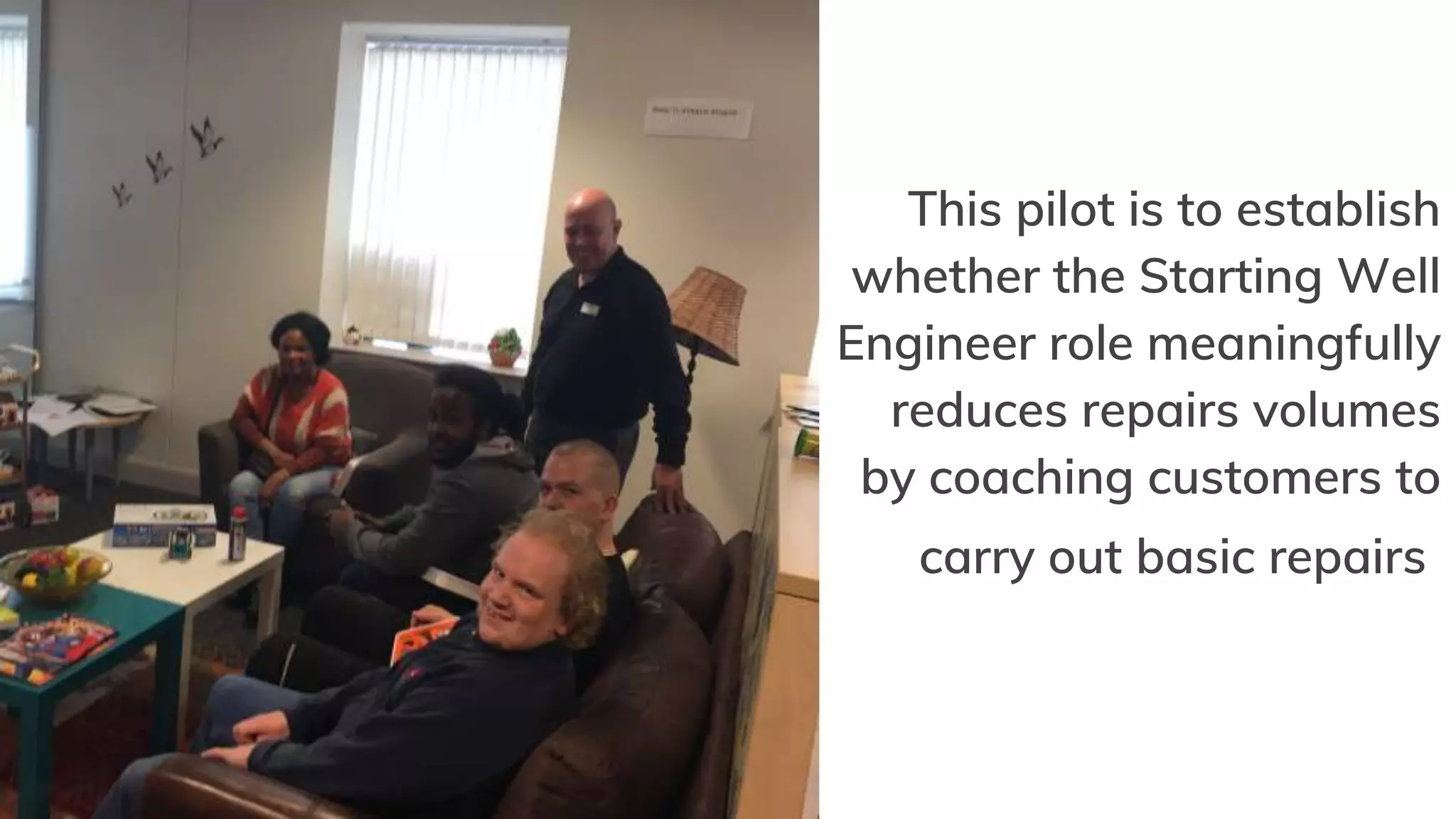
This pilot is to establish
whether the Starting Well
Engineer role meaningfully
reduces repairs volumes
by coaching customers to
carry out basic repairs.
Every year Bromford experiences a large demand for small everyday repairs. Our engineers have reported that many of these
repairs are easily avoidable, however the customer doesn’t feel suitably equipped with information, skills or tools to complete
them themselves.
Data also shows that customers tend to report higher numbers of repairs at the start of their tenancy than at any other time.
Anecdotally, there are a variety of reasons for this, including works that should have been picked up at void, customers not
being fully aware of how to maintain their homes and customers not understanding which repairs they could carry out
themselves. Early feasibility exercises also confirmed that many customers didn’t feel they had ‘adequate permission’ to
complete any repairs while in the property.
An initial test phase explored both our operational ability to deliver the service and the value of doing so over a period of 6
months. During which we found no evidence of a reduction in repairs volume – namely because of complications recording
SWE initiated repairs (i.e. void works had been reported) or those raised by the customer following the SWE visit. There was an
increase in customer’s self-reported confidence for all repairs and customer sentiment was generally very positive. The visit
lengths did gradually increase across the 6 months to the point where the average duration was around 90 minutes – again,
this seemed to be completing outstanding void works. Keeping visits to a more reasonable timeframe (60 mins) will only
improve the viability of the service.
WHY PILOT?
A colleague in repairs
support coordinates
bookings with customer
SWE coaches customers on
repairs and collects some
data
Feedback carry out follow
up calls for more information
and Insight analyse trends
Neighbourhood coach
notifies repairs support
when a new customer
signs-up
CUSTOMER EXPERIENCE
PILOT FOCUS
Leaky Taps Running Toilets
Damp &
Condensation
Lightbulbs Faults & Fuses
Stopping a leak using the
stop-cock and isolator valves
Stopping a toilet from
continuously running
Preventing damp and
condensation
Replacing halogen, covered
or strip light bulbs
Diagnosing minor electrical
faults and replacing fuses.
PILOT OVERVIEW
Customers moving into their homes will be given an appointment with a “Starting Well Engineer”, for around two to three weeks after their move in date. During
this appointment the engineer will both give the customer guidance on how to carry out small jobs around the home, and provide them with a toolkit containing
the basics for household maintenance.
During the period prior to this appointment, the only repairs the customer will be able to raise will be emergencies.
Neighbourhood Coaches explain the process with customers at sign-up. They will explain which repairs are considered emergencies, which can be carried out by
the starting well engineer, and which we would consider the customer’s responsibility. They will be thorough in going through the basic details of the home
maintenance, such as positioning of stopcocks etc.
CSC will be briefed on the changes, and alerted by a CRM pop-up when they are dealing with a customer taking part in the scheme. For the purposes of the first
phase of the test, as soon as a customer has had their appointment they can raise repairs as normal through CSC. In the second phase, CSC will be asked to
challenge customers who are reporting repairs that (in theory) they might be able to carry out themselves after the Starting Well Engineer’s visit
The initial test phases took place in repairs central area,
however this caused confusion with housing manager referrals
to SWE. We will be rolling the pilot out over two Localities –
Marches and Staffs. Any customers moving into a void
property in these localities will be expected to receive a SWE
visit. Initially mutual exchanges and transfers will not be
considered. However, this may be considered as a ‘sub-test’
once the pilot is established and our SWE have capacity. Other
individual high users may also be approached proactively by
the SWE – if the NC advises it. The pilot will exclude temporary
accommodation (on licence) and supported accommodation.
For the period 3rd Feb – 11 Aug (based on average new
lettings in these localities over the last three years) we can
expect around 149 SWE visits in Marches and 230 in
Staffordshire.
CUSTOMER INVOLVEMENT
PILOT TIMETABLE
23 - 27 Jan 23 - 27 Jan 13 - 17 Feb 20 - 24 Feb 28 April
Brief NCs in
Marches/Staffs/(+BC)
about SWE pilot
responsibilities
1 - 25 August 5 - 14 February
NCs begin to make
referrals to SWE for
each sign-up (Pilot
Goes Live)
First SWE visits
should be
completed,
shadowed by TH/HS
First performance
review
(TH/HS/JG/SWE),
process refinement
First data quality
review, monthly
thereafter (KL)
6 month evaluation
(KL)
12 month evaluation
(KL)
It is imperative that the data be reviewed and processed at regular intervals to ensure correct
measurements are being recorded and give early ‘health checks’. Kush Longhurst will lead on
the data evaluation. Tom Hartland and Simon Penny will assist Helen Smith in evaluating
whether the process is effective at reaching outcomes and remove obstacles.
The pilot has seven core objectives:
Feb - August 2017
PILOT AIMS & OBJECTIVES
● To see if SW engineer reduces number of
repairs raised and the number of repairs calls,
in particular in relation to the specific repairs
where the SW engineers are offering coaching
● To better enable customers to carry out minor
repairs themselves.
● To ascertain workload/capacity of SW
Engineer, and amount of time needed with
customer.
● To ascertain whether void works are being
missed/not carried out to necessary
standard and to remedy this.
● To potentially better develop the ability to
identify “max” repairs customers; i.e. those
most likely to be heavy repairs service users.
● To gain a picture of the different types of
repairs that are raised by customers.
● Ensure the current proposed process is fit
for purpose
MEASURING IMPACT
Quantitative & Qualitative Measurement
● We will compare number of repairs (overall and specific repairs
where customers are being coached) raised during the test with:
○ Historic data for the same localities in terms of repairs
raised and causes for a call to be raised for a repair.
● We will compare the number of repairs calls received during the
test with historic data to see if the pilot has caused a fall in
repairs volumes.
● We will review if there are any cost savings being delivered as a
result of the starting well engineer visits, by reviewing the
following:
○ Reviewing average time/ cost of a visit to the average
time/ cost of a normal repair. This will identify a cost
saving if there has been a fall in repairs
● Ensure the process is being followed with the correct types of
repairs being raised pre visit (emergency repairs only).
● Review if resourcing allows for appointments to be booked
in during the correct timeframe.
● Customers involved in the test will be surveyed at the end of
their visit. They will be asked about what aspects of the visit
appealed to them the most in carrying out specific tasks
around the home. The survey will also gather their
confidence to carry out the repairs before and after the visit.
● Starting Well Engineers will provide qualitative feedback
regarding whether required repairs could/should have been
carried out at void period. Tom Hartland has designed this
survey, whilst Helen Smith will input this information and
pass on to Insight Team for evaluation.
● Use a mixture of qualitative and quantitative data collected
during pilot to make predictions about which incoming
customers will require most repairs (or most help with
maintaining their home). Test these predictions against
actually repairs levels to see whether they work as an
accurate basis for profiling customers’ repairs needs. Khush
Longhurst will take responsibility for correlating the data
collected during the pilot
This information can be extracted through the repairs tables.
The service has not yet been tested alongside localities or neighbourhood coaches, we
expect there to be a number of challenges and opportunities that arise from the locality
approach.
As with the first test, there will be limited long term findings throughout the pilot, so we
will be unsure whether self-repairing behaviour is evident throughout the customer’s
tenancy, or whether they return to using the repairs service for minor repairs. Because of
this a review of households visited during the test will be completed alongside the pilot.
LIMITATIONS
The critical aspect for this pilot will be establishing whether the service achieves its desired outcomes. Any
complications in reaching this outcome should be identified and resolved during the initial data quality reviews.
CONCLUSION & RECOMMENDATIONS
Starting Well Engineer
Bromford Lab
Can we reduce repairs volume by coaching customers how
to carry out basic repairs?

Starting Well Engineer - Pilot Overview

  • 1.
    Starting Well Engineer PilotOverview Concept Team: Jason Holder, Helen Smith Design Lead: Tom Hartland/Simon Penny Insight Lead: Khush LonghurstJune 2017
  • 2.
    This pilot isto establish whether the Starting Well Engineer role meaningfully reduces repairs volumes by coaching customers to carry out basic repairs.
  • 3.
    Every year Bromfordexperiences a large demand for small everyday repairs. Our engineers have reported that many of these repairs are easily avoidable, however the customer doesn’t feel suitably equipped with information, skills or tools to complete them themselves. Data also shows that customers tend to report higher numbers of repairs at the start of their tenancy than at any other time. Anecdotally, there are a variety of reasons for this, including works that should have been picked up at void, customers not being fully aware of how to maintain their homes and customers not understanding which repairs they could carry out themselves. Early feasibility exercises also confirmed that many customers didn’t feel they had ‘adequate permission’ to complete any repairs while in the property. An initial test phase explored both our operational ability to deliver the service and the value of doing so over a period of 6 months. During which we found no evidence of a reduction in repairs volume – namely because of complications recording SWE initiated repairs (i.e. void works had been reported) or those raised by the customer following the SWE visit. There was an increase in customer’s self-reported confidence for all repairs and customer sentiment was generally very positive. The visit lengths did gradually increase across the 6 months to the point where the average duration was around 90 minutes – again, this seemed to be completing outstanding void works. Keeping visits to a more reasonable timeframe (60 mins) will only improve the viability of the service. WHY PILOT?
  • 4.
    A colleague inrepairs support coordinates bookings with customer SWE coaches customers on repairs and collects some data Feedback carry out follow up calls for more information and Insight analyse trends Neighbourhood coach notifies repairs support when a new customer signs-up CUSTOMER EXPERIENCE
  • 5.
    PILOT FOCUS Leaky TapsRunning Toilets Damp & Condensation Lightbulbs Faults & Fuses Stopping a leak using the stop-cock and isolator valves Stopping a toilet from continuously running Preventing damp and condensation Replacing halogen, covered or strip light bulbs Diagnosing minor electrical faults and replacing fuses.
  • 6.
    PILOT OVERVIEW Customers movinginto their homes will be given an appointment with a “Starting Well Engineer”, for around two to three weeks after their move in date. During this appointment the engineer will both give the customer guidance on how to carry out small jobs around the home, and provide them with a toolkit containing the basics for household maintenance. During the period prior to this appointment, the only repairs the customer will be able to raise will be emergencies. Neighbourhood Coaches explain the process with customers at sign-up. They will explain which repairs are considered emergencies, which can be carried out by the starting well engineer, and which we would consider the customer’s responsibility. They will be thorough in going through the basic details of the home maintenance, such as positioning of stopcocks etc. CSC will be briefed on the changes, and alerted by a CRM pop-up when they are dealing with a customer taking part in the scheme. For the purposes of the first phase of the test, as soon as a customer has had their appointment they can raise repairs as normal through CSC. In the second phase, CSC will be asked to challenge customers who are reporting repairs that (in theory) they might be able to carry out themselves after the Starting Well Engineer’s visit
  • 7.
    The initial testphases took place in repairs central area, however this caused confusion with housing manager referrals to SWE. We will be rolling the pilot out over two Localities – Marches and Staffs. Any customers moving into a void property in these localities will be expected to receive a SWE visit. Initially mutual exchanges and transfers will not be considered. However, this may be considered as a ‘sub-test’ once the pilot is established and our SWE have capacity. Other individual high users may also be approached proactively by the SWE – if the NC advises it. The pilot will exclude temporary accommodation (on licence) and supported accommodation. For the period 3rd Feb – 11 Aug (based on average new lettings in these localities over the last three years) we can expect around 149 SWE visits in Marches and 230 in Staffordshire. CUSTOMER INVOLVEMENT
  • 8.
    PILOT TIMETABLE 23 -27 Jan 23 - 27 Jan 13 - 17 Feb 20 - 24 Feb 28 April Brief NCs in Marches/Staffs/(+BC) about SWE pilot responsibilities 1 - 25 August 5 - 14 February NCs begin to make referrals to SWE for each sign-up (Pilot Goes Live) First SWE visits should be completed, shadowed by TH/HS First performance review (TH/HS/JG/SWE), process refinement First data quality review, monthly thereafter (KL) 6 month evaluation (KL) 12 month evaluation (KL) It is imperative that the data be reviewed and processed at regular intervals to ensure correct measurements are being recorded and give early ‘health checks’. Kush Longhurst will lead on the data evaluation. Tom Hartland and Simon Penny will assist Helen Smith in evaluating whether the process is effective at reaching outcomes and remove obstacles.
  • 9.
    The pilot hasseven core objectives: Feb - August 2017 PILOT AIMS & OBJECTIVES ● To see if SW engineer reduces number of repairs raised and the number of repairs calls, in particular in relation to the specific repairs where the SW engineers are offering coaching ● To better enable customers to carry out minor repairs themselves. ● To ascertain workload/capacity of SW Engineer, and amount of time needed with customer. ● To ascertain whether void works are being missed/not carried out to necessary standard and to remedy this. ● To potentially better develop the ability to identify “max” repairs customers; i.e. those most likely to be heavy repairs service users. ● To gain a picture of the different types of repairs that are raised by customers. ● Ensure the current proposed process is fit for purpose
  • 10.
    MEASURING IMPACT Quantitative &Qualitative Measurement ● We will compare number of repairs (overall and specific repairs where customers are being coached) raised during the test with: ○ Historic data for the same localities in terms of repairs raised and causes for a call to be raised for a repair. ● We will compare the number of repairs calls received during the test with historic data to see if the pilot has caused a fall in repairs volumes. ● We will review if there are any cost savings being delivered as a result of the starting well engineer visits, by reviewing the following: ○ Reviewing average time/ cost of a visit to the average time/ cost of a normal repair. This will identify a cost saving if there has been a fall in repairs ● Ensure the process is being followed with the correct types of repairs being raised pre visit (emergency repairs only). ● Review if resourcing allows for appointments to be booked in during the correct timeframe. ● Customers involved in the test will be surveyed at the end of their visit. They will be asked about what aspects of the visit appealed to them the most in carrying out specific tasks around the home. The survey will also gather their confidence to carry out the repairs before and after the visit. ● Starting Well Engineers will provide qualitative feedback regarding whether required repairs could/should have been carried out at void period. Tom Hartland has designed this survey, whilst Helen Smith will input this information and pass on to Insight Team for evaluation. ● Use a mixture of qualitative and quantitative data collected during pilot to make predictions about which incoming customers will require most repairs (or most help with maintaining their home). Test these predictions against actually repairs levels to see whether they work as an accurate basis for profiling customers’ repairs needs. Khush Longhurst will take responsibility for correlating the data collected during the pilot This information can be extracted through the repairs tables.
  • 11.
    The service hasnot yet been tested alongside localities or neighbourhood coaches, we expect there to be a number of challenges and opportunities that arise from the locality approach. As with the first test, there will be limited long term findings throughout the pilot, so we will be unsure whether self-repairing behaviour is evident throughout the customer’s tenancy, or whether they return to using the repairs service for minor repairs. Because of this a review of households visited during the test will be completed alongside the pilot. LIMITATIONS
  • 12.
    The critical aspectfor this pilot will be establishing whether the service achieves its desired outcomes. Any complications in reaching this outcome should be identified and resolved during the initial data quality reviews. CONCLUSION & RECOMMENDATIONS
  • 13.
    Starting Well Engineer BromfordLab Can we reduce repairs volume by coaching customers how to carry out basic repairs?