JSLOL
                           brendan@mozilla.org


Tuesday, October 4, 2011
JSLOL
                                            brendan@mozilla.org


                    •      History, goals


Tuesday, October 4, 2011
JSLOL
                                            brendan@mozilla.org


                    •      History, goals

                    •      ES6, what’s in it?


Tuesday, October 4, 2011
JSLOL
                                            brendan@mozilla.org


                    •      History, goals

                    •      ES6, what’s in it?

                    •      Controversies


Tuesday, October 4, 2011
JSLOL
                                            brendan@mozilla.org


                    •      History, goals

                    •      ES6, what’s in it?

                    •      Controversies

                    •      Harmony tune-up


Tuesday, October 4, 2011
JSLOL
                                            brendan@mozilla.org


                    •      History, goals

                    •      ES6, what’s in it?

                    •      Controversies

                    •      Harmony tune-up

                    •      RiverTrail demo


Tuesday, October 4, 2011
A very brief history


                                  mozilla

          2


Tuesday, October 4, 2011
A very brief history

          • Ten days in May 1995: “Mocha”, form validation, img rollovers, scripting of Java


                                                                                      mozilla

          2


Tuesday, October 4, 2011
A very brief history

          • Ten days in May 1995: “Mocha”, form validation, img rollovers, scripting of Java

          • September 1995: “LiveScript” (did Netscape marketing go to Microsoft after?)


                                                                                      mozilla

          2


Tuesday, October 4, 2011
A very brief history

          • Ten days in May 1995: “Mocha”, form validation, img rollovers, scripting of Java

          • September 1995: “LiveScript” (did Netscape marketing go to Microsoft after?)

          • December 1995: “JavaScript”, thanks to Bill Joy (a Sun Founder)


                                                                                      mozilla

          2


Tuesday, October 4, 2011
A very brief history

          • Ten days in May 1995: “Mocha”, form validation, img rollovers, scripting of Java

          • September 1995: “LiveScript” (did Netscape marketing go to Microsoft after?)

          • December 1995: “JavaScript”, thanks to Bill Joy (a Sun Founder)

          • 1996-1997: ES1 thanks to ECMA (now Ecma) TC39 -- see my TXJS talk


                                                                                      mozilla

          2


Tuesday, October 4, 2011
A very brief history

          • Ten days in May 1995: “Mocha”, form validation, img rollovers, scripting of Java

          • September 1995: “LiveScript” (did Netscape marketing go to Microsoft after?)

          • December 1995: “JavaScript”, thanks to Bill Joy (a Sun Founder)

          • 1996-1997: ES1 thanks to ECMA (now Ecma) TC39 -- see my TXJS talk

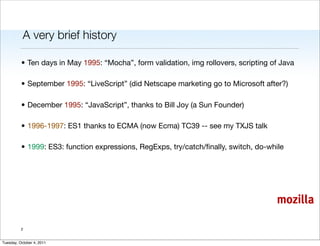
          • 1999: ES3: function expressions, RegExps, try/catch/finally, switch, do-while


                                                                                      mozilla

          2


Tuesday, October 4, 2011
A very brief history

          • Ten days in May 1995: “Mocha”, form validation, img rollovers, scripting of Java

          • September 1995: “LiveScript” (did Netscape marketing go to Microsoft after?)

          • December 1995: “JavaScript”, thanks to Bill Joy (a Sun Founder)

          • 1996-1997: ES1 thanks to ECMA (now Ecma) TC39 -- see my TXJS talk

          • 1999: ES3: function expressions, RegExps, try/catch/finally, switch, do-while

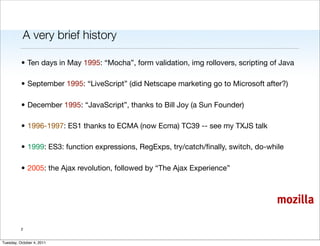
          • 2005: the Ajax revolution, followed by “The Ajax Experience”


                                                                                      mozilla

          2


Tuesday, October 4, 2011
A very brief history

          • Ten days in May 1995: “Mocha”, form validation, img rollovers, scripting of Java

          • September 1995: “LiveScript” (did Netscape marketing go to Microsoft after?)

          • December 1995: “JavaScript”, thanks to Bill Joy (a Sun Founder)

          • 1996-1997: ES1 thanks to ECMA (now Ecma) TC39 -- see my TXJS talk

          • 1999: ES3: function expressions, RegExps, try/catch/finally, switch, do-while

          • 2005: the Ajax revolution, followed by “The Ajax Experience”

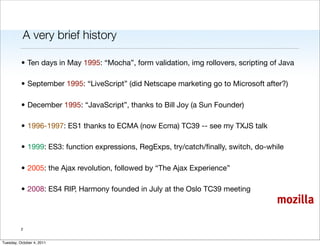
          • 2008: ES4 RIP, Harmony founded in July at the Oslo TC39 meeting
                                                                                      mozilla

          2


Tuesday, October 4, 2011
A very brief history

          • Ten days in May 1995: “Mocha”, form validation, img rollovers, scripting of Java

          • September 1995: “LiveScript” (did Netscape marketing go to Microsoft after?)

          • December 1995: “JavaScript”, thanks to Bill Joy (a Sun Founder)

          • 1996-1997: ES1 thanks to ECMA (now Ecma) TC39 -- see my TXJS talk

          • 1999: ES3: function expressions, RegExps, try/catch/finally, switch, do-while

          • 2005: the Ajax revolution, followed by “The Ajax Experience”

          • 2008: ES4 RIP, Harmony founded in July at the Oslo TC39 meeting
                                                                                      mozilla
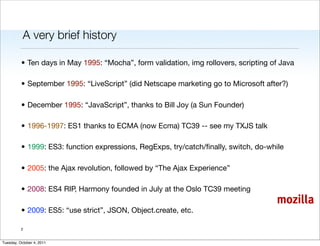
          • 2009: ES5: “use strict”, JSON, Object.create, etc.

          2


Tuesday, October 4, 2011
The Harmony goals


                              mozilla

          3


Tuesday, October 4, 2011
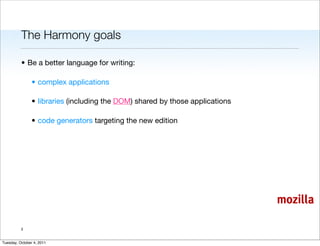
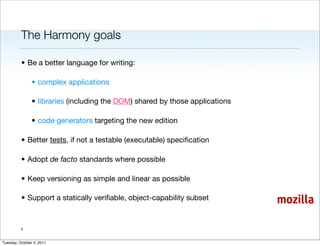
The Harmony goals

          • Be a better language for writing:


                                                mozilla

          3


Tuesday, October 4, 2011
The Harmony goals

          • Be a better language for writing:

                • complex applications


                                                mozilla

          3


Tuesday, October 4, 2011
The Harmony goals

          • Be a better language for writing:

                • complex applications

                • libraries (including the DOM) shared by those applications


                                                                               mozilla

          3


Tuesday, October 4, 2011
The Harmony goals

          • Be a better language for writing:

                • complex applications

                • libraries (including the DOM) shared by those applications

                • code generators targeting the new edition


                                                                               mozilla

          3


Tuesday, October 4, 2011
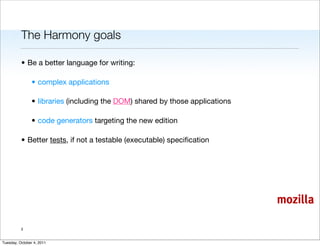
The Harmony goals

          • Be a better language for writing:

                • complex applications

                • libraries (including the DOM) shared by those applications

                • code generators targeting the new edition

          • Better tests, if not a testable (executable) specification


                                                                               mozilla

          3


Tuesday, October 4, 2011
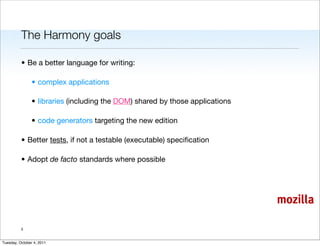
The Harmony goals

          • Be a better language for writing:

                • complex applications

                • libraries (including the DOM) shared by those applications

                • code generators targeting the new edition

          • Better tests, if not a testable (executable) specification

          • Adopt de facto standards where possible


                                                                               mozilla

          3


Tuesday, October 4, 2011
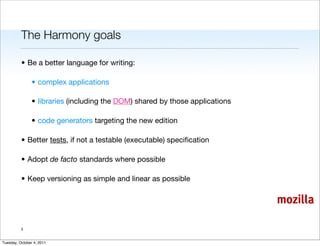
The Harmony goals

          • Be a better language for writing:

                • complex applications

                • libraries (including the DOM) shared by those applications

                • code generators targeting the new edition

          • Better tests, if not a testable (executable) specification

          • Adopt de facto standards where possible

          • Keep versioning as simple and linear as possible

                                                                               mozilla

          3


Tuesday, October 4, 2011
The Harmony goals

          • Be a better language for writing:

                • complex applications

                • libraries (including the DOM) shared by those applications

                • code generators targeting the new edition

          • Better tests, if not a testable (executable) specification

          • Adopt de facto standards where possible

          • Keep versioning as simple and linear as possible

          • Support a statically verifiable, object-capability subset           mozilla

          3


Tuesday, October 4, 2011
Approved for ES6


                             mozilla

          4


Tuesday, October 4, 2011
Approved for ES6

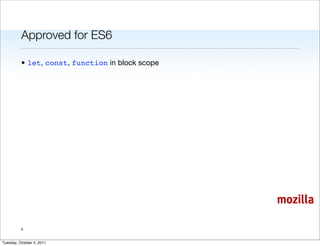
          • let, const, function in block scope


                                                  mozilla

          4


Tuesday, October 4, 2011
Approved for ES6

          • let, const, function in block scope

          • destructuring: let {x, y} = pt; let [s, v, o] = triple()


                                                                       mozilla

          4


Tuesday, October 4, 2011
Approved for ES6

          • let, const, function in block scope

          • destructuring: let {x, y} = pt; let [s, v, o] = triple()

          • parameter default values: function f(x, y=1, {z=2, w=3}) {...}


                                                                             mozilla

          4


Tuesday, October 4, 2011
Approved for ES6

          • let, const, function in block scope

          • destructuring: let {x, y} = pt; let [s, v, o] = triple()

          • parameter default values: function f(x, y=1, {z=2, w=3}) {...}

          • rest, spread: function g(i, j, ...r) { return r.slice(i, j); }
                          let a = [0, 1, 2, 3],
                              o = new any_constructor(...a)


                                                                             mozilla

          4


Tuesday, October 4, 2011
Approved for ES6

          • let, const, function in block scope

          • destructuring: let {x, y} = pt; let [s, v, o] = triple()

          • parameter default values: function f(x, y=1, {z=2, w=3}) {...}

          • rest, spread: function g(i, j, ...r) { return r.slice(i, j); }
                          let a = [0, 1, 2, 3],
                              o = new any_constructor(...a)


          • proxies, weak maps: Proxy.create(handler, proto), new WeakMap


                                                                             mozilla

          4


Tuesday, October 4, 2011
Approved for ES6

          • let, const, function in block scope

          • destructuring: let {x, y} = pt; let [s, v, o] = triple()

          • parameter default values: function f(x, y=1, {z=2, w=3}) {...}

          • rest, spread: function g(i, j, ...r) { return r.slice(i, j); }
                          let a = [0, 1, 2, 3],
                              o = new any_constructor(...a)


          • proxies, weak maps: Proxy.create(handler, proto), new WeakMap

          • modules: module M { export function fast_sin(x) {...} }


                                                                             mozilla

          4


Tuesday, October 4, 2011
Approved for ES6

          • let, const, function in block scope

          • destructuring: let {x, y} = pt; let [s, v, o] = triple()

          • parameter default values: function f(x, y=1, {z=2, w=3}) {...}

          • rest, spread: function g(i, j, ...r) { return r.slice(i, j); }
                          let a = [0, 1, 2, 3],
                              o = new any_constructor(...a)


          • proxies, weak maps: Proxy.create(handler, proto), new WeakMap

          • modules: module M { export function fast_sin(x) {...} }

          • iterators, generators: function* gen() { yield 1; yield 2; }
                                                                             mozilla

          4


Tuesday, October 4, 2011
Approved for ES6

          • let, const, function in block scope

          • destructuring: let {x, y} = pt; let [s, v, o] = triple()

          • parameter default values: function f(x, y=1, {z=2, w=3}) {...}

          • rest, spread: function g(i, j, ...r) { return r.slice(i, j); }
                          let a = [0, 1, 2, 3],
                              o = new any_constructor(...a)


          • proxies, weak maps: Proxy.create(handler, proto), new WeakMap

          • modules: module M { export function fast_sin(x) {...} }

          • iterators, generators: function* gen() { yield 1; yield 2; }
                                                                             mozilla
          • comprehensions: return [x+y for x of a for y of b]

          4


Tuesday, October 4, 2011
Yet more approved for ES6


                                      mozilla

          5


Tuesday, October 4, 2011
Yet more approved for ES6

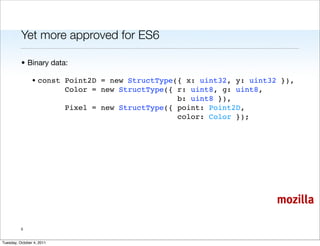
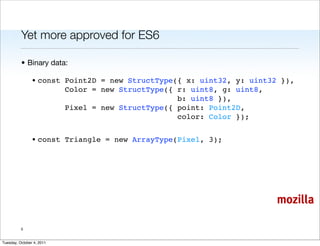
          • Binary data:


                                      mozilla

          5


Tuesday, October 4, 2011
Yet more approved for ES6

          • Binary data:

                • const Point2D = new StructType({ x: uint32, y: uint32 }),
                        Color = new StructType({ r: uint8, g: uint8,
                                                 b: uint8 }),
                        Pixel = new StructType({ point: Point2D,
                                                 color: Color });


                                                                       mozilla

          5


Tuesday, October 4, 2011
Yet more approved for ES6

          • Binary data:

                • const Point2D = new StructType({ x: uint32, y: uint32 }),
                        Color = new StructType({ r: uint8, g: uint8,
                                                 b: uint8 }),
                        Pixel = new StructType({ point: Point2D,
                                                 color: Color });


                • const Triangle = new ArrayType(Pixel, 3);


                                                                       mozilla

          5


Tuesday, October 4, 2011
Yet more approved for ES6

          • Binary data:

                • const Point2D = new StructType({ x: uint32, y: uint32 }),
                        Color = new StructType({ r: uint8, g: uint8,
                                                 b: uint8 }),
                        Pixel = new StructType({ point: Point2D,
                                                 color: Color });


                • const Triangle = new ArrayType(Pixel, 3);

                • new Triangle([{ point:   {   x:   0, y: 0 },
                                  color:   {   r:   255, g: 255, b: 255 } },
                                { point:   {   x:   5, y: 5 },
                                  color:   {   r:   128, g: 0, b: 0 } },
                                { point:   {   x:   10, y: 0 },
                                  color:   {   r:   0, g: 0, b: 128 } }]);     mozilla

          5


Tuesday, October 4, 2011
Quasi-Literals


                           mozilla

          6


Tuesday, October 4, 2011
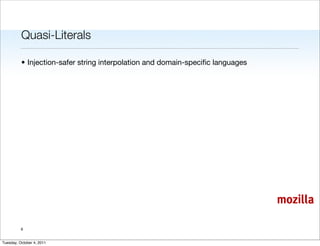
Quasi-Literals

          • Injection-safer string interpolation and domain-specific languages


                                                                                mozilla

          6


Tuesday, October 4, 2011
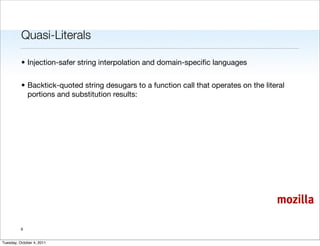
Quasi-Literals

          • Injection-safer string interpolation and domain-specific languages


          • Backtick-quoted string desugars to a function call that operates on the literal
            portions and substitution results:


                                                                                        mozilla

          6


Tuesday, October 4, 2011
Quasi-Literals

          • Injection-safer string interpolation and domain-specific languages


          • Backtick-quoted string desugars to a function call that operates on the literal
            portions and substitution results:

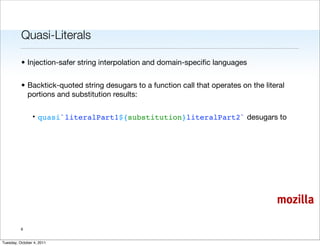
                • quasi`literalPart1${substitution}literalPart2` desugars to


                                                                                        mozilla

          6


Tuesday, October 4, 2011
Quasi-Literals

          • Injection-safer string interpolation and domain-specific languages


          • Backtick-quoted string desugars to a function call that operates on the literal
            portions and substitution results:

                • quasi`literalPart1${substitution}literalPart2` desugars to


                • quasi({raw: ["literalPart1", "literalPart1"],
                         cooked: ["literalPart1", "literalPart1"]},
                        substitution)


                                                                                        mozilla

          6


Tuesday, October 4, 2011
Quasi-Literals

          • Injection-safer string interpolation and domain-specific languages


          • Backtick-quoted string desugars to a function call that operates on the literal
            portions and substitution results:

                • quasi`literalPart1${substitution}literalPart2` desugars to


                • quasi({raw: ["literalPart1", "literalPart1"],
                         cooked: ["literalPart1", "literalPart1"]},
                        substitution)


          • Multiline string literals w/o prefix: `literalPart1${substitution}
             (yes, that was a newline!) literalPart2`
                                                                                        mozilla

          6


Tuesday, October 4, 2011
Quasi-Literals

          • Injection-safer string interpolation and domain-specific languages


          • Backtick-quoted string desugars to a function call that operates on the literal
            portions and substitution results:

                • quasi`literalPart1${substitution}literalPart2` desugars to


                • quasi({raw: ["literalPart1", "literalPart1"],
                         cooked: ["literalPart1", "literalPart1"]},
                        substitution)


          • Multiline string literals w/o prefix: `literalPart1${substitution}
             (yes, that was a newline!) literalPart2`
                                                                                        mozilla
          • Multiline regexp literals: re`literalPart1${substitution}
             (yes, that was a newline!) w+ literalPart2`
          6


Tuesday, October 4, 2011
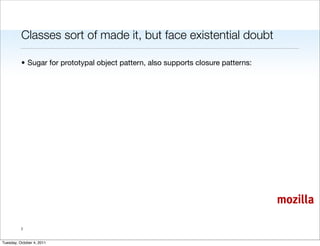
Classes sort of made it, but face existential doubt


                                                                mozilla

          7


Tuesday, October 4, 2011
Classes sort of made it, but face existential doubt

          • Sugar for prototypal object pattern, also supports closure patterns:


                                                                                   mozilla

          7


Tuesday, October 4, 2011
Classes sort of made it, but face existential doubt

          • Sugar for prototypal object pattern, also supports closure patterns:

                • const px = Name.create(‘x’), py = Name.create(‘y’);

                   class Point extends Base {
                     constructor(x, y) {
                       super();
                       this[px] = x, this[py] = y;
                       this.r = function() { return Math.sqrt(x*x + y*y); }
                     }
                     get x()    { return this[px]; }
                     get y()    { return this[py]; }
                     proto_r() { return Math.sqrt(this[px] * this[px] +
                                                   this[py] * this[py]); }
                     equals(p) { return this[px] === p[px] &&
                                         this[py] === p[py]; }                     mozilla
                   }

          7


Tuesday, October 4, 2011
Triangle (the proto operator)


                                          mozilla

          8


Tuesday, October 4, 2011
Triangle (the proto operator)

          • Instead of var obj = {__proto__: base, a: 1, b: 2}, use
                       let obj = base <| {a: 1, b: 2}


                                                                      mozilla

          8


Tuesday, October 4, 2011
Triangle (the proto operator)

          • Instead of var obj = {__proto__: base, a: 1, b: 2}, use
                       let obj = base <| {a: 1, b: 2}


          • Works for other literal object forms:
                      let arr = base <| [p, q, r]
                      let fun = base <| function (...args) { ... }
                      let re = base <| /(w+)s+(w)+/g


                                                                      mozilla

          8


Tuesday, October 4, 2011
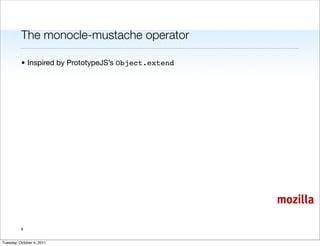
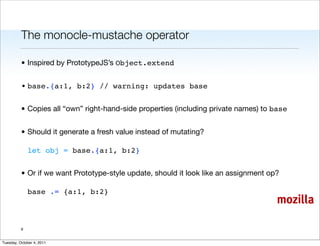
The monocle-mustache operator


                                          mozilla

          9


Tuesday, October 4, 2011
The monocle-mustache operator

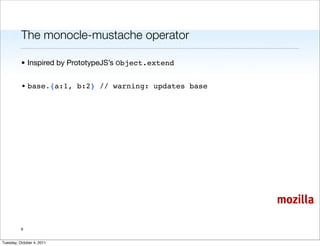
          • Inspired by PrototypeJS’s Object.extend


                                                      mozilla

          9


Tuesday, October 4, 2011
The monocle-mustache operator

          • Inspired by PrototypeJS’s Object.extend


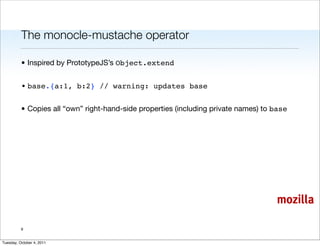
          • base.{a:1, b:2} // warning: updates base


                                                       mozilla

          9


Tuesday, October 4, 2011
The monocle-mustache operator

          • Inspired by PrototypeJS’s Object.extend


          • base.{a:1, b:2} // warning: updates base


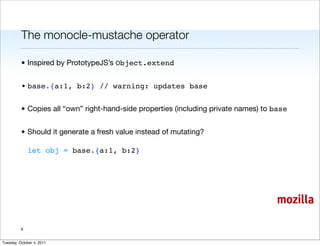
          • Copies all “own” right-hand-side properties (including private names) to base


                                                                                     mozilla

          9


Tuesday, October 4, 2011
The monocle-mustache operator

          • Inspired by PrototypeJS’s Object.extend


          • base.{a:1, b:2} // warning: updates base


          • Copies all “own” right-hand-side properties (including private names) to base


          • Should it generate a fresh value instead of mutating?

              let obj = base.{a:1, b:2}


                                                                                     mozilla

          9


Tuesday, October 4, 2011
The monocle-mustache operator

          • Inspired by PrototypeJS’s Object.extend


          • base.{a:1, b:2} // warning: updates base


          • Copies all “own” right-hand-side properties (including private names) to base


          • Should it generate a fresh value instead of mutating?

              let obj = base.{a:1, b:2}


          • Or if we want Prototype-style update, should it look like an assignment op?

              base .= {a:1, b:2}
                                                                                      mozilla

          9


Tuesday, October 4, 2011
Class pattern using triangle-monocle-mustache


                                                          mozilla

          10


Tuesday, October 4, 2011
Class pattern using triangle-monocle-mustache

          • const px = Name.create(‘x’), py = Name.create(‘y’);

               let Point = Base <| function (x, y) {
                 super();
                 this[px] = x, this[py] = y;
                 this.r = function() { return Math.sqrt(x*x + y*y); }
               }.prototype.{
                 get x()   { return this[px]; },
                 get y()   { return this[py]; },
                 proto_r() { return Math.sqrt(this[px] * this[px] +
                                              this[py] * this[py]); },
                 equals(p) { return this[px] === p[px] &&
                                    this[py] === p[py]; }
               }.constructor.{
                 allPoints: [] // class “static” property!
               }                                                         mozilla

          10


Tuesday, October 4, 2011
Syntax, yay


                           mozilla

          11


Tuesday, October 4, 2011
Syntax, yay

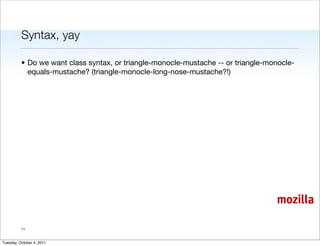
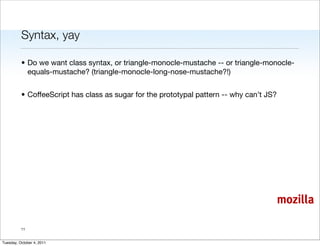
          • Do we want class syntax, or triangle-monocle-mustache -- or triangle-monocle-
            equals-mustache? (triangle-monocle-long-nose-mustache?!)


                                                                                   mozilla

          11


Tuesday, October 4, 2011
Syntax, yay

          • Do we want class syntax, or triangle-monocle-mustache -- or triangle-monocle-
            equals-mustache? (triangle-monocle-long-nose-mustache?!)


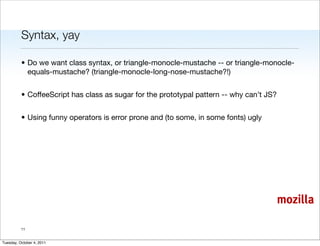
          • CoffeeScript has class as sugar for the prototypal pattern -- why can’t JS?


                                                                                          mozilla

          11


Tuesday, October 4, 2011
Syntax, yay

          • Do we want class syntax, or triangle-monocle-mustache -- or triangle-monocle-
            equals-mustache? (triangle-monocle-long-nose-mustache?!)


          • CoffeeScript has class as sugar for the prototypal pattern -- why can’t JS?


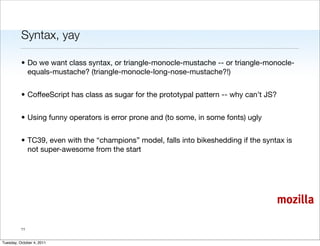
          • Using funny operators is error prone and (to some, in some fonts) ugly


                                                                                          mozilla

          11


Tuesday, October 4, 2011
Syntax, yay

          • Do we want class syntax, or triangle-monocle-mustache -- or triangle-monocle-
            equals-mustache? (triangle-monocle-long-nose-mustache?!)


          • CoffeeScript has class as sugar for the prototypal pattern -- why can’t JS?


          • Using funny operators is error prone and (to some, in some fonts) ugly


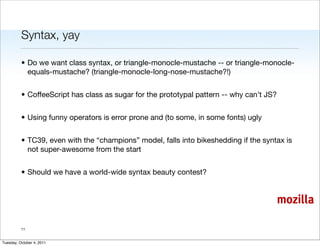
          • TC39, even with the “champions” model, falls into bikeshedding if the syntax is
            not super-awesome from the start


                                                                                          mozilla

          11


Tuesday, October 4, 2011
Syntax, yay

          • Do we want class syntax, or triangle-monocle-mustache -- or triangle-monocle-
            equals-mustache? (triangle-monocle-long-nose-mustache?!)


          • CoffeeScript has class as sugar for the prototypal pattern -- why can’t JS?


          • Using funny operators is error prone and (to some, in some fonts) ugly


          • TC39, even with the “champions” model, falls into bikeshedding if the syntax is
            not super-awesome from the start


          • Should we have a world-wide syntax beauty contest?


                                                                                          mozilla

          11


Tuesday, October 4, 2011
Not yet in Harmony: arrow function syntax


                                                      mozilla

          12


Tuesday, October 4, 2011
Not yet in Harmony: arrow function syntax

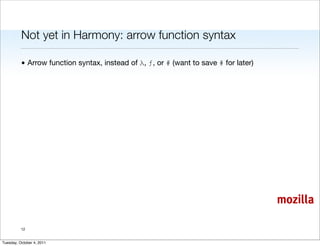
          • Arrow function syntax, instead of λ, ƒ, or # (want to save # for later)


                                                                                      mozilla

          12


Tuesday, October 4, 2011
Not yet in Harmony: arrow function syntax

          • Arrow function syntax, instead of λ, ƒ, or # (want to save # for later)

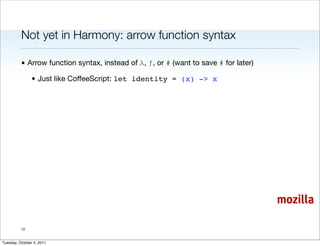
                • Just like CoffeeScript: let identity = (x) -> x


                                                                                      mozilla

          12


Tuesday, October 4, 2011
Not yet in Harmony: arrow function syntax

          • Arrow function syntax, instead of λ, ƒ, or # (want to save # for later)

                • Just like CoffeeScript: let identity = (x) -> x

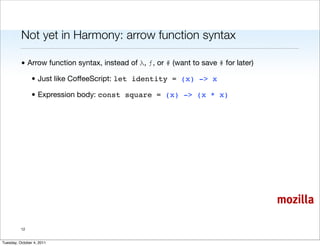
                • Expression body: const square = (x) -> (x * x)


                                                                                      mozilla

          12


Tuesday, October 4, 2011
Not yet in Harmony: arrow function syntax

          • Arrow function syntax, instead of λ, ƒ, or # (want to save # for later)

                • Just like CoffeeScript: let identity = (x) -> x

                • Expression body: const square = (x) -> (x * x)

                • Statement body: let countUsed = (str) -> {
                                    if (str in usedWords)
                                      usedWords[str]++;
                                    else
                                      usedWords[str] = 1;
                                  }


                                                                                      mozilla

          12


Tuesday, October 4, 2011
Not yet in Harmony: arrow function syntax

          • Arrow function syntax, instead of λ, ƒ, or # (want to save # for later)

                • Just like CoffeeScript: let identity = (x) -> x

                • Expression body: const square = (x) -> (x * x)

                • Statement body: let countUsed = (str) -> {
                                    if (str in usedWords)
                                      usedWords[str]++;
                                    else
                                      usedWords[str] = 1;
                                  }


          • Fat arrow too: callback = (msg) => ( this.vmail.push(msg) )

                                                                                      mozilla

          12


Tuesday, October 4, 2011
Not yet in Harmony: arrow function syntax

          • Arrow function syntax, instead of λ, ƒ, or # (want to save # for later)

                • Just like CoffeeScript: let identity = (x) -> x

                • Expression body: const square = (x) -> (x * x)

                • Statement body: let countUsed = (str) -> {
                                    if (str in usedWords)
                                      usedWords[str]++;
                                    else
                                      usedWords[str] = 1;
                                  }


          • Fat arrow too: callback = (msg) => ( this.vmail.push(msg) )

          • Binding forms: let f() -> “writable”
                          const K() -> “readonly”                                     mozilla

          12


Tuesday, October 4, 2011
Not yet in Harmony: block lambda revival

          • Inspired by Smalltalk via Ruby

               let empty = {||};                      // no need for space between bars


               assert(empty() === undefined);
               assert(typeof empty === "function");   // native and implements [[Call]]
               assert(empty.length === 0);
           
               let identity = {|x| x};                // completion is return value
           
               assert(identity(42) === 42);
               assert(identity.length === 1);
           
               let a = [1, 2, 3, 4];
               let b = a.map {|e| e * e}              // paren-free call with block is
                                                      // idiomatic control structure so
                                                      // no semicolon at end
                                                                                  mozilla
               print(b);                              // [1, 4, 9, 16]


          13


Tuesday, October 4, 2011
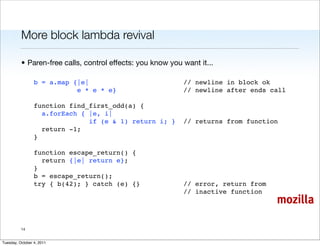
More block lambda revival

          • Paren-free calls, control effects: you know you want it...

                 b = a.map {|e|                             // newline in block ok
                            e * e * e}                      // newline after ends call
                  
                 function find_first_odd(a) {
                   a.forEach { |e, i|
                                if (e & 1) return i; }      // returns from function
                   return -1;
                 }
                  
                 function escape_return() {
                   return {|e| return e};
                 }
                 b = escape_return();
                 try { b(42); } catch (e) {}                // error, return from
                                                            // inactive function
                                                                                    mozilla

          14


Tuesday, October 4, 2011
Syntax, yay again


                              mozilla

          15


Tuesday, October 4, 2011
Syntax, yay again

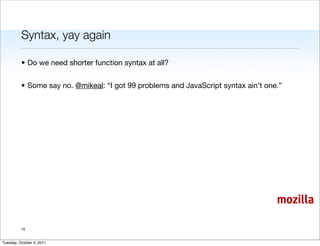
          • Do we need shorter function syntax at all?


                                                         mozilla

          15


Tuesday, October 4, 2011
Syntax, yay again

          • Do we need shorter function syntax at all?


          • Some say no. @mikeal: “I got 99 problems and JavaScript syntax ain’t one.”


                                                                                    mozilla

          15


Tuesday, October 4, 2011
Syntax, yay again

          • Do we need shorter function syntax at all?


          • Some say no. @mikeal: “I got 99 problems and JavaScript syntax ain’t one.”


          • Others say yes, but divide into roughly three camps:


                                                                                    mozilla

          15


Tuesday, October 4, 2011
Syntax, yay again

          • Do we need shorter function syntax at all?


          • Some say no. @mikeal: “I got 99 problems and JavaScript syntax ain’t one.”


          • Others say yes, but divide into roughly three camps:


                • Arrow function syntax, as in CoffeeScript.


                                                                                    mozilla

          15


Tuesday, October 4, 2011
Syntax, yay again

          • Do we need shorter function syntax at all?


          • Some say no. @mikeal: “I got 99 problems and JavaScript syntax ain’t one.”


          • Others say yes, but divide into roughly three camps:


                • Arrow function syntax, as in CoffeeScript.


                • Block lambdas. @jashkenas: “For the record, I too favor [block lambdas] if
                  arrows in JS will need curlies to delimit blocks. Curlies or arrows, not both.”


                                                                                            mozilla

          15


Tuesday, October 4, 2011
Syntax, yay again

          • Do we need shorter function syntax at all?


          • Some say no. @mikeal: “I got 99 problems and JavaScript syntax ain’t one.”


          • Others say yes, but divide into roughly three camps:


                • Arrow function syntax, as in CoffeeScript.


                • Block lambdas. @jashkenas: “For the record, I too favor [block lambdas] if
                  arrows in JS will need curlies to delimit blocks. Curlies or arrows, not both.”


                • Some leading ugly character, maybe  -- unsure about this, return.
                                                                                            mozilla

          15


Tuesday, October 4, 2011
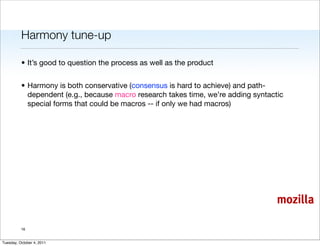
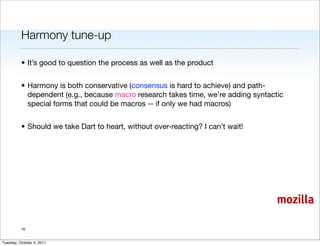
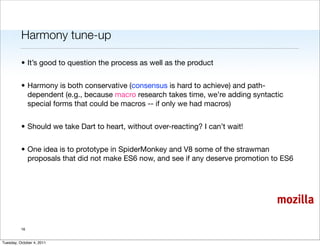
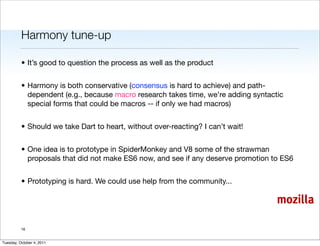
Harmony tune-up


                            mozilla

          16


Tuesday, October 4, 2011
Harmony tune-up

          • It’s good to question the process as well as the product


                                                                       mozilla

          16


Tuesday, October 4, 2011
Harmony tune-up

          • It’s good to question the process as well as the product


          • Harmony is both conservative (consensus is hard to achieve) and path-
            dependent (e.g., because macro research takes time, we’re adding syntactic
            special forms that could be macros -- if only we had macros)


                                                                                    mozilla

          16


Tuesday, October 4, 2011
Harmony tune-up

          • It’s good to question the process as well as the product


          • Harmony is both conservative (consensus is hard to achieve) and path-
            dependent (e.g., because macro research takes time, we’re adding syntactic
            special forms that could be macros -- if only we had macros)


          • Should we take Dart to heart, without over-reacting? I can’t wait!


                                                                                    mozilla

          16


Tuesday, October 4, 2011
Harmony tune-up

          • It’s good to question the process as well as the product


          • Harmony is both conservative (consensus is hard to achieve) and path-
            dependent (e.g., because macro research takes time, we’re adding syntactic
            special forms that could be macros -- if only we had macros)


          • Should we take Dart to heart, without over-reacting? I can’t wait!


          • One idea is to prototype in SpiderMonkey and V8 some of the strawman
            proposals that did not make ES6 now, and see if any deserve promotion to ES6


                                                                                    mozilla

          16


Tuesday, October 4, 2011
Harmony tune-up

          • It’s good to question the process as well as the product


          • Harmony is both conservative (consensus is hard to achieve) and path-
            dependent (e.g., because macro research takes time, we’re adding syntactic
            special forms that could be macros -- if only we had macros)


          • Should we take Dart to heart, without over-reacting? I can’t wait!


          • One idea is to prototype in SpiderMonkey and V8 some of the strawman
            proposals that did not make ES6 now, and see if any deserve promotion to ES6


          • Prototyping is hard. We could use help from the community...

                                                                                    mozilla

          16


Tuesday, October 4, 2011
Good news tonight


                              mozilla

          17


Tuesday, October 4, 2011
Good news tonight

          • ES6 is being drafted


                                   mozilla

          17


Tuesday, October 4, 2011
Good news tonight

          • ES6 is being drafted


          • It contains lots of awesome already


                                                  mozilla

          17


Tuesday, October 4, 2011
Good news tonight

          • ES6 is being drafted


          • It contains lots of awesome already


          • Prototyping in SpiderMonkey and V8 is ongoing, so we’ll actually implementor-
            and user-test before finalizing the spec


                                                                                    mozilla

          17


Tuesday, October 4, 2011
Good news tonight

          • ES6 is being drafted


          • It contains lots of awesome already


          • Prototyping in SpiderMonkey and V8 is ongoing, so we’ll actually implementor-
            and user-test before finalizing the spec


          • Even if we cut a few things -- still awesome


                                                                                    mozilla

          17


Tuesday, October 4, 2011
Good news tonight

          • ES6 is being drafted


          • It contains lots of awesome already


          • Prototyping in SpiderMonkey and V8 is ongoing, so we’ll actually implementor-
            and user-test before finalizing the spec


          • Even if we cut a few things -- still awesome


          • Help us find the prettiest and most usable syntax


                                                                                    mozilla

          17


Tuesday, October 4, 2011
Help us, pretty/usable syntax pony-corn!


                                                     mozilla

          18


Tuesday, October 4, 2011
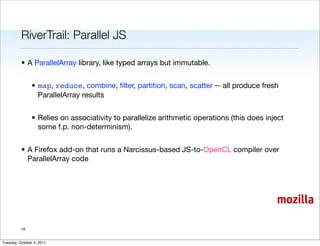
RiverTrail: Parallel JS


                                    mozilla

          19


Tuesday, October 4, 2011
RiverTrail: Parallel JS

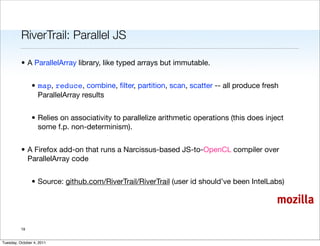
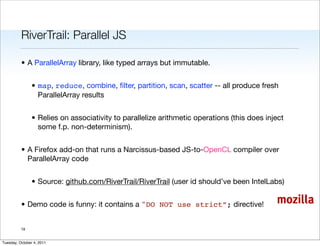
          • A ParallelArray library, like typed arrays but immutable.


                                                                        mozilla

          19


Tuesday, October 4, 2011
RiverTrail: Parallel JS

          • A ParallelArray library, like typed arrays but immutable.


                • map, reduce, combine, filter, partition, scan, scatter -- all produce fresh
                  ParallelArray results


                                                                                           mozilla

          19


Tuesday, October 4, 2011
RiverTrail: Parallel JS

          • A ParallelArray library, like typed arrays but immutable.


                • map, reduce, combine, filter, partition, scan, scatter -- all produce fresh
                  ParallelArray results


                • Relies on associativity to parallelize arithmetic operations (this does inject
                  some f.p. non-determinism).


                                                                                             mozilla

          19


Tuesday, October 4, 2011
RiverTrail: Parallel JS

          • A ParallelArray library, like typed arrays but immutable.


                • map, reduce, combine, filter, partition, scan, scatter -- all produce fresh
                  ParallelArray results


                • Relies on associativity to parallelize arithmetic operations (this does inject
                  some f.p. non-determinism).


          • A Firefox add-on that runs a Narcissus-based JS-to-OpenCL compiler over
            ParallelArray code


                                                                                             mozilla

          19


Tuesday, October 4, 2011
RiverTrail: Parallel JS

          • A ParallelArray library, like typed arrays but immutable.


                • map, reduce, combine, filter, partition, scan, scatter -- all produce fresh
                  ParallelArray results


                • Relies on associativity to parallelize arithmetic operations (this does inject
                  some f.p. non-determinism).


          • A Firefox add-on that runs a Narcissus-based JS-to-OpenCL compiler over
            ParallelArray code


                • Source: github.com/RiverTrail/RiverTrail (user id should’ve been IntelLabs)

                                                                                             mozilla

          19


Tuesday, October 4, 2011
RiverTrail: Parallel JS

          • A ParallelArray library, like typed arrays but immutable.


                • map, reduce, combine, filter, partition, scan, scatter -- all produce fresh
                  ParallelArray results


                • Relies on associativity to parallelize arithmetic operations (this does inject
                  some f.p. non-determinism).


          • A Firefox add-on that runs a Narcissus-based JS-to-OpenCL compiler over
            ParallelArray code


                • Source: github.com/RiverTrail/RiverTrail (user id should’ve been IntelLabs)


          • Demo code is funny: it contains a "DO NOT use strict”; directive!                mozilla

          19


Tuesday, October 4, 2011
RiverTrail demo sample code

          • the ParallelArray constructor builds on typed arrays:

               NBody.private.initVel = new Array(numBodies);


               NBody.private.initVelTA = new Float32Array(numBodies * 4);

               var initAsteroidPos = new Array(50);

               for (i = 0; i < 50; i++) {
                 initAsteroidPos[i] = new ParallelArray([
                                                         NBody.private.posTA[i * 3 + 0],     // x
                                                         NBody.private.posTA[i * 3 + 1],
                                                         NBody.private.posTA[i * 3 + 2],
                                                         ]);
               }
               . . .
               NBody.private.asteroidPos = new ParallelArray(Float32Array, initAsteroidPos);
               . . .
               NBody.private.vel = new ParallelArray(Float32Array, NBody.private.initVel);
                                                                                             mozilla

          20


Tuesday, October 4, 2011
ParallelArray methods in action

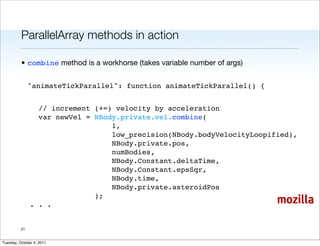
          • combine method is a workhorse (takes variable number of args)


               "animateTickParallel": function animateTickParallel() {


              // increment (+=) velocity by acceleration
              var newVel = NBody.private.vel.combine(
                               1,
                               low_precision(NBody.bodyVelocityLoopified),
                               NBody.private.pos,
                               numBodies,
                               NBody.Constant.deltaTime,
                               NBody.Constant.epsSqr,
                               NBody.time,
                               NBody.private.asteroidPos
                           );
            . . .                                                           mozilla

          21


Tuesday, October 4, 2011
Always bet on JS


Tuesday, October 4, 2011
Always bet on JS
              •     First they said JS couldn’t be useful
                    for building “rich Internet apps”


Tuesday, October 4, 2011
Always bet on JS
              •     First they said JS couldn’t be useful
                    for building “rich Internet apps”

              •     Then they said it couldn’t be fast


Tuesday, October 4, 2011
Always bet on JS
              •     First they said JS couldn’t be useful
                    for building “rich Internet apps”

              •     Then they said it couldn’t be fast

              •     Then they said it couldn’t be fixed


Tuesday, October 4, 2011
Always bet on JS
              •     First they said JS couldn’t be useful
                    for building “rich Internet apps”

              •     Then they said it couldn’t be fast

              •     Then they said it couldn’t be fixed

              •     Then it couldn’t do multicore/GPU


Tuesday, October 4, 2011
Always bet on JS
              •     First they said JS couldn’t be useful
                    for building “rich Internet apps”

              •     Then they said it couldn’t be fast

              •     Then they said it couldn’t be fixed

              •     Then it couldn’t do multicore/GPU

              •     Wrong every time!


Tuesday, October 4, 2011
Always bet on JS
              •     First they said JS couldn’t be useful
                    for building “rich Internet apps”

              •     Then they said it couldn’t be fast

              •     Then they said it couldn’t be fixed

              •     Then it couldn’t do multicore/GPU

              •     Wrong every time!

              •     My advice: always bet on JS


Tuesday, October 4, 2011
Q&A

          • @BrendanEich on twitter


          • brendan@mozilla.org


          • es-discuss@mozilla.org


                                      mozilla

          23


Tuesday, October 4, 2011

JSLOL

  • 1.
    JSLOL brendan@mozilla.org Tuesday, October 4, 2011
  • 2.
    JSLOL brendan@mozilla.org • History, goals Tuesday, October 4, 2011
  • 3.
    JSLOL brendan@mozilla.org • History, goals • ES6, what’s in it? Tuesday, October 4, 2011
  • 4.
    JSLOL brendan@mozilla.org • History, goals • ES6, what’s in it? • Controversies Tuesday, October 4, 2011
  • 5.
    JSLOL brendan@mozilla.org • History, goals • ES6, what’s in it? • Controversies • Harmony tune-up Tuesday, October 4, 2011
  • 6.
    JSLOL brendan@mozilla.org • History, goals • ES6, what’s in it? • Controversies • Harmony tune-up • RiverTrail demo Tuesday, October 4, 2011
  • 7.
    A very briefhistory mozilla 2 Tuesday, October 4, 2011
  • 8.
    A very briefhistory • Ten days in May 1995: “Mocha”, form validation, img rollovers, scripting of Java mozilla 2 Tuesday, October 4, 2011
  • 9.
    A very briefhistory • Ten days in May 1995: “Mocha”, form validation, img rollovers, scripting of Java • September 1995: “LiveScript” (did Netscape marketing go to Microsoft after?) mozilla 2 Tuesday, October 4, 2011
  • 10.
    A very briefhistory • Ten days in May 1995: “Mocha”, form validation, img rollovers, scripting of Java • September 1995: “LiveScript” (did Netscape marketing go to Microsoft after?) • December 1995: “JavaScript”, thanks to Bill Joy (a Sun Founder) mozilla 2 Tuesday, October 4, 2011
  • 11.
    A very briefhistory • Ten days in May 1995: “Mocha”, form validation, img rollovers, scripting of Java • September 1995: “LiveScript” (did Netscape marketing go to Microsoft after?) • December 1995: “JavaScript”, thanks to Bill Joy (a Sun Founder) • 1996-1997: ES1 thanks to ECMA (now Ecma) TC39 -- see my TXJS talk mozilla 2 Tuesday, October 4, 2011
  • 12.
    A very briefhistory • Ten days in May 1995: “Mocha”, form validation, img rollovers, scripting of Java • September 1995: “LiveScript” (did Netscape marketing go to Microsoft after?) • December 1995: “JavaScript”, thanks to Bill Joy (a Sun Founder) • 1996-1997: ES1 thanks to ECMA (now Ecma) TC39 -- see my TXJS talk • 1999: ES3: function expressions, RegExps, try/catch/finally, switch, do-while mozilla 2 Tuesday, October 4, 2011
  • 13.
    A very briefhistory • Ten days in May 1995: “Mocha”, form validation, img rollovers, scripting of Java • September 1995: “LiveScript” (did Netscape marketing go to Microsoft after?) • December 1995: “JavaScript”, thanks to Bill Joy (a Sun Founder) • 1996-1997: ES1 thanks to ECMA (now Ecma) TC39 -- see my TXJS talk • 1999: ES3: function expressions, RegExps, try/catch/finally, switch, do-while • 2005: the Ajax revolution, followed by “The Ajax Experience” mozilla 2 Tuesday, October 4, 2011
  • 14.
    A very briefhistory • Ten days in May 1995: “Mocha”, form validation, img rollovers, scripting of Java • September 1995: “LiveScript” (did Netscape marketing go to Microsoft after?) • December 1995: “JavaScript”, thanks to Bill Joy (a Sun Founder) • 1996-1997: ES1 thanks to ECMA (now Ecma) TC39 -- see my TXJS talk • 1999: ES3: function expressions, RegExps, try/catch/finally, switch, do-while • 2005: the Ajax revolution, followed by “The Ajax Experience” • 2008: ES4 RIP, Harmony founded in July at the Oslo TC39 meeting mozilla 2 Tuesday, October 4, 2011
  • 15.
    A very briefhistory • Ten days in May 1995: “Mocha”, form validation, img rollovers, scripting of Java • September 1995: “LiveScript” (did Netscape marketing go to Microsoft after?) • December 1995: “JavaScript”, thanks to Bill Joy (a Sun Founder) • 1996-1997: ES1 thanks to ECMA (now Ecma) TC39 -- see my TXJS talk • 1999: ES3: function expressions, RegExps, try/catch/finally, switch, do-while • 2005: the Ajax revolution, followed by “The Ajax Experience” • 2008: ES4 RIP, Harmony founded in July at the Oslo TC39 meeting mozilla • 2009: ES5: “use strict”, JSON, Object.create, etc. 2 Tuesday, October 4, 2011
  • 16.
    The Harmony goals mozilla 3 Tuesday, October 4, 2011
  • 17.
    The Harmony goals • Be a better language for writing: mozilla 3 Tuesday, October 4, 2011
  • 18.
    The Harmony goals • Be a better language for writing: • complex applications mozilla 3 Tuesday, October 4, 2011
  • 19.
    The Harmony goals • Be a better language for writing: • complex applications • libraries (including the DOM) shared by those applications mozilla 3 Tuesday, October 4, 2011
  • 20.
    The Harmony goals • Be a better language for writing: • complex applications • libraries (including the DOM) shared by those applications • code generators targeting the new edition mozilla 3 Tuesday, October 4, 2011
  • 21.
    The Harmony goals • Be a better language for writing: • complex applications • libraries (including the DOM) shared by those applications • code generators targeting the new edition • Better tests, if not a testable (executable) specification mozilla 3 Tuesday, October 4, 2011
  • 22.
    The Harmony goals • Be a better language for writing: • complex applications • libraries (including the DOM) shared by those applications • code generators targeting the new edition • Better tests, if not a testable (executable) specification • Adopt de facto standards where possible mozilla 3 Tuesday, October 4, 2011
  • 23.
    The Harmony goals • Be a better language for writing: • complex applications • libraries (including the DOM) shared by those applications • code generators targeting the new edition • Better tests, if not a testable (executable) specification • Adopt de facto standards where possible • Keep versioning as simple and linear as possible mozilla 3 Tuesday, October 4, 2011
  • 24.
    The Harmony goals • Be a better language for writing: • complex applications • libraries (including the DOM) shared by those applications • code generators targeting the new edition • Better tests, if not a testable (executable) specification • Adopt de facto standards where possible • Keep versioning as simple and linear as possible • Support a statically verifiable, object-capability subset mozilla 3 Tuesday, October 4, 2011
  • 25.
    Approved for ES6 mozilla 4 Tuesday, October 4, 2011
  • 26.
    Approved for ES6 • let, const, function in block scope mozilla 4 Tuesday, October 4, 2011
  • 27.
    Approved for ES6 • let, const, function in block scope • destructuring: let {x, y} = pt; let [s, v, o] = triple() mozilla 4 Tuesday, October 4, 2011
  • 28.
    Approved for ES6 • let, const, function in block scope • destructuring: let {x, y} = pt; let [s, v, o] = triple() • parameter default values: function f(x, y=1, {z=2, w=3}) {...} mozilla 4 Tuesday, October 4, 2011
  • 29.
    Approved for ES6 • let, const, function in block scope • destructuring: let {x, y} = pt; let [s, v, o] = triple() • parameter default values: function f(x, y=1, {z=2, w=3}) {...} • rest, spread: function g(i, j, ...r) { return r.slice(i, j); } let a = [0, 1, 2, 3], o = new any_constructor(...a) mozilla 4 Tuesday, October 4, 2011
  • 30.
    Approved for ES6 • let, const, function in block scope • destructuring: let {x, y} = pt; let [s, v, o] = triple() • parameter default values: function f(x, y=1, {z=2, w=3}) {...} • rest, spread: function g(i, j, ...r) { return r.slice(i, j); } let a = [0, 1, 2, 3], o = new any_constructor(...a) • proxies, weak maps: Proxy.create(handler, proto), new WeakMap mozilla 4 Tuesday, October 4, 2011
  • 31.
    Approved for ES6 • let, const, function in block scope • destructuring: let {x, y} = pt; let [s, v, o] = triple() • parameter default values: function f(x, y=1, {z=2, w=3}) {...} • rest, spread: function g(i, j, ...r) { return r.slice(i, j); } let a = [0, 1, 2, 3], o = new any_constructor(...a) • proxies, weak maps: Proxy.create(handler, proto), new WeakMap • modules: module M { export function fast_sin(x) {...} } mozilla 4 Tuesday, October 4, 2011
  • 32.
    Approved for ES6 • let, const, function in block scope • destructuring: let {x, y} = pt; let [s, v, o] = triple() • parameter default values: function f(x, y=1, {z=2, w=3}) {...} • rest, spread: function g(i, j, ...r) { return r.slice(i, j); } let a = [0, 1, 2, 3], o = new any_constructor(...a) • proxies, weak maps: Proxy.create(handler, proto), new WeakMap • modules: module M { export function fast_sin(x) {...} } • iterators, generators: function* gen() { yield 1; yield 2; } mozilla 4 Tuesday, October 4, 2011
  • 33.
    Approved for ES6 • let, const, function in block scope • destructuring: let {x, y} = pt; let [s, v, o] = triple() • parameter default values: function f(x, y=1, {z=2, w=3}) {...} • rest, spread: function g(i, j, ...r) { return r.slice(i, j); } let a = [0, 1, 2, 3], o = new any_constructor(...a) • proxies, weak maps: Proxy.create(handler, proto), new WeakMap • modules: module M { export function fast_sin(x) {...} } • iterators, generators: function* gen() { yield 1; yield 2; } mozilla • comprehensions: return [x+y for x of a for y of b] 4 Tuesday, October 4, 2011
  • 34.
    Yet more approvedfor ES6 mozilla 5 Tuesday, October 4, 2011
  • 35.
    Yet more approvedfor ES6 • Binary data: mozilla 5 Tuesday, October 4, 2011
  • 36.
    Yet more approvedfor ES6 • Binary data: • const Point2D = new StructType({ x: uint32, y: uint32 }), Color = new StructType({ r: uint8, g: uint8, b: uint8 }), Pixel = new StructType({ point: Point2D, color: Color }); mozilla 5 Tuesday, October 4, 2011
  • 37.
    Yet more approvedfor ES6 • Binary data: • const Point2D = new StructType({ x: uint32, y: uint32 }), Color = new StructType({ r: uint8, g: uint8, b: uint8 }), Pixel = new StructType({ point: Point2D, color: Color }); • const Triangle = new ArrayType(Pixel, 3); mozilla 5 Tuesday, October 4, 2011
  • 38.
    Yet more approvedfor ES6 • Binary data: • const Point2D = new StructType({ x: uint32, y: uint32 }), Color = new StructType({ r: uint8, g: uint8, b: uint8 }), Pixel = new StructType({ point: Point2D, color: Color }); • const Triangle = new ArrayType(Pixel, 3); • new Triangle([{ point: { x: 0, y: 0 }, color: { r: 255, g: 255, b: 255 } }, { point: { x: 5, y: 5 }, color: { r: 128, g: 0, b: 0 } }, { point: { x: 10, y: 0 }, color: { r: 0, g: 0, b: 128 } }]); mozilla 5 Tuesday, October 4, 2011
  • 39.
    Quasi-Literals mozilla 6 Tuesday, October 4, 2011
  • 40.
    Quasi-Literals • Injection-safer string interpolation and domain-specific languages mozilla 6 Tuesday, October 4, 2011
  • 41.
    Quasi-Literals • Injection-safer string interpolation and domain-specific languages • Backtick-quoted string desugars to a function call that operates on the literal portions and substitution results: mozilla 6 Tuesday, October 4, 2011
  • 42.
    Quasi-Literals • Injection-safer string interpolation and domain-specific languages • Backtick-quoted string desugars to a function call that operates on the literal portions and substitution results: • quasi`literalPart1${substitution}literalPart2` desugars to mozilla 6 Tuesday, October 4, 2011
  • 43.
    Quasi-Literals • Injection-safer string interpolation and domain-specific languages • Backtick-quoted string desugars to a function call that operates on the literal portions and substitution results: • quasi`literalPart1${substitution}literalPart2` desugars to • quasi({raw: ["literalPart1", "literalPart1"], cooked: ["literalPart1", "literalPart1"]}, substitution) mozilla 6 Tuesday, October 4, 2011
  • 44.
    Quasi-Literals • Injection-safer string interpolation and domain-specific languages • Backtick-quoted string desugars to a function call that operates on the literal portions and substitution results: • quasi`literalPart1${substitution}literalPart2` desugars to • quasi({raw: ["literalPart1", "literalPart1"], cooked: ["literalPart1", "literalPart1"]}, substitution) • Multiline string literals w/o prefix: `literalPart1${substitution} (yes, that was a newline!) literalPart2` mozilla 6 Tuesday, October 4, 2011
  • 45.
    Quasi-Literals • Injection-safer string interpolation and domain-specific languages • Backtick-quoted string desugars to a function call that operates on the literal portions and substitution results: • quasi`literalPart1${substitution}literalPart2` desugars to • quasi({raw: ["literalPart1", "literalPart1"], cooked: ["literalPart1", "literalPart1"]}, substitution) • Multiline string literals w/o prefix: `literalPart1${substitution} (yes, that was a newline!) literalPart2` mozilla • Multiline regexp literals: re`literalPart1${substitution} (yes, that was a newline!) w+ literalPart2` 6 Tuesday, October 4, 2011
  • 46.
    Classes sort ofmade it, but face existential doubt mozilla 7 Tuesday, October 4, 2011
  • 47.
    Classes sort ofmade it, but face existential doubt • Sugar for prototypal object pattern, also supports closure patterns: mozilla 7 Tuesday, October 4, 2011
  • 48.
    Classes sort ofmade it, but face existential doubt • Sugar for prototypal object pattern, also supports closure patterns: • const px = Name.create(‘x’), py = Name.create(‘y’); class Point extends Base { constructor(x, y) { super(); this[px] = x, this[py] = y; this.r = function() { return Math.sqrt(x*x + y*y); } } get x() { return this[px]; } get y() { return this[py]; } proto_r() { return Math.sqrt(this[px] * this[px] + this[py] * this[py]); } equals(p) { return this[px] === p[px] && this[py] === p[py]; } mozilla } 7 Tuesday, October 4, 2011
  • 49.
    Triangle (the protooperator) mozilla 8 Tuesday, October 4, 2011
  • 50.
    Triangle (the protooperator) • Instead of var obj = {__proto__: base, a: 1, b: 2}, use let obj = base <| {a: 1, b: 2} mozilla 8 Tuesday, October 4, 2011
  • 51.
    Triangle (the protooperator) • Instead of var obj = {__proto__: base, a: 1, b: 2}, use let obj = base <| {a: 1, b: 2} • Works for other literal object forms: let arr = base <| [p, q, r] let fun = base <| function (...args) { ... } let re = base <| /(w+)s+(w)+/g mozilla 8 Tuesday, October 4, 2011
  • 52.
    The monocle-mustache operator mozilla 9 Tuesday, October 4, 2011
  • 53.
    The monocle-mustache operator • Inspired by PrototypeJS’s Object.extend mozilla 9 Tuesday, October 4, 2011
  • 54.
    The monocle-mustache operator • Inspired by PrototypeJS’s Object.extend • base.{a:1, b:2} // warning: updates base mozilla 9 Tuesday, October 4, 2011
  • 55.
    The monocle-mustache operator • Inspired by PrototypeJS’s Object.extend • base.{a:1, b:2} // warning: updates base • Copies all “own” right-hand-side properties (including private names) to base mozilla 9 Tuesday, October 4, 2011
  • 56.
    The monocle-mustache operator • Inspired by PrototypeJS’s Object.extend • base.{a:1, b:2} // warning: updates base • Copies all “own” right-hand-side properties (including private names) to base • Should it generate a fresh value instead of mutating? let obj = base.{a:1, b:2} mozilla 9 Tuesday, October 4, 2011
  • 57.
    The monocle-mustache operator • Inspired by PrototypeJS’s Object.extend • base.{a:1, b:2} // warning: updates base • Copies all “own” right-hand-side properties (including private names) to base • Should it generate a fresh value instead of mutating? let obj = base.{a:1, b:2} • Or if we want Prototype-style update, should it look like an assignment op? base .= {a:1, b:2} mozilla 9 Tuesday, October 4, 2011
  • 58.
    Class pattern usingtriangle-monocle-mustache mozilla 10 Tuesday, October 4, 2011
  • 59.
    Class pattern usingtriangle-monocle-mustache • const px = Name.create(‘x’), py = Name.create(‘y’); let Point = Base <| function (x, y) { super(); this[px] = x, this[py] = y; this.r = function() { return Math.sqrt(x*x + y*y); } }.prototype.{ get x() { return this[px]; }, get y() { return this[py]; }, proto_r() { return Math.sqrt(this[px] * this[px] + this[py] * this[py]); }, equals(p) { return this[px] === p[px] && this[py] === p[py]; } }.constructor.{ allPoints: [] // class “static” property! } mozilla 10 Tuesday, October 4, 2011
  • 60.
    Syntax, yay mozilla 11 Tuesday, October 4, 2011
  • 61.
    Syntax, yay • Do we want class syntax, or triangle-monocle-mustache -- or triangle-monocle- equals-mustache? (triangle-monocle-long-nose-mustache?!) mozilla 11 Tuesday, October 4, 2011
  • 62.
    Syntax, yay • Do we want class syntax, or triangle-monocle-mustache -- or triangle-monocle- equals-mustache? (triangle-monocle-long-nose-mustache?!) • CoffeeScript has class as sugar for the prototypal pattern -- why can’t JS? mozilla 11 Tuesday, October 4, 2011
  • 63.
    Syntax, yay • Do we want class syntax, or triangle-monocle-mustache -- or triangle-monocle- equals-mustache? (triangle-monocle-long-nose-mustache?!) • CoffeeScript has class as sugar for the prototypal pattern -- why can’t JS? • Using funny operators is error prone and (to some, in some fonts) ugly mozilla 11 Tuesday, October 4, 2011
  • 64.
    Syntax, yay • Do we want class syntax, or triangle-monocle-mustache -- or triangle-monocle- equals-mustache? (triangle-monocle-long-nose-mustache?!) • CoffeeScript has class as sugar for the prototypal pattern -- why can’t JS? • Using funny operators is error prone and (to some, in some fonts) ugly • TC39, even with the “champions” model, falls into bikeshedding if the syntax is not super-awesome from the start mozilla 11 Tuesday, October 4, 2011
  • 65.
    Syntax, yay • Do we want class syntax, or triangle-monocle-mustache -- or triangle-monocle- equals-mustache? (triangle-monocle-long-nose-mustache?!) • CoffeeScript has class as sugar for the prototypal pattern -- why can’t JS? • Using funny operators is error prone and (to some, in some fonts) ugly • TC39, even with the “champions” model, falls into bikeshedding if the syntax is not super-awesome from the start • Should we have a world-wide syntax beauty contest? mozilla 11 Tuesday, October 4, 2011
  • 66.
    Not yet inHarmony: arrow function syntax mozilla 12 Tuesday, October 4, 2011
  • 67.
    Not yet inHarmony: arrow function syntax • Arrow function syntax, instead of λ, ƒ, or # (want to save # for later) mozilla 12 Tuesday, October 4, 2011
  • 68.
    Not yet inHarmony: arrow function syntax • Arrow function syntax, instead of λ, ƒ, or # (want to save # for later) • Just like CoffeeScript: let identity = (x) -> x mozilla 12 Tuesday, October 4, 2011
  • 69.
    Not yet inHarmony: arrow function syntax • Arrow function syntax, instead of λ, ƒ, or # (want to save # for later) • Just like CoffeeScript: let identity = (x) -> x • Expression body: const square = (x) -> (x * x) mozilla 12 Tuesday, October 4, 2011
  • 70.
    Not yet inHarmony: arrow function syntax • Arrow function syntax, instead of λ, ƒ, or # (want to save # for later) • Just like CoffeeScript: let identity = (x) -> x • Expression body: const square = (x) -> (x * x) • Statement body: let countUsed = (str) -> { if (str in usedWords) usedWords[str]++; else usedWords[str] = 1; } mozilla 12 Tuesday, October 4, 2011
  • 71.
    Not yet inHarmony: arrow function syntax • Arrow function syntax, instead of λ, ƒ, or # (want to save # for later) • Just like CoffeeScript: let identity = (x) -> x • Expression body: const square = (x) -> (x * x) • Statement body: let countUsed = (str) -> { if (str in usedWords) usedWords[str]++; else usedWords[str] = 1; } • Fat arrow too: callback = (msg) => ( this.vmail.push(msg) ) mozilla 12 Tuesday, October 4, 2011
  • 72.
    Not yet inHarmony: arrow function syntax • Arrow function syntax, instead of λ, ƒ, or # (want to save # for later) • Just like CoffeeScript: let identity = (x) -> x • Expression body: const square = (x) -> (x * x) • Statement body: let countUsed = (str) -> { if (str in usedWords) usedWords[str]++; else usedWords[str] = 1; } • Fat arrow too: callback = (msg) => ( this.vmail.push(msg) ) • Binding forms: let f() -> “writable” const K() -> “readonly” mozilla 12 Tuesday, October 4, 2011
  • 73.
    Not yet inHarmony: block lambda revival • Inspired by Smalltalk via Ruby let empty = {||}; // no need for space between bars assert(empty() === undefined); assert(typeof empty === "function"); // native and implements [[Call]] assert(empty.length === 0);   let identity = {|x| x}; // completion is return value   assert(identity(42) === 42); assert(identity.length === 1);   let a = [1, 2, 3, 4]; let b = a.map {|e| e * e} // paren-free call with block is // idiomatic control structure so // no semicolon at end mozilla print(b); // [1, 4, 9, 16] 13 Tuesday, October 4, 2011
  • 74.
    More block lambdarevival • Paren-free calls, control effects: you know you want it... b = a.map {|e| // newline in block ok e * e * e} // newline after ends call   function find_first_odd(a) { a.forEach { |e, i| if (e & 1) return i; } // returns from function return -1; }   function escape_return() { return {|e| return e}; } b = escape_return(); try { b(42); } catch (e) {} // error, return from // inactive function mozilla 14 Tuesday, October 4, 2011
  • 75.
    Syntax, yay again mozilla 15 Tuesday, October 4, 2011
  • 76.
    Syntax, yay again • Do we need shorter function syntax at all? mozilla 15 Tuesday, October 4, 2011
  • 77.
    Syntax, yay again • Do we need shorter function syntax at all? • Some say no. @mikeal: “I got 99 problems and JavaScript syntax ain’t one.” mozilla 15 Tuesday, October 4, 2011
  • 78.
    Syntax, yay again • Do we need shorter function syntax at all? • Some say no. @mikeal: “I got 99 problems and JavaScript syntax ain’t one.” • Others say yes, but divide into roughly three camps: mozilla 15 Tuesday, October 4, 2011
  • 79.
    Syntax, yay again • Do we need shorter function syntax at all? • Some say no. @mikeal: “I got 99 problems and JavaScript syntax ain’t one.” • Others say yes, but divide into roughly three camps: • Arrow function syntax, as in CoffeeScript. mozilla 15 Tuesday, October 4, 2011
  • 80.
    Syntax, yay again • Do we need shorter function syntax at all? • Some say no. @mikeal: “I got 99 problems and JavaScript syntax ain’t one.” • Others say yes, but divide into roughly three camps: • Arrow function syntax, as in CoffeeScript. • Block lambdas. @jashkenas: “For the record, I too favor [block lambdas] if arrows in JS will need curlies to delimit blocks. Curlies or arrows, not both.” mozilla 15 Tuesday, October 4, 2011
  • 81.
    Syntax, yay again • Do we need shorter function syntax at all? • Some say no. @mikeal: “I got 99 problems and JavaScript syntax ain’t one.” • Others say yes, but divide into roughly three camps: • Arrow function syntax, as in CoffeeScript. • Block lambdas. @jashkenas: “For the record, I too favor [block lambdas] if arrows in JS will need curlies to delimit blocks. Curlies or arrows, not both.” • Some leading ugly character, maybe -- unsure about this, return. mozilla 15 Tuesday, October 4, 2011
  • 82.
    Harmony tune-up mozilla 16 Tuesday, October 4, 2011
  • 83.
    Harmony tune-up • It’s good to question the process as well as the product mozilla 16 Tuesday, October 4, 2011
  • 84.
    Harmony tune-up • It’s good to question the process as well as the product • Harmony is both conservative (consensus is hard to achieve) and path- dependent (e.g., because macro research takes time, we’re adding syntactic special forms that could be macros -- if only we had macros) mozilla 16 Tuesday, October 4, 2011
  • 85.
    Harmony tune-up • It’s good to question the process as well as the product • Harmony is both conservative (consensus is hard to achieve) and path- dependent (e.g., because macro research takes time, we’re adding syntactic special forms that could be macros -- if only we had macros) • Should we take Dart to heart, without over-reacting? I can’t wait! mozilla 16 Tuesday, October 4, 2011
  • 86.
    Harmony tune-up • It’s good to question the process as well as the product • Harmony is both conservative (consensus is hard to achieve) and path- dependent (e.g., because macro research takes time, we’re adding syntactic special forms that could be macros -- if only we had macros) • Should we take Dart to heart, without over-reacting? I can’t wait! • One idea is to prototype in SpiderMonkey and V8 some of the strawman proposals that did not make ES6 now, and see if any deserve promotion to ES6 mozilla 16 Tuesday, October 4, 2011
  • 87.
    Harmony tune-up • It’s good to question the process as well as the product • Harmony is both conservative (consensus is hard to achieve) and path- dependent (e.g., because macro research takes time, we’re adding syntactic special forms that could be macros -- if only we had macros) • Should we take Dart to heart, without over-reacting? I can’t wait! • One idea is to prototype in SpiderMonkey and V8 some of the strawman proposals that did not make ES6 now, and see if any deserve promotion to ES6 • Prototyping is hard. We could use help from the community... mozilla 16 Tuesday, October 4, 2011
  • 88.
    Good news tonight mozilla 17 Tuesday, October 4, 2011
  • 89.
    Good news tonight • ES6 is being drafted mozilla 17 Tuesday, October 4, 2011
  • 90.
    Good news tonight • ES6 is being drafted • It contains lots of awesome already mozilla 17 Tuesday, October 4, 2011
  • 91.
    Good news tonight • ES6 is being drafted • It contains lots of awesome already • Prototyping in SpiderMonkey and V8 is ongoing, so we’ll actually implementor- and user-test before finalizing the spec mozilla 17 Tuesday, October 4, 2011
  • 92.
    Good news tonight • ES6 is being drafted • It contains lots of awesome already • Prototyping in SpiderMonkey and V8 is ongoing, so we’ll actually implementor- and user-test before finalizing the spec • Even if we cut a few things -- still awesome mozilla 17 Tuesday, October 4, 2011
  • 93.
    Good news tonight • ES6 is being drafted • It contains lots of awesome already • Prototyping in SpiderMonkey and V8 is ongoing, so we’ll actually implementor- and user-test before finalizing the spec • Even if we cut a few things -- still awesome • Help us find the prettiest and most usable syntax mozilla 17 Tuesday, October 4, 2011
  • 94.
    Help us, pretty/usablesyntax pony-corn! mozilla 18 Tuesday, October 4, 2011
  • 95.
    RiverTrail: Parallel JS mozilla 19 Tuesday, October 4, 2011
  • 96.
    RiverTrail: Parallel JS • A ParallelArray library, like typed arrays but immutable. mozilla 19 Tuesday, October 4, 2011
  • 97.
    RiverTrail: Parallel JS • A ParallelArray library, like typed arrays but immutable. • map, reduce, combine, filter, partition, scan, scatter -- all produce fresh ParallelArray results mozilla 19 Tuesday, October 4, 2011
  • 98.
    RiverTrail: Parallel JS • A ParallelArray library, like typed arrays but immutable. • map, reduce, combine, filter, partition, scan, scatter -- all produce fresh ParallelArray results • Relies on associativity to parallelize arithmetic operations (this does inject some f.p. non-determinism). mozilla 19 Tuesday, October 4, 2011
  • 99.
    RiverTrail: Parallel JS • A ParallelArray library, like typed arrays but immutable. • map, reduce, combine, filter, partition, scan, scatter -- all produce fresh ParallelArray results • Relies on associativity to parallelize arithmetic operations (this does inject some f.p. non-determinism). • A Firefox add-on that runs a Narcissus-based JS-to-OpenCL compiler over ParallelArray code mozilla 19 Tuesday, October 4, 2011
  • 100.
    RiverTrail: Parallel JS • A ParallelArray library, like typed arrays but immutable. • map, reduce, combine, filter, partition, scan, scatter -- all produce fresh ParallelArray results • Relies on associativity to parallelize arithmetic operations (this does inject some f.p. non-determinism). • A Firefox add-on that runs a Narcissus-based JS-to-OpenCL compiler over ParallelArray code • Source: github.com/RiverTrail/RiverTrail (user id should’ve been IntelLabs) mozilla 19 Tuesday, October 4, 2011
  • 101.
    RiverTrail: Parallel JS • A ParallelArray library, like typed arrays but immutable. • map, reduce, combine, filter, partition, scan, scatter -- all produce fresh ParallelArray results • Relies on associativity to parallelize arithmetic operations (this does inject some f.p. non-determinism). • A Firefox add-on that runs a Narcissus-based JS-to-OpenCL compiler over ParallelArray code • Source: github.com/RiverTrail/RiverTrail (user id should’ve been IntelLabs) • Demo code is funny: it contains a "DO NOT use strict”; directive! mozilla 19 Tuesday, October 4, 2011
  • 102.
    RiverTrail demo samplecode • the ParallelArray constructor builds on typed arrays: NBody.private.initVel = new Array(numBodies); NBody.private.initVelTA = new Float32Array(numBodies * 4); var initAsteroidPos = new Array(50); for (i = 0; i < 50; i++) {     initAsteroidPos[i] = new ParallelArray([                                             NBody.private.posTA[i * 3 + 0],     // x                                             NBody.private.posTA[i * 3 + 1],                                             NBody.private.posTA[i * 3 + 2],                                             ]); }   . . . NBody.private.asteroidPos = new ParallelArray(Float32Array, initAsteroidPos);   . . . NBody.private.vel = new ParallelArray(Float32Array, NBody.private.initVel); mozilla 20 Tuesday, October 4, 2011
  • 103.
    ParallelArray methods inaction • combine method is a workhorse (takes variable number of args) "animateTickParallel": function animateTickParallel() {     // increment (+=) velocity by acceleration     var newVel = NBody.private.vel.combine(                  1,                      low_precision(NBody.bodyVelocityLoopified),                      NBody.private.pos,                      numBodies,                      NBody.Constant.deltaTime,                      NBody.Constant.epsSqr,                      NBody.time,                      NBody.private.asteroidPos                  );   . . . mozilla 21 Tuesday, October 4, 2011
  • 104.
    Always bet onJS Tuesday, October 4, 2011
  • 105.
    Always bet onJS • First they said JS couldn’t be useful for building “rich Internet apps” Tuesday, October 4, 2011
  • 106.
    Always bet onJS • First they said JS couldn’t be useful for building “rich Internet apps” • Then they said it couldn’t be fast Tuesday, October 4, 2011
  • 107.
    Always bet onJS • First they said JS couldn’t be useful for building “rich Internet apps” • Then they said it couldn’t be fast • Then they said it couldn’t be fixed Tuesday, October 4, 2011
  • 108.
    Always bet onJS • First they said JS couldn’t be useful for building “rich Internet apps” • Then they said it couldn’t be fast • Then they said it couldn’t be fixed • Then it couldn’t do multicore/GPU Tuesday, October 4, 2011
  • 109.
    Always bet onJS • First they said JS couldn’t be useful for building “rich Internet apps” • Then they said it couldn’t be fast • Then they said it couldn’t be fixed • Then it couldn’t do multicore/GPU • Wrong every time! Tuesday, October 4, 2011
  • 110.
    Always bet onJS • First they said JS couldn’t be useful for building “rich Internet apps” • Then they said it couldn’t be fast • Then they said it couldn’t be fixed • Then it couldn’t do multicore/GPU • Wrong every time! • My advice: always bet on JS Tuesday, October 4, 2011
  • 111.
    Q&A • @BrendanEich on twitter • brendan@mozilla.org • es-discuss@mozilla.org mozilla 23 Tuesday, October 4, 2011