The Use of Non-Linear
Narrative in Theater of the
Absurd
Paper 110 A: History of English Literature - From 1900 to 2000
Presented at - Smt. Sujata Binoy Gardi, Department of English, MKBU, Bhavnagar
Personal Information
❖ Presenter: Pooja Bhuva A.
❖ Enrollment Number:
4069206420220005
❖ Batch: 2022 - 2024 (M.A. Sem - 2)
❖ E-mail: poojabhuva2002@gmail.com
❖ Date: 15 March, 2023
❖ Subject Code: 22403
❖ Roll No.: 15
Non-Linear Narrative
❖ Theater of the Absurd is known for its obsolete approach to narrative structure,
often employing non-linear and fragmented storytelling techniques.
❖ This can be seen as a reflection of the absurdity of human existence and the
disorientation and confusion that can arise from living in an unpredictable and
often nonsensical world.
❖ Non-linear narrative style is a storytelling technique that does not follow a linear,
chronological sequence of events. Instead, the story is presented in a fragmented
or non-chronological way, often through the use of flashbacks, dream sequences,
or other techniques that disrupt the traditional flow of time.
❖ In Theater of the Absurd, non-linear narrative is often used to reflect the
absurdity of human existence and the chaotic, unpredictable nature of the world.
❖ Non-Linear Narrative included in work may be to generate
Confusion and Disorientation so that audience or reader
concentrate on storyline.
❖ In a non-linear narrative, the audience may be presented with
events out of order, or with events that seem disconnected or even
contradictory.
❖ So, it seems like this style is also a tool to run the story smoothly
with unpredictability and also is for audencine.
❖ The audience is encouraged to engage more actively with the
story and to draw their own conclusions about the meaning and
significance of the events being portrayed.
What is the need of Non-Linear Narrative?
Different ways to present Non-Linear Narrative
❖ Some stories from the Arabian Nights, like "The City of Brass" and "The Three
Apples," don't follow a straight, chronological order. Instead, they begin in the
middle of the action (in medias res) and jump back and forth in time (using
flashbacks) to fill in the gaps and provide more information about what happened.
(Pinault)
❖ The poem Beowulf, written in medieval English, doesn't tell the story of the main
character's life in a straight, chronological order. Instead, it jumps around to different
important events throughout Beowulf's life, showing how he grows and changes over
time. (Klaeber)
❖ In the late 1800s and early 1900s, writers like Joseph Conrad, Virginia Woolf, Ford
Madox Ford, Marcel Proust, and William Faulkner were modernist novelists who
played with the way stories are told. Instead of sticking to a straight, chronological
order, they experimented with different ways of organizing events and sometimes
skipped around in time. (Heise)
❖ A critic named Martin Esslin came up with a term in 1960 called "The Theatre of the
Absurd." In his essay, he talked about a group of playwrights who wrote in this style,
including Samuel Beckett, Arthur Adamov, and Eugène Ionesco. The term refers to plays
that are strange and don't make sense in a traditional way. (Esslin)
❖ The term "The Theatre of the Absurd" comes from an essay by a French philosopher
named Albert Camus. In his essay "The Myth of Sisyphus," written in 1942, Camus said
that life is meaningless and absurd. (Culík)
❖ The plays by Samuel Beckett, Arthur Adamov, Eugene Ionesco, Jean Genet, Harold Pinter,
and others that are part of this theatre all have a similar view that people are living in a
world that they don't understand. (Culík)
❖ The world doesn't seem to have any meaning, and people feel lost and afraid. (Culík)
❖ The structure of the plays in "The Theatre of the Absurd" often goes in a circle, starting
and ending at the same point.
Theater of the Absurd
❖ "Waiting for Godot" by Samuel Beckett is a play that employs a non-linear narrative
structure. The play's structure is not chronological, and it jumps back and forth between
different time periods and events.
❖ The non-linear structure of the play supports this sense of emptiness, meaninglessness
and existentialism.
❖ The play follows two characters, Vladimir and Estragon, who are waiting for a character
named Godot to arrive. However, Godot never appears, and the characters are left to
question the meaning of their existence.
❖ The characters often repeat the same actions and conversations, and events seem to loop
back on themselves. The audience is left with the impression that nothing is progressing
or changing.
❖ They are stuck in the action of Waiting and not able to move forward, this shows how
powerless their are to make they own choices, and this might have happened because of
the use of Non-Linear Narrative in the Play.
Non-Linear Narrative in ‘Waiting for Godot’ by Samuel Beckett
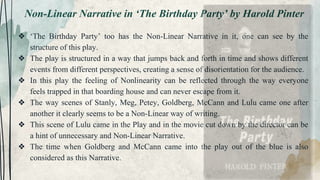
❖ ‘The Birthday Party’ too has the Non-Linear Narrative in it, one can see by the
structure of this play.
❖ The play is structured in a way that jumps back and forth in time and shows different
events from different perspectives, creating a sense of disorientation for the audience.
❖ In this play the feeling of Nonlinearity can be reflected through the way everyone
feels trapped in that boarding house and can never escape from it.
❖ The way scenes of Stanly, Meg, Petey, Goldberg, McCann and Lulu came one after
another it clearly seems to be a Non-Linear way of writing.
❖ This scene of Lulu came in the Play and in the movie cut down by the director can be
a hint of unnecessary and Non-Linear Narrative.
❖ The time when Goldberg and McCann came into the play out of the blue is also
considered as this Narrative.
Non-Linear Narrative in ‘The Birthday Party’ by Harold Pinter
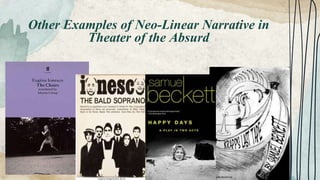
Other Examples of Neo-Linear Narrative in
Theater of the Absurd
❖ Culík, Jan. “The Theater of the Absurd The West and The East.” The Theatre of the Absurd,
University of Glasgow, 2000,
web.archive.org/web/20090823075755/www.arts.gla.ac.uk/Slavonic/Absurd.htm.
❖ Esslin, Martin. “The Theatre of the Absurd.” The Tulane Drama Review, vol. 4, no. 4, 1960,
pp. 3–15. JSTOR, https://doi.org/10.2307/1124873.
❖ Heise, Ursula K. Chronoschisms: Time, Narrative, and Postmodernism. Cambridge
University Press, 1997.
❖ Klaeber, Friedrich. Klaeber's Beowulf and The Fight at Finnsburg. University of Toronto
Press, 2008.
❖ Pinault, David. Story-Telling Techniques in the Arabian Nights. Brill, 1992.
Works Cited
CRÉDITOS: Esta apresentação foi creada pelo Slidesgo, e inclui ícones
da Flaticon, e infográficos e imagens da Freepik

The_Use_of_Non-Linear_Narrative_in_Theater_of_the_Absurd.pptx

  • 1.
    The Use ofNon-Linear Narrative in Theater of the Absurd Paper 110 A: History of English Literature - From 1900 to 2000 Presented at - Smt. Sujata Binoy Gardi, Department of English, MKBU, Bhavnagar
  • 2.
    Personal Information ❖ Presenter:Pooja Bhuva A. ❖ Enrollment Number: 4069206420220005 ❖ Batch: 2022 - 2024 (M.A. Sem - 2) ❖ E-mail: poojabhuva2002@gmail.com ❖ Date: 15 March, 2023 ❖ Subject Code: 22403 ❖ Roll No.: 15
  • 3.
    Non-Linear Narrative ❖ Theaterof the Absurd is known for its obsolete approach to narrative structure, often employing non-linear and fragmented storytelling techniques. ❖ This can be seen as a reflection of the absurdity of human existence and the disorientation and confusion that can arise from living in an unpredictable and often nonsensical world. ❖ Non-linear narrative style is a storytelling technique that does not follow a linear, chronological sequence of events. Instead, the story is presented in a fragmented or non-chronological way, often through the use of flashbacks, dream sequences, or other techniques that disrupt the traditional flow of time. ❖ In Theater of the Absurd, non-linear narrative is often used to reflect the absurdity of human existence and the chaotic, unpredictable nature of the world.
  • 4.
    ❖ Non-Linear Narrativeincluded in work may be to generate Confusion and Disorientation so that audience or reader concentrate on storyline. ❖ In a non-linear narrative, the audience may be presented with events out of order, or with events that seem disconnected or even contradictory. ❖ So, it seems like this style is also a tool to run the story smoothly with unpredictability and also is for audencine. ❖ The audience is encouraged to engage more actively with the story and to draw their own conclusions about the meaning and significance of the events being portrayed. What is the need of Non-Linear Narrative?
  • 5.
    Different ways topresent Non-Linear Narrative ❖ Some stories from the Arabian Nights, like "The City of Brass" and "The Three Apples," don't follow a straight, chronological order. Instead, they begin in the middle of the action (in medias res) and jump back and forth in time (using flashbacks) to fill in the gaps and provide more information about what happened. (Pinault) ❖ The poem Beowulf, written in medieval English, doesn't tell the story of the main character's life in a straight, chronological order. Instead, it jumps around to different important events throughout Beowulf's life, showing how he grows and changes over time. (Klaeber) ❖ In the late 1800s and early 1900s, writers like Joseph Conrad, Virginia Woolf, Ford Madox Ford, Marcel Proust, and William Faulkner were modernist novelists who played with the way stories are told. Instead of sticking to a straight, chronological order, they experimented with different ways of organizing events and sometimes skipped around in time. (Heise)
  • 6.
    ❖ A criticnamed Martin Esslin came up with a term in 1960 called "The Theatre of the Absurd." In his essay, he talked about a group of playwrights who wrote in this style, including Samuel Beckett, Arthur Adamov, and Eugène Ionesco. The term refers to plays that are strange and don't make sense in a traditional way. (Esslin) ❖ The term "The Theatre of the Absurd" comes from an essay by a French philosopher named Albert Camus. In his essay "The Myth of Sisyphus," written in 1942, Camus said that life is meaningless and absurd. (Culík) ❖ The plays by Samuel Beckett, Arthur Adamov, Eugene Ionesco, Jean Genet, Harold Pinter, and others that are part of this theatre all have a similar view that people are living in a world that they don't understand. (Culík) ❖ The world doesn't seem to have any meaning, and people feel lost and afraid. (Culík) ❖ The structure of the plays in "The Theatre of the Absurd" often goes in a circle, starting and ending at the same point. Theater of the Absurd
  • 7.
    ❖ "Waiting forGodot" by Samuel Beckett is a play that employs a non-linear narrative structure. The play's structure is not chronological, and it jumps back and forth between different time periods and events. ❖ The non-linear structure of the play supports this sense of emptiness, meaninglessness and existentialism. ❖ The play follows two characters, Vladimir and Estragon, who are waiting for a character named Godot to arrive. However, Godot never appears, and the characters are left to question the meaning of their existence. ❖ The characters often repeat the same actions and conversations, and events seem to loop back on themselves. The audience is left with the impression that nothing is progressing or changing. ❖ They are stuck in the action of Waiting and not able to move forward, this shows how powerless their are to make they own choices, and this might have happened because of the use of Non-Linear Narrative in the Play. Non-Linear Narrative in ‘Waiting for Godot’ by Samuel Beckett
  • 8.
    ❖ ‘The BirthdayParty’ too has the Non-Linear Narrative in it, one can see by the structure of this play. ❖ The play is structured in a way that jumps back and forth in time and shows different events from different perspectives, creating a sense of disorientation for the audience. ❖ In this play the feeling of Nonlinearity can be reflected through the way everyone feels trapped in that boarding house and can never escape from it. ❖ The way scenes of Stanly, Meg, Petey, Goldberg, McCann and Lulu came one after another it clearly seems to be a Non-Linear way of writing. ❖ This scene of Lulu came in the Play and in the movie cut down by the director can be a hint of unnecessary and Non-Linear Narrative. ❖ The time when Goldberg and McCann came into the play out of the blue is also considered as this Narrative. Non-Linear Narrative in ‘The Birthday Party’ by Harold Pinter
  • 9.
    Other Examples ofNeo-Linear Narrative in Theater of the Absurd
  • 10.
    ❖ Culík, Jan.“The Theater of the Absurd The West and The East.” The Theatre of the Absurd, University of Glasgow, 2000, web.archive.org/web/20090823075755/www.arts.gla.ac.uk/Slavonic/Absurd.htm. ❖ Esslin, Martin. “The Theatre of the Absurd.” The Tulane Drama Review, vol. 4, no. 4, 1960, pp. 3–15. JSTOR, https://doi.org/10.2307/1124873. ❖ Heise, Ursula K. Chronoschisms: Time, Narrative, and Postmodernism. Cambridge University Press, 1997. ❖ Klaeber, Friedrich. Klaeber's Beowulf and The Fight at Finnsburg. University of Toronto Press, 2008. ❖ Pinault, David. Story-Telling Techniques in the Arabian Nights. Brill, 1992. Works Cited
  • 11.
    CRÉDITOS: Esta apresentaçãofoi creada pelo Slidesgo, e inclui ícones da Flaticon, e infográficos e imagens da Freepik