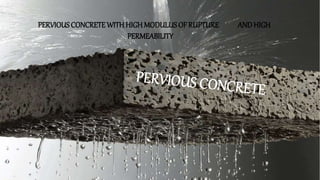
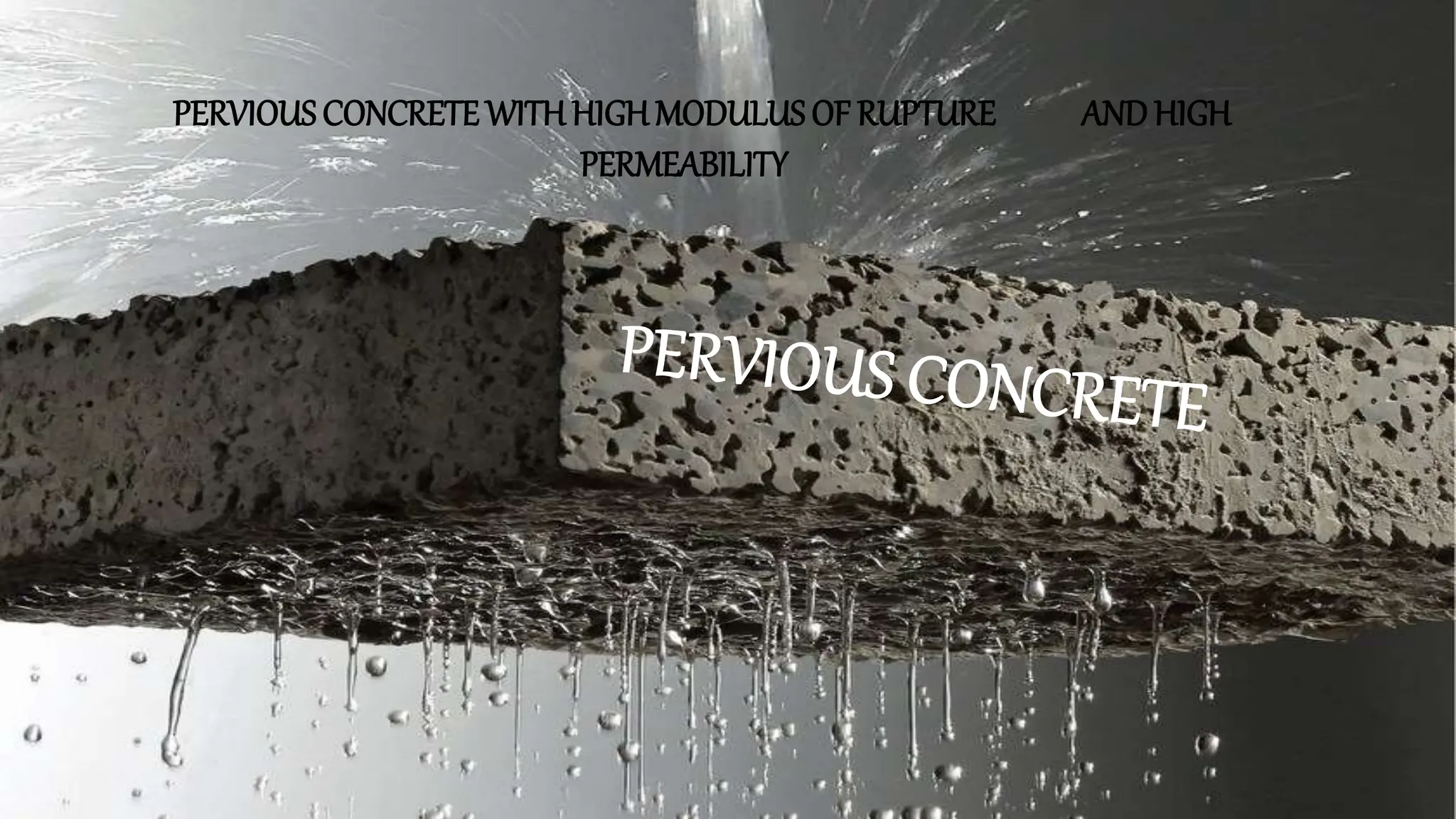
PERVIOUSCONCRETE WITH HIGH MODULUS OF RUPTURE ANDHIGH
PERMEABILITY
UNDER THE GUIDANCE OF : Mr. P.VINAY
1. SK.KARIMULLA (18KT5A0111)
2. SANA.SYED ( 17KT1A0141)
3. SHAIK.KHADEER ( 17KT1A0145)
4. SHAIK.ALIJAN ( 17KT1A0143)
5. T.DINEESHA ( 17KT1A0151)
ABSTRACT :-
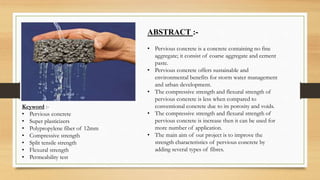
• Pervious concrete is a concrete containing no fine
aggregate; it consist of coarse aggregate and cement
paste.
• Pervious concrete offers sustainable and
environmental benefits for storm water management
and urban development.
• The compressive strength and flexural strength of
pervious concrete is less when compared to
conventional concrete due to its porosity and voids.
• The compressive strength and flexural strength of
pervious concrete is increase then it can be used for
more number of application.
• The main aim of our project is to improve the
strength characteristics of pervious concrete by
adding several types of fibres.
Keyword :-
• Pervious concrete
• Super plasticizers
• Polypropylene fiber of 12mm
• Compressive strength
• Split tensile strength
• Flexural strength
• Permeability test
INTRODUCTION :-
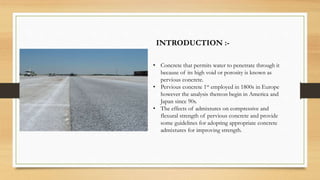
• Concrete that permits water to penetrate through it
because of its high void or porosity is known as
pervious concrete.

• Pervious concrete 1st employed in 1800s in Europe
however the analysis thereon begin in America and
Japan since 90s.
• The effects of admixtures on compressive and
flexural strength of pervious concrete and provide
some guidelines for adopting appropriate concrete
admixtures for improving strength.
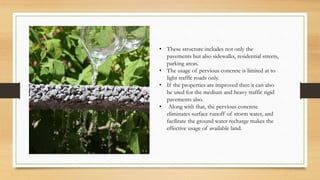
• These structure includes not only the
pavements but also sidewalks, residential streets,
parking areas.
• The usage of pervious concrete is limited at to
light traffic roads only.
• If the properties are improved then it can also
be used for the medium and heavy traffic rigid
pavements also.
• Along with that, the pervious concrete
eliminates surface runoff of storm water, and
facilitate the ground water recharge makes the
effective usage of available land.
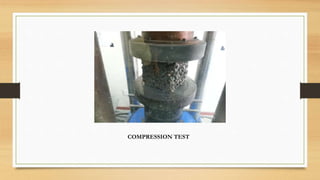
COMPRESSION TEST
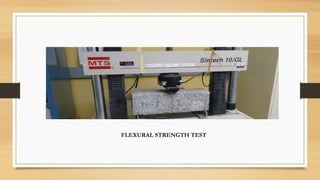
FLEXURAL STRENGTH TEST
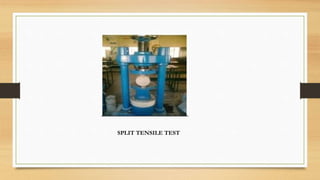
SPLIT TENSILE TEST
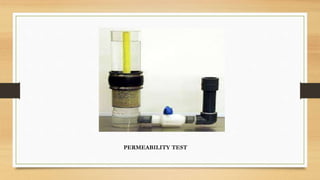
PERMEABILITY TEST
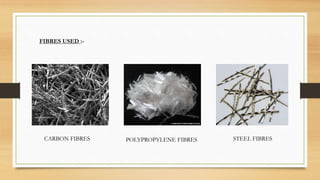
FIBRES USED :-
CARBON FIBRES POLYPROPYLENE FIBRES STEEL FIBRES
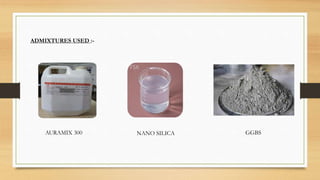
ADMIXTURES USED :-
AURAMIX 300 NANO SILICA GGBS
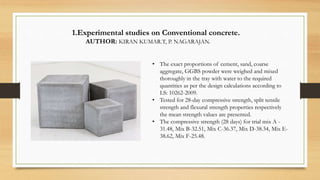
1.Experimental studies on Conventional concrete.
AUTHOR: KIRAN KUMAR.T, P. NAGARAJAN.
• The exact proportions of cement, sand, coarse
aggregate, GGBS powder were weighed and mixed
thoroughly in the tray with water to the required
quantities as per the design calculations according to
I.S: 10262-2009.
• Tested for 28-day compressive strength, split tensile
strength and flexural strength properties respectively
the mean strength values are presented.
• The compressive strength (28 days) for trial mix A -
31.48, Mix B-32.51, Mix C-36.37, Mix D-38.34, Mix E-
38.62, Mix F-25.48.
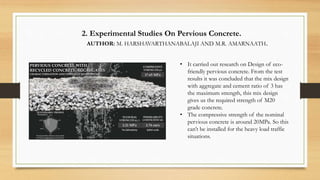
2. Experimental Studies On Pervious Concrete.
AUTHOR: M. HARSHAVARTHANABALAJI AND M.R. AMARNAATH.
• It carried out research on Design of eco-
friendly pervious concrete. From the test
results it was concluded that the mix design
with aggregate and cement ratio of 3 has
the maximum strength, this mix design
gives us the required strength of M20
grade concrete.
• The compressive strength of the nominal
pervious concrete is around 20MPa. So this
can’t be installed for the heavy load traffic
situations.
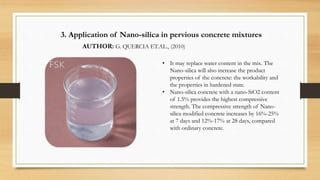
3. Application of Nano-silica in pervious concrete mixtures
AUTHOR: G. QUERCIA ET.AL., (2010)
.
• It may replace water content in the mix. The
Nano-silica will also increase the product
properties of the concrete: the workability and
the properties in hardened state.
• Nano-silica concrete with a nano-SiO2 content
of 1.5% provides the highest compressive
strength. The compressive strength of Nano-
silica modified concrete increases by 16%-25%
at 7 days and 12%-17% at 28 days, compared
with ordinary concrete.
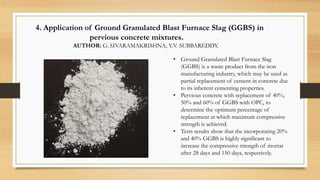
4. Application of Ground Granulated Blast Furnace Slag (GGBS) in
pervious concrete mixtures.
AUTHOR: G. SIVARAMAKRISHNA, Y.V. SUBBAREDDY.
• Ground Granulated Blast Furnace Slag
(GGBS) is a waste product from the iron
manufacturing industry, which may be used as
partial replacement of cement in concrete due
to its inherent cementing properties.
• Pervious concrete with replacement of 40%,
50% and 60% of GGBS with OPC, to
determine the optimum percentage of
replacement at which maximum compressive
strength is achieved.
• Tests results show that the incorporating 20%
and 40% GGBS is highly significant to
increase the compressive strength of mortar
after 28 days and 150 days, respectively.
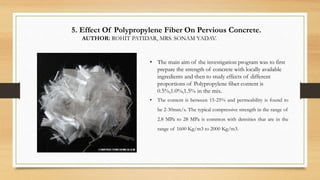
5. Effect Of Polypropylene Fiber On Pervious Concrete.
AUTHOR: ROHIT PATIDAR, MRS. SONAM YADAV.
• The main aim of the investigation program was to first
prepare the strength of concrete with locally available
ingredients and then to study effects of different
proportions of Polypropylene fiber content is
0.5%,1.0%,1.5% in the mix.
• The content is between 15-25% and permeability is found to
be 2-30mm/s. The typical compressive strength in the range of
2.8 MPa to 28 MPa is common with densities that are in the
range of 1600 Kg/m3 to 2000 Kg/m3.
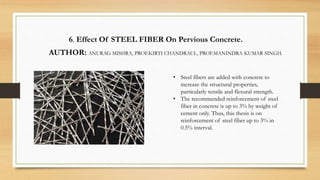
6. Effect Of STEEL FIBER On Pervious Concrete.
AUTHOR: ANURAG MISHRA, PROF.KIRTI CHANDRAUL, PROF.MANINDRA KUMAR SINGH.
• Steel fibers are added with concrete to
increase the structural properties,
particularly tensile and flexural strength.
• The recommended reinforcement of steel
fiber in concrete is up to 3% by weight of
cement only. Thus, this thesis is on
reinforcement of steel fiber up to 3% in
0.5% interval.
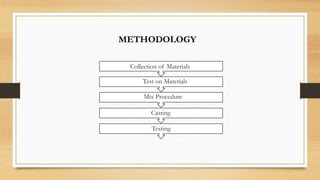
METHODOLOGY
Collection of Materials
Test on Materials
Mix Procedure
Casting
Testing
REFERENCES
1. American Concrete Institute 522R-10
2. I.S: 10262-2009-Indian Standard for water-cement ratio.
3. M. HarshavarthanaBalaji and M.R.Amarnaath- IJPUB1802101-ISSN: 2320-2882-“A
brief review on pervious concrete.”
4. T.Kiran Kumar, P.Nagarajan-ISSN: 2395-0056 -“Studies on Strength Characteristics
of Normal conventional Concrete with GGBS as Admixtures.”
5. Anurag Mishra, Prof. Kirti Chandraul, Prof. Manindra Kumar Singh- IRJET-
V4I11159-e-ISSN: 2395-0056 - “Experimental study on steel fiber reinforced
concrete.”
6. Jahid Patel, Atul Kute, Akash Thosar, Sujit Gaikwad- IRJET-V4I1205-e-ISSN: 2395-
0056-“Literature Review on Polypropylene Fiber.”
7. G.SivaRamaKrishna, Y.V.SubbaReddy- 12-IJARSET-ISSN: 2350-0328-
“Experimental Study on Partial Replacement of Cement with GGBS.”
PERVIOUS CONCRETE.pptx

PERVIOUS CONCRETE.pptx

  • 1.
    PERVIOUSCONCRETE WITH HIGHMODULUS OF RUPTURE ANDHIGH PERMEABILITY
  • 2.
    UNDER THE GUIDANCEOF : Mr. P.VINAY 1. SK.KARIMULLA (18KT5A0111) 2. SANA.SYED ( 17KT1A0141) 3. SHAIK.KHADEER ( 17KT1A0145) 4. SHAIK.ALIJAN ( 17KT1A0143) 5. T.DINEESHA ( 17KT1A0151)
  • 3.
    ABSTRACT :- • Perviousconcrete is a concrete containing no fine aggregate; it consist of coarse aggregate and cement paste. • Pervious concrete offers sustainable and environmental benefits for storm water management and urban development. • The compressive strength and flexural strength of pervious concrete is less when compared to conventional concrete due to its porosity and voids. • The compressive strength and flexural strength of pervious concrete is increase then it can be used for more number of application. • The main aim of our project is to improve the strength characteristics of pervious concrete by adding several types of fibres. Keyword :- • Pervious concrete • Super plasticizers • Polypropylene fiber of 12mm • Compressive strength • Split tensile strength • Flexural strength • Permeability test
  • 4.
    INTRODUCTION :- • Concretethat permits water to penetrate through it because of its high void or porosity is known as pervious concrete. • Pervious concrete 1st employed in 1800s in Europe however the analysis thereon begin in America and Japan since 90s. • The effects of admixtures on compressive and flexural strength of pervious concrete and provide some guidelines for adopting appropriate concrete admixtures for improving strength.
  • 5.
    • These structureincludes not only the pavements but also sidewalks, residential streets, parking areas. • The usage of pervious concrete is limited at to light traffic roads only. • If the properties are improved then it can also be used for the medium and heavy traffic rigid pavements also. • Along with that, the pervious concrete eliminates surface runoff of storm water, and facilitate the ground water recharge makes the effective usage of available land.
  • 6.
  • 7.
  • 8.
  • 9.
  • 10.
    FIBRES USED :- CARBONFIBRES POLYPROPYLENE FIBRES STEEL FIBRES
  • 11.
    ADMIXTURES USED :- AURAMIX300 NANO SILICA GGBS
  • 12.
    1.Experimental studies onConventional concrete. AUTHOR: KIRAN KUMAR.T, P. NAGARAJAN. • The exact proportions of cement, sand, coarse aggregate, GGBS powder were weighed and mixed thoroughly in the tray with water to the required quantities as per the design calculations according to I.S: 10262-2009. • Tested for 28-day compressive strength, split tensile strength and flexural strength properties respectively the mean strength values are presented. • The compressive strength (28 days) for trial mix A - 31.48, Mix B-32.51, Mix C-36.37, Mix D-38.34, Mix E- 38.62, Mix F-25.48.
  • 13.
    2. Experimental StudiesOn Pervious Concrete. AUTHOR: M. HARSHAVARTHANABALAJI AND M.R. AMARNAATH. • It carried out research on Design of eco- friendly pervious concrete. From the test results it was concluded that the mix design with aggregate and cement ratio of 3 has the maximum strength, this mix design gives us the required strength of M20 grade concrete. • The compressive strength of the nominal pervious concrete is around 20MPa. So this can’t be installed for the heavy load traffic situations.
  • 14.
    3. Application ofNano-silica in pervious concrete mixtures AUTHOR: G. QUERCIA ET.AL., (2010) . • It may replace water content in the mix. The Nano-silica will also increase the product properties of the concrete: the workability and the properties in hardened state. • Nano-silica concrete with a nano-SiO2 content of 1.5% provides the highest compressive strength. The compressive strength of Nano- silica modified concrete increases by 16%-25% at 7 days and 12%-17% at 28 days, compared with ordinary concrete.
  • 15.
    4. Application ofGround Granulated Blast Furnace Slag (GGBS) in pervious concrete mixtures. AUTHOR: G. SIVARAMAKRISHNA, Y.V. SUBBAREDDY. • Ground Granulated Blast Furnace Slag (GGBS) is a waste product from the iron manufacturing industry, which may be used as partial replacement of cement in concrete due to its inherent cementing properties. • Pervious concrete with replacement of 40%, 50% and 60% of GGBS with OPC, to determine the optimum percentage of replacement at which maximum compressive strength is achieved. • Tests results show that the incorporating 20% and 40% GGBS is highly significant to increase the compressive strength of mortar after 28 days and 150 days, respectively.
  • 16.
    5. Effect OfPolypropylene Fiber On Pervious Concrete. AUTHOR: ROHIT PATIDAR, MRS. SONAM YADAV. • The main aim of the investigation program was to first prepare the strength of concrete with locally available ingredients and then to study effects of different proportions of Polypropylene fiber content is 0.5%,1.0%,1.5% in the mix. • The content is between 15-25% and permeability is found to be 2-30mm/s. The typical compressive strength in the range of 2.8 MPa to 28 MPa is common with densities that are in the range of 1600 Kg/m3 to 2000 Kg/m3.
  • 17.
    6. Effect OfSTEEL FIBER On Pervious Concrete. AUTHOR: ANURAG MISHRA, PROF.KIRTI CHANDRAUL, PROF.MANINDRA KUMAR SINGH. • Steel fibers are added with concrete to increase the structural properties, particularly tensile and flexural strength. • The recommended reinforcement of steel fiber in concrete is up to 3% by weight of cement only. Thus, this thesis is on reinforcement of steel fiber up to 3% in 0.5% interval.
  • 18.
    METHODOLOGY Collection of Materials Teston Materials Mix Procedure Casting Testing
  • 19.
    REFERENCES 1. American ConcreteInstitute 522R-10 2. I.S: 10262-2009-Indian Standard for water-cement ratio. 3. M. HarshavarthanaBalaji and M.R.Amarnaath- IJPUB1802101-ISSN: 2320-2882-“A brief review on pervious concrete.” 4. T.Kiran Kumar, P.Nagarajan-ISSN: 2395-0056 -“Studies on Strength Characteristics of Normal conventional Concrete with GGBS as Admixtures.” 5. Anurag Mishra, Prof. Kirti Chandraul, Prof. Manindra Kumar Singh- IRJET- V4I11159-e-ISSN: 2395-0056 - “Experimental study on steel fiber reinforced concrete.” 6. Jahid Patel, Atul Kute, Akash Thosar, Sujit Gaikwad- IRJET-V4I1205-e-ISSN: 2395- 0056-“Literature Review on Polypropylene Fiber.” 7. G.SivaRamaKrishna, Y.V.SubbaReddy- 12-IJARSET-ISSN: 2350-0328- “Experimental Study on Partial Replacement of Cement with GGBS.”