The Nucleus AccumbensMartina Cupova and Julia Matejcek
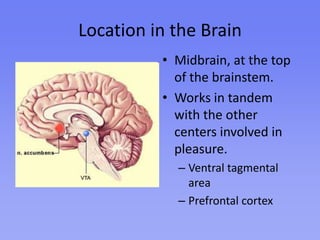
Location in the BrainMidbrain, at the top of the brainstem.Works in tandem with the other centers involved in pleasure.Ventral tagmental areaPrefrontal cortex
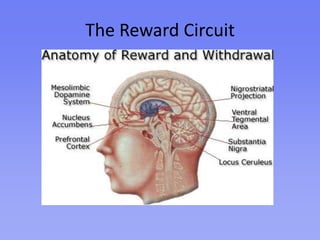
The Reward Circuit
FunctionPart of the reward circuit.Two neurotransmitters: dopamine (desire) seretonin (satiety and inhibition)Maintains motivation.Controls feeding, sexual, reward, stress-related, and drug self-administration behaviours.
A study by James OldesAim – to determine how rats would respond to the opportunity of stimulating their pleasure centers by pressing a lever.ProcedureOldes implanted electrodes in the brains of the rats.They received an electrical shock to their nucleus accumbens each time they pressed a lever.In some conditions, an electrified grid was placed between the rat and the lever.
Results and FindingsThe rats became addicted to the rush of pushing the lever.They preferred it to eating and drinking – some of the rats even starved themselves.Many even ran across the electrified grid to reach the lever.
A study by Axmacher et al.Aim: to determine whether activation of the nucleus accumbens precedes the formation of memories of surprising events.ProcedureImplanted electrodes in the nucleus accumbens and hippocampus of participants.Showed participants a picture of a face on a red background for a few seconds and then switched the picture to a house on a green background.Used an electroencephalogram (EEG) to put together the overall pattern of brain activity while this was happening.
Results and FindingsSwitching the stimulus activated the hippocampus, the nucleus accumbens, and then the hippocampus again.This brain pattern provides a way to consistently predict memory formation.The nucleus accumbens is involved in processing not only rewards, but also novel information.May influence further processing by the hippocampus.
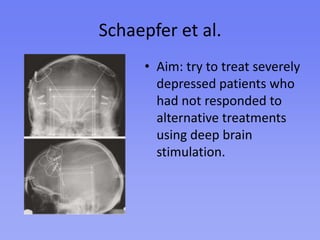
Schaepfer et al.Aim: try to treat severely depressed patients who had not responded to alternative treatments using deep brain stimulation.
ProcedureImplanted the electrodes in the nucleus accumbens of the patients.Turned on the stimulator to send electrical signals to that part of the brain.Turned the stimulator on and off over a period of weeks and tracked development of symptoms by questionnaires.
Results and FindingsMost patients reported positive effects instantaneously – they had newfound motivation.Most patients improved only in the short-term – they had instant results that did not last.Deep brain stimulation of the nucleus accumbens did not treat depression in the long term.
DysfunctionDepression
ADHD – motivation is impaired.
Drug addiction – unusually high levels of dopamine in the nucleus accumbens.Works CitedCrane, J., & Hannibal, J. (2009). Psychology: Course Companion. Oxford: 	Oxford University Press.Dubuc, B. (2002, September). The Pleasure Centres Affected by Drugs. In The 	Brain from Top to Bottom. Retrieved from http://thebrain.mcgill.ca/Fernandez-Espejo, E. (2000, May). How does the Nucleus Accumbens 	Function? In Pub Med [biomedical data base]. Retrieved from 	http://www.ncbi.nlm.nih.gov/‌pubmedHarmon, K. (2010, February 24). Surprised? How the Brain Records Memories 	of the Unexpected. In The Scientific American. Retrieved from 	http://www.scientificamerican.com
Works Cited cont.New Way To Fight Cocaine Addiction Discovered. (2009, April 2). Science Daily. Retrieved from University of California - Irvine website: http://www.sciencedaily.comScientists Discover Alterations in Brain’s Reward System Related to Attention-Deficit/‌hyperactivity Disorder. (n.d.). Science Daily. Retrieved from Universitat Autònoma de Barcelona website: http://www.sciencedaily.comSinger, E. (2007, April 26). Brain Electrodes Help Treat Depression. In Technology Review. Retrieved from Massachusetts Institute of Technology website: http://technologyreview.comSurprise! Neural Mechanism May Underlie an Enhanced Memory for the Unexpected. (2010, February 25). Science Daily.
Nucleus  Accumbens

Nucleus Accumbens

  • 1.
    The Nucleus AccumbensMartinaCupova and Julia Matejcek
  • 2.
    Location in theBrainMidbrain, at the top of the brainstem.Works in tandem with the other centers involved in pleasure.Ventral tagmental areaPrefrontal cortex
  • 3.
  • 4.
    FunctionPart of thereward circuit.Two neurotransmitters: dopamine (desire) seretonin (satiety and inhibition)Maintains motivation.Controls feeding, sexual, reward, stress-related, and drug self-administration behaviours.
  • 5.
    A study byJames OldesAim – to determine how rats would respond to the opportunity of stimulating their pleasure centers by pressing a lever.ProcedureOldes implanted electrodes in the brains of the rats.They received an electrical shock to their nucleus accumbens each time they pressed a lever.In some conditions, an electrified grid was placed between the rat and the lever.
  • 6.
    Results and FindingsTherats became addicted to the rush of pushing the lever.They preferred it to eating and drinking – some of the rats even starved themselves.Many even ran across the electrified grid to reach the lever.
  • 7.
    A study byAxmacher et al.Aim: to determine whether activation of the nucleus accumbens precedes the formation of memories of surprising events.ProcedureImplanted electrodes in the nucleus accumbens and hippocampus of participants.Showed participants a picture of a face on a red background for a few seconds and then switched the picture to a house on a green background.Used an electroencephalogram (EEG) to put together the overall pattern of brain activity while this was happening.
  • 8.
    Results and FindingsSwitchingthe stimulus activated the hippocampus, the nucleus accumbens, and then the hippocampus again.This brain pattern provides a way to consistently predict memory formation.The nucleus accumbens is involved in processing not only rewards, but also novel information.May influence further processing by the hippocampus.
  • 9.
    Schaepfer et al.Aim:try to treat severely depressed patients who had not responded to alternative treatments using deep brain stimulation.
  • 10.
    ProcedureImplanted the electrodesin the nucleus accumbens of the patients.Turned on the stimulator to send electrical signals to that part of the brain.Turned the stimulator on and off over a period of weeks and tracked development of symptoms by questionnaires.
  • 11.
    Results and FindingsMostpatients reported positive effects instantaneously – they had newfound motivation.Most patients improved only in the short-term – they had instant results that did not last.Deep brain stimulation of the nucleus accumbens did not treat depression in the long term.
  • 12.
  • 13.
  • 14.
    Drug addiction –unusually high levels of dopamine in the nucleus accumbens.Works CitedCrane, J., & Hannibal, J. (2009). Psychology: Course Companion. Oxford: Oxford University Press.Dubuc, B. (2002, September). The Pleasure Centres Affected by Drugs. In The Brain from Top to Bottom. Retrieved from http://thebrain.mcgill.ca/Fernandez-Espejo, E. (2000, May). How does the Nucleus Accumbens Function? In Pub Med [biomedical data base]. Retrieved from http://www.ncbi.nlm.nih.gov/‌pubmedHarmon, K. (2010, February 24). Surprised? How the Brain Records Memories of the Unexpected. In The Scientific American. Retrieved from http://www.scientificamerican.com
  • 15.
    Works Cited cont.NewWay To Fight Cocaine Addiction Discovered. (2009, April 2). Science Daily. Retrieved from University of California - Irvine website: http://www.sciencedaily.comScientists Discover Alterations in Brain’s Reward System Related to Attention-Deficit/‌hyperactivity Disorder. (n.d.). Science Daily. Retrieved from Universitat Autònoma de Barcelona website: http://www.sciencedaily.comSinger, E. (2007, April 26). Brain Electrodes Help Treat Depression. In Technology Review. Retrieved from Massachusetts Institute of Technology website: http://technologyreview.comSurprise! Neural Mechanism May Underlie an Enhanced Memory for the Unexpected. (2010, February 25). Science Daily.