TRILL & Datacenter technologies – their
importance, and alternatives to
datacenter network convergence


Rajesh Kumar Sundararajan
Assistant VP Product Management, Aricent
May 10, Interop Las Vegas, 2012
About Me
  ARICENT Group
  • Global innovation, technology, and services company
  • Focused exclusively on communications
  • Co-creating most innovative communications products and applications
    with customers
  • Complete lifecycle solutions for networks, management, applications


  Me
  • Rajesh Kumar Sundararajan
  • Assistant Vice President – Product Line Management
  • Ethernet, IP and Datacenter offerings


                                                                           2
Agenda

 Datacenter imperatives
 Solutions proposed to datacenter imperatives
 Categorization of the solutions
 Technological overview of each of the solutions
 TRILL and alternatives
 Summary comparison
 Conclusion


                                                   3
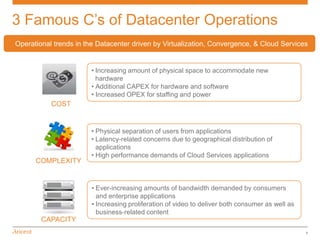
3 Famous C’s of Datacenter Operations
Operational trends in the Datacenter driven by Virtualization, Convergence, & Cloud Services


                       • Increasing amount of physical space to accommodate new
                         hardware
                       • Additional CAPEX for hardware and software
                       • Increased OPEX for staffing and power
           COST


                       • Physical separation of users from applications
                       • Latency-related concerns due to geographical distribution of
                         applications
                       • High performance demands of Cloud Services applications
      COMPLEXITY


                        • Ever-increasing amounts of bandwidth demanded by consumers
                          and enterprise applications
                        • Increasing proliferation of video to deliver both consumer as well as
                          business-related content
        CAPACITY
                                                                                                  4
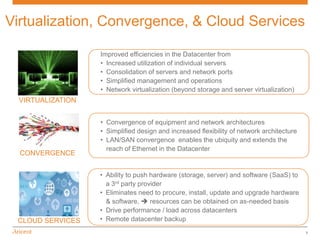
Virtualization, Convergence, & Cloud Services

                   Improved efficiencies in the Datacenter from
                   • Increased utilization of individual servers
                   • Consolidation of servers and network ports
                   • Simplified management and operations
                   • Network virtualization (beyond storage and server virtualization)
  VIRTUALIZATION


                   • Convergence of equipment and network architectures
                   • Simplified design and increased flexibility of network architecture
                   • LAN/SAN convergence enables the ubiquity and extends the
                     reach of Ethernet in the Datacenter
  CONVERGENCE


                   • Ability to push hardware (storage, server) and software (SaaS) to
                     a 3rd party provider
                   • Eliminates need to procure, install, update and upgrade hardware
                     & software,  resources can be obtained on as-needed basis
                   • Drive performance / load across datacenters
 CLOUD SERVICES    • Remote datacenter backup
                                                                                           5
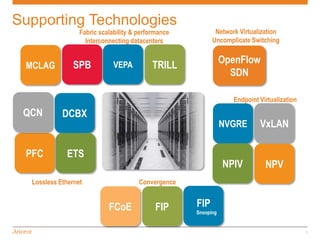
Imperatives and Solutions
          Increase Price/ Performance Ratio
          • 10Gb Ethernet support required for all new Datacenter Ethernet equipment
          • Migration to 40GbE/100GbE needs to be planned
          • Next gen products need to balance high performance with low CAPEX &
            OPEX

          Improve Energy Efficiency
          • Networking equipment needs to lower energy consumption costs
          • New server chipsets, architectures and software needed to improve overall
            energy efficiency


          Support Multiple Migration Options
          • Multiple migration options available for evolution to a converged network
          • Companies may start by migrating to converged network adaptors to top-of-
            rack switches to a converged core or vice versa
          • Equipment vendors need to support different migration options in products
          Evolve Standards
          •   DCBX, ETS, PFC, QCN
          •   FCoE, FIP, FIP Snooping
          •   Openflow, SDN, TRILL, SPB, MC-LAG
          •   VxLAN, NVGRE

                                                                                        6
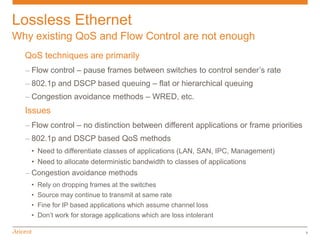
Supporting Technologies
                  Fabric scalability & performance          Network Virtualization
                    Interconnecting datacenters            Uncomplicate Switching


                SPB           VEPA          TRILL               OpenFlow
 MCLAG
                                                                  SDN

                                                                  Endpoint Virtualization

 QCN        DCBX
                                                                NVGRE      VxLAN

 PFC         ETS
                                                                NPIV         NPV
  Lossless Ethernet                    Convergence


                            FCoE             FIP     FIP
                                                     Snooping


                                                                                            7
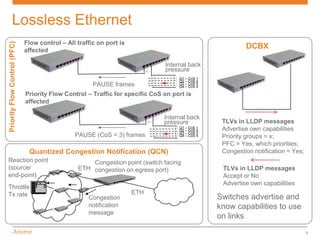
Lossless Ethernet
Why existing QoS and Flow Control are not enough
  QoS techniques are primarily
  – Flow control – pause frames between switches to control sender’s rate
  – 802.1p and DSCP based queuing – flat or hierarchical queuing
  – Congestion avoidance methods – WRED, etc.
  Issues
  – Flow control – no distinction between different applications or frame priorities
  – 802.1p and DSCP based QoS methods
   • Need to differentiate classes of applications (LAN, SAN, IPC, Management)
   • Need to allocate deterministic bandwidth to classes of applications
  – Congestion avoidance methods
   • Rely on dropping frames at the switches
   • Source may continue to transmit at same rate
   • Fine for IP based applications which assume channel loss
   • Don’t work for storage applications which are loss intolerant

                                                                                       8
Lossless Ethernet
                              Flow control – All traffic on port is
Priority Flow Control (PFC)


                              affected
                                                                                                          DCBX

                                                                               Internal back
                                                                               pressure
                                                                                    Q1 – CoS 1
                                                                                    Q2 – CoS 2
                                                       PAUSE frames                 Q3 – CoS 3
                                                                                    Q4 – CoS 4

                              Priority Flow Control – Traffic for specific CoS on port is
                              affected

                                                                               Internal back
                                                                               pressure           TLVs in LLDP messages
                                                                                    Q1 – CoS 1
                                                                                    Q2 – CoS 2    Advertise own capabilities
                                                                                    Q3 – CoS 3
                                                PAUSE (CoS = 3) frames              Q4 – CoS 4    Priority groups = x;
                                                                                                  PFC = Yes, which priorities;
                               Quantized Congestion Notification (QCN)                            Congestion notification = Yes;
Reaction point                                       Congestion point (switch facing
(source/                                         ETH congestion on egress port)                   TLVs in LLDP messages
end-point)                                                                                        Accept or No
                                                                                                  Advertise own capabilities
Throttle
Tx rate                                                               ETH
                                                     Congestion                                  Switches advertise and
                                                     notification                                know capabilities to use
                                                     message
                                                                                                 on links
                                                                                                                                   9
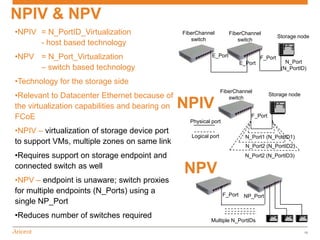
NPIV & NPV
•NPIV = N_PortID_Virtualization                  FiberChannel         FiberChannel
                                                                                            Storage node
                                                    switch               switch
      - host based technology
•NPV = N_Port_Virtualization                                E_Port                 F_Port
                                                                          E_Port               N_Port
     – switch based technology                                                               (N_PortID)

•Technology for the storage side
                                                                   FiberChannel
•Relevant to Datacenter Ethernet because of                           switch
                                                                                       Storage node

the virtualization capabilities and bearing on   NPIV
FCoE                                               Physical port
                                                                              F_Port

•NPIV – virtualization of storage device port
                                                    Logical port            N_Port1 (N_PortID1)
to support VMs, multiple zones on same link                                 N_Port2 (N_PortID2)
•Requires support on storage endpoint and                                   N_Port2 (N_PortID3)

connected switch as well
                                                 NPV
•NPV – endpoint is unaware; switch proxies
for multiple endpoints (N_Ports) using a                           F_Port NP_Port
single NP_Port
•Reduces number of switches required
                                                            Multiple N_PortIDs

                                                                                                      10
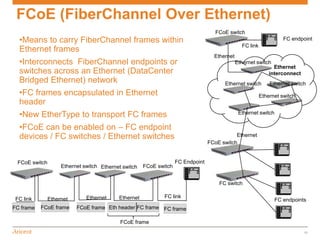
FCoE (FiberChannel Over Ethernet)
                                                                                     FCoE switch
  •Means to carry FiberChannel frames within                                                                         FC endpoint
                                                                                                 FC link
  Ethernet frames
                                                                                    Ethernet
  •Interconnects FiberChannel endpoints or                                                     Ethernet switch
                                                                                                                 Ethernet
  switches across an Ethernet (DataCenter                                                                      interconnect
  Bridged Ethernet) network                                                             Ethernet switch        Ethernet switch
  •FC frames encapsulated in Ethernet                                                                      Ethernet switch
  header
  •New EtherType to transport FC frames                                                         Ethernet switch

  •FCoE can be enabled on – FC endpoint
  devices / FC switches / Ethernet switches                                                  Ethernet
                                                                                  FCoE switch


 FCoE switch                                                        FC Endpoint
                    Ethernet switch Ethernet switch   FCoE switch


                                                                                      FC switch

 FC link       Ethernet       Ethernet     Ethernet          FC link
                                                                                                                  FC endpoints
FC frame   FCoE frame     FCoE frame Eth header FC frame FC frame

                                            FCoE frame
                                                                                                                              11
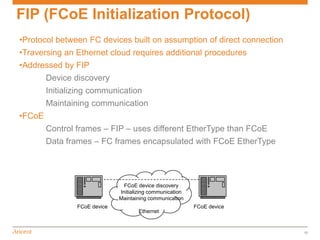
FIP (FCoE Initialization Protocol)
•Protocol between FC devices built on assumption of direct connection
•Traversing an Ethernet cloud requires additional procedures
•Addressed by FIP
        Device discovery
        Initializing communication
        Maintaining communication
•FCoE
        Control frames – FIP – uses different EtherType than FCoE
        Data frames – FC frames encapsulated with FCoE EtherType


                                FCoE device discovery
                              Initializing communication
                              Maintaining communication
                FCoE device                                FCoE device
                                     Ethernet


                                                                         12
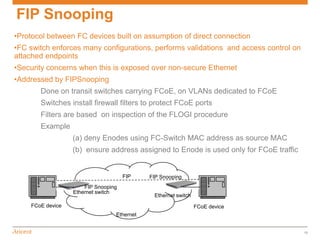
FIP Snooping
•Protocol between FC devices built on assumption of direct connection
•FC switch enforces many configurations, performs validations and access control on
attached endpoints
•Security concerns when this is exposed over non-secure Ethernet
•Addressed by FIPSnooping
       Done on transit switches carrying FCoE, on VLANs dedicated to FCoE
       Switches install firewall filters to protect FCoE ports
       Filters are based on inspection of the FLOGI procedure
       Example
                  (a) deny Enodes using FC-Switch MAC address as source MAC
                  (b) ensure address assigned to Enode is used only for FCoE traffic


                                     FIP    FIP Snooping
                      FIP Snooping
                  Ethernet switch
                                             Ethernet switch
    FCoE device                                                FCoE device
                                 Ethernet


                                                                                       13
Fabric Scalability and Performance
Why Spanning Tree (RSTP/MSTP/PVRST) is not enough
Necessary fundamentals for FCoE to work
        Multipath through the network
        Lossless fabric
        Rapid convergence in fabric
Spanning tree (with variants like RSTP, MSTP, PVRST) is the universal way to provide redundancy
and stability (loop avoidance) in Ethernet networks
Spanning tree is a distance vector based protocol
  • Routing equivalent of spanning tree (distance vector based) = RIP
  • Limits the size of the network that it can handle
  • Much smaller network size than link state based protocols (OSPF / ISIS)
Datacenter networks have got much bigger (and getting bigger still !!)
Spanning tree blocks links / paths to create redundancy  inefficient capacity utilization
Does not support multipath which is important for SAN/LAN convergence
The TRILL solution
  • Apply link state routing to bridging / Layer 2 Ethernet
  • Use technique like ECMP for alternate paths without blocking any links or paths

                                                                                                  14
Fabric Scalability and Performance
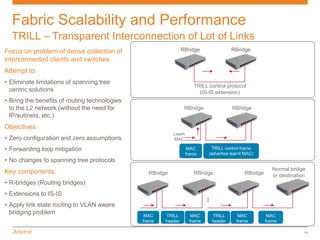
  TRILL – Transparent Interconnection of Lot of Links
Focus on problem of dense collection of                         RBridge                RBridge
interconnected clients and switches
Attempt to:
• Eliminate limitations of spanning tree
                                                                      TRILL control protocol
  centric solutions                                                     (IS-IS extension)
• Bring the benefits of routing technologies
  to the L2 network (without the need for                        RBridge               RBridge
  IP/subnets, etc.)
Objectives:
                                                           Learn
• Zero configuration and zero assumptions                  MAC

• Forwarding loop mitigation                                        MAC      TRILL control frame
                                                                   frame    (advertise learnt MAC)
• No changes to spanning tree protocols
                                                                                                          Normal bridge
Key components:                                  RBridge              RBridge                RBridge      or destination
• R-bridges (Routing bridges)
• Extensions to IS-IS
• Apply link state routing to VLAN aware
  bridging problem                              MAC    TRILL         MAC     TRILL        MAC           MAC
                                               frame   header       frame    header      frame         frame

                                                                                                                       15
Fabric Scalability and Performance
TRILL – Handling Multicast and Broadcast
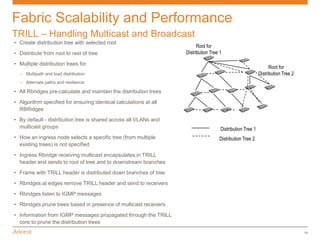
• Create distribution tree with selected root
                                                                         Root for
• Distribute from root to rest of tree                             Distribution Tree 1

• Multiple distribution trees for
                                                                                                                 Root for
  – Multipath and load distribution                                                                        Distribution Tree 2
  – Alternate paths and resilience

• All Rbridges pre-calculate and maintain the distribution trees
• Algorithm specified for ensuring identical calculations at all
  RBRidges
• By default - distribution tree is shared across all VLANs and
  multicast groups                                                                   Distribution Tree 1
• How an ingress node selects a specific tree (from multiple                        Distribution Tree 2
  existing trees) is not specified
• Ingress Rbridge receiving multicast encapsulates in TRILL
  header and sends to root of tree and to downstream branches
• Frame with TRILL header is distributed down branches of tree
• Rbridges at edges remove TRILL header and send to receivers
• Rbridges listen to IGMP messages
• Rbridges prune trees based in presence of multicast receivers
• Information from IGMP messages propagated through the TRILL
  core to prune the distribution trees
                                                                                                                                 16
Fabric Scalability and Performance
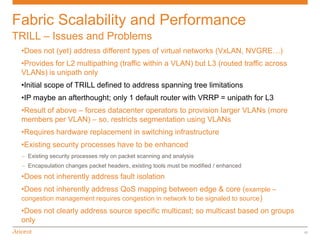
TRILL – Issues and Problems
 •Does not (yet) address different types of virtual networks (VxLAN, NVGRE…)
 •Provides for L2 multipathing (traffic within a VLAN) but L3 (routed traffic across
 VLANs) is unipath only
 •Initial scope of TRILL defined to address spanning tree limitations
 •IP maybe an afterthought; only 1 default router with VRRP = unipath for L3
 •Result of above – forces datacenter operators to provision larger VLANs (more
 members per VLAN) – so, restricts segmentation using VLANs
 •Requires hardware replacement in switching infrastructure
 •Existing security processes have to be enhanced
 – Existing security processes rely on packet scanning and analysis
 – Encapsulation changes packet headers, existing tools must be modified / enhanced
 •Does not inherently address fault isolation
 •Does not inherently address QoS mapping between edge & core (example –
 congestion management requires congestion in network to be signaled to source )
 •Does not clearly address source specific multicast; so multicast based on groups
 only
                                                                                       17
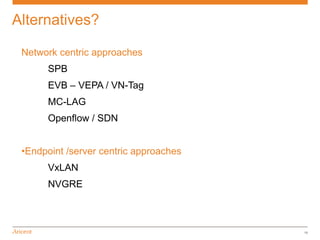
Alternatives?

 Network centric approaches
      SPB
      EVB – VEPA / VN-Tag
      MC-LAG
      Openflow / SDN


 •Endpoint /server centric approaches
      VxLAN
      NVGRE


                                        18
Fabric Scalability and Performance
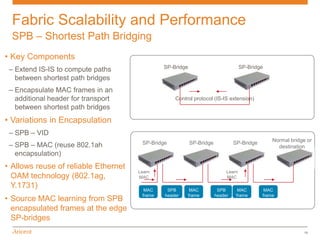
  SPB – Shortest Path Bridging
• Key Components
                                               SP-Bridge                            SP-Bridge
 – Extend IS-IS to compute paths
   between shortest path bridges
 – Encapsulate MAC frames in an
   additional header for transport                 Control protocol (IS-IS extension)
   between shortest path bridges
• Variations in Encapsulation
 – SPB – VID
                                                                                                Normal bridge or
 – SPB – MAC (reuse 802.1ah            SP-Bridge           SP-Bridge            SP-Bridge
                                                                                                  destination
   encapsulation)
• Allows reuse of reliable Ethernet
                                      Learn                                 Learn
  OAM technology (802.1ag,            MAC                                   MAC

  Y.1731)                               MAC     SPB      MAC            SPB       MAC        MAC
                                       frame   header   frame          header    frame      frame
• Source MAC learning from SPB
  encapsulated frames at the edge
  SP-bridges
                                                                                                            19
EVB (Edge Virtual Bridging)
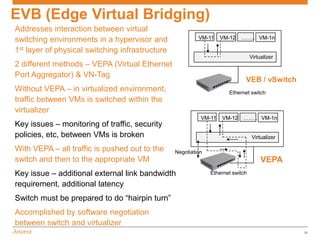
Addresses interaction between virtual
switching environments in a hypervisor and                VM-11    VM-12 ……… VM-1n

1st layer of physical switching infrastructure
                                                                                 Virtualizer
2 different methods – VEPA (Virtual Ethernet
Port Aggregator) & VN-Tag
                                                                             VEB / vSwitch
Without VEPA – in virtualized environment,                            Ethernet switch
traffic between VMs is switched within the
virtualizer
                                                           VM-11   VM-12 ……… VM-1n
Key issues – monitoring of traffic, security
policies, etc, between VMs is broken                                              Virtualizer

With VEPA – all traffic is pushed out to the     Negotiation
switch and then to the appropriate VM                                                 VEPA
Key issue – additional external link bandwidth                 Ethernet switch

requirement, additional latency
Switch must be prepared to do “hairpin turn”
Accomplished by software negotiation
between switch and virtualizer
                                                                                                20
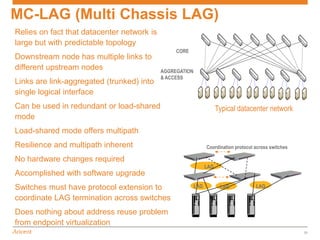
MC-LAG (Multi Chassis LAG)
Relies on fact that datacenter network is
large but with predictable topology
                                                 CORE
Downstream node has multiple links to
different upstream nodes                    AGGREGATION
                                            & ACCESS
Links are link-aggregated (trunked) into
single logical interface
Can be used in redundant or load-shared                               Typical datacenter network
mode
Load-shared mode offers multipath
Resilience and multipath inherent                               Coordination protocol across switches

No hardware changes required
                                                                LAG
Accomplished with software upgrade
Switches must have protocol extension to                  LAG          LAG            LAG

coordinate LAG termination across switches
Does nothing about address reuse problem
from endpoint virtualization
                                                                                                        21
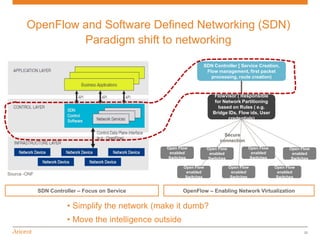
OpenFlow and Software Defined Networking (SDN)
                 Paradigm shift to networking

                                                                  SDN Controller [ Service Creation,
                                                                   Flow management, first packet
                                                                     processing, route creation)


                                                                         Flowvisor ( Responsible
                                                                         for Network Partitioning
                                                                           based on Rules ( e.g.
                                                                        Bridge IDs, Flow ids, User
                                                                               credentials)


                                                                             Secure
                                                                           connection
                                                   Open Flow          Open Flow           Open Flow         Open Flow
                                                    enabled            enabled             enabled           enabled
                                                   Switches           Switches            Switches          Switches

                                                          Open Flow               Open Flow           Open Flow
Source -ONF                                                enabled                 enabled             enabled
                                                          Switches                Switches            Switches


              SDN Controller – Focus on Service           OpenFlow – Enabling Network Virtualization

                        • Simplify the network (make it dumb?
                        • Move the intelligence outside
                                                                                                                  22
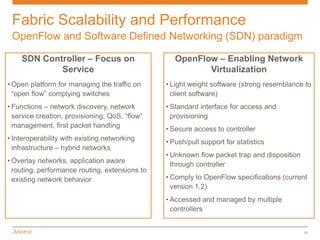
Fabric Scalability and Performance
 OpenFlow and Software Defined Networking (SDN) paradigm

    SDN Controller – Focus on                      OpenFlow – Enabling Network
            Service                                       Virtualization
• Open platform for managing the traffic on     • Light weight software (strong resemblance to
  “open flow” complying switches                  client software)
• Functions – network discovery, network        • Standard interface for access and
  service creation, provisioning, QoS, “flow”     provisioning
  management, first packet handling             • Secure access to controller
• Interoperability with existing networking
                                                • Push/pull support for statistics
  infrastructure – hybrid networks
                                                • Unknown flow packet trap and disposition
• Overlay networks, application aware
                                                  through controller
  routing, performance routing, extensions to
  existing network behavior                     • Comply to OpenFlow specifications (current
                                                  version 1.2)
                                                • Accessed and managed by multiple
                                                  controllers


                                                                                             23
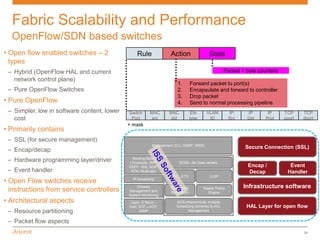
Fabric Scalability and Performance
  OpenFlow/SDN based switches
• Open flow enabled switches – 2                 Rule              Action                   Stats
  types
 – Hybrid (OpenFlow HAL and current                                                                  Packet + byte counters
   network control plane)
                                                                       1.         Forward packet to port(s)
 – Pure OpenFlow Switches                                              2.         Encapsulate and forward to controller
                                                                       3.         Drop packet
• Pure OpenFlow                                                        4.         Send to normal processing pipeline
 – Simpler, low in software content, lower   Switch      MAC      MAC              Eth     VLAN          IP     IP      IP    TCP     TCP
   cost                                       Port        src      dst            type      ID           Src    Dst    Prot   sport   dport
                                             + mask
• Primarily contains
 – SSL (for secure management)
                                                          Management (CLI, SNMP, WEB)
                                                                                                               Secure Connection (SSL)
 – Encap/decap
 – Hardware programming layer/driver           Routing Block
                                             ( Protocols –RIP,           DCBX –for Data centers
                                             OSFP, ISIS, BGP,                                                   Encap /         Event
 – Event handler                              RTM, Multicast)                                                   Decap          Handler
                                                                   PFC , ETS                LLDP
• Open Flow switches receive                   IP forwarding

                                                  Chassis                                                      Infrastructure software
  instructions from service controllers      Management and
                                                                   Congestion
                                                                   Notification
                                                                                         Master Policy
                                                                                           Engine
                                             System Monitoring
• Architectural aspects                       Layer -2 Block –        QOS (Hierarchical, multiple
                                             Vlan, STP, LACP,         Scheduling Scheme) & ACL                  HAL Layer for open flow
 – Resource partitioning                           IGMP                     Management


 – Packet flow aspects
                                                                                                                                      24
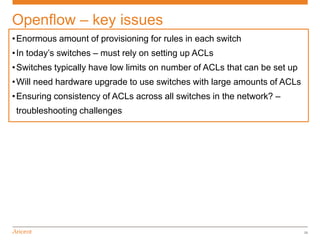
Openflow – key issues
• Enormous amount of provisioning for rules in each switch
• In today’s switches – must rely on setting up ACLs
• Switches typically have low limits on number of ACLs that can be set up
• Will need hardware upgrade to use switches with large amounts of ACLs
• Ensuring consistency of ACLs across all switches in the network? –
 troubleshooting challenges


                                                                            25
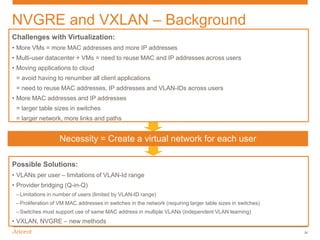
NVGRE and VXLAN – Background
Challenges with Virtualization:
• More VMs = more MAC addresses and more IP addresses
• Multi-user datacenter + VMs = need to reuse MAC and IP addresses across users
• Moving applications to cloud
 = avoid having to renumber all client applications
 = need to reuse MAC addresses, IP addresses and VLAN-IDs across users
• More MAC addresses and IP addresses
 = larger table sizes in switches
 = larger network, more links and paths


                   Necessity = Create a virtual network for each user

Possible Solutions:
• VLANs per user – limitations of VLAN-Id range
• Provider bridging (Q-in-Q)
 – Limitations in number of users (limited by VLAN-ID range)
 – Proliferation of VM MAC addresses in switches in the network (requiring larger table sizes in switches)
 – Switches must support use of same MAC address in multiple VLANs (independent VLAN learning)
• VXLAN, NVGRE – new methods
                                                                                                             26
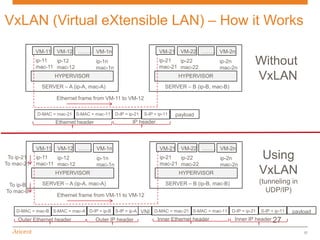
VxLAN (Virtual eXtensible LAN) – How it Works
            VM-11    VM-12 ……… VM-1n                                  VM-21    VM-22 ……… VM-2n
            ip-11  ip-12
            mac-11 mac-12
                                      ip-1n
                                      mac-1n
                                                                      ip-21  ip-22
                                                                      mac-21 mac-22
                                                                                              ip-2n
                                                                                              mac-2n
                                                                                                             Without
                    HYPERVISOR                                                 HYPERVISOR                    VxLAN
              SERVER – A (ip-A, mac-A)                                   SERVER – B (ip-B, mac-B)

                     Ethernet frame from VM-11 to VM-12

            D-MAC = mac-21 S-MAC = mac-11      D-IP = ip-21    S-IP = ip-11   payload
                    Ethernet header                    IP header


            VM-11    VM-12 ……… VM-1n                                  VM-21     VM-22 ……… VM-2n
 To ip-21   ip-11  ip-12              ip-1n                           ip-21  ip-22            ip-2n           Using
To mac-21   mac-11 mac-12             mac-1n                          mac-21 mac-22           mac-2n
                    HYPERVISOR                                                 HYPERVISOR                     VxLAN
 To ip-B      SERVER – A (ip-A, mac-A)                                   SERVER – B (ip-B, mac-B)             (tunneling in
To mac-B                                                                                                         UDP/IP)
                     Ethernet frame from VM-11 to VM-12

    D-MAC = mac-B S-MAC = mac-A D-IP = ip-B S-IP = ip-A       VNI D-MAC = mac-21 S-MAC = mac-11 D-IP = ip-21 S-IP = ip-11   payload
    Outer Ethernet header             Outer IP header              Inner Ethernet header         Inner IP header 27

                                                                                                                                27
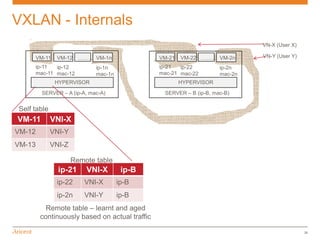
VXLAN - Internals
                                                                             VN-X (User X)

     VM-11    VM-12 ……… VM-1n                  VM-21   VM-22 ……… VM-2n       VN-Y (User Y)

     ip-11  ip-12           ip-1n              ip-21  ip-22         ip-2n
     mac-11 mac-12          mac-1n             mac-21 mac-22        mac-2n
              HYPERVISOR                               HYPERVISOR
        SERVER – A (ip-A, mac-A)                SERVER – B (ip-B, mac-B)


Self table
VM-11        VNI-X
VM-12        VNI-Y
VM-13        VNI-Z

                     Remote table
               ip-21     VNI-X        ip-B
              ip-22     VNI-X        ip-B
              ip-2n     VNI-Y        ip-B
          Remote table – learnt and aged
        continuously based on actual traffic

                                                                                             28
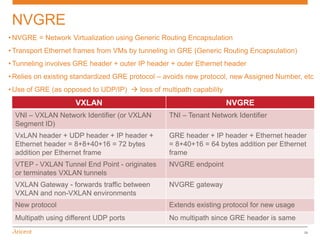
NVGRE
• NVGRE = Network Virtualization using Generic Routing Encapsulation
• Transport Ethernet frames from VMs by tunneling in GRE (Generic Routing Encapsulation)
• Tunneling involves GRE header + outer IP header + outer Ethernet header
• Relies on existing standardized GRE protocol – avoids new protocol, new Assigned Number, etc
• Use of GRE (as opposed to UDP/IP)  loss of multipath capability
                     VXLAN                                           NVGRE
  VNI – VXLAN Network Identifier (or VXLAN       TNI – Tenant Network Identifier
  Segment ID)
  VxLAN header + UDP header + IP header +        GRE header + IP header + Ethernet header
  Ethernet header = 8+8+40+16 = 72 bytes         = 8+40+16 = 64 bytes addition per Ethernet
  addition per Ethernet frame                    frame
  VTEP - VXLAN Tunnel End Point - originates     NVGRE endpoint
  or terminates VXLAN tunnels
  VXLAN Gateway - forwards traffic between       NVGRE gateway
  VXLAN and non-VXLAN environments
  New protocol                                   Extends existing protocol for new usage
                                                               5/29/201            29
  Multipath using different UDP ports            No multipath since GRE header is same
                                                               2
                                                                                           29
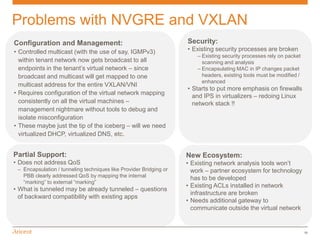
Problems with NVGRE and VXLAN
Configuration and Management:                                       Security:
• Controlled multicast (with the use of say, IGMPv3)                • Existing security processes are broken
                                                                        – Existing security processes rely on packet
  within tenant network now gets broadcast to all                         scanning and analysis
  endpoints in the tenant’s virtual network – since                     – Encapsulating MAC in IP changes packet
  broadcast and multicast will get mapped to one                          headers, existing tools must be modified /
                                                                          enhanced
  multicast address for the entire VXLAN/VNI
                                                                    • Starts to put more emphasis on firewalls
• Requires configuration of the virtual network mapping
                                                                      and IPS in virtualizers – redoing Linux
  consistently on all the virtual machines –                          network stack !!
  management nightmare without tools to debug and
  isolate misconfiguration
• These maybe just the tip of the iceberg – will we need
  virtualized DHCP, virtualized DNS, etc.


Partial Support:                                                    New Ecosystem:
• Does not address QoS                                              • Existing network analysis tools won’t
 – Encapsulation / tunneling techniques like Provider Bridging or     work – partner ecosystem for technology
   PBB clearly addressed QoS by mapping the internal                  has to be developed
   “marking” to external “marking”
                                                                    • Existing ACLs installed in network
• What is tunneled may be already tunneled – questions
                                                                      infrastructure are broken
  of backward compatibility with existing apps
                                                                    • Needs additional gateway to
                                                                      communicate outside the virtual network


                                                                                                                       30
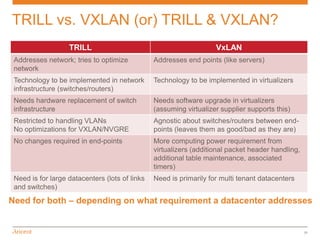
TRILL vs. VXLAN (or) TRILL & VXLAN?
                   TRILL                                            VxLAN
 Addresses network; tries to optimize           Addresses end points (like servers)
 network
 Technology to be implemented in network        Technology to be implemented in virtualizers
 infrastructure (switches/routers)
 Needs hardware replacement of switch           Needs software upgrade in virtualizers
 infrastructure                                 (assuming virtualizer supplier supports this)
 Restricted to handling VLANs                   Agnostic about switches/routers between end-
 No optimizations for VXLAN/NVGRE               points (leaves them as good/bad as they are)
 No changes required in end-points              More computing power requirement from
                                                virtualizers (additional packet header handling,
                                                additional table maintenance, associated
                                                timers)
 Need is for large datacenters (lots of links   Need is primarily for multi tenant datacenters
 and switches)

Need for both – depending on what requirement a datacenter addresses


                                                                                                   31
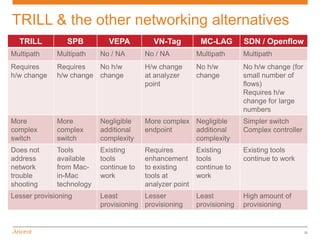
TRILL & the other networking alternatives
  TRILL          SPB         VEPA          VN-Tag          MC-LAG        SDN / Openflow
Multipath     Multipath    No / NA       No / NA          Multipath      Multipath
Requires      Requires   No h/w          H/w change       No h/w         No h/w change (for
h/w change    h/w change change          at analyzer      change         small number of
                                         point                           flows)
                                                                         Requires h/w
                                                                         change for large
                                                                         numbers
More          More         Negligible    More complex Negligible         Simpler switch
complex       complex      additional    endpoint     additional         Complex controller
switch        switch       complexity                 complexity
Does not      Tools        Existing      Requires         Existing       Existing tools
address       available    tools         enhancement      tools          continue to work
network       from Mac-    continue to   to existing      continue to
trouble       in-Mac       work          tools at         work
shooting      technology                 analyzer point
Lesser provisioning        Least        Lesser            Least          High amount of
                           provisioning provisioning      provisioning   provisioning


                                                                                              32
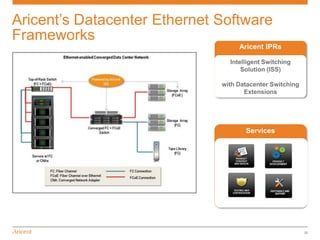
Aricent’s Datacenter Ethernet Software
Frameworks
                                   Aricent IPRs

                                Intelligent Switching
                                    Solution (ISS)

                              with Datacenter Switching
                                     Extensions


                                     Services


                                                          33
Feel free to meet me at booth #2626 or get in touch with
                me for any questions at:
   Rajesh Kumar Sundararajan: rajeshkumar.sundararajan@aricent.com
Thank you.

Trill and Datacenter Alternatives

  • 1.
    TRILL & Datacentertechnologies – their importance, and alternatives to datacenter network convergence Rajesh Kumar Sundararajan Assistant VP Product Management, Aricent May 10, Interop Las Vegas, 2012
  • 2.
    About Me ARICENT Group • Global innovation, technology, and services company • Focused exclusively on communications • Co-creating most innovative communications products and applications with customers • Complete lifecycle solutions for networks, management, applications Me • Rajesh Kumar Sundararajan • Assistant Vice President – Product Line Management • Ethernet, IP and Datacenter offerings 2
  • 3.
    Agenda Datacenter imperatives Solutions proposed to datacenter imperatives Categorization of the solutions Technological overview of each of the solutions TRILL and alternatives Summary comparison Conclusion 3
  • 4.
    3 Famous C’sof Datacenter Operations Operational trends in the Datacenter driven by Virtualization, Convergence, & Cloud Services • Increasing amount of physical space to accommodate new hardware • Additional CAPEX for hardware and software • Increased OPEX for staffing and power COST • Physical separation of users from applications • Latency-related concerns due to geographical distribution of applications • High performance demands of Cloud Services applications COMPLEXITY • Ever-increasing amounts of bandwidth demanded by consumers and enterprise applications • Increasing proliferation of video to deliver both consumer as well as business-related content CAPACITY 4
  • 5.
    Virtualization, Convergence, &Cloud Services Improved efficiencies in the Datacenter from • Increased utilization of individual servers • Consolidation of servers and network ports • Simplified management and operations • Network virtualization (beyond storage and server virtualization) VIRTUALIZATION • Convergence of equipment and network architectures • Simplified design and increased flexibility of network architecture • LAN/SAN convergence enables the ubiquity and extends the reach of Ethernet in the Datacenter CONVERGENCE • Ability to push hardware (storage, server) and software (SaaS) to a 3rd party provider • Eliminates need to procure, install, update and upgrade hardware & software,  resources can be obtained on as-needed basis • Drive performance / load across datacenters CLOUD SERVICES • Remote datacenter backup 5
  • 6.
    Imperatives and Solutions Increase Price/ Performance Ratio • 10Gb Ethernet support required for all new Datacenter Ethernet equipment • Migration to 40GbE/100GbE needs to be planned • Next gen products need to balance high performance with low CAPEX & OPEX Improve Energy Efficiency • Networking equipment needs to lower energy consumption costs • New server chipsets, architectures and software needed to improve overall energy efficiency Support Multiple Migration Options • Multiple migration options available for evolution to a converged network • Companies may start by migrating to converged network adaptors to top-of- rack switches to a converged core or vice versa • Equipment vendors need to support different migration options in products Evolve Standards • DCBX, ETS, PFC, QCN • FCoE, FIP, FIP Snooping • Openflow, SDN, TRILL, SPB, MC-LAG • VxLAN, NVGRE 6
  • 7.
    Supporting Technologies Fabric scalability & performance Network Virtualization Interconnecting datacenters Uncomplicate Switching SPB VEPA TRILL OpenFlow MCLAG SDN Endpoint Virtualization QCN DCBX NVGRE VxLAN PFC ETS NPIV NPV Lossless Ethernet Convergence FCoE FIP FIP Snooping 7
  • 8.
    Lossless Ethernet Why existingQoS and Flow Control are not enough QoS techniques are primarily – Flow control – pause frames between switches to control sender’s rate – 802.1p and DSCP based queuing – flat or hierarchical queuing – Congestion avoidance methods – WRED, etc. Issues – Flow control – no distinction between different applications or frame priorities – 802.1p and DSCP based QoS methods • Need to differentiate classes of applications (LAN, SAN, IPC, Management) • Need to allocate deterministic bandwidth to classes of applications – Congestion avoidance methods • Rely on dropping frames at the switches • Source may continue to transmit at same rate • Fine for IP based applications which assume channel loss • Don’t work for storage applications which are loss intolerant 8
  • 9.
    Lossless Ethernet Flow control – All traffic on port is Priority Flow Control (PFC) affected DCBX Internal back pressure Q1 – CoS 1 Q2 – CoS 2 PAUSE frames Q3 – CoS 3 Q4 – CoS 4 Priority Flow Control – Traffic for specific CoS on port is affected Internal back pressure TLVs in LLDP messages Q1 – CoS 1 Q2 – CoS 2 Advertise own capabilities Q3 – CoS 3 PAUSE (CoS = 3) frames Q4 – CoS 4 Priority groups = x; PFC = Yes, which priorities; Quantized Congestion Notification (QCN) Congestion notification = Yes; Reaction point Congestion point (switch facing (source/ ETH congestion on egress port) TLVs in LLDP messages end-point) Accept or No Advertise own capabilities Throttle Tx rate ETH Congestion Switches advertise and notification know capabilities to use message on links 9
  • 10.
    NPIV & NPV •NPIV= N_PortID_Virtualization FiberChannel FiberChannel Storage node switch switch - host based technology •NPV = N_Port_Virtualization E_Port F_Port E_Port N_Port – switch based technology (N_PortID) •Technology for the storage side FiberChannel •Relevant to Datacenter Ethernet because of switch Storage node the virtualization capabilities and bearing on NPIV FCoE Physical port F_Port •NPIV – virtualization of storage device port Logical port N_Port1 (N_PortID1) to support VMs, multiple zones on same link N_Port2 (N_PortID2) •Requires support on storage endpoint and N_Port2 (N_PortID3) connected switch as well NPV •NPV – endpoint is unaware; switch proxies for multiple endpoints (N_Ports) using a F_Port NP_Port single NP_Port •Reduces number of switches required Multiple N_PortIDs 10
  • 11.
    FCoE (FiberChannel OverEthernet) FCoE switch •Means to carry FiberChannel frames within FC endpoint FC link Ethernet frames Ethernet •Interconnects FiberChannel endpoints or Ethernet switch Ethernet switches across an Ethernet (DataCenter interconnect Bridged Ethernet) network Ethernet switch Ethernet switch •FC frames encapsulated in Ethernet Ethernet switch header •New EtherType to transport FC frames Ethernet switch •FCoE can be enabled on – FC endpoint devices / FC switches / Ethernet switches Ethernet FCoE switch FCoE switch FC Endpoint Ethernet switch Ethernet switch FCoE switch FC switch FC link Ethernet Ethernet Ethernet FC link FC endpoints FC frame FCoE frame FCoE frame Eth header FC frame FC frame FCoE frame 11
  • 12.
    FIP (FCoE InitializationProtocol) •Protocol between FC devices built on assumption of direct connection •Traversing an Ethernet cloud requires additional procedures •Addressed by FIP Device discovery Initializing communication Maintaining communication •FCoE Control frames – FIP – uses different EtherType than FCoE Data frames – FC frames encapsulated with FCoE EtherType FCoE device discovery Initializing communication Maintaining communication FCoE device FCoE device Ethernet 12
  • 13.
    FIP Snooping •Protocol betweenFC devices built on assumption of direct connection •FC switch enforces many configurations, performs validations and access control on attached endpoints •Security concerns when this is exposed over non-secure Ethernet •Addressed by FIPSnooping Done on transit switches carrying FCoE, on VLANs dedicated to FCoE Switches install firewall filters to protect FCoE ports Filters are based on inspection of the FLOGI procedure Example (a) deny Enodes using FC-Switch MAC address as source MAC (b) ensure address assigned to Enode is used only for FCoE traffic FIP FIP Snooping FIP Snooping Ethernet switch Ethernet switch FCoE device FCoE device Ethernet 13
  • 14.
    Fabric Scalability andPerformance Why Spanning Tree (RSTP/MSTP/PVRST) is not enough Necessary fundamentals for FCoE to work Multipath through the network Lossless fabric Rapid convergence in fabric Spanning tree (with variants like RSTP, MSTP, PVRST) is the universal way to provide redundancy and stability (loop avoidance) in Ethernet networks Spanning tree is a distance vector based protocol • Routing equivalent of spanning tree (distance vector based) = RIP • Limits the size of the network that it can handle • Much smaller network size than link state based protocols (OSPF / ISIS) Datacenter networks have got much bigger (and getting bigger still !!) Spanning tree blocks links / paths to create redundancy  inefficient capacity utilization Does not support multipath which is important for SAN/LAN convergence The TRILL solution • Apply link state routing to bridging / Layer 2 Ethernet • Use technique like ECMP for alternate paths without blocking any links or paths 14
  • 15.
    Fabric Scalability andPerformance TRILL – Transparent Interconnection of Lot of Links Focus on problem of dense collection of RBridge RBridge interconnected clients and switches Attempt to: • Eliminate limitations of spanning tree TRILL control protocol centric solutions (IS-IS extension) • Bring the benefits of routing technologies to the L2 network (without the need for RBridge RBridge IP/subnets, etc.) Objectives: Learn • Zero configuration and zero assumptions MAC • Forwarding loop mitigation MAC TRILL control frame frame (advertise learnt MAC) • No changes to spanning tree protocols Normal bridge Key components: RBridge RBridge RBridge or destination • R-bridges (Routing bridges) • Extensions to IS-IS • Apply link state routing to VLAN aware bridging problem MAC TRILL MAC TRILL MAC MAC frame header frame header frame frame 15
  • 16.
    Fabric Scalability andPerformance TRILL – Handling Multicast and Broadcast • Create distribution tree with selected root Root for • Distribute from root to rest of tree Distribution Tree 1 • Multiple distribution trees for Root for – Multipath and load distribution Distribution Tree 2 – Alternate paths and resilience • All Rbridges pre-calculate and maintain the distribution trees • Algorithm specified for ensuring identical calculations at all RBRidges • By default - distribution tree is shared across all VLANs and multicast groups Distribution Tree 1 • How an ingress node selects a specific tree (from multiple Distribution Tree 2 existing trees) is not specified • Ingress Rbridge receiving multicast encapsulates in TRILL header and sends to root of tree and to downstream branches • Frame with TRILL header is distributed down branches of tree • Rbridges at edges remove TRILL header and send to receivers • Rbridges listen to IGMP messages • Rbridges prune trees based in presence of multicast receivers • Information from IGMP messages propagated through the TRILL core to prune the distribution trees 16
  • 17.
    Fabric Scalability andPerformance TRILL – Issues and Problems •Does not (yet) address different types of virtual networks (VxLAN, NVGRE…) •Provides for L2 multipathing (traffic within a VLAN) but L3 (routed traffic across VLANs) is unipath only •Initial scope of TRILL defined to address spanning tree limitations •IP maybe an afterthought; only 1 default router with VRRP = unipath for L3 •Result of above – forces datacenter operators to provision larger VLANs (more members per VLAN) – so, restricts segmentation using VLANs •Requires hardware replacement in switching infrastructure •Existing security processes have to be enhanced – Existing security processes rely on packet scanning and analysis – Encapsulation changes packet headers, existing tools must be modified / enhanced •Does not inherently address fault isolation •Does not inherently address QoS mapping between edge & core (example – congestion management requires congestion in network to be signaled to source ) •Does not clearly address source specific multicast; so multicast based on groups only 17
  • 18.
    Alternatives? Network centricapproaches SPB EVB – VEPA / VN-Tag MC-LAG Openflow / SDN •Endpoint /server centric approaches VxLAN NVGRE 18
  • 19.
    Fabric Scalability andPerformance SPB – Shortest Path Bridging • Key Components SP-Bridge SP-Bridge – Extend IS-IS to compute paths between shortest path bridges – Encapsulate MAC frames in an additional header for transport Control protocol (IS-IS extension) between shortest path bridges • Variations in Encapsulation – SPB – VID Normal bridge or – SPB – MAC (reuse 802.1ah SP-Bridge SP-Bridge SP-Bridge destination encapsulation) • Allows reuse of reliable Ethernet Learn Learn OAM technology (802.1ag, MAC MAC Y.1731) MAC SPB MAC SPB MAC MAC frame header frame header frame frame • Source MAC learning from SPB encapsulated frames at the edge SP-bridges 19
  • 20.
    EVB (Edge VirtualBridging) Addresses interaction between virtual switching environments in a hypervisor and VM-11 VM-12 ……… VM-1n 1st layer of physical switching infrastructure Virtualizer 2 different methods – VEPA (Virtual Ethernet Port Aggregator) & VN-Tag VEB / vSwitch Without VEPA – in virtualized environment, Ethernet switch traffic between VMs is switched within the virtualizer VM-11 VM-12 ……… VM-1n Key issues – monitoring of traffic, security policies, etc, between VMs is broken Virtualizer With VEPA – all traffic is pushed out to the Negotiation switch and then to the appropriate VM VEPA Key issue – additional external link bandwidth Ethernet switch requirement, additional latency Switch must be prepared to do “hairpin turn” Accomplished by software negotiation between switch and virtualizer 20
  • 21.
    MC-LAG (Multi ChassisLAG) Relies on fact that datacenter network is large but with predictable topology CORE Downstream node has multiple links to different upstream nodes AGGREGATION & ACCESS Links are link-aggregated (trunked) into single logical interface Can be used in redundant or load-shared Typical datacenter network mode Load-shared mode offers multipath Resilience and multipath inherent Coordination protocol across switches No hardware changes required LAG Accomplished with software upgrade Switches must have protocol extension to LAG LAG LAG coordinate LAG termination across switches Does nothing about address reuse problem from endpoint virtualization 21
  • 22.
    OpenFlow and SoftwareDefined Networking (SDN) Paradigm shift to networking SDN Controller [ Service Creation, Flow management, first packet processing, route creation) Flowvisor ( Responsible for Network Partitioning based on Rules ( e.g. Bridge IDs, Flow ids, User credentials) Secure connection Open Flow Open Flow Open Flow Open Flow enabled enabled enabled enabled Switches Switches Switches Switches Open Flow Open Flow Open Flow Source -ONF enabled enabled enabled Switches Switches Switches SDN Controller – Focus on Service OpenFlow – Enabling Network Virtualization • Simplify the network (make it dumb? • Move the intelligence outside 22
  • 23.
    Fabric Scalability andPerformance OpenFlow and Software Defined Networking (SDN) paradigm SDN Controller – Focus on OpenFlow – Enabling Network Service Virtualization • Open platform for managing the traffic on • Light weight software (strong resemblance to “open flow” complying switches client software) • Functions – network discovery, network • Standard interface for access and service creation, provisioning, QoS, “flow” provisioning management, first packet handling • Secure access to controller • Interoperability with existing networking • Push/pull support for statistics infrastructure – hybrid networks • Unknown flow packet trap and disposition • Overlay networks, application aware through controller routing, performance routing, extensions to existing network behavior • Comply to OpenFlow specifications (current version 1.2) • Accessed and managed by multiple controllers 23
  • 24.
    Fabric Scalability andPerformance OpenFlow/SDN based switches • Open flow enabled switches – 2 Rule Action Stats types – Hybrid (OpenFlow HAL and current Packet + byte counters network control plane) 1. Forward packet to port(s) – Pure OpenFlow Switches 2. Encapsulate and forward to controller 3. Drop packet • Pure OpenFlow 4. Send to normal processing pipeline – Simpler, low in software content, lower Switch MAC MAC Eth VLAN IP IP IP TCP TCP cost Port src dst type ID Src Dst Prot sport dport + mask • Primarily contains – SSL (for secure management) Management (CLI, SNMP, WEB) Secure Connection (SSL) – Encap/decap – Hardware programming layer/driver Routing Block ( Protocols –RIP, DCBX –for Data centers OSFP, ISIS, BGP, Encap / Event – Event handler RTM, Multicast) Decap Handler PFC , ETS LLDP • Open Flow switches receive IP forwarding Chassis Infrastructure software instructions from service controllers Management and Congestion Notification Master Policy Engine System Monitoring • Architectural aspects Layer -2 Block – QOS (Hierarchical, multiple Vlan, STP, LACP, Scheduling Scheme) & ACL HAL Layer for open flow – Resource partitioning IGMP Management – Packet flow aspects 24
  • 25.
    Openflow – keyissues • Enormous amount of provisioning for rules in each switch • In today’s switches – must rely on setting up ACLs • Switches typically have low limits on number of ACLs that can be set up • Will need hardware upgrade to use switches with large amounts of ACLs • Ensuring consistency of ACLs across all switches in the network? – troubleshooting challenges 25
  • 26.
    NVGRE and VXLAN– Background Challenges with Virtualization: • More VMs = more MAC addresses and more IP addresses • Multi-user datacenter + VMs = need to reuse MAC and IP addresses across users • Moving applications to cloud = avoid having to renumber all client applications = need to reuse MAC addresses, IP addresses and VLAN-IDs across users • More MAC addresses and IP addresses = larger table sizes in switches = larger network, more links and paths Necessity = Create a virtual network for each user Possible Solutions: • VLANs per user – limitations of VLAN-Id range • Provider bridging (Q-in-Q) – Limitations in number of users (limited by VLAN-ID range) – Proliferation of VM MAC addresses in switches in the network (requiring larger table sizes in switches) – Switches must support use of same MAC address in multiple VLANs (independent VLAN learning) • VXLAN, NVGRE – new methods 26
  • 27.
    VxLAN (Virtual eXtensibleLAN) – How it Works VM-11 VM-12 ……… VM-1n VM-21 VM-22 ……… VM-2n ip-11 ip-12 mac-11 mac-12 ip-1n mac-1n ip-21 ip-22 mac-21 mac-22 ip-2n mac-2n Without HYPERVISOR HYPERVISOR VxLAN SERVER – A (ip-A, mac-A) SERVER – B (ip-B, mac-B) Ethernet frame from VM-11 to VM-12 D-MAC = mac-21 S-MAC = mac-11 D-IP = ip-21 S-IP = ip-11 payload Ethernet header IP header VM-11 VM-12 ……… VM-1n VM-21 VM-22 ……… VM-2n To ip-21 ip-11 ip-12 ip-1n ip-21 ip-22 ip-2n Using To mac-21 mac-11 mac-12 mac-1n mac-21 mac-22 mac-2n HYPERVISOR HYPERVISOR VxLAN To ip-B SERVER – A (ip-A, mac-A) SERVER – B (ip-B, mac-B) (tunneling in To mac-B UDP/IP) Ethernet frame from VM-11 to VM-12 D-MAC = mac-B S-MAC = mac-A D-IP = ip-B S-IP = ip-A VNI D-MAC = mac-21 S-MAC = mac-11 D-IP = ip-21 S-IP = ip-11 payload Outer Ethernet header Outer IP header Inner Ethernet header Inner IP header 27 27
  • 28.
    VXLAN - Internals VN-X (User X) VM-11 VM-12 ……… VM-1n VM-21 VM-22 ……… VM-2n VN-Y (User Y) ip-11 ip-12 ip-1n ip-21 ip-22 ip-2n mac-11 mac-12 mac-1n mac-21 mac-22 mac-2n HYPERVISOR HYPERVISOR SERVER – A (ip-A, mac-A) SERVER – B (ip-B, mac-B) Self table VM-11 VNI-X VM-12 VNI-Y VM-13 VNI-Z Remote table ip-21 VNI-X ip-B ip-22 VNI-X ip-B ip-2n VNI-Y ip-B Remote table – learnt and aged continuously based on actual traffic 28
  • 29.
    NVGRE • NVGRE =Network Virtualization using Generic Routing Encapsulation • Transport Ethernet frames from VMs by tunneling in GRE (Generic Routing Encapsulation) • Tunneling involves GRE header + outer IP header + outer Ethernet header • Relies on existing standardized GRE protocol – avoids new protocol, new Assigned Number, etc • Use of GRE (as opposed to UDP/IP)  loss of multipath capability VXLAN NVGRE VNI – VXLAN Network Identifier (or VXLAN TNI – Tenant Network Identifier Segment ID) VxLAN header + UDP header + IP header + GRE header + IP header + Ethernet header Ethernet header = 8+8+40+16 = 72 bytes = 8+40+16 = 64 bytes addition per Ethernet addition per Ethernet frame frame VTEP - VXLAN Tunnel End Point - originates NVGRE endpoint or terminates VXLAN tunnels VXLAN Gateway - forwards traffic between NVGRE gateway VXLAN and non-VXLAN environments New protocol Extends existing protocol for new usage 5/29/201 29 Multipath using different UDP ports No multipath since GRE header is same 2 29
  • 30.
    Problems with NVGREand VXLAN Configuration and Management: Security: • Controlled multicast (with the use of say, IGMPv3) • Existing security processes are broken – Existing security processes rely on packet within tenant network now gets broadcast to all scanning and analysis endpoints in the tenant’s virtual network – since – Encapsulating MAC in IP changes packet broadcast and multicast will get mapped to one headers, existing tools must be modified / enhanced multicast address for the entire VXLAN/VNI • Starts to put more emphasis on firewalls • Requires configuration of the virtual network mapping and IPS in virtualizers – redoing Linux consistently on all the virtual machines – network stack !! management nightmare without tools to debug and isolate misconfiguration • These maybe just the tip of the iceberg – will we need virtualized DHCP, virtualized DNS, etc. Partial Support: New Ecosystem: • Does not address QoS • Existing network analysis tools won’t – Encapsulation / tunneling techniques like Provider Bridging or work – partner ecosystem for technology PBB clearly addressed QoS by mapping the internal has to be developed “marking” to external “marking” • Existing ACLs installed in network • What is tunneled may be already tunneled – questions infrastructure are broken of backward compatibility with existing apps • Needs additional gateway to communicate outside the virtual network 30
  • 31.
    TRILL vs. VXLAN(or) TRILL & VXLAN? TRILL VxLAN Addresses network; tries to optimize Addresses end points (like servers) network Technology to be implemented in network Technology to be implemented in virtualizers infrastructure (switches/routers) Needs hardware replacement of switch Needs software upgrade in virtualizers infrastructure (assuming virtualizer supplier supports this) Restricted to handling VLANs Agnostic about switches/routers between end- No optimizations for VXLAN/NVGRE points (leaves them as good/bad as they are) No changes required in end-points More computing power requirement from virtualizers (additional packet header handling, additional table maintenance, associated timers) Need is for large datacenters (lots of links Need is primarily for multi tenant datacenters and switches) Need for both – depending on what requirement a datacenter addresses 31
  • 32.
    TRILL & theother networking alternatives TRILL SPB VEPA VN-Tag MC-LAG SDN / Openflow Multipath Multipath No / NA No / NA Multipath Multipath Requires Requires No h/w H/w change No h/w No h/w change (for h/w change h/w change change at analyzer change small number of point flows) Requires h/w change for large numbers More More Negligible More complex Negligible Simpler switch complex complex additional endpoint additional Complex controller switch switch complexity complexity Does not Tools Existing Requires Existing Existing tools address available tools enhancement tools continue to work network from Mac- continue to to existing continue to trouble in-Mac work tools at work shooting technology analyzer point Lesser provisioning Least Lesser Least High amount of provisioning provisioning provisioning provisioning 32
  • 33.
    Aricent’s Datacenter EthernetSoftware Frameworks Aricent IPRs Intelligent Switching Solution (ISS) with Datacenter Switching Extensions Services 33
  • 34.
    Feel free tomeet me at booth #2626 or get in touch with me for any questions at: Rajesh Kumar Sundararajan: rajeshkumar.sundararajan@aricent.com
  • 35.

Editor's Notes

  • #15 The TRILL solution:Apply link state routing to bridging/Layer 2 EthernetUse techniques like ECMP for alternate paths without blocking any links or paths