Oracle Real Application Clusters
Load Balancing and Failover Options
      An IT Convergence presentation by Dan Norris
Agenda
      Brief RAC and Grid Concepts Review
  Services & Workload Management in 10g RAC
       Fast Application Notification (FAN)
         Fast Connection Failover (FCF)
     Transparent Application Failover (TAF)
      Load Balancing in RAC: Client, Server
Connection pools and load balancing with RAC 10g
        Miscellaneous Configuration Tips
            Next Steps & References
RAC: The Cluster Database
                                                   Network
Centralized
                                                               Users
Management
Console
                     Interconnect
                                                     No Single
High Speed                                           Point Of Failure
Switch or
Interconnect


                                              he
                                    Shared Cac
Clustered
Database Servers


Hub or                                              Storage Area Network
Switch
Fabric

Mirrored Disk
Subsystem
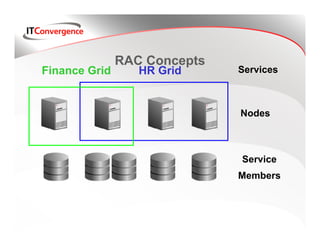
RAC Concepts
Finance Grid      HR Grid     Services


                              Nodes


                              Service
                              Members
VIPs: Why?
 Protects clients from long TCP/IP timeouts (can be
>10 minutes)
 Transparent to clients during normal operations
 During failure event, doesn't accept or maintain
connections, but allows clients to receive a
response (a negative one) causing them to fail to
next address in their ADDRESS_LIST
 Note that each node in a cluster has its own node
VIP
 Node VIP ≠ Application VIP
Services & Workload Management
A service is an entity to which users connect

Usually designates a module or application used by a specific
group of users

Technically, a service is listed in the service_name parameter
for an instance (Note: You should not edit the service_name
parameter in a RAC environment.)

Clusterware processes alter the service_name parameter on
the fly to relocate services (according to policies)

Stats in 10g are also gathered per service
Services & Workload Management

                   Order          Order         Order
      HR                          Entry         Entry
                   Entry

                                 Time &         Time &
                                 Labor          Labor

    AR & GL       AR & GL
                                 iExpense      iExpense


Services can be available via one or more instances

Failover policies and load balancing goals are set per service
Managing Services
Services can be managed via:
   Oracle Enterprise Manager
       Can manage all service attributes
   DBMS_SERVICE
       Allows you to set service advisory goals + service failover attributes
   DBCA
       Allows you to set service failover type
   srvctl
       Allows you to set preferred and available instances + service failover
       type
Set thresholds for service monitoring via
DBMS_SERVER_ALERT
Oracle Notification Service (ONS)

Publish/Subscribe Messaging System
Allows both local and remote consumption
Used by Fast Application Notification (FAN) to publish
HA Events and Load Balancing Events
Used by FAN clients to subscribe to events
Automatically installed and configured during the Oracle
Clusterware installation
DO NOT TURN OFF – Required by Oracle Clusterware
and RAC
FAN in a Nut Shell
RAC posts
  Node, service, instance, database status changes
  Load balancing advice
FAN events specify what changed, where, when
FAN callouts execute server-side
Subscribers receive FAN over AQ
Packaged clients: ODP.NET, JDBC, OCI, Net
Fast Application Notification (FAN)
Notification
    First step for application recovery, diagnosis, repair, routing
In-Band Events
    Posted and processed synchronously in your session
    Used when actively conversing with instances, ASM…
Out-of-Band Events
    Posted and processed asynchronously via another process
    Used when nodes, public or private networks are down, application is
    doing something else, nodes are slow, hung…
FCF: Fast Connection Failover
 Introduced in 10g, Fast Connection Failover builds on
the infrastructure created by FAN events and ONS.

 FCF can be easily integrated with existing application
code. Once enabled, FCF’s mechanism is automatic;
no application intervention is needed.
FCF Pre-Requisites
There are a number of pre-requisites which must be met before
FCF can be used. These include:
   Implicit connection cache is enabled
   Service names must be used for connecting to the database
   If using the 10.1 release, the JVM in which the JDBC instance is
   running must have the oracle.ons.oraclehome property set to
   point to an ORACLE_HOME
   For 10.1: Oracle Notification Service (ONS) is configured and
   available on the node where JDBC running
   For 10.2 and higher, it is possible to subscribe to a remote ONS
   service
Fast Connection Failover
             How Does It Work?

 Applications continue to work while the RAC/HA events
are processed asynchronously

 The pool uses an HA signature to selectively remove
affected connections

Process RAC/HA DOWN Events

Process RAC/HA UP Events
Fast Connection Failover
                               How Does It Work?
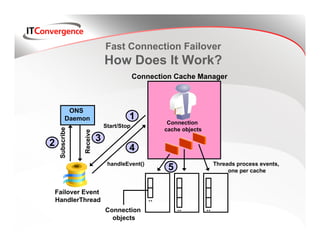
                                            Connection Cache Manager


            ONS
           Daemon                       1
                                                      Connection
                               Start/Stop
     Subscribe


                                                     cache objects
                 Receive


                           3
2                                       4
                                handleEvent()                             Threads process events,
                                                      5                        one per cache


    Failover Event
    HandlerThread                               ..
                               Connection                 ..         ..
                                 objects
Fast Connection Failover
        Client Side Configuration
Simplified Configuration (10.2 - Standalone)
ods.setONSConfiguration("nodes=node1:4200,node2:4200
   walletfile=/mydir/conf/wallet");


Ensure ons.jar file is in the CLASSPATH

When starting Application, Specify system property
-Doracle.ons.oraclehome=<location-of-ORACLE_HOME>
Fast Connection Failover
                         JDBC Usage
try {
      conn = getConnection();
      // do some work
  } catch (SQLException e) {
        handleSQLException(e);
   }
  ...
  handleSQLException (SQLException e)
  {
      if (OracleConnectionCacheManager.isFatalConnectionError(e))
         ConnRetry = true; // Fatal Connection error detected,
    }


Oracle Application Server handles connection retry transparently for
container managed applications.
Fast Connection Failover
             ODP.NET Usage
Down events monitored
    Monitors service, service member, and node
 Cleans up sessions and connections in connection
pool to downed instance
    Prevents other incoming requests from getting bad
    connections
No manual intervention required
  "user id=scott;password=tiger;data
    source=orcl;HA events=true;pooling=true"
Fast Connection Failover
       DOWN Event Processing
Under FCF, each connection in the cache maintains a
mapping to a service, instance, database, and
hostname.
One worker thread per pool instance handles DOWN
event processing – more efficient
     First pass – Connections are marked as DOWN first, to
     efficiently disable bad connections
     Second pass – Abort and remove connections that are
     marked as DOWN
 Active connections that may be in the middle of a
transaction receive a SQLException instantly
 Application may replay transaction
Fast Connection Failover
        DOWN Event Processing
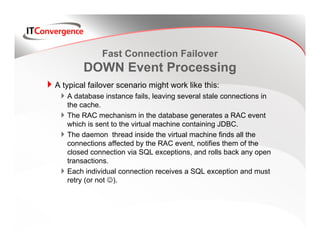
A typical failover scenario might work like this:
   A database instance fails, leaving several stale connections in
   the cache.
   The RAC mechanism in the database generates a RAC event
   which is sent to the virtual machine containing JDBC.
   The daemon thread inside the virtual machine finds all the
   connections affected by the RAC event, notifies them of the
   closed connection via SQL exceptions, and rolls back any open
   transactions.
   Each individual connection receives a SQL exception and must
   retry (or not ☺).
Fast Connection Failover
          UP Event Processing
 Service UP event initiates connections to be load
balanced to all active RAC instances

 All stateless connections in the pool are load
balanced
   Connection creation depends on listener’s placement of
   connections


UP event load balancing is dampened
   Improved scalability
Fast Connection Failover

               Best Practices
Applications must catch SQLException and retry
connection requests
Fast Connection Failover relies on the Oracle Net
Services for connection creation and placement
  In 10.1, listener’s config should contain
  PREFER_LEAST_LOADED_NODE_[<listener_name>]=OFF
  In 10.2 and above, Service CLB_GOAL must be set
Use Oracle RAC VIP in connect strings for all client
connections
FCF vs. TAF
FCF
  Proactive
  Uses ONS to receive information about cluster status
  Cleans up connections immediately, before they are used
  Application-tier (connection pool) technology
TAF
  Reactive
  Network layer technology (OCI/Net)
  Connections discovered disconnected when they are next
  used
  Less efficient
  Useful for non-pooling applications
TAF: Transparent Application Failover

 TAF allows applications and processes to
automatically reconnect to another instance in event
of failure.

 Failover is transparent and the new connection will be
established. However, any uncommitted transactions
will be rolled back.

 TAF occurs at the OCI layer which means an
application does not need to be modified in order to
take advantage of TAF.
TAF Configuration

   Here is an example tnsnames.ora file.
ORCLSERV =
   (DESCRIPTION =
      (ADDRESS = (PROTOCOL = TCP)(HOST = nap-rac01-vip)(PORT = 1521))
      (ADDRESS = (PROTOCOL = TCP)(HOST = nap-rac02-vip)(PORT = 1521))
      (LOAD_BALANCE = yes)
      (CONNECT_DATA =
         (SERVER = DEDICATED)
         (SERVICE_NAME = orclserv.itconvergence.com)
         (FAILOVER_MODE =
            (TYPE = SELECT)
            (METHOD = BASIC)
            (RETRIES = 180)
            (DELAY = 5)
         )
      )
   )
Failover with TAF

TAF can be configured to perform two methods of
  failover:
  METHOD=BASIC
     The session to a surviving node is created at failover time
     Delay of creating new process on surviving node is incurred at
     failure time
     In 10.2, can be configured entirely server-side, per service.
  METHOD=PRECONNECT
     During original connection, a backup connection is established to
     another cluster instance.
     Requires client-side configuration
     Faster failover time, shorter delay, more overhead to manage
Failover with TAF

TAF can be configured to perform two types of
  failover:
  TYPE=SESSION
     Any uncommitted transactions will be rolled back
     The session will be connected to another instance
  TYPE=SELECT
     Any uncommitted transactions will be rolled back
     The session will be connected to another instance
     A SELECT statement that was executing at the time of failure
     will be re-executed by the new session using the same SCN and
     fetched rows will be discarded up to the point that the original
     query failed.
What To Expect After TAF Failover

TYPE=SESSION
  If any uncommitted transaction existed in the session
      ORA-25402: transaction must roll back
      rollback;
      re-issue statement (requires application to know how/what to
      resubmit)
  If no active transaction
      SELECT statements will get ORA-25401: can not continue fetches
      Even though error may be returned, session will be connected to
      surviving instance and work may continue
TYPE=SELECT
  Similar behavior to above, but SELECT statements will continue
  fetches without interruption if no transaction in progress
What TAF Cannot Do

TAF may cause issues for applications which
modify the database.

 Applications must be capable of detecting DML
failure and, if necessary, reapplying statements up
to the point of failure.

 Session state is lost. Through callbacks, it is
possible to restore session variables, PL/SQL
package variables, and instances of user-defined
types.
Callbacks

 When there is a failure, callback functions are
initiated on the client-side via OCI callbacks.

 This can be implemented in Java by implementing
the OracleOCIFailover interface. This interface is
invoked on failure of a node or lost connection.
Summary: What Does Oracle
      Provide For Client Failover?

   Failure notification: FAN
   Previous connection cleanup: FCF
   Automatic reconnection: FCF, TAF
   Possibly query replay: TAF, your application-level
  handling

Note that FCF and TAF may be utilized from JDBC,
  ODP.NET, and OCI.
Questions?


(Please don't leave—I'm only about
         ½ way through!)
Load balancing is coming up next…
Load Balancing Available
Client-side
  Uses TNS configuration to balance connections to various
  listeners in cluster
  Challenging to maintain and update
  Not "intelligent"—purely random distribution
Server-side
  More "powerful" by incorporating metrics into decision-
  making process
  No maintenance required—"automagic"
  Will redirect clients according to policies and configuration
Connect-time (Client-Side)
         Load Balancing
 Uses TNS entry attribute LOAD_BALANCE=ON
 Client chooses randomly from the ADDRESSes in
the ADDRESS_LIST
 Client may then be redirected based on server-
side load balancing
 Useful to spread initial connection load among all
listeners in the cluster (especially during major
failover events)
Runtime Connection Load Balancing
         Why Do We Need It?
 Connections in pool last a long time. Balancing at
connect time is no longer enough.
 Need to do best routing of work requests over
existing connections to make best use of resources
 Capacity may differ across the cluster, over time
as things change
 Want to avoid sending work to slow, hung, dead
nodes
Runtime Connection Load Balancing
           What Does It Do?
 Manages pooled connections for high performance
and scalability
 Receives "continuous" recommendations on the
percentage of work to route to database instances
 Adjusts distribution of work based on different
backend node capacities such as CPU capacity or
response time
 Reacts "quickly" (not immediately) to changes in
cluster reconfiguration, application workload,
overworked nodes or hangs
Runtime Connection Load Balancing
                                Better Response Time
                                            RESPONSE- TIME (service1)


                                                                                               Average
                                                                                                Average
                 node#4                                          1.98                          response time of
                 node#3                                                                         response time of
     LBA ON                                                                                    4 nodes
                                                                                                4 nodes
RCLB ON          node#2
                                                                        AVG 20%
                                                                         AVG 20%
                 node#1                                               Improvement
                                                                       Improvement

                 node#4
                 node#3
    LBA OFF
RCLB OFF         node#2
                 node#1

                                                                  2.47
           0.0            0.5      1.0          1.5         2.0           2.5           3.0        3.5        4.0
                                                 response- time (Avg msec)

                     for new graph rac29   for new graph rac30    for new graph rac31   for new graph rac32

                                                      Tests run by NS Solutions Corporation, Japan
Runtime Connection Load Balancing
          How Does It Work?
 Uses connections to well performing instances
more often
 Gets distribution metrics from RAC Load Balancing
Advisory
 New and unused connections to "bad" instances
will gravitate away over time
 When distribution metrics are not received,
connection selection falls back to random choice
Runtime Connection Load Balancing
                How Does It Work?                           RAC
                                                          Database
                          30% Work

                                     I’m busy
                  pool                                    Instance1
                                            10% Work
Application
                                          I’m very busy

                                        I’m idle          Instance2


                          60% Work
                                                          Instance3
Runtime Connection Load Balancing
            How Do I Use It?
Tight integration with RAC

 When not enabled, connection request
distribution is based on default policy – random

 No additional client side configuration necessary
– just ensure Fast Connection Failover is enabled
RAC Load Balancing Advisory
 Monitors workload activity for a service across all
instances in the cluster
 Analyzes the service level for each instance based
on defined metric goal
   Metric: service time (GOAL_SERVICE_TIME)
   Metric: throughput (GOAL_THROUGHPUT)
 Publishes FAN events recommending amount of
work to be sent to each instance and data quality
flag
 Default is Off. Set via EM or DBMS_SERVICE
Load Balancing Advisory Goals
THROUGHPUT – Work requests are directed based on
throughput
     Best when work completes at homogenous rates
     Measures how quickly DB tasks complete
     Example: trading system where work requests are similar lengths
SERVICE_TIME – Work requests are directed based on response
time
     Used when the work in a service completes at various rates
     Measures CPU usage
     Example: internet shopping system where work requests are
     various lengths
NONE – LBAs use a formula based on CPU utilization to create
advisories
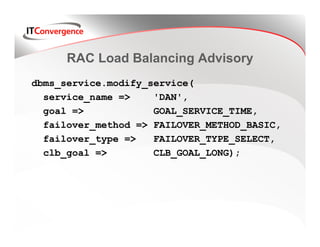
RAC Load Balancing Advisory
dbms_service.modify_service(
  service_name =>    'DAN',
  goal =>            GOAL_SERVICE_TIME,
  failover_method => FAILOVER_METHOD_BASIC,
  failover_type =>   FAILOVER_TYPE_SELECT,
  clb_goal =>        CLB_GOAL_LONG);
Load Balancing Advisory
 Load Balancing Advisory is an advisory for
balancing work across RAC instances
 Load balancing advice
    Is available to ALL applications that send work
    Directs work to where services are executing well and
    resources are available
    Adjusts distribution for different power nodes, different
    priority and shape workloads, changing demand
    Stops sending work to slow, hung, failed nodes early
Load Balancing Advisory

Automatic Workload Repository
  Calculates goodness locally, forwards to master MMON
  process
  Master MMON builds advisory for distribution of work
  Records advice to SYS$SERVICE_METRICS
  Posts FAN event to AQ, PMON, ONS
JDBC Load Balancing Tips
 Must be using Oracle JDBC drivers
 By configuring FCF, your pool will also receive LBAs from
ONS
 The LBAs will be processed locally by the pool to ensure
that getConnection will return the most favorable
connection in the pool
 Use remote ONS subscription in order to avoid running a
local ONS daemon on the app tier
 Can be used with JDBC OCI or thin drivers
JDBC Load Balancing
OracleDataSource ods = new OracleDataSource()
...
ods.setUser("Scott");
ods.setPassword("tiger");
ods.setConnectionCachingEnabled(True);
ods.setFastConnectionFailoverEnabled(True);
ods.setConnectionCacheName("MyCache");
ods.setConnectionCacheProperties(cp);
// configure remote ONS subscription over SSL
ods.setONSConfiguration("nodes=racnode1:6200,racnode2:6200
   walletfile=/mydir/conf/wallet");
.NET Integration with Grids
Automatic connection cleanup
   Via FCF
   CP Attribute: HA Events = true


Automatic connection load balancing
   Via RLB
   CP Attribute: Load Balancing = true


Must be using ODP.NET connection pool
ODP.NET Connection Load Balancing
  ODP.NET connection pool is integrated with RAC
 load balancing advisory

  When application calls
 OracleConnection.Open, connection with best
 service given

  Policy defined by service goal
  "user id=scott;password=tiger;data
    source=orcl;load
    balancing=true;pooling=true"
Miscellaneous Tips
Test everything. Rinse. Repeat.

See #1 above.

Java clients should set the
oracle.net.ns.SQLnetDef.TCP_CONNTIMEOUT_STR
property on the data source

 Do not use TAF with JDBC OCI clients as TAF will
interfere with FCF.
Miscellaneous Tips
JDBC thin clients can use FCF

Configure remote ONS subscriptions to enable
FCF—also, configure ONS communication via SSL

 Configure
SQLNET.OUTBOUND_CONNECT_TIMEOUT on
clients in sqlnet.ora file
Next Steps
Read "Client Failover Best Practices for Highly Available Oracle
Databases: Oracle Database 10g Release 2" (January 2007)
found at http://www.oracle.com/technology/deploy/availability/

Read " Workload Management with Oracle Real Application
Clusters" found at
http://www.oracle.com/technology/products/database/clustering/

Join the RAC SIG at http://www.oracleracsig.org/


Test, TEST, TEST.
References, page 1
Padraig O'Sullivan, IT Convergence contributed many slides
and samples in this presentation

Client Failover Best Practices for Highly Available Oracle
Databases: Oracle Database 10g Release 2 (January 2007),
http://www.oracle.com/technology/deploy/availability/

Several documents by Barb Lundhild, Oracle: conference
presentations, whitepapers on http://otn.oracle.com/rac

Alex Keh, Oracle, presentation "Leveraging Oracle Grid
Computing with .NET"
References, page 2
http://www.oracle.com/technology/products/database/clusteri
ng/

Demystifying RAC Internals, Barb Lundhild & Kirk McGowan,
Oracle, OOW 2006

Under the Covers of High Availability and Load Balancing for
JDBC Connections in Real Application Clusters/Grid
Environments, Rajkumar Irudayaraj, Oracle

Workload Management with Oracle Real Application Clusters,
Barb Lundhild, Oracle
RAC SIG Events
See www.oracleracsig.org for details

   Monday, April 16 @ 10:30 am: RAC SIG Expert Panel
   Tuesday, April 17 @ 1:45 pm: RAC SIG Birds of a Feather Mixer
   Wednesday, April 18 @ 11:00 am: RAC SIG Customer Panel


Join the RAC SIG at www.oracleracsig.org!
Save the Date!


Oracle OpenWorld San Francisco
     November 11-15, 2007

        See you there!
Save the Date!


                             08
     April 13 - 17, 2008
Colorado Convention Center
        Denver, CO
Submit to present for the IOUG!
►Share your expertise with the greater Oracle community. Solidify your
reputation as an Oracle expert! The IOUG is looking for presentations in the
following tracks: Architecture, Database, Development, and Middleware.
►Submit your abstracts no later than (not yet announced—
usually mid-November).
►If selected, you will receive a FREE COLLABAORATE 08 conference
registration, industry and peer recognition and much more!
                    Submit today at www.ioug.org


                                                          08
Oracle Real Application Clusters
Load Balancing and Failover Options
      An IT Convergence presentation by Dan Norris
Legal
The information contained herein should be deemed reliable but
not guaranteed. The author has made every attempt to provide
current and accurate information. If you have any comments or
suggestions, please contact the author at:

                  dnorris@itconvergence.com

Only Collaborate 07 has been granted permission to reprint and
distribute this presentation. Others may request redistribution
permission from dnorris@itconvergence.com.

                                    Copyright © 2007, IT Convergence

Load balancing and failover options

  • 1.
    Oracle Real ApplicationClusters Load Balancing and Failover Options An IT Convergence presentation by Dan Norris
  • 2.
    Agenda Brief RAC and Grid Concepts Review Services & Workload Management in 10g RAC Fast Application Notification (FAN) Fast Connection Failover (FCF) Transparent Application Failover (TAF) Load Balancing in RAC: Client, Server Connection pools and load balancing with RAC 10g Miscellaneous Configuration Tips Next Steps & References
  • 3.
    RAC: The ClusterDatabase Network Centralized Users Management Console Interconnect No Single High Speed Point Of Failure Switch or Interconnect he Shared Cac Clustered Database Servers Hub or Storage Area Network Switch Fabric Mirrored Disk Subsystem
  • 4.
    RAC Concepts Finance Grid HR Grid Services Nodes Service Members
  • 5.
    VIPs: Why? Protectsclients from long TCP/IP timeouts (can be >10 minutes) Transparent to clients during normal operations During failure event, doesn't accept or maintain connections, but allows clients to receive a response (a negative one) causing them to fail to next address in their ADDRESS_LIST Note that each node in a cluster has its own node VIP Node VIP ≠ Application VIP
  • 6.
    Services & WorkloadManagement A service is an entity to which users connect Usually designates a module or application used by a specific group of users Technically, a service is listed in the service_name parameter for an instance (Note: You should not edit the service_name parameter in a RAC environment.) Clusterware processes alter the service_name parameter on the fly to relocate services (according to policies) Stats in 10g are also gathered per service
  • 7.
    Services & WorkloadManagement Order Order Order HR Entry Entry Entry Time & Time & Labor Labor AR & GL AR & GL iExpense iExpense Services can be available via one or more instances Failover policies and load balancing goals are set per service
  • 8.
    Managing Services Services canbe managed via: Oracle Enterprise Manager Can manage all service attributes DBMS_SERVICE Allows you to set service advisory goals + service failover attributes DBCA Allows you to set service failover type srvctl Allows you to set preferred and available instances + service failover type Set thresholds for service monitoring via DBMS_SERVER_ALERT
  • 9.
    Oracle Notification Service(ONS) Publish/Subscribe Messaging System Allows both local and remote consumption Used by Fast Application Notification (FAN) to publish HA Events and Load Balancing Events Used by FAN clients to subscribe to events Automatically installed and configured during the Oracle Clusterware installation DO NOT TURN OFF – Required by Oracle Clusterware and RAC
  • 10.
    FAN in aNut Shell RAC posts Node, service, instance, database status changes Load balancing advice FAN events specify what changed, where, when FAN callouts execute server-side Subscribers receive FAN over AQ Packaged clients: ODP.NET, JDBC, OCI, Net
  • 11.
    Fast Application Notification(FAN) Notification First step for application recovery, diagnosis, repair, routing In-Band Events Posted and processed synchronously in your session Used when actively conversing with instances, ASM… Out-of-Band Events Posted and processed asynchronously via another process Used when nodes, public or private networks are down, application is doing something else, nodes are slow, hung…
  • 12.
    FCF: Fast ConnectionFailover Introduced in 10g, Fast Connection Failover builds on the infrastructure created by FAN events and ONS. FCF can be easily integrated with existing application code. Once enabled, FCF’s mechanism is automatic; no application intervention is needed.
  • 13.
    FCF Pre-Requisites There area number of pre-requisites which must be met before FCF can be used. These include: Implicit connection cache is enabled Service names must be used for connecting to the database If using the 10.1 release, the JVM in which the JDBC instance is running must have the oracle.ons.oraclehome property set to point to an ORACLE_HOME For 10.1: Oracle Notification Service (ONS) is configured and available on the node where JDBC running For 10.2 and higher, it is possible to subscribe to a remote ONS service
  • 14.
    Fast Connection Failover How Does It Work? Applications continue to work while the RAC/HA events are processed asynchronously The pool uses an HA signature to selectively remove affected connections Process RAC/HA DOWN Events Process RAC/HA UP Events
  • 15.
    Fast Connection Failover How Does It Work? Connection Cache Manager ONS Daemon 1 Connection Start/Stop Subscribe cache objects Receive 3 2 4 handleEvent() Threads process events, 5 one per cache Failover Event HandlerThread .. Connection .. .. objects
  • 16.
    Fast Connection Failover Client Side Configuration Simplified Configuration (10.2 - Standalone) ods.setONSConfiguration("nodes=node1:4200,node2:4200 walletfile=/mydir/conf/wallet"); Ensure ons.jar file is in the CLASSPATH When starting Application, Specify system property -Doracle.ons.oraclehome=<location-of-ORACLE_HOME>
  • 17.
    Fast Connection Failover JDBC Usage try { conn = getConnection(); // do some work } catch (SQLException e) { handleSQLException(e); } ... handleSQLException (SQLException e) { if (OracleConnectionCacheManager.isFatalConnectionError(e)) ConnRetry = true; // Fatal Connection error detected, } Oracle Application Server handles connection retry transparently for container managed applications.
  • 18.
    Fast Connection Failover ODP.NET Usage Down events monitored Monitors service, service member, and node Cleans up sessions and connections in connection pool to downed instance Prevents other incoming requests from getting bad connections No manual intervention required "user id=scott;password=tiger;data source=orcl;HA events=true;pooling=true"
  • 19.
    Fast Connection Failover DOWN Event Processing Under FCF, each connection in the cache maintains a mapping to a service, instance, database, and hostname. One worker thread per pool instance handles DOWN event processing – more efficient First pass – Connections are marked as DOWN first, to efficiently disable bad connections Second pass – Abort and remove connections that are marked as DOWN Active connections that may be in the middle of a transaction receive a SQLException instantly Application may replay transaction
  • 20.
    Fast Connection Failover DOWN Event Processing A typical failover scenario might work like this: A database instance fails, leaving several stale connections in the cache. The RAC mechanism in the database generates a RAC event which is sent to the virtual machine containing JDBC. The daemon thread inside the virtual machine finds all the connections affected by the RAC event, notifies them of the closed connection via SQL exceptions, and rolls back any open transactions. Each individual connection receives a SQL exception and must retry (or not ☺).
  • 21.
    Fast Connection Failover UP Event Processing Service UP event initiates connections to be load balanced to all active RAC instances All stateless connections in the pool are load balanced Connection creation depends on listener’s placement of connections UP event load balancing is dampened Improved scalability
  • 22.
    Fast Connection Failover Best Practices Applications must catch SQLException and retry connection requests Fast Connection Failover relies on the Oracle Net Services for connection creation and placement In 10.1, listener’s config should contain PREFER_LEAST_LOADED_NODE_[<listener_name>]=OFF In 10.2 and above, Service CLB_GOAL must be set Use Oracle RAC VIP in connect strings for all client connections
  • 23.
    FCF vs. TAF FCF Proactive Uses ONS to receive information about cluster status Cleans up connections immediately, before they are used Application-tier (connection pool) technology TAF Reactive Network layer technology (OCI/Net) Connections discovered disconnected when they are next used Less efficient Useful for non-pooling applications
  • 24.
    TAF: Transparent ApplicationFailover TAF allows applications and processes to automatically reconnect to another instance in event of failure. Failover is transparent and the new connection will be established. However, any uncommitted transactions will be rolled back. TAF occurs at the OCI layer which means an application does not need to be modified in order to take advantage of TAF.
  • 25.
    TAF Configuration Here is an example tnsnames.ora file. ORCLSERV = (DESCRIPTION = (ADDRESS = (PROTOCOL = TCP)(HOST = nap-rac01-vip)(PORT = 1521)) (ADDRESS = (PROTOCOL = TCP)(HOST = nap-rac02-vip)(PORT = 1521)) (LOAD_BALANCE = yes) (CONNECT_DATA = (SERVER = DEDICATED) (SERVICE_NAME = orclserv.itconvergence.com) (FAILOVER_MODE = (TYPE = SELECT) (METHOD = BASIC) (RETRIES = 180) (DELAY = 5) ) ) )
  • 26.
    Failover with TAF TAFcan be configured to perform two methods of failover: METHOD=BASIC The session to a surviving node is created at failover time Delay of creating new process on surviving node is incurred at failure time In 10.2, can be configured entirely server-side, per service. METHOD=PRECONNECT During original connection, a backup connection is established to another cluster instance. Requires client-side configuration Faster failover time, shorter delay, more overhead to manage
  • 27.
    Failover with TAF TAFcan be configured to perform two types of failover: TYPE=SESSION Any uncommitted transactions will be rolled back The session will be connected to another instance TYPE=SELECT Any uncommitted transactions will be rolled back The session will be connected to another instance A SELECT statement that was executing at the time of failure will be re-executed by the new session using the same SCN and fetched rows will be discarded up to the point that the original query failed.
  • 28.
    What To ExpectAfter TAF Failover TYPE=SESSION If any uncommitted transaction existed in the session ORA-25402: transaction must roll back rollback; re-issue statement (requires application to know how/what to resubmit) If no active transaction SELECT statements will get ORA-25401: can not continue fetches Even though error may be returned, session will be connected to surviving instance and work may continue TYPE=SELECT Similar behavior to above, but SELECT statements will continue fetches without interruption if no transaction in progress
  • 29.
    What TAF CannotDo TAF may cause issues for applications which modify the database. Applications must be capable of detecting DML failure and, if necessary, reapplying statements up to the point of failure. Session state is lost. Through callbacks, it is possible to restore session variables, PL/SQL package variables, and instances of user-defined types.
  • 30.
    Callbacks When thereis a failure, callback functions are initiated on the client-side via OCI callbacks. This can be implemented in Java by implementing the OracleOCIFailover interface. This interface is invoked on failure of a node or lost connection.
  • 31.
    Summary: What DoesOracle Provide For Client Failover? Failure notification: FAN Previous connection cleanup: FCF Automatic reconnection: FCF, TAF Possibly query replay: TAF, your application-level handling Note that FCF and TAF may be utilized from JDBC, ODP.NET, and OCI.
  • 32.
    Questions? (Please don't leave—I'monly about ½ way through!) Load balancing is coming up next…
  • 33.
    Load Balancing Available Client-side Uses TNS configuration to balance connections to various listeners in cluster Challenging to maintain and update Not "intelligent"—purely random distribution Server-side More "powerful" by incorporating metrics into decision- making process No maintenance required—"automagic" Will redirect clients according to policies and configuration
  • 34.
    Connect-time (Client-Side) Load Balancing Uses TNS entry attribute LOAD_BALANCE=ON Client chooses randomly from the ADDRESSes in the ADDRESS_LIST Client may then be redirected based on server- side load balancing Useful to spread initial connection load among all listeners in the cluster (especially during major failover events)
  • 35.
    Runtime Connection LoadBalancing Why Do We Need It? Connections in pool last a long time. Balancing at connect time is no longer enough. Need to do best routing of work requests over existing connections to make best use of resources Capacity may differ across the cluster, over time as things change Want to avoid sending work to slow, hung, dead nodes
  • 36.
    Runtime Connection LoadBalancing What Does It Do? Manages pooled connections for high performance and scalability Receives "continuous" recommendations on the percentage of work to route to database instances Adjusts distribution of work based on different backend node capacities such as CPU capacity or response time Reacts "quickly" (not immediately) to changes in cluster reconfiguration, application workload, overworked nodes or hangs
  • 37.
    Runtime Connection LoadBalancing Better Response Time RESPONSE- TIME (service1) Average Average node#4 1.98 response time of node#3 response time of LBA ON 4 nodes 4 nodes RCLB ON node#2 AVG 20% AVG 20% node#1 Improvement Improvement node#4 node#3 LBA OFF RCLB OFF node#2 node#1 2.47 0.0 0.5 1.0 1.5 2.0 2.5 3.0 3.5 4.0 response- time (Avg msec) for new graph rac29 for new graph rac30 for new graph rac31 for new graph rac32 Tests run by NS Solutions Corporation, Japan
  • 38.
    Runtime Connection LoadBalancing How Does It Work? Uses connections to well performing instances more often Gets distribution metrics from RAC Load Balancing Advisory New and unused connections to "bad" instances will gravitate away over time When distribution metrics are not received, connection selection falls back to random choice
  • 39.
    Runtime Connection LoadBalancing How Does It Work? RAC Database 30% Work I’m busy pool Instance1 10% Work Application I’m very busy I’m idle Instance2 60% Work Instance3
  • 40.
    Runtime Connection LoadBalancing How Do I Use It? Tight integration with RAC When not enabled, connection request distribution is based on default policy – random No additional client side configuration necessary – just ensure Fast Connection Failover is enabled
  • 41.
    RAC Load BalancingAdvisory Monitors workload activity for a service across all instances in the cluster Analyzes the service level for each instance based on defined metric goal Metric: service time (GOAL_SERVICE_TIME) Metric: throughput (GOAL_THROUGHPUT) Publishes FAN events recommending amount of work to be sent to each instance and data quality flag Default is Off. Set via EM or DBMS_SERVICE
  • 42.
    Load Balancing AdvisoryGoals THROUGHPUT – Work requests are directed based on throughput Best when work completes at homogenous rates Measures how quickly DB tasks complete Example: trading system where work requests are similar lengths SERVICE_TIME – Work requests are directed based on response time Used when the work in a service completes at various rates Measures CPU usage Example: internet shopping system where work requests are various lengths NONE – LBAs use a formula based on CPU utilization to create advisories
  • 43.
    RAC Load BalancingAdvisory dbms_service.modify_service( service_name => 'DAN', goal => GOAL_SERVICE_TIME, failover_method => FAILOVER_METHOD_BASIC, failover_type => FAILOVER_TYPE_SELECT, clb_goal => CLB_GOAL_LONG);
  • 44.
    Load Balancing Advisory Load Balancing Advisory is an advisory for balancing work across RAC instances Load balancing advice Is available to ALL applications that send work Directs work to where services are executing well and resources are available Adjusts distribution for different power nodes, different priority and shape workloads, changing demand Stops sending work to slow, hung, failed nodes early
  • 45.
    Load Balancing Advisory AutomaticWorkload Repository Calculates goodness locally, forwards to master MMON process Master MMON builds advisory for distribution of work Records advice to SYS$SERVICE_METRICS Posts FAN event to AQ, PMON, ONS
  • 46.
    JDBC Load BalancingTips Must be using Oracle JDBC drivers By configuring FCF, your pool will also receive LBAs from ONS The LBAs will be processed locally by the pool to ensure that getConnection will return the most favorable connection in the pool Use remote ONS subscription in order to avoid running a local ONS daemon on the app tier Can be used with JDBC OCI or thin drivers
  • 47.
    JDBC Load Balancing OracleDataSourceods = new OracleDataSource() ... ods.setUser("Scott"); ods.setPassword("tiger"); ods.setConnectionCachingEnabled(True); ods.setFastConnectionFailoverEnabled(True); ods.setConnectionCacheName("MyCache"); ods.setConnectionCacheProperties(cp); // configure remote ONS subscription over SSL ods.setONSConfiguration("nodes=racnode1:6200,racnode2:6200 walletfile=/mydir/conf/wallet");
  • 48.
    .NET Integration withGrids Automatic connection cleanup Via FCF CP Attribute: HA Events = true Automatic connection load balancing Via RLB CP Attribute: Load Balancing = true Must be using ODP.NET connection pool
  • 49.
    ODP.NET Connection LoadBalancing ODP.NET connection pool is integrated with RAC load balancing advisory When application calls OracleConnection.Open, connection with best service given Policy defined by service goal "user id=scott;password=tiger;data source=orcl;load balancing=true;pooling=true"
  • 50.
    Miscellaneous Tips Test everything.Rinse. Repeat. See #1 above. Java clients should set the oracle.net.ns.SQLnetDef.TCP_CONNTIMEOUT_STR property on the data source Do not use TAF with JDBC OCI clients as TAF will interfere with FCF.
  • 51.
    Miscellaneous Tips JDBC thinclients can use FCF Configure remote ONS subscriptions to enable FCF—also, configure ONS communication via SSL Configure SQLNET.OUTBOUND_CONNECT_TIMEOUT on clients in sqlnet.ora file
  • 52.
    Next Steps Read "ClientFailover Best Practices for Highly Available Oracle Databases: Oracle Database 10g Release 2" (January 2007) found at http://www.oracle.com/technology/deploy/availability/ Read " Workload Management with Oracle Real Application Clusters" found at http://www.oracle.com/technology/products/database/clustering/ Join the RAC SIG at http://www.oracleracsig.org/ Test, TEST, TEST.
  • 53.
    References, page 1 PadraigO'Sullivan, IT Convergence contributed many slides and samples in this presentation Client Failover Best Practices for Highly Available Oracle Databases: Oracle Database 10g Release 2 (January 2007), http://www.oracle.com/technology/deploy/availability/ Several documents by Barb Lundhild, Oracle: conference presentations, whitepapers on http://otn.oracle.com/rac Alex Keh, Oracle, presentation "Leveraging Oracle Grid Computing with .NET"
  • 54.
    References, page 2 http://www.oracle.com/technology/products/database/clusteri ng/ DemystifyingRAC Internals, Barb Lundhild & Kirk McGowan, Oracle, OOW 2006 Under the Covers of High Availability and Load Balancing for JDBC Connections in Real Application Clusters/Grid Environments, Rajkumar Irudayaraj, Oracle Workload Management with Oracle Real Application Clusters, Barb Lundhild, Oracle
  • 55.
    RAC SIG Events Seewww.oracleracsig.org for details Monday, April 16 @ 10:30 am: RAC SIG Expert Panel Tuesday, April 17 @ 1:45 pm: RAC SIG Birds of a Feather Mixer Wednesday, April 18 @ 11:00 am: RAC SIG Customer Panel Join the RAC SIG at www.oracleracsig.org!
  • 56.
    Save the Date! OracleOpenWorld San Francisco November 11-15, 2007 See you there!
  • 57.
    Save the Date! 08 April 13 - 17, 2008 Colorado Convention Center Denver, CO
  • 58.
    Submit to presentfor the IOUG! ►Share your expertise with the greater Oracle community. Solidify your reputation as an Oracle expert! The IOUG is looking for presentations in the following tracks: Architecture, Database, Development, and Middleware. ►Submit your abstracts no later than (not yet announced— usually mid-November). ►If selected, you will receive a FREE COLLABAORATE 08 conference registration, industry and peer recognition and much more! Submit today at www.ioug.org 08
  • 60.
    Oracle Real ApplicationClusters Load Balancing and Failover Options An IT Convergence presentation by Dan Norris
  • 61.
    Legal The information containedherein should be deemed reliable but not guaranteed. The author has made every attempt to provide current and accurate information. If you have any comments or suggestions, please contact the author at: dnorris@itconvergence.com Only Collaborate 07 has been granted permission to reprint and distribute this presentation. Others may request redistribution permission from dnorris@itconvergence.com. Copyright © 2007, IT Convergence