



Hydrocarbon Sheens
February 10, 2016
NAPL Quick Tips by Caron Koll, Consultant
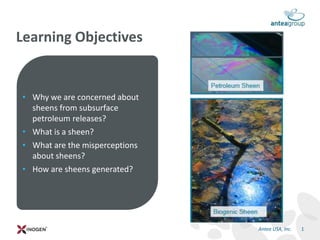
• Why we are concerned about
sheens from subsurface
petroleum releases?
• What is a sheen?
• What are the misperceptions
about sheens?
• How are sheens generated?
Learning Objectives
1Antea USA, Inc.
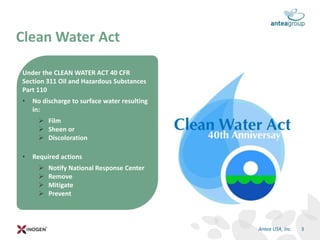
Regulatory Drivers
Under the CLEAN WATER ACT 40 CFR
Section 311 Oil and Hazardous Substances
Part 110
• No discharge to surface water resulting
in:
 Film
 Sheen or
 Discoloration
• Required actions
 Notify National Response Center
 Remove
 Mitigate
 Prevent
Clean Water Act
3Antea USA, Inc.
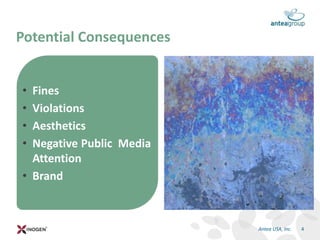
• Fines
• Violations
• Aesthetics
• Negative Public Media
Attention
• Brand
Potential Consequences
4Antea USA, Inc.
Sheen Misconceptions
Misconceptions by regulatory and regulated
community regarding the transport mechanisms
of hydrocarbon from upland subsurface to
surface water creating a sheen can result in
costly and/or ineffective remedial actions.
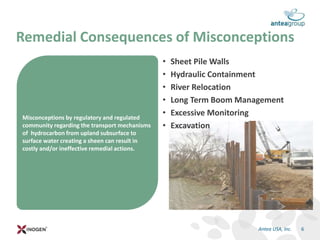
Remedial Consequences of Misconceptions
6Antea USA, Inc.
• Sheet Pile Walls
• Hydraulic Containment
• River Relocation
• Long Term Boom Management
• Excessive Monitoring
• Excavation
• A thin layer of non-miscible phase resting on
surface water
• May be liquid, waxy semi-solid or Petroleum
Sheen solid material
• Less dense than water
• Biogenic sheens derived from the breakdown
of natural organic material
• “Petroleum” sheens derived from crude or
refined petroleum
What is a Sheen?
7Antea USA, Inc.
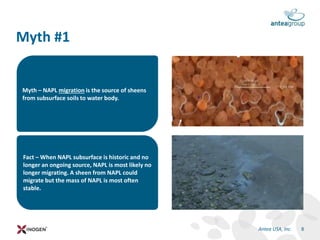
Fact – When NAPL subsurface is historic and no
longer an ongoing source, NAPL is most likely no
longer migrating. A sheen from NAPL could
migrate but the mass of NAPL is most often
stable.
Myth – NAPL migration is the source of sheens
from subsurface soils to water body.
Myth #1
8Antea USA, Inc.
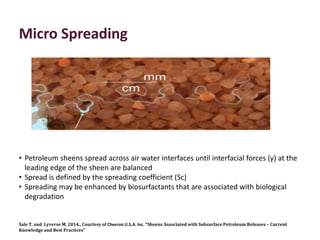
Sale T. and Lyverse M. 2014., Courtesy of Chevron U.S.A. Inc. “Sheens Associated with Subsurface Petroleum Releases – Current
Knowledge and Best Practices”
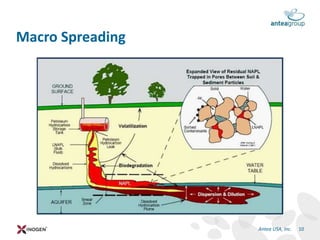
Micro Spreading
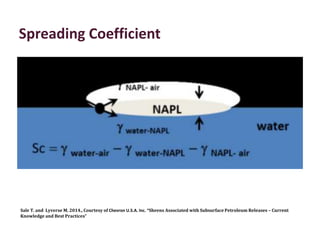
• Petroleum sheens spread across air water interfaces until interfacial forces (γ) at the
leading edge of the sheen are balanced
• Spread is defined by the spreading coefficient (Sc)
• Spreading may be enhanced by biosurfactants that are associated with biological
degradation
Macro Spreading
Antea USA, Inc. 10
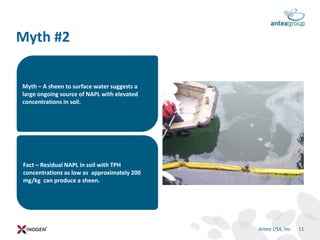
Fact – Residual NAPL in soil with TPH
concentrations as low as approximately 200
mg/kg can produce a sheen.
Myth – A sheen to surface water suggests a
large ongoing source of NAPL with elevated
concentrations in soil.
Myth #2
11Antea USA, Inc.
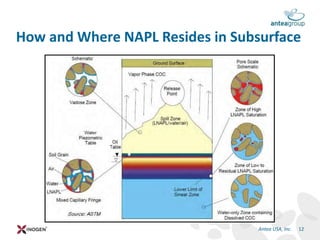
How and Where NAPL Resides in Subsurface
Antea USA, Inc. 12
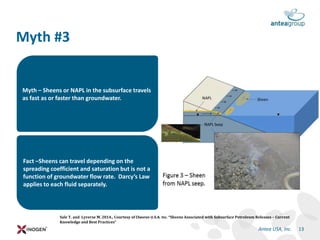
Fact –Sheens can travel depending on the
spreading coefficient and saturation but is not a
function of groundwater flow rate. Darcy’s Law
applies to each fluid separately.
Myth – Sheens or NAPL in the subsurface travels
as fast as or faster than groundwater.
Myth #3
13Antea USA, Inc.
Sale T. and Lyverse M. 2014., Courtesy of Chevron U.S.A. Inc. “Sheens Associated with Subsurface Petroleum Releases – Current
Knowledge and Best Practices”
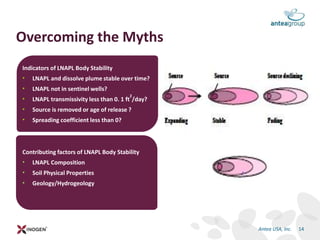
Contributing factors of LNAPL Body Stability
• LNAPL Composition
• Soil Physical Properties
• Geology/Hydrogeology
Indicators of LNAPL Body Stability
• LNAPL and dissolve plume stable over time?
• LNAPL not in sentinel wells?
• LNAPL transmissivity less than 0. 1 ft
2
/day?
• Source is removed or age of release ?
• Spreading coefficient less than 0?
Overcoming the Myths
14Antea USA, Inc.
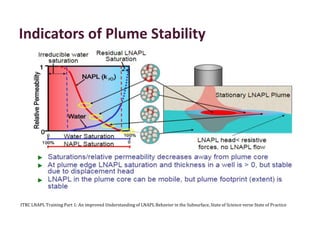
ITRC LNAPL Training Part 1: An improved Understanding of LNAPL Behavior in the Subsurface, State of Science verse State of Practice
Indicators of Plume Stability
Sale T. and Lyverse M. 2014., Courtesy of Chevron U.S.A. Inc. “Sheens Associated with Subsurface Petroleum Releases – Current
Knowledge and Best Practices”
Spreading Coefficient
Sheen Generation
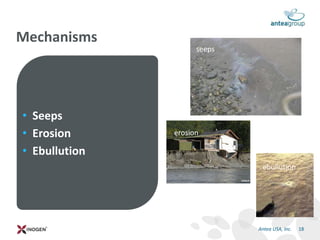
Mechanisms
• Seeps
• Erosion
• Ebullution
Mechanisms
18Antea USA, Inc.
seeps
erosion
ebullution
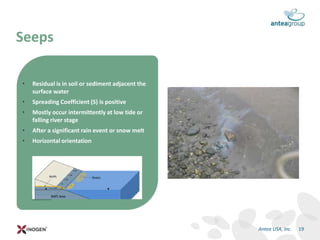
• Residual is in soil or sediment adjacent the
surface water
• Spreading Coefficient (S) is positive
• Mostly occur intermittently at low tide or
falling river stage
• After a significant rain event or snow melt
• Horizontal orientation
Seeps
19Antea USA, Inc.
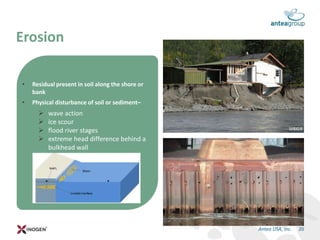
• Residual present in soil along the shore or
bank
• Physical disturbance of soil or sediment–
 wave action
 ice scour
 flood river stages
 extreme head difference behind a
bulkhead wall
Erosion
20Antea USA, Inc.
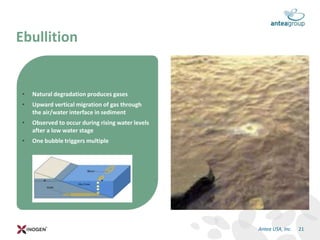
• Natural degradation produces gases
• Upward vertical migration of gas through
the air/water interface in sediment
• Observed to occur during rising water levels
after a low water stage
• One bubble triggers multiple
Ebullition
21Antea USA, Inc.
Upcoming NAPL sheen series presentation quick
tips topics
• Sheen forensics sampling for source
evaluation
• Measuring spreading coefficients and other
helpful NAPL characteristics
• Innovative sustainable shoreline sheen
remedy solutions
• Calculating life expectancy for sheen
remedies
• Biodiversity and importance of groundwater
surface water interface – Hyproheic Zone
Upcoming Quick Tips
22Antea USA, Inc.
Note: This photo is for example slide master options demo only and can be swapped out for more relevant
images
Contact
Caron Koll, PG
caron.koll@anteagroup.com
Tel +1 315 552 9832
Questions?
confidential and proprietary 23
B E T T E R B U S I N E S S ,
B E T T E R W O R L D℠
Antea Group Offices
USA Headquarters
5910 Rice Creek Parkway, Suite 100
St. Paul, MN 55126, USA
USA Toll Free: +1 800 477 7411
International: +1 651 639 9443
Belgium
Roderveldlaan 1
2600 Antwerpen
Colombia
Calle 35 No. 7-25, Piso 12
Bogota, DC
France
29 avenue Aristide Briand - CS 10006
94117 Arcueil Cedex
Netherlands
Monitorweg 29
1322 BK Almere
www.anteagroup.com

NAPL Quick Tips: A Primer on Hydrocarbon Sheens

  • 1.
    Hydrocarbon Sheens February 10,2016 NAPL Quick Tips by Caron Koll, Consultant
  • 2.
    • Why weare concerned about sheens from subsurface petroleum releases? • What is a sheen? • What are the misperceptions about sheens? • How are sheens generated? Learning Objectives 1Antea USA, Inc.
  • 3.
  • 4.
    Under the CLEANWATER ACT 40 CFR Section 311 Oil and Hazardous Substances Part 110 • No discharge to surface water resulting in:  Film  Sheen or  Discoloration • Required actions  Notify National Response Center  Remove  Mitigate  Prevent Clean Water Act 3Antea USA, Inc.
  • 5.
    • Fines • Violations •Aesthetics • Negative Public Media Attention • Brand Potential Consequences 4Antea USA, Inc.
  • 6.
  • 7.
    Misconceptions by regulatoryand regulated community regarding the transport mechanisms of hydrocarbon from upland subsurface to surface water creating a sheen can result in costly and/or ineffective remedial actions. Remedial Consequences of Misconceptions 6Antea USA, Inc. • Sheet Pile Walls • Hydraulic Containment • River Relocation • Long Term Boom Management • Excessive Monitoring • Excavation
  • 8.
    • A thinlayer of non-miscible phase resting on surface water • May be liquid, waxy semi-solid or Petroleum Sheen solid material • Less dense than water • Biogenic sheens derived from the breakdown of natural organic material • “Petroleum” sheens derived from crude or refined petroleum What is a Sheen? 7Antea USA, Inc.
  • 9.
    Fact – WhenNAPL subsurface is historic and no longer an ongoing source, NAPL is most likely no longer migrating. A sheen from NAPL could migrate but the mass of NAPL is most often stable. Myth – NAPL migration is the source of sheens from subsurface soils to water body. Myth #1 8Antea USA, Inc.
  • 10.
    Sale T. andLyverse M. 2014., Courtesy of Chevron U.S.A. Inc. “Sheens Associated with Subsurface Petroleum Releases – Current Knowledge and Best Practices” Micro Spreading • Petroleum sheens spread across air water interfaces until interfacial forces (γ) at the leading edge of the sheen are balanced • Spread is defined by the spreading coefficient (Sc) • Spreading may be enhanced by biosurfactants that are associated with biological degradation
  • 11.
  • 12.
    Fact – ResidualNAPL in soil with TPH concentrations as low as approximately 200 mg/kg can produce a sheen. Myth – A sheen to surface water suggests a large ongoing source of NAPL with elevated concentrations in soil. Myth #2 11Antea USA, Inc.
  • 13.
    How and WhereNAPL Resides in Subsurface Antea USA, Inc. 12
  • 14.
    Fact –Sheens cantravel depending on the spreading coefficient and saturation but is not a function of groundwater flow rate. Darcy’s Law applies to each fluid separately. Myth – Sheens or NAPL in the subsurface travels as fast as or faster than groundwater. Myth #3 13Antea USA, Inc. Sale T. and Lyverse M. 2014., Courtesy of Chevron U.S.A. Inc. “Sheens Associated with Subsurface Petroleum Releases – Current Knowledge and Best Practices”
  • 15.
    Contributing factors ofLNAPL Body Stability • LNAPL Composition • Soil Physical Properties • Geology/Hydrogeology Indicators of LNAPL Body Stability • LNAPL and dissolve plume stable over time? • LNAPL not in sentinel wells? • LNAPL transmissivity less than 0. 1 ft 2 /day? • Source is removed or age of release ? • Spreading coefficient less than 0? Overcoming the Myths 14Antea USA, Inc.
  • 16.
    ITRC LNAPL TrainingPart 1: An improved Understanding of LNAPL Behavior in the Subsurface, State of Science verse State of Practice Indicators of Plume Stability
  • 17.
    Sale T. andLyverse M. 2014., Courtesy of Chevron U.S.A. Inc. “Sheens Associated with Subsurface Petroleum Releases – Current Knowledge and Best Practices” Spreading Coefficient
  • 18.
  • 19.
    • Seeps • Erosion •Ebullution Mechanisms 18Antea USA, Inc. seeps erosion ebullution
  • 20.
    • Residual isin soil or sediment adjacent the surface water • Spreading Coefficient (S) is positive • Mostly occur intermittently at low tide or falling river stage • After a significant rain event or snow melt • Horizontal orientation Seeps 19Antea USA, Inc.
  • 21.
    • Residual presentin soil along the shore or bank • Physical disturbance of soil or sediment–  wave action  ice scour  flood river stages  extreme head difference behind a bulkhead wall Erosion 20Antea USA, Inc.
  • 22.
    • Natural degradationproduces gases • Upward vertical migration of gas through the air/water interface in sediment • Observed to occur during rising water levels after a low water stage • One bubble triggers multiple Ebullition 21Antea USA, Inc.
  • 23.
    Upcoming NAPL sheenseries presentation quick tips topics • Sheen forensics sampling for source evaluation • Measuring spreading coefficients and other helpful NAPL characteristics • Innovative sustainable shoreline sheen remedy solutions • Calculating life expectancy for sheen remedies • Biodiversity and importance of groundwater surface water interface – Hyproheic Zone Upcoming Quick Tips 22Antea USA, Inc. Note: This photo is for example slide master options demo only and can be swapped out for more relevant images
  • 24.
    Contact Caron Koll, PG caron.koll@anteagroup.com Tel+1 315 552 9832 Questions? confidential and proprietary 23
  • 25.
    B E TT E R B U S I N E S S , B E T T E R W O R L D℠ Antea Group Offices USA Headquarters 5910 Rice Creek Parkway, Suite 100 St. Paul, MN 55126, USA USA Toll Free: +1 800 477 7411 International: +1 651 639 9443 Belgium Roderveldlaan 1 2600 Antwerpen Colombia Calle 35 No. 7-25, Piso 12 Bogota, DC France 29 avenue Aristide Briand - CS 10006 94117 Arcueil Cedex Netherlands Monitorweg 29 1322 BK Almere www.anteagroup.com

Editor's Notes

  • #2 This presentation is one of several (I hope) on NAPL.
  • #3 A sheen can be as thin as 0.00004 mm to 0.05mm adopted by NOAA 2007 from Bonn Agreement Oil Appearance Code May 2006 . BTW the Boon Agreement The Bonn Agreement is a European environmental agreement. Following several oil spills in 1969, the coastal nations of the North Sea formed the Bonn Agreement to ensure mutual cooperation in the avoidance and combatting of environmental pollution. The agreement was revised in 1983 to include the European Union and again in 2001 to allow Ireland to join. Members of the Bonn Agreement are Belgium, Denmark, the European Community, France, Germany, Ireland, the Netherlands, Norway, Sweden, and the United Kingdom. How do you tell the difference between a biogenic and petrogenic sheen? Field test – the stick or rock test. Empirically, fingerprinting by a lab but you need special hydrophobic sheen collection apparatus to collect a sheen. A separate presentation will be provided to discuss sampling and characterizing sheen methods.
  • #4 Note: These photos are for position only and can be swapped out for more relevant images To swap these images, right click on the shape, select Format Picture, under “Fill” choose the Picture “From File” option and replace with suitable image. Make sure to consider complementary color arrangements. Check new image to make sure not ‘shrunken’ or distorted to fit shape (to make any adjustments as necessary, select the image and edit the image size and portion used via the cropping tool in the “Picture Tools” ribbon feature)
  • #5 Applicability of CWA to groundwater discharge to surface water has been a point of contention for a number of years. NRS is most concerned with spills directly from a vessel or through an outfall ( unpermitted NPDES ) however, fines and violation have been issued for sheens migrating from groundwater to surface water. Although the CWA excludes groundwater, once it reaches the surface water it is current considered a violation under the CWA.
  • #6 The Clean Water Act (“CWA”) prohibits the discharge of pollutants into “waters of the United States”[1] without a valid National Pollutant Discharge Elimination System (“NPDES”) permit.[2] On May 27, 2015, the EPA and the U.S. Army Corps of Engineers (the Corps) issued a rule defining “Waters of the United States” (“Clean Water Rule“) that expands the agencies’ Clean Water Act (CWA or Act)[1] jurisdiction over millions of acres of private, state and federal property, and is certain to face political, legislative, and legal challenges. The Clean Water Rule determines where permits will be required to dredge and fill wetlands and other waters under CWA §404 and to discharge pollutants to surface waters under CWA §402 (NPDES). The rule relies on a 331-page scientific report, Connectivity of Streams and Wetlands to Downstream Waters: A Review and Synthesis of the Scientific Evidence (“Connectivity Report”) that the EPA’s Science Advisory Board finalized in January 2015. The agencies are using the Connectivity Report as the scientific basis for the policy decisions expressed in the Clean Water Rule. Statute: 33 U.S.C. 1319(1) & (2) & 1321 (b)(3) Element: Negligently or Knowingly Discharges Oil or a Hazardous Substance Into a water of the United States/upon adjoining shorelines/into the contiguous Zone In a Harmful Quantity Penalty: Negligent Violations: 1 year and/or $2,500 - 25,000 per day; Subsequent convictions 2 years and/or $50,000 per day. Knowing Violations: 3 years and/or $5,000 - 50,000 per day; Subsequent convictions 6 years and/or $100,000 per day
  • #7 Note: These photos are for position only and can be swapped out for more relevant images To swap these images, right click on the shape, select Format Picture, under “Fill” choose the Picture “From File” option and replace with suitable image. Make sure to consider complementary color arrangements. Check new image to make sure not ‘shrunken’ or distorted to fit shape (to make any adjustments as necessary, select the image and edit the image size and portion used via the cropping tool in the “Picture Tools” ribbon feature)
  • #9 A petroleum sheen can be as thin as 0.00004 mm to 0.05mm from studies by European nations. BTW the Boon Agreement The Bonn Agreement is a European environmental agreement. Following several oil spills in 1969, the coastal nations of the North Sea formed the Bonn Agreement to ensure mutual cooperation in the avoidance and combatting of environmental pollution. The agreement was revised in 1983 to include the European Union and again in 2001 to allow Ireland to join. Bonn Agreement Oil Appearance Code May 2006, was were adopted by NOAA and in 2007 was the most recent NOAA document on sheen characterization. Members of the Bonn Agreement are Belgium, Denmark, the European Community, France, Germany, Ireland, the Netherlands, Norway, Sweden, and the United Kingdom. How do you tell the difference between a biogenic and petrogenic sheen? Field test – the stick or rock test. Empirically, you will need fingerprinting by a lab. However you need special hydrophobic sheen collection apparatus to collect a sheen. I jar won’t be effective in collecting a sheen sample. A separate presentation will be provided to discuss sheen sampling and characterizing methods.
  • #10 If your seeing a sheen, it’s mostly because residual has already spread in the soils at the shore line at the time of the initial release.
  • #11 Spreading – Petroleum sheens occur (Nonaqueous Phase Liquids – NAPLs) spread across air water interfaces. The potential for a NAPL to spread is defined by the spreading coefficient (Sc). This concept is presented in Figure 2. NAPLs spread across air-water interfaces until interfacial forces (γ) at the leading edge of the sheen are balanced or natural processes deplete the petroleum liquids. Most petroleum NAPLs spread across surface water including crude oil, fuels, and lubricants. Spreading may be enhanced by biosurfactants that are associated with biological degradation of NAPLs in subsurface media including sediments, soils, and rock.
  • #13 Based on petroleum sheens generation studies, concentration in the range of 200 mg/kg TPH can generate a sheen. A 1.5 ounces (one shot glass) would result in a sheen roughly 100 feet by 100 feet in size. Shot glass ( one shot = 1.8 cubic inches x 1.5) divided by the thickness of a silver gray sheen 1.6x10⁻⁶ inches. Square root of the result of the last step = 108 by 108 feet.
  • #15 Based on observations and those documented by Interstate Technology Regulatory Council (ITRC), although LNAPL can readily spread at rates higher than the groundwater flow rate due to large LNAPL hydraulic heads at the time of the release. AND LNAPL can spread opposite of ground water flow direction (radially) at the time of the release. HOWEVER, after LNAPL release is abated, LNAPL bodies come to be stable within a short period of time. The rate of transport can be estimated based on the interfacial tension between the media (water oil and air) and the resulting spreading coefficient. The LNAPL and groundwater now shares pore space. Darcy’s law applies to each fluid independently, within the oil/water system because of the differences in fluid properties. Biologically derived surfactants are thought to mobilize NAPL.
  • #16 This is a separate topic that can be covered in a three day course by ITRC.
  • #17 Irreducible water saturation (Swir) is equal to the minimum water saturation found capillary pressure curves determined from core analysis and is inversely proportional to porosity. Residual LNAPL saturation is non removable NAPL via water flooding, without the aid of enhanced recovery (heating, surfactants)
  • #18 Spreading – Petroleum sheens occur (Nonaqueous Phase Liquids – NAPLs) spread across air water interfaces. The spreading coefficient (S) describes the tendency of oil to spread on the air–water interface (Adamson, 1990) and is given by S=σ aw −(σ ow +σ oa )  (1) Adamson AW. Physical chemistry of surfaces. Wiley; New York: 1990. where σ is interfacial tension; and pairs of subscripts refer to the interface between the respective phases. If S is positive, the oil spreads spontaneously; if negative, the oil beads up into lenses. The potential for a NAPL to spread is defined by the spreading coefficient (Sc). This concept is presented above. NAPLs spread across air-water interfaces until interfacial forces (γ) at the leading edge of the sheen are balanced or natural processes deplete the petroleum liquids. Most petroleum NAPLs spread across surface water including crude oil, fuels, and lubricants. Spreading may be enhanced by biosurfactants (any surfactant of biological origin) that are associated with biological degradation of NAPLs in subsurface media including sediments, soils, and rock. In the vadose zone, NAPL migration is controlled by a number of processes including flow by buoyant and capillary forces, liquid spreading at air–water interfaces, and evaporation (Conrad et al., 1992).
  • #19 Note: These photos are for position only and can be swapped out for more relevant images To swap these images, right click on the shape, select Format Picture, under “Fill” choose the Picture “From File” option and replace with suitable image. Make sure to consider complementary color arrangements. Check new image to make sure not ‘shrunken’ or distorted to fit shape (to make any adjustments as necessary, select the image and edit the image size and portion used via the cropping tool in the “Picture Tools” ribbon feature)
  • #20 Understanding mechanisms of sheen releases and controlling factors is central to developing remedies. Seeps – Groundwater typically discharges from river banks or shorelines to surface water during falling surface water levels. Where NAPL near the groundwater surface interface discharge of groundwater can drive sheen on groundwater into surface water (Figure 3). Most often, seeps appear at low flow or low tide surface water stages. Seeps generally have a horizontal orientation. Erosion – Another mechanism driving sheens is erosion of sediments and soils. Erosion can occur at high flows along rivers, due to storm-related wave actions, construction activities, and/or ice scour. This method of sheen generation is intuitive, since soils containing residual LNAPL is now placed in direct contact with the air/water interface at the sediment surface. Ebullition – Natural degradation of petroleum often occurs in petroleum impacted sediments, generating gases that migrate upward through sediments due to buoyancy. As is the case in surface water, a thin film of petroleum liquid can be incorporated at the air/water interface in gas bubbles adjacent to NAPL; essentially a sheen within gas bubbles. The term “ebullition” (Amos et al. 2006) has been used to describe the process of gas generation and discharge from sediments. Ebullition can occur in situ generation of gases and/or with rising water levels, leading to compression of entrapped gases to the point where they are small enough to be released. Often the release of one bubble leads to the coalescing of multiple bubbles and episodic releases. As shown in the Figure 4, sheens generated from ebullition process appear when sediments are submerged and transport is a vertical process.
  • #21 Seeps – Groundwater typically discharges from river banks or shorelines to surface water during falling surface water levels. Where NAPL is near the groundwater surface interface, discharge of groundwater can drive sheen on groundwater into surface water. Most often, seeps appear intermittently at low stream flow or low tide stages. Seeps generally have a horizontal orientation.
  • #22 Erosion – Another mechanism driving sheens is erosion of sediments and soils. Erosion can occur at high flows along rivers, due to storm-related wave actions, construction activities, and/or ice scour. Erosion has also been observed during low tide event along corroded seawall. This method of sheen generation is intuitive, since soils containing residual LNAPL is now placed in direct contact with the air/water interface at the sediment surface.
  • #23 Ebullition – Natural degradation of petroleum often occurs in petroleum impacted sediments, generating gases that migrate upward through sediments due to buoyancy. As is the case in surface water, a thin film of petroleum liquid can be incorporated at the air/water interface in gas bubbles adjacent to NAPL; essentially a sheen within gas bubbles. The term “ebullition” (Amos et al. 2006) has been used to describe the process of gas generation and discharge from sediments. Ebullition can occur in situ generation of gases and/or with rising water levels, leading to compression of entrapped gases to the point where they are small enough to be released. Often the release of one bubble leads to the coalescing of multiple bubbles and episodic releases. As shown in the Figure 4, sheens generated from ebullition process appear when sediments are submerged and transport is a vertical process. The surface water ground water interface is a zone of oxygenation with a diverse and high microbial community population.
  • #25 How do you measure spreading coefficient? You will need to collect cores and coordinate with a specialty lab such as PTS that measures .