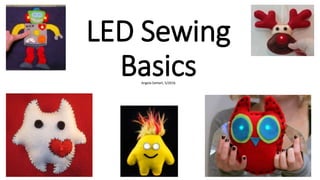
LED Sewing
BasicsAngela DeHart, 5/2016
Updated 3/2017
Tools
Angela DeHart, 5/2016
A large variety of scissors and shears all
exist for specialized purposes. Hair-cutting
shearsand kitchen shears are functionally
equivalent to scissors, but the larger
implements tend to be called shears. Hair-
cutting shears have specific blade angles
ideal for cutting hair. Using the incorrect
scissors to cut hair will result in increased
damage or split ends, or both, by breaking
the hair. Kitchen shears, also known as
kitchen scissors, are for cutting and
trimming foods such as meats.
Modern scissors are often
designed ergonomically with
composite thermoplastic and rubber handle
s which enable the user to exert either a
power grip or a precision grip.
https://en.wikipedia.org/wiki/Scissors
Shears
Angela DeHart, 5/2016
Thread Thread is made from a wide variety of materials. If
your machine will sew with the thread, any thread
can used for just about any purpose. This is very
useful for someone who is trying to learn sewing.
However, it should be remembered that where a
thread is stronger than the material that it is being
used to join, if seams are placed under strain the
material may tear before the thread breaks.
Garments are usually sewn with threads of lesser
strength than the fabric so that if stressed the
seam will break before the garment. Heavy goods
that must withstand considerable stresses such
as upholstery, car seating, tarpaulins, tents,
and saddlery require very strong threads.
Attempting repairs with light weight thread will
usually result in rapid failure, though again, using a
thread that is stronger than the material being
sewn can end up causing rips in that material
before the thread itself gives way.
https://en.wikipedia.org/wiki/Thread_(yarn)
Angela DeHart, 5/2016
Ruler A ruler, sometimes called a rule or line
gauge, is an instrument used
in geometry, technical drawing, printing,
engineering and building to measure
distances or to rule straight lines. The ruler is
a straightedge which may also contain
calibrated lines to measure distances.[1]
https://en.wikipedia.org/wiki/Ruler
Angela DeHart, 5/2016
Scissors Scissors are hand-operated
shearing tools. They consist
of a pair
of metal blades pivoted so
that the sharpened edges
slide against each other
when the handles (bows)
opposite to the pivot are
closed. Scissors are used for
cutting various thin
materials, such
as paper,cardboard, metal
foil, cloth, rope, and wire.
https://en.wikipedia.org/wiki/Scissors
Angela DeHart, 5/2016
Round nose pliers Round nose pliers, rosary
pliers or snub-nose pliers are a
specialized plier characterized by their
rounded, tapering jaws and most
commonly used for creating loops in pieces
of wire
by electricians and jewellers.[1] Some round
nose pliers have insulated handles for
safeelectrical work, a spring-fitted joint and
comfortable grips on the handles.
https://en.wikipedia.org/wiki/Round-nose_pliers
Angela DeHart, 5/2016
Clear Nail Polish
You can use clear nail
polish to prevent the
conductive thread
from fraying.
Angela DeHart, 5/2016
A light-emitting diode (LED) is a two-
lead semiconductor light source. It is a p–n
junction diode, which emits light when
activated.[4]When a suitable voltage is applied to
the leads, electrons are able to recombine
with electron holes within the device, releasing
energy in the form of photons. This effect is
called electroluminescence, and the color of the
light (corresponding to the energy of the photon) is
determined by the energy band gap of the
semiconductor.
LED
https://en.wikipedia.org/wiki/Light-emitting_diode
Angela DeHart, 5/2016
Conductive Thread A conductive textile is a fabric which can
conduct electricity. Conductive textiles can be made with
metal strands woven into the construction of the textile.
There is also an interest in semiconducting textiles, made
by impregnating normal textiles with carbon- or metal-
based powders.[1]
Conductive fibers consist of a non-conductive or less
conductive substrate, which is then either coated or
embedded with electrically conductive elements,
often carbon, nickel,copper, gold, silver, or titanium.
Substrates typically include cotton, polyester, nylon,
and stainless steel to high performance fibers such as
aramids and PBO. Straddling the worlds of textiles and
wires, conductive fibers are sold either by weight or
length, and measured in denier or AWG.
Because of the rapid growth in the kinds of conductive
fibers and the uses of these fibers, a trade association--
the Conductive Fiber Manufacturers Council[2]--was
formed to increase awareness, utilization, and possibly
standardize terminology. https://en.wikipedia.org/wiki/Conductive_textile
Angela DeHart, 5/2016
Hand needle A sewing needle for hand-
sewing is a long slender tool
with a pointed tip at one end
and a hole or eye at the other.
The earliest needles were made
of bone or wood; modern ones
are manufactured from
high carbon steel wire and
are nickel- or 18K gold-plated
for corrosion resistance. The
highest quality embroidery
needles are plated with two-
thirds platinum and one-
third titanium alloy.
https://en.wikipedia.org/wiki/Sewing_needle
Angela DeHart, 5/2016
Coin Cell Battery A watch battery or button cell is a small
single cell battery shaped as a
squat cylinder typically 5 to 25 mm in
diameter and 1 to 6 mm high—like a button
on a garment, hence the name. Button cells
are used to power small portable
electronicsdevices such as wrist
watches, pocket calculators, artificial cardiac
pacemakers, implantable cardiac
defibrillators, and hearing aids.
Devices using button cells are usually designed
to use a cell giving a long service life, typically
well over a year in continuous use in a
wristwatch. Most button cells have low self-
discharge and hold their charge for a long time if
not used
A metal can forms the bottom body and positive
terminal of the cell. The insulated top cap is the
negative terminal.
https://en.wikipedia.org/wiki/Button_cell Angela DeHart, 5/2016
Battery Holder
A battery holder is one or more
compartments or chambers for
holding a battery.
https://en.wikipedia.org/wiki/Battery_holder
Embellishments (optional)
Embroidery floss Embroidery Printed picture Puffs
Angela DeHart, 5/2016
Embellishments (optional)
Ribbon Beads Buttons Fabric glue
Angela DeHart, 5/2016
Embellishments (optional)
Stuffing Hard felt Yarn
Angela DeHart, 5/2016
Technique
https://engineering.purdue.edu/Engr/Giving/FundingPriorities/MEP_html
http://viewpure.com/SewLED
Angela DeHart, 5/2016
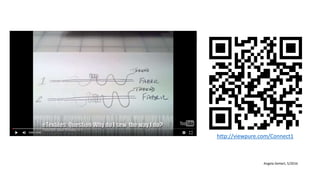
http://viewpure.com/Connect1
Angela DeHart, 5/2016
http://viewpure.com/Pressure1
Angela DeHart, 5/2016
http://viewpure.com/SuperSew
DesignYou are making your own!
Angela DeHart, 5/2016
Prepare for Step 1:
What tools do I need to create my 2 designs?
Angela DeHart, 5/2016
Step 1: Create 2 designs
Design#1
Design#2
LED
LED
Buttons
Stuffed
Embroidery
Printed Fabric
Angela DeHart, 5/2016
Prepare for Step 2:
What tools do I need to explain why I choose my design?
Angela DeHart, 5/2016
Step 2: Choose the design you want to make.
Explain why you choose that design.
I complete this design because it allows me to demonstrate many sewing techniques.
1. I can sew on the sewing machine when I sew on the earth
2. I can hand sew when I put on the buttons
3. I can show off my ability to cut when I cut the windows for the space ship
4. I think it shows off my personality because I have always interested in space
5. I think the design is creative because it puts all of these technical elements
together and makes them look nice
6. This will be a nice keepsake for my time in this class
7. It will look good when I hang it in my room. I can’t wait to see it when I cut the lights
in my room off and leave the LEDs in my spaceship on!
An example
Angela DeHart, 5/2016
Prepare for Step 3:
What tools do I need to make each component of my design?
Angela DeHart, 5/2016
Step 3: Determine how each component of your design is going
to actually be made.
a. Determine how many buttons I need and can afford
b. Choose “STAR” buttons from lab’s button collection
c. Pay Ms. DeHart for the buttons (write a check)
d. Determine where the buttons go, estimate how long it is going to take me to sew them on and then and sew them on my design
a. Find a photo of earth I want to use
b. Determine how large my earth needs to be to work with my design
c. Purchase a sheet of fabric print paper
d. Print the picture, estimate how long it is going to take for me to process and sew the earth on, and then sew the earth on my design
a. Determine the number of colors and types of fabric I will need to create my design
b. Create a pattern for each component of my rocket that I need to cut it out of a different color fabric
c. Purchase the fabric from Ms. DeHart
d. Cut out my patterns. Pin and cut the parts out of my fabrics and then sew my rocket onto my design
a. Determine where your LEDs are going to be in your design
b. Determine where your battery holder is going to be in your design
c. Draw an electrical schematic of the circuit you are going to sew to make your LEDs light up
d. Purchase the LEDs, battery, battery holder, any other electrical components you need for your design from Ms. DeHart
e. Create your circuit Angela DeHart, 5/2016
Step 4: Create your designs based on the
information and supplies you gathered
in Step #3
Step 5: Turn your work in for grading
IF there is time left in the semester:
a. Is there anything you can redo & turn in to improve your grade?
b. Verify with Ms. DeHart that you are authorized to help other students, and help
c. Look at completing the extra credit project
d. Help clean the room for the end of the semester/year Angela DeHart, 5/2016
Extra Credit: Quiet Book
http://viewpure.com/QuietBk
Angela DeHart, 5/2016
Appendix A: Polarity(That means there is a positive (+) and negative (-) side to each component.)
Battery Holder
•Positive (+, "E"): The positive end of the battery holder looks like an "E" shape.
•Negative (-, with slot): The negative end of the battery holder has a slot.
Battery
• Positive (+): The top side of the battery has writing on it.
• Negative (-): The bottom side of the battery is blank.
LED
• Positive (+): The positive leg of the LED is longer.
• Negative (-): The negative leg of the LED is shorter.
Angela DeHart, 5/2016
Appendix A: Polarity
To test the LED and battery:
1. Touch the LED positive leg to the battery positive side.
IF the LED and the battery are “good” the LED will light up!
Problem solving:
IF the LED does not light up:
a) Check to see if the battery good?
b) Check to see if the LED good?
c) Check to see if you have the (+) part of the battery & the LED touching?
(That means there is a positive (+) and negative (-) side to each component.)
Angela DeHart, 5/2016
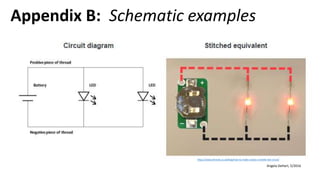
Appendix B: Schematic examples
https://www.kitronik.co.uk/blog/how-to-make-a-basic-e-textile-led-circuit/
Angela DeHart, 5/2016
Appendix B: Schematic examples
YouTube: E textiles - Adding one LED light to your crafts
http://web.media.mit.edu/~leah/grad_work/diy/diy_e_sewing_old.html
Angela DeHart, 5/2016
E-textiles batteryRegular Battery
Appendix C: Part equivalentsSnap Circuit parts vs E-textile parts vs Paper circuit parts
Snap Circuit Electronics Kit LED E-textile
Adifruit
LED
E-textile
LED
E-textile
Paper LED
Snap Circuit Electronics Kit Connector E-textiles Conductive Thread
Battery Holder electronics kit
Battery Holder e-textilesSlide Switch electronics kit
Slide Switch e-textiles

Led Sewing Basics

  • 1.
    LED Sewing BasicsAngela DeHart,5/2016 Updated 3/2017
  • 2.
  • 3.
    A large varietyof scissors and shears all exist for specialized purposes. Hair-cutting shearsand kitchen shears are functionally equivalent to scissors, but the larger implements tend to be called shears. Hair- cutting shears have specific blade angles ideal for cutting hair. Using the incorrect scissors to cut hair will result in increased damage or split ends, or both, by breaking the hair. Kitchen shears, also known as kitchen scissors, are for cutting and trimming foods such as meats. Modern scissors are often designed ergonomically with composite thermoplastic and rubber handle s which enable the user to exert either a power grip or a precision grip. https://en.wikipedia.org/wiki/Scissors Shears Angela DeHart, 5/2016
  • 4.
    Thread Thread ismade from a wide variety of materials. If your machine will sew with the thread, any thread can used for just about any purpose. This is very useful for someone who is trying to learn sewing. However, it should be remembered that where a thread is stronger than the material that it is being used to join, if seams are placed under strain the material may tear before the thread breaks. Garments are usually sewn with threads of lesser strength than the fabric so that if stressed the seam will break before the garment. Heavy goods that must withstand considerable stresses such as upholstery, car seating, tarpaulins, tents, and saddlery require very strong threads. Attempting repairs with light weight thread will usually result in rapid failure, though again, using a thread that is stronger than the material being sewn can end up causing rips in that material before the thread itself gives way. https://en.wikipedia.org/wiki/Thread_(yarn) Angela DeHart, 5/2016
  • 5.
    Ruler A ruler,sometimes called a rule or line gauge, is an instrument used in geometry, technical drawing, printing, engineering and building to measure distances or to rule straight lines. The ruler is a straightedge which may also contain calibrated lines to measure distances.[1] https://en.wikipedia.org/wiki/Ruler Angela DeHart, 5/2016
  • 6.
    Scissors Scissors arehand-operated shearing tools. They consist of a pair of metal blades pivoted so that the sharpened edges slide against each other when the handles (bows) opposite to the pivot are closed. Scissors are used for cutting various thin materials, such as paper,cardboard, metal foil, cloth, rope, and wire. https://en.wikipedia.org/wiki/Scissors Angela DeHart, 5/2016
  • 7.
    Round nose pliersRound nose pliers, rosary pliers or snub-nose pliers are a specialized plier characterized by their rounded, tapering jaws and most commonly used for creating loops in pieces of wire by electricians and jewellers.[1] Some round nose pliers have insulated handles for safeelectrical work, a spring-fitted joint and comfortable grips on the handles. https://en.wikipedia.org/wiki/Round-nose_pliers Angela DeHart, 5/2016
  • 8.
    Clear Nail Polish Youcan use clear nail polish to prevent the conductive thread from fraying. Angela DeHart, 5/2016
  • 9.
    A light-emitting diode(LED) is a two- lead semiconductor light source. It is a p–n junction diode, which emits light when activated.[4]When a suitable voltage is applied to the leads, electrons are able to recombine with electron holes within the device, releasing energy in the form of photons. This effect is called electroluminescence, and the color of the light (corresponding to the energy of the photon) is determined by the energy band gap of the semiconductor. LED https://en.wikipedia.org/wiki/Light-emitting_diode Angela DeHart, 5/2016
  • 10.
    Conductive Thread Aconductive textile is a fabric which can conduct electricity. Conductive textiles can be made with metal strands woven into the construction of the textile. There is also an interest in semiconducting textiles, made by impregnating normal textiles with carbon- or metal- based powders.[1] Conductive fibers consist of a non-conductive or less conductive substrate, which is then either coated or embedded with electrically conductive elements, often carbon, nickel,copper, gold, silver, or titanium. Substrates typically include cotton, polyester, nylon, and stainless steel to high performance fibers such as aramids and PBO. Straddling the worlds of textiles and wires, conductive fibers are sold either by weight or length, and measured in denier or AWG. Because of the rapid growth in the kinds of conductive fibers and the uses of these fibers, a trade association-- the Conductive Fiber Manufacturers Council[2]--was formed to increase awareness, utilization, and possibly standardize terminology. https://en.wikipedia.org/wiki/Conductive_textile Angela DeHart, 5/2016
  • 11.
    Hand needle Asewing needle for hand- sewing is a long slender tool with a pointed tip at one end and a hole or eye at the other. The earliest needles were made of bone or wood; modern ones are manufactured from high carbon steel wire and are nickel- or 18K gold-plated for corrosion resistance. The highest quality embroidery needles are plated with two- thirds platinum and one- third titanium alloy. https://en.wikipedia.org/wiki/Sewing_needle Angela DeHart, 5/2016
  • 12.
    Coin Cell BatteryA watch battery or button cell is a small single cell battery shaped as a squat cylinder typically 5 to 25 mm in diameter and 1 to 6 mm high—like a button on a garment, hence the name. Button cells are used to power small portable electronicsdevices such as wrist watches, pocket calculators, artificial cardiac pacemakers, implantable cardiac defibrillators, and hearing aids. Devices using button cells are usually designed to use a cell giving a long service life, typically well over a year in continuous use in a wristwatch. Most button cells have low self- discharge and hold their charge for a long time if not used A metal can forms the bottom body and positive terminal of the cell. The insulated top cap is the negative terminal. https://en.wikipedia.org/wiki/Button_cell Angela DeHart, 5/2016
  • 13.
    Battery Holder A batteryholder is one or more compartments or chambers for holding a battery. https://en.wikipedia.org/wiki/Battery_holder
  • 14.
    Embellishments (optional) Embroidery flossEmbroidery Printed picture Puffs Angela DeHart, 5/2016
  • 15.
    Embellishments (optional) Ribbon BeadsButtons Fabric glue Angela DeHart, 5/2016
  • 16.
    Embellishments (optional) Stuffing Hardfelt Yarn Angela DeHart, 5/2016
  • 17.
  • 18.
  • 19.
  • 20.
  • 21.
  • 22.
    DesignYou are makingyour own! Angela DeHart, 5/2016
  • 23.
    Prepare for Step1: What tools do I need to create my 2 designs? Angela DeHart, 5/2016
  • 24.
    Step 1: Create2 designs Design#1 Design#2 LED LED Buttons Stuffed Embroidery Printed Fabric Angela DeHart, 5/2016
  • 25.
    Prepare for Step2: What tools do I need to explain why I choose my design? Angela DeHart, 5/2016
  • 26.
    Step 2: Choosethe design you want to make. Explain why you choose that design. I complete this design because it allows me to demonstrate many sewing techniques. 1. I can sew on the sewing machine when I sew on the earth 2. I can hand sew when I put on the buttons 3. I can show off my ability to cut when I cut the windows for the space ship 4. I think it shows off my personality because I have always interested in space 5. I think the design is creative because it puts all of these technical elements together and makes them look nice 6. This will be a nice keepsake for my time in this class 7. It will look good when I hang it in my room. I can’t wait to see it when I cut the lights in my room off and leave the LEDs in my spaceship on! An example Angela DeHart, 5/2016
  • 27.
    Prepare for Step3: What tools do I need to make each component of my design? Angela DeHart, 5/2016
  • 28.
    Step 3: Determinehow each component of your design is going to actually be made. a. Determine how many buttons I need and can afford b. Choose “STAR” buttons from lab’s button collection c. Pay Ms. DeHart for the buttons (write a check) d. Determine where the buttons go, estimate how long it is going to take me to sew them on and then and sew them on my design a. Find a photo of earth I want to use b. Determine how large my earth needs to be to work with my design c. Purchase a sheet of fabric print paper d. Print the picture, estimate how long it is going to take for me to process and sew the earth on, and then sew the earth on my design a. Determine the number of colors and types of fabric I will need to create my design b. Create a pattern for each component of my rocket that I need to cut it out of a different color fabric c. Purchase the fabric from Ms. DeHart d. Cut out my patterns. Pin and cut the parts out of my fabrics and then sew my rocket onto my design a. Determine where your LEDs are going to be in your design b. Determine where your battery holder is going to be in your design c. Draw an electrical schematic of the circuit you are going to sew to make your LEDs light up d. Purchase the LEDs, battery, battery holder, any other electrical components you need for your design from Ms. DeHart e. Create your circuit Angela DeHart, 5/2016
  • 29.
    Step 4: Createyour designs based on the information and supplies you gathered in Step #3 Step 5: Turn your work in for grading IF there is time left in the semester: a. Is there anything you can redo & turn in to improve your grade? b. Verify with Ms. DeHart that you are authorized to help other students, and help c. Look at completing the extra credit project d. Help clean the room for the end of the semester/year Angela DeHart, 5/2016
  • 30.
    Extra Credit: QuietBook http://viewpure.com/QuietBk Angela DeHart, 5/2016
  • 31.
    Appendix A: Polarity(Thatmeans there is a positive (+) and negative (-) side to each component.) Battery Holder •Positive (+, "E"): The positive end of the battery holder looks like an "E" shape. •Negative (-, with slot): The negative end of the battery holder has a slot. Battery • Positive (+): The top side of the battery has writing on it. • Negative (-): The bottom side of the battery is blank. LED • Positive (+): The positive leg of the LED is longer. • Negative (-): The negative leg of the LED is shorter. Angela DeHart, 5/2016
  • 32.
    Appendix A: Polarity Totest the LED and battery: 1. Touch the LED positive leg to the battery positive side. IF the LED and the battery are “good” the LED will light up! Problem solving: IF the LED does not light up: a) Check to see if the battery good? b) Check to see if the LED good? c) Check to see if you have the (+) part of the battery & the LED touching? (That means there is a positive (+) and negative (-) side to each component.) Angela DeHart, 5/2016
  • 33.
    Appendix B: Schematicexamples https://www.kitronik.co.uk/blog/how-to-make-a-basic-e-textile-led-circuit/ Angela DeHart, 5/2016
  • 34.
    Appendix B: Schematicexamples YouTube: E textiles - Adding one LED light to your crafts http://web.media.mit.edu/~leah/grad_work/diy/diy_e_sewing_old.html Angela DeHart, 5/2016
  • 35.
    E-textiles batteryRegular Battery AppendixC: Part equivalentsSnap Circuit parts vs E-textile parts vs Paper circuit parts
  • 36.
    Snap Circuit ElectronicsKit LED E-textile Adifruit LED E-textile LED E-textile Paper LED
  • 37.
    Snap Circuit ElectronicsKit Connector E-textiles Conductive Thread
  • 38.
    Battery Holder electronicskit Battery Holder e-textilesSlide Switch electronics kit Slide Switch e-textiles