BLOCKCHAIN FOR AUDITORS
Andrew Clark
Data Economist
BlockScience
About Me
● B.S. in Business Administration with a concentration in Accounting, Summa Cum
Laude, from University of Tennessee at Chattanooga.
● M.S. in Data Science from Southern Methodist University.
● Ph.D. Candidate in Economics at the University Reading, specializing in
International Monetary Policy.
● American Statistical Association Graduate Statistician (GStat), INFORMS Certified
Analytics Professional (CAP) and AWS Certified Solutions Architect – Associate.
● Experienced in designing, built and deployed numerous machine learning and
continuous monitoring solutions using open source technologies.
● Successfully developed and deployed an Audit Analytics program for a publicly
traded decentralized manufacturing company.
● Working as a Data Economist creating ecosystem economic design specifications
by employing mathematical engineering technologies to create novel solutions to
solve business problems.
● Understand what Blockchain is
● Describe the differences between public and private blockchains
● Understand where blockchain can be useful to companies, and where it is
unnecessary
● What security considerations exist
● Be able to perform a basic Blockchain audit
Objectives
● A blockchain is a distributed ledger of transactions (DLT), recorded into blocks
that are linked together by cryptography into a ‘chain’.
● Originally introduced by Satoshi Nakamoto, an unknown individual or group of
individuals, in a whitepaper titled ‘Bitcoin: A Peer-to-Peer Electronic Cash
System’ via a cryptography email list.
What is Blockchain?
Signal vs Noise
● Common confusion of Blockchain = Bitcoin
● Blockchain, as previously defined, was initially created as part of Bitcoin, but
it’s usefulness outside Bitcoin was quickly ascertained.
● Examples:
○ Traceability of fish, where they were farmed/caught.
○ Traceability of agriculture
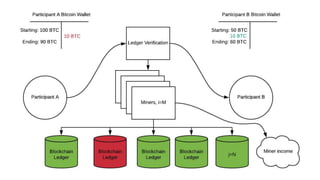
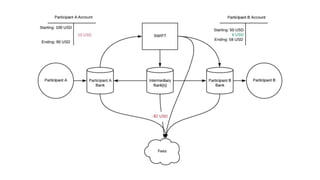
○ International money transfers (see next two slides)
■ JP Coin
Blockchain != Cryptocurrrency
● As Bitcoin has a finite amount coins that can be ‘minted’, imposing scarcity.
○ Sometimes called “digital gold”.
● Held for speculative purposes, used on a small scale as money.
● Grand dreams of creating a monetary system outside the reach of
governments and the banking system - “decentralized”.
● Plagued by:
○ Lack of respect of economics and history
○ Silicon Valley superiority complex
○ Lack of rigor in designing currencies
○ Too many cryptocurrencies vying for supremacy.
What are cryptocurrencies?
● Are cryptocurrencies ‘real’ money?
● Are cryptocurrency viable, stable assets? Examined in detail by yours truly and
my PhD advisor, Dr. Alexander Mihailov, in a paper entitled: “Why private
cryptocurrencies cannot serve as international reserves but central bank digital
currencies can”.
○ Hint: they are not.
What are cryptocurrencies? Cont.
● So far we have talked about public blockchains, were anyone can download
the entire blockchain, examine it, and/or begin mining.
● Private blockchains restrict access to only specific individuals/groups.
What is a public and what is a private blockchain?
● As previously highlighted briefly, blockchain implementations are being
used/developed for:
○ Traceability/accountability applications, such as the Fair Trade product
tracking
○ International money movement:
■ SWIFT
■ JP Morgan
■ Etc
○ International trade
○ Digital Identity
When is blockchain useful?
● Whenever possibly, try to use a regular database.
● Many companies wanting to ‘be innovative like Silicon Valley” - a pernicious
disease affecting most major consulting firms and Fortune 500 C suites -
implement blockchains for the ‘wow’ factor when they will actually turn into
expensive, unwieldy databases.
● As a rule, blockchain should never be used within a corporation.
○ JP Morgan breaks this rule, but it is for a very specific purpose.
● A blockchain should only be used when traditional means of data sharing
and/or databases will not allow the needed recording of data, or a solid
enough audit trail.
● Blockchains do not store data, can only point to it.
When is it not?
● 51% attack
● Sybil attack (identity forging)
● SHA-256 hack - if quantum computing ever becomes a thing (don’t hold your
breath)
● Entry point attack
● Oracle attack
● In private blockchains
○ Access control
○ And all the other regular ITGC worries
Blockchain Security
● Honestly, not that ‘new’
○ The same blocking and tackling of any other ITGC audit is required.
● New audit workpaper out by ISACA yours truly helped to develop.
● The biggest lift will be examining the use case, is a blockchain really needed,
and was a standard implementation, such as Hyperledger implemented?
● Was proper SDLC planning and implementation carried out?
● Does IT Department have the appropriate controls in place for who can access
the blockchain, and/or companies that run nodes?
● Key management, consensus, etc.
● Is third-party vendor risk mitigated?
The Blockchain Audit
Questions?
ContactLinkedIn
Email: andrew@block.science
Phone: 423-504-5024
Personal website
BlockScience website
THANK YOU
Andrew Clark
Data Economist
BlockScience

Blockchain for Auditors

  • 1.
    BLOCKCHAIN FOR AUDITORS AndrewClark Data Economist BlockScience
  • 2.
    About Me ● B.S.in Business Administration with a concentration in Accounting, Summa Cum Laude, from University of Tennessee at Chattanooga. ● M.S. in Data Science from Southern Methodist University. ● Ph.D. Candidate in Economics at the University Reading, specializing in International Monetary Policy. ● American Statistical Association Graduate Statistician (GStat), INFORMS Certified Analytics Professional (CAP) and AWS Certified Solutions Architect – Associate. ● Experienced in designing, built and deployed numerous machine learning and continuous monitoring solutions using open source technologies. ● Successfully developed and deployed an Audit Analytics program for a publicly traded decentralized manufacturing company. ● Working as a Data Economist creating ecosystem economic design specifications by employing mathematical engineering technologies to create novel solutions to solve business problems.
  • 3.
    ● Understand whatBlockchain is ● Describe the differences between public and private blockchains ● Understand where blockchain can be useful to companies, and where it is unnecessary ● What security considerations exist ● Be able to perform a basic Blockchain audit Objectives
  • 4.
    ● A blockchainis a distributed ledger of transactions (DLT), recorded into blocks that are linked together by cryptography into a ‘chain’. ● Originally introduced by Satoshi Nakamoto, an unknown individual or group of individuals, in a whitepaper titled ‘Bitcoin: A Peer-to-Peer Electronic Cash System’ via a cryptography email list. What is Blockchain?
  • 5.
  • 6.
    ● Common confusionof Blockchain = Bitcoin ● Blockchain, as previously defined, was initially created as part of Bitcoin, but it’s usefulness outside Bitcoin was quickly ascertained. ● Examples: ○ Traceability of fish, where they were farmed/caught. ○ Traceability of agriculture ○ International money transfers (see next two slides) ■ JP Coin Blockchain != Cryptocurrrency
  • 9.
    ● As Bitcoinhas a finite amount coins that can be ‘minted’, imposing scarcity. ○ Sometimes called “digital gold”. ● Held for speculative purposes, used on a small scale as money. ● Grand dreams of creating a monetary system outside the reach of governments and the banking system - “decentralized”. ● Plagued by: ○ Lack of respect of economics and history ○ Silicon Valley superiority complex ○ Lack of rigor in designing currencies ○ Too many cryptocurrencies vying for supremacy. What are cryptocurrencies?
  • 10.
    ● Are cryptocurrencies‘real’ money? ● Are cryptocurrency viable, stable assets? Examined in detail by yours truly and my PhD advisor, Dr. Alexander Mihailov, in a paper entitled: “Why private cryptocurrencies cannot serve as international reserves but central bank digital currencies can”. ○ Hint: they are not. What are cryptocurrencies? Cont.
  • 11.
    ● So farwe have talked about public blockchains, were anyone can download the entire blockchain, examine it, and/or begin mining. ● Private blockchains restrict access to only specific individuals/groups. What is a public and what is a private blockchain?
  • 12.
    ● As previouslyhighlighted briefly, blockchain implementations are being used/developed for: ○ Traceability/accountability applications, such as the Fair Trade product tracking ○ International money movement: ■ SWIFT ■ JP Morgan ■ Etc ○ International trade ○ Digital Identity When is blockchain useful?
  • 13.
    ● Whenever possibly,try to use a regular database. ● Many companies wanting to ‘be innovative like Silicon Valley” - a pernicious disease affecting most major consulting firms and Fortune 500 C suites - implement blockchains for the ‘wow’ factor when they will actually turn into expensive, unwieldy databases. ● As a rule, blockchain should never be used within a corporation. ○ JP Morgan breaks this rule, but it is for a very specific purpose. ● A blockchain should only be used when traditional means of data sharing and/or databases will not allow the needed recording of data, or a solid enough audit trail. ● Blockchains do not store data, can only point to it. When is it not?
  • 14.
    ● 51% attack ●Sybil attack (identity forging) ● SHA-256 hack - if quantum computing ever becomes a thing (don’t hold your breath) ● Entry point attack ● Oracle attack ● In private blockchains ○ Access control ○ And all the other regular ITGC worries Blockchain Security
  • 15.
    ● Honestly, notthat ‘new’ ○ The same blocking and tackling of any other ITGC audit is required. ● New audit workpaper out by ISACA yours truly helped to develop. ● The biggest lift will be examining the use case, is a blockchain really needed, and was a standard implementation, such as Hyperledger implemented? ● Was proper SDLC planning and implementation carried out? ● Does IT Department have the appropriate controls in place for who can access the blockchain, and/or companies that run nodes? ● Key management, consensus, etc. ● Is third-party vendor risk mitigated? The Blockchain Audit
  • 16.
  • 17.
  • 18.
    THANK YOU Andrew Clark DataEconomist BlockScience