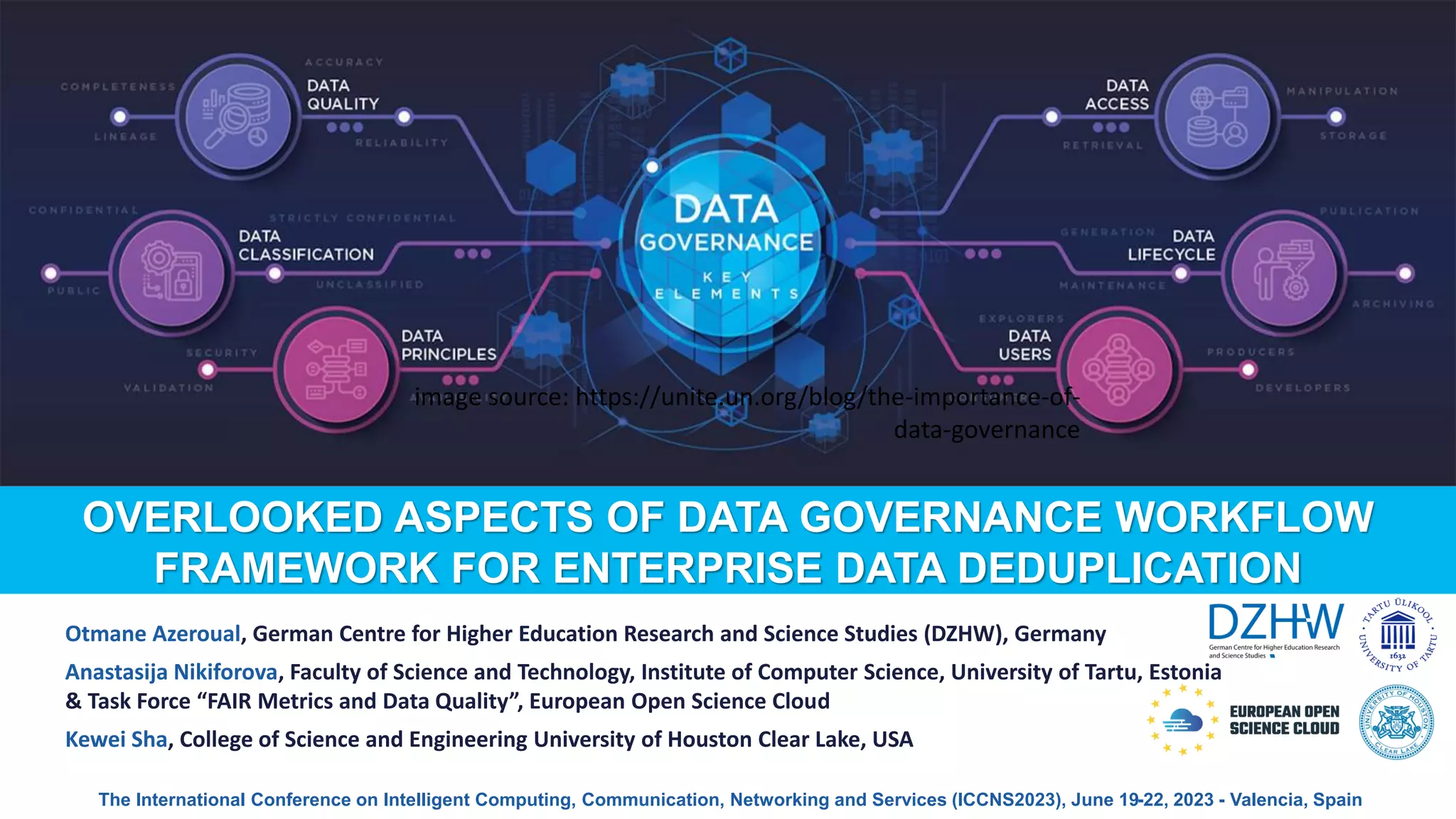
OVERLOOKED ASPECTS OF DATA GOVERNANCE WORKFLOW
FRAMEWORK FOR ENTERPRISE DATA DEDUPLICATION
Otmane Azeroual, German Centre for Higher Education Research and Science Studies (DZHW), Germany
Anastasija Nikiforova, Faculty of Science and Technology, Institute of Computer Science, University of Tartu, Estonia
& Task Force “FAIR Metrics and Data Quality”, European Open Science Cloud
Kewei Sha, College of Science and Engineering University of Houston Clear Lake, USA
The International Conference on Intelligent Computing, Communication, Networking and Services (ICCNS2023), June 19-22, 2023 - Valencia, Spain
image source: https://unite.un.org/blog/the-importance-of-
data-governance
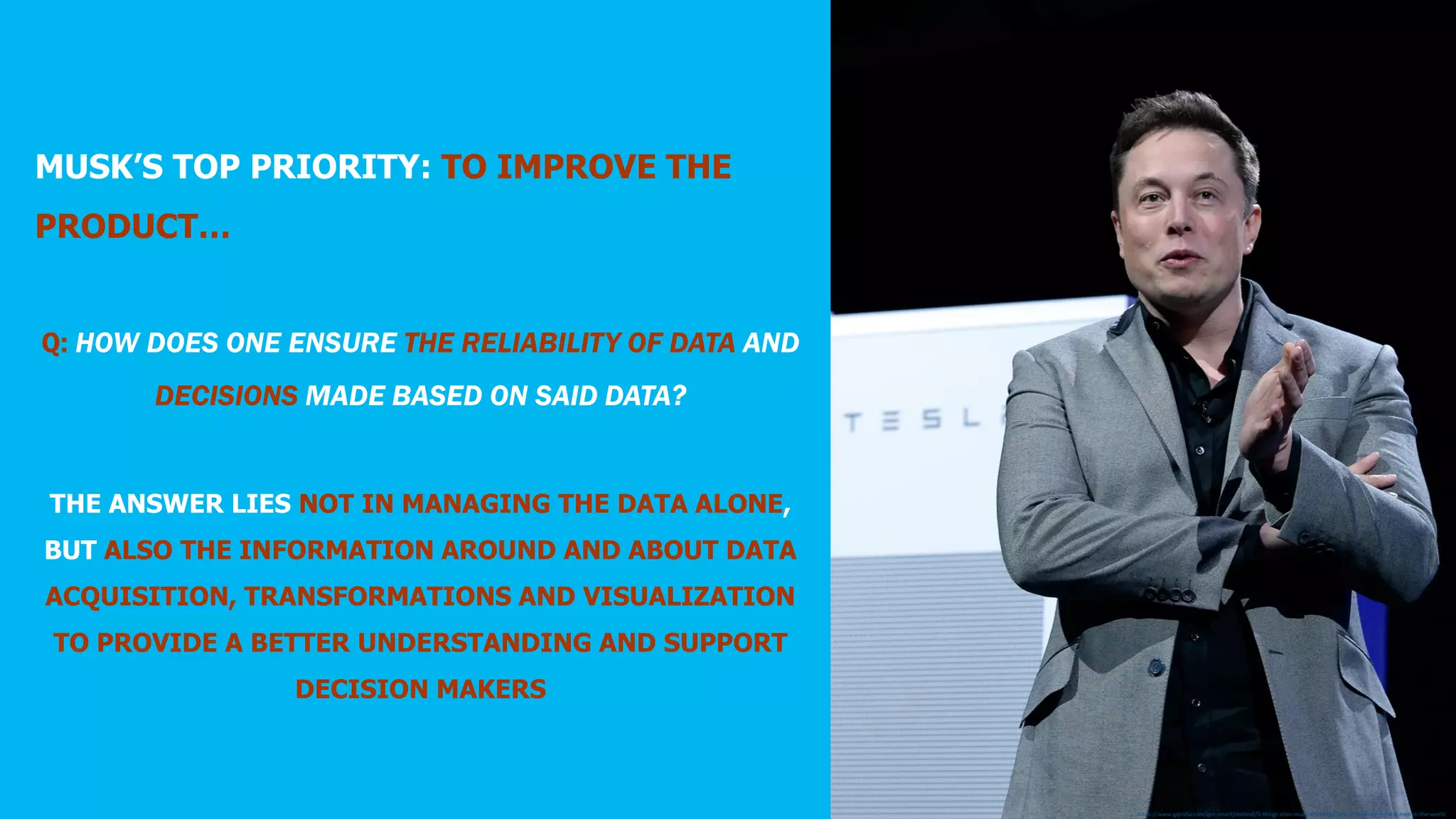
MUSK’S TOP PRIORITY: TO IMPROVE THE
PRODUCT…
Q: HOW DOES ONE ENSURE THE RELIABILITY OF DATA AND
DECISIONS MADE BASED ON SAID DATA?
THE ANSWER LIES NOT IN MANAGING THE DATA ALONE,
BUT ALSO THE INFORMATION AROUND AND ABOUT DATA
ACQUISITION, TRANSFORMATIONS AND VISUALIZATION
TO PROVIDE A BETTER UNDERSTANDING AND SUPPORT
DECISION MAKERS
https://www.gqindia.com/get-smart/content/5-things-elon-musk-did-to-become-one-of-the-richest-men-in-the-world
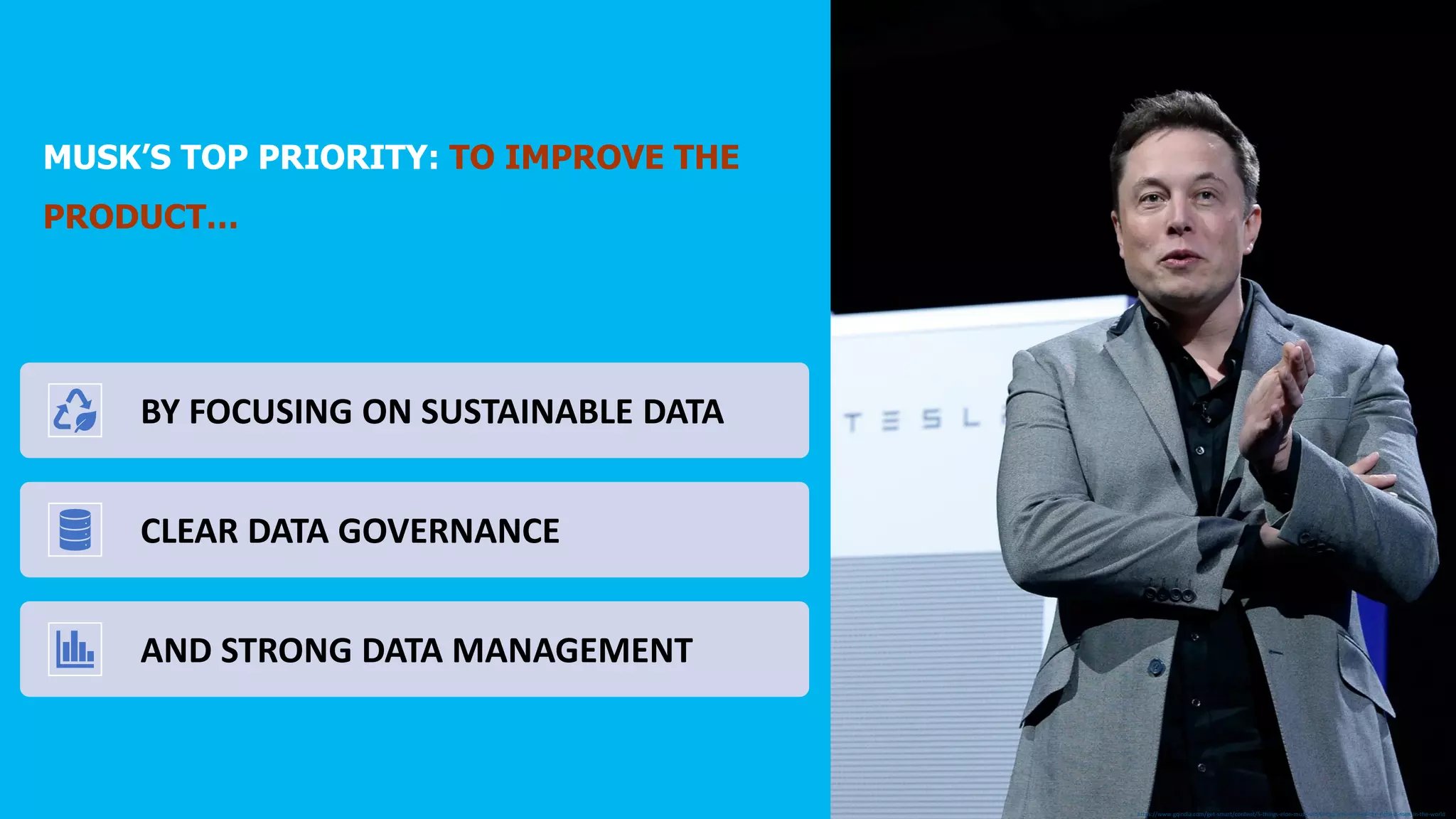
MUSK’S TOP PRIORITY: TO IMPROVE THE
PRODUCT…
Q: HOW DOES ONE ENSURE THE RELIABILITY OF DATA
AND DECISIONS MADE BASED ON SAID DATA?
THE ANSWER LIES NOT IN MANAGING THE DATA ALONE,
BUT ALSO THE INFORMATION AROUND AND ABOUT
DATA ACQUISITION, TRANSFORMATIONS AND
VISUALIZATION TO PROVIDE A BETTER
UNDERSTANDING AND SUPPORT DECISION MAKERS
BY FOCUSING ON SUSTAINABLE DATA
CLEAR DATA GOVERNANCE
AND STRONG DATA MANAGEMENT
Background
In the context of the data economy, which is characterized by a
global ecosystem of many digitally connected actors / entities /
organizations, data is considered a critical business asset [1].
However, many organizations are still struggling and even
failing to combine a large number of internal and external data
flows, assign appropriate responsibilities and determine
significance and relevance to business processes to these data
sources, and ensure sufficient data quality [2].
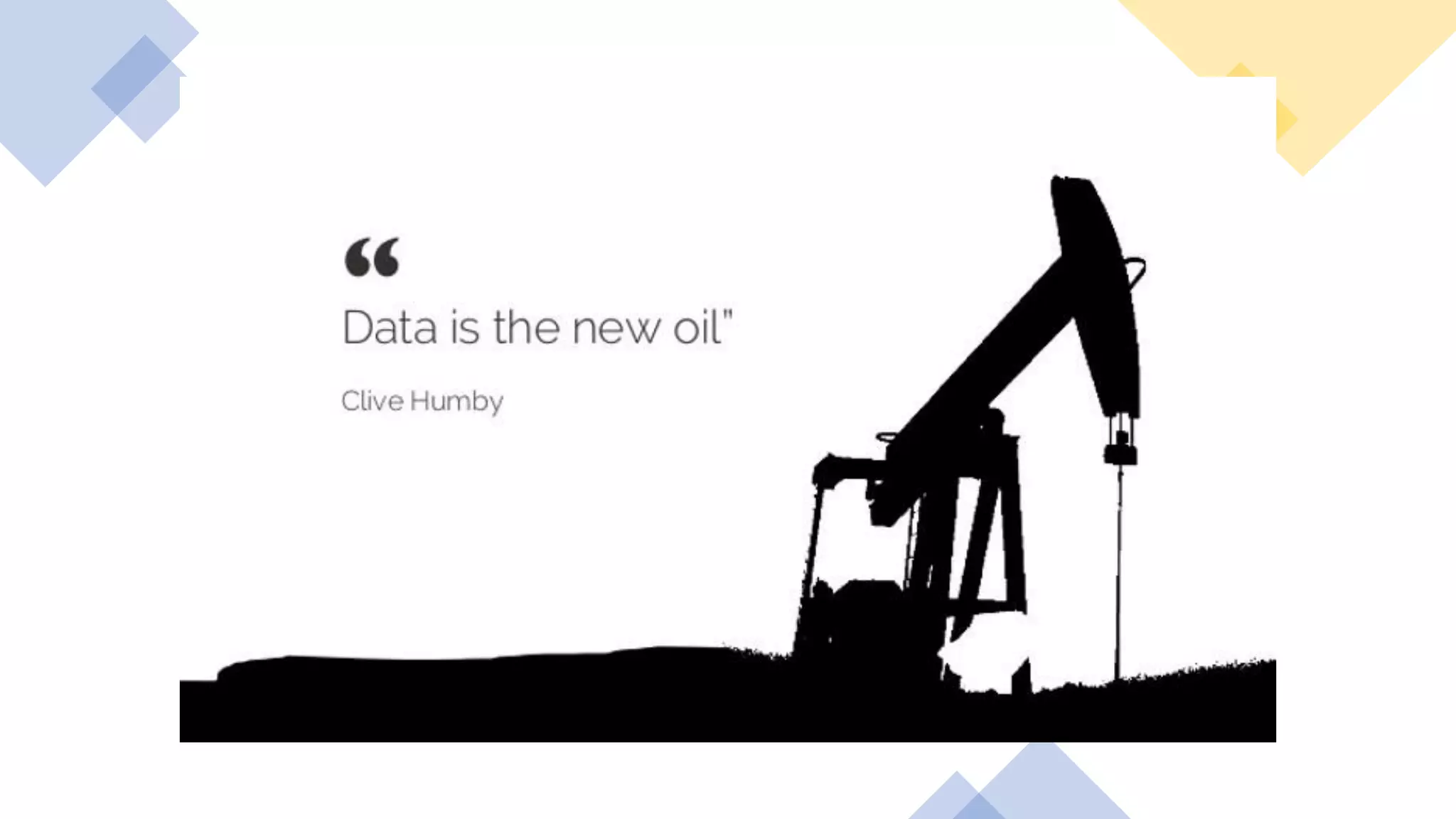
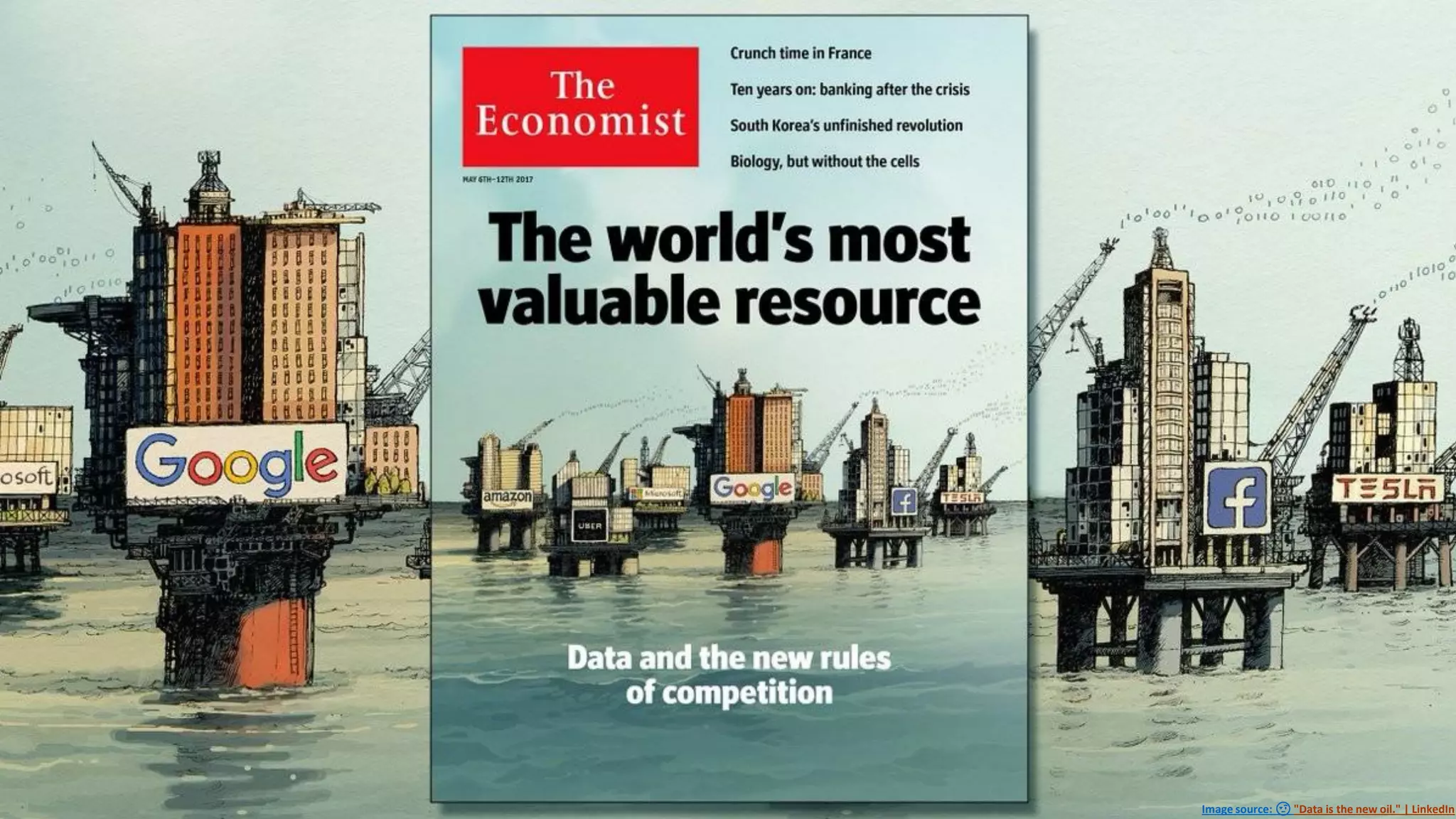
IF WE THINK ABOUT DATA AS A POWER SOURCE OR FUEL,
IT WOULD MAKE MORE SENSE TO COMPARE THEM WITH
RENEWABLE SOURCES LIKE THE
SUN, WIND AND TIDES”
-B. Marr, Forbes
Soures: Letter from the Editor: Here comes the sun (medicalnewstoday.com), A healthy wind | MIT News | Massachusetts Institute
of Technology, Tidal phenomenon: high and low tides | Ponant Magazine, Here's Why Data Is Not The New Oil (forbes.com)
Image source: 🤨 "Data is the new oil."​ | LinkedIn
Background
It is believed that 80% of a data scientist’s time is spent simply searching, cleaning &
organizing data, and only 20% - to perform analysis [3,4]
According to Total Data Quality Management (TDQM), “1-10-100” rule applies to data
quality, i.e., 1$ spent on prevention saves 10$ on appraisal & 100$ on failure costs [5]
According to [6], 19% of businesses lost their customers due to the use of inaccurate,
incomplete data in 2019, with losses exacerbated in industries where customers have
a high lifetime value
“Magic Quadrant for Data Quality Solutions” 2020 found that organizations estimate
the average cost of poor data quality at more than $12 million per year [7]
According to [6], 42% of companies struggle with inaccurate data, and 43% of them
have experienced the failure of some data-driven projects.
Background
Data duplication, in particular, has become problematic due to the growing volume of data, incl. due to
the adoption of cloud technologies, use of multiple different sources, the proliferation of connected
personal and work devices in homes, stores, offices and supply chains.
Data duplication as one of the major data quality issues (also known as uniqueness) is a serious issue
affecting company image, decision-making, and other data-driven activities such as service personalisation
in terms of both their accuracy, trustworthiness and reliability, user acceptance / adoption and
satisfaction, customer service, risk management, crisis management, as well as resource management
(time, human, and fiscal).
At the same time, it is known that the amount of data that companies collect is growing exponentially,
i.e., the volume of data is constantly increasing, making it difficult to effectively manage them.
Consequently, organizations are affected by / suffer from inaccurate analysis, poor, distorted or skewed
decisions, distorted insights provided by Business Intelligence (BI) or machine learning (ML) algorithms,
models, forecasts, and simulations, where the data form the input, wasted resources, and employees, who
are less likely trust the data and associated applications.
Thus, both ex-ante and ex-post deduplication mechanisms are critical in this context to ensure sufficient
data quality and are usually integrated into a broader data governance approach.
Background
Consequently, organizations are affected by / suffer from inaccurate analysis,
poor, distorted or skewed decisions, distorted insights provided by Business
Intelligence (BI) or machine learning (ML) algorithms, models, forecasts, and
simulations, where the data form the input, wasted resources, and employees,
who are less likely trust the data and associated applications.
THUS, BOTH EX-ANTE AND EX-POST DEDUPLICATION MECHANISMS ARE CRITICAL
TO ENSURE SUFFICIENT DATA QUALITY AND ARE USUALLY INTEGRATED INTO
A BROADER DATA GOVERNANCE APPROACH
Background
Proper data governance frameworks are powerful mechanisms to help businesses become
more organized and focused. They provide a structure for the data that an organization
collects and guidelines for managing that data, incl. but not limited to determine who can
use what data, in what situations, and how, i.e., in what scenarios [20].
The implementation of data governance can be greatly simplified with a conceptual
framework [17].
Some data governance frameworks focus on specific areas such as data analytics, data
security, or data life cycle [21-23]. However, there is a lack of data governance framework
for managing duplicate data in large data ecosystems, i.e., effectively, and efficiently
identifying, and eliminating them.
Practice also shows that many companies face challenges in this respect in both North America, South and
Latin America, Europe, Middle East and Africa, East-Asia, with the Americas being more advanced in this
respect compared to other regions.
A study conducted by PricewaterhouseCoopers of the 2,500 largest publicly listed companies shows that
while 1/3 of companies based in North America tend to have a Chief Data Officer & deal with
the data governance wiser, this is the case for only ¼ of the surveyed companies in Europe
Source: https://www.strategyand.pwc.com/de/en/functions/data-strategy/cdo-2022.html?trk=feed_main-
feed-card_feed-article-content , https://commons.wikimedia.org/wiki/File:PricewaterhouseCoopers_Logo.png
AIM
The aim of this study is to develop a conceptual data governance framework for effective and
efficient management of duplicate data in big data ecosystems.
To achieve the objective, we use the Apache Spark-based framework proposed by Hildebrandt et
al. [19] that has proved its relevance in terms of generating large and realistic test datasets for
duplicate detection and can go beyond the individual elements of data quality assessment.
However, while this is a promising solution, our experience with it shows that it is not suitable
for all data formats and database types, including but not limited to CRM, ERP, or SAP.
Thus, we use it as a reference model, which we extend by integrating methods for analysing
customer data collected from all types of databases and formats in the company.
We believe that a data governance framework should not only evaluate, but also provide a
practical guidance on how to analyse and eliminate data duplicate data through proactive
management, which can then be integrated into the organization's processes.
AIM
First, we present methods for how companies can deal meaningfully with duplicate data. Initially, we
focus on data profiling using several analysis methods applicable to different types of datasets, incl.
analysis of different types of errors, structuring, harmonizing, & merging of duplicate data.
Second, we propose methods for reducing the number of comparisons and matching attribute values
based on similarity (in medium to large databases). The focus is on easy integration and duplicate
detection configuration so that the solution can be easily adapted to different users in companies
without domain knowledge. These methods are domain-independent and can be transferred to other
application contexts to evaluate the quality, structure, and content of duplicate / repetitive data.
Finally, we integrate the chosen methods into the framework of Hildebrandt et al. [19]. We also explore
some of the most common data quality tools in practice, into which we integrate this framework.
After that, we test and validate the framework.
The final refined solution provides the basis for subsequent use. It consists of detecting and visualizing duplicates, presenting
the identified redundancies to the user in a user-friendly manner to enable and facilitate their further elimination.
AIM
By eliminating redundancies, the quality of the data is optimized and thus improves further data-driven
actions, including data analyses and decision-making.
This paper aims to support research in data management and data governance by identifying duplicate data
at the enterprise level and meeting today's demands for increased connectivity / interconnectedness, data
ubiquity, and multi-data sourcing.
In addition, the proposed conceptual data governance framework aims to provide an overview of data
quality, accuracy and consistency to help practitioners approach data governance in a structured manner.
METHODS AND WORKFLOW FRAMEWORK
FOR DUPLICATE DETECTION
Recognizing the need for duplicates management, we present a set of expected requirements and a list of
practices that can be integrated into our data governance framework.
To do be consistent with the motivation and intended purpose of duplicates management, the planned
procedure must meet a number of criteria. The identified requirements are (based on [20]):
✓efficiency & scalability: should be able generate large test datasets in an acceptable run time ➔
(R1) the highest possible efficiency and (R2) scalability;
✓schema and data type independence: the method must be able to obtain / derive test datasets from any
existing relational datasets ➔ (R3) it must be able to handle different schemas and data types;
✓realistic errors: the input is assumed to be a dataset that is as clean as possible➔ (R4) the method is expected
to be “responsible” for injecting errors & the injected errors should match as close as possible the errors in
respective domain;
✓flexible configurability: (R5) allow generating test datasets with different properties depending on the
configuration (e.g., the number of tuples, the proportion of duplicates, the degree of contamination /
pollution, the type of errors). (R6) the required configuration effort for the user should be as small as possible
to make this tool easier to use and enable inexperienced users.
METHODS AND WORKFLOW FRAMEWORK
FOR DUPLICATE DETECTION
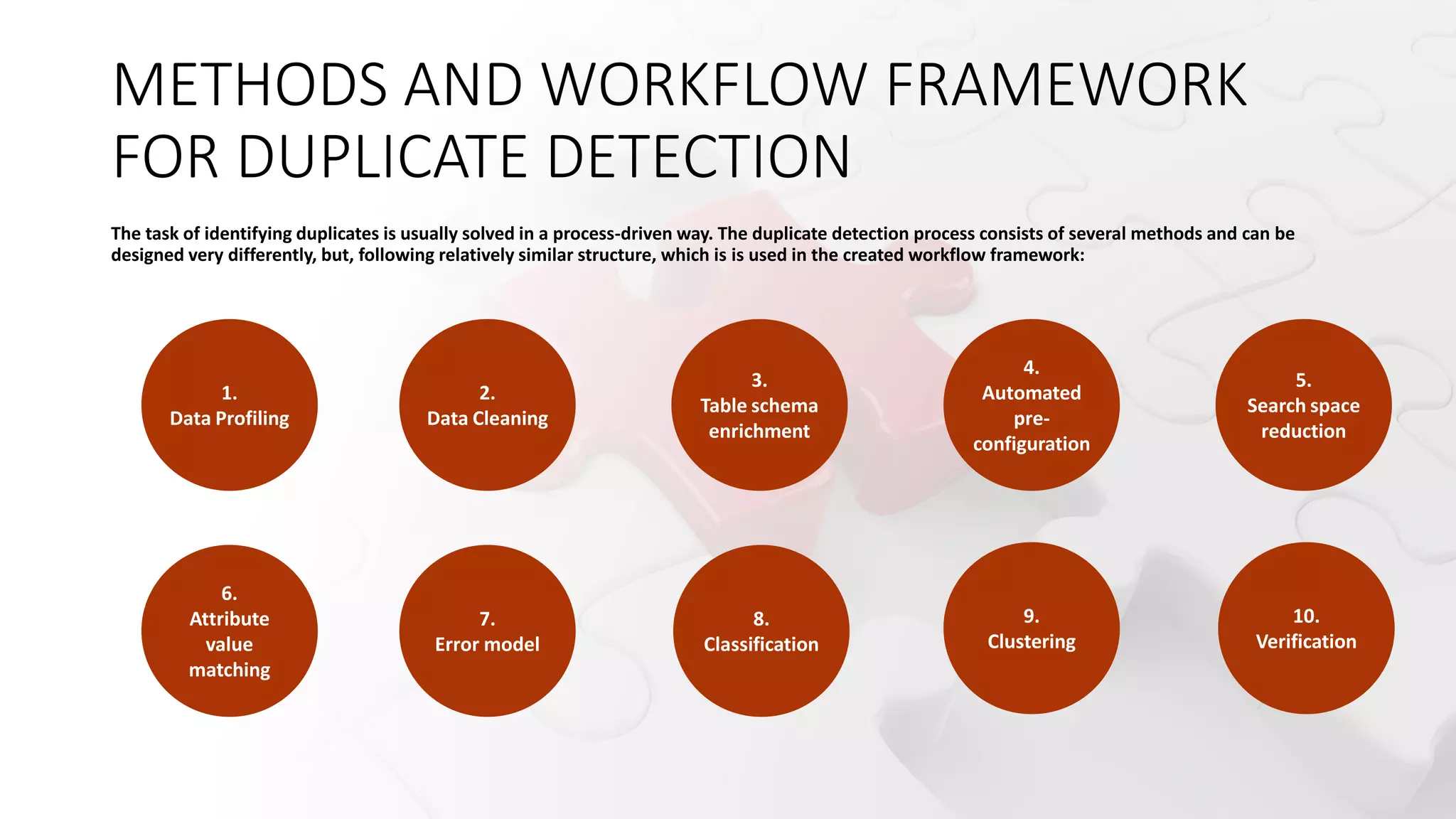
The task of identifying duplicates is usually solved in a process-driven way. The duplicate detection process consists of several methods and can be
designed very differently, but, following relatively similar structure, which is is used in the created workflow framework:
2.
Data Cleaning
3.
Table schema
enrichment
4.
Automated
pre-
configuration
5.
Search space
reduction
6.
Attribute
value
matching
7.
Error model
8.
Classification
9.
Clustering
10.
Verification
1.
Data Profiling
Method Description
Data profiling describes automated data analysis using various analysis methods and techniques [27]; profiling of data associated with attributes is used to determine statistical
characteristics of individual attributes, which are recorded in the data profile along with the schema information of the data source
Data Cleaning used to prepare and standardize the database [28]. Data quality can be improved through syntactic and semantic adjustments, which in turn can improve the
quality of duplicate detection.
Possible measures include removing unwanted characters, standardizing abbreviations or adding derived attributes
Table schema
enrichment
uses an enriched table schema, incl. information about the structural schema of the input dataset and contains additional information for further processing. This
allows the procedure to be schema independent and also lays the foundation for generating realistic errors and implementing flexible configurability
Automated pre-
configuration
With the help of reasoning procedures, a pre-configuration of the actual data generation process is automatically derived from the characteristics of the input data
[19]. The generated pre-configurations are intended to ensure that the required configuration effort remains as low as possible despite the large number of
configuration parameters that the user can manually configure / adjust;
Search space
reduction
avoid comparisons between tuples that are very likely not duplicates, using certain criteria. When choosing the criteria used for this, there is always a trade-off
between the reduction factor or ratio and the completeness of pairs. The most well-known methods are standard blocking and the sorted neighbourhood method
[10];
Attribute value
matching
values are calculated for each pair of tuples in the (reduced) search space using appropriate measures to represent the degree of similarity between the attribute
values of two tuples [30].
E.g., edit-based (Levenshtein distance), sequence-based (Jaro distance), token-based string metrics (Jaccard coefficient, n-grams) [30]
Error model is based on the so-called error schemes, where each schema represents a specific defined sequence of applying of different types of errors to data. Defined by
flexible linking and nesting of different types of errors using meta-errors.
Error types are classified according to their scope, i.e., according to the area of the dataset in which they operate - row errors, column errors, field errors. These
field/area errors can also be further divided into subclasses based on the data type of the field.
Clustering classification of pairs of tuples into matches, non-matches / mismatches, and possible matches.
However, duplicate detection is defined as mapping an input relation to a cluster. To obtain a globally consistent result, the tuples are collectively classified in the
clustering step based on (independent) pairwise classification decisions.
Verification The usual approach is to express the quality of the process in terms of the goodness of these pairwise classification decisions. The numbers of correctly classified
duplicates (true positives), tuple pairs incorrectly classified as duplicates (false positives), and duplicates not found (false negatives) are related.
The most common of these measures are Precision, Recall and F-Measure [38].
Workflow framework for data discovery
Based on:
O. Azeroual, M. Jha, A. Nikiforova, K. Sha, M. Alsmirat, and S. Jha, “A Record Linkage-Based Data Deduplication Framework with DataCleaner Extension,” Multimodal Technologies and Interaction, vol. 6, no. 4, p. 27, 2022.
K. Hildebrandt, F. Panse, N. Wilcke, and N. Ritter, “Large-Scale Data Pollution with Apache Spark,” IEEE Transactions on Big Data, vol. 6, pp. 396–411, 2020.
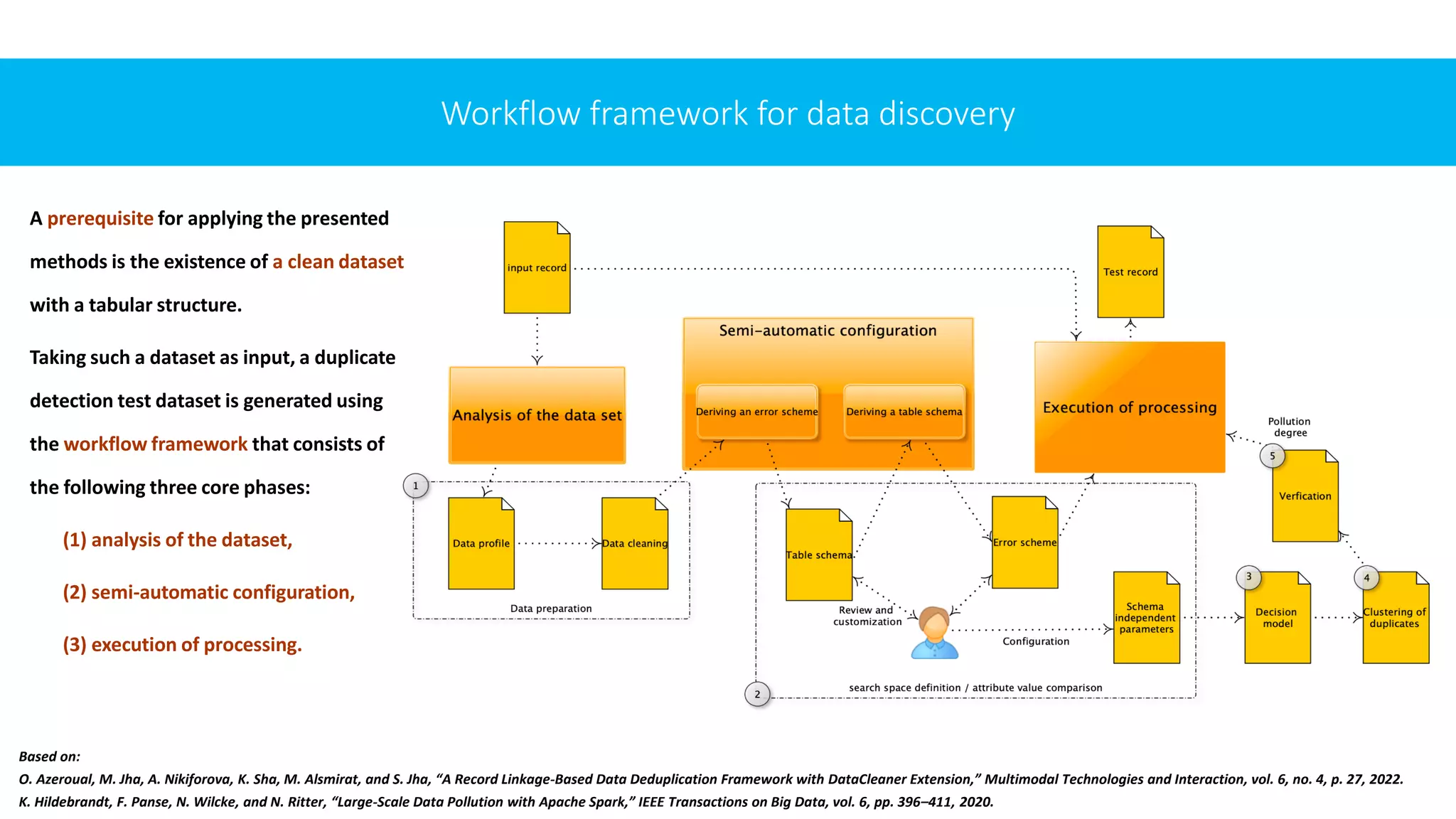
A prerequisite for applying the presented
methods is the existence of a clean dataset
with a tabular structure.
Taking such a dataset as input, a duplicate
detection test dataset is generated using
the workflow framework that consists of
the following three core phases:
(1) analysis of the dataset,
(2) semi-automatic configuration,
(3) execution of processing.
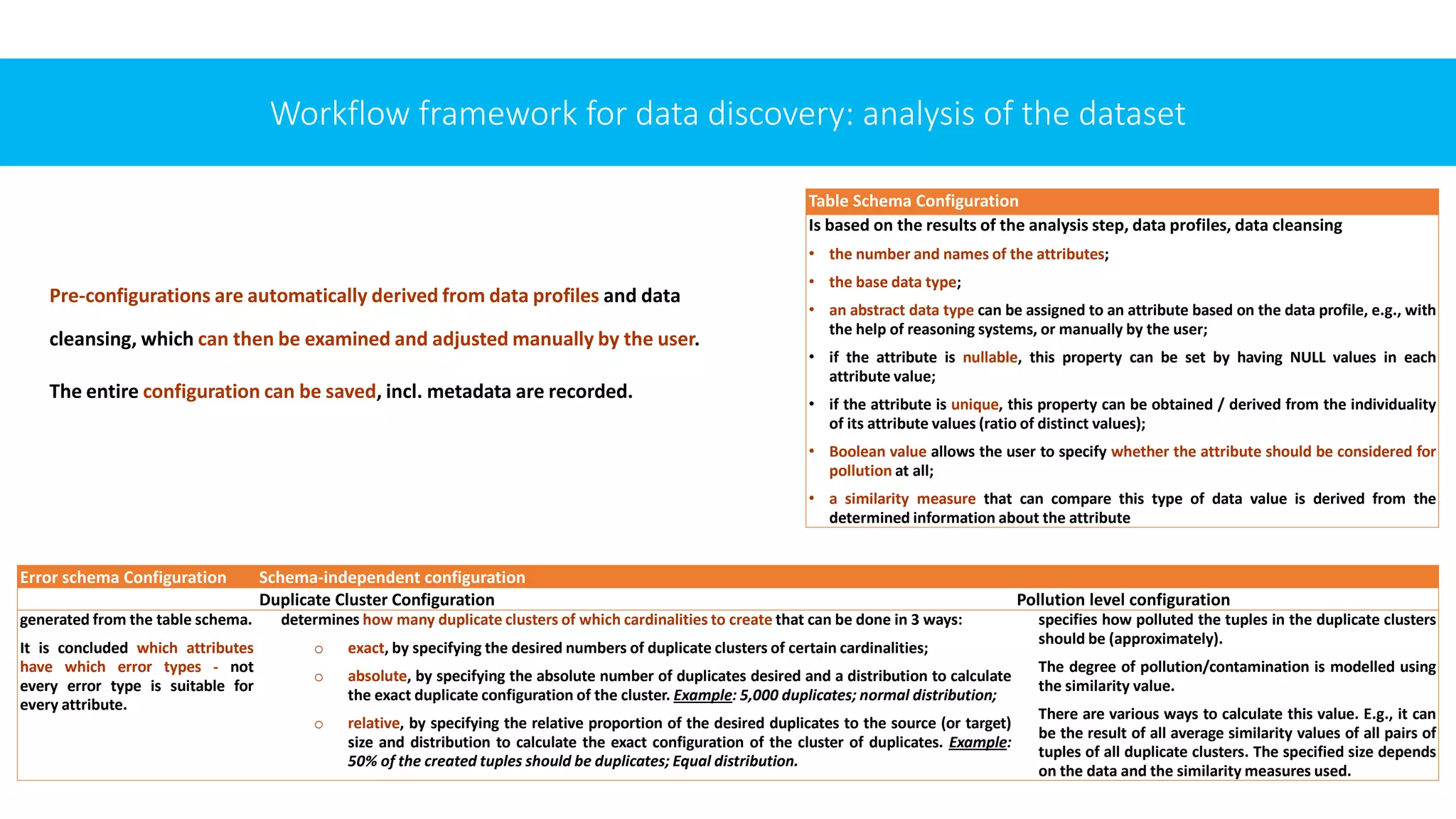
Workflow framework for data discovery: analysis of the dataset
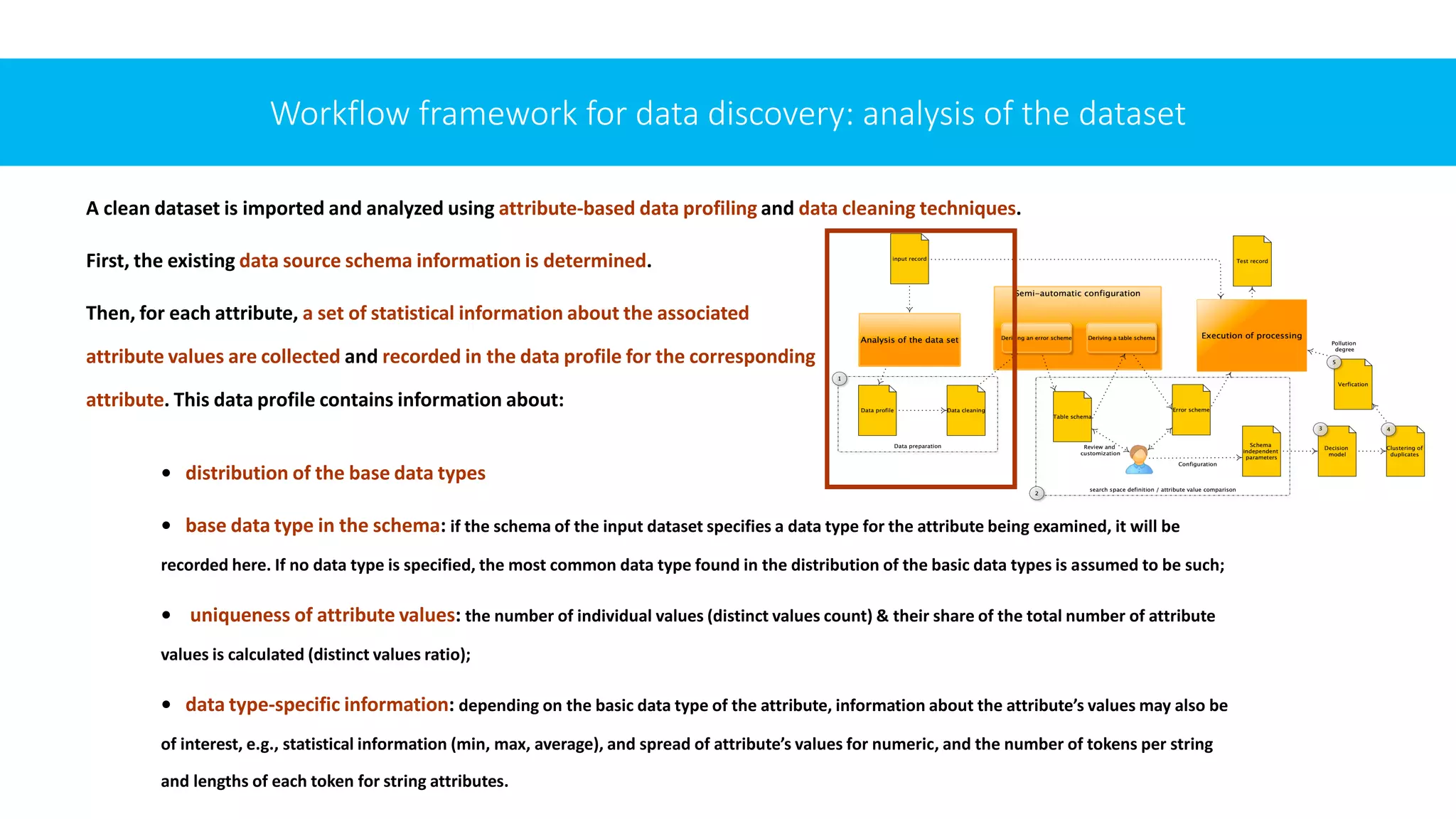
A clean dataset is imported and analyzed using attribute-based data profiling and data cleaning techniques.
First, the existing data source schema information is determined.
Then, for each attribute, a set of statistical information about the associated
attribute values are collected and recorded in the data profile for the corresponding
attribute. This data profile contains information about:
• distribution of the base data types
• base data type in the schema: if the schema of the input dataset specifies a data type for the attribute being examined, it will be
recorded here. If no data type is specified, the most common data type found in the distribution of the basic data types is assumed to be such;
• uniqueness of attribute values: the number of individual values (distinct values count) & their share of the total number of attribute
values is calculated (distinct values ratio);
• data type-specific information: depending on the basic data type of the attribute, information about the attribute’s values may also be
of interest, e.g., statistical information (min, max, average), and spread of attribute’s values for numeric, and the number of tokens per string
and lengths of each token for string attributes.
Workflow framework for data discovery: analysis of the dataset
Pre-configurations are automatically derived from data profiles and data
cleansing, which can then be examined and adjusted manually by the user.
The entire configuration can be saved, incl. metadata are recorded.
Error schema Configuration Schema-independent configuration
Duplicate Cluster Configuration Pollution level configuration
generated from the table schema.
It is concluded which attributes
have which error types - not
every error type is suitable for
every attribute.
determines how many duplicate clusters of which cardinalities to create that can be done in 3 ways:
o exact, by specifying the desired numbers of duplicate clusters of certain cardinalities;
o absolute, by specifying the absolute number of duplicates desired and a distribution to calculate
the exact duplicate configuration of the cluster. Example: 5,000 duplicates; normal distribution;
o relative, by specifying the relative proportion of the desired duplicates to the source (or target)
size and distribution to calculate the exact configuration of the cluster of duplicates. Example:
50% of the created tuples should be duplicates; Equal distribution.
specifies how polluted the tuples in the duplicate clusters
should be (approximately).
The degree of pollution/contamination is modelled using
the similarity value.
There are various ways to calculate this value. E.g., it can
be the result of all average similarity values of all pairs of
tuples of all duplicate clusters. The specified size depends
on the data and the similarity measures used.
Table Schema Configuration
Is based on the results of the analysis step, data profiles, data cleansing
• the number and names of the attributes;
• the base data type;
• an abstract data type can be assigned to an attribute based on the data profile, e.g., with
the help of reasoning systems, or manually by the user;
• if the attribute is nullable, this property can be set by having NULL values in each
attribute value;
• if the attribute is unique, this property can be obtained / derived from the individuality
of its attribute values (ratio of distinct values);
• Boolean value allows the user to specify whether the attribute should be considered for
pollution at all;
• a similarity measure that can compare this type of data value is derived from the
determined information about the attribute
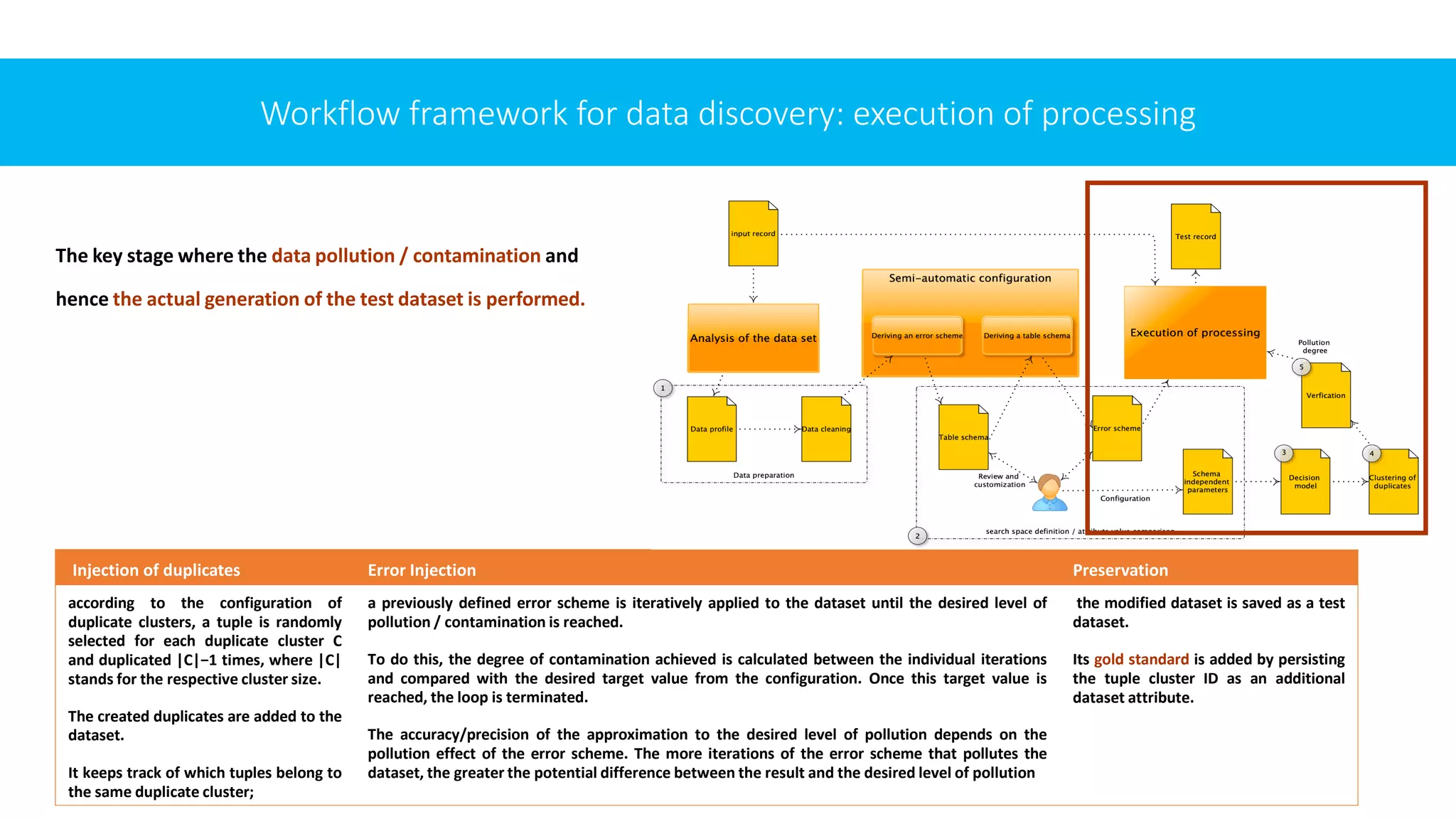
Workflow framework for data discovery: execution of processing
The key stage where the data pollution / contamination and
hence the actual generation of the test dataset is performed.
Injection of duplicates Error Injection Preservation
according to the configuration of
duplicate clusters, a tuple is randomly
selected for each duplicate cluster C
and duplicated |C|−1 times, where |C|
stands for the respective cluster size.
The created duplicates are added to the
dataset.
It keeps track of which tuples belong to
the same duplicate cluster;
a previously defined error scheme is iteratively applied to the dataset until the desired level of
pollution / contamination is reached.
To do this, the degree of contamination achieved is calculated between the individual iterations
and compared with the desired target value from the configuration. Once this target value is
reached, the loop is terminated.
The accuracy/precision of the approximation to the desired level of pollution depends on the
pollution effect of the error scheme. The more iterations of the error scheme that pollutes the
dataset, the greater the potential difference between the result and the desired level of pollution
the modified dataset is saved as a test
dataset.
Its gold standard is added by persisting
the tuple cluster ID as an additional
dataset attribute.
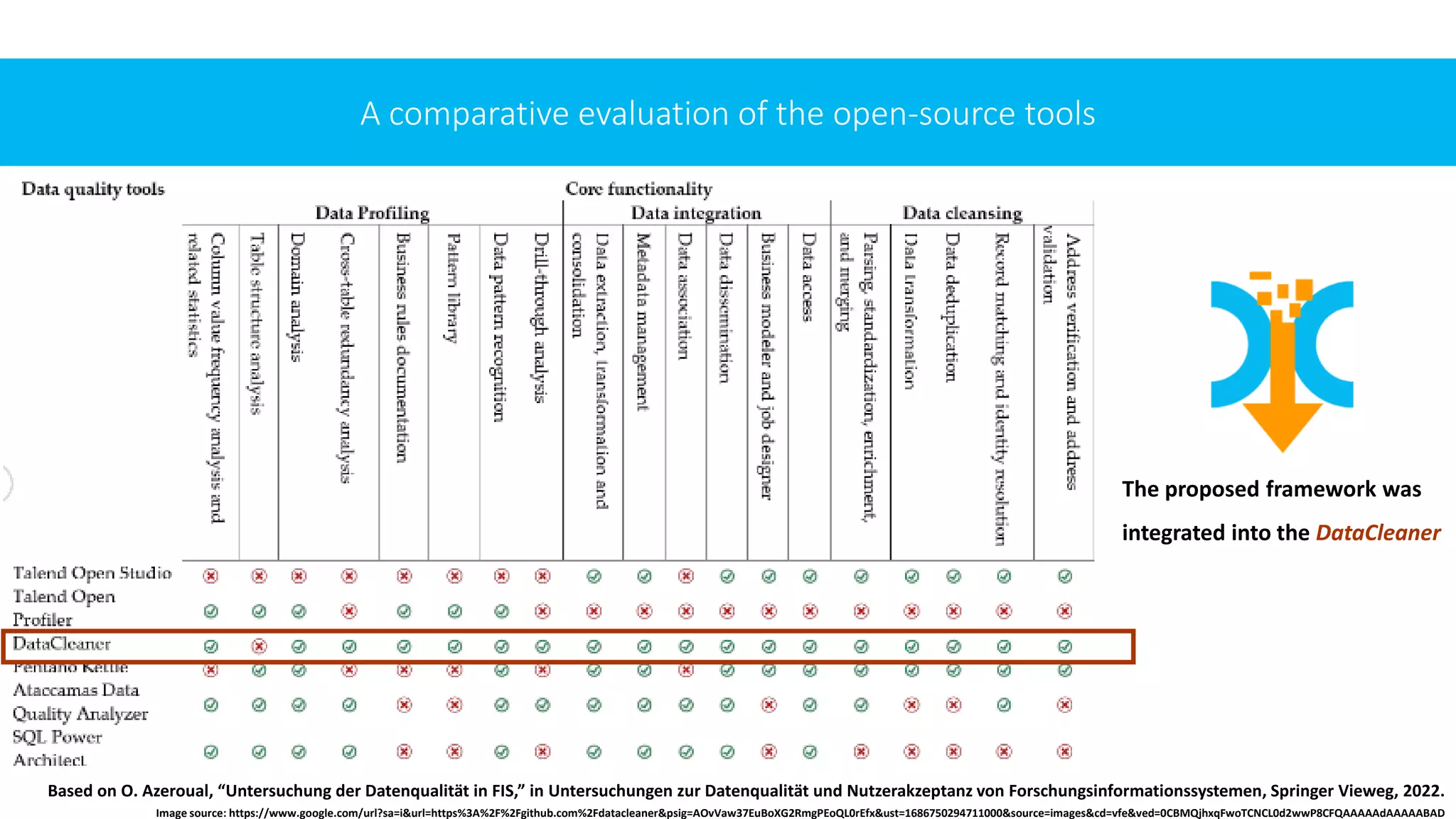
A comparative evaluation of the open-source tools
Based on O. Azeroual, “Untersuchung der Datenqualität in FIS,” in Untersuchungen zur Datenqualität und Nutzerakzeptanz von Forschungsinformationssystemen, Springer Vieweg, 2022.
Image source: https://www.google.com/url?sa=i&url=https%3A%2F%2Fgithub.com%2Fdatacleaner&psig=AOvVaw37EuBoXG2RmgPEoQL0rEfx&ust=1686750294711000&source=images&cd=vfe&ved=0CBMQjhxqFwoTCNCL0d2wwP8CFQAAAAAdAAAAABAD
The proposed framework was
integrated into the DataCleaner
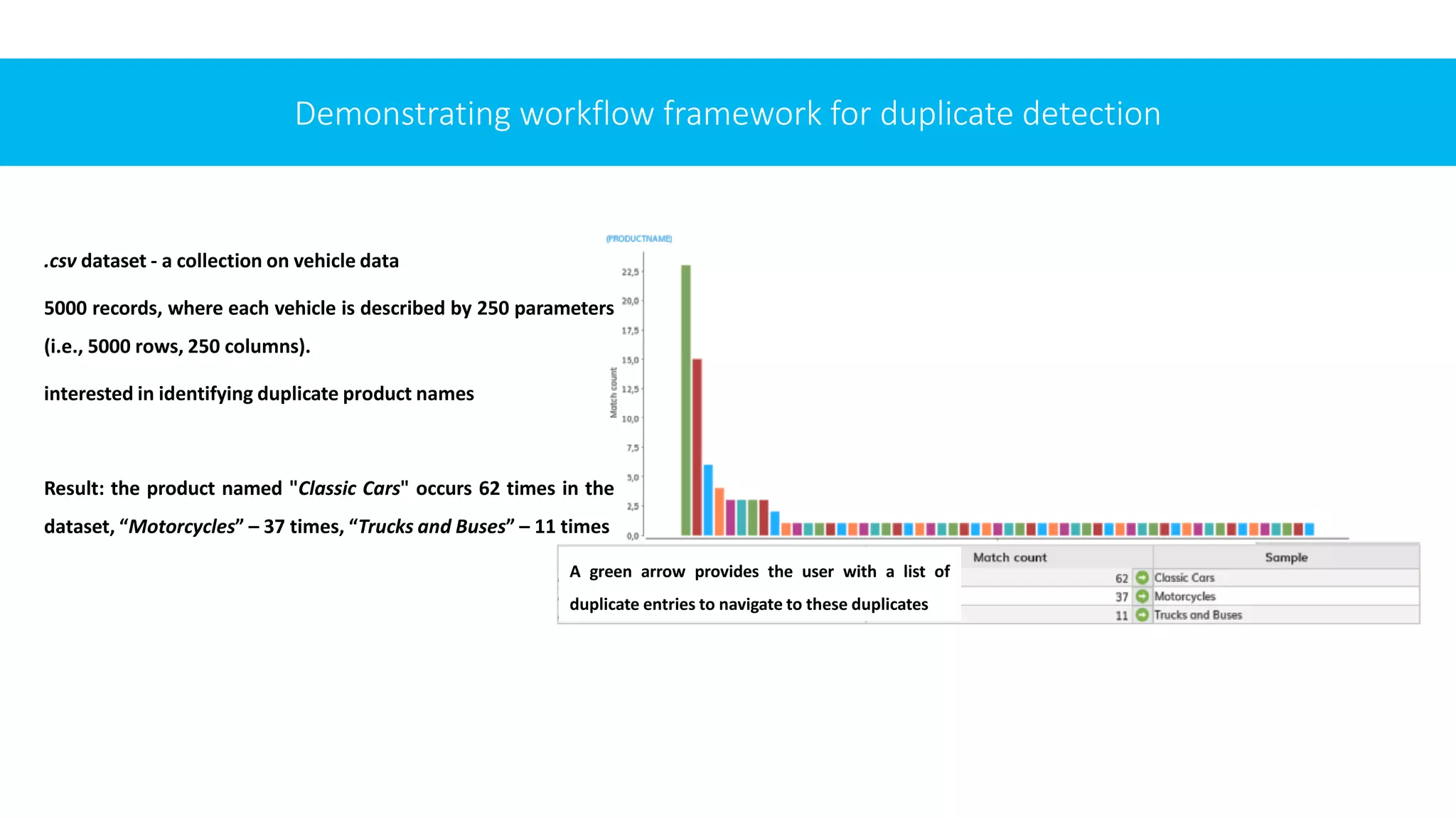
Demonstrating workflow framework for duplicate detection
.csv dataset - a collection on vehicle data
5000 records, where each vehicle is described by 250 parameters
(i.e., 5000 rows, 250 columns).
interested in identifying duplicate product names
Result: the product named "Classic Cars" occurs 62 times in the
dataset, “Motorcycles” – 37 times, “Trucks and Buses” – 11 times
A green arrow provides the user with a list of
duplicate entries to navigate to these duplicates
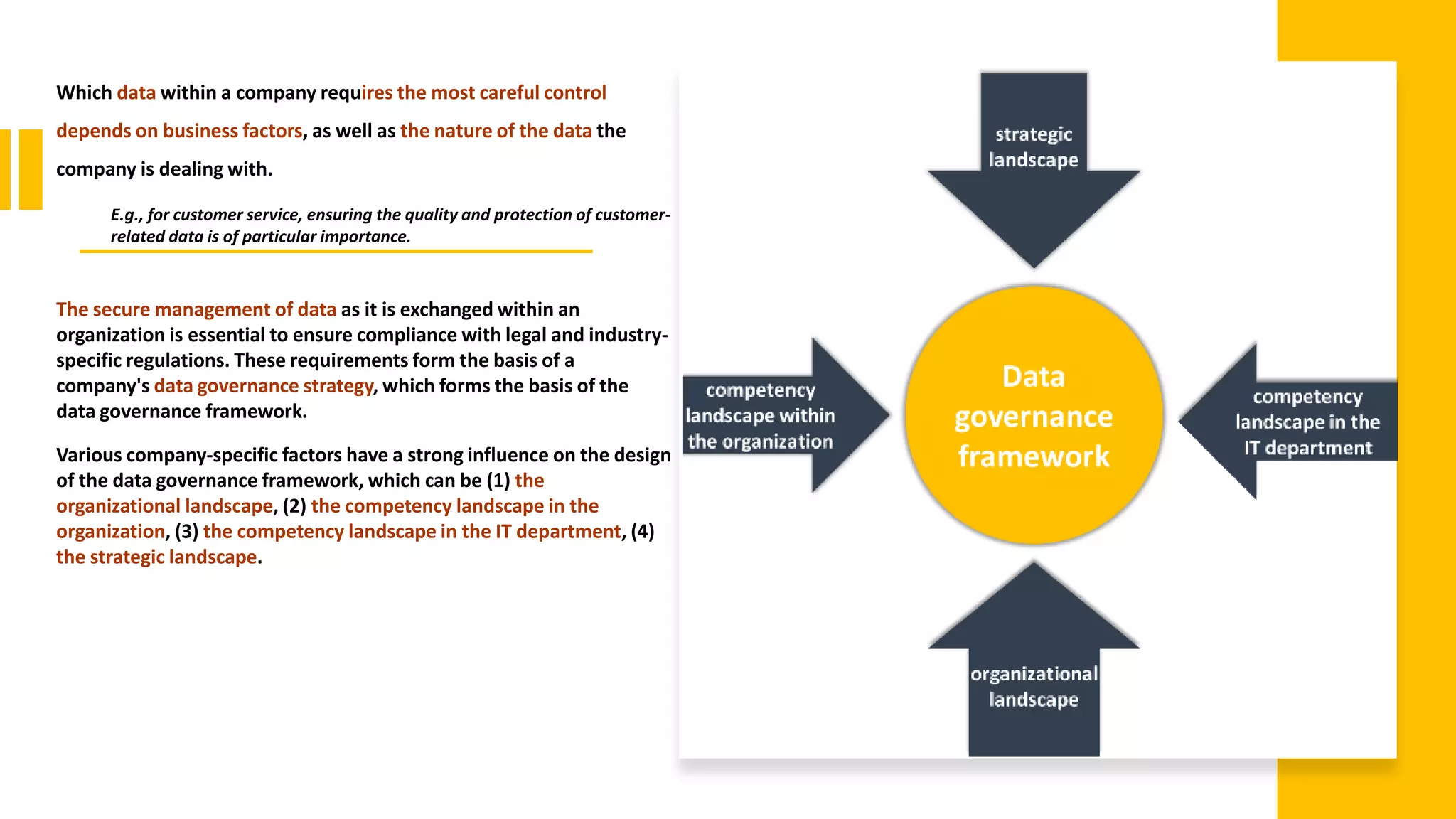
Which data within a company requires the most careful control
depends on business factors, as well as the nature of the data the
company is dealing with.
E.g., for customer service, ensuring the quality and protection of customer-
related data is of particular importance.
The secure management of data as it is exchanged within an
organization is essential to ensure compliance with legal and industry-
specific regulations. These requirements form the basis of a
company's data governance strategy, which forms the basis of the
data governance framework.
Various company-specific factors have a strong influence on the design
of the data governance framework, which can be (1) the
organizational landscape, (2) the competency landscape in the
organization, (3) the competency landscape in the IT department, (4)
the strategic landscape.
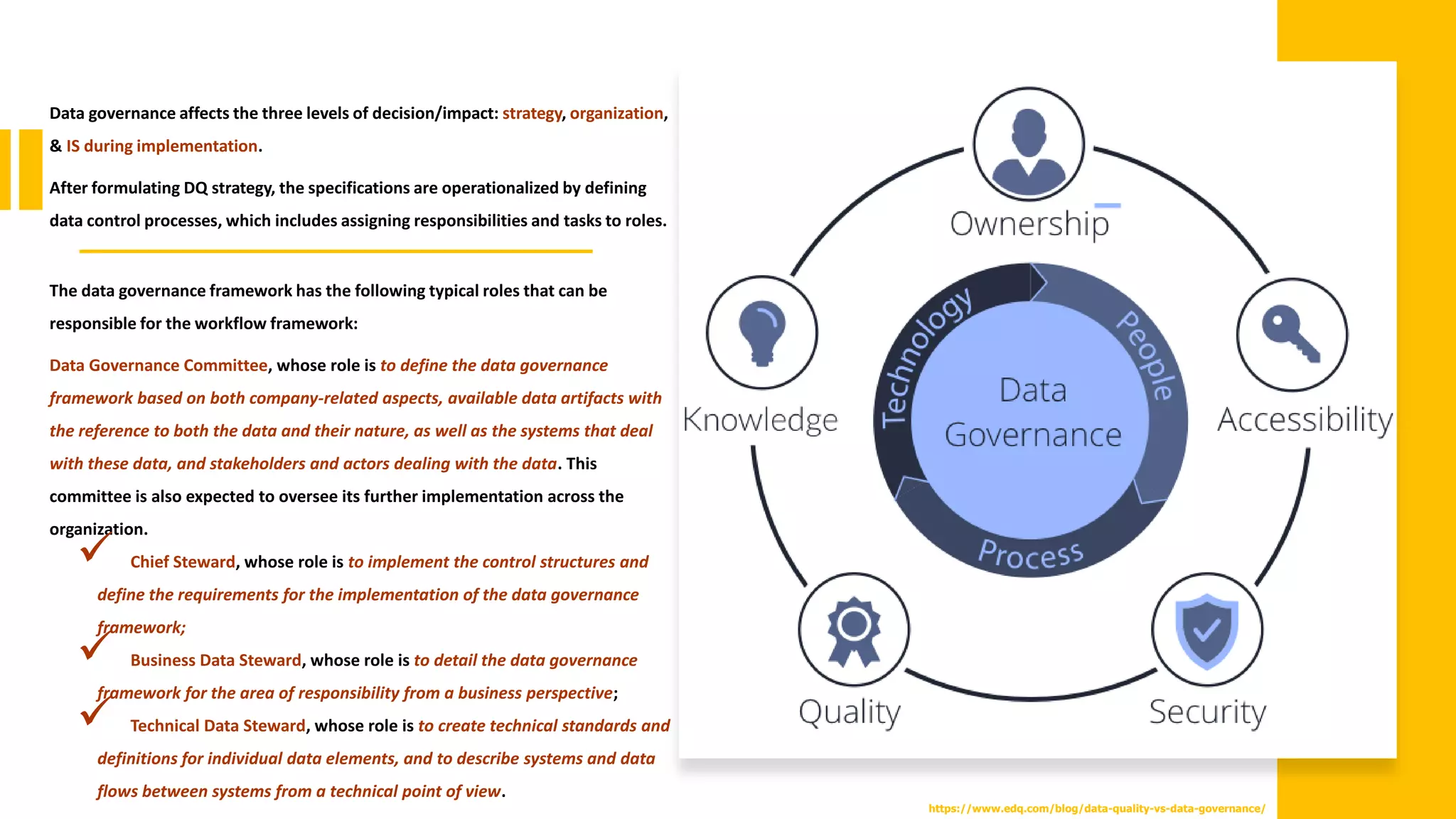
Data governance affects the three levels of decision/impact: strategy, organization,
& IS during implementation.
After formulating DQ strategy, the specifications are operationalized by defining
data control processes, which includes assigning responsibilities and tasks to roles.
The data governance framework has the following typical roles that can be
responsible for the workflow framework:
Data Governance Committee, whose role is to define the data governance
framework based on both company-related aspects, available data artifacts with
the reference to both the data and their nature, as well as the systems that deal
with these data, and stakeholders and actors dealing with the data. This
committee is also expected to oversee its further implementation across the
organization.
✓ Chief Steward, whose role is to implement the control structures and
define the requirements for the implementation of the data governance
framework;
✓ Business Data Steward, whose role is to detail the data governance
framework for the area of responsibility from a business perspective;
✓ Technical Data Steward, whose role is to create technical standards and
definitions for individual data elements, and to describe systems and data
flows between systems from a technical point of view.
https://www.edq.com/blog/data-quality-vs-data-governance/
Data Stewardship and data ownership
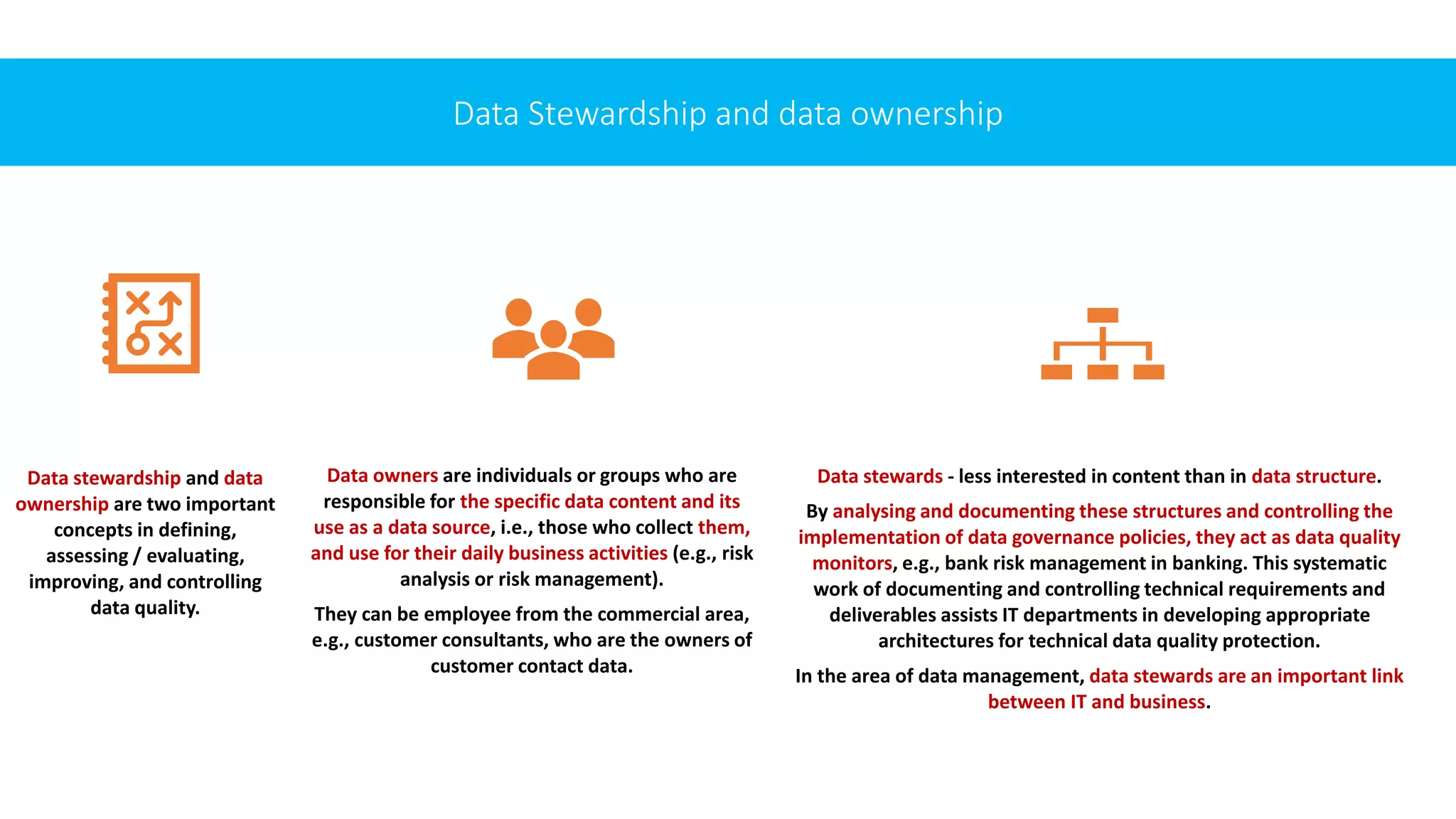
Data stewardship and data
ownership are two important
concepts in defining,
assessing / evaluating,
improving, and controlling
data quality.
Data owners are individuals or groups who are
responsible for the specific data content and its
use as a data source, i.e., those who collect them,
and use for their daily business activities (e.g., risk
analysis or risk management).
They can be employee from the commercial area,
e.g., customer consultants, who are the owners of
customer contact data.
Data stewards - less interested in content than in data structure.
By analysing and documenting these structures and controlling the
implementation of data governance policies, they act as data quality
monitors, e.g., bank risk management in banking. This systematic
work of documenting and controlling technical requirements and
deliverables assists IT departments in developing appropriate
architectures for technical data quality protection.
In the area of data management, data stewards are an important link
between IT and business.
what data needs to be defined more precisely, accurately or detailed?
how it is expected to be done?
how business expectations/requirements are taken into account and dealt with?
how data generally (can) change?
As a critical and decisive factor, data governance links business policy to data management and forms the regulatory framework / backbone when it
comes to the systematic integration of data. Larger companies can afford to create their own data management team to complement the data
governance committee with the development, governance, and implementation of data management tasks. In smaller companies, assigning roles as a
secondary organization using existing processes and organizational structures is a more cost-effective alternative.
Data Stewardship and data ownership
RESULTS
1
we presented methods for how
companies can deal meaningfully
with duplicate data.
Initially, we focus on data
profiling using several analysis
methods applicable to different
types of datasets, including
analysis of different types of
errors, structuring, harmonizing/
reconciling, and merging of
duplicate data.
2
we proposed methods for
reducing the number of
comparisons and matching
attribute values based on
similarity.
The focus is on easy integration
and duplicate detection
configuration so that the
solution can be easily adapted to
different users in companies
without domain knowledge.
These methods are domain
independent and can be
transferred to other application
contexts to evaluate the quality,
structure, and content of
duplicate / repetitive data.
3
we integrated the chosen
methods into the framework of
Hildebrandt et al. [19].
We explored the most common
data quality tools in practice,
into which we integrate this
framework.
4
we demonstrated the framework
with a real dataset.
The final refined solution
provides the basis for
subsequent use consisting of
detecting and visualizing
duplicates, presenting the
identified redundancies to the
user in a user-friendly manner to
enable and facilitate their further
elimination.
By eliminating redundancies, the
quality of the data is optimized
and thus improves further data-
driven actions, including data
analyses and decision-making.
5
This paper aims to support
research in data management
and data governance by
identifying duplicate data at the
enterprise level and meeting
today's demands for increased
connectivity /
interconnectedness, data
ubiquity, and multi-data
sourcing.
The proposed conceptual data
governance framework aims to
provide an overview of data
quality, accuracy and consistency
to help practitioners approach
data governance in a structured
manner.
CONCLUSIONS
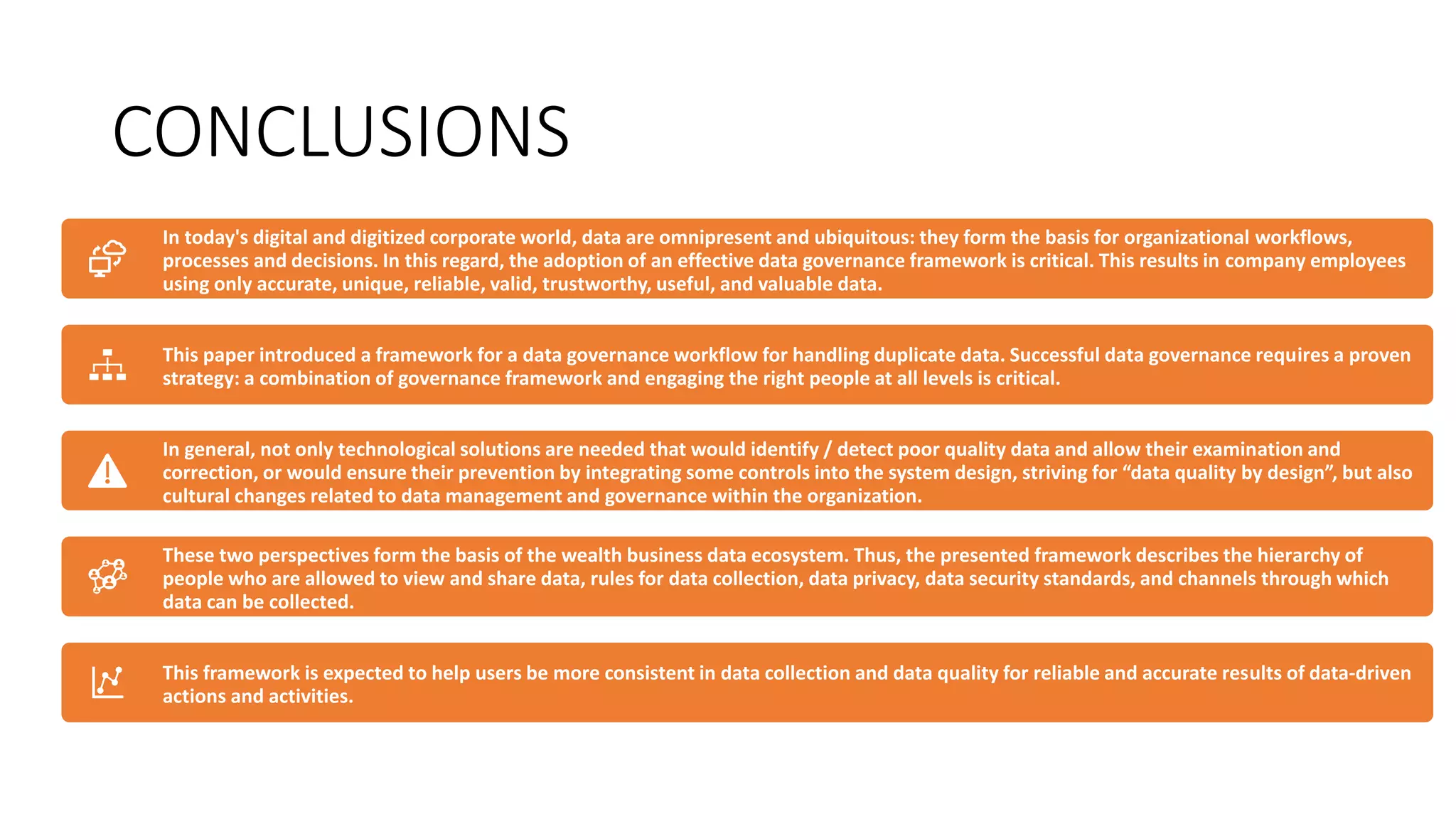
In today's digital and digitized corporate world, data are omnipresent and ubiquitous: they form the basis for organizational workflows,
processes and decisions. In this regard, the adoption of an effective data governance framework is critical. This results in company employees
using only accurate, unique, reliable, valid, trustworthy, useful, and valuable data.
This paper introduced a framework for a data governance workflow for handling duplicate data. Successful data governance requires a proven
strategy: a combination of governance framework and engaging the right people at all levels is critical.
In general, not only technological solutions are needed that would identify / detect poor quality data and allow their examination and
correction, or would ensure their prevention by integrating some controls into the system design, striving for “data quality by design”, but also
cultural changes related to data management and governance within the organization.
These two perspectives form the basis of the wealth business data ecosystem. Thus, the presented framework describes the hierarchy of
people who are allowed to view and share data, rules for data collection, data privacy, data security standards, and channels through which
data can be collected.
This framework is expected to help users be more consistent in data collection and data quality for reliable and accurate results of data-driven
actions and activities.
1. M. Spiekermann, S. Wenzel, and B. Otto, "A Conceptual Model of Benchmarking Data and its Implications for Data Mapping in the Data Economy," in Multikonferenz Wirtschaftsinformatik 2018, Lüneburg,
Germany, Mar. 6-9, 2018.
2. T. Redman, "To Improve Data Quality, Start at the Source," Harvard Business Review, 2020.
3. A. Gabernet and J. Limburn, “Breaking the 80/20 rule: How data catalogs transform data scientists’ productivity,” IBM, 2017. [Online]. Available: https://www.ibm.com/blogs/bluemix/2017/08/ibm-data-
catalog-data-scientists-productivity/
4. A. Nikiforova, “Open Data Quality Evaluation: A Comparative Analysis of Open Data in Latvia,” Baltic Journal of Modern Computing, vol. 6, no. 4, pp. 363–386, 2018.
5. J. E. Ross, Total quality management: Text, cases, and readings. Routledge, 2017.
6. A. Scriffignano, "Understanding Challenges and Opportunities in Data Management," Dun & Bradstreet, 2019, available online at https://www.dnb.co.uk/perspectives/master-data/data-management-
report.html.
7. M. Chien and A. Jain, “Gartner Magic Quadrant for Data Quality Solutions,” 2020. [Online]. Available: https://www.gartner.com/en/documents/3988016/magic-quadrant-for-data-quality-solutions.
8. P. C. Sharma, S. Bansal, R. Raja, P. M. Thwe, M. M. Htay, and S. S. Hlaing, "Concepts, strategies, and challenges of data deduplication," in Data Deduplication Approaches, T. T. Thwel and G. R. Sinha, Eds.,
Academic Press, 2021, pp. 37-55.
9. Startegy & part of the PwC Network. Chief Data Officer Study . online: https://www.strategyand.pwc.com/de/en/functions/data-strategy/cdo-2022.html?trk=feed_main-feed-card_feed-article-content, last
accessed: 26/05/2023
10. N. Nataliia, H. Yevgen, K. Artem, H. Iryna, Z. Bohdan, and Z. Iryna, “Software System for Processing and Visualization of Big Data Arrays,” in Advances in Computer Science for Engineering and Education.
ICCSEEA 2022, Z. Hu, I. Dychka, S. Petoukhov, and M. He, Eds. Cham: Springer, 2022, vol. 134, pp. 151–160.
11. S. Bansal and P. C. Sharma, “Classification criteria for data deduplication methods,” in Data Deduplication Approaches, Tin Thein Thwel and G. R. Sinha, Eds. Academic Press, 2021, pp. 69–96.
12. O. Azeroual, M. Jha, A. Nikiforova, K. Sha, M. Alsmirat, and S. Jha, “A Record Linkage-Based Data Deduplication Framework with DataCleaner Extension,” Multimodal Technologies and Interaction, vol. 6, no.
4, p. 27, 2022.
13. I. Heumann, A. MacKinney, and R. Buschmann, “Introduction: The issue of duplicates,” The British Journal for the History of Science, vol. 55, pp. 257–278, 2022.
14. B. Engels, “Data governance as the enabler of the data economy,” Intereconomics, vol. 54, pp. 216–222, 2019.
15. R. Abraham, J. Schneider, and J. vom Brocke, "Data governance: A conceptual framework, structured review, and research agenda," International Journal of Information Management, vol. 49, pp. 424-438,
2019.
16. M. Fadler, H. Lefebvre, & C. Legner, “Data governance: from master data quality to data monetization,” In ECIS, 2021.
17. A. Gregory, “Data governance — Protecting and unleashing the value of your customer data assets,” J Direct Data Digit Mark Pract, vol. 12, pp. 230–248, 2011.
18. D. Che, M. Safran, and Z. Peng, “From Big Data to Big Data Mining: Challenges, Issues, and Opportunities,” in Database Systems for Advanced Applications. DASFAA 2013, Hong et al., Eds. Springer, Berlin,
Heidelberg, 2013, vol. 7827.
19. A. Donaldson and P. Walker, “Information governance—A view from the NHS,” International Journal of Medical Informatics, vol. 73, pp. 281–284, 2004.
20. P. P. Tallon, R. V. Ramirez, and J. E. Short, "The information artifact in IT governance: Toward a theory of information governance," Journal of Management Information Systems, vol. 30, pp. 141-177, 2014.
References
21. P. H. Verburg, K. Neumann, and L. Nol, "Challenges in using land use and land cover data for global change studies,” Global change biology, 17(2), 974–989, 2011.
22. S. Sarawagi and A. Bhamidipaty, "Interactive deduplication using active learning," in Proceedings of the eighth ACM SIGKDD international conference on Knowledge discovery and data
mining, 2002, pp. 269-278.
23. T. F. Kusumasari, “Data profiling for data quality improvement with OpenRefine,” in 2016 international conference on information technology systems and innovation (ICITSI), IEEE, 2016,
pp. 1–6.
24. O. Azeroual, G. Saake, and M. Abuosba, "Data Quality Measures and Data Cleansing for Research Information Systems," Journal of Digital Information Management, vol. 16, pp. 12-21,
2018.
25. G. Papadakis, E. Ioannou, C. Niederée, and P. Fankhauser, "Efficient entity resolution for large heterogeneous information spaces," in Proceedings of the fourth ACM international
conference on Web search and data mining, 2011, pp. 535-544.
26. M. K. Alnoory and M. M. Aqel, "Performance evaluation of similarity functions for duplicate record detection," Middle East University, 2011.
27. S. R. Seaman and I. R. White, "Review of inverse probability weighting for dealing with missing data," Statistical methods in medical research, vol. 22, no. 3, pp. 278-295, 2013.
28. D. Nadeau and S. Sekine, “A survey of named entity recognition and classification,” Lingvisticae Investigationes, vol. 30, no. 1, pp. 3–26, 2007.
29. C. Batini and M. Scannapieca, “Object Identification,” in Data Quality: Concepts, Methodologies and Techniques, 2006, pp. 97–132.
30. F. Panse, M. van Keulen, and N. Ritter, "Indeterministic handling of uncertain decisions in deduplication," Journal of Data and Information Quality (JDIQ), vol. 4, no. 2, pp. 1-25, 2013.
31. F. Panse, M. van Keulen, and N. Ritter, "Indeterministic handling of uncertain decisions in duplicate detection," CTIT Technical Report Series, TR-CTIT-10-21, 2010.
32. F. Naumann, A. Bilke, J. Bleiholder, and M. Weis, “Data fusion in three steps: Resolving inconsistencies at schema-, tuple-, and value-level,” IEEE Data Engineering Bulletin, vol. 29, no. 2,
pp. 21–31, 2006.
33. O. Hassanzadeh and R. J. Miller, “Creating probabilistic databases from duplicated data,” The VLDB Journal, vol. 18, no. 5, pp. 1141, 2009.
34. D. M. Powers, "Evaluation: from precision, recall and F-measure to ROC, informedness, markedness and correlation," arXiv preprint arXiv:2010.16061, 2020.
35. N. Wu, N., E. M. Pierce, J. R.Talburt & Wang, “An Information Theoretic Approach to Information Quality Metric,” In ICIQ (pp. 133–145), 2006.
36. O. Azeroual, “Untersuchung der Datenqualität in FIS,” in Untersuchungen zur Datenqualität und Nutzerakzeptanz von Forschungsinformationssystemen, Springer Vieweg, Wiesbaden,
2022.
37. A. Nikiforova. Open Data Quality. In 13th International Baltic Conference on Databases and Information Systems (DBIS 2018), Trakai, Lithuania, July 1–4, 2018, S. 151–160. Springer, Cham,
2018.
38. C., Guerra-García, A. Nikiforova, S. Jiménez, H. Perez-Gonzalez, M. Ramírez-Torres & L. Ontañon-García, ISO/IEC 25012-based methodology for managing data quality requirements in the
development of information systems: Towards Data Quality by Design." Data & Knowledge Engineering 145 (2023): 102152.
39. D. C. Corrales, A. Ledezma, & J.C. Corrales, A systematic review of data quality issues in knowledge discovery tasks. Revista Ingenierías Universidad de Medellín, 15(28), 125-150, 2016.
References

Overlooked aspects of data governance: workflow framework for enterprise data deduplication

  • 1.
    OVERLOOKED ASPECTS OFDATA GOVERNANCE WORKFLOW FRAMEWORK FOR ENTERPRISE DATA DEDUPLICATION Otmane Azeroual, German Centre for Higher Education Research and Science Studies (DZHW), Germany Anastasija Nikiforova, Faculty of Science and Technology, Institute of Computer Science, University of Tartu, Estonia & Task Force “FAIR Metrics and Data Quality”, European Open Science Cloud Kewei Sha, College of Science and Engineering University of Houston Clear Lake, USA The International Conference on Intelligent Computing, Communication, Networking and Services (ICCNS2023), June 19-22, 2023 - Valencia, Spain image source: https://unite.un.org/blog/the-importance-of- data-governance
  • 2.
    MUSK’S TOP PRIORITY:TO IMPROVE THE PRODUCT… Q: HOW DOES ONE ENSURE THE RELIABILITY OF DATA AND DECISIONS MADE BASED ON SAID DATA? THE ANSWER LIES NOT IN MANAGING THE DATA ALONE, BUT ALSO THE INFORMATION AROUND AND ABOUT DATA ACQUISITION, TRANSFORMATIONS AND VISUALIZATION TO PROVIDE A BETTER UNDERSTANDING AND SUPPORT DECISION MAKERS https://www.gqindia.com/get-smart/content/5-things-elon-musk-did-to-become-one-of-the-richest-men-in-the-world
  • 3.
    https://www.gqindia.com/get-smart/content/5-things-elon-musk-did-to-become-one-of-the-richest-men-in-the-world MUSK’S TOP PRIORITY:TO IMPROVE THE PRODUCT… Q: HOW DOES ONE ENSURE THE RELIABILITY OF DATA AND DECISIONS MADE BASED ON SAID DATA? THE ANSWER LIES NOT IN MANAGING THE DATA ALONE, BUT ALSO THE INFORMATION AROUND AND ABOUT DATA ACQUISITION, TRANSFORMATIONS AND VISUALIZATION TO PROVIDE A BETTER UNDERSTANDING AND SUPPORT DECISION MAKERS BY FOCUSING ON SUSTAINABLE DATA CLEAR DATA GOVERNANCE AND STRONG DATA MANAGEMENT
  • 4.
    Background In the contextof the data economy, which is characterized by a global ecosystem of many digitally connected actors / entities / organizations, data is considered a critical business asset [1]. However, many organizations are still struggling and even failing to combine a large number of internal and external data flows, assign appropriate responsibilities and determine significance and relevance to business processes to these data sources, and ensure sufficient data quality [2].
  • 6.
    IF WE THINKABOUT DATA AS A POWER SOURCE OR FUEL, IT WOULD MAKE MORE SENSE TO COMPARE THEM WITH RENEWABLE SOURCES LIKE THE SUN, WIND AND TIDES” -B. Marr, Forbes Soures: Letter from the Editor: Here comes the sun (medicalnewstoday.com), A healthy wind | MIT News | Massachusetts Institute of Technology, Tidal phenomenon: high and low tides | Ponant Magazine, Here's Why Data Is Not The New Oil (forbes.com)
  • 7.
    Image source: 🤨"Data is the new oil."​ | LinkedIn
  • 8.
    Background It is believedthat 80% of a data scientist’s time is spent simply searching, cleaning & organizing data, and only 20% - to perform analysis [3,4] According to Total Data Quality Management (TDQM), “1-10-100” rule applies to data quality, i.e., 1$ spent on prevention saves 10$ on appraisal & 100$ on failure costs [5] According to [6], 19% of businesses lost their customers due to the use of inaccurate, incomplete data in 2019, with losses exacerbated in industries where customers have a high lifetime value “Magic Quadrant for Data Quality Solutions” 2020 found that organizations estimate the average cost of poor data quality at more than $12 million per year [7] According to [6], 42% of companies struggle with inaccurate data, and 43% of them have experienced the failure of some data-driven projects.
  • 9.
    Background Data duplication, inparticular, has become problematic due to the growing volume of data, incl. due to the adoption of cloud technologies, use of multiple different sources, the proliferation of connected personal and work devices in homes, stores, offices and supply chains. Data duplication as one of the major data quality issues (also known as uniqueness) is a serious issue affecting company image, decision-making, and other data-driven activities such as service personalisation in terms of both their accuracy, trustworthiness and reliability, user acceptance / adoption and satisfaction, customer service, risk management, crisis management, as well as resource management (time, human, and fiscal). At the same time, it is known that the amount of data that companies collect is growing exponentially, i.e., the volume of data is constantly increasing, making it difficult to effectively manage them. Consequently, organizations are affected by / suffer from inaccurate analysis, poor, distorted or skewed decisions, distorted insights provided by Business Intelligence (BI) or machine learning (ML) algorithms, models, forecasts, and simulations, where the data form the input, wasted resources, and employees, who are less likely trust the data and associated applications. Thus, both ex-ante and ex-post deduplication mechanisms are critical in this context to ensure sufficient data quality and are usually integrated into a broader data governance approach.
  • 10.
    Background Consequently, organizations areaffected by / suffer from inaccurate analysis, poor, distorted or skewed decisions, distorted insights provided by Business Intelligence (BI) or machine learning (ML) algorithms, models, forecasts, and simulations, where the data form the input, wasted resources, and employees, who are less likely trust the data and associated applications. THUS, BOTH EX-ANTE AND EX-POST DEDUPLICATION MECHANISMS ARE CRITICAL TO ENSURE SUFFICIENT DATA QUALITY AND ARE USUALLY INTEGRATED INTO A BROADER DATA GOVERNANCE APPROACH
  • 11.
    Background Proper data governanceframeworks are powerful mechanisms to help businesses become more organized and focused. They provide a structure for the data that an organization collects and guidelines for managing that data, incl. but not limited to determine who can use what data, in what situations, and how, i.e., in what scenarios [20]. The implementation of data governance can be greatly simplified with a conceptual framework [17]. Some data governance frameworks focus on specific areas such as data analytics, data security, or data life cycle [21-23]. However, there is a lack of data governance framework for managing duplicate data in large data ecosystems, i.e., effectively, and efficiently identifying, and eliminating them.
  • 12.
    Practice also showsthat many companies face challenges in this respect in both North America, South and Latin America, Europe, Middle East and Africa, East-Asia, with the Americas being more advanced in this respect compared to other regions. A study conducted by PricewaterhouseCoopers of the 2,500 largest publicly listed companies shows that while 1/3 of companies based in North America tend to have a Chief Data Officer & deal with the data governance wiser, this is the case for only ¼ of the surveyed companies in Europe Source: https://www.strategyand.pwc.com/de/en/functions/data-strategy/cdo-2022.html?trk=feed_main- feed-card_feed-article-content , https://commons.wikimedia.org/wiki/File:PricewaterhouseCoopers_Logo.png
  • 13.
    AIM The aim ofthis study is to develop a conceptual data governance framework for effective and efficient management of duplicate data in big data ecosystems. To achieve the objective, we use the Apache Spark-based framework proposed by Hildebrandt et al. [19] that has proved its relevance in terms of generating large and realistic test datasets for duplicate detection and can go beyond the individual elements of data quality assessment. However, while this is a promising solution, our experience with it shows that it is not suitable for all data formats and database types, including but not limited to CRM, ERP, or SAP. Thus, we use it as a reference model, which we extend by integrating methods for analysing customer data collected from all types of databases and formats in the company. We believe that a data governance framework should not only evaluate, but also provide a practical guidance on how to analyse and eliminate data duplicate data through proactive management, which can then be integrated into the organization's processes.
  • 14.
    AIM First, we presentmethods for how companies can deal meaningfully with duplicate data. Initially, we focus on data profiling using several analysis methods applicable to different types of datasets, incl. analysis of different types of errors, structuring, harmonizing, & merging of duplicate data. Second, we propose methods for reducing the number of comparisons and matching attribute values based on similarity (in medium to large databases). The focus is on easy integration and duplicate detection configuration so that the solution can be easily adapted to different users in companies without domain knowledge. These methods are domain-independent and can be transferred to other application contexts to evaluate the quality, structure, and content of duplicate / repetitive data. Finally, we integrate the chosen methods into the framework of Hildebrandt et al. [19]. We also explore some of the most common data quality tools in practice, into which we integrate this framework. After that, we test and validate the framework. The final refined solution provides the basis for subsequent use. It consists of detecting and visualizing duplicates, presenting the identified redundancies to the user in a user-friendly manner to enable and facilitate their further elimination.
  • 15.
    AIM By eliminating redundancies,the quality of the data is optimized and thus improves further data-driven actions, including data analyses and decision-making. This paper aims to support research in data management and data governance by identifying duplicate data at the enterprise level and meeting today's demands for increased connectivity / interconnectedness, data ubiquity, and multi-data sourcing. In addition, the proposed conceptual data governance framework aims to provide an overview of data quality, accuracy and consistency to help practitioners approach data governance in a structured manner.
  • 16.
    METHODS AND WORKFLOWFRAMEWORK FOR DUPLICATE DETECTION Recognizing the need for duplicates management, we present a set of expected requirements and a list of practices that can be integrated into our data governance framework. To do be consistent with the motivation and intended purpose of duplicates management, the planned procedure must meet a number of criteria. The identified requirements are (based on [20]): ✓efficiency & scalability: should be able generate large test datasets in an acceptable run time ➔ (R1) the highest possible efficiency and (R2) scalability; ✓schema and data type independence: the method must be able to obtain / derive test datasets from any existing relational datasets ➔ (R3) it must be able to handle different schemas and data types; ✓realistic errors: the input is assumed to be a dataset that is as clean as possible➔ (R4) the method is expected to be “responsible” for injecting errors & the injected errors should match as close as possible the errors in respective domain; ✓flexible configurability: (R5) allow generating test datasets with different properties depending on the configuration (e.g., the number of tuples, the proportion of duplicates, the degree of contamination / pollution, the type of errors). (R6) the required configuration effort for the user should be as small as possible to make this tool easier to use and enable inexperienced users.
  • 17.
    METHODS AND WORKFLOWFRAMEWORK FOR DUPLICATE DETECTION The task of identifying duplicates is usually solved in a process-driven way. The duplicate detection process consists of several methods and can be designed very differently, but, following relatively similar structure, which is is used in the created workflow framework: 2. Data Cleaning 3. Table schema enrichment 4. Automated pre- configuration 5. Search space reduction 6. Attribute value matching 7. Error model 8. Classification 9. Clustering 10. Verification 1. Data Profiling
  • 18.
    Method Description Data profilingdescribes automated data analysis using various analysis methods and techniques [27]; profiling of data associated with attributes is used to determine statistical characteristics of individual attributes, which are recorded in the data profile along with the schema information of the data source Data Cleaning used to prepare and standardize the database [28]. Data quality can be improved through syntactic and semantic adjustments, which in turn can improve the quality of duplicate detection. Possible measures include removing unwanted characters, standardizing abbreviations or adding derived attributes Table schema enrichment uses an enriched table schema, incl. information about the structural schema of the input dataset and contains additional information for further processing. This allows the procedure to be schema independent and also lays the foundation for generating realistic errors and implementing flexible configurability Automated pre- configuration With the help of reasoning procedures, a pre-configuration of the actual data generation process is automatically derived from the characteristics of the input data [19]. The generated pre-configurations are intended to ensure that the required configuration effort remains as low as possible despite the large number of configuration parameters that the user can manually configure / adjust; Search space reduction avoid comparisons between tuples that are very likely not duplicates, using certain criteria. When choosing the criteria used for this, there is always a trade-off between the reduction factor or ratio and the completeness of pairs. The most well-known methods are standard blocking and the sorted neighbourhood method [10]; Attribute value matching values are calculated for each pair of tuples in the (reduced) search space using appropriate measures to represent the degree of similarity between the attribute values of two tuples [30]. E.g., edit-based (Levenshtein distance), sequence-based (Jaro distance), token-based string metrics (Jaccard coefficient, n-grams) [30] Error model is based on the so-called error schemes, where each schema represents a specific defined sequence of applying of different types of errors to data. Defined by flexible linking and nesting of different types of errors using meta-errors. Error types are classified according to their scope, i.e., according to the area of the dataset in which they operate - row errors, column errors, field errors. These field/area errors can also be further divided into subclasses based on the data type of the field. Clustering classification of pairs of tuples into matches, non-matches / mismatches, and possible matches. However, duplicate detection is defined as mapping an input relation to a cluster. To obtain a globally consistent result, the tuples are collectively classified in the clustering step based on (independent) pairwise classification decisions. Verification The usual approach is to express the quality of the process in terms of the goodness of these pairwise classification decisions. The numbers of correctly classified duplicates (true positives), tuple pairs incorrectly classified as duplicates (false positives), and duplicates not found (false negatives) are related. The most common of these measures are Precision, Recall and F-Measure [38].
  • 19.
    Workflow framework fordata discovery Based on: O. Azeroual, M. Jha, A. Nikiforova, K. Sha, M. Alsmirat, and S. Jha, “A Record Linkage-Based Data Deduplication Framework with DataCleaner Extension,” Multimodal Technologies and Interaction, vol. 6, no. 4, p. 27, 2022. K. Hildebrandt, F. Panse, N. Wilcke, and N. Ritter, “Large-Scale Data Pollution with Apache Spark,” IEEE Transactions on Big Data, vol. 6, pp. 396–411, 2020. A prerequisite for applying the presented methods is the existence of a clean dataset with a tabular structure. Taking such a dataset as input, a duplicate detection test dataset is generated using the workflow framework that consists of the following three core phases: (1) analysis of the dataset, (2) semi-automatic configuration, (3) execution of processing.
  • 20.
    Workflow framework fordata discovery: analysis of the dataset A clean dataset is imported and analyzed using attribute-based data profiling and data cleaning techniques. First, the existing data source schema information is determined. Then, for each attribute, a set of statistical information about the associated attribute values are collected and recorded in the data profile for the corresponding attribute. This data profile contains information about: • distribution of the base data types • base data type in the schema: if the schema of the input dataset specifies a data type for the attribute being examined, it will be recorded here. If no data type is specified, the most common data type found in the distribution of the basic data types is assumed to be such; • uniqueness of attribute values: the number of individual values (distinct values count) & their share of the total number of attribute values is calculated (distinct values ratio); • data type-specific information: depending on the basic data type of the attribute, information about the attribute’s values may also be of interest, e.g., statistical information (min, max, average), and spread of attribute’s values for numeric, and the number of tokens per string and lengths of each token for string attributes.
  • 21.
    Workflow framework fordata discovery: analysis of the dataset Pre-configurations are automatically derived from data profiles and data cleansing, which can then be examined and adjusted manually by the user. The entire configuration can be saved, incl. metadata are recorded. Error schema Configuration Schema-independent configuration Duplicate Cluster Configuration Pollution level configuration generated from the table schema. It is concluded which attributes have which error types - not every error type is suitable for every attribute. determines how many duplicate clusters of which cardinalities to create that can be done in 3 ways: o exact, by specifying the desired numbers of duplicate clusters of certain cardinalities; o absolute, by specifying the absolute number of duplicates desired and a distribution to calculate the exact duplicate configuration of the cluster. Example: 5,000 duplicates; normal distribution; o relative, by specifying the relative proportion of the desired duplicates to the source (or target) size and distribution to calculate the exact configuration of the cluster of duplicates. Example: 50% of the created tuples should be duplicates; Equal distribution. specifies how polluted the tuples in the duplicate clusters should be (approximately). The degree of pollution/contamination is modelled using the similarity value. There are various ways to calculate this value. E.g., it can be the result of all average similarity values of all pairs of tuples of all duplicate clusters. The specified size depends on the data and the similarity measures used. Table Schema Configuration Is based on the results of the analysis step, data profiles, data cleansing • the number and names of the attributes; • the base data type; • an abstract data type can be assigned to an attribute based on the data profile, e.g., with the help of reasoning systems, or manually by the user; • if the attribute is nullable, this property can be set by having NULL values in each attribute value; • if the attribute is unique, this property can be obtained / derived from the individuality of its attribute values (ratio of distinct values); • Boolean value allows the user to specify whether the attribute should be considered for pollution at all; • a similarity measure that can compare this type of data value is derived from the determined information about the attribute
  • 22.
    Workflow framework fordata discovery: execution of processing The key stage where the data pollution / contamination and hence the actual generation of the test dataset is performed. Injection of duplicates Error Injection Preservation according to the configuration of duplicate clusters, a tuple is randomly selected for each duplicate cluster C and duplicated |C|−1 times, where |C| stands for the respective cluster size. The created duplicates are added to the dataset. It keeps track of which tuples belong to the same duplicate cluster; a previously defined error scheme is iteratively applied to the dataset until the desired level of pollution / contamination is reached. To do this, the degree of contamination achieved is calculated between the individual iterations and compared with the desired target value from the configuration. Once this target value is reached, the loop is terminated. The accuracy/precision of the approximation to the desired level of pollution depends on the pollution effect of the error scheme. The more iterations of the error scheme that pollutes the dataset, the greater the potential difference between the result and the desired level of pollution the modified dataset is saved as a test dataset. Its gold standard is added by persisting the tuple cluster ID as an additional dataset attribute.
  • 23.
    A comparative evaluationof the open-source tools Based on O. Azeroual, “Untersuchung der Datenqualität in FIS,” in Untersuchungen zur Datenqualität und Nutzerakzeptanz von Forschungsinformationssystemen, Springer Vieweg, 2022. Image source: https://www.google.com/url?sa=i&url=https%3A%2F%2Fgithub.com%2Fdatacleaner&psig=AOvVaw37EuBoXG2RmgPEoQL0rEfx&ust=1686750294711000&source=images&cd=vfe&ved=0CBMQjhxqFwoTCNCL0d2wwP8CFQAAAAAdAAAAABAD The proposed framework was integrated into the DataCleaner
  • 24.
    Demonstrating workflow frameworkfor duplicate detection .csv dataset - a collection on vehicle data 5000 records, where each vehicle is described by 250 parameters (i.e., 5000 rows, 250 columns). interested in identifying duplicate product names Result: the product named "Classic Cars" occurs 62 times in the dataset, “Motorcycles” – 37 times, “Trucks and Buses” – 11 times A green arrow provides the user with a list of duplicate entries to navigate to these duplicates
  • 25.
    Which data withina company requires the most careful control depends on business factors, as well as the nature of the data the company is dealing with. E.g., for customer service, ensuring the quality and protection of customer- related data is of particular importance. The secure management of data as it is exchanged within an organization is essential to ensure compliance with legal and industry- specific regulations. These requirements form the basis of a company's data governance strategy, which forms the basis of the data governance framework. Various company-specific factors have a strong influence on the design of the data governance framework, which can be (1) the organizational landscape, (2) the competency landscape in the organization, (3) the competency landscape in the IT department, (4) the strategic landscape.
  • 26.
    Data governance affectsthe three levels of decision/impact: strategy, organization, & IS during implementation. After formulating DQ strategy, the specifications are operationalized by defining data control processes, which includes assigning responsibilities and tasks to roles. The data governance framework has the following typical roles that can be responsible for the workflow framework: Data Governance Committee, whose role is to define the data governance framework based on both company-related aspects, available data artifacts with the reference to both the data and their nature, as well as the systems that deal with these data, and stakeholders and actors dealing with the data. This committee is also expected to oversee its further implementation across the organization. ✓ Chief Steward, whose role is to implement the control structures and define the requirements for the implementation of the data governance framework; ✓ Business Data Steward, whose role is to detail the data governance framework for the area of responsibility from a business perspective; ✓ Technical Data Steward, whose role is to create technical standards and definitions for individual data elements, and to describe systems and data flows between systems from a technical point of view. https://www.edq.com/blog/data-quality-vs-data-governance/
  • 27.
    Data Stewardship anddata ownership Data stewardship and data ownership are two important concepts in defining, assessing / evaluating, improving, and controlling data quality. Data owners are individuals or groups who are responsible for the specific data content and its use as a data source, i.e., those who collect them, and use for their daily business activities (e.g., risk analysis or risk management). They can be employee from the commercial area, e.g., customer consultants, who are the owners of customer contact data. Data stewards - less interested in content than in data structure. By analysing and documenting these structures and controlling the implementation of data governance policies, they act as data quality monitors, e.g., bank risk management in banking. This systematic work of documenting and controlling technical requirements and deliverables assists IT departments in developing appropriate architectures for technical data quality protection. In the area of data management, data stewards are an important link between IT and business.
  • 28.
    what data needsto be defined more precisely, accurately or detailed? how it is expected to be done? how business expectations/requirements are taken into account and dealt with? how data generally (can) change? As a critical and decisive factor, data governance links business policy to data management and forms the regulatory framework / backbone when it comes to the systematic integration of data. Larger companies can afford to create their own data management team to complement the data governance committee with the development, governance, and implementation of data management tasks. In smaller companies, assigning roles as a secondary organization using existing processes and organizational structures is a more cost-effective alternative. Data Stewardship and data ownership
  • 29.
    RESULTS 1 we presented methodsfor how companies can deal meaningfully with duplicate data. Initially, we focus on data profiling using several analysis methods applicable to different types of datasets, including analysis of different types of errors, structuring, harmonizing/ reconciling, and merging of duplicate data. 2 we proposed methods for reducing the number of comparisons and matching attribute values based on similarity. The focus is on easy integration and duplicate detection configuration so that the solution can be easily adapted to different users in companies without domain knowledge. These methods are domain independent and can be transferred to other application contexts to evaluate the quality, structure, and content of duplicate / repetitive data. 3 we integrated the chosen methods into the framework of Hildebrandt et al. [19]. We explored the most common data quality tools in practice, into which we integrate this framework. 4 we demonstrated the framework with a real dataset. The final refined solution provides the basis for subsequent use consisting of detecting and visualizing duplicates, presenting the identified redundancies to the user in a user-friendly manner to enable and facilitate their further elimination. By eliminating redundancies, the quality of the data is optimized and thus improves further data- driven actions, including data analyses and decision-making. 5 This paper aims to support research in data management and data governance by identifying duplicate data at the enterprise level and meeting today's demands for increased connectivity / interconnectedness, data ubiquity, and multi-data sourcing. The proposed conceptual data governance framework aims to provide an overview of data quality, accuracy and consistency to help practitioners approach data governance in a structured manner.
  • 30.
    CONCLUSIONS In today's digitaland digitized corporate world, data are omnipresent and ubiquitous: they form the basis for organizational workflows, processes and decisions. In this regard, the adoption of an effective data governance framework is critical. This results in company employees using only accurate, unique, reliable, valid, trustworthy, useful, and valuable data. This paper introduced a framework for a data governance workflow for handling duplicate data. Successful data governance requires a proven strategy: a combination of governance framework and engaging the right people at all levels is critical. In general, not only technological solutions are needed that would identify / detect poor quality data and allow their examination and correction, or would ensure their prevention by integrating some controls into the system design, striving for “data quality by design”, but also cultural changes related to data management and governance within the organization. These two perspectives form the basis of the wealth business data ecosystem. Thus, the presented framework describes the hierarchy of people who are allowed to view and share data, rules for data collection, data privacy, data security standards, and channels through which data can be collected. This framework is expected to help users be more consistent in data collection and data quality for reliable and accurate results of data-driven actions and activities.
  • 31.
    1. M. Spiekermann,S. Wenzel, and B. Otto, "A Conceptual Model of Benchmarking Data and its Implications for Data Mapping in the Data Economy," in Multikonferenz Wirtschaftsinformatik 2018, Lüneburg, Germany, Mar. 6-9, 2018. 2. T. Redman, "To Improve Data Quality, Start at the Source," Harvard Business Review, 2020. 3. A. Gabernet and J. Limburn, “Breaking the 80/20 rule: How data catalogs transform data scientists’ productivity,” IBM, 2017. [Online]. Available: https://www.ibm.com/blogs/bluemix/2017/08/ibm-data- catalog-data-scientists-productivity/ 4. A. Nikiforova, “Open Data Quality Evaluation: A Comparative Analysis of Open Data in Latvia,” Baltic Journal of Modern Computing, vol. 6, no. 4, pp. 363–386, 2018. 5. J. E. Ross, Total quality management: Text, cases, and readings. Routledge, 2017. 6. A. Scriffignano, "Understanding Challenges and Opportunities in Data Management," Dun & Bradstreet, 2019, available online at https://www.dnb.co.uk/perspectives/master-data/data-management- report.html. 7. M. Chien and A. Jain, “Gartner Magic Quadrant for Data Quality Solutions,” 2020. [Online]. Available: https://www.gartner.com/en/documents/3988016/magic-quadrant-for-data-quality-solutions. 8. P. C. Sharma, S. Bansal, R. Raja, P. M. Thwe, M. M. Htay, and S. S. Hlaing, "Concepts, strategies, and challenges of data deduplication," in Data Deduplication Approaches, T. T. Thwel and G. R. Sinha, Eds., Academic Press, 2021, pp. 37-55. 9. Startegy & part of the PwC Network. Chief Data Officer Study . online: https://www.strategyand.pwc.com/de/en/functions/data-strategy/cdo-2022.html?trk=feed_main-feed-card_feed-article-content, last accessed: 26/05/2023 10. N. Nataliia, H. Yevgen, K. Artem, H. Iryna, Z. Bohdan, and Z. Iryna, “Software System for Processing and Visualization of Big Data Arrays,” in Advances in Computer Science for Engineering and Education. ICCSEEA 2022, Z. Hu, I. Dychka, S. Petoukhov, and M. He, Eds. Cham: Springer, 2022, vol. 134, pp. 151–160. 11. S. Bansal and P. C. Sharma, “Classification criteria for data deduplication methods,” in Data Deduplication Approaches, Tin Thein Thwel and G. R. Sinha, Eds. Academic Press, 2021, pp. 69–96. 12. O. Azeroual, M. Jha, A. Nikiforova, K. Sha, M. Alsmirat, and S. Jha, “A Record Linkage-Based Data Deduplication Framework with DataCleaner Extension,” Multimodal Technologies and Interaction, vol. 6, no. 4, p. 27, 2022. 13. I. Heumann, A. MacKinney, and R. Buschmann, “Introduction: The issue of duplicates,” The British Journal for the History of Science, vol. 55, pp. 257–278, 2022. 14. B. Engels, “Data governance as the enabler of the data economy,” Intereconomics, vol. 54, pp. 216–222, 2019. 15. R. Abraham, J. Schneider, and J. vom Brocke, "Data governance: A conceptual framework, structured review, and research agenda," International Journal of Information Management, vol. 49, pp. 424-438, 2019. 16. M. Fadler, H. Lefebvre, & C. Legner, “Data governance: from master data quality to data monetization,” In ECIS, 2021. 17. A. Gregory, “Data governance — Protecting and unleashing the value of your customer data assets,” J Direct Data Digit Mark Pract, vol. 12, pp. 230–248, 2011. 18. D. Che, M. Safran, and Z. Peng, “From Big Data to Big Data Mining: Challenges, Issues, and Opportunities,” in Database Systems for Advanced Applications. DASFAA 2013, Hong et al., Eds. Springer, Berlin, Heidelberg, 2013, vol. 7827. 19. A. Donaldson and P. Walker, “Information governance—A view from the NHS,” International Journal of Medical Informatics, vol. 73, pp. 281–284, 2004. 20. P. P. Tallon, R. V. Ramirez, and J. E. Short, "The information artifact in IT governance: Toward a theory of information governance," Journal of Management Information Systems, vol. 30, pp. 141-177, 2014. References
  • 32.
    21. P. H.Verburg, K. Neumann, and L. Nol, "Challenges in using land use and land cover data for global change studies,” Global change biology, 17(2), 974–989, 2011. 22. S. Sarawagi and A. Bhamidipaty, "Interactive deduplication using active learning," in Proceedings of the eighth ACM SIGKDD international conference on Knowledge discovery and data mining, 2002, pp. 269-278. 23. T. F. Kusumasari, “Data profiling for data quality improvement with OpenRefine,” in 2016 international conference on information technology systems and innovation (ICITSI), IEEE, 2016, pp. 1–6. 24. O. Azeroual, G. Saake, and M. Abuosba, "Data Quality Measures and Data Cleansing for Research Information Systems," Journal of Digital Information Management, vol. 16, pp. 12-21, 2018. 25. G. Papadakis, E. Ioannou, C. Niederée, and P. Fankhauser, "Efficient entity resolution for large heterogeneous information spaces," in Proceedings of the fourth ACM international conference on Web search and data mining, 2011, pp. 535-544. 26. M. K. Alnoory and M. M. Aqel, "Performance evaluation of similarity functions for duplicate record detection," Middle East University, 2011. 27. S. R. Seaman and I. R. White, "Review of inverse probability weighting for dealing with missing data," Statistical methods in medical research, vol. 22, no. 3, pp. 278-295, 2013. 28. D. Nadeau and S. Sekine, “A survey of named entity recognition and classification,” Lingvisticae Investigationes, vol. 30, no. 1, pp. 3–26, 2007. 29. C. Batini and M. Scannapieca, “Object Identification,” in Data Quality: Concepts, Methodologies and Techniques, 2006, pp. 97–132. 30. F. Panse, M. van Keulen, and N. Ritter, "Indeterministic handling of uncertain decisions in deduplication," Journal of Data and Information Quality (JDIQ), vol. 4, no. 2, pp. 1-25, 2013. 31. F. Panse, M. van Keulen, and N. Ritter, "Indeterministic handling of uncertain decisions in duplicate detection," CTIT Technical Report Series, TR-CTIT-10-21, 2010. 32. F. Naumann, A. Bilke, J. Bleiholder, and M. Weis, “Data fusion in three steps: Resolving inconsistencies at schema-, tuple-, and value-level,” IEEE Data Engineering Bulletin, vol. 29, no. 2, pp. 21–31, 2006. 33. O. Hassanzadeh and R. J. Miller, “Creating probabilistic databases from duplicated data,” The VLDB Journal, vol. 18, no. 5, pp. 1141, 2009. 34. D. M. Powers, "Evaluation: from precision, recall and F-measure to ROC, informedness, markedness and correlation," arXiv preprint arXiv:2010.16061, 2020. 35. N. Wu, N., E. M. Pierce, J. R.Talburt & Wang, “An Information Theoretic Approach to Information Quality Metric,” In ICIQ (pp. 133–145), 2006. 36. O. Azeroual, “Untersuchung der Datenqualität in FIS,” in Untersuchungen zur Datenqualität und Nutzerakzeptanz von Forschungsinformationssystemen, Springer Vieweg, Wiesbaden, 2022. 37. A. Nikiforova. Open Data Quality. In 13th International Baltic Conference on Databases and Information Systems (DBIS 2018), Trakai, Lithuania, July 1–4, 2018, S. 151–160. Springer, Cham, 2018. 38. C., Guerra-García, A. Nikiforova, S. Jiménez, H. Perez-Gonzalez, M. Ramírez-Torres & L. Ontañon-García, ISO/IEC 25012-based methodology for managing data quality requirements in the development of information systems: Towards Data Quality by Design." Data & Knowledge Engineering 145 (2023): 102152. 39. D. C. Corrales, A. Ledezma, & J.C. Corrales, A systematic review of data quality issues in knowledge discovery tasks. Revista Ingenierías Universidad de Medellín, 15(28), 125-150, 2016. References