Agile Project Methodology
By Prof. Prasad Jaywant
Learnings
1. Introduction to Agile
Agile is a set of principles and values that guide a flexible and collaborative approach to software development. It emphasizes adaptability,
customer collaboration, and iterative development to deliver high-quality software efficiently. Unlike traditional waterfall methodologies, Agile
embraces change and encourages continuous improvement.
2. The Agile Manifesto
The Agile Manifesto was created in 2001 by a group of software development practitioners who identified four core values that guide Agile
methodologies:
a) Individuals and interactions over processes and tools:
Valuing people and effective communication within the team is prioritized over relying solely on processes and tools.
b) Working software over comprehensive documentation:
The focus is on delivering working software as the primary measure of progress, while recognizing the importance of documentation.
c) Customer collaboration over contract negotiation:
Active involvement and collaboration with customers throughout the development process are emphasized over strict contract negotiations.
d) Responding to change over following a plan:
Embracing change and adapting quickly to new requirements and feedback is favoured over strictly adhering to a predefined plan.
Learnings
3. Why Agile
Agile methodologies offer several benefits, including:
a) Flexibility and Adaptability:
Agile enables teams to respond quickly to changing requirements and market dynamics, allowing for greater flexibility and adaptability.
b) Faster Time to Market:
By delivering working software in shorter iterations, Agile methodologies accelerate the time to market and provide a competitive
advantage.
c) Customer Satisfaction:
Active customer involvement and continuous feedback help ensure that the final product meets customer expectations, leading to
increased satisfaction.
d) Collaboration and Communication:
Agile fosters collaboration and communication among team members, stakeholders, and customers, enhancing productivity and
reducing misunderstandings.
Learnings
4. Scrum: An Agile Framework
Scrum is one of the most popular Agile frameworks. It follows a set of defined roles, events, and artifacts to facilitate the development process:
a) Roles in Scrum:
Scrum Master: Facilitates the Scrum process, removes impediments, and ensures adherence to Scrum principles.
Product Owner: Represents the customer and defines and prioritizes the product backlog.
Development Team: Cross-functional team responsible for delivering the working software.
b) Scrum Events:
Sprint Planning: Determines the work to be done in the upcoming sprint.
Daily Scrum: Daily stand-up meetings for the team to synchronize activities.
Sprint Review: Demonstrates the completed work to stakeholders and gathers feedback.
Sprint Retrospective: Reflects on the previous sprint and identifies areas for improvement.
c) Scrum Artifacts:
Product Backlog: Prioritized list of requirements or features.
Sprint Backlog: Subset of the product backlog items selected for the current sprint.
Increment: The sum of all completed and tested product backlog items at the end of a sprint.
Scrum provides a framework for effective collaboration, transparency, and delivering value incrementally.
Business Analysis
By Prof. Pradeep Pendse
Learnings
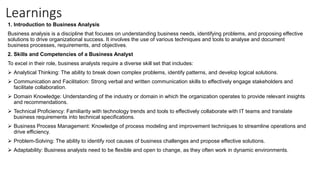
1. Introduction to Business Analysis
Business analysis is a discipline that focuses on understanding business needs, identifying problems, and proposing effective
solutions to drive organizational success. It involves the use of various techniques and tools to analyse and document
business processes, requirements, and objectives.
2. Skills and Competencies of a Business Analyst
To excel in their role, business analysts require a diverse skill set that includes:
 Analytical Thinking: The ability to break down complex problems, identify patterns, and develop logical solutions.
 Communication and Facilitation: Strong verbal and written communication skills to effectively engage stakeholders and
facilitate collaboration.
 Domain Knowledge: Understanding of the industry or domain in which the organization operates to provide relevant insights
and recommendations.
 Technical Proficiency: Familiarity with technology trends and tools to effectively collaborate with IT teams and translate
business requirements into technical specifications.
 Business Process Management: Knowledge of process modeling and improvement techniques to streamline operations and
drive efficiency.
 Problem-Solving: The ability to identify root causes of business challenges and propose effective solutions.
 Adaptability: Business analysts need to be flexible and open to change, as they often work in dynamic environments.
Business Analysis
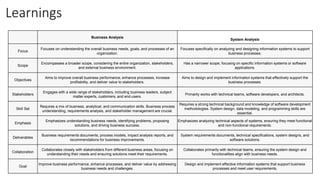
System Analysis
Focus
Focuses on understanding the overall business needs, goals, and processes of an
organization.
Focuses specifically on analyzing and designing information systems to support
business processes.
Scope
Encompasses a broader scope, considering the entire organization, stakeholders,
and external business environment.
Has a narrower scope, focusing on specific information systems or software
applications.
Objectives
Aims to improve overall business performance, enhance processes, increase
profitability, and deliver value to stakeholders.
Aims to design and implement information systems that effectively support the
business processes.
Stakeholders
Engages with a wide range of stakeholders, including business leaders, subject
matter experts, customers, and end-users.
Primarily works with technical teams, software developers, and architects.
Skill Set
Requires a mix of business, analytical, and communication skills. Business process
understanding, requirements analysis, and stakeholder management are crucial.
Requires a strong technical background and knowledge of software development
methodologies. System design, data modeling, and programming skills are
essential.
Emphasis
Emphasizes understanding business needs, identifying problems, proposing
solutions, and driving business success.
Emphasizes analyzing technical aspects of systems, ensuring they meet functional
and non-functional requirements.
Deliverables
Business requirements documents, process models, impact analysis reports, and
recommendations for business improvements.
System requirements documents, technical specifications, system designs, and
software solutions.
Collaboration
Collaborates closely with stakeholders from different business areas, focusing on
understanding their needs and ensuring solutions meet their requirements.
Collaborates primarily with technical teams, ensuring the system design and
functionalities align with business needs.
Goal
Improve business performance, enhance processes, and deliver value by addressing
business needs and challenges.
Design and implement effective information systems that support business
processes and meet user requirements.
Learnings
Learnings
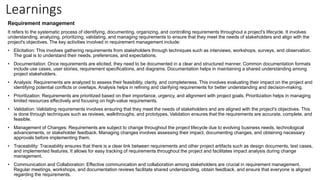
Requirement management
It refers to the systematic process of identifying, documenting, organizing, and controlling requirements throughout a project's lifecycle. It involves
understanding, analyzing, prioritizing, validating, and managing requirements to ensure that they meet the needs of stakeholders and align with the
project's objectives. The key activities involved in requirement management include:
• Elicitation: This involves gathering requirements from stakeholders through techniques such as interviews, workshops, surveys, and observation.
The goal is to understand their needs, preferences, and expectations.
• Documentation: Once requirements are elicited, they need to be documented in a clear and structured manner. Common documentation formats
include use cases, user stories, requirement specifications, and diagrams. Documentation helps in maintaining a shared understanding among
project stakeholders.
• Analysis: Requirements are analyzed to assess their feasibility, clarity, and completeness. This involves evaluating their impact on the project and
identifying potential conflicts or overlaps. Analysis helps in refining and clarifying requirements for better understanding and decision-making.
• Prioritization: Requirements are prioritized based on their importance, urgency, and alignment with project goals. Prioritization helps in managing
limited resources effectively and focusing on high-value requirements.
• Validation: Validating requirements involves ensuring that they meet the needs of stakeholders and are aligned with the project's objectives. This
is done through techniques such as reviews, walkthroughs, and prototypes. Validation ensures that the requirements are accurate, complete, and
feasible.
• Management of Changes: Requirements are subject to change throughout the project lifecycle due to evolving business needs, technological
advancements, or stakeholder feedback. Managing changes involves assessing their impact, documenting changes, and obtaining necessary
approvals before implementing them.
• Traceability: Traceability ensures that there is a clear link between requirements and other project artifacts such as design documents, test cases,
and implemented features. It allows for easy tracking of requirements throughout the project and facilitates impact analysis during change
management.
• Communication and Collaboration: Effective communication and collaboration among stakeholders are crucial in requirement management.
Regular meetings, workshops, and documentation reviews facilitate shared understanding, obtain feedback, and ensure that everyone is aligned
regarding the requirements.
The Paradoxical Manager
By Prof. Gabriel Banerjee
Learnings
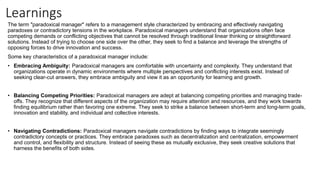
The term "paradoxical manager" refers to a management style characterized by embracing and effectively navigating
paradoxes or contradictory tensions in the workplace. Paradoxical managers understand that organizations often face
competing demands or conflicting objectives that cannot be resolved through traditional linear thinking or straightforward
solutions. Instead of trying to choose one side over the other, they seek to find a balance and leverage the strengths of
opposing forces to drive innovation and success.
Some key characteristics of a paradoxical manager include:
• Embracing Ambiguity: Paradoxical managers are comfortable with uncertainty and complexity. They understand that
organizations operate in dynamic environments where multiple perspectives and conflicting interests exist. Instead of
seeking clear-cut answers, they embrace ambiguity and view it as an opportunity for learning and growth.
• Balancing Competing Priorities: Paradoxical managers are adept at balancing competing priorities and managing trade-
offs. They recognize that different aspects of the organization may require attention and resources, and they work towards
finding equilibrium rather than favoring one extreme. They seek to strike a balance between short-term and long-term goals,
innovation and stability, and individual and collective interests.
• Navigating Contradictions: Paradoxical managers navigate contradictions by finding ways to integrate seemingly
contradictory concepts or practices. They embrace paradoxes such as decentralization and centralization, empowerment
and control, and flexibility and structure. Instead of seeing these as mutually exclusive, they seek creative solutions that
harness the benefits of both sides.
Learnings
• Facilitating Collaboration: Paradoxical managers foster a collaborative culture where diverse perspectives are welcomed
and valued. They create an environment where individuals and teams can openly discuss and explore different viewpoints
and find common ground. They encourage constructive dialogue, promote active listening, and facilitate collaboration
across departments or functions.
• Adaptive Leadership: Paradoxical managers demonstrate adaptive leadership by being flexible and responsive to
changing circumstances. They are open to experimentation, encourage learning from failures, and adapt their approaches
based on feedback and new insights. They understand that what works in one situation may not work in another and are
willing to adjust their strategies accordingly.
• Systems Thinking: Paradoxical managers adopt a systems thinking approach, considering the interconnectedness of
various elements within the organization. They recognize that decisions in one area can have ripple effects in other areas.
By understanding the broader context and relationships, they make informed decisions that minimize unintended
consequences and maximize overall organizational effectiveness.
Learnings
Example :
The paradoxical manager recognizes that the managerial dilemma presents an inherent tension between two opposing
options, and rather than choosing one over the other, they seek to find a way to embrace and leverage both sides of the
dilemma. They understand that by effectively managing paradoxes, they can achieve better outcomes and create a more
balanced approach to decision-making.
For example, a common managerial dilemma is the need to balance short-term results with long-term sustainability. A
paradoxical manager would avoid a rigid focus solely on short-term gains or long-term planning and instead seek ways to
integrate both perspectives. They would explore strategies that deliver immediate results while also considering the long-term
implications and sustainability of those actions.
In another example, the dilemma of centralization versus decentralization in decision-making can create tension within an
organization. A paradoxical manager would not opt for extreme centralization or complete decentralization. Instead, they would
find ways to strike a balance by empowering teams and individuals while maintaining overall coordination and alignment.
The paradoxical manager's ability to manage conflicting demands allows them to embrace complexity, think systemically, and
find innovative solutions to navigate through the managerial dilemma. They create an environment that encourages
collaboration, open communication, and shared decision-making, enabling the organization to adapt and thrive in the face of
challenging dilemmas.
Overall, a paradoxical manager acknowledges and embraces the inherent tensions in managerial dilemmas, seeks creative
and balanced solutions, and leverages the strengths of opposing forces to achieve better outcomes for the organization.
6 Thinking Hats
By Prof. Gaurang Chandarana
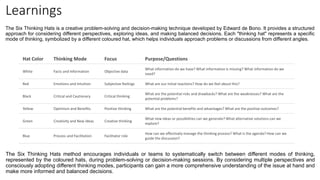
The Six Thinking Hats is a creative problem-solving and decision-making technique developed by Edward de Bono. It provides a structured
approach for considering different perspectives, exploring ideas, and making balanced decisions. Each "thinking hat" represents a specific
mode of thinking, symbolized by a different coloured hat, which helps individuals approach problems or discussions from different angles.
Hat Color Thinking Mode Focus Purpose/Questions
White Facts and Information Objective data
What information do we have? What information is missing? What information do we
need?
Red Emotions and Intuition Subjective feelings What are our initial reactions? How do we feel about this?
Black Critical and Cautionary Critical thinking
What are the potential risks and drawbacks? What are the weaknesses? What are the
potential problems?
Yellow Optimism and Benefits Positive thinking What are the potential benefits and advantages? What are the positive outcomes?
Green Creativity and New Ideas Creative thinking
What new ideas or possibilities can we generate? What alternative solutions can we
explore?
Blue Process and Facilitation Facilitator role
How can we effectively manage the thinking process? What is the agenda? How can we
guide the discussion?
Learnings
The Six Thinking Hats method encourages individuals or teams to systematically switch between different modes of thinking,
represented by the coloured hats, during problem-solving or decision-making sessions. By considering multiple perspectives and
consciously adopting different thinking modes, participants can gain a more comprehensive understanding of the issue at hand and
make more informed and balanced decisions.
Balanced Scorecard
By Prof. Ramchandra Nadkarni
Learnings
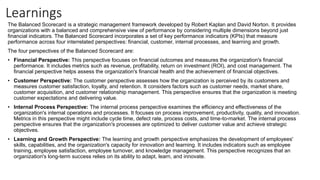
The Balanced Scorecard is a strategic management framework developed by Robert Kaplan and David Norton. It provides
organizations with a balanced and comprehensive view of performance by considering multiple dimensions beyond just
financial indicators. The Balanced Scorecard incorporates a set of key performance indicators (KPIs) that measure
performance across four interrelated perspectives: financial, customer, internal processes, and learning and growth.
The four perspectives of the Balanced Scorecard are:
• Financial Perspective: This perspective focuses on financial outcomes and measures the organization's financial
performance. It includes metrics such as revenue, profitability, return on investment (ROI), and cost management. The
financial perspective helps assess the organization's financial health and the achievement of financial objectives.
• Customer Perspective: The customer perspective assesses how the organization is perceived by its customers and
measures customer satisfaction, loyalty, and retention. It considers factors such as customer needs, market share,
customer acquisition, and customer relationship management. This perspective ensures that the organization is meeting
customer expectations and delivering value.
• Internal Process Perspective: The internal process perspective examines the efficiency and effectiveness of the
organization's internal operations and processes. It focuses on process improvement, productivity, quality, and innovation.
Metrics in this perspective might include cycle time, defect rate, process costs, and time-to-market. The internal process
perspective ensures that the organization's processes are optimized to deliver customer value and achieve strategic
objectives.
• Learning and Growth Perspective: The learning and growth perspective emphasizes the development of employees'
skills, capabilities, and the organization's capacity for innovation and learning. It includes indicators such as employee
training, employee satisfaction, employee turnover, and knowledge management. This perspective recognizes that an
organization's long-term success relies on its ability to adapt, learn, and innovate.
Learnings
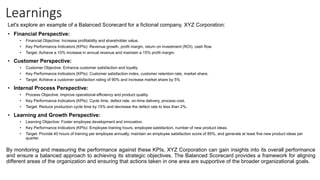
Let's explore an example of a Balanced Scorecard for a fictional company, XYZ Corporation:
• Financial Perspective:
• Financial Objective: Increase profitability and shareholder value.
• Key Performance Indicators (KPIs): Revenue growth, profit margin, return on investment (ROI), cash flow.
• Target: Achieve a 10% increase in annual revenue and maintain a 15% profit margin.
• Customer Perspective:
• Customer Objective: Enhance customer satisfaction and loyalty.
• Key Performance Indicators (KPIs): Customer satisfaction index, customer retention rate, market share.
• Target: Achieve a customer satisfaction rating of 90% and increase market share by 5%
• Internal Process Perspective:
• Process Objective: Improve operational efficiency and product quality.
• Key Performance Indicators (KPIs): Cycle time, defect rate, on-time delivery, process cost.
• Target: Reduce production cycle time by 15% and decrease the defect rate to less than 2%.
• Learning and Growth Perspective:
• Learning Objective: Foster employee development and innovation.
• Key Performance Indicators (KPIs): Employee training hours, employee satisfaction, number of new product ideas.
• Target: Provide 40 hours of training per employee annually, maintain an employee satisfaction score of 85%, and generate at least five new product ideas per
quarter.
By monitoring and measuring the performance against these KPIs, XYZ Corporation can gain insights into its overall performance
and ensure a balanced approach to achieving its strategic objectives. The Balanced Scorecard provides a framework for aligning
different areas of the organization and ensuring that actions taken in one area are supportive of the broader organizational goals.

Agile Project Methodology.pptx

  • 1.
    Agile Project Methodology ByProf. Prasad Jaywant
  • 2.
    Learnings 1. Introduction toAgile Agile is a set of principles and values that guide a flexible and collaborative approach to software development. It emphasizes adaptability, customer collaboration, and iterative development to deliver high-quality software efficiently. Unlike traditional waterfall methodologies, Agile embraces change and encourages continuous improvement. 2. The Agile Manifesto The Agile Manifesto was created in 2001 by a group of software development practitioners who identified four core values that guide Agile methodologies: a) Individuals and interactions over processes and tools: Valuing people and effective communication within the team is prioritized over relying solely on processes and tools. b) Working software over comprehensive documentation: The focus is on delivering working software as the primary measure of progress, while recognizing the importance of documentation. c) Customer collaboration over contract negotiation: Active involvement and collaboration with customers throughout the development process are emphasized over strict contract negotiations. d) Responding to change over following a plan: Embracing change and adapting quickly to new requirements and feedback is favoured over strictly adhering to a predefined plan.
  • 3.
    Learnings 3. Why Agile Agilemethodologies offer several benefits, including: a) Flexibility and Adaptability: Agile enables teams to respond quickly to changing requirements and market dynamics, allowing for greater flexibility and adaptability. b) Faster Time to Market: By delivering working software in shorter iterations, Agile methodologies accelerate the time to market and provide a competitive advantage. c) Customer Satisfaction: Active customer involvement and continuous feedback help ensure that the final product meets customer expectations, leading to increased satisfaction. d) Collaboration and Communication: Agile fosters collaboration and communication among team members, stakeholders, and customers, enhancing productivity and reducing misunderstandings.
  • 4.
    Learnings 4. Scrum: AnAgile Framework Scrum is one of the most popular Agile frameworks. It follows a set of defined roles, events, and artifacts to facilitate the development process: a) Roles in Scrum: Scrum Master: Facilitates the Scrum process, removes impediments, and ensures adherence to Scrum principles. Product Owner: Represents the customer and defines and prioritizes the product backlog. Development Team: Cross-functional team responsible for delivering the working software. b) Scrum Events: Sprint Planning: Determines the work to be done in the upcoming sprint. Daily Scrum: Daily stand-up meetings for the team to synchronize activities. Sprint Review: Demonstrates the completed work to stakeholders and gathers feedback. Sprint Retrospective: Reflects on the previous sprint and identifies areas for improvement. c) Scrum Artifacts: Product Backlog: Prioritized list of requirements or features. Sprint Backlog: Subset of the product backlog items selected for the current sprint. Increment: The sum of all completed and tested product backlog items at the end of a sprint. Scrum provides a framework for effective collaboration, transparency, and delivering value incrementally.
  • 5.
  • 6.
    Learnings 1. Introduction toBusiness Analysis Business analysis is a discipline that focuses on understanding business needs, identifying problems, and proposing effective solutions to drive organizational success. It involves the use of various techniques and tools to analyse and document business processes, requirements, and objectives. 2. Skills and Competencies of a Business Analyst To excel in their role, business analysts require a diverse skill set that includes:  Analytical Thinking: The ability to break down complex problems, identify patterns, and develop logical solutions.  Communication and Facilitation: Strong verbal and written communication skills to effectively engage stakeholders and facilitate collaboration.  Domain Knowledge: Understanding of the industry or domain in which the organization operates to provide relevant insights and recommendations.  Technical Proficiency: Familiarity with technology trends and tools to effectively collaborate with IT teams and translate business requirements into technical specifications.  Business Process Management: Knowledge of process modeling and improvement techniques to streamline operations and drive efficiency.  Problem-Solving: The ability to identify root causes of business challenges and propose effective solutions.  Adaptability: Business analysts need to be flexible and open to change, as they often work in dynamic environments.
  • 7.
    Business Analysis System Analysis Focus Focuseson understanding the overall business needs, goals, and processes of an organization. Focuses specifically on analyzing and designing information systems to support business processes. Scope Encompasses a broader scope, considering the entire organization, stakeholders, and external business environment. Has a narrower scope, focusing on specific information systems or software applications. Objectives Aims to improve overall business performance, enhance processes, increase profitability, and deliver value to stakeholders. Aims to design and implement information systems that effectively support the business processes. Stakeholders Engages with a wide range of stakeholders, including business leaders, subject matter experts, customers, and end-users. Primarily works with technical teams, software developers, and architects. Skill Set Requires a mix of business, analytical, and communication skills. Business process understanding, requirements analysis, and stakeholder management are crucial. Requires a strong technical background and knowledge of software development methodologies. System design, data modeling, and programming skills are essential. Emphasis Emphasizes understanding business needs, identifying problems, proposing solutions, and driving business success. Emphasizes analyzing technical aspects of systems, ensuring they meet functional and non-functional requirements. Deliverables Business requirements documents, process models, impact analysis reports, and recommendations for business improvements. System requirements documents, technical specifications, system designs, and software solutions. Collaboration Collaborates closely with stakeholders from different business areas, focusing on understanding their needs and ensuring solutions meet their requirements. Collaborates primarily with technical teams, ensuring the system design and functionalities align with business needs. Goal Improve business performance, enhance processes, and deliver value by addressing business needs and challenges. Design and implement effective information systems that support business processes and meet user requirements. Learnings
  • 8.
    Learnings Requirement management It refersto the systematic process of identifying, documenting, organizing, and controlling requirements throughout a project's lifecycle. It involves understanding, analyzing, prioritizing, validating, and managing requirements to ensure that they meet the needs of stakeholders and align with the project's objectives. The key activities involved in requirement management include: • Elicitation: This involves gathering requirements from stakeholders through techniques such as interviews, workshops, surveys, and observation. The goal is to understand their needs, preferences, and expectations. • Documentation: Once requirements are elicited, they need to be documented in a clear and structured manner. Common documentation formats include use cases, user stories, requirement specifications, and diagrams. Documentation helps in maintaining a shared understanding among project stakeholders. • Analysis: Requirements are analyzed to assess their feasibility, clarity, and completeness. This involves evaluating their impact on the project and identifying potential conflicts or overlaps. Analysis helps in refining and clarifying requirements for better understanding and decision-making. • Prioritization: Requirements are prioritized based on their importance, urgency, and alignment with project goals. Prioritization helps in managing limited resources effectively and focusing on high-value requirements. • Validation: Validating requirements involves ensuring that they meet the needs of stakeholders and are aligned with the project's objectives. This is done through techniques such as reviews, walkthroughs, and prototypes. Validation ensures that the requirements are accurate, complete, and feasible. • Management of Changes: Requirements are subject to change throughout the project lifecycle due to evolving business needs, technological advancements, or stakeholder feedback. Managing changes involves assessing their impact, documenting changes, and obtaining necessary approvals before implementing them. • Traceability: Traceability ensures that there is a clear link between requirements and other project artifacts such as design documents, test cases, and implemented features. It allows for easy tracking of requirements throughout the project and facilitates impact analysis during change management. • Communication and Collaboration: Effective communication and collaboration among stakeholders are crucial in requirement management. Regular meetings, workshops, and documentation reviews facilitate shared understanding, obtain feedback, and ensure that everyone is aligned regarding the requirements.
  • 9.
    The Paradoxical Manager ByProf. Gabriel Banerjee
  • 10.
    Learnings The term "paradoxicalmanager" refers to a management style characterized by embracing and effectively navigating paradoxes or contradictory tensions in the workplace. Paradoxical managers understand that organizations often face competing demands or conflicting objectives that cannot be resolved through traditional linear thinking or straightforward solutions. Instead of trying to choose one side over the other, they seek to find a balance and leverage the strengths of opposing forces to drive innovation and success. Some key characteristics of a paradoxical manager include: • Embracing Ambiguity: Paradoxical managers are comfortable with uncertainty and complexity. They understand that organizations operate in dynamic environments where multiple perspectives and conflicting interests exist. Instead of seeking clear-cut answers, they embrace ambiguity and view it as an opportunity for learning and growth. • Balancing Competing Priorities: Paradoxical managers are adept at balancing competing priorities and managing trade- offs. They recognize that different aspects of the organization may require attention and resources, and they work towards finding equilibrium rather than favoring one extreme. They seek to strike a balance between short-term and long-term goals, innovation and stability, and individual and collective interests. • Navigating Contradictions: Paradoxical managers navigate contradictions by finding ways to integrate seemingly contradictory concepts or practices. They embrace paradoxes such as decentralization and centralization, empowerment and control, and flexibility and structure. Instead of seeing these as mutually exclusive, they seek creative solutions that harness the benefits of both sides.
  • 11.
    Learnings • Facilitating Collaboration:Paradoxical managers foster a collaborative culture where diverse perspectives are welcomed and valued. They create an environment where individuals and teams can openly discuss and explore different viewpoints and find common ground. They encourage constructive dialogue, promote active listening, and facilitate collaboration across departments or functions. • Adaptive Leadership: Paradoxical managers demonstrate adaptive leadership by being flexible and responsive to changing circumstances. They are open to experimentation, encourage learning from failures, and adapt their approaches based on feedback and new insights. They understand that what works in one situation may not work in another and are willing to adjust their strategies accordingly. • Systems Thinking: Paradoxical managers adopt a systems thinking approach, considering the interconnectedness of various elements within the organization. They recognize that decisions in one area can have ripple effects in other areas. By understanding the broader context and relationships, they make informed decisions that minimize unintended consequences and maximize overall organizational effectiveness.
  • 12.
    Learnings Example : The paradoxicalmanager recognizes that the managerial dilemma presents an inherent tension between two opposing options, and rather than choosing one over the other, they seek to find a way to embrace and leverage both sides of the dilemma. They understand that by effectively managing paradoxes, they can achieve better outcomes and create a more balanced approach to decision-making. For example, a common managerial dilemma is the need to balance short-term results with long-term sustainability. A paradoxical manager would avoid a rigid focus solely on short-term gains or long-term planning and instead seek ways to integrate both perspectives. They would explore strategies that deliver immediate results while also considering the long-term implications and sustainability of those actions. In another example, the dilemma of centralization versus decentralization in decision-making can create tension within an organization. A paradoxical manager would not opt for extreme centralization or complete decentralization. Instead, they would find ways to strike a balance by empowering teams and individuals while maintaining overall coordination and alignment. The paradoxical manager's ability to manage conflicting demands allows them to embrace complexity, think systemically, and find innovative solutions to navigate through the managerial dilemma. They create an environment that encourages collaboration, open communication, and shared decision-making, enabling the organization to adapt and thrive in the face of challenging dilemmas. Overall, a paradoxical manager acknowledges and embraces the inherent tensions in managerial dilemmas, seeks creative and balanced solutions, and leverages the strengths of opposing forces to achieve better outcomes for the organization.
  • 13.
    6 Thinking Hats ByProf. Gaurang Chandarana
  • 14.
    The Six ThinkingHats is a creative problem-solving and decision-making technique developed by Edward de Bono. It provides a structured approach for considering different perspectives, exploring ideas, and making balanced decisions. Each "thinking hat" represents a specific mode of thinking, symbolized by a different coloured hat, which helps individuals approach problems or discussions from different angles. Hat Color Thinking Mode Focus Purpose/Questions White Facts and Information Objective data What information do we have? What information is missing? What information do we need? Red Emotions and Intuition Subjective feelings What are our initial reactions? How do we feel about this? Black Critical and Cautionary Critical thinking What are the potential risks and drawbacks? What are the weaknesses? What are the potential problems? Yellow Optimism and Benefits Positive thinking What are the potential benefits and advantages? What are the positive outcomes? Green Creativity and New Ideas Creative thinking What new ideas or possibilities can we generate? What alternative solutions can we explore? Blue Process and Facilitation Facilitator role How can we effectively manage the thinking process? What is the agenda? How can we guide the discussion? Learnings The Six Thinking Hats method encourages individuals or teams to systematically switch between different modes of thinking, represented by the coloured hats, during problem-solving or decision-making sessions. By considering multiple perspectives and consciously adopting different thinking modes, participants can gain a more comprehensive understanding of the issue at hand and make more informed and balanced decisions.
  • 15.
    Balanced Scorecard By Prof.Ramchandra Nadkarni
  • 16.
    Learnings The Balanced Scorecardis a strategic management framework developed by Robert Kaplan and David Norton. It provides organizations with a balanced and comprehensive view of performance by considering multiple dimensions beyond just financial indicators. The Balanced Scorecard incorporates a set of key performance indicators (KPIs) that measure performance across four interrelated perspectives: financial, customer, internal processes, and learning and growth. The four perspectives of the Balanced Scorecard are: • Financial Perspective: This perspective focuses on financial outcomes and measures the organization's financial performance. It includes metrics such as revenue, profitability, return on investment (ROI), and cost management. The financial perspective helps assess the organization's financial health and the achievement of financial objectives. • Customer Perspective: The customer perspective assesses how the organization is perceived by its customers and measures customer satisfaction, loyalty, and retention. It considers factors such as customer needs, market share, customer acquisition, and customer relationship management. This perspective ensures that the organization is meeting customer expectations and delivering value. • Internal Process Perspective: The internal process perspective examines the efficiency and effectiveness of the organization's internal operations and processes. It focuses on process improvement, productivity, quality, and innovation. Metrics in this perspective might include cycle time, defect rate, process costs, and time-to-market. The internal process perspective ensures that the organization's processes are optimized to deliver customer value and achieve strategic objectives. • Learning and Growth Perspective: The learning and growth perspective emphasizes the development of employees' skills, capabilities, and the organization's capacity for innovation and learning. It includes indicators such as employee training, employee satisfaction, employee turnover, and knowledge management. This perspective recognizes that an organization's long-term success relies on its ability to adapt, learn, and innovate.
  • 17.
    Learnings Let's explore anexample of a Balanced Scorecard for a fictional company, XYZ Corporation: • Financial Perspective: • Financial Objective: Increase profitability and shareholder value. • Key Performance Indicators (KPIs): Revenue growth, profit margin, return on investment (ROI), cash flow. • Target: Achieve a 10% increase in annual revenue and maintain a 15% profit margin. • Customer Perspective: • Customer Objective: Enhance customer satisfaction and loyalty. • Key Performance Indicators (KPIs): Customer satisfaction index, customer retention rate, market share. • Target: Achieve a customer satisfaction rating of 90% and increase market share by 5% • Internal Process Perspective: • Process Objective: Improve operational efficiency and product quality. • Key Performance Indicators (KPIs): Cycle time, defect rate, on-time delivery, process cost. • Target: Reduce production cycle time by 15% and decrease the defect rate to less than 2%. • Learning and Growth Perspective: • Learning Objective: Foster employee development and innovation. • Key Performance Indicators (KPIs): Employee training hours, employee satisfaction, number of new product ideas. • Target: Provide 40 hours of training per employee annually, maintain an employee satisfaction score of 85%, and generate at least five new product ideas per quarter. By monitoring and measuring the performance against these KPIs, XYZ Corporation can gain insights into its overall performance and ensure a balanced approach to achieving its strategic objectives. The Balanced Scorecard provides a framework for aligning different areas of the organization and ensuring that actions taken in one area are supportive of the broader organizational goals.